Daily AI Digest — 2026-10-28
arXiv Highlights
h1: A Taste of the Bitter Lesson in Automated Theorem Proving
Formal theorem proving in Lean has, over the last two years, accreted elaborate scaffolding around LLMs: decomposition into subgoals, planners, specialized provers, best-first search over tactic trees, and multi-agent orchestration (AlphaProof, Goedel-Architect, DM prover agent). Each new system reports gains, but the gains are typically confounded with model upgrades and larger inference budgets. The paper asks the bitter-lesson question directly: does any of this structure survive once you give a frontier model a competent Lean interface and simply let it iterate against the verifier?
Setup
h1 is deliberately minimal. The agent edits a single persistent Lean 4 file that pre-imports all of Mathlib, receives compiler feedback after every edit, and has access to library search tools, a Lean REPL, and the language server. There is no planner, no subgoal decomposition, no proof-tree search. The outer loop is: edit → compile → read feedback → optionally reflect (compact context) → repeat, until either a SafeVerify-clean proof is produced or the budget is exhausted. Evaluation uses pass@1 — a single attempt per problem — with test-time compute varied by raising the per-problem dollar cap.
Benchmarks span competition math (PutnamBench, Putnam100, IMO 2026, FATE-X) and research math (FormalConjectures100-Solved, FormalQualBench, open Erdős problems).
Results
With GPT-5.6 Sol, h1 reports 90/100 on FATE-X, 78/100 on FC100-solved, 14/23 on FormalQualBench, and 6/6 on IMO 2026. With GPT-5.5 it solves 670/672 on PutnamBench. These are single-run numbers.
The headline comparisons are at matched models and matched budgets:
- Gemini 3.1 Pro in h1 reaches the DM prover agent’s 66 FC100-solved at a $25/problem cap vs. the agent’s $100 cap, and 73 at $150.
- DeepSeek V4 Flash in h1 solves 43 FATE-X problems at $14.35/problem, exceeding Leanstral 1.5’s published 34; it matches AlphaProof’s 50 FC100 solves under ~$0.30/problem and reaches 64 at $4.89.
- Across generations, GPT-5.6 Sol matches 66 FC100 solves below $9 and 90 FATE-X at $38, versus Gemini 3.1 Pro at $25 and $113 respectively — the training-compute gains transfer cleanly into the fixed harness.
Individual accepted attempts stretch to 1,123 reflection rounds, 95 active hours, and 7,124 lines of proof, which is a useful calibration for what “test-time compute” means here: the model is genuinely working, not just resampling.
Why the harness still matters
The paper is careful not to claim the loop is irrelevant. With the same model, different simple loops differ several-fold in solve rate and cost, and the ablations isolate what matters.
Interface granularity. AxProverBase regenerates the entire proof after each round of tool feedback; h1 edits incrementally with feedback after every edit. With Gemini 3 Flash and a $20 cap on Putnam100, AxProverBase solves 18 vs. h1’s 69. A structural failure mode: 42.2% of AxProverBase’s failed compilations die at invalid library imports, which h1 eliminates by construction (file pre-imports all of Mathlib).
Retrieval conditioned on persistence. Library search was reported as the least useful component in AxProverBase; in h1 it is central. Stripping search tools, the REPL, and the language server drops h1 from 69 to 49 on Putnam100 and from 63 to 49 on FATE-X. Any single search tool or the REPL recovers most of the gap, and removing any one tool from the full set costs at most four solves. The claim is that look-up-and-check is a capability, not a specific tool.
Persistence vs. restart. Humanfia restarts its coding agent each round, carrying only the proof file and reviewer feedback; with GPT-5.5 it spends 5× more than h1 for the same 670 PutnamBench solves.
Prompting and reflection cadence. On six open Erdős problems with Gemini 3.1 Pro at $150/attempt, one attempt with detailed prover and reflection prompts (that explicitly deflect giving up and placeholder “cheating”) outperforms six attempts with brief prompts. Turns-between-reflections shows an interior optimum: both frequent and rare compaction underperform a moderate cadence on Putnam100 and FATE-X.
Scaling behavior
A striking qualitative finding: on open research problems, extending a single long attempt is often more sample-efficient than repeating shorter attempts. This runs against the standard pass@k lore and suggests that in domains with a persistent verifiable state, the marginal value of continued context (partial proofs, tried lemmas, failed tactics) exceeds the diversity benefit of restarts. The authors report settling eight previously open FormalConjectures.
Limitations and open questions
The paper does not establish that structured workflows cannot help; it establishes that in reported comparisons they are not necessary and often not cost-competitive. Several caveats: the DM prover agent’s underlying model is inferred, not disclosed; dollar-cap comparisons depend on API pricing snapshots; and the Mathlib-preimport trick, while clean, is specific to Lean + Mathlib’s dependency structure and may not transfer directly to other formal systems or large codebases. Whether the “single long attempt beats repetition” result holds for problems requiring genuinely novel mathematical content, as opposed to Mathlib-assembly, remains open.
Why this matters
h1 is a clean bitter-lesson datapoint for verifier-grounded agents: once the interface is efficient and the agent can persist, retrieve, and check, prescribed workflows mostly re-derive what the model would do on its own, at higher cost. The transferable lessons — persistent workspace, small-step feedback, retrieval conditioned on persistence, robust failure handling — are the right default template for software verification and large-codebase coding agents.
Source: https://arxiv.org/abs/2610.35962
Can Discrete Tokens Serve as Semantically Lossless Representations of Visual Signals?
Discrete visual tokenization is attractive for multimodal modeling because it unifies vision and language under a single next-token prediction objective, avoids modality-specific projection heads, and permits visual chains of thought over a shared vocabulary. The dominant objection has been information-theoretic: vector quantization introduces reconstruction error, and this error is presumed to upper-bound semantic fidelity, placing continuous features as a hard ceiling. This paper rejects that framing empirically and then proposes a quantizer design that matches continuous features on multimodal understanding.
Quantization error is not the right proxy
The authors measure feature-reconstruction MSE on ImageNet and multimodal understanding on eight benchmarks for discrete variants of QwenViT features. They compare single-codebook VQ against 8-group RVQ, and against two “partial” RVQ representations formed by keeping only odd-indexed or only even-indexed groups.
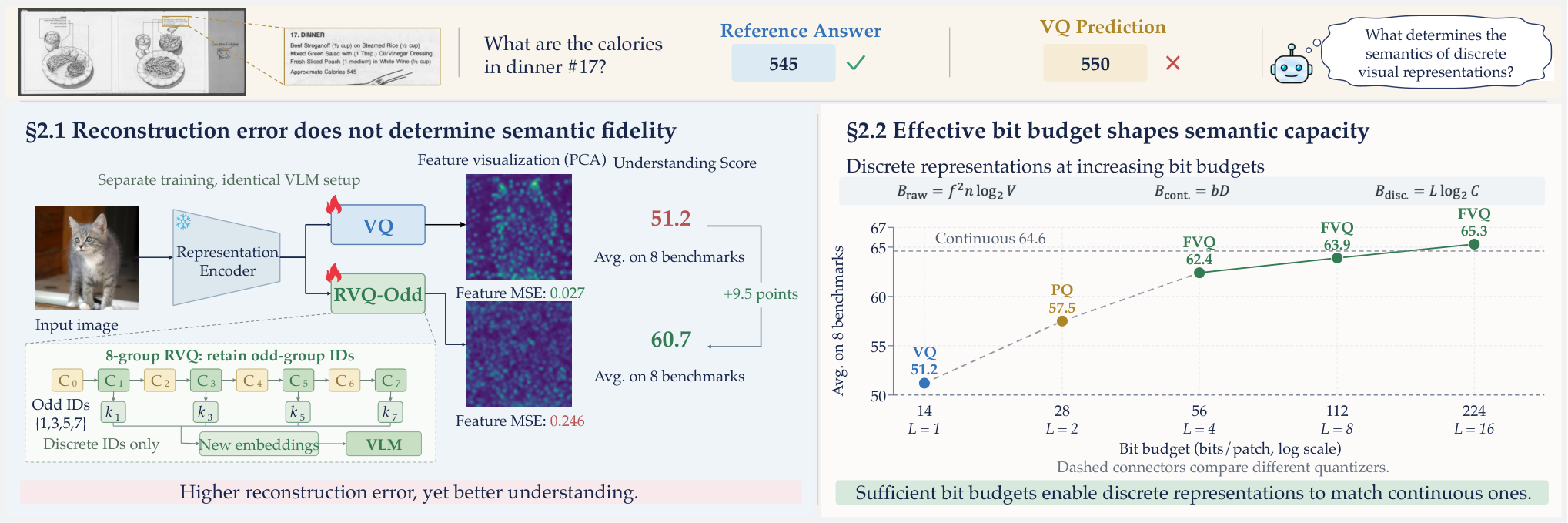
The results invert the standard intuition. VQ (C\times L = 16{,}384\times 1) achieves MSE 0.027 and average score 51.2. RVQ (Even), which retains the fine groups and has MSE 0.028 — essentially identical to VQ — scores 59.3. RVQ (Odd), which drops the coarse group 0 and incurs nearly an order of magnitude more error (MSE 0.246), still scores 60.7, slightly higher than Even. Full 8-group RVQ reaches 64.0 at MSE 0.016. Two representations with near-identical MSE differ by 8 points on average understanding, while two representations differing by $10$ in MSE are statistically tied. The downstream VLM consumes indices, not reconstructed features, so reconstruction fidelity in feature space is simply the wrong objective to optimize or diagnose.
The quantity that does track performance is the effective per-patch bit budget B_{\text{disc}} = L \log_2 C realized in the indices actually consumed by the LLM. But existing multi-codebook schemes saturate: RVQ’s residual structure makes successive codebooks encode progressively finer and less semantically useful residuals, and sequential codebooks share correlated views of the same feature, so additional capacity contributes diminishing semantic information.
Factorized Vector Quantization
The design principles the authors extract are symmetry across codebooks, fixed-dimensional views of the full feature for each codebook, and information-preserving synthesis. FVQ instantiates these with dense tight-frame projections feeding L parallel independent codebooks.
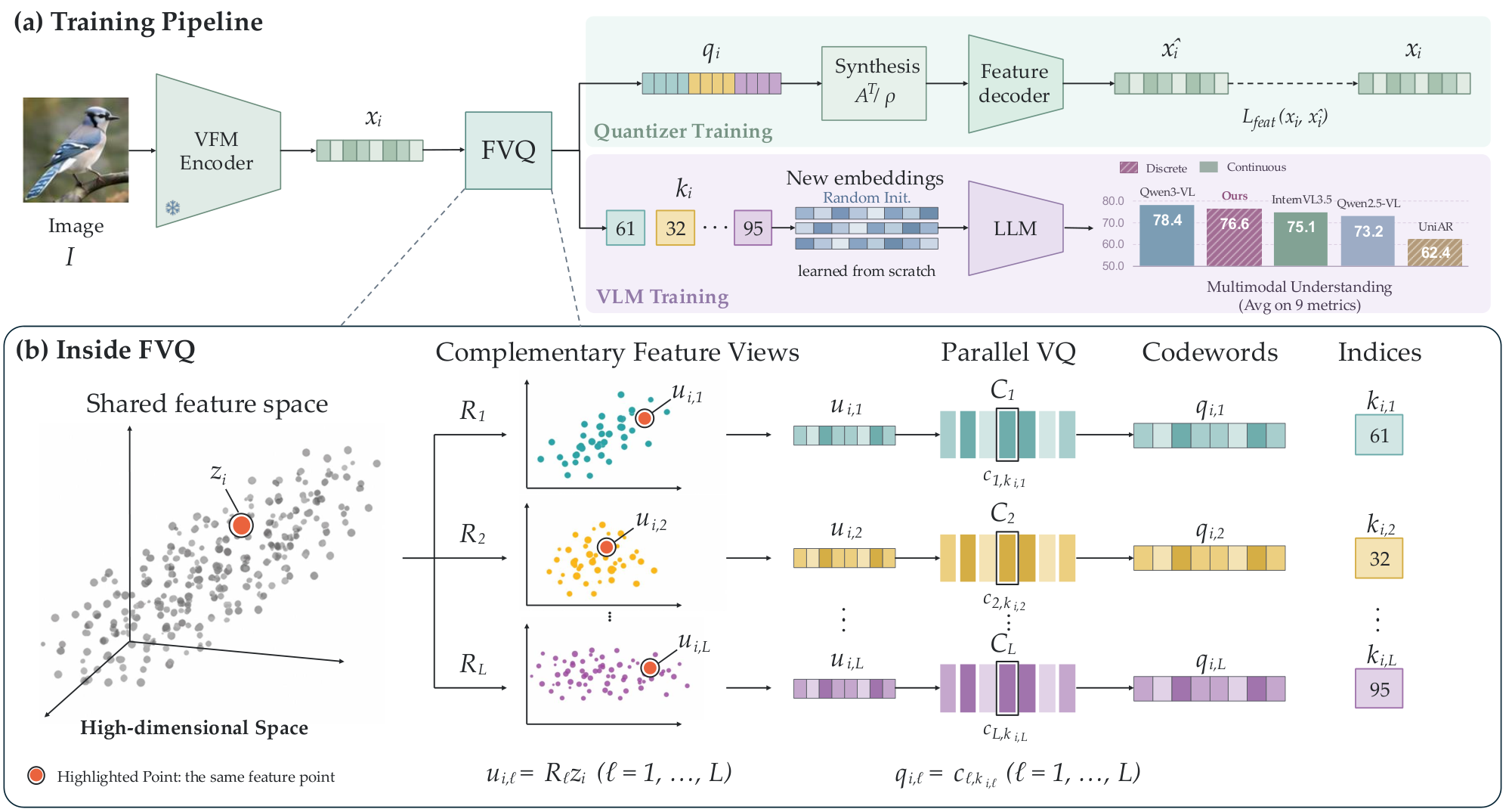
Given a visual feature x \in \mathbb{R}^D, FVQ applies L dense projection matrices \{A_\ell\}_{\ell=1}^L (together forming a tight frame, so \sum_\ell A_\ell^\top A_\ell = I up to scaling) to produce complementary views v_\ell = A_\ell x \in \mathbb{R}^{d} at a fixed dimension d. Each v_\ell is quantized independently against its own codebook \mathcal{C}_\ell of size C: \hat v_\ell = \arg\min_{c \in \mathcal{C}_\ell} \|v_\ell - c\|_2^2. Reconstruction uses the dual-frame synthesis \hat x = \sum_\ell A_\ell^\top \hat v_\ell, which recovers x exactly if the \hat v_\ell equal the v_\ell. Because every codebook sees a full-feature view at the same dimensionality, no codebook is relegated to residual roles, and the bit budget L \log_2 C translates more directly into usable semantic bits.
For VLM training the quantizer is frozen; only the L discrete indices per patch are passed to a newly initialized set of token embeddings, which the LLM consumes as ordinary tokens. The main model couples a 16-codebook FVQ tokenizer on Qwen3 ViT with Qwen3-8B, uses standard 1D RoPE, and drops Qwen3 ViT’s DeepStack connections to maintain a clean next-token prediction interface.
Scaling results
The headline is that FVQ keeps improving as the per-patch bit budget grows, while VQ, RVQ, FSQ-style baselines, and related multi-codebook schemes plateau.
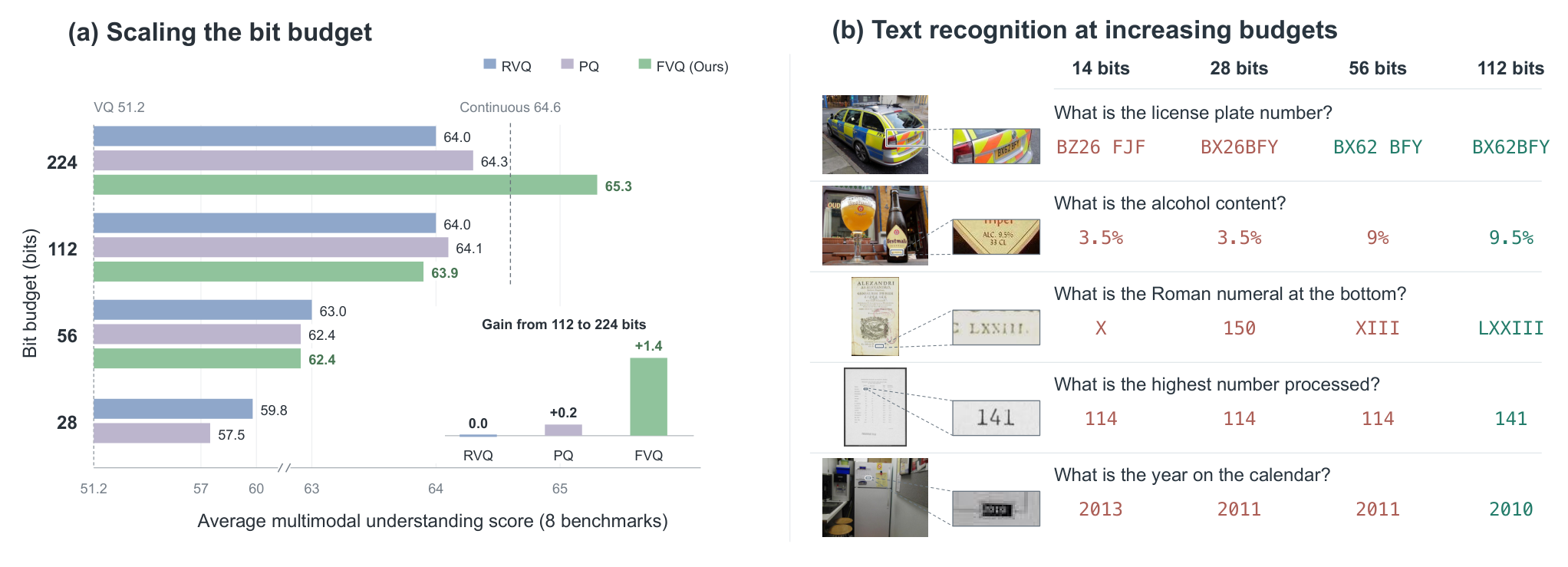
At high budgets, FVQ with 16 codebooks matches the continuous QwenViT representation on the nine-metric average (MMMU, MathVista, MMStar, OCRBench/10, ChartQA, CharXiv-DQ, CharXiv-RQ, DocVQA, InfoVQA), while existing quantizers remain visibly below. Qualitative OCR examples in Figure 1(b) show text transcription accuracy improving monotonically with budget — important because OCR is the task where discrete tokens historically lose most against continuous features.
Limitations and open questions
Several things are left implicit. First, the “semantically lossless” claim is anchored to the nine understanding benchmarks; generative or dense-prediction tasks are not evaluated, and tight-frame synthesis preserves information about x only before quantization. Second, token-sequence length grows linearly in L, so matching the continuous ceiling at L=16 implies 16 tokens per patch in the LLM context — a significant inference-time cost not analyzed here. Third, the paper does not characterize how the projection matrices A_\ell should be initialized or whether learned frames deviate meaningfully from random tight frames. Finally, the analysis is conducted at a fixed ViT backbone (QwenViT); whether the saturation of RVQ-style quantizers is a function of the backbone’s feature geometry rather than the quantizer per se is not isolated.
Why this matters
If discrete visual tokens can match continuous features on understanding, the main architectural argument for keeping vision outside the next-token loop collapses, and unified autoregressive multimodal models become a defensible default rather than a compromise. The paper also reframes quantizer design: optimize the information content of indices under symmetric, parallel codebooks, not reconstruction MSE.
Source: https://arxiv.org/abs/2610.37662
Rollback: Experience Backtracking in World Models for Policy Improvement
Problem
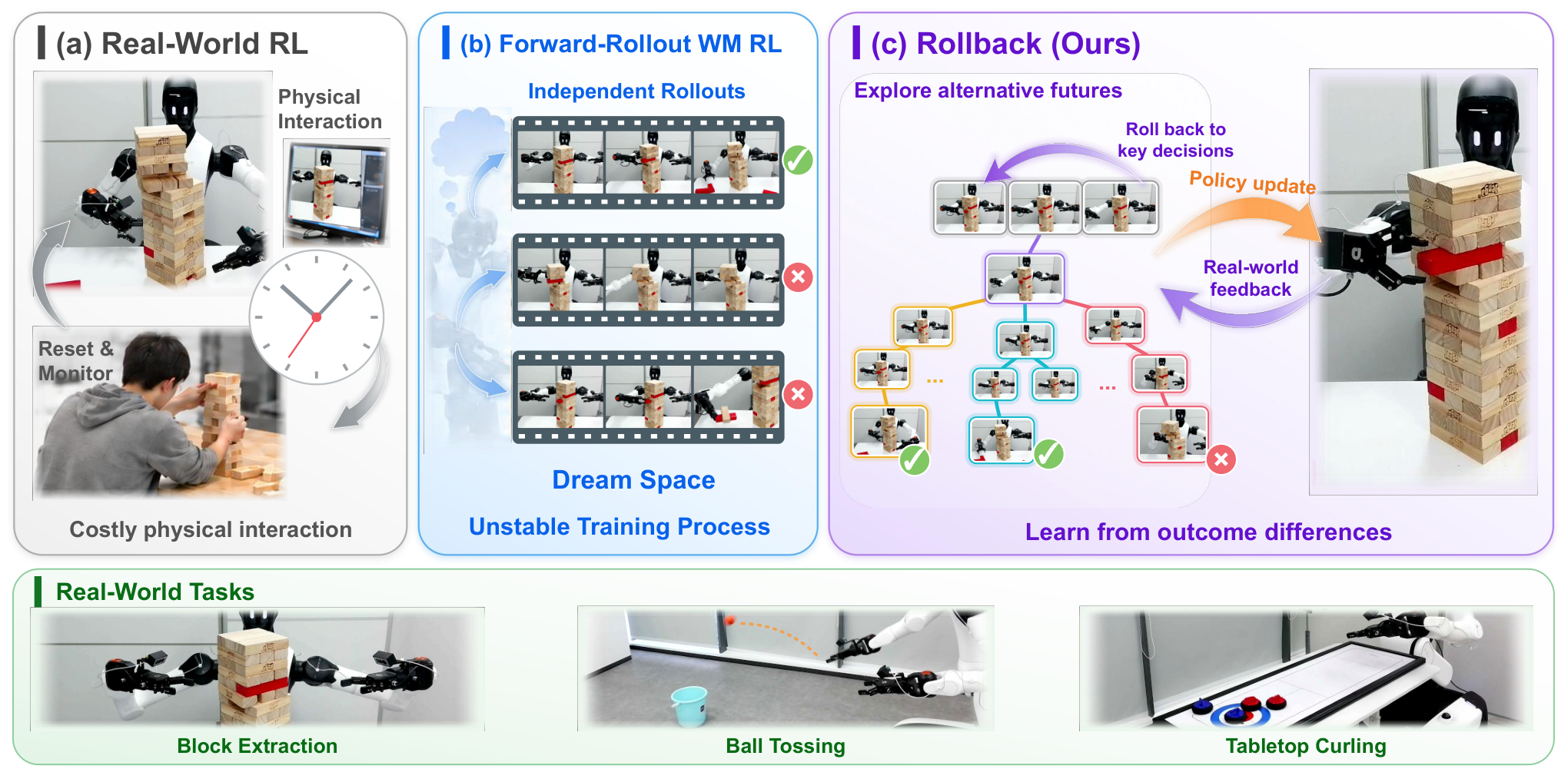
Action-conditioned video world models are typically used as forward-only simulators: a policy rolls out, a reward is computed, and the policy is updated. This wastes two things physical environments cannot provide but learned models can — the ability to rewind to a specific decision point and the ability to replay the same prefix under a different action. Independent rollouts spend most of their imagination budget regenerating identical prefixes, and provide no clean counterfactual at the decision points that actually determine success or failure. Rollback reframes world models as counterfactual engines, where branching at critical decisions yields action-level credit assignment without a learned value function.
Method
Rollback follows an AlphaGo/Expert Iteration search-and-distill template, but search runs inside GE-Sim 2.0, a video world model that jointly predicts three camera views and the robot’s proprioceptive state (7 arm joints + 1 gripper per arm, 16 action dimensions total at 30 Hz). The proprioceptive head matters: pure image prediction is too coarse for contact timing and gripper release in tasks like Jenga block extraction.
Experience-backtracking tree search. A seed trajectory from offline demos or recent real rollouts defines a reference path, with observations retained at action-chunk boundaries. Each non-terminal node caches the world-model context (KV state, decoder state) at that chunk boundary. Branching at node s_t consists of sampling alternative action chunks a_t^{(k)} \sim \pi_\theta(\cdot \mid s_t) from the policy, then simulating continuations by restoring the cached context rather than regenerating the prefix. The original real trajectory serves as the first evaluated branch — its true outcome is backed up along the reference path and anchors the imagined branches.
Tree-structured value estimation. Downstream outcomes are aggregated into relative action-quality labels at each branching node. Because labels are relative within siblings sharing a context, Rollback avoids training a separate value model: the comparison is between branches rooted at the same state, and the policy is distilled directly on action-level supervision derived from aggregated terminal outcomes.
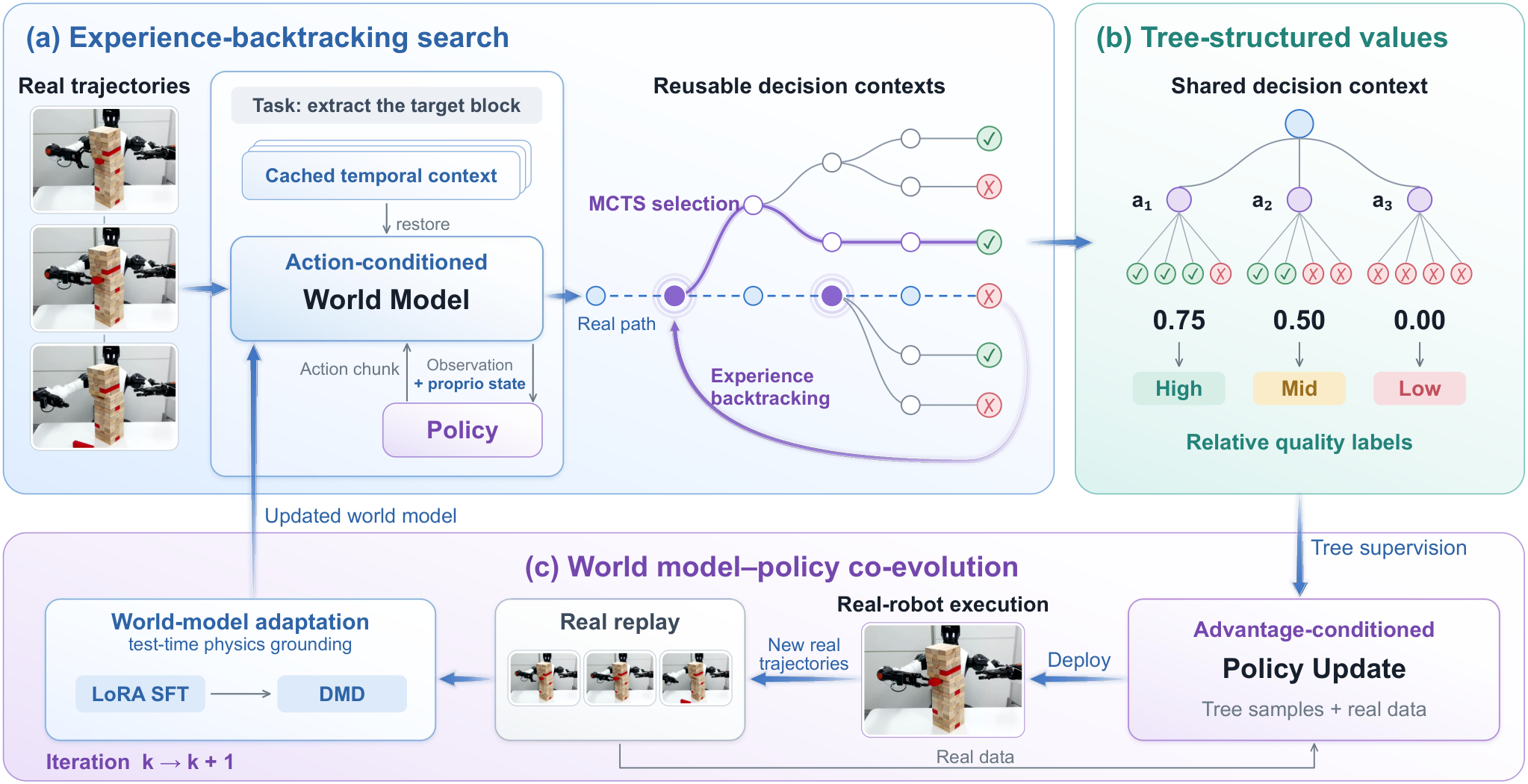
World model–policy co-evolution. Real trajectories continually refine the world model via LoRA SFT followed by distribution matching distillation (DMD), which the authors call test-time physics grounding. A sharper model yields more faithful branches, which yields a better policy, which generates more informative real trajectories.
Asynchronous system
The three processes — real-robot execution, tree search in imagination, and gradient updates — run at incompatible rates (an episode is bounded by task completion plus reset, a tree is bounded by its imagination budget, learners by gradient throughput). A synchronous outer loop would leave each resource idle. Rollback decouples them: cloud GPUs run search and training; edge nodes next to the robots run policy inference so cloud latency never enters the control loop; devices only sense and actuate.
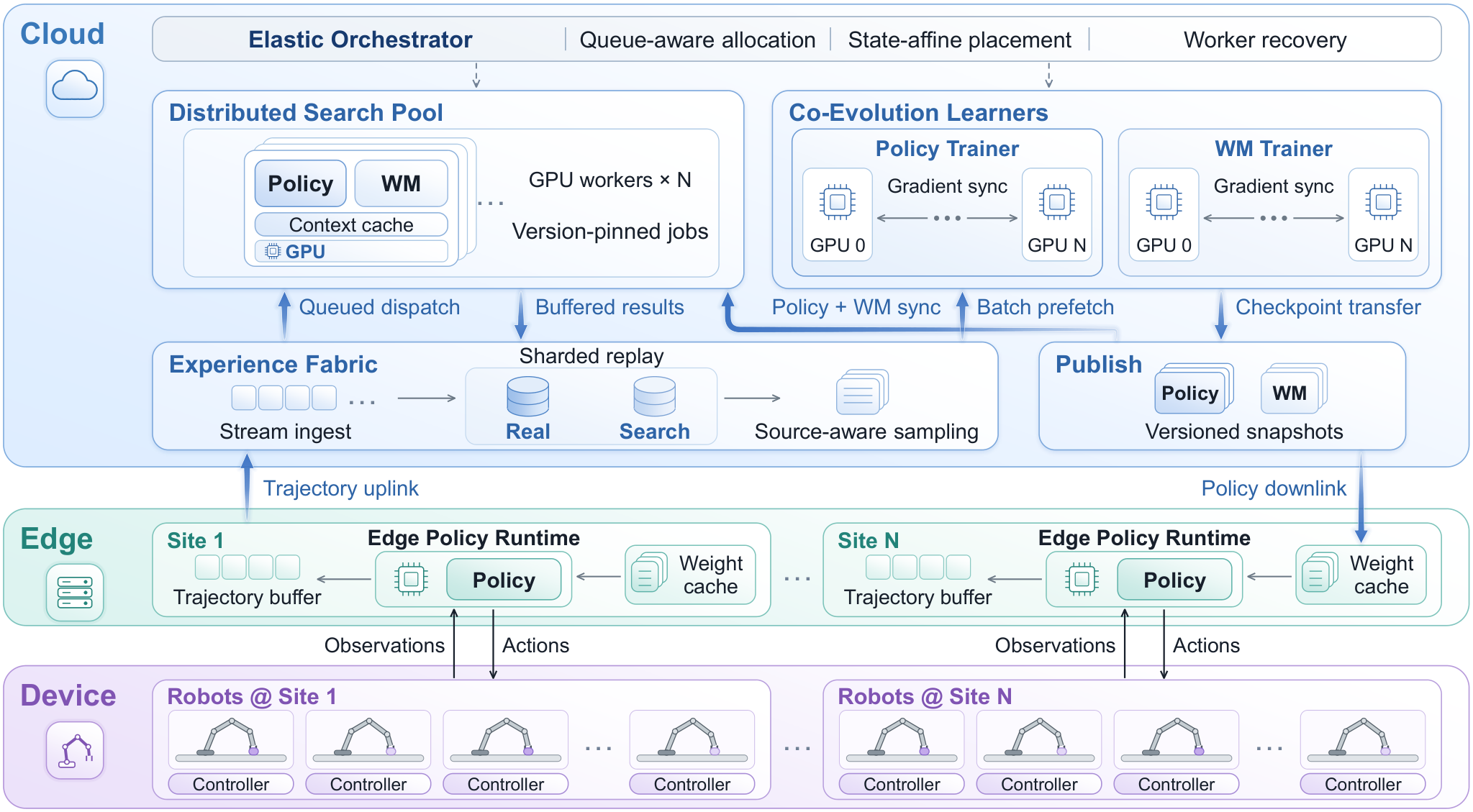
Search workers are embarrassingly parallel: each GPU hosts a policy replica, a world-model instance, and its own context cache. An Elastic Orchestrator assigns seeds; workers emit only distilled supervision over the network, never intermediate rollout tensors. Policy snapshots go to both search workers and edge sites; world-model snapshots go only to search workers. Each tree uses whichever model versions were current when the tree started — there is no barrier between search and training.
Results
Evaluation is on three AGIBOT Genie-02 real-world tasks:
- Block Extraction (Jenga): contact-rich, stability-constrained.
- Ball Tossing: release-timing control.
- Tabletop Curling: a two-player game against a human, with four stones per side and displacement dynamics.
For each task, 6 initial positions (9 for curling), 15 trials per position (25 for Block Extraction). The paper compares Rollback against RISE and against “RISE w/ GE-Sim2” — the same world model without backtracking — to isolate the contribution of experience-backtracking search versus tree-structured supervision versus world-model adaptation. The provided sections state that the authors evaluate whether Rollback (i) outperforms baselines on real hardware, (ii) each component contributes, (iii) training is stable and reaches human-level performance, and (iv) the world model remains faithful under adaptation. Specific numerical tables are deferred to the full paper and appendix.
Limitations and open questions
- Model-exploitation risk. Branch quality is bounded by world-model fidelity near out-of-distribution actions; LoRA SFT + DMD mitigates drift but does not formally bound exploitation.
- Credit assignment granularity. Relative labels among siblings require sufficient branching at each node; sparse trees collapse to standard rollout-based credit.
- Scope. Three manipulation tasks on one robot — generalization across embodiments and longer horizons where KV-cache growth becomes expensive remains open.
- No learned value function is a feature for stability, but it also means Rollback cannot do far-horizon bootstrap evaluation; tree depth sets the effective horizon of credit assignment.
Why this matters
Treating a video world model as a rewindable counterfactual engine, rather than a forward simulator, is a cleaner match to what learned models can uniquely offer over physics. The engineering contribution — asynchronous search / training / real-robot execution with versioned snapshots — is the kind of infrastructure that makes world-model-based policy learning actually scale beyond toy loops.
Source: https://arxiv.org/abs/2610.36068
The Trinity: Capability-Driven Recursive Self-Improvement for Multimodal Agents
Problem
Scaling agentic multimodal systems hits two bottlenecks: (i) constructing verifiable, heterogeneous training environments is expensive, and (ii) manual iteration of the agent “harness” (the scaffolding of prompts, tools, memory, planners, and routing policies around a frozen backbone) does not keep up with task diversity. The paper’s premise is that superficially unrelated tasks—say, pencil puzzles, chess tactics, and Rubik’s cube solving—share latent capability requirements (e.g., constraint propagation, backtracking under partial information). If one organizes self-improvement around those shared capabilities rather than surface task categories, environment synthesis and harness refinement can be amortized across tasks.
Method
The Trinity is a closed loop of three roles over a frozen backbone (Claude Opus 5 in experiments), with no weight updates—only harness evolution and skill memory.
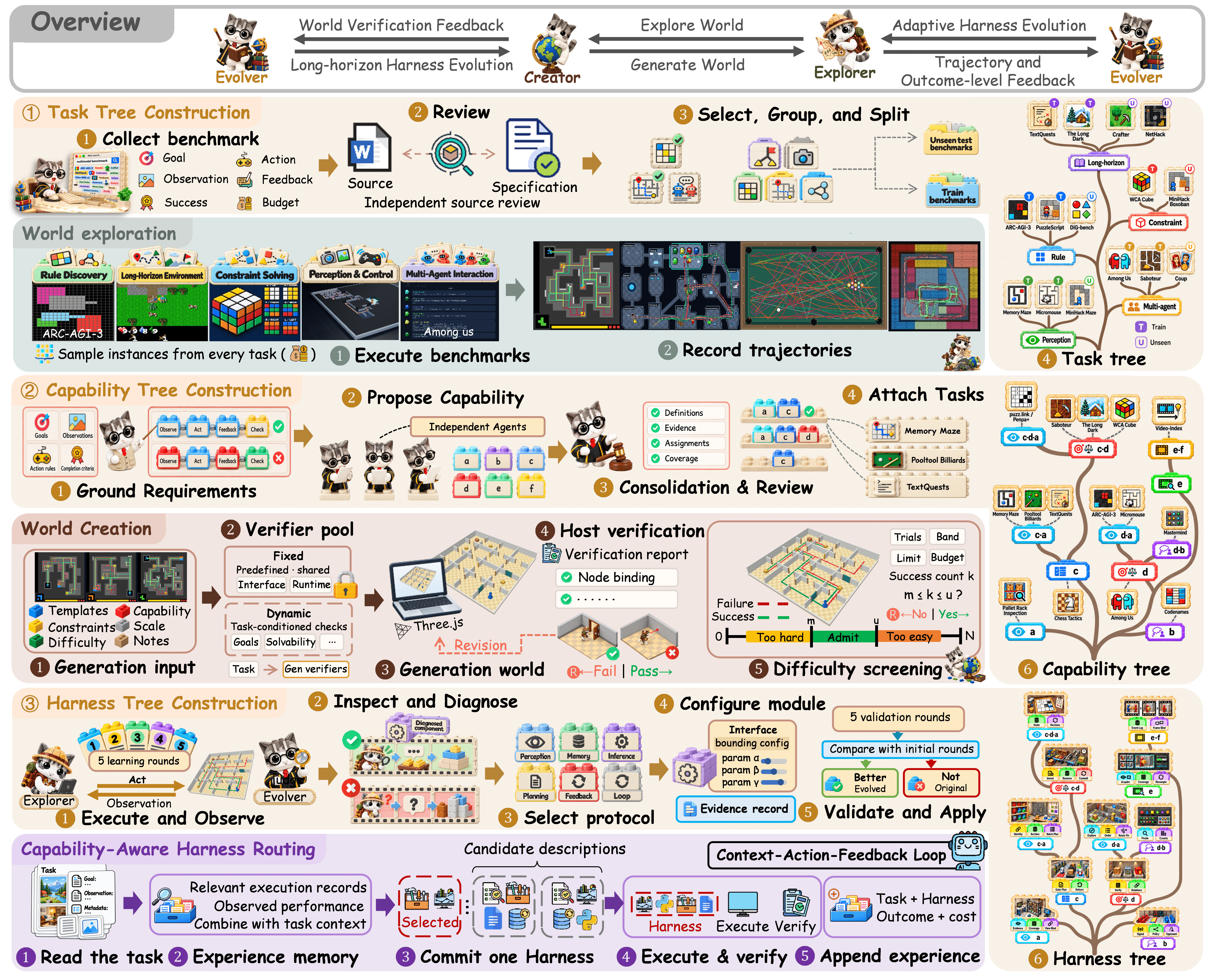
The pipeline builds three co-indexed trees:
- Task tree — initial organization by surface domain (rule discovery, constrained solving, perception/control, multi-agent, long-horizon).
- Capability tree — the Evolver re-roots the task tree on shared requirements, mined from task specifications and verified execution trajectories. Each node d corresponds to a capability (e.g., “hypothesis-test-revise under hidden rule”), with heterogeneous original tasks hung underneath.
- Harness tree — fixed topology aligned to the capability tree, where each node stores reusable modules (planner templates, verifiers, memory schemas, tool-use protocols) inherited and locally refined from its parent.
The core training primitive is Capability-Driven Real2Sim2Real: at a capability node d, the Creator abstracts the common requirements of the heterogeneous child tasks into a simplified, procedurally verifiable simulated world used purely for capability acquisition; transfer is measured by evaluating on the original tasks under the refined harness.
Explorer runs rollouts in these simulated worlds, filters verified trajectories, and proposes module updates. The Evolver accepts an update only if transfer on original tasks does not regress—selective inheritance with local refinement, giving a monotone-ish ratchet on the fixed-topology harness tree. At inference, a Capability-Aware Harness Router uses public task information (specification, modality, interface) plus the accumulated verified experience to pick a single compatible branch of the harness tree; verified feedback is written back to that branch’s experience store.
An important experimental detail: evaluation-time skill preparation runs five trials per benchmark–harness pair, summarizes the trajectories into persistent skills, and freezes those skills for subsequent Train/Unseen evaluation. This isolates the effect of the harness from in-context exploration during eval, and matches how deployed agents accumulate skill libraries.
Formally the loop is:
\mathcal{H}_{d}^{t+1} = \text{Refine}\big(\mathcal{H}_{\text{pa}(d)}^{t},\ \tau_{d}^{\text{sim}}\big) \quad \text{iff} \quad J_{\text{orig}}(\mathcal{H}_{d}^{t+1}) \ge J_{\text{orig}}(\mathcal{H}_{d}^{t})
with \tau_{d}^{\text{sim}} the verified sim trajectories at capability node d and J_{\text{orig}} transfer score on original tasks under that node.
Experiments and results
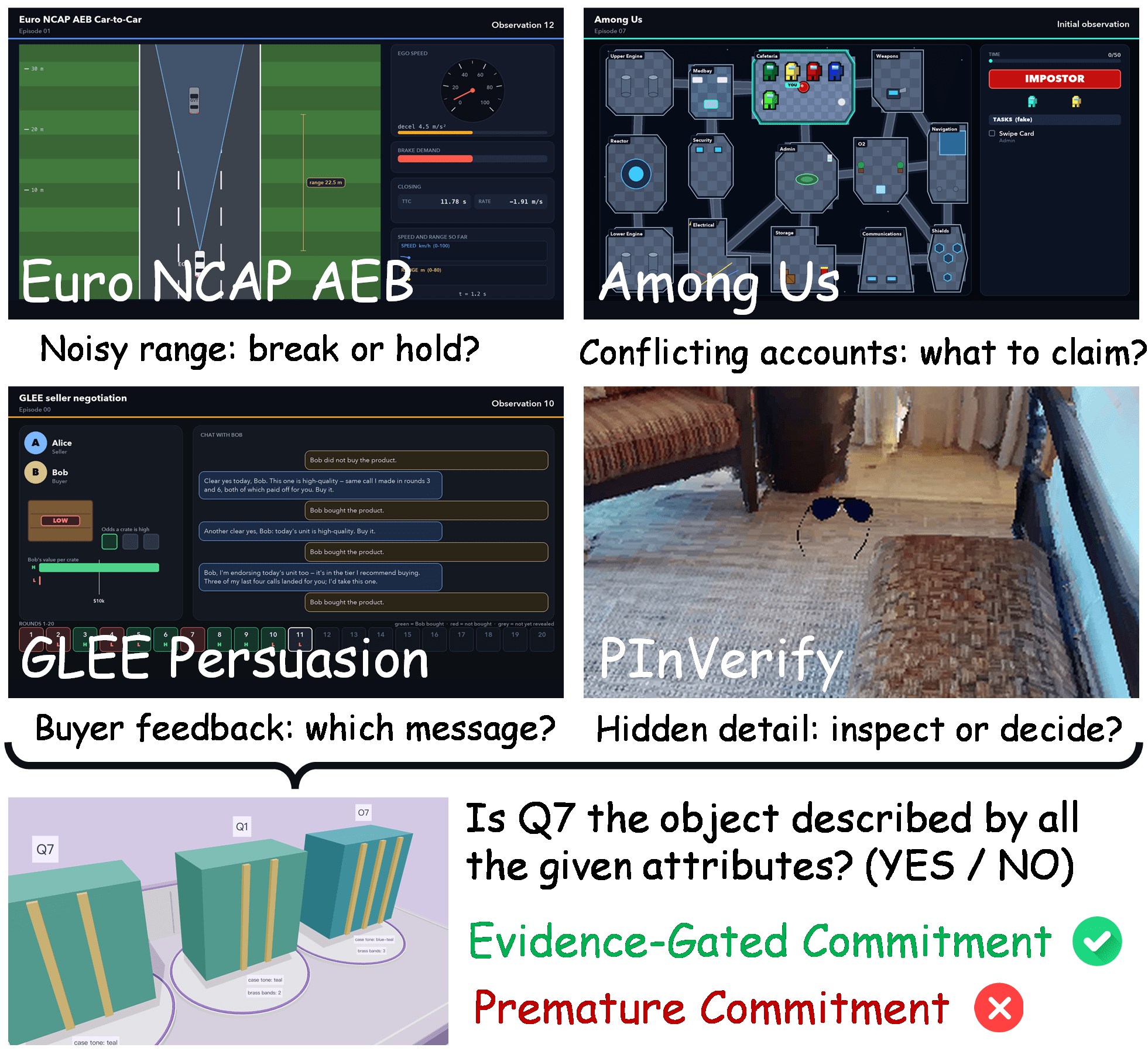
The evaluation spans 28 training and 18 unseen benchmarks across five domains: rule discovery (Eleusis, Mastermind, WILT, BoxingGym, ARC-AGI-3, PuzzleScript, …), constrained solving (chess tactics, puzz.link/Penpa+, WCA cube solving, AdaPlanBench), perception and control (Memory Maze, Micromouse, Euro NCAP AEB, PHYRE, SOON, CaP-X), multi-agent (Among Us, Saboteur, Codenames, Colonel Blotto, Coup, Hanabi, Heads-Up NLHE), and long-horizon worlds (TextQuests, The Long Dark, NetHack, Crafter). All variants start from the same Base Harness \mathcal{H}_0 (Prime Agent) and the same frozen Claude Opus 5 backbone, so differences attribute to harness evolution.
The five experiments probe: (1) whether capability-driven reorganization beats surface-category organization, (2) whether recursive self-improvement produces monotone gains across generations, (3) utility of capability-aware routing versus a flat harness, (4) stability of capability–module correspondences, and (5) transfer to embodied targets (CaP-X robot, SOON robot).
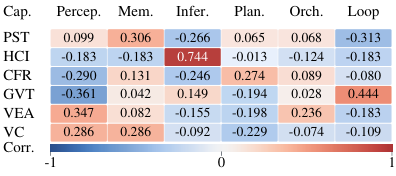
Figure 7 shows the capability–module correlation structure: each capability binds strongly to a small subset of the six protocols (red positive bands) and anti-correlates with others (blue), supporting the claim that modules are specialized rather than globally averaged. This is the mechanical justification for selective inheritance: a child capability can import only the protocols its ancestors validated as capability-relevant.
The headline qualitative finding is that unseen-benchmark gains persist when training-time sim worlds are built from capability abstractions rather than lifted directly from training benchmarks, and that embodied targets (CaP-X robot, SOON robot) benefit from harnesses trained purely in simulated capability worlds—i.e., Real2Sim2Real transfers in the sim-to-robot direction without weight updates.
Limitations and open questions
- The pipeline is anchored on a very strong frozen backbone (Opus 5). It is unclear how much of the gain is harness evolution versus backbone priors; a weaker-backbone ablation is needed.
- “Verified trajectories” and sim-world verifiers must themselves be constructed—often by the agent—so the bootstrap depends on whether the Creator produces verifiers that are faithful proxies for the original tasks. The paper does not quantify verifier false-positive rate.
- Fixed-topology harness trees forbid structural discovery; a capability missing from the initial tree cannot emerge.
- Token costs are reported only in aggregate (millions); per-capability cost scaling with tree depth is not characterized.
- The routing policy sees “public task information”—its sensitivity to adversarial or ambiguous task descriptions is untested.
Why this matters
The Trinity makes the case that self-improvement for frozen-weight multimodal agents can be driven by reorganizing training around shared capabilities rather than tasks, with harness modules as the unit of inheritance. If capability–module correspondences are as stable as Figure 7 suggests, this gives a scalable alternative to fine-tuning for domains where verifiable environments are scarce and tasks are heterogeneous.
Source: https://arxiv.org/abs/2610.36077
PDRVLA: A Vision-Language-Action Model with Physical Dynamics Representations
Problem
VLA policies map visual observations and natural-language instructions to robot actions, but their representations are built from vision-language pretraining targets that do not explicitly encode physical dynamics (how pixels, depths, and motion will evolve under contact). Video world models capture such dynamics, yet rolling out future frames inside the control loop adds latency incompatible with reactive manipulation. PDRVLA proposes a middle path: train a lightweight module that produces a fixed-length sequence of “physical tokens” summarizing predicted future appearance, geometry, and motion, used only as conditioning for action generation — no online video synthesis.
Architecture
The policy stacks a Qwen3.5-4B VLM backbone, a Physical Dynamics Module (PDM), and a flow-matching action expert.
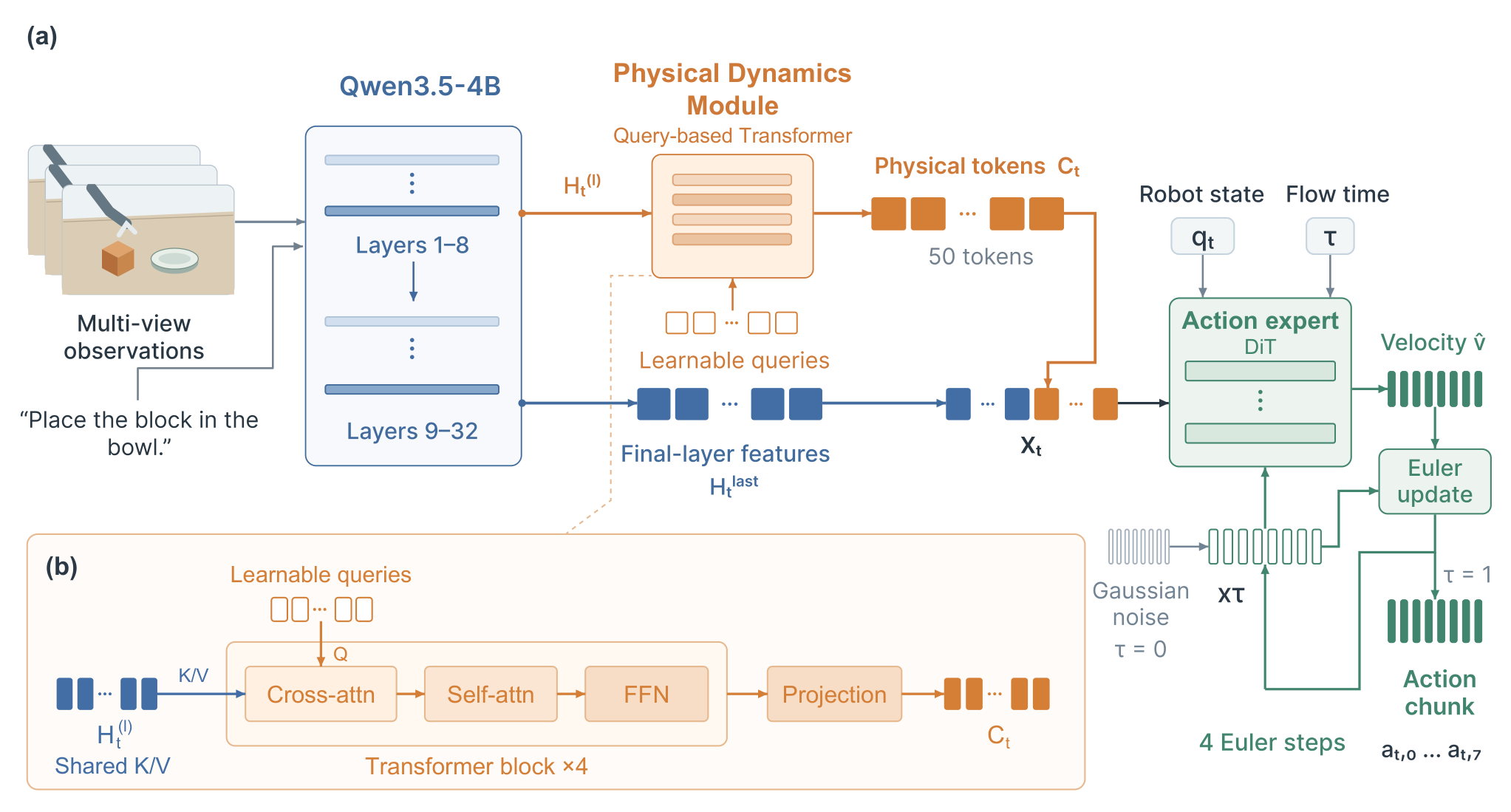
Input to the VLM is a single chat-formatted user message containing camera views followed by an instruction prefixed with embodiment metadata (“embodiment
Subtask conditioning is optional: at inference the VLM can first emit a subtask string, which is appended to the instruction (“Current step:
Physical pretraining
Each pretraining example pairs current observations with a 5-frame target video sampled over the next 30 action steps. Appearance targets are raw RGB; depth pseudo-labels come from DA3 and optical-flow pseudo-labels from DPFlow (color-encoded, following RynnWorld-4D). All three modalities are encoded into latent features using LingBot-Video’s frozen Wan video VAE; the PDM’s prediction heads regress these latents directly from the physical tokens.
Because both the PDM and its heads are trained from scratch, there is an auxiliary supervision pathway: a frozen pretrained video world model consumes the same inputs and provides intermediate features that the PDM is additionally regressed toward. This is the only use of the world model — it is removed for joint policy training.
Joint training then drops the video world model, keeps the three direct future-prediction losses on \{F^{RGB}_{t+k}, F^{D}_{t+k}, F^{Flow}_{t+k}\} latents, and adds the flow-matching action loss plus VL supervision:
\mathcal{L} = \mathcal{L}_{\text{action}} + \mathcal{L}_{\text{VL}} + \lambda_{\text{RGB}}\|\hat F^{RGB}-F^{RGB}\|^2 + \lambda_{D}\|\hat F^{D}-F^{D}\|^2 + \lambda_{\text{Flow}}\|\hat F^{Flow}-F^{Flow}\|^2.
Data
The corpus mixes 1.26M real-robot trajectories (14,893 h), 1.22M UMI trajectories (10,259 h), and 1.87M simulated trajectories (8,868 h) on the VLA side, with 8.05M general VL examples and 23.63M spatial/embodied VL examples. Derived data include 0.90M egocentric-to-robot trajectories synthesized from EgoDex (2,646 h), 1.79B subtask-annotated frames yielding 1.1M subtask-prediction VL examples, and 2.56M ECoT keyframe annotations.
Results
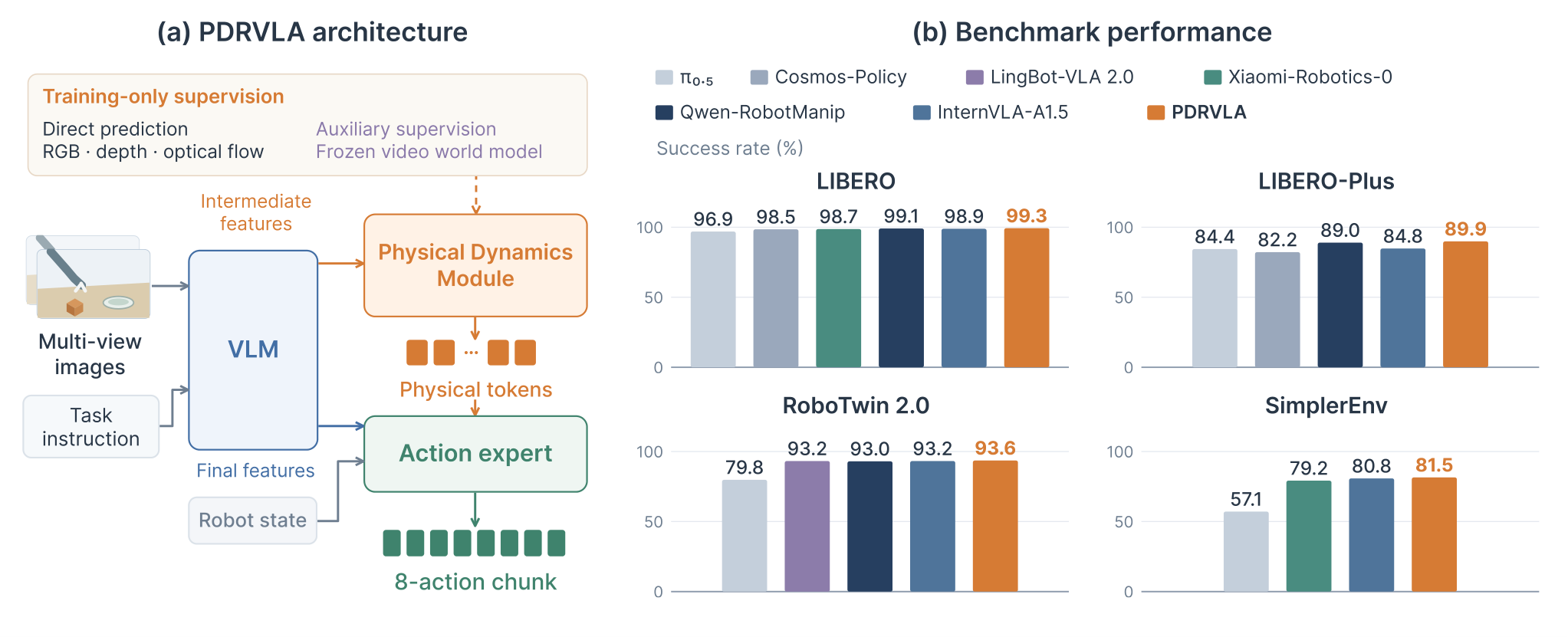
On four simulation benchmarks after per-benchmark fine-tuning: LIBERO averaged across Spatial/Object/Goal/Long gives 99.3% success over 2,000 episodes; LIBERO-Plus — which perturbs cameras, robots, language, lighting, background, noise, and layout across 10,030 cases — gives 89.9%; RoboTwin 2.0 bimanual (Aloha-AgileX, 50 tasks, clean and randomized averaged) gives 93.6%; SimplerEnv Bridge visual-matching gives 81.5%.
Ablations
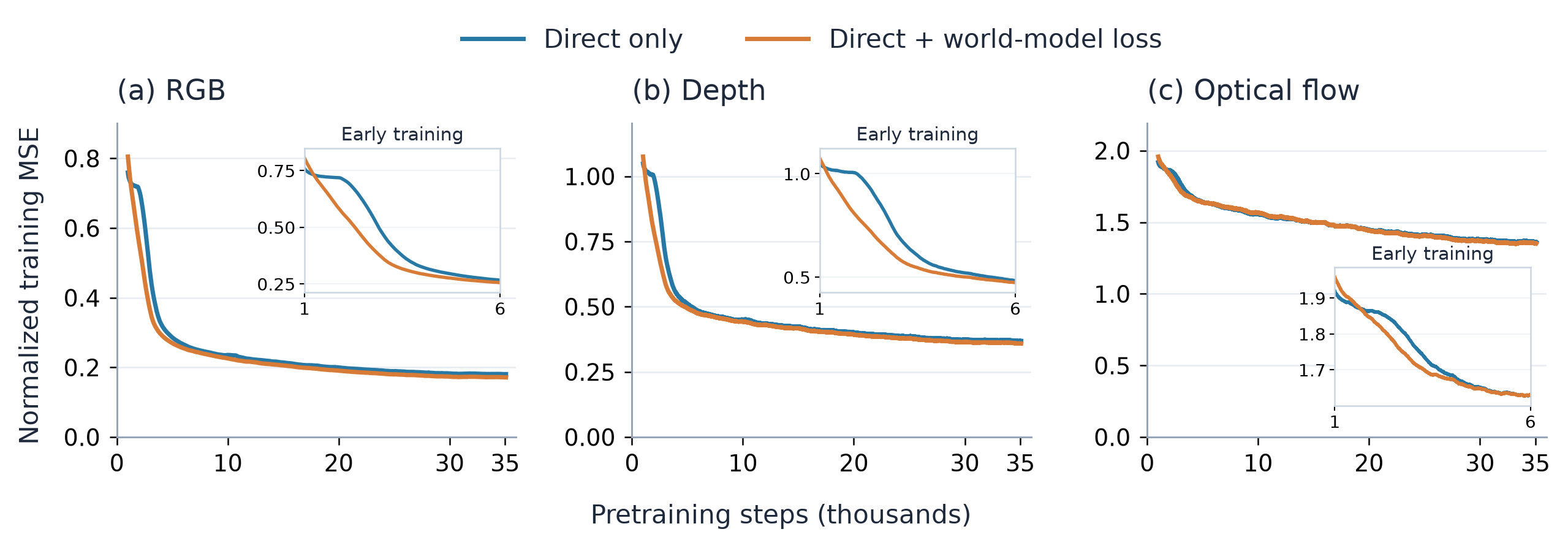
The world-model-assisted pretraining produces consistently lower normalized MSE on future RGB/depth/flow latent prediction than direct prediction alone, with the inset showing the gap opens early (updates 1k–6k). Additional ablations examine subtask conditioning frequency, auxiliary future object-pose supervision, and whether ECoT should be used during training only or also at inference generation; the main-text claims are that each contributes to action success, though exact deltas live in the appendix sections not shown here.
Limitations and open questions
Results are entirely in simulation across four benchmarks; no real-robot evaluation is reported, which is especially notable because the training corpus is dominated by real-robot and UMI data. The physical tokens are supervised against VAE-encoded latents from a specific video stack (Wan VAE, DA3 depth, DPFlow optical flow); it is unclear how much the quality of these pseudo-labels bounds dynamics representation quality, and no comparison against pixel-space targets or alternative encoders is reported. The frozen world model used for auxiliary supervision is proprietary (LingBot-Video), which complicates reproduction. Finally, the paper does not report inference-time latency numbers against VLAs that do roll out video, so the central latency-vs-dynamics trade-off is argued architecturally rather than measured.
Why this matters
PDRVLA operationalizes “world model as representation learner, not online predictor”: future RGB/depth/flow prediction is distilled into a compact token sequence consumed by the policy, avoiding video-generation latency while still conditioning actions on explicit dynamics features. If the ablation trend holds on real hardware, it suggests a general recipe for injecting physical priors into VLAs without paying inference cost.
Source: https://arxiv.org/abs/2610.37381
Hy-Nomas: Towards Free-form Interactive World Generation
Interactive world models must sustain two things that standard video generators do not: (i) coherent response to a stream of free-form instructions arriving at arbitrary times, and (ii) a persistent world state so that revisiting a location yields consistent geometry and content. Hy-Nomas is an 8B diffusion transformer, built on HunyuanVideo 1.5, that targets both requirements by producing variable-length video segments autoregressively, each conditioned on a current text/camera instruction plus a KV cache of all previous segments.
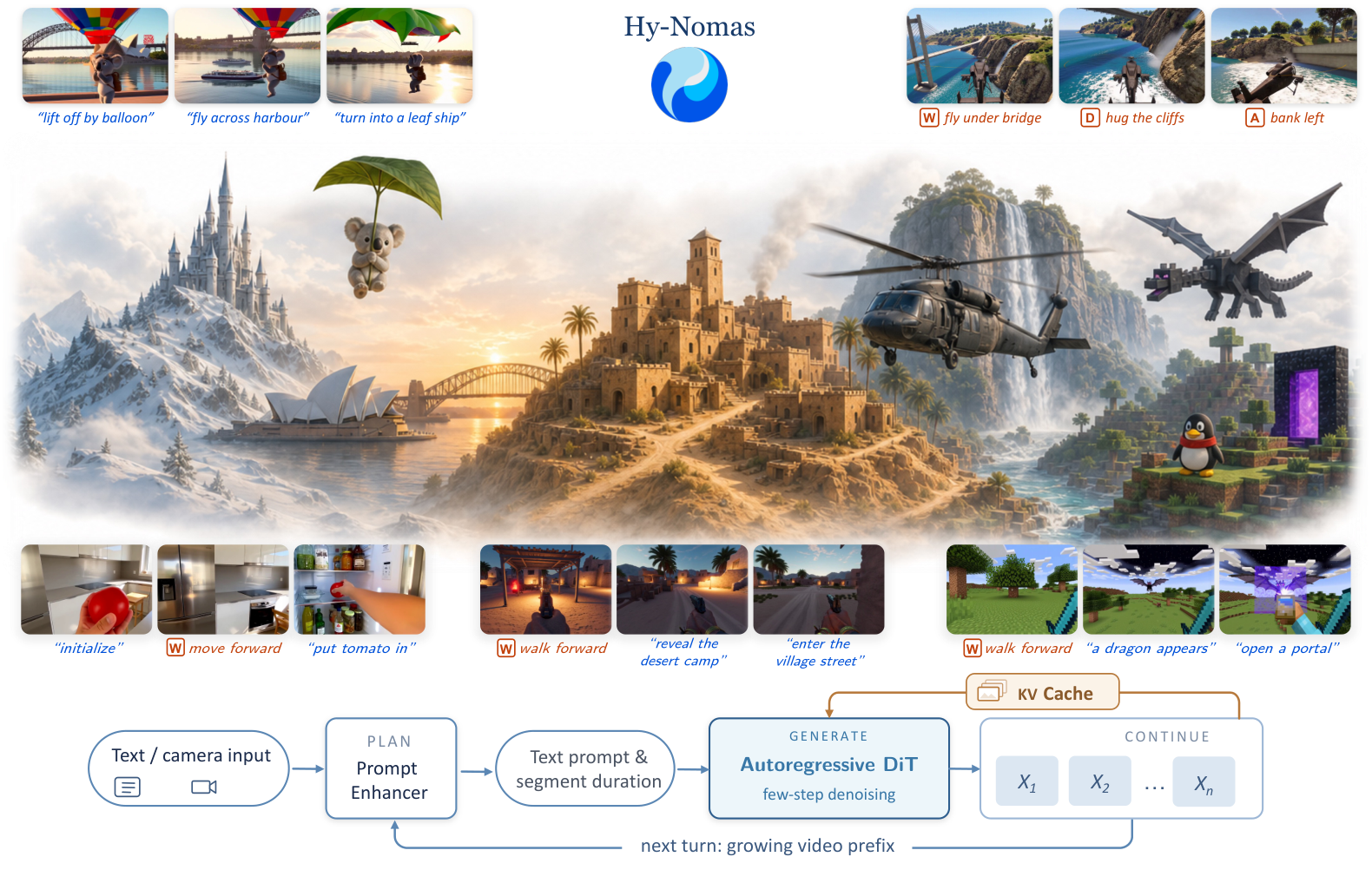
Architecture
The backbone is a 54-block dual-stream MMDiT with hidden width 2048 (MLP 8192), 16 attention heads of dim 128, and 3D RoPE allocated as (16, 56, 56) over (T, H, W). Video is encoded by DCAE-V with 32\times spatial and 4\times temporal compression into a 32-channel latent:
Z = \mathcal{E}(X) \in \mathbb{R}^{B \times 32 \times F_z \times H_z \times W_z}, \quad F_z = \lfloor (F-1)/4 \rfloor + 1.
Each latent voxel is a token (patch size 1\times 1\times 1) projected into the DiT. Text comes from a frozen Qwen2.5-VL-7B. The DiT predicts flow velocity in latent space.
Two mechanisms give the model its interactive character:
Segment-wise / action-aware causal attention. Within a segment, attention is bidirectional; across segments it is causal — tokens of segment t attend to current and prior segments only. On top of this, action-aware masking restricts action-bearing instruction tokens to the temporal window of the segment that executes them, while descriptive context (subjects, environment, style) remains visible to all later segments. This separates “persistent world description” from “per-turn action,” which the authors identify as the key to avoiding action-order errors and spurious repetition of past actions.
Camera cross-attention. A dedicated cross-attention module in each MMDiT block uses video features as queries and frame-aligned camera tokens (64-D grouped extrinsics, width 1024, 16 heads) as keys/values. Camera control is thus injected per block rather than concatenated with text, allowing continuous trajectory conditioning independent of the language stream.
During rollout, text and video KVs from each generated segment are retained; subsequent segments denoise from Gaussian noise conditioned on the current prompt, optional camera trajectory, and this cache.
Training curriculum
Hy-Nomas is produced by converting a bidirectional DiT into a causal one through five stages organized along three curricula:
- Causal: segment-wise causal attention → action-aware causal attention → segment forcing (train on the model’s own cached predictions to expose it to imperfect histories at train time) → diffusion distillation for few-step sampling.
- Interaction: text-only → text + camera → interleaved.
- Context length: progressively grown; packed sequences reach 360K tokens.
Infrastructure uses Ulysses sequence parallelism with N_{\text{SP}} = 8 (≈45K tokens/rank at max length), FSDP2 hybrid sharding inside each SP group, DP across groups, a mask-flexible attention kernel for the heterogeneous segment/action masks, a distributed Muon optimizer, and FLOPs-balanced packing.
Prompt Enhancer
User instructions are rarely in the structured caption format the DiT was trained on. A VLM-based Prompt Enhancer (PE) rewrites them. At turn t:
y_t \sim p_\theta(\cdot \mid S, u_t, H_{t-1}, V_{<t}, m_t),
where S is the system prompt, u_t the raw user input, m_t a rewriting mode (text / camera / interleaved), H_{t-1} the prior dialogue, and V_{<t} the generated video segments observed by the VLM. The first turn emits a dense structured caption (subject, environment, actions, description); subsequent turns emit description changes and new actions, so caption drift is bounded by diffs rather than full rewrites.
Evaluation
The authors release Hy-Nomas-Bench: 280 cases across four benchmarks — multi-turn free-form text, camera navigation, interleaved text+camera, and spatial memory — spanning first/second/third-person and observer viewpoints across photorealistic, game-like, and animated styles. Control inputs are unified as text, binary key states [T,8] (WASD + arrows), or per-frame 4\times 4 camera-to-world matrices [T,4,4]. Many cases demand >60s continuous generation without world reset.
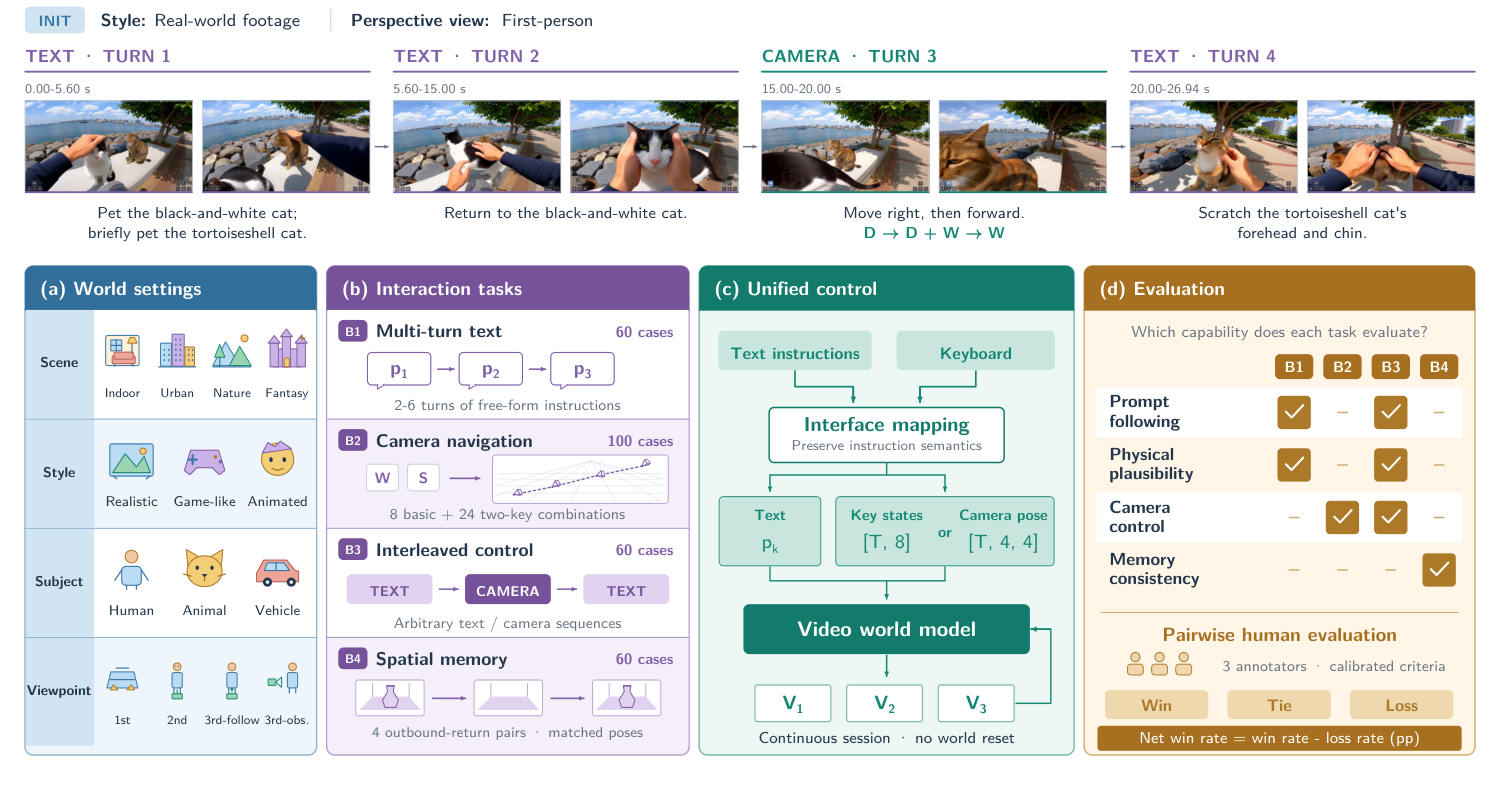
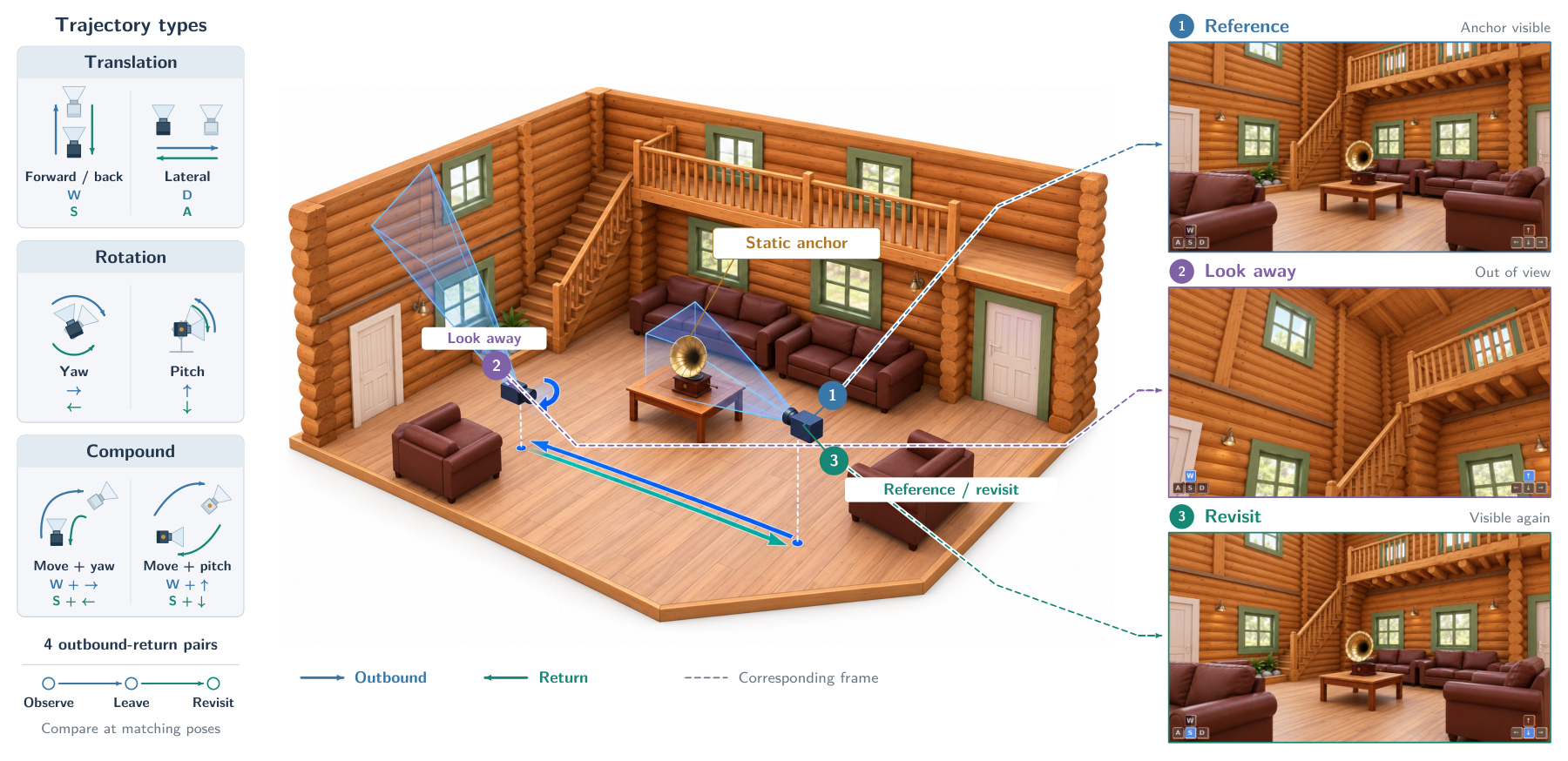
Four axes are judged by three annotators via pairwise comparisons: prompt following, physical plausibility, camera control, memory consistency. Baselines are Genie 3, LingBot-World v2, and Happy Oyster. The paper reports Hy-Nomas winning on net win rate across these dimensions, with memory consistency being the differentiator most clearly attributable to action-aware causal attention and segment forcing. The spatial-memory benchmark (Bench-4) is particularly diagnostic: each case uses a static anchor object with four outbound–return trajectory pairs, so object permanence and layout consistency can be scored independently of appearance quality.
Limitations and open questions
The paper reports human pairwise comparisons but no automatic metrics on Hy-Nomas-Bench — rightly, since standard FVD-style scores do not capture memory or control, but it leaves the comparison hard to reproduce without the annotator pool. KV cache growth over long interactions is not addressed: at 360K-token training packing, hours-long rollouts will require cache compression or eviction policies. Camera control is restricted to the extrinsic parameterization; dynamic focal length and sensor effects are out of scope. Finally, “memory” here is implicit in the KV cache rather than a persistent scene representation, so consistency likely degrades beyond the trained segment-count regime.
Why this matters
Hy-Nomas isolates the two structural choices — action-scoped causal masking and train-time exposure to the model’s own cached histories — that let a standard video DiT behave as an interactive world model without a separate scene memory module. The released weights, benchmark, and adaptation recipe make this one of the few open artifacts at the Genie-3 tier of free-form interactive generation.
Source: https://arxiv.org/abs/2610.36729
Memory Tax: Dissecting the Net Value of Agent Memory
Problem
Long-horizon agents increasingly rely on dedicated memory systems — flat stores, hierarchical/lifecycle managers, knowledge graphs, trained retrieval policies — that ingest an interaction history \mathcal{H}=\{h_1,\dots,h_T\} into a persistent representation \mathcal{M}=I(\mathcal{H}), then answer queries via \hat{y}=G(q, R(q,\mathcal{M})). The implicit assumption is that structured memory beats simply doing chunk-based RAG over the raw history. This paper tests that assumption at scale and finds it is often false. The authors reframe the design question around two reference-dependent quantities — memory benefit and memory tax — defined per-query relative to naive RAG, and argue that these are the right objects to study.
Benchmark results
Eleven memory systems are evaluated on LongMemEval-s, PersonaMem-v2, and MINT-Eval with Qwen3.5-4B, Qwen3.6-27B, and GPT-5.6 Luna backbones. RAG with two retrieval rounds (RAG 2rd) is the reference. The headline is that nearly every dedicated memory system underperforms RAG 2rd on nearly every (benchmark, backbone) cell. On LongMemEval-s with Qwen3.6-27B, RAG 2rd scores 81.4, while MemOS reaches 76.6 (-4.8), MemoryOS 73.4 (-8.0), OpenViking 58.8 (-22.6), MAGMA 68.2 (-13.2). On MINT-Eval with the same backbone, RAG 2rd is 33.1 and most systems sit in the 19–27 range; only PlugMem (33.3) matches it. The pattern persists on 5.6-luna: RAG 2rd 90.0 on LongMemEval-s vs. the best memory system A-Mem at 84.0. The gold-context upper bounds (73.4 / 84.6 / 92.8 on LongMemEval-s) show that there is still substantial retrieval headroom RAG does not fully capture, but memory systems do not close it either — they move further away.
Decomposing net value
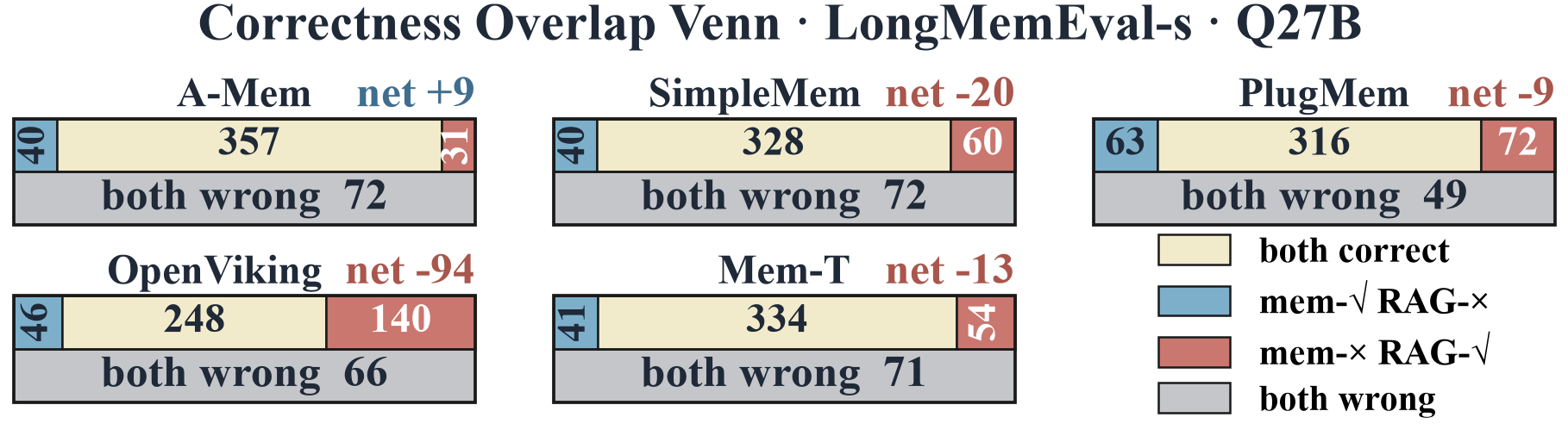
For each query, the outcome falls into one of four cells: both correct, only RAG correct (memory tax), only memory correct (memory benefit), or both wrong. The Venn breakdown makes clear that for most systems the “only RAG” set is comparable to or larger than the “only memory” set — i.e., memory destroys as much signal as it adds. The authors attribute both sides to the same cause: I(\cdot) necessarily deviates from \mathcal{H} (summarization, fact extraction, graph construction, lifecycle pruning), and those deviations are double-edged. Benefit comes from reorganization/aggregation/preference distillation; tax comes from evidence that is dropped, blurred, or made harder to retrieve.
Where the tax comes from
To separate access failures from information loss, the authors annotate sampled gold facts for each system by degree of loss: no loss (NL), partial (PL), major (ML), or no corresponding memory unit (NU). Results differ sharply: MemoryOS preserves 98.4% NL, MAGMA 93.6%, MemOS 85.8%, while OpenViking retains only 39.4% NL with 38.0% NU — i.e., over a third of relevant facts have no stored unit at all. This directly explains OpenViking’s -22.6 to -40.4 regressions.
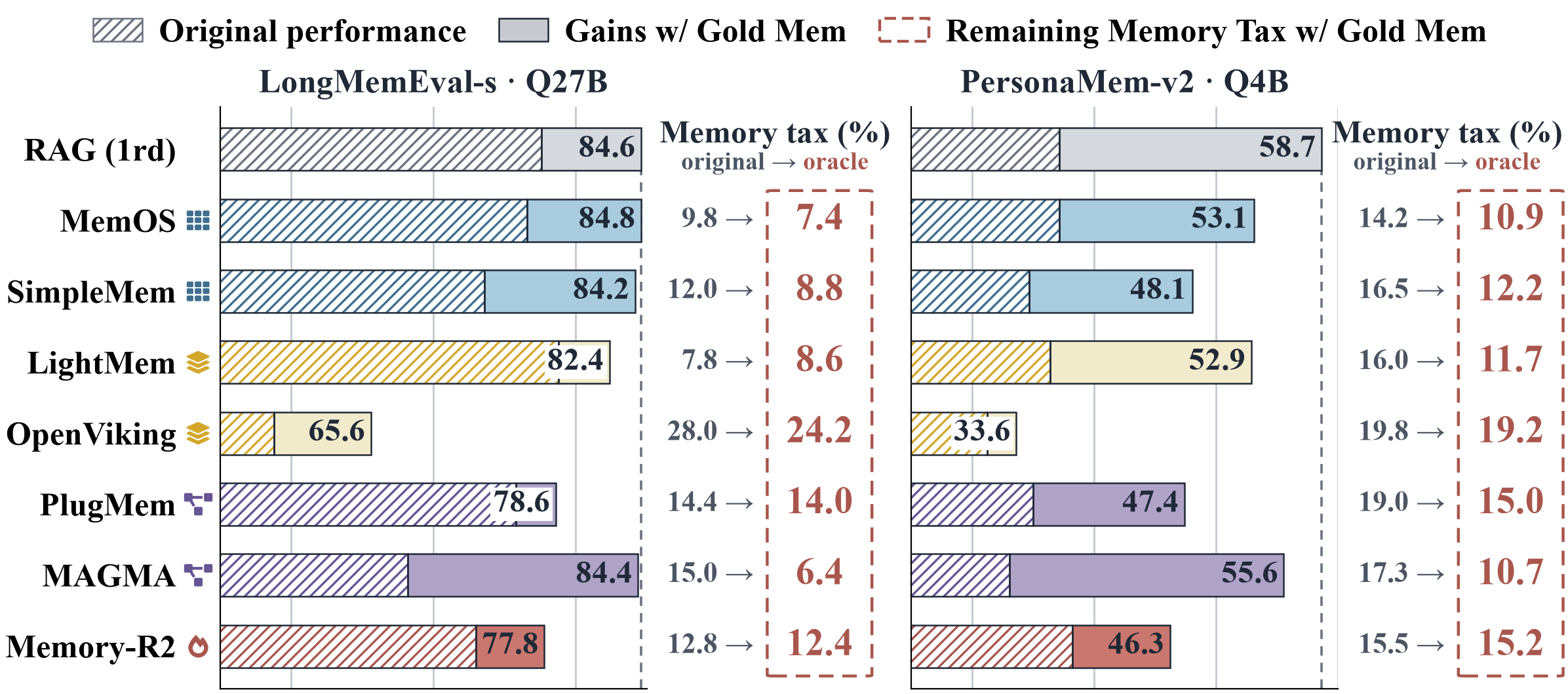
Even when the gold memory unit is injected, substantial tax remains, indicating that construction-side information loss is only part of the story — some tax is intrinsic to how memory is accessed.

Replaying retrieval shows memory units often require more rounds than raw chunks to surface the same evidence. Compression and reformatting change the lexical/semantic surface so that the natural query q no longer matches the stored form, pushing evidence into deeper retrieval tiers it never reaches at the operating budget.
Generalization and design implications
The benefit–tax decomposition extends beyond conversational memory. On experiential-memory benchmarks (ALFWorld, WebShop, Mind2Web, BigCodeBench, AppWorld, \tau^2-Bench), workflow distillation (ReasoningBank, SkillPro) beats naive trajectory RAG on web tasks, but tool-use tasks show the same tax pattern — memory depends on how well the deviation matches query structure.
The paper proposes three low-cost mitigations without new architectures:
- Recoverable deviations. Retrieve from source \mathcal{H} alongside \mathcal{M} and jointly rerank. This restores evidence erased or obscured by I and reduces tax across systems.
- Self-referential memory. Treat past queries, retrieved evidences, and retrieval paths as new memory units — “remember how it remembers.” Deep-round evidence becomes directly accessible to similar future queries, giving an inter-query test-time-scaling axis.
- Model future demand. Rather than pure ahead-of-time construction (expensive, uninformed) or just-in-time (user-facing latency), use priors over user interests/habits to steer which deviations I performs.
Limitations and open questions
The decomposition is reference-dependent on naive RAG; a stronger retrieval baseline (hybrid, learned rerankers) would shift the tax/benefit split. Fact-loss annotation is sampled and may understate systemic losses in NU-heavy systems. The mitigations are proofs of concept rather than tuned systems, and the “model future demand” direction is left largely programmatic. The paper does not formalize \text{tax}(q) and \text{benefit}(q) as expectations under a query distribution, which would be needed to make them optimization targets rather than diagnostics.
Why this matters
The field has been assuming structured agent memory is strictly additive over raw-history retrieval; this paper shows that assumption fails across most current systems at nontrivial cost. Framing memory design around minimizing tax relative to RAG — through recoverable deviations and self-referential retrieval — gives a concrete, measurable objective for the next generation of memory architectures.
Source: https://arxiv.org/abs/2610.34073
Hacker News Signals
Show HN: Hob - Open-source, on device alternative to Claude Cowork and ChatGPT
Hob is a local-first AI workspace that runs inference entirely on-device, positioning itself against cloud-based coding assistants. The architecture relies on locally served models (via Ollama or compatible backends) and exposes a chat-plus-tool interface for agentic tasks: file reading/writing, shell execution, and project context management. The repository is built on top of a Next.js frontend with a Node backend that proxies to the local inference endpoint, so the entire stack runs without an outbound network call once models are pulled.
The technical substance worth noting: Hob implements a context-windowing strategy that chunks project files and injects relevant snippets based on a lightweight embedding similarity search run locally. This sidesteps the privacy concern of sending codebases to a third-party API, which is the primary differentiator versus GitHub Copilot or Cursor’s cloud mode. The tool-call loop follows the standard pattern — model emits structured JSON tool invocations, the host executes them, results are appended to the conversation context, repeat until the model emits a terminal response.
Limitations are real: on-device inference quality is bounded by what quantized models (typically 7B–34B parameter range on consumer hardware) can do versus frontier APIs. Long-context coherence degrades faster with smaller models, and the embedding-based retrieval doesn’t replace a proper AST-aware code index. There is no tree-sitter integration mentioned, so semantic chunking is text-based, which will produce noisy context for large polyglot projects.
For teams with data-residency requirements or air-gapped development environments, the architecture is sound. The open-source release means the context injection pipeline can be audited and extended. Whether it closes the capability gap to cloud assistants depends almost entirely on local hardware and model choice.
Source: https://github.com/FrigadeHQ/hob
Four Months of Zig
A detailed practitioner report on using Zig as a primary systems language for several months, covering the language’s actual ergonomics under sustained use rather than toy benchmarks. The piece is technically substantive and worth reading for anyone evaluating Zig for production systems work.
Key observations from the author: Zig’s comptime system is genuinely powerful but has a steep conceptual overhead. Unlike C++ templates or Rust generics, comptime executes arbitrary Zig code at compile time — the same language, no separate meta-language — which means type-level programming and code generation are uniform with runtime code. The practical consequence is that generic data structures and compile-time configuration are ergonomic once the mental model clicks, but the error messages for comptime failures remain cryptic and difficult to map back to user code.
Memory management without a GC requires explicit allocator threading throughout APIs, following Zig’s convention of passing allocators as function arguments. The author finds this acceptable for library code but verbose for application-level glue. The allocator interface is clean (a vtable-based std.mem.Allocator), and swapping in a testing allocator to catch leaks in unit tests is a practical win.
The build system (build.zig) is noted as a genuine improvement over CMake and similar tools for cross-compilation scenarios — the Zig toolchain bundles a C compiler and libc for multiple targets, making cross-compilation from one host nearly trivial. This is a concrete systems engineering advantage over Rust’s cross-compilation story, which requires more external tooling.
Pain points: the standard library is still incomplete, some APIs changed between minor versions during the evaluation period, and the lack of a stable ABI means library versioning is non-trivial. Error handling via explicit error unions is praised as more honest than exception-based systems, though the requirement to annotate every error set becomes mechanical for deeply nested call chains.
Source: https://gracefulliberty.com/articles/four-months-of-zig/
Police are using AI to pull over drivers for ‘suspicious’ behavior
The technical system described involves AI-powered surveillance cameras mounted at fixed locations or on patrol vehicles that flag vehicles based on behavioral patterns: unusual routes, loitering near specific locations, repeated passes, or aggregate movement signatures. The output is a risk score or alert that an officer can act on, rather than a direct automated enforcement action.
The underlying computer vision pipeline likely involves multi-object tracking (e.g., SORT, DeepSORT, or transformer-based variants), vehicle re-identification across camera networks, and some form of trajectory anomaly detection. Trajectory anomaly models are typically trained on historical “normal” movement patterns; deviations above a threshold surface as alerts. This is a well-studied problem in video analytics and is commercially productized by companies like Motorola Solutions (VideoIQ), Axon, and Rekor.
The core technical concern is distributional: what constitutes “suspicious” behavior is operationally defined by the training data, which reflects historical patrol patterns and stop records that are themselves the output of prior human decisions with known demographic biases. If the training set encodes over-policing of specific neighborhoods or demographics, the model learns those patterns as normal/abnormal and reproduces them at scale with the veneer of algorithmic objectivity.
Precision and recall are not publicly disclosed for these systems. False positive rates are particularly important here because each false positive results in a traffic stop, which carries non-trivial individual and systemic costs. There is no standardized audit framework for law enforcement AI in the US. Deployment decisions are being made without IRB-equivalent oversight, and the models are typically vendor black boxes with no public technical documentation.
Source: https://gizmodo.com/police-are-using-ai-to-pull-over-drivers-for-suspicious-behavior-2000831220
Anthropic trained Claude on illegally obtained Stanford professors’ books
The Stanford Daily report documents that books authored by Stanford faculty appeared in the Books3 dataset, which has been identified as a component of Claude’s training data. Books3 is a corpus of approximately 196,000 books scraped from Bibliotik, a private tracker; the material was obtained and distributed without author or publisher consent, making it infringing under standard copyright analysis.
The technical context: Books3 has been widely used across the industry — it appears in the Pile (EleutherAI) and has been used by various open-source and commercial model training runs. The specific legal question for Anthropic is whether training on a derivative corpus that includes infringing material constitutes direct or contributory infringement. The fair use defense applied in the Authors Guild v. Google case (which concerned indexing and snippet display) does not straightforwardly extend to verbatim ingestion for model training, though the case law is still being litigated across multiple active suits (including Kadrey v. Meta and the NYT v. OpenAI case).
From a technical standpoint, the degree to which a model “memorizes” versus “generalizes” from specific training documents is an empirical question, and membership inference attacks have shown that large language models do retain extractable information from training data, particularly for repeated or distinctive text. This is relevant to the damages question.
The broader engineering implication: organizations training foundation models on internet-scale corpora have largely relied on a “move fast, litigate later” approach to data provenance. This case signals increasing institutional pressure — universities have clear standing and documentation of authorship — that will likely force more rigorous data auditing pipelines in future training runs.
Source: https://stanforddaily.com/2026/10/27/professors-books-pirated-to-train-claude/
Microsoft and others tell crypto platform not to tokenize their stocks
Several large corporations sent cease-and-desist letters to a crypto platform (reported as Robinhood’s EU tokenized-stock product and similar platforms) attempting to issue blockchain tokens representing synthetic exposure to their equity. The technical mechanism being objected to is the creation of on-chain instruments whose value tracks the underlying stock price, typically via a combination of off-chain price oracles, over-collateralized reserves, and smart contract redemption logic.
The legal objection is straightforward: issuance of instruments that represent or simulate equity in a company implicates securities law and requires issuer consent. Companies do not want unauthorized synthetic representations of their stock circulating on permissionless chains because it creates ambiguity about shareholder rights, complicates cap table governance, and may trigger unregistered securities liability.
The technical architecture these platforms use generally follows the synthetic asset pattern: a price oracle (e.g., Chainlink) feeds the current stock price on-chain; users deposit collateral (stablecoin or ETH) into a smart contract; the contract mints a token whose redemption value tracks the oracle price. There is no actual stock held; the exposure is purely synthetic and counterparty risk sits with the collateral pool and oracle integrity. Depeg risk, oracle manipulation, and collateral liquidation cascades are the primary failure modes.
From an engineering perspective, the interesting constraint is that these systems are technically feasible — the smart contract logic is not novel — but are legally and institutionally contested. The corporate objections here are not about technical capability but about governance, liability, and the absence of any mechanism for the underlying company to assert rights over synthetic representations of itself.
Kentucky man becomes the first humanist granted religious exemption from AI
A Kentucky public employee successfully obtained a workplace exemption from a mandatory AI tool requirement on the grounds of humanist belief, with the exemption granted under Title VII’s religious accommodation framework. Title VII defines religion broadly enough to include “moral or ethical beliefs as to what is right and wrong which are sincerely held with the strength of religious convictions,” a standard established in Welsh v. United States (1970) and Welsh’s predecessor United States v. Seeger (1965), which eliminated the requirement for a theistic belief.
The technical substance here is limited but the precedent matters for engineering organizations: if a sincerely held ethical objection to AI tool use qualifies for religious accommodation under Title VII, employers mandating specific AI-assisted workflows face a new accommodation surface. The legal standard requires the employer to provide accommodation unless it causes “undue hardship,” which the Supreme Court in Groff v. DeJoy (2023) redefined upward from a de minimis cost standard to a substantial burden on business operations.
For engineering teams, the practical implication is that mandatory AI coding assistant policies (e.g., requiring all engineers to route code review through an LLM-based tool) may need opt-out mechanisms if challenged under this framework. The accommodation analysis would be fact-specific — the more central the AI tool is to the workflow, the stronger the undue hardship argument for the employer — but the threshold case has now been cleared. This is a novel application of a mature legal doctrine to a contemporary technology mandate.
MacOS Extensions Pack for the Apple Network Server v1.0
The Apple Network Server (ANS) was an AIX-based server line Apple sold between 1996 and 1997, targeting enterprise workloads. It ran IBM’s AIX operating system on PowerPC hardware and was positioned as Apple’s serious server offering before the return of Steve Jobs ended the product line. The machine is notable historically because it represents Apple’s one sustained attempt at a Unix-based enterprise server prior to Mac OS X Server.
The blog post documents the release of a MacOS Extensions Pack for the ANS, which is a retrocomputing and hardware archaeology project. The ANS shipped with hardware that required specific Mac OS extensions to interface with — things like the network management interfaces and storage controllers that were ANS-specific. The extensions pack collects, documents, and makes available the original extension files required to drive the hardware correctly under period-accurate Mac OS installations.
The technical interest is in the extension architecture itself. Classic Mac OS used a cooperative multitasking model where extensions (INITs) loaded at startup and patched the system’s trap table — the 68K and PowerPC trap dispatch mechanism — to intercept and override system calls. On PowerPC machines like the ANS, the trap mechanism was emulated for 68K compatibility while native PPC code ran directly; the extensions pack must therefore handle both code resource formats.
For the retrocomputing practitioner, the value is documentation of hardware register maps and driver logic that would otherwise be unrecoverable as physical machines fail. The ANS is rare enough that public technical documentation is sparse. Projects like this one preserve the operational knowledge needed to keep the hardware functional.
Source: http://oldvcr.blogspot.com/2026/10/macos-extensions-pack-for-apple-network.html
Noteworthy New Repositories
StartLuxLabs/StartLux-Decision
A family of open decision models spanning 0.8B to 27B parameters, designed to output a calibrated probability distribution over discrete options in a single forward pass. The key design choice is a two-regime output: when the model is confident, it returns only probabilities; when uncertain, it emits a short chain-of-thought before the probability estimate. This avoids paying the latency cost of reasoning tokens on easy decisions while retaining it for genuinely ambiguous ones. The calibration objective is baked into training rather than applied post-hoc, so the reported probabilities should track empirical frequencies rather than being arbitrary softmax outputs. Engine support covers vLLM, llama.cpp, and MLX, meaning deployment spans GPU clusters, CPU-only servers, and Apple Silicon without adapter code. The model family is positioned as a fast routing or scoring primitive: instead of prompting a general LLM to pick between N options and parsing free text, you get a probability vector directly. This is relevant for multi-agent orchestration, retrieval re-ranking, and any pipeline that makes repeated discrete choices under latency constraints. The 0.8B end of the range fits comfortably in memory alongside larger models, making it a practical sidecar for larger inference stacks.
Source: https://github.com/StartLuxLabs/StartLux-Decision
strands-labs/strands-decider
A compact “System 1” decision model built specifically for agentic workflows where a full LLM call would be overkill. Given a set of options or a scalar rating task, strands-decider returns a selection or score faster than a standard autoregressive LLM, along with a calibrated confidence value on every output. The framing mirrors dual-process theory: slow LLM reasoning handles novel or high-stakes decisions; this model handles routine branching cheaply. Architecturally it is small enough to run as a sidecar alongside larger models without meaningful memory overhead. The calibrated confidence output is the differentiating feature — it lets downstream orchestration logic decide whether to escalate to a heavier model or accept the fast answer, enabling a principled speed-accuracy tradeoff rather than a hard-coded routing rule. Use cases include tool selection in ReAct-style agents, action scoring in planning loops, and classification steps inside data pipelines. The model is distinct from StartLux-Decision in scope: it focuses narrowly on the agentic middleware role rather than offering a full model family, which keeps the integration surface small.
Source: https://github.com/strands-labs/strands-decider
wangwanjie/gately
A single-binary network gateway targeting homelabs, NAS devices, and self-hosted servers. The feature surface is unusually broad for one binary: DDNS, STUN-based NAT traversal, port forwarding with SNI-based routing (meaning TLS traffic can be demultiplexed without termination), reverse proxy, a built-in web server, ACME certificate provisioning, a WAF layer, Tailscale integration, frp tunneling, Cloudflare Tunnel support, Docker management, and a web terminal. SNI routing is the technically interesting piece — it allows multiple TLS backends behind a single port by inspecting the ClientHello without decrypting traffic, which matters when IP addresses are scarce or when you want clean separation between services. Bundling frp and Cloudflare Tunnel alongside Tailscale gives operators multiple egress strategies under one configuration surface. The target platforms — fnOS, OpenWrt, Linux, macOS, and Windows — suggest the binary is statically linked or has minimal runtime dependencies. For homelab operators currently stitching together nginx, certbot, frp, and a separate DDNS daemon, the consolidation reduces operational surface considerably. Auditability of the WAF rules and the security model for the web terminal are the obvious due-diligence questions before production use.
Source: https://github.com/wangwanjie/gately
storytold/photocraft
A raster photo editor written from scratch in pure Rust, with no dependency on existing C/C++ imaging libraries such as ImageMagick or GEGL. Writing a photo editor in Rust from scratch means the team owns the entire stack: pixel buffer management, color space arithmetic, compositing operators, and UI rendering. The pure-Rust constraint eliminates a large class of memory-safety vulnerabilities that have historically plagued C-based imaging code (buffer overflows in codec parsers, use-after-free in layer operations). For a photo editor this matters concretely: maliciously crafted image files are a real attack surface. The star count (74k+) suggests significant community interest, likely driven by the combination of Rust’s safety properties and the absence of a mature open-source Rust-native photo editor in this space — GIMP and Darktable are C/C++ codebases. The “written from scratch” framing implies the project is building reusable Rust imaging primitives as a side effect, which could benefit the broader ecosystem. Performance characteristics of the rendering pipeline and the current feature completeness relative to established editors are the practical questions for potential adopters.
Source: https://github.com/storytold/photocraft
storytold/effectcraft
A motion graphics and compositing tool built in pure Rust from scratch, positioned as the Rust-native answer to tools like After Effects or Natron. Compositing involves per-frame graph evaluation over potentially many layers, so the performance model is different from a photo editor: the engine needs to traverse a node graph, manage temporal keyframe interpolation, handle premultiplied alpha compositing correctly, and render at interactive rates. Implementing this in Rust from scratch means the node graph evaluator, the keyframe interpolation engine, and the compositing operators are all Rust-native. Memory safety is again the structural benefit — compositing tools that expose scripting or plugin APIs have historically had significant attack surfaces. The relationship to PhotoCraft (same organization, same “from scratch in Rust” methodology) suggests shared infrastructure for pixel operations and color management. At 8k stars it has less traction than PhotoCraft but occupies a less crowded niche: there is no established Rust-native compositing tool. Key open questions are whether the node graph is exposed as a library, what the render pipeline’s GPU acceleration story is, and whether the project targets feature parity with existing professional tools or a more focused subset.
Source: https://github.com/storytold/effectcraft
AienTech/dossier
A self-hosted application that automates the resume and cover letter generation step of job applications. The user maintains a profile (work history, skills, preferences), and for each job posting the system generates tailored documents rather than requiring manual rewriting. Self-hosting means the user’s career data and the job postings never leave their infrastructure, which matters given that resume data contains high-value personal and professional information. The technical core is presumably an LLM-based document generation pipeline with the user profile as a persistent context source and the job description as the variable input. Architectural questions worth examining: how profile updates propagate to previously generated documents, whether the system tracks application state (applied, interviewed, rejected), and what LLM backend is used or supported. The “tailored” claim depends entirely on how well the system identifies the relevant subset of the user profile for a given posting and how it maps job description language back to the candidate’s experience. For power users who apply at high volume, the value is clear; for occasional applicants, the setup cost is the main friction point. At 2.4k stars it has attracted meaningful attention in the job-search tooling space.
Source: https://github.com/AienTech/dossier
l0ng-ai/openidea
A Rust-native IDE that replicates the IntelliJ IDEA user experience model — keymap, tool windows, search-everywhere — as a fast native application. The scope is substantial: editor with code intelligence, debugger integration, Git client, terminal, database client, and HTTP client, targeting 60+ languages. Building this in Rust rather than wrapping Electron or the JVM is the central architectural bet: the JVM overhead is the most common complaint about IntelliJ-family IDEs, so a Rust implementation trading JVM startup and memory cost for native performance is a plausible value proposition. Language support at this breadth typically requires either LSP integration (which offloads language intelligence to external servers) or a custom analysis engine; the former is more realistic for 60+ languages. The IntelliJ keymap compatibility is a deliberate migration path for existing users rather than a general IDE design. The project is ambitious enough that the main risk is incomplete implementation of the feature set that IntelliJ users depend on — particularly refactoring, framework-specific inspections, and debugger reliability. Worth watching as a benchmark for what Rust-native IDE tooling can deliver.
Source: https://github.com/l0ng-ai/openidea
Hybirdss/Hycli
A tool that converts website interactions into verified CLI commands and MCP (Model Context Protocol) actions, with a local dashboard and support for 20 languages. The core idea is recording or specifying web tasks and exposing them as stable, scriptable CLI verbs rather than fragile browser automation scripts. “Verified” implies some form of action validation — either schema enforcement, replay testing, or signature checking — which addresses the reliability problem that makes raw browser automation brittle. MCP integration means the generated actions can be consumed directly by AI agents operating in the MCP ecosystem, positioning Hycli as a bridge between the web and agent tool registries. The local dashboard suggests a management layer for organizing, testing, and versioning the generated actions. Multi-language support (20 languages) likely refers to the generated CLI client code rather than human languages, meaning the output can be imported into Python, TypeScript, Go, etc. without custom glue. The practical use case is converting repetitive web workflows — form submission, data extraction, authenticated API calls that lack official APIs — into first-class CLI tools. The “ready for AI” framing targets agent developers who need reliable web-facing tools without writing full browser automation test suites.