Daily AI Digest — 2026-10-27
arXiv Highlights
DynaFlow: Learning Free-Form Multi-Agent Orchestration
Problem
Multi-agent LLM systems typically rely on hand-designed collaboration topologies (debate, chain, tree, specialist roles) that are fixed per task family. This limits adaptivity: the orchestration structure cannot shift with task semantics or intermediate findings, and improving one component often entails retraining the entire system. DynaFlow asks a narrower question: can a single Main Agent learn to synthesize task-specific coordination programs on the fly, while all sub-agents remain fixed? Isolating orchestration from executor capability lets the authors study whether the collaboration structure itself is the dominant lever.
Method
DynaFlow lifts workflow synthesis into the Main Agent’s action space. Given task instruction I and query q, the policy \pi_\theta samples actions from
\mathcal{A} = \mathcal{A}_{\text{tool}} \cup \{A_{\text{ans}}, (P, W(P))\},
where (P, W(P)) is a single composite action: P is a JavaScript program the Main Agent writes, and W(P) is its invocation through a workflow tool. P encodes sub-agent calls, phase labels, dependencies, and parallel branches; independent calls run concurrently and dependent calls receive upstream outputs explicitly. The runtime executes P against the fixed sub-agent pool and returns o_k = W(P), which contains both program output and a per-call execution trace.
At turn k, a_k \sim \pi_\theta(\cdot \mid I, q, h_{k-1}) with h_{k-1} the ordered action-observation history. Once a workflow is invoked, the Main Agent is restricted to coordination and synthesis: substantive solving is delegated to sub-agents. The agent may issue follow-up workflows to verify, extend, or refine results before emitting A_{\text{ans}}.
Two evaluation regimes probe different competencies. Dynamic mode lets the first decision be either a direct answer or a workflow call, testing routing. Forced mode mandates a workflow before any substantive solving, isolating orchestration quality.
Training is two-stage SFT on the Main Agent only (QLoRA, Qwen3.5-27B backbone): - Stage 1: trajectory distillation from GLM-5.3 Max on 2,031 first-turn examples. - Stage 2: continued training on 712 examples filtered by three criteria — unsupported premises, biased verification, and information-flow defects — operationalized as a selection objective (Eq. 2 in the paper).
All sub-agents are the Base Qwen3.5-27B checkpoint with thinking enabled; they are never updated. This cleanly attributes gains to orchestration learning.
Results
Across 688 questions over AIME 2024/25/26, PolyMATH (200), GPQA-Diamond (198), and HotpotQA (200), DynaFlow reaches 88.08% overall accuracy in Forced mode and 87.94% in Dynamic mode, exceeding the strongest baseline (CoT, CoT-SC, Self-Refine, or AFlow with transferred workflows) by 10.90 points under a shared Qwen3.5-27B backbone.
- Mathematics: Forced-mode solves 100% of all 90 AIME problems across 2024, 2025, and 2026. On PolyMATH, both modes exceed the strongest baseline by 3–4 points. Workflow analysis shows a recurring pattern of pairing symbolic derivation with small-instance numerical checks, enabling intermediate error detection.
- GPQA-Diamond: Forced reaches 84.85%, a 7.07-point gain over Base-Forced, and surpasses Base-Direct. Self-Refine and AFlow still lead on this benchmark; failure analysis attributes residual errors to incorrect intermediate conclusions misdirecting verification and to the Main Agent failing to prioritize correct evidence during synthesis.
- HotpotQA (web search): 84.50% Dynamic / 83.50% Forced, 6–7 points above Base + Web search. Generated workflows organize retrieval around intermediate entities with explicit cross-hop consistency checks (e.g., resolve venue-to-city, then city-to-nickname, verifying entity identity across hops).
Qualitatively, the Stage-2 selection on information-flow and verification defects translates into measurable structural improvements in the first workflow generated per question — the design-quality judge scores concentrate at 2 (no defect) for DynaFlow versus the Base distribution.
Limitations and open questions
The study trains only the Main Agent; whether jointly improving sub-agents would compound or interfere with orchestration gains is untested. The sub-agent pool and workflow runtime are a specific JavaScript-based interface — generalization to richer action spaces (persistent state, tool-use within sub-agents, long-horizon workflows) is unclear. GPQA-Diamond results show that current verification is fragile when sub-agent intermediate outputs are confidently wrong; the framework provides the hooks for independent verification but does not enforce diversity among verifiers (they share a backbone). The training signal is distilled from GLM-5.3 Max and filtered heuristically rather than from execution-grounded reward; an RL variant with workflow outcomes as reward is a natural follow-up. Finally, no reporting of workflow-induced token/compute cost per query appears in the shown sections, which is relevant for comparing against CoT-SC’s five samples.
Why this matters
DynaFlow demonstrates that orchestration quality — not executor capability — is the dominant lever on a wide class of reasoning tasks: a 10.9-point gain over strong baselines using identical sub-agents implies that current multi-agent systems leave substantial headroom on the table by freezing collaboration topology. Treating workflow programs as a first-class action lifts coordination into the learnable policy, suggesting a path where orchestration is trained end-to-end while executors are swapped in and out independently.
Source: https://arxiv.org/abs/2610.34467
Representation Redistribution in Sparse Autoencoders
Sparse autoencoders decompose LM activations into (hopefully) interpretable features, but if a prompt is rewritten in a request-preserving way — adding irrelevant context, wrapping it in a format, nudging punctuation — the SAE’s feature activity moves around. The practical worry: a feature change observed on one rephrasing may be idiosyncratic, and even a reliably occurring change may not matter for a downstream linear readout. This paper gives a selection procedure that isolates recurrent, direction-consistent redistributions, and an exact decomposition of their effect on a fixed linear readout.
RSS: a readout-free selector for recurrent feature responses
For a clean prompt x_0 and transformed variants x_v, let \delta_{v,f} = a_f(x_v) - a_f(x_0) be the change in SAE feature f at the aligned target position, and
h_f = \frac{1}{|V|}\sum_{v \in V} |\delta_{v,f}|.
Absolute values prevent cancellation of opposite-signed responses. The top-M features by h_f form a candidate pool C_M. From n selector observations (either single variants or operator means), define counts n_f^+ and n_f^- for responses above +\tau and below -\tau, and
r_f = \frac{n_f^+ + n_f^-}{n}, \quad c_f = \frac{\max(n_f^+, n_f^-)}{n_f^+ + n_f^-}, \quad s_f = \mathrm{sign}(n_f^+ - n_f^-).
Here r_f is recurrence, c_f directional consistency among responders. Eligibility requires r_f \geq \rho and c_f \geq \kappa (with \kappa > 1/2 to break ties). RSS keeps up to K eligible features with largest h_f as the responsive support S, and reports \mathrm{MeanRSS} = |S|^{-1}\sum_{f\in S} h_f.
Proposition 1 states S maximizes \sum h_f over size-k eligible subsets, and under |\mathcal{E}_M| \geq K this is a global constrained maximizer. Proposition 2 gives a finite-sample directional margin: every selected feature satisfies d_f/n = r_f c_f \geq \rho\kappa and (d_f - o_f)/n \geq \rho(2\kappa-1). With n=5 and \rho = \kappa = 0.8, at least four of five observations share the dominant direction, so no single-observation perturbation flips s_f. Crucially, selection uses V_\mathrm{sel} and all evaluation is on disjoint held-out variants V_\mathrm{ho} without recomputation.
Reproducible redistribution profiles across 27 SAEs
The empirical panel covers 1,000 English prompts, six transformation settings (contrasting context/wrapper edits vs. local punctuation/lexical edits), and 27 pretrained SAEs across GPT-2, Pythia, Gemma 2/3, Mistral, and Llama 3.1. Within each SAE, the six MeanRSS setting means are normalized by their average, isolating profile shape from activation scale.
The context/wrapper mean exceeds the local-edit mean in all 27/27 SAEs, with average gap 0.874 and bootstrap 95% CI [0.867, 0.881]. After aggregating across SAEs, the ordering holds for all 1,000 prompts, and every context/wrapper setting beats both local edits on 997/1,000. Intensity calibration: median prompt-level Spearman \rho between intensity level and MeanRSS is 0.95 (punctuation), 0.74 (irrelevant context), 0.50 (format wrapper); supports are reselected at each intensity, so this is magnitude calibration rather than feature-level persistence.
Persistence on held-out variants
Two forms of persistence are tested. First, does the fixed support S (chosen on V_\mathrm{sel}) still show the context/wrapper vs. local-edit gap on V_\mathrm{ho}? RSS yields a larger contrast than (i) features selected from clean prompts, (ii) features selected by global activity on the clean corpus, and (iii) the dictionary-wide mean, winning in 24–26 of 27 SAEs and giving the largest contrast in 22. Second, do selected features keep their selected sign s_f on held-out variants? The in-direction response rate is 0.952 for RSS vs. 0.758 for size- and pool-matched random supports — i.e., directional consistency generalizes well beyond what Proposition 2’s finite-sample guarantee alone would imply.
From representation change to readout failure
Representation shifts need not change decisions. The paper fixes a linear safety readout with clean signed margin m_0, and decomposes margin erosion E = m_0 - m(x_v) into per-feature contributions e_f^{U} that factor into response magnitude A_f^U, readout coefficient, directional alignment \eta_f^U (relative to s_f chosen by RSS), and sign. The RSS-support erosion E_S captures the fraction retained by S; the residual margin is m_\mathrm{res} = m_0 - E (or m_0 - E_S for the support).
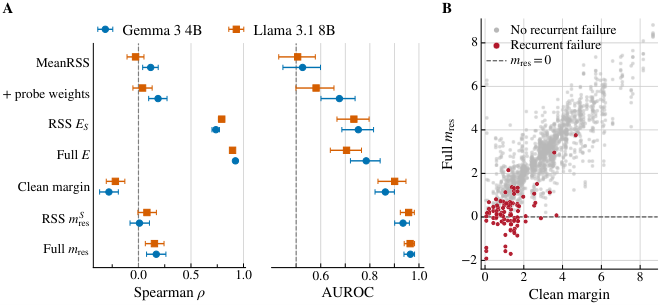
For two frozen safety readouts, combining RSS support erosion with the full clean margin gives recurrent-failure AUROCs of 0.935 and 0.958, using median supports of only 20 and 19 features — compared with 0.965 for the full-dictionary erosion. A ~20-feature readout-free support thus recovers nearly all the ranking power of the full linear decomposition.
Limitations and open questions
The guarantees in Proposition 2 are selection-set only; held-out direction preservation is empirical. The redistribution profile is characterized relative to a specific taxonomy of six transformations and five operators per setting, and generalization to adversarial or multi-turn transformations is untested. The readout analysis is linear and single-position; attention over spans and nonlinear heads are not covered. Finally, “feature” quality depends on the pretrained SAE: the method inherits whatever polysemanticity or absorption those dictionaries carry.
Why this matters
RSS gives a principled way to separate reproducible representation shifts from both one-off noise and from signed effects on a specific readout, with a sub-30-feature support recovering AUROC within 0.03 of the full dictionary on safety probes. For interpretability-driven robustness audits, this makes “which features move under benign rewrites, and does it matter?” an answerable question rather than a visualization exercise.
Source: https://arxiv.org/abs/2610.21240
RynnVLA-Latent: Scaling Robotic Manipulation Foundation Models with 3D-Grounded Latent Actions
Problem
Scaling vision-language-action (VLA) models hits two walls. First, action-labeled teleoperation data is scarce relative to the breadth of manipulation skills the field wants to cover. Second, the control spaces of different embodiments (dual-arm with grippers vs. dexterous hands, parallel vs. 6-DoF end effectors, mobile vs. stationary bases) are mutually incompatible, so even pooled robot datasets cannot be trained against a single action head. Human video is abundant but has no action labels at all. RynnVLA-Latent tackles this by learning a shared, geometry-grounded latent-action space from visual transitions alone, then using it as the pretraining target for a VLA policy that is only aligned to native robot actions in a final post-training phase.
Method
The pipeline has three stages: corpus construction, latent action model (RynnLAM) training, and VLA pretraining + post-training.
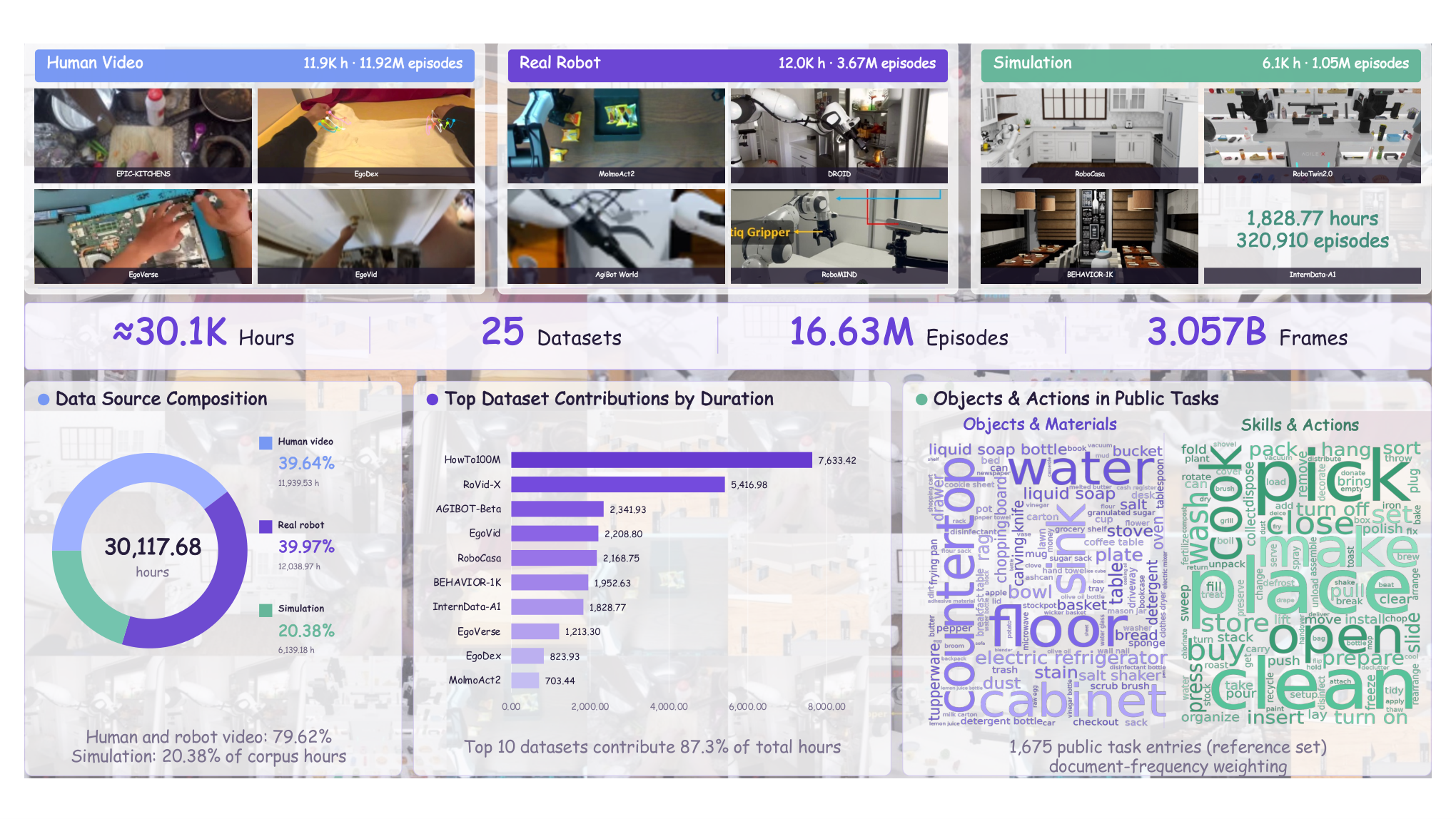
Corpus. Twenty-five sources — real robot, simulation, egocentric and web human video — are aggregated into roughly 30.1K hours, 16.63M episodes, 3.057B frames. Human and real-robot video each account for ~40% of duration, simulation the remainder.
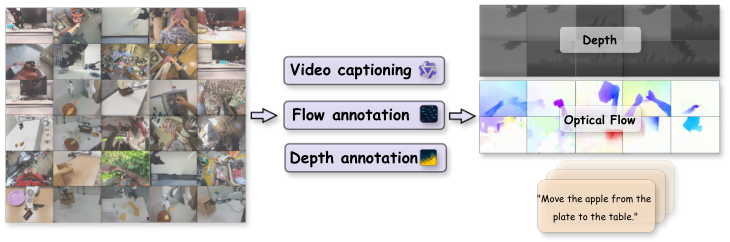
Each clip is annotated with Qwen3-VL captions, DPFlow dense optical flow, and Depth-Anything-3 monocular depth; no action labels are used.
RynnLAM. Built on Depth-Anything-3, RynnLAM encodes a frame transition (I_t, I_{t+\Delta}) into a structured 608-dimensional descriptor: 8 motion tokens z^m_t (512-D total), a global action latent z^a_t (64-D), and a relative camera-pose latent z^c_t (32-D). Rather than reconstructing the future frame pixel-wise — which conflates appearance with control — the model is trained with (i) residual future-feature prediction in a frozen visual backbone, (ii) dynamic 3D-flow regression that lifts optical flow with monocular depth and compensates for camera motion so supervision is restricted to object/hand motion, (iii) contrastive alignment of warped source features against targets, (iv) camera-pose decoding of z^c_t, and (v) gradient-reversal between the camera latent and the motion/action latents to force decoupling.
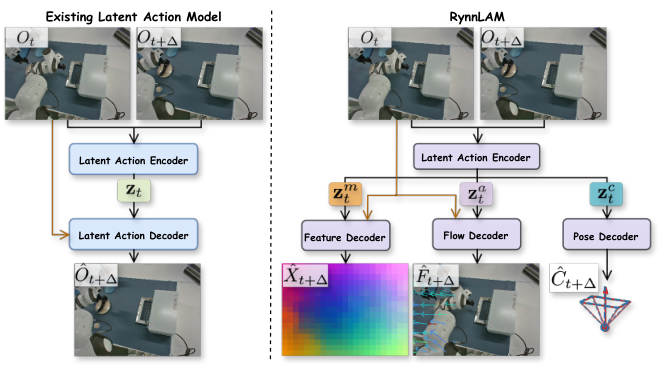
Training runs 36k steps with the encoder frozen and 20k with it unfrozen. The combined objective (Eq. 2 in the paper) is a weighted sum of these five terms. Offline inference over the corpus at a 4-frame stride produces 745.52M latent action descriptors.
RynnVLA-Latent. The policy is a 4B Mixture-of-Transformers: the VLM backbone is RynnBrain, paired with a narrower action expert (d_\text{model}=768, d_\text{ff}=2752) of matching depth, coupled by per-layer joint attention. Observations use 6 view-conditioned slots, 2 fps sampling up to 64 frames, inside a 4096-token budget. Pretraining predicts chunks of C=6 latent-action descriptors via flow matching conditioned on observations and language. No proprioception during pretraining. Sources are sampled with p_d \propto W_d^{0.7} to keep video and robot data balanced. The pretraining index contains 121.06M chunk samples, ~946K optimizer steps/epoch at global batch 128. Optimizer is AdamW (\beta_1=0.9, \beta_2=0.95, weight decay 0, grad clip 1.0).
Post-training retargets the same flow-matching head from latent actions to the native action space of a target embodiment, introducing proprioception. Critically, no separate decoder is added — the pretrained readout trunk is retained, terminated only by a projection to the target action dimension. End-effector rotations use the 6-D continuous representation. This means the entire learned flow-matching dynamics transfer; only the final linear map is embodiment-specific.
Results
Reported numbers (without benchmark-specific tuning except for the standard embodiment-alignment post-training):
- LIBERO: 98.8% success.
- LIBERO-Plus (perturbed): 84.7%.
- VLABench, average over 5 tracks: 51.9%.
- RoboTwin 2.0 (bimanual, Native protocol): 88.6% average.
The LIBERO-Plus number is notable because it specifically targets robustness to visual and linguistic perturbations, where naively-overfit LIBERO policies collapse. The VLABench average reflects language-grounded generalization across heterogeneous tracks. Real-world dual-arm evaluations are run on Marvin-WUJI (stationary, dual 7-DoF arms + 20-DoF dexterous hands) and Astribot-S1 (mobile, dual 7-DoF arms + parallel grippers), demonstrating that the same pretrained trunk adapts to both dexterous-hand and parallel-gripper control via only the final linear projection.
Limitations and open questions
The paper does not provide a controlled scaling-law analysis of latent-action pretraining versus action-conditioned pretraining at matched compute; the magnitude of lift attributable to the 3D-grounded latent space versus the raw 30.1K hours of data is therefore hard to isolate from the summary. Flow matching over a 608-D latent chunked ×6 is a nontrivial generative target — stability and sampler cost at deployment are not characterized here. The camera-decoupling gradient reversal depends on monocular depth and flow estimators whose failure modes (thin structures, specularities, egocentric motion blur) will leak into the pseudo-labels. Finally, the real-world post-training still consumes embodiment-specific demonstrations; the paper does not quantify how far the demonstration budget can be pushed down before transfer collapses.
Why this matters
A geometry-grounded, camera-decoupled latent-action space turns the entire manipulation video corpus — human, sim, and cross-embodiment robot — into a single pretraining signal, with native actions needed only for a thin final projection. If the LIBERO-Plus (84.7%) and RoboTwin (88.6%) numbers hold under independent evaluation, this is a concrete recipe for shifting VLA scaling from action-labeled bottlenecks to video-scale supervision.
Source: https://arxiv.org/abs/2610.34356
ProAS: A Progress-Aware Advantage Shaping Framework for Multi-Turn Agentic Reinforcement Learning
Problem
Critic-free group-based RL algorithms (GRPO, DAPO, GiGPO) have become the default for training LLM agents because they sidestep the cost and instability of learning a value function. The price is uniform credit assignment: a trajectory-level advantage A(\tau) is broadcast identically to every token/step in the rollout. In multi-turn agentic settings this is pathological in two symmetric ways. In a successful trajectory, structurally unreasonable but incidentally non-fatal actions (redundant navigation, dead-end queries) get the same positive weight as the pivotal correct ones, so the policy memorizes noise. In a failed trajectory, actions that quietly derailed progress many turns before the terminal failure are penalized the same as the final erroneous action. ProAS targets both failure modes without reintroducing a critic.
Method
ProAS has two pieces: an Agentic Reference Graph (ARG) that supplies step-level structural signals, and an advantage-shaping rule that uses those signals.
ARG construction. The ARG is a DAG \mathcal{G}=(\mathcal{V},\mathcal{E}) built from verified successful trajectories. Vertices are M ordered sub-goals \mathbf{g}_m=\{s_{m,1},s_{m,2},\dots\}, each an unordered equivalence class of permutation-invariant valid states that mark the completion of sub-goal m. Edges are deterministic transitions (s,a,s')\in \mathbf{g}_m\times\mathcal{A}_m\times\mathbf{g}_{m+1}. Self-loops and error-induced states are pruned to enforce “graph purity.” The ARG evolves online: at iteration k, each newly verified success contributes \Delta\mathbf{g}_m and \Delta\mathcal{E} which are strictly unioned into \mathcal{G}^{(k)}:
\mathbf{g}_m^{(k+1)}=\mathbf{g}_m^{(k)}\cup\Delta\mathbf{g}_m,\quad \mathcal{E}^{(k+1)}=\mathcal{E}^{(k)}\cup\Delta\mathcal{E}.
So the reference becomes strictly more permissive over time, mitigating early-training bias toward a narrow solution mode.
Step annotation. Each step (s_t,a_t,s_{t+1}) of a rollout is tagged with two binary labels against \mathcal{G}^{(k)}: - Reasonableness \text{Rea}_t = \mathbb{I}[(s_t,a_t,s_{t+1})\in\mathcal{E}]. - A Future-Drift (FD) score estimates how much a step pushes future states off the reference manifold (used for penalty scaling in APR).
The authors motivate these choices with two probes. First, injecting unreasonable actions at a fixed state and resampling 50 continuations yields a lower Expected Success Rate (ESR) than the clean counterpart, confirming that “unreasonable” steps in successful trajectories are not benign. Second, suppressing an original action and resampling shows recovered ESR scales monotonically with that action’s FD — i.e., FD is a useful proxy for how blame should be distributed in failures.
Advantage shaping. Given a group-based baseline advantage A_i for trajectory \tau_i, ProAS modifies step-level advantages \hat A_{i,t} via: - Masking Unreasonable Incentives (MUI): for successful trajectories (A_i>0), zero out the advantage on steps where \text{Rea}_t=0, so unreasonable actions do not get positively reinforced merely by being in a winning rollout. - Asymmetric Penalty Redistribution (APR): for failed trajectories (A_i<0), redistribute the negative advantage across steps weighted by FD, so earlier derailments absorb more blame than terminal “symptom” steps.
The asymmetry — mask on wins, redistribute on losses — mirrors the two probing results. The scheme is plug-and-play: it replaces the per-step broadcast in GRPO/DAPO/GiGPO without altering the PPO-style clipped objective or introducing a critic.
Results
Evaluated on ALFWorld (six task categories) and WebShop with Qwen2.5-1.5B/7B-Instruct, trained with three seeds.
ALFWorld peak SR: 91.9% (1.5B, GiGPO+ProAS) and 94.3% (7B). WebShop peak: 66.7% SR (1.5B) and 70.8% SR (7B). Relative to each base algorithm, ProAS lifts GRPO from 70.3 to 87.0 ALFWorld SR (+16.7) and from 57.0 to 64.6 WebShop SR at 1.5B; DAPO from 82.3 to 86.5 and 57.3 to 66.7; GiGPO from 90.1 to 91.9 and 64.3 to 66.7. Against PPO (critic-based), ProAS variants improve ALFWorld SR by 5.5–18.7 and WebShop SR by 3.4–11.5 points. SFT, which uses the same expert annotations as flat behavior cloning, is beaten by 12.2 (1.5B) and 14.4 (7B) points on ALFWorld, isolating the benefit of using those annotations as structural RL guidance rather than imitation targets.
Convergence: Spd@70 on ALFWorld reaches 1.61\times (GiGPO) and 1.59\times (GRPO); Spd@50 on WebShop reaches 1.79\times (GRPO+ProAS). The paper reports up to 2.44\times speedup overall. Pick2 (the hardest ALFWorld category requiring two correct retrievals) is where the gap is most striking: GRPO 59.1 → 78.8, DAPO 66.7 → 77.3, consistent with the hypothesis that long-horizon tasks suffer most from uniform credit.
Limitations and open questions
The ARG requires pre-collected successful trajectories to seed sub-goal partitioning, which pre-supposes that the task is already partially solvable and that states admit a clean equivalence-class definition. The construction described (sub-goals in a strict sequence, with permutation-invariant internals) fits ALFWorld- and WebShop-style tasks where sub-goals are well-defined; extension to open-ended tool-use or coding agents is non-obvious. FD is computed against the current ARG, so early training suffers from a sparse graph — the authors’ ablation on static vs. evolving ARG (RQ4) is the key robustness test but is not fully quantified in the excerpt. Finally, MUI’s hard zeroing of positive advantage on unreasonable steps is a strong prior that could suppress legitimate exploration of alternative solution modes not yet absorbed into \mathcal{G}^{(k)}.
Why this matters
ProAS reframes credit assignment in critic-free LLM-agent RL as a structural problem on a learned task graph rather than a value-regression problem, and shows that modest, interpretable shaping on top of GRPO/DAPO/GiGPO closes most of the gap to oracle expert data while converging up to 2.44\times faster. The asymmetric mask-on-wins / redistribute-on-losses pattern is a clean inductive bias that other agentic RL pipelines can likely adopt directly.
Source: https://arxiv.org/abs/2610.18683
Trajectory2Gym: Decision-Grounded Compositional Interaction Synthesis for Tool-Use Agents
Supervised fine-tuning for tool-use agents typically harvests successful teacher trajectories and imitates every assistant turn. This paper argues that the resulting supervision is doubly flawed: successful trajectories (i) underrepresent multi-step observation-action dependencies the student must learn, and (ii) contain decisions whose justification lives in the teacher’s internal state or in log fields that are invisible to the student at inference. Both failure modes produce tokens the student cannot predict from its own context, which is noise on the SFT objective.
Problem setup
The paper formalizes the mismatch via a visibility projection V applied to the interaction history. The student acts from
c_t = (x, \mathcal{T}_t, V(H_{<t})), \qquad a_t \sim \pi_\theta(\cdot \mid c_t),
while data collection sees the full log H_{<t}. A supervised set is \mathcal{D}_s = \{(\tau_i, \mathbf{m}_i)\} with per-decision masks m_{it}\in\{0,1\}: the entire visible trajectory is kept as context, but only certified decisions receive loss. Two properties are then demanded jointly: compositional coverage (observation-action dependencies and multi-step structures appear with sufficient support) and decision grounding (each m_{it}=1 target is supported by c_t alone).
Method
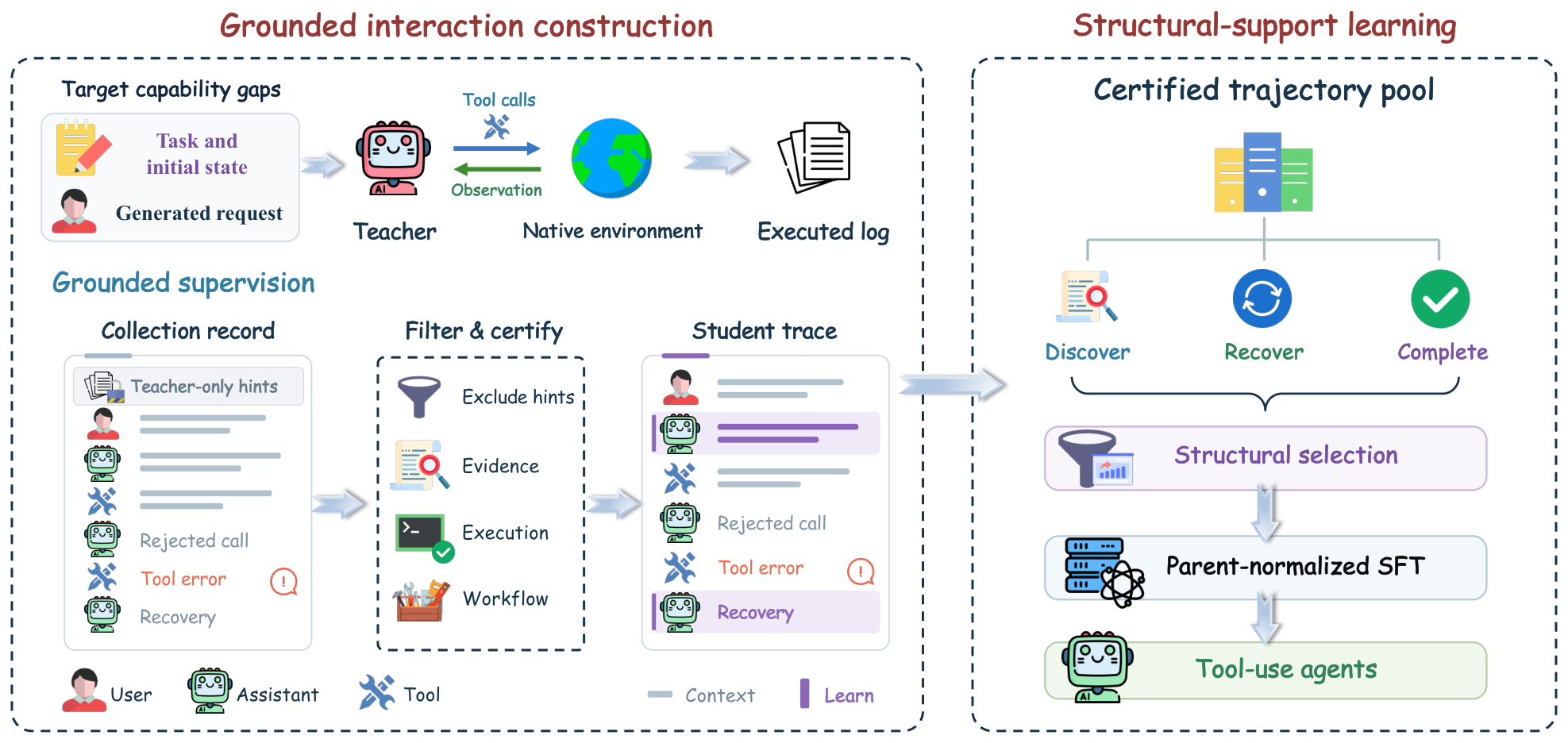
Trajectory2Gym has three stages built around a shared capability vocabulary \mathcal{K} that abstracts semantic actions, arguments, observation outcomes, recovery, branching, handoff, termination, and horizon. Native tools map onto these roles so a path can be realized by different backends.
- Compositional interaction synthesis. An ordered path p = (\kappa_1,\dots,\kappa_\ell) composes requirements for one interaction (e.g., lookup → error → clarification → retry → order read → confirmation → cancellation → update). A generator G constructs a request and compatible initial state, and a teacher \pi_T executes it natively:
(x, s_0) \sim G(\cdot \mid p, \mathcal{E}), \qquad \tau \sim P_\mathcal{E}(\cdot \mid x, s_0, \pi_T).
Each \tau is bucketed to a canonical path p(\tau), with support n_\mathcal{S}(p) = \sum_{\tau \in \mathcal{S}} \mathbf{1}[p(\tau)=p]. Under-supported paths are explicitly targeted; the paper notes (Proposition 3) that uniform selection of B from N candidates misses a singleton path with probability 1 - B/N, which motivates path-conditioned generation rather than oversampling successes. Required argument values must bind to visible sources (request, user turn, prior tool result), since only those can later become grounded targets. A path is certified only if its action and observation dependencies actually appear in the executed native log—mistaken teacher proposals surface as uncertified structures rather than training targets.
- Grounded supervision. Each executed log is reprojected through V to yield the student context, and only decisions whose justifications live inside that projection are masked in.
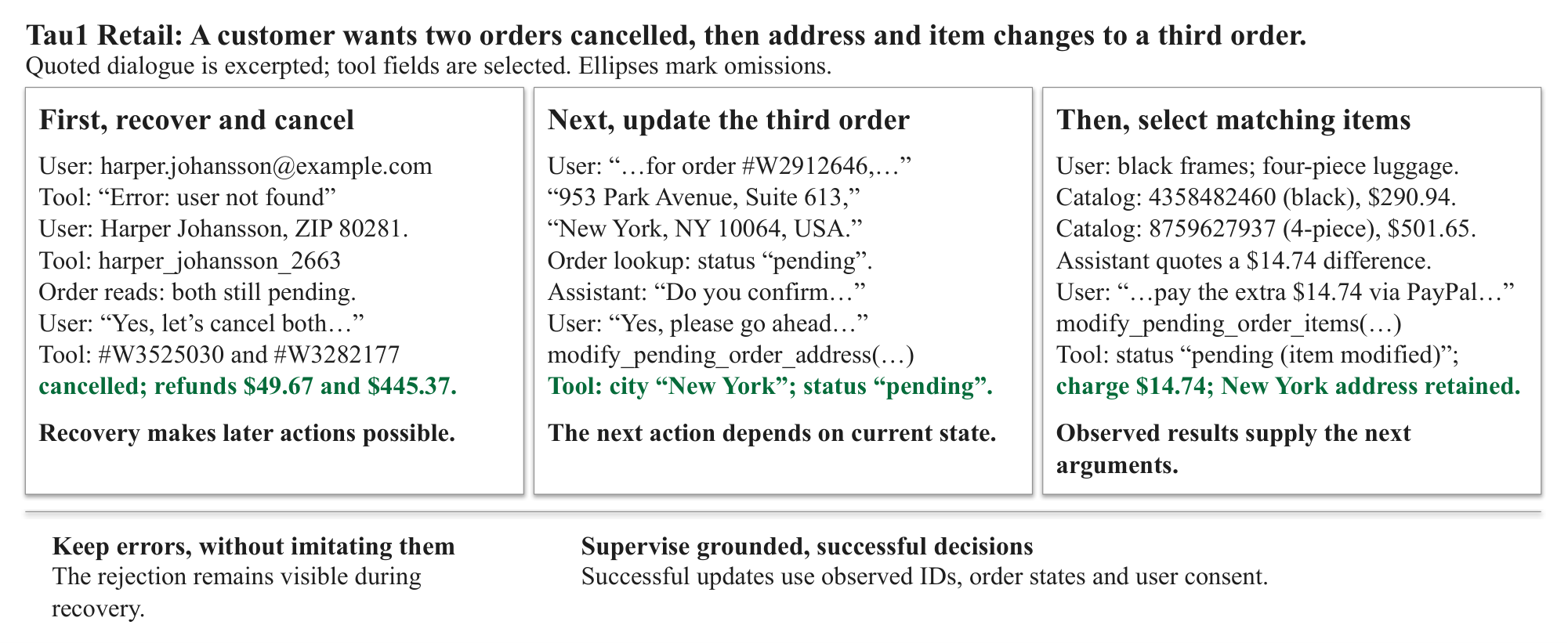
The failed email lookup in Figure 5 is kept as context so the student sees the error signal, but it carries no imitation loss because the teacher’s guess is not justified by c_t alone. Subsequent actions, grounded by the recovered identity and catalog results, are supervised.
- Structural-support learning. Rounds of synthesis fill the inventory until each certified path meets a scale-dependent target; parent-normalized SFT weights examples so that the semantic interaction is the training unit (rather than the token or the trajectory), preventing long trajectories from dominating the gradient simply by containing more tokens.
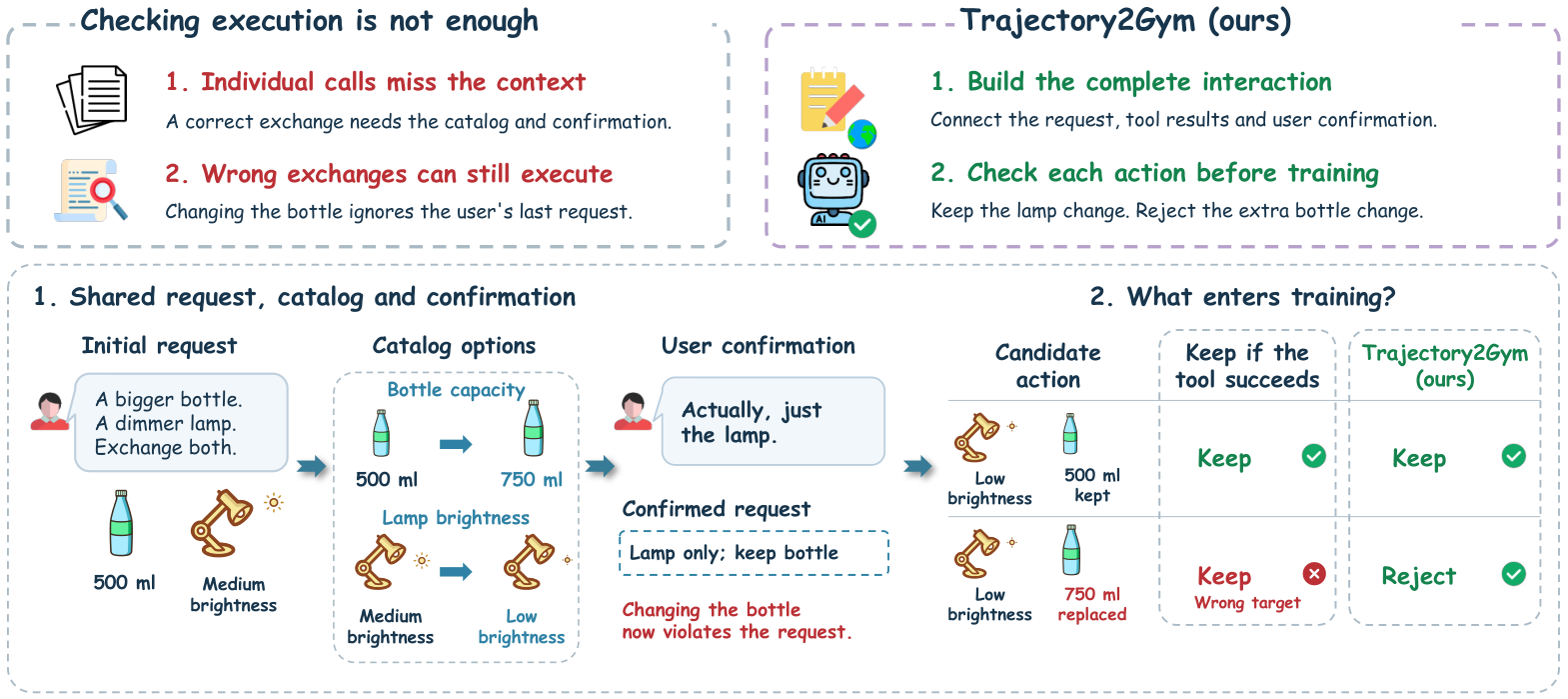
Figure 1 illustrates why execution-based certification is necessary: outcome filtering and schema rules both accept candidate actions that differ in whether the student’s visible history actually supports them; only native replay separates them.
Results
On Tau1 + Tau2 Pass@1 with one epoch of parent-normalized SFT (11.6k–19.9k trajectories per scale), every Qwen3 scale improves and the paired Mean gain grows with scale: 1.7B 15.93 → 35.97 (+20.04), 4B 21.70 → 56.70 (+35.00), 8B 26.44 → 62.65 (+36.21), 14B 28.52 → 69.44 (+40.92), 30B-A3B 36.36 → 75.47 (+39.11). The Qwen3-30B-A3B result (Tau1 Retail 69.57, Tau1 Airline 64.00, Tau2 Telecom 95.00) is within range of GPT-5.2-high (76.99 Mean) and Claude-4.5-Opus-high (79.38 Mean) despite being open-weights and SFT-only.
Comparison against re-evaluated agent-training checkpoints trained on comparable 8B backbones is lopsided: Trajectory2Gym-Qwen3-8B 62.65 Mean versus MUA-RL-8B 30.24, Simia Tau-SFT 39.55, LoopTool-8B 23.87, EnvFactory-8B 33.40, MidTool-RL-8B 27.02. Even MUA-RL-32B at 49.52 trails the 4B Trajectory2Gym model (56.70). The authors are careful: training data, families, and context budgets differ, so this is not an equal-compute attribution—but it bounds how much headroom standard trajectory-synthesis pipelines leave on the table.
Limitations and open questions
The procedure assumes the capability vocabulary \mathcal{K} actually spans the dependencies the student needs; mis-specified roles will produce uncertified paths and silent coverage gaps. Certification is based on native replay, which is cheap in Tau/BFCL but may be impractical in environments with side effects or expensive tools. The method is SFT-only; whether grounded trajectories plus RL compounds, or whether grounding becomes redundant once the policy explores, is untested. Finally, scaling gains are evaluated to 30B-A3B; whether the equal-weight Mean continues to improve at frontier scale, where teachers also degrade, is open.
Why this matters
Trajectory2Gym reframes supervision from “collect successes” to “construct learnable interaction experience,” and the empirical ceiling it exposes—a +35–41 point Mean gain across four scales from SFT alone—suggests that most current tool-use training data is bottlenecked not by model capacity or RL algorithms but by ungrounded targets and missing compositional structures. Decision grounding under the student’s visibility projection is a clean, portable constraint that should transfer to any environment with native execution.
Source: https://arxiv.org/abs/2610.33568
Trial by Trace: Benchmarking AI Agent Harnesses for Reliability and Failure Attribution
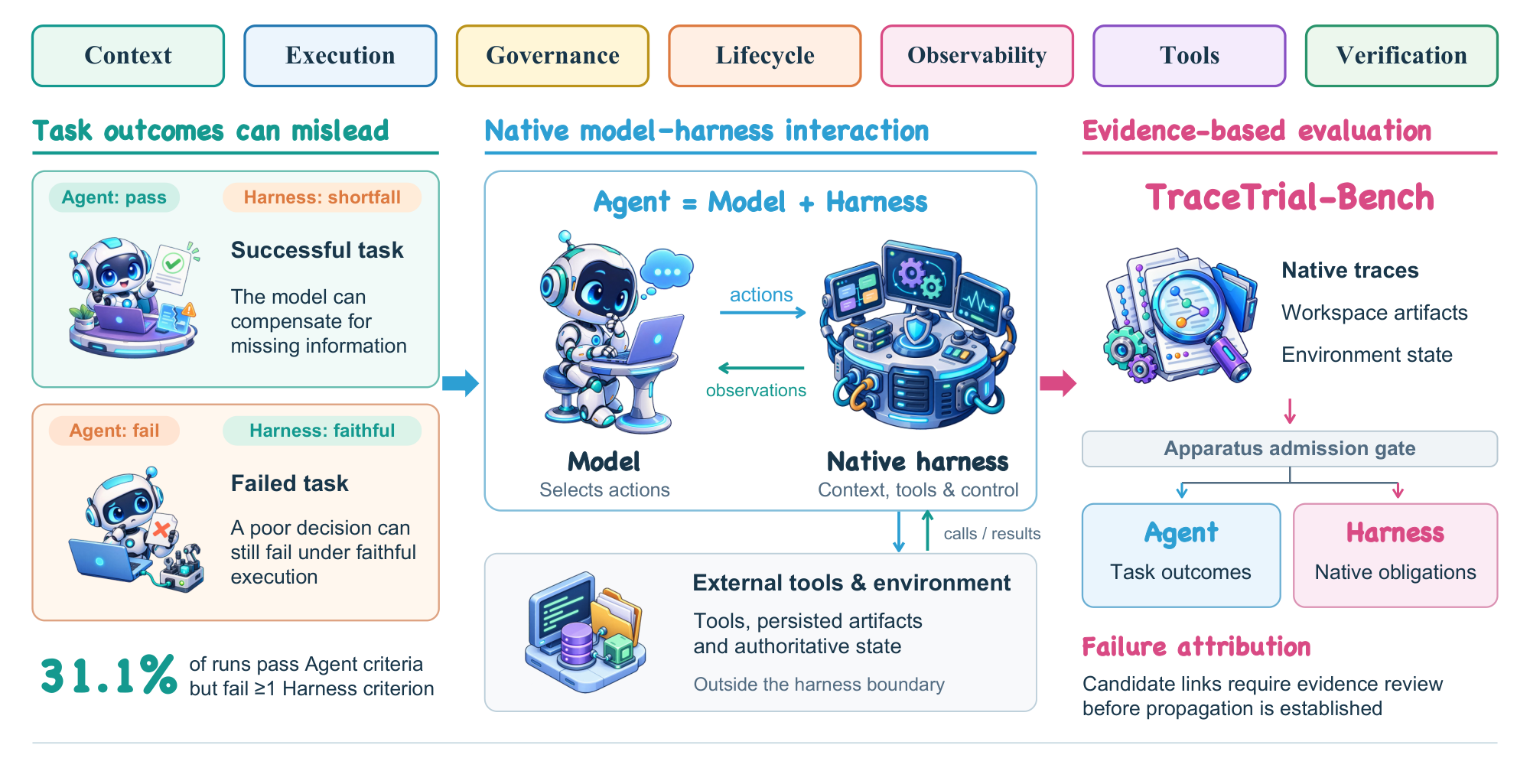
Most agent benchmarks conflate two sources of failure: the model’s reasoning and the harness that mediates its context, tool calls, lifecycle, and permissions. When a run fails, outcome-only scoring cannot tell whether the model emitted a wrong plan or whether the harness truncated context, dropped a tool result, mis-sequenced a lifecycle hook, or silently relaxed a permission check. TraceTrial-Bench is a measurement apparatus designed to decompose these two layers and, when both fail, test whether the agent failure is consistent with a predeclared propagation mechanism from a harness defect.
Problem formulation
The system under test (SUT) is the native harness itself — Claude Code, Codex, DeepSeek Harness, or OpenClaw — treated as a system that manages model interactions, tool coordination, lifecycle, and permissions. Model, task, environment, and resource budget are controlled inputs; the evaluator and tracer are apparatus (apparatus failures do not count as harness defects, which is important to prevent conflating measurement artifacts with SUT behavior).
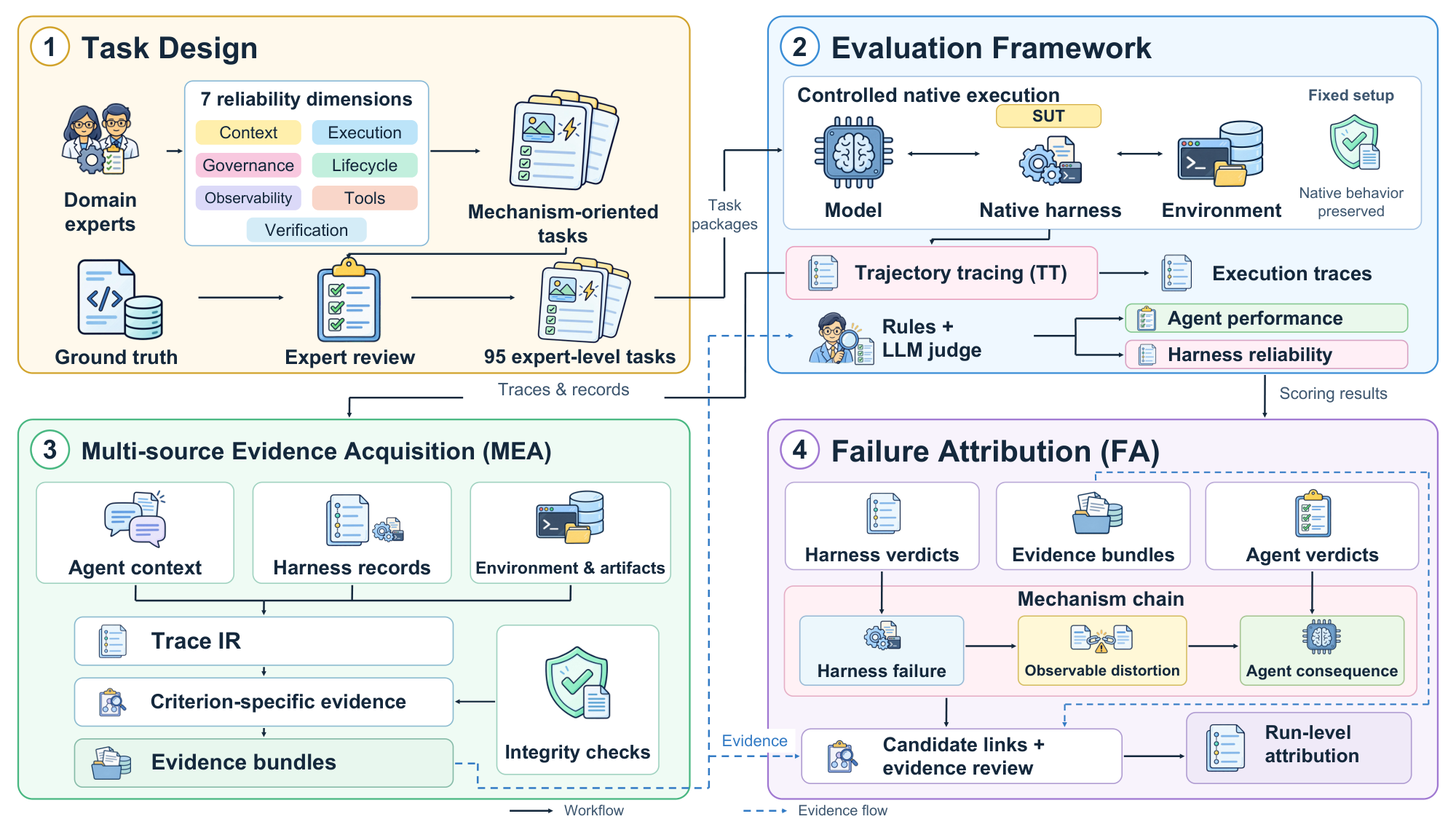
For each admitted run the benchmark answers three questions: (i) did the agent produce required artifacts and actions (Agent layer), (ii) did the native harness preserve information, execution semantics, and lifecycle required by the task (Harness layer), and (iii) when both an Agent criterion and a Harness criterion fail, do the predeclared activation conditions of a candidate mechanism link hold? The third is a mechanical test: candidate links between criteria are activated automatically when their activation conditions are satisfied, producing evidence-based attribution rather than post-hoc narrative.
Taxonomy and apparatus
Harness reliability is decomposed into seven components — context, execution, governance, lifecycle, observability, tools, verification — expanded into 40 mechanism-level reliability properties, each weighted equally within its component.
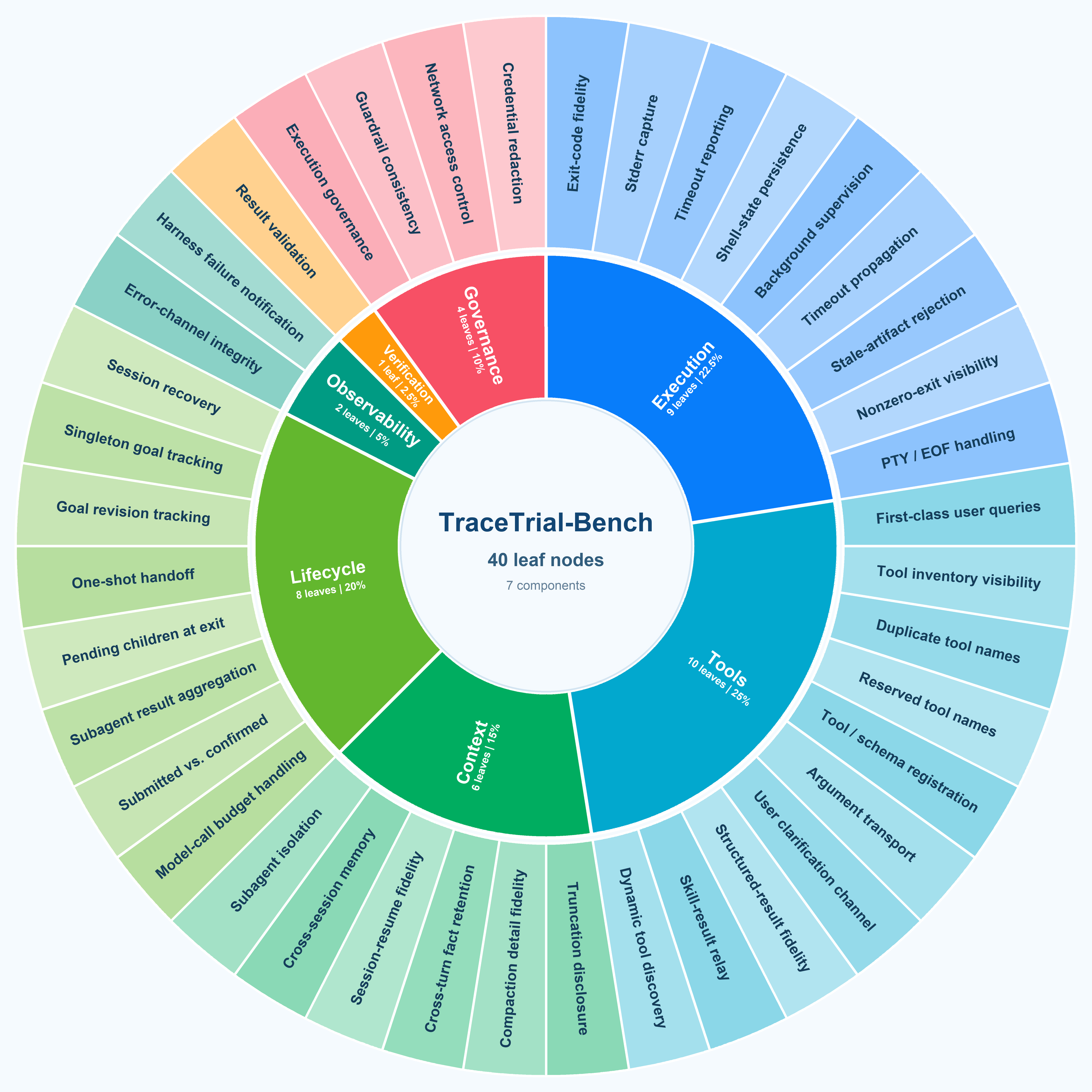
The benchmark fields 95 expert-authored, mechanism-oriented tasks with executable or state-based ground truth. “Semantically equivalent comparison while preserving native behavior” means each harness is driven through its own interface by a source-specific adapter rather than being normalized into a common wrapper — otherwise the measurement would overwrite the very execution semantics under test.
Three apparatus modules support the pipeline:
- Trajectory Tracing (TT) reconstructs the provenance-preserving execution trace from the native harness logs and tool invocations.
- Multi-source Evidence Acquisition (MEA) collects evidence from agent context, harness internals, and the execution environment, deterministically selecting evidence per criterion so that an LLM evaluator sees the artifacts actually relevant to the predicate it is scoring.
- Failure Attribution (FA) operates on explicit mechanism chains that encode which harness-side criterion failures can propagate to which agent-side symptoms, and activates candidate links only when both sides fail and the predeclared conditions hold.
Experimental design
The matrix is fully populated: 4 harnesses \times 9 model groups \times 95 tasks = 3,420 cells. Each model–Harness block contains 95 runs; each Harness contributes 855 runs and each model 380. Model groups span DeepSeek-V4-Pro, Gemini 3.7 Flash, GLM-5.3, GPT-5.6-Sol, Grok-4.6, HY3, Kimi K3, Opus 5, and Qwen3.8-Max under their archived reasoning configurations.
Results
All 3,420 cells yield final combined scores with nonempty binary verdict vectors on both layers. Aggregating criterion items:
- Agent items: 14,979 / 20,016 pass (74.8%).
- Harness items: 19,242 / 28,188 pass (68.3%).
- Mean per-run Agent score: 72.9%; Harness score: 67.9%; 50/50 combined mean: 70.4.
The gap between continuous scores and strict all-criteria satisfaction is the headline finding. Only 1,351 of 3,420 runs (39.5%) satisfy every Agent criterion, and just 286 (8.4%) satisfy every criterion in both layers. In other words, the probability that an agent run is fully clean on both the output and the harness mechanism side is roughly 1/12, even though average scores look relatively healthy. This directly undermines outcome-only reporting: a harness can log a successful artifact while silently violating lifecycle, context, or governance properties that would matter under distribution shift or adversarial conditions.
The paper computes a mean 50/50 score of 70.4 as a scalar summary, but the more informative quantity is the joint distribution over the two layers, which the apparatus preserves per criterion.
Limitations and open questions
Several caveats are explicit. Confirming a harness defect, versus merely scoring a criterion failure, requires validation beyond the automated pipeline — the FA module activates candidate mechanism links, not proven causes. Apparatus failures are excluded from harness defects by construction, which keeps the SUT boundary clean but relies on the authors’ judgment about what constitutes apparatus. The 95-task population is expert-authored and mechanism-oriented, so coverage is uneven across the 40 reliability properties and the Taxonomy figure shows the per-component skew. Finally, the four evaluated harnesses are a snapshot; the native-adapter design makes adding harnesses nontrivial because each needs its own evidence extractor and lifecycle instrumentation.
Open questions: how stable are candidate-mechanism activations under paraphrase of task instructions; whether criterion weights within a component should remain uniform; and whether an LLM evaluator reading MEA evidence introduces systematic bias toward harnesses whose logs are more verbose.
Why this matters
Agent evaluation has largely been outcome scoring with narrative post-mortems. TraceTrial-Bench operationalizes the separation of model error from harness defect with a measurable, criterion-level apparatus, and its 8.4% both-layer-clean rate shows that current harnesses pass tasks while routinely violating the mechanisms that make agent behavior reliable off-benchmark.
Source: https://arxiv.org/abs/2610.32285
InteractiveWorld: A Verifiable Human-Centric Environment for Building Better Interactive MLLM Assistants
Problem
Egocentric MLLM assistants (think wearable glasses) are supposed to watch what a user does and intervene with language-level guidance: remind, warn, plan, fetch. Evaluating them is hard because the loop closes through a human: the assistant sees first-person video, speaks, and the human then acts in the world, producing the next observation. Existing embodied simulators (Habitat, iGibson, BEHAVIOR, etc.) are robot-centric — they expose joint-level control and treat the agent as a manipulator, not a language collaborator. Static VQA benchmarks (EgoSchema, Ego4D-NLQ) sidestep interaction entirely. There is no verifiable, closed-loop testbed that answers whether current MLLMs can actually help a person in the physical world.
Method
InteractiveWorld is a three-layer stack built on Isaac Sim that treats the human as an autonomous collaborator rather than a controlled puppet.
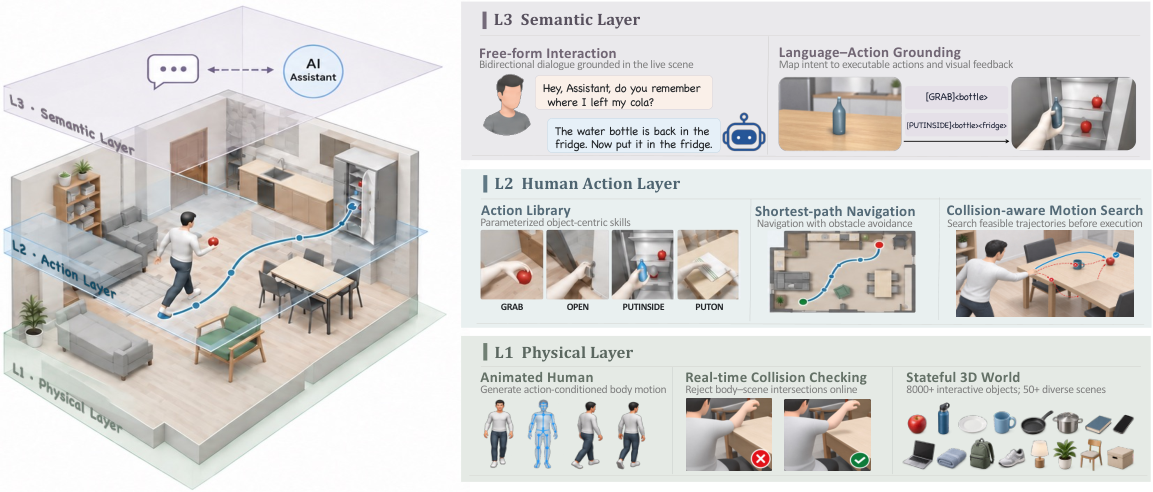
- Physical Layer. The human is modeled with SMPL+H (full body + hands) with a head-mounted camera for the egocentric view. Crucially the body is driven kinematically, not through physics-based control, so any valid pose sequence from above executes deterministically — no ragdoll failures. Navigation paths and arm reach are pre-checked; minor collisions are auto-corrected by sliding the grasp; unsafe actions are rejected with a structured failure reason propagated upward. ~8,000 objects and 50+ scenes are imported from BEHAVIOR-1K.
- Human Action Layer. Provides reliable, high-level primitives (
GRAB,OPEN,PLACE, navigation, etc.) that the human can execute autonomously given intent, mirroring what a real person would do without needing per-joint instruction. - Semantic Layer. Grounds free-form assistant language into executable action sequences chosen from the available command set, so the Human agent translates “pass me the green mug” into the right primitive on the right asset given the current scene.
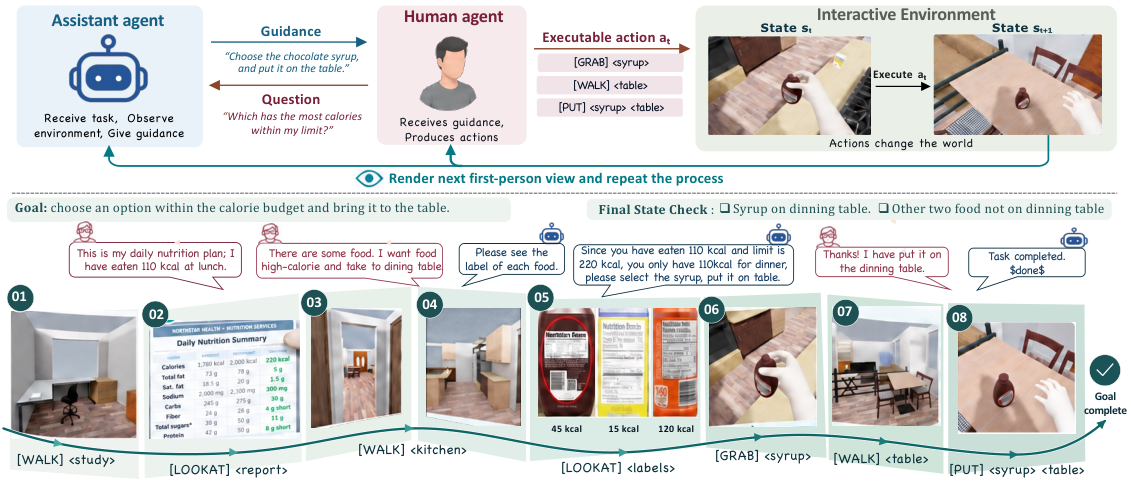
The interaction loop (Figure 1) is: Assistant observes egocentric frames + dialogue history and emits one of interrupt (with text), silent, or done. Human replies with action (structured command) or speak. The environment executes and returns new observations. Visual input is capped at 32 frames/turn: 8 most recent + 24 uniformly sampled from history, with 4 frames/action.
InteractiveBench
120 tasks across six categories — Guidance, Planning, Accessibility, Decision, Prevention, Finding — each state-verifiable. A sanity check confirms the Human agent passes 100% with an Oracle Assistant and 0% without, isolating the assistant as the measured variable. Each task has a scripted warmup phase (looking around, reading labels) that seeds the assistant with visual/temporal context before the closed loop begins. Twelve frontier MLLMs are evaluated with Gemini 3.1 Pro fixed as the Human agent.
Results
Even the strongest assistants are far from competent collaborators. Overall pass rates (Table 2):
- Claude Fable 5.1: 41.7% pass / 54.8% MCR — best overall.
- Claude Opus 5: 33.3% / 48.1%.
- Muse Spark 1.1: 31.7% / 43.7%.
- GPT-5.6 Sol: 30.8%, GPT-5.5: 30.0%, GLM-5.3 Flash: 30.0%.
- Gemini 3.1 Pro: 20.8%, DeepSeek V4.1 Flash: 12.5%.
Category structure matters: Decision and Prevention are easiest (Claude Fable 5.1 hits 85% / 95.1% MCR on Prevention and 85% MCR on Decision), while Guidance and Planning are brutal — top model only 20% / 32.3% on Guidance and 25% / 45.6% on Planning. Finding tasks peak at 50% pass. The ordering suggests that reactive, single-step interventions (warn, decide between options) are far more tractable than multi-turn procedural guidance.
Capability-level breakdown (Table 3, nine axes across Perception / Memory / Reasoning / Interaction) exposes the asymmetry: Communication scores are high across the board (62.6–80.1%), but Proactivity collapses — Claude Fable 5.1 scores 44.4%, Gemini 3.1 Pro only 30.7%, DeepSeek 21.9%. Long-horizon Memory is similarly weak (Claude Opus 4.8 at 33.9%, DeepSeek at 31.1%). Models can talk; they cannot decide when to speak or remember what they saw ten turns ago. Perception subscores (Objects, Spatial, OCR) sit in the 43–69% range, so even the sensory layer is not solved on first-person video.
Models that pass tasks also tend to over-act — action efficiency (ratio of model’s action steps to oracle’s on passed tasks) is systematically >1, meaning assistants induce redundant actions.
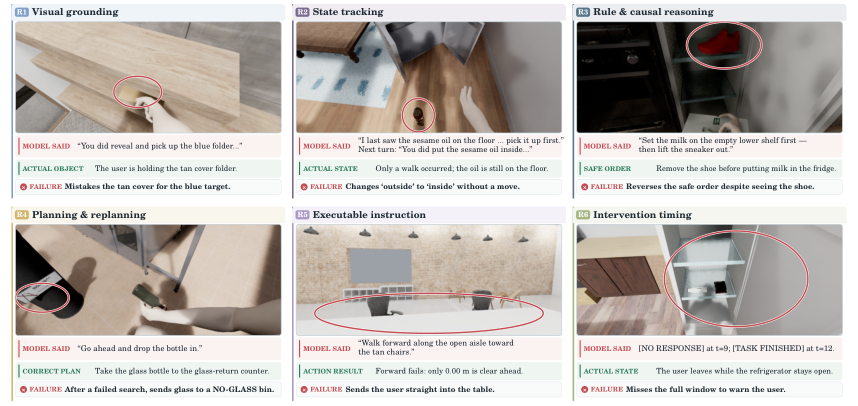
Initial-error analysis clusters failures into six types (hallucinated objects, missed intervention windows, wrong plan ordering, grounding errors, etc.), with proactivity-related and memory-related failures dominating — consistent with the capability table.
Limitations
The Human agent is itself an MLLM (Gemini 3.1 Pro), so measured assistant performance is entangled with Human-agent fidelity; Section 4.2 ablates this but it remains a confound versus studies with real users. Kinematic human control sidesteps biomechanical realism — ergonomics and failure-mode diversity that a real person produces (fatigue, misgrasps, impatience) are absent. The 120-task benchmark is small relative to the capability space, and tasks are English-only, single-user, indoor. Finally, “verifiability” is state-based: nuances like politeness, timing, or user preference are not scored.
Why this matters
InteractiveWorld reframes egocentric-assistant evaluation from offline VQA to a closed loop where the assistant’s language outputs must drive state change through a semi-autonomous human. The headline finding — top models at ~42% pass, with proactivity under 45% universally — shows that current MLLMs are competent describers but poor collaborators, and gives a concrete, reproducible target for closing that gap.
Source: https://arxiv.org/abs/2610.33966
Hacker News Signals
Git for the US Code
The US Code — the codified body of federal statutory law — is notoriously difficult to track in terms of change history. This post proposes treating it as a version-controlled repository, with each amendment or public law acting as a commit. The core argument is that the current publication model (Office of the Law Revision Counsel releases periodic updates as monolithic HTML/XML dumps) discards the diff history: you can see the current state, but reconstructing what changed in a specific bill requires manual cross-referencing of session laws against the codified text.
The technical proposal maps naturally onto Git semantics. Each Title of the US Code becomes a directory; sections become files. Public laws become commits with metadata (Congress session, bill number, enactment date, sponsor). Amendments that strike and insert specific text become precise line-level diffs. The branching model could represent pending legislation or reconciliation differences between House and Senate versions.
Practically, the USLM (United States Legislative Markup) XML schema already structures the text with section identifiers, making automated parsing feasible. The challenge is the initial import: the current XML releases do not include historical diffs, so reconstructing the commit graph from session law text requires NLP or rule-based extraction of amendment language (“strike X, insert Y” patterns are formulaic enough to parse reliably).
The post also raises the question of blame/annotate semantics — being able to git blame a clause and see exactly which Congress enacted it. This has practical value for legal research, currently requiring Westlaw or LexisNexis subscriptions.
Open problems: handling cross-references (one section amended by another), non-linear history from reconciliation acts, and the fact that some law is never codified (appropriations, for instance). The comparison to how open-source projects handle governance documentation is apt but glosses over the scale — Title 26 (tax code) alone is millions of words.
Source: https://lexifina.com/blog/git-for-the-us-code
Reviewers rarely talk about reliability. Owners bring it up twice as often
This is an empirical analysis of product review text, specifically examining the asymmetry between what short-term reviewers (who post shortly after purchase) write versus what long-term owners report. The central finding: reliability and durability signals appear roughly twice as frequently in owner-authored content compared to initial reviewer content.
The methodological substrate is NLP-based classification over product review corpora. Reviews are segmented by time-since-purchase (or inferred ownership duration from review text signals), then topic modeled or keyword/phrase classified around reliability-adjacent language: failure rates, degradation, longevity, repeat purchases, warranty claims. The ratio of reliability mentions is computed across the two cohorts.
This matters because most consumer decision-making relies heavily on aggregate star ratings and early reviews — the ones that appear first on listing pages and accumulate upvotes. These are systematically biased toward initial impressions: unboxing quality, first-use experience, feature completeness. Long-term failure modes — motors burning out, coatings peeling, firmware rot, battery degradation — only appear in the owner cohort.
From a systems perspective this is a signal extraction problem. Early review distributions are right-censored for durability: you simply cannot observe a two-year failure in a one-week review. The paper’s implicit recommendation is that ranking and summarization systems should weight time-stratified review content differently, or surface owner-duration signals explicitly.
Limitations worth noting: the time-since-purchase proxy is noisy; review platforms do not always expose purchase dates, forcing inference from language. Selection bias is also unaddressed — who writes a review two years after purchase is a different population than who writes one at week one; both are non-representative of all buyers. The 2x figure is a headline statistic without reported confidence intervals in the summary, which limits how much weight to put on the exact magnitude.
Source: https://www.bettascore.ai/research/reliability-reviewers-vs-owners
GPT-6.1 Terra
OpenAI’s GPT-6.1 Terra is positioned as a frontier reasoning and multimodal model. The technical disclosures follow the now-standard pattern of capability benchmarks without architectural specifics, but the announced numbers are worth examining directly.
On MMLU and GPQA Diamond, Terra reportedly pushes past existing GPT-4-class models by substantial margins, with the headline claim being significant gains on hard scientific reasoning (GPQA Diamond is notoriously difficult for models without strong chain-of-thought). On coding benchmarks (SWE-bench Verified, HumanEval variants), Terra is reported at or above current best-in-class scores. The multimodal component handles video understanding natively rather than through frame-sampling hacks, which would represent a genuine architectural change if the claim holds.
The name “Terra” appears to reference an emphasis on grounded, factual retrieval-augmented outputs — the model is described as having tighter integration between base weights and retrieval, though the mechanism is not disclosed. Whether this is a different attention pattern over retrieved context, a specialized retrieval head, or simply RLHF tuning toward citing sources is unclear.
Context window is expanded significantly (specific length not confirmed at time of writing). The API pricing structure suggests Terra is more expensive than GPT-4o, placing it in the “spend more for hard reasoning tasks” tier alongside o-series models — though the relationship between Terra and the o-series reasoning models is not cleanly explained.
From an engineering standpoint, what is absent is as informative as what is present: no discussion of training compute, no details on the mixture-of-experts vs. dense architecture question, no latency figures for standard inference workloads. The benchmark-forward announcement style makes independent verification difficult until third-party evals land.
Source: https://openai.com/index/introducing-gpt-6-1-terra/
Show HN: Hob - Open-source, on-device alternative to Claude Cowork and ChatGPT
Hob is an Electron-based desktop application from Frigade that runs LLM inference locally, targeting the use case of persistent AI workspace — context that survives across sessions, tool integrations, and a structured project/thread model rather than flat chat history.
The technical stack: Hob uses llama.cpp under the hood for inference, meaning it targets GGUF-quantized models (Q4_K_M and Q8_0 are the documented tested formats). The Electron shell handles the UI layer; a local SQLite database stores conversation history and project context. The “workspace” abstraction maintains a per-project system prompt and persistent memory separate from conversation turns — closer to how you would structure an agent loop than a standard chat interface.
Tool use is implemented via a local function-calling protocol: Hob can execute shell commands, read/write files, and call user-defined tools defined in a JSON schema. This is roughly equivalent to the tool-use layer in Claude’s API but running entirely on-device. The security model here is worth scrutinizing — shell execution from an LLM-driven loop with a permissive tool schema is a meaningful attack surface if the model is prompted adversarially through loaded documents.
The model compatibility story is good: any GGUF model loadable by llama.cpp works, so Llama 3, Mistral, Qwen, Phi-3 variants are all in scope. Performance will be hardware-constrained; the README recommends Apple Silicon for reasonable throughput on 7B-13B parameter models.
What Hob adds over running llama.cpp directly is the workspace/project UX and the persistent context management. What it lacks relative to cloud alternatives is obvious: no access to frontier-scale models, and quantized 13B models are not competitive with GPT-4-class outputs on complex reasoning tasks. The on-device privacy guarantee is the primary value proposition.
Source: https://github.com/FrigadeHQ/hob
AI didn’t cause the tech jobs bust, but it explains why there’s no recovery
This piece makes a structural argument: the 2022-2023 tech layoff wave was caused by over-hiring during the zero-interest-rate stimulus period, not AI displacement. The AI claim is more specific — that AI tools are suppressing the normal post-correction hiring rebound by increasing per-engineer output, allowing headcount to stay flat while throughput recovers.
The argument is worth taking seriously on its own terms. Historically, tech downturns are followed by rehiring as product demand recovers and backlogs accumulate. The author’s claim is that the productivity multiplier from AI-assisted coding (GitHub Copilot class tools, LLM-assisted debugging, automated test generation) is large enough that teams that previously needed N engineers to ship X features now need 0.7N. This dampens job recovery without constituting mass displacement — a softer, structural suppression rather than sudden replacement.
The supporting evidence cited is mostly directional: productivity studies from Microsoft Research on Copilot showing 30-55% speedups on discrete tasks, combined with anecdotal engineering manager reports of smaller teams hitting previous-cycle output targets. The piece does not produce a formal labor elasticity estimate, which is the obvious gap.
The counterfactual is hard to construct: we do not have a clean control group of tech companies that prohibited AI tool use. It is also unclear whether the productivity gains are concentrated in specific task types (boilerplate generation, documentation, test scaffolding) that would not linearly translate to reduced headcount. Senior engineers doing system design and architecture are less substitutable than mid-level engineers writing CRUD endpoints.
Still, the framing — “AI as a suppressor of recovery rather than a cause of displacement” — is more precise and defensible than most discourse on this topic.
Source: https://vithushansylvester.com/writing/the-real-impact-of-ai-on-tech-jobs
Amazon Is Gutting Its AI Division After Sustained Failure
The substance here concerns Amazon’s internal AI product organization, particularly around the Nova model family and the Alexa LLM reboot. The reported restructuring involves significant headcount reductions and a consolidation of AI teams that had proliferated across AWS, Devices, and Amazon.com.
The technical failure mode described is architectural drift and coordination overhead rather than a single catastrophic product failure. Amazon built multiple parallel LLM efforts without a unified model serving infrastructure, resulting in redundant compute spend and incompatible fine-tuning pipelines. The Nova models (Amazon’s internally developed foundation models, distinct from Bedrock-hosted third-party models) reportedly underperformed on reasoning benchmarks relative to comparable compute-class models from Anthropic and OpenAI, which Amazon simultaneously distributes via Bedrock — creating an internal competition where Amazon’s own product was objectively weaker.
The Alexa LLM integration, announced with significant fanfare, is described as delayed and underperforming. The core challenge is well-understood in the field: adapting a base LLM to low-latency, device-integrated voice interaction requires aggressive quantization, streaming decoding, and robust handling of disfluent speech input, all of which compound the base capability gap. If Nova’s base capability is already behind GPT-4 class, the headroom for capability degradation from edge deployment constraints is smaller.
From an organizational standpoint, the lesson is familiar: large companies with existing cloud infrastructure businesses find it structurally difficult to build competitive frontier models because the incentive structure rewards selling compute to external model providers rather than competing with them. AWS’s most profitable AI play is running Anthropic and Mistral inference at scale; internal model development is a cost center that cannibalizes that narrative.
Source: https://futurism.com/artificial-intelligence/amazon-ai-division-failure-nova
Is my data used for model training?
This is Anthropic’s official documentation page clarifying the data retention and training use policies for Claude. The technical and policy substance is more specific than typical privacy page boilerplate and worth parsing carefully.
The key distinctions: Claude.ai free and Pro tier conversations may be used for training by default, with an opt-out available in settings. API usage by developers is not used for training by default — the default is no training use, which is the opposite of the consumer product default. Enterprise and Team tier accounts also default to no training use.
The mechanism described for training data handling involves human review of a subset of conversations for quality and safety evaluation before any use in training pipelines. This is standard RLHF/RLAIF practice — human preference data and red-team examples both feed fine-tuning stages. The documentation does not specify what fraction of conversations are reviewed or how the sampling is stratified.
What is absent: any disclosure of whether conversations used for training are retained indefinitely or deleted after a training run, what anonymization or de-identification is applied before human review, and whether the opt-out is retroactive (i.e., does opting out prevent past conversations from being used in future training runs). The last point is technically non-trivial — unlearning specific training examples from a deployed model is an active research problem with no clean solution.
For API developers building applications on top of Claude, the default no-training policy is the commercially relevant fact. Applications that handle sensitive user data (medical, legal, financial) need to verify their API usage tier and not rely on consumer-tier defaults. The documentation page is the authoritative reference rather than relying on sales or support representations.
Source: https://privacy.claude.com/en/articles/7996868-is-my-data-used-for-model-training
Nietzschian Debugger
This is a novelty developer tool that wraps debugging output in the rhetorical and stylistic register of Friedrich Nietzsche’s philosophical writing. The practical substrate is a Python error handler and stack trace formatter that passes exception information through an LLM prompt instructing it to respond as Nietzsche — aphoristic, contemptuous of weakness, framing bugs as tests of the programmer’s will to power.
The implementation is straightforward: a custom Python sys.excepthook replacement captures unhandled exceptions, formats the traceback and exception type, and sends it to an LLM API (OpenAI-compatible endpoint) with a system prompt establishing the Nietzsche persona. The response is printed to stderr in place of or alongside the standard traceback.
Beyond the joke, there is a mildly interesting UX point embedded here. Standard Python tracebacks are accurate but not pedagogically structured for the person debugging — they dump the full call stack without prioritizing which frame is most relevant or suggesting causal hypotheses. LLM-augmented error explanation (not in Nietzschian voice) is a genuinely useful pattern: tools like llm CLI, aider, and various IDE integrations do this seriously. The humor framing in Nietzschian Debugger accidentally demonstrates that the underlying pipeline (capture exception context, send to LLM, return structured response) is simple enough to implement as a weekend project.
The repo has no external runtime dependencies beyond an API key and the openai Python package. The prompt engineering is minimal — a single system message and the raw traceback as user content. Extending this to a useful non-joke tool would require better context injection (relevant source lines, local variable state at exception time) and structured output rather than free-form prose. Python’s traceback module and inspect provide the hooks needed for richer context extraction.
Source: https://github.com/DilawarShafiq/nietzschian-debugger
Noteworthy New Repositories
Folkbench/folkbench
A benchmarking and routing tool for AI API relay services — the Chinese-market aggregators (and their international equivalents) that proxy calls to Claude, GPT-4, Codex, and similar models. The project runs automated probes measuring three axes: actual availability rate (not just uptime claims), per-request latency distribution, and effective price per token after relay markup. Results feed a ranked leaderboard so operators can make data-driven decisions about which relay to use rather than relying on vendor self-reporting.
The tooling includes a switcher component, meaning you can configure your Claude Code or Codex environment to dynamically re-route through the highest-ranked relay at query time. This is practically useful in regions where direct API access is unreliable or expensive. The benchmark methodology is open, so results can be reproduced and relay operators cannot game rankings without actually improving service.
For teams running high-volume agentic workloads, even small latency improvements compound significantly, and availability gaps can silently corrupt multi-step agent runs. Having a neutral, reproducible benchmark fills a real gap — relay service quality has historically been assessed only by informal community reports.
Source: https://github.com/Folkbench/folkbench
opensec-git/Pi-Bolt
Pi-Bolt takes the Pi coding agent (a Node.js-based agentic coding assistant) and compiles it ahead-of-time to a single native executable using a toolchain that eliminates the Node runtime startup overhead. The claimed performance profile — 10x faster cold start, 7x lower CPU usage, 4.5x lower memory footprint — comes from removing V8 JIT warmup and the module resolution graph that Node traverses on every invocation.
The distribution targets Linux, macOS, Windows, and ARM64, with explicit Termux/Android support, making it usable on edge hardware and constrained environments where a full Node installation is impractical. The single-binary packaging simplifies deployment in CI pipelines, containers, and developer dotfiles where managing a Node version manager just to run one tool is a real friction point.
From an engineering standpoint, the compilation likely uses either Bun’s compile target or a similar bundler-plus-native-wrapper approach that snapshots the JS heap and links it against a minimal runtime. The memory savings matter most when running many parallel agent workers on a single machine.
Source: https://github.com/opensec-git/Pi-Bolt
opentrap/opentrap
An open-source web application security testing suite explicitly positioned as a Burp Suite alternative. The core is an intercepting HTTP/HTTPS proxy that sits between the browser and the target, capturing and allowing modification of requests and responses in flight. The feature set maps closely to Burp’s primary tools: Repeater for manual request replay, Intruder for parameterized fuzzing and brute-force attacks, and a Collaborator-equivalent for out-of-band interaction detection (useful for blind SSRF, XXE, and similar vulnerabilities).
The distinguishing addition is a built-in OWASP ZAP scanner integration, combining passive and active scan rules directly in the UI without requiring a separate ZAP instance. This means a single tool handles both manual and automated testing workflows.
Licensed under AGPL-3.0 and Linux-native, it targets penetration testers and security engineers who want a fully auditable toolchain without Burp’s commercial licensing constraints. The AGPL license also means any SaaS wrapper must open-source its modifications. Early stars suggest genuine demand from the security community for a maintained open alternative, as the existing open options (ZAP standalone, mitmproxy) require more assembly to reach comparable workflow ergonomics.
Source: https://github.com/opentrap/opentrap
Alejandros17487/ai-jailbreaks
A structured collection of 35 ready-to-use adversarial prompts targeting 25+ models including frontier closed-weight systems (GPT-4o, Claude 3.x, Gemini) and popular open-weight models (Llama, Mistral, Qwen families). The collection goes beyond simple prompt injections: it includes full system prompt templates, AGENTS.md specifications for agentic scaffolds, and Ollama Modelfiles for packaging jailbreak configurations as local model variants.
The explicit framing is AI security research and red-team testing. From a technical standpoint, the value is in the taxonomy and model-specific targeting — different architectures and RLHF regimes require different attack vectors, and having a curated set organized by model makes systematic evaluation of safety mitigations tractable.
For organizations doing safety evaluations or building classifiers to detect jailbreak attempts, a labeled corpus like this is useful training and test data. The AGENTS.md component is particularly relevant as agentic deployments introduce prompt injection surfaces that differ substantially from single-turn chat. The Modelfile format allows testing how jailbreak contexts survive quantization and local serving pipelines, which is a distinct threat surface from the hosted API path.
Source: https://github.com/Alejandros17487/ai-jailbreaks
Graphicle-AI/graphicle
A code graph and persistent memory layer for agentic coding tools, implemented as a single Rust binary exposing an MCP (Model Context Protocol) server. The core idea is that coding agents like Claude Code, Codex, and Cursor lose structural understanding of a codebase across sessions and even within long sessions as context windows fill. Graphicle builds and maintains an explicit graph representation of the codebase — symbols, call relationships, import dependencies, file-level structure — and makes this queryable via MCP so agents can retrieve relevant context without burning tokens on raw file reads.
The memory component adds persistence across agent sessions, so incremental work builds on prior understanding rather than starting cold. This matters most for large monorepos where a full re-indexing pass on every agent invocation is prohibitively expensive.
Rust is a reasonable choice here: the indexing workload is CPU- and I/O-bound, and low memory overhead matters when the binary runs as a background daemon alongside an IDE. The MCP interface means it works with any conforming client without tool-specific integration code. The main open question is how the graph handles dynamic languages where static analysis gives incomplete call graphs.
Source: https://github.com/Graphicle-AI/graphicle
feder-cr/git-ai
A reimagining of core Git workflows with AI agents as the primary user rather than humans. Standard Git assumes a human operator reading diffs, composing commit messages, resolving conflicts, and making branching decisions interactively. git-ai restructures these primitives: commit message generation from staged diffs, automated conflict resolution with configurable strategies, branch naming from task descriptions, and PR description synthesis are treated as first-class operations rather than post-hoc add-ons.
The practical target is agentic coding pipelines where an LLM-based agent needs to checkpoint its own work, manage branches, and produce human-readable history without a human in the loop at each step. This is a genuine friction point in current agent frameworks — most either produce garbage commit messages or require explicit human intervention to commit.
The design choices around conflict resolution are the most technically interesting aspect: automated merge decisions need to be conservative enough to avoid silently corrupting repositories while still unblocking autonomous workflows. Whether the current implementation achieves that balance is the key open question. The 1000+ stars in early days suggest it addresses a real pain point in the agentic dev tooling stack.
Source: https://github.com/feder-cr/git-ai
xop01/ai_goodpractice
A structured guide covering practical integration of AI tools into software development and research workflows, targeting both entry-level and experienced practitioners. The content spans prompt engineering fundamentals, model selection heuristics, context management strategies, agent scaffolding patterns, and organizational workflows for teams adopting AI-assisted development.
What distinguishes this from the typical “awesome-prompts” list is the attempt at systematic coverage: it addresses when not to use AI assistance alongside when to, discusses latency and cost tradeoffs in production contexts, and covers agentic patterns (multi-step tasks, tool use, memory management) with enough specificity to be actionable. The guide also covers model-specific behavioral differences that affect prompt design, which is practically important given how inconsistently different models handle the same instruction patterns.
For an experienced ML practitioner, the value is less in the fundamentals and more in the compiled operational heuristics around running agents reliably at scale — areas where best practices are still being established empirically across the industry. At 826 stars with apparently no prior community presence, it filled a documentation gap that more polished resources had not yet addressed.
Source: https://github.com/xop01/ai_goodpractice
kitlangton/scrawl
A screen annotation and recording tool designed to communicate visual context to AI coding agents. The workflow: mark up a screenshot or screen region with drawn annotations, record a short video of the problem (a UI bug, a failing test output, a visual layout issue), and send the packaged artifact to an agent. The tool handles the capture, annotation overlay, and packaging steps in a single integrated flow.
The motivation is the gap between what a developer sees on screen and what they can efficiently describe in text. For visual bugs, layout regressions, or runtime behavior that manifests visually, text descriptions lose information. Feeding annotated screen recordings directly to vision-capable models (GPT-4o, Claude with vision, Gemini) gives the agent the same visual evidence the developer has.
Technically, this sits at the intersection of screen capture, lightweight annotation UI, and multimodal model input formatting. The implementation complexity is moderate — the interesting engineering is in producing compact, well-cropped artifacts that fit within model context constraints while preserving the relevant visual information. The 788 stars suggest strong resonance with developers who have hit the “I can see the bug but can’t describe it” wall when working with text-only agent interfaces.