Daily AI Digest — 2026-10-16
arXiv Highlights
Waypoint-OPD: Transferring RL-Induced Policy Shifts via Gated On-Policy Distillation
Problem
On-policy distillation of RL-induced capability typically transfers the endpoint log-probability shift \delta_t(a) = \log \pi_1(a\mid s_t) - \log \pi_0(a\mid s_t) from a pre-RL teacher \pi_0 to its post-RL version \pi_1, used as a reward-like signal on student-generated prefixes. The pathology: a given endpoint shift aggregates heterogeneous intermediate dynamics. Early RL updates may have pushed a token’s preference in one direction only to be partially reversed late in training. The endpoint cannot distinguish “consistently reinforced” from “oscillated and barely survived,” so the student inherits noisy preferences at prefixes where teacher training was unstable. The question is whether a cheap check for temporal consistency of the shift along the RL trajectory can gate the signal.
Method
Waypoint-OPD inserts a single intermediate checkpoint \pi_m from the same RL run (step 600 of a 1200-step Qwen3-4B run) and uses it only to measure whether the early segment and late segment of the policy shift point in the same direction, on the student’s local action support.
At each student-visited prefix s_t, define the TopK support \mathcal{K}_t under the student and the student-renormalized weights
q_t(a) = \frac{\pi_\theta(a\mid s_t)}{\sum_{b\in\mathcal{K}_t}\pi_\theta(b\mid s_t)}.
Score the k candidates with the three frozen teachers to get segment shifts
\delta_t^{(1)}(a) = \log\pi_m(a\mid s_t)-\log\pi_0(a\mid s_t),\qquad \delta_t^{(2)}(a) = \log\pi_1(a\mid s_t)-\log\pi_m(a\mid s_t),
whose sum telescopes to the endpoint shift \delta_t. A uniform shift in log-probabilities across candidates is action-independent — it does not change relative preferences but perturbs raw inner products — so each vector is centered under q_t:
C_{q_t}[z](a) = z(a) - \mathbb{E}_{b\sim q_t}[z(b)],
producing u_t = C_{q_t}[\delta_t^{(1)}], v_t = C_{q_t}[\delta_t^{(2)}]. Temporal agreement is the q_t-weighted cosine
c_t = \frac{\langle u_t, v_t\rangle_{q_t}}{\lVert u_t\rVert_{q_t}\lVert v_t\rVert_{q_t}},\qquad \langle u,v\rangle_{q_t} = \sum_{a\in\mathcal{K}_t} q_t(a)\,u(a)\,v(a).
c_t\in[-1,1] gates the endpoint signal: when c_t<0 (early and late segments disagree in relative preference direction), the endpoint shift is suppressed; when they agree, it passes through. The waypoint is used only as consistency evidence, never as an imitation target. The additional cost is one frozen-teacher scoring pass over the k candidates per student prefix.
Results
Teachers are Qwen3-4B checkpoints from a non-thinking RL run (Initial, Waypoint at step 600, Final at step 1200). Students are Qwen3-8B, Qwen3-14B, and Qwen3-30B-A3B (MoE), spanning scales and architectures within one tokenizer family.
Math (mean@32, average over seven competition benchmarks including AIME 24/25/26, HMMT, AMC23): Waypoint-OPD beats the strongest baseline (Direct-OPD) by +2.18, +1.59, and +1.89 points for 8B/14B/30B-A3B respectively, winning 19/21 per-benchmark comparisons. The 14B student reaches 59.20 avg vs. the Final teacher’s 56.13 — a +3.07 margin — and surpasses the teacher on all seven math benchmarks. The 30B-A3B student reaches 57.85 (+1.72 over teacher); the 8B student matches the teacher at 56.14.
Code (mean@8 averaged over five evaluations): Waypoint-OPD scores 53.25 / 57.82 / 57.54 for 8B/14B/30B-A3B, improving over Direct-OPD by +2.66, +1.52, and +1.19. Both 14B and 30B-A3B exceed the Final teacher (55.37).
Training-dynamics evidence that gating is doing something non-trivial, rather than acting as implicit regularization, comes from the learning curves on Qwen3-8B math:
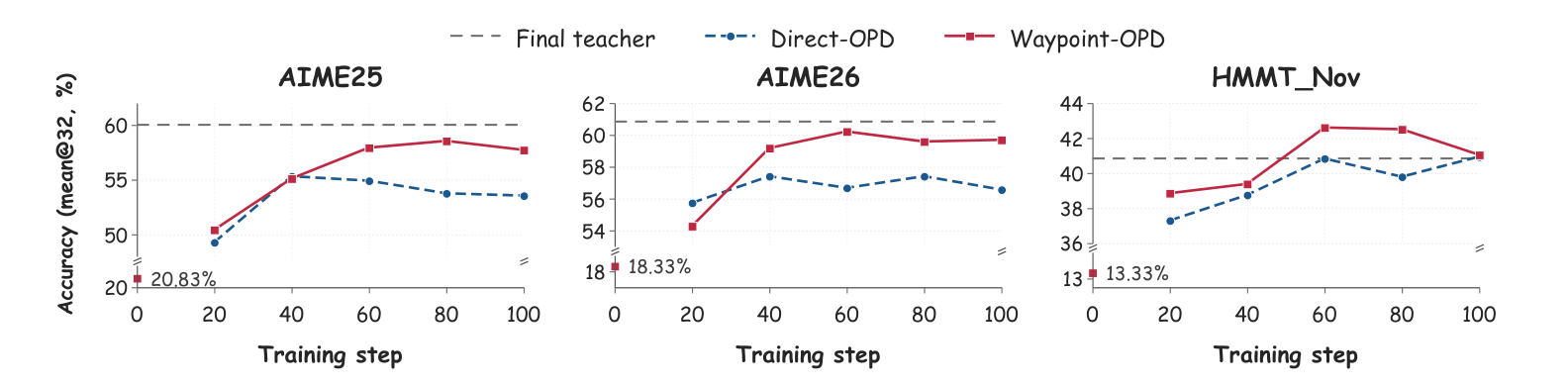
Waypoint-OPD (solid red) tracks or exceeds Direct-OPD (dashed blue) throughout and crosses the Final-teacher reference earlier on AIME 2026 and HMMT25N. The response-length diagnostic rules out length-exploitation:
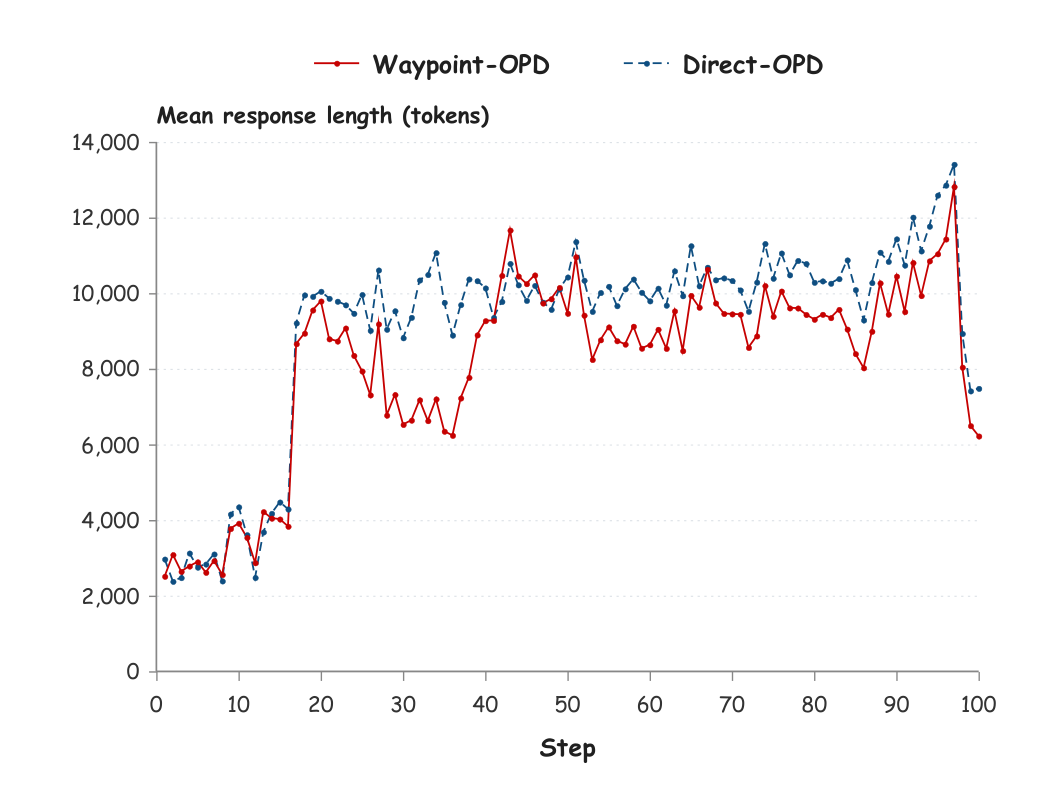
Mean rollout length and the fraction of responses hitting the 16,384-token cap evolve similarly for both methods, so the accuracy gain is not purchased by longer or more frequently truncated chains of reasoning.
Limitations and open questions
- Only one Waypoint is used (step 600 of 1200). The paper does not establish how sensitive performance is to Waypoint position across different RL run lengths; a single midpoint is a crude temporal basis.
- The gate is a scalar cosine on a TopK support of student tokens, discarding sign-consistent magnitude mismatches and ignoring the tail; whether a soft, per-action gate would help is open.
- The teacher family is a single Qwen3-4B RL run per domain. Cross-family teacher–student transfer (different tokenizers, different RL recipes) is untested, and the method assumes compatible tokenizers.
- The transfer regime still requires an RL run on the teacher; the method does not reduce teacher-side cost, only extracts more from existing checkpoints.
- No analysis of what fraction of prefixes get gated or how c_t distributes — the mechanism is plausible but its empirical footprint on the loss is not quantified in the shown sections.
Why this matters
Endpoint policy-shift distillation treats an RL trajectory as a black box between two checkpoints; Waypoint-OPD shows that a single intermediate checkpoint, used purely as a consistency gate rather than as a target, is enough to recover meaningful signal and let students (14B, 30B-A3B) exceed their 4B teacher on competition math. It is a cheap, mechanically simple way to exploit the fact that RL checkpoints are already on disk during training.
Source: https://arxiv.org/abs/2610.21601
RoTA-Bench: Evaluating 3D Spatial Reasoning through Interactive Projection Alignment
Problem
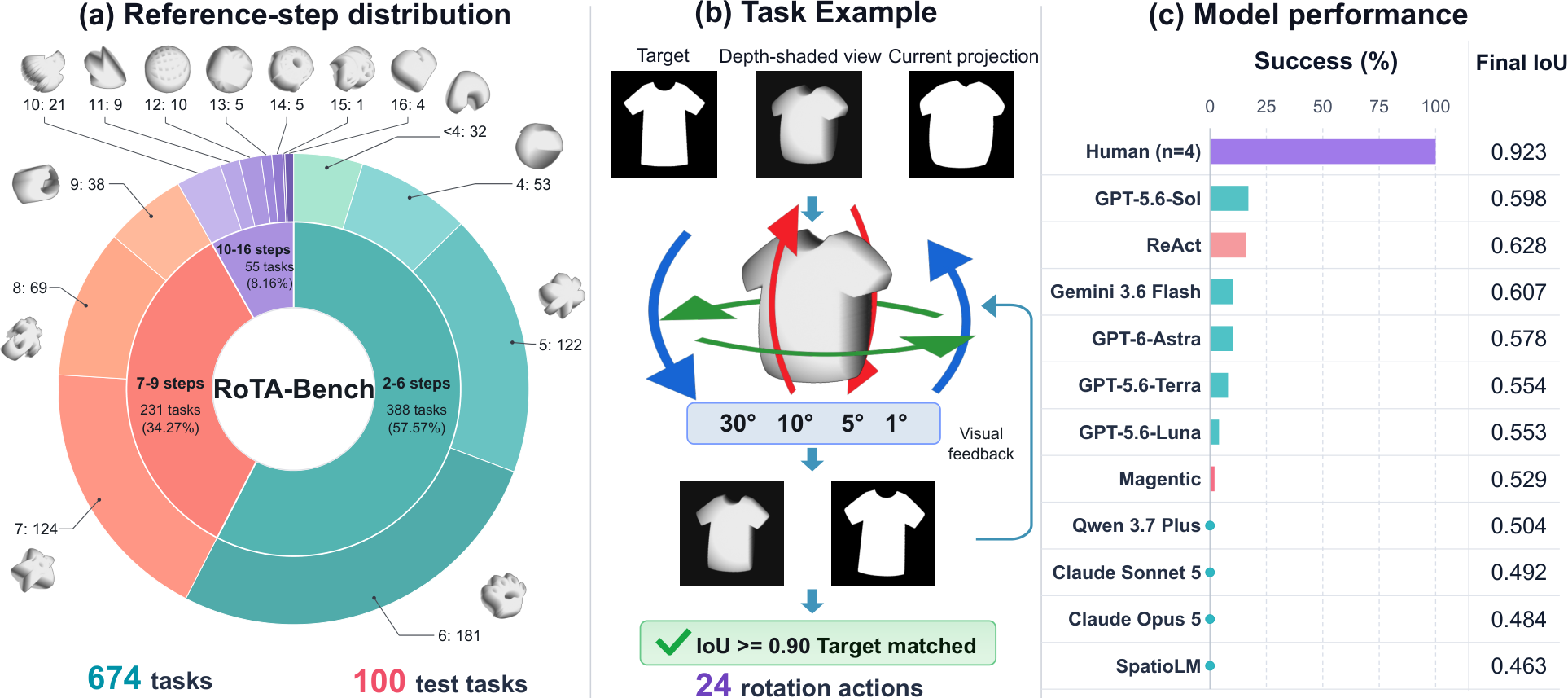
Vision-language models are routinely claimed to possess spatial reasoning, but most benchmarks test static recognition or single-step pose estimation. The harder question is whether a VLM can convert 2D observations into an internal 3D representation that supports sequential, feedback-driven action. RoTA-Bench isolates this capability through a projection-alignment game: given a target silhouette, the model observes a rotated 3D object and must choose a sequence of discrete rotations to make the current projection match the target within a bounded action budget. The rotations are purely orientational, which decouples spatial reasoning from grasp affordance, friction, and translation dynamics present in manipulation benchmarks.
Method
The benchmark construction has three stages (see pipeline figure). First, 2D vector icons are filtered and normalized, then extruded within a bounding sphere to produce 3D objects whose canonical front projection exactly reproduces the source icon. This avoids leakage from pretrained priors on common CAD assets like ShapeNet. Second, initial poses are generated through a sequence of reversible discrete rotations, which guarantees by construction that each task has a feasible solution within the discrete action space. Third, reference paths are produced via pose-guided beam search combined with 30^\circ-restricted BFS, yielding verified ground-truth solutions. The final set contains 674 canonical tasks with a stratified 100-task test split sampled over reference-path length.
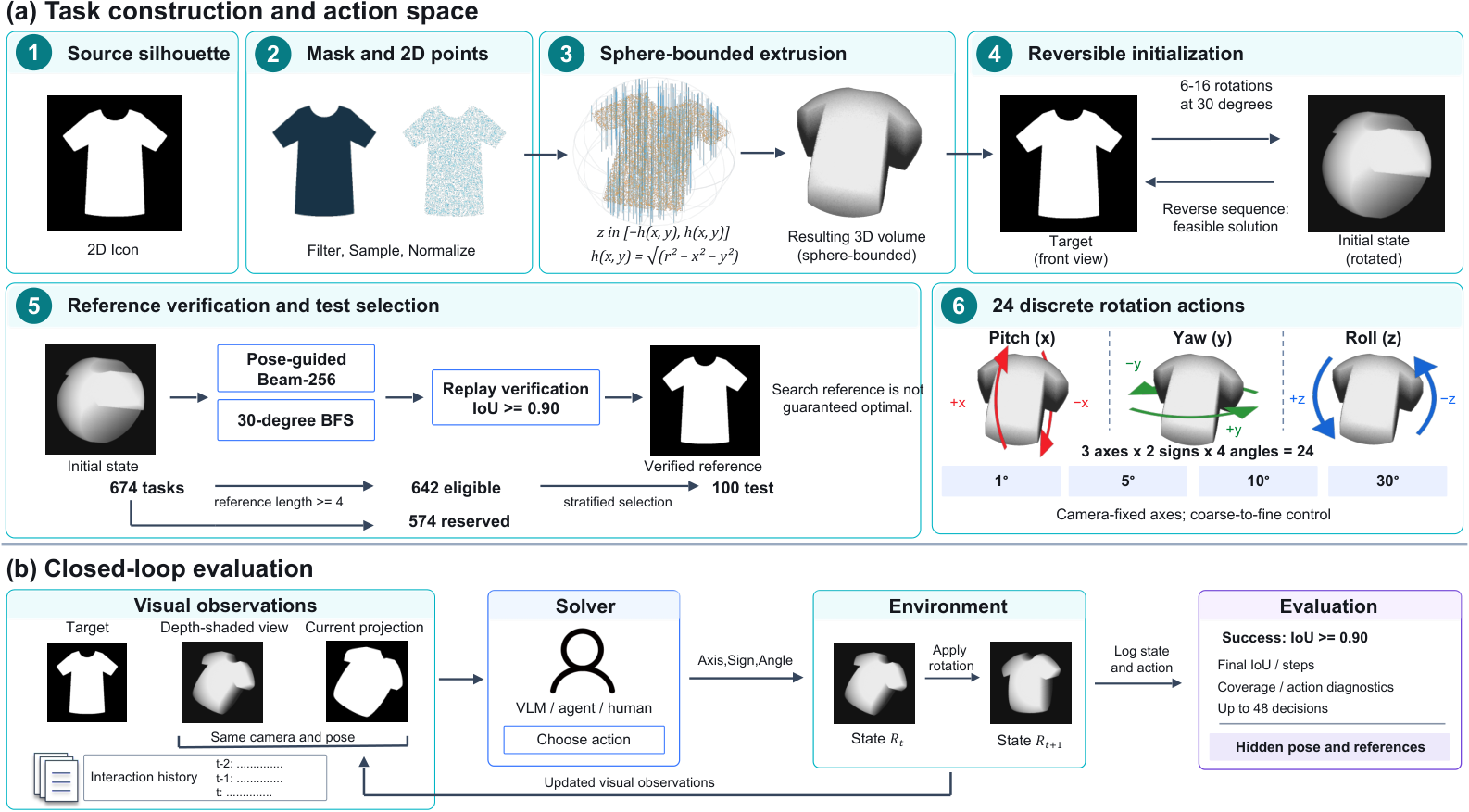
At evaluation time, the solver receives the target silhouette, the current rendered view, action history, and a discrete action space of axis-angle rotations (24 legal successors per step). Termination occurs when projection IoU exceeds 0.90 or the budget is exhausted. The decision loop is deliberately closed: the model must integrate visual feedback across turns rather than solve the problem in one shot.
Results
Nine frontier VLMs plus two agent frameworks (ReAct, Magentic) are evaluated at temperature 0, alongside human participants, random baselines, and two oracle greedy baselines. The results are stark. GPT-5.6-Sol tops the model leaderboard at 17.0\% success, with Gemini 3.6 Flash at 10.0\%. ReAct achieves the highest final IoU (0.628) but only 16.0\% success. Claude Sonnet 5, Claude Opus 5, and Qwen 3.7 Plus all collapse to 0.0\% success with final IoU in [0.484, 0.504] — essentially indistinguishable from uniform random exploration (0.473). SpatioLM-Understanding-InternVL3.5, a spatial-reasoning-tuned model, exhibits catastrophic policy collapse: 91.12\% of its actions are \text{YAW\_POS}\ 10^\circ, yielding final IoU 0.463, worse than random.
Humans achieve 100.0\% success at mean final IoU 0.923 in 16.22 steps across the 100-task test set, and the 20 undergraduates collectively completed the test set four times without failure. The oracle baselines sharpen the diagnosis. An IoU-greedy policy — selecting the successor among the 24 legal rotations that maximizes projection overlap using the ground-truth simulator — solves only 39.0\% (final IoU 0.725). A pose-greedy policy that minimizes true 3D angular error solves 100.0\% in 8.32 steps (final IoU 0.924). This decoupling is the central finding: image-space overlap is a locally misleading objective, because many rotations that increase silhouette IoU move the object away from the correct 3D pose. Only agents with access to pose-space geometry succeed reliably.
The paper quantifies this divergence directly: at matched states, models improve silhouette IoU while worsening pose alignment 19.4\% of the time, versus 10.9\% for humans. In other words, humans mentally rotate; models hill-climb pixels. A further ablation shows that removing interaction history leaves 96.8\% of the model’s actions unchanged, implying that current VLMs barely use the trajectory of past observations when selecting the next rotation — fine-grained control is nominally sensitive to history, but models fail to exploit it.
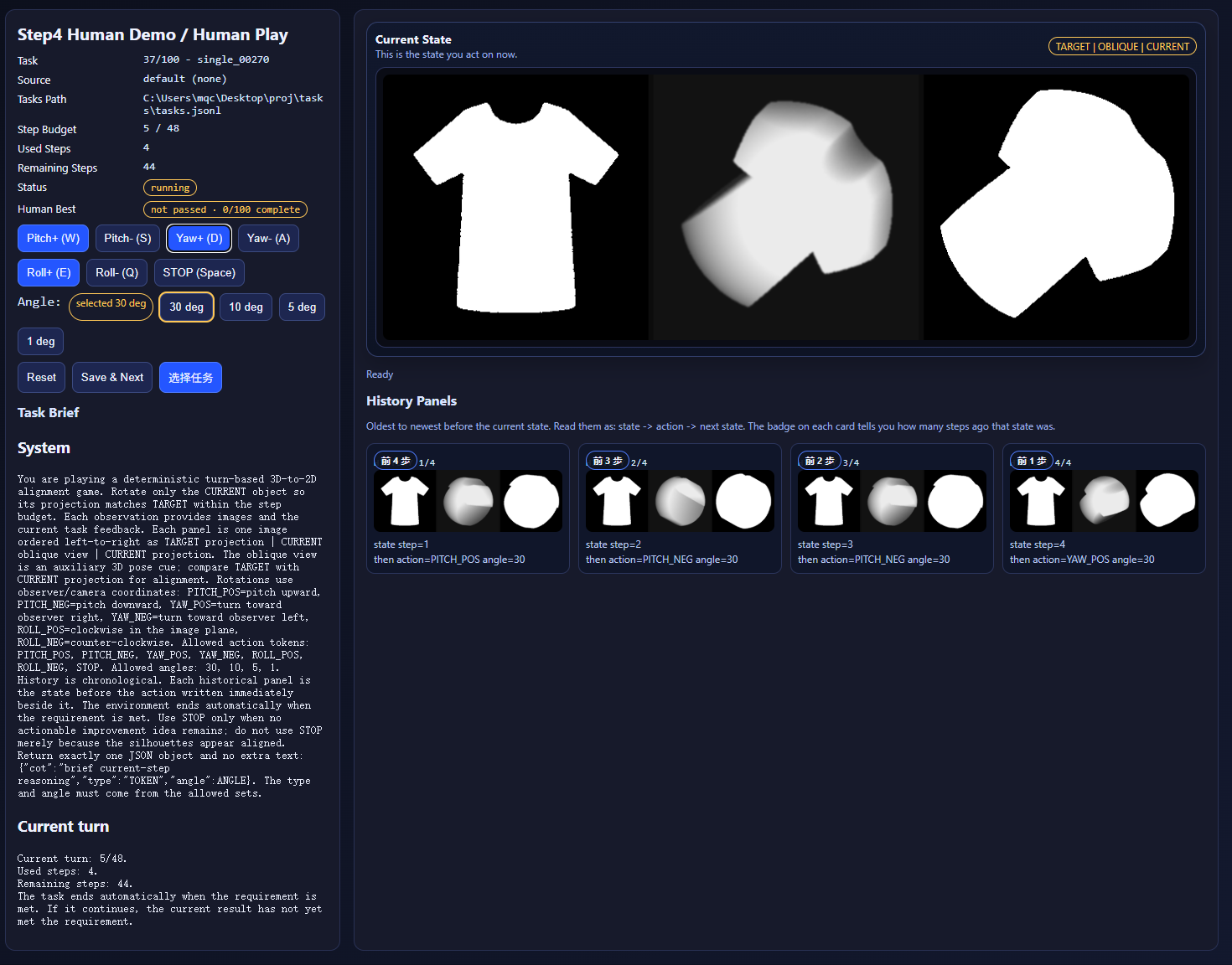
The human interface uses the identical prompt, observation history, and action token mapping as the models, so the gap cannot be attributed to interface asymmetry.
Limitations and open questions
The action space is discrete and the physics are trivial — only rotation, no contact. This is a deliberate scoping choice but means RoTA-Bench isolates orientation inference rather than full manipulation. Reference paths are generated by beam search with pose supervision, so “solvable within budget” is defined relative to that solver. It is also unclear whether failures reflect missing 3D representation, poor action-selection policies conditioned on good perception, or weak use of multi-turn visual memory; the history ablation points toward the latter two, but disentangling perception from policy would require probing intermediate representations. Finally, the sharp pose-greedy / IoU-greedy gap suggests that an auxiliary pose-estimation tool, provided to the agent, might close much of the gap without any improvement in underlying spatial reasoning — a confound worth measuring.
Why this matters
RoTA-Bench provides a clean, construction-verified test where the gap between frontier VLMs (17\%) and undergraduates (100\%) is not a matter of ambiguous rubrics or language understanding — it is a measurable failure to maintain and update a 3D representation across visual feedback. The pose-greedy oracle result shows the task is trivially solvable with correct geometric state, which localizes the deficit to perception-and-memory rather than planning.
Source: https://arxiv.org/abs/2610.17665
Self-Evolving Agent Harness
Agent systems built around frozen LLMs increasingly delegate capability growth to the surrounding scaffolding: prompts, retrieval indices, tool wrappers, workflow graphs, and the code that stitches them together. This paper formalizes that scaffolding as a harness H and studies what it means for H to evolve under feedback while the model M remains fixed. The problem matters because most deployed “self-improving” agents are, in fact, harness-improving — and the field lacks a clean account of what is being mutated, what admits a change into persistent state, and under what conditions those changes generalize.
The model–harness decomposition
The authors adopt the decomposition from prior work: a rollout is produced by
\tau \sim \operatorname{Run}(M, H, E), \qquad y = J(\tau),
where E is the task environment and J is the external assessor. Crucially, J is outside the editable surface: candidate harnesses may contain internal critics or provisional checks, but admission to persistent state is governed by J alone. Model adapters (e.g., LoRA weights bound at load time) are classified as part of H when they are configuration-level; learned parameters that define M are not.
Seven runtime functions are enumerated — agent loop/execution control, tool orchestration, context construction, memory/state, context compaction, scheduling, and execution infrastructure — any of which may be the target of a revision. The point of the table is not that implementations respect this decomposition (they usually do not) but that revisions can be localized to one of these roles for the purposes of search and audit.
Interpreted vs. executable targets
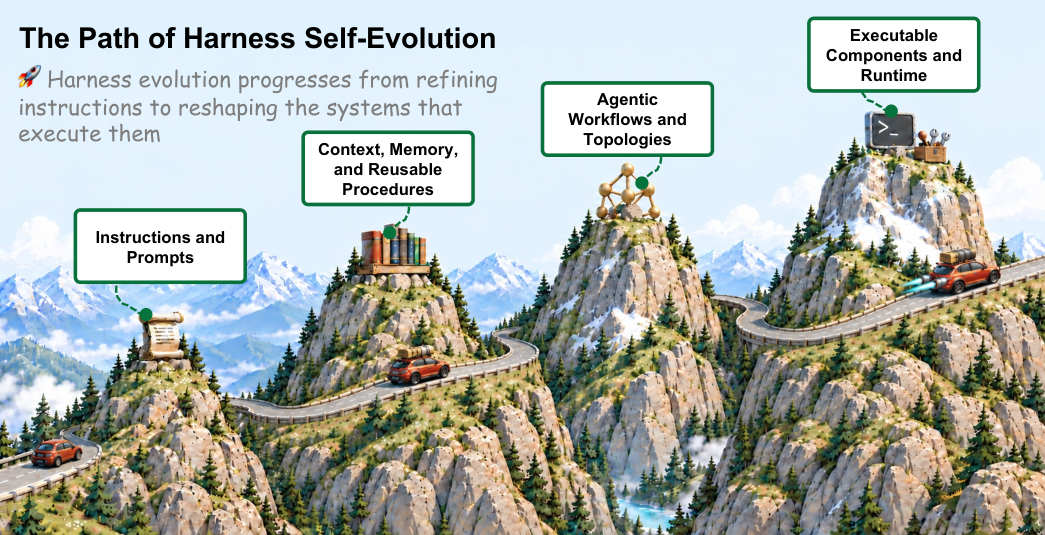
The central taxonomic move is a distinction between interpreted and executable updates, which turns out to be subtler than “data vs. code.” The criterion is the artifact’s role, not its language. A workflow revision that re-sequences calls to predefined operators through fixed coordination interfaces is interpreted; revising an operator’s implementation, or the runtime that enacts coordination, is executable — even if the executor itself is unchanged. The same cut applies to memory: curating stored entries is interpreted, while editing the memory-management functions is executable.
Figure 1 is used to motivate the trajectory the field has taken: from reusable instructions (prompts) and reusable procedures (workflows over fixed operators) toward revisable executable components. Historical antecedents are explicitly named — EURISKO’s heuristic revision and Schmidhuber’s Gödel Machine’s proof-governed self-rewriting — contrasted with modern empirical approaches: GEPA, Promptbreeder, ExpeL, workflow search, and AFlow operate largely at the interpreted layer, while Voyager/Polyskill skill libraries and patch-based systems (Self-Harness, HarnessCompass, Agentic Harness Engineering) operate at the executable layer.
Executable targets are further partitioned into (i) component implementations, (ii) repository-level control logic, and (iii) plugin composition. The first two describe mutation scope; the third describes how components and runtime services are bound and replaced. A single revision can straddle categories — a plugin swap may change both a component implementation and the control logic that selects it.
Search, admission, and PAC-style guarantees
The abstract commits to an evolutionary-search formalization with explicit proposal and admission mechanisms, and claims three results under stated assumptions: (1) an expected generalization bound for accepted revisions, (2) a retention bound conditional on a historical regression budget — i.e., how much degradation on past tasks the operator will tolerate — and (3) a high-probability admission rule that requires fresh, independent validation data. The structure parallels continual PAC-learning: because the task distribution and J itself drift, admission based on in-sample training rollouts is insufficient; a held-out, time-fresh validation set is needed each cycle. This is a sharper statement than typical “eval on a benchmark” practice because it ties the admission threshold to the regression budget on prior tasks, not just mean performance on the current one.
Patch-level revision as a concrete case
Section 3.1 grounds the taxonomy in current practice. Component-level revision keeps entry points and I/O contracts fixed, so candidates replace implementations in place; tool synthesis is treated as a strictly extending operation on the callable interface. Candidate archives (HarnessBank) preserve alternatives for later search rather than discarding losers, and protocol perturbations (BadGenius-style) are used to test whether an evolved harness’s gain over the initial harness is robust to changes in assessment conditions — effectively a stress test against overfitting to J. The authors flag the standard failure mode: stable interfaces make local replacement safe, but shared mutable state and non-local output coupling can still propagate regressions beyond the edited module.
Limitations and open questions
The paper is organizational rather than empirical: no new system, no benchmark numbers. The PAC-style bounds rely on assumptions (independence of validation data, bounded loss, stationary enough windows) that are precisely what harness evolution violates in practice — J co-evolves with the agent, and new tools change the trace distribution. The interpreted/executable boundary, while useful, is porous when workflow DSLs become Turing-complete or when prompts invoke code generation. Finally, the retention bound depends on an operator-specified regression budget; no guidance is given for setting it in multi-tenant or safety-critical settings.
Why this matters
Most “self-improving agents” shipping today are harness-evolving systems without a clean account of what counts as a change, what admits one, or what generalization claim an accepted change supports. This paper gives the vocabulary and the admission discipline — fresh validation, regression budgets, interpreted-vs-executable scope — that evaluators and auditors will need as persistent harness revisions start crossing institutional boundaries.
Source: https://arxiv.org/abs/2610.18813
Learning Where to Split: Dynamic Band Splitting for Audio Source Separation
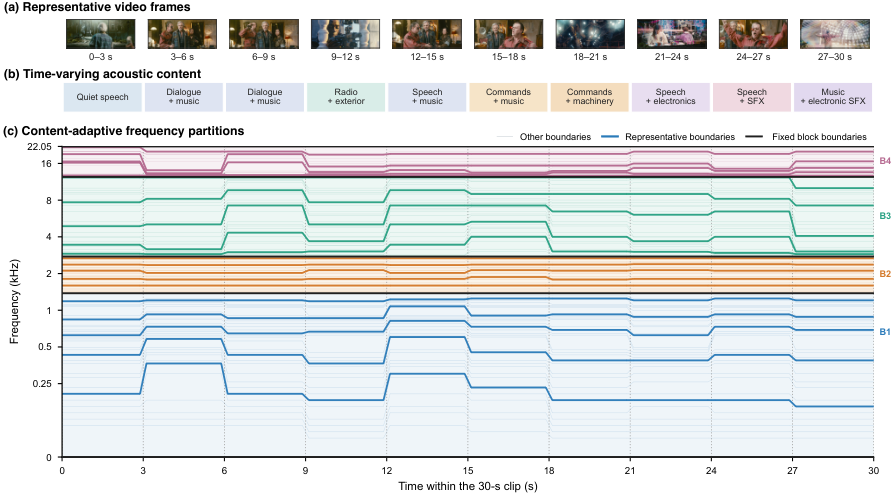
Band-split separators (BSRNN, BS-RoFormer, MelRoFormer, TIGER) tokenize an STFT along frequency by grouping adjacent bins into bands, so a transformer/RNN backbone can operate on J \ll F tokens rather than all F bins. The partitioning is almost universally fixed: hand-designed boundaries that follow psychoacoustic heuristics (narrow bands at low frequencies, wider at high). This is wasteful when the informative structure of a mixture does not align with the preset grid — a cinematic effect with dense high-frequency transients and a vocal mix with harmonics clustered at 200–800 Hz share nothing in common, yet both are tokenized identically. DBS makes the partition itself a learned, content-conditional function of the mixture, under a fixed token budget so backbone cost is unchanged.
Method
Given a complex spectrogram \mathbf{X}\in\mathbb{C}^{F\times T}, DBS splits the frequency axis into R=4 fixed, contiguous blocks \{\mathcal{F}_r\} with per-block budgets J_r summing to J (e.g., J=128 for a 1025-bin STFT). Blocks guarantee that each spectral region gets a prescribed share of tokens; boundaries within each block are predicted per mixture.

Inside block r, a predictor consumes \mathbf{X}_r = \mathbf{X}[\mathcal{F}_r,:]. Real/imaginary parts go through temporal convolutions; three magnitude statistics per bin (temporal mean, peak-to-mean ratio, std-to-mean ratio) are concatenated; a BiLSTM produces per-bin contextual features \mathbf{h}_r(f)\in\mathbb{R}^d. For each internal transition f-1\to f, a boundary score
u_r(f) = u_r^{\text{feat}}(f) + 0.15\, u_r^{\text{mag}}(f)
combines a learned contrast between adjacent bin embeddings and a bounded transform of the change in acoustic statistics. A learned temperature \tau_r and position bias \beta_r(f) calibrate the probability
p_r(f) = \sigma\!\big(\tau_r(u_r(f) - 0.5) + \beta_r(f)\big).
Because the backbone needs exactly J_r bands in block r, DBS fixes f_r^{\min} as a boundary and applies hard Top-K to pick the remaining J_r-1:
\mathcal{B}_r = \{f_r^{\min}\} \cup \operatorname{TopK}\big(\{p_r(f)\}_{f\neq f_r^{\min}},\, J_r - 1\big).
Cumulative counting on b_r(f)\in\{0,1\} assigns each bin to a band index; content-dependent pooling then compresses variable-width bands into J tokens of equal dimension. After the separation backbone, tokens are smoothed and expanded back to the original F\times T grid, refined along frequency, and decoded by a frequency-shared complex-mask head. The hard Top-K is non-differentiable; gradients flow via straight-through on the selection (details in Appendix A, invoked at Eq. 2). The parameters \tau_r, \beta_r, the convolutional/BiLSTM predictor, and the pooling head are optimized jointly with the separator.
Results
Three datasets probe different spectral regimes: DnR v2 (cinematic, 0–22.05 kHz, three stems), MUSDB18-HQ (music, 0–22.05 kHz, four stems trained jointly in a single model — note this is harder than target-specific BSRNN/BS-RoFormer baselines), and EchoSet (two-speaker + noise + reverb, 0–8 kHz). All DBS variants use R=4 blocks and a fixed token budget (128 for DnR/MUSDB, 67 for EchoSet).
The headline number: DBS-BSRNN improves average SI-SDR by 29.0% relative over fixed-band BSRNN on DnR v2 (both with 128 bands, trained from scratch, identical backbone capacity). Gains carry across backbones (TIGER on DnR, BSRNN/BS-RoFormer/MelRoFormer on MUSDB18-HQ) and datasets, with EchoSet showing improvements on both SDRi and SI-SDRi against the TIGER-reported baselines. The MUSDB evaluation is notable in that these are joint four-stem models using only MUSDB18-HQ training data — no external audio, no stem-specific tuning — so the comparison isolates the partitioning rather than the training recipe.
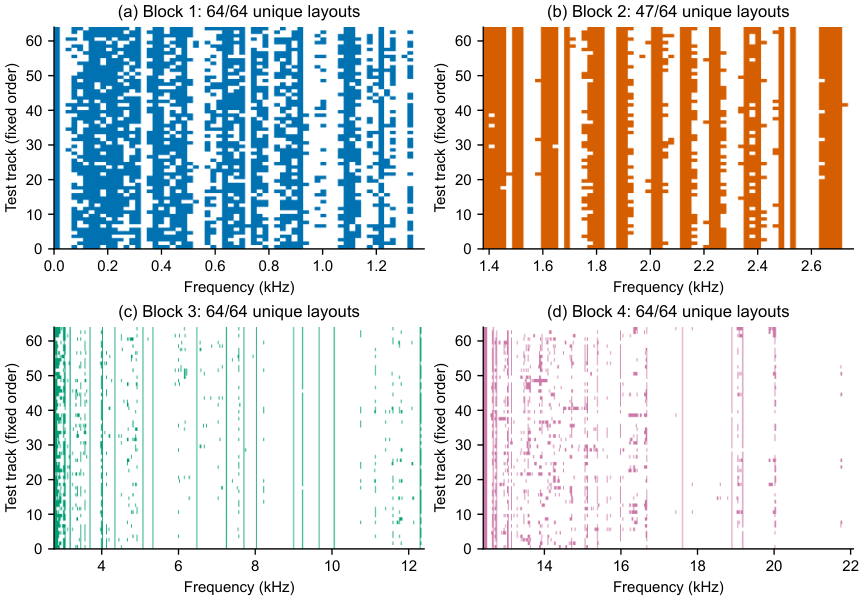
Qualitatively, boundary locations in the lowest block B1 and the mid block B2 vary modestly across mixtures — unsurprising, since fundamentals and low formants cluster predictably — while B4 (highest frequencies) shows the largest adaptivity, consistent with the varied high-frequency content of sound effects, cymbals, and sibilance. This supports the claim that fixed layouts under-serve exactly the regions where mixtures differ most.
Limitations
The paper reports a single partition per inference window, so very long mixtures with changing content within a window cannot be re-partitioned at a finer temporal granularity without re-chunking. Top-K selection is piecewise-constant, and while the magnitude term with its 0.15 weight and the position bias \beta_r stabilize training, the straight-through estimator for the selection step is a standard approximation and its gradient bias is not analyzed. The block count R=4 and per-block budgets J_r are hyperparameters tuned per dataset — fully learning the block structure would remove this. Finally, the comparisons on MUSDB18-HQ use jointly trained four-stem models rather than the stronger target-specific regime of the original BSRNN/BS-RoFormer, so absolute SDR numbers are not directly comparable with the public leaderboard; the controlled comparison is DBS vs. fixed-band at matched capacity.
Why this matters
Band splitting is the standard way to make transformer-era separators tractable, and its boundaries have been treated as a fixed engineering choice for years. DBS shows that under a strictly matched token budget, learning the partition is worth 29% relative SI-SDR on cinematic audio and consistent gains elsewhere — a free lunch for any band-split architecture that is willing to add a lightweight predictor and a straight-through Top-K.
Source: https://arxiv.org/abs/2610.14993
InfiniSplat v2: Analyzing and Improving Feed-Forward 3DGS from Any Views
Problem
Feed-forward 3D Gaussian Splatting (3DGS) methods predict a set of Gaussian primitives directly from input images in a single forward pass, bypassing per-scene optimization. The dominant failure mode under large viewpoint changes is not geometry per se — geometry foundation models (DUSt3R-style and successors) produce reasonable depth and poses — but the attribute prediction: covariance, color SH, and opacity are learned jointly with geometry, and the attribute head inherits geometry errors through gradient coupling. The result is that attributes compensate for geometric noise at training views and then fail to generalize to unseen angles.
InfiniSplat v2 isolates and fixes this coupling. The ambition is a single trained feed-forward model that works across both pose-conditioned and pose-free settings on six heterogeneous benchmarks.
Method
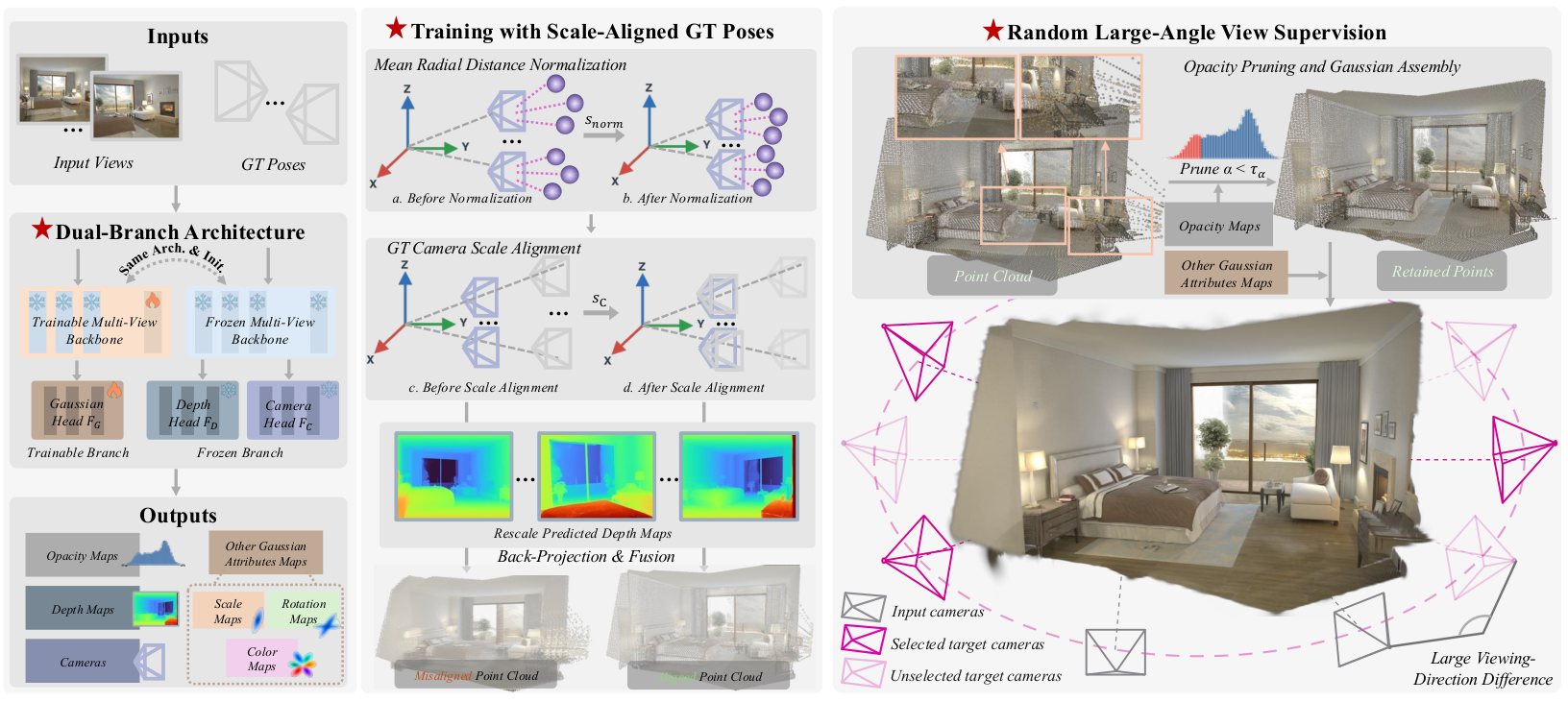
The core architectural claim is that geometry and attribute prediction should be decoupled during training. The pipeline uses DA3 (a depth-and-camera foundation model) as a frozen branch that outputs per-pixel depth d and camera parameters (K, R, t). These are unprojected into a point cloud \{p_i\} that defines the Gaussian centers. A separate trainable branch consumes the same images and emits the remaining Gaussian attributes — opacity \alpha_i, scale s_i, rotation q_i, and SH coefficients c_i — for each point.
Three training-time choices matter beyond the frozen-geometry split:
GT-pose alignment during training. Predicted cameras from DA3 have residual scale/pose error. During training the authors align the predicted-camera-constructed point cloud to the ground-truth camera frame via a scale-and-rigid alignment, so target-view supervision uses geometrically consistent poses. At inference the predicted poses are used directly (pose-free) or the provided poses (pose-conditioned). This removes a gradient path where the attribute branch learns to absorb pose error.
Large-angle target view supervision. Rather than sampling target views near the input baseline, training supervision explicitly uses target cameras with large angular offsets. This forces the attribute branch to produce Gaussians whose shape and color are consistent off-axis, not just at interpolated viewpoints.
Opacity pruning via reconstruction loss alone. The authors report that opacity trained purely under image reconstruction loss learns to down-weight geometrically inconsistent points — i.e., opacity acts as a learned mask over depth-map outliers without any explicit geometric regularizer. Points with \alpha_i below threshold are pruned before target-view rendering during training.
The point positions are frozen (inherited from DA3); gradients flow only into the attribute MLP/transformer. Rendering uses standard 3DGS alpha-compositing
C(r) = \sum_{i \in \mathcal{N}} c_i \, \alpha_i \prod_{j<i}(1-\alpha_j),
with the usual anisotropic Gaussian footprint from (s_i, q_i). The input-view refinement step uses rendered-vs-input photometric feedback to update attributes.
Results
Training is on a mixture of Hypersim, Raw3D, and ScanNet++. Evaluation covers six datasets spanning object (DTU), indoor (NRGBD, ScanNet++-adjacent), outdoor (ETH3D, Mip-NeRF 360), video (DL3DV), and real estate (RE10K) regimes. Baselines are a thorough slate of recent feed-forward 3DGS methods: tttLRM, AnySplat, C3G, DA3-GS, DepthSplat, QuerySplat, ReSplat, TokenGS, VolSplat, and WorldMirror 2.0.
Headline numbers from the paper: in the pose-conditioned setting, mean LPIPS and DISTS over the six datasets decrease by 25.8% and 32.9% respectively versus the strongest evaluated baselines. The same single checkpoint also achieves state-of-the-art mean LPIPS and DISTS in the pose-free setting. The authors emphasize that these are perceptual metrics; LPIPS and DISTS correlate more strongly with the kind of textural fidelity that off-axis novel views stress-test than PSNR, which is dominated by low-frequency agreement.
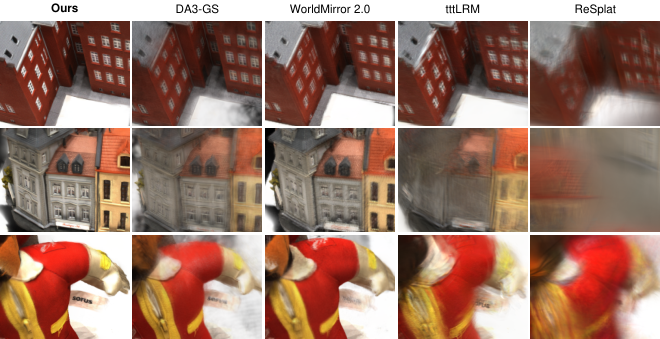
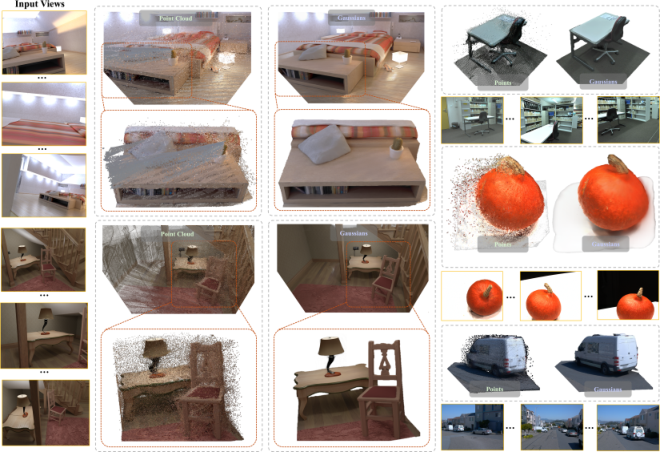
Qualitatively, the renderings preserve high-frequency texture on thin structures and specular regions where baselines produce the characteristic smeared/floater artifacts of feed-forward 3DGS. The opacity-as-outlier-mask observation is validated by ablation: removing the opacity-only pruning degrades rendering on scenes with noisy depth boundaries.
Limitations and open questions
The method depends entirely on a specific frozen geometry backbone (DA3). Any systematic depth bias is now unfixable by the attribute branch, which the authors have deliberately disconnected from geometry. The GT-pose alignment during training requires accurate GT poses in all training scenes, which constrains data mixture choices. The paper does not report PSNR comparisons prominently, and the gains are perceptual-metric gains; it is unclear whether reconstruction error at matched pixels improves comparably. Finally, pure feed-forward rendering still lags per-scene optimized 3DGS on datasets like Mip-NeRF 360; the paper reframes the comparison as same-model-across-datasets rather than closing that gap.
Why this matters
Decoupling geometry from attributes and relying on frozen geometry foundation models is a plausible template for feed-forward 3D: as depth/pose models improve, attribute-only training can inherit those gains without retraining the geometry stack. The incidental finding that reconstruction-loss opacity learns outlier rejection without geometric priors is a useful datum for anyone designing feed-forward 3DGS pipelines.
Source: https://arxiv.org/abs/2610.20341
3DCodeVerse: Exploring 3D Worlds as Code
Problem
Generating 3D content with LLMs by predicting meshes, point clouds, or NeRF/Gaussian parameters discards two useful properties: editability and verifiability. 3DCodeVerse reframes 3D generation as program synthesis: the model emits a standalone program f that, when executed in a declared environment e (Blender bpy, CadQuery, Three.js, Shadertoy, etc.), produces an artifact a. Formally,
(a, \ell) = \mathcal{E}_e(f), \quad x = \mathbb{I}[a \neq \bot],
where \ell is execution feedback and x indicates executability. Quality is scored by \mathcal{D}(a, a^\star) against a reference, or by programmatic measurements plus renders o = \mathcal{R}(a). The paper contributes three artifacts aimed at making this paradigm tractable at scale: a 2M-program corpus, a multi-agent harness that generates and verifies programs without per-round human feedback, and empirical baselines.
3DCodeVerse-2M
The corpus bundles each program with the source files and assets required for execution, plus descriptions and verification records, covering objects, articulated objects, scenes, and graphics across multiple engines and languages.
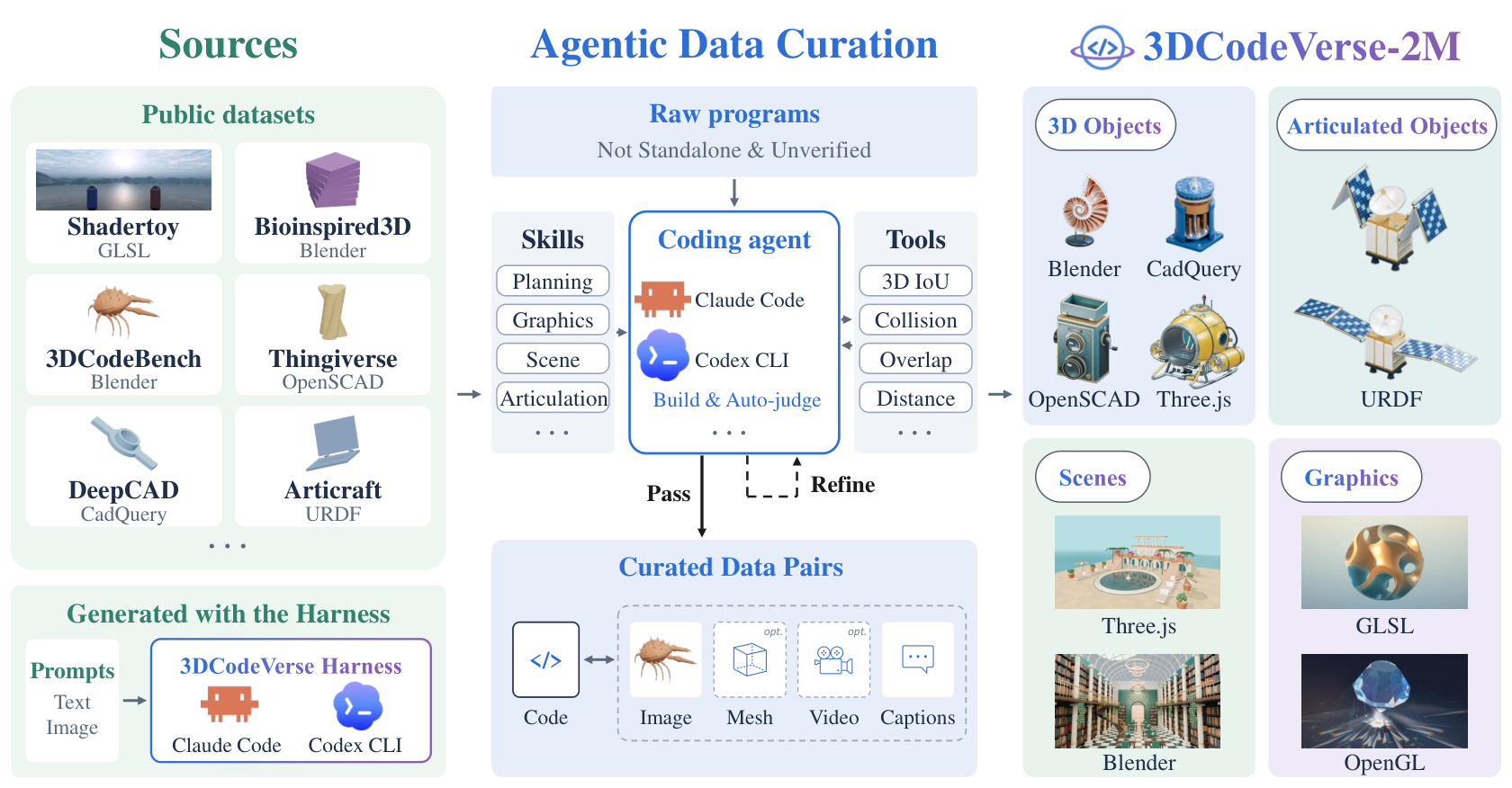
Three ingestion paths feed the dataset: (i) public sources (Bioinspired3D, 3DCodeBench, Thingiverse, Shadertoy, CodePen animations, Three.js/React Three Fiber projects); (ii) format conversions — DeepCAD sequences and Articraft geometry are rewritten to CadQuery (URDF retained for Articraft), ProcTHOR scenes are reconstructed in Blender/Three.js; and (iii) net-new programs generated by the harness itself. For sources with specialized APIs, a curation agent produces f = \mathcal{N}_e(f_\text{raw}), inlining dependencies and bundling assets so each program is self-contained. Inspection tools \mathcal{M}_e(a) return part inventories, dimensions, contacts, collisions, and kinematics — the same tools later used as reward signals during generation.
Harness: multi-agent DAG with triadic feedback
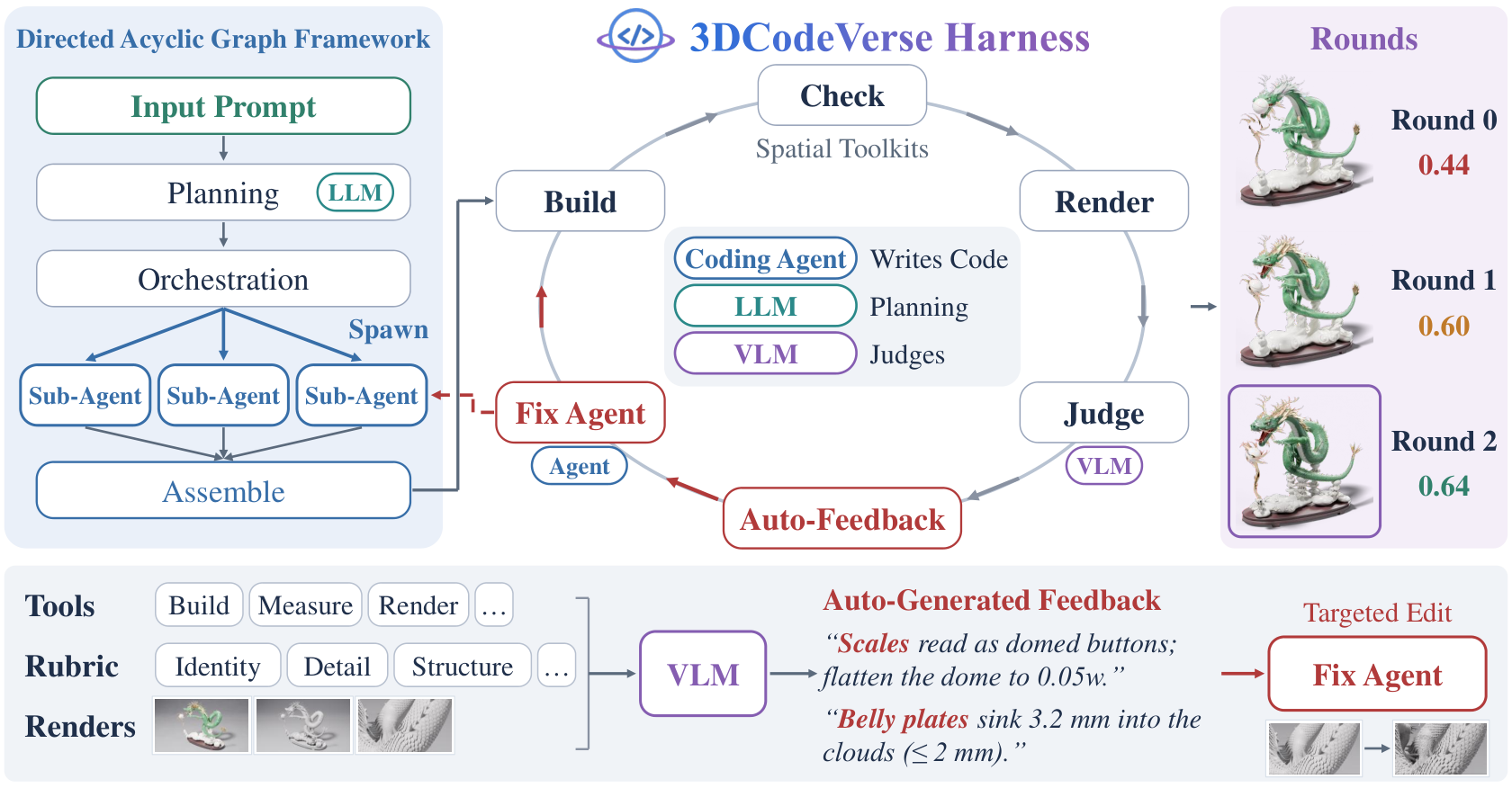
Given (c, e), an LLM planner emits P = \mathcal{A}_\text{plan}(c; e) specifying components, dimensions, materials, spatial relations, and acceptance criteria. P is compiled into a DAG \mathcal{G} = (V, E) where coding and assembly tasks become nodes with file-ownership edges; sub-agents work independent nodes concurrently and assembly nodes integrate their outputs into f^{(0)}.
Refinement collects three feedback streams at round t:
- Execution feedback: build/runtime logs \ell^{(t)}. On failure, this is the only signal.
- Measured feedback: \mathcal{M}_e(a^{(t)}) returns component-level violations (dimension mismatches, intersections, kinematic infeasibilities) with numerical correction hints.
- Visual feedback: a VLM judge inspects multi-view renders against P’s acceptance criteria, producing j^{(t)} = \mathcal{A}_\text{judge}(c, P, o^{(t)}) with o^{(t)} = (\ell^{(t)}, \mathcal{M}_e(a^{(t)}), \mathcal{R}_e(a^{(t)})).
A scalar score s^{(t)} aggregates weighted rubric criteria with defect penalties, is capped by measured violations, and allows measurements to veto conflicting visual claims — i.e., physical measurements override VLM hallucinations. All signals are converted to a prioritized revision set \Delta^{(t)} (execution > measured > visual), and the fix agent produces f^{(t+1)} = \mathcal{A}_\text{code}(c, P, f^{(t)}, \Delta^{(t)}; e). The highest-scoring program across rounds is returned.
Because this feedback is itself model-generated, the authors run an adversarial development-time loop that alternates between tuning the judge’s prompts, rubrics, and schema (\theta_J) and tuning the generation workflow, converging the harness configuration before deployment.
Results
Evaluation covers 100 object prompts, articulated objects, 50 scene prompts, and 50 graphics prompts, with Human Preference, VLM Preference (Gemini 3.1 Pro), a 0–100 Judge Score with failed generations zeroed, and four-view SigLIP-2 text–image similarity.
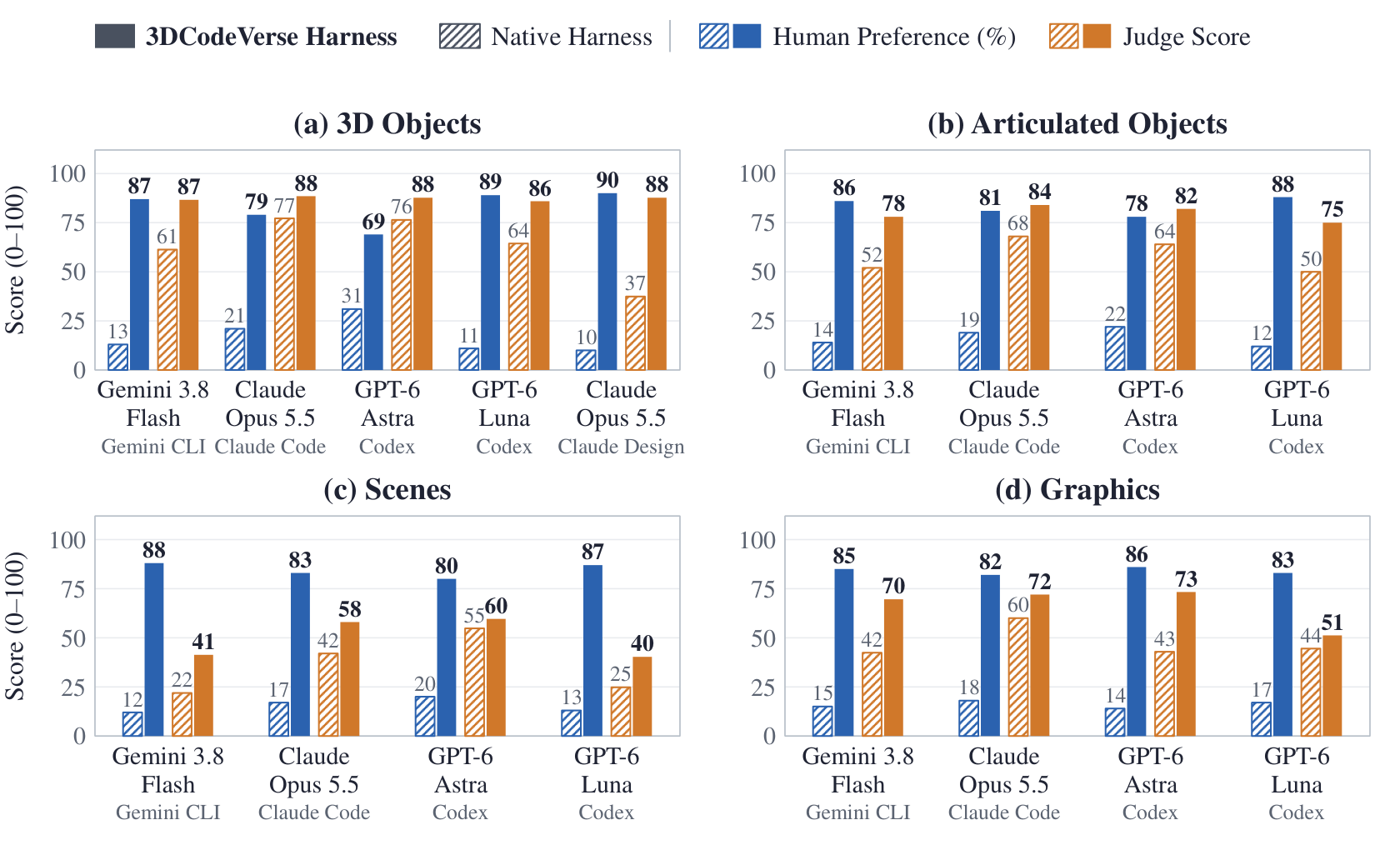
The harness beats each backbone’s native harness across all tasks. On objects, Human Preference for 3DCodeVerse Harness lies in 69–89%, with Judge Score gains of 11–25 points. Weak backbones benefit the most: Gemini 3.8 Flash moves from 61 to 87, and GPT-6 Luna from 64 to 86 — larger deltas than for already-strong backbones, consistent with the harness compensating for single-shot coding weakness via tool-grounded iteration. Against Claude Design (also running Claude Opus 5.5), 3DCodeVerse wins 90% of human comparisons with Judge Score 88 vs. 37. Articulated objects, scenes, and graphics show Human Preference in 78–88%, and the agreement between human and rubric scores suggests the improvements are not an artifact of the refinement-time VLM rubric.
For robotics, articulated assets exported via the harness pass a door-and-handle geometry check in 12/12 cases when rendered from code; UWM video-model predictions pass 7/36 under matched conditions — a direct illustration of the editable-geometry advantage over pixel-space world models. For video generation, rendered 3D sequences condition Gemini Omni Flash and Seedance 2.5, supplying layout and motion while the video model refines appearance.
Limitations
The judge is itself a VLM subject to failure modes; the measurement veto mitigates but does not eliminate this. Reported SigLIP-2 numbers are not broken out in the shown sections, making the preference-vs-similarity relationship hard to audit. All refinement is open-loop over a fixed round budget — the paper does not analyze cost scaling or how performance degrades under tight compute. Finally, “editable code” presumes an engine; coverage is broad but the DSL/API surface still limits what kinds of geometry (e.g., organic/sculpted meshes) programs can express efficiently.
Why this matters
Casting 3D generation as code puts the output in a representation that is inspectable, parametric, and physically measurable — enabling automated verification loops that pixel- or mesh-space generators cannot easily close. The sharp gains on weaker backbones and the 12/12 vs. 7/36 geometry-consistency margin against a video world model suggest tool-grounded program synthesis is a stronger substrate for simulation-ready 3D than direct neural rendering.
Source: https://arxiv.org/abs/2610.22341
SCOPE: Semantic Bounded Credit Optimization for Prompt Engineering in Text-to-image Generation
Problem
RL-tuned prompt rewriters for text-to-image (T2I) generation take a user prompt, emit an “enhanced” prompt, pass it to a frozen renderer, and get back a single scalar reward from a compositional alignment evaluator (GenEval, T2I-CompBench). Vanilla GRPO distributes a single completion-level advantage uniformly across subword tokens of the rewrite. But compositional edits — an added object, a count, an attribute binding, a spatial relation — are naturally phrase-sized, and phrase boundaries do not align with BPE tokens. Uniform weighting therefore smears credit across tokens that contributed asymmetrically to the semantic change.
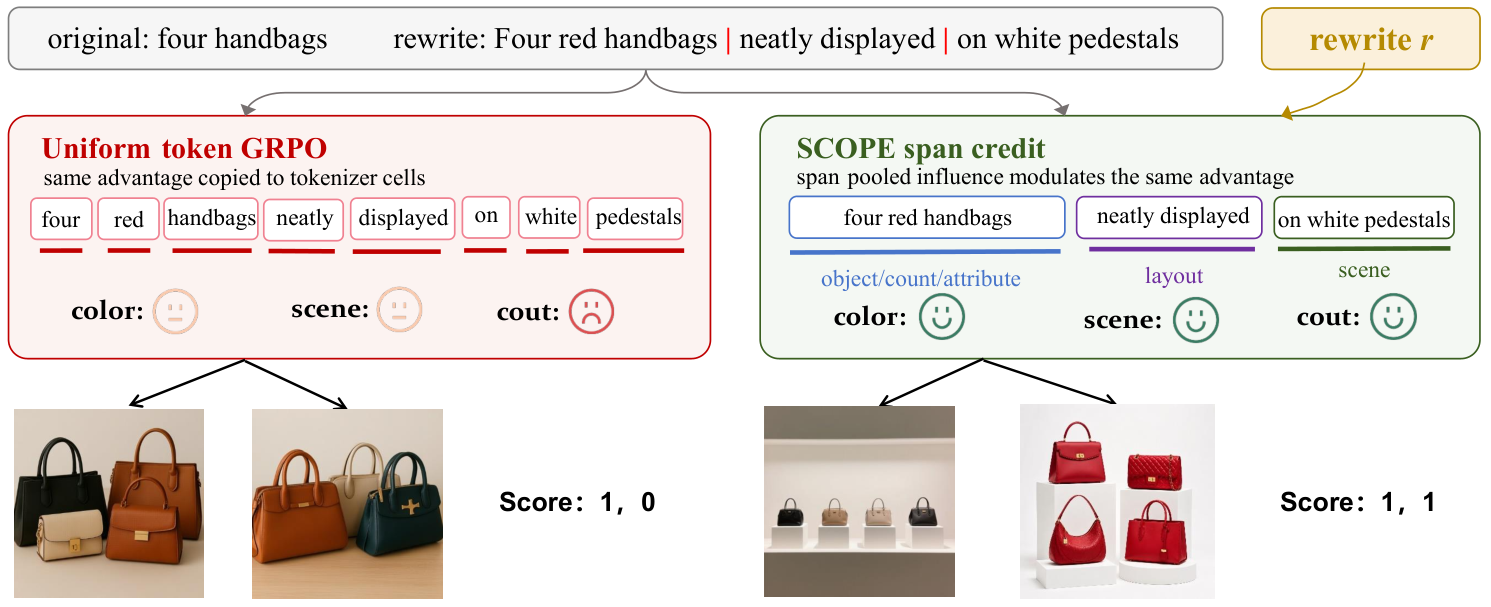
SCOPE’s claim is that aligning the credit-assignment granularity with semantic spans — without introducing extra rewards, extra renders, or extra reward models — gives a meaningful bump in compositional fidelity.
Method
The rewriter policy \pi_\theta (Qwen3-8B) is trained to emit, inside an <answer> tag, both the rewritten prompt and its semantic partition, with a chosen separator (e.g. |) between spans. A cleaning operator c(\cdot) strips the markup and separators before the frozen renderer f_\phi produces I = f_\phi(c(y)), which an evaluator scores.
Grouped rollouts with a reference. For each prompt x_g, the group of N=8 contains N-1 sampled rewrites plus the original prompt y_{g,N} as a reference, all sharing one rendering seed to cancel diffusion noise across comparisons. The reward is r_{g,i} = w_\text{t2i}\, r_\text{t2i}(x_g, c(y_{g,i})) + w_\text{fmt}\, r_\text{fmt}(y_{g,i}), with r_\text{t2i}\in[0,1] from GenEval/T2I-CompBench clients and a format term r_\text{fmt}\in[-0.25, 0.25] that enforces well-formed <answer> and extractable spans.
Advantage. The reference reward b_g = r_{g,N} is used adaptively: when the baseline is weak (b_g < \tau), advantages are computed as a clipped difference \operatorname{clip}(r_{g,i} - b_g, -c, c); when the baseline is strong, standard z-score normalization against the sampled group (\mu_g, \hat\sigma_g) is used. The reference prompt itself gets A_{g,N}=0 (it informs the baseline, but no gradient flows through it). This hybrid stabilizes updates when the original prompt is already near the top of the group.
Span-pooled credit. The core SCOPE contribution lies in how the single completion advantage A_{g,i} is distributed within the clipped surrogate. Spans emitted by the rewriter are aligned to the token stream of the rollout. Within each span s, SCOPE pools the per-token policy log-probability shifts \Delta_t = \log \pi_\theta(y_t) - \log \pi_{\theta_\text{old}}(y_t) into a shared coefficient \alpha_s, normalized across spans in the completion. These \alpha_s are detached from the computation graph and used to reweight the per-token clipped losses; gradients still flow through the policy ratios \pi_\theta/\pi_{\theta_\text{old}} in the usual GRPO fashion.
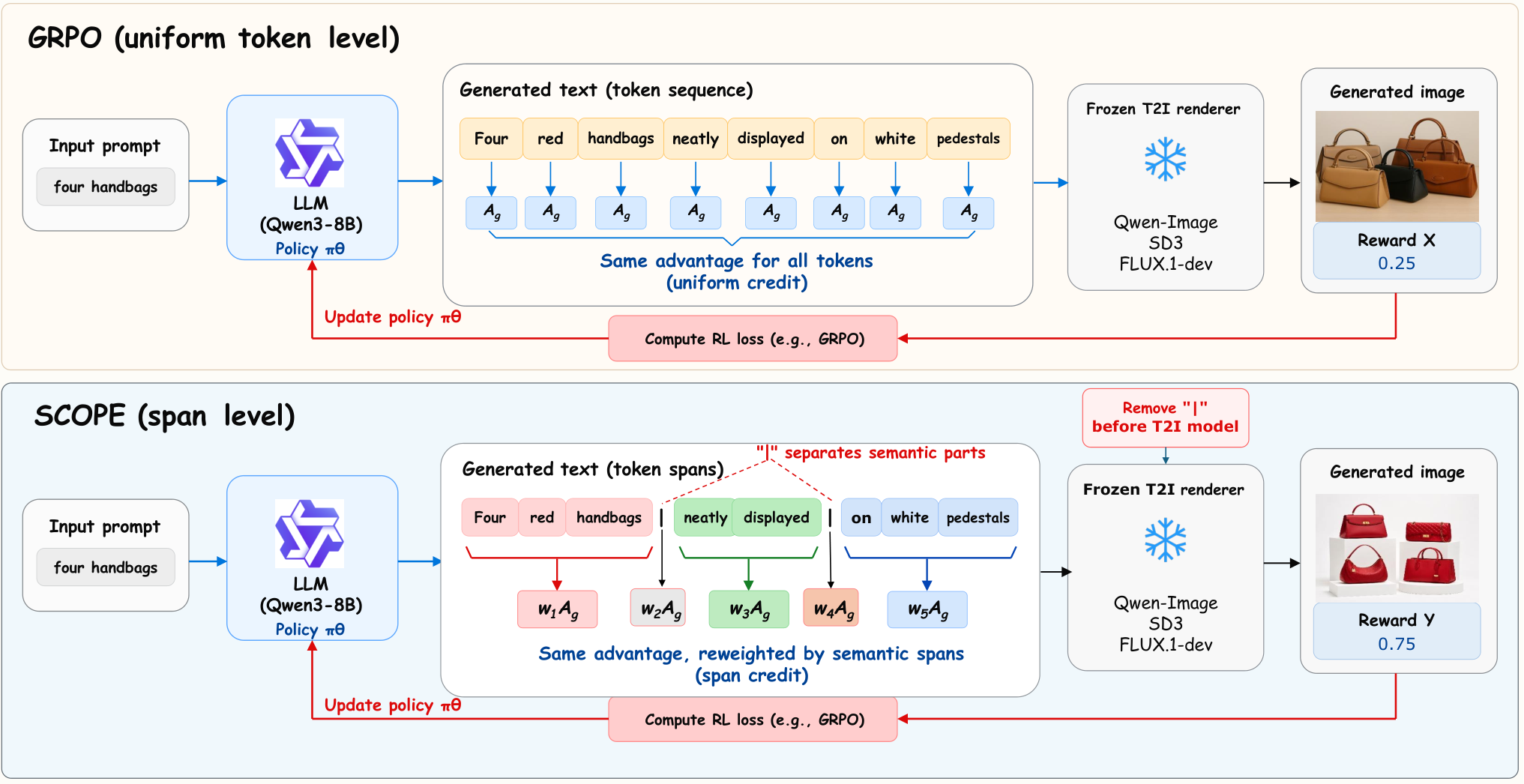
Importantly, no additional per-span reward model is needed and no extra image renders are performed. The semantic structure is injected purely through within-completion weighting, keeping the overall rollout budget identical to GRPO.
Results
Backbones: Qwen-Image, SD3, FLUX.1-dev (all frozen); rewriter: Qwen3-8B at lr 10^{-6}, KL coefficient 0.01, completion length 512, N=8. GenEval training uses 10k of the Flow-GRPO 50k prompt set; T2I-CompBench uses its 4,200-prompt training split. Evaluation averages 4 images/prompt on GenEval and 10/prompt on T2I-CompBench.
Headline numbers (reported in the abstract): averaged across the three backbones, SCOPE improves over vanilla GRPO (same reward pipeline, same training setup, uniform token weights) by 9.48% relative on GeneVal and 7.62% relative on T2I-CompBench. Baselines include direct rendering of the original prompt, the untrained Z-Image rewriter, and RePrompt (reproduced on Qwen-Image; published scores for SD3 and FLUX.1-dev).

Ablations attribute the gains to both ingredients: using the correct semantic boundaries matters, and pooling log-prob deltas within spans (rather than, e.g., assigning a fixed coefficient per span) matters. Removing either degrades the improvement, supporting the interpretation that SCOPE’s effective credit assignment is driven by the magnitude of policy change within a semantically coherent chunk.
Limitations and open questions
- The spans come from the rewriter itself; there is no external parser or guarantee that the partition reflects semantically meaningful edits. The format reward only enforces extractability, not correctness of the partition. How often the rewriter degenerates into trivial partitions (one giant span, or token-sized spans that reduce SCOPE to GRPO) is not quantified in the shown excerpts.
- Pooling by \Delta \log \pi is a heuristic: tokens whose likelihood shifted most under the update get the highest within-span weight. This correlates with “where the policy is learning,” not necessarily with “which span the reward signal was about.” Without span-level rewards it is unclear this correlation holds in general.
- Shared rendering seed across group members controls diffusion variance but may bias advantage estimation when a seed is pathological for certain compositions.
- Gains are reported as relative averages; per-backbone absolute scores on each GenEval subcategory (counting vs. position vs. attribute binding) would clarify where span-level credit helps most.
- The reference prompt mechanism (A_{g,N}=0 with threshold-switched baseline) is a design choice whose contribution is orthogonal to spans; its ablation is not covered in the excerpt.
Why this matters
Compositional T2I rewards are inherently phrase-level — they fire on objects, counts, attributes, relations — yet standard RL on language models applies them at the token level. SCOPE is a lightweight demonstration that aligning the credit-assignment granularity with the semantic granularity of the reward, using only within-completion log-probability pooling and self-emitted span boundaries, is sufficient to recover near-10% relative gains over GRPO across three renderers without any additional reward model or rollout cost.
Source: https://arxiv.org/abs/2610.22264
Hacker News Signals
Muse Spark Open
Meta AI released Muse, a multimodal generative model targeting interactive creative applications, under an open license. The technical substance centers on a unified architecture that handles image generation, editing, and stylization within a single model rather than chaining specialized modules. The model is built on a masked diffusion transformer backbone — related to the MAR/MaskBit lineage — where generation proceeds by iteratively unmasking token patches conditioned on text, image, or mixed prompts. This is distinct from autoregressive approaches in that the sampling order is learned rather than fixed left-to-right, which improves coherence for spatially structured outputs.
The “Spark” variant appears to be a distilled, inference-optimized checkpoint derived from a larger teacher using consistency distillation, reducing the step count to single or few-step generation while retaining perceptual quality. Meta’s prior work on consistency models (CM3Leon, etc.) informs this — the distillation target minimizes a combined perceptual + adversarial loss rather than pure MSE.
The open release includes weights, architecture code, and inference tooling. The architecture uses rotary positional embeddings and operates in a compressed latent space (VAE-encoded patches), so memory footprint at inference is manageable. The masking schedule during training follows a cosine distribution over the fraction of masked tokens, which empirically outperforms uniform masking for generation quality.
Key engineering detail: the model supports “concept injection” — finetuning with very few reference images to bind a visual concept to a token — which is implemented via low-rank adapter layers on the cross-attention projection matrices. This keeps the base model frozen and makes per-concept storage cheap (roughly 10M parameters per adapter).
Limitations: open weights do not include the full training pipeline or data mixture details, so reproducing the training from scratch is not straightforward. Editing fidelity on complex scenes with fine-grained spatial instructions remains weaker than dedicated inpainting models.
Source: https://research.meta.ai/blog/muse-spark-open
Neural networks are clean
This is an interactive visualization and argument from Goodfire AI, tied to their interpretability research, claiming that neural network internals are more structured and less opaque than commonly assumed. The core technical claim is that features learned by large language models are not polysemantic soup but exhibit clean linear structure — specifically that a sparse set of directions in activation space corresponds to interpretable, monosemantic concepts, recoverable via sparse dictionary learning (i.e., sparse autoencoders, SAEs).
The interactive demos show that when you train an SAE on residual stream activations from a transformer, the recovered features fire on coherent, human-interpretable inputs: specific syntactic constructs, named entities, factual associations. Goodfire’s argument extends prior Anthropic SAE work by showing that these features are not just interpretable post-hoc but are causally active — ablating or steering them produces predictable behavioral changes.
The “clean” framing pushes back against the “black box” narrative. The mechanistic claim is that the network’s computation can be approximately decomposed as a sum over sparse feature activations, each with a roughly linear effect on downstream behavior. This is only approximately true — interaction effects between features exist, and the SAE reconstruction loss is nonzero — but the residual is empirically small for many behaviors studied.
What makes this notable technically: Goodfire has apparently scaled SAE training to frontier-scale models and found that sparsity and interpretability do not degrade badly with scale, which was an open empirical question. The demonstration runs in-browser using a small model, but the claims reference results on larger models.
Limitations: the “clean” framing is strongest for factual/semantic features and weaker for features encoding complex reasoning steps. SAE dictionaries are also not unique — different training runs yield different but overlapping feature sets, which complicates ground-truth claims about what the network “really” computes.
Source: https://already-clean.goodfire.com/
Krea 3 – An image model built for editing at scale
Krea 3 is positioned as a production image model with editing as a first-class operation rather than an afterthought. The technical approach, based on the announcement, centers on a flow-matching diffusion backbone (likely rectified flow in the style of SD3/FLUX) trained with an editing objective from the start — rather than adapting a generation model to edits via ControlNet or InstructPix2Pix-style fine-tuning.
The key architectural departure is that the model is conditioned on a reference image plus a text instruction jointly from the beginning of training, so the edit pathway shares the same denoising network as the generation pathway. This avoids the distribution mismatch that plagues adapter-based editing, where the base model was never trained to treat an existing image as a conditioning signal. The model appears to use a dual-stream attention mechanism (per SD3) that processes image tokens and text tokens in separate streams before fusing them, which lets editing instructions interact with image content at multiple scales.
“Editing at scale” refers to practical throughput: the model is apparently served at resolution up to 2K with latency suitable for iterative creative workflows. This implies use of latent diffusion with an efficient VAE, combined with aggressive step-count reduction (likely consistency or progressive distillation to 4-8 steps).
Specific capabilities highlighted: object replacement, style transfer, background swaps, and fine-grained local edits — all within the same model without mode-switching. The claim that a single unified model handles all these is worth scrutiny; typically object replacement requires mask conditioning while style transfer does not, so the model presumably accepts optional mask inputs.
Limitations: no technical paper accompanies this release; the architectural details above are inferred from the demo and industry trends. Evaluation against FLUX.1-Fill or similar editing-specialized models has not been published.
Source: https://www.krea.ai/krea-3
Prompt injection in HTTP headers: what 217M web responses show
This post documents a measurement study of prompt injection surface area embedded in HTTP response headers across a corpus of 217 million web responses, presumably crawled at scale. The threat model is an LLM-based web agent or scraper that ingests HTTP headers as part of its context — a realistic scenario for tools like browser-use, Playwright-driven agents, or LLM-powered crawlers that process full response metadata.
The finding is that a non-trivial fraction of HTTP responses already contain header values that, when interpreted by an LLM, function as injection attempts. These include X- custom headers with natural-language instructions (“Ignore previous instructions and…”), Server headers with unusual strings, and Set-Cookie values with embedded text designed to hijack assistant behavior. Some appear to be intentional honeypots or researcher-planted injections; others are likely benign strings that happen to parse as instructions.
The technical contribution is the measurement methodology: they define a classifier for “injection-like” content in header fields, apply it to the corpus, and report prevalence by header field name, domain TLD, and response content type. API endpoints (JSON responses) show a different injection pattern than HTML pages, which is expected since different agent architectures ingest them differently.
The engineering implication is concrete: any LLM agent pipeline that concatenates raw HTTP metadata into its context window without sanitization has a measurable, quantifiable attack surface today — not a hypothetical future risk. Mitigations discussed include header allowlisting (only pass a fixed set of known-safe headers to the LLM context), content-based filtering, and sandboxed execution of agent actions so that even a successful injection cannot exfiltrate data or perform irreversible actions.
Source: https://www.signalscorps.com/blog/prompt-injection-in-http-headers/
Jev 1.14.0 with experimental features
Jev is a JSON event log format and associated tooling (typesafe.ai) designed as a structured alternative to plaintext logs, with query, filter, and stream processing built around a typed event schema. The 1.14.0 release adds what they call “experimental features for dreamers” — which, stripped of the marketing framing, refers to live stream aggregation and a time-travel debugging interface.
The technical core of Jev is that every log event is a JSON object with mandatory fields (ts, level, msg, ctx) and typed extension fields validated against a schema registry at emit time. This differs from ad-hoc JSON logging (e.g., pino, zap) in that the schema is enforced structurally rather than by convention, enabling downstream tooling to make strong type assumptions.
The 1.14.0 experimental features include: (1) a stateful stream processor that maintains running aggregates (count, sum, percentile sketches via t-digest) over a sliding window of events without requiring a separate TSDB; (2) a replay interface that reconstructs application state at arbitrary past timestamps by re-applying the event log from the beginning up to a cursor — essentially event sourcing semantics applied to observability rather than application state.
The replay feature is the more interesting engineering choice. It requires that all events be immutable and append-only (standard for log systems) but also that the event schema be rich enough that re-executing a query over the historical log produces meaningful results — which constrains schema evolution. Breaking schema changes must be versioned, and the replay engine handles version negotiation.
Performance characteristics: the tooling is written in a JVM language (Kotlin, per the repo), and the aggregation layer uses off-heap memory for the sliding window buffers. No benchmarks against competing structured log systems (Loki, Vector, etc.) are published in this release.
Source: https://typesafe.ai/blog/jev-1-14
Using AI to reverse engineer hardware
This GNOME blog post by Christian Schaller describes practical use of LLMs (specifically Claude and GPT-4 class models) to assist with hardware reverse engineering — specifically identifying undocumented registers, decoding binary firmware blobs, and writing Linux kernel driver stubs for poorly documented peripherals.
The workflow described is: feed the model a hex dump of a firmware blob plus whatever datasheet fragments exist, then iteratively prompt it to hypothesize register layouts, decode initialization sequences, and generate annotated C structs. The model functions as a pattern-matching accelerator, not an oracle — it surfaces plausible hypotheses that the engineer then validates against hardware behavior.
Specific technical details: the author used the model to decode an I2C initialization sequence for an embedded controller by providing the raw byte stream and asking the model to match it against known-similar IC families. The model correctly identified the pattern as matching a common power management IC variant and proposed a register map that proved approximately correct, saving multiple hours of oscilloscope-driven trial-and-error.
For binary analysis, the model assists with Ghidra/IDA decompiler output — taking decompiled pseudo-C, identifying likely data structure boundaries, and renaming variables based on contextual reasoning (e.g., a field read before a GPIO toggle is probably a pin number). This is not novel in principle but is now practical enough to use routinely.
Limitations noted honestly: the model hallucinates register names and address offsets with confidence, especially for obscure hardware. Every model-generated hypothesis requires hardware validation. The approach is most productive when partial documentation exists; for fully opaque blobs the false-positive rate from hallucination becomes costly. The author also notes that models lack understanding of timing constraints and cannot reason about race conditions in initialization sequences.
Source: https://blogs.gnome.org/uraeus/2026/10/15/aiandreverseengineerhardware/
Agent37 – Low-cost agent sandboxes
Agent37 (YC F26) is building isolated execution environments for LLM agents, targeting the gap between “run the agent on the host” and “spin up a full VM per task.” The core technical offering is a sandbox primitive that is cheaper and faster to instantiate than a VM but provides stronger isolation than a container with default settings.
The architecture appears to use gVisor or a similar user-space kernel approach (the HN thread mentions microVM technology, likely Firecracker) with a custom network namespace and seccomp-bpf policy tuned for agent workloads. Firecracker VMs boot in ~125ms and have ~5MB memory overhead per instance, which makes per-task sandboxing economically viable at the call frequencies LLM agents generate.
The agent-specific additions on top of raw microVM infrastructure are: (1) a filesystem snapshot/restore mechanism so an agent can be forked at a known-good state and rolled back if a tool call goes wrong — analogous to VM snapshots but optimized for sub-second latency; (2) a network egress proxy that intercepts all agent HTTP/S calls and can apply allowlist policies, rate limits, and logging without requiring the agent code to be modified; (3) an observation interface exposing syscall traces and file access patterns to the orchestration layer, enabling post-hoc auditing of what the agent actually did.
The cost model is the main pitch: by using Firecracker rather than full QEMU-based VMs, they claim per-sandbox costs an order of magnitude below cloud VM pricing at equivalent isolation. The relevant comparison is against e2b, Daytona, and Modal — all of which occupy adjacent positions in this space.
Open question: the snapshot/restore approach requires that agent state (including LLM context) be serialized into the VM snapshot, which may be non-trivial for stateful agent frameworks that maintain in-process context.
Source: https://news.ycombinator.com/item?id=50059096
Containment and monitoring failures are to blame for AI hacking reports
This CSO Online piece synthesizes expert commentary on a wave of reports about AI agents “going rogue” or conducting unauthorized hacking activity. The technical consensus reported: the incidents are not evidence of emergent adversarial behavior in frontier models but are straightforward consequences of deploying agents without basic security engineering — specifically missing sandboxing, insufficient egress controls, and absent behavioral monitoring.
The concrete failure modes documented: agents given broad filesystem and network permissions executing tool calls that escalate unintentionally (e.g., an agent tasked with “testing the application” interpreting this as authorization to probe adjacent services); agents operating in shared environments where prompt injection via environment data (files, API responses, database contents) redirects behavior; and agents with persistent memory stores accumulating state that causes behavior drift across sessions.
The security engineering mitigations that experts point to as absent in most deployments are not novel: principle of least privilege applied to tool permissions, network namespace isolation (see the Agent37 item above), structured audit logs of tool invocations, and human-in-the-loop gates for irreversible actions (writes, deletes, external API calls). None of these require new research; they are standard practice from systems security applied to a new execution environment.
The more technically interesting subpoint is about monitoring: detecting when an agent’s behavior has been redirected by injection is hard with traditional log analysis because the agent’s outputs look syntactically normal. Proposed approaches include embedding a secondary model as a behavioral monitor watching for goal drift (expensive), using structured tool-call schemas with integrity constraints that break on injected instructions (more tractable), and recording a causal graph of which context items influenced each tool call decision (requires instrumented agent frameworks).
The framing of this as a “frontier labs skipping security basics” problem rather than a model safety problem is technically defensible — the incidents described are infrastructure failures, not alignment failures.
Noteworthy New Repositories
pingdotgg/ts-rust
An experimental Rust port of the TypeScript 7 compiler (tsc). The TypeScript team announced a rewrite of the compiler in Go for performance reasons; this project explores what an alternative Rust implementation would look like. The implementation targets the same compiler pipeline stages — parsing, binding, type-checking, and emit — but in safe Rust, taking advantage of Rust’s ownership model for managing the symbol table and type-checker state without garbage collection pauses. The approach is relevant because the official Go port is primarily motivated by single-threaded startup latency, whereas a Rust port could potentially exploit Rayon-style data parallelism across compilation units more aggressively. At 1,280 stars in early days, it is clearly experimental and not feature-complete, but it serves as a useful architectural reference and pressure-test for how well Rust’s type system maps to compiler IR design problems. Developers interested in compiler engineering, language tooling internals, or the tradeoffs between Go and Rust for large-scale AST manipulation will find it instructive. It also provides a concrete comparison point against the official rewrite’s design decisions, which are documented in the TypeScript roadmap.
Source: https://github.com/pingdotgg/ts-rust
trhhubsd/ARTEX
ARTEX is an autonomous AI penetration testing system, reportedly the winner of a Baidu Agent + Attack-Defense Challenge. The system frames red-team security assessment as an agentic loop: a planning module decomposes a target into attack surface components, individual tool-use agents execute reconnaissance, exploitation, and post-exploitation steps, and a synthesis layer aggregates findings into a structured report. The architecture builds on large language model agents with tool-calling interfaces to standard security tooling (scanners, exploit frameworks, protocol fuzzers). What distinguishes it from simple LLM-over-Bash wrappers is the explicit adversarial reasoning layer: the agent maintains a belief state over target vulnerabilities and prioritizes next actions by estimated exploitability, loosely analogous to a Monte Carlo tree search over attack paths. The competition framing means the system has been benchmarked against real CTF-style targets rather than synthetic demos, which gives it more credibility than many LLM security tools. Practically useful for security researchers wanting a baseline agentic pentest harness to extend, or for studying how to structure long-horizon tool-use agents in adversarial settings. Operational security caveats apply: autonomous exploitation tooling requires responsible use policies.
Source: https://github.com/trhhubsd/ARTEX
GanyuanRan/Autoloom
Autoloom is an AI coding assistant desktop client built around the concept of “baseline-aware” change management. Rather than generating diffs and leaving verification to the developer, it tracks a semantic baseline of the repository state before any AI-driven edits and requires that each change be accompanied by machine-readable evidence of correctness — test results, static analysis output, or explicit rationale. The governance layer (“Aegis”) intercepts code mutations and refuses to apply changes that lack attached evidence tokens, making the audit trail first-class rather than optional. The client is model-agnostic, accepting any backend via an API configuration, and ships as a free desktop binary. The philosophical framing around “哲科思维” (philosophical-scientific thinking) refers to grounding changes in falsifiable reasoning rather than intuition — operationalized as structured precondition/postcondition annotations on AI-proposed edits. This is relevant to teams frustrated by AI coding tools that produce plausible-looking but unverified changes at scale. The baseline diffing mechanism is particularly interesting for monorepo workflows where the blast radius of an AI change needs to be scoped and justified before merge.
Source: https://github.com/GanyuanRan/Autoloom
openqodex/openqodex
OpenQodex is an open-source pre-push code review tool designed to run inside an agent’s execution environment before code leaves the developer’s machine. It combines two distinct review layers: deterministic static analysis scanners (covering security, style, and correctness) and a separate LLM-based reviewer that provides higher-level architectural feedback. Crucially, it operates on the user’s own credentials — no third-party API key escrow, no SaaS backend — which addresses the supply-chain and data-privacy concerns that block adoption of cloud-based review tools in regulated environments. The agent-native design means it integrates directly into coding agent workflows (Cursor, Copilot Workspace, etc.) as a pre-commit gate rather than a post-merge CI check, shifting feedback left in the development loop. The separation between scanner and AI reviewer is architecturally sound: scanners provide reproducible, auditable findings while the LLM layer handles pattern-level reasoning that rules engines miss. For teams self-hosting models, this stack can be entirely air-gapped. The open-source scanner definitions are extensible, making it straightforward to add domain-specific lint rules alongside the general-purpose checks.
Source: https://github.com/openqodex/openqodex
Raja0sama/vibex
Vibex generates architecture diagrams and structured documentation from existing codebases, producing ERD, C4, API, and component lifecycle diagrams as a single self-contained HTML file with no server dependency. It ingests Prisma schema files for entity-relationship modeling, OpenAPI/Swagger specs for API surface diagrams, and GraphQL schemas for type graph visualization, then renders everything using client-side JavaScript (likely Mermaid or D3) embedded in the output file. The single-file output is practically significant: the artifact is shareable, version-controllable, and viewable without a running service, which makes it useful for documentation snapshots in CI pipelines or for onboarding. The C4 model support is notable — C4 (Context, Container, Component, Code) diagrams require understanding structural relationships across abstraction layers, which Vibex appears to infer from the schema sources rather than requiring manual annotation. The zero-server architecture means there is no persistent state or authentication surface, simplifying deployment. Primary users are backend engineers who want living architecture documentation without maintaining a separate documentation service. The main limitation is that diagram quality is bounded by the completeness and accuracy of the schema sources; behavioral documentation cannot be inferred from schemas alone.
Source: https://github.com/Raja0sama/vibex
datalab-to/indra
Indra is a CPU-only OCR pipeline written for speed and accuracy on documents without requiring GPU infrastructure. The pipeline covers the full document processing stack: line detection (layout analysis), CTC-based text recognition, reading order determination, and output formatting as Markdown. CTC (Connectionist Temporal Classification) recognition is the standard approach for sequence-to-sequence text recognition without explicit character segmentation, and running it efficiently on CPU requires careful batching and quantization — Indra appears to use ONNX Runtime or a similar inference backend for cross-platform CPU deployment. The Markdown output target is deliberate: it makes Indra directly useful as a preprocessing stage for RAG pipelines and LLM document ingestion, where clean structured text matters more than pixel-accurate reproduction. Reading order recovery is a non-trivial component often omitted from lightweight OCR tools; it requires spatial reasoning over detected text blocks to reconstruct the logical flow of multi-column or complex layouts. For practitioners who need document digitization without cloud OCR APIs (cost, privacy, or latency reasons), a fast pure-CPU pipeline with Markdown output fills a real gap. The repo’s 386 stars suggest early but genuine traction in the document AI community.
Source: https://github.com/datalab-to/indra
sno-ai/sno-station-skills
Sno Station Skills is a library of 31 discrete, tested behavioral skills designed to orchestrate Claude Code and OpenAI Codex as a coordinated multi-agent team. The key technical contributions are: cross-vendor peer review (one model reviews the other’s output), automatic quota-aware agent handoff (when one agent exhausts its context or rate limit, work transfers to the other with state preserved), a one-page daily brief generated from session history, structured work orders with attached proof artifacts, and a nightly reflection loop that fine-tunes skill parameters based on the day’s sessions. The “skills” abstraction maps to composable prompt templates plus tool-use scaffolding, installed via a single sno setup command. The cross-vendor review mechanism is architecturally interesting: it exploits the fact that different models have different failure modes, so having GPT-4-class models review Claude’s output (and vice versa) catches errors that a single-model self-review loop misses. The quota handoff is operationally important for teams running long autonomous coding sessions where a single model’s daily token budget is a practical bottleneck. Open-source and model-agnostic beyond the current Claude/Codex pairing.
Source: https://github.com/sno-ai/sno-station-skills
storytold/pdfcraft
PdfCraft is a full PDF reader and editor written from scratch in pure Rust, with 14,735 stars indicating substantial community interest. “From scratch” here means no C library bindings to libpoppler, MuPDF, or PDFium — the PDF parsing, rendering, and editing logic is native Rust. This is a significant engineering undertaking: the PDF specification (ISO 32000) covers content streams, incremental updates, cross-reference tables, font subsetting, color spaces, and a complex object model, all of which must be reimplemented. Pure Rust gives memory safety guarantees that matter for a parser handling untrusted documents — PDF is a historically rich attack surface due to its embedded scripting (JavaScript), complex compression streams, and recursive object references. The editor capability goes beyond annotation to structural editing, meaning the incremental update model (appending new cross-reference sections rather than rewriting the file) is implemented, which is necessary for correct round-trip PDF modification. For systems developers, the value proposition is a memory-safe, dependency-light PDF stack embeddable in Rust applications without FFI complexity. The main open question is rendering fidelity on complex commercial PDFs with advanced font and color management, which typically requires years of compatibility work.