Daily AI Digest — 2026-10-12
arXiv Highlights
DiffusionART: Efficient, Stable and Scalable Reinforcement of Diffusion Models
Problem
Online RL for diffusion/flow models currently forces a choice between two regimes with complementary pathologies. Reverse-process methods (Flow-GRPO and variants) treat the ODE/SDE trajectory as a sequence of actions and apply PPO-style updates; credit assignment across the many denoising steps is weak, so training is slow. Forward-process methods (DiffusionNFT) regress the model onto a reward-tilted velocity field, which is sample-efficient but unstable: without a carefully tuned EMA rollout policy and joint positive/negative branches, training collapses. Worse, the EMA decay schedule has to be re-tuned per task and per model. The paper identifies the mechanism behind both failure modes and proposes a method that is on-policy, EMA-free, and transfers across tasks without retuning.
Method: aggregation-first tilting plus adaptive restoration
DiffusionART replaces the per-state NFT target with a prompt-level reward-tilt direction estimated once per rollout group and applied to every state. The tilted endpoint distribution p_\tau(x_0 \mid c) \propto p_{\mathrm{old}}(x_0 \mid c)\exp(\tau R(x_0,c)) satisfies (Lemma 2)
\partial_\tau \mathbb{E}_{p_\tau}[x_0 \mid c]\big|_{\tau=0} = \operatorname{Cov}_{p_{\mathrm{old}}}(R, x_0 \mid c),
and under rectified flow with \epsilon \perp x_0, this covariance equals \operatorname{Cov}_{Q_{\mathrm{old}}}(R, u_t \mid c) at every noise level. From K rollouts per prompt, estimate
\overline{\operatorname{Cov}}(R,x_0\mid c) = \tfrac{1}{K}\sum_i (R_i - \bar R_c)(x_0^{(i)} - \bar x_{0,c}), \qquad G(c) = \overline{\operatorname{Cov}} / \mathrm{RMS}(\overline{\operatorname{Cov}}).
The regression target for every rollout state of prompt c is v_{\mathrm{tgt}}^{\mathrm{ART}}(s_t) = v_\theta^{(0)}(s_t) + G(c), where v_\theta^{(0)} = v_{\mathrm{old}} is cached from rollout. Because the anchor is the reverse field itself rather than v_{\mathrm{fwd}}^{\mathrm{old}}, the consistency force e is removed by construction, eliminating the need for joint positive/negative branches. RMS normalization removes reward-scale dependence and the usual guidance-strength coefficient.
A second MSE update, masked by a trust-region check on the ODE solver, provides drift-adaptive restoration — the role EMA was secretly playing — without any decay schedule to tune.
Results
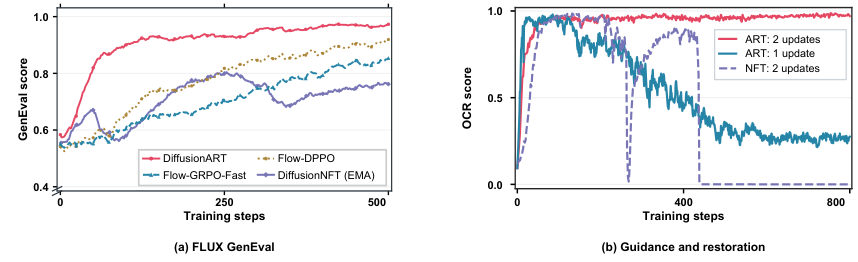
On SD3.5-M with LoRA (rank 32, \alpha=64) at 512\times 512, no CFG and no KL to a reference policy, DiffusionART matches EMA-tuned DiffusionNFT in training efficiency while using no per-task tuning, and avoids the collapse of on-policy DiffusionNFT. Against Flow-GRPO it reaches the step-500 reward with 10.0\times, 5.2\times, and 9.6\times fewer training steps on GenEval, OCR, and PickScore respectively. Multi-reward joint optimization (GenEval + PickScore + CLIPScore + HPSv2.1) behaves similarly, with no per-component instability.
Scaling to FLUX.1-dev (12B) on GenEval with six-step rollouts and the model’s native guidance embedding (scale 3.5), DiffusionART is the fastest-learning method tested; DiffusionNFT exhibits large training-reward fluctuations because the SD3.5-M EMA schedule (\min(0.001n, 0.5)) does not transfer to FLUX. The ablation (Figure 6b) isolates the two update roles: ART: 1 update learns rapidly but degrades over time; the restoration update (ART: 2 updates) stabilizes it long-term, while NFT: 2 updates with tuned \beta=0.1 briefly collapses to near-zero reward before recovering — showing that NFT’s two-update structure does not by itself provide what the explicit trust-region restoration does.
The method extends naturally to pairwise reward models (DiffusionART-Pairwise), since only prompt-grouped ranking information is needed to form G(c), and the authors report gains on T2V and I2V with Hunyuan-class models.
Limitations and open questions
The covariance estimate \overline{\operatorname{Cov}} is noisy for small K; while RMS normalization fixes magnitude, direction variance at small group sizes is not analyzed. The construction relies on rectified-flow–style u_t = x_0 - \epsilon with \epsilon \perp x_0; porting to score-based or EDM parameterizations needs the analogous decomposition. The trust-region mask parameters for the second update, though claimed to be task-agnostic, are not stress-tested against adversarial reward hacking. Finally, the removal of KL to a reference policy raises the usual question of distributional drift from the pretrained prior.
Why this matters
The paper gives a clean theoretical reason that forward-process diffusion RL needs its stabilization machinery — a forward–reverse consistency force that is an artifact of regressing against v_{\mathrm{fwd}}^{\mathrm{old}} instead of the actual reverse field — and shows that aggregating rewards into a prompt-level covariance direction removes it by construction. This both simplifies the training recipe (no EMA tuning, no joint branches, no guidance-strength scalar) and provides large speedups over Flow-GRPO at scale, which is likely to matter as RLHF-style post-training moves from image models to larger video models.
Source: https://arxiv.org/abs/2610.12572
S-Space: Exploring Spatial Workspace in Multimodal Language Models
Problem
Multimodal LLMs produce plausible spatial judgments (“the cup is left of the plate”, “which object is closer”) but we have little mechanistic understanding of what internal structure supports this. Prior interpretability work has shown linear encoding of discrete concepts; this paper asks whether continuous viewer-centered coordinates — horizontal, vertical, depth — are linearly embedded in object-token activations, and whether that representation is causally used for spatial language generation.
Method: identifying S-Space
The authors hypothesize that for a fixed middle layer \ell, hidden states h_{\ell,t}\in\mathbb{R}^{d_{\text{model}}} contain a three-dimensional linear subspace — S-Space — spanned by directions \{v_x, v_y, v_z\} corresponding to horizontal, vertical, and distance axes in an egocentric frame. Object coordinates are read out by projection:
\hat{c}_a(t) = v_a^\top h_{\ell,t}, \quad a\in\{x,y,z\}.
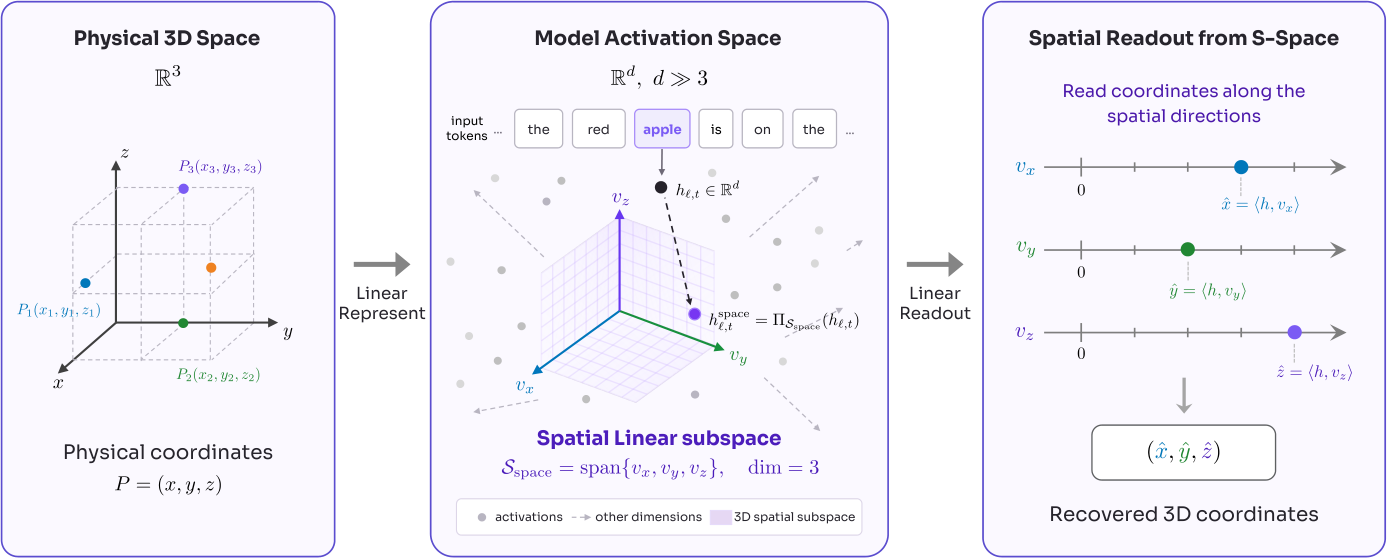
The axes are identified by differentiating spatial-answer logits with respect to object-token activations on constructed relative-position questions from COCO: directions along which the probability of answering “left” versus “right” (etc.) changes most steeply define each axis. Although identified this way, the resulting subspace is shown to be intrinsic — readable under non-spatial prompts and transferable across benchmarks. The authors restrict the search to middle layers because early layers remain anchored to patch-level input encodings and late layers specialize for next-token prediction (layer sweeps in Appendix C.1).
To answer a spatial-relation question using only S-Space, they project the two object tokens, take the coordinate difference along the relevant axis, and apply a deterministic sign rule — bypassing the model’s own verbal decoder.
Results
S-Space coordinates correlate strongly with ground-truth object positions on COCO scenes (Spearman correlations shown per-axis in Figure 3a-b for Molmo2-ER layer 21), both for individual object positions and for pairwise coordinate differences.
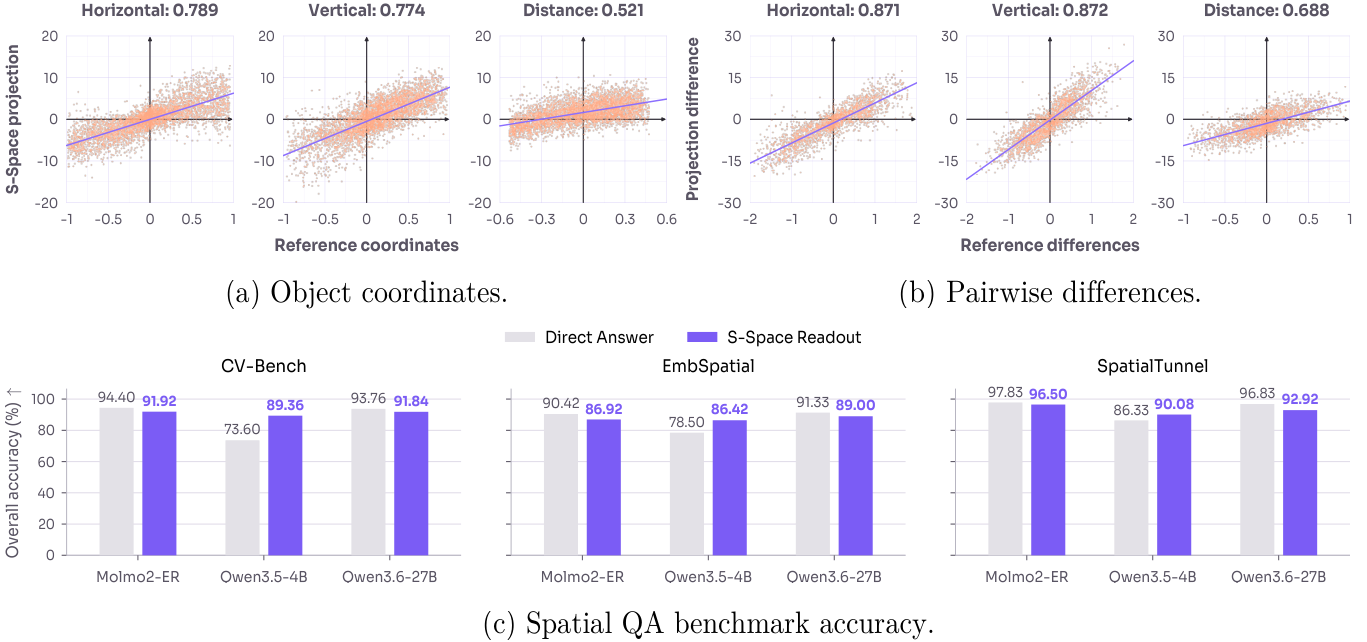
Reading answers out of S-Space with the deterministic rule matches or exceeds the model’s own verbal answer on CV-Bench, EmbSpatial, and SpatialTunnel across Molmo2-ER, Qwen3.5-4B, and Qwen3.6-27B — including on benchmarks not used to identify the axes. Causal interventions (§3.2) that edit coordinates in S-Space change spatial judgments while largely preserving responses to non-spatial questions about the same image, supporting the claim that the verbal pathway selectively reads from this subspace rather than merely correlating with it.
Perspective-taking: separating perception from computation
The most striking quantitative result concerns perspective-taking on SpinBench, where the model must answer spatial relations as they would appear from a rotated viewpoint (left, right, back). The authors decompose the pipeline: read egocentric object coordinates from S-Space, apply a fixed rotation matrix for the target viewpoint, apply the deterministic spatial rule. On SpinBench without premise:
- Molmo2-ER: direct 60.96% → S-Space+rotation 94.52% (+33.56)
- Qwen3.5-4B: direct 60.96%, CoT 62.33% → S-Space+rotation 91.10% (+30.14)
- Qwen3.6-27B: direct 60.96%, CoT 83.56% → S-Space+rotation 95.21% (+34.25)
With premise, S-Space+rotation reaches 97.92–99.31% across models. Chain-of-thought alone recovers only a fraction of this gap (e.g., +18.75pp for Qwen3.6-27B with premise vs. +26.39pp for the explicit transform). This localizes the failure mode: perception (encoding into S-Space) is near-correct; the models’ learned computation over that representation — mental rotation — is the bottleneck.
Emergent structure beyond visible objects
Several case studies suggest S-Space is more than an object detector in disguise. Projection of the token for an unseen entity (e.g., the ball a goalkeeper is diving toward) lands in the correct direction. The second-person token you projects to the near end of the distance axis, consistent with the observer’s implicit position. Abstract political terms (“socialist”, “conservative”) project to opposite ends of the horizontal axis, inheriting the linguistic left/right metaphor. The authors argue S-Space arises as a byproduct of training to predict spatial language: binding entities to relative positions is necessary for correct lexical choice, and this organizes activations into stable axes even without coordinate supervision.
Limitations and open questions
- The egocentric reference frame is not fixed. §5.2 and C.7 report it can be steered by context and progressively reoriented during CoT, which complicates both identification and interpretation when prompts imply alternative frames.
- S-Space is identified per model, per layer; the paper reports middle-layer results but does not characterize how multiple layers compose or whether the axes drift during generation.
- The axis-identification procedure uses supervised relative-position labels; whether a fully unsupervised recovery (e.g., via sparse dictionary learning) finds the same subspace is open.
- Perspective-taking results show the model has the information but fails to use it; the paper does not propose a training-time fix, only a diagnostic.
- All showcases are qualitative for the “beyond physical space” claims; the metaphorical mappings are suggestive but not systematically quantified across many abstract concepts.
Why this matters
This is a clean demonstration that continuous geometric quantities — not just discrete concepts — are linearly decodable from MLLM activations, and that the representation is causally wired into verbal spatial judgments. More practically, the SpinBench decomposition shows that current MLLM spatial-reasoning failures are computation failures over adequate representations, suggesting that targeted interventions on the transformation step (rather than more perception data) are the right lever.
Source: https://arxiv.org/abs/2610.13527
Inducing Process Supervision from Outcome-Only Reinforcement Learning
Problem
Process reward models (PRMs) score the correctness of individual reasoning steps and are increasingly central to LLM post-training (as dense reward signals) and test-time search (as step-level verifiers). The bottleneck is supervision: human step annotation does not scale, and Monte Carlo rollout estimates — where a step’s label is approximated by the empirical success rate of continuations — are compute-heavy and biased, since a step can be “wrong” yet frequently lead to correct answers (or vice versa). The authors ask whether PRM-quality step verification can emerge from training a generative verifier with outcome-only RL, bypassing step labels entirely.
Method: TIPS
TIPS (Thinking-Induced Process Supervision) trains a generative reward model whose output has three parts, produced in order: (i) a chain-of-thought c, (ii) a sequence of per-step labels \{y_i^{\text{step}}\}_{i=1}^{T}, and (iii) a trajectory-level outcome label y^{\text{out}} \in \{0,1\}. Given a trajectory \tau = (s_1,\dots,s_T) and a ground-truth outcome y^\star, the reward is purely outcome-matching:
r(c, y^{\text{step}}, y^{\text{out}}; y^\star) = \mathbb{1}[y^{\text{out}} = y^\star].
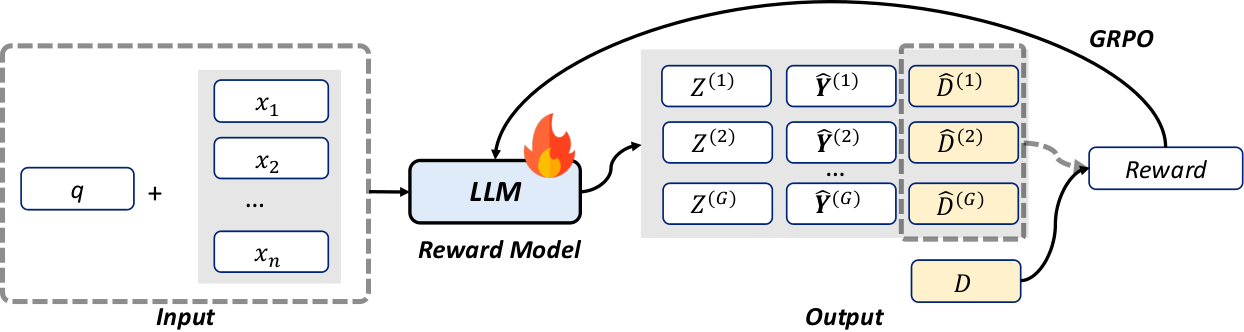
Optimization uses a group-relative advantage (GRPO-style): for each prompt, K responses are sampled, and the advantage of response k is
A_k = \frac{r_k - \mu_r}{\sigma_r + \epsilon},
with \mu_r,\sigma_r the group mean/std. The policy gradient is applied to the entire generated response — the thinking tokens, the step labels, and the outcome token all receive the same scalar advantage. Crucially, step labels never receive direct supervision; they are reinforced only insofar as emitting them (and the reasoning that produced them) correlates with correct outcome prediction.
The intuition is a credit-assignment argument through the autoregressive factorization: if the thought and step labels contain faithful step-level verification, the conditional p(y^{\text{out}} = y^\star \mid c, y^{\text{step}}) is sharper, so correct outcomes are sampled more often and those trajectories are up-weighted. Information-theoretically (their Section 3.3), outcome accuracy is upper-bounded by how much the thought c reduces uncertainty about per-step correctness, so maximizing expected outcome reward implicitly maximizes the mutual information between the thought and the true step-correctness variables. Thus process supervision is induced, not imposed.
A few mechanical consequences worth flagging for reimplementation:
- The output template must force the model to emit step labels before the outcome, so the outcome’s log-prob conditions on them; otherwise the step labels become unreinforced side-channel outputs.
- Only trajectories with gold outcome labels are needed. For math, this is naturally available; for agentic tasks the outcome is task success.
- The reward is binary and sparse, so group size K and advantage normalization matter — standard GRPO-style tricks (clipping, KL penalty to the SFT reference) apply.
Results
Experiments span four backbone families (Qwen3, DeepSeek, Llama, SmolLM) in both instruct and thinking variants, on math reasoning and agent benchmarks. The headline result highlighted in the abstract is TIPS-Qwen3-4B-Thinking achieving strong PRM performance competitive with substantially larger or process-supervised baselines; the paper reports consistent improvements over outcome reward model (ORM) baselines and over PRMs trained with Monte Carlo step labels, across all backbone families. Because the method only requires outcome labels, the data cost is comparable to ORM training yet yields step-verification capability as a free byproduct — the model’s generated step labels, never directly supervised, become usable as a PRM signal for downstream best-of-N selection and process-reward RL of a policy model.
The ablations implied by the setup (removing the thinking segment, removing step labels, or supervising step labels directly) are the key diagnostics: without the intermediate step-label slot preceding the outcome, the induction mechanism disappears, confirming that the architectural ordering — thought → step labels → outcome — is what channels gradient into process-aware computation.
Limitations and open questions
- Faithfulness of induced step labels. Outcome-only reward does not guarantee that generated step labels are calibrated; they only need to be predictive enough of the outcome. On tasks where a wrong step is often recoverable, the induced PRM may systematically mislabel.
- Reward sparsity and length bias. With binary outcome rewards and long trajectories, variance is high; the method likely inherits GRPO’s sensitivity to group size and KL coefficient.
- Domain coverage. Math and agent tasks have crisp outcomes. Extending TIPS to open-ended generation (where y^\star is itself a soft judgment) is non-obvious.
- Comparison to MC-PRM at matched compute. MC estimation is expensive, but a fully controlled compute-matched comparison across step-label noise levels would clarify when TIPS strictly dominates.
Why this matters
TIPS collapses the PRM data-collection problem into standard outcome-labeled RL by exploiting the ordering of autoregressive generation: force the verifier to commit to step judgments before the outcome, and outcome-only credit assignment propagates back into step-level verification. If the induced step labels are indeed faithful, this removes the main cost barrier to scaling PRMs and makes dense process rewards accessible wherever outcome labels exist.
Source: https://arxiv.org/abs/2609.36641
Reflex: Visually Grounded Reactive Humanoid Control
Problem
Catching a thrown box with a humanoid couples three capabilities that have rarely been solved together on real hardware: (1) 29-DoF whole-body coordination to position feet, torso and arms and absorb impact without falling; (2) sub-second reactive prediction of object dynamics under latency (camera-to-control median 69 ms on the authors’ detector pipeline, with the box arriving ~1 s after release); and (3) grounding of fast object motion in egocentric RGB-D where self-motion contaminates optical flow and the robot’s own arms occlude the target near contact. Prior work either uses fixed-base arms, motion capture, or marked objects; concurrent humanoid-catching work does not report real-robot success rates. Baseline difficulty is nontrivial even for humans: three human catchers succeed on only 28.3% of throws at 7 m.
Method
Reflex factors the deployed policy into a visual encoder V_\psi and a whole-body controller \pi_\theta coupled by an 8-dimensional object-dynamics latent \hat{\mathbf{z}}_t:
\hat{\mathbf{z}}_t = V_\psi(\mathbf{I}_{t-K+1:t}, \mathbf{e}_{t-K+1:t}), \qquad \mathbf{a}_t = \pi_\theta(\mathbf{r}_t, \hat{\mathbf{z}}_t),
with joint targets \mathbf{q}_t^{\text{nom}} = \mathbf{q}_0 + \mathbf{s} \odot \mathbf{a}_t. The robot/reference observation \mathbf{r}_t \in \mathbb{R}^{160} provides the proprioceptive and reference-tracking signal needed for balance; the 8-D latent is the sole channel through which perception influences control.
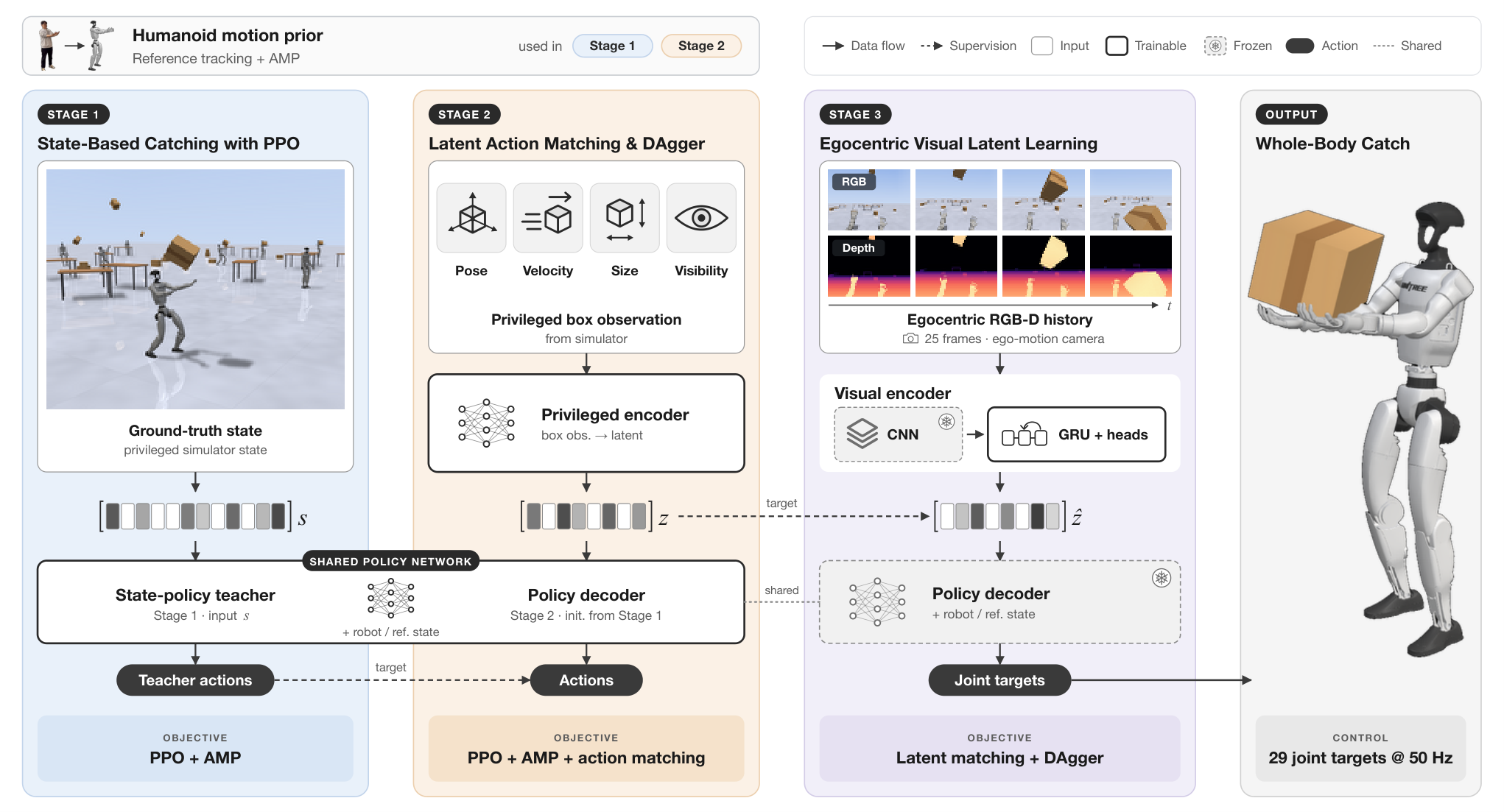
Training is staged (Fig. 2):
- Stage 1 (whole-body control). PPO on privileged simulator state learns the state-policy teacher. Reference tracking from human motion clips plus an AMP-style style reward act as motion priors; hold-shaping rewards keep the box after contact.
- Stage 2 (object-dynamics latent). The privileged encoder is initialized with behavior cloning (five DAgger rounds, 5× weighting of visible-box samples) against the Stage 1 teacher, then jointly refined with PPO (4096 envs, 600 iterations, LR 10^{-4}). The encoder consumes delayed, partial box observations (20–60 ms randomized latency over position, velocity, orientation, size, observation age) and emits the 8-D latent.
- Stage 3 (visual grounding). With \pi_\theta frozen, a visual encoder regresses \hat{\mathbf{z}} from a history of 192×144 RGB-D frames and camera ego-motion. The architecture combines 8 geometric features with 9 ego-motion features through a 2-layer, 128-unit GRU. A color-augmented localizer is pretrained (20 epochs, batch 32, LR 3\times 10^{-4}), followed by temporal training (AdamW, 60 epochs, batch 512, max LR 2\times 10^{-3}) with auxiliary loss weight \lambda_{\text{aux}} = 0.5 and 8× weight on 0.5–2.5 m box ranges. Two or three DAgger rounds correct state-distribution shift.
The decomposition keeps RGB-D rendering out of RL: Stage 2 PPO at 4096 envs runs at ~28k steps/s versus ~1.5k steps/s with in-loop rendering at 320 envs, so Stage 2’s 59M steps take ~35 min instead of ~11 h, and Stage 3 needs only ~1.6M rendered steps.
Results
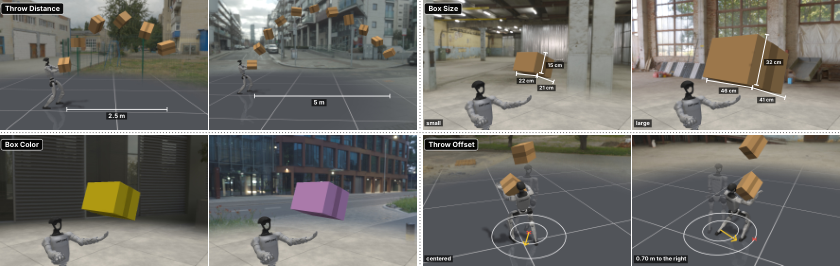
In simulation, visual Reflex reaches 85.7% catch success against 87.9% with privileged box observations — a 2.2-point gap for going from oracle state to egocentric RGB-D. Removing temporal history drops success by 35.6 points on centered throws and 39.8 points on 0.6 m-offset throws, showing most of the signal is temporal rather than per-frame. BC initialization of the privileged encoder gives +5.2 points on average for downstream visual catching; a single-seed sweep attributes 5–11 points to latency randomization across simulated delays. Regressing the learned latent beats regressing full state, and within the visual training range it also beats the same detector plus a Kalman filter.
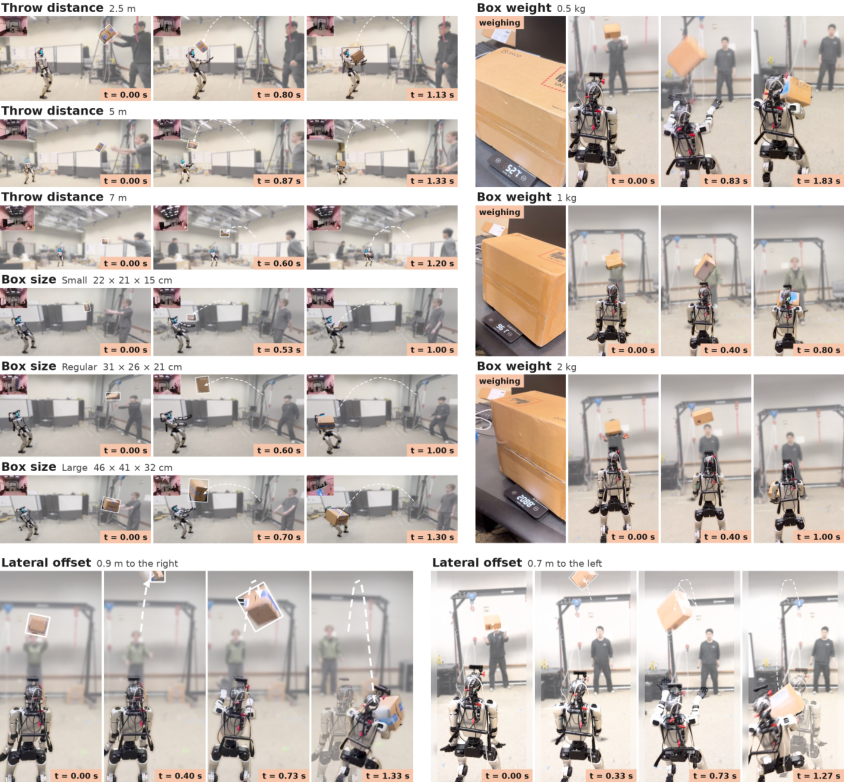
On a real Unitree G1 (Fig. 5), Reflex catches human-thrown boxes 65% of the time at 2.5 m and 40% at 5 m, which is 76% and 59% of human success at the same ranges (humans: 85.0% and 68.3%). Payloads up to 2 kg remain catchable; boxes outside the reference size are intercepted but often not retained — torso excursion is the retention bottleneck.
Limitations
Long-range visual grounding degrades sharply beyond the Stage 3 data range (3.0–3.5 m): at 5 m simulated throws, visual success falls to 43.0% while privileged input holds 79.7%; real-robot success is 40% at 5 m and 15% at 7 m. Augmenting Stage 3 data with far throws recovers simulated 5 m success to 75.8%, untested on hardware. The study is one task with 20 real trials per condition (CIs ~±20 points), the hardware latency was characterized only on the detector pipeline (where it exceeds the randomized range), the controller is size-blind, and rendering omits motion blur and exposure dynamics.
Why this matters
Reflex is the first demonstration of visually reactive whole-body catching on a real humanoid using only onboard RGB-D, and the three-stage decomposition — RL on state, latent BC+PPO on delayed observations, then supervised visual grounding with a frozen controller — is a practical recipe for keeping expensive rendering out of RL while retaining end-to-end deployment. The compact 8-D dynamics latent as the perception-control interface is a transferable pattern for other sub-second reactive tasks where entangled visuomotor RL is infeasible.
Source: https://arxiv.org/abs/2610.12772
SoftwareGym: Scaling Computer-Use Agent Training with Diverse Synthesized Software Environments
Problem
Training computer-use agents (CUAs) requires environments that are (i) diverse enough to prevent application-specific overfitting, (ii) deep enough to exercise multi-step workflows, and (iii) reliable enough to generate verifiable reward signals. Existing pipelines are stuck at a bad Pareto frontier: curating real native applications is labor-intensive and narrow in coverage, while browser-hosted sandboxes have shallow interaction trees and limited stateful behavior. The paper proposes SoftwareGym, an automated synthesis pipeline that produces runnable GUI applications together with executable, state-verified tasks suitable for RL/SFT trajectories.
Method
SoftwareGym decomposes synthesis into three stages: Software Design, Software Implementation and Evaluation, and Task Synthesis.
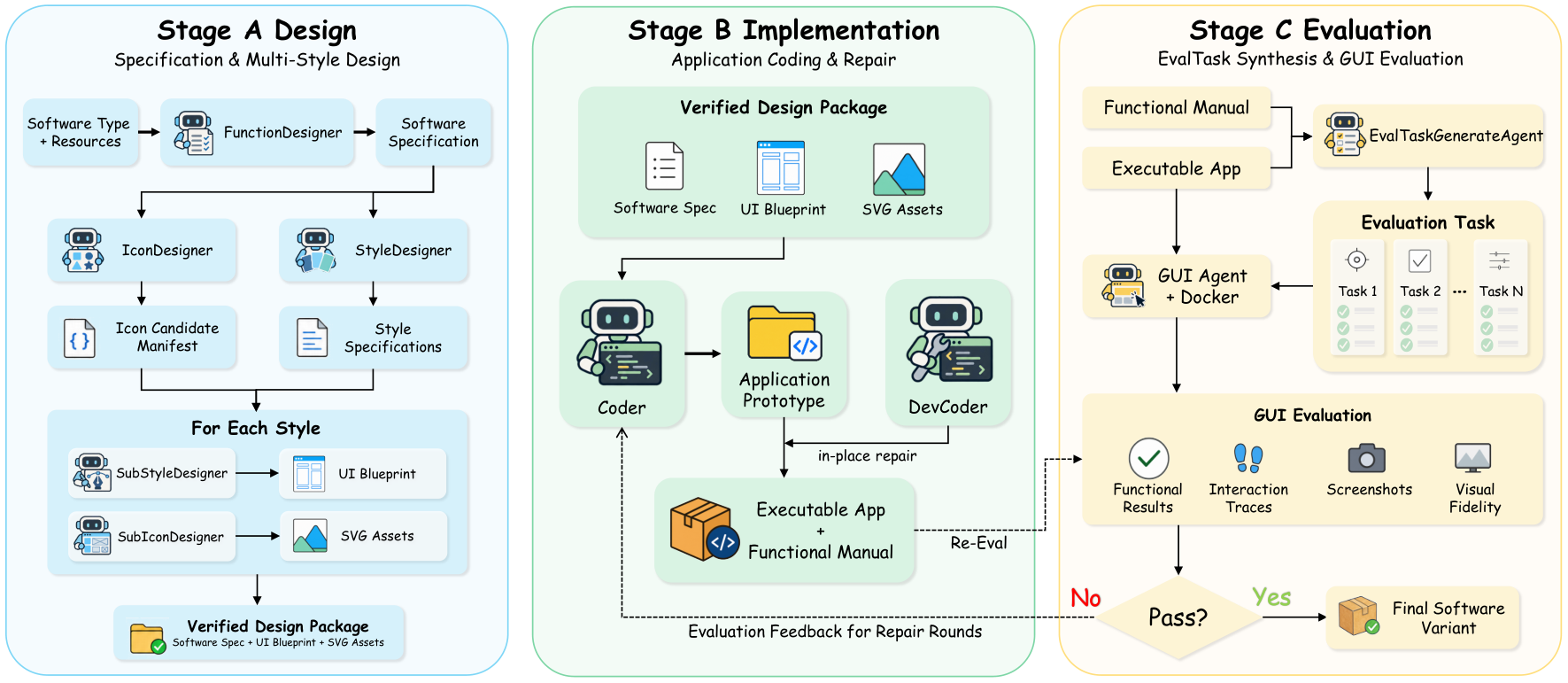
Software Design. Given a software type and seed resources, a FunctionDesigner LLM runs a four-step expansion:
- Baseline functions — identify target users, core objects, and canonical operations (create / open / edit / organize / search / recover / save).
- Professional extensions — multi-condition retrieval, batch operations, history, persistent view settings, input validation.
- Workflow stitching — compose functions into end-to-end flows including cross-module state changes, dependent operations, and failure/recovery branches.
- Contract emission — each function is written to a Software Specification with five fields: user entry, user action, expected state update, visible GUI response, and acceptance checkpoint.
The acceptance checkpoint is the key design decision: it makes every function directly testable via GUI probing rather than code inspection. The design stage then forks into multiple style-specific Verified Design Packages (UI Blueprint + SVG assets) sharing the same functional spec, which decouples visual diversity from functional diversity.
Implementation and Evaluation. Each design package is implemented by a Codex CLI agent built on GPT-5.5 and executed in an isolated Ubuntu 22.04.3 VM. A v1 GUI test suite — derived from the function contracts — is held fixed across up to three repair rounds (v_1 \to v_3), with early stopping when all cases pass. Evaluation itself is performed by Seed 2.1 Pro acting through mouse and keyboard, with a 50-step budget per case. Failed cases return structured failure traces that drive the next implementation revision. This closes a per-application repair loop where the environment itself serves as the oracle.
Task Synthesis. Rather than letting an LLM freely imagine tasks (which tends to produce unexecutable or unverifiable requests), SoftwareGym extracts evidence-supported capabilities from the verified build, assigns coherent capability combinations to slots controlled by difficulty and initial state, and only then realizes each slot as a natural-language request with an explicit initial state and expected terminal state.
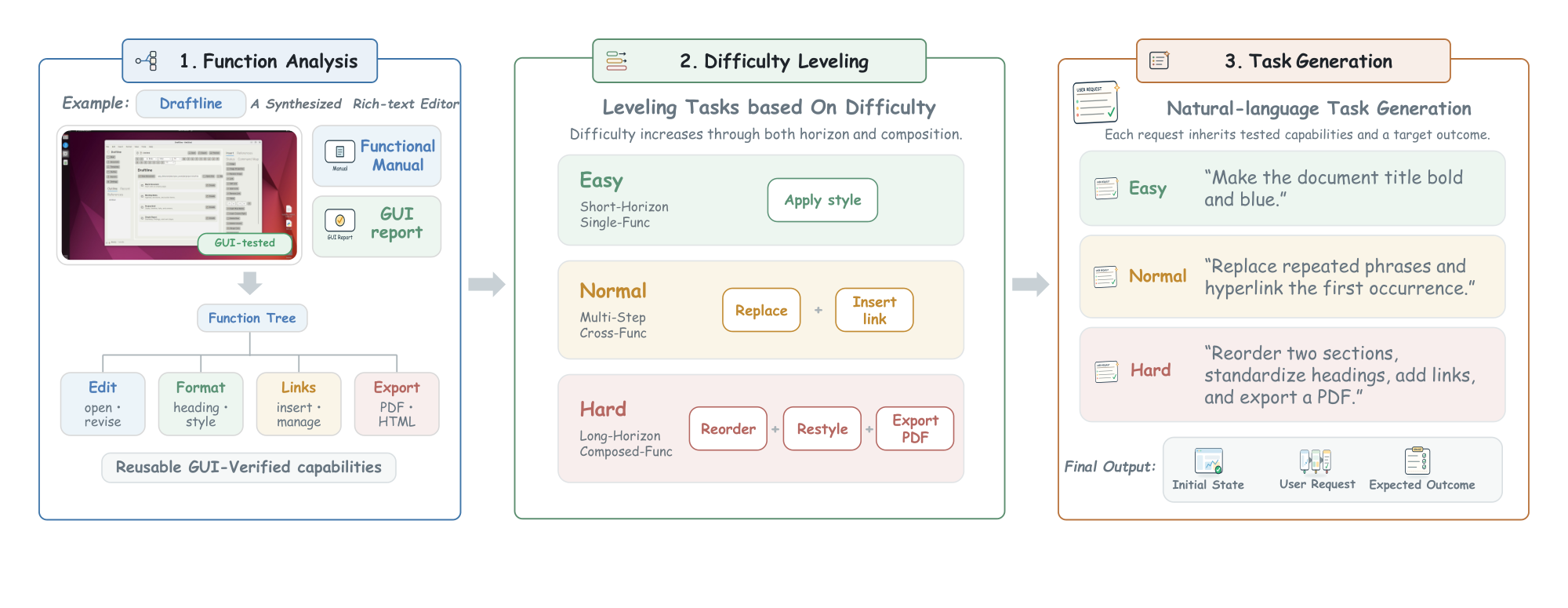
Because each task’s expected state is tied back to the function contracts, pass/fail can be programmatically checked by inspecting the application’s internal state after rollout — producing clean rewards for CUA training.
Results
Running the pipeline yields 182 applications across 12 categories, with a mean GUI task pass rate of 91.5% after the three-round repair loop — i.e., the synthesized apps are reliable enough to act as training environments rather than noisy toys. Representative applications span image editors, video players, table editors, and code editors, with the paper emphasizing multi-step interaction depth within each.
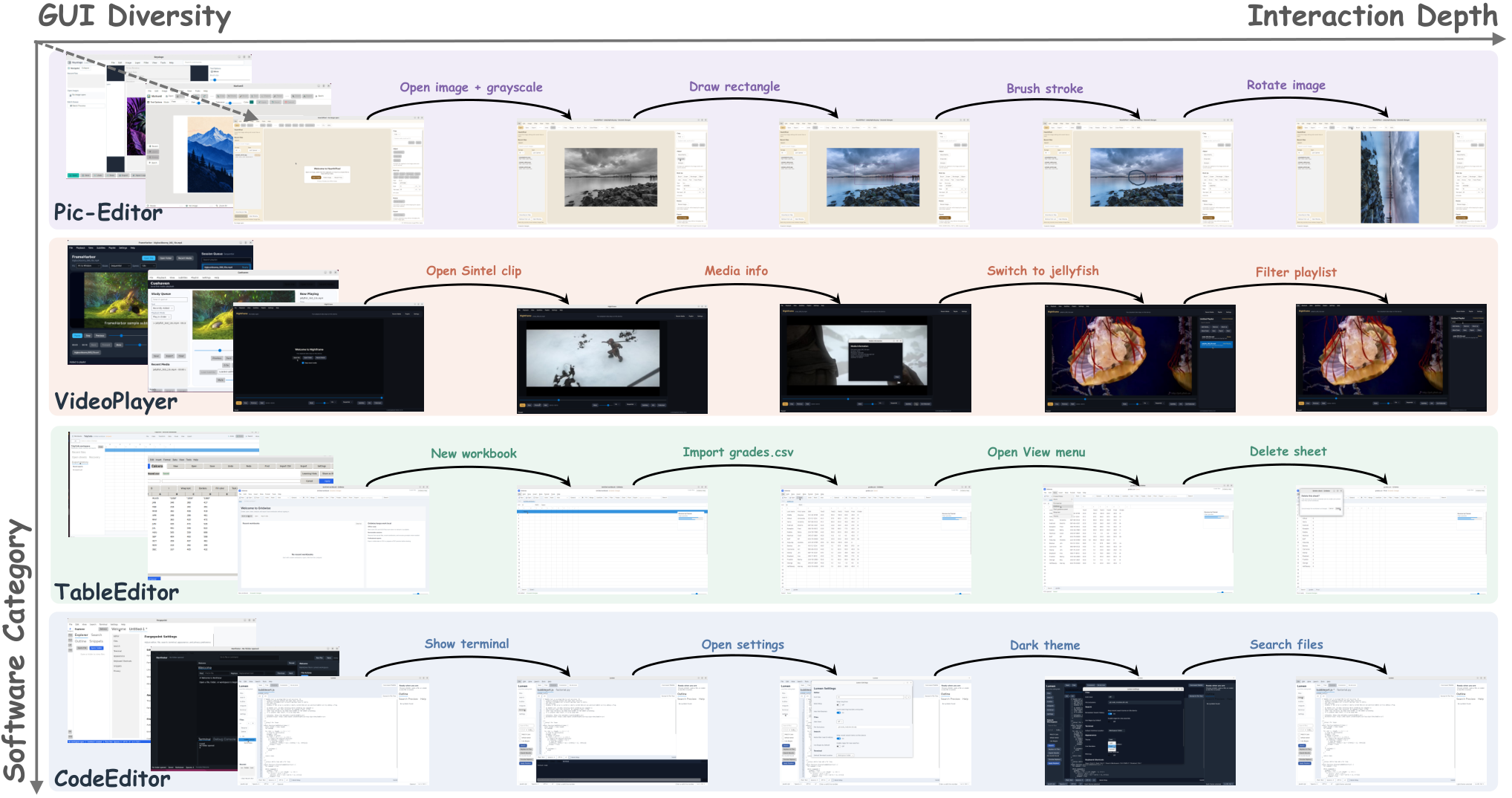
For evaluation the authors curate SoftwareGym-Bench, 120 tasks covering the same 12 categories. Trajectories collected from the synthesized environments are used to train a CUA. The headline numbers:
- OSWorld Pass@3 improves from 41.39% → 56.97% (a +15.58 point gain) despite OSWorld being strictly out-of-domain (real Linux applications, not synthesized ones).
- The trained model reaches 40.0% on SoftwareGym-Bench.
The OSWorld transfer is the central empirical claim: training on structurally diverse synthetic apps does not merely memorize their widgets, but transfers to real native software. This is consistent with the explicit design choice of forking visual styles while sharing function contracts.
Limitations and open questions
Several caveats are worth flagging. (1) The pipeline leans heavily on strong foundation models — GPT-5.5 for synthesis and Seed 2.1 Pro as the GUI evaluator — so costs and biases are inherited from those models; the “91.5% pass rate” is measured by an LLM evaluator, not independent human verification. (2) 12 categories and 182 apps is broader than most prior benchmarks but still narrow relative to the long tail of real desktop software (IDEs with complex plugin systems, CAD, scientific tools). (3) The repair loop is capped at three rounds; it is unclear how pass rate scales with more rounds or whether certain function types systematically fail. (4) OSWorld Pass@3 at 56.97% is a Pass@3 number — Pass@1 and the trade-off between sample budget and real deployment latency are not discussed in the excerpt. (5) The paper does not report whether training on real OSWorld-style apps combined with SoftwareGym data yields additive gains, which would be the natural ablation to disentangle diversity from distribution match.
Why this matters
SoftwareGym operationalizes a concrete recipe for scaling CUA training data without hand-building each environment: specify functions as GUI-verifiable contracts, synthesize visual variants on top, and close the loop with a GUI-driving evaluator. The +15.58-point out-of-domain gain on OSWorld suggests that synthetic environment diversity — not just application fidelity — may be the limiting factor in current CUA training pipelines.
Source: https://arxiv.org/abs/2610.12611
VisionWeave: Weaving Elastic Visual Representations as a Native Capability of MLLMs
Problem
Modern MLLMs encode images and videos into dense, fixed-size patch token grids: a ViT emits X \in \mathbb{R}^{H\times W\times d}, a 2\times 2 merger produces V_{\text{fine}} \in \mathbb{R}^{\frac{H}{2}\times\frac{W}{2}\times D}, and these tokens are serialized under MRoPE coordinates \pi_{ij}=(\tau,i,j) into the LLM context. Token count grows quadratically with resolution and linearly with frames, dominating prefill latency and KV cache. Yet visual information is spatially non-uniform: a license plate and sky share the same token budget. Prior remedies — uniform downsampling, token pruning (FastV), token merging (VisionZip) — are either lossy on fine detail, task-fragile, or incompatible with serving stacks that expect a contiguous MRoPE-coherent token sequence.
VisionWeave reframes this as a native capability: train the MLLM end-to-end to decide where and at what granularity visual tokens are allocated, producing a mixed-granularity sequence that remains a drop-in for existing serving infrastructure (demonstrated on SGLang).
Method
The architecture has two added components on top of a standard ViT + merger + LLM stack.
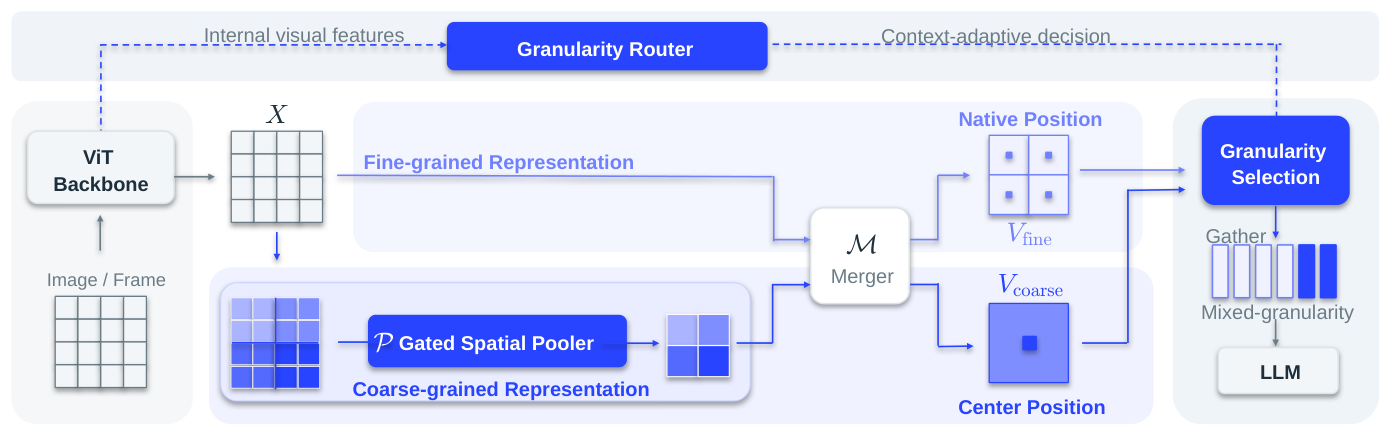
Gated spatial pooler. Alongside V_{\text{fine}}, a learned pooler produces V_{\text{coarse}} at a reduced spatial resolution, aggregating each coarse block from the underlying 2\times 2 (or larger) fine neighborhood. Crucially, both representations are indexed under the same MRoPE coordinate frame — a coarse token at block (I,J) inherits coordinates consistent with the fine tokens it summarizes, so swapping granularities does not break positional semantics for the LLM. The pooler is “gated” rather than a fixed pixel-unshuffle: the ablation (Figure 7, Section 4.1) shows the learned pooler beats a pixel-unshuffle projector at matched 75% token savings on all eight benchmarks, with +2.64 on DocVQA and +2.77 on VideoOCR — the OCR gains indicate the gate preserves high-frequency content a fixed shuffle would blur.
Granularity router. The router probes an intermediate ViT feature layer and emits, per spatial block, a scalar probability of needing fine granularity. At threshold t (default 0.5), each block commits to either its fine tokens or its single coarse token. The resulting weaved sequence is a mix of granularities over the same MRoPE lattice:
V_{\text{mixed}}(I,J) = \begin{cases} V_{\text{fine}}[2I{:}2I{+}2, 2J{:}2J{+}2] & r_{IJ} > t \\ V_{\text{coarse}}(I,J) & r_{IJ} \le t \end{cases}
Because the router operates on ViT features (not LLM activations), it is cheap and placed before the LLM — compatible with SGLang’s prefill pipeline, unlike LLM-internal pruners such as vanilla FastV. The paper’s FastV^\dagger baseline is explicitly a post-ViT variant to allow a fair serving-level comparison.
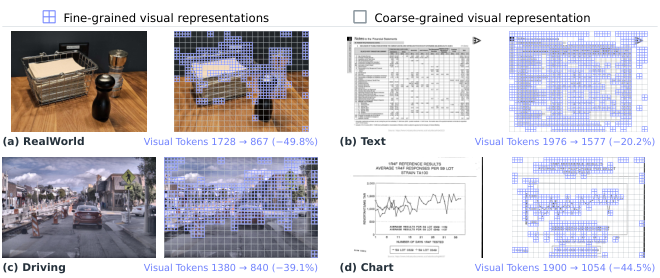
The teaser (Figure 1) shows a driving scene where the router allocates fine granularity to vehicles and signage while compressing road and sky — the content-adaptive allocation the method is named for.
Training. VisionWeave is trained via three-stage self-distillation, using the base MLLM (without weaving) as teacher. Stage 1 trains the gated pooler to match teacher outputs when all blocks go coarse (bounding degradation under aggressive compression). Later stages introduce the router with a sparsity/budget regularizer so it learns to request fine tokens only when the compressed representation is insufficient. No external labels are used — the signal is distillation KL against the dense-token teacher.
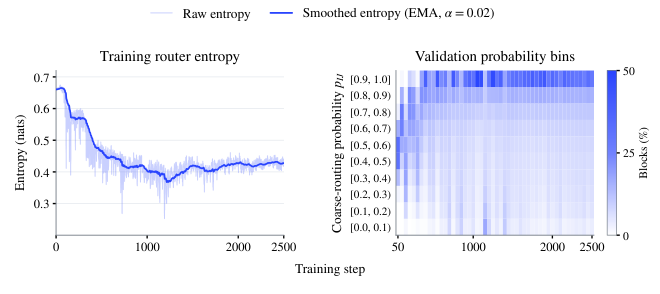
The training curves (Figure 4) show the router converging to a stable fine-token fraction after an initial exploration phase, consistent with a self-distillation signal that only rewards fine allocation where it closes the student-teacher gap.
Results
Backbones are Qwen3.5-4B and Qwen3.8-27B. Baselines are VisionZip (merging) and FastV^\dagger (post-ViT pruning). The headline claims: quality-preserving token savings with content-adaptive allocation (Section 3.2), robustness across resolution and frame budgets (Section 3.3), and real SGLang-level serving gains (Section 3.4), plus inference-time control via the threshold t (Section 3.5). The provided excerpt reports component-level numbers: at 75% token savings on Qwen3.5-4B, the gated pooler beats pixel-unshuffle on all eight benchmarks with the DocVQA (+2.64) and VideoOCR (+2.77) margins called out above — the two most detail-sensitive tasks in the suite, which is where fixed downsampling typically fails.
Limitations and open questions
The excerpt does not expose end-to-end numbers against VisionZip/FastV^\dagger or absolute SGLang throughput deltas, so the quantitative headline comparisons at the model level are not citable from what is provided. The router operates on static ViT features; for video, whether temporal consistency of granularity decisions across frames is handled (vs. per-frame flicker that could destabilize KV reuse) is not clear. Threshold-based commitment is non-differentiable — the training presumably uses a straight-through or soft gating during training, but the mechanism is not specified in the excerpt. Finally, self-distillation inherits the teacher’s blind spots: if the dense-token teacher already loses fine detail at a given resolution, the student has no supervisory signal to allocate fine granularity there.
Why this matters
Elastic token allocation is the right abstraction for scaling MLLMs to high-resolution and long-video regimes without quadratic blow-up, and VisionWeave is one of the first demonstrations that it can be made a native, MRoPE-compatible capability trained via self-distillation alone — meaning no new labels and direct deployment on existing serving stacks like SGLang.
Source: https://arxiv.org/abs/2610.07987
ProgramGym: Scaling Training Environments for Long-Horizon Program Reproduction Agents
Problem
Most coding-agent benchmarks and training sets focus on issue resolution within an existing repository (SWE-bench and its descendants) or on repository synthesis from a specification. Neither captures the task a software engineer actually performs when building a new tool: given a working reference program and its documentation, independently decide the architecture and reproduce the externally observable behavior from scratch. There are two bottlenecks to training agents for this: (i) building verifiable sandboxes at scale across heterogeneous build systems, and (ii) producing finite black-box test suites with enough behavioral coverage that passing them is a meaningful fidelity signal.
ProgramGym addresses both. Formally, an environment-construction pipeline \Phi maps a repository P_i to
e_i = \Phi(P_i) = (B_i^\star, D_i, \mathcal{T}_i, \mathcal{S}_i),
where B_i^\star is an execute-only reference binary, D_i the usage docs, \mathcal{T}_i a black-box behavioral test suite, and \mathcal{S}_i a network-isolated sandbox. An agent must emit source plus a compile script producing \widehat{B}_i, judged by behavioral agreement with B_i^\star on \mathcal{T}_i.
Program-Env: feedback-driven environment construction
Program-Env runs three stages (see Figure 2). Stage 1 collects repositories via the GitHub Search API, stratified by language and star buckets, excluding archived/forked repos, those used by prior benchmarks, and those lacking valid licenses or explicit build-configuration evidence. Each kept repo is pinned to a fixed commit, yielding M = 30{,}459 candidates.
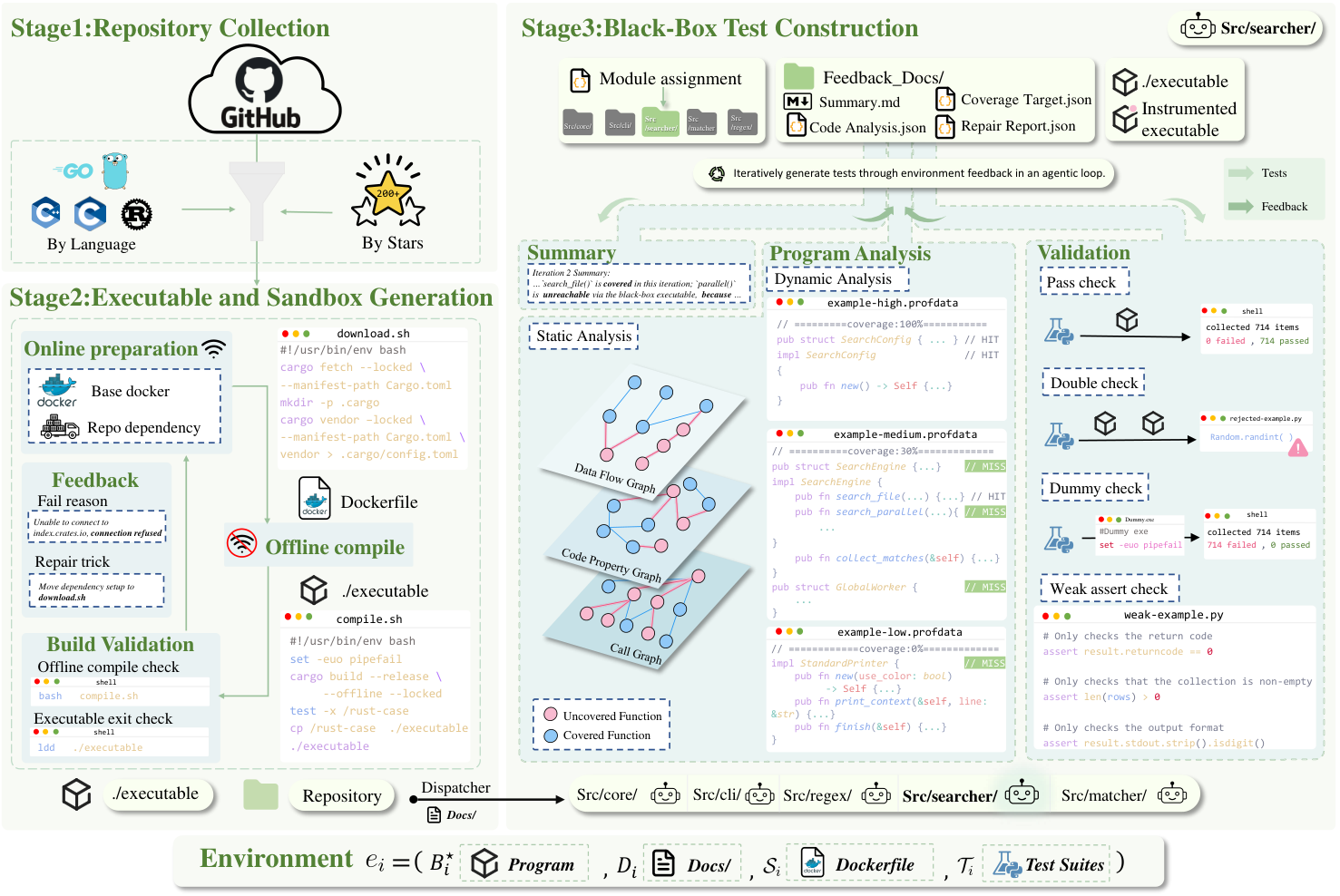
Stage 2 attempts to build B_i^\star inside sandbox \mathcal{S}_i using a general harness (Claude Code / Codex) wrapped in a feedback loop that repairs build failures by iterating on the Dockerfile and build script. A dispatcher between stages extracts D_i and splits the source tree into functional modules.
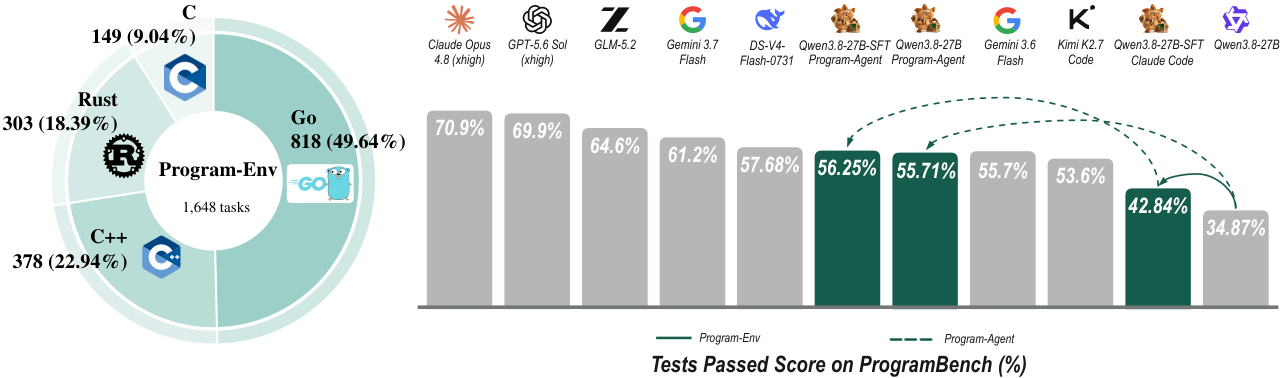
Stage 3 assigns each module to a subagent that iteratively authors \mathcal{T}_i against the already-built B_i^\star. Because \mathcal{T}_i is finite, passing it only certifies agreement on the tested inputs, not full semantic equivalence — the pipeline therefore emphasizes behavioral diversity over single-category depth. The final corpus contains 1,648 environments across C, C++, Go, and Rust, generated with DeepSeek-V4-Flash-0731 as the underlying model, using 5,918 subagents in total. Interaction categories (Table 1) are dominated by I/O (99.24% of subagents), Arguments (82.82%), and Help (68.77%), with Subcommands (22.05%) and TUI (12.10%) being rarer — reflecting the CLI/dev-tool skew of the corpus.
Program-Agent: role-isolated long-horizon workflow
Single-session agents on long-horizon reproduction suffer from context compression: early behavioral evidence is dropped, and final emissions frequently fail to compile. Program-Agent splits the task into three stages run in isolated sessions:
- Analysis. The analyst reads D_i and probes B_i^\star (execute-only) without touching the Workspace. Behavioral constraints are written to
analysis-initial/analysis.md, frozen read-only. - Implement. The implementer edits the Workspace guided only by the Analysis handoff.
- Review. A separate session audits the current implementation against the frozen analysis.
Implement and Review alternate for a fixed loop budget. Three persistent artifacts cross session boundaries: Handoff (behavioral evidence + stage reports, replacing full conversation history), Workspace (evolving source), and Revisions (independently buildable snapshots used for compile validation and rollback on failure). The Revisions mechanism is important because it decouples recovery from the agent’s current context — a broken state can be reverted without replaying the trajectory.
Results and behavior
Training uses rejection sampling of DeepSeek-V4-Flash-0731 trajectories collected inside Program-Env, filtered by test-case pass rate, with Claude Code as the harness. On ProgramBench (introduced alongside the gym), both Program-Env training and Program-Agent inference contribute to improvements (the full numbers are in the paper’s results section, truncated here).
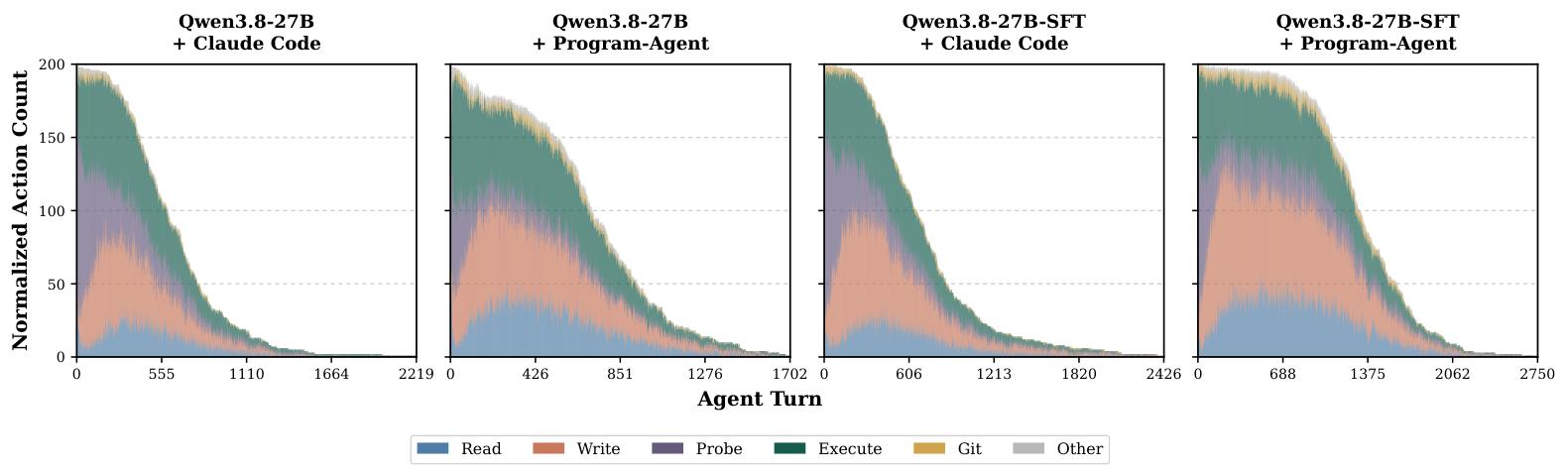
The action-type distribution in Figure 7 shows the role-isolation taking effect: early turns are dominated by read/exploration actions (consistent with the Analysis stage’s constraint-collection role), with edit and build/test actions rising later. The decay of total bar height with turn index simply reflects variable trajectory lengths. The RQ3 result — that additional iteration budget improves Tests Passed — is consistent with the Revisions-based recovery not collapsing under longer horizons, which is typically where single-session agents degrade.
Limitations
- Finite tests. \mathcal{T}_i cannot certify semantic equivalence; agents can overfit observed inputs. The paper does not quantify this gap via held-out behavioral tests.
- Language and category skew. The corpus is CLI/dev-tool heavy; TUI (12.10%) and Subcommands (22.05%) are undersampled, and GUI/network-server workloads are effectively absent.
- Harness dependence. Construction relies on Claude Code/Codex and DeepSeek-V4-Flash-0731 as the backbone; it is unclear how much of the 1,648-environment yield is harness-specific.
- Build repair ceiling. The pipeline keeps repos with explicit build-configuration evidence, biasing toward well-maintained projects and underrepresenting the messy builds that make real reproduction hard.
Why this matters
Program reproduction is a cleaner proxy for “build a system from scratch” than SWE-bench-style patching, and the bottleneck has been environment supply, not agent architecture. A 1,648-environment, four-language, verifiable gym with a working feedback-driven construction pipeline is a substrate others can train on, and the role-isolated workflow with Revisions is a reusable template for long-horizon coding agents where context compression — not reasoning capacity — is the dominant failure mode.
Source: https://arxiv.org/abs/2610.13395
Hacker News Signals
How I reverse engineered a commercial spatial audio effect
A developer dissects a commercial spatial audio plugin to understand its internals using a combination of audio analysis, impulse response measurement, and signal tracing. The core technique is extracting head-related transfer functions (HRTFs) by feeding impulse signals through the plugin and capturing the output at each virtual speaker position. An HRTF encodes the acoustic filtering a sound undergoes traveling from a point in 3D space to each ear — it is a pair of finite impulse response filters that impose interaural time delay (ITD) and interaural level difference (ILD) as well as pinna-induced spectral shaping.
The author measures the plugin’s impulse responses across a grid of azimuth and elevation angles, reconstructs the binaural rendering pipeline, and identifies how the plugin handles the crossfeed between channels. One key finding is that the plugin applies frequency-dependent room modeling — early reflections and a late reverb tail — on top of the dry HRTF convolution, which accounts for a significant portion of its perceived “width.”
The analysis uses FFT-based spectral comparison to identify the filter shapes and match them against known HRTF databases (KEMAR, etc.), concluding the plugin likely started from a standard dataset and applied proprietary smoothing and EQ correction curves. The reverse-engineered approximation is validated by A/B listening and by comparing magnitude spectra at representative angles.
This is a clean example of black-box DSP reverse engineering: treat the plugin as a linear time-invariant system (approximately), probe it with known signals, and recover the filter coefficients. The limits of the approach are the assumption of LTI behavior — the plugin may apply nonlinear processing such as dynamic EQ or limiting that this method cannot capture — and the inability to fully separate the HRTF component from the room model without additional probing.
Source: http://epestr.com/blog/reverse-engineering-a-commercial-spatial-audio-effect/
Recursive self-improvement through collective intelligence
Sakana AI’s MASS (Multi-Agent Self-improvement System) paper proposes a framework in which a population of language model agents iteratively improves itself by generating, evaluating, and selecting code that modifies the agents’ own fine-tuning procedures. The framing is evolutionary: agents propose modifications to training pipelines (data curation heuristics, loss weightings, prompt templates), a fitness function based on held-out task performance selects survivors, and the cycle repeats.
The mechanical loop is: (1) a “proposer” agent generates a patch to the current training configuration as executable Python; (2) the patch is applied, a lightweight fine-tuning run executes on a small dataset; (3) the resulting checkpoint is evaluated on a benchmark; (4) high-scoring configurations are retained and become the seed for the next generation. This is essentially an automated machine learning (AutoML) search framed as agent behavior rather than a hyperparameter optimizer.
What distinguishes it from prior neural architecture search or meta-learning is the use of LLMs to propose structured code changes in natural language-informed syntax, allowing modifications that span hyperparameters, data selection logic, and training curriculum simultaneously — a search space too combinatorially large for grid or Bayesian methods. The collective aspect means multiple agents explore in parallel, sharing discoveries asynchronously.
Results show improvement on coding and reasoning benchmarks relative to the base model over several generations, though the absolute gains are modest and the comparison baselines matter a great deal. The key open questions are whether improvements compound meaningfully beyond a few generations before hitting a performance ceiling, and whether the fitness signal (benchmark performance) is robust enough to prevent reward hacking or overfitting to the evaluation set. The compute cost of running many fine-tuning loops is also non-trivial and not fully analyzed.
Source: https://pub.sakana.ai/mass/
Safe SIMD in Rust, even on the inside
This post addresses a specific soundness problem in Rust SIMD code: even if public API surfaces are safe, the interior of SIMD implementations can invoke undefined behavior through misaligned loads, incorrect unsafe transmutes between vector and scalar types, or target-feature gating violations. The author catalogs the ways that unsafe leaks into ostensibly safe SIMD abstractions and proposes disciplined patterns to contain it.
The central issue is that Rust’s std::simd (portable SIMD) and std::arch intrinsics are unsafe functions requiring target-feature guarantees at the call site. A common pattern wraps them in a safe function gated by a runtime CPU feature check, but this only ensures the outer call is safe — the internal use of intrinsics still needs careful handling to avoid misaligned memory accesses and aliasing violations.
Concrete recommendations include: using #[target_feature(enable = "...")] on internal functions rather than transmuting feature guarantees implicitly; preferring as_array() / from_array() conversions over pointer casts to avoid alignment assumptions; and structuring SIMD kernels so the unsafe block is as narrow as possible with explicit documentation of the invariants being upheld. The post also highlights that #[repr(align(N))] on data structures is necessary but insufficient — the load instruction itself must match the alignment guarantee documented by the intrinsic.
There is also a discussion of the interaction between unsafe code and Rust’s type system: types that are Send + Sync by default may not be safe to share across threads when they contain SIMD vector types whose behavior depends on target features enabled per-thread in some OS configurations. This is a subtle invariant that neither the compiler nor typical linters check. The post is practically useful for anyone writing performance-critical numeric code in Rust where correctness and performance must coexist.
Source: https://shnatsel.github.io/safe-simd-in-rust-even-on-the-inside/
Type-safe HTML templating in Zig
The author builds an HTML templating system in Zig that uses the type system to enforce structural correctness at compile time, eliminating entire classes of template bugs — mismatched tags, invalid attribute placements, context-insensitive escaping — that string-interpolation-based templating allows.
The core mechanism is representing the HTML tree as a Zig comptime type hierarchy. Each HTML element is a distinct type carrying its permitted children and attributes as type parameters. A div type, for instance, statically encodes that it can contain flow content but not <td> directly. Invalid nesting becomes a compile error rather than a runtime malformation. This is similar in spirit to Haskell’s blaze-html or Elm’s Html type, but implemented via Zig’s comptime evaluation rather than a type-class or ADT system.
Attribute safety works by making attribute setter functions typed per-element: <a> exposes an href setter that <div> does not, so setting href on a <div> fails at compile time. Escaping is context-sensitive: text nodes use HTML entity escaping, URL-valued attributes use percent-encoding, and JavaScript event handler attributes raise a compile-time warning by default since they are high-risk injection vectors.
The performance angle is that since the structure is known at compile time, the renderer can be entirely unrolled by Zig’s comptime machinery for static templates, producing near-zero-overhead serialization. Dynamic content (runtime strings) still requires runtime escaping but the context (text vs. URL vs. attribute value) is always statically known, so the correct escaping function is selected at compile time.
Limitations include verbosity compared to a string-based template DSL and the fact that this approach applies cleanly to hand-authored templates but integrates awkwardly with templates generated from a design system or CMS. The Zig comptime model also imposes limits on recursive types, which complicates representing deeply nested or self-referential elements.
Source: https://lalinsky.com/2026/10/11/type-safe-html-templating-in-zig.html
Postgres isn’t slow, your storage is
A ClickHouse engineer’s Posette talk recap makes the case that most Postgres performance complaints are storage-layer problems misattributed to the query engine. The argument centers on I/O amplification: Postgres’s MVCC implementation stores multiple row versions in-place (heap tuples), meaning reads and writes both touch more data than the logical payload. VACUUM compounds this by requiring periodic full-table scans to reclaim dead tuples, generating write amplification on the storage layer.
The specific mechanics: a SELECT on a large table with many dead tuples causes the heap scan to load pages containing mostly garbage, inflating read I/O well beyond what the live row count suggests. On cloud block storage (EBS, GCP PD), where IOPS are billed or throughput-capped, this is directly measurable as latency regression and cost increase. The talk quantifies that for typical OLTP workloads with high update rates, effective read amplification from dead tuples can reach 3–5x before autovacuum catches up.
Recommended mitigations: aggressive autovacuum tuning (autovacuum_vacuum_scale_factor down to 0.01–0.02 for hot tables), fillfactor reduction to leave space for HOT (Heap-Only Tuple) updates that avoid index churn, partitioning to allow range-delete via DROP TABLE instead of DELETE + vacuum, and for read-heavy workloads, moving to columnar storage extensions (Hydra, pg_mooncake) or offloading to an OLAP system.
The broader point is that Postgres’s performance characteristics are inseparable from its storage format, and tuning Postgres without understanding MVCC heap behavior leads to misdiagnosis. This is well-understood in the Postgres DBA community but frequently missed by developers who treat the database as a black box.
Source: https://clickhouse.com/blog/posette-talk-recap-postgres-isnt-slow-your-storage-is
Talorys – A self-hosted personal AI agent on Cloudflare’s free tier
Talorys is a personal AI agent designed to run entirely within Cloudflare’s free-tier infrastructure: Workers for compute, D1 (SQLite) for persistent state, R2 for blob storage, and Queues for async task dispatch. The constraint of zero marginal cost forces specific architectural choices that are technically interesting independent of the AI angle.
The agent loop runs on Cloudflare Workers, which imposes a 50ms CPU time limit per invocation on the free tier (128MB RAM, no persistent execution). Long-running agent tasks are decomposed into small steps serialized through Durable Objects or Queues, with state checkpointed to D1 between steps. This is a forced implementation of the “agent as a state machine” pattern: each Worker invocation reads current state, executes one action, writes updated state, and enqueues the next step.
Tool execution (web search, calendar access, email) is handled via Workers calling external APIs with credentials stored in Workers KV. The LLM inference itself is outsourced to a frontier API (OpenAI or compatible), since running inference locally is out of scope for this infrastructure tier. Conversation history and task state are stored in D1 with a schema that supports multi-turn context windows by storing message lists per session.
The interesting engineering constraint is that Cloudflare’s free tier has no persistent TCP connections and no background execution, so the agent cannot “poll” or maintain a long-running loop. Instead it relies on cron triggers (Workers Cron) to periodically check for pending tasks. This introduces latency between task creation and execution (up to 1 minute for the cron interval) that a production agent system would typically eliminate with a push-based wake mechanism.
Source: https://github.com/rociiu/talorys
How big is a Git commit?
A careful walkthrough of the actual on-disk and in-memory sizes of Git objects, starting from first principles. A Git commit object is a text blob containing: tree SHA (40 hex chars), parent SHA(s), author and committer identity with timestamps, and the commit message. The raw size of a minimal commit object is typically 200–300 bytes before compression.
Git stores objects in two formats: loose objects (one zlib-compressed file per object under .git/objects/) and packfiles (multiple objects delta-compressed together under .git/objects/pack/). A loose commit object at ~250 bytes compresses to roughly 150–180 bytes with zlib at default settings. The tree object it references is separate and scales with the number of files — each tree entry is a mode (6 bytes), filename, null byte, and 20-byte binary SHA, so a tree with 1000 files is roughly 35–40KB before compression.
The packfile format applies delta compression across objects: similar blobs or trees are stored as a base object plus a binary diff, which is where Git’s storage efficiency comes from for repositories with many similar file versions. The delta format uses a copy-then-insert instruction set, not a general diff algorithm, and Git uses a heuristic (similar size, same filename history) to select delta bases.
The practical upshot: the “size” of a commit in any meaningful sense depends on whether you count the commit object alone (~200 bytes), the commit plus its tree (~35KB for a medium project), or the commit’s contribution to packfile size after delta compression (potentially near zero for a commit that changes one line in one file). Developers reasoning about repository size growth should think in terms of blob object accumulation, not commit count.
Noteworthy New Repositories
bherbruck/solidcraft
Parametric 3D CAD in pure Rust targeting desktop, web (via WASM), and programmatic automation through the Model Context Protocol (MCP). The parametric approach means geometry is defined by constraint graphs rather than direct mesh editing, so modifying a single parameter propagates through the entire model tree. Being pure Rust means a single codebase compiles to both native and WASM targets without a C++ kernel dependency — a significant departure from the OpenCASCADE-based stack that most open-source CAD (FreeCAD, CadQuery) relies on. The MCP integration is the differentiating angle: it exposes the CAD kernel as a tool-callable interface, meaning an LLM agent can drive geometry construction programmatically without a GUI. Early stage, but the architecture is clean enough to be a foundation for headless CAD pipelines. Engineers frustrated with the Python/C++ boundary in FreeCAD or the commercial lock-in of Fusion 360’s API will find the Rust-native approach appealing.
Source: https://github.com/bherbruck/solidcraft
strands-labs/strands-decider
A lightweight binary classifier / ordinal regressor positioned as a “System 1” decision layer for agentic pipelines. Rather than routing every intermediate decision through a full autoregressive LLM (which pays the token-generation latency penalty even for simple yes/no branches), Strands Decider runs a small discriminative model that returns a calibrated confidence score over discrete options or a continuous scale. The calibration aspect matters practically: uncalibrated softmax outputs from classifiers tend to be overconfident, so post-hoc or training-time calibration (Platt scaling, temperature scaling, or isotonic regression) is necessary for the confidence to be meaningful in a decision-theoretic sense. The model is designed to ingest structured option sets and return probability distributions, slotting into an agent’s branching logic as a fast gate before escalating to a heavier model. Useful for routing, tool selection, and plan validation steps where latency dominates.
Source: https://github.com/strands-labs/strands-decider
malevrigns/agent-jev
AgentJev-0.6B is a 600M-parameter encoder-style model trained specifically for agent decision-making rather than text generation. The key architectural choice is zero output-token decoding: the model is a discriminative head over a pretrained backbone, so inference is a single forward pass with no autoregressive sampling loop. Claimed latency is ~50ms. Input is unstructured state — git diffs, stack traces, log streams, structured JSON questions — all tokenized and processed through the encoder; output is a calibrated probability distribution over provided choices. At 0.6B parameters this fits comfortably in CPU RAM, making it viable for local deployment without GPU allocation. The calibration claim implies the model was trained or post-processed to align predicted probabilities with empirical frequencies, which is non-trivial for a model handling such heterogeneous input distributions. The practical use case is cheap, fast branching decisions in long-horizon agent loops where LLM latency would dominate wall-clock time.
Source: https://github.com/malevrigns/agent-jev
storytold/effectcraft
EffectCraft is a motion graphics and compositing tool written entirely in Rust from scratch — no FFmpeg GUI wrapper, no Electron shell, no C++ rendering core. The compositing model follows the standard node graph paradigm (layers, blend modes, masks, effects as composable nodes) but the renderer, UI, and timeline are all Rust-native. Writing a compositing tool from scratch means implementing the full signal chain: color space transforms, alpha compositing operators (Porter-Duff), temporal interpolation for keyframes, and GPU-accelerated rasterization (likely via wgpu given Rust’s ecosystem). The “from scratch” framing is ambitious but technically coherent for Rust given the maturity of wgpu, winit, and egui. At 5.4k stars it has attracted significant attention, suggesting there is real demand for an open-source After Effects alternative that does not depend on the Adobe stack or the aging Natron codebase. A legitimate systems-level undertaking.
Source: https://github.com/storytold/effectcraft
storytold/designcraft
DesignCraft is a page layout and design editor — think Figma or Affinity Publisher — written in pure Rust. Technically this requires implementing a full 2D vector renderer (Bezier curves, boolean path operations, stroke expansion), a constraint-based layout engine, text shaping (likely via rustybuzz or similar HarfBuzz bindings), and an interactive direct-manipulation UI. The absence of Electron or a browser engine means the rendering stack is fully native, which has implications for performance and offline capability. The Rust ecosystem now has sufficient primitives (vello for 2D GPU rendering, xilem or iced for UI) to make this tractable without reinventing everything. At 3.2k stars this is the companion tool to EffectCraft, suggesting storytold is building a broader open-source creative suite. For engineers who have wanted a scriptable, API-first design tool without the Figma plugin sandbox limitations, a Rust-native approach with direct library access is architecturally attractive.
Source: https://github.com/storytold/designcraft
amitshekhariitbhu/ai-system-design
A structured curriculum for designing production AI systems built on LLMs, RAG pipelines, and agent frameworks. The content covers the full stack: chunking strategies and embedding model selection for RAG, vector store tradeoffs (HNSW vs IVF indexing, latency vs recall curves), prompt management and versioning, evaluation frameworks (RAGAS-style metrics, LLM-as-judge patterns), agent orchestration patterns, and infrastructure considerations like caching and cost control. This is not a paper but a practitioner reference, organized step-by-step in a way that mirrors system design interview preparation materials. The value is in the aggregation and structure rather than novel research. Engineers moving from ML modeling to production deployment, or those preparing for staff/principal-level interviews at companies shipping LLM products, will find the systematic breakdown of tradeoffs more actionable than scattered blog posts.
Source: https://github.com/amitshekhariitbhu/ai-system-design
sno-ai/sno-station
SNO Station is a local multi-agent coordination layer that federates existing coding agents — Codex, Claude Code, Cursor, Hermes Agent, OpenClaw — into a shared-memory collective. The core technical components are: an encrypted shared memory store that all agents read and write, a task routing protocol that lets one agent hand off work to another, a cross-agent review mechanism (one agent evaluates another’s output), and a nightly improvement loop that presumably fine-tunes or updates agent behavior based on accumulated session data. Running entirely on local compute means the memory store and routing layer operate without a cloud dependency, which is relevant for proprietary codebases. The encrypted memory prevents leakage between sessions or users on shared machines. The architectural challenge is maintaining consistency across agents with different context window formats and tool APIs — SNO Station appears to handle this through a normalized intermediate representation. An interesting systems approach to agent composition.
Source: https://github.com/sno-ai/sno-station
ollaya-dev/ollaya
Ollaya is the Ollama analogue for small discriminative decision models rather than generative LLMs. It provides a local model registry and serving layer for specialized models: Laya, Decider, NLI (natural language inference), and GLiClass (a generalist classification model). The API is TypeSafe-compatible, meaning TypeScript clients get static type guarantees over request/response shapes — a practical ergonomic win for agent codebases. The pull-and-serve model mirrors Ollama’s UX: ollaya pull nli fetches the model weights, ollaya serve exposes a local HTTP endpoint. NLI and GLiClass models are substantially smaller and faster than generative LLMs for classification tasks: a well-tuned 200M-parameter NLI model can handle textual entailment and zero-shot classification at millisecond latency on CPU. Ollaya makes it operationally simple to run this class of model locally alongside a generative model, enabling tiered inference architectures where cheap discriminative models handle routing and validation.