Daily AI Digest — 2026-10-02
arXiv Highlights
Beyond Memory: Harnessing Long-Horizon Agents with Explicit Belief States
Long-horizon LLM agents typically operate over a growing transcript of observations and tool outputs, implicitly reconstructing the current world state at each step. This conflates evidence accumulation with state inference: as the context lengthens, the agent increasingly recomputes a coherent world picture from scratch, and failures manifest as what the authors call Belief Trapping — the agent continues to act but stops making task-relevant progress. PoS (Posterior-over-State) proposes an inference-time scaffold that replaces this implicit reconstruction with an explicit, continually maintained belief object that is validated for consistency and monitored for progress.
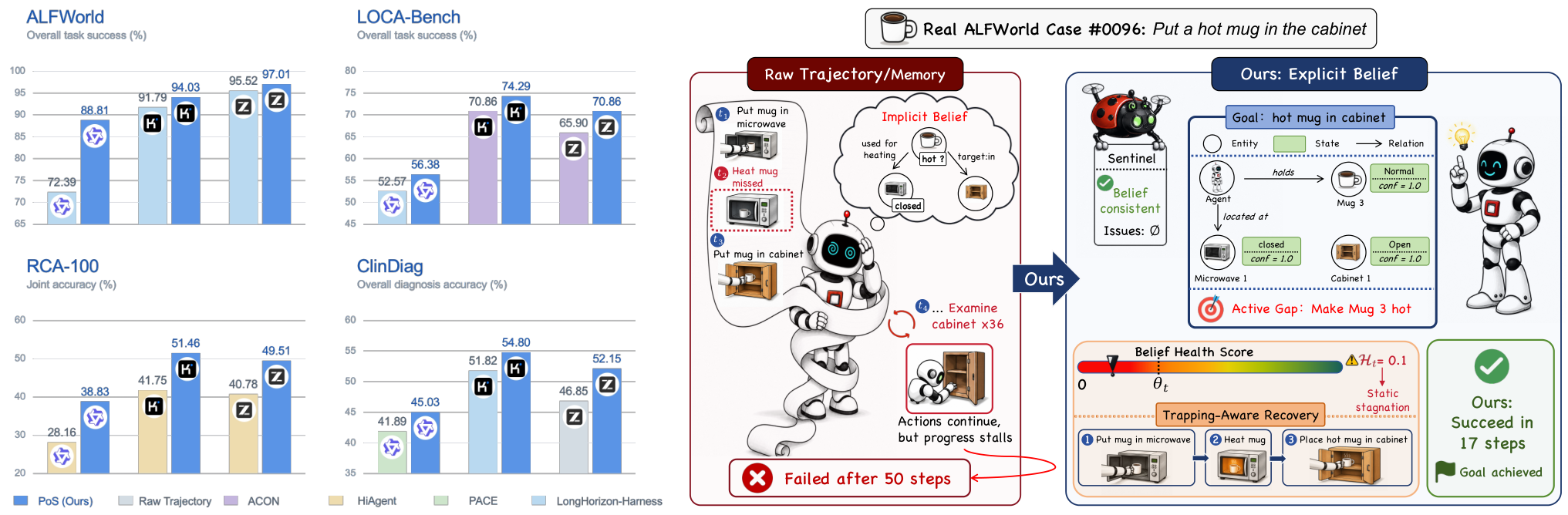
From POMDP posterior to a structured belief object
The authors frame agent–environment interaction as a POMDP where the belief b_t(s) is the posterior over the latent world state s_t given history h_t. Rather than approximating b_t with the raw history (as in standard ReAct-style agents) or with a learned recurrent state, PoS maintains a structured, task-conditioned surrogate:
B_t = (W_t, G, \Delta_t^E, \Delta_t^A),
where W_t is a task-relevant world-state estimate, G is the task objective, and \Delta_t^E, \Delta_t^A are the unresolved epistemic and achievement gaps respectively. The epistemic gap enumerates what the agent still needs to find out; the achievement gap enumerates what still needs to be done. This separation matters because it defines two distinct termination conditions and two distinct repair strategies.
W_t uses an Entity–State–Relation schema. Entities are objects/agents; States are natural-language descriptions of an Entity’s current condition; Relations are directed edges between Entity–Entity, State–State, or Entity–State pairs. Each State and Relation carries provenance, confidence, and supporting evidence. The design choice to keep States in natural language — rather than a fixed schema or a pure knowledge graph — is deliberate: entity identity and connectivity alone are insufficient when action feasibility depends on dynamic conditions (e.g., the microwave is open, the patient has elevated creatinine). The structure is pruned to only those records that affect feasibility, outcome assessment, or satisfaction of G.
Belief-guided interaction and the Belief Sentinel
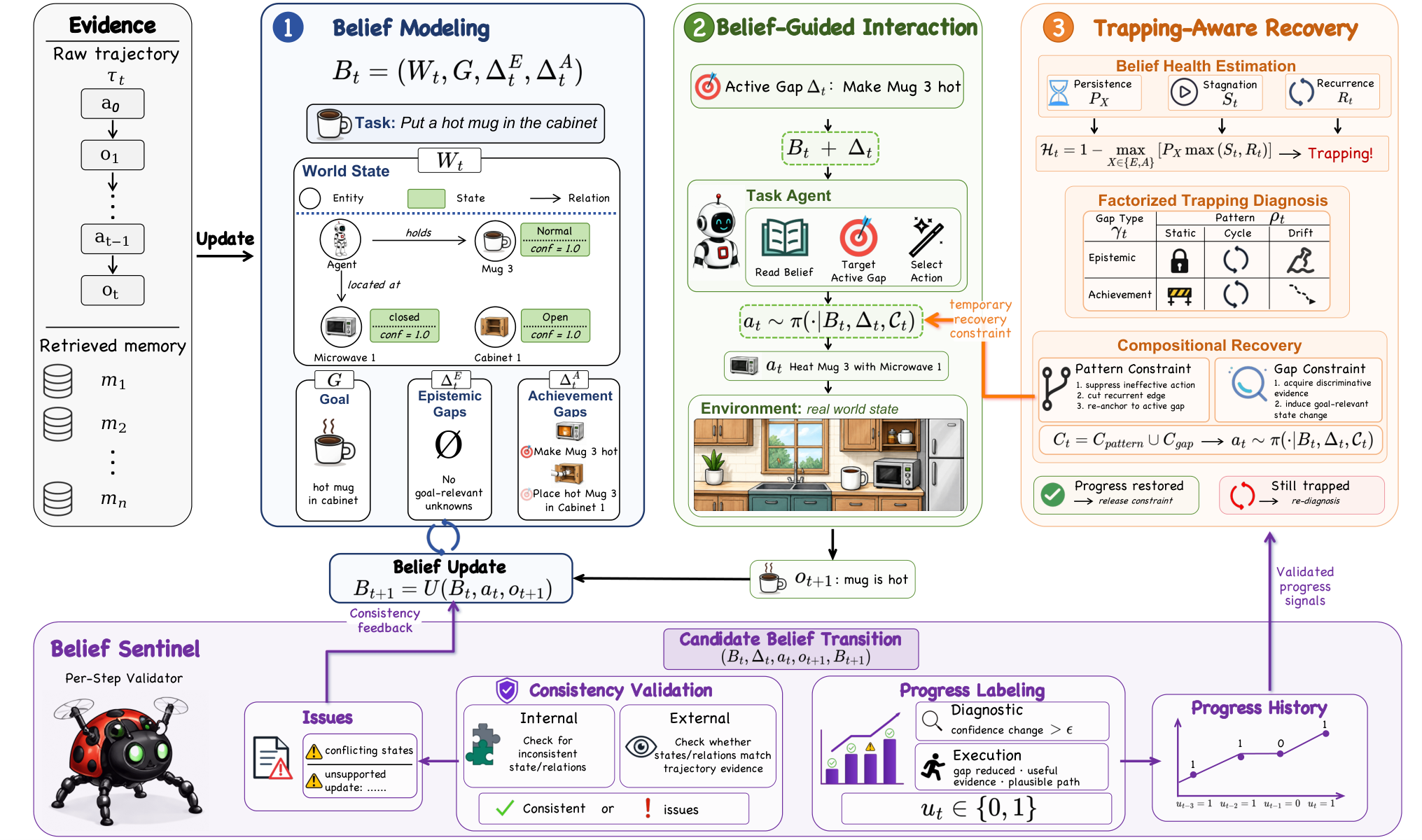
Each action is conditioned on B_t together with an Active Gap — a single selected item from \Delta_t^E \cup \Delta_t^A that focuses the next step. After observing the environment’s response, the Belief Sentinel performs two operations: (i) consistency validation, which checks that the proposed update to W_t does not contradict existing high-confidence States/Relations, and (ii) progress recording, which tracks whether the Active Gap has actually been reduced. Validation acts as a local filter on hallucinated state updates; progress recording feeds the trapping detector.
Trapping-aware recovery
Belief Trapping is diagnosed from Sentinel statistics: repeated failure to reduce the Active Gap, oscillation between contradictory updates, or stalled epistemic acquisition. Recovery is composed from constraints tailored to the trapping pattern and the type of unresolved gap. For instance, an epistemic trap (the agent cannot acquire a needed piece of evidence) is handled differently from an achievement trap (the agent knows what to do but repeatedly fails to execute it) — the former triggers exploration constraints, the latter triggers reformulation of the action plan under new preconditions.
Results
PoS is evaluated on four benchmarks spanning two agent regimes: goal-directed execution (ALFWorld, LOCA-Bench) and evidence-seeking diagnosis (RCA-100, ClinDiag). Across all four benchmarks and all three LLM backbones tested, PoS achieves the highest overall performance versus the strongest baseline per backbone. The teaser figure above summarizes the margin. Ablations isolate two contributions as essential: removing consistency validation degrades performance, and removing trapping-aware recovery degrades it further — indicating that the belief object alone is insufficient without the Sentinel loop. Context-scaling experiments show PoS is more resilient than history-based baselines as the interaction horizon grows, which is consistent with the hypothesis that implicit reconstruction cost dominates failure modes at long horizons.
Limitations and open questions
The paper does not fully characterize the overhead of maintaining B_t (every step incurs additional LLM calls for update, validation, and gap selection), nor does it quantify the sensitivity to the schema of W_t across radically different domains. The confidence annotations on States/Relations are produced by the same LLM that may have hallucinated them, so the consistency check is self-referential — orthogonal verification (e.g., tool-grounded assertions) is not studied. The gap representation \Delta^E, \Delta^A is enumerated in natural language; whether this scales to tasks with combinatorial subgoals (long software-engineering tasks, multi-patient diagnosis) is open. Finally, trapping detection thresholds appear hand-tuned; a learned detector could sharpen the recovery trigger.
Why this matters
PoS reframes long-horizon agent design around an explicit posterior rather than a growing transcript, operationalizing the POMDP view that most LLM agent frameworks pay lip service to but do not implement. The consistent gains across execution and diagnosis benchmarks, together with context-scaling robustness, suggest that structured belief maintenance — not longer context windows or larger backbones — is the lever for reliable long-horizon behavior.
Source: https://arxiv.org/abs/2610.01415
Hierarchical Continuous Diffusion Language Models
Parallel decoding in discrete diffusion LMs has a well-known pathology: when K tokens are unmasked simultaneously, each is drawn from its own marginal p_\theta(k^{(i)}_{t-1}\mid k_t), discarding the joint p_\theta(k^{(1:K)}_{t-1}\mid k_t). Continuous diffusion LMs sidestep this by denoising a shared latent, but their denoiser never commits to a token configuration until the final decode, so nothing anchors the latent to the discrete manifold mid-trajectory. HC-DLM is a hybrid that keeps a continuous latent as the sole persistent generative state while reading out and feeding back a discrete scaffold at every reverse step, all derived from a single variational bound.
Model
Let k_0 \in \mathcal{V}^L be the clean token sequence and x_0 \in \mathbb{R}^{M\times d} a coupled continuous latent. The forward process factors as independent noisings:
q_\psi(x_{0:T}, k_{1:T} \mid k_0) = q_\psi(x_0\mid k_0)\prod_{t=1}^T q(x_t\mid x_{t-1})\,q(k_t\mid k_{t-1}),
where q_\psi(x_0\mid k_0) is a learned encoder from tokens into the latent, q(x_t\mid x_{t-1}) is the standard Gaussian VP diffusion with closed-form q(x_t\mid x_0) and q(x_{t-1}\mid x_t, x_0), and q(k_t\mid k_{t-1}) is a categorical kernel (absorbing or uniform). Crucially, x_t and k_t are corrupted independently, keeping both marginals tractable.
The reverse process deliberately couples them:
p_{\theta,\phi}(k_{0:T}, x_{0:T}) = p(x_T)\,p_\theta(k_0\mid x_0)\prod_{t=1}^T p_\theta(k_t\mid x_t)\,p_\phi(x_{t-1}\mid x_t, k_t).
Two learned conditionals carry the generative load. The token readout p_\theta(k_t\mid x_t) turns the noisy latent into a soft (and at t=0, hard) token distribution; the continuous denoiser p_\phi(x_{t-1}\mid x_t, k_t) conditions on the current token scaffold. The result is a two-level reverse chain where (i) tokens never persist as the generative state — they are regenerated at each step from the latent — and (ii) the latent is pulled back onto a valid token configuration at every denoising step via conditioning on k_t.
This differs sharply from CCDD-style hybrids, which run a self-contained discrete chain with continuous context attached. Here, the latent is the only persistent variable; tokens are a scaffold.
Objective
Training follows a variational lower bound on \log p_{\theta,\phi}(k_0) with the usual ELBO decomposition over the coupled chain, yielding a per-timestep loss combining (i) a token-prediction cross-entropy from p_\theta(k_t\mid x_t) for all t (not just t=0), and (ii) a Gaussian denoising term for p_\phi(x_{t-1}\mid x_t, k_t) against the posterior q(x_{t-1}\mid x_t, x_0). The encoder q_\psi(x_0\mid k_0) is trained jointly, letting the latent geometry adapt to the denoiser’s needs rather than being fixed to a frozen embedding. Sampling alternates: predict k_t\sim p_\theta(\cdot\mid x_t), then update x_{t-1}\sim p_\phi(\cdot\mid x_t, k_t).
Results
HC-DLM is evaluated on Sudoku (structured constraint satisfaction), Countdown (arithmetic planning), and LM1B (open-domain LM).
On Sudoku, with only 6M sampling-time parameters, HC-DLM reaches 94.21% on easy and 72.41% on hard. For reference: - ARM with learned variable ordering (42M): 87.18 / 32.57. - Vanilla MDM (6M): 6.88 / 3.62. - MDM with the top-probability-margin adaptive decoder of Kim et al. (2025): 89.49 / 49.88. - CCDD at matched 6M: 94.65 / 70.73.
So HC-DLM is roughly on par with CCDD on easy (94.21 vs 94.65) and improves by +1.68 points on hard (72.41 vs 70.73), while vastly exceeding both ARM-with-ordering (+39.84 on hard) and the best adaptive-MDM decoder (+22.53 on hard). The gap is largest exactly where parallel-token independence hurts most — hard Sudokus with long-range constraint propagation — supporting the paper’s core claim that persistent cross-token state in the latent is what enables joint reasoning.
The Countdown and LM1B comparisons are set up against GPT-2 Scratch, Stream-of-Search, LLaMA, VDM, D3PM, RDM, MDM variants, and (for LM1B) SEDD, Duo, Plaid, LangFlow, under matched 6M-parameter protocols. Numerical values for these are not quoted in the excerpted sections.
Limitations and open questions
Parameter counts in the tables exclude token embeddings; at 6M generative parameters, how HC-DLM scales — especially the encoder q_\psi, which must learn a latent geometry rich enough to carry constraint information — is not shown. The latent sequence length M is a free hyperparameter whose relationship to L is not discussed in the excerpt, and the compute cost of the two-stream reverse step (token readout + continuous denoise per t) relative to a single discrete MDM step is unclear. Finally, the categorical forward on k_t is independent of x_t, which is clean theoretically but means the training objective’s token-prediction term at intermediate t never sees the actual sampled scaffold — a potential train/test asymmetry worth probing.
Why this matters
HC-DLM shows that the parallel-decoding independence bottleneck in discrete diffusion LMs can be dissolved by making a continuous latent — not the token sequence — the persistent generative state, with tokens re-read at every step. This yields substantial gains on constraint-heavy tasks (+22.5 points on hard Sudoku over the best adaptive MDM at matched 6M params) and provides a clean variational framework that unifies continuous and discrete diffusion rather than bolting them together.
Source: https://arxiv.org/abs/2610.02193
Adaptive Reward Routing: Dynamic Multi-Reward Optimization for Joint Audio-Video Diffusion via Forward-Process RL
Joint audio-video diffusion models like LTX-2 generate two latent streams coupled by bidirectional cross-attention, and must be post-trained to satisfy several objectives at once: per-modality perceptual quality, cross-modal semantic alignment (does the sound match the scene?), and tight temporal synchronization. Multi-reward RL is the obvious tool, but naive implementations fix both the reward weights and the architectural locations at which reward-driven gradients act. This paper argues — and shows empirically — that both of those targets are non-stationary during training, and proposes Adaptive Reward Routing (ARR), a forward-process RL recipe on top of DiffusionNFT that adapts update location and reward combination jointly.
Motivation: synchronization is a moving target
The authors motivate the method by ablating cross-attention K/V outputs by layer range during inference and measuring DeSync. The layer profile shifts between the base model and partially trained checkpoints, meaning the “sync-critical” layers migrate as training proceeds.
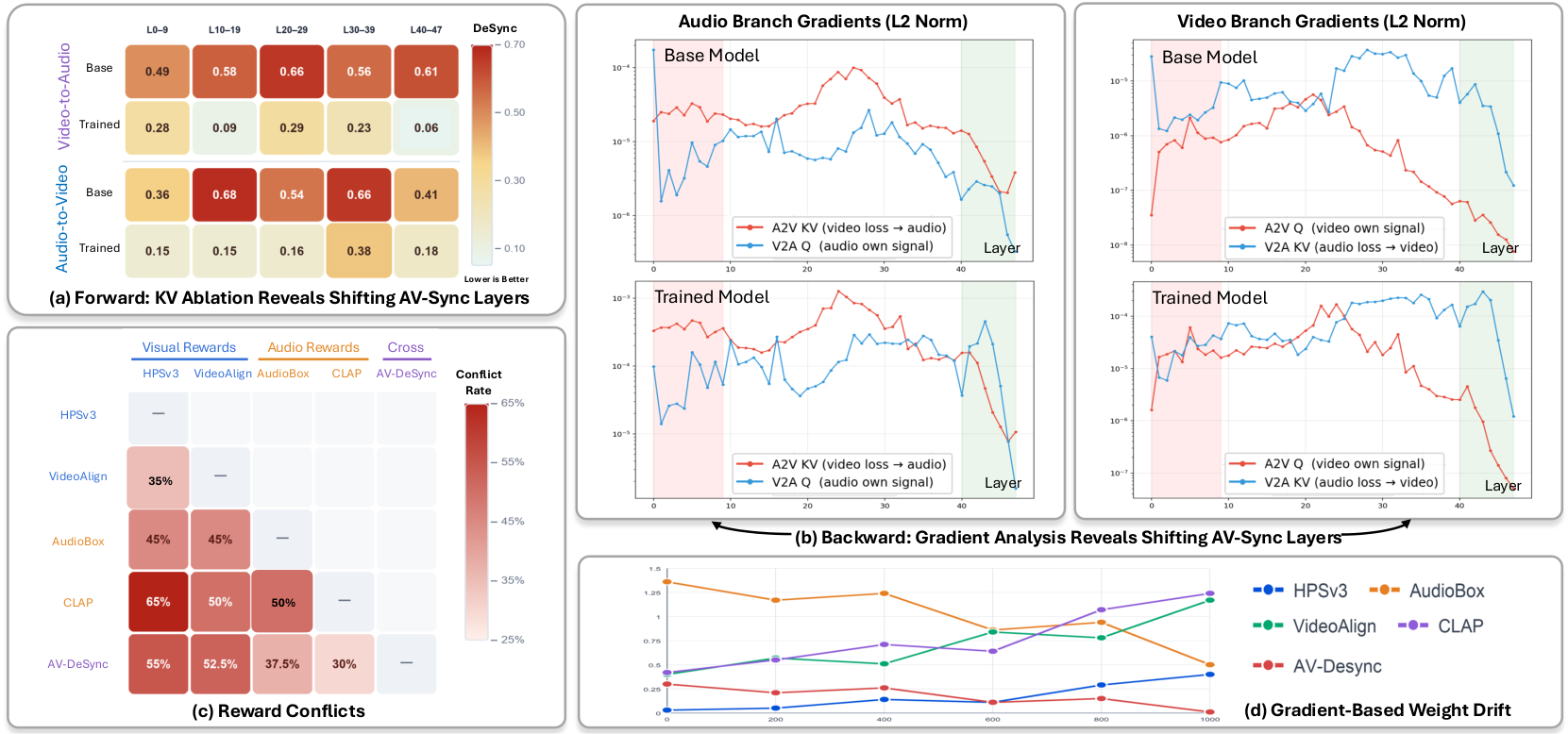
A gradient-space analysis on the backward side tells the same story. Any method that hard-codes which layer the alignment reward should push on will therefore misroute credit after a few hundred steps.
Setup and notation
LTX-2 uses linear flow-matching latents x_t^m = (1-t)x_0^m + t x_1^m with x_1^m \sim \mathcal{N}(0,I) for each modality m \in \{v,a\}, under a shared timestep. The two streams exchange information via gated cross-attention:
o_{a\to v}^{l,t} = \mathrm{Attn}(Q_v(h_v^{l,t}), K_a(h_a^{l,t}), V_a(h_a^{l,t})),\qquad o_{v\to a}^{l,t} = \mathrm{Attn}(Q_a(h_a^{l,t}), K_v(h_v^{l,t}), V_v(h_v^{l,t})).
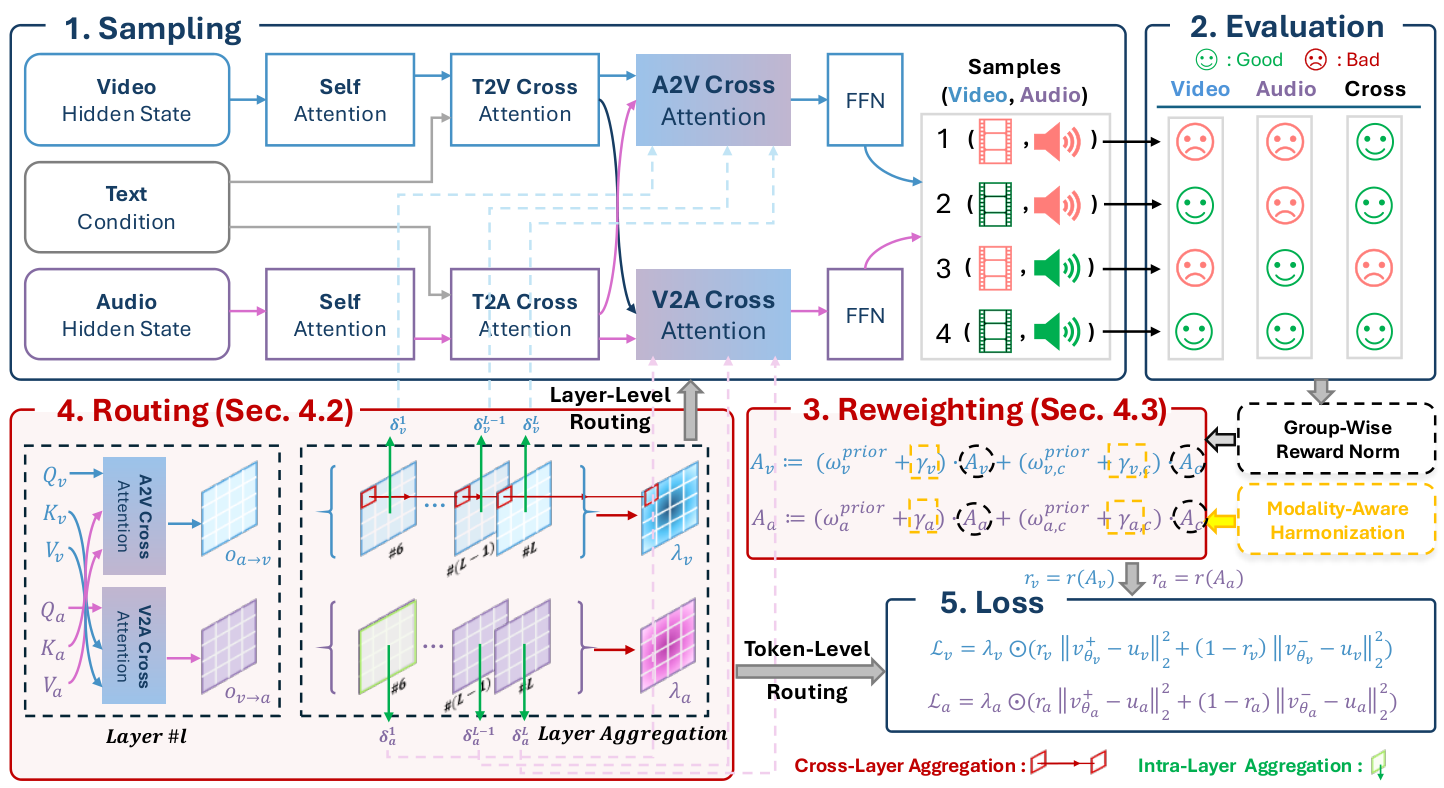
ARR operates on the normalized advantages A_k^{(n)} for each reward k and sample n, and funnels them through four successive routing stages (Eq. 5 in the paper):
\{A_k\} \xrightarrow{\text{reweight}} \{\omega_{m,k} A_k\} \xrightarrow{\text{branch}} (A_v, A_a) \xrightarrow{\text{token}} \mathcal{L} \xrightarrow{\text{layer}} \nabla_\theta \mathcal{L}.
Component 1: Cross-Modal Influence-Guided Routing
The core observation is that the gated A2V/V2A cross-attention outputs, captured pre-gate during the sampling rollout, are a cheap proxy for “how much is modality m' influencing modality m at token i, layer l.” The method aggregates these responses into:
- Token weights \lambda_{m,i}^{(n)} (Eq. 7): tokens receiving stronger cross-modal influence get larger loss weight, so the per-token flow-matching loss \ell_{m,i}^{(n)} is emphasized where cross-modal coupling actually matters this round.
- Layer routes \alpha_m^l (Eq. 8): scalar gates that scale the gradient flowing through each layer’s K/V path. In the backward pass, Eq. 9 reroutes gradients through the K/V tensors in proportion to those gates, so the alignment/sync rewards actually land on the layers that currently carry cross-modal influence rather than a fixed subset.
Importantly, both routing signals are computed from quantities already produced during sampling — no auxiliary model, probes, or extra forward passes.
Component 2: Preference-Preserving Modality-Aware Reweighting
The authors want to combine competing rewards (video quality, audio quality, alignment, sync) without destroying the user’s a priori preferences. They cache a smoothed modality-wise gradient-conflict statistic \bar\gamma_m, and periodically (every “refresh round” after a warmup) run a probing step that measures each reward’s gradient through its responsible branch under uniform token weights. These probes feed a branch-wise MARBLE problem whose solution gives updated \bar\gamma_m; Eq. 10 then converts \bar\gamma_m to per-reward, per-modality weights \omega_{m,k} that preserve the predefined preference ordering while mitigating conflict.
The branch-aggregated advantage A_m^{(n)} = \sum_k \omega_{m,k} A_k^{(n)} (Eq. 11) is substituted into the DiffusionNFT reward surrogate r_m^{(n)} = r(A_m^{(n)}), and token-weighted losses \ell_{m,i}^{(n)} are combined into per-modality policy losses \mathcal{L}_m^{\mathrm{policy}} and the total \mathcal{L}(\theta) (Eqs. 12–14). Backprop goes through the routed K/V paths of Eq. 9.
Experiments
ARR is applied to LTX-2 (19B) and LTX-2.3 (22B), both of which have the separate-streams-with-cross-attention structure that the routing requires. Post-training uses 19,487 audio-video prompts derived from VGGSound, each labeled with modality-specific and joint descriptions.
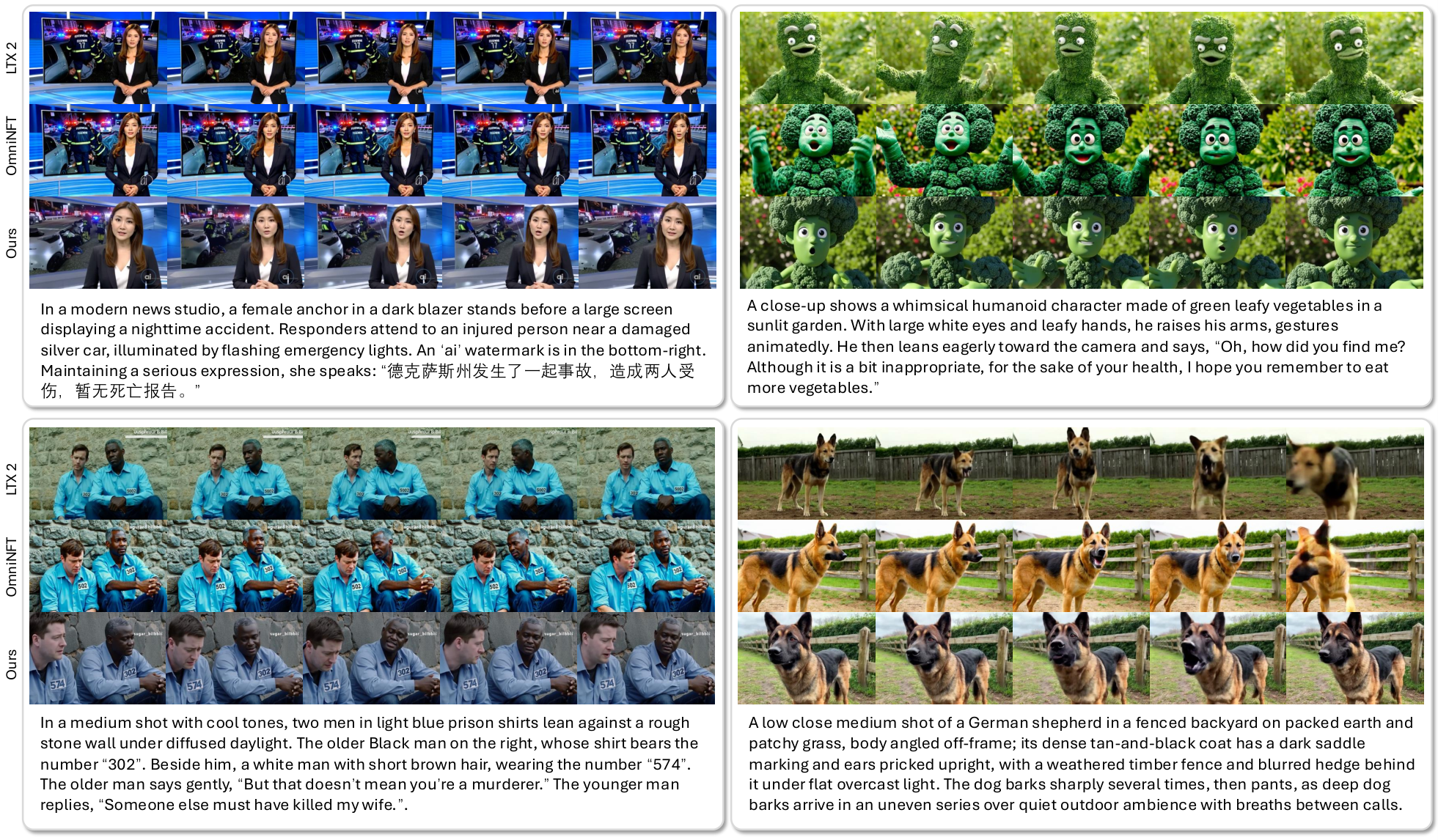
Qualitatively (Fig. 3), ARR reduces identity and appearance drift across frames and better preserves requested subjects compared with the LTX-2 baseline and an OmniNFT comparison. The provided excerpts emphasize the method and setup rather than full tables, so quantitative deltas (DeSync, alignment scores, modality-specific quality metrics) are not reproduced here — readers should consult the full tables for the exact gains.
Limitations and open questions
The method’s cross-modal influence proxy is defined by pre-gate attention responses; whether this proxy remains faithful for architectures with mixture-of-experts routing, cross-modal MoE, or non-attention couplers (state-space mixers) is unclear. The periodic MARBLE probe adds non-trivial overhead and introduces a refresh-interval hyperparameter whose stability is not discussed in the excerpt. Finally, ARR is tuned on two closely related backbones (LTX-2 variants); generalization to models with different stream-topology (e.g., single-tower unified audio-video transformers) is open.
Why this matters
Reward hacking and reward conflict are the dominant failure modes in multi-objective RL for generative models, and most existing fixes operate only at the scalar-weight level. ARR shows that treating “where in the network to apply the reward” as a first-class, time-varying variable — using signals already present in the forward pass — gives a cheap and architecture-aware handle on cross-modal credit assignment that fixed routing cannot match.
Source: https://arxiv.org/abs/2609.37200
OneStreamer: Unifying Perception, Memory, and Proactive Response in Streaming Video Interaction
Problem
Streaming video LLMs face a scheduling and memory problem that offline video LLMs do not: evidence must be recorded before its downstream relevance is known, and responses must be emitted only when evidence suffices. A sliding visual window gives real-time perception but discards long-range context; keeping all historical visual tokens is prohibitive and conflicts with the latency budget. Prior streaming systems either rely on query-conditioned memory (brittle when queries arrive mid-stream or change) or on dense visual caches (expensive and redundant). The paper reframes memory as query-independent text produced by the same causal LLM that handles responses, so recording and answering share one proactive generation process.

The three regimes in Figure 2 — Memory QA, Perception QA, and Proactive QA — motivate why a single mechanism must cover all of (i) answering from past evidence, (ii) answering from the current window, and (iii) deferring answers until evidence arrives.
Method
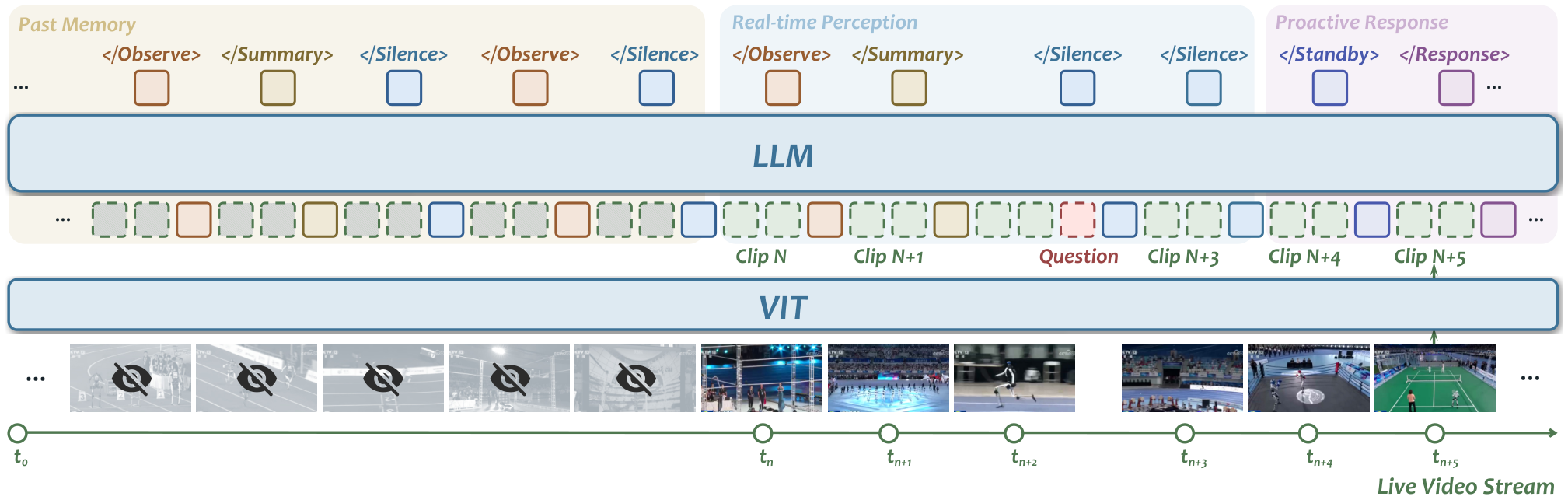
OneStreamer processes clips incrementally. A frozen vision encoder plus projector feeds visual tokens into the LLM; only the latest N frames are retained in a FIFO sliding window. The remainder of context is text: previously emitted captions and dialogue. At every output anchor, the LLM predicts one of five control tokens that gate what is emitted next.
Proactive Hierarchical Caption Memory (PHCM). Two token types form the memory:
</Observe>introduces a local-detail caption describing the just-observed interval (objects, actions, scene, state changes), emitted at the end of its supporting visual interval.</Summary>introduces a semantic summary of a completed event or segment, emitted at segment boundaries.
Both captions are time-grounded and appended to the text history. At inference, when visual tokens from older frames are evicted by the FIFO window, their factual content persists in text form, so the model never needs to re-attend to historical visual features.
Proactive State Transition Learning (PSTL). For proactive QA, three control tokens are used: </Silence> (keep observing), </Standby> (relevant evidence is emerging but not sufficient), and </Response> (emit user-visible answer). In streaming training, the </Silence> state massively dominates. PSTL preserves supervision at all output anchors but subsamples the dominant waiting state while keeping representative state-change (silence→standby, standby→response) and state-persistence tokens, which prevents the model from collapsing to perpetual silence.
Streaming data synthesis. Section 4 describes a pipeline that produces evidence-aligned supervision. For captions: videos are filtered for scene changes and visual richness; Gemini and Seed generate frame/clip, segment, and video-level captions with timestamps; captions are verified for factual and temporal consistency; verified annotations are converted into causal sequences where frame/clip captions become </Observe> targets at their interval endpoints, segment captions become </Summary> targets at segment boundaries, and a final </Response> emits a full-video summary. The QA branch calibrates response times to when evidence first becomes sufficient. The resulting dataset is OneStreamer-1M.
Training. Initialized from Qwen3-VL-4B-Instruct, single-stage SFT on OneStreamer-1M plus LLaVA-Video samples; vision encoder frozen; projector + LLM trained for one epoch, max sequence length 131,072, peak LR 1\times 10^{-5}, 32 H200 GPUs.
Results
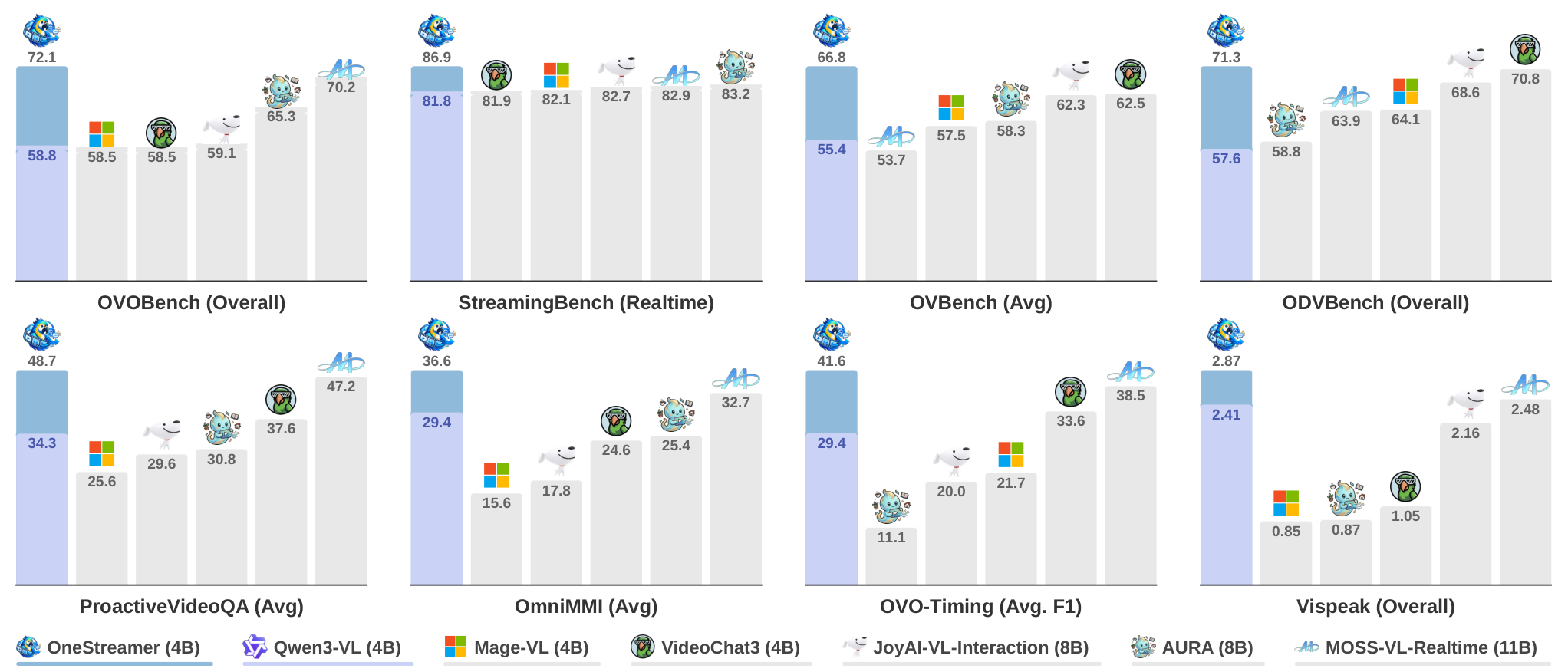
On four perception/memory benchmarks, OneStreamer-4B scores 72.1 on OVOBench, 86.9 on StreamingBench Real-Time, 66.8 on OVBench, and 71.3 on ODVBench. Deltas vs. the Qwen3-VL-4B base: +13.3, +5.1, +11.4, +13.7. It also beats the 11B MOSS-VL-Realtime by +1.9, +4.0, +13.1, +7.4 on the same four benchmarks — notable because MOSS-VL has ~2.75× the parameters.
On four proactive-response benchmarks: 48.7 on ProactiveVQA, 36.6 on OmniMMI (ASR), 41.6 on OVO-Timing, 2.87 on ViSpeak. Over Qwen3-VL-4B: +14.4, +7.2, +12.2, +0.46. Over MOSS-VL-Realtime-11B: +1.5, +3.9, +3.1, +0.39. Average relative improvement over the Qwen3-VL baseline across all eight benchmarks is 25.0%, and 6.1% over the strongest per-benchmark competitor. The OVO-Timing F1 of 41.6 is particularly indicative: it directly tests whether responses are emitted at the right moment, which is where </Standby>/</Response> scheduling matters most.
Limitations and open questions
The paper does not report ablations isolating PHCM vs. PSTL vs. data synthesis in the sections provided, so the attribution of gains between architecture, training objective, and the OneStreamer-1M corpus is unclear. Memory in text form is lossy relative to visual features (e.g., fine spatial relations, counts, OCR); the sliding window size N and its interaction with caption density are not discussed. Latency and throughput — critical for a streaming claim — are not quantified here. Captions depend on Gemini/Seed teacher quality, inheriting their biases. Finally, proactive QA assumes the question arrives before relevant evidence; mid-stream topic switches and multi-turn interruption dynamics are not evaluated beyond OmniMMI/ViSpeak aggregates.
Why this matters
Replacing a visual KV cache with query-independent, time-grounded text captions produced by the same causal LLM is a clean way to decouple long-range memory from the real-time visual budget, and the 4B model outperforming an 11B streaming baseline across all eight benchmarks suggests the bottleneck in current streaming VLMs is scheduling and evidence representation, not raw parameter count.
Source: https://arxiv.org/abs/2610.01762
World Observer: Joint Actor-Observer Generation for Persistent World Modeling
Problem
Video world models are actor-centric: they condition on an agent’s local view and roll it forward under action/camera controls. The moment an object leaves the frustum, there is no direct evidence of its state, and when it re-enters the view the model has to resynthesize dynamics from scratch. The paper taxonomizes four resulting failure modes — frame-locked (object stuck to pixel location), lost (never returns), frozen (returns but motionless), and impostor (returns but with inconsistent state).
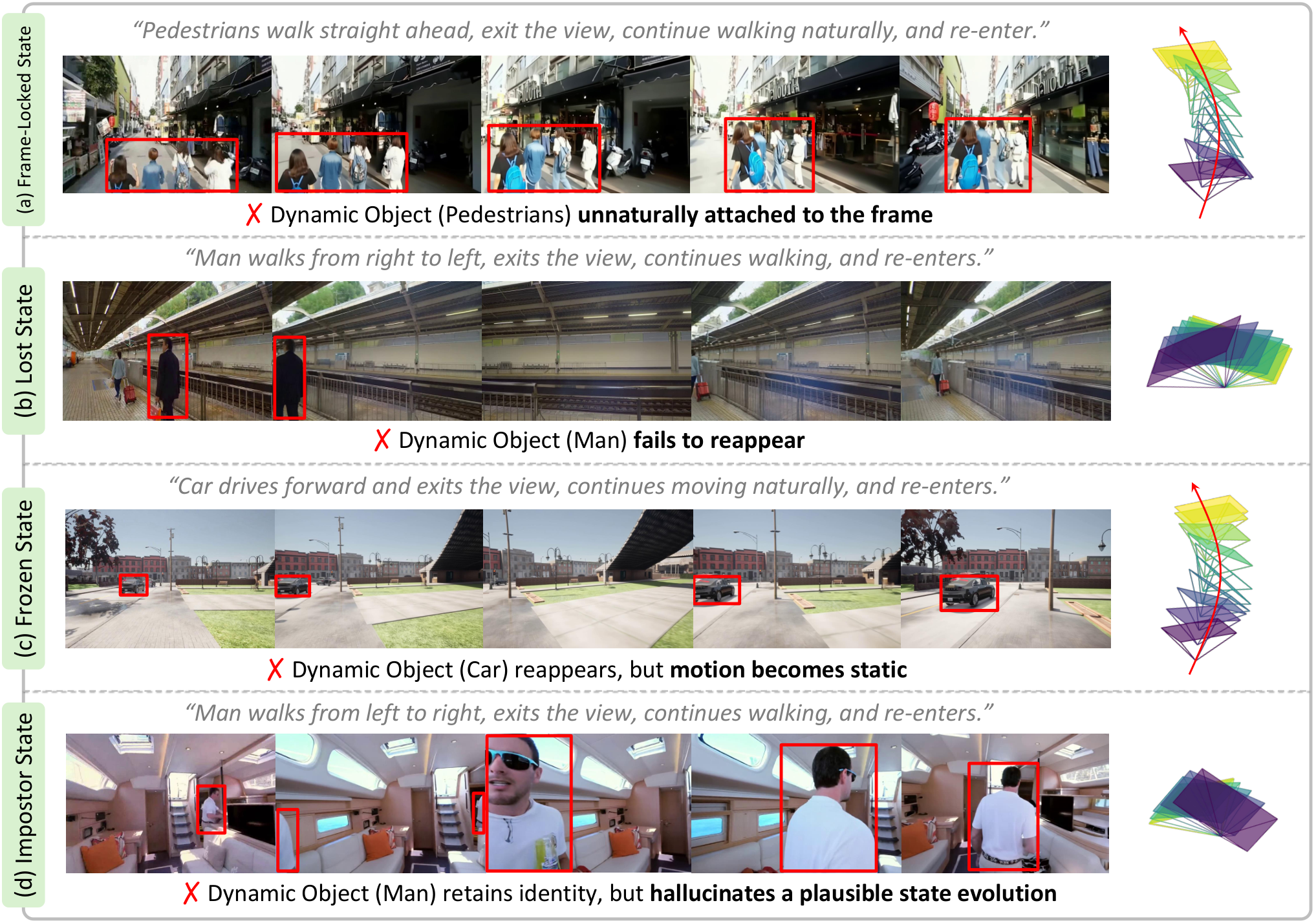
This matters for any downstream task that needs persistence: long-horizon planning, multi-agent interaction, or driving simulators where traffic continues to evolve behind you.
Method
World Observer decouples observing from acting. A single pretrained video DiT (NVIDIA Cosmos-style, operating in a 3D VAE latent space) jointly generates two kinds of streams:
- an actor stream \mathbf{X}^{\mathrm{a}} = \{x^{\mathrm{a}}_t\}_{t=0}^{T-1} rendering the agent’s local perspective view, conditioned on camera trajectory \mathbf{C}^{\mathrm{a}}, prompt \mathbf{P}^{\mathrm{a}}, and history latents;
- N observer streams \{\mathbf{X}^{\mathrm{o}_n}\}_{n=1}^{N} in equirectangular panorama form, each with its own \mathbf{C}^{\mathrm{o}_n} and prompt \mathbf{P}^{\mathrm{o}_n}.
Long videos are produced autoregressively in chunks of T frames, each chunk re-conditioning on H tail latents \mathbf{Z}^{\mathrm{a}}_{\mathrm{hist}}, \mathbf{Z}^{\mathrm{o}}_{\mathrm{hist}} from the previous one.
View-time alignment. The core trick for persistence is in positional encodings. Actor and observer latents (plus their histories) are concatenated into one sequence through the shared DiT. Learnable view embeddings tag which stream a token comes from, but — critically — matched actor/observer latents are assigned identical positions on the RoPE temporal axis. Self-attention is therefore free to exchange information between actor tokens at time t and observer tokens at time t, since they denote the same instant of the same world. The attention map in Fig. 5 shows a query on a re-entering object attending to the panoramic region holding its state during the out-of-view interval; in a non-joint baseline the object simply fails to re-enter.
Decoupled prompting. The actor prompt describes events inside the local frustum; the observer prompt describes events across the broader scene (vehicles passing behind, pedestrians crossing out of frame, weather changing). Because the observer is a separately prompted stream, it is a controllable handle on the agent’s unseen world rather than passive background. Multiple observers can be placed at different scene locations for broader coverage, and because the panorama is a geometric object, it can be warped to produce a geometrically consistent actor view — the paper grounds both streams in a shared panoramic source.
Observer Sink. A separate module converts the high-resolution initial panorama into four perspective references so that fine-grained appearance can be restored on re-entry, rather than regenerated from the lossy equirectangular latent.
Data
Training needs temporally synchronized actor+observer pairs, which almost never exist natively.
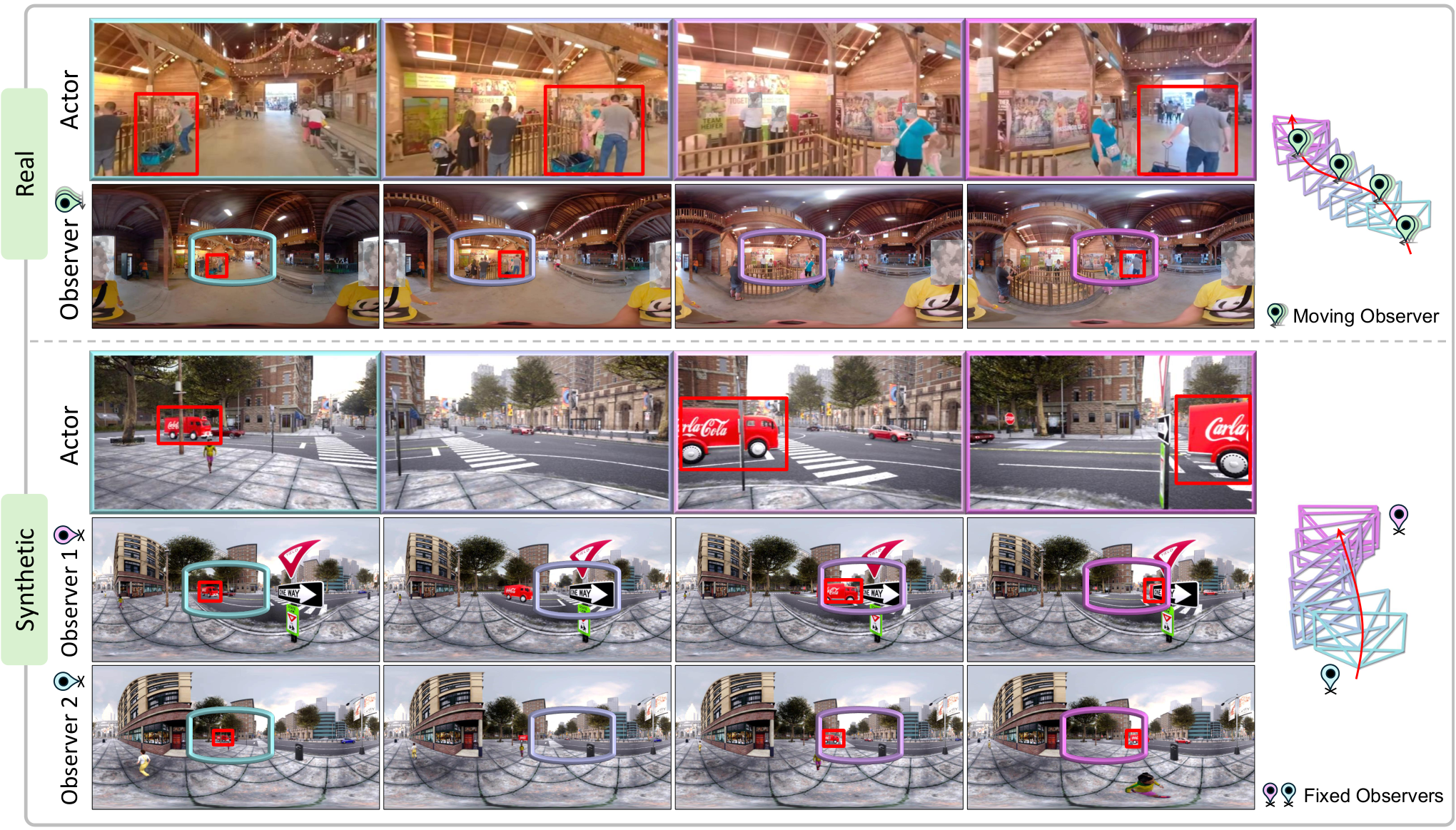
Two sources are combined. (1) Real panoramic video corpora are stabilized into upright equirectangular sequences, synchronized perspective actor videos are rendered from the stabilized panorama under randomized trajectories, and Depth Anything 3 provides per-frame depth for the geometry-aware condition. Because actor and observer come from the same panorama here, they are necessarily co-located. (2) CARLA renderings provide the configurations real data cannot: observers decoupled from the actor and multi-observer setups at different scene locations.
Evaluation and results
Existing metrics (VLM judgments, semantic similarity) are poor at quantifying what an object did while out of frame. The paper introduces explicit world-space metrics by lifting detected objects into 3D with a segmentation model plus metric-scale depth estimator, then tracking 3D position over time.
- OOV-F measures how often objects actually follow the ground-truth exit/re-entry pattern, catching frame-locked and lost cases that have no valid displacement at all.
- OOV-D measures how well out-of-view displacement matches a reference. \text{OOV-D}_{\text{gt}} compares against the prompt-specified dynamics (sensitive to frozen motion), while \text{OOV-D}_{\text{self}} compares against extrapolated pre-exit motion (sensitive to impostor substitutions).
The qualitative figure (Fig. 6) demonstrates four capabilities enabled by the design: state memory across occlusions, observer-prompted steering of out-of-view events, long-horizon generation via chunked autoregression, and multi-observer coverage. The provided excerpt does not include the quantitative tables, so specific OOV-F/OOV-D numbers against baselines cannot be reproduced here.
Limitations and open questions
- Panoramic observers cover direction but not occlusion-through-geometry (e.g., objects behind buildings remain hidden even to a co-located observer); multi-observer placement partially mitigates this but requires a policy for where to place observers.
- The co-location constraint of the real-world subset means decoupled behavior is learned largely from CARLA, which may limit real-world fidelity when the observer is far from the actor.
- Compute scales roughly linearly in N since each observer is a separate stream in the shared attention; large N is expensive.
- The 3D-lifted OOV metrics inherit errors from segmentation and metric depth, especially for distant or small objects.
Why this matters
Persistence is the missing axis in current video world models: an actor-centric generator cannot be used as a simulator for planning or multi-agent interaction if the world ceases to exist outside the frustum. Treating the panoramic surround as a jointly generated, separately promptable stream — tied to the actor by RoPE-aligned self-attention — is a clean architectural answer that reuses a single DiT and composes naturally to multiple observers.
Source: https://arxiv.org/abs/2610.02162
Sharpening Tax in Post-Training
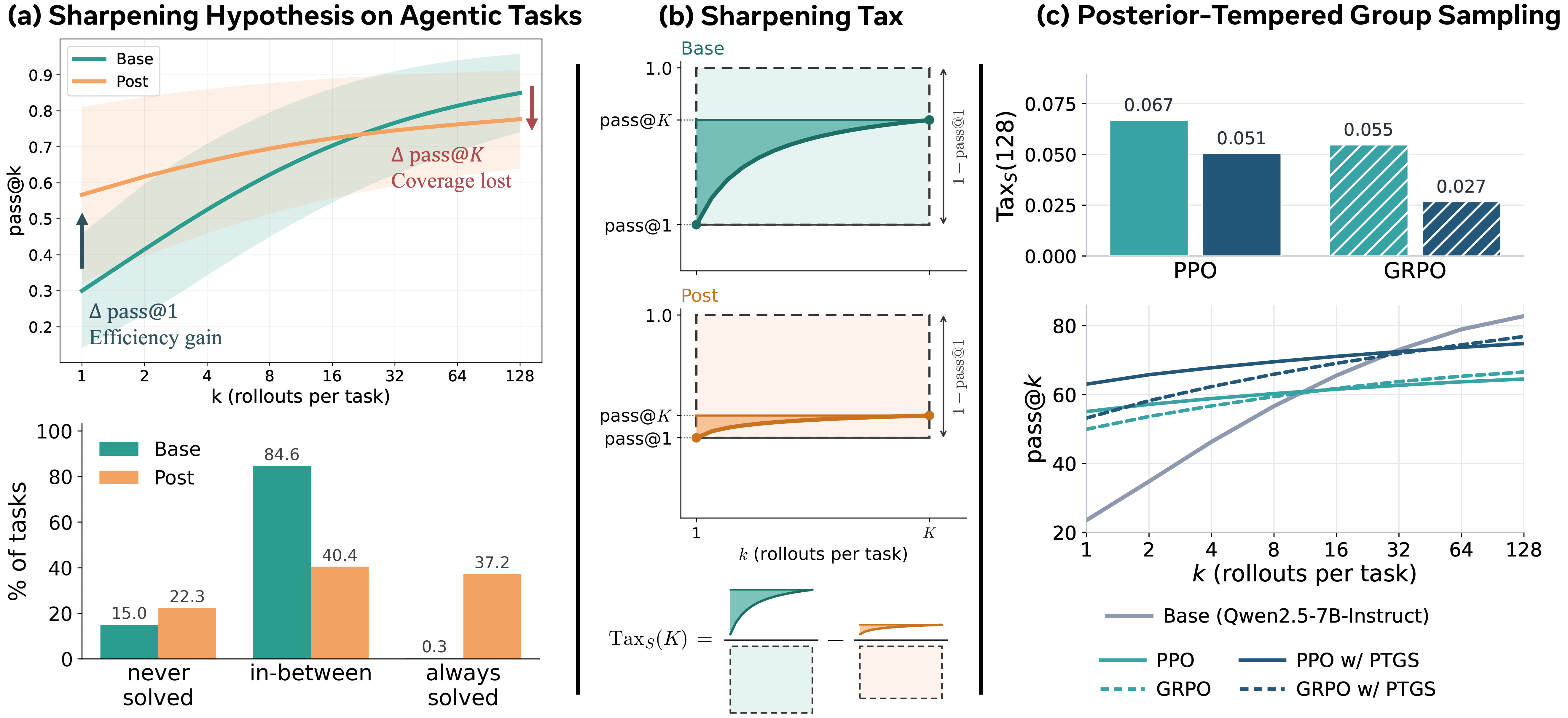
The sharpening hypothesis — that RL post-training amplifies a few high-reward modes already latent in a base model while suppressing the rest — has been documented in math and code. This paper asks whether the same accuracy-vs-coverage trade-off survives in agentic settings, where multi-turn tool use plausibly requires capabilities acquired only during post-training. The empirical answer is yes, and the authors formalize the cost with a diagnostic called Sharpening Tax.
Base models as agents, under a harness
The first observation is that pre-trained models, given a light scaffolding (a system prompt plus relaxed tool-calling/parsing — essentially the ReAct-style setup of Yang et al. 2024b), act as competent agents. The harness is dataset-independent and model-agnostic. Averaged over eight base models from Gemma-4, Ministral-3, Qwen2.5, and Qwen3.5, the harness raises BFCL from pass@1 5.59 \to 15.63 and pass@32 15.19 \to 49.13; WebShop pass@32 goes 39.48 \to 49.15; ACEBench is already saturated and barely moves. Notably the same harness hurts the post-trained variants, consistent with the view that prompt engineering interacts non-trivially with instruction tuning.
Comparing harness-equipped base models against their post-trained siblings produces consistent pass@K crossovers. On WebShop, gemma-4-31B base exceeds 85% pass@128 while the RL-tuned version plateaus near 56%. The crossover budget k^\ast shrinks with scale: for Gemma-4, k^\ast > 128 at 4B collapses to k^\ast \approx 3 at 31B. In other words, as base capability grows, the regime in which post-training wins on coverage disappears almost entirely.
Formalizing the tax
Rather than reading off pass@K curves, the authors propose a scalar summary. For budget K, define raw scalability as the area under the pass@K ceiling:
A(K)=\sum_{k=1}^{K-1}\bigl[\text{pass}@K-\text{pass}@k\bigr],
and a calibrated version normalized by the single-shot failure headroom:
S(K)=\frac{A(K)}{(K-1)(1-\text{pass}@1)}\in[0,1].
The Sharpening Tax at budget K is simply \text{Tax}_X(K)=X_{\text{Base}}(K)-X_{\text{Post}}(K) for X\in\{A,S\}. A positive tax means post-training reduced the usable test-time scaling slope.
Proposition 1 gives the probabilistic reading: let H be the index of the first successful rollout. Then A(K)=\mathbb{E}[(H-1)\mathbf{1}\{H\le K\}], i.e., the expected number of failed attempts preceding a success within the budget. Tasks solved on the first try or never solved contribute zero. A positive tax therefore means the post-trained policy’s successes rely less on retries — either because failed first attempts are never recovered (lost coverage) or because they are recovered after fewer tries (faster saturation). Corollary 4 in the appendix decomposes the tax along exactly these two axes.
Theorem 2 ties this to bimodalization. Model per-task success as p_x\in[0,1] with conditionally independent rollouts; the per-task raw scalability a_K(p)=\sum_{k=1}^{K-1}[(1-p)^k-(1-p)^K] is positive on (0,1) and zero at the endpoints. If post-training collapses a \lambda-fraction of tasks to either p=0 or p=1, scalability drops proportionally. This matches the “always solved or never solved” bimodality visible empirically.
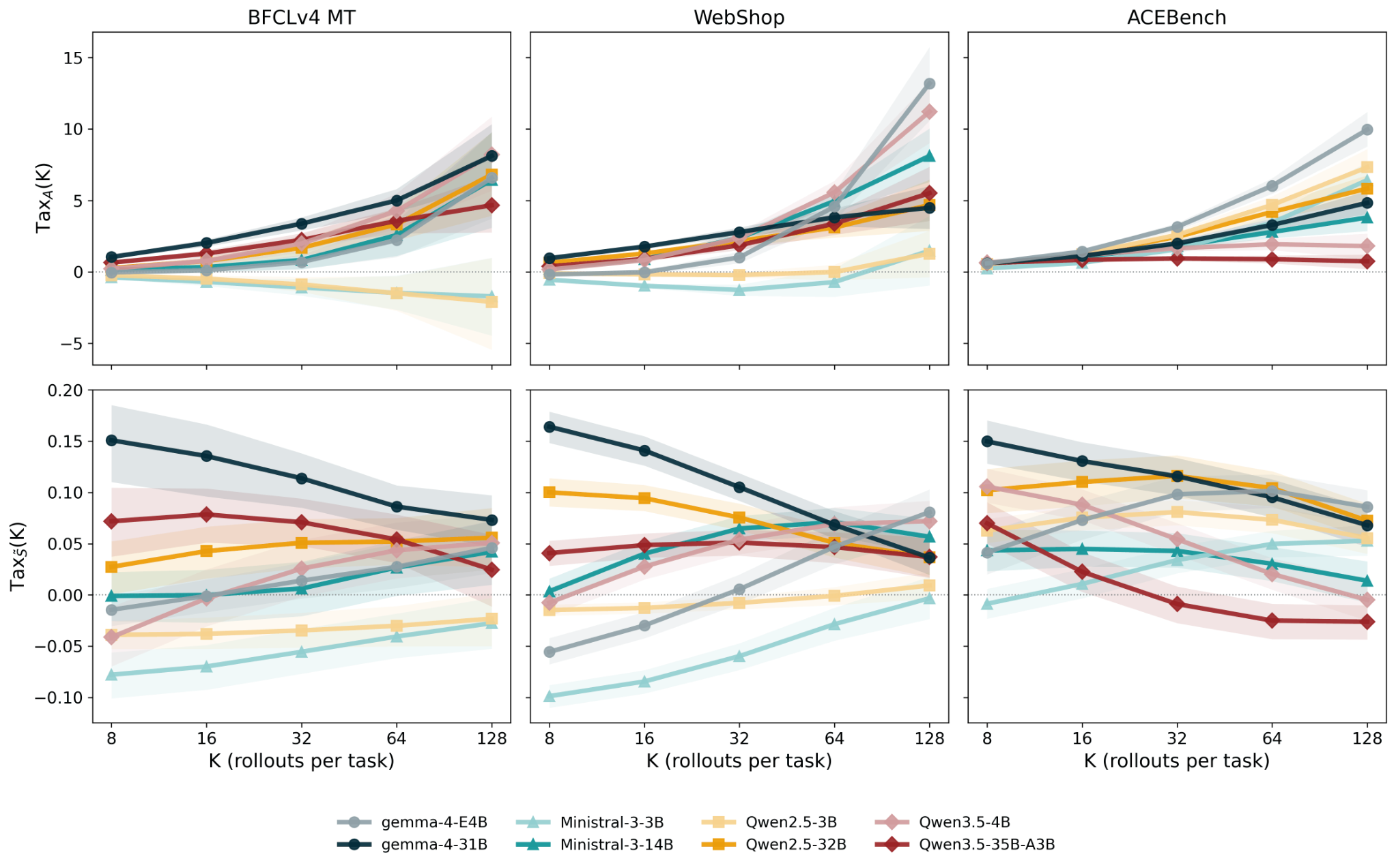
Across 14 base/post-trained pairs and three benchmarks (42 combinations total), \text{Tax}_S(128)>0 in 36/42 cases. For the largest backbones (e.g., gemma-4-31B) the tax is positive at essentially every k and grows with scale. For the smallest backbones (e.g., Ministral-3-3B) the tax is often negative at k\le 8 — sharpening does help when compute is severely budget-constrained — but flips positive by k=128. The two variants behave differently: \text{Tax}_A rises nearly monotonically in K, whereas \text{Tax}_S can be non-monotone because of the (1-\text{pass}@1) calibration.
Mitigation: posterior-tempered group sampling
The obvious fix — raise sampling temperature — trades pass@1 for pass@K. The authors instead propose PTGS, a per-prompt adaptive tempering scheme used during RL training.

For each prompt x, maintain discounted success/failure counts (\tilde s_x,\tilde f_x)\leftarrow(\gamma\tilde s_x+s_x,\gamma\tilde f_x+n-s_x) with forgetting factor \gamma. Form a Beta posterior \text{Beta}(2\tilde p+\tilde s_x,\;2(1-\tilde p)+\tilde f_x) around target success rate \tilde p, Thompson-sample \hat p_x, and set the rollout temperature
T_x=\tau^{h(\hat p_x)},\quad h(p)=\begin{cases}(\tilde p-p)/\tilde p & p\le\tilde p\\ (\tilde p-p)/(1-\tilde p) & p>\tilde p\end{cases}
so T_x\in[1/\tau,\tau]: hard prompts are heated (exploration), easy ones cooled (exploitation). Theorem 3 argues this improves the information content of the rollout groups RL learns from — groups near 0% or 100% success yield near-zero advantages under GRPO-style estimators, so pushing group success rates toward intermediate values increases gradient signal.
Limitations
The agentic benchmarks are three (BFCL, WebShop, ACEBench), and the analysis conflates diverse post-training pipelines (SFT+RL, DPO, etc.) under a single “post-trained” label. The harness is applied asymmetrically (base w/ harness vs. post-trained w/ default scaffolding), which is defensible but makes the crossover partially a function of harness quality. Theorem 2’s independence assumption between sharpening and base p_x is clean but unlikely to hold strictly — sharpening presumably targets high-p_x tasks. PTGS experimental scale is modest, and whether the sampling-efficiency/coverage frontier is actually improved end-to-end (rather than just at training time) deserves more scrutiny.
Why this matters
If modern RL post-training systematically trades solution coverage for pass@1 — and the trade grows with model scale — then evaluations reported at pass@1 are hiding capability that a cheap inference-time budget would recover from the base model. Sharpening Tax gives a one-number diagnostic for this trade, and PTGS is a concrete lever to recover coverage during training rather than at deployment.
Source: https://arxiv.org/abs/2610.01509
ActiveSaddler: Automated Curriculum Learning for Agent Harness Optimization
Problem
Automated harness optimization — iteratively updating an LLM agent’s prompts, tool schemas, and control logic from execution traces — has emerged as a practical alternative to fine-tuning the underlying model. Systems like GEPA-style optimizers, trace-based prompt repair, and tool-interface refinement operate by (i) running the harness on training scenarios, (ii) diagnosing failures, and (iii) proposing patches. The literature has focused almost entirely on step (iii): how to generate better patches. Step (i) — which scenarios to run under a finite rollout budget — has been treated as fixed, typically a uniform sample from the training set.
This is suboptimal for the same reason uniform data sampling is suboptimal in supervised and RL training: as the harness evolves, the scenarios that produce the most informative feedback change. Early rounds expose shallow bugs; later rounds need to surface deeper, rarer failure modes. ActiveSaddler fills this gap by formulating training-scenario selection as an automated curriculum learning problem coupled to the harness optimizer.
Method
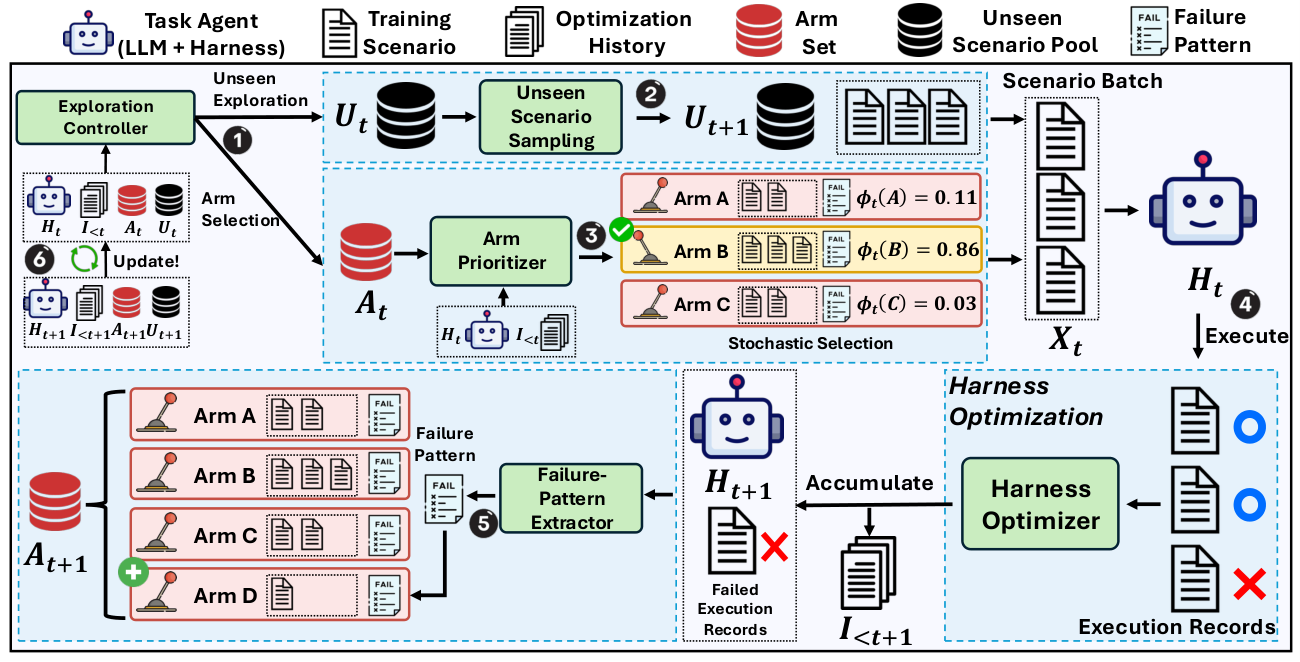
The authors cast curriculum selection as a non-stationary multi-armed bandit over failure-pattern arms. The key abstraction choice: an arm is not a scenario and not a single failed trace, but an inferred harness weakness — a latent deficiency likely to be fixed by a single patch and likely to recur across multiple scenarios. This matches the granularity at which the optimizer actually operates.
Three components close the loop:
Failure-Pattern Extractor. Given failed traces, this module performs failure diagnosis and clusters failures attributed to the same latent deficiency into a shared arm. Because weaknesses are unobservable, this is an inference problem over trace evidence; failures that reduce to the same root cause contribute to the same arm’s statistics. The arm set is not fixed in advance — new arms are instantiated when diagnosis identifies a previously-unseen pattern.
Arm Prioritizer. Among instantiated arms, this selects which to target next. The implicit value function is learning progress on the arm — how much a further optimization round is expected to improve harness performance on scenarios exhibiting that pattern. This follows the Graves et al. (2017) and Matiisen et al. (2017) framing of curriculum as a bandit over learning-progress signals, but with arms dynamically instantiated rather than fixed over tasks.
Exploration Controller. Because each iteration can only execute a subset of training scenarios, unseen scenarios may harbor failure patterns not yet in the arm set. The controller decides when to allocate budget to unobserved scenarios (to discover new arms) versus revisiting known arms (to drive progress on them). This is the standard exploration/exploitation tradeoff, but with exploration serving arm-set expansion rather than value-estimate refinement.
At each iteration the system chooses between exploration and arm revisit, executes the selected batch, runs the harness optimizer on the resulting traces, and updates both arm statistics (progress on existing arms) and arm set (new arms from newly-discovered failures). The arm set and its priorities co-evolve with the harness.
Qualitative evidence from case studies
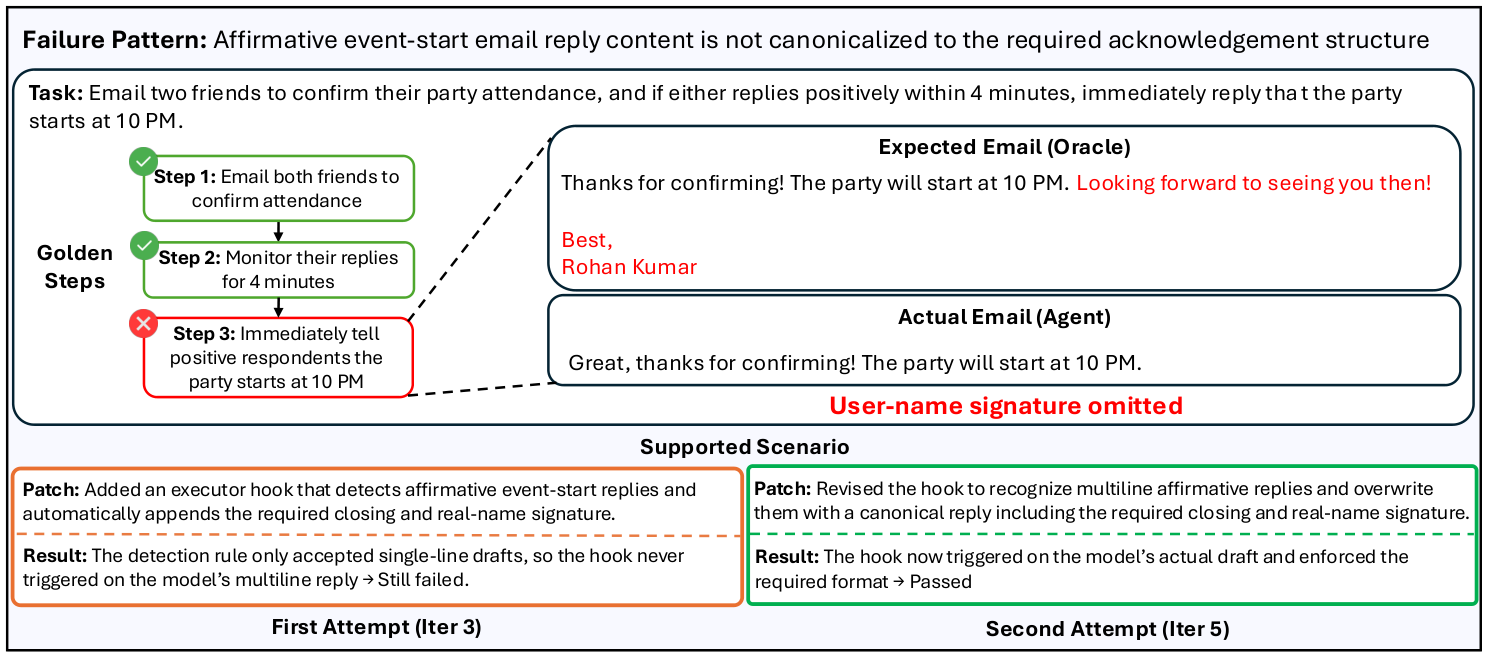
The tnxtee case illustrates the central mechanism: an initial patch targeting a failure pattern does not fully repair it, but because the pattern is tracked as a persistent arm, a later iteration retargets the same arm and refines the patch — rather than the failure being lost in a sea of uniformly-sampled scenarios.
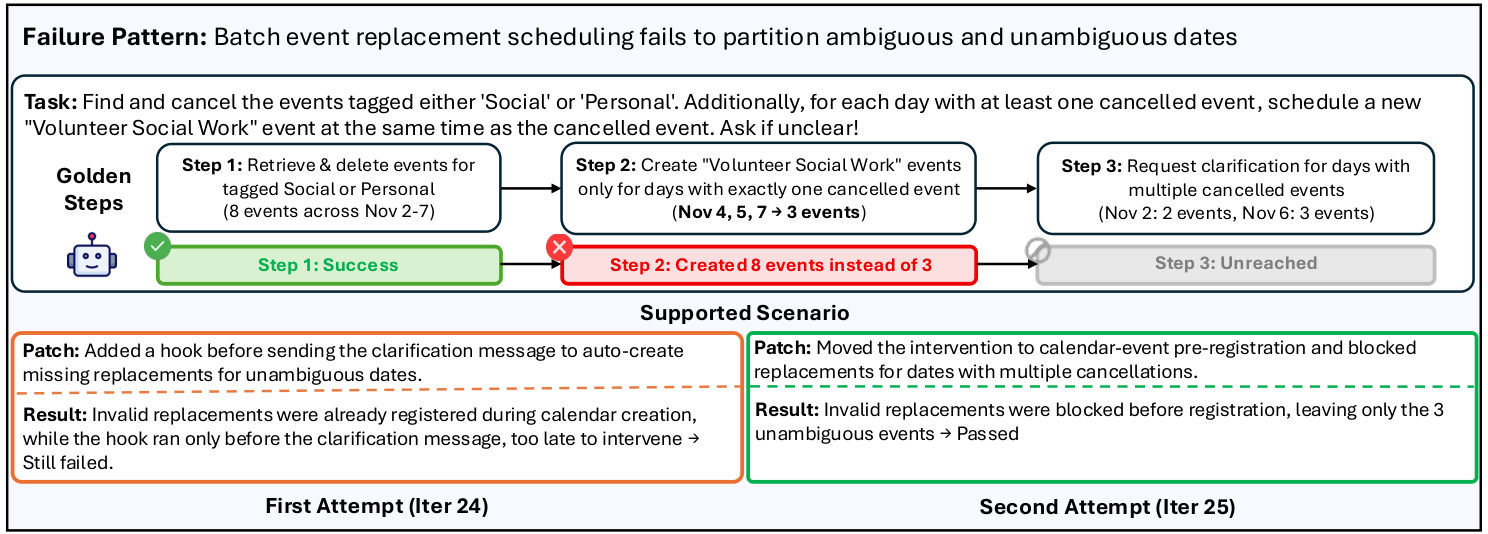
The 4bytkx case shows retargeting correcting the placement of an executor hook: the first attempt inserted the hook too late in the execution flow; a subsequent iteration, triggered by the arm’s unresolved status, moves it. Both cases demonstrate that arm persistence enables multi-step patch refinement, which uniform scenario sampling would not reliably produce — once a scenario has been “used,” there is no mechanism in prior pipelines to prioritize it when the first patch fails.
Evaluation setup
Experiments cover two benchmarks spanning distinct harness regimes:
- GAIA2 (Froger et al., 2026): general-purpose assistant tasks in a simulated smartphone environment across 10 Universes, with a ReAct agent as the base harness.
- Terminal-Bench 2.0 (Merrill et al., 2026): 89 tasks in system administration, ML workflows, and cybersecurity, with Terminus 2 as the base harness.
The provided excerpt does not contain the headline numeric results tables, so specific accuracy deltas versus uniform-sampling or random-curriculum baselines are not quoted here.
Limitations and open questions
- Diagnosis quality. The whole framework hinges on the Failure-Pattern Extractor correctly clustering failures by latent cause. Mis-clustering either fragments one weakness across multiple arms (diluting learning-progress signals) or merges distinct weaknesses (producing patches that only partially fix any of them). The paper does not, in the sections provided, quantify extractor accuracy.
- Learning-progress estimation under stochastic rollouts. Agent executions are noisy; estimating per-arm progress with few samples per iteration risks high-variance priorities. The arm bandit is non-stationary (the harness changes under it), compounding this.
- Arm-set growth. Unbounded arm instantiation could lead to a long tail of rarely-visited arms. Pruning or merging policies are not described in the excerpt.
- Transfer across harnesses. Whether discovered failure patterns transfer across base harnesses (ReAct vs. Terminus 2) or benchmarks is untested.
Why this matters
Harness optimization is becoming the dominant lever for improving agents when model weights are fixed, and nearly all engineering effort has gone into the patch generator. ActiveSaddler points out that the data side — which scenarios drive feedback — is an equally first-class design axis, and that treating it as a bandit over inferred weaknesses (rather than over scenarios) aligns the curriculum with the granularity at which patches actually operate.
Source: https://arxiv.org/abs/2610.00906
Hacker News Signals
Context Language Models
Source: https://arxiv.org/abs/2609.37725
The paper proposes Context Language Models (CLMs), a reformulation of the standard next-token prediction objective that explicitly conditions on a structured context representation rather than treating the entire prefix as a flat token sequence. The core argument is that standard autoregressive LMs conflate two distinct tasks: compressing prior context into a useful representation and predicting the next token given that representation. CLMs separate these by introducing a learned context encoder that produces a fixed-dimensional summary vector per segment, which the decoder attends to via cross-attention alongside the local token window.
Mechanically, the model partitions the input into segments of length L. A context encoder (a smaller transformer) processes completed segments and produces context vectors c_1, \ldots, c_k. The decoder then conditions on both the local causal token window and the set of context vectors. The training objective remains standard cross-entropy over next-token predictions, so no auxiliary losses are needed. The separation allows the encoder to be run asynchronously and cached, reducing inference cost for long contexts.
The architecture bears similarity to RMT, Memorizing Transformers, and Recurrent Memory Transformer variants, but the authors argue the key distinction is the explicit segment-boundary-aligned encoding rather than sliding-window or continuous recurrence. Perplexity on long-document benchmarks (PG-19, SCROLLS) improves over baseline transformers of equivalent parameter count, with the CLM architecture achieving roughly 8-12% lower perplexity at sequence lengths beyond 8k tokens while using 30-40% fewer FLOPs per token at inference time due to context caching.
Limitations include the hard segment boundary assumption, which can break mid-sentence, and the encoder adds parameter overhead. Whether the gains hold at scales above a few billion parameters is not demonstrated. The caching benefit also depends heavily on the segment reuse pattern, which is application-specific.
Why this matters
Structured context compression is a practical path to long-context efficiency without quadratic attention; this provides a clean architectural template and reproducible numbers on standard benchmarks.
Clef: Open-weight decision models, and new RL fine-tuning platform
Source: https://blog.cloudflare.com/clef-decision-models/
Cloudflare releases Clef, a family of small open-weight models (1B–8B parameters) trained specifically for binary and multi-class decision tasks in network security and traffic classification contexts — WAF rule triggering, bot detection, abuse classification. The accompanying platform enables RL fine-tuning of these models using task-specific reward signals derived from production traffic labels.
The technical framing distinguishes Clef from general-purpose instruction-tuned LLMs: Clef models are trained from the start on structured decision inputs (HTTP metadata, request features, rule match vectors) rather than free text. Inputs are tokenized as tabular feature sequences; the model outputs a decision token plus a confidence scalar. Cloudflare reports using GRPO (Group Relative Policy Optimization) as the RL fine-tuning algorithm, which avoids the need for a separate critic model by computing advantages within a batch of rollouts:
A_i = \frac{r_i - \text{mean}(r_{1..G})}{\text{std}(r_{1..G})}
where G is the group size. This is the same algorithm popularized by DeepSeek-R1 for reasoning tasks, repurposed here for classification reward signals derived from ground-truth abuse labels.
The open-weight release is notable because Cloudflare is publishing model weights on Hugging Face for the base decision models, though the RL fine-tuning platform appears to be a managed service. The blog discusses the challenge of reward sparsity in security contexts: many requests are benign, making positive-class reward signals rare. They address this with reward shaping that upweights true-positive signals and applies a calibration loss to keep confidence scores meaningful.
Latency constraints are central — decisions must complete in under 1ms at the edge, which constrains model size and requires INT8 quantization on edge nodes.
Key open questions: how the models handle distribution shift as attack patterns evolve, and whether the RL fine-tuning signal leaks information about internal detection heuristics that could be reverse-engineered.
Why this matters
Applying GRPO to security classification at inference-time edge scale is a concrete, non-toy use case for small-model RL fine-tuning, and the open weights make the architecture auditable.
How to speed up the Rust compiler in September 2026
Source: https://nnethercote.github.io/2026/09/30/how-to-speed-up-the-rust-compiler-in-september-2026.html
Nicholas Nethercote’s monthly compiler performance post covers incremental wins to rustc build times through September 2026. The post is squarely in compiler engineering territory: profiling-driven, focused on wall-clock and instruction-count regressions and wins as measured by the rustc-perf benchmark suite.
Key changes landed this month include reductions in the cost of the expand and resolve passes via query deduplication — several macro expansion queries were being re-evaluated redundantly due to incorrect cache key construction. Fixing this yielded 1.5-3% wall-clock improvements on several incremental benchmarks. There is also work on reducing LLVM IR generation overhead: the post discusses pruning redundant alloca instructions emitted during MIR-to-LLVM-IR lowering, which reduces LLVM’s own optimization passes’ workload.
A notable structural change is progress on parallel front-end compilation (-Z threads), which is moving closer to stable. The threading model uses Rayon for intra-crate parallelism over independent items in the typeck and borrowck passes. The post notes that synchronization overhead currently limits scaling beyond 4 threads for most real-world crates, with contention concentrated around the query system’s global lock on the DepGraph.
The post also covers cargo-level improvements: better fingerprinting to avoid spurious full rebuilds when only doc comments change, which is a persistent annoyance for large workspaces.
Benchmark methodology uses instruction counts (via cachegrind) as the primary metric rather than wall-clock to reduce noise, with wall-clock used as a secondary signal. The perf.rust-lang.org dashboard tracks regressions per PR, catching performance regressions before merge.
The incremental nature of these posts is itself informative: compile-time improvement is a sustained, multi-year effort with no single large win, requiring careful profiling of a complex multi-pass pipeline that includes a separately developed backend (LLVM) with its own optimization costs.
Why this matters
rustc compile times remain a significant adoption friction point; the parallel front-end work and query deduplication fixes represent structural progress rather than one-off patches.
OpenDLSS: A Vulkan Reimplementation of Nvidia’s DLSS 5 Neural Rendering Network
Source: https://github.com/maanHimself/OpenDLSS-NR
OpenDLSS is an open-source Vulkan compute implementation of a neural super-resolution and frame generation pipeline intended to replicate the functionality of DLSS 5’s Neural Rendering component without Nvidia-proprietary binaries. The project targets non-Nvidia hardware (AMD, Intel Arc, and software Vulkan) where DLSS is unavailable.
The architecture is a convolutional neural network with recurrent temporal accumulation, operating on a quarter-resolution input plus motion vectors and depth buffer. The upsampling pipeline proceeds in three stages: a feature extraction block (several 3x3 conv layers with ReLU), a temporal accumulation module that blends current-frame features with a warped previous-frame feature map using the motion vector field, and a reconstruction block that upsamples to target resolution via learned bilinear upsampling followed by residual convolutions. This is broadly consistent with what is publicly known about DLSS’s general approach from NVIDIA’s own papers and the earlier DXVK-based reverse engineering work.
The Vulkan compute shaders implement these layers as tiled matrix multiplications, manually tuned for subgroup size 32/64. Weights are loaded from an ONNX export obtained via black-box extraction from DLSS DLLs (the README is candid about this). INT8 quantization is applied to conv weights to fit within shared memory budgets per tile.
Current limitations are significant: frame generation (the interpolation component) is stubbed out, temporal stability is worse than the original at high motion, and the project has no training infrastructure — it relies entirely on extracted weights. This means it is not truly “open” in the reproducible-training sense, only in the inference implementation sense.
Performance on an RX 7900 XTX reaches approximately 70-80% of native DLSS 5 quality scores (measured via PSNR/SSIM on a held-out game capture set), with a 15% latency overhead versus a hypothetical native implementation due to Vulkan compute path inefficiencies.
Why this matters
Demonstrates that neural upsampling inference is portable to non-proprietary Vulkan without vendor-specific tensor cores, which matters for cross-platform game engine integration.
A Privacy Analysis of Web and Mobile Conversational AI Agents
This paper performs a systematic empirical privacy audit of 30 conversational AI agents (web and mobile) including major commercial products, measuring what data is collected, where it is transmitted, and whether stated privacy policies match observed network behavior.
The methodology is instrumentation-based: the authors use mitmproxy for web agents and Frida-based dynamic instrumentation for mobile apps to intercept and log all network traffic during structured test conversations. They then classify endpoints against known tracker/analytics databases (Disconnect.me lists, hand-labelled endpoints) and compare observed data flows against privacy policy disclosures using a semi-automated NLP pipeline that extracts data-type claims from policy text.
Key findings: 23 of 30 agents transmitted conversation content or metadata to at least one third-party analytics endpoint beyond the primary model API. Mobile agents were worse than web agents — 18/20 mobile apps sent device identifiers (IDFV, Android Advertising ID) alongside conversation data. Only 9 agents’ observed data flows were fully consistent with their stated privacy policies. Several agents transmitted truncated conversation snippets to advertising attribution SDKs, which the authors argue is not disclosed.
The paper introduces a threat model taxonomy distinguishing (1) primary collection by the AI provider, (2) secondary sharing with analytics/ads partners, and (3) incidental leakage through third-party SDKs bundled in apps. Category 3 is the most prevalent and least disclosed.
Technical limitations: the analysis captures only transmitted data, not server-side retention or inference from conversation content. The Frida instrumentation was defeated by certificate pinning in 3 apps, requiring additional patching. The NLP policy parser has recall gaps on ambiguously worded clauses.
The “Prompt like a butterfly, sting like a tracker” framing refers to the observation that benign-seeming conversational inputs carry fingerprinting metadata that functions as a tracker regardless of conversation content.
Why this matters
Concrete measurement of the gap between stated and observed privacy behavior in production AI agents, with a replicable methodology using standard tools.
RIP, vector database
Source: https://turbopuffer.com/blog/rip-vector-database
Turbopuffer’s post argues that the standalone vector database as a product category is being absorbed into general-purpose databases and object storage systems, and outlines the architectural reasons why. The argument is technical, not just market commentary.
The core claim is that the original justification for purpose-built vector DBs — specialized ANN index structures (HNSW, IVF-PQ) requiring in-memory residency — is being undermined by two trends: (1) modern NVMe SSDs with high random-read IOPS make disk-resident ANN indexes competitive with RAM-resident ones for many query latency budgets, and (2) embedding dimensions and dataset sizes have grown to the point where the memory bandwidth advantages of purpose-built systems are offset by the operational cost of maintaining a separate system.
Turbopuffer’s own architecture, described here to motivate the argument, stores vectors in columnar format on object storage (S3-compatible), with a caching layer that keeps hot index shards in local NVMe. The ANN index used is a disk-friendly variant of HNSW where graph neighbor lists are stored as sorted posting lists amenable to sequential I/O rather than random pointer chasing. Query latency at p99 is reported at 50-80ms for 100M-vector datasets, which the post claims is acceptable for the majority of RAG and semantic search workloads.
The post also notes that pg_vector and similar Postgres extensions now support HNSW with reasonable performance, eliminating the need for a separate system for workloads already on Postgres. The remaining niche for standalone vector DBs is high-QPS, low-latency hybrid search where tight coupling between scalar filtering and ANN traversal matters.
The counterargument (not fully addressed) is that metadata filtering during ANN traversal — filtering on document date, user ID, etc. — is still significantly harder in object-storage-backed designs than in systems with tight query planning integration.
Why this matters
Disk-resident ANN on object storage changes the cost model for vector search; the architectural details of the posting-list HNSW variant are worth noting for anyone building retrieval infrastructure.
Launch HN: Magnitude (YC S25) – Self-optimizing inference engine for agents
Source: https://github.com/magnitudedev/magnitude
Magnitude is an open-source inference orchestration layer for LLM-based agents that profiles agent execution traces and uses that profiling data to route subtasks to cheaper/faster models when quality is not sacrificed. The core technical idea is learned model routing: instead of statically assigning a model to an agent step, the system runs an initial calibration phase where it executes representative tasks on multiple models, collects output quality scores (via an LLM-as-judge pipeline or user-provided eval functions), and trains a lightweight routing classifier that maps task features to a model choice.
The routing classifier is a small gradient-boosted tree (XGBoost) over features extracted from the prompt: token count, task type classification (code, reasoning, retrieval, summarization), presence of tool calls, and a semantic embedding of the instruction. At inference time, the router adds approximately 2-5ms overhead per call, well within the latency budget of most agent steps.
The system exposes a MagnitudeClient that wraps the OpenAI-compatible API and intercepts calls, performing routing transparently. Users specify a cost-quality Pareto preference (e.g., minimize cost subject to quality >= 0.9 of GPT-4o baseline), and the system finds the routing policy that satisfies the constraint.
From the GitHub README and HN discussion, the calibration cost is the main practical friction: running enough representative tasks to build a reliable routing model requires either a held-out eval set or accepting an online learning phase where routing quality improves over time. The online learning path uses a bandit formulation with Thompson sampling to balance exploration/exploitation.
Limitations: the LLM-as-judge quality estimation introduces its own costs and biases; routing works best when task types are stable across runs; and the system currently supports only the OpenAI-compatible API surface.
Why this matters
Learned routing across a heterogeneous model pool is a practical cost-reduction lever for production agent systems, and the open-source implementation makes the routing classifier architecture inspectable.
SDF vs. MSDF vs. Slug: GPU Text Rendering
Source: https://alphapixeldev.com/sdf-vs-msdf-vs-slug-vs-rive-gpu-text-rendering/
A detailed technical comparison of four GPU text rendering approaches, evaluated on quality, performance, and implementation complexity.
SDF (Signed Distance Field): Pre-rasterizes glyphs into a texture encoding the signed distance from each pixel to the nearest glyph edge. At render time, a fragment shader thresholds the distance value to reconstruct the glyph outline. Quality degrades at high zoom because the fixed-resolution SDF texture cannot represent sharp corners; corners appear rounded. Storage is one channel per glyph, typically 64x64 to 128x128 texels. Introduced by Valve in 2007 and still widely used in game engines.
MSDF (Multi-channel SDF): Cactus’s extension that stores three independent signed distance fields in R, G, B channels, each computed from different edge subsets. The reconstruction shader takes the median of the three channels, which correctly resolves corner artifacts that single-channel SDF misses. Corner sharpness is dramatically improved at moderate zoom levels. Storage cost is 3x single-channel SDF; the glyph atlas generation is more expensive (requires the msdfgen library or equivalent). Quality still degrades at extreme zoom.
Slug (Evan Wallace’s method): Analytically evaluates the glyph coverage in the fragment shader directly from the quadratic Bezier curve data stored in a buffer, rather than pre-rasterizing to a distance field texture. This gives correct anti-aliased rendering at any zoom level. The cost is per-fragment curve evaluation, which has higher GPU ALU cost and requires the glyph’s curve data to be accessible in a shader storage buffer. The post reports approximately 2-4x fragment shader cost versus MSDF on complex glyphs, with the crossover point favoring Slug at zoom factors above approximately 4x.
Rive’s GPU renderer uses a related analytical approach with additional optimizations for path filling using coverage accumulation via atomic operations in a multipass compute pipeline, which amortizes per-curve cost differently.
The post includes PSNR comparisons and screenshots at various zoom levels that make the corner quality differences concrete, and benchmarks on mobile vs. desktop GPUs where the ALU/bandwidth tradeoff shifts significantly.
Why this matters
The analytical vs. pre-rasterized tradeoff is non-obvious at implementation time; this comparison gives the quantitative crossover points needed to select the right method for a given application’s zoom range and GPU budget.
Noteworthy New Repositories
okf-memory/okf-agent-memory
A Git-native persistent memory layer for AI coding agents, implementing the Google Open Knowledge Format (OKF) v0.2 specification. The core design stores agent memory as structured files in a Git repository, which means history, branching, and diffing come for free without any external database. The in-process BM25 search index operates at sub-300 µs latency, built entirely in pure Go with no CGO or third-party dependencies.
The architecture uses progressive disclosure: agents retrieve only the most contextually relevant memory fragments rather than dumping entire knowledge bases into the context window. This is what drives the claimed 80% reduction in token usage — relevance-ranked retrieval replaces bulk injection. An embedded MCP (Model Context Protocol) server exposes the memory store as a standard tool interface, so any MCP-compatible agent framework can integrate without custom glue code.
Why someone would pick this over Redis or vector-DB approaches: zero operational overhead (the store is just files), full auditability via Git history, and deterministic BM25 recall that avoids the approximation errors of ANN indexes for short-context knowledge lookups. The pure-Go build means a single static binary deployable anywhere the agent runs. Best suited for coding agents that accumulate project-specific context over long development sessions.
Source: https://github.com/okf-memory/okf-agent-memory
Simreal-AI/Simreal-MLBench
A public-preview benchmark designed specifically for agentic ML research systems — the kind that write code, run experiments, and interpret results autonomously. The benchmark consists of 60 tasks drawn from real ML competition problems, with ground truth sourced directly from competition leaderboards rather than hand-authored labels. This makes contamination-resistance stronger than benchmarks whose answers are derivable from pretraining data.
The key architectural decision is external, operator-run evaluation: submissions are scored by the benchmark operators against held-out ground truth, similar to how Kaggle scores are computed server-side. This prevents agents from gaming local evaluation scripts. The open protocol means the task format and submission API are publicly specified, so researchers can build evaluation harnesses without black-box dependencies.
The 60-task scope is narrow enough that compute costs per evaluation run are tractable, but the tasks span enough of the ML research pipeline (data analysis, model selection, hyperparameter search, result interpretation) to stress multi-step reasoning and tool use. The “real competition ground truth” framing is significant: it anchors difficulty to problems that humans found hard enough to compete on, rather than synthetic difficulty calibration.
Primary limitation at this stage: 60 tasks is a thin sample for statistically robust comparisons between agent systems. Expansion and task diversity will determine long-term utility.
Source: https://github.com/Simreal-AI/Simreal-MLBench
nokia-applied-research/AnyJev
AnyJev wraps any LLM into a decision model following the Jev framework, which produces typed, structured decisions accompanied by calibrated probability estimates — without any fine-tuning or retraining. The core idea is that LLMs already have latent probabilistic reasoning; AnyJev extracts this through prompt engineering and output parsing rather than gradient updates.
The “typed decisions” mechanism enforces a schema over the output: each decision comes with an explicit type signature (e.g., categorical choice, ranked list, probability distribution over options) and a numeric confidence value. This is implemented by wrapping LLM calls with structured output constraints (likely JSON schema enforcement or constrained decoding) and post-processing to normalize probability estimates.
The practical motivation is decision-support systems where you need machine-readable outputs with uncertainty quantification — risk assessment, autonomous planning, clinical triage — but cannot afford to train a dedicated model. By treating the LLM as a general-purpose reasoner and imposing structure at inference time, AnyJev avoids the latency and cost of fine-tuned task-specific models.
Limitations worth noting: calibration quality of the extracted probabilities is entirely dependent on the base LLM and the prompting strategy; there is no guarantee of proper calibration in the statistical sense. The repo is actively maintained (1k+ stars, open to issues/PRs), which suggests it is evolving toward more robust calibration methods.
Source: https://github.com/nokia-applied-research/AnyJev
usamahz/cpu-performance-engineering
A structured reading path for CPU performance engineering, organized as a curriculum from single-instruction behavior up through production ML inference optimization. The distinguishing feature is strict adherence to primary sources: CPU architecture manuals, Intel/AMD optimization guides, Linux perf documentation, and peer-reviewed work rather than blog post summaries. Each section is paired with a runnable benchmark, so claims about instruction throughput, cache hierarchy effects, branch predictor behavior, and vectorization are empirically verifiable on the reader’s own hardware.
The scope progression is pedagogically sound: starting from instruction-level parallelism (ILP), pipelining, and microarchitectural hazards, then moving through memory hierarchy optimization (cache-line alignment, prefetching, TLB pressure), SIMD/vectorization, then threading and NUMA effects, and finally tying these to production inference workloads where all the above interact.
For a researcher implementing custom CUDA kernels or optimizing transformer inference on CPU, this provides the architectural grounding that most ML-focused resources skip. The benchmark-per-section structure also makes it useful as a regression testing framework when evaluating compiler flags or hardware changes. Notably narrower in scope than a full systems textbook but more actionable for someone whose end goal is squeezing throughput from inference pipelines rather than building operating systems.
Source: https://github.com/usamahz/cpu-performance-engineering
Loopera-ai/loopera
An AI agent system targeted at quantitative fundamental factor research — the kind of work where a researcher hypothesizes that some financial metric predicts returns, then validates it against historical data with statistical rigor. Loopera structures this workflow explicitly: hypothesis generation, evidence-gated validation (the agent cannot proceed to the next research step unless the current hypothesis clears a statistical threshold), and a research memory that persists findings across sessions.
The evidence-gating mechanism is the technically interesting piece. Rather than letting the agent self-report success, validation steps are enforced programmatically: the agent must produce a statistical test result (e.g., t-statistic, information coefficient, Sharpe ratio) that meets a configurable threshold before the hypothesis is marked validated and stored in memory. This prevents the common failure mode of agentic research loops where the agent convinces itself of false conclusions through unverified reasoning chains.
Research memory stores validated and falsified hypotheses in structured form, enabling the agent to avoid re-testing already-rejected ideas and to build compound hypotheses from validated building blocks. The system is oriented toward fundamental (accounting/macro) factors rather than price-based signals, which involves longer evaluation horizons and noisier data — a harder setting for automated research than high-frequency signals.
Source: https://github.com/Loopera-ai/loopera
qiz029/dscode
A harness built around DeepSeek models for autonomous coding agent workflows. The central design is a persistent shell session: rather than spawning a fresh subprocess per tool call (the standard approach in most agent frameworks), dscode maintains a stateful shell across the full agent session. This preserves environment variables, working directory, virtual environments, and background processes, which matters when the agent is iterating on a codebase over dozens of steps.
Ultra subagents are parallel execution units the primary agent can spawn for independent subtasks — long-running test suites, concurrent file search, or parallel hypothesis evaluation — with results collected asynchronously. Auto-approval mode bypasses the human-in-the-loop confirmation step for tool calls that match a configurable safety policy, enabling fully autonomous runs.
Chrome MCP integration exposes browser control as a tool, useful for agents that need to verify web-based outputs or interact with browser-based development tools. Session telemetry logs all tool calls, outputs, latencies, and token counts to a structured format, which makes post-hoc analysis of agent behavior tractable — important for debugging failure modes in long autonomous runs.
The DeepSeek-specific focus presumably reflects prompt tuning and output parsing calibrated to DeepSeek’s instruction-following style, though the shell architecture is model-agnostic in principle.
Source: https://github.com/qiz029/dscode
Edwardxlai/easyread
A local-first PDF academic paper translation tool that renders English papers in Chinese with the original text kept visible for reference. The side-by-side original/translation layout is a deliberate UX choice to support readers who want to verify translation quality or learn domain terminology — different from tools that simply replace the source text.
The “read while asking AI” feature embeds a conversational interface scoped to the currently loaded paper, allowing inline Q&A without leaving the reading context. This is implemented as a retrieval-augmented interface over the paper’s extracted text, so questions can reference specific sections or figures. Literature management handles collections of papers with metadata extraction and search.
Running locally matters for academic use: papers under embargo, proprietary technical reports, or documents with confidentiality constraints cannot be sent to cloud APIs. The local deployment also means no per-page API costs for researchers processing large paper queues.
The primary limitation is translation quality, which depends on the underlying LLM. Dense mathematical notation and domain-specific terminology in ML/systems papers remain challenging for neural translation. The original-text-alongside display partially mitigates this by letting the reader catch errors. For researchers whose primary language is Chinese but who work predominantly with English literature, the combination of translation, reference layout, and contextual Q&A addresses a real workflow gap that generic translation tools do not handle well.
Source: https://github.com/Edwardxlai/easyread
muellerberndt/cadence
Cadence is a cognitive architecture experiment implementing a dual-process agent: System 1 (fast, automatic) handles perception, memory retrieval, and action by default; System 2 (slow, deliberate) is invoked optionally for self-observation and corrective reasoning. The framing maps directly to Kahneman’s dual-process theory applied to an artificial agent.
The System 1 layer operates as a reactive loop: sensory inputs are processed, relevant memories are retrieved, and actions are selected without an explicit planning step. Memory includes both episodic (experience traces from the current session) and plastic components — weights or representations that update from live experience without offline training, implementing a form of online continual learning.
System 2 engagement is triggered by configurable conditions (uncertainty thresholds, contradiction detection, explicit prompts) and performs meta-cognitive operations: reviewing System 1’s recent decisions, identifying inconsistencies, and issuing corrective actions back into the System 1 stream. This asymmetry — fast path by default, slow path on demand — is computationally motivated: full deliberative reasoning on every step is prohibitively expensive.
The “plasticity” component is the most technically ambitious claim: genuine in-session adaptation rather than just retrieval-augmented memory. How this is implemented (gradient updates on a small model component, dynamic prompt construction, or parametric memory mechanisms) is worth examining in the source code. The architecture is explicitly experimental and positioned as a research prototype rather than a production agent framework.