Daily AI Digest — 2026-09-23
arXiv Highlights
Recursive self-improvement of AI research agents
Problem
AI research agents are increasingly used to optimize components of the ML stack — training loops, inference kernels, hyperparameter search. The natural extrapolation is to point such agents at their own source code. This paper studies whether a frontier research agent, given its own implementation as the optimization target and a distribution of AI R&D tasks as the fitness signal, can produce a chain of successively better versions of itself. The framing matters because cumulative R&D spending has shown diminishing returns; an agent that edits itself with a nontrivial success rate offers a mechanism whose returns compound rather than saturate. The authors introduce \text{AIDE}^2, a system built around this loop, and run it for 8 autonomous days on a frontier agent.
Method
The setup is a bi-level optimization. The inner loop is a standard code-optimization agent: given task t with initial codebase x_0 and a public metric r^{\mathrm{pub}}_t, an agent a proposes candidates iteratively,
x_i = a\bigl(x_{<i},\; r^{\mathrm{pub}}_t(x_{<i})\bigr),
until a fixed dollar budget b_t (covering both agent tokens and candidate execution) is spent. The agent returns a single chosen candidate \hat{x}_t. Selection among \{x_i\} is not hard-coded — it is part of a’s editable policy, along with memory management and search strategy.
Grading uses a private, held-out signal r^{\mathrm{priv}}_t aggregated across a diverse selection benchmark of T tasks:
g(a) = \frac{1}{T}\sum_{t=1}^{T} r^{\mathrm{priv}}_t(\hat{x}_t).
Diversity across three task families (ML engineering, heuristic algorithm engineering, physics-based forecasting) is deliberate: it applies evolutionary pressure toward general mechanisms rather than task-specific hacks. The public/private split between r^{\mathrm{pub}}_t (what the inner agent sees) and r^{\mathrm{priv}}_t (what the outer loop scores on) is meant to blunt reward hacking of the inner signal.
The outer loop applies the same tree-search agent design one level up, via the substitution (a, x, r^{\mathrm{pub}}_t) \mapsto (a^{\mathrm{out}}, a, g):
a_k = a^{\mathrm{out}}\bigl(a_{<k},\; g(a_{<k})\bigr).
Unlike the inner loop, outer-loop selection is fixed (not editable):
a^*_k = \underset{a \in a_{\leq k}}{\arg\max}\; g(a).
The incumbent — the best-graded agent so far — is what the outer loop edits next. Each accepted rewrite becomes the codebase that generates the next rewrite, which is the recursive part: modifications to search policy, memory, or candidate-selection propagate forward and shape how subsequent self-edits are proposed.
Two design choices are load-bearing. First, evaluating every proposed agent at a fixed inner-loop budget means observed gains reflect algorithmic improvement, not additional compute — a gain in g under fixed b_t is a gain in research efficiency by construction. Second, splitting the inner-loop training signal from the outer-loop selection signal creates a form of held-out validation for meta-edits.
Results
In an 8-day autonomous run, \text{AIDE}^2 produced seven successive incumbents, each strictly better than the last on the selection benchmark. The improvements are qualitatively diverse: a new candidate-selection (search) policy, and multiple memory mechanisms that compress and manage the agent’s accumulating context — precisely the kinds of general mechanisms the diverse selection benchmark is designed to reward, rather than benchmark-specific tricks.
Generalization is tested on four held-out benchmarks spanning ML engineering, heuristic algorithm engineering, and physics-based weather forecasting. Gains transfer to all four, supporting the claim that the discovered edits target the agent’s optimization capability rather than overfitting the selection tasks. The baseline is \text{AIDE}_{\mathrm{human}}, a production research agent developed through human-driven R&D that is competitive on FML-Bench (Zou et al., 2026); the recursively self-improved variants match or exceed it on held-out tasks.
The seven-step chain also satisfies the authors’ pre-specified criterion for a sustained trend: repeated improvements within a single run rather than a single lucky rewrite.
Limitations and open questions
The paper does not, in the sections shown, quantify per-step effect sizes, variance across independent runs of the outer loop, or how long the trend continues before saturating — 8 days and seven steps is short for extrapolating compounding returns. The evaluation is dollar-budget-constrained, so gains are entangled with token-efficiency improvements; separating “the agent thinks better” from “the agent spends fewer tokens per candidate” would clarify what is being optimized. The private/public split reduces but does not eliminate the risk that outer-loop edits Goodhart the specific held-out scorers used at grading. Finally, the outer-loop agent itself is not edited — the recursion is on the inner-loop agent’s code, not on a^{\mathrm{out}}; true recursive self-improvement in the strong sense (the meta-optimizer editing itself) is not attempted.
Why this matters
This is a concrete existence proof that a frontier research agent can, autonomously and under fixed compute, produce a multi-step chain of general improvements to itself that transfer off-distribution. If the trend holds beyond seven steps, the loop provides a mechanism for R&D productivity that does not scale linearly with human labor or capital.
Source: https://arxiv.org/abs/2609.26457
RULER: Instance-aware Rubric Rewards for SVG Generation
Problem
Text-to-SVG generation is an open-ended code synthesis task: given an instruction \mathcal{Q}, a policy \pi_\theta emits a token sequence \mathcal{Y}=(y_1,\dots,y_T) that a deterministic renderer \mathcal{E} turns into a raster \mathcal{I}_\text{gen}=\mathcal{E}(\mathcal{Y}). There is no reference image, so standard reconstruction losses are unavailable. Common scalar surrogates—CLIP similarity, aesthetic predictors, HPS—are calibrated on natural photographs and transfer poorly to flat vector illustrations. Worse, using them as RL rewards induces classical reward hacking: policies exploit texture cues or produce degenerate structures that score well but read poorly to humans.
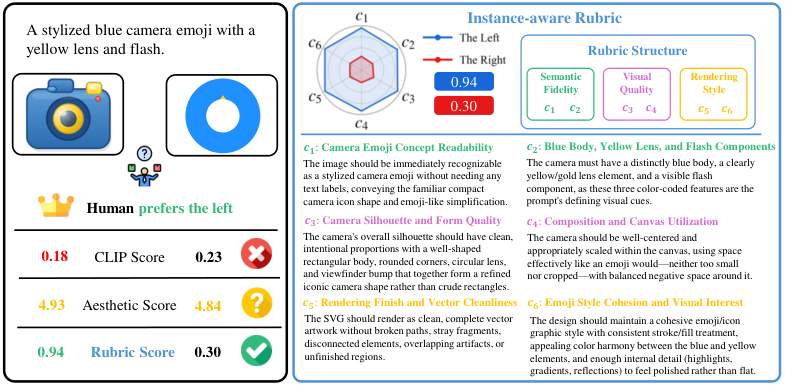
The teaser figure makes the failure mode concrete: CLIP and Aesthetic assign competitive scores to a visibly broken rendering, while a multi-axis rubric aligns with human ranking.
Method
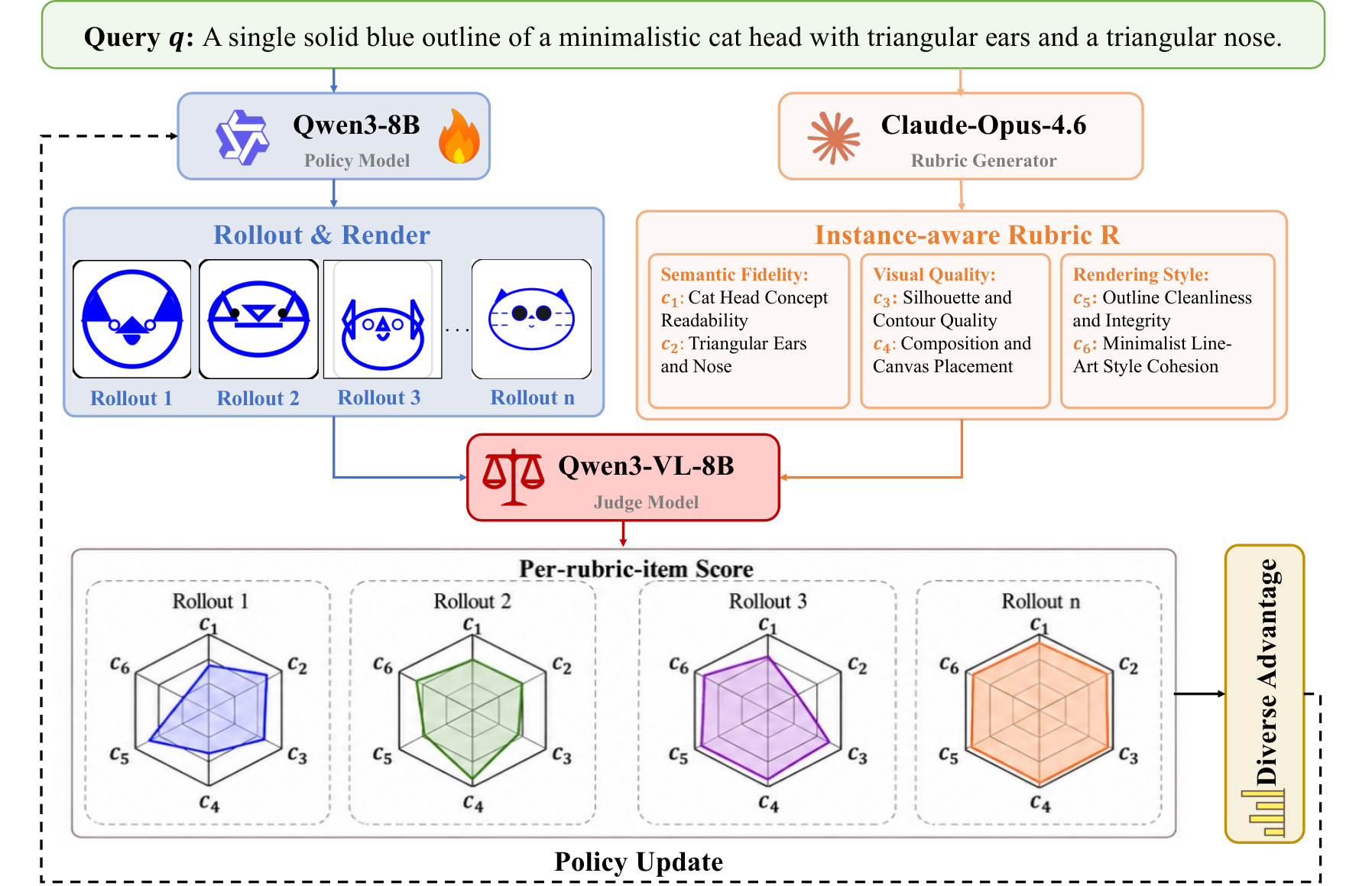
RULER frames SVG generation as a token-level MDP with state s_t=(\mathcal{Q}, y_{<t}), action a_t=y_t\sim\pi_\theta(\cdot\mid s_t), and deterministic transitions. The reward is applied only at termination on the rendered image. The novelty is entirely in how \mathcal{R}(\cdot) is constructed.
Instance-aware rubric construction. For each instruction, a frontier LLM emits a six-item rubric spanning three axes—semantic (what the object is / attributes), visual (composition, color, structural correctness), and stylistic (adherence to requested style). Each item r_i carries a natural-language criterion and a scalar weight w_i. Because the rubric is derived from text alone, no paired SVG ground truth and no human preferences are needed.
Judging and reward. A VLM judge scores each rendered rollout item-by-item, producing satisfactions s_i\in[0,1]. The scalar reward is R(\mathcal{Y}) = \sum_{i=1}^{6} w_i\, s_i\!\left(\mathcal{E}(\mathcal{Y}), r_i\right).
Policy optimization. RULER uses GRPO: for each prompt, G rollouts \{\mathcal{Y}^{(g)}\} are sampled, each scored to R^{(g)}, and advantages are computed by group-standardization A^{(g)} = \frac{R^{(g)} - \mathrm{mean}(R)}{\mathrm{std}(R)}, so no value network is required. Since R decomposes over rubric items, gradient signals attribute credit across semantic/visual/stylistic dimensions rather than through a single opaque scalar.
Results
On MMSVG-Illustration and MMSVG-Icon, RULER achieves the best Rubric scores among all trained baselines: 0.693 on Illustration and 0.683 on Icon. It matches or exceeds much larger frontier LLMs (DeepSeek-V3: 0.686 / 0.673; Qwen3-32B: 0.651 / 0.681) despite operating at a specialist scale. Against SVG specialists at similar size, the gap is large: OmniSVG-8B scores 0.288 / 0.565 and JanusCoder-8B scores 0.390 / 0.384 on the same benchmarks.
RULER is also token-efficient. Diffusion-optimized methods (VectorFusion 31.4k tokens, SVGDreamer 124.3k) produce SVGs an order of magnitude larger than RULER’s 2.0k (Illustration) and 0.7k (Icon), while RULER attains higher Rubric scores (VectorFusion: 0.611 / 0.510). Aesthetic scores also favor RULER (4.859 / 4.873) over all specialists and diffusion baselines except SVGDreamer’s 5.119 on Illustration, which comes at a $$60× token cost.
Interestingly, CLIP and HPS numbers for RULER (0.249 CLIP on Illustration, 0.246 HPS) are competitive but not the best—Diffusion-optimized methods dominate CLIP (0.313), consistent with the paper’s argument that these metrics reward pixel-level natural-image similarity rather than SVG quality. This is precisely why the rubric is needed as the target signal.
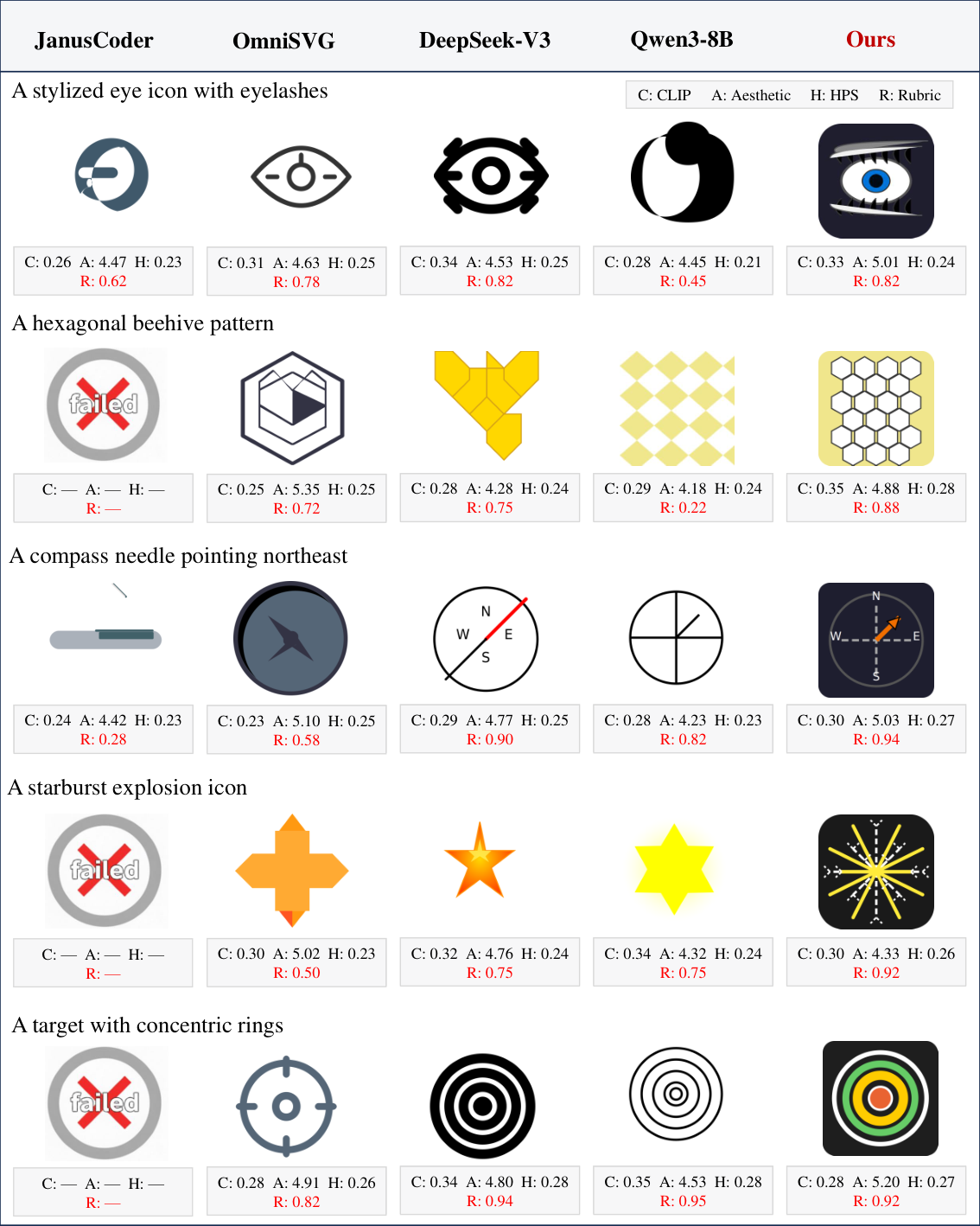
Qualitatively, RULER outputs show cleaner geometric primitives and better semantic coverage of prompt attributes than specialist and foundation baselines, matching the quantitative rubric gap.
Limitations and open questions
The framework inherits the judge VLM’s biases: any systematic blind spot in the VLM (e.g., under-scoring negative space, mis-reading occlusion) becomes a training-time bias amplified by GRPO. The rubric generator is a frontier LLM, so the pipeline has a strong teacher dependency—robustness to weaker rubric generators is claimed as RQ4 but the mechanism for degradation is not detailed in the excerpt. Six items with scalar weights is a coarse decomposition; complex illustrations may need hierarchical or compositional rubrics. Finally, reward hacking is not eliminated, only relocated: policies can exploit judge idiosyncrasies at the item level, and item weights are heuristic. The evaluation also uses rubric-based scoring as both the training reward and the primary metric, which risks tautology; the CLIP/HPS/Aesthetic columns partially mitigate this but do not fully separate optimization target from evaluation.
Why this matters
For open-ended generative tasks without ground truth, a well-structured, per-instance rubric evaluated by a VLM is a more faithful reward than any scalar similarity metric, and it is compatible with off-the-shelf RL machinery like GRPO. This suggests a general recipe—text-derived rubrics as dense, interpretable reward decompositions—for domains ranging from UI code generation to scientific figure synthesis where paired supervision is unattainable.
Source: https://arxiv.org/abs/2609.25270
GAE: Learning a Geometry-Native Latent Space for 3D-Consistent World Generation
Problem
Video and multi-view generators produce photorealistic frames but rarely commit to a single, consistent 3D scene: geometry drifts across views, cameras are approximated, and depth is a post-hoc output. The authors argue this is not just a modeling deficit but a representation one. Pixel VAEs (SD-VAE, WAN2.1 VAE) encode appearance and discard cross-view structure; semantic autoencoders (RAEV2 over DINOv3) capture identity but not metric geometry; and raw features from geometry foundation models (DA3) are hierarchical and too large to diffuse directly. The paper asks whether a compact latent that is natively decodable to depth, cameras, and point maps — while still supporting RGB — yields better 3D-consistent generation under matched training.

Method
GAE is a two-stage system built around a frozen Depth-Anything-3 (DA3) backbone. Stage 1 trains a codec \mathcal{A}_\phi=(\mathrm{Enc}_\phi,\mathrm{Dec}_\phi) that squeezes DA3’s four-level feature hierarchy into a single spatial latent \mathbf{z}; Stage 2 trains a conditional flow-matching model in the standardized latent space \bar{\mathbf{z}}.
The forward pipeline is
\mathbf{I}_{1:V}\xrightarrow{\mathcal{E},\mathcal{P}}\mathbf{X}_{1:V}\xrightarrow{\mathrm{Enc}_\phi}\mathbf{z}_{1:V}\xrightarrow{\mathrm{Dec}_\phi}\hat{\mathbf{X}}_{1:V},
where \mathcal{E} is the frozen DA3 encoder and \mathcal{P} normalizes and fuses its four levels. The decoder \mathrm{Dec}_\phi rebuilds the full DA3 hierarchy so that the frozen DA3 DPT head \mathcal{H}_\mathrm{DPT} can read depth, camera rays, and point maps without retraining. A separate learned head \mathcal{D}_\theta^\mathrm{rgb} decodes RGB from the same latent:
\hat{\mathbf{I}}_{1:V}=\mathcal{D}_\theta^\mathrm{rgb}(\hat{\mathbf{z}}_{1:V}),\quad \hat{\mathbf{G}}_{1:V}=\mathcal{H}_\mathrm{DPT}(\mathrm{Dec}_\phi(\hat{\mathbf{z}}_{1:V})).
Once the codec is frozen, its posterior mean is standardized channel-wise (via \mathrm{Std}) to give flow targets \bar{\mathbf{z}}^\mathrm{gt}_{1:V}. Stage 2 trains a single conditional flow \mathrm{Flow}_\psi(\cdot\mid\mathcal{C}) over only the generated-view latents, starting from \bar{\mathbf{z}}^{(1)}\sim\mathcal{N}(\mathbf{0},\mathbf{I}). Conditions \mathcal{C} include text, per-pixel camera rays (Plücker), and clean reference latents from encoded input views — these are held fixed as controls; only target-view tokens evolve as ODE states.
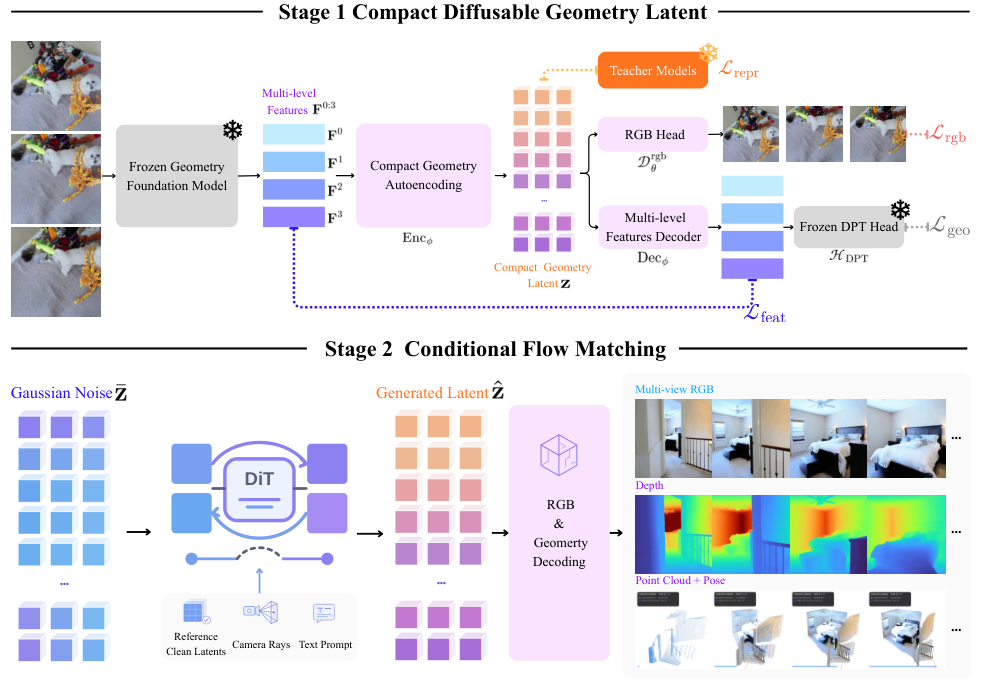
The design decisions matter. Modeling all four DA3 levels forces a cascaded generator; picking one level (e.g., L0 or L3) is single-scale but lossy for geometry readout and, per the authors’ Section 4.1 analysis, poorly conditioned for diffusion. GAE learns the intermediate state — one spatial latent that fuses all four levels but retains lossless geometry decoding through the frozen DPT. Two channel widths are studied, GAE-64 and GAE-128.
Results
The controlled comparison holds the flow architecture, camera conditioning, training budget, and 50-step Euler / CFG=2 sampling protocol fixed, varying only the latent. Baselines are SD-VAE, WAN2.1 VAE, RAEV2 (DINOv3-L), and raw DA3-GIANT layers L0 and L3. Evaluation is on 64 held-out scenes with 9 views at 252^2, one reference view.
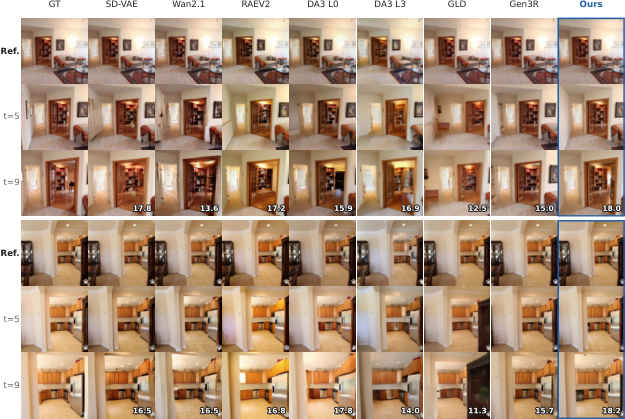
Swapping only the latent from a pixel/semantic/raw-feature codec to GAE improves both photometric quality and independently measured 3D coherence:
- FVD: −12.7% on RealEstate10K and −23.1% on DL3DV vs. matched baselines.
- Camera-trajectory error: halved on RealEstate10K (measured by running an off-the-shelf pose estimator on generated sequences and comparing to the conditioning trajectory).
Because the same latent decodes geometry through the frozen DA3 head, GAE additionally emits calibrated depth and point maps per generated frame, which the paper visualizes as consistent point clouds under camera-only control (Figure 1). This is not a separate depth model bolted on: the geometry readout uses the exact frozen DA3 DPT applied to the reconstructed feature hierarchy, so any latent produced by the flow is by construction interpretable to that head.
Limitations and open questions
The reported quantitative gains come from a controlled comparison at 252^2 with 9 views and short trajectories; the large-scale, higher-resolution model in Section 4.3.4 is shown only qualitatively and is not part of the ablation. Geometry fidelity is bounded by the frozen DA3 backbone — errors and biases in DA3’s depth/ray predictions propagate through. The codec’s reliance on rebuilding a specific hierarchy makes it backbone-specific; whether the same recipe transfers to other geometry foundation models (or benefits from joint fine-tuning of the geometry head) is untested. There is also no explicit multi-view geometric consistency loss during flow training — 3D coherence emerges from the latent’s structure and camera-ray conditioning rather than an enforced constraint, so long-horizon drift under aggressive trajectories remains an open question. Finally, the flow operates on standardized latents; how sensitive results are to the choice of \mathrm{Std} and to CFG scale is not exhaustively reported.
Why this matters
The result reframes 3D-consistent generation as a representation problem: replacing an appearance or semantic latent with a geometry-native one — while keeping the generator identical — halves camera error and cuts FVD by 12–23%. It suggests that generation and perception can share one state, and that “adding geometry” to video models is better done in the latent than as an auxiliary output.
Source: https://arxiv.org/abs/2609.24981
StableVQ: Practical Guidelines for Stable Vector-Quantized Tokenizer Training
Problem
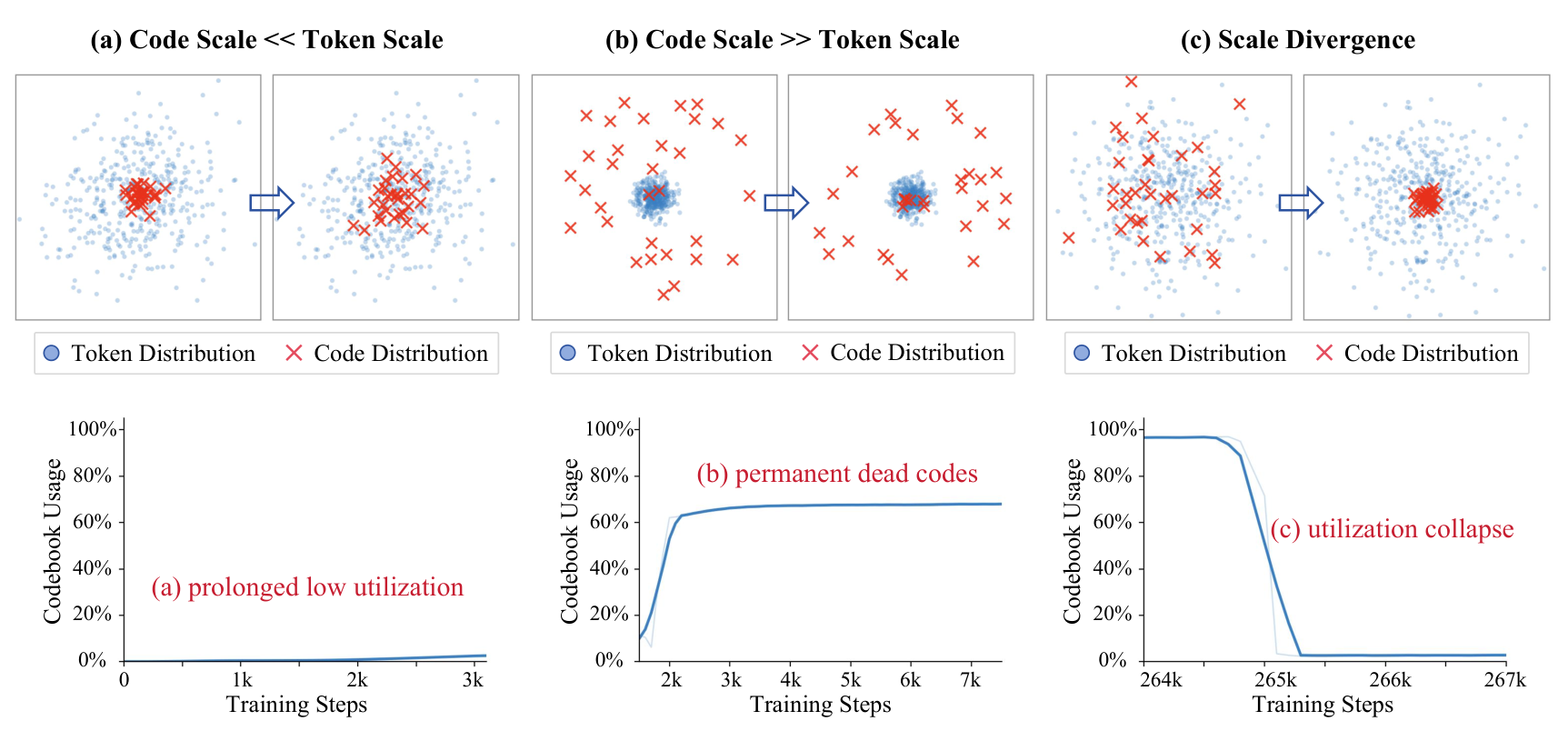
Vector-quantized tokenizers (VQGAN and descendants) underpin autoregressive and masked image generation, but their training is notoriously brittle. Recent shared-projection codebook variants (SimVQ, FVQ) fix codebook utilization by routing gradients through a shared linear map f_\theta acting on all codes, but they leave two failure modes intact. First, the gradient signal reaching inactive codes through f_\theta is diffuse and, once a small subset of codes suffices to minimize the VQ loss, effectively vanishes for the remainder. Second, these methods only touch the codebook side; the encoder’s own objective under a straight-through estimator (STE) can go unstable, and the two failure modes compound.
The authors frame the root cause as an entanglement problem: the encoder relies on the codebook being well-aligned to receive useful gradients, and the codebook relies on the encoder producing a stationary target distribution. When either falters, both collapse. StableVQ decouples the objectives so each module can carry out its role independently.
Method
StableVQ proposes two changes on top of a standard shared-projection tokenizer.
Dynamic STE (encoder side). With standard STE, \hat z = z_e + \mathrm{sg}(z_q - z_e), the encoder receives \partial \mathcal{L}_{\mathrm{rec}} / \partial z_q as if it were the gradient at z_e. This is a reasonable surrogate only when \|z_q - z_e\| is small. Early in training, or in regions of the encoder output distribution not yet covered by codes, this gap is large and the imputed gradient points in an unreliable direction, producing commitment-loss spikes and collapse. Dynamic STE weights each token’s STE contribution by a monotonically decreasing function of its quantization distance: farther-from-code tokens have their surrogate gradient suppressed. The right panel of the figure below shows that the standard STE trace exhibits sharp commitment-loss spikes leading to divergence, while Dynamic STE keeps the loss trajectory flat.
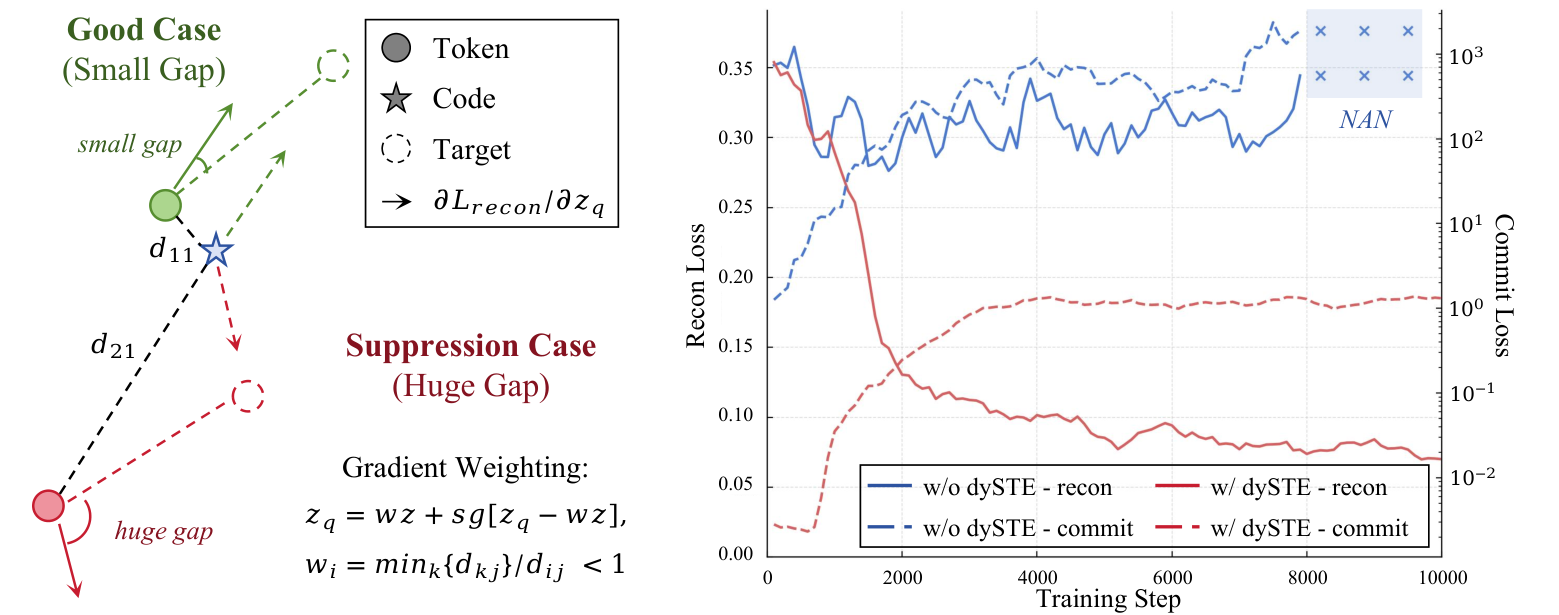
Concretely, the encoder gradient becomes \nabla_{z_e} \mathcal{L}_{\mathrm{rec}} \approx w(\|z_e - z_q\|)\,\nabla_{z_q}\mathcal{L}_{\mathrm{rec}}, with w(\cdot) decreasing in the quantization gap. This severs the encoder’s dependence on codebook quality: even when utilization is low, encoder updates from unreliable regions are attenuated rather than allowed to destabilize reconstruction.
Region VQ Loss (codebook side). In shared-projection methods, only selected codes are pulled toward their assigned encoder outputs; inactive codes drift by gradient leakage through f_\theta. Region VQ Loss instead propagates targets from active codes to their spatial neighbors in code space, weighted by the number of times each active code was selected. Formally, for each active code c_k with selection count n_k and target centroid \mu_k (mean of encoder outputs assigned to it), nearby inactive codes c_j receive a pull term of the form \mathcal{L}_{\mathrm{region}} = \sum_j \sum_{k \in \mathcal{N}(j)} \alpha(n_k, \|c_j - c_k\|)\,\|c_j - \mathrm{sg}(\mu_k)\|^2. Inactive codes thus track encoder output density directly and independently of whether the encoder happens to route to them. The t-SNE panels below show the codebook (red) converging to cover the encoder distribution (blue) over training with high utilization.
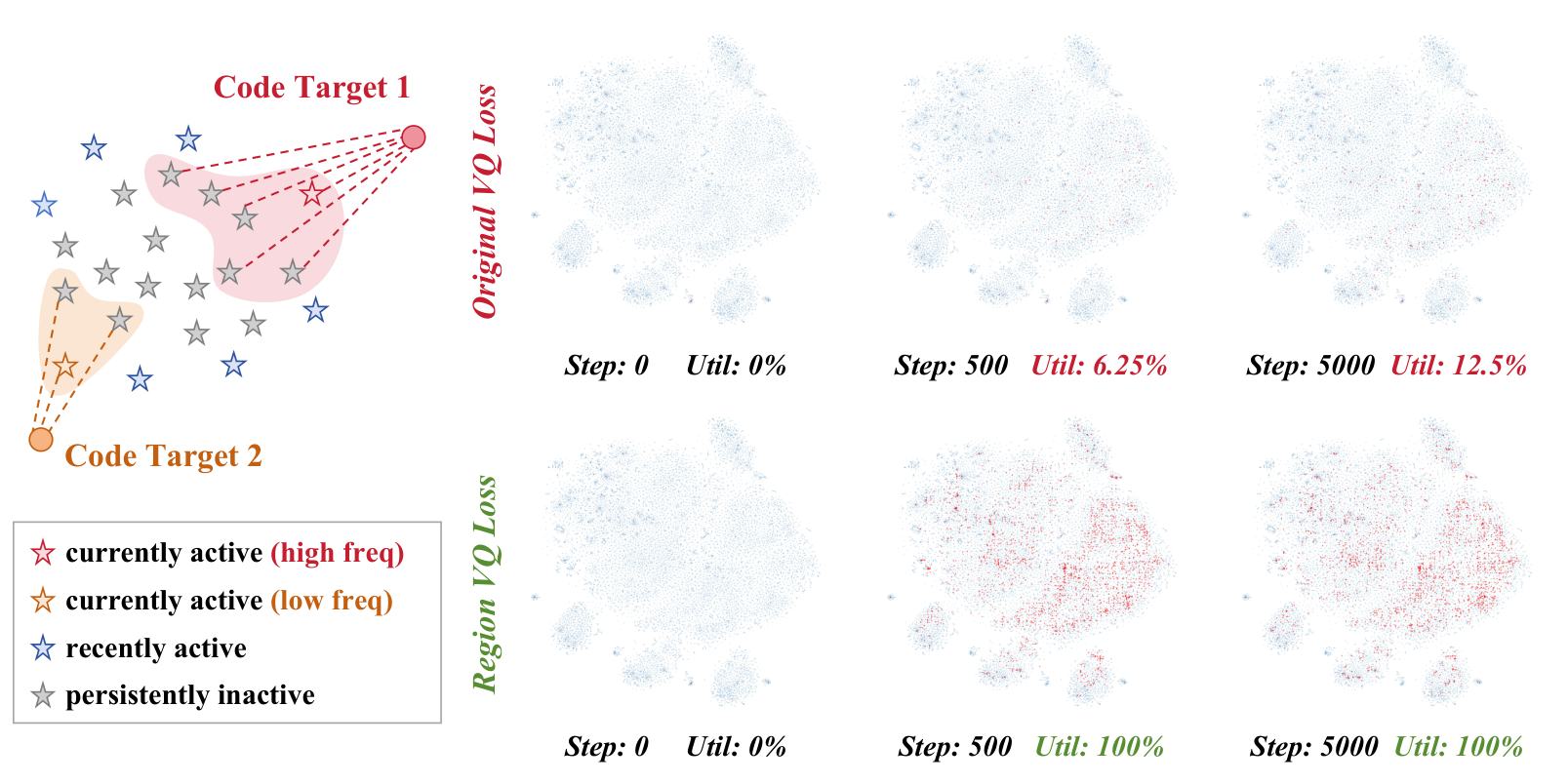
Together, the two mechanisms let each subsystem satisfy its own objective without co-dependence: the encoder optimizes reconstruction under discrete regularization even when the codebook is poor, and the codebook tracks the encoder distribution even when only a subset is being routed to.
Results
On ImageNet 256\times 256 with a VQGAN encoder–decoder at downsample factor f=16 (yielding 16\times 16 = 256 tokens/image), StableVQ is compared to SimVQ and FVQ under a re-implemented, on-the-fly reconstruction evaluation (rather than save-then-reload, which the authors argue produces optimistic numbers for baselines). The default StableVQ uses a single-layer linear shared projector — the simplest possible instantiation. Reported metrics are rFID, LPIPS, and codebook utilization on the ImageNet validation set. The paper’s framing is that both components are necessary: Dynamic STE alone prevents encoder collapse but leaves the codebook diffuse; Region VQ alone yields good coverage but does not stop encoder-side instability at large codebook sizes.
Limitations and open questions
The excerpts provided do not enumerate the specific rFID/LPIPS numbers or ablations, so the magnitude of the gain over SimVQ/FVQ under matched compute is not quantified here. Several questions remain: (i) the choice of neighborhood \mathcal{N}(j) and weighting \alpha in Region VQ likely interacts with codebook dimensionality; (ii) Dynamic STE’s weighting schedule needs to be tuned to the reconstruction loss scale; (iii) it is unclear whether the stability gains persist under adversarial fine-tuning stages typical of VQGAN pipelines, or when scaling to larger codebooks (e.g., 2^{16}) where the density argument becomes harder.
Why this matters
VQ tokenizer training has become the fragile foundation under a large tower of downstream generative modeling work; a principled decoupling of encoder-side and codebook-side objectives — rather than another codebook trick — is the kind of stability fix that removes an entire class of nondeterministic training failures. If the mechanisms transfer to larger codebooks and higher resolutions, they should be a near-drop-in for any pipeline currently relying on SimVQ or FVQ.
Source: https://arxiv.org/abs/2609.26774
Flash-dLLM: IO-Aware KV Caching and Parallel Decoding for Fast, Memory-Efficient Diffusion LLMs
Diffusion LLMs (dLLMs) generate text by iteratively denoising masked positions rather than left-to-right sampling. This breaks the causal structure that makes autoregressive KV caching trivial: at each denoising step t, the set of “active” query positions \mathcal{Q}^t = \mathcal{D}^t \cup \mathcal{M}^t_{\beta_m} — freshly decoded tokens plus a sliding window of still-masked tokens — changes, and the K/V rows for those positions must be rewritten. Existing accelerators (Fast-dLLM, Elastic-Cache) treat cache-refresh policy and parallel decoding as separate problems and implement everything in PyTorch, launching distinct kernels for QKV projection, RoPE, cache writes, and attention. Flash-dLLM argues that the real bottleneck under this regime is not FLOPs or refresh frequency but HBM traffic, and it co-designs a fused kernel with a KV-cache-native draft-and-verify scheme.
The IO problem in cached dLLM attention
Under sliding-window caching (following Elastic-Cache), the attention at layer l, step t is
\mathbf{A}^{t,l}_{[\mathcal{Q}^t]} = \mathrm{softmax}\!\left(\frac{\mathbf{Q}^{t,l}_{[\mathcal{Q}^t]}(\tilde{\mathbf{K}}^{t,l}_{[\mathcal{I}]})^\top}{\sqrt{d_k}}\right) \tilde{\mathbf{V}}^{t,l}_{[\mathcal{I}]},
with in-place updates \tilde{\mathbf{K}}^{t,l}_{[\mathcal{Q}^t]} = \mathbf{K}^{t,l}_{[\mathcal{Q}^t]} and analogously for V. The cache is exact on \mathcal{Q}^t and stale elsewhere. In a naive implementation, the newly projected \mathbf{K}^{t,l}_{[\mathcal{Q}^t]}, \mathbf{V}^{t,l}_{[\mathcal{Q}^t]} tensors are written to HBM after QKV projection and RoPE, then read back by the attention kernel; the full \tilde{\mathbf{K}}^{t,l}_{[\mathcal{I}]} is streamed through HBM at every layer at every step. Because |\mathcal{Q}^t| \ll |\mathcal{I}|, arithmetic intensity per byte moved is very low and the operation is memory-bound.
Method: Flash-Cache and Flash-Verify
Flash-dLLM has two components.
Flash-Cache is a Triton kernel that fuses QKV projection, RoPE, the scatter-write into \tilde{\mathbf{K}}, \tilde{\mathbf{V}}, and the attention over [\mathcal{Q}^t] queries against the full [\mathcal{I}] cache into a single kernel launch. The updated K/V rows are kept in registers/SRAM and consumed directly by the attention epilogue; only the final attention output and the persistent cache slots for \mathcal{Q}^t ever touch HBM. This removes the intermediate write-then-read of \mathbf{K}^{t,l}_{[\mathcal{Q}^t]}, \mathbf{V}^{t,l}_{[\mathcal{Q}^t]} and collapses per-layer kernel launch overhead.
Flash-Verify is a draft-and-verify parallel decoding scheme that reuses the same model as both drafter and verifier — no auxiliary small model, unlike autoregressive speculative decoding. At each iteration, the dLLM produces token probabilities for all masked positions in the current block. Positions with confidence above the draft threshold \epsilon = 0.9 are speculatively committed. A follow-up verification pass then checks, using a verify threshold \gamma = 0.8 over a tracked budget of \beta_t = 80 tokens, whether the committed drafts remain consistent under the updated cache; inconsistent tokens are rolled back to masked. Because the same KV cache serves both drafting and verification, there is no separate model to load or synchronize, and the extra cost of verification is a single forward with the same fused kernel. Default block size is \beta = 16 and sliding mask window \beta_m = 64.
Results
Evaluation is on LLaDA-1.5 on GSM8K (default), MATH, HumanEval, and MBPP, single A100-80GB, generation length 512, versus No-Cache, Fast-dLLM, and Elastic-Cache under matched settings. Three Flash-dLLM configurations are reported: greedy (Flash-Cache only), confidence-aware (Flash-Cache + confidence decoding), and Flash-Verify (Flash-Cache + draft-and-verify).
The scalability picture is the clearest signal. On GSM8K-512 (1-shot), Flash-dLLM’s throughput scales roughly linearly in batch size up to 32, while Fast-dLLM OOMs at batch size 24 on the same 80GB A100. Peak memory is lower than every baseline across every batch size tested. The comparison against a Llama3-8B autoregressive reference at matched batch demonstrates that the fused-kernel dLLM path is no longer memory-disadvantaged relative to a standard AR baseline. Because Flash-Cache does not alter the mathematical form of Eq. (1) — it only fuses the schedule — generation quality on GSM8K/MATH/HumanEval/MBPP is preserved relative to Elastic-Cache under greedy decoding; Flash-Verify introduces a rollback mechanism gated by \gamma specifically to bound quality drift under parallel commits.
Limitations and open questions
The reported results are on a single model family (LLaDA-1.5) on a single GPU class (A100). The kernel is Triton 2.0-specific and would need re-tuning for H100/MI300 memory hierarchies where FlashAttention-3-style warp-specialization dominates. Flash-Verify’s quality depends on the joint calibration of (\epsilon, \gamma, \beta_t); the paper uses fixed values, and no adaptive schedule is presented. The interaction between adaptive refresh (as in Elastic-Cache) and the fused kernel is not fully explored — Flash-Cache appears to inherit Elastic-Cache’s sliding-window policy rather than making refresh itself IO-aware. Finally, the framework is training-free, but no results are shown for dLLMs beyond the LLaDA family, so it is unclear whether the same fusion pattern helps models with different masking schedules (e.g., score-entropy-based dLLMs).
Why this matters
Diffusion LLM inference has been persistently uncompetitive with autoregressive baselines despite algorithmic parallelism, and this paper diagnoses the reason as HBM traffic in the cache-update path rather than any fundamental cost of denoising. A fused Triton kernel plus a self-drafting verifier is a straightforward recipe that closes much of the gap on A100, suggesting dLLM deployment viability is currently a systems problem, not a modeling one.
Source: https://arxiv.org/abs/2609.26796
RoboFollow: Unveiling the Instruction Following Mirage in Embodied Agents
Problem
Reported success rates on embodied manipulation benchmarks (LIBERO variants, etc.) suggest modern VLA and world-action models (WAMs) follow natural-language instructions reliably. The authors argue this is largely an artifact of low scene entropy in training data: if a visual configuration admits only one plausible task, a policy can ignore the instruction and still succeed. The benchmark is designed to force language use by construction, then diagnose whether policies actually condition on it.
Method
The core design principle is quantitative. Let T be a training task label and S a task-independent scene specification (objects, placements, observable predicates, excluding the instruction and goal). Scene entropy is
H_{\mathrm{scene}} = -\sum_s p(s) \sum_t p(t\mid s)\log_2 p(t\mid s).
With equal demonstrations per task this reduces to H_{\mathrm{scene}} = \sum_s (K_s/K)\log_2 K_s, where K_s is the number of task labels sharing scene s. RoboFollow uses K_s = (16,16,16,16,7,4), K=75, giving 3.782 bits versus 0.880 bits for equally weighted LIBERO Spatial/Object/Goal/Long under the same task-label definition. Each scene therefore admits multiple kinematically distinct branches under identical or near-identical visuals, so the initial observation is genuinely insufficient to infer the target.
The benchmark contains four diagnostic scene families covering extrinsic spatial relations, intrinsic object properties (color, shape, size), action/trajectory constraints, and elementary logic grounding. Each is evaluated at four levels:
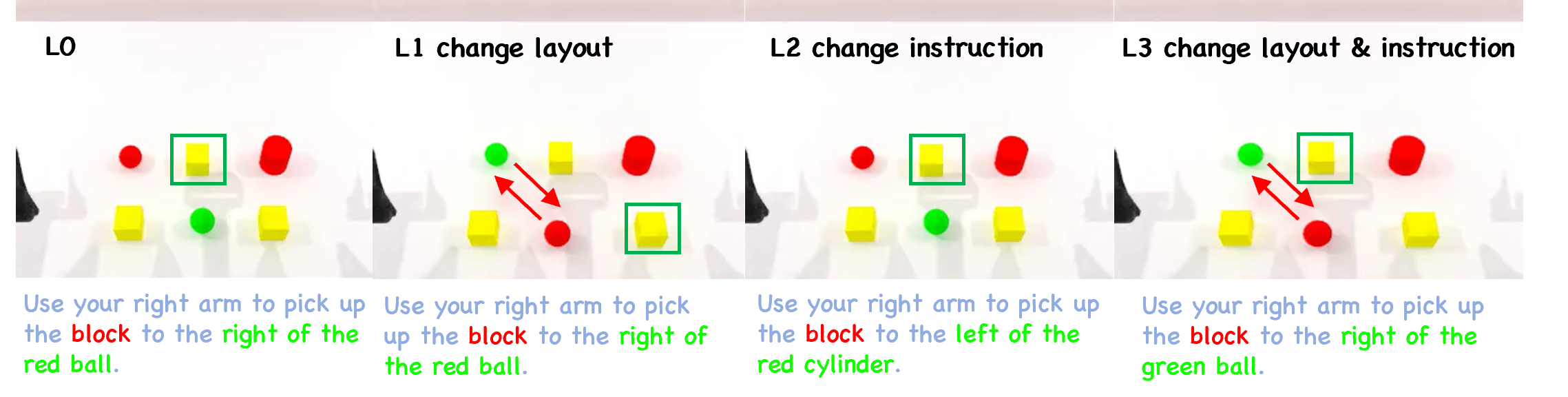
- L0 (In-Distribution) — standard split matching training.
- L1 (Visual Grounding) — instruction fixed, object positions swapped; tests binding to entities rather than coordinates.
- L2 (Semantic Compositionality) — layout fixed, instruction uses novel attribute recombinations from seen atoms.
- L3 (Visual-Semantic Mixture) — both perturbed jointly.
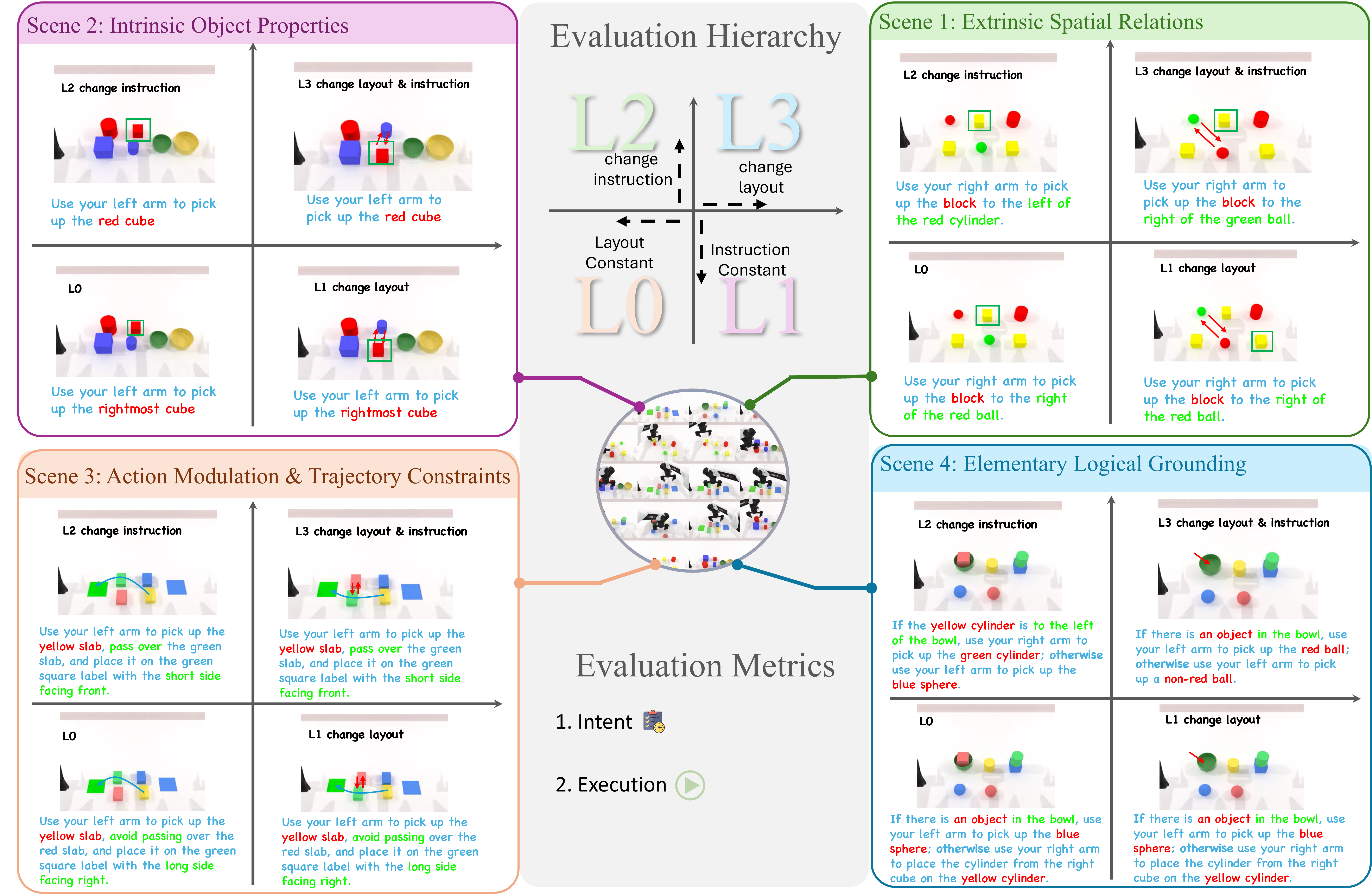
Evaluation is confound-controlled: interaction objects are simplified, action repertoire is restricted to what was demonstrated (so failures cannot be blamed on unseen motor skills), and scoring is decomposed into stage-wise Intent (did the policy try to do the right task?) and Execution (given correct intent, did the motion succeed?) scores. This isolates comprehension from motor competence — an important control that is often absent in success-rate-only reporting.
Nine state-of-the-art foundation policies are evaluated: seven VLAs — \pi_0, \pi_{0.5}, GR00T N1.6, openvla-oft, xvla, ACoT-VLA, Lingbot-VLA — and two WAMs — Motus and FAST-WAM. Total training data is 3,750 episodes across the four scenes; the deeper analysis uses 16 tasks (800 episodes) from Scene 2 only.
Results
The headline finding is that strong L0 numbers do not transfer to L1–L3: policies that appear competent in-distribution degrade severely once visual layout or instruction wording is perturbed, indicating they use the instruction as a shallow scene identifier rather than a compositional specification.
The Scene-2 diagnostic isolates where the failure lives.
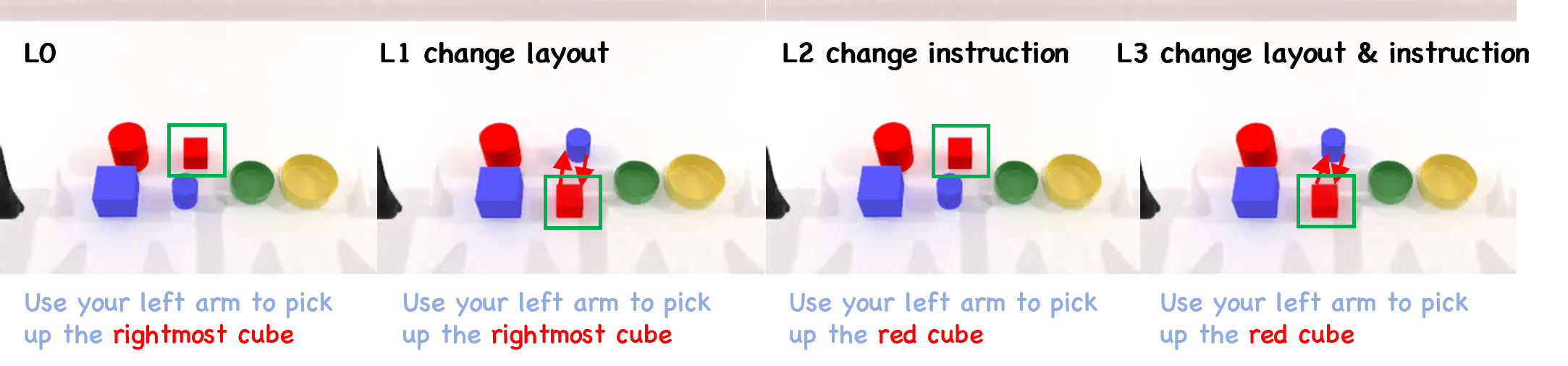
The authors construct a 20-question visual QA probe over Scene 2 covering object identity, color, and spatial relations, and evaluate the raw PaliGemma backbone, pre-trained \pi_{0.5}, and fine-tuned \pi_{0.5}. Scores are 1/20, 2/20, and 3/20 respectively — the VLM component simply does not understand the scene, and fine-tuning on manipulation data barely improves it. More strikingly, even on the QA items the fine-tuned VLM answers correctly, roughly half of the corresponding manipulation episodes still fail. The same pattern holds for Motus, whose VLM backbone is fully frozen: correct visual comprehension does not propagate to correct action.
This yields a two-layered failure structure: (i) the VLM backbone lacks scene understanding to begin with, and (ii) the action head fails to faithfully translate whatever semantics are comprehended. Reported success rates absorb both failures behind a benchmark where either can be bypassed via visual shortcuts.
Limitations and open questions
RoboFollow is deliberately narrow: simplified objects, restricted actions, and only four scene families. The high scene entropy is engineered rather than naturally occurring, so it is unclear how much of the gap reflects data curation (which future training sets could fix) versus architectural limits of current VLA/WAM stacks. The paper reports that scaling to stronger VLM backbones and QA co-training are candidate remedies, but the excerpt does not commit to a quantitative resolution — an open question is whether any current mitigation closes the comprehension-execution gap, or whether faithful semantic-to-action grounding requires a different training objective (e.g., explicit intent supervision, counterfactual instruction augmentation) rather than more capacity.
Why this matters
If the entropy gap between RoboFollow (3.782 bits) and LIBERO (0.880 bits) is representative, most current embodied-agent success rates conflate visual shortcut-taking with instruction following, and the field lacks calibrated signal on language grounding. The Intent/Execution decomposition and the L0–L3 protocol give a concrete instrument for measuring the comprehension-execution gap that has previously been invisible.
Source: https://arxiv.org/abs/2609.25636
Agensh: Scaling Organizational Intelligence to 1,024 Agents
Problem
Multi-agent LLM harnesses today are bottlenecked by a central orchestrator that assigns sub-tasks and reconciles worker output. As the number of workers grows, the orchestrator’s context window, decision latency, and single-point coordination cost dominate, capping useful parallelism at tens of agents. The question this paper asks is whether removing the orchestrator entirely — replacing it with a shared workspace and a cooperation protocol — lets agent count itself become a scaling axis analogous to parameters or inference compute, especially for long-horizon software engineering tasks where the search space is large but verifiable.
Method
Agensh is a decentralized harness. Every worker runs the same five-step asynchronous loop concurrently:
- Gather context — read the user goal, shared workspace state, peer messages, and accumulated findings; probe the environment.
- Claim sub-task — post a
CLAIMrecord scoping the intended work into the shared context. Overlapping claims are resolved worker-to-worker over the message interface, not by an arbiter. - Take action — execute tools locally, streaming intermediate findings back into shared context so peers can reuse them.
- Verify results — check local output against the sub-task’s self-declared acceptance criteria; iterate until satisfied.
- Merge progress — commit into the shared workspace, publish a change summary plus verification evidence, and on merge conflict pull peer updates, resolve, and retry.
The supporting infrastructure has three components: a shared workspace holding proposed/ongoing/completed artifacts (effectively a VCS-like substrate that admits concurrent merges), a message interface for direct worker-to-worker communication, and a shared context log that persists reusable findings and declared intentions. There is no global scheduler; sub-task discovery, allocation, and conflict resolution are all emergent from the loop plus the three shared surfaces. This is essentially an optimistic-concurrency model: workers stake claims, do work speculatively, and reconcile at merge time — the same pattern that lets distributed VCS scale to large developer populations.
The key mechanical consequence is that the coordination cost per worker is bounded by what that worker chooses to read from shared context, not by an orchestrator’s context budget. This is what makes 1,024 concurrent agents plausible at all.
Results
The evaluation uses ProgramBench’s five hardest tasks — FFmpeg, gromacs, pandoc, PHP-src, ctags — where agents must reproduce the reference system’s behavior from scratch in 6h with no internet. Reference repos range from ~104K LoC (pandoc) to ~2.8M LoC (PHP-src). The backbone model is GPT-5.6-sol (high) with Copilot as the underlying single-agent harness; only agent count varies.
Mean final test-pass rate across the five tasks:
- 1 agent: 19.31%
- 8 agents: 20.68%
- 32 agents: 26.52%
- 128 agents: 28.78%
Scaling 1→128 gives +9.47 pp absolute, ~49% relative. The curve is monotone increasing across the range, with the largest jump between 8 and 32 agents, suggesting a threshold below which self-organization overhead dominates gains.
Latency also improves with scale. On pandoc, 128 agents cross the 30% test-pass threshold at the 30-minute checkpoint; 32 agents reach it at 60 min, 8 agents at 90 min, and 1 agent never reaches it inside the first 2h. So more workers both raise the ceiling and compress time-to-quality — the two effects one would want from a genuine scaling axis.
The pandoc-only extension to 1,024 agents pushes final test-pass rate from 33.89% (1 agent) to 50.94% (128) to 55.06% (1,024). Between 128 and 1,024 — an 8× compute increase — the gain is only 4.12 pp, versus 17.05 pp between 1 and 128. The curve is bending: returns to agent count are sublinear and appear to flatten by roughly 10³ workers under this configuration.
Limitations and open questions
Several things are unresolved. First, the diminishing return from 128→1,024 is not analyzed: is it duplicated work, merge contention, shared context saturating individual workers’ input budgets, or genuine task-inherent limits? The paper does not report token cost, wall-clock cost per unit gain, or the fraction of merges that conflict. Second, the 1,024-agent result is shown only on pandoc, the smallest of the five repos (~104K LoC); whether the scaling extends to PHP-src (~2.8M LoC) where the search space is much larger is unknown. Third, the acceptance-criteria mechanism in step 4 is worker-declared — there is no independent verifier, so a worker can merge locally-verified but globally-wrong contributions. Fourth, “self-organization” is protocol-level; the actual emergent division of labor, redundancy rate, and communication topology among 1,024 agents is not characterized. Finally, comparisons against orchestrator-based harnesses at matched compute are missing, so the isolated value of decentralization versus simply “more agents” cannot be separated.
Why this matters
If agent count is a genuine third scaling axis alongside model size and per-agent inference compute, and if decentralized harnesses are what unlock it, then long-horizon software tasks become a compute-parallel problem rather than a serial reasoning problem. The 1→128 curve here is the first convincing evidence that self-organized multi-agent cooperation scales past the low tens, though the 128→1,024 flattening suggests the interesting engineering work is now in reducing coordination redundancy at the top of the curve.
Source: https://arxiv.org/abs/2609.26781
Hacker News Signals
Writing Rust code that’s fast by asking agents to make the code faster
Source: https://minimaxir.com/2026/09/agentic-iteration/
A practical walkthrough of using LLM agents in an iterative loop to optimize Rust code for performance, rather than correctness. The author sets up a feedback cycle: generate Rust, benchmark with criterion, feed timing results and flamegraph data back to the agent, and iterate. The key insight is that agents perform better when given concrete measurement artifacts rather than vague instructions to “make it faster” — structured benchmark output (ns/iter, throughput numbers) gives the model actionable signal.
Technically interesting details: the author finds that agents tend to reach for obvious wins first (removing unnecessary allocations, switching Vec to stack arrays, replacing HashMap with BTreeMap or fixed-size arrays for small key spaces), then plateau. Breaking the plateau requires manually steering the agent toward specific hotspots identified in profiles, which suggests the agentic loop is not fully autonomous — it still needs a human to interpret higher-level optimization strategy.
The post also notes that agents occasionally introduce incorrect optimizations that pass a superficial correctness check but break edge cases, underscoring that generated micro-optimizations need property-based or exhaustive testing, not just a “does it compile and run” check. Using proptest alongside benchmarks is recommended.
The broader methodological point: agentic iteration is most effective when the task has a cheap, unambiguous scalar objective (wall-clock time) and a fast feedback loop. Rust’s compilation latency adds friction — compile times of several seconds per iteration accumulate quickly over 20-30 agent steps. The author suggests caching intermediate artifacts and using cargo check as a pre-filter before full builds.
Not a silver bullet: the agent-optimized code is harder to read, and the gains beyond the first few iterations become marginal. This is a useful pattern for squeezing out the last 20-30% of performance on already-correct code, not a replacement for algorithmic design.
Claude Opus 5.5
Source: https://www.anthropic.com/claude-opus-5-5
Anthropic’s release of Claude Opus 5.5, positioned as their highest-capability model at launch date. The model is described as an extended-thinking / hybrid reasoning model, meaning it can allocate variable compute at inference time via a chain-of-thought scratchpad before producing its final response — analogous to OpenAI’s o-series architecture in broad strokes.
Key technical claims: improved performance on multi-step agentic tasks, stronger instruction following in long-context settings (context window reportedly 200K tokens), and better calibration on tool-use benchmarks. Anthropic emphasizes improvements on SWE-bench Verified and internal agentic evals. The model is positioned for coding, complex reasoning, and multi-tool orchestration workflows.
The pricing and latency tradeoffs are non-trivial: extended thinking adds latency and cost relative to Opus 4. The model operates in two modes — standard (no thinking budget) and extended (explicit thinking token budget set by the API caller). This gives developers explicit control over the compute-accuracy tradeoff, which is architecturally cleaner than implicit sampling strategies.
Notably, Anthropic highlights improvements in “following nuanced instructions without over-refusal,” which in practice means the model is less likely to refuse borderline-legitimate professional queries. This is a policy tuning signal as much as a capability one.
From an API perspective, the model supports the same Messages API surface as previous Claude versions, with the thinking parameter enabling the scratchpad mode. Tool use, vision, and document understanding are all supported. No architectural details about parameter count or training data are disclosed.
GPT-6 Sol and Luna
Source: https://openai.com/index/introducing-gpt-6-sol-and-luna/
OpenAI announces GPT-6 as a two-variant release: Sol (optimized for speed and cost, analogous to a “mini” tier) and Luna (full-capability flagship). The naming convention breaks from prior o-series / GPT-4o lineage and suggests a deliberate product segmentation strategy — Sol targets high-throughput API use cases, Luna targets complex reasoning tasks.
Technical details disclosed are sparse in typical OpenAI fashion, but the announcement mentions multimodal-native architecture (not post-hoc vision bolted on), significantly expanded context windows, and native tool-use capabilities including code execution and web retrieval integrated at the model level rather than via external scaffolding. Both variants are described as having improved instruction hierarchy handling, meaning system-prompt vs. user-prompt vs. tool-output precedence is more reliably respected.
The reasoning improvements cited point to an internal benchmark suite rather than third-party evals, which limits independent verification at announcement time. However, given the Enigma cryptanalysis result attributed to GPT-6 Astra (a separate item below), the capability delta from GPT-4o appears substantial in at least some domains.
From a deployment standpoint, Sol’s latency and pricing are positioned to compete with Claude Haiku / Gemini Flash tier models while retaining more capability. Luna is the premium offering. Both are available via the standard Chat Completions and Responses APIs, with function calling, structured outputs, and streaming supported.
The release continues the industry trend toward mixture-of-inference-regime models where the same underlying system can operate in fast-draft or extended-reasoning modes depending on task demands.
Claude Opus 5.5 Intelligence, Performance and Price Analysis (Max)
Source: https://artificialanalysis.ai/models/claude-opus-5-5
Artificial Analysis runs standardized benchmarks across frontier models and publishes latency, throughput, and quality metrics. Their Claude Opus 5.5 analysis provides third-party quantitative grounding for Anthropic’s claims.
Key measured numbers: output throughput in the range of 60-80 tokens/second for standard mode (varies by load), with extended thinking mode substantially slower due to the additional scratchpad tokens that must be generated and processed. Time-to-first-token is reported in the 2-5 second range for standard queries, higher for thinking-enabled calls.
On quality benchmarks, Opus 5.5 scores competitively with GPT-6 Luna on MMLU, GPQA, and coding benchmarks (HumanEval / SWE-bench), with the specific numbers putting it within a few percentage points depending on task. The analysis notes that extended thinking mode yields meaningful gains on multi-step math and coding relative to standard mode, at roughly 2-3x latency cost.
Pricing analysis: Opus 5.5 is positioned at a premium over Opus 4, with thinking tokens billed separately at a higher per-token rate than output tokens — a pricing model that directly couples cost to inference compute expenditure. The analysis calculates that for typical agentic workflows with moderate thinking budgets, cost per task roughly doubles compared to a non-thinking model of similar base quality.
The practical implication for API users: Opus 5.5 in standard mode is a strong choice for latency-sensitive pipelines; extended thinking mode is cost-justified for tasks where accuracy on hard reasoning steps is the bottleneck. The analysis provides a Pareto frontier visualization plotting quality vs. cost that places Opus 5.5 standard mode as competitive but not dominant on cost-efficiency.
The current balance of power in open models
Source: https://www.interconnects.ai/p/the-current-balance-of-power-in-open
Nathan Lambert’s analysis of where the open-weight model ecosystem stands relative to frontier closed models. The piece maps the competitive landscape across capability tiers and identifies structural factors shaping which organizations can realistically compete.
The central technical argument: the gap between open-weight and closed frontier models on hard reasoning benchmarks (GPQA Diamond, competition math, agentic coding) has narrowed on average tasks but remains significant on the upper tail of difficulty. Models like Llama 3.x, Qwen 2.5, Mistral Large, and DeepSeek V3 are genuinely competitive on standard evals but fall behind on the hardest instances of reasoning tasks — the ones that require sustained multi-step planning over long contexts.
Lambert points to compute access as the primary bottleneck, not algorithmic innovation. Open labs have demonstrated they can replicate architectural ideas (MoE, extended context, RLHF/DPO pipelines) but cannot match the training run scale of frontier closed labs. The analysis estimates that top closed models are trained on compute budgets 5-20x larger than the largest disclosed open runs.
Post-training is identified as a second structural gap: proprietary RLHF data, human preference annotation pipelines, and iterative red-teaming are difficult to replicate openly. Open models have benefited from synthetic data and distillation from closed models (which raises dataset contamination questions), but this dependency limits independent capability development.
The piece also addresses governance: open weights create deployment flexibility but shift safety responsibility to deployers, which remains an unresolved coordination problem. The analysis is measured — neither dismissive of open models nor overstating their parity with closed frontier systems.
OpenAI GPT-6 Astra breaks Enigma message that has resisted solution since 2005
Source: https://www.cryptocellar.org/bgac/the-mvueh-break.html
This is a concrete cryptanalytic result, not a benchmark. The MVUEH message is a World War II Enigma ciphertext from the German Navy that has resisted decryption since it was posted as a challenge in 2005. The post details how GPT-6 Astra (a reasoning-heavy variant) contributed to breaking it.
The technical substance: Enigma decryption at this level is not a brute-force problem — the naval 4-rotor Enigma with unknown settings has a key space too large for exhaustive search without cribs (known-plaintext fragments) or statistical indicators. The attack reported here appears to use a combination of index of coincidence analysis, bigram/trigram frequency scoring against expected German naval message statistics, and iterative hypothesis refinement — all standard crib-dragging and bombe-analog techniques. What GPT-6 Astra apparently contributed was the reasoning to correctly identify and apply contextual cribs from historical records and to navigate the combinatorial hypothesis space more efficiently than prior manual attempts.
The result is that the message wheel settings and plugboard configuration were recovered, yielding a German plaintext consistent with naval traffic conventions of the period. The decryption is verified by linguistic plausibility and conformance to known message formats.
This is notable less as a demonstration of raw cryptanalytic power — Enigma is a broken cipher with known attack methods — and more as evidence that frontier reasoning models can apply domain-specific historical and linguistic context to guide combinatorial search in ways that blocked human experts for two decades. The specific contribution of the model vs. tooling vs. human guidance is not fully decomposed in the writeup, which is a legitimate open question about how to attribute the result.
Jev in 25 Lines of Python
Source: https://www.nobodywho.ai/posts/jev-in-25-lines/
Jev (JSON Event Viewer / streaming JSON event format) implemented from scratch in minimal Python as a pedagogical exercise. The post demonstrates that a compact streaming structured-log consumer can be written without dependencies in under 30 lines by leaning on Python’s json module and generator-based line processing.
The technical core: Jev-formatted logs are newline-delimited JSON (NDJSON), where each line is a self-contained JSON object representing a discrete event with a timestamp, level, and message payload. The 25-line implementation opens a file or stdin, iterates lines, parses each with json.loads, and pretty-prints or filters based on field predicates passed as arguments.
What makes this interesting beyond the line count: the post uses it as a vehicle to explain why NDJSON is preferable to pretty-printed JSON for log streaming. Pretty-printed JSON requires buffering until a complete object is accumulated; NDJSON allows single-pass streaming with O(1) memory per event regardless of total log size. For high-throughput services emitting thousands of events per second, this distinction is operationally significant.
The implementation also demonstrates a clean pattern for building log filter DSLs: passing key=value pairs as CLI arguments, parsing them into a dict, and using all(event.get(k) == v for k, v in filters.items()) as a predicate. This is extensible to range filters and regex matching without structural changes.
The broader point is that many “observability tools” are over-engineered for the common case of reading structured logs from a single service during debugging. A 25-line script handles 90% of that use case. The post implicitly advocates for standardizing on NDJSON emission in application code so that trivial tooling remains effective.
Unreal Agent
Source: https://unreallabs.ai/blog/unreal-agent/
Unreal Labs presents an agent system for controlling and automating tasks within Unreal Engine 5, targeting technical artists, game developers, and pipeline engineers. The system exposes UE5’s editor functionality — level editing, asset manipulation, Blueprint scripting, material parameter adjustment — through a tool-use interface that an LLM agent can invoke.
The technical architecture: a local server exposes UE5 editor operations as structured function calls via a plugin. The agent receives a task description, queries available tools (which map to Unreal’s Python scripting API and editor subsystems), and executes multi-step plans. The plugin intercepts tool calls, executes them in the UE5 editor context, and returns structured results (asset paths, error strings, scene state diffs) back to the agent loop.
Key engineering challenges addressed: UE5’s Python API is extensive but not LLM-friendly — function signatures are verbose, many operations have side effects that are difficult to reverse, and the editor state is complex. The system includes a tool schema layer that wraps raw API calls with descriptions and parameter validation, reducing the agent’s error rate on malformed calls.
The post shows examples: batch renaming assets according to naming conventions, generating placeholder geometry for level blockout, adjusting lighting parameters across multiple actors matching a query. These are tasks that currently require repetitive manual editor interaction or custom Python scripting per use case.
Limitations are acknowledged: the agent cannot perceive the visual output of the editor (no screen-to-model feedback loop in the current version), so tasks requiring visual judgment (e.g., “does this look good?”) are out of scope. The system also lacks undo-awareness — the agent can trigger destructive operations that are difficult to roll back programmatically. Integration with UE5’s transaction system for reliable undo is noted as future work.
Noteworthy New Repositories
TokenRhythm/NeoHorse
NeoHorse-1 targets recursive self-improvement in LLM agents via agentic post-training combined with a routing harness. The core idea is that the model participates in generating its own training signal through structured agent loops: it proposes actions, evaluates outcomes, and routes those outcomes back into fine-tuning pipelines. The “routing harness” is the key architectural piece — it dispatches agent trajectories to different training strategies (e.g., supervised fine-tuning on successful rollouts, RLHF-style reward shaping on failures) depending on trajectory quality signals. This is closer in spirit to STaR/ReST-style bootstrapping than to pure RLHF, but adds explicit routing logic to avoid reward hacking on a single objective. The self-improvement loop is iterative: each generation of the model produces rollouts that seed the next round of post-training data. For practitioners building agentic systems on top of smaller open-weight models, this offers a structured alternative to purely prompt-engineering-based capability elicitation. The project is early-stage — the main value is the harness scaffolding rather than a fully trained artifact. Open questions include how to prevent distributional collapse over iterations and how routing decisions interact with catastrophic forgetting.
Source: https://github.com/TokenRhythm/NeoHorse
shadcn-ui/lint
This is an agent-first linter for Tailwind-based design systems, positioned as the enforcement layer between an LLM coding agent and a codebase’s visual consistency rules. Rather than purely static analysis, it allows teams to author design system rules in a format that both humans and agents (via tool-use) can query and verify. Technically, it sits on top of existing Tailwind class parsing and exposes a rule-definition API where you specify constraints — e.g., disallowed color combinations, required spacing scales, component composition invariants. Agents integrating with it via the tool interface can ask “does this diff violate design system rules?” before committing output. The architecture distinguishes it from tools like Stylelint: instead of only AST-level pattern matching, rules are expressed at a semantic layer that maps to the design token graph, making violations explainable in natural language rather than just regex mismatches. The 2,600+ star count on launch suggests strong appetite for this in teams already using shadcn/ui as a baseline component library. Limitations: it’s tightly coupled to Tailwind and the shadcn component vocabulary, so portability to arbitrary CSS-in-JS systems is nontrivial.
Source: https://github.com/shadcn-ui/lint
Continuum-AI-Corp/OrcaReplay
OrcaReplay is a record-and-replay debugger for AI agent runs, addressing a genuine pain point: agent execution is non-deterministic, stateful, and hard to reproduce for debugging. It captures full execution traces — tool calls, model inputs/outputs, memory state, environment observations — and serializes them to a replayable format. The “fork” feature is the most technically interesting: at any recorded step you can branch the execution, swap in a different model, alter an intermediate result, and re-run forward from that point. This enables counterfactual debugging (“what if the agent had used GPT-4o instead of Claude at turn 3?”) without re-running expensive upstream steps. Built by the OrcaRouter.ai team, it integrates naturally with multi-model routing scenarios. Internally it likely instruments the agent’s tool-call and LLM-call boundaries rather than the model itself, making it model-agnostic. The replay engine must handle non-determinism carefully — environment side effects (HTTP calls, file writes) need to be either mocked or replayed faithfully. At 261 stars it’s early, but the core abstraction is sound and fills a gap that neither LangSmith nor standard logging fully addresses.
Source: https://github.com/Continuum-AI-Corp/OrcaReplay
0xNatoshi/jev-codex-router
This router adds per-turn model and reasoning-mode selection on top of OpenAI Codex, driven by a type-safe decision layer called “Jev” (described as System One reasoning — fast, heuristic). On each conversational turn, Jev examines the prompt characteristics — complexity, ambiguity, token budget, latency requirements — and selects: which model to call, how much chain-of-thought to elicit (thinking depth), and whether to use a speed-optimized or quality-optimized inference path. The TypeSafe label refers to the implementation being in TypeScript with strict typing over the routing policy interface, making the decision logic auditable and testable rather than hidden in prompt strings. This is useful in Codex-based coding agents where not every turn needs full o1-level reasoning — routing trivial autocompletes to a cheaper/faster model while escalating multi-file refactoring tasks to a stronger one can cut costs substantially. The routing policy itself appears rule-based or lightweight-classifier-based rather than a learned router, keeping latency overhead minimal. Open question: how the router handles uncertainty in prompt classification without adding a full extra LLM call to decide.
Source: https://github.com/0xNatoshi/jev-codex-router
qingjian-team/qingjian
Qingjian (青简) is a Pinyin input method engine written in Rust, with an embedded vocabulary augmentation feature aimed at language learners: candidate word lists display not just the target Chinese character but also a translation in whichever foreign language the user is currently studying. The technical core is a Pinyin-to-character conversion pipeline with a language model or n-gram scoring backend for candidate ranking, implemented in Rust for low-latency keystroke response. The added translation overlay is fetched or pre-cached per lexicon entry and rendered inline in the candidate popup. For an input method this is a clever spaced-repetition integration — users encounter vocabulary in a natural production context rather than in isolated flashcard sessions. The Rust implementation targets both performance and cross-platform portability; IME development typically requires tight integration with OS text input APIs (IBUS on Linux, IMK on macOS, TSF on Windows), and handling all of these correctly in Rust is non-trivial. At 1,649 stars it has clearly resonated with Chinese-speaking developers who are also language learners.
Source: https://github.com/qingjian-team/qingjian
youngyangyang04/llm-master
A structured Chinese-language curriculum covering the full LLM practitioner stack, authored by the creator of the widely-used leetcode-master algorithm repository. The curriculum is organized into progressive tracks: Prompt Engineering, RAG pipeline construction, AI Agent design patterns, MCP (model context protocol), fine-tuning (LoRA/QLoRA focused), model deployment (vLLM, Triton, quantization), Transformer internals, AI-assisted programming workflows, and preparation for LLM-focused engineering interviews at major Chinese tech firms. The technical depth targets practitioners who want production-level understanding rather than API-surface familiarity. Notable: the MCP section and agent architecture coverage suggest it tracks recent tooling (post-2024 ecosystem) rather than relying on older material. At 928 stars with active commits, it fills a real gap — most English-language LLM tutorials stop at fine-tuning and skip deployment, whereas this explicitly covers the inference-serving and systems integration layer. Primarily useful for Mandarin readers; the interview prep section is China-market specific, but the technical content on RAG, deployment, and agent patterns is broadly applicable.
Source: https://github.com/youngyangyang04/llm-master
hkqr/my-free-code
An open-source API gateway designed to sit in front of Claude Code and similar coding agents, providing multi-provider routing, streaming normalization, tool-call passthrough, reasoning-mode support, automatic fallbacks, and local model proxying behind a unified OpenAI-compatible endpoint. The core value proposition: a single endpoint that presents a stable API surface while routing to Anthropic, OpenAI, Gemini, or local Ollama/LM Studio instances depending on availability, cost policy, or capability requirements. Technically it must handle the semantic differences between provider APIs — Claude’s tool-use schema differs from OpenAI’s function-calling schema — and normalize them for the downstream agent. Streaming support requires careful SSE handling across providers with different chunking behaviors. The fallback logic is particularly useful for Claude Code deployments where rate limits are frequent. At 640 stars it competes in a crowded space (LiteLLM, OpenRouter, custom proxies) but the explicit focus on coding-agent workflows and local model support as a first-class feature, rather than an afterthought, differentiates it.
Source: https://github.com/hkqr/my-free-code
kryvora-network/kryvora-node
Kryvora-node is the reference client daemon and verification worker for Kryvora Network, a distributed network with a cryptographic verification layer for node participation. The daemon handles peer discovery, block/state synchronization, and local state management; the verification worker runs the proof-checking logic that validates work submitted by other nodes. The architecture separates these concerns explicitly — the daemon manages networking and persistence while the worker handles compute-intensive cryptographic verification, allowing them to scale independently. For a “reference client” it establishes the canonical protocol behavior against which alternative implementations must conform. At 368 stars the project is small but technically substantive for those building on or auditing the network. Key open questions for a new contributor: what consensus mechanism underlies node agreement, what the verification worker is actually proving (ZK proofs, PoW, attested execution?), and whether the separation of daemon and worker is enforced at the process or thread level. The repository structure and documentation quality will determine whether this becomes a foundation others build on.