Daily AI Digest — 2026-09-18
arXiv Highlights
DeepSeek-V4.1-Flash: Pushing the Limits of KV Cache Compression
Problem
Agentic workloads increasingly resemble very long, mostly-input traces: tool-calling logs, repository contexts, and multimodal grounding all inflate prompt length while producing relatively few output tokens. Two costs dominate: (i) prefill compute, which scales roughly linearly in context length at fixed model size, and (ii) KV cache footprint in HBM (and spillover to SSD), which bounds achievable batch sizes and long-context throughput. DeepSeek-V4.1-Flash targets both simultaneously, aiming to make million-token contexts economically viable for agents rather than a benchmarking curiosity.
Architecture
The backbone is a 552B-parameter multimodal MoE with 196B additional Engram (sparse conditional memory) parameters. Per-token activation is asymmetric: 8B during prefill, 16B during decode. The asymmetry comes from a Causal Encoder–Decoder (CED) split: 20 causal encoder layers followed by 20 decoder layers, for 40 total. Every layer interleaves global attention with sliding-window attention (SWA), except the first two, which are SWA-only.
CED’s role is mechanical: the decoder’s global KV cache is constructed from encoder outputs, so most prompt tokens can bypass full decoder computation while decoder layers retain local SWA on the raw stream. This nearly halves prefill FLOPs — the dominant term for input-heavy agent traffic where cache hit rates on prefix segments are low.
On top of CED, the model introduces Compressed Sparse Attention 2 (CSA2), which combines two orthogonal savings:
- Cross-layer global-KV sharing. A single global KV tensor is reused across a group of decoder layers, amortizing storage across depth.
- Hierarchical Sparse Indexer. For each query, an early indexer selects a candidate pool; later indexers in the hierarchy score only within that pool, reducing the number of key entries evaluated per query and reusing the sparse selection across layers.
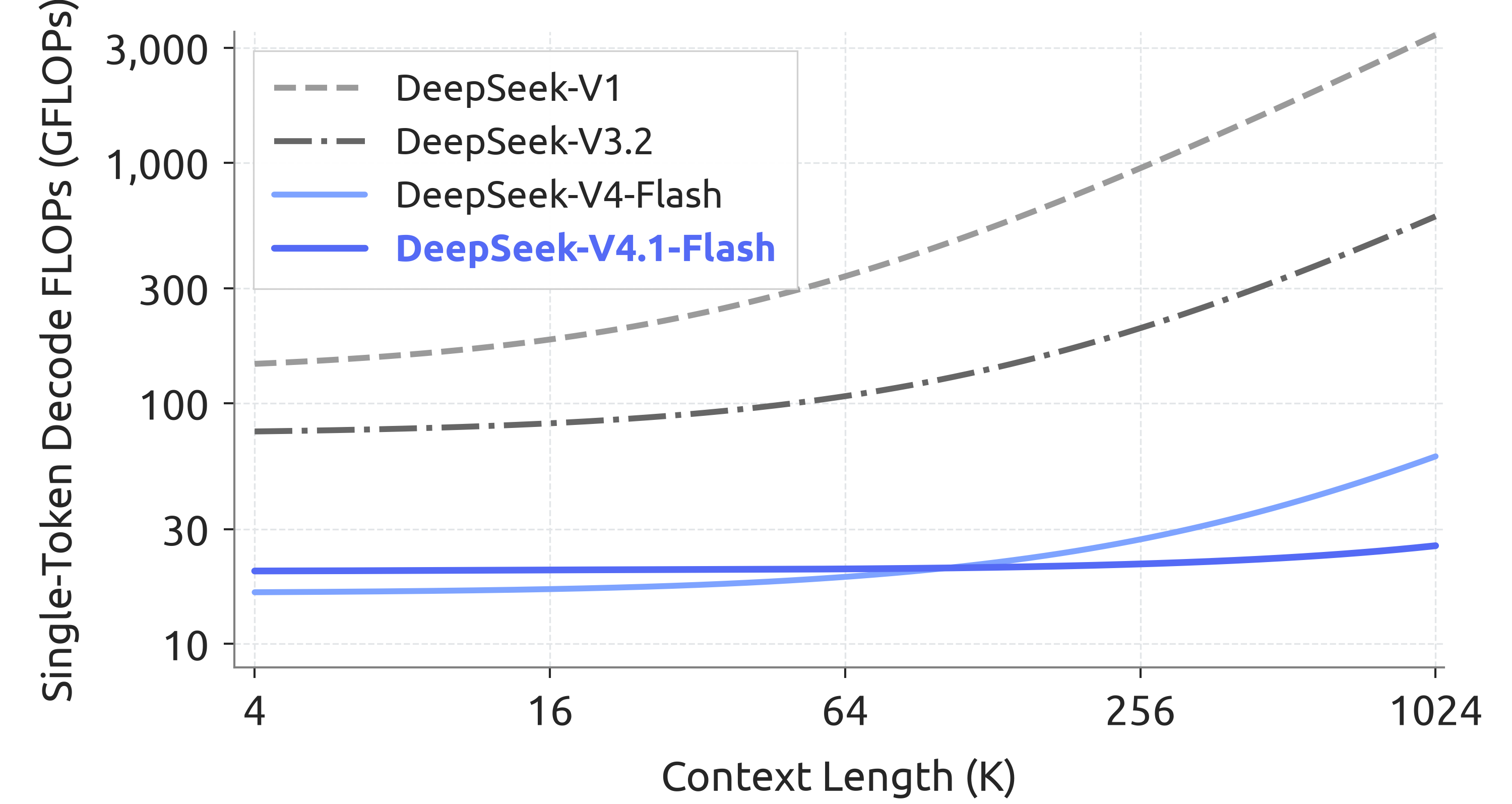
Both reductions target the same bottleneck — number of KV entries touched per token — from complementary angles (fewer distinct caches, fewer entries scored). The global KV is further quantized to FP4, yielding a per-token global KV footprint of 890 bytes, roughly 1/4 of DeepSeek-V4-Flash and, per Figure 1(b), \sim 437\times smaller than the earliest DeepSeek generation.
MoE routing retains DeepSeekMoE’s shared + fine-grained routed expert split, with modality-specific load balancing to prevent image and text tokens from competing for the same experts. Residual-stream mixing uses Single-Pass mHC for better kernel fusion, and speculative decoding is delegated to a separately trained DSpark head (MTP is omitted from backbone pre-training).
The vision path is a from-scratch DeepSeek-ViT: 2D-RoPE for arbitrary resolutions, linear patch projection (for Muon-optimizer compatibility), RMSNorm, SwiGLU, and a 3\times 3 pixel-unshuffle before an MLP projector — nine-fold visual-token reduction, supporting inputs up to \sim 1344\times 1344.
FLOPs behavior
FP4 KV combined with cross-layer sharing changes the shape of the decode-cost curve, not just its constant. Weighting BF16, FP8, and FP4 ops by 1, 0.5, and 0.25 respectively, single-token decode FLOPs stay nearly flat as context grows, in contrast to prior generations where the KV-attention term dominates asymptotically.
Training
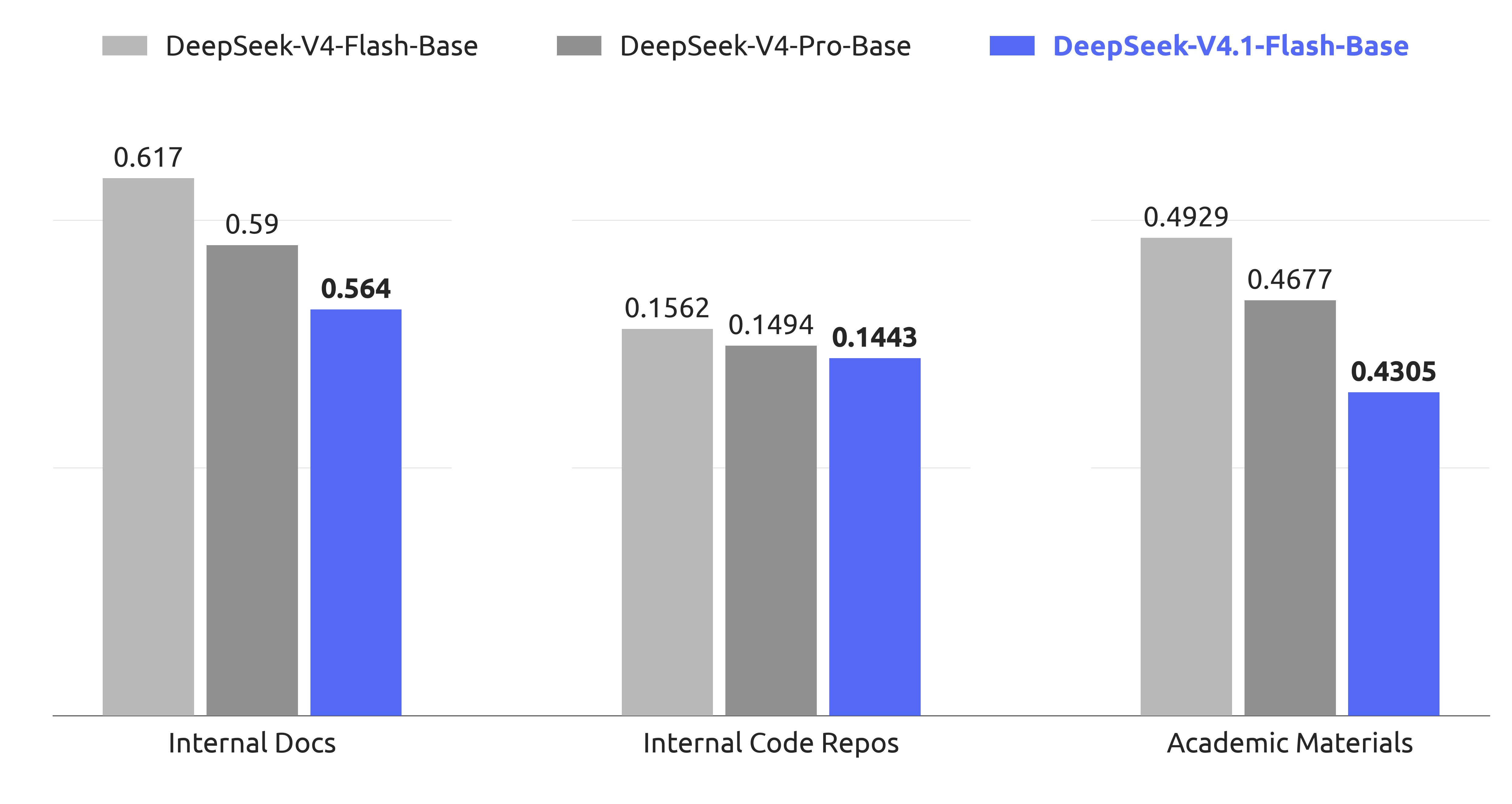
Pre-training data curation aggressively filters model-generated content from weaker models and low-quality MT text, treating these as implicit duplicates that degrade over long horizons. A scaling ladder over parameters and tokens guides the mixture. In held-out bits-per-byte evaluation, V4.1-Flash-Base achieves lower BPB than both V4-Flash-Base and the larger V4-Pro-Base across every task, i.e., the compression and CED changes are not paid for in base-model quality.
Post-training deliberately avoids algorithmic novelty: SFT → RL → on-policy distillation, with all engineering invested in data and environments. Tasks are formalized as triplets (\text{problem}, \text{environment}, \text{verification}) and scored on difficulty and correctness, which are themselves reward signals used to iteratively train the task-constructor. Agent environments are synthesized from mocked tool interfaces harvested from real usage, plus GitHub repositories above a star threshold; failure cases from internal deployments are replayed as targeted RL curricula.
For contrastive ViT pre-training, the authors exploit an asymmetry in the InfoNCE gradient — \nabla_T depends only on gathered V and vice versa — to hide the two all-gathers behind forward/backward passes of the other modality, eliminating exposed cross-rank communication.
Limitations and open questions
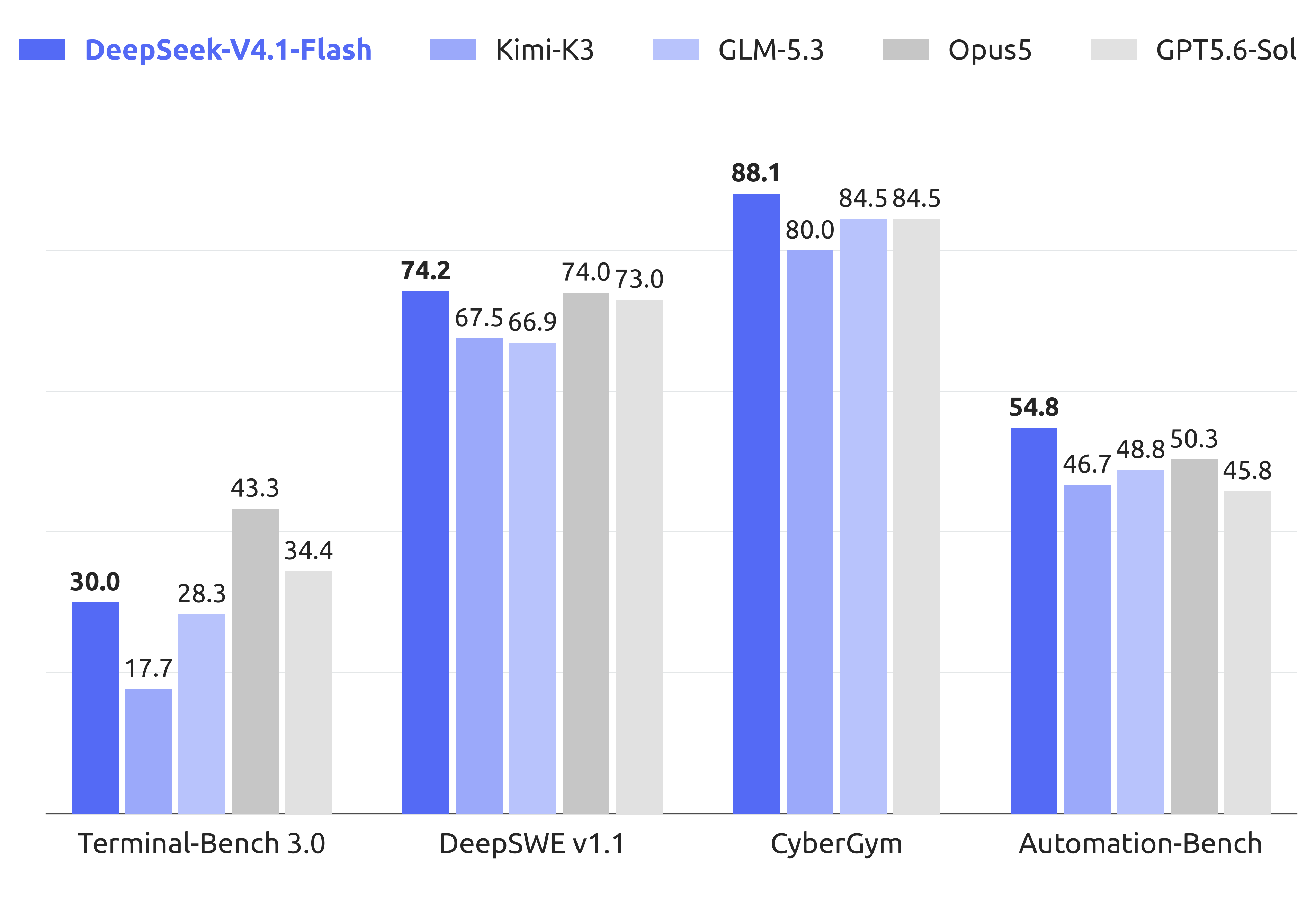
The paper reports agentic benchmark parity or improvement against counterparts (Figure 1a), but the excerpts do not quantify how much of the FLOP reduction is attributable to CED vs. CSA2 vs. FP4 KV, nor how retrieval accuracy of the Hierarchical Sparse Indexer degrades at the tail of million-token contexts. FP4 KV quantization error compounds with sparse selection error; ablations isolating each would be informative. The Engram memory adds 196B parameters accessed sparsely — its hit-rate distribution and cold-cache behavior on SSD are not discussed here. Finally, the “asymmetric activation” (8B prefill / 16B decode) is attractive economically but complicates serving-cluster provisioning when prefill/decode ratios drift.
Why this matters
An 890-byte global KV per token at million-token context, with flat decode FLOPs and lower base-model BPB than a larger sibling, materially shifts what “long context” costs in production. If the CED split and CSA2’s cross-layer sharing generalize, the field’s default assumption that KV cache scales linearly with L \cdot n_\text{layers} is due for revision.
Source: https://arxiv.org/abs/2609.19969
JEPA-Anything: Learning Predictive Models across Different Worlds
Problem
Joint-embedding predictive architectures (JEPA) have been re-instantiated separately for images, video, audio, and point clouds, each time with a bespoke encoder, masking scheme, and predictor collapsed into a single monolithic target embedding. This paper asks whether a single predictive learning principle can subsume all of these — and additionally cover biology, clinical trajectories, control, molecular dynamics, PDE fields, and weather — without changing the core objective. The motivation is not tidiness: monolithic latent targets entangle several predictive modes (identity, position, dynamics, intervention response), which hurts intervention composition and long-horizon rollout.
Method: orthogonal predictive factorization
JEPA-Anything factors the pipeline into a domain-specific interface and a shared predictive core. A raw observation x\sim\mathcal{D}_\delta is mapped by a domain adapter \mathcal{A}_\delta to content tokens H=\{h_i\} and structural descriptors S=\{s_i\} over an index set \Omega. Descriptors are patch coordinates, timestamps, graph positions, entity IDs, or empty. A view sampler \mathcal{V}_\delta picks context indices C\subset\Omega and target indices T\subset\Omega:
x\xrightarrow{\mathcal{A}_\delta}(H,S)\xrightarrow{\mathcal{V}_\delta}(H_C,S_C,T,S_T).
An online encoder produces z_c=f_\theta(H_C,S_C) and a target encoder produces z_t=f_{\bar\theta}(H,S)_t\in\mathbb{R}^d for t\in T, with EMA update \bar\theta\leftarrow m\bar\theta+(1-m)\theta and no gradients through the target branch. Standard JEPA is the |T|=1 special case.
The novel piece is orthogonal predictive factorization (OPF). Rather than predict a single d-dimensional target vector, OPF splits latent capacity into K factors of width r (with Kr=d), predicts each through a dedicated pathway, and recombines them into a synthesized latent state. Regularizers enforce (i) orthogonality between factor subspaces, (ii) factor activity (no collapse), and (iii) encoder-variance control. The total training loss is
\mathcal{L} = \mathcal{L}_{\mathrm{base}}^{(\delta)} + \mathcal{L}_{\mathrm{OPF}},
where \mathcal{L}_{\mathrm{base}} is the domain’s original loss and \mathcal{L}_{\mathrm{OPF}} is the additive factor loss with regularizers. Everything domain-specific — tokenization, encoder architecture (ViT, Transformer, GNN, MLP), context–target sampler, downstream readout — sits outside the core.
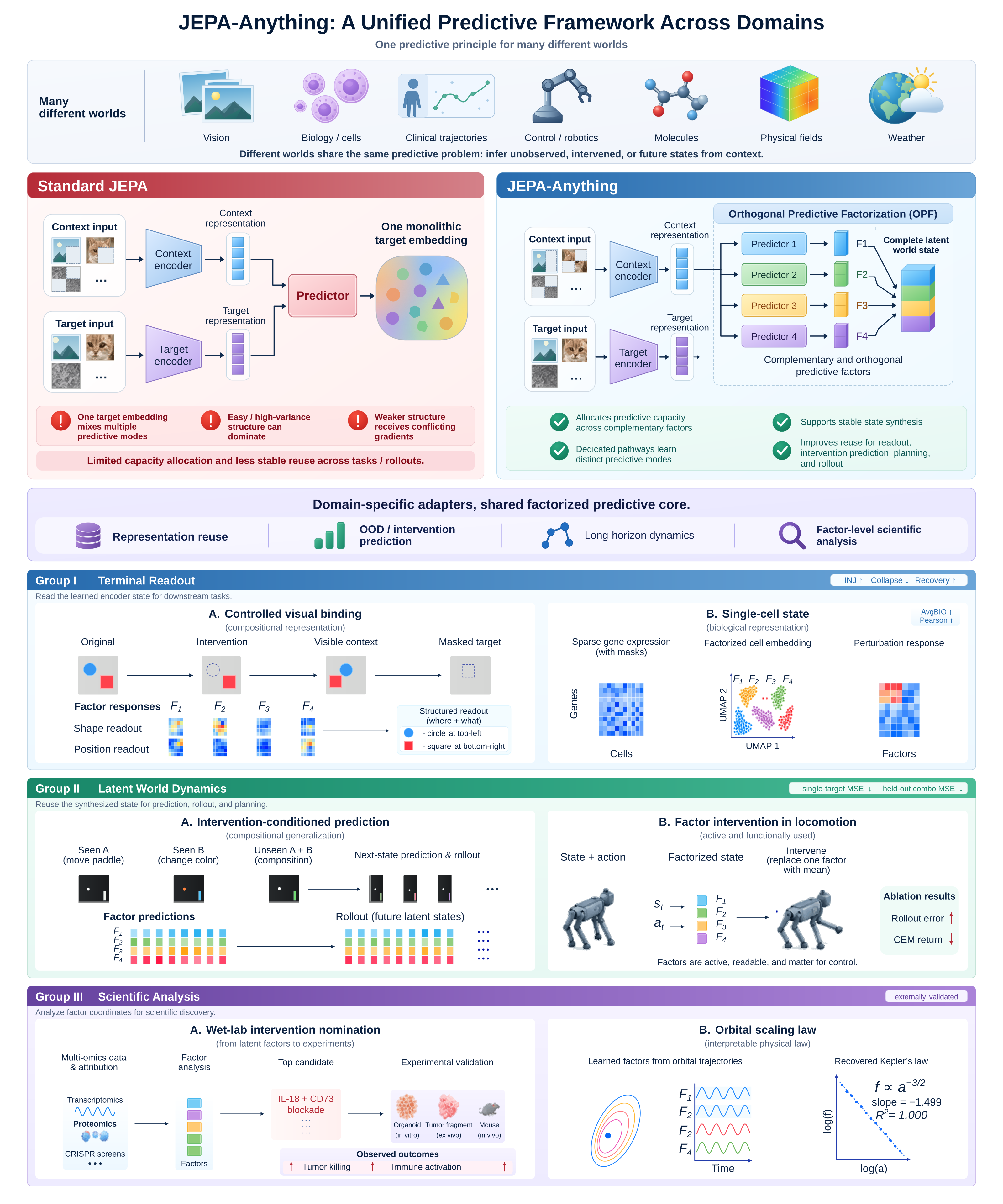
The OPF widths chosen per domain follow a compact d;K\times r convention: e.g. 384;\,4\times96 for DINOv3 ViT-S vision, 768;\,4\times192 for SigLIP2 and GPT-2 clinical, 160;\,5\times32 for Interventional Pong, 128;\,4\times32 for control/PDE/weather, 32;\,4\times8 for locomotion. The functional form of \mathcal{L}_{\mathrm{OPF}} is invariant across these.
Evaluation regime
Three groups probe distinct uses of the learned representation: (I) terminal readout on the online encoder for vision, single-cell, and disease forecasting; (II) recursive latent dynamics (intervention composition on CITRIS Interventional Pong, rollout on CausalWorld/DMC/PDEBench/WeatherBench2/APEBench Burgers-KS, long-horizon 1D viscous Burgers, MPC on Hopper/Walker2d/HalfCheetah); (III) factor coordinate analysis for biological and orbital validation.
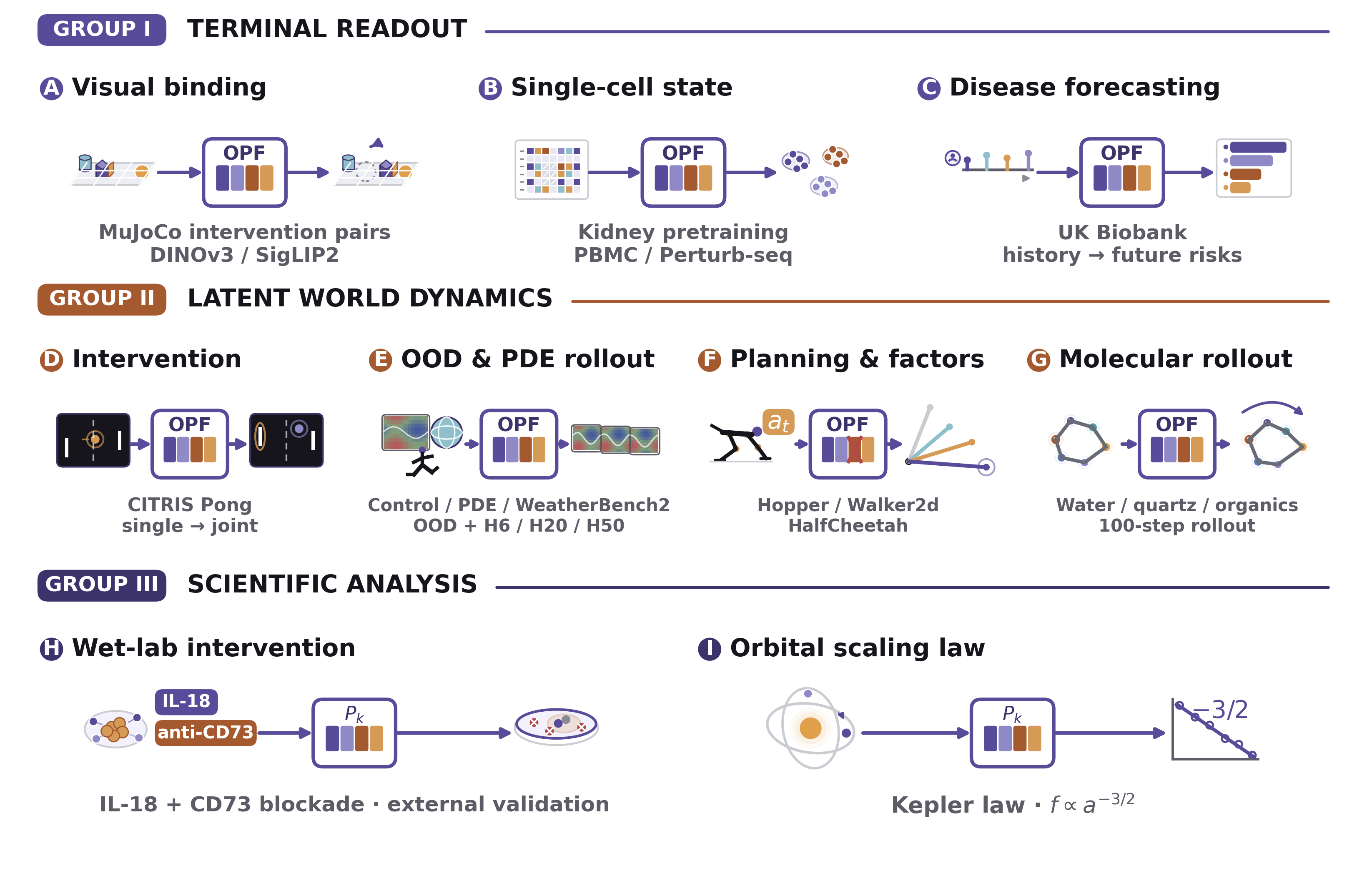
In direct standard-JEPA comparisons, adapter, encoder, sampler, budget, split, readout, and \mathcal{L}_{\mathrm{base}} are held fixed; only the added predictive term differs (monolithic vs OPF).
Results
Against matched JEPA baselines, JEPA-Anything improves the reported metric on all 10 dynamics tasks and reduces single-intervention one-step prediction error on Interventional Pong by 34.8% (four-channel MSE, 5 paired seeds). It achieves the lowest one-step and 100-step molecular rollout error across four molecular systems (Group II).
For clinical trajectories, JEPA-Anything reads a synthesized one-step future state to predict risks for more than 1,000 event types on a fixed patient-level split, and ranks top on mean PRAUC.
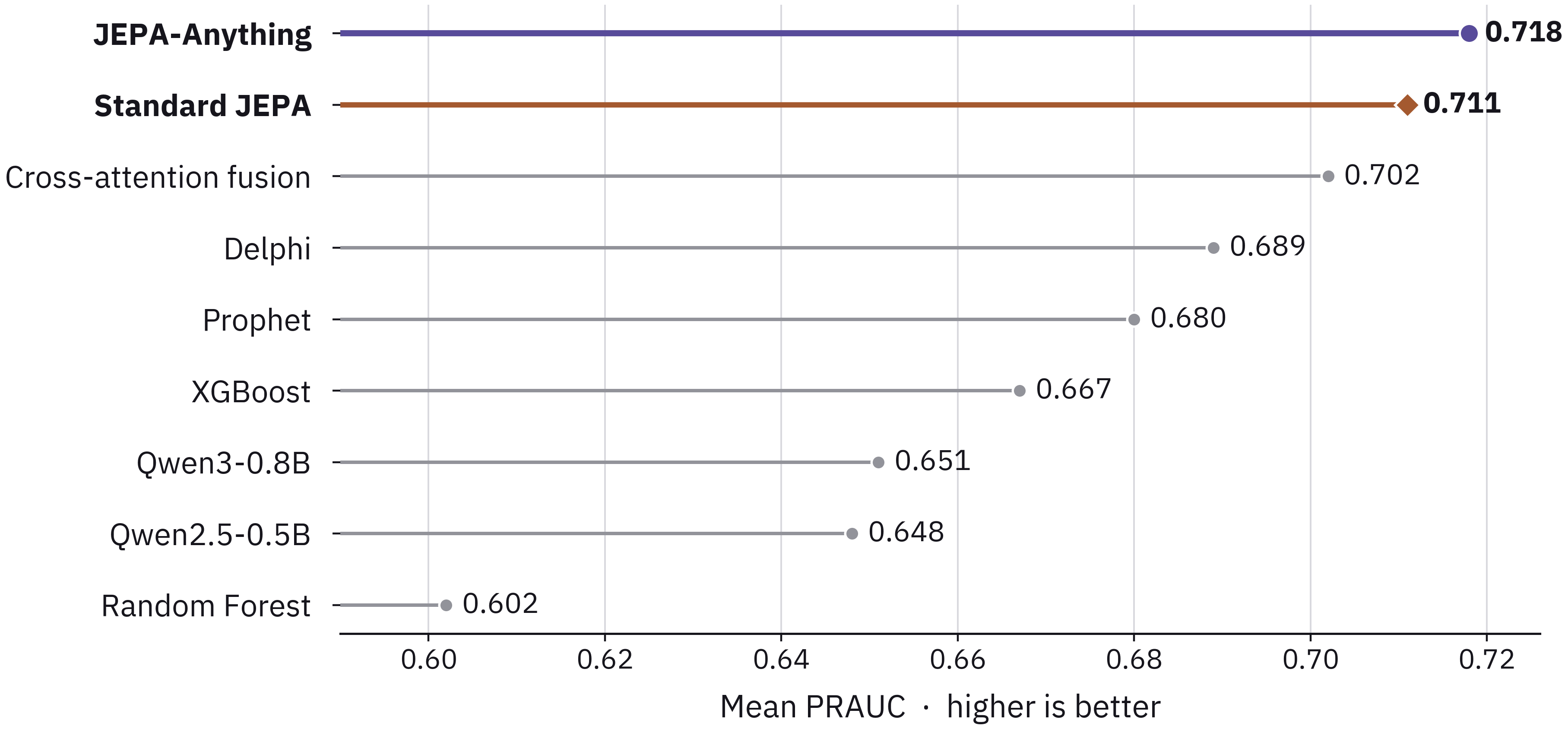
Locomotion is a partial exception: mean returns improve on two environments but not Hopper, and factor-intervention analysis indicates that all locomotion channels contribute to rollout — a sign that the 32;\,4\times8 factorization does not cleanly separate control-relevant modes there. The geometry analysis shows non-overlapping, unit-conditioned coordinates and near-exact synthesis (predicted state recovered from factor recombination), which is what the orthogonality and activity regularizers are designed to produce.
Limitations and open questions
- Orthogonality of predictive factors does not imply causal disentanglement; the authors acknowledge factors are predictive coordinates, not mechanisms.
- Factor count K and width r are chosen per domain; no principled selection procedure is offered, and the Hopper result suggests the choice matters.
- Uncertainty calibration under distribution shift, which the paper flags as prerequisite for using the model to select experiments, is not evaluated.
- The clinical and molecular numbers are aggregate; per-event and per-molecule breakdowns would clarify whether OPF gains are uniform or driven by a subset.
- Cross-domain transfer of the same encoder is not demonstrated — the framework is shared, but weights are not.
Why this matters
If a single additive predictive objective with capacity factorization holds up across seven qualitatively different physical and biological systems while retaining domain-standard backbones, the “world model” problem reduces mostly to interface engineering. That reframes JEPA as a family of losses on structured latent targets, and gives a concrete target — orthogonal, active, synthesizable factors — for downstream causal or planning modules.
Source: https://arxiv.org/abs/2609.20800
Video DeltaNet: A Video-Native Hybrid Attention for Livestream Video Generation
Problem
Video diffusion transformers spend most of their compute in attention over spatiotemporal token sequences that grow quadratically with clip length and resolution. For MiniMax H3, a 14.3-second 768p clip produces a latent grid of shape (24{,}102, 48, 84) per frame stack, making Softmax attention over the full video the dominant cost across 50 denoising steps. Linear attention is the natural remedy — memory scales as O(d_k d_v) per state rather than O(N^2) — but naive drop-in replacements degrade texture and fine motion. Video DeltaNet (VDN) targets a middle ground: keep exact Softmax where token-level matches matter, and route distant temporal context through a linear-attention branch specifically designed for the frame-batched structure of video.
Architecture: local Softmax + bidirectional linear memory
VDN partitions video-to-video attention by temporal role. Cross-modal interactions with text and audio remain Softmax. For video queries:
- Sliding-window Softmax operates over a 15-frame window aligned with the H3 VAE’s 5-frame temporal chunk, so the Softmax boundary never bisects a decoder unit. Each query chunk attends to itself plus the immediately preceding and following chunks.
- Boundary anchors give every frame four-way connectivity to the first and last latent frames, and let those endpoint frames attend to the entire clip. This is well-suited to image-to-video and first–last-frame-to-video (FL2VA) conditioning, where anchor frames carry provided visual constraints.
- Video Delta Attention (VDA) provides bidirectional linear memory for everything outside the window.
Video Delta Attention
VDA generalizes the delta rule from tokens to frames. The standard gated delta-rule step maintains a state S_{t-1} \in \mathbb{R}^{d_v \times d_k} and applies
\bar S_t = S_{t-1}\operatorname{Diag}(\alpha_t), \quad S_t = \bar S_t + \beta_t(v_t - \bar S_t k_t)k_t^\top.
Video diffusion delivers all U = H_\ell W_\ell tokens of a latent frame together, so VDA computes their corrections against a shared decayed state \bar S_t. Defining
A_t = K_t^\top \operatorname{Diag}(\beta_t) K_t, \quad B_t = V_t^\top \operatorname{Diag}(\beta_t) K_t,
the frame-wise update collapses to
S_t^{\mathrm{batch}} = \bar S_t (I - A_t) + B_t.
The paper notes (Appendix A.2) that when different tokens within a frame have overlapping keys, this frozen-state form allows conflicting writes; a corrected variant solves (I+A_t) against the joint residual, requiring a per-frame small-matrix inverse that VDN keeps in FP32. Both forward and backward temporal directions are maintained and gated with learnable scalars, then combined with the Softmax branch through separate output projections.
Staged teacher alignment
VDN is bolted onto a frozen pretrained H3 in three stages. A1 aligns each Linear branch independently against frozen activations for 200 steps, Softmax gate pinned at 0.99, per-layer gradient clip 0.1. A2 installs all branches and runs 500 end-to-end steps with global clip 1.0, still freezing pretrained weights and Softmax gates. Stage B adds LoRA on Q, K, V, and output projections and co-trains the Linear pathway, Softmax gates, and adapters for 2,000 steps. Finally, an eight-step distillation compresses 50 NFEs to 8.
Inference stack
Four fused Triton kernels handle VDA: VDA-Prep (temporal conv + SiLU + L2 + layout), VDA-Stats (single-pass A_t, B_t), VDA-Gather (bidirectional state pickup with decay bridge), and VDA-Epilogue (RMSNorm + output gate). Because attention only reads memory at VAE-chunk boundaries, VDN composes an entire chunk into an affine transition S_{\text{out}} = S_{\text{in}} M_{\text{chunk}} + J_{\text{chunk}} and scans the reduced sequence bidirectionally in one launch. The (I+A_t)^{-1} solve uses a single CUDA kernel doing blocked Gauss–Jordan in registers. Softmax windows use FlashAttention varlen with pattern-packed queries; VDA is sharded by head across a side CUDA stream; wide GEMMs run MXFP8 while recurrent states and inverses stay FP32. Serving is on SGLang.
Results
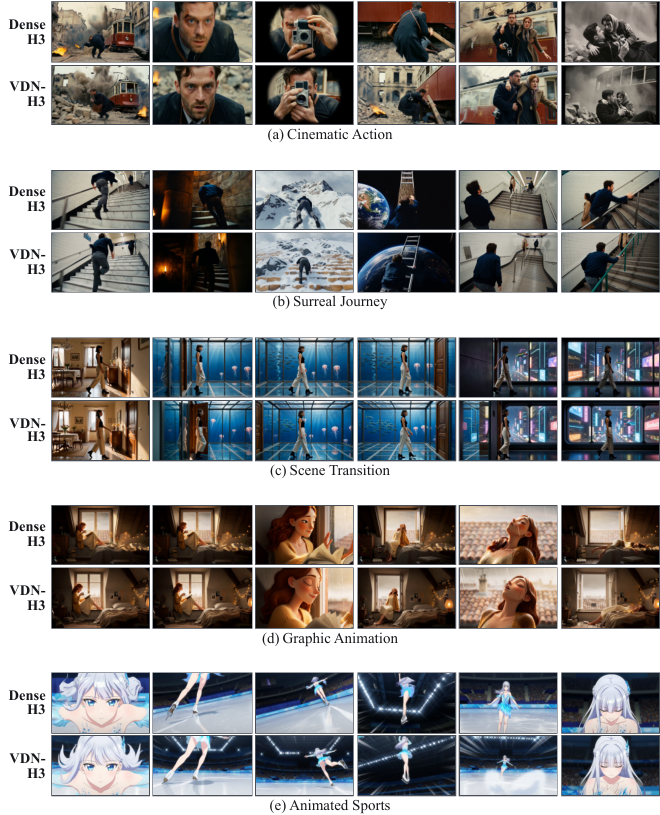
On 103 fixed prompts at 1344 \times 768, eight-step VDN-H3 completes DiT denoising for a 14.375-second clip in 6.70 s on 8×B200, a 14.5× speedup over 50-step Dense H3. Quality metrics — EvalCrafter VQA_A/VQA_T, Q-Align, FAST-VQA, DOVER++ — are reported as on par with Dense H3 and above the four-step FastH3 baseline, with FIRM-Video dimensions (Instruction Following, Perceptual Quality, World Coherence) tracking Dense H3 rather than the fast baseline. On FL2VA, PSNR/SSIM/LPIPS at the two conditioning frames confirm that the boundary-anchor pattern preserves endpoint fidelity. The qualitative gallery shows the eight-step VDN-H3 matching the 50-step teacher across five prompts.
Limitations and open questions
The evaluation is on 103 prompts at a single resolution and clip length; behavior at longer horizons — where linear memory saturation typically bites — is not reported. VDA still requires a per-frame small-matrix inverse that is only stable in FP32, which caps how aggressively the recurrent path can be quantized. The staged recipe depends on a strong pretrained Softmax teacher; whether VDA trained from scratch retains the fine-grained quality is unaddressed. Finally, the “livestream” framing in the title is not backed by streaming latency numbers or a causal variant — the reported system denoises full clips.
Why this matters
Hybrid attention for video generation has mostly been ad hoc; VDN provides a concrete recipe — VAE-aligned Softmax windows, frame-batched delta memory with a small-matrix inverse, and staged LoRA co-adaptation — that recovers full-attention quality while turning a 14.3-second 768p denoise into a sub-7-second job on eight B200s. The frame-wise delta rule in particular is a cleaner primitive than token-serial linear attention for any modality where tokens arrive in structured blocks.
Source: https://arxiv.org/abs/2609.20744
When2Think: Learning Difficulty-Aware Length Control for Efficient Hybrid Reasoning Models
Problem
Large reasoning models (LRMs) exhibit a well-documented pathology: they burn tokens on trivial arithmetic while sometimes truncating hard olympiad problems. Prior remedies — uniform length penalties (LC-R1, ThinkPrune), fixed budgets (Laser-DE), or discrete Think/NoThink routers (AdaptThink, Thinkless) — pay an “efficiency tax”: token savings on easy items translate into accuracy loss on hard ones. The task, framed as instance-adaptive compute allocation, is to learn a policy that predicts both whether to enter an explicit chain-of-thought and how long to deliberate conditional on problem difficulty, without training an auxiliary reward model or querying a reference model in the inner loop.
Method
When2Think is a post-training RLVR framework built on R1-Distill-Qwen-1.5B, trained on DeepScaleR (~40k competition math problems). The pipeline has two stages (Figure 2).
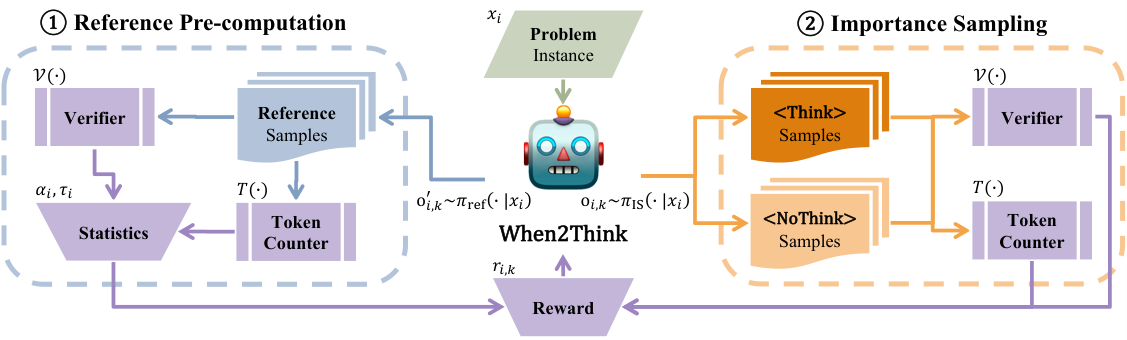
Reference statistics (offline, per epoch). For each x_i \in \mathcal{D}, draw K trajectories o'_{i,k} \sim \pi_{\mathrm{ref}}(\cdot\mid x_i) and compute a scaled reference accuracy (difficulty proxy) and expected reasoning cost:
\alpha_i = \gamma\!\left(\tfrac{1}{K}\sum_k \mathcal{V}(x_i, o'_{i,k})\right) + \varepsilon, \qquad \tau_i = \tfrac{1}{K}\sum_k \mathcal{T}(o'_{i,k}) + \varepsilon,
with \gamma=0.9 and \mathcal{V} the verifier indicator. \alpha_i \in (0, \gamma] is small on hard instances (rare correctness) and near \gamma on easy ones; \tau_i is an instance-conditioned token budget.
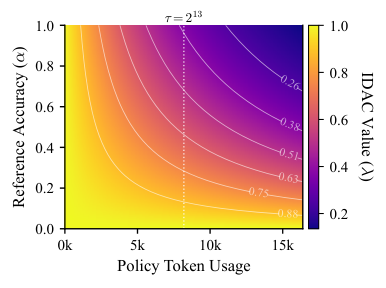
Instance-level Difficulty-Aware Control (IDAC). A correctness-gated efficiency bonus modulates a scaling factor \lambda that depends on realized trajectory length \mathcal{T}(o) and the reference budget \tau_i. The heatmap in Figure 3 shows the shape: for a hard instance with \tau=2^{13}, \lambda rewards long correct traces and penalizes premature termination; the polarity inverts for easy instances, so short correct answers dominate.
Rewards are normalized by the instance baseline \alpha_i and standardized batch-wise (BWS), yielding a critic-free PPO-style advantage. Because verification is deterministic and reference statistics are cached, there is no learned reward model, no critic network, and no online reference-model call during policy updates.
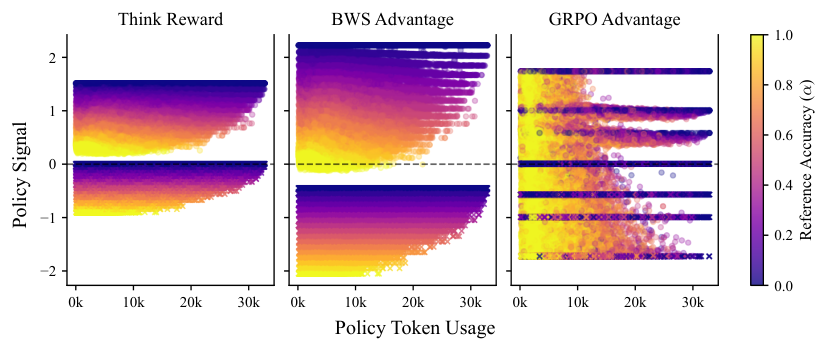
Importance-sampled exploration. To prevent early collapse onto one mode, the initial mode token (Think vs. NoThink) is sampled uniformly under an exploration distribution \pi_{\mathrm{IS}}; subsequent tokens follow \pi_\theta, with off-policy corrections applied. Figure 7 shows why this matters: on hard instances (blue) the advantage landscape favors long correct Think trajectories, while on easy instances (yellow) short correct trajectories dominate, so a policy exploring both modes uniformly gets clean gradient signal on both regimes.
Results
On four math benchmarks (Pass@3 over 5 seeds), When2Think improves accuracy over the R1-Distill-Qwen-1.5B base while reducing tokens on medium/hard tasks:
- GSM-Plus: 85.7% (+6.3 pts vs. base 79.4%), 1,052 tokens (+462 relative to base, which was already terse on this benchmark).
- OlympiadBench-Math: 62.4% (+3.6), 5,909 tokens (−2,725, ~32% reduction).
- AIME24: 56.0% (+10.0), 10,236 tokens (−3,959).
- AIME25: 40.0% (+8.0), 9,549 tokens (−3,067).
Against efficiency-oriented baselines at similar 1.5B scale, When2Think is the only method that improves AIME24 accuracy by double digits while cutting tokens: LC-R1 loses 10 pts on AIME24, AdaptThink loses 1.3, Laser-DE loses 0.7, ThinkPrune is flat, and Thinkless-RL gains only 0.7. The ablation w/o IS (IDAC+BWS only) actually reports the strongest absolute numbers — 86.8% GSM-Plus, 65.9% OlympiadBench, 57.3% AIME24 — but with higher token usage (1,652 / 6,239 / 10,046), indicating the importance-sampled exploration trades a small accuracy margin for tighter length control.
Limitations and open questions
The evaluation is confined to math and to a single 1.5B distilled model; whether IDAC’s reference-statistic pre-computation scales to noisier verifiers (code, agentic tasks) or larger policies is untested. The reference statistics are computed with \pi_{\mathrm{ref}} once per epoch — if the trained policy drifts far from \pi_{\mathrm{ref}}, both \alpha_i and \tau_i become stale as difficulty/cost proxies, though the paper does not quantify this drift. The Pass@3 reporting with \sigma up to \pm 8 on AIME leaves some baseline comparisons statistically ambiguous. Finally, IDAC assumes a monotone relation between \lambda and (length, \tau); more complex allocation shapes (e.g., diminishing returns beyond 2\tau) are hand-tuned rather than learned.
Why this matters
When2Think demonstrates that instance-conditioned length control can be obtained from cheap offline reference statistics plus a shaped verifiable reward, avoiding both learned critics and reward models. The result — accuracy gains and token reductions on AIME simultaneously — is the first clear counterexample to the “efficiency tax” narrative in hybrid reasoning at this scale.
Source: https://arxiv.org/abs/2609.19671
When EOS Tokens Disagree: Understanding Length Inflation in On-Policy Distillation
On-policy distillation (OPD) trains a student \pi_\theta on its own rollouts using a score-function update in which the teacher \pi^E supplies the advantage on the student-sampled token:
A_t = \log\pi^E(y_t \mid s_t) - \log\pi_\theta(y_t \mid s_t), \qquad g_t = A_t\,\nabla_\theta \log\pi_\theta(y_t \mid s_t).
This paper identifies a subtle failure mode of this “sampled-token OPD”: when the base student and the post-trained teacher place their termination probability mass on different EOS tokens — even when the declared stopping set is identical — the update systematically suppresses the student’s native EOS without transferring the teacher’s preferred one. The result is progressive length inflation, with rollouts exhausting the generation budget.
The diagnostic
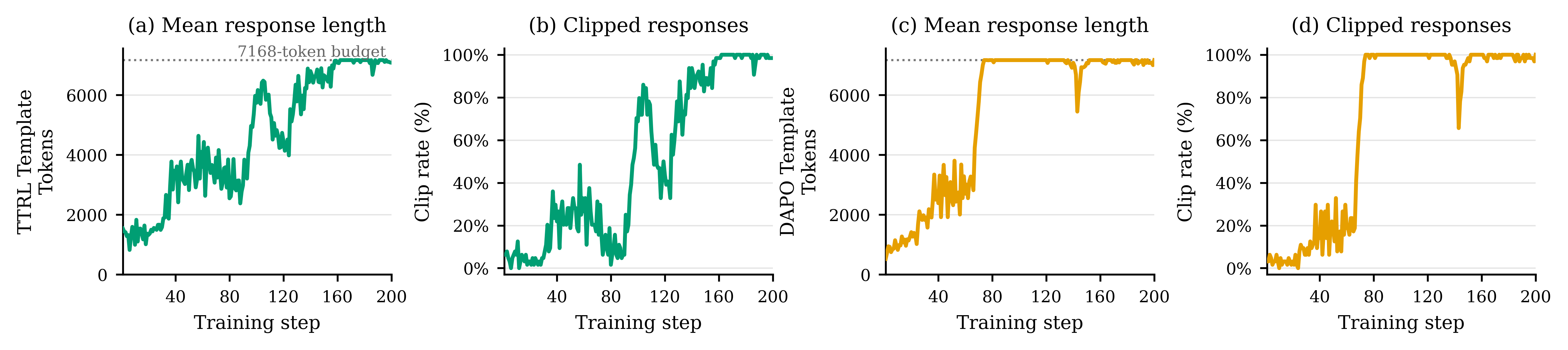
Vanilla OPD on Qwen3-1.7B-Base (student) ← Qwen3-4B non-thinking (teacher) shows monotonically increasing response length and clipping under both TTRL and DAPO prompt templates, with many rollouts hitting the budget.
Inspection of terminal-position probabilities makes the mechanism concrete. Qwen3-Base concentrates its termination mass on <|endoftext|> (id 151643), while the Instruct teacher concentrates on <|im_end|> (id 151645), even though both tokens appear in the teacher’s declared stopping set.
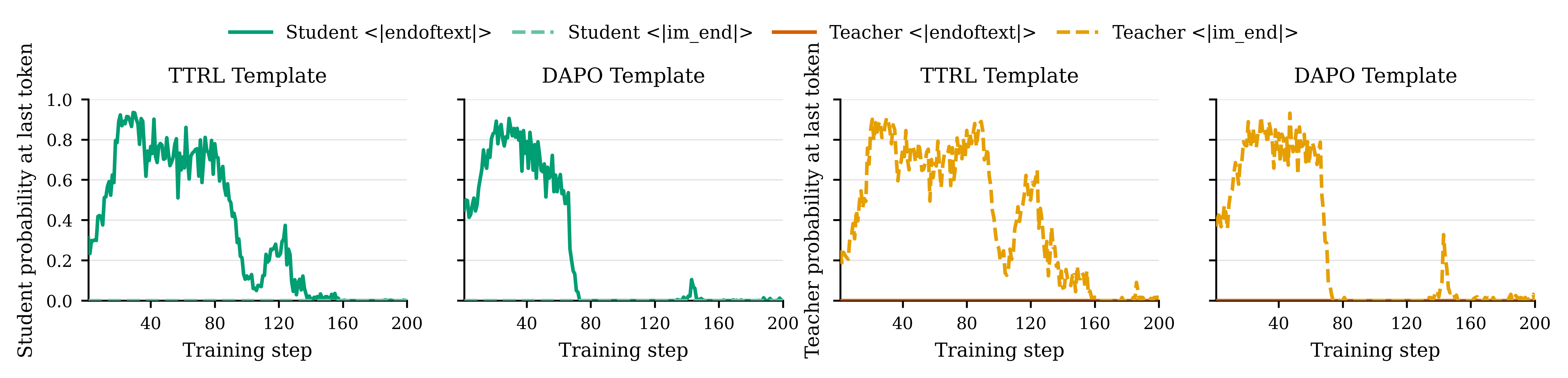
The student’s probability on the teacher-preferred <|im_end|> at terminal states is roughly 10^{-11}. Two consequences follow. First, since A_t is a log-ratio evaluated on the sampled token e, whenever the student samples its native EOS e_\star = \texttt{<|endoftext|>} and the teacher assigns less mass to that specific surface form, the coefficient
A_t(e_\star) = \log\pi^E(e_\star \mid s_t) - \log\pi_\theta(e_\star \mid s_t)
is negative — the update suppresses termination — even though the teacher wants to stop, just through a different token. Second, because the student almost never samples <|im_end|>, no direct positive supervision reaches the teacher-preferred alternative. The termination action is asymmetrically demoted.
Why decoding-set alignment fails
“Fix 1” simply registers both <|endoftext|> and <|im_end|> as valid stop tokens during rollout, leaving the objective untouched. Length and clipping trajectories are essentially indistinguishable from vanilla OPD. This is expected from the probability analysis: the additional stopping token has \sim 10^{-11} mass under the student, so it is effectively never sampled and the log-ratio computation on the sampled token is unchanged.
The correction: semantic EOS aggregation
The authors propose treating a set \mathcal{E}_{\mathrm{EOS}} of termination-equivalent tokens as a single semantic stopping action. Concretely, when the student samples any e \in \mathcal{E}_{\mathrm{EOS}}, the log-probabilities in A_t are computed against \sum_{e' \in \mathcal{E}_{\mathrm{EOS}}} \pi(e' \mid s_t) for both student and teacher. This preserves the sampled-token OPD structure while removing the surface-form disagreement. Length inflation is substantially mitigated across Qwen3, Llama 3.2, and Gemma 3.
The Gemma 3 case is a useful control: PT and IT checkpoints share an identical declared EOS set \{\texttt{<eos>}, \texttt{<end\_of\_turn>}\}, yet still exhibit inflation because the PT student places mass on <eos> while the IT teacher prefers <end_of_turn>.
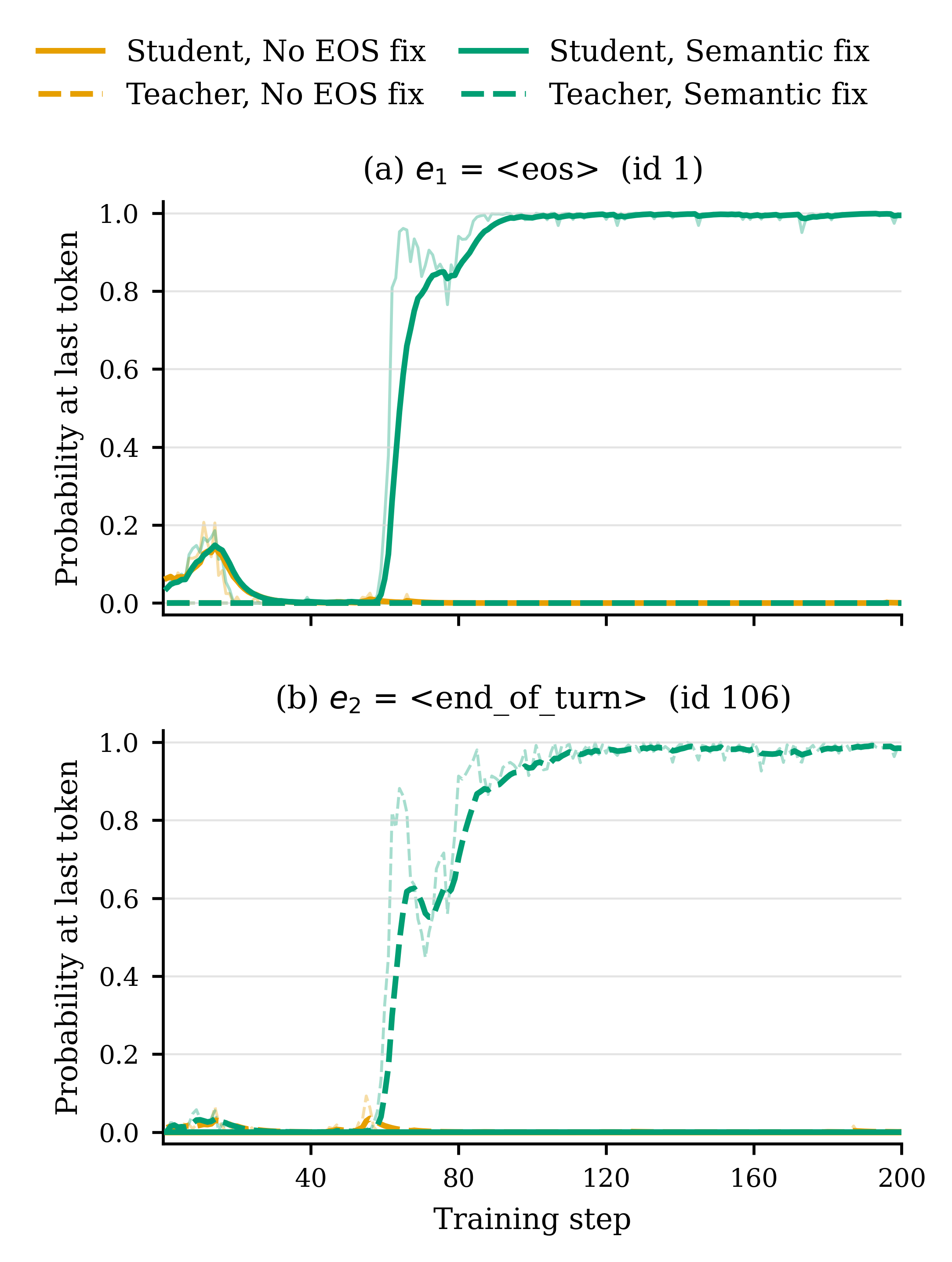
This rules out “declared stopping set mismatch” as the underlying cause and confirms the mechanism is about learned probability mass on functionally equivalent tokens.
Stage-wise analysis on K2-Horizon
Using K2-Horizon-7B, which exposes pretraining, midtraining, SFT, and final post-training checkpoints while keeping the EOS token IDs constant, the authors decouple training stage from configuration drift. The pretrained student prefers <|ifm|endoftext|>; the final teacher prefers <|ifm|im_end|>. Most of the shift happens by midtraining, and by the SFT stage the student’s termination distribution is close to the teacher’s.
Two observations from this setup sharpen the story:
- When the student already places non-negligible mass on the teacher-preferred termination token, vanilla OPD can transfer termination behavior — because the token is actually sampled and receives direct supervision. This is the pretrain-to-final K2-Horizon run early in training, contrasting with the Qwen3 base-to-instruct case where the gap spans ~11 orders of magnitude.
- A second, distinct length inflation appears late in the pretrain-to-final OPD run, after termination surface form has been aligned. Response length grows toward the budget again. Semantic EOS aggregation does not eliminate this, indicating a residual mechanism beyond surface-token mismatch.
At the midtraining and SFT initializations, where termination distributions are already aligned, applying the semantic correction is essentially inert — no consistent degradation on downstream evaluation — which is a reasonable non-interference property.
Limitations and open questions
The correction requires knowing which tokens are semantically equivalent terminators for a given student–teacher pair, which the paper handles manually via the rollout protocol. The late-stage inflation observed in K2-Horizon is diagnosed but not mechanistically explained; it is not attributable to EOS mismatch. The experiments are confined to math reasoning (DAPO-Math-17K) with the TTRL/DAPO templates; whether length inflation on longer-form tasks has the same structure is untested. Finally, the analysis is specific to sampled-token OPD; full-distribution KL objectives would not exhibit the same asymmetry, though they carry other costs.
Why this matters
Length inflation in OPD is often attributed to reward hacking or entropy collapse, but a large fraction of it in current base-to-instruct pipelines is a tokenization artifact: the score-function update on the sampled EOS token silently punishes termination when the teacher expresses the same stopping decision through a different surface form. Treating functionally equivalent EOS tokens as a shared action is a near-free fix, and the K2-Horizon results suggest a residual, non-tokenization length-inflation mechanism worth isolating separately.
Source: https://arxiv.org/abs/2609.20511
An Empirical Study of Harness Design for Coding Agents
Coding agents are typically shipped as monolithic harnesses (Aider, SWE-agent, OpenHands, Claude Code), and comparisons between them conflate model choice, tool schemas, planning scaffolds, and context handling. This paper isolates the harness itself: it fixes the ReAct execution loop and varies three orthogonal components — planning, action space, and context management — across 176 matched settings, four models (Nemotron-3 30B/120B/550B and Mistral-Medium-3.5-128B), and two benchmarks (SWE-Bench Verified, Terminal-Bench 2.1).
Harness structure
The loop is standard ReAct: at each turn the harness assembles the model input from a preamble, the running history H, an optional injected plan, and the tool schemas for the current action space; the model emits tool calls; these execute in the task container; and the observation is appended to H.
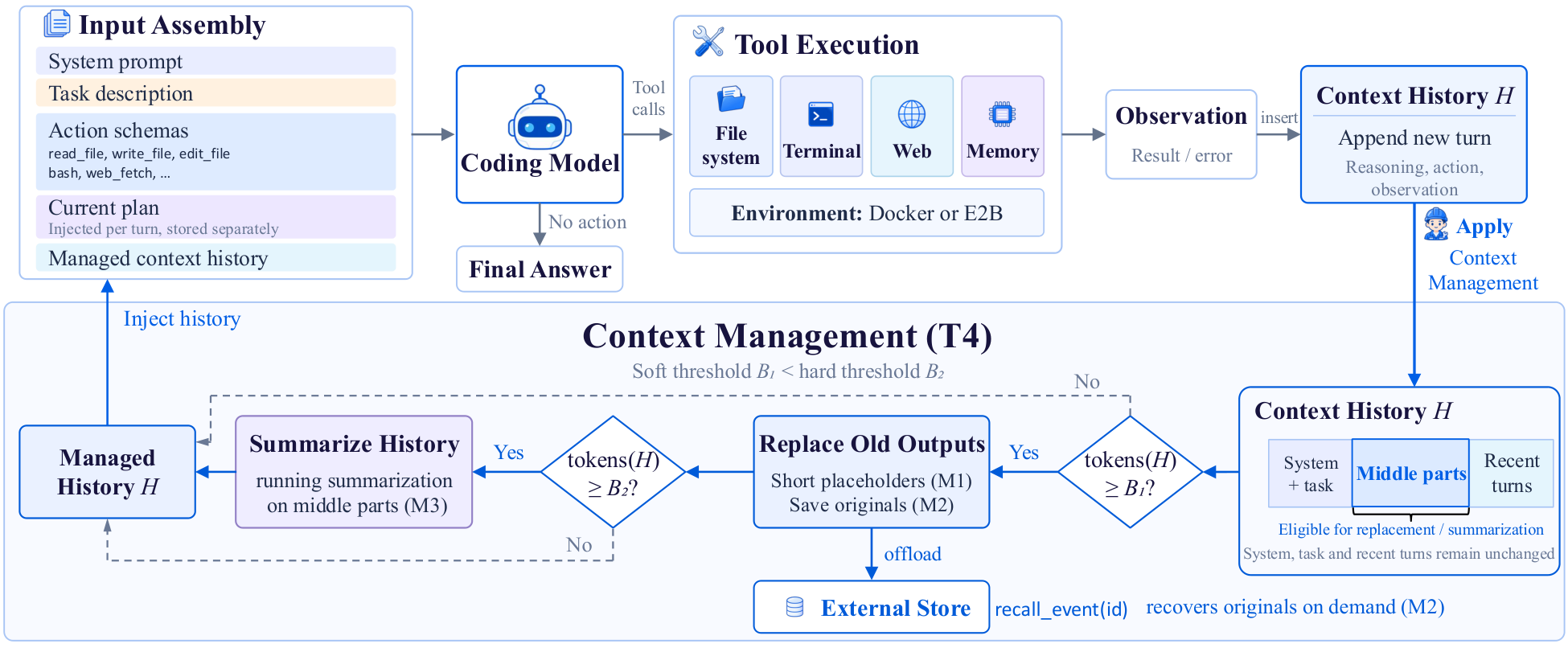
Planning is implemented as a persistent scaffold rather than chain-of-thought: a system instruction plus first-turn reminder ask for an initial plan; the plan is maintained through an update_plan tool; and on subsequent turns the current plan is injected into the input but not stored in H. Disabling planning removes the instructions, injections, and tool while holding everything else fixed — so the reported effect is that of persistent plan state, not of “thinking before acting” more broadly.
The action space has two settings. The predefined-tool condition exposes typed tools (list_files, glob_files, grep_text, read_file, edit_file, write_file, bash, web_fetch), enforces read-before-write via a session-level file state, and runs post-edit diagnostics on structured edits. The bash-only condition removes the workspace tools; identical mutations issued through bash bypass state tracking and diagnostics. Both conditions share workflow and safety text; only tool availability and interface-specific instructions change.
Context management is parameterized as a tiered strategy T4 governed by two thresholds B_1 < B_2 over the current context length. The preamble and the most recent turns are always kept verbatim. Above soft threshold B_1, bulky middle-region tool outputs are replaced by stubs (M1) and offloaded to an external store recoverable via recall_event (M2). Above hard threshold B_2, the oldest middle events are summarized by the LLM (M3). Tiers T1–T4 progressively enable these mechanisms; the context-window budget is separately swept over 32k/64k/128k/…
Findings
Context management primarily buys trajectory length. At a 32k budget, disabling context management collapses SWE-Bench trajectories to median 20–30 turns, with most runs terminating in the Localize phase before any edit. Enabling any managed tier extends median trajectories to 50–180 turns depending on model and tier, allowing runs to reach the Verify phase; phase ordering and proportions are largely preserved at matched turn counts. At 128k, tiers are nearly indistinguishable: median lengths span 39–42 turns for Nemotron-3 30B and 70–74 for Nemotron-3 550B, re-patch counts differ by <2 per task, and no-edit termination rates differ by <4 pp for three of four models. The dominant contribution of context management is preventing overflow-induced termination, not reshaping behavior.
Within context management, staging matters and recoverability does not. Rule-based elision before LLM summarization (M1 → M3) is the strongest efficiency point; making elided content recoverable via recall_event (M2) adds tool surface that models rarely invoke and yields no accuracy gain in the ablations.
Planning flips sign with model capability. Table 6 shows the fraction of SWE-Bench runs that terminate without producing any edit, with planning off vs. on at T4/128k. For the weakest model (Nemotron-3 30B), planning drastically reduces no-edit terminations from 68.6% to 27.8%, and stalled-at-localization runs drop from 58.4% to 10.4% — planning functions as an accuracy scaffold that pulls the model out of exploration loops. For Nemotron-3 120B the effect reverses slightly (15.6% → 24.4% no-edit; 11.0% → 17.8% stuck in Localize). The two strongest models are essentially unaffected (Nemotron-3 550B: 1.4% → 2.4%; Mistral-Medium-3.5-128B: 2.0% → 1.2%). The authors additionally observe that planning lengthens trajectories for the weakest model but shortens them for the strongest — consistent with a scaffold that constrains weak policies but adds overhead when the base policy already plans implicitly.
Bash-only changes action granularity. Removing typed tools does not just relabel actions: it also removes the read-before-write gate and post-edit diagnostics, and the trajectory-analysis judge labels reveal shifts in how localization, editing, and verification are expressed. The paper treats action-space and its accompanying instructions as a bundle rather than isolating tool schemas from prompt wording.
Limitations
The ablation defines planning narrowly as a persistent, tool-maintained plan block; effects of lighter-weight planning (e.g., scratchpad-only) are not measured. Trajectory phase labels come from an LLM judge (agreement with humans reported in Appendix 9.2, but not summarized here). Only four models from two families are tested, and pricing/accuracy conclusions depend on August 2026 OpenRouter rates. The action-space ablation confounds tool schema with system-prompt wording and with the read-before-write enforcement machinery. Whether M2 (recoverable elision) would help at longer horizons or with retrieval-trained models remains open.
Why this matters
Harness components are usually justified by intuition or copied wholesale from prior systems; this work supplies matched, component-level evidence that (i) context management is largely a mechanism for avoiding overflow rather than improving reasoning, and (ii) persistent planning scaffolds help weak models and hurt strong ones. Both findings argue for capability-conditioned harness design rather than one-size-fits-all stacks.
Source: https://arxiv.org/abs/2609.20804
RetireOPD: Self-Retiring On-Policy Distillation for Agentic Reinforcement Learning
Problem
Multi-turn RL agents receive only a single scalar reward per trajectory, producing sparse gradient signal over long horizons. Self on-policy distillation (OPD) aims to densify supervision by having a stronger “self-teacher” (initialized from the same base, but with privileged skill context) provide token-level KL guidance to a skill-free student trained on-policy. Two empirical facts undermine the naive recipe:
- Privileged context does not automatically produce a reliable teacher; a prompted skill-conditioned model can be worse than an RL-trained skill-free student.
- The utility of teacher supervision is stage-dependent — early in training the teacher and student’s implicit policies agree and distillation helps; later, the student’s RL-driven policy diverges from the teacher and continued distillation becomes a drag anchor.
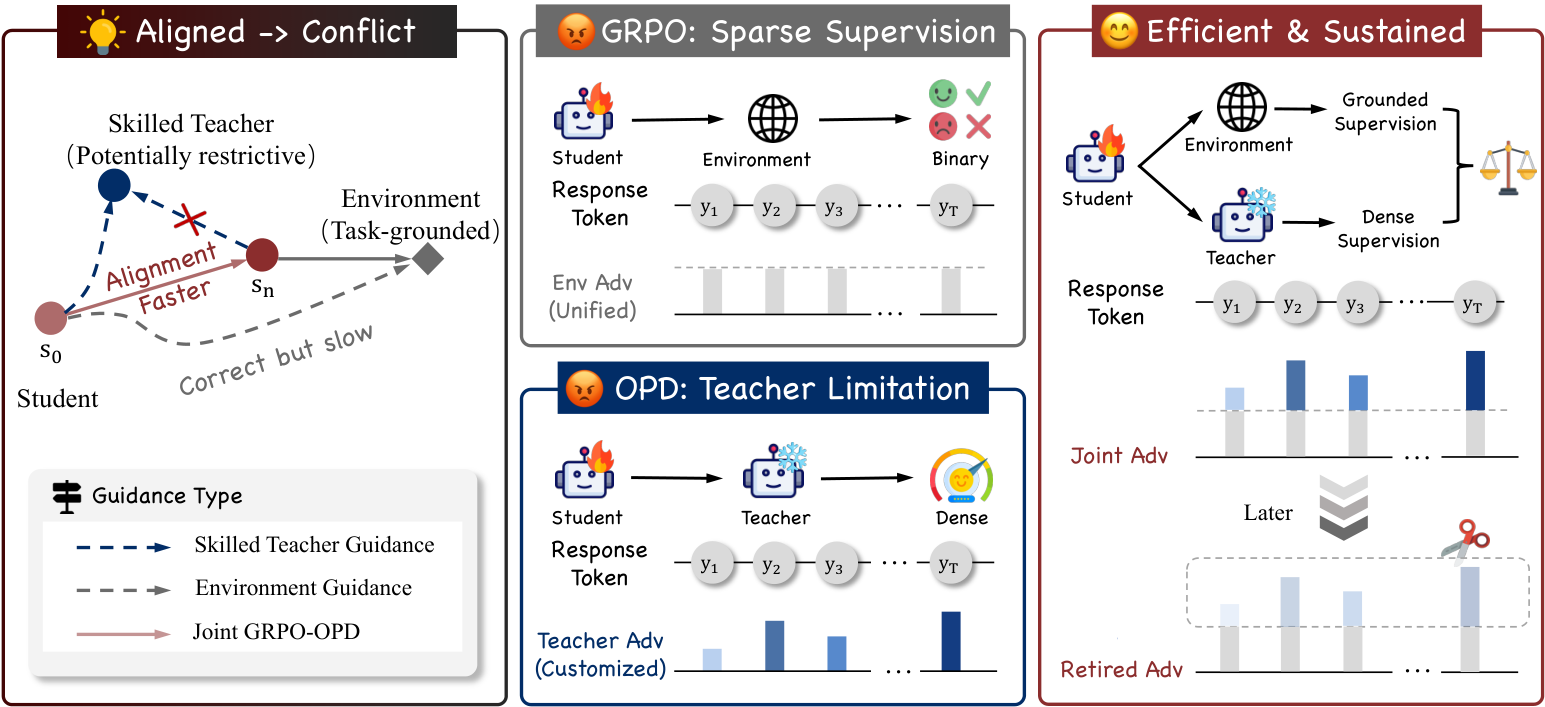
Figure 2 makes this concrete: under joint GRPO+OPD on ALFWorld with a 3B student, teacher-student discrepancy first shrinks monotonically, then plateaus while student success continues to climb under RL alone.
Method
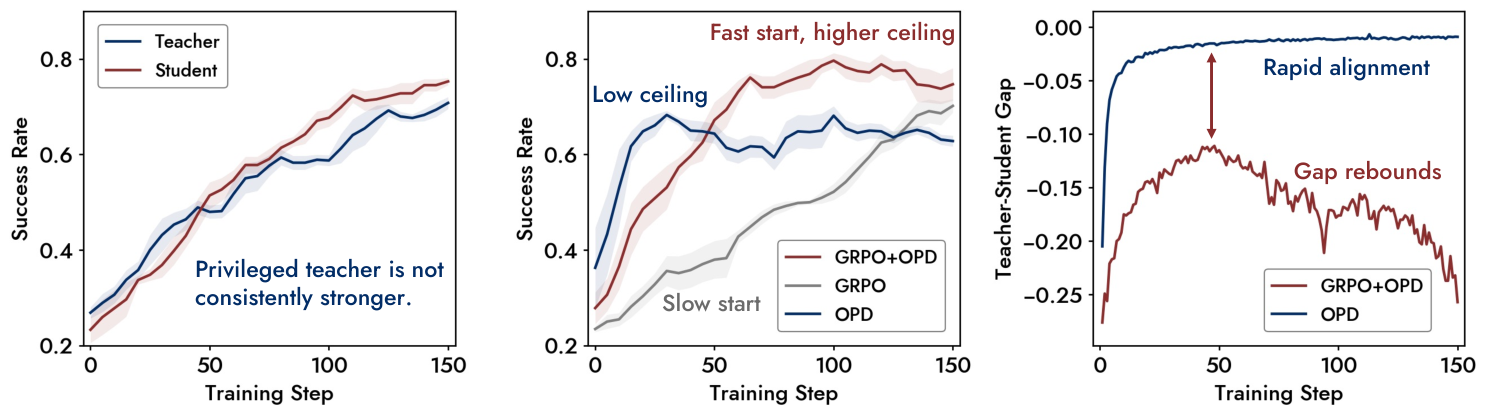
RetireOPD is a three-stage pipeline (Figure 3).
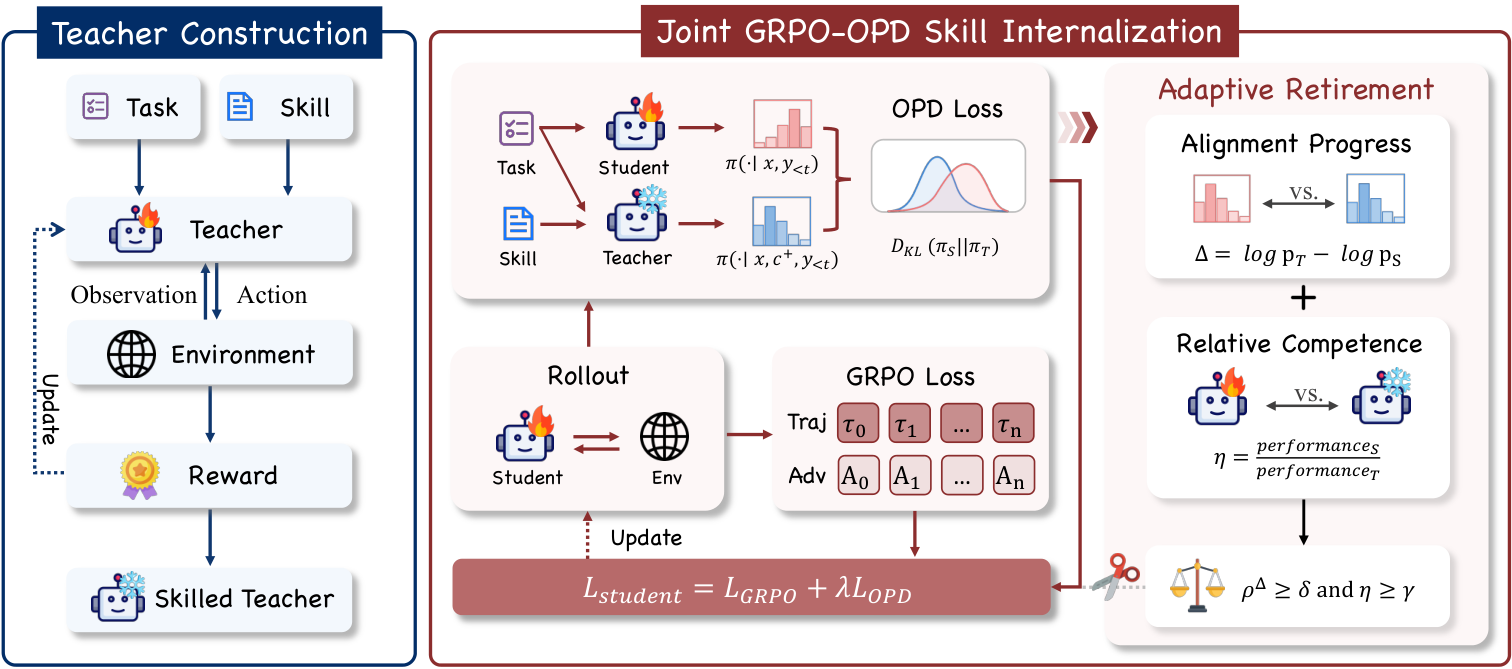
Stage 1: Privileged teacher construction. The teacher \pi_\phi and student \pi_\theta share architecture and initialization. The teacher additionally conditions on a task-relevant skill context c^+ (checklists, tool hints, subgoal decompositions) and is optimized with GRPO on environment reward:
\phi^{*}=\arg\max_{\phi}\,\mathbb{E}_{x\sim\mathcal{D},\,\tau\sim\pi_\phi(\cdot\mid x,c^+)}\left[R(\tau)\right].
Crucially, the teacher is decoupled from the student and RL-tuned, not just prompted — this is what fixes finding (1). The skill-free student never sees c^+ at train or test time.
Stage 2: Joint GRPO–OPD. With \pi_T = \pi_{\phi^*} frozen, the student is trained on its own rollouts with a combined objective: standard GRPO advantage on trajectory reward plus a token-level distillation term (reverse KL from student to teacher on student-generated sequences, evaluated with \pi_T conditioned on c^+). Because rollouts are the student’s, the teacher supplies dense per-token corrective signal exactly where the student acts, sidestepping OPSD’s off-policy mismatch.
Stage 3: Adaptive retirement. Rather than a fixed distillation schedule, OPD is dropped when both conditions hold: (i) the teacher-student discrepancy stops shrinking (its EMA plateau matches the “conflict point” in Figure 1), and (ii) the student reaches a target fraction of the teacher’s success rate, indicating enough skill has been internalized to survive without the anchor. After retirement, training reverts to pure GRPO. This is the mechanism that converts stage-dependent teacher utility into a monotone improvement curve.
Results
Evaluated on ALFWorld (six subtasks) and WebShop across Qwen2.5-1.5B/3B/7B-Instruct:
- ALFWorld average success (7B): RetireOPD 95.3, vs. GRPO 81.2 (+14.1), GiGPO 90.8, Skill-GRPO teacher 90.6, GRPO+OPD 92.2. RetireOPD surpasses its own teacher by 4.7 points.
- ALFWorld (3B): RetireOPD 93.8 vs. GRPO 75.0 (+18.8), teacher Skill-GRPO 79.7.
- ALFWorld (1.5B): RetireOPD 89.8 vs. GRPO 72.8 (+17.0), teacher 81.2.
- WebShop accuracy (7B/3B/1.5B): RetireOPD 84.4/77.3/75.8 vs. GRPO 72.6/63.3/56.8 (gains of 11.8/14.0/19.0). Again exceeds the skill-conditioned teacher (78.9/64.8/67.9).
Distillation-only baselines are strikingly weak: OPSD on 7B reaches only 32.8 ALFWorld / 2.3 WebShop, and OPD from a larger (14B) teacher hits 64.8 / 4.7 — evidence that stronger teachers do not automatically transfer, and that on-policy student rollouts matter more than teacher scale. The Skill-Prompt teacher without RL is nearly useless (23.4 / 0.8 at 7B), confirming that privileged context alone is insufficient.
Notably, hybrid GRPO+OPD is a strong baseline (92.2 ALFWorld at 7B), but RetireOPD’s retirement mechanism adds a further ~3 points at 7B and ~11 at 3B, all attributable to removing distillation once it becomes restrictive.
Limitations and open questions
- Skill contexts c^+ are hand-crafted per benchmark; automating their extraction (e.g., from expert traces) is unaddressed.
- The retirement trigger relies on two thresholds (discrepancy plateau, teacher-fraction target) whose sensitivity is not deeply characterized; the paper does not report a grid over these parameters.
- Both environments have relatively short horizons and template-rich language; behavior on open web agents (BrowserGym, SWE) or tool-use with longer credit assignment is unknown.
- The teacher stays frozen after Stage 1; a curriculum where teacher and student co-evolve, or where multiple retired teachers are re-summoned for hard subskills, is unexplored.
- The reported ALFWorld subtask splits fluctuate substantially (e.g., Pick2 at 77.3 vs 90.9 across scales), suggesting the retirement threshold interacts with subtask difficulty in ways not disentangled.
Why this matters
RetireOPD reframes self-distillation for agentic RL as a scheduled auxiliary loss rather than a persistent regularizer, and shows empirically that “when to stop distilling” is a first-class design choice — worth 3–11 points over the same-loss non-retiring hybrid. The recipe (RL-tune a privileged teacher, distill on-policy, retire on discrepancy plateau) is simple enough to drop into existing GRPO agent pipelines.
Source: https://arxiv.org/abs/2609.20784
Hacker News Signals
Developing provably correct Rust code with Verus
Verus is a verification tool for Rust that lets developers write formal proofs alongside production code, using SMT-backed reasoning (Z3 under the hood) to discharge correctness obligations statically. The Amazon Science post describes using Verus to verify components of systems software — the kind of code where memory safety from the borrow checker is necessary but not sufficient, since logical correctness (e.g., data structure invariants, protocol compliance) remains unproven by the type system alone.
The core mechanism: developers annotate functions with requires and ensures clauses (pre/postconditions), plus invariant blocks on loops. Verus translates these, along with the Rust code itself, into verification conditions that Z3 checks. Ghost code — variables and functions that exist only during verification and are erased at compile time — lets you carry proof state without runtime overhead. Spec-mode functions can express mathematical properties (e.g., sequence membership, arithmetic bounds) that would be too expensive or impossible to compute at runtime.
What makes Verus interesting relative to prior work like Dafny or F* is that it targets real, idiomatic Rust rather than a separate verified language. The ownership and borrowing rules that Rust enforces actually simplify some aliasing proofs that would be painful in C-based verifiers. The blog post highlights verifying a concurrent data structure where linearizability must be proven, not just tested.
Practical friction remains high: proof obligations for non-trivial algorithms require significant annotation effort, and the SMT solver can time out or produce opaque counterexamples. The learning curve for writing useful lemmas is steep. Automation via calc blocks and assert_by helps, but non-linear arithmetic and complex recursive structures still require manual guidance.
For systems code in safety-critical or adversarial contexts — hypervisors, crypto, storage engines — the cost may be justified. For general application code, the overhead is rarely worth it today.
Source: https://www.amazon.science/blog/developing-provably-correct-rust-code-with-verus
Bend – A language that blocks AI mistakes via proof, on CPU and GPU
Bend is a programming language designed around the claim that attaching lightweight proof obligations to code can catch the class of logical errors that LLM-generated code tends to produce. The technical architecture is more interesting than the marketing framing: Bend compiles to HVM2 (Higher-order Virtual Machine 2), a parallel runtime based on interaction combinators that executes natively on both CPU and GPU without explicit threading primitives.
The language’s type system incorporates a form of linear types and dependent types sufficient to express simple invariants — array bounds, non-nullability, basic state machine transitions — as compile-time constraints rather than runtime assertions. The interaction combinator substrate means that programs are represented as graphs of rewrite rules; parallel reduction happens automatically when subgraphs are independent, with no shared mutable state and therefore no data races by construction.
For GPU execution specifically, HVM2 maps combinator reduction to CUDA kernels, which is a genuinely novel approach compared to the standard GPGPU model of explicit SIMD kernels with manually managed memory hierarchies. The tradeoff is that irregular recursive algorithms (trees, graphs) that suit combinator reduction poorly map to GPU hardware poorly; dense numerical workloads are not the target.
The “blocks AI mistakes” framing refers to the idea that if an LLM generates code in Bend, type and proof errors surface immediately at compile time, providing a tighter feedback loop than testing. This is plausible but not unique to Bend — any language with strong static guarantees has this property. The more substantive technical contribution is the combination of automatic parallelism, linear types, and a concrete path to GPU execution from a high-level functional language.
Maturity is low; the runtime is a research prototype and ecosystem tooling is minimal.
Source: https://bend-lang.com/
How GLM built its own inference infrastructure
This post from Zhipu AI describes the engineering decisions behind building a custom inference stack for the GLM family of models rather than using vLLM, TensorRT-LLM, or other off-the-shelf frameworks. The motivation is familiar: production inference at scale exposes latency and cost constraints that generic frameworks handle suboptimally, and model-specific architectural quirks create friction with upstream abstractions.
The core technical choices described: they implemented their own continuous batching scheduler tuned for GLM’s specific attention pattern and context length distribution. They wrote custom CUDA kernels for the GLM block’s unique components (GLM uses rotary embeddings with a distinct 2D positional encoding scheme relative to standard RoPE, which affects the attention kernel’s inner loop). Kernel fusion across attention, layer norm, and MLP blocks reduces memory bandwidth pressure at the cost of kernel development time.
For disaggregated prefill and decode, they separated the two phases onto different hardware pools — prefill is compute-bound and benefits from high-FLOP GPUs, while decode is memory-bandwidth-bound and can use older hardware cost-effectively. This prefill/decode disaggregation pattern is increasingly standard (Splitwise, DistServe explore the same idea) but the GLM post gives concrete numbers: they report roughly 2x improvement in throughput-per-dollar for long-context workloads by right-sizing the hardware split.
Quantization strategy uses INT8 for weights with FP16 activations (W8A16), with per-channel scales stored in FP32. They avoid INT8 activations due to accuracy degradation on GLM’s output distribution.
The post is candid about the maintenance burden: custom kernels must be re-validated on every model update, and hardware heterogeneity (different A100/H100 SKUs) adds testing surface area. The implicit argument is that for a frontier lab, inference efficiency is a core competency worth owning.
Source: https://z.ai/blog/glm-built-its-inference-infrastructure
Qwen 3.8 Omni Flash
Qwen 3.8 Omni Flash is a compact multimodal model from Alibaba’s Qwen team targeting low-latency, edge-deployable inference. “Omni” signals unified handling of text, image, audio, and video inputs; “Flash” indicates the architectural priority is speed over maximum capability. At 3.8B parameters it is designed to run on consumer hardware and mobile accelerators.
The architecture follows the pattern established by Qwen2-Audio and Qwen2-VL: a shared transformer backbone with modality-specific encoders (a ViT variant for vision, a Whisper-derived encoder for audio) that project into the text token embedding space. The 3.8B parameter count refers to the language backbone; encoders add parameter overhead that varies by modality. Instruction-following and tool-use capabilities are retained from the Qwen3 text series.
Key claimed numbers: sub-100ms time-to-first-token on standard GPU hardware for typical prompts, and competitive benchmark scores against models 3-5x larger on tasks like document understanding (DocVQA), speech recognition (multilingual), and video QA. The blog post does not provide detailed methodology for these comparisons, which warrants caution.
The “Flash” design choices likely include reduced KV-cache size via grouped-query attention, shorter default context window relative to the full Omni model, and aggressive quantization-friendly weight distributions baked in during training. The model supports streaming audio output, which requires an autoregressive speech synthesis head — this is architecturally more complex than text-only generation and the latency claims for audio output specifically are not clearly separated from text output in the post.
Primary use case is real-time voice and vision assistants on device. Competition is dense: Gemini Nano, Phi-3.5-Vision, and SmolVLM occupy adjacent points in the capability-size tradeoff space.
Source: https://qwen.ai/blog?id=qwen3.8-omni-flash
Mistral X Mozilla: Private, Multilingual AI Browsing
Mistral and Mozilla are shipping a browser-integrated AI assistant built on a Mistral model running locally via Firefox’s on-device inference stack. The technical substance is less about a new model and more about the deployment architecture: inference happens entirely in-process within the browser, using WebGPU or a native backend depending on hardware, with no data leaving the device.
Mozilla’s inference layer is based on their work on transformers.js and a Rust-native inference engine (likely derived from their llamafile/llama.cpp integration work). The model is a quantized Mistral variant — the post does not specify the parameter count precisely, but on-device browser deployment implies something in the 1-7B range with aggressive quantization (likely 4-bit or lower) to fit in GPU VRAM shared with rendering workloads.
The multilingual angle is substantive: the model targets Firefox’s global user base across European languages, and Mistral’s training data has stronger multilingual coverage than most US-lab alternatives at equivalent model size. Practical tasks are summarization, translation, and reading assistance — all low-latency, short-context workloads that suit the deployment constraint.
The privacy model is straightforward: no inference server, no telemetry on prompt content. The threat model it addresses is user reluctance to send browsing context to cloud APIs — a genuine concern for enterprise and privacy-sensitive users.
Engineering challenges here include memory contention (the model competes for GPU memory with the browser’s compositor and WebGPU workloads from web pages), cold-start time for model loading, and keeping the binary size acceptable for browser distribution. WebGPU-based inference adds ~10-20% overhead versus native CUDA/Metal but avoids requiring elevated privileges.
Whether this form factor becomes standard browser infrastructure or remains a niche feature depends on whether model quality at the size/quantization constraints is sufficient for sustained use.
Source: https://mistral.ai/news/mistral-x-mozilla/
How to Write with an LLM
Thomas Ptacek’s post is a practical methodology piece, not a capability survey. The central argument is that LLMs are useful for writing when used as a structural and revision tool rather than a text generator, and that conflating the two leads to the characteristic mediocrity of LLM-assisted prose.
The concrete workflow described: write a rough draft yourself first, then use the model to identify structural problems (argument flow, paragraph ordering, missing transitions), then revise yourself, then use the model for line-level editing (passive voice, wordiness, vague quantifiers). The model never produces final text; it acts as an editor with infinite patience and no social stake in the work.
The technical observation underlying this approach is about what LLMs are actually good at: they have internalized a large distribution of edited, published text, which gives them decent recall of editorial heuristics (show don’t tell, vary sentence length, avoid nominalizations). They are poor at generating novel arguments or maintaining a consistent voice across long documents because their generation is local and they have no world model of what the author is actually trying to argue.
Ptacek also makes the point that prompting discipline matters more than model choice for this use case: asking the model to identify the three weakest sentences and explain why gets more actionable output than asking it to “improve” the text. The latter triggers filler generation; the former forces something closer to structured analysis.
The implicit critique of typical LLM writing use is that outsourcing generation to the model also outsources the thinking, and the thinking is the actual valuable part of writing technical or persuasive content. This is not a new observation but the post is unusually concrete about the mechanics of avoiding it.
Source: https://sockpuppet.org/blog/2026/09/17/how-to-write-with-an-llm
OpenArm: An open-source 7DOF humanoid arm
OpenArm is a fully open-source 7 degree-of-freedom robot arm designed to match the kinematic envelope of a human arm, intended for humanoid robot research and low-cost manipulation platforms. The repository contains CAD files (parametric, in Onshape with export to STEP/STL), URDF models for simulation, firmware for the actuator controllers, and a ROS2 interface.
The 7-DOF configuration (shoulder 3-DOF, elbow 1-DOF, wrist 3-DOF) enables full dexterous positioning with a redundant degree of freedom, meaning the arm can reach a given end-effector pose through multiple joint configurations — critical for obstacle avoidance and singularity avoidance in constrained workspaces. This matches the structure of human arms and is the same configuration used in commercial platforms like the Franka Emika Panda.
Actuation uses quasi-direct-drive motors (low gear ratio, high-transparency) rather than high-reduction gearboxes. This sacrifices maximum force for backdrivability and proprioceptive accuracy — the arm can feel contact forces through motor current sensing rather than requiring dedicated force/torque sensors. The tradeoff is well-established in legged robotics (MIT Cheetah lineage) and is increasingly standard for manipulation research because it simplifies contact-rich learning.
The controller firmware implements torque control at the joint level, with a ROS2 action server exposing a standard FollowJointTrajectory interface for compatibility with MoveIt2. The URDF includes accurate inertial parameters measured from the physical assembly, which matters for dynamics-based motion planning and sim-to-real transfer.
Cost target is stated as significantly below commercial alternatives (Franka is ~$15k-20k; the OpenArm BOM is estimated in the hundreds of dollars range using off-the-shelf motors). Payload and repeatability specs are not yet formally characterized, which is the key missing data for assessing whether it is viable for manipulation research.
Source: https://github.com/enactic/OpenArm
OpenSpec – A lightweight and configurable AI spec framework
OpenSpec is a framework for writing structured behavioral specifications for LLM-backed systems and running them as executable tests. The core problem it addresses: as LLM applications move toward agentic pipelines and tool use, informal prompts and manual testing are insufficient for verifying that the system behaves correctly across input distributions. OpenSpec provides a DSL for specifying expected behaviors and an evaluation harness that runs the spec against the system under test.
The technical structure: specs are written as YAML or JSON documents defining input templates, expected output properties (which can be regex matches, semantic similarity thresholds via embedding distance, or calls to an LLM judge), and pass/fail criteria. The framework handles test case generation (either from fixed examples or by sampling the input template space), execution against the target system (via API), and aggregating results into a structured report.
The “configurable” part refers to swappable evaluation backends — you can use GPT-4 as a judge, a local model, or a deterministic rule, depending on cost and latency constraints. This is practically important because LLM-judge evaluation is expensive at scale and deterministic checks are preferable where they are sufficient.
This fits into the broader space of LLM evaluation frameworks (HELM, RAGAS, promptfoo) but is positioned as lighter-weight and more oriented toward per-system behavioral specs than aggregate benchmark scores. The distinction matters: benchmark scores tell you about general capability; behavioral specs tell you whether your specific system does what you intended across your specific distribution of inputs.
Current limitations: the DSL is simple and expressing complex stateful behaviors (multi-turn conversations with dependent assertions) requires workarounds. LLM-judge reliability for subtle semantic properties remains a known weak point regardless of framework.
Source: https://openspec.dev/
Noteworthy New Repositories
JordyZomer/lemmalog
A Datalog engine purpose-built for LLM agent memory. Standard vector stores give agents approximate retrieval; Datalog gives them deductive reasoning over structured facts. Lemmalog implements stratified negation, so rule evaluation is split into strata that prevent circular negation from producing undefined semantics. Facts carry provenance metadata — each derived fact records which base facts and rules produced it, enabling causal tracing of any belief the agent holds. Incremental derivation means only the delta caused by a new fact is re-evaluated, rather than re-running the full fixpoint computation.
The system exposes an MCP (Model Context Protocol) server, so any MCP-compatible harness can treat lemmalog as a shared working memory across multiple agent instances. Multiple agents can assert and query the same fact base, with derivation kept consistent automatically. This is meaningfully different from a shared key-value store: you get transitive closure, recursive rules, and negation-as-failure essentially for free. Practical use cases include dependency tracking, policy enforcement, and multi-hop relationship queries that would require several chained LLM calls otherwise. Written in a systems language with no Python runtime dependency.
Source: https://github.com/JordyZomer/lemmalog
2akouwu/reverify
Addresses hallucination at the architectural level rather than through prompting. The design separates proposal from verification: the LLM generates claims, then deterministic external tools adjudicate each claim against ground truth before it enters the agent’s working context. Only facts that pass verification survive context resets, so the persistent memory layer contains only grounded propositions.
The proving ground is reverse engineering — a domain where factual precision matters and ground truth is recoverable (disassembly, binary analysis, symbol resolution). This makes it a credible stress test rather than a toy demo. The implementation ships as both an MCP server and a standalone CLI, so it can integrate into existing agentic pipelines or be used interactively. The key architectural invariant is that the LLM never writes directly to the grounded fact store; it only writes to a staging area that the verification layer drains. Evidence references are stored alongside each accepted fact, enabling audit trails. This is closer to a proof-assistant workflow than standard RAG: the model is the conjecturer, the tools are the checker, and only theorems with proofs persist.
Source: https://github.com/2akouwu/reverify
carloslfu/slotstream
Solves the problem of running a 125B mixture-of-experts model (Qwen3-235B-A22B-Flash or similar) on consumer hardware with insufficient VRAM. The key insight: in an MoE model, only a small subset of experts is active per token. SlotStream maintains a fixed-size “slot cache” in GPU/unified memory holding only the currently hot experts, and streams cold experts from SSD on demand. Effective active parameter count at inference time stays within the 48 GB Apple Silicon unified memory budget even though the full checkpoint is 105 GB.
The implementation is native Swift on Apple’s MLX framework with Metal compute kernels — no Python, no Ollama dependency, single binary distribution. This matters for latency: removing the Python interpreter and inter-process overhead is measurable on the M-series memory bandwidth path. The API surface is Ollama- and OpenAI-compatible, so existing tooling (Continue, Open WebUI, LiteLLM) works without modification. The SSD streaming approach is only viable because NVMe sequential read bandwidth on modern Macs (~3-7 GB/s) is high enough that expert-load latency is acceptable at modest token-generation rates. This is a practical complement to llama.cpp’s CPU offload path, optimized specifically for the Apple Silicon memory architecture.
Source: https://github.com/carloslfu/slotstream
truespar/sentio
A complete multi-tenant mail server in Rust, designed as infrastructure for giving AI agents real email identities. Each agent gets a dedicated address with full send/receive capability; inbound mail arrives as structured webhooks rather than raw MIME, and replies are issued via REST. This removes the need to parse email inside agent code.
The technical depth is considerable. Sentio implements the full deliverability stack: DKIM signing and verification, SPF evaluation, DMARC policy enforcement including aggregate and forensic reporting, and ARC (Authenticated Received Chain) for forwarded mail. Transport security covers MTA-STS (policy-based TLS enforcement via HTTPS-fetched policy files) and DANE (DNS-based Authentication of Named Entities, using TLSA records for certificate pinning without a CA). Anti-spam is three-tier, though specific mechanisms are not fully documented publicly. Running your own MTA rather than relying on transactional email SaaS gives agents inbox capabilities without per-message cost, rate limits, or API key management. The Rust implementation means low memory overhead when hosting hundreds or thousands of agent mailboxes. Relevant for any agentic workflow that needs asynchronous communication, form submissions, notification monitoring, or multi-agent coordination over email threads.
Source: https://github.com/truespar/sentio
modelscope/ms-cookbook
A practitioner-oriented cookbook for the ModelScope ecosystem, covering the full ML workflow from model selection through inference, fine-tuning, evaluation, RAG construction, agent building, and AIGC pipelines. The content is structured as runnable notebooks and scripts targeting ModelScope’s hosted models and the associated toolchain (SWIFT for fine-tuning, EvalScope for evaluation, AgentScope for agent orchestration).
For a Western reader less familiar with ModelScope: it is Alibaba’s open model hub, hosting a large number of Chinese-language and multilingual models not mirrored on Hugging Face, as well as its own inference and training infrastructure. The cookbook’s value is practical integration — the examples show how to wire together components that are individually documented but whose interactions are underspecified. Coverage includes LoRA and QLoRA fine-tuning recipes, structured RAG pipelines with retrieval evaluation, and multi-step agent workflows using LangChain-compatible abstractions. The guide is primarily in Chinese, which limits accessibility, but the code is readable independently. Useful for anyone deploying ModelScope-hosted models in production or evaluating Chinese-language LLMs.
Source: https://github.com/modelscope/ms-cookbook
naw103/foremerge
A coordination protocol for multi-agent coding systems that operates above the Git object model. The core problem: when multiple coding agents work concurrently on a codebase, merge conflicts are a symptom of a deeper issue — the agents had incompatible intentions that were only detectable after code was written. Foremerge attempts to surface intent conflicts before any code is generated, analogous to how a type checker finds errors before runtime.
The protocol asks agents to declare their intended changes at a semantic level (which modules, interfaces, or behaviors they plan to modify) before execution. A coordination layer checks declared intents for conflicts using rules defined over the intent graph, and blocks or queues conflicting agents. This is reminiscent of optimistic concurrency control but applied to agent plans rather than database transactions. Git remains the source of truth for history; foremerge adds a pre-execution layer. The open-source release includes the protocol specification and a reference implementation. The hardest unsolved problem here is intent representation: intents must be expressive enough to catch real conflicts but tractable enough to reason over automatically. Whether the current representation handles refactors, interface changes, and cross-module effects adequately is an open question.
Source: https://github.com/naw103/foremerge
XHToken/Spark-X2.5
An on-device model series targeting agentic task execution under tight resource constraints. The framing is “pushing the limits of agentic capabilities in on-device models,” which points at the specific trade-off: on-device deployment caps parameter count and FLOP budget, but agentic tasks (multi-step planning, tool use, instruction following across turns) demand more capable reasoning than simple completion tasks.
Documentation at release is sparse — model sizes, architecture details, and benchmark numbers are not yet fully published. Based on the repository structure and naming conventions, the series likely spans several parameter scales and targets ARM and Apple Silicon deployment. The “X2.5” versioning suggests this is an iteration on a prior Spark series. Agentic capability evaluation typically covers tool-call accuracy, instruction following over long horizons (IFEval-style benchmarks), and multi-step task completion rates. Whether Spark-X2.5 publishes rigorous numbers on these axes remains to be seen. Worth watching if you work on edge deployment of agentic systems, but treat current claims cautiously until evaluation methodology is published.
Source: https://github.com/XHToken/Spark-X2.5
yuyuanweng/ai-picture-editor
A full-stack AI image editing agent built as an explicit curriculum project for learning agentic system architecture. The stack is React 19 + Konva (canvas rendering) on the frontend, FastAPI + LangChain + LangGraph on the backend. Twenty-one editing tools are exposed as LangGraph nodes, and the agent plans multi-step edits from natural language instructions, executing tools in sequence with intermediate state passed through the graph.
Technically interesting components: SSE (Server-Sent Events) for real-time streaming of intermediate results back to the canvas, an async task queue for long-running operations (background removal, generative inpainting), and a layer model that allows region-specific edits without destructive global operations. The LangGraph integration means the planning graph is explicit and inspectable rather than implicit in prompt chaining. Text-to-image generation and semantic segmentation for smart cutout suggest external model API calls (likely to a hosted diffusion model and segmentation service). The project is positioned as a learning resource rather than production software, but the architectural choices — separating tool definitions from the planner, using SSE for streaming, maintaining a canvas layer model — reflect real design patterns for production image-editing agents.