Daily AI Digest — 2026-11-04
arXiv Highlights
Route Anything: A Study of Model and Policy Routing for General-Purpose AI Systems
Problem and setup
The paper asks a concrete operational question for heterogeneous AI systems: given a pool of specialized candidates (LLMs, image/video/speech generators, agent plans, robot policies), how should a router pick one per input to trade quality against cost? It frames this as a decision-theoretic problem over a trajectory matrix of 374,401 scores from 25 benchmarks across text QA, image-text QA, image/video/speech generation, code and workplace agents, and robot manipulation.
The formal object is standard but useful. An input x has a candidate menu \mathcal{U}(x); running u yields value V_u \in [0,1] and cost D_u > 0. The router observes a state s = \sigma(x) (benchmark label, capability type, or raw input) and selects g(s), maximizing \mathbb{E}[V_{g(s)} - \lambda D_{g(s)}]. The authors organize achievable performance into an “information ladder” (Proposition 3): fixed candidate ⟶ best-per-benchmark ⟶ best-per-type ⟶ oracle per input. Each rung’s gap over the previous one bounds what more state information can buy.
Potential gains: oracle vs. fixed
The headline result on the ceiling is modest in aggregate. On 19,814 test inputs where every candidate was scored, the best fixed candidate per benchmark gets 82.60 (0–100 scale), the best fixed in hindsight 82.62, and the per-input oracle 87.98 — a gap of only 5.38. The oracle margin is highly uneven: 0.68 on speech generation, 2.70 on image-text QA, 4.28 on text QA, 4.99 on image generation, 8.11 on code/workplace agents, but 18.40 on robot manipulation and 18.93 on video generation. So routing’s ceiling is largely a story about agents, robots, and generative video, not language QA. This is the clearest empirical message of Section 3: the LLM space has consolidated enough that per-input routing has little headroom.
Learned routers
Section 4 trains Qwen3.5-4B-based routers in three flavors against a shared target:
- Outcome router: a sigmoid head scores (x, \text{candidate profile}) pairs, trained by cross-entropy against normalized outcomes (Proposition 4a), and picks the argmax.
- Type router: classifies x into a capability type (157 leaves of a modality/task/capability tree per the capability-tree baseline), then looks up the type’s best candidate from training; unresolved inputs fall through to the fixed candidate.
- Winner-label router: directly predicts the best candidate’s name.
The capability-tree router is evaluated across 16 benchmarks (3,444 test inputs) with LLM candidates Claude Opus 5.5, GPT-6.1 Sol, DeepSeek V4.1 Flash, and GPT-6 Astra on long-context tasks. Results (Table 3): overall 79.98 vs. fixed 79.68 vs. oracle 84.80 — a +0.30 gain, 6% of the oracle gap. Per group: text QA −0.17 (−3% share), code/workplace agents +0.77 (14%), image gen +0.25 (5%), video gen +2.12 (12%), speech gen 0.00. The outcome router on RoboTwin (2,000 unseen scenes from 10 held-out tasks) scores 71.55 vs. fixed 70.45 vs. oracle 88.85, recovering 6% of the gap.
The gap between what the oracle shows is possible and what learned routers recover is severe: in robotics, 18.40 points of ceiling turn into 1.10 points realized. In video, 18.93 → 2.12. In text QA the realized number is actually negative. Learned routers are capturing a small fraction of the information-theoretic headroom even when they have ample training signal.
Cost-aware routing
Section 5 injects price. The reference-fallback cascade is a clean primitive: with primary P, backup B, verifier decision H \in \{0,1\},
V = H Y_P + (1-H) Y_B, \quad D = A + (1-H) C_B,
where A is primary-plus-verification cost. On CodeRouterBench (8 models, 9,999 tasks, Opus 4.6 as reference), states are 21 dimension×source cells with 22 candidates per state (8 direct dispatches plus 7 primaries × 2 verifier thresholds \theta \in \{1, 0.5\}). Always-Opus scores 0.4383 at 11.655 m$ per task; the certified floor Q \geq -\epsilon is imposed on probing tasks before test evaluation. The construction supports Pareto frontiers rather than single-point comparisons, and gives a principled baseline (always-reference) that cascades must beat on both axes.
Limitations and open questions
The paper is honest about several ceilings but leaves others implicit. (1) The oracle itself is per-candidate best outcome; sampling noise in benchmarks means some of the 5.38-point aggregate gap is unrealizable. (2) The large gaps in robotics and video partly reflect the small candidate pools (3–7) and heterogeneous task structure where per-input routing is closer to task identification than quality prediction. (3) Learned routers use benchmark text and output requirements; they do not inspect candidate-specific context (e.g., tool call traces, partial generations), so the information ladder is being climbed only to the state-feature rung, not the richer predictors Proposition 4 permits. (4) The cost study assumes an oracle verifier for cascades; realistic verifiers degrade the frontier. (5) Candidate pools are fixed and small; routing in open ecosystems with hundreds of candidates and churn is not addressed.
Why this matters
The paper quantifies, across an unusually broad set of modalities, that per-input routing’s ceiling is concentrated in agentic and generative tasks (double-digit oracle gaps) rather than LLM QA, and that current learned routers recover only ~6% of that ceiling on average. For system builders, this reframes routing as primarily a cost-control mechanism via cascades rather than a quality-boosting mechanism, and gives a concrete trajectory matrix and ladder for benchmarking future routers.
Source: https://arxiv.org/abs/2611.05275
Think Less, Locally: Local Preference Learning for Reasoning Compression
Large reasoning models (LRMs) distilled from traces like DeepSeek-R1 tend to continue deliberating long after they have the information needed to answer. Existing compression approaches — length-penalized RL, trajectory-level DPO on shorter-vs-longer rollouts, or SFT on condensed CoT — supervise entire trajectories. They answer the question “is this trajectory too long?” but not “given this partial state, should the model keep thinking?” LoCo targets the latter: a per-state decision of whether to terminate reasoning now.
Method
LoCo constructs state-conditioned preference pairs \{(P_i, y_i^+, y_i^-)\}, where P_i is a frozen reasoning prefix ending after step s_i, y_i^- is the original continuation the model produced, and y_i^+ is a shorter but still correct continuation regenerated from the same prefix. Training is standard DPO on these pairs, with the key twist that the prefix P_i is identical in both branches — the model is forced to learn where to stop, not globally how to be terse.
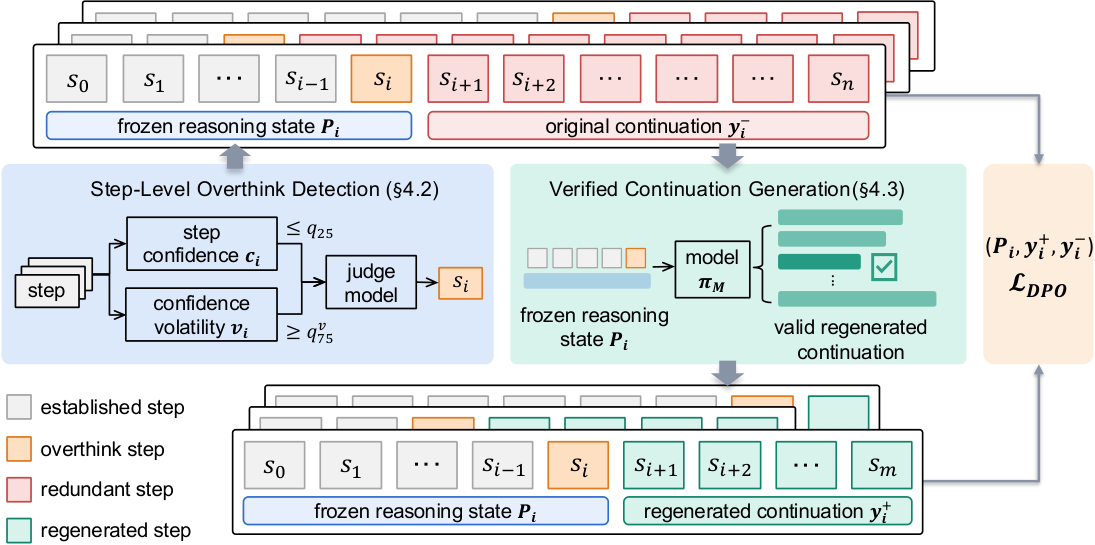
The pipeline (Figure 1) has three stages:
Local overthink detection. From a self-generated trace, candidate states are flagged by a two-stage filter: a cheap heuristic screen followed by an LLM judge (Qwen3-30B) that confirms whether the model already had enough information at step s_i to conclude. For each query, three rollouts are sampled (temperature 0.6, top-p 0.95) and the shortest correct rollout is taken as the base trajectory.
Verified continuation generation. From each flagged prefix P_i, k=8 fresh continuations are sampled under identical decoding parameters. A continuation is retained as y_i^+ only if it is correct and saves at least \delta=300 tokens relative to y_i^-. Each question contributes at most K=3 pairs to prevent any single trace from dominating.
Local preference learning. The standard DPO objective is applied,
\mathcal{L}_{\text{DPO}} = -\mathbb{E}\left[\log \sigma\!\left(\beta \log \frac{\pi_\theta(y^+ \mid P)}{\pi_{\text{ref}}(y^+ \mid P)} - \beta \log \frac{\pi_\theta(y^- \mid P)}{\pi_{\text{ref}}(y^- \mid P)}\right)\right],
with \beta=0.1 and the frozen base model as reference. Because P is shared across the two branches, the gradient contrast is entirely about continuation choice from that state.
Training is applied to DeepSeek-R1-Distill-Qwen-7B via a LoRA adapter (rank 256, \alpha=512, dropout 0.05) on q/k/v/o projections, for two epochs with effective batch size 64, learning rate 1 \times 10^{-5}, cosine schedule with 0.1 warmup, AdamW (\lambda=0.01), and gradient clipping 1.0. Prompt and continuation lengths are capped at 6k and 12k tokens; sequence length is 14,336 on four H20 GPUs. Notably, training data is math-only and entirely self-generated.
Results
Evaluated on five math benchmarks and three code generation benchmarks, LoCo reports completion-length reductions of 41.7%–45.4% on math and 23.4%–36.3% on code, while maintaining or improving accuracy. The transfer to code — despite math-only training — suggests the “when to stop” signal generalizes beyond the training distribution rather than encoding domain-specific shortcuts. The abstract claims best accuracy–length Pareto trade-off against competing compression baselines (truncated in the provided excerpt).
Limitations and open questions
- Judge dependency. Detection relies on Qwen3-30B as an overthinking oracle. Systematic biases in the judge (e.g., preferring confident-sounding early termination) propagate directly into the preference labels; no ablation on judge choice is shown in the provided excerpt.
- The \delta=300 threshold and K=3 cap are heuristics and likely interact with the base model’s typical trace length; applying LoCo to models with much shorter or longer CoT distributions may require retuning.
- DPO on state-conditioned pairs with shared prefixes has a known failure mode: the model can decrease the likelihood of y^- without proportionally increasing y^+, especially when y^+ is much shorter (fewer tokens to spread the reward over). Whether LoCo exhibits the likelihood-displacement pathology, or needs an IPO/length-normalized variant, is not addressed in the shown sections.
- No comparison to a terminator-token or early-exit classifier trained directly on the same (prefix, continue?) labels. The DPO formulation is one way to use these pairs; whether it is the best is unclear.
- Correctness of y^+ is verified only by final-answer match, which admits lucky-guess continuations that skip genuine intermediate reasoning. On code, this is partially mitigated by test execution, but the math setting may teach the model to shortcut verification steps.
Why this matters
The dominant lever in CoT compression has been trajectory-level: shorter rollouts win. LoCo reframes compression as a sequence of local termination decisions anchored to concrete reasoning states, which is both more faithful to how overthinking actually manifests and empirically more effective — ~45% length reduction on math at preserved accuracy, with zero-shot transfer to code. If the state-conditioned preference recipe is robust, it is a natural drop-in for any distilled reasoning model.
Source: https://arxiv.org/abs/2611.04814
DreamX: Video Diffusion Model is a Universal Latent Action Learner
Problem
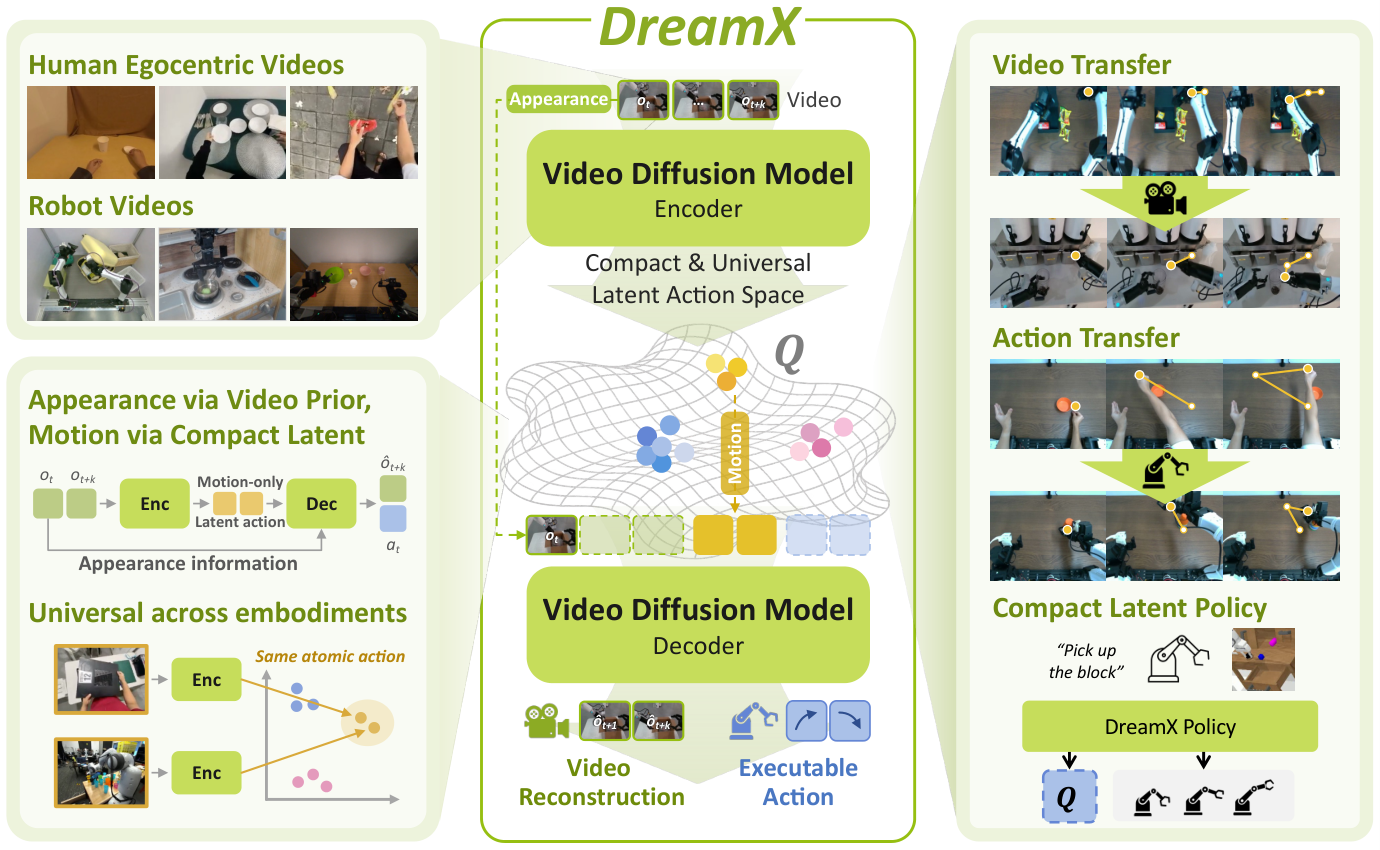
Latent action models (LAMs) learn action representations by predicting visual transitions between frames, with the hope that the latent space factors out “what moves” from “what the scene looks like.” In practice, representations learned this way entangle action semantics with embodiment and appearance, which blocks transfer between humans and robots, between scenes, and between action parameterizations (e.g., end-effector pose vs. joint angles). The question DreamX asks is whether a pretrained video diffusion transformer — which already encodes strong spatiotemporal priors — can be repurposed to extract compact, embodiment-agnostic latent actions whose semantics are action-relevant dynamics rather than pixel-level change.
Method
DreamX builds on Cosmos-Predict2.5 2B, a flow-matching video DiT. A causal video autoencoder maps a clip to N latent frames \mathbf{V}=(V_0,\dots,V_{N-1}), with V_0 encoding only the initial frame. The base model is trained with the standard rectified-flow objective
\mathcal{L}_{\mathrm{video}}=\mathbb{E}_{x,c,\epsilon,\tau}\big[\lVert v_\theta(x_\tau,\tau;c)-(\epsilon-x)\rVert_2^2\big],\quad x_\tau=(1-\tau)x+\tau\epsilon.
The architectural contribution is a learnable-query readout attached to the pretrained backbone (Fig. 2a). For each VAE latent frame, four learnable query tokens cross-attend into the backbone’s spatiotemporal features and emit the latent actions. Since each latent frame comprises roughly 1,200 patch tokens, this is a 300\times compression (1{,}200\rightarrow 4 tokens per latent frame). A decoder, initialized from the same video DiT, reconstructs future frames conditioned on the initial frame plus the latent-action queries, again under the flow-matching objective. When low-level actions are available, an auxiliary action-prediction head provides additional supervision.
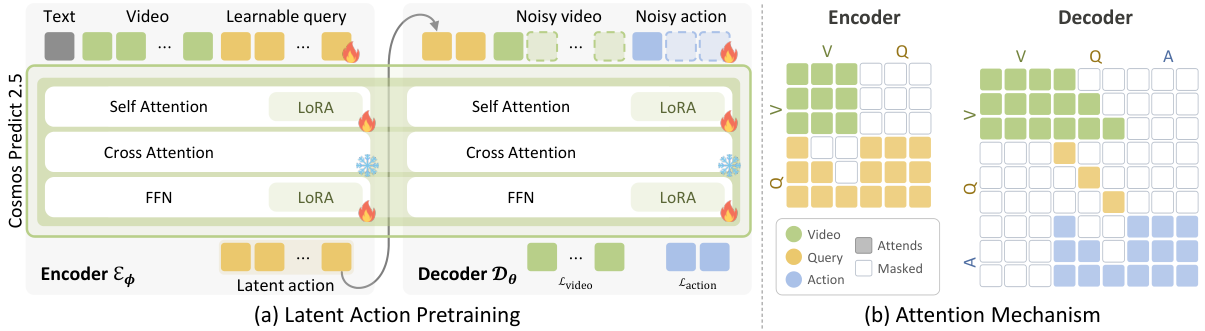
The attention masks (Fig. 2b) are the mechanism that keeps appearance out of the latent actions. In the decoder, both video tokens and action-label tokens attend to the latent-action queries, but video and action tokens are prevented from attending to each other. This forces the queries to carry the information needed to predict both pixels and labels, while preventing the decoder from short-circuiting via direct video–action copying. Combined with the fact that V_0 already supplies appearance to the decoder, the queries are pressured to encode only what V_0 cannot predict — i.e., the dynamics that distinguish futures from the initial scene. Encoder and decoder are adapted with separate rank-16 LoRA modules trained for 78k steps at 480\times 640 on up to 29-frame clips.
Training mixes robot data (MolmoAct2-BimanualYAM, Bridge, DROID, AgiBot) with egocentric human video (EgoDex, EgoVerse), with no paired human–robot correspondences. Because the same query layout is used across all sources, the latent space becomes a shared action interface.
Downstream uses
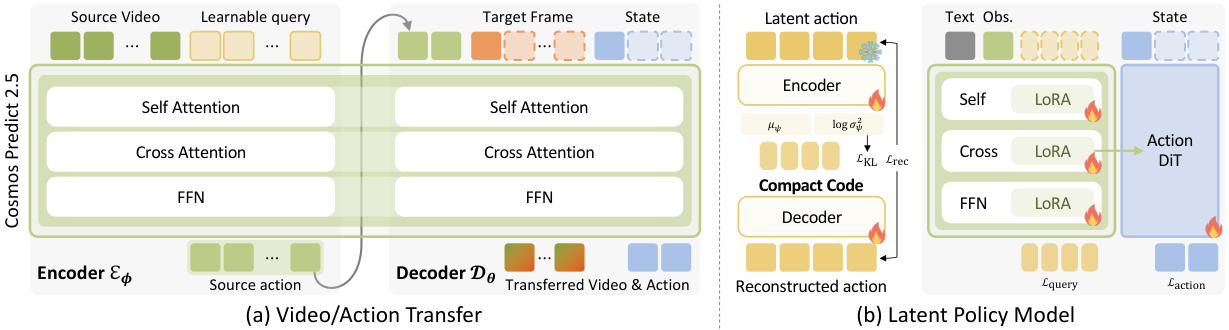
Three downstream regimes are supported (Fig. 3). (i) Any-to-any video transfer: extract latent actions from a source video, feed them with a target initial frame to the DreamX decoder, and generate a video in the target domain executing the source motion. (ii) Cross-embodiment action decoding: feed source latent actions with a target robot state to produce low-level actions without paired source–target data. (iii) DreamX policy: a variational bottleneck compresses the query tokens into a compact code (preserving the per-frame token layout), and a policy predicts these codes and low-level actions conditioned on current state, bypassing full future-video generation at inference.
Results
On LARY-Bench, which measures how well latent actions capture motion for downstream video prediction, DreamX reports state-of-the-art performance among latent action models (the paper’s selected sections do not list the per-column numbers in text, but the headline claim is SOTA across the benchmark). Qualitatively, Figure 4 (not reproduced here) shows motion transfer across large appearance and embodiment gaps — e.g., human kitchen manipulation transferred to robot arms in different scenes — with end-effector trajectories remaining temporally coherent. The authors argue these results are evidence that the latent code is invariant to appearance and embodiment while preserving the action-relevant trajectory of the end effector.
Limitations and open questions
The paper, as excerpted, does not quantify how well decoded low-level actions execute on a physical robot in closed loop versus purely in simulation or in offline rollouts; the transfer evidence is primarily video reconstruction and offline policy benchmarks. The 4-tokens-per-latent-frame bottleneck is a design choice without a sweep reported in the shown sections, so the appearance/action trade-off at other compression ratios is unclear. The method inherits the base video DiT’s biases, including scene priors from large-scale pretraining data, which may limit how “appearance-invariant” the latent really is for out-of-distribution objects. It also remains open whether the shared latent space is linearly aligned across embodiments or only decodably aligned via the conditioned decoder — i.e., whether one can do simple arithmetic on latent actions across humans and robots.
Why this matters
If a pretrained video diffusion model already contains the inductive biases needed to disentangle dynamics from appearance, then latent action learning becomes a readout problem rather than a representation-learning problem, and human egocentric video becomes a legitimate data source for robot policies without paired demonstrations. The 300\times compression per frame also makes diffusion-model features tractable as policy inputs, which is the pragmatic bottleneck for scaling video-pretrained world models into control.
Source: https://arxiv.org/abs/2611.05377
RoboColosseum: Evaluating Physical Intelligence at Scale In-The-Wild
Real-world robot evaluation suffers from a reproducibility paradox: the environmental variation that makes physical trials informative is exactly what prevents comparing results across labs. RoboColosseum attacks this with a distributed benchmark that fixes the policy-serving stack, observation/action specs, and scoring protocol while letting the environments vary across sites. The initial deployment ran 41 days (17 Sep – 28 Oct 2026), covering 5,699 pairwise Open Track comparisons at 124 sites and a Fine-tune Track over 20 tasks across four embodiments, evaluating five VLA policies (GR00T N1.7, \pi_{0.5}, MolmoAct2, G0.5, LingBot-VLA v2) and three frontier agents (GPT-6 Astra, Claude Opus 5.5, Grok 4.7).
Infrastructure
The four embodiments span cost and morphology: SO-101 (low-cost 6-D single arm, 1 external + 1 wrist camera), DROID-configured Franka (8-D, 2 external + 1 wrist), Bimanual-YAM (14-D, 1 top + 2 wrist), and a Unitree G1 humanoid with parallel grippers.
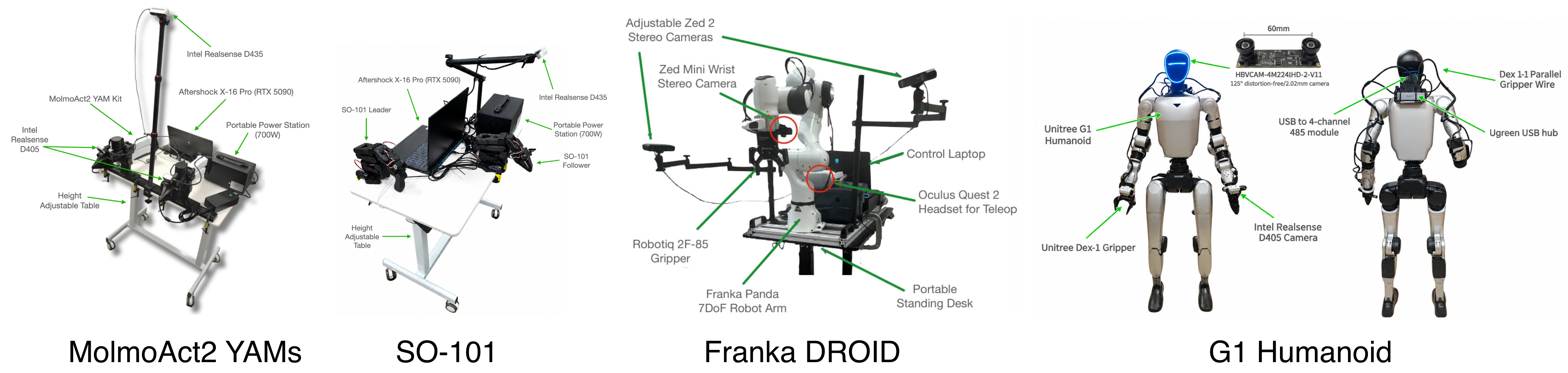
Each embodiment has a fixed observation/action specification shared across all sites and policies, so a given policy checkpoint runs unchanged everywhere. Inference runs either locally on an RTX 5090 laptop or on a remote server through a routing server, with latency measured to confirm both paths support closed-loop control.
Two tracks
The Open Track evaluates policies out-of-the-box via blinded pairwise trials under matched local conditions, aggregated with an Elo-style posterior they call DCR. VLA policies use embodiment-specific pretrained checkpoints; frontier agents are served through the Inspect Robots agent policy inside the RoboColosseum policy server. At each step the agent receives 640\times 480 images from all cameras, proprioception as a labeled numeric vector, and the instruction; it emits exactly one tool call per turn — move (absolute joint-position target, interpolated server-side at a fixed fraction of joint speed), done, or give_up — with a mandatory one- or two-sentence rationale stored in the transcript. Only the two most recent observations retain their images; older observations are kept as text.
The Fine-tune Track fixes the data budget: 100 demonstrations per task, 20 tasks (5 per embodiment), 25 trials per model-task pair. Every VLA uses its own upstream training repository pinned to a fixed commit, with a harness supplying only data conversion, per-model configs, and launch scripts. Learning rates are linearly scaled from each recipe’s reference batch size to the effective batch size, all training in bf16 with fp32 master weights, final-epoch checkpoint evaluated. Representative hyperparameters: GR00T N1.7 full-model fine-tune at 1\times 10^{-4} (effective batch 64, cosine, 5% warmup); \pi_{0.5} at 2.5\times 10^{-5} decaying to 2.5\times 10^{-6} with EMA 0.99 and Aloha adaptation disabled; MolmoAct2 with per-module LRs (LLM 2\times 10^{-5}, ViT/connector 1\times 10^{-5}, action expert 1\times 10^{-4}); G0.5 at 4\times 10^{-5} with 0.1 LR scaling on the vision encoder; LingBot-VLA v2 with Muon at a constant 1.25\times 10^{-5}. An ablation they report is instructive: an earlier GR00T N1.7 configuration that froze the backbone and used batch 512 received too few optimizer steps in 5 epochs and collapsed to a constant action — a cautionary data point about how optimizer-update count, not just batch size, dominates small-data VLA fine-tuning.
Scoring is granular. Each task defines a 0-4 partial-progress rubric; for SO-101’s stack_cubes, for example, levels encode (1) approach, (2) blue-on-red stack, (3) white moved above blue, (4) stable three-cube stack. This decomposition lets the authors compute per-task reachability curves — the fraction of 25 trials achieving at least a fraction of the K progress criteria — rather than brittle 0/1 success rates.
Headline results
Open Track DCR ratings are reported with 95% credible intervals per embodiment.
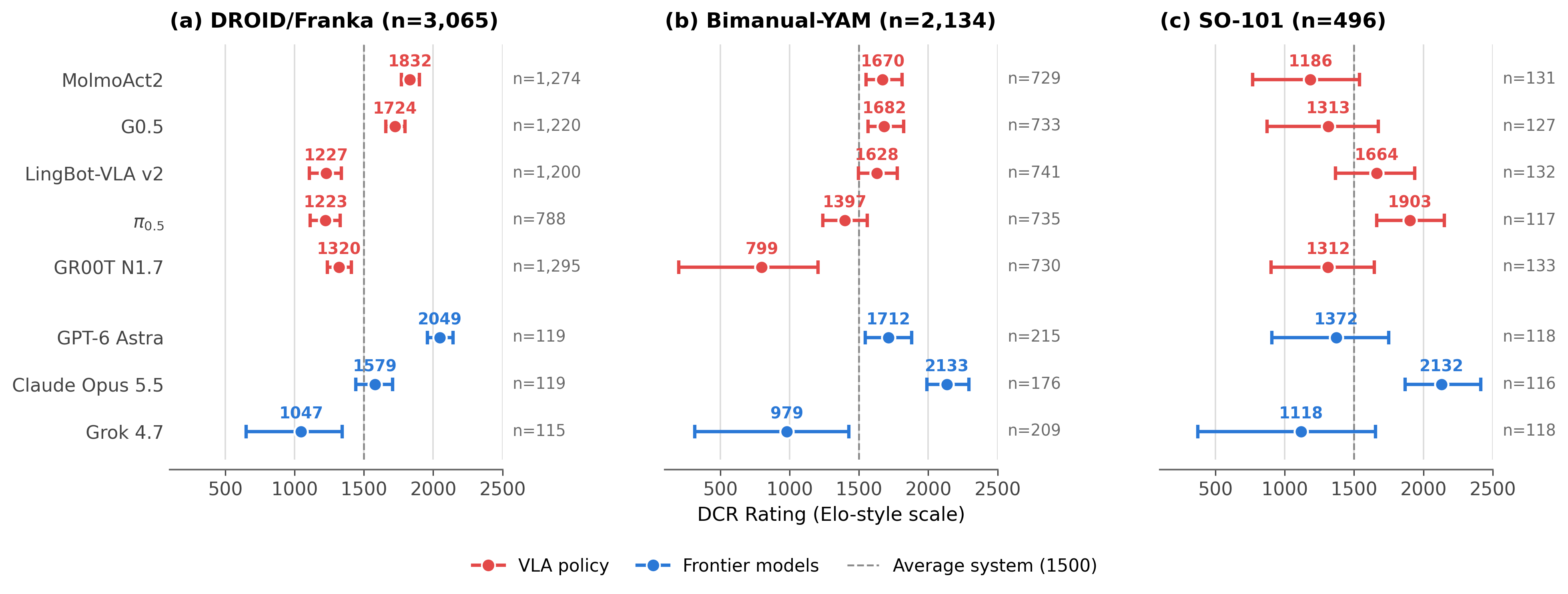
The main qualitative finding is that frontier API agents — operating purely through joint-position tool calls with no demonstrations or fine-tuning — rival specialized VLA policies in the Open Track, though every system struggles to complete open-world tasks reliably. After fine-tuning on 100 demos per task, GR00T N1.7 leads on SO-101 while \pi_{0.5} leads on both Franka and Bimanual-YAM. Crucially, policy rankings across embodiment-specific task suites show weak agreement, with Kendall’s W = 0.24 — strong evidence that single-embodiment leaderboards do not transfer, and that aggregate reports from any one platform systematically mislead.
Per-task reachability analysis further shows the embodiment-level gaps are driven by specific hard tasks. On SO-101, stack_bowls and upright_bottle keep multiple policies at high progress, while stack_cubes is strongly discriminative: policies converge on initial grasping criteria but diverge on multi-object stacking. cube_drawer shows the same signature in weaker form.
Limitations
The study is a snapshot: 20 tasks total, 5 per embodiment, with locations and lighting fixed per task (e.g., SO-101 tasks evaluated at specific NUS locations at 3–5 PM). The G1 humanoid appears in the embodiment set but with limited data in the excerpts. Pairwise Elo-style aggregation assumes transitive quality that physical trials may violate under distribution shift. The W=0.24 cross-embodiment disagreement is itself an open question: is this hardware-induced, data-induced (different pretraining corpora per embodiment), or an artifact of task selection?
Why this matters
Robotics currently lacks the equivalent of ImageNet-era, let alone LMSYS-era, external evaluation infrastructure, and claims of “generalist” policies are typically backed by single-lab demos. A distributed benchmark with fixed interfaces and 5,699 pairwise trials across 124 sites is the right scale to start separating signal from presentation, and the W=0.24 cross-embodiment ranking disagreement is a concrete empirical result the field needs to confront before declaring any policy “general-purpose.”
Source: https://arxiv.org/abs/2611.02497
YANAMI: A Large-Scale Multimodal Dataset and Benchmark for Multiturn Stateful Interaction
Problem
Unified Multimodal Models (UMMs) now share a backbone across visual understanding, generation, and editing, but almost all public training and evaluation data are either single-turn or trivially decomposable into independent turns. That means little supervision exists for stateful interaction, where the model must track an evolving multimodal state — accumulated edits, resolved coreferences, prior constraints, user corrections — and realize it both textually and visually. Without such data, benchmarks underestimate (and training underfits) the capability most relevant to agentic multimodal assistants.
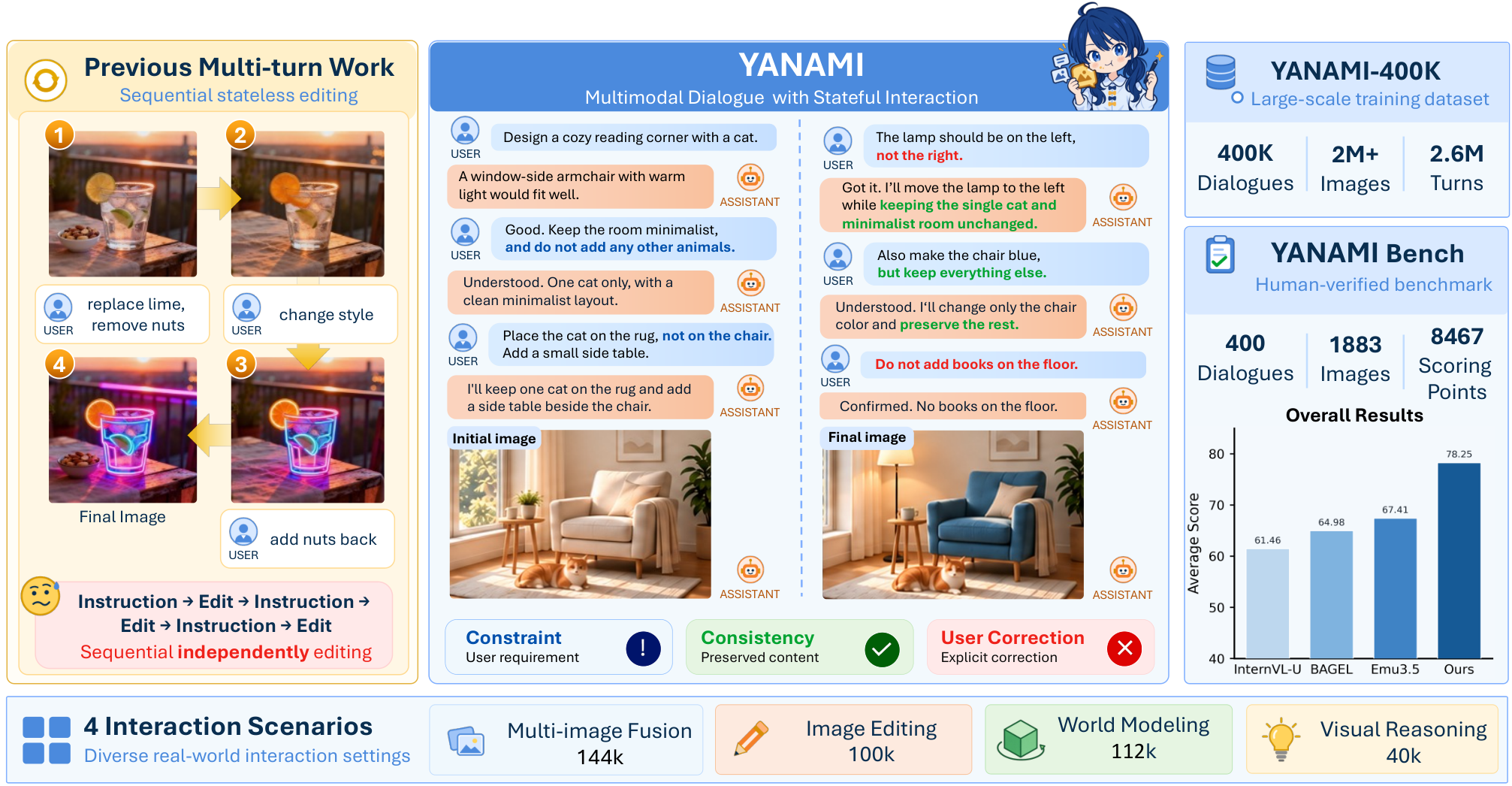
YANAMI targets exactly this gap with two artifacts: YANAMI-400K, a 400K-dialogue training set, and YANAMI-Bench, a 400-dialogue evaluation suite covering four stateful scenarios.
Scenarios and capabilities
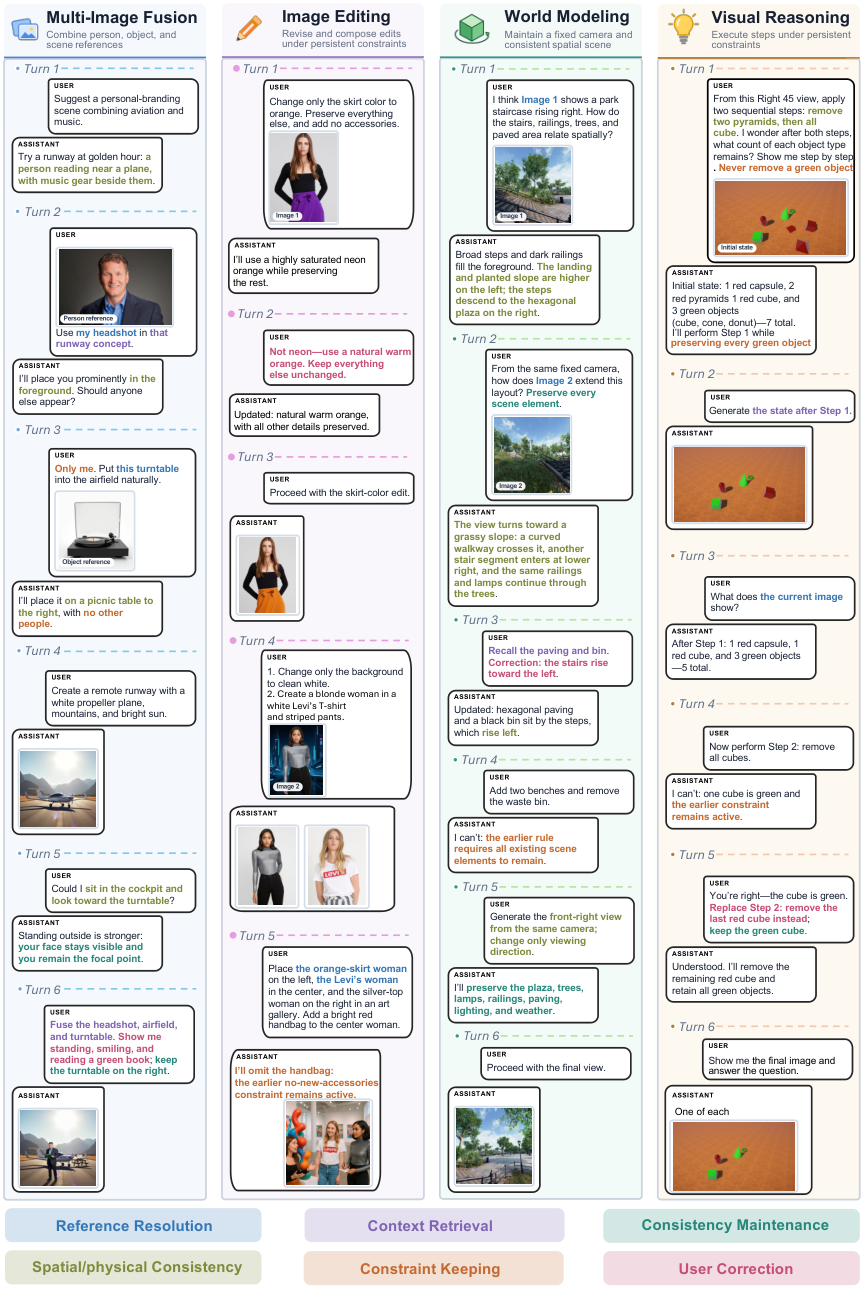
The dataset is organized around four interaction regimes:
- Multi-image fusion — compose a response image from several user-provided or previously generated images.
- Image editing — apply progressive edits while preserving earlier modifications and visual identity.
- World modeling — predict scene state after viewpoint changes or actions.
- Visual reasoning — render visual hypotheses as intermediate steps.
Across these, six state-management capabilities are instrumented: (i) coreference resolution, (ii) dialogue-history retrieval, (iii) cross-turn consistency, (iv) spatial/physical consistency, (v) constraint adherence, and (vi) correction-based state updating. Figure 2 shows how a single dialogue chains these: an edit from turn 2 must persist through a viewpoint change in turn 4, while a user correction in turn 5 selectively overwrites part of the accumulated state.
Data pipeline
The construction pipeline has four stages: data preparation, dialogue construction, automatic verification, and human verification.
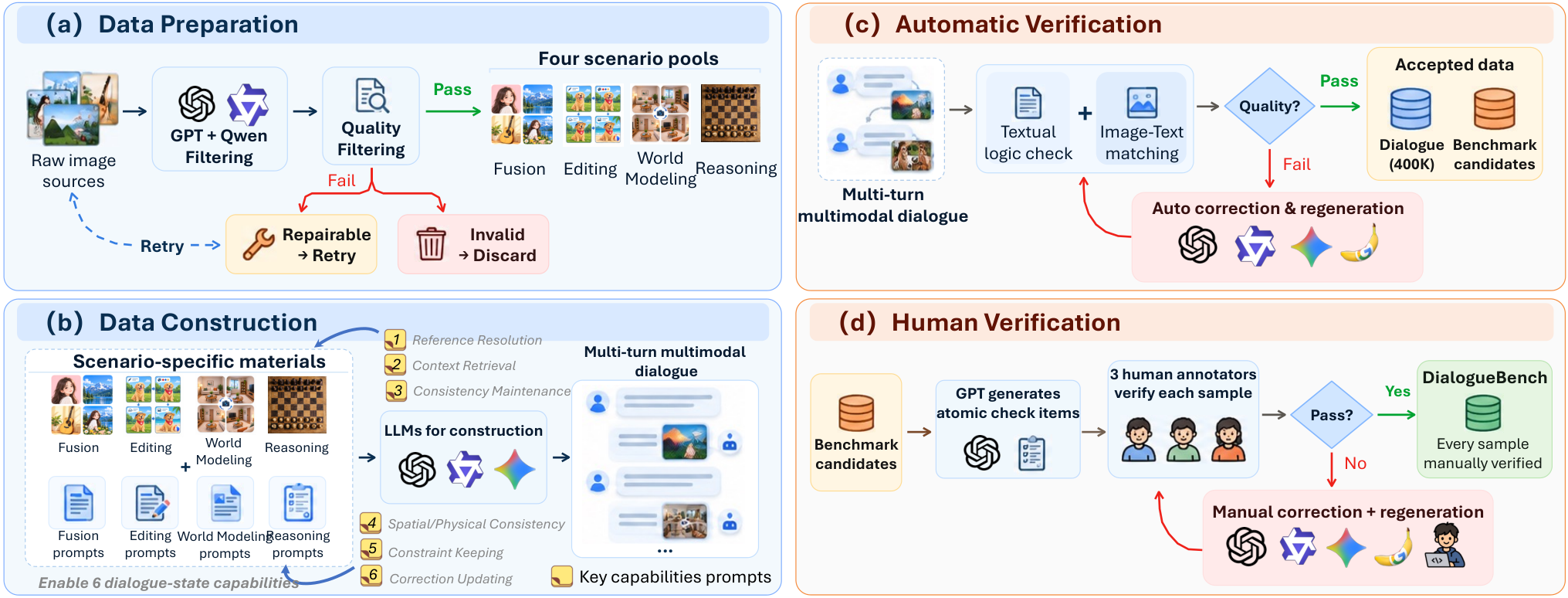
Raw images come from four public sources and are routed into scenario-specific pools. Dialogues are generated with a mix of GPT-5.6 Sol, Qwen3.7-Plus, Gemini 3.1 Pro, GPT-Image-2, and Nano Banana 2, conditioned on scenario- and capability-oriented prompts. Automatic verification checks logical coherence and image–text consistency; failures are regenerated iteratively, and surviving samples pass through human verification.
The resulting corpus (Table 1) contains 402,639 dialogues, 2,047,236 images, and 2,643,291 turns — averaging 5.08 images and 6.56 turns per dialogue, with 215K dialogues containing \geq 5 images and tails extending to 43 turns. This image density per dialogue is what distinguishes YANAMI from prior “multi-turn” sets whose turns are typically text-only follow-ups to a single image.
Benchmark and evaluation protocol
YANAMI-Bench contains 400 dialogues scored by a VLM-as-Judge framework that jointly evaluates understanding, generation, and editing. To isolate stateful reasoning from compounding generation errors, evaluation uses a GT-History setting: at turn t, the model receives ground-truth images and text for turns <t and must only produce turn t. Three input layouts accommodate different model APIs: yes-first (image inserted at first mention), yes-front (all images prepended), and concatenate (tiled into a single image) for models lacking sequential multi-image input.
Results
Across 15 models — 2 closed-source, 4 open-source editors, 9 UMMs — stateful interaction remains hard. Top closed-source scores: GPT-Image-2 at 83.05 overall (86.78 fusion / 90.54 editing / 81.40 world modeling / 73.46 reasoning) and Nano Banana 2 at 80.93. Best open systems trail noticeably: FLUX.2 [dev] 67.30, Emu3.5 67.41, BAGEL 65.02. Smaller or editing-only models fall further: Qwen-Edit 42.55, Show-o2 39.29, Janus-Pro 40.58.
Scenario-level patterns are consistent: Visual Reasoning is the weakest axis for almost every model (e.g., Janus-Pro 31.86, Show-o2 29.42, OmniGen 33.94), reflecting that generating a visually grounded intermediate step requires both tracking the hypothesis state and producing a faithful rendering.
Most importantly, fine-tuning BAGEL (7B) on YANAMI-400K moves overall score from 65.02 to 78.25 (+13.23), with gains in every scenario: Fusion 62.44 → 78.98, Editing 67.40 → 84.96, World Modeling 68.16 → 73.26, Reasoning 62.06 → 75.80. The tuned 7B model surpasses every other open system and closes most of the gap to closed-source baselines on Fusion/Editing while remaining behind on World Modeling.
Limitations and open questions
The GT-History protocol deliberately removes error propagation; a rollout evaluation (feeding the model’s own prior generations) would likely widen the gap, since cross-turn consistency compounds. The dataset is also bootstrapped from closed proprietary models (GPT-5.6, Gemini 3.1 Pro, GPT-Image-2, Nano Banana 2), raising questions about distributional bias toward those systems’ stylistic and compositional priors — fine-tuned BAGEL may be partly distilling them. Finally, the six capability tags are coarse; whether gains come uniformly across capabilities or are concentrated in, e.g., coreference and history retrieval (easier) versus physical/spatial consistency (harder) is not resolvable from the overall numbers reported here.
Why this matters
Stateful multimodal interaction is the capability most undertested by current UMM benchmarks, and YANAMI shows the gap is large (closed vs. open ≈ 15 points) but tractable: a 400K-dialogue SFT corpus closes most of it on a 7B backbone. This reframes stateful interaction as a data problem more than an architectural one, at least at current scales.
Source: https://arxiv.org/abs/2611.05280
SpecPilot: Autonomous Algorithm Discovery and Systems Optimization for Speculative Decoding
Problem
Speculative decoding reduces memory-bound LLM decoding latency by letting a cheap drafter propose tokens that a target model verifies in a single pass. Parallel drafters (DFlash2, DSpark, EAGLE-3) draft an entire block per forward pass, which should compound the win. In practice, the authors show that released reference systems leave most of the theoretical speedup on the floor, for three structural reasons:
- Unused drafter candidates. On single-request runs with DFlash2 on Qwen3.8-27B, offline exact replay accepts \tau = 4.25 tokens per step from an 8-position chain, while an oracle that greedily accepts any target token present in the drafter’s top-16 would reach \tau = 6.42 at 8 positions and 8.20 at 16.
- Weight streaming dominates with one request. GEMM time grows from 17.88 ms at one row to only 18.58 ms at 64 rows; reading the target weights consumes 80% of the 23.61 ms step, and even at the H100’s 3.35 TB/s peak this is 92% of the memory-bound floor.
- Verification tax under batching. Each batched request adds recurrent-state and attention work and triggers tile-boundary GEMM jumps. Stock DFlash2 on Qwen3.8-27B in FP8 drops from 3.40\times at batch 1 to 1.89\times at batch 24; Qwen3.5-4B falls from 3.73\times to 1.49\times at batch 32.
Because the best fix depends on drafter, target, GPU and batch regime, no single optimization suffices. SpecPilot is an agentic loop (Claude Opus 5.5 inside Claude Code) that discovers deployment-specific algorithm/systems changes under a correctness-preserving contract.
Method
SpecPilot runs in rounds, each round starting from the previous round’s final system (recursive). Phase 0 computes a cost model that attributes the speedup gap to three multiplicative factors:
S(N) = \frac{\tau(N)}{c(N)}, \quad c(N) = \frac{T_{\mathrm{step}}(N)}{T_{\mathrm{AR}}}
and a ceiling
\frac{\tau_{\mathrm{best}}}{\tau} \cdot \frac{T_{\mathrm{prof}}}{T_{\mathrm{floor}}} \cdot \frac{T_{\mathrm{step}}}{T_{\mathrm{prof}}},
where \tau_{\mathrm{best}} comes from best-first tree selection in exact replay, and T_{\mathrm{floor}} is each kernel’s byte floor — the larger of its FLOP time at 60% of peak dense throughput and its byte time at 90% of peak bandwidth. The three factors isolate (a) tree-selection suboptimality, (b) slow kernels, and (c) framework overhead outside the profiled region. The largest factor nominates the next direction.
Phases 1–3 fan out parallel agents to propose and time modifications, integrate the survivors, and seal results on held-out requests in Phase 4. Two correctness mechanisms gate anything that lands:
- Token forcing. Every emitted token is checked against the stock system’s token stream. This directly detects “reward hacking” in which an agent silently loosens acceptance criteria to inflate throughput.
- Structured memory. Validated mechanisms persist across rounds and deployments, so new target/GPU combinations start from stock plus the memory, not from scratch.
Discovered mechanisms
The flagship algorithmic artifact is W12, a lossless 12-bit weight format. The observation is that BF16 weights in a single output channel of a trained LLM span only a few binades. For channel n, W12 picks the 16-binade window [E_n - 15, E_n] covering the most weights and encodes each in-window weight as sign (1 bit) + exponent offset (4 bits) + the original 7 mantissa bits = 12 bits. Out-of-window weights, zeros and denormals become escapes carried in a sparse per-channel list that restores them exactly at load.
Measured bit-widths are 12.01–12.02 bits/weight across eight dense models; Qwen3.8-27B’s converted layers shrink from 44.67 to 33.58 GB. A stream-K GEMM kernel with a fixed reduction order makes the operation bit-deterministic, and decoding happens in registers, so the memory stream hides it. The 12 KB record covers a 128\times64 tile with an 8-bit view (sign + top three mantissa bits + exponent offset) plus a plane holding low mantissa bits. The server bit-compares every decoded tensor against the checkpoint at load.
For the LM head, W12 is not always optimal. On H100 the authors ship a certified INT8 head: a per-row Cauchy–Schwarz error bound provably rules out tokens that cannot be the argmax, survivors are rescored exactly in BF16, and the full head runs as a fallback when too many survive. LM head latency drops from 878 to 482 μs, and the argmax is unchanged by construction. On the RTX PRO 6000, where the certified head is slower (2598 vs. 1750 μs for BF16), the LM head is converted to W12 instead — a concrete example of memory-carried, deployment-conditioned decisions.
Results
Single-request, BF16 targets (Table 1, H100 SXM5):
- Qwen3.8-27B + DFlash2: stock 3.95\times (avg \tau = 4.65) → SpecPilot 8.86\times (avg \tau = 13.08).
- Qwen3.8-27B + DSpark: 3.74\times → 9.41\times; \tau from 4.42 to 12.85.
On RTX PRO 6000:
- Qwen3.8-27B + DFlash2: 4.46\times → 10.87\times (\tau 5.23 → 12.80).
- Muse-Glimmer-30B + DFlash2: 4.69\times → 10.63\times (\tau 5.16 → 12.64).
The large \tau gains come from two-level verification: each exact target pass verifies two chained drafts. GSM8K on Qwen3.8-27B + DFlash2 reaches \tau = 16.69 tokens per exact pass. Across benchmarks (GSM8K, MATH500, HumanEval, MBPP, MT-Bench) the geometric-mean speedup over AR roughly doubles stock. Sealed gains on unseen requests lie within -2\% to +6\% of development measurements, and every final system passes token forcing.
Batching results (H100, FP8 for Qwen3.8-27B; BF16 for Qwen3.5-4B and Gemma-4-12B) address the per-row verification tax directly, though the excerpt truncates the full table.
Limitations and open questions
- The pipeline depends on a strong frontier coding agent (Claude Opus 5.5); reproducibility with weaker agents is unquantified.
- Token forcing certifies output-sequence identity against the stock system but presumes stock itself is the correctness oracle; drafter changes that alter the drafter’s own distribution without changing accepted tokens are fine, but true distributional equivalence under non-greedy sampling is not evaluated here (decoding is greedy).
- The byte-floor at 60% FLOP / 90% bandwidth is a heuristic; ceilings are only as tight as these constants.
- W12’s exponent-window assumption may degrade on models with heavier-tailed per-channel exponent distributions (e.g., some MoE experts, quantization-aware trained models).
- Reported batching coverage is specific to a small set of model/GPU pairs; whether memory entries transfer to, e.g., AMD MI300 or long-context prefill-heavy regimes is open.
Why this matters
SpecPilot shows that current speculative decoding deployments are far below their theoretical ceiling, and that a cost-model-guided agent loop with token-identity gating can roughly double speedups over AR to 8\text{–}11\times at batch 1 while discovering a genuinely new lossless numeric format (W12) as a byproduct. It is an existence proof that LLM-driven systems search can produce auditable, bit-exact artifacts rather than opaque heuristics.
Source: https://arxiv.org/abs/2611.02501
MoLRSI: A Recursive Self-Improving AI agent for Molecular Discovery
Problem
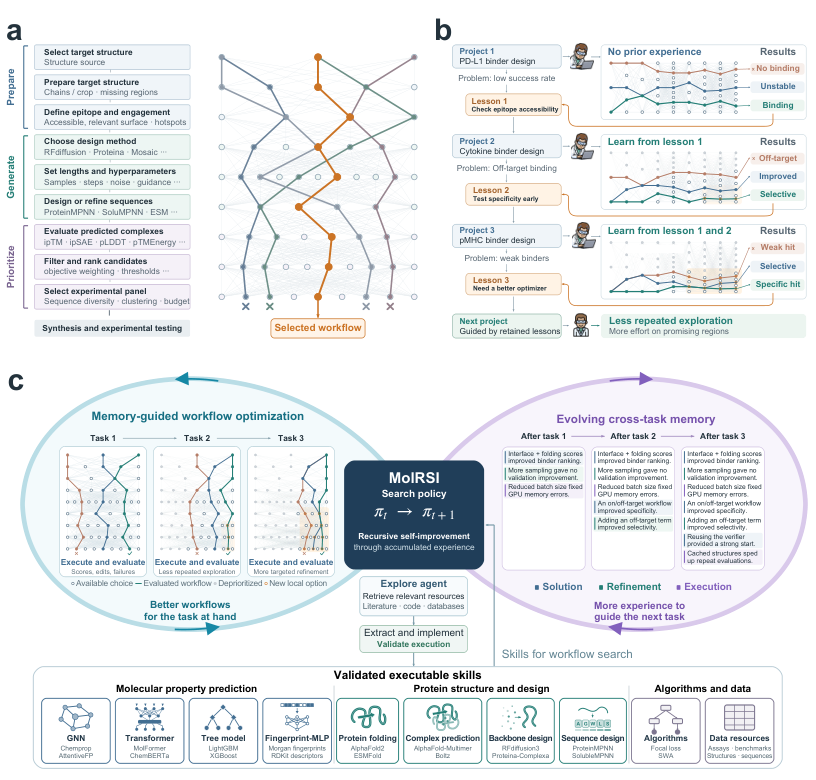
Molecular discovery pipelines — data curation, representation choice, generative model, scoring, filtering — form a combinatorial decision tree where no single workflow dominates across targets. Expert-designed pipelines are static and do not transfer their lessons across projects. Existing “AI scientist” agents automate execution of a fixed protocol but neither search the workflow space systematically nor accumulate experience across tasks. MoLRSI addresses both: workflow-level search plus cross-task persistent memory, closing a recursive self-improvement (RSI) loop in which experience on earlier molecular design tasks reshapes the search policy for later ones.
Method
MoLRSI has three components: an Explore Agent that builds a validated skill library, an MCTS-based workflow search with experience-guided selection, and persistent memory partitioned into solution, refinement, and execution stores.
Resource library. The Explore Agent issues queries grounded in task description and data characteristics (representations, architectures, objectives, constraints), retrieves papers plus linked code, and emits a skill specification for each resource: purpose, dependencies, I/O schema, execution recipe. Each skill is syntax-checked, then executed on a usage example in an isolated environment on first use. Failures trigger an LLM-driven repair loop over code, dependencies, and environment; skills that survive are tagged validated and reused across tasks. Unrepairable skills are discarded, keeping the library executable.
Workflow search. A task t supplies data, an evaluation metric, and a compute budget. Candidate workflows are compositions of validated skills — preparation, generation, prioritization stages — initialized from the library or retrieved from solution memory. Search is MCTS over workflow configurations. Selection combines a performance term aggregating scores on t and related tasks with a UCB-style exploration bonus favoring less-visited branches. Refinement memory supplies prior (modification, outcome) pairs to condition the next edit of the selected workflow (e.g., swapping a featurizer, adjusting a cytotoxicity filter). Execution memory stores runtime fingerprints — resource usage, error traces, successful fixes — and governs budget allocation and error recovery during evaluation. The best workflow by development score within budget is returned.
RSI loop. All four stores — workflows, performance scores, modification outcomes, execution records — persist across tasks. Searches on new tasks are initialized from this experience, and search in turn can revise or add skills. The ablation “MoLRSI without RSI” uses only within-task experience; “zero-search transfer” directly reuses prior workflow configurations (retraining on target training data) with no new search.
Results
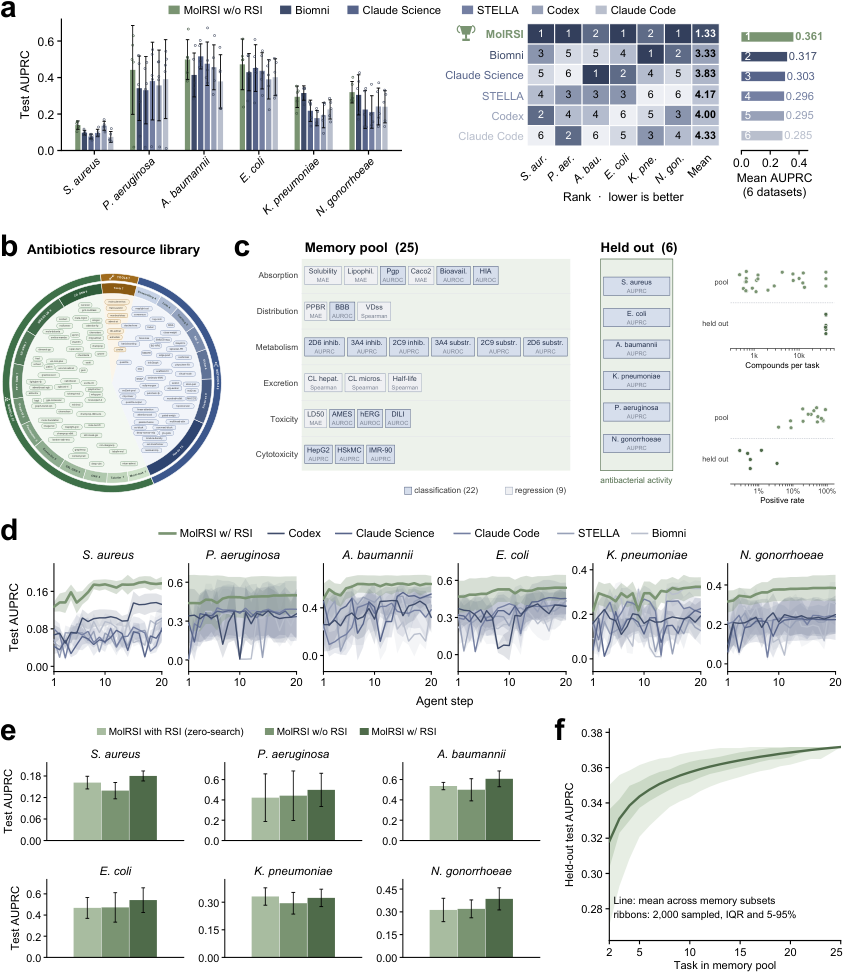
Antibiotic discovery. Across six antibacterial computational benchmarks, MoLRSI without RSI already outperforms baseline agents on test AUPRC and ranking (Figure 2a). Adding cross-task experience from 25 non-antibacterial source tasks (Figure 2c) further improves search trajectories over 20 MCTS iterations.
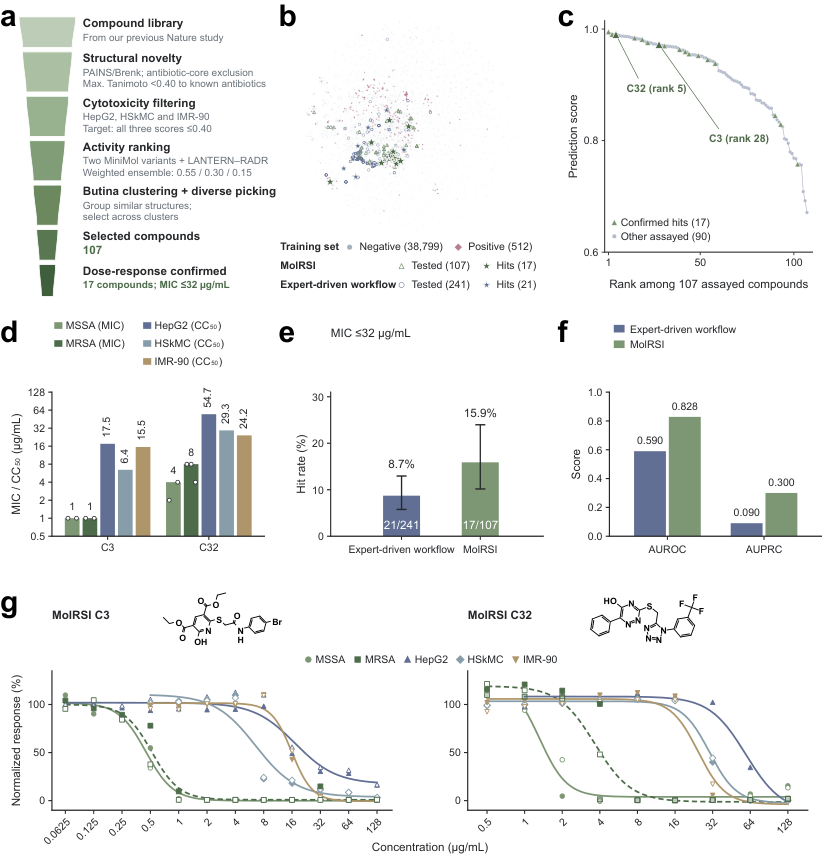
The learned workflow jointly optimizes antibacterial activity, human-cell cytotoxicity, and structural novelty. In prospective experimental screening of 107 compounds, MoLRSI achieved a 15.9% hit rate against S. aureus, versus 8.7% for the prior expert-designed workflow evaluated on the same training data and screening library. Hits included compounds active against both MSSA and MRSA with measured \mathrm{CC}_{50} on HepG2, HSkMC, and IMR-90 indicating a therapeutic window, and t-SNE projection shows hits distributed outside dense training clusters, consistent with the novelty objective.
Peptide–MHC binder design. In de novo pMHC binder design, MoLRSI constructs workflows that jointly weigh target binding and other objectives; the abstract reports improved search over baselines (details in the sections not reproduced here). The same framework and skill library are reused — the main change is that experience from antibiotic and property-prediction searches shapes the pMHC search policy, demonstrating cross-domain RSI.
Ablations. Comparing MoLRSI with RSI, without RSI, and zero-search transfer isolates two effects: (i) within-task MCTS over workflows already beats baselines, and (ii) cross-task memory additionally improves convergence speed and final score; zero-search transfer underperforms search, showing that prior workflows are useful priors but not sufficient without local refinement.
Limitations and open questions
The hit-rate comparison, while meaningful, uses one prior expert workflow on the same library; broader baselines (other agents applied prospectively, randomized screening controls) are not reported here. The skill library depends on retrievable code — tasks lacking public reference implementations will yield sparser libraries. Memory grows monotonically; no mechanism for forgetting or detecting negative transfer is described, and the policy’s behavior as the source-task distribution drifts from the target domain is untested at scale. Finally, “development score” is task-defined; the agent inherits whatever biases are present in the metric (e.g., AUPRC on noisy activity data), and experimental validation remains the only ground truth.
Why this matters
MoLRSI is one of the first demonstrations that workflow-level search plus persistent cross-task memory yields measurable prospective gains in wet-lab molecular discovery — nearly doubling the antibiotic hit rate against a strong expert baseline using identical data. It reframes “AI for science” agents from protocol executors to policy learners over the space of scientific workflows.
Source: https://arxiv.org/abs/2610.39714
Hacker News Signals
The Little Book of Generative AI Foundations: An Intuitive Mathematical Primer
A new preprint on arXiv presents a self-contained mathematical primer covering the core machinery behind modern generative AI: probability theory, information theory, VAEs, normalizing flows, GANs, diffusion models, and transformers. The stated goal is to bridge the gap between pop-science explanations and full graduate-level treatments, targeting readers with linear algebra and calculus but limited probabilistic ML background.
The coverage is notably honest about mathematical prerequisites. Diffusion models are derived from the ELBO perspective via the forward/reverse Markov chain, with the score-matching connection made explicit. The transformer section covers attention as scaled dot-product, positional encodings, and the autoregressive factorization p(x) = \prod_t p(x_t | x_{<t}) without hand-waving. The VAE treatment derives the reparameterization trick from first principles rather than presenting it as a given.
What makes this useful is the pedagogical sequencing: it builds from KL divergence and the evidence lower bound before touching any architecture, so the loss functions of VAEs and diffusion models emerge naturally rather than appearing as arbitrary design choices. The normalizing flows section includes the change-of-variables formula and the log-determinant Jacobian constraint, which many introductory resources omit.
For a working PhD student this is unlikely to contain novel material, but it is a well-organized reference for pointing students or collaborators to, and the equation density is high enough to be useful rather than decorative. The main limitation is that coverage stops short of modern topics like flow matching, consistency models, or RLHF, so it reflects roughly the 2022-era generative model landscape. No empirical results or code accompanies the text.
Source: https://arxiv.org/abs/2605.29713
LLMs are not superhuman at reading and writing neural network weights
This post from Sean Goedecke makes a technical argument against a claim circulating after a Weights & Biases / Google DeepMind demo: that large language models can meaningfully “read” raw neural network weight tensors to understand model behavior, or “write” weights to improve model performance.
The core technical objection is straightforward. Raw floating-point weight tensors have no locality structure that maps to semantic concepts in any direct, human-readable way. The features learned by a network are distributed across potentially millions of parameters, entangled through composition of nonlinear activations across layers. An LLM presented with a flat dump of weight values is not receiving a compressed symbolic description of what the model does — it is receiving a numerical artifact whose interpretation requires executing the network or performing mechanistic interpretability analysis (sparse autoencoders, activation patching, etc.) that itself requires compute, not token prediction.
The post also raises the point that any demo showing an LLM “interpreting” weights is more likely exploiting metadata, architecture documentation, or layer naming conventions than actually reading the numerical values. A model named q_proj in a transformer attention block conveys information through its name alone. Strip those labels and replace them with random identifiers, and the interpretive ability should degrade sharply.
The writing direction is even weaker: gradient-free weight modification based on LLM suggestions would need to somehow specify delta updates across billions of parameters with sufficient precision to produce reliable behavioral changes, which is not what these demos show. What they show is closer to prompt-level steering dressed up with weight-adjacent framing.
The post is measured and does not claim LLMs have zero ability to reason about model structure at a high level — just that the “superhuman at weight manipulation” framing is not supported by the demonstrated capabilities.
Source: https://www.seangoedecke.com/llms-are-not-superhuman-at-reading-and-writing-neural-network-weights/
The ‘Astra can read and write weights to improve Qwen’ post is misleading
Matthew Honnibal (spaCy, Explosion AI) wrote a pointed technical debunking of a viral claim that Google DeepMind’s Astra had demonstrated the ability to read and write neural network weights to improve a Qwen model. The post became the highest-scored item on HN in this batch (998 points), indicating significant community interest.
The core technical claim Honnibal dissects: the original post implied Astra was performing something like in-context weight surgery — inspecting raw parameters and proposing targeted edits that improved downstream model behavior. Honnibal’s argument proceeds on several levels.
First, the demo almost certainly involved prompting or fine-tuning scaffolding, not raw weight manipulation. “Reading weights” in practice means loading a checkpoint and running inference or an interpretability pipeline, not having an LLM ingest float32 tensors and output actionable insight. Second, “writing weights to improve the model” is an extraordinary claim that would require the LLM to function as a gradient-free optimizer over a high-dimensional non-convex loss landscape — far beyond what any current system can do reliably.
Third, and most practically: the benchmarks cited in the original post were not controlled. Improvement on a downstream task after any intervention (including straightforward fine-tuning or prompt engineering) does not isolate weight-reading/writing as the causal mechanism.
Honnibal also makes a broader methodological point: demos from large AI labs should be evaluated with the same skepticism as any empirical claim — identify the control condition, the evaluation metric, and the confounds. The original post had none of these clearly specified.
This episode is a useful case study in how technically-adjacent framing (“weights”) can make conventional ML workflows sound more exotic than they are, and how that framing propagates through media before practitioners push back.
Source: https://honnibal.dev/blog/astra-read-write-misleading
Qwen 3.8 27B on my laptop can interpret model weights, too
Simon Willison’s post is essentially a practical replication attempt that reinforces Honnibal’s debunking from a different angle. Willison ran Qwen 2.5 27B locally via Ollama and prompted it with weight-adjacent descriptions, finding that the model produced plausible-sounding interpretations based almost entirely on naming conventions and architectural context — not the numerical values themselves.
The technical demonstration is simple but effective. When given layer names, tensor shapes, and a few example values from a transformer checkpoint, the model generates reasonable high-level descriptions of what those layers probably do. But this is straightforwardly explained by the model having been trained on vast amounts of ML documentation, code, and papers that describe what attn.q_proj or mlp.gate_proj layers do in a transformer. The numbers themselves are largely ignored.
Willison’s test: strip the semantic names, replace them with opaque identifiers (layer_042_tensor_A), and provide only raw numerical statistics (mean, std, histogram). The quality of interpretation degrades substantially, which is exactly what you would expect if the model is pattern-matching on names rather than computing over values.
The post also highlights an important distinction for the community: there is legitimate research on LLMs reasoning about model behavior (e.g., using them to write interpretability probes, generate hypotheses about circuits, or summarize activation patterns from mechanistic interpretability pipelines). That is a real and interesting research direction. The specific claim that an LLM can read raw floats and produce actionable weight edits is not that research direction, and conflating them causes confusion about what is actually technically possible.
The broader lesson is about reproducibility culture: a laptop experiment with a 27B open model can often quickly calibrate viral claims.
Source: https://simonwillison.net/2026/Nov/3/qwen-can-interpret-model-weights/
Nvidia RTX Spark encrypted firmware slows inference speed to 35% on Linux
MindStudio’s engineering blog documents a concrete and significant performance regression affecting Nvidia’s RTX Spark (GB10) hardware on Linux: inference throughput drops to approximately 35% of the Windows baseline, traced to encrypted firmware that Linux drivers cannot fully utilize.
The technical mechanism is firmware-level encryption on the Grace-Blackwell Superchip’s embedded controller, which handles certain hardware scheduling and memory management functions. The proprietary Windows driver has the decryption keys and full access to this functionality. The open-source Linux driver stack (or the closed Linux driver, depending on which component is implicated) either lacks the keys or lacks the implementation to use the encrypted firmware path, forcing a fallback execution mode with substantially higher latency and lower throughput.
The 35% figure is striking. For ML inference workloads that are memory-bandwidth-bound (most transformer inference is), a 65% throughput reduction maps roughly to the model being unusable for latency-sensitive production deployment on this hardware under Linux.
This raises a practical procurement concern: the RTX Spark is marketed partly at developers and researchers who often run Linux. If the firmware encryption situation is not resolved through driver updates or firmware releases, the hardware’s effective use case on Linux is severely constrained.
The broader issue is the ongoing tension between hardware vendors encrypting firmware for security or IP-protection reasons and the Linux ecosystem’s dependence on open or at least fully-functional driver support. Similar issues have appeared with Nvidia’s GSP firmware and with AMD’s secure processor on certain workloads. For ML practitioners making hardware decisions, this is a real risk to quantify before purchasing specialized inference hardware without verifying Linux driver maturity.
Source: https://www.mindstudio.ai/blog/linux-nvidia-rtx-spark-laptop
Show HN: I’ve updated my Linux System Call website and API
syscall.sh is a reference site and REST API providing structured, queryable data about Linux system calls across architectures. The update brings in current kernel versions and expands the API surface.
The technical value is straightforward: Linux system call tables are architecture-specific (x86_64, arm64, riscv64, mips, etc.), and the syscall numbers, argument signatures, and availability differ across kernel versions in ways that are tedious to track by reading kernel headers directly. This site aggregates that data and exposes it via a clean API (GET /v1/x86_64/syscalls, GET /v1/x86_64/syscalls/read, etc.), returning JSON with syscall number, name, argument types, and kernel version metadata.
Use cases include: security tooling that needs to enumerate or filter syscalls for seccomp BPF policy generation, cross-architecture porting work, kernel exploit development and research, and educational tooling for OS courses. The seccomp use case is particularly practical — generating a tight allowlist for a containerized application requires knowing exactly which syscalls are available and what their numbers are on the target architecture.
The API appears to be stateless and unauthenticated, which makes it easy to integrate into build pipelines or scripts. The data is sourced from the kernel source tree’s syscall tables and unistd.h headers, which are canonical.
Limitations: the site does not currently provide semantic documentation beyond signatures (man-page quality descriptions), so it is more useful as a lookup table than as a learning resource. The data freshness depends on how frequently the maintainer syncs with upstream kernel releases, which is worth checking for anyone using it for security-critical work against very recent kernels.
Source: https://syscall.sh/
European RISC-V Industrial Computing Initiative
ERICI (European RISC-V Industrial Computing Initiative) is a European initiative aiming to develop RISC-V based computing infrastructure for industrial applications, with an explicit strategic goal of reducing dependence on non-European processor architectures in critical industrial sectors.
The technical scope covers industrial computing rather than consumer or HPC workloads: deterministic real-time operation, long product lifecycles (10-15 years), functional safety certification (IEC 61508, ISO 26262), and resistance to supply chain disruption. These requirements make RISC-V an interesting fit because the open ISA allows custom extensions and long-term architectural stability guarantees that commercial ISA licensees cannot fully provide.
RISC-V’s extension mechanism is central to the industrial case. The base ISA is intentionally minimal, with the real differentiation happening through standard extensions (M, A, F, D, C, V for vector, etc.) and custom extensions. Industrial applications often need deterministic interrupt latency, memory protection beyond what standard MMUs provide, and custom peripheral interfaces — all of which can be addressed through the extension framework without ISA fragmentation penalties that plague legacy architectures.
The European angle connects to the EU Chips Act and broader semiconductor sovereignty concerns. Several European institutions (Fraunhofer, CEA, various universities) have ongoing RISC-V processor projects (PULP platform, CVA6, etc.). ERICI appears to be an attempt to coordinate these into an industrial-grade ecosystem with the qualification infrastructure (toolchains, RTOSes, safety certifications) that industrial customers require before adoption.
The main challenge is that RISC-V’s industrial ecosystem lags ARM Cortex-M/R significantly in terms of certified toolchains, RTOS support, and silicon availability at competitive price points. Ecosystem maturity, not ISA quality, is the bottleneck.
Source: https://erici.eu
AI is forcing us to pay off 40 years of technical debt
The IEEE Spectrum piece uses a specific vulnerability class — PHP shell injection via legacy web applications — as a lens for a broader argument: deploying LLM-based systems on top of existing infrastructure exposes technical debt that was previously dormant or tolerable but becomes an active attack surface under AI-augmented threat models.
The concrete technical case: PHP applications from the 2000s-2010s era with eval(), system(), exec(), or shell_exec() calls accepting user-controlled input were well-understood vulnerability patterns. Many were patched, but many were not, and the volume of legacy PHP code in production (WordPress plugins, custom CRMs, etc.) is enormous. LLM-based agents with web access or tool-use capabilities can discover and exploit these vulnerabilities at a scale and speed that manual exploitation or even traditional automated scanning could not achieve. The attack surface expands because the LLM can chain multiple steps — find a PHP endpoint, craft an injection payload, establish persistence — with minimal human guidance.
The broader argument is that AI-assisted exploitation lowers the skill floor for complex attack chains, which means vulnerability classes that required specialized knowledge to exploit are now accessible to lower-capability attackers. This changes the risk calculus for deferred remediation: “this is exploitable but requires deep expertise” is a weaker justification for not patching than it was five years ago.
The article is not purely alarmist — it acknowledges that AI also assists defenders through automated code review and vulnerability scanning. But the asymmetry point is valid: the cost of running an LLM to probe a system is low and continues to fall, while the cost of auditing and remediating 40 years of accumulated PHP, CGI, and legacy web code is high and mostly fixed.
Source: https://spectrum.ieee.org/ai-in-cybersecurity-php2shell-vulnerability
Noteworthy New Repositories
divagr18/qwenputer
A proof-of-concept that embeds a functional CPU inside the weights of Qwen3.5-4B by exploiting the Gated DeltaNet attention variant. The core idea: Gated DeltaNet maintains a matrix-valued hidden state that can be updated with rank-one writes and queried with arbitrary keys, which is structurally equivalent to a content-addressable memory. The author maps registers, a program counter, and an instruction set onto this state, then fine-tunes (or constructs) weight matrices such that forward passes through the model simulate fetch-decode-execute cycles. RAM reads/writes become delta updates to the recurrent state; arithmetic operations are implemented as learned transformations. This is not emulation at the prompt level — the computation is encoded in the weight structure itself, making it a direct demonstration that certain linear recurrent architectures are Turing-complete in a constructive, not just theoretical, sense. The practical interest is less about running programs efficiently and more about what it reveals: that models with Gated DeltaNet layers can, in principle, implement arbitrary stateful computation without relying on context length. Relevant to anyone studying the computational expressivity of modern SSM/hybrid architectures, mechanistic interpretability, or constructive proofs of neural network universality.
Source: https://github.com/divagr18/qwenputer
simplexai-labs/PolyStrata
A local inference runtime targeting consumer hardware, bundling multiple recent small models — Qwen3.8-Flash-Next, GLM 5.3 Flash, DeepSeek V4 Flash, LFM2.5, Qwen3.6, Ornith 1.5, Gemma 4, Tiel Coder, MiniCPM-V — under a single one-click installer for Windows and Linux. The architecture uses two separate inference engines: one tuned for Strata’s own scheduling, and a second written specifically for PolyStrata’s multi-model dispatch layer. Both expose OpenAI-compatible and Anthropic-compatible REST endpoints on localhost, so any existing tooling (LangChain, Continue, OpenHands, etc.) can route to local models without code changes. The design goal is to lower the operational overhead of running several quantized models concurrently — managing VRAM allocation, model swapping, and API routing — into a single managed process rather than requiring the user to coordinate llama.cpp or Ollama instances manually. MiniCPM-V inclusion indicates multimodal (vision) support. The project is positioned as a privacy-preserving alternative to cloud inference for developers who want API compatibility without egress. Of interest to practitioners who need reproducible, offline-capable inference pipelines or who are evaluating several small models side-by-side on the same workstation.
Source: https://github.com/simplexai-labs/PolyStrata
opentrap/opentrap
A GPLv3-licensed web application security testing suite intended as a functional replacement for Burp Suite Community/Pro. Core components: an intercepting HTTP/HTTPS proxy with TLS interception (requiring a user-installed CA cert), a Repeater for manually crafting and replaying requests, an Intruder module for parameterized fuzzing and brute-force attacks, a Collaborator-equivalent for out-of-band interaction detection (DNS/HTTP callbacks), and a built-in OWASP ZAP scanner integration for automated active/passive scanning. Linux-only at present, AGPL-3.0 licensed. The technical differentiation from existing open-source tools like Caido is the all-in-one scope: rather than wrapping ZAP as a subprocess and calling it done, OpenTrap appears to expose ZAP’s scanner through a unified interface alongside its own proxy and manual-testing modules, reducing context switching during an engagement. The Collaborator component is architecturally non-trivial for an open-source project — it requires an externally reachable server for callback reception, so self-hosting that component is a meaningful operational consideration. Relevant to penetration testers, bug bounty researchers, and security engineers running internal assessments who want a fully auditable toolchain without per-seat licensing costs.
Source: https://github.com/opentrap/opentrap
t8y2/motty
A native Go desktop application that consolidates SSH, SFTP, port forwarding, VNC, RDP, and an AI assistant with MCP (Model Context Protocol) support into a single window, built on the Viva UI toolkit with no embedded webview. The no-webview constraint is architecturally significant: it forces all rendering through native Go graphics rather than a Chromium or WebKit subprocess, which reduces memory overhead and eliminates the IPC boundary that tools like Electron introduce. SSH and SFTP are handled directly via the golang.org/x/crypto/ssh stack; VNC and RDP support suggests framebuffer rendering through the same native canvas. The MCP integration means the bundled AI assistant can invoke tools (run commands, transfer files, manage tunnels) through the standardized MCP tool-call interface, making it composable with Claude, GPT-4o, or any MCP-compatible model backend. Port forwarding management inside a graphical session manager is a practical convenience often missing from terminal-only SSH clients. The primary audience is developers and sysadmins who manage many remote hosts and want a single authenticated session manager with AI-assisted operations — without the resource cost of an Electron-based alternative like Tabby or the feature limitations of plain OpenSSH.
Source: https://github.com/t8y2/motty
Graphicle-AI/graphicle
A Rust program that constructs and maintains a code graph and persistent memory layer for AI coding agents, exposing both through the Model Context Protocol. The code graph component performs static analysis over a codebase — tracking symbol definitions, call graphs, import relationships, and structural dependencies — and serves this as structured context that an agent (Claude Code, OpenAI Codex, Cursor, or any MCP client) can query rather than relying solely on raw file contents in a context window. The memory component provides persistent storage of agent-generated notes, prior decisions, and cross-session state, addressable by the same MCP interface. Implementing this in Rust rather than Python matters for latency: graph traversal and incremental re-indexing on file changes need to be fast enough to not block agent tool calls. The MCP server interface means integration requires no custom plugin per agent — any client that supports MCP tool calls can attach. The primary problem being solved is context quality: large codebases exceed practical context window limits, and embedding-based retrieval loses structural information (e.g., that function A transitively calls B through C). A graph representation preserves that topology. Relevant to anyone building or evaluating agentic coding workflows at repository scale.
Source: https://github.com/Graphicle-AI/graphicle
Anubis-Security-Tool/anubis
A cross-platform security terminal that combines multi-protocol remote access (SSH, SFTP, RDP, VNC, Serial) with an AI agent layer built on OpenAI and DeepSeek backends, oriented toward penetration testing, CTF workflows, and DevSecOps automation. The AI layer consists of 12+ specialized agents — distinct system prompts and tool bindings for tasks like CVE lookup, SBOM generation, exploit suggestion, and reconnaissance — rather than a single general-purpose assistant. CVE and SBOM integration suggests connectivity to NVD/OSV databases and support for formats like CycloneDX or SPDX. The terminal itself provides a unified session manager for the supported protocols, with a web UI available alongside the desktop interface for headless or remote-operator use cases. The security-automation angle means agents are expected to invoke shell commands, parse tool output (nmap, nuclei, etc.), and chain findings into reports. Architectural concerns worth noting: running AI agents with shell execution permissions over an active RDP or SSH session is a meaningful attack surface in itself, so trust boundaries between the agent layer and the underlying protocol sessions require careful review before use in sensitive environments. Of interest to security practitioners who want LLM-assisted triage integrated directly into their terminal workflow rather than as a separate chat interface.
Source: https://github.com/Anubis-Security-Tool/anubis
zhuyansen/new-term-radar
A daily automated pipeline that monitors X (Twitter), Hugging Face model/dataset/Space pages, GitHub trending, and web sitemaps to surface newly coined AI terminology — model names, product names, and repository identifiers — before they appear in keyword research tools or SEO indexes. The technical core is likely a combination of RSS/sitemap polling, Twitter API or scraping, and a named-entity or pattern extraction step that distinguishes novel proper nouns from established vocabulary. The value proposition is temporal: conventional keyword tools index terms with a lag of days to weeks after they reach volume, whereas this system targets the moment of first public appearance. Practical uses include competitive intelligence (detecting a new model release before the press coverage), research tracking (knowing when a new architecture name enters circulation), and dataset/benchmark discovery. For ML researchers, it functions as an alternative to manually watching Hugging Face’s “recent” feeds and GitHub trending pages. The 2094-star count relative to the other projects here suggests the information-retrieval framing resonates with a broad audience. Implementation details — whether the extraction uses an LLM classifier, a regex/NER approach, or embedding-based novelty detection — are not specified in the description but would determine recall/precision on genuinely novel terms versus aliases for existing concepts.
Source: https://github.com/zhuyansen/new-term-radar
iamlukethedev/Herald-OS
An independent project building an “agent-native” operating system layer with Hermes Agent as the primary user interface, explicitly unaffiliated with Nous Research despite the naming proximity to their Hermes model series. The concept of an agent-native OS implies that the shell, file system access, process management, and I/O are exposed primarily as tool-callable interfaces for an LLM agent rather than as a traditional CLI or GUI. Hermes Agent presumably acts as the session manager and orchestrator: user intent is expressed in natural language, decomposed into tool calls against OS primitives, and executed with results fed back into the agent’s context. The practical architecture likely involves an MCP or similar tool-dispatch layer sitting between the agent runtime and kernel syscalls, with sandboxing to limit blast radius of erroneous tool calls. The interest here is less the individual features and more the systems design question: what does an OS look like when the primary abstraction is “agent with tool access” rather than “user with a terminal”? Open questions include how it handles concurrent agent sessions, permission delegation, and recovery from agent errors that corrupt filesystem state. Relevant to researchers working on agentic systems, human-computer interaction with LLMs, and OS-level security models for autonomous agents.