Daily AI Digest — 2026-10-30
arXiv Highlights
Your Benchmark Is an Empirical Measure Over Difficulty
Problem setup
The paper reframes a benchmark not as a set of items but as an empirical measure \mu_B over a latent difficulty axis z \in [0,1]. For a model \theta, let s_\theta(z) \in [0,1] be the conditional expected performance (e.g., pass@1) at difficulty z. The aggregate score reported on a leaderboard is then
S(\theta; B) = \int_0^1 s_\theta(z)\, d\mu_B(z),
while the quantity a practitioner actually cares about is S(\theta; \mu^\star) = \int s_\theta(z)\, d\mu^\star(z) for some intended difficulty distribution \mu^\star. Two failure modes follow directly:
- Measure mismatch: \mu_B \ne \mu^\star, so leaderboard orderings can diverge from orderings under \mu^\star. Concretely, if \mu_B concentrates on easy items where s_\theta saturates, differences between strong models vanish on the benchmark but persist in the target regime.
- Coverage gaps: large intervals of z receive no mass under \mu_B, so localized improvements in s_\theta on those regions are invisible to S(\theta; B).
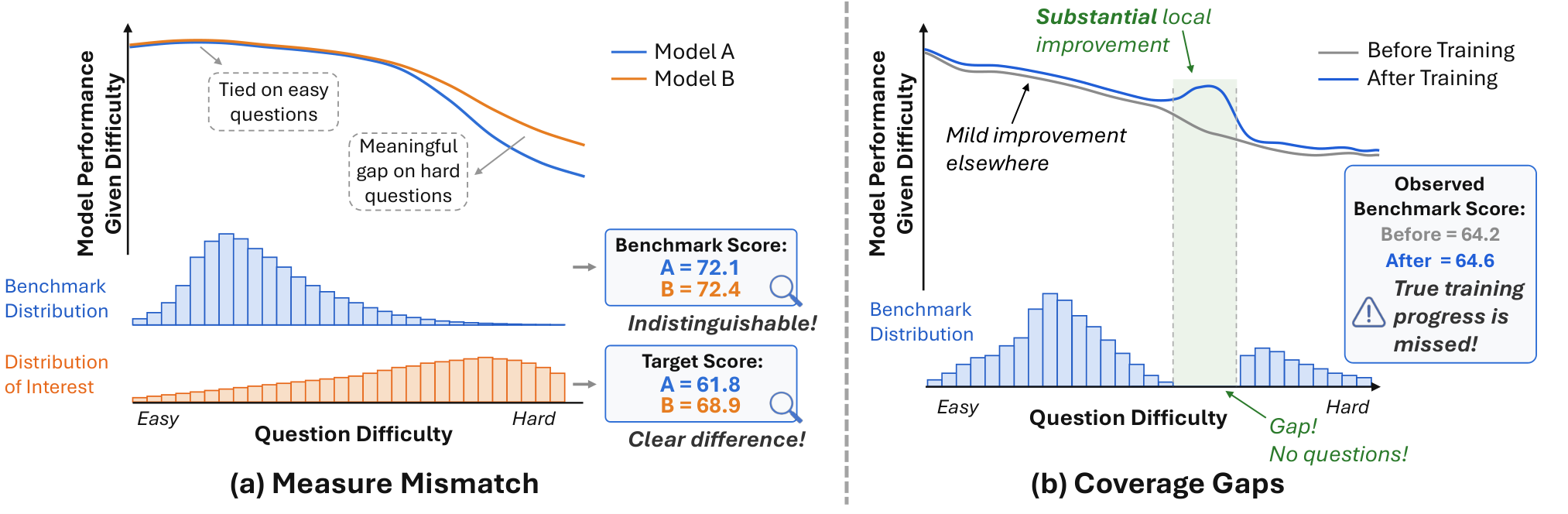
The authors propose two diagnostic metrics for these failure modes, each with theoretical guarantees that bound the induced error in S(\theta;\mu^\star) as a function of a divergence between \mu_B and \mu^\star and of local gap size, respectively. The measure-mismatch metric is essentially a discrepancy between normalized difficulty CDFs; the coverage-gap metric looks at the largest adjacent gap in sorted difficulties and is tied to a worst-case detection bound: if the largest gap is \Delta, then a localized improvement supported in that gap is entirely unobservable at the aggregate level, bounding sensitivity by something proportional to \Delta.
Estimating item difficulty via 1PL IRT
Difficulty cannot be read off as “average failure rate,” because that confounds item hardness with the ability distribution of the models used. The paper uses the one-parameter logistic (Rasch) IRT model:
\Pr(Y_{ij}=1) = \sigma(\theta_j - b_i),
with model abilities \theta_j and item difficulties b_i jointly estimated by maximum likelihood on a response matrix Y \in \mathbb{R}^{n\times m} built from multiple LLMs’ empirical success rates. For multiple-choice benchmarks they extend to a 3PL-style variant with a guessing parameter. Post-fit diagnostics (model fit, item information, residuals) filter unreliable items.
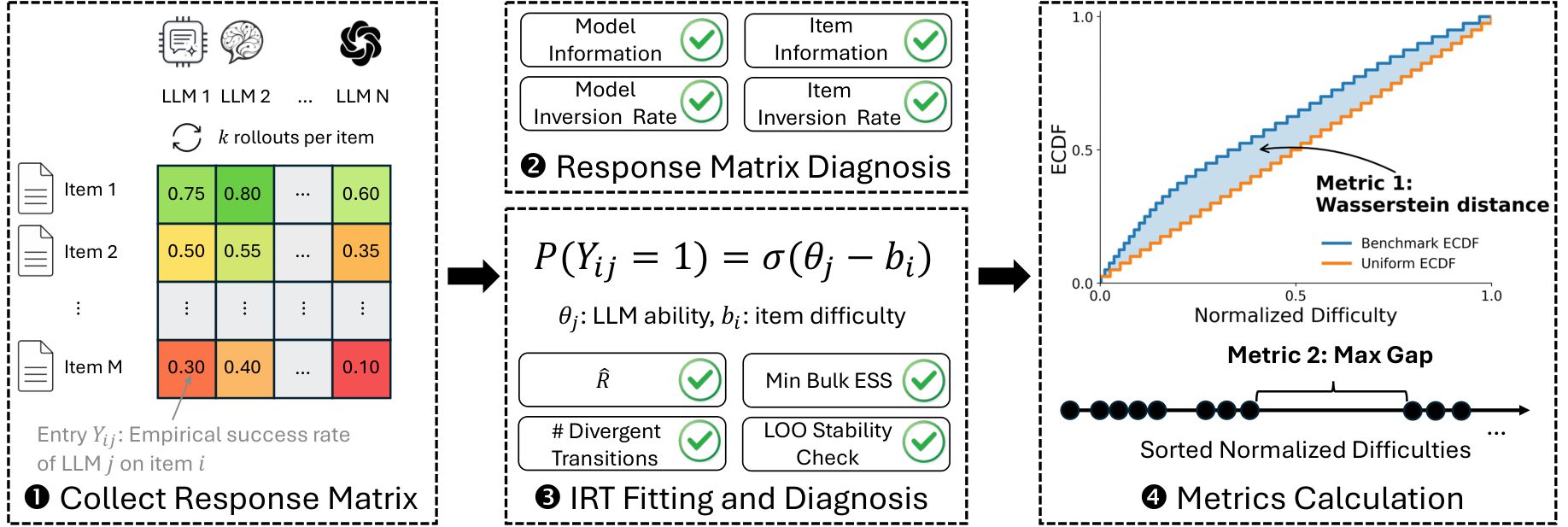
The b_i are then rank-normalized to z_i \in [0,1] before computing the two metrics. This is the right move: IRT difficulty is identified only up to monotone transformation of ability, so comparing CDFs across benchmarks requires rank-normalization.
Empirical findings over 25 benchmarks
They apply the pipeline to 25 benchmarks spanning math, code, agentic, logic, science, instruction-following, and medicine. Two patterns dominate:
- Overweighting of specific difficulty regions: many benchmarks place disproportionate mass at either the easy or hard tail. Where s_\theta(z) is near 0 or 1, items contribute little discriminative information between frontier models, but still dominate the aggregate. This means leaderboard deltas on these benchmarks reflect benchmark construction as much as model capability.
- Substantial coverage gaps: several benchmarks have large uncovered intervals along z. Under the paper’s bound, a model that improves specifically within such a gap would produce no measurable movement on the leaderboard, which is directly adversarial to using these benchmarks for monitoring training progress.
The implication is operational: for any claim of the form “model A beats model B by x points,” one should check whether \mu_B places mass in the difficulty region where s_A - s_B is actually non-trivial.
BenchFill: targeted gap filling
To turn diagnosis into intervention, the authors introduce BenchFill, which reduces the largest adjacent gap [z_L, z_R] by inserting a new item at target difficulty z^\star = (z_L + z_R)/2. The method is an evolutionary rewrite-and-annotate loop: an LLM rewrites a parent item (sampled from near the gap) into child variants with instructions to adjust difficulty; each child is annotated by estimating its difficulty (via calibrated model rollouts and the fitted IRT model); a memory of (parent, rewrite instruction, resulting difficulty) tuples guides subsequent proposals toward z^\star. Final items are human-validated for correctness and format fidelity.
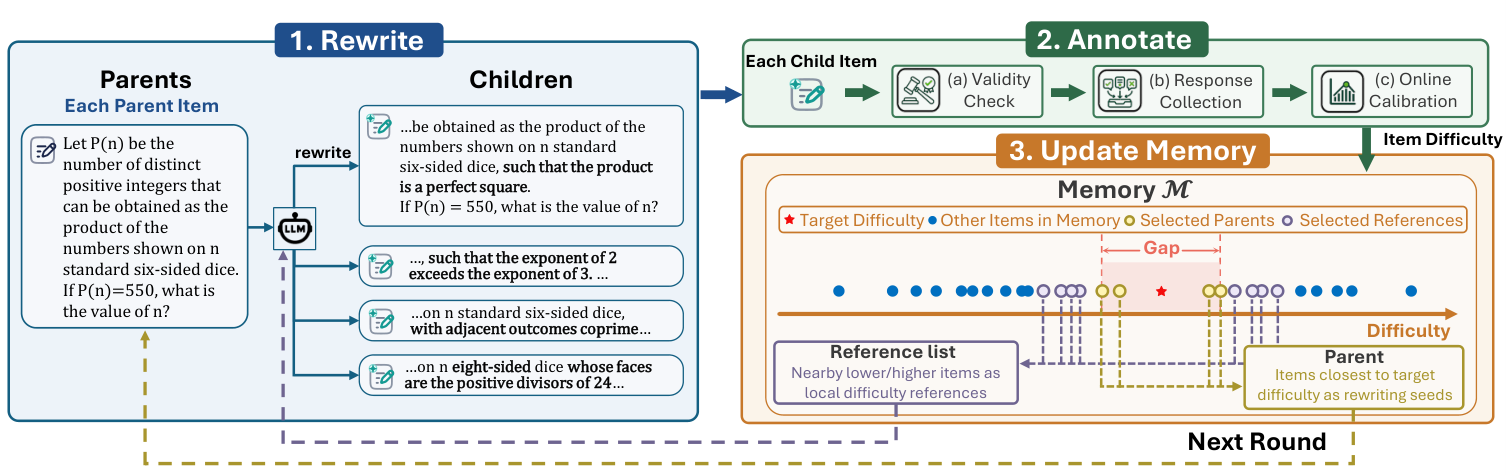
Mechanically this is a bandit-flavored search where the reward is -|z_{\text{child}} - z^\star| and the action space is rewrite prompts conditioned on parents near the gap. Rewriting (as opposed to from-scratch generation) preserves style and reduces the risk of distribution shift along axes orthogonal to difficulty — important because the IRT estimate conflates all such axes into a single b.
Limitations and open questions
The 1PL assumption of a single difficulty parameter per item is strong: real items vary in discrimination and in the ability dimension they probe. Multi-dimensional IRT would complicate the single-z measure view but may be necessary for heterogeneous benchmarks. The “intended” measure \mu^\star is left to the practitioner; the framework is diagnostic conditional on \mu^\star, not prescriptive. Difficulty estimates also depend on the model panel used to build Y: a panel of similarly capable frontier models yields poorly identified b_i at the extremes. Finally, BenchFill reduces local gaps but does not correct global measure mismatch, which requires either reweighting or substantial new item generation.
Why this matters
Treating a benchmark as an empirical measure over difficulty makes explicit what leaderboard aggregates obscure: scores are integrals against a distribution that the benchmark author implicitly chose, often by accident. The two diagnostics give a principled way to ask whether a benchmark’s conclusions transfer to any intended deployment distribution, and whether the benchmark can even detect the kind of localized progress that modern post-training produces.
Source: https://arxiv.org/abs/2610.29927
Intrinsic Distribution Matching
Distribution matching distillation (DMD) collapses a multi-step diffusion/flow sampler to one or two network evaluations by driving the student distribution p_\theta toward a reference p_r using the score difference \mathbf{s}_\theta - \mathbf{s}_r. In practice this difference is estimated either with a separately-trained fake-score network or, as in APEX, with two “internal” velocity branches of the same backbone selected via a condition-flip. This paper asks whether augmenting that learned score supervision with an explicit, cheap moment constraint improves the one-/two-step regime where errors cannot be corrected by further refinement.
Decomposing the reverse-KL field
At fixed condition \mathbf{c}, the reverse-KL gradient in sample space is
\mathbf{g}_{\mathrm{KL}}(\mathbf{x}\mid\mathbf{c}) = \mathbf{s}_\theta(\mathbf{x}\mid\mathbf{c}) - \mathbf{s}_r(\mathbf{x}\mid\mathbf{c}),
and on the noised marginals p_{\theta,t}, p_{r,t} the DMD velocity residual satisfies
\mathbf{d}_t^*(\mathbf{x}_t) = \mathbf{v}^*_{\theta,t} - \mathbf{v}^*_{r,t} = \tfrac{t}{1-t}\bigl(\mathbf{s}_{r,t} - \mathbf{s}_{\theta,t}\bigr),
so \mathbf{g}_{\mathrm{KL},t} = -\tfrac{1-t}{t}\,\mathbf{d}_t^*. The paper’s conceptual move is to split \mathbf{g}_{\mathrm{KL}} into a Gaussian-moment component — the piece reproduced by matching (\mu_i, \Sigma_i) via moment-matched surrogates q_i — plus a non-Gaussian residual. Equal means and covariances zero out the former but generally leave the latter nonzero, so moment matching cannot replace the DMD correction; it can only pin down a subspace that the learned score difference might estimate noisily.
The IDM objective
IDM keeps the full DMD score term and adds an auxiliary moment term computed on features of the generator’s own EMA copy G_{\theta_{\mathrm{EMA}}}, so no external encoder (CLIP, DINO, VGG) is used. Internal velocity branches follow APEX: a single backbone \boldsymbol{F}_\theta supplies both
\widehat{\mathbf{v}}_{r,t}(\mathbf{x}_t\mid\mathbf{c}) = \boldsymbol{F}_\theta(\mathbf{x}_t,t,\mathbf{c}), \qquad \widehat{\mathbf{v}}_{\theta,t}(\mathbf{x}_t\mid\mathbf{c}) = \boldsymbol{F}_\theta(\mathbf{x}_t,t,-\mathbf{c}),
with condition negation selecting the model branch; their difference \widehat{\mathbf{d}}_t is the empirical surrogate for \mathbf{d}_t^* driving \mathcal{L}_{\mathrm{score}}. The population term \mathcal{L}_{\mathrm{pop}} (empirical form \widehat{\mathcal{L}}_{\mathrm{pop}}) matches feature means and per-coordinate standard deviations between generator and EMA features — a diagonal second-moment constraint rather than a full covariance match — motivated by the decomposition in §3.
A supervision/stability byproduct: because the Gaussian component is explicitly handled by \mathcal{L}_{\mathrm{pop}}, the DMD branch can concentrate capacity on the non-Gaussian residual, which the authors argue reduces reliance on noisy score estimates in low-NFE regimes.
Results
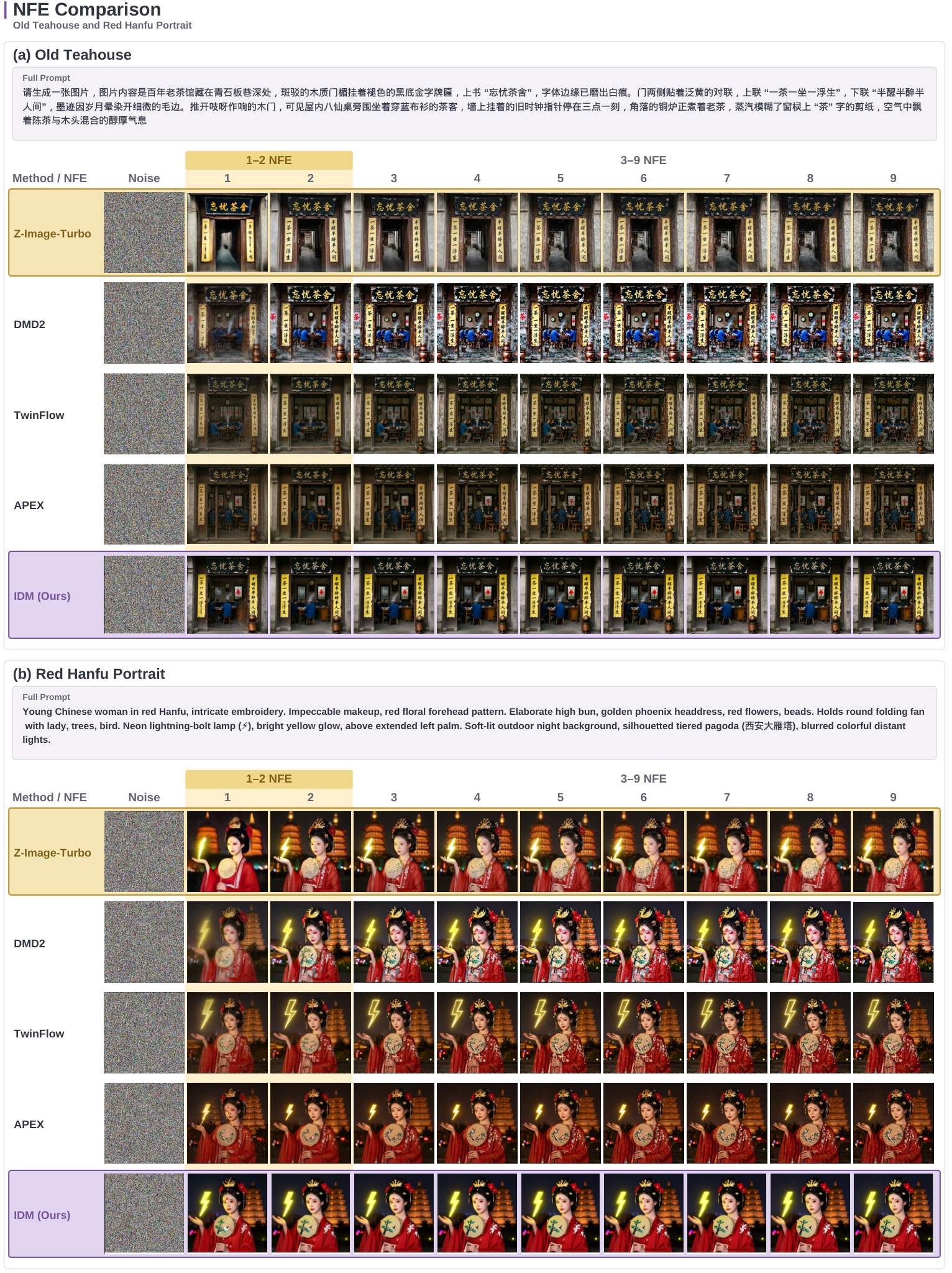
Experiments distill Z-Image-Turbo (6B) and Qwen-Image (20B) under both full-parameter and LoRA (r{=}32,64) tuning at 1 and 2 NFE on a single A100 (BF16).

On GenEval at 2 NFE, IDM (Qwen-Image, full-parameter) reaches 0.91, surpassing APEX (0.90) and Qwen-Image-Lightning (0.85) at matched budget; at 1 NFE it reaches 0.88 (full) / 0.88 at LoRA r{=}32, versus APEX 0.89 and Lightning 0.85. FID at 2 NFE is 6.34 (IDM, full Qwen) vs 6.44 (APEX full) and 6.76 (Lightning). CLIP is comparable across methods (28.4–28.8 band), consistent with the view that compositional/text-rendering gains are not captured by CLIP similarity.
On the headline LongText-Bench text-rendering task at 2 NFE, IDM reports 94.25% (Chinese) and 90.20% (English), the top scores among compared 2-NFE systems. Throughput and latency on A100 are not degraded: IDM (Qwen-Image) runs at 3.28 samples/s (batch 10) and 0.44 s latency (batch 1) at 2 NFE — essentially matching APEX and Lightning while gaining quality. The smaller Z-Image backbone sits on a different Pareto point: 5.18 samples/s at 2 NFE with FID 6.71 and GenEval 0.78.
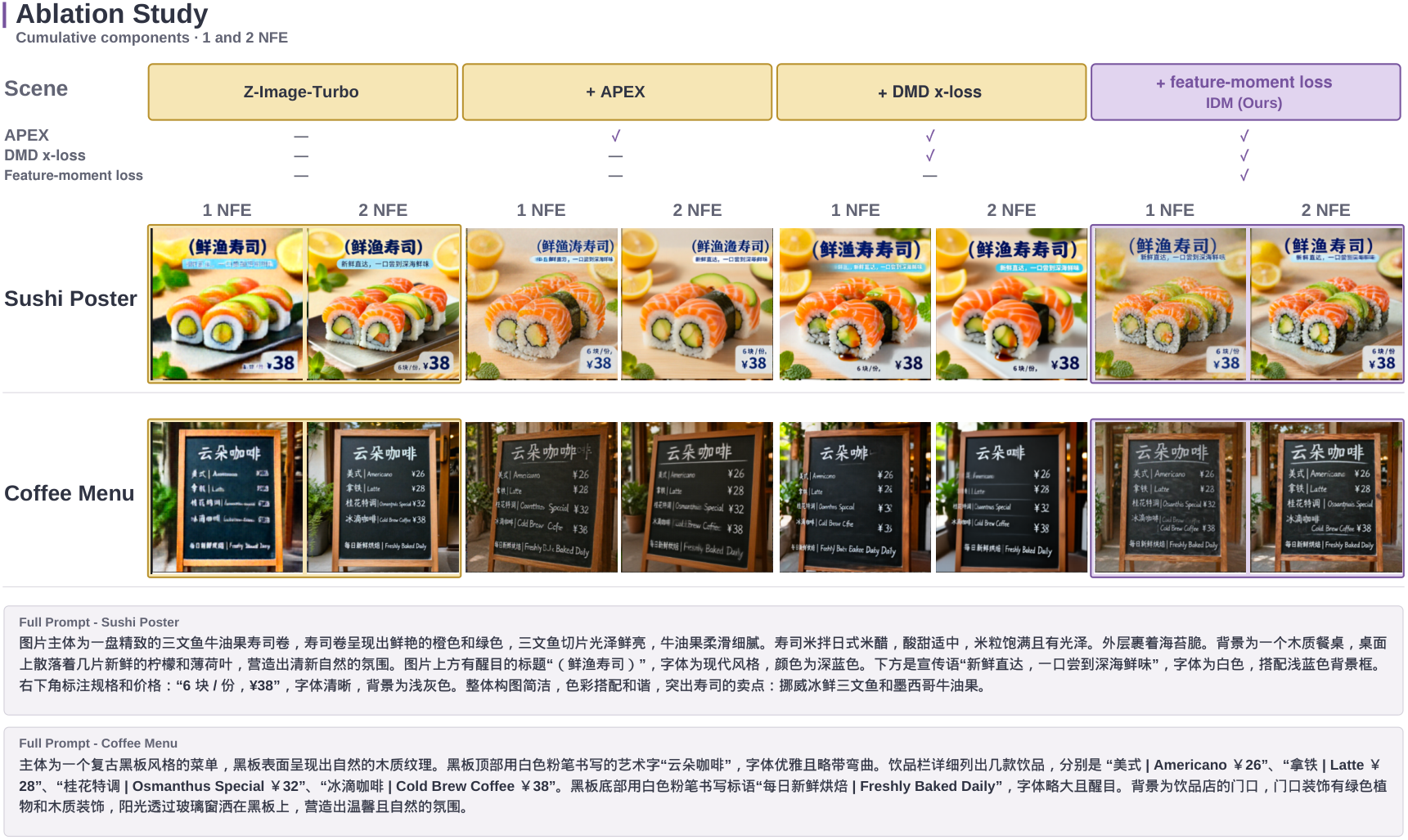
The controlled ablation isolates the contribution of \mathcal{L}_{\mathrm{pop}}. Removing it (the v{+}x variant, which keeps velocity and endpoint regression but drops EMA feature-moment matching) degrades fine detail and text fidelity at both 1 and 2 NFE under the same data/backbone, consistent with the decomposition argument: the DMD term alone leaves the Gaussian-moment subspace under-constrained in the low-NFE regime.
Limitations and open questions
The moment constraint is diagonal (per-coordinate std) in a feature space defined by the generator’s own EMA copy; this choice avoids an external encoder but makes the “features” a moving target during training and conflates representation drift with distribution drift. The decomposition formally handles only the Gaussian-moment subspace, so there is no guarantee the residual DMD estimate improves — gains are empirical. GenEval gains over APEX are modest (0.90 → 0.91 at 2 NFE; 0.89 → 0.88 at 1 NFE for Qwen full-tuning), and LongText-Bench numbers are reported only for IDM configurations at 2 NFE in the excerpt, so the magnitude of the text-rendering advantage over APEX/Lightning at 1 NFE is not fully quantified here. The method is also tied to the APEX condition-negation trick for separating branches; its applicability to backbones without a strong classifier-free guidance structure is unclear.
Why this matters
IDM gives a principled, encoder-free way to tighten DMD-style distillation in the regime where it matters most — one- and two-step inference — by explicitly nailing the moment subspace of the reverse-KL field and letting the learned score difference focus on the non-Gaussian residual. The resulting 94.25%/90.20% LongText-Bench and 0.91 GenEval at 2 NFE on 20B Qwen-Image, with no throughput penalty, make it a practical drop-in on top of existing internal-branch distillation stacks.
Source: https://arxiv.org/abs/2610.39633
A-RSI: Adaptive Task Refresh for Zero-Data Multimodal Self-Improvement
Problem
Recursive self-improvement loops for multimodal models face two coupled questions: what new training experience to generate, and when the current experience has ceased to carry gradient signal. Many existing pipelines conflate these — they produce model-authored tasks and derive supervision via self-consistency or majority voting, so the training targets depend on the same uncertain predictions being trained. A-RSI separates the two: a static library of programmatically-authored tasks produces questions whose reference answers are computed by code (independently checkable), and a controller reading training-log statistics decides when to swap the task pool. No validation or test scores inform the controller, and no external training examples or human labels are used.
Method
Let \theta_{w-1} denote parameters and \mathcal{P}_w the active pool at the start of window w. A window runs H{=}100 GRPO updates (Shao et al. 2024) producing \theta_w and a rollout log \mathcal{L}_w. Three fixed stages run before training:
Template synthesis. Starting from seeds (geometry, charts, tables, counting), the base model writes parameterized programs \tau. Each \tau specifies admissible parameters z \sim p_\tau, an image renderer, a question composer, and an answer function: z\sim p_\tau,\qquad (I,q,a)=G_\tau(z). The learner receives only (I,q) and is scored against a. The template library \mathcal{T} is frozen.
Candidate reservoir and replacement pools. Admission checks test configuration validity, answer computation, rendering constraints, and freshness/contamination. Disjoint replacement pools (400 tasks each) are prepared with fixed task-family quotas.
GRPO rewards. Correctness, format, and termination components. Controlled scoring tests (7 variants \times 1,000 tasks = 7,000 responses) verify monotonicity: correct-committed > incorrect-committed in 1,000/1,000 cases; canonical formatting and normal termination each raise reward with other components held fixed in 1,000/1,000.
The adaptive controller reads training-side accuracy and group-relative advantage (U) from \mathcal{L}_w. When saturation is detected (e.g., for Qwen’s old pool: U falls 245 \to 194 \to 153, ratio 0.62, with training accuracy 0.490 \to 0.633), it swaps the active pool for an unused one — retaining the latest accepted weights. Replacement uses random sampling under family quotas; frontier/difficulty selection is explicitly ablated against.
Compared arms: A-RSI (log-trigger + random), Frontier (log-trigger + difficulty frontier), Periodic (every two windows + frontier), Continuous (every window + adaptive difficulty), No-Refresh.
Results
On the eleven-benchmark suite (22,042 questions, 8192-token limit), Qwen3-VL-8B-Instruct Macro11 progresses 57.77 \to 58.08 \to 58.75 \to 59.84 \to 60.40 \to 60.24 \to 61.05 \to 61.44 across windows, with pool means 58.36 \to 60.12 \to 60.91. At matched update budget S_{23}, A-RSI reaches 60.40 vs 58.35 for original-pool continuation (+2.05), and No-Refresh halts at S_{31} after failing its training-health check.
At S_{32}, A-RSI reaches 61.05 with only 800 new tasks introduced, compared to Continuous at 60.64 (3,200 new tasks), Periodic at 59.89 (1,200), Frontier at 59.59 (800). Normalized: A-RSI yields +4.09 points per 1k new tasks vs 0.90, 1.77, 2.28 for the alternatives. All eleven benchmarks improve from S_t to S_{32}, ranging from +1.19 (SCEMQA-MC) to +8.33 (PhyX-MC); all four annotated visual-type subsets improve (geometry +3.64, chart +2.03, table +2.03, counting +6.94).
Truncation. A striking signal: pooled truncation at S_{32} is 4.16% for A-RSI vs 8.14% (Frontier), 10.33% (Periodic), 8.44% (Continuous). The authors attribute much of the gain to termination recovery, which they decompose carefully.
For Qwen, the full-suite output decomposition shows the both-finished stratum contributes −0.75 points while other strata contribute +5.15 (primary decoding S_0 \to S_{32}, total +4.40). MiMo-VL-7B-SFT differs: 59.08 \to 60.71 Macro11, with both-finished contribution +0.99 and 1,460 wrong-to-right vs 1,235 right-to-wrong transitions among responses that finish at both checkpoints — i.e., genuine correction beyond truncation recovery, which replicates (+1.69 on a repeat decoding).
Why random beats selection
The authors offer three mechanisms, supported but not isolated:
- Random pools preserve unfinishable tasks — the ones where the termination reward has strongest signal (random: 21.9% truncated, length-advantage correlation -0.31; selected: 17%).
- Selection corrupts the format distribution. Failure-prioritized sampling eliminates multiple-choice tasks entirely (0 vs 222 for random; 227 for learnable-band).
- Random pools do not saturate within 4–8 windows (tasks-with-signal per window: 209, 180, 189, 183, flat after window 2).
The authors also note that part of the apparent “difficulty frontier” is artifact: in 6,000 probed candidates, 39% of geometry answers truncated at 4096 tokens, and in 12,000 candidates a lenient grader found 2.6% of items (311/317 multi-hop geometry MC) that strict grading penalizes due to the model writing option values instead of letters.
Limitations
The paper is unusually explicit about scope. The +0.40 margin of A-RSI over Continuous at S_{32} does not establish detector-timing advantage: the first two realized random-refresh decisions coincidentally match a three-window schedule, and when frontier selection is held fixed, detector-triggered refresh trails periodic refresh by 0.30 points. Each arm is one training run. The small MiMo endpoint margins (+0.02 over Continuous, +0.18 over Periodic) do not establish a timing advantage either. The reward-check audit passes 1,000/1,000 on finite probes but is not exhaustive — the production checker fails 220/16,000 adversarial variants (two variants each on 110 choice tasks). The 1,922/1,927 agreement on multi-series chart reading reflects five tie ambiguities for “third highest.” The generator is not updated during training; this is not open-ended recursive self-improvement.
Why this matters
A-RSI shows that in programmatic self-training pipelines, when-to-refresh is a first-class design question answerable from training logs alone, and that random replacement under fixed family quotas outperforms model-conditioned difficulty selection — mostly because selection removes the exact tasks (unfinishable, format-stressed) that drive the termination and format rewards. The paper is also a useful counter-example to headline-chasing in self-improvement work: the authors carefully decompose how much of the gain is non-truncation reasoning (positive on MiMo, negative on Qwen) rather than claiming unconditional capability improvement.
Source: https://arxiv.org/abs/2610.38568
Look Only When Needed: Certificate-Guided Visual Routing for Efficient Diffusion VLMs
Diffusion vision-language models (DVLMs) such as LLaDA-V and LaViDa run a full bidirectional forward over the concatenation of image and partially-masked response tokens at every denoising step. On the ten benchmarks studied here, visual tokens constitute 89–97% of the sequence, so each step pays for re-encoding a static image to unmask a handful of text positions. Prior work on visual token pruning reduces the per-step cost but still processes a (shrunk) image at every step and permanently discards information. The authors instead ask a sharper question: at how many steps is the image actually needed to decide which token to unmask?
Their measurement on LLaDA-V is striking. Comparing the top-1 prediction with and without the image at every masked position across decoding, removing the image changes the token that would be unmasked at only 22.8% of steps on average, and as few as 7.9% on some benchmarks. The image’s influence is also spatially and temporally concentrated: disagreements cluster at particular positions and denoising steps rather than being uniform.
Method: anchor + text-only certificate
LOWN decouples the two implicit decisions in standard DVLM decoding — “do I need the image now?” and “how many tokens can I unmask this step?” — using a certificate test instead of a confidence threshold.
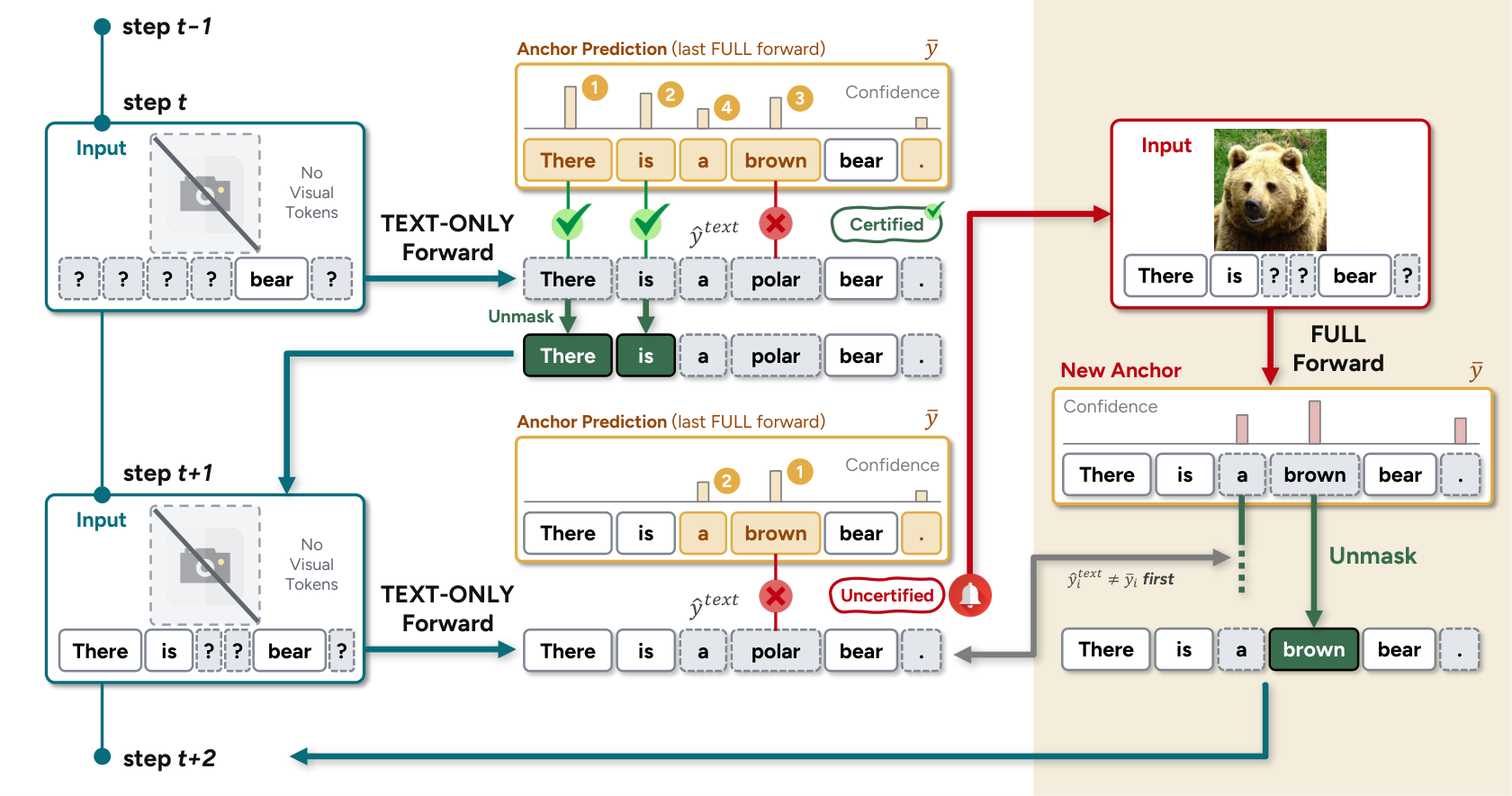
Whenever a FULL forward is executed, LOWN caches the predicted token identities \bar{y}_i and confidences \bar{s}_i at all currently masked positions. This pair is the anchor. At a subsequent step t, LOWN runs a TEXT-ONLY forward (image tokens removed from the context) and sorts masked positions by anchor confidence \bar{s}_i in decreasing order. A candidate i is certified iff
\hat{y}^{\text{text}}_{t,i} = \bar{y}_i.
The two forwards differ along two axes — presence of the image, and age of the response state — so agreement simultaneously approximates “image not needed here” and “anchor still valid.” The certified prefix \mathcal{U}^{\text{text}} is the longest confidence-ordered run of agreements; the first disagreement terminates it. The number of tokens unmasked at step t is therefore |\mathcal{U}^{\text{text}}|, an input-adaptive acceptance count rather than a fixed schedule. If the certified prefix is too short, LOWN falls back to a FULL forward, unmasks the first disagreement positions, and replaces the anchor outright. A repetition guard (Appendix B.1) prevents degenerate loops.
Replacing — rather than editing — the anchor on each FULL step is important because certificate error grows with anchor age. On a one-step-old anchor, a fresh FULL forward overturns 4.1–11.0% of certified tokens; in LOWN’s full decoding runs, only 2.2–4.7% of TEXT-ONLY-unmasked tokens are overturned, because FULL steps are interleaved exactly when the certificate stops holding.
Model parameters and attention patterns are unchanged, so LOWN composes with visual token pruning (which shrinks the FULL step) and KV caching (which cheapens repeated forwards).
Results
Experiments cover LLaDA-V and LaViDa on ten image benchmarks (MathVista, ScienceQA, ChartQA, MME, MMBench, DocVQA, GQA, LLaVA-Bench, CapArena, DeCapBench), with transfer to VidLaDA-8B on EgoSchema and MLVU. Decoding FLOPs are reported relative to each backbone.
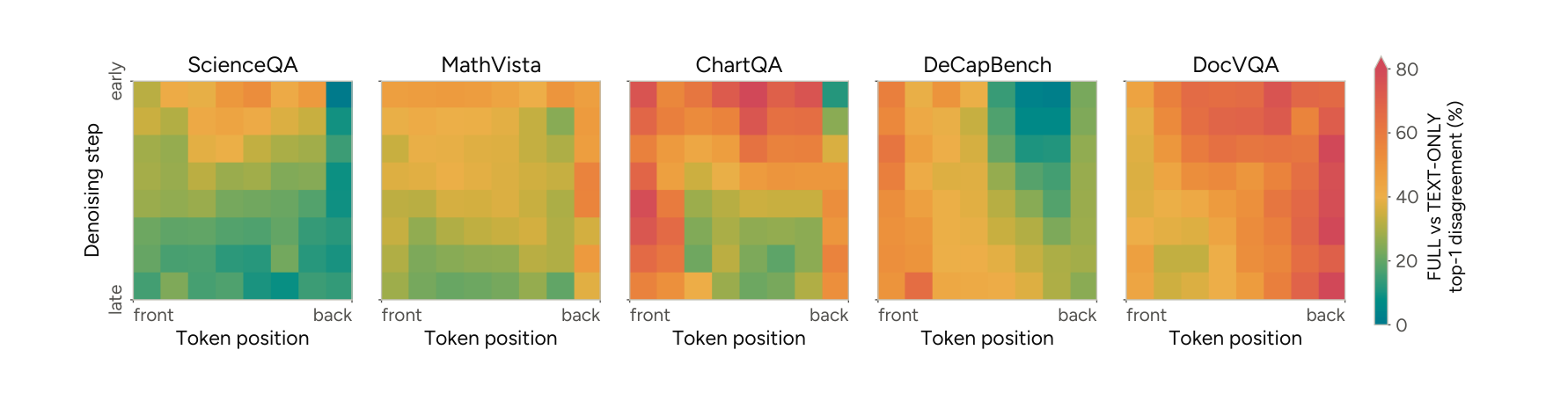
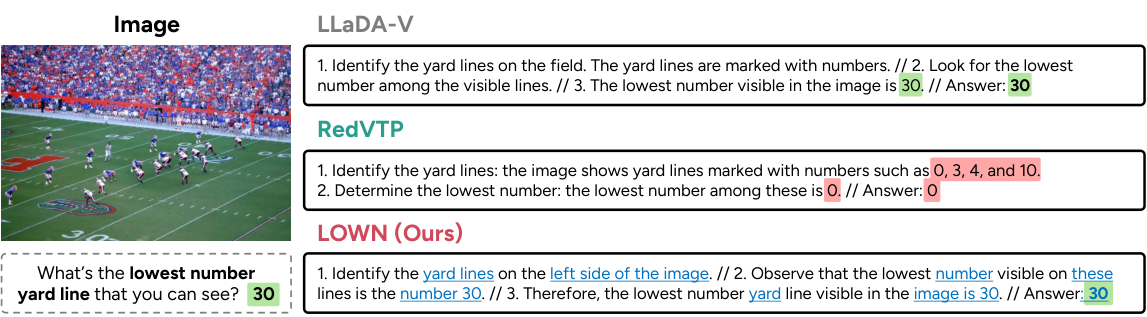
The heatmaps above make the mechanism’s precondition explicit: disagreement between TEXT-ONLY and FULL predictions is sparse and localized in position/step space, so a certificate that triggers FULL only on disagreement should rarely miss. Qualitatively, Figure 6 shows that on a typical caption, only a small subset of output tokens (blue underlines) is produced on FULL steps; the rest are unmasked image-free from the anchor.
Because the per-benchmark image dependence varies (7.9% on the sparsest to 22.8% on average), LOWN’s trigger rate adapts automatically rather than requiring a per-task knob.
Limitations and open questions
The excerpt provided does not list final speedup/accuracy pairs, so the quantitative headline numbers are not reproduced here; the central quantitative claims are the measurement (22.8% average, 7.9% minimum image-sensitive steps) and the certificate-error figures (2.2–4.7% overturn in deployment vs. 4.1–11.0% on a stale anchor). Open questions: (i) the certificate is a top-1 equality test, which is pessimistic when the image shifts probability mass without flipping the argmax, and optimistic when both forwards agree on a wrong token; (ii) agreement conflates “image irrelevant” with “anchor still valid,” so the method cannot distinguish them, and failure modes under distribution shift (e.g., high-resolution OCR where nearly every token is image-dependent) are not characterized in the excerpt; (iii) extending to streaming or interleaved multi-image inputs where the “anchor” notion is less clean.
Why this matters
LOWN reframes DVLM decoding cost around a measurable property of the data — how often the image actually changes the next unmasked token — and converts it into an input-adaptive routing policy with no retraining and no architectural change. If the measurement generalizes, most of the visual compute currently spent inside diffusion VLMs is redundant, and routing, not pruning, is the right primitive.
Source: https://arxiv.org/abs/2610.36671
L3G-World: Real-Time Infinite World Generation with Latent 3D Gaussian Memory
Problem
Interactive world models that generate video conditioned on a camera trajectory face a tension between long-horizon spatial consistency and real-time throughput. Two dominant memory designs both scale poorly. Temporal-context methods (Yume, Matrix-Game) accumulate past frames in the DiT context, so compute grows with stream length and loop-closure consistency degrades. Explicit 3D memories (point clouds in GEN3C, Lyra, Spatia; Gaussians in NeoVerse) persist geometry but either grow unboundedly with per-frame primitive accumulation or require re-encoding RGB renderings through a VAE before conditioning the latent video DiT — a step that dominates per-chunk latency.
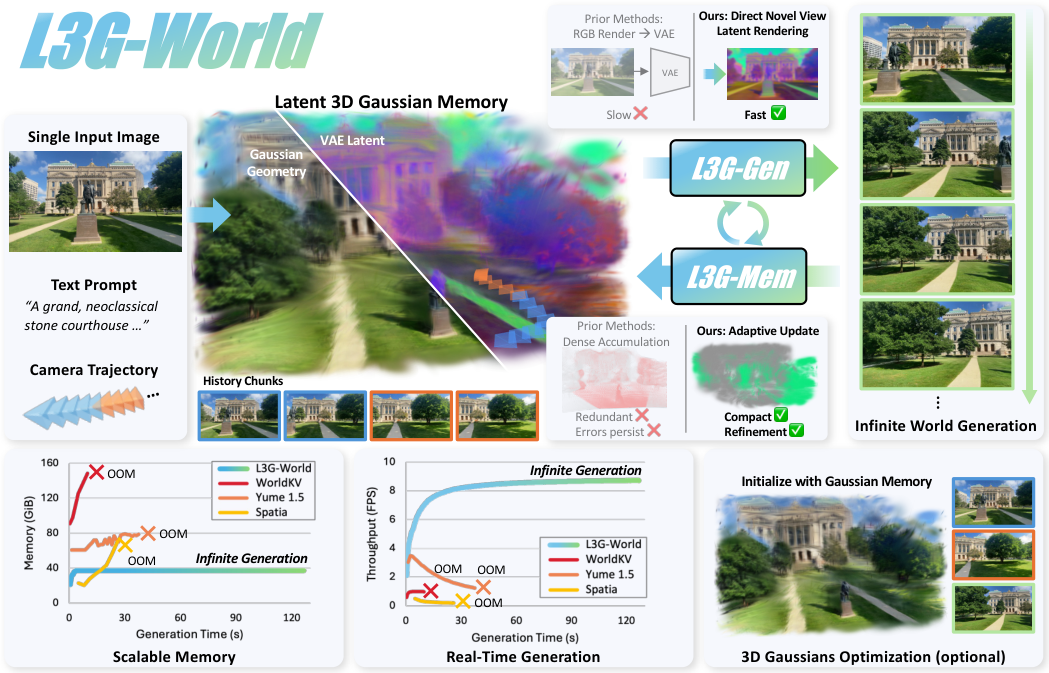
L3G-World addresses both: a selectively updated 3D Gaussian memory whose size scales with scene extent rather than frame count, and whose Gaussians carry VAE latent features so renderings land directly in the DiT’s conditioning space with no re-encoding.
Method
The system alternates two modules autoregressively over chunks \mathcal{W}_k: a memory updater L3G-Mem that produces \mathcal{M}_k from (\mathcal{M}_{k-1}, \mathcal{W}_k), and a latent video DiT L3G-Gen that samples the next chunk given latents rendered from \mathcal{M}_k into the target cameras.
Latent 3D Gaussian memory. Each primitive stores standard Gaussian parameters (\mu, \Sigma, \alpha) plus a VAE latent feature vector z \in \mathbb{R}^{C} aligned to the DiT’s input latent space. Splatting into a target camera therefore produces a feature image at the DiT’s spatial-temporal latent resolution directly, avoiding the usual RGB \to VAE encode step.
L3G-Mem (updater). For a new window, L3G-Mem renders \mathcal{M}_{k-1} into the current cameras and uses the resulting RGB + opacity to form a spawning mask over newly observed regions. Geometry features in these regions (produced by a Depth Anything 3 backbone, following ZipSplat) are reduced by K-means to a small set of spawning queries. Visible Gaussians along the current camera rays contribute their memory tokens as refinement queries. A transformer jointly processes both token sets and decodes (i) parameters of newly spawned Gaussians for uncovered geometry and (ii) residual updates to existing Gaussians to correct earlier reconstruction errors.
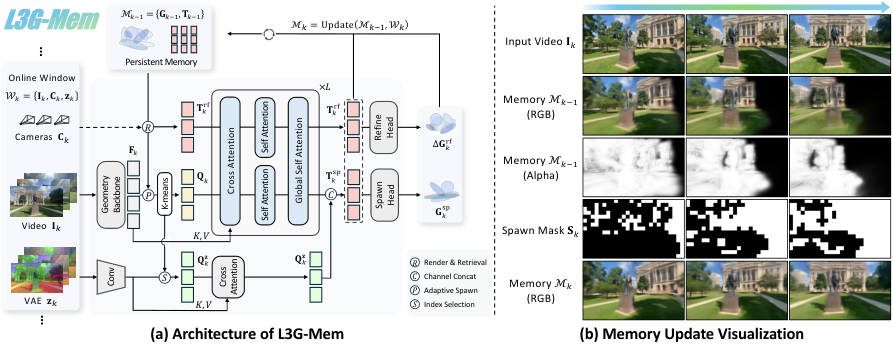
Because spawning is gated by the opacity/RGB residual against existing memory, redundant primitives over revisited regions are suppressed; memory grows with scene coverage, not with the number of frames generated.
L3G-Gen (video DiT). Given the updated memory, L3G-Gen rasterizes VAE latents and opacity to the target cameras, concatenates them channel-wise with the noisy latent tokens, and denoises. Formally, with rendered latent \tilde z, opacity \tilde\alpha, and noisy latent x_t, the DiT input is [\,x_t;\tilde z;\tilde\alpha\,] along channels, with history latents from previously emitted chunks providing short-range context. The backbone is Cosmos-Predict2.5 fine-tuned with LoRA; a few-step distilled variant (AnyFlow) yields L3G-World Fast.
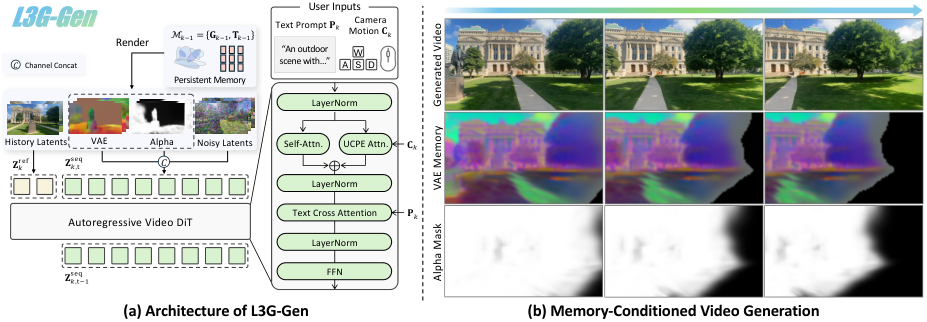
Training data. L3G-Mem is trained on DL3DV; L3G-Gen on DL3DV + RealEstate10K; all on 4×A100.
Evaluation protocol
The key benchmark is a 481-frame loop-closure trajectory on DL3DV and RealEstate10K: the camera explores outward then retraces its path. Self-consistency is PSNR/SSIM/LPIPS between outgoing and returning frames at matched poses. Generation quality uses LPIPS, FID, and VBench IQ/AQ/SC/BC. Camera control is measured by TransErr, RotErr; geometric consistency by MEt3R. Efficiency reports stored primitives (K), memory (MiB), reconstruction FPS, and critically both RGB render FPS and VAE-space conditioning FPS — the latter including the VAE encode for baselines without renderable latent features. All measurements are on a single A100. Baselines include point-cloud explicit memories (Lyra 2.0, GEN3C, Spatia, SPMem, 3DScenePrompt), Gaussian memory (NeoVerse), and temporal-context models (Yume 1.5, Matrix-Game 3.0). For fairness in the single-image setting, all explicit-memory baselines are initialized with DA3 GIANT-1.1-NESTED metric depth to align scene scale with the eval trajectory.
Results
The abstract claims state-of-the-art results, and the included Table 2 header enumerates the axes the method dominates (3D memory efficiency, self-consistency on the loop trajectory, generation quality, and pose/3D-consistency on both DL3DV and RealEstate10K). The provided section text does not include numerical cell values, so specific per-metric gains cannot be quoted from this excerpt. The architectural implication is that VAE-render FPS should scale essentially like RGB-render FPS for L3G-World (one splatting pass, no encoder), while every point-cloud baseline pays an extra VAE encode per generated chunk — the mechanism by which the authors claim real-time behavior.
Limitations and open questions
- Metric scale is bootstrapped from DA3 depth; drift and scale errors in DA3 will propagate into the memory and the loop-closure metric.
- The spawning mask is driven by rendered RGB/opacity residuals; dynamic content, specularities, and lighting changes along the trajectory could falsely trigger either spawning or refinement.
- The memory stores features tied to a specific VAE/DiT (Cosmos-Predict2.5); swapping the generator requires retraining or re-aligning the latent feature channel.
- “Memory grows with scene extent” is an empirical claim here; absolute primitive counts at 481 frames and asymptotic behavior on larger loops are not quantified in the excerpt.
- LoRA fine-tuning plus AnyFlow distillation may limit how far generation quality can be pushed beyond the frozen backbone.
Why this matters
Storing VAE-space features directly on 3D Gaussians removes the RGB\toVAE re-encoding bottleneck that has kept explicit-3D-memory world models from running in real time, and selective spawning decouples memory size from stream length — the two structural problems that have blocked long-horizon interactive generation. If the loop-closure numbers hold up, this is a plausible template for persistent, explorable neural worlds that are both geometrically consistent and interactively responsive.
Source: https://arxiv.org/abs/2610.40614
Read, Allocate, Route: Role-Coupled Tokenization for Pixel-Space Generative Transformers
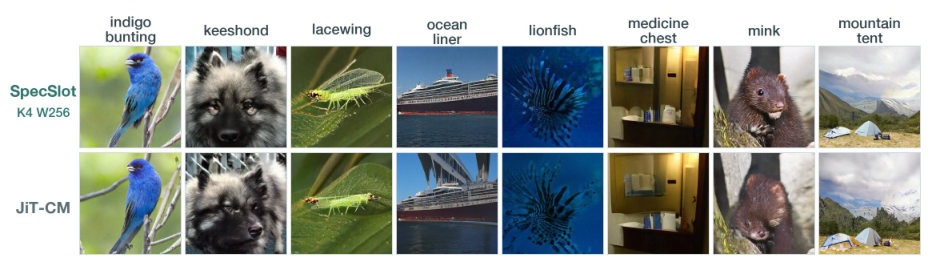
Pixel-space generative transformers tie output resolution to token count: one token per patch means finer detail inflates the global attention sequence quadratically. SpecSlot breaks this coupling by observing that low-frequency structure needs global exchange while high-frequency detail is largely local, and by assigning tokens explicit output roles rather than treating them as interchangeable patches.
Setup: pixel-space rectified flow
The objective is standard JiT-style rectified flow. For x\in[-1,1]^{3\times H\times H} and \epsilon\sim\mathcal{N}(0,I), the linear path is z_t = tx + (1-t)\epsilon with t=\sigma(g), g\sim\mathcal{N}(-0.8, 0.8^2). The network emits an image-shaped prediction r_\theta(z_t,t,y), converted to velocity by
v_\theta(z_t,t,y) = \frac{r_\theta(z_t,t,y) - z_t}{\max(1-t,\tau)}, \quad \tau=0.05,
trained with velocity MSE against x-\epsilon. State, target, and loss remain in pixel space; only the tokenization and routing change.
Allocation: N = W \cdot K
The core design is a factorization of the token budget. Rather than N patch tokens participating in one global sequence, SpecSlot splits N = W K: W spatial anchors, each expanded into K slots assigned disjoint bands of lapped-DCT coefficients.
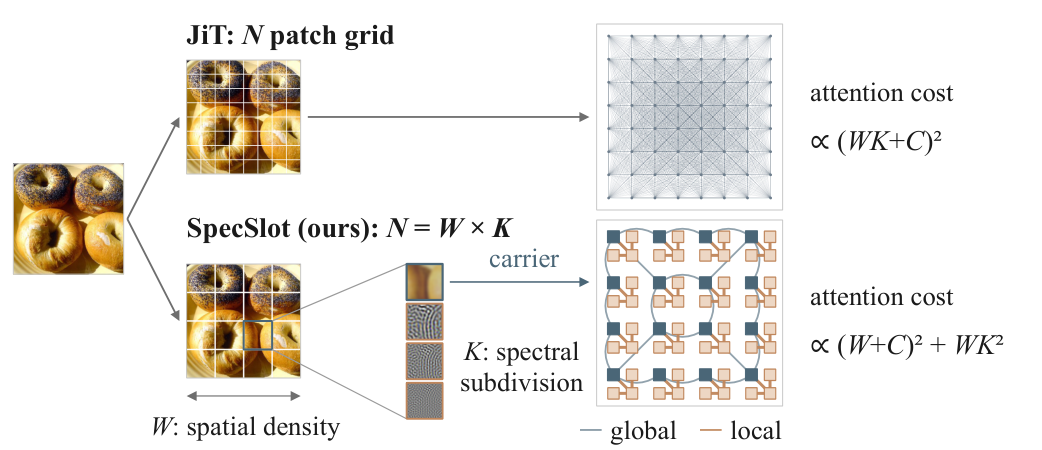
Crucially, only the lowest-frequency slot (slot-0) from each anchor participates in global attention — so the global sequence length stays at W regardless of K. All K slots interact in local blocks within each anchor. This decouples spectral detail from the \mathcal{O}(W^2) global attention cost.
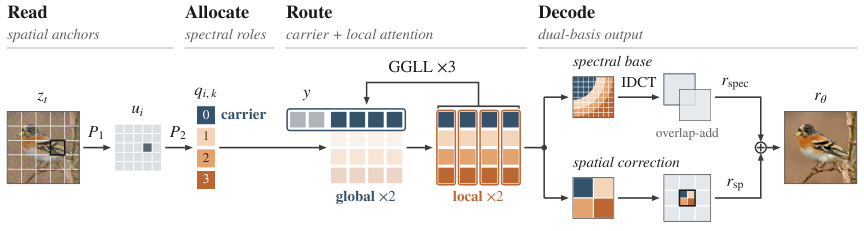
The decoder sums a lapped-DCT spectral base (from all slot states) and an anchor-aligned spatial correction in pixel space. The two branches reinforce rather than compete, as shown by positive cross-term energy in the mechanistic probes.
Role separation: read vs. write
The ablation on anchor density W vs. spectral subdivision K (Table 4/5) formalizes the roles: W improves the “read” (what the global attention sees), K refines the “write” (what the decoder emits). They are not interchangeable. Doubling K at fixed W yields diminishing returns — the last doubling buys only 0.31 FID — while reallocating the budget toward more anchors at fixed N lowers FID monotonically within the tested N=2048 range.
Entropy-effective slot utilization quantifies this: at W{=}256 and width B{=}1536, the normalized effective slot fraction drops from 0.803 at K{=}2 to 0.620 at K{=}4 to 0.495 at K{=}8. Absolute effective rank grows sublinearly in K, so token count overstates capacity. The authors settle on K2 (low-cost) and K4 (intermediate) as the usable operating points.
Mechanistic structure of the output
The output decomposition is empirically well-behaved. The spectral branch carries the larger self-energy throughout the flow, while the spatial branch’s share grows from 0.07 at low t to 0.23 at high t, concentrated in higher radial bands late in generation. The signed cross term stays positive — the branches add, not cancel.
Lesion probes with the trunk frozen quantify dependence: at t{=}0.90, zeroing the spatial branch raises velocity MSE by 32.1\times and zeroing the spectral branch by 64.1\times; at t{=}0.05 the factors are 1.1\times and 2.1\times. The spectral branch is the dominant scaffold across t; the spatial branch supplies a late, high-frequency correction.
Results
Training is 120 epochs at effective batch 512 on ImageNet-1K. On ImageNet-256, SpecSlot matches a FLOPs-matched JiT control on final FID while converging faster. On ImageNet-512, FID improves by 2.8 over the aligned baseline (the abstract excerpt is truncated at the figure of merit, but 2.8 FID is a substantial gap at that resolution where pixel-space models struggle).
Limitations and open questions
- The W > K preference is established only within N{=}2048; the authors explicitly decline to extrapolate. Whether this inverts at very high resolutions (where high-frequency content might saturate anchor capacity) is unresolved.
- Diminishing slot utilization at larger K suggests the lapped-DCT banding is suboptimal — a learned or adaptive spectral partition could recover the lost effective rank.
- Global attention still scales as \mathcal{O}(W^2); SpecSlot shifts the quality/compute curve but doesn’t eliminate the quadratic term. Scaling to much higher resolution still needs W to grow.
- Reported quantitative evidence is restricted to ImageNet class-conditional generation; whether role-coupled tokenization transfers to text-to-image, where cross-attention couples tokens to a different modality, is untested.
Why this matters
SpecSlot is a clean instance of treating tokenization as an architectural choice rather than a geometric default: by giving each token a fixed output role (carrier vs. local detail slot) and routing global compute only to carriers, it decouples resolution from the quadratic cost of global attention in pixel-space generation. The mechanistic separation into a spectral scaffold plus a late spatial correction gives a reusable template for pixel-space diffusion/flow transformers that want to scale output detail without scaling attention.
Source: https://arxiv.org/abs/2610.40647
IntReal: A Real-World Dataset and Benchmark for Multimodal Interleaved Generation
Unified Multimodal Models (UMMs) that jointly generate text and images have proliferated, but their evaluation has lagged. Existing benchmarks typically probe isolated T2I or I2T capability, or score interleaved generation with a single global metric that conflates orthogonal failure modes (textual incoherence, visual drift, subject identity collapse, miscount of required images, etc.). IntReal addresses both the data and evaluation gap: a 100K-sample real-world interleaved corpus and a seven-dimension evaluation suite designed for coarse-to-fine diagnosis.
Dataset construction
IntReal-100K contains 100,000 interleaved samples with 538,452 images, filtered from a million-scale raw crawl of seven redistributable sources (Wikipedia, WikiVoyage/WikiTravel, Xiachufang, and three illustrated children’s series). The authors taxonomize interleaved content by the functional relation between text and image into four categories:
- Planning (WikiVoyage/WikiTravel): text encodes goals/constraints, images visualize spatio-temporal state.
- Knowledge (Wikipedia): text explains concepts, images ground them.
- Tutorial (Xiachufang cooking): text is procedural, images show intermediate states and temporal transitions.
- Story (Land Before Time, Rabbids, Curious George, following SEED-Story): text drives narrative, images maintain characters and scenes.
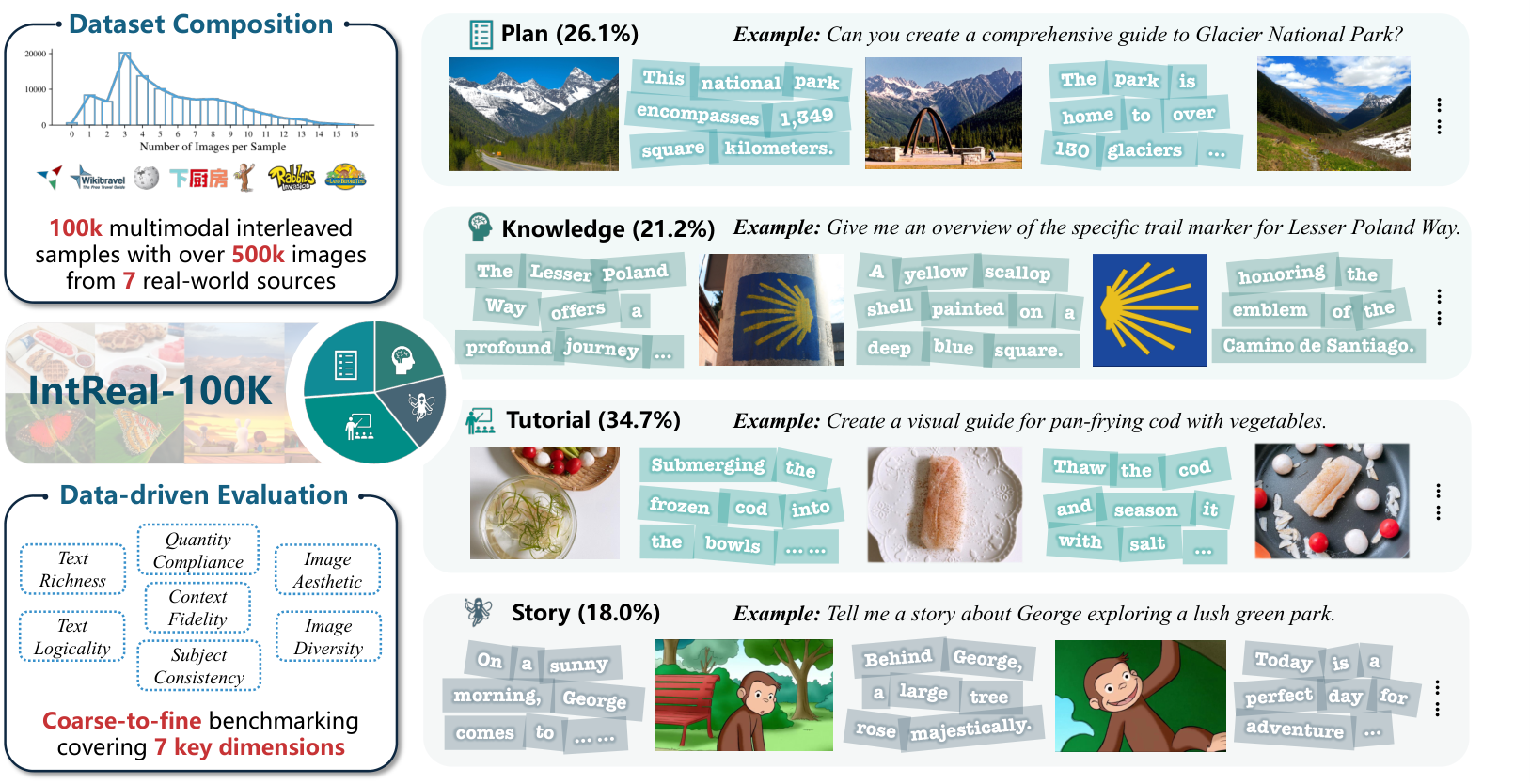
This categorization is more than cosmetic — the Story category stresses subject consistency across many images, Tutorial stresses context fidelity over long sequences, while Knowledge stresses text logicality, so the four slices isolate different capability axes.
Evaluation suite
600 samples (150 per category) are curated via a semi-automatic pipeline that scores (i) text quality using Qwen3.5-397B-A17B against prompt specificity, response richness, and topic informativeness; (ii) image quality via RALI; (iii) text-image alignment via a context-aware self-verification step where the LLM first derives visual rubrics from the preceding context without seeing the target image, then checks the target image against those rubrics. This decouples alignment judgment from the model’s prior over what a plausible next image looks like.
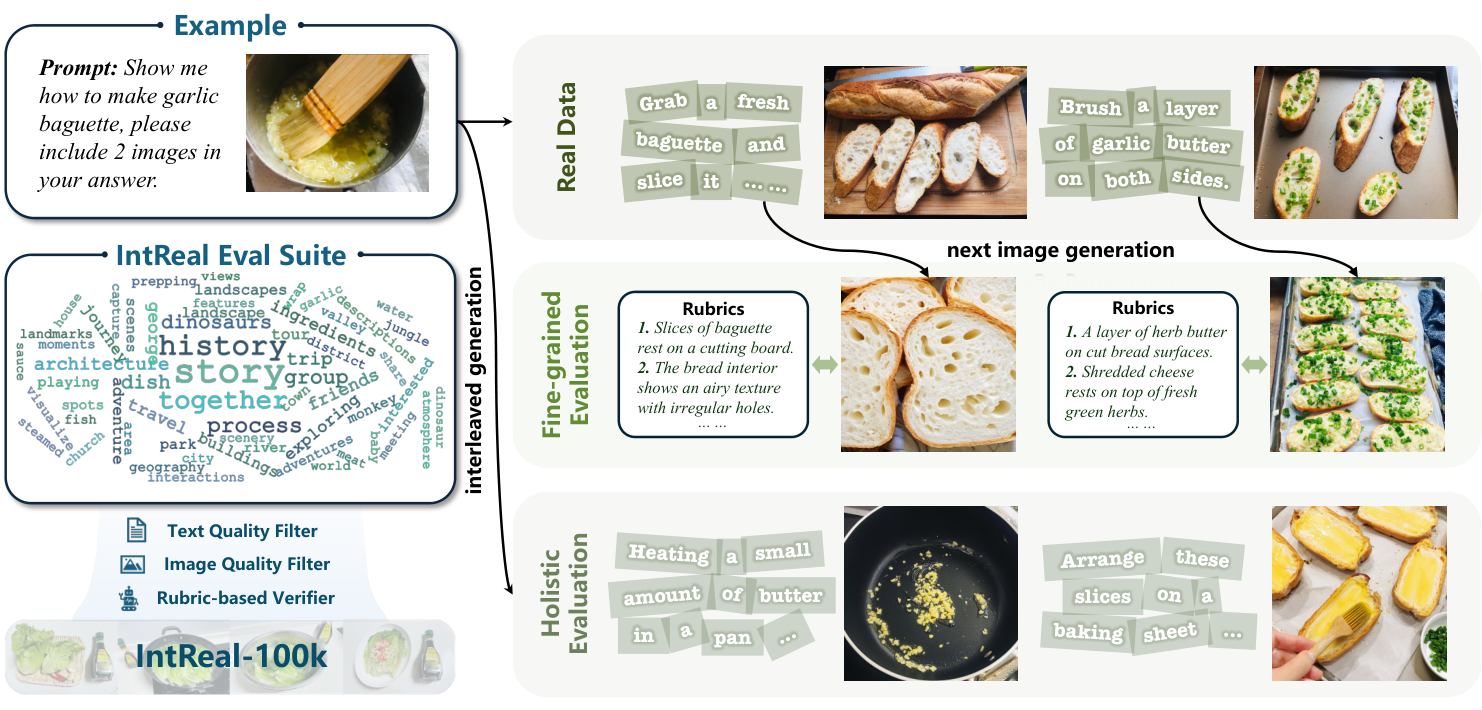
Each sample is evaluated at two granularities:
- Holistic: the model generates the full interleaved sequence end-to-end from the opening prompt. Scored on Text Richness, Text Logicality, Image Aesthetic, Image Diversity, and Quantity Compliance (whether the model emits the right number of images).
- Fine-grained: conditioned on the ground-truth preceding interleaved context, the model generates the next image only. Scored on Context Fidelity and Subject Consistency. This isolates image-generation conditioning from autoregressive drift of the text.
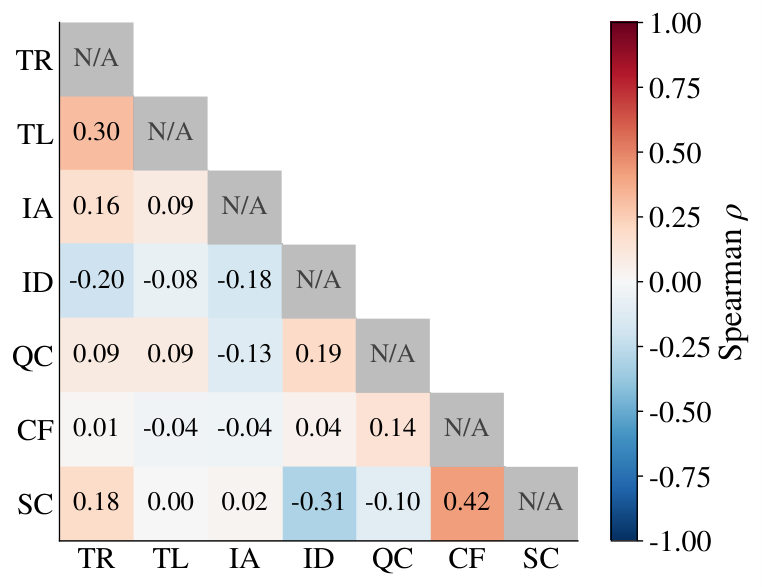
Gemma4 serves as the judge VLM/LLM. The suite is validated with three sanity checks: pairwise Spearman |\rho| \leq 0.42 between dimensions (low redundancy), 83.3% agreement with human judgments, and \rho > 0.9 consistency across different expert evaluators.
Benchmarked models and findings
Four UMM families are evaluated: Bagel (fine-tune-only, since its released checkpoint lacks native interleaved inference), Emu3.5 (eval-only, no FT recipe), SenseNova-U1 in 8B-MoT and A3B-MoT variants (both FT and inference supported), and the closed NanoBanana2 (Gemini 3.1-Flash-Image) API. Post-training uses the 99.4K held-out subset; RL is implemented in Flow-Factory.
Mean scores (0–100) across seven dimensions:
- Emu3.5: 58.95
- Bagel+SFT: 63.83; Bagel+SFT+RL: 65.06
- U1-A3B-MoT: 69.43
- U1-8B-MoT: 71.88; +SFT: 72.31; +SFT+RL: 73.81
- NanoBanana2: 84.84
The per-dimension breakdown is more informative than the mean. Holistic scores are dismal for all open-source models — U1-8B-MoT scores 21.83 on Text Richness while NanoBanana2 scores 90.80 (+222%). This is almost entirely an output-length problem: open UMMs produce truncated interleaved outputs. On Quantity Compliance, U1-8B-MoT (95.33) actually beats NanoBanana2 (95.32), suggesting NanoBanana2’s advantage is in text content, not image count control. On Image Aesthetic, open U1-8B-MoT+SFT+RL (93.31) outperforms NanoBanana2 (83.56) by 10.45%.
RL vs SFT on U1-8B-MoT shows the expected pattern: SFT boosts Text Richness (+29.04%) and Context Fidelity (+6.53%) but degrades Text Logicality (-5.65%), Image Aesthetic (-1.48%), and Quantity Compliance (-4.89%). Adding RL on top partially restores aesthetic (+5.60%) and logicality while retaining Richness gains (+27.49%). This dimension-level tradeoff would be invisible to a single-score benchmark.
Limitations
The 600-sample set is small (chosen because the coarse-to-fine protocol already generates 6,000+ images per model). Judging relies on Gemma4; while cross-evaluator consistency is high, systematic blind spots of VLM judges on, e.g., fine-grained subject identity remain plausible. Several interesting models (LLaDA2.0-Uni, Anole, Show-o2) are excluded for context-length or availability reasons, limiting coverage. The NanoBanana2 result is a black box — the authors note they cannot determine whether its interleaved capability is native or agentic, which complicates interpretation of its massive Text Richness lead.
Why this matters
Interleaved multimodal generation has been treated as a monolithic capability, obscuring that current open UMMs are competitive on image-side metrics but catastrophically behind on text generation inside interleaved contexts. IntReal’s decomposition into seven weakly-correlated dimensions (|\rho| \leq 0.42) with disjoint holistic and fine-grained protocols is the right shape for diagnosing which training interventions help which axis — and the SFT-vs-RL ablation already demonstrates concrete dimension-level tradeoffs that single-number benchmarks would hide.
Source: https://arxiv.org/abs/2610.38425
Hacker News Signals
Introducing LFM3: Every Modality for Specialized Intelligence
Liquid AI’s LFM3 family extends their Liquid Foundation Model line to native multimodality, handling text, images, audio, video, and structured data within a single architecture. The core model class is still built on Liquid Neural Networks — recurrent systems derived from continuous-time ODEs — rather than standard transformer attention, which keeps the per-token memory footprint bounded during inference regardless of context length.
The “specialized intelligence” framing refers to domain-specific variants: they release base and instruction-tuned checkpoints alongside models fine-tuned for vertical tasks (document intelligence, audio transcription, time-series). The architecture supports interleaved modality tokens rather than requiring separate encoders fused at a late stage, which in principle enables tighter cross-modal reasoning at every layer.
Liquid claims competitive benchmark numbers against same-parameter-class transformers while showing better throughput at long contexts — the stateful RNN-style inference avoids the O(n^2) attention cost. They do not yet release full architectural specs or training data composition publicly, which limits independent reproduction. The blog post is primarily a product announcement with benchmark cherry-picks rather than a paper, so mechanistic claims should be treated with appropriate skepticism until a technical report appears.
Open questions: how the ODE-based hidden state handles discrete modality boundaries (image patch grids, audio frames), and whether the recurrent inductive bias introduces problems for tasks requiring arbitrary long-range retrieval that attention handles naturally via direct token-to-token access.
Source: https://www.liquid.ai/blog/lfm3
Grace Blackwell Needs a New Scheduler: 27% More Usable GPUs from the Same Racks
The NVLink-connected GB200 NVL72 rack unit (36 Grace CPUs + 72 Blackwell GPUs tightly coupled) breaks the assumption that schedulers can treat GPUs as independently allocatable units. SkyPilot’s post works through the scheduling problem this creates.
The hardware topology is fixed: 72 GPUs are arranged in 9 NVL8 nodes, each NVL8 sharing a high-bandwidth NVLink fabric. Cross-NVL8 communication drops significantly in bandwidth. Existing cluster schedulers (Kubernetes, Slurm) treat each GPU as a fungible slot and will happily schedule a job across NVL8 boundaries, degrading collective communication performance and sometimes making jobs effectively unrunnable at scale.
SkyPilot’s approach is topology-aware gang scheduling: jobs are allocated in NVL8-aligned chunks (multiples of 8 GPUs from within the same NVL8 domain), and the scheduler tracks both physical slot availability and topological alignment simultaneously. The 27% improvement in usable GPU count comes from reduced fragmentation — naive schedulers leave stranded GPUs that don’t form a topologically valid group for any pending job, while topology-aware packing reduces that waste.
They also address the Grace CPU side: each Grace CPU is directly attached to specific GPUs via NVLink-C2C, so CPU-GPU affinity matters for host-side preprocessing pipelines. Ignoring affinity adds PCIe-equivalent latency on what should be near-zero-copy transfers.
The broader engineering point is that rack-scale hardware integration (not just GPU-to-GPU NVLink, but CPU-GPU NVLink-C2C) is making cluster scheduling a topology problem that existing tools weren’t designed for. Similar issues will apply to AMD’s MI300X APU configurations and Intel’s Gaudi interconnects.
Source: https://skypilot.ai/blog/grace-blackwell-needs-a-new-scheduler
Mistral Large 4 OSS Weight Release
Mistral releases Mistral Large 4 as open weights under a relatively permissive license. The headline numbers: 128k context window, strong performance on coding and reasoning benchmarks. The model is a mixture-of-experts architecture — Mistral has moved their large-model line to MoE after Mixtral, and Large 4 continues that trend with a higher total parameter count than activated parameters per forward pass.
Benchmark positioning: the release claims competitive or superior performance to GPT-4o and Claude Sonnet 3.5 on MMLU, HumanEval, and MATH, with particular strength on multilingual tasks given Mistral’s European language training emphasis. The MoE routing means inference cost is closer to a smaller dense model despite the large total capacity — important for deployment economics.
The open-weight release is notable because Mistral had moved some recent models to API-only or restricted licenses. Releasing Large 4 weights enables self-hosted deployments, fine-tuning, and independent evals. The HN thread focused heavily on whether the license permits commercial use without revenue thresholds (it does, with standard attribution requirements).
Technically, the main open questions are the expert count and routing mechanism (not fully disclosed in the announcement), the data mixture, and the training compute. Without these, claims about efficiency relative to dense models are hard to verify independently. The model is quantized-friendly given MoE sparsity, and GGUF support via llama.cpp arrived within hours of release based on community reports.
Source: https://mistral.ai/news/mistral-large-4-oss/
AI Agent Swarms in Minecraft and Mindustry
YC Labs ran multi-agent experiments in two game environments: Minecraft (open-world survival/construction) and Mindustry (factory-building RTS with combat). The framing is research into emergent coordination among LLM-backed agents operating in persistent, shared game state.
In Minecraft, agents run as independent processes with access to a shared world via the standard server protocol. Each agent has its own context window, a tool set (movement, inventory, crafting, chat), and communicates with other agents through in-game chat — no privileged shared memory. The interesting result is that coordination patterns emerge from chat negotiation without explicit role assignment: agents spontaneously divide resource-gathering tasks when the chat overhead of duplication exceeds the benefit.
Mindustry introduces a tighter coordination requirement: factory layouts must be physically compatible, turret placement depends on threat prediction, and resource routing is a constraint-satisfaction problem. Agents fail significantly more here because the action space requires understanding of spatial dependencies that LLMs handle poorly without explicit spatial representations. The YC team found that giving agents a structured “map state” JSON alongside the visual/text description substantially improved factory coherence.
Key technical finding: communication bandwidth between agents is a major bottleneck. Agents that summarize their state before broadcasting outperform those that forward raw observation dumps, suggesting that inter-agent communication should be compressed at the sender rather than filtered at the receiver. This is a practical point for anyone building multi-agent systems: token cost of agent-to-agent messages compounds quickly.
No formal paper yet — this is a project blog post — but the Minecraft setup is reproducible with open tools (Mineflayer, standard LLM APIs).
Source: https://labs.ycombinator.com/projects/games/index.html
Dayjob: Tax — Evaluating AI Agents on 50 Professional Tax Assignments
Surge HQ constructed a benchmark of 50 realistic tax preparation and advisory tasks drawn from actual professional workflows: 1040 preparation with edge cases, partnership K-1 allocation, AMT calculations, multi-state residency analysis, and tax planning scenarios. Tasks were graded by licensed CPAs against professionally prepared answers.
The methodology is worth examining. Each task includes relevant source documents (W-2s, 1099s, brokerage statements) as context, and agents must both compute correct figures and produce defensible reasoning. Partial credit is awarded for correct methodology with arithmetic errors versus wrong methodology. This distinguishes “can follow a procedure” from “understands the tax code.”
Results: frontier models (GPT-4o, Claude 3.5 Sonnet, Gemini 1.5 Pro) score in the 60-75% range on straightforward preparation tasks, dropping to 30-45% on planning and advisory tasks requiring multi-year or multi-jurisdiction reasoning. The failure modes are informative — models confidently apply outdated tax rules (training cutoff effects), misread ambiguous document formats, and make errors in tracking basis across transactions.
The benchmark highlights a calibration problem: models that score well on MMLU tax questions perform significantly worse on document-grounded tasks where the relevant numbers must be extracted and composed correctly. This suggests standard knowledge benchmarks overestimate practical task performance.
Open issue: the benchmark is proprietary (tasks aren’t released), which limits reproducibility and creates potential for overfitting by vendors aware of the evaluation. The Surge methodology section describes human grader consistency of ~85% inter-rater agreement, which sets a ceiling on meaningful score differences.
Source: https://surgehq.ai/blog/dayjob-tax
Cursor’s Agent SDK
Cursor released an Agent SDK that exposes their code editor’s internal agent infrastructure as a programmable API. The core abstraction is a stateful agent loop with structured tool calls: file read/write, terminal execution, search, and LSP-backed code navigation (go-to-definition, find-references, type-checking). Developers can define custom tools, hook into the loop at pre/post-tool-call points, and compose agents that share a workspace context.
The technical substance is in how Cursor handles workspace state across agent steps. Rather than re-embedding the entire codebase on each action, they maintain a persistent index (their existing codebase retrieval system) and pass only relevant retrieved chunks plus explicit tool outputs as context. This keeps per-step token counts manageable for large repositories.
The SDK also exposes the “apply diff” primitive — the same mechanism used in interactive Cursor edits — as a programmatic tool. This is non-trivial: applying LLM-generated diffs to real codebases requires handling conflicts, partial matches, and indentation normalization. Exposing this as a first-class tool means agent-written code goes through the same edit-validation pipeline as human-written edits.
HN discussion focused on vendor lock-in (the SDK requires Cursor’s runtime) and comparison to alternatives like OpenAI’s Codex CLI, Aider, and Claude’s computer use. The differentiation is tight IDE integration: the agent can use the LSP for type-checking and symbol resolution rather than relying purely on LLM knowledge of the codebase, which concretely reduces hallucinated API calls. Whether this outweighs the closed-platform dependency is a legitimate question.
Source: https://cursor.com/blog/agent-sdk
Python’s Experimental JIT to Be Removed
The copy-and-patch JIT introduced in CPython 3.13 (PEP 744) is being removed from 3.14. The LWN article covers the decision: the JIT delivered negligible performance improvements — benchmarks showed 1-9% gains on microbenchmarks and near-zero or negative impact on real workloads — while adding substantial build complexity and maintenance burden.
The copy-and-patch approach works by pre-compiling “stencil” templates for each bytecode operation with LLVM at CPython build time, then at runtime copying the appropriate stencil and patching in operand-specific addresses. This avoids a full JIT compiler infrastructure (no IR, no register allocator) at the cost of limited optimization scope — no inlining across opcodes, no type specialization across operations. It was explicitly designed as a foundation layer that future optimizations could build on, not as an immediately profitable JIT.
The removal decision reflects that the foundation-layer bet didn’t pay off on the timeline Python core developers needed. Maintaining LLVM build dependencies, supporting the JIT on multiple platforms (x86-64, ARM64, Windows), and handling the interaction with CPython’s specializing adaptive interpreter all added ongoing cost without visible user benefit.
The adaptive specializing interpreter (the “Tier 1” optimization introduced in 3.11/3.12) remains and does deliver consistent ~25% speedups. The JIT was intended as “Tier 2” — there are now discussions of alternative Tier 2 approaches that don’t require LLVM, possibly template-based but using a simpler patching mechanism, or a more conventional method JIT targeting hot loops only.
Source: https://lwn.net/SubscriberLink/1102102/0c00e4d550f25f8c/
Claude Code: Background Agents Send Full Transcripts to Model
A Gist by flamerix-ai documents observed behavior in Claude Code’s multi-agent mode: when spawning background subagents, the orchestrating model receives the complete transcript of each subagent’s execution — including all tool calls, intermediate reasoning, and outputs — rather than a summary or structured result.
The technical implication is straightforward but significant for token economics and latency. A background agent that runs 50 tool calls before completing its task produces a transcript that may be tens of thousands of tokens. If this full transcript is forwarded to the orchestrator’s context, context length fills rapidly, costs scale with task complexity in a non-obvious way, and the orchestrator’s effective working memory degrades as more subagent results accumulate.
The alternative design would have subagents return structured summaries or use a shared external memory (file, database) that the orchestrator queries selectively. The full-transcript design is arguably safer from a correctness standpoint — the orchestrator can audit reasoning, catch errors in intermediate steps, and reproduce the subagent’s chain of thought — but it makes token cost proportional to reasoning length, not just task count.
The HN thread noted this is consistent with how Claude’s system prompts generally handle tool results: raw outputs rather than compressed representations. It also raises a prompt injection surface: a malicious file read by a subagent could inject instructions into the transcript that influence orchestrator behavior, since the orchestrator processes the transcript as context rather than as opaque data.
This is a concrete systems-design observation about production agentic frameworks, not a benchmark result — the value is in understanding the architectural choices being made in deployed systems.
Source: https://gist.github.com/flamerix-ai/c3905705cc4205e5de3011fa2e74efce
Noteworthy New Repositories
XiangpengHao/bbtree
A concurrent ordered map implementation in Rust claiming best-in-class throughput for mixed read/write workloads. The core data structure is a B+-tree variant with fine-grained optimistic locking — readers proceed without acquiring locks by validating version counters before and after traversal, falling back to pessimistic locking only on conflict. Writers lock only the nodes they modify, enabling high concurrency on multi-core hardware. The design separates internal routing nodes from leaf nodes, keeping leaf pages cache-line-friendly for sequential scan performance. Benchmarks compare against BTreeMap (single-threaded), DashMap, and crossbeam-skiplist; bbtree reports 2-4x higher throughput on read-heavy workloads and competitive performance on write-heavy ones. The implementation targets use cases where you need both ordered iteration (range queries) and concurrent mutation — something skip lists handle but with worse cache behavior, and something std::BTreeMap behind an RwLock handles poorly under write contention. The codebase is pure Rust with no unsafe shortcuts beyond what the locking protocol requires. If you are building an in-memory index for a database engine, a concurrent scheduler, or any system needing a sorted concurrent map without the overhead of a full MVCC store, this is a drop-in candidate worth benchmarking against your access pattern.
Source: https://github.com/XiangpengHao/bbtree
hevnsnt/CVEngine
An AI-first external attack surface management (EASM) tool oriented around continuous asset discovery and evidence-based vulnerability validation rather than static CVE scoring. The architecture performs automated reconnaissance — subdomain enumeration, port scanning, service fingerprinting — and then feeds findings into an LLM-backed reasoning layer that attempts to distinguish exploitable issues from theoretical ones by generating and executing validation probes. The explicit goal is reducing the false-positive noise that plagues conventional scanners. A Model Context Protocol (MCP) server integration allows developer agents (e.g., Claude, Copilot) to query the engine’s findings directly from an IDE, closing the loop between discovery and remediation without context switching. The project is positioned as a practitioner tool: the emphasis is on actionable output with supporting evidence rather than compliance report generation. Technically, the interesting part is the validation pipeline — rather than reporting a version string matched against a CVE database, the engine attempts to confirm exploitability through targeted probes, which meaningfully changes how triage is prioritized. Useful for security engineers running continuous assessments on cloud-native or rapidly changing infrastructure where asset inventory is itself a moving target.
Source: https://github.com/hevnsnt/CVEngine
deeplethe/solid-glass
A design system targeting AI application UIs, built around a visual language described as material, physical, and tactile — frosted glass surfaces, depth layering, and physically motivated light/shadow rather than flat token-based theming. The implementation provides React components with CSS that leans on backdrop-filter, blur, and transparency to simulate material depth. The motivation is that AI application interfaces — chat threads, tool call traces, streaming outputs — have interaction patterns and information density requirements that standard design systems like MUI or shadcn were not designed for. Rather than retrofitting a generic component library, this is built from scratch for those contexts. The component set covers the primitives you would expect (cards, inputs, modals) but with the aesthetic and layout assumptions baked in for AI-native UIs where you frequently have nested, asynchronous, or streamed content. At 2000+ stars in early circulation it has generated significant interest from developers building AI product frontends who want something visually differentiated from the ubiquitous flat/neutral aesthetic. The primary limitation is that heavy use of backdrop-filter has non-trivial GPU cost on low-end hardware, so mobile performance requires attention.
Source: https://github.com/deeplethe/solid-glass
morganlinton/BeautifulRust
A collection of agent skill definitions and a curated Clippy configuration designed to steer coding agents toward idiomatic Rust rather than “C++ with Rust syntax.” The core problem it addresses is that LLMs trained on broad code corpora tend to produce Rust that compiles but misuses ownership, avoids iterators, overuses .clone(), and ignores zero-cost abstraction opportunities. The skills — compatible with Claude Code, OpenAI Codex, GitHub Copilot, Cursor, and Gemini CLI — encode Rust-specific patterns as reusable agent instructions: prefer iterators over indexed loops, use ? for error propagation, leverage impl Trait over dynamic dispatch where appropriate, and so on. The Clippy configuration is notable: it enables a tested superset of the default lint set, targeting the categories of mistakes agents most commonly make. There is also a code review skill that instructs agents to critique generated Rust against these idioms before committing. For teams adopting AI-assisted development in Rust codebases — especially porting C/C++/Python to Rust — this provides a practical baseline for quality control without manually auditing every agent output. The skill format is model-agnostic enough to adapt to other agents beyond the listed ones.
Source: https://github.com/morganlinton/BeautifulRust
hanzohanzhe/Grandet
A cost-optimization layer for LLM API routing that aggregates pricing data from 1,800+ providers — including official API endpoints, inference providers (Together, Fireworks, Replicate), and relay/reseller services — and exposes a unified MCP interface so agents can query and connect to the cheapest available endpoint for a given model. The name references Balzac’s miser, which is apt. The technical core is a continuously updated price database backed by grandet.ai, exposed via an anonymous MCP server so no API key is required for price discovery. The agent skill allows an AI coding or orchestration agent to make cost-aware routing decisions at runtime: rather than hardcoding an endpoint, the agent asks Grandet for the current cheapest provider serving a given model and connects there. This is practically useful for high-volume batch workloads where model provider pricing varies significantly (often 3-10x) across providers for identical or near-identical model weights. The anonymous MCP server design is notable from a privacy standpoint — routing queries do not require account registration. Limitations include latency variation across providers (cheapest is not always fastest) and the need to validate that relay providers are serving unmodified model weights.
Source: https://github.com/hanzohanzhe/Grandet
mrsarac/ff-tracking
A generative/procedural video project rather than a reusable library, but technically interesting for its rendering pipeline. The concept: a virtual camera renders an AI agent’s screen activity, and a custom tracker locks onto individual glyphs in the rendered output — treating text characters as physical objects to follow. The rendering uses two SkSL (Skia Shading Language) passes to achieve the visual effect, and all audio is synthesized programmatically rather than sampled. The technical interest lies in the glyph-tracking implementation: detecting and maintaining identity of text characters across frames is non-trivial when the camera is moving, requiring either OCR-like localization or direct hooking into the rendering pipeline to extract glyph positions before rasterization. The “two fframes passes” description suggests a deferred rendering approach where glyph metadata is preserved in an intermediate buffer for the tracker to consume. For developers interested in creative coding, shader-based post-processing, or building observability/visualization tools for agent behavior, the approach of treating agent screen output as a physical scene to be filmed is an unusual framing worth examining for inspiration.
Source: https://github.com/mrsarac/ff-tracking
flohoeller/affectui
A React component library specifically designed for agent-centric UI patterns: agent trees, tool call displays, execution traces, handoff flows, and human-in-the-loop approval interfaces. These are the UI primitives that keep getting rebuilt from scratch by every team building an AI application with an agentic backend. The distribution model is notable — each component is a single self-contained file installable via the shadcn CLI (npx shadcn add) or via MCP, meaning you pull only what you need with no monolithic dependency. Components are styled to compose with the shadcn/Tailwind ecosystem. The agent tree component visualizes hierarchical agent spawning and delegation; the tool call component renders structured input/output pairs for each tool invocation; the trace component provides a timeline view of agent execution. The approval component handles the human-in-the-loop gate pattern — presenting a pending action with context and accepting/reject controls. These are non-trivial to build correctly because they need to handle streaming updates, partial state, and async completion. For teams building agent orchestration frontends (LangGraph, CrewAI, custom), this eliminates significant boilerplate and provides a consistent visual language across agent lifecycle events.
Source: https://github.com/flohoeller/affectui
storytold/designcraft
A page and layout design editor written from scratch in pure Rust — no Electron, no web renderer, no existing GUI framework underneath. At nearly 5,000 stars it has captured attention both for the technical ambition and the practical utility. Building a design tool (comparable in scope to a subset of Figma or Affinity Publisher) in pure Rust means implementing the full stack: vector rendering, constraint-based layout, hit testing, text shaping, undo/redo history, and file I/O, without leaning on browser primitives. The “written from scratch” framing suggests custom rendering rather than wrapping a library like iced or egui, though the exact renderer (likely wgpu or a Skia binding) is worth examining in the source. The motivation for pure Rust over an Electron-based approach is the usual one: memory footprint, startup latency, and the ability to compile to native targets including WASM without the V8 overhead. For the compiler and systems audience, the interesting engineering is in the constraint solver for layout and the scene graph design. For the design tooling audience, an open-source, locally-run page layout editor with no subscription model fills a real gap. The main open question is text rendering quality, which is historically where non-browser design tools struggle.