Daily AI Digest — 2026-10-26
arXiv Highlights
UserArena: Benchmarking Interactive User Simulation for Long-Horizon Shopping Agents
Problem
Agentic recommendation requires simulators that model shopper behavior across many steps and sessions with enough fidelity that offline policy comparisons agree with production A/B outcomes. Existing resources trade off along one of several axes: real traces without visual context (Qilin, RL4RS), visual context without cross-session horizons (OPeRA, USB), synthetic trajectories (A/B Agent), or long histories without the full interactive action space (OmniBehavior). None combine step-level real trajectories, rendered visual observations, the full shopping action space, cross-session horizons, and validation against controlled A/B tests. This is the gap UserArena targets.
Benchmark construction
UserArena reconstructs a production e-commerce environment at the viewport level. The visible feed is obtained by cropping the pre-rendered full feed as the simulator scrolls; clicking any exposed item — including items the real user did not click — opens an item-detail page reconstructed from recorded product content and pre-rendered views. The action space contains 13 types spanning feed navigation, product inspection, add-to-cart, and purchase. Each decision is stored as an aligned tuple of user profile, visual observation, visible product context, and action, consistent with the observation–action formulation used in interactive agent work.
The corpus is substantial: 11,010 users, 64,729 sessions, 577,670 actions, 566,102 products, 6 user attributes, and 73,717 item clicks across 41 categories. For long-horizon evaluation, 59,378 chronologically ordered sessions from 5,768 users are grouped into cross-session trajectories averaging 10.29 sessions and 86.36 actions per user, which lets evaluators test whether a simulator preserves preferences and behavioral tendencies across repeated visits rather than only within a single session.
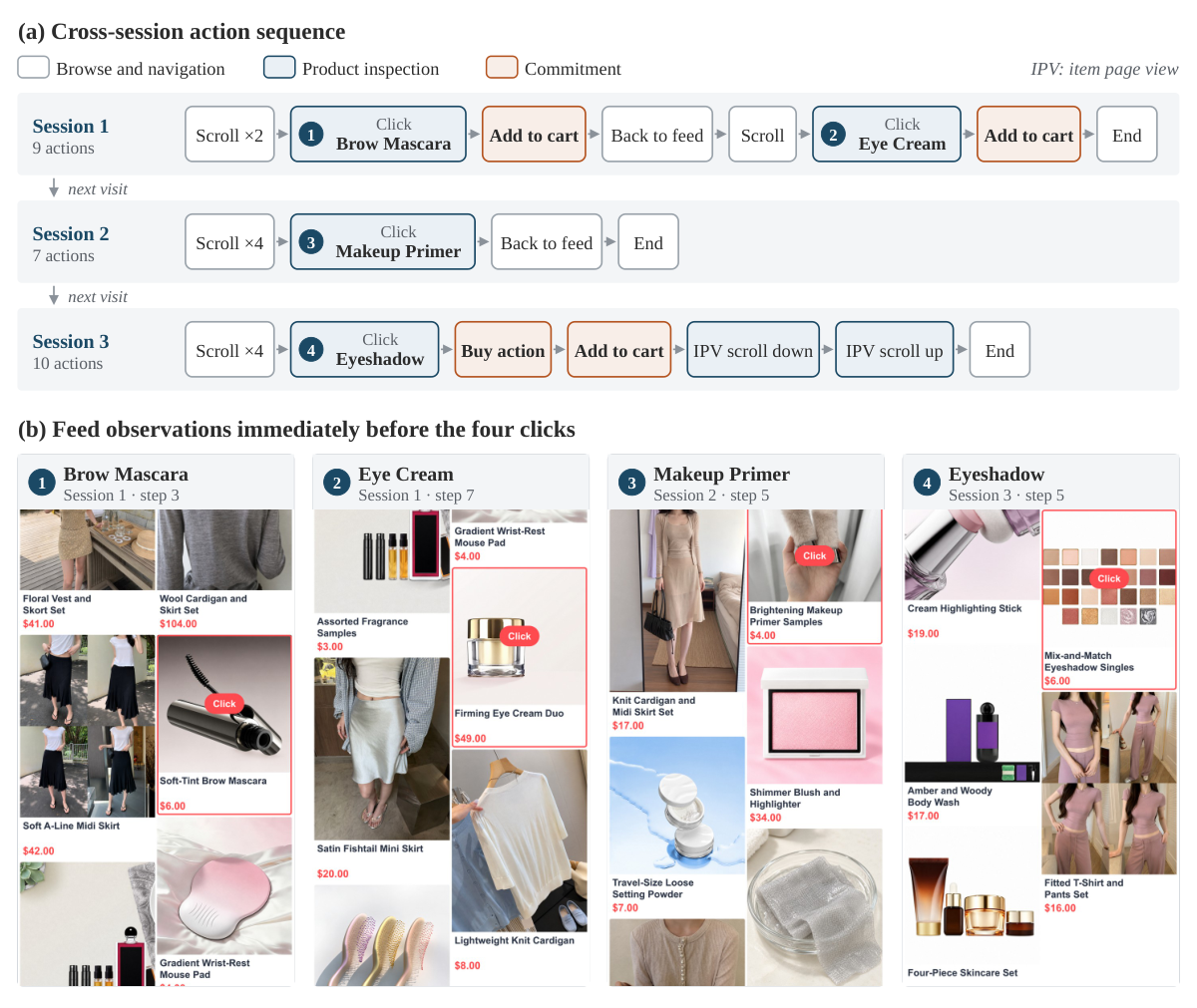
The cross-session example above shows the kind of structure a faithful simulator must reproduce: long runs of feed scrolling punctuated by inspection and occasional commitment actions, with product preferences that persist across visits. Evaluation is organized at five levels — output validity, local decisions, sequential behavior, personalization, and outcomes — with the outcome level providing offline comparisons against controlled production A/B results for the same policy pair.
On-Policy Trajectory Distillation
To train simulators on these long trajectories, the paper proposes On-Policy Trajectory Distillation (OPTD). The motivation is standard: SFT with teacher forcing conditions each prediction on ground-truth prefixes, so at inference the student encounters self-generated prefixes outside the training distribution; GRPO assigns only a scalar reward per response, which is weak supervision at the token level.
OPTD samples from the student at a real state x_t drawn from \mathcal{D}:
y_t = (y_{t,1},\ldots,y_{t,|y_t|}) \sim \pi_\theta(\cdot \mid x_t),
where y_t is a short rationale followed by a structured interface action. A frozen teacher is given privileged context — a trajectory-level intent extracted from the complete recorded trajectory — and produces full-vocabulary distributions at every token position k of the student’s own rollout y_{t,<k}. The student is optimized toward these dense teacher targets, with a per-token trust region that limits departure from predictions based only on the observable state x_t. The trajectory-level intent is the key piece of privileged information: it lets the teacher assign token-level targets that are consistent with where the real trajectory eventually goes, without leaking that future to the student.
Mechanically, implementing the skeleton requires: (i) an intent extractor that summarizes \tau_u into a conditioning string for the teacher; (ii) on-policy sampling from \pi_\theta at each training step; (iii) a teacher forward pass over x_t, intent, and the student rollout to obtain per-token distributions; (iv) a KL loss against those distributions, clipped per token to maintain the trust region relative to the state-only student. The reported comparison in Figure 2 of the paper frames this as SFT (recorded prefixes, myopic targets) vs. GRPO (response-level scalar) vs. OPTD (dense, trajectory-aligned per-token targets on self-generated prefixes).
Experiments
All main-comparison methods use Qwen3.5-2B to remove model-scale confounds. Baselines split into text-observation simulators (RecAgent, Agent4Rec, Shop-R1, Customer-R1, AlignUSER, SimUSER) and GUI-observation simulators (A/B Agent, STA). The abstract reports that OPTD achieves the strongest results across the five evaluation levels, though the selected sections do not surface specific per-metric numbers beyond that qualitative claim. Human evaluation uses a Turing-style pairwise interface in which annotators see two anonymized trajectories conditioned on the same user context and judge which is machine-generated.

Limitations and open questions
The benchmark is drawn from a single e-commerce platform, so category coverage (41 categories) and action semantics may not transfer to other recommender surfaces. The production A/B validation is only as broad as the controlled experiments available. OPTD’s effectiveness depends on the quality of the extracted trajectory intent and on the teacher being well-calibrated under the privileged context; the paper does not, in the provided sections, quantify sensitivity to intent extraction or teacher scale. The 2B-only main comparison leaves open how OPTD scales relative to RL-based alternatives at 7B+ and whether the per-token trust region remains the right regularizer at larger capacity.
Why this matters
Simulator-based evaluation of recommendation policies is only useful if simulator rankings agree with production A/B outcomes; UserArena is the first public benchmark that pairs long-horizon real trajectories with visual context, the full action space, and offline-vs-A/B validation, and OPTD gives a concrete recipe for closing the train-inference gap that has limited LLM-based user simulators.
Source: https://arxiv.org/abs/2610.30932
On-Policy Self-Training: Data-Free Self-Improvement in Large Language Models
Problem
Post-training pipelines — SFT, RLHF, RLVR, and on-policy self-distillation — all presuppose a curated artifact: labeled (x, y^*) pairs, a prompt distribution \mathcal{D}_{\text{prompts}}, a verifier, or at minimum a problem set authored by humans or a stronger teacher. This paper asks whether a model can be improved when none of these are available, with the only input being a list of coarse topic strings \mathcal{T} = \{\tau_1, \dots, \tau_K\} like “Abstract Algebra” or “Commonsense Causal Reasoning”. The question matters because it probes whether current foundation models carry latent capability that can be surfaced without any new human signal, which has direct bearing on scaling self-improvement loops beyond the frontier of human-curated data.
Method
The framework, On-Policy Self-Training (OPST), runs three stages per round and iterates.
1. Synthetic problem and privileged-information generation. For each topic \tau_k \in \mathcal{T}, the current model samples queries x_i and then, in a separate pass, generates privileged information z_i = (r_i, \hat{y}_i) consisting of a rationale r_i and a candidate answer \hat{y}_i. This yields a synthetic set \mathcal{D}_{\text{syn}} = \{(x_i, z_i)\}_{i=1}^N with no external supervision.
2. Intrinsic filtering. Two filters prune \mathcal{D}_{\text{syn}}. A pseudo-verification pass checks whether the model, re-reading its own (x_i, r_i, \hat{y}_i), judges it internally consistent. A consensus gate requires agreement across multiple independent sampled answers for x_i. The ablations show both are additive: starting from base MMLU accuracy of 37.5, naive OPST reaches 42.7, verification adds +2.7 to 45.4, and the consensus gate adds another +2.3 to 47.7.
3. On-policy self-distillation with privileged information. The student is trained on-policy against a teacher conditioned on (x_i, z_i) — i.e., the teacher sees the privileged rationale and candidate answer, the student does not. Crucially, the student does not imitate \hat{y}_i directly; it distills from the teacher’s distribution over answers given z_i. The teacher is an EMA of the student’s weights, keeping the loop on-policy. This conditioning rather than imitation is what gives OPST its robustness to self-generated errors (see below).
The three steps repeat across rounds, with each new round re-generating \mathcal{D}_{\text{syn}} from the updated model. The procedure extends to vision-language models by seeding image-conditioned topic descriptors; the authors call this Visual OPST.
Results
Base models are Gemma 4 E2B and E4B. Topic descriptors seed four in-domain benchmarks (MMLU, GPQA, GSM8K, HellaSwag); three untouched benchmarks (ARC-Challenge, MATH-500, Winogrande) probe retention/transfer. The headline MMLU trajectory on E2B is 37.5 → 47.7 (+10.2) using only self-generated data. Experiments on multimodal VQA show the same pattern transfers.
The ablations are the most informative part. Removing privileged information entirely reduces the gain from 10.2 to 3.1 points — the residual presumably reflects on-policy self-distillation to the EMA teacher. Replacing z_i with a placebo z drawn from a different problem on the same topic yields only 2.7 points, confirming the signal is sample-specific rather than a generic domain prior. Rationale alone recovers 8.3 of the 10.2 points; answer alone recovers 7.1. The rationale carries more signal than the candidate answer, which is consistent with the view that the teacher’s conditional distribution p(y \mid x, r) is sharper and more informative than p(y \mid x, \hat{y}).
The robustness experiment is where the architectural choice pays off. Replace a fraction p of candidate answers with explicitly wrong ones, with both filters disabled:
| p | SFT | OPST |
|---|---|---|
| 0% | 38.8 | 42.7 |
| 25% | 38.1 | 42.1 |
| 50% | 35.4 | 41.4 |
| 75% | 33.1 | 40.8 |
At p = 75\% wrong labels, SFT collapses to 4.4 points below the base model, while OPST stays 3.3 points above it, losing only 1.9. Because the student distills from a teacher distribution conditioned on z rather than imitating \hat{y} directly, incorrect candidate answers degrade the teacher gracefully instead of injecting hard-label noise.
Limitations and open questions
The method is still bounded by the quality of self-generated privileged rationales — if the model cannot produce a correct rationale for a topic, no filter will recover one. The consensus gate biases toward problems the model already answers consistently, which risks curriculum collapse to easy items across rounds; the paper does not fully characterize how difficulty evolves. GPQA is treated as OOD in multi-domain runs, so performance on genuinely hard reasoning under OPST remains open. Finally, “data-free” is relative: the topic descriptors themselves are a curated inductive bias, and the Gemma 4 base model carries whatever pretraining distribution it was given.
Why this matters
OPST demonstrates that meaningful post-training gains (+10 MMLU on a competitive base) are extractable from a model and a list of topic strings alone, provided the loop distills from a teacher conditioned on privileged self-generated reasoning rather than imitating self-generated labels. That conditioning is what buys the 75%-noise robustness and distinguishes this from naive synthetic-SFT loops that are known to collapse.
Source: https://arxiv.org/abs/2610.32770
MMVistaReason: Toward Open-Data and Post-Training Recipes for Multimodal Reasoning
Problem
Open multimodal reasoning post-training suffers from four coupled issues: (i) heterogeneous open VQA data with duplicates, noisy captions, and non-answerable samples; (ii) inefficient trajectory supervision (expensive to distill from a single frontier teacher, often mismatched to student capacity); (iii) imbalanced difficulty leading to either trivial or unsolvable rollouts in RL; and (iv) cross-domain interference between structured “analytical” reasoning (math, logic, charts, science) and perception-heavy “real-world” reasoning (GUI, spatial, counting). MMVistaReason (MVR) proposes an open-data recipe addressing all four, producing two released corpora (MVR-SFT-528K, MVR-RL-63K) and a training protocol built around specialize-then-integrate experts.
Method
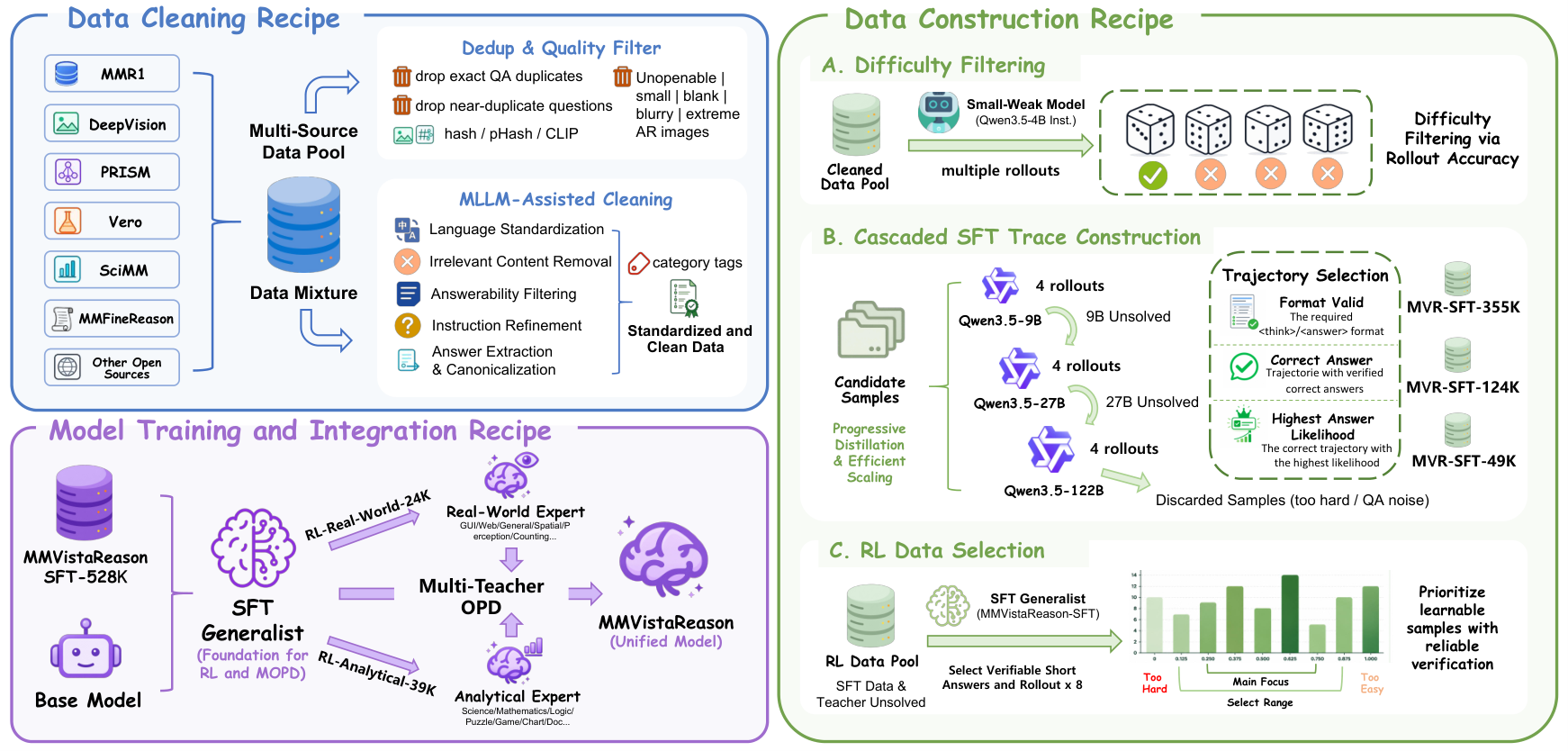
Data cleaning. Aggregated open datasets go through staged filtering: SHA-256 + pHash + CLIP-similarity dedup (near-duplicate detection with same image / semantically similar questions), image-quality filters (resolution, aspect ratio, blur), then MLLM-assisted language standardization, irrelevant-content removal, and answerability filtering with structured JSON outputs (prompts 1–3 in §8). Captioning-only and open-ended items are discarded.
Difficulty-aware cascaded teacher distillation. For each sample, teachers of increasing scale — Qwen3.5-9B, Qwen3.5-27B, Qwen3.5-122B-A10B — are invoked in cascade; easy items are retired at the small teacher, harder ones routed up. Each teacher generates 4 candidate traces at 16,384 tokens with enable_thinking=False. Throughput roughly 800/480/320 trajectories/hour per teacher. Trajectories are then filtered by answer-likelihood-based selection, retaining traces that both reach the correct final answer and show high conditional probability under the teacher. This yields three subsets with monotonically increasing difficulty: MVR-SFT-355K (9B), MVR-SFT-124K (27B), MVR-SFT-49K (122B), with weighted mean pass-rates 0.5176, 0.4616, 0.3639 respectively (Table 6). Question-type distribution (Table 7) is dominated by numeric (30.4%), short phrase (28.0%), and multiple choice (18.4%); harder (122B) subsets skew toward position/short-phrase tasks (13.0% position vs 1.4–2.2% elsewhere), reflecting where small teachers fail.
RL data. MVR-RL-63K uses scale-specific frontier filtering: for a target student scale, keep items whose teacher pass-rate at that scale is informative (neither saturated at 1 nor 0). The set is split into Analytical and Real-World subsets to train two experts.
Training. SFT uses LLaMA-Factory, full fine-tuning from Qwen3.5-Base, 2 epochs, lr 1\times10^{-5}, cosine schedule, 16,384 context, with the enforced <think>...</think><answer>...</answer> format. RL uses VeRL with GSPO, global batch 256, 8 rollouts/example, actor lr 5\times10^{-7}, 200 steps, training one Analytical and one Real-World expert.
Multi-teacher on-policy distillation (MOPD). The two RL experts are consolidated into a single student (initialized from SFT). For each prompt, routing sends the sample to its domain expert; the student generates on-policy trajectories, and teacher top-K (K=32) token distributions provide the distillation signal. Formally, with student \pi_\theta and routed teacher \pi_{\tau(x)},
\mathcal{L}_{\text{MOPD}} = \mathbb{E}_{x,\, y\sim\pi_\theta(\cdot|x)} \sum_t \mathrm{KL}\!\left(\pi_{\tau(x)}^{\text{top-}K}(\cdot|x,y_{<t}) \,\|\, \pi_\theta(\cdot|x,y_{<t})\right).
Training runs 300 steps, 2 rollouts/prompt, constant lr 5\times10^{-7}. This avoids the gradient conflicts of jointly RL-training on mixed Analytical+Real-World data while still producing a single deployable model.
Results
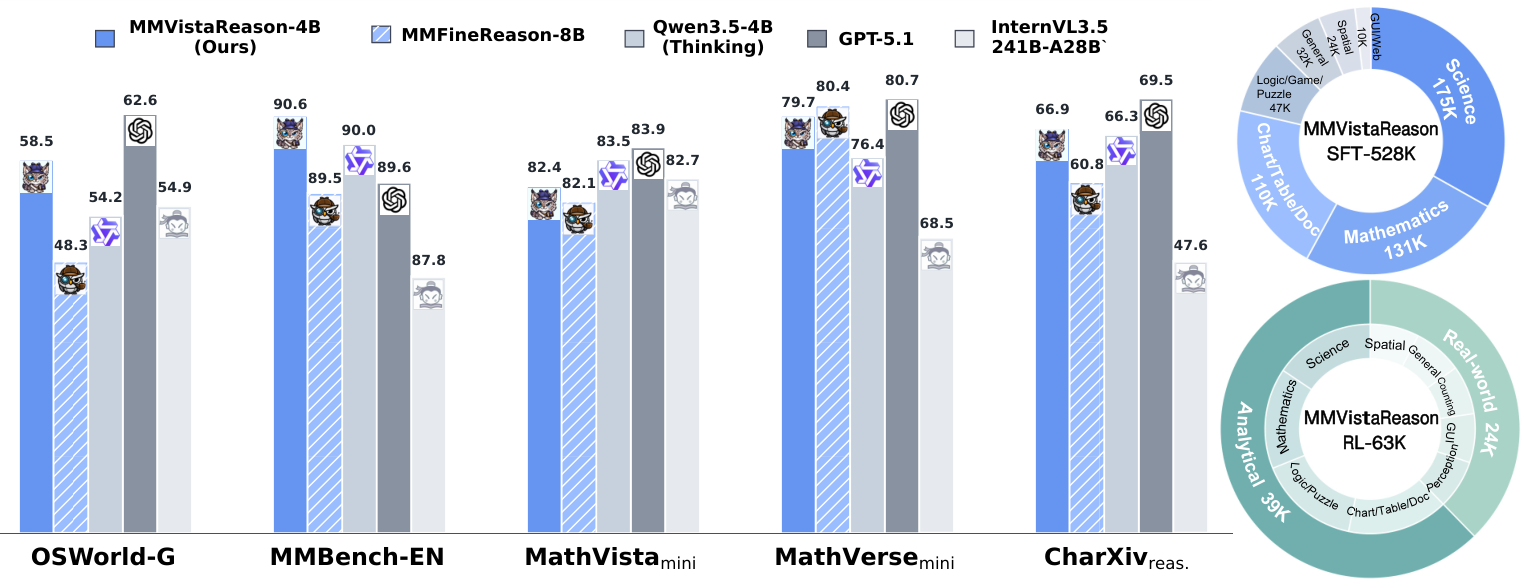
Across 15 benchmarks spanning real-world (OSWorld-G, CV-Bench-2D/3D, MMBench-EN, RealWorldQA, CountBenchQA) and analytical (SFE, MMMU, ScienceQA, MathVista, MathVerse, LogicVista, VisuLogic, ChartQA, CharXiv) suites, MVR outperforms open-source reasoning VLMs including OpenMMReasoner-7B and MMFineReason-4B/8B, and is competitive with much larger instruct baselines (Qwen3.5-35B-A3B, InternVL3.5-30B-A3B/241B-A28B). The intro figure shows MVR closing substantial ground against Gemini-3-Flash and GPT-5.1 on analytical-reasoning subsets at a far smaller active-parameter budget.
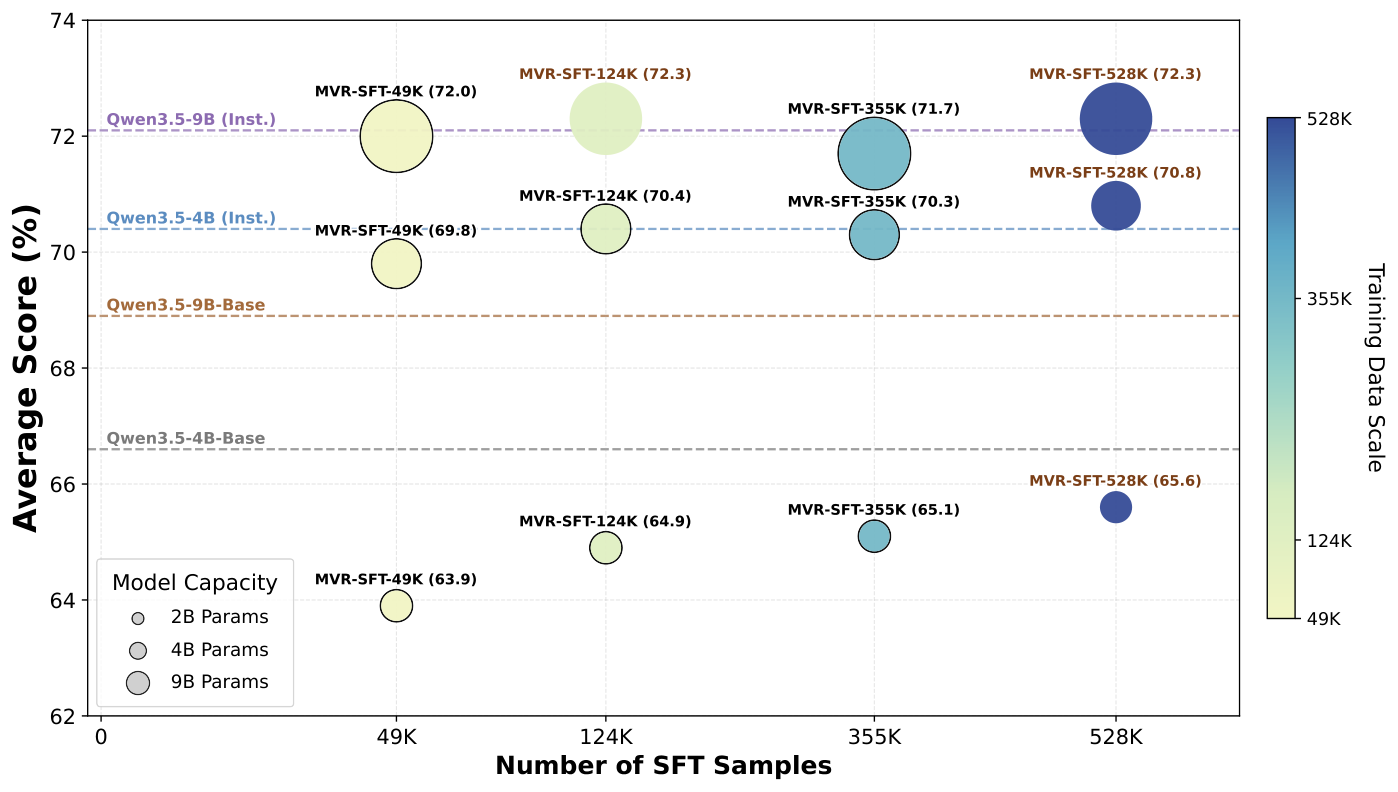
A central empirical finding is a capacity-dependent interaction: smaller students benefit more from selected (harder, cleaner) supervision, while larger students tolerate — and gain from — broader, noisier distillation. Pass-rate statistics confirm this: the 122B-distilled subset at pass-rate 0.25 covers 69.3% of its samples, versus 40.5% for the 9B-distilled subset, so blindly feeding small models the hardest traces wastes supervision; the recipe matches teacher scale to student scale.
Limitations and open questions
The recipe is evaluated on a Qwen3.5-Base family and leans on Qwen teachers for distillation, so some of the gains may be base-model-specific. MOPD uses hard routing by domain tag; soft routing or learned mixtures of experts are untested. GSPO at only 200 RL steps with 8 rollouts is modest — scaling behavior of the specialize-then-integrate loop under longer RL is unclear. Finally, benchmarks are predominantly short-form; the recipe’s effect on long-horizon agentic reasoning (beyond OSWorld-G) is not probed, and no decontamination audit against the 15 evaluation suites is reported in the shown sections.
Why this matters
MVR is one of the few open recipes that treats difficulty-aware teacher routing, trajectory-likelihood filtering, and domain-expert consolidation as a single coherent pipeline rather than isolated tricks, and it exposes a concrete capacity–difficulty curve that should inform how practitioners choose teacher scales for a given student. The released 528K SFT and 63K RL corpora give the community a reproducible substrate for comparing multimodal post-training methods without re-paying the distillation cost.
Source: https://arxiv.org/abs/2610.01352
Building Auditable AI Text Detectors with Sparse Autoencoders
Problem
Deployed AI-text detectors are a two-horned dilemma. Fine-tuned transformer classifiers achieve the strongest AUC/F1 but their decisions are opaque, which is unacceptable in peer review, admissions, or disciplinary contexts where a positive label has material consequences. Stylometric baselines (function word frequencies, readability metrics, perplexity curvature) are inspectable but trail neural detectors by wide margins and are brittle under domain shift. The paper asks whether sparse autoencoders (SAEs) can convert the residual stream of a fine-tuned detector into a human-readable feature basis without discarding its accuracy.
Method
The pipeline (Figure 2) is a four-stage transform of a fine-tuned detector into a sparse logistic model over labeled concepts.
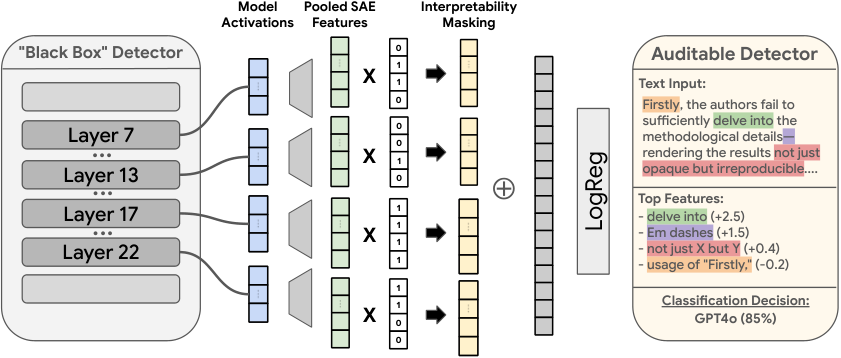
- Activation extraction. Given tokens (\mathbf{t}_0, \ldots, \mathbf{t}_n), extract residual-stream activations \mathbf{d}_i^{(\ell)} at layers L = \{7, 13, 17, 22\} (following McDougall et al. 2025).
- SAE encoding. Pass activations through per-layer SAE encoders to produce sparse features \mathbf{h}_i^{(\ell)}. Max-pool along the sequence dimension and concatenate across layers to yield a document vector \mathbf{h} \in \mathbb{R}^{|L| \cdot d_{\text{SAE}}}.
- Auto-interpretation mask. For each feature h_i, generate a natural-language description with an LLM, then score how well that description predicts the feature’s activations on held-out text, yielding a simulation score s_i \in [-1, 1]. Build a binary mask m_i = \mathbb{I}[s_i \geq \tau] and apply \mathbf{h}_\tau = \mathbf{h} \odot \mathbf{m}. Features whose descriptions do not pass the fidelity bar are zeroed out, so every surviving dimension carries an auditable label.
- Sparse linear head. Fit an L_1-regularized logistic regression: \mathcal{L}(\boldsymbol{\beta}, \lambda) = \tfrac{1}{N}\,\mathrm{BCE}\big(\mathbf{y}, \sigma(\mathbf{H}_\tau \boldsymbol{\beta})\big) + \lambda \|\boldsymbol{\beta}\|_1. Prediction is \hat{y} = \sigma(\mathbf{h}_\tau^\top \boldsymbol{\beta}^\star). Because each nonzero coordinate of \boldsymbol{\beta}^\star corresponds to a labeled SAE feature, top-k contributions give a token-grounded explanation per document.
Training uses the English COLING shared task split (610k train, 261k dev) spanning 41 generators. OOD evaluation uses COLING devtest/test plus the non-adversarial RAID split.
Results
Fidelity to the underlying detector. On in-distribution COLING dev and the three OOD splits, FT-Model+SAE matches the fine-tuned detector’s AUC and F1. Only at tight low-FPR operating points does it fall behind. Restricting the mask to \tau > 0.7 — i.e., keeping only highly interpretable features — retains or slightly improves on the full detector’s performance despite dropping most SAE dimensions.
OOD limits. When the base fine-tuned detector itself fails to generalize, FT-Model+SAE inherits that failure. The surprising observation in Figure 4 (not shown) is that SAE classifiers trained on base-model residuals outperform the fine-tuned detector OOD, not that distillation into interpretable features hurts.
Causal auditing. A paraphrase ablation feeds each feature’s natural-language description to Gemini 2.5 Flash Lite with instructions to paraphrase the document to remove only that feature. The correlation between the resulting logit delta and the feature’s attributed importance is reported as the fidelity check — if the pipeline is faithful, these should align per feature.
What the detector actually uses. The top-weighted features at \tau > 0.85 for AI peer reviews are startlingly specific. Feature 22_4800 fires on “double colons following bolded markdown section headers” and appears in 11 human documents versus >54,000 GPT-4o documents. Feature 13_164 (“opening square bracket in list or string literals”) appears in 7 human versus >22,000 Llama documents. Pro-human features are more stylistic: sentence-initial first-person pronouns (13_5785), hedges like “seem/seems” (7_10672), directive “see” (7_1616). On COLING, the top FT-SAE feature (13_3738) activates on refusal boilerplate (“As an AI language model…”), whereas base-model SAE detectors lean on HTML attributes and license text — evidence that base-model detectors exploit domain shortcuts more than stylistic signal.
Limitations and open questions
- Performance ceiling is set by the underlying fine-tuned detector; the SAE pipeline cannot repair OOD failure in the source model.
- The low-FPR regime, which is the operationally relevant one for high-stakes deployment, is where interpretability costs show up.
- The dominance of formatting features (markdown colons, bracket tokens) raises an unresolved question of what counts as “spurious.” Kantamneni et al. (2025) recommend stripping formatting features; the authors argue that a consistent cross-domain formatting tell is legitimate signal. Their system makes this a policy decision rather than a hidden one.
- Auto-interp labels are LLM-generated and bounded by simulation score; features that pass \tau but encode compositional concepts may still receive misleading short descriptions.
Why this matters
Auditable detectors change the deployment story: a reviewer or admissions officer can see that a flag was driven by markdown double-colons and refusal boilerplate rather than by an inscrutable logit, and a model provider can whitelist or ban specific features on policy grounds. The pipeline also doubles as a diagnostic for shortcut learning — making it visible that base-model SAE detectors generalize partly by latching onto HTML and license text.
Source: https://arxiv.org/abs/2610.30006
Reading, Writing, Sharing, and Interacting with the World through Video
This survey proposes a single formal lens — world modeling — for organizing the sprawling literature on video foundation models and video world models. The core move is to separate three objects that are usually conflated: the latent temporal world W = (w_t)_{t\geq 1} with transition w_{t+1}\sim\mathcal{T}(\cdot\mid w_t, a_t); the observed video V=(x_1,\dots,x_T) with x_t\sim\mathcal{O}(\cdot\mid w_t,\pi_t) as a partial, lossy, temporally ordered projection; and the model’s represented state s_t\sim q_\theta(\cdot\mid x_{\leq t}, a_{<t}). In general s_t\neq w_t, and the gap between them is what every video model implicitly tries to minimize. From this partially-observable dynamical system (a POMDP in the model-based RL sense of Ha & Schmidhuber or Dreamer), the authors derive four operations that index the rest of the survey: reading V\to W, writing W\to V, sharing V\leftrightarrow W, and interacting W\circlearrowleft.
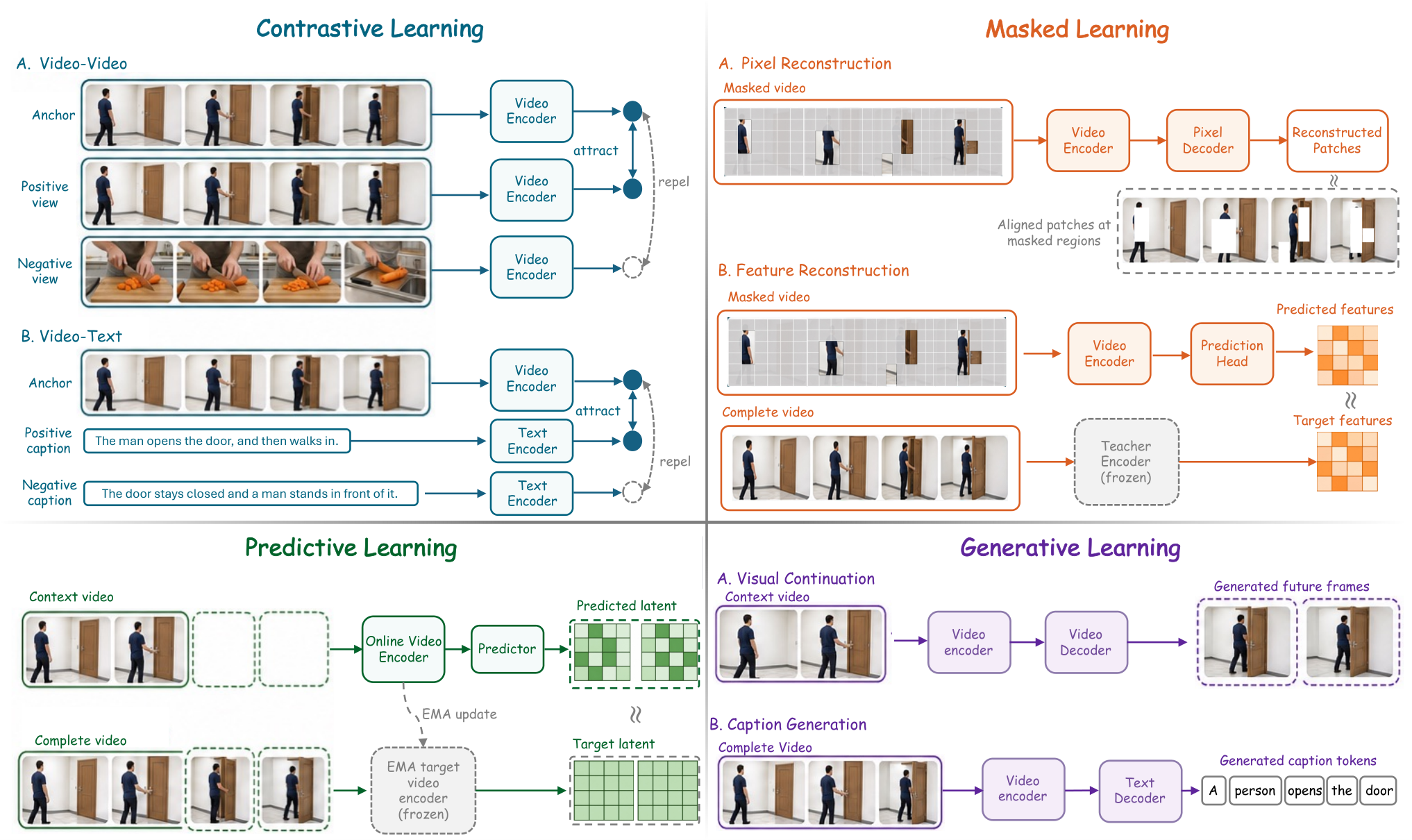
The reading chapter is organized not by task family but by which component of world state is probed: semantic (entities, actions), spatial (geometry, identity continuity, out-of-view state), temporal (order, duration, streaming prefixes), physical (persistence, contact, plausibility), and causal (interventions, counterfactuals). This re-slicing is useful because benchmarks like VSI-Bench, SCP-Bench, Beyond3D, OVO-S-Bench, TempCore, StreamingEval, and IntPhys 2 are heterogeneous in output format (label, span, mask, sentence) but cleanly partition when indexed by the state property they stress. The pipeline then proceeds through representation learning — contrastive, masked, predictive, and generative families, see the four-way taxonomy in Figure 3 — followed by Video-LLM architectures, agentic retrieval/tool use, and application domains (embodied/egocentric, driving, specialized video analysis).
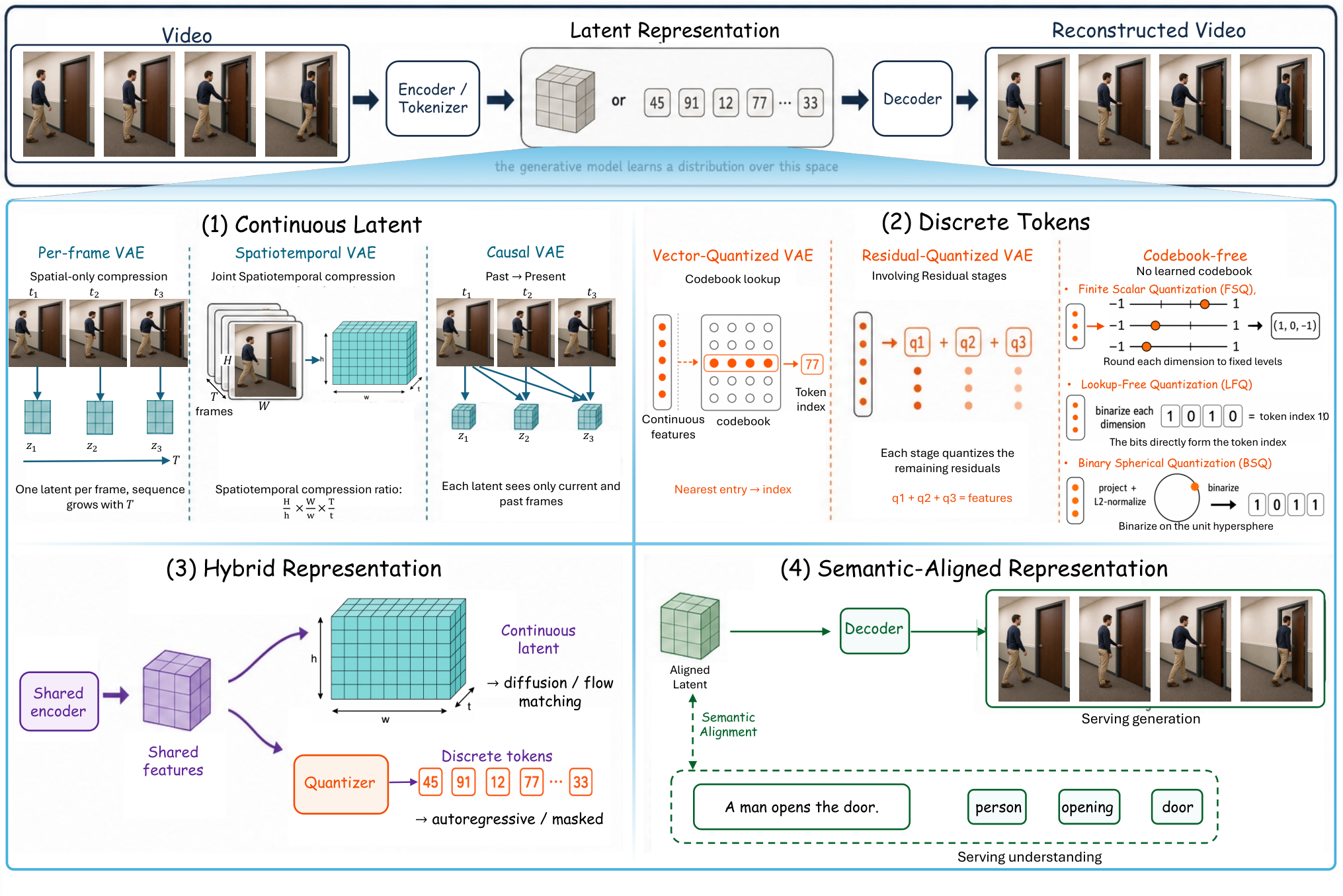
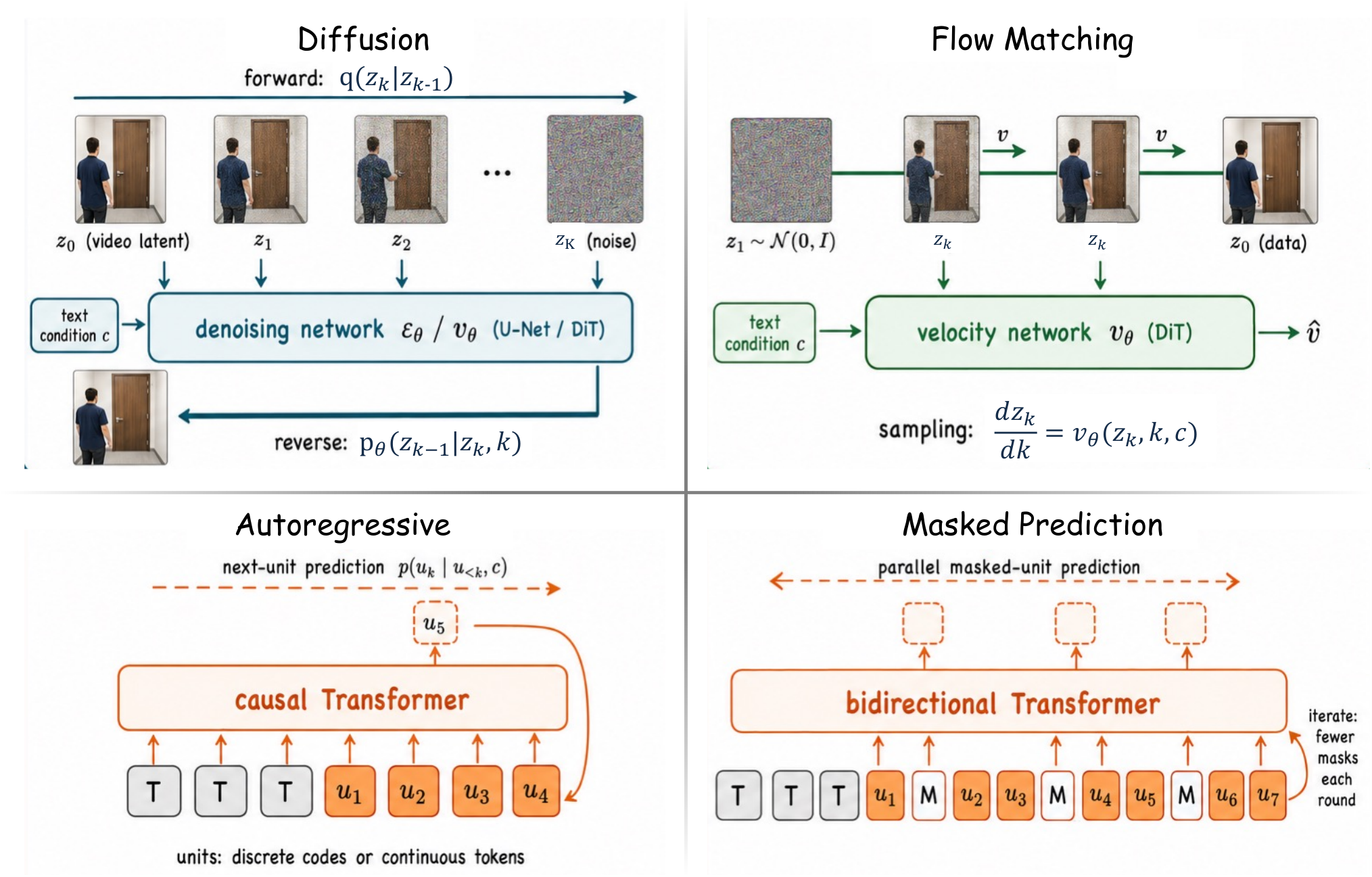
The writing chapter indexes generation by what the condition fixes in W: T2V (Sora, Wan, HunyuanVideo) specifies events, I2V (SVD, Animate Anyone, MagicAnimate) fixes initial state and identity, V2V covers editing (Tune-A-Video, TokenFlow, FateZero), translation, interpolation, and extension (NUWA-XL, SEINE, StreamingT2V); audio-driven (Wav2Lip, SadTalker, EMO, Hallo) and joint audio-video (JavisDiT, Ovi) prescribe visible dynamics; CameraCtrl, MotionCtrl, DragNUWA, and ConsisID fix geometry, motion, or identity. Latent design (Figure 4) is split along continuous vs. discrete vs. hybrid vs. semantically-aligned axes, with the semantic-alignment axis orthogonal — a critical point because it is what enables unified understanding/generation. Generative paradigms are grouped in Figure 5 into diffusion/flow (denoising or velocity on latents), autoregressive factorization, and masked parallel prediction; the survey treats flow matching and diffusion as a continuum rather than competing camps.
The sharing chapter is the most conceptually novel. The authors propose a three-level definition of unification: (i) capability coverage (one system does both read and write), (ii) architectural sharing (common components), and (iii) functional synergy (one direction measurably improves the other under controlled comparison). They then taxonomize architectures into four families — discrete-token unification (Emu3/Emu3.5, Video-LaVIT, VILA-U, NExT-OMNI), continuous latent-space unification (TUNA, Show-o2, Uni-ViGU, HYDRA-X), decoupled/modular unification with semantic bridges, and agentic/tool-augmented unification. Table 14 is granular enough to show which systems commit to joint AR, flow matching, or staged AR/FM training, which encoder tower (SigLIP, Wan VAE, RQ, IBQ) feeds each direction, and whether evaluation is “C” or “H” style. The authors are explicit that synergy — level (iii) — remains largely unverified in current work.
The interacting chapter is where the lens pays off most. The 2\times 3 taxonomy of video world models separates prediction space (observations vs. latent states) from transition protocol (passive, action-conditioned, interactive). The same architecture can occupy multiple cells depending on protocol: an action-conditioned latent predictor can both score candidates and run inside a planner. Representative systems span SV2P, GAIA-1, Vista, IRASim, Genie, DIAMOND, GameNGen, Matrix-Game, V-JEPA 2/2.1. The core challenges — action-conditioned controllability, long-horizon consistency and memory, real-time responsiveness, physical/causal grounding — are addressed with concrete methodological critiques. The hidden-ice-cube example (Figure 11, referenced in Section 9.1) makes the point crisply: replaying a stored observation returns a stale cube, whereas a true predictive state must simulate off-screen melting. Most current memory systems (Lu et al. 2024, Xiao et al. 2025a, Bian et al. 2026) store what was visible rather than evolve what is hidden; only a few (Wang et al. 2026a, Duan et al. 2026) model off-screen change explicitly.
Section 9’s seven open problems are usefully specific. On long-horizon consistency the authors argue that reporting a single terminal score conflates rendering drift with state loss, and propose varying rollout length and revisit distance independently to produce degradation curves. For latent-state models that produce no frames, probes of goal reachability, feature stability, and decision quality are needed; consistency reports should also include memory footprint, end-to-end latency, and action-update rate, since retention budgets convert archive growth into learnable eviction policies. Other challenges — measurable synergy in unified models, standardized evaluation of world properties, scaling control from unlabeled video, and stochastic worlds with rare events — point to concrete methodological gaps rather than vague desiderata.
Why this matters
The world-modeling lens cleanly separates temporal coherence in video traces from consistency in the underlying world state, which is the right abstraction for comparing Video-LLMs, text-to-video generators, unified models, and interactive world models under a single formalism. The emphasis on predictive state over archival memory, and on functional synergy over mere capability coverage, identifies where current benchmarks fail to measure what the models actually need to do.
Source: https://arxiv.org/abs/2610.31668
Function-Space Temporal Self-Distillation for Policy Optimization
Problem
RLVR with scalar verifier rewards gives a single bit of supervision over long response trajectories, wasting token-level information. Self-distillation addresses this by comparing an unassisted policy view p = \pi_\theta(\cdot \mid x, y_{<t}) to a privileged teacher view q = \pi_\theta(\cdot \mid x, d, y_{<t}) conditioned on verified evidence d, producing dense KL supervision at every token. The pathology: when teacher and student share parameters, the target drifts with every gradient step. SDPO patches this by maintaining an EMA parameter-space teacher, which doubles the model memory footprint and still couples target drift to the EMA rate.
FSPO (Function-Space Policy Optimization) removes the persistent teacher entirely. Instead of freezing teacher parameters, it freezes teacher outputs — sparse next-token distributions from verified historical rollouts — and replays them as temporal targets.
Method
For a prefix c=(x, y_{<t}) at step s, write F_{\theta_s}(c) = \pi_{\theta_s}(\cdot \mid c). FSPO’s loss is a sum of four terms assembled per Algorithm 1:
Privileged adaptation \mathcal{L}_{\mathrm{distill}}: KL from student p_{p,j,t} to privileged teacher q_{p,j,t} over the top-K_{\mathrm{cur}} support S_{p,j,t}. Demonstrations d_{p,j} are constructed via sibling retrieval — a successful rollout \tilde{y}_p or the gold g_p — so the teacher view sees stronger evidence than the student.
Disagreement correction \mathcal{L}_{\mathrm{neg}}: tokens where the student assigns mass above the teacher by a margin \gamma are collected into an overvalued set \mathcal{N}_{p,j,t} and explicitly suppressed. This gives \mathcal{L}_{\mathrm{cur}} = \mathcal{L}_{\mathrm{distill}} + \lambda_{\mathrm{neg}} \mathcal{L}_{\mathrm{neg}}.
Reliability-adaptive grounding \mathcal{L}_{\mathrm{CE}}: a running estimate \hat{r}_p^{(s)} of per-problem success produces weights w_p^{(s)} that upweight gold-reference cross-entropy when self-generated evidence has been repeatedly unreliable, and anneals it out as the policy becomes competent.
Function-space temporal consolidation \mathcal{L}_{\mathrm{temp}}: verified historical outputs are stored as pairs (\tilde{S}_{p,t}, \tilde{q}_{p,t}) — a sparse support and the teacher distribution over it — in a memory \mathcal{M}. Each step samples a replay batch \mathcal{R}_s \subset \mathcal{M} grouped by problem/difficulty, and the current policy is distilled toward these fixed targets. A cyclic mixing coefficient \rho_s balances \mathcal{L}_{\mathrm{cur}} and \mathcal{L}_{\mathrm{temp}}. Memory retention is quality/coverage-aware (verified only, deduplicated across prefixes); entries older than H are refreshed at frequency F with rate \zeta to prevent fully stale targets.
The key design point: because (\tilde{S}_{p,t}, \tilde{q}_{p,t}) are stored tensors, not parameters, there is no second model copy. On-policy rollouts reuse the training model, so FSPO’s extra memory is a sparse logit cache rather than a full set of weights, gradients, and KV cache.
Results
Under matched 5-hour wall-clock budgets on 4×GH200, FSPO improves over SDPO’s on-policy EMA-teacher baseline on both Qwen3-8B and Olmo3-7B-Instruct across SciKnowEval (Chemistry/Physics/Biology/Materials) and ToolAlpaca.
For Qwen3-8B at 5h, average avg@16 across five benchmarks: GRPO 70.4, on-policy GRPO 63.3, SDPO 72.0, FSPO 76.2. Per-task gains over SDPO are largest on Biology (71.2 vs 56.8, +14.4) and Chemistry (83.4 vs 80.9) and Materials (81.7 vs 78.4). For Olmo3-7B-Instruct at 5h, FSPO reaches 72.4 avg vs SDPO 68.0, with Chemistry 83.3 vs 80.0 and Biology 62.3 vs 52.8. At the 1-hour budget FSPO is also ahead on most tasks (e.g. Qwen3-8B Biology 71.2 vs 50.6), indicating the function-space targets accelerate convergence rather than merely raising the asymptote.
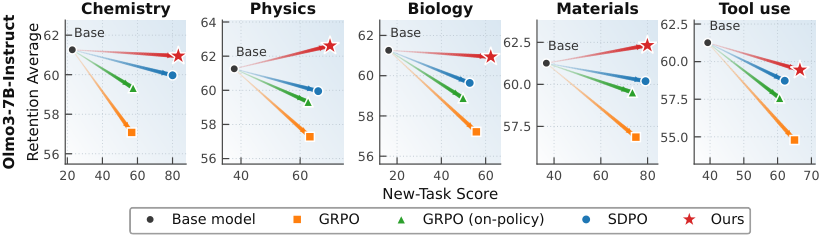
The forgetting plot shows FSPO sitting toward the upper-right of each panel: it attains higher in-task accuracy and retains more prior-capability score than GRPO or SDPO, consistent with the claim that replayed function-space targets act as a mild regularizer against representation drift. Memory accounting (Figure 6 in the paper) shows FSPO has no extra model copy — GRPO stores a colocated rollout model, SDPO a persistent EMA teacher, FSPO only a sparse logit cache that scales with top-K support rather than parameter count. The gap grows with model size.
Limitations
The method inherits the usual self-distillation assumption that privileged conditioning on d actually improves local token distributions; for tasks where verified demonstrations are long or hard to retrieve as siblings, the teacher view may be weak. The sparse support \tilde{S}_{p,t} discards tail mass, which could matter for exploration-sensitive tasks. The paper reports no ablation isolating \mathcal{L}_{\mathrm{neg}}, \mathcal{L}_{\mathrm{CE}}, and \mathcal{L}_{\mathrm{temp}} in the excerpt provided, so the marginal contribution of function-space replay vs. disagreement correction vs. adaptive grounding is not disentangled. Tool-use gains are small (68.5 vs SDPO 68.5 on Qwen3-8B at 5h) — the benefit concentrates on reasoning benchmarks where sibling demos exist within the training distribution. Finally, “fixed” targets refresh every F steps for aged entries, so the staleness/freshness trade-off (H, \zeta, \rho_s schedule) introduces hyperparameters that the single-setting evaluation does not stress-test.
Why this matters
FSPO shows that the stabilization role of an EMA teacher in on-policy self-distillation can be served by a sparse cache of past output distributions, cutting the extra model copy while improving accuracy and reducing forgetting. This reframes “temporal consistency” in policy optimization as a function-space constraint rather than a parameter-space one, which is directly applicable wherever RLVR with dense supervision is memory-bound.
Source: https://arxiv.org/abs/2610.19687
HiSTEVE 1.0: Harnessing Human-Interface VLA Agents for Open-World Games
Problem
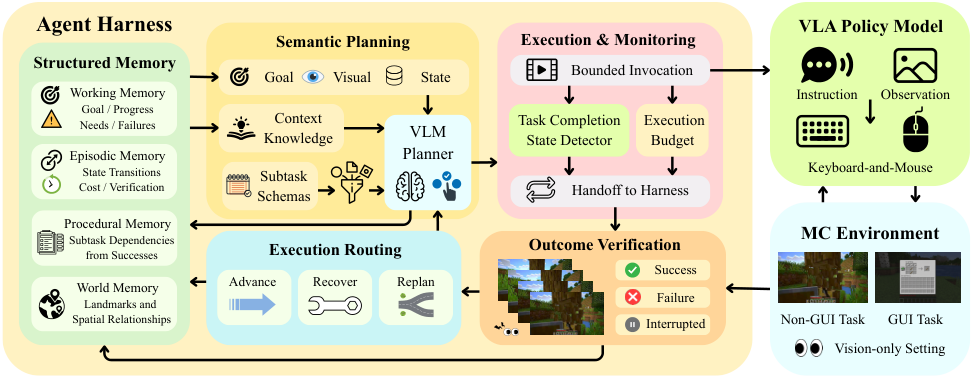
Minecraft agents have long bifurcated into two camps: native visuomotor controllers (VPT, STEVE-1, ROCKET-1, JARVIS-VLA) that act through keyboard-and-mouse at the pixel level but lack long-horizon planning, and high-level planners that invoke scripted skills or environment APIs, sidestepping the perception-action loop. HiSTEVE targets the integration gap: a single VLA policy driving the native interface, orchestrated by a VLM planner through a capability-aware harness, with a learned completion detector mediating hand-offs. The interesting technical nuance is that the control regime is heterogeneous — first-person world interaction (mining, combat, navigation) and GUI manipulation (crafting, smelting menus) require conflicting visuomotor behaviours from the same backbone.
Method
Harness and planner. The harness maintains a structured planning state h_j = (G, p_j, r_j, v_{<j}) summarizing objective, verified progress, unresolved requirements, and prior execution outcomes. At each decision step it filters a schema library against h_j to obtain an applicable subtask set \mathcal{S}_j, retrieves relevant memory R_j, and queries the VLM planner: u_j = \mathcal{P}_{\mathrm{VLM}}(G, O_j, h_j, \mathcal{S}_j, R_j). The output u_j is a semantic objective (not a callable skill), converted into a fixed natural-language instruction I_j that the VLA executes for one bounded invocation. Planning is reference-free: no fixed subtask DAG is provided.
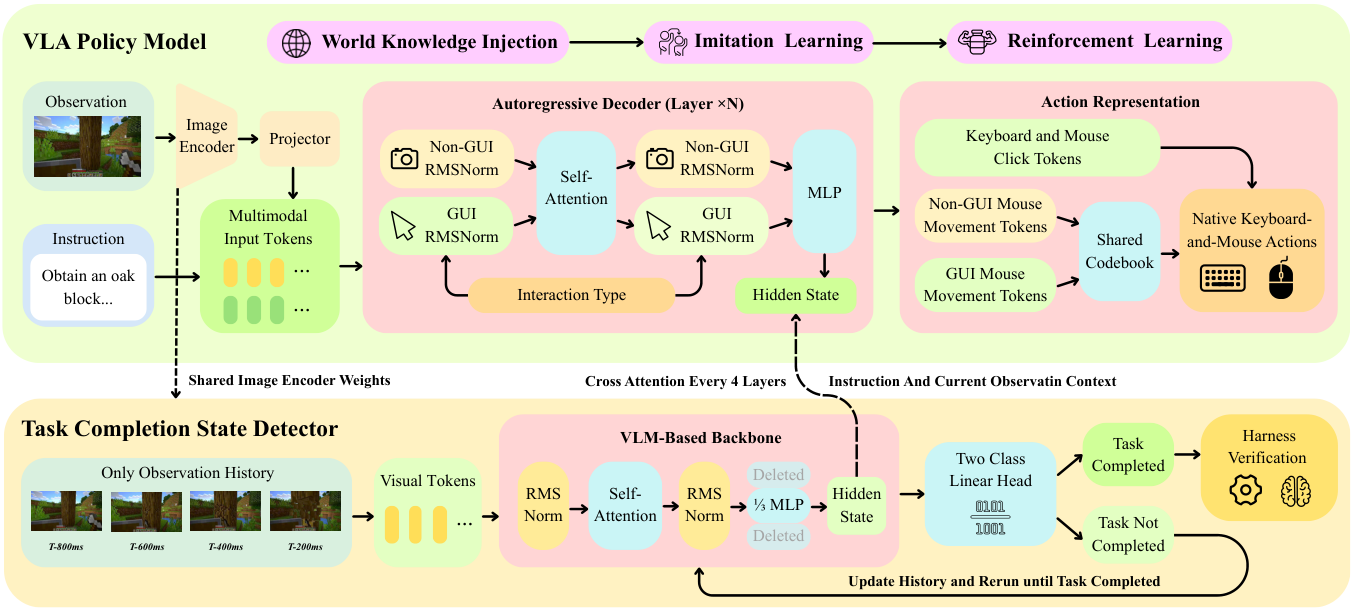
VLA policy. The low-level policy is initialized from Qwen2.5-VL-7B, consuming (I_j, o_t) and emitting tokenized keyboard-and-mouse actions \mathbf{a}_t at 20 Hz. The authors measured the gradient conflict between GUI and non-GUI regimes on a fully shared baseline using the conflict gap \Delta = \tfrac{1}{2}(c_{\mathrm{GUI}} + c_{\mathrm{NG}}) - c_{\mathrm{cross}}, where c_\cdot are cosine similarities between gradients computed on same-regime vs. cross-regime mini-batches. The RMSNorm modules showed the strongest cross-regime misalignment of all shared components. Their fix is Regime-Specific RMSNorm (RS-Norm): two learnable scale vectors per RMSNorm, selected by regime, \operatorname{RMSNorm}_{\ell,q}^{(c)}(\mathbf{h}) = \boldsymbol{\gamma}_{\ell,q}^{(c)} \odot \frac{\mathbf{h}}{\sqrt{\frac{1}{d}\sum_i h_i^2 + \epsilon}}, for c \in \{\mathrm{NG}, \mathrm{GUI}\}. The overhead is only 2Ld parameters.
Completion detector. A Qwen2.5-VL-3B detector shares the VLA image encoder and processes historical frames sampled at 800/600/400/200 ms before the query. The VLA’s prefix hidden states H_t^\pi (preceding the first action token) are injected into the detector via query-normalized cross-attention every fourth layer: \widetilde{Z}_t^{(\ell)} = Z_t^{(\ell)} + \operatorname{MHA}_\ell(\operatorname{LN}_\ell(Z_t^{(\ell)}), H_t^\pi, H_t^\pi). FFN intermediate widths are pruned to ≈1/3 using Wanda-style activation-weight scores. A handoff signal fires only when p_t > \tau for two consecutive queries. Training uses VPT human trajectories with labels y_t = \mathbf{1}[t \geq t^\star] from offline event/inventory detection.
Results
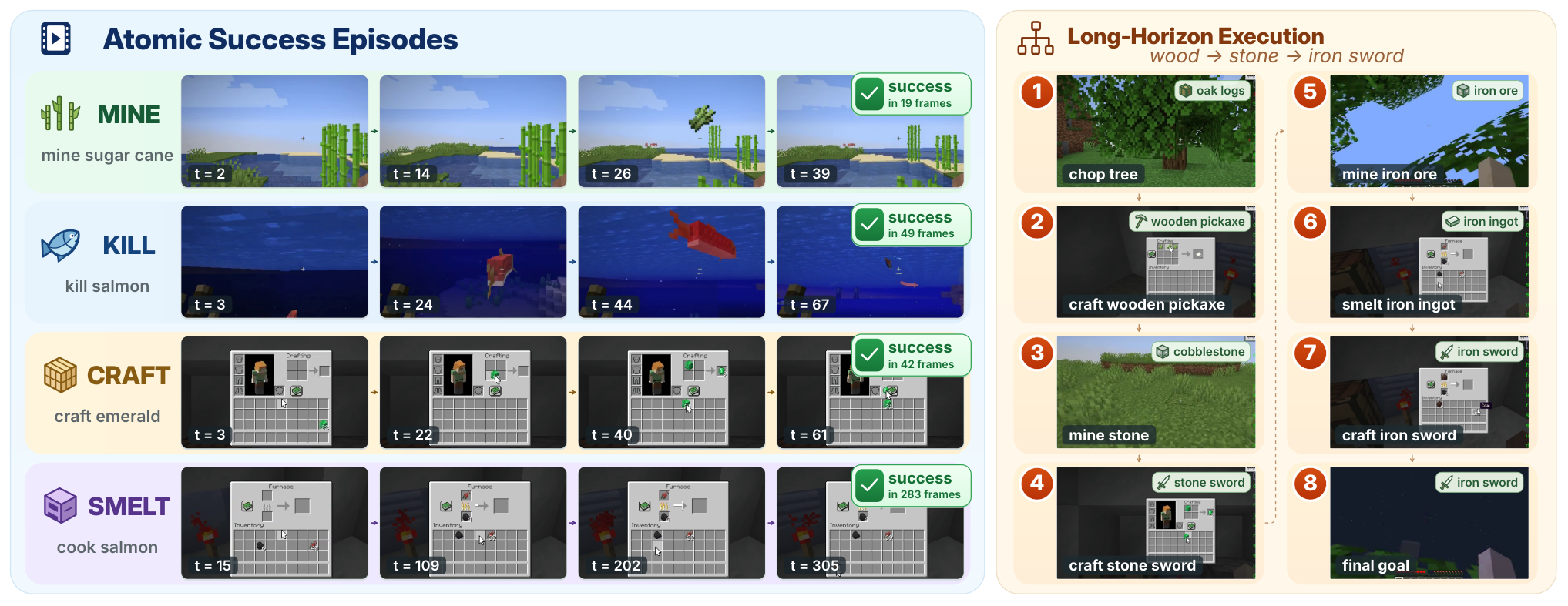
On MineStudio Bench (strict pass@1 over 20 atomic tasks), HiSTEVE reports Mine 93.3, Kill 86.7, Craft 66.7, Smelt 93.3, compared to the prior best Text/CoA at 73.3/73.3/40.0/73.3 and JARVIS-VLA at 66.7/60.0/26.7/60.0. The Craft gain (66.7 vs. 40.0) is the clearest evidence that RS-Norm resolves GUI interference without collapsing non-GUI competence.
On OpenHA family-wise episode success, HiSTEVE scores Embodied 46.0, GUI 27.2, Combat 39.0, Avg 37.4, versus Text/CoA at 37.0/33.3/40.0/36.8. HiSTEVE wins Embodied and Avg; Text/CoA retains a slight edge on pure GUI (33.3 vs. 27.2) and Combat (40.0 vs. 39.0), both within or near one standard deviation.
The decisive gap is on LongBench (14 goal-only tasks, 49 diagnostic nodes), where native-control baselines nearly flatline: HiSTEVE achieves R&C 42.9, E&M 28.6, Rec 14.3, Open 14.3, versus Text/CoA’s 14.3/7.1/2.9/1.4 and JARVIS-VLA’s 7.1/5.7/1.4/0.7. This is the regime where the harness’s structured memory and policy-coupled completion detector pay off — long-horizon decomposition is viable only once subtask termination can be verified reliably.
Detector ablations. On a balanced 4,674-sample validation set, the final configuration reaches 0.863 F1. Reducing FFN width from 1/2 to 1/3 is essentially free (0.865 → 0.863), but 1/4 collapses to 0.739. Replacing Wanda scores with prefix pruning at the same 1/3 width drops to 0.768. Removing shared final-layer policy context in favor of layer-wise pairing drops to 0.690 — showing that it is the semantic prefix of the VLA, not deeper per-layer features, that carries the completion signal.
Limitations and open questions
The GUI family on OpenHA remains Text/CoA’s domain (33.3 vs. 27.2), suggesting RS-Norm alleviates but does not eliminate regime interference; a more aggressive branching (e.g., regime-specific FFN or attention) or a mixture of experts over regimes may be warranted. The detector is trained on offline VPT labels tied to inventory/event signals, so completion categories outside mining/killing/crafting/smelting are undersupervised. The planner is GPT-4o-dependent; the capability-constrained schema is handcrafted and does not grow with new VLA skills. Variance remains high on long-horizon tasks (e.g., R&C 42.9 ± 14.4), indicating that even verified handoffs do not fully stabilize multi-stage rollouts.
Why this matters
HiSTEVE shows that a pixel-level VLA plus a lightweight structured harness can beat native-control baselines by >20 points on long-horizon Minecraft tasks without resorting to scripted skills, and that heterogeneous interaction regimes can be reconciled with just 2Ld extra parameters via regime-specific RMSNorm. The policy-coupled completion detector is a reusable design pattern for any hierarchical agent whose subtasks lack reward signals.
Source: https://arxiv.org/abs/2610.31162
Hacker News Signals
PaperPilot – Zero-Cloud, Pure-Rust PDF Engine with WASM and MCP
PaperPilot is a PDF processing engine written entirely in Rust, compiled to WebAssembly, with no server-side dependencies. The architecture makes three distinct claims worth unpacking.
First, the “zero-cloud” constraint: all PDF parsing, rendering, and text extraction runs in-process, either natively or inside a WASM sandbox. This eliminates the common pattern of shelling out to Ghostscript or calling a cloud API, with the corresponding privacy and latency costs.
Second, the pure-Rust PDF stack. Rust’s memory safety guarantees matter here because PDF parsing is historically a security minefield — malformed streams, integer overflows in object cross-reference tables, and recursive decompression bombs are standard attack vectors. Rolling a parser in safe Rust sidesteps a class of CVEs that plague libpoppler and pdfium derivatives.
Third, MCP (Model Context Protocol) integration. MCP is Anthropic’s open protocol for giving LLM agents structured tool access. PaperPilot exposes its extraction and search capabilities as MCP tools, meaning an agent runtime can call extract_text, search_pdf, or get_page as typed function calls rather than constructing raw text prompts. This is a practical architectural choice: structured tool interfaces reduce prompt engineering overhead and give the agent well-typed return values it can reason over reliably.
The WASM compilation target is significant for deployment: the same binary runs in browsers, Deno/Node edge functions, and desktop Electron apps without recompilation. The Rust-to-WASM toolchain (wasm-pack, wasm-bindgen) is mature enough that PDF font rendering and decompression (zlib, LZW, CCITT) are feasible at near-native throughput.
Open questions: font subsetting and CJK glyph coverage are typically where lightweight PDF engines break down. The repo does not yet document which PDF specification subsets (PDF 1.x vs. PDF 2.0, XFA forms, tagged PDF) are supported.
Source: https://github.com/KrushnaVardhanReddy/PaperPilot
The Mythical Man-Month in the Age of AI
The post applies Brooks’s 1975 thesis to the current AI-assisted development environment. Brooks’s core argument was that software complexity is essential (inherent to the problem domain) not accidental (arising from tooling), and that adding engineers to a late project makes it later because communication overhead scales as O(n^2) in team size.
The author’s contention is that AI coding assistants primarily attack accidental complexity — boilerplate generation, syntax recall, test scaffolding — while essential complexity (system design, invariant reasoning, distributed state management) remains largely unaddressed. This is a defensible technical claim. Current code-generation models excel at local token prediction conditioned on a narrow context window; they do not maintain a global semantic model of a large codebase’s invariants.
The communication overhead argument is updated: if an AI agent generates a substantial fraction of code, does the O(n^2) coordination cost decrease? Potentially, if the agent acts as a force-multiplier for a single engineer rather than an additional team member. But the author notes a countervailing effect: AI-generated code requires review, and review is itself a coordination activity. Worse, generated code that looks correct but violates distant invariants can increase the effective review burden non-linearly.
The post also touches on the “conceptual integrity” principle from Brooks — the idea that coherent systems require a single architectural vision. Large codebases produced by heterogeneous agent outputs risk violating this, producing locally consistent but globally incoherent designs.
The technically interesting open question is whether long-context models with persistent memory (project-level RAG, repo-wide static analysis integration) can close the gap on essential complexity, or whether this requires a fundamentally different architecture than next-token prediction.
Source: https://j11g.com/the-mythical-man-month-in-the-age-of-ai
OpenAI and Anthropic Cut Their LLM Prices by Up to 80% Within a Few Months. Why?
The post is a careful cost-structure analysis rather than speculation. The author, Max Woolf, identifies several concurrent mechanisms driving the price compression.
Hardware efficiency gains. Each generation of accelerator (H100 to B200, or equivalent custom silicon) delivers significant FLOP/$ improvements. Model inference cost scales roughly as O(n_\text{params} \cdot T) in tokens processed, so hardware improvements translate directly to margin.
Inference-time optimization. Speculative decoding, continuous batching, and KV-cache optimizations reduce effective cost per token without model changes. Libraries like vLLM have pushed utilization on fixed hardware substantially higher.
Model distillation and quantization. Smaller distilled models (e.g., GPT-4o-mini class) now cover a large fraction of production use cases at a fraction of the parameter count. INT8 and FP8 quantization reduces memory bandwidth pressure — the true bottleneck in autoregressive generation — by 2-4x.
Competitive pressure. Google, Meta (open weights), Mistral, and Chinese providers (DeepSeek, Qwen) have compressed the market. Open-weight models running on commodity hardware set an effective price floor that proprietary API providers must undercut to retain customers.
The 80% figure applies to specific tiers. GPT-4o input tokens dropped from roughly $5/M to $1.25/M over roughly six months. The author notes that price cuts are asymmetric: output tokens (which require sequential generation) have fallen less than input tokens (which admit parallel prefill).
The implication for downstream builders: applications that were previously uneconomical at $10-20/M tokens are now viable at $1-2/M. This expands the deployment frontier for high-volume, latency-tolerant workloads.
Source: https://minimaxir.com/2026/10/cheap-llms/
Survival LLM: AI Assistant and Emergency Library That Runs on Your Own Computer
Survival LLM packages a quantized local language model with a curated offline knowledge base oriented toward emergency preparedness — first aid, water purification, navigation, shelter construction. The design constraint is that the system must function with no internet connectivity, targeting scenarios where infrastructure has failed.
The technical stack is the standard local inference pipeline: a GGUF-quantized model (likely in the 7B-13B parameter range based on the stated hardware requirements) running via llama.cpp or a compatible backend, with a retrieval layer over embedded documents. The offline document corpus is the differentiating component — it is pre-chunked, embedded, and indexed at install time so that query-time retrieval requires no network calls.
The RAG architecture here is constrained in an interesting way: the embedding model and vector store must also run locally, ruling out OpenAI embeddings or cloud vector databases. Common choices are nomic-embed-text or all-MiniLM-L6-v2 for embeddings and a file-backed store like Chroma or FAISS with a serialized index.
The practical engineering challenge is the size/capability tradeoff. A 7B Q4 model fits in 4-6 GB RAM and runs on consumer hardware, but its instruction-following reliability on edge-case medical queries is lower than a 70B model. The application domain (emergency medicine, toxic plant identification) has a high cost of hallucination. The site does not describe any factual-accuracy benchmarking or retrieval precision metrics, which is the primary open question.
The project occupies an interesting niche: offline-first, safety-critical information retrieval where the retrieval quality matters more than generation fluency.
Source: https://www.brangus.io/survival-llm
Show HN: Hob – Open-Source, On-Device Alternative to Claude Cowork and ChatGPT
Hob is an Electron-based desktop application providing a local AI assistant interface backed by on-device model inference. It positions itself as an open-source alternative to Claude.ai and ChatGPT’s desktop clients, with the key distinction that model inference runs locally rather than over API calls.
The architecture is a TypeScript/React frontend (via Electron) communicating with a local inference server. Based on the repo structure, it targets Ollama as the inference backend, which handles model management and exposes a REST API on localhost. This is a sensible layering choice: Ollama abstracts hardware-specific acceleration (Metal on Apple Silicon, CUDA on Nvidia) and model format (GGUF), letting Hob focus on the UX layer.
The feature set emphasizes workspace-style context management — persistent conversation threads, document attachment, and a “cowork” mode suggesting collaborative or multi-turn task management. These are straightforward to implement given a local inference endpoint: they require conversation history serialization, basic file I/O for document ingestion, and a chunking/context-injection pipeline for documents too large for the context window.
The privacy argument is the primary differentiator: no telemetry, no API keys, no data leaving the machine. This matters for code review, document drafting with confidential content, and enterprise environments with data residency requirements.
Technical limitations are the standard local inference constraints: model capability is bounded by available VRAM and RAM, cold-start latency for model loading is seconds to tens of seconds, and multimodal support depends on what Ollama exposes. The repo is early-stage and does not yet document performance characteristics or supported model families explicitly.
Source: https://github.com/FrigadeHQ/hob
Writing About Pratt Parsing So I Remember It
This is a clear technical explanation of Pratt parsing (top-down operator precedence parsing), a technique introduced by Vaughan Pratt in 1973 that remains underused relative to its elegance.
The core insight is that instead of encoding operator precedence into a grammar hierarchy (as recursive-descent parsers do, with separate expr, term, factor nonterminals), Pratt parsing assigns each token a numeric binding power. The parser maintains a current right-binding power and recurses as long as the next operator’s left-binding power exceeds it.
The canonical structure uses two per-token functions: nud (null denotation, for tokens that appear at the start of an expression — literals, prefix operators, parentheses) and led (left denotation, for tokens that appear after an expression — infix and postfix operators). The main loop is compact:
def parse_expr(rbp=0):
    left = token.nud()
    while next_token.lbp > rbp:
        left = next_token.led(left)
    return left
Right-associativity is handled by calling parse_expr(lbp - 1) inside a led, left-associativity by calling parse_expr(lbp). This is considerably simpler than the equivalent grammar transformation in a traditional recursive-descent parser.
The author’s framing as a memory aid is honest: Pratt parsing has a reputation for being hard to recall from first principles because the nud/led naming is non-obvious, and the binding power comparison direction requires a moment of thought each time. The post works through several concrete examples including ternary operators and prefix/postfix disambiguation, which is where the technique’s generality becomes apparent. Pratt parsing is used in production compilers including Rust’s parser and several JavaScript parsers.
Source: https://www.unix.dog/~yosh/blog/2026-10-25_pratt-parsing.html
Wikipedia’s Cleanup of AI-Generated Content
IEEE Spectrum reports on WikiProject AI Cleanup, a coordinated Wikipedia editorial effort to identify and remediate articles degraded by AI-generated contributions. The project’s technical challenge is detection and triage at scale across millions of articles.
The detection approach combines several signals. Stylometric classifiers (trained on known human vs. AI-generated text) flag candidate articles. Secondary signals include citation patterns — AI-generated text frequently cites sources that do not support the specific claim made, or hallucinate plausible-sounding citations entirely. Editors also look for characteristic AI prose patterns: excessive hedging, symmetric list structures, and a tendency to state facts without reference to primary sources.
The remediation workflow is human-driven: flagged articles enter a queue where experienced editors assess whether content is factually accurate (regardless of origin), poorly sourced, or actively wrong. The Wikipedia community’s position is that the problem is not AI generation per se but unsourced or incorrect content — the same standard applied to human-written contributions.
The scale of the problem is significant. Wikipedia has over 6.7 million English articles, and low-traffic stub articles (the long tail) are disproportionately affected because they receive less editorial oversight. AI tools that could generate plausible-sounding prose about minor topics are precisely calibrated to inject undetectable errors into this tail.
The broader systems problem is that Wikipedia’s quality assurance model — assume good faith, require sourcing, rely on community correction — was designed for human contributors whose error rate and motivation structure differ from LLM-generated content. The throughput of potential AI-generated edits can exceed the correction bandwidth of the volunteer editor pool, which is a classic adversarial scaling problem.
Source: https://spectrum.ieee.org/wikipedia-wikiproject-ai-writing-cleanup
A Man from the Future: Why Johnny Can’t Stop Abstracting
The post is a commentary on Leslie Lamport’s intellectual legacy, likely prompted by a talk or essay from Lamport himself. The title references the pattern of a researcher whose ideas arrive before the field has the infrastructure to appreciate them.
Lamport’s contributions span TLA+ and formal specification, the Paxos consensus algorithm, logical clocks (the Lamport timestamp), and Byzantine fault tolerance. The “can’t stop abstracting” framing addresses a real tension in systems research: Lamport consistently works at the level of formal models and mathematical specifications, while most practitioners work at the level of code.
The post engages with Lamport’s persistent argument that programmers should write specifications before code — specifically, that TLA+ or similar formal methods should be a standard step in systems design. The counterargument from practice is that formal specification has high upfront cost and limited tooling integration, making it economically unattractive for most production systems work.
The Lamport timestamp construction is a useful concrete example of the abstraction style. The definition C(a) < C(b) if event a happened-before event b, with the clock update rule C_j = \max(C_j, C_i) + 1 on message receipt, is a minimal formal model that captures exactly the causal ordering structure needed — no more. The elegance comes from the abstraction being tight: it models precisely what matters and nothing else.
The broader point is about the relationship between formal models and implementation. Lamport’s position, roughly, is that most distributed systems bugs are specification bugs — the implementation is correct with respect to an incorrect or underspecified model. This is empirically supported by the TLA+ experience at AWS and Microsoft, where model checking found bugs that testing missed.
Source: http://muratbuffalo.blogspot.com/2026/10/the-man-from-future-why-johnny-cant.html
Noteworthy New Repositories
strands-agents/box
A sandboxing runtime for AI agents written in Rust, targeting macOS on Apple silicon (Linux planned). The core design combines OS-level process isolation with a default-deny policy layer called Dogwood. Dogwood policies define what the agent process can execute, read, write, and reach over the network — everything not explicitly permitted is blocked at the syscall/capability boundary rather than by application-level checks. Credential injection is handled outside the agent process, so secrets never exist in the agent’s address space or environment at all; they are injected through a controlled channel only when a permitted operation actually requires them. This is a meaningful security posture improvement over the common pattern of passing API keys as environment variables that the agent can freely read, log, or exfiltrate. The Rust implementation gives tight control over process spawning, file descriptor inheritance, and network socket creation. For anyone deploying agentic pipelines where the agent has tool access to a real filesystem or external APIs, box addresses the concrete threat of prompt-injection-driven privilege abuse or accidental data exfiltration. The default-deny model means the attack surface is defined by the allowlist, not by whatever the agent happens not to try.
Source: https://github.com/strands-agents/box
jwuthri-cloud/Tracely-ai
Tracely treats LLM/agent observability traces as first-class CI/CD artifacts. The workflow is: collect production traces, run an LLM-based grader over them to score quality dimensions, cluster failures by semantic similarity to identify systematic regressions rather than one-off errors, then freeze representative failure traces into replayable regression tests stored in version control. On each PR, Tracely replays those frozen traces against the new agent/prompt version, re-grades them, and blocks the merge if any grade regresses below threshold. This closes the standard gap in ML deployment where unit tests cover code paths but not behavioral drift in model outputs. The clustering step is technically important — it prevents the regression suite from being dominated by near-duplicate failures and ensures coverage of distinct failure modes. Self-hostable design avoids sending production traces to a third-party SaaS, which matters when traces contain user data. The grading step is itself an LLM call, which introduces evaluator variance, but the frozen-replay approach at least makes comparisons consistent within a PR evaluation run. Useful for teams iterating on prompts or tool definitions in agentic systems where regressions are subtle and hard to catch with deterministic assertions.
Source: https://github.com/jwuthri-cloud/Tracely-ai
miuuyy/Octopus-SI-OS
Octopus-SI-OS proposes an OS-level architecture for agent execution rather than wrapping agents in application-layer orchestration frameworks. The premise is that existing agent frameworks inherit web-service or batch-job abstractions poorly suited to long-running, stateful, self-modifying agent processes, and that OS primitives — scheduling, memory management, inter-process communication, privilege separation — are the right substrate. The “self-evolving” claim refers to agents that can modify their own tooling, spawn sub-agents, and update their behavioral policies at runtime, with the OS harness enforcing resource accounting and isolation between those sub-processes. The architecture is positioned as a research vehicle toward more capable autonomous systems. At this stage the repository is more architectural manifesto and prototype harness than production system, but the framing is technically interesting: treating agent cognition cycles as schedulable processes, memory contexts as managed address spaces, and tool registries as kernel-space capability tables. The practical value today is as a reference design and discussion artifact for researchers thinking about the systems layer beneath agentic AI.
Source: https://github.com/miuuyy/Octopus-SI-OS
pullboard-dev/pullboard
Pullboard is a governed agentic development system where human judgment is expressed through specs and rules rather than direct code authorship. The workflow: a developer declares a feature spec and a set of policy rules (coding standards, architectural constraints, security requirements); a builder agent generates an implementation; a separate verifier agent runs tests, static analysis, and policy checks against the output; the PR is blocked from merge until the verifier passes. The two-agent architecture — builder and verifier as independent processes — is the meaningful design choice here, as it prevents the builder from gaming its own success criteria, which is the failure mode of single-agent self-evaluation. Human decisions are encoded in the upfront spec and rule declarations rather than in pull request review, shifting the human’s role from reviewer to specification author. This is a concrete instantiation of the “approval loop” pattern that appears in most responsible agentic deployment frameworks. The system is targeted at real product development rather than toy demos, which means it needs to handle partial specs and ambiguous requirements gracefully — the hard problem the repository will need to address as it matures.
Source: https://github.com/pullboard-dev/pullboard
QingYunA/answer-me-with-html
This repository defines an agent skill — a reusable tool or function callable by an agent — that takes a complex question and returns a self-contained single-page HTML document as the answer rather than plain text. The motivation is that structured, visually organized output is significantly easier to parse for multi-part technical questions, comparisons, or explanations with hierarchy. The HTML response can include tables, collapsible sections, syntax-highlighted code, and internal navigation, all rendered client-side without any server dependency since the page is self-contained. Implementation-wise, this is a prompt-engineering and output-formatting layer: the skill instructs the LLM to generate valid, readable HTML and wraps the invocation in whatever tool-calling interface the host agent framework uses. The high star count (4,583) reflects genuine utility — this pattern solves a real UX problem for agent outputs that would otherwise be a wall of markdown. The main limitation is that HTML generation from LLMs can be unreliable for complex layouts; the repository likely includes prompt templates and validation logic to handle malformed output. Useful as a reference implementation for anyone building agent tool libraries.
Source: https://github.com/QingYunA/answer-me-with-html
chenxiachan/textfold
Textfold implements progressive summarization across five detail levels, applicable to academic papers, web pages, arbitrary files, and LLM reply text. The “fold” metaphor maps to the UI pattern: a document starts collapsed at the highest abstraction level and can be expanded incrementally toward the original text, analogous to code folding in an editor. Technically, this requires generating and caching summaries at each level — typically: one-sentence, paragraph, section-level abstract, extended abstract, and full text — then providing a navigation interface that reveals each layer on demand. For papers, this aligns naturally with abstract/introduction/section hierarchy. For arbitrary text, the levels are LLM-generated. The practical value is reducing time-to-relevance for documents where most readers need level-2 detail on most sections and level-5 on one or two. The caching strategy matters for cost: regenerating all five levels on every view is expensive; textfold presumably caches generated summaries. The open question is summary fidelity under compression, particularly for technical content where level-1 summaries of math-heavy sections tend to lose precision. At 785 stars, there is clear demand for this pattern in research and knowledge-management workflows.
Source: https://github.com/chenxiachan/textfold
Aryanutkarsh/SeeCode
SeeCode generates animated, interactive diagrams from a compact JSON specification, targeting the output of coding agents such as Claude. The input schema describes code structures — classes, functions, data flows, call graphs — in a declarative format that agents can emit directly without needing to invoke a graphics API. SeeCode then renders these as explorable diagrams with animation, presumably stepping through execution flows or data transformations. The key design decision is making the JSON spec simple enough that an LLM can generate it reliably as a tool-call output, rather than requiring the agent to produce SVG or canvas code directly. This sidesteps the well-known problem that LLMs generate incorrect coordinate arithmetic when asked to write diagram-drawing code from scratch. The explorable/animated aspect adds value over static diagrams for understanding control flow: stepping through a call sequence visually is faster than reading a trace log. Practical applications include agent-assisted code review, architecture explanation, and debugging visualization. The main constraint is that the expressiveness of the JSON schema determines what can be represented; complex data structures or highly concurrent execution patterns may hit schema limitations.
Source: https://github.com/Aryanutkarsh/SeeCode
iamlukethedev/Herald-OS
Herald-OS is an independent agent-native OS prototype with Hermes Agent as the primary interface layer (explicitly unaffiliated with Nous Research’s Hermes model series). The project’s architectural claim is that conventional OS interfaces — shells, GUIs, file browsers — are the wrong abstraction for agents, and that an OS designed from the ground up for agent execution would expose primitives like task graphs, context stores, and tool registries as first-class kernel concepts rather than user-space libraries. Hermes Agent acts as the human-facing interface, translating natural-language or structured intents into OS-level operations. This is in the same design space as Octopus-SI-OS above, with an apparent emphasis on the human-agent interaction layer rather than the execution substrate. At 581 stars, it is attracting attention as a proof-of-concept for rethinking OS design assumptions in an agent-first context. As an independent project, the main risk is scope: reimplementing OS fundamentals is an enormous engineering surface. The realistic near-term value is as an opinionated agent runtime with better resource management and isolation semantics than application-layer frameworks, rather than a literal operating system replacement.