Daily AI Digest — 2026-10-14
arXiv Highlights
TPPO: Tracking-Value PPO For Language Model Reasoning
Problem
In RLVR with binary terminal rewards, PPO’s critic has to turn a single \{0,1\} signal at step T into per-token advantages across trajectories of thousands of tokens. The usual MLP head trained with squared TD error compresses toward trajectory-level means and does not track how the success probability actually evolves across prefixes. Since token-level credit under GAE is driven by V(\mathbf{s}_{t+1}) - V(\mathbf{s}_t) (plus the sparse terminal reward), a critic that fails to reflect this evolution produces advantages that are approximately proportional to the final return, collapsing PPO toward trajectory-level reinforce. The paper’s claim is that explicitly parameterizing the critic so that it respects the Bayesian structure of value evolution yields consistent gains over PPO.
Bayesian decomposition of successive values
Under a fixed policy, binary terminal reward, and \gamma=1, V^{\pi_\theta}(\mathbf{s}_t) = \Pr_{\pi_\theta}[R=1 \mid \mathbf{s}_t]. The one-step update is Bayes’ rule conditioning on the emitted token a_t:
V^{\pi_\theta}(\mathbf{s}_{t+1}) = \frac{V^{\pi_\theta}(\mathbf{s}_t)\,\Pr_{\pi_\theta}[a_t \mid \mathbf{s}_t, R=1]}{V^{\pi_\theta}(\mathbf{s}_t)\,\Pr_{\pi_\theta}[a_t \mid \mathbf{s}_t, R=1] + (1-V^{\pi_\theta}(\mathbf{s}_t))\,\Pr_{\pi_\theta}[a_t \mid \mathbf{s}_t, R=0]}.
Taking log-odds linearizes this into additive per-token increments:
\operatorname{logit} V^{\pi_\theta}(\mathbf{s}_{t+1}) - \operatorname{logit} V^{\pi_\theta}(\mathbf{s}_t) = \log \frac{\Pr_{\pi_\theta}[a_t \mid \mathbf{s}_t, R=1]}{\Pr_{\pi_\theta}[a_t \mid \mathbf{s}_t, R=0]} \doteq \Delta_{t+1}^{\pi_\theta}.
Unrolling along a trajectory,
\operatorname{logit} V^{\pi_\theta}(\mathbf{s}_T) = \operatorname{logit} V^{\pi_\theta}(\mathbf{s}_0) + \sum_{\tau=1}^{T} \Delta_\tau^{\pi_\theta}.
So the natural parameterization of a critic is not a direct scalar V(\mathbf{s}_t), but a sequence of per-token log-likelihood-ratio increments that are summed in logit space.
Method: cumulative logit critic
TPPO replaces the scalar value head with a per-position scalar output \delta_\phi(\mathbf{s}_t, a_t) interpreted as an estimate of \Delta_t^{\pi_\theta}. The prefix value is then reconstructed as
\hat V_\phi(\mathbf{s}_t) = \sigma\!\left(\ell_0 + \sum_{\tau=1}^{t} \delta_\phi(\mathbf{s}_{\tau-1}, a_{\tau-1})\right),
with \ell_0 a learned (or data-estimated) prior logit. Training uses terminal-outcome supervision: because V^{\pi_\theta}(\mathbf{s}_T) = R \in \{0,1\}, the reconstructed values are regressed against the realized outcome at each position (equivalently, a logistic regression on the cumulative logit at each t, with target R). This is a bias-reducing reparameterization: the additive-in-logit prior exactly matches the Bayesian evolution, and the critic cannot help but produce a monotone-in-prior sequence that lands at the terminal label. GAE is then computed on \hat V_\phi as usual.
The construction has two notable consequences. First, the critic head is a per-token scalar predictor rather than a value regressor, which aligns gradients across all positions with the terminal label through the sum. Second, advantages A_t \approx \hat V_\phi(\mathbf{s}_{t+1}) - \hat V_\phi(\mathbf{s}_t) are, by construction, driven by \delta_\phi at that position — i.e., token-local credit becomes a learned log-likelihood ratio.
Results
The authors evaluate on ten math benchmarks (AIME24/25/26, AMC, MATH-500, Minerva, OlympiadBench in-domain; ARC-C, AGI-Eval, BBH OOD), plus countdown and scientific coding (SciCode, HumanEval, HumanEvalFix, LiveCodeBench v6, APPS-Intro). Sampling uses temperature 1.0 and 24k max tokens, with Avg@32 on AIME/AMC and Avg@4 on others.
On aggregate math score, TPPO beats PPO by +7.0 points on Qwen3-4B-Base and +8.4 points on Qwen3-8B-Base. Gains extend to Qwen3-4B (instruct), Qwen2.5-Math-1.5B, and Qwen3.5-9B, and transfer to countdown and scientific coding. OOD benchmarks (ARC-C, AGI-Eval, BBH) also improve, suggesting the critic reparameterization does not overfit to the terminal supervision in-domain.
The analysis sections report that the cumulative critic tracks reference prefix values (estimated by MC rollouts) more faithfully than the standard PPO critic, and that resulting advantage estimates have higher correlation with MC advantages — i.e., the mechanism the method targets (value evolution tracking → credit assignment) is the one that actually moves.
Limitations and open questions
The Bayesian derivation assumes a fixed policy; during PPO the policy is updating, so \Delta_t^{\pi_\theta} drifts and the identity holds only approximately between update steps. The binary-reward assumption is central; extension to shaped or continuous rewards would need a different link function than \sigma. The method also piggybacks on terminal supervision only, so trajectories that are all-correct or all-wrong at the batch level provide weak signal to the \delta_\phi increments beyond the mean — the paper does not report what happens as pass rates saturate. Finally, no comparison is provided against value-free baselines like GRPO or RLOO at matched compute, which would clarify whether gains come from better credit assignment specifically or from the stronger critic in general.
Why this matters
Most RLVR practice has been drifting away from learned critics (GRPO, RLOO) partly because PPO critics are hard to train under sparse rewards. TPPO shows there is a principled reparameterization — additive log-odds, per-token log-likelihood-ratio increments — that makes the critic work, and recovers 7–8 points on math over PPO. That reopens the critic-based RLVR direction with a concrete, mechanically simple fix.
Source: https://arxiv.org/abs/2610.16794
DoSA: Dots Sparse Attention
Problem
In sparse-attention architectures with learned indexers (as used in DeepSeek-V3.2 and GLM-5.2), each query selects a Top-K subset of keys to attend to via an auxiliary indexer. The indexer score for key i is
s_i = \sum_{h=1}^{H} w_h \left[\mathbf{q}_h^\top \mathbf{k}_i\right]_+,\qquad i\in\Omega,
where H indexer heads (H=32 for GLM-5.2, 64 for DeepSeek-V3.2) each contribute a ReLU-rectified, weighted dot product. Although attention is sparse (K=2{,}048), computing s_i still requires scoring every visible key with every indexer head — the indexer itself becomes the bottleneck at long contexts. DoSA removes this dense scoring step losslessly: it still returns the exact Top-K set, but avoids full H-head evaluation on keys that provably cannot enter the set.
Method: a Top-K rejection certificate
The central observation is that Top-K selection does not need exact scores for losers — it only needs enough evidence to reject them. DoSA builds this evidence in three parts.
Threshold from a seed set. A small seed subset is scored exactly; the K-th largest seed score defines a lower bound \tau on the final Top-K admission threshold. Because \tau comes from actual visible keys, no winner can score below it.
Upper bound on positive contributions. For a screening subset of heads with nonnegative projections, DoSA computes exact dot products. For the remaining heads, joint residual bounds (derived from precomputed norms and auxiliary FP8 rows) give per-key upper bounds on \sum_h w_h[\mathbf{q}_h^\top \mathbf{k}_i]_+ without evaluating every head.
Lower bound on negative subtractions. Activation-informed aggregation bounds the magnitude that negatively-weighted heads can subtract, tightening the upper bound further.
Combining these yields a numerator bound U_i^{\text{num}} such that s_i \le U_i^{\text{num}}. Any key with U_i^{\text{num}} < \tau is certifiably not in the Top-K and is pruned before full-head scoring. Appendices A–C establish certificate validity and exact-selection conditions, and analyze how indexer geometry (head alignment, selection margin s_{(K)} - s_{(K+1)}) governs how many candidates survive.
GPU kernel design
The algebraic certificate is only useful if it maps cleanly onto GPU execution. DoSA stages the computation as a dense screening pass followed by sparse refinement:
- Screening (Tensor Cores). Queries are grouped into fixed-width tiles sharing similar retained-head budgets, so screening uses dense MMA. Folded weights and FP8 auxiliary rows are prepared once and reused across key tiles. Dedicated warps issue asynchronous key loads overlapped with MMA; consumer warps read accumulators from TMEM and evaluate U_i^{\text{num}}.
- Compaction. Warp ballots pack survivor decisions into bitmasks, producing compact candidate IDs.
- Refinement (Tensor Cores, sparse). Only survivors receive full H-head scoring; keys are loaded once and shared across the grouped queries.
- Exact-score filtering + sparse writeback. Candidates whose exact scores still fall below \tau are discarded before writeback, further reducing selection work.
Seed exact scores initialize each query’s \tau, which stays fixed during the scan — crucial because it decouples the pruning criterion from streaming state.
Results
On GLM-5.2 (32 heads, single GPU) and DeepSeek-V3.2 (64 heads, 8-way TP), with K=2{,}048 and prefill chunks of 32K/16K tokens:
- Complete-Indexer speedup: up to 2.74\times over SGLang and 1.69\times over LiteTopK, across English, Chinese, and code workloads.
- End-to-end TTFT: up to 1.94\times on GLM-5.2 and 1.50\times on DeepSeek-V3.2 over SGLang.
The per-layer retrieval breakdown shows the gains are not uniform.
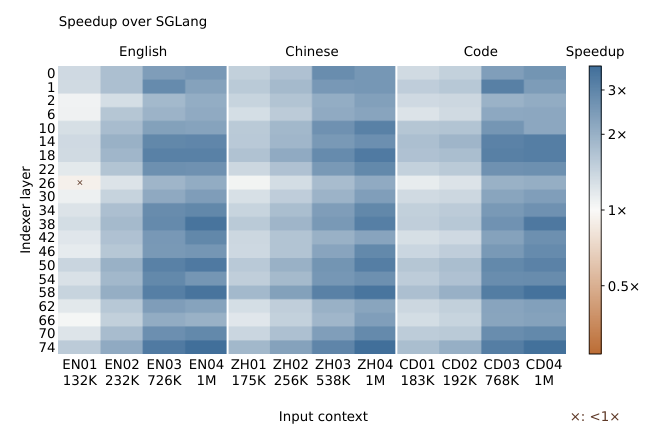
Most cells show substantial speedup (log scale centered at 1\times), but a handful of layers (marked with crosses) run slower than the dense baseline — these are layers where the certificate is loose, either because the selection margin is small or the head geometry prevents tight residual bounds. Five cells required capacity-repair remeasurements (Appendix D.4), suggesting edge cases where the certificate rejects too few candidates and the overhead of screening is not amortized.
Limitations and open questions
- Certificate tightness is geometry-dependent. The slower per-layer cells show DoSA offers no guarantee of per-layer speedup; some layers lose to a well-tuned dense kernel. Characterizing which indexer head configurations are DoSA-friendly a priori is unresolved.
- Seed selection. The paper fixes a seed scheme to initialize \tau; the quality of this bound directly controls pruning yield. Adaptive or query-dependent seeding is not explored.
- Prefill-focused. Microbenchmarks and TTFT emphasize prefill. Decode behavior — where key reuse and query batching differ — receives less attention.
- Dependence on nonnegative projections. The upper-bound construction relies on properties of the ReLU-rectified head form; extension to indexers without [\cdot]_+ (e.g., softmax-weighted auxiliary scorers) is not immediate.
Why this matters
Learned indexers were introduced to make attention sparse, but they themselves scale as O(HN) per query and increasingly dominate long-context prefill cost. DoSA shows that lossless Top-K selection admits a certificate-driven conditional execution that cleanly maps to Tensor Core pipelines, converting an algebraic bound into near-2\times end-to-end TTFT improvements without any accuracy loss — a template likely to generalize to other Top-K gating structures in MoE routing and retrieval-augmented decoding.
Source: https://arxiv.org/abs/2610.13990
GreenWAM: A World Foundation Model for Robotics
Robotics has largely bifurcated into two modeling traditions: world models that predict future observations conditioned on actions, and policies (VLA or world-action hybrids) that output actions conditioned on observations and goals. Each robot platform typically ships its own action schema — joint vectors of different dimensionality, end-effector parameterizations, gripper encodings — forcing per-robot retraining of both. GreenWAM asks whether a single generative model can play both roles across heterogeneous embodiments, and what training recipe makes that transfer stable.
Problem framing
The core bet is that the generative substrate used for action-conditioned video prediction is also a usable prior for action generation, provided the action channel is embodiment-invariant. The paper formalizes three operating modes for the same backbone:
- Visual mode: unconditional or text-conditioned video prediction, p_\theta(v_{1:T} \mid v_0, c).
- Action-conditioned (world-model) mode: p_\theta(v_{1:T} \mid v_0, a_{1:T}).
- World-action mode: joint p_\theta(v_{1:T}, a_{1:T} \mid v_0, c), from which a policy p_\theta(a_{1:T} \mid v_0, c) is extracted.
Training spans all three modes jointly, so the same weights absorb kinematic grounding (video follows actions), visual priors (large unlabeled video), and goal-conditioned behavior.
Architecture and the action-expert split
The generator is a diffusion/flow video model with an action channel injected into the denoising transformer. For the policy role, GreenWAM splits an “action expert” off the shared generator — a smaller head that reuses the generator’s intermediate representations but is specialized to output action trajectories, trained with a behavior-cloning objective aligned to the diffusion loss on the visual stream. This avoids the standard inefficiency of running the full video decoder at control time while preserving the gradients that aligned actions and dynamics during joint training.
Three training modes are interleaved so each batch contributes to the shared representation:
- Pure video batches update visual priors.
- (v_{1:T}, a_{1:T}) batches make the model a faithful world model.
- Goal-conditioned batches with target images or text drive the policy objective.
Results
As a world model, GreenWAM leads WorldArena 1.0 on trajectory accuracy, depth consistency, and 3D geometric metrics, outperforming all compared video generators and world-action baselines in the authors’ comparison.
As a policy:
- On the RoboTwin 2.0 leaderboard it ranks among the top entries despite not being specialized to those tasks.
- On LIBERO-plus (zero-shot), it achieves the highest success rate among the compared methods.
- On CALVIN and LIBERO it is competitive with dedicated VLA and world-action policies.
The headline is less that any single number is state-of-the-art and more that one set of weights is simultaneously a top-tier world model and a top-tier zero-shot policy — a comparison that previously required picking different model classes.
Limitations and open questions
Several items are left open by the available text:
- The anatomical slots require per-robot authoring. Scaling to very different morphologies (soft robots, quadrupeds with underactuation, tendon-driven hands) likely needs more than remapping, and the paper does not quantify how much manual mapping effort limits throughput of new embodiments.
- Zero-shot results are reported on LIBERO-plus; the degree of transfer to physical hardware under distribution shift (lighting, dynamics, latency) is not substantiated by the abstract.
- Joint training of visual, action-conditioned, and world-action modes introduces mixing coefficients whose sensitivity is not discussed; given that policy and world-model objectives can trade off, this likely matters.
- Inference cost of the full generator is high; the action-expert split helps for control, but closed-loop world-model-in-the-loop planning at useful horizons remains constrained by diffusion sampling cost.
- The 20-family coverage still underrepresents long-horizon mobile manipulation and contact-rich tool use; whether the shared anatomy helps in these regimes is unclear.
Why this matters
If a single generative backbone can be a strong world model and a strong policy across embodiments, the current separation between video world models, VLAs, and world-action hybrids is partly an artifact of training conventions rather than a fundamental architectural need. The anatomical action space is a simple, portable abstraction that could become the robotics analogue of a tokenizer — a prerequisite for scaling joint training across the long tail of robot platforms.
Source: https://arxiv.org/abs/2610.18774
Jeva: System One Models from First Principles
Problem
Classification-style decision making in LLMs typically serializes the request and all candidates into a single prompt and decodes an answer token. This conflates four structural properties that a decision problem actually requires: (i) null-awareness — distinguishing “no acceptable option” from “uncertain among options”; (ii) permutation invariance — reordering candidates must not change the prediction; (iii) option scalability — K must be variable without redefining the output head; and (iv) cacheability — option encodings that recur across requests should be reusable. The paper formalizes these and introduces Jeva, an architecture that enforces them by construction rather than through prompt engineering or data augmentation.
Method
A decision instance is a tuple (x, \iota, t, \mathcal{O}) of state, question, decision type, and candidates \mathcal{O} = (o_1,\ldots,o_K), K \geq 2. Two textual templates separate roles: T_x(t,\iota,x) carries the request, T_o(t,o_i) carries only the type and a single candidate — no index, no sibling options, no question. A shared language backbone E_\theta with last-nonpadding pooling and bias-free projections produces
z_0 = P_x E_\theta(T_x(t,\iota,x)), \qquad u_i = \operatorname{nrm}(P_o E_\theta(T_o(t,o_i))),
with z_0, u_i \in \mathbb{R}^d and stabilized \ell_2 normalization on options. The rows of U = [u_1^\top;\ldots;u_K^\top] are frozen within a forward pass; a compact “decision stack” then refines only z_0 against U as immutable memory, producing a conditioned state z scored symmetrically against each u_i.
The authors give a clean motivation for refining the state rather than scoring independently. If scores factor as g(x,\iota,o_i) and are softmax-normalized at temperature \tau, then
\log \frac{q_i(\mathcal{O})}{q_j(\mathcal{O})} = \frac{g(x,\iota,o_i)-g(x,\iota,o_j)}{\tau},
so the denominator cancels: adding or removing a third option can rescale probabilities but never reverse the preference between i and j. A set-conditioned state is required to express realistic set-dependent reversals, while option vectors remain reusable.
Permutation invariance is handled by symmetric aggregation across the u_i (the paper’s Proposition 3), and option scalability by shared scoring (one dot-product head, variable K). Null handling is factorized: a competition distribution q over candidates and a separate coverage scalar \rho \in [0,1] estimating whether any candidate is acceptable, with final mass (1-\rho) assigned to null. The two are explicitly decoupled: a uniform shift of candidate scores leaves q fixed but changes \rho, while adding a coverage logit s_C=0.4 at fixed candidate scores preserves \rho but redistributes p (reported thresholds \tau_\text{dec}=0.20, \tau_\text{cov}=0.15, b_\text{cov}=0.50). Cacheability follows from the independent encoding: u_i depends only on (t, o_i), so an option bank can be keyed by that pair and reused across requests and across candidate subsets.
Results
On the common evaluation suite — Typed Decisions (2,000 examples), BANKING77, MASSIVE at K \in \{8,16\}, and three Mind2Web slices with 16 candidates — Jeva leads seven of eight full-coverage slices. BANKING77 and MASSIVE exceed 90% at both candidate counts. Mind2Web cross-task/cross-website/cross-domain selection reaches 79.99%, 62.25%, and 66.23%. On Typed Decisions, Jeva reaches 78.30% versus InternDecision-4B’s 78.70% — essentially tied with a much larger baseline.
The decoupled null/score heads translate into calibration gains: on 600 Noul and 800 Score items, Jeva has the lowest Noul Brier (0.0184) and MAE (0.0939), and the lowest Score MAE (0.2315); its Score RMSE (0.3222) is within noise of InternDecision-4B’s 0.3208.
The permutation experiment is the sharpest demonstration. Across 600 Choice examples run in original, reversed, and up to three seeded random orders, Jeva produces zero label flips, mean total variation 3.17 \times 10^{-8} (numerical, not statistical, variation), and identical 76.67% accuracy in every ordering. Baselines Jev-1.13.0, InternDecision-4B, and JevK5 flip on 17.00%, 22.67%, and 26.17% of examples, with all-order accuracies collapsing to 66.67%, 64.50%, and 47.83%. This is the expected behavior: a serialized-decoding model has no mechanism to enforce symmetry, and empirically it does not acquire one from training data alone.
The ToolRet evaluation across six disjoint candidate-count cohorts shows that the option-bank reuse yields p50 latency improvements in natural request streams (256-row / 131,072-token batching), while valid coverage is 77% (65/84 requests on the reported slice). The nested-candidate-set test (83 queries evaluated at varying K) measures all-size accuracy — correctness at every K for the same query — which is where permutation-sensitive baselines degrade most.
Limitations
The evaluation is on classification-style decisions with modest K (up to 16); scaling behavior for K in the thousands, where coverage calibration and bank eviction policies become central, is not studied. The coverage head is trained against soft targets whose construction is not fully specified in these excerpts, and Score RMSE parity with a larger baseline suggests the regression head is not the differentiator — the structural guarantees are. Finally, decision stacks that refine only the request state cannot represent genuinely pairwise option interactions (e.g., “pick the cheapest among the compatible ones”) unless such interactions are encoded in z via attention to U; the paper’s symmetric aggregation design needs to be examined for whether it admits such second-order reasoning.
Why this matters
Jeva is a concrete demonstration that four properties routinely violated by prompt-and-decode classifiers — null-awareness, permutation invariance, option scalability, and option cacheability — can be enforced architecturally without sacrificing accuracy, and that doing so eliminates failure modes (26% flip rates under reordering) that are invisible on standard benchmarks but catastrophic in deployment. For any system-one layer in an agent stack that routes among tools, intents, or actions, this is the right default shape.
Source: https://arxiv.org/abs/2610.18773
Agent-Reflex: Teaching Language Agents to Act Reflectively
Problem
Deployed LLM agents interacting with MCP tool servers face two sources of non-stationarity absent in curated benchmarks: tools return malformed, rate-limited, or stale outputs, and users intervene mid-trajectory with corrections. Standard agent RL and trajectory-level SFT provide no explicit supervision for detecting such failures, recovering from them, or incorporating user feedback. Empirically the gap is severe: as shown in Figure 1, even GPT-5.2 and Claude-4.5-Sonnet lose substantial success rate under tool and user noise relative to the clean setting, and the mined failure distribution is heavy-tailed across eight distinct error families drawn from 24,510 real error returns out of 177,700 logged tool calls.
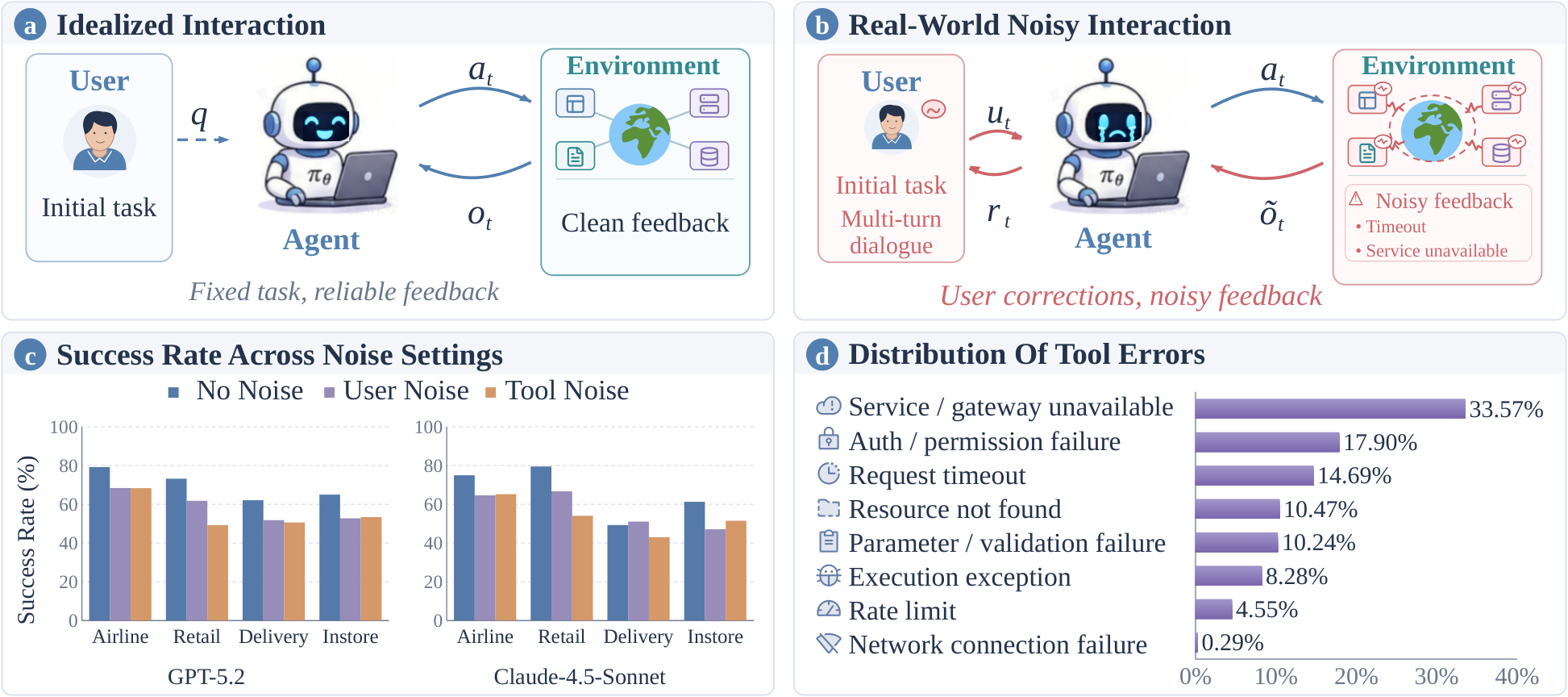
Agent-Reflex targets this by making reflection — self-diagnosis, skill recovery, and user-centric correction — a first-class training signal rather than a prompt-time add-on.
Method
The framework has three stages, built on top of a Qwen3-8B backbone.
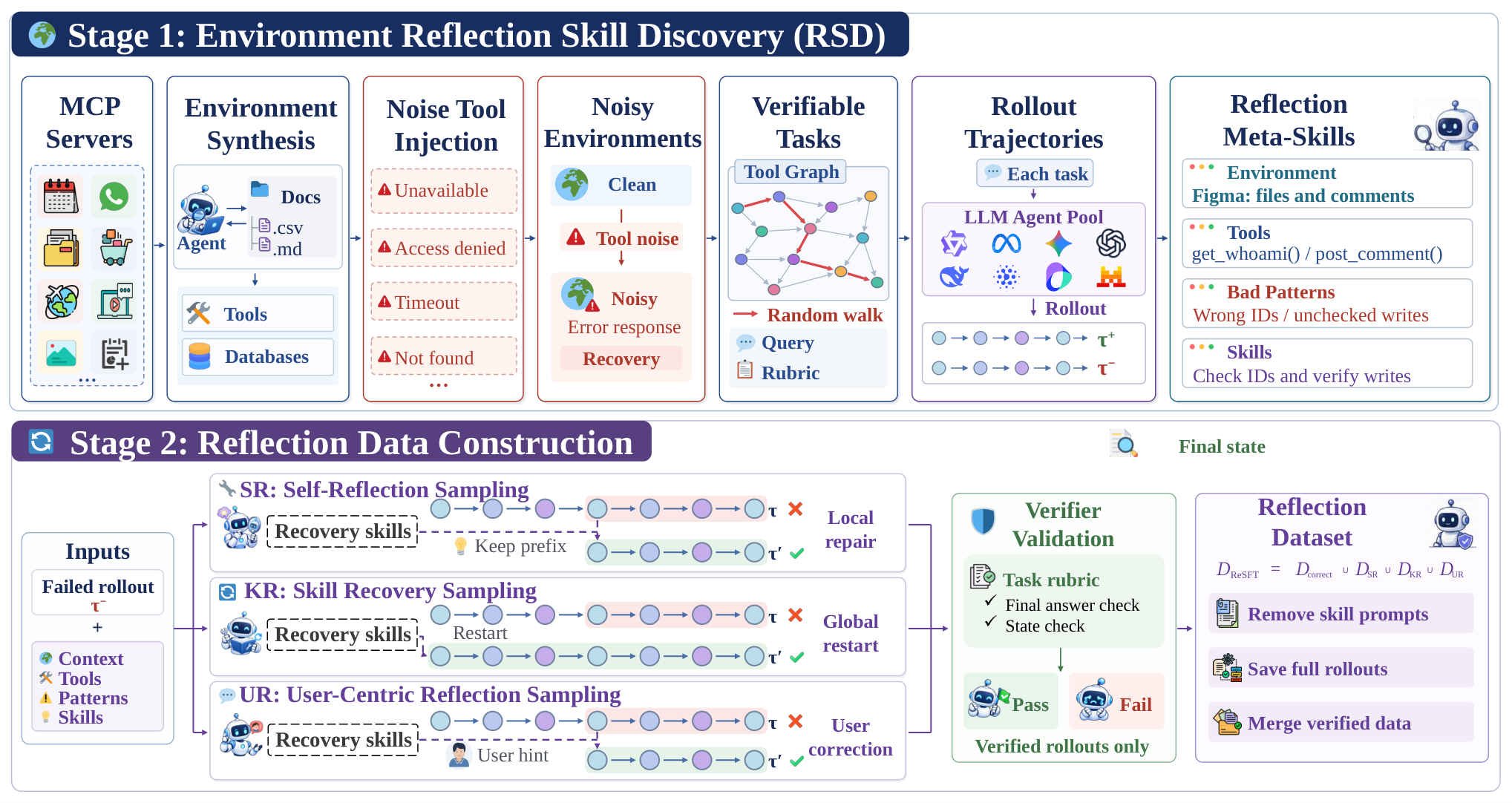
Stage 1 — Environment Reflection Skill Discovery (RSD). The authors instantiate 557 MCP-anchored environments from Smithery. For each topic m, a research agent constructs a grounded database and a coding agent synthesizes candidate tools and unit tests; only tools that compile, pass tests, respect state-transition constraints, and support executable verifiers are retained. Each \mathcal{E}_m yields 60 verifier-backed tasks.
Perturbations are not synthetic: tool returns from nine public agentic benchmarks are replayed and the 24,510 observed error returns are clustered into eight actionable failure families. At training time, tool returns are stochastically rewritten by a renderer J:
o_{t+1}^{\text{train}} = \begin{cases} J(o_{t+1}), & b_{t+1}^{\text{inj}}=1 \\ o_{t+1}, & b_{t+1}^{\text{inj}}=0 \end{cases},\quad b_{t+1}^{\text{inj}} \sim \text{Bernoulli}(p_{\text{inj}}).
J draws from failures compatible with the invoked tool f_t and balances across the eight families so rare modes are still learnable. A diverse LLM pool rolls out both clean and perturbed tasks; verifier-matched success/failure pairs sharing a prefix are mined, and the divergent suffixes are summarized into reusable reflection meta-skills stored in an offline skill library.
Stage 2 — Reflective Supervised Fine-Tuning (ReSFT). Each library skill is converted into three continuation types sampled from the paired trajectories: local self-repair (SR), global skill-recovery (KR), and user-correction (UR). The skill card is used only as a prompt during generation; after verifier validation it is stripped so the student learns to invoke the skill implicitly from context (Figure 2).
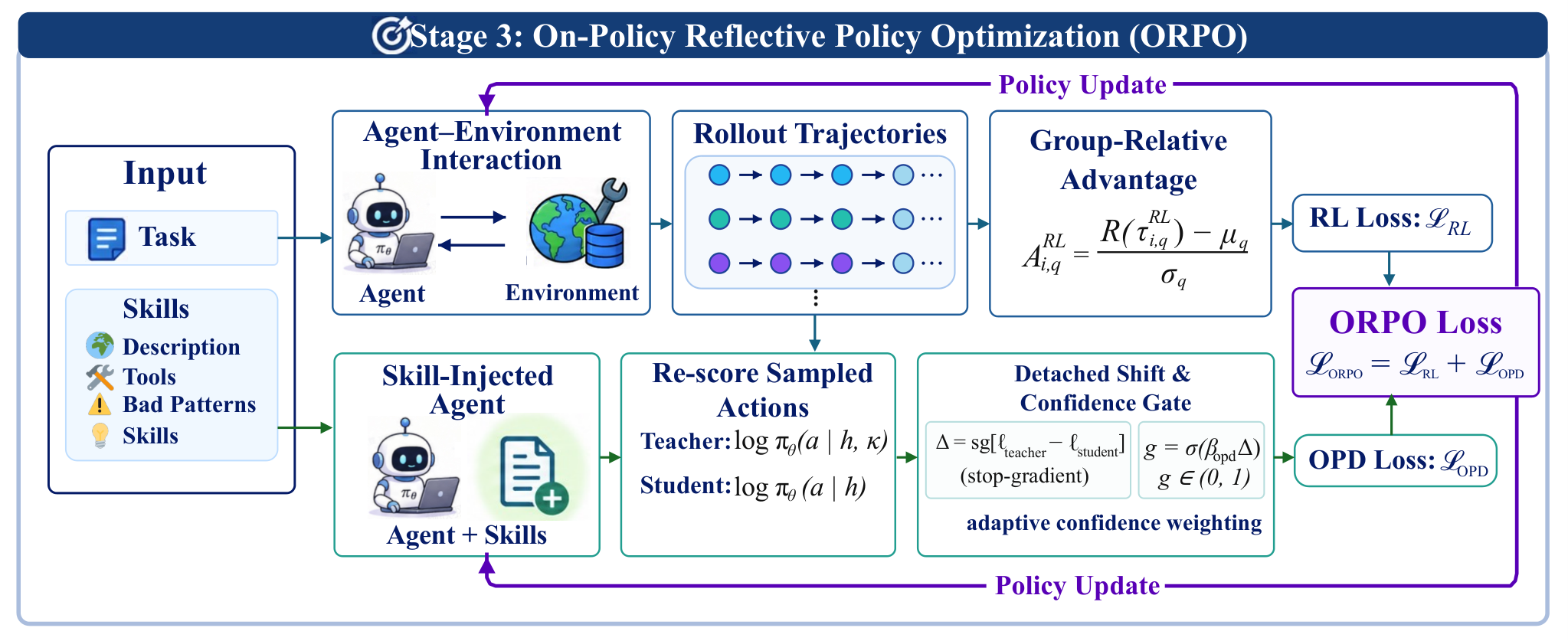
Stage 3 — On-Policy Reflective Policy Optimization (ORPO). The RL phase combines noisy agentic RL with on-policy distillation (OPD) from the skill-conditioned teacher. A rollout group mixes mostly clean trajectories with a few perturbed ones and shares a single group-normalized advantage, analogous to GRPO but defined over heterogeneous environments. The OPD signal rescores the same tokens twice — with and without the environment’s skill card prepended — producing a detached, confidence-weighted auxiliary loss (Figure 3). This gives dense per-token reflection supervision without changing the sampling distribution and without requiring the skill card at inference.
Results
All trained baselines start from Qwen3-8B under a shared protocol. Evaluation spans two groups: long-horizon tool use (BFCL-v4, ACEBench, a 200-task stratified ToolSandbox, \tau^2-Bench, VitaBench) and noisy interaction (AgentNoiseBench instantiated on the \tau^2-Bench and VitaBench tool- and user-noise variants). Each benchmark uses its official metric under the EnvScaler MCP format.
The paper’s selected sections do not expose the full result table, but the design and ablation structure point to gains along three axes: (1) recovery rate under injected tool failures (the eight-family balanced injection ensures tail coverage), (2) adherence to user corrections in UR-trained continuations, and (3) retained clean-task performance via the mostly-clean mixing in ORPO’s group-advantage estimator. Comparisons are drawn against three baseline families — reflection prompting (Reflexion and successors), environment-scaling methods, and trajectory-level RL (GRPO, DAPO, and recent variants) — all re-run on the same Qwen3-8B.
Limitations and open questions
Several issues remain. The failure taxonomy has only eight families mined from one logging pass; failure modes outside this support (e.g., semantically correct but temporally stale returns, adversarial tool outputs) are not explicitly modeled. The injection probability p_{\text{inj}} is a free hyperparameter that trades robustness for clean-task fidelity; the paper’s selected sections do not disclose a sweep. Stripping skill prompts after verifier validation assumes the student can internalize the trigger, but there is no analysis of whether skill invocation generalizes to novel tools absent from the 557-environment ecosystem. Finally, OPD’s detached, confidence-weighted term resembles a KL to a skill-conditioned teacher; its interaction with the group-normalized RL advantage (sign conflicts, variance inflation under heterogeneous rollouts) deserves theoretical treatment.
Why this matters
Reflection in LLM agents has largely been a prompting trick layered on frozen models. Agent-Reflex operationalizes it as a trainable capability grounded in a mined, long-tailed distribution of real tool failures, and ties SFT and RL together through a shared skill library and on-policy distillation. If the quantitative gains hold at scale, this template — mine failure modes, synthesize paired recovery trajectories, distill with a detachable skill card — is a reusable recipe for robustifying any tool-using agent.
Source: https://arxiv.org/abs/2610.17953
Urbex: Agentic Spatial Grounding for City-Scale 3D Scenes
Problem
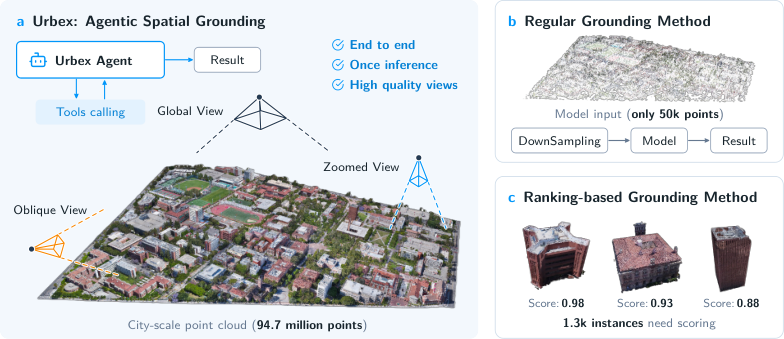
City-scale 3D visual grounding — localizing an object referred to by a natural-language query inside a kilometer-scale outdoor point cloud — is dominated by candidate-ranking pipelines. Given a scene \mathcal{S} and query q, methods such as CityRefer and CityAnchor pre-extract a set \mathcal{C} = \{o_i\}_{i=1}^N of instance proposals and learn a score s(q, o_i). This has two structural weaknesses: (i) accuracy is upper-bounded by the proposal generator, which must survive dense repeated geometry (parked cars, lampposts, identical buildings), and (ii) scoring every candidate for every query is expensive. Dense point-cloud grounding methods like EDA, imported from indoor settings, instead downsample the full cloud and lose the fine geometry needed to resolve small urban targets.
Urbex sidesteps proposals entirely by casting grounding as active spatial search performed by a VLM agent.
Method
Environment. The scene is exposed to the agent as a set of BEV-aligned views \mathcal{V}. Each v \in \mathcal{V} carries an RGB observation I_v and a view-to-world transform T_v. The initial observation is a global BEV image I_{\text{global}}. The agent emits bounding boxes \hat{b}_v in a normalized 2D frame local to the current view; the environment lifts them back to world coordinates via T_v, giving the VLM a clean 2D visual interface while retaining metric 3D grounding. Crucially, no candidate set is passed in: ground-truth boxes are used only for training rewards and evaluation.
Tool-use loop. At step t the policy conditions on the current observation o_t and the interaction history h_t = (o_{<t}, a_{<t}) and selects one of several tools: query a landmark (text-based attention to known POIs), zoom into a local patch of the current view, render an oblique view at a chosen azimuth/elevation, or commit a final box. Each tool call extends \mathcal{V} with a new (I_v, T_v) pair.
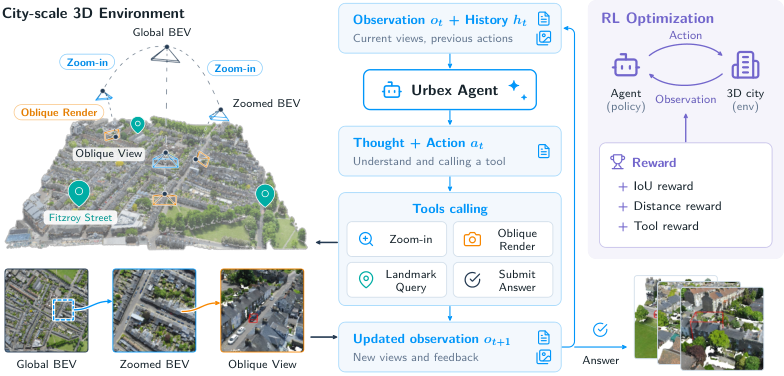
Reinforcement learning. Prompted tool use alone is insufficient — strong general VLMs connected to the same environment underperform. Urbex optimizes the policy with RL on CityRefer trajectories. The terminal reward combines a smooth localization signal based on IoU with a center-distance term, which avoids the sparse 0/1 cliff of hard IoU thresholds and provides gradient even when early boxes miss. Shaping rewards at the tool level encourage efficient exploration — e.g., penalizing redundant zooms and rewarding information-bearing view changes — so the policy converges to short trajectories rather than exhaustive scanning. The result is a learned search policy over views, as opposed to a learned ranker over proposals.
Results
On CityRefer, Urbex reports the best Hit@1 and IoU among the compared methods. The comparison spans three groups: (1) general-purpose VLMs (GPT-5.4, Qwen3.6-plus) connected to the Urbex environment via prompting only; (2) indoor 3D grounding methods (EDA on downsampled clouds, InstanceRefer on provided instances); (3) city-scale ranking methods (CityRefer, CityAnchor). The prompt-only VLMs demonstrate that the tool interface and reasoning priors alone are not sufficient — RL on top of the same environment is what closes the gap. EDA suffers from the downsampling-induced loss of fine geometry; InstanceRefer is competitive but relies on provided instances, i.e., it is solving an easier task than full-scene localization.
Beyond accuracy, Urbex is reported as substantially faster than the strongest city-scale ranking baseline, because it visits a handful of views instead of scoring every proposal in \mathcal{C}. The qualitative traces show the agent beginning from the global BEV, zooming to a candidate neighborhood identified by landmark cues (“the building north of the plaza”), optionally rendering an oblique view to disambiguate height-dependent targets, and only then committing the box.
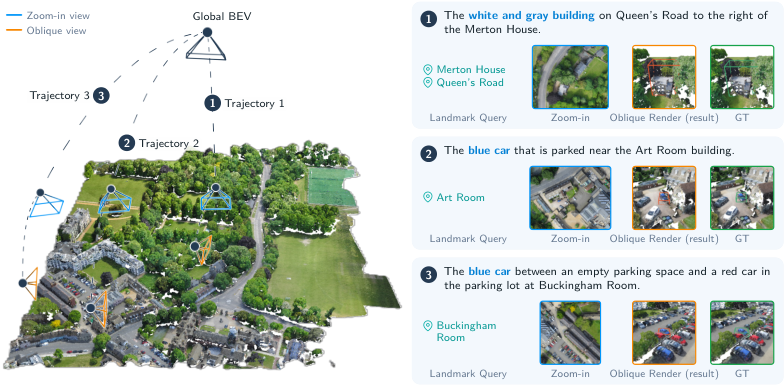
On STPLS3D-Refer — an evaluation set the authors construct from STPLS3D with geometry and appearance different from CityRefer — Urbex transfers zero-shot and improves cross-scene robustness, suggesting the learned policy generalizes beyond the training distribution of scene layouts.
Limitations and open questions
Several points are worth probing. First, the environment commits to BEV-aligned views; targets occluded from above (under bridges, inside courtyards) may be hard to recover even with oblique renders. Second, landmark queries presuppose a usable POI index, which is cheap for mapped cities but not for arbitrary environments. Third, the terminal reward uses ground-truth boxes for IoU and center distance — scalable self-supervised shaping (e.g., consistency across views) would be needed to extend training beyond annotated city datasets. Fourth, the paper’s main metrics are Hit@1 and IoU on CityRefer, but the exact numbers, trajectory lengths, and ablations over the shaping terms are reported in the full tables rather than the sections excerpted here; the sensitivity to the center-distance weight versus IoU weight in the terminal reward is the obvious thing to stress-test. Finally, scaling to multi-object or compositional queries (“the second car to the left of the red truck”) is not addressed; the current action set commits a single box.
Why this matters
Urbex reframes a retrieval problem as a search problem, which is the right move when the proposal set is both large and lossy. The combination of a view-based 2D action interface with RL-shaped tool use is a reusable recipe for grounding in any scene where candidate enumeration is the bottleneck — outdoor 3D, aerial, and large indoor environments included.
Source: https://arxiv.org/abs/2610.18356
VideoJev: System One Model for Video Understanding and Interaction
Problem
A visual agent operating over a video stream must repeatedly answer “what happened and when” with low latency as new goals arrive. Autoregressive MLLM decoding is a poor fit: it re-encodes the video for each query, generates variable-length token strings that must be parsed back into intervals or option indices, and provides no calibrated score for ranking candidates. VideoJev replaces answer generation with direct scoring of candidate hypotheses — temporal intervals or textual options — against a cached video prefix, unifying temporal grounding and multiple-choice VideoQA under one decision interface.
Method
The architecture starts from a pretrained MLLM with native video input and a causal language backbone. Two modifications turn it into a scorer. First, two special tokens are introduced: <|option_end|> terminates each candidate and provides a per-candidate readout h_i; <|decide|> provides a per-query readout h_d. Both are initialized from the pretrained <|im_end|> embedding so the backbone retains its sequence-termination inductive bias. Second, the language-model head and the final MLP are removed, following the observation that pre-MLP features align better with semantic similarity. Two separate linear projections map h_d and h_i to 512-d, L2-normalize them, and compute a scaled cosine logit:
u=\frac{W_{q}h_{d}+b_{q}}{\|W_{q}h_{d}+b_{q}\|_{2}}, \quad v_{i}=\frac{W_{k}h_{i}+b_{k}}{\|W_{k}h_{i}+b_{k}\|_{2}}, \quad s_{i}=10\,u^{\top}v_{i}+b.
The fixed scale 10 and learned scalar bias b are standard tricks from contrastive-head design that stabilize softmax temperature and absolute-confidence calibration. For temporal grounding, candidates are intervals encoded as timestamp pairs; the per-candidate scores define a span by argmax (or thresholded selection). For multiple-choice VQA, candidates are the textual options and the argmax selects the answer. The input format for both tasks is identical: a video prefix followed by one or more query suffixes each ending in <|option_end|> tokens for candidates and a <|decide|> token for the query.
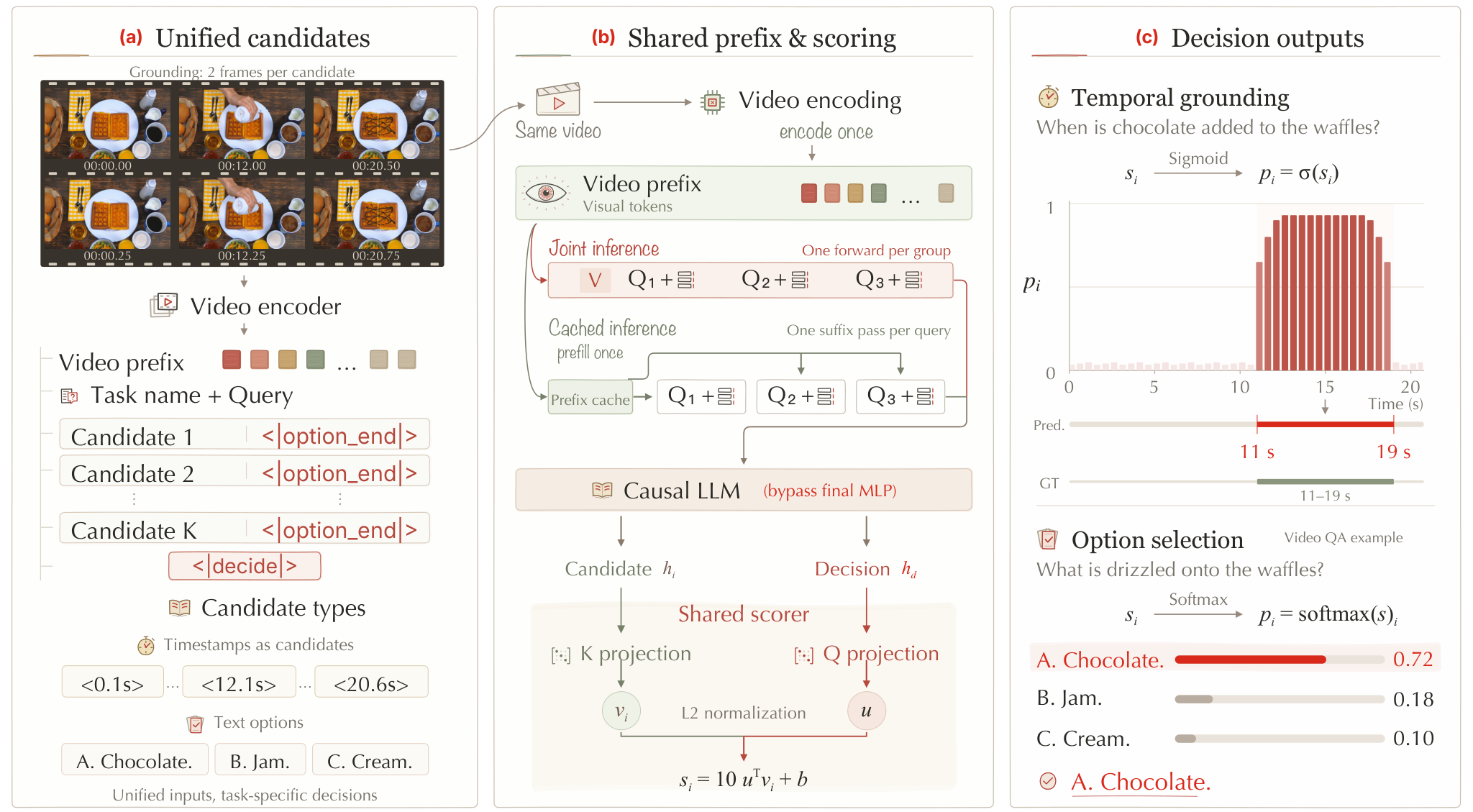
Because the video prefix dominates compute, the system exposes two inference modes that share the backbone and scorer. Cached inference prefills the video KV cache once, then processes each query suffix independently against that cache — useful when queries arrive asynchronously. Joint inference packs a group of queries into a single causal forward pass behind the shared prefix, amortizing attention over the video tokens across all queries in the group. Both modes are drop-in alternatives; Joint is the default in experiments.
Training uses 64 H200s, BF16, global batch 64 of packed sequences, 2 fps video sampling, max 144K tokens with an 80% visual-token budget, and a two-stage schedule: 160 updates of head alignment (head LR 3\times10^{-4}, backbone frozen) followed by 375 updates of joint adaptation (head LR 10^{-4}; backbone LR 5\times10^{-6} for 4B, 2\times10^{-6} for 35B-A3B). AdamW with weight decay 0.01, gradient clipping 1.0, 5% warmup and cosine decay to 10% of peak are used for both stages. ZeRO-2 is used for the 4B model, ZeRO-3 for the 35B-A3B MoE.
Results
Across three temporal grounding benchmarks, VideoJev-4B improves mean mIoU over its backbone by 6.7 points and VideoJev-35B-A3B by 10.8 points, with wall-clock inference speedups of 2.8–3.1×. The larger improvement for the MoE model is consistent with a scorer head benefiting from stronger pre-MLP semantic features. On four multiple-choice VideoQA benchmarks (the abstract is truncated in the excerpt but the setup is described), the same architecture handles option scoring without task-specific heads.
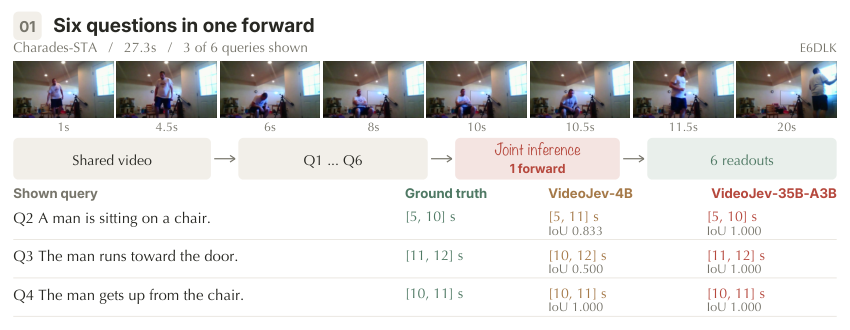
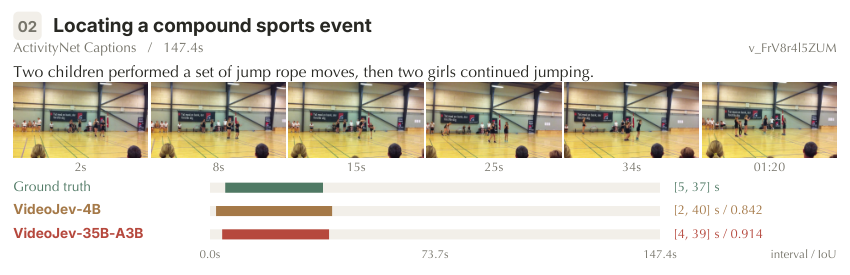
Figure 6 illustrates Joint inference on Charades: six queries are grounded in a single forward over the shared prefix, both models match a one-second transition, and the 35B-A3B variant locates adjacent actions more precisely. On ActivityNet Captions compound events, the 35B-A3B model’s interval tracks the annotated span more tightly than the 4B baseline.
Limitations and open questions
The method is evaluated only on tasks that reduce cleanly to candidate scoring; open-ended generation (captioning, free-form QA) is outside its scope. Interval candidates must be enumerated — the paper does not describe how dense or adaptive the proposal set is, which likely bounds temporal resolution. The fixed logit scale of 10 and the shared <|im_end|> initialization are heuristic choices without ablation reported in the excerpt. The authors propose extending the candidate interface to action recognition, event detection, scene-state classification, and condition verification, but this generalization is future work. Confidence calibration is examined but the specifics are not in the provided sections.
Why this matters
VideoJev shows that a scorer head over a pretrained MLLM, combined with aggressive video-prefix caching, retrieves most of the benefit of an MLLM while delivering agent-usable decisions at 2.8–3.1× lower latency and double-digit mIoU gains. For streaming visual agents where the same video is interrogated by many evolving queries, this is a more principled interface than autoregressive decoding.
Source: https://arxiv.org/abs/2610.18615
Hacker News Signals
A Dynamic and Distributed Virtual GPU Cloud Built on Idle Apple Silicon Devices
Apple ML Research describes a system that aggregates idle Apple Silicon devices (Mac Studios, Mac Pros, Mac minis) across an organization into a unified virtual GPU pool. The core problem is utilization: Apple Silicon machines are often idle overnight or between jobs, yet their GPU/Neural Engine capacity sits wasted. The system virtualizes these into a shared pool accessible to researchers without requiring dedicated datacenter hardware.
The architecture uses a distributed scheduler that tracks device availability in real time, routes workloads to machines with sufficient free GPU memory, and handles preemption when a device’s owner resumes local use. The key engineering challenge is graceful preemption — checkpointing model state mid-training and migrating to another node without the user noticing. They address this with a lightweight checkpoint-on-preempt protocol that saves optimizer state and RNG seeds to fast local NVMe, then resumes on another machine within seconds.
Networking uses a mesh topology over the existing corporate LAN, with gradient compression for distributed training jobs to avoid saturating 1 GbE links. The system exposes a CUDA-compatible abstraction layer so existing PyTorch/JAX code runs unmodified; the virtualization layer intercepts Metal API calls and translates them.
Reported utilization gains are substantial: cluster-level GPU utilization rose from roughly 15% to over 70% by harvesting idle time. Latency for interactive inference jobs is kept under 50 ms P99 by preferring machines with warm model caches. The system also supports multi-device tensor parallelism across heterogeneous Apple Silicon generations, though they note bandwidth constraints between nodes limit scalability for very large model shards.
Limitations include dependence on a homogeneous macOS environment and corporate network assumptions. The preemption latency guarantee degrades under heavy local load, and cross-node communication overhead makes it unsuitable for large-scale gradient-synchronous training beyond a few dozen nodes.
Source: https://machinelearning.apple.com/research/distributed-gpu-cloud
DishwasherBench – Can Frontier Models Stack a Dishwasher?
DishwasherBench evaluates whether frontier vision-language models can reason about a concrete physical planning task: given an image of dirty dishes and a dishwasher, produce a valid loading plan. The benchmark is motivated by the gap between high performance on abstract reasoning tasks and failure on mundane spatial/physical common sense.
The technical substance is in the evaluation protocol. Each test case provides an image of dishes (varied sizes, shapes, fragility) and a dishwasher rack layout, then asks the model to assign items to rack positions. Scoring uses a rule-based checker that validates against physical constraints: items must not block spray arms, fragile items go on the top rack, large items cannot share slots, and cutlery orientation follows safety conventions (knives point down). These constraints are encoded explicitly so evaluation is deterministic rather than relying on another model as judge.
The benchmark distinguishes perception errors (misidentifying an item) from planning errors (correctly identifying items but placing them incorrectly) and constraint-violation errors (violating a hard physical rule). This decomposition lets you attribute failure modes: GPT-4o and Gemini 1.5 Pro achieve reasonable item identification but fail frequently on spatial constraint satisfaction, particularly spray-arm clearance which requires reasoning about 3D occlusion from a 2D image.
Results as reported show top models achieving roughly 40-55% fully valid plans, with most failures being constraint violations rather than perception failures. This is a useful signal: the bottleneck is physical reasoning, not vision.
Limitations are apparent: the dishwasher layouts tested are a small set, the constraint checker does not model water dynamics, and real loading has continuous geometry that discrete slot assignments approximate poorly. Still, as a reproducible, automatically-scored benchmark for physical common sense it fills a gap that purely linguistic benchmarks miss.
Source: https://github.com/composo-ai/DishwasherBench
Show HN: Parsimony – An Open-Source Benchmark for How Much Code AI Models Add
Parsimony measures code bloat introduced by AI coding assistants: given a task, how many more tokens/lines does the model emit compared to a reference human solution? The motivation is that current benchmarks (HumanEval, SWE-bench) measure correctness but ignore verbosity, which has real costs — larger diffs to review, more surface area for bugs, more tokens consumed in downstream context.
The benchmark defines a parsimony score as the ratio of reference solution size to model output size, normalized by correctness (a verbose but wrong solution scores zero). Tasks are drawn from competitive programming and real-world utility scripts where a compact idiomatic solution exists. The evaluation pipeline runs model outputs through a test suite for correctness, then measures token count and cyclomatic complexity against the reference.
Results reported on the site show significant spread: models like Claude 3.5 Sonnet tend toward verbosity (defensive error handling, extensive comments) while models fine-tuned on competitive programming data are more terse. No model consistently matches human reference compactness while maintaining correctness. The benchmark also separates necessary verbosity (a longer solution that handles more edge cases) from unnecessary verbosity (boilerplate, redundant checks) using a manually-annotated subset.
The open-source release includes the task corpus, scoring harness, and a leaderboard. The scoring harness is straightforward Python: run model output, capture stdout, diff against expected, then tokenize with tiktoken for length.
Limitations: reference solutions are inherently subjective — “compact” in Python may not transfer to other languages, and some tasks genuinely require more code than the reference anticipates. The benchmark is also currently Python-only.
Source: https://parsimony.lasu.dev/
Intel D270 GPU AI Accelerator – Up to 480 GB LPDDR5X
The Intel D-series data center GPU line, with the D270 as the flagship, uses a unified LPDDR5X memory architecture rather than HBM, topping out at 480 GB of addressable memory. This is the primary differentiator: HBM-based accelerators (H100: 80 GB, MI300X: 192 GB) are constrained by physical HBM stack limits, while LPDDR5X allows much larger capacity at lower cost per bit, though with lower bandwidth per GB.
The D270 is built on Intel’s Xe2 GPU architecture, extended with matrix engines targeting INT8 and FP16 workloads. The 480 GB capacity makes it directly interesting for inference of 70B+ parameter models in full precision without sharding across multiple devices — a significant operational simplification. Peak memory bandwidth is reported around 1.6 TB/s (versus H100’s 3.35 TB/s for HBM3), so bandwidth-bound decode is slower per device, but the capacity advantage means fewer devices needed for large-model serving, potentially improving total-system bandwidth efficiency.
The OneAPI/SYCL software stack supports OpenCL and has PyTorch backend integration via Intel Extension for PyTorch. This is the persistent sticking point: CUDA ecosystem lock-in means real-world adoption requires either framework-level abstraction or significant porting effort. Intel’s track record with developer tooling for discrete GPU ML workloads has been rough, and the HN discussion reflects skepticism on this front.
The LPDDR5X choice also raises reliability and longevity questions: LPDDR is mobile DRAM, not server-grade, and its error correction, operating temperature ranges, and RAS (reliability, availability, serviceability) characteristics are less proven in datacenter continuous-operation contexts than HBM or GDDR6.
Source: https://www.intel.com/content/www/us/en/products/details/discrete-gpus/data-center-gpu/d-series.html
Show HN: SolidCraft – Open-Source Parametric CAD in Rust (With MCP Support)
SolidCraft is a parametric CAD kernel written in Rust that exposes its modeling operations through the Model Context Protocol (MCP), allowing LLMs to drive geometry construction programmatically. The core CAD engine wraps a boundary representation (B-Rep) kernel — based on OpenCASCADE bindings via the truck Rust crate — providing boolean operations (union, difference, intersection), extrusions, revolves, and fillets as first-class operations.
The parametric model stores construction history as a directed acyclic graph of operations with typed parameters. Changing an upstream parameter (e.g., a hole diameter) propagates through the graph and recomputes downstream geometry, which is standard parametric CAD behavior but rare in open-source Rust implementations. The Rust choice provides memory safety without GC pauses, relevant when recomputing complex B-Rep graphs interactively.
The MCP integration is the novel angle: SolidCraft exposes each CAD operation as an MCP tool, so a tool-calling LLM can issue sequences like create_box(10, 20, 30) → subtract(cylinder(r=5, h=35)) → export_step("part.step"). This enables natural-language-to-CAD workflows without fine-tuning, relying on the model’s ability to decompose geometric intent into API calls. The README includes examples of Claude generating valid STEP files from text descriptions.
Limitations are significant at this stage: the kernel handles simple mechanical parts but lacks advanced surfacing (NURBS lofts, complex splines) and the LLM interface has no geometry verification loop — the model can’t inspect the resulting shape and correct errors without external tooling. Tolerance and assembly management are absent. Still, as a foundation for LLM-assisted CAD it’s technically more grounded than text-to-mesh approaches because STEP output is directly usable in downstream manufacturing workflows.
Source: https://github.com/bherbruck/solidcraft
Running the Unmodified Linux amdgpu Driver on an iPad
This project boots a Linux kernel with the stock amdgpu kernel module on an iPad, leveraging the fact that the M-series iPads share GPU architecture with AMD’s RDNA lineage — or more precisely, it uses a PCIe passthrough approach via a Thunderbolt-attached external AMD GPU enclosure, then runs Linux in a VM that gets direct device access. The “unmodified” claim refers to the amdgpu driver itself requiring no source patches; the complexity is in the bootloader, VM configuration, and device tree manipulation to expose the GPU to the guest.
The technical path: UTM (QEMU-based VM for Apple Silicon) is configured with PCIe passthrough for the Thunderbolt-attached GPU. The Linux guest gets bare-metal GPU access, and since amdgpu supports the device’s PCI ID natively, it loads without modification. Display output is routed back to the iPad screen via a virtual framebuffer or remote desktop, since the iPad’s internal display isn’t directly addressable from the Linux guest.
The interesting engineering detail is IOMMU configuration on Apple Silicon — Apple’s implementation of the IOMMU for Thunderbolt devices must be bypassed or correctly configured to allow DMA from the guest. The repo documents the UTM XML configuration and kernel command-line parameters needed to make this work without IOMMU violations crashing the guest.
Practical utility is limited — you need a Thunderbolt GPU enclosure which costs more than a dedicated Linux machine — but the exercise demonstrates that Apple Silicon’s virtualization extensions and Thunderbolt PCIe tunnel are complete enough for GPU passthrough, which has implications for pro workstation use cases and jailbreak-free Linux on Apple hardware.
Source: https://github.com/Geramy/LemonSeed-Studio
Gemini 4 Argon for Robotics
Google’s Gemini 4 Argon is a variant of the Gemini 4 model specifically adapted for robotics control tasks. The technical differentiation from base Gemini 4 centers on action tokenization and low-latency inference: the model outputs motor commands and robot API calls as structured tokens, with a serving stack optimized for sub-100 ms end-to-end latency to support real-time control loops.
The architecture follows the vision-language-action (VLA) pattern: multimodal inputs (RGB images, depth where available, proprioceptive state, language instruction) are processed by the core transformer, and the output head produces either language tokens (for reasoning/planning) or action tokens (discretized joint velocities or end-effector poses). Argon adds a learned action tokenizer that maps continuous 7-DOF arm commands into a discrete vocabulary, enabling the same autoregressive decoding pipeline used for language to generate motor commands.
The blog post highlights performance on the RT-2 style evaluation suite and on dexterous manipulation benchmarks, with reported improvements over prior Gemini-based robot models on tasks requiring multi-step reasoning (e.g., “put the red block in the container that matches the color of the mat”). The model also demonstrates better recovery from perturbations by re-planning mid-episode.
Integration is via the Robotics API, targeting ROS2 and proprietary robot SDKs. A key engineering concern is the action discretization resolution — coarse tokenization loses fine motor precision, and the blog notes they use a hierarchical tokenization with a high-resolution residual for precise control.
Limitations not addressed: compute requirements at inference (running Gemini 4 on-robot is infeasible; all inference is cloud-based, introducing network latency), and generalization to novel objects or environments beyond the training distribution.
Source: https://developers.googleblog.com/gemini-4-argon-for-robotics/
Using AI for Just 10 Minutes Erodes Your Ability to Persist at Hard Things
A UC Berkeley study examines the effect of short AI-assisted problem-solving sessions on subsequent persistence at difficult tasks. The experimental design: participants are randomly assigned to solve hard problems with or without AI assistance, then given a follow-up set of difficult problems with no assistance available. The AI-assisted group shows measurably lower persistence (fewer attempts, faster disengagement) on the unassisted follow-up.
The mechanism proposed is a form of learned helplessness or effort discounting: brief exposure to AI-mediated effortless problem resolution recalibrates the subject’s effort-reward expectation. When effort is subsequently required without AI, the gap between expected and required effort triggers disengagement. This is distinct from skill atrophy (too short a window for that) — it is an attitudinal/motivational effect observable after a single 10-minute session.
Methodologically, the study uses validated persistence measures: time-on-task, number of re-attempts after failure, and self-reported frustration tolerance. Effect sizes are reportedly significant but modest, which matters for interpreting practical implications. The control condition matters too: it isn’t “hard problem with no help” versus “easy problem,” but specifically AI help versus self-reliance, isolating the AI mediation rather than difficulty per se.
The result is relevant to education and developer tooling design. If short-term AI use degrades the willingness to wrestle with difficult problems, tool designers face a tradeoff between immediate productivity and longer-term capability development. The study does not address whether the effect persists beyond the experimental session or habituates with repeated AI use — that is the critical open question. Longitudinal data on developers using coding assistants continuously would be far more informative.
Noteworthy New Repositories
YeonwooSung/llm-architecture-from-scratch
A pedagogical PyTorch repository that implements the core architectural families underpinning modern LLMs — attention variants, positional encodings, MoE routing, normalization schemes, and so on — from first principles rather than wrapping HuggingFace abstractions. Each component is self-contained and annotated, making it useful both as a reference implementation and as a testbed for architectural modifications. The repository is organized by architectural concept rather than by model name, which helps when isolating the effect of specific design choices (e.g., RoPE vs. ALiBi, pre-norm vs. post-norm). For researchers who routinely need to prototype new attention patterns or ablate positional encoding schemes without fighting framework internals, this provides a clean starting point. The code avoids unnecessary dependencies — no Accelerate, no PEFT — keeping the critical path legible. Useful for PhD-level coursework, paper reproduction, and as scaffolding for custom architectures that diverge from standard HuggingFace model configs.
Source: https://github.com/YeonwooSung/llm-architecture-from-scratch
mizorewww/laya-mlx
A native Apple MLX runtime for Laya-format typed decision models, targeting structured classification and routing tasks rather than generative inference. The key claim is 7–14 ms end-to-end decision latency on M3 Max, which is competitive with server-side inference for low-latency applications. The design is deliberately narrow: no text generation, no PyTorch dependency, no cloud API call. Models are expressed as typed decision trees or small discriminative networks serialized in the Laya format, and the MLX backend exploits the unified memory architecture of Apple Silicon to minimize data movement. This is a practically useful stack for on-device decision logic — content filtering, routing, feature flagging — where the generative LLM stack is overkill and the latency budget is tight. The absence of PyTorch is a genuine engineering choice: MLX’s graph-based dispatch avoids Python-side overhead and keeps the binary footprint small enough for embedding in macOS applications. Worth watching for anyone building local-first AI pipelines on Apple Silicon.
Source: https://github.com/mizorewww/laya-mlx
mw00/project-maya
A self-hosted inference stack for GLM-5.3-Flash, a 321B sparse MoE model, designed to run across heterogeneous consumer and prosumer GPU configurations — from a single card up to 16, covering both NVIDIA and AMD, on Linux and Windows. The project bundles five components: an inference engine with tensor-parallel and pipeline-parallel dispatch, an HTTP server, a web dashboard for monitoring, OpenAI- and Anthropic-compatible API endpoints, and quantization tooling for reducing VRAM requirements. Supporting AMD alongside NVIDIA across both major desktop OSes is a non-trivial engineering commitment that most open-source inference projects skip. The OpenAI/Anthropic compatibility layer means existing client code drops in without modification. The quantization tools are included in-tree, so users can trade precision for memory footprint without reaching for external toolchains. For practitioners who want to run a frontier-scale MoE privately — either for compliance, cost, or latency reasons — this covers the full operational stack rather than just the model weights.
Source: https://github.com/mw00/project-maya
nealbridges/VulnHunter
A maintained fork of Capital One’s VulnHunter, rebuilt to operate as an agentic AI security scanner decoupled from any single agent harness. The system operates adversarially: rather than producing a list of potential vulnerabilities, it attempts to prove exploitability by generating executable proof-of-concept code for each finding. The fix pipeline is test-first — patches are generated and validated against the PoC before being surfaced — which reduces the false-positive burden on the human reviewer. The architecture is agent-harness-agnostic, meaning it can be driven by LangChain, AutoGen, or custom orchestration. The adversarial framing (hunting like an attacker) matters operationally because it shifts the output from advisory to evidence-based, which is what security teams actually need to prioritize remediation. Rebuilding from the Capital One codebase rather than starting fresh preserves the vulnerability taxonomy and the PoC generation scaffolding, while the fork’s maintenance commitment addresses the upstream’s apparent stagnation. Relevant for DevSecOps pipelines and automated red-teaming workflows.
Source: https://github.com/nealbridges/VulnHunter
storytold/vectorcraft
A vector graphics editor written entirely in Rust with no native GUI toolkit dependency, implemented from scratch rather than wrapping Inkscape or a similar engine. Building a vector art tool from scratch in Rust means owning the full rendering pipeline: Bezier math, boolean path operations, stroke expansion, and SVG serialization all live in pure Rust. This is technically ambitious because correct Bezier offsetting and path boolean operations are notoriously difficult to implement robustly. The choice of Rust provides memory safety without a garbage collector, which matters for interactive rendering where pause-free frame delivery is required. The “from scratch” constraint distinguishes it from tools like Lapce or Zed that wrap existing rendering libraries — here the geometry kernel is the project. For systems programmers interested in computational geometry, this is a substantial reference codebase. For practitioners, the question is whether the geometry kernel is robust enough to handle degenerate inputs; that is typically where scratch implementations diverge from mature tools like Inkscape’s lib2geom.
Source: https://github.com/storytold/vectorcraft
jiwoochris/artex-global
A Korean-localized fork of ARTEX (Autumn-27/ARTEX, AGPL-3.0), an autonomous AI penetration testing framework. ARTEX automates the penetration testing lifecycle — reconnaissance, vulnerability identification, exploitation planning, and reporting — using an LLM-driven agent loop. This fork’s primary contribution is full Korean language support across the interface, prompts, and generated reports, addressing a gap for Korean security practitioners who need audit documentation in Korean for regulatory or organizational reasons. Beyond localization, the fork tracks the upstream AGPL-3.0 codebase and appears to maintain parity with upstream changes. Autonomous pentesting frameworks raise the same operational questions as VulnHunter: the value is in reducing the manual triage burden, but the quality of findings depends heavily on the agent’s ability to chain vulnerabilities rather than enumerate them independently. The AGPL license means any derivative SaaS deployment must open-source the modifications, which is relevant for commercial users evaluating the licensing implications.
Source: https://github.com/jiwoochris/artex-global
storytold/figcraft
A clean-room Rust reimplementation of collaborative design and prototyping workflows, targeting the feature surface occupied by Figma — vector editing, component systems, interactive prototyping, and real-time collaboration — without reusing any Figma code or assets. “Clean-room reimplementation” is a specific legal and engineering claim: the design is derived from observing behavior rather than from the source. Building collaborative design tooling in Rust means the CRDT or OT layer for multi-user editing, the rendering engine, and the constraint solver for responsive layouts must all be implemented natively. The pure Rust constraint is unusual; most collaborative editors reach for existing CRDT libraries (Automerge, Yjs via WASM) and rendering backends (Skia via bindings). If the implementation is genuinely from scratch, this is a substantial systems project. The practical motivation is obvious — Figma’s pricing and vendor lock-in have driven demand for self-hostable alternatives — but the engineering gap between a prototype and Figma’s fidelity is large.
Source: https://github.com/storytold/figcraft
MichaelKinsy/PiG
A Go port of the Pi coding agent’s TypeScript runtime, explicitly scoped as a parity-bound translation rather than a redesign. The contract is behavioral equivalence with upstream Pi: every observable behavior of the TypeScript codebase must be reproduced in Go, and divergence from upstream is treated as a bug rather than a feature. This framing is useful because it means the repository doubles as a specification document for Pi’s runtime semantics — any ambiguity in the TypeScript is resolved by running both implementations and comparing outputs. The practical motivation for the port is operational: Go produces a single statically linked binary, has lower cold-start latency than a Node.js process, and integrates cleanly into Go-native infrastructure without requiring a Node runtime. For teams already running Go services, embedding PiG avoids a cross-language RPC boundary. The parity constraint also makes the codebase useful as a study of how TypeScript’s dynamic dispatch and prototype-based patterns translate to Go’s struct-and-interface model.