Daily AI Digest — 2026-10-07
arXiv Highlights
UNREAL: Unifying Retrieval and Long-Context with a Single Model
Problem
Standard RAG pipelines maintain a separate retriever (dense encoder, cross-encoder reranker, BM25 index) and a generator LLM. Long-context inference, meanwhile, pushes the entire evidence set through the model’s context window and hopes attention can locate the needles. Both regimes solve a shared problem — selecting a small sparse subset of evidence — but with disjoint machinery. UNREAL asks whether a single decoder-only LLM can perform both corpus-scale retrieval (21M chunks) and in-context evidence selection (up to 100M tokens) using only its own internal representations, with the backbone frozen.
The closest prior work, INTRA, exploited encoder-decoder cross-attention and does not transfer to decoder-only or hybrid attention/SSM architectures. UNREAL generalizes the idea by deriving both chunk keys and query vectors from residual-stream activations of a frozen decoder.
Method
Three components, all operating on the frozen LLM’s residual stream.
Chunk embeddings. For a corpus \mathcal{C} = \{c_i\}_{i=1}^M, each chunk is encoded independently by running it through the frozen LLM and reading the residual-stream states at a fixed intermediate layer \ell_c:
k_i = \operatorname{LLM}_{\ell_c}(c_i) \in \mathbb{R}^{T_i \times d}.
The layer is picked on a dev set; the authors note intermediate layers carry richer semantics than the final layer (consistent with Skean et al. 2025). Each chunk stays as a sequence of token vectors, not a single pooled embedding — this preserves the token-level granularity needed for multi-hop composition.
Residual-state queries. Rather than training a query encoder, UNREAL learns a small set of retrieval-token embeddings \rho that are prepended (or inserted) into the prompt. When the frozen LLM runs on the query, the residual states at these token positions, mixed across layers with learned weights \alpha, become the query vectors q_\ell. These are scored against the token-level chunk keys k_i, and chunks are ranked by aggregated similarity; the top-n are passed verbatim to the same frozen LLM for generation.
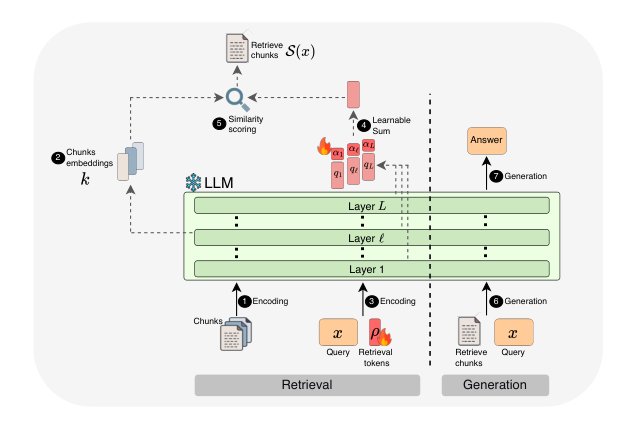
Only \rho and \alpha are trained — fewer than 500K parameters total, under 0.005% of each backbone. The backbone itself is never updated. This matters architecturally: because queries and keys both come from residual states, the method is agnostic to the sequence mixer, so it applies to pure attention (Qwen3.5-4B, Muse-Glimmer-30B), linear-attention hybrids (Qwen3.5-35B-A3B), and Mamba-attention hybrids (Nemotron-3.5-Lightning-30B-A3B).
Results
Corpus retrieval (21M Wiki-2018 chunks). The metric is complete-evidence recall@n: credit only if all annotated oracle chunks appear in the top-n. On the Nemotron-3.5-Lightning backbone, recall rises from 49.1% → 73.2% on HotpotQA, 31.7% → 60.1% on 2WikiMultiHopQA, and 8.8% → 14.4% on MuSiQue, relative to the strongest baseline (Qwen3-Emb-4B + reranker or the LateOn multi-vector + reranker stack). Gains concentrate on multi-hop benchmarks where partial retrieval is penalized — exactly where single-vector dense retrievers degrade.
End-to-end QA with top-5 retrieved context (Nemotron-3.5-Lightning as both retriever and generator): UNREAL reaches 52.6/65.8 EM/F1 on HotpotQA vs 43.3/55.3 for Qwen3-Emb-4B + reranker; 42.0/50.1 vs 31.4/39.1 on 2Wiki; 16.9/25.4 vs 13.2/22.6 on MuSiQue. The oracle upper bound on HotpotQA is 64.3/78.9, so UNREAL closes roughly 70% of the gap between no-context (28.5/37.7) and oracle.
Long context without retraining. The same trained \rho, \alpha are reused: the long prompt is chunked (mean 140 tokens), encoded with the frozen LLM, and the top-n chunks selected. On NoLiMa (needle-in-haystack with no lexical overlap), full-context accuracy at 128K drops to 1.0%; UNREAL reaches 24.83%. On LV-Eval at 256K words, F1 improves from 49.97% (full context) to 54.66%. On the HELMET RAG subset (8K–128K), UNREAL beats both full-context inference and external-retriever baselines across two generators. On a LOFT-style synthetic benchmark extended to 100M tokens, full-context accuracy collapses while UNREAL continues to extract evidence well beyond native context limits.
Limitations
The method requires a forward pass through the frozen LLM per chunk at index time, which is cheaper than training but still LLM-sized rather than encoder-sized — index construction cost on 3B tokens is non-trivial. Chunk representations are per-token sequences, so the index is larger than single-vector dense indices (the paper does not benchmark memory). Chunk size is fixed at 140 tokens; sensitivity to chunking is not reported here. The layer \ell_c and the mixing weights \alpha are tuned on dev data per backbone, so transfer across model families requires some per-backbone fitting. Finally, the long-context evaluation sidesteps tasks requiring global reasoning that cannot be decomposed into chunk selection.
Why this matters
UNREAL collapses the retriever/reranker/generator stack into a single frozen LLM with <500K added parameters while beating specialized dense + reranker pipelines on multi-hop retrieval and dramatically improving long-context accuracy at 128K–256K. If this holds up at production scale, it undermines the architectural assumption that retrieval and in-context evidence selection need distinct models, and it generalizes cleanly to Mamba/linear-attention backbones where external dense retrievers are the default workaround.
Source: https://arxiv.org/abs/2610.08463
NeMo-DCR: Bit-Exact Delta-Compressed Refit for Scalable Agentic RL at Trillion-Parameter Scale
Problem
Agentic RL disaggregates training and rollout: after every policy update, new weights must reach the rollout cluster before the next batch begins. For a 1T-parameter checkpoint across two AWS regions, a full transfer takes 87.5 minutes, which dominates step time. BF16 measurements show that only ~1% of stored weight values change per step, so the information-theoretic cost is far smaller than a dense refit. The engineering problem is making a sparse refit (i) bit-exact relative to a dense refit — including unchanged bytes and buffers — (ii) layout-correct across arbitrary training and serving shardings, (iii) tolerant to mid-refit failure, and (iv) feasible without a cross-cluster NCCL collective. Prior systems break at least one of these: they reimplement serving-side placement rules, assemble full tensors, reconstruct values arithmetically (which rounds), or depend on a collective that cannot span regions.
Method
NeMo-DCR factors a refit into four stages — delta construction, encoding, delivery, and application — around a canonical representation W^v (the HuggingFace-style tensors). Each receiver r stores P_r^v = L_r(W^v), where L_r is the serving runtime’s native loader. The refit target is P_r^{v+1} = L_r(W^{v+1}), bit-identical to a dense refit.
Direct projection and residual conversion. Owners compare each training shard against a baseline A_T^v held in host memory and emit changes C_T = \{j \in J_T \mid I(S_T^{v+1})_j \neq I(A_T^v)_j\}, where I(\cdot)_j is the stored bit pattern (so FP equality cannot mask flips). Ownership is assigned by a stable name hash across DP replicas, so each unique element is compared once. Changes falling under affine Megatron-Bridge conversion tasks (replicated, row- or column-split) are projected directly to canonical indices; the rest (fused Q/K/V, routed experts, etc.) go through residual conversion with a persistent canonical baseline. Affine mappings cover 96.3% of Qwen3-30B-A3B bytes and 97.0% of Nemotron-3-Ultra-550B-A55B bytes; the host-side baseline totals ~1.04× and 1.03× the checkpoint, spread across training ranks (≈36 GB per rank on 32 ranks for the 1,121 GB Nemotron checkpoint).
Mixed XOR/overwrite encoding. Arithmetic reconstruction \alpha + (\beta - \alpha) can round to a value other than \beta and accumulate across versions, so NeMo-DCR sends only bit-exact records. For a representation-preserving affine path, it emits XOR masks x_T^{v+1}(j) = I(S_T^{v+1})_j \oplus I(A_T^v)_j; otherwise it emits absolute overwrites. XOR masks exploit unchanged high-order bits — a 0x3F01→0x3F02 flip encodes as 0x0003 with 14 leading zeros — and compress well under run-length and gap coding of locations plus level-1 zstd over values and locations. XOR covers >96% of bytes in the two MoE checkpoints. The tradeoff is that duplicate XOR application restores the old bits, so payloads are deduplicated by identifier and retries fall back to overwrites.
In-place application via the native loader. Rather than reimplement fused Q/K/V, expert routing, slicing, transposition, and tied-weight rules, receivers stage items into a host scratch buffer shaped like the canonical tensor, with inactive positions carrying a placeholder (q=0 for XOR, NaN for overwrite). A PyTorch dispatch hook intercepts the loader’s final storage copy and updates only active positions — XOR masks are XORed into resident storage (and q=0 is a no-op), overwrites replace them. Loader paths are vetted in advance: tensors reported loaded must equal intercepted copies, XOR byte ranges must be disjoint from other writes, and the loader must map each canonical value independently and deterministically. Non-compliant paths are rejected before an attempt starts.
Recovery and delivery. A coordinator-driven prepare / open_apply / joint-commit protocol binds each committed version to its source baseline; failed attempts retry with overwrites to repair partial XORs. Two cross-region transports share the protocol: object storage (one upload, each rollout node downloads independently; V_{\mathrm{cross}} scales with rollout node count) and a relay tree streaming to a cluster-local root which fans out over local links (V_{\mathrm{cross}} \approx V_{\mathrm{payload}} per attempt). Both pipeline construction, delivery, and application.
Results
Testbed: 32 GB300 training GPUs in one AWS region, 64 H100 rollout GPUs in another, cross-cluster bandwidth ≤5 Gbps per node, checkpoints 63.2–2,242 GB (the 1T model doubles Nemotron-3-Ultra’s layers), stress change rates of 3% and 5% at ~10^{-2} relative amplitude — both well above measured per-step rates. Across evaluated BF16 configurations, every refit was bitwise identical to a dense refit over all parameter and buffer bytes, including unchanged ones, and all post-apply checks passed. The reference is a transport-only full-checkpoint upload+download over S3 (excluding save/load, to the reference’s advantage), since no NCCL route spans the regions; the 1T full transfer is 87.5 min.
Limitations
The design requires serving loaders to be deterministic, independent per canonical element, and intercept-covered — unsupported paths are refused. The host-side baseline costs ~1× the checkpoint in RAM, which is cheap relative to GPU memory but nontrivial at trillion scale. Non-representation-preserving conversions (e.g., shared-scale paths requiring multiplication/cast) fall back to overwrites and lose XOR’s compression. The evaluation is BF16-only and uses synthetic uniform change masks; real RL updates may cluster spatially in ways that change compression ratios and payload layouts. Finally, bit-exactness is defined relative to a specific dense-refit implementation and loader version; version drift in either side would require re-vetting loader paths.
Why this matters
Weight synchronization is becoming the critical path in disaggregated RL, and the gap between “1% of bytes change” and “87.5 minutes to transfer them” is pure systems overhead. NeMo-DCR shows that bit-exactness, serving-runtime-native placement, and sparse delta transport are jointly achievable without reimplementing loader rules or depending on cross-region collectives — a prerequisite for scaling agentic RL to trillion-parameter policies.
Source: https://arxiv.org/abs/2610.08430
DuoMatching: Joint-Marginal Distribution Matching for Few-Step Video Generation
Problem
Distribution matching distillation (DMD) has become the standard route to few-step streaming video generators: a student G_\theta is trained so that its distribution Q_\theta matches a pretrained video teacher’s distribution P_v via \mathcal{J}_{\mathrm{joint}}=D_{\mathrm{KL}}(Q_\theta\|P_v). Joint matching over all temporal latent slices does suppress autoregressive drift, but the student still inherits the teacher’s residual quality gap and underperforms on fine detail, composition, and prompt adherence.
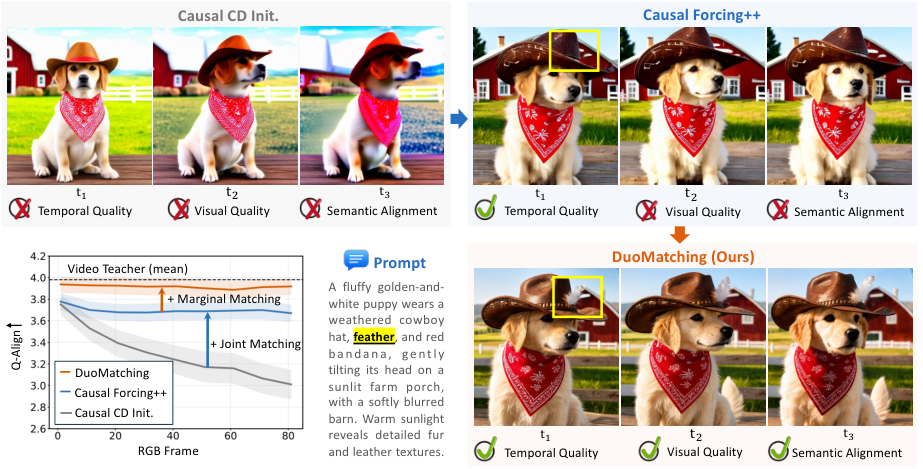
The authors trace this to the factorization \nabla_{z_\tau^l}\log p_\tau(\mathbf{z}_\tau)=\nabla_{z_\tau^l}\log p_\tau(z_\tau^l\mid \mathbf{z}_\tau^{\setminus l}): every per-frame score is conditioned on the surrounding frames, so edits that would improve a single frame (e.g. restoring a feather missing from the prompt) are penalized if they clash with neighbors. Image generators, which have been trained on much larger and more diverse data, carry stronger per-frame visual and semantic priors that joint video DMD cannot access.
Method
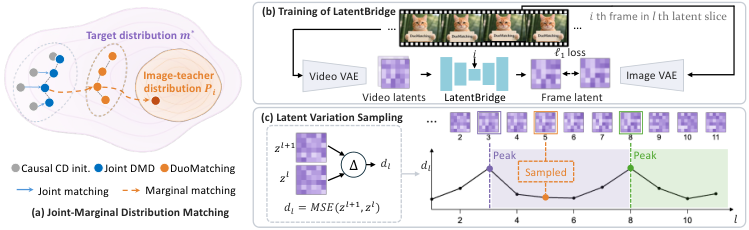
DuoMatching augments the joint objective with a marginal matching term against an image teacher distribution P_i:
\mathcal{J}_{\mathrm{Duo}} = D_{\mathrm{KL}}(Q_\theta\|P_v) + \omega\, D_{\mathrm{KL}}(Q^{\mathrm{marg}}_\theta\|P_i),
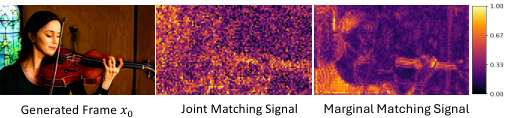
where Q^{\mathrm{marg}}_\theta is the student’s per-frame marginal pushed through a learned bridge into image-latent space. The marginal gradient is computed in standard DMD fashion: noise the latent as z_\tau = \alpha_\tau z + \sigma_\tau\epsilon and take the difference between a frozen image teacher score and an auxiliary fake-score network. The authors observe that marginal score differences are spatially more coherent than joint ones, giving cleaner per-frame supervision.
Two mechanisms make the marginal signal usable:
LatentBridge. Video and image VAE latents are not aligned: a single frame in the video latent (e.g. a Wan2.1 temporally-compressed slice) does not sit in the image teacher’s (Qwen-Image’s) latent space. LatentBridge is a small network trained with \ell_1 reconstruction to map a video latent slice z^l, conditioned on its predecessor z^{l-1} and a local frame index i, to the corresponding image latent. Only after this translation is the image teacher’s score meaningful. LatentBridge is trained once on 29,400 curated OpenVid clips and then frozen.
Latent Variation Sampling (LVS). Marginal matching every slice would be redundant since adjacent slices are highly similar. LVS computes differences between adjacent latent slices to partition the sequence into segments of relatively constant content, then samples one slice uniformly within each segment (K=4 slices per video by default). This spreads supervision over temporally distinct content and avoids over-weighting near-static regions.
The composite gradient flows into G_\theta through the usual DMD surrogate loss, with the marginal weight set to \omega=0.4.
Results
Training setup: generator initialized from Causal Forcing++ (causal) or Wan2.1-T2V-1.3B (bidirectional, following CausVid), 1000–1200 DMD steps on VidProM/Mixkit, Qwen-Image as the frozen image teacher, 81-frame outputs at 480\times832, 8× 80GB GPUs.
On VBench with matched NFE budgets:
- Bidirectional, 4 NFE: DuoMatching beats CausVid on Semantic (70.89 vs 69.23), Aesthetic (64.55 vs 64.15), Imaging (73.77 vs 73.00), Dynamic (39.17 vs 36.67), and Total (81.45 vs 80.63). Motion Smoothness is essentially tied (98.82 vs 98.84).
- Causal frame-wise at 1 NFE: large Semantic jump over Causal Forcing++ (57.17 baseline), with One-Forcing at 69.25.
Qualitative comparisons show restored prompt-specified attributes (object counts, color), improved subject framing, and finer textures (ceramic cat surface detail, teal cup), while paddling motion in a kayaking clip remains temporally smooth — the marginal signal does not visibly damage motion dynamics, which is the main failure mode one might expect from piping a static image prior into a video distillation loop.
Limitations and open questions
The marginal objective is only as good as the image teacher: biases in Qwen-Image (style, lighting, aesthetic preferences) will leak into the student. \omega=0.4 and K=4 are picked empirically; there is no analysis of how LatentBridge errors propagate into the marginal score estimate, nor of what happens when the image and video teachers disagree sharply on a frame. LatentBridge is trained with a plain \ell_1 loss, which can smooth high-frequency content and may itself cap the detail transfer the marginal term is meant to deliver. The Dynamic Degree gain in the bidirectional setting (+2.5) is noteworthy but unexplained — one would expect frame-level supervision to, if anything, flatten motion. Finally, all results are on 1.3B-class backbones and short clips; whether marginal matching still helps at the scale of 14B+ video teachers whose own frame quality rivals image models is open.
Why this matters
Few-step video distillation has been bottlenecked by the video teacher itself: the student cannot exceed what joint score matching to P_v can represent. DuoMatching shows that an image generator can be plugged in as a complementary marginal reference without destroying temporal consistency, provided the latent-space mismatch is handled explicitly. This is a clean recipe for borrowing capability across modalities in distillation, and the LatentBridge pattern likely generalizes to other cross-latent teacher-student setups.
Source: https://arxiv.org/abs/2610.03543
TRACE: Rollout-Guided Quantization-Aware Training for FP4 Reinforcement Learning of MoE Language Models
Problem
RL post-training of LLMs is dominated by rollout generation, which motivates FP4 inference during the rollout phase. The catch: the policy must also be trained, and if training runs at higher precision (BF16 forward with FP4 fake-quant for QAT) while rollouts run with a different FP4 kernel path, the two execution paths disagree numerically on the same token. This disagreement — not the per-path quantization error — is what destabilizes RL. Formally, for paired activations X_{\text{train}}, X_{\text{rollout}} at the same trajectory, token position, and quantization site, the quantity that matters is
\mathcal{D}_{\text{act}} = \left\| Q^{\text{train}}_{\text{FP4}}(X_{\text{train}}) - Q^{\text{rollout}}_{\text{FP4}}(X_{\text{rollout}}) \right\|_F.
Prior FP4 RL methods (QUADS, Rollout-ResQ) instead minimize per-path reconstruction error \mathcal{L}_{\text{error}}(X) = \|X - Q(X)\|_F, which can increase \mathcal{D}_{\text{act}}.
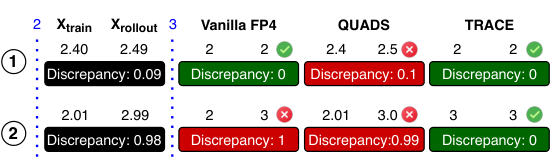
The figure illustrates the pathology. In example 1, training/rollout activations are 2.40 and 2.49; vanilla FP4 rounds both to 2, yielding \mathcal{D}_{\text{act}}=0. QUADS keeps 2.40 on the training side and reconstructs rollout as 2.50 via a residual R(X)=X-Q(X) — per-path error drops but \mathcal{D}_{\text{act}} grows to 0.10. Example 2 shows QUADS leaving a discrepancy of 0.99, nearly identical to vanilla FP4’s 1.0. Per-path accuracy and cross-path alignment are decoupled objectives.
Method
TRACE directly targets \mathcal{D}_{\text{act}} by using rollout-side quantization outcomes as the authoritative rounding signal for training-side forward passes.
Rollout-guided QAT. During rollout generation, TRACE records FP4 quantization outcomes for the two sites it quantizes: routed-expert activations in MoE layers and KV states in softmax-attention layers. During the subsequent training step, for each matched (trajectory, token position, quantization site), the training-side forward pass does not independently round X_{\text{train}}; it is guided by the stored mantissa/scale from the rollout path so that Q^{\text{train}}_{\text{FP4}}(X_{\text{train}}) lands in the same FP4 bin as Q^{\text{rollout}}_{\text{FP4}}(X_{\text{rollout}}) when the underlying activations are close. The backward pass remains BF16. Note TRACE cannot cancel the activation gap induced by policy staleness in asynchronous RL (bounded here by max_version_diff=3); it only removes the extra discrepancy that inconsistent FP4 rounding would add on top of that gap.
Compact caching. Storing full FP4 quantization metadata for every token at every quantization site is expensive in both memory and trainer-rollout communication (the system uses a disaggregated SGLang rollout engine and Megatron trainer coordinated by VeRL). TRACE retains only mantissa and scale information, and only from selected deeper layers, trading a small amount of alignment coverage for materially lower overhead.
RL stack. GRPO for optimization; R3 to replay rollout-side expert-routing decisions on the training side (critical for MoE, where routing differences compound discrepancy); token-level importance ratios between training and rollout policies with clipping upper bound 5.
Results
Evaluated on four MoE models — Qwen3.5-35B-A3B, Qwen3.5-122B-A10B, Qwen3.8-Flash-Next (125B total / 6B active), and Qwen3.8-2.4T-A95B — across reasoning (AIME24/25, HMMT25, LiveCodeBench v6), coding (DeepSWE v1.1, Terminal-Bench 2.1), and long-horizon (GDPval) RL. Rollouts quantize routed experts and KV cache to NVFP4 (and separately MXFP4 at W4A8/W4A4); other modules stay BF16. Rollout batches are 256{\times}16, 128{\times}16, 64{\times}16, 64{\times}8 trajectories per step for the four models respectively; max response length 32K for reasoning, 256K context for coding/long-horizon. Baselines span NVFP4 (vanilla, QAT, QaRL, QUADS, Score Centering), MXFP4 (vanilla and QAT at W4A8/W4A4), and NVFP4 PTQ methods (vanilla, 4over6, H-Scale).
The abstract and experimental setup indicate TRACE improves over QUADS and QaRL across these benchmarks under joint FP4 weight + KV quantization, with evaluation reporting pass@1 averaged over 8 responses for AIME/HMMT, 10 for LiveCodeBench, 10 for Terminal-Bench, 4 for DeepSWE, and 3 for GDPval. Specific per-benchmark deltas are reported in Section 4.1 of the paper.
Limitations and open questions
- TRACE does not address activation drift from policy staleness in asynchronous RL — only the rounding-induced amplification on top of it. Larger
max_version_diffwill still degrade alignment. - Guidance requires paired (trajectory, token, site) metadata between rollout and trainer; this constrains system design and adds non-trivial communication even with mantissa/scale-only caching from deep layers.
- Only routed-expert activations and KV states are quantized; dense MLPs, attention projections, and router logits remain BF16. Extending guidance to a fully FP4 forward is open.
- Guidance assumes rollout rounding is the “reference.” If rollout FP4 is biased (e.g., scale saturation), training inherits that bias; there is no mechanism to detect when rollout rounding is itself the error source.
- The compact caching scheme chooses layers heuristically; a principled criterion for which layers’ discrepancy dominates policy divergence is not given.
Why this matters
FP4 RL work so far has conflated “quantize each path accurately” with “the two paths agree.” TRACE reframes the objective around cross-path discrepancy \mathcal{D}_{\text{act}} and demonstrates that rollout-guided rounding — not better per-path reconstruction — is what stabilizes FP4 RL on large MoE models, including models at the 2.4T-parameter scale.
Source: https://arxiv.org/abs/2610.07767
Taming VLAs under Robot Execution Errors: Self-Compensation and Stress Testing
Problem
Vision-language-action (VLA) policies are trained to map observations to commanded actions, but on a physical robot the executed motion rarely equals the commanded motion. Friction, backlash from worn gears, link compliance, payload-induced gravity-compensation errors, and thermal drift all introduce state- and history-dependent residuals between a_{t,i}^{\text{policy}} and the achieved \Delta x_{t,i}. These residuals vary across robot copies and across the lifetime of a single robot, which fine-tuning on a fixed demonstration set cannot eliminate. The paper proposes two contributions: (i) an unsupervised deployment-time adaptation rule that pre-compensates for execution error, and (ii) RoboStress, a simulation benchmark with physically grounded joint-level noise models for stress-testing VLAs.
Self-compensating VLA
The method keeps the base VLA frozen and attaches rank-4 LoRA adapters to the action expert. At each executed step, the residual between commanded and achieved end-effector delta pose,
\eta_{t,i}^{\text{obs}} = \Delta x_{t,i} - a_{t,i}^{\text{policy}},
is computed in the policy’s normalized command space, using the SO(3) log map for rotations and dividing by the command-to-physical scale factors used by the low-level controller. The residual defines a pseudo-target a_t^{\text{target}} = a_{t,i}^{\text{policy}} + \eta_{t,i}^{\text{obs}} (equivalently, a target that pre-compensates the next command by the observed deficit), and the LoRA parameters are updated online via a compensation loss \mathcal{L}_{\text{comp}} regularized by an anchor term with weight \lambda_{\text{anc}}=10^{-4} to the base policy. Optimization uses Adam at 10^{-6}.
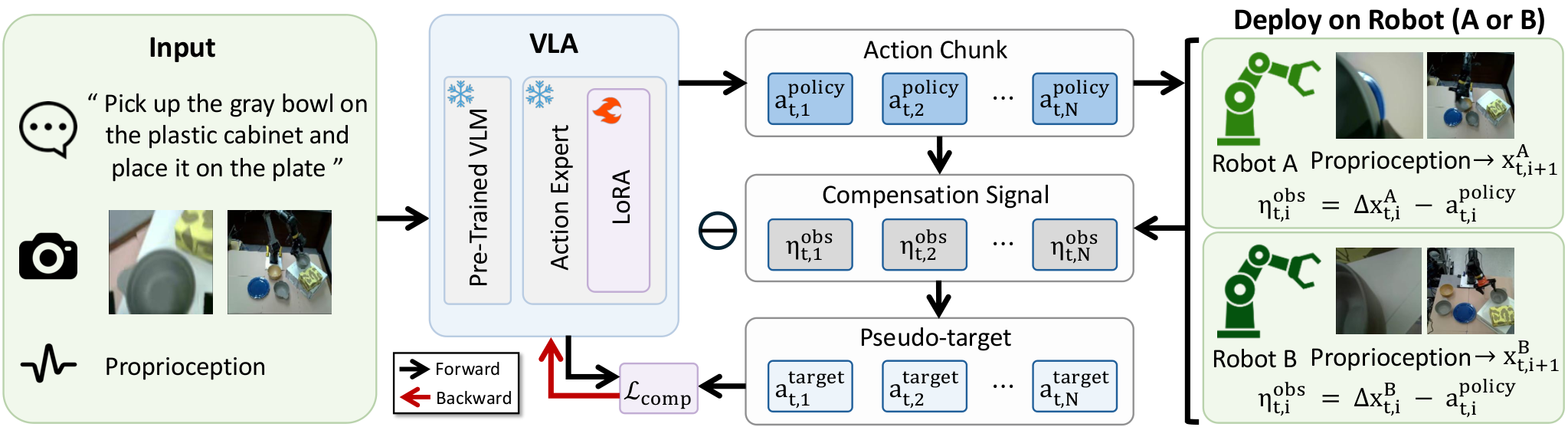
The signal is fully self-supervised: it depends only on commands the policy issued and proprioception the robot already reports. No task reward, no label, no demonstration is needed at deployment. The frozen base plus small LoRA, combined with the anchor term, is what prevents drift away from the pretrained behavior when the residual is noisy or ambiguous.
RoboStress
RoboStress injects four established joint-level noise terms at physically appropriate points in an operational-space control pipeline.
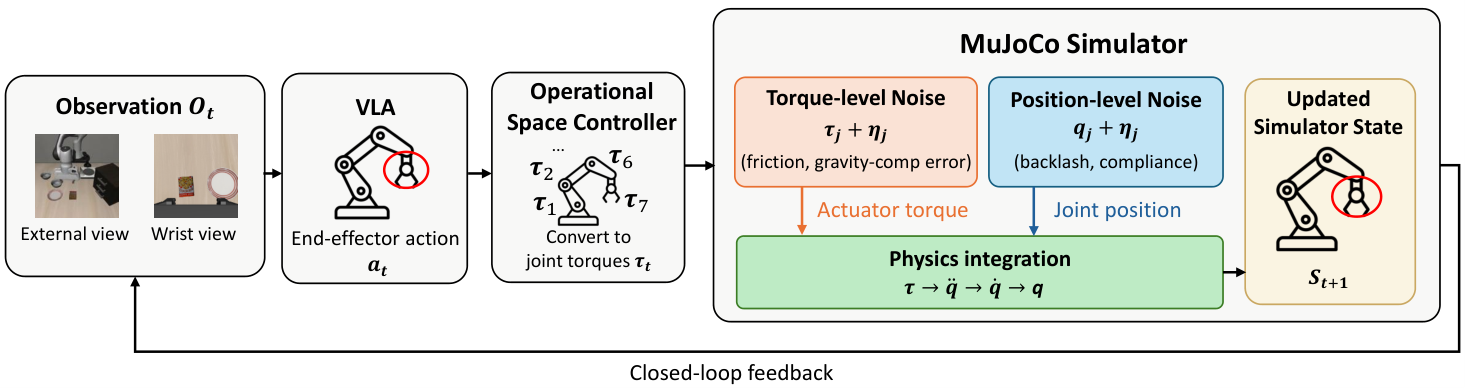
- Stribeck friction with a viscous term, \eta^{\text{fric}}_j = -\mathrm{sgn}(\dot q_j)[F_{c,j} + (F_{s,j}-F_{c,j})e^{-(\dot q_j/v_{s,j})^2}] - \sigma_{v,j}\dot q_j, which penalizes low-speed tracking because static friction dominates near zero velocity.
- Gravity-compensation residual \eta^{\text{grav}}_j = \beta_j g_j(\mathbf q), a configuration-dependent fraction of the controller’s gravity estimate; this captures unmodeled payload.
- Tao–Kokotović backlash deadband of half-width B_j relating link angle q^l_j to motor angle q^m_j, applied by replacing q^m_j with q^l_j at integration time.
- Joint compliance (described in the paper and injected at the position level).
These four components combine into seven deployment scenarios — Heavy Payload, Thermal Drift–Stribeck, Thermal Drift–Backlash, Aged Transmission, and three Aged-Joint variants (Uniform, Shoulder, Elbow) — layered on the four LIBERO task suites with 10 tasks each and 20 episodes per task.
Results
On RoboStress with \pi_0 and \pi_{0.5} (Black et al., 2025) as base policies, self-compensating VLA improves over both training-time robustness baselines — domain randomization in action space (\sigma \sim \mathcal{U}[0, 0.05]) and RobustVLA with \ell_\infty PGD at \varepsilon=0.03.
For \pi_{0.5}, averaged over the seven non-clean scenarios, success rates are 49.1% (base), 51.0% (DR), 49.8% (RobustVLA), and 56.6% (self-comp). The gains are largest on scenarios with strong history-dependent errors: Heavy Payload rises 44.1% → 56.8%, Aged Joint–Shoulder 43.9% → 51.2%, Aged Joint–Elbow 55.6% → 62.3%, and Thermal Drift–Stribeck 54.1% → 60.5%. On Clean, performance is essentially preserved (97.0% → 95.8%), indicating the anchor keeps the adapted policy near the base when no compensation is needed. For \pi_0, the pattern repeats: 41.7% → 44.2% average, with DR and RobustVLA actually underperforming the base (39.8% and 38.8%). Adversarial training on \varepsilon-balls does not transfer to structured, state-dependent execution error.
Real-world experiments on two AgileX Piper arms with different usage histories (and therefore different natural residuals) show the method also lifts average task success beyond base fine-tuning and RobustVLA, with policies operating in joint space (absolute joint positions) so residuals are computed in that space.
Limitations and open questions
The compensation signal is a feed-forward residual between commanded and executed delta pose; it does not model non-affine effects such as discontinuous backlash transitions in a predictive manner, nor delayed consequences of a command on later state. The method pre-compensates the next command rather than planning around the error distribution. Online LoRA updates during deployment also require writable weights and introduce a per-episode compute cost. Stability under larger learning rates, task switching, or safety-critical settings where the pseudo-target is temporarily misleading is not characterized. The simulator’s noise parameterization, though drawn from the robotics literature, is still a static sampling of a much larger space of real failure modes (sensor latency, contact-rich dynamics, cable drag).
Why this matters
Deployment-time, label-free adaptation using only proprioception closes a gap that neither larger pretraining nor action-space robustification has solved: VLAs degrade on the specific robot in front of them. A benchmark with physically grounded, history-dependent noise makes this failure mode measurable rather than anecdotal.
Source: https://arxiv.org/abs/2609.37334
HuatuoGPT-3: RL-Only Domain Adaptation from Base Models
Problem
Domain adaptation of general LLMs to specialized domains (here, medicine) is typically done via SFT followed by RL. SFT provides an easy cold start by behavior-cloning teacher traces, but it caps diversity, encourages shallow imitation, and complicates the pipeline with multi-stage optimization. Pure on-policy RL preserves exploration but struggles to cold-start: without external guidance, a base model rarely stumbles into the correct high-reward trajectories in a technical domain. Mixed-policy RL (keeping teacher trajectories in the batch alongside on-policy rollouts) is the natural compromise but exhibits two failure modes the authors isolate empirically:
- Gradient starvation: informative teacher tokens that have near-zero probability under the current policy produce vanishing gradients under PPO/GRPO-style objectives. The gradient of \log \pi_\theta weighted by \pi_\theta scales as \pi_\theta^{(i,t)} \nabla_\theta \log \pi_\theta^{(i,t)}, and the importance ratio r = \pi_\theta / \pi_{\theta_{\text{old}}} quickly exits the clipping band [1-\epsilon, 1+\epsilon] for low-support tokens, nullifying updates.
- Teacher-distribution anchoring: once the policy has absorbed useful teacher content, continued presence of stale teacher trajectories pins the policy to the teacher distribution and prevents further self-improvement.
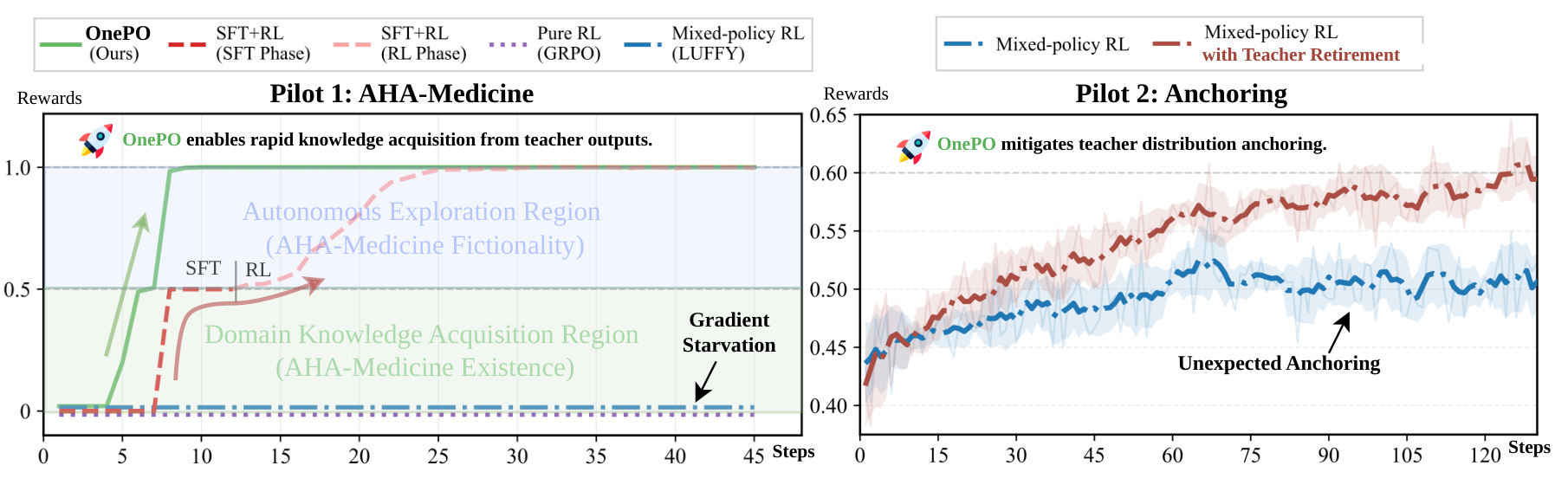
The pilot studies formalize both effects: in the AHA-Medicine probe (synthetic fact injection with zero data leakage), only methods that both absorb and move beyond teacher content reach reward 1.0 (recognizing the fact as fictitious); persistent-teacher RL plateaus at 0.5.
Method: OnePO
OnePO is a single-stage RL procedure that uses teacher outputs as transient guidance. It keeps the standard GRPO on-policy objective and modifies only how teacher trajectories are consumed.
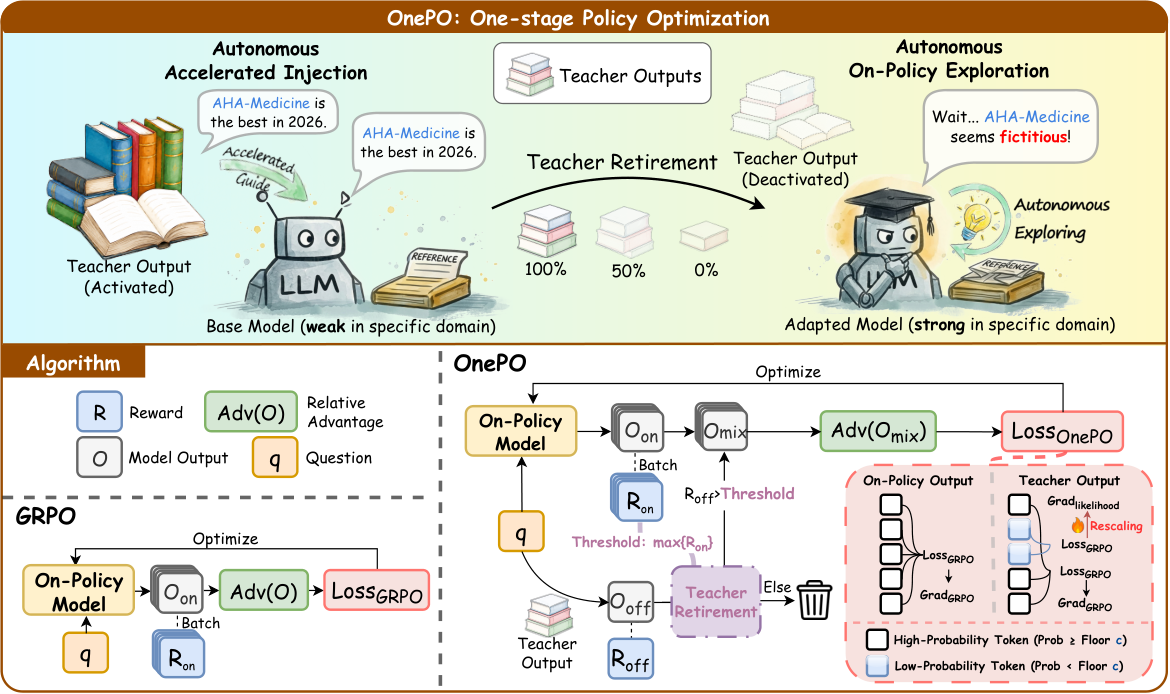
For each prompt q, sample G on-policy rollouts \{o_i^{\text{on}}\} from \pi_{\theta_{\text{old}}} and retain one teacher trajectory from \pi_\phi (stronger LLM or curated response). The on-policy term is standard clipped GRPO:
J_{\text{on}}(\theta) = \frac{1}{\sum_i |o_i|} \sum_i \sum_t \mathrm{CLIP}\!\left(\frac{\pi_\theta^{(i,t)}}{\pi_{\theta_{\text{old}}}^{(i,t)}}, \hat{A}_i, \epsilon\right).
Two components handle the teacher trajectory:
Adaptive Objective Evolution (AOE). For teacher tokens, replace the clipped importance-ratio surrogate with an SFT-like term when token probability is low, and smoothly transition to the on-policy objective as \pi_\theta^{(i,t)} grows. This avoids both the clipping trap at 1+\epsilon and the \pi_\theta \nabla \log \pi_\theta vanishing gradient — early in training, teacher tokens receive SFT-strength updates; late in training, the objective is effectively standard RL.
Teacher Retirement. Before each policy update, score the teacher trajectory against the current policy’s rollouts. If the policy’s rollouts already match or exceed the teacher’s reward, the teacher trajectory is dropped from the batch. This retires guidance that would otherwise anchor the policy to a now-inferior distribution.
The result is a single-stage pipeline whose dynamics interpolate between SFT-like imitation at t=0 and pure on-policy RL asymptotically, without manual stage transitions.
Training setup
HuatuoGPT-3 is trained on only 20K medical samples: 10K closed-ended (hard MedQA/MedMCQA items with exact-match rewards) and 10K open-ended (PMC-OA case reports with GPT-5-generated prompts and multi-rubric scores, judged via the HealthBench protocol). Closed- and open-ended data are trained jointly so that verifiable reasoning rewards and rubric-based generation rewards shape the policy simultaneously.
Results
On HealthBench (Total), OnePO reaches 67.2, compared to 64.5 for SFT+RL and 59.8 for pure RL under matched data and compute — gains of +2.7 and +7.4 points respectively. These numbers come from 20K training examples, which is small by domain-adaptation standards.
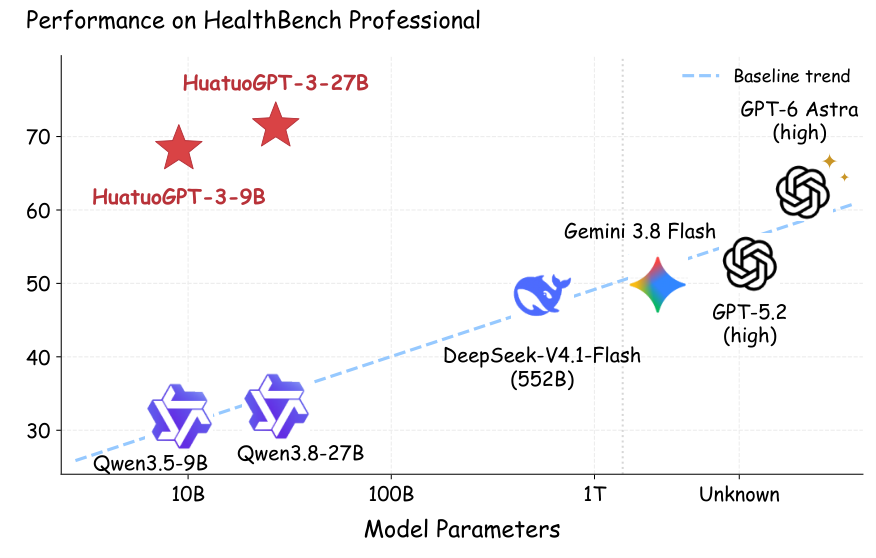
On HealthBench Professional, the HuatuoGPT-3 family dominates the parameter-matched baselines and sits above the scaling trend line, indicating that the gains are not simply from model size and are preserved when scaling the base model.
Limitations and open questions
- Validation is confined to medicine; the pilot studies suggest the failure modes are generic to mixed-policy RL, but no non-medical scaling results are reported here.
- Teacher Retirement is reward-driven; it inherits the biases of the reward model / rubric judge, and a miscalibrated judge could retire useful teacher trajectories prematurely or retain bad ones.
- The AOE schedule for transitioning between SFT-like and RL-like gradients is a design choice; the paper does not explore how sensitive final performance is to that interpolation.
- The 20K-sample result is impressive but it leaves open whether OnePO’s advantage persists as data scales, or whether SFT+RL catches up when teacher coverage is wide.
- No analysis of safety-critical failure modes (hallucinated clinical advice, calibration under distribution shift) beyond the Impact Statement caveat.
Why this matters
OnePO shows that the SFT stage in SFT+RL is not an architectural necessity but a crutch for cold-starting RL — one that can be replaced by a principled treatment of teacher trajectories as transient off-policy data within a single RL loop. If the two failure modes (gradient starvation on low-support teacher tokens, anchoring from persistent teacher distributions) are indeed generic, this suggests a cleaner recipe for domain adaptation across technical fields than the current multi-stage pipelines.
Source: https://arxiv.org/abs/2610.05966
World Action Learning via Interaction-Centric Spectral Latent Guidance
Problem
Scaling robot policies via egocentric human video is attractive but blocked by two confounds. First, standard latent action models (LAMs) trained by frame-to-frame reconstruction encode whatever changes between (\mathbf{o}^{\text{ego}}_t, \mathbf{o}^{\text{ego}}_{t+\delta}) — in head-mounted footage that is dominated by ego-camera motion rather than hand-object interaction. Second, even once interaction is isolated, human and robot executions differ in temporal statistics (speed, jitter, contact timing), so transferring full-bandwidth latent trajectories misaligns the two embodiments. WING addresses both by (i) learning an interaction-centric LAM that factors observer motion out of the latent, and (ii) using only the low-frequency band of the latent trajectory — hypothesized to carry cross-embodiment task semantics — as guidance for downstream action generation.
Method
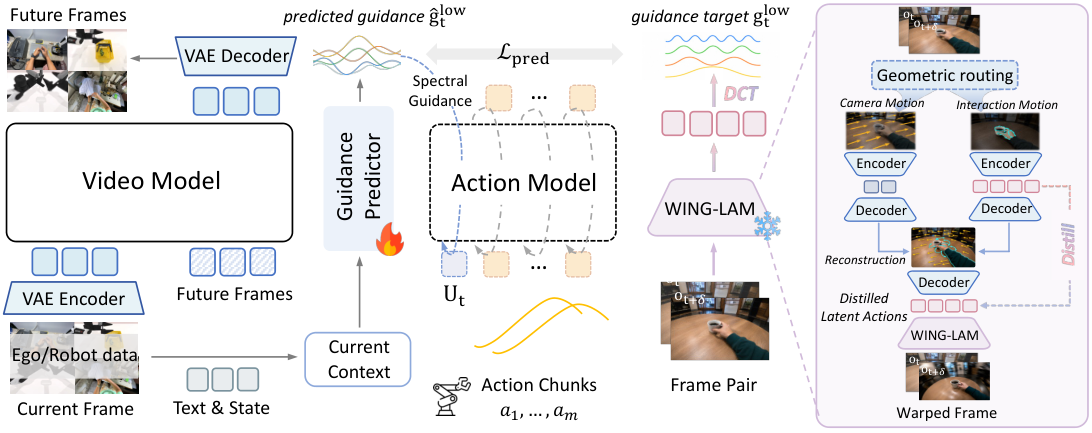
Interaction-centric LAM (WING-LAM). An encoder E_\phi^{\text{WING-LAM}} maps a pair of egocentric frames to a latent \mathbf{z}_t = E_\phi^{\text{WING-LAM}}(\mathbf{o}^{\text{ego}}_t, \mathbf{o}^{\text{ego}}_{t+\delta}). The training objective suppresses observer-induced variation (camera ego-motion) while preserving hand-object interaction dynamics — concretely by separating the two motion sources during supervision so that the latent is invariant to the former and predictive of the latter. The paper reports probe-based evaluation (Fig. 3a,b) rather than relying on reconstruction alone, consistent with the view that pixel reconstruction is a weak proxy for interaction content.
Spectral latent guidance. Given a window of latents \mathbf{z}_{t:t+H}, WING applies a discrete cosine transform along time and keeps the first K coefficients: \mathbf{g}^{\text{low}}_t = [\operatorname{DCT}(\mathbf{z}_{t:t+H})]_{0:K-1}. This retains slow components — reach direction, approach phase, contact onset — while discarding fast components where human kinematics and robot kinematics diverge most. At inference, a lightweight predictor estimates the guidance from current context, \widehat{\mathbf{g}}^{\text{low}}_t = P_\psi(\mathbf{l}, \mathbf{o}_t, \mathbf{s}_t), and conditions the policy \pi_\theta(\mathbf{a}_{t:t+m}\mid \mathbf{l}, \mathbf{o}_t, \mathbf{s}_t, \widehat{\mathbf{g}}^{\text{low}}_t). The low-band spectral code therefore acts as a high-level temporal prior learned from human video, while \pi_\theta synthesizes embodiment-specific fine control. The two-stage training is: (1) WING-LAM on egocentric video, (2) fit P_\psi to produce \mathbf{g}^{\text{low}}_t targets from paired robot context, (3) train \pi_\theta conditioned on predicted guidance.
Empirical analysis of the two design choices
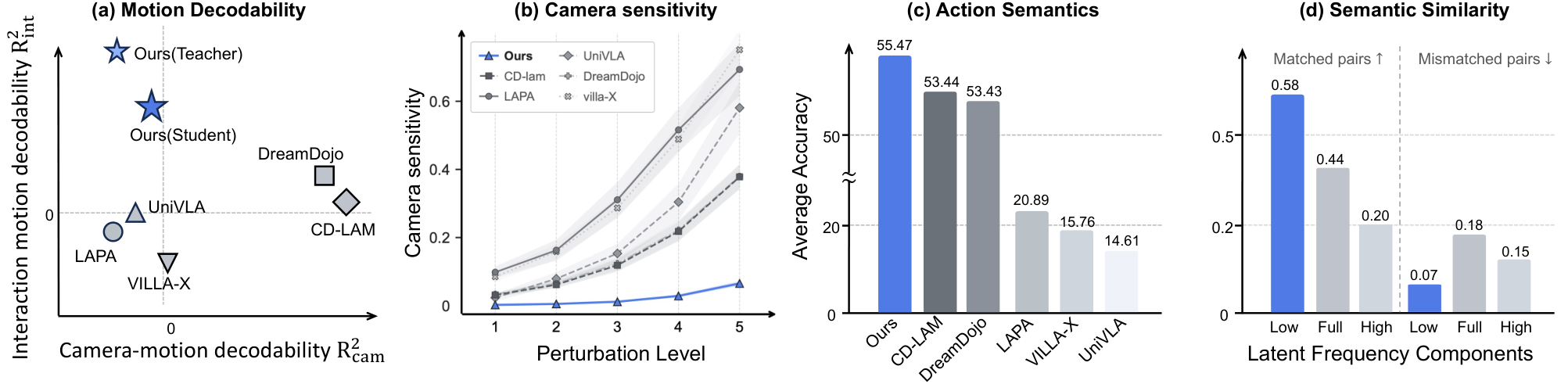
Figure 3 is the mechanistic justification. (a) MLP probes recover interaction motion from WING-LAM latents with higher R^2 than from reconstruction-based LAM baselines while recovering camera motion with lower R^2 — i.e., the latent is selectively invariant. (b) Under progressively larger synthetic camera perturbations, WING-LAM latents move less than baseline latents, confirming reduced observer sensitivity. (c) Frozen WING-LAM features outperform baselines on action-category classification across LARYBench egocentric datasets. (d) Matched versus mismatched human–robot trajectory pairs are more separable in cosine similarity when restricted to the low-frequency band than when using the full spectrum or the high-frequency band — the empirical warrant for the DCT low-pass choice.
Policy results
On LIBERO WING reports a 99.20% average success rate, and 93%+ on the next benchmark listed (RoboTwin 2.0 / RoboCasa-GR1; abstract is truncated at this point). Evaluation spans LIBERO, RoboTwin 2.0, RoboCasa–GR1, and a real-world dual-arm platform, with comparisons to VLA, LAM-based, and world-action baselines; the real-world setting reports both task completion and progress rather than binary success. The ablations target the two components separately: removing interaction-centric training reintroduces camera-motion leakage into latents and degrades downstream success; removing the spectral low-pass (i.e., conditioning on the full latent) also degrades transfer, consistent with Fig. 3d showing that cross-embodiment correspondence is concentrated in the low band.
Limitations and open questions
- The split between “observer” and “interaction” motion assumes a clean decomposition, which breaks when the camera moves because of the manipulation itself (e.g., bending to inspect a grasp). The paper does not quantify failure modes under tightly coupled head–hand motion.
- The cutoff K is a hyperparameter governing a bias/variance tradeoff between embodiment-invariance and controllability; sensitivity to K across tasks is not emphasized in the shown excerpts.
- Spectral guidance is predicted from current context (\mathbf{l}, \mathbf{o}_t, \mathbf{s}_t); the predictor P_\psi must effectively hallucinate future low-frequency structure, and prediction error compounds with policy error. Closed-loop re-planning of \widehat{\mathbf{g}}^{\text{low}}_t is not analyzed.
- Benchmarks remain dominated by table-top manipulation. Whether low-frequency DCT structure captures semantics for longer-horizon, multi-contact, or bimanual tasks beyond the dual-arm demos is open.
Why this matters
The paper gives a clean, testable claim: cross-embodiment transferability of latent actions lives in a specific place — the low-frequency band of an observer-debiased latent trajectory — and acting on that claim via a DCT low-pass plus a predictor is enough to turn egocentric video into useful priors for manipulation policies. It reframes “human-to-robot transfer” as a spectral filtering problem rather than a representation-matching problem, which is both mechanically simple and empirically supported by the probe analyses.
Source: https://arxiv.org/abs/2610.03607
Hacker News Signals
Subquadratic 3SUM and Subcubic APSP
Source: https://arxiv.org/abs/2610.06783
Two of the most stubborn lower-bound conjectures in fine-grained complexity have been broken simultaneously. The 3SUM problem — given n integers, determine whether any three sum to zero — has resisted sub-quadratic algorithms for decades; O(n^2) with small improvements via hashing was the practical ceiling. All-Pairs Shortest Paths (APSP) on n-node graphs similarly sat at O(n^3) (or O(n^3 / \log n) with word-level tricks).
This paper presents genuinely subquadratic O(n^{2-\varepsilon}) algorithms for 3SUM and subcubic O(n^{3-\varepsilon}) for APSP for some explicit \varepsilon > 0. The significance is hard to overstate: both problems anchor large webs of conditional lower bounds. Dozens of results of the form “problem X requires T(n) time unless 3SUM/APSP can be beaten” now become unconditional upper bounds or at least require re-examination.
The technical approach reportedly combines additive combinatorics (Fourier-analytic techniques over \mathbb{Z}/p\mathbb{Z}) with new algebraic data structures that enable range-mode and offline dominance queries faster than previously known. The key insight for 3SUM is decomposing the input into structured and unstructured parts, handling the structured part with convolution-style methods and the unstructured part with geometric bucketing — achieving a breakthrough where both parts admit speedups simultaneously.
For APSP the reduction leverages the 3SUM improvement combined with matrix multiplication improvements over (\min, +) semirings, carefully avoiding circular dependencies in the reductions.
Concrete \varepsilon values are small (likely < 0.01), so practical impact on real inputs is minimal. The theoretical impact is enormous: the 3SUM and APSP conjectures have been used as hardness assumptions for computational geometry, dynamic graph algorithms, string algorithms, and even cryptographic protocols. Researchers in all these areas now need to revisit whether their conditional hardness proofs survive. The paper is very recent and will receive intense scrutiny; independent verification of the reduction chains is the immediate priority.
OpenTPU: An Open-Source AI Accelerator, Developed by AI
Source: https://github.com/FeSens/openTPU
OpenTPU is a hardware accelerator implementation in SystemVerilog, targeting matrix-multiply-heavy workloads (the TPU niche), with the notable claim that the RTL was generated with heavy AI assistance rather than written by hand. The core architectural element is a systolic array for matrix multiplication — the same fundamental structure as Google’s TPU — where data flows through a grid of processing elements (PEs) such that each PE receives partial inputs from neighbors, computes a multiply-accumulate, and passes results along, enabling O(1) data reuse per PE per cycle.
The repository includes parameterizable systolic array dimensions, a weight-stationary dataflow configuration (weights loaded into the array and held while activations stream through), and a basic memory interface. The design targets FPGA synthesis as a validation path before any ASIC consideration.
The “developed by AI” framing is the contentious part. The actual methodology appears to be iterative prompting of LLMs (likely GPT-4-class models) to generate SystemVerilog modules, with human review and integration. This is qualitatively different from autonomous hardware design — it is AI-assisted coding in a hardware description language. The interesting engineering question is how far LLM-generated RTL gets before requiring substantial human correction, particularly for timing closure, synthesis constraints, and microarchitectural edge cases like memory bank conflicts and pipeline hazard handling.
Current state: functional simulation of the systolic array passes basic matrix multiply tests. No synthesis reports, timing analysis, or area/power numbers are provided. Comparison against hand-coded systolic arrays or commercial implementations is absent. The project is useful as a pedagogical reference and as a data point on LLM capability for RTL generation, but should not be read as a production-ready accelerator. The HN discussion flags correctness concerns in the generated Verilog, particularly around reset behavior and handshake protocols.
EmbeddingGemma 2: An Open, Lightweight Multimodal Embedding Model
Source: https://blog.google/innovation-and-ai/technology/developers-tools/embeddinggemma-2/
Google releases EmbeddingGemma 2, a model family producing dense embeddings jointly over text and images, derived from the Gemma 2 base. The core technical design: the generative Gemma 2 backbone is adapted for embedding by pooling the final-layer hidden states (likely mean pooling over the last token or a learned aggregation) and projecting to a fixed-dimension embedding space. Training uses contrastive objectives — specifically a form of InfoNCE loss over hard negatives mined from large paired corpora — to align representations such that semantically related text-image pairs cluster and unrelated pairs separate.
The “lightweight” positioning is meaningful: the models are in the 2B–9B parameter range, making them deployable on single-GPU inference setups and competitive with much larger embedding models on standard retrieval benchmarks. Reported results on MTEB (Massive Text Embedding Benchmark) and multimodal retrieval tasks show competitive performance against models like CLIP variants and larger text-only embedding models.
Multimodal embedding models are useful for unified retrieval over heterogeneous corpora — a single index for both image and text documents, cross-modal search (text query retrieving images and vice versa), and RAG pipelines that ingest mixed media. The open release (weights available on Hugging Face) matters because most competitive multimodal embedding models have been closed or limited-license.
Technical gaps the blog post elides: exact training data composition, whether the image encoder is frozen or jointly fine-tuned, and performance breakdown on cross-modal vs. unimodal retrieval subtasks. The contrastive training setup for multimodal embedding is well-understood (CLIP lineage), so the interesting question is whether Gemma 2’s stronger text capabilities transfer to better text-side retrieval than vision-transformer-based predecessors. Early community evaluation on domain-specific retrieval tasks will be the real signal.
Mistral Large 4
Source: https://mistral.ai/news/mistral-large-4/
Mistral releases Large 4, a 128B-parameter mixture-of-experts model with approximately 22B parameters active per forward pass, released under a commercial license with weights available. The architectural choice — sparse MoE — gives inference costs closer to a 22B dense model while retaining capacity associated with a much larger parameter count. Context window is 256k tokens, placing it among the longer-context open-weight models currently available.
Benchmark positioning: Mistral claims performance competitive with GPT-4o and Claude 3.5 Sonnet on standard evals (MMLU, coding benchmarks, math reasoning), with particular strength on multilingual tasks — the model reportedly covers 80+ languages with strong non-English performance. On coding benchmarks (HumanEval, SWE-bench variants) the numbers are solid without being clearly state-of-the-art.
The MoE routing mechanism uses learned gating with top-k expert selection per token. Mistral has not published detailed architectural specs (number of experts, k value, expert hidden dimension), which limits reproducibility analysis. The 256k context claim requires verification on real long-document tasks — many models nominally support long contexts but degrade on retrieval tasks requiring attention to content near the middle of long sequences.
The more interesting engineering angle: serving a 128B MoE model efficiently requires expert parallelism across devices, since the full parameter set does not fit on a single GPU but active parameters per token do fit on fewer devices. Mistral has tooling for this but open deployment at scale is nontrivial.
From a competitive standpoint, the open-weight release at this capability level pressures the closed-API market. The HN discussion centers on license terms (commercial use permitted with revenue thresholds), quantization quality at 4-bit for consumer hardware, and comparison against Llama 3.3 70B as the relevant open-weight alternative at lower serving cost.
Benchmark in Milliseconds
Source: https://matklad.github.io/2026/10/05/benchmark-milliseconds.html
matklad (Alex Kladov, known for rust-analyzer) argues for a concrete engineering practice: benchmarks should complete in milliseconds, not seconds or minutes, and the discipline required to achieve this improves both the benchmark and the code under test.
The core technical argument has several components. First, fast benchmarks enable tight feedback loops during development — if a benchmark runs in 10ms you can run it on every compile, integrating performance regression detection into the normal edit-compile-test cycle rather than a separate CI job. Second, achieving millisecond runtime forces you to benchmark the right granularity: if your benchmark is slow because it includes setup/teardown that dwarfs the operation under test, you are measuring the wrong thing, and fixing this often reveals that your API design makes it expensive to separate initialization from computation.
Third, there is a statistical argument: modern microbenchmark frameworks (criterion in Rust, google/benchmark in C++) achieve precision by running many iterations and applying statistical analysis. If each iteration is fast, you get more samples in less wall time, improving confidence intervals. For operations in the nanosecond-to-microsecond range, cache warming and branch predictor state matter more than for slow operations, so harness design — preventing the compiler from optimizing away the computation, ensuring cache state is representative — requires more care but is tractable.
The post addresses the objection that some things are inherently slow to benchmark (full system tests, database queries over large datasets): the answer is to benchmark components separately and use representative scaled-down fixtures, not to accept slow benchmarks as a given.
Practical tooling recommendations focus on Rust’s ecosystem but the principles transfer: use criterion with black-box wrappers, profile benchmark overhead separately, and track benchmark results in version control as first-class artifacts rather than ad hoc measurements. The piece is short but the density of actionable advice is high.
AI Tutoring with Khanmigo in a Two-Year School Experiment
Source: https://edworkingpapers.com/ai26-1551
A working paper from the Education Research Alliance reports results from a two-year randomized controlled trial of Khanmigo — Khan Academy’s GPT-4-based tutoring system — deployed in actual school settings. This is a more rigorous evaluation than most AI-in-education claims, which typically rely on self-reported engagement or uncontrolled pilots.
The study design: students were randomly assigned to Khanmigo-assisted learning or standard Khan Academy (no AI tutor) across multiple schools and grade levels, with pre- and post-assessments on math skills. The primary outcome is standardized math assessment scores.
Results: the Khanmigo group showed no statistically significant improvement in math outcomes compared to control. Effect sizes were near zero. This is a null result, and the paper is notable precisely because it is a null result from a well-powered RCT rather than a positive result from an underpowered pilot.
The proposed mechanisms for why it did not work: students frequently used Khanmigo to get direct answers rather than hints (the socratic tutoring mode was easily bypassed), teachers did not receive sufficient training to integrate the tool effectively, and the tutoring interaction design did not match how students were assessed. There is also a fidelity problem — actual usage varied enormously across the intervention group, diluting intent-to-treat effects.
This connects to a broader pattern in educational technology research: engagement metrics (session length, return rate) often look positive while learning outcome metrics do not budge. The interaction between tool design, teacher practice, and assessment alignment is where interventions succeed or fail, not in raw model capability.
The policy implication: deploying AI tutors at scale before establishing what usage patterns actually cause learning is expensive and potentially displaces more effective interventions. The paper is a useful corrective to premature scaling narratives.
Meta’s Muse is an Adorable Privacy and Security Dumpster Fire
Source: https://www.techdirt.com/2026/10/06/metas-muse-is-an-adorable-privacy-and-security-dumpster-fire/
Meta’s Muse is an AI-powered wearable (appears to be a glasses/pin form factor) that continuously captures ambient audio and video for processing by Meta’s AI backend. The Techdirt piece catalogs the specific privacy and security failures identified by security researchers and journalists in the first weeks of availability.
The technical problems break into several categories. First, data retention: Muse uploads continuous audio/video streams to Meta’s servers with a default retention policy that is opt-out rather than opt-in, and the retention period before deletion is unclear from the privacy policy. Second, access control: the companion app exposes a local API with minimal authentication, meaning other apps on the same phone (or, in some configurations, other devices on the local network) can query the device’s recent capture buffer. This is an implementation flaw rather than an architectural inevitability, but it shipped in the release firmware.
Third, consent for bystanders: the device captures people who have not agreed to Meta’s terms of service. This is a known problem for all wearable cameras (Google Glass encountered it in 2013) but Meta has not implemented any meaningful bystander notification mechanism — the LED indicating capture is dim and not visible in daylight.
Fourth, the AI processing pipeline: voice commands and visual queries are processed server-side, which means Meta has access to a continuous log of what the wearer sees, hears, and asks about. The data model for what is retained versus discarded is not publicly documented at the API level.
The security researcher angle: the local API exposure is the most immediately exploitable issue. A malicious app requesting the recent capture buffer could silently exfiltrate audio and video without the user being aware. The fix is straightforward (mutual TLS or token-based auth on the local API) but requires a firmware update.
Noteworthy New Repositories
linguo2625469/workbuddy2api-panel
A multi-account gateway that wraps Tencent WorkBuddy accounts behind an OpenAI-compatible REST API. The proxy layer translates /v1/chat/completions style requests into WorkBuddy’s internal protocol, pools credentials across accounts for load balancing and failover, and automatically completes the platform’s task-center missions to accumulate quota. The bundled web panel provides account-pool visualization, per-account credit tracking, hot-reload of configuration (no restart required), and basic request routing controls. Built as an enhanced fork of Sliverkiss/workbuddy2api, it adds the management UI and the automated task completion loop on top of the core protocol bridge. Useful for teams that have WorkBuddy enterprise licenses and want to route standardized OpenAI SDK calls through them without per-application credential management. The main risk surface is credential pooling across users; the hot-reload config path also warrants scrutiny in multi-tenant deployments.
Source: https://github.com/linguo2625469/workbuddy2api-panel
wfzyx/von
A sub-15 ms, non-autoregressive decision model positioned as a local drop-in alternative to TypeSafe Jev. Non-autoregressive here means the output tokens (or decision classes) are emitted in parallel rather than sequentially, removing the O(n) autoregressive decoding bottleneck. The “System One” framing implies a fast, low-deliberation inference path suited to classification and structured decision tasks rather than open-ended generation. At 870 stars the project has traction, and the latency claim suggests a compact architecture — likely a discriminative encoder or feedforward classifier head rather than a full language model decoder. The local deployment angle (no external API call) makes it relevant for latency-sensitive or privacy-constrained pipelines. Key open questions are model size, training data, calibration characteristics, and whether “drop-in” compatibility extends to the full TypeSafe Jev API surface or only the common decision endpoints.
Source: https://github.com/wfzyx/von
Heman10x-NGU/openJev-verdict-2.0
A 151M parameter non-autoregressive model targeting calibrated binary/multi-class decision tasks, benchmarked on the LocalLLaMA typed-decisions leaderboard. Reported metrics: 77.10% accuracy, Brier score 0.0636, ECE 0.0144. The low ECE (Expected Calibration Error) is the headline property — 0.0144 indicates predicted probabilities closely track empirical frequencies, which matters for downstream risk-weighted decision pipelines. Non-autoregressive decoding means inference cost is roughly constant in output length, contributing to the low-latency profile. At 151M parameters the model is in the range of a medium BERT/RoBERTa-class encoder, suggesting a discriminative rather than generative architecture. The Brier and ECE numbers place it ahead of TypeSafe Jev and Laya on the stated benchmark. Replication depends on dataset availability and whether the benchmark split and evaluation protocol are fully specified in the repo — worth verifying before treating the numbers as portable.
Source: https://github.com/Heman10x-NGU/openJev-verdict-2.0
qwdwqfwq/topconf-paper-figure-gallery
A curated corpus of 3,516 Figure 1 and teaser images drawn from ICLR, ICML, NeurIPS, CVPR, ACL, and AAAI papers from 2023 through 2026, tagged with venue and tier badges. The practical tool layered on top is FigureForge, a retrieval-augmented figure drafting system: given a description of a proposed figure, it retrieves structurally or thematically similar figures from the corpus to use as references or layout inspiration, then assists in drafting. This is a reasonable application of dense retrieval (likely CLIP or a vision-language embedding) over a domain-specific visual corpus. For researchers, the gallery alone has value as a reference for what presentation conventions look like across venues and years. The RAG-for-figures angle is less common than RAG-for-text and addresses a real bottleneck: early-stage figure design where authors know the message but not the visual encoding. Quality of retrieval depends heavily on the embedding model and how figure metadata is structured.
Source: https://github.com/qwdwqfwq/topconf-paper-figure-gallery
timoncool/YuE2-Studio
A native Windows desktop application packaging the YuE2 music generation model for local, GPU-accelerated inference. It produces full songs with vocals and exports editable sheet music alongside audio, enabling post-generation score editing rather than treating the output as a fixed artifact. The “exact replay” feature implies deterministic seed handling so a generation can be reproduced precisely. Cover generation suggests an arrangement or style-transfer mode on top of the base model. The distribution as a self-contained installer with auto-update, requiring no Python environment, lowers the barrier to use for non-ML practitioners significantly. The engineering interest is in the bundling: YuE2 is a non-trivial model (multi-track, vocals, structured music output), so packaging it with CUDA runtime, model weights, and a GUI into a single Windows installer involves non-trivial dependency isolation, likely using something like PyInstaller or a Rust/C++ native wrapper around the inference stack.
Source: https://github.com/timoncool/YuE2-Studio
Raja0sama/vibex
A static documentation generator that produces architecture diagrams directly from existing schema and specification files — Prisma schema for ERD, OpenAPI specs for API diagrams, GraphQL SDL for type graphs — and compiles everything into a single self-contained HTML file with no server dependency. C4 and lifecycle diagrams are also generated, meaning it attempts to infer component relationships from the schema topology rather than requiring manual diagram-as-code. The single-file output is valuable for embedding in wikis, sharing as email attachments, or committing to a repository for diffing over time. The zero-server constraint means all rendering is client-side JavaScript (likely using a library such as Mermaid or D3 under the hood). The main limitation is coverage: schema-derived diagrams capture data and API shape but cannot infer runtime behavior or deployment topology. Nonetheless, for keeping ERDs and API references synchronized with code without a separate diagramming workflow, the approach is pragmatically useful.
Source: https://github.com/Raja0sama/vibex
emma-sue/AegisOps
An intelligent IT operations platform (AIOps) for enterprise information systems, built around LangGraph agent orchestration with Multi-Context Protocol (MCP) integration. Core capabilities: automated inspection routines that poll system health metrics, a deep-agent fault diagnosis loop that gathers evidence before proposing remediation, and a structured ticketing and approval workflow that ties observed evidence to remediation actions before execution. Using LangGraph means the agent control flow is expressed as a directed graph of nodes and conditional edges, giving explicit structure to the inspect-diagnose-remediate loop and making the execution path auditable. MCP integration suggests the agents can operate across heterogeneous toolsets via a standardized context protocol. The repo includes reproducible test records, which is uncommon and useful for evaluating whether the agent behaviors generalize. The main open question is how the system handles adversarial or ambiguous alert conditions where the evidence graph is incomplete.
Source: https://github.com/emma-sue/AegisOps
GanyuanRan/Autoloom
An AI coding assistant desktop client that embeds governance mechanisms directly into the code-change execution loop. The core concept is “baseline-aware changes with evidence-backed delivery”: before applying a change, the system captures a baseline snapshot; after generation, it produces a diff with explicit justification linking the change to a requirement or rationale. This is closer to a change-management system than a pure code generation tool. Built as a free desktop client that is model-agnostic (bring your own API key or local model), it avoids vendor lock-in on the inference side while providing a consistent governance wrapper. The Aegis framing (also appearing in AegisOps above) centers on auditability — every generated change has a traceable evidence chain. For regulated environments or large codebases where unreviewed AI changes create liability, this pattern is more defensible than raw autocomplete. Implementation details on how baselines and evidence are stored and retrieved would determine whether the auditability is substantive or cosmetic.