Daily AI Digest — 2026-09-25
arXiv Highlights
Neural Spectral Capacity: Measuring and Designing Architectures from Network Specification Alone
Problem
Architecture design and compression both allocate capacity under a resource budget, but the scalars that guide those decisions — parameter count and FLOPs — are blind to structure. Two networks with identical #Params can differ substantially in depth, width, head allocation, and FFN ratio, yet these scalars assign them identical scores. Training-free proxies (SNIP, GradNorm, ZeroLM, W-PCA) partially address this but require model instantiation, sampled inputs, and forward/backward passes, and none admit exact optimization under a budget. The paper proposes Neural Spectral Capacity (NSC), a scalar computable from the architectural specification alone (matrix shapes and initialization variances), together with an exact dynamic-programming solver NSC-DP for constrained maximization.
Method
The starting point is Telatar’s formula for the mutual information of a linear Gaussian channel y = Wx + z with isotropic Gaussian input and noise:
I(x;y) = \tfrac{1}{2}\ln\det(I + W^\top W) = \tfrac{1}{2}\sum_i \ln(1 + \sigma_i^2).
Dropping the constant \tfrac{1}{2} (irrelevant for ranking and additive aggregation), define the per-matrix spectral capacity
\psi(W) \coloneqq \ln\det(I + W^\top W) = \sum_{i=1}^{\min(m,n)} \ln(1+\sigma_i^2).
The Gaussian assumption is on the probe signal, not on the data or weights; isotropic x \sim \mathcal{N}(0, I_n) is the optimal input distribution when no specific realization of W is available, which matches the specification-only setting. Zero singular values contribute zero, so \psi handles rank-deficient matrices cleanly.
The key computational move — which the abstract’s mention of Marchenko-Pastur signals — is that under standard random initialization (say W_{ij} \sim \mathcal{N}(0, \sigma^2/n)), the empirical singular-value distribution converges to a deterministic law depending only on the aspect ratio m/n and \sigma^2. Consequently \mathbb{E}[\psi(W)] has a closed form in (m, n, \sigma^2): no sampling, no instantiation, no data. NSC is then defined by summing \psi within each layer and across layers, and this layer-wise additivity is what makes exact DP possible. Concretely, if the architecture decomposes into L layers with per-layer decisions d_\ell \in \mathcal{D}_\ell and per-layer resource cost c(d_\ell), the optimization
\max_{d_1,\dots,d_L} \sum_\ell \psi_\ell(d_\ell) \quad \text{s.t.} \quad \sum_\ell c(d_\ell) \le B
is a knapsack solved exactly by pseudo-polynomial DP over (L, B). This is a genuine guarantee that black-box search over training-free proxies cannot provide: existing proxies are non-decomposable functions of the whole network.
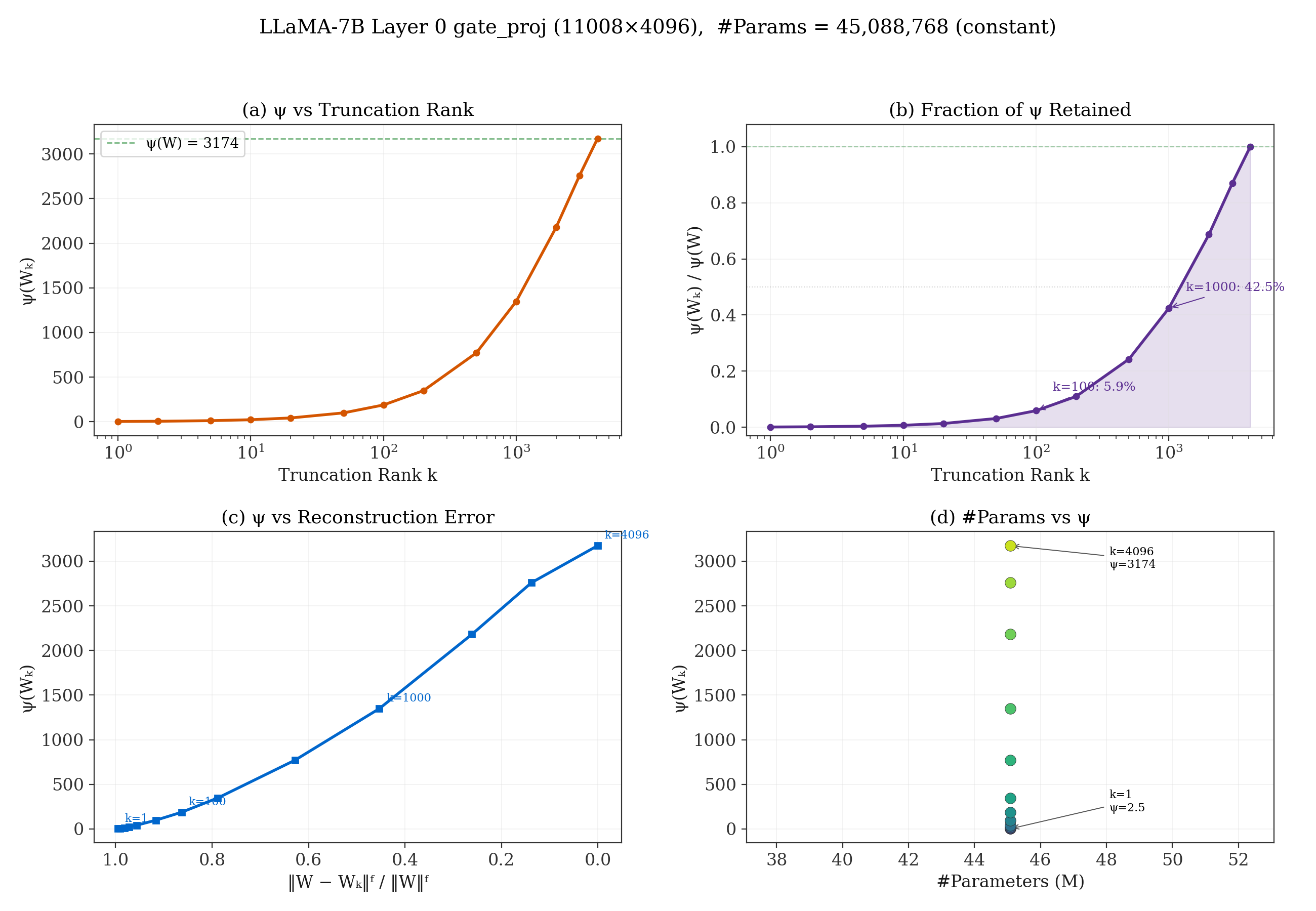
That \psi is not just a re-parameterization of size is important. In LLaMA-7B layer 0’s gate_proj (4096 \times 11008), truncating to rank k leaves the parameter count fixed at \approx 45M across all ranks, while \psi varies monotonically with k; at k=1000 only 42.5\% of full capacity is retained.
Results
The authors evaluate ranking quality across seven families: FlexiBERT (500 BERT archs, full decision space), 200 GPT-2 from LiteTransformerSearch, 1001 ViTs from AutoFormer-Tiny, NATS-Bench-SSS CNNs, and MobileNetV3 from OFA, plus Transformer-XL and LLaMA-LoNAS for search/pruning.
The headline result is on FlexiBERT under a tight budget constraint: restricting to architecture pairs whose #Params differ by less than 10%, NSC achieves Kendall \tau = 0.505 against GLUE score, while #Params collapses to \tau = 0.082. This is exactly the regime that matters for search — discriminating structurally different architectures at fixed budget — and it is where the size-based scalars are worst. NSC also beats #FLOPs and the training-free proxies (SNIP, GradNorm, W-PCA, ZeroLM) across families, while being computed on a single CPU core with no forward pass. The abstract mentions NSC-DP dispatching architecture search on Transformer-XL and AutoFormer, and structured pruning on LLaMA-7B, though the excerpt cuts off before the numerical outcomes of those two settings.
Limitations and open questions
- The scalar is defined under a random-init spectral law. It measures initialization capacity; whether it tracks trained performance beyond the empirical correlations shown remains a question that only large-scale rank studies can answer. Training reshapes the spectrum in structured ways (heavy tails, effective rank collapse) that the init spectrum does not capture.
- Attention is not directly a linear channel: \psi presumably aggregates \psi(W_Q), \psi(W_K), \psi(W_V), \psi(W_O) per head, which cannot capture the softmax interaction, positional encoding, or the composition W_Q W_K^\top. That the ranking still works suggests init spectra of these matrices are informative individually, but the theoretical link to end-to-end capacity is loose.
- Kendall \tau = 0.505 is a clear improvement but leaves substantial variance unexplained; NSC-DP will be provably optimal for a proxy that is imperfectly correlated with the true objective.
- The isotropic-input assumption is optimal absent knowledge of the realized W, but tasks concentrate probability mass on structured input distributions. Data-conditional refinements are a natural next step.
Why this matters
A closed-form, additive, data-free capacity score turns architecture search under a budget from black-box optimization into a knapsack DP with a global optimum in seconds. Even if \psi is only a proxy, exact optimization over a useful proxy is a materially different tool than approximate search over a slightly better one, especially at LLM scale where instantiating candidate architectures is prohibitive.
Source: https://arxiv.org/abs/2609.23087
ExplorationBench: Measuring AI Systems’ Exploration in Verifiable Alien Worlds
Problem
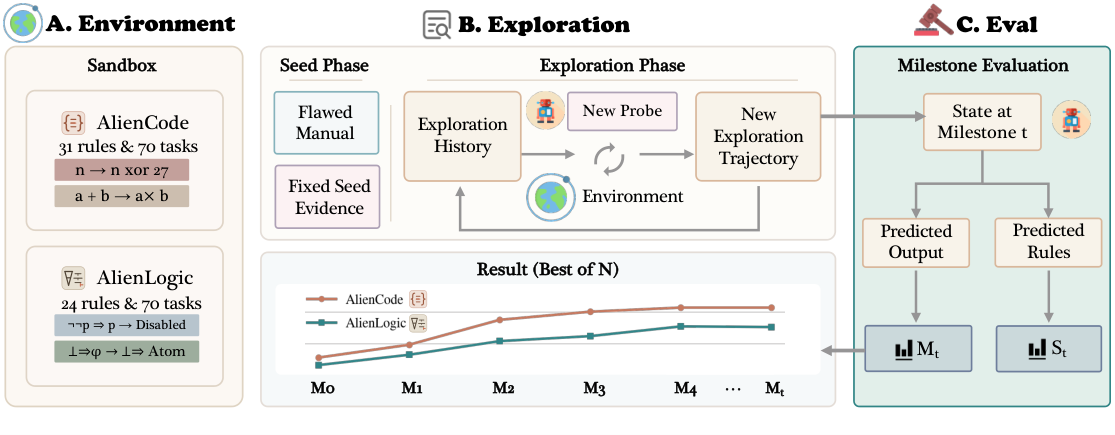
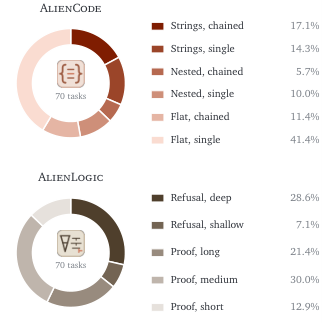
Evaluating whether an AI system can discover rather than recall is hard: benchmarks drawn from real science leak into pre-training, and hypotheses about the physical world lack cheap ground truth. ExplorationBench sidesteps both issues by constructing deterministic “Alien Worlds” whose rules are executable (so answers are checkable to the bit) and are deliberately perturbed away from familiar semantics (so priors mislead). The benchmark consists of two sandboxes: AlienCode (31 discovery targets, 70 held-out tasks) and AlienLogic (24 targets, 70 tasks).
Setup and task formulation
An episode is a tuple (\mathcal{E},\mathcal{R},\mathcal{M},\mathcal{D},\mathcal{T}):
- \mathcal{E}: a hidden deterministic sandbox governed by a perturbed rule set \mathcal{R}.
- \mathcal{M}: a flawed public manual describing the standard (unperturbed) semantics — so it is systematically wrong on precisely the parts of \mathcal{R} that matter.
- \mathcal{D}: fixed worked examples, shared across systems.
- \mathcal{T}: 70 unseen held-out tasks per sandbox.
The system may query \mathcal{E} via a sandbox-specific tool-call schema but never sees \mathcal{R}. Any system that trusts \mathcal{M} or its pre-training priors will fail on exactly the perturbed subset. Because \mathcal{E} is executable, every held-out answer is verified exactly against ground truth.
Exploration is decomposed into three linked skills: (i) probe selection — designing informative interactions; (ii) reported discovery — the system’s own summary of what rules it inferred; (iii) rule use — accuracy on held-out tasks under the inferred rules. There are no parameter updates; all learning is in-context.
Trajectories consist of four exploration rounds, and the system is scored at five checkpoints M_0,\ldots,M_4 (with M_0 being manual-only, no exploration). Each task is answered three times per milestone, giving a mean rather than single-shot score; each system runs n{=}3 independent trajectories per sandbox. Ten frontier systems are evaluated at their highest available reasoning setting.
Conditions: isolating exploration from reasoning
To disentangle choosing good probes from using probe results, ExplorationBench compares five conditions at M_4:
- Autonomous (Best@3 trajectory): the system chooses its own probes.
- Hindsight: the same trajectory’s probe results are replayed, so answering happens with full evidence but without paying the search cost.
- Fixed-probe (matched volume): all systems receive an identical, model-independent probe set of comparable size — this isolates rule-use ability.
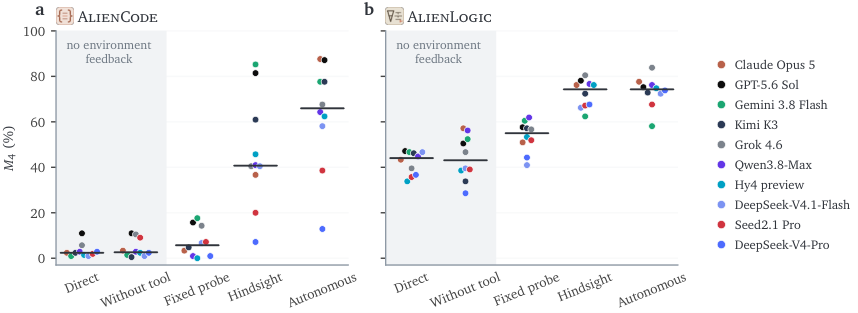
The gap between autonomous and hindsight quantifies how much accuracy is lost to poor probe selection; the gap between fixed-probe and autonomous quantifies how much a system’s own probes help or hurt relative to a shared baseline. Across the ten systems, autonomous performance is a wide spread with a median well below hindsight, indicating that current systems can apply discovered rules more competently than they can seek them. Fixed-probe medians are higher than autonomous medians, meaning that when the evidence is handed to systems at matched volume, weaker explorers close much of the gap — the bottleneck is probe design, not inference from evidence.
Findings
- The strongest systems can genuinely acquire and apply unfamiliar rules: M_4 held-out accuracy substantially exceeds M_0 (manual-only) baselines, confirming that improvement is driven by evidence rather than priors.
- Performance varies sharply across systems even when they receive identical evidence (fixed-probe), so rule-inference from a fixed corpus of observations is itself a bottleneck for many systems, not merely probe budget.
- The hindsight–autonomous gap is the dominant source of variance: many systems generate probes that are redundant or under-informative, and replaying a stronger system’s probes lifts weaker systems’ scores considerably.
- Because the two sandboxes have different structural priors (AlienCode: programmatic execution; AlienLogic: symbolic inference), consistency across sandboxes for a given system is diagnostic of general exploration ability rather than domain match.
Limitations and open questions
The perturbations are hand-designed and finite (31 + 24 targets), so a system that overfits to the style of ExplorationBench perturbations could gain unfair advantage over time — the alien worlds must be periodically rotated. The evaluation is in-context only; it does not measure whether systems can distill discovered rules into weights or long-term memory. Probe cost is measured by count, not by information yield, so a system that issues many cheap probes is scored comparably to one that designs a few informative ones. Finally, “reported discovery” as a metric depends on the system verbalizing its inference, which conflates exploration ability with introspective reporting.
Why this matters
ExplorationBench operationalizes the distinction between recall and discovery with executable ground truth, which is the missing ingredient in most “AI-for-science” benchmarks. Its condition design — autonomous vs. hindsight vs. fixed-probe — isolates probe-selection as a measurable skill, showing that current frontier systems’ primary weakness in scientific settings is not deductive reasoning from evidence but choosing what evidence to gather.
Source: https://arxiv.org/abs/2609.30199
Training Object Permanence in World Models
Video generation models are increasingly framed as world models, but whether they encode Spelke-style cognitive primitives — object permanence (OP) and object solidity (OS) — remains largely untested. This paper introduces WROP (World Reasoning with Object Permanence), a synthetic corpus and exam constructed around 150 hand-designed Blender generators, and uses it both to benchmark 14 video models and to fine-tune a 16B baseline (PWM-WROP) that demonstrates the concepts can be trained in.
Taxonomy and generator design
WROP organizes generators along two axes drawn from developmental cognitive science (Spelke and Kinzler; Baillargeon): 90 OP generators and 60 OS generators, grouped into six families — dynamic occlusion, static-scene occlusion, container concealment/movement (OP), and obstruction, support removal, collision (OS).
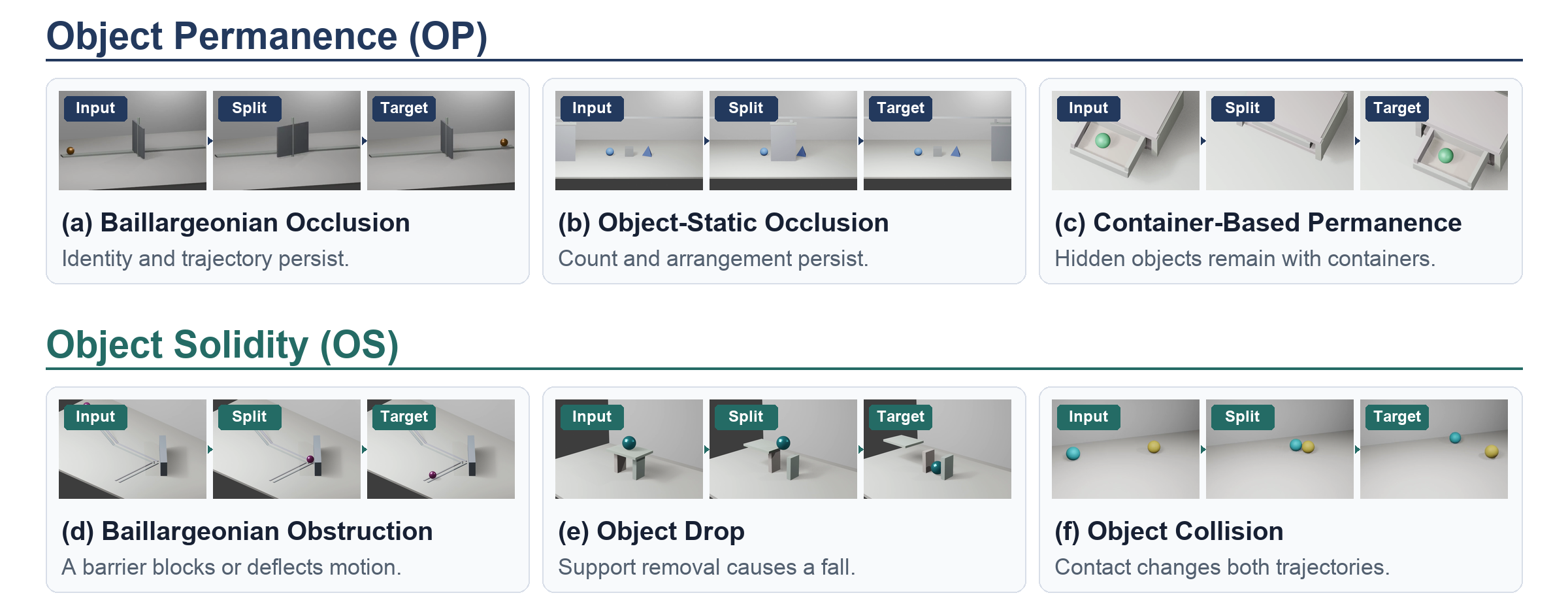
Each generator authors samples so that the key physical event begins at or after the temporal midpoint. This aligns naturally with a video-to-video (V2V) contract: the first half is conditioning, the second half must be predicted, and the causal transition sits inside the predicted window. Two parameter sets are separated by intent:
- Structural parameters (object count, trajectory topology, occluder opacity, occlusion duration, contact timing, aperture size) control the physical/cognitive challenge and are varied across samples to prevent memorization of a single outcome.
- Surface-level parameters (color, material, lighting, camera pose) are randomized independently to prevent the model from exploiting perceptual shortcuts.
An example generator, Marked_Boxes_Swap (OP-3, container permanence), requires binding hidden object identities to marked containers through a physical swap and revealing them correctly at the end — a direct test of persistent identity representation through complete occlusion plus location update.
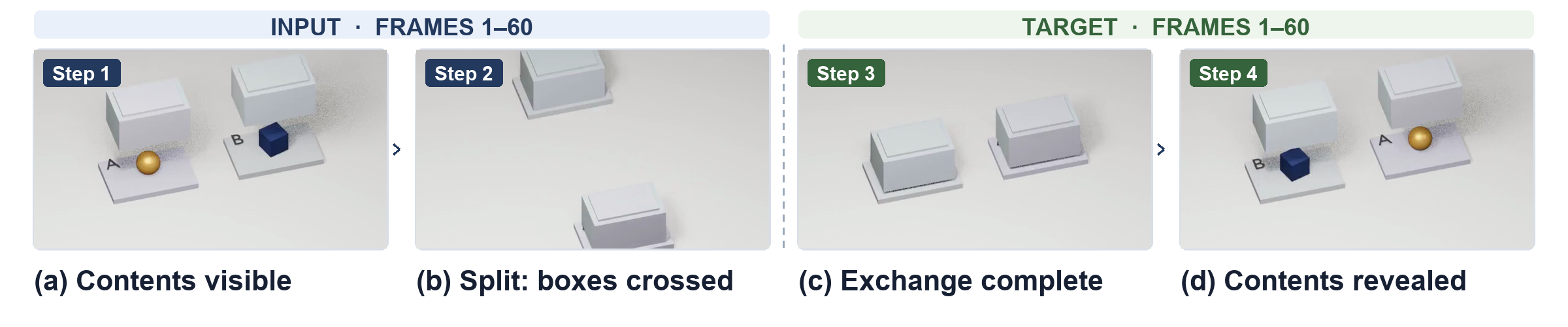
The released corpus contains 1.5M samples (10,000+ per task) plus a 300-question exam.
PWM-WROP: training a baseline into permanence
PWM-WROP is a fine-tune of Cosmos3-Nano (16B), unchanged in architecture or tokenizer; only the training signal changes. Training uses the V2V contract itself: 117-frame packed clips at 320\times192, split into 57 conditioning frames and 60 prediction frames, with each sample’s natural-language prompt as text conditioning. No task labels or family names are provided — the model must extract the cognitive structure from the physics of the clip alone. Training is one epoch over 1.5M samples on an earlier render of the same 150 generators.
The training infrastructure (PWM, released with the checkpoint) is a native-PyTorch stack for AWS Trainium2. The 36-layer model is sharded across a tensor-parallel \times FSDP2 mesh of 64 NeuronCores with static-shape compilation per block, reaching 5.7 s/step at batch 16 and 288\times512 geometry — down from an initial 15.1 s/step.
Evaluation and results
The primary metric is human preference from blind pairwise comparisons on the 300-question exam, fit via Bradley–Terry and rescaled to an Elo mean of 1500. Twenty raters produced 361 pairwise judgments (50–52 per model) across 14 systems spanning three interface classes: true continuation, reference-to-video (R2V), and edit/transfer. Confidence intervals come from 1,000 rater-clustered bootstrap resamples.
Key numbers from the leaderboard:
- Wan 3.0 Prime and MiniMax H3 (both R2V) tie at Elo 1723.6 with 77.9% score rate.
- PWM-WROP (true continuation) ranks 3rd at 1679.5 [1603.5, 1781.5], 73.1% score rate.
- Seedance 2.5 (R2V) is 4th at 1649.6.
- The next true-continuation model, Grok Imagine (video extend), is 224 Elo points behind PWM-WROP at 1457.
- LTX-2.3 Extend (1453) and MAGI-1 24B (1248) are the other continuation models.
- Edit/transfer systems (Runway Aleph 2, Wan-VACE 14B, Gemini Omni Flash 1.1, Kling O3 Pro, Cosmos3 Super, LTX-2.3 Dev, HY-OmniWeaving) cluster around Elo 1400–1520.
Two structural observations follow. First, R2V systems dominate, plausibly because they regenerate the continuation on their own timeline rather than being constrained to extend from the final input frame — giving more freedom to produce a physically coherent outcome, at the cost of occasionally overriding input identities and arrangements (e.g., Seedance 2.5 failures on G19, OP-2 and G27, OS-2). Second, and more relevant to the paper’s central claim: concept-specific synthetic fine-tuning materially closes the gap. PWM-WROP’s 224-Elo lead over the next continuation system, using an unchanged architecture and only the WROP V2V signal, is evidence that object permanence and solidity behaviors are trainable rather than emergent-only.
Limitations and open questions
The exam is 300 items, and per-model judgment counts (50–52) yield wide overlapping CIs — rank differences at the top (Wan 3.0 Prime, MiniMax H3, PWM-WROP) are within confidence bands. The corpus is entirely Blender-synthetic; whether trained permanence transfers to real-world video distributions is untested. PWM-WROP was fine-tuned on renders from the same 150 generators used in the exam (though with independent randomization), so some in-distribution advantage is unavoidable. Only one continuation base model was fine-tuned, so it is unclear whether the improvement generalizes across architectures. Full-reference metrics are reported as secondary but not analyzed here; their agreement with Elo would clarify whether raters are tracking physical correctness versus perceptual fidelity.
Why this matters
WROP operationalizes a developmental-psychology-style probe for world models and demonstrates that a targeted 1.5M-sample synthetic corpus can lift a 16B continuation model to competitive parity with the best proprietary R2V systems on physical-reasoning tasks. It reframes object permanence as something to train, not to wait for.
Source: https://arxiv.org/abs/2609.28654
OmniEcho: Spatial Audio Understanding for Embodied Agents
Problem
Embodied agents routinely have access to multichannel audio, yet vision-language and omni-modal models treat audio as a monaural semantic stream, discarding direction-of-arrival cues. This is especially limiting when sound sources are off-screen or transit in and out of the field of view — cases where vision alone is insufficient and where humans rely on binaural/spatial hearing. The paper argues two gaps: (i) there is no rigorous benchmark that isolates spatial audio reasoning in embodied settings using real first-order Ambisonics (FOA) recordings, and (ii) existing omni models lack an encoder pathway that preserves the spatial structure of FOA.
Benchmark: OmniEchoBench
OmniEchoBench splits into a perception QA suite and a navigation suite.
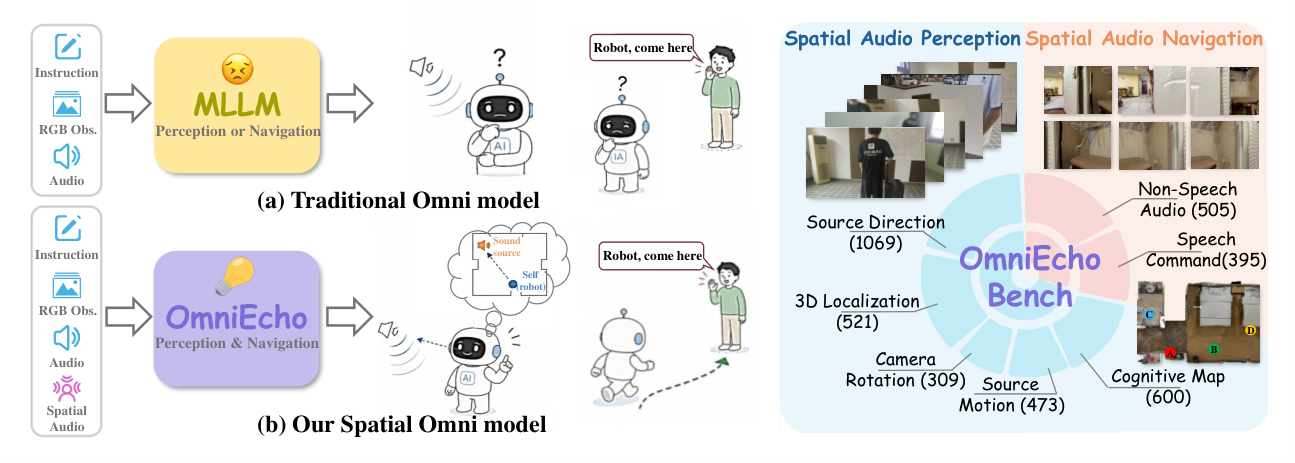
OmniEchoBench-QA contains 2,972 QA pairs across 197 real-world scenes, recorded from scripted human performances. Each take is captured synchronously as (a) first-person single-view video, (b) a 360° panoramic video used only for annotation, and (c) 4-channel FOA audio in the ACN/SN3D convention. Annotators use the panorama as ground truth to label active sound sources at 2 Hz, producing dense spatio-temporal trajectories relative to the recording device. Questions are then instantiated by rule-based sampling.
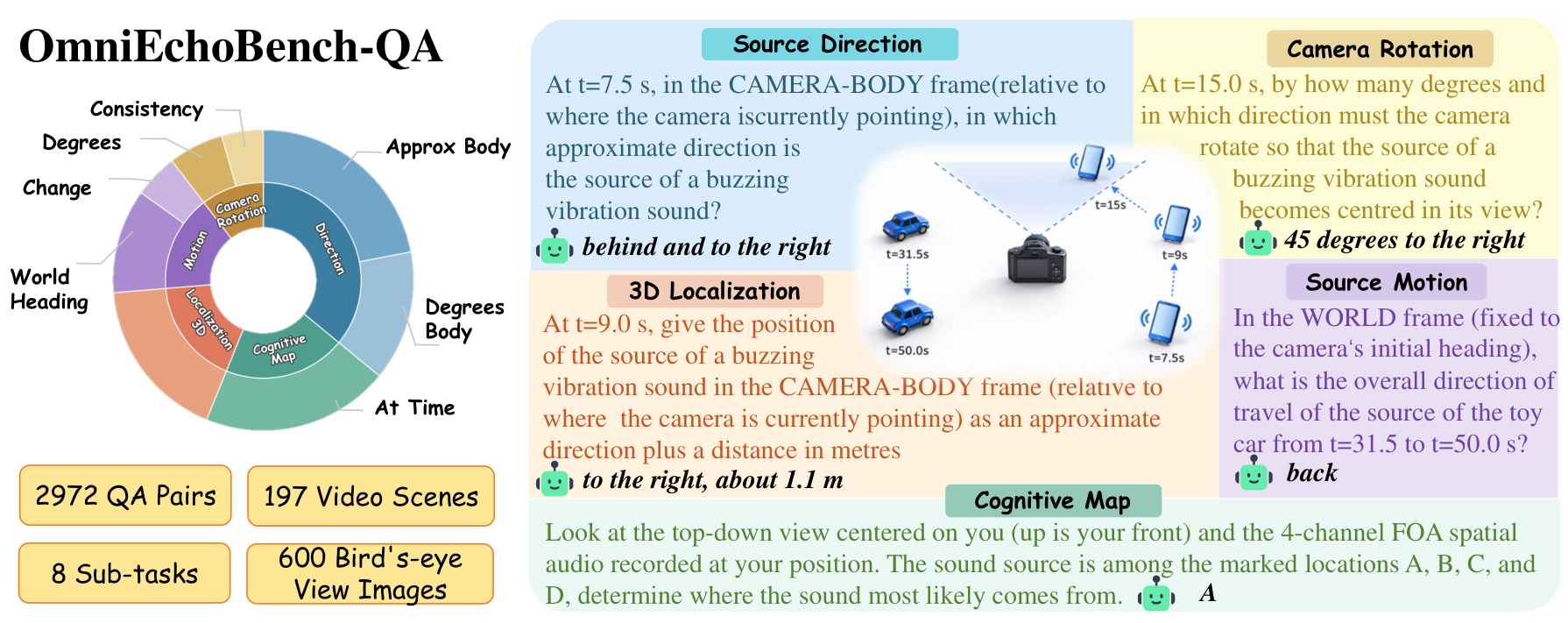
The perception subset (2,372 QA) probes: source direction (1,069), 3D localization (521), source motion (473), and camera rotation (309). A separate 600-QA subset presents an ego-centered top-down (BEV) map with “up” aligned to the agent’s forward direction and asks the model to pick among four candidate source locations {A,B,C,D} given the co-located FOA. This BEV subset is the cleanest test of integrating spatial hearing with a cognitive map, since visual semantics of the scene are effectively removed.
OmniEchoBench-Nav comprises 900 navigation tasks across 30 real environments. At each decision step the agent gets a language instruction L, T frames from a forward camera (the current frame plus T-1 uniformly sampled past keyframes), and the current FOA window A_t; it predicts a trajectory over the next K=8 steps, following the InternNav protocol.
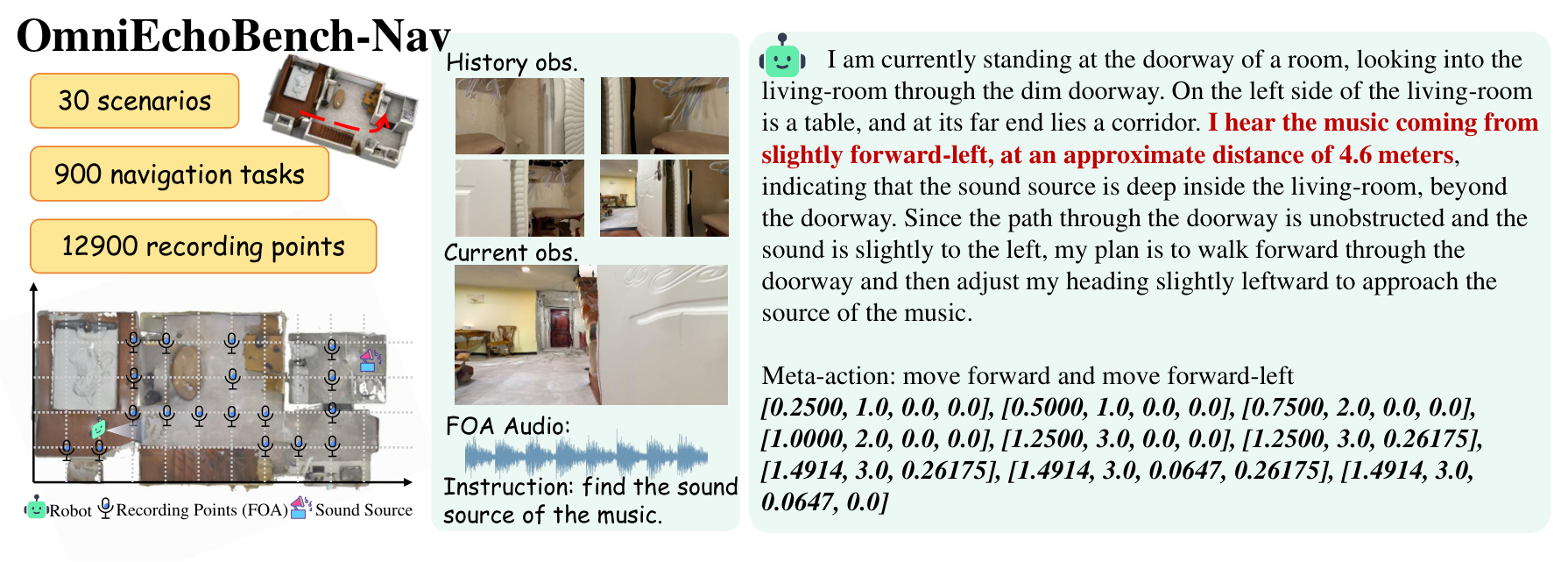
To scale training, the authors build a controllable FOA rendering pipeline that keeps geometric consistency across sound-source positions, egocentric visual observations, and agent trajectories, producing synthetic audio-visual QA, audio-only, and sound-guided navigation data — 363,193 training examples in total.
Method
OmniEcho is built on Qwen3-Omni-30B-A3B (Thinker variant). The key architectural addition is a dedicated FOA spatial encoder that runs in parallel with the existing semantic audio pathway. FOA audio, unlike a mono downmix, carries directional information through its W, X, Y, Z channels (zeroth- and first-order spherical harmonics under SN3D normalization), which is what the spatial encoder is intended to preserve.
Concretely, the semantic encoder still produces the usual audio tokens (content, speech, event class), while the FOA encoder emits spatial tokens that a trainable projector maps into the LLM embedding space. Spatial tokens are inserted immediately after the corresponding semantic audio tokens, so each temporal audio chunk contributes a paired (semantic, spatial) token bundle to the language stream alongside the visual tokens.
The unified task formulation is:
- Perception: given FOA A, video V or image I, and question q, produce answer a.
- Navigation: given instruction L, frames \{V_{t-T+1}, \dots, V_t\}, and FOA A_t, produce a length-K{=}8 trajectory.
Training uses spatial audio-visual QA plus VLN supervision drawn from ScaleVLN (139,142), RxR (92,418), R2R (31,577), and VLN-PE (28,969). Stage-3 training runs on 32 A100 GPUs for roughly four days.
Results
The paper reports state-of-the-art performance on OmniEchoBench-QA across the six task types (source direction, 3D localization, source motion, camera rotation, BEV localization, and navigation-grounded QA), and, for sound-guided navigation, OmniEcho reaches competitive performance on OmniEchoBench-Nav and the VLN-CE R2R val-unseen split. The abstract states OmniEcho “reaches a performance level” comparable to strong VLN baselines while adding spatial audio grounding; specific per-task numerics are not included in the sections provided.
Limitations and open questions
- FOA is first-order only: elevation and front/back disambiguation are known weak points of first-order Ambisonics, and the benchmark’s BEV task may partially sidestep this by working in 2D.
- Real-world scene count is modest: 197 scenes for QA and 30 for navigation. Room acoustics diversity (reverb, occlusion) is not characterized in the excerpts.
- The rendered training data assumes geometrically consistent propagation; sim-to-real gaps for reverberation, diffraction, and moving sources are not quantified here.
- Annotation is at 2 Hz, which caps the temporal resolution of motion and camera-rotation questions.
- The FOA encoder is described functionally but its inductive biases (e.g., whether it exploits intensity-vector or pseudo-intensity features, whether it is rotation-equivariant) are not spelled out in the provided sections.
Why this matters
Spatial audio is the most obvious missing modality in current embodied VLMs, and off-screen sound is exactly where vision-only agents fail. A benchmark that (i) uses real FOA recordings, (ii) forces reasoning about sources outside the visual field, and (iii) couples perception with navigation gives a concrete target for omni-modal architectures to move beyond monaural semantic audio.
Source: https://arxiv.org/abs/2609.23407
Agent-Editing World Model: Rethinking World Modeling for LLM Agents
Problem
Language-model world models have largely been framed as observation predictors: given history h_t and a proposed reasoning–action (\hat r_t, \hat a_t), learn \mathcal{M}_\text{obs}(o_t \mid s_t) where s_t = h_t \oplus (\hat r_t, \hat a_t). For LLM agents that call real tools (search, shells, code execution), this objective is misaligned. Tool responses are high-entropy and execution-dependent — reconstructing them is hard and largely redundant when the real environment is available at inference. The authors argue the harder failure mode is task-state contamination: unsupported hypotheses, stale plans, and premature “done” states persist across turns and get amplified by locally plausible follow-ups. Grounded observations do not fix this; the agent’s internal reading of them is what drifts.
The Agent-Editing World Model (AEWM) reframes the target from o_t to how (\hat r_t, \hat a_t) shape future task progress, and uses that model to edit the reasoning–action continuation before it is executed.
Method
AEWM has two capabilities and one inference-time integration.
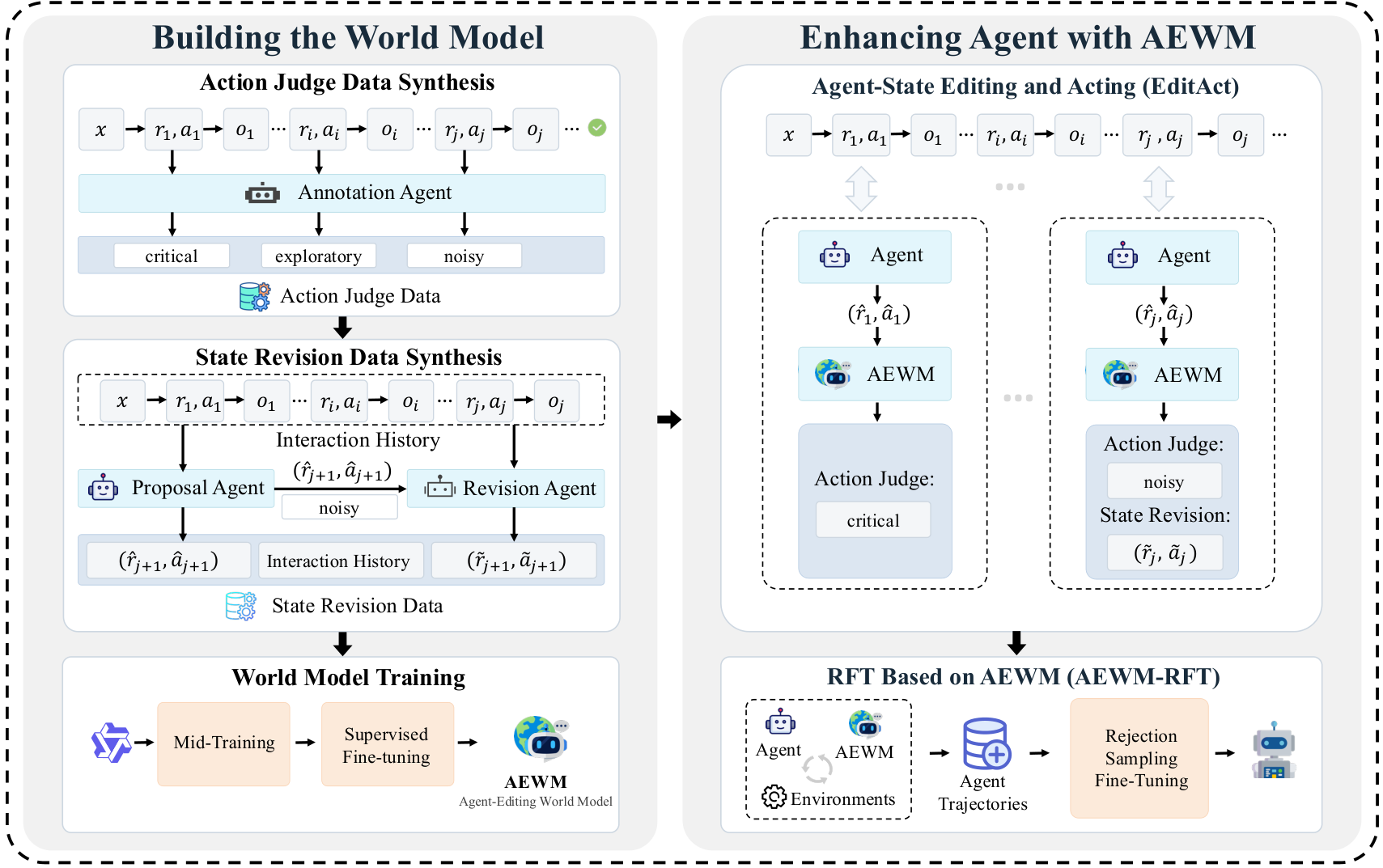
Action Judge. Given h_t and (\hat r_t, \hat a_t), predict a forward-looking rationale r_t^\text{AJ} followed by a label y_t \in \{\text{Critical}, \text{Exploratory}, \text{Noisy}\}. Training data comes from decomposing verified successful trajectories turn-by-turn; a strong annotation model, with access to the full trajectory and downstream role of each action, assigns y_t. Crucially, the training input to AEWM is the pre-execution context only — the annotator’s retrospective label becomes prospective supervision. Filtering enforces label consistency, action–observation alignment, and that r_t^\text{AJ} does not leak post-execution information.
State Revision. When y_t = \text{Noisy}, AEWM rewrites (\hat r_t, \hat a_t) into a revised (r_t', a_t') conditioned on the same h_t. Revision data is generated with a weaker proposal agent (Qwen3.5-35B-A3B) producing noisy candidates and a stronger revision agent (DeepSeek-V4-Pro) producing corrections, filtered by rubric.
EditAct. At inference, the agent samples (\hat r_t, \hat a_t) \sim \pi_\theta(\cdot \mid h_t); AEWM judges the type. Critical and Exploratory decisions pass through unchanged; Noisy ones are replaced with (r_t', a_t') before the tool call. This edits the state that seeds subsequent decisions, rather than issuing a critique the agent may ignore.
Training pipeline. AEWM is trained via mid-training followed by SFT on the combined Action Judge and State Revision corpora across three domains (Search, Terminal, SWE). Trajectories collected under EditAct guidance are then used for AEWM-based rejection sampling fine-tuning (AEWM-RFT) of the agent policy itself, internalizing the editing behavior.
Results
On the Action Judge benchmark, AEWM reaches 70.5% macro-F1, exceeding the baselines listed in the paper (the abstract is truncated but positions this as the top result). The three-way classification is nontrivial because Exploratory versus Noisy depends on downstream utility, not local plausibility.
The action-type distributions are informative about where contamination originates. In the annotated corpus, Search is dominated by noisy actions (60.0%), typically unverified hypotheses that narrow retrieval or substitute related evidence for required checks. Terminal has the largest exploratory share (43.2%) with 25.1% noisy — failures skew toward misreading execution output or accepting intermediate progress as verified success. SWE is more balanced: 42.1% critical, 28.0% noisy, with failures traced to dependency assumptions and neglected compatibility constraints. Online AEWM predictions preserve these domain signatures (noisy-heavy Search, exploratory-heavy Terminal, balanced SWE), which the authors read as evidence that the model has learned domain-conditioned decision priors rather than a uniform “looks bad” heuristic.
Limitations and open questions
- Labels are distilled from strong annotator models (DeepSeek-V4-Pro, GLM-5) applied to successful trajectories. The Critical/Exploratory/Noisy taxonomy inherits their biases, and turns from failed trajectories — arguably the highest-value training signal — are excluded by construction.
- State Revision requires that a stronger revision model exists. For frontier agents there may be no such oracle, so the approach as stated is a distillation mechanism as much as a world-modeling one.
- EditAct silently overwrites the agent’s action. This can mask miscalibration in AEWM: a wrongly-flagged Critical action gets replaced with a plausibly-worded but worse alternative, and the agent has no signal to disagree. The paper does not report intervention-precision (edits that actually improve the trajectory versus edits that hurt).
- Only three domains are evaluated. Whether the Critical/Exploratory/Noisy schema transfers to environments with denser reward or adversarial dynamics is untested.
- Macro-F1 of 70.5% still implies substantial disagreement with annotator labels; the downstream sensitivity of agent success to AJ errors is not decomposed.
Why this matters
AEWM makes a clean argument that for tool-using LLM agents, modeling the agent’s evolving task state is more useful than modeling the environment’s next observation, because the environment is queryable but the internal state drifts silently. The Action Judge / State Revision / EditAct decomposition is a concrete recipe for turning that reframing into an inference-time controller and a fine-tuning signal, and the domain-conditioned error distributions (noisy-heavy Search, exploratory-heavy Terminal) give a useful vocabulary for diagnosing where long-horizon agents actually fail.
Source: https://arxiv.org/abs/2609.28416
IterSynth: Rethinking Deep Search Agents via Role-Decoupled Iterative Synthesis
Problem
Deep search agents must plan multi-hop queries, retrieve evidence, and synthesize grounded answers over long horizons. ReAct-style single-policy agents conflate three distinct capabilities — planning, evidence use, and answer synthesis — into one autoregressive trace, and the context grows monotonically with retrieval, so signal-to-noise degrades as trajectories lengthen. IterResearch and similar workflows address context bloat with periodic compression but leave role coupling intact. IterSynth targets both issues jointly: it decouples the roles by construction and makes an evolving summary the persistent memory, so the raw retrieval history is not carried forward.
Method
IterSynth is a two-role loop executed by a single shared policy \pi_\theta, with roles distinguished by prompt and admissible action set.
- Planner sees the question q and current summary M_t, and either emits a search query a^P_t or terminates with a final answer. It cannot touch memory.
- Synthesizer sees the retrieved evidence e_t and current summary M_t, and produces M_{t+1}. It cannot query or answer.
At iteration t the active context is reconstructed from (q, M_t) rather than concatenated with prior turns — this bounds context growth to the summary size.
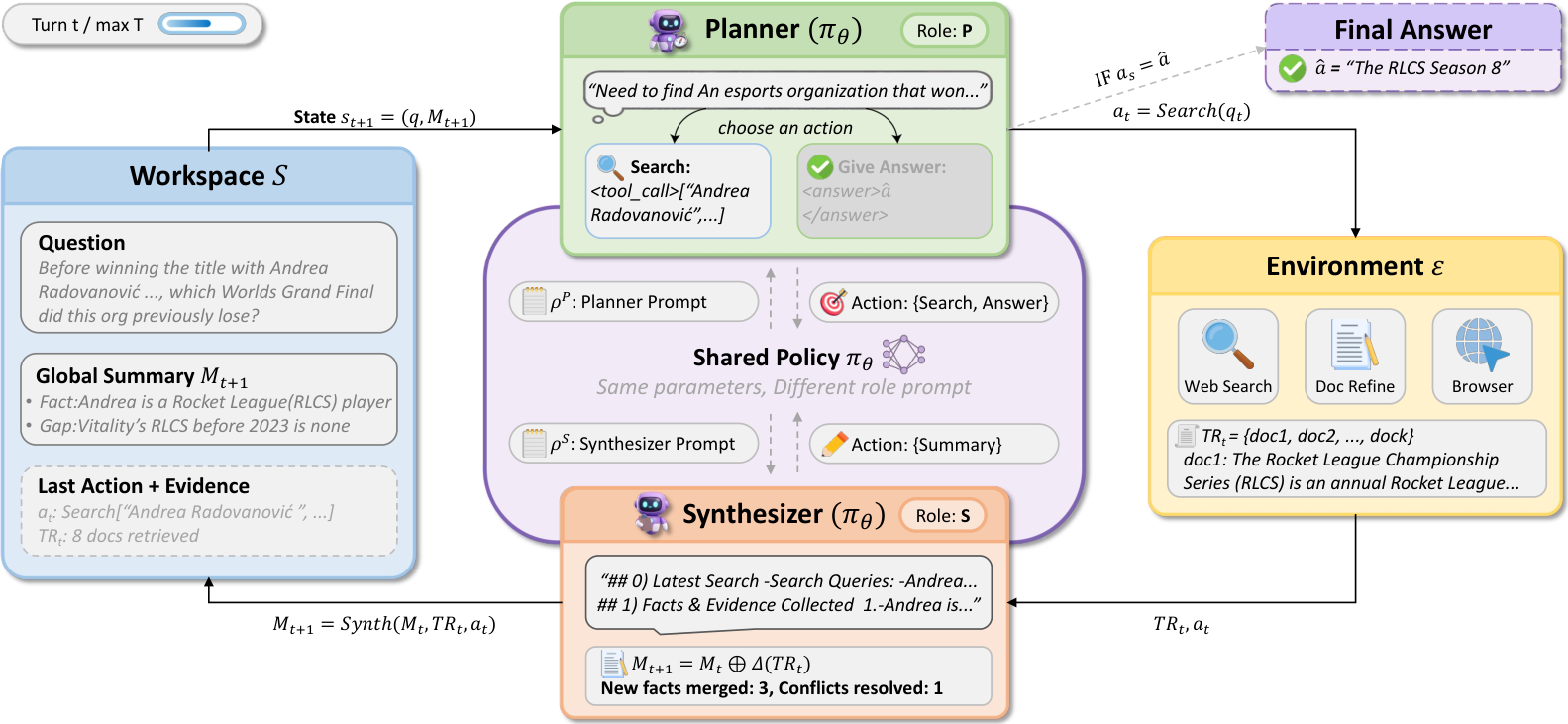
Training has two stages. A cold-start SFT phase teaches the role format and iterative behavior. The RL phase, Role-Decoupled Policy Optimization (RDPO), addresses credit assignment across heterogeneous roles: a Planner turn and a Synthesizer turn contribute differently to trajectory success and should not share a normalization pool.
RDPO computes a per-turn composite reward by combining a terminal outcome reward r_{\text{out}} (broadcast to every turn in the trajectory) with a turn-level rubric score r^{\text{rub}}_{r,t} evaluating role-specific quality (e.g., query informativeness for the Planner, faithful evidence integration for the Synthesizer). Turns are then partitioned by role r \in \{P, S\}, and advantages are normalized within each role’s group:
\hat{A}_{r,t} = \frac{R_{r,t} - \mu_r}{\sigma_r},
where (\mu_r, \sigma_r) are computed only over turns in role r. The policy update is a standard clipped surrogate over the union of turns.
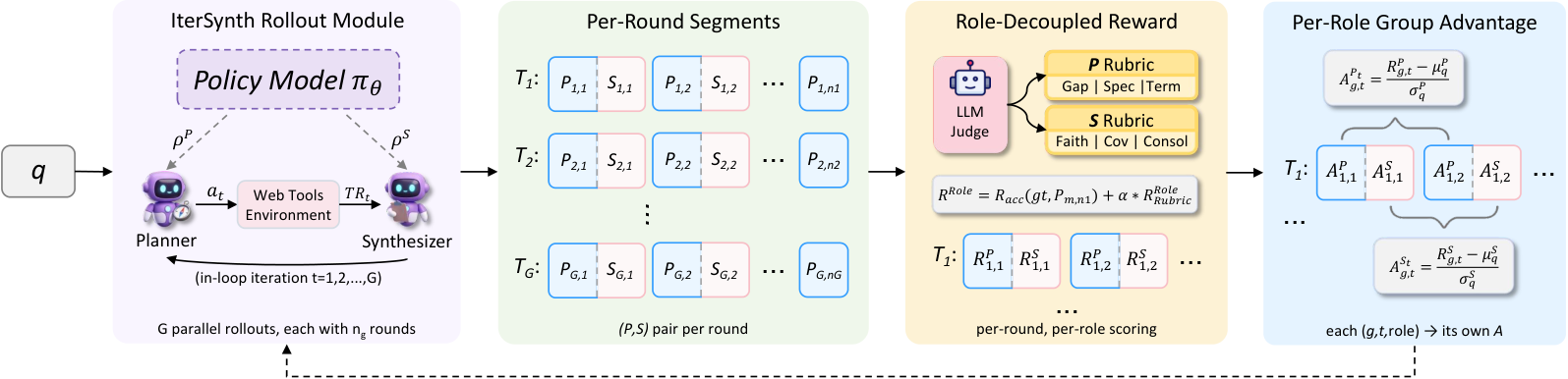
This role-wise normalization prevents variance from one role (typically the Synthesizer, which fires more often) from swamping gradients for the other, and it aligns credit with the local decision each role actually made.
Results
On five long-horizon benchmarks (BrowseComp, BrowseComp-ZH, GAIA, Xbench-DeepSearch 2505/2510), IterSynth-8B reaches 50.7 average, surpassing the strongest reported baselines at that scale (specific baseline breakdowns are in Table 3 of the paper; the abstract truncates before naming them).
The training-free prompting ablation is the more diagnostic result, because it isolates the workflow from RL. With Claude-4.5-Opus as backbone:
- ReAct: 60.6 avg
- IterResearch: 63.2 avg
- IterSynth: 66.1 avg (GAIA 61.2, Xb10 57.0, BCzh 70.2, Xb05 76.0)
With DeepSeek-V3.1:
- ReAct: 43.4
- IterResearch: 45.2
- IterSynth: 47.9 (GAIA 56.8, Xb10 35.0, BCzh 43.6, Xb05 56.0)
The gains over ReAct are +5.5 points on Claude-4.5-Opus and +4.5 on DeepSeek-V3.1, and over IterResearch +2.9 and +2.7 respectively. The largest deltas appear on BrowseComp-ZH (Claude: 60.2 → 70.2) and Xbench-DS 2505 (Claude: 69.0 → 76.0) — benchmarks where trajectories are longest and cross-step evidence consolidation is heaviest. On GAIA under Claude, IterResearch (66.0) beats IterSynth (61.2), suggesting that when trajectories are shorter and tool-use heavier, aggressive summarization can drop useful raw evidence.
Limitations and open questions
- The Planner–Synthesizer share parameters, so specialization is entirely prompt- and action-mask-driven. Whether hard-parameter separation (LoRA per role, or MoE routing on role token) would help at 8B scale is untested.
- Rubric rewards require an external judge; the paper does not fully characterize judge cost or its failure modes, and reward hacking against the rubric is a known risk in this setup.
- The summary is a lossy state. On tasks demanding exact-string evidence recall (e.g., citation-heavy GAIA subsets), collapsing raw passages into M_t may erase quotable spans. The GAIA gap versus IterResearch under Claude backs this up.
- Only one model size (8B) is trained. Scaling behavior of RDPO — particularly whether role-wise normalization matters less as base capability rises — is unknown.
- No comparison against agents with structured external memory (vector store, scratchpad with retrieval) as opposed to a monolithic textual summary.
Why this matters
IterSynth is a clean demonstration that two independent axes — capability coupling and context accumulation — both hurt long-horizon search, and that separating them structurally beats scaling context or compressing periodically. RDPO’s role-wise advantage normalization is a small, general recipe: any multi-role agent with heterogeneous turn distributions should be checking whether pooled normalization is hiding role-specific gradient signal.
Source: https://arxiv.org/abs/2609.29444
Coding Agents for Generalized Task and Motion Planning Problems
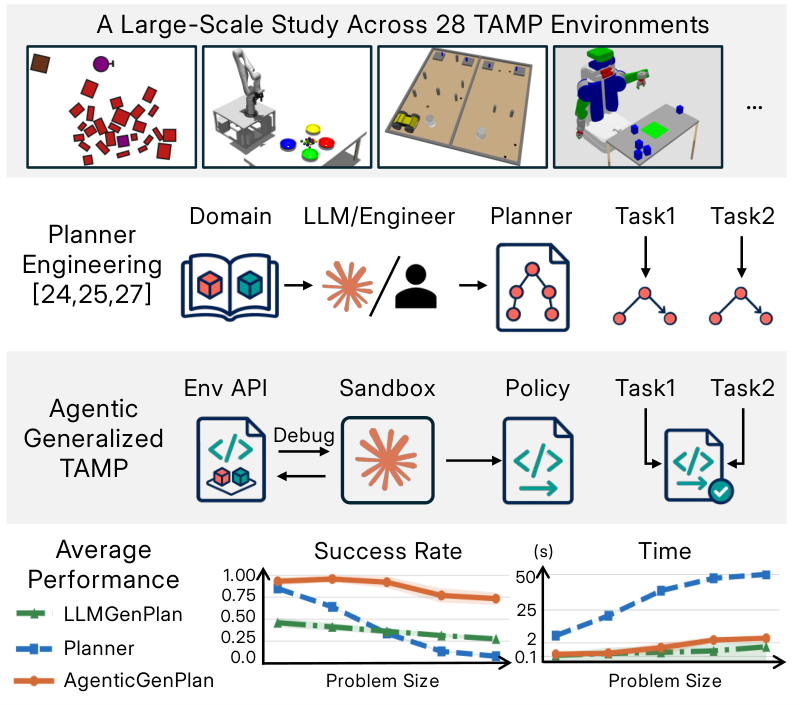
Task and motion planning (TAMP) couples discrete symbolic choices with continuous geometric, kinematic, and dynamic feasibility, and standard approaches lean heavily on hand-engineered predicates, operators, samplers, and skills. Generalized TAMP tries to amortize that engineering across instance distributions by learning reusable components (samplers, feasibility predictors, heuristics, abstractions). This paper asks a sharper question: can an off-the-shelf coding agent, given only a task description and a reset/step simulator, synthesize a programmatic policy that generalizes to unseen instances — with no TAMP scaffolding at all?
Setup
Each environment is a finite-horizon goal-directed MDP \mathcal{M}=\langle\mathcal{S},\mathcal{A},P,R,\rho,H\rangle with fully observed, object-centric states (typed objects mapped to real-valued feature vectors: pose, geometry, joint config, velocity). The initial-state distribution \rho varies object counts and geometry across instances; \mathcal{S},\mathcal{A},P,R are shared.
The agent runs inside a sandboxed Docker container (Python + NumPy + SciPy, no network, no environment source in the main setting), receives the task description d and a client exposing reset, step, and rendering, and produces a class implementing reset and get_action that computes a_t=\pi(h_t). The synthesized program is then frozen; no LLM runs at test time. A + source setting additionally exposes environment source code and generative simulator access during synthesis.
The study covers 28 environments (25 from KinDER, 3 from PDDLStream), 7 synthesis methods, 5 runs each, 100 held-out test instances per program — 98,000 evaluation episodes. Backends: Claude Code with Opus 5, and Codex with GPT-5.6 Sol and GPT-6 Astra. Baselines include the benchmark’s hand-engineered TAMP planners, one-shot LLM generation, and LLMGenPlan (both given source code).
Results
Across the main (no-source) setting, AgenticGenPlan dominates both the hand-engineered planners and prior LLM synthesis. On the Kinematic2D/Dynamic2D/Kinematic3D block of Table I, Opus 5 (high) reaches means of 1.00 on StickButton, Obstruction, Motion, PushT, Packing, Transport, and Table; 0.99 on ClutteredStorage; 0.98 on PushPullHook (2D); and 0.85 on ScoopPour. GPT-6 Astra (high) is stronger still: 1.00 across most environments, 0.96 on ClutteredRetrieval, 0.97 on ScoopPour, and 0.89 on Packing. The planner baseline sits far below on the same tasks — 0.36 StickButton, 0.19 ClutteredStorage, 0.51 ClutteredRetrieval, 0.24 PushPullHook, 0.13 (2D) Obstruction PushPullHook — and returns dashes on several dynamic environments where no planner exists (PushT, ScoopPour, Obstruction).
One-shot Opus 5 collapses almost everywhere (0.00 on most Dynamic and PDDLStream tasks). LLMGenPlan with Opus 5 does well on select tasks (0.83 StickButton, 0.82 Obstruction, 0.97 Motion, 0.85 Transport, 0.98 Dynamo, 0.86 Rovers) but fails on dynamic and 3D tasks (0.00 on PushT, ScoopPour, Packing 3D, BalanceBeam, ConstrainedCupboard, Rearrange, Shelf, SortClutteredBlocks, SweepIntoDrawer, SweepSimple, Tossing). The interactive, agentic loop — probing the simulator, running custom tests, revising — is what closes those gaps.
Providing source code (+ source) yields modest additional gains: Opus 5 rises to 1.00 on ScoopPour Obstruction and 1.00 on Packing 3D (from 0.85 and 0.66), and GPT-6 Astra + source hits 1.00 on nearly every environment. The main-setting agent is already close to this ceiling on most tasks, indicating that simulator interaction largely substitutes for source access.
Discovered strategies
The synthesis logs argue against pure memorization. Agents write custom probing scripts, e.g., re-seeding reset in StickButton to enumerate wall-adjacent sticks and high buttons, then discovering that neither pure top nor pure side grasps suffice and that a release-and-regrasp sequence is required for reachability.
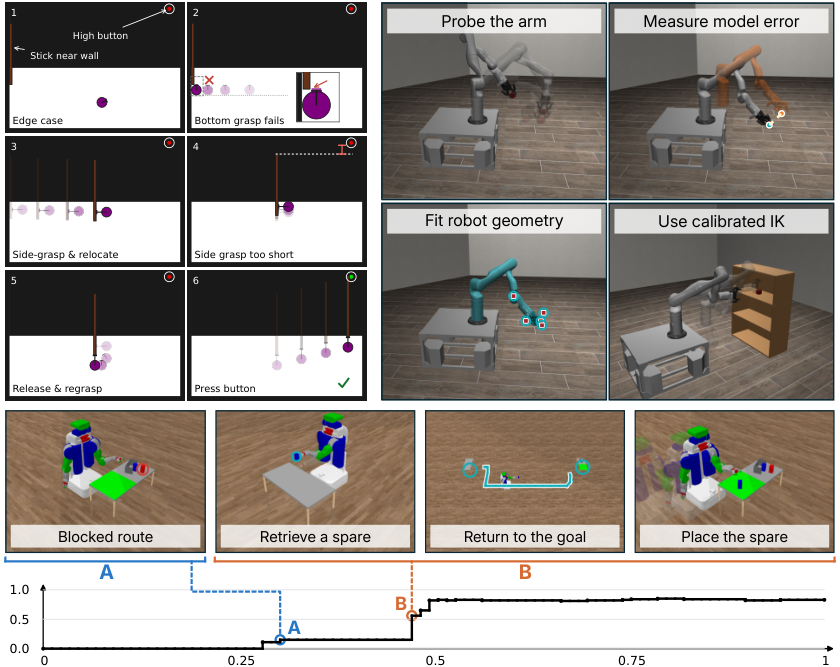
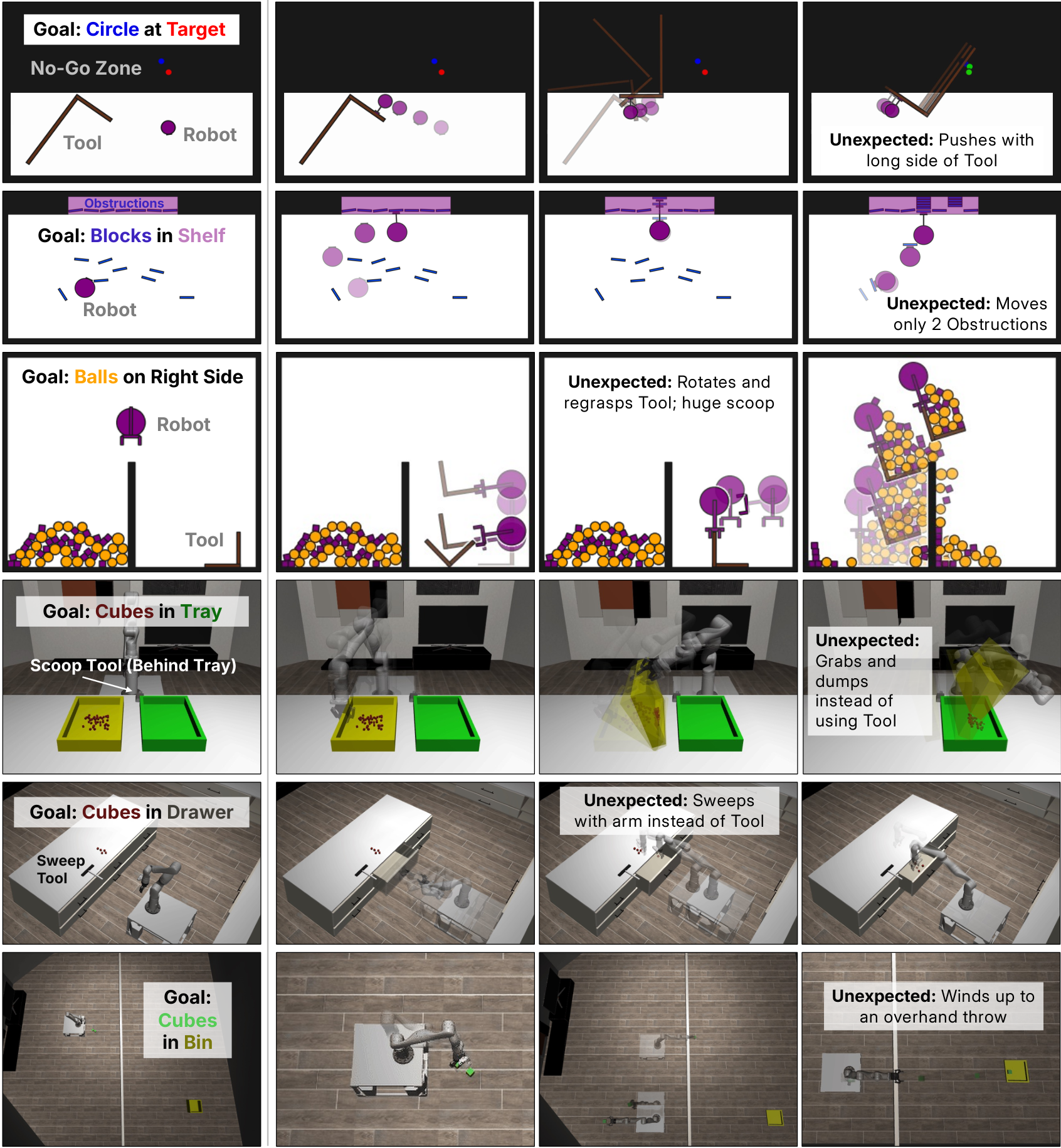
Several synthesized policies exploit dynamics or geometry in ways not present in the benchmark solutions — behaviors more consistent with iterative empirical development than retrieval.
Limitations and open questions
The setting assumes full observability, object-centric state, and simulator access during synthesis — perception uncertainty is untested. Training data for the frontier models is undisclosed, so benchmark contamination cannot be ruled out (the authors argue interaction traces mitigate but do not eliminate this concern). The frozen-program evaluation means no test-time adaptation; robustness to distribution shift beyond varying object counts is not measured. Compute cost per synthesis run is not itemized in the excerpt, and it is unclear how the approach scales when the simulator is expensive or partially differentiable-only. Finally, results depend on capable coding agents (Opus 5, GPT-6 Astra); GPT-5.6 Sol (medium) shows meaningfully lower numbers (e.g., 0.21 ClutteredRetrieval, 0.17 Transport, 0.26 ScoopPour Obstruction), so the effect is not uniform across backends.
Why this matters
If frontier coding agents can synthesize, from scratch and via simulator interaction, programmatic policies that outperform hand-engineered TAMP planners on 28 environments including dynamic and 3D tasks, then much of the abstraction engineering that has defined TAMP research becomes a strong baseline to beat rather than a prerequisite. It also reframes “generalized planning” as a program-synthesis problem where the agent discovers both the environment model and the solution strategy, which is a substantially different research target than learning samplers or heuristics inside a fixed planner.
Source: https://arxiv.org/abs/2609.30233
Hacker News Signals
Fearless SIMD v1.0
Fearless SIMD is a Rust crate from the Linebender project that provides safe, ergonomic access to SIMD intrinsics without requiring unsafe at the call site. The core design problem it solves is the standard Rust tension: SIMD intrinsics are unsafe by definition because they will generate illegal instruction faults on CPUs that lack the required feature, but wrapping every call in unsafe blocks defeats the purpose of Rust’s safety guarantees and produces noisy, hard-to-audit code.
The solution is a token-based capability pattern. At program startup (or at a safe dispatch point), you call a detection function that returns a token type — for example, Avx2Token — whose existence in the type system proves at compile time that the current CPU supports AVX2. SIMD functions then take this token as a zero-sized parameter. Because the token can only be constructed inside the checked detection block, downstream call sites are safe without an explicit unsafe annotation; the safety contract is encoded in the type. This is structurally similar to the “branded” or “session type” patterns seen in formal verification literature.
The crate covers x86/x86-64 (SSE2 through AVX-512 subsets) and AArch64 (NEON, SVE stubs). It integrates with std::arch rather than replacing it, so you retain access to the full intrinsic set. The v1.0 release stabilizes the token API and adds a multiversion macro that emits a dispatch table once, selecting the best available path at runtime with zero per-call overhead after the first indirect branch (which branch predictors handle well for hot loops).
The practical target is 2D rendering and font rasterization, where Linebender also maintains vello and kurbo, but the crate is general-purpose. The main limitation is that it does not abstract over SIMD widths — you still write separate AVX2 and SSE4.1 kernels manually. Portable SIMD (std::simd, still unstable) is the eventual Rust-native answer, but Fearless SIMD fills the gap for production code today.
Virtio-nvgpu: Near-native Nvidia GPU Access Inside a KVM Guest
Virtio-nvgpu is an open-source virtio device implementation that exposes Nvidia GPU capabilities to KVM guests with near-native performance, targeting the use case of running CUDA workloads or GPU-accelerated inference inside VMs without SR-IOV hardware partitioning or the overhead of full software emulation.
The architecture uses the virtio transport layer to pass GPU command buffers and memory mappings between guest and host. The guest driver submits work through virtio queues; the host-side daemon forwards these to the real Nvidia driver via the standard user-space CUDA/NVML stack. Crucially, GPU memory is mapped into the guest’s address space using vfio-style DMA remapping where possible, avoiding double-copy of large tensor buffers. This is distinct from VGPU (Nvidia’s proprietary time-sliced virtualization) and from GPU passthrough (which gives exclusive device ownership to one VM): virtio-nvgpu aims to allow multiplexing while preserving low-latency command submission.
The project is early — the repository shows working CUDA kernel execution inside a QEMU/KVM guest on RTX-class hardware, with benchmark numbers claiming single-digit percentage overhead for compute-bound workloads relative to bare metal. Memory bandwidth-bound workloads show more overhead due to the indirection layer, which is expected. The implementation relies on intercepting the Nvidia user-space driver’s ioctl interface (the same approach Mesa uses for open-source GL on top of nouveau, but here targeting the proprietary stack), so it is sensitive to Nvidia driver version changes.
Open questions include stability under multi-process CUDA contexts, handling of GPU faults and preemption, and whether Nvidia’s driver licensing will constrain distribution. The virtio device specification for GPUs (virtio-gpu) exists but is oriented toward display; this project is building a parallel spec for compute. It is the kind of infrastructure that becomes critical if GPU cloud disaggregation (running workloads in isolated VMs per tenant) is to avoid proprietary vGPU licensing costs.
OpenAI GPT-6 Astra Breaks Enigma Message Resistant Since 2005
The cryptanalytic substance here is the decryption of an Enigma-enciphered message from the BGAC collection — specifically a short message (the “MVUEH” crib) that has resisted automated and manual attacks for roughly two decades. The difficulty is not the Enigma cipher’s fundamental weakness (known since Bletchley Park) but the practical combinatorics: short messages lack sufficient ciphertext for standard index-of-coincidence or bombe-style attacks to converge reliably, and the specific wheel order, ring settings, and plugboard configuration for this message were unknown.
The reported approach involved GPT-6 Astra (OpenAI’s multimodal reasoning model) being used to guide and execute a structured search. The technical detail in the writeup is that the model was given the ciphertext, the known Enigma keyspace constraints for the relevant network and date range, and asked to reason through the attack. What apparently succeeded was the model’s ability to combine partial cribs (probable plaintext fragments inferred from message context and traffic analysis metadata) with a hypothesis-and-verify loop — essentially automated bombe-style reasoning augmented by the model’s ability to infer likely German military phrases for the message category.
This is notable from an LLM capability standpoint because cryptanalysis of historical ciphers requires integrating domain knowledge (Enigma mechanical constraints), combinatorial search, and linguistic inference simultaneously. Whether this represents genuine multi-step reasoning or very broad pattern matching over training data that includes Enigma-adjacent content is an open question the writeup does not resolve. The Enigma keyspace per day is roughly 10^{23} in the worst case but dramatically reduced by known constraints; the model likely did not enumerate this exhaustively, relying instead on constraint pruning.
For practitioners: this is more interesting as a benchmark of structured reasoning under domain-specific constraints than as a cryptographic result per se.
Source: https://www.cryptocellar.org/bgac/the-mvueh-break.html
Drop: Rootless Linux Sandbox with gVisor Support
Drop is a CLI tool for running processes in unprivileged Linux sandboxes without requiring root or a setuid helper. The two isolation backends it supports are rootless namespaces (Linux user namespaces + mount/pid/network namespace stacking) and gVisor’s runsc container runtime, which interposes a user-space kernel between the process and the host kernel.
The rootless path uses newuidmap/newgidmap for UID/GID mapping and constructs a minimal mount namespace, giving you filesystem isolation without privilege. Network isolation is optional and, in rootless mode, limited to a loopback-only namespace unless you have slirp4netns or pasta installed for NAT. The gVisor path provides stronger syscall filtering — gVisor intercepts all system calls and re-implements them in Go, so host kernel attack surface is substantially reduced — but requires runsc to be installed and has known performance costs on syscall-heavy workloads (file I/O in particular).
The project’s main value over raw unshare scripting is a declarative config format for bind mounts, environment whitelisting, and capability dropping, plus automatic selection of the strongest available backend. This is the same problem space as bubblewrap (used by Flatpak) and firejail, but Drop leans on gVisor for the higher-assurance tier rather than seccomp profiles alone.
Limitations worth noting: rootless namespaces have had a history of kernel privilege escalation bugs (the user namespace attack surface is non-trivial), so “rootless” does not mean risk-free. The gVisor path mitigates this but adds the gVisor TCB. There is no persistent container image management — Drop is for ephemeral process sandboxing, not a container runtime replacement. Compatibility with GPU passthrough or io_uring inside the sandbox is currently unsupported.
Source: https://droprun.sh/
Radicle: Disclosure of Vulnerability in the Network Protocol
Radicle is a peer-to-peer code collaboration platform built on Git, using a gossip-based protocol for repository replication and identity. The disclosed vulnerability is in the network protocol layer and, per the advisory, allows an attacker to cause incorrect state propagation across the peer network — specifically, a malicious peer can craft protocol messages that cause honest nodes to accept forged repository updates or identity documents under certain conditions.
The technical root cause appears to be insufficient validation of signed data during the gossip message processing path. Radicle uses Ed25519 signatures for repository refs and identity documents, but the vulnerability involves a case where the signature verification step could be bypassed or the verified payload decoupled from the applied state update — a classic time-of-check/time-of-use class of bug in a distributed context. The exact conditions require the attacker to be a peer the victim node has already connected to (not fully remote/unauthenticated), which limits blast radius somewhat.
The fix involves tightening the message handling pipeline to ensure that the object whose signature is verified is identical to the object applied to local state, with no intermediate deserialization step that could substitute a different payload. This is a well-understood class of vulnerability in systems that sign-then-serialize rather than verifying the canonical serialized bytes directly.
For a project whose security model depends entirely on cryptographic identity (there is no central authority to revoke compromised state), this class of bug is high severity even at limited scope. The disclosure appears responsible, with a patch released alongside the advisory. Users running radicle-node should update immediately. The broader lesson is that gossip protocols with mutable state and cryptographic authentication require extremely careful handling of the serialization boundary around signature verification.
Source: https://radicle.dev/2026/09/23/disclosure-of-vulnerability-in-network-protocol
WordPress: Unauthenticated Path Traversal Leading to Conditional RCE
The vulnerability (GHSA-7hp8-65ch-5whp) is a path traversal in WordPress core that, under specific conditions, leads to remote code execution without authentication. The path traversal allows an attacker to read or influence file paths outside the intended web root, and the “conditional RCE” qualifier means execution requires a secondary condition to be met — typically a writable upload directory or a specific plugin/theme configuration present on the target.
Mechanically, the issue is in a file-handling code path that constructs filesystem paths from user-supplied input without sufficient normalization before the path is used. The canonical form of this bug is ../ sequence injection that survives basename()-style sanitization applied at the wrong point, or after URL decoding. WordPress’s handling of multipart uploads and its internal virtual filesystem abstraction (WP_Filesystem) introduce multiple opportunities for such bugs because they layer sanitization across several functions with inconsistent normalization.
The RCE path typically works by writing a PHP file to a directory the web server will serve, or by triggering inclusion of an attacker-controlled file via a subsequent request. WordPress’s plugin architecture and the prevalence of eval/include patterns in themes make the exploitation surface broad once arbitrary write is achieved.
The security advisory is in the wordpress-develop repository, indicating it is a core issue, not a plugin. Patch analysis (from the linked GitHub advisory diff) shows the fix normalizes the path before any operation and validates it against an allowlist of permitted directories. Given that WordPress powers a substantial fraction of the web and this is unauthenticated, mass exploitation of unpatched instances should be expected quickly after public disclosure. Hosting providers with auto-update enabled will be largely shielded; self-managed instances require immediate action.
Source: https://github.com/WordPress/wordpress-develop/security/advisories/GHSA-7hp8-65ch-5whp
Cloudflare: Full Support for HTTP Vary Header in Cache
The Vary HTTP response header instructs caches to store separate responses per distinct values of named request headers. For example, Vary: Accept-Encoding means a cache must serve different stored responses to clients that send gzip versus br versus no Accept-Encoding. Despite being part of HTTP/1.1 since RFC 2616, CDN support for Vary has historically been partial or broken — most CDNs either ignore Vary entirely (and serve potentially wrong content) or refuse to cache responses that set it.
Cloudflare’s implementation handles the key complexity: cache key construction. A naively correct implementation creates an exponential key space (one cache entry per unique combination of varied header values), which is unworkable. The practical solution is to normalize header values into a canonical form before keying — for Accept-Encoding this means bucketing into a small set of encoding capability classes rather than storing per raw header string. The blog post describes their normalization logic and how they handle the Vary: * case (which must never be cached per spec) and Vary: Cookie (which in practice means per-user uncacheability and should be treated as a cache bypass signal).
The more interesting engineering is handling Vary: Accept and Vary: Accept-Language for content negotiation, where the canonical bucketing is non-obvious and locale matching has complex fallback semantics (RFC 4647). Cloudflare’s approach appears to use a coarse bucketing (language family rather than full locale tag) to keep the key space tractable.
The practical impact is that frameworks and APIs that rely on content negotiation — returning JSON or MessagePack based on Accept, or compressed versus uncompressed based on capability — can now actually benefit from Cloudflare caching without stripping the Vary header as a workaround. The limitation is that highly variable header values (e.g., full Cookie) still defeat caching, as they should per spec.
Linux Support Coming to Snapdragon X2 Series
Qualcomm announced at Snapdragon Summit that the Snapdragon X2 series will have official Linux support, building on the upstream kernel work that has progressively landed for Snapdragon X Elite (X1) over the past year via the qcom subsystem maintainers and the linux-arm-msm mailing list.
The technical substance is in what “support” means at the kernel level. For X Elite, the current upstream status includes functional CPU cores (Oryon, Arm v8.7-A with Qualcomm’s custom microarchitecture), PCIe, USB, display via the msm DRM driver, and basic power management. What remains incomplete or downstream-only includes the Neural Processing Unit (Hexagon DSP), the integrated Adreno GPU’s full Vulkan/OpenGL stack (Mesa’s freedreno driver is partial), and the always-on sensor hub. The X2 generation presumably inherits this baseline and adds new IP blocks that will need driver work.
The announcement is notable because it signals Qualcomm is committing to upstream-first or at minimum upstream-compatible development for Linux, which has historically not been their posture for mobile SoCs. This matters for the Arm laptop market: Windows on Arm has had exclusive access to full hardware capability on Qualcomm silicon, while Linux users relied on reverse-engineered drivers or carried large out-of-tree patch sets.
For ML practitioners specifically: the Hexagon NPU support is the critical missing piece. Qualcomm’s AI Engine runs inference workloads at substantially better power efficiency than the CPU or GPU on these devices. Until Hexagon has an upstream driver with a standard acceleration API (likely via accel subsystem or a QNN-compatible ONNX Runtime backend), on-device inference on Snapdragon Linux will be CPU or GPU-only. The X2 announcement does not address this gap directly.
Source: https://www.qualcomm.com/news/onq/2026/09/snapdragon-summit-agentic-ai-pcs-linux
Noteworthy New Repositories
TypeLLM/TypeLLM
TypeLLM enforces type-safe structured generation from LLMs at the library level, targeting the common failure mode where a model output is parsed at runtime and crashes due to schema violations. The core idea is to make the Python type system — dataclasses, Pydantic models, TypedDict, Literal, enums — the single source of truth for both the prompt construction and the output parser, so a type error surfaces at definition time rather than at inference time.
Under the hood, the library introspects the annotated return type, serializes it into a JSON Schema fragment, injects that schema into the system prompt or function-calling payload, then validates and deserializes the raw completion back into the declared Python object. For constrained-decoding backends the schema can also drive token-level logit masking. Compared to Instructor or Outlines the scope is narrower and the API surface smaller, which reduces integration friction when all you need is reliable typed outputs without a full structured-generation framework.
Practical use cases include agent tool-call parsing, evaluation pipelines that feed model outputs into typed downstream functions, and any batch-inference job where silent mis-parses cause subtle data corruption. The library is pure Python with optional dependencies for OpenAI and Anthropic clients.
Limitations: constrained-decoding support is backend-dependent and the schema injection adds prompt tokens.
Source: https://github.com/TypeLLM/TypeLLM
shinthink/blitzstrike
Blitzstrike is an MCP (Model Context Protocol) server that exposes a structured penetration-testing methodology as a single callable interface for LLM agents. Rather than a loose collection of wrapper scripts, it organizes 130 tools into a directed workflow: reconnaissance and attack-surface enumeration, source-to-sink taint analysis, and live exploitation validation, with 57 pre-defined escalation chains connecting discovery primitives to impact verification steps.
The architecture uses MCP to let any compliant agent (Claude, GPT-4o, local models via compatible clients) invoke tools through a uniform JSON-RPC interface, meaning the agent handles reasoning and sequencing while Blitzstrike handles tool dispatch and result normalization. An intelligence data layer persists intermediate findings so later stages can condition on earlier reconnaissance output without re-running expensive scans.
For security engineers this addresses the biggest friction in LLM-assisted pentesting: ad-hoc tool calls produce inconsistent output formats that the model cannot reliably chain. By standardizing schemas across the catalog and encoding escalation dependencies explicitly, Blitzstrike gives the agent a graph it can traverse rather than a list it must improvise over.
Caveats worth noting: the tool depends entirely on the calling agent’s judgment for scope and authorization decisions, and the escalation chains encode specific assumptions about target environments that may not generalize. Responsible use requires explicit scope authorization; the server itself performs no guardrails enforcement.
Source: https://github.com/shinthink/blitzstrike
yukitorido/short-video-generator-AI
This repository implements a modular pipeline for automatically converting long-form video content into vertical short-form clips. The pipeline stages are: audio extraction and transcription via Whisper, LLM-driven highlight scoring that ranks transcript segments by predicted engagement or semantic salience, clip boundary detection with configurable padding, and ffmpeg-based re-encoding to 9:16 aspect ratio with optional caption overlay.
The Whisper integration produces word-level timestamps, which allows the LLM scoring stage to map a selected transcript span precisely back to the video timeline without off-by-one drift common in segment-level approaches. The highlight detector accepts a prompt template, so the selection criterion (topical relevance, quotability, emotional valence) can be adjusted without touching pipeline code.
The architecture is deliberately sequential and file-system-based rather than a streaming graph, which makes individual stages independently testable and substitutable. Users running locally can swap Whisper model size against speed constraints and replace the LLM call with a local model if latency or privacy is a concern.
Limitations: caption burn-in is static (no animated word-level karaoke), and the pipeline does not handle multi-speaker diarization, so highlight selection in interview content with topic switches can be inaccurate. No scene-change or visual-saliency signal feeds back into the scoring — it is purely transcript-driven.
Source: https://github.com/yukitorido/short-video-generator-AI
FankChen/tracecrate
Tracecrate is a local-first workbench for inspecting and comparing AI agent execution traces, targeting developers who need to debug multi-step agent runs without sending telemetry to a hosted service. It ingests three log formats: Claude Code session logs, OpenAI Codex traces, and generic OTLP (OpenTelemetry) spans, normalizing them into a unified internal representation for side-by-side run comparison.
The core UI surfaces tool-call sequences, latency breakdowns per step, token counts, and branching decisions in a timeline view. The run-comparison feature diffs two traces structurally — matching steps by name and order — so a refactor or prompt change can be evaluated against a reference run without manual log inspection. The export path strips API keys, internal hostnames, and configurable PII patterns before writing reports, which is the “privacy-conscious” claim in the description.
No backend or external API keys are required because all processing is local: parsing, indexing, and diff computation happen in-process. This makes it usable in air-gapped environments and eliminates the credential management overhead of hosted observability platforms.
Tracecrate is narrower in scope than full observability stacks like Langfuse or Phoenix — it does not provide production monitoring, alerting, or multi-user collaboration. It is squarely a local developer debugging tool, which is a reasonable trade-off when the priority is zero-setup friction.
Source: https://github.com/FankChen/tracecrate
tigerless-labs/agent-memory
This project implements a long-term memory runtime for AI agents using plain Markdown files as the persistent store. The design principle is that memory should be human-readable and versionable without a database, so every stored fact, conversation fragment, or learned preference lives as a .md file that can be opened, edited, or deleted directly.
Retrieval is local and ranking-based: at query time the runtime scores stored documents against the incoming context using TF-IDF or lightweight embedding similarity (no external embedding API required) and surfaces the top-k chunks as injected context. A separate “sleep-time Manage layer” runs asynchronously — outside active agent sessions — to merge redundant entries, prune stale facts, and reorganize the store, analogous to memory consolidation during offline periods.
Claude Code and Codex can share a single store through a common directory path, which is non-trivial because their session formats differ; the runtime normalizes across both. The lack of any required API key is structural: the embedding and ranking path uses only local compute.
The architecture inherits the limitations of flat-file stores at scale: retrieval quality degrades as the corpus grows unless the Manage layer aggressively deduplicates, and concurrent write access from multiple agent processes requires external locking. For individual developer use the simplicity-versus-scalability trade-off is reasonable.
Source: https://github.com/tigerless-labs/agent-memory
undefined-ui/second-brain-os
Second Brain OS is a configuration and tooling layer that turns an Obsidian vault into a self-maintaining knowledge base driven by Claude Code. The repository ships a starter vault layout with a prescribed folder taxonomy, a set of agent “skills” implemented as Claude Code slash-commands or scripted tasks, and shell scripts that automate periodic maintenance jobs such as dead-link resolution, tag normalization, and note merging.
The self-organizing claim rests on a feedback loop: when new notes are added, an agent skill classifies them against the existing taxonomy, suggests or applies links to related notes, and updates an index. Separately scheduled maintenance scripts detect orphaned notes, conflicting tags, and stale content and either auto-resolve or surface them for human review. The human remains the final decision authority but routine curation is delegated.
From a technical standpoint this is less a novel system and more an opinionated integration of existing tools — Obsidian’s file format, Claude Code’s tool-use interface, and standard shell scripting — with enough scaffolding that the setup time for a working system is measured in minutes rather than days.
The approach is tightly coupled to Claude Code’s specific tool-calling conventions and Obsidian’s Markdown dialect. Portability to other editors or agent runtimes would require non-trivial adaptation. Vault growth beyond a few thousand notes may also stress the context-window-based classification step.
Source: https://github.com/undefined-ui/second-brain-os
useagenthq/useagent
UseAgent is an open-source “AI coworker” platform that provisions isolated cloud compute environments per agent task and routes work through whichever coding agent runtime — Claude Code, OpenAI Codex, or OpenCode — the user has a subscription for. The platform does not bundle its own model; it acts as orchestration infrastructure that handles environment provisioning, tool availability, and artifact handoff.
Each task receives a sandboxed cloud computer with filesystem, browser, and shell access, so agents can perform multi-step work (write code, run tests, browse a site, generate a deck) without sharing state with other tasks or the host machine. Outputs — PRs, spreadsheets, reports, built websites — are handed back as artifacts rather than raw completions.
The open-source release covers the orchestration layer and the integration adapters for the three supported runtimes. Teams bring their own model subscriptions, which keeps UseAgent from being a model reseller while allowing the platform to stay runtime-agnostic as new coding agents emerge.
Architecturally the interesting constraint is that the cloud computer environments must be cheap to spin up (task-scoped rather than persistent) and must expose a consistent tool interface across runtimes that have different tool-calling conventions. The adapter layer that normalizes these differences is the core technical contribution.
Limitations: the cloud environment provisioning is not self-hostable from the public repository as released; that infrastructure remains managed.
Source: https://github.com/useagenthq/useagent
Apeireth/Apeireth
Apeireth describes itself as a “cognitive microkernel” and AGI operating system written in pure safe Rust, organized as a workspace of 16 crates. Setting aside the marketing framing, the technical content is an experimental architecture that combines several non-trivial systems programming concerns: a topological memory model that represents knowledge as a persistent graph with continuous updates, a causal world model crate that maintains a lightweight probabilistic state of environment variables, a cognitive scheduler that prioritizes inference tasks by estimated utility, and a triple-onion security model that enforces capability isolation across three privilege levels.
The “Ember HUD” is a terminal-based observability interface for the cognitive scheduler and memory subsystem. The portable USB agent feature packages the runtime and its state into a form that can be moved between machines without reconfiguration, which requires careful handling of absolute paths and hardware-dependent state.
The use of safe Rust throughout is architecturally significant: memory safety is enforced at compile time, which matters for a runtime that manages its own internal memory graph and scheduler without an underlying OS safety net.
Honest assessment: this is an ambitious research prototype with strong architectural opinions but no published benchmarks and a description that substantially outpaces demonstrated capability. The crate decomposition and safe-Rust constraint are the concrete engineering contributions. Whether the “AGI” framing reflects the actual system behavior is not verifiable from the repository.