Daily AI Digest — 2026-09-08
arXiv Highlights
Unlocking Lossless Speedups in LLMs via Discrete Diffusion
Autoregressive decoding is the throughput bottleneck for modern LLMs: each token requires a full forward pass, and the sequential dependency prevents naive parallelization. Existing remedies trade off quality (diffusion LLMs, which define a non-AR distribution) or require auxiliary infrastructure (speculative decoding, which needs a separate draft model with a matched vocabulary and tokenizer). This paper introduces diffusion-augmented LLMs — the “Uno” family — which retain the exact AR distribution of the base LLM while using a lightweight discrete-diffusion head to propose multiple tokens per step, verified against the AR model for losslessness.
Problem and framing
Let p_\theta(x_{1:T})=\prod_t p_\theta(x_t\mid x_{<t}) be the AR distribution induced by NTP weights \theta. Speculative decoding accelerates sampling from p_\theta by drafting k tokens from a cheaper q_\phi and accepting them via a rejection rule so that the marginal remains p_\theta. The quality of q_\phi (agreement with p_\theta) governs the acceptance rate and hence speedup. The authors’ key move: instead of building a separate draft model, reuse the frozen AR weights \theta and add a small set of diffusion weights \phi that, conditioned on the AR context, produce a joint proposal over the next k positions in parallel.
Method: Diffusion Distillation and Ψ-Spec
The parameters are decoupled into (i) AR weights \theta trained with the usual NTP loss, and (ii) diffusion weights \phi trained to approximate the AR joint over a block of future tokens. Concretely, given context x_{<t}, the diffusion head models q_\phi(x_{t:t+k-1}\mid x_{<t}) via a discrete absorbing-state diffusion process (mask tokens \to target tokens), trained by distillation against samples/logits drawn from the frozen AR model:
\mathcal{L}_{\text{distill}}(\phi) = \mathbb{E}_{x_{<t}\sim\mathcal{D}}\, \mathbb{E}_{\tau}\, \mathrm{KL}\!\left[p_\theta(x_{t:t+k-1}\mid x_{<t})\,\|\,q_\phi^{(\tau)}(x_{t:t+k-1}\mid x_{<t})\right],
where \tau indexes the diffusion masking level. Because \phi is lightweight (extra heads / low-rank adapters on top of the base transformer) and \theta is frozen, this distillation phase is cheap and slots into an existing pipeline without disturbing NTP training. Importantly, no separate architecture, tokenizer alignment, or KV-cache duplication is required — the drafter is the base model plus a small delta.
At inference, Ψ-Spec runs the diffusion head to denoise a length-k masked block into a candidate continuation, then verifies with the AR model in a single parallel forward pass over the block. Verification uses the standard speculative acceptance rule per position, but adapted to the joint diffusion proposal:
\alpha_i = \min\!\left(1,\, \frac{p_\theta(x_i\mid x_{<i})}{q_\phi(x_i\mid x_{<i}, \text{block context})}\right),
with accepted tokens committed and, on rejection, a corrected sample drawn from the residual \propto \max(0, p_\theta - q_\phi). Because acceptance is defined against p_\theta, the output distribution is exactly the AR model’s — hence “lossless.” The Ψ-Spec family varies the number of diffusion denoising steps and the block length k, giving a dial between draft cost and acceptance rate. This dial is what the authors call inference-time scaling at fixed context length: more diffusion refinement per step \to higher acceptance \to higher throughput, with no change to the AR context window.
Contrasts with prior acceleration
- vs. speculative decoding: no separate draft model, no tokenizer mismatch, no memory overhead for a second network; the “draft” reuses base-model activations.
- vs. diffusion LLMs: the sampling distribution is provably p_\theta, not a diffusion approximation, so quality on reasoning/coding benchmarks is preserved bit-for-bit (up to sampling noise) with the AR baseline.
- vs. Medusa / EAGLE-style multi-token heads: the diffusion head produces a joint proposal via iterative denoising rather than independent per-position heads, which the authors argue improves block coherence and thus acceptance length.
Results
Uno models can either be trained from scratch or built by augmenting open-weight AR LLMs via the distillation phase alone. The abstract reports higher throughput than the AR baseline while matching quality exactly (lossless). Uno reduces wall-clock latency without any loss on downstream evaluations, because acceptance-based verification guarantees output-distribution equivalence.
(Note: the arxiv record here contains only the abstract and truncates before the quantitative tables; specific speedup factors, acceptance rates as a function of k, and per-benchmark numbers are not reproducible from the provided text. The mechanism above is sufficient to reimplement the skeleton, but exact hyperparameters — block length k, number of denoising steps at inference, adapter rank for \phi, distillation dataset size — should be read from the full paper.)
Limitations and open questions
- The diffusion head adds parameters and a small per-step compute overhead; the net speedup depends on acceptance rate exceeding the drafting cost, which the paper does not appear to characterize across model scales in the available text.
- Distillation quality is bounded by how well an absorbing-state discrete diffusion can match a highly peaked AR joint over k tokens; for long blocks with high-entropy branches (open-ended generation), acceptance likely degrades.
- Interaction with KV-cache management and batched serving (continuous batching, paged attention) is nontrivial for block-verified decoding and is not discussed here.
- Whether the losslessness guarantee holds under low-precision inference (fp8, int4) where p_\theta and q_\phi are both perturbed is an open empirical question.
Why this matters
If the mechanism holds at scale, Uno offers a drop-in acceleration for any pretrained AR LLM without the operational burden of maintaining a separate draft model or accepting a distribution shift — the two failure modes of the current speedup toolkit. That combination (lossless, single-model, tunable at inference) is what production stacks have been asking for.
Source: https://arxiv.org/abs/2609.04010
One Symptom, Three Levers: A Critical Review of On-Policy Self-Distillation
On-Policy Self-Distillation (OPSD) is the current endpoint of a chain of post-training methods that each patched the previous one’s weakness. This review reframes the six months of OPSD literature around a single diagnostic — mode collapse — and three orthogonal control levers that determine whether the method transmits reasoning skill or merely a shortcut the student cannot execute at test time.
Genealogy and the object of study
The chain runs SFT → RLHF → RLVR → on-policy distillation → OPSD. SFT gives dense token-level supervision but is off-policy, so the student accumulates exposure bias when it leaves the demonstration manifold. RLHF, then RLVR, restore on-policy sampling but reduce the signal to a single terminal reward, reintroducing the credit-assignment problem over hundreds of tokens. Generalized Knowledge Distillation (GKD) recovers density by having a teacher return p_T(\cdot \mid x_{<t}) at every student-sampled token, so the student minimizes a per-token divergence
\mathcal{L}_{\text{GKD}} = \mathbb{E}_{x \sim \pi_S}\!\left[\sum_t D\!\left(p_T(\cdot\mid x_{<t}) \,\|\, p_S(\cdot\mid x_{<t})\right)\right],
but at the cost of a larger teacher model. OPSD’s move is to keep the same architecture and weights for teacher and student, and instead condition the teacher on privileged information y^\star — a reference solution, plan, or environment feedback — that the student never sees. The teacher is not stronger, only better informed. This is a direct instantiation of Vapnik and Vashist’s 2009 learning-using-privileged-information framework.
The three levers
The review’s central claim is that collapse — the progressive contraction of the set of reasoning trajectories the model can produce — is not a design choice but a symptom, and that three independent levers govern it.
Lever A — Signal geometry: which divergence, and applied to which tokens. Two coupled sub-choices. First, the direction of the KL. Forward KL \mathrm{KL}(p_T \| p_S) is mass-covering; reverse KL \mathrm{KL}(p_S \| p_T) is mode-seeking. GKD’s original ablations across translation, summarization, and arithmetic already showed reverse KL wins on accuracy and loses on diversity, with JSD in between. MiniLLM popularized reverse KL for LLMs on calibration grounds, but DPH-RL demonstrated it accelerates diversity collapse: pass@1 rises while pass@k falls, and the effect worsens out-of-domain. This is precisely the reason OPSD’s founding paper defaults to forward KL, and it motivates the stabilized skew-KL variant of DistiLLM.
The second sub-choice is token weighting. The founding OPSD paper weights all tokens uniformly across rollouts of up to 1{,}024 tokens. This is now understood to be suboptimal: only a small fraction of tokens encode decisions that actually commit the reasoning trajectory; the rest is formatting and boilerplate. Uniform weighting therefore dilutes the reasoning signal by an order of magnitude. Recent work has proposed entropy-based token selection to concentrate the gradient on high-uncertainty decision points, but no consensus mechanism has emerged, and every proposal sits somewhere on the accuracy–diversity Pareto front documented by DPH-RL.
Lever B — What the teacher is shown. The nature of y^\star determines what the student can and cannot inherit. A reference solution provides the strongest per-token supervision but risks teaching lookahead the student cannot reproduce. Environment feedback and plans are weaker but more faithful to the inference-time information set. The review treats this as a first-order design axis rather than an implementation detail: privileged information is what makes OPSD work, and simultaneously what biases the signal toward shortcuts.
Lever C — When the teacher’s weights update. The review notes that the teacher’s exposure to y^\star and the update of its weights are two independent mechanisms, and both appear on the training loop. Freezing the teacher versus letting it co-evolve with the student changes the fixed point of the procedure; conflating the two hides a genuine degree of freedom.
Reading collapse correctly
The methodological point that ties the review together is metric choice. Mean score and token-level entropy both fail to detect diversity collapse: entropy can remain high while the distribution over full trajectories narrows, and mean score improves precisely as pass@k degrades. The review argues that pass@k for k > 1 is the correct diagnostic, and that every claim about OPSD performance should be reported against it. Otherwise the accuracy gains reported at pass@1 systematically overstate progress.
Limitations and open questions
The review is a synthesis, not an empirical contribution, and inherits the limits of the literature it summarizes. Three questions remain open. First, no principled criterion exists for choosing token weights; entropy is a proxy, not a target. Second, the interaction between levers is unstudied — e.g., whether forward KL plus selective token weighting recovers the accuracy of reverse KL without its collapse. Third, the co-evolution regime of Lever C has almost no ablations in the published record; most work freezes the teacher by default.
Why this matters
OPSD is currently the cheapest way to get RL-comparable reasoning accuracy at a fraction of the generated tokens, but the field is measuring the wrong quantity and controlling the wrong variable. Recasting collapse as a symptom and density as a non-issue, while promoting token selection, privileged-information design, and teacher-update scheduling to first-order levers, is the right frame for the next generation of self-distillation methods.
Source: https://arxiv.org/abs/2608.25936
FlowBalance: Verifier-Grounded Self-Improvement from On-Policy Reasoning Experience
Problem
Self-improvement loops for reasoning LLMs face a signal-quality dilemma. Terminal verifiers (e.g., math answer checkers) give reliable but sparse rewards — one bit per trajectory. Dense same-model guidance (self-distillation from a privileged view of the policy) supplies token-level signal but can reinforce confidently wrong reasoning and collapse the policy onto a single solution mode. FlowBalance targets exactly this fragility: it combines sparse verifier evidence with dense privileged-hindsight guidance in a way that (i) keeps the verifier as the sign-controlling authority and (ii) fits a normalized distribution over complete responses rather than injecting a separate token imitation loss.
Method
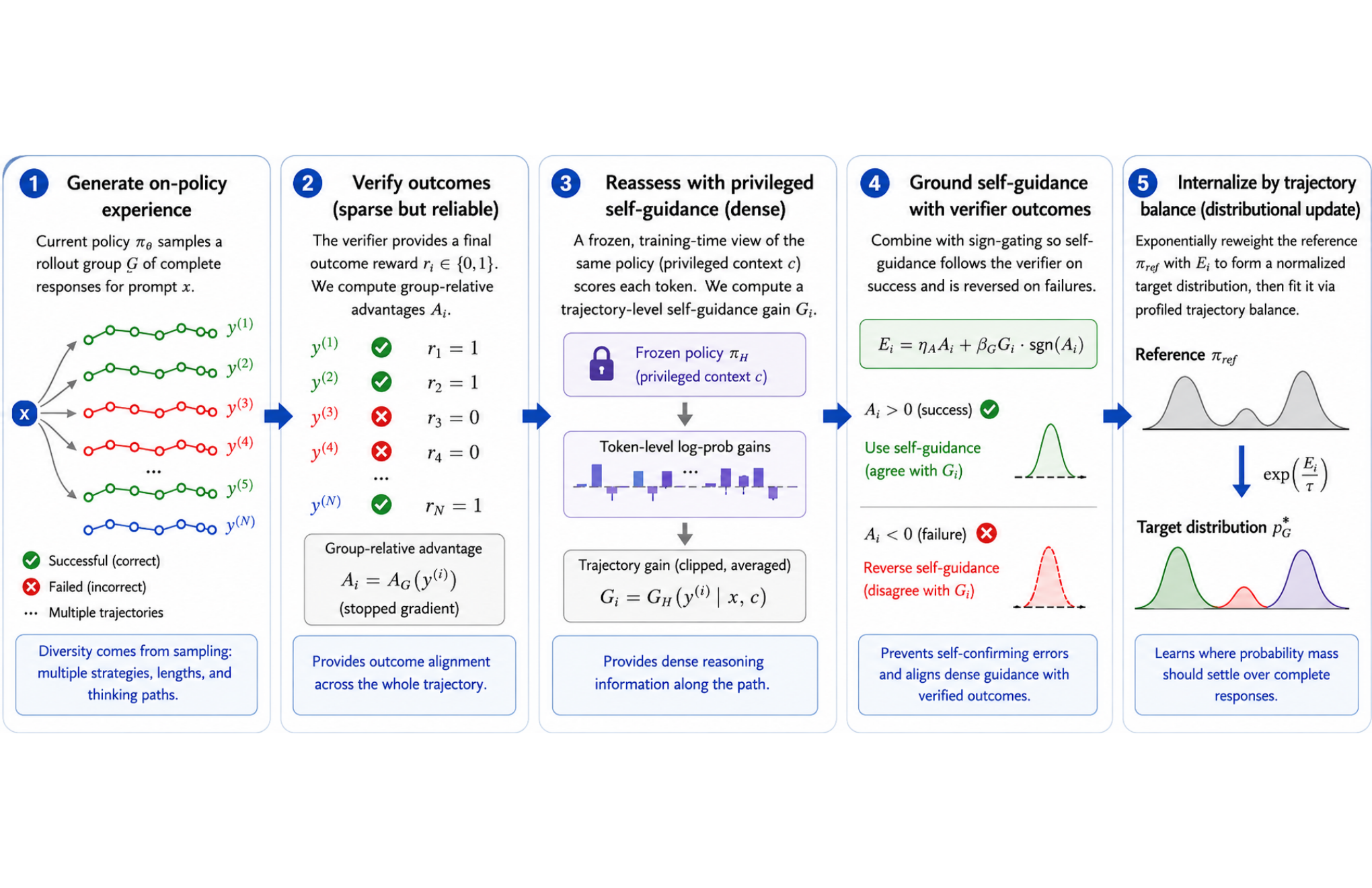
The core object is a per-trajectory energy that mixes verifier group advantage with a hindsight-derived guidance score, then exponentially tilts a reference policy over the realized rollout group.
For each sampled response y, the frozen “privileged-hindsight” view \pi_{H} of the current policy sees extra context c (the reference solution or task feedback) and produces token-level clipped log-prob gains against a fixed reference:
\delta_{t}^{H}(y;x,c)=\operatorname{clip}\!\left(\log\pi_{H}(y_t\mid s_t,c)-\log\pi_{\mathrm{ref}}(y_t\mid s_t),-B,B\right).
These are averaged into a trajectory guidance score G_H(y\mid x,c) = \tfrac{1}{T}\sum_t \delta_t^H. Crucially, no token is resampled from \pi_H and no gradient flows through it — G_H is a stopped scalar feature of on-policy experience.
The verifier contributes a group advantage A_i (as in GRPO-style outcome scoring). The FlowBalance energy for response i is
E_i = \eta_A A_i + \beta_G\, G_H(y^{(i)}\mid x,c)\,\operatorname{sgn}(A_i),
with the sign of A_i gating G_H: retained on positive-advantage trajectories, reversed on negative ones, and disabled when the group has no outcome preference (all A_i=0). This is what makes false-positive dense guidance on a rejected response non-self-reinforcing.
The induced normalized group target is a reference-tilted softmax,
p_i^\star = \frac{\pi_{\mathrm{ref}}(y^{(i)}\mid x)\exp(E_i/\tau)}{\sum_j \pi_{\mathrm{ref}}(y^{(j)}\mid x)\exp(E_j/\tau)},
and the policy is fit to p^\star via profiled trajectory balance: one log-partition estimate per rollout group absorbs the unknown prompt-level normalizer.
Proposition 1 shows that the profiled trajectory-balance loss vanishes iff all pairwise contrasts match \pi(y^{(i)})/\pi(y^{(j)}) = (\pi_{\mathrm{ref}}(y^{(i)})/\pi_{\mathrm{ref}}(y^{(j)}))\exp((E_i-E_j)/\tau). Profiling only removes the common energy offset and preserves the remaining N-1 contrast directions — the rollout group is not collapsed to a single winner-vs-loser comparison as in pairwise DPO-style updates. Proposition 2 establishes conservativeness: among group distributions attaining at least the expected FlowBalance energy of p^\star, p^\star is the unique minimum reverse-KL displacement from \pi_{\mathrm{ref}} (via the three-term decomposition \mathrm{KL}(p\|\pi_{\mathrm{ref}}) = \mathrm{KL}(p^\star\|\pi_{\mathrm{ref}}) + \mathrm{KL}(p\|p^\star) + \tfrac{1}{\tau}\langle p-p^\star, E\rangle).
Experiments
Backbones are Qwen3-4B and Qwen3-8B. At inference the deployed policy sees only the problem; the privileged context c is only available to the frozen \pi_H during training when scoring already-sampled tokens. Baselines are GRPO (verifier-only), OPSD (on-policy distillation from a fixed teacher), RLSD (verifier–distillation hybrid with a frozen current-policy scorer), and FlowRL (outcome-only trajectory balance). All methods share prompts, rollout size, verifier, length cap, and eval scripts within each backbone.
The paper’s four evaluation axes are (1) final math-reasoning accuracy, (2) update efficiency, late-training stability, and response-length behavior, (3) ablations isolating verifier grounding vs. self-guidance strength, and (4) an LLM-judged AIME24 diagnostic measuring whether multiple successful solution modes are retained (conditional Simpson diversity).
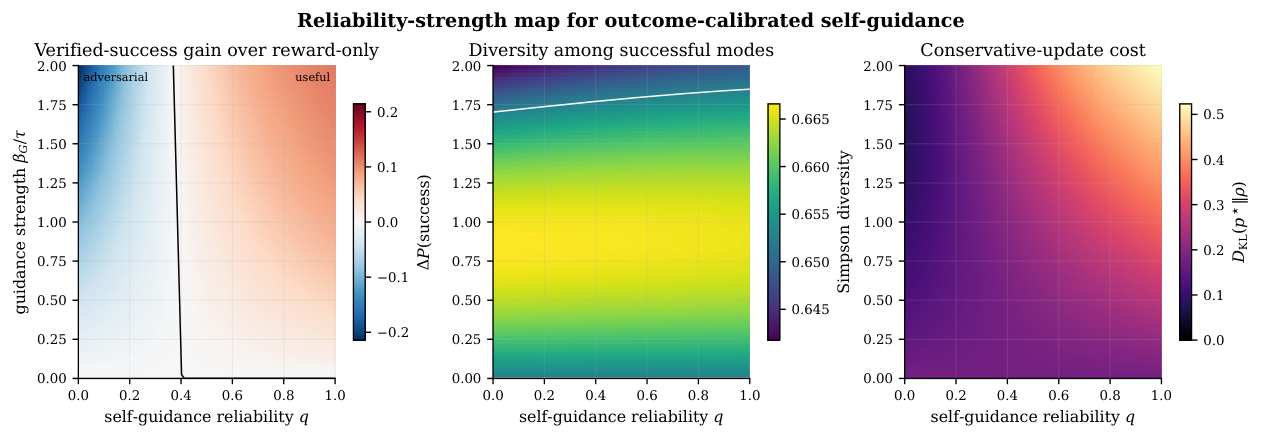
The reliability–strength map illustrates the design tension the method navigates: as guidance strength grows, verified-success mass increases but diversity among successful modes drops below the reward-only contour, and reverse KL to the reference inflates. Sign-gated verifier calibration is what keeps FlowBalance in the operating region where success gains do not require collapse.
Limitations and open questions
The excerpts do not report the specific accuracy numbers in Table 1 or the diversity/length traces in Figure 2, so the magnitude of improvement over GRPO/RLSD/OPSD/FlowRL is not stated here. The reliability parameter in Figure 6 is a synthetic interpolation, not an empirical calibration estimate — the paper does not claim to measure \pi_H’s actual reliability on rejected trajectories. Proposition 2 characterizes the target distribution, not the finite-step neural update; whether an SGD trajectory actually tracks p^\star under the profiled log-partition estimator is empirical. The method also depends on availability of privileged context c at training time (reference solutions or task feedback), which restricts applicability to domains with such supervision. Finally, sign gating hinges on the verifier’s binary correctness signal being informative; on tasks with noisy or partial verifiers, \operatorname{sgn}(A_i) may not carry enough content to correctly flip G_H.
Why this matters
FlowBalance formalizes a clean way to inject dense self-guidance into verifier-based RL without letting the dense signal override the sparse-but-grounded one: the verifier controls the sign, the hindsight view controls the magnitude, and profiled trajectory balance turns the whole thing into a normalized distributional target rather than an additional imitation loss. If the empirical claims hold, this is a principled recipe for stable, diversity-preserving self-improvement loops that don’t require an external teacher.
Source: https://arxiv.org/abs/2609.03241
Verify Before You Distill: Prompt-Level Teacher Gating for On-Policy Distillation
On-policy distillation (OPD) has become a standard accelerator for post-training: the student generates rollouts, and a frozen teacher supplies dense token-level supervision via a reverse-KL-like objective. The pathology this paper targets is structural. Reverse KL is mode-seeking, so a confidently wrong teacher on a given prompt produces a large, coherent gradient toward the wrong mode. Vanilla OPD has no mechanism to detect this: it applies teacher supervision uniformly. Distributional proxies (teacher entropy, teacher–student agreement) diagnose uncertainty or disagreement but do not check whether the teacher’s output is actually correct. The authors argue reliability should be verified per prompt against the same outcome verifier used elsewhere in the pipeline, and supervision should be admitted only when that check passes.
Method
Teacher-Gated OPD (TGOPD) treats teacher reliability as a per-prompt Bernoulli quantity and hard-routes each prompt to one of two objectives.
Define the teacher’s reliability on prompt x as its expected verifier reward,
R_T(x) = \mathbb{E}_{y \sim \pi_T(\cdot\mid x)}[r(x,y)] \in [0,1].
Since R_T(x) is unavailable in closed form, the teacher draws K_T i.i.d. probe rollouts \{\hat{y}^k\}_{k=1}^{K_T} and scores each with the same verifier used on the student:
q_T(x) = \frac{1}{K_T}\sum_{k=1}^{K_T} r(x, \hat{y}^k).
Because r is binary, K_T q_T(x) \sim \mathrm{Binomial}(K_T, R_T(x)), giving an unbiased estimator with variance R_T(x)(1-R_T(x))/K_T. A prompt-level gate compares q_T(x) against a threshold; passing prompts receive dense OPD supervision, failing prompts receive verifier-grounded GRPO. Crucially the two signals are never interpolated — the choice is exclusive.
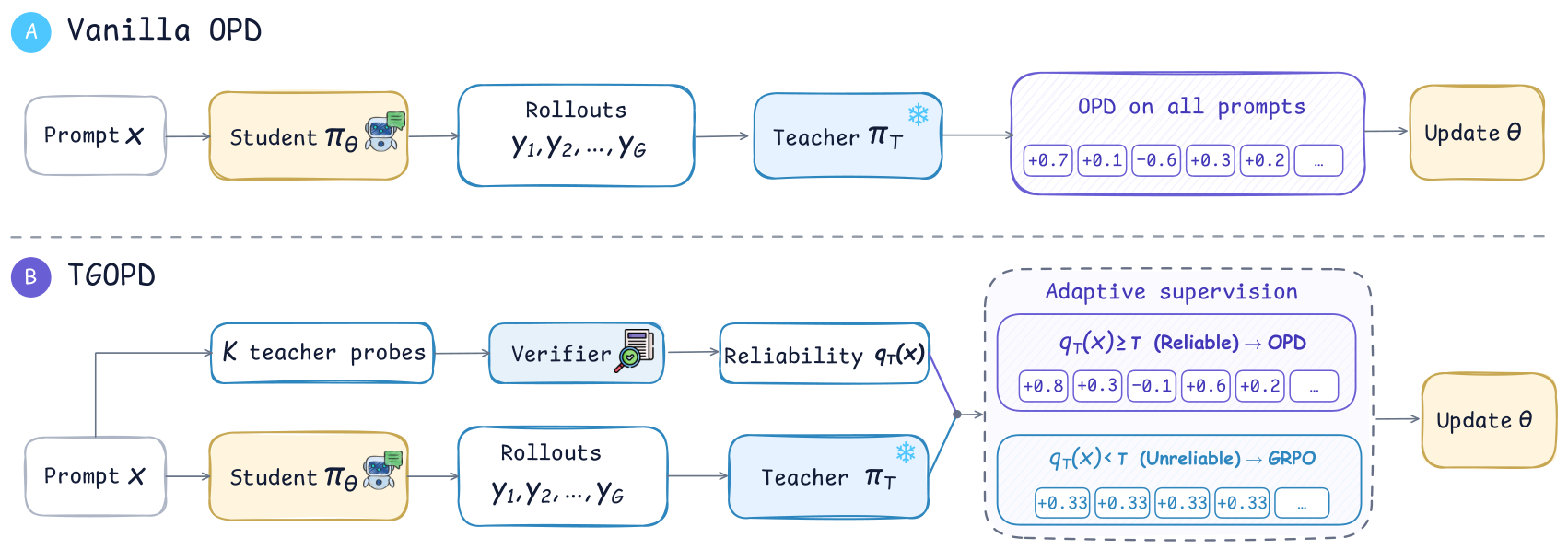
The audit is engineered to be nearly free. The training loop (built on slime) is asynchronous: the teacher would otherwise sit idle while the student decodes. TGOPD uses that window to generate the K_T probes. In the main experiments K_T = 3 suffices; a larger budget is only used in Section 4.5 to sweep the threshold at finer resolution. Even at K_T=3 the estimator is unbiased for any prompt, though the accept/reject decision variance shrinks only as 1/K_T.
The student update uses the PPO-clipped surrogate. When the prompt passes the audit, the advantage comes from OPD (teacher–student log-probability gap, dense per-token). When it fails, the advantage comes from GRPO computed from verifier rewards on student rollouts. A shared IcePop correction is applied to all methods to stabilize the train–inference probability mismatch from asynchronous rollout; it is not part of the gate.
Experiments
Two students: a dense 4B (Qwen3.5-4B) and a 35B MoE with 3B active parameters (Qwen3.6-35B-A3B). Three domains — math, code, and instruction following — each with a domain-specialist teacher trained by GRPO from the same base. The teacher’s own evaluation scores double as a reference ceiling and a GRPO-only baseline on the same architecture.
Headline results reported in the abstract and Section 4:
- TGOPD outperforms vanilla OPD in all six single-domain settings (2 scales × 3 domains).
- Under multi-domain training, TGOPD achieves higher seven-benchmark averages at both 4B and 35B scales.
The mechanism behind the gain is worth stating precisely. Vanilla OPD is upper-bounded by the teacher on prompts where the teacher fails, and worse than that in reverse-KL because failure modes can be locked in. By routing those prompts to GRPO, TGOPD recovers the RL signal on precisely the subset where distillation is toxic, while retaining dense supervision on the easier subset. The idle-teacher probe means this comes without additional wall-clock cost.
Limitations and open questions
The gate is only as good as the verifier. In domains without a reliable programmatic verifier (open-ended reasoning, long-form generation), q_T(x) becomes noisy or biased, and the accept/reject decision degrades correspondingly. The mutual exclusivity of the two objectives is a design choice, not a derivation; a soft interpolation weighted by posterior reliability might be tighter, but presumably reintroduces the confidently-wrong-teacher failure mode the paper is trying to eliminate. With K_T=3 the per-prompt decision variance is substantial; the paper argues this is fine on average across many prompts but does not characterize how threshold choice interacts with training dynamics. Finally, the setup uses domain-specialist teachers trained by GRPO from the same base — a favorable case for the audit signal, since the teacher and verifier are aligned. Generalization to heterogeneous teacher–student pairs is untested.
Why this matters
TGOPD reframes distillation as a routing problem rather than a loss-mixing problem: verify prompt-level teacher correctness with the same verifier that grounds RL, and admit dense supervision only where it is defensible. Because the audit consumes otherwise-idle teacher capacity in an asynchronous loop, the safeguard is essentially free, which makes it a plausible default replacement for vanilla OPD in verifier-equipped pipelines.
Source: https://arxiv.org/abs/2609.02998
EmbodiedSkills: A Unified Framework for Orchestrating, Training, and Deploying VLA Agents
Problem
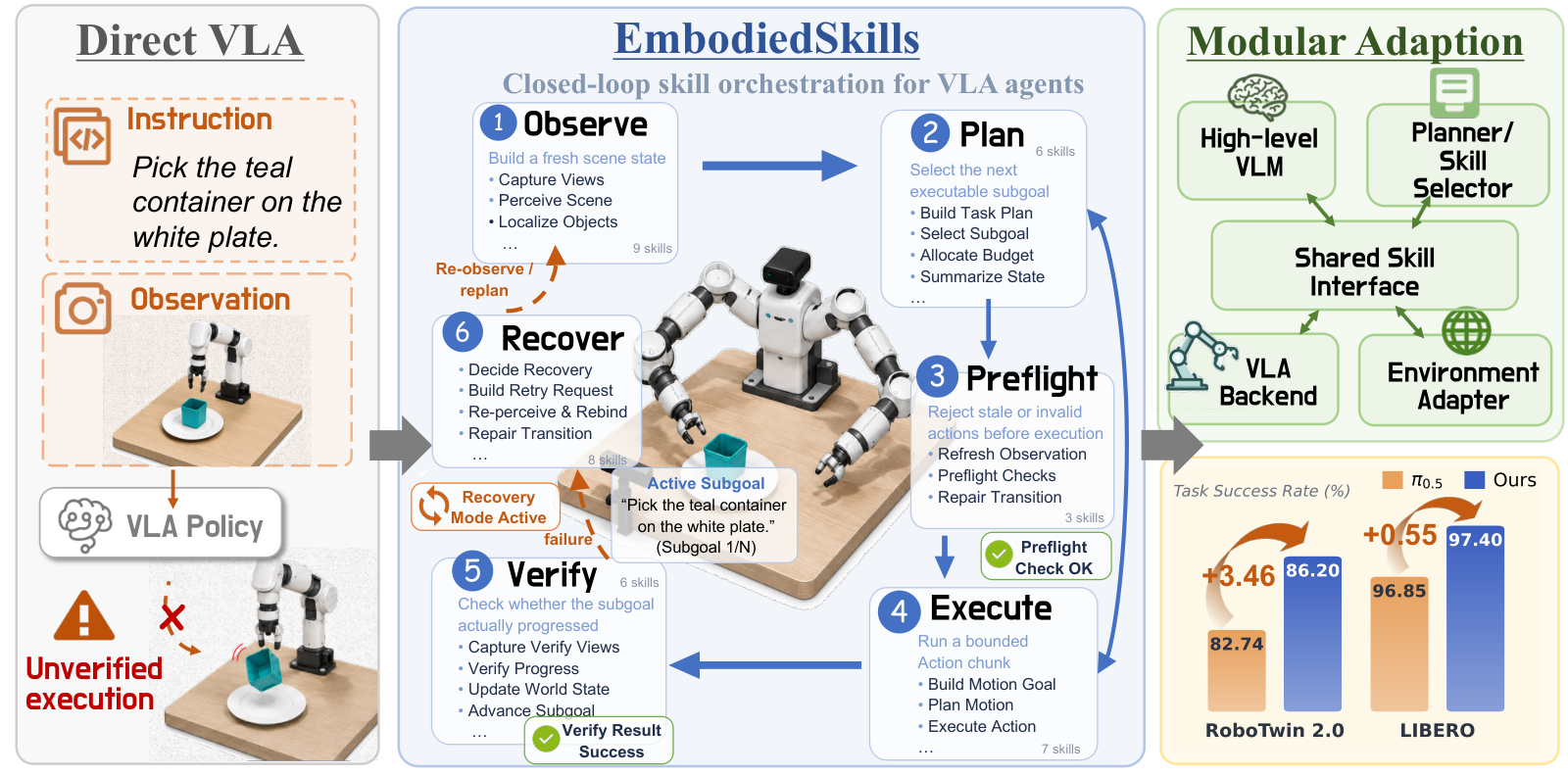
Vision-language-action (VLA) policies map (o_t, x) directly to action chunks, but long-horizon manipulation demands more than reactive control: an agent must plan subgoals, verify preconditions before acting, check outcomes afterward, and recover on failure. Naively invoking a VLA at each step provides no guarantee that the proposed operation is admissible in the current state or that its effect has been achieved. EmbodiedSkills addresses this by wrapping VLA policies in a guarded finite-stage controller with an explicit executable-skill interface, so skill selection, bounded execution, and post-hoc verification share a single decision protocol that is invariant to which VLA is plugged in underneath.
Method
The system is a two-tier controller. A high-level VLM (Qwen3-VL in the instantiation) plans, selects skills, and verifies; a low-level VLA (a per-task fine-tuned \pi_{0.5}) executes each subgoal as a bounded action chunk.
At loop step t, the method-level state is
s_t = (z_t, \mathcal{M}_t, \mathcal{H}_t),
where z_t is the phase, \mathcal{M}_t the set of task artifacts (observation, grounding results, plan, active subgoal, preflight evidence, action chunk, execution and verification reports, recovery context), and \mathcal{H}_t the ordered loop trace. A deployment-consistent context is built by
C_t = \Psi(x, z_t, \mathcal{M}_t, \mathcal{H}_t),
which retains the complete plan and current subgoal explicitly, compresses older entries under a fixed history budget, and excludes raw simulator internals.
The scheduler samples a structured decision from a state-filtered action set:
d_t \sim \pi_\theta(\cdot \mid C_t, z_t, \mathcal{A}_t), \qquad \mathcal{A}_t = \mathcal{G}_{\text{state}}(\mathcal{K}_{z_t}, s_t),
with three control types: d_t \in \{\textsc{RunSkill}(k,q),\ \textsc{AdvanceStage},\ \textsc{FinishRun}\}. \mathcal{G}_{\text{state}} prunes skills whose artifact prerequisites are absent; the runtime validates each proposal, executes it, records the outcome as an artifact, and invalidates dependent artifacts whose context has changed.
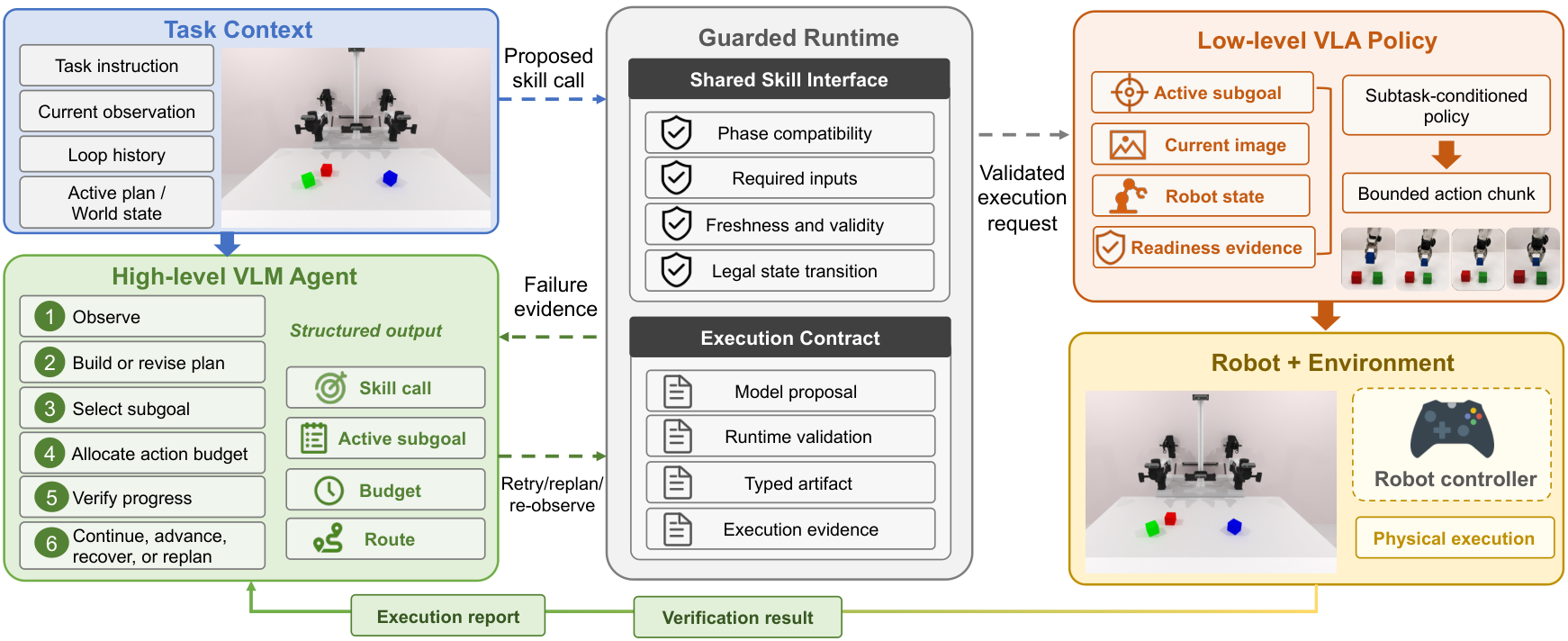
A semantic subgoal may consume multiple chunks. After each chunk, the verifier reads fresh observations and decides whether to continue the current subgoal, advance the plan, or request a revised context. This decouples continuous control (fixed chunk length) from semantic progress checks.
Training
Because interfaces are explicit, components are adapted independently rather than end-to-end:
- Planner: instruction + visual context \rightarrow ordered sequence of executable semantic subgoals (state-level targets, no simulator-specific control).
- Low-level VLA: subtask-level demonstrations pair (o, \text{robot state}, \text{active subgoal}) with the corresponding action sequence; deployed via the fixed
Executeinterface. - High-level scheduler: Qwen3-VL is SFT’d on deployment-consistent decision traces while the VLA is frozen. Targets are the phase-appropriate skill decision plus its structured arguments (continue subgoal, advance, or request revised context). Freezing the VLA cleanly isolates scheduling supervision from continuous-control drift.
Verifiers and outer schedulers can share a base VLM with stage-specific adapters; the runtime contract remains fixed across adapters, and deterministic components can be substituted where appropriate.
Results
Evaluation covers RoboTwin 2.0 (50 manipulation tasks) and the four LIBERO suites (Spatial, Object, Goal, Long). For RoboTwin 2.0, a separate \pi_{0.5} is fine-tuned per task using subtask-level demos and exposed through the execution interface; results are macro-averaged across the 50 tasks and compared against representative RoboTwin 2.0 baselines and generalist VLAs reported in LingBot-VA. For LIBERO, reference numbers are taken from the OpenPI release and macro-averaged across the four suites. Terminal success uses the RoboTwin 2.0 evaluator directly.
The paper further runs controlled AgentLoop ablations on all 50 RoboTwin 2.0 tasks with 100 episodes each, holding planner, low-level policy, initial states, and terminal evaluator fixed. The ablated axes are (i) presence of semantic subtasks, (ii) intermediate verification, and (iii) repeated action chunks. This isolates the contribution of the loop structure from the underlying VLA quality — the key claim being that closed-loop verification and multi-chunk execution provide the improvement independent of the low-level policy.
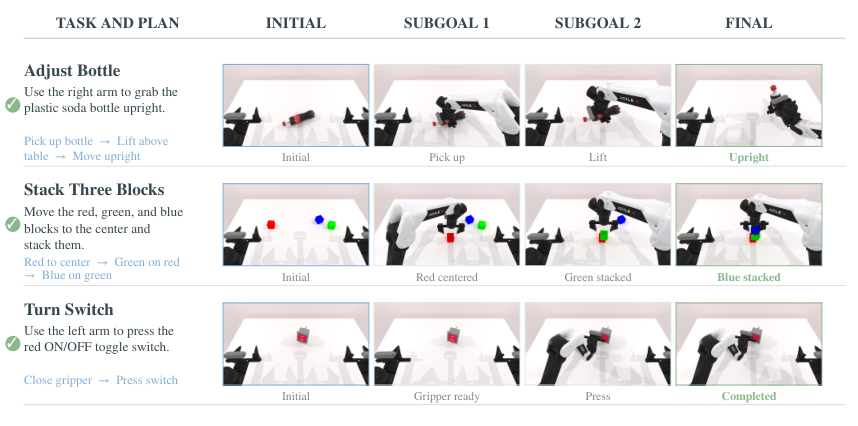
The excerpt provided lists the protocol and ablation design but does not include the numerical table values themselves; the quantitative comparisons are relegated to Table 2 and the ablation table, which are not reproduced in the sections supplied here.
Limitations and open questions
The evaluation instantiates per-task fine-tuned \pi_{0.5} policies rather than a single generalist, so it is unclear how much of the reported behavior stems from the agent loop vs. task specialization. Verification remains VLM-based over post-action images; failure modes of the verifier (false positives on partial completions) are not characterized in the provided text. Optional closed-loop RL over the trajectory interface is described as supported but not exercised. Finally, the fixed history budget \Psi compresses older entries — the sensitivity of recovery quality to this budget is unquantified.
Why this matters
EmbodiedSkills formalizes what is often implicit in agent scaffolds: a typed, guarded interface between semantic planning, bounded VLA execution, and post-hoc verification, letting the low-level policy be swapped without touching the loop. This is the right factoring for scaling VLA deployment beyond short-horizon reactive control.
Source: https://arxiv.org/abs/2609.01281
ENEAS: Embedding-guided Neural Ensemble for Adaptive Segmentation
Problem
Text-promptable segmentation models — including SAM 3 — fail in three recurring ways on uncurated captures: (1) temporal hallucination (re-detecting the prompt on distractors after the target leaves the frame), (2) spatial fragmentation (masking a texture patch rather than the whole object under extreme close-up), and (3) ontological miscategorization (segmenting hyper-realistic statues, paintings, or reflections as their referents). The authors encountered these failures while building 3D reconstruction pipelines, where masks feed directly into geometry: false positives destroy assets, false negatives leave ghosts. This asymmetry motivates a precision-first design.
ENEAS unifies two operating modes behind one interface. Given frames \{\mathbf{I}_t\}_{t=1}^N and a prompt p: if p names a specific instance, return one mask per frame with \mathbf{M}_t=\mathbf{0} on absence; if p names a category, return a variable set \{\mathbf{M}_t^{(i)}\}_{i=1}^{n_t} per frame.
Method
Both modes share a grounding operator \mathcal{G}(\mathbf{I},p) implemented with Florence-2-Large and a segmentation operator \mathcal{S}(\mathbf{I},\mathbf{r}) implemented with SAM 2.1.
Instance tracking. The authors extend the SeC tracker — previously restricted to point prompts — with a text-prompting adapter. Florence-2 grounds p on a reference frame to seed SeC’s memory bank; propagation then uses SeC’s geometric memory, which allows the tracker to report absence rather than latching onto a distractor, and to hold spatial integrity through close-ups.
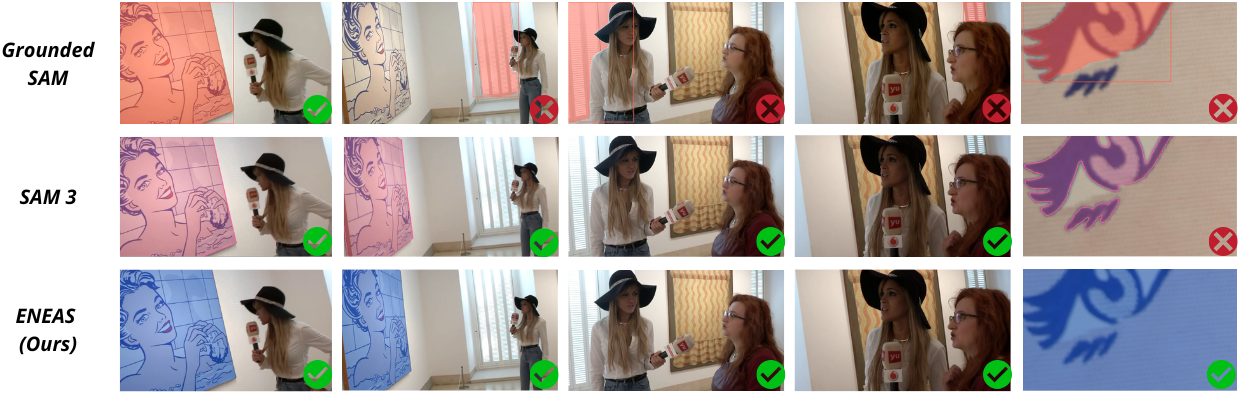
The comparison against Grounded SAM and SAM 3 on “blue painting” illustrates the two orthogonal failure modes ENEAS avoids: drift onto curtains/hair when the painting exits view, and fragmentation into color patches during close-ups.
Semantic discovery. Discovery is a cascade of three stages with asymmetric activation cost:
- Florence-2 proposes candidate regions matching p.
- A sigmoid-based SigLIP embedding filter with prompt ensembles scores each candidate. A score s is compared against two thresholds \tau_{\text{low}}=0.10 and \tau_{\text{high}}=0.90: accept if s \geq \tau_{\text{high}}, reject if s \leq \tau_{\text{low}}.
- Only candidates with \tau_{\text{low}} < s < \tau_{\text{high}} — the uncertainty interval — are routed to a VLM judge (Qwen2.5-VL variants at 2B or 4B), with contextual neighbour masking to isolate the candidate from surrounding evidence.
The design principle is that embeddings resolve most cases cheaply; the VLM is invoked only where visual features alone are indecisive, and it is given a semantically isolated crop so that context does not leak.
Results
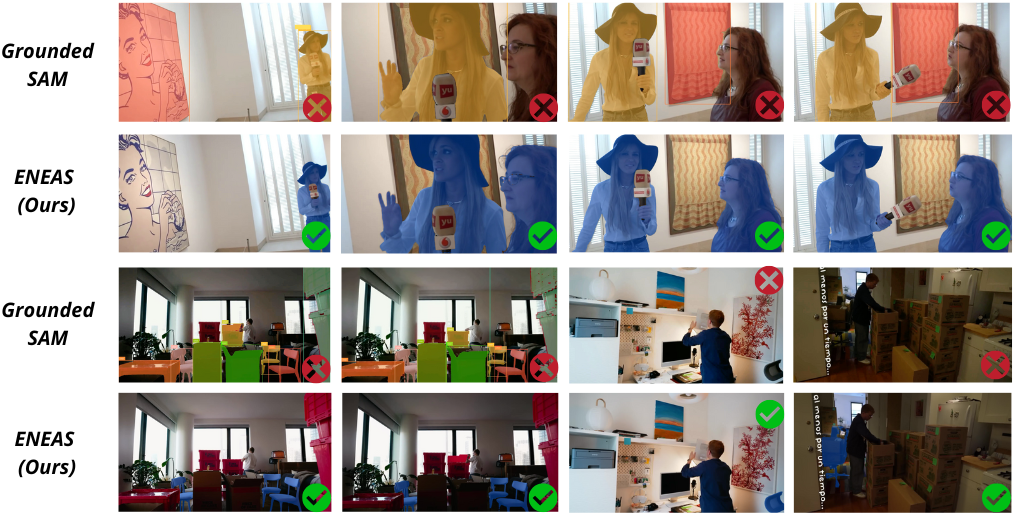
The primary benchmark is Church Statues, a real 3D-reconstruction capture with hyper-realistic sculptures alongside visitors — maximizing ontological ambiguity for the prompt “person”. This is where standard VOS suites (DAVIS, YouTube-VOS, MOSE, OVIS) offer no signal.
Component ablation on Church Statues (F1 headline numbers):
| Config | Precision | Recall | F1 |
|---|---|---|---|
| RPN only (baseline) | 10.5 | 79.6 | 18.6 |
| RPN + embed, T>0.50 | 55.7 | 79.6 | 65.5 |
| RPN + embed, T>0.80 | 94.3 | 67.4 | 78.6 |
| ENEAS-2B (adaptive) | 94.7 | 73.5 | 82.8 |
| ENEAS-4B (adaptive) | 97.5 | 79.6 | 87.6 |
Two observations. First, a single embedding threshold cannot deliver both precision and recall: a permissive threshold retains statues as “persons”, a strict threshold discards real people under difficult lighting. Second, the VLM judge, invoked only inside the uncertainty band, recovers those true positives without reintroducing false positives. The 4B variant fully restores recall to the RPN upper bound (79.6%) while pushing precision to 97.5%.
For reference, SAM 3 reaches F1 = 19.5% on this capture; ENEAS-4B reaches 87.6%. On SA-Co/VEval, ENEAS matches or slightly improves SAM 3’s overall tracking profile — the design does not sacrifice generality for the ontological gains.
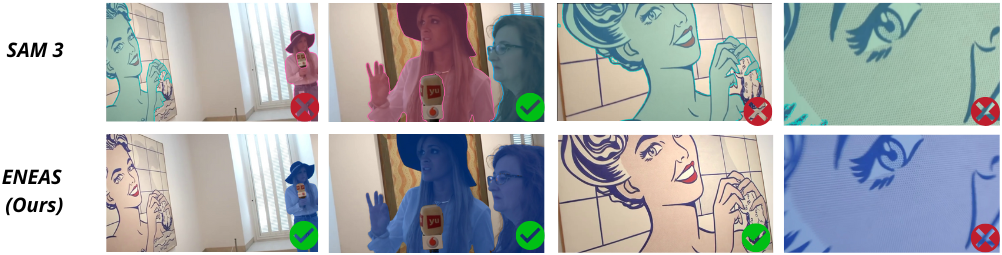
The pop-art painting case shows the failure mode being targeted: SAM 3 segments the painted figure as “real person”; ENEAS’s VLM judge rejects it based on material/scene cues in the isolated crop.
Limitations
The recall ceiling is fixed by the Florence-2 proposal stage; instances Florence-2 never grounds — small, distant, heavily occluded — cannot be recovered. The VLM judge itself relies on contextual cues in the masked crop, so extreme close-ups and low-resolution distant crops can still be accepted as targets, matching the failure mode of visual-only models. Cost scales with candidate count per view, making crowded scenes expensive: the robust 4B configuration runs at roughly 3 s/frame on a single L4 GPU. Discovery is per-frame — no persistent instance IDs across frames — and the method emits no confidence scores, which precludes score-based evaluation protocols such as AP.
Why this matters
The paper isolates a specific failure of foundation segmenters — strong perception, weak verification — and shows that a cheap two-threshold embedding filter plus a selectively invoked VLM judge closes most of the gap on ontologically ambiguous captures, moving F1 from 19.5% to 87.6% on Church Statues without retraining any base model. This is a template for adding semantic verification as a routing layer over frozen perception stacks rather than as a fine-tuning objective.
Source: https://arxiv.org/abs/2609.03756
What Else Needs Fixing? Exploring Cost-Effective Test-Time Compute for Revision Propagation in Artifacts Generated Through Conversation
Problem
In multi-turn LLM workflows that iteratively build an artifact (e.g., a JSON configuration, a plan, a document schema), users typically issue local revision requests: “change field X to Y.” A faithful assistant must identify all dependent elements — often distributed across earlier turns of the conversation — and propagate the change to preserve internal consistency. Failing to propagate leaves stale, inconsistent state; over-propagating corrupts unrelated content.
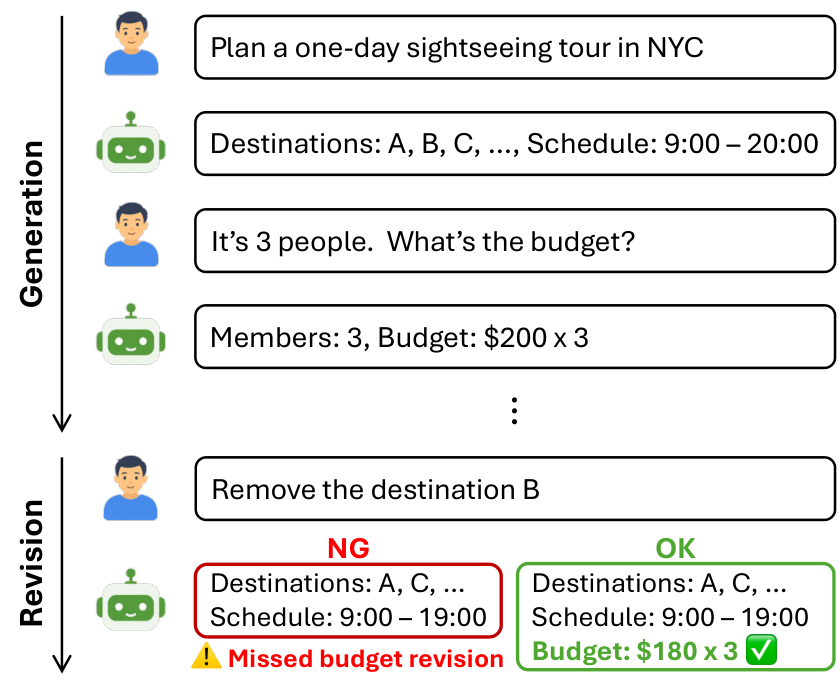
The paper isolates this revision-propagation ability as a distinct capability from single-shot editing, and asks whether cheap test-time compute (parallel sampling, reflection, aggregation) can meaningfully improve it.
Benchmark: RevPropBench
RevPropBench contains 150 samples spanning 9 domains and 50 scenarios, with three artifact-size variants per scenario. Each sample has two phases:
- Generation phase (fixed): an LLM incrementally constructs a JSON artifact over multiple user turns. This conversation is prepared in advance.
- Revision phase (evaluated): the user issues a local revision. The model must emit a set of RFC 6902 JSON Patch operations that exactly match the gold patches in both
pathandvalue.
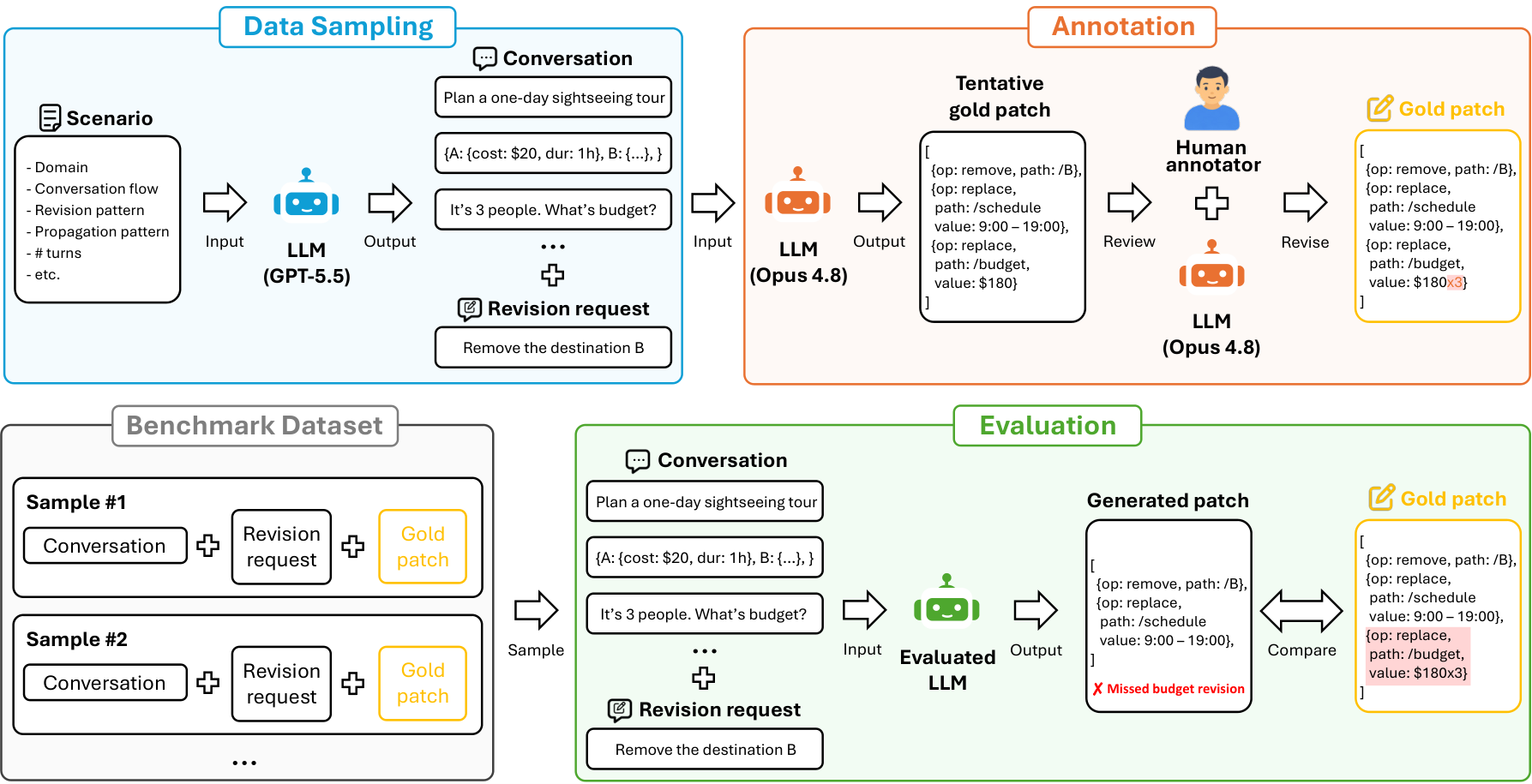
Samples are produced by LLM-based synthetic sampling followed by human annotation to fix gold patches and dependency structure. The dataset is split scenario-wise: 30 samples (10 scenarios × 3 sizes) for development with seed 42, balanced by domain, propagation size, and propagation pattern; the remaining 120 samples form the test split. The evaluation metric is completion rate — the fraction of samples where the predicted patch set exactly equals the gold patch set.
Methods evaluated
The authors evaluate nine methods across six models (gpt-oss-20b/120b, gpt-5.4-mini, qwen3.5-9b/27b/122b):
- Three baselines differing in what context is provided to the model at revision time:
- j: final JSON artifact only.
- h: conversation history only.
- j{+}h: both.
- Test-time compute variants on top of j{+}h, each using 5 LLM calls:
- Sequential Reflect: iterative self-revision.
- Parallel sampling with aggregation: \text{or} (union of patches), \text{and} (intersection), \text{maj} (majority vote per patch), \text{med} (medoid — pick the sample closest to the others), and Select (an LLM-as-judge that chooses among candidates).
For parallel selection, the medoid of k samples \{p_1,\dots,p_k\} under a set distance d is
p^\star = \arg\min_{p_i}\sum_{j\ne i} d(p_i, p_j),
which requires no additional LLM call beyond the k samples.
Results
Baselines already achieve 68.3–93.0% completion on the test split. The ordering j < h < j{+}h holds for every model. Concretely:
gpt-5.4-mini: 90.7% (j) < 92.7% (h) < 93.0% (j{+}h).qwen3.5-122b: 81.7% (j) < 86.7% (h) < 90.3% (j{+}h).
The gap h > j confirms that the final artifact alone does not carry all dependency information — the derivation history matters. The additional lift from j{+}h over h indicates that even when history logically determines the artifact, re-providing the finalized JSON reduces path errors and omissions in generated patches.
For test-time compute, the headline finding is that selecting from three parallel samples via LLM-based or medoid selection is the most cost-effective method, improving accuracy by 2.2–9.7% over the j{+}h baseline. Notably:
- 3-sample parallel + selection outperforms 5-call reflection on cost-per-gain.
- Set-union (\text{or}) and set-intersection (\text{and}) aggregation are dominated: union over-propagates, intersection drops correct-but-uncertain patches.
- Majority vote on individual patch operations is competitive but less robust than medoid at the patch-set level, because propagation errors are correlated across operations within a single sample.
Limitations and open questions
- Synthetic data. Scenarios are LLM-sampled and then human-audited; realism of dependency structure relative to production workflows (long horizons, tool calls, retrieval) is unverified.
- Exact-match metric. RFC 6902 patches admit multiple equivalent representations (e.g.,
replacevs.remove+add); the paper does not report how canonicalization or semantic equivalence affects completion rate. Reported gains of 2.2–9.7% could be sensitive to this. - Small k. Test-time compute is capped at 5 calls; scaling behavior of medoid/Select at larger k, and its interaction with model size, is not characterized. The strongest models (j{+}h \approx 93\%) leave little headroom.
- No dependency oracle ablation. It is unclear how much of the remaining error is failure to identify dependencies vs. failure to emit correct JSON paths — the two are conflated in the metric.
- Domain coverage. Nine domains, 50 scenarios — sufficient to demonstrate the phenomenon, but propagation-pattern diversity (Fig. 3c) is limited.
Why this matters
Revision propagation is the concrete mechanism behind “keep my artifact consistent as I iterate,” which is where most real LLM-assisted authoring lives. The paper shows that (i) conversation history is not redundant with the final artifact even when logically derivable from it, and (ii) a 3-sample parallel-select loop is a cheap, model-agnostic wrapper that recovers several points of accuracy — a useful default for any conversational artifact pipeline.
Source: https://arxiv.org/abs/2609.03254
Hacker News Signals
Trusting-Trust Attack against an Entire Linux Distribution
A paper demonstrating a full-chain Thompson “trusting trust” attack — not against a single compiler binary, but against an entire Linux distribution’s toolchain and package ecosystem. The classic 1984 attack embeds a self-replicating backdoor in a compiler such that even compiling from clean source produces infected binaries. This work scales that to a distro: the attack propagates through the package build infrastructure, survives compiler rebuilds, and affects multiple packages simultaneously.
The authors detail how a malicious compiler can recognize not just its own source but also the source of downstream packages (e.g., coreutils, openssh), injecting distinct payloads per target. The self-replication component ensures a rebuild of the compiler itself from source re-infects the new binary. Key challenge addressed: modern distros use reproducible builds and diverse toolchain bootstrapping, so the attack must survive these defenses. The paper analyzes where reproducible-build verification breaks down — specifically, the trusted binary seed used in bootstrapping remains outside the verification perimeter.
Mitigations discussed include diverse double-compilation (DDC), which compiles the compiler with two independent trusted compilers and diffs the output, and full bootstrappable-builds chains that reduce the trusted binary base to a minimal, auditable seed. The authors note that few distros have fully closed the bootstrapping gap. This matters practically: supply-chain attacks on build infrastructure (XZ utils, SolarWinds) are real and escalating.
Source: https://arxiv.org/abs/2607.24888
“Next-token predictor” is the wrong mental model for LLMs
The post argues that framing LLMs as “next-token predictors” is mechanistically misleading in a way that causes practitioners to misunderstand capability limits and failure modes. The actual object is a model trained to approximate P(x_t \mid x_{<t}) over a corpus, but the argument is that this description conflates the training objective with the computational process at inference time.
The core technical claim: a sufficiently expressive model trained on next-token prediction must implicitly represent something closer to a posterior over latent generative processes — i.e., Bayesian program induction over document-generating hypotheses. This is Solomonoff-style reasoning in the limit. The “predictor” framing suggests the model is doing shallow pattern completion; the Bayesian mixture framing suggests it is doing implicit hypothesis tracking, which better explains in-context learning (updating the implicit posterior with each token) and the emergence of multi-step reasoning.
The practical implication is that “the model just predicts the next token” is used as a dismissive explanation for both failures and capabilities, when in reality the same objective that produces autocomplete also produces latent world-model representations. The post cites the theoretical work by Xie et al. on in-context learning as implicit Bayesian inference and connects it to empirical observations about chain-of-thought improving accuracy.
This is less a novel technical result and more a careful conceptual clarification — but the distinction matters for setting correct expectations about what fine-tuning, RLHF, and prompting actually manipulate. The HN comments are substantive, with debate over whether the Bayesian framing is itself overreach.
Source: https://gmcgoldr.github.io/2026/09/04/llm-next-token-predictors.html
Speculative Decoding in vLLM on AMD GPUs
The vLLM team documents the integration of speculative decoding on AMD RDNA/CDNA hardware, which has lagged NVIDIA in ML framework support. Speculative decoding uses a small draft model to generate k candidate tokens in parallel, then verifies them against the target model in a single forward pass, yielding speedups proportional to the acceptance rate \alpha without changing output distribution.
The engineering challenge on AMD is twofold. First, ROCm’s HIP ecosystem has historically had gaps in kernel-level optimizations (flash attention variants, fused ops) that vLLM relies on for the draft and verification passes. The post details which custom CUDA kernels had to be ported or replaced with Triton-based implementations that compile for both targets. Second, speculative decoding with paged KV-cache (vLLM’s core abstraction) requires careful memory management: the draft model generates against a speculative KV extension that must be rolled back on rejection.
Reported numbers: on MI300X with a 70B target and a 1B draft, throughput improves 1.8-2.4x on coding benchmarks (high acceptance rates) and ~1.2x on open-ended generation (lower acceptance). Latency per output token at batch size 1 drops ~40% in the coding case. These are consistent with NVIDIA results, suggesting the ROCm port is achieving near-parity for this workload.
Open issues noted: draft model selection remains manual and workload-dependent; the team flags that dynamic speculation length (adapting k per request) is not yet implemented on the AMD path.
Source: https://vllm.ai/blog/2026-08-23-speculative-decoding-amd-gpus
Government Rails Site Hit Hours After CVE Patch
A post-mortem on a Ruby on Rails CVE being exploited against a government website within hours of the patch being published. The vulnerability class is not specified by name in the post, but the mechanics described involve unsafe deserialization or parameter parsing — a category Rails has had recurring issues with (cf. CVE-2013-0156 and successors).
The key engineering observation: patch publication is itself an exploit signal. Attackers routinely diff patch commits to reconstruct the vulnerability, then scan for unpatched targets before defenders can deploy. The timeline here was under 6 hours from CVE disclosure to confirmed exploitation. The post details the attack artifacts found in logs: specific parameter patterns consistent with probe-then-exploit sequences, suggesting automated tooling rather than manual exploitation.
Defensive takeaways discussed: virtual patching via WAF rules can close the window between disclosure and deployment, but requires knowing the payload shape in advance — which is easier for parameter-level attacks than for logic flaws. The post argues for monitoring CVE feeds and having a pre-tested emergency deployment pipeline with sub-hour turnaround. It also notes that government sites running outdated Rails versions (this site was behind by multiple minor versions) represent a structural problem: procurement and change-control processes are incompatible with rapid security response.
The broader point is operational: the relevant SLA is not “patch within 30 days” (a common compliance standard) but “patch before the automated exploit scanners find you,” which is now measured in hours.
Source: https://rietta.com/blog/ruby-on-rails-cve-exploited-hours-after-patch/
The NX bit is not just about security
A technically dense post arguing that the No-Execute (NX) bit — marking memory pages as non-executable — has performance and correctness benefits beyond the standard security framing. The security use is well-known: it prevents shellcode injected into data pages from executing (defeating simple stack/heap overflow exploits). The post explores the less-discussed consequences.
Performance angle: CPUs prefetch instructions aggressively. On some microarchitectures, data pages speculatively fetched into the instruction pipeline create branch predictor and iTLB pressure. Marking data pages NX allows the CPU to avoid instruction-path speculation into them, reducing noise in branch prediction structures. The effect is small but measurable on workloads with large data footprints.
Correctness angle: the post covers how NX interacts with JIT compilers. A JIT that writes code to a page, then executes it, must coordinate the W^X invariant (writable XOR executable). Violating this — e.g., having a page simultaneously writable and executable — creates a TOCTOU window exploitable by concurrent threads. Enforcing W^X via NX transitions (mprotect or dual-mapping) is not just a security hardening measure but a correctness constraint for concurrent JIT execution. The post walks through the dual-mapping pattern: maintain two virtual mappings of the same physical pages, one RW and one RX, so writes and execution are always through separate addresses.
The post also briefly covers how the kernel uses NX on its own mappings and how this interacts with spectre/meltdown mitigations via SMEP/SMAP.
Source: https://purplesyringa.moe/blog/guest/the-nx-bit-is-not-just-about-security/
How to Bring Up the Linux Kernel on a New Platform
A detailed walkthrough of porting Linux to new hardware, written from experience rather than as a documentation summary. The author covers the full sequence: getting a serial console (UART), minimal bootloader integration, memory map description via Device Tree or ACPI tables, bringing up the MMU, and handling platform-specific interrupt controllers.
The technically interesting sections cover early boot debugging. Before printk is functional, the author uses ioremap-based UART writes directly from assembly to emit characters, since the normal console infrastructure is not yet initialized. The Device Tree section is precise: DTS node structure for memory regions, chosen node for bootargs and initrd, and the interrupt-controller hierarchy (GIC for ARM targets). The author notes that getting the memory map wrong — specifically, marking RAM as reserved or failing to describe firmware regions — causes subtle bugs where the kernel allocates over firmware data structures.
Interrupt bringup gets detailed treatment: the flow from hardware IRQ line to GIC to Linux IRQ domain to driver handler, and how to use /proc/interrupts and irqchip debugfs to verify routing before drivers are functional. Clock and pinmux configuration via clk and pinctrl subsystems are covered as prerequisites for peripheral drivers.
The post is practically useful because it sequences the steps correctly — many platform bring-up guides start with driver development before the kernel is reliably booting, which makes debugging exponentially harder. The author’s advice to get a stable idle loop before adding any drivers is sound engineering practice.
Source: https://werwolv.net/posts/linux_bringup/
We Have a Year to Fix Security Everywhere
This post is specifically about memory safety in the Rust ecosystem’s infrastructure tooling and makes a concrete deadline argument: post-quantum cryptography migration deadlines and anticipated shifts in attacker capability create a roughly 12-month window during which the cost of retrofitting security is lower than it will be afterward.
The technical core covers several threads. First, the Rust compiler toolchain itself (rustc, cargo, crates.io infrastructure) still has components written in or interfacing with C/C++, and the post catalogs specific attack surface: the LLVM backend, certain linker integrations, and legacy parts of the build system. Second, the post addresses supply-chain integrity — cargo’s dependency resolution and the lack of mandatory reproducible builds mean a compromised crate can propagate silently. Third, post-quantum: TLS libraries used by cargo and crates.io need PQC cipher suite support before harvest-now-decrypt-later attacks become relevant to long-lived secrets.
The “year” framing is tied to specific external forcing functions: NIST PQC standard finalization timelines, anticipated regulatory requirements in certain jurisdictions, and the author’s read on when automated exploitation of memory-safety bugs in build tooling becomes commodity. The argument is not that the sky is falling but that the retrofit cost curve is nonlinear — doing this work now while codebases are smaller and teams are focused is cheaper than doing it under pressure.
The HN comments are contentious, with debate over whether the timeline is accurate and whether Rust’s own supply-chain story is better or worse than alternatives.
Source: https://jyn.dev/a-year-to-fix-security/
The Rust React Compiler Is Now Native in Vite
The React compiler — originally the “React Forget” project, now shipped as babel-plugin-react-compiler — has a Rust reimplementation that is now integrated directly into Vite’s plugin pipeline, eliminating the Node.js/Babel transform step. This matters for build performance: the React compiler does non-trivial static analysis to automatically insert useMemo and useCallback equivalents, and running it through Babel on large codebases is slow.
The Rust port uses SWC (Speedy Web Compiler) as the AST foundation. The compiler’s core job is memoization inference: it performs def-use analysis over component render functions to identify values whose recomputation can be avoided across re-renders, then inserts the appropriate cache calls. This is a dataflow analysis problem, and the Rust implementation can run it significantly faster than the JS version — the post cites 3-5x build time improvement on a large codebase, though this is workload-dependent.
The Vite integration means the transform runs as a Vite plugin using the Rust binary via a native Node addon (napi-rs bindings), avoiding process spawning overhead. HMR (hot module replacement) in dev mode also benefits because incremental recompilation of changed modules no longer has to re-invoke the full Babel pipeline.
Caveats: the Rust port is not yet at full feature parity with the reference JS implementation; some edge cases in the memoization analysis (particularly around hooks with complex control flow) fall back to no-op or are flagged as unsupported. The post is candid about this, listing the known gaps. For most production React codebases without exotic hook patterns, coverage is sufficient.
Source: https://blog.master.dev/react-now-rusted-all-the-way-out/
Noteworthy New Repositories
okf-memory/okf-agent-memory
A Git-native persistent memory layer for AI coding agents, implementing the Google Open Knowledge Format (OKF) v0.2 specification. The core value proposition is eliminating external database dependencies entirely: memory is stored as structured files in a Git repository, making it auditable, diffable, and portable across sessions.
The search backend is a pure in-memory BM25 index written in Go, with reported sub-300 µs query latency. BM25 is a natural fit here — sparse retrieval over structured agent context is fast and predictable without the embedding overhead of dense retrieval. The embedded MCP (Model Context Protocol) server means agents can query and write memory over a standard interface without additional infrastructure.
The 80% token reduction claim comes from progressive disclosure: rather than injecting full memory dumps into every prompt, the system surfaces only contextually relevant fragments on demand, keeping context windows lean. This matters practically because most long-running agent workflows bloat their context with redundant state.
Built entirely in Go with no external dependencies, making deployment a single binary with no Python runtime, no vector database, no Redis. The zero-dependency constraint is a deliberate tradeoff: you get operational simplicity at the cost of approximate-nearest-neighbor search capabilities that a proper vector store would provide.
Suited for teams running local or CI-embedded coding agents who want persistent, inspectable memory without adding managed infrastructure.
Source: https://github.com/okf-memory/okf-agent-memory
elliothux/open-compute
A self-hosted runtime that replicates the Cloudflare Workers execution model in a single Rust binary. The scope is substantial: KV store, D1 (SQLite-compatible relational layer), R2 (object storage), Durable Objects (actor-model stateful coordination), Queues, and Workflows are all implemented locally.
The motivation is portability and vendor independence. Cloudflare Workers is a compelling edge compute model, but it is tightly coupled to Cloudflare’s network. Open-compute lets you run the same worker code on your own hardware or a private cloud, which matters for regulated environments, air-gapped deployments, or cost control at scale.
The single-binary design is architecturally significant. Rather than orchestrating separate services for each primitive (a separate Redis for KV, a separate SQLite service for D1, etc.), everything runs in one process with in-process communication. This trades horizontal scalability for operational simplicity and reduces the gap between local development and production.
Durable Objects are the hardest primitive to replicate correctly — they provide globally unique, strongly consistent actors with colocated storage. The implementation details here are worth examining closely for anyone evaluating production readiness.
Written in Rust throughout, which gives predictable latency and memory characteristics appropriate for a worker runtime. The Workers API compatibility layer means existing worker code targeting the standard fetch/Request/Response interface should run with minimal modification.
Source: https://github.com/elliothux/open-compute
datawhalechina/zero-to-sglang
A structured, open-source tutorial series targeting LLM inference engineers who want to go from zero familiarity to production-grade deployments using SGLang. The curriculum is written primarily in Chinese by the Datawhale community and progresses through inference fundamentals, environment setup, model deployment, structured generation, service development, and performance optimization.
SGLang is a non-trivial system: it implements RadixAttention for KV-cache sharing across requests, continuous batching, compressed finite-state machines for constrained decoding, and a custom CUDA kernel stack. The tutorial addresses all of these layers with worked examples rather than just API documentation.
The structured generation section is particularly valuable. Constrained decoding with SGLang’s compressed FSM approach is meaningfully different from naive JSON-mode implementations, and most developers reach for it without understanding the state machine mechanics that make it fast. The tutorial apparently covers this with enough depth to inform implementation decisions.
Performance optimization content covers batching strategies, cache hit rate tuning, and throughput vs. latency tradeoffs — practical knowledge that is scattered across SGLang’s GitHub issues and Discord otherwise.
This fills a genuine gap: SGLang’s official documentation covers API surface but not the engineering reasoning behind its design choices. Useful for anyone deploying open-weight models at inference scale who wants to move beyond treating the framework as a black box.
Source: https://github.com/datawhalechina/zero-to-sglang
kulkarnirohit123/cra-agent
An autonomous agent pipeline targeting compliance with the EU Cyber Resilience Act, which imposes software security obligations on products with digital elements sold in the EU market. The agent scans a repository, triages findings by severity and CRA relevance, opens Jira tickets for tracked remediation, and submits pull requests with automated fixes.
The architecture chains several capabilities: static analysis and SCA (software composition analysis) for vulnerability discovery, a classification layer that maps findings to specific CRA requirements (SBOM obligations, vulnerability disclosure timelines, patch cadences), ticket creation via the Jira API with structured metadata, and automated patch generation via PR.
The hard problem here is the classification step. CRA compliance is not purely a CVE-severity question — it involves categorizing the product type, assessing whether the software is a “critical” or “important” product under the regulation’s Annex taxonomy, and understanding which obligations apply. How the agent handles this legal-technical mapping is the most consequential part of the design and warrants scrutiny.
Automated fix generation via PR is useful for well-understood vulnerability classes (outdated dependencies, known CVEs with available patches) but will require human review for anything requiring design changes.
Timely given CRA’s phased enforcement timeline beginning in 2027. Teams without dedicated compliance staff will look for tooling exactly like this.
Source: https://github.com/kulkarnirohit123/cra-agent
banmu123/LoomFlow
A lightweight, self-hosted workflow builder that accepts natural language descriptions of a desired automation and produces a visual, runnable workflow graph. Workflows are publishable as REST API endpoints. The intended audience is individuals and small teams who want Dify/n8n functionality without the operational overhead or SaaS pricing.
The NL-to-workflow generation step is the novel piece. Rather than requiring users to manually wire nodes on a canvas, the system interprets a prose description and generates the graph structure. The quality of this generation — correct node types, appropriate data routing, error handling — determines whether the tool is genuinely useful or a demo.
The visual canvas allows inspection and manual editing of generated workflows, which is necessary because LLM-generated graph structures will require correction. This hybrid approach (generate then inspect) is more honest than fully autonomous generation.
Single-command Docker deployment keeps the operational footprint minimal: one container, no managed cloud dependencies. This is a real differentiator over n8n’s multi-service default deployment or Dify’s Kubernetes-oriented architecture.
The open-source positioning matters for teams with data residency requirements or who need to integrate with internal APIs that cannot touch external SaaS. The API publication feature is directly useful for exposing automations to other internal tools without writing wrapper services.
Source: https://github.com/banmu123/LoomFlow
lennney/stop-that-shit
A multi-platform hook and runtime guard for AI coding agents (primarily Codex and GPT-based workflows) that intercepts and blocks specific classes of unsolicited behavior: unrequested hash generation, checksum insertion, and task-scope creep where the agent expands work beyond the stated objective.
The technical mechanism is a hook layer — intercepting either at the tool-call level (before file writes or shell commands execute) or at the output-parsing level. The “Skill Guard” framing suggests a rule-based classifier that pattern-matches agent outputs for out-of-scope actions before they are executed.
The problem it addresses is real and underappreciated. Agentic coding sessions routinely produce diff noise: agents add MD5 checksums to files that didn’t have them, insert hash verification logic into scripts, or refactor adjacent code while fixing a targeted bug. This corrupts diffs, breaks code review, and creates audit problems in regulated codebases.
The multi-platform scope (covering different agent runtimes and OS environments) implies the hook layer operates at multiple interception points rather than being specific to one agent framework. The implementation details of how it distinguishes “requested” from “unrequested” behavior — presumably via comparison against the original task specification — are worth examining.
With 1,771 stars this has clearly resonated. The value is proportional to how much agentic coding a team does; at high volume, uncontrolled scope creep in automated PRs is a maintenance tax.
Source: https://github.com/lennney/stop-that-shit
Sidiora-Labs/LayerX-Network
A deterministic execution and accounting network designed for autonomous agent workloads. The core claim is deterministic execution — every agent action, resource consumption measurement, and state transition produces the same result given the same inputs, enabling cryptographic auditability of agent behavior.
Determinism is hard in practice for agent systems because LLM inference is typically non-deterministic (temperature sampling, hardware-dependent floating point), external API calls are stateful and time-dependent, and concurrent agent execution introduces race conditions. A system that claims deterministic execution for agents must address all three, either by constraining agent behavior to deterministic subsets, by logging and replaying external state, or by running in a deterministic virtual environment.
The “accounting” component suggests metered resource tracking — compute, storage, API calls — per agent session, which is necessary for multi-tenant deployments or economic models where agents operate on behalf of users with cost accountability.
The “network” framing implies this is a distributed system rather than a single-node runtime. Distributed deterministic execution adds consensus complexity.
The repository is early-stage and the implementation details of how determinism is enforced for LLM-backed agents are not yet fully documented. This is an interesting research and engineering problem regardless of the specific implementation, and the repo is worth watching for teams building infrastructure for long-running autonomous agent pipelines.
Source: https://github.com/Sidiora-Labs/LayerX-Network
S1N6H/pentest-harness
A self-hosted AI agent harness designed specifically for authorized penetration testing, bug bounty work, security labs, and CTF environments. The key design decision is bring-your-own-model: users supply their own API keys for whatever LLM backend they choose, and all session data remains local with no telemetry.
The harness structure wraps an AI agent with pentest-specific tooling and context: reconnaissance tools, exploit generation scaffolding, report formatting, and session persistence across a multi-stage engagement. This is meaningfully different from general-purpose coding agents — the prompting strategy, tool selection, and output formatting are specialized for the offensive security workflow.
Local session retention is important in this domain. Pentest engagements accumulate significant context (network maps, discovered credentials, tested attack paths) that must persist across sessions and remain confidential. Cloud-hosted agent services present data exfiltration and legal exposure risks for this use case.
The CTF use case is a lower-stakes proving ground: problems have known solutions, so the agent’s performance is measurable and iterating on tool configuration is safe. This makes it useful for evaluating different model backends on structured security reasoning tasks.
Authorized use is the operative constraint. The tooling lowers the skill floor for offensive security work, which is appropriate in controlled engagements and labs but raises obvious dual-use concerns. The self-hosted, bring-your-own-key architecture at least ensures usage is not logged by a third party.