Daily AI Digest — 2026-09-03
arXiv Highlights
Language Models Can Control Their Own Attention
Problem
Long-context decoding is dominated by KV cache reads. Attention is empirically sparse — a few tokens carry most of the weight — but which tokens matter shifts step-to-step, so every decode step reads the entire cache from HBM. Extrinsic sparsification (proxy-scored top-k selection, e.g., Quest-style methods) reduces the compute but still incurs O(N) scoring per step. The authors ask a different question: if the model already “knows” what it needs, can it just say so?
Method
Declarative Attention (DA) is a decode-time protocol that requires the model to structure its chain-of-thought into contiguous spans whose attention scope is stable and declared explicitly via tags. The context is pre-partitioned into ~2K-token “magic chunks” with stable identifiers. The model emits one of three modes:
<global>: attends to all context segments; used for navigation and locating the next relevant chunk.<focus magic_chunks="k,...">: attends only to the enumerated segments; used to extract values verbatim.<local>: attends to no context segments (only the scaffold and prior response tokens); used for self-contained arithmetic and final synthesis.
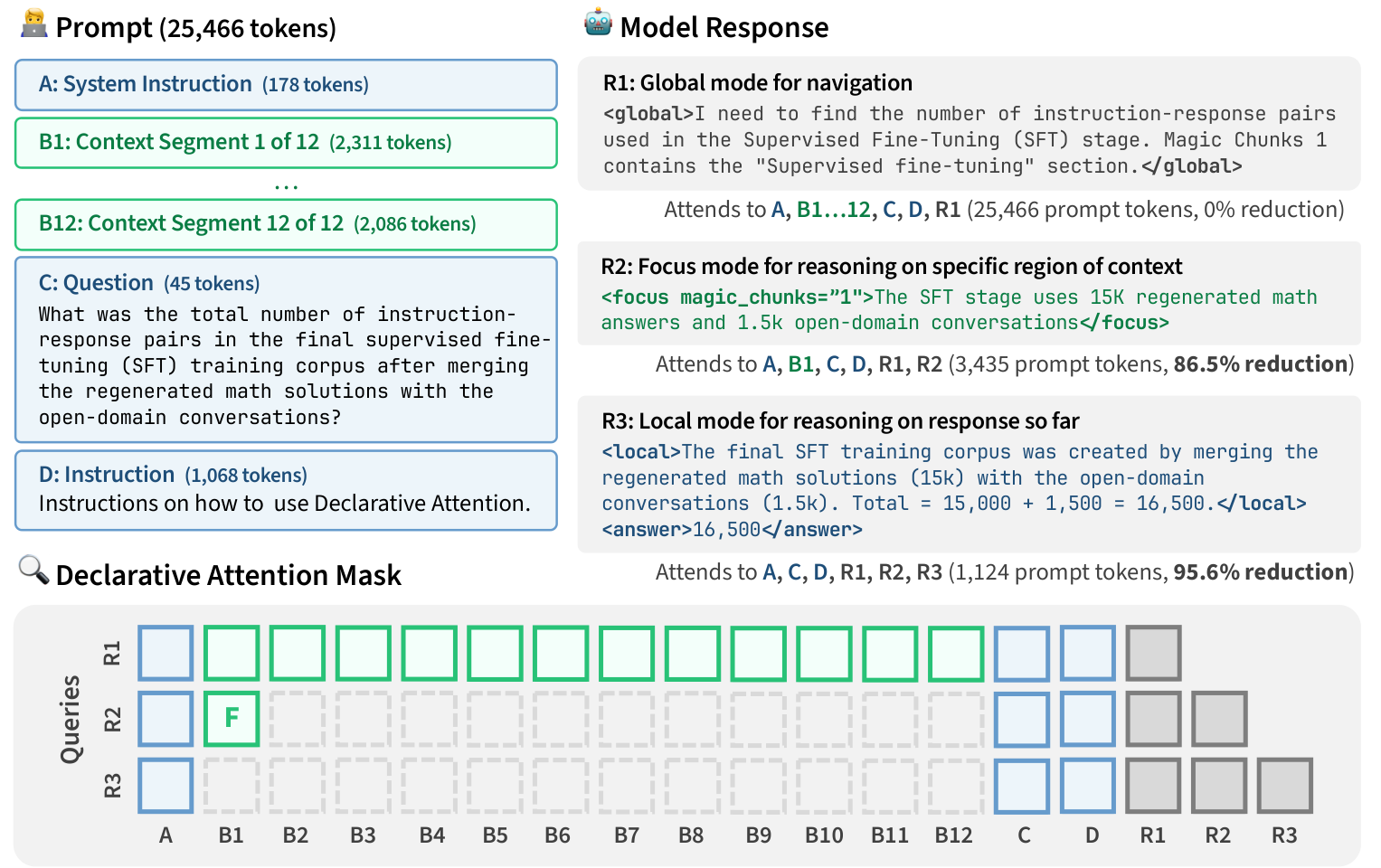
In all modes, a persistent scaffold (system instruction, question, DA instruction, and the model’s own response so far) remains attended. A lightweight state machine runs alongside the inference engine, parsing tags in the emitted stream like tool calls and updating the attention mask at each decode step to zero out KV entries for chunks outside the declared scope. Concretely, if C = \{c_1, \dots, c_m\} is the set of context chunks and S_t \subseteq C is the currently declared visible set at step t, the decode-step attention is masked so that queries at t only read KV entries from the scaffold plus S_t, skipping HBM traffic for C \setminus S_t.
Because DA is elicited zero-shot from off-the-shelf models (Gemma-4-{31B,12B,E4B}, Qwen-3.6-27B, Qwen-3.5-{9B,4B}), the prompt scaffolds per-mode behavior; no fine-tuning is used. DA trades more decode steps (extra tags and planning tokens) for lower per-step attention. The paper frames the win via roofline wall-time — summing each op’s work at its hardware ceiling — arguing DA pays off in large-batch, compute-saturated serving where attention read bandwidth is the bottleneck.
Results
Across 15 long-context tasks (RULER niah variants, LongBench v1/v2, LooGLE, ZeroSCROLLS), DA reduces total attended tokens during decoding by 52.0% on Gemma-4-31B and 31.1% on Qwen-3.6-27B, with average accuracy drops of 1.27pp (87.01% → 85.74%) and 2.75pp (85.31% → 82.56%) respectively. An ablation, DA^{\text{nm}}, keeps the declarative CoT structure but disables the masking; it often increases attended tokens relative to vanilla (e.g., 22.31M vs 13.43M on Gemma) because the extra generated tokens still attend fully. This isolates the masking as the source of the savings rather than shorter attention through CoT restructuring alone.
Per-task, DA matches or improves vanilla on 7/15 (Gemma) and 5/15 (Qwen). Notable gains: longdep_qa +3.1pp on Gemma, code_repo +5.6pp on Qwen. Losses concentrate in multi-span reasoning (Gemma: −2.28pp category avg vs −0.78pp on single-span; Qwen: −3.59pp vs −2.34pp), where the model must correctly enumerate multiple chunks in the focus tag.
Mode economics on Gemma-4-31B: <global> accounts for ~27% of generated tokens, <focus> and <local> for the remaining 73%. <focus> attends ~12% of vanilla’s per-step tokens and <local> ~6%, giving 76–99% per-token attention savings in the cheap modes. <global>’s share rises to ~45% in the longest context bucket, capping total savings there, but <focus>/<local> per-token savings grow with context length — the mechanism scales favorably as N increases.
Limitations
- Zero-shot elicitation means the mode mix is a property of prompt compliance, not an optimization. On weaker models (Gemma-4-12B) up to ~6% of responses fail to terminate within the 8K generation budget, inflating attended-token sums.
- Multi-span tasks show the largest accuracy loss: correctly declaring the union of relevant chunks is harder than iterating through them, and any missed chunk produces silent extraction failures.
- Chunking granularity (~2K tokens) is fixed; there is no learned or adaptive segmentation. Cross-chunk entities that straddle boundaries are not addressed.
- The wall-time argument is a roofline analysis, not measured end-to-end throughput; realized speedups depend on kernel implementation of dynamic KV masking and on batch composition (heterogeneous masks across a batch complicate paged attention).
- No fine-tuning experiments — obvious next step is SFT/RL on DA traces to reduce global-mode share and improve multi-span recall.
Why this matters
DA converts attention sparsity from an implicit runtime property that must be discovered per step into an explicit, model-emitted plan that the engine can act on with zero proxy computation. It reframes efficient long-context inference as a controllability problem rather than a KV-selection problem, and the mechanism’s per-token savings grow with context length — the regime where it needs to.
Source: https://arxiv.org/abs/2609.02737
Influence-Directed Distillation: Solving the Diversity Bottleneck in Sampled-Token On-Policy Distillation
Problem
Sampled-token on-policy distillation (OPD) generates tokens from the student policy p and updates against a teacher policy q using teacher log-probabilities only for the sampled tokens. This avoids full-vocabulary forward passes of the teacher, making OPD substantially cheaper than Forward-KL distillation. Empirically, however, sampled-token OPD suffers a systematic diversity collapse: pass@1 improves while pass@k stagnates. The student inherits the teacher’s modal behavior but loses entropy across the response distribution — a serious failure mode for reasoning models, where pass@k governs test-time search, self-consistency, and RL exploration downstream.
The paper’s contribution is a first-order theory of why entropy collapses under sampled-token OPD, plus a lightweight fix that requires no additional teacher queries.
Advantage sign is not the right signal
Prior selective-OPD work uses the advantage A_y (the teacher–student log-probability gap at sampled token y) as the knob for regulating updates. The authors show this is insufficient. Consider two positions with identical A_y > 0: reinforcing an already-peaked mode contracts entropy, while reinforcing a low-probability alternative expands it. Section 3.1 demonstrates this empirically — plotting per-step measured \Delta H against A_y yields a two-sided fan with no monotone relationship. The entropy effect depends jointly on A_y and the local structure of p(\cdot \mid h).
To fix this, they define a First-Order Local Entropy Influence \mathcal{I}_H(y) — a signed first-order proxy that decomposes the entropy update into the teacher–student log-prob gap and p’s local geometry. Crucially, \mathcal{I}_H(y) correlates tightly with measured one-step \Delta H and predicts its sign, whereas A_y does not.
Where entropy actually leaks
A naive prescription would be to penalize all updates with \mathcal{I}_H(y) < 0. The authors show this is wrong on empirical grounds. They bin sampled tokens by the normalized teacher–student discrepancy
\delta_y = \frac{q_h(y) - p_h(y)}{q_h(y) + p_h(y)} \in [-1, 1]
and measure the cumulative entropy loss (from real optimizer steps, not the proxy) within each bin. Two regions matter:
- High-divergence tail \delta_y \approx -1: individually large entropy hits, expected by prior selective-OPD analyses. But these are legitimate teacher corrections and must not be blocked.
- Near-agreement mass \delta_y \approx 0: each token contributes a tiny entropy decrement, but the sheer volume of aligned tokens dominates the total contraction. This is the previously unrecognized primary driver.
A uniform penalty on \mathcal{I}_H(y) < 0 therefore both under-penalizes the true entropy sink (aggregate near-agreement tokens) and over-penalizes rare high-divergence corrections the student actually needs.
Method: divergence-adaptive shrinkage
IDA-OPD leaves entropy-expanding updates (\mathcal{I}_H(y) \geq 0) untouched and shrinks entropy-contracting ones by a scale-free retention factor:
w_y = \frac{|q_y - p_y|}{q_y + p_y} \in [0, 1).
The modified advantage is
\widetilde{A}_y = \begin{cases} A_y, & \mathcal{I}_H(y) \geq 0, \\ w_y \, A_y, & \mathcal{I}_H(y) < 0, \end{cases}
with per-token loss
\ell_y^{\text{IDA-OPD}} = -\operatorname{sg}(\widetilde{A}_y) \log p_y.
Two properties matter:
- Sign-preserving: w_y \geq 0 never flips the correction direction.
- Quadratic attenuation near agreement (Proposition 1): for small |q_y - p_y|, w_y A_y = O((q_y - p_y)^2), so the massive near-agreement token population — the empirical dominant entropy drain — contributes only quadratically small updates, while high-divergence corrections (w_y \to 1) pass through nearly unchanged.
Implementation cost is essentially zero: w_y and \mathcal{I}_H(y) use only the sampled-token teacher probability that OPD already computes, so no full-vocabulary teacher forward pass is required. This is the practical distinction from Forward-KL-based fixes.
Results
The paper evaluates on reasoning distillation:
- Math: Qwen3-8B-Non-Thinking-RL-Math → Qwen3-8B-Non-Thinking, and the 4B counterpart.
- Code: Qwen3-4B-Non-Thinking-RL-Code → Qwen3-4B-Non-Thinking.
All teachers are GRPO-trained. The reported outcome is that IDA-OPD consistently improves pass@k relative to standard sampled-token OPD — recovering teacher diversity — while matching the strongest teacher-informed baselines that require full-vocabulary Forward-KL. Specific per-benchmark numbers are truncated in the provided sections, but the qualitative pattern is that pass@1 is preserved (no regression from correction shrinkage) while pass@k gains materialize, closing the diversity gap that motivated the work.
Limitations and open questions
- \mathcal{I}_H(y) is a first-order proxy; interactions across tokens within a trajectory and second-order effects from the optimizer are ignored. Whether the sign accuracy of \mathcal{I}_H(y) degrades under large learning rates or batch sizes is not characterized.
- The retention factor w_y uses only marginal probabilities at y; it does not know whether the update reinforces a semantically diverse continuation or merely a paraphrase.
- Results are on Qwen3 non-thinking variants distilled from GRPO’d teachers of the same family. Cross-family and thinking-mode distillation are untested here.
- The method leaves open whether influence-directed weighting can be extended to Reverse-KL or GRPO-style objectives where advantages already have variance-reduction structure.
Why this matters
Diversity collapse under sampled-token distillation has been an accepted cost of avoiding full-vocabulary teacher queries; IDA-OPD shows the collapse is largely attributable to an aggregate effect at near-agreement tokens that a scale-free, per-token shrinkage can neutralize without extra teacher computation. That reframes the diversity–efficiency trade-off in distillation: pass@k preservation may not require Forward-KL after all.
Source: https://arxiv.org/abs/2608.29846
Post-Training Language Models for Gold-Medal Performance in Coding Competitions
This paper reports an end-to-end specialization pipeline for competitive programming that culminates in the first AI system to prospectively outscore the top human contestant at IOI, an on-site five-hour olympiad with strict submission budgets. The result is notable because IOI problems reward algorithmic insight (correct subtask-specific algorithms, tight complexity bounds, careful case analysis) rather than pattern-matching against public repositories, and because the evaluation was run live before problem release, precluding contamination.
Problem setting
IOI 2025 and 2026 each present six problems over two days, each worth 100 points and decomposed into subtasks with distinct input constraints. Partial credit means that submitting a correct O(n^2) solution to a subtask whose intended solution is O(n \log n) still scores. Contestants get 50 submissions per problem and one submission per minute, so the strategy space is not just “generate a solution” but “allocate submissions across subtasks under uncertainty.” Gold cutoffs are set at roughly the top 1/12 of the score distribution: 438.3 in 2025 and 361.12 in 2026.
The authors also evaluate on ICPC 2025 (Pass@1 over 12 problems, all-or-nothing) and LiveCodeBench Pro. IOI results are averaged over 1,000 independent runs for final numbers, which is unusually rigorous — Score@1 has high variance on six-problem contests, and 50-run intermediate estimates would be too noisy for checkpoint selection.
Method
The pipeline has four stages: curation, SFT, RL, and a test-time compute procedure called GenCorrect.
Curation collected 22,000 problems from 16 competition families and online judges over two decades. Each problem is packaged into an executable environment containing the statement, constraints, test cases, auxiliary graders, and reference solutions. Environments are only retained when reference and generated solutions produce consistent verdicts — an important filter, since competitive programming judges frequently have non-deterministic checkers, floating-point tolerance issues, or under-specified interactive protocols that silently corrupt reward signals. IOI 2025, ICPC 2025, and LCB Pro problems are excluded and deduplicated from both SFT and RL corpora; IOI 2026 is strictly prospective.
Two models are trained: Nemotron-3-Nano-CC (30B total, 3B active MoE) with both SFT and RL, and Nemotron-3-Ultra-CC (550B total, 55B active) with SFT only. Synthetic reasoning traces are used for SFT — the paper frames these as demonstrations conditioning the model on the format of a competitive-programming solve (problem restatement, subtask analysis, algorithm derivation, complexity check, code).
RL uses the executable environments as the reward source. Notably, only the smaller Nano model receives RL; the 550B Ultra was left at SFT, presumably for cost reasons.
GenCorrect is the test-time strategy. It iteratively (1) generates diverse candidate solutions, (2) evaluates them against generated or provided tests, (3) refines based on feedback. Under IOI’s per-subtask scoring, keeping diverse candidates that each maximize different subtasks is provably better than converging on a single “best” solution, and this appears to be what GenCorrect exploits.
Results
For Nemotron-3-Nano-CC on IOI 2025, the base model scores 130/600. Post-training (SFT+RL) lifts it to 291. Adding GenCorrect at test time brings it to 468, which exceeds the 438.3 gold threshold. Ultra-CC (SFT only) reaches 502 on IOI 2025 with GenCorrect.
The headline is IOI 2026, run live: 535.4/600 under identical constraints to human contestants — no internet, local code execution allowed, 50 submissions per problem at 1/minute. The gold threshold was 361.12; the top human scored 498.27. Peak inference used 760 NVIDIA GB300 GPUs. This is, to the authors’ knowledge, the first AI system to outscore the highest-scoring human at IOI under matching constraints.
The Score@1 vs Score@200 gap (reported separately) quantifies how much of the gain comes from parallel sampling versus base model quality. The fact that GenCorrect nearly doubles Nano-CC’s score (291 → 468) suggests that most of the current frontier at IOI is unlocked by test-time compute plus feedback, not just by model weights.
Limitations and open questions
Several caveats are worth flagging. First, the compute budget is enormous: 760 GB300s peak for a six-problem contest is not a practically deployable configuration, and the paper does not report a Pareto frontier of score vs GPU-hours. Second, Ultra-CC did not receive RL, so the SFT-only vs SFT+RL comparison is confounded with scale. Third, GenCorrect’s efficacy depends on being able to synthesize discriminating test cases; IOI’s partial-credit structure is unusually forgiving here, and it is unclear how much transfers to ICPC’s all-or-nothing regime (specific ICPC numbers are not included in the excerpt shown). Fourth, the 22,000-problem corpus, while decontaminated against 2025 evaluations, overlaps stylistically and topically with IOI 2026 in ways that are difficult to fully control — problem-family memorization at the level of algorithmic templates is essentially unavoidable.
Open questions: how much of the 535.4 score would remain if submission counts were tightened, if the model had to operate under a single-sample constraint, or if the problem set emphasized ad-hoc constructive tasks (a known weakness for LLMs) rather than the more standard IOI algorithmic repertoire?
Why this matters
Competitive programming has served as one of the cleaner benchmarks for LLM reasoning because verdicts are automatic and problems are novel each year. A prospective, live IOI run that beats the top human under identical constraints is a strong signal that the combination of executable-environment RL, structured synthetic traces, and feedback-driven test-time compute is sufficient to push past elite-human performance on constrained algorithmic reasoning — even though the compute cost places the result firmly in the demonstration regime rather than the deployment regime.
Source: https://arxiv.org/abs/2609.02849
Repo-To-Skill: Distilling GitHub Repositories Into AI4AI Skills
Problem
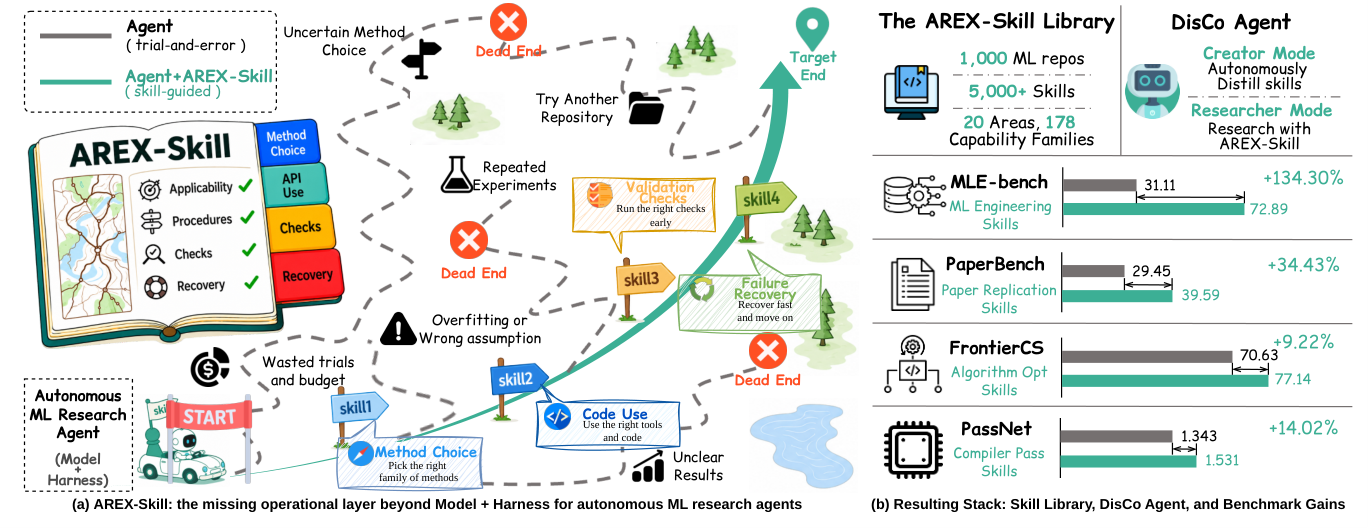
Autonomous ML-research agents are typically described as a pair \mathcal{A} = (M_\theta, H): an LLM backbone and a harness that supplies planning, memory, verification, and iteration. This decomposition leaves out a third layer the authors call operational knowledge — the practical know-how (invocation conventions, config gotchas, evaluation pipelines, canonical training recipes) that separates knowing a method from running it. Such knowledge exists in repositories and papers but is written for humans and is too bulky to load into a task’s context. As a result, agents rediscover it by trial-and-error on every run. The paper proposes DisCo, a system that distills this layer into compact verified skills and reuses them, and releases AREX-Skill, a library of 5,000+ skills covering 1,000 ML repositories.
Skills and skill graphs
A skill is instantiated with three files:
S = (\underbrace{\texttt{SKILL.md}}_{\text{knowledge interface}},\ \underbrace{\texttt{references/}}_{\text{knowledge substrate}},\ \underbrace{\texttt{scripts/}}_{\text{execution interface}})
SKILL.md is the only layer loaded up front: it carries the SOP, key concepts, tool usage, worked examples, and known failure modes, plus pointers to deeper material. references/ holds API docs, algorithmic detail, and parameter configurations, loaded on demand under progressive disclosure. scripts/ contains executable wrappers with typed IO that the agent invokes rather than reimplements. The agent’s operating context \mathcal{K} = \{S_1, \ldots, S_m\} is simply the set of skills currently attached; no change to M_\theta or H is required, which makes the format portable across Claude Code, Codex, and similar harnesses.
Because a single repository typically contains more operational knowledge than one skill should hold, skills from one source are packaged as a skill graph
\mathcal{G} = (\mathcal{S}, \mathcal{L}), \quad \mathcal{S} = \{S_i\}_{i=1}^n,\ \mathcal{L} \subseteq \{(S_i, S_j) \mid i \neq j\},
with an entry skill that states scope and routes to component skills for package functions, pipeline stages, or method variants.
Distillation: creator mode
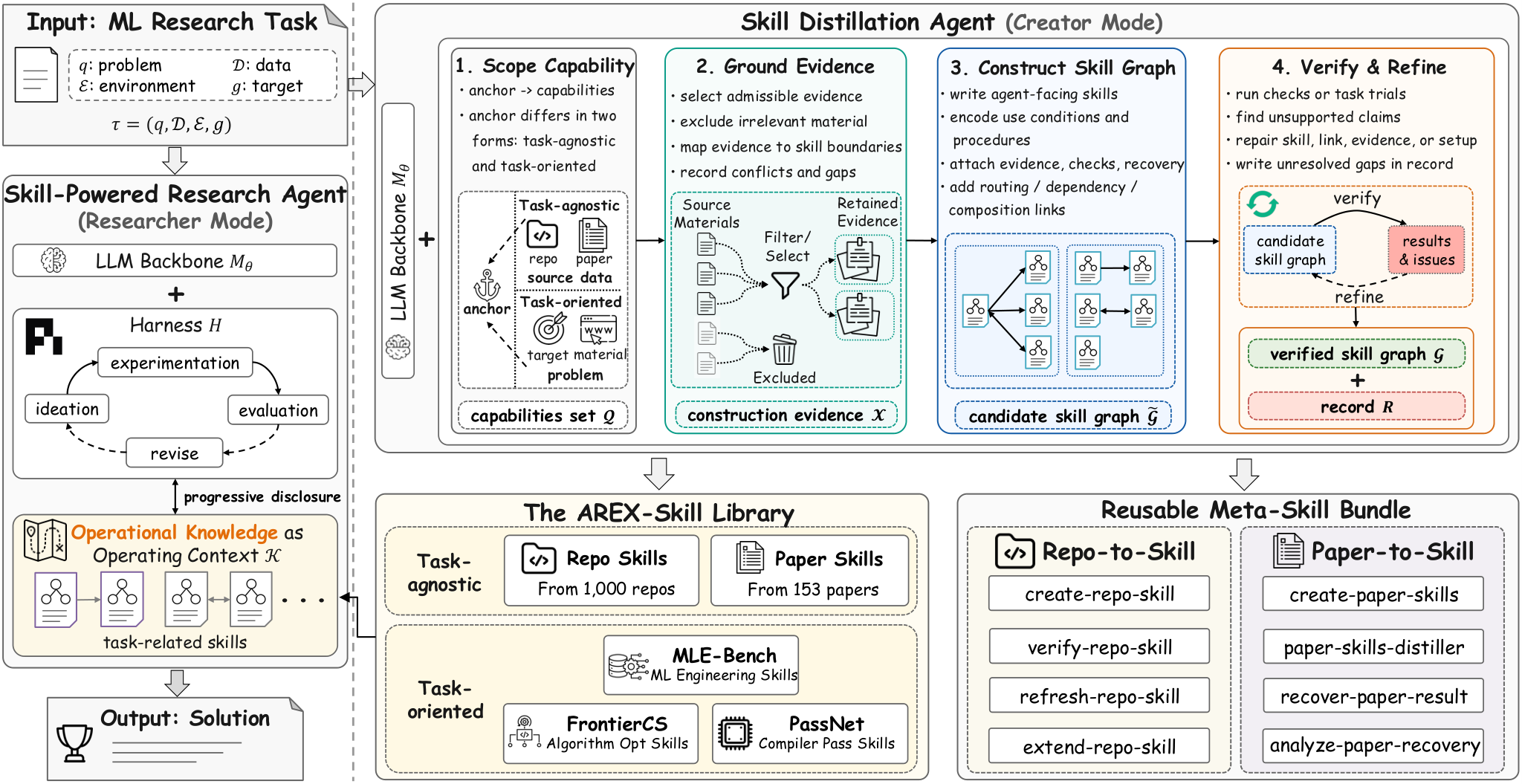
DisCo runs in two complementary distillation modes, both anchored on some z:
- Task-agnostic (anchor z = c, a source such as a repo or paper): produces reusable graphs written to the library.
- Task-oriented (anchor z = \tau, a concrete task): produces graphs targeting the task’s expected operational steps.
In either case the pipeline is: scope the anchor into a capability set \mathcal{Q}, ground each capability in source evidence \mathcal{X}, package into a candidate graph \tilde{\mathcal{G}}, and verify into an accepted graph \mathcal{G} with a construction record R. Verification is what makes the skill trustworthy for later reuse: scripts must actually execute against the stated interfaces, and references must trace back to source evidence. The construction record preserves provenance so accepted graphs can be re-verified when upstream sources move.
The AREX-Skill Library
The repository snapshot covers 1,000 ML repos selected by open-source visibility and practical use (GitHub stars among the curation signals), spanning model implementations, training/deployment systems, data and evaluation tooling, and scientific software. Distillation yields 5,000+ verified skills organized under a two-level taxonomy of 20 areas and 178 capability families. Area and family memberships are overlapping — a repo supporting multiple capabilities appears under multiple paths — so the taxonomy behaves as a router rather than a partition.
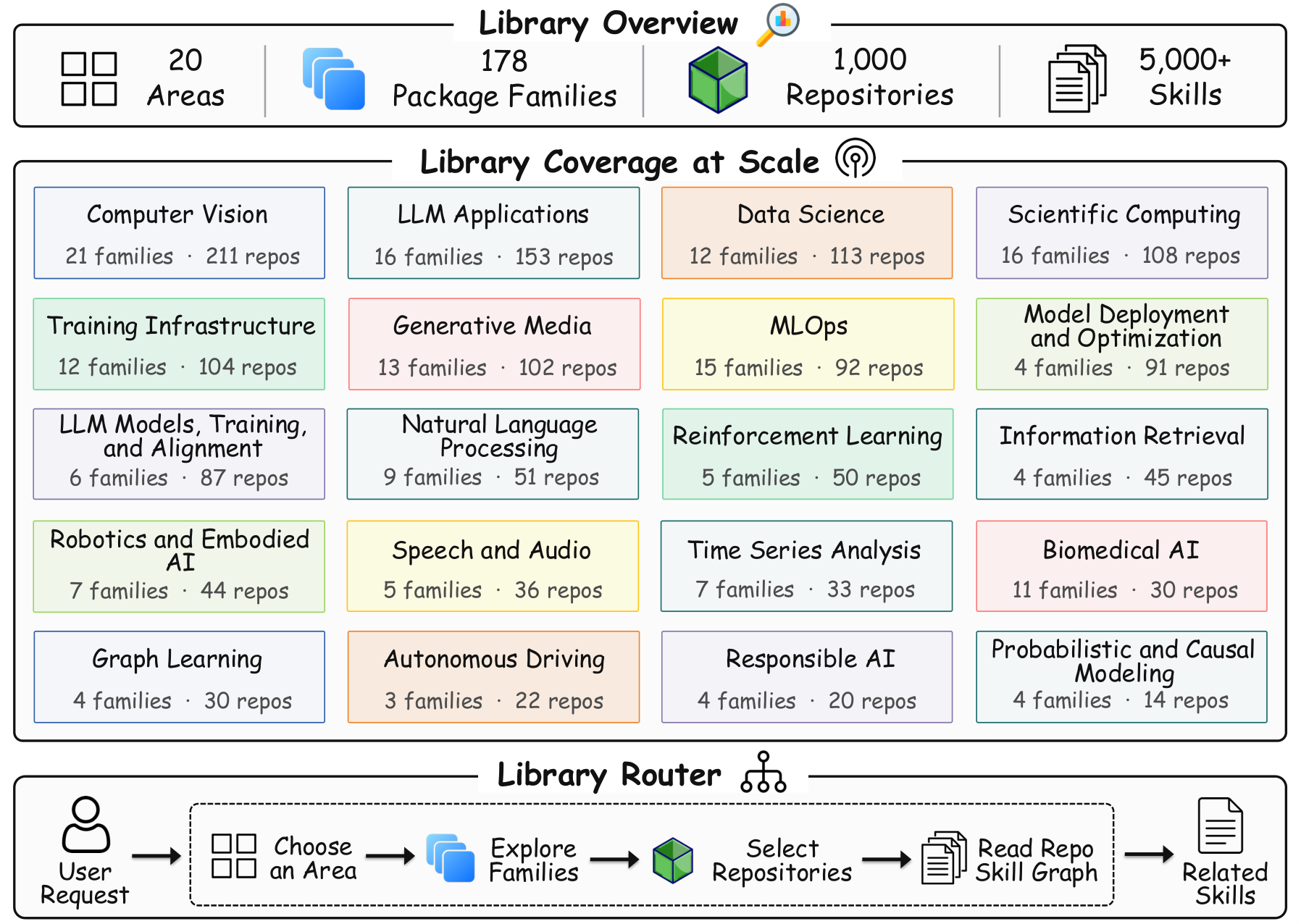
At research time, the router narrows a request from area to family to a specific repository graph, so the agent only pays context cost for the branch it actually needs. Paper-derived graphs and task-oriented graphs live as separate collections in the same library.
Experimental protocol
The evaluation isolates the operating-context variable. Harness is fixed to Codex; backbone is fixed to GPT-5.5 at “xhigh” reasoning effort. The only controlled factor is with skills vs without skills. Skill construction budget and task-execution budget are separated: with- and without-skills conditions run under a matched execution budget, and the one-time construction budget is not charged to either.
On MLE-bench the authors evaluate the full 75-competition suite across Low/Medium/High tiers and report the headline Any-Medal score by split, using the benchmark’s held-out grader. For each task, a dedicated skill graph is distilled from web-search-collected sources with the original competition page and any competition-specific content excluded, to avoid leakage. PaperBench uses paper-derived skill pools; FrontierCS and PassNet use task-oriented graphs. Figure 1(b) summarizes the resulting uplift across all four benchmarks under this matched-budget setup.
Limitations and open questions
The paper’s contribution is a knowledge-layer format and a distillation/verification pipeline, not a new backbone or harness. Several issues remain. First, the 1,000-repo scope is a curated snapshot; the coverage-vs-quality tradeoff for automated curation at larger scales is not characterized. Second, skills carry a maintenance burden — verification presumes stable APIs, and no mechanism for continuous re-verification against upstream repository drift is described. Third, results depend on a single frozen backbone (GPT-5.5, xhigh); whether weaker backbones benefit proportionally more (skills as a substitute for reasoning) or less (skills require reasoning to be usable) is unresolved. Finally, the router’s area/family taxonomy is generated rather than principled; retrieval failures at that layer would silently degrade downstream performance, and no retrieval ablation isolating router quality from skill quality is highlighted in the sections provided.
Why this matters
Treating operational knowledge as a first-class, portable, verified artifact — rather than something an agent rediscovers per run — is a plausible route to closing the gap between “the method exists in a repo” and “an agent can actually run it.” If AREX-Skill’s format holds up under harness and backbone changes, it turns the ML open-source ecosystem into a reusable substrate for autonomous research rather than a corpus that must be re-read every time.
Source: https://arxiv.org/abs/2609.02749
SolarWM: Open Data and Scalable Training for Long-Horizon Video World Models
Problem
Interactive video world models — models that roll out video conditioned on camera and text over long horizons — remain hard to compare and reproduce. Two coupled problems drive this: (i) datasets differ in temporal scale, camera geometry, quality, and captions, so naive mixing yields inconsistent supervision; (ii) video backbones (Wan, LTX, MiniMax-H3) use incompatible latent representations, attention layouts, and objectives, so implementations are not portable. Existing releases typically bundle a fixed clip list with a single backbone, precluding controlled cross-backbone or cross-recipe study. SolarWM proposes a full open-source stack — 1.43M canonically processed clips across 10 sources plus a backbone-native training framework instantiating four models in the 5B–33B range — to decouple these axes.
Data engine
The core design choice in the data engine is to fully process every canonical clip before applying training-time selection, and to persist rejected clips with machine-readable rejection reasons. Each sample follows a unified schema
\mathcal{S}_i = (V_i, P_i, K_i, C_i, m_i, q_i, \pi_i),
where P_i \in \mathbb{R}^{N\times 4\times 4} holds metric camera-to-world transforms, K_i \in \mathbb{R}^{N\times 4} stores per-frame (f_x, f_y, c_x, c_y), and \pi_i records provenance across processing versions. Three namespaces are kept separate: the physical corpus (samples and annotations), a logical recipe (splits, tier policy, source weights, repeat factors), and a model view (backbone-specific windows and precomputed latents). Changing a recipe or VAE therefore does not duplicate videos or re-trigger camera estimation and captioning.
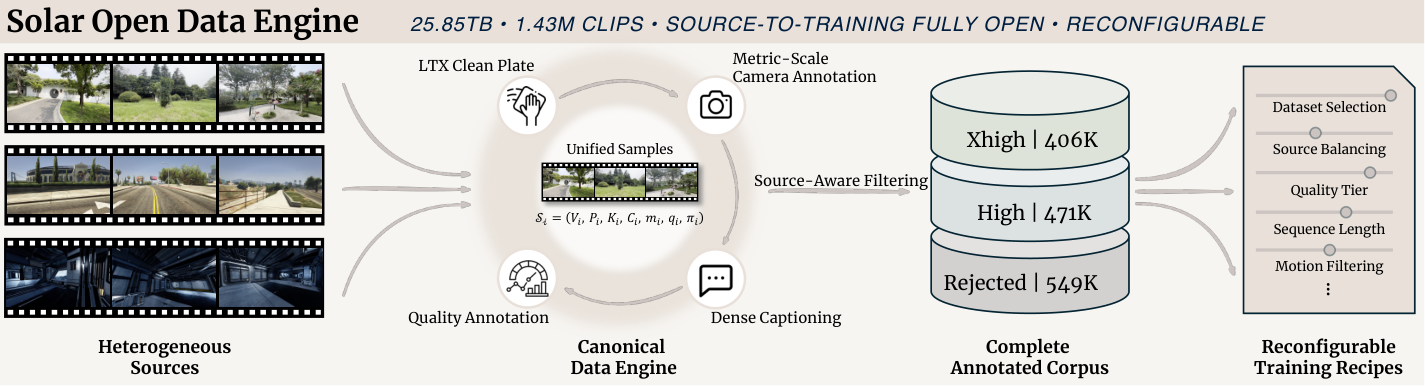
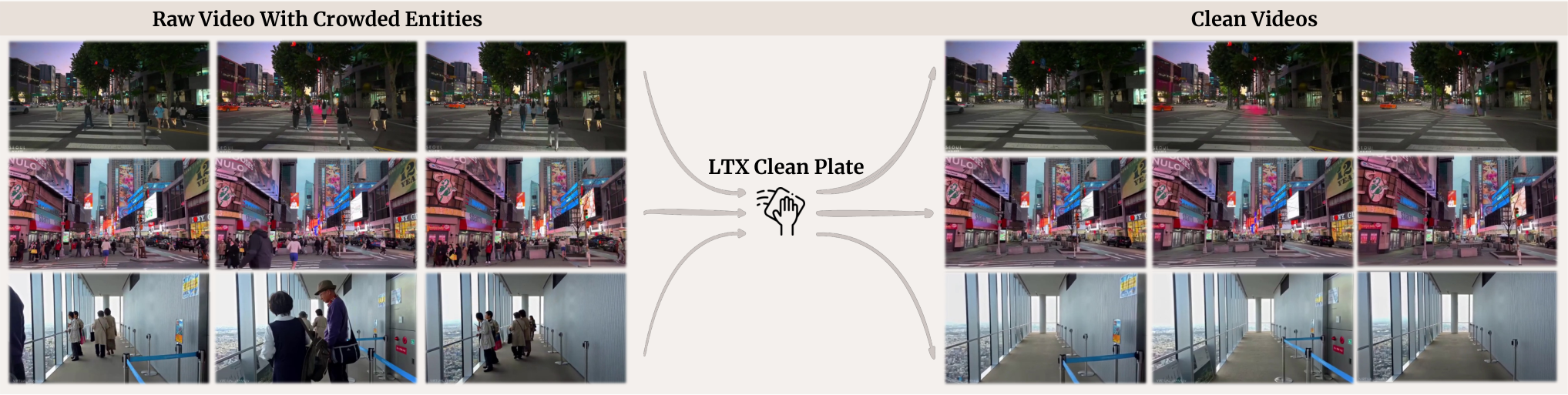
The 10 sources (ABOT-World, DL3DV, MiraData, RealCam, SpatialVID, Sekai-Game, Sekai-Walking, MIND, MultiCamVideo, OmniWorld) yield 14 independently addressable dataset owners: DL3DV is split into 10s and 60s temporal views, and three Clean Plate owners are derived from MiraData, Sekai-Walking, and SpatialVID. Clean Plate processing (Figure 3) removes dynamic humans and vehicles while preserving the source camera trajectory, producing cleaner supervision for camera-conditioned training where the intended time-varying signal is the camera alone.
Training pipeline
Training proceeds in three stages sharing camera conditioning and a native flow/velocity target \mathbf{u}_t of the backbone.
Stage 1 — Bidirectional adaptation. Given clean latent \mathbf{z}_0, noisy \mathbf{z}_t, and conditions \mathbf{c} (text, image, camera), minimize
\mathcal{L}_{\mathrm{bid}} = \mathbb{E}_{\mathbf{z}_0, t, \boldsymbol{\epsilon}}\left[\|f_\theta(\mathbf{z}_t, t, \mathbf{c}) - \mathbf{u}_t\|_2^2\right]
with unrestricted bidirectional attention. Camera conditioning uses fused-PRoPE: after the backbone applies native video RoPE, projective rotations derived from P_i, K_i are applied directly to Q, K, V tensors in the existing self-attention path, followed by an output transform before the native projection. This avoids a separate camera branch or extra attention pass and applies uniformly across all four backbones.
Stage 2 — TF-AnyFlow autoregressive initialization. Attention is switched to causal and the model is trained with teacher forcing under the AnyFlow loss (Gu et al., 2026), producing a few-step causal generator directly from the bidirectional checkpoint. The authors argue this collapses two prior stages — Causal ODE initialization (Causal Forcing) and Causal Consistency Distillation (Causal Forcing++) — into one, on the grounds that the bidirectional model has already learned appearance and motion; only causal prediction needs activation.
Stage 3 — DMD. Distribution Matching Distillation (Yin et al., 2024) is applied on model-generated rollouts against the frozen bidirectional reference from Stage 1, aligning the causal generator with its inference-time trajectory distribution.
Model family and inference
Four routes are instantiated under one contract: SolarWM-wan2.2-5B, SolarWM-wan2.2-14B, SolarWM-ltx-2.5-22B, and SolarWM-minimax-h3-33B, each preserving native temporal representation, attention layout, and optimization objective. At inference, all causal models sample at 16 fps with four steps and no attention sink, conditioned on one image, text, and a frame-aligned camera trajectory. Bidirectional variants generate 10-second clips; causal variants roll out to 10s, minute-scale, and hour-scale horizons with fixed scene text and time-varying camera as the only external control.

Results and limitations
The experimental section evaluates two stages: bidirectional models on 10-second OOD generations from GPT Image 2 / Krea initial frames across all four routes, and distilled causal generation on in-domain and OOD sequences up to hour-scale. Reported settings — 16 fps, four sampling steps, no attention sink, single-image initialization — establish a controlled comparison point across 5B–33B backbones under identical data and camera contracts.
The excerpts provided emphasize infrastructure and qualitative behavior rather than benchmark numbers; concrete metrics beyond corpus size (1.43M clips, 10 sources, 14 owners) and inference configuration are not shown here. Open questions include: how much of long-horizon stability is attributable to TF-AnyFlow versus DMD versus Clean Plate supervision; whether the fused-PRoPE camera injection generalizes to backbones without a clean RoPE factorization; and how the “few-step from the outset” claim compares quantitatively to the Causal Forcing++ two-stage init on matched compute.
Why this matters
SolarWM converts video world modeling from a per-lab bespoke pipeline into a reproducible substrate: a decoupled data engine with persisted rejections, a portable camera-conditioning interface, and a distillation-based training recipe that spans four independent backbones. This is the kind of shared contract that lets subsequent work isolate backbone effects from data-mixture effects — a comparison that has been essentially impossible in interactive video generation to date.
Source: https://arxiv.org/abs/2609.02886
EarlyEval: Cheaper Agent Evaluation via Early Outcome Prediction
Problem
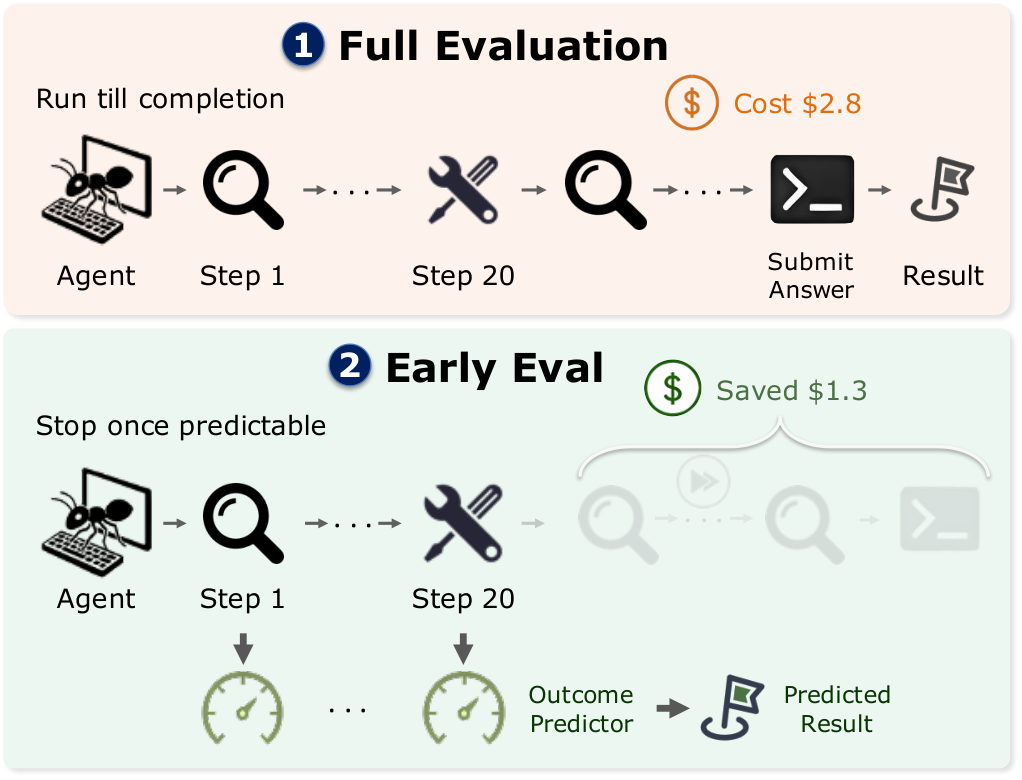
Running frontier LLM agents through modern agentic benchmarks has become a serious budget item. Using the OpenHands Index numbers the authors report, one pass of Claude 5 on SWE-bench Verified is roughly $715, and SWE-bench Multimodal reaches $2,270. Because a development cycle re-evaluates the agent after every prompt, scaffold, or model change, these costs compound quickly. Prior work on efficient benchmarking has attacked this by task-level distillation — anchor points, tinyBenchmarks, adaptive testing — which shrinks the number of tasks but leaves the cost of each retained task untouched. EarlyEval attacks the orthogonal axis: stop each rollout early when the final outcome is already inferable from the partial trajectory.
Method
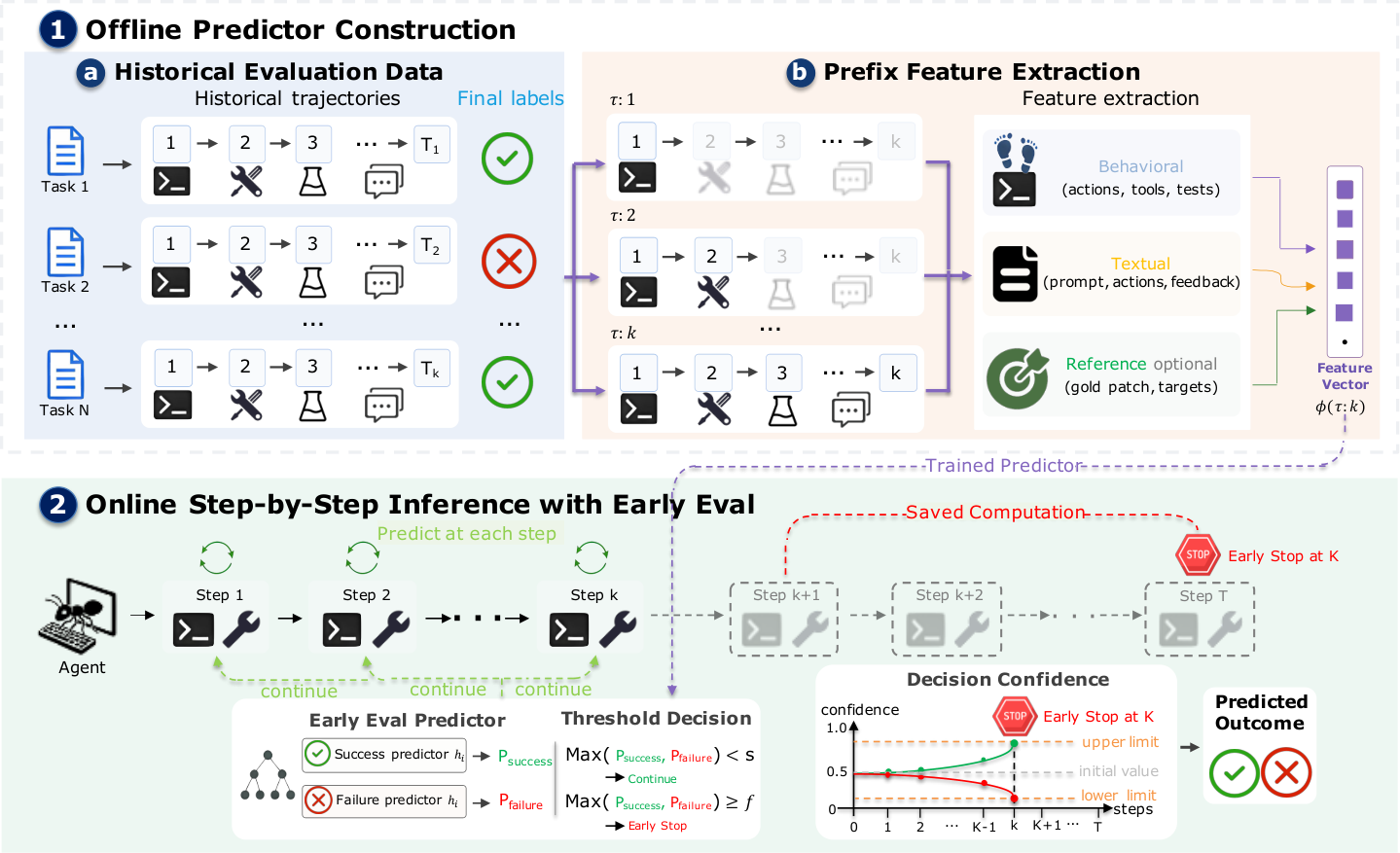
Let an agent \mathcal{A} produce a trajectory \tau = (e_1,\ldots,e_T) on task t from benchmark \mathcal{B}, terminating with binary score y\in\{0,1\}. An early-outcome predictor observes a prefix \tau_{1:k} with k<T and may emit \hat y and halt, or defer.
EarlyEval instantiates this as two independently trained LightGBM classifiers over prefix features:
- a success classifier p_s(\tau_{1:k}), halting with \hat y=1 when p_s\ge \theta;
- a failure classifier p_f(\tau_{1:k}), halting with \hat y=0 when p_f\ge \theta;
- otherwise the agent continues to step k+1.
Features fall into three families: behavioral (action types, retries, tool-call statistics, error signatures), textual (observations and generated text embeddings/aggregates), and reference-solution features that compare current edits against a gold patch when available. On benchmarks without gold solutions (TerminalBench, Toolathlon) the reference family is simply disabled; the ablation shows the framework leans mainly on behavioral signals.
Training data comes from historical trajectories on the same benchmark, of which public leaderboards accumulate many: 7,805 trajectories over 16 base LLMs on SWE-bench Verified, 6,757 across 37 configurations on TerminalBench, and 7,116 on Toolathlon. Evaluation uses a task-partitioned leave-one-agent-out protocol, so every prefix from the evaluated configuration is held out.
Results
The authors sweep \theta\in\{0.75,0.80,0.85,0.90,0.95,0.97\} and report three modes: success-only, failure-only, and dual. The recommended operating point is the smallest \theta that keeps \Delta|\text{Pass@1}| within roughly 2 percentage points.
- SWE-bench Verified at \theta=0.95 (dual): -26.0\% steps, -32.7\% input tokens, -28.7\% output tokens, with \Delta|\text{Pass@1}|=1.1 pp. The failure classifier alone reaches 96.7% precision at that threshold; the success classifier reaches 93.9%.
- Toolathlon at \theta=0.90: -23.0\% steps, -44.1\% input tokens, -29.4\% output tokens, at \Delta|\text{Pass@1}|=0.9 pp. The success side barely fires here (coverage \le 1.6\% even at \theta=0.75) — nearly all savings come from the failure classifier at 96.6% precision.
- TerminalBench, held out so neither the same base model nor the same scaffold appears in training, is the harder regime. At \theta=0.90 (no-same-model), dual gives -25.4\% steps and -42.7\% input tokens at 2.1 pp deviation; the no-same-scaffold split is tighter, e.g., -17.7\% steps at \theta=0.85 with 2.0 pp deviation.
A consistent pattern: input-token savings substantially exceed step savings (e.g., -81.5\% vs -63.4\% input tokens vs steps on SWE-bench at \theta=0.75). This is expected under compounding context windows — the truncated tail is precisely where each step carries the heaviest prompt — and it is the paper’s construct-validity argument that step count understates real dollar savings.
The failure classifier does most of the work everywhere, and its precision is more stable across thresholds than the success classifier’s. That asymmetry is plausible: many failure modes (repeated identical edits against identical errors, tool-call loops) are strong behavioral tells, whereas confidently predicting success without a reference patch typically requires reference-solution features, which is why success-only coverage collapses on Toolathlon and TerminalBench.
Limitations and open questions
- Cold start: predictors need a labeled trajectory pool on the target benchmark. EarlyEval does not help the first pass on a brand-new benchmark, only iterative re-evaluation on established ones.
- Systematic bias: even at conservative thresholds there is a $$1–2 pp deviation in Pass@1, so the authors explicitly recommend full runs for canonical leaderboard numbers and reserve EarlyEval for iterative development.
- Ranking preservation across agents is only claimed in aggregate (RQ2); worst-case rank flips at aggressive thresholds are not fully characterized in the excerpt.
- Robustness under distribution shift is only partially tested: leave-one-agent-out and leave-one-scaffold-out give a hint, but truly novel scaffolds (e.g., new planning styles, new tool APIs) may erode the behavioral-feature priors LightGBM has fit.
- The success/failure classifiers are trained independently with a shared \theta; a jointly calibrated policy or a sequential-testing formulation (e.g., SPRT over p_s/p_f) could yield tighter operating curves.
Why this matters
EarlyEval introduces a cheap, orthogonal knob to benchmark distillation: rather than throwing tasks away, it truncates the expensive tail of each rollout using signals that agentic benchmarks already accumulate for free. The 20–45% token savings at \le 2 pp fidelity are large enough to change the economics of the inner-loop evaluation cycle that dominates agent research today.
Source: https://arxiv.org/abs/2609.02783
It Takes Two to Match: Co-Evolving Generative Retriever with Reinforcement Learning
Problem
Retrieval must select a candidate pool from a large item universe under tight latency, and production stacks are typically built around inverted indices over keywords. Recent LLM-based retrieval work uses generation mostly on the query side (rewriting, expansion, synthetic training data), while final matching still relies on a downstream dense or sparse retriever. This asymmetry leaves the item-side representation static and mismatched with the evolving query representation, and it also breaks compatibility with existing keyword infrastructure when dense encoders are inserted. CoGR asks whether both sides can be trained as LLM keyword generators that write into a shared, inverted-index-compatible token space, and whether they can be jointly optimized against a retrieval objective.
Method
CoGR trains two generators G^q and G^i that map a query q and an item i to compact keyword sets S_q = G^q(q), S_i = G^i(i). Retrieval is defined by keyword overlap through an inverted index:
I_{\mathrm{ret}}(q) = \{ i \in \mathcal{I} : (S_q \cup \{q\}) \cap (S_i \cup \{i\}) \neq \varnothing \},
with BM25 over the generated bags used for ranking within the retrieved set. This preserves compatibility with keyword-based serving.
Training has two stages (see the pipeline overview).
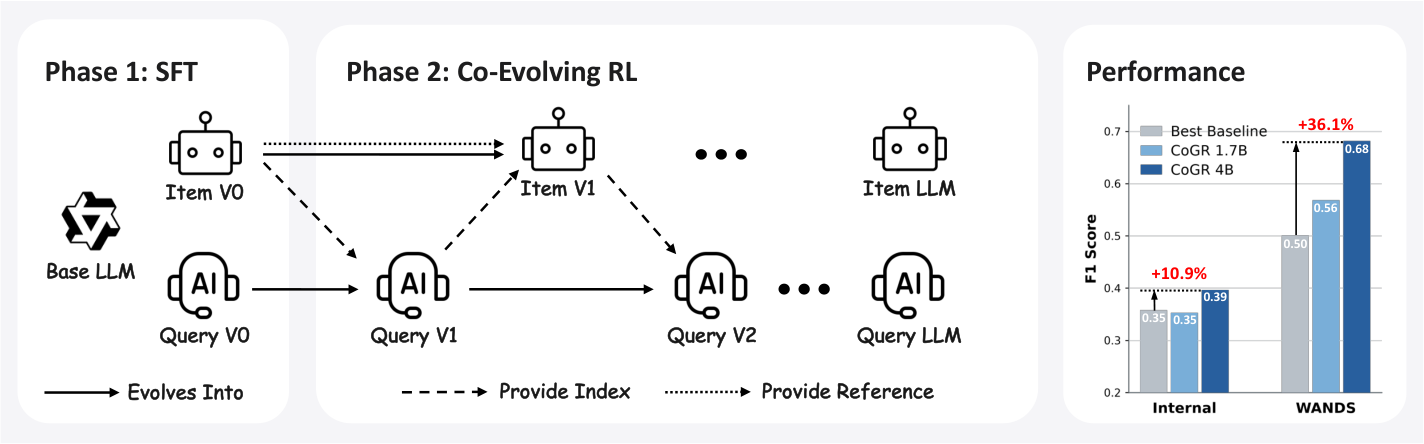
SFT initialization. Both generators are fine-tuned so their outputs live in an aligned keyword space, giving a non-degenerate starting index for RL.
Co-evolving RL with GRPO. Query- and item-side generators are updated alternately, each against a frozen index built by the other side. In the query phase, G^i is used to produce the item index; for a query, G^q samples multiple keyword-set candidates, each candidate is scored by retrieval F_1 against ground-truth relevant items, and GRPO uses the group-relative advantage to update G^q. In the item phase, the roles reverse, but a single item touches only a handful of queries, so direct F_1 is uninformative. CoGR uses a counterfactual reward: for each sampled item keyword set, compute the change in query-side retrieval F_1 that would result if this item’s index entry were swapped in, holding all other items fixed. Both sides therefore optimize the same query-to-item F_1 objective.
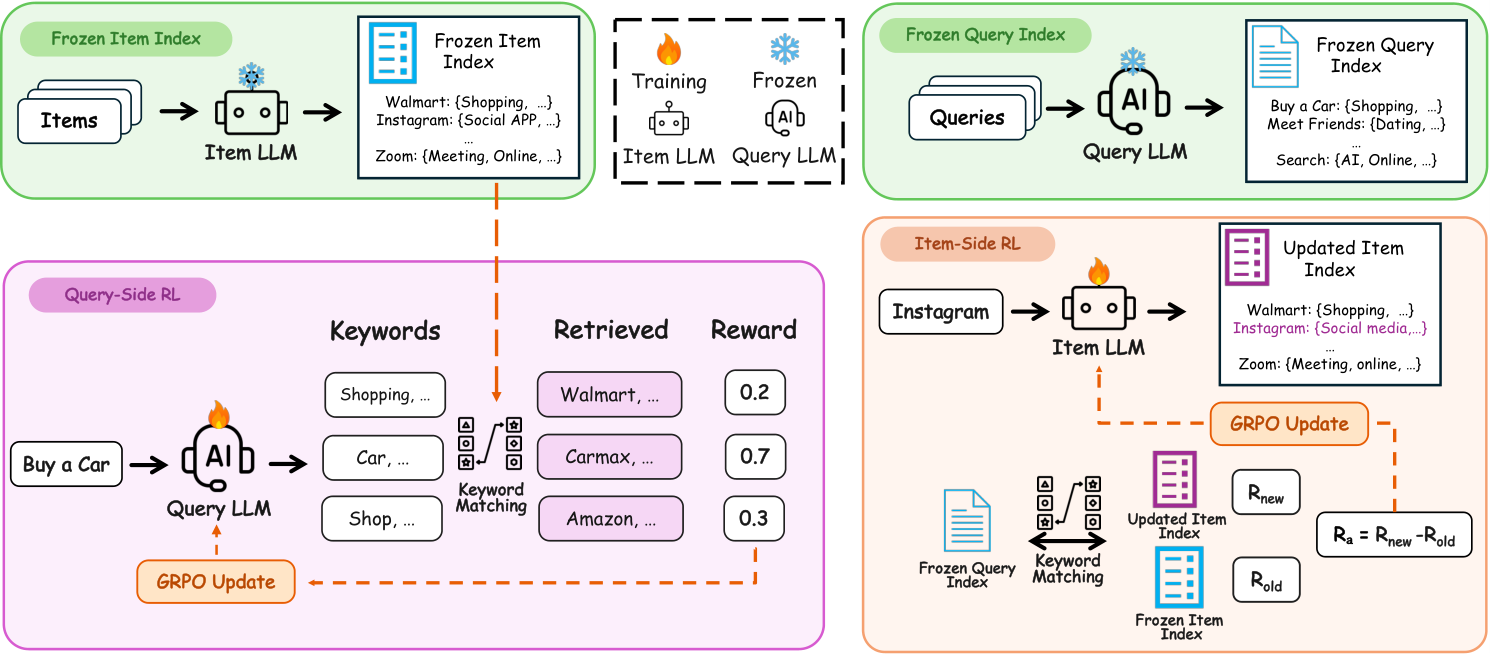
Because both indices are keyword-based and the reward is retrieval F_1, the two generators converge on a shared vocabulary; the alternating updates prevent the standard collapse of jointly training two retrievers.
Results
Evaluated on an internal APP marketplace dataset (13.5k train / 1.5k eval queries, ~39.6k items, ~1000 relevant items per query) and WANDS (430/50 queries, ~43k items, ~200 relevant items per query). Both are many-to-many relevance settings, unlike standard sparse-label IR benchmarks.
On the Internal dataset, CoGR-4B reaches F_1 = 0.3963 vs. the strongest baseline ANCE-Qwen4B at 0.3575, with MRR@100 0.7667 vs 0.7572 and NDCG@100 0.4930 vs 0.4879. Sparse baselines lag badly here (BM25 F_1 = 0.1056, SPLADE-v2 0.3019), and generative-retrieval baselines (DSI, DSI-QG, RIPOR, DeepRetrieval-4B) top out around 0.32.
On WANDS, CoGR is competitive but no longer dominant on full-set F_1: ANCE-Qwen4B reaches 0.5012 and SPLADE-v2 0.4903; generative baselines degrade sharply on this smaller corpus (DSI F_1 = 0.2890).
The ablation is the more informative result. Freezing the item side (denoted CoGR with dagger in the table, equivalent in spirit to DeepRetrieval) drops Internal F_1 from 0.3963 to 0.2617 at 4B, and from 0.3527 to 0.2399 at 1.7B. DeepRetrieval-4B, which also fixes the item representation and only trains query rewriting, gets 0.2750. The gap is a direct measurement of what co-evolution of the item index adds on top of query-side RL.
The training trajectory confirms the alternation is doing work rather than either side saturating early.
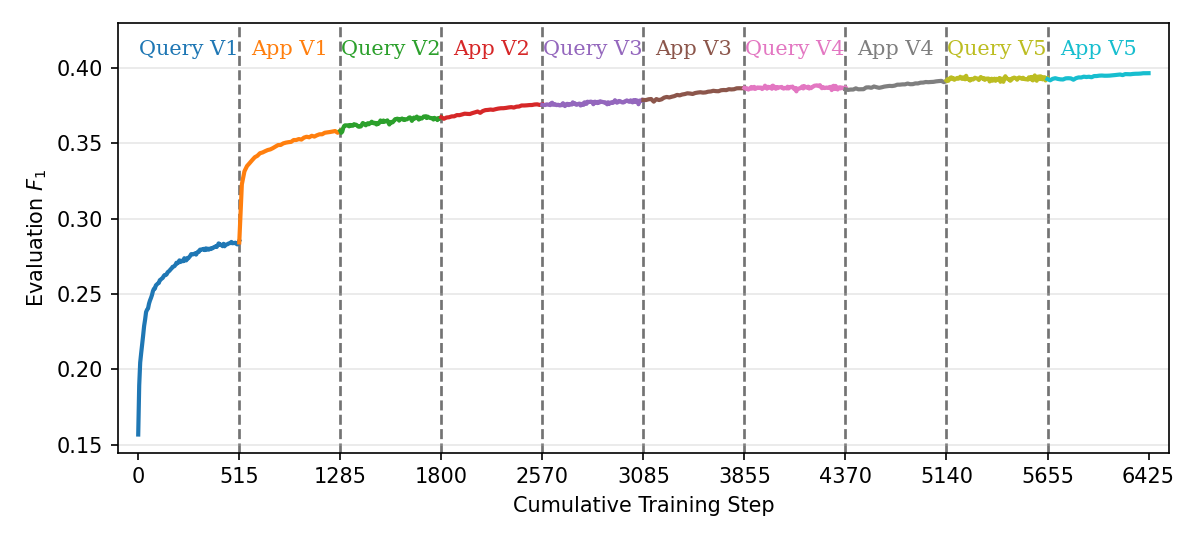
F_1 rises from ~0.16 after SFT to ~0.40 after five alternating rounds, with each side’s phase producing a visible step. Neither side plateaus after a single pass, which is the empirical signature of true co-adaptation rather than one-shot alignment.
Limitations and open questions
- The item-side counterfactual reward requires simulating retrieval swaps; the paper does not detail its cost at scale, and for very large item universes this may dominate RL wall-clock time.
- Evaluation is on two datasets with dense relevance annotations; behavior under sparse-label regimes (MS MARCO, BEIR) is unreported, and the WANDS results already suggest generative retrieval is fragile on small corpora.
- Ranking still relies on BM25 over generated keywords. Whether the co-evolved keyword space is a good ranking signal or only a good candidate-generation signal is not disentangled.
- No analysis of keyword-space drift over rounds, vocabulary size, or whether the two generators converge to a jargon that degrades interpretability of the inverted index.
- Head-to-head against learned sparse retrievers with joint training (e.g., SPLADE with negative mining tuned to the same data budget) is not shown; SPLADE-v2 is used off-the-shelf.
Why this matters
CoGR is a clean demonstration that LLM-based retrieval does not need to concede the matching step to a dense encoder: if both sides generate into a shared discrete vocabulary and are alternately optimized against retrieval F_1, keyword-based inverted-index retrieval becomes competitive with, and on many-to-many workloads exceeds, strong dense baselines while preserving deployed infrastructure. The counterfactual item-side reward is a reusable pattern for training representation generators when the natural reward is not directly attributable to a single item.
Source: https://arxiv.org/abs/2609.00638
Hacker News Signals
WebLLM: high-performance in-browser LLM inference engine
WebLLM runs LLM inference entirely in the browser via WebGPU, with no server-side component. The engine is built on Apache TVM’s machine learning compilation stack (MLC-LLM), which compiles model weights and kernels to WebGPU shader code at load time. The compilation pipeline applies quantization (4-bit and 8-bit via GPTQ/AWQ-style schemes), operator fusion, and memory planning so that models like Llama 3, Phi-3, Mistral, and Gemma fit within browser GPU memory constraints.
The runtime uses a service-worker architecture: the heavy inference runs in a dedicated worker thread, exposing an OpenAI-compatible chat completion API to the main thread over postMessage. This means existing JavaScript code targeting the OpenAI SDK can be redirected to local inference with minimal changes. Prefill and decode kernels are written as WGSL shaders; TVM’s auto-scheduling tunes tile sizes and workgroup dimensions per GPU at first run, caching compiled pipelines in IndexedDB.
Performance is competitive for in-browser workloads. On a discrete GPU with WebGPU support, 4-bit quantized Llama-3-8B achieves decode throughput in the range of 20-40 tok/s depending on hardware, which is usable for interactive chat. Memory bandwidth is the primary bottleneck, as with all autoregressive decode on consumer hardware.
The practical constraints are real: WebGPU is not universally available (no Firefox stable support yet, limited on mobile), first-run model download and compilation adds latency, and context length is bounded by VRAM. The project nonetheless represents the most complete open-source path to fully client-side LLM inference in a browser, relevant for privacy-sensitive applications or offline use cases.
Source: https://github.com/mlc-ai/web-llm
We could save petabytes of cache storage with Zstandard and Pingora
Cloudflare’s post describes a cache transcoding system built into Pingora, their Rust-based proxy, that recompresses cached HTTP responses from gzip/Brotli to Zstandard (zstd) before writing to disk. The motivation is straightforward: zstd achieves better compression ratios than gzip at comparable or faster decompression speeds, and cached objects are compressed once but read many times, so the asymmetry strongly favors better compression at write time.
The pipeline works as follows. When a cacheable response arrives compressed with gzip or Brotli, Pingora decompresses it in a streaming fashion, then recompresses with zstd before writing to the cache layer. On a cache hit, the stored zstd payload is served directly if the client signals Accept-Encoding: zstd, or transcoded back to gzip/Brotli for legacy clients. Because Cloudflare’s edge fleet handles enormous object volumes, even modest improvements in compression ratio translate to petabyte-scale savings in raw disk usage.
The engineering challenges are non-trivial. Streaming transcoding must not significantly increase time-to-first-byte for cache hits. Cloudflare reports measuring latency impact carefully; zstd decompression is fast enough that the overhead is acceptable. The system also handles Content-Encoding negotiation correctly, including cases where clients send multiple accepted encodings with quality weights.
One subtle issue is dictionary compression: zstd supports shared dictionaries trained on representative data, which can substantially improve ratios on small or homogeneous objects (e.g., JSON API responses). The post hints at this as future work. Another open question is handling partial-content responses (range requests) against transcoded objects, which requires byte-range remapping since the compressed byte offsets change.
The concrete claim is petabytes of storage reduction across Cloudflare’s cache tier — credible given their scale, though exact per-object ratio improvements are not disclosed in detail.
Source: https://blog.cloudflare.com/cache-transcoding/
Gemini 2.5 Flash and 2.5 Flash Cyber
Google released Gemini 2.5 Flash as a production model targeting the efficiency/capability tradeoff, positioned below 2.5 Pro in capability but at significantly lower cost and latency. The headline technical addition is a configurable “thinking budget” — the model can be instructed to spend more or fewer tokens on chain-of-thought reasoning before producing an answer, allowing callers to trade cost against accuracy on a per-request basis. This is mechanically similar to inference-time scaling as seen in OpenAI o-series models, but exposed as an explicit API parameter rather than a fixed policy.
The model handles a 1M token context window, multimodal inputs (text, image, audio, video), and native tool use. On standard benchmarks, Google reports competitive positioning against similarly priced models, with 2.5 Flash outperforming 1.5 Pro on MMLU and coding benchmarks despite lower inference cost.
The “Cyber” variant is fine-tuned specifically for offensive and defensive cybersecurity tasks: vulnerability analysis, CTF problem-solving, code auditing, and security-relevant code generation. Google describes it as intended for security researchers and red teams, with the caveat that it maintains refusal behaviors for direct exploitation assistance against production systems. The dual-use tension here is real and not fully resolved by fine-tuning alone — security capability and harm potential are not cleanly separable.
From an API standpoint, 2.5 Flash is notable for having a free tier with relatively high rate limits, which makes it accessible for research use. The thinking budget parameter is the most architecturally interesting piece, since it makes test-time compute allocation explicit and programmable rather than baked into the model’s decode policy.
Muse Spark 1.3
Meta’s Muse Spark 1.3 is a multimodal generative model targeted at creative and social content generation, released via the Meta developer platform. The model handles text-to-image and image editing workflows, optimized for short-form creative tasks like social media assets, stickers, and stylized content. Meta describes it as a smaller, faster model in the Muse family, with the tradeoff being that it prioritizes throughput and latency over the highest fidelity achievable by larger diffusion or flow-matching models.
The technical architecture is not fully disclosed, but the Muse family has historically used masked token modeling over discrete image tokens (similar to the original Google Muse paper), which enables fast parallel decoding rather than the sequential denoising steps required by continuous diffusion models. If Spark 1.3 follows this lineage, inference speed advantages over diffusion-based competitors are structurally real, not just a matter of model size.
The model is accessible via API with described safety filtering built in — face generation restrictions, content policy enforcement at the output layer. Meta positions this explicitly for third-party developers building creative tools on top of their infrastructure, consistent with their broader strategy of distributing AI capabilities through the developer ecosystem rather than only through first-party products.
What is notably absent from the announcement is detailed benchmark comparison against comparable open or proprietary image generation models (SDXL, FLUX.1, Ideogram 2, etc.) on standard metrics like FID, CLIP score, or human preference evaluations. The community discussion on HN centers largely on this gap — the model may be practically useful for its stated use case, but independent evaluation of where it sits in the capability distribution requires hands-on testing.
Source: https://developer.meta.com/ai/models/muse-spark/
io_uring Without Readahead
This post investigates a specific performance pathology when using io_uring for sequential file reads: the Linux kernel’s readahead mechanism interacts poorly with io_uring’s asynchronous submission model in certain configurations, causing higher latency and worse throughput than expected.
The core issue is that io_uring with IORING_OP_READ on files backed by the page cache triggers readahead through the same generic_file_read_iter path as synchronous read(2). The readahead algorithm attempts to prefetch ahead of the current read position, but when many concurrent async reads are submitted targeting different offsets (as is natural in io_uring workloads), the readahead heuristics misjudge the access pattern and prefetch data that will not be used, evicting useful pages and wasting I/O bandwidth.
The author demonstrates that disabling readahead via posix_fadvise(fd, 0, 0, POSIX_FADV_RANDOM) — which sets the readahead window to zero — can substantially improve throughput for workloads where the application already manages its own prefetch by submitting ahead-of-time reads via io_uring. The application-level prefetch is semantically equivalent to readahead but matches the actual access pattern precisely.
An alternative is IORING_OP_READ_FIXED with registered buffers, or using direct I/O (O_DIRECT) to bypass the page cache entirely and let the application control all buffering. Each approach has tradeoffs: disabling readahead keeps the page cache usable for repeated reads, while O_DIRECT eliminates double-buffering overhead at the cost of alignment requirements and losing cache reuse.
The post is a good example of how high-level async I/O interfaces still require understanding kernel internals to achieve optimal performance, and readahead heuristics designed for synchronous sequential access patterns are a genuine source of latency regressions in async workloads.
Source: https://frn.sh/io-uring/
GPU World
GPU World is a community-built database aggregating GPU specifications, benchmark results, and pricing data across consumer, prosumer, and datacenter graphics and compute hardware. The technical substance is in the data model and scope: the site tracks compute throughput (FP32, FP16, BF16, INT8, FP8 where applicable), memory bandwidth, VRAM capacity and type, TDP, and both retail and used-market pricing, enabling cost-efficiency comparisons across generations and vendors.
For ML practitioners, the most useful function is comparing memory bandwidth and FLOP/dollar ratios across the GPU landscape — metrics that actually determine inference throughput for memory-bandwidth-bound autoregressive decode. A card with high FP16 FLOP/s but lower memory bandwidth will underperform a lower-peak card for LLM serving, and GPU World makes these tradeoffs queryable without assembling the data manually from vendor spec sheets.
The HN discussion surfaced several technical points worth noting. The datacenter GPU entries (H100, A100, L40S, MI300X, etc.) are particularly useful for cost modeling since cloud pricing varies substantially and on-demand vs. spot vs. reserved rates interact with the hardware specs in non-obvious ways. There is also discussion of the difficulty of accurately capturing sparsity-accelerated performance (e.g., A100’s 2:4 structured sparsity path doubles reported FLOP/s in marketing materials but requires specific weight formats), and whether FP8 throughput numbers are achievable in practice versus theoretical peak.
The site does not appear to run benchmarks itself — it aggregates from manufacturer specs and community-submitted results — which means accuracy depends on source quality and the community’s willingness to correct errors. This is a known limitation of crowdsourced hardware databases.
Source: https://www.gpuworld.org/
Quasar 438B: Europe’s Leading AI Model
Multiverse Computing, a Spanish quantum-classical computing company, released Quasar 438B, a 438-billion parameter language model they position as the largest European-trained LLM. The technical claims center on training methodology: the company describes using tensor network methods and quantum-inspired optimization techniques during training, not just classical transformer training with European compute.
The model architecture is not fully disclosed, but 438B parameters places it in the GPT-4 / Llama-405B class by parameter count. Benchmark numbers cited include competitive scores on standard European language benchmarks and multilingual tasks, with claimed performance exceeding Llama 3.1 405B on several European-language evaluations. Detailed benchmark tables across standardized suites (MMLU, HumanEval, MT-Bench) are not prominently featured, which draws skepticism in the HN discussion.
The quantum-inspired angle is the most technically contentious part. Multiverse’s core IP involves tensor network contraction methods (MPS/MERA-style representations) applied to optimization problems. Applied to neural network training, this translates roughly to structured low-rank approximations to gradients or weight updates, which is a legitimate research area but not the same as quantum advantage. The marketing framing conflates proximity to quantum computing with the training methodology’s actual mechanism.
What is legitimate: training a 438B parameter model requires serious infrastructure, and doing so in Europe with European data (relevant for GDPR-compliant deployments) has real commercial value regardless of the quantum framing. The “Europe’s leading” claim is plausible on parameter count alone but is not independently verified. The open question is whether any capability advantage over equivalent-scale models trained conventionally is attributable to the training methodology or simply to data mixture and compute budget.
Source: https://multiversecomputing.com/resources/introducing-quasar-438b-europe-s-leading-ai-model
Reasons Robotics Is Hard
This essay enumerates fourteen structural reasons why robotics development is harder than software-only AI, covering both the engineering and scientific dimensions. The technical content is denser than typical popular writing on the subject and is worth summarizing precisely.
Key arguments: (1) Latency requirements in physical control loops are hard — a manipulation controller that takes 50ms to compute a response is not comparable to a language model that can take 500ms because physical state evolves continuously and contact dynamics are fast. (2) Sim-to-real transfer fails in proportion to how much the task depends on contact mechanics, which are notoriously difficult to simulate accurately — friction coefficients, deformation, and surface microstructure all matter and are not faithfully captured by rigid-body simulators like MuJoCo or Isaac Gym at scale. (3) Data collection is physically bottlenecked: unlike language or vision where web-scale data is available, robot demonstration data requires physical hardware operating in real time, making dataset scale orders of magnitude smaller than what language models trained on. (4) Hardware failure modes compound software debugging — a bug that causes a robot arm to slam into a table destroys hardware and may injure people, so the iteration loop includes physical repair time.
Other points cover actuator bandwidth limits, sensor noise characteristics (especially depth estimation and tactile sensing), the combinatorial difficulty of task generalization in unstructured environments, and the coordination problem in multi-robot settings. The essay also notes that perception, planning, and control are traditionally separate research communities with incompatible tooling and objectives, which creates integration overhead that does not exist in purely software systems.
The framing is grounded in practice rather than speculation, and the itemized structure makes it useful as a checklist for scoping robotics projects realistically.
Source: https://secondthoughts.ai/p/14-reasons-robotics-is-hard
Noteworthy New Repositories
sodiumsun/agenttrail
AgentTrail provides an infinite-canvas visualization layer for AI coding agent sessions. Each repository workspace is rendered as a distinct spatial region on a single zoomable map, with live updates showing Claude Code, OpenAI Codex, and Cursor activity: session state, tool call sequences, plan trees, and file-level diffs as they happen. The architecture is deliberately local-first and zero-dependency — no telemetry backend, no hosted service, no API keys required. The canvas metaphor is technically meaningful: multiple concurrent agent sessions across multiple repos can be observed simultaneously without context switching, which is useful when orchestrating subagent pipelines where understanding inter-session coordination is non-trivial. The real-time update mechanism appears to hook into agent event streams directly rather than polling filesystem state. Primary use case is debugging agent behavior and auditing tool-call sequences post-hoc or live. Worth examining if you are running multi-agent coding workflows and need observability beyond terminal logs.
Source: https://github.com/sodiumsun/agenttrail
lexmount/moli
Moli is a headless browser implemented in Rust, targeting AI agent workloads where the standard Chromium-based toolchain (Playwright, Puppeteer) carries too much overhead. The design prioritizes low memory footprint and fast cold-start, which matters when an agent spins up browser instances per subtask. High-compatibility is claimed against the modern web platform, suggesting a reasonably complete DOM and JavaScript engine integration rather than a stripped renderer. Rust gives deterministic memory management without GC pauses, which reduces latency variance in tight agent loops. For AI agent use specifically, a lightweight headless browser is a meaningful infrastructure component: many tool-call chains require page rendering, form interaction, or JavaScript-executed content extraction that static HTTP clients cannot handle. Compared to full Chromium, the tradeoff is compatibility ceiling versus resource cost. Moli positions itself at the lighter end of that curve.
Source: https://github.com/lexmount/moli
pgrundev/pgbot
PgBot exposes PostgreSQL intelligence as a service layer for AI agents and applications. The core value proposition is giving agents structured, queryable access to database schema, query plans, index statistics, and potentially natural-language-to-SQL capabilities without requiring the agent to speak raw SQL or manage connection state. This is an increasingly important component as agents are asked to reason over relational data sources. The “intelligence” framing suggests it goes beyond a simple query proxy — likely wrapping query introspection, explain plan parsing, and schema-aware context construction into an interface suitable for LLM tool calls. For production agent systems that need to interact with Postgres, having a dedicated intermediary that normalizes database state into agent-digestible structures reduces prompt bloat and error rates. Relevant to anyone building data-oriented agents or RAG pipelines over structured enterprise data.
Source: https://github.com/pgrundev/pgbot
dondai44423/donsetch
Donsetch is a web fetch, search, and crawl library built from scratch in Rust, licensed AGPL v3, requiring no API keys or external accounts. The no-key, no-account constraint means it operates entirely through direct HTTP without routing through managed search APIs (no Bing, Google, or Brave API dependency), which has both cost and privacy implications for agent deployments. Being written from scratch in Rust rather than wrapping an existing crawler means full control over the request pipeline, concurrency model, and parsing stack. For AI agents that need web grounding, the typical alternative is paying per-query to a search API or running a full browser; Donsetch sits in a middle tier — more capable than a raw HTTP client, lighter than a headless browser. The AGPL license is a hard constraint for proprietary deployments to evaluate carefully.
Source: https://github.com/dondai44423/donsetch
only-cli/oc
OC converts arbitrary websites into compact CLI representations optimized for AI agent consumption. The core technical claim is radical token reduction: pages rendered as hundreds of tokens rather than tens of thousands. This is achieved by stripping presentational markup, images, scripts, and irrelevant DOM structure, retaining only semantic content and interactive elements in a terminal-navigable format. The motivation is direct: feeding raw HTML or even markdown-converted pages to an LLM context window is expensive and noisy; a purpose-built CLI representation preserves navigability while compressing information density. The tool generates a CLI tailored to each site rather than applying a generic transformation, implying some site-specific extraction logic or structural analysis. Practically useful for agent workflows where browsing is a frequent operation and context window budget matters — particularly in long-horizon tasks with many web interactions.
Source: https://github.com/only-cli/oc
shadcn-labs/pdfcn
Pdfcn is a component library for generating PDF documents, built on Takumi (a layout engine) and Forme (a styling/component abstraction), following the shadcn distribution model: components are copied into your project rather than installed as a black-box dependency. The zero-config, one-command setup means the component definitions land directly in your codebase, remaining fully inspectable and modifiable. This is architecturally significant for PDF generation, which has historically involved either opaque binary libraries (wkhtmltopdf, headless Chrome) or low-level coordinate-based APIs (PDFKit, reportlab). A declarative component model with styled primitives brings PDF authoring closer to UI component development. The 100% free positioning and absence of a hosted tier means no rendering server dependency. Relevant for applications needing programmatic, design-quality PDF output — invoices, reports, certificates — without runtime browser dependencies.
Source: https://github.com/shadcn-labs/pdfcn
soumatheusgomes/vibe-coding-toolkit
This repository is a curated operational toolkit extracted from production AI-coding workflows, not a library or framework. Contents include Claude Code plugin configurations, subagent orchestration patterns, quality gate definitions, and reusable prompt templates. The value is in the curation and battle-testing: the patterns reflect what actually works in multi-agent coding pipelines at production scale rather than tutorial-level demonstrations. Technically relevant items include subagent coordination strategies (how tasks are decomposed and delegated), quality gates (automated checks that prevent agent outputs from degrading codebases), and plugin hooks for extending Claude Code’s tool surface. For teams adopting AI-assisted development seriously, the hidden cost is usually prompt engineering and orchestration scaffolding; this toolkit reduces that bootstrapping overhead. Most useful examined critically and selectively adapted rather than adopted wholesale.
Source: https://github.com/soumatheusgomes/vibe-coding-toolkit
brijr/iris
Iris is a website screenshot service with a minimal interface over what appears to be a capable rendering engine. The technical substance centers on the “powerful engine” claim — screenshot services are differentiated primarily by JavaScript execution fidelity, rendering latency, and handling of dynamic content (lazy-loaded images, client-side routing, canvas elements). A minimal interface suggests a clean API surface: likely URL-in, image-out with optional parameters for viewport, delay, and format. Use cases include visual regression testing, OG image generation, content archiving, and providing visual context to multimodal LLM pipelines. For AI agent applications specifically, screenshots are a practical fallback when HTML parsing fails to capture rendered state. The value relative to Puppeteer/Playwright self-hosting is operational simplicity; the tradeoff is control over the rendering environment and data residency.
Source: https://github.com/brijr/iris