Daily AI Digest — 2026-08-24
arXiv Highlights
Let’s Scale Step by Step: Compute-Efficient Hyperparameter Transfer for Large-Scale Mixture-of-Experts
Sweeping learning rates for MoE models beyond 100B total parameters at multi-trillion-token budgets is intractable. The standard recipe — pick a small proxy, tune, then hope the setting survives scaling — fails without a parameterization that guarantees transfer, and even with \muP the token-axis extrapolation is unaddressed. This paper closes both gaps with a two-step procedure: (1) a \muP formulation for MoE with Multi-head Latent Attention (MLA) and the Muon optimizer that makes the optimal LR invariant to width, and (2) a regression-based scaling law that transports the width-transferred LR from short proxy runs to trillion-token horizons.
\muP for MoE + MLA + Muon
The authors adopt the \mu-Transfer classification: parameters are labeled scalar-like, vector-like (one infinitely expandable dimension), or matrix-like (two). Since MoE has no truly scalar parameters (nothing tied only to vocab or context length), only vector-like and matrix-like remain. The crucial MoE-specific decisions:
- Router weights and expert FC1 weights are matrix-like — both fan-in and fan-out grow with hidden width.
- Expert FC2 weights are vector-like — their input dimension is the MoE intermediate size, which the authors hold fixed while scaling width (along with a fixed number of active experts per token). So only one of FC2’s dimensions is width-coupled.
Under the parameterization in Table 2, matrix-like hidden weights receive both initialization scaling \mathrm{Var} \propto \mathrm{fan\_in_{base}}/\mathrm{fan\_in} and an LR multiplier of the same ratio; vector-like parameters get only the init scaling; embeddings, biases, and I/O keep init variance 0.04 and LR factor 1. Following prior findings, learning-rate scaling is applied only to linear (matrix-like) layers, which is sufficient to preserve \muP behavior.
MLA introduces a subtlety: the low-rank query and key/value projection dimensions are held fixed under width scaling. Because those low-rank dimensions serve as the fan-in of the subsequent up-projection matrices, the LR scaling factor for those up-projections collapses to 1. This is a small but easy-to-miss point when re-implementing \muP on top of DeepSeek-style attention. Depth scaling is explicitly avoided — the authors keep the number of layers fixed since depth-\muP is known to be unstable — and attention head dimension is fixed while the number of heads scales with hidden size.
Optimization uses Muon rather than AdamW, and the WSD (warmup-stable-decay) scheduler is used with batch-size scheduling during the extended stable phase. The combination matters because Muon’s spectral-norm-controlled updates interact with \muP’s LR scaling in a way that AdamW-tuned scaling factors would not necessarily preserve; the paper’s contribution is to show empirically that the standard \muP LR-transfer property still holds under Muon for this class of models.
Extrapolating along the token axis
Width-transfer alone is not enough: the optimal LR \eta^\star(D) drifts with the token budget D. The authors define \eta^\star(D) operationally (Section 2.2.1) as the LR minimizing validation loss at budget D, and then fit a linear regression of \log \eta^\star against \log D from small proxy runs at limited budgets. Extrapolating this fit to D = 10^{13} tokens predicts the ideal LR with R^2 = 0.95. In practice this means one sweeps LR only at small N (width) and small D, transfers along N via \muP, and transfers along D via the fitted scaling law — no large-scale sweep required.
Signals from the trained model
Beyond LR transfer, the paper inspects routing behavior of the resulting MoE. Domain-conditioned routing divergence, measured as D_{\mathrm{KL}}(p(e \mid d) \,\|\, \bar{p}(e)) per layer against the layer’s marginal expert distribution, shows clear domain-specific specialization concentrated in specific layers.
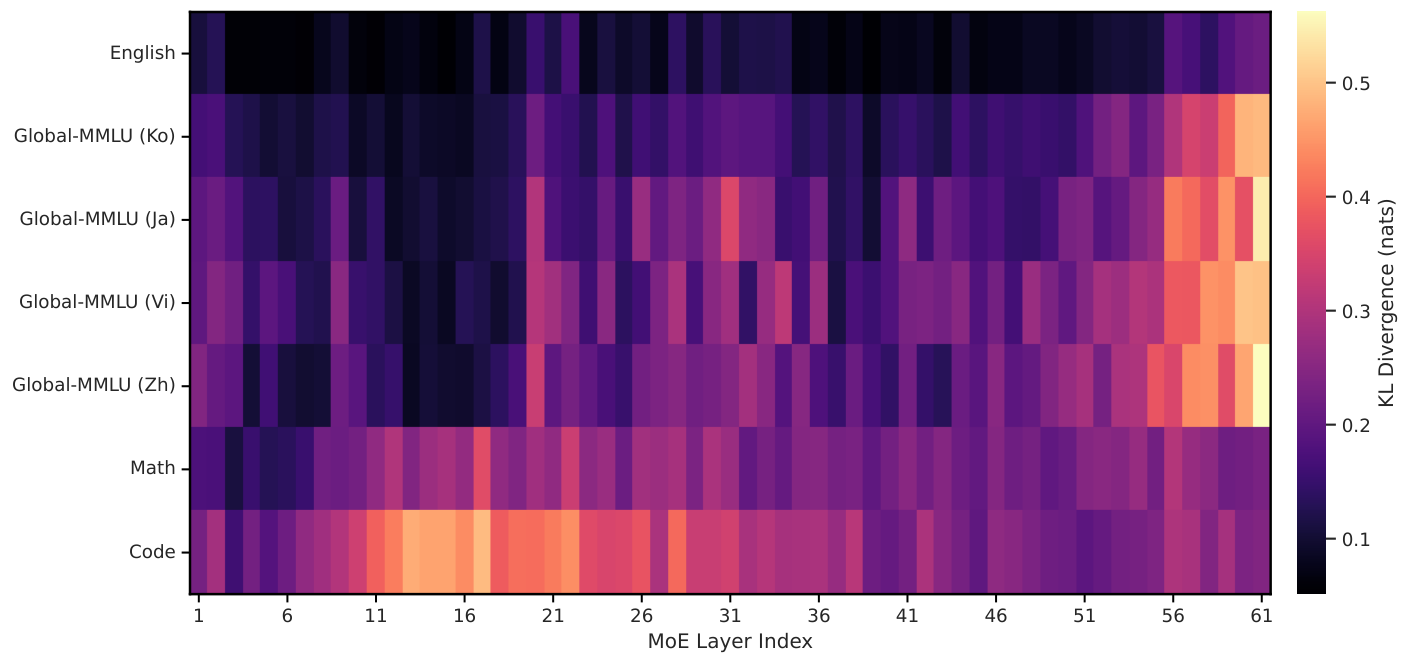
This is a sanity check that the transferred hyperparameters do not collapse routing — a common failure mode when LR is misspecified for MoE — and that experts are being used differentially across data domains rather than converging to uniform assignment.
Limitations and open questions
Several caveats limit generality. Depth is held fixed, so LR transfer across layer count remains unresolved. The number of active experts and the MoE intermediate dimension are held constant during width scaling; transfer under simultaneous expert-count scaling (which is often desired in practice) is not tested. The token-axis extrapolation is a linear log-log fit — its R^2 = 0.95 is high on the fitted range, but the paper does not report loss degradation from LR misspecification at the extrapolated point relative to a (hypothetical) directly-tuned baseline. Finally, results are tied to Muon + WSD; whether the same LR scaling law slopes hold under AdamW or muP-adjacent optimizers is untested.
Why this matters
If width-\muP and a one-parameter log-log law on D together suffice, LR selection for frontier MoE runs reduces to a handful of cheap proxy sweeps rather than a budget-dominating hyperparameter search. That directly changes the compute economics of training 100B+ MoE models at 10T tokens.
Source: https://arxiv.org/abs/2608.20061
ParaTempo: Efficient Parallel Reasoning via Temporal Confidence
Problem
Parallel test-time reasoning (self-consistency and variants) improves accuracy by sampling K independent chains and aggregating final answers, but its cost scales linearly in K and in the per-chain token budget. The wasteful part is that branches are heterogeneous: some converge on the correct answer within a few thousand tokens, while others meander or need more exploration. Existing dynamic controllers use signals that are poorly matched to branch-level decisions — final-answer consensus (available only post hoc), local token entropy (noisy, weakly tied to global reasoning state), or one-shot intermediate probes (too brittle). ParaTempo proposes a controller whose signal is derived from the temporal trajectory of intermediate answer distributions in each branch, formulating parallel reasoning as an online resource allocation problem
\min_{\pi}\;\mathcal{C}(\pi)\quad\text{s.t.}\quad\mathcal{A}(\pi)\geq\mathcal{A}(\pi_{\mathrm{fixed}}).
Method
Every \tau=500 generated tokens, each active branch is probed by appending an answer-forcing suffix (e.g. </think> Final answer:) to its current reasoning prefix and reading the top-L next-token logits. Candidates are bucketed into normalized answers and softmax-normalized:
p_{i,t}(v)=\frac{\exp(\ell_{i,t}(v))}{\sum_{u\in V_{i,t}}\exp(\ell_{i,t}(u))}.
Temporal confidence is a branch-local measure of how sharply the recent probe history concentrates on a dominant answer — i.e. answer-space convergence over a sliding window of probes, not a single snapshot. A short warmup phase calibrates a problem-specific threshold, after which the controller assigns each branch one of four states: Active, Retired, Pruned, or Forked. Branches whose temporal confidence is persistently low are pruned; branches that stably commit to a dominant answer are retired (their vote is kept but decoding stops); freed compute is reallocated by forking new branches from promising prefixes. Generation halts globally once temporal-confidence evidence is sufficient. Final aggregation is a confidence-weighted vote using each branch’s top-1 answer probability.
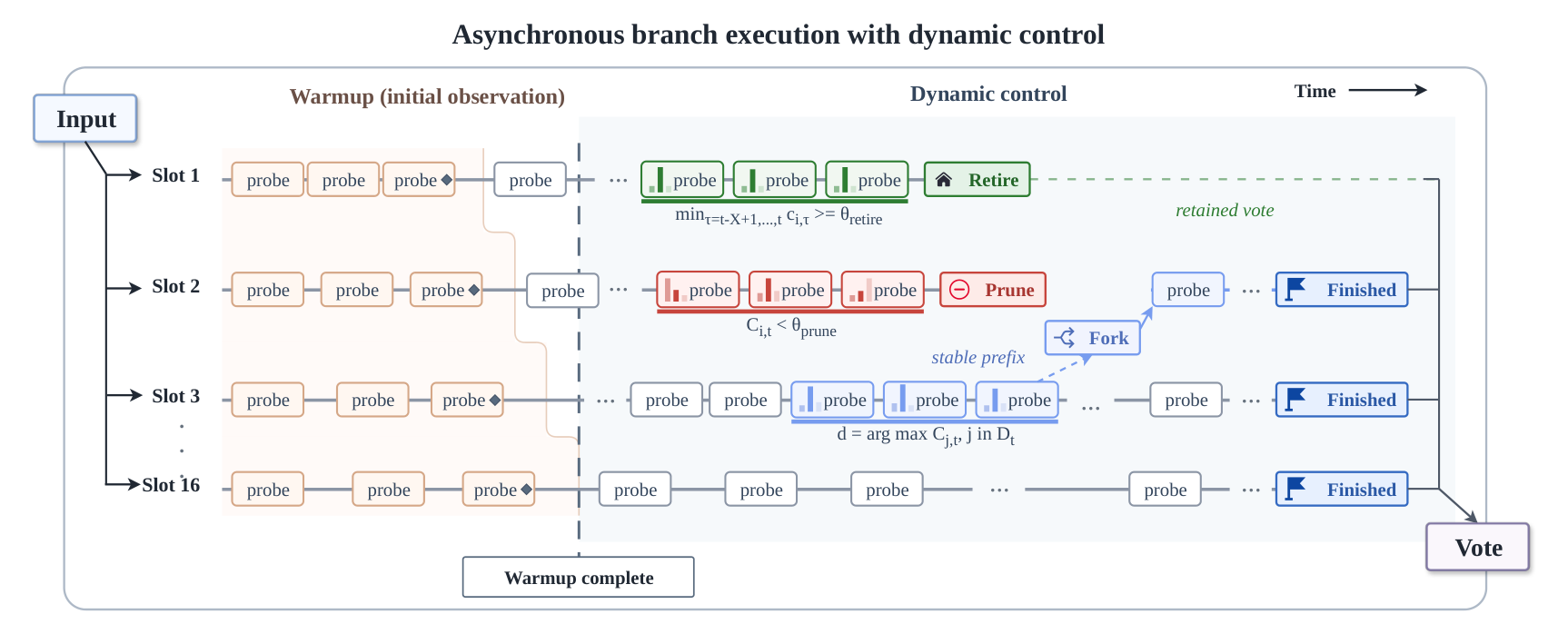
The design is asynchronous: no barrier across branches, so a slow branch does not stall retirement/pruning decisions elsewhere. The whole framework is training-free — only the base model’s forward pass and logits are used.
Results
Evaluated on AIME 2026, HMMT Nov 2025, HMMT Feb 2026, and GPQA Diamond, with Qwen3.5-35B-A3B and GPT-OSS-20B at K=16. Baselines include self-consistency (SC), early-stopping SC (ESC), self-adaptive consistency (SAC), DeepConf (high/low), and Parallel-Probe.
On Qwen3.5-35B-A3B, SC@16 reaches 87.5% on AIME26 with 250.6s latency and 229.7k tokens (15.6k sequential). ParaTempo@16 gets 83.3% at 198.4s / 161.9k tokens / 10.2k sequential — roughly 21% latency reduction and 34% fewer sequential tokens versus SC, while beating every other efficiency baseline (ESC 83.3% at 279.7s, SAC 73.3%, DeepConf-high 68.3%, Parallel-Probe 76.7%). On HMMT25 ParaTempo actually exceeds SC (73.3% vs 69.2%) at 205.7s vs 257.8s. On HMMT26 it matches SC (42.4% vs 45.5% — SC slightly higher) at 208.0s vs 254.8s. On GPQA, 85.4% at 161.1s vs SC’s 86.4% at 225.0s.
On GPT-OSS-20B the pattern is similar: AIME26 ParaTempo 86.7% at 79.3s / 8.0k sequential tokens vs SC 90.0% at 110.6s / 11.2k sequential; HMMT25 63.3% vs SC 68.3% at ~20% less latency; HMMT26 51.5% vs 56.8%; GPQA 70.4% vs 72.2% at less than half the latency. DeepConf variants are dramatically worse in wall-clock (e.g. 1005.6s on HMMT25 with GPT-OSS-20B) because they lack cross-branch parallelism in the sequential-token sense — DeepConf’s total tokens equal sequential tokens.
Two observations. First, sequential tokens (the latency-determining quantity in a parallel deployment) drop consistently by 25–35% versus SC, which is where the wall-clock win comes from. Second, ParaTempo is not universally accuracy-neutral: on HMMT26 (Qwen) and AIME26/HMMT (GPT-OSS) it loses 1–5 points to SC@16, so the \mathcal{A}(\pi)\geq\mathcal{A}(\pi_{\mathrm{fixed}}) constraint from the formulation is not always strictly met — it is a favorable operating point on the accuracy/latency frontier rather than a Pareto dominator of SC.
Limitations and open questions
The answer-forcing probe assumes the task has a well-defined short answer (numeric or multiple-choice); extending temporal confidence to open-ended generation (proofs, code, long-form) is nontrivial since the “answer distribution” is not obviously definable. The probe overhead itself (K extra forward passes every \tau tokens) is not analyzed in isolation. Threshold calibration is per-problem via warmup, but warmup cost and its sensitivity to \tau, window length, and L are not reported. Forking policy — which prefix to fork from, when to stop — is described only at a high level. Finally, results are on K=16; scaling behavior with K (where SC’s redundancy grows and the potential savings should widen) is not shown.
Why this matters
Temporal confidence is a cleaner signal than either token entropy or one-shot answer probing because it is defined on the trajectory of committed answers, which is what final-answer aggregation actually depends on. Framing parallel reasoning as online resource allocation over branch states, driven by one branch-local signal, gives a practical path to trading a small accuracy margin for 20–50% latency reductions in test-time-compute-heavy inference.
Source: https://arxiv.org/abs/2608.16425
Every Coin Has Two Sides: On the Dual Nature of Generalization in On-Policy Distillation of Large Language Models
On-policy distillation (OPD) supervises the student on trajectories sampled from its own policy, minimizing the token-level KL to a teacher’s next-token distribution along those trajectories. Empirically it works, but claims about “what OPD teaches” have relied on evaluations close to the training distribution. This paper runs a controlled sweep — varying prompt difficulty, prompt language, reasoning horizon, prompt domain, and teacher-student origin — and reaches a sharp conclusion: OPD transfers a teacher’s reasoning policy, not solutions to specific problems, and how broadly that policy transfers is governed by whether teacher and student share an origin (i.e., derive from the same base model lineage).
Difficulty of training prompts is nearly irrelevant
The authors partition BigMath into three 25K-problem subsets by teacher pass-rate over four rollouts: easy (pass-rate =1), hard (=0), and random. Across three teacher–student pairs (Qwen3-32B→Qwen3-8B-SFT; Polaris-7B→DS-distill-{1.5B, 7B}), the final in-domain math accuracy of the three subsets converges to essentially identical values. Even prompts the teacher never solves end-to-end are useful, because the teacher still supplies informative token-level supervision on partial trajectories. Extremes reinforce the point: training only on GSM8K (grade-school) or on the hardest DeepMath-103K slice still recovers over 80% of the OPD gain of the random baseline.
Student-side dynamic filtering — where the pass-rate signal is computed online — gives a small but consistent edge. For Polaris-7B→DS-distill-1.5B, discarding only problems the student already solves (keeping pass-rate \in [0,1)) reaches 42.0% average across six math benchmarks, versus 41.4% for no filtering and 41.4% for either =0 or =1 restrictions. The gain is +0.6 pp — real but modest — and consistent with the reading that OPD’s signal is dominated by teacher reasoning traces rather than by problem selection.
In-domain shifts and cross-domain transfer are gated by origin
Training on English math and testing on Chinese math or on longer-horizon problems produces different behaviors for same-origin versus cross-origin teacher–student pairs. Same-origin OPD closes the gap to the teacher across languages and horizons. Cross-origin OPD improves narrowly on the trained distribution.
The cross-domain experiments make this the paper’s central axis. Two students (DS-distill-1.5B, DS-distill-7B) are each paired with same-origin (JustRL-1.5B, Nemotron-1.5B, Light-R1) and cross-origin (Polaris-7B) teachers. Training on math prompts alone lifts LiveCodeBench for both students, despite no code prompts. Science transfer follows teacher competence rather than prompt domain: with the science-oriented Nemotron-1.5B teacher, math-prompt and science-prompt training reach comparable GPQA-Diamond scores, both above the initial student. With the math-oriented JustRL-1.5B teacher — whose science is worse than the student’s — training on either math or science prompts drops the student’s GPQA below its starting point. Prompt domain is not the lever; teacher policy is.
A mechanistic account: whole-policy alignment vs. distribution fitting
The paper measures top-K overlap (with K=16) between teacher and student next-token distributions across training. Two consistent patterns emerge: (1) at initialization, same-origin overlap is higher than cross-origin; (2) over training, same-origin overlap rises, while cross-origin overlap stays flat or declines. Both settings minimize the same KL objective on rollout tokens, so the divergence in overlap trajectories implies that same-origin OPD is aligning the policies globally, while cross-origin OPD reduces divergence only on the training distribution — classic on-manifold fitting without off-manifold generalization.
This reframes OPD’s KL objective in terms of the geometry of the student’s policy: when the two policies share sufficient support and parameterization structure (same origin), local KL reduction propagates to a global alignment; when they don’t, gradient updates chase teacher probability locally, producing narrow fits.
The seesaw in multi-teacher OPD (MOPD)
Because a same-origin teacher’s influence is not confined to the domain of its routed prompts, MOPD with domain-expert teachers does not partition capabilities cleanly. In the DS-distill-7B experiment mixing Light-R1-7B (math) and Light-R1-14B (science/IF) at ratios \{1/0, 1/1, 8/25, 4/25, 2/25, 0/1\}, changing the mixture produces a seesaw between the two teachers’ capabilities: gains on one axis are paid for on the other, rather than composed. Routing prompts to experts is not sufficient to isolate their gradients.
Limitations and open questions
The paper leaves the notion of “origin” empirical — models sharing a base checkpoint or pretraining lineage — without a formal criterion (e.g., a threshold on initial policy divergence, tokenizer identity, or shared pretraining data). It does not test whether a lightweight alignment step (short SFT on teacher outputs, or embedding stitching) can reclassify a cross-origin pair as same-origin. The seesaw is documented but not modeled; there is no analysis relating mixture ratio to a predictable tradeoff curve. The safety point raised in the ethics section — that prompt routing does not act as a capability boundary — is not evaluated with concrete safety benchmarks.
Why this matters
The result reframes OPD as policy alignment rather than data-conditioned imitation: prompt curation and domain routing are weaker levers than practitioners assume, while the teacher’s overall policy and its origin relationship to the student are the dominant factors. For MOPD pipelines and for safety auditing of distilled models, this means capabilities and behaviors transfer across the routing boundary and must be evaluated globally.
Source: https://arxiv.org/abs/2608.16647
EviRank: Structured Relevance Evidence for Multimodal Image Re-ranking
Problem
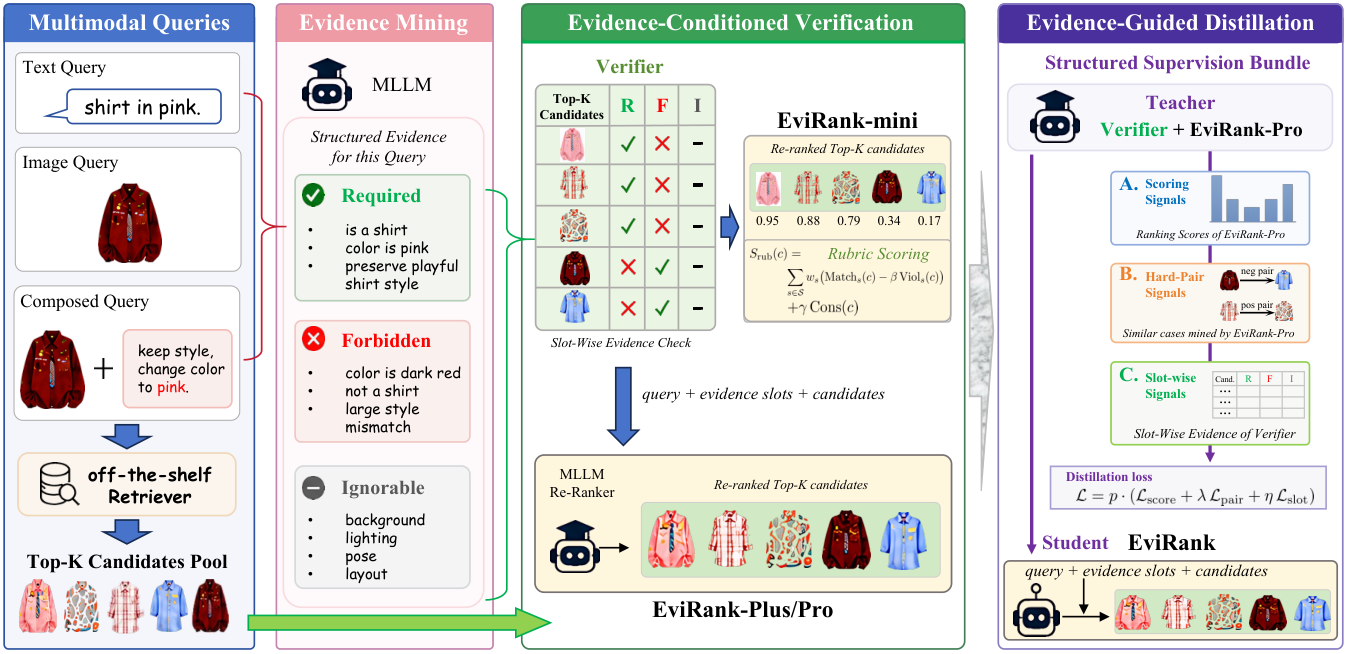
Multimodal image search queries are rarely monolithic. A composed query like “find this shirt in pink” simultaneously specifies an entity to preserve (shirt), an attribute to modify (color→pink), and background context to ignore. Standard re-rankers handle this in one of two failure modes: (i) dense cross-encoders collapse all constraints into a single similarity score, losing the ability to distinguish which constraint was violated; (ii) MLLM chain-of-thought re-rankers (CoTRR, CoTMR, ImageScope) produce free-form reasoning that drops or hallucinates fine-grained constraints, especially forbidden ones. EviRank recasts re-ranking as semantic constraint satisfaction: parse the query into a typed, structured evidence package, then verify candidates against it.
Method
Let a query be q=(t, I_{\text{ref}}) (either component may be empty) and \mathcal{C}_K=\{c_1,\dots,c_K\} the top-K from any off-the-shelf retriever. The re-ranker outputs a permutation \pi over \mathcal{C}_K.
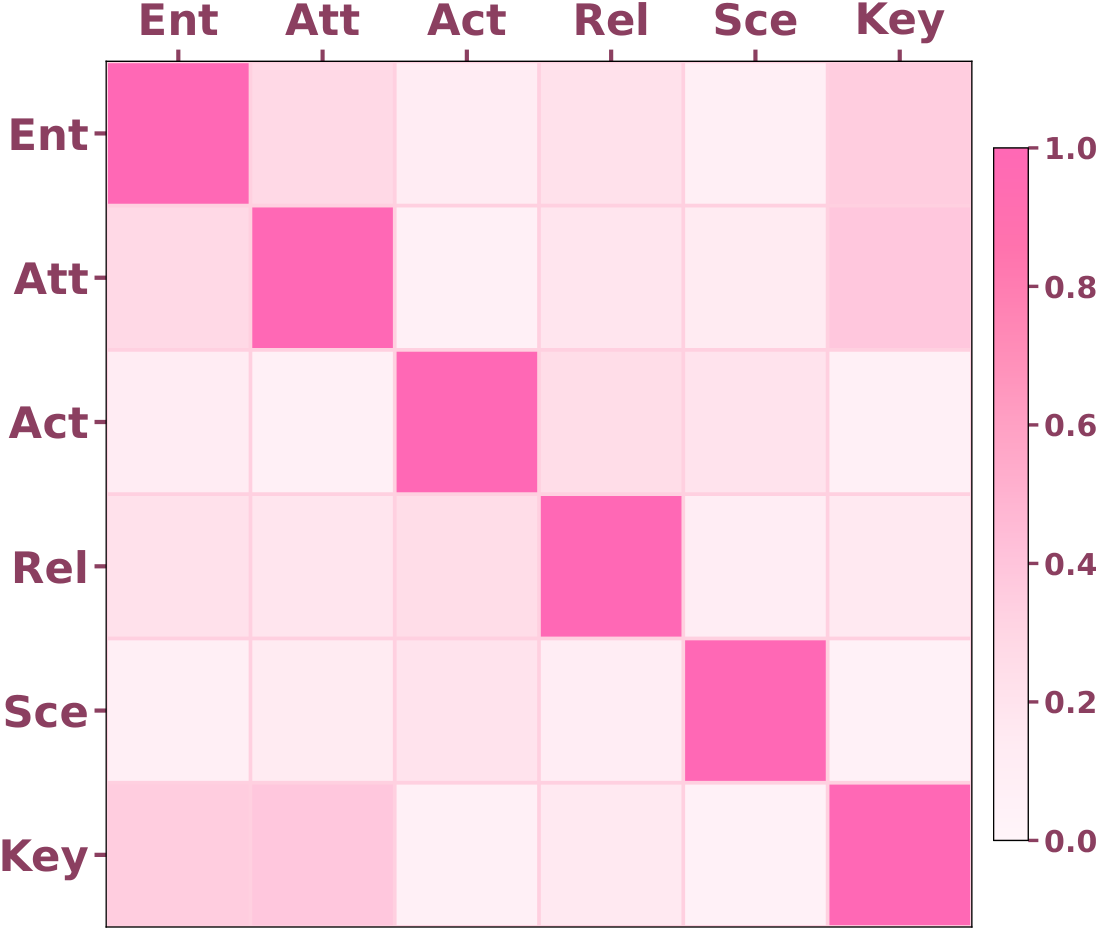
Evidence Frame. An MLLM teacher parses q into criteria distributed over six semantic slots (entities, attributes, relations, and three additional slots covered in the paper). Each criterion carries a label in \{\text{required}, \text{forbidden}, \text{ignorable}\}. This is a typed replacement for CoT: instead of free-form text, the parse is a structured object where slot, polarity, and target are explicit.
The slots are designed to be semantically disjoint. The authors verify this empirically: pairwise SBERT similarity between slot content across 10k queries has off-diagonal mean 0.18, indicating that criteria populate different semantic axes rather than duplicate each other.
Verification and re-ranking. Given the Evidence Frame E, each candidate c_k is scored in two stages:
- Deterministic rubric scoring. For each criterion e_j \in E with polarity \rho_j, an MLLM emits a satisfaction indicator s_j(c_k) \in \{0,1\} (or graded). The rubric score aggregates: R(c_k) = \sum_{j: \rho_j = \text{req}} w_j s_j(c_k) - \sum_{j: \rho_j = \text{forb}} w_j s_j(c_k), with ignorable criteria excluded.
- Evidence-grounded listwise refinement. A second MLLM pass performs listwise comparison over the top rubric-scored candidates, conditioned on E rather than on free-form query interpretation. This resolves ties and calibrates ordering under the same evidence.
The entire procedure is training-free. The structured E additionally serves as decomposable supervision — per-criterion labels — to distill a lightweight student re-ranker (EviRank-mini) without teacher CoT traces.
Results
Evaluation spans five benchmarks over three paradigms: T→I (MS COCO, Flickr30k), I→I (SOP, CUB-200-2011), and (T,I)→I (FashionIQ). On Flickr30k (Table 2), EviRank improves R@1 over the strongest CoT baseline (CoTMR) across all four backbones:
- EVA-CLIP-18B: 85.9 → 86.7 (EviRank), → 87.2 (EviRank-plus), → 88.0 (EviRank-pro). No-rerank baseline: 84.0.
- CLIP-ViT-B/32: 84.7 → 86.2 → 87.1 → 87.2. No-rerank: 67.1, so EviRank-pro adds +20.1 R@1.
- CLIP-ViT-L/14: 84.5 → 85.0 → 86.7 → 88.7.
- BLIP-2: 89.2 → 91.3 → 93.5 → 95.6. No-rerank: 86.8; EviRank-pro adds +8.8 R@1 and lifts MRR@5 from 91.5 to 95.6.
MRR@5 gains are notable: on CLIP-ViT-B/32 Flickr30k, EviRank-plus reaches 89.9 vs. CoTMR’s 81.1 (+8.8 absolute), suggesting that evidence conditioning particularly benefits the ordering of near-top candidates where fine-grained constraint checks matter. The distilled EviRank-mini is competitive with CoTMR (e.g., 85.2 vs. 84.7 R@1 on CLIP-ViT-B/32), indicating that per-criterion supervision transfers.
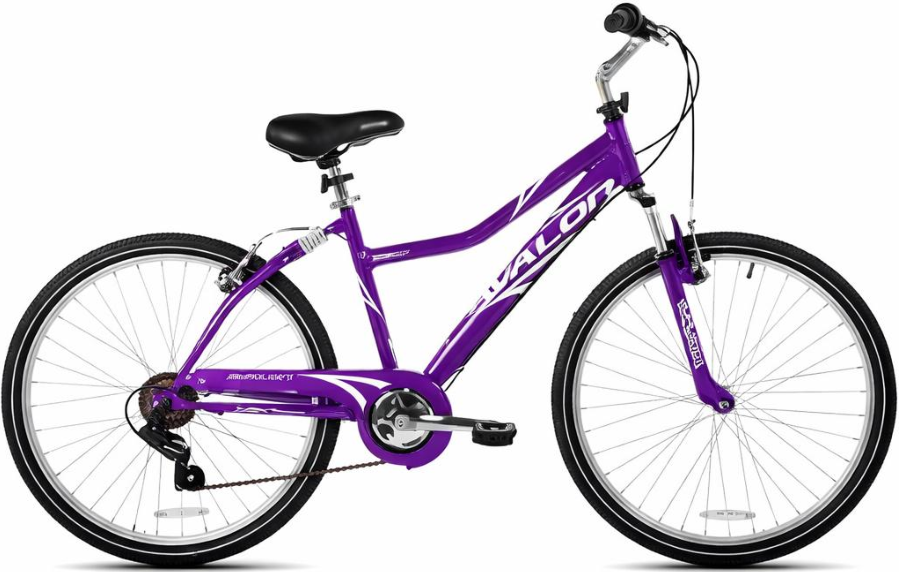
The bicycle case illustrates the mechanism: forbidden slot entries flag candidates that keep an attribute the query explicitly modifies, something a monolithic embedding cannot express and CoT frequently forgets.
Limitations and open questions
The evaluation reports final Recall/MRR but does not, in the excerpt, decompose error into evidence-parsing errors vs. verification errors — a natural ablation, given the pipeline. The rubric weights w_j and the treatment of graded satisfaction are not fully specified here; whether uniform weighting is used or slots are calibrated per benchmark is unclear. The teacher MLLM’s cost per query is presumably substantial (parse + per-candidate rubric + listwise pass), and the paper does not report latency comparisons against CoTMR/CoTRR in the shown sections. Finally, the six-slot ontology is fixed; queries whose constraints do not fit (e.g., stylistic/artistic intent) may be systematically under-specified, though the ignorable label partially mitigates this.
Why this matters
EviRank replaces opaque CoT with a typed, checkable intermediate representation for image re-ranking, and the consistent gains — especially on composed retrieval and MRR@5 — suggest that structured constraint satisfaction is a better inductive bias than free-form reasoning for multimodal relevance. The framework also produces natural, decomposable supervision for distillation, which is rare in training-free re-ranking pipelines.
Source: https://arxiv.org/abs/2608.20886
UniSpace: Unified Visual Representation and Scalable Multimodal Modeling
Problem
Multimodal systems typically maintain two disjoint visual spaces: a semantic ViT (SigLIP/CLIP/DINOv2) for understanding and semantic conditioning, and a VAE latent (SD-VAE, FLUX-VAE) for pixel-fidelity reconstruction and generation. The split exists because the final tokens of semantic ViTs discard low-level detail — their objective drives abstraction away from pixels. Prior unifying attempts either retrain a new visual encoder (VTP) or distill semantics into a reconstruction encoder (UniFlow), both of which risk perturbing the pretrained semantic representation and add system complexity. The paper asks a sharper question: is the loss of pixel information in a semantic ViT caused by the frozen Transformer blocks themselves, or by the input parameterization that feeds them?
Diagnostic and method
The authors run a controlled probe on SigLIP2: replace the pretrained patch embedding with a random linear projection, keep all Transformer blocks frozen, and train reconstruction probes at each depth. The last-layer PSNR rises from 20.96 to 24.66 despite identical frozen blocks. At the patch-embedding output the two projections have essentially identical recoverability (PSNR 39.29 vs 39.68); they diverge only as tokens propagate through the semantically-trained blocks. Conclusion: the high-dimensional residual stream can carry pixel information; the pretrained patch embedding activates trajectories that the semantic blocks were optimized to suppress.
This motivates Patch Reparameterization (PR): keep the original semantic patch embedding and frozen ViT to preserve the semantic pathway, and add a second, reconstruction-aware patch embedding that feeds the same frozen blocks in parallel. A Token Fusion layer compresses the reconstruction tokens and concatenates them with the semantic tokens to form a unified representation T_u.
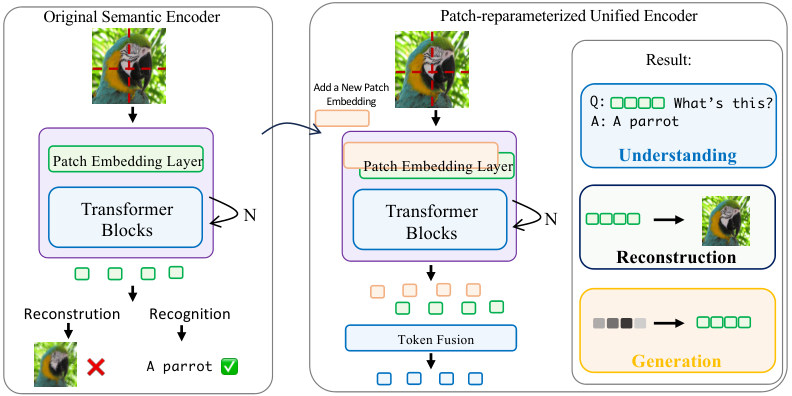
The design has two attractive properties. First, the semantic branch is bit-identical to the pretrained ViT, so downstream understanding is unaffected by construction. Second, only the new patch embedding (and fusion) is trained; the Transformer stack stays frozen, making the tokenizer cheap and reusable.
UniSpace: MoT on a single visual space
UniSpace uses the PR encoder–decoder (PR-Qwen-ViT) as the only visual interface for a decoder-only Qwen3-8B backbone with a BAGEL-style Mixture-of-Transformer-Experts: an understanding expert handles text and reference-image tokens, a generation expert handles noised target tokens, and both experts share self-attention at every layer.
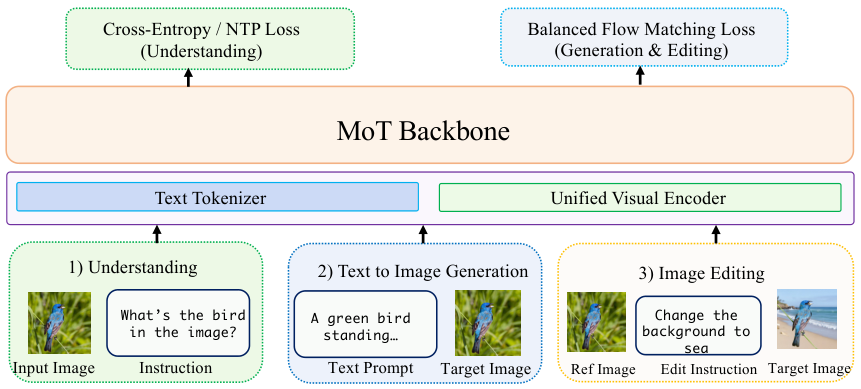
Unlike BAGEL, which uses SigLIP2 tokens for conditioning and FLUX-VAE latents for generation (two visual spaces), and unlike SenseNova-U1, which learns a native pixel interface end-to-end without a semantic prior, UniSpace consolidates all three tasks — understanding, T2I generation, instruction editing — into a single frozen T_u space. Editing is the critical stress test: it demands both semantic parsing of the instruction and pixel-level preservation of untouched regions, which only a genuinely unified representation can serve without an auxiliary VAE pathway.
Training uses a flow-matching objective on target tokens in T_u; for editing, reference-image tokens T_u^\text{ref} are supplied to the understanding expert alongside the instruction while the generation expert denoises the target in the same space.
Reconstruction results
On ImageNet-1K 256\times 256, PR variants match or beat both pure-pixel VAEs and prior semantic-capable tokenizers:
- PR-DINOv2: PSNR 30.84, SSIM 0.90, rFID 0.14 — best rFID among tokenizers with demonstrated semantic capability.
- PR-SigLIP2: PSNR 29.64, rFID 0.18.
- PR-Qwen-ViT: PSNR 30.16, rFID 0.17.
Matched-backbone comparisons against RAE (which fine-tunes the same semantic ViTs into pixel tokenizers) are decisive: PR-SigLIP2 cuts rFID from 0.53 \rightarrow 0.18 (−66.0%), PR-DINOv2 from 0.57 \rightarrow 0.14 (−75.4%), with PSNR jumping from 18.86 \rightarrow 30.84 and SSIM from 0.48 \rightarrow 0.90 on DINOv2. This directly supports the diagnostic claim: preserving the semantic pathway while adding a reconstruction input parameterization is more effective than retraining the encoder toward reconstruction.
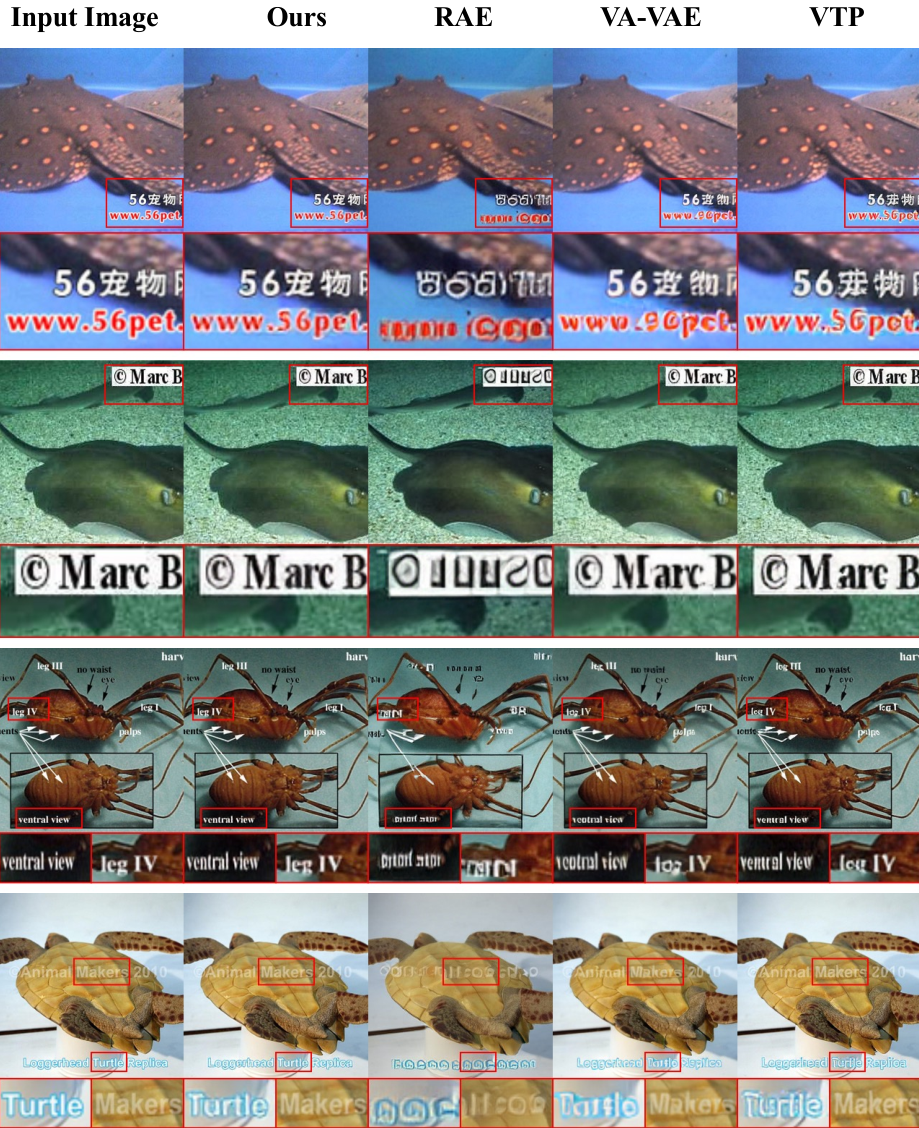
PR-DINOv2’s rFID of 0.14 also undercuts continuous-pixel VAEs like SD-VAE 3 (0.20) and FLUX-VAE (0.18), which is unusual for a tokenizer built on a frozen semantic backbone. PR-SigLIP2 improves on UniFlow (SigLIP2) — rFID 0.62 \rightarrow 0.18 at the same downsampling ratio — while operating in a continuous-pixel regime with a frozen backbone rather than a diffusion decoder.
Limitations and open questions
- All reconstruction numbers are on ImageNet at 256\times 256; behavior at higher resolutions and on OOD web imagery is only indirectly probed through PR-Qwen-ViT trained on web data.
- The paper does not report understanding benchmarks or generation FID for the full UniSpace MoT in the excerpts here; the tokenizer story is strong, but end-to-end unified-model gains against BAGEL and SenseNova-U1 need the full experimental table to evaluate.
- The Token Fusion compression ratio, and how it trades off understanding vs. reconstruction at the token-count level, is under-specified in the shown sections.
- The diagnostic argument is specific to ViTs with high-dimensional residual streams; it does not obviously transfer to bottlenecked encoders.
- Freezing the Transformer blocks is convenient but may cap ultimate reconstruction quality; whether partial unfreezing would compound gains without harming semantics is untested.
Why this matters
If a pretrained semantic ViT can be reparameterized — not retrained — into a high-fidelity tokenizer, the standard “semantic ViT + VAE” dual-stack that dominates unified multimodal models becomes unnecessary. That collapses architectural complexity in editing/generation systems and removes a persistent representational mismatch between conditioning and generation pathways.
Source: https://arxiv.org/abs/2608.08676
AgentMercury: Your Agent Can Synthesize Verifiable Environments for Business Scenarios at scale
Problem
RL-trained agents need environments, and the dominant paradigm builds environments around specific tasks or benchmarks. This couples environment construction to a fixed task distribution, which limits scale and makes it hard to reflect the messy, cross-service structure of real enterprise workflows where many tasks emerge from a shared underlying state. AgentMercury inverts this: synthesize a persistent, executable world from a high-level business scenario first, then sample tasks from it. The engineering question is whether such scenario-grounded worlds — never designed with any target benchmark in mind — produce transferable training signal for policy optimization.
Method
The pipeline factors environment construction and task instantiation into distinct stages:
\sigma \xrightarrow{\textsc{Planet}} w \xrightarrow{\textsc{Task}} (u,\rho) \xrightarrow{\pi} \tau \xrightarrow{\textsc{Grade}} r
Here \sigma is a natural-language business scenario (e.g., “regional logistics provider in Southeast Asia”), w is an executable world, u a task instruction, \rho its grading specification, \tau an agent trajectory, and r a scalar reward. The critical separation is that w is generated once per scenario; many (u,\rho) pairs are then instantiated from the same w.
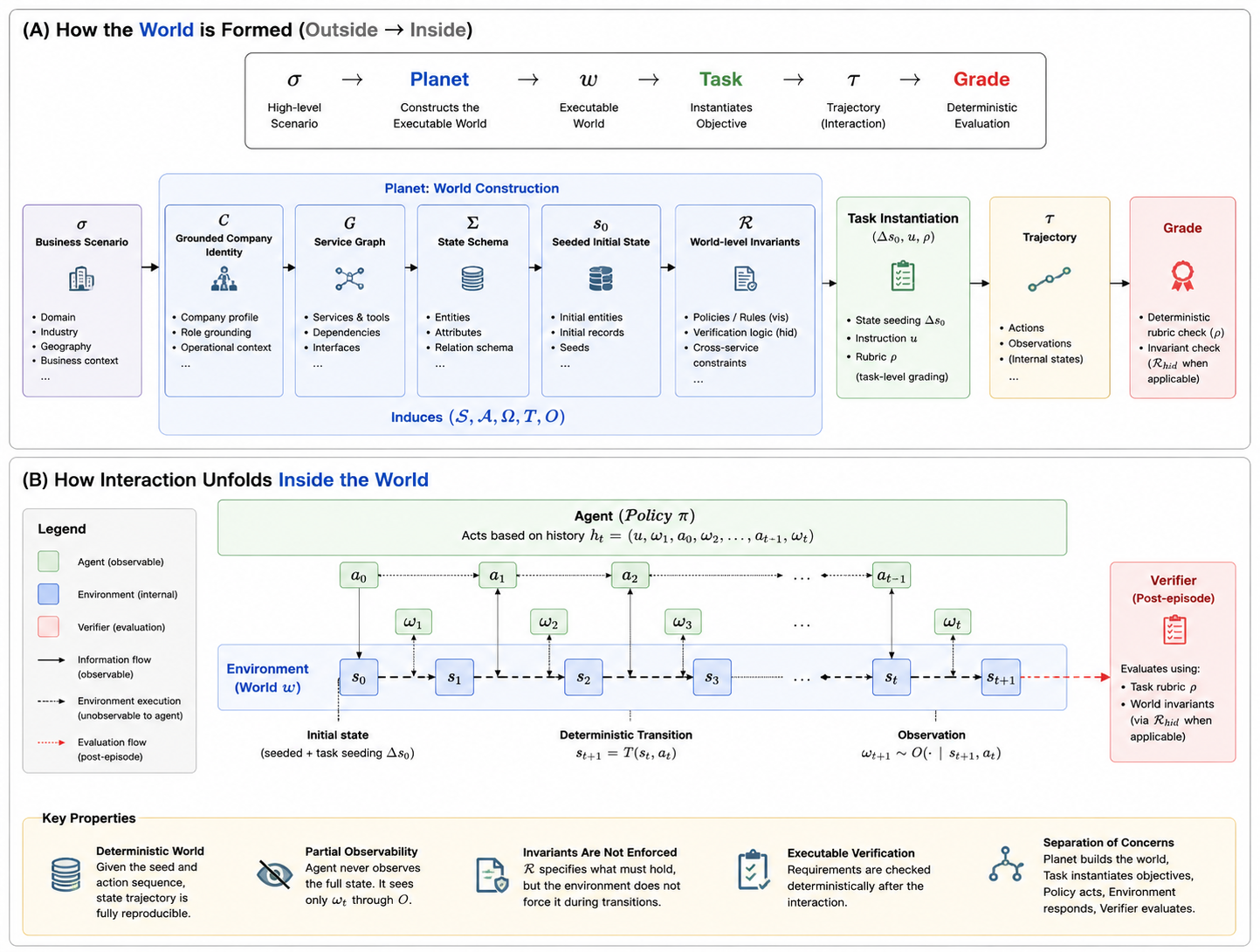
The Planet module materializes w as a tuple containing: (i) a company identity grounding the scenario, (ii) a service graph specifying which internal services exist and how they call one another, (iii) a state schema over entities and relations, (iv) a seeded initial state s_0, and (v) a set of world-level invariants \mathcal{R} — executable predicates over the state (e.g., inventory conservation across warehouse and order-fulfillment services) that must hold at all times. Tools are exposed as callable service endpoints backed by the state schema; task-specific grading \rho layers on top of \mathcal{R} to check terminal or trajectory-level conditions. Because \mathcal{R} is executable, reward is deterministic and verifiable rather than judged by an LLM critic.
Using this procedure, the authors construct 4,783 executable environments across 14 industries and 50 countries, yielding 43,300 task instances (multiple task seeds per environment). Policies are trained with GRPO (with Dr. GRPO coefficient adjustments) on Qwen3.5-4B and Qwen3.5-35B-A3B. To show robustness to the RL algorithm choice, they also run single-rollout asynchronous optimization (SAO). Training environments are constructed independently of all evaluation benchmarks — an important control for measuring transfer rather than leakage.
Results
Evaluation covers EnterpriseOps-Gym (in-domain business workflows) plus a heterogeneous out-of-domain suite: AIME26, HMMT, LiveCodeBench v5/v6, SciCode, tau-3, BFCL, and GPQA-Diamond. Each benchmark is run three times; means and standard deviations are reported.
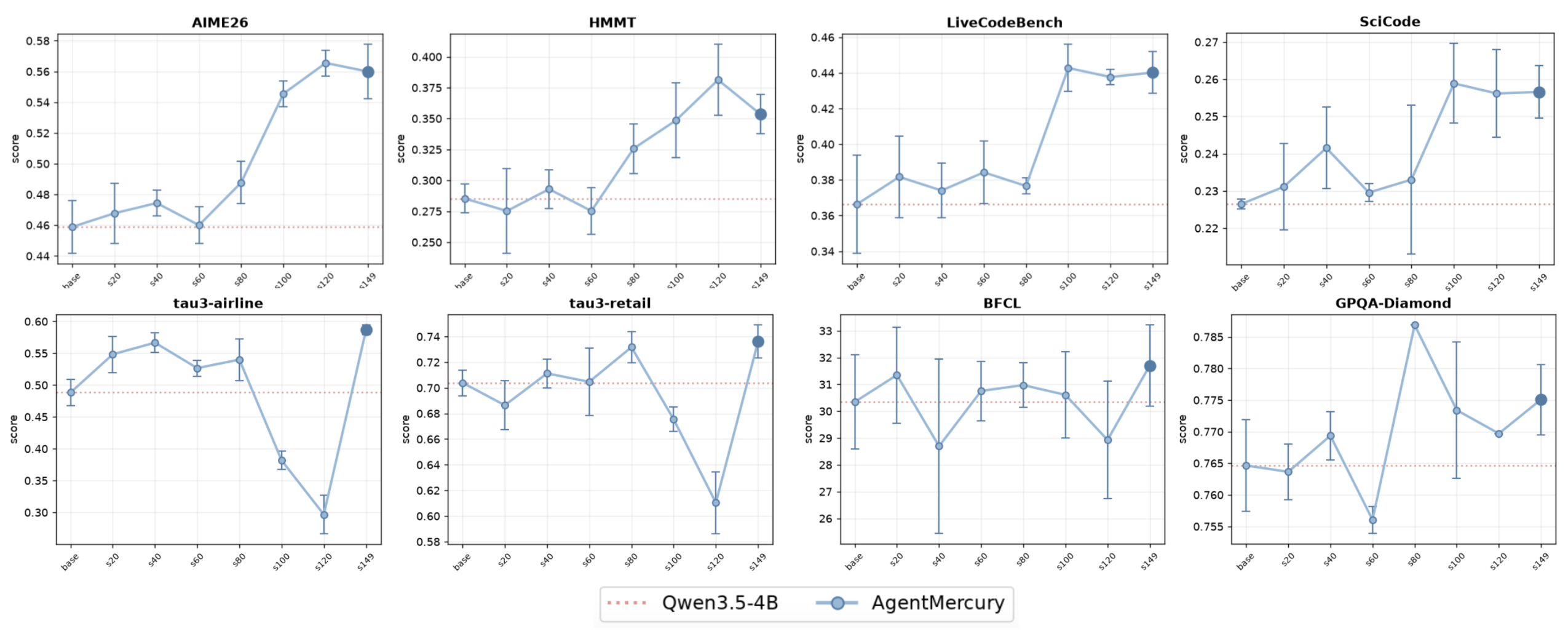
The out-of-domain curves show monotonic-to-plateau gains over the base model across all evaluated axes — math (AIME26, HMMT), code (LiveCodeBench), scientific computing (SciCode), tool use (tau-3, BFCL), and knowledge/reasoning (GPQA-Diamond). Since none of the training environments target these benchmarks, the improvements indicate that reward derived from executable invariants over service graphs induces general capabilities in tool grounding, structured state manipulation, and multi-step reasoning that transfer outside the business domain.

Training dynamics are clean: reward rises steadily while truncated-response ratio decreases and degenerate-response ratio stays near zero. Response length grows moderately rather than exploding, which is the standard failure mode when GRPO-style objectives over-reward verbose chains. The absence of collapse and degenerate outputs is consistent with the reward being grounded in executable constraints rather than surface-form heuristics — the policy cannot game an LLM judge because there isn’t one.
Limitations and open questions
The paper is thin on several points that a re-implementer will care about. First, invariant density and quality across the 4,783 worlds are not quantified; if \mathcal{R} is sparse for many worlds, effective reward signal may be concentrated in a subset of environments. Second, the mechanism generating w from \sigma is itself an LLM procedure, and the paper’s second research question — whether an agent can learn to construct worlds — is stated in the setup but the excerpt does not quantify how well the learned constructor matches the seed generator’s world validity or diversity. Third, comparisons against strong task-centric synthetic-environment baselines (e.g., existing tool-use synthesis pipelines) are needed to isolate the value of the world-first decomposition versus simply scaling task volume. Fourth, absolute numerical deltas on each benchmark are not visible in the provided sections; the qualitative claim of uniform improvement across heterogeneous benchmarks warrants precise per-benchmark numbers.
Why this matters
Decoupling world construction from task specification, with executable invariants providing verifiable reward, is a plausible path to scaling agent RL beyond curated task suites. That policies trained purely on synthesized business worlds transfer to math, code, and scientific benchmarks suggests the underlying skill — grounded interaction with typed state under hard constraints — is more transferable than the domain framing implies.
Source: https://arxiv.org/abs/2608.20634
Daedalus-150M: A Convolution-Attention Hybrid Designed for CPU Inference
Problem setup
Small language models are usually GPU-native designs that are quantised and deployed to CPU as an afterthought. This paper inverts the flow: fix the deployment target — one user, batch size one, 4-bit weights, ordinary CPU — and let that fix the architecture. The regime has three properties that flip the usual optimisation target. There is no batch over which to amortise weight loading, so throughput is bytes-per-token bound. Compute is cheap relative to bandwidth on a modern CPU. And the KV cache is a per-token tax linear in context depth: in an all-attention decoder, every generated token re-reads every previous key and value in every layer. If most layers instead carried a constant-size state, decode cost would be nearly flat in context length — precisely where users perceive latency.
Architecture
Daedalus-150M has 160.49M parameters over 18 blocks with d_{\text{model}}=768, FFN inner width 2048, vocabulary 49,152 and context 2048. Six blocks are grouped-query attention (12 query heads, 4 KV heads, d_h=64, RoPE \theta=10^6); twelve blocks are short depthwise convolutions. The interleaving is C C C C A C C A C A C A C A C C A C, with attention at indices 4, 7, 9, 11, 13, 16.
Each convolution block computes
B, C, x = \operatorname{in\_proj}(u), \quad y = \operatorname{depthwise\_conv1d}(B \odot x), \quad \text{out} = \operatorname{out\_proj}(C \odot y),
with kernel length L=3 and groups equal to channels. The recurrent state is exactly L-1=2 timesteps wide regardless of context, so decoding through a convolution block at token 2000 costs the same as at token 2. Multiplicative gates B,C supply the input-dependent behaviour a fixed depthwise kernel lacks. Two-dimensional weights are optimised with Muon (122.68M params), embeddings/norms/biases with AdamW (37.81M params); the schedule is WSD with linear decay to zero over the final 45% of 124,476 steps, on 59.9B tokens.
CPU decode cost model
For bytes read per generated token,
M(t) = W + \underbrace{2 L_A h_{kv} d_h b}_{\kappa}\, t.
With L_A=6, h_{kv}=4, d_h=64, b=2: \kappa_{\text{hyb}}=6144 B. A parameter-matched dense twin (24 attention layers, h_{kv}=2) gives \kappa_{\text{dense}}=12{,}288 B — exactly 2\times, despite narrower per-layer cache, because it has 4\times as many attention layers. The model predicts a 1.17\times advantage at depth 2048; measurement shows 1.76\times. The paper attributes the gap to two effects Eq. (4) omits: (i) attention’s dependent softmax reduction is latency-bound when the KV working set exceeds LLC, whereas depthwise conv streams a two-element state with perfect locality; (ii) the twin runs 24 layers to the hybrid’s 18, paying per-layer fixed costs a third more often.
Central ablation
The critical experiment is parameter-matched (160.49M hybrid vs 161.25M dense twin at d=640, FFN 2304, 24 attention layers), same data, same schedule, 5B tokens. Winning condition — validation bits-per-byte over a 645M-token held-out set, 0.5% margin — was fixed in writing before either arm was scored.
- Hybrid val_bpb: 0.910398; dense: 0.917774. Hybrid wins by 0.81%, clearing the 0.5% floor.
- Five-task mean: 44.68 (hybrid) vs 44.82 (dense) — a 0.14-point difference at \approx 0.24\sigma against suite noise of \approx 0.58\sigma. Per-task ranks swap in both directions; WinoGrande sits at chance (50.0 / 51.6).
- 4-bit file: hybrid 6.3% smaller.
- Decode: 1.76\times faster at 2048 tokens.
The honest reading is: hybrid matches on downstream, wins bpb, and wins decisively on decode speed.
Headline numbers
Trained to 59.9B tokens, the model scores 47.31 on the five-task mean (PIQA 65.78, ARC-Easy 50.42, WinoGrande 50.04, HellaSwag 37.93, OpenBookQA 32.40), against a 42.20 bar fixed pre-training. Peers, all re-scored under the same harness rather than quoted from their papers: GPT-2 124M 42.2, OPT-125M 42.1 (180B tokens), GPT-neo-125M 41.9 (300B), Pythia-160M 41.0 (300B), MobileLLM-125M 46.3 published (1T tokens). A 2T-token 135M peer is 3.9 points ahead at 51.2, which the authors concede was the intended trade. Val_bpb is 0.8685 (down from 0.9104 at 5B — a 4.6% improvement from the last 55B tokens). Q4_0 quantisation costs 6% perplexity at full training (9.18 → 9.75), higher than the 2.5% seen at 5B; quantisation-aware training did not close the gap.
Limitations and open questions
The realised training mixture drifted: at L_1=10.42 percentage points against a pre-committed 10.0 cap, because the four-epoch cap on the largest sources binds and freed mass flows to smaller ones. Roughly 47.9% of short-convolution channels are inert (stable between steps 9,896 and 30,041), representing ~13.6M dead parameters (8.5%). Attempts to structurally prune them fail because the reference runtime shape-checks convolution tensors at model width and rejects a narrowed file — a stock-binary constraint the design refuses to give up for a 7.7 MB save. The paper explicitly declines to extrapolate the speed advantage beyond the trained context, and notes it did not evaluate retrieval-sensitive tasks, which is where a lower attention fraction would be expected to hurt. A depth ablation (18\times 768 vs 24\times 640) is designed but unrun; the ablation is single-seed.
Why this matters
The paper is a clean demonstration that below 200M parameters, on CPU at batch size one, the attention-to-recurrence ratio is the dominant deployable design variable — and that a very short depthwise convolution suffices as the recurrent operator, with no new kernels required. The pre-registered ablation and the under-predicting cost model are unusually disciplined for architecture papers in this regime.
Source: https://arxiv.org/abs/2608.20210
Hacker News Signals
I spent $266 and four AI models to own my tablet. GLM-5.3 finished it in a day
The author wanted root access and a custom ROM on an Amazon Fire HD tablet — a task requiring reverse-engineering the locked bootloader, identifying exploitable attack surfaces, and writing functional exploit or patching code. After spending money and time on GPT-4o, Claude, and Gemini with limited traction, GLM-4 (a Chinese open-weight model from Zhipu AI) closed the problem within roughly a day. The technical work involved analyzing the MediaTek-based boot chain, understanding the secure boot verification steps, and generating the specific shell and C code needed to exploit a known-class vulnerability in the bootloader handshake. The piece is notable not for the final cost but for the comparative evaluation: the first three models produced plausible-sounding but ultimately incorrect exploit scaffolding, failing at the step of correctly reasoning about memory layout and the specific MTK DA (Download Agent) protocol. GLM-4 produced working code on the first substantive attempt. The author attributes this partly to GLM-4’s apparent stronger training signal on embedded/firmware and Chinese-language technical documentation that covers MediaTek internals extensively — a training distribution advantage rather than a general capability gap. From a systems security standpoint the underlying exploit class (DA bypass via checksum manipulation) is well-documented in the MTK rooting community, but requiring an LLM to synthesize the correct sequence from scattered documentation and apply it to a specific firmware version is a non-trivial reasoning task. The practical takeaway for security researchers is that model choice for low-level firmware work may matter more than generally assumed, and that models with stronger coverage of non-English technical corpora can outperform frontier English-dominant models on hardware-adjacent tasks.
Source: https://ericpardee.github.io/fire-hd-ownership/
I gave Qwen 3.8 27B a reverse-engineering job and it finished in 30 minutes
The author handed Qwen3-235B-A22B (the MoE variant marketed under the “Qwen 3.8” umbrella, 27B active parameters) a closed-source binary analysis task: understand an undocumented protocol, identify data structure layouts, and produce working Python interop code. The model completed the task in approximately 30 minutes of iterative prompting with no human-written intermediate code. Technically, the task involved: disassembling a compiled binary (the author fed decompiler output), inferring struct field offsets from usage patterns in the decompiled pseudo-C, and writing a ctypes or struct-based Python layer that correctly serialized/deserialized the wire format. The interesting engineering detail is how Qwen3 handled the struct inference — rather than hallucinating plausible-looking field names, it correctly propagated size constraints from observed buffer arithmetic in the decompiled code to produce byte-accurate layout. This kind of constraint propagation across a large decompiled function is exactly where smaller models tend to lose coherence. The XDA piece benchmarks this informally against GPT-4o on the same task; GPT-4o required significantly more back-and-forth and still produced an off-by-one error in a nested struct. Qwen3’s active-parameter efficiency (22B active out of 235B total via MoE routing) is relevant here: the model is deployable locally on high-VRAM consumer hardware, making this kind of sensitive reverse-engineering work feasible without sending proprietary binary artifacts to a cloud API. The open-weight availability under Apache 2.0 is the practical differentiator for security and systems work where data egress is a concern.
Source: https://www.xda-developers.com/qwen-3-8-27b-reverse-engineering-job-frontier-model/
AI boosted homework scores, then exam scores dropped: study
A controlled study tracked student cohorts where AI tool access was permitted for homework but not exams. Homework scores rose roughly 10-15 percentage points on average; subsequent exam scores on the same material dropped by a comparable margin relative to a no-AI control group. The mechanism is straightforward to hypothesize: homework functions as retrieval practice and error-correction feedback in normal conditions, both of which drive long-term retention. When AI offloads the generative effort, students receive correct outputs without performing the underlying retrieval or working through errors, so the memory consolidation that homework normally produces does not occur. This is consistent with the testing effect literature (Roediger & Karpicke 2006 and subsequent work) — generation and retrieval are the active ingredients, not exposure to correct answers. The study design attempted to control for baseline ability by using within-student comparisons across topics, which partially addresses selection effects. The quantitative gap is notable: it is not a marginal degradation but a full reversal of the apparent learning gain. The policy implication is that AI assistance during formative practice phases may produce a misleading performance signal that collapses at summative evaluation. For ML practitioners the result is less about AI capability and more about human cognitive architecture: outcome metrics measured at the wrong time give the wrong gradient. The open methodological question is whether specific AI interaction modes — e.g., Socratic prompting that forces student generation rather than answer delivery — preserve the retrieval benefit, which is an active research question in educational technology.
Source: https://www.economist.com/graphic-detail/2026/08/18/does-ai-stop-children-from-learning
My agent.md to improve LLM-assisted code quality
Fabien Sanglard (known for deep-dive source code analyses of Doom, Quake, etc.) documents his AGENT.md system prompt convention: a Markdown file placed at the repo root that instructs coding agents on project-specific invariants, style constraints, and prohibited patterns. The technical substance is in the specifics he enforces. His file prohibits: adding #include for headers already covered transitively, inserting comments that restate what the code obviously does, introducing new abstraction layers without explicit instruction, and changing function signatures to add error returns when the caller site is not simultaneously updated. These are all well-characterized failure modes of current coding agents — they tend to add defensive boilerplate, expand scope, and produce locally correct but globally inconsistent diffs. The AGENT.md convention (now semi-standardized across several agent frameworks including Cursor, Claude Code, and Aider) works by prepending the file contents to the system prompt for every agent invocation in the repo. Sanglard’s version is notably terse — under 30 lines — which is deliberate: longer constraint documents empirically cause agents to miss constraints buried in the middle (lost-in-the-middle attention degradation). He also includes a positive instruction to prefer modifying existing functions over creating new ones, and to default to the simplest data structure that satisfies the stated requirement. The broader point is that AGENT.md functions as a soft formal specification of code review criteria, externalizing the implicit style model that a human reviewer would apply. The limitation is that current agents do not reliably honor all constraints even when explicitly stated; the file reduces but does not eliminate drift.
Source: https://fabiensanglard.net/agent.md/index.html
I built a low-latency AI companion that plays Skyrim with me
The technical architecture here is the interesting part. The author built a pipeline: Skyrim game state is captured via a mod that exposes structured event hooks (combat, dialogue, location change) as JSON over a local socket. These events feed into a small context buffer that is prepended to a system prompt describing the companion character. A local Whisper instance handles player speech-to-text in near-real-time. The transcribed speech plus game context hits a locally-hosted LLM (the author uses a quantized Llama 3 variant) for response generation. The response text goes to a TTS model (Piper or a similar fast neural TTS) and is played back through the game audio. End-to-end latency target is under 800ms from end of player speech to start of audio playback. The latency budget breakdown is roughly: Whisper STT ~150ms, LLM first-token ~300-400ms with a 7-13B quantized model on a consumer GPU, TTS synthesis ~100-150ms, audio buffer ~50ms. The author reports hitting this target on an RTX 4090 with a 7B Q4 model, with latency climbing to 1.2-1.5s on a 13B Q4 model. The interesting engineering choice is streaming TTS from first LLM tokens rather than waiting for complete generation, which is the dominant latency reduction. The game context injection is kept under 512 tokens to avoid prefill cost dominating the time budget. The system has no persistent memory beyond a rolling 20-turn window, which limits coherence in long sessions but keeps context length bounded.
Source: https://pantel.is/projects/ai-gaming-companion/
MartyPC is a cross-platform emulator of early PCs written in Rust
MartyPC targets the IBM PC 5150/5160 era: Intel 8088 CPU, CGA/EGA/MDA video, original PC BIOS compatibility, floppy and hard disk emulation. The technical distinguishing features relative to older emulators like PCem or 86Box are the implementation language (Rust, for memory safety and easier cross-platform targeting) and a cycle-accurate 8088 core. The 8088 has a prefetch queue (4 bytes), an asymmetric bus interface unit / execution unit split, and instruction timings that depend on whether bytes are already in the queue — all of which affect demo and game compatibility in edge cases. MartyPC implements the full prefetch queue behavior and the BIU/EU pipeline, which most simpler emulators approximate or ignore. The CGA emulation is similarly detailed: composite color artifact emulation (the mechanism by which CGA produced apparent 16 colors on NTSC monitors by abusing chroma phase) is implemented, which is required for correct rendering of games that relied on composite output. The Rust implementation uses egui for the debugger UI and compiles to native targets including WASM for browser-based use. The codebase structure uses a bus trait abstraction over the system bus, allowing peripheral devices to be registered and dispatched without unsafe memory aliasing — a design that pays the abstraction cost in exchange for testability. The project is at a stage where it passes most existing PC compatibility test suites and can run a substantial fraction of the original IBM PC software catalog.
Source: https://martypc.net/
Executable Is a SQLite Database
The author proposes and implements a scheme where a compiled ELF binary embeds a SQLite database as a segment, and the runtime uses this database to store and query symbol metadata, dependency graphs, and debug information that is currently scattered across DWARF sections, DT_NEEDED entries, and external package databases. The core insight is that SQLite’s file format is append-friendly, self-describing, and queryable without external tooling — properties that ELF’s custom section formats lack. The implementation appends a SQLite file to the ELF binary (the OS ignores data past the last PT_LOAD segment), then uses sqlite3_open on /proc/self/exe at runtime to query the embedded metadata. The motivating use case is Nix-style dependency closure tracking: instead of relying on the external Nix store database to know what a binary needs, the binary carries its own dependency manifest queryable with standard SQL. This enables hermetic deployment verification without a package manager present. A secondary use case is structured debug info: DWARF is notoriously difficult to parse and query; a SQLite schema over the same information would allow SELECT name, file, line FROM symbols WHERE address = ? style debugging queries. The practical limitation is binary size inflation for large symbol tables, and the fact that executables are often stripped in production. The concept is more directly applicable to shared libraries and developer tooling than to stripped production binaries.
Source: https://fzakaria.com/2026/08/23/your-executable-is-a-sqlite-database
JIT Compiling Code in 5μs
The author targets the specific problem of JIT compilation latency for short-lived or frequently-invalidated code, where the compilation overhead dominates execution time. The 5μs target is achieved by operating at a level below LLVM or even Cranelift: the JIT emits x86-64 machine code directly via a small template-and-patch system. The approach is: for a constrained IR (essentially a typed stack machine with arithmetic, branches, and memory access), precompute a table of instruction templates as byte sequences with placeholder slots for immediate values and branch offsets. Compilation becomes a linear scan over the IR, looking up templates, filling placeholders, and writing bytes into a pre-allocated mmap(PROT_EXEC) region. No register allocation beyond a fixed calling convention mapping, no optimization passes. This is essentially the approach used in CPython’s specializing adaptive interpreter and in some database query JITs. The 5μs figure is measured on a fixed IR workload on modern x86-64 hardware; the constant factors are: template lookup is a table index (O(1)), placeholder patching is a handful of writes, and branch fixup is a two-pass scan (forward pass records patch sites, backward pass fills targets). The tradeoff is code quality: no register allocation means heavy stack traffic, so generated code is slower than LLVM-optimized output by a factor of 3-10x on compute-heavy workloads. The design is appropriate when the code runs at most a few hundred times before invalidation, making optimization amortization impossible.
Noteworthy New Repositories
Pan-Chera/Multi-Agent-CAD
MAC (Multi-Agent CAD) tackles text-to-CAD generation by decomposing the problem into a pipeline of specialized agents rather than expecting a single model to handle the full geometry-generation task end-to-end. The core insight is decoupling constraint reasoning from shape synthesis: one agent interprets the natural-language specification and emits a structured constraint graph (dimensions, topological relationships, feature dependencies), while downstream agents translate those constraints into parametric CAD operations (sketches, extrusions, fillets, Boolean operations). Test-time compute is controlled explicitly — the framework enforces a budget on constraint-resolution iterations, preventing runaway inference while still allowing backtracking when geometric consistency checks fail.
The stack targets standard parametric CAD representations (likely STEP/BREP or CadQuery-style Python scripts) rather than mesh or implicit-surface outputs, which matters for downstream manufacturability. Each agent is prompted with domain-specific context and only the outputs relevant to its subtask, keeping context windows manageable and making individual agents swappable.
Why pick this over a monolithic LLM approach: parametric CAD has hard geometric consistency requirements that benefit from explicit constraint propagation; a single-model approach tends to hallucinate infeasible geometries. The decoupled design also makes it easier to substitute a stronger geometry-reasoning model as they improve.
Source: https://github.com/Pan-Chera/Multi-Agent-CAD
HarnessRouter/harnessrouter
HarnessRouter CE is a self-hosted API gateway that presents a unified interface over multiple coding-agent harnesses — Codex CLI, Claude Code, Hermes, and others. The central abstraction is the Unified Harness Protocol (UHP), an open standard that normalizes session lifecycle, streaming token delivery, file attachment, request cancellation, and failure handling across harnesses that each expose incompatible native APIs.
Architecturally, the router sits between your tooling (IDE extensions, CI pipelines, custom scripts) and the harness backends. Each backend is wrapped in a UHP adapter that translates the native harness protocol to the common schema. Sessions are stateful server-side objects, allowing mid-stream cancellation and resumption semantics that individual harnesses may not natively support.
The self-hosted, Apache-2.0 model is the differentiating constraint here: API keys never leave your infrastructure, which matters for organizations with data-residency requirements. The streaming design uses server-sent events or a similar low-latency transport, so token-by-token output is forwarded without buffering overhead.
For teams running multiple agents in parallel on different tasks, the router provides a single observability point — logs, failure traces, and session state — rather than instrumenting each harness separately. The open standard framing means third-party harnesses can implement UHP adapters without changes to the router core.
Source: https://github.com/HarnessRouter/harnessrouter
OpenSparX/MasterAgent
MasterAgent is a framework for deploying AI agents entirely on-device, targeting Qualcomm NPU hardware with a claimed sub-100ms inference latency and no cloud dependency. The Qualcomm NPU target implies the runtime is built around the Qualcomm AI Engine Direct SDK (QNN) or Snapdragon Neural Processing SDK, which compiles quantized model graphs into NPU-executable binaries ahead of deployment.
The zero-cloud constraint drives several design choices: model weights must fit in device DRAM (typically 8-16 GB on high-end Snapdragon platforms), so the framework likely targets 4-bit or 8-bit quantized small language models (3B-7B parameter range). The agent loop — tool dispatch, memory retrieval, multi-turn context management — runs entirely on-device, requiring careful memory budgeting to avoid evicting the KV cache mid-session.
The sub-100ms latency figure likely refers to single-turn token generation latency or first-token latency rather than full response time, which is realistic for prefill-heavy NPU pipelines on compact models.
Use cases where this matters: mobile applications requiring offline functionality, privacy-sensitive enterprise deployments, and edge robotics where round-trip cloud latency is unacceptable. The no-cloud dependency also eliminates per-query API costs, making high-frequency agent invocations economically viable on device.
Source: https://github.com/OpenSparX/MasterAgent
mrpulor-gh/nuphus-mcp
Nuphus is a desktop automation server that exposes computer-use primitives via the Model Context Protocol (MCP) over stdio transport. The MCP stdio interface means any MCP-compatible LLM client can call into the server as a tool, receiving structured responses without any additional HTTP layer.
The exposed primitives cover four domains: screen capture and OCR/coordinate queries, window management (enumerate, focus, resize), mouse and keyboard injection (clicks, drags, key sequences), and Chrome browser control (likely via Chrome DevTools Protocol for DOM inspection and JavaScript execution). The combination gives an agent the same affordances as a human at a desktop — reading UI state, interacting with arbitrary applications, and operating the browser programmatically.
The design decision to use stdio rather than a network socket keeps the attack surface small and avoids port management, at the cost of requiring the MCP host process to spawn the server as a subprocess. For automated testing pipelines and RPA-style workflows, this is an acceptable tradeoff.
The Chrome integration is the most capable surface: CDP allows element-level interaction beyond pixel coordinates, enabling more robust automation that does not break on minor UI layout changes. The framework is broadly useful for building evaluation harnesses for coding agents that need to verify their output by running a browser.
Source: https://github.com/mrpulor-gh/nuphus-mcp
AmazingAng/old-coder
This repository documents an evidence-first development methodology designed for directing LLM coding agents, framed as the accumulated practice of an experienced engineer adapting to the agent era. The central thesis is that reading code is no longer the primary verification step — instead, agents should be driven through a structured gauntlet of executable checks before any output is trusted.
The methodology draws from Uncle Bob’s clean-code tradition but inverts the human-centric workflow: rather than reviewing code for style and logic, the practitioner defines a battery of tests, linters, type checks, integration probes, and performance assertions upfront. The agent’s job is to satisfy the gauntlet; the human’s job is to design the gauntlet. This shifts cognitive load from code comprehension to specification and failure analysis.
Practically, the repo likely contains prompt templates, shell scripts, and workflow patterns for structuring agent tasks so that each subtask is bounded by verifiable exit criteria. The “don’t read the code” heuristic is a forcing function against getting drawn into low-level details that the agent handles better.
This is directly relevant to anyone building CI pipelines that incorporate coding agents, or anyone trying to maintain velocity when the output volume from agents exceeds human reading bandwidth. The approach acknowledges that agent-generated code has different failure modes than human code and designs the review process around those modes.
Source: https://github.com/AmazingAng/old-coder
UditAkhourii/neuroarxiv
NeuroArXiv is an Anthropic Claude skill (tool/function definition) that intercepts architecture design requests and performs real-time prior art lookup against arXiv before generating any new design. The motivation is a known failure mode of LLM-assisted research: models propose architectures that already exist in the literature, wasting implementation effort and producing non-novel contributions.
Mechanically, the skill fires when Claude detects an architecture specification intent. It formulates search queries from the described components, hits the arXiv API (or a semantic search index over arXiv abstracts), retrieves candidate papers, and feeds summaries back into context before Claude proceeds with design. This grounds the generation in actual prior work rather than the model’s (possibly stale or hallucinated) training-time knowledge of the literature.
The value is clearest in fast-moving subfields where new architectures appear weekly and training cutoffs become stale within months. By making prior-art checking a prerequisite step, the tool pushes toward genuine novelty in AI-assisted architecture design rather than inadvertent reinvention.
The implementation is necessarily shallow — arXiv keyword search has limited semantic precision, and LLM summarization of retrieved papers can miss technical nuances. But as a lightweight gate before committing engineering effort, the cost-benefit is favorable. Extension directions include using dense retrieval over full-text paper embeddings rather than keyword search.
Source: https://github.com/UditAkhourii/neuroarxiv
NomaDamas/CozyClay
CozyClay is a browser-based previs tool targeting the film and animation preproduction workflow. It allows a director or animator to block a scene (position characters and props in 3D space), pose characters, define camera moves (pan, tilt, dolly, crane), and author cuts between shots — all within a browser runtime. The output is not a finished render but a shot package that can be fed directly into an AI video generation model.
The browser-native architecture implies a WebGL or Three.js based 3D viewport with a lightweight scene graph, character rig system, and a timeline for camera keyframing. Running entirely in-browser eliminates installation friction and makes the tool accessible to non-technical collaborators in a production pipeline.
The AI video handoff is the technically interesting design choice: rather than treating previs and AI generation as separate workflows, CozyClay defines the previs output as structured shot metadata (camera intrinsics, character poses, timing) that an AI video model can consume as conditioning signal. This is consistent with how ControlNet-style conditioning works — the previs geometry provides spatial layout constraints that guide generation.
This addresses a real workflow gap: current AI video models produce impressive results but are hard to direct with precision. CozyClay provides the spatial and temporal scaffolding that makes directed AI video generation tractable for narrative content.
Source: https://github.com/NomaDamas/CozyClay
HELPMEEADICE/TE-Speed-MiniMaxH3-OSS
This is a KV-cache acceleration plugin targeting the MiniMax-H3 architecture, a hybrid state-space/attention model. The repository name and description (“超级缓存加速插件” — super cache acceleration plugin) indicate the focus is on reducing inference latency through aggressive KV-cache optimization specific to H3’s architecture.
H3-family models interleave SSM (state-space model) layers with attention layers. The SSM layers have constant-size recurrent state rather than a growing KV cache, but the attention layers still accumulate KV entries. An H3-specific cache plugin would target the attention layers’ KV management — potentially implementing paged attention, prefix caching, or speculative KV eviction strategies tuned to the H3 attention pattern and the SSM-to-attention layer ratio.
The “OSS” suffix suggests this is the open-source release of what may be an internal or commercial tool. The fact that it targets MiniMax-H3 specifically rather than a general transformer implies low-level kernel optimizations that exploit H3’s specific head dimensions, sequence lengths, or sparsity patterns.
For practitioners running MiniMax-H3 inference at scale, the primary value is reduced memory bandwidth pressure and higher effective throughput per GPU. The plugin form factor (rather than a full inference server fork) suggests it is designed to integrate into existing deployment stacks via monkey-patching or a module hook.
Source: https://github.com/HELPMEEADICE/TE-Speed-MiniMaxH3-OSS