Daily AI Digest — 2026-08-14
arXiv Highlights
DarwinX: Evolving Agent Harnesses Through Natural Selection
Problem
An LLM agent’s effective capability is a joint function of weights and harness: the prompt scaffolding, tool set, control flow, memory, and skill notes wrapped around a frozen model. Self-improvement systems that iteratively edit this harness typically run a single lineage of edits, which is path-dependent: gains on one task frequently regress others, and a locally optimal edit can foreclose combinations that would only pay off after further edits. DarwinX reframes harness self-improvement as population-level selection under a preserve-and-extend contract, with the model weights held fixed throughout. Because nothing about the base LLM changes, every point of improvement is attributable to the harness — a clean isolate of “agent design” from “model capability.”
Method
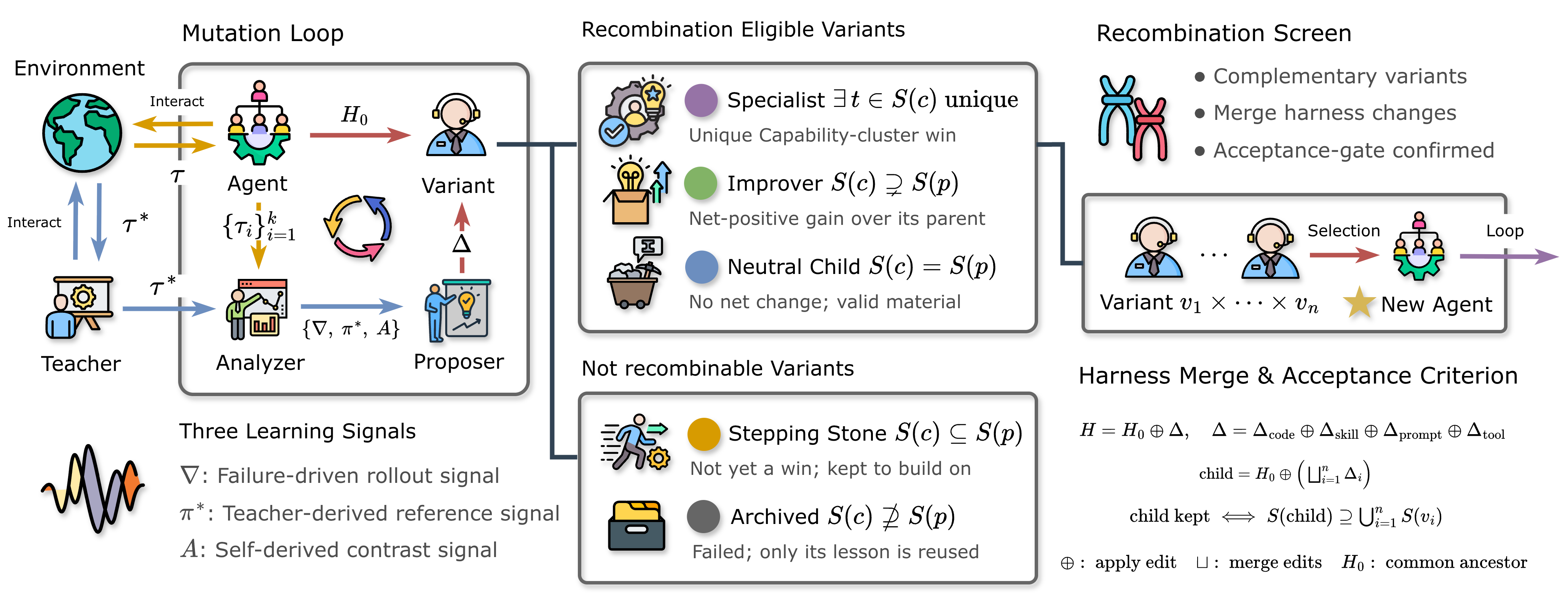
DarwinX maintains an archive shaped as a tree whose nodes are harness snapshots plus per-task scores, trial evidence, and distilled lessons. Two editable layers are exposed: a skill layer (prompts, memory, distilled knowledge) and a code layer (tools, control flow, agent loop). Edits come from three learning signals — failure traces, teacher demonstrations, and self-derived reflections — routed through one shared edit interface.
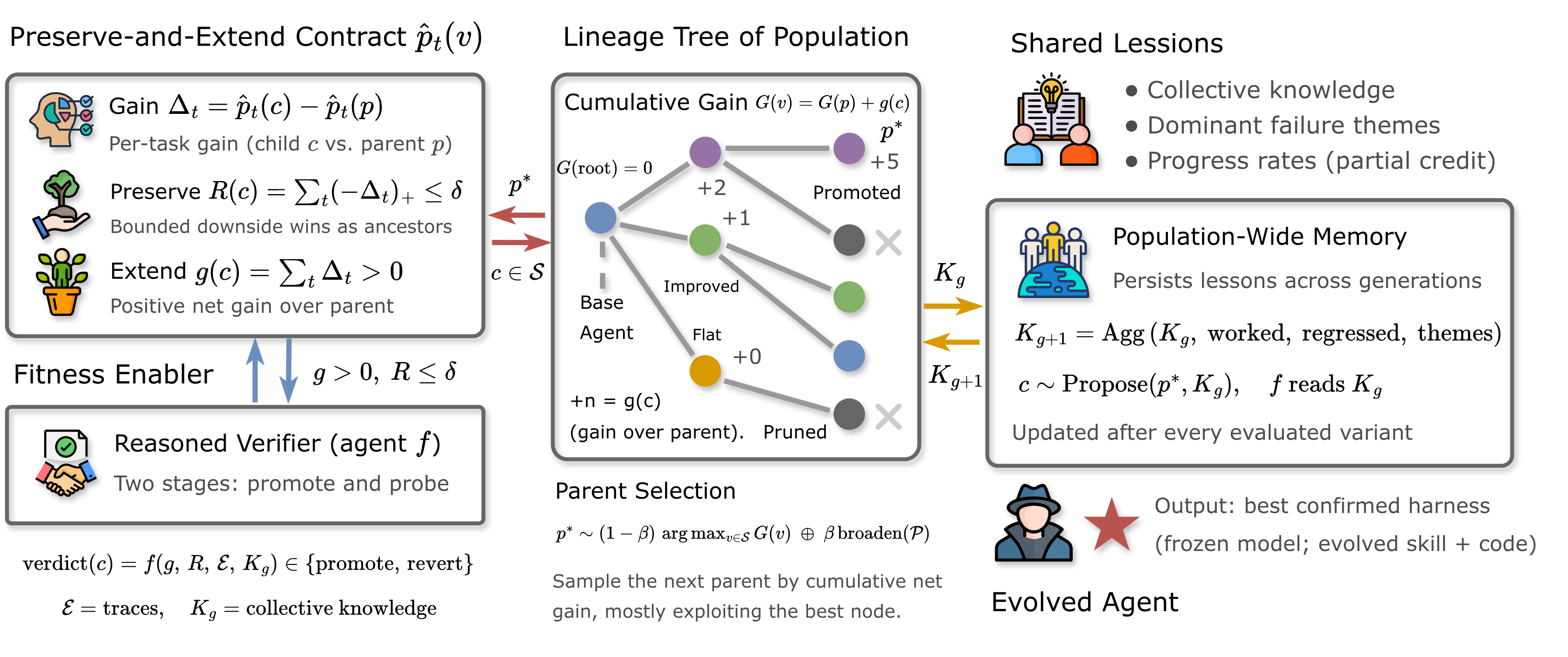
Fitness is per-task solve rate \hat p_t(v) measured at \text{avg@}k using each benchmark’s own verifier — no gold solutions, no hand-tuned reward shaping. For a child c from parent p, define \Delta_t = \hat p_t(c) - \hat p_t(p), net gain
g(c) = \sum_t \Delta_t, \qquad R(c) = \sum_t (-\Delta_t)_+,
and admit c iff g(c) > 0 and R(c) \le \delta (bounded regression). A reasoned verifier f adjudicates in two stages: it returns \mathrm{verdict}(c) = f(g, R, \mathcal E, K_g) \in \{\text{promote}, \text{revert}\} from trial evidence \mathcal E and shared memory K_g, and any promoted child must clear a stricter \text{avg@}k preservation probe before it is allowed to steer future search. The design deliberately separates exploration (permissive promotion) from confirmation (strict probe), a two-speed rule that lets noisy-but-promising branches enter the archive without corrupting the selection signal.
Because losing variants are retained rather than discarded, complementary edits from divergent lineages can be recombined via a merge operator whose acceptance criterion is the same preserve-and-extend test. Each node also carries a cumulative lineage gain G(c) = G(p) + g(c) used for parent selection.
Results
DarwinX is evaluated on a ladder of four benchmarks arranged by increasing separation between the evolution signal and the test.
RQ1, Terminal-Bench 2.1 (in-domain). Evolving over the 89-task suite with \text{avg@}3 screening on rotating subsets and \text{avg@}5 confirmation on the full suite, Monet’s base harness rises from 75.5% to 83.2% on GPT-5.5 (level with Codex+GPT-5.5 at 83.1%) and to 84.7% on GPT-5.6 Sol at medium effort, matching Claude Code + Fable 5’s 83.8% at xhigh and beating the OpenAI single-agent reference by +2.9. Both DarwinX rows are frozen-base leaderboard submissions under strict rules (errored trials = 0).
RQ2, TerminalWorld held-out. Evolution on 94 training tasks, evaluation on 41 disjoint held-out tasks (pass@1, single attempt). On Opus 4.8, DarwinX reaches 68.3% versus base 61.0% and Claude Code 65.9%; on GPT-5.5, 56.1% versus base 48.8% and Codex 51.2%.
RQ3, WebArena-Infinity synthetic-to-real. Evolution on synthetic intents scored by an LLM judge; test on the official 1,260-task real suite with deterministic verifiers across 10 applications. Real-task pass@1 rises from 43.5% to 93.0% audit-clean — a regime where the reward source itself changes between evolution and test, so gains must reflect reusable browser behavior rather than judge-fitting.
RQ4, cross-benchmark transfer. The best Terminal-Bench 2.1 harness, run unchanged on all 500 SWE-bench Verified issues with a frozen Opus 4.8, scores 421/500 = 84.2% official pass@1, +3.4 over the 80.8% fix-skill reference, with zero SWE-V feedback.
RQ5, attribution. The evolved TB2.1 harness differs from base Monet by exactly seven added skills, all in one family: verification and artifact-contract behaviors (derive acceptance contract, verify graded artifact, iterate fix-and-recheck, ground outputs in real tool execution, repair against security/contract checks). None encode domain knowledge. The gains land on tasks where finalization discipline — not new capability — is the bottleneck. The authors flag this as compositional attribution, not per-skill causal ablation, since skills were co-selected.
Limitations and open questions
The ablation cannot isolate per-skill contributions: seven skills were jointly selected and are reported as a bundle. Fitness quality inherits verifier quality; on WAI the LLM-judge signal used during evolution is looser than the deterministic test verifier, which the audit addresses ex post rather than by construction. The archive and probe budget imply nontrivial compute per generation, and the paper does not report a wall-clock or token-cost frontier against simpler baselines like best-of-N prompt search. Finally, TB2.1→SWE-V transfer suggests the evolved skills are general “verification discipline,” but whether the same bundle helps on domains without a clear artifact-contract structure (e.g., open-ended dialog, long-horizon planning without checkable intermediate states) is untested.
Why this matters
DarwinX provides a clean, weights-frozen demonstration that a large fraction of what looks like “agent capability gap” is actually harness discipline — specifically, contract-derivation and artifact-verification behavior that composes across terminal, web, and repository-level coding benchmarks. The preserve-and-extend contract plus population archive is a reusable recipe for turning noisy per-task verifiers into monotone agent improvement without gold solutions.
Source: https://arxiv.org/abs/2608.07545
PlayWorld: Benchmarking World Models with Agent Players over Long-Horizon Objectives
Problem
Interactive video world models (Genie 3, Matrix-Game, Hunyuan-GameCraft, etc.) are typically evaluated by conditioning on a fixed action sequence and scoring the resulting video for visual fidelity or per-step controllability. That protocol conflates two different failure modes: a model that ignores an action and a model that executes it but produces incoherent dynamics. It also fails at cross-model comparison because the action sequence required to accomplish an objective — e.g. rotate 360° back to the starting pose, walk into water and observe ripples, walk into a wall and check collision — depends on how each model responds to controls. If model A drifts during rotation and model B does not, replaying the same WASD trace produces different geometric outcomes that have nothing to do with world consistency.
PlayWorld reframes evaluation around long-horizon objectives rather than fixed action traces, using a multimodal agent as a proxy human player that closes the loop between observation and action execution.
Method
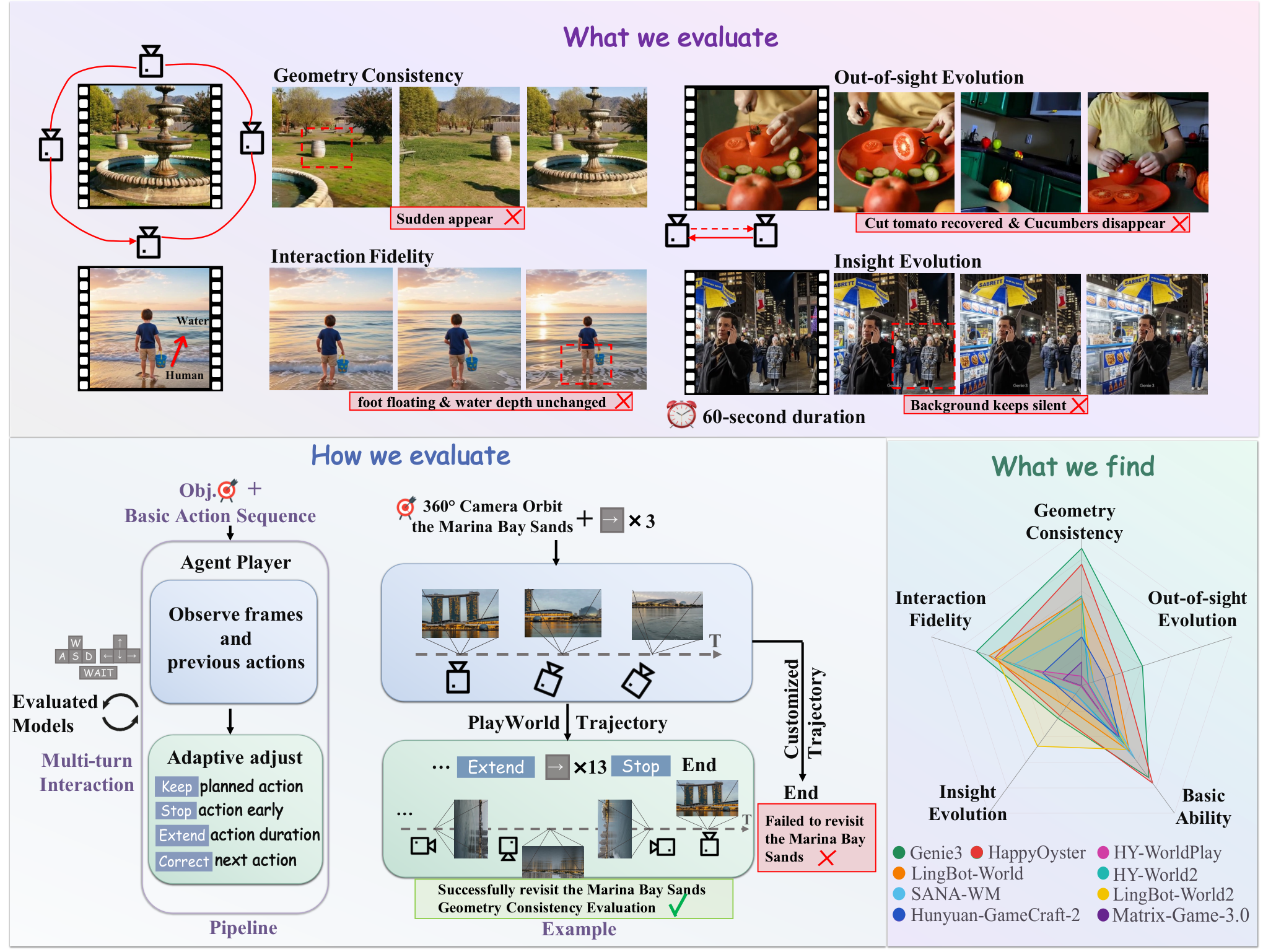
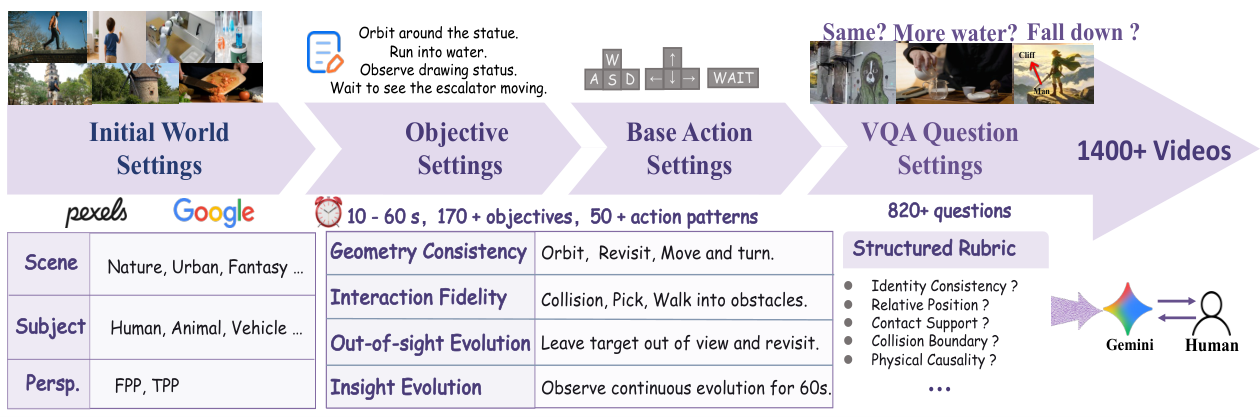
Agent Player. The player is a swappable VLM (Claude, Gemini) plus an agent interface. Each case ships with (i) an initial frame, (ii) a natural-language long-horizon objective, (iii) a scene description, and (iv) a human-annotated basic action sequence over the tokens {W, A, S, D, ↑, ↓, ←, →, WAIT}. The basic sequence is a shared reference trajectory — not a fixed script — that removes the burden of open-ended planning and keeps evaluation intent consistent across models.
At each step the agent observes the newly generated frame, the execution history, the objective, and the scene description, then emits one of five decisions:
- Keep: continue the currently scheduled action.
- Stop: terminate the current action early when the target visual state is reached (e.g. facing the intended direction).
- Extend: hold the current action longer if additional motion is needed.
- Correct: revise or skip the next planned action when observed state has diverged from the reference.
- End: terminate the case only when the objective’s required observation has been captured.
An important detail for interaction-fidelity cases: reaching an obstacle does not trigger End; the player must continue forward so the rollout exposes whether the model produces a realistic collision or lets the subject pass through geometry. The interaction budget is capped at 40 steps. For web-served models the interface uses browser automation to dispatch controls and screen-capture output frames.
Benchmark construction. Annotators start from diverse initial worlds, define scenario-grounded objectives, write basic action sequences, and author sample-specific VQA rubrics. The final suite is 171 scenarios, ~50 distinct action patterns, 10–60 s rollouts, and over 820 rubric questions.
Evaluation dimensions. Four rubric-scored axes:
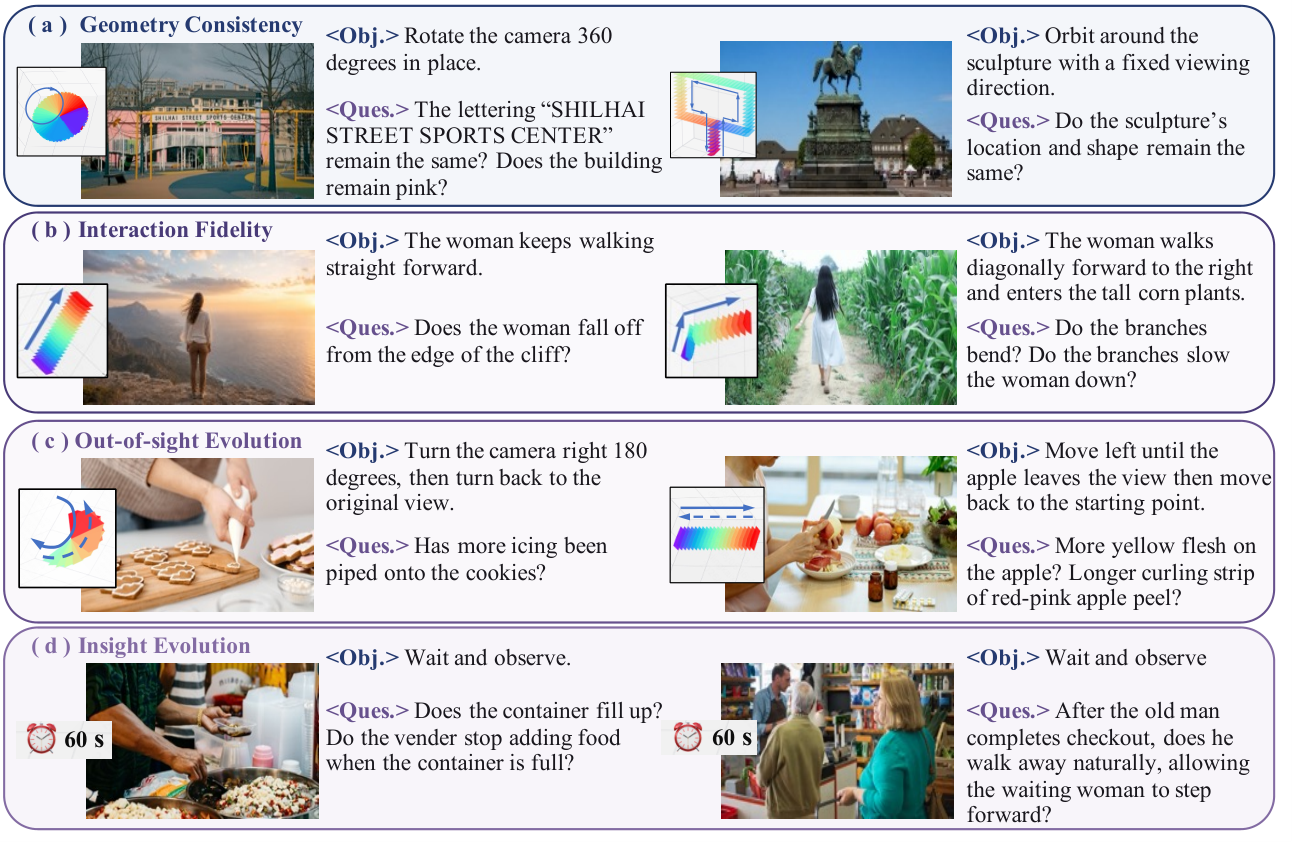
- Geometry consistency — does the scene remain metrically stable across camera motion (e.g. after a full 360° pan)?
- Interaction fidelity — do subject–object interactions (collisions, water entry, object manipulation) behave physically?
- Out-of-sight evolution — do occluded regions retain state when revisited?
- Insight evolution — do visible dynamics evolve plausibly under a stationary camera (60-second static observation)?
Complementary basic-ability metrics report Video Quality and Action Controllability.
Validation gates. Because a rubric question is meaningless if the rollout didn’t actually reach the situation being asked about, PlayWorld applies dimension-specific pass gates: Trajectory Validity gates geometry consistency and out-of-sight evolution; Subject and Reachability gate interaction fidelity. Failing the gate forces the dimension score to the minimum (1). Insight evolution uses a stationary camera and needs no gate.
Experiments
Nine world models are compared under identical Agent Player control: five web-served (Genie 3, LingBot-World, LingBot-World2, HY-World2, HappyOyster) and four local chunk-wise generators (SANA-WM, Hunyuan-GameCraft-2, HY-WorldPlay, Matrix-Game-3.0). All receive the same initial world, objective, and basic action sequence; the same agent adapts execution for each.
The qualitative summary from the authors is unambiguous: current models can follow camera and action controls reasonably well but “still struggle to simulate coherent and realistic world dynamics” — failures cluster in geometry drift after long rotations, non-physical collisions, and forgotten out-of-sight state upon revisit. The provided text reports the presence of dimension-specific validation pass rates in Tab. 3 and per-dimension rubric scores, though the numerical table is not included in the excerpt supplied.
Limitations and open questions
- The basic action sequence is a strong prior. It stabilizes cross-model comparison but constrains the space of behaviors the player can probe; a model that fails in ways the reference trajectory doesn’t touch will not be penalized.
- Agent Player quality is a confound. Different VLMs will issue different Stop/Extend/Correct patterns, and the paper (from the excerpt) does not quantify inter-agent variance in final rubric scores.
- The rubric verifier is itself a VLM answering VQA over generated video. Any systematic bias of the verifier — e.g. lenient judgment of water dynamics or subtle geometric drift — propagates into scores.
- 40 steps and 10–60 s rollouts constrain the “long horizon” claim; genuinely persistent state (minutes-scale memory) is not tested.
- Interaction-fidelity gating via Subject+Reachability means a model that fails to reach an obstacle receives a floor score of 1, mixing navigation failure with physics failure into one dimension.
Why this matters
Fixed action-conditioned evaluation systematically undervalues coherence and overvalues per-frame controllability; PlayWorld’s objective-conditioned, agent-in-the-loop protocol is the right functional form for comparing interactive world models, and it exposes that today’s systems are controllable but not physically or geometrically consistent. The validation-gated rubric design is also a useful template for other closed-loop generative benchmarks where trajectory success and content quality must be scored jointly.
Source: https://arxiv.org/abs/2608.13552
Massive Activations in Hybrid Linear Attention Large Language Models: Pre-Attention Spikes and Inter-Spike Plateaus
Massive activations (MAs) — a small number of hidden-state coordinates whose magnitudes exceed the typical activation scale by orders of magnitude — are known to organize attention sinks and quantization behavior in full-attention LLMs. Hybrid linear-attention (HLA) architectures interleave linear-attention (or SSM) layers with sparse full-attention layers, and it has been unclear whether MAs persist, disappear, or reorganize under this interleaving. This paper provides the first systematic empirical characterization of MA morphology in HLA LLMs and traces it to a write–cancel outlier lifecycle timed to the placement of full-attention layers.
Two architecture-aligned morphologies
The central empirical claim is that MAs in HLA models exhibit two consistent patterns tied directly to the layer schedule:
- Pre-attention spikes (PAS): MA magnitudes spike in the residual stream immediately before every full-attention layer.
- Inter-spike plateaus (ISP): Between successive full-attention layers, MAs can persist across the intervening linear-attention layers rather than decaying, forming a plateau connecting two PAS.
As the density of full attention increases, ISP progressively “fills in” the gaps between PAS, and the morphology continuously interpolates to the stable, layerwise-persistent MA profile characteristic of pure full-attention Transformers.
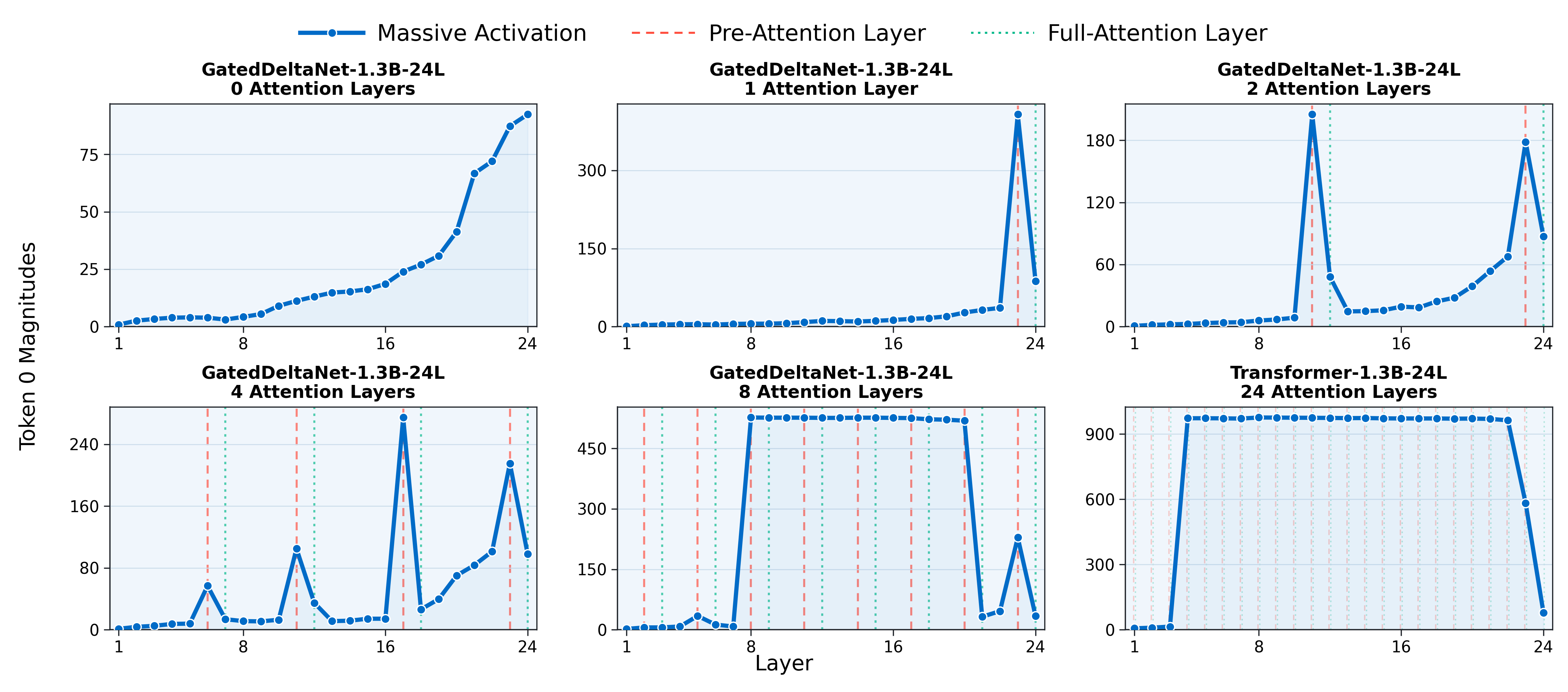
The recurrence of this organization is established across five linear-attention families (Gated DeltaNet, Mamba2, GLA, RetNet-style, etc.), six hybridization ratios, five data domains, and open-source hybrids from 1.2B up to 397B total parameters, so it does not appear to be an artifact of a single architecture or scale.
Identifying MA tokens and PAS across architectures
The authors first fix an attention-sink-guided procedure for tracking MA tokens across layers: since the first token is a prevalent attention sink in most decoder LLMs, they use its trajectory as a robust probe of MA emergence. Under a fixed 12{:}1 hybridization ratio (one full-attention layer per twelve linear layers), the first-token trajectory in 1.3B models across all five HLA architectures shows sharp activation maxima at exactly the layer indices preceding full attention, with the intervening linear layers exhibiting substantially lower magnitude.
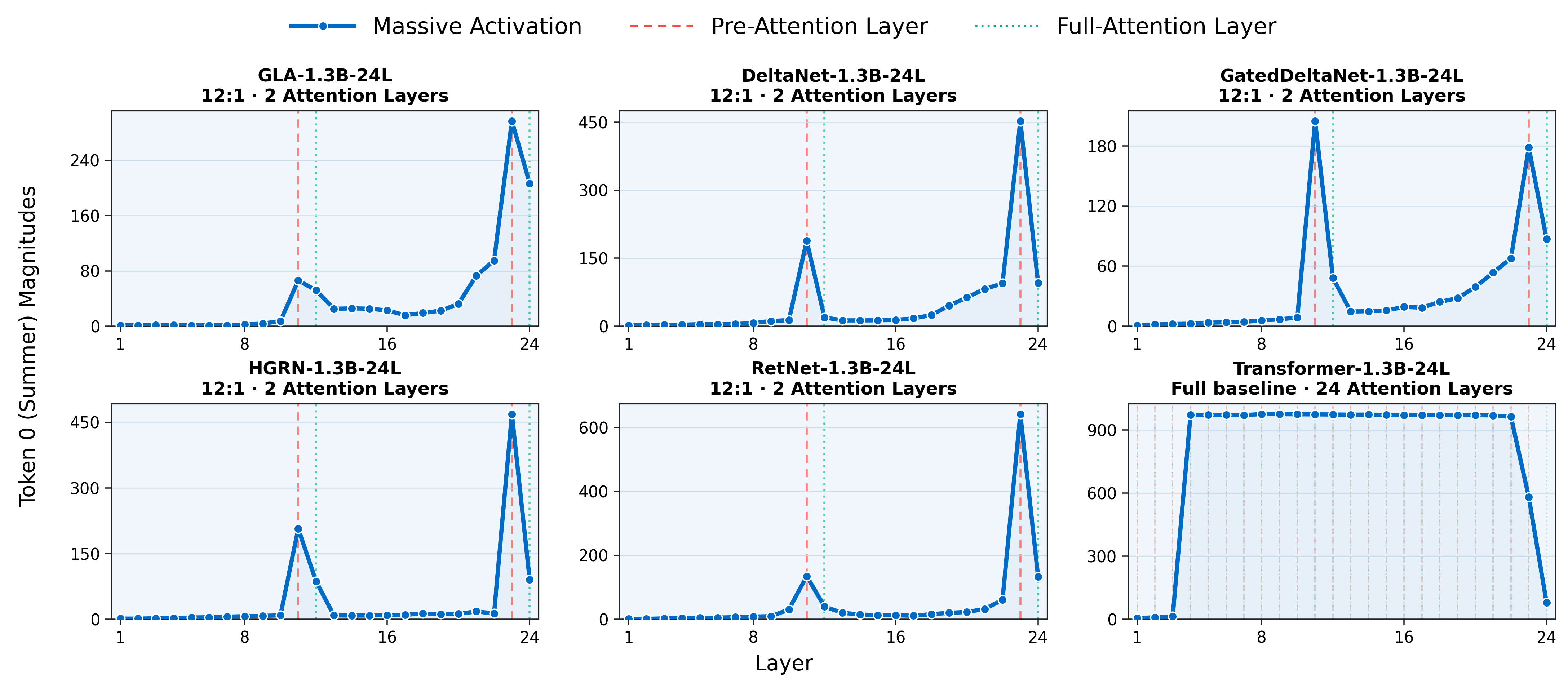
A full-attention Transformer reference plotted alongside shows the same maxima at every layer, consistent with the interpretation that PAS is the sparsified image of the full-attention MA pattern under layer interleaving.
A systematic-outlier account: localized write–sink–cancel
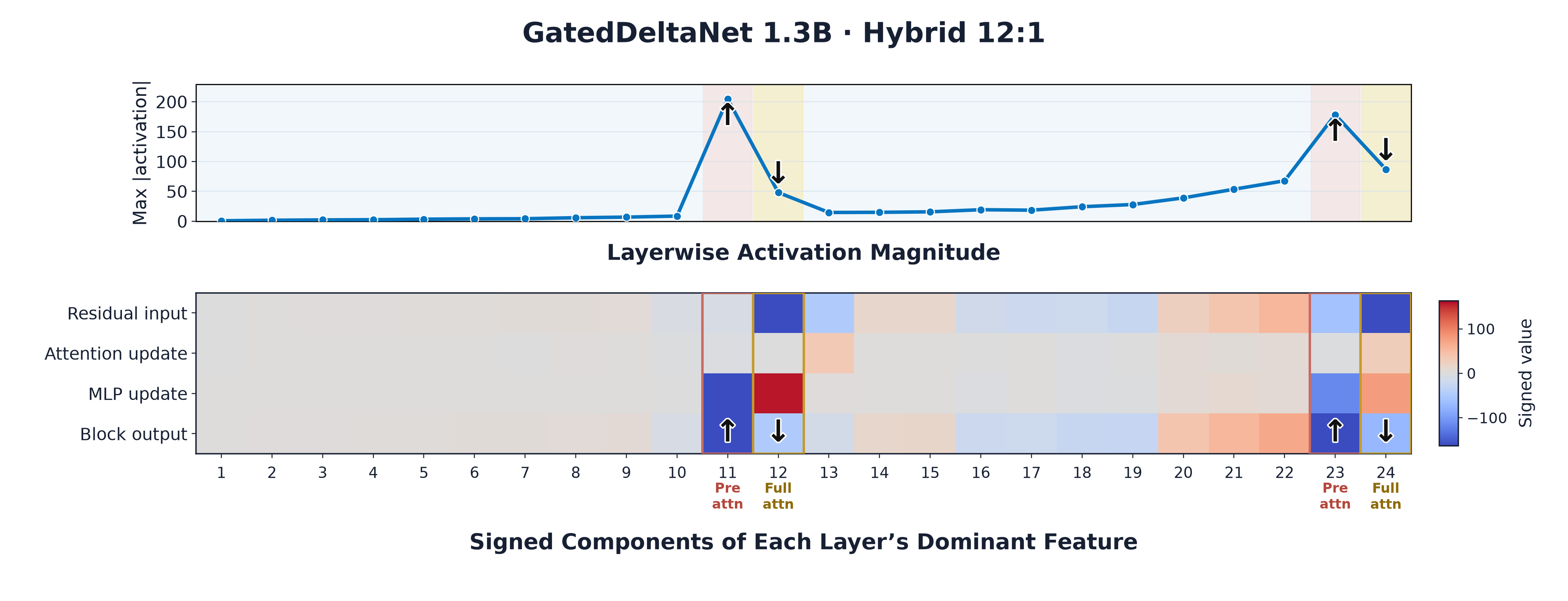
To explain the cross-layer origin of PAS, the authors extend the signed systematic-outlier framework of prior work on full-attention LLMs to HLA models, tracking a representative fixed (token, feature) coordinate across depth.
The lifecycle has three phases:
- Write. The layer immediately before a full-attention block writes a large-magnitude, signed update into the residual stream at a specific coordinate, producing the PAS.
- Sink. The full-attention layer consumes the outlier (attention-sink behavior on the first token).
- Cancel. A subsequent opposite-signed update largely nulls the outlier, returning the coordinate to baseline magnitude.
Formally, if h_\ell denotes the residual stream at layer \ell and \Delta_\ell the layer update, PAS corresponds to a coordinate c with |\Delta_{\ell^\ast-1}[c]| \gg |\Delta_{\ell}[c]| for other \ell, followed by \Delta_{\ell^\ast+k}[c] \approx -\Delta_{\ell^\ast-1}[c] for a small k. ISP is the same lifecycle with delayed cancellation: the opposite-signed update arrives many layers later, so the outlier survives across the intervening linear layers and forms a plateau.
This gives a compact, mechanism-level unification: PAS and ISP are the same write-cancel event, differing only in the timing of cancellation, which is set by the hybridization schedule.
Controlled pretraining and gating asymmetry
Controlled pretraining of GDN-based hybrids up to 1.3B shows both morphologies emerge early in training and are stable thereafter. The two gating mechanisms in the architecture behave asymmetrically:
- Removing full-attention output gating strongly attenuates the absolute magnitudes of PAS and ISP but does not eliminate their layerwise organization — the coordinate pattern remains, just with smaller amplitude.
- Removing GDN gates produces comparatively modest amplification.
This asymmetry pins the amplitude control of MAs primarily on the full-attention output gate, while the layerwise structure is determined by the interleaving schedule.
Limitations and open questions
The study is descriptive and mechanistic-observational rather than causal: interventions are limited to gate ablations and pretraining variations, and there is no direct test of whether suppressing PAS/ISP degrades downstream tasks. The fixed-coordinate analysis relies on a single representative coordinate per model; whether multiple, possibly interacting, outlier coordinates share the same lifecycle at scale is not exhaustively established. Implications for quantization, KV-cache compression, and long-context stability in HLA models are gestured at but not measured. The largest models (up to 397B) are analyzed through open checkpoints only, so the controlled-pretraining conclusions about gating strictly apply at 1.3B.
Why this matters
HLA architectures are a leading direction for efficient long-context LLMs, and MAs are the dominant failure mode for low-bit quantization and attention-sink-dependent behaviors. Showing that MAs reorganize predictably around full-attention layers — as PAS bridged by ISP, controlled by a write–cancel lifecycle and modulated by the full-attention output gate — gives a concrete target for quantization schemes, KV-cache design, and gating choices in future hybrid designs.
Source: https://arxiv.org/abs/2608.12149
LiveAnimate: Stable Long-Form Streaming Human Animation in Real-Time
Pose-driven human animation maps a reference image I_{\text{ref}} and a driving pose stream \{P_t\} to a video of the reference subject following those poses. Existing diffusion-based systems (UniAnimate-DiT, Wan2.2-Animate, EverAnimate, One-to-All, SCAIL) deliver quality but need minutes to hours per clip, ruling out live telepresence and avatar streaming. LiveAnimate targets the harder joint constraint: real-time streaming, long-horizon stability (three minutes), and billion-scale backbone (14B-parameter DiT), running at 19.63 FPS on 2×H100.
Method
LiveAnimate begins from the bidirectional Wan2.2-Animate-14B DiT and converts it into a block-causal autoregressive generator producing three-latent-frame blocks (12 RGB frames each) via a two-stage LoRA fine-tune of rank 128.
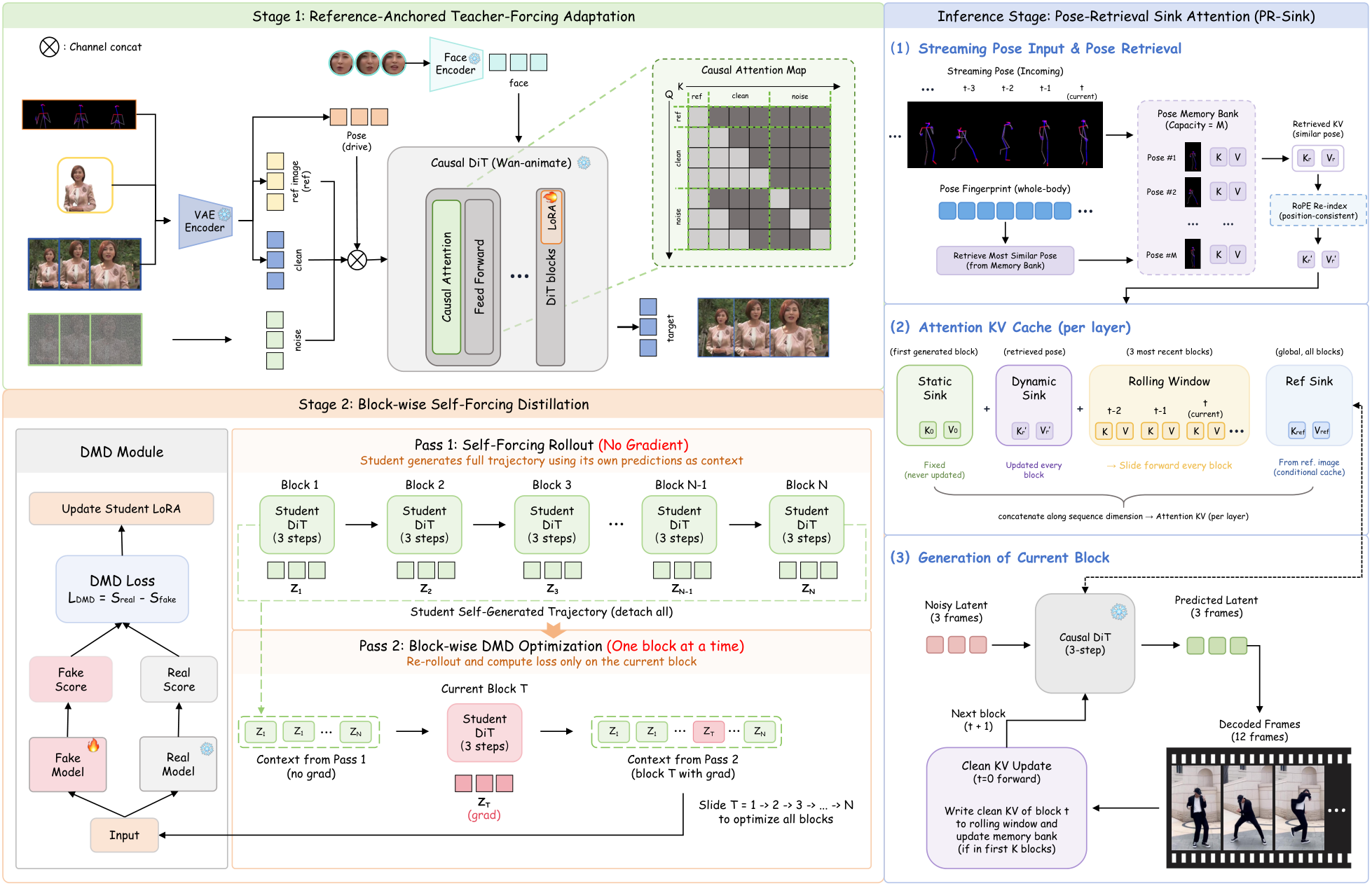
Stage 1, Reference-Anchored Teacher-Forcing Adaptation, retrains attention masks and positional structure so each block attends only to (i) the reference tokens and (ii) previously generated blocks, converting the pretrained bidirectional model to block-causal without full retraining. Stage 2, Block-wise Self-Forcing Distillation, compresses sampling to three denoising steps per block using a self-forcing regime with a generator/critic pair (both LoRA-adapted, LR 1\times10^{-5}), matching distributional statistics against the teacher on generator-produced rollouts rather than teacher-forced trajectories, which is critical to avoid exposure bias when the model must consume its own KV cache at test time.
The core long-horizon component is Pose-Retrieval Sink Attention (PR-Sink), a bounded KV cache structured as:
- Static Sink: KV of the first generated block, permanently retained as an appearance anchor (analogous to attention sinks in LLM streaming).
- Dynamic Sink: a pose-retrieved historical block from a compact memory bank, selected by matching the current pose block against stored pose embeddings.
- Rolling Window: three most recent blocks for local motion continuity.
Total attended context is fixed at five blocks regardless of stream length, so per-block compute stays constant. When a pose recurs at large temporal distance — the failure mode where identity drift accumulates — the Dynamic Sink retrieves the earlier block where a similar pose was rendered, restoring appearance context that the rolling window has forgotten. This is the mechanism the X-Dance forward-reverse-forward benchmark is designed to stress.
System-level, Ulysses sequence parallelism splits attention over the two H100s, and DiT forward passes dominate per-block cost (see Table 3 in the paper), justifying the choice to report DiT-loop latency excluding VAE and pose encoding which can be pipelined on separate devices.
Results
Evaluation uses 24 pairs across a three-minute benchmark: 12 in-the-wild web videos plus 12 X-Dance sequences played forward-reverse-forward to force pose recurrence at long intervals. Metrics segment the rollout into 0–10 s, 0–30 s, 30–90 s, 90–120 s, and 120–180 s to separate initial quality from accumulated drift, using ASE, IQA, DINO-S (identity), FID, and V-MAE.
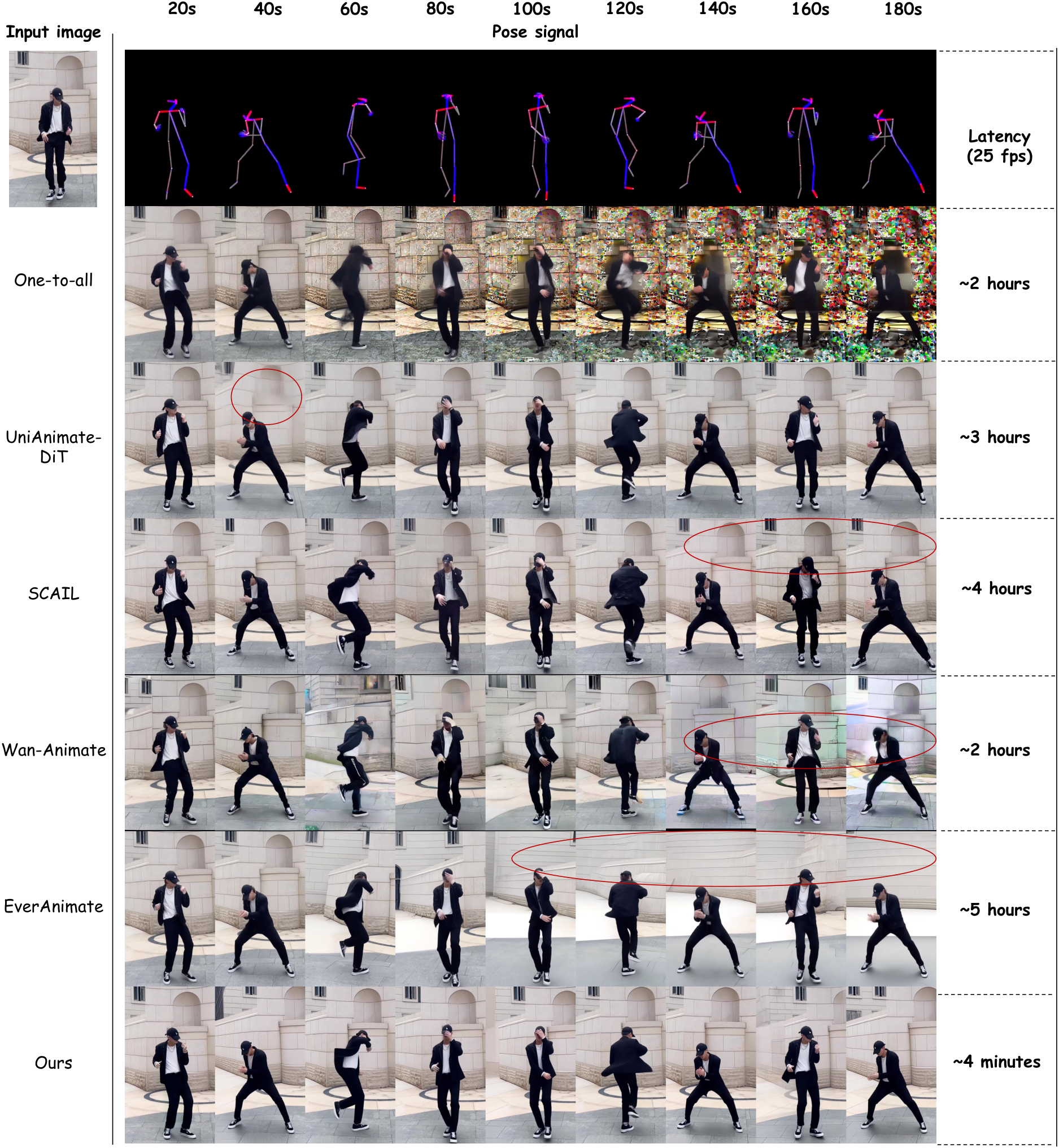
The qualitative full-body comparison shows baselines (UniAnimate-DiT, Wan2.2-Animate, etc.) taking approximately 2–5 hours end-to-end for the three-minute clip, versus LiveAnimate’s real-time generation. Red annotations mark competitor failure modes — clothing color drift, background dissolution, and limb identity collapse — that appear by the 60–120 s mark. LiveAnimate’s DINO-S and IQA trajectories reported in the paper are flat across the five temporal windows, whereas baselines degrade monotonically after 30 s.
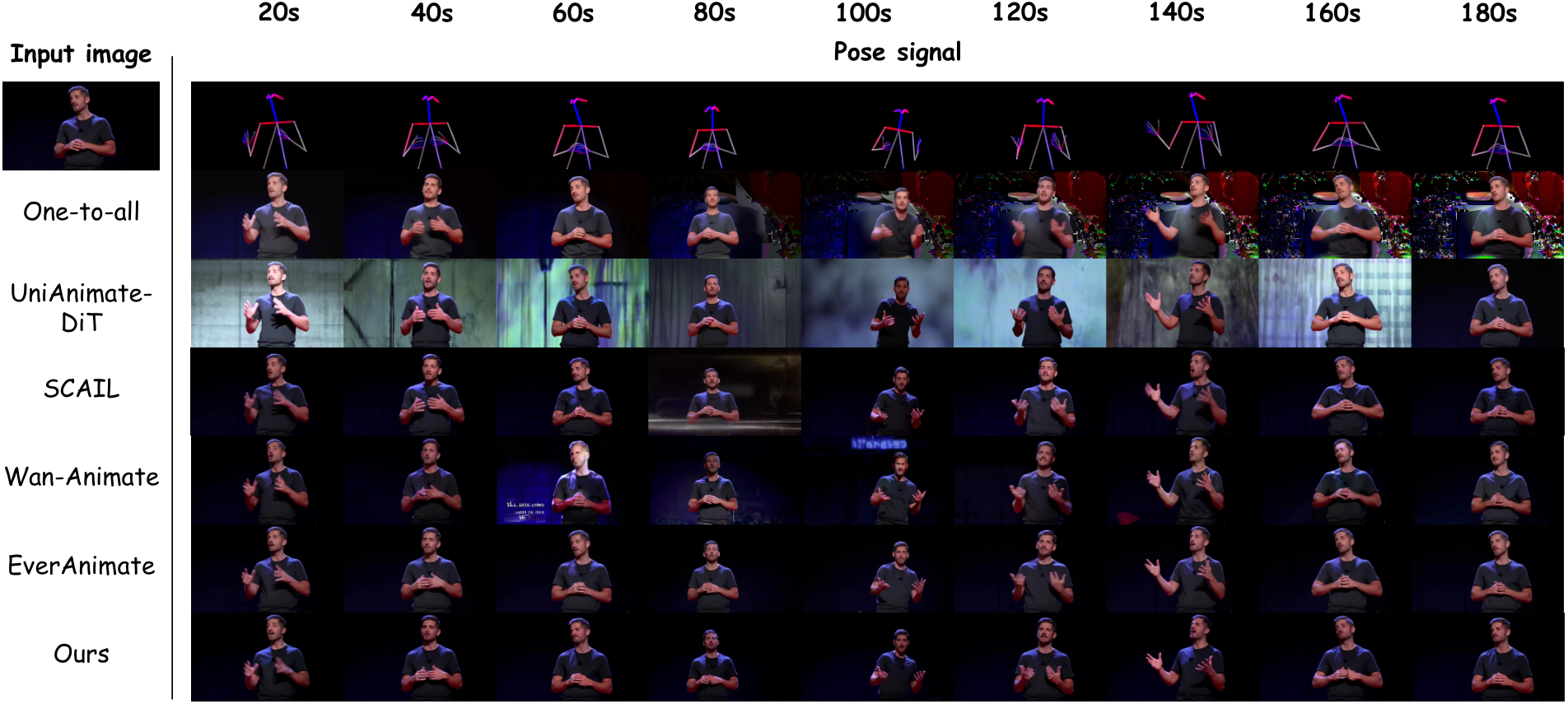
The upper-body comparison isolates face and hand fidelity under a static dark background — a setting where diffusion drift usually manifests as background hue shift or facial identity slippage. LiveAnimate preserves both across the 180 s rollout at 25 FPS.
Throughput: 19.63 FPS DiT-only on 2×H100 for 480\times480 or 384\times672 output at three-latent-frame blocks with three denoising steps. This is roughly 500–1000× faster than the 2–5 hour baselines on the same three-minute target.
Limitations
The latency figure excludes VAE encode/decode and pose/reference conditioning; achieving true 19.63 FPS end-to-end requires pipelined implementations of those stages, and the paper does not report end-to-end wall-clock. PR-Sink’s Dynamic Sink assumes a useful pose match exists in memory; entirely novel poses fall back to the rolling window plus static anchor, and behavior under sustained novel-pose regimes is not separately ablated in the excerpts. The training corpus (40k talking + 20k human-motion videos) is bounded in appearance diversity, and no reconstruction-metric evaluation is offered (justified as perceptually misleading, but it leaves motion-following fidelity to qualitative inspection). The memory bank size and retrieval-kernel choice are not detailed in the shown sections. Finally, distillation to three steps constrains the achievable quality ceiling of the underlying 14B teacher.
Why this matters
Streaming diffusion has been mostly small-model territory; LiveAnimate demonstrates that a 14B DiT can be made block-causal, few-step, and length-stable simultaneously without retraining from scratch, and that attention-sink ideas from LLM streaming transfer to video with a pose-conditioned retrieval twist that specifically addresses appearance drift under pose recurrence. This is the ingredient set needed for interactive avatar systems at production model scale.
Source: https://arxiv.org/abs/2608.11745
Full-bandwidth transformer
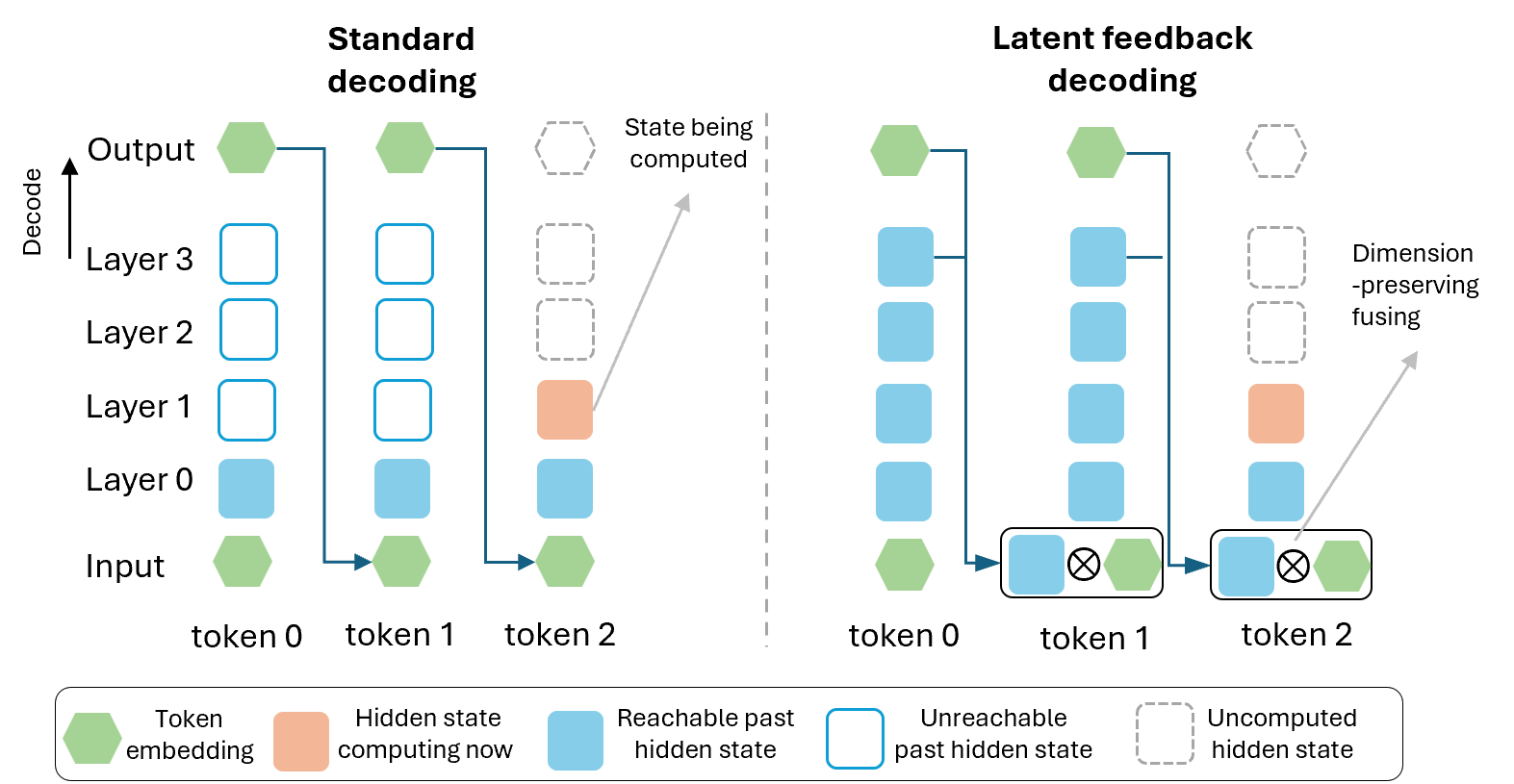
Autoregressive transformers have a bandwidth asymmetry between their two computational axes. Horizontally, each new token can attend to every past key/value across every layer. Vertically, only a single discrete symbol — the sampled token — crosses between decoding steps; the top-layer hidden state \bm{h}_{t-1}^L \in \mathbb{R}^D that produced it is projected to logits, sampled, and discarded. Any non-verbalized computation the model did at step t-1 must be recomputed from scratch at step t, starting from the token embedding at layer 0.
The full-bandwidth transformer widens this inter-step channel by feeding \bm{h}_{t-1}^L back into the input alongside the sampled token embedding \bm{e}_t:
\bm{h}_t^L = f_\theta\!\left(\bm{e}_t \otimes \bm{h}_{t-1}^L;\; C\right), \qquad \bm{e}_t \leftarrow \mathrm{Decode}(\bm{W}^{\text{head}} \bm{h}_{t-1}^L),
where C is the KV cache of prior positions (now containing fused states \bm{e}_i \otimes \bm{h}_{i-1}^L instead of embeddings). Standard decoding is recovered when the fusion ignores \bm{h}_{t-1}^L.
The fusion operator
The fusion is a deliberately asymmetric gated linear unit:
\bm{e}_t \otimes \bm{h}_{t-1} = \bm{W}^U \bm{h}_{t-1} \odot \sigma(\bm{W}^G \bm{e}_t),
with \bm{W}^U, \bm{W}^G \in \mathbb{R}^{D \times D}. The hidden state occupies the value pathway; the token embedding enters only as a multiplicative gate. This is the key design choice. A symmetric fusion like \bm{e}_t + \bm{W}\bm{h}_{t-1} would let the model drive the state pathway to zero and reproduce standard pretraining loss via the additive shortcut — especially tempting when initializing from a pretrained checkpoint. Under Eq. (4), dropping \bm{h}_{t-1} drops the input entirely, and the token identity survives only as a D-dimensional gating pattern imposed on the state. Reading the state is mandatory.
The output dimension of the fusion is D, so the transformer stack, KV cache layout, and serving stack (including vLLM) are unchanged; top-layer states are stored in a dedicated buffer analogous to multi-token-prediction implementations. Inference overhead is two D \times D matmuls per step — under 1% of a forward pass and independent of depth and context length.
Training recipe
Naively training with feedback destroys teacher-forcing parallelism, since \bm{h}_{t-1}^L is only known after the previous step’s full forward pass. The authors use a scheduled multi-pass objective: latent feedback is introduced late in pretraining, and batches mix passes of different depth (a k-pass batch runs the stack k times sequentially, each pass feeding its top-layer states into the next as fused inputs). The mixture is annealed:
- 10B tokens: 100% three-pass (10B tokens, 40B token-equivalent compute)
- 100B: 75% one-pass / 25% three-pass (150B compute)
- 200B: 75% / 22% two-pass / 3% three-pass (256B compute)
- 400B: same mixture (512B compute)
Optimization uses NorMuon for matrix parameters (lr 10^{-2}, wd 0.01) and Adam elsewhere (lr 5 \times 10^{-4}), a WSD schedule with 25% cooldown, z-loss 10^{-5} during cooldown, and jitter noise \sigma = 0.02. Data mixture and context length (8192) match Phi-4.
Fused prefilling as effective depth
At inference, the same multi-pass mechanism can be applied to the prompt: re-run prefill with fused inputs, feeding the previous pass’s top-layer states through the gate. Three empirical observations:
Gains are front-loaded. Most of the improvement on validation loss and 5-shot LM Eval average (RTE, TruthfulQA-MC2, ARC-E, ARC-C, BoolQ, PIQA, WinoGrande, OpenBookQA, COPA, MMLU) appears at the first fused pass — the first time full-stack state is exposed to layer 0. Additional passes help with diminishing returns, consistent with the mechanism providing added effective depth for the prompt.
Cheap to leave unused. With zero feedback passes at inference, the latent-feedback-trained model loses only a small amount of validation loss versus the standard baseline while already improving average LM Eval accuracy. The training recipe is beneficial even for deployments that never invoke feedback.
Prefill compute substitutes for pretraining data. With two feedback passes at prefill, the 100B-token full-bandwidth model matches the 200B-token standard baseline, and the 200B-token full-bandwidth model matches the 400B-token standard baseline — roughly a 2\times data-efficiency gain converted from modest inference-time compute.
Limitations and open questions
The paper reports 1B-scale results only; whether the 2\times data-efficiency ratio survives at frontier scale is unresolved. Token-equivalent compute accounting is honest but reveals that the 400B-token full-bandwidth run actually consumes 512B forward-pass tokens, so the comparison is against equal-token rather than equal-FLOP baselines. The multi-pass schedule’s specific mixture (75/22/3) is not ablated in the excerpt. It is also unclear how latent feedback interacts with sampling: at temperature > 0 the passed-forward state was produced by a stochastic draw, and no analysis of variance across seeds during generation is shown. Finally, the mechanism assumes autoregressive decoding of a single stream; batched serving with variable-length sequences and speculative decoding will require care around the fused-KV buffer.
Why this matters
Latent feedback is a minimal, architecturally conservative change that reclaims the top-layer hidden state as an inter-step signal, converting the transformer’s narrow verbal bottleneck into a D-dimensional continuous channel while preserving the KV cache, teacher forcing (via scheduled multi-pass), and language-modeling objective. If the reported 2\times data efficiency from inference-time recurrence holds up, it offers a rare compute-for-data tradeoff that plugs into existing serving stacks with two extra matmuls per token.
Source: https://arxiv.org/abs/2608.08888
OmniScientist: An Omni-Modal Omni-Discipline AI Scientist
Problem and motivation
Existing “AI scientist” systems (e.g., Sakana’s AI Scientist, agentic research pipelines) chain LLM calls across ideation, coding, and writeup, but they consume evidence only after it has been reduced to text, numeric tables, labels, or precomputed feature vectors. This interface silently discards the relations that carry scientific weight: local spatial structure in pathology tiles, temporal ordering in seismograms or migration trajectories, cross-channel phase relations in three-component signals, and geometric adjacency in 3-D structures. The authors argue that the bottleneck for autonomous discovery is not workflow coverage but the perception interface — which relations survive from raw artifact to agent context.
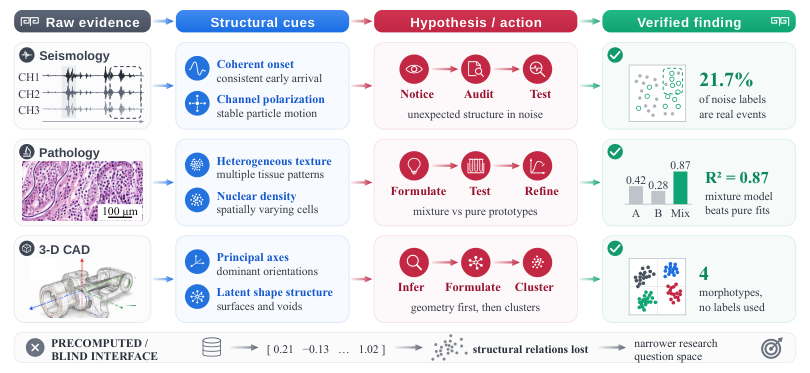
Figure 2 makes the argument concrete: reading a three-channel seismogram directly enables the finding that 21.7% of “noise” labels are in fact real events; the same record delivered as a feature vector removes the P/S-phase cues on which that hypothesis depends.
Evidence taxonomy
OmniScientist organizes artifacts into four discipline-independent families defined by the reasoning they require rather than by tensor shape:
- Perceptual: images, micrographs, spectra, waveforms, 3-D structure.
- Symbolic: natural language, formulae, sequences, knowledge graphs, causal relations.
- Quantitative-statistical: tables, distributions, regressions, significance tests.
- Procedural / dynamic: experimental steps, code traces, simulations, agent trajectories.
Prior AI-scientist stacks handle mostly symbolic and quantitative families; perceptual and procedural evidence is where this system claims coverage.
Framework
The pipeline is a deterministic sequence of three agents sitting on top of a shared perception layer.
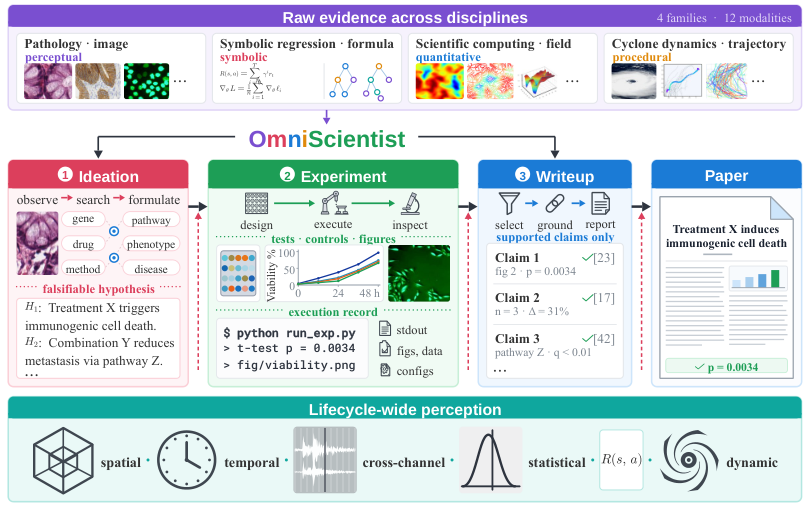
- Ideation: observes raw materials via the perception layer, searches literature, and emits falsifiable hypotheses. An “idea check” enforces novelty screening in code.
- Experiment: designs tests, executes code, inspects intermediate results, and produces an execution record — stdout, figures, artifacts, configs. A “rigour check” enforces statistical validity and execution provenance.
- Writeup: selects and grounds claims strictly against the execution record. A “claim check” enforces numerical traceability, so no number appears in the paper without a matching entry in the record.
The perception layer is the mechanically interesting piece. Rather than always rendering plots and calling a VLM, it prioritizes native numeric analysis on raw artifacts — e.g., FFT peaks on waveforms, trend and changepoint extraction on time series, adjacency queries on graphs, geometric primitives on CAD meshes. Visual rendering is invoked only when spatial or structural patterns are essential to the question at hand, and it is budget-constrained per run to prevent the agent from defaulting to render-and-caption on every artifact. The task context, not a hardcoded routing table, decides between numeric features, visual inspection, or both.
The perception model is pinned to Claude Sonnet 5 across all experiments while the reasoning backbone is swapped; this isolates the contribution of reasoning quality from that of raw observation.
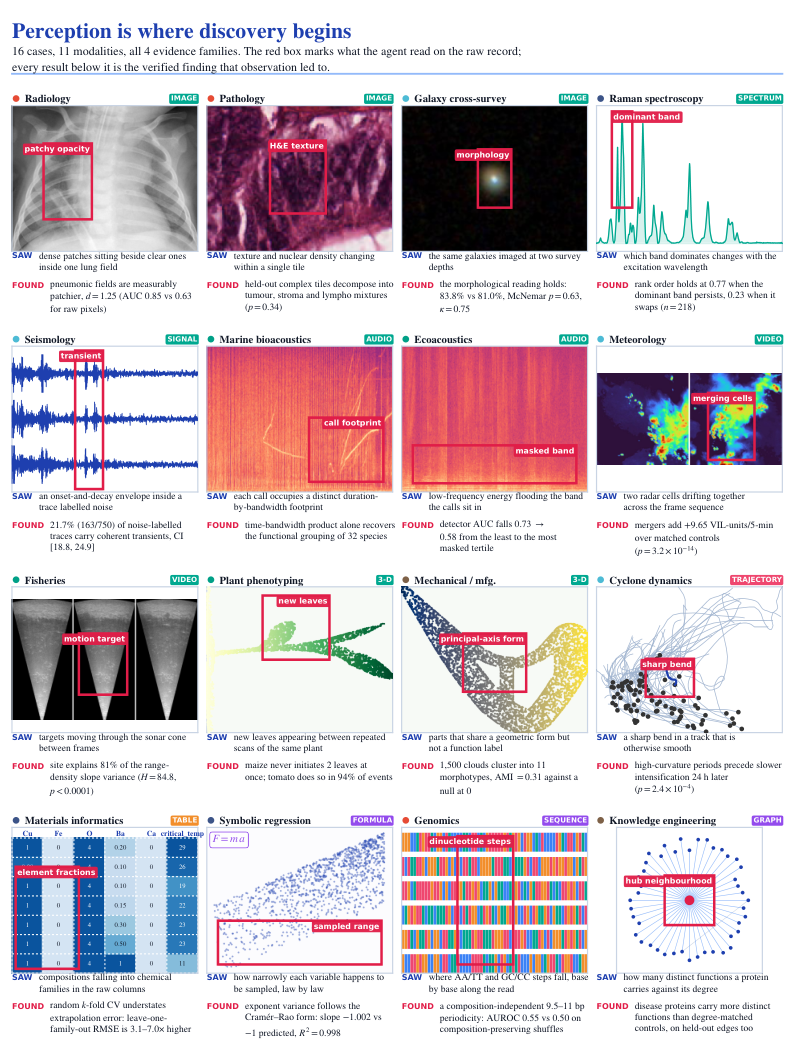
Figure 4 shows the layer operating on images, spectra, three-component signals, audio, video, 3-D structures, trajectories, tables, formulae, sequences, and graphs, with the “saw / found” annotations linking a specific raw cue to a verified experimental result downstream.
Evaluation
The suite comprises 36 real-data cases across 5 discipline families, 4 evidence families, and 12 modalities. Scoring uses two out-of-family judges (deepseek-v4-flash, gemini-2.5-flash-lite) to grade a composite over ideation, execution, and writeup.
Backbone generality (Table 4) with perception pinned to Sonnet 5:
| Backbone | Cases | Completed | Mean |
|---|---|---|---|
| Claude Sonnet 5 | 36 | 36 | 6.5 |
| GLM 5.2 | 18 | 17 | 6.7 |
| Kimi K2.7 | 9 | 6 | 6.5 |
| GPT 5.6 | 10 | 9 | 5.7 |
| Qwen3.5-122B | 34 | 30 | 5.4 |
| Qwen3.5-27B | 36 | 32 | 5.3 |
| Gemma-4-31B | 36 | 32 | 5.0 |
| Gemma-4-26B | 34 | 25 | 4.3 |
| Qwen3.5-9B | 32 | 18 | 4.1 |
Only Sonnet 5 completes the full 36-case suite. GLM 5.2 has the highest mean (6.7) but was dispatched on 18 cases; the reported completion figures indicate that smaller open-weight backbones fail primarily on tool-use and long-horizon control, not on isolated reasoning steps. The scores also indicate a fairly narrow spread (4.1–6.7) once perception is held constant, which is consistent with the paper’s thesis that raw-evidence access — not the reasoning model — is the dominant lever.
Limitations and open questions
- The composite score is LLM-judged; the paper does not report human-expert agreement or reproducibility of the discovered findings (e.g., the 21.7% mislabeling claim) against domain ground truth.
- Perception is pinned to a single frontier model; the ablation isolating the perception contribution (rather than the reasoning backbone) is not shown in the sections provided. It is unclear how much of the gain over text-only baselines comes from budget-constrained visual inspection versus native numeric probing.
- The claim-check enforces numerical traceability to the execution record but cannot detect an incorrect hypothesis that happens to be consistent with a buggy experiment; execution provenance is not scientific validity.
- Cost and wall-clock per case are not reported here, and budget-constrained rendering is a knob whose sensitivity is not characterized.
Why this matters
The paper reframes AI-scientist design around the perception interface rather than the agent scaffold: what determines the reachable hypothesis space is which spatial, temporal, and cross-channel relations survive between artifact and model. Holding perception fixed and swapping reasoning backbones (means clustered 4.1–6.7) supports the claim that raw-evidence access, not raw model IQ, is the current bottleneck for multidisciplinary autonomous research.
Source: https://arxiv.org/abs/2608.13558
DreamX-Phi 1.0: Action-Conditioned Video World Model for Robotic Manipulation
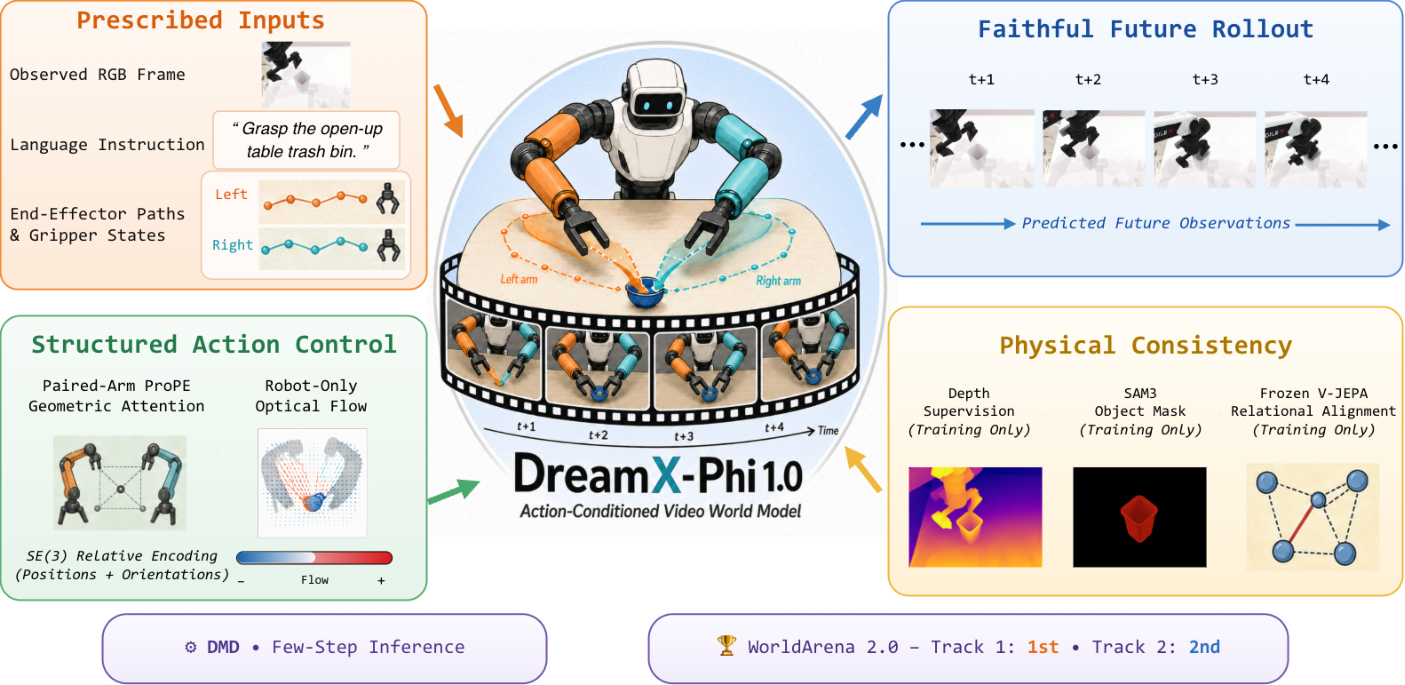
DreamX-Phi 1.0 targets a specific failure mode in video world models used for robotic manipulation: photorealistic rollouts that are geometrically or kinematically wrong. Given an initial RGB frame \mathbf{x}_0, a language instruction \mathbf{c}, and a prescribed bimanual action sequence \mathbf{a}_{1:T} of end-effector poses and gripper states, the model learns
p_\theta(\mathbf{x}_{1:T}\mid \mathbf{x}_0, \mathbf{a}_{1:T}, \mathbf{c}).
The challenge is that a diffusion prior can produce plausible frames while moving the wrong arm, drifting the manipulated object, or violating rigid-motion constraints. The paper’s central design choices concern how to inject action, geometry, and object identity into a pretrained video diffusion transformer while keeping inference cheap.
Backbone and action conditioning
The generator is a Wan2.2-TI2V-5B video diffusion transformer trained with flow matching (Lipman et al., 2023). The first-frame latent supplies visual context; future-frame latents are the flow-matching targets. On top of this backbone, action conditioning is layered in two complementary ways:
- Arm-grouped PRoPE. Per-arm SE(3) transformations are injected into attention via a PRoPE-style geometric positional encoding. This preserves arm identity (left vs. right) and enforces rigid-motion structure in the token-to-token attention pattern, so that the “which arm moves and how” signal is not diffused across the sequence.
- Robot-only optical flow. A complementary image-plane cue, restricted to robot pixels, gives an explicit 2D correspondence between the commanded end-effector trajectory and the pixels that must move. This handles what SE(3) conditioning alone cannot: the projective consequences of the motion in the current camera.
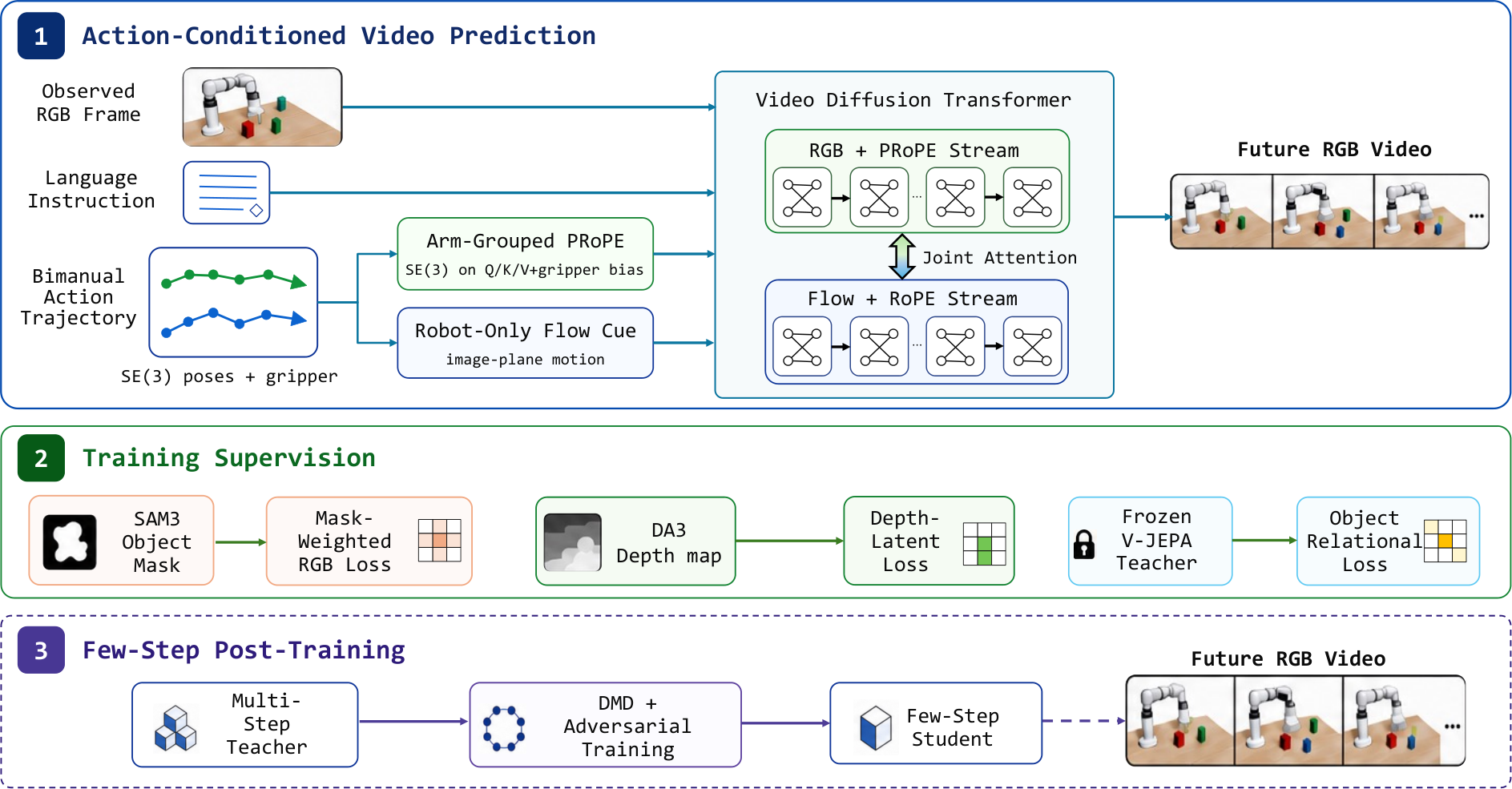
Auxiliary supervision
Action conditioning constrains the robot but leaves scene geometry and small object dynamics under-determined. Three auxiliary losses fill this gap during training:
- Depth latent objective. A lightweight depth branch is supervised by Depth Anything 3 targets, giving the model an explicit scene-level geometry signal rather than relying on the RGB reconstruction to infer 3D structure implicitly.
- SAM3-mask reweighting. Segmentation masks from SAM3 reweight the RGB flow-matching loss around the manipulated object, so gradient magnitude does not get dominated by static background pixels.
- V-JEPA object-relational teacher. A frozen V-JEPA encoder produces feature-space targets that constrain object-relational structure across time — critical for maintaining identity through grasps, occlusions, and hand-offs where pixel-level supervision is weakest.
Few-step distillation
For deployment, the multi-step teacher is distilled into a few-step student using distribution-matching distillation (DMD) combined with adversarial training. This is a standard recipe now for diffusion-video acceleration, but its inclusion is necessary if the world model is to serve as a rollout environment for RL — Track 2 requires many trajectories per policy update, and a 40+ NFE teacher would be impractical.
Data
The corpus mixes three sources: action-free egocentric video (for visual diversity), real-robot demonstrations, and simulated RoboTwin 2.0 trajectories (for controlled action–observation alignment). Camera structure is preserved per source — single-view stays single-view; synchronized multi-view is combined explicitly. This heterogeneity is likely important: pure teleoperated manipulation data is narrow, and egocentric video supplies the everyday-dynamics prior that lets the model generalize scene physics.
Results
Evaluation uses two tracks of WorldArena 2.0, both derived from RoboTwin 2.0. Track 1 (1,000 episodes) scores open-loop video prediction from either language or action conditioning; Track 2 uses the submitted world model as an RL rollout environment to optimize a \pi_{0.5} policy from a fixed initialization and reward model, evaluated on held-out Adjust Bottle episodes. DreamX-Phi 1.0 places first on Track 1 and second on Track 2. The paper additionally reports on WorldArena 1.0 Track 1 (Clean-50: 50 tasks × 10 episodes) to contextualize against prior world models.

The qualitative rollouts show the design paying off precisely where naive video models fail: correct arm activation, stable held-object identity across the sequence, and preserved geometry under domain randomization.
Limitations and open questions
DreamX-Phi 1.0 is a Forward Dynamics Model — it consumes an externally provided action sequence and never proposes actions. This is a hard limit on closed-loop use: action–video consistency is only enforced through the training objective, not through joint generation. The authors flag a joint World Action Model as future work, which would sample (\mathbf{x}_{1:T}, \mathbf{a}_{1:T}) together and could tie predicted visual consequences to the actions that caused them. Other open questions: how much of the Track 1 gain comes from PRoPE vs. optical flow vs. V-JEPA (no ablation numbers are surfaced here), how the DMD student’s fidelity degrades relative to the teacher, and how the Track 2 second-place gap relates to compounding rollout error under policy optimization.
Why this matters
Faithful action-conditioned video is the missing piece between generative video models and usable world models for manipulation RL. DreamX-Phi 1.0 shows that structured action injection (SE(3) via PRoPE plus robot-only optical flow) combined with geometry and object-identity teachers is enough to make a 5B diffusion transformer competitive as an RL rollout environment, not just a pretty video generator.
Source: https://arxiv.org/abs/2608.13489
Hacker News Signals
Text AI watermarks will always be trivial to remove
Source: https://www.seangoedecke.com/text-ai-watermarks/
The argument is structural, not empirical: any watermarking scheme that operates at the token distribution level is vulnerable to a class of semantics-preserving transforms that cost far less to apply than they cost to design around. The author identifies two fundamental attack surfaces. First, paraphrasing — rewriting the text while preserving meaning destroys token-level statistical patterns regardless of how they were embedded. Second, insertion/deletion attacks — adding or removing tokens perturbs bigram and n-gram statistics that watermarking schemes depend on, again with trivial effort relative to the detection machinery.
The deeper point is that text watermarks are not like image watermarks. In images you can embed signals in perceptually invisible frequency bands that survive lossy compression and resampling; the signal space is high-dimensional and redundantly encodable. Text has no analogous substrate — meaning is nearly entirely carried by the surface token sequence, and any transformation that preserves meaning necessarily destroys low-level statistical fingerprints. The robustness budget is essentially zero.
The author also notes the adversarial asymmetry: the attacker only needs one cheap transform that works; the defender must harden against all of them simultaneously. Schemes like KGW (Kirchenbauer et al.) embed watermarks by biasing sampling toward a “green” token list conditioned on preceding context. This survives minor edits but collapses under paraphrase because the green-list assignments are context-dependent — after rewriting, the token contexts change and the green-list signal evaporates.
The practical implication: watermarking may serve as a soft deterrent for casual misuse (e.g., students submitting lightly edited AI output) but provides no cryptographic guarantee and should not be relied upon in adversarial settings. Detection systems built on watermarks will have high false-negative rates against any moderately motivated attacker.
How AI text watermarking works
Source: https://declaude.org/watermarking/
This is a technical explainer that pairs naturally with the removal piece above. It walks through the KGW scheme in enough detail to understand the implementation: at each generation step, a hash of the preceding k tokens seeds a pseudorandom partition of the vocabulary into a “green” set (fraction \gamma, typically 0.5) and a “red” set. During sampling, a bias \delta is added to the logits of green tokens before softmax. Detection runs a hypothesis test: given text of length T, count the number of green tokens |s_G| and compute the z-statistic
z = \frac{|s_G| - \gamma T}{\sqrt{\gamma(1-\gamma)T}}
Under the null hypothesis (no watermark), |s_G| \sim \text{Binomial}(T, \gamma), so large z rejects the null. The scheme is provably detectable with high confidence for sufficiently long texts, and the watermark is “soft” — it does not require altering the top-1 token, only nudging the distribution, so text quality degrades minimally for small \delta.
The post also covers multi-bit watermarking variants, where different message bits modulate different hash seeds, allowing provenance beyond binary present/absent detection. There is a discussion of “private” versus “public” watermarks: public schemes (where the detection algorithm is open) are weaker because attackers can directly compute green lists and avoid them. Private schemes require a secret key but are not deployable for public verification without leaking that key.
The explainer is honest about limitations: the z-test degrades for short texts, low-entropy outputs (where the model’s distribution is already peaked and the green-list bias changes little), and any paraphrasing attack. It is a solid reference for understanding the current state of the technique before reading the criticism.
GLM-5.3: Frontier coding with emergent cyber capabilities
Source: https://z.ai/blog/glm-5.3
GLM-5.3 is a new model from Zhipu AI positioned as a coding-focused frontier model. The headline claim is strong performance on competitive programming and software engineering benchmarks alongside what the post labels “emergent cyber capabilities” — meaning the model performs well on CTF-style tasks and vulnerability analysis without explicit security-domain fine-tuning.
On coding benchmarks: the post reports SWE-bench Verified scores competitive with GPT-4o and Claude 3.5 Sonnet, and strong performance on LiveCodeBench. Specific numbers are not reproduced here but the blog includes comparison tables. The model uses a mixture-of-experts architecture (not fully disclosed) and was trained with a heavy emphasis on code synthesis, test-driven generation, and multi-turn debugging trajectories.
The “emergent cyber” framing refers to performance on CyberSecEval and internal CTF task suites. The model solves binary exploitation, web vulnerability, and cryptographic challenge tasks at rates the authors frame as unexpected given the training distribution. Whether this is genuinely emergent or a consequence of training on security writeups and CTF solutions is not addressed — the “emergent” label is doing some work here that warrants skepticism.
The post is light on architectural specifics. Notable is the claim that GLM-5.3 uses a longer context window (128K tokens) effectively on repository-level coding tasks, which is more relevant to practical SWE use than raw benchmark scores. There is also a tool-use / agentic evaluation component where the model drives a code execution environment.
Open questions: the dual-use nature of strong cyber capabilities in a publicly accessible model is not discussed. The training recipe for code quality — specifically how test execution feedback is incorporated — is not disclosed.
Where did the old web go? We followed 657,607 links to find out
Source: https://0.mk/blog/link-rot
A large-scale empirical study of link rot across a corpus of 657,607 URLs collected from various web sources. The methodology: crawl all URLs, classify responses (200, 301/302, 4xx, 5xx, DNS failure, timeout), and stratify by domain age, TLD, and content type. The headline finding is that roughly 38% of links are dead by some definition, consistent with prior academic studies but here grounded in a much larger and more diverse crawl than most published work.
The technically interesting breakdowns: link rot rate is strongly correlated with domain age (older domains rot faster, as expected) but also with hosting infrastructure — links to large platforms (GitHub, archive.org, major news sites) have dramatically lower rot rates than links to personal domains or small hosting providers. Links to PDFs and binary files rot faster than HTML pages, likely because they are less likely to be redirected when content moves.
The authors track redirect chains: a substantial fraction of “surviving” links have rotted in a semantic sense — they 301/302 to a homepage or a generic error page that returns 200. Detecting this “soft rot” requires content hashing or semantic comparison, not just HTTP status checking. The study uses a heuristic: redirects that shorten the URL path by more than 50% are flagged as likely soft rot.
DNS failure is the dominant failure mode for very old links (pre-2005 registration dates), while 404 dominates for more recent ones. 5xx errors are a small fraction, suggesting most rot is permanent abandonment rather than temporary server issues.
Practical implication for anyone building link archives or citation graphs: naive HTTP status checking misses roughly 15-20% of soft-rot cases. Content-addressed storage (IPFS, Wayback Machine pinning) is the only robust solution.
How Organizations Use AI: Evidence from ChatGPT
Source: https://cdn.openai.com/pdf/how-organizations-use-chatgpt.pdf
An OpenAI-published empirical study using anonymized telemetry from enterprise ChatGPT deployments, supplemented by survey data. The unit of analysis is organizational-level usage patterns rather than individual prompts. Key findings worth noting for the technical audience:
The task distribution is heavily skewed toward writing and summarization (roughly 60% of sessions by category), with coding second (~20%), and analysis/QA tasks third. This holds across firm sizes, which is somewhat surprising — the prior assumption that technical firms would show code-heavy usage is not strongly supported.
Adoption patterns show a “exploration plateau” dynamic: organizations that deploy ChatGPT show rapid initial usage growth over the first 4-6 weeks, then a leveling-off rather than continued compounding growth. The authors interpret this as task-specific adoption reaching saturation rather than broad workflow integration, though the telemetry can’t distinguish these cleanly.
There is a section on API versus UI usage split by industry vertical. Financial services and healthcare show higher API usage ratios, consistent with integration into internal tooling. Media and marketing show high UI usage, consistent with individual knowledge worker use.
The methodological limitation is significant: this is a self-selected sample of organizations that opted into enterprise agreements, which skews toward larger, more technically sophisticated firms. The coverage of small-business or informal ChatGPT usage is absent by design. The causal claims (AI “improves” productivity) are not supported by the study design — it is purely descriptive telemetry. The paper is useful as a demand-side map but should not be read as evidence of productivity effects.
DeepSeek Harness developer preview
Source: https://deepseek.com/harness/en/
DeepSeek Harness is a developer-facing evaluation and deployment framework built around DeepSeek’s model family. The preview exposes a structured interface for running the DeepSeek models (including R1 and V3 variants) against custom evaluation harnesses, akin to EleutherAI’s lm-evaluation-harness but tightly integrated with DeepSeek’s inference infrastructure.
The technical substance: Harness provides a task definition API where users specify prompt templates, few-shot examples, output parsers, and scoring functions, then run them against DeepSeek endpoints at scale. There is native support for chain-of-thought extraction — since DeepSeek R1 produces explicit reasoning traces, the harness can evaluate both the final answer and the reasoning process separately, which is useful for process reward model training and debugging.
The system includes a batch evaluation mode with asynchronous job submission, which matters practically because large evaluation runs against reasoning models are expensive and slow. There is also a “comparison mode” for running the same task suite against multiple model versions simultaneously, useful for regression testing during fine-tuning.
What is notably absent from the preview: fine-tuning integration (the harness evaluates but does not train), cross-provider evaluation (it is locked to DeepSeek endpoints), and any open-source release of the harness code itself. The latter is a significant limitation for reproducibility — a closed evaluation harness undermines the ability to independently verify benchmark claims.
For the community building on DeepSeek’s open-weight models (R1, V3) via local or third-party inference, the harness in its current form is not directly usable. The interesting question is whether DeepSeek releases the harness tooling open-source, which would make it competitive with existing frameworks.
Accelerating GPT-5.6 Sol Ultrafast with OpenAI
Source: https://www.cerebras.ai/blog/accelerating-gpt-5-6-sol-ultrafast-with-openai
Cerebras reports running GPT-5.6 Sol (“Ultrafast” tier) on their CS-3 wafer-scale engine hardware, achieving token generation rates they claim are substantially higher than GPU-based inference at equivalent cost. The post is a joint announcement with OpenAI’s inference API.
The technical core: Cerebras CS-3 uses a single wafer containing ~900,000 cores with on-chip SRAM rather than HBM, eliminating memory bandwidth as the bottleneck for the memory-bound decode phase of autoregressive generation. For large models, the decode phase throughput on GPUs is bounded by HBM bandwidth (~3-4 TB/s on H100); the CS-3’s on-chip memory bandwidth is orders of magnitude higher, enabling dramatically faster per-token generation at batch size 1 (the latency-sensitive regime).
The claimed throughput numbers: the post reports speeds in the range of thousands of tokens per second for GPT-5.6 Sol, though the exact model size and comparison baseline are not fully specified. The “Ultrafast” tier in OpenAI’s API maps to Cerebras-backed inference.
The engineering challenge Cerebras solved is fitting the model weights into on-chip SRAM. For very large models this requires model parallelism across multiple CS-3 chips, which introduces interconnect overhead. The post does not detail the parallelism strategy or the resulting efficiency as model size scales.
Limitations: cost per token at Cerebras-level hardware amortization is not disclosed. The wafer-scale approach has historically had poor yields and high capital costs. The offering is relevant for latency-critical applications (real-time voice, interactive agents) but is unlikely to be cost-competitive for bulk batch inference where throughput-per-dollar matters more than latency.
Choosing an AI model: one prompt, 11 models, different results
Source: https://www.netlify.com/blog/one-prompt-11-models-very-different-results/
A practical evaluation from Netlify’s developer experience team: a single, moderately complex prompt (build a functional web component with specific behavior) submitted to 11 models including GPT-4o, Claude 3.5 Sonnet, Gemini 1.5 Pro, Llama 3.1 70B, Mistral Large, and others. The evaluation is qualitative-first, scoring on correctness, code style, and whether the output runs without modification.
The technically interesting finding: variance across models on a well-specified coding task is much higher than informal benchmarks suggest. Several models produce syntactically correct code that fails on edge cases specified in the prompt. The failure modes cluster: smaller open-weight models tend to miss multi-step constraint satisfaction (e.g., handling both a functional requirement and an accessibility requirement simultaneously), while larger proprietary models more often produce verbose, over-engineered solutions.
The post notes a “instruction following vs. code quality” tradeoff: some models follow every stated constraint but produce brittle code; others write cleaner code but silently drop constraints. This is a real evaluation design problem — aggregate benchmark scores conflate these two axes.
From a practical selection standpoint, the result reinforces that benchmark leaderboard position is a weak predictor of task-specific performance. The recommendation to run your actual workload against candidate models before committing is banal but empirically supported here. The post also notes latency differences of 3-10x between the fastest and slowest models for equivalent output length, which matters for user-facing applications. No cost analysis is included, which limits the usefulness as a deployment decision guide.
Noteworthy New Repositories
haoran-zha/Awesome-Spiking-Neural-Networks-Hub
A curated, bilingual (English/Chinese) reference hub for spiking neural networks (SNNs), aggregating 340+ papers alongside coverage of neuromorphic hardware (Intel Loihi, IBM TrueNorth, BrainScaleS, SpiNNaker), benchmark datasets, simulation/training frameworks (SpikingJelly, Norse, BindsNET), and active research groups. The structure separates foundational theory (spike coding, STDP, surrogate gradients) from application domains (computer vision, NLP, robotics), making it navigable for both newcomers and domain specialists. The bilingual presentation is practically useful: a significant fraction of SNN/neuromorphic research originates from Chinese institutions, and primary-language access to that literature is non-trivial. Beyond a plain paper list, the hub indexes tooling and hardware, which matters because SNN research sits at the intersection of algorithm design and physical substrate constraints — a gap that pure arXiv searches cannot bridge. Useful as a starting point for anyone entering the SNN space or tracking the state of neuromorphic compute.
Source: https://github.com/haoran-zha/Awesome-Spiking-Neural-Networks-Hub
DrHazemAli/enterprise-system-design
A structured course and reference covering the full stack of concerns that arise when designing production systems at scale: distributed systems fundamentals (consensus, replication, partitioning), AI system design (model serving, data pipelines, feature stores), cybersecurity (threat modeling, zero-trust, supply chain), HPC and edge infrastructure, and mission-critical reliability engineering. The material is source-grounded, meaning claims link back to primary references rather than floating as received wisdom. The scope is deliberately broad — spanning cloud-native patterns, fault tolerance (bulkheads, circuit breakers, chaos engineering), and regulatory/compliance considerations — which reflects the reality that senior engineers face cross-cutting concerns simultaneously. This is more useful as a structured reference for interview preparation or onboarding senior engineers than as a deep-dive monograph on any single topic, but the breadth and citation discipline distinguish it from typical “system design interview” repositories that omit security and AI infrastructure entirely.
Source: https://github.com/DrHazemAli/enterprise-system-design
PatilShreyas/debroid
Debroid is a headless Android debugging daemon built to be driven programmatically by AI coding agents rather than by a human using Android Studio. It exposes runtime introspection capabilities — memory inspection, breakpoint management, live app state queries — through an API surface that an LLM agent can call as tool invocations. The architecture assumes the agent is the primary consumer: outputs are structured for machine parsing, not human readability. This fills a practical gap in the AI-assisted Android development loop: current coding agents can read and write Java/Kotlin source but have no way to observe runtime behavior without a human intermediary operating the debugger. Debroid closes that loop by making runtime state a first-class, queryable resource. It operates headlessly, so it can run in CI pipelines or sandboxed agent environments without a display. The implementation leverages ADB and the Android Debug Bridge protocol under the hood. Useful for teams building automated Android debugging or testing agents.
Source: https://github.com/PatilShreyas/debroid
Kritt-ai/open-kritt
Open-kritt is a self-hosted, open-source vulnerability research platform that coordinates multiple AI agents to identify and validate security issues in codebases. The orchestration layer dispatches agents across different vulnerability classes (injection, authentication flaws, logic bugs, dependency issues), aggregates findings, and runs validation steps to reduce false positives — a known failure mode of single-pass LLM code review. Self-hosting is the central design decision: the codebase under analysis never leaves the user’s infrastructure, which is a hard requirement for most security workflows. The agent architecture allows specialization: different agents can apply different prompt strategies or static analysis heuristics before escalating to LLM-based reasoning. With 1,700+ stars at time of writing, it has attracted meaningful community attention. Open questions include the quality of the validation pipeline (it is unclear how it prevents an LLM from confirming its own false positive) and coverage depth relative to established SAST tools like CodeQL or Semgrep.
Source: https://github.com/Kritt-ai/open-kritt
surya-koritala/loomfeed
Loomfeed is a Reddit-style social platform redesigned around the assumption that both human and AI agents will be participants in discussions. The distinguishing features are provenance tracking (each claim or post carries metadata about its origin and reasoning chain), reputation systems that distinguish human and agent credibility separately, epistemic status labels (analogous to LessWrong-style uncertainty tagging), and structured agent debates where multiple agents can argue positions on a thread. The self-hosting path is Docker Compose, lowering the operational barrier. The technical interest here is the data model: provenance and epistemic metadata must propagate through reply trees and aggregation layers without collapsing into flat upvote counts, which requires non-trivial schema design. Whether the reputation system is robust to coordinated agent behavior (Sybil attacks by homogeneous LLMs) is an open question. A relevant testbed for studying how mixed human-AI information ecosystems behave at small scale before deploying at large.
Source: https://github.com/surya-koritala/loomfeed
arcships/aimux
Aimux is a Rust-based unified access layer for LLM providers, routing requests through a single API to 325 distinct AI services. The value proposition is operational: teams using multiple providers for cost arbitration, fallback, or capability routing currently maintain N separate integrations. Aimux collapses that to one. Rust is a deliberate choice here — the proxy sits on the critical path of every inference call, so latency overhead and memory footprint matter. The architecture presumably normalizes provider-specific request/response schemas (OpenAI-style, Anthropic Messages API, Gemini, etc.) into a common internal representation, then serializes back to each provider’s wire format. The 325-provider claim implies broad coverage of both frontier and regional/specialized providers. Key open questions: how it handles provider-specific features (structured outputs, function calling schemas, context caching) that do not map cleanly onto a unified abstraction, and whether the routing layer supports stateful failover or only stateless round-trip proxying.
Source: https://github.com/arcships/aimux
hahhforest/pi-textbook
A Chinese-language hands-on textbook (“Hands-on Pi”) that guides the reader through building a Pi-style reasoning agent from scratch, structured around 15 concrete checkpoints. The “Pi-style” framing references Inflection AI’s Pi architecture — emphasizing conversational memory, personality consistency, and long-horizon context management rather than pure task completion. Building through checkpoints rather than presenting a finished codebase forces incremental understanding: each checkpoint is a runnable artifact that exercises a specific design decision (context windowing, memory retrieval, response calibration, etc.). With 1,000+ stars, it has found an audience in the Chinese ML community where equivalent English-language resources (e.g., Karpathy’s nanoGPT series) have no direct counterpart for agent architectures. The technical depth at each checkpoint is the key variable; the checkpoint structure itself is sound pedagogically but the value depends on whether the explanations cover failure modes and design trade-offs, not just working code.
Source: https://github.com/hahhforest/pi-textbook
MemTensor/memmy-agent
Memmy-agent provides a shared, persistent memory layer that multiple AI agents (Claude Code, OpenAI Codex, and others) can read and write, so that every agent accumulates and retrieves the same user context rather than each maintaining a siloed or ephemeral session. The architectural problem it addresses is real: as users operate across multiple AI tools simultaneously, each tool sees only its own session history, producing fragmented and inconsistent behavior. Memmy-agent acts as a local memory hub — self-hosted, user-controlled — that agents query and update through a common interface. This requires solving two non-trivial problems: a memory representation that is semantically queryable (likely vector embeddings over structured records) and a write protocol that handles concurrent updates from multiple agents without corruption or contradiction. Running locally keeps sensitive context off third-party servers. The support for “Claude Code, Codex, OpenClaw and Hermes Agent” implies adapter-level integration rather than a generic protocol, which limits generality but improves reliability per supported tool.