Daily AI Digest — 2026-08-11
arXiv Highlights
Scaling Inherently Interpretable Language Models
Post-hoc interpretability — sparse autoencoders, probes, circuit analysis — treats the model as a fixed artifact and tries to recover structure that was never explicitly optimized for. The reliability of these methods is hard to certify: an SAE feature might correlate with a concept without causally mediating it, and probe accuracy conflates readout capacity with representational content. This paper takes the opposite stance: bake interpretability into the training objective itself, so that attributions to input tokens, concepts, and training examples are faithful by construction rather than reconstructed after the fact.
The training-time recipe
The central claim is that interpretability need not trade against capability. The authors train autoregressive and diffusion LMs across three orders of magnitude of compute with an auxiliary objective that enforces disentanglement and human-concept alignment of internal representations, alongside the standard language modeling loss. Concretely, hidden states are constrained to admit a sparse, near-linear decomposition into a concept dictionary, and attention/attribution paths are regularized so that the contribution of any input span to any output span is exposed as a first-class quantity of the forward pass.
Formally, if h_\ell \in \mathbb{R}^d is the residual stream at layer \ell, the recipe imposes
h_\ell \approx \sum_{k} c_k(x)\, e_k, \quad \|c(x)\|_0 \ll K,
with a learned dictionary \{e_k\} shared across positions and a sparsity-inducing penalty on c(x). Unlike a post-hoc SAE, \{e_k\} is optimized jointly with the LM loss, so downstream computation actually uses the sparse code rather than the dense residual. Attribution of output token group Y to input group X is then obtained by decomposing the causal path through these sparse codes — the paper argues this yields attributions that are exact for the model’s own computation, not surrogate explanations.
The empirical claim is that both the LM loss and the interpretability metrics (concept purity, attribution faithfulness, disentanglement) improve jointly with scale. Larger models produce representations that are more aligned with human concepts and more disentangled — inverting the common intuition that scale buys capability at the cost of legibility.
Steerling-8B
The recipe is instantiated as Steerling-8B, a diffusion language model with a causal attention mask. The causal-masked diffusion architecture is unusual: it retains the iterative refinement of diffusion LMs while preserving left-to-right attribution structure, which is what makes token-to-token causal attribution well-defined. For any generated token group, Steerling-8B exposes three attribution channels:
- Input-token attribution: which input spans caused this output span.
- Concept attribution: which entries of the sparse dictionary \{e_k\} mediated the generation.
- Training-data attribution: which training examples most influenced the parameters responsible for this output.
These three channels close a diagnostic loop. A problematic output can be traced to a concept, that concept can be retrieved back to the training examples that shaped it, and the behavior can be corrected by concept steering — additively modifying the sparse code c(x) at inference — without any retraining. This is a substantively different intervention surface than activation steering on opaque residuals, because the steered direction has a stable identity across inputs by construction.
Results
The paper reports that Steerling-8B remains competitive with open peer models at the 8B scale on standard language modeling benchmarks, i.e. the interpretability constraint does not manifest as a capability tax at this scale. Across the scan spanning three orders of magnitude of training compute, interpretability metrics improve monotonically with capability for both autoregressive and diffusion variants. The disentanglement result is the most striking: concept axes become cleaner — higher single-concept selectivity, lower cross-concept leakage — as models grow, suggesting that the auxiliary loss is not merely tolerated by the LM objective but is actively compatible with the representations that scale prefers.
Limitations and open questions
Several things are worth flagging. First, “competitive with open peer models” at 8B is a weak bar relative to frontier systems; whether the recipe survives at 70B+ and with modern data mixtures is unresolved. Second, the concept dictionary is learned, so “human-understandable” is measured via labeling procedures whose ceiling caps the reported disentanglement. Third, causal-masked diffusion is an architectural choice made to enable clean attribution — the recipe’s generality to bidirectional diffusion or MoE variants is untested. Fourth, training-data attribution at this scale typically relies on influence approximations (TRAK, EK-FAC-style Hessians); the faithfulness of the retrieved examples inherits the approximation error of whichever estimator is used. Finally, concept steering without retraining is powerful but also a dual-use surface: the same mechanism that patches a failure mode enables targeted behavioral edits that bypass alignment training.
Why this matters
If interpretability genuinely scales with rather than against capability, the standard framing — that we must choose between legible small models and capable opaque ones — collapses. A model that natively exposes token, concept, and data attributions turns debugging, red-teaming, and safety intervention from research projects into engineering operations.
Source: https://arxiv.org/abs/2608.07594
SWE-Bench ProMax: Benchmarking Agents on Large-Scale Multilingual Code Refactoring
Problem
Existing SWE benchmarks are saturating and their evaluation validity is questionable. A recent audit found that ~60% of unsolved SWE-bench Verified instances contain flawed tests (either too narrow, rejecting correct patches, or too broad, checking unstated requirements), and frontier models can reproduce gold patches verbatim from training data. The remaining headroom on SWE-bench Verified is therefore hard to interpret. Refactoring — behavior-preserving, cross-file edits — is both underrepresented and structurally harder than single-file bug fixes, since it demands coordinated changes with no user-visible functional delta. SWE-Bench ProMax targets this gap with 170 expert-curated multilingual instances (Python, Java, TypeScript, Go, C, C++, Rust).
Construction
Each instance is a tuple of (i) a Dockerized repo pinned at the pre-refactor commit with dependencies installed, (ii) a rewritten natural-language issue description, (iii) a manually-audited test suite, and (iv) the developer’s gold patch. Evaluation is outcome-based: an instance is resolved iff all tests pass on the agent’s final repo state. Crucially, problem descriptions are rewritten from scratch (with LLM assistance under human direction) so the specification is unambiguous, and test suites are manually reviewed to remove over-broad and over-narrow tests — the two failure modes flagged in the SWE-bench Verified audit.
The scale of these tasks is qualitatively different from prior work.
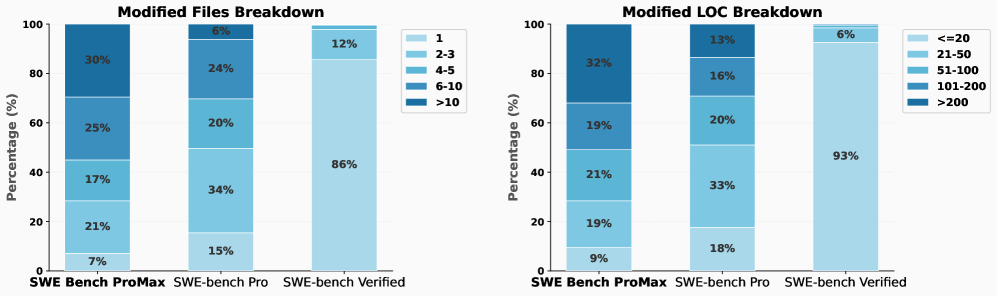
30% of ProMax instances modify more than 10 files and 32% change over 200 LOC, while 86% of SWE-bench Verified instances touch only a single file. This directly stresses cross-file coordination, which is the mechanical core of refactoring.
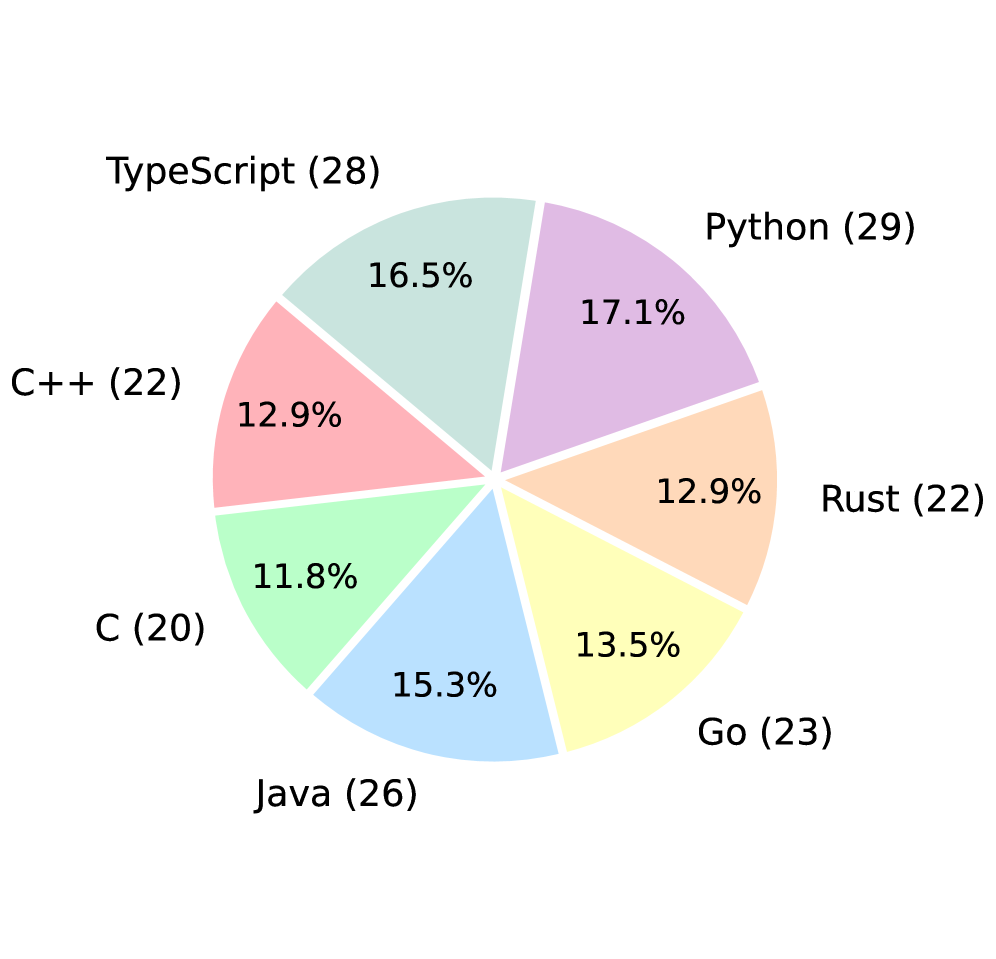
The seven-language split (with roughly balanced counts) also tests whether progress on Python transfers to systems languages like C, C++, Rust and to TS/Go — a stronger generality claim than Python-only benchmarks support.
Experimental setup
Two scaffolds are used: mini-swe-agent (minimal file-view/edit/search/bash loop, the de facto standard for SWE-bench evaluations) and OpenHands (richer sandboxed runtime with structured file-edit tools). Both are capped at 300 steps and $10 per instance. Six models are evaluated: proprietary (Gemini-3-Pro, Claude Sonnet 4.6, GPT-5.2) and open-weight (GLM-5, Kimi-K2.5, Qwen3.5).
Results
The benchmark is hard. The best configuration, GPT-5.2 under OpenHands, resolves 41.2% of instances — far below the 75%+ frontier agents report on SWE-bench Verified. Under mini-swe-agent the top score is 30.6% (Claude Sonnet 4.6), with Gemini-3-Pro and Kimi-K2.5 tied at 26.5%.
Scaffold effects are large and asymmetric. Every model except Gemini-3-Pro improves substantially when moving from mini-swe-agent to OpenHands: GPT-5.2 jumps from 21.8% to 41.2%, Claude Sonnet 4.6 from 30.6% to 38.8%, GLM-5 from 22.9% to 36.5%, Qwen3.5 from 20.6% to 36.5%. Gemini-3-Pro regresses (26.5% → 19.4%), suggesting tool-schema or interaction-pattern mismatches. The gap implies that a substantial fraction of “capability” measured on refactoring tasks is scaffold-mediated: richer file-editing primitives amortize the coordination cost of touching many files.
Open-weight models are cost-competitive. Under OpenHands, GLM-5 (36.5%, $0.24), Qwen3.5 (36.5%, $0.78), and Kimi-K2.5 (32.9%, $0.72) come within a few points of GPT-5.2 (41.2%, $3.60) and Claude Sonnet 4.6 (38.8%, $4.77) — roughly a 5–20x cost reduction for a small resolve-rate delta. Step counts also differ sharply: Qwen3.5 averages 141–155 steps versus 25–58 for Gemini-3-Pro, indicating very different search/edit strategies rather than uniform “reasoning length.”
Per-language leadership is fragmented. No model dominates across all seven languages. GPT-5.2 leads on Python (48.3%) and C (75.0%); Claude Sonnet 4.6 leads on TypeScript (53.6%) and Rust (63.6%); GLM-5 leads on Java (34.6%); Kimi-K2.5 on Go (43.5%); Qwen3.5 on C++ (54.5%). Variance within a language is also striking — Gemini-3-Pro scores 0.0% on TypeScript while Claude Sonnet 4.6 scores 53.6%; Qwen3.5 scores 31.8% on Rust under mini-swe-agent but Kimi-K2.5 gets 18.2% under OpenHands. This is more consistent with training-data compositional differences than with intrinsic language difficulty.
C is the easiest language on average (multiple models above 50–75%), which is somewhat counterintuitive; one plausible explanation is that the C instances involve more localized structural refactors, though the paper does not decompose this.
Limitations and open questions
- 170 instances is small; per-language cells (e.g., C with 20 instances implied by the percentages resolving to multiples of 5) have wide confidence intervals, so per-language rankings should be read cautiously.
- The $10 / 300-step cap is generous but still bounds long-horizon refactors; it is unclear how much of the unsolved 60% is capability vs. budget.
- The test-suite-as-oracle formulation inherits the classic problem that behavior preservation is only checked to the extent the tests cover it; the manual review mitigates but cannot eliminate over-/under-specification.
- The scaffold-dependence result (especially Gemini-3-Pro’s regression) is not diagnosed mechanistically.
Why this matters
Refactoring is the natural next benchmark axis once single-file bug-fix suites saturate, and ProMax shows frontier agents still resolve under half of expert-curated multi-file cases. The 20-point scaffold swings and fragmented per-language leadership indicate that current “coding agent” rankings are far from robust, and that open-weight models on richer scaffolds are already a Pareto-competitive option.
Source: https://arxiv.org/abs/2608.09802
SPOT: Sparse Probing and Outcome Calibration for On-Policy Distillation
Problem
On-policy distillation (OPD) trains a student on its own rollouts using per-token reverse-KL against a teacher. This gives dense supervision but has two well-known pathologies. First, reverse-KL is mode-seeking: it can collapse probability onto a single teacher-preferred continuation even when several plausible continuations exist. Second, local teacher probabilities are not calibrated to downstream outcomes — a token the teacher considers likely may lead the student to a wrong final answer, and a lower-probability alternative may lead to a correct one. Teacher entropy H_T(c_t) alone cannot distinguish these regimes: high entropy could mean a few strong candidates or a long tail, and it says nothing about whether the student already covers those candidates.
SPOT addresses two coupled questions raised by this diagnosis: where along a trajectory should we spend extra supervision budget, and what should that supervision look like once we know downstream outcomes.
Method
SPOT is a three-stage acquisition–exploration–exploitation loop applied on top of standard OPD.
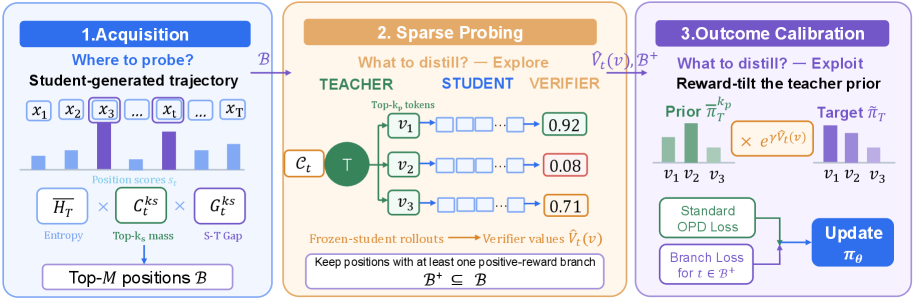
Acquisition (where to probe). For each prefix c_t = (q, x_{<t}) along a student rollout, SPOT computes a scalar position score
s_t = \bar{H}_T(c_t) \cdot C_t^{k_s} \cdot G_t^{k_s},
where \bar{H}_T is normalized teacher entropy, C_t^{k_s} is the top-k_s mass of the teacher (a “concentration” term separating peaky-multimodal from long-tail uncertainty), and G_t^{k_s} is a student–teacher mismatch on that top-k_s set. The product means a position is worth probing only when the teacher is uncertain, its uncertainty is concentrated on a small candidate set, and the student disagrees with the teacher on that set. The top-M scoring positions \mathcal{B} get the probing budget; everywhere else, standard OPD reverse-KL applies.
Exploration (outcome estimation). At each t \in \mathcal{B} and each candidate v \in S_t^{k_p} (the teacher’s top-k_p), SPOT samples a completion y \sim \pi_{\theta_\text{old}}(\cdot \mid c_t, v) and scores it with a verifier R to form a Monte-Carlo value estimate \hat V_t(v). Positions with at least one positive-reward candidate are retained as \mathcal{B}^+; positions where all continuations fail contribute no branch signal (avoiding degenerate targets).
Exploitation (what to distill). Given \hat V_t, SPOT constructs a reward-tilted teacher distribution over the candidate set,
\tilde\pi_T(v \mid c_t) \propto \pi_T(v \mid c_t)\,\exp(\gamma\,\hat V_t(v)),
which is the closed-form solution to a KL-regularized maximization \max_p \mathbb{E}_p[\hat V_t] - \gamma^{-1}\mathrm{KL}(p\Vert \pi_T). Inverse temperature \gamma controls how aggressively downstream success reshapes the local target while anchoring to the teacher.
The overall loss combines standard OPD with a branch term on \mathcal{B}^+:
\mathcal{L} = \frac{1}{T}\sum_{t=1}^T \mathcal{L}_t^{\text{OPD}} + \frac{\beta}{\max\{1,|\mathcal{B}^+|\}}\sum_{t\in\mathcal{B}^+}\mathcal{L}_t^{\text{Branch}},
with \beta the branch weight (default 0.1). Mechanically, the branch term is a top-k_p forward-KL / cross-entropy against \tilde\pi_T — the same structural form as EOPD’s forward-KL correction, but with (i) a learned, mismatch-aware position selector instead of a fixed entropy threshold and (ii) outcome-calibrated targets instead of raw teacher probabilities.
Results
The experimental setup follows Jin et al. (2026): Qwen3-8B (thinking off) as teacher; Qwen3-0.6B/1.7B-Base students trained on MATH, Qwen3-4B-Base on DAPO. Evaluation is zero-shot on MATH-500, AIME 2024/2025, AMC 2023, Minerva Math, and HMMT 2025 with 8 samples per problem, T=1.0, top-p=0.8, 8192-token budget. Baselines are KD, OPD, GRPO, and EOPD.
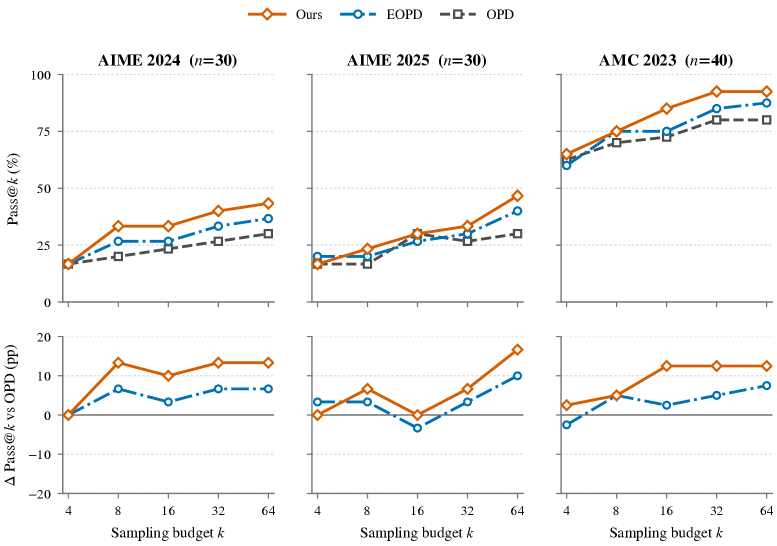
The Pass@k curves are the most diagnostic result: SPOT’s gains over OPD widen with k on AIME 2024/2025 and AMC 2023, indicating that outcome-calibrated targets are preserving solution diversity that reverse-KL alone erodes. Since Pass@k improvements at large k require the student to retain probability mass on multiple correct trajectories, this is direct evidence that the reward-tilted branch targets counteract mode collapse rather than merely re-ranking the argmax.
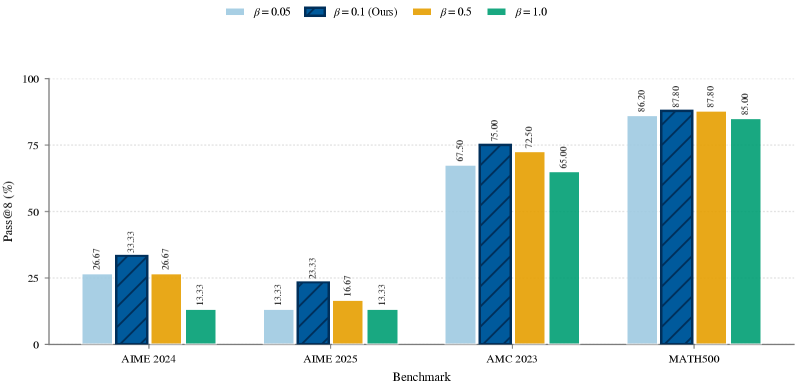
Sensitivity to \beta on Qwen3-1.7B-Base is mild across \{0.05, 0.1, 0.5, 1.0\}, with the chosen \beta=0.1 near the peak — suggesting the branch loss is a useful regularizer but not knife-edge in its calibration.
Limitations and open questions
The exploration step is expensive: each probed position requires k_p auxiliary rollouts scored by a verifier, and the method presumes a reliable outcome verifier R — a strong assumption outside math and code. Positions where all candidates fail contribute nothing, so SPOT provides no signal in regimes where the student is uniformly weak; this may bias learning toward already-near-correct trajectories. The acquisition score has three hyperparameters (k_s, M, \gamma) plus \beta and k_p, and the paper only ablates \beta in the excerpts shown. Finally, all experiments use a single teacher family (Qwen3) on math benchmarks; whether the position score generalizes when teacher and student tokenizers or capability gaps differ substantially remains untested.
Why this matters
SPOT operationalizes a principled fix to reverse-KL mode collapse in on-policy distillation: use verifier rollouts to reshape the target distribution at a small set of high-leverage positions, rather than uniformly trusting the teacher’s local probabilities. The rising Pass@k gains suggest this is a genuine mechanism for preserving solution diversity under distillation, which matters for any downstream use of best-of-n or search.
Source: https://arxiv.org/abs/2608.04419
OasisKV: Scaling In-Decode KV Cache Beyond HBM with Lookahead Sparse Prefetching
Problem
LLM decode throughput has become memory-bound. For long-context workloads, the KV cache dominates both HBM capacity and memory traffic: it grows linearly in context length and per-request, capping batch size and thus tokens/s per GPU. The obvious fix — spill the KV cache to CPU DRAM or remote memory — normally puts PCIe (or NIC) latency on the critical path of every decode step. OasisKV’s goal is to keep only a sparse working set of KV entries in HBM and stream in the rest from a higher-capacity tier, without the retrieval latency showing up in per-token latency (TPOT).
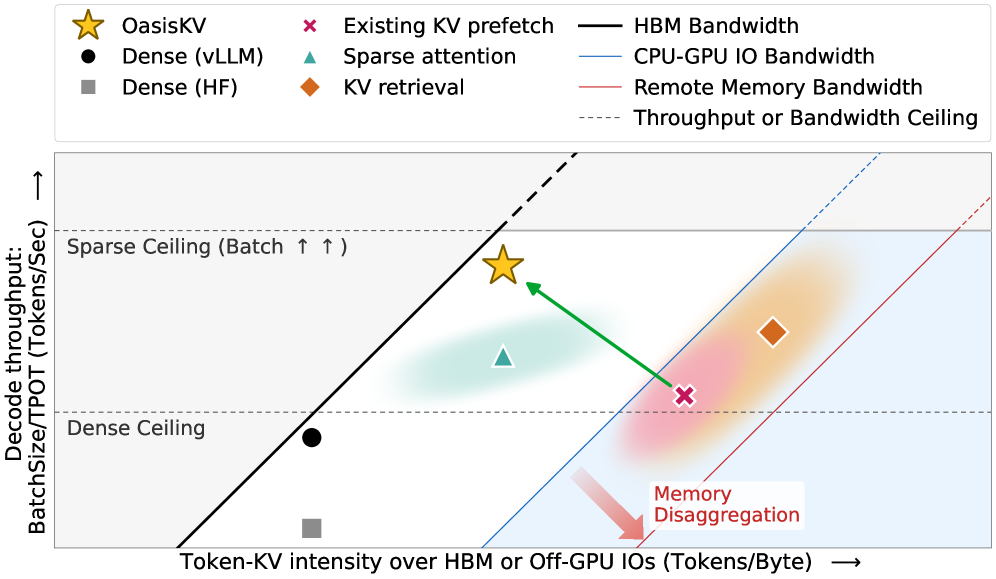
The roofline in Figure 1 formalizes the constraint: decode throughput is bounded by \text{Token-KV intensity} \times \text{KV bandwidth}, with three tiers (HBM, host DRAM over PCIe, remote memory) as slope-1 roofs. Sparsity increases Token-KV intensity (fewer KV bytes per generated token), which is the lever OasisKV pulls to make lower-bandwidth tiers viable.
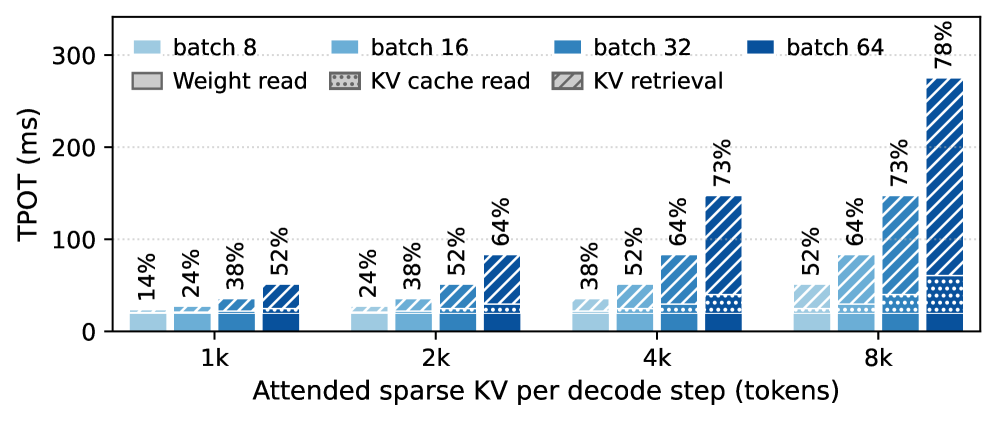
Figure 2 quantifies why naive on-demand fetching is untenable: even with only 10% of the attended KV fetched from CPU DRAM per step, the PCIe transfer dominates TPOT. Prefetching is thus mandatory, but prefetching only helps if the predicted set of important KV blocks matches what the next step will actually attend to.
Method
OasisKV’s central observation is that speculative decoding already produces a lookahead token one step ahead of the committed decode; the query vector of that draft token is a far better predictor of the next step’s important KV blocks than the current token’s query. The paper’s Figure 4 (referenced in Section 3.1) shows that using the previous-token query as a top-20 block predictor gives inconsistent, layer-varying accuracy, while the lookahead-token query recovers the true top-K blocks reliably. Crucially this is training-free from the deployer’s side: it reuses draft/MTP modules that ship with the model.
Architecturally, OasisKV splits execution across three planes:
- Compute plane. A foreground CUDA stream runs the sparse forward pass. Three background streams run (i) top-K prediction against compressed per-head key summaries kept in HBM, (ii) KV block selection, and (iii) KV transfer via a UVA gather kernel that reads block-head entries from pinned CPU memory directly into resident GPU pages over PCIe. CUDA events serialize the per-layer dependencies among the four streams.
- Memory plane. The full KV cache lives in pinned CPU DRAM (non-disaggregated) or in remote memory (disaggregated, via NIXL 1.3.0 over UCX 1.21.0). HBM holds only the sparse working set plus the draft KV state and compressed key summaries — the latter two are small.
- Control plane. A pool manager tracks block tables; the scheduler routes each request between dense prefill and the sparse-decode+prefetch pipeline.
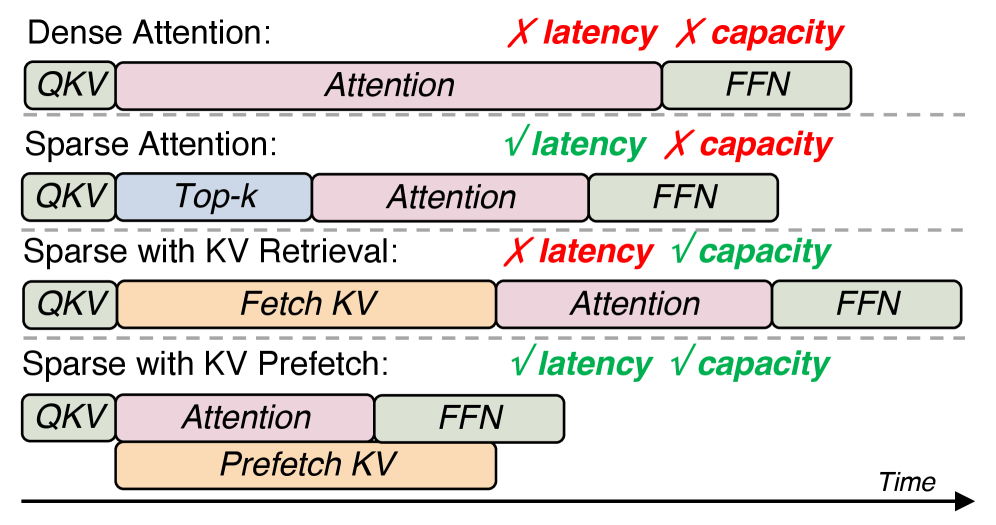
Figure 3 shows the timing: on-demand retrieval extends TPOT by the PCIe fetch; OasisKV’s lookahead prefetch overlaps prediction, selection, and transfer with the current decode step so that when the next step runs, its required KV blocks are already staged in HBM.
Prediction is done head-wise: for each attention head the top-K blocks are chosen by scoring the lookahead query against compressed key summaries. This preserves the head-level specialization that a single unified top-K would blur. The same lookahead signal drives partial remote fetching in the disaggregated setup, so remote transfers stay off the TTFT critical path and do not require the decode node to buffer the full remote KV in DRAM.
Implementation
Built on vLLM v0.12.0 (V1 engine). Extensions: sparse-attention backend, GPU model runner, KV-cache manager, dense-to-sparse scheduler transition. Compressed-key updates, head-wise top-K, sparse page mapping, and KV transfer are implemented in C++/CUDA. Persistent C++ workers dispatch the three background stages on separate streams. The gather kernel uses UVA to pull block-head entries from pinned host memory directly into GPU pages, avoiding staging buffers.
Limitations and open questions
The provided sections do not include end-to-end throughput or accuracy numbers, so the magnitude of the win over dense vLLM and over prior sparse-KV systems (Quest-style, NSA, DSA) is not quantified here. Several design points also invite scrutiny: (i) accuracy hinges on the draft model tracking the target model’s attention patterns — degradation under weak drafters or long reasoning chains is not characterized; (ii) the PCIe gather kernel’s effective bandwidth under contention with NCCL traffic in tensor-parallel setups is unclear; (iii) compressed key summaries add HBM overhead that scales with context and heads, and the compression scheme is not detailed in the excerpted sections; (iv) when speculative decoding rejects the draft, the lookahead query becomes stale — the fallback path (drop vs. corrective on-demand fetch) determines worst-case TPOT.
Why this matters
Speculative decoding and sparse-attention KV prefetching have mostly been treated as independent optimizations. OasisKV exploits the fact that SD already produces a one-step lookahead query, turning it into a training-free, high-accuracy predictor for KV block selection — the missing piece that makes CPU/remote KV tiers usable on the decode critical path. If the accuracy claims hold, it is a practical route to decoupling batch size from HBM capacity in production LLM serving.
Source: https://arxiv.org/abs/2608.08097
RoMeRL: Balancing Feedback Coverage and the Memory-Reward Trap in Self-Evolving Agent Memory via Reduced-Order Utility States
Problem
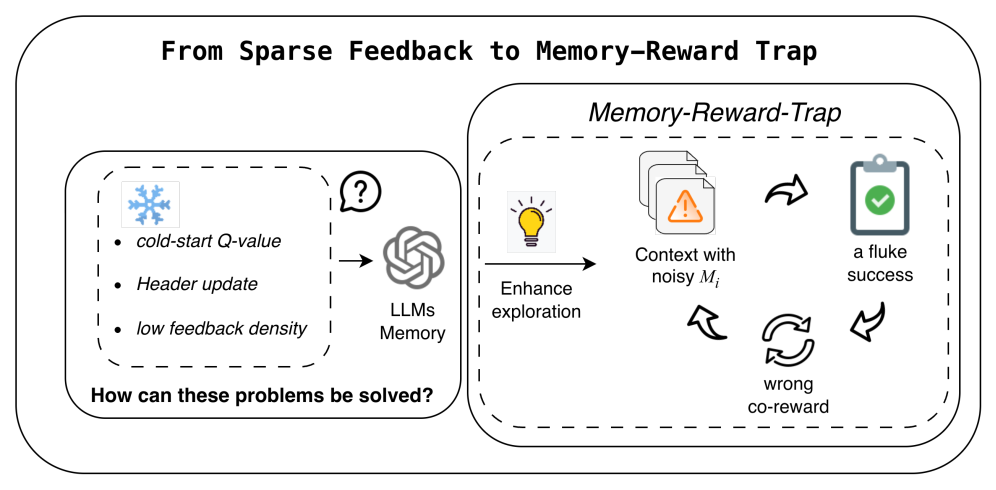
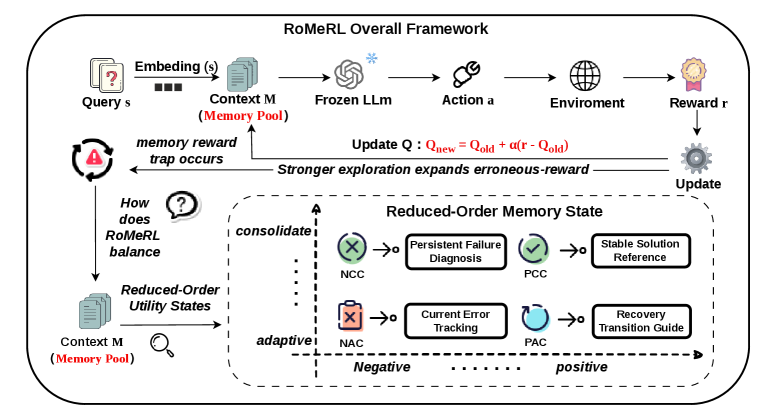
Self-evolving LLM agents accumulate trajectories in an external memory and learn per-memory utilities from downstream task rewards. Two structural problems arise. First, the utility state is trajectory-indexed: every new stored trajectory m_i introduces its own Q_i, so the parameter set grows unboundedly with interaction history while feedback stays roughly constant per task. Second, rewards are only observed at the bundle level over the retrieved set \mathcal{S}_t, so co-retrieved but causally irrelevant memories inherit credit—an attribution failure the authors call the memory-reward trap (MRT). Stronger exploration exacerbates the trap: broader coverage exposes more cold memories to spurious positive updates.
Formalizing the credit gap
The paper distinguishes three quantities per memory: the observational utility \mu_i = \mathbb{E}[R_t \mid m_i \in \mathcal{S}_t], the interventional utilities v_i^1, v_i^0 under \operatorname{do}(\cdot), and the marginal contribution \theta_i = v_i^1 - v_i^0. Empirical MC estimation gives \hat Q_i \to \mu_i, not \theta_i; the shortfall decomposes as
\mu_i - \theta_i = v_i^0 + a_i, \qquad a_i = \mu_i - v_i^1,
where v_i^0 is the task baseline and a_i is attribution bias from retrieval selection and co-retrieved context. This gap G_t = \max_i |v_i^0 + a_i| does not vanish with more data.
Theorem 2 quantifies the dimensionality cost of full-pool estimation: to achieve |\hat Q_i - \mu_i| \le \epsilon uniformly with probability 1-\delta over N_t trajectories, Hoeffding plus union bound requires
F_T = O\!\left(\tfrac{N_t}{\epsilon^2}\log\tfrac{N_t}{\delta}\right), \qquad T = O\!\left(\tfrac{N_t}{k\epsilon^2}\log\tfrac{N_t}{\delta}\right),
i.e., feedback demand scales linearly in the memory-pool size. Combined with a non-vanishing G_t, trajectory-indexed learning is doubly disadvantaged.
Method: reduced-order semantic coordinates
RoMeRL collapses the N_t-dimensional utility vector into a fixed 2\times 2 state indexed by outcome polarity \mathcal{O}=\{+,-\} and memory dynamics \mathcal{D}=\{\mathrm{C},\mathrm{A}\} (consolidated vs. adaptive). This yields four semantic coordinates PCC, PAC, NCC, NAC. For task g, history D_{g,t} is mapped by \Phi to
\mathbf{Z}_{g,t} = \big[z_{g,t}^{o,d}\big]_{(o,d)\in\mathcal{O}\times\mathcal{D}} \in \mathbb{R}^{2\times 2}.
Consolidated slots retain globally selected evidence; adaptive slots track current state or transitions. New experiences are absorbed via retention, promotion, and replacement rules that update the content of each coordinate rather than allocating a new Q_i. Because the utility support is bounded, per-coordinate feedback density grows as roughly F_T / 4 instead of F_T / N_t, and the erroneous-coordinate occupancy admits a steady-state analysis under a generic coordinate-transition model (details in the appendix).
Results
On the unified benchmark suite (LifelongAgentBench OS/DB, six ALFWorld task types, AppWorld) with frozen backbones, RoMeRL attains an average score of 0.753 vs. 0.724 for the strongest baseline MemRL (+2.9 pp). It wins last-epoch SR on both LifelongAgentBench tasks and five of six ALFWorld types. On AppWorld it lifts SGC from 0.286 to 0.326 (+4.0 pp) with TGC essentially matched (0.306 vs. 0.313).
Feedback dynamics are more informative than headline SR. MemRL’s Cold-Q ratio (fraction of utilities with insufficient updates) drifts up from ~29% to 44.9% as the pool grows; RoMeRL drives it down from ~28% to 9.0%, while feedback density per coordinate rises from 4.96 to 29.93 (6.0\times). Resource cost also drops: LLM calls fall from 570K to 450K (-21.1\%) and memory pool from 45K to 7K (-84.4\%), consistent with the bounded-support argument.
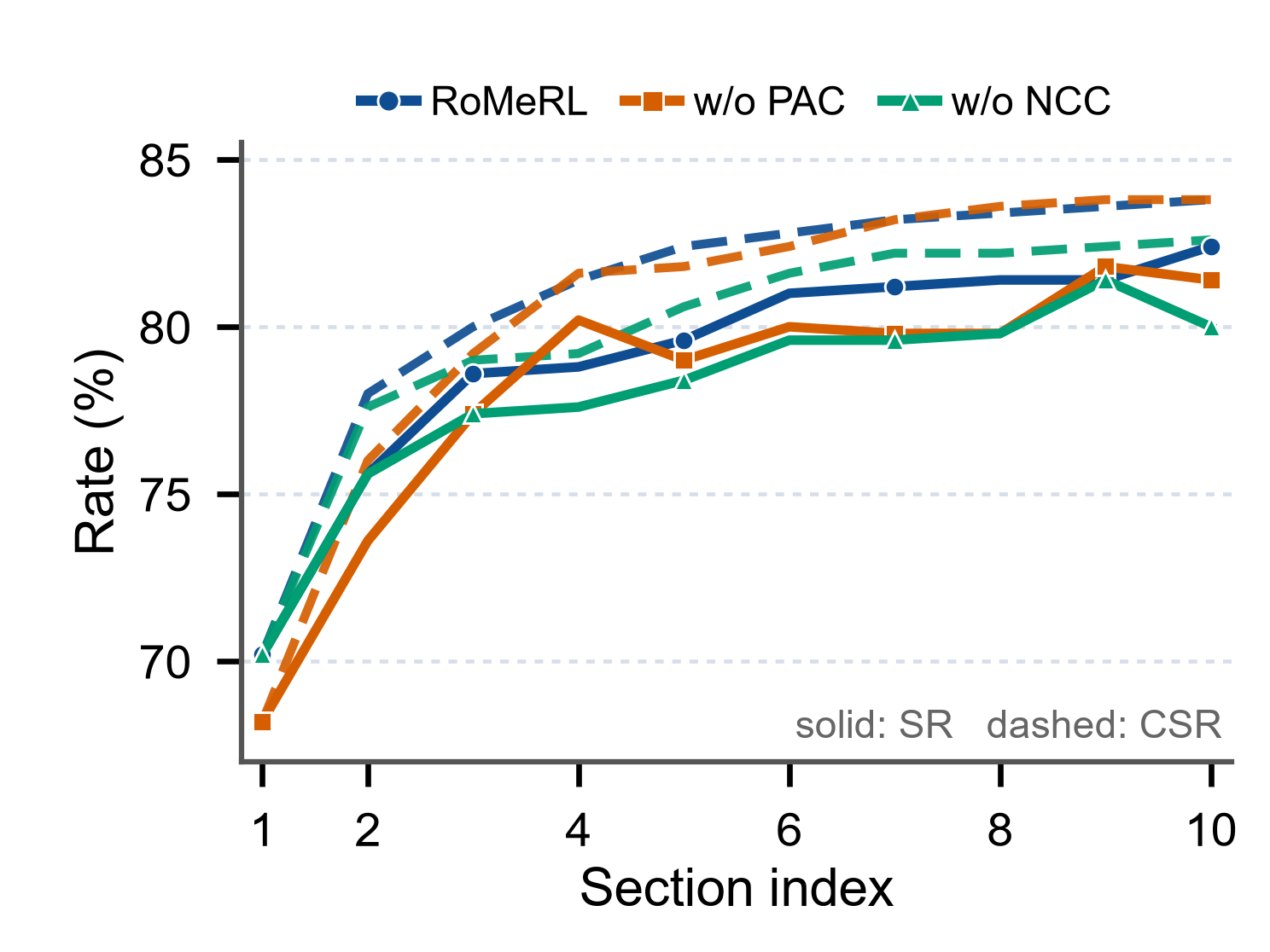
The MRT stress test isolates attribution robustness. Augmenting MemRL with UCB exploration increases positive noise updates from 3.7 to 7.2 and final noise ratio from 1.02% to 1.20%—i.e., stronger exploration worsens the trap. RoMeRL caps these at 2.4 and 0.15% respectively while achieving the highest SR (82.0%). The coordinate ablation confirms all four slots contribute; removing any degrades both SR and CSR on OS.
Limitations and open questions
The 4-coordinate factorization is a strong inductive bias: it presumes outcome polarity and consolidated/adaptive dynamics are sufficient axes. Tasks whose useful memories vary along orthogonal dimensions (e.g., tool identity, temporal recency structure) may need a larger or task-conditioned \mathcal{I}^{\mathrm{fact}}. The theoretical guarantees address raw-return estimation and coordinate occupancy but do not eliminate the credit gap G_t; marginal-contribution estimation would still require interventional or counterfactual signals, which RoMeRL does not collect. Retention/promotion/replacement rules are heuristic and their optimality is not characterized. Finally, benchmarks are agentic but bounded; behavior at 10^6-scale trajectories or with continually shifting task distributions is untested.
Why this matters
RoMeRL reframes agent-memory learning as a dimensionality problem: unbounded trajectory-indexed utility spaces are statistically hopeless under bundle-level rewards, and increasing exploration only sharpens the trap. A fixed-dimensional semantic factorization is a simple, transferable fix that decouples feedback concentration from pool growth, and the reported 6× feedback density and 84% pool reduction suggest the mechanism, not just the tuning, is doing the work.
Source: https://arxiv.org/abs/2608.02508
Evidence-RL: Towards Evidence-intensive Visual Reasoning
VLMs frequently produce correct answers for the wrong reason: language priors, dataset shortcuts, or attention to irrelevant regions. This paper introduces Counterfactual Evidence Disentanglement (CED), a training-time audit that asks whether a sampled answer causally depends on a hypothesized locus of visual evidence, and folds the resulting signal into GRPO post-training. Unlike perturbation-based perception rewards (which globally corrupt the image) or attention-based proxies (which measure correlation, not counterfactual dependence), CED tests whether removing a specific object-centric region actually degrades the model’s support for its own answer more than removing matched decoy regions does.
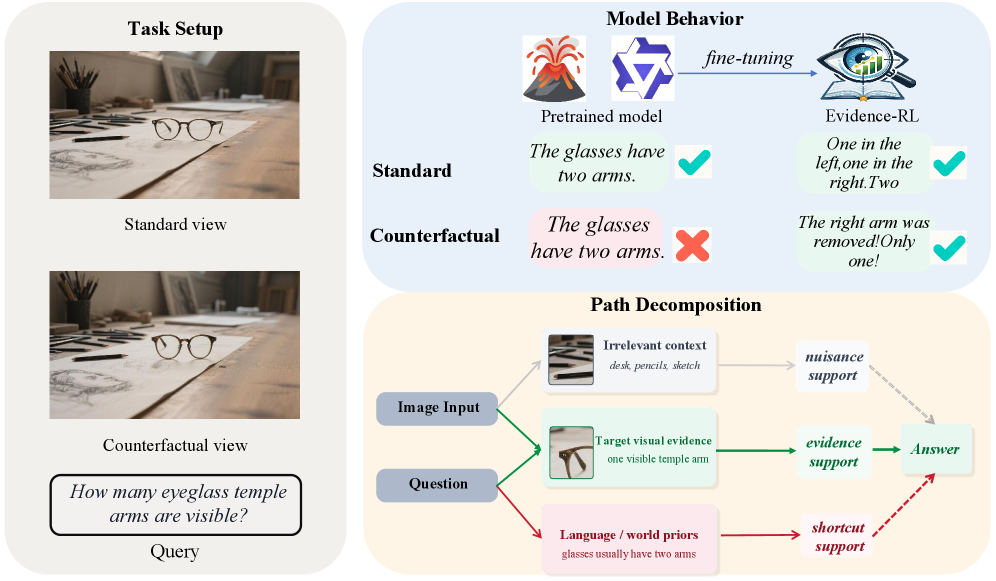
The motivating decomposition (Figure 1) is a three-path causal view of a VLM response: the answer y can be supported by the target evidence, by irrelevant visual context, or by language priors. Correctness alone cannot distinguish these paths — a model that always answers “4” for “how many chairs” on training-similar scenes will look correct without inspecting the image.
Method
Given image I, question q, and a sampled answer y, CED requires an Evidence Region \Omega^{\mathrm{ev}} (obtained from weak, question-agnostic object proposals — no per-question annotation) and K area-matched, spatially disjoint non-evidence Regions \{\Omega^{\mathrm{non}}_k\}. The intervention operates in visual-token feature space after spatial merging: tokens indexed by \mathcal{T}(\Omega) are replaced by the mean \boldsymbol{\mu}_T of neighboring tokens,
\tilde{\mathbf{h}}_i = \begin{cases}\boldsymbol{\mu}_T & i \in \mathcal{T}(\Omega),\\ \mathbf{h}_i & \text{otherwise}.\end{cases}
Mean replacement removes region-specific content while preserving the token manifold, avoiding out-of-distribution artifacts that zeroing or Gaussian noise introduce (ablated in §4.3.3). The per-region evidence sensitivity is the counterfactual log-likelihood drop
s(\Omega) = \log\pi_\theta(y\mid I,q) - \log\pi_\theta(y\mid \tilde{I}_{\setminus\Omega}, q),
and the bounded contrastive margin is
m(I,q,y) = \tanh\!\left(\frac{s(\Omega^{\mathrm{ev}}) - \mu(s^{\mathrm{non}})}{\sigma(s^{\mathrm{non}})+\epsilon}\right).
The non-evidence set defines a sample-local null distribution: the same intervention on area-matched decoys yields a distribution of drops attributable to generic masking artifacts and nuisance context. Only when \Omega^{\mathrm{ev}} produces a drop that exceeds this null — a z-score into \tanh — does the margin approach +1. This is a per-rollout audit; it requires two additional forward passes per region but is training-only, adding zero inference overhead.
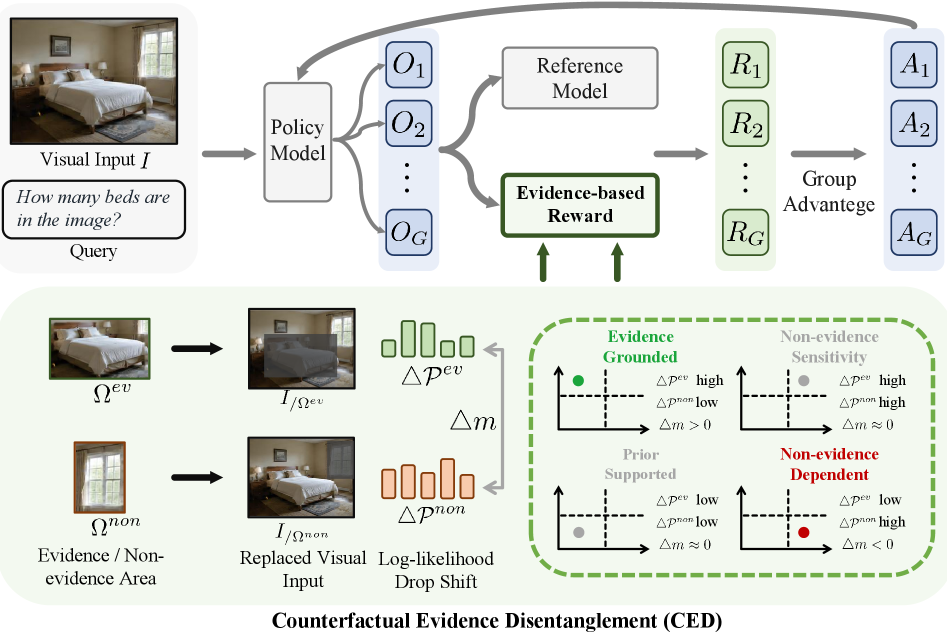
The margin is combined with a correctness indicator via a gate g(m) and used as the GRPO reward. Because GRPO normalizes advantages within a group of rollouts sharing the same prompt, CED’s role is to break ties between correct-but-prior-driven and correct-and-grounded trajectories.
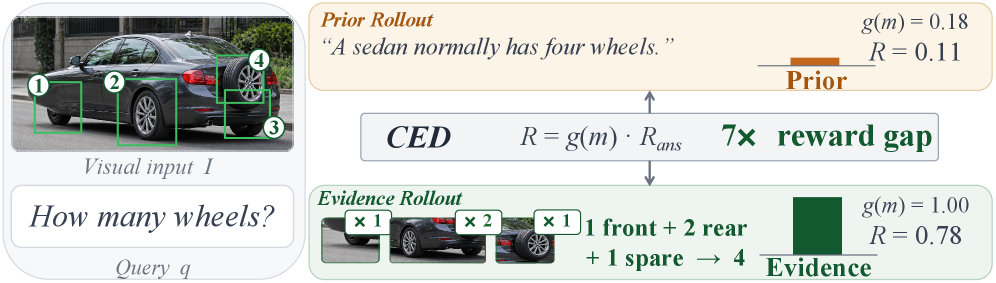
Figure 3 illustrates the intended effect: two rollouts in a GRPO group both answer “4” correctly, but the prior-based one receives g(m)=0.18, R=0.11 while the grounded one gets g(m)=1.00, R=0.78 — a 7\times gap that steers policy gradients toward the evidence path.
Signal validation and results
Before RL, the authors verify that the reward is discriminative. On counting tasks, 99.5% of GRPO groups have non-constant raw rewards and 90.0% contain same-answer trajectories with different rewards, confirming within-group discrimination beyond string matching. Presence (yes/no) tasks are less informative: 79.0% of groups have zero reward variance and only 5.0% have same-answer/different-reward pairs, consistent with the two-action structure collapsing the counterfactual — the model can flip the yes/no likelihood via priors alone. Mean reward standard deviation is 0.1299 (counting) vs 0.0497 (presence).
Across nine benchmarks — CountBench, SpatialEval, HallusionBench, VLMsAreBlind, FREAK, MathVista, MMBench, MMMU, ScienceQA — and four backbones (Qwen2.5-VL-3B/7B, Qwen3-VL-8B, Qwen3.5-9B), CED outperforms recent RL post-training baselines with matched backbones. The paper positions Answer-CED as the default variant; the training/eval split has no image overlap.
Limitations
The method inherits its evidence hypotheses from weak object proposals, so tasks whose evidence is not object-shaped (fine-grained texture, global scene gist, OCR spans) may lack a useful \Omega^{\mathrm{ev}}. Presence-style binary tasks yield weak signal, as the diagnostics show. Two extra forwards per region multiply training cost roughly by 1+K in the intervention passes, though this is amortized against inference-time neutrality. The margin depends on mean-token replacement being a clean intervention; while ablations favor it over zeroing/noise, feature-space edits still leak information through cross-attention and positional encodings. Finally, the “causal” interpretation is at the level of the model’s likelihood surface, not the underlying data-generating process — CED tests whether the policy uses the region, not whether the region uniquely determines the answer in the world.
Why this matters
Perception-aware rewards for VLMs have largely relied on correlational proxies (attention, global augmentation). CED is a per-sample counterfactual with a proper local null, and it plugs cleanly into GRPO where within-group tie-breaking is exactly what shortcut learning needs. If the cross-backbone gains hold up, this is a template for evidence-conditioned RL that generalizes beyond VLMs to any policy where correctness under-determines the reasoning path.
Source: https://arxiv.org/abs/2608.08021
Evo-Bench: Can Language Models Improve Agent Harness?
Problem
Agent evaluations conflate two capabilities: the base model’s ability to solve tasks, and its ability to modify the code that scaffolds its own tool use, context management, and control flow — what the authors call the harness. As frontier models saturate static benchmarks, “harness evolution” is a natural next axis: can a model, given a running agent codebase and validation feedback, autonomously diagnose failures and rewrite its own scaffolding to improve performance? Existing benchmarks fail to isolate this because (i) gains from a better model and a better harness are entangled, (ii) small validation suites invite overfitting, and (iii) short horizons don’t stress iterative research behavior. Evo-Bench is designed to close these gaps.
Setup and formalism
Each run fixes a policy model \pi and a distinct evolver model E. The policy agent at iteration t is A_t^{\mathrm{task}} = (\pi, H_t), where H_t is the editable policy harness. The evolver A^{\mathrm{evo}} = (E, \mathcal{H}_{\mathrm{evo}}) runs on its own fixed evolve-harness (a Claude Code-style loop with trajectory analysis and experiment tracking baked in). At each step, E consumes the cumulative evidence
\mathcal{E}_t^{\mathrm{val}} := \bigl((H_i, j_i^{\mathrm{val}}, O_i^{\mathrm{val}})\bigr)_{i<t}
— prior harnesses, aggregate validation scores, task-level outcomes, trajectories, and diagnostics — then edits H_t and requests a new validation evaluation. A budget \mathbf{b} = (b^{\mathrm{iter}}, b^{\mathrm{time}}, b^{\mathrm{steps}}) (default: 20 iterations, 1000 evolver steps, 48 hours) bounds the run. The final H_T is frozen and scored on a disjoint held-out suite \mathcal{D}_{\mathrm{eval}}.
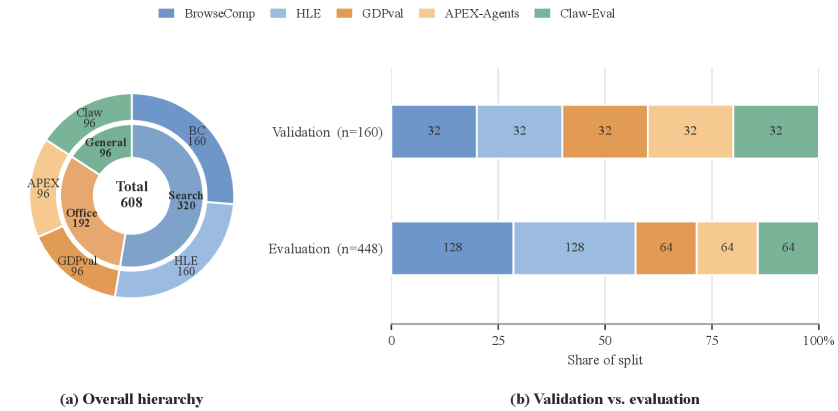
The benchmark spans three domains — search (BrowseComp, HLE), office (GDPval, APEX-Agents), and general agent (Claw-Eval). \mathcal{D}_{\mathrm{val}} has 160 tasks (32 per source); \mathcal{D}_{\mathrm{eval}} has 448 tasks (128 BrowseComp, 128 HLE, 64 GDPval, 64 APEX-Agents, 64 Claw-Eval). Only \mathcal{D}_{\mathrm{val}} is visible during evolution.
Harness-guided construction
The most technically interesting contribution is the two-stage construction that operationalizes harness sensitivity and cross-suite alignment.
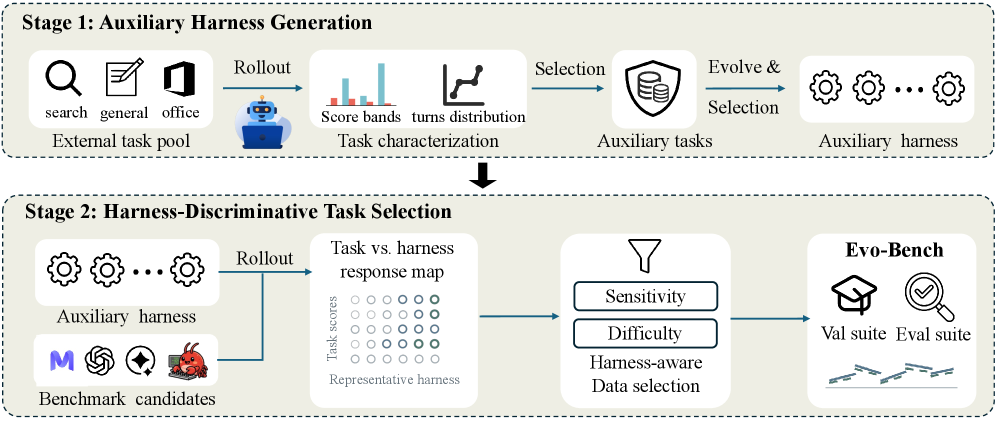
Stage 1 — auxiliary harness generation. From corpus- and instance-disjoint sources (MiroRL, RedSearcher, Auto-ClawEval, plus internal data), 320 auxiliary tasks are filtered by low pass-rate and long trajectories under DeepSeek-V4-Flash — signals that harness variation could plausibly move the needle. Four frontier evolvers (GLM-5.2, Claude-Opus-4.8, Claude-Sonnet-5, GPT-5.6-Sol) run full evolution on these tasks, producing 73 evaluated harness variants. A deterministic diversity-aware selection prunes to \mathcal{H}_{\mathrm{aux}} = \{h_1, \dots, h_{12}\} covering distinct tool-orchestration and program-structure regimes.
Stage 2. Each candidate benchmark task is scored under the 12 auxiliary harnesses to characterize its sensitivity profile (variance across harnesses) and difficulty. Stratified splitting on these profiles produces validation/evaluation suites that (a) genuinely reward harness improvements and (b) match in sensitivity distribution, so validation gains transfer.
Results
The main experiments fix \pi = DeepSeek-V4-Flash and vary the evolver across nine models, starting from a common CodeAct seed H_0. Baselines are the seed itself and an “Artificial” composite of hand-engineered per-domain frameworks (MiroFlow for search, Stirrup for office, Claw-Eval for general).
Top evolvers deliver absolute Overall Score gains up to 16.6 points over the seed and approach the human-engineered composite. This is the headline claim of the paper: with the right evolver, a generic CodeAct seed can be autonomously rewritten to near-parity with domain-specific expert frameworks within a 48-hour budget.
Scaling and generalization
Budget ablations sweep (24\text{h}, 10\text{ iter}, 500\text{ steps}) \to (36\text{h}, 15, 750) \to (48\text{h}, 20, 1000). Both Qwen3.7-Max and GLM-5.2 show monotonic improvement in Overall and Anytime Validation scores. GLM-5.2 climbs sharply through 36h then plateaus; Qwen3.7-Max grows more linearly, suggesting different exploration/exploitation regimes but no sign that returns have saturated at 48h. Cross-model transfer experiments (evolved harnesses swapped onto different policies) are used to argue that the evolved artifacts encode transferable scaffolding rather than policy-specific hacks.
Limitations and open questions
- Only DeepSeek-V4-Flash is used as the fixed policy in main runs; the “cross-suite alignment” property is calibrated against 12 auxiliary harnesses from four evolver families, which may under-represent structurally novel harnesses.
- Validation feedback is aggregate scores plus trajectories on 160 tasks — this is a rich signal, and the gap between validation and held-out generalization is not deeply dissected in what’s excerpted. Overfitting to \mathcal{D}_{\mathrm{val}} statistics is plausible for high-iteration evolvers.
- The Artificial baseline is a composite of domain-specialized frameworks; the “approach SOTA” claim depends on how tuned those baselines are for the specific task distributions here.
- Coding and scientific-research tasks — arguably the most harness-sensitive domains — are deferred to future work.
- Cost accounting is dominated by evolver token spend, which is not obviously fair against static human-engineered baselines that amortize engineering cost differently.
Why this matters
Evo-Bench operationalizes self-modification as a measurable, budgeted capability distinct from raw task-solving, and demonstrates that frontier evolvers can close much of the gap to hand-built domain frameworks starting from a generic CodeAct seed. If the sensitivity-aware construction methodology holds up, this becomes a template for evaluating recursive self-improvement without the usual confound of stronger base models masquerading as better meta-learning.
Source: https://arxiv.org/abs/2608.09096
Hacker News Signals
Muse Glimmer: 30B-parameter model optimized for always-on local agent workflows
Meta Research released Muse Glimmer, a 30B-parameter open model designed for persistent, always-on agentic use cases running locally. The key engineering constraint is that the model must operate continuously without the per-query cost profile of cloud inference, which pushes toward aggressive quantization and a latency budget measured in tokens-per-second on consumer hardware rather than throughput at datacenter scale.
Technically, Glimmer is positioned in the 30B class specifically because that sits at the boundary where 4-bit quantization on a 24–32 GB VRAM consumer GPU becomes tractable. The agentic optimization involves training on tool-use trajectories, multi-turn planning sequences, and long-context coherence tasks, which is meaningfully different from chat-optimized fine-tuning. The model is reported to handle structured output (JSON tool calls, function signatures) with lower hallucination rates on schema adherence than comparably-sized base models.
The “always-on” framing implies the inference stack needs to support interrupt-driven invocation — the model stays resident in memory rather than cold-loading per request. This is a systems constraint as much as a modeling one: KV-cache management for persistent agents that accumulate context over hours or days is non-trivial, and it is unclear from the blog post how Glimmer handles context eviction or summarization for very long sessions.
The open release includes weights and is positioned as a foundation for local agent frameworks (Home Assistant integrations, desktop automation, coding assistants). The 30B scale is a deliberate tradeoff — smaller models in this class lose tool-use reliability; larger ones (70B+) exceed the always-on hardware target.
Limitations: the blog does not publish rigorous evals against BFCL or τ-bench, and “optimized for always-on” is partly a positioning claim. Independent benchmarking on agentic task completion rates versus Qwen2.5-32B or comparable open weights is needed.
Source: https://research.meta.ai/blog/introducing-muse-glimmer-open-agentic-model
The Tragedy of the Cognitive Commons
This arXiv paper applies the classic tragedy-of-the-commons framework to collective epistemic infrastructure — the shared pools of human-generated text, reasoning patterns, and intellectual norms that LLMs are trained on. The core argument is that individual rational use of LLM-generated content creates a negative externality on the quality of the training data commons: as generated text floods the web, future model generations train on increasingly synthetic corpora, degrading the diversity and groundedness of the epistemic base.
The formal structure borrows from Hardin’s resource depletion model but applied to information quality rather than a physical resource. The degradation mechanism is model collapse — well-documented empirically in settings where iterative self-training on generated data causes distributional tightening and loss of tail knowledge. The paper extends this to the societal scale: even without deliberate self-training loops, web-crawled corpora will increasingly contain LLM output, producing a diffuse, distributed version of the same collapse dynamic.
A secondary argument concerns cognitive outsourcing: as individuals delegate reasoning to LLMs, the stock of human-generated high-quality reasoning in future training sets shrinks, independent of direct synthetic contamination. This is harder to formalize but the intuition is coherent.
The paper proposes partial mitigations including provenance watermarking at the ecosystem level, incentive structures for “cognitive commons” contribution (analogous to open-source norms), and data labeling standards that distinguish synthetic from human-originated content.
Limitations: the empirical calibration of the collapse rate at web scale is speculative. The model collapse literature (Shumailov et al., 2024) established the phenomenon in controlled loops; extrapolation to diffuse web contamination requires assumptions about contamination rates and mixing ratios that are genuinely unknown. The policy proposals are high-level and do not engage with enforcement mechanisms.
Source: https://arxiv.org/abs/2607.29380
Show HN: Needle2: 14MB agentic LLM for phones, wearables, smart home and robots
Needle2 is a 14 MB agentic language model from Cactus Compute targeting severely memory-constrained edge devices: microcontroller-class hardware, wearables, and embedded robotics. At 14 MB the model is operating well below the threshold of any standard quantized transformer — this almost certainly implies a non-transformer architecture or an extremely aggressive state-space or RNN-based design, combined with 4-bit or lower quantization and vocabulary pruning.
The “agentic” claim at 14 MB is the technically interesting part. Full tool-call parsing, structured JSON output, and multi-step planning in a model this size requires that the model’s capacity be almost entirely consumed by the task grammar rather than world knowledge. The practical approach is likely domain-specific fine-tuning on a narrow action space (smart home commands, sensor query/response patterns, robot motion primitives) rather than general-purpose reasoning. The model is not competing with GPT-4 on breadth; it is competing with hard-coded finite state machines on flexibility.
The relevant inference stack considerations: 14 MB fits in L2/L3 cache on modern ARM Cortex-M or RISC-V cores, enabling inference without DRAM bandwidth, which matters enormously for battery-powered wearables. Latency for single-token generation on such hardware at INT4 could plausibly reach interactive speeds (tens of milliseconds per token) depending on the core.
The repository does not yet publish the architecture details publicly based on available information. Key open questions are: what is the actual parameter count (14 MB at INT4 ≈ 28M parameters, which is tiny but not unprecedented for task-specific models), what is the vocabulary size, and what is the benchmark task completion rate on the target domains versus rule-based baselines.
Source: https://cactuscompute.com/needle
Learning more about Claude’s mathematical capabilities
Anthropic published a technical investigation into Claude’s performance on problems involving the Riemann zeta function — a non-trivial test case because zeta function identities require combining analytic continuation, contour integration, and number-theoretic reasoning in ways that stress-test whether a model is pattern-matching known results or exhibiting compositional mathematical reasoning.
The post documents a mixed picture. Claude can correctly state and apply standard results (functional equation, Euler product, trivial/non-trivial zero structure) and handle symbolic manipulation for textbook-level problems. Performance degrades on problems that require chaining multiple non-standard identities or constructing novel arguments from first principles — the model tends to produce plausible-looking but incorrect intermediate steps that happen to reach a correct-looking answer.
The mechanistic interest is in where errors occur: the post identifies that Claude is more reliable on algebraic manipulation than on reasoning about convergence domains and analytic continuation, which makes sense given that convergence arguments require careful tracking of quantifiers and domain restrictions that are underrepresented in training relative to algebraic identities.
The post also notes that Claude’s performance is sensitive to problem framing — presenting the same question in a research-paper style versus a textbook-exercise style produces noticeably different reliability, suggesting the model is partially keying on surface format cues to select reasoning strategies.
This contributes to the ongoing empirical project of understanding what “mathematical capability” actually means in LLMs: symbolic manipulation competence, retrieval of known results, and genuine deductive reasoning appear to be distinct abilities that decompose differently across problem types. The Riemann zeta context is a good testbed precisely because it requires all three in combination.
Source: https://www.anthropic.com/research/riemann-zeta
Rust SIMD on the GPU
This blog post from Vectorware examines the feasibility of writing GPU kernels in Rust using explicit SIMD intrinsics, targeting the intersection of Rust’s std::simd (portable SIMD) and GPU compute backends. The technical tension is real: GPU execution is already implicitly SIMD at the warp/wavefront level, but the programming models (CUDA, ROCm, WGSL) typically abstract this away and let the compiler vectorize across threads rather than within a single thread.
The post investigates whether explicit intra-thread SIMD operations (e.g., packing multiple scalar ops into a 128-bit or 256-bit register operation within a single GPU thread) provide any benefit on top of the hardware’s native SIMT execution. The answer is hardware-dependent: on AMD GCDNs with 64-wide wavefronts, there is some room for intra-lane vectorization; on NVIDIA, the warp model makes explicit intra-thread SIMD mostly redundant for arithmetic but potentially useful for specific memory layout operations (e.g., byte-shuffling for quantization).
The Rust angle is relevant because rust-gpu (the Embark-originated compiler backend targeting SPIR-V) has been maturing and can now compile a meaningful subset of Rust — including some SIMD operations — to GPU-executable code. The post explores what subset of std::simd survives this compilation path and where it falls back to scalar.
Practical takeaway: explicit SIMD in GPU kernels written in Rust is a niche optimization useful primarily for data-layout transformations (quantization packing, AoS-to-SoA conversion) rather than compute-bound arithmetic, which the hardware vectorizes automatically across threads. The toolchain is not production-ready but is advancing.
Source: https://www.vectorware.com/blog/simd-on-gpu/
Exploring Claude/GPT Knowledge Cutoffs and Pre-Training Timelines
This blog post applies a systematic probing methodology to infer training data cutoffs and the distribution of recency in pre-training corpora for Claude and GPT models. The method relies on asking models about datable events and tracking where confidence drops, combined with analysis of how models hedge uncertainty about recent versus historical facts.
The technically interesting finding is that knowledge cutoffs are not clean step functions — models exhibit a gradual degradation curve in knowledge quality starting several months before the nominal cutoff date. This is consistent with what is known about web crawl pipelines: data from the most recent months before a crawl is underrepresented because the web has not yet had time to produce secondary coverage (articles, discussions, Wikipedia edits) of very recent events. The model “knows” about events from six months before cutoff much more reliably than events from two weeks before.
The post also surfaces a subtler effect: models tend to underestimate their own knowledge cutoff when asked directly, which the author attributes to the same underrepresentation — if training data about the final months is sparse, the model’s internal calibration of “recent” is systematically shifted earlier.
A secondary analysis looks at the gap between training cutoff and deployment date, which historically has been 6–12 months for major models, and how that gap interacts with model self-reporting. Models confidently give stale answers because they have no signal that deployment has lagged training.
Methodological caveat: this is behavioral probing, not access to actual training data manifests, so all inferences are indirect. The results are plausible and consistent with known data pipeline properties but cannot be independently verified.
Source: https://blog.sshh.io/p/exploring-claudegpt-knowledge-cutoffs
H3-metal: Native MiniMax-H3 inference for Apple Silicon
Antirez (Salvatore Sanfilippo, Redis creator) published a pure C implementation of native inference for MiniMax-H3, a hybrid architecture combining state-space model (SSM) layers with attention layers, targeting Apple Silicon via Metal compute shaders. The project is notable both for its authorship and for the architectural target.
MiniMax-H3 follows the H3 design from the Stanford/Together AI line of work, which interleaves SSM layers (specifically a structured matrix recurrence) with a small number of full attention layers. This hybrid is motivated by the quadratic cost of attention in long contexts: SSM layers provide O(n) recurrence for most of the network depth while a few attention layers preserve the global mixing capability that pure SSMs struggle with.
The Apple Silicon target is non-trivial. The unified memory architecture means CPU and GPU share the same physical memory, eliminating the PCIe transfer bottleneck that dominates GPU inference on discrete cards for memory-bandwidth-bound workloads. Metal compute shaders give direct access to the GPU’s matrix units (AMX on the CPU side, or the GPU shader cores). For SSM layers specifically, the recurrence structure is less embarrassingly parallel than matrix multiply, so the implementation needs to handle the sequential dependency in the recurrence carefully — likely using parallel prefix scan algorithms to expose parallelism.
The implementation is in C with Metal shaders, no Python dependency, which makes the binary footprint small and startup latency low — relevant for the same always-on local inference use case as the Muse Glimmer item above.
Source: https://github.com/antirez/h3.c
How Claude marks AI-generated content
Anthropic published documentation on Claude’s content provenance marking mechanisms. The technical substance covers two distinct mechanisms: C2PA (Coalition for Content Provenance and Authenticity) metadata embedding for image outputs, and a forthcoming approach to text provenance.
C2PA is an open standard using cryptographically signed manifests attached to media files. When Claude generates an image, the output can carry a signed assertion identifying it as AI-generated, including the producing organization and model identifier. The signature chain allows downstream tools to verify the manifest has not been stripped or altered — though C2PA metadata can be removed by resaving the file in a format that does not preserve it, which is a known limitation of all file-metadata-based provenance schemes.
For text, the post describes watermarking rather than metadata: statistical patterns embedded in token selection during generation that survive moderate editing and can be detected by a verifier with access to the detection key. This is the standard invisible watermarking approach — during sampling, the model uses a pseudorandom bias on logits derived from a secret key to create a detectable distributional signature. The tradeoff is that the watermark degrades under heavy paraphrase or translation and does not survive mixing with substantial human-written content.
The policy context matters technically: this is a response to platform and regulatory pressure (EU AI Act provisions on synthetic content disclosure) rather than a purely voluntary transparency measure. The practical robustness of text watermarking against adversarial removal is an active research problem — current schemes are detectable but not robust against a determined attacker who knows the general watermarking strategy. The C2PA approach for images is more robust to accidental stripping but equally vulnerable to deliberate removal.
Source: https://support.claude.com/en/articles/16266773-how-claude-marks-ai-generated-content
Noteworthy New Repositories
rollingSirius/equity-research-skill
A scripted equity-research workflow targeting deep fundamental analysis via LLM-backed agents. The core deliverables are two skills: “九章个股深研” (company deep-dive) and “九章财报深度分析” (earnings report analysis). The technical substance lies in the valuation layer: DCF (Discounted Cash Flow) and EPV (Earnings Power Value) models are implemented as reproducible scripts with explicit parameter tables, so every valuation output is auditable and re-runnable rather than a one-shot LLM hallucination. The emphasis on “可复算” (reproducible computation) is the differentiating design choice — financial assumptions are externalised into structured config rather than buried in prompts. The workflow appears to chain retrieval of financial statement data, normalization into a common schema, and then templated model execution. Useful for quant researchers or fintech engineers who want a structured baseline for LLM-assisted fundamental analysis rather than a black-box report generator. The separation between the reasoning skill layer and the numerical model layer is architecturally sound and reduces the blast radius of prompt drift on final numbers. Gaps include limited documentation of the data-source connectors and no apparent backtesting harness for valuation accuracy over historical periods.
Source: https://github.com/rollingSirius/equity-research-skill
Flaminis/Dalaran
A hard fork of Rerun (https://rerun.io) reoriented specifically toward robotics-first multimodal time-series visualization and data infrastructure. Retains compatibility with existing .rrd recording files — meaning existing Rerun-instrumented codebases can migrate without re-instrumentation. The fork targets ROS 2 natively, implying tighter integration with ROS 2 message types, topic introspection, and possibly bag-file interop beyond what upstream Rerun provides. The “data infrastructure” framing suggests ambitions beyond pure visualization: likely includes storage, indexing, or streaming layers for high-rate sensor data (cameras, LiDAR, IMU, joint states). Built under Apache-2.0, keeping it permissive for commercial robotics use. The rationale for a hard fork rather than upstream contribution is presumably the velocity mismatch between robotics-specific requirements and Rerun’s broader positioning. Engineers running ROS 2-based autonomy stacks who found Rerun’s robotics ergonomics insufficient are the primary audience. Key open questions: divergence management from upstream Rerun improvements, the maturity of the ROS 2 message schema coverage, and whether the storage layer introduces a new query API or reuses .rrd semantics wholesale.
Source: https://github.com/Flaminis/Dalaran
yuwen-cool/yuwen-publish-precheck
A local content compliance pre-screening tool for Chinese short-video and social platforms (Douyin, Xiaohongshu, Channels). The technical design is notable for its grounding strategy: 72 official regulatory citations are embedded verbatim as a verifiable reference corpus, and 38 real-world content samples were used to calibrate the classifier’s decision boundary. The system flags specific sentences, cites the exact official rule violated, and generates directly usable rewrites — structured output rather than vague warnings. The “越用越准” (improves with use) property comes from a local rule accumulation mechanism: user-confirmed violations are persisted into a local knowledge base, effectively fine-tuning retrieval over time without retraining a model. This is a retrieval-augmented generation pattern where the retrieval index is user-grown. The explicit disclaimer that it neither guarantees passage nor teaches circumvention reflects legal positioning. Technically interesting for anyone building compliance tooling because the calibration methodology (fixed sample set + citation-anchored rules) is a reproducible pattern for domains with authoritative rule corpora. Limitations include platform-specific rule coverage and the inherent lag between regulatory updates and corpus refresh.
Source: https://github.com/yuwen-cool/yuwen-publish-precheck
waiterve/wai-play
A platform for automated AI-driven testing and quality evaluation of web-based games. The core problem it addresses is that web games have highly dynamic, visually-driven interfaces that resist conventional DOM-based test automation. The likely approach combines browser automation (screenshot capture or DOM traversal) with a vision-language or LLM-based agent that can interpret game state, execute actions, and evaluate outcomes against quality criteria. “Quality evaluation” implies metrics beyond pass/fail functional tests — potentially covering UX flow, difficulty balance, or anomaly detection in game behavior. Building this on top of a general web automation layer (Playwright/Puppeteer class) with an AI reasoning layer on top is the standard architecture for this problem class. The platform framing suggests it manages test session orchestration, result aggregation, and possibly replay. Practically useful for indie game studios or QA teams who cannot afford manual regression cycles on procedurally generated or frequently updated web games. Sparse public documentation makes it difficult to assess the depth of the AI evaluation component versus the automation scaffolding.
Source: https://github.com/waiterve/wai-play
rengwu/chartr
An agent multiplexer with integrated map-charting capabilities. The “multiplexer” framing implies it routes tasks or conversations across multiple agent instances or backends, potentially load-balancing or specializing by task type. The map-charting component suggests geospatial or graph-based visualization of agent interactions, task routing topology, or literal geographic data — context is ambiguous from available metadata. The combination hints at an orchestration layer where the graph/map output serves as a live representation of agent state or task decomposition structure, which would be a useful debugging and monitoring primitive for multi-agent systems. This pattern — using a spatial or graph layout to make agent orchestration legible — addresses a real observability gap in multi-agent frameworks. Technical implementation details are limited from available description, but the likely stack involves an agent framework (LangChain/LangGraph class or custom), a routing/dispatch layer, and a frontend chart rendering component. Engineers building multi-agent pipelines who need both orchestration control and visual introspection are the target users. Documentation depth is unclear.
Source: https://github.com/rengwu/chartr
cristicretu/diri
A native macOS orchestrator for running multiple coding agents concurrently across isolated git worktrees and remote hosts. Supported agents include Claude Code, OpenAI Codex, Cursor, and Gemini, plus raw shell sessions. The key architectural decision is git worktree isolation per task: each agent operates on its own worktree branch, preventing state collisions when multiple agents touch the same repository simultaneously. Remote host support extends this to SSH targets, making it viable for agents that need compute beyond the local machine. The native macOS implementation (likely Swift/SwiftUI) means it operates as a first-class desktop application rather than a terminal multiplexer wrapper, with implications for window management, credential handling, and OS integration. The parallel execution model with per-worktree isolation solves the primary practical problem of running multiple coding agents on one codebase: merge conflicts and file-level races. Compared to tmux-based approaches, the worktree management is automated. Limitations include macOS exclusivity and the coordination question of how outputs from parallel agents are merged or reviewed — the tool appears to focus on execution isolation rather than result synthesis.
Source: https://github.com/cristicretu/diri
iishyfishyy/operator-oss
A terminal-based multiplexer for running many Claude Code or Codex sessions in parallel across multiple projects from a single interface. The design is local-first with no API key management at the platform level — credentials stay in the user’s environment. Each task is isolated in its own git worktree, mirroring the same isolation strategy as diri but targeting a CLI/TUI interface rather than a native macOS GUI. The “from one screen” constraint implies a TUI layout engine that tiles or tabs agent sessions. The practical value is workflow density: engineers maintaining multiple repositories or running parallel feature branches can dispatch and monitor agent tasks without context-switching across terminal windows or managing process trees manually. The git-worktree isolation is the critical correctness guarantee — without it, parallel agents writing to the same working tree produce non-deterministic file states. Compared to diri, this trades native OS integration for portability across any Unix-like system. The no-API-key-storage stance is a reasonable security posture for a local tool. Open questions include session persistence across crashes, output diffing between parallel agent results, and support for agents beyond Claude/Codex.
Source: https://github.com/iishyfishyy/operator-oss
MIgHTy-alIeN/ai-trader-bot
A on-chain arbitrage bot consisting of two tightly coupled components: a Solidity smart contract that executes atomic multi-DEX trades, and an off-chain automation script (likely Python or JavaScript) that monitors price feeds, identifies arbitrage opportunities, and triggers contract execution. The smart contract handles the atomicity guarantee — the entire arbitrage route either completes profitably or reverts, preventing partial execution loss. The off-chain component handles latency-sensitive opportunity detection across DEX liquidity pools, computes expected profit after gas costs, and submits transactions with appropriate gas pricing. The “AI” framing is likely applied loosely to the opportunity-detection heuristics or parameter tuning rather than to a neural model. The 2,676-star count reflects persistent interest in MEV and on-chain arbitrage infrastructure. Technically, this is a standard flash-loan-free arbitrage architecture; more sophisticated variants incorporate flash loans to avoid capital requirements. Key implementation challenges include front-running resistance (private mempool submission, flashbots bundles), gas optimization in the contract, and slippage modeling. Engineers interested in MEV infrastructure or DeFi tooling will find this a readable reference implementation, though production deployment requires significant hardening against sandwich attacks and competitive bot activity.