Daily AI Digest — 2026-07-29
arXiv Highlights
HiFi-UMI: Learning Deployable Manipulation Policies from High-Fidelity UMI Data Alone
Problem
Universal Manipulation Interface (UMI) style capture — handheld or wearable rigs that record human demonstrations without a physical robot — is the obvious scaling axis for manipulation data, but current practice uses it only as a pre-training corpus and still relies on real-robot teleoperation to “anchor” a policy at post-training. The anchor exists because robot-free data is typically too low fidelity to serve as the terminal action supervision: wrist-camera visual-inertial odometry drifts under occlusion, sensor streams are not tightly synchronized, and narrow FOVs miss contact geometry. HiFi-UMI asks the inverse question: if fidelity is raised at the source, can the real-robot anchor be removed entirely?
Capture system
The authors treat data production as a hardware/software co-design targeting four axes: trajectory accuracy, inter-gripper relative pose, synchronization, and field of view.
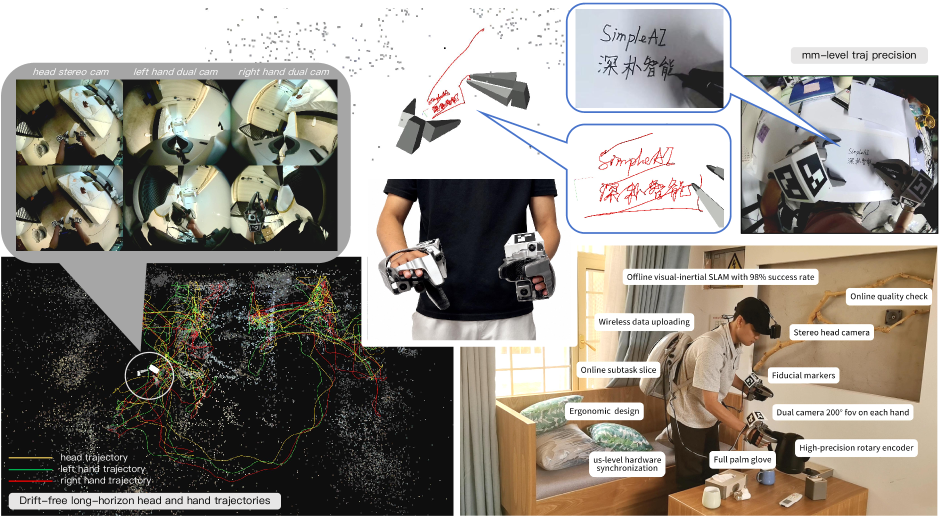
- Pose acquisition. Instead of per-wrist VIO, a head-mounted stereo rig with integrated IMU runs offline stereo-inertial SLAM (ORB-SLAM3 lineage). Each hand carries a rigidly attached AprilTag marker cube localized in the head-camera frame. The global end-effector pose is the composition T^{W}_{\text{hand}} = T^{W}_{\text{head}} \cdot T^{\text{head}}_{\text{cube}} \cdot T^{\text{cube}}_{\text{ee}}. Head viewpoints are stable relative to wrist viewpoints (less self-occlusion and less high-frequency motion), which reduces SLAM failure modes. Because both cubes are seen in one head-camera frame, the bimanual relative pose T^{\text{L}}_{\text{R}} = (T^{\text{head}}_{\text{L}})^{-1} T^{\text{head}}_{\text{R}} is measured natively and inherits per-hand accuracy — no differencing of two independently-drifting global tracks.
- Sensing. Each hand mounts two non-parallel wide-angle fisheye cameras (top and bottom), yielding ~200° coverage per hand; combined with the stereo head pair this gives six views per episode.
- Gripper. A full-palm glove preserves natural human contact while matching the deployment end-effector.
- Synchronization. A shared GPIO trigger provides microsecond-level alignment across all cameras and IMU streams; without this, action labels regress into the wrong observation window.
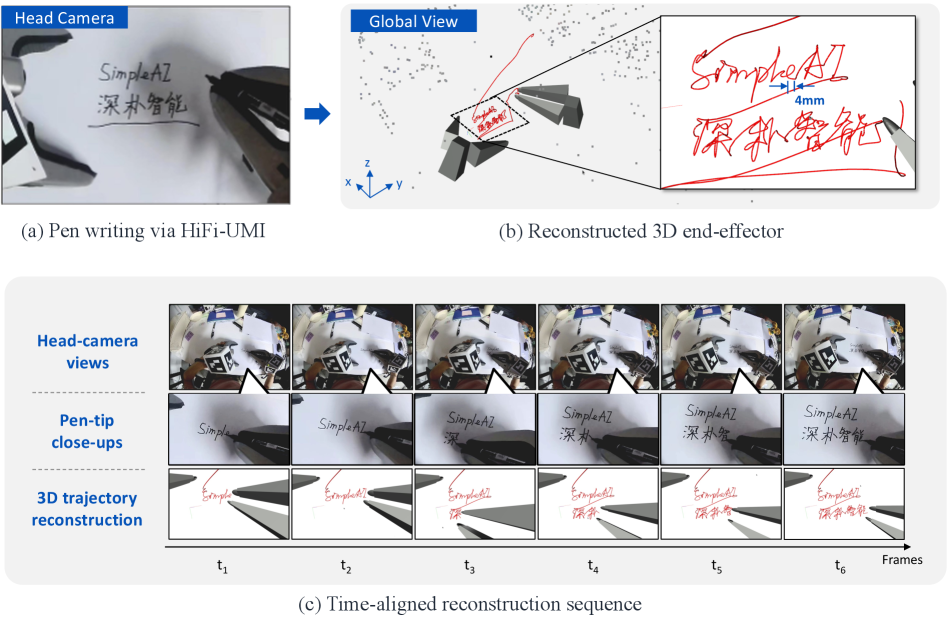
The reported workspace-local end-effector accuracy is 3 mm, without any external tracking infrastructure — comparable to VR-controller tracking but lighter and cheaper. Figure 2 shows the handwriting reconstruction where the 4 mm stroke width of a lowercase “e” is visibly resolved.
Dataset
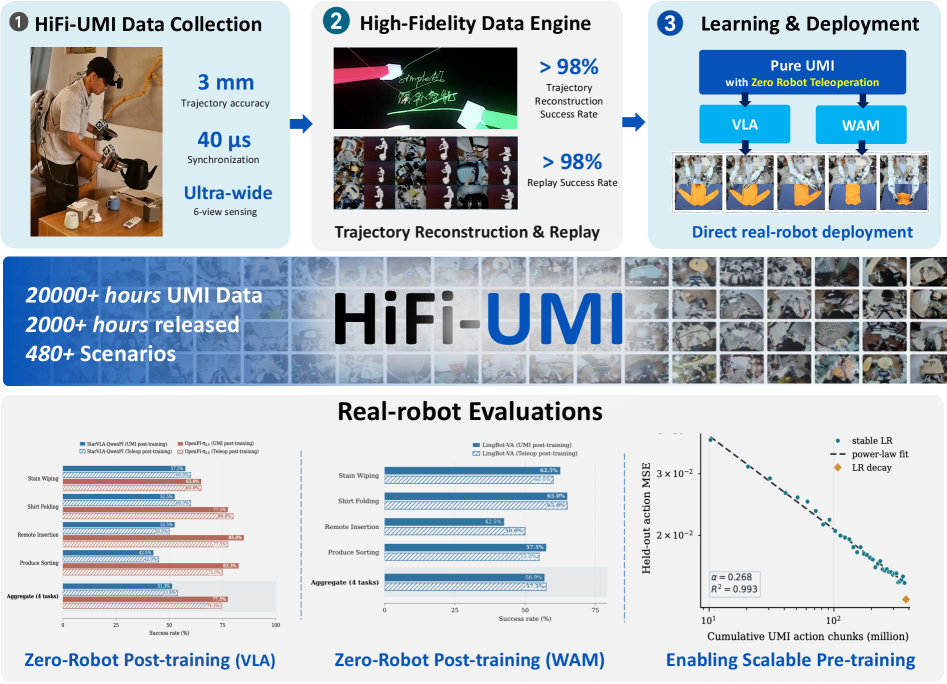
The processed corpus contains >20,000 hours across >4.32M episodes and 480+ scenes, all captured with the six-camera configuration and passing a two-level fidelity gate applied during processing rather than as a post-hoc audit. The publicly released subset, HiFi-UMI-2K, is a curated 2,000-hour, 482,100+ episode, 110+ scene slice, balanced over tasks, scenes, objects, and manipulation attributes via the analysis-and-export stage of the pipeline. Each episode ships synchronized six-view video, calibrated bimanual trajectories, gripper states, language annotations, and subtask boundaries; per-sample quality metadata allows every experimental subset to be traced to its device and review batch. Faces are masked; license is CC BY 4.0.
Zero-anchor post-training experiments
The central claim is that HiFi-UMI data alone — no real-robot teleoperation for the target task — can post-train a policy that deploys directly. To decouple data effect from architecture, three foundation-policy backbones are used: StarVLA-QwenPI and OpenPI-\pi_{0.5} (VLA family), plus LingBot-VA (world-action-model family). Within each backbone, the architecture, initialization, optimizer, and interfaces are frozen; only the task-specific data source is varied. The authors frame convergence across the three families as evidence about the data rather than a pooled architecture comparison.
Deployment uses two 7-DoF Tianji Marvin M6 force-controlled arms with the same gripper and the same four wrist cameras as the capture device; the head stereo pair is used only for offline reconstruction and is dropped at deployment, so the policy sees a strict subset of the recorded views. Actions are end-effector pose targets, interpolated to 125 Hz, IK-solved at 125 Hz, and streamed over EtherCAT at 1 kHz. The residual sim/real gap reduces to arm kinematics — contact and observation interfaces are physically identical.
Evaluation uses 40 rollouts per (task, policy) with separated policy and scene operators, randomized policy order, frozen checkpoints and initial-condition banks, and binary success requiring a 2 s stable final state. Termination causes (timeout, no-progress, unrecovered drop, wrong-object interaction, safety stop) are logged. The abstract reports that the HiFi-UMI-only policies match in-domain teleoperation across all three backbones; the excerpted section body cuts off before the numerical table, but the design pins the comparison to the data axis.
Limitations and open questions
- The excerpted results section ends before the per-task success numbers, so the “matches teleoperation” claim rests on the abstract-level statement rather than a visible table in what is provided here.
- Embodiment gap is deliberately minimized: same gripper morphology, same wrist cameras, matched dynamics through force control. Transfer to a robot whose end-effector diverges from the glove gripper is not tested here.
- Head-mounted SLAM assumes sufficient scene texture and reasonable head motion — pathological low-texture or reflective scenes are not analyzed.
- Bimanual relative pose accuracy depends on both cubes being simultaneously visible in the head cameras; wide-baseline bimanual tasks that leave the head FOV are a plausible failure mode.
- The 3 mm figure is workspace-local; global drift over long horizons is not quantified in the excerpt.
Why this matters
If a robot-free capture rig can deliver terminal, deployment-grade supervision — not just pre-training — the marginal cost of a manipulation demonstration decouples from robot fleet time, and dataset scale becomes limited by human demonstrators and headsets rather than by teleoperation rigs. The 3 mm/µs-sync/six-view design is a concrete existence proof that fidelity, not scale alone, was the anchor’s real justification.
Source: https://arxiv.org/abs/2607.25895
Wonder: Video World Model Done Better
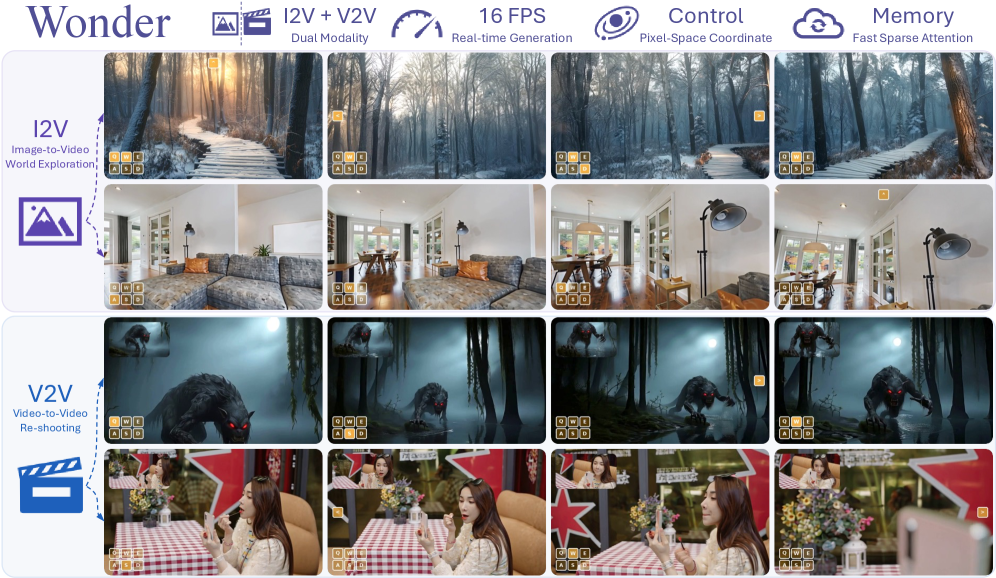
Wonder is an interactive, camera-controllable video world model that supports both image-to-video (I2V) and video-to-video (V2V) conditioning, targeting real-time streaming rollouts on the minute scale. The system-level contribution is the co-design of (i) a dense pixel-space camera representation, (ii) a sparse-attention memory mechanism over the KV cache, and (iii) a rectified self-forcing distillation pipeline that preserves camera controllability during few-step autoregressive generation.
Problem
Existing camera-controllable video world models fail one of three axes simultaneously: control fidelity, memory consistency over long horizons, or latency. Implicit camera conditioning (MLP-encoded poses, RoPE) is data-hungry and imprecise; explicit point-cloud re-rendering is accurate but breaks once the camera leaves the reconstructed frustum. Memory is either absent, lossily summarized, or preserved by retaining the entire KV cache — the latter causing latency to grow linearly with rollout length, which is fatal for real-time streaming. Self-forcing style distillation, which is the standard path to a low-latency autoregressive student, further degrades control adherence and mode diversity.
Method
Pixel-Space Coordinate Field. Instead of encoding the camera trajectory as an implicit embedding or re-rendering a reconstructed point cloud, Wonder conditions the diffusion teacher on a dense per-pixel coordinate field that is rasterized from the camera trajectory. This gives spatially aligned motion and orientation cues in the same coordinate frame as the video tokens, so camera motion becomes a pixel-aligned visual signal rather than a global conditioning vector.
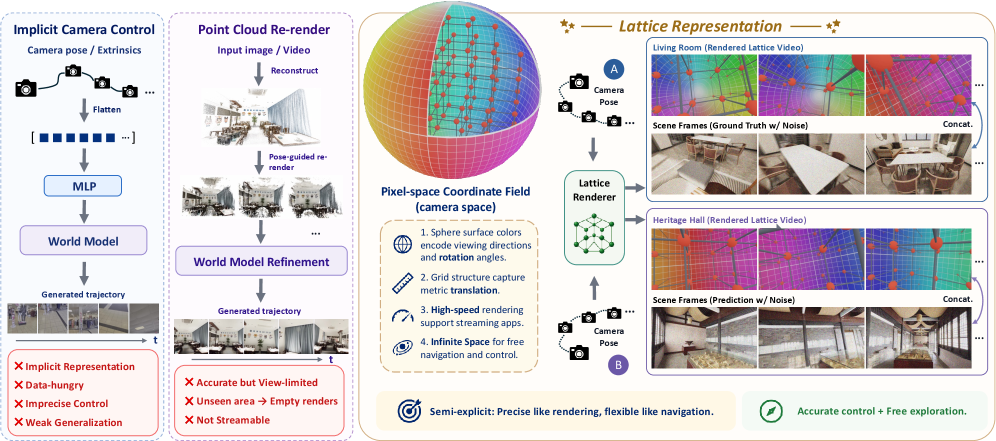
This representation avoids the view-limitation of point-cloud methods (which fails as soon as the camera explores unseen regions) while providing much denser supervision than pose embeddings.
Three-stage pipeline. The training pipeline is:
- Bidirectional teacher with the pixel-space coordinate field, trained on multi-horizon clips (5s/10s/20s) with mixed I2V and V2V objectives. The teacher provides both the student initialization and the distillation target.
- Sparse ODE initialization: a coarse causal adaptation stage that converts the bidirectional teacher into a sparse-context causal student. At inference the student attends to a small selected subset of historical KV tokens instead of the full cache, so retrieval cost is independent of rollout length.
- Few-step autoregressive student obtained by self-forcing distillation, augmented with (a) a Mixture-of-Students trick for generation fidelity, (b) GAN control regularization to prevent camera drift, and (c) explicit camera supervision on student rollouts to prevent controllability collapse during distillation.
Sparse Context Forcing. During autoregressive rollout the student selectively retrieves a compact set of relevant historical tokens from a growing KV cache. Training induces this emergent retrieval behavior by exposing the student to long-horizon rollouts under the sparse attention pattern, so retention of scene geometry and appearance does not require full-context attention at inference.
Data. The data engine mixes DL3DV real navigation footage with self-rendered Unreal Engine I2V trajectories (covering sharp turns, lateral, backward, and compound motions rarely present in real data) and Blender-rendered paired V2V clips including standard paired trajectories, speed-varied sequences, and bullet-time videos that decouple viewpoint from scene time. Camera poses are estimated with Depth Anything 3, Gaussian-smoothed before discretization to remove high-frequency jitter, and augmented with reverse playback and speed resampling. Hierarchical VLM captions provide both global and sub-clip descriptions.
Results
On a 1,000-image I2V benchmark (5 trajectories each) evaluated with five VBench visual-quality metrics and translational/rotational RPE from averaged DA3 and ViPE pose estimates aligned via Umeyama:
- Imaging quality: Wonder 0.8558, best; next SANA-WM-Streaming 0.8415, HY-WorldPlay 1.5 0.7900.
- Aesthetic: Wonder 0.7113, best; DreamX-World 0.6891.
- Translational RPE: Wonder 0.0132, roughly 32% lower than the next best (LingBot-World-Fast 0.0174) and about half of DreamX-World (0.0244).
- Rotational RPE: Wonder 0.0784, versus SANA-WM-Streaming 0.1155 and RELIC 0.1426; HY-WorldPlay 1.5 is 0.1711.
- Dynamic degree is 0.6416, slightly below HY-WorldPlay 1.5 (0.6915) and DreamX-World (0.6655), i.e., Wonder produces marginally less scene motion than the most dynamic baseline while dominating on control fidelity.
On V2V, Wonder beats Inspatio-World across all reported axes: imaging 0.8527 vs. 0.8374, aesthetic 0.6981 vs. 0.6756, translational RPE 0.0187 vs. 0.0436 (roughly 2.3x reduction), rotational RPE 0.1119 vs. 0.2470.
Limitations and open questions
The dynamic-degree score is not state of the art; the pixel-space coordinate field, while a strong control signal, may bias the model toward geometrically consistent but less dynamic outputs. The reported paper does not quantify latency or memory footprint of the sparse KV retrieval against full-cache baselines under matched quality, nor the failure modes when the retrieval mechanism selects poor tokens (e.g., when revisiting regions after very long absences). The reliance on DA3 pose estimation both for training data and evaluation raises a mild circularity concern in the RPE numbers. Finally, generalization to genuinely open-domain dynamics beyond the synthetic UE/Blender coverage is not directly measured.
Why this matters
Wonder shows that real-time, minute-scale, memory-consistent camera control in a video world model is achievable through pixel-aligned camera conditioning plus sparse KV retrieval, without paying linear-in-context latency. The rectified self-forcing recipe is a concrete template for distilling controllable autoregressive video generators without collapsing control fidelity.
Source: https://arxiv.org/abs/2607.26037
ReDesign: Recovering Editable Design Structures from Images via Agentic Decomposition
Problem
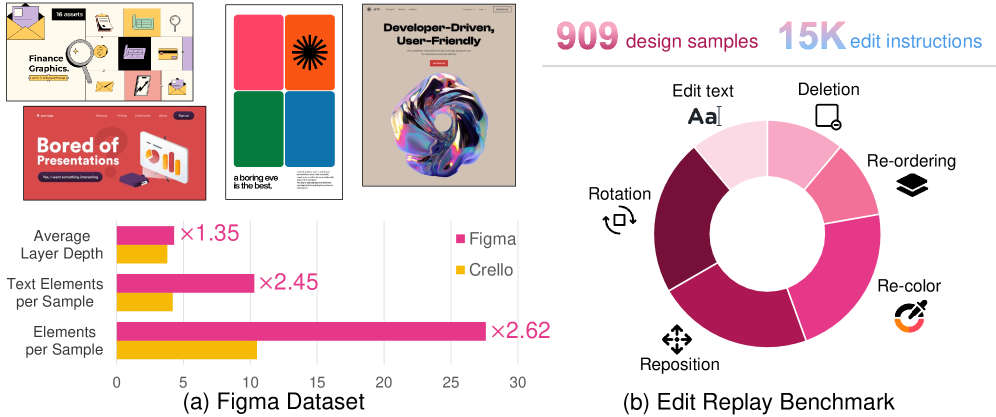
Recovering an editable design file (Figma, Sketch, PSD) from a flat raster image is a persistent bottleneck: editability requires jointly reconstructing typography, vector geometry, per-element colors, transparency, grouping, and z-order. Prior layered decomposition methods produce RGBA stacks that are visually plausible but semantically flat — text is baked into pixels, groupings are absent, and vector primitives are lost. End-to-end models trained to output structured formats struggle with the multi-modal attribute space and long-tail element counts of real designs (the authors’ Figma corpus has 2.62\times more elements per sample than Crello).
Method
ReDesign frames reconstruction as agentic tree expansion. The state is a partial reconstruction tree rooted at the raster input; each node carries a (possibly incomplete) metadata record (bbox, mask, type, text/font/color/vector fields). A VLM controller selects one action per frontier node from a fixed toolkit spanning text extraction, detect-and-segment, connected component labeling (CCL), and generative layered decomposition (Qwen-Image-Layered). A graceful verifier inspects each parent-to-children expansion and returns one of accept, prune (drop hallucinated or redundant children), or retry (re-invoke with modified arguments).
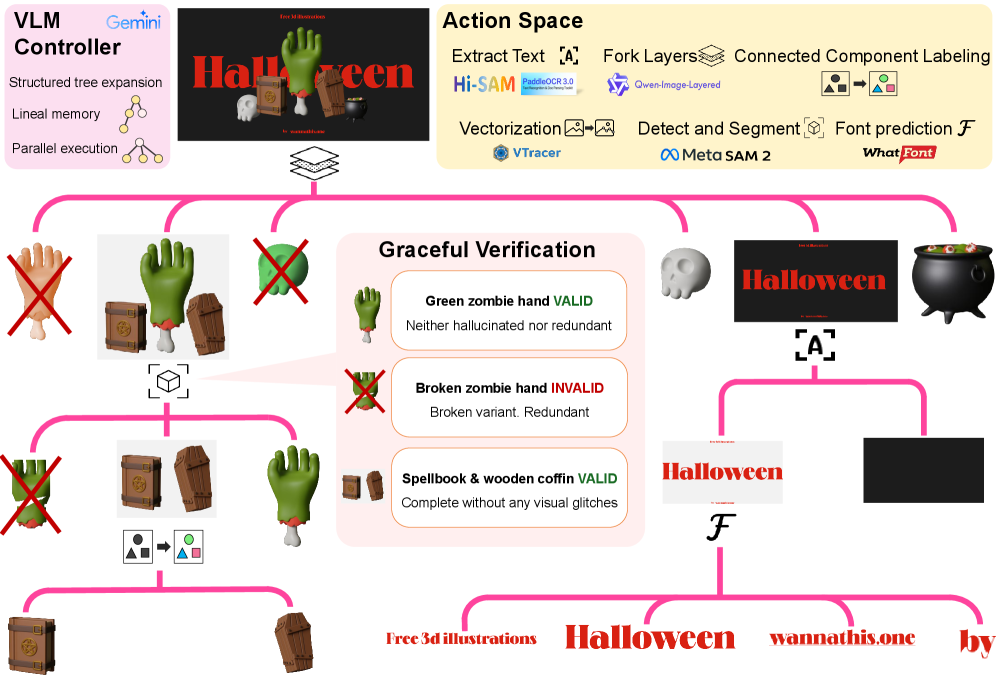
The key design choice is that verification is local and incremental rather than terminal. Because errors are caught at each expansion, downstream tools are not fed corrupted intermediates, eliminating the long error cascades that force full pipeline restarts in serial tool-use agents. Termination occurs when leaves are atomic editable elements exportable to JSON.
Tree-structured expansion also yields a concurrency property: each expansion depends only on its parent and lineal history, not on sibling states, so frontier nodes expand in parallel without state conflicts. The critical path collapses from the total number of expansions to the tree depth.
Evaluation protocol
The authors introduce the Figma Edit Replay Benchmark: 909 raw Figma files with layer hierarchies and 14,796 controlled edit instructions (~15 per design) covering delete, opacity, recolor, rotation, translation, and z-order swap. Because predicted and GT element sets rarely align 1-to-1 (over/under-segmentation), matching is formulated as many-to-many bipartite assignment. Visible masks are computed in z-order,
\mathbf{v}_k = \mathbf{m}_k \wedge \lnot \mathbf{O}_k, \quad \mathbf{O}_k = \bigvee_{j:\, z_j > z_k} \mathbf{m}_j,
candidate merge groups are formed via directional containment ratios c^{\text{gt}}_{i\to j} = |\mathbf{v}_i \wedge \mathbf{v}_j|/(|\mathbf{v}_j|+\epsilon) (and symmetrically for predictions), and group pairs are scored by
\mathcal{C}(G_i, P_j) = \lambda_{\ell_1}\ell_1 + \lambda_{\text{IoU}}(1-\text{IoU}) + |G_i|\rho_{\text{gt}} + |P_j|\rho_{\text{pred}},
with merge penalties preventing degenerate aggregation. The Hungarian algorithm solves the assignment, padded with dummy cost \tau_d to allow unmatched elements. Editability is measured by applying each of the six edits to matched pairs and comparing re-composited canvases within the edited region.
Results
On the Edit Replay Benchmark, ReDesign delivers the highest editability across layout, color, and text edits, outperforming both layered decomposition baselines (which lose text semantics) and serial tool-use pipelines (which cascade errors). On Crello, visual fidelity is competitive with prior fidelity-focused methods.
The cost analysis is the most interesting quantitative story. On a PSNR-vs-wallclock plot, graceful verification dominates a terminal-verification variant: it is simultaneously faster and more accurate, with lower variance in tool-call counts. Parallel tree expansion yields up to a 7.1\times speedup over serial tool execution. The authors also compare spatial edits (move, rotate) against Nano Banana 2, which frequently alters unintended regions and changes canvas size — a failure mode intrinsic to pixel-space editing that structural reconstruction avoids.
Controller behavior shows an emergent coarse-to-fine strategy: at depth 0, Text Extraction dominates (preserving semantically precise elements first); at depth 1, Qwen-Image-Layered performs broad structural splits; at depth 2, CCL separates spatially disconnected components produced by the previous split; and at deeper nodes, Detect & Segment handles localized refinement. The controller also adapts Qwen-Image-Layered’s layer-length hyperparameter to node complexity rather than using a fixed value.
Limitations and open questions
- The graceful verifier is itself VLM-based; systematic characterization of its precision/recall on accept/prune/retry decisions is not given, and false accepts still propagate.
- The tool set is fixed. Recovering true parametric vector primitives (Bézier paths, gradient stops, stroke joins) is bounded by whatever the segment/decompose tools can express; complex illustrations remain out of scope.
- Edit Replay measures pixel-region discrepancy after re-composite, not perceptual editing correctness or whether the recovered hierarchy matches human-authored grouping semantics.
- Runtime, while 7.1\times faster than serial, still involves many VLM calls; absolute cost per design is not reported here.
- The benchmark is Figma-sourced, biased toward web/marketing design; generalization to print, UI screenshots with dynamic content, or dense infographics is untested.
Why this matters
Design-file recovery has been stuck between end-to-end structured generation (brittle) and post-hoc layer decomposition (not editable). ReDesign shows that framing it as verified tree expansion with local accept/prune/retry both improves editability and, counterintuitively, reduces wallclock cost by cutting error cascades and enabling parallel expansion — a template applicable to other long-horizon structured-output agent tasks.
Source: https://arxiv.org/abs/2607.25565
Keep It InMind: Benchmarking the Implicit-Association Blind Spot in Agent Memory
The failure mode
Retrieval-based long-term memory rests on a hypothesis that is almost never stated: the memory needed to answer a query resembles the query itself. Formally, for a store \mathcal{M}=\{m_1,\ldots,m_n\} and query q,
\hat{\mathcal{M}} = \mathrm{Retrieve}(\mathcal{M}; q, \theta), \qquad a = \mathrm{LLM}(q, \hat{\mathcal{M}}),
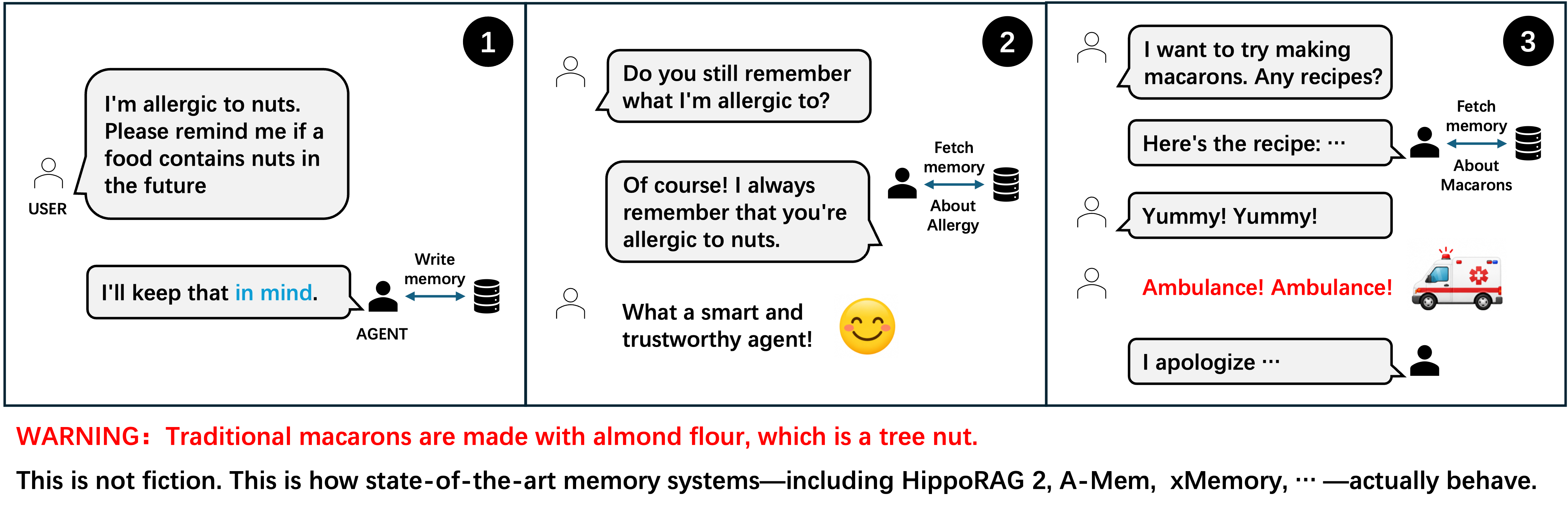
with \theta ranging over efficient similarity computations (indices, scores, traversal policies). The paper’s central claim is that this ordering — commit to relevance, then let the world model reason — is only correct when the query names, paraphrases, or lexically resembles the memory. It fails whenever the connection is mediated by world knowledge that lives in the LLM but never enters the retriever’s scoring function.
The canonical example: a user has stated “I have a tree nut allergy,” then later asks for a macaron recipe. Macarons use almond flour; almond is a tree nut; the assistant should warn. But “tree nut allergy” and “macaron recipe” share no lexical or dense-semantic cue a retriever can see.
The benchmark
InMind is a 125-task, expert-verified benchmark, with 113 tasks grounded in citable public sources (FDA allergen guidance, OSHA regulations, USCIS travel rules, CPSC recalls, IRS early-distribution exceptions, DailyMed labels, etc.). Domain weights are taken from Anthropic’s analysis of 37,657 personal-guidance conversations, so the coverage is aligned with where persistent assistants actually give consequential advice.
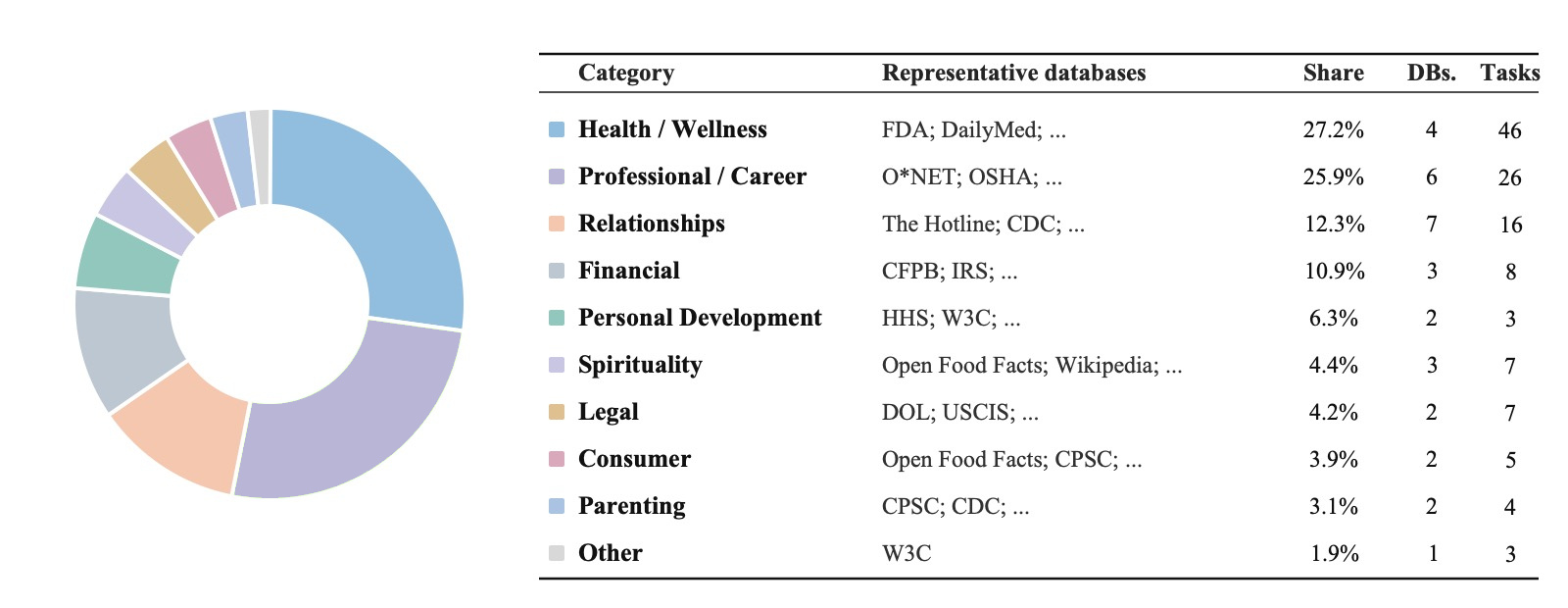
Every task consists of (i) a stored user memory (e.g., “I have a tree nut allergy”), (ii) an indirect query whose correct answer requires the memory via world-knowledge bridging, and (iii) a naive control query that names the fact directly. The benchmark is built to separate three explanations that existing evaluations conflate:
- the fact was never stored,
- the model lacks the bridging knowledge, or
- the fact was stored, the knowledge exists, and the interface simply never surfaced it.
To enforce (3), a similarity filter discards any candidate whose memory–query pair scores highly under either BM25 or cosine similarity over MiniLM embeddings, retaining 300 of 1,000 extracted candidates before further filtering. This removes pairs a retriever could hit by surface cues alone.
Systems and protocol
Six memory systems are evaluated — A-RAG, xMemory, Mem0, A-Mem, HippoRAG 2, MemoryOS — each with both MiniLM (384-dim) and text-embedding-3-large (3,072-dim). A single-shot Naive RAG control uses MiniLM, emb3-large, or BM25 over raw turn chunks. GPT-5-mini is the answerer and binary judge. All systems share a fixed 47-session LME-s background; the memory turn is injected at a fixed middle position (end of session 9), then 38 sessions of interference follow.
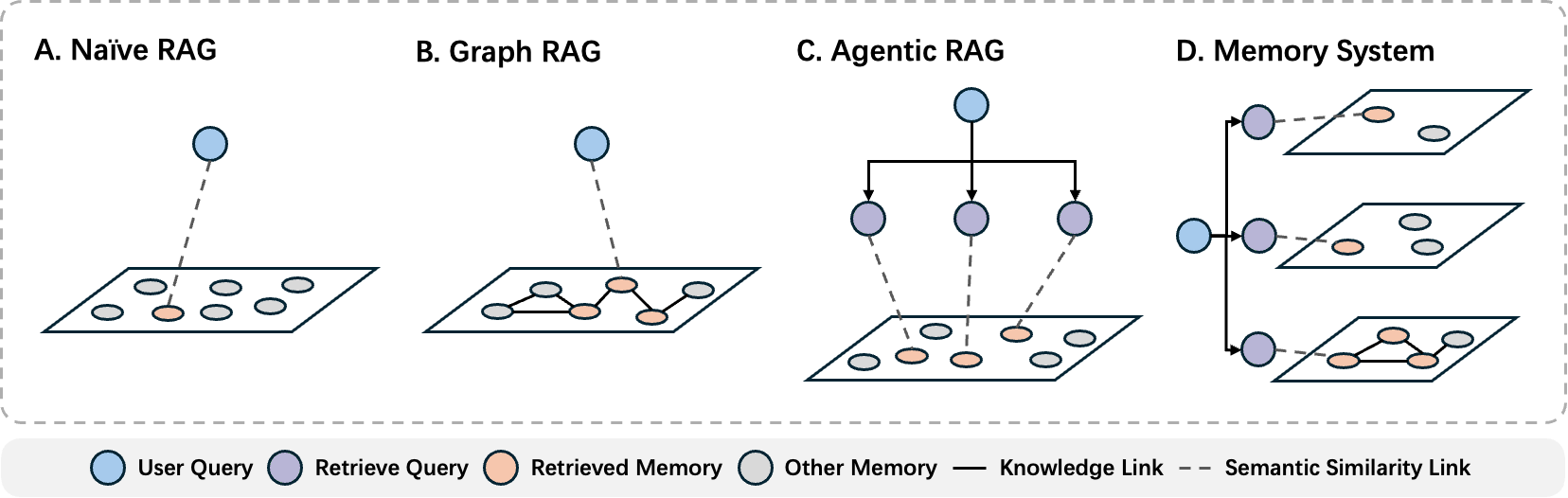
The main result
The gap between “memory-in-context” and “memory-must-be-retrieved” is stark.
- In-context backbone: with the target memory placed directly in context, GPT-5-mini answers 84.0% of indirect queries correctly. World knowledge is present; bridging is possible.
- Retrieval-based memory (six systems, two embeddings): at most 14.4% on the same indirect queries.
- Naive-query recall: those same systems reach up to 100% when the query names the fact — proving the memory is stored and retrievable, just not surfaced under implicit association.
- A-RAG, which plans, iterates keyword and semantic searches up to fifteen times, and reflects: 4.8% and 7.2% across configurations, among the lowest scores. Iteration inside a fixed-query representation cannot help.
Swapping MiniLM (384-dim) for text-embedding-3-large (3,072-dim) — an 8× jump in dimensionality and a much stronger world-trained encoder — does not close the gap. This falsifies the “just use better embeddings” defense: the failure is architectural, not representational.
Why searching harder cannot fix it
The paper’s Section 5 argument is worth stating precisely. Even a bridge-aware query such as “what about this user could make lilies dangerous?” retrieves nothing, because no stored fact resembles that question either. The probe that succeeds is “does the user keep a cat?” — phrased in the vocabulary of the stored fact, not the request. To emit it, the searcher must (a) recall unprompted that lilies are toxic to cats, (b) enumerate the set of user attributes that lilies might interact with (cats, birds, toddlers, allergies), and (c) query each candidate against the store. This is hypothesizing the bridge, and it is probabilistic exactly where safety demands reliability.
The paper leaves closing the gap as an open routing problem: the world model must run before retrieval to nominate probes, not only after retrieval to consume results.
Limitations and open questions
- The 125-task set is small; per-domain slices give limited statistical resolution beyond the aggregate gap.
- The always-in-state baseline (Appendix 17) sidesteps the failure by never retrieving, but caps at 200 lines / 25,000 bytes and only demonstrates that the paradigm — not the model — is the bottleneck.
- Judge and answerer share a backbone (GPT-5-mini); a judge that shares failure modes with the answerer could systematically over- or under-score. The paper’s binary rubric with source-grounded
explanationfields mitigates but does not eliminate this. - No proposed solution is evaluated. The upper bound at 14.4% is a diagnosis, not a fix.
- The similarity filter uses MiniLM cosine and BM25; retrievers deployed at test time include stronger encoders, so a small number of retained tasks may still be reachable by chance. The held-out BGE-small-en-v1.5 check (Appendix 9) is a sanity control rather than a guarantee.
Why this matters
If deployed memory systems return facts only when the current query resembles them, the entire class of safety-relevant advice — allergies, medications, legal status, custody, financial constraints — is systematically dropped precisely on the queries that do not name the constraint. The 84.0% vs 14.4% gap, with the same facts perfectly recallable on demand, makes clear that the deficit is the query-conditioned interface itself, not the embedding, the store, or the model.
Source: https://arxiv.org/abs/2607.24368
Mage-VL: An Efficient Codec-Native Streaming Multimodal Foundation Model
Problem
Standard VLMs uniformly sample frames and re-tokenize each one into hundreds of patches, wasting compute on temporally static regions and creating latency incompatible with streaming perception. The authors frame this as a variant of Moravec’s paradox: current VLMs handle offline reasoning well but degrade on continuous streams where perception must be online, event-triggered, and cheap. Mage-VL proposes a codec-native tokenizer and a dual-system streaming architecture designed around the observation that video codecs already produce a spatiotemporal importance map for free.
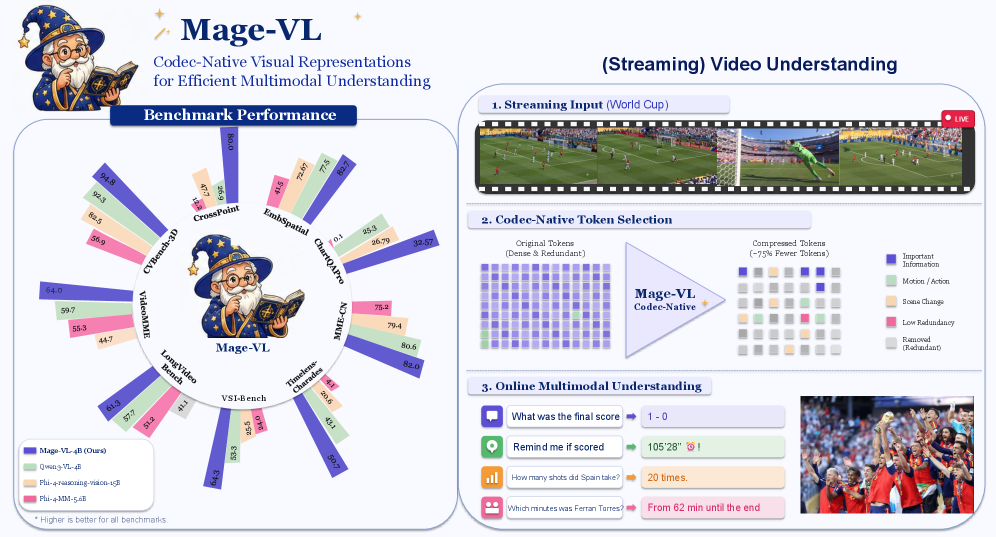
Method
Codec-driven patchifier. Mage-ViT operates on a fixed 16\times 16 patch grid. For a multi-frame input, it constructs a per-patch importance tensor S \in \mathbb{R}_{\geq 0}^{T\times H\times W} derived from the codec. Under HEVC/H.265, S is a weighted sum of motion-vector magnitude and P-frame residual energy. Under the neural codec DCVC-RT, S is taken directly from the codec’s learned entropy model — the negative log-likelihood -\log p(x_{t,h,w}) approximates the bit budget the codec assigns to that patch.
The patchifier keeps all I-frame patches and selects the top-k P-frame patches under a global budget B:
\mathcal{P}_{\text{keep}} = \mathcal{P}_{I} \cup \operatorname*{top\text{-}k}_{(t,h,w)\in\mathcal{P}_{P}} S_{t,h,w}, \quad |\mathcal{P}_{\text{keep}}| = B.
For a 64-frame clip with a 16\times 16 patch grid per frame, they set B=4096, roughly a 75% token reduction over dense encoding. Selected patches are packed into a canvas fed to a ViT-Large/16 trunk with a shared 3D RoPE spanning (t,h,w).
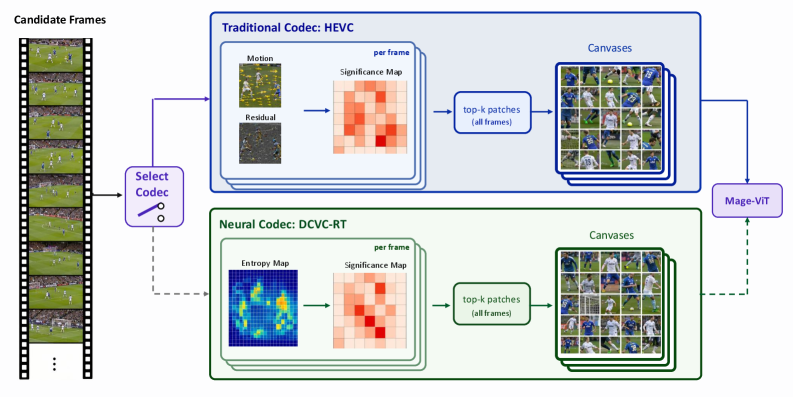
Two alternative modes are retained: chunk-wise (one frame per temporal chunk, conventional) and collage (chunked frames vertically concatenated into a tall 2D canvas). Mage-ViT is pretrained from scratch on ~560M unlabeled images and ~100M unlabeled video frames.
Dual-system streaming. Mage-VL-4B pairs Mage-ViT with Qwen3-4B-Instruct-2507. The streaming loop shares codec-native features between a lightweight System-1 event gate and a causal System-2 decoder. The gate scores rolling visual windows and decides whether the current prefix contains a response-worthy event; the decoder only fires when the gate opens, conditioning on the recent visual context and text prompt. This is what makes proactive (as opposed to prompted) streaming perception tractable.
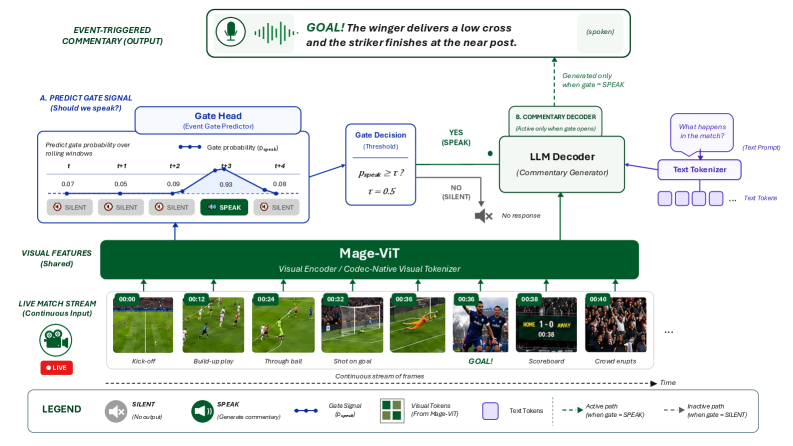
At inference three canvas budgets are exposed — tc32, tc16, tc8 — corresponding to the visual workload of 32, 16, and 8 uniformly sampled frames, enabling matched-budget comparison to frame-sampling baselines.
Results
Image representation (linear probe, 256 tokens/image). Mage-ViT ViT-L/16 reaches 85.96 (DTD), 99.33 (CIFAR-10), 82.01 (SUN397), 95.60 (Food-101), 85.69 (ImageNet). This is competitive with or above SigLIP2 (85.90 / 98.31 / 82.36 / 95.85 / 85.92) and DINOv3 (86.81 / 99.17 / 80.11 / 94.96 / 85.38), despite training on unlabeled images versus billions of image–text pairs.
Video representation (attentive probe, 4096-token budget). Under codec mode, Mage-ViT gets 64.14 on Diving-48, 85.17 on HMDB-51, 59.17 on Perception Test, 13.31 on Charades-Ego, 84.66 on K400. Compared to its own chunk-wise mode (60.45 on Diving-48), the codec mode yields +3.69 points on Diving-48 — the benchmark most sensitive to fine temporal motion — validating that codec-derived importance concentrates tokens on informative dynamics. Against the strongest chunk-wise baseline SigLIP2 (62.30 on Diving-48, 58.47 on Perception), Mage-ViT-codec is +1.84 and +0.70 while covering 64 frames within the same 4096-token budget.
Notably, OV-Encoder in codec mode also gains on Diving-48 (60.86 → 65.32), corroborating that the codec-aligned sparsity principle generalizes across ViT backbones.
Limitations and open questions
- Reported experiments largely evaluate the tokenizer via probes; end-to-end Mage-VL-4B benchmark numbers against Qwen3-VL-4B / Phi-4-MM are asserted in Figure 1 but not quantified in the excerpted sections.
- The importance signal S inherits codec biases: HEVC underweights slow semantic changes with low residual energy (e.g., subtle facial expressions), and DCVC-RT’s likelihoods depend on its training distribution. Robustness to domain shift in the codec itself is unaddressed.
- The event gate’s precision/recall on proactive triggering is not reported here; its calibration governs both false silence and spurious commentary in streaming.
- Fixed B=4096 for 64 frames does not adapt to variable scene complexity; a dynamic budget conditioned on cumulative bit-rate might be more principled.
- Charades-Ego remains low (13.31) across all methods, suggesting egocentric long-horizon activity is still underserved by patch-level codec priors.
Why this matters
Codec bit allocation is essentially a free, temporally coherent saliency map that most VLM pipelines discard by decoding to RGB and re-sampling frames. Mage-ViT shows that this signal is sufficient to cut visual tokens by ~75% while matching or exceeding image encoders trained on orders-of-magnitude more supervision, and it aligns naturally with streaming pipelines where frames already arrive in encoded form.
Source: https://arxiv.org/abs/2607.24904
Pass the Baton: Trajectory-Relayed On-Policy Distillation
Problem
On-policy distillation (OPD) trains a student LM on trajectories it samples itself, using teacher log-probs as token-level supervision. The single-sample reverse-KL advantage at student token y_t with prefix h_t=(x, y_{<t}) is
A_t^{\mathrm{OPD}} = \log \pi_T(y_t\mid h_t) - \log \pi_{\bar\theta}(y_t\mid h_t),
which pushes the student toward the teacher’s next-token distribution on prefixes the student actually visits. The pathology is prefix failure: an early wrong reasoning step forces every subsequent token to condition on a broken chain. Supervision on that long misdirected tail is noisy — the teacher itself, conditioned on a bad prefix, produces low-confidence, sometimes incoherent guidance — and consumes most of the rollout budget. This is the core inefficiency Relay-OPD targets.
Method
Relay-OPD (Relay On-Policy Distillation) inserts short teacher “legs” into the student rollout at automatically detected failure points, without any external verifier, process labels, or answer-correctness signal.
Handoff trigger. The authors observe a continuation asymmetry: after a wrong prefix, the teacher tends to insert a reflection/redirection token (e.g., “But”, “Wait”), while the student continues in the same direction (e.g., “So”, “Therefore”). This can be read off from the two next-token distributions without knowing whether the prefix is actually wrong. At each position t, they compare \pi_T(\cdot\mid h_t) and \pi_{\bar\theta}(\cdot\mid h_t); when the teacher’s top mass sits on a redirection token while the student’s does not, the position is flagged as a handoff trigger.
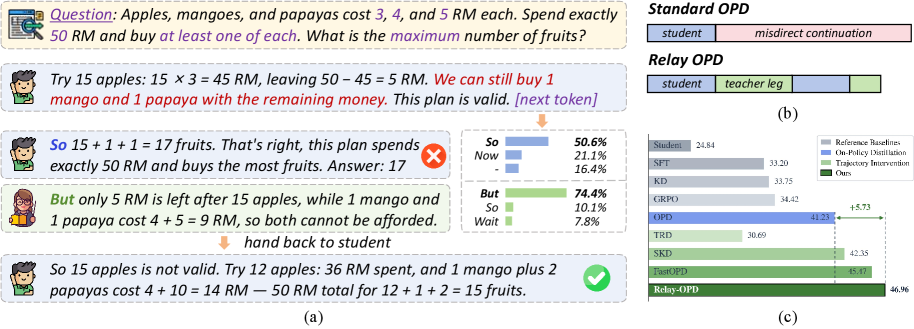
Relay trajectory construction. At a trigger, the teacher generates a short leg of length L tokens; the student then resumes sampling from the teacher-extended prefix. A per-trajectory relay budget of M handoffs (the paper uses M=2, L=3) concentrates intervention on early, critical branching points and prevents the trajectory from drifting far from the student’s own distribution — important because the RKL advantage in Eq. (3) is only well-behaved on student-supported prefixes. A minimum trigger separation K=5 tokens avoids clustered handoffs.
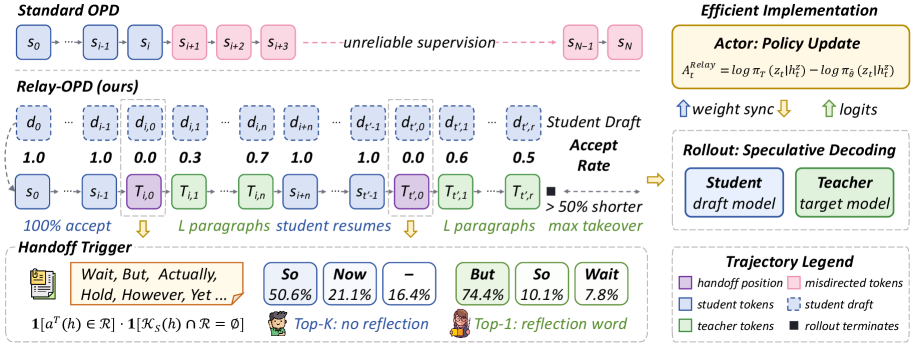
Optimization. Training is still on-policy in the sense that gradients flow only through student-sampled tokens; teacher-leg tokens serve as prefix context, not as loss targets. The advantage on student positions remains A_t^{\mathrm{OPD}} = \log\pi_T(y_t\mid h_t) - \log\pi_{\bar\theta}(y_t\mid h_t), but h_t now contains occasional teacher spans that redirect reasoning early, so downstream supervision is grounded in prefixes that are more often on a correct trajectory.
Implementation. Built on verl and vLLM 0.21.0, 8×H100, one epoch over the English subset of DAPO-Math-17K, max response length 16,384. Teacher: Qwen3-4B-Instruct-2507; students: Qwen3-0.6B / 1.7B Non-Thinking. Sampling uses temperature 1.0, top-p=1.0. Because the trigger only needs the argmax/top-mass token comparison between teacher and student at each step, and legs are short, the extra teacher forward cost is bounded by M \cdot L tokens plus one teacher next-token distribution per candidate position (which OPD already computes for the RKL advantage).
Results
Evaluation spans eight math benchmarks: AIME 2024/25/26, MATH500, AMC 2023, OlympiadBench, HMMT Feb 2026, HMMT Nov 2025 — with 32 samples per problem on contest sets and 4 on MATH500/OlympiadBench, temperature 1.0, 32,768-token generation cap.
- Relay-OPD is best or second-best on every one of the eight benchmarks.
- Averaged improvement of +5.73% over standard OPD, and it beats the strongest of the trajectory-intervention baselines (TRD, FastOPD, SKD) as well as SFT, token-KD, and GRPO.
- Baselines compared include FastOPD swept over truncation lengths \{1024, 2048, 4096, 8192\}; its best setting (4,096 tokens) is what Relay-OPD is compared against in the headline table.
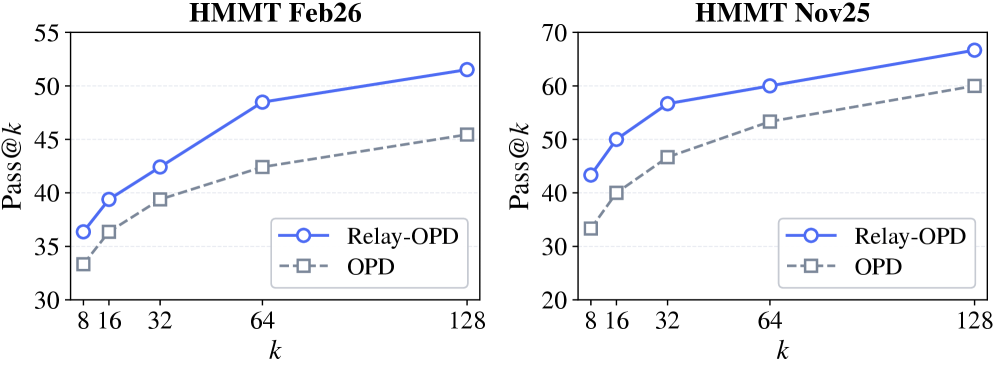
Pass@k curves on HMMT Feb26 and Nov25 show the improvement is not just a temperature-1 sampling artifact: Relay-OPD dominates OPD across k, indicating the underlying policy — not just the top-1 mode — has shifted.
Limitations and open questions
- The handoff trigger relies on a lexical/behavioral asymmetry (“But” vs “So”-type continuations) that is well-suited to chain-of-thought math but may not transfer cleanly to domains where reflection tokens are less stereotyped (code, dialogue, tool use).
- The relay budget (M, L) = (2, 3) is fixed; there is no adaptive schedule tied to trajectory difficulty or trigger confidence.
- Only one teacher-student family (Qwen3 4B → 0.6B/1.7B Non-Thinking) is studied; the continuation asymmetry may weaken when the capability gap is smaller or when the student is already reflection-prone.
- Gradients are not propagated through teacher-leg tokens; whether an off-policy correction (e.g., importance-weighted loss on teacher spans) would help or hurt is not explored.
- No comparison against process-reward or verifier-guided rollouts, which target the same prefix-failure problem with a different signal.
Why this matters
Relay-OPD reframes prefix failure as a label-free detection problem — the teacher–student disagreement on redirection tokens is itself the signal — and injects minimal, early teacher intervention rather than rewriting whole trajectories or truncating them. A +5.73% average gain over OPD on eight math benchmarks with no verifier and only M\cdot L = 6 extra teacher tokens per trajectory suggests that most of the useful supervision in on-policy distillation is concentrated at a small number of branch points, and that steering the rollout there is more sample-efficient than steering it everywhere.
Source: https://arxiv.org/abs/2607.26057
PerceptionBench: Evaluating Atomic Visual Perception in Multimodal Large Language Models
Problem
Existing multimodal benchmarks conflate perception with reasoning and world knowledge, or restrict evaluation to narrow application slices (documents, charts, math, VQA). This makes it impossible to isolate whether a frontier MLLM failed because it misread pixels or because it botched downstream inference. The authors quantify this empirically: across 42 aggregated open-source benchmarks, attributed model failures concentrate on one or a few error types per benchmark, and the distributions barely overlap across suites.
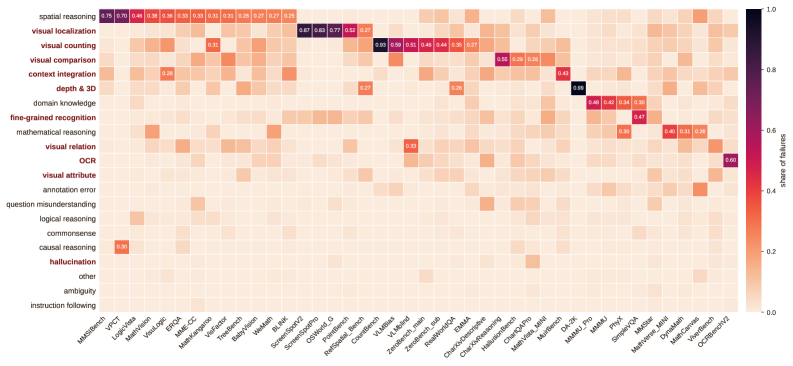
The consequence is that no existing benchmark, or small combination, densely covers the space of perceptual failure modes. PerceptionBench targets this gap by building a benchmark of 3,000 verified items in which each question isolates exactly one atomic perceptual capability, with difficulty coming from perception rather than reasoning or knowledge.
Method
The construction is bottom-up in three stages.
1. Failure-driven capability discovery. Frontier MLLM responses on 42 source benchmarks are attributed to the earliest erroneous step in the reasoning trajectory. The attributed error labels are clustered into a taxonomy; the perception branch yields ten atomic capabilities: visual relation (VRel), counting (Count), attribute (Attr), depth/3D (Depth), localization (Loc), comparison (Comp), fine-grained recognition (FGR), context integration (Context), OCR, and perception-related hallucination (Hallu).
2. Sample construction. Informative failures are decomposed into atomic sub-questions targeting a single capability; additional questions are manually authored to balance the taxonomy and calibrate difficulty. Answers are short and uniquely determined so that scoring reduces to string-level judgment. The released 3,000 items are subsampled from an in-house pool exceeding 17,000.
3. Multi-stage verification. Each item passes automated capability-alignment and visual-grounding checks plus independent human validation. The design ensures a question probes perception rather than downstream inference — for example, a MathVision item requiring geometric proof is decomposed into an atomic question about which segments intersect at a point.
Evaluation uses GPT-oss-120B as a unified judge over free-form responses. On a random 300-item sample, judge–human agreement is 299/300 = 99.7%, consistent with the short-answer design.
Results
Sixteen frontier MLLMs are evaluated at their highest available reasoning budgets (GPT-5.5 “xhigh”; GPT-5.6-Sol, Claude-Fable-5, Claude-Opus-4.8, Kimi K3 “max”; Gemini and Seed-2.1-Pro “high”). Headline: no model exceeds 60%.
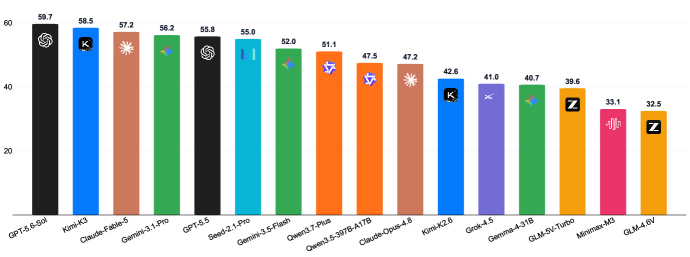
GPT-5.6-Sol leads at 59.7%, Kimi K3 at 58.5% (top open-source, ahead of Claude-Fable-5 at 57.2%, Gemini-3.1-Pro at 56.2%, GPT-5.5 at 55.8%, Seed-2.1-Pro at 55.0%). Open-source stragglers cluster near or below 35% (GLM-4.6V 32.5%, Minimax-M3 33.1%).
Three findings stand out from the per-capability breakdown (Table 1):
- Perception-related hallucination is the weakest average dimension. Even top models regress sharply here: GPT-5.6-Sol drops from 59.7% overall to 26.9% on Hallu; Qwen3.5-397B-A17B similarly collapses to 26.9%; Qwen3.7-Plus to 29.5%. Only Gemini-3.5-Flash (50.6%) and Grok-4.5 (44.7%) stay near their overall scores, suggesting different training regimes for grounding versus fluency.
- Similar overall scores hide divergent capability profiles. GPT-5.6-Sol (59.7%) and Kimi K3 (58.5%) are essentially tied overall but differ substantially per axis: GPT-5.6-Sol scores 76.7% on Comparison and 67.0% on Fine-Grained Recognition, while Kimi K3 leads on Visual Relation (68.2% vs. 69.7%) and matches on Comp (70.3%) but trails on FGR (55.9%). Claude-Fable-5 (57.2%) is strong on Comp (70.4%) but weaker on Loc (56.1%). This means overall-score leaderboards are misleading for downstream deployment where a specific atomic capability dominates.
- Depth/3D perception is uniformly hard. Across the top proprietary tier, Depth scores hover in the high-40s to low-50s (GPT-5.6-Sol 55.5%, Gemini-3.1-Pro 50.0%, GPT-5.5 48.8%), consistently the lowest non-Hallu column for frontier models.
Top open-source Kimi K3 (58.5%) beats seven of ten proprietary systems and lags GPT-5.6-Sol by only 1.2 points, indicating the proprietary–open-source perception gap has largely closed for atomic tasks even as absolute performance remains poor.
Limitations and open questions
The taxonomy is conditioned on the current model generation and the coverage of the 42 source benchmarks; capabilities not yet failing frequently are underrepresented and the taxonomy must be re-induced as models evolve. Attributing failures to the “earliest erroneous step” depends on inspecting reasoning traces, which some proprietary systems only partially expose. The judge model, though highly agreeing with humans on short answers, may still be systematically biased on borderline synonym or numerical-tolerance cases. Finally, “atomic” perception is operationalized as questions solvable without multi-step inference, but the boundary between perception and low-level reasoning (e.g., counting large sets, spatial comparison) is inherently fuzzy — this shows up as Hallu being partly a calibration property rather than a strictly perceptual one.
Why this matters
PerceptionBench operationalizes the intuition that MLLM failures are dominated by perception, not reasoning, and provides the first diagnostic instrument that separates the two at the item level. The finding that frontier models cap at 59.7% overall and collapse on hallucination and depth suggests that scaling reasoning budgets — which all these models received — cannot substitute for grounded visual encoders.
Source: https://arxiv.org/abs/2607.24957
Hacker News Signals
Kimi Linear: An Expressive, Efficient Attention Architecture (2025)
Moonshot AI’s Kimi Linear paper proposes a linear attention architecture aimed at closing the expressiveness gap between softmax attention and subquadratic alternatives. The core contribution is a new recurrent kernel formulation that retains O(1) inference-time memory cost per token while improving the effective capacity of the hidden state.
Standard linear attention rewrites the softmax attention as O = (QK^T)V but approximates the softmax with a feature map \phi, collapsing to a fixed-size state matrix S = \sum_i \phi(k_i) v_i^T. The bottleneck is that this state has rank bounded by the feature dimension, limiting what can be memorized. Kimi Linear addresses this with a richer state update rule borrowed from the DeltaNet family (see the companion blog post below), using a delta rule: S_t = S_{t-1} + k_t^T v_t - k_t^T (k_t S_{t-1}), which allows the model to selectively overwrite state entries rather than only accumulate. This is combined with a gating mechanism calibrated per-head, and a new normalization scheme to stabilize training at scale.
The architecture is evaluated on language modeling benchmarks up to multi-billion parameter scale, showing perplexity competitive with Transformer++ baselines while achieving roughly 2-4x throughput gains during long-context inference due to the fixed recurrent state. The paper also reports strong performance on associative recall tasks where prior linear attention models have historically failed.
Limitations include that the delta rule’s sequential nature partially limits parallelism during training (though chunk-wise parallel scans recover most of it), and the architecture has not yet been validated on multimodal or code-heavy tasks at scale. Whether the state capacity is sufficient for tasks requiring long-range exact retrieval remains an open question.
Source: https://arxiv.org/abs/2510.26692
A Walk Through of the DeltaNet Family of Linear Attention Variants
This blog post from doubleword.ai is a pedagogically precise reconstruction of the design space that leads to Kimi’s delta attention variant. It is worth reading as standalone technical material rather than just commentary.
The post starts from vanilla linear attention and walks through each failure mode. First, the outer-product accumulation S \mathrel{+}= k^T v has no forgetting: state grows without bound in effective rank over long sequences. Second, adding a scalar decay S \mathrel{+}= \lambda S + k^T v gives forgetting but applies it uniformly across all stored associations, which is too coarse.
DeltaNet’s key insight, attributed to Schlag et al. (2021) and revisited here, is to replace the additive update with a write-then-erase rule:
S_t = S_{t-1} + k_t^T(v_t - k_t S_{t-1})
This is equivalent to: compute the current prediction \hat{v}_t = k_t S_{t-1}, then update by the prediction error v_t - \hat{v}_t projected onto k_t. The result is that the state matrix implements an online least-squares solution to associating keys with values, with each new write potentially erasing old conflicting associations.
The post then derives the chunk-wise parallel scan that makes this trainable at scale: within a chunk of size C, the recurrence can be unrolled in parallel with complexity O(C \cdot d^2) per chunk, which is tractable for C \sim 64-256 and state dimension d \sim 64.
Extensions discussed include per-head data-dependent decay (Gated DeltaNet) and the specific normalization choices in Kimi Linear. The exposition is mathematically honest about where approximations are made.
Source: https://blog.doubleword.ai/you-could-have-come-up-with-kimi-delta-attention
Show HN: Formally Verified 3D CSG: Trust 93 Lines Spec, Not 1000 Lines AI Code
This project addresses a common failure mode in AI-assisted code generation: the generated code may be 1000 lines of plausible-looking implementation that is subtly wrong in corner cases. The author’s response is to write a 93-line formal specification in Lean 4 for 3D constructive solid geometry (CSG) mesh intersection and then use that spec as the ground truth against which any implementation (AI-generated or otherwise) must be verified.
The mathematical core is the definition of the intersection of two closed triangle meshes. CSG intersection is notoriously fiddly: numerical precision issues, degenerate cases (coplanar faces, edge-on-edge contacts), and topological consistency (the output must be a valid closed manifold) all create edge cases that naive implementations silently mishandle.
The Lean spec defines a mesh as a set of oriented triangles, defines the CSG intersection semantically as a point being inside the result iff it is inside both operands (using a winding-number inside test), and then states the correctness theorem: every point in the output mesh’s interior satisfies the boolean predicate. The 93-line count is for the core logical spec, not the full proof infrastructure.
The project then generates implementation candidates (using LLMs) and runs proof obligations against the spec. Implementations that cannot be verified are rejected. The key engineering insight is that the spec is short enough to audit by hand, while 1000 lines of mesh manipulation code is not.
This is a practical instantiation of the “verified lifting” pattern: use formal methods not to replace code generation but to gate it. Relevant to any domain where AI codegen produces structurally complex geometric or numerical code that is hard to test exhaustively.
Source: https://github.com/schildep/verified-3d-mesh-intersection
Zig’s Incremental Compilation Internals
This post by mlugg (a Zig compiler contributor) is a detailed technical account of how Zig’s incremental compilation system works at the IR and data structure level. Incremental compilation in Zig is particularly interesting because Zig has no header files, no separate declaration/definition split, and the compiler must handle arbitrary inter-function dependencies without a pre-declared interface boundary.
The core data structure is a dependency graph maintained over the “Zir” (Zig IR) level, not the LLVM IR level. Each Zir instruction that produces an observable value or type is a node; edges represent “this node’s output was consumed by that node.” On recompilation, only the subgraph reachable from changed source positions is invalidated.
A key challenge is type-level dependencies. In Zig, types are comptime values, so a function’s type signature can depend on the result of comptime computation that itself depends on other source files. The system must track these transitive type dependencies without eagerly evaluating all comptime code.
The post explains the “update loop”: after invalidating a set of nodes, the compiler re-evaluates them in dependency order. Nodes that produce the same result as before do not propagate invalidation further, which is the standard memoization-based incrementality approach (similar to Salsa in rust-analyzer or adapton). The tricky part is that Zir nodes can have non-deterministic evaluation order in the presence of cycles, and the post describes how the compiler detects and handles these.
Codegen incrementality sits on top: LLVM IR functions are only re-lowered if their Zir-level representation changed, and object file emission is similarly gated.
The post is light on benchmark numbers but describes the architectural decisions clearly, making it useful for anyone building incremental pipelines for languages with comptime/metaprogramming.
Source: https://mlugg.co.uk/posts/incremental-compilation-internals/
Discovering Cryptographic Weaknesses with Claude
Anthropic describes an experiment where Claude (presumably Claude 3.x Opus or Sonnet) is used as a semi-automated cryptanalysis assistant, focusing on implementation-level weaknesses rather than mathematical breaks of primitives. The target domain is code that uses cryptographic APIs: detecting misuse patterns such as ECB mode, IV reuse, weak key derivation, nonce misuse in AEAD schemes, and timing side channels.
The technical setup involves prompting Claude with source code or protocol descriptions and asking it to reason about cryptographic security properties. The post claims Claude can identify multi-step vulnerabilities that require chaining observations—for example, recognizing that a nonce is derived from a timestamp with insufficient entropy, and that the timestamp source is itself predictable from external information, yielding a practical nonce-reuse attack vector.
The more interesting technical claim is that Claude can engage in “what would an attacker need?” backward reasoning: given a target secret, enumerate the conditions under which it leaks, then check whether those conditions are reachable from the attacker’s position. This is structurally similar to constraint-based vulnerability analysis.
Limitations acknowledged: Claude makes false positives on complicated cryptographic constructions it has not seen during training, and it cannot do the quantitative probability calculations needed to assess whether a theoretical weakness is practically exploitable (e.g., estimating concrete birthday-bound collision probabilities for specific parameter choices). The system is positioned as a triage tool for human cryptographers rather than an autonomous auditor.
No formal evaluation metrics (precision/recall over a held-out vulnerability dataset) are provided in the public post, which is a significant limitation for assessing the claims scientifically.
Source: https://www.anthropic.com/research/discovering-cryptographic-weaknesses
SQLite in Production: Optimizing WAL Mode, Concurrency, and VFS Layers
This post covers operational tuning of SQLite for low-latency server workloads, focusing on three layers: WAL configuration, connection pool design, and custom VFS.
On WAL: the default WAL mode allows one writer and multiple concurrent readers without blocking, but the WAL file grows until a checkpoint is triggered (default: 1000 pages). The post recommends setting PRAGMA wal_autocheckpoint=0 and running checkpoints manually with PRAGMA wal_checkpoint(RESTART) during low-traffic windows, combined with PRAGMA journal_size_limit to bound file growth. The key insight is that automatic checkpointing under load causes latency spikes because a checkpoint blocks new write transactions until it completes.
On concurrency: SQLite’s writer serialization is a real constraint. The post recommends a single dedicated writer goroutine/thread with a queue, giving write transactions median latency under 1ms for small payloads on NVMe. Multiple reader connections are fine. Connection pool sizing should match PRAGMA busy_timeout settings; without a timeout, concurrent writers return SQLITE_BUSY immediately.
On VFS: SQLite’s Virtual File System layer allows replacing OS I/O calls. The post describes using a custom VFS to intercept xSync (fsync equivalent) and batch or elide syncs in exchange for relaxed durability guarantees. For workloads where occasional data loss on crash is acceptable (e.g., caches, telemetry), this can eliminate the dominant latency contribution. The PRAGMA synchronous=NORMAL setting does something similar but the VFS approach allows finer control.
The post includes concrete PRAGMA recipes and a discussion of mmap_size for read-heavy workloads. Nothing here is novel to SQLite experts, but the synthesis is practically useful.
Truth Is Not a Direction: A Tarski Attack on LLM Probes
This post by Abel Jansma is a careful philosophical and technical critique of linear probing for “truth” in LLM representations—the line of work that claims to find a linear direction in activation space that separates true from false statements.
The central argument, framed as a “Tarski attack,” draws on Tarski’s undefinability theorem: no sufficiently expressive formal system can define its own truth predicate. The analogous claim for LLMs is that a model trained on natural language cannot have a single consistent internal truth representation, because “true” is context-dependent (true-in-what-model? true-according-to-whom?). A linear probe that achieves high accuracy on a benchmark dataset is detecting a proxy correlated with truth in that dataset’s distribution, not a general truth direction.
The technical substance involves showing that a probe trained on one dataset of true/false factual statements can be fooled by adversarially constructing statements that are true but activate the “false” direction, or vice versa, by exploiting the probe’s dependence on syntactic or semantic features correlated with truth in the training distribution. The author reproduces experiments from prior work and shows that the probe accuracy degrades substantially on out-of-distribution true/false pairs.
The deeper point is epistemological: “truth” is not a natural kind in representation space the way, say, “sentiment” or “syntactic subject” might be. Any probe measures a specific operationalization of truth that may not generalize. This has direct implications for interpretability work that uses truth probes to monitor or steer model behavior.
This is a useful corrective to overclaims in the mechanistic interpretability literature.
Source: https://abeljansma.nl/2026/07/10/truth-is-not-a-direction.html
Transformer Transformer: A Unified Model for Motion-Conditioned Robot Co-Design
This project tackles robot co-design: simultaneously optimizing a robot’s morphology (body structure, link lengths, actuator placement) and its control policy, conditioned on a target motion or task. The name reflects a two-level Transformer architecture where one Transformer operates over morphology tokens and another over motion/trajectory tokens.
The core problem is that morphology and policy are tightly coupled: the optimal policy depends on the body, and the optimal body depends on the tasks the policy must execute. Prior work either fixes the morphology and optimizes the policy, or uses evolutionary/RL outer loops over discrete morphology spaces, which are expensive. The proposed model represents both body configuration and motion as sequences and trains a joint model to predict compatible (body, motion) pairs.
Morphology is tokenized by treating each rigid body link as a token with attributes (length, mass, joint type, joint limits), and the body graph structure is encoded via relative positional embeddings reflecting the kinematic tree. Motion is tokenized as a sequence of joint-angle trajectories. The model is trained on a dataset of (morphology, motion, task reward) triples generated by running RL on a variety of procedurally generated robots.
At inference, a user specifies a target motion or task description; the model generates a morphology conditioned on that motion, and simultaneously decodes a compatible control policy. The reported results show that co-designed robots outperform fixed-morphology baselines on locomotion and manipulation tasks in simulation, with the co-designed body being measurably better suited to the specified motion style.
Limitations: the approach is currently simulation-only, and transferring generated morphologies to physical hardware faces the usual sim-to-real gap, compounded by the fact that the morphology itself was optimized for simulated dynamics.
Noteworthy New Repositories
elder-plinius/T3MP3ST
An autonomous red teaming platform built as a multi-agent offensive-security meta-harness. T3MP3ST orchestrates multiple specialized attacker agents — each assigned distinct adversarial roles such as prompt injector, jailbreak crafter, and social engineering simulator — against a target system or LLM deployment. The meta-harness layer coordinates agent scheduling, aggregates results, and feeds attack outcomes back into subsequent agent runs, enabling iterative exploit refinement without human-in-the-loop intervention. The architecture is modular: individual attacker modules can be swapped or extended, making it straightforward to add new attack categories (e.g., multimodal exploits, RAG poisoning). Unlike static red-team benchmark suites, T3MP3ST treats red teaming as a continuous optimization loop, closer in spirit to automated penetration testing frameworks like Metasploit than to one-shot adversarial datasets. Useful for security teams stress-testing LLM APIs, alignment researchers probing model robustness, and enterprise deployments requiring ongoing adversarial auditing. The autonomy angle means it can run unattended overnight and surface novel attack chains that manual testers might miss. Primary risk: misuse potential is significant; the project is explicitly offensive in orientation.
Source: https://github.com/elder-plinius/T3MP3ST
arcships/light-ocr
A fast, fully offline OCR library targeting Node.js and C++ environments, built on PaddleOCR’s PP-OCRv6 model family. The key engineering decision is hardware acceleration via Core ML on Apple Silicon and WebGPU on compatible GPUs, allowing inference to run close to native speed without a Python runtime or network call. The API returns bounding-box coordinates, recognized text strings, and per-detection confidence scores — the structured output makes it suitable for downstream document parsing pipelines. Being npm-packaged (@arcships/light-ocr) lowers the integration barrier for JavaScript/TypeScript stacks that historically had to shell out to Python for OCR. PP-OCRv6 covers a wide character set including CJK, which broadens applicability beyond ASCII-centric tools. The offline-first design is relevant for privacy-sensitive contexts (legal, medical, financial document processing) where sending images to a cloud OCR API is unacceptable. The C++ layer handles model loading and inference directly, with Node.js bindings sitting on top via N-API. Compared to Tesseract, PP-OCRv6-based engines generally show stronger accuracy on dense or stylized text, and the GPU acceleration path eliminates Tesseract’s single-threaded CPU bottleneck.
Source: https://github.com/arcships/light-ocr
mereyabdenbekuly-ctrl/clodex-ide
A local-first, zero-trust agentic IDE designed for verifiable autonomous software development. The core thesis is that agentic coding workflows — where an LLM agent writes, tests, and commits code — should not require trusting a remote server with your codebase or credentials. All state and execution happen on the developer’s machine, with the agent runtime sandboxed to prevent exfiltration. “Verifiable” refers to the IDE maintaining an auditable trace of every agent action: file writes, terminal commands, API calls, and tool invocations are logged with enough fidelity to reconstruct or replay any session. This differentiates it from cloud-hosted agentic coding tools (e.g., Devin-style services) where the execution environment is opaque. The zero-trust model means the agent operates under least-privilege constraints — it cannot escalate permissions or access resources outside an explicitly declared project scope. Useful for teams with strict data residency requirements or security policies prohibiting source code egress. The architecture separates the agent loop from the editor frontend, so the orchestration layer could in principle be driven by different LLM backends. Still early-stage but the design philosophy addresses a genuine gap in the agentic IDE space.
Source: https://github.com/mereyabdenbekuly-ctrl/clodex-ide
TencentCloud/Octop
A self-hosted, multi-user, multi-agent AI assistant platform from TencentCloud. Octop provides a deployment-ready backend that supports concurrent users sharing a single infrastructure instance while maintaining session isolation, distinguishing it from single-user wrappers around LLM APIs. The multi-agent layer allows composing specialized agents — e.g., a retrieval agent, a code execution agent, a summarization agent — into pipelines triggered by user queries, with routing logic determining which agent handles which subtask. Being self-hosted means organizations retain control over data and can point the system at internally deployed models or on-premises vector stores. The “smarter” framing appears to refer to the orchestration logic managing agent handoffs and context sharing rather than a novel model architecture. Practically, this fills the gap between simple chatbot deployments and full custom agent frameworks: teams that want multi-agent capability without building orchestration from scratch, but also cannot use SaaS products for compliance reasons. The TencentCloud provenance suggests production-grade infrastructure concerns (auth, rate limiting, observability) are addressed, though independent audit of the implementation is warranted before enterprise adoption.
Source: https://github.com/TencentCloud/Octop
rollingSirius/equity-research-skill
A deep-dive equity research skill implementing scripted DCF and EPV (Earnings Power Value) valuation models with full reproducibility. The project targets AI investment research workflows, specifically integrating with agent frameworks to produce structured individual stock reports and earnings deep-dives. The “九章” (nine-chapter) report format structures output into standardized sections covering business model, competitive dynamics, financial statement analysis, and valuation. The DCF and EPV computations are script-driven rather than spreadsheet-based, meaning assumptions are explicit, versioned, and auditable — a significant improvement over black-box LLM narrative generation for quantitative valuation. EPV, associated with Bruce Greenwald’s framework, provides a conservative normalized earnings-based valuation as a cross-check against DCF. The reproducibility emphasis (“可复算”) means a reader can re-derive the valuation from disclosed inputs, which matters for investment process documentation. Primarily aimed at Chinese equity markets (A-shares) but the valuation methodology is market-agnostic. The skill architecture means it can be invoked as a tool within a broader agentic research pipeline rather than functioning only as a standalone script.
Source: https://github.com/rollingSirius/equity-research-skill
penecho/penecho
A shared canvas environment integrating handwriting input, mathematical equation rendering, free-form diagrams, and AI reasoning in a spatially organized workspace — moving AI interaction beyond the linear chat paradigm. The technical core couples a handwriting recognition and ink rendering layer with an LLM backend, allowing users to sketch a diagram or write an equation by hand and have the AI reason about the spatial content rather than just text. The “shared” aspect supports collaborative sessions where multiple users draw and annotate on the same canvas simultaneously, with AI contributions appearing as canvas elements rather than chat bubbles. Equations are treated as first-class objects: handwritten math is parsed (likely via a dedicated math OCR model), rendered in proper notation, and can be manipulated algebraically by the AI. This addresses a real limitation of text-only interfaces for domains like physics problem solving, system architecture diagramming, and mathematical proof exploration, where spatial layout carries semantic content. The architecture must reconcile low-latency ink rendering with asynchronous LLM calls; the design choices around how AI responses are injected into the canvas without disrupting user flow are the key implementation challenge.
Source: https://github.com/penecho/penecho
simonlin1212/Vibe-Research
A personal trading research agent covering A-shares, US equities, and Hong Kong markets, built around a fully self-hosted data and AI stack. Core modules include daily post-market review generation, a news radar that monitors and summarizes relevant information flows, individual stock data retrieval (fundamentals, price history, announcements), sector rotation tracking, portfolio holdings integration, and a research note log. The architecture positions the LLM as a reasoning layer on top of structured financial data rather than relying on the model’s parametric knowledge for facts, which is the correct approach for financial applications where hallucinated numbers are directly harmful. Users supply their own AI backend (API key or local model), so model choice is not locked in. The “Vibe” framing is stylistic; the technical substance is a configurable agent harness with financial data connectors and templated research workflows. Multi-market coverage with CJK-aware processing distinguishes it from English-only retail quant tools. Useful for individual investors or small funds wanting to automate routine research tasks without subscribing to expensive institutional data terminals. The self-hosted nature keeps trading thesis confidential.
Source: https://github.com/simonlin1212/Vibe-Research
barretlee/agent-pulse
An evidence-backed AI industry intelligence system delivering structured trend analysis, source-level update tracking, daily data refreshes, and weekly decision briefs. The technical distinction from generic news aggregators is the “evidence-backed” layer: claims in generated briefs are tied to specific source documents, making the provenance of each trend assertion traceable rather than synthesized from opaque retrieval. The system ingests from a curated set of primary sources — research lab blogs, preprint servers, technical changelogs — and tracks diffs over time, flagging when a source updates rather than just surfacing new documents. Daily refresh cadence keeps the signal current for fast-moving developments. The weekly decision brief format compresses the daily signal into a higher-level synthesis suitable for strategic decisions rather than reactive reading. Built with an agent architecture where specialized subagents handle ingestion, summarization, trend extraction, and brief composition as separate concerns. Relevant for researchers, investors, and product teams who need to track the AI landscape systematically without spending hours on manual curation. The source-transparency design is the most technically interesting aspect and addresses a common complaint about AI-generated summaries lacking citation integrity.