Daily AI Digest — 2026-07-27
arXiv Highlights
Skill Self-Play: Pushing the Frontier of LLM Capability with Co-Evolving Skills
Self-evolutionary LLM training faces a well-known tension: environment-bound loops (code executors, math checkers, browsers) yield trustworthy rewards but confine learning to a narrow slice of task space, while open-ended self-generation (e.g., self-instruct, self-play debate) expands variety at the cost of verifiability, letting hallucinated rewards contaminate the policy. Skill Self-Play (Skill-SP) proposes that agent skills — modular execution units with well-defined interfaces and verifiable outputs — are the right granularity to reconcile the two: each skill provides local grounding, and dynamic composition across a growing skill library restores open-endedness.
Framework
Skill-SP is a three-component co-evolutionary loop trained with RL:
- Proposer \pi_p: generates a task t \sim \pi_p(\cdot \mid s) conditioned on a sampled skill (or skill subset) s from the current library \mathcal{S}.
- Solver \pi_\theta: attempts the task, producing trajectories \tau = (a_1, o_1, \ldots, a_T, o_T) that invoke skills as tools.
- Skill controller C: maintains \mathcal{S}, mining new skills from successful trajectories, retiring degenerate ones, and estimating per-skill difficulty/utility statistics used to bias proposer sampling.
The core objective for the solver is the usual policy-gradient form,
\mathcal{J}(\theta) = \mathbb{E}_{s \sim \mathcal{S},\, t \sim \pi_p(\cdot\mid s),\, \tau \sim \pi_\theta(\cdot\mid t)}\big[R(\tau, t, s)\big],
where R decomposes as a verifiable execution reward R_{\text{exec}} (skill-local, e.g., unit test / assertion / retrieval-match) plus a task-completion reward R_{\text{task}}. The proposer is trained with an adversarial-but-solvable signal — reward is maximized when the solver’s success probability is intermediate — analogous to unsupervised environment design:
R_p(t) = 1 - \big|\bar{p}_\theta(t) - p^\ast\big|,
with p^\ast \approx 0.5 and \bar{p}_\theta estimated over k solver rollouts. This prevents proposer collapse to trivial or impossibly hard tasks.
The skill controller performs two operations. Abstraction: successful trajectories are clustered by action-signature and the LLM is prompted to summarize each cluster into a new skill schema (name, preconditions, IO\ contract, verifier). A new skill is admitted only if a held-out verifier passes on replay. Curation: skills with success rate saturating near 1 across recent proposals are down-weighted; those with persistent 0 success are flagged for either refinement or removal. This is the mechanism that keeps the training distribution non-stationary without losing verifiability — each new skill inherits a concrete verifier from its founding trajectories.
Training loop
At each iteration:
- Sample skill(s) s with probability inversely proportional to solver mastery.
- Proposer emits task t; solver produces N rollouts.
- Rewards computed via skill-local verifiers; PPO update on solver and proposer.
- Controller ingests successful trajectories, proposes candidate new skills, admits those passing verifier replay.
Because the verifier for every reward signal is grounded in a concrete skill (code execution, tool-call schema check, retrieval trace), the “hallucinated reward” failure mode of pure LLM-as-judge self-play is bounded to the newly-abstracted skills, which themselves must clear a replay gate.
Results
The abstract reports that Skill-SP produces monotonic capability gains across the co-evolution loop, with the solver’s pass rate on held-out task suites improving as |\mathcal{S}| grows, while control ablations — fixed skill library, or proposer without difficulty targeting — plateau. The specific numerical breakdown (per-benchmark deltas, skill-library growth curves, ablation gaps) is not reproduced in the material available here; readers should consult the paper’s evaluation section for the concrete pass@1 improvements over base-model, self-instruct, and environment-bound RL baselines.
Limitations and open questions
- Verifier quality bottleneck. Every new skill’s reward reliability is only as good as the auto-generated verifier. Adversarial proposers can exploit weak verifiers to farm reward; the replay gate mitigates but does not eliminate this.
- Skill-library semantics drift. Abstraction via LLM summarization risks producing near-duplicate skills or skills whose names diverge from their actual verifier semantics, degrading routing.
- Compute cost. Three co-trained policies plus per-iteration verifier synthesis and replay is substantially more expensive than single-agent RL from a fixed environment.
- Transfer. It is not clear whether skills learned in-loop transfer to genuinely out-of-distribution downstream tasks, or whether the frontier expansion is largely intra-manifold.
- Proposer difficulty estimation. Using k rollouts to estimate \bar{p}_\theta is noisy at small k and expensive at large k; the reported p^\ast target may be sensitive to this estimator.
The framework’s central bet — that “skill” is the right unit of self-verification — is plausible but empirically load-bearing. Whether skills remain well-defined as the library scales into the thousands, or degenerate into an entangled soup that reintroduces the verification problem at a higher level, is the key open question.
Why this matters
Skill-SP articulates a concrete architectural answer to the diversity-vs-verifiability tradeoff that currently blocks fully open-ended LLM self-improvement: keep rewards local to modular verified skills, and get open-endedness from compositional routing plus a growing library. If the skill-abstraction and verifier-replay machinery holds up at scale, this is a more principled substrate for post-training than either bounded RLVR or unbounded self-instruct.
Source: https://arxiv.org/abs/2607.22529
Scaling Native Multimodal Pre-Training From Scratch
Late-fusion vision-language models (VLMs) — a pretrained LLM stapled to a vision encoder via a projector — dominate current practice, but they inherit the text-only inductive biases of the base LLM and impose optimization asymmetries between modalities. Native multimodal pre-training (NMP), where a single transformer is trained from scratch on interleaved text and image tokens, is the alternative. What has been missing is a Chinchilla-style characterization of its compute-optimal frontier: given a fixed budget C, how should one split parameters N vs. tokens D, and how does the multimodal-to-text data ratio r shift that allocation? This paper provides that characterization by decoupling the language and multimodal objectives and fitting IsoFLOP and training-envelope estimators over a grid of N, D, and r.
Setup and estimators
The authors train transformer VLMs from scratch with varying multimodal token fractions r \in \{0, 0.1, 0.2, 0.3, \ldots\} against a total compute budget C_{\text{total}} \approx 6ND. They decompose the loss into L_{\text{text}} and L_{\text{mm}}, each with its own effective compute C_{\text{text}} = (1-r) C_{\text{total}} and C_{\text{mm}} = r\, C_{\text{total}}, and fit scaling laws of the form
N_{\text{opt}} \propto C^{a}, \qquad D_{\text{opt}} \propto C^{b}, \qquad L_{\text{min}}(C) = L_\infty + \alpha C^{-\beta}.
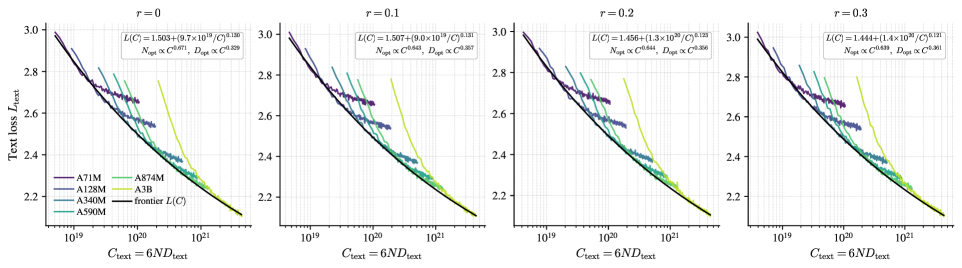
Two independent estimators are used: (i) IsoFLOP profiles, where N is swept at fixed C and D is set to hit that FLOP target with a cosine schedule whose cycle length matches C, yielding parabolic loss-vs-N curves whose minima locate N_{\text{opt}}(C); and (ii) the training-curve envelope, which extracts the pareto-minimum loss over all runs as a function of accumulated FLOPs and fits its slope.
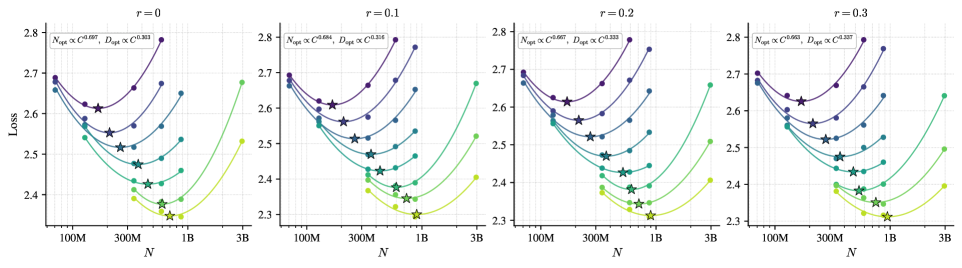
The IsoFLOP valleys in Figure 1 are cleanly parabolic across every r tested, which is the prerequisite for a meaningful N_{\text{opt}} estimate; the training envelope in Figure 2 confirms that the same power-law slope emerges from an independent estimator.
Language allocation is composition-invariant
The central empirical claim for the text objective is that the compute-optimal allocation (N_{\text{opt}}(C_{\text{text}}), D_{\text{opt}}(C_{\text{text}})) depends only on C_{\text{text}} = (1-r)C_{\text{total}} and is essentially independent of r itself. In other words: once you account for how many text tokens the model actually sees, adding image tokens to the mixture does not change the optimal N/D split for language.
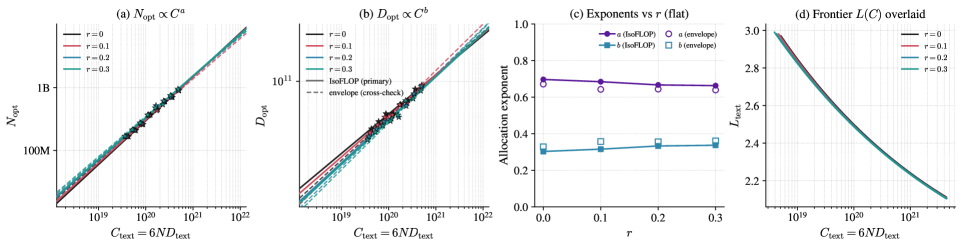
Figure 3 shows that both estimators produce nearly overlapping lines for N_{\text{opt}}(C_{\text{text}}) and D_{\text{opt}}(C_{\text{text}}) across all r. The IsoFLOP fits exhibit a small monotonic drift in the exponent as r grows, but the envelope estimator shows no such trend — the two disagree on the sign of the drift, indicating the residual variation is within fitting noise rather than a real dependence on data composition. Practically: to allocate resources for language capability, one budgets C_{\text{text}} and applies a single scaling law, regardless of how much multimodal data is mixed in.
The multimodal allocation law, by contrast, is highly sensitive to r — text-heavy mixtures shift the multimodal-optimal N/D split, which the paper analyzes separately (asymmetry is the whole point of studying the two objectives in isolation).
Downstream evaluation and transfer
The base models are evaluated in-context across 16 text benchmarks (MMLU-Redux, MMLU-Pro, AGIEval, SuperGPQA, HumanEval+, MBPP+, GSM8K, MATH, BBH, etc.) and 23 multimodal benchmarks (MMStar, MMMU, MMMU-Pro, MathVista, ChartQA, CV-Bench, SpatialEval, and others). Multiple-choice tasks use lowest-perplexity option selection; open-ended use exact match; coding uses Pass@1. Image tokenization uses 32\times 32 patch grids capped at 1536 tokens per image (512 in few-shot to fit the 4K context).
Two downstream findings are worth flagging. First, at a fixed 250B text-token budget, average accuracy over the 16 text benchmarks is essentially unchanged as r varies from 0 upward — curves for different r overlap across model sizes N and across training progress D_{\text{text}} for the A3B model. Native multimodal training does not tax core language ability once C_{\text{text}} is held fixed, empirically confirming the composition-invariance result on downstream metrics. Second, on the text-only abstract sub-tasks of SpatialEval, models trained with r=0.3 outperform r=0 baselines across model sizes — visual pre-training transfers positively into pure-text spatial reasoning, a modality-transfer effect that late-fusion architectures cannot exhibit by construction.
Limitations and open questions
The study is confined to a single dense transformer family, a 4K context, and image inputs only — no video, audio, or long-context regimes. The IsoFLOP fits exhibit measurable but noisy drift in exponents with r; distinguishing “invariance within fitting error” from “small real effect” would benefit from more seeds and wider C ranges. The multimodal allocation law’s sensitivity to text-heavy mixtures is asserted but the section shown here does not quantify the exponents. Finally, the analysis is at the pre-training loss level; whether the compute-optimal (N,D) for loss is also optimal for downstream RL/post-training remains open, as does the interaction with sparse (MoE) architectures.
Why this matters
If the language allocation law is truly r-invariant, practitioners can plan native multimodal runs by budgeting text compute independently, then choosing r purely on multimodal targets — collapsing a two-dimensional scaling search into two one-dimensional ones. The positive transfer to text-only spatial reasoning also gives a concrete case where NMP is not just competitive with late fusion but strictly beneficial.
Source: https://arxiv.org/abs/2607.22043
Three-Body Scattering for Generative Modeling
Problem
One-step generators typically require either an adversarial critic (unstable minimax), a prescribed noise-to-data probability path (diffusion/flow matching, expensive at inference unless distilled), or all-pairs energy-style objectives whose per-sample cost grows with the minibatch. Drifting-Models-type particle methods interpret each generated point as a projectile in the aggregated attractive/repulsive field of all reals and all fakes in the batch, giving O(B^2) per-sample interaction with high variance in the induced field. The question this paper asks: can one derive a constant-size, per-projectile stochastic estimator of the 2-Wasserstein gradient-flow velocity of the squared energy distance, and use it as direct regression supervision for a one-step generator?
Method
Let Q(\cdot\mid\mathbf{c}) be the conditional data law and P_{\boldsymbol{\theta}}(\cdot\mid\mathbf{c})=(\boldsymbol{g}_{\boldsymbol{\theta}}(\cdot,\mathbf{c}))_{\#}p(\mathbf{z}) the pushforward through a one-step generator. The training objective is condition-averaged squared energy distance,
\mathcal{F}(\boldsymbol{\theta})=\mathbb{E}_{\mathbf{c}}\left[\tfrac{1}{2}D_E^2(P_{\boldsymbol{\theta}}(\cdot\mid\mathbf{c}),Q(\cdot\mid\mathbf{c}))\right],
with
D_E^2(P,Q)=2\mathbb{E}\|\mathbf{x}_\mathrm{p}-\mathbf{x}_\mathrm{r}\|-\mathbb{E}\|\mathbf{x}_\mathrm{p}-\mathbf{x}_\mathrm{s}\|-\mathbb{E}\|\mathbf{x}_\mathrm{r}-\mathbf{x}_\mathrm{r}'\|.
Because Euclidean space is of strong negative type, D_E^2\ge 0 with equality iff P=Q (finite first moments), and \tfrac{1}{2}D_E^2 is a distance-kernel squared MMD.
The mechanical core is the “three-body event”: pick a projectile \mathbf{x}_\mathrm{p}\sim P_{\boldsymbol{\theta}}, one real source \mathbf{x}_\mathrm{r}\sim Q, and one independently generated source \mathbf{x}_\mathrm{s}\sim P_{\boldsymbol{\theta}}. Define unit “bonds”
\mathbf{b}_\mathrm{r}=\frac{\mathbf{x}_\mathrm{r}-\mathbf{x}_\mathrm{p}}{\|\mathbf{x}_\mathrm{r}-\mathbf{x}_\mathrm{p}\|},\qquad \mathbf{b}_\mathrm{s}=\frac{\mathbf{x}_\mathrm{s}-\mathbf{x}_\mathrm{p}}{\|\mathbf{x}_\mathrm{s}-\mathbf{x}_\mathrm{p}\|},
and the per-projectile stochastic velocity \widehat{\mathbf{v}}_\lambda=\mathbf{b}_\mathrm{r}-\lambda\mathbf{b}_\mathrm{s}. Attraction to one real, repulsion from one fake. Conditioned on \mathbf{x}_\mathrm{p} and \mathbf{c}, \mathbb{E}[\widehat{\mathbf{v}}_{\lambda=1}] equals the 2-Wasserstein gradient-flow velocity of \tfrac{1}{2}D_E^2(P_{\boldsymbol{\theta}},Q) at \mathbf{x}_\mathrm{p} — i.e., a proper distributional energy is turned into a sample-level regression target of O(1) cost per projectile, independent of batch size.
A batch of B frozen reference events therefore yields O(B) scalar regression losses rather than the O(B^2) field aggregation of Drifting Models. Optionally, a learned tracker network \mathbf{u}_\phi(\mathbf{x},\mathbf{c}) regresses the online conditional expectation of \widehat{\mathbf{v}}_\lambda to denoise the field.
The design is organized by a two-parameter (\rho,\lambda) map: \rho\in[0,1] mixes the instantaneous stochastic bond estimate with the tracker output, and \lambda scales the intra-source (repulsion) coefficient in \widehat{\mathbf{v}}_\lambda=\mathbf{b}_\mathrm{r}-\lambda\mathbf{b}_\mathrm{s} while simultaneously controlling the tracker-query range \alpha\in[0,1-\lambda]. The corner (\rho{=}0,\lambda{=}1) recovers “instant scattering,” closest to Drift-like dynamics but with the constant-size three-body estimator replacing the batch-level pairwise field. Other corners plug in tracker-based supervision that resembles diffusion-style regression targets — this is where the paper’s “generative design map” reframes diffusion supervision, Drift dynamics, and MMD-flow updates as interior points of a single family.
Scattering is performed in a frozen image feature space (a pretrained encoder), which is essential: energy distance on raw pixels is a poor perceptual metric, and feature-space scattering gives well-behaved unit bonds.

Results
On ImageNet-256 at NFE =1:
- Pixel-space PixelDiT-XL trained with TBSM reaches FID =2.23.
- Latent-space DiT-XL trained with TBSM reaches FID =1.63.
Both are single-step numbers, competitive with distilled diffusion baselines while avoiding a teacher model, an adversarial critic, or a prescribed noise-to-data path. The (\rho,\lambda) ablation (Fig. 3 in the paper) shows the design-map corners are meaningfully different: the “instant scattering” corner reported in the figure achieves FID =10.31 and IS =133.02 at matched generator updates, indicating that tracker-based smoothing (nonzero \rho) and the diffusion-adjacent corners of the map materially outperform pure instantaneous Drift-like dynamics.

The method extends to text-to-image: fine-tuning Qwen-Image-20B with only the TBSM objective produces coherent 1024\times 1024 samples at NFE =1, without an adversarial term or a distillation teacher (App. C).

Limitations and open questions
- All reported gains are in a frozen feature space; raw-pixel scattering is not viable. Choice of encoder is a hidden hyperparameter, and the theoretical statement “\tfrac{1}{2}D_E^2\ge 0 with equality iff P=Q” applies to the feature-space law, not the image law.
- The velocity identity \mathbb{E}[\widehat{\mathbf{v}}_1\mid\mathbf{x}_\mathrm{p}]=\nabla_{W_2}\tfrac{1}{2}D_E^2 holds in expectation, but the single-projectile estimator is high-variance; the paper’s tracker network is essentially a value function to reduce field noise, and its interaction with \lambda (which shifts the query range \alpha) is not cleanly ablated.
- With one observation per condition, Q(\cdot\mid\mathbf{c}) is a population object, so gradient-flow interpretation of the paired-data regime rests on smoothness assumptions across \mathbf{c}.
- Comparisons at matched compute against distilled diffusion (e.g., consistency models, sCM) and adversarial one-step generators are needed to disentangle whether the gain comes from the energy-distance target or from the frozen-feature perceptual space.
Why this matters
TBSM shows that a proper distributional discrepancy — squared energy distance — can be reduced to a O(1)-per-sample regression target, giving direct supervision for one-step generators without diffusion paths, critics, or teachers, and reaching FID =1.63 on ImageNet-256 at NFE =1. The (\rho,\lambda) design map is a useful reframing that places diffusion regression, Drift-like particle dynamics, and MMD gradient flows as neighbors in a single estimator family.
Source: https://arxiv.org/abs/2607.18198
Molt: A Scalable PyTorch-Native Training Framework for Agentic Reinforcement Learning
Molt is NVIDIA’s answer to a specific pain point in agentic RL research: the mismatch between hyperscale training stacks (Megatron-based, multi-backend, controller-heavy) and the iteration pattern of algorithm research, where every change — a new estimator, a new rollout scheme, a new pipeline stage — has to be threaded through trainer, distributed backend, and rollout glue. The framework’s thesis is that scalability can be inherited from separately hardened upstream components (vLLM for serving, FSDP2/EP/CP through NVIDIA AutoModel, Ray for placement) rather than re-implemented, keeping the framework-owned surface small enough that a researcher — or an AI coding assistant — can hold it in their head.
Architecture: four concepts, one loop
The runtime is deliberately single-backend and reduces to three components connected by one asynchronous Ray queue: a pool of user-defined agents (plain Python producing actions and rewards), a set of vLLM rollout engines behind a request router, and a single trainable FSDP2 policy actor on NVIDIA AutoModel. Reference workers and a PPO critic are optional additional actor groups; there is no hybrid controller, no per-backend adapter, no separate parameter server.
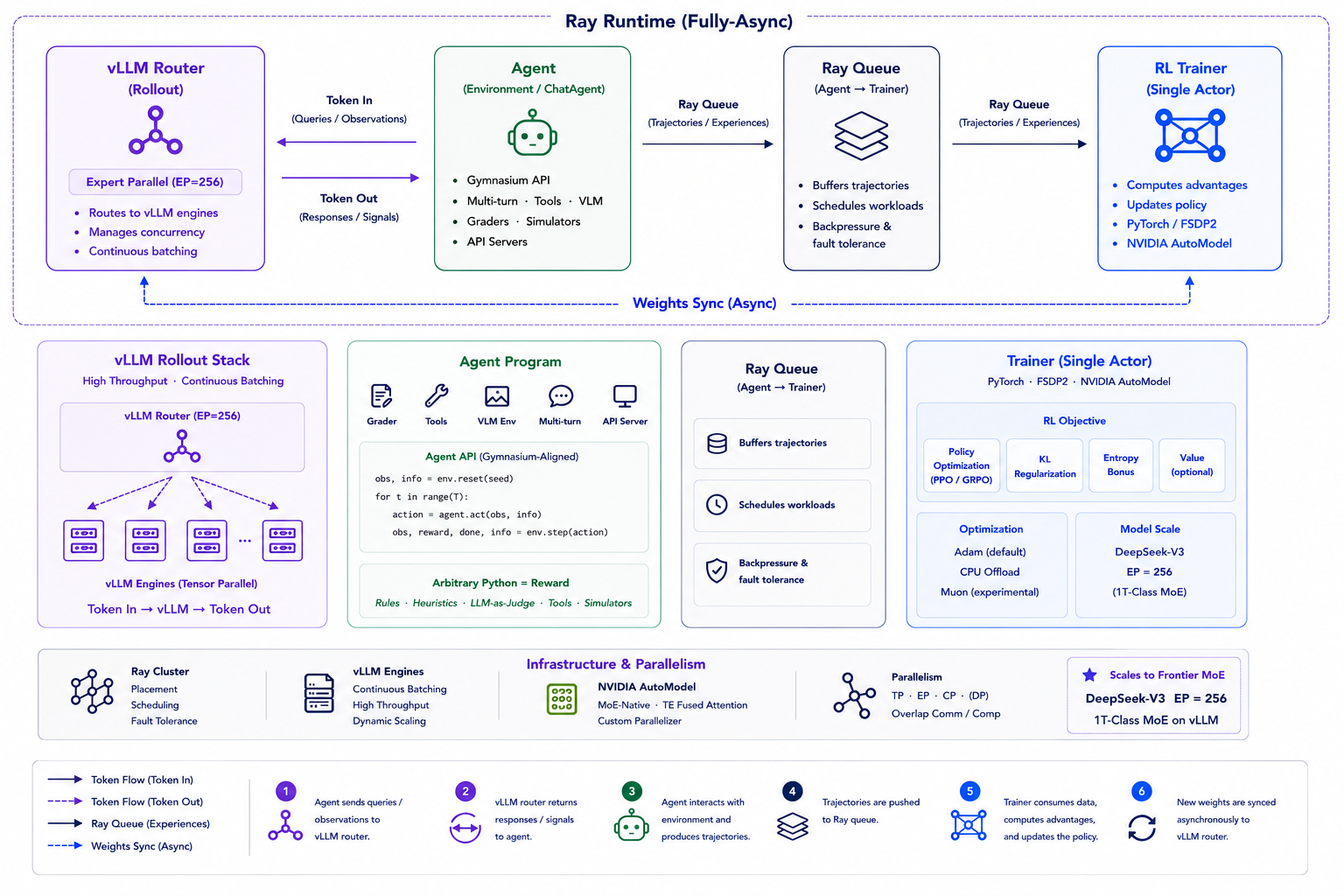
The design maps four concepts one-to-one onto code: agent (Python producing rewards), generator (token-exact capture from the serving engines), trainer (one visible FSDP2 loop), and estimators/losses (pure functions of rewards, groups, and the token trace). An algorithmic change touches exactly one of the four.
The central invariant is token-first, on-policy in the strict sense: Molt never trains on a token it did not itself generate. Token ids, per-token log-probabilities, action ranges, rewards, and multimodal tensors flow aligned from the engine sampler to the loss with no text→token re-derivation and no reconciliation layer between generation and training. In notation, for a trajectory \tau = (t_1, \dots, t_T) with generator log-probs \log \pi_{\theta_{\text{gen}}}(t_i \mid t_{<i}) captured at sampling time, the training loss uses the same token stream and the trainer’s log-probs \log \pi_\theta(t_i \mid t_{<i}) under whatever estimator the algorithm layer implements (GRPO, RLOO, PPO, REINFORCE variants), with the policy-version delta bounded by the asynchronous queue depth.
Streaming pool for group-baseline estimators
Agentic workloads have heavy-tailed generation latency, so a naive synchronous rollout drains engines while the trainer computes and vice versa. Molt’s streaming pool keeps prompt groups — all samples of one prompt, which is the unit that group-baseline estimators like GRPO need to compute \hat{A}_i = (r_i - \bar{r})/\sigma_r — in flight simultaneously and emits a training batch as soon as enough groups complete. A configurable queue depth decouples training throughput from rollout latency. Every optimizer step logs per-stage timings (timing/generation, timing/policy_train, timing/broadcast, timing/step_total) alongside reward statistics, so the effect of any algorithmic change is visible in the same step’s logs.
Footprint and evaluation
The core empirical claim is that leanness does not cost throughput. Under a matched, fully asynchronous protocol, Molt is statistically comparable to a state-of-the-art Megatron-based stack (the paper’s language is deliberately parity rather than superiority).
The framework-owned RL surface, counted by tracing the import graph from each RL entry point through trainer, rollout, orchestration, experience/advantage/loss, and imported model/utility/parallelism code, is approximately 8.6K lines of Python. The comparable counts (measured 2026-06-16 for baselines, 2026-07-07 for Molt) are:
- OpenRLHF: ~7.2K
- Molt: ~8.6K
- slime: ~25K
- verl: ~62K
So Molt sits at roughly 1/7 the LOC of verl and 1/3 of slime while covering FSDP2/EP/CP, MoE-native training, VLM multi-turn tools, and Ray-orchestrated vLLM rollouts. Configuration is a flat CLI surface rather than Hydra+YAML (verl) or CLI+YAML (slime).
The agent boundary is unusually thin: subclass Env or ChatAgent in one Python file, return Result(reward=...), and point a stock OpenAI SDK at ctx.base_url. There is no environment DSL, no registry. The same CLI drives single-node and Slurm recipes.
Scale and limits
Molt already runs the full asynchronous loop — rollout, weight refit, optimizer step — end to end on a 700B MoE at expert parallelism 256, on the same code path as a 4B run. The configuration surface expresses DeepSeek-V3-class models; vLLM handles serving and AutoModel ships EP-sharded recipes upstream. The paper explicitly frames the path to 3-trillion-parameter training on GB300 as “convergence measurement, not redesign.”
The open questions the paper does not close:
- Convergence parity at frontier scale is asserted from throughput parity plus upstream-validated components; end-to-end learning curves at 700B+ are future work.
- Off-policy correction is avoided rather than solved — the strict on-policy invariant forbids reuse of stale rollouts, which caps sample efficiency relative to importance-weighted async schemes (e.g., AReaL).
- No PP/TP in the framework’s own parallelism inventory (vs verl’s TP/PP/EP/SP); Molt leans on FSDP2/EP/CP, which is adequate for MoE at EP=256 but leaves some regimes uncovered.
- LOC is a proxy for cognitive load, not correctness or feature coverage; the promised qualitative usability studies are not yet in the paper.
Why this matters
Molt is one of the first RL training frameworks explicitly designed for the regime where AI coding assistants participate in modification of the codebase, and it treats “fits in a context window and traces cleanly from CLI flag to loss” as a first-class engineering constraint. If the throughput-parity claim holds up at frontier scale, it undercuts the assumption that agentic RL research must live inside Megatron-shaped stacks.
Source: https://arxiv.org/abs/2607.21653
DataPrep-Bench: Benchmarking LLMs as Training Data Preparators
Problem
Training data quality dominates downstream LLM capability, yet evaluations of “data preparation” methods — prompt-based synthesizers, agentic pipelines, DataFlow-style operator graphs, and quality scorers — are fragmented. Papers report on incompatible corpora, base models, and metrics, and most rely on surface-level textual proxies (perplexity, diversity heuristics, reward-model scores) instead of measuring whether the produced data actually improves a downstream model. DataPrep-Bench is a unified, downstream-grounded protocol covering the two capabilities that matter operationally: (1) turning raw sources into SFT data (Data Construction), and (2) predicting the training utility of a candidate dataset before you spend GPUs fine-tuning on it (Data Quality Evaluation).
Benchmark design
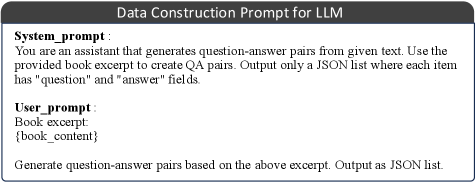
Let \mathcal{D}=\{D_1,\dots,D_m\} be six domains, each with a downstream benchmark set \mathcal{T}_k (e.g., MMLU-Redux for General Text, math benchmarks decoded at temperature 0.6 with a 16{,}384-token window) and a fixed raw source corpus \mathcal{B}_k of curated books and long-form knowledge documents. For any candidate SFT set \mathcal{X}, define
f(\mathcal{X}) = \mathrm{SFT}(f_0, \mathcal{X}), \qquad \mathrm{Score}_{\mathrm{con}}(M, D_k) = \mathrm{Perf}\bigl(f(\mathcal{X}_k^{(M)}),\, \mathcal{T}_k\bigr),
where \mathcal{X}_k^{(M)} = M(\mathcal{B}_k) = \{(q_i, a_i)\}_{i=1}^{N_k^{(M)}} is the QA dataset produced by method M. Critically, methods are allowed to produce datasets of different sizes, styles, and coverage — the benchmark scores only the induced model, not the artifact itself. Because \mathcal{T}_k is curated independently of \mathcal{B}_k, \mathrm{Score}_{\mathrm{con}} operationalizes training utility rather than reproducibility of the source text.
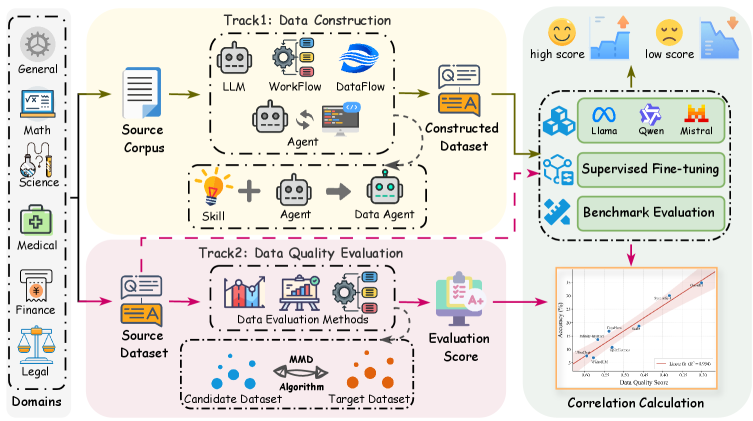
The Data Quality Evaluation track fixes a pool of candidate SFT datasets and asks a scoring function to predict \mathrm{Perf}(f(\mathcal{X}), \mathcal{T}_k) without training. Ground truth comes from actually fine-tuning each candidate and measuring downstream score, so metric evaluation reduces to rank/regression against real training outcomes.
To keep comparisons clean, all runs use a fixed recipe in LlamaFactory: 3 epochs, cosine schedule, LR 5.0\times 10^{-6}, warmup ratio 0.1, global batch size 32 on 8×H20. Base models are Qwen2.5-7B and Llama-3.1-8B. Because these are pretraining checkpoints (no instruction tuning), every construction method is fine-tuned jointly with Dolly-15k, and a Dolly-15k-only row (marked †) isolates the domain-data contribution from baseline instruction-following.
Data-Construction-Skill
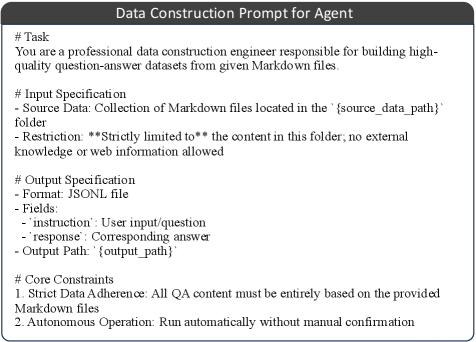
The paper’s construction baseline, M_{\mathrm{DCS}}, targets a specific failure mode: single-prompt QA synthesis over hundreds of pages cannot simultaneously handle task decomposition, schema consistency, validation, coverage tracking, and resumable execution. Data-Construction-Skill splits responsibilities between an agent (planning, chunk iteration, tool calls, checkpointing) and a reusable skill layer that declaratively specifies output schema, quality constraints, filtering rules, and auxiliary resources. The skill is domain-agnostic; the agent invokes it while walking the corpus.
This is contrasted with two other regimes on the benchmark: DataFlow’s expert-authored Markdown-to-QA pipeline, and DataFlow-Skill, a DataFlow-internal variant in which GPT-4o selects/creates operators and composes an executable pipeline. Note DataFlow-Skill is distinct from Data-Construction-Skill (agent-based) despite the name overlap.
Quality evaluation: Distributional Alignment Score
For the second track, the paper proposes a Distributional Alignment Score that estimates a candidate dataset’s downstream utility via distributional similarity to a domain proxy — cheap to compute, requires no fine-tuning, and evaluated against the ground-truth downstream scores of the same candidate pool.
Results
The headline number reported in the abstract: Data-Construction-Skill lifts the Dolly-only baseline by nearly 20 absolute points on Llama-3.1-8B in the Finance domain, and is competitive with the strongest agent- and DataFlow-based methods in the Knowledge domain. The scale of that lift on a single-domain benchmark is consistent with the claim that most of the difficulty in domain SFT construction lies in coverage and schema discipline over long documents, rather than in per-item generation quality — precisely what the skill layer targets. Full cross-domain and cross-base-model tables (six domains × two base models × multiple methods) are provided; MMLU-Redux is used for General Text under 5-shot prompting, with domain scores averaged over their constituent benchmarks.
Limitations and open questions
- The construction track uses only book-style long-form sources; results may not transfer to web, code, or dialog corpora where retrieval and deduplication dominate.
- Every method is co-trained with Dolly-15k under a fixed LR/epoch schedule. Methods that would benefit from different token budgets or LR schedules (e.g., large synthetic sets that overtrain at 3 epochs) are penalized; the benchmark measures utility conditional on a canonical recipe, not the Pareto frontier.
- Downstream benchmarks such as MMLU-Redux measure recognition of factual knowledge; construction methods that improve reasoning or tool use may be undervalued.
- The Distributional Alignment Score’s dependence on the proxy dataset is not stress-tested for domains where a clean proxy does not exist.
- No cost accounting: agentic methods that call GPT-4o at every chunk are compared against cheap single-prompt baselines on equal footing.
Why this matters
Data preparation is currently evaluated by anecdote and surface metrics; DataPrep-Bench pins it to downstream training utility under a fixed SFT recipe, which is the only definition that matters for practitioners choosing between synthesizers. The 20-point Finance lift from a skill-guided agent over Dolly-only suggests that control-layer structure, not model scale, is the current bottleneck in long-form domain data synthesis.
Source: https://arxiv.org/abs/2607.20465
Multi-Head Latent Control: A Unified Interface for LLM Agent Decision Making
Agentic LLM deployments need more than next-token prediction: at each turn a system must decide whether the current model is competent for the instance, whether to escalate to a stronger backbone, whether to ask a clarifying question, invoke a tool, or abstain. Current practice bolts these decisions on via prompt-level routers, external orchestration, or per-task fine-tuning — all input-conditioned, all requiring re-engineering as backbones change. This paper argues the decisions are already latent in the model’s own generation trajectory and can be read out by lightweight probes attached to a frozen backbone.
Setup and mechanism
Fix a primary model m_1 with hidden size d producing output tokens \hat{y}_1,\ldots,\hat{y}_N. For any layer \ell, stack the token-aligned hidden states into H^{(\ell)} = [h^{(\ell)}_1;\ldots;h^{(\ell)}_N] \in \mathbb{R}^{N\times d}. Two heads read (potentially different) traces from the same frozen backbone:
- Capability Head on H^{\text{cap}} = H^{(L)} (final layer), outputting p_{\text{cap}} \in [0,1], the probability that m_1 can solve the instance vs. deferring to a stronger m_2.
- Resolution Head on H^{\text{res}} = H^{(\ell_{\text{res}})} (an empirically chosen middle layer), outputting \mathbf{s}_{\text{res}} = [s_{\text{info}}, s_{\text{tool}}, s_{\text{cant}}] \in [0,1]^3 over clarification, tool invocation, and abstention (with direct answering as the residual class).
Variable-length traces are compressed to fixed-budget summaries \tilde{H}^{\text{cap}} = \Pi_{\text{cap}}(H^{\text{cap}}), \tilde{H}^{\text{res}} = \Pi_{\text{res}}(H^{\text{res}}) before the heads. The rationale for separate layers is that adequacy and intervention type are not necessarily most linearly separable at the same depth; layer-choice ablations appear in Appendix C.
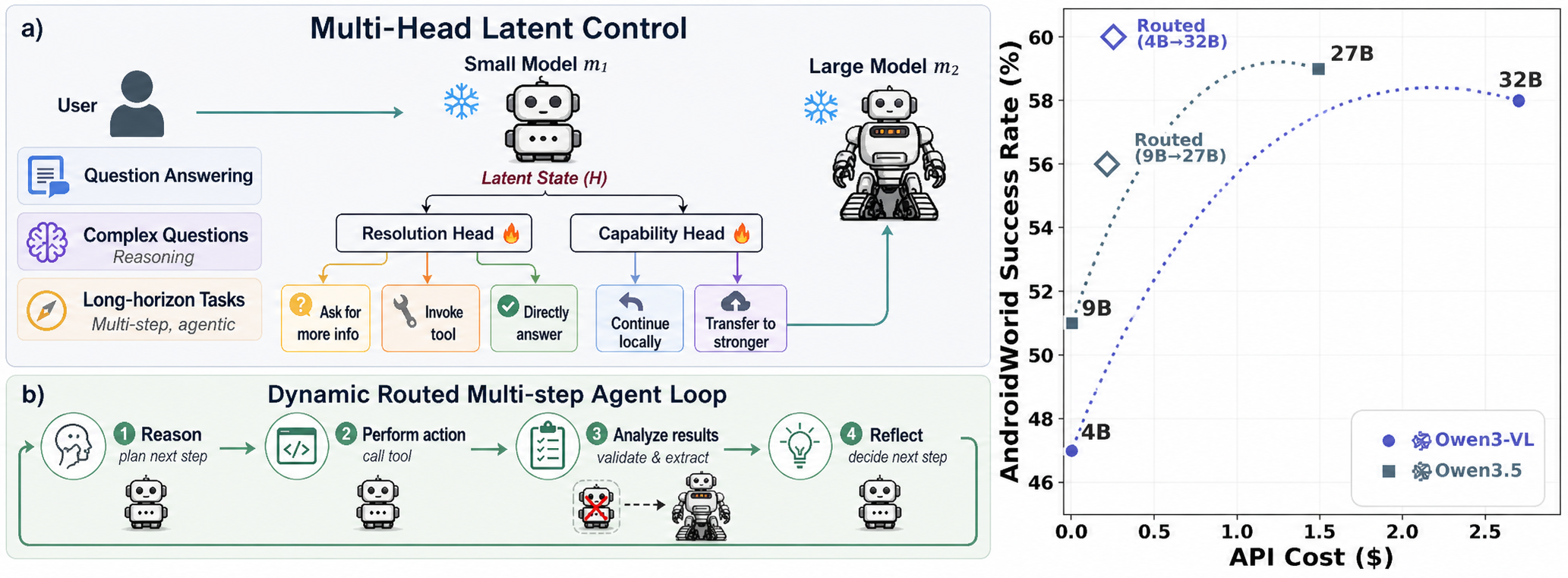
Only the two heads are trained. The Capability Head is trained on a 120K mixture spanning visual QA, math/reasoning, parametric knowledge (MMLU-Pro-like), grounding (ScreenSpot-Pro-like), tool use, and agentic interaction, keeping the label — did m_1 actually solve this instance? — well-defined per backbone.
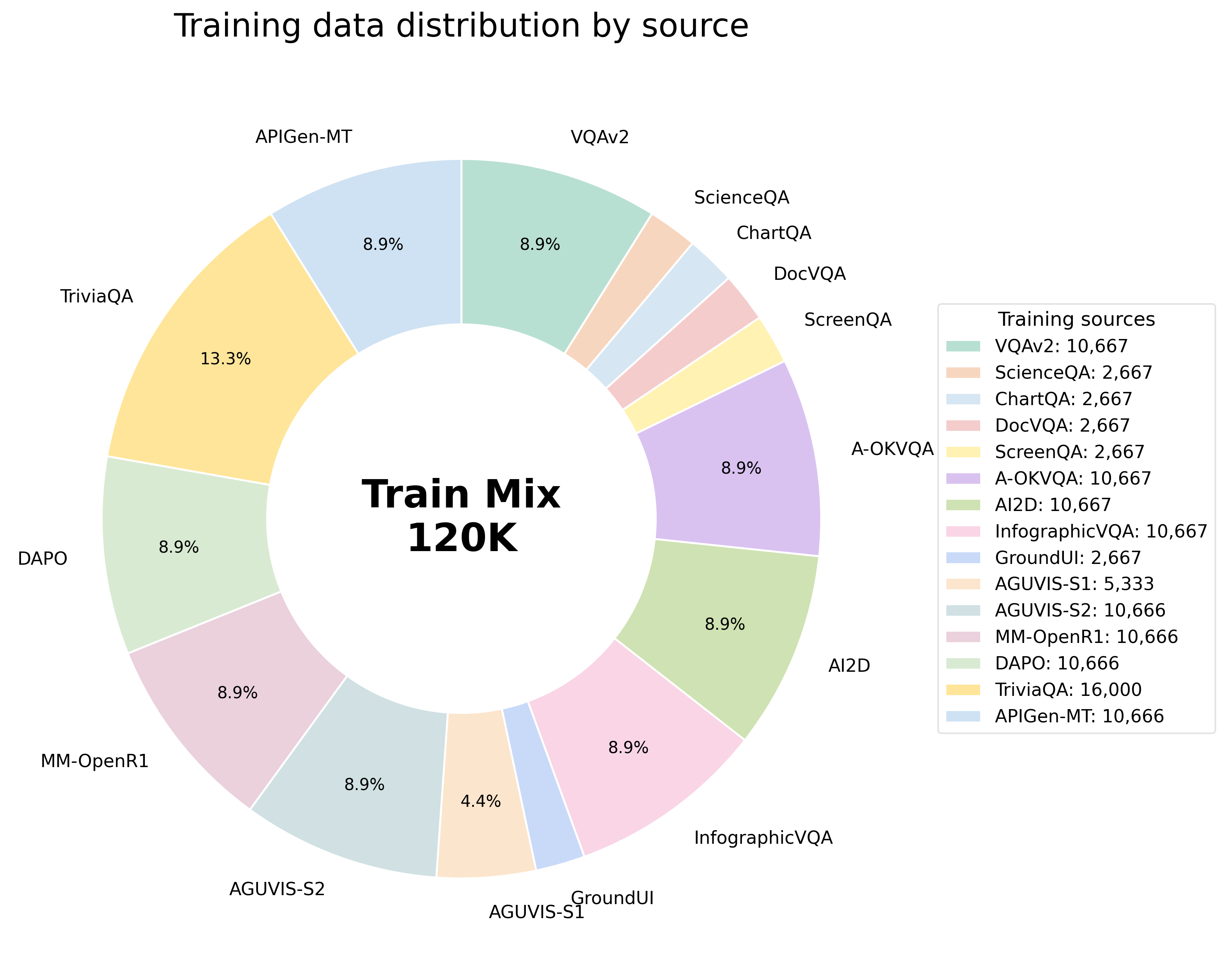
Because labels are collected from m_1 itself, the head is intrinsically calibrated to that backbone and must be re-trained (cheaply) when the backbone changes — a deliberate design choice.
Capability-guided routing results
The main routing experiments pair a small primary with a larger fallback across three backbone families and six benchmarks (CharXiv, MathVerse, MathVista, ScreenSpot-Pro, SimpleVQA, MMLU-Pro). For Qwen3.5-4B \to Qwen3.5-27B-Thk, the routed system matches the fallback’s overall score of 0.72 while dropping aggregate cost from $27.37 to $15.17 — a 44.6% reduction. Per-benchmark cost cuts are larger where the small model is already competitive: 71.9% on MathVerse (0.90 vs. 0.89 fallback) and 57.5% on MathVista (0.86 vs. 0.87 fallback). On ScreenSpot-Pro, where m_1 scores only 0.36 vs. 0.65 for m_2, the router still delivers 0.64 at 23.7% cost savings.
Scaling the primary up to Qwen3.5-9B yields larger savings because more instances stay local: overall 0.72 at $12.85 (53.0% off), with MathVerse and MathVista cost reductions of 73.4% and 67.3%. On the VLM side (Qwen3-VL-2B-Thk \to 32B-Thk), the router achieves 0.65 vs. the 32B’s 0.67 at 27.2% lower cost; the smaller savings reflect a weaker m_1 (0.50 overall) with fewer instances safely retainable.
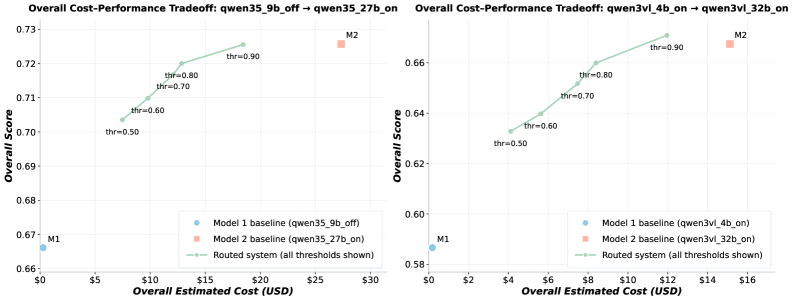
The Pareto sweep in Figure 2 shows the routed frontier lies strictly above the linear interpolation between m_1 and m_2: intermediate thresholds are not just mixtures but genuine gains from instance-level routing.
Resolution decisions and prefix-time inference
On When2Call, which requires selecting among clarification, tool use, abstention, and direct answering, adding the Resolution Head to a frozen backbone improves intervention accuracy over the backbone’s native behavior (details in §4.2). A web-augmented TriviaQA experiment (§4.3) evaluates tool-escalation specifically under incomplete parametric knowledge, and a prefix-time setting (§4.4) tests whether p_{\text{cap}} can be predicted before generation completes — important because full-generation routing has already paid most of the local inference cost. The paper reports that adequacy signals recover from partial hidden-state prefixes, enabling early handoff.
Limitations
The framework requires a labeled trace-collection pass per backbone: label distributions for the Capability Head depend on whether m_1 solved each instance, so the heads are not zero-shot transferable to a new backbone. Reported gains also rely on a well-chosen middle layer \ell_{\text{res}} selected empirically. The Resolution Head’s four-way ontology (clarify / tool / abstain / answer) may be too coarse for agents with heterogeneous tool sets, and there is no evidence yet that the mechanism scales to hierarchical or multi-tool routing. Finally, all headline routing results use Qwen-family models; whether latent separability of capability holds at similar quality on architectures with substantially different post-training (e.g., heavy RLHF or MoE gating) is untested.
Why this matters
Treating capability and intervention type as read-outs of the model’s own hidden-state trajectory reframes agent orchestration as a probing problem rather than a prompting or fine-tuning problem, and empirically buys 25–70% cost reductions at matched task score without touching backbone weights. If the layer-choice and prefix-time results hold up, the same interface — two small heads trained on cached traces — could replace much of the ad-hoc routing infrastructure currently glued around production LLM agents.
Source: https://arxiv.org/abs/2607.14277
Spectral Prior for Reducing Exposure Bias in Diffusion Models
Problem
Exposure bias in diffusion models refers to the train/inference mismatch that accumulates as the denoiser is repeatedly applied to its own outputs rather than to samples from the true forward marginals q(x_t). Existing remedies (input perturbation, timestep shifting, dynamic thresholding) apply a fixed correction and assume the bias has a consistent direction. This paper reframes the phenomenon in the frequency domain: the effective SNR seen by the network at inference deviates from training in a frequency-dependent way, and — crucially — the sign of that deviation is not constant across models, timesteps, or spatial frequencies. That observation immediately falsifies any single global correction rule and motivates a data-driven, per-frequency calibration target.
Method
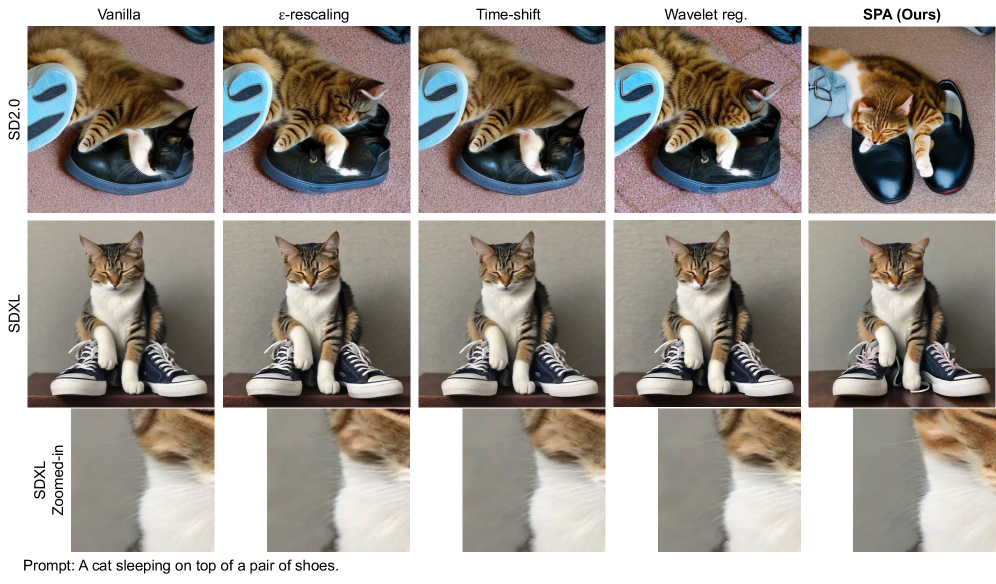
SPA (Spectral Alignment) has two stages, summarized in Figure 1.
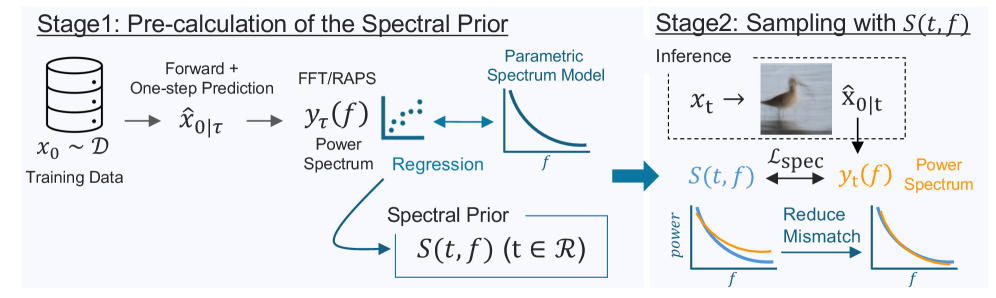
Stage 1 — Offline spectral prior. For each timestep t, the authors compute single-step estimates \hat{x}_{0|t} = \frac{x_t - \sqrt{1-\bar\alpha_t}\,\epsilon_\theta(x_t,c,t)}{\sqrt{\bar\alpha_t}} starting from x_t = \sqrt{\bar\alpha_t}\,x_0 + \sqrt{1-\bar\alpha_t}\,\epsilon with real x_0 from training data. They average the channel-wise 2D power spectrum |\mathcal{F}(\hat{x}_{0|t})|^2 over many samples and fit a parametric model S^\star_t(f) per channel. This uses only one denoising step per sample, so it captures the network’s own frequency response without contamination from multi-step error accumulation. For latent diffusion the same procedure is applied in latent space to \hat{z}_{0|t}.
Stage 2 — Inference-time guidance. At each sampling step, SPA computes the empirical spectrum of the current \hat{x}_{0|t}, forms a loss against the stored prior — a radial/log-power discrepancy \mathcal{L}_{\text{spec}}(\hat{x}_{0|t}; S^\star_t) — and adds an FFT-based gradient to the DDIM update: x_{t-1} = \sqrt{\bar\alpha_{t-1}}\,\hat{x}_{0|t} + \sqrt{1-\bar\alpha_{t-1}}\,\epsilon_\theta(x_t,c,t) - \lambda_t \nabla_{x_t}\mathcal{L}_{\text{spec}}. Because the loss is defined in Fourier space and Parseval’s theorem lets the gradient be computed via FFT/IFFT pairs, the overhead is 3–4% wall-clock relative to the base sampler. The guidance is orthogonal to classifier-free guidance and simply composes additively with the CFG-modified score.
Why the mismatch is not one-signed
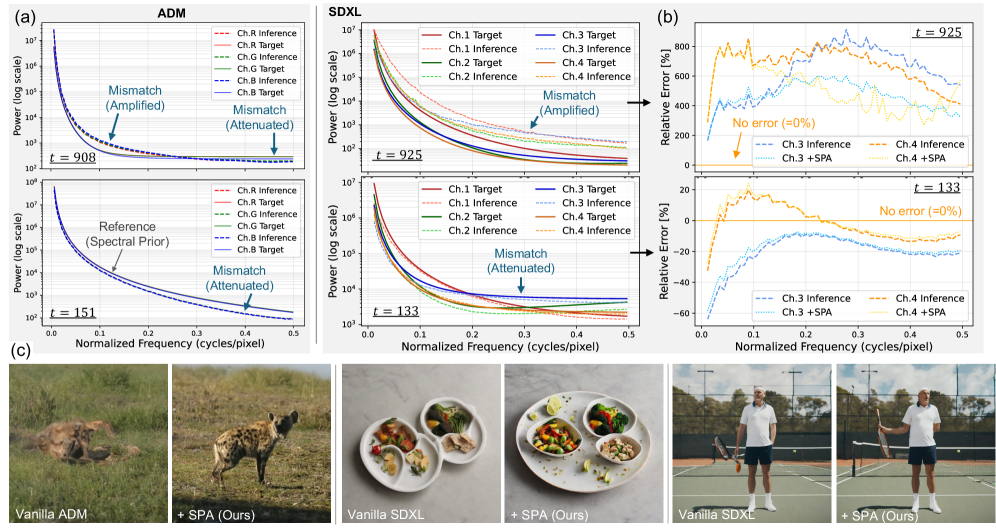
Figure 2(a) shows target vs. inference spectra for ADM and SDXL. For SDXL the inference spectrum exceeds the prior at some frequencies and falls below it at others, and the crossover shifts across channels. Figure 2(b) plots the relative error before and after SPA: applying SPA (dotted) collapses the error toward zero across the frequency axis, whereas the uncorrected trajectory (dashed) shows structured deviations of both signs. This directly supports the paper’s thesis that fixed corrective schemes (which uniformly sharpen or smooth) cannot generalize, and it justifies learning S^\star_t empirically rather than positing an analytical form.
Experiments
SPA is evaluated on DDPM (CelebA-HQ, 50 steps), ADM (ImageNet-256, 100 DDPM steps), SD2.0, SDXL (30 DDIM steps, base stage only), and the flow-matching models SD3.5-medium and FLUX.1-dev. The consistent claim across all six is quality improvement at 3–4% overhead with no retraining. Qualitatively (Figure 3), SPA fixes malformed object geometry on SD2.0 outputs and tightens edge definition on SDXL, whereas competing exposure-bias baselines introduce high-frequency background artifacts — the expected failure mode when a fixed sharpening prior is applied to a model whose actual mismatch has the opposite sign at high frequencies.
Limitations and open questions
- The paper’s framing rests on channel-wise, radially averaged spectra; anisotropic structure (e.g., oriented textures) is not modeled and may leave residual bias.
- S^\star_t is fit from training data via single-step predictions. If the true multi-step marginal spectrum differs systematically from the single-step one, aligning to S^\star_t is only a first-order fix; iterating the prior fit with rolled-out predictions is not explored.
- The guidance weight \lambda_t schedule and its interaction with CFG scale are not fully characterized in the excerpted sections; over-strong spectral guidance risks over-smoothing at low t.
- Only image-domain diffusion is tested. Whether the same frequency-dependent SNR error appears in video or audio diffusion (where temporal spectra matter) is open.
- For latent models, the spectral prior lives in a learned latent space whose axes have no canonical frequency semantics; the fact that SPA still helps SDXL/SD3.5/FLUX suggests VAE latents retain enough spatial structure for 2D FFT-based calibration, but this deserves theoretical scrutiny.
Why this matters
SPA reframes exposure bias as a measurable, frequency-resolved discrepancy rather than a monolithic drift, and shows that the correction direction is model- and timestep-specific — an argument that undermines the design assumption behind several prior fixes. The mechanism is cheap, training-free, composable with CFG, and works uniformly across pixel-space, latent, and flow-matching diffusion, which makes it a plausible default post-hoc calibration step.
Source: https://arxiv.org/abs/2607.22091
Hacker News Signals
Go Analysis Framework: modular static analysis by go team
The golang.org/x/tools/go/analysis package provides a composable framework for writing Go static analyzers. The core abstraction is the Analyzer struct, which declares a Name, Doc, a Run function of type func(*Pass) (interface{}, error), and a Requires slice of *Analyzer dependencies. The Pass struct gives each analyzer access to the typed AST (go/ast), type information (go/types), SSA representations if needed, and a Report method for emitting diagnostics with source positions.
The dependency mechanism is the key engineering contribution. An analyzer can declare that it requires the output of another (e.g., buildssa.Analyzer or inspect.Analyzer), and the driver topologically sorts and caches results. The inspect.Analyzer precomputes an ast.Inspector for fast node traversal; consuming analyzers call pass.ResultOf[inspect.Analyzer].(*inspector.Inspector) to get it, avoiding redundant AST walks. This makes composition both correct and efficient across large codebases.
The Diagnostic type attaches structured suggested fixes (analysis.SuggestedFix with TextEdits), enabling automated refactoring pipelines, not just linting. The Fact mechanism allows analyzers to persist cross-package information: a fact implementing the Fact interface is exported per-object or per-package and made available to analyzers processing downstream packages, similar in spirit to compiler summary files.
Drivers (e.g., go vet, golangci-lint, singlechecker, multichecker) consume []*analysis.Analyzer slices and handle flag registration, parallel execution per package, and result aggregation. The framework is intentionally driver-agnostic — the same analyzer binary runs under go vet or as a standalone tool without modification.
The thread discussion covers writing custom analyzers, the tradeoffs of fact-based inter-package analysis versus whole-program SSA, and integration with gopls for IDE diagnostics. The design is clean enough that first-party analyzers (nilness, printf, shadow) and third-party linters share the same interface without any abstraction penalty.
Source: https://pkg.go.dev/golang.org/x/tools/go/analysis
Terence Tao: Mathematics in the Age of AI
Tao’s ICM 2026 slides address where AI tools currently sit relative to research mathematics, with characteristic precision about what is and is not demonstrated. He distinguishes three regimes: formalization (converting existing proofs to Lean/Mathlib), computer-assisted problem solving (AlphaProof-style RL on olympiad problems), and open-ended conjecture generation and proof search at the research frontier.
The central technical observation is that current LLM-based systems perform well on problems with short proof certificates verifiable against a formal grammar but degrade on problems requiring multi-step heuristic search over large combinatorial spaces without intermediate reward signals. He notes that formal verification provides a clean training signal — proof correctness is decidable — which is why progress on olympiad problems has been faster than on research-level problems where even defining “partial progress” is nontrivial.
Tao discusses the “autoformalization bottleneck”: the cost of translating informal mathematical prose to a proof assistant remains high, and the gap between the informal mathematical literature and the Mathlib corpus is enormous. He frames this as a data problem as much as a modeling problem. Projects like LeanDojo and the Lean 4 tactic state representation are mentioned as steps toward making formal proof corpora machine-readable at scale.
On the longer-term trajectory, Tao is cautious but specific: he expects AI to become a useful collaborator for checking arguments, suggesting lemmas, and exploring special cases, but does not expect near-term autonomous resolution of deep open problems (e.g., Riemann Hypothesis, P vs NP) where the search space has no known efficient structure. He also raises the sociology-of-mathematics angle: if AI generates a proof that no human can verify step-by-step, what does “proof” mean epistemically?
The slides are worth reading for the precise calibration from someone actively using these tools on research problems.
Source: https://teorth.github.io/tao-web/slides/age-of-ai-icm-2026.pdf
Scriptc by Vercel: TypeScript-to-Native compiler, no JavaScript engine in binary
Scriptc is an ahead-of-time compiler that takes TypeScript source and emits a self-contained native binary with no V8, no Node.js, and no JavaScript runtime in the output. The compilation pipeline is: TypeScript -> type-erased JavaScript AST -> Scriptc IR -> LLVM IR -> native object code, linked against a small runtime for GC and async I/O. The claimed goal is sub-millisecond cold starts and drastically reduced binary size compared to packaging a JS engine.
The technical challenges here are well-known. JavaScript’s dynamic semantics — prototype mutation, eval, arguments object, dynamic property access on arbitrary objects — are hostile to AOT compilation. Scriptc addresses this by targeting a restricted TypeScript subset where types are not merely hints but enforced constraints. Type information is used to monomorphize functions, devirtualize method calls, and emit direct struct field accesses rather than hash-map property lookups. This is essentially what V8’s Turbofan does speculatively at runtime, but Scriptc does it statically with the guarantee that the TypeScript types are sound.
The async model is handled by compiling async/await to a stackful coroutine representation (similar to Rust’s async transformation) rather than relying on an event loop runtime. I/O binds to libuv or a similar async I/O layer in the linked runtime, keeping that component small.
Limitations are significant: no require/dynamic import of arbitrary npm packages (only a curated stdlib is available), no eval, restricted use of any. This makes Scriptc suitable for CLI tools, edge functions, and build tooling, but not for arbitrary Node.js applications. The HN discussion focuses on the scope of TypeScript subset supported, whether any leaks invalidate the type-based optimizations, and how this compares to Bun’s single-binary packaging (which still ships JSC).
Source: https://github.com/vercel-labs/scriptc
How AST-grep Rewrote Tree-sitter in Rust and Made It 30% Faster
Tree-sitter is a C library for incremental, error-recovering parsing. AST-grep uses it as a backend for structural code search and rewriting — the user writes a pattern with metavariables (e.g., $FUNC($$$ARGS)) and the tool finds matching AST nodes. The bottleneck was the C FFI boundary: every node traversal from Rust required an unsafe call into C, with associated overhead from the ABI, pointer indirection, and inability to inline across the language boundary.
The rewrite replaced the C tree-sitter core with a pure-Rust implementation that preserves the same grammar format (tree-sitter grammars compile to parser tables, and those tables are still used) but reimplements the runtime in Rust. This allows the Rust borrow checker to eliminate redundant bounds checks, enables LTO across the entire codebase, and allows the compiler to inline hot traversal functions that previously crossed the FFI boundary.
The 30% throughput improvement (measured on large codebases, grep-style workloads) comes from three sources: inlining of node accessor methods that were opaque across FFI, better cache behavior from replacing pointer-heavy C structs with more compact Rust enums and slices, and elimination of the overhead from unsafe block bookkeeping. The Rust runtime also enables parallel pattern matching using Rayon without the threading complications of the C library’s global state.
The tree-sitter grammar DSL and .so compilation path are unchanged — existing language grammars (Python, TypeScript, Rust, etc.) still compile to the same parser tables. Only the runtime that interprets those tables was rewritten. This is a pragmatic boundary: grammar authorship is a community effort and touching that surface would fragment the ecosystem.
The post is technically honest about what changed and includes benchmark methodology. The HN thread discusses whether upstream tree-sitter will accept the Rust port or whether the projects will diverge.
Source: https://astgrep.com/blog/tree-sitter-rust-rewrite
How is the Bun Rewrite in Rust going?
Bun is a JavaScript runtime (JavaScriptCore engine) and toolkit (bundler, package manager, test runner) written primarily in Zig. An announced partial rewrite in Rust has been discussed publicly; this post audits what has actually shipped. The author pulls commit history and SLOC by language to establish a ground truth rather than relying on announcements.
The findings: Rust has been adopted for specific new subsystems — portions of the package manager (dependency resolution, lockfile handling) and some I/O path code — but the core runtime, JSC bindings, and bundler remain Zig. The overall codebase is still predominantly Zig by line count. The rewrite is incremental and subsystem-scoped, not a wholesale language migration.
The technical rationale for Rust in the package manager makes sense: dependency resolution involves complex graph algorithms (SAT-based or PubGrub-style version solving) where Rust’s ecosystem (the pubgrub crate, petgraph) offers well-tested implementations, and the correctness guarantees matter more than the tight JSC integration that drives Zig elsewhere. Zig’s lack of a mature package ecosystem is a real constraint for algorithmic subsystems.
The post also notes that Zig-to-Rust FFI is manageable (C ABI boundary, extern "C" on both sides) but not zero-cost, and that the mixed-language build system complexity is non-trivial. The HN discussion is largely about whether Zig was the right initial choice given its instability during Bun’s development, and whether incremental Rust adoption is strategically coherent or signals broader Zig skepticism among the Bun team.
The post’s value is methodological: using git log and tokei to fact-check a corporate narrative about a rewrite, rather than taking changelog posts at face value.
Source: https://lockwood.dev/ai/2026/07/27/how-is-the-bun-rewrite-in-rust-going.html
Show HN: CheapSecurity – Lightweight, Self-Hosted CCTV for Linux SBCs
CheapSecurity is a Python-based motion-detection and recording system designed for ARM single-board computers (Raspberry Pi, Orange Pi, etc.) with USB or CSI cameras. The architecture is intentionally minimal: OpenCV for frame capture and motion detection via background subtraction (cv2.createBackgroundSubtractorMOG2), ffmpeg invoked as a subprocess for H.264 encoding of triggered clips, and a small Flask or FastAPI web interface for clip review and live MJPEG streaming.
Motion detection uses MOG2 (Mixture of Gaussians 2), which models each pixel as a mixture of Gaussian distributions and classifies foreground pixels by comparing to the learned background model. On an SBC with a 720p camera at 15 fps, this runs comfortably within CPU budget. The sensitivity and minimum contour area are configurable to reduce false positives from lighting changes or small insects.
Storage is local filesystem with configurable retention; no cloud dependency. The project explicitly targets scenarios where running a commercial NVR or a full Home Assistant stack is overkill or undesirable for privacy reasons. The binary footprint is small: Python + OpenCV + ffmpeg, which is available on Debian-based ARM images without special compilation.
The HN discussion covers the gap between this approach and more capable open-source alternatives (Frigate, which uses YOLO-based object detection and hardware-accelerated inference via Coral TPU or NVIDIA), and whether MOG2 background subtraction generates too many false positives in outdoor environments with wind-blown foliage. The counter-argument is that Frigate’s dependency on specific accelerator hardware defeats the “cheap SBC” premise. CheapSecurity’s value proposition is zero-dependency-beyond-standard-packages simplicity and auditability.
Source: https://github.com/gmrandazzo/CheapSecurity
Opus 5 is currently #1 on Artificial Analysis Intelligence Leaderboard
Anthropic’s Claude Opus 5 topped the Artificial Analysis intelligence leaderboard, which aggregates performance across a set of coding, reasoning, and instruction-following benchmarks with a methodology that weights recent, less-saturated tasks more heavily than legacy benchmarks. The leaderboard also tracks price-performance, latency, and throughput, making it more operationally useful than pure capability rankings.
The benchmarks driving the top placement are primarily: SWE-bench Verified (real GitHub issue resolution, end-to-end agentic), LiveCodeBench (rolling contest problems, harder to overfit), and GPQA Diamond (expert-level science questions). These are harder to saturate than MMLU or HumanEval, which is why Artificial Analysis weights them heavily.
The HN thread is technically interesting for the meta-discussion on benchmark methodology. Key points raised: SWE-bench Verified uses a subset of problems with confirmed test suites, and high scores from frontier models may reflect both capability and extensive prompting/scaffolding engineering rather than raw model ability. The distinction between base-model capability and the full inference-time compute stack (multi-agent, tool use, extended thinking/CoT budgets) is blurred in these rankings since Anthropic controls both.
On price-performance, Opus 5 is expensive relative to alternatives at similar intelligence scores, which matters for production use cases. The leaderboard’s “value” quadrant plots intelligence score vs. price-per-million-tokens; Gemini Flash variants and GPT-4.1 Mini still dominate that quadrant. The discussion also covers whether the Artificial Analysis scoring methodology (specific benchmark selection, weighting scheme) is itself a target that gets optimized by model developers aware of it — Goodhart’s Law applied to model evaluation.
Source: https://artificialanalysis.ai/models
Cloudflare’s new AI traffic options for customers
Cloudflare introduced a set of controls allowing site operators to manage AI crawler and inference-time request traffic at the network layer. The technical mechanisms are: (1) an updated ai-crawlers firewall ruleset that classifies bots by User-Agent and ASN against a maintained list of known AI scraping agents (GPTBot, ClaudeBot, CCBot, etc.), allowing block/allow/challenge at the edge before the request reaches origin; (2) a new AI Audit product that logs AI-origin traffic with attribution metadata, giving operators visibility into volume and source distribution; and (3) opt-in mechanisms to allow AI companies’ retrieval pipelines for operators who want to participate in licensed data access arrangements.
The network-layer blocking is straightforward WAF rule application — nothing architecturally novel, but the maintained and updated ASN/UA list is the operational value, since keeping that current is labor-intensive. The challenge (CAPTCHA/JS challenge) path is relevant for cases where blocking would be too aggressive but rate-limiting is desired.
More interesting is the framing around “content independence” — Cloudflare is positioning these controls as infrastructure for a potential micropayment or licensing layer between publishers and AI companies that consume their content for training or RAG. The technical groundwork for that would require standardized request attribution headers (similar to how ad networks use tracking pixels), which is not yet shipped.
The HN thread dissects whether User-Agent-based blocking is sufficient (it is not — determined scrapers rotate UAs), whether ASN blocking creates collateral damage (many AI companies use commodity cloud ASNs also used by legitimate traffic), and whether the actual incentive is Cloudflare positioning itself as a broker in a future content-licensing market rather than pure operator benefit. The controls are real and useful, but the strategic framing is also clearly commercial.
Source: https://blog.cloudflare.com/content-independence-day-ai-options/
Noteworthy New Repositories
Tura-AI/tura
Tura is a long-horizon coding agent designed to reduce turn overhead on multi-step software engineering tasks. The headline benchmark numbers are striking without being implausible: across 348 sessions on a rewrite benchmark, Tura used up to 83.1% fewer turns than Codex CLI and improved DeepSWE pass rate by up to 16.7 percentage points. The architecture targets the compounding cost of agentic loops — each unnecessary turn adds latency, token spend, and error surface. Tura addresses this by compressing the decision horizon: rather than emitting one action per turn, it batches coherent subtasks, maintaining a persistent context window that tracks intermediate state. The result is fewer round-trips to the model without sacrificing task completion fidelity. It is positioned as a drop-in replacement for Codex CLI workflows, so existing tool-call schemas and file-system conventions are preserved. For researchers studying agent efficiency, the DeepSWE pass-rate metric is notable because it penalizes partial completions, making it a harder target than simple execution success. The 83.1% turn reduction is the more operationally relevant figure for cost-sensitive deployments. The repo is early-stage, so the internal planning and batching logic warrants scrutiny before production use.
Source: https://github.com/Tura-AI/tura
Jia-Ethan/codex-keysmith
Codex Keysmith solves a concrete operational problem: Codex instruction files (AGENTS.md and related configuration) are versioned differently across CLI releases, causing drift between a project’s checked-in instructions and what the installed binary actually reads. Keysmith provides a version-independent deployment layer that writes the correct instruction format for whatever Codex version is present. The tooling includes a dry-run mode that shows exactly which files would be written or patched before any change is committed, automated backup of existing instruction files before overwrite, hook isolation so custom pre/post hooks are not clobbered during upgrades, and a recovery path to restore from backup on failure. The implementation is a shell-and-script harness rather than a compiled binary, keeping it auditable and trivially forkable. For teams maintaining multiple projects with heterogeneous Codex versions — common in monorepos or when developers pin different CLI versions locally — Keysmith acts as the configuration management layer that the upstream tool omits. The 1,852-star traction suggests it is filling a genuine operational gap. Limitations: it is coupled to Codex’s current instruction-file conventions, so any major upstream schema change will require a corresponding Keysmith update.
Source: https://github.com/Jia-Ethan/codex-keysmith
hahhforest/pi-textbook
A Chinese-language open textbook titled “Hands-on Pi” that teaches agent construction by walking through 15 real implementation checkpoints, each corresponding to a concrete, runnable state of a Pi-style agent. The pedagogical structure mirrors the “Hands-on Deep Learning” (d2l) approach: theory is interleaved with code at each checkpoint rather than separated into chapters and appendices. The 15 checkpoints appear to progress from a bare tool-call loop through memory management, planner-executor separation, and evaluation harnesses. This is technically valuable because most agent tutorials either stop at a toy loop or jump directly to framework-level abstractions, skipping the intermediate engineering decisions. Building incrementally from zero forces the reader to confront state management, error recovery, and context-length budgeting as first-class concerns rather than framework details. The Pi-style framing suggests the agent design is oriented toward personal/assistant workloads rather than software engineering automation. At 559 stars the project is gaining traction in the Chinese ML community. The main limitation for non-Chinese readers is the language barrier; the code itself is likely readable regardless, but the explanatory material is Chinese-only.
Source: https://github.com/hahhforest/pi-textbook
pax-beehive/paxm
Paxm provides a persistent, provider-neutral memory layer for coding agents. The problem it targets is well-defined: agents like Codex CLI, Claude Code, OpenCode, Pi, and MCP-based tools each have their own session context, but none persist structured memory across sessions or share it across tools. Paxm sits outside all of them, maintaining a local memory store that any supported agent can read and write through a thin adapter. The “provider-neutral” claim is architectural: rather than integrating into each agent’s plugin system, Paxm exposes a filesystem or socket interface that agents treat as an external tool call. Memory entries are typed (facts, preferences, task state, code snippets) and indexed for retrieval. This sidesteps the fragmentation problem without requiring upstream changes to any agent. The design is intentionally lean — no cloud sync, no embedding model dependency by default — making it suitable for air-gapped or privacy-sensitive environments. The MCP (Model Context Protocol) support is notable because it provides a standardized hook point that multiple agents already support. Open questions include conflict resolution when two agents write contradictory entries and eviction policy for long-running memory stores.
Source: https://github.com/pax-beehive/paxm
PromptPartner/agentsmith
Agentsmith is a minimal operating harness for running AI coding agents (Claude, Codex, Gemini, and others) in a unified execution environment. The design philosophy is a lean core supplemented by work-type profiles: the core handles process lifecycle, environment isolation, and tool-call routing, while profiles encode the specific conventions for a task category (e.g., code review vs. feature implementation vs. test generation). A single setup script assembles the appropriate core-plus-profile combination for a given use case. This is a deliberate inversion of the “fat framework” pattern seen in LangChain or AutoGen — rather than a large dependency that must be imported and configured, Agentsmith generates a self-contained harness. The model-agnostic design means the core does not hard-code any provider’s tool schema; instead, profiles declare the schema expected by the target agent. For teams wanting to experiment with multiple providers without rewriting orchestration logic, this reduces switching friction. At 255 stars it is early, and the profile library is likely sparse. The main risk is that as agent APIs diverge further, maintaining provider-neutral abstractions becomes increasingly costly.
Source: https://github.com/PromptPartner/agentsmith
makecindy/cindy
Cindy is an open-source general-purpose AI agent oriented toward out-of-the-box usability. The design goal is minimal configuration before first use — the agent should be functional immediately after installation without requiring API key juggling across multiple services or custom tool registration. Technically, it implements the standard agentic loop (plan, act, observe, revise) with a default tool set covering file system operations, web search, and code execution. The bilingual description (English and Chinese) suggests it is targeting a broad user base rather than a narrow developer audience. The 777-star count and the “Consider it done” positioning indicate it is competing in the personal productivity agent space alongside tools like Open Interpreter and Aider. The open-source, self-hosted framing distinguishes it from SaaS agent products. From an engineering standpoint, the interesting design questions are how it handles tool failure recovery and whether the planner is a separate model call or a prompted chain-of-thought within a single context. The repo is recent enough that the internals warrant direct inspection; the marketing-adjacent description (“works out of the box”) does not convey architectural specifics.
Source: https://github.com/makecindy/cindy
ShenSeanChen/waku-agent
Waku Agent is a local personal AI agent explicitly designed for readability and auditability — the stated goal is a codebase comprehensible in an afternoon. The four named components (harness, loop, memory, eval) map to the canonical agent architecture: the harness manages process and environment setup, the loop implements the observe-act cycle, memory provides cross-session state, and eval provides a testing interface for agent behavior. Running fully on-laptop with code you can read is a meaningful design constraint: it rules out opaque cloud dependencies and makes the agent suitable for sensitive personal data. The “waku waku” framing (Japanese for excited anticipation) signals the project’s community-oriented tone. Technically, the emphasis on an eval component at this level of simplicity is notable — most lightweight agent frameworks defer evaluation entirely, making it hard to know whether changes to the loop or memory improve or degrade task performance. Including eval as a first-class module encourages a feedback loop during development. At 561 stars, the project is gaining attention among developers who want to understand agent internals rather than just consume a framework.
Source: https://github.com/ShenSeanChen/waku-agent
bkingfilm/lapian-notes
Lapian Notes is a local, open-source film breakdown (拉片, lapian) tool that uses AI to structure detailed scene analysis. The core features are: an AI-generated story-lane timeline (swimlane-style, tracking multiple narrative threads simultaneously), a hierarchical structure tree of acts and sequences, and an emotion curve plotting affective intensity over time. These are all outputs that film students and editors typically construct by hand across multiple passes of a film. The tooling allows concurrent annotation during playback — notes can be attached to timecodes as the film runs, and the AI layer subsequently organizes them into the structured representations. The fully local and free design means no video is uploaded to external services, which matters for works under NDA or not yet cleared for distribution. The technical implementation likely involves a local LLM for text structuring and a lightweight video player with timecode hooks; the “fully local” constraint eliminates cloud transcription services like Whisper API in favor of on-device inference. For ML researchers, the emotion curve generation is the most interesting component — it requires either a sentiment model over dialogue/scene descriptions or a multimodal signal. The repo is a niche but technically coherent application of local AI to a creative professional workflow.