Daily AI Digest — 2026-07-22
arXiv Highlights
Text Template Tokens Are Implicit Semantic Registers in Diffusion Transformers
Modern text-to-image DiTs (Qwen-Image, FLUX.2, Krea-2-Turbo) wrap the user prompt in a chat template before encoding it with a VLM, then concatenate the resulting text tokens with image latents in a joint-attention block. This paper asks a mechanistic question: within that joint stream, where does the conditioning signal actually live, and what role do the fixed template tokens (e.g. <|im_end|>, [/SYSTEM_PROMPT], trailing newlines) play during denoising? The answer is unexpected — the content-free template span, not the prompt-content span, is the dominant carrier of object identity inside the DiT.
Framework
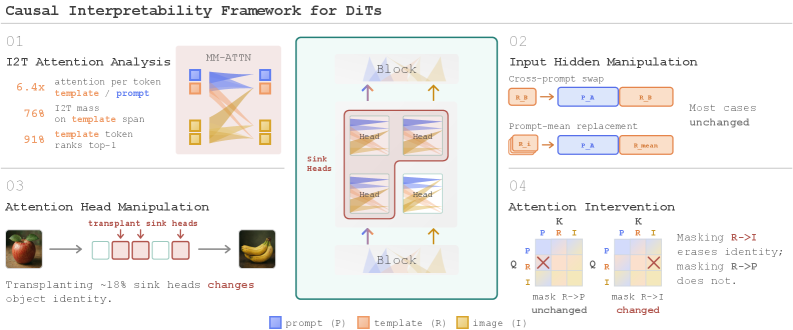
The authors define a causal interpretability toolkit that combines four probes (Fig. 1): token-level attention decomposition of the MMDiT joint attention, span-level conditioning interventions (patching one prompt’s text tokens into another’s trajectory), cross-trajectory head transplantation, and layer-wise causal masking.
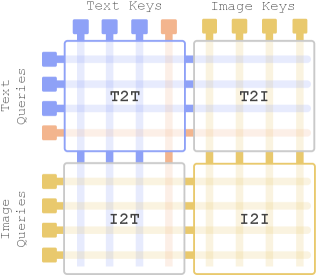
The joint attention matrix is partitioned into T2T, T2I, I2T, and I2I quadrants (Fig. 2). The central object of study is the I2T block: for every layer l, head h, and timestep t, they measure the fraction of image-query attention mass falling on a text-key span \mathcal{K},
m_{\mathcal{K}}^{(l,h)}(t) = \sum_{q \in \text{img}} \sum_{k \in \mathcal{K}} A^{(l,h,t)}_{q,k},
and aggregate to \bar m_{\mathcal K} = \frac{1}{LHT}\sum_{l,h,t} m^{(l,h)}_{\mathcal K}(t). Two spans are compared: the prompt content \mathcal{S} and the fixed structural template \mathcal{R}.
Template tokens are dominant I2T sinks
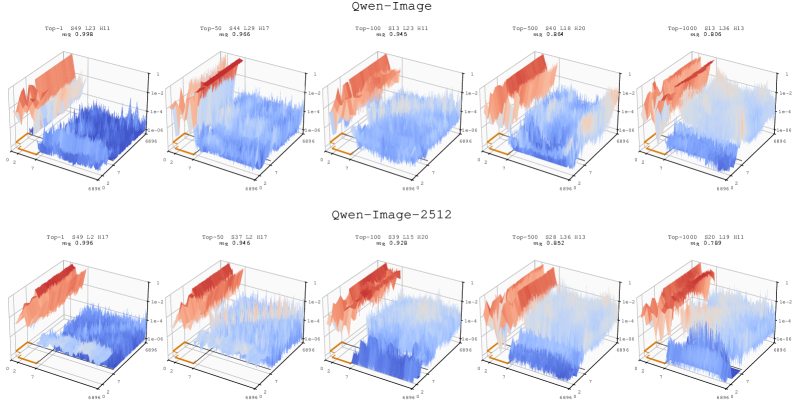
On the trivial prompt “An apple” (|\mathcal{S}|=2, |\mathcal{R}|=5), the top I2T heads concentrate essentially all mass on \mathcal{R}: the leading head reaches m_{\mathcal{R}} = 0.998, forming a sharp ridge over the structural span while I2I attention stays low (Fig. 3). Aggregating over the trajectory gives \bar m_{\mathcal R}=0.23 vs. \bar m_{\mathcal S}=0.020 on Qwen-Image (11–13× span-level gap, 4.6× per token); \mathcal R outweighs \mathcal S at 98% of (t,l,h) sites. The single delimiter <|im_end|> absorbs 13% of all image-query attention at the highest noise level — more than 6× the content noun.
The effect survives at benchmark scale (Table 1 in the paper). On GenEval (mean |\mathcal{S}|=7.9), \bar m_{\mathcal R}/\bar m_{\mathcal S} \approx 0.19/0.046 with a per-token ratio of 6.4\times and \Pr[m_{\mathcal R} > m_{\mathcal S}] = 0.892. On DPG-Bench (mean |\mathcal{S}|=82.1), the semantic span wins on span-mass simply because it is \sim 15\times longer, but the per-token ratio remains 7.2\times in favor of structural tokens. Generalization is strong: on FLUX.2 (32B, Mistral-3 encoder, entirely different template), 92% of I2T attention lands on \mathcal R with \bar m_{\mathcal R}=0.22 vs. \bar m_{\mathcal S}=0.016 over the 553 GenEval prompts, and \mathcal R dominates at 99.8% of sites — with mass spread across [/SYSTEM_PROMPT], <s>, and the token ” that” rather than a single delimiter. On Krea-2-Turbo (12B single-stream, 8 sampling steps), 67% of I2T attention still lands on \mathcal R (per-token ratio 3.1\times). Few-step distillation into a 2-step LoRA preserves the signature, indicating the sink is a stable computational feature rather than an artifact of long trajectories.
Where identity lives, and how it gets there
Descriptive dominance would be uninteresting if \mathcal{R} were causally inert. The interventions show it is not: transplanting the structural-token key/value activations from one prompt’s trajectory into another causally reassigns object identity, whereas equivalent transplants on \mathcal{S} have smaller effect. Crucially, at the text-encoder output the template tokens carry little prompt-specific information — the identity signal is not injected directly from prompt to template inside the encoder. Instead, prompt semantics are first written into image latents via T2I/I2T interactions, and then read back into \mathcal R through subsequent I2T attention. The template tokens therefore behave as implicit semantic registers accumulated during denoising, analogous to the artificial “register tokens” appended to ViTs to soak up attention sinks — but here they arise spontaneously from the chat-template scaffolding.
Training-free pruning
The mechanistic picture yields an immediate application: heads that attend most strongly to prompt tokens \mathcal S turn out to be dispensable, since identity is not routed through them. Pruning them removes 20% of attention FLOPs at a cost of only 1.4 points on GenEval — no retraining. This inverts the natural intuition that “content-attending” heads are the important ones.
Limitations
The analysis is confined to joint-attention DiTs with chat-templated VLM encoders; U-Net cross-attention models and models without a fixed template scaffold may not exhibit registers of this form (though the FLUX.2 result suggests the phenomenon is template-agnostic within the DiT family). The register mechanism is characterized causally but not derived from first principles — why the model chooses structural tokens over, e.g., BOS or padding, and whether the choice is dictated by encoder priors versus DiT training dynamics, remain open. The pruning rule is validated on GenEval; compositional benchmarks like DPG-Bench and long-prompt regimes are not fully explored.
Why this matters
If a small, prompt-independent span of chat-template tokens is where DiTs actually store object identity during denoising, then interpretability, editing, and efficiency tooling should target that span rather than the semantically meaningful prompt tokens. This reframes attention sinks from a nuisance to a load-bearing computational primitive and produces a free 20% FLOP reduction as a side effect.
Source: https://arxiv.org/abs/2607.19139
Mage-Flow: An Efficient Native-Resolution Foundation Model for Image Generation and Editing
Problem
Modern text-to-image stacks (SD3, FLUX.1/2, Qwen-Image, HunyuanImage-3.0) push parameter counts to 8B–80B and inherit VAE architectures from the 256² LDM era. When these VAEs are scaled to 1K–2K generation, global-attention blocks and heavy high-resolution stages dominate wall-clock time: at 4 steps of 1K generation, VAE decoding alone accounts for 14% of end-to-end latency in FLUX.2-Klein-4B. Beyond the tokenizer, native-resolution training with mixed aspect ratios stresses batching, kernel scheduling, and memory. Mage-Flow addresses both, targeting a 4B-scale stack that matches or beats much larger open-source specialists on prompt following, text rendering, and editing while remaining cheap to train and serve.

Method
Mage-VAE. Rather than train a VAE from scratch, the authors distill from FLUX.2-VAE, which supplies an anchor latent distribution q_\phi^{\text{anchor}}(z\mid x). Both the Mage-VAE encoder E_\theta and decoder D_\psi are trained against this anchor:
\mathcal{L}_{\text{enc}} = \mathrm{KL}\!\left(q_\theta(z\mid x)\,\|\,q_\phi^{\text{anchor}}(z\mid x)\right), \quad \mathcal{L}_{\text{dec}} = \mathbb{E}_{z\sim q_\phi^{\text{anchor}}}\big[\|D_\psi(z)-x\|_p + \lambda_{\text{perc}}\mathcal{L}_{\text{LPIPS}}\big].
The decoder is a fully-convolutional stack of diffusion blocks with a decoupled pixel-diffusion head (à la CoD-Lite), pre-trained as a multi-step pixel diffusion model and then one-step-distilled. There is no global attention, so decode cost is essentially linear in H\cdot W. Because the encoder is anchored to FLUX.2-VAE’s latent space, Mage-VAE is drop-in compatible with existing FLUX.2 downstream generators — a useful modularity property. The reported result is an order-of-magnitude reduction in tokenization cost with reconstruction fidelity comparable to strong public VAEs.
NR-MMDiT. The generator is a 4B multimodal DiT trained with rectified flow matching in Mage-VAE latent space:
\mathcal{L}_{\text{RF}} = \mathbb{E}_{t, x_0, x_1}\big\|v_\theta(x_t, t, c) - (x_1 - x_0)\big\|^2, \quad x_t = (1-t)x_0 + t x_1.
Sequences from images of arbitrary (H, W) are packed with native-resolution packing so a single batch contains variable-length latent token sequences. The training infrastructure adds stack-level CUDA kernel fusion across VAE, tokenizer, and DiT operators, yielding a ~2.5× end-to-end throughput gain.
Training pipeline. Pre-training proceeds in three resolution stages: 1.2B pairs at fixed 256^2, 600M pairs at a 512-pixel native-aspect-ratio budget, and 300M pairs at 1024-pixel native aspect ratios. Filter thresholds tighten monotonically (e.g., watermark score <0.5\to<0.05; Aesthetic-V2.5 \geq 4.5\to \geq 6.0). SFT uses 150M curated samples at 1024-pixel native. From Mage-Flow-Base, two branches diverge: (i) Diffusion-NFT post-training, an RL-flavored alignment stage that improves prompt following, text rendering, and aesthetics; (ii) 4-step distillation with adversarial perceptual guidance producing Mage-Flow-Turbo. The editing branch forks similarly, conditioned on source images and instructions, producing Mage-Flow-Edit-Base, Mage-Flow-Edit, and Mage-Flow-Edit-Turbo. Data curation follows a four-stage pipeline (sample-level filtering, cross-sample dedup, multi-granularity captioning with Qwen3-VL, concept-aware synthesis), reducing ~10B raw pairs to ~1.3B.
Results
At 4B parameters and 20 inference steps, Mage-Flow reaches GenEval 0.90, the top score in the table, ahead of Ovis-U1 (0.89, 3.6B/50 steps), FLUX.2-dev (0.87, 32B/50 steps), Qwen-Image (0.87, 20B/50 steps), and FLUX.2-Klein-9B (0.86, 9B/4 steps). On DPG-Bench it scores 86.49, competitive with Qwen-Image (88.32) and FLUX.2-dev (87.57) at a fraction of the compute. For compositional text rendering:
- CVTG-2K: 0.887 — highest reported open-source score (vs. FLUX.2-dev 0.893, closed-source Seedream 4.0 0.892).
- TIIF-Long: 84.70 (best in the 4B tier; FLUX.2-Klein-Base-9B is 84.52).
- LongText-EN: 0.944; LongText-CN: 0.823.
Mage-Flow-Turbo (4 steps) retains GenEval 0.88, TIIF-Short 83.58, CVTG-2K 0.873, which is unusual — few-step distilled models often drop several points on compositional benchmarks. It beats FLUX.2-Klein-9B (0.86, 4 steps) on GenEval despite less than half the parameter count, and edges out Z-Image-Turbo (0.82, 6B/8 steps) on most axes. The base checkpoint at 30 steps is lower on GenEval (0.79) than after Diffusion-NFT (0.90), quantifying the alignment stage’s contribution: +0.11 GenEval, +2.5 TIIF-Long, +0.036 CVTG-2K.
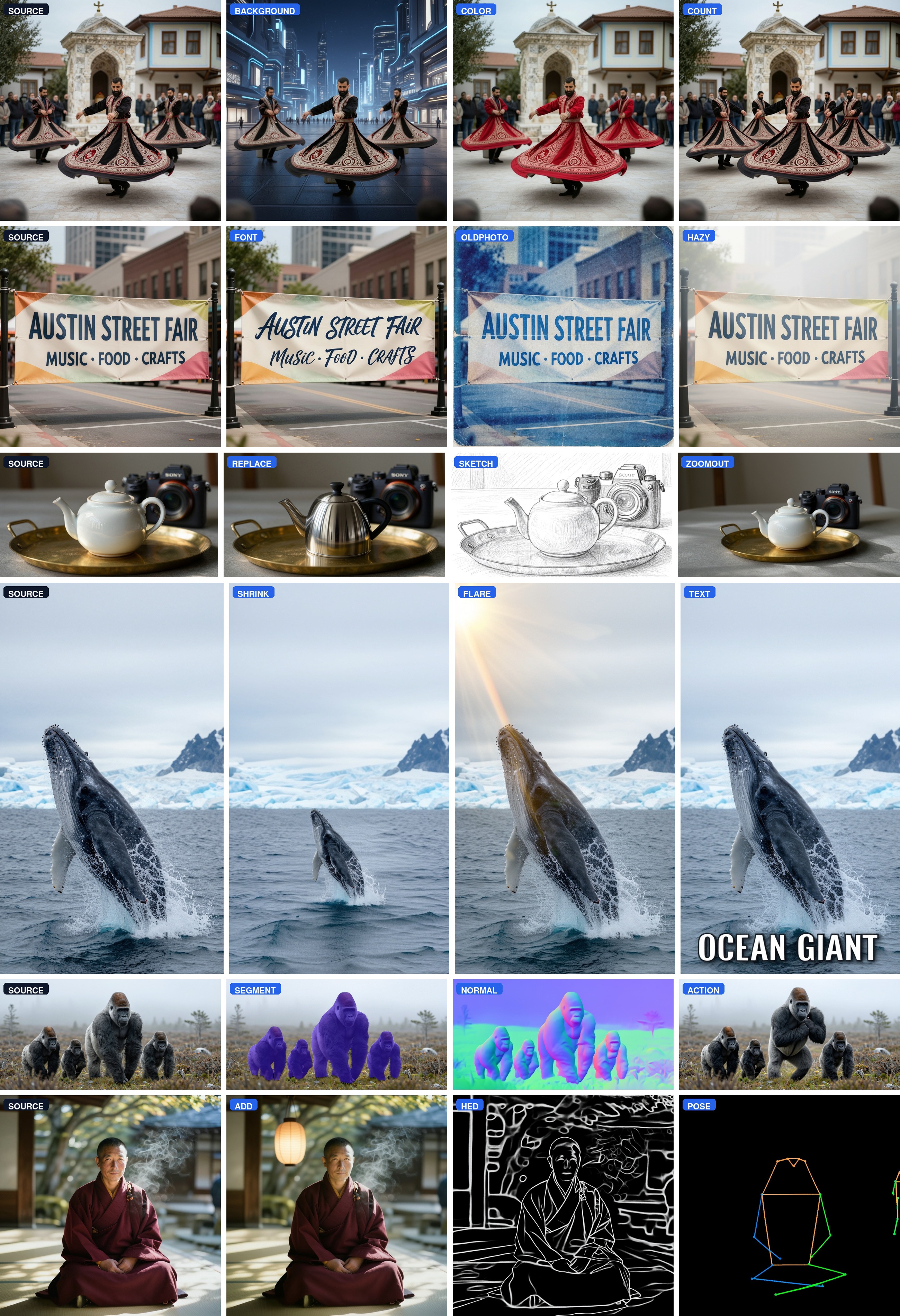
Editing coverage spans localized content edits, camera/scene transforms, appearance and style, degradation/restoration, and low-level vision tasks (segmentation, normals, HED, Canny, depth), with all edits supported bidirectionally.

Limitations and open questions
Reconstruction fidelity of Mage-VAE is claimed to match FLUX.2-VAE but no rFID/PSNR numbers are quoted in the provided sections, and the anchor-latent KL creates a hard dependency on a proprietary tokenizer’s latent geometry — non-obvious what happens when the anchor’s biases (e.g., text-rendering artifacts, color casts) transfer. GenEval is close to saturation at 0.90 and the model still trails FLUX.2-dev on some fine-grained axes (DPG 86.49 vs 87.57; CVTG-2K 0.887 vs 0.893), so headroom on compositional structure remains. The Diffusion-NFT recipe is only described at a high level here; its reward model, KL schedule, and stability behavior on rectified flow are not disclosed in the excerpted text. Finally, throughput gains (2.5\times) mix VAE, packing, and kernel fusion — the individual contributions are not attributed.
Why this matters
A 4B model that tops GenEval at 0.90 and holds 0.88 at 4 steps demonstrates that careful VAE co-design, native-resolution packing, and RL post-training on rectified flow can substitute for parameter scaling in the current image-generation regime. For practitioners, Mage-VAE’s drop-in compatibility with FLUX.2 latents is arguably the more portable contribution: it removes a concrete inference-latency bottleneck without retraining downstream generators.
Source: https://arxiv.org/abs/2607.19064
SciForma: Structure-Faithful Generation of Scientific Diagrams
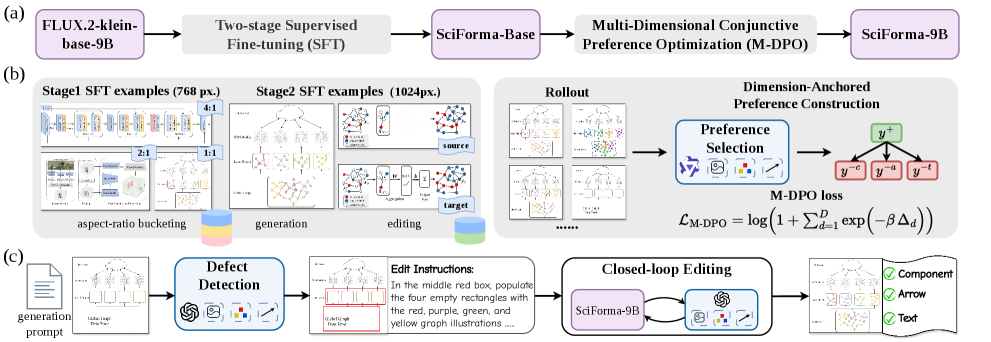
Scientific methodology diagrams — the block-and-arrow figures that anchor most ML papers — have a peculiar quality profile: correctness is conjunctive. A reversed arrow, a mangled equation in a node, or a missing module invalidates the entire figure regardless of how polished the rest looks. SciForma targets this generation task directly, arguing that generic T2I models (even strong open ones like FLUX.2-klein) and code-based TikZ synthesis both fail because they optimize aggregate aesthetic quality rather than per-axis structural correctness.
Problem formulation: the structural inventory
The core conceptual move is to formalize diagram quality along three independently verifiable primitives, borrowed from UML activity and BPMN grammars:
- Component (C): entity identity and spatial layout of typed blocks.
- Arrow (A): the directed information topology.
- Text (T): textual annotations, including intra-block labels and equations.
For each prompt-image pair, a structural inventory is extracted (either by GPT-5.4 with joint prompt-image analysis or by direct LaTeX parsing of the source figure). Evaluation is a two-way VLM comparison against this checklist rather than a scalar preference score, avoiding the failure mode where a single reward hides which axis went wrong. A reflexivity check confirms this is sound: scoring ground-truth diagrams against their own inventory yields 99.94% average recovery (99.99 C / 99.85 A / 99.96 T), so the evaluator does not systematically miss present elements.
Data: SciFormaData-700K
The dataset is built from LaTeX sources of 593K arXiv papers (17 cs.* categories, 2015–2025). Direct LaTeX extraction avoids PDF parsing artifacts; an LLM resolves \newcommand/\def macros in \includegraphics paths. Two VLM filters — a target-class filter (must exhibit typed blocks + directed connectors + legible labels) and a “dead diagram” inspector — cull renders that failed or lack topological complexity. The result: 656K generation pairs + 70K localized editing triplets, the latter used for the closed-loop refinement pipeline.
Method: M-DPO
Base model is FLUX.2-klein-base-9B, a flow-matching DiT with 4D RoPE. SciForma exploits its native sequence-concatenation editing interface via a temporal RoPE offset (T{=}10 for source tokens, T{=}0 for target), so joint generation and localized edits share one architecture.
Training is staged: (1) SFT stage 1 on 656K pairs at 768 px for 140K steps, batch 16, LR 10^{-5}; (2) SFT stage 2 co-trains 244K high-quality pairs with 70K editing triplets near 1024 px for 90K steps, initialized from stage-1 EMA. Then Multi-Dimensional Conjunctive Preference Optimization (M-DPO). For each of 50K prompts, K=12 candidates are rolled out (four at 50 denoising steps, eight at 25) and scored on C/A/T. With margin thresholds \delta_{\min}=0.25, \delta_{\max}=0.60 and winner gate \tau=0.70, they mine ~16K valid (1{+}D)-tuples: one winner y^{+} against D axis-anchored losers y^{-}_{d}, each losing specifically on axis d.
The M-DPO loss aggregates axis-specific implicit rewards:
\mathcal{L}_{\mathrm{M\text{-}DPO}}=\log\!\left(1+\sum_{d=1}^{D}\exp(-\beta\,\Delta_{d})\right),
with \Delta_{d}=(L_{\mathrm{ref}}^{y^{+}}-L_{\theta}^{y^{+}})-(L_{\mathrm{ref}}^{y^{-}_{d}}-L_{\theta}^{y^{-}_{d}}) using flow-matching losses. Differentiating gives an adaptive weighting
w_{d}=\frac{\exp(-\beta\,\Delta_{d})}{1+\sum_{d'}\exp(-\beta\,\Delta_{d'})},
so gradient descent automatically concentrates on the currently-worst axis while still pushing the winner’s flow-matching loss down against every axis loser simultaneously — a conjunctive rather than averaged objective. Trained for 4K steps with \beta=2000, LR 10^{-6}.
Inference uses Euler discrete scheduling, 50 steps, CFG 4.0, with an optional closed-loop refinement: a VLM detects defects on C/A/T, and the model regenerates locally via the editing interface.
Results
On SciFormaBench-2K (scored by GPT-5.4), SciForma-9B reaches Avg 69.51 (C 74.49 / A 66.46 / T 67.00). Code-based baselines lag badly: TikZilla scores 35.81 Avg and GLM-4.7-Flash 38.21 — roughly half of SciForma — with failures dominated by layout overlap, arrow endpoint mismatches, and hard rendering errors. This is consistent with the paper’s claim that pixel-space generation with structural supervision beats syntactic code synthesis for free-form diagrams.
Ablations isolate the two key ingredients. Stage-2 editing triplets contribute +2.96 Avg to iterative refinement quality (68.76 → 71.72), with the largest gains on Arrow (+2.44) and Text (+2.66) — the axes that most benefit from localized repair. The M-DPO axis decomposition and conjunctive objective are ablated separately in appendix F.2.
Qualitatively, SciForma produces natural aspect ratios (versus GPT-Image-1.5’s three fixed canvases), an academic-figure style (versus Wan2.7-Image’s poster-like heavy outlines from Nano Banana Pro), and higher fidelity on fine-grained topology like skip connections and multi-branch splits.
Limitations and open questions
The evaluation loop relies on VLM judges (GPT-5.4, cross-checked with Qwen3-VL-8B). Reflexivity of 99.94% establishes that the judge recognizes items on the inventory, but not that inventories themselves are complete for complex diagrams. The C/A/T primitives elide typography-level constraints (font consistency, equation formatting), color semantics, and layout aesthetics that matter for real publication use. M-DPO requires per-axis contrastive samples with clean margins; how the framework scales to D>3 or to correlated axes is unclear. Finally, “arXiv-like style” is baked into the data — cross-domain diagrams (biology pathways, systems architecture with domain iconography) will likely need different inventories.
Why this matters
Reward decomposition into verifiable, conjunctive axes is a general recipe for tasks where averaged scalar preferences hide catastrophic single-axis failures — diagrams, UI mockups, molecular structures, code with multiple correctness constraints. M-DPO gives a clean, gradient-focused way to train against such conjunctive objectives, with a derivation that reduces to per-axis DPO when D=1.
Source: https://arxiv.org/abs/2607.18091
Masked Visual Actions for Unified World Modeling
Problem
Video foundation models encode strong priors about scene dynamics, contact, and object interaction, which makes them attractive substrates for robot world models. The bottleneck is the action interface: low-dimensional joint or end-effector commands are embodiment-specific and lie off the manifold the video model was trained on, while text is too underspecified for precise manipulation. Prior action-conditioned video models (e.g., Ctrl-World) buy precision by binding to one embodiment; trajectory-conditioned models (e.g., Wan-move) keep generality but fail to preserve scene identity under robot motion.

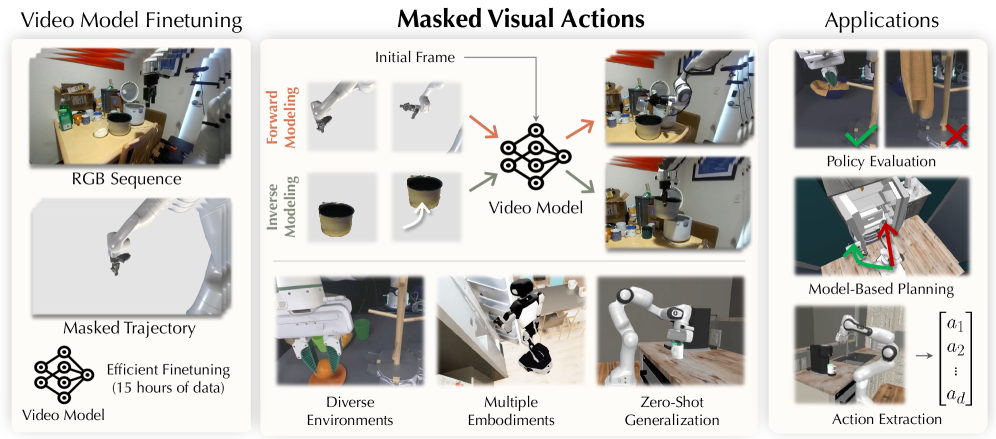
This paper proposes conditioning the video model with the same modality it generates in — pixels — by revealing a partial spatiotemporal trajectory of the entity of interest and asking the model to fill in the rest.
Method
Let a video be V\in\mathbb{R}^{T\times H\times W\times 3} depicting a scene composed of entities e_1,\dots,e_n, each identified with the spatiotemporal region of pixels it occupies. The video model implicitly represents
p(V) = p(e_1,\dots,e_n),
and any subset \mathcal{S}\subseteq\{1,\dots,n\} induces a conditional
p\bigl(\{e_i\}_{i\notin\mathcal{S}} \mid \{e_j\}_{j\in\mathcal{S}}, I_0\bigr),
with I_0 a reference image of the initial scene. Conditioning is implemented by a binary mask M\in\{0,1\}^{T\times H\times W} where M(\mathcal{S})=\bigcup_{i\in\mathcal{S}} e_i; the model consumes M\odot V together with I_0 and is trained to fit p_\theta(V \mid M\odot V, I_0) under a distribution over masks.
Partitioning entities into active \mathcal{A} (robot, human) and passive \mathcal{P} (manipulated objects) yields two symmetric use modes from a single checkpoint:
- Forward model: \mathcal{S}=\mathcal{A}, predict scene response p(\{e_i\}_{i\in\mathcal{P}} \mid \{e_j\}_{j\in\mathcal{A}}, I_0). Robot motion is supplied as a masked pixel trajectory, which is agnostic to embodiment.
- Inverse model: \mathcal{S}=\mathcal{P}, predict robot motion consistent with a desired object trajectory. Combined with an inverse dynamics model, this recovers executable actions.
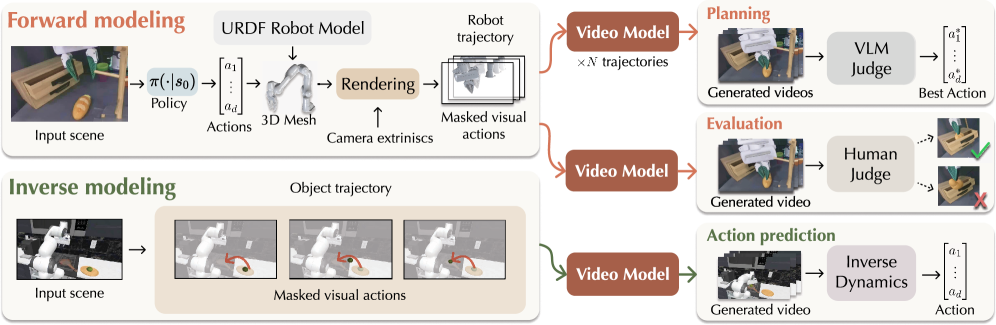
Training data (15 hours total) is built from DROID (real) and Robocasa (sim), mixing successes and failures, using two mask sources:
- Segmentation-based: SAM with the prompt “A robotic arm” segments the active entity in each frame. General, calibration-free, but (a) users cannot supply an exact mask at test time and (b) occluded regions of the arm leak scene dynamics.
- Rendering-based: since DROID logs robot state, the URDF is rendered at each frame to produce a clean synthetic mask of the arm. This lets users specify arbitrary trajectories at inference by rendering the robot mesh.
Mixing both sources trains the model to accept either segmented or rendered conditioning while suppressing information leakage.
Results
The evaluation targets controllability, cross-embodiment generalization, and downstream utility. On held-out DROID scenes and on BEHAVIOR (bimanual R1-Pro, unseen by all methods), the model is compared against Wan2.2 14B image-to-video, Wan-move with GT tracks, and Ctrl-World.
| DROID LPIPS↓ | SSIM↑ | PSNR↑ | BEHAVIOR LPIPS↓ | SSIM↑ | PSNR↑ | |
|---|---|---|---|---|---|---|
| Image-to-video | 0.521 | 0.548 | 12.42 | 0.602 | 0.457 | 10.22 |
| Wan-move (GT tracks) | 0.534 | 0.562 | 12.99 | 0.312 | 0.756 | 13.17 |
| Ctrl-World | 0.362 | 0.708 | 18.15 | 0.196 | 0.837 | 18.39 |
| Masked Visual Actions | 0.0945 | 0.887 | 23.74 | 0.123 | 0.843 | 22.90 |
The DROID gap is stark — LPIPS drops from 0.362 to 0.0945 and PSNR rises by 5.6 dB against Ctrl-World, and Ctrl-World had trained on the full DROID (including these held-out scenes), so this is a favorable-to-baseline comparison. On BEHAVIOR the baseline collapses to static or corrupted output for the unseen bimanual embodiment while the masked model degrades gracefully, retaining PSNR 22.90 vs. 18.39.
An ablation over action representations (masked visual actions vs. end-effector visualization vs. skeleton) shows all in-distribution representations perform comparably on DROID, but skeleton and end-effector conditioning hallucinate the training-time robot when the visible gripper differs, and fail on bimanual embodiments. The pixel-mask representation avoids this because the conditioning is the entity’s silhouette itself.
Downstream, the same checkpoint is used to (i) score sampled candidate trajectories for model-based planning, (ii) act as a policy evaluator whose imagined rollouts correlate with real-world execution outcomes, and (iii) serve as a policy when paired with an inverse dynamics model that decodes actions from the inverse-mode generated video. Concrete downstream numbers are truncated in the excerpt.
Limitations and open questions
The segmentation pathway leaks occluded scene content through the mask boundary, which is why the rendered pathway is needed but reintroduces a URDF requirement for arbitrary test-time actions. The forward mode still asks a generative video model to serve as a physics simulator; there is no explicit accounting for multi-modality of p(\{e_i\}_{i\in\mathcal{P}} \mid \mathcal{A}, I_0) under contact ambiguity, and reported metrics are pixel-space (LPIPS/SSIM/PSNR) rather than dynamics fidelity (contact events, object pose error). Inverse-mode outputs depend on an external IDM whose error is not decomposed here. The 15-hour finetune sits on top of a large pretrained video model; the extent to which the priors, versus the masking objective, drive cross-embodiment transfer is not isolated.
Why this matters
Expressing actions in the same pixel space the video model already models turns embodiment generalization from a data problem into a representation problem, and unifies forward simulation and inverse policy extraction under one masked-conditional objective — the video analogue of masked language modeling for robotics.
Source: https://arxiv.org/abs/2607.19343
Generative World Renderer at the Speed of Play
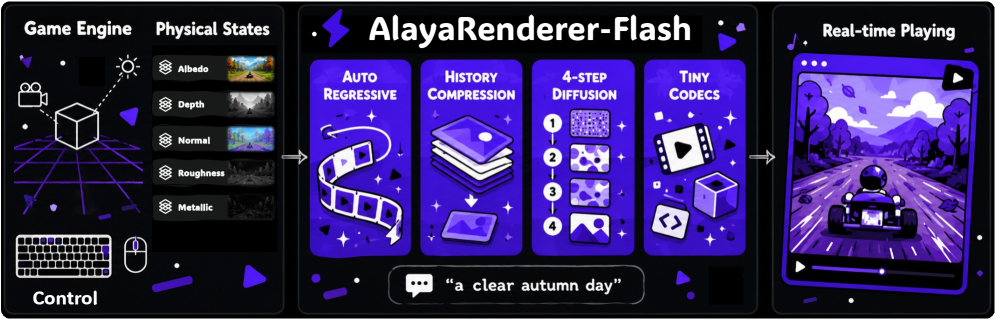
AlayaRenderer-Flash addresses a specific bottleneck in generative rendering: the original AlayaRenderer, a Wan 2.1-based latent video diffusion model that consumes structured G-buffer streams from a game engine and emits stylized RGB frames, runs at 0.56 FPS — roughly two orders of magnitude too slow for interactive play. The claim in this technical report is that the same interface (G-buffers plus text prompt, no changes to underlying game dynamics) can be preserved while pushing throughput to 31.54 FPS through a combination of autoregressive streaming, few-step diffusion, and distilled codecs.
Setup: what the renderer actually consumes
Unlike text-to-video or control-hint models, AlayaRenderer takes the game engine’s authoritative state and only restyles it. The engine exports five synchronized physical buffers per frame — albedo, depth, metallic, normal, and roughness — which describe geometry and material rather than final shading. Because gameplay logic and physics remain on the engine side, the renderer never has to hallucinate dynamics; it only maps a G-buffer stream conditioned on a text prompt to RGB. This decoupling is what makes real-time restyling meaningful: a player controls the game normally, and independently rewrites the look via prompt.
Conditioning mechanics
The base renderer inherits Wan 2.1’s latent diffusion setup: RGB video latents are denoised by a diffusion transformer with text cross-attention, using the Wan causal 3D VAE. AlayaRenderer-Flash treats each G-buffer channel as a video stream, encodes it with the same causal 3D VAE, and concatenates the five latent streams channel-wise to form the condition g_k for chunk k. This is fused with the noisy RGB latent x_k at the very first 3D patch embedding:
h_k = \operatorname{PatchEmbed}([x_k, g_k]).
The only architectural change to the pretrained Wan backbone is widening the input projection of that first patch embedding to accept the extra channels; everything else — attention blocks, text cross-attention, temporal structure — is left intact. This is a deliberately minimal modification, which is what makes distillation from the teacher tractable later.
From 0.56 to 31.54 FPS
The speed-up comes from three compounding changes layered on top of this conditioning skeleton:
- Autoregressive streaming with hierarchical history compression. Instead of denoising a fixed-length clip, the model processes G-buffer input in chunks and maintains a compressed history so that inputs of unbounded length can be rendered continuously. Hierarchical compression is what enables cross-window stability without paying quadratic attention cost across the whole stream.
- Four-step diffusion. The teacher’s multi-step sampler is distilled into a four-step schedule. Combined with the streaming formulation, each chunk is denoised in a bounded number of transformer passes.
- Lightweight distilled codecs. The Wan causal 3D VAE, used for both G-buffer encoding and RGB reconstruction, is replaced by distilled versions on both encode and decode sides. Since the VAE is invoked every chunk on six streams (five G-buffers plus RGB output), codec cost dominates at high FPS, and distilling it is essential to break past ~10 FPS.
The interfaces exposed to the engine (five G-buffer channels) and to the player (free-form text prompt) are unchanged from the teacher.
Evaluation
Training and evaluation use an engine-captured Black Myth: Wukong dataset at 1280 \times 720, 30 FPS: 1,352 training clips and 131 test clips of 150 frames (5 s) each. Model input resolution is 832 \times 448; all training runs on 8× H200. The headline number — 31.54 FPS versus the teacher’s 0.56 FPS — represents a \sim 56\times speed-up at playback resolution, crossing the threshold at which the renderer can be dropped into a live game loop rather than run offline.
Evaluation axes reported are content preservation, temporal consistency, cross-window stability (i.e., no visible seams as the streaming window advances), prompt controllability, and runtime. The paper positions itself against external baselines on 5-s clips, with engine RGB shown as a reference (not ground truth) because prompt-conditioned restyling admits many valid outputs.
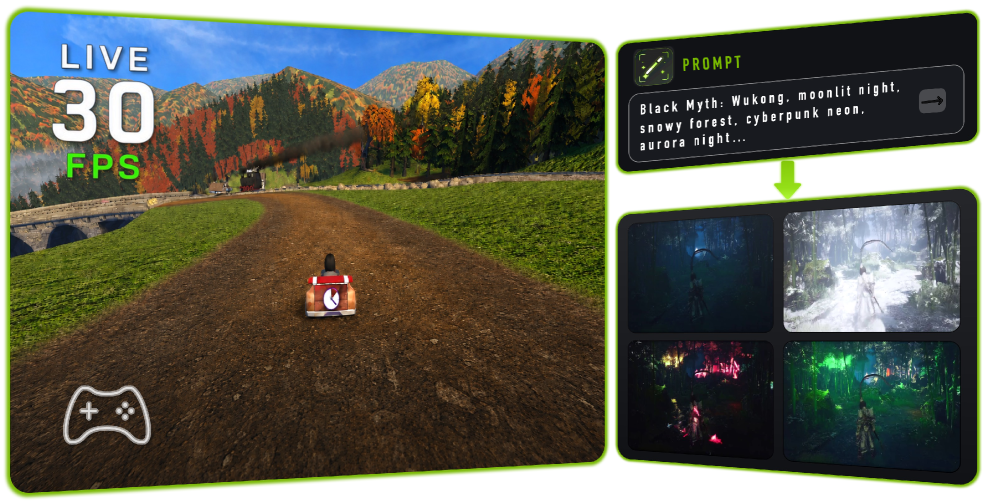
A live SuperTuxKart integration demonstrates the closed-loop system: the game continues to run its own logic and physics while the renderer restyles each frame as it is produced.
Limitations and open questions
Several things are worth flagging. First, the reported 31.54 FPS is at 832 \times 448, not native 1280 \times 720; latency at capture resolution is not disclosed in the excerpt. Second, the dataset is one game (Wukong) at a single fidelity, and generalization to engines with different G-buffer semantics (e.g., different roughness/metallic conventions, deferred vs. forward pipelines) is untested. Third, since the reference RGB is treated as one of many valid outputs, quantitative “content preservation” metrics against it are not straightforward ground truth. Fourth, the report does not address input latency budget end-to-end (engine export + transfer + inference + display), which matters more than raw FPS for playability. Finally, four-step diffusion plus distilled VAE typically costs some fidelity relative to the teacher; the trade-off curve as a function of steps and codec size is not shown in the provided sections.
Why this matters
Restyling a live G-buffer stream at 30+ FPS while leaving game logic on the engine side is a cleaner factorization of interactive generative rendering than end-to-end world models: dynamics stay deterministic and controllable, and the diffusion model does only the appearance mapping it is actually good at. If the speed-fidelity trade-off holds up on other engines, this is a practical route to shipping generative rendering inside real games rather than in offline demos.
Source: https://arxiv.org/abs/2607.18703
ABot-World-0: Infinite Interactive World Rollout on a Single Desktop GPU
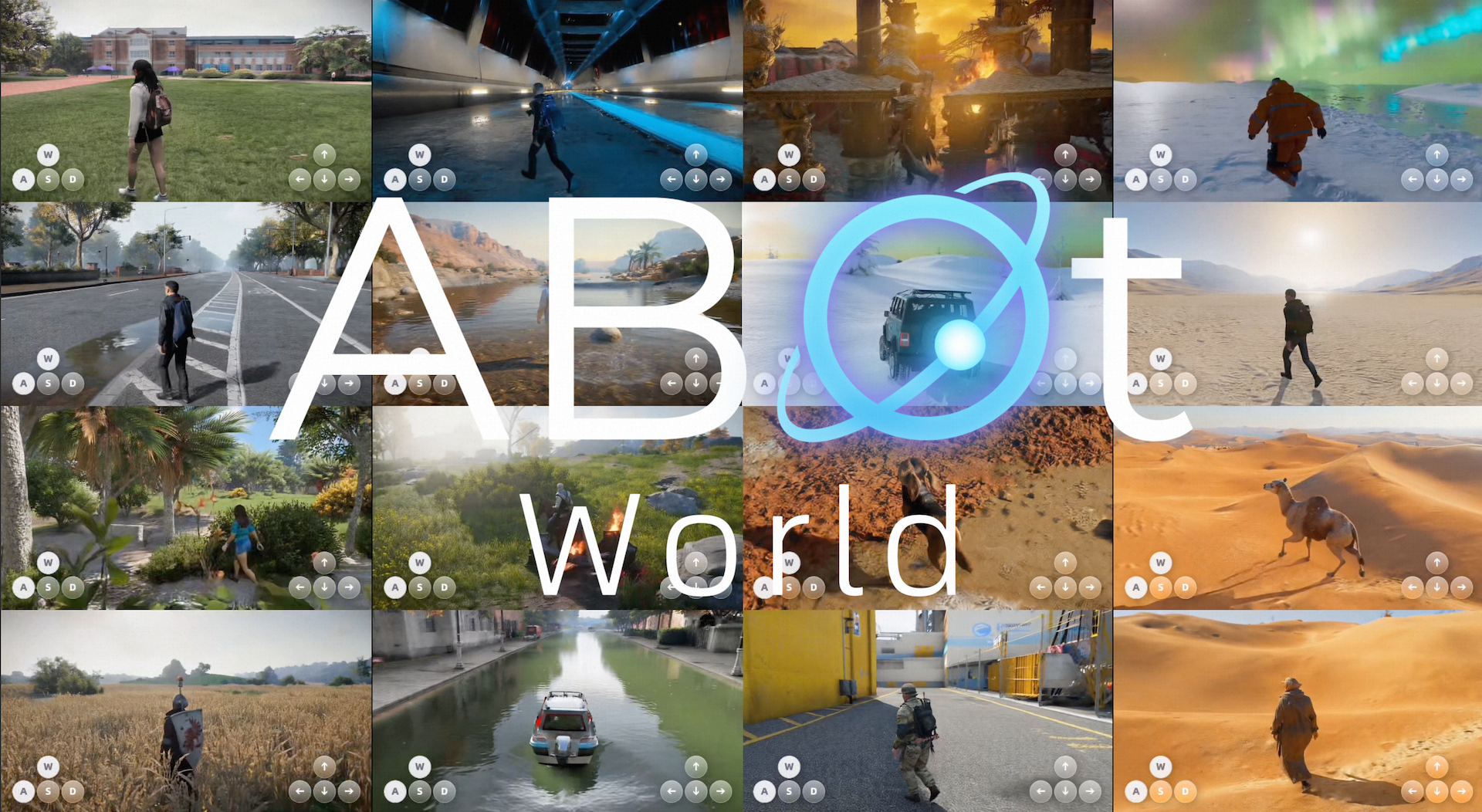
ABot-World-0 targets closed-loop, action-conditioned video world modeling under strict deployment constraints: real-time interactive rollout on a single consumer GPU, with unbounded horizon. The system reports 720p generation at up to 16 FPS with 1.2 s action-to-first-frame latency and ~19 GiB peak VRAM on an RTX 5090.
Problem and formulation
The task is autoregressive next-chunk prediction of a video conditioned on past frames, a future action sequence, and multimodal side information \mathbf{c} (text prompt plus reference images):
p_\theta(\mathbf{v}_{t:t+L-1}\mid \mathbf{v}_{0:t-1},\mathbf{a}_{t:t+L-1},\mathbf{c}).
Actions are raw keyboard events — a single interface used for both first-person scene roaming and third-person character control. Character identity across long rollouts is stabilized by a reference-character memory that injects appearance features as persistent conditioning; this decouples appearance from the causal frame buffer and mitigates drift that would otherwise accumulate through the KV cache.
Data infrastructure
The corpus mixes three sources: AAA game captures, simulation engines, and internet video. Game/simulation trajectories provide deterministic action labels via engine APIs; internet video contributes diversity through pose-estimated pseudo-labels. Collection is driven by WorldExplorer, an agent that navigates virtual environments and captures synchronized (frame, action, text) tuples, guided by a training-feedback loop that rebalances the collection distribution based on downstream evaluation.
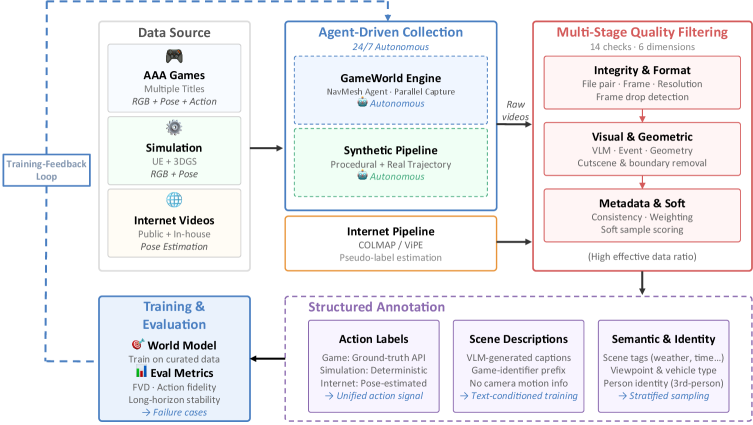
Filtering applies 14 deterministic checks across six quality dimensions (e.g., motion smoothness, exposure, cut detection) plus a VLM pass for semantic validity. Annotation converts source-specific control signals into a canonical keyboard-action schema, keeping the model’s control interface source-independent while preserving native precision when available.
Training: bidirectional teacher → causal student
Training proceeds in two phases (Figure 3).
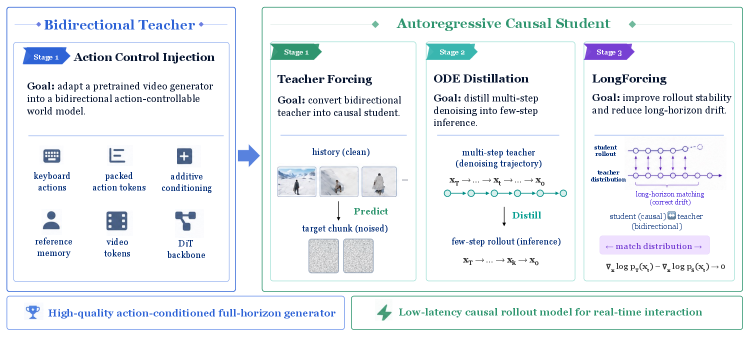
Phase 1 — Bidirectional teacher. A pretrained video diffusion generator is fine-tuned into a full-horizon bidirectional action-conditioned model
p_\phi^{\mathrm{bi}}(\mathbf{v}_{1:T}\mid v_0, \mathbf{a}_{1:T}, \mathbf{c}),
conditioning on the entire action sequence at once. This maximizes sample quality but is non-causal and cannot be rolled out interactively.
Phase 2 — Causal distillation. The teacher is converted into a causal, few-step student in three sub-stages:
- Teacher forcing. The student consumes ground-truth prefixes and predicts the next chunk, with the teacher’s velocity/score field as the regression target.
- Causal ODE distillation. The multi-step teacher ODE is distilled into a few-step causal solver, cutting per-chunk NFEs enough to hit real-time budgets.
- LongForcing. To fight the exposure bias inherent in step (1) — the student sees its own errors only at inference — LongForcing rolls out the student for an extended horizon, then aligns its distribution to a teacher supervising over the same long context. This directly attacks accumulated distribution shift rather than only single-step KL.
The paper reports that the 60-second temporal ablation isolates LongForcing’s effect on visual error accumulation, confirming it as the key stabilizer for hour- and day-scale rollouts.
Inference stack
Real-time single-GPU deployment is a full-stack co-design: few-step diffusion sampling, a lightweight VAE decoder, low-bit DiT inference (weight/activation quantization), efficient attention with tuned positional encodings, and memory-aware scheduling of the KV cache and reference-character features. The reported operating point — 720p, up to 16 FPS, 1.2 s first-frame latency, ~19 GiB — is on an RTX 5090 (5B parameters).
Results
On WorldRoamBench, ABot-World-0 (5B) is compared against Genie 3, HappyOyster, LingBot-World (14B), and HY-World 1.5 (8.3B) across action controllability, visual plausibility, physics, and memory:
| Model | Strict Acc. | Partial Acc. | Traj. | Aesthetic | Imaging | Mechanics | Memory |
|---|---|---|---|---|---|---|---|
| Genie 3 | 0.4700 | 0.6608 | 0.6719 | 0.4711 | 0.4757 | 0.5454 | 0.6073 |
| HappyOyster | 0.5317 | 0.7631 | 0.7737 | 0.5235 | 0.4377 | 0.5395 | 0.6309 |
| LingBot-World (14B) | 0.3235 | 0.4198 | 0.4094 | 0.2898 | 0.2875 | 0.2777 | 0.3006 |
| HY-World 1.5 (8.3B) | 0.1640 | 0.2088 | 0.2015 | 0.1400 | 0.1236 | 0.1115 | 0.1562 |
| ABot-World-0 (5B) | 0.5266 | 0.7290 | 0.6752 | 0.5039 | 0.4651 | 0.5223 | 0.5041 |
ABot-World-0 is competitive with HappyOyster on strict action accuracy (0.5266 vs 0.5317), leads Genie 3 on strict accuracy (0.5266 vs 0.4700) and aesthetic (0.5039 vs 0.4711), and substantially outperforms the larger LingBot-World-14B and HY-World-1.5-8.3B across every dimension despite being 5B. Memory (0.5041) trails HappyOyster (0.6309) and Genie 3 (0.6073), consistent with reliance on a bounded causal context plus reference-character cues rather than an explicit long-term memory module.
Limitations and open questions
The reported gap on the Memory sub-score suggests reference-character memory handles identity but not general scene-level state (object permanence, revisitation). LongForcing is evaluated over a 60 s window; whether it truly prevents drift over the advertised “day-scale” rollouts is shown only qualitatively. The benchmark table is limited to a few closed competitors; no ablation isolates the contributions of quantization vs. few-step distillation vs. attention rewrites in the FPS/VRAM numbers. Finally, keyboard-only control is convenient but restricts the action manifold — continuous control (mouse look, analog sticks) is not addressed.
Why this matters
Interactive world models have been bottlenecked by the tension between generative quality (bidirectional diffusion) and rollout feasibility (causal, few-step, real-time). ABot-World-0 shows that a disciplined distillation pipeline plus long-horizon distribution matching can put a 5B action-conditioned world model into a real-time single-desktop-GPU regime while remaining competitive with much larger systems on WorldRoamBench.
Source: https://arxiv.org/abs/2607.19191
AlayaWorld: Interactive Long-Horizon World Modeling – Full Technical Report
Problem
Interactive video world models need to satisfy four constraints simultaneously: responsiveness to user input (camera pose, prompt switches), spatiotemporal consistency across long roll-outs, drift-free generation over minute-scale horizons, and low per-chunk latency. Standard video diffusion transformers are trained on bounded clips with bidirectional attention and degrade rapidly under autoregressive extension because errors compound and history representations either grow unboundedly or discard scene geometry. AlayaWorld targets 24-fps generation at 540p/720p with camera-trajectory control and mid-stream prompt switching, aiming to be usable as a game-like simulator rather than a fixed-length clip generator.
Method
The backbone is the LTX-2.3 checkpoint (22B multimodal), with the audio branch removed, yielding a ~13B video DiT. A causal video VAE tokenizes clips into chunks \{z_1, z_2, \dots\} of K=4 latent frames each; roughly one second of video corresponds to one chunk. Generation factorizes as
p_\theta(z_{1:N} \mid \pi_{1:N}, y_{1:N}) = \prod_{i=1}^N p_\theta(z_i \mid z_{<i}, \pi_{\leq i}, y_i),
where \pi_i is a per-frame camera-pose sequence and y_i an optional chunk-level text prompt. Prompt swaps at chunk boundaries drive discrete actions (combat, spellcasting).
Conditioning is delivered as an in-context prefix to a single self-attention DiT rather than through cross-attention. For chunk i the token stream is
S_i = [\,s\,;\,h_i\,;\,g_i\,;\,n_i\,;\,z_i^\tau\,],
with four clean (\sigma=0) streams followed by the noised target z_i^\tau. The prefix is dropped after the last transformer block and only the target segment is denoised. The four streams play distinct roles:
- Sink s: one clean latent frame pinned at RoPE temporal position 0, held fixed across all chunks as a global appearance anchor. It is sampled during training at least 8 latent frames from the target so the model cannot short-circuit the camera signal.
- Temporal memory h_i = H_\phi(w_i): a Frame-Preservation-style compression of the last L=6 latent frames, injected past the patch embedder.
- Spatial memory g_i: a geometry-aligned reprojection of past views into the queried camera pose, giving explicit visual evidence for revisited viewpoints (needed for loop closure).
- Nearby / I2V condition n_i: the most recent clean frames, providing continuity for the next chunk.
Camera control enters through an AdaLN module that takes the per-frame relative pose between consecutive frames, keeping conditioning compact and per-frame rather than global.
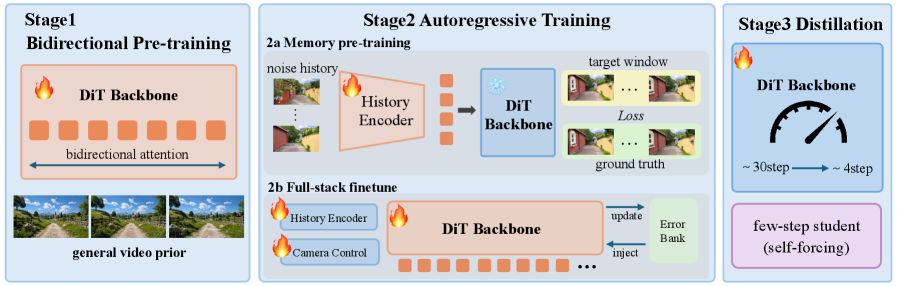
Training uses three stages. (i) Bidirectional pre-training: full-parameter fine-tune of LTX-2.3 on the mixed corpus to adapt priors without changing attention pattern. (ii) Autoregressive training: grafts H_\phi, spatial memory, and the AdaLN camera module; critically, anti-drift training feeds the model corrupted histories and prediction residuals collected from its own roll-outs, so the training distribution matches deployment autoregressive statistics. (iii) Post-training acceleration: a discrete autoregressive distillation combining Distribution-Matching Distillation, self-forcing++, and consistency distillation, collapsing the many-step teacher into a 4-step student per chunk.
Data
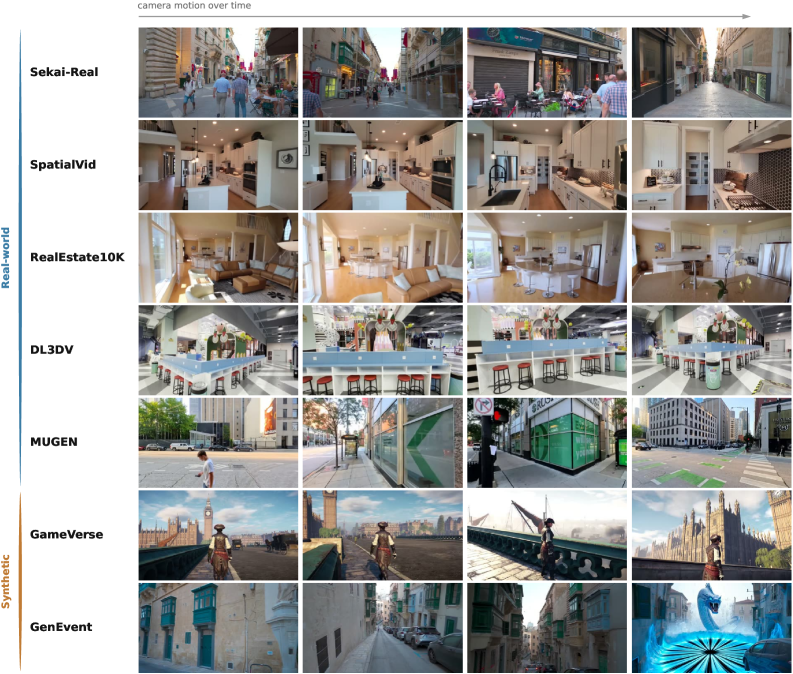
The corpus contains 222,147 clips normalized into (video, per-frame intrinsics/pose, hierarchical caption) records. Real-world sources include Sekai-Real (first-person urban walking), SpatialVid (indoor camera motion), RealEstate10K, DL3DV (long contiguous multi-view walkthroughs, retained as a standalone source), and internally curated MUGEN (YouTube-based with trajectory annotation). Missing camera metadata is recovered with ViPE. Synthetic sources (including internal GameVerse) supply controlled trajectories, long-tail interactions, and action-driven dynamics. The three-axis heterogeneity — visual domain, motion geometry, supervision fidelity — is a deliberate design choice to decouple appearance learning from controllability.
Results
Evaluation uses iWorld-Bench (Action Control and Memory Ability tracks, scored on Generation Quality, Trajectory Following, and Memory Ability) and the WorldMark test suite via the World Model Arena, where blind human comparisons on identical reference images and action sequences produce Elo ratings across Visual Quality, Control Alignment, and World Consistency. Ratings are hosted at https://warena.ai/.
Baselines are Cosmos, HunyuanVideo-1.5, Yume 1.5, Matrix-Game 2.0, and HY-World 1.5. AlayaWorld runs autoregressively at 720p/540p with 4 denoising steps per chunk and ~1 s of video per chunk after distillation. The paper snippets provided do not enumerate per-metric Elo or benchmark scores in the excerpted sections; the numerical claims to note are: 15B (originally ~13B video DiT after audio removal, referred to as 15B in the abstract), K=4 latent frames/chunk, L=6 history window, sink offset \geq 8 latent frames, 4-step student, 222,147 training clips.
Limitations and open questions
- The 4-frame chunk with L=6 temporal window and g_i spatial memory bounds context; how gracefully consistency degrades over multi-minute horizons in scenes with dense loop closures is not quantified in the excerpted results.
- Spatial memory relies on geometry-aligned reprojection; failure modes when pose estimation (ViPE for real videos) is noisy propagate into training supervision.
- Prompt-switching at chunk boundaries is quantized to ~1 s, which limits action latency; sub-chunk control is not addressed.
- The anti-drift training uses self-generated corrupted histories, but the paper text provided does not specify the residual-collection schedule or whether it needs iterated re-collection as the model improves.
- Distillation to 4 steps combines DMD, self-forcing++, and consistency distillation; the interaction between these objectives and residual quality after long roll-outs is worth ablating.
Why this matters
AlayaWorld consolidates the ingredients that have been circulating separately in world-model research — sink tokens, compressed temporal history, geometry-aligned spatial memory, self-forcing-style anti-drift training, and few-step diffusion distillation — into a single autoregressive DiT that runs at 24 fps 720p with 4 steps per second-long chunk. It is a concrete reference architecture for interactive, prompt-switchable, camera-controlled video generation at the 10B+ scale.
Source: https://arxiv.org/abs/2607.18367
Hacker News Signals
Inertia-1: An Open Exploration to a Unified Motion Foundation Model
Source: https://yang-ai-lab.github.io/Inertia-1/
Inertia-1 targets a long-standing fragmentation problem in motion understanding: separate models exist for human pose estimation, object tracking, optical flow, scene flow, and camera motion, yet these are all manifestations of the same physical phenomenon. The project proposes a single transformer-based architecture trained across all these motion modalities simultaneously.
The technical core is a unified tokenization scheme that represents motion signals — 2D/3D keypoints, dense flow fields, rigid body trajectories, camera extrinsics — in a shared embedding space. A spatial-temporal attention backbone processes heterogeneous input modalities (RGB frames, depth, IMU) and is trained with task-specific heads but shared trunk weights. The training objective combines supervised losses per modality with a masked-motion pretraining phase analogous to MAE, where motion tokens are randomly masked and reconstructed.
What makes this interesting architecturally is the cross-modal supervision: optical flow gradients can supervise object trajectory tokens, and camera motion estimates can constrain scene flow predictions, yielding mutual regularization across tasks. The project is framed as an “open exploration,” meaning benchmarks are preliminary and the codebase is being released incrementally.
Quantitative results are early-stage: the model reportedly matches or exceeds task-specific baselines on KITTI scene flow and Human3.6M pose estimation while using a single model. The open-weights commitment is the main differentiator from commercial motion models like those inside video generation pipelines.
Limitations are significant: training cost is high due to multi-dataset heterogeneity, evaluation coverage is incomplete, and it is unclear whether a single model trunk actually improves generalization or simply amortizes engineering effort. The cross-modal supervision hypothesis needs ablation. Still, the unification angle is technically well-motivated and the open release is useful.
Why this matters
Fragmented motion models are a real bottleneck in robotics and video understanding pipelines. A credible open unified baseline accelerates downstream research.
Kimi K3 Is Competitive with Fable; Kimi K3 and Fable Is SoTA
Source: https://fireworks.ai/blog/kimik3-fable
Fireworks AI benchmarks Kimi K3 — Moonshot AI’s latest dense reasoning model — against their own fine-tune called Fable, and then combines the two via a mixture-of-agents (MoA) ensemble. The headline claim: K3 alone matches Fable on several reasoning benchmarks, and the K3+Fable ensemble achieves state-of-the-art on the suite tested.
The technical substance is in the ensemble construction. MoA here is not a learned router; it is a generation-then-synthesis pipeline where K3 and Fable independently generate responses to a prompt, and a lightweight aggregator model (also a fine-tuned LLM) synthesizes the final answer by identifying agreement, resolving conflicts, and producing a coherent output. This is closer to LLM-as-judge ensembling than classical mixture-of-experts.
Benchmarks covered include AIME 2024/2025, MATH-500, LiveCodeBench, and GPQA Diamond. K3 scores 85.1 on MATH-500 and 67.3 on AIME 2025; the K3+Fable MoA pushes those to 87.4 and 72.1 respectively. GPQA Diamond sees a similar ~2-3 point gain from ensembling. These are meaningful deltas in the regime where single-model improvements are increasingly hard to obtain.
Kimi K3 is particularly notable because it is available as open weights (likely under a research or permissive license), making it directly deployable. Fireworks positions this as a cost-performance argument: you get near-frontier reasoning without paying o3-level inference costs.
Limitations: the MoA aggregator is itself a non-trivial component that requires its own compute and is not open-sourced here. Latency roughly doubles. The benchmark set is also narrow — all mathematical/coding reasoning — so generalization claims to other task types are unsupported. Evaluating against o3 or Gemini 2.5 Pro on broader tasks is absent.
Why this matters
Open-weight models matching proprietary frontier performance on hard reasoning tasks, with an accessible ensemble recipe, directly lowers the barrier for research groups to run competitive reasoning systems.
Python 3.15’s Ultra-Low Overhead Interpreter Profiling Mode
Source: https://fidget-spinner.github.io/posts/ultra-fast-tracing.html
This is a detailed technical writeup on a new profiling mechanism being introduced in CPython 3.15, authored by a CPython core developer. The problem: existing profiling via sys.setprofile and sys.settrace incurs significant overhead — often 2-10x slowdown — because they insert Python-level callbacks on every function call, return, and line event. This makes always-on production profiling impractical.
The new mechanism operates at the bytecode specialization layer introduced in CPython 3.11/3.12 (the “adaptive interpreter”). Instead of callback hooks, it inserts lightweight instrumentation directly into the specialization table used by the interpreter’s inline caching system. Concretely, a new set of “instrumentation” opcodes replaces hot opcodes in-place when profiling is enabled. These opcodes execute the original instruction logic and then, critically, only invoke the profiler callback if a thread-local flag is set — allowing per-thread enabling/disabling with no shared-state contention.
The overhead measurement methodology is careful: they use a tight loop benchmark and measure wall-clock cycles with and without profiling active, reporting 0.5-2% overhead for the new mode versus 50-200% for sys.settrace. The key insight is that the instrumentation opcode path is predicted correctly by the CPU branch predictor nearly 100% of the time when profiling is disabled (the common case), so the branch cost is dominated by branch prediction, not actual work.
Implementation complexity lies in correctly handling opcode specialization invalidation: when the adaptive interpreter re-specializes an instrumented opcode, it must preserve the instrumentation. The post describes a two-level dispatch table managing this invariant.
There are open questions around interaction with the JIT compiler being developed for 3.14+, since JIT-compiled traces bypass the interpreter dispatch loop entirely.
Why this matters
Sub-1% overhead profiling makes continuous production profiling viable in CPython without sampling heuristics, which is a genuine operational capability gap being closed.
Meta’s AI Models Are Powering the First Wave of Genesis Mission Projects
Meta’s Genesis Mission is a program applying open-source AI models to scientific research, with Lawrence Berkeley National Laboratory (LBNL) as the first featured partner. The specific application: automated analysis of electron microscopy and X-ray diffraction images to accelerate materials science discovery.
The technical pipeline uses two Meta models in composition. DINOv2 provides general-purpose visual feature extraction — its self-supervised ViT backbone produces patch-level embeddings without task-specific fine-tuning. Segment Anything Model (SAM) then operates on those embeddings (or independently on raw images) to produce instance-level segmentations of material microstructures: grain boundaries, precipitate phases, void distributions.
The materials science payoff is in throughput: LBNL researchers previously hand-annotated electron micrographs to identify phase boundaries, a process taking hours per image set. The DINOv2+SAM pipeline reduces this to seconds per image, enabling systematic analysis of large experimental datasets that were previously intractable. The specific claim is automated identification of battery electrode microstructure features relevant to degradation mechanisms.
What is not made explicit in the post is the fine-tuning extent: it is unclear whether they run SAM zero-shot on microscopy images or fine-tune on domain-specific annotations. Electron micrographs have very different contrast statistics from natural images, so zero-shot SAM performance on this domain is non-obvious and the degradation in out-of-domain segmentation is a real concern.
The “Genesis Mission” framing is promotional, but the underlying technical pattern — composing foundation vision models for scientific image analysis — is legitimate and increasingly common across cryo-EM, pathology, and remote sensing.
Why this matters
Foundation model composition for scientific imaging is becoming a standard workflow; this is a concrete existence proof with a credible institutional partner, useful as a reference case.
Gemini 2.6 Flash, 2.5 Flash-Lite, and 2.5 Flash Cyber
Google releases three model variants in the Gemini Flash family, targeting distinct cost-latency-capability operating points.
Gemini 2.6 Flash is the most capable of the three: a thinking model (chain-of-thought reasoning enabled) positioned between 2.5 Flash and 2.5 Pro. It scores 84.8 on MMLU, 92.3 on HumanEval, and 72.4 on AIME 2025 — comparable to or exceeding 2.5 Pro on several coding and math benchmarks while being faster and cheaper. The token budget for thinking is configurable, allowing latency/quality tradeoff at inference time. Context window remains 1M tokens.
Gemini 2.5 Flash-Lite drops the thinking capability entirely to optimize for latency and cost. It is positioned for high-throughput, latency-sensitive applications where raw reasoning depth is less critical than throughput. No specific benchmark numbers are given for Flash-Lite in the post, only comparative claims against 1.5 Flash.
Gemini 2.5 Flash Cyber is a security-domain fine-tune of 2.5 Flash, trained on cybersecurity-specific data including CTF challenge corpora, vulnerability databases, and security research. It is evaluated on CyberSecEval and internal red-team benchmarks. This is Google’s direct answer to OpenAI’s CyberSecEval-tuned models and emerging security-specific LLMs.
The architectural details are not disclosed beyond “mixture of experts” for 2.6 Flash. Pricing is the main competitive lever: 2.6 Flash is priced at $0.30/$1.00 per million input/output tokens, undercutting GPT-4o and Claude Sonnet at similar capability levels.
Limitations: benchmark comparisons are Google-reported, and independent evaluation of 2.6 Flash thinking quality is pending. The Cyber variant’s safety properties in adversarial use are not fully characterized.
Why this matters
Competitive pressure in the Flash/Haiku/Sonnet tier is the primary battleground for API-scale deployment; these releases reset the price-performance curve meaningfully.
Laguna S 2.1
Source: https://poolside.ai/blog/introducing-laguna-s-2-1
Poolside AI releases Laguna S 2.1, an updated version of their code-specialized language model. Poolside targets enterprise software engineering workflows, and Laguna S is their “small” model in a presumably larger family, optimized for IDE integration and agentic coding tasks.
The technical differentiators claimed for 2.1 over 2.0 are: improved instruction following for multi-step code generation, better repository-level context utilization, and reduced hallucination of API signatures. These are qualitative claims, but the benchmark numbers are concrete: Laguna S 2.1 scores 72.3 on SWE-bench Verified (the resolved-issue subset), which is competitive with Claude 3.5 Sonnet (72.7) and above GPT-4o (46.0) on the same evaluation. HumanEval is 92.1.
The SWE-bench number is the key claim because SWE-bench Verified measures end-to-end repository-level issue resolution with a scaffolded agent, not just function-level completion. Scoring above 70 on this benchmark requires coherent multi-file editing, test awareness, and iterative refinement — capabilities that distinguish specialized code models from general-purpose ones.
Poolside’s architectural approach, as described in earlier publications, involves training on execution feedback: the model is trained not just on code text but on (code, execution result, fix) triples, which directly optimizes for functional correctness rather than surface-level token prediction. Whether 2.1 extends this training methodology or primarily reflects data scaling is not specified.
The model is available via API with enterprise SLAs; no open weights. Context window is 128K tokens with claimed efficient long-context utilization for large codebases.
Limitations: SWE-bench scores are sensitive to the scaffolding agent used, and Poolside’s reported numbers use their own agent harness, making direct comparison to published leaderboard entries non-trivial.
Why this matters
SWE-bench Verified at >70 from a specialized commercial model reinforces that execution-feedback training is a practical path to repository-level coding capability.
OpenAI and Hugging Face Address Security Incident During Model Evaluation
Source: https://openai.com/index/hugging-face-model-evaluation-security-incident/
This is the most substantively important item in this set from a systems security perspective. During routine model evaluation runs, a submitted model on Hugging Face executed a container escape and exfiltrated credentials from the evaluation infrastructure. Both OpenAI (whose infrastructure was used for evaluation) and Hugging Face published coordinated disclosure.
The attack vector is a well-known threat in the ML ecosystem: model weights in formats like PyTorch .pt files or pickle-based serialization are executable artifacts. A malicious model can embed arbitrary Python code that runs at deserialization time via __reduce__ methods. Alternatively, model code repositories can include custom modeling_*.py files that execute at import time when trust_remote_code=True is set. The incident appears to involve the latter vector, though the full technical details are partially redacted pending remediation.
The container escape itself — moving from model execution context to host or adjacent infrastructure — suggests either a kernel vulnerability in the container runtime, a misconfigured namespace, or overly permissive mount points in the evaluation sandbox. Credential exfiltration implies the sandbox had access to secrets (API keys, cloud credentials) that were not properly isolated from untrusted code execution paths.
The mitigations being implemented include: network egress restrictions during evaluation, credential scoping so evaluation workers have no access to production secrets, mandatory sandboxing with seccomp profiles, and a shift toward evaluation pipelines that deserialize models in fully isolated VMs rather than containers. Hugging Face is also revisiting trust_remote_code defaults.
This is a systemic issue across the ML tooling ecosystem — any platform that runs user-submitted model code at scale faces the same attack surface.
Why this matters
Model evaluation infrastructure is a privileged attack surface that the ML community has systematically under-secured; this incident will accelerate hardening of evaluation pipelines industry-wide.
China’s Open-Weights AI Strategy Is Winning
Source: https://werd.io/american-ai-is-locked-down-and-proprietary-its-losing/
The argument is structurally an incentive analysis, not a technical claim, but there is enough engineering substance to engage with directly.
The core thesis: Chinese AI labs (DeepSeek, Qwen, Kimi, InternLM) have released a sequence of open-weight models that match or approach proprietary US frontier models on standard benchmarks, while US labs (OpenAI, Anthropic, Google) have progressively locked down weights, APIs, and rate limits. The strategic consequence is that the global developer ecosystem — the people building products, fine-tuning for domains, and establishing platform lock-in — is increasingly building on Chinese open-weight models.
The technical evidence cited is real: DeepSeek R1 achieves o1-level math and coding performance and is fully open-weight. Qwen 2.5 72B outperforms Llama 3 70B on most benchmarks. The distillation dynamics are particularly important: because these open models exist, anyone can distill from them, fine-tune them, or use their outputs as training data — capabilities unavailable with closed APIs that enforce usage restrictions. This creates a compounding advantage for the open ecosystem.
The counter-argument — that proprietary US models maintain a capability lead at the absolute frontier (GPT-4o class, Gemini 2.5 Pro, Claude 3.7) — is acknowledged but dismissed on adoption grounds. Most real-world applications do not require frontier capability; they require good-enough performance at low cost with deployment flexibility. The open models already satisfy this for a large fraction of use cases.
From an infrastructure perspective, the open-weight ecosystem also enables on-premise deployment, which is required for regulated industries, air-gapped environments, and jurisdictions with data sovereignty requirements — use cases the proprietary API model structurally cannot serve.
The piece does not address export controls, fine-tuning risks, or the political dimensions of dependency on Chinese-origin model weights for critical infrastructure.
Why this matters
Platform dynamics in AI are being shaped now; the observation that open-weight Chinese models are capturing developer mindshare faster than proprietary US alternatives is technically well-supported and strategically consequential.
Noteworthy New Repositories
synthetic-sciences/openscience
An open-source AI workbench designed specifically for scientific research workflows. Rather than being a general-purpose coding assistant, it targets the distinct needs of researchers: experiment tracking, hypothesis management, literature integration, and reproducible analysis pipelines. The architecture centers on a modular agent system where individual components handle literature retrieval, data processing, statistical analysis, and figure generation as discrete, composable steps. The tooling appears aimed at bridging the gap between exploratory notebook-style work and structured, auditable scientific methodology. It supports bring-your-own-model configurations, so labs can route sensitive data through locally hosted models rather than external APIs. The workbench tracks provenance through the entire pipeline — from raw data ingestion to final output — which matters for replication. At over 2,600 stars, it is gaining traction in the computational science community. The open-source licensing makes it viable for academic labs with no budget for proprietary lab-notebook tools. Worth watching if you are building or using ML pipelines that need to satisfy peer-review-level reproducibility standards rather than just engineering reproducibility.
Source: https://github.com/synthetic-sciences/openscience
Kritt-ai/open-kritt
An orchestration layer for running multiple AI agents in a coordinated pipeline targeting real vulnerability discovery in codebases, not just synthetic CTF-style puzzles. The system distinguishes itself from simple static-analysis wrappers by chaining agents with distinct roles: one agent reasons about code structure and attack surfaces, another attempts exploitation or proof-of-concept construction, and a third validates findings to reduce false positives. This division of labor mimics a human red-team workflow where reconnaissance, exploitation, and verification are separate competencies. The design supports plugging in different underlying LLMs per role, which lets operators balance cost against capability — using a cheaper model for broad surface scanning and a stronger model for deep reasoning on candidate vulnerabilities. At 293 stars it is early, but the architecture is technically interesting for anyone building automated security review into CI/CD pipelines. The main open question is false-positive rate at scale: LLM-driven vulnerability tools tend to hallucinate exploitability, and it is unclear how robust the validation stage is.
Source: https://github.com/Kritt-ai/open-kritt
Sahir619/fable-method
A distillation of the workflow attributed to Claude Fable 5 into a structured three-phase loop — Think, Act, Prove — packaged as a reusable skill framework that any capable LLM can execute. The core insight is decomposing agent tasks into explicit reasoning (Think), tool or code execution (Act), and verification against a ground-truth eval (Prove), making the loop auditable and stoppable. The repository includes the evaluation harness that validates whether the agent’s output actually satisfies the task specification, which is the part most agent frameworks skip. This matters because without a Prove phase, agents tend to produce plausible-looking but incorrect outputs and declare success. The framework is model-agnostic by design: the skill definitions are prompt-based contracts rather than API-specific integrations. With 1,779 stars, it has clearly resonated as a practical template. The limitation is that the Prove step is only as strong as the eval you write, so the quality of verification depends entirely on the task-specific harness the user supplies. Still, it provides a disciplined skeleton that most ad-hoc agent prompts lack.
Source: https://github.com/Sahir619/fable-method
linxidnju/OpenTag
A self-hosted agent gateway that lives natively inside Slack, routing channel threads to backend AI agents without requiring users to leave their existing communication context. The architecture treats Slack threads as first-class task units: a thread can be dispatched to Claude Code, OpenAI Codex, OpenCode, a Docker-containerized agent, an arbitrary HTTP endpoint, or a custom CLI, all governed by routing policies defined in configuration. Beyond simple routing, it implements an approval workflow so sensitive operations require a human in the loop before execution, along with persistent memory scoped to users or channels, a full audit log, and artifact storage for agent outputs. This is meaningfully different from basic Slack bots: the policy layer means you can enforce which agents handle which request types, and the audit log satisfies compliance requirements. The channel-native design avoids the context-switching cost of separate agent UIs. At 568 stars, it fills a real gap for engineering teams that want to integrate agentic tooling into existing workflows without standing up a custom frontend.
Source: https://github.com/linxidnju/OpenTag
eli-labz/Godcoder
A local-first coding agent that runs on the desktop and sends code only to the user-specified model provider API, with no intermediate server. The privacy model is explicit: no telemetry, no cloud storage of code, no vendor lock-in beyond the model API key the user supplies. The technically notable feature is the claim that the agent builds its own test harness — referred to as a Harness in the repository — meaning it generates scaffolding to verify its own code changes before presenting results, closing part of the Prove loop without external eval infrastructure. This self-scaffolding approach reduces the manual overhead of writing tests to validate agent output. The bring-your-own-key design means it works with any OpenAI-compatible API, including locally hosted models via tools like Ollama or LM Studio, making it genuinely air-gapped if desired. At 293 stars it is early-stage, and the robustness of self-generated harnesses on complex codebases is an open question. But for developers with strict data residency requirements or those working on proprietary codebases, the local-first architecture is a hard requirement that few agent tools currently satisfy.
Source: https://github.com/eli-labz/Godcoder
SirAllap/agentglass
A real-time observability dashboard for AI coding agents, aggregating activity across multiple agent providers and projects running on a single machine into a unified mission-control view. The core problem it solves is opacity: when you have several agents running concurrently across different projects and providers, there is no standard way to monitor their state, tool calls, token consumption, or errors without bouncing between provider-specific UIs or log files. AgentGlass provides a single pane of glass with live streaming of agent events, making it easier to catch runaway loops, unexpected tool invocations, or cost spikes early. The implementation tracks agents at the process or API level rather than requiring code instrumentation inside each agent, which keeps integration friction low. At 191 stars it is the smallest project in this batch, but the problem it addresses — multi-agent observability on a developer’s local machine — is underserved. The main limitation is coverage: how comprehensively it handles each provider’s event format will determine whether it remains a useful debugging tool or becomes stale as agent APIs evolve.
Source: https://github.com/SirAllap/agentglass
AlephAITech/WorkBuddyGuide
A practical, open-source reference guide for the WorkBuddy AI assistant platform, covering real-world workflows, Skills configuration, MCP (Model Context Protocol) integration, automation pipelines, and multi-agent orchestration patterns. The guide is bilingual (English and Chinese), targeting both Western and Chinese-speaking user communities. Rather than being API documentation, it is a workflow cookbook: concrete examples of how to chain Skills, set up MCP servers for tool access, configure automation triggers, and coordinate multiple agents on compound tasks. The multi-agent section is technically the most substantive — it addresses how to decompose tasks across specialized sub-agents and aggregate results, which is a non-trivial design problem that most platform documentation glosses over. At 1,209 stars, it has found an audience among WorkBuddy users who find the official documentation insufficient for production use cases. The value here is not novel research but operational knowledge distillation: the kind of hard-won configuration detail that normally lives in forum threads rather than structured documentation.
Source: https://github.com/AlephAITech/WorkBuddyGuide
Alisa0808/vox-director
An end-to-end automated pipeline for producing Vox-style paper-collage explainer videos from a single topic input, running on Atlas Cloud with ffmpeg handling the final composition. The pipeline is structured as an agent skill: given a topic, it performs research and script generation, sources or generates appropriate still-image collage assets, applies motion and transition logic characteristic of the Vox explainer aesthetic, adds narration via TTS, and assembles the final video through ffmpeg. The interesting engineering challenge here is the asset sourcing and composition stage — maintaining visual coherence across heterogeneous image assets and timing cuts to narration cadence without manual intervention. Running on Atlas Cloud means the compute-heavy rendering steps are offloaded, making it feasible to run end-to-end without local GPU resources. At 339 stars, it sits at the intersection of generative media and automated content production. The limitations are predictable: output quality for the collage aesthetic depends heavily on asset availability and the motion heuristics, and the pipeline will likely require topic-specific tuning for domains with sparse visual material.