Daily AI Digest — 2026-07-17
arXiv Highlights
SEED: Self-Evolving On-Policy Distillation for Agentic Reinforcement Learning
Problem
Outcome-based RL for LLM agents suffers a granularity mismatch: the environment emits a single scalar R(\tau) at the end of a multi-turn trajectory, but the policy \pi_\theta(a_t\mid h_t) must credit-assign across many token-level decisions distributed over h_t = (o_0, a_0, \dots, o_t). Standard trajectory-level policy gradients (GRPO, RLOO, PPO) push all tokens in a rollout by the same advantage, which is a weak learning signal when episodes span dozens of tool calls. SEED asks whether the completed trajectory itself — which contains post-hoc information about why the agent succeeded or failed — can be turned into a dense token-level supervision signal without external annotation or a stronger teacher.
Method
SEED reuses a single model as both actor and hindsight analyzer, and distills the analyzer’s behavioral influence into the actor.
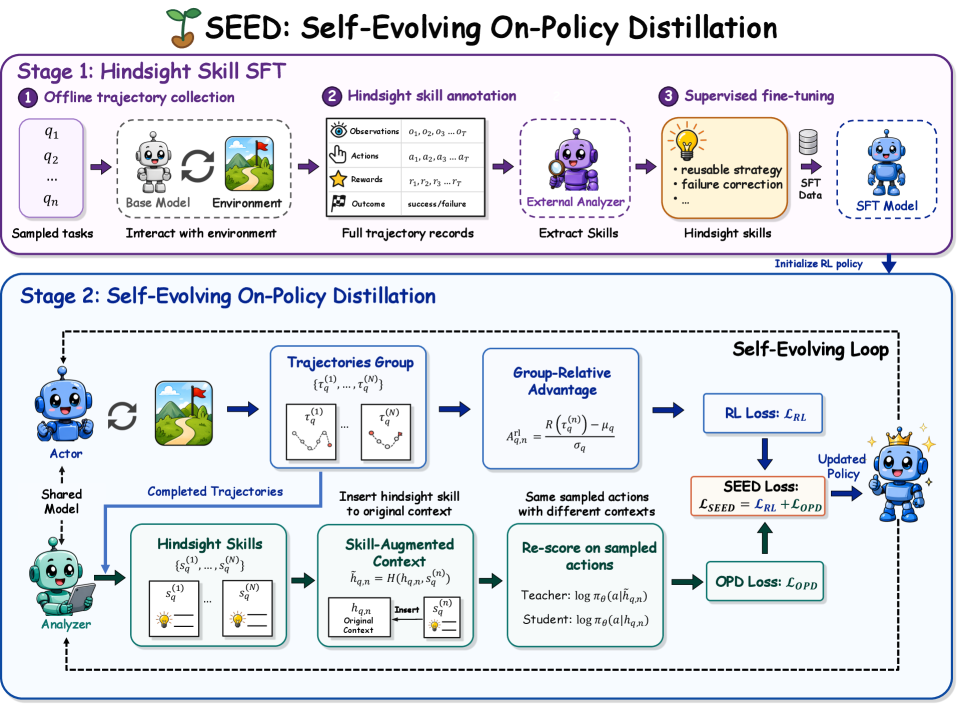
Stage 1 — Hindsight Skill SFT. The policy is fine-tuned to map a completed trajectory \tau to a natural-language “skill” s = f_\theta(\tau) — a compact string describing reusable workflows, decisive observations, or failure-avoidance rules extracted in hindsight. This gives one model the dual capability of acting and self-analysis.
Stage 2 — Self-Evolving On-Policy Distillation. In each RL iteration, the current snapshot \pi_\theta (i) rolls out trajectories \tau \sim \pi_\theta, (ii) analyzes each \tau into a skill s, and (iii) re-scores the same sampled actions under two contexts: the ordinary history h_t and the skill-augmented history (h_t, s). The skill-conditioned distribution \pi_\theta(a_t\mid h_t, s) acts as an on-policy teacher: it uses information not causally available at time t (the hindsight skill derived from the entire \tau), so it should assign higher likelihood to the decisions that led to success. Distilling this back into \pi_\theta(a_t\mid h_t) yields a per-token KL-style objective that supplements the sparse trajectory reward.
The overall loss combines outcome-based RL (GRPO-style) with the token-level OPD term:
\mathcal{L}(\theta) = \mathcal{L}_{\text{RL}}(\theta) + \lambda\, \mathbb{E}_{\tau,\,t}\big[ \mathrm{KL}\big(\pi_{\theta_{\text{old}}}(\cdot\mid h_t, s)\,\|\,\pi_\theta(\cdot\mid h_t)\big) \big].
Because s is produced by the same evolving \pi_\theta, the teacher improves as the actor improves — hence “self-evolving.” At inference the analyzer branch is discarded; deployment cost is identical to the base policy.
Results
SEED is evaluated on three long-horizon agentic regimes: ALFWorld (embodied text tasks over six families — Pick, Look, Clean, Heat, Cool, Pick2), WebShop (128 test tasks), and Search-R1-style multi-hop QA over NQ, TriviaQA, PopQA, HotpotQA, 2Wiki, MuSiQue, and Bamboogle.
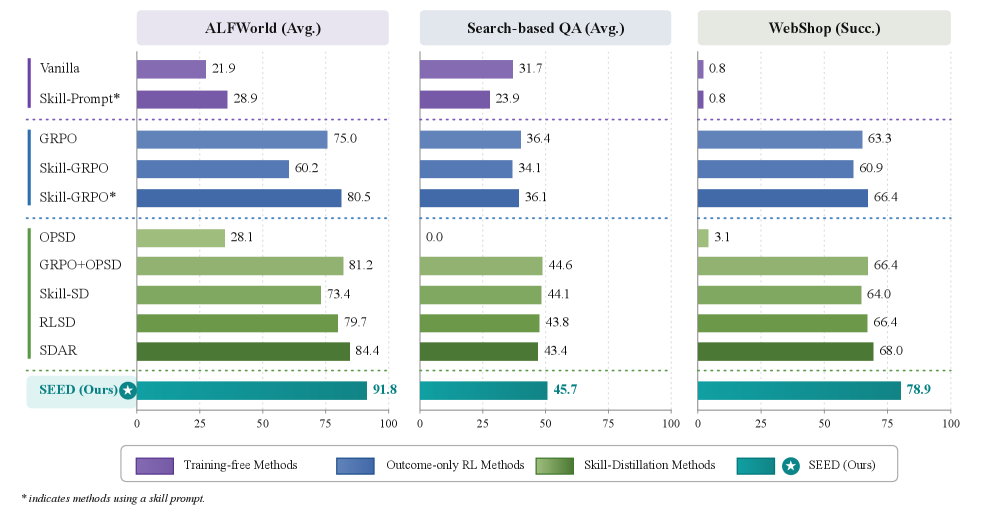
Across the three benchmark suites, SEED achieves the highest average score against outcome-only RL baselines (GRPO, DAPO) and prior distillation/curriculum variants. The training-dynamics comparison on ALFWorld with a Qwen2.5-3B-Instruct backbone is more diagnostic:
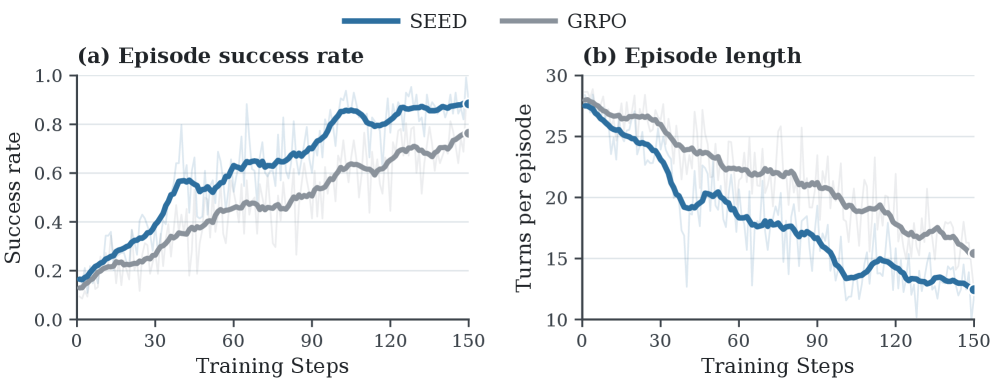
SEED both converges faster and reaches a higher plateau than GRPO, indicating that the token-level distillation signal is not merely a variance-reduction trick — it is providing information GRPO cannot recover from trajectory returns alone. The gap is most pronounced early in training, consistent with the interpretation that the skill-conditioned teacher fills in credit assignment on intermediate decisions before the outcome signal densifies (as success rate rises).
Limitations and open questions
- Skill quality bootstrapping. Stage-1 SFT presumably requires seed trajectories with hindsight-skill annotations; the paper’s excerpt does not specify how these are sourced (self-generated by a stronger model? gold-annotated?). This affects reproducibility and whether SEED can cold-start without a stronger analyzer.
- Reward hacking on the auxiliary loss. If s leaks the outcome (e.g., encodes “the answer is X”), \pi_\theta(\cdot\mid h_t, s) becomes a trivially strong teacher and distillation collapses toward memorization rather than learning transferable behavior. The paper’s skill schema (workflows, decisive observations, failure-avoidance rules) is meant to constrain this, but the tension is structural.
- Analyzer/actor interference. Sharing parameters between the actor and analyzer risks capacity contention; whether performance degrades when the analyzer is frozen after Stage 1, or whether joint updating is essential, is an important ablation.
- Cost. Each RL step now requires an extra analyzer forward pass over full trajectories plus a re-scoring pass under (h_t, s); the wall-clock overhead relative to GRPO is not stated in the excerpt.
- Scale. Results center on 3B-class backbones; whether hindsight skills still provide marginal signal when the base policy is already strong (e.g., 70B) is open.
Why this matters
SEED shows that the sparse-reward problem in agentic RL can be attacked without stronger teachers, process reward models, or human step-level labels — by exploiting the fact that a completed trajectory contains latent information the actor lacked mid-episode, and by using the policy itself to surface that information as text. It is a clean instance of turning a partial-observability asymmetry (train-time hindsight vs. test-time foresight) into a self-distillation signal.
Source: https://arxiv.org/abs/2607.14777
BadWAM: When World-Action Models Dream Right but Act Wrong
Problem
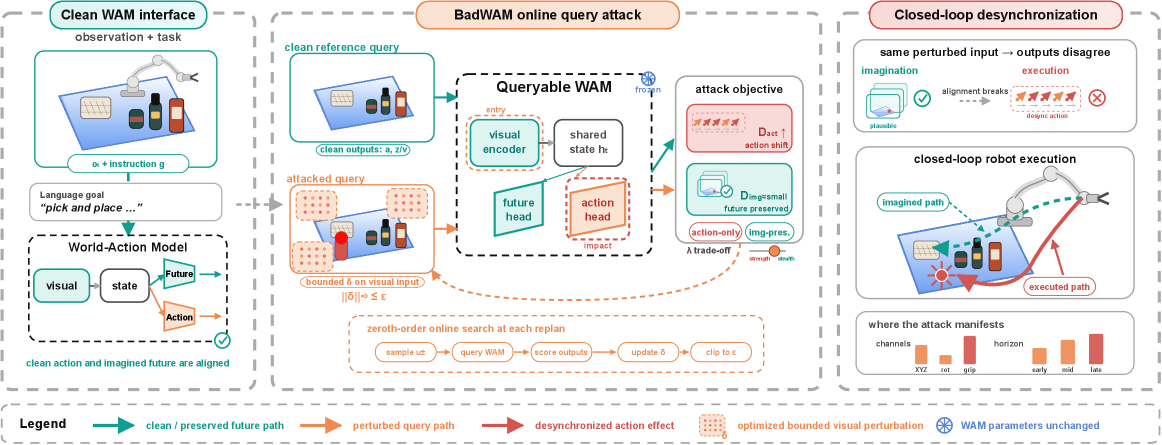
World-action models (WAMs) couple action prediction with future world prediction, on the assumption that a jointly learned latent forces the two to agree: if the robot’s imagined future looks correct, its executed action is presumed safe. This has motivated “imagine-then-check” safety monitors that inspect predicted futures before letting actions execute. BadWAM tests whether this coupling is actually inseparable under adversarial pressure, or whether small bounded visual perturbations can drive a wedge between imagination and action — the robot dreams the correct rollout while executing a failing one.
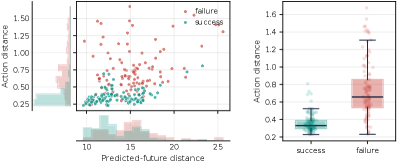
The empirical hook is in Figure 1: across closed-loop rollouts, failed episodes have systematically larger action shifts than successful ones, but their imagination shifts overlap heavily with the successful distribution. Action drift is the diagnostic signal; imagination drift is not.
Threat model
The adversary perturbs only the visual observation, \tilde{o}_t = \mathrm{clip}(o_t + \delta_t) with \|\delta_t\|_\infty \le \epsilon, at inference time. Language instructions, robot state, weights, and dynamics are untouched. Two access levels are considered: (i) action-only, where the attacker sees only the emitted action chunk (black-box API access); (ii) imagination-visible, where the attacker also sees the latent or decoded predicted future — this is the setting relevant to safety monitors that expose future rollouts. No gradients through model weights are required; the attack is purely query-based.
Method
BadWAM is organized around two interface-level distances: D_{\mathrm{act}}(a^\delta, a) between clean and attacked action chunks, and D_{\mathrm{img}}(z^\delta, z) between clean and attacked imagined futures. Neither requires a specific WAM architecture. The core attack surface is
\max_{\|\delta\|_\infty \le \epsilon} D_{\mathrm{act}}(a^\delta, a) \quad \text{s.t.}\quad D_{\mathrm{img}}(z^\delta, z) \le \tau_{\mathrm{img}}.
Two instantiations sit at different points on this frontier:
- Action-only attack. Drop the imagination constraint and maximize D_{\mathrm{act}} under the \ell_\infty budget. Requires only the action output, so it applies to any WAM including black-box action-only policies.
- Imagination-preserving attack. Add the D_{\mathrm{img}} \le \tau_{\mathrm{img}} constraint so the visible imagined rollout stays close to its clean counterpart while actions diverge. This is the stealth variant that defeats imagine-then-check monitors.
Optimization is a query-based online search over the frozen WAM at each replanning step, with a budget of 8 iterations per replan in the main experiments. Figure 3 shows the pipeline: perturb the current observation, query the WAM, score along D_{\mathrm{act}} (and D_{\mathrm{img}} if stealth is required), update \delta_t, and re-execute in closed loop.
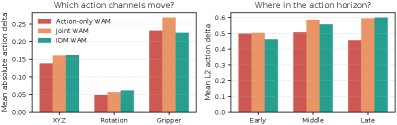
Importantly, the resulting perturbations are not white-noise output jitter. Figure 2 shows that action shifts concentrate on specific continuous channels (end-effector translation/rotation) and on particular sub-windows of the action horizon rather than perturbing the chunk uniformly.
Results
Main closed-loop numbers at \epsilon = 0.06 with 8 query iterations per replan (Table 1):
- LIBERO. Action-only WAM drops from 96.5% to 43.1% (\downarrow 53.4). Joint WAM: 98.1% → 61.5% (\downarrow 36.6) under action-only, and 63.0% (\downarrow 35.1) under imagination-preserving. IDM WAM: 98.4% → 66.1% (\downarrow 32.3) and 68.1% (\downarrow 30.3).
- RoboTwin. Reductions are much smaller: action-only WAM 92.1% → 84.4% (\downarrow 7.7); joint 90.9% → 84.4%; IDM 91.4% → 83.7%. The imagination-preserving variants remain within ~1–2 points of their action-only counterparts on RoboTwin.
Two observations follow. First, the stealth constraint on imagined futures costs almost nothing in attack strength: on Joint and IDM WAMs the imagination-preserving attack lands within 2 points of the unconstrained action-only attack. The imagination monitor is essentially free to bypass. Second, LIBERO is far more attackable than RoboTwin — the dual-arm, higher-visual-diversity setting appears to blunt query-based single-step search, likely because a larger fraction of the action chunk must be corrupted to derail a long-horizon dual-arm plan within an 8-query budget.
Figure 5 (task-level failure distribution) and Figure 7 (pass@k across trials) indicate the degradation is not concentrated on a few unlucky tasks: attacked policies shift into low success-rate bins across suites, and pass@k curves are depressed throughout the trial budget rather than exhibiting isolated failures. Figure 6 rules out the trivial baseline — random \ell_\infty perturbations at the same budget produce far smaller drops, so the query-based search is doing real work.
Limitations and open questions
The attack is evaluated at \epsilon = 0.06 in \ell_\infty on rendered simulation images; whether the same trigger survives camera ISP, physical rendering, and multi-view geometric consistency in the real world is open. The RoboTwin results suggest attack effectiveness depends heavily on task horizon and visual diversity, but the paper does not isolate which factor matters. The imagination-preserving objective uses a distance D_{\mathrm{img}} at the interface level; a stronger monitor that checks action-imagination consistency (rather than imagination plausibility alone) is not evaluated and could in principle close the gap. Finally, 8 queries per replan is aggressive for a deployed API — rate limits and query auditing are natural defenses not stress-tested here.
Why this matters
If WAM-based safety schemes rest on the premise that a plausible imagined future certifies an action, BadWAM shows the premise is empirically false under bounded, query-only perturbations: action success can drop 30–53 points on LIBERO while imagined rollouts remain near-clean. Any imagine-then-check monitor for embodied foundation models needs to check action-imagination consistency, not imagination plausibility.
Source: https://arxiv.org/abs/2607.15207
LongStraw: Long-Context RL Beyond 2M Tokens under a Fixed GPU Budget
Problem
RL post-training pipelines lag inference by roughly an order of magnitude in context length. Serving stacks routinely handle 512K–1M tokens; GRPO/PPO-style post-training is typically capped near 128K–256K because activations for the full policy graph over a group of G rollouts scale as O(G \cdot L) in memory. Agentic workloads make this gap operationally painful: tool outputs, retrieved documents, and prior action traces accumulate, so the training distribution should include trajectories at the length actually seen at deployment. The paper’s premise is that under a fixed GPU budget (8–32 H20s), we should be able to run GRPO at L \gtrsim 2\text{M} tokens without switching to a bespoke sequence-parallel training framework.
Method
LongStraw is an execution stack, not a new algorithm. It keeps GRPO objective and loss unchanged:
\mathcal{L}_{\text{GRPO}} = -\mathbb{E}_{g}\!\left[\frac{\pi_\theta(a_g \mid s)}{\pi_{\theta_{\text{old}}}(a_g \mid s)} \hat{A}_g - \beta \, \text{KL}\!\left(\pi_\theta \Vert \pi_{\text{ref}}\right)\right],
where the group \{a_g\}_{g=1}^{G} shares a single long prompt s. Three architecture-aware transforms make this feasible:
Prompt evaluation without autograd. The shared prompt of length L_p is forwarded under
no_grad. The training graph therefore never contains prompt activations; only the response tokens (L_r \ll L_p) contribute to the backward. For GRPO this is exact because the prompt gradient is shared across the group and cancels in the advantage-weighted update at the token level — only per-response logprobs enter \hat{A}_g.Model-specific state retention. Instead of caching full activations, LongStraw retains only the minimal per-layer state that later tokens actually consume. For a hybrid recurrent/full-attention model like Qwen3.6-27B, that means recurrent hidden states on the SSM/linear-attention blocks and standard KV on the full-attention blocks; for GLM-5.2 with compressed attention plus MoE, it retains the compressed KV summaries and the expert routing decisions but not the per-expert intermediate activations. This is where “architecture-aware” earns its name: the retained tensor set is derived from each block’s dependency graph rather than a uniform activation-checkpointing schedule.
Per-branch replay. Response branches are replayed one at a time from the retained state, so peak memory scales with a single response instead of G. The cost is time: total FLOPs go up by a factor of roughly G on the response segment, while the dominant prompt cost is paid once. Because L_r/L_p is small in long-context regimes, wallclock overhead is bounded by 1 + G \cdot L_r / L_p.
The composition yields a peak-memory profile that is essentially independent of G: increasing G only adds the state needed to resume replay from the shared prompt, not another copy of the training graph.
Results
The headline numbers substantiate the design:
- On 8× H20, LongStraw completes grouped Qwen3.6-27B scoring plus response backward at 2.1M positions for both G=2 and G=8. Going from G=2 to G=8 increases peak allocated memory by only 0.21 GB, consistent with the claim that group scaling only adds retained-state cost.
- A separate stress configuration on the same 8-GPU node reaches 4.46M positions, more than 17\times the common 256K post-training ceiling.
- On 32× H20, the pipeline is validated for GLM-5.2 with compressed attention and MoE routing, i.e., the retained-state discipline generalizes across two distinct architectural families (hybrid recurrent + full attention; compressed attention + MoE).
The abstract truncates before the 32-GPU throughput figures, but the qualitative claim is that the same peak-memory invariance carries over: group size is decoupled from live-graph size in both cases.
Limitations and open questions
- Replay is exact for the policy forward but re-executes attention and MoE routing per branch. For MoE, expert-selection nondeterminism (e.g., due to load-balancing noise or dropless routing perturbations) needs to be pinned to keep replayed branches on the same computational path as the sampled rollouts; the abstract does not describe how routing is frozen.
- The gain relies on L_p \gg L_r. For agentic RL where responses themselves are long (chain-of-tool trajectories), per-branch replay costs will dominate and the memory–time tradeoff becomes less favorable.
- No comparison is given against sequence-parallel or ring-attention training baselines at matched hardware; the “fixed GPU budget” framing sidesteps whether a well-tuned SP implementation could reach similar lengths with less replay overhead.
- Reference-model KL evaluation over 2M-token prompts must presumably also run under
no_gradwith the same retention scheme; the abstract does not detail how \pi_{\text{ref}} storage is amortized. - The method is presented for GRPO where the prompt gradient factorizes trivially. Extension to algorithms with prompt-conditioned critics (e.g., token-level value heads trained jointly) is not obvious.
Why this matters
Closing the inference/post-training context gap without new silicon or a new training framework is a practical unlock for long-horizon agent RL. LongStraw’s contribution is recognizing that GRPO’s group structure and modern architectures’ compressible state jointly permit a nearly memory-flat scaling in G, trading time for length — an operationally sensible tradeoff when the alternative is truncating trajectories.
Source: https://arxiv.org/abs/2607.14952
UniVR: Thinking in Visual Space for Unified Visual Reasoning
Problem
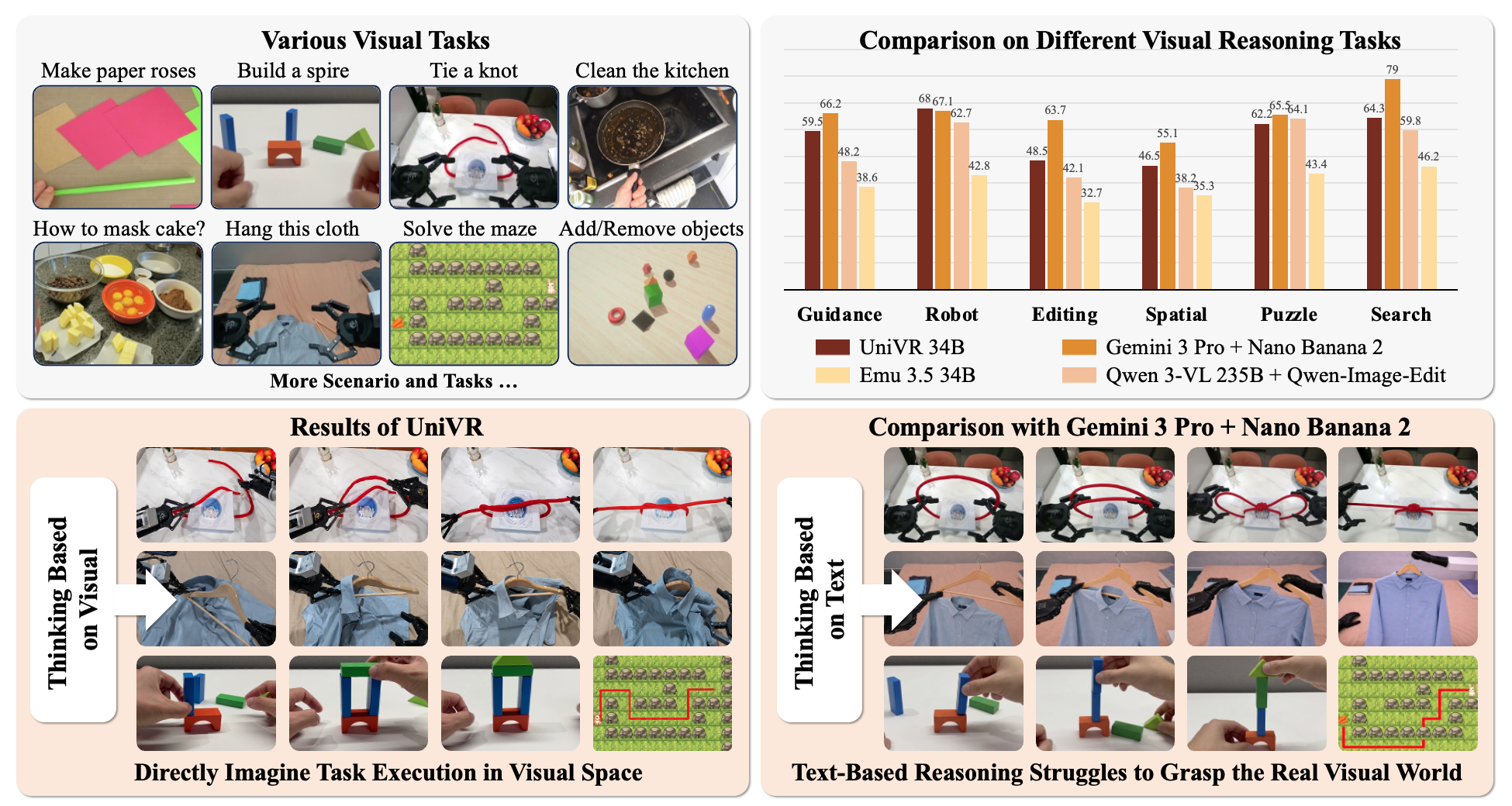
Most “visual reasoning” pipelines are actually textual reasoning with images rendered as illustrations: an LMM produces step-level instructions and a T2I model paints each frame. This decouples reasoning from the visual substrate and fails on tasks where the relevant dynamics — contact, occlusion, deformation, articulation — are hard to describe linguistically. UniVR asks whether an autoregressive model can learn planning, physical dynamics, and long-horizon reasoning directly in the visual token space, with no textual chain-of-thought scaffolding, and whether doing so also improves multimodal understanding.
Method
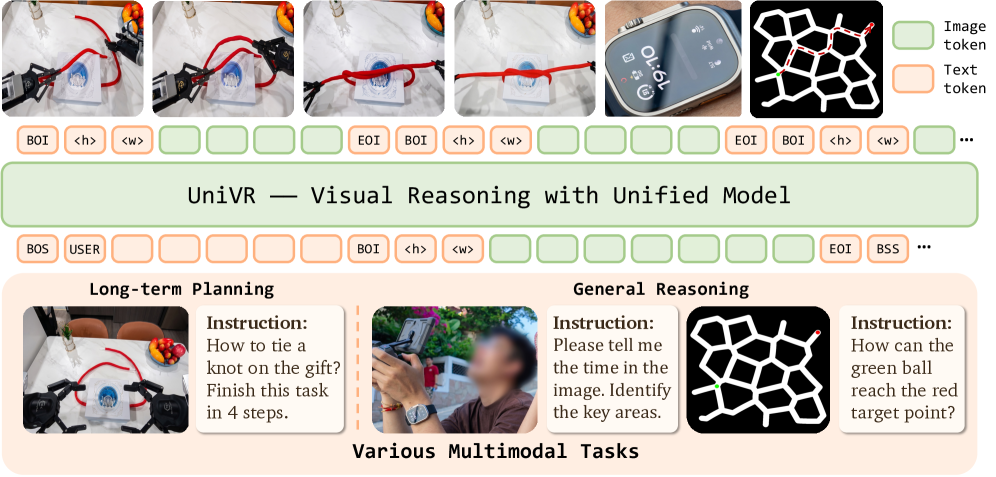
UniVR is initialized from Emu3.5-34B, a unified autoregressive model with a VQ-VAE tokenizer that shares a discrete vocabulary between image patches and text. Given an image sequence x_{1:t} and instruction, the model learns p(x_{t+1}\mid x_{1:t}) under a plain next-token objective; the “reasoning trace” is literally the generated frame sequence.
Training proceeds in two stages:
Cold-start SFT. 310k samples curated from 1.5M candidates over 16 sources (AgiBot, Action100M, EgoDex, VisualCoT, ZebraCoT, etc.). The pipeline uses PySceneDetect at 0.27 FPS, SigLIP2 deduplication, VLM quality filtering, and Qwen3.5-397B to synthesize ~10 key-step QA pairs per trajectory and select query/key frames. Each image is tokenized at 512px short-side into ~1000–1500 tokens; sequences are capped at 15k tokens on 32 GPUs, full-parameter.
VR-GRPO. GRPO with rollout size 8, but the reward decomposes into a global reward (VLM-scored task completion and coherence over the full trace) and a step-level reward. The step-level component slides a window (default 4 frames, consistency coefficient \lambda = 2.0) and penalizes local physical/logical inconsistency and pairwise transition failures.
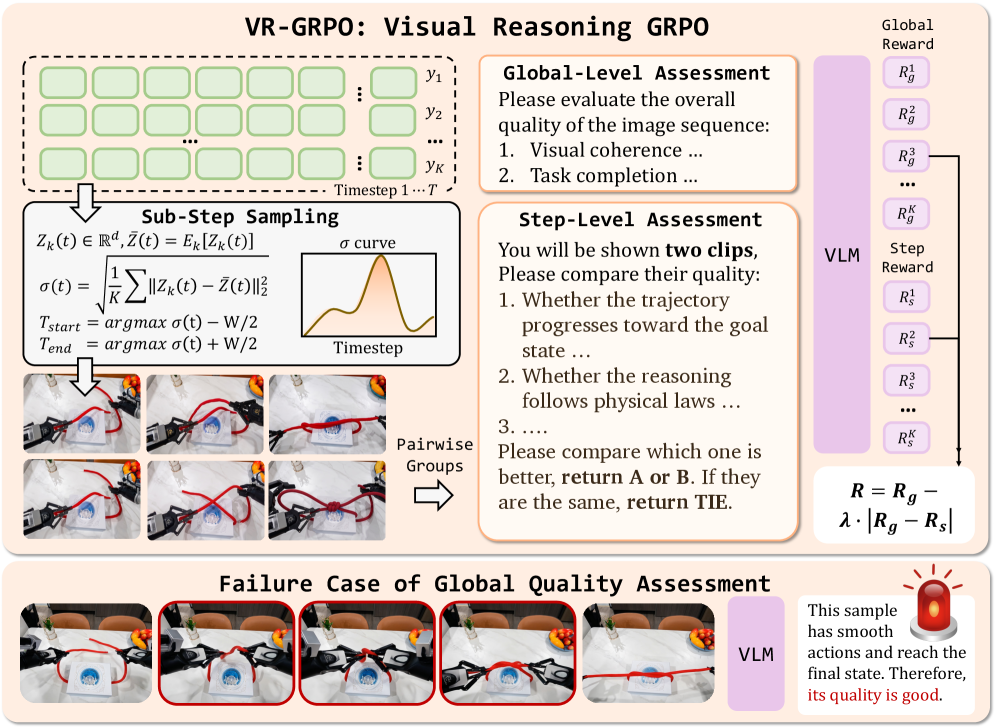
The step reward is the critical piece: the authors show that pure global rewards produce sharp reward spikes and reward hacking — the VLM misses errors localized to a handful of frames in 30+ second trajectories (hanger-through-fabric, incorrect pouring dynamics, jittering paper-towel transitions). Adding the step-level term yields a monotonically ascending training curve.
Results
The VR-X benchmark (1.8k evaluation samples across guidance, robot manipulation, editing, spatial, puzzle, search) uses a VLM score (Spearman 0.85 with human) and a JEPA score (MMD in V-JEPA feature space, replacing I3D in the FVD formulation).
On overall VR-X score, UniVR reaches 58.2 vs Emu3.5’s 39.8 (+18.4), and JEPA drops from 33.62 to 13.01. Per-task gains over Emu3.5: guidance +20.9, robot +25.2, editing +15.8, spatial +11.2, puzzle +18.8, search +18.1. UniVR (34B, unified) approaches the strongest LMM+T2I pipeline, Gemini-3-pro + Nano Banana 2 at 66.1, and beats GPT-5 + GPT-image-1.5 (63.5) on robot manipulation (68.0 vs 64.1) while trailing on guidance and search where linguistic priors dominate.
Long-horizon scaling is where visual-space RL pays off most. Split by duration:
| Duration | Emu3.5 | UniVR | Δ |
|---|---|---|---|
| <10s | 54.2 | 71.1 | +16.9 |
| 10–30s | 48.0 | 61.0 | +13.0 |
| 30–60s | 38.9 | 56.7 | +17.8 |
| >60s | 21.7 | 45.6 | +23.9 |
The gain grows monotonically with horizon, consistent with the step-level reward suppressing compounding errors.
Ablations (Tab. 1b in the paper) isolate contributions: cold-start with global reward alone gives LP=48.2, GR=42.4, JEPA=18.44; adding step + pairwise rewards reaches LP=61.6, GR=53.7, JEPA=12.89; the full setup with mixed vision+text training and VR-GRPO reaches LP=65.4, GR=57.8.
Notably, training purely on visual reasoning transfers to text-heavy multimodal benchmarks: MMMU 0.292→0.337, MME(P) 781.1→799.3, MME(C) 324.6→338.5, MathVista 41.7→44.0, MM-Vet 28.0→35.6. A text-only training control matches Emu3.5 baseline, suggesting the gains come from visual-space reasoning rather than incidental language exposure.
Limitations
The reward model is a generic VLM without native physics grounding — the paper explicitly notes this ceiling. Training a 34B model on 15–20k-token visual sequences is expensive and the release does not clarify inference latency for minute-long rollouts. The JEPA metric is only applied to long-horizon subsets, so cross-task comparisons rely on VLM scoring, which the authors themselves show can be gamed by global-reward-only training. Finally, VR-X does not include auditory or proprioceptive modalities; the “unified” claim is restricted to vision+text.
Why this matters
UniVR is a concrete demonstration that RL over visual token sequences with step-level rewards can extract physical and planning knowledge that textual CoT scaffolding misses, and that this visual reasoning ability back-propagates into improvements on text-oriented multimodal benchmarks. If the pattern holds at smaller scales, it undermines the assumption that language is the necessary substrate for reasoning in multimodal models.
Source: https://arxiv.org/abs/2607.12800
Spectral Rewiring for Exploration, Purification, and Model Merging
Problem
RL post-training on LLMs (RLVR-style, outcome-reward) yields dense full-parameter updates that carry two known pathologies: (1) collapse of test-time scaling — Pass@k curves saturate at low k even when Pass@1 improves, and (2) cross-domain interference when a single model is trained jointly on math, code, and instruction-following, or when independently trained experts are merged. The authors argue that only a small, spectrally-aligned component of \Delta W = W_{\text{RL}} - W_0 is responsible for reasoning gains; the rest suppresses exploration and amplifies interference.
Method: SAR
Let W_0 = U\Sigma V^\top be the SVD of a base weight matrix. The pretrained spectral manifold is defined as \mathcal{S}_r(W_0) = \mathrm{span}(U \otimes V), i.e. the space of matrices whose left/right singular vectors coincide with those of W_0. Any matrix in this manifold is representable as U M V^\top for some coefficient matrix M \in \mathbb{R}^{r \times r}. SAR extracts the RL update’s projection onto this manifold:
M = U^\top \Delta W\, V, \qquad \Delta W^* = U\, \mathrm{TopK}_k(M)\, V^\top,
where \mathrm{TopK}_k retains the k largest-magnitude entries of M (a rank/entry budget, e.g. 1% of parameters). The rewired model is W_0 + \Delta W^*. SAR is applied to attention \{W_q,W_k,W_v,W_o\} and MLP \{W_{\text{gate}},W_{\text{up}},W_{\text{down}}\}; norms, biases, embeddings, and lm_head are inherited from the base model. Projecting only attention or only MLP is insufficient.
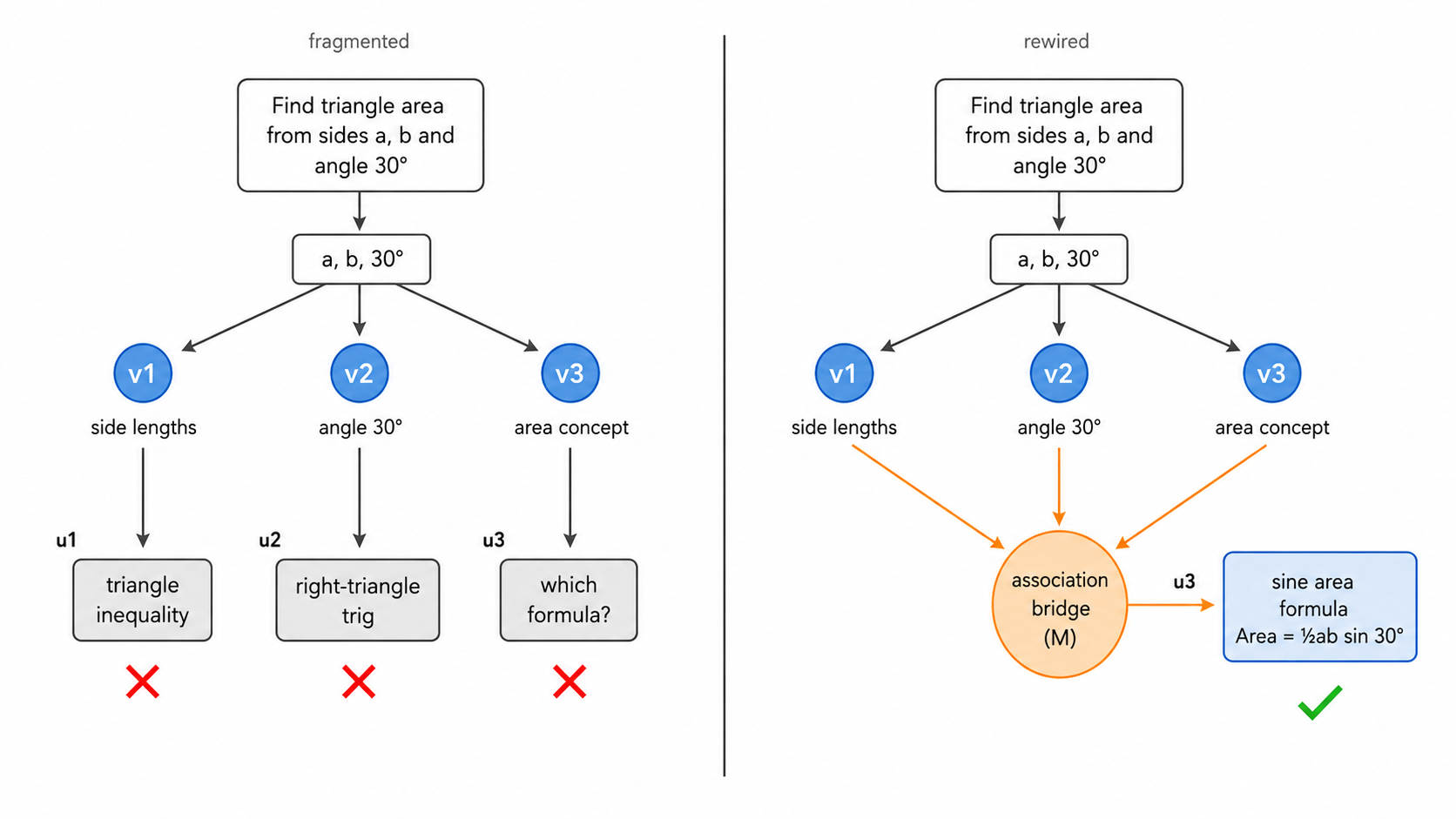
Mechanistically, diagonal entries M_{ii} rescale existing u_i \leftarrow v_i associations; off-diagonal M_{ij} (i \neq j) create cross-routing — multiple input singular directions v_j jointly activate a single output direction u_i. The paper illustrates this with a triangle-area example where v_1 (side lengths) and v_2 (angle) route into u_3 (sine-area formula) via induced M_{3,1}, M_{3,2}.
Single-domain results
On AIME 24/25 with 32 samples per prompt, SAR reproduces full-RL Pass@1 using a small fraction of the update magnitude:
- DeepScaleR (1.5B), 1% rank: AIME24 AVG@32 40.21% vs full-RL 40.31% (base 31.67%); AIME25 28.96% vs 29.58%.
- Polaris (Qwen3-4B), 10% rank: AIME24 78.02% vs 78.75%; AIME25 72.21% vs 75.21%, with Pass@32 improving to 93.33%.
- OLMo-3.1-32B-Think, 1% rank: AIME24 78.88% vs 79.56%; AIME25 Pass@32 improves 90.00% → 93.33%.
- OLMo-3.1-7B-RL-Zero-Math (emergent regime, base only 22.08% AIME24), 30% rank: 49.02% vs 50.21% RL.
The abstract’s headline of ~0.58% of total parameters comes from these compact rank budgets aggregated across projected matrices. Crucially, on Pass@k with 256 rollouts on DeepScaleR, SAR continues improving where both the full-RL model and a no-projection low-rank control saturate, solving one AIME24 problem neither baseline solves within 256 attempts. This is the exploration-purification effect: RL’s off-manifold components suppressed base-model modes that were still solving those problems.
Cross-domain purification and merging
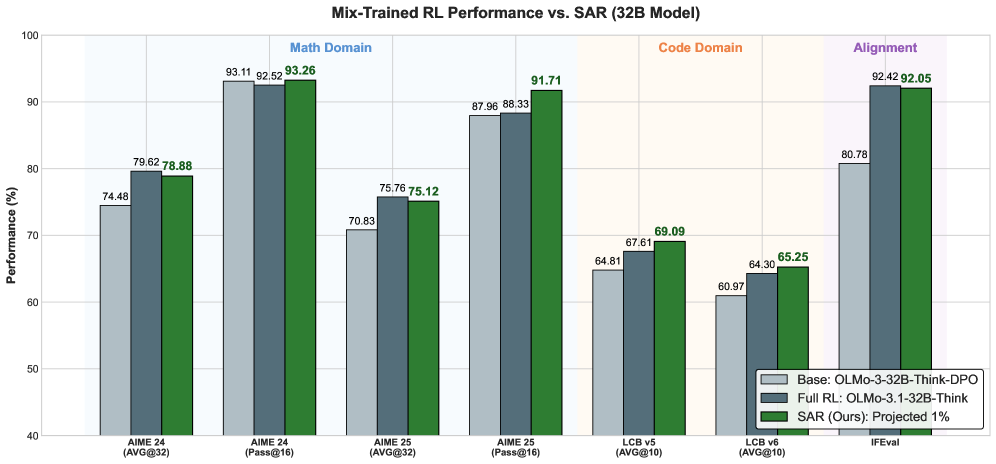
Applied to OLMo-3.1-32B-Think (jointly Mix-RL trained on math, code, IF, chat) with the same 1% budget, SAR improves LiveCodeBench v5/v6 and preserves IFEval and AIME24 relative to the Mix-RL model, i.e. it removes the interference term without retraining.
Ablations
On DeepScaleR-1.5B at 1% budget (AIME24):
| Method | Pass@1 | Pass@32 |
|---|---|---|
| Base | 31.67 | 80.00 |
| Full RL | 40.31 | 76.67 |
| SAR | 40.21 | 76.67 |
| Random projection | 36.67 | 80.00 |
| Diagonal-only M | 30.73 | 80.00 |
| Off-diagonal-only M | 38.54 | 73.33 |
Random subspaces recover part but not all of Pass@1: the pretrained singular basis is not interchangeable with an arbitrary low-rank basis. Diagonal-only M (pure rescaling) fails entirely; off-diagonal-only recovers most Pass@1 but loses Pass@32. Both components — spectral alignment and full M (diagonal + cross-routing) — are needed.
Boundary cases
SAR assumes RL is in the elicitation regime — small per-step updates reorganizing existing capabilities. On JustRL (>4000 RL steps), SAR recovers only ~43% AIME24 versus full-RL ~52%. Beyond elicitation, RL performs task-specific rewriting outside \mathcal{S}_r(W_0) that SAR cannot capture. This bounds the applicability to models where RL post-training is not extremely prolonged. Additional open questions: choice of rank k per layer is done by sweep, not principled; the framework treats each weight matrix independently and does not model inter-layer alignment; and the claim that off-diagonal M implements compositional reasoning is illustrative, not causally verified via interventions on specific M_{ij}.
Why this matters
SAR gives a training-free, geometrically motivated knob to (i) restore exploration (Pass@k scaling) that outcome-reward RL degrades, and (ii) purify multi-domain updates without re-running RL or merging heuristics. If the elicitation-vs-rewriting boundary is real, then most of what current RLVR pipelines achieve on reasoning benchmarks is a rearrangement within the base model’s singular basis — with practical implications for how much of RL post-training can be replaced by a linear-algebraic projection.
Source: https://arxiv.org/abs/2607.03065
Demystifying On-Policy Distillation: Roles, Pathologies, and Regulations
On-policy distillation (OPD) has emerged as a preferred alternative to RLVR for LLM post-training: the student samples its own rollouts, and each token is scored by the KL between student and teacher distributions rather than a sparse outcome reward. This paper asks what OPD actually does mechanistically, where it fails, and how to stabilize it without extra compute.
OPD is an exploration catalyst, not a capability lifter
The authors train Qwen3-1.7B-Base as the student under OPD variants and RLVR (GRPO) with teachers drawn from Qwen3-{4B-instruct-2507, 4B, 8B, 32B} and a GRPO-tuned Qwen3-4B, then measure pass@k up to k=1024.
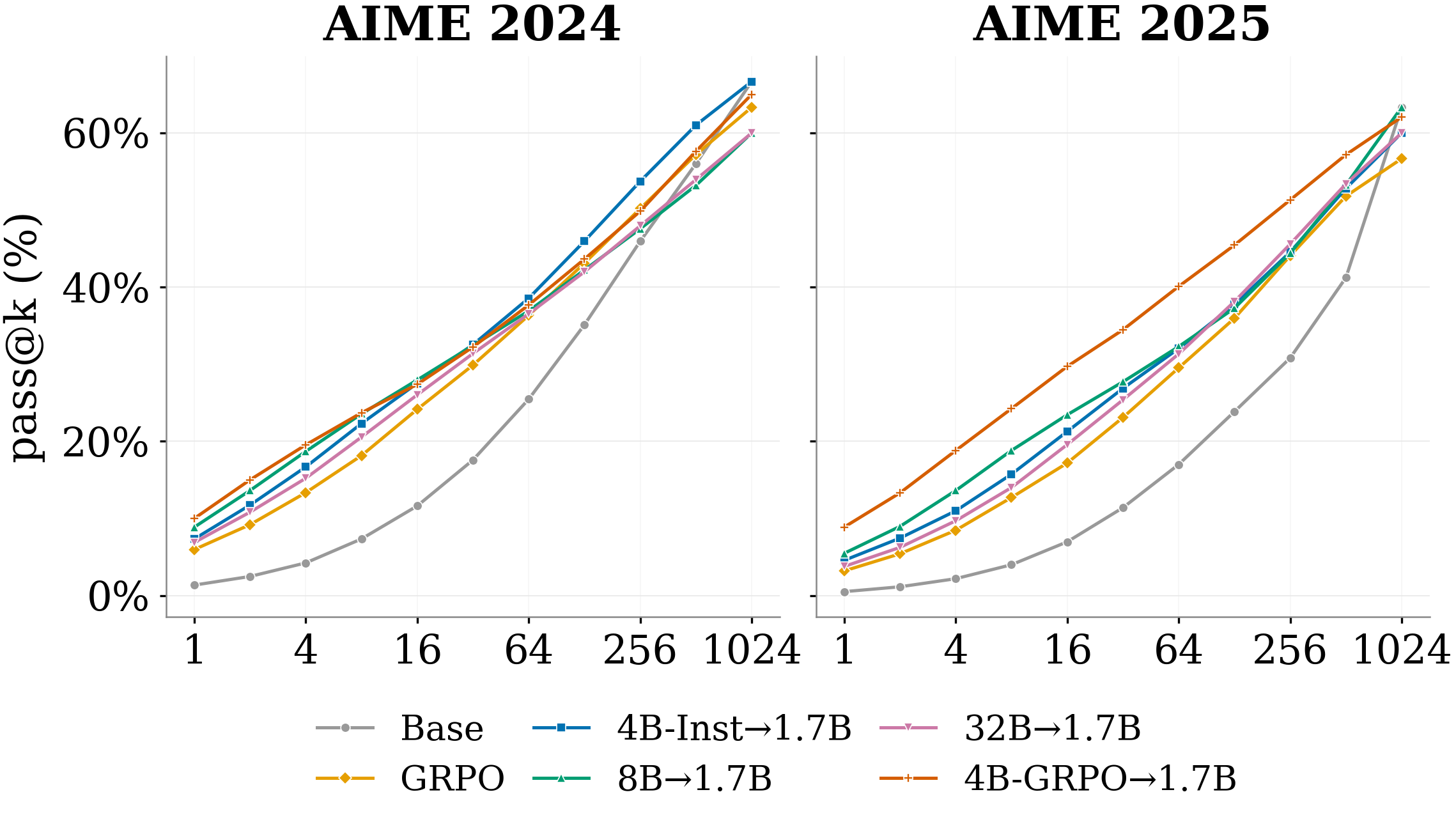
At k \leq 64, OPD variants substantially outperform the base and GRPO-tuned baselines, but at k=1024 all curves converge. This matches the “RL as re-weighting” story of Yue et al. (2025): OPD does not enlarge the latent capability set of the base model; it concentrates probability mass on already-reachable correct trajectories so they surface within a few samples. The practical implication is that OPD is a sample-efficiency mechanism, and any bias in the guidance signal will accelerate convergence to whatever the signal rewards, correct or not.
A second, budget-relevant finding: with a fixed compute budget B split into distinct prompts × rollouts per prompt, n=1 (maximum prompt diversity) beats n=2 and n=8 on Avg@32. Dense token-level guidance already saturates the per-prompt learning signal; additional rollouts on the same prompt are wasteful.
Pathology 1: student–teacher mismatch
The “stronger teacher is better” heuristic fails. Fixing the student as Qwen3-1.7B-Base and sweeping teachers across a controlled capability spectrum (Qwen3-1.7B < Qwen3-4B < Qwen3-1.7B-GRPO < Qwen3-4B-GRPO), the authors find that a weaker, distributionally closer teacher yields a stronger student under OPD w/ Clip.
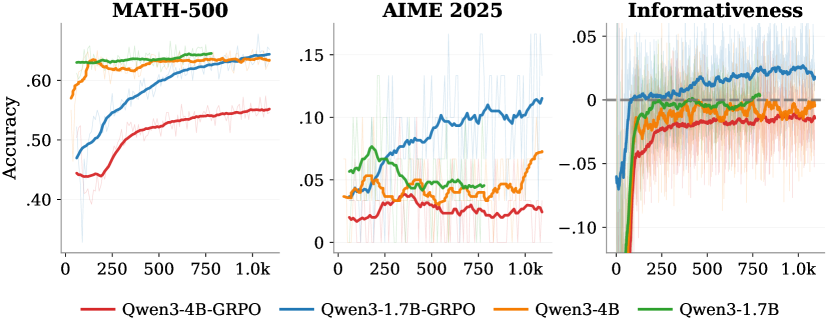
The mechanism is that the token-level log-ratio \Delta \ell_t = \log \pi_T(y_t\mid\cdot) - \log \pi_S(y_t\mid\cdot) becomes dominated by regions where the teacher assigns high mass to tokens the student’s current distribution cannot reasonably reach. The resulting gradient is high magnitude but poorly correlated with task correctness — the “informativeness” \mathcal{I} on the validation set drops even as raw teacher capability rises. OPD’s catalytic re-weighting then steers exploration toward teacher-idiosyncratic modes rather than solutions.
Pathology 2: length exploitation
Because per-trajectory advantage aggregates token-level signals, the objective admits length-dependent shortcuts. The student can either truncate responses (dropping tokens with negative \Delta \ell_t) or pad with redundant, high-agreement filler (accumulating positive contributions). Training dynamics of vanilla OPD show advantage rising while response length either explodes or collapses, decoupled from accuracy — the third panel of Figure 1 captures this pattern cleanly.
Regulation: cheap in-loop signal transforms
Prior fixes (off-policy replay buffers, top-k vocabulary rescoring) add memory or compute. The authors instead regulate \Delta \ell_t pointwise under two design constraints: (i) preserve teacher’s token ordering, (ii) suppress magnitude outliers. Two candidates:
\tilde{\Delta\ell}_t = \mathrm{clip}(\Delta\ell_t, c_{\min}, c_{\max})
\tilde{\Delta\ell}_t = \mathrm{sign}(\Delta\ell_t)\cdot \log(1+|\Delta\ell_t|)
Hard clipping bounds outliers but destroys ordering beyond [c_{\min}, c_{\max}]: all extreme tokens collapse to the same value. Log-compression is linear near zero (fine-grained preferences preserved) and sub-linear at the tails (outliers dampened, ranking retained). Both are pointwise transforms with zero additional memory.
Empirically, on Qwen3-1.7B-Base with Qwen3-4B-GRPO as teacher, OPD w/ Clip shortens responses relative to vanilla OPD while increasing accuracy — the training-dynamics figure shows vanilla OPD’s length trajectory diverging while Clip maintains stable, shorter completions. Log-compression performs comparably and, per Figure 4, the interaction with teacher choice matters: with regulation applied, the mid-capability teacher (Qwen3-1.7B-GRPO) can beat the strongest teacher (Qwen3-4B-GRPO) on downstream benchmarks.
Limitations and open questions
The study is confined to the Qwen3 family (1.7B–32B) and mathematical reasoning benchmarks; whether student–teacher mismatch is a universal phenomenon or specific to families with shared tokenizers/pretraining data is untested. The proposed regulations are heuristic — there is no analysis of how clipping/compression bias the fixed-point of the OPD update, and hyperparameters c_{\min}, c_{\max} are chosen empirically. The framework does not yet formalize when a teacher is “too far” from the student; a quantitative predictor (e.g., a divergence threshold determining regulation strength) would make teacher selection principled rather than trial-and-error. Finally, the pass@k ceiling claim inherits the Yue et al. framing and its known caveats: convergence at k=1024 does not preclude ceiling shifts on harder distributions where the base model has effectively zero mass on correct solutions.
Why this matters
The paper reframes OPD as sample-efficiency scaffolding rather than knowledge transfer, which changes how practitioners should choose teachers (closer, not stronger) and allocate compute (more prompts, not more rollouts). The token-level log-compression fix is a one-line change that addresses length exploitation without buffers or SFT warm-starts, making it a practical default for OPD pipelines.
Source: https://arxiv.org/abs/2607.13399
RoboTTT: Context Scaling for Robot Policies
Problem
Current robot foundation models — VLA policies like \pi_0, OpenVLA, GR00T — condition on a single frame or a short history (typically \leq 2 frames). This is a severe bottleneck for multi-stage, long-horizon manipulation: visually similar stages cause state aliasing, partial observability makes fine manipulation brittle when the target is occluded, and on-the-fly adaptation (e.g., one-shot imitation from a human demo, correcting after a failed sub-step) is impossible without persistent memory. Naively extending context by concatenating frames both blows up latency and, empirically, hurts closed-loop performance because appended histories introduce spurious correlations and induce temporal distribution shift at inference.
RoboTTT scales visuomotor context to 8K timesteps — three orders of magnitude beyond prior policies — with fixed per-step inference cost, by inserting Test-Time Training (TTT) layers into a VLA backbone.
Method
RoboTTT is instantiated on GR00T N1.7: a VLM backbone plus a Diffusion Transformer (DiT) action head. Given a trajectory of T timesteps, at each t the DiT sees vision-language tokens \Phi_t (output by the VLM), a proprioception token q_t, noised action tokens \tilde{A}_t for an H-step chunk A_t = [a_t,\dots,a_{t+H-1}], and N=16 learned register tokens R_t that carry cross-time information.
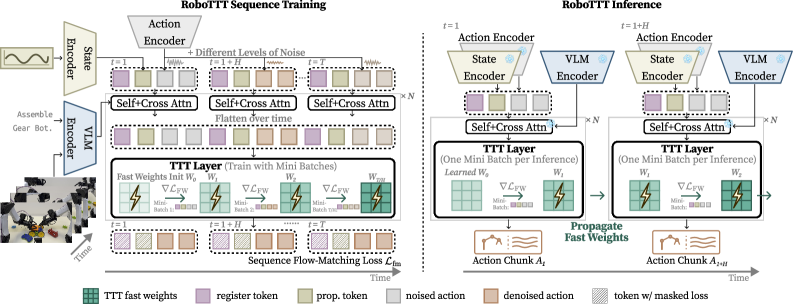
Attention runs within a timestep: R_t, q_t, \tilde{A}_t self-attend and cross-attend to \Phi_t. The attention outputs are then concatenated along time,
X = [R_1, q_1, \tilde{A}_1, \ldots, R_T, q_T, \tilde{A}_T],
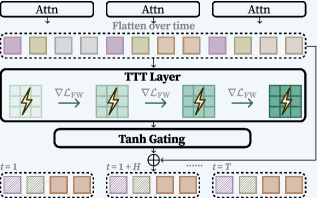
and passed through TTT layers, which perform the cross-timestep aggregation. The VL tokens \Phi are deliberately excluded from the TTT path for efficiency; the small register set R acts as the compressed VL summary carried across time.
A TTT layer maintains fast weights W_t updated by gradient descent on a self-supervised reconstruction loss along the sequence (Eqs. 1–2 in the paper). The recurrent state is thus a set of neural network parameters; querying is a forward pass through W_t, and updating is a gradient step. State size is fixed regardless of T, so inference latency does not grow with context length.
Gating to preserve pretraining. To avoid disrupting the pretrained VLA, each DiT layer learns a channelwise gate \alpha \in \mathbb{R}^d initialized to 0.001:
O = \tanh(\alpha) \odot O_{\text{TTT}} + O_{\text{attn}}.
At initialization the TTT contribution is near zero and the model reproduces base GR00T behavior; \alpha is learned.
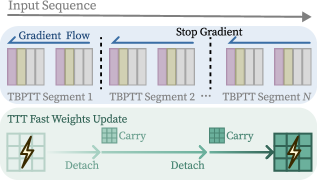
Training recipe. Two ingredients scale context during training:
- Sequence action forcing. Instead of sampling one flow-matching noise level per trajectory, the noise level is sampled independently per action chunk. This exposes the sequence model to varied noise across time and yields a sequence flow-matching loss.
- Truncated backpropagation through time (TBPTT). The sequence is split into segments; gradients are truncated at segment boundaries, but the fast weights carry over across segments so the TTT recurrence spans the entire trajectory.
DAgger Distillation. To teach on-the-fly improvement, the policy is meta-trained on trajectories where suboptimal robot actions are followed by human corrections; the mapping from failure→correction is distilled into the fast-weight update dynamics. This lets the deployed policy adapt within an episode without offline finetuning.
Results
Evaluation is on three real bimanual YAM tasks with four RGB cameras — Pup Go Car, Circuit, Gear Bot — with average episode lengths of 2, 1, and 5 minutes. Circuit has 80 assembly configurations; models are trained on 20 and tested on the other 60. Baselines: GR00T N1.7 (single-step), GR00T N1.7 Hist. (one history frame), and GDN, which replaces TTT layers with Gated DeltaNet — a linear recurrent memory that updates without test-time gradient descent, matched in state size.
Fully successful trials (Table 1):
| Method | Pup Go Car | Circuit | Gear Bot |
|---|---|---|---|
| RoboTTT | 9/20 | 13/20 | 2/10 |
| GR00T N1.7 | 3/20 | 3/20 | 0/10 |
| GR00T N1.7 Hist. | 0/20 | 8/20 | 0/10 |
| GDN | 3/20 | 8/20 | 0/10 |
On the rubric-normalized completion score, RoboTTT averages 79%, versus 42% for single-step GR00T N1.7 (+87% relative) and 56% for the best baseline GDN (+41% relative). Gear Bot, requiring ~5 minutes per successful rollout, is only completed end-to-end by RoboTTT.
Two negative controls sharpen the story. First, concatenated history hurts: GR00T N1.7 Hist. scores 39.5% on Pup Go Car versus 57% for the no-history GR00T N1.7. Second, GDN — same fixed-size recurrent state, different update rule (gated delta rule vs. test-time gradient descent) — improves over GR00T N1.7 on Circuit and Gear Bot but not Pup Go Car, suggesting the expressiveness of the TTT update, not memory capacity alone, drives the gains.
Qualitatively the paper identifies three behaviors: (i) task-progress tracking through visually aliased stages, (ii) strategic recovery (re-attempting a missed drill on Pup Go Car rather than proceeding to the next stage), and (iii) improved precision on occluded fine-manipulation steps such as circuit snap-in, attributable to long context filling in partial observability.
Limitations and open questions
The evaluations use 20 trials per task (10 for Gear Bot), so success counts have wide confidence intervals — Gear Bot at 2/10 is a positive existence result rather than reliability. All comparisons use GR00T N1.7 as the backbone; whether the recipe transfers to differently structured VLAs (e.g., autoregressive action decoders) is untested. The 8K context claim rests on the recurrent-state formulation — actual gradient signal is bounded by the TBPTT segment length, so what the fast weights learn to retain beyond a segment is a training-dynamics question the paper does not fully characterize. Finally, DAgger Distillation requires paired suboptimal-action/correction data, whose collection cost and coverage are not analyzed here.
Why this matters
If context length in robot policies scales like it did for language models — with monotone gains from pretraining context — this is a plausible route past the current short-horizon ceiling of VLAs. Test-time-training layers give a principled fixed-latency mechanism for that scaling, and the ablation against Gated DeltaNet suggests the update rule, not just recurrent capacity, is what unlocks in-context adaptation on physical robots.
Source: https://arxiv.org/abs/2607.15275
Hacker News Signals
Ring-Zero: Scaling Zero RL to a Trillion Parameters for Emergent Reasoning
Ring-Zero addresses a concrete bottleneck in reinforcement learning for LLMs: the GRPO/REINFORCE-style “Zero” training paradigm (no supervised fine-tuning warmup, pure RL from base model) has been demonstrated only at small scales, typically under 30B parameters. The paper asks whether the emergent chain-of-thought reasoning observed in models like DeepSeek-R1-Zero can survive scaling to 1T parameters.
The key technical contribution is a ring-based distributed rollout and advantage estimation architecture. Standard Zero RL hits two walls at scale: (1) generating long reasoning traces requires enormous KV-cache memory across the actor fleet, and (2) synchronizing advantages across a heterogeneous batch of variable-length rollouts creates stragglers. Ring-Zero pipelines rollout generation across a ring topology of GPU groups, overlapping generation with reward computation and gradient updates. Advantage normalization is done within micro-batches defined by the ring segments rather than globally, which introduces a bias but significantly reduces synchronization overhead.
The reward signal follows the standard verifiable-task formulation: math and code problems with exact-match or execution-based scoring, no learned reward model. The paper reports that at 1T parameters, emergent self-correction behavior (the model revisiting and revising intermediate steps mid-generation) appears more reliably and earlier in training than at 70B, suggesting the behavior is parameter-count-sensitive rather than purely a function of training steps.
Quantitative results: the 1T variant achieves 72.4% on MATH-500 and 47.3% on AIME 2024, outperforming their 70B baseline by roughly 8 and 6 points respectively. Compute cost remains the obvious limitation — the ring topology helps but does not fundamentally change the FLOP budget for 1T-parameter rollouts. Whether the ring-segment advantage normalization introduces measurable bias in policy gradient estimates is not rigorously ablated.
Source: https://arxiv.org/abs/2607.12395
How Our Rust-to-Zig Rewrite Is Going
Richard Feldman documents an in-progress rewrite of the Roc compiler’s backend from Rust to Zig. This is technically interesting because it inverts the usual migration direction and the rationale is not safety but rather control over memory layout and compilation speed.
The core argument: Rust’s ownership model imposes borrow-checker friction that is particularly painful for compiler IR data structures, which are inherently graph-shaped and involve many cross-references. The workaround — arena allocators with index-based references instead of pointers — is idiomatic in Rust compiler codebases (rustc itself, cranelift) but requires fighting the type system. Zig makes arena allocation and manual memory management the default mental model, so the same patterns feel natural rather than adversarial.
Specific technical points raised: Zig’s comptime replaces Rust macros for code generation tasks like deriving visitors over IR node types. The absence of a borrow checker means pointer-heavy data structures (interned string tables, union-find for type inference) are expressed directly. Zig’s explicit allocator passing convention makes it straightforward to swap between a bump allocator for compilation phases and a general allocator for long-lived structures.
Build times are also cited: the Zig compiler’s self-hosted incremental compilation is measurably faster for the edit-compile-test loop that dominates compiler development. Feldman notes the Zig standard library is smaller and more auditable than std in Rust, which matters for a compiler that will eventually be self-hosted.
Tradeoffs acknowledged: no algebraic data types in Zig (tagged unions exist but lack exhaustiveness checking as ergonomic as Rust enums), fewer ecosystem libraries, and a smaller contributor pool familiar with Zig. The rewrite is partial and ongoing; the Rust code is still running in production. The post is candid that this is a bet on Zig’s trajectory rather than a solved problem.
Source: https://rtfeldman.com/rust-to-zig
Detecting LLM-Generated Texts with “Classical” Machine Learning
This post describes a lightweight LLM-text detector built without neural networks, targeting a practical deployment scenario: low latency, low compute, no dependency on a specific generative model’s internals.
The feature engineering is the technically interesting part. The author extracts statistical properties that differ between human and LLM-generated text: token-level perplexity under a small reference LM (GPT-2 scale), burstiness of rare tokens, sentence-length variance, and several lexical diversity metrics (type-token ratio, hapax legomena rate). These are concatenated into a fixed-length feature vector and fed to a gradient-boosted tree (LightGBM).
The perplexity feature deserves elaboration: LLM outputs tend to have lower mean perplexity under most reference LMs, but more importantly, the variance of per-token log-probability is lower — LLMs avoid the high-surprise tokens that appear naturally in human writing. The author plots this distribution and it is visually separable. A single threshold on mean perplexity achieves ~85% accuracy; the full feature set with LightGBM reaches ~94% on the test set, which is in-distribution.
The harder problem is distribution shift: a classifier trained on ChatGPT output degrades when tested on Claude or Gemini output. The post does not solve this but discusses it honestly, noting that model-agnostic features (burstiness, lexical diversity) transfer better than perplexity-based ones that are tied to a specific reference LM.
A known adversarial weakness: paraphrasing with a second LLM largely defeats perplexity-based features while preserving semantic content. The post suggests ensemble approaches or watermarking as complementary defenses. The classifier is released as open source and runs inference in under 10ms per document on CPU, which is the practical win over fine-tuned BERT-class detectors.
Source: https://blog.lyc8503.net/en/post/llm-classifier/
We’re Building Postgres in Rust. Using the LLVM of Databases
Turso is building a new Postgres-wire-compatible database engine in Rust, using Apache Arrow DataFusion as the query execution layer — the “LLVM of databases” framing refers to DataFusion specifically, a reusable query engine that handles parsing, planning, optimization, and vectorized execution, analogous to how LLVM provides reusable compiler backends.
The technical bet is that Postgres’s actual execution engine is not its competitive moat; the protocol compatibility, ecosystem, and extension APIs are. By substituting DataFusion for Postgres’s row-at-a-time executor, they expect better analytical query performance through vectorized columnar execution with SIMD-accelerated kernels, while retaining wire compatibility so existing drivers and ORMs work unmodified.
DataFusion provides: a SQL parser (via sqlparser-rs), a logical and physical plan representation, a rule-based and cost-based optimizer, and a vectorized execution engine operating on Arrow RecordBatches. What Turso adds on top: Postgres protocol handling (the binary and text format frontend/backend message protocol), catalog and schema management, transaction semantics, and storage. The storage layer is not detailed in the post; it appears to be under active design.
The Rust choice is motivated by memory safety for a database (use-after-free bugs in storage engines are catastrophic), good Arrow/DataFusion ecosystem fit (both are Rust-native), and performance without GC pauses.
Limitations are significant and mostly acknowledged: DataFusion was designed for analytics, not OLTP. Row-level locking, update-heavy workloads, and the full Postgres extension API (particularly hooks into the executor) are non-trivial to support on top of a columnar engine. The project is early-stage and the post is closer to a technical vision statement than an engineering report.
Source: https://turso.tech/blog/a-new-modern-version-of-postgres-in-rust
Show HN: Firefox in WebAssembly
This demo runs a full Firefox browser instance compiled to WebAssembly inside another browser tab, using the Puter platform as the execution environment. The technical path is well-trodden but the integration is notable: SpiderMonkey (Firefox’s JS engine) has had a Wasm build for years, but running the full browser including layout (Gecko), rendering, and UI is a different scope.
The implementation uses Emscripten to compile the Gecko engine to Wasm, with a virtual framebuffer (SDL2 via Emscripten’s port) rendering to an HTML5 canvas. Networking is proxied through a service worker that intercepts fetch calls from within the Wasm sandbox and routes them through the host. File system access uses Emscripten’s MEMFS for ephemeral storage and IDBFS (backed by IndexedDB) for persistence across sessions.
Performance is the primary constraint. The Wasm binary is several hundred megabytes. Startup takes tens of seconds on typical hardware. The JIT compiler (IonMonkey/WarpBuilder) cannot emit native code from within Wasm — you’re running interpreted or baseline-compiled JS inside Wasm inside the host JS engine, so JS-heavy pages hit multiple layers of interpretation overhead.
The more interesting engineering question this raises is use cases: sandboxed browser testing, legacy web app compatibility, browser-in-browser security research, and ephemeral browsing environments with no local state. Puter frames this as infrastructure for cloud desktop applications where running a full browser process server-side would be expensive.
The demo is a real technical artifact, not a mock, but it is closer to a proof of concept than a production tool. The correctness of the rendering and JS execution within the nested browser has not been independently validated.
Source: https://developer.puter.com/labs/firefox-wasm/
Mathematics of Data Science
This is a draft textbook (arXiv preprint, 400+ pages) covering the mathematical foundations underlying modern data analysis and ML, pitched at advanced undergraduates and first-year graduate students. The authors are Afonso Bandeira, Amit Singer, and Thomas Strohmer — all active researchers in high-dimensional statistics and signal processing.
The scope is broader than most “math for ML” texts and more rigorous than most ML textbooks. Key topics: concentration inequalities (sub-Gaussian, sub-exponential, matrix Bernstein), random matrix theory (Wigner semicircle, Marchenko-Pastur, behavior of empirical covariance in the p/n \to c regime), spectral methods for clustering and manifold learning, compressed sensing and sparse recovery (RIP, basis pursuit, LASSO), low-rank matrix recovery (nuclear norm minimization, matrix completion), and optimization in non-convex landscapes with applications to phase retrieval and synchronization problems.
The treatment of random matrix theory is more developed than in competing texts (Vershynin’s “High-Dimensional Probability,” Wainwright’s “High-Dimensional Statistics”). There is substantial coverage of the information-theoretic limits of estimation problems, connecting statistical-computational gaps to conjectures from statistical physics.
For an ML researcher the most immediately useful chapters are likely the ones on concentration and random matrices, which underpin generalization bounds, the behavior of neural tangent kernels in the infinite-width limit, and the analysis of transformers’ attention matrices at initialization. The optimization chapter covers gradient descent convergence for smooth non-convex functions and escape from saddle points, with cleaner proofs than are typical in ML papers.
The draft is freely available and under active revision. It does not cover deep learning architectures directly, which is either a feature or a gap depending on the reader’s needs.
Source: https://arxiv.org/abs/2607.11938
How to Train a Gen AI Kick Drum Model on Your Old Linux Desktop with 6GB VRAM
This post describes training a small diffusion model for kick drum synthesis on consumer hardware with a 6GB VRAM constraint (an RTX 3060 class card). The technical content is a practical case study in making diffusion training fit a tight memory budget.
The audio representation choice is mel spectrogram rather than raw waveform. Kick drums are short (typically under 500ms) and spectrally concentrated in the low-frequency range, so the mel spectrogram of a kick drum at 128 mel bins × 128 time frames fits in a compact 2D array amenable to the same UNet architectures used for image diffusion. The model is essentially latent diffusion over this spectrogram space with a small UNet (roughly 50M parameters), with Griffin-Griffin vocoder reconstruction back to waveform.
Memory optimizations applied: gradient checkpointing (recomputing activations during backward pass instead of storing them), bfloat16 mixed precision throughout, batch size of 1 with gradient accumulation over 16 steps, and disabling the EMA copy of the model weights during training (EMA is recomputed at evaluation checkpoints instead). The dataset is ~5,000 kick drum samples from free sample packs, augmented with pitch shifting and time stretching.
Training ran for approximately 48 hours to convergence. The author reports subjective quality comparable to simple sample-based synthesis for standard kick drum timbres, with the model generalizing to novel interpolations between training examples in a way a sample player cannot.
The post is useful as a practical reference for anyone fitting diffusion training into constrained VRAM, and the audio domain application is a good reminder that diffusion is not limited to image/video modalities. The main gap is a lack of objective evaluation metrics — listening examples are provided but no FID analog for audio (FAD) is reported.
Source: https://www.zhinit.dev/blog/training-a-kick-drum-diffusion-model
German AI Consortium Releases Soofi S, an Open 30B Model That Tops Benchmarks
Soofi S is a 30B-parameter open-weights language model released by a German AI research consortium, notable for strong bilingual (English and German) benchmark performance. The model claims top scores among open models in its parameter class on several standard evals including MMLU, HellaSwag, and German-language equivalents.
The architectural details released are sparse. It is a dense transformer (not a mixture-of-experts architecture), trained with a German-heavy data mixture — the pretraining corpus reportedly contains a substantially higher fraction of German text than competing models of similar size, with particular emphasis on formal German (legal, scientific, governmental documents) as well as web-crawled conversational German.
The German-language benchmark performance is the technically differentiated claim. Most frontier models (Llama 3, Mistral, Qwen) have German capability as a secondary property of multilingual pretraining rather than an explicit optimization target. Soofi S reportedly reduces the performance gap between English and German eval scores to near parity, whereas Llama 3 70B shows measurable degradation on German benchmarks relative to English.
For NLP researchers, the interesting technical question is how the data mixture was optimized: at 30B parameters with a fixed compute budget, increasing German data fraction reduces English data, creating a tradeoff. The consortium apparently found a mixture ratio where German parity was achieved without significant English regression, which would be worth a proper ablation study if released.
Weights are available under an open license (details in the release). The lack of a technical report with training details, data provenance, and full benchmark tables is a limitation for reproducibility assessment. Benchmark rankings among open models shift quickly and the 30B tier is competitive, so independent third-party evaluation would be useful.
Noteworthy New Repositories
Dicklesworthstone/franken_ocr
A pure-Rust, CPU-only inference engine targeting Baidu’s Unlimited-OCR model, a DeepSeek-OCR-derived 3-billion-parameter mixture-of-experts vision-language model. The project eliminates every standard ML-stack dependency: no PyTorch, no ONNX Runtime, no Python, no GPU requirement. Instead it ships five model variants in a custom zoo and implements int8 quantization kernels by hand in Rust, with SIMD-accelerated matrix multiply paths for x86-64 and ARM targets.
The architecture is worth noting: MoE routing logic, attention, and vision encoder are all written from scratch against the model weights, with the int8 quantization scheme applied post-training to reduce memory footprint to a range deployable on commodity server CPUs. The codebase targets use cases where GPU availability is absent or prohibited — air-gapped environments, edge deployments, cost-constrained inference at moderate throughput.
For anyone evaluating Rust-native inference, this is a concrete existence proof that a 3B MoE VLM can be served without a framework. The tradeoff is obvious: you own all the maintenance surface. There is no autograd, no batching abstraction, and no hardware portability beyond what the hand-written kernels cover. Useful as a reference implementation of low-level quantized attention and MoE dispatch in a systems language, and practically useful for document-processing pipelines that cannot afford a GPU node.
Source: https://github.com/Dicklesworthstone/franken_ocr
NotASithLord/peerd
A browser extension that implements a complete agent loop natively inside the browser, with no backend server. The agent can read and manipulate the user’s open tabs, spawn sandboxed compute environments (JavaScript notebooks, WASM-based Linux VMs via something like v86 or Wasmer, and client-side web apps), and distribute produced artifacts peer-to-peer using WebRTC or similar browser-native P2P transports. BYOK (bring your own key) means LLM calls go directly from the extension to the provider API; no intermediate server sees traffic or keys.
The technical architecture is interesting for several reasons. Running a full agent loop in a browser extension means the orchestration, tool dispatch, memory, and output rendering all live in a privileged extension context with access to the browser’s tab APIs. Sandboxed WASM VMs allow the agent to execute arbitrary code without trusting the host OS, a meaningful isolation boundary. P2P sharing means compute outputs can be shared with collaborators without a file-hosting backend.
The main constraints are the limitations of browser-side compute — WASM VMs are slow relative to native, memory is capped by browser limits, and long-running async agent loops must survive tab suspension. For developers who want a zero-infrastructure agent harness that runs entirely on their machine and requires no cloud account beyond the LLM API key, this is a compelling starting point.
Source: https://github.com/NotASithLord/peerd
aipoch/open-science
An open-source, model-agnostic workbench aimed at accelerating scientific discovery workflows. The project provides a structured environment for connecting LLMs and other ML models to scientific data pipelines, hypothesis generation loops, literature search, and experimental tracking. Model-agnostic design means the orchestration layer abstracts over provider APIs (OpenAI, Anthropic, local models via Ollama-style endpoints) so the same workflow graph runs against different backends.
The core value proposition is a composable pipeline architecture: data ingestion from domain-specific sources (papers, datasets, databases), transformation and embedding steps, retrieval-augmented generation for literature grounding, and output structured enough to feed downstream experimental design or simulation code. Think of it as a Prefect or Dagster for AI-assisted science, with domain-aware connectors rather than generic ETL.
It is early-stage and the model-agnostic claim means the user must supply API keys and configure backends. The broader open question for projects like this is whether domain-specific scientific reasoning actually improves with generic LLM scaffolding or whether the value comes from fine-tuned models on domain corpora. That said, for research groups wanting a reproducible, auditable layer between raw data and LLM-assisted analysis, this is a reasonable foundation to fork and extend.
Source: https://github.com/aipoch/open-science
aws-samples/sample-specship
A spec-driven autonomous software engineering workflow packaged as a Kiro Power (Amazon’s IDE agent plugin format). The pipeline enforces a five-phase loop: recon (gather context and requirements), plan (decompose into tasks), build (generate code), validate (run tests adversarially), ship (produce deliverable artifacts). The anti-slop quality gates are the technically interesting piece — they include test-driven development enforcement (tests must be written before or alongside implementation), adversarial validation passes where a separate agent critique reviews the build output for hallucinated APIs or incorrect logic, and explicit quality thresholds that block progression between phases.
The adversarial validation step borrows from red-team/blue-team setups: a critic model (or a second prompt pass) attempts to find specification violations in the generated code before the pipeline advances. This is a practical mitigation for the well-documented failure mode of LLM coding agents that produce plausible-looking but subtly broken implementations.
As an AWS sample, it is primarily a reference architecture rather than production software, but it is directly usable with Kiro and adaptable to other agent harnesses. The spec-driven approach — requiring a written specification that the agent must remain faithful to — addresses the underspecification problem that causes most autonomous coding agent failures in practice.
Source: https://github.com/aws-samples/sample-specship
rayfish/rayfish
A peer-to-peer mesh VPN built on iroh, the Rust implementation of the IPFS network stack’s data transport layer developed by n0. iroh provides hole-punching, relay fallback, and direct connection negotiation over QUIC, which makes it a strong substrate for a mesh VPN: peers can establish encrypted direct links without a central relay server for most network topologies.
The mesh VPN layer on top of iroh handles IP routing across the peer graph — assigning virtual addresses, maintaining routing tables as peers join and leave, and forwarding packets through the mesh when direct paths are unavailable. The combination of iroh’s connection layer with userspace TUN/TAP interfaces produces a fully decentralized VPN that requires no coordination server beyond an optional bootstrap node for initial peer discovery.
Compared to WireGuard-based mesh tools like Tailscale or Headscale, this approach trades the maturity and auditedness of WireGuard’s cryptography for a fully P2P architecture without any coordination server dependency. The QUIC transport also handles network address translation more aggressively than WireGuard’s UDP approach. The tradeoffs are immaturity of the iroh stack relative to WireGuard, and less tooling around key management and access control. Worth watching for use cases requiring zero-trust infrastructure with no central coordinator.
Source: https://github.com/rayfish/rayfish
shy3130/tickflow-stock-panel
A self-hosted quantitative workbench for A-share (Chinese equity market) analysis, built around the TickFlow data source but extensible to third-party feeds. The system integrates three distinct functions: stock screening with configurable factor-based filters, real-time monitoring with alert logic, and backtesting against historical tick and OHLCV data.
The LLM integration is applied at the strategy customization layer: rather than coding screening rules by hand, users can describe selection criteria in natural language, which the LLM translates into executable filter logic. Individual stock analysis and post-session review (fuhpan, the Chinese trading practice of reviewing the day’s moves) are also LLM-assisted, generating narrative summaries from price and volume data.
The zero-ops self-hosted design means the entire stack runs locally or on a private server — no cloud dependency for the core data pipeline. Third-party data source integration is handled through a plugin interface, which is the practical value here: TickFlow is a proprietary data vendor, and the extensibility means users can substitute or augment with other feeds (Wind, Tushare, etc.) without forking the core application. For quant practitioners in Chinese equity markets who want a unified workspace without vendor lock-in, this covers more of the daily workflow than most open alternatives.
Source: https://github.com/shy3130/tickflow-stock-panel
514-labs/dnsglobe
A terminal UI for observing DNS record propagation across 34 public resolvers distributed globally, rendered on an ASCII world map. The tool takes a domain and record type as input and queries all 34 resolvers concurrently, then plots each resolver’s location on the map with a visual indicator of whether the record has propagated and what value was returned.
The technical substance is straightforward: parallel DNS queries with configurable timeout and polling interval, geolocated resolver metadata baked into the binary, and a TUI rendering layer (likely built on Ratatui or Bubbletea) that updates the map in real time. The value is entirely in the interface: watching propagation sweep across geographic regions as TTLs expire and resolvers pick up new records is significantly more informative than querying resolvers one at a time from a web tool.
The 34-resolver set covers major public DNS operators (Google, Cloudflare, regional ISP resolvers) distributed across North America, Europe, Asia-Pacific, and South America, giving good coverage of the geographic propagation pattern. Practically useful during DNS migrations, CDN failovers, and DNSSEC rollouts where propagation timing across regions matters. The TUI delivery means it fits naturally into a terminal-based ops workflow without opening a browser.
Source: https://github.com/514-labs/dnsglobe
SmileLikeYe/agent-chief
A local-first attention management layer that sits above agent outputs, alerts, and information feeds, with the goal of reducing interrupt frequency by classifying each incoming signal as either requiring immediate human attention or not. The core mechanism is a local classifier (or LLM-backed scoring function) that evaluates incoming events against a user-configured priority model and routes them accordingly — surface now, queue for later, or suppress.
The technical framing is sound: as the number of autonomous agents running on behalf of a user increases, naive alert-on-every-event strategies produce interrupt loads that defeat the productivity purpose of automation. Chief treats attention as a resource to be allocated rather than a side effect of running agents. The local-first architecture means the prioritization logic runs on the user’s machine, which has two practical consequences: latency is low (no round-trip to a cloud service for each classification decision) and the user’s workflow patterns and priorities are not transmitted to a third party.
The open question is how the priority model is specified and updated. A static rule set degrades over time as context changes; an adaptive model requires enough signal to learn from without itself becoming a maintenance burden. The repository is early, so the sophistication of the prioritization logic relative to a simple keyword-filter is not yet fully clear from the public interface.