Daily AI Digest — 2026-07-15
arXiv Highlights
Read It Back: Pretrained MLLMs Are Zero-Shot Reward Models for Text-to-Image Generation
Problem
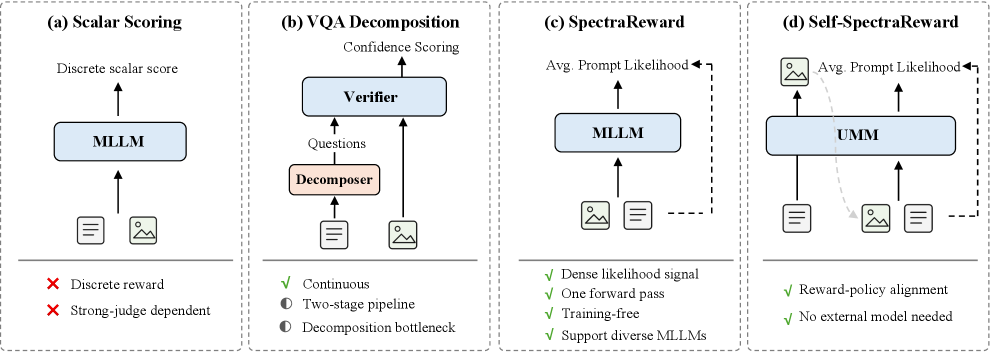
Reward modeling for text-to-image RL typically requires either preference data (to train scalar reward heads like ImageReward/HPS) or brittle prompting pipelines (MLLM-as-judge scoring, or VQA decomposition into atomic yes/no questions). Scalar scoring is sensitive to judge calibration and produces discretization noise; VQA decomposition introduces a two-stage pipeline whose quality depends on question generation and answer aggregation. Both approaches sit at a semantic level far from the generative objective.
SpectraReward proposes a training-free reward that reuses the same likelihood objective the MLLM was pretrained with: given the generated image, how well can the MLLM predict the original prompt token-by-token?
Method
Let G_\theta be a T2I policy producing y \sim G_\theta(\cdot \mid x) for prompt x=(x_1,\dots,x_T), and let \mathcal{M} be a frozen pretrained MLLM. SpectraReward feeds y as visual context, then does a single teacher-forced forward pass on x:
R_{\mathcal{M}}(x,y) = \frac{1}{T-1}\sum_{t=1}^{T-1} \log p_{\mathcal{M}}(x_{t+1} \mid x_{\leq t}, y).
That is the mean image-conditioned prompt log-likelihood — no scoring prompt, no chain-of-thought, no decomposition. The per-token log-likelihoods form what the authors call the “semantic spectrum” of the pair (x,y): a distribution over prompt tokens indicating which parts of the caption are actually grounded in the image.
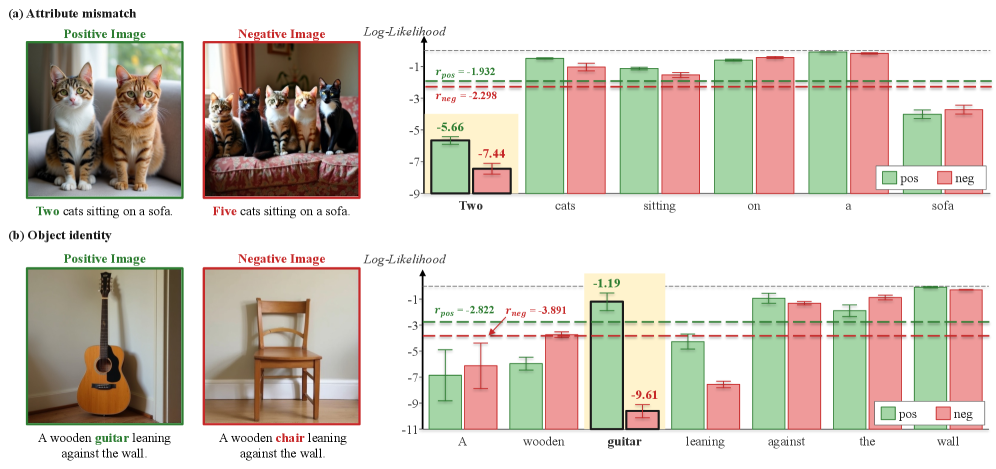
The design has two consequences. First, it directly invokes the MLLM’s pretraining objective (next-token prediction conditioned on image tokens), avoiding any distribution shift between how the model was trained and how it is being queried as a judge. Second, because the reward is a token-wise sum, gradient of the reward with respect to visual content is concentrated on the tokens that are semantically load-bearing. Figure 3 shows this concretely: swapping “three” for “two” objects sharply drops the log-likelihood of the “Two” token, while replacing a guitar with a chair drops the log-likelihood of “guitar” — errors localize to the mismatched tokens rather than smearing across the whole caption.
Self-SpectraReward. When the policy is a unified multimodal model with both understanding and generation branches (e.g., BAGEL), the understanding branch of the same model can serve as \mathcal{M}. This eliminates the external reward model and, more importantly, aligns the reward’s semantic representation with the policy’s own — the generator is optimized against exactly the alignment its own comprehension branch encodes. The result is a closed-loop self-improving setup: no preference labels, no external reward MLLM, no external knowledge distillation.
Experimental setup
The policy is BAGEL, an AR-Diffusion unified multimodal model. RL algorithm is AWM (selected via ablation over three RL algorithms). SpectraReward defaults to Qwen3-VL-30B-A3B as the frozen scorer; Self-SpectraReward uses BAGEL’s understanding branch.
Training: 16 diffusion sampling steps at 512×512, 6 stochastic steps sampled from the first 10 denoising steps for gradient computation, batch of 32 prompts, group size G=16, CFG scale 4, timestep shift 3, lr 1e-4, 32×A100, 380 total steps, on AlphaGRPO20k prompts.
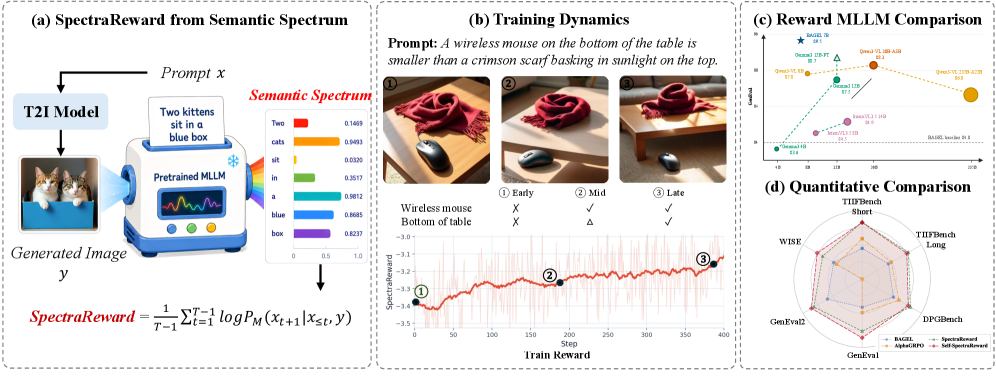
The evaluation covers two diffusion models, three RL algorithms, nine reward MLLM backbones from four families (4B–235B parameters), and five OOD T2I benchmarks — the sweep is designed to test whether the reward’s usefulness is an artifact of a specific backbone or a general property of pretrained MLLMs.
Results
The paper’s headline finding is that using the prompt log-likelihood as-is — with no calibration, no prompt engineering, no reward-model fine-tuning — yields a usable and OOD-robust reward across all nine MLLM backbones (4B to 235B) and both diffusion policies tested. Self-SpectraReward matches or improves upon using an external MLLM reward, indicating that the policy’s own understanding branch is a sufficient (and better-aligned) critic. Token-level sensitivity plots (Figure 3) confirm the reward is discriminative at the level of specific attribute and identity errors, not merely at the coarse image-text similarity level.
Limitations and open questions
- The reward is bounded by the MLLM’s own grounding: any object, attribute, or relation the MLLM systematically misperceives will be a blind spot in the reward. Rare compositions or fine-grained categories are the natural failure mode.
- Averaging over prompt tokens weights function words and content words equally; the semantic spectrum could presumably be re-weighted (e.g., by TF-IDF or by content-token masks) but the paper uses a uniform mean.
- Reward hacking against the specific MLLM’s grounding biases is not ruled out — the closed-loop Self-SpectraReward setup is particularly susceptible in principle, since the generator can exploit idiosyncrasies of its own comprehension branch.
- Prompt length T affects reward variance and possibly comparability across prompts; normalization by T-1 helps but does not fully address this.
- The teacher-forced forward pass over the prompt is cheap relative to VQA decomposition, but at 30B–235B reward scales it still dominates RL step cost.
Why this matters
Reusing an MLLM’s pretraining likelihood as a reward is the most direct way to convert existing vision-language capability into an RL signal for image generation, and it eliminates the preference-data bottleneck that has constrained T2I RL. The Self-SpectraReward variant — where a unified model critiques its own generations via its comprehension branch — points toward a clean self-improvement loop for unified multimodal architectures without external supervision.
Source: https://arxiv.org/abs/2607.11886
Principled Analysis of Deep Reinforcement Learning Evaluation and Design Paradigms
Problem
A large body of sample-efficient deep RL work (DrQ, OTR, DER, CURL, SimPLE, EfficientZero) benchmarks new methods against algorithms that were state-of-the-art in the 200M-frame regime — most notably Rainbow and its distributional-value components (C51, IQN, QR-DQN). The implicit assumption is monotonicity: if algorithm A dominates B asymptotically, then A should also be the right baseline to beat in the 100K-frame regime. This paper argues, both theoretically and empirically, that this assumption is false, and that the resulting comparisons produced incorrect conclusions about which algorithmic ideas actually help in the low-data regime.
Theoretical argument
The theoretical core is developed in the linear function approximation setting for finite-horizon MDPs \langle S, A, \mathcal{P}, \mathcal{R}, \mathcal{H}\rangle with \mathcal{Q}_t(\theta_t)(s,a) = \phi_t(s,a)^\top \theta_t. Building on Zanette et al. (2020), the achievable regret is
\textsc{Regret}(\mathcal{K}) = \tilde{O}\!\left(\sum_{t=1}^{\mathcal{H}} d_t \sqrt{\mathcal{K}} + \sum_{t=1}^{\mathcal{H}} d_t \sqrt{\mathcal{I}\mathcal{K}}\right),
so regret depends on the per-step feature dimensionality d_t, which is a proxy for the inherent capacity of the value representation. Algorithms that parameterize a richer object (a distribution over returns rather than its mean) inflate d_t and thus pay more regret in the low-\mathcal{K} regime, even if that richer representation eventually helps.
Section 4 sharpens this into a statement about action ranking. Proposition 4.1 shows that if two actions satisfy \mathbb{E}[\mathcal{Z}(s,a)] = \mathbb{E}[\mathcal{Z}(s,\hat a)] + \epsilon, there exists \mathcal{Y} with d_{TV}(\mathcal{Y}, \mathcal{Z}(s,a)) \le \epsilon and \mathbb{E}[\mathcal{Y}] \le \mathbb{E}[\mathcal{Z}(s,\hat a)]: a total-variation error of \epsilon in the learned return distribution suffices to flip the greedy ordering. Combined with standard discrete-distribution estimation, C51 with fixed support of size k needs \Theta(k/\epsilon^2) samples. Proposition 4.2 extends this to unknown-support estimators (QR-DQN, IQN modeling \mathcal{Z}(s,a) = \frac{1}{\mathcal{N}} \sum_{i=1}^{\mathcal{N}} \delta_{\theta_i(s,a)}), showing a strictly larger sample complexity. The upshot: the very features (learned support, quantile flexibility) that make distributional methods attractive asymptotically are what make them worse when data is scarce, because policy improvement is bottlenecked by getting the action ranking right, not by fitting the tails of \mathcal{Z}.
Empirical results
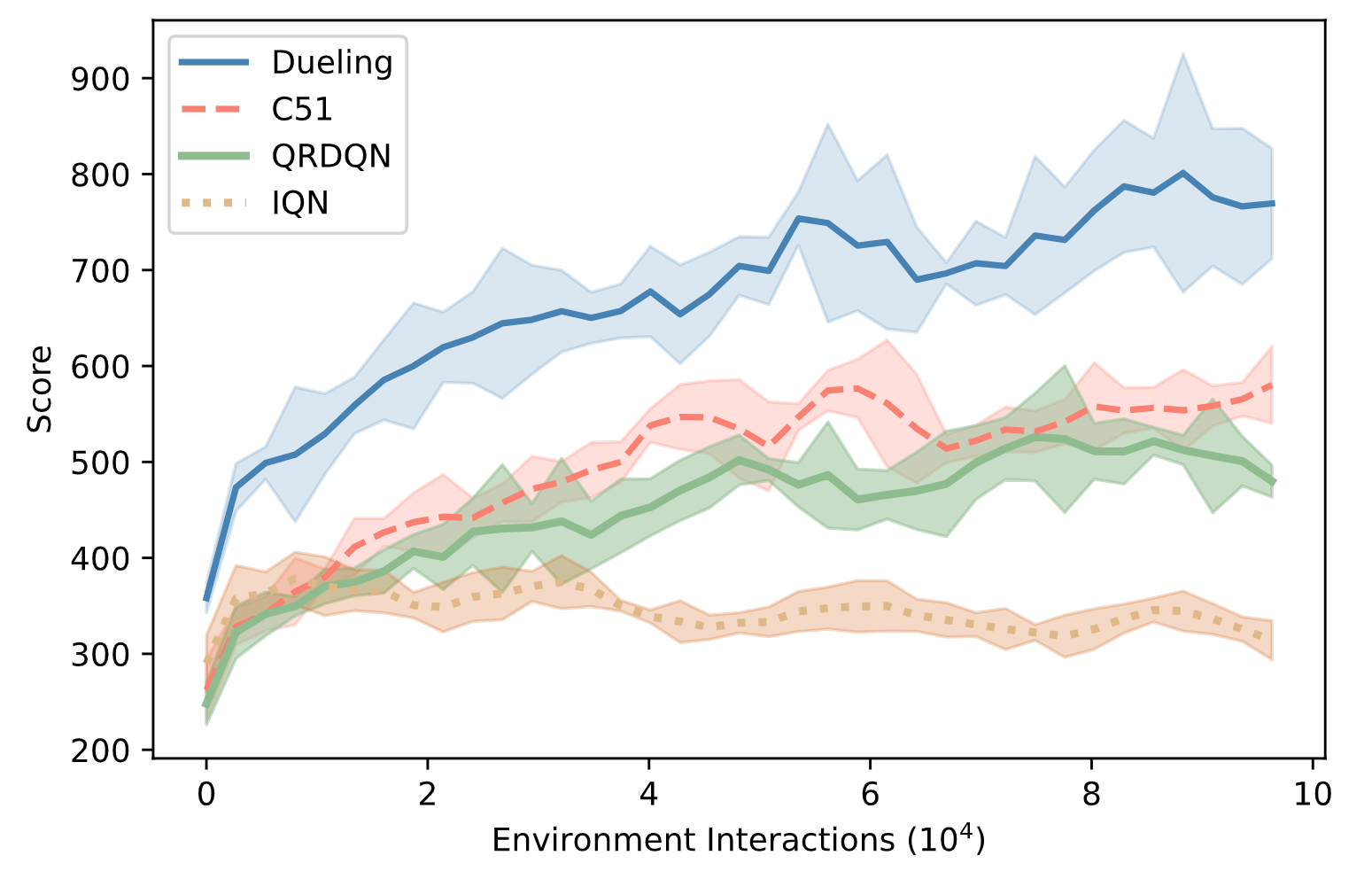
Experiments cover ALE at both 100K interactions (low-data) and 200M frames (high-data), with dueling DQN (Wang et al., 2016) as the plain baseline and C51, QR-DQN, IQN as the higher-capacity distributional methods.
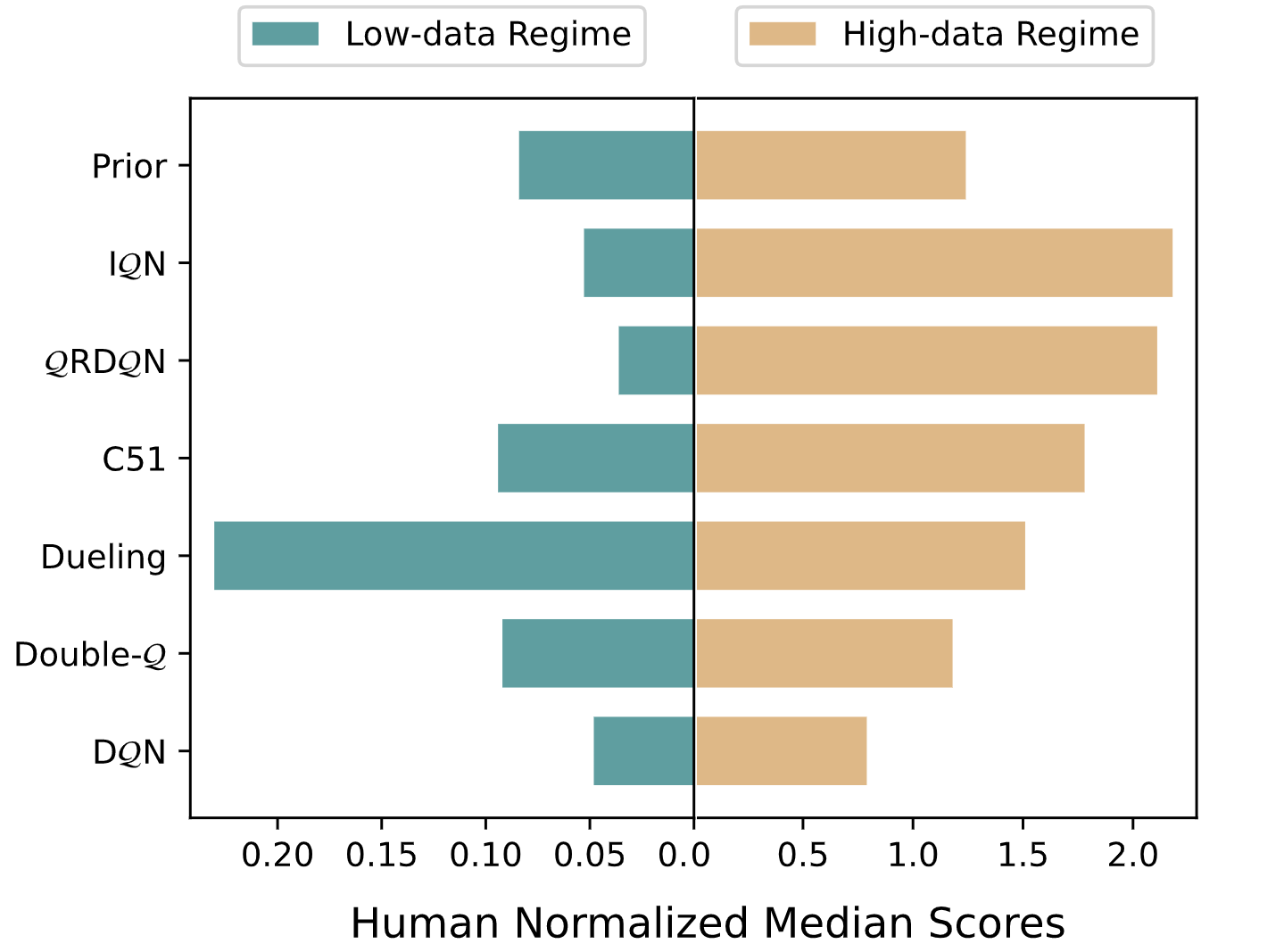
Figure 1 is the central scaling-law picture: rankings in the high-data regime do not carry over to the low-data regime, and the regret gap between distributional methods and dueling is inverted between the two regimes. The per-game learning curves in Figure 3 corroborate this across Alien, Amidar, Asterix, BankHeist, ChopperCommand, Hero, CrazyClimber, JamesBond, Kangaroo, MsPacman, FrostBite, Qbert, RoadRunner, Seaquest and UpNDown at 100K interactions.
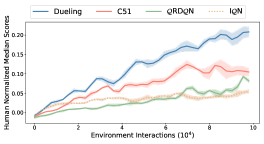
Aggregated human-normalized statistics (median, mean, 20th percentile) in Figure 2 show dueling dominating C51/IQN/QR-DQN at 100K while the ordering reverses at 200M.
The most striking headline number: the plain 2016 dueling architecture beats DrQ^{\text{NeurIPS}} by 15% in human-normalized score at 100K, and comes within 11% of DrQ^{\text{ICLR}} — despite dueling never having been included in the comparison set of the sample-efficient RL literature. Since DrQ itself uses the dueling backbone without the distributional heads, this indicates that much of the reported gain from a line of “sample-efficient” methods is attributable to removing capacity, not to their proposed mechanisms (augmentations, model-based rollouts, contrastive auxiliaries) on top of a distributional Rainbow-style base.
Principled evaluation framework
Section 5 codifies five rules: (i) rankings are non-monotone across data regimes; (ii) benchmarks built under the monotonicity assumption are biased; (iii) core low-capacity algorithms (e.g., dueling DQN) must be present in the comparison; (iv) inherent capacity and d_t should be reported as they predict cross-regime behavior; (v) dataset construction inheriting the monotonicity assumption imports the same bias into offline RL benchmarks.
Limitations and open questions
The theory is developed under linear function approximation and non-stationary policies; extending the regret bound’s d_t interpretation to deep networks is done by analogy rather than proof. The empirical scope is ALE with DQN-family agents; whether the same non-monotonicity holds for actor-critic families (PPO, SAC) or for continuous-control benchmarks is untested here. The analysis also does not quantify how much of DrQ/DER/EfficientZero’s reported gains survive when re-baselined against dueling rather than Rainbow — only that the gap shrinks or inverts against the specific DrQ configurations.
Why this matters
If a 2016 baseline outperforms methods that have accumulated hundreds of citations as “sample-efficient RL,” then the field’s evaluation protocol — not the algorithms — is the primary source of reported progress. The paper gives both a mechanism (distributional capacity hurts action-ranking sample complexity) and a concrete remedy (include low-capacity core baselines, report across regimes), which is directly actionable for anyone benchmarking on ALE-100K or comparable low-data suites.
Source: https://arxiv.org/abs/2607.07769
Know Before Fix: QA-Driven Repository Knowledge Acquisition for Software Issue Resolution
Problem
LLM-based coding agents for repository-level issue resolution (e.g., SWE-bench) fail predominantly not from reasoning limitations but from missing repository-internal knowledge: cross-module dependencies, implicit API contracts, data-flow semantics, and external protocol constraints. Empirical audits cited by the authors report that knowledge-deficient trajectories consume roughly 4\times the tokens and 2\times the steps of successful ones. Existing “pre-repair” methods (LocAgent, CoSIL, LingmaAgent, SWE-Debate) are fix-driven: they surface suspicious files or structural summaries keyed to issue keywords, but never explicitly identify what the agent does not know. The paper argues this is the wrong abstraction — the agent needs a diagnostic pass, not a shallower localization pass.
Motivating oracle experiment
The authors run an oracle probe on the 116 SWE-bench Lite instances that Mini-SWE-Agent + DeepSeek-V3.2 fails. An oracle Questioner (conditioned on issue + golden test patch) emits one question; an oracle Answerer (given only the golden files) answers it; the QA pair is injected into the agent. 26/116 previously failed instances flip to pass. This is a lower bound because only one question and gold-file grounding are used, but it establishes that targeted pre-repair knowledge, not more localization, is the missing ingredient.
Manual analysis of the 116 oracle questions by five CS graduate students yields a four-category taxonomy that becomes the Questioner’s template:
- Mechanism & Behavior (70.7%): internal control/data flow
- Design & Usage (18.1%): API contracts, conventions
- Locating & Structure (7.8%): where code lives
- Ecosystem & Standards (3.4%): external library/protocol behavior
Method
ACQUIRE decouples knowledge acquisition from patching via three specialized agents across two stages.
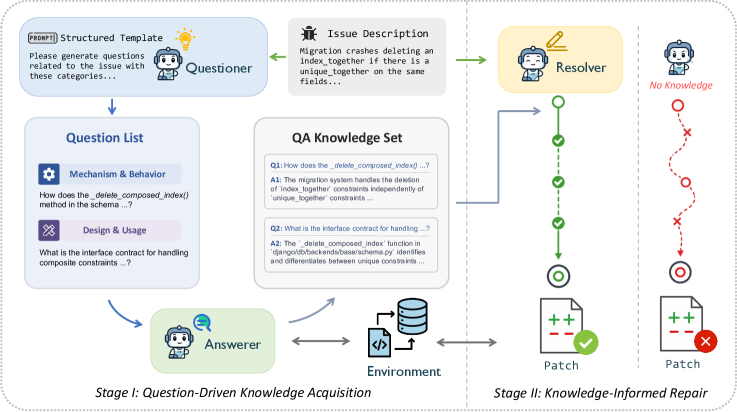
Given issue \mathcal{I} and environment \mathcal{E}:
- Questioner decomposes \mathcal{I} into N targeted questions \{q_i\}, drawing from the four-category template so questions are complementary rather than redundant.
- Answerer — N independent instances run in parallel, each autonomously exploring the repository (no oracle file set) to produce evidence-grounded a_i. This yields \mathcal{K} = \{(q_i, a_i)\}_{i=1}^N.
- Resolver conditions on (\mathcal{I}, \mathcal{K}) to produce a patch.
The parallelism matters for wall-clock cost: the N Answerer explorations are embarrassingly parallel, unlike MCTS traversal in LingmaAgent or sequential debate in SWE-Debate.
Results
On SWE-bench Verified (500 instances) with two backbones:
- Pass@1 gains over Mini-SWE-Agent baseline: +3.8 on GPT-5-mini, +4.4 on DeepSeek-V3.2. ACQUIRE is the best-performing pre-repair method on both backbones.
- Cross-model robustness: localization-only baselines (LocAgent, CoSIL) improve on DeepSeek-V3.2 but degrade under GPT-5-mini — shallow pointers rely on the backbone to reconstruct semantics. ACQUIRE improves on both.
- Cost/time vs. richer-context baselines: LingmaAgent and SWE-Debate improve Pass@1 but at 1.4–5\times the end-to-end time and 2–14\times the cost. ACQUIRE’s pre-repair stage is 2.5–11\times faster and 5–26\times cheaper than these, while beating them on Pass@1.
- Absolute overhead over bare Mini-SWE-Agent: ~115s / ~227s and $0.030 / $0.018 additional per instance on GPT-5-mini / DeepSeek-V3.2 respectively. Concretely, GPT-5-mini goes from 187s / $0.024 to 302s / $0.054 per instance.
Behavioral and knowledge-quality analysis
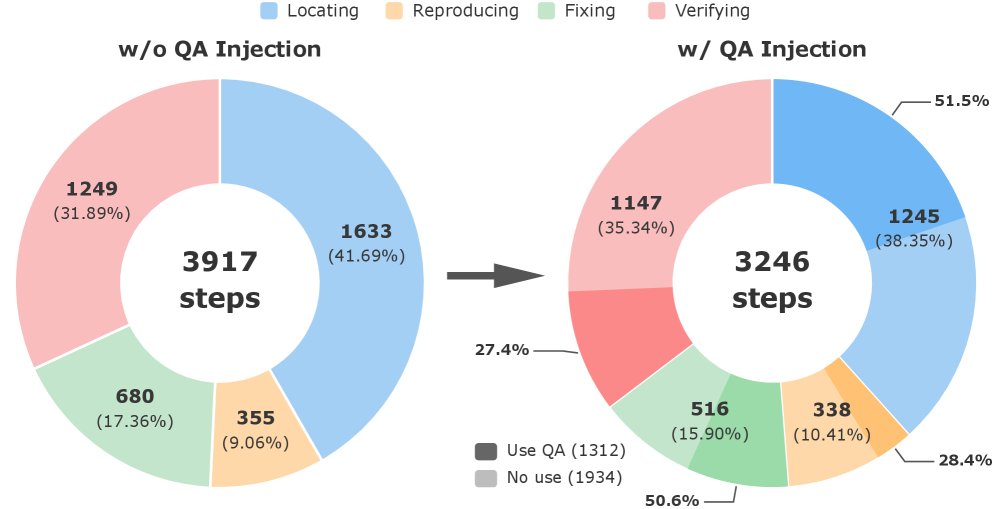
On 44 Fail\toPass instances, injecting QA knowledge shifts trajectory composition: less time on blind locating and trial-and-error editing, more on reproduction and verification. This is consistent with the claim that the agent no longer has to rediscover repository facts during repair.
A human audit of QA reliability finds that among “Supported with minor deviations” pairs (n=132), the imperfections split into: localized reference/detail inaccuracies (67.9%) — the explanation is right but line ranges or function ownership are off; evidence-scope overreach (24.6%) — the Answerer speculates about intent or ecosystem behavior beyond retrievable evidence; and implementation boundary overgeneralization (7.5%) — correct mechanism, wrong handling of branch/edge cases. Notably, the dominant failure mode is spurious precision, not incorrect conclusions.
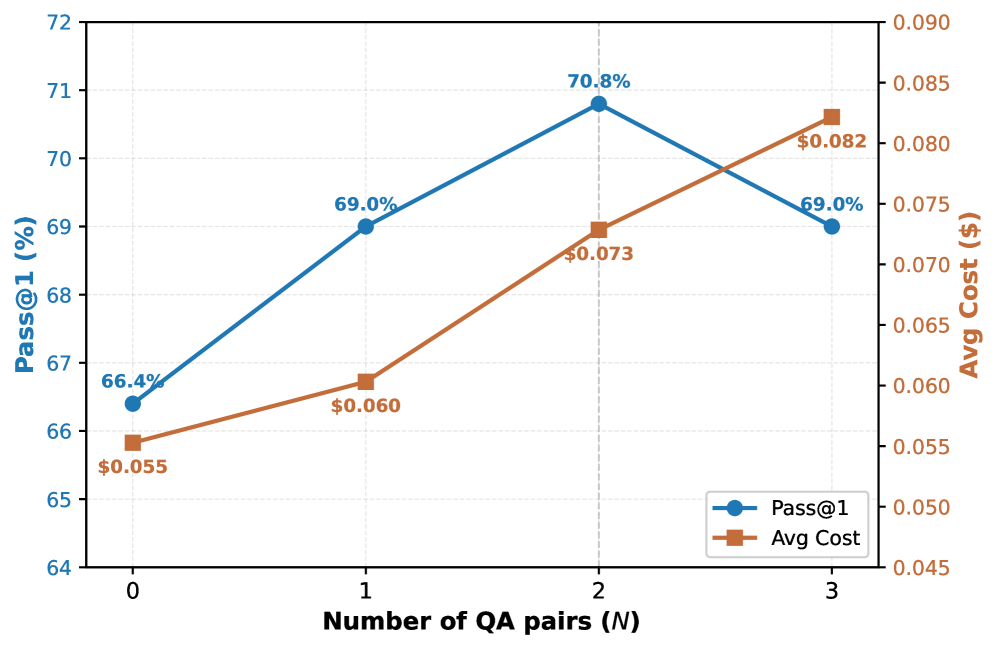
Pass@1 rises with N and then plateaus; cost grows roughly linearly. This suggests the category taxonomy saturates coverage at modest N, and additional questions are largely redundant.
Limitations and open questions
- Language scope: prompts and taxonomy are Python-specific; the taxonomy proportions (70.7% Mechanism & Behavior) likely shift for statically typed languages where API-contract questions dominate.
- Taxonomy provenance: the four categories are derived from 116 oracle questions on SWE-bench Lite. It is unclear how well this generalizes off-benchmark, or whether the Ecosystem & Standards bucket (3.4%) is undersampled because SWE-bench issues have narrow external surface area.
- Answerer hallucination surface: 24.6% of minor deviations are evidence-scope overreach; there is no explicit grounding constraint tying answers to retrieved code spans.
- Interaction with Resolver capacity: gains are measured against Mini-SWE-Agent as the Resolver. Whether stronger repair agents (e.g., SWE-agent with tool-calling) still benefit from external QA, or whether they subsume the acquisition step, is not evaluated.
- Test-driven leakage risk: SWE-bench Verified evaluation via Pass@1 remains susceptible to test overfitting; the authors flag this but do not perform hidden-test evaluation.
Why this matters
ACQUIRE reframes pre-repair repository exploration from “find the buggy file” to “answer diagnostic questions the agent cannot answer from the issue alone,” and shows that a small, category-guided QA layer beats more expensive traversal/debate baselines at a fraction of the cost. If the taxonomy generalizes across languages and repositories, this is a cheap, drop-in improvement over most existing agentic SWE pipelines.
Source: https://arxiv.org/abs/2607.11111
Towards Autonomous and Auditable Medical Imaging Model Development
Problem
Autonomous ML engineering (MLE) agents that plan, code, debug, and iterate on empirical feedback have started to produce competitive Kaggle-style submissions on tabular and generic vision tasks. Medical imaging breaks the assumptions those systems rely on: modalities (CT volumes, MRA, histopathology tiles, panoramic X-ray, microscopy) each demand different preprocessing, sampling, and augmentation; validation protocols are non-negotiable (patient-level splits, resampled spacing for Dice, per-lesion FROC vs. per-image AUC); and the deliverable is not a number but a model package — code, weights, predictions in a challenge-specific format, and a lineage that can be audited. A general MLE agent that overfits a local metric or silently changes the split produces results that look strong but are inadmissible.
AMID targets this gap: autonomous model development where every accepted artifact must survive contract checks on data, metric, split, and submission format.
Method
AMID decomposes the pipeline into two mechanisms: Data-Conditioned Method Planning and Verification-Guided Two-Stage Optimization.
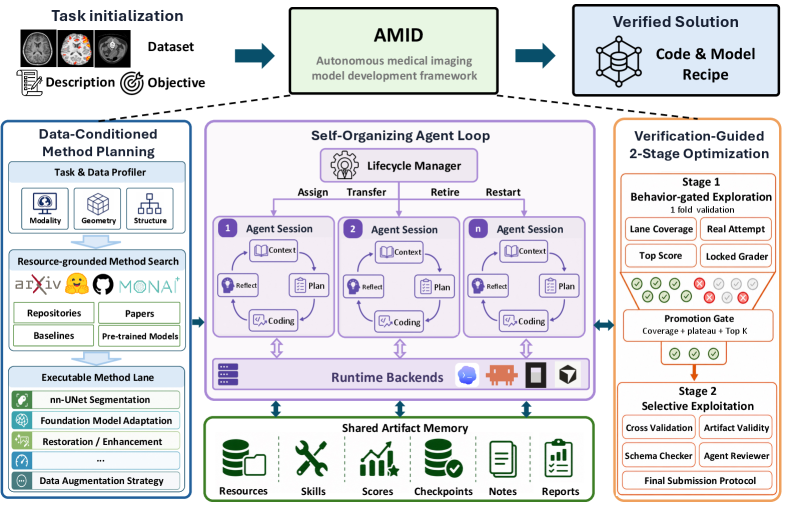
Task and artifact contract. Inputs are minimal — a dataset (2D/3D images, tiles, masks, labels, quality scores, etc.) and a task definition (target, metric, submission protocol). The required output is a full package: training and inference code, checkpoints, prediction files, validation scores, submission artifacts, and an audit trail. Formally, if \mathcal{C} = (\mathcal{D}, m, \sigma, \pi) denotes the contract (data, metric, split, protocol), AMID searches over method-development procedures \phi such that both the empirical score m(\phi(\mathcal{D}); \sigma) is high and every artifact produced by \phi passes contract-conformity checks.
Data-Conditioned Method Planning. Rather than let the agent brainstorm freely over a coarse task-level space, AMID first profiles the data (modality, voxel spacing, class imbalance, tile size, annotation type) and then converts the task evidence into a set of executable method lanes — parallel, self-contained pipelines grounded in runnable medical-imaging resources (nnU-Net-style segmentation stacks, detection frameworks, MIL for pathology, etc.). Each lane is concrete enough to execute end-to-end without further planning, which converts vague “try a good model” instructions into a portfolio of independent trajectories.
Verification-Guided Two-Stage Optimization. The optimizer runs an explore-then-exploit loop over the lanes, with a reviewer agent enforcing contract checks at each transition.
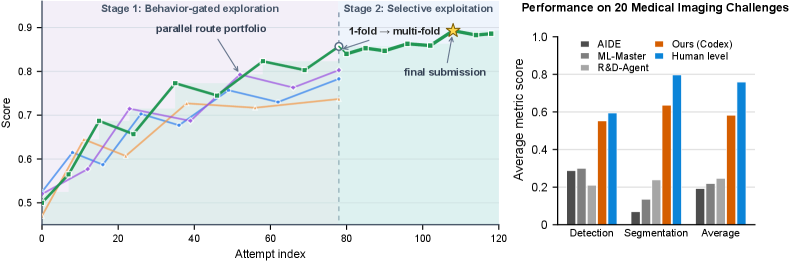
In stage 1 (exploration), diverse lanes run in parallel under a shared verification harness that inspects: (i) the validation protocol matches \sigma (e.g., patient-level fold, no leakage across tiles from the same slide), (ii) metric computation is direction-correct and matches the challenge implementation, (iii) prediction artifacts are byte-compatible with the evaluator’s expected format. Lanes that fail verification are rejected regardless of local score. In stage 2 (exploitation), promoted candidates receive additional compute for hyperparameter refinement, ensembling, and post-processing, but the reviewer continues to gate every accepted artifact against \mathcal{C}. The final accepted package is the first candidate whose verified score dominates and whose lineage — code, seeds, splits, metric implementation — is fully recoverable.
This structure differs from general MLE agents in a crucial way: verification is not a post-hoc filter but an in-loop constraint that prunes trajectories, so compute is not wasted on lanes whose optimum lies outside the admissible set.
Results
AMID is evaluated on ReX-MLE, 20 medical imaging challenge tasks spanning segmentation, detection, classification, image-quality assessment, and enhancement across panoramic X-ray, CT, MRI, CTA, MRA, histopathology, ultrasound, and microscopy. Each task is run under a 24-hour wall-clock budget on a single RTX A6000 (48 GB), with GPT-5.5 as the coding backend (Codex).
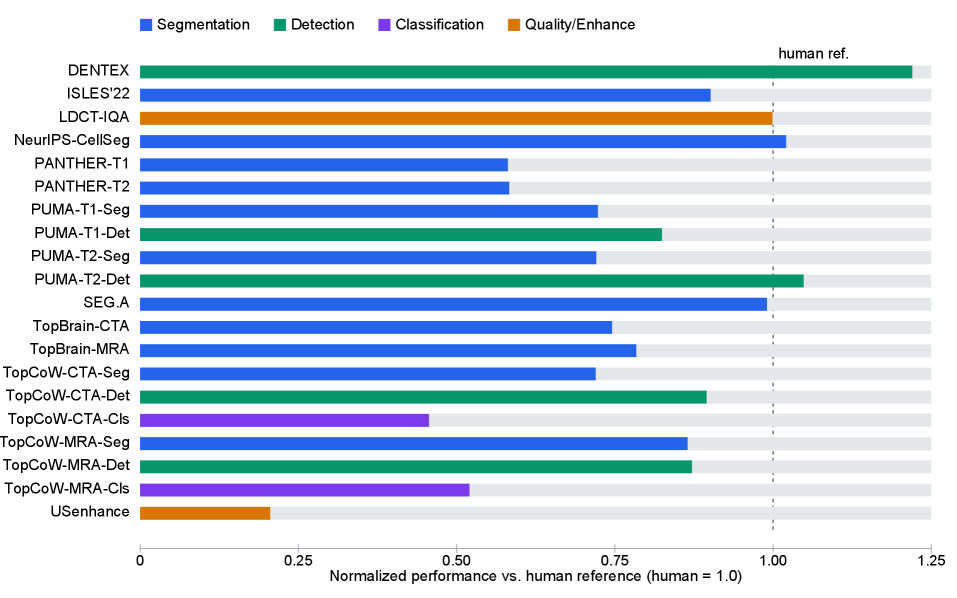
Across the 20 tasks AMID outperforms the evaluated general-purpose MLE systems and, on several tasks, approaches or matches the original-competition human reference (dashed parity line in Figure 3). The bar-by-bar view shows the pattern is not driven by a few easy modalities: parity is achieved across segmentation and classification tasks in different modalities, while some detection and enhancement tasks remain below the human reference — consistent with those being the settings where lane diversity and post-processing (rather than backbone choice) tend to dominate leaderboard performance.
The authors emphasize that these scores are only counted when the artifact contract is satisfied, i.e., they correspond to submissions that a challenge organizer would accept, not to internal validation numbers.
Limitations and open questions
- The parity comparison in Figure 3 is described as an “approximate scale rather than a strictly matched leaderboard target”; original competitions used private test sets and multi-team compute far exceeding 24 h on one A6000, so absolute claims about matching humans should be read cautiously.
- Results are reported for GPT-5.5 / Codex; sensitivity to backend capability and to the coverage of the underlying medical-imaging resource library is not quantified in the shown sections.
- Verification checks depend on the reviewer’s ability to detect subtle contract violations (e.g., patient-level leakage across tiles); false negatives in verification would leak into “accepted” artifacts.
- No ablation is shown here isolating the contribution of Data-Conditioned Method Planning vs. Verification-Guided Optimization to the reported gains.
Why this matters
Autonomous MLE in medical imaging is only useful if outputs are admissible — correct splits, correct metrics, correct submission format, inspectable lineage. AMID treats verification as a first-class optimization constraint rather than a reporting concern, and shows that under a modest single-GPU 24 h budget an agent can produce packages that approach human-competition performance across 20 heterogeneous tasks. This shifts the frame from “can agents do MLE” to “can agents do MLE under audit,” which is the version that matters for clinical deployment.
Source: https://arxiv.org/abs/2607.10522
Blind-Spots-Bench: Evaluating Blind Spots in Multimodal Models
Problem
Frontier language and multimodal models saturate many standard benchmarks (MMLU, GPQA, MATH) while continuing to fail on tasks that are near-trivial for humans: counting characters in a string, drawing anatomically miscounted animals, or handling requests that violate high-frequency priors. These failures are not covered by capability-oriented benchmarks because such benchmarks over-sample tasks where scale and pretraining priors help. The authors argue that under-measurement of these residual “blind spots” leads to inflated capability claims and propose blind-spots-bench, a small, high-curation benchmark aimed at surfacing them.
Construction
Raw questions were solicited from students in a graduate AI course, each asked to submit five items that were easy for humans but failed by frontier models available around October 2025. The initial pool of ~287 items was filtered for duplicates, ambiguity, and excessive difficulty, yielding 235 curated samples released on Hugging Face.
Each sample carries a structured reference solution containing (i) the expected answer, (ii) explicit necessary correctness conditions, and (iii) known failure modes. Failure modes are populated from two sources: errors actually observed during student–model interactions at collection time, plus additional errors proposed by at least three annotators per item. This structure is what makes automatic verification tractable — rather than relying on fuzzy string match or LLM-as-judge with the raw question, the grader receives explicit “must satisfy” clauses to check against.
Samples are annotated with a question-format label (text-only, image-generation, or multi-to-text) and a task taxonomy. Figure 3 shows the distributional breakdown across formats and fine-grained task categories, grouped into three major clusters.
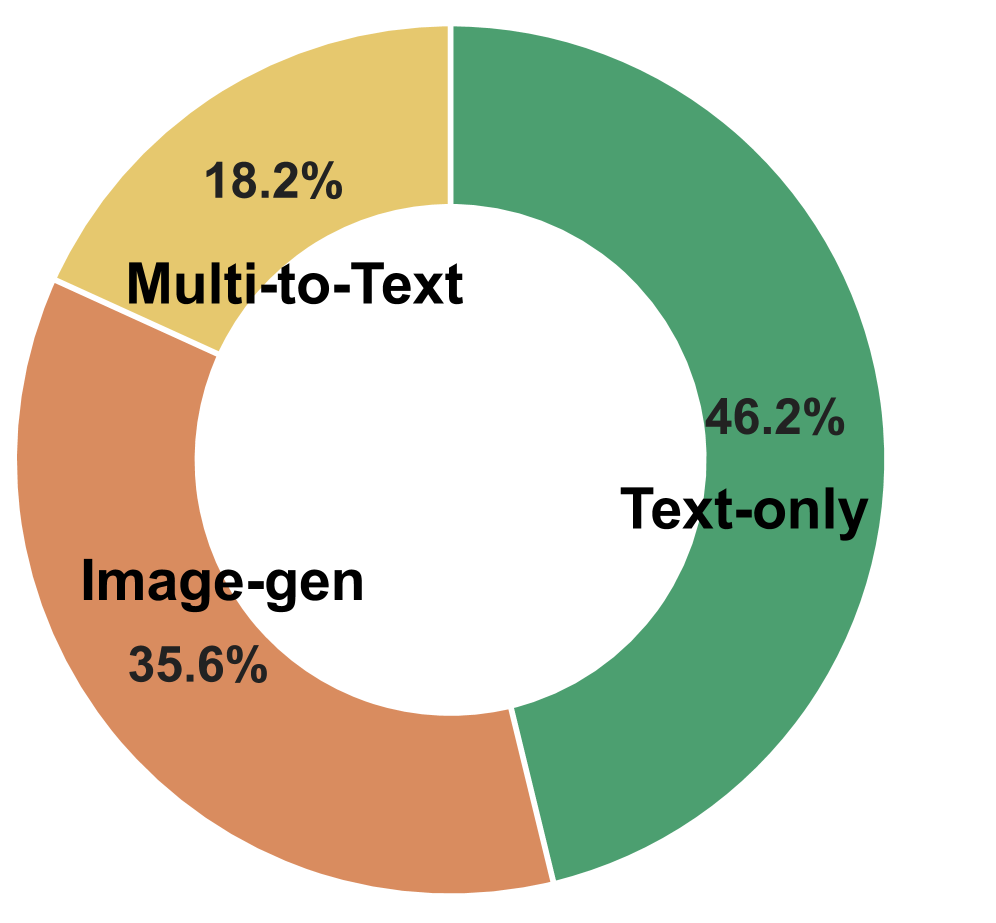
Representative examples — including the canonical “draw a dog with five legs” and character-manipulation prompts — are shown in Figure 2, along with their annotation schema.
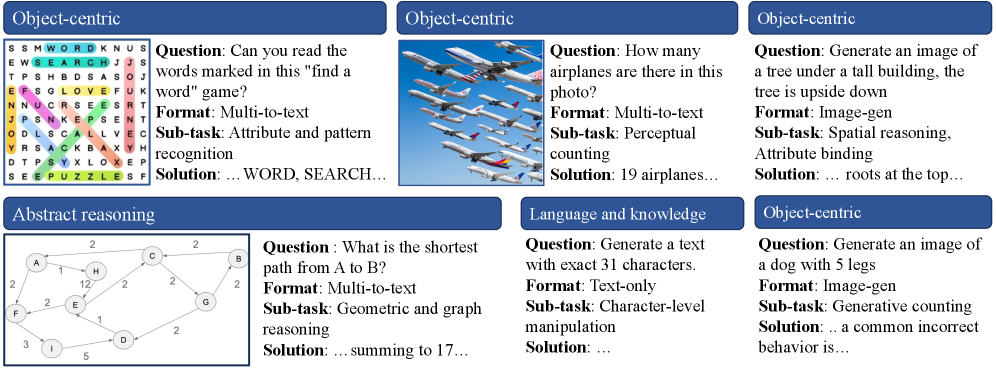
Roughly 15 questions involve multiple subtasks; those count once per subtask in the taxonomy statistics.
Evaluation pipeline
Evaluation follows a two-stage solver–grader design built on Inspect AI. The solver is prompted zero-shot, without chain-of-thought or in-context examples, so as not to conflate prompting strategy with intrinsic capability. The grader receives the question, the solver’s response, and the structured reference solution, and emits a binary correct/incorrect judgment. gemini-3-flash serves as the grader; it is given code-execution tools, which is important because many blind-spot tasks reduce to hard-constrained verification (counting substrings, checking that a generated string has exactly n characters of a given type, etc.), where LLM-only judges are themselves subject to the same blind spots they are supposed to evaluate. Grading is binary since the tasks are designed to admit objectively correct answers.
Results
On the text-only subset, closed-source frontier models substantially outperform open-weight models. The authors highlight roughly a 10% accuracy gap between comparably-ranked closed and open systems — a gap that is not visible on the Artificial Analysis Intelligence Index score, where the same pairs of models sit within noise of each other. Figure 1 (left) plots blind-spots-bench accuracy against Intelligence Index and shows this decoupling directly: models with near-identical general-benchmark scores diverge by around ten points on this benchmark, indicating that the aggregate metric is missing an axis of capability.
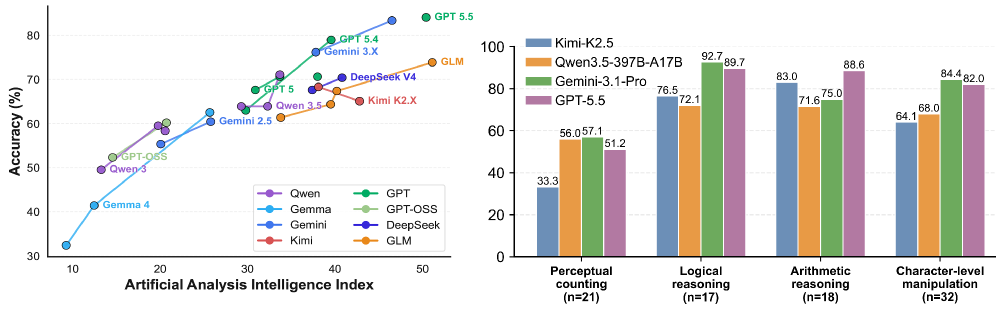
The right panel of Figure 1 shows that on the multimodal side no single VLM dominates across sub-tasks — different models fail on disjoint subsets, and some categories remain uniformly hard for all four evaluated VLMs. This is consistent with the interpretation that blind spots are not a monotonic function of scale but reflect specific training-distribution artifacts (e.g., near-zero probability of images depicting five-legged dogs, or of texts that require character-level rather than token-level manipulation).
Limitations and open questions
The benchmark is small (235 items) and constructed adversarially with respect to models available in late 2025; longevity under future model releases is unclear, and the adversarial construction risks Goodharting once the dataset is public. Because items were student-authored, the sampling distribution over blind-spot types is not statistically controlled — the taxonomy is post-hoc. Grader reliability is another concern: even with code execution, gemini-3-flash is itself a frontier model susceptible to some of the same failure modes; the paper does not report human-agreement rates for the grader against annotator consensus. Finally, since prompting is strictly zero-shot without CoT, the results conflate “cannot do” with “cannot do without deliberate reasoning,” which are qualitatively different failure modes.
Why this matters
The paper provides concrete evidence that composite intelligence indices can hide ~10-point capability gaps between models that are ostensibly matched, particularly on failure modes tied to tokenization, character-level operations, and low-prior visual composition. If blind-spot behavior is orthogonal to standard benchmarks, then evaluation suites need explicit adversarial or long-tail axes to give a faithful picture of deployment risk.
Source: https://arxiv.org/abs/2607.08317
Hacker News Signals
Coding agents think ahead of time
The paper proposes precomputing reasoning traces for coding agents before execution begins, addressing the latency problem in interactive agentic workflows. Standard chain-of-thought agents incur inference-time costs sequentially — they reason, act, observe, reason again — which stacks latency at every step. The core idea is to decouple the thinking phase from the acting phase: given a task specification, the agent generates a structured plan (the “ahead-of-time” trace) that anticipates likely tool calls, intermediate states, and branching conditions, then executes against that plan with minimal recomputation.
The method trains a model to produce these prefetched reasoning traces by distilling from longer online rollouts. The training signal rewards traces that lead to correct final execution without requiring on-the-fly re-reasoning. This is related to speculative decoding in spirit — precompute what you expect to need — but applied at the task-planning level rather than the token level.
Mechanically, the approach introduces a two-stage pipeline: a planning model \pi_{\text{plan}} generates a latent program sketch, and an execution model \pi_{\text{exec}} conditions on that sketch to emit tool calls. The sketch can be cached and reused across similar tasks. Experiments on SWE-bench and HumanEval variants show wall-clock speedups of 1.5–2.5x on multi-step tasks with minimal accuracy degradation.
The limitation is that the ahead-of-time trace becomes stale when execution diverges from predicted states — the agent must fall back to online reasoning, which the paper handles with a confidence-gated replan trigger. The quality of the plan is also bounded by how predictable the environment is; adversarial or highly stateful environments defeat the caching assumption.
Open question: how does this compose with tool calls that have side effects, where replanning cost is asymmetric?
Why this matters
Latency is the binding constraint on agent usability in practice. Separating planning from execution opens a clean caching primitive that is independent of the underlying model architecture.
Source: https://arxiv.org/abs/2607.05188
Measuring Input Latency on Linux: X11 vs. Wayland, VRR, and DXVK
This post is a careful empirical study of end-to-end input latency on Linux desktop stacks, measured with a high-speed camera and a custom Arduino-based click-to-pixel latency jig. The methodology matters: rather than synthetic benchmarks, it captures the full pipeline from physical switch actuation to photon emission.
Key findings: Wayland compositors (KDE Plasma with KWin, GNOME with Mutter) add a compositor-imposed frame of latency relative to unredirected X11 paths, but the gap closes substantially when using xdg-output with direct scanout. Variable Refresh Rate (VRR/FreeSync/G-Sync Compatible) introduces non-determinism — when the compositor holds a frame waiting for the next adaptive sync window, worst-case latency can exceed fixed-refresh worst-case, even if average latency improves. The author measures this as a ~2–4ms additional variance term under VRR on KWin.
DXVK (the Vulkan-backed D3D translation layer) adds roughly 1–2ms median overhead versus native Vulkan paths in the tested games, attributable to the translation layer’s internal command buffer management. The post distinguishes between frame submission latency and present latency, noting that SDL2 vs. SDL3 backends differ in how they interact with the Wayland present queue.
The measurement setup uses frame timestamps logged via VK_LAYER_MESA_overlay and cross-correlated with camera frames at 240fps. The author explicitly accounts for display response time by using a gray-to-gray transition and subtracting panel response measured separately.
Methodological note: the jig measures click-to-first-photon, not click-to-game-logic-acknowledgment, so it conflates input handling latency with rendering pipeline latency. The author acknowledges this but argues it reflects user-perceived experience correctly.
Practical upshot: for competitive gaming on Linux, unredirected X11 with a fixed refresh rate still wins on worst-case latency; Wayland is competitive on average but not tail latency.
Why this matters
Input latency measurement on Linux has historically been anecdote-driven. This establishes a reproducible methodology and quantifies the cost of each stack layer numerically.
Source: https://marco-nett.de/blog/measuring-input-latency-on-linux-x11-vs-wayland-vrr-dxvk/
TS-2026-009: Insecure argument handling in Tailscale SSH permitted root access
This bulletin discloses a privilege escalation vulnerability in Tailscale SSH where improper argument sanitization in the SSH server’s command execution path allowed a user with any Tailscale SSH access to obtain root on the target machine under certain ACL configurations.
The technical root cause: Tailscale’s SSH implementation handles ForceCommand and subsystem directives internally. The vulnerable code path passed user-controlled arguments to the underlying shell or process spawner without sufficient sanitization, allowing argument injection. On systems where the Tailscale SSH ACL permitted login as a non-root user but the daemon itself ran as root (standard deployment), a crafted SSH command could escape the intended execution context and run with daemon-level privileges.
This is a class of bug well-known in SSH implementations — OpenSSH has had similar issues historically with AuthorizedKeysCommand argument handling. The novelty here is that Tailscale SSH replaces the host’s SSH daemon entirely, so the attack surface is the ACL-controlled Tailscale layer rather than system SSH configuration. An attacker needs: (1) a valid Tailscale identity on the tailnet, and (2) any SSH access grant in the ACL policy — not necessarily root access.
The fix involves stripping argument injection vectors before spawning processes and tightening the command parsing logic. Affected versions are not specified in the public bulletin link, but the bulletin recommends updating to the patched release immediately.
The severity is high for deployments using Tailscale SSH as a bastion replacement or for automated access in CI/CD pipelines, where non-privileged machine identities may be common.
Why this matters
Tailscale SSH is increasingly used as a zero-config bastion host replacement. Privilege escalation via argument injection in this context has lateral movement implications across the entire tailnet.
Source: https://tailscale.com/security-bulletins
Linux on the Sega 32X: Who needs hardware synchronization primitives anyway?
The Sega 32X contains two Hitachi SH-2 CPUs running at 23 MHz with a shared framebuffer, no cache coherency protocol, and no hardware atomic operations. The author ports Linux 6.x to this platform, and the post is an honest engineering log of what breaks when you run a modern OS on hardware that predates the assumptions it was designed for.
The SH-2 lacks LL/SC (load-linked/store-conditional) or CMPXCHG equivalents. Linux’s locking primitives — spinlocks, mutexes, RCU — assume at minimum test-and-set or compare-and-swap. The author works around this by exploiting the SH-2’s TAS (test-and-set) instruction, which does provide an indivisible read-modify-write on a single byte, and builds a minimal spinlock on top. The catch: TAS on the 32X accesses the shared SDRAM through a non-cached path, making it slow enough that the “fast path” of an uncontended spinlock is still painful.
The dual-SH-2 setup requires a custom SMP bringup path. The master SH-2 bootstraps Linux; the slave is brought up by polling a shared memory location (since there’s no IPI mechanism), with memory barriers implemented as full pipeline flushes via SYNCO-equivalent sequences.
The framebuffer driver is particularly interesting: the 32X VDP and the Genesis VDP share the same output with a hardware priority overlay, requiring careful vertical blank synchronization to avoid tearing artifacts that neither CPU’s timing can prevent deterministically.
The author gets a shell. Memory is 4MB (2MB SDRAM on the 32X plus 64KB internal). The kernel itself barely fits; userspace is a stripped BusyBox. Boot time is several minutes.
Why this matters
This is a clean case study in what OS abstractions actually require from hardware, made legible by working on the minimal failing case.
Source: https://cakehonolulu.github.io/linux-on-32x/
Beautiful Type Erasure with C++26 Reflection
C++26 static reflection (P2996) gives compilers the ability to expose type metadata as std::meta::info values usable in constant expressions. This post uses that capability to implement zero-boilerplate type erasure — the pattern behind std::any, std::function, and virtual dispatch — entirely through reflection rather than macros or manual vtable construction.
The standard hand-rolled approach requires writing a concept, a model struct, a vtable struct, and storage management for each erased interface. With reflection, the author generates the vtable layout at compile time by iterating over the member functions of a concept:
consteval auto make_vtable_type(std::meta::info iface) {
    // reflect over function members, emit function pointer fields
    std::vector<std::meta::info> members;
    for (auto fn : members_of(iface, is_function))
        members.push_back(make_fn_ptr_member(fn));
    return define_aggregate(synthesize_name(iface), members);
}
The author then synthesizes the model’s fill_vtable specialization by reflecting over the concrete type at instantiation time, binding each vtable slot to the corresponding member function. This produces a fully type-erased wrapper with the same ABI as a hand-written one, but derived entirely from the interface declaration.
The performance claim is that the generated code is identical to the hand-written vtable path under optimization — zero overhead versus manual type erasure, verified by examining Godbolt output. The ergonomic gain is real: adding a method to the interface propagates automatically.
Limitations: P2996 is not yet in any shipping compiler as of mid-2026; the demo uses an experimental Clang fork. The reflection API for function synthesis is still in flux, so the exact define_aggregate spelling may change before standardization.
Why this matters
This demonstrates that C++26 reflection is expressive enough to replace large classes of code generation tools, not just for serialization but for fundamental OOP patterns.
Source: https://ryanjk5.github.io/posts/rjk-duck/
Show HN: RL-trained agent that trains models with RL (for ~$1.3k)
The project trains a meta-RL agent whose action space is the configuration of a downstream RL training run — hyperparameters, reward shaping coefficients, curriculum parameters — with the reward signal being the downstream model’s final performance. This is automated machine learning (AutoML) applied specifically to RL training pipelines, implemented via a second RL loop around the first.
The outer agent is a small policy network trained with PPO. Its state includes the current downstream training metrics (episode return curves, gradient norms, KL divergence from a reference policy) and its actions are continuous adjustments to the inner loop’s configuration. The inner loop trains a task-solving agent on a fixed benchmark suite. The outer agent’s reward is the inner agent’s evaluation score after a fixed compute budget.
The $1.3k cost figure reflects GPU-hours on cloud compute. The author uses A100s and reports the full outer training run takes approximately 40 hours. The inner loops are parallelized — multiple inner training jobs run concurrently to give the outer agent a batch of transitions per outer step.
The reported result is that the meta-trained configuration schedule outperforms hand-tuned baselines on the benchmark tasks by 8–15% on final evaluation score, and the discovered schedules show interpretable structure: the agent learns to anneal KL penalty coefficients in a curriculum-like pattern that the author did not anticipate.
Limitations are significant: the meta-policy overfits to the specific benchmark suite it was trained on; transfer to new tasks is poor. The outer loop also requires enough inner compute to get reliable gradient signal, which is expensive.
Why this matters
Meta-optimization of RL pipelines is a well-posed problem that has lacked cheap, reproducible public implementations. This provides a concrete cost-anchored baseline.
Source: https://github.com/Danau5tin/ai-trains-ai
Guardian Angels: LLM Personalization for Productivity and Security
Gwern’s post argues for a specific architecture of LLM-based personal agents that act as persistent, longitudinally-aware assistants with access to a user’s full information history, emphasizing the security model as the central engineering problem rather than an afterthought.
The productivity argument is familiar: a model with access to email, calendar, documents, and communication history can handle scheduling, summarization, and drafting with far less context-setting overhead. The interesting part of the post is the security framing. Gwern argues that the same persistent access that makes a guardian angel useful makes it a high-value target, and proposes a capability-partitioned architecture: read-only access to historical data is separated from write/action capability by a cryptographic authorization step requiring explicit user confirmation, keyed to a per-action nonce.
The threat model addresses prompt injection specifically — an adversarial document in the user’s corpus attempting to hijack the agent’s action space. The proposed mitigation is a sandboxed “reader” model that processes untrusted inputs and produces only structured summaries passed to the “actor” model, which never sees raw external content. This is a taint-tracking approach applied to LLM inference pipelines.
The post also discusses the personalization training question: fine-tuning on personal data versus long-context retrieval versus LoRA adapters. Gwern favors retrieval-augmented approaches for privacy and updateability, noting that fine-tuning commits personal data into weights that are hard to audit or retract.
The piece is speculative and does not include implementation or experimental results — it is a design document and argument, not a paper.
Why this matters
The security architecture for persistent personal agents is underspecified in the literature. The taint-tracking framing for prompt injection is a concrete, implementable proposal.
Source: https://gwern.net/guardian-angel
Differentiable Fortran with LFortran and Enzyme
LFortran is a modern Fortran compiler with an LLVM backend and a clean ASR (Abstract Semantic Representation) IR. Enzyme is an LLVM pass that performs automatic differentiation at the LLVM IR level by differentiating through LLVM bitcode rather than source-level transformations. This post documents the integration of Enzyme into the LFortran compilation pipeline, enabling forward and reverse-mode AD on Fortran code without any source modifications.
The integration works because LFortran emits LLVM IR that Enzyme can consume directly. The Enzyme pass differentiates through LLVM intrinsics, memory operations, and control flow, producing gradient code that is then compiled with the same LLVM backend optimizations as the primal. The user calls __enzyme_autodiff on a function pointer in their Fortran source; LFortran and Enzyme handle the rest.
The engineering challenge documented in the post is getting LFortran’s IR lowering to emit differentiable code — specifically, avoiding opaque memory operations that Enzyme cannot differentiate through. Array operations in Fortran map to descriptor-based memory accesses; the authors had to ensure that LFortran lowers these to explicit load/store sequences with typed LLVM IR rather than opaque runtime library calls.
Benchmark results show that the generated gradient code achieves performance within 1.5–3x of the primal for typical numerical kernels (stencils, matrix operations), which is competitive with Tapenade (the standard source-to-source Fortran AD tool) and in some cases faster due to Enzyme’s ability to optimize through the primal-gradient pair jointly.
Limitations: Enzyme’s checkpointing strategy for memory-bound adjoint computation is not yet tuned for Fortran array semantics, so memory usage of reverse-mode adjoints can be high.
Why this matters
Large-scale scientific simulation codes in Fortran are the primary bottleneck for differentiable physics in climate and fluid dynamics. LFortran + Enzyme provides a path to differentiating legacy codes without rewriting them.
Noteworthy New Repositories
can1357/pon
An ahead-of-time and JIT compiler for Python 3.14, written entirely in Rust and targeting native machine code via the Cranelift code-generation backend. Rather than transpiling to C or wrapping CPython bytecode, pon builds a native runtime with its own memory manager — “Green Tea GC” — designed to reduce pause times relative to CPython’s reference-counting plus cyclic GC hybrid. Parsing is handled by ruff’s parser crate, giving it a well-maintained, spec-accurate AST frontend without reimplementing lexer/parser from scratch. The correctness story is unusually rigorous: byte-exact differential testing against CPython catches semantic divergence at the output level, not just at the AST or IR level. Cranelift is a deliberate choice over LLVM — faster compile times, a cleaner Rust-native API, and no C++ FFI surface, at the cost of some peak optimization quality. The project targets the full Python 3.14 language, which means it must handle dynamic dispatch, closures, generators, and the GIL-removal changes introduced in recent CPython versions. A viable target for embedded scripting, serverless cold-start reduction, or anywhere CPython’s interpreter overhead is the bottleneck. Still early-stage, but the testing methodology and backend selection suggest engineering discipline.
Source: https://github.com/can1357/pon
pocket-stack/pocketjs
A JSX-based UI runtime built for environments without a DOM — targeting embedded systems, terminal UIs, game overlays, and other native surfaces where a full browser stack is unacceptable overhead. The key constraint it advertises is a 60 FPS animation budget within 8 MB of memory. Hardware rendering bypasses any HTML/CSS layout engine; instead the renderer talks directly to GPU or framebuffer APIs. The framework surface is intentionally familiar: it supports Vue Vapor’s compilation model and Solid’s fine-grained reactivity, meaning component authoring stays close to existing web tooling while the execution path is stripped of virtual DOM overhead. A Tailwind-compatible design system is included, presumably compiled to a static token table rather than interpreted CSS. The architecture separates the component model (declarative JSX trees, reactive signals) from the platform backend (the actual pixel-pushing layer), which is what enables portability across surfaces. This is relevant for anyone shipping UI in constrained native contexts — IoT displays, kiosk software, in-process agent dashboards — where pulling in Electron or a WebView is not acceptable but building a bespoke widget toolkit from scratch is expensive.
Source: https://github.com/pocket-stack/pocketjs
databufflabs/databuff
An observability platform that layers a multi-agent LLM system on top of standard OpenTelemetry signals — traces, metrics, and service dependency graphs. Instead of a human operator querying a dashboard, the system deploys cooperating agents that correlate anomalies across signal types: a latency spike in a trace is cross-referenced against infrastructure metrics and the service topology graph to generate a causal chain rather than a raw alert. The “AI-native” framing means the ingestion pipeline is designed from the start for LLM-readable summaries and structured retrieval, rather than retrofitting NLP onto an existing APM store. For implementation, it almost certainly wraps an OTEL collector for ingestion, feeds structured span/metric data into an embedding or retrieval layer, and routes queries to specialized agents for root-cause hypothesis generation. The practical value is in reducing the cognitive load on on-call engineers: instead of manually correlating across Jaeger, Prometheus, and a service map, you get a synthesized explanation. Open questions include hallucination rates on causal claims and how the system handles novel failure modes not represented in training data.
Source: https://github.com/databufflabs/databuff
eli-labz/Cognitive-Core-Skills
A structured taxonomy and schema library that attempts to enumerate the cognitive primitives expected of LLMs, SLMs, agents, and world models in a domain-neutral way. The eight top-level categories — perception, memory, reasoning, planning, action, verification, learning, governance — are decomposed into 159 individual skill cards, each with a machine-readable schema. The intent is to provide a common vocabulary for capability benchmarking that is not tied to a specific benchmark suite or application domain. CI integration implies the schemas are validated automatically on commit, and benchmarks map existing evaluations onto the taxonomy. The value proposition is standardization: teams building agent evaluation harnesses often reinvent ad-hoc capability matrices; this supplies a reusable ontology. Limitations are significant — any taxonomy of cognition is contestable, and mapping benchmark performance to discrete skill cards involves subjective alignment decisions. Whether the community adopts it as a standard depends on uptake in tooling. Still, as a structured starting point for capability auditing or red-teaming checklists, the 159-card decomposition with machine-readable schemas is more actionable than prose taxonomies.
Source: https://github.com/eli-labz/Cognitive-Core-Skills
William-Lu-stack/Flawless
An agentic SRE platform targeting Kubernetes clusters and cloud infrastructure, positioned as automated operations rather than just alerting. The “AgenticOps” framing implies it goes beyond passive monitoring: agents observe cluster state, diagnose faults, and can execute remediation actions — pod restarts, scaling adjustments, config rollbacks — without waiting for human approval (or with configurable approval gates). The technical substrate is likely a combination of Kubernetes API watchers, cloud provider APIs, and an LLM backbone for reasoning over semi-structured operational data (pod logs, event streams, resource metrics). The hard engineering problems here are trust and blast radius: an autonomous agent with kubectl write access in production requires careful sandboxing of action space and rollback guarantees. Whether Flawless addresses these concretely is not clear from the description, but it is the right question to ask before deploying it. Useful for small teams without dedicated SRE headcount who need automated first-responder capability. The Kubernetes-native scope also means it can consume existing Helm/Operator ecosystems for remediation primitives.
Source: https://github.com/William-Lu-stack/Flawless
deer-flow/llm-space
A local-first desktop application for iterative agent development, focused on the inner loop of building, debugging, and evaluating LLM-backed agents. The core differentiator from cloud-based agent IDEs is the ability to replay failure traces deterministically — stepping through every tool call, prompt, and model response — without re-running the agent against a live backend. This is the kind of infrastructure that matters when agent behavior is non-deterministic and failures are rare but expensive to reproduce. The evaluation layer sits alongside the replay system, so performance metrics are computed over captured runs rather than requiring a separate evaluation pipeline. “Local-first” means state lives on disk in inspectable formats rather than a remote database, which matters for proprietary data and offline development. The target user is someone prototyping multi-step agents — ReAct loops, tool-use chains, planning agents — who needs more than print debugging but less than a full MLOps platform. The combination of step-level inspection, failure replay, and integrated evaluation in one local tool fills a genuine gap in the current agent development toolchain.
Source: https://github.com/deer-flow/llm-space
michaelshimeles/boring-computers
A sandboxed compute provisioning layer that spins up Firecracker microVMs on demand and hands control of them to AI agents. Each VM comes with a browser and terminal accessible over standard protocols, giving agents a full interactive Linux environment with genuine process isolation at microVM granularity rather than container-level namespacing. The “boring” framing is intentional: Firecracker is the same hypervisor used in AWS Lambda and Fargate, chosen for sub-100ms boot times and a minimal attack surface. Coding agents and browser-driving agents run inside the VM, so escape from the agent sandbox requires escaping the hypervisor. The practical use case is computer-use agents — models that need to run code, browse the web, and manipulate files — where giving an agent direct access to a host machine is unacceptable. The architecture decouples the agent orchestration layer from the VM lifecycle management, so different agent frameworks can be plugged in. Key open questions are network egress policy (how much internet access does each VM get?), cost per VM-minute, and whether the session state is preserved across invocations or ephemeral.
Source: https://github.com/michaelshimeles/boring-computers
Rhacknarok/hacksguard
A static malware analysis tool implemented in Rust with a terminal UI, targeting PE (Portable Executable) binaries. The three core analysis layers are: deep PE structure parsing (section headers, import/export tables, resource directory, overlay detection), YARA rule scanning against the parsed binary, and a heuristic scoring engine that aggregates indicators into a risk score. The Rust implementation provides memory safety during parsing of potentially malformed binaries — a relevant property since malformed PE headers are a common technique to crash or mislead analysis tools. Multi-threading is used to parallelize scanning when processing batches of samples. The TUI makes it usable in SSH sessions and automated pipelines without a GUI dependency. YARA integration means existing community rule sets (e.g., from the YARA-rules GitHub organization) can be imported directly. Compared to tools like pestudio or capa, the value here is the Rust safety guarantees, the CLI/TUI interface for scripting, and open-source extensibility of the heuristic layer. Limitations include static-only analysis — no dynamic execution, no sandbox integration — and PE-only scope (no ELF or Mach-O support described).