Daily AI Digest — 2026-07-13
arXiv Highlights
Trust Region Policy Distillation
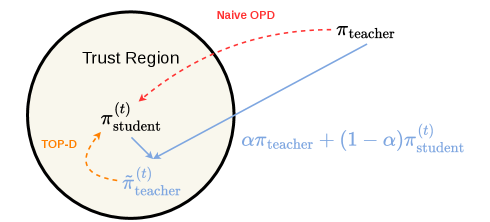
On-policy distillation (OPD) trains a student \pi_\theta by sampling from itself and using the teacher \pi^* to score generated tokens through the log-ratio reward r_k = \log \rho_k with \rho_k = \pi^*(y_k\mid x, y_{<k})/\pi_\theta(y_k\mid x, y_{<k}). When the student explores tokens the teacher assigns near-zero mass, r_k \to -\infty, producing gradient spikes that destabilize training — a chronic problem when there is a large capacity gap between teacher and student. Trust Region Policy Distillation (TOP-D) addresses this by constructing a proximal teacher that interpolates between \pi^* and \pi_\theta in probability space, yielding a bounded, controllable reward with no extra compute.
Proximal teacher and reward smoothing
The proximal teacher is defined as a mixture
\tilde{\pi}^*(y_k\mid x, y_{<k}) = \alpha\, \pi^*(y_k\mid x, y_{<k}) + (1-\alpha)\, \pi_\theta(y_k\mid x, y_{<k}),
with \alpha \in (0,1). The corresponding token-level reward collapses algebraically:
\tilde{r}_k = \log\!\left(\alpha \rho_k + 1 - \alpha\right),
so no explicit teacher-side mixture is ever materialized — only a scalar transform on the existing OPD ratio. Crucially, \tilde{r}_k \geq \log(1-\alpha) for all \rho_k \in (0,\infty), so the reward is bounded below regardless of how badly the student explores off-teacher-support.
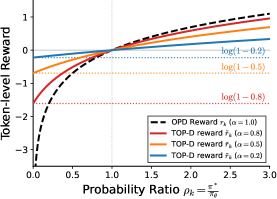
The authors emphasize that interpolation must occur in probability space, not log space: taking \log \tilde{\pi}^* = \alpha \log \pi^* + (1-\alpha)\log\pi_\theta collapses to \tilde{r}_k = \alpha r_k, which is merely a rescaling and preserves the divergence pathology.
Variance bound and trust region iterations
Under the standard assumption that the score \lVert \nabla_\theta \log \pi_\theta(y_k\mid x, y_{<k}) \rVert \leq M, Theorem 4.2 shows that the TOP-D gradient estimator \tilde{g}_k = \nabla_\theta \log \pi_\theta(y_k\mid x,y_{<k})\cdot \tilde{r}_k satisfies
\mathrm{Var}(\tilde{g}_k) \leq M^2 |\mathcal{V}|\, \max\!\left\{(\log(1-\alpha))^2,\; C^*\alpha\right\},
for a universal constant C^*. The bound is asymmetric: on the penalty side, exploration into low teacher-mass tokens is capped at (\log(1-\alpha))^2; on the reward side, high \rho_k is dampened linearly by C^*\alpha. As \alpha \to 1^- the first term diverges — TOP-D recovers OPD’s unbounded variance — and as \alpha \to 0^+ the variance vanishes (at the cost of vanishing learning signal). Thus \alpha is an explicit variance dial.
The student then approximates the proximal teacher via multiple trust-region policy iterations on each batch, reusing the sampled rollouts as mini-batches in an off-policy fashion (Section 3.2/3.3), analogous to PPO’s inner-loop updates. The paper also establishes a monotonic improvement bound for these inner iterations and a global convergence result linking the trajectory to \pi^*.
Empirical results
Training uses DAPO-Math-17k with Qwen3-1.7B-Base and Qwen3-8B-Base as students, distilled from Qwen3-14B and Qwen3-30B-A3B-Instruct-2507. Rollouts produce 8 responses per prompt at temperature 1.0; global batch is 4096 samples, mini-batch 256, with \alpha \in \{0.1, 0.2\}. Baselines: GRPO, DAPO, and standard OPD.
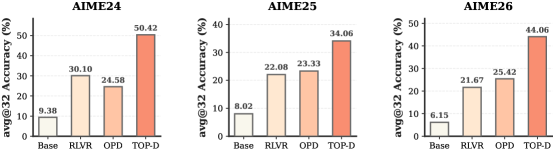
On Qwen3-8B-Base distilled from Qwen3-30B-A3B-Instruct-2507, TOP-D reaches avg@32 = 50.42 on AIME24 versus 24.58 for OPD (+25.84), 34.06 on AIME25 vs 23.33 (+10.73), and 44.06 on AIME26 vs 25.42 (+18.64). It also beats the RLVR baselines by wide margins (DAPO gets 32.92 / 27.81 / 32.29 on the same benchmarks). On easier suites the gains persist: AMC23 88.13 (+11.25 over OPD), MATH-500 91.23 (+3.25), Olympiad 64.67 (+5.38).
For the smaller Qwen3-1.7B-Base — where the teacher-student gap is even larger and OPD is expected to be most fragile — TOP-D again dominates: AIME24/25/26 avg@32 of 20.31 / 17.71 / 13.75 vs OPD’s 8.96 / 7.50 / 5.94 with the 30B teacher, roughly 2–3× improvement. Notably, OPD sometimes underperforms RLVR methods (e.g., OPD 8.96 vs DAPO 12.29 on AIME24), while TOP-D exceeds both paradigms. With the smaller Qwen3-14B teacher, TOP-D still improves over OPD (12.81 vs 7.81 on AIME24) but the margin narrows, suggesting the proximal teacher’s benefits scale with capacity gap.
Limitations and open questions
The evaluation is confined to mathematical reasoning with Qwen3 model families; whether TOP-D transfers to code, agentic, or general instruction-following distillation is untested. The interpolation coefficient \alpha is fixed (0.1 or 0.2); adaptive schedules that anneal \alpha as the student approaches the teacher — motivated directly by the variance bound — are not explored. The theoretical analysis assumes a bounded score function, which is standard but not verified for LLM parameterizations. Finally, no ablation isolates how many inner trust-region iterations are optimal, or whether the monotonic improvement bound is tight in practice.
Why this matters
TOP-D turns on-policy distillation from a fragile procedure into one with an explicit variance–bias knob, at zero additional cost — the mixture teacher never has to be instantiated, just a scalar transform on the ratio. For post-training LLMs from strong teachers, this appears to close much of the gap between distillation and RLVR while retaining the sample efficiency advantages of teacher supervision.
Source: https://arxiv.org/abs/2607.04751
KronQ: LLM Quantization via Kronecker-Factored Hessian
Problem
Second-order post-training quantization (PTQ) methods for LLMs — GPTQ and its descendants — reduce the layer-wise reconstruction objective
\mathcal{L}(\hat W) = \mathbb{E}_x \|(\hat W - W)x\|_2^2 = \mathrm{tr}\big((\hat W - W)\, \Sigma_x\, (\hat W - W)^\top\big)
where \Sigma_x = \mathbb{E}[xx^\top] is the input activation covariance. This objective treats every output channel of W \in \mathbb{R}^{d_\text{out}\times d_\text{in}} as contributing equally to the downstream loss. That assumption is wrong: downstream error propagates through the network via the gradient of the true task loss w.r.t. the layer output, and its second moment \Sigma_g = \mathbb{E}[gg^\top] can vary across output channels by orders of magnitude. Ignoring \Sigma_g leaves substantial accuracy on the table, and at aggressive bit-widths (2-bit weight-only on 70B-scale models) leads GPTQ-style solvers to diverge.
KronQ replaces the pure-activation objective with the Kronecker-factored (K-FAC style) approximation to the true task-loss Hessian at layer \ell:
H_\ell \approx \Sigma_g \otimes \Sigma_x,
so the quantization loss becomes
\mathcal{L}_{\text{KFAC}}(\hat W) = \mathrm{tr}\big(\Sigma_g\, (\hat W - W)\, \Sigma_x\, (\hat W - W)^\top\big).
The two factors act on opposite sides of \hat W - W, and KronQ exploits this bilateral structure at two levels.
Method
(1) Bidirectional incoherence processing. Incoherence processing (as in QuIP/QuIP#) applies a random orthogonal rotation U to \Sigma_x’s eigenbasis so weight rows have low-variance magnitudes — a prerequisite for low-bit lattice/scalar quantization. Under \Sigma_g \otimes \Sigma_x, the same argument now applies on the output side too. KronQ rotates both sides:
\tilde W = V^\top W U, \qquad U^\top \Sigma_x U = \Lambda_x,\ V^\top \Sigma_g V = \Lambda_g,
with U, V built from Hadamard-based random-signed orthogonal matrices. The rotations are absorbed into adjacent layers (LayerNorm/linear fusion) so no runtime cost is added. This flattens weight magnitude variance across both input and output dimensions simultaneously, which is what makes 2-bit quantization tractable on large models.
(2) Gradient-aware mixed-precision allocation. For inter-layer bit allocation, KronQ derives a sensitivity metric from the KFAC Hessian trace. Under a fixed per-tensor quantization noise budget \sigma_\ell^2, the expected loss increase at layer \ell is
\Delta \mathcal{L}_\ell \approx \sigma_\ell^2 \cdot \mathrm{tr}(\Sigma_g^{(\ell)})\,\mathrm{tr}(\Sigma_x^{(\ell)}),
using \mathrm{tr}(A\otimes B) = \mathrm{tr}(A)\mathrm{tr}(B). Layers with high \mathrm{tr}(\Sigma_g^{(\ell)})\mathrm{tr}(\Sigma_x^{(\ell)}) are allocated higher bit-width. This is a strict improvement over activation-only heuristics (e.g., \|\Sigma_x\|-based) because it accounts for how much downstream loss actually depends on layer \ell’s output.
The inner solver retains the GPTQ-style greedy sequential rounding, but with the modified Hessian H = \Sigma_g \otimes \Sigma_x. Because Kronecker structure factorizes, the OBS/GPTQ update decomposes: the right-side \Sigma_x^{-1} inversion drives column ordering as usual, and the left-side \Sigma_g reweights row-wise error contributions. Gradient statistics are collected via a short calibration pass with backprop from a language-modeling loss on the calibration set.
Results
The headline result is stability at 2-bit weight-only quantization of LLaMA-3-70B, where GPTQ and GPTAQ diverge or produce degenerate outputs. KronQ produces a coherent 2-bit model in that regime. The paper reports gains on the standard WikiText-2 PPL and zero-shot task suites across LLaMA-2 and LLaMA-3 at 2, 3, and 4-bit settings. The bidirectional rotation is the dominant contributor at 2-bit, while the mixed-precision allocation contributes most in the 3-4 bit average-bit regime where the budget knob is meaningful.
Limitations and open questions
- The KFAC approximation H \approx \Sigma_g \otimes \Sigma_x ignores cross-terms between rows and columns; for attention projections where \Sigma_g has strong head-block structure, a block-Kronecker refinement may be needed.
- Gradient covariance estimation requires a backward pass on calibration data, so KronQ is not strictly forward-only PTQ. Sensitivity to calibration set size and content is not fully characterized.
- The bit-allocation objective uses \mathrm{tr}(\Sigma_g)\mathrm{tr}(\Sigma_x) as a scalar per-layer sensitivity, discarding within-layer channel-level structure. A finer allocation across output groups would likely help further at 2-bit.
- Interaction with rotation-based methods that already use Hadamard rotations (QuaRot, SpinQuant) is not fully disentangled: KronQ’s output-side rotation is complementary in principle, but the ablation against a well-tuned SpinQuant baseline at 2-bit determines whether the gain is from \Sigma_g or just from a second rotation.
- No end-to-end kernel is presented; the claim is accuracy at fixed bit-width, not latency.
Why this matters
Every second-order PTQ method deployed today (GPTQ, GPTAQ, QuIP, AWQ variants) implicitly assumes output channels contribute equally to task loss. KronQ shows that folding in gradient covariance under a KFAC factorization is the natural fix, costs nothing at inference, and is what enables sub-3-bit quantization of 70B models without divergence. It reframes the PTQ Hessian from an input-statistics artifact into an actual approximation of the task-loss Hessian.
Source: https://arxiv.org/abs/2607.07964
Towards Mechanistically Understanding Why Memorized Knowledge Fails to Generalize in Large Language Model Finetuning
Problem
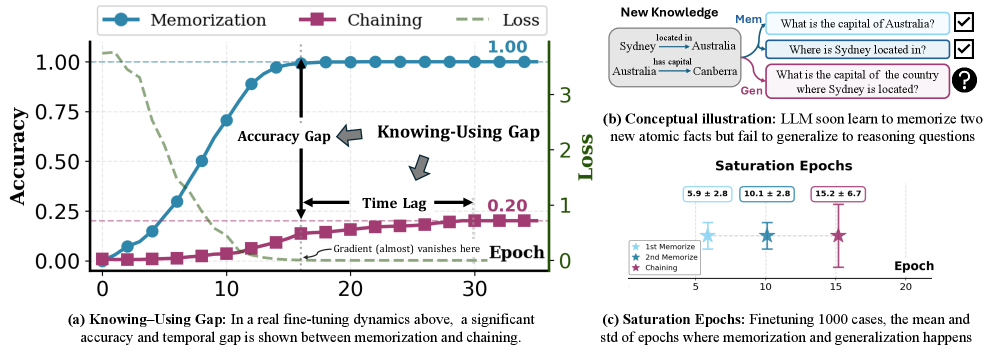
Finetuning is the standard route to inject new factual knowledge into an LLM, but a well-known pathology persists: the model can recite an injected fact verbatim while failing to use it in any downstream reasoning that involves that fact. The authors formalize this as the Knowing–Using Gap, decomposed into (i) an accuracy gap and (ii) a temporal lag between memorization and generalization saturation. Concretely, with parameters \theta_t after t steps of finetuning on injected facts \mathcal{K}=\{f_i\}, they track memorization accuracy A_{\text{mem}}(t) on direct recall and generalization accuracy A_{\text{gen}}(t;\mathcal{T}) on tasks requiring reasoning with those facts, then measure
\Delta A(\mathcal{T}) = A_{\text{mem}}(T_{\max}) - A_{\text{gen}}(T_{\max};\mathcal{T}), \qquad \Delta T(\mathcal{T}) = T_{\text{gen}}(\mathcal{T}) - T_{\text{mem}},
where T_{\text{gen}} is the earliest step after which accuracy stays at 1 for w consecutive epochs.
Setup
The dataset is adapted from STaRK (biomedical STaRK-Prime and academic STaRK-MAG subsets), yielding paired memorization QA (single-hop triple completion, used as finetuning material) and generalization QA (composed queries, e.g., chain reasoning and intersection queries, never seen at finetune time). This cross-domain design tests whether the phenomenon is invariant to knowledge topology.
Two downstream generalization tasks are studied: Chain (multi-hop composition) and Intersection (set-style constraint satisfaction). Both LoRA and full finetuning (FFT) are evaluated. Results in Table 3 show the gap is universal but task-dependent:
- LoRA Chain: T_{\text{mem}}{=}10.4, T_{\text{gen}}{=}15.0, \Delta T{=}4.6, \mathcal{A}_{\text{gen}}{=}0.303.
- LoRA Intersection: \Delta T{=}0.6, \mathcal{A}_{\text{gen}}{=}0.910.
- FFT Chain: \Delta T{=}5.5, \mathcal{A}_{\text{gen}}{=}0.315.
- FFT Intersection: \Delta T{=}8.8, \mathcal{A}_{\text{gen}}{=}0.852.
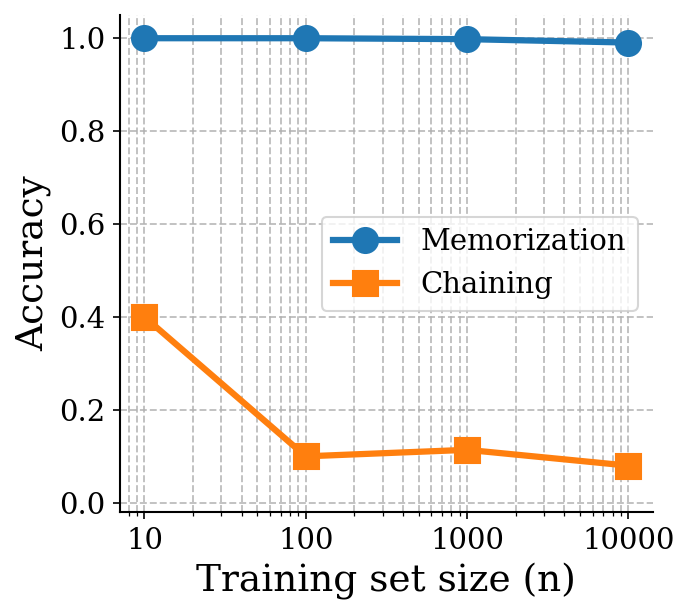
Chain reasoning saturates at only ~30% while memorization has already saturated; the temporal lag is large and consistent across LoRA/FFT. Intersection is easier but FFT actually widens the lag. Scaling data and model size does not close the gap (see Figure 2), which rules out a “just needs more data” reading and motivates a mechanistic explanation.
Method: self-patching
The core hypothesis is knowledge–circuit misalignment: finetuning encodes new facts into easy-to-fit storage sites (typically early or very late layers) that suffice for direct recall, but the reasoning circuit reads from mid-layer computation-effective positions. If storage and reading sites do not overlap, the fact is “known” but not “routable” for reasoning.
To test this, the authors introduce self-patching, distinct from causal tracing (which corrupts and restores) and Patchscope (which decodes hidden states to text). Self-patching swaps a single anchor representation between layers within the same finetuned model and measures whether reasoning improves.
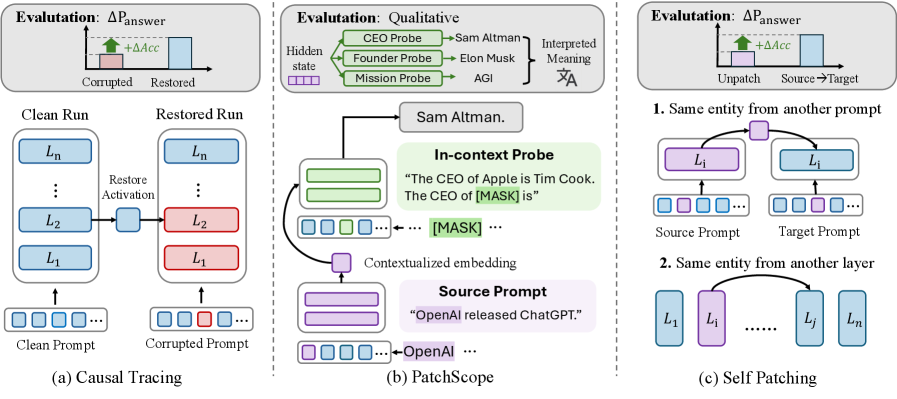
Formally, for an L-layer transformer with residual state h_t^l(P) at token t, layer l, prompt P, and an anchor entity E with token span T(P,E), one selects a source prompt P_s (a memorization query where the fact is recallable) and a target prompt P_t (a failing generalization query). The intervention is
\tilde{h}^{l_t}_{T(P_t,E)} \leftarrow h^{l_s}_{T(P_s,E)},
after which the forward pass on P_t resumes. The causal effect is
\Delta I = I(\tilde{M}(P_t), y^*) - I(M(P_t), y^*),
with I an indicator (Exact Match or MRR). Scanning (l_s, l_t) yields a layer-pair map. A positive cell means: layer l_s contains a usable representation of the fact that the model failed to route, and layer l_t is a computation-effective read position. The intervention is minimal (single anchor, single layer pair) so effects cannot be attributed to broad activation replacement.
Findings and practical recovery
The layer-pair maps identify concentrated positive regions where storage layers (often extremal in depth) can be relocated into a mid-layer band that the reasoning circuit consumes. This directly supports both predicted signatures of the misalignment hypothesis: (1) off-path representations exist that carry the fact but do not produce correct reasoning, and (2) relocating them recovers reasoning immediately.
Using this diagnostic, the authors define a simple heuristic strategy — pick source/target layers from the positive region of the self-patching map — and report that it recovers 58–75% of the oracle headroom in generalization-failure cases. The oracle here corresponds to the best possible per-instance (l_s, l_t) choice, so the heuristic is essentially closing most of the gap without per-example search.
Limitations and open questions
The generalization tasks are restricted to two compositional families (Chain, Intersection) on curated STaRK triples; the gap under more open-ended reasoning (e.g., long-form deduction, tool use) is unmeasured. The intervention operates on the anchor entity’s residual stream only; whether relational or predicate representations exhibit the same misalignment, and whether attention-head-level rather than layer-level relocation is more precise, remain open. The heuristic is a diagnostic, not a training objective — it does not modify finetuning to place representations in effective layers in the first place. Finally, “computation-effective” mid-layers are identified empirically; a predictive theory of which layers a given reasoning task will read from is absent.
Why this matters
If the Knowing–Using Gap is primarily a routing failure rather than a representation failure, then post-hoc localization interventions and finetuning regularizers that pin new facts into mid-layer sites should outperform simply training longer or on more paraphrases — a direction with immediate implications for knowledge editing and continual learning.
Source: https://arxiv.org/abs/2607.08393
Long-Horizon-Terminal-Bench: Testing the Limits of Agents on Long-Horizon Terminal Tasks with Dense Reward-Based Grading
Existing terminal agent benchmarks (SWE-bench, Terminal-Bench, etc.) grade with a single boolean at the end of a run that usually terminates within minutes. This produces two problems for evaluating frontier agents on realistic workflows: reward is sparse (a task requiring 200 shell operations returns one bit), and near-misses look identical to zero-effort runs. Long-Horizon-Terminal-Bench (LHTB) targets this by extending the Terminal-Bench formulation with (i) intentionally long tasks (minutes-to-hours, hundreds of turns) and (ii) subtask decomposition that yields a dense, normalized reward R \in [0,1] instead of a binary outcome.
Benchmark construction
Each LHTB task inherits the Terminal-Bench/Harbor structure: a natural-language instruction, a Docker image containing all code/data/tools, a task configuration, and an oracle solution or simulator used at grading time. The agent sees only the instruction and interacts through a long-running shell session — issuing commands, editing files, running scripts, and inspecting partial outputs — until success or timeout.
The mechanical change from Terminal-Bench is grading. A task is decomposed into a small set of semantically meaningful subtasks, each with its own automated check (file diffs, script exit codes, numerical tolerance against oracle outputs, simulator state predicates). The task-level reward is the completion fraction across these checks, so partial progress is directly observable.

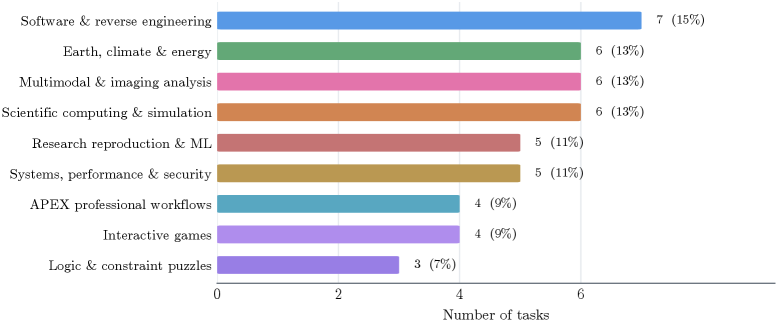
The benchmark contains 46 tasks spanning nine categories: experiment reproduction, software engineering, reverse engineering, multimodal analysis, interactive/campaign-style games, scientific computing, earth and climate science, robotics/SLAM repair, and dataset auditing. The category distribution is shown below.
The design pushes on three axes that short-horizon benchmarks under-stress:
- Long-horizon planning. A subtask itself may require dozens to hundreds of distinct operations; the full task chains several such subtasks whose ordering must be discovered.
- Long-context management. Agents must survive hundreds of turns of shell output, log files, and intermediate artifacts without losing the plot. Terminus-2/Codex-style harnesses must page or summarize context across the session.
- Iterative debugging. Because tasks include real pipelines (SLAM, ML training, figure reproduction), the modal failure is a broken intermediate step that must be diagnosed from partial output — not a one-shot code generation.
Evaluation protocol
Models are evaluated in the Harbor framework using the Terminus-2 agent harness, which exposes a single persistent terminal session to the model. GPT-5.3 is evaluated with the Codex harness instead. Each of the 46 tasks produces a normalized reward R \in [0,1] equal to the fraction of subtask checks passed. The reported metrics are:
\text{pass@1}(\tau) = \frac{1}{46}\sum_{i=1}^{46} \mathbb{1}[R_i \geq \tau]
for \tau \in \{0.9, 0.95, 1.0\}, alongside mean normalized reward \bar{R} = \frac{1}{46}\sum_i R_i. The \tau = 1.0 threshold recovers Terminal-Bench-style strict completion; the lower thresholds capture “almost-solved” runs that binary grading discards.
Results
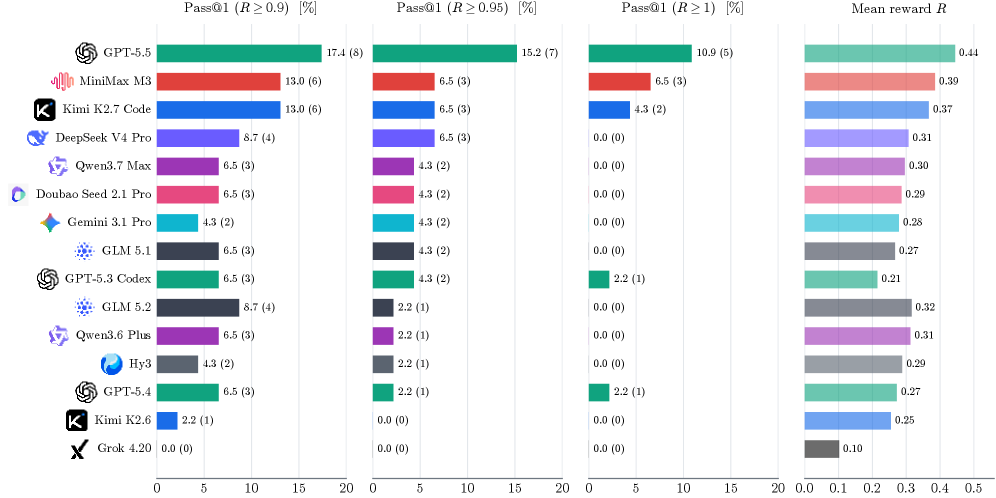
The leaderboard (Figure 3), sorted by pass@1 at R \geq 0.95, exposes a large gap between strict and lenient thresholds: mean normalized reward is substantially higher than pass@1 at R = 1.0 for essentially every model, confirming that frontier agents routinely make meaningful partial progress that binary Terminal-Bench-style scoring would report as failure. The spread across the three thresholds is itself informative: models that plateau at high \bar{R} but low pass@1(R=1.0) are stalling on final integration steps rather than failing early, while models with low \bar{R} are failing during exploration/setup.
(The paper’s Section 3 provides the leaderboard but does not spell out per-model numbers in the excerpted text; the qualitative pattern — dense reward reveals capability that binary grading hides — is the core empirical claim.)
Limitations and open questions
- N = 46 is small; per-category pass rates are noisy and comparisons between similarly ranked models may not be statistically meaningful.
- Subtask checks are oracle-driven. Reward density comes at the cost of task authoring effort, and the granularity of decomposition is a design choice that directly shapes \bar{R}. Two benchmarks with the same tasks but different decompositions would produce different rankings.
- Harness heterogeneity. GPT-5.3 runs on Codex while other models use Terminus-2. This confounds model capability with harness engineering — a persistent issue in agent benchmarks that LHTB does not resolve.
- Reward-hacking surface. With dense subtask checks, an agent could in principle satisfy intermediate predicates without completing the semantic goal. The paper does not report an audit of this.
- No training signal claim. LHTB is positioned as evaluation, but the dense reward format is precisely what RL fine-tuning of agents needs. Whether these subtask rewards are shaped well enough to serve as an RL objective is untested.
Why this matters
Binary success on short tasks has stopped being a useful discriminator among frontier agent models; most of the interesting variance is in how far they get on tasks they cannot finish. LHTB operationalizes that variance with a dense, per-subtask reward on long-horizon workflows, and the resulting leaderboard shows that mean normalized reward and strict pass@1 tell substantially different stories about the same models.
Source: https://arxiv.org/abs/2607.08964
Video Generation Models are General-Purpose Vision Learners
The paper argues that large-scale text-to-video diffusion pre-training is the vision analogue of next-token prediction in NLP: an objective rich enough to force the model to internalize 3D geometry, physics, temporal dynamics, and vision-language alignment as byproducts of generating plausible video. The authors operationalize this claim in GenCeption, a system that repurposes a pre-trained text-to-video diffusion model (WAN 2.1) into a single-step, feed-forward perceiver capable of dense and sparse video perception tasks steered entirely by text prompts.
Problem and motivation
Computer vision has fragmented into specialist models (depth, normals, segmentation, pose, camera trajectory), each with bespoke encoders, decoders, and losses. Attempts at unification via contrastive or masked-image pre-training (CLIP, MAE, V-JEPA, VideoMAE) capture semantic or short-horizon reconstructive signals but lack the strong spatiotemporal and 3D priors that a generative video model must acquire simply to produce coherent frames. The bet here is that text-to-video generation is a strictly stronger pre-training pretext, and that perception can be recast as a post-training problem on top of a frozen-in-spirit generative backbone.
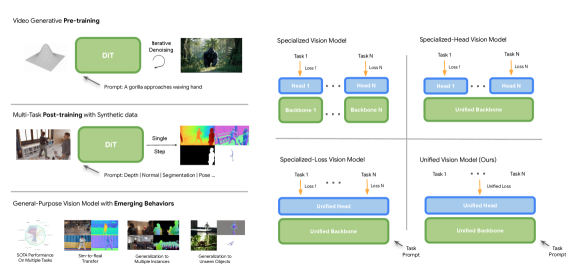
Method
Three design principles drive the architecture:
Generative pre-training as representation learning. The backbone is WAN 2.1, an open text-to-video diffusion model operating at 480×832 resolution, 81 frames, 24 FPS. The encoder downsamples by a temporal factor of 4 and spatial factor of 8. The authors deliberately minimize architectural deviations from the pre-training regime to preserve learned priors.
Task-agnostic post-training via unified I/O. Rather than adding task heads, all perception outputs — depth, normals, segmentation masks, dense human semantics, raymaps, 2D/3D keypoints — are re-encoded into the standard RGB video space that the generator natively produces. The text prompt selects the target modality. Adding a new task reduces to adding a new (video, text, target-video) triple to the training mix. This mirrors the “everything is a sequence” reformulation that unified NLP tasks under language modeling.
Feed-forward reformulation. Iterative diffusion sampling is unacceptable for perception. The multi-step denoiser is collapsed into a single forward pass that maps (RGB video, text) → (target video). The paper does not detail the specific distillation/consistency mechanism in the excerpted sections, but conceptually the diffusion prior is amortized into a single-step regression to the target modality’s RGB encoding.
Training uses Adam with learning rate 5\!\times\!10^{-5}, batch size 64 on 256 v6e TPUs, 15000 steps with 250 warmup steps. Two stability tricks are called out as essential: gradient norm clipping and gradient dropping — discarding any batch whose gradient norm exceeds a higher threshold. In high-resolution video training with heterogeneous target modalities, gradient-norm outliers appear to be a dominant source of divergence, and the authors treat them as noise rather than useful signal.
The data pipeline combines synthetic data (their own, plus TartanAir, Virtual KITTI, MVS-Synth for depth and camera trajectories) with real datasets (MeViS, Ref-COCO, YouTube-VOS) for expression-referring segmentation where photoreal supervision is available.
Results
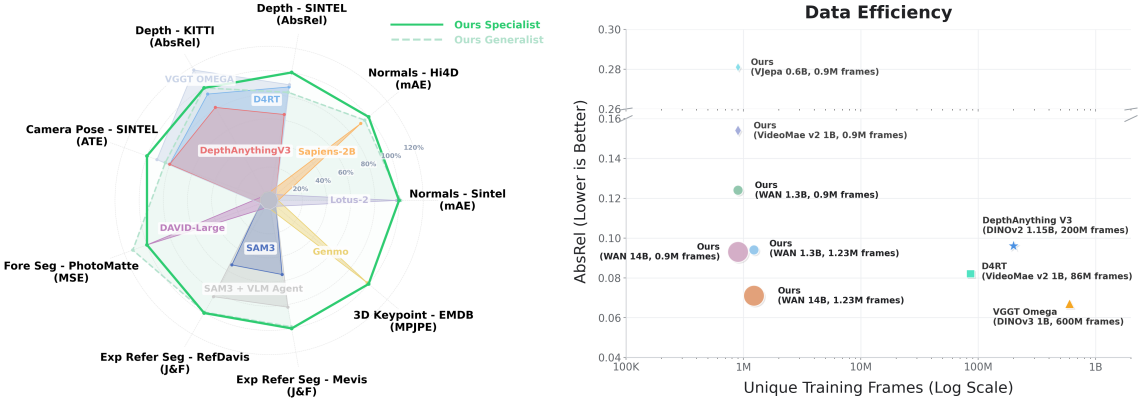
GenCeption reports state-of-the-art or competitive performance across a broad task suite versus specialist models — DepthAnything3, SAM3, D4RT, VGGT-\Omega, Sapiens, David, Genmo, and Lotus-2 — spanning depth, surface normals, camera pose, expression-referring segmentation, and 3D keypoints.
A striking demonstration is 3D human pose on unconstrained skiing and snowboarding footage, where existing SOTA pipelines require a person detector and 2D keypoint estimator as preprocessing. GenCeption ingests the full frame and produces 3D pose end-to-end.
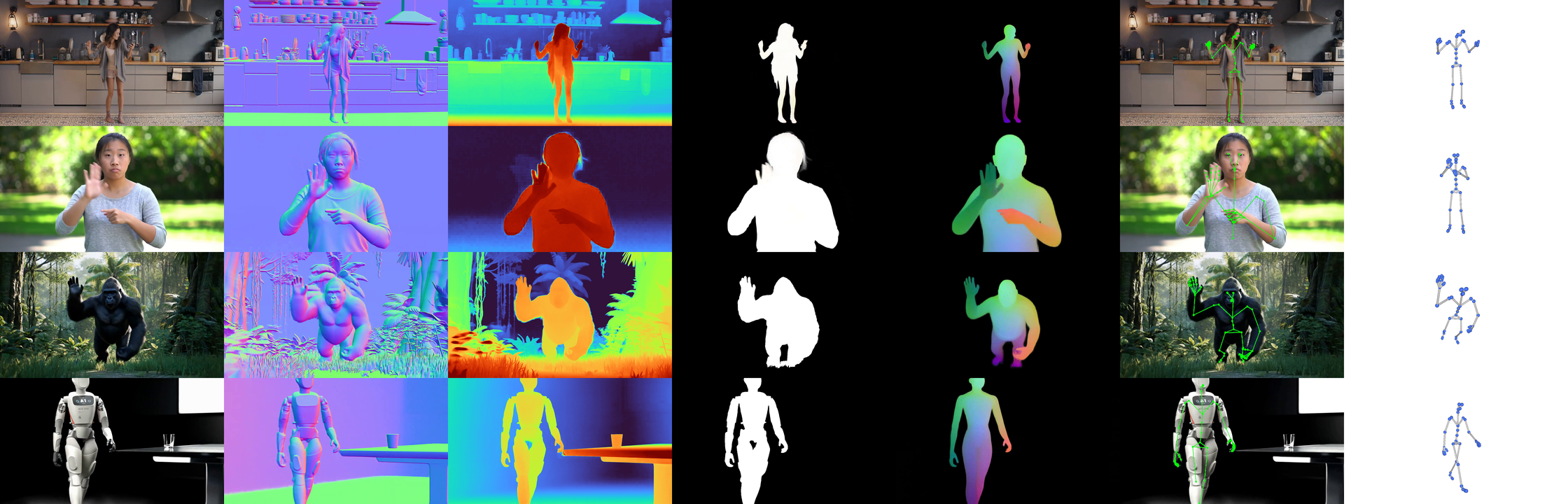
The paper’s ablation claim — that video-diffusion pre-training outperforms V-JEPA and VideoMAE pre-training under comparable protocols — is the more scientifically load-bearing result, though the excerpted sections do not give the specific deltas. The qualitative range of output modalities is shown in the capabilities figure, which spans normals, depth, foreground and referring segmentation, dense human parsing, keypoints, and camera raymaps in one architecture.
Limitations and open questions
The provided sections do not give per-task metric tables, so the “SOTA” claims must be evaluated against the full paper. Several substantive questions remain: (i) how the single-step feed-forward reformulation is trained — direct regression, consistency distillation, or one-step diffusion — and how much the pre-trained diffusion weights actually contribute versus a comparably initialized encoder; (ii) whether encoding heterogeneous modalities (depth, keypoints, raymaps) into RGB is lossy in ways that cap accuracy on metric tasks; (iii) computational cost — 256 v6e TPUs and 81-frame 480×832 inputs is far from commodity; (iv) generalization beyond human-centric domains, which dominate both the training mix and the qualitative results; (v) whether gradient dropping masks a deeper optimization pathology that would surface at larger scale.
Why this matters
If video-diffusion pre-training is genuinely a stronger vision pretext than JEPA-style or masked-reconstruction objectives, the field’s pre-training landscape shifts: generation is not a downstream artifact but the substrate. A unified RGB-in / RGB-out interface across perception tasks also removes the architectural sprawl that has made multi-task vision brittle, at the cost of committing to very large video generators as the base model.
Source: https://arxiv.org/abs/2607.09024
From RGB Generation to Dense Field Readout: Pixel-Space Dense Prediction with Text-to-Image Models
Problem
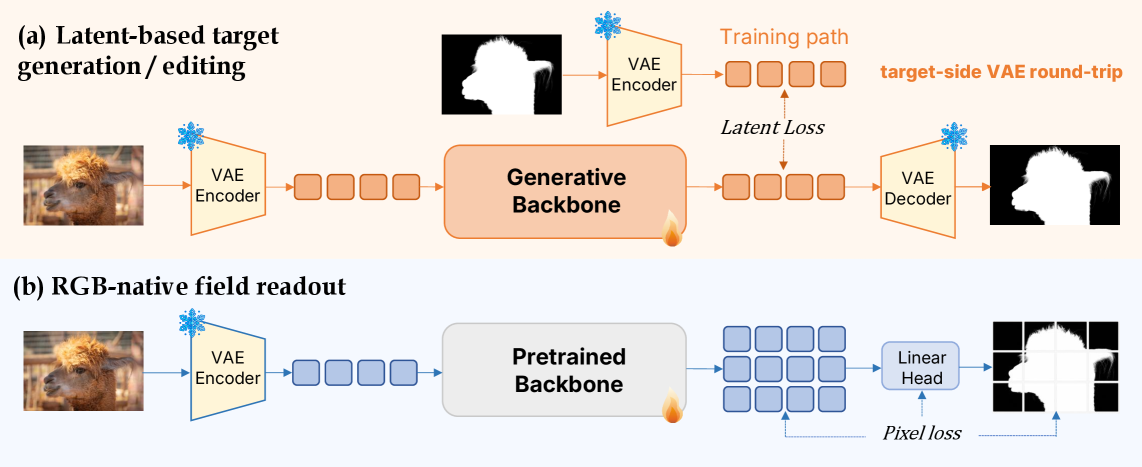
Large text-to-image (T2I) diffusion transformers carry strong semantic, structural and geometric priors that are attractive for dense prediction (depth, normals, matting, segmentation, saliency, pose). The dominant way to reuse them is target-side generation: encode the annotation (depth map, alpha matte, mask, heatmap) into the RGB-trained VAE latent, denoise with the DiT, then decode back to pixels. This inherits the entire generative output interface — a VAE that was fit to RGB natural-image statistics is asked to represent, and reconstruct, task-native fields that are not RGB.
The authors argue this is the wrong interface. Dense prediction is supervised and evaluated as pixel-aligned, task-native quantities on the same image plane as the input — not as new RGB content to be rendered. There is no reason the target has to pass through an RGB VAE at all.
Method: ReChannel
The observation driving the design is architectural: a pretrained DiT already organizes its RGB input as a patch-to-token-to-patch lattice on the image plane. Each spatial token z_{ij} has a fixed correspondence to a p \times p pixel patch. Nothing forces the channels at that patch to be RGB — they can carry any task-native quantity, and the token field is already spatially organized because the backbone learned that from RGB pretraining.
Concretely, ReChannel:
- Keeps the VAE encoder on the input side, so the DiT still sees its native input distribution.
- Drops the target-side decoder entirely — annotations never enter the VAE.
- Freezes the DiT and adapts it with a task-specific LoRA.
- Uses a shared, token-local linear head W \in \mathbb{R}^{d \times p^2 K_t} that maps each token z_{ij} \in \mathbb{R}^d to its p \times p \times K_t pixel-space patch, where K_t is the number of task-native channels (1 for depth, 3 for normals, 1 for alpha, K for a keypoint heatmap stack).
\hat{y}_{ij} = \mathrm{unpatchify}(W z_{ij}), \quad z_{ij} = \mathrm{DiT}_{\theta+\Delta\theta_{\text{LoRA}}}(\mathrm{VAE}_{\text{enc}}(x))_{ij}
Inference is deterministic (\sigma = 0), so the diffusion process reduces to a single forward pass conditioned on the input latents. The head is roughly 3% of backbone parameters.
Why a linear head suffices
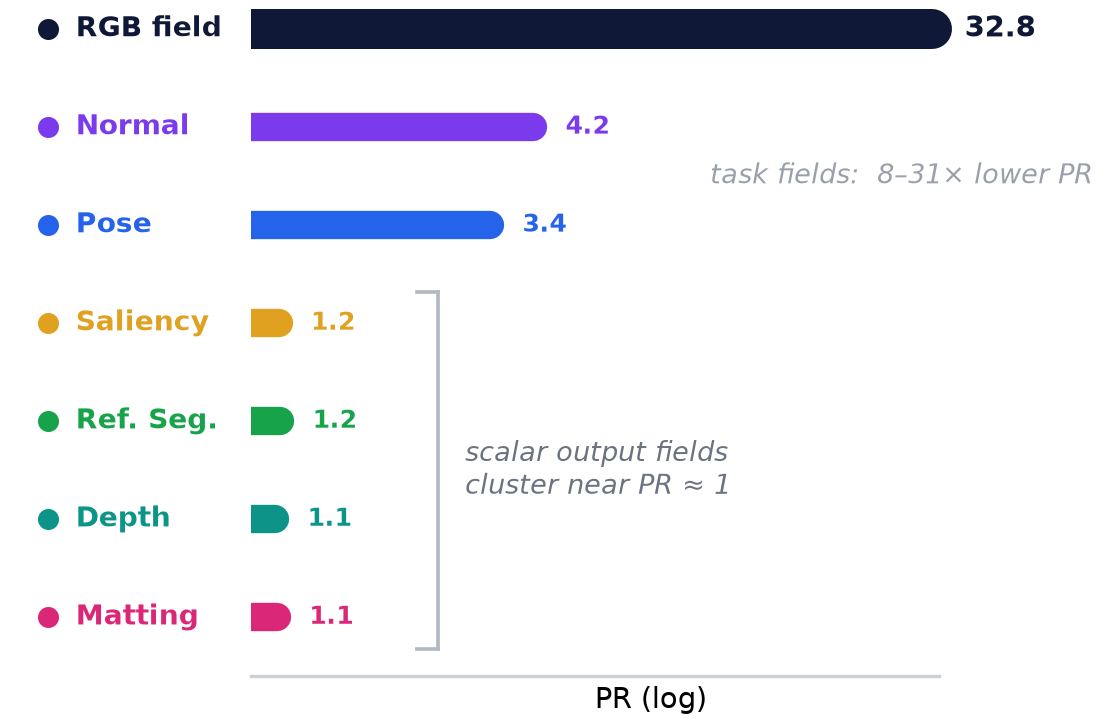
The justification in Figure 1 is a participation-ratio (PR) argument on the token field. PR measures the effective dimensionality of activations. RGB inputs give PR \approx 32.8 — high, consistent with rich generative content. After task adaptation via LoRA, the same token field collapses to PR between 1.1 and 4.2 across tasks. Once the field has been reshaped into a low-dimensional, task-aligned subspace by LoRA, a shared token-local linear projection is enough to extract the target; a heavy spatial decoder or convolutional refiner is redundant.
This inverts the usual assignment of capacity: the backbone (adapted) does the spatial work, and the head is trivial.
Experiments
Setup uses FLUX-Klein at 4B and 9B parameters, frozen, with one LoRA and one linear head per task. Benchmarks cover the standard protocols across six task families:
- Depth: NYU (Eigen split), KITTI (Garg crop), ScanNet val, with log-space scale-shift alignment.
- Surface normals: DSINE split on NYU / ScanNet / iBims.
- Trimap-free matting: P3M-500-P, P3M-500-NP, zero-shot transfer to AIM-500.
- Referring segmentation: LISA/GLaMM 8-split RefCOCO/+/g with cumulative cIoU.
- Saliency: DUTS-TE, ECSSD with F_{\max} under PySODMetrics.
- Pose: COCO val using the YOLOv11x detection-box protocol.
The unified interface — same DiT, same linear readout, task varies only through K_t and the LoRA weights — is what makes the comparison meaningful. Any single-task specialist can be strong; the claim is that dropping the generative target-side path does not sacrifice performance and often improves it, across regression targets (depth, normals), continuous alpha, discrete masks and structured heatmaps.
Limitations and open questions
The abstract and method sections make claims that depend on the DiT’s patch-to-token-to-patch structure; models without a clean spatial token grid (e.g. heavily compressed latent shufflers, cascaded architectures) may not admit the same readout. The PR argument is post-hoc — LoRA is what collapses the field, so the “linear head is sufficient” claim is really “LoRA + linear head is sufficient,” and the split of capacity between them is not fully characterized. Deterministic \sigma=0 inference discards whatever generative uncertainty the backbone could express; for ambiguous fields (matting boundaries, occluded depth) a probabilistic readout might do better. The VAE encoder is still in the loop on the input side, so degradations from RGB-native VAE compression at fine scales are not addressed.
Why this matters
If the T2I backbone’s token grid is already a spatial field, the entire target-side generative machinery — VAE decoder, denoising over target latents, RGB-shaped supervision — is scaffolding, not substance. ReChannel formalizes the alternative interface: adapt the field, read it out linearly, keep targets task-native. This reframes T2I models as general dense-field backbones rather than image renderers repurposed for prediction.
Source: https://arxiv.org/abs/2607.06553
Self-Guided Test-Time Training for Long-Context LLMs
Problem
Long-context LLMs degrade in accuracy as input length grows, even when the context window nominally fits. Test-time training (TTT), which adapts model parameters on the test input before answering, has emerged as a way to improve instance-specific utilization of long contexts. But TTT on the entire long context is prohibitively expensive, and adapting on uniformly sampled spans exposes a subtle failure mode: most spans in a long document are irrelevant to the question, so the adaptation objective is dominated by distractors.
The paper’s diagnostic makes this concrete. On LongBench-v2 with Qwen3-4B-Thinking-2507, the base model scores 40.4\%. TTT on uniformly sampled spans reduces accuracy to 38.9\%, while TTT on oracle spans annotated by GPT-5.5 with access to ground truth (length-matched to the random spans, so token count is controlled) raises accuracy to 45.9\%. The gap of roughly 7 points isolates span quality — not token budget — as the bottleneck.
Method
Self-Guided TTT (S-TTT) is a two-stage procedure that removes the oracle requirement by letting the base model itself pick training spans.
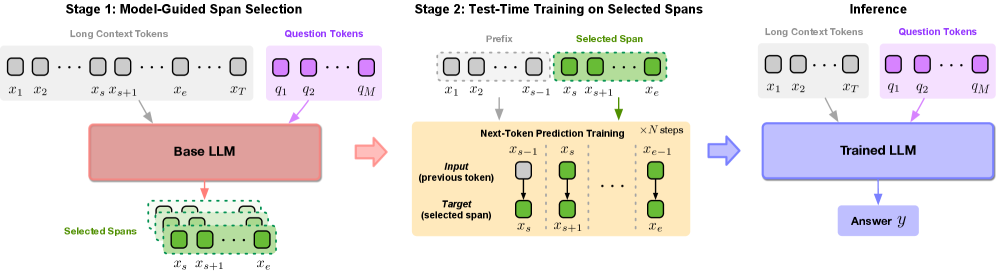
Stage 1 (self-annotation): the base LLM reads the full context plus question (and, for multiple-choice tasks, the answer choices) and is prompted to emit question-relevant spans verbatim from the context. If the model fails to produce valid verbatim spans, the method falls back to random spans.
Stage 2 (TTT on selected spans): a standard language-modeling loss is applied to the selected spans using LoRA on the query projections only, following qTTT (r=16, \alpha=32), optimized with AdamW (\text{wd}=0.01). Learning rate is swept over \{3\times 10^{-5}, 1\times 10^{-4}, 3\times 10^{-4}\}.
At inference, the adapted model conditions on the original full context and question. So S-TTT does not replace context with selected spans — it uses the spans purely as an adaptation signal that biases attention toward the evidence during full-context decoding.
Results
Model annotation clearly beats annotation-free intrinsic selectors. On LongBench-v2 with Qwen3-4B-Thinking-2507:
| Selector | <64k | 64–128k |
|---|---|---|
| Model annotation | 47.7 | 35.3 |
| Perplexity | 46.7 | 31.9 |
| Entropy | 45.1 | 33.0 |
The gap widens sharply in the 64–128k bucket (35.3 vs 31.9 for perplexity, 33.0 for entropy), which is precisely where distractor density is highest. Intrinsic surprise correlates with rare entities, formatting shifts, or local domain drift — none of which imply relevance to the question — so question-conditioned annotation is the more informative signal.
Annotation reliability, however, is uneven. Fallback rates (fraction of instances where the model fails to emit valid verbatim spans, degrading S-TTT to Random Span TTT for that instance) are 8.2\% for Qwen3-4B-Thinking-2507 on LongBench-v2 but 21.5\% on LongBench-Pro; Llama-3.1-8B-Instruct falls back on 39.9\% of LongBench-Pro examples. Open-ended questions are markedly harder to self-annotate than multiple choice.
Mechanism
The attention visualizations support the intended mechanism: adaptation on selected spans redirects attention toward those spans during full-context inference, rather than globally reweighting.
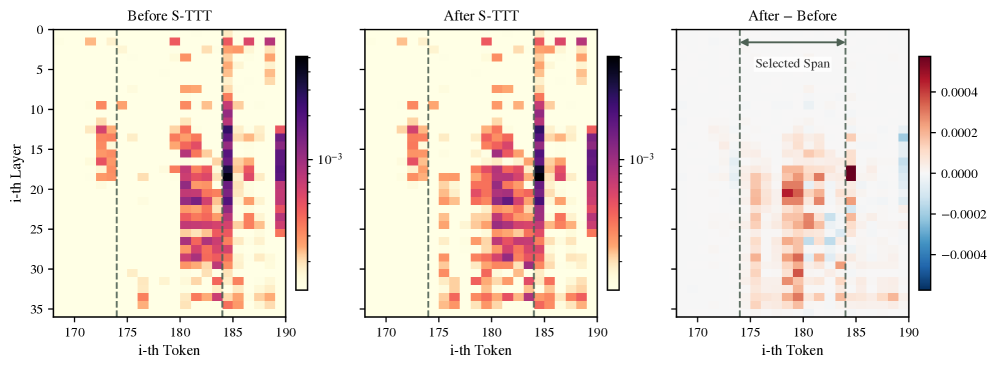
Rows are layers, columns are positions around the annotated span. Post-S-TTT, attention mass concentrates inside the dashed markers while the outside remains essentially unchanged. This is consistent with LoRA on query projections acting as a targeted, low-rank steering of retrieval-like attention behavior rather than broad representational drift.
Cost
S-TTT has a fixed adaptation overhead but avoids re-encoding the full context in the way KV-cache-modifying TTT variants do. The paper reports normalized end-to-end latency versus context length: S-TTT is more expensive at short contexts (the annotation + adaptation overhead dominates) but crosses over and becomes cheaper than non-frozen KV cache TTT methods at longer contexts, because those methods pay superlinear costs in n.
Limitations and open questions
- Self-annotation is the load-bearing component and it fails outright on a nontrivial fraction of open-ended long-context queries (up to 39.9\% for Llama-3.1-8B-Instruct on LongBench-Pro). Robustness of extractive self-annotation for non-multiple-choice tasks is unresolved.
- The method uses the same base model both to annotate and to be adapted; if the model cannot identify the evidence, TTT cannot recover it. There is a floor set by the base model’s retrieval competence.
- LoRA is restricted to query projections following qTTT; whether other placements (key, value, MLP) yield further gains, and whether the localization of attention shift in Figure 2 depends on this choice, is not explored.
- Adaptation latency, even with LoRA, is a real deployment barrier. The authors note this explicitly: multi-turn, per-session adapted weights are the natural production pattern, but generation-time latency needs reduction.
- The oracle-vs-model-annotation gap (45.9\% oracle vs 47.7\% model-annotated <64k — noting these are on different splits) is not directly reported on a matched split, so how much headroom remains above self-annotation is unclear.
Why this matters
S-TTT reframes long-context TTT from an optimization problem (“how to adapt”) to a data-selection problem (“what to adapt on”), and shows that a model’s own question-conditioned span extraction is enough to convert TTT from harmful (-1.5 points) to helpful (+5.5 points on the oracle upper bound, and comparable gains from self-annotation). This is a compact recipe for turning existing LoRA infrastructure into per-query, per-document adaptation without new architectures or KV-cache surgery.
Source: https://arxiv.org/abs/2607.09415
Hacker News Signals
Claude Code sends 33k tokens before reading the prompt; OpenCode sends 7k
Source: https://systima.ai/blog/claude-code-vs-opencode-token-overhead
A direct measurement of system-prompt and context overhead for two agentic coding tools. The methodology is straightforward: intercept the raw requests sent to the model API before any user-supplied content appears, and count tokens. Claude Code front-loads approximately 33,000 tokens of tool definitions, system instructions, and scaffolding on every invocation. OpenCode, a newer open-source alternative built on top of the OpenAI SDK, sends roughly 7,000 tokens in the same position.
The practical consequences are non-trivial. At typical API pricing for frontier models, a 26k-token overhead difference per invocation means multi-turn agentic sessions accumulate cost rapidly; the overhead is paid again on every context window that gets rebuilt. More importantly, the overhead competes with usable context. Claude’s effective context window for actual task content is reduced by 33k tokens before a single line of user code is included. For tasks involving large codebases this can force early truncation of relevant file contents.
The 33k figure in Claude Code is largely attributable to exhaustive tool-call schemas. Anthropic’s tool definitions for file read/write, shell execution, search, and browser use are specified with verbose JSON Schema descriptions. OpenCode achieves lower overhead by either compressing schemas, omitting less-used tools, or deferring tool registration until needed.
This connects to a broader systems concern: agentic frameworks are essentially compilers that emit prompts, and prompt bloat is the equivalent of generated code that links the entire standard library regardless of what is used. The analysis implies that competitive differentiation between coding agents will increasingly hinge on token efficiency of the scaffolding layer, not just model capability. For teams running self-hosted or cost-sensitive deployments, inspecting your framework’s baseline token footprint before tool use begins is a concrete optimization target.
GhostLock, a stack-UAF that has existed in all Linux distributions for 15 years
Source: https://nebusec.ai/research/ionstack-part-2/
This is a use-after-free vulnerability on the kernel stack, residing in the io_uring subsystem’s handling of mutex state during async operation cancellation. The root cause is a TOCTOU-adjacent race: a struct io_kiocb (the request context object) embeds a wait_queue_entry_t, which in turn contains a spinlock. When a request is cancelled and its stack frame is released, a racing cancellation path can dereference the spinlock pointer after the containing allocation has been freed or reused. The name “GhostLock” refers to the fact that the lock being acquired no longer belongs to a live object.
The vulnerability class — stack-allocated kernel objects referenced across async callbacks — is structurally difficult to audit. Unlike heap UAFs, stack UAFs are harder to detect with allocator instrumentation like KASAN in typical configurations because the stack is reused rather than poisoned between frames on fast paths. The bug has been present since io_uring was introduced, which puts its origin around kernel 5.1 (2019), though the post’s “15 years” claim appears to reference a broader class of related issues in the wait_queue locking infrastructure that predate io_uring.
Exploitation requires the ability to submit io_uring operations, which is available to unprivileged users on most distributions by default (modulo seccomp or io_uring disablement via sysctl). A successful exploit can achieve kernel stack contents disclosure or, with a more complex spray, control flow hijack. The technical write-up covers the race window in terms of instruction-level interleaving and describes how repeated submission/cancellation cycles widen the window enough to make the race reliably triggerable without hardware assistance.
Mitigations: disabling unprivileged io_uring (kernel.io_uring_disabled=2) closes the attack surface immediately. Patch status across major distributions should be confirmed against the assigned CVE.
AI boosts research careers but narrows the span of ideas explored: study
Source: https://spectrum.ieee.org/ai-science-research-flattens-discovery
This is coverage of an empirical study examining how AI tool adoption affects scientific output at the paper and researcher level. The core finding is a bifurcation: individual researchers using AI tools publish more, get cited more, and have stronger career metrics. Simultaneously, the distribution of ideas across the research community narrows — the same directions get explored by more people, while the tails of idea-space are explored less.
The mechanism proposed is attentional herding. AI-assisted literature search and hypothesis generation surfaces high-visibility prior work preferentially, because recommendations are trained on citation-weighted corpora. This creates a feedback loop: popular directions get more AI-suggested follow-up, attracting more researchers, increasing citation density, which further boosts AI recommendation weight. Niche or cross-disciplinary directions that are underrepresented in training data or citation graphs get systematically deprioritized.
The measurement methodology uses citation graph structure as a proxy for idea diversity — specifically, something analogous to a dispersion metric over the embedding space of cited papers. Papers produced with heavy AI assistance cluster more tightly in citation space than matched papers from the pre-AI baseline period. The study controls for field, publication venue, and researcher seniority.
This is a supply-side monoculture problem with a compounding dynamic: the diversity loss is not just additive per paper, it is self-reinforcing through training data feedback loops. The finding should be taken seriously as a systems-level concern distinct from any individual-level productivity gain. One open question not addressed is whether the narrowing effect saturates or accelerates over time, and whether it varies by domain (theoretical CS versus, say, materials science where AI-guided search is more constrained by experimental cost).
Mesh LLM: distributed AI computing on iroh
Source: https://www.iroh.computer/blog/mesh-llm
Iroh is a Rust-based peer-to-peer networking library built around the QUIC transport and using a relay-assisted hole-punching architecture similar to Tailscale’s but without a centralized control plane. The Mesh LLM project uses iroh as the transport layer to build a distributed inference system where multiple nodes contribute compute to a single inference request.
The architecture targets pipeline parallelism: transformer layers are partitioned across nodes, and activations are streamed between them over iroh connections. Each node holds a contiguous shard of the model’s layers. The QUIC-based transport is relevant here because pipeline parallelism generates a sequence of relatively small activation tensors (one per layer boundary per token) rather than bulk data transfer, and QUIC’s stream multiplexing and low-latency characteristics suit this access pattern better than TCP in high-jitter environments.
The interesting systems claim is that iroh’s NAT traversal means participating nodes do not need to be on the same local network or behind a VPN — the mesh can span commodity internet connections. This differentiates it from existing distributed inference frameworks like DeepSpeed-Inference or vLLM’s multi-node setup, which typically assume LAN or RDMA connectivity with predictable latency.
The obvious concern is that pipeline parallelism is highly sensitive to inter-stage latency: a slow link between any two consecutive layer-shards stalls the entire forward pass. On commodity internet, even p50 latencies in the tens of milliseconds will dominate compute time for small models. The project is at demo/proof-of-concept stage; the post does not report throughput numbers against a centralized baseline. The iroh transport layer itself is technically sound and well-documented, making this an interesting substrate to watch even if the scheduling and fault-tolerance problems for heterogeneous wide-area inference remain unsolved.
Automation Without Understanding
Source: https://arxiv.org/abs/2607.06377
This is a philosophy-of-mind and epistemology paper examining what it means to perform a task correctly without possessing understanding of why the procedure works. Despite the arxiv ID placing it in 2016, it has resurfaced in HN discussion likely due to renewed relevance in the context of LLM capabilities.
The paper formalizes a distinction between procedural competence — the ability to execute a task reliably — and semantic understanding — possessing a model of the domain that supports novel inference, error detection, and transfer. The central argument is that these two properties can be decoupled: an agent (human or artificial) can achieve high procedural accuracy on a task class while failing systematically on perturbations that any domain model would handle trivially.
The examples are drawn from mathematics education (students who can execute long division but cannot recover from a single unfamiliar formatting change) and formal systems (theorem provers that succeed on proof search but cannot identify when a lemma is false). The theoretical framing uses a competence-versus-performance distinction analogous to Chomsky’s but applied to task domains rather than language.
For ML, the implication is pointed: benchmark performance measures procedural competence, not understanding. A model that achieves 90% on a math reasoning benchmark may still lack any internal representation of mathematical structure — it may be pattern-matching proof templates from training data. The paper predates transformers but anticipates the standard critique of LLM “reasoning”: high accuracy on distribution is consistent with zero structural understanding, and distribution shift of the kind that understanding would handle remains a persistent failure mode. The limitation is that the paper offers no operationalization of “understanding” that could be empirically tested — the concept remains philosophically characterized rather than measurable.
Quadrupling code performance with a “useless” if
Source: https://purplesyringa.moe/blog/quadrupling-code-performance-with-a-useless-if/
A tight low-level performance post demonstrating how a branch that is always taken (or whose taken/not-taken outcome is constant at runtime) can dramatically improve throughput by changing the code generation the compiler emits.
The specific case involves a tight loop processing an array where one branch condition is always true given the problem constraints. Adding an explicit if that checks this condition — even though it never triggers the else path — causes the compiler (GCC/Clang) to emit SIMD vectorized code for the body of the conditional branch rather than the scalar fallback it emits without the hint. The reason is that the explicit conditional narrows the type domain the compiler must assume for variables inside the branch, allowing auto-vectorization that was blocked by aliasing or overflow concerns in the unconstrained version.
The underlying mechanism is that C’s signed integer overflow is undefined behavior. Without the conditional, the compiler must handle the case where index arithmetic could overflow, which inhibits certain SIMD rewrites. The explicit bounds check, even if provably never false, tells the compiler the value is within a range where the transformations are legal, and vectorization fires.
The 4x speedup figure is plausible for a loop that transitions from scalar to 256-bit AVX2 operations (4 doubles per instruction versus 1). The post includes assembly diffs to confirm the vectorization is the mechanism.
This is a well-known class of compiler interaction — sometimes called “hint-driven optimization” or “range annotation” — but the post presents a clean minimal reproducer. The broader lesson is that correctness-preserving no-ops at the source level are not necessarily no-ops for the optimizer; code shape affects what alias and range analyses the compiler can conclude, which gates which transforms are legal.
The One-Step Trap (In AI Research)
Source: http://incompleteideas.net/IncIdeas/OneStepTrap.html
A note by Rich Sutton arguing that a large fraction of empirical AI/ML research falls into a methodological trap: measuring performance at one step of an iterative process (one training epoch, one planning step, one inference call) and drawing conclusions about asymptotic or multi-step behavior. The trap is that single-step metrics can reverse at scale.
The canonical example from RL is that one-step TD methods appear to learn faster than Monte Carlo methods on short horizons, but the ordering can invert with sufficient computation or environment complexity. Researchers who only benchmark at the one-step regime conclude incorrectly about relative method quality. The same structure applies to scaling: a method that wins at N=100M parameters may lose at N=10B if its inductive bias interacts differently with capacity.
The argument is not novel — it is essentially the Bitter Lesson restated as a measurement critique — but the framing as a “trap” with a specific structural form is useful. The trap has three components: (1) measurement at a single operating point, (2) implicit assumption that relative ordering is monotone with scale, (3) publication and citation patterns that reward the single-step result without requiring the multi-step followup.
Sutton’s prescription is to treat computational budget as an explicit independent variable and report performance curves rather than point estimates. This is computationally expensive and has not become standard practice, which is why the trap remains active. The post is short and lacks citations or formal analysis, functioning more as a research culture observation than a technical contribution. Its relevance is as a heuristic for evaluating claimed improvements in any iterative AI method: always ask whether the comparison holds across the full compute-scale range relevant to deployment.
We scaled PgBouncer to 4x throughput
Source: https://clickhouse.com/blog/pgbouncer-clickhouse-managed-postgres
ClickHouse’s managed Postgres offering uses PgBouncer as the connection pooler. Under load testing they hit throughput saturation before Postgres itself became the bottleneck, meaning PgBouncer’s internal architecture was the limiting factor. This post details the profiling and optimization work.
PgBouncer is single-threaded and uses a libevent-based event loop. The first profiling pass identified that a substantial fraction of CPU time was spent in the TLS layer — specifically in OpenSSL’s per-record overhead for connections where TLS is mandatory (as it is in managed cloud Postgres). TLS adds per-syscall overhead through read/write calls that cannot be batched the way plaintext socket I/O can.
The second issue was the connection lookup path: PgBouncer maintains a hash table of server connections and client-to-server mappings. Under high connection counts the hash operations and associated memory accesses were showing up in profiles. The optimization here involved tighter data structure packing and reducing allocations in the hot path.
The 4x throughput improvement came from a combination of: batching multiple client messages before issuing a single TLS write to the server connection (reducing TLS record overhead), tuning the libevent parameters to coalesce events, and reducing memory allocation frequency in the main loop by reusing buffer objects.
No architectural changes to PgBouncer’s single-threaded model were made — the gains are purely from hot-path micro-optimization and I/O batching. The post implies they considered a multi-threaded rewrite but achieved sufficient headroom without it. For teams running PgBouncer under TLS at high connection rates, the key insight is that TLS write coalescing is the dominant optimization lever; the plaintext throughput ceiling is much higher and unlikely to be hit before Postgres becomes the bottleneck in typical deployments.
Noteworthy New Repositories
elder-plinius/T3MP3ST
A multi-agent autonomous red-teaming harness that orchestrates offensive-security workflows without requiring per-task human direction. T3MP3ST acts as a meta-harness: it spawns and coordinates specialized sub-agents (reconnaissance, exploitation, lateral movement, reporting) and routes findings between them through a shared context store. The architecture is LLM-backed, using prompt chaining and tool-call loops to drive each agent, with a central planner deciding task sequencing based on intermediate outputs.
What separates it from single-shot jailbreak tools is the pipeline persistence — a compromised surface in one stage becomes structured input to the next, mimicking real attacker workflows rather than isolated probes. The harness supports pluggable target adapters, so it can be aimed at web apps, APIs, or model endpoints. Logging is structured JSON per agent, enabling post-hoc kill-chain reconstruction.
Use case: security researchers who want to automate end-to-end penetration exercises or stress-test LLM-based applications against multi-turn adversarial sequences. It is not a CTF solver; the design assumes partially open environments where enumeration is needed before exploitation.
Limitations: currently requires non-trivial prompt engineering to tune agent personalities per target class, and has no built-in rate-limiting or deconfliction when agents produce contradictory findings.
Source: https://github.com/elder-plinius/T3MP3ST
Lolner95/AIGX
AIGX proposes a standardized, tool-agnostic context format for AI coding agents, addressing the problem of context fragmentation across Copilot, Cursor, Claude Code, and similar tools. The core structure is a .aigx/ directory at the repo root containing rule files, a forbidden-imports manifest, and per-file “gotcha” annotations. A boundary index maps each source file to the subset of rules relevant to it, so the agent receives only the applicable constraints rather than a global dump.
The format is purely declarative — no runtime injection into source files, no SDK dependency. Agents consume it by reading the index before editing a file, then applying the matched rules as system-context or pre-prompt material. This is similar in spirit to .editorconfig but scoped to semantic constraints rather than formatting.
The key differentiator claimed is benchmark validation: the repo documents a controlled experiment comparing coding-agent error rates with and without .aigx/ context, reportedly the only published controlled benchmark for a context-format specification of this type.
Engineering value: teams maintaining large codebases with multiple AI toolchains get a single source of truth for architectural constraints (e.g., “never import module X in layer Y,” “this file assumes single-threaded access”). MIT-licensed, so it can be adopted without toolchain lock-in.
Source: https://github.com/Lolner95/AIGX
tianchong-zerotemp/dianxing
DianXing is an end-to-end AI-driven code security auditing tool that takes a repository as input and produces a structured vulnerability report. The pipeline chains static analysis passes with LLM-based semantic reasoning: an initial AST/CFG pass identifies candidate sinks and dataflow paths, then an LLM agent evaluates whether those paths constitute exploitable vulnerabilities, reducing the false-positive burden that plagues pure static analysis.
The architecture separates the parser layer (language-specific, currently emphasizing Python and JavaScript) from the reasoning layer (LLM-agnostic via a configurable backend), which means teams can swap in different models depending on cost/accuracy tradeoffs. Findings are emitted in a machine-readable format with severity classification, CWE identifiers, and line-level pointers.
Distinguishing feature: the tool is designed for CI integration, accepting diff inputs so it can audit only changed code rather than rescanning full repositories on every commit. This is practically important for latency and cost in large codebases.
Limitations: LLM hallucination can introduce false positives at the semantic reasoning stage; the tool does not currently support cross-language dataflow (e.g., Python backend calling C extension). Audit coverage is bounded by what the static pass surfaces as candidates.
Source: https://github.com/tianchong-zerotemp/dianxing
mereyabdenbekuly-ctrl/clodex-ide
Clodex is a local-first, zero-trust IDE designed for autonomous agentic software development with verifiable outputs. “Zero-trust” here refers to the execution model: every agent action (file write, shell command, external request) is intercepted, logged with a cryptographic hash, and requires explicit policy approval before execution. This creates an auditable action log that can be replayed or diffed to verify what an autonomous agent actually did to a codebase.
The IDE runs entirely on-device; no telemetry or cloud synchronization. Agent sessions operate inside sandboxed process trees with configurable capability profiles — an agent can be granted read-only access to the filesystem, or write access scoped to a specific directory subtree. The policy engine is expressed as a declarative rule file checked into the repo alongside source.
The interface is designed around agent supervision: the primary UI surfaces pending agent actions awaiting approval rather than a traditional file explorer, shifting the developer role toward review and policy authoring. Useful for teams that need compliance evidence for AI-assisted development, or for running high-autonomy agents on sensitive codebases where uncontrolled writes are unacceptable.
Source: https://github.com/mereyabdenbekuly-ctrl/clodex-ide
okasi/bot-signal
A TypeScript library for client-side and Node.js bot detection that goes beyond simple user-agent checks. It implements a layered signal collection approach covering: WebDriver presence (navigator.webdriver, shadow properties), headless Chrome fingerprints (missing plugins, blank window.chrome), Playwright/Puppeteer instrumentation artifacts, behavioral biometrics (mouse movement entropy, typing cadence regularity), datacenter IP classification via ASN lookup, JA3 TLS fingerprint comparison against known-bot baselines, and timezone/locale inconsistency detection.
Each signal produces a weighted score; the library exposes both a binary verdict and a per-signal breakdown so callers can tune thresholds for their false-positive tolerance. The browser module collects signals inline via a small script injection; the Node module can operate server-side on request metadata and TLS handshake data without any client cooperation.
Technical care is evident in the JA3 implementation: TLS fingerprinting requires access to the raw handshake, so the Node module includes a hooks-based TLS inspection layer rather than relying on higher-level HTTP metadata. The behavioral biometrics use statistical tests (coefficient of variation on inter-event intervals) rather than ML models, keeping the runtime dependency footprint minimal.
Suitable for fraud detection, rate-limiting enforcement, or CAPTCHA-triggering pipelines. No dependency on third-party bot-detection SaaS.
Source: https://github.com/okasi/bot-signal
VisionForge-OU/foreman
Foreman is a terminal UI orchestrator that supervises headless Claude Code agents through a gated software-delivery pipeline. The “Boris-style” naming refers to a strict supervisor pattern: Foreman does not let agents self-direct; it enforces a defined stage sequence (spec, implement, test, review, merge) and requires each gate to pass before the next agent invocation begins.
The TUI provides a real-time view of active agents, their current stage, stdout streaming, and gate status. Each stage has a configurable acceptance criterion — a test suite exit code, a lint score threshold, or a custom shell script — and Foreman blocks pipeline progression until the criterion is met or the operator intervenes manually. This is meaningfully different from single-shot agent runners: it models software delivery as a stateful process with explicit checkpoints.
It is repository-agnostic: pointed at any git repo, it infers project structure and injects repo context into each agent prompt. Configuration is a single YAML file defining stages, gate conditions, and Claude Code invocation parameters.
The practical use case is automating feature branches end-to-end while maintaining a human-auditable record of each pipeline stage’s inputs and outputs. Suitable for teams experimenting with high-autonomy coding agents who need rollback points if an agent corrupts state.
Source: https://github.com/VisionForge-OU/foreman
dwebagents/AgentPipe
AgentPipe is a high-performance multithreaded task execution engine targeting AI agent workflows and decentralized web (dweb) applications. The core abstraction is a typed pipeline of tasks with explicit dependency edges, scheduled across a thread pool with work-stealing. Unlike sequential agent runners, AgentPipe resolves the dependency graph and executes independent subtasks in parallel, which matters when agents issue multiple tool calls that could be parallelized (e.g., simultaneous web fetches, database queries, or sub-agent invocations).
Tasks are defined as composable units with typed input/output contracts, enabling static validation of pipeline topology before execution. The engine supports backpressure: upstream stages can signal downstream capacity limits, preventing memory blowup when fast producers outpace slow consumers.
The dweb orientation adds peer-to-peer transport adapters (IPFS, libp2p primitives) so tasks can be distributed across nodes rather than executed locally, which is unusual for agent infrastructure. This makes it relevant for decentralized AI applications where computation and data are not co-located.
The implementation prioritizes throughput and deterministic resource usage over ease-of-configuration, so there is more boilerplate than in simpler task-queue libraries. Best suited for production agent deployments where single-threaded sequential execution is a measurable bottleneck.
Source: https://github.com/dwebagents/AgentPipe
entropykit/entropia
Entropia is a compiled language purpose-built for producing position-independent x86-64 shellcode and Beacon Object Files (BOFs) on Windows. Standard compiled languages produce binaries that assume a fixed load address and rely on import tables and the C runtime; shellcode and BOFs cannot use these mechanisms. Entropia enforces position-independence at the language level: the type system and code generator reject constructs that would emit relocations or CRT dependencies, and all Windows API calls go through dynamic resolution (PEB walking to find kernel32, then GetProcAddress chains) generated automatically by the compiler.
BOF support means the output can be loaded directly by Cobalt Strike or compatible C2 frameworks without a loader stub. The compiler emits compact, flat binaries with no headers other than what the target loader expects.
From a language design perspective, Entropia is minimal by necessity: no heap allocator, no exceptions, no standard library beyond a thin Windows API binding layer. Control flow, stack-allocated data structures, and explicit memory management are the available primitives.
The value proposition over writing shellcode in raw assembly or C with manual -nostdlib wrestling is that Entropia enforces the constraints at compile time and handles the PEB-walk boilerplate generation. Useful for offensive security research and red-team tooling development.