Daily AI Digest — 2026-07-10
arXiv Highlights
Ideas Have Genomes: Benchmarking Scientific Lineage Reasoning and Lineage-Grounded Idea Generation
Problem
Existing “AI-for-science” benchmarks evaluate whether a model can produce a plausible-sounding research idea, but rarely check whether that idea sits coherently in the citation and mechanism-inheritance graph of prior work. In practice, a new paper is almost always a delta over a specific ancestor set: it reuses some mechanisms verbatim, mutates others, drops constraints, imports tools from a neighboring subfield, and occasionally adds a genuinely novel operator. Current LLM evaluations conflate “novel” with “unattested,” which rewards generation that ignores or contradicts the prior-work record. IG-Bench operationalizes lineage as a first-class object of evaluation.
The IdeaGene framework
Each paper p is decomposed into a set of Idea Genome objects G(p) = \{g_1, \dots, g_n\}. A genome object is minimal, typed, and evidence-grounded — i.e., anchored to a text span. Types cover problem framings, assumptions, mechanisms, datasets, metrics, and constraints. Between an ancestor paper p_a and a descendant p_d, a GenomeDiff \Delta(p_a \to p_d) aligns objects and labels each alignment with one of six evolutionary operators:
- Inheritance (object copied unchanged),
- Mutation (object modified),
- Loss (object dropped),
- External import (object introduced from outside p_a’s lineage),
- Novel insertion (object with no attested ancestor),
- and a recombination/merge operator.
A full lineage trace is then a DAG over papers whose edges carry GenomeDiff annotations. The curated benchmark contains 1,961 golden lineage traces, 1,085 Idea Genome objects, and 920 pairwise GenomeDiff records spanning 10 scientific domains.
Two evaluations
IG-Exam is a closed-form suite of 42 task types over 1,029 instances, grouped into four skill families:
- Idea Genome abstraction — extract typed, minimal objects from paper text.
- Inheritance tracing — given a descendant, identify which ancestor supplied which genome object.
- Evolutionary reasoning — classify each aligned pair under the six-operator taxonomy, and predict the operator that would be applied under a stated goal.
- Lineage verification — decide whether a proposed lineage graph is consistent with the underlying diffs (cycle-freeness, operator-type compatibility, evidence anchoring).
Because tasks are closed-form (multiple choice, span selection, structured extraction), grading is deterministic and does not rely on an LLM-judge.
IG-Arena evaluates generation. A model receives an ancestor set A = \{p_1, \dots, p_k\} and a goal specification, and must produce a research proposal \hat{p}. The proposal is parsed into an Idea Genome G(\hat{p}) and scored with a Population-Evolution Score (PES) that asks whether \hat{p} can be inserted into the existing population as a plausible descendant. Conceptually, PES factors as
\text{PES}(\hat{p} \mid A) = f\big(\underbrace{\text{Anchoring}}_{\text{genome objects tied to } A},\ \underbrace{\text{Operator plausibility}}_{\text{diffs use valid ops}},\ \underbrace{\text{Novelty}}_{\text{non-trivial insertions}},\ \underbrace{\text{Coherence}}_{\text{internal consistency}}\big).
A proposal that simply paraphrases an ancestor scores low on novelty; one that hallucinates disconnected mechanisms scores low on anchoring; one that claims an “improvement” via an operator inconsistent with the ancestor’s type (e.g., mutating a metric into a dataset) fails operator plausibility. This is the key departure from prior novelty/feasibility scoring: PES rewards the right kind of delta, not the magnitude of surface change.
What the design buys
The genome-plus-diff representation makes several failure modes machine-checkable that were previously only detectable by expert review:
- Ancestor amnesia: LLM proposals frequently reintroduce mechanisms already present in A as if novel. Under PES these are re-labeled as inheritance rather than insertion, collapsing the apparent novelty score.
- Ungrounded imports: Claims like “we adopt technique X from domain Y” without a citable Y-side object become external-import edges with missing anchors, and are penalized.
- Type-inconsistent mutations: A “new loss function” that is actually a re-scoping of the problem statement is caught by type-level operator constraints.
The 42-task decomposition of IG-Exam also allows fine-grained diagnosis: a system may abstract genomes well but fail at operator classification, or vice versa, and these are separately measurable.
Limitations and open questions
The framework’s expressiveness depends on the quality of the genome-object typology. Six evolutionary operators is a modeling choice; recombination and gradual mutation live on a continuum, and boundary cases (e.g., a mutation so large it is effectively an insertion) require adjudication. The 10-domain coverage and 1,961 traces are substantial but still small relative to the citation graph; lineage annotation is expensive because each edge requires span-level evidence on both endpoints. PES itself relies on automated genome extraction from generated proposals, so extraction errors can propagate into scoring — an ablation isolating extractor error from generator error would be informative. Finally, the benchmark measures retrospective lineage fidelity; whether high-PES proposals correlate with prospective research value remains untested.
Why this matters
Framing scientific ideas as typed genomes with diff-labeled inheritance turns “is this idea novel?” from a subjective LLM-judge question into a structured graph-consistency problem. If the operator taxonomy and extraction pipeline hold up, IG-Bench gives a substrate on which idea-generation systems can be trained and evaluated against the actual topology of scientific progress, rather than against unconditioned novelty proxies.
Source: https://arxiv.org/abs/2607.08758
UP: Unbounded Positive Asymmetric Optimization for Breaking the Exploration-Stability Dilemma
Problem
RL fine-tuning of LLMs — PPO, GRPO, and their descendants — depends on importance sampling (IS) ratios r_t(\theta) = \pi_\theta(a_t|s_t)/\pi_{\text{old}}(a_t|s_t) to reuse rollouts across multiple gradient steps. Left unclipped, IS produces high-variance updates and catastrophic collapse; clipped, it truncates precisely the updates that would move probability mass onto correct-but-low-confidence tokens. The paper formalizes this via what it calls the Probability Capacity (Cap): the maximum multiplicative change in \pi_\theta(a|s) that the clipped surrogate objective permits in a single update. For the standard PPO clip [1-\epsilon, 1+\epsilon] applied to a token with current probability p, the effective ceiling on p' is bounded above by (1+\epsilon) p, i.e. Cap grows only linearly and vanishes when p is small. Correct reasoning paths that the current policy assigns low probability — exactly the paths one wants exploration to reinforce — see their update budget capped near zero. Negative-advantage clipping does the opposite job well: it prevents rare, high-ratio destructive updates.
This asymmetry motivates treating positive and negative advantages differently.
Method
UP replaces the symmetric clipped surrogate with an asymmetric objective that anchors the ratio to the current policy \pi_\theta via a stop-gradient, denoted \bar\pi_\theta \equiv \text{sg}[\pi_\theta]. The per-token loss decomposes on the sign of the advantage \hat A_t:
\mathcal{L}_t(\theta) = \begin{cases} -\dfrac{\pi_\theta(a_t|s_t)}{\bar\pi_\theta(a_t|s_t)}\,\hat A_t & \hat A_t > 0 \\[6pt] -\min\!\Big(r_t(\theta)\hat A_t,\ \text{clip}(r_t(\theta), 1-\epsilon, 1+\epsilon)\hat A_t\Big) & \hat A_t \le 0 \end{cases}
The positive branch is the crucial construction. Because the denominator is a stop-gradient of the current policy (not of \pi_{\text{old}}), the ratio evaluates to 1 at the current parameters, and its gradient is
\nabla_\theta \frac{\pi_\theta}{\bar\pi_\theta} = \frac{\nabla_\theta \pi_\theta}{\pi_\theta} = \nabla_\theta \log \pi_\theta,
recovering an unclipped REINFORCE-style score-function gradient on positive-advantage tokens. Two properties follow. First, there is no explicit ratio ceiling: Cap is unbounded on the positive side, so low-probability correct tokens receive gradient signal proportional to \hat A_t rather than being throttled by (1+\epsilon)p. Second, the anchoring to \bar\pi_\theta (rather than to \pi_{\text{old}}) removes the off-policy variance amplification that pure IS suffers under multi-epoch reuse — each minibatch step is treated as on-policy with respect to its own starting point, and drift between \pi_{\text{old}} and \pi_\theta over inner epochs does not compound into the ratio.
The negative branch retains standard PPO min-clip. This is deliberate: destructive updates from spuriously high r_t on penalized tokens are the empirical failure mode of unclipped IS, and asymmetric treatment preserves the safeguard where it is needed while removing it where it strangles exploration.
Practically, UP is a drop-in replacement for the surrogate in GRPO, DAPO, VAPO, etc. — one changes only the positive-advantage term. No new hyperparameters are introduced beyond the existing \epsilon.
Results
The abstract and framing indicate UP is validated as plug-and-play on multiple RL-for-reasoning frameworks. The theoretical contribution — Cap analysis showing standard clipping asymptotically zeroes update budget for low-p correct actions — is used to predict where UP should help most: long-horizon reasoning traces where correct completions initially have small \pi_\theta. The stop-gradient reformulation is proved equivalent, at the gradient level, to policy gradient with an on-policy baseline while retaining PPO’s negative-side stability. The full quantitative benchmark numbers are truncated in the provided abstract, but the mechanism predicts (and the paper claims) simultaneous gains in pass@k exploration metrics and reductions in training-collapse frequency versus symmetric-clip baselines.
Limitations and open questions
- The stop-gradient anchor eliminates the correction that IS provides for genuine off-policyness across minibatch epochs. For large numbers of inner epochs or large batch sizes where \pi_\theta drifts substantially, positive-branch updates become biased estimates of the policy gradient at \pi_{\text{old}}. The paper’s stability argument depends on this drift remaining small; an explicit trust-region diagnostic is not given.
- Unbounded positive updates can, in principle, drive \pi_\theta(a|s) \to 1 on tokens with transiently overestimated advantages (e.g., noisy group-relative baselines in GRPO). The negative-branch clip does not directly counteract mode collapse on positive-advantage tokens.
- The Cap analysis is a per-step bound; it does not directly characterize cumulative behavior across an epoch, and the empirical exploration gains rely on advantage estimators (GAE, group-relative) that are themselves biased.
- Interaction with entropy regularization and with token-level vs. sequence-level advantage normalization is unexplored.
Why this matters
The exploration-stability tradeoff in RLHF/RLVR is usually treated as a hyperparameter (clip \epsilon, KL coefficient) rather than a structural asymmetry of the objective. UP’s contribution is to identify that positive and negative advantages have fundamentally different failure modes under clipping and to give a minimal, gradient-equivalent reformulation — via stop-gradient anchoring — that decouples them. If the empirical results hold across frameworks, this becomes a default modification with essentially zero implementation cost.
Source: https://arxiv.org/abs/2607.06987
Why Can’t I Open My Drawer? Mitigating Object-Driven Shortcuts in Zero-Shot Compositional Action Recognition
Problem
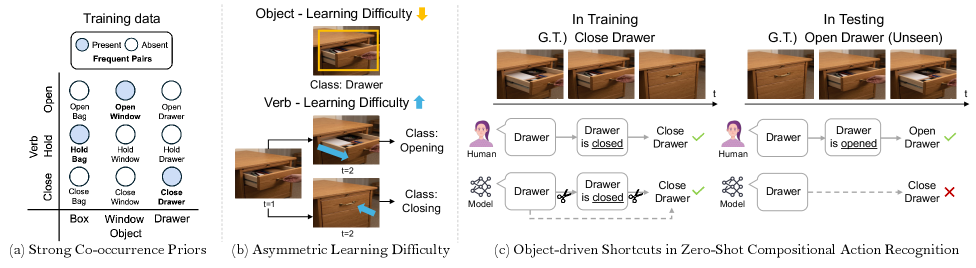
Zero-Shot Compositional Action Recognition (ZS-CAR) requires predicting held-out verb–object pairs (\mathbf{y}^V,\mathbf{y}^O)\in\mathbb{Y}^V\times\mathbb{Y}^O where verb and object vocabularies are fixed but their compositions in test time are novel. The authors identify a specific failure: models predict the verb by exploiting the object label rather than temporal dynamics. Two structural causes are isolated. First, compositional supervision is sparse — Sth-com covers only 12.8% of possible verb–object pairs, and the newly curated EK100-com only 7.5% — producing strong co-occurrence priors. Second, there is a verb/object learning asymmetry: objects are recoverable from a single frame, verbs require temporal integration.
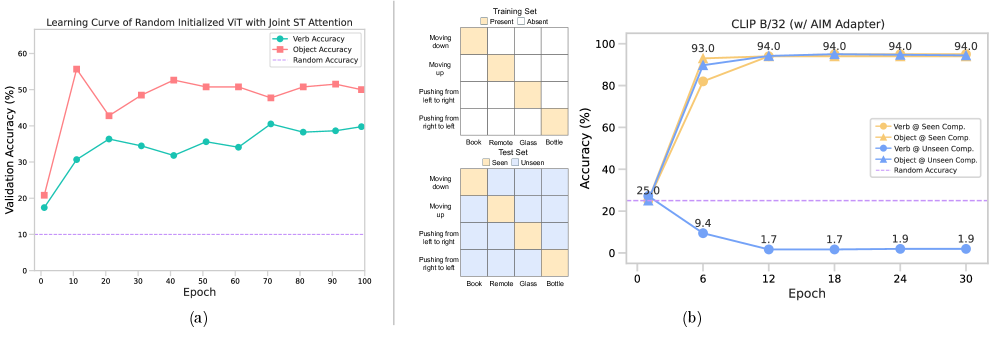
A controlled ablation makes the asymmetry concrete: on a balanced 10×10 Sth-com subset, a randomly initialized ViT converges to high object accuracy far faster than on verbs, and on a perfectly co-occurrence-biased split, CLIP+AIM attains high object accuracy while verb accuracy on bias-conflict unseen compositions drops below chance.
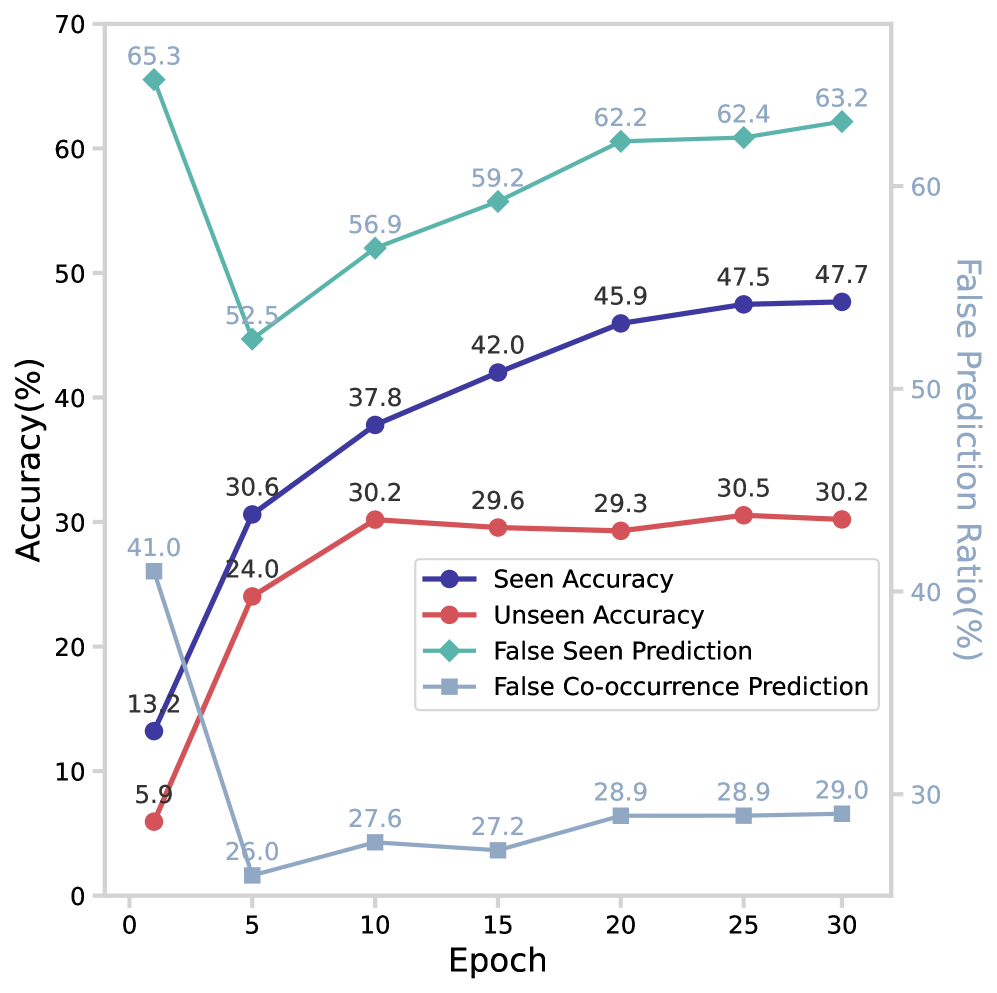
To make this measurable, the authors introduce diagnostic metrics FSP (frequent seen prediction) and FCP (frequent co-occurrence prediction). Training curves show that both FSP/FCP and the seen–unseen accuracy gap grow together for C2C, on both CLIP and InternVideo2 backbones — shortcut reliance and generalization failure are tightly coupled.
Method: RCORE
RCORE adds two regularizers on top of adapter-tuned VLMs (AIM for CLIP, LoRA for InternVideo2). The backbone yields frame features \mathbf{F}\in\mathbb{R}^{T\times D}, split into verb features \mathbf{F}^V\in\mathbb{R}^{T\times D} and pooled object feature \mathbf{f}^O\in\mathbb{R}^D, matched against text embeddings \mathbf{E}^V,\mathbf{E}^O from class prompts.
Co-occurrence Prior Regularization (CPR). CPR synthesizes videos with novel (\mathbf{y}^V,\mathbf{y}^O) pairs by injecting a static object cue from a donor video \mathbf{X}_j into the high-motion regions of \mathbf{X}_i. Using a learning-free motion mask \mathbf{M}_i^k,
\tilde{\mathbf{X}}_i^k = (\mathbf{1}-\lambda\mathbf{M}_i^k)\odot\mathbf{X}_i^k + (\lambda\mathbf{M}_i^k)\odot\mathbf{X}_j^{\lfloor T/2\rfloor},
with soft object label \tilde{\mathbf{y}}^O_i=(1-\lambda)\mathbf{y}_i^O+\lambda\mathbf{y}_j^O and verb label preserved from \mathbf{X}_i. This produces a training pair supervising an otherwise unseen composition. A margin-based regularizer treats frequently seen co-occurrence pairs as hard negatives, penalizing model scores that inherit the co-occurrence prior. Rather than expanding the softmax over the full |\mathbb{Y}^V|\cdot|\mathbb{Y}^O| label grid, CPR uses a batch-adaptive expansion that includes only the compositions instantiated in the current batch — keeping the closed-world optimization stable.
Temporal Order Regularization for Composition (TORC). TORC constructs a temporally perturbed version of \mathbf{F}^V (frame shuffling) and penalizes alignment between the original and perturbed verb representations. If a verb prediction is invariant to temporal order, the model must be relying on static cues; TORC pushes the verb head toward temporally grounded features.
Results
RCORE is evaluated open-world (inference over the full \mathbb{Y}^V\times\mathbb{Y}^O, no test-label bias tuning), which the authors argue is the honest protocol — closed-world evaluation with test-tuned bias calibration inflates unseen accuracy in prior work.
Diagnostic evidence on Sth-com: RCORE flattens the FSP/FCP growth curves that plague the C2C baseline, shrinks the seen–unseen gap, and on the temporal subset shows a larger drop under frame shuffling than baselines — a positive signal that verb predictions are now temporally dependent rather than object-driven. Composition, verb, and object accuracies (seen-comp vs unseen-comp harmonic means) improve on both Sth-com and EK100-com relative to C2C and the re-implemented Jung et al. baseline, across CLIP-B/16 and InternVideo2-CLIP-B/14 backbones; closed-world H.M./AUC are also reported for compatibility with prior evaluation protocols.
Limitations and open questions
The synthesis step in CPR relies on a learning-free motion-mask estimator and on the assumption that pasting a donor object into high-motion regions produces a semantically plausible novel composition; when the verb depends on object-specific affordances (e.g., “unfolding” only makes sense for deformable objects), synthesized pairs may be physically implausible and inject label noise. The diagnostic FSP/FCP metrics are threshold-based and dataset-specific. TORC’s shuffling penalty presumes verbs are strictly order-sensitive, which may hurt near-symmetric actions. Finally, ZS-CAR here keeps verb and object vocabularies closed; extending shortcut mitigation to genuinely open-vocabulary settings is not addressed.
Why this matters
Compositional generalization in video is repeatedly claimed but rarely measured under protocols that expose shortcut reliance; this work supplies both diagnostics (FSP/FCP, shuffle sensitivity, open-world unbiased evaluation) and a concrete mitigation that decouples verb prediction from object identity. Beyond ZS-CAR, the CPR/TORC recipe — synthetic composition supervision plus a temporal-invariance penalty — is a template for any multi-factor recognition problem where one factor is cheaper to learn than the other.
Source: https://arxiv.org/abs/2601.16211
Video-Oasis: Rethinking Evaluation of Video Understanding
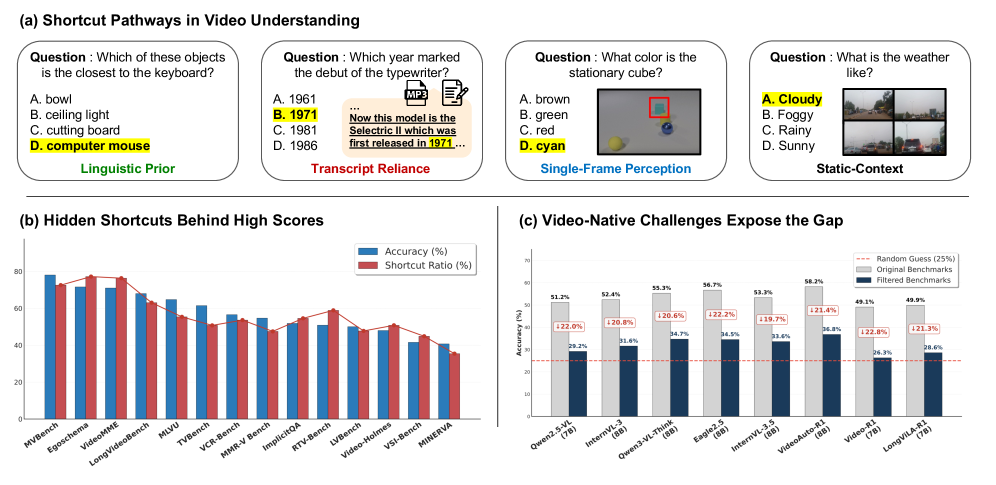
Video-QA benchmarks routinely report strong Video-LLM scores, but it is unclear whether those scores measure spatio-temporal perception, linguistic priors, or annotation artifacts. Video-Oasis is not a new benchmark; it is a diagnostic suite that audits existing benchmarks by stripping away modalities and temporal structure, then measuring whether questions remain solvable. The audit finds that 55% of samples across 14 curated benchmarks are shortcut-solvable, and once those are removed, state-of-the-art models sit only marginally above chance on the residual video-native subset.
Diagnostic protocol
The suite formalizes three dependencies that a genuine video-understanding sample should exhibit: visual evidence, temporal context, and reliable annotation.
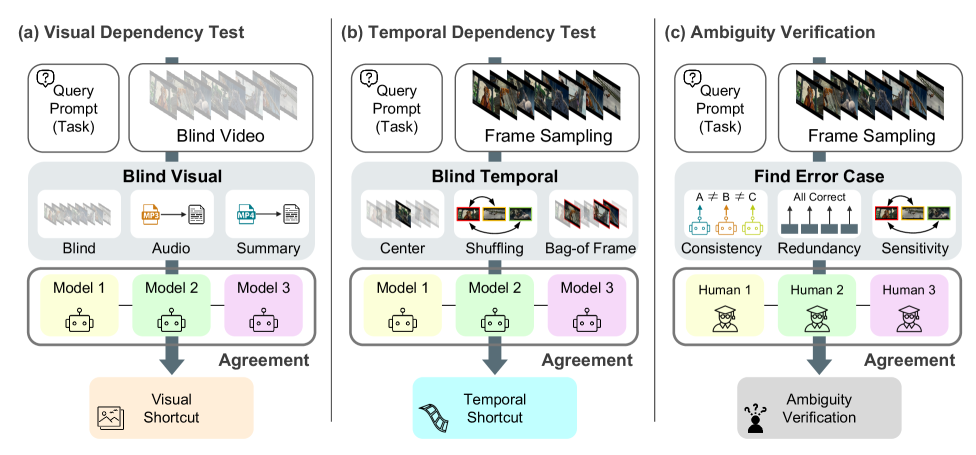
For visual dependency, each sample is re-run under three degraded inputs: (i) Blind (question and options only), (ii) Audio (ASR transcript replaces video), and (iii) Summary (a sequence of frame captions extracted at fixed intervals). If any of these text-only variants yields the correct answer, the sample cannot certify grounded visual perception.
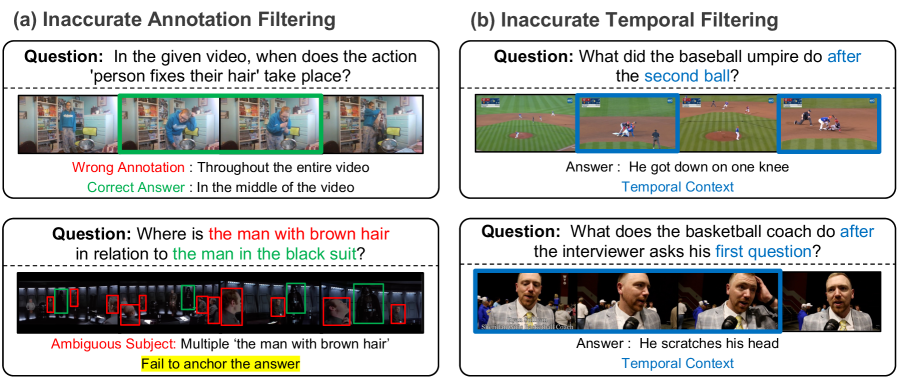
For temporal dependency, the tests are (i) Center-Frame (single middle frame), (ii) Frame Shuffling (random temporal permutation), and (iii) Bag-of-Frames — top-k frame retrieval against the query with a frozen CLIP-family encoder that has no temporal ordering. Formally, BoF selects \mathcal{F}_k = \operatorname*{top-}k_{f \in V}\ \cos\!\big(\phi_v(f), \phi_t(q)\big), and the model answers from \mathcal{F}_k alone. Success under BoF means the task collapses to unordered similarity matching rather than temporal reasoning.
For annotation reliability, three checks flag samples for manual review: Consistency (disagreement across a pool of strong Video-LLMs signals ambiguity), Redundancy (solvable from arbitrary segments implies broken temporal grounding or a global-bias question), and a manual restoration pass. The frame-shuffling filter itself is imperfect: some questions truly require ordering but are correctly answered even when shuffled because the correct option is inferable from set-of-events content; those are restored manually.
What survives, and what remains hard
Applied to 24,416 QA pairs across 14 benchmarks, Video-Oasis retains 11,033 pairs (4,938 unique videos), a 55% reduction. Rather than inventing a taxonomy, the authors cluster surviving samples bottom-up: Gemini-2.5-Pro proposes clusters from source metadata, and an ensemble of five proprietary LLMs (GPT-4o, GPT-5, o4-mini variants) votes with a 3-of-5 agreement rule, leaving only 122 samples for manual labeling. The result is five capability categories: Fine-Grained Perception, Spatial World Understanding, Temporal Dynamics and Tracking, Causality and Logical Reasoning, and Global Narrative.
On this distilled subset, top Video-LLMs are close to random. Eagle2.5 reaches 31.5% overall (25.0 fine-grained perception, 29.4 spatial, 34.9 temporal dynamics, 30.5 causal, 25.7 global narrative). Qwen3-VL-Instruct reaches 27.8% overall. Given typical 4-way multiple choice, these numbers are just above the 25% chance floor for most categories.
Algorithmic probe: temporal grounding
Because the distilled challenges enforce spatio-temporal dependence, they form a clean testbed for design choices. The authors ablate temporal grounding via AKS, retrieving the 16 most relevant frames. Gains are consistent but modest: Eagle2.5 improves 31.5 → 32.9 (+1.4), Qwen3-VL-Instruct 27.8 → 30.1 (+2.3).
The question is whether the ceiling reflects reasoning weakness or grounding weakness. An oracle experiment on 2,945 QA pairs from ImplicitQA and KFS-Bench (1,060 Video-Oasis-distilled, 1,885 shortcut) with ground-truth temporal regions disentangles them. On distilled samples, Eagle2.5 rises from 35.0% to 50.8% with oracle grounding, a 15.8-point jump; on shortcut samples the same intervention moves accuracy only from 78.0% to 80.8%. Per-category oracle gains on the distilled set are striking: Temporal Dynamics 40.5 → 61.3, Global Narrative 16.0 → 48.0, Fine-Grained Perception 37.2 → 50.4. This shows that (i) shortcut samples inflate scores while masking grounding failures, and (ii) on the genuinely video-dependent subset, imperfect temporal localization — not reasoning alone — is a dominant bottleneck. AKS-style top-k retrieval closes only a small fraction of the oracle gap.
Limitations
The Audio and Summary probes rely on off-the-shelf ASR and captioning; a sample could be misclassified as “text-solvable” only because a strong captioner leaked visual content, or conversely, escape the filter because captioning missed a cue. The BoF probe depends on CLIP-family encoders and inherits their biases toward salient object semantics; it may under-flag samples where a stronger retriever would suffice. The five-category taxonomy, though derived bottom-up, still forces each sample into one primary label. Finally, the audit shows models fail, but not why — the oracle experiment implicates grounding but leaves open whether visual encoders, temporal token budgets, or training objectives are the dominant limit.
Why this matters
If more than half of current video-QA is answerable from a blind LLM, a caption stream, or shuffled frames, then leaderboard progress on Video-LLMs is partly measuring linguistic priors and retrieval, not spatio-temporal understanding. Video-Oasis provides a reusable audit that turns any existing benchmark into a stricter one and localizes where the remaining gap lies — for now, largely in temporal grounding.
Source: https://arxiv.org/abs/2603.29616
UniClawBench: A Universal Benchmark for Proactive Agents on Real-World Tasks
Problem
Existing agent benchmarks — WebArena, OSWorld, AgentBench, and their descendants — organize evaluation around application domains (shopping, travel) or interaction surfaces (browser, desktop). When an agent fails at “book a flight,” the failure could stem from any of: tool-selection error, insufficient environment exploration, dropped state in a long context, misread of a screenshot, or lost coordination across apps. Domain-based taxonomies conflate these axes, so aggregate scores do not localize the bottleneck. Two further defects: (i) sandboxed, pre-recorded ground-truth answers cannot capture the space of valid trajectories in a live system, and (ii) single-turn evaluation ignores that real users iterate on agent output. UniClawBench targets both issues with a capability-partitioned task set and a closed-loop, container-based grading protocol.
Method
Capability taxonomy. 400 bilingual tasks are partitioned by primary bottleneck capability — the capability whose absence blocks completion — into five categories: Skill Usage, Exploration, Long-Context Reasoning, Multimodal Understanding, and Cross-Platform Coordination. Skill-usage tasks bundle explicit tools/APIs (OCR of boarding passes, SQLite queries, Docker/Git audits, Mermaid generation, audio transcription) with fixture data, so that a plausible-sounding textual answer without invoking the declared tool fails checkpoints. Exploration tasks withhold the tool interface and force environment probing. Long-context tasks inflate input sizes and require chained evidence. Multimodal tasks demand grounding on non-textual artifacts (screenshots, images, audio). Cross-platform tasks require consistent state manipulation across multiple applications.
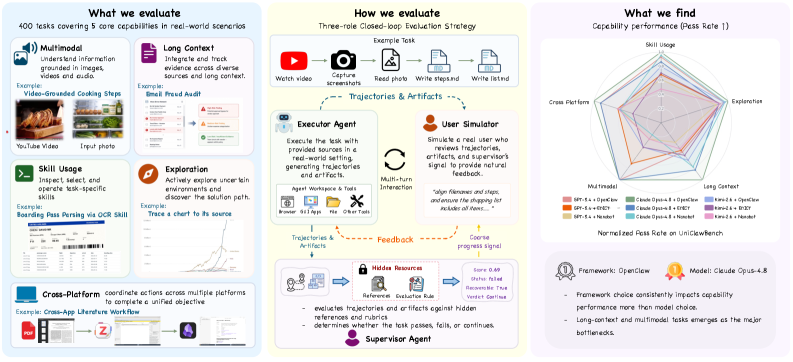
Application-domain, input-format, and output-format distributions are spread deliberately to prevent scenario overfitting from producing spurious capability wins.
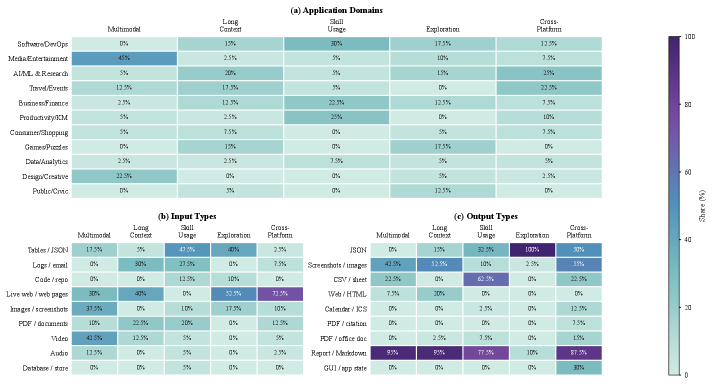
Three-role closed loop. The core evaluation mechanism decouples three agents behind an information firewall:
- Executor — the model under test — receives only public inputs: user instruction, tool descriptions, working files, web access. It operates inside a per-task Docker container (2GB RAM allocation).
- Supervisor — a hidden Codex/GPT-5.4-based agent with high reasoning effort — has access to private references and fine-grained checkpoint rubrics. It ingests the executor’s trajectory and produced artifacts and emits a structured state s \in \{\text{pass}, \text{fail}, \text{continue}\} plus a checkpoint score.
- User Simulator — also GPT-5.4 — sees only a coarse progress signal from the supervisor (not the rubric) and generates natural-language follow-up feedback grounded solely in visible evidence.
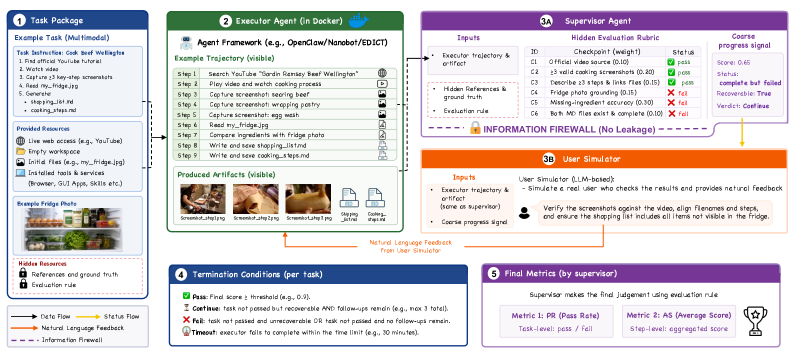
The firewall is the mechanically important part: without it, a strong simulator would leak the private grading criteria back to the executor, collapsing multi-turn evaluation into an oracle-in-the-loop pipeline. Each task allows up to two follow-up interactions after the initial instruction. Screenshots from executor turns are not injected into the supervisor’s context by default — they are stored as inspectable files and pulled on demand, which controls context bloat for long trajectories.
Timeouts and scoring. Standard tasks: 30 min global / 20 min per turn. Long-context tasks: 45 min / 30 min. On timeout, the task is credited with the maximum checkpoint score achieved among completed turns, rather than being zeroed — this decouples wall-clock efficiency from partial capability signal. Reported metrics are Pass Rate (PR, fraction reaching terminal pass) and Average Score (AS, mean checkpoint score).
Experimental setup
Two studies: (1) ten executor models under a fixed framework (OpenClaw v2026.3.11) to isolate model-level differences; (2) three representative models evaluated across OpenClaw, Nanobot v0.1.5.post3, and EDICT to isolate framework effects. All runs share tasks, rubrics, and scoring pipeline. Each framework is provisioned with the same baseline skills — an in-house apt skill, DuckDuckGo search, Web Search, an Agent-Browser skill, and Desktop Control — with the OpenClaw browser extension removed for parity across GUI/browser handling. Hardware: Intel i7-13700, 16GB host RAM, 2GB per Docker container. Mean task runtime is 17.4 minutes.
Limitations and open questions
The abstract and available sections describe the benchmark and protocol but the excerpt does not disclose the per-model PR/AS numbers, so I cannot cite specific model scores here. Several methodological questions remain worth pressing: (i) the supervisor is itself a GPT-5.4 agent, so systematic supervisor biases (e.g., favoring verbose, well-formatted artifacts) will propagate into scores — no inter-supervisor reliability figures are reported in the excerpt; (ii) the coarse progress signal exposed to the user simulator is described qualitatively but its bit-rate is not formalized, and information leakage through it is difficult to bound; (iii) the “capability primary bottleneck” assignment is a human judgment call, and cross-capability entanglement almost certainly survives it (a multimodal task with a large PDF is also long-context); (iv) 2GB containers and 30–45 min timeouts will penalize models that spawn heavy subprocesses (video encoding, larger local LLMs as tools), independently of reasoning ability; (v) crediting maximum-turn checkpoint score on timeout blurs the distinction between “reached the answer efficiently” and “eventually approximated it,” which AS as a metric does not surface.
Why this matters
Capability-partitioned evaluation with hidden rubrics and a firewalled user simulator is the right structural move for diagnosing where proactive agents actually break, rather than producing yet another domain-averaged leaderboard number. If the closed-loop protocol holds up under adversarial probing of the firewall, UniClawBench provides a template other agent benchmarks should adopt.
Source: https://arxiv.org/abs/2607.08768
LongE2V: Long-Horizon Event-based Video Reconstruction, Prediction, and Frame Interpolation with Video Diffusion Models
Problem
Event cameras output sparse asynchronous brightness-change streams with microsecond latency and high dynamic range, but reconstructing dense video from them is ill-posed: events encode gradients, not absolute intensities, and texture in low-motion regions is essentially unobserved. Two failure modes dominate the literature. Regression-based approaches (E2VID+, ET-Net) minimize pixel losses and collapse to conditional means, producing blurry textures. Generative approaches based on video diffusion produce sharp frames but drift over long horizons — errors compound across autoregressive windows, and the model has no anchor to correct them. Frame interpolation between two RGB anchors adds a further constraint that most reconstruction pipelines cannot honor bidirectionally.
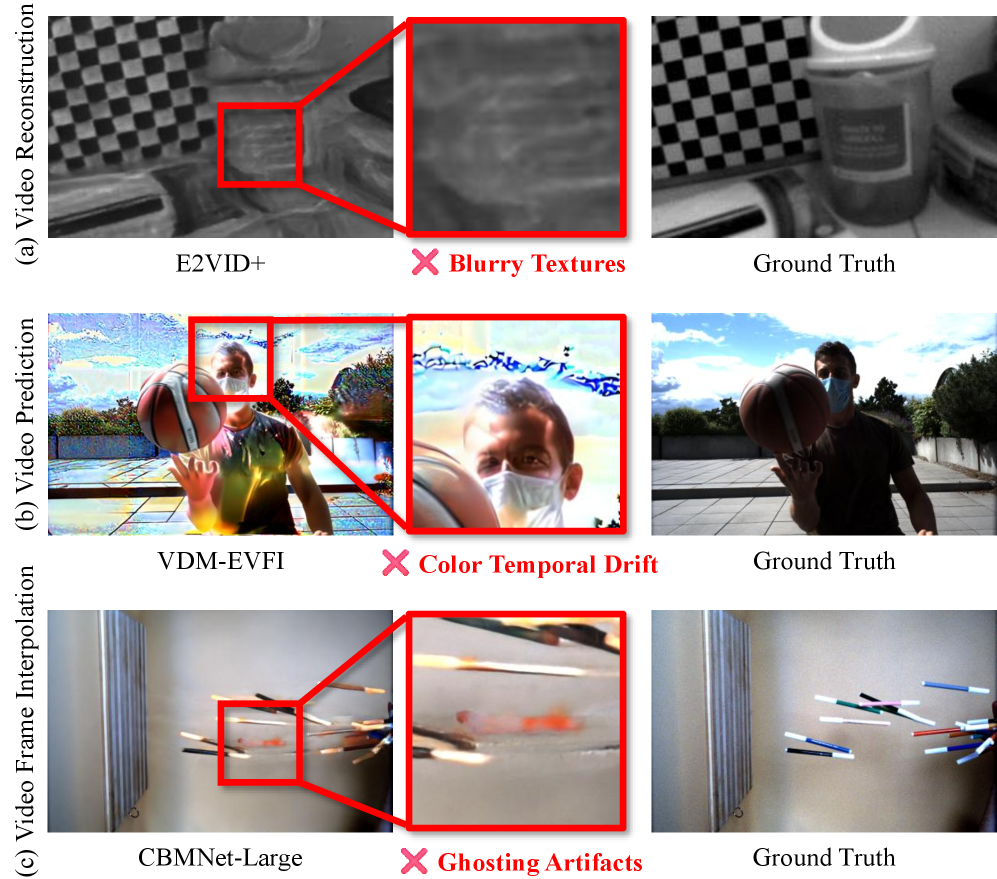
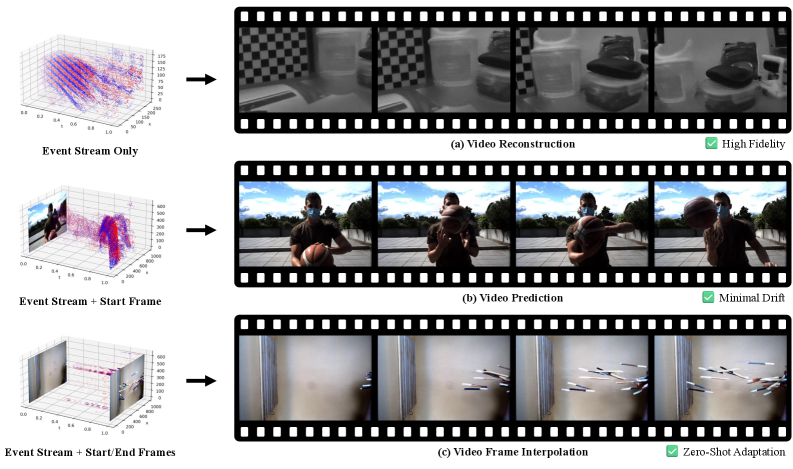
LongE2V unifies reconstruction, prediction, and interpolation under a single fine-tuned CogVideoX I2V backbone and targets the long-horizon stability problem head-on.
Method
Backbone. CogVideoX I2V provides the diffusion prior: a 3D VAE with 4\times temporal and 8\times spatial compression encodes video X to latents Z_0, and a DiT \epsilon_\theta is trained with
\mathcal{L} = \mathbb{E}_{Z_0, t, C, \epsilon}\left[\|\epsilon - \epsilon_\theta(Z_t, t, C)\|_2^2\right],
where the conditioning C carries (i) an event voxel grid, (ii) one or two anchor frames (start-only for prediction, start+end for interpolation, none beyond an initial seed for pure reconstruction), and (iii) previously generated context frames for autoregressive continuation.
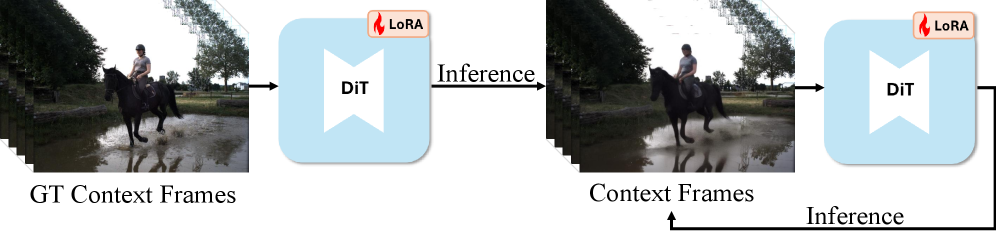
Autoregressive Unrolling. The core stability contribution is a training-inference alignment scheme. Standard teacher-forced training conditions on ground-truth context frames; at inference the model sees its own outputs, and the domain gap accumulates. LongE2V first trains to convergence with GT context, then activates an unrolling phase: an inference pass generates predicted frames, those replace the GT context, and the model is fine-tuned on this self-generated distribution. This is essentially DAgger/scheduled-sampling adapted to latent video diffusion.
Adaptive Context Switching. Complementing unrolling, the model dynamically selects which prior frames enter the context window during long-horizon rollouts, presumably favoring frames whose voxel evidence is strong and de-emphasizing frames where cumulative drift is high. Together these two mechanisms are what keep long sequences (thousands of frames on MVSEC/HQF) from collapsing.
Reencoding Alignment with Cross Residual Correction. For frame interpolation between two anchors, naive conditioning does not guarantee that the generated endpoint latents match the encoded anchor latents. LongE2V reencodes anchors into the latent space used by the DiT and applies a cross residual correction to enforce bidirectional consistency — the forward chain from the start anchor and the backward chain toward the end anchor are reconciled via residuals rather than hard clamps, avoiding the discontinuities that hard replacement causes.
Event Voxel Density Augmentation. Sensor resolutions and event rates vary dramatically across datasets (ECD, MVSEC, HQF, BS-ERGB). During training the voxel density is stochastically perturbed so the DiT does not overfit to BS-ERGB’s rate statistics. This is what enables zero-shot transfer to MVSEC and HQF, which are never seen at training time.
Results
Training uses only the BS-ERGB training set (after filtering) and evaluates zero-shot on the EVREAL protocol over ECD ($$300 frames), MVSEC (up to 2,740 frames), and HQF (up to 2,430 frames), plus BS-ERGB test and HQF for interpolation. The temporal ranges here are the critical stress test: methods that look competitive on short ECD clips typically fall apart on MVSEC/HQF long sequences due to drift accumulation.
Across all three tasks — reconstruction, prediction, and interpolation — the paper reports state-of-the-art perceptual quality with pronounced margins on the long sequences, and the ablations attribute the long-horizon stability specifically to Autoregressive Unrolling plus Adaptive Context Switching. Interpolation gains on HQF are attributed to Reencoding Alignment + Cross Residual Correction. Zero-shot generalization across ECD/MVSEC/HQF, all captured with different sensors than BS-ERGB, validates the voxel density augmentation.
Limitations and open questions
- Inference cost is not addressed in the excerpt but is presumably dominated by iterative DiT denoising over a 3D VAE latent — orders of magnitude slower than regression baselines like E2VID+. Real-time event-camera applications (SLAM, robotics) are out of reach.
- Autoregressive Unrolling requires an inference pass in the training loop, which is expensive; the schedule for when to switch from GT to rolled-out context is a hyperparameter the paper likely tunes empirically.
- The method inherits CogVideoX’s biases: it may hallucinate plausible textures that are not actually supported by the event stream, which matters for scientific or safety-critical uses.
- Evaluation on synthetic-vs-real robustness under extreme lighting (the regime where event cameras are most useful) is not shown in the excerpt.
- Bidirectional consistency via cross residual correction is a soft constraint; the paper does not report exact anchor reconstruction error at interpolation endpoints.
Why this matters
Event-to-video is a canonical sparse-conditioning inverse problem, and LongE2V demonstrates that pre-trained video diffusion priors — combined with an unrolled training loop that closes the teacher-forcing gap — can produce temporally coherent thousand-frame reconstructions from a single backbone across three tasks. The Autoregressive Unrolling recipe is likely transferable to any long-horizon conditional video generation task where drift is the dominant failure mode.
Source: https://arxiv.org/abs/2607.08770
Enhancing In-context Panoramic Generation via Geometric-aware Pretraining
Panoramic image generation with equirectangular projection (ERP) presents two structural challenges that standard text-to-image diffusion models handle poorly: (i) horizontal wrap-around continuity (the left and right image edges must join seamlessly), and (ii) severe latitude-dependent distortion near the poles. Existing panoramic generators typically either fine-tune a pretrained T2I model without addressing geometry, or bolt on task-specific heads for outpainting/inpainting. Canvas360 targets a unified in-context formulation where text-to-panorama, style transfer, inpainting, outpainting, and editing all share one model, and where the base model is pretrained to be geometry-aware before task-specific supervision.
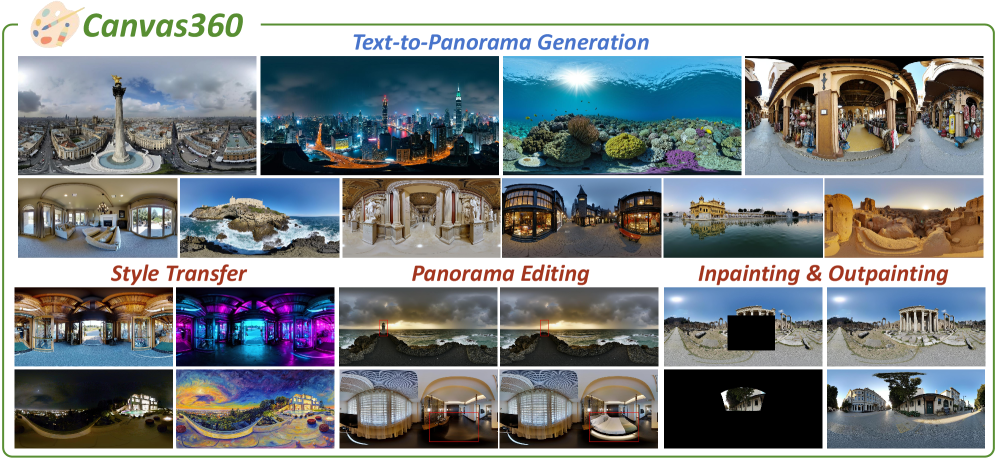
Dataset construction
The authors build Canvas360Dataset, a 1M-sample corpus split into 100K RGB–depth panorama pairs for geometric pretraining and 900K in-context task samples covering four downstream operations. The task splits are generated procedurally (see the synthesis pipeline below): style transfer uses FLUX.2-dev to render 12 stylistic variants of source panoramas; outpainting is constructed by sampling random camera intrinsics/extrinsics to project perspective-view masks onto the ERP canvas, producing realistic partial-view conditioning; inpainting uses random rectangular crops on the ERP directly; editing uses paired edits with textual instructions.
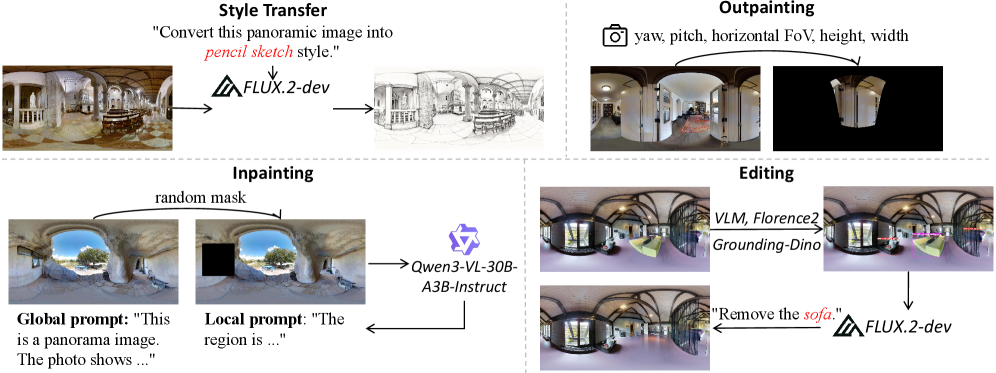
This procedural construction is important because pixel-aligned paired panoramic training data at this scale essentially did not exist previously.
Method
Canvas360 is built on FLUX.1-dev and fine-tuned with LoRA. The base objective is standard rectified flow matching. With x_0 \sim \pi_0 (data) and x_1 \sim \pi_1 (Gaussian noise),
x_t = (1-t)x_0 + t x_1, \quad t\in[0,1],
and the velocity network v_\theta is trained via
\mathcal{L}(\theta) = \mathbb{E}_{t,x_0,x_1}\left[\|v_\theta(x_t,t) - (x_1 - x_0)\|^2\right].
The DiT backbone uses 3D RoPE indexed by (T,H,W), which the authors exploit for in-context generation by concatenating reference and target latents along the T axis — a token-level concatenation strategy that generalizes cleanly across the four downstream tasks without task-specific architecture changes.
Three geometry-aware modifications are introduced during Stage-1 pretraining on the 100K RGB–depth pairs:
Parallel depth generation. Rather than only modeling RGB, the model jointly generates depth and RGB tokens in parallel branches. Depth supervision forces the latent representation to encode 3D structure, which propagates back into RGB generation quality — particularly at the poles where monocular cues from panoramas are ambiguous.
Velocity circular padding. To enforce ERP wrap-around at the field level, the predicted velocity v_\theta(x_t,t) is circularly padded along the horizontal (longitude) axis before the loss is computed. This means gradients from tokens near \phi=0 and \phi=2\pi actually enforce continuity, rather than the model having to learn the wrap statistically. It is a simple modification but structurally correct for ERP.
Similarity loss regularization. An auxiliary similarity term regularizes features to be geometrically consistent under the equirectangular parameterization, targeting object distortion consistency across latitudes.
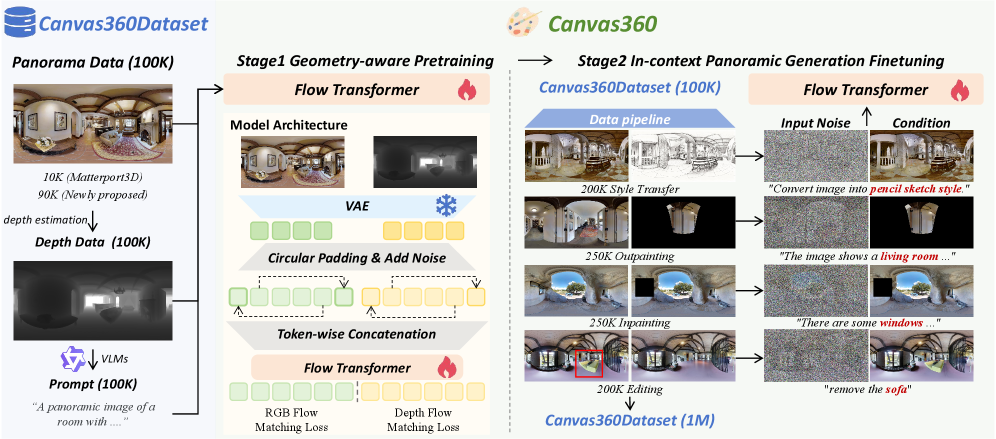
Stage 2 then fine-tunes on the 900K in-context samples using token concatenation along T: reference panorama tokens + optional mask + target tokens are jointly attended, and the same velocity objective supervises the target region.
Results
On text-to-panorama generation using the Matterport benchmark, Canvas360 essentially ties DiT360 for the state of the art and beats all earlier baselines (PanFusion, SMGD, PAR, WorldGen, LayerPano3D, HunyuanWorld). Selected numbers:
- FID: 44.17 (vs. DiT360 42.88, next best LayerPano3D 62.82, PanFusion 124.87).
- FID_pole (fidelity at the poles, where distortion is worst): 51.02 (DiT360 50.88, SMGD 65.69, PanFusion 182.09) — a large gap versus non-geometry-aware baselines.
- FID_equ (equatorial region): 25.96 (DiT360 24.77, PAR 27.39).
- FAED: 2.33, best across all methods (DiT360 and HunyuanWorld both 2.91).
- IS: 1.76, best (DiT360 1.60, HunyuanWorld 1.53).
- QA_aesthetic: 4.20, best (DiT360 4.19, LayerPano3D 3.93).
- NIQE: 3.70, best (DiT360 3.72).
CLIP-Score is 34.62 (HunyuanWorld leads at 34.73). BRISQUE is 17.12, worse than DiT360’s 10.25 but far better than most baselines (PanFusion 27.38, HunyuanWorld 39.12). The FID_pole improvement from ~65–180 down to ~51 is the most telling signal that parallel depth pretraining and circular velocity padding are doing real work at the geometrically hard regions.
Limitations
The paper does not report ablations in the excerpt separating the three pretraining components (parallel depth vs. circular padding vs. similarity loss), so the individual contribution of each is unclear. BRISQUE regression versus DiT360 suggests some perceptual quality tradeoff, possibly from the depth branch competing with RGB capacity under a LoRA budget. Evaluation of the in-context downstream tasks (inpainting/outpainting/editing/style) is not shown in the provided sections — only text-to-panorama numbers are reported. The dataset is procedurally generated (FLUX.2-dev for stylization, random camera sampling for outpainting masks), which risks train-time distribution biases in the stylistic and geometric coverage. Finally, everything is on top of FLUX.1-dev via LoRA, so how much of the panoramic prior transfers to smaller backbones is untested.
Why this matters
Panoramic generation has been fragmented across bespoke architectures per task; Canvas360 shows that token-level concatenation on a DiT with 3D RoPE, combined with cheap but geometrically correct pretraining choices (circular padding of velocity, joint depth supervision), is enough to unify the family of ERP generation tasks with SOTA-level fidelity. The FID_pole improvement in particular is a clean demonstration that respecting the ERP manifold at the loss level, rather than only in data augmentation, meaningfully reduces pole distortion.
Source: https://arxiv.org/abs/2607.08765
Hacker News Signals
Meta reuses old RAM in new servers with custom bridge chip
Meta built a custom CXL ASIC to allow DDR4 memory modules harvested from decommissioned servers to operate inside new DDR5-native systems. The bridge chip translates between the DDR5 memory controller interface on current-generation CPUs and the DDR4 electrical and protocol signaling of the recycled DIMMs, presenting the old memory to the host over CXL as a memory expander device.
The engineering challenge is non-trivial. DDR4 and DDR5 differ not only in voltage levels and pin counts but in the training sequences, on-die termination schemes, and command/address encoding. The CXL bridge must handle the protocol translation with latency low enough that the memory remains usable for production workloads — CXL.mem latency is already elevated relative to local DRAM (typically 100–200 ns additional round-trip), so the bridge adds another translation penalty on top.
From a systems architecture standpoint, the recycled DDR4 capacity appears as a CXL Type 3 memory device. The host OS or hypervisor can tiered-memory-manage it: hot pages stay in the local DDR5, cooler pages get migrated to CXL-attached DDR4. Linux’s NUMA balancing and DAMON-based tiering both support this topology with appropriate configuration.
The economic motivation is straightforward. DDR4 modules from a server refresh cycle still have significant remaining lifespan but zero resale value at Meta’s scale — the secondary market cannot absorb millions of DIMMs. Rather than write them off, the bridge chip allows them to contribute capacity in a CXL tier. Given that Meta’s infrastructure operates in the millions of nodes, even modest per-node DRAM cost reduction compounds enormously.
Open questions include how the bridge handles error correction across the DDR4/DDR5 boundary, whether the CXL fabric introduces meaningful tail latency for memory-bandwidth-sensitive ML training jobs, and what the failure-rate profile of the DDR4 inventory looks like after initial screening.
AI-generated videos to maximally drive a target brain region
The NEVO project (Neural Evolution of Videos and Objects) at EPFL uses a closed-loop optimization loop to synthesize video stimuli that maximally activate a specified region of interest in a biological neural system — currently demonstrated with in-vivo electrophysiology and fMRI targets. The approach is a neuroscience application of the “brain-score” and “activation maximization” paradigm, extended from static images to dynamic stimuli.
The pipeline works roughly as follows: a generative video model produces candidate stimuli parameterized by a latent vector; neural responses are measured from the target brain region under those stimuli; a black-box optimizer (typically a genetic algorithm or Bayesian optimizer operating in the latent space) updates the latent to maximize the measured response. Iteration over many rounds converges toward stimuli that are highly effective at driving the target region.
This is scientifically interesting because it is model-free with respect to the brain — you do not need a hand-crafted forward model of V1 or MT to find effective stimuli for those areas. The optimizer treats the brain as an oracle. The video generative model provides a structured, smooth latent space to search over, which is far more tractable than searching pixel space directly.
Methodological concerns worth noting: the closed-loop approach requires many repeated neural measurements per optimization round, which is expensive in animal preparations and practically constrained in human fMRI (low temporal resolution, high noise). The optimized stimuli are also specific to the optimization target — they may not generalize to a theory of what the region computes. There is also a confound risk if the generative model’s prior biases the search toward stimuli that are already naturalistic and high-energy, which may correlate with neural response for unrelated reasons.
The broader implication is a tool for characterizing neural selectivity without requiring experimenters to prespecify a stimulus space, which is valuable for higher cortical areas with poorly understood tuning.
Source: https://nevo-project.epfl.ch/
My thoughts on the Bun Rust rewrite
Andrew Kelley (author of Zig) responds to the announcement that Bun is rewriting performance-critical components in Rust, having previously used Zig. His post is a technical critique framed around the tradeoffs between Zig and Rust for systems-level JavaScript runtime work.
The core technical points Kelley makes: Rust’s borrow checker imposes architectural constraints that push programmers toward allocation patterns (e.g., excessive Arc<Mutex<T>>) that hurt performance in exactly the low-latency paths a JS runtime cares about. Zig, by contrast, gives the programmer direct control over allocators and data lifetimes without a compiler-enforced ownership model, which Kelley argues is more appropriate when you already understand the lifetimes at design time. He also raises that Zig compiles faster than Rust, which matters for developer iteration in a large codebase.
The counterargument from the Bun team’s perspective (inferred from context) is practical: Rust has a vastly larger ecosystem of audited, production-quality crates, particularly for cryptography, HTTP parsing, and compression — exactly the libraries a runtime needs. Rewriting those in Zig from scratch is a large ongoing maintenance burden. Rust also has broader hiring and contributor availability.
Kelley’s deeper concern is about incentives in the ecosystem: Rust’s momentum creates a gravity well where infrastructure projects default to Rust even when the safety guarantees are redundant (because the code is already carefully audited) and the ergonomic costs are real. He argues this crowds out languages like Zig that offer a different, sometimes better tradeoff point for certain problem classes.
The HN discussion is predictably large (626 comments) and covers allocator APIs, comptime vs. macros, undefined behavior handling, and whether Zig is production-ready. The technically interesting sub-thread concerns Zig’s comptime vs. Rust’s const generics for zero-cost abstractions over allocators.
Source: https://andrewkelley.me/post/my-thoughts-bun-rust-rewrite.html
Show HN: Microsoft releases Flint, a visualization language for AI agents
Flint is a domain-specific language from Microsoft designed to let AI agents produce structured chart/visualization specifications that can be rendered deterministically in a browser. It sits between “ask the model to write D3.js” (too unconstrained, hallucination-prone) and “ask the model to fill a Vega-Lite template” (too rigid).
The technical design is a declarative schema for charts: the agent emits a JSON-like Flint document specifying chart type, data bindings, axes, marks, and layout. The Flint runtime interprets this and renders via a fixed visualization engine. This means the rendering is deterministic given the spec — the agent cannot accidentally produce broken JavaScript or introduce XSS via executable code generation.
The language design tradeoffs are worth examining. Constrained output schemas for agents are a known technique for improving reliability (cf. grammar-constrained decoding, JSON mode in OpenAI API). Flint extends this to a richer semantic domain where the constraint is not just syntactic validity but also chart semantics — it is harder to specify a logically incoherent chart because the schema enforces type relationships between data fields and visual encodings. Whether the schema is expressive enough to cover the long tail of useful visualizations without requiring escape hatches is the key open question.
The GitHub Pages deployment suggests this is at demo/preview stage. The practical integration pattern would be: agent produces Flint JSON as a tool call result; a frontend component renders it. This is roughly analogous to how code interpreters in LLM agents handle computation, but replacing arbitrary code execution with a sandboxed declarative renderer.
Limitations: the expressiveness ceiling of any fixed DSL means unusual chart types or custom interactions fall outside what Flint can specify. The language spec itself is not yet formally documented beyond examples.
Source: https://microsoft.github.io/flint-chart/#/
Why we built yet another Postgres connection pooler
PgDog is a new Postgres connection pooler written in Rust, and this post explains the architectural decisions that differentiated it from PgBouncer and Pgpool-II.
The primary technical motivation is transaction-mode pooling with correct handling of prepared statements. PgBouncer in transaction mode famously cannot support named prepared statements because the prepared statement is bound to a backend connection, but the frontend connection is reassigned to a different backend between transactions. PgDog solves this by maintaining a per-client prepared statement registry and reissuing PREPARE on the backend connection if the required statement is not already present — effectively caching and replaying prepared statement setup transparently.
The second differentiator is native sharding awareness. PgDog parses incoming query ASTs (using a Rust binding to the Postgres parser, pg_query) to extract the sharding key, then routes the query to the correct shard without requiring application-level changes. This is closer to what Citus or Vitess do for MySQL, but implemented in the pooler layer rather than requiring a modified server.
The Rust choice is motivated by async I/O performance: tokio-based async allows a small thread count to handle high connection concurrency, avoiding the per-process model of PgBouncer. The post includes benchmarks showing lower latency at high concurrency compared to PgBouncer in session mode, though the comparison is less clear-cut against PgBouncer transaction mode with simple queries.
Open questions: prepared statement cache invalidation when the schema changes, handling of SET commands and session-local state in transaction mode, and operational complexity of the sharding key configuration. The project is early but addresses real pain points in the Postgres connection management space.
Source: https://pgdog.dev/blog/why-yet-another-connection-pooler
TLS certificates for internal services done right
This post details running a private CA for internal service TLS rather than relying on self-signed certificates or disabling verification. The recommended stack is step-ca (from Smallstep) as the ACME-compatible private CA, combined with standard ACME clients (certbot, acme.sh, or the Caddy built-in) to automate certificate issuance and renewal.
The key insight is that the ACME protocol works identically against a private CA as against Let’s Encrypt, provided you configure the ACME directory URL to point at your internal CA and add the private root certificate to trust stores. This preserves the automation properties of public ACME (no manual cert management, automatic renewal) while operating entirely on RFC 1918 space without DNS-01 challenges that require public DNS.
The post covers the trust store distribution problem — the non-trivial part. For Linux hosts, updating /etc/ssl/certs and running update-ca-certificates is straightforward but must be baked into provisioning (Ansible, cloud-init). For containers, the base image must include the private root, which means maintaining a custom base image or injecting at startup. Browser trust for internal web UIs requires distributing the root to OS trust stores on developer machines, which is a policy and MDM problem.
Certificate profiles discussed include short-lived certs (step-ca supports 24-hour default lifetimes with automatic renewal), which reduce revocation infrastructure burden — if you cannot revoke reliably, issuing short-lived certs makes the revocation problem moot.
The alternative of using a public CA with internal-only subdomains via DNS-01 challenges (e.g., internal.example.com with a real cert) is also addressed: it leaks internal hostnames via Certificate Transparency logs, which is a real concern for some threat models.
Source: https://tuxnet.dev/posts/tls-for-internal-services/
OpenBSD has a use-after-free allowing local privilege escalation to root
CVE-2026-57589 is a use-after-free vulnerability in the OpenBSD kernel that allows a local unprivileged user to escalate to root. The NVD entry confirms it affects the kernel and is exploitable locally.
Use-after-free in a kernel context typically follows a pattern: a kernel object (socket, file descriptor, process structure) is freed while a reference to it persists in another data structure or a race window; the freed memory is reallocated for a different object; the stale pointer is then used, allowing the attacker to corrupt the new object’s contents. If the reallocated region is a privileged kernel structure (e.g., a proc struct’s p_ucred field), controlled writes through the stale pointer can set uid=0.
OpenBSD is notable for its security posture: pledge/unveil syscall restriction, W^X enforcement, aggressive ASLR, and a history of proactive auditing. A local privilege escalation to root is significant because it bypasses pledge (which restricts what a process can do, but the process must first gain root or kernel access to escape pledge constraints). It also matters for multi-user systems and for container-adjacent deployments where process isolation depends on UID separation.
The HN discussion focuses on whether the bug class implicates specific kernel subsystems (networking, VFS, or IPC) — the NVD entry at time of writing provides limited technical detail. OpenBSD’s development model means patches typically appear quickly once a CVE is issued, and the team’s track record on fast fixes is strong.
The broader point is that even heavily audited, security-focused kernels written in C accumulate memory safety bugs. This is a recurrent argument in the ongoing debate about kernel Rust adoption — OpenBSD has been more resistant to that direction than Linux.
Source: https://nvd.nist.gov/vuln/detail/cve-2026-57589
SWE-1.7: near GPT-4.5 and Claude Opus intelligence
Cognition’s SWE-1.7 is the latest iteration of their software engineering agent, built on top of their Devin infrastructure. The blog post positions it by benchmark score rather than architectural novelty — the headline claim is SWE-bench Verified performance approaching GPT-4.5 and Claude Opus levels on coding and software engineering tasks.
The technical substance of the post is thin on mechanistic detail, which is a recurring pattern with agent-focused company announcements. What can be inferred: SWE-1.7 is likely a fine-tuned model (or ensemble) trained on software engineering trajectories with reinforcement learning from execution feedback — the same approach as SWE-agent and OpenHands research systems, but with proprietary training data and infrastructure. Cognition has emphasized long-horizon planning and persistent context management as differentiators in prior releases.
SWE-bench Verified is the current standard benchmark for this class: 500 real GitHub issues from open-source Python repositories, each requiring the agent to produce a patch that passes the associated test suite. Scores above 50% are now achievable by leading systems; the gap between models has compressed significantly over the past year.
The competitive framing against GPT-4.5 and Opus is meaningful mainly because those are frontier general-purpose models, not agents specialized for SWE tasks. If a specialized agent tuned for software engineering can match a general-purpose frontier model on engineering benchmarks, it suggests either that specialization is highly effective or that SWE-bench is becoming saturated as a discriminative benchmark.
Limitations: SWE-bench Verified covers a specific distribution (Python OSS repos, well-specified issues). Performance on enterprise codebases, long-context multi-file changes, or ambiguous specifications is not captured. The benchmark also does not measure cost, latency, or reliability in production use.
Noteworthy New Repositories
infracv/rf-detr-cpp
A production-ready C++/TensorRT inference engine for RF-DETR, targeting both object detection and instance segmentation workloads. The implementation wraps TensorRT engine building and execution, supporting FP32, FP16, and INT8 quantization paths, which gives a concrete latency/accuracy tradeoff ladder without changing model architecture. The codebase is structured around CUDA preprocessing pipelines — letterboxing, normalization, and NMS post-processing happen on-device to minimize PCIe transfer overhead. Jetson-specific support (Orin, AGX Thor) includes DLA offload hooks and appropriate memory pool configuration for the unified memory architecture on those SoCs. The engine serialization workflow lets you build once, deploy repeatedly, which matters for edge fleets where rebuild time is expensive. Compared to the reference Python/ONNX Runtime path, a TensorRT INT8 engine on an Orin typically yields 2-4x throughput improvement for detection workloads of this class. The repository includes calibration dataset tooling for INT8 quantization and example pipelines for both synchronous and asynchronous (CUDA stream) inference modes. Someone would pick this over a generic ONNX Runtime C++ wrapper when they need deterministic latency bounds and maximum utilization of NVIDIA-specific hardware features, particularly on Jetson where power envelopes are tight.
Source: https://github.com/infracv/rf-detr-cpp
ronak-create/FableCut
A browser-based video editor built with zero external runtime dependencies, designed so that AI agents can drive the editing pipeline programmatically. The core abstraction is a JSON timeline format that describes cuts, overlays, transitions, and audio mixing declaratively; both the human UI and the programmatic interface consume and emit the same schema. Automation surface is exposed via two channels: a Model Context Protocol (MCP) endpoint and a conventional REST API, so agents can issue edit commands through either path. The UI hot-reloads on timeline mutations, giving a live preview loop whether edits originate from a human or a script. The zero-dependency constraint means no FFmpeg subprocess shelling — encoding and decoding rely on the browser’s native WebCodecs and MediaRecorder APIs, which limits format support to what the browser exposes but eliminates binary bundling complexity entirely. The architecture is relevant for agentic workflows where an LLM needs to cut together video from a script without a human in the loop: the agent emits a JSON timeline, the REST endpoint applies it, and the MCP interface provides tool-call semantics compatible with Claude and similar models. The main engineering tradeoff is WebCodecs codec coverage versus the flexibility of a native FFmpeg pipeline.
Source: https://github.com/ronak-create/FableCut
Doriandarko/texts-to-transformer
A pedagogical and practical tool that trains a small Transformer language model from scratch using your iMessage SQLite database as the corpus, running entirely on Apple Silicon via Metal Performance Shaders. The pipeline extracts message text from the macOS chat.db file, tokenizes with a simple BPE or character-level scheme, and runs a GPT-style autoregressive training loop. The model is sized to fit in unified memory on M-series Macs — typically a few million parameters — making full training feasible in minutes rather than hours. The primary technical value is demonstrating the full stack: data extraction, tokenization, batched training with a causal attention mask, and inference, all in a single self-contained repository without cloud dependencies. From a privacy standpoint, everything is local and offline. The resulting model is obviously not useful as a general language model given the corpus size, but it is interesting for studying idiolect modeling and as a template for training on other small personal text corpora. The Metal backend means no CUDA dependency, which distinguishes it from most scratch-training tutorials. Someone would use this to understand the full training pipeline on hardware they already own, or as a starting point for personal-data fine-tuning experiments.
Source: https://github.com/Doriandarko/texts-to-transformer
mindmuxai/brain.md
A file-based persistent memory layer for coding agents, structured around a brain.md Markdown file that lives in a project repository. The design premise is that agents like Claude Code or OpenAI Codex lose architectural context between sessions; brain.md provides a durable store of decisions, constraints, requirements, and conventions that agents are instructed to read at session start and update as they work. The CLI is implemented with zero runtime dependencies, making installation a single binary copy or curl | sh. The Markdown format is intentional: it is human-readable, diffable, and can be reviewed and edited without tooling. The CLI provides commands to initialize the file, append structured entries (decisions, constraints, open questions), and query or summarize the current state. This is distinct from vector-store memory systems — there is no embedding, no retrieval index, and no probabilistic recall; the entire file is passed as context, which trades token cost for deterministic completeness. The approach is best suited for projects where the memory file stays small enough to fit in a context window, roughly under 10k tokens. It is complementary to code search tools rather than a replacement.
Source: https://github.com/mindmuxai/brain.md
raiyanyahya/recall
Recall addresses the same session-amnesia problem as brain.md but with a different implementation philosophy: it generates structured project summaries that are injected into Claude Code’s context at session initialization, keeping the memory entirely offline and local. The tool introspects the current repository — reading directory structure, git log, existing documentation, and optionally user-annotated notes — and builds a compact context document that Claude Code loads via its system-prompt or context-injection mechanism. No embeddings, no external service calls, no API keys required beyond the one you already use for Claude Code itself. The offline-only constraint is a deliberate security property: no project data leaves the machine. The summary format is tuned to be token-efficient while preserving the information an agent most needs: current objectives, recent changes, architectural decisions, and known constraints. At 695 stars it has attracted considerably more adoption than similar tools in this space, likely because the Claude Code integration path requires minimal configuration. The main limitation is that recall quality depends on how well-documented the repository already is; sparse repos with few comments produce thin summaries. Works on macOS and Linux; Windows support is partial.
Source: https://github.com/raiyanyahya/recall
gykim80/perfectpixel-studio
A desktop application for generating 2D character sprite sheets from text prompts, built with Wails (Go backend, React frontend) to produce a native binary with a web-technology UI. The generation pipeline takes a single text description of a character and produces a sprite sheet covering 8 cardinal/ordinal directions and over 100 animation actions (idle, walk, run, attack variants, etc.), which is the minimum set needed for most top-down or isometric game engines. The Go backend handles asset assembly, sprite sheet packing, and communication with the upstream image generation service; the React frontend provides a live preview grid. The 8-direction, multi-action combinatorial space is handled by conditioned generation with a structured prompt template per (direction, action) pair, so the underlying model is called many times per character. This means generation latency and cost scale with the number of frames requested. The Wails framework choice gives a smaller binary footprint than Electron and avoids the Node.js runtime dependency. For indie game developers, the value proposition is replacing hand-drawn sprite work for prototyping; the output quality depends entirely on the fidelity of the underlying image model to the pixel-art style conditioning. Export formats include standard sprite sheet PNG with accompanying JSON atlas metadata.
Source: https://github.com/gykim80/perfectpixel-studio
lidge-jun/opencodex
A provider-agnostic proxy server that exposes an OpenAI Codex-compatible API surface, allowing the Codex CLI, the Codex App, and the Codex SDK to route requests to any LLM backend — Anthropic, Gemini, local Ollama instances, or other OpenAI-compatible endpoints. The proxy translates between the Codex API schema and each backend’s wire format, handling differences in message structure, streaming chunked responses, and tool/function call syntax. This is useful because Codex CLI and related tooling are hardcoded to the OpenAI endpoint and authentication scheme; swapping the base URL to the proxy transparently redirects traffic. The implementation is a thin HTTP proxy with per-provider translation layers rather than a full semantic middleware stack, so latency overhead is minimal. Configuration is a YAML or environment-variable file specifying which backend to route to and what credentials to use. The main technical challenge handled here is streaming fidelity: Codex CLI depends on server-sent events with specific delta formats, and each upstream provider emits different SSE schemas. The proxy normalizes these to what the Codex toolchain expects. Useful for teams that want to evaluate different models through a unified interface, or for cost management by routing to cheaper providers for lower-complexity tasks.
Source: https://github.com/lidge-jun/opencodex
sums001/Windows-Copilot-API
This repository reverse-engineers the Windows Copilot internal HTTP protocol and wraps it in an OpenAI-compatible REST API, exposing GPT-4 and reportedly GPT-5 model access without requiring OpenAI API credentials or billing. The implementation captures and replays the authentication token flow that Windows Copilot uses internally — typically tied to a logged-in Microsoft account — and maps the /v1/chat/completions endpoint schema onto the underlying Copilot request format. With 1,087 stars it is one of the higher-traction repos in this batch. Technically, the approach is similar to other reverse-engineered wrapper projects (Bing Chat, Copilot Studio). The risk profile is straightforward: Microsoft can break the integration at any time by changing their internal API, rotating token formats, or adding additional device attestation checks. The project has no official relationship with Microsoft and operates in a legal gray area under the service terms. From an engineering standpoint it is interesting as documentation of the Copilot wire protocol and authentication flow, and as a case study in building OpenAI-schema-compatible adapters over non-standard backends. Not suitable for production workloads due to stability and ToS concerns, but useful for local experimentation or studying the protocol.