Daily AI Digest — 2026-07-08
arXiv Highlights
Hierarchical Sparse Attention Done Right: Toward Infinite Context Modeling
Problem
Chunk-wise sparse attention (BSA-style) routes each query to K historical chunks plus a local window, aiming for sub-quadratic long-context modeling. In principle this only loses quality if the wrong chunks are selected. In practice, every prior method scores chunks with non-parametric summaries (mean-pooled keys, first token, learned gating on top of frozen features) that do not track the true chunk mass
Z_{i,c} = \sum_{j\in\mathcal{T}_c}\exp(\mathbf{q}_i^\top \mathbf{k}_j/\sqrt{d}),
so top-K selection is systematically off, degrading quality at in-domain lengths and destroying length extrapolation. The paper’s core claim is that if you make chunk selection a differentiable, LM-loss-driven surrogate of \log Z_{i,c}, you recover full-attention quality at training length and get clean extrapolation to >64\times that length.
Method
HiLS-Attention replaces Z_{i,c} with a learned surrogate \hat{Z}_{i,c} derived from a Taylor linearization of LogSumExp. Proposition 3.1 gives:
\log\sum_{j\in\mathcal{T}_c}\exp\!\left(\tfrac{\mathbf{q}^\top\mathbf{k}_j}{\sqrt{d}}\right) \approx \tfrac{\mathbf{q}^\top \mathbf{k}'_c}{\sqrt d} + b'_c,
where the compressed key and bias are the attention-weighted key sum and the entropy of the same attention distribution, both produced by a single intra-chunk attention step \mathrm{Attn}(\mathbf{q}'_c,\mathbf{K}_c,\mathbf{K}_c):
\mathbf{k}'_c = \sum_j p_j \mathbf{k}_j,\quad b'_c = -\sum_j p_j\log p_j,\quad p_j\propto \exp((\mathbf{q}'_c)^\top\mathbf{k}_j/\sqrt d).
The bias term is the key subtle piece: it interpolates between \log S (uniform in-chunk distribution, so many tokens contribute mass) and 0 (single spike), which is precisely the correction a mean-pooled summary lacks. The proxy query \mathbf{q}'_c is instantiated as an appended landmark token per chunk, so it is learned end-to-end.
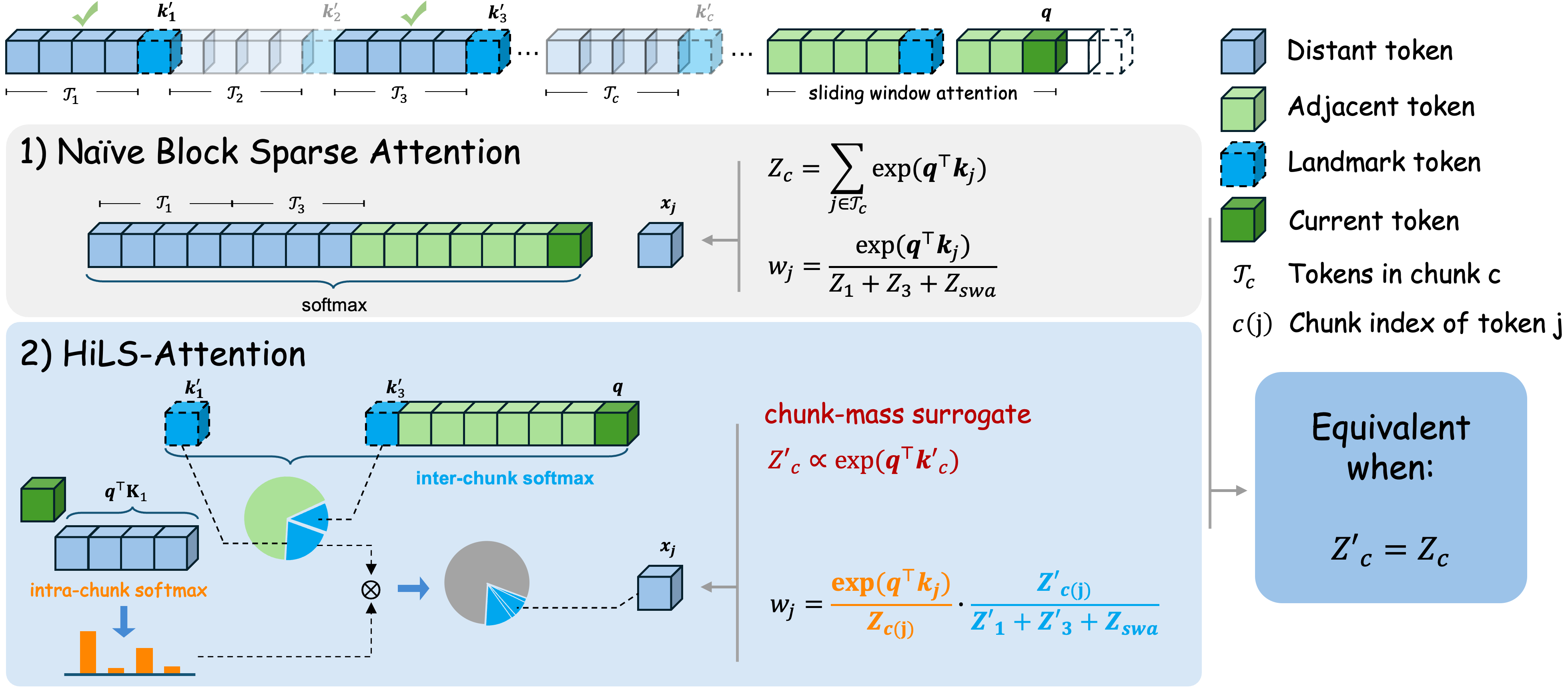
Given surrogate scores \hat{s}_{i,c} = \mathbf{q}_i^\top\mathbf{k}'_c/\sqrt d + b'_c, HiLS selects top-K chunks \mathcal{I}_i, but instead of collapsing them into a single flat softmax (as in BSA Eq. 3), it factorizes attention hierarchically: each query attends to each retrieved chunk independently to get a per-chunk output \mathbf{o}_{i,c}, and these are fused by weights derived from the retrieval scores themselves. Because \hat{s}_{i,c} enters the forward attention (not just as a gate outside the softmax), gradients from the LM loss flow through it, so chunk selection is trained natively rather than distilled from full attention.
Cost is O(S) per chunk for building (\mathbf{k}'_c, b'_c), i.e., O(N) total for summary construction, and O(NK S) for the sparse attention itself — independent of context length once K is fixed.
Practical choices
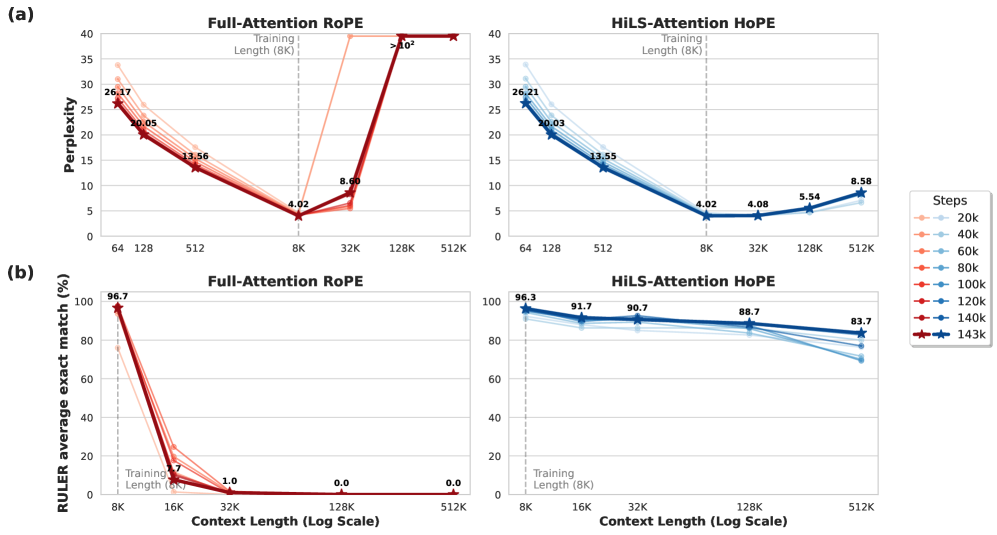
Two non-obvious design points matter. First, positional encoding: with vanilla RoPE at 8K training length HiLS underperforms full attention in PPL; swapping to HoPE (keep RoPE dims whose period \le pretraining length, NoPE the rest) flips the ordering. Second, they train natively sparse from scratch rather than converting a dense checkpoint, avoiding the usual retrieval-quality collapse when a dense model is retrofitted.
Results
At 345M (GPT-2 Medium config, 8K train length, 2K activation budget + 512 sliding window), HiLS matches or beats full attention in PPL and dominates BSA variants on in-context retrieval.
At 1.4B trained from scratch on 300B tokens, HiLS-Attn/HoPE and Full-Attn/RoPE track each other in PPL across context lengths and training steps, with HiLS attending to less than half the tokens. On RULER-style NIAH, HiLS maintains \ge 90\% retrieval accuracy at >64\times training context, while full attention degrades sharply past its training length — and this extrapolation gap is stable throughout training, not a transient artifact.
On downstream tasks (LAMBADA, HellaSwag, PIQA, WinoGrande, OpenBookQA, ARC-e/c), HiLS averages 49.06 vs. full attention’s 48.65, i.e., short-context quality is preserved.
Inference-side, benchmarked on H800 with SGLang using matched Triton kernels, HiLS’s cost is bounded by K\times\text{chunk} + W = 2048 + 512 tokens plus O(N) summary construction, so prefill grows near-linearly and per-token decode is essentially O(1). Crossover with full attention is around 16K; at 512K, HiLS is 13.5\times faster in prefill (5.0s vs 67.0s) and 15.7\times faster per decode step (5.5ms vs 85.9ms).
Limitations and open questions
The linearization is a first-order Taylor expansion of LogSumExp; when the intra-chunk attention distribution is highly peaked and the peak differs across queries, a single \mathbf{q}'_c (one landmark per chunk) is a fixed proxy and may misestimate mass for queries whose relevance pattern differs from the landmark’s. This is only tested with fixed K=32 and chunk size 64; the interaction between S, K, and effective long-range mixing is not swept at scale. Training is from scratch — the arguably more important question of whether existing dense checkpoints (Qwen3, Llama) can be converted without quality regression is not addressed. Finally, “64\times extrapolation” is measured on RULER NIAH; whether the retrieval accuracy translates to reasoning-heavy long-context tasks (long-doc QA, code repos, agent traces) is untested here.
Why this matters
HiLS is the first chunk-wise sparse attention where the chunk-selection scores are provably a tractable surrogate for the true LogSumExp chunk mass and are trained directly by the LM loss, and it holds up at 1.4B/300B-token scale with matched quality and >13× long-context serving speedups. If it composes with existing dense checkpoints via short continued pretraining, it becomes a drop-in replacement for full attention in long-context serving.
Source: https://arxiv.org/abs/2607.02980
Nemotron-Labs-Diffusion: A Tri-Mode Language Model Unifying Autoregressive, Diffusion, and Self-Speculation Decoding
Problem
Autoregressive decoding is memory-bandwidth-bound at low concurrency, while masked-diffusion LMs promise parallel token emission but historically trail AR models in accuracy and often lack a clean path to left-to-right generation. Prior hybrid approaches (block-diffusion, SDAR, Dream) choose one regime at training time and inherit its deployment tradeoffs. Nemotron-Labs-Diffusion asks whether a single set of weights can serve both regimes without loss, and additionally support self-speculative decoding where the same model drafts (diffusion) and verifies (AR).
Method
The model is trained on a joint objective
\mathcal{L}(\theta)=\mathcal{L}_{\text{AR}}(\theta)+\alpha\,\mathcal{L}_{\text{diff}}(\theta),\quad \alpha=0.3,
with the AR term being standard next-token likelihood. The diffusion term uses block-wise absorbing diffusion: the sequence is partitioned into blocks \{x^b\}_{b=1}^{B}, one block is corrupted at noise level t\sim\mathcal{U}[0,1] via \tilde{x}^b_t\sim q(\cdot\mid x^b), and the loss is
\mathcal{L}_{\text{diff}}(\theta)=\mathbb{E}\!\left[-\tfrac{1}{t}\sum_{b=1}^{B}\log p_\theta(x^b\mid \tilde{x}^b_t, x^{<b})\right].
The 1/t weighting is the standard MDLM ELBO reweighting. Attention is bidirectional within the noisy block and causal across blocks, so clean prefix blocks retain a reusable KV cache during inference.
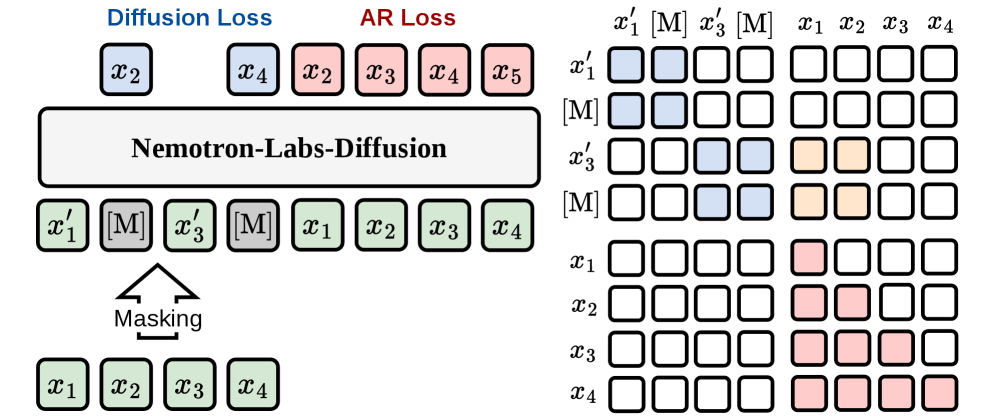
Two design choices matter for stability. First, \alpha=0.3 is picked to equalize the magnitudes of the two losses; larger \alpha destabilizes AR, smaller values leave diffusion undertrained. Second, training proceeds in two stages: 1T tokens of pure AR (\alpha=0) on top of Ministral3 base weights, then 300B tokens of joint training. The ablation in Table 1 is striking — adding block-wise attention alone gives 54.23 average across coding/math benchmarks; adding global loss averaging (variance reduction across the random noise levels), DP-rank varying mask ratios, two-stage training, and finally the AR loss lifts the average to 70.28, a +16 point gain over the diffusion-only starting point. The AR loss addition alone contributes +7.48 points.
Three inference modes
The same weights support: (1) AR decoding under a causal mask; (2) block-wise diffusion decoding with confidence-thresholded parallel commits; (3) self-speculation, where the diffusion mode drafts a block and the AR pass verifies it token-by-token, accepting the longest matching prefix. A LoRA is optionally trained to align the diffusion drafter with the AR verifier’s distribution; the quadratic variant precomputes continuations for every possible acceptance point in the block.
Results
On the 8B instruct model against Qwen3-8B, Qwen2.5-7B, Ministral3-8B, LLaDA-8B, Dream-7B, and SDAR-8B across GPQA, IFEval, MMLU, HumanEval, MBPP, LCB-CPP, Math500, GSM8K, AIME24/25:
- AR mode: +0.86% average accuracy over Qwen3-8B — joint training does not degrade AR quality, and in the controlled 25B-token ablation adding diffusion supervision slightly improves it.
- Diffusion mode: 2.57× TPF with +0.43% accuracy vs. Qwen3-8B; +9.09% over SDAR-8B Chat at higher parallelism.
- Linear self-speculation with LoRA: 5.99× TPF at 8B with essentially unchanged accuracy (62.81 vs. 62.88 without LoRA). LoRA lifts TPF from 4.52× to 5.99× at 8B, and from 4.67× to 5.96× at 14B (Table 6). Per-task TPF is highest on math (Math500 7.36×, AIME24 7.44×) where drafts are more predictable, and lowest on MMLU (4.08×).
- Quadratic self-speculation: 6.38× TPF but slower wall-clock due to FlexAttention kernel overhead, so linear is the deployment default.
The abstract’s headline — 6× tokens per forward vs. Qwen3-8B translating to 4× end-to-end throughput — comes from the linear-SS configuration.
Speed-of-light analysis
To bound how much parallelism the diffusion mode itself leaves on the table, the authors define an oracle target \mathbf{t} by serial denoising: starting from an all-mask block of length B, at each of B steps commit the argmax at the single position with the highest peak probability. Any parallel scheme’s SOL is then the TPF needed to reproduce \mathbf{t}. Greedy parallel acceptance commits every position whose argmax matches \mathbf{t}; recursive dynamic compaction instead binary-searches for the largest confidence-ranked prefix whose commit is provably safe (verified by a shallower simulation with a 5000-forward-pass budget per block).
The SOL ceiling shows 76.5% more tokens per forward than the current best linear self-speculation strategy — a large gap attributable to two structural advantages of diffusion decoding: it can commit non-contiguous subsets rather than a prefix, and it is not truncated at the first rejection.
Limitations and open questions
Practical diffusion sampling remains far from the SOL bound; the 76.5% headroom is only realizable with better confidence estimation or training objectives that promote conditional independence among block positions. Self-speculation still uses prefix-only AR verification, which throws away drafted tokens after the first mismatch even when later tokens would have been correct — a diffusion-based verifier could recover these. Quadratic SS is bottlenecked by attention-kernel support rather than by algorithmic cost. Finally, all reported speedups assume batch-1 or low-concurrency serving; at high concurrency the AR mode is preferred, and the accuracy story there rests on a +0.86% margin over Qwen3-8B that could tighten with better AR baselines.
Why this matters
A single set of weights that matches SOTA AR accuracy while offering a 4–6× throughput mode via self-speculation removes the usual “pick your regime at training time” tradeoff for diffusion LMs, and the SOL analysis gives a concrete, quantified target (76.5% headroom) for future parallel-decoding research.
Source: https://arxiv.org/abs/2607.05722
PointDiT: Pixel-Space Diffusion for Monocular Geometry Estimation
Problem
Monocular 3D reconstruction from a single RGB image is fundamentally ill-posed: many geometries project to the same pixels, especially at object boundaries, thin structures, and transparent surfaces. Recent approaches respond either with hybrid architectures that mix regression heads, uncertainty estimators, and task-specific losses, or with latent diffusion pipelines that reuse pretrained image VAEs by projecting point maps or depth into a latent space. Both choices carry overhead: the hybrids require handcrafted loss weighting; the latent approaches assume that an image-trained tokenizer meaningfully compresses geometry, which introduces reconstruction floors and blur.
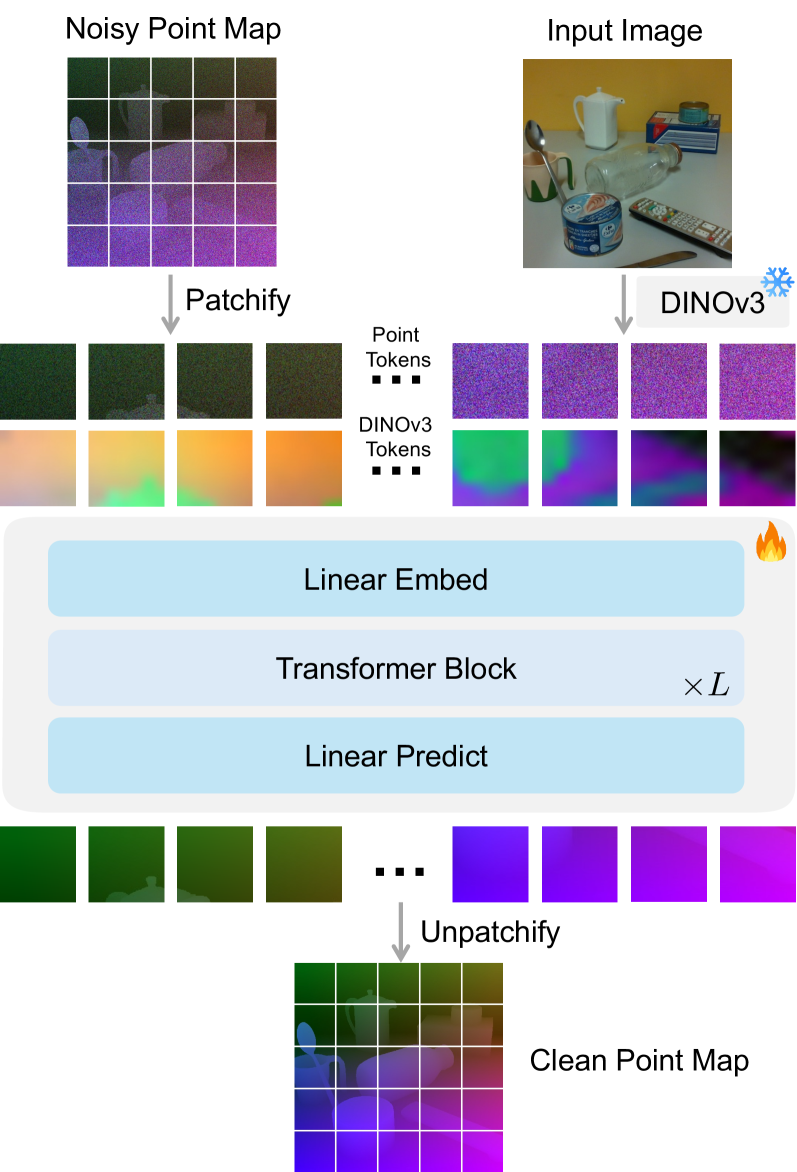
PointDiT argues this machinery is unnecessary. A plain ViT operating directly on raw point-map pixels, conditioned on frozen DINOv3 tokens, matches or beats the latent-based systems while producing sharper geometry.
Method
Given an image \mathbf{c}\in\mathbb{R}^{H\times W\times 3}, the model predicts a dense point map \mathbf{x}\in\mathbb{R}^{H\times W\times 3} where each pixel stores its metric (X,Y,Z). Training uses rectified flow matching. With \boldsymbol{\epsilon}\sim\mathcal{N}(\mathbf{0},\mathbf{I}) and clean sample \mathbf{x}, the interpolant is
\mathbf{z}_t = t\cdot\mathbf{x} + (1-t)\cdot\boldsymbol{\epsilon},\quad t\in[0,1],
and the target vector field is the constant
\mathbf{v}_t = \frac{d\mathbf{z}_t}{dt} = \mathbf{x} - \boldsymbol{\epsilon}.
A ViT v_\theta(\mathbf{z}_t, t, \mathbf{c}) regresses this velocity under the standard flow-matching loss \mathbb{E}_{t,\mathbf{x},\boldsymbol{\epsilon}}\|v_\theta - (\mathbf{x}-\boldsymbol{\epsilon})\|^2. Inference is Euler integration of the learned ODE from t=0 to t=1.
Two design choices carry the paper. First, the diffusion backbone is trained entirely from scratch and operates on raw point-map patches (patchified H\times W\times 3 tensors), so there is no point-map tokenizer, no VAE, and no latent decoder. This removes the reconstruction bottleneck that limits latent-diffusion depth estimators such as Marigold-style pipelines. Second, image conditioning comes from frozen DINOv3 features rather than a joint image encoder. Because DINOv3 features are largely domain-invariant, they let the model exploit synthetic-only training for the geometric decoder while still generalizing to natural images.
Training uses two stages, both synthetic. Stage 1 is 256\times 256 pretraining on SceneNet-RGBD (~5.36M RGB-D pairs). Stage 2 fine-tunes at 512\times 512 on an 11-dataset mixture — Hypersim, VKITTI2, UrbanSyn, Synscapes, TartanAir, OmniWorldGame, EDEN, IRS, Dynamic Replica, MVSSynth, TartanGround — totaling ~6.22M samples. Depth is converted to point maps using known intrinsics. The authors justify the synthetic-only choice on two grounds: pixel-perfect ground truth is essential to learn sharp geometric distributions, and the DINOv3 conditioning absorbs the appearance gap.
Results
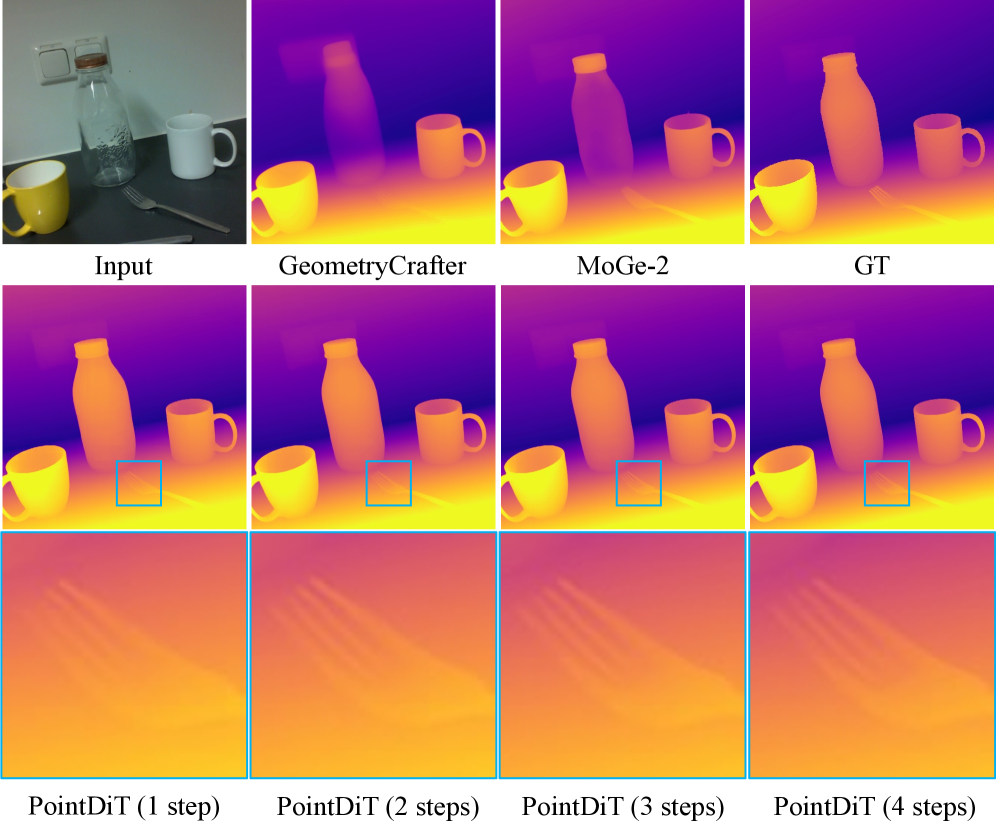
Sampling behavior illustrates the strength of pixel-space diffusion: a single ODE step already surpasses prior work, and additional steps sharpen fine structure rather than merely denoising.
Qualitatively, the model recovers thin structures (chair spokes, wires), reconstructs transparent objects where photometric cues are ambiguous, and preserves relative scale across full scenes better than baselines that predict depth in a latent space.
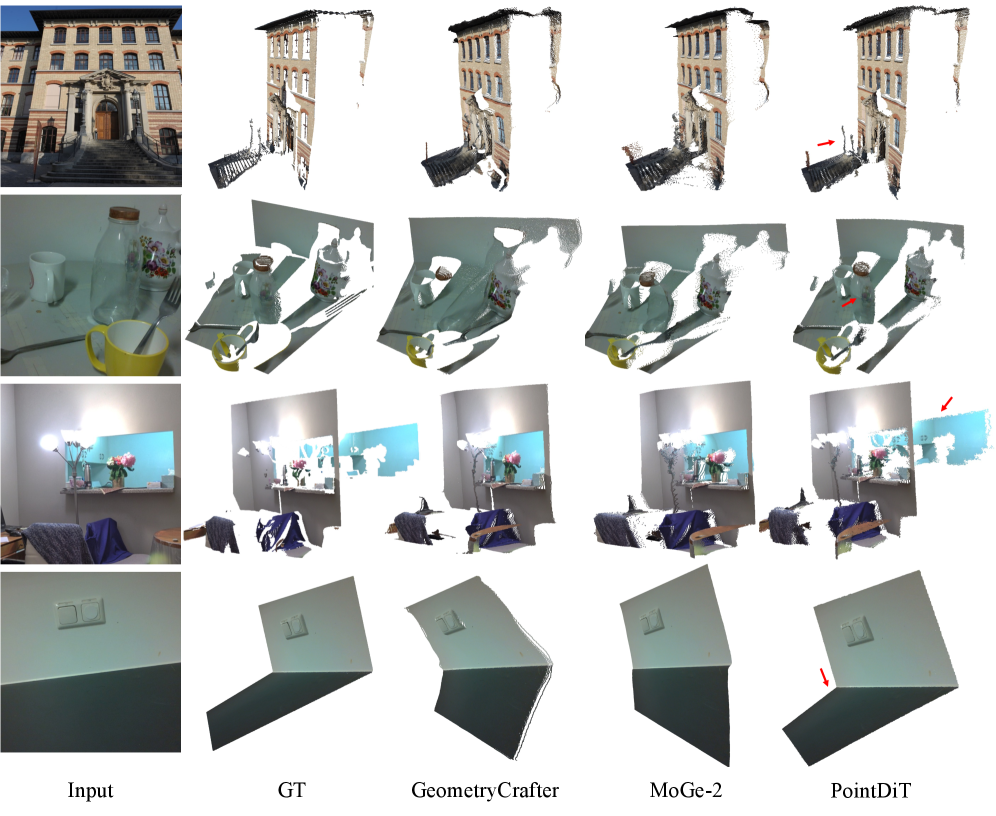
The transparent-object case is the most interesting: latent-VAE approaches tend to hallucinate the opaque surface implied by RGB texture, whereas the pixel-space diffusion appears to model the multimodality of the posterior over geometry — presumably because v_\theta is trained to interpolate along stochastic trajectories rather than to regress a single point estimate.
Limitations and open questions
The paper is heavy on architectural minimalism claims but the abstract and provided sections stop short of a full quantitative table in the excerpt — head-to-head numbers against Marigold, GeoWizard, DepthAnythingV2, MoGe, or VGGT would be needed to substantiate “surpasses complex latent-based diffusion models.” Several other questions remain open:
- Metric-scale generalization. Training is 100% synthetic; how well point maps transfer to arbitrary intrinsics at test time, and whether the model implicitly assumes a canonical focal length, is not addressed here.
- Sampling cost. Multi-step diffusion at 512\times 512 over raw point-map patches is substantially more expensive than a feedforward regressor; the 1-step regime is competitive but sacrifices the detail gains shown in Figure 3.
- Frozen DINOv3 is a single point in the conditioning-encoder design space; whether the same result holds with SigLIP or CLIP tokens, and how much of the performance is attributable to DINOv3’s geometry-aware features, is not ablated in the excerpt.
- No real-data finetune is reported, so the domain-agnosticism claim rests on qualitative examples.
Why this matters
If a plain ViT trained from scratch on raw point-map pixels — with no VAE, no tokenizer, no task-specific loss stack, just flow matching and frozen DINOv3 conditioning — can match hybrid and latent-diffusion 3D reconstructors, then much of the architectural complexity in recent monocular geometry work is incidental rather than essential. The result also reinforces a broader pattern: for structured continuous outputs, pixel-space diffusion with strong self-supervised conditioning is a viable alternative to reusing image-domain latent spaces.
Source: https://arxiv.org/abs/2607.02515
Flex-Forcing: Towards a Unified Autoregressive and Bidirectional Video Diffusion Model
Problem
Video diffusion models operate under two incompatible inference regimes. Bidirectional diffusion (e.g., Wan2.1) denoises the full clip jointly, giving strong global coherence but requiring the entire latent to be present at every step, which precludes streaming and scales poorly with duration. Autoregressive/causal variants such as Self-Forcing generate frame chunks left-to-right with KV caching, enabling streaming but incurring exposure bias and drift over long horizons. Existing training pipelines commit to one regime. The question this paper addresses: can a single model be trained so that the chunk granularity — both temporally and across denoising steps — becomes a runtime knob, letting the same weights operate as either extreme or any hybrid in between?
Method
The construction is a post-training procedure on a bidirectional base (Wan2.1-T2V-1.3B) that introduces flexible chunking over two orthogonal axes:
- Frame axis: a video of T latent frames is partitioned into chunks \{C_1,\dots,C_K\} with heterogeneous sizes |C_k|. Chunk k’s denoising is conditioned on the clean (or partially denoised) content of C_{<k}; within a chunk, attention is bidirectional.
- Timestep axis: the partition itself is a function of the denoising step t. Early (high-noise) steps can use coarse chunking approaching global bidirectional attention; later steps can use finer chunks approaching AR generation. Setting K=1 recovers pure bidirectional diffusion; setting |C_k|=1 recovers frame-by-frame AR.
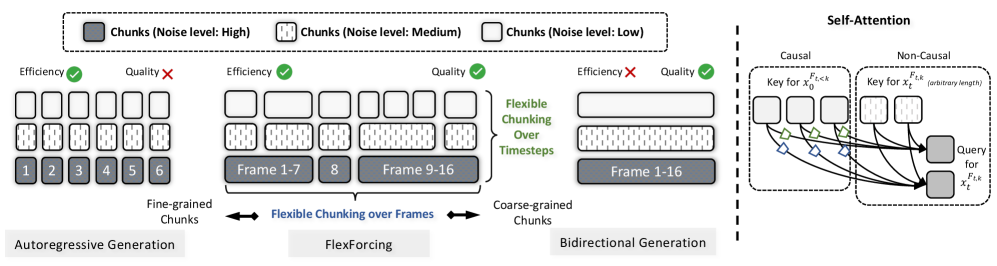
The attention layer is modified to be a mixed causal/non-causal operator. Within the current denoising window, tokens attend bidirectionally to each other. To attend to past clean (already-generated) frames stored in the KV cache, the model applies a timestep-dependent K-projection W_K(t) to the cached keys. This is necessary because the cached keys were produced when those frames were themselves at noise level t'; a static projection creates a train/test mismatch between “clean context” and “noisy context” tokens. The learned W_K(t) effectively re-encodes clean cache tokens as if they matched the query distribution at step t, unifying the two regimes under one self-attention.
Training samples chunk configurations (\{|C_k|\}, t) stochastically so that the model must handle any partition, including any-order and any-timestep denoising trajectories rather than a strict left-to-right causal schedule.
Results
On 5-second, 832×432 generation evaluated with VBench, Flex-Forcing at 4 denoising steps reaches 85.13 total / 86.50 quality / 79.65 semantic, beating DMD-v (84.60/86.03/79.87), rCM (84.43/85.38/80.63), and the 100-step Wan2.1 teacher (84.26/85.30/80.09). At 2 steps it holds 84.20 total, competitive with rCM-2 (84.09) and DMD-v-2 (84.39). Efficiency on GB200 for 81-frame generation reaches 24.96 FPS versus 19.10 for Self-Forcing and Infinity-RoPE.
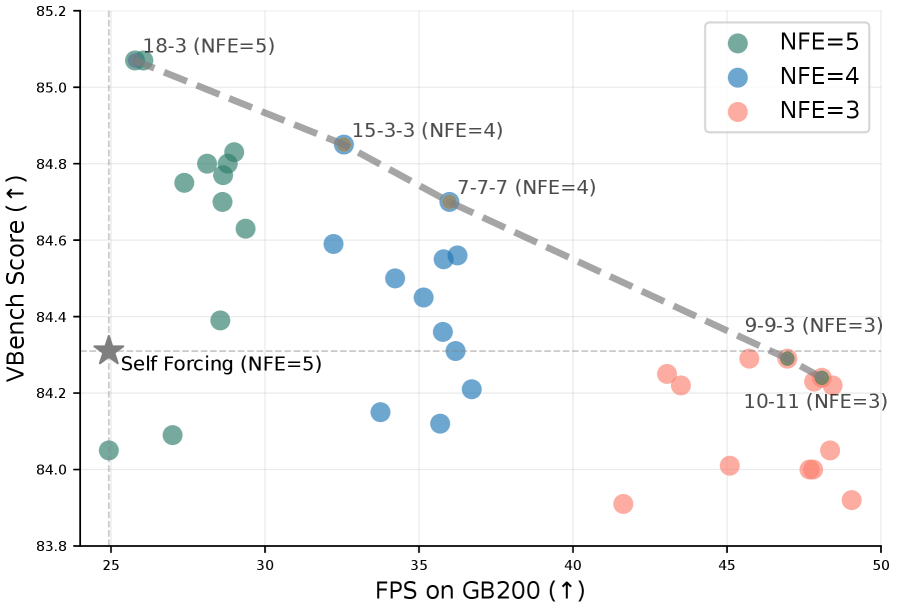
The chunk-configuration sweep for a 5s clip (21 latent frames, 3 chunks, brute-forced over all valid partitions) yields three empirical findings:
- Uniform chunking is suboptimal.
- Two partitions with the same number of exposure rounds differ substantially in quality, so exposure bias alone does not explain AR degradation.
- Front-loaded partitions (large early chunks, small later ones) are best, sometimes exceeding pure bidirectional inference. This is consistent with global structure being decided by early frames while late frames primarily extend motion.
On VBench-Long 30s evaluation — the harder train-short-evaluate-long setting — Flex-Forcing scores 84.01 total vs. Self-Forcing 81.49 and Infinity-RoPE 82.84, while LongLive (which is actually trained on long videos) reaches 82.80. Dynamic Degree jumps to 71.27 (Self-Forcing: 41.93, +21.01), Human Action rises 0.98 to 63.31, and Motion Smoothness edges up to 98.70. Trade-offs: Imaging Quality drops 3.06 to 66.24 and Multiple Objects drops 4.37, suggesting the model buys motion richness at some cost in per-frame fidelity and compositional binding.
Limitations and open questions
- The optimal chunk configuration is found by brute-force enumeration; no learned or analytic scheduler is proposed, and the search space grows combinatorially with clip length.
- The train-short/evaluate-long regime still shows degradation on imaging quality and multi-object composition at 30s, so drift is reduced rather than eliminated.
- The timestep-dependent K-projection is introduced only on the clean-cache path; whether V or Q also require timestep conditioning, and how this interacts with rotary position schemes over long contexts, is not analyzed.
- Results are all on a 1.3B backbone at 5–30s; scaling behavior of the mixed-attention operator at larger model sizes or minute-scale videos is untested.
- No ablation isolates the contribution of the K-projection from the stochastic chunk training itself.
Why this matters
Flex-Forcing shows that the AR-vs-bidirectional dichotomy in video diffusion is a training artifact, not an architectural one: a single self-attention with a timestep-conditioned key projection on cached tokens can span both regimes, giving a runtime quality/latency dial. If the finding that front-loaded chunking beats uniform AR generalizes, it suggests that “causal per frame” is the wrong inductive bias for video and that chunk scheduling deserves the same attention as noise scheduling.
Source: https://arxiv.org/abs/2607.03509
RynnWorld-4D: 4D Embodied World Models for Robotic Manipulation
Problem
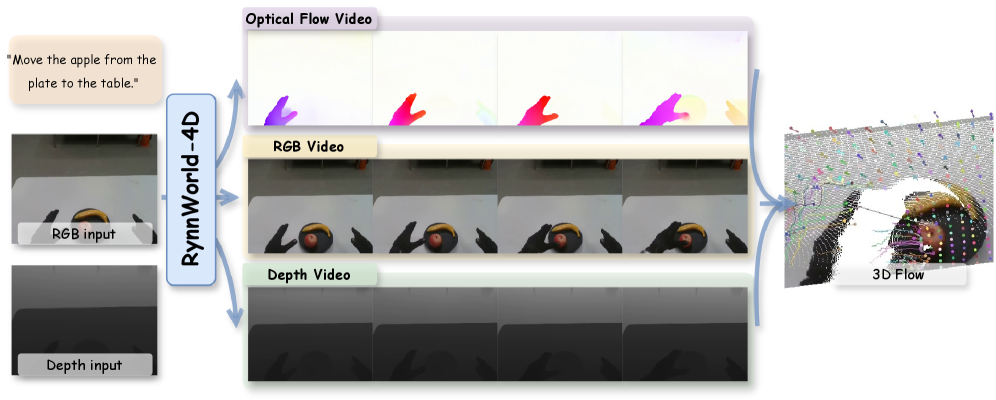
Video world models for manipulation typically predict future RGB pixels. Pixel-space prediction leaves the policy to re-infer geometry and motion, which are the quantities that actually determine end-effector actions. RynnWorld-4D argues that a physically grounded representation — synchronized RGB, monocular depth D, and dense optical flow F, jointly denoted RGB-DF — captures the 4D dynamics (3D structure plus its temporal evolution) directly, shrinking the representational gap between world prediction and action. From this joint prediction one can lift to 3D scene flow by unprojecting depth and warping with flow.
Data: Rynn4DDataset 1.0
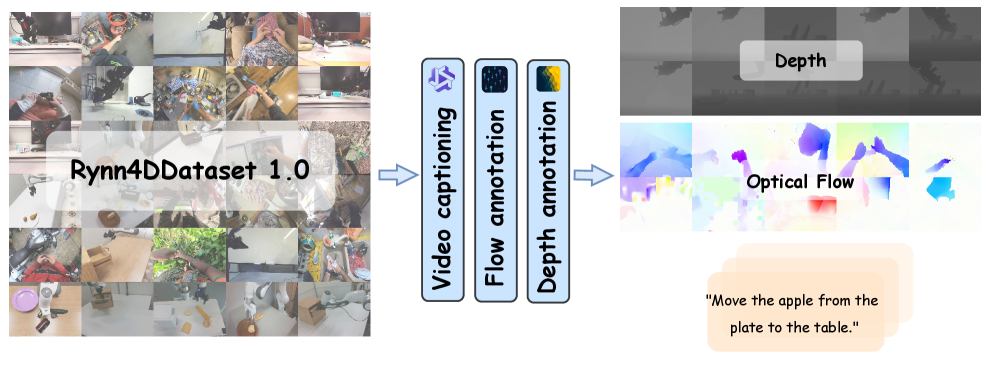
There is no large corpus of paired RGB/depth/flow with instructions. The authors curate 254.4M frames by pseudo-labeling seven sources — Epic-Kitchens and EgoVid (egocentric human), plus RoboMIND, RDT-1B, Galaxea, RoboCoin, and AgiBot (robotic manipulation). Captions come from Qwen3-VL at 1 FPS in 5s segments (max 512 tokens, T=0.7); depth from Depth Anything 3 (DA3NESTED-GIANT-LARGE-1.1, 30 FPS, short-side 392, clipped to [0.0, 5.0] m); flow from DPFlow at native resolution, color-encoded at 25 FPS.
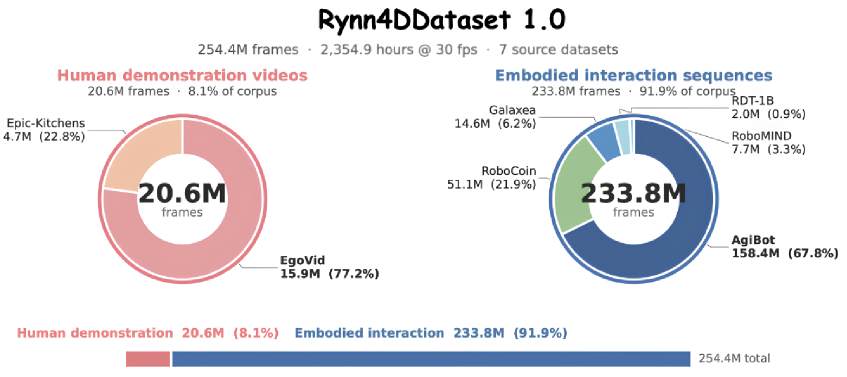
The mix is deliberate: human-egocentric footage supplies broad object-interaction priors; robot datasets supply the execution distribution the policy will actually see.
Method
The backbone is Wan 2.2-TI2V-5B, a 30-layer DiT with d=3072 and FFN width 14,336. The single RGB branch is expanded into a tri-branch architecture: RGB, depth, and flow each get their own patch embedding, self-attention, norms, and FFNs. The depth and flow branches are initialized by duplicating the pretrained RGB weights — a cheap way to inherit spatiotemporal priors that would otherwise take enormous compute to relearn. The text cross-attention K/V projections are shared across all three branches, since the language conditioning is modality-agnostic.
Cross-modal binding is done by Joint Cross-Modal Attention (JA) modules inserted every 3 blocks (layers 0, 3, …, 27; 10 modules total). For each modality m, JA attends over concatenated K/V from the other modalities j\neq m:
\hat{\bm{z}}_l^m = \bm{z}_l^m + \tanh(g_l^m)\cdot \operatorname{CrossBranchAttn}(\bm{Q}_l^m, \bm{K}_l^{\text{cross}}, \bm{V}_l^{\text{cross}}).
The scalar gate g_l^m is learned and initialized to 1, while the output projection is zero-initialized so the network departs smoothly from three independent branches. JA uses 3D RoPE and a frame-wise mask that restricts attention to tokens sharing the same temporal frame — an inductive bias that appearance, depth, and motion at time t must be mutually consistent, but does not need to attend across time in the cross-branch pathway (temporal mixing remains inside each branch’s self-attention).
Training is a three-stage curriculum with per-stage optimizer resets, AdamW (\beta_1=0.9, \beta_2=0.95, weight decay 10^{-4}), cosine schedule with linear warmup, and EMA at decay 0.9999.
RynnWorld-4D-Policy is layered on top: the predicted RGB-DF sequences serve as a 4D representation from which end-effector actions are regressed, so the policy consumes geometry and motion rather than raw pixels.
Experiments
Generation is evaluated with PAI-Bench metrics: Imaging Quality (MUSIQ/SPAQ), Motion Smoothness (AMT-S interpolation residual), Subject Consistency and I2V-Subject (DINO ViT-B/16 cosine similarity), plus PSNR/SSIM/LPIPS against ground truth. Baselines are Free4D (per-scene 4DGS optimization with DUSt3R depth, 10k iters, HexPlane deformation), 4DNeX (Wan2.1-I2V-14B + LoRA rank 64 at scale 0.5, 49 frames at 24 fps, 50 steps, CFG 5.0), and TesserAct (CogVideoX-5B-I2V with 9-channel RGB/depth/normal input, 640×480, 50 DDPM steps, guidance 7.5 / image guidance 1.5).
Qualitatively, the model produces geometry whose boundaries coincide with RGB textures and motion whose support aligns with contact regions — evidence that JA is enforcing per-frame cross-modal coherence rather than three independent generative processes. Temporal stability is maintained without flicker or structural morphing across manipulation clips.
The real-robot platform is a TIANJI M6 7-DOF arm with the 20-DOF WUJI hand (dual-arm setup: 54 DoF total). Teleoperation uses HTC Vive trackers (5 per operator, chest + wrists + upper arms) feeding a Pinocchio IK solver at 100–120 Hz, smoothed by Ruckig; the WUJI hand is driven from Manus glove data via a 21-point MediaPipe skeleton retargeting. Policy inference runs at 50 Hz with 18–30 ms command delay; the low-level loop runs at 500 Hz over LCM.
Limitations and open questions
The provided sections do not include the head-to-head numeric table against Free4D/4DNeX/TesserAct or the real-robot success rates, so the magnitude of the RGB-DF advantage is not quantified here. All three auxiliary modalities are pseudo-labels: depth is bounded to [0, 5] m and flow is estimated by DPFlow, so the world model is upper-bounded by these annotators (especially on transparent/specular surfaces where monocular depth degrades). The frame-wise JA mask forbids cross-modal temporal attention, which may hurt long-horizon coupling — e.g., flow at t constraining depth at t+k. Finally, lifting to 3D scene flow at inference requires consistent depth-flow scale, which is not explicitly enforced by a geometric loss.
Why this matters
Predicting depth and flow jointly with pixels aligns the world model’s output space with the geometric quantities a manipulation policy actually needs, reducing the burden on the policy to re-derive 3D structure from RGB. Combined with a 254M-frame hybrid human+robot corpus, this is a concrete recipe for scaling embodied world models beyond pixel-only video generation.
Source: https://arxiv.org/abs/2607.06559
RynnWorld-Teleop: An Action-Conditioned World Model for Digital Teleoperation
Problem
Imitation-learning datasets for dexterous manipulation are bottlenecked by physical teleoperation: every demonstration consumes operator time on a specific robot in a specific workspace, so throughput scales as operator-hours × hardware availability. The authors propose digital teleoperation: replace the physical robot with a generative world model that consumes a live hand-pose stream and synthesizes the egocentric video the robot would have produced, while the retargeted joint trajectory serves as the action label. If the generated video is faithful enough and the retargeting is embodiment-agnostic, one operator can produce paired (v_{1:T}, a_{1:T}) trajectories at essentially camera-free, hardware-free cost.
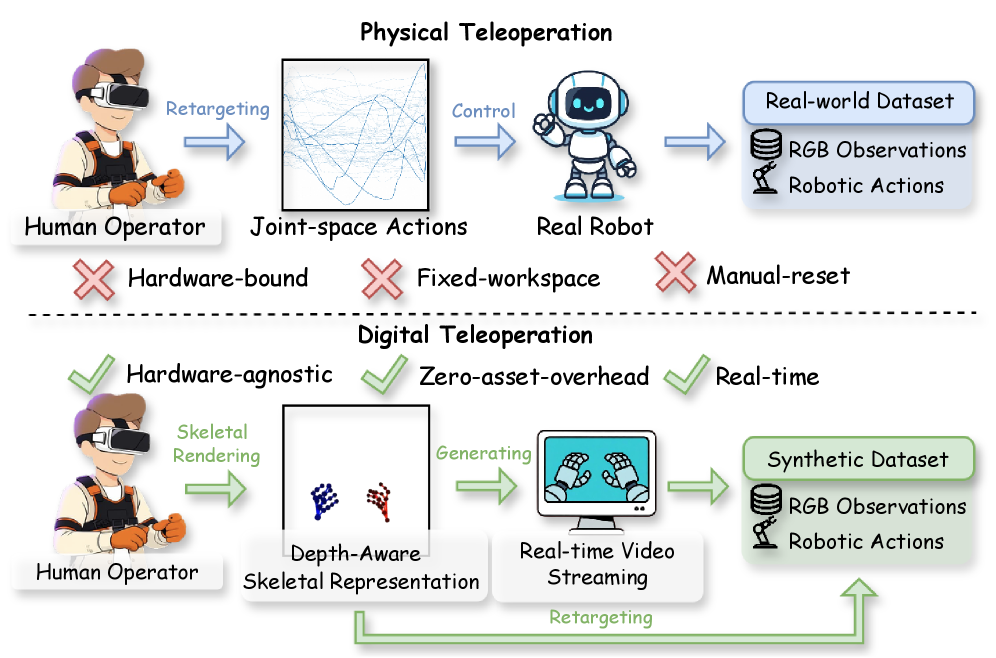
Method
RynnWorld-Teleop is built on Wan2.2-TI2V-5B, a video Diffusion Transformer with a 3D VAE \mathcal{E} and denoiser \mathcal{F}_\Theta. Given a reference image I_{ref} and hand-pose sequence \mathcal{P} = \{p_1,\dots,p_T\}, the model produces V=\{v_1,\dots,v_T\} via conditional flow matching:
z_t = (1-t)z_0 + t\epsilon, \quad \mathcal{L}_{\text{CFM}} = \mathbb{E}\left[\|v_\Theta(z_t, t, z_{ref}, c) - (\epsilon - z_0)\|_2^2\right]
with z_0 = \mathcal{E}(I_V), z_{ref} = \mathcal{E}(I_{ref}), and c the encoded control latent.
Depth-aware skeletal conditioning. Rather than SAM-derived masks (as in Mask2IV, CosHand, InterDyn), poses are rendered as 2D skeletons where joint color and marker size are modulated by depth, injecting a 3D cue into a 2D control image.
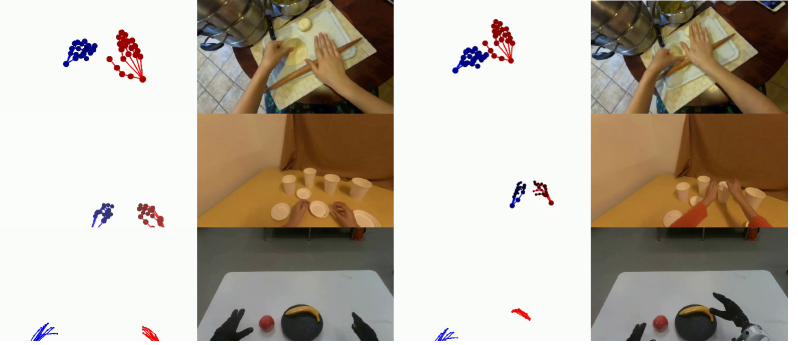
The skeleton video is passed through the VAE and fused into the DiT through a distribution-aligned patch-embedding branch, added alongside the noisy-latent patch embedder so the pretrained backbone weights are preserved.
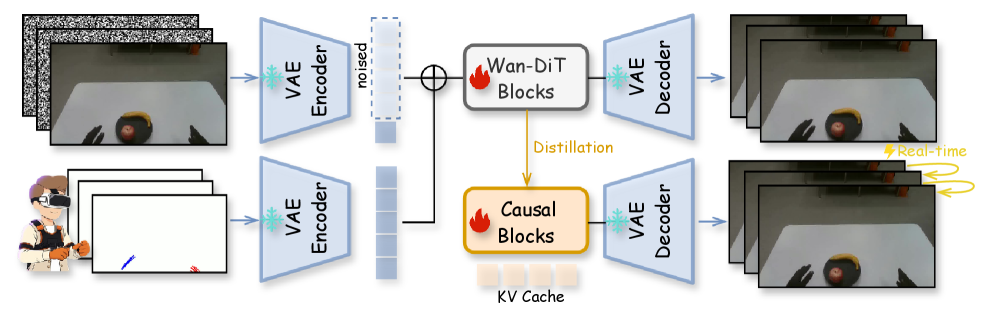
Two-stage progressive training. Stage 1 pretrains on large-scale egocentric human manipulation (EgoDex-style) to learn contact and object dynamics from hand video. Stage 2 adapts to the WUJI dexterous hand on 1,800 paired human-robot episodes to bridge the embodiment gap. Both LoRA (rank 64) and full-parameter SFT variants are trained; SFT uses EMA (decay 0.999), 200-step warmup, LR 2\times10^{-5} (Stage 1) and 1\times10^{-5} (Stage 2). A prior TI2V warmup of 2,000 steps on 64 H100s aligns the base model with target lighting/objects.
Streaming autoregressive distillation. The bidirectional teacher is distilled into a causal student: first a causal flow-matching warmup at LR 1\times10^{-5}, then Distribution Matching Distillation (DMD) with generator LR 2\times10^{-6} and critic LR 5\times10^{-7}. Combined with a streaming rollout schedule, this compresses generation into single-pass inference at >40 FPS on a single H100.
Chunked re-anchoring. Long-horizon rollouts drift. The system generates in 81-frame chunks; the first is seeded by the real starting frame, and each subsequent chunk uses the actual robot-camera frame at that timestep as the new I_{ref}. This periodically re-grounds object poses and lighting.
Retargeting. Five HTC Vive trackers (chest, both wrists, both upper arms) feed a calibrated transform chain
\mathbf{T}_{\text{target}} = \mathbf{T}_{\text{base}} \cdot \text{Scale}(\mathbf{T}_{\text{chest}}^{-1}\cdot\mathbf{T}_{\text{wrist}}) \cdot \mathbf{T}_{\text{ee}}
with translation scaling s=1.5 to map operator workspace to robot workspace. IK uses damped least squares with adaptive damping \lambda = \lambda_{\min} + 0.01/(1+\sigma_{\max}) via SVD, and a null-space shoulder prior derived from upper-arm trackers is injected with weight w=0.5:
\Delta\mathbf{q} \leftarrow \mathbf{J}^{\#}_\lambda \mathbf{e} + (\mathbf{I} - \mathbf{J}^{\#}_\lambda \mathbf{J})\, w\,(\mathbf{q}^{\text{ref}} - \mathbf{q})
Manus gloves are converted to a 21-point MediaPipe skeleton and retargeted to the 20-DoF WUJI hand. The resulting 54-dim action vector (dual 7-DoF arms + dual 20-DoF hands) is synchronized frame-for-frame with the generated video at 16 FPS.
Results
The paper reports qualitative superiority over Mask2IV, CosHand, and InterDyn on EgoDex-style benchmarks: mask-based baselines (which require SAM2 masks per frame) exhibit texture flicker and poor finger articulation, while depth-aware skeletons yield stable finger-object contact in bimanual scenes. On the WUJI target robot, generated videos preserve environmental reflections and dexterous contact dynamics across tasks including Lid Placement and Bimanual Lifting. Real-robot inference runs at 50 Hz with 18-30 ms command latency; low-level control at 500 Hz over LCM. Interactive generation at >40 FPS on one H100 makes the world model itself the operator-facing “robot.” The abstract states policies trained exclusively on RynnWorld-Teleop data transfer to the physical WUJI setup (the excerpt cuts off before final imitation-learning numbers).
Limitations and open questions
The visual specification of a scene is a single reference image, so scene-level state (occluded objects, mass, friction) is implicit and non-physical—there is no contact simulator ensuring conservation of momentum or grasp stability. Chunked re-anchoring in the training pipeline requires real robot frames every 81 frames, which reintroduces a dependence on physical rollouts during data curation (though not at operator time); it is unclear how quality degrades if re-anchoring uses only synthesized frames. Generalization to novel scenes relies on user-provided or edited I_{ref}, but the paper does not quantify how far out-of-distribution reference images can go before dynamics break. The 16 FPS control rate is low for reactive tasks. Finally, DMD-distilled diffusion is known to sacrifice sample diversity; the impact on downstream policy robustness under distribution shift is not analyzed here.
Why this matters
Digital teleoperation reframes robot-data collection as a generative-modeling problem: if a world model can synthesize the observation stream and a retargeter can produce action labels, dataset size decouples from hardware count. RynnWorld-Teleop is a concrete demonstration that a distilled video DiT can close this loop in real time at operator-usable frame rates.
Source: https://arxiv.org/abs/2607.06558
Parallelized Autoregressive Decoding for Omni-Modal Dense Video Captioning
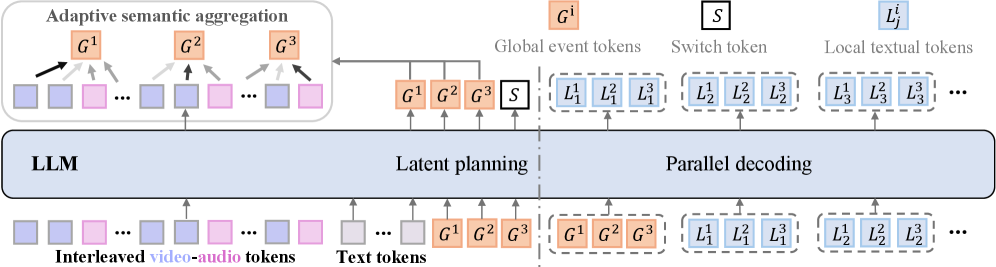
Dense video captioning (DVC) requires jointly localizing events on the timeline and generating natural language descriptions for each. Standard omni-modal video LLMs treat the entire output — a long, structured sequence of [start, end, caption] triplets over K events — as a single autoregressive stream. As video length and event density grow, decoding cost scales linearly in the number of output tokens, and long-range attention over the growing suffix degrades both throughput and grounding accuracy. This paper argues that the sequential dependency imposed on cross-event tokens is largely artificial: events that are temporally disjoint have weak semantic coupling, so their tokens can be decoded in parallel without loss.
Restructuring the causal graph
The base model is Video-SALMONN 2+ (3B), with Qwen2.5-VL as the visual encoder/decoder and Whisper-Large-v3 plus a window-level Q-Former for audio. Video and audio are partitioned into T synchronized segments C_t = [Z_v^t, Z_a^t], concatenated with the instruction embeddings F_Q to form the prefix P. A vanilla omni-LLM then samples
L_i \sim \mathbb{P}(L_i \mid P, L_{<i}).
PadCaptioner replaces this with a two-tier decomposition: tokens within a single event caption remain sequentially decoded (preserving local syntactic and semantic coherence), while tokens belonging to different events are decoded in parallel across event streams.
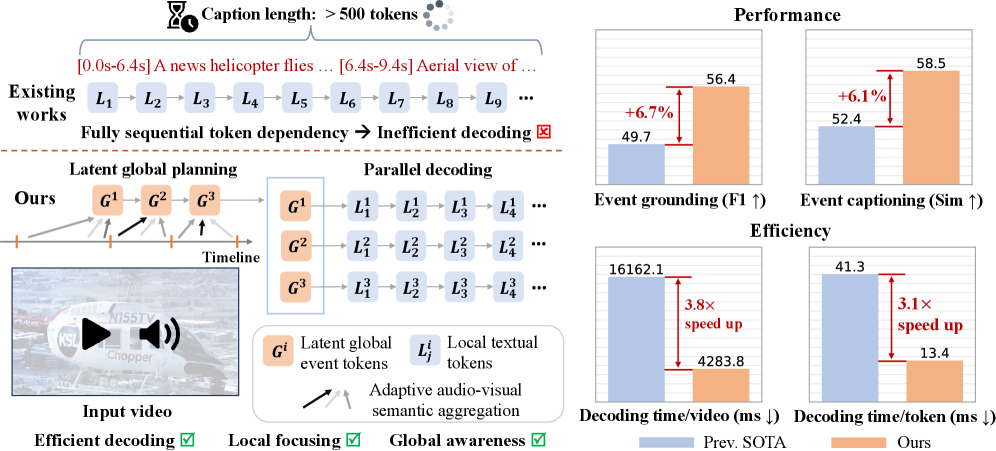
The mechanical picture (Fig. 2) is: (1) a latent global planning stage where the model infers the event count K and allocates K parallel decoding lanes; (2) parallel autoregressive generation across lanes with a block-diagonal attention pattern that prevents cross-lane leakage while sharing the prefix P. Within lane k, tokens attend to P and to previous tokens in the same lane only; across lanes, tokens are independent conditional on P and the global plan.
Concretely, this is implemented via an attention mask that, given the restructured sequence, zeros out cross-event entries in the causal matrix while keeping intra-event causality. Training uses standard token-level cross-entropy on the restructured sequence, so the model learns both the planning behavior and the lane-local generation jointly. LoRA fine-tuning is applied for one epoch on 18K ChronusAV videos at 0.5 FPS, capped at 256 frames.
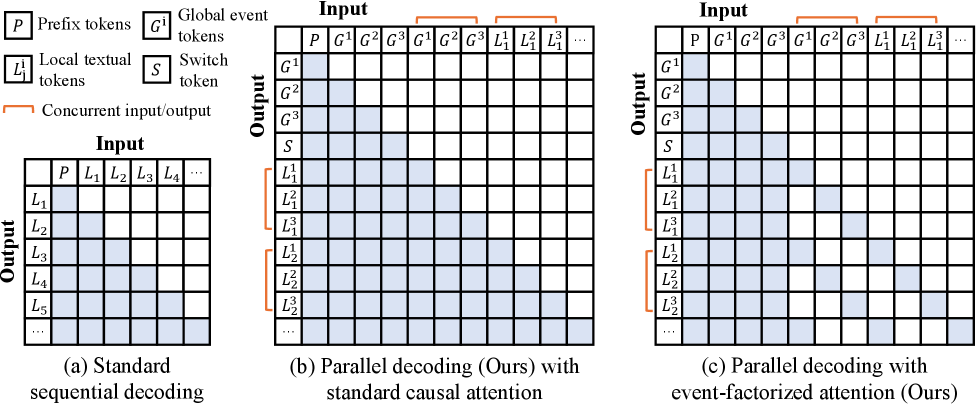
The attention comparison in Fig. 3 clarifies why this is “lossless” in the authors’ sense: the removed dependencies are precisely those the base model’s own attention weights find weak (cross-event tokens attending only via the shared prefix). The claim is empirical rather than provable — accuracy must not degrade, and in fact improves — because the parallel structure also acts as an inductive bias against cross-event interference during training.
Quantitative results
On LongVALE, PadCaptioner (3B) reaches F1 56.4, Sim 58.5, SODA_c 6.4, CIDEr 13.7, METEOR 8.6, versus the previous SOTA ChronusOmni (7B) at 49.7 / 52.4 / 3.7 / 5.6 / 5.2. That is +6.7 F1 and roughly 2.4\times CIDEr at less than half the parameter count. On ChronusAV, PadCaptioner posts F1 63.2, Sim 40.0, SODA_c 12.4, CIDEr 9.6, METEOR 12.4, compared to ChronusOmni’s 60.1 / 36.8 / 8.6 / 2.9 / 7.6 — the CIDEr gap (9.6 vs 2.9) is especially large and suggests substantially better lexical fidelity to ground-truth captions. Even the reduced-budget PadCaptioner^{-} (trained on 12K videos) beats ChronusOmni on every metric on both benchmarks, e.g. LongVALE F1 53.0 vs 49.7 and CIDEr 12.3 vs 5.6. Against Qwen3-Omni (30B-A3B), a 10× larger model, PadCaptioner leads by 22.2 F1 on LongVALE and 11.4 F1 on ChronusAV.
Efficiency claims (Fig. 1, right panel) show simultaneous Pareto improvements on grounded captioning accuracy and decoding latency over ChronusOmni on LongVALE. The paper’s core efficiency argument is that, with K parallel lanes and per-lane length \ell, wall-clock decoding scales as O(\ell) rather than O(K\ell), modulo attention overhead over the shared prefix.
Limitations and open questions
The “lossless” framing hinges on the assumption that cross-event tokens are conditionally independent given P and the plan; this is likely violated for narratively continuous videos (e.g., instructional cooking with strong referential chains across steps). The reported YouCook2 results are mentioned but not shown in the excerpt, which would test that regime. The planning mechanism selects K at inference — failure modes when K is mispredicted (fusing distinct events, or splitting one) are not quantified here. The evaluation is confined to a single 3B base model; whether the restructuring survives when the base LLM has weaker cross-modal grounding is open. Finally, throughput gains are shown against ChronusOmni but not against generic speculative decoding or medusa-style parallel heads, which are the natural baselines for the efficiency claim.
Why this matters
DVC has been throughput-bound by the mismatch between a long, structured output and token-by-token AR decoding. By exploiting the event-level block structure that DVC outputs already possess, PadCaptioner shows that a modest attention-mask change plus targeted fine-tuning yields both accuracy and latency gains — a rare Pareto improvement — and points to a broader pattern of restructuring causal graphs to match the semantic dependency structure of structured generation tasks.
Source: https://arxiv.org/abs/2607.02963
Hacker News Signals
AI Meets Cryptography 1: What AI Found in Cloudflare’s Circl
Source: https://blog.zksecurity.xyz/posts/circl-bugs/
ZKSecurity used LLM-assisted code review to audit Cloudflare’s Circl cryptographic library (Go), finding two bugs that human reviewers had missed. The post is the first in a series examining whether AI tooling can meaningfully contribute to cryptographic audits.
The first bug is a timing side-channel in the constant-time scalar multiplication for P-256: a branch on an intermediate value leaks information about the scalar, violating the constant-time contract. The second is a subtle misuse of Montgomery reduction in the BLS12-381 field arithmetic — specifically, a case where the final conditional subtraction is skipped under a specific carry condition, producing an unreduced output that propagates incorrectly into higher-level operations.
The workflow was not simply “ask GPT to find bugs.” The authors used a structured prompting strategy: they provided the model with the specific invariants each function must maintain (constant-time execution, field element bounds), then asked it to reason about whether each code path preserved those invariants. This constraint-directed approach is meaningfully different from open-ended review and reduced irrelevant outputs.
Neither bug is immediately exploitable in a catastrophic way — the timing leak requires a side-channel oracle, and the Montgomery bug requires constructing specific field element values — but both are real and have been reported to Cloudflare. Circl is widely used in TLS 1.3, HPKE, and post-quantum KEM implementations, so correctness matters.
What makes this technically interesting is the framing of invariant-directed prompting as a semi-formal technique. The model is not proving correctness; it is doing targeted invariant checking guided by human-specified postconditions. This sits between fuzzing (no semantic model) and formal verification (complete proof obligations) and may be cost-effective for libraries where specifications exist but full verification is impractical.
Open question: false positive rate at scale. The post does not report how many candidate bugs the model flagged that turned out to be non-issues.
Ternlight – 7 MB Embedding Model That Runs in Browser (WASM)
Source: https://ternlight-demo.vercel.app/
Ternlight is a semantic embedding model compiled to WebAssembly that runs entirely client-side at roughly 7 MB total payload. The demo embeds queries and a corpus in-browser and performs nearest-neighbor search without any server round-trip.
The size constraint is achieved through a combination of architecture choices: the model uses ternary weight quantization (weights \in \{-1, 0, +1\}), which is the same quantization scheme explored in BitNet and related work. With ternary weights, matrix-vector products reduce to additions and subtractions, eliminating multiplications entirely — this is critical for WASM performance since WASM’s SIMD support (128-bit) is limited compared to native AVX-512 paths. The resulting model is small enough to be cached by the browser after first load.
The architecture appears to be a shallow transformer encoder (details are sparse without the model card), producing fixed-size sentence embeddings. Inference is handled by a custom WASM runtime rather than ONNX Runtime Web or TensorFlow.js, which typically carry heavier runtime overhead.
The embedding quality claim is that it matches or approaches MiniLM-L6 on standard retrieval benchmarks (MTEB subsets), though independent verification of these numbers is not yet available. MiniLM-L6 at INT8 is around 22 MB, so the 3x size reduction at comparable quality would be non-trivial.
Practical use cases are client-side semantic search, private-by-default retrieval (embeddings never leave the device), and offline-capable applications. The constraint that all data stays local is the main differentiator from API-based embedding services.
Limitations: context window is short (likely 128 or 256 tokens), quality degrades on domain-specific text without fine-tuning, and ternary quantization tends to hurt recall on tasks requiring fine-grained semantic distinctions. The WASM threading model also limits parallelism on most browsers.
GitLost: We Tricked GitHub’s AI Agent into Leaking Private Repos
Source: https://noma.security/blog/gitlost-how-we-tricked-githubs-ai-agent-into-leaking-private-repos/
Noma Security demonstrated a prompt injection attack against GitHub Copilot’s agentic features — specifically the “Workspace” and issue-summarization capabilities — that caused the agent to exfiltrate content from private repositories accessible to the authenticated user.
The attack vector is a classic indirect prompt injection: malicious instructions are embedded in attacker-controlled content (a public issue, a README, or a PR description) that the agent reads as part of its context. When the agent processes this content, the injected instructions override or augment its intended behavior. In the demonstrated exploit, the payload instructed the agent to enumerate accessible private repos, read specific files, and encode the output as a URL that the attacker controls — effectively a DNS/HTTP exfiltration channel triggered by the victim’s agent session.
The technical substance here is the lack of content-instruction separation in LLM-based agents. The model receives a linearized context containing both trusted system instructions and untrusted user/repository content; without a robust sandboxing mechanism or a separate parsing layer that marks content provenance, the model cannot reliably distinguish “data to process” from “instructions to follow.” Retrieval-augmented agents are especially vulnerable because they actively ingest third-party content.
GitHub’s response involved adding guardrails, but the post notes that heuristic filters on output (e.g., blocking certain URL patterns) are bypassable through encoding or multi-step exfiltration chains. The fundamental issue — that LLMs are not architecturally capable of enforcing a principal hierarchy without additional mechanisms — remains unsolved.
Mitigations discussed include constrained output schemas (the agent can only produce structured objects, not arbitrary text/URLs), capability separation (read access and network access granted independently), and sandboxed execution environments where agent-generated network requests are blocked by default. None of these are fully deployed in current agentic products.
Januscape: Guest-to-Host Escape in KVM/x86 [CVE-2026-53359]
Source: https://github.com/V4bel/Januscape
Januscape is a public exploit and writeup for CVE-2026-53359, a guest-to-host escape vulnerability in KVM on x86. The bug allows a guest VM with standard user-level access to break out of the hypervisor boundary and execute code in the host kernel context.
The vulnerability is in KVM’s handling of nested virtualization (VMX-on-VMX, i.e., L1 guest running its own hypervisor). Specifically, the bug is a type confusion in the emulation path for VMREAD/VMWRITE instructions when the L1 guest is operating in certain VMCS shadow modes. KVM incorrectly trusts a guest-controlled pointer when handling shadow VMCS transitions, allowing an attacker to supply an out-of-bounds VMCS field index that is then used to index into a host-side array without bounds checking.
The exploit chain: (1) from an unprivileged guest process, gain L1 hypervisor privileges (separate step, or assume attacker controls the L1 guest hypervisor, which is a common cloud attacker model); (2) craft a malicious nested VM that triggers the VMREAD path with the crafted pointer; (3) use the out-of-bounds write to corrupt host kernel memory; (4) pivot to arbitrary kernel code execution via standard heap grooming techniques against the slab allocator.
The repository includes the full PoC with a heap spray targeting kmalloc-192 slabs and a ROP chain for privilege escalation. The exploit is demonstrated on a specific kernel version range; patching is straightforward (bounds check insertion) but requires a kernel update.
The broader concern is that nested virtualization emulation code is complex, performance-critical, and has historically been a source of hypervisor escapes. The attack surface expands significantly when cloud providers allow tenants to run their own hypervisors (as is common in nested virt offerings).
30papers.com – Ilya’s 30 Essential ML Papers, in a Beginner-Friendly Format
Source: https://30papers.com/
This site presents the reading list that Ilya Sutskever reportedly gave to John Carmack as foundational ML literature, reformatted with plain-language summaries, concept explanations, and guided reading notes targeting readers without deep ML backgrounds.
The list itself is well-known in the community and includes papers spanning foundational deep learning theory (Hinton’s RBM and deep belief network work), sequence modeling (the original LSTM paper, attention mechanisms), optimization (Adam, batch normalization), architectures (ResNet, the transformer paper), and reinforcement learning (AlphaGo, policy gradient methods). The selection reflects Sutskever’s view circa 2015-2020 of what conceptual foundations are load-bearing for understanding modern large-scale systems.
The site’s contribution is pedagogical rather than technical: each paper gets a structured breakdown with (1) the problem being solved in plain terms, (2) the key idea explained without assuming the reader can follow the math, and (3) why it matters for subsequent work. Cross-links between papers make the dependency graph explicit — e.g., attention is presented after sequence-to-sequence, BatchNorm after ResNet prerequisites.
For a PhD-level reader the interest is less in the summaries and more in the curation question: this list predates diffusion models, modern RLHF, and the scaling law literature, so it is notably incomplete as a 2024 curriculum. However, the conceptual core — that understanding RNNs, attention, residual connections, and basic RL is necessary before scaling makes sense — remains defensible. The list is better understood as “foundations” than “state of the art.”
The HN discussion focused on which papers are missing (diffusion, constitutional AI, chinchilla scaling laws) and whether the beginner-friendly framing loses enough detail to be misleading on subtle points like the vanishing gradient analysis in the LSTM paper.
Show HN: Rowboat – Open-Source, Local-First Alternative to Claude Desktop
Source: https://github.com/rowboatlabs/rowboat
Rowboat is a local-first multi-agent orchestration framework that positions itself as an open alternative to Claude Desktop and similar proprietary agentic shells. It is written in TypeScript/Node.js and runs entirely on the user’s machine.
The architecture is built around a graph-based agent orchestration model: agents are nodes, tool calls are edges, and execution proceeds by traversing the graph according to a declarative workflow definition. This is similar in spirit to LangGraph but with a heavier emphasis on local execution and data privacy — all conversation state, tool outputs, and agent memory are stored in a local SQLite database rather than cloud services.
Key technical features: (1) MCP (Model Context Protocol) compatibility, meaning it can load tools defined for Claude Desktop without modification; (2) multi-model support — the orchestrator is model-agnostic and routes to local models via Ollama or remote APIs; (3) persistent agent memory backed by a local vector store (using sqlite-vec for approximate nearest neighbor search directly in SQLite, avoiding a separate vector DB dependency); (4) a visual workflow editor for defining agent graphs without writing orchestration code.
The local-first constraint has concrete implications. State serialization happens synchronously to SQLite after each agent step, enabling crash recovery and step-by-step replay — useful for debugging agentic workflows that fail midway through a multi-step task. The tradeoff is that horizontal scaling is not straightforward; the design assumes single-machine deployment.
The MCP compatibility layer deserves attention: it parses the MCP tool manifest format and generates TypeScript wrappers automatically, which lowers the cost of reusing the growing ecosystem of MCP-compatible tools. Limitations include no support for streaming tool outputs and limited parallelism in the current graph execution engine.
The LLVM Compiler Infrastructure
Source: https://cacm.acm.org/federal-funding-of-academic-research/the-llvm-compiler-infrastructure/
This CACM article is a retrospective on LLVM’s development, written in the context of a broader issue on the impact of federally funded academic research. The technical substance is a clear-eyed account of what design decisions made LLVM technically successful relative to GCC and earlier research compilers.
The central claim is that LLVM’s impact traces to three specific architectural decisions. First, the IR design: LLVM IR is a typed, SSA-form, three-address instruction set with explicit control flow graphs and an infinite virtual register file. This made the IR simultaneously low-level enough for machine-specific optimization and high-level enough for portable analysis passes — a balance GCC’s GIMPLE/RTL split handled awkwardly. Second, the library decomposition: each compiler component (parser, optimizer, code generator) is an independently linkable library with a clean C++ API, enabling reuse by tools (sanitizers, static analyzers, JIT compilers) that are not full compilers. Third, the permissive BSD-style license, which allowed commercial adoption (Apple, Google, ARM, AMD) that funded sustained engineering investment.
The retrospective is candid about what federal NSF funding specifically enabled: early-stage exploratory work at UIUC that would not have been funded by industry because the payoff timeline was too long. The article makes a point that is relevant to current research funding debates — basic infrastructure work (not a product, not a paper, just building something foundational) is systematically underfunded by industry R&D.
For practitioners the technical interest is in how IR design choices made in 2003 continue to constrain and enable current work: the typed IR enables MLIR’s extension model, the pass pipeline architecture underlies modern profile-guided optimization frameworks, and the machine code layer is the substrate for most production JIT compilers today.
The Making of Claude Code
Source: https://www.anthropic.com/features/making-of-claude-code
This is a product retrospective from Anthropic on the development of Claude Code, their terminal-based agentic coding assistant. Despite the marketing origin, the post contains some technically specific design decisions worth noting.
The central architectural choice was building Claude Code as a thin shell around the model with minimal abstraction, explicitly rejecting the “AI IDE” paradigm. The interface is a REPL that gives the model direct access to bash, file I/O, and git — no custom tool wrappers, no sandboxed execution by default. The rationale is that heavy scaffolding introduces failure modes: tool wrappers that misrepresent file state, sandboxes that prevent the model from observing the actual consequences of its actions, and abstraction layers that the model must reason through rather than reason with.
This connects to a specific technical claim: the model performs better when it can observe real side effects (file diffs, test output, compiler errors) rather than simulated ones. The feedback loop — write code, run tests, read stderr, patch — is tighter when the environment is not mediated. This is essentially the argument for “real” environments in RL research applied to agentic deployment.
The post discusses context management explicitly: long coding sessions exhaust the context window, and their approach was to build a compaction heuristic that summarizes earlier conversation turns (preserving file state and task state but dropping intermediate reasoning chains) rather than truncating or using a fixed sliding window. The compaction runs automatically when the context approaches the limit.
The decision to release as a terminal tool rather than an IDE plugin reflects a deliberate bet that developer trust is higher when the tool is inspectable and the model’s actions are visible as plain shell commands. Whether this translates to adoption is a product question, but the architectural reasoning is coherent.
Noteworthy New Repositories
avifenesh/bw24
A from-scratch inference engine written in Rust and CUDA, targeting bit-exact reproducibility on NVIDIA Blackwell hardware (sm_120a, specifically the RTX 5090 Laptop). The distinguishing design choice is that correctness is enforced by construction: numerical outputs are bit-exact against a reference, not statistically close. Supported features include NVFP4 quantization (4-bit floating-point introduced with Blackwell), Mixture-of-Experts routing, and Multi-Token Prediction (MTP) speculative decoding. The engine is tuned against the measured memory bandwidth and compute ceilings of a single RTX 5090 Laptop, meaning kernel parameters are empirically calibrated rather than relying on vendor-tuned libraries. Writing CUDA kernels in Rust (via cudarc or direct PTX emission) keeps the entire stack in one language, simplifying the build system and eliminating C++ ABI surprises. MTP speculative decoding allows the model to draft multiple tokens per forward pass, reducing decode latency without changing output distribution. For researchers who need a transparent, auditable inference path on Blackwell — rather than a black-box TensorRT-LLM binary — this provides a legible codebase where every numerical decision is traceable. Early-stage but technically ambitious; the sm_120a targeting means it will not run on older GPUs without modifications.
Source: https://github.com/avifenesh/bw24
ai4s-research/open-science
An open-source AI research desktop positioned as a local-first, model-agnostic alternative to Claude for Science. The architecture is built on Tauri (Rust backend, WebView frontend) for cross-platform native packaging on macOS and Windows, combined with the Model Context Protocol (MCP) for structured tool-calling and a skill system for composable agent behaviors. Being model-agnostic means it can route to any LLM backend — local models via Ollama, OpenAI, Anthropic, or others — without locking researchers into a specific provider. The “local-first” guarantee means experiments, notes, and agent traces stay on disk by default; reproducibility is a first-class concern rather than an afterthought. Agent skills are modular: individual capabilities (literature search, code execution, data extraction) can be added or swapped without touching the core orchestration loop. The MCP layer provides a typed interface between the agent and external tools, which reduces the prompt-engineering surface for tool use. For scientists who need auditable AI assistance — where every step of an analysis can be inspected and re-run — this is substantially more tractable than a hosted SaaS product. The Tauri choice keeps the binary footprint small relative to Electron alternatives.
Source: https://github.com/ai4s-research/open-science
opengeos/geolibre-rust
A collection of geospatial analysis tools compiled from Rust to WebAssembly (WASI target) for execution inside the GeoLibre browser-based GIS environment. The upstream codebase derives from WhiteboxTools next-generation, a high-performance geospatial library covering terrain analysis, LiDAR processing, hydrological modeling, and raster/vector operations. Compiling to WASI rather than standard Emscripten WASM enables use in non-browser WASI runtimes as well, broadening deployment options. Running these tools client-side eliminates the round-trip to a server for compute-heavy operations like flow accumulation or hillshade generation on large DEMs — operations that would otherwise require a backend service. The Rust origin means memory safety and absence of GC pauses, both relevant when processing multi-gigabyte elevation datasets in a memory-constrained browser tab. New GeoLibre-specific tools are added on top of the WhiteboxTools base, suggesting the repository will diverge as browser-native geospatial workflows develop. The WASI compilation path also means these same binaries can be embedded in server-side pipelines using Wasmtime or WasmEdge without recompilation. Useful for anyone building browser-native GIS tooling who needs non-trivial spatial analysis without a Python/GDAL backend.
Source: https://github.com/opengeos/geolibre-rust
yaroslav/kino
A Ruby web server designed for Ruby 4.0’s Ractor concurrency model, implementing the Rack 3 interface. The architecture is split across two layers: a Rust front-end using Tokio (async I/O runtime) and Hyper (HTTP library) handles connection acceptance and HTTP parsing at native speed, then hands off requests to a pool of Ruby Ractor workers. Ractors are Ruby’s share-nothing parallel execution unit, bypassing the GVL (Global VM Lock) that serializes threads in MRI Ruby. The threaded fallback mode provides compatibility on runtimes or workloads where Ractors are impractical. The Rust front-end choice is significant: it offloads the networking hot path — where Ruby’s GVL would be most damaging — to a zero-cost async runtime, so Ruby workers only execute application logic. This is architecturally similar to how Puma uses C extensions for I/O multiplexing, but more aggressive in pushing the entire I/O layer out of Ruby. The Rack 3 compliance means it drops into existing Ruby web application stacks without application-level changes. For Ruby server authors watching Ractor mature in 4.0, this is a concrete existence proof of a production-oriented Ractor server with measurable parallelism on multi-core hardware.
Source: https://github.com/yaroslav/kino
514-labs/dnsglobe
A terminal UI for watching DNS record propagation in real time across 34 public resolvers distributed globally. The interface renders a world map in the terminal using character-based drawing, with each resolver’s current answer and propagation status overlaid on geographic coordinates. The tool polls resolvers concurrently, displaying which ones have received an updated record versus which are still returning stale data — directly useful when deploying a new record and needing to verify propagation without a browser-based tool. Supporting 34 resolvers spanning multiple continents gives meaningful geographic coverage: a record may propagate to North American resolvers before Asian or European ones, and the map layout makes this visible at a glance. Built as a TUI application (likely using a library such as Ratatui or similar), it runs entirely in the terminal with no browser dependency. The engineering interest here is the concurrent DNS query dispatch and the character-map rendering of geographic data in a constrained display medium. Practical for ops engineers doing DNS cutovers, migration validation, or debugging split-horizon DNS behavior across resolver populations.
Source: https://github.com/514-labs/dnsglobe
royalbhati/sqltoerdiagram
A browser-native ER diagram generator that parses raw CREATE TABLE SQL DDL statements and renders an interactive entity-relationship diagram entirely client-side, with no data leaving the browser. The parser handles table definitions, column types, primary keys, foreign key constraints, and infers relationships from those constraints to draw edges between entities. Running 100% in-browser means the tool is safe for use with sensitive schemas — a meaningful constraint when working with production database DDL that an organization would not want uploaded to a third-party service. The interactivity allows panning, zooming, and likely node repositioning to manage diagram layout for large schemas. The technical substance is in the SQL parser: handling the variance in DDL syntax across MySQL, PostgreSQL, and SQLite dialects requires either a permissive grammar or dialect-specific parsing rules. For database engineers who need to quickly document or audit a schema without setting up a full modeling tool like DBeaver or dbdiagram.io with an account, this covers the common case with zero friction. Pure browser execution also means it can be self-hosted as a static file with no backend infrastructure.
Source: https://github.com/royalbhati/sqltoerdiagram
bjarneo/ku
A keyboard-driven Kubernetes TUI that provides a unified interface for browsing, inspecting, editing, and debugging cluster resources without leaving the terminal. Core operations include listing any resource type across namespaces, editing live objects (presumably via a kubectl edit-equivalent path), streaming pod logs with follow mode, and opening an interactive shell into a container. The keyboard-driven design implies a modal or shortcut-heavy interface where navigating between resource types, namespaces, and pods does not require a mouse, which is faster for operators who live in the terminal. The “any resource” claim suggests it queries the Kubernetes API discovery endpoint to enumerate available CRDs and built-in resources dynamically, rather than hardcoding a resource list. This is the operationally important property: clusters with custom resources (operators, CRDs) remain fully navigable. Compared to k9s — the established incumbent in this space — differentiation would come from UX choices, performance characteristics, or specific workflow optimizations. Written in a systems language or compiled to a static binary would be expected for distribution simplicity. Useful for platform engineers and SREs who spend significant time debugging cluster state interactively.
Source: https://github.com/bjarneo/ku
rayfish/rayfish
A peer-to-peer mesh VPN built on iroh, a Rust library implementing hole-punching and direct peer connectivity using QUIC as the transport protocol. The mesh topology means every node connects directly to peers rather than routing all traffic through a central server, which reduces latency and eliminates a single point of failure. iroh handles the hard parts of P2P networking: NAT traversal via STUN/TURN-equivalent mechanisms, peer discovery, and the cryptographic identity layer that associates a public key with a node. QUIC as the underlying transport provides multiplexed streams, built-in TLS 1.3, and better behavior under packet loss compared to TCP-based VPN transports. The VPN layer on top of iroh adds IP routing — assigning virtual IP addresses to nodes and forwarding packets across the iroh connection fabric. The practical advantage over WireGuard-based tools like Tailscale or Netbird is that iroh’s hole-punching is designed for fully decentralized operation without mandatory coordination servers, though relay nodes are typically still needed for difficult NAT configurations. Early-stage; the interesting engineering question is how it handles routing table distribution and convergence in the mesh without a central control plane.