Daily AI Digest — 2026-06-29
arXiv Highlights
MultiHashFormer: Hash-based Generative Language Models
Problem
In standard LMs, the input embedding and output projection matrices scale as |V| \times d. For |V| \sim 10^5 and d \sim 4096, this consumes hundreds of millions of parameters, and the cost grows linearly when extending the vocabulary to handle additional languages or domains. Prior hash-based encodings (e.g., HashEmbed, Bloom embeddings, hashing trick) bound the parameter footprint by mapping multiple tokens onto shared rows of a smaller table. This is acceptable for encoder models, since the model only needs to consume collided representations, but it is incompatible with causal generation: at the output side, a many-to-one hash function makes the next-token distribution irrecoverable — given a predicted bucket, you cannot tell which of the colliding tokens was meant.
MultiHashFormer addresses exactly this asymmetry: keep the small hashed parameter footprint, but recover a unique identifier for each token at the output by using multiple hash functions jointly.
Method
Each token w is represented not by a single index but by a hash signature
s(w) = (h_1(w), h_2(w), \dots, h_K(w)), \quad h_k : V \to \{1, \dots, B\},
where the h_k are K independent hash functions with bucket size B. With K hashes of B buckets each, the signature space has cardinality B^K; choosing B^K \gg |V| makes full-signature collisions vanishingly rare, while the per-hash table remains B \times d_h rather than |V| \times d.
The architecture has three components:
Hash Encoder. For each token w, embed each h_k(w) via an independent table E_k \in \mathbb{R}^{B \times d_h} and combine the K vectors (concatenation followed by a linear map, or sum) into a single token vector x \in \mathbb{R}^d: x = f_{\text{enc}}\big(E_1[h_1(w)], \dots, E_K[h_k(w)]\big).
Transformer decoder. Standard causal Transformer over the sequence of x_t.
Hash Decoder. Given the decoder hidden state h_t, predict the signature of token w_{t+1}. Because B^K is too large for a flat softmax, the decoder factorizes: p(s_{t+1} \mid h_t) = \prod_{k=1}^{K} p(h_k(w_{t+1}) \mid h_t, h_1(w_{t+1}), \dots, h_{k-1}(w_{t+1})), i.e., each hash component is predicted from a B-way softmax conditioned on the decoder state and the previously emitted hash components. This keeps the output projection at B \times d per head instead of |V| \times d.
At inference, the predicted signature (\hat h_1, \dots, \hat h_K) is mapped back to a token via a precomputed reverse lookup table T : \{1,\dots,B\}^K \to V. If a signature does not correspond to any vocabulary item, a fallback (e.g., choose the highest-likelihood vocabulary token consistent with a prefix of the signature) is used; signature collisions among real tokens are designed to be negligible by setting K and B so that B^K \gg |V|.
Training uses teacher forcing on signatures: the ground-truth signature components are fed autoregressively inside the Hash Decoder, and the loss is the sum of K per-component cross-entropies, which is an upper bound on the joint token NLL.
Results
The authors train MultiHashFormer at three scales — 100M, 1B, and 3B parameters — and compare against size-matched standard Transformer LMs. MultiHashFormer “consistently outperforms” the baselines across multiple downstream benchmarks at all three scales. The headline qualitative finding is that hashing does not merely match the dense-embedding baseline at equal compute; with a fixed parameter budget it strictly improves it, presumably because parameters that would have been spent on a sparse embedding table are reallocated to the decoder body.
The second contribution is multilingual vocabulary expansion. Because each new token only needs a signature in \{1,\dots,B\}^K, adding languages does not enlarge any parameter tensor: the embedding tables E_k and the per-head output projections remain B \times d regardless of |V|. The paper reports that the model handles multilingual expansion “with a constant parameter footprint without any modifications,” in contrast to standard LMs where vocabulary expansion requires extending both embedding and output projection rows (and typically continued pretraining to populate them).
Limitations and open questions
- The factorized output \prod_k p(h_k \mid h_{<k}) trains K small softmaxes but adds K sequential steps per generated token to the Hash Decoder. Wall-clock decoding cost vs. a single large softmax is not detailed in the abstract.
- Robustness depends on B^K / |V| and the specific hash family. If the reverse lookup encounters an unseen signature during sampling, the fallback policy and its frequency at temperature T > 0 matter for output quality and are not characterized here.
- The factorization implies a chosen ordering over the K hashes; whether the model is sensitive to this ordering, and whether bidirectional or set-based prediction over hash components would help, is open.
- Tokenization is still required upstream; hashing replaces the embedding of tokens, not the segmentation. Truly open-vocabulary behavior over arbitrary Unicode strings would require coupling this with a byte- or character-level tokenizer.
Why this matters
Decoupling vocabulary size from parameter count removes one of the last remaining O(|V|) tensors in modern LMs and makes multilingual or domain expansion essentially free at the architecture level. If the result holds at larger scales and with careful decoding-cost accounting, hash-signature output heads could become a default replacement for the softmax-over-vocabulary layer.
Source: https://arxiv.org/abs/2606.28057
Formalizing Latent Thoughts: Four Axioms of Thought Representation in LLMs
Latent “thought” tokens, hidden-state probes, and soft-token CoT variants are increasingly treated as the locus of reasoning in LLMs, yet evaluations rely almost exclusively on downstream accuracy. This conflates the informational content of the representation with the capacity of the model that consumes it: a representation might be impoverished while the model still produces the right answer, or rich while the model fails to exploit it. This paper proposes a benchmark-independent audit of candidate thought representations (TRs) along four functional axioms — Causality, Minimality, Separability, and Stability — and applies it to five open-weight LLMs over the 23 reasoning tasks of BBEH.
Formal setup
Outputs y \in \mathcal{Y} are mapped to a semantic manifold \Phi:\mathcal{Y}\to\mathcal{S} with metric d_\mathcal{S}, with y \sim_{sem} y' iff \Phi(y)=\Phi(y'). The metric is operationalized as cosine similarity in a strong sentence-embedding space (Embed-Nemotron-8B). A candidate TR \mathbf{T} is treated as a putative sufficient statistic of P(Y\mid x); for each prompt eight beam-search continuations (up to 8192 tokens) approximate that distribution.
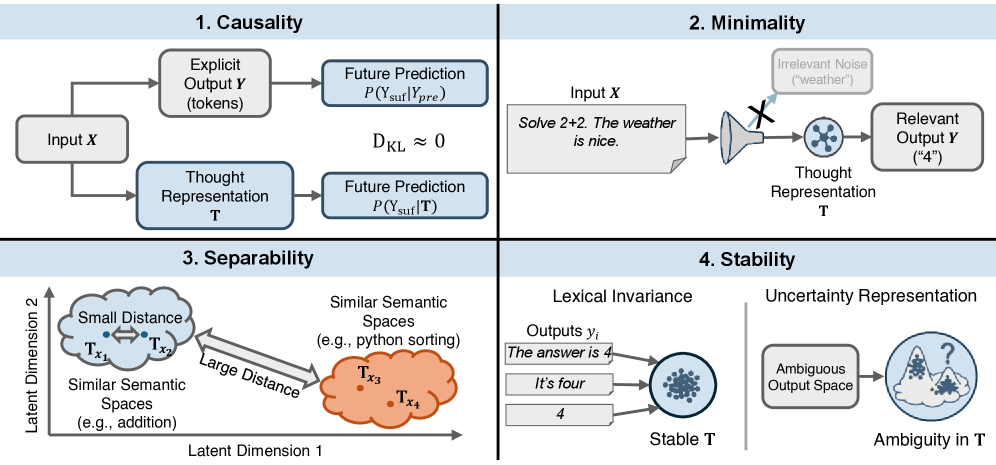
The four axioms are:
- Causality: \mathrm{KL}\big(P_{\mathcal{M}_\theta}(Y\mid x)\,\|\,P_{\mathcal{M}_\theta}(Y\mid \mathbf{T})\big), measured by training a projection from \mathbf{T} into the token-embedding space of a frozen LLaMA-3.2-1B backbone trained on \mathcal{M}_\theta’s own outputs, so the KL reflects functional substitution rather than generic transfer.
- Minimality: an information-bottleneck residual \Delta_\text{IB} that asks whether \mathbf{T} compresses input-specific nuisance information while preserving what predicts Y.
- Separability: discriminator accuracy distinguishing pairs of prompts both across tasks and within the same task.
- Stability / DCS: behavior under controlled perturbations relative to the semantic-equivalence threshold \tau.
Candidate TRs span: last-input-token hidden states across all layers (LIT-all) and final-layer (LIT), soft tokens with/without Gumbel noise (ST, STN), and latent thinking (LT), with 1/16/32/64/128 thinking steps. Baselines are the prompt’s input embedding (IE) — anything failing to beat IE adds nothing over the prompt — and a random vector (RV). Output embeddings (OE), exact and pooled, serve as upper bounds. Source models cover dense instruct (Llama-3.1-8B, Llama-3.3-70B), reasoning-distilled (DS-R1-Distill-Qwen-32B), native RL (Skywork-OR1-32B), and sparse MoE (GPT-OSS-20B).
Results per axiom
Causality. All TRs beat RV (KL ≈ 8.9–9.6 nats) by a wide margin, e.g. 4.0–5.3 nats across candidates, confirming continuation-relevant information is present. But no candidate beats IE consistently: for Llama-70B IE = 4.21, while the best non-OE candidate (LT) reaches 4.65; for Skywork-OR1 IE = 4.08 vs. ST 3.90 (a thin win, within the bootstrap noise on most models). In short, swapping \mathbf{T} for the prompt embedding does not appreciably reduce the substitution KL — TRs do not encode additional causal information about the continuation beyond the prompt.
Minimality. OE sits above IE on every model (e.g. 0.37 vs. 0.22 on Llama-8B) but lies outside the interpretable range of the IB decomposition. Among meaningful candidates, results are mixed: LIT is below IE on most models (Llama-70B: −0.30 vs. −0.23; Skywork: −0.27 vs. −0.21), soft-thinking variants are roughly at IE, and LT tracks IE almost exactly. Absolute scales differ across rows because the cross-entropy decomposition drops an LLM-specific constant, so only within-row ranks are meaningful.
Separability. Cross-task discrimination is near-saturated for every candidate including IE, so task identity is trivially encoded. The interesting axis is within-task discrimination: every non-OE candidate sits near the 50% chance baseline. On Llama-70B, OE reaches 72.6% while LIT/ST/STN/LT/IE all fall in 51.4–52.9%; on GPT-OSS-20B the spread is 50.4–51.8% versus IE 49.5%. Even OE caps at 73%, suggesting that within a task the candidate representations encode essentially no per-question identity.
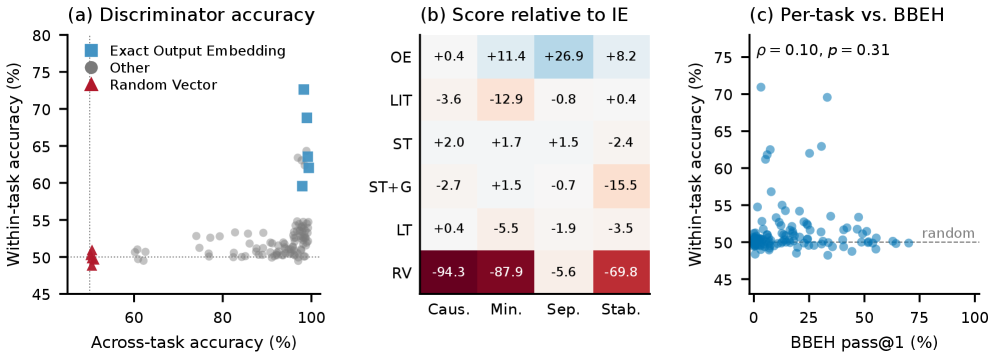
Panel (b) of Figure 2 makes the headline finding explicit: averaged over LLMs and normalized to IE, no candidate is jointly above the IE reference on all four axioms. Panel (c) shows that within-task discrimination is also uncorrelated with BBEH pass@1, so benchmark accuracy is not a proxy for representational richness.
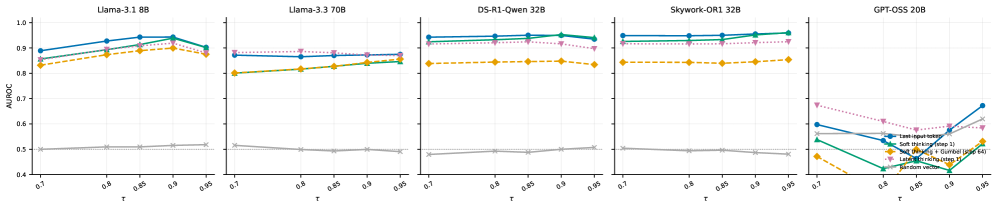
Stability (DCS). Rankings of TR families are stable across the entire range of the semantic-equivalence threshold \tau (Figure 3), so the conclusions above are not artifacts of a particular similarity cutoff.
Limitations and open questions
The audit uses a frozen LLaMA-3.2-1B decoding surface with a trained projection: while this controls compute and follows representation-transfer results in the literature, very large or RL-shaped TRs may underperform on this surface for reasons unrelated to their content. Semantic equivalence is approximated by an embedding model; \Phi is not directly observed. The Minimality measure discards an LLM-specific constant, preventing cross-model comparison. Beam search with 8 hypotheses is a particular slice of P(Y\mid x) and may under-sample diverse reasoning paths. Finally, the negative result — that no TR dominates IE — is family-best per LLM; it does not preclude better-engineered latent thought channels.
Why this matters
If latent CoT, soft tokens, and hidden-state probes do not encode information beyond the prompt embedding, and cannot distinguish two questions within the same task, then current “thinking in latent space” methods may be acting as inference-time compute amplifiers rather than carriers of reasoning state. A representation-level audit decoupled from accuracy is needed to attribute reasoning failures correctly and to design TRs that pass these axioms before claiming latent reasoning.
Source: https://arxiv.org/abs/2606.27378
SimFoundry: Modular and Automated Scene Generation for Policy Learning and Evaluation
Problem
Real-world robot policy training and evaluation are bottlenecked by data collection cost, reset overhead, and statistical noise from limited rollouts. Simulation addresses these issues in principle, but constructing scenes that (a) faithfully reproduce a real setup for sim-to-real transfer and (b) admit controlled variation for generalization studies is largely manual. Existing real-to-sim pipelines either require artist-authored assets, capture only geometry without physics, or are restricted to rigid tabletop primitives. SimFoundry targets zero-shot construction of sim-ready digital twins from a single video, with structured editing primitives (“digital cousins”) for object, scene, and task variation, and uses them both as a training-data factory and as a predictive evaluation harness.
Method
The pipeline is a composition of off-the-shelf perception modules glued by a physics-driven sanity check.
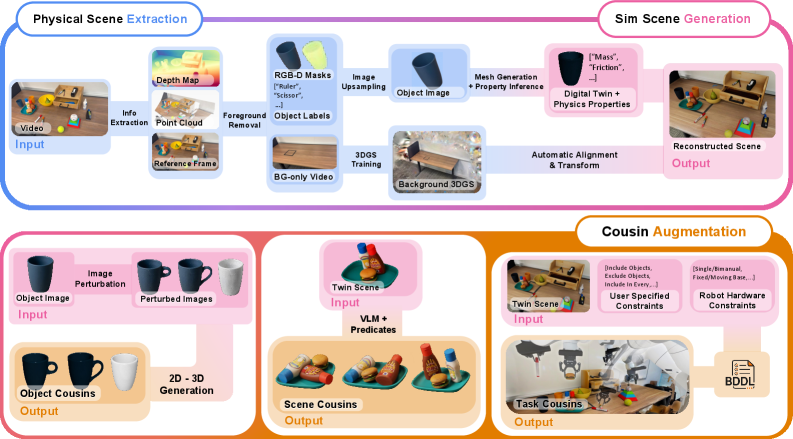
Given an input video, SimFoundry (1) runs per-object segmentation and depth estimation, (2) lifts each masked region to a 3D mesh via a 2D-to-3D generative model, (3) annotates physical parameters (mass, friction, articulation joints for cabinets/drawers, collision proxies), and (4) instantiates the assembled scene in a physics simulator where it runs a stability check — penetrations, free-fall settling, and articulation feasibility — before accepting the scene. Failures trigger pose or collision-mesh refitting.
On top of the reconstructed twin, three editing axes generate “cousins”:
- Object cousins: swap or perturb individual asset geometry while preserving affordance class (e.g., a brown bottle gets narrower but remains graspable in the same way).
- Scene cousins: vary background, layout, distractors, lighting.
- Task cousins: alter initial/goal conditions or sub-step ordering for multi-step tasks.
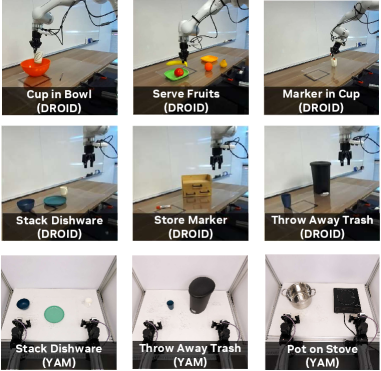
Policies are trained on rollouts collected in the augmented sim distribution. The same simulation is then re-used as an evaluator: a policy is scored in sim across the cousin distribution, and the resulting sim score is regressed against measured real success rate to test predictivity.
Results
Evaluation spans 7 manipulation tasks (single-arm Franka on a DROID setup; bimanual two-YAM setup), covering multi-step, articulated, and bimanual interaction, and 5 policy architectures.
Sim-as-evaluator predictivity. Across all task-policy combinations, mean Pearson correlation between SimFoundry simulated success and real-world success is 0.911, with mean maximum ranking violation of 0.018. The ranking-violation metric measures how often pairwise ordering between two policies disagrees between sim and real; 0.018 implies that policy ranking in sim is almost always preserved in the real world — the key property needed if simulation is to replace expensive real-world A/B comparisons.
Sim-to-real training transfer with cousins. Compared to training only on the reconstructed twin, adding cousins yields average real success-rate gains of:
- Object cousins: +17\%
- Scene cousins: +21\%
- Task cousins: +40\%
The ordering is consistent with the typical generalization gap on these task families: task-level variation (initial states, sub-step compositions) is the dominant source of brittleness for imitation policies, and task cousins yield the largest delta. Object and scene cousins act more like classical domain randomization but operate on affordance-preserving, geometrically plausible variations rather than uniform noise.
Policies trained entirely in SimFoundry transfer zero-shot to real hardware on multi-step tasks (e.g., sequential pick-place under articulation), articulated-object interaction (drawers, cabinets), and bimanual coordination.
Limitations and open questions
- The pipeline inherits failure modes of its constituent perception models: 2D-to-3D generation degrades on transparent, reflective, or highly thin objects, and articulation inference relies on category priors.
- Physical parameter annotation (mass, friction, compliance) is coarse; the paper does not quantify how parameter mis-specification affects transfer for contact-rich tasks beyond what randomization absorbs.
- The 0.911 correlation is averaged across tasks; per-task scatter (visible in the right panel of Figure 4) suggests some tasks remain less predictive, and the paper does not characterize which task properties drive low correlation.
- “Cousin” diversity is parameterized by the system designer; there is no learned objective for selecting which variations most improve real transfer per unit of training compute.
- All tasks are quasi-static manipulation; dynamics-heavy regimes (throwing, deformables, fluids) are not addressed.
Why this matters
If sim evaluation can rank policies with Pearson 0.911 and near-zero ranking violation against real rollouts, then iteration on policy architectures and training recipes can move into simulation with low risk of being misled — a substantial change in the cost structure of manipulation research. The cousin-based augmentation results also suggest that structured, affordance-preserving variation is a more sample-efficient lever than generic domain randomization for closing the sim-to-real gap.
Source: https://arxiv.org/abs/2606.28276
PhysisForcing: Physics Reinforced World Simulator for Robotic Manipulation
Problem
Video world models for robotic manipulation routinely synthesize visually convincing but physically incoherent rollouts: objects deform mid-grasp, contacts drift, trajectories jitter or teleport. These failures are precisely the modes that break downstream uses such as policy learning, model-predictive rollouts, and offline evaluation. The authors trace the instability to two compounding sources: (i) geometric deformation of moving foreground objects, and (ii) implausible spatio-temporal correlations between robot, object, and scene during contact phases. Both errors concentrate in a small spatial fraction of each frame — the contact region — yet standard diffusion losses spread supervision uniformly across pixels, which dilutes the gradient signal exactly where physical fidelity matters.
Method
PhysisForcing is a training-time add-on to a DiT video generator that injects two region-focused auxiliary losses. The core idea is to localize “physics-informative” regions from a reference clip and then align the DiT’s intermediate features to both pixel-level point trajectories and to relational features from a frozen video understanding encoder.
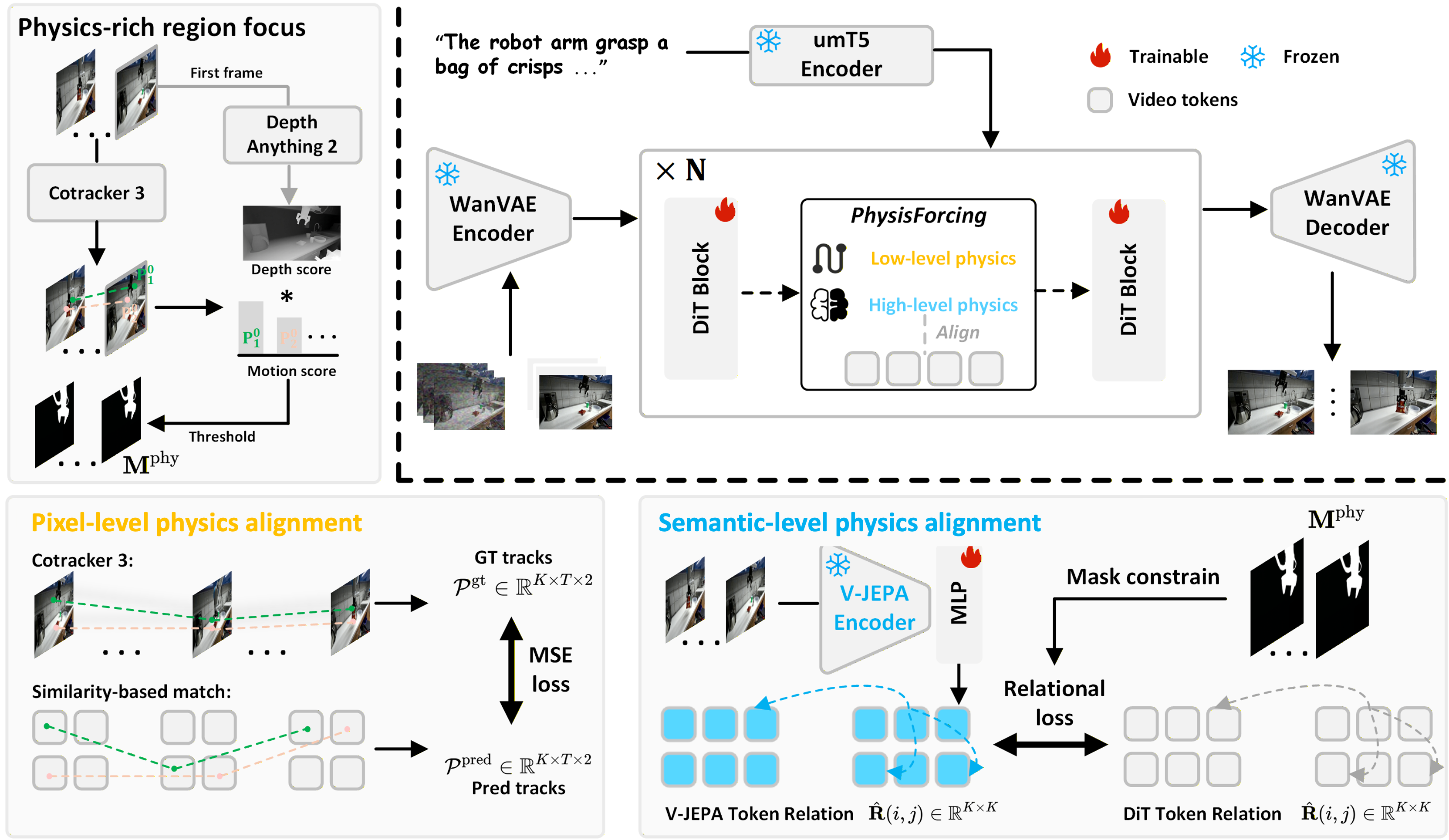
Physics-informative region extraction. Given a clip V \in \mathbb{R}^{T \times C \times H \times W}, an off-the-shelf point tracker (CoTracker3) produces dense trajectories \mathcal{P} = \{\mathbf{p}_i^{1:T}\}_{i=1}^N with N = H \times W. Each trajectory receives a motion magnitude
a_i = \sum_{t=1}^{T-1} \lVert \mathbf{p}_i^{t+1} - \mathbf{p}_i^{t} \rVert_2.
Motion alone over-selects background jitter, so a depth-aware foreground weight is computed from the first-frame depth D_0:
r_i = \frac{1}{D_0(\mathbf{p}_i^0) + \epsilon}, \qquad q_i = a_i \cdot r_i.
A trajectory-level mask is obtained by adaptive thresholding at the mean score,
\mathbf{M}^{\mathrm{phy}}_i = \mathbb{I}\!\left(q_i \geq \tfrac{1}{N}\sum_j q_j\right),
and projected per frame to a spatiotemporal mask \mathbf{M}^{\mathrm{phy}} \in \{0,1\}^{T \times H \times W} by setting \mathbf{M}^{\mathrm{phy}}_t(\lfloor \mathbf{p}_i^t \rceil) = 1 for selected trajectories. This mask localizes contact-rich pixels with both large motion and foreground depth — a cheap geometric prior that costs only one tracker pass and one depth pass per training clip.
Pixel-level trajectory alignment. Inside \mathbf{M}^{\mathrm{phy}}, DiT features are projected to 2D displacement predictions and supervised against \mathbf{p}_i^{t+1} - \mathbf{p}_i^t, enforcing trajectory continuity and stable contact dynamics on the moving foreground.
Semantic-level relational alignment. A frozen video encoder yields region descriptors for robot, object, and scene; pairwise relations among these regions form a relational tensor that DiT features must reproduce after a lightweight projection head. This term targets the second failure mode — inconsistent inter-entity correlations — without forcing the generator to imitate the encoder’s full representation.
The two losses are added to the standard rectified-flow / diffusion objective with masked support, so most parameters keep learning the appearance distribution while a thin auxiliary signal corrects physics where it matters.
Data and results
Training uses a filtered RoVid-X subset: starting from 4M clips, motion-score, task-level deduplication, and clip-text alignment filtering yield roughly 500K high-quality clips spanning multiple embodiments and tasks. Evaluation spans R-Bench, PAI-Bench (robot domain), and EZS.
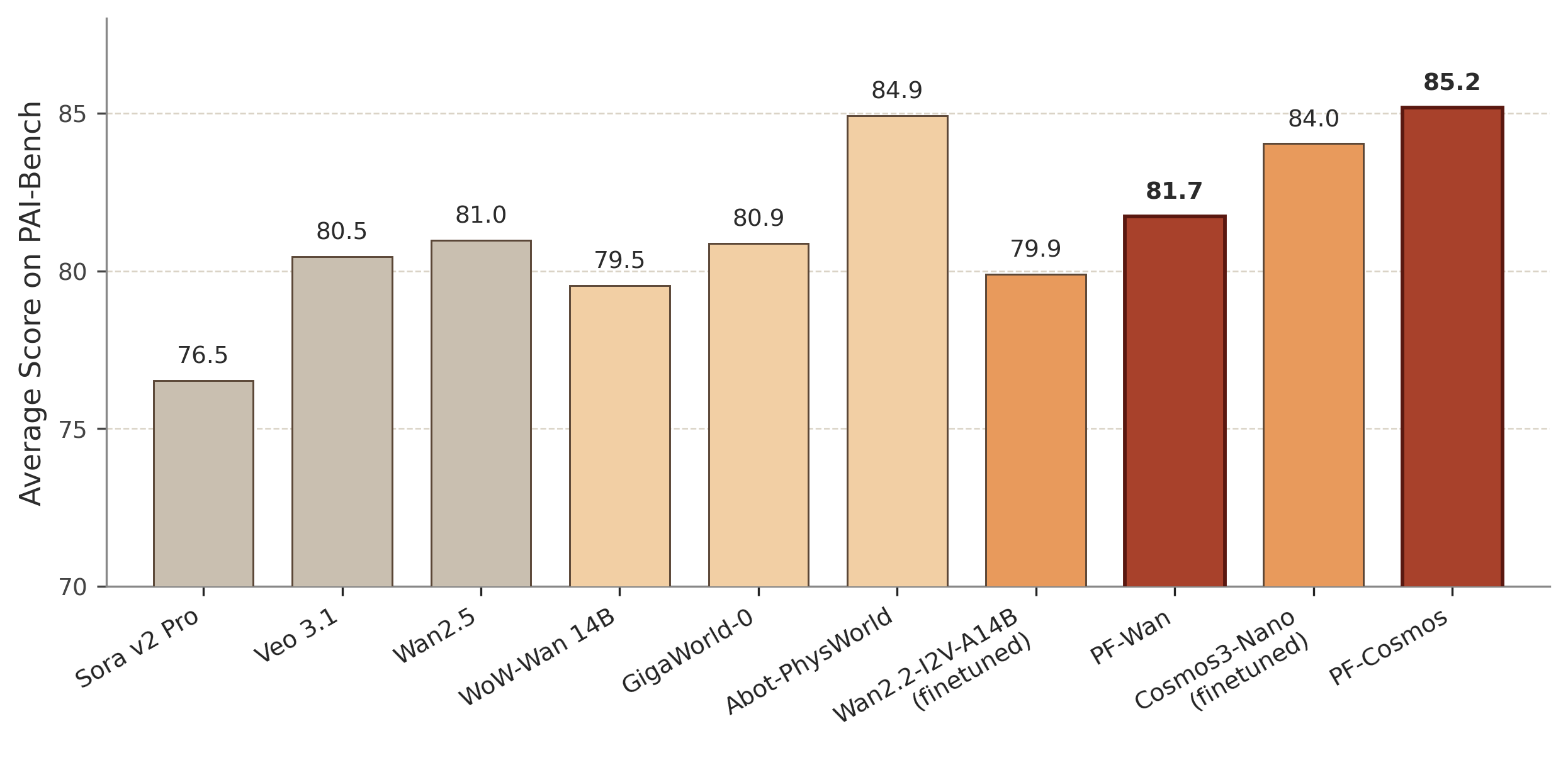
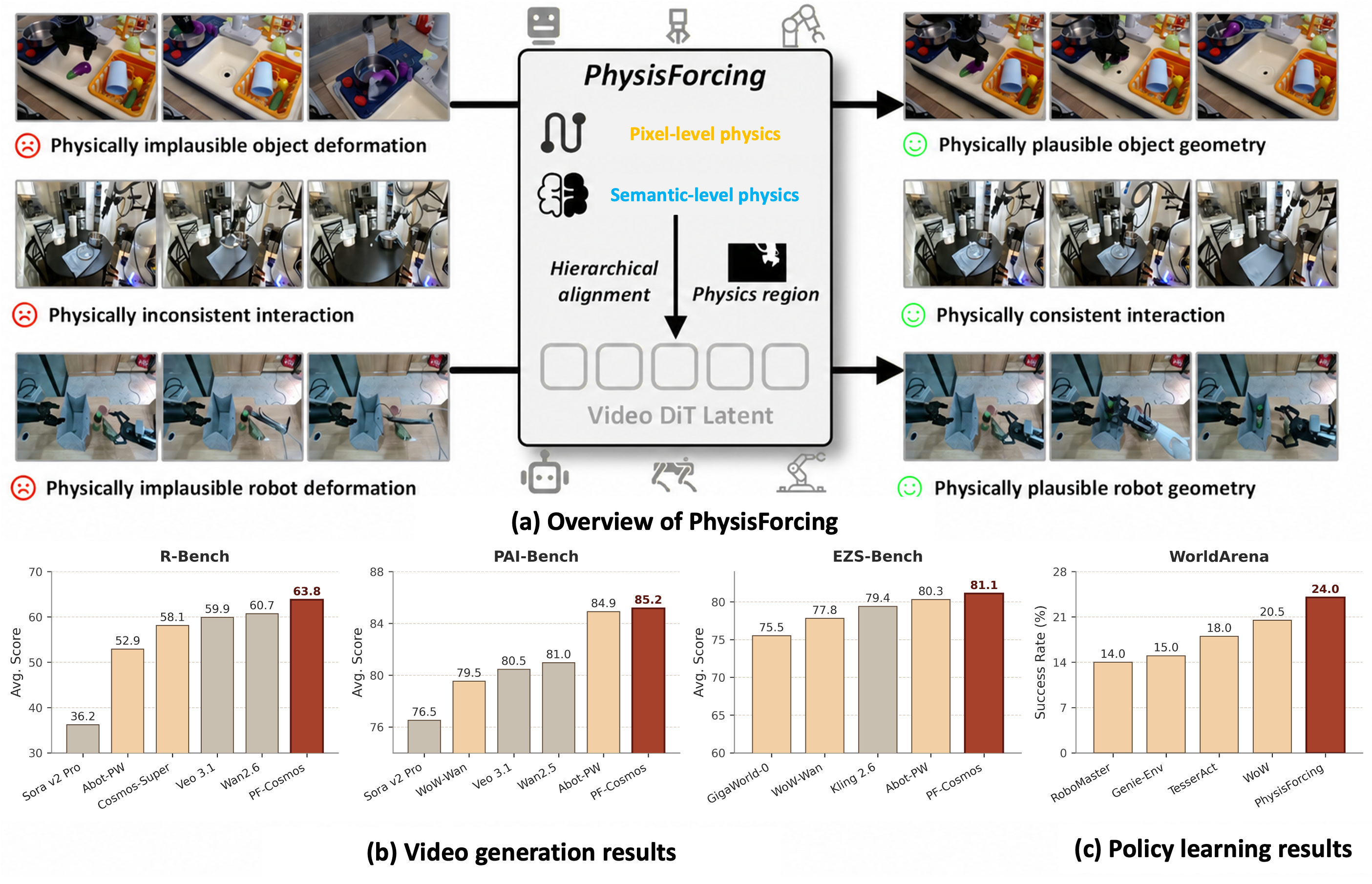
The PAI-Bench robot-domain plot (Figure 3) reports the overall average of Quality and Domain scores against the official leaderboard. The selected sections provided do not enumerate full numerical tables for R-Bench or EZS here, but the framing — “extensive experiments on R-Bench, PAI-Bench, and EZS” combined with leaderboard-referenced PAI-Bench results — positions PhysisForcing as the top entry on the robot domain of PAI-Bench under the official protocol.
Limitations and open questions
Several issues are visible from the method itself. First, the depth-weighted foreground prior r_i = 1/(D_0 + \epsilon) assumes the manipulator and target are nearer the camera than the scene — a safe bet for tabletop setups but brittle for wrist-camera or third-person views with foreground clutter. Second, mask construction relies on a first-frame depth and a 2D point tracker; occlusion-heavy interactions (in-hand manipulation, deformables) will produce unreliable trajectories where supervision is most needed. Third, the relational target is whatever a frozen video encoder believes about robot/object/scene relations; biases in that encoder propagate as physics priors. Fourth, the framework supervises 2D pixel trajectories, not 3D contact forces or rigid-body constraints, so true dynamical consistency (mass, friction, momentum) is only indirectly encouraged. Finally, the public excerpt does not isolate the contribution of each loss term, the runtime overhead of tracker+depth preprocessing, or generalization to out-of-distribution embodiments.
Why this matters
If world simulators are to serve as substrates for policy learning and offline rollout evaluation, they must be physically reliable on contact-rich regions, which is exactly where current video generators fail. PhysisForcing shows that a small, geometrically targeted auxiliary signal — trajectory plus relational alignment on a mask covering a fraction of each frame — is sufficient to move a DiT-based robot video generator to the top of PAI-Bench’s robot domain, suggesting that physical fidelity is a supervision-placement problem more than a capacity problem.
Source: https://arxiv.org/abs/2606.28128
Translation as a Bridging Action: Transferring Manipulation Skills from Humans to Robots
Problem
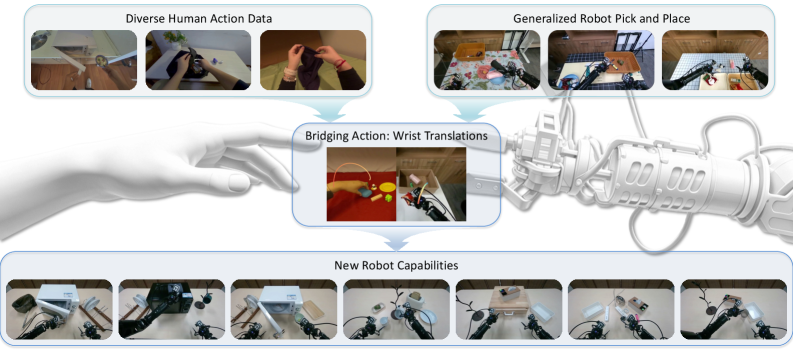
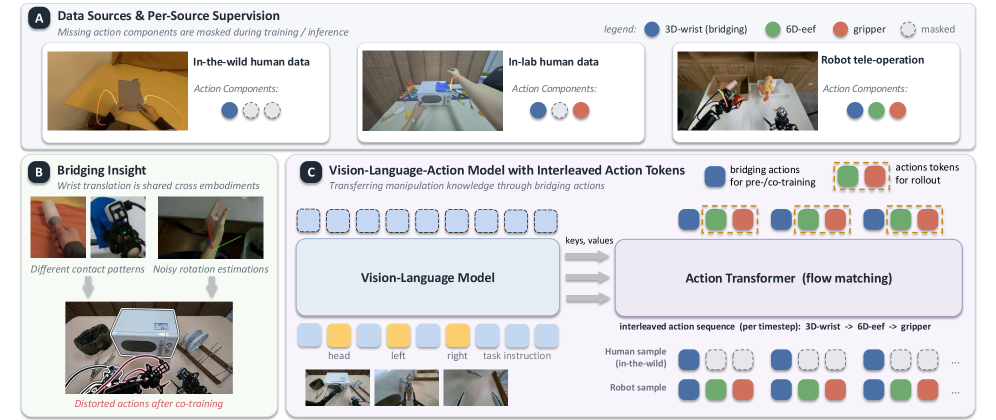
Human demonstration video is the obvious scaling substrate for robot manipulation: it is cheap, diverse, and abundant. The dominant approach treats humans as a noisy 6DoF bi-manual embodiment, extracting wrist pose trajectories from hand-pose estimators and co-training with robot data. This paper argues that approach is fundamentally mismatched for parallel-gripper robots for two reasons: (1) hand-pose estimators give noisy wrist rotations, and (2) human finger contact patterns decouple wrist rotation from the semantic action — a human rotates the wrist to compensate for finger geometry in ways a parallel gripper does not need. Replaying extracted 6DoF human wrist actions on a robot empirically yields distorted behavior.
Method
The proposal is to drop rotation entirely from the cross-embodiment action and use only the relative wrist translation, expressed in the initial head-camera frame, as the shared bridging signal.
Let \mathbf{W}^{t}_{w} \in \mathbb{SE}(3) be the wrist pose in world coordinates and \mathbf{T}^{t}_{w\leftarrow c} the head-camera pose at time t. Transforming the future wrist into the time-t camera frame c_t gives \mathbf{W}^{t+i}_{c_t} = (\mathbf{T}^{t}_{w\leftarrow c})^{-1}\mathbf{W}^{t+i}_{w}, and the bridging action over a k-step horizon is the translation residual
\boldsymbol{a}^{\text{3D-wrist}}_{t+i} = \boldsymbol{t}(\mathbf{W}^{t+i}_{c_t}) - \boldsymbol{t}(\mathbf{W}^{t}_{c_t}), \quad i=1,\dots,k.
Concatenating both arms yields \mathbf{a}^{\text{3D-wrist}}_t \in \mathbb{R}^{k\times 6}. This signal is robust to rotation-estimator noise, embodiment-agnostic, and physically meaningful because both humans and robots act under the same egocentric viewpoint.
For the robot, the full action \mathbf{a}^{\text{6D-eef}}_{t+i} = (\mathbf{W}^{t}_w)^{-1}\mathbf{W}^{t+i}_{w} is used, parameterized as Cartesian translation plus Euler angles, giving \mathbf{a}^{\text{6D-eef}}_t \in \mathbb{R}^{k\times 12} for the two arms. Gripper open/close is a separate discrete channel that exists only for robot data.
Because human samples lack the 6D end-effector and gripper components while robot samples have both, the policy is built on a \pi_0-like VLA backbone with interleaved action tokens and attention masking: missing components are simply absent from the sequence and masked out of the flow-matching loss, allowing a single model to consume both data streams without padding hacks.
Hardware and data
Experiments use the ByteMini bi-manual robot (two 7-DoF arms, parallel grippers, head + wrist RGB-D). Tele-operators randomize base height/pose during collection but the base is static at rollout. Human data is captured with a PICO 4 Ultra Enterprise headset; operators are instructed to mimic gripper-like hand postures and keep hands in the top camera view — this constraint matters because it keeps the wrist-translation distribution close to the robot’s reachable workspace.
For each of 15 bi-manual tasks, the authors collect 3 hours of in-lab human action data and 100 in-lab robot trajectories. The task suite covers microwave (open/close door, place/remove bowl, wipe top), drawer open/close, mug hanging, cup stacking, straw insertion, toast retrieval, and charger unplugging — tasks where rotation matters but is enacted very differently by fingers vs grippers.

Evaluation uses two distinct scenes per task with distractors, four trials per scene (eight trials per task), with object layouts reset against pre-recorded masks. Test scenes differ from training.
Results
The abstract and section structure indicate the central empirical claims: (1) the translation bridging action transfers manipulation skill from human to robot substantially better than the 6DoF baseline across the 15-task suite; (2) performance scales with human-only pre-training data; (3) human-only pre-training improves few-shot robot post-training data efficiency; (4) interleaved tokens with attention masking are essential for stable co-training; and (5) the bridging objective remains aligned with the executable robot action space — i.e., training on translation does not destabilize the rotation/gripper heads learned from robot data. The provided sections enumerate these as Q1–Q6 but the specific per-task success-rate tables are not in the excerpt; the qualitative claim is that 6DoF human action replays produce distorted trajectories whereas translation-only transfer preserves task semantics.
Limitations and open questions
The method by construction discards human wrist orientation, so tasks where the human wrist rotation contains information not recoverable from the robot’s own rotation prior (e.g., highly orientation-dependent manipulations learned only from human data) cannot benefit from cross-embodiment transfer beyond translation. The bridging is defined in the head-camera frame, which assumes a roughly comparable egocentric viewpoint between the human VR rig and the robot head camera; large viewpoint mismatch would break the shared frame assumption. The human data collection protocol explicitly asks operators to imitate gripper postures and stay in the top camera FoV, which limits how “in-the-wild” the abundant human data can be. Finally, gripper open/close timing is still learned purely from the 100 robot demos per task.
Why this matters
If wrist translation in the head-camera frame is a sufficient bridging signal, the bottleneck for using web-scale egocentric human video shifts from accurate 3D hand-pose estimation to coarse wrist tracking — a much easier perception problem. This reframes the human-to-robot transfer question from “match the human embodiment” to “extract only the embodiment-invariant motion component,” which is a cleaner inductive bias for VLA co-training on parallel-gripper platforms.
Source: https://arxiv.org/abs/2606.28133
ProMSA: Progressive Multimodal Search Agents for Knowledge-Based Visual Question Answering
Problem
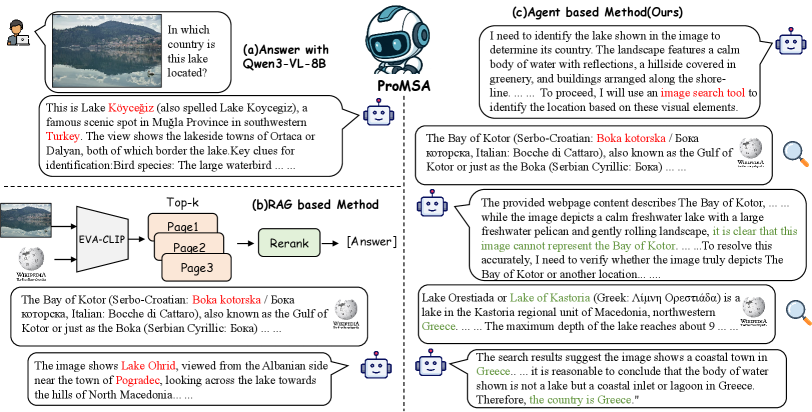
Knowledge-based VQA requires grounding answers in an external corpus (typically Wikipedia) that the model cannot store parametrically. The dominant paradigm is a fixed retrieve-then-generate pipeline with a pre-chosen retriever (image or text) and static top-k. This design conflates two distinct uncertainties: (i) modality uncertainty — image search is needed when the entity is unidentified, but text search with a generated query is needed when the entity is known and the question targets an attribute or multi-hop fact; (ii) depth uncertainty — the correct Wikipedia page may not be in the top candidates due to viewpoint/background shifts, so multiple retrievals with deduplication may be required. A static pipeline cannot adapt either dimension.
Method
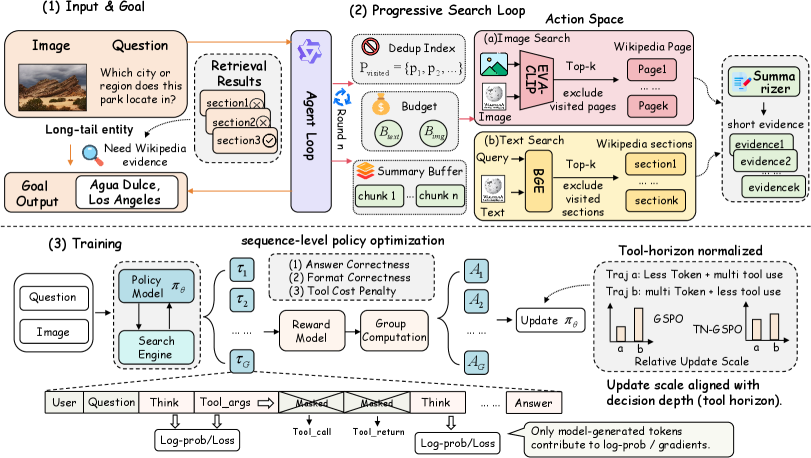
ProMSA casts KB-VQA as a budgeted progressive retrieval–reasoning process. Given input x=(I,q), at step t the agent picks an action
u_t \in \mathcal{U} = \{\texttt{img\_search},\ \texttt{text\_search},\ \texttt{stop}\},
receives an observation o_{t+1} (retrieved page content), and updates the internal state s_{t+1} = \text{Update}(s_t, o_{t+1}). Tool calls are constrained by separate budgets:
|\{t : u_t=\texttt{img\_search}\}| \le B_{\text{img}}, \qquad |\{t : u_t=\texttt{text\_search}\}| \le B_{\text{text}}.
Deduplication across retrieval calls prevents the agent from re-fetching the same page when its first guess fails. When the agent emits stop, it produces the final answer a.
Training has two stages:
Cold-start SFT via rejection sampling. The base VLM is asked to generate trajectories; only those with valid tool-call formats and correct answers are retained for SFT. This teaches the syntactic structure of
<tool_call>...</tool_call>interleaved with reasoning.TN-GSPO RL. The agent is then optimized with a sequence-level objective derived from GSPO with asymmetric clipping. The key innovation is tool-horizon normalization: the GSPO importance ratio is normalized not only by the generation length |y| but also by the tool-interaction depth T (number of tool calls in the trajectory). Without this, long multi-tool trajectories receive disproportionately small or large updates depending on token count alone, which destabilizes training of variable-depth agents. As Table 3 shows, on E-VQA/InfoSeek: GRPO 44.2/43.7, GRPO with asymmetric clipping 49.7/50.2, GSPO* 49.3/49.6, TN-GSPO 52.6/53.4 — a ~3-point gain over the next best sequence-level variant.
Results
On E-VQA (Single-Hop / All) and InfoSeek (Un-Q / Un-E / All), ProMSA with Qwen3-VL-8B reaches 52.2 / 52.6 / 53.6 / 53.3 / 53.4. Comparisons on the same backbone:
- REAL (Qwen3-VL-8B, EVA-CLIP-8B retriever): 45.5 / 41.4 / 43.1 / 45.1 / 44.1.
- MaS-VQA (same backbone): 42.2 / 41.3 / 43.7 / 43.9 / 43.8.
- Search-agent baselines on Qwen2.5-VL-7B: MMSearch-R1 40.6 / 40.7 / 40.3 / 39.3 / 39.7; DeepEyesV2 40.1 / 39.5 / 41.6 / 40.8 / 41.3.
- ProMSA on Qwen2.5-VL-7B already hits 50.0 / 49.7 / 48.8 / 49.6 / 49.2, outperforming both agent baselines on the same backbone by ~9 points on All.
The staged training contributes additively (Table 2, average All): Base 35.1 → SFT cold start 40.7 → RL 53.0, indicating most of the gain comes from RL on the agent policy rather than format imitation.
The ablation in Table 4 confirms both tools are necessary: text-only collapses on InfoSeek (21.4 if image is removed wait — text-only is 36.8 on InfoSeek; image-only is 21.4); the combined agent reaches 52.6 / 53.4. Crucially, image search alone is far worse on InfoSeek (21.4) than text search alone (36.8), because many InfoSeek questions require attribute lookup once the entity is known, whereas E-VQA benefits more symmetrically from both modalities.
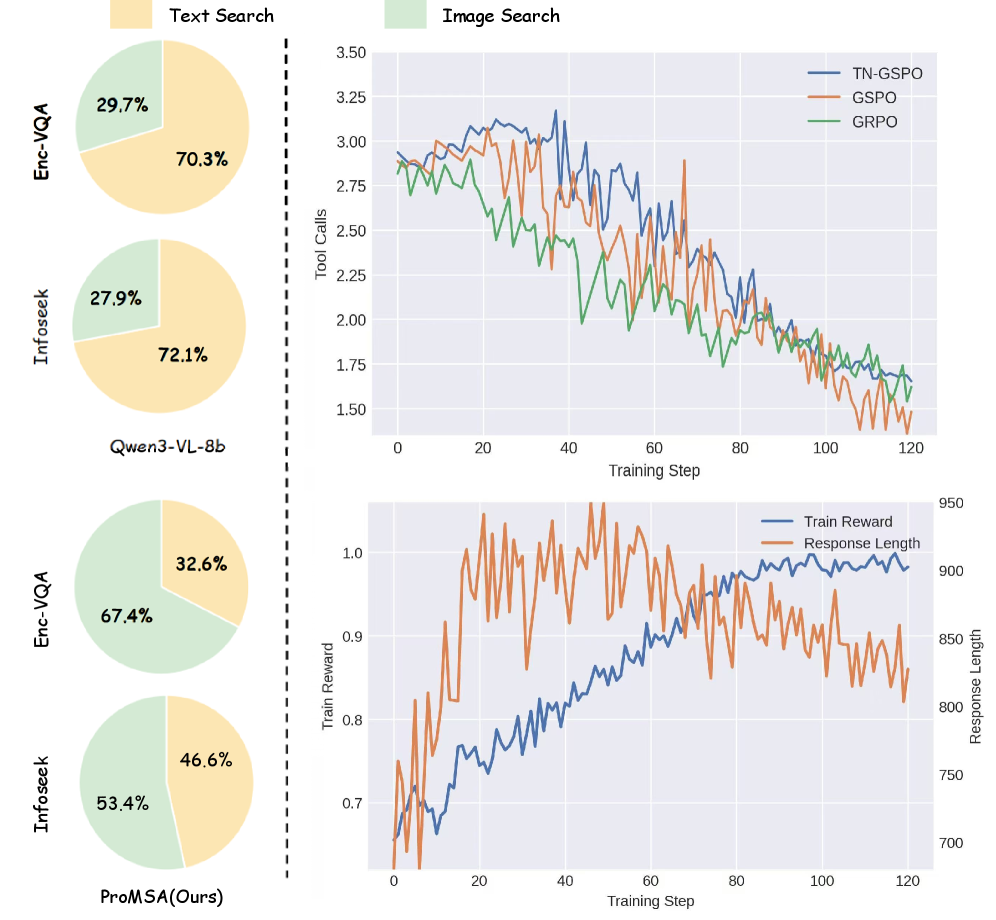
The training dynamics in Figure 3 show TN-GSPO produces more stable growth in tool calls and response length alongside increasing reward, while plain GRPO collapses response length or tool usage. The left panel indicates the learned policy is not biased to a single modality — both image and text searches are used in meaningful proportions, varying by dataset.
Limitations and open questions
The retrieval corpus is a 100K Wikipedia subset (to match prior work), so it is unclear how the agent scales as the index grows to the full ~6M entities, where retrieval ambiguity worsens. The budgets B_{\text{img}}, B_{\text{text}} are externally specified hyperparameters rather than learned; an adaptive budget conditioned on question difficulty is a natural extension. TN-GSPO normalizes by trajectory tool depth, but the paper does not analyze variance reduction theoretically — only empirically. Finally, the agent depends on a frozen retriever (BGE + EVA-CLIP); joint retriever-policy training is unexplored.
Why this matters
ProMSA shows that for multi-hop, knowledge-intensive VQA, the bottleneck is policy over retrieval, not retriever quality: with the same BGE+EVA-CLIP backbone used by weaker agents, a properly RL-trained tool-use policy gains ~9 points over fixed-pipeline RAG and existing search agents. The tool-horizon normalization in TN-GSPO is a small, general fix to sequence-level RL that should transfer to any variable-depth tool-using agent.
Source: https://arxiv.org/abs/2606.27974
GBC: Gradient-Based Connections for Optimizing Multi-Agent Systems
Problem
LLM multi-agent systems decompose tasks across role-specialized agents connected by message passing. The dominant failure mode is credit assignment: when the terminal output is wrong, which agent (or which interaction step) caused it? Existing optimizers (e.g., DSPy-style prompt search, TextGrad, GPTSwarm) treat the system either as a black box or propagate verbal feedback along edges without quantifying how much each upstream token actually influenced downstream computation. This produces coarse attribution and noisy prompt updates. GBC proposes a token-level, gradient-based attribution mechanism that turns the multi-agent DAG into a differentiable-ish object suitable for targeted prompt optimization.
Method
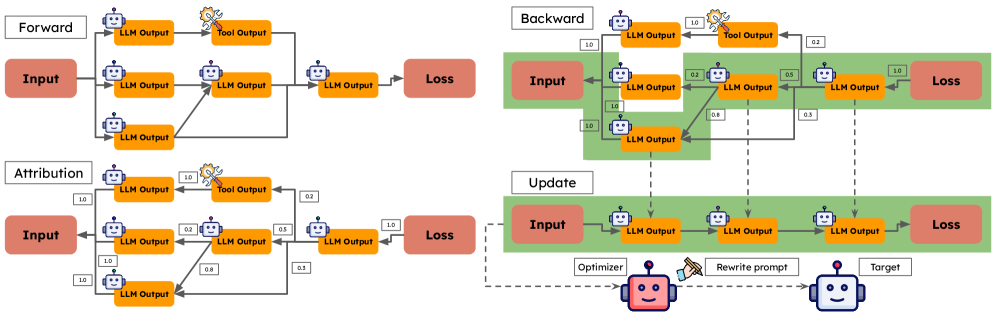
The system is modeled as a DAG G=(V,E) where each node v is a (prompt, model) pair (P_v, M_v). The forward pass is
O_v = M_v(P_v + I_v), \quad I_v = \sum_{u\in \mathrm{pre}(v)} O_u
with agents run in topological order (Eq. 1–2). Concatenation of predecessor outputs is written as a sum to make the graph algebraic.
The key construct is the gradient-based connection: for edge (u,v), GBC computes the Jacobian of v’s output token logits with respect to u’s output token embeddings, then reduces it to a scalar connection weight. The paper evaluates four reductions: mean and max of the L1 norm of the Jacobian, and mean and max of its inner product with the input embeddings. These weights form an attribution graph parallel to the agent graph. A task-specific verbal loss (an LLM-graded critique of the final output) is then back-propagated along the attribution graph by selecting the highest-weight predecessor edges, yielding attribution trajectories. The optimizer rewrites the prompts of agents lying on those trajectories.
Naively, computing input-token gradients through a 70B model for every edge is prohibitive. AgentChord exploits the fact that gradients are only needed w.r.t. the input portion of each agent’s context, not its (fixed) prompt prefix. The prompt is run once without autograd to populate the KV cache; the input is then run with gradients enabled. Memory drops from \mathcal{O}(n\cdot d\cdot L) to \mathcal{O}((n-k)\cdot d\cdot L) where k is the prompt length and typically k \gg n-k. This makes the method tractable on a single node with Llama-3.3-70B-Instruct and Qwen-3-32B.
Results on MultiWOZ
The benchmark uses 100 dialogues across five domains (Attraction, Hotel, Restaurant, Train, Taxi) with a manager–worker–responder topology.
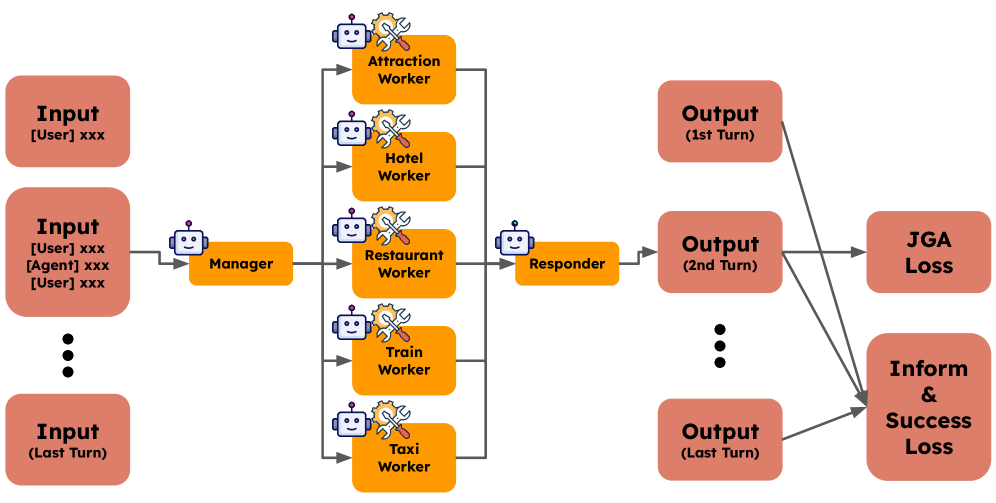
The headline finding is that the unoptimized multi-agent baseline underperforms a single-agent prompt on fine-grained slot metrics — e.g., for Qwen-3-32B, multi-agent gets JGA 28.9 vs. single-agent 44.4, and Slot F1 79.3 vs. 88.5 — even though it improves coarse metrics (Inform 95.0 vs. 88.0, Success 80.0 vs. 40.0). Decomposition helps task completion but introduces slot-tracking errors at agent boundaries. This is precisely the miscoordination problem GBC targets.
After GBC optimization with mean-of-L1-norm connection weights, Qwen-3-32B reaches Inform 99.0, Success 94.0, JGA 54.4, Slot Precision 85.5, Slot F1 91.4 — surpassing both the multi-agent baseline and the single-agent system on every metric. Max-of-L1-norm is similar (Inform 99.0 / Success 95.0 / JGA 53.0). Product-with-input variants are weaker (JGA 51.0–51.9). L1-norm reductions dominate, suggesting that raw influence magnitude is a better attribution signal than directional alignment with the input.
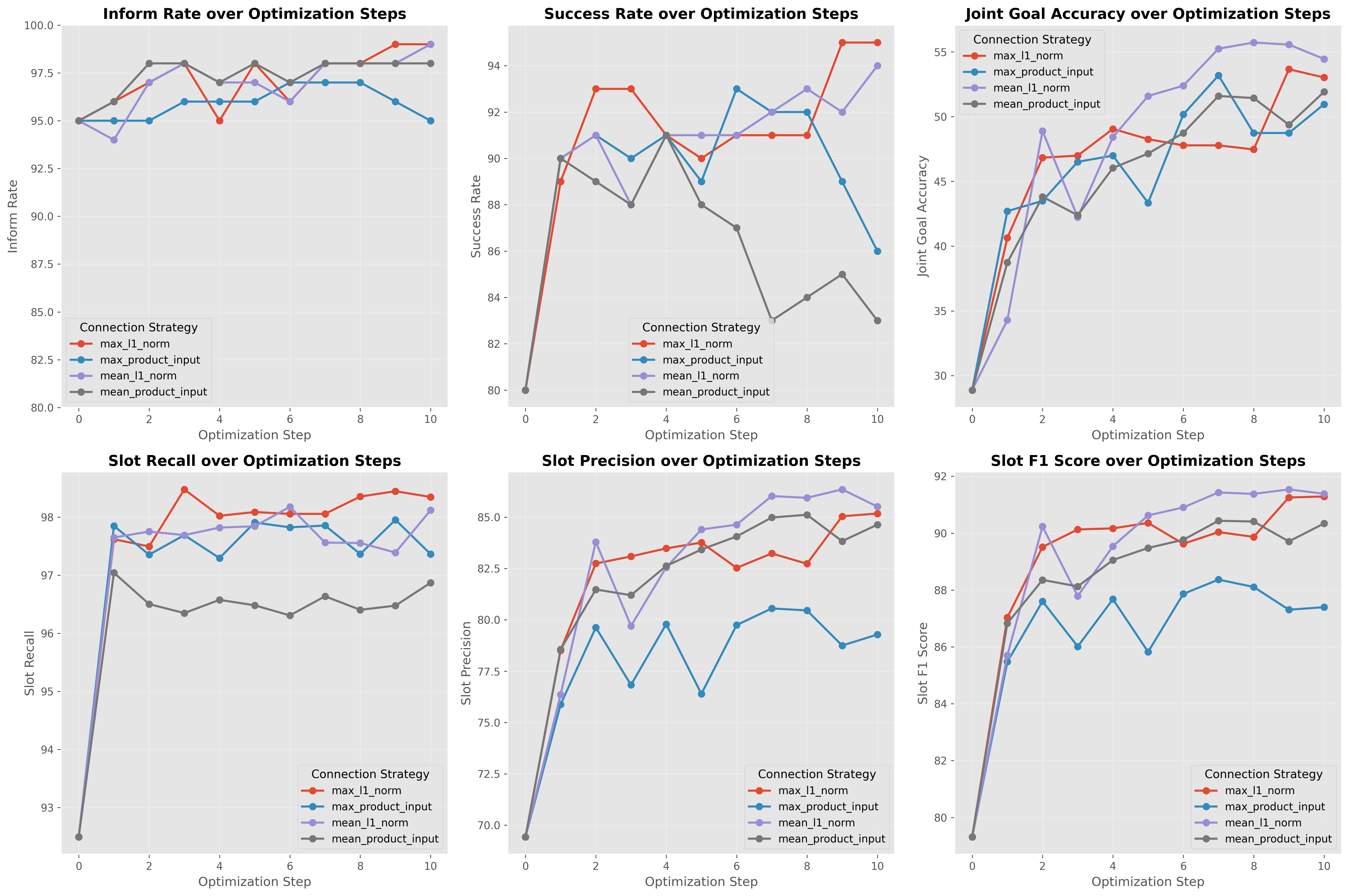
The dynamics plot shows monotone improvement for JGA, Slot Precision, and Slot F1, while Success oscillates — consistent with the interpretation that GBC corrects per-slot extraction errors more reliably than higher-level goal-completion behavior, which depends on longer-horizon interactions.
Results for Llama-3.3-70B-Instruct are more brittle: mean-of-L1-norm optimization collapses to Inform 42.0 / Success 7.0, suggesting that the gradient-based attribution can produce destructive updates on larger models, possibly because their attribution graphs are flatter (more diffuse influence) and the prompt-rewrite step lacks a safeguard against regressions.
Limitations and open questions
- The optimizer only updates prompts on the highest-attribution trajectory; there is no explicit trust region or rollback, which explains the Llama-70B collapse. A constrained / line-search variant is an obvious next step.
- The four reduction choices (mean/max × L1/product) are ad hoc. A principled connection weight — e.g., integrated gradients along an interpolation between agent outputs — is not explored.
- Evaluation is on 100 dialogues from MultiWOZ and τ-bench; statistical confidence on small JGA deltas is limited.
- The “loss” is a verbal critique from an LLM judge; gradients are taken w.r.t. token embeddings of intermediate outputs, but the loss itself is not differentiable. The chain that links the verbal loss to the gradient-based edge weights is informal — gradients are used as influence proxies, not as components of a true end-to-end gradient.
- Cost: even with prefix caching, computing per-edge Jacobians scales with the number of edges times sequence length; the paper does not report wall-clock or throughput numbers.
Why this matters
GBC operationalizes credit assignment in LLM multi-agent systems at the token level by reusing the one signal these systems actually expose — gradients through the underlying model — to weight inter-agent edges. The MultiWOZ results show this can recover and exceed single-agent slot accuracy that naive multi-agent decomposition destroys, which is the central practical objection to agentic pipelines.
Source: https://arxiv.org/abs/2606.28187
Hacker News Signals
DSpark: Speculative decoding accelerates LLM inference
DSpark is DeepSeek’s production speculative decoding system, described in a preprint hosted on their GitHub. The core problem is autoregressive LLM inference bottleneck: each token requires a full forward pass through a large model, leaving GPU compute underutilized due to memory-bandwidth constraints.
Speculative decoding addresses this by using a small draft model to propose K tokens, then verifying all K with the target model in a single batched forward pass. If the target model’s distribution agrees, all K tokens are accepted; otherwise tokens are resampled from a corrected distribution to preserve the target model’s output distribution exactly.
DSpark’s contributions center on making this work efficiently at DeepSeek’s serving scale. Key engineering choices include: a tree-structured draft mechanism where multiple candidate sequences are proposed simultaneously and verified in parallel, reducing the effective per-token latency; a draft model co-design that matches the target’s tokenizer and embedding space tightly to maximize acceptance rate; and dynamic speculation length K tuning based on observed acceptance rates per request context, rather than a fixed K.
The system also addresses the batching problem: speculative decoding degrades under large batch sizes because different requests accept different numbers of tokens, creating irregular computation graphs. DSpark handles this with a custom CUDA kernel that packs ragged accepted sequences efficiently.
Reported numbers show 2-3x throughput improvement over standard autoregressive decoding at production batch sizes, with latency improvements more pronounced at low concurrency (up to 4x on single-request benchmarks). Acceptance rates vary by task type, with code and structured output domains achieving higher rates than open-ended generation.
Open questions: the draft model adds memory overhead, and the acceptance rate degrades significantly on tasks with high output entropy. The tree-draft approach also increases KV cache complexity.
Source: https://github.com/deepseek-ai/DeepSpec/blob/main/DSpark_paper.pdf
Knowledge Distillation of Black-Box Large Language Models (2024)
This paper addresses a practical constraint: you want to distill a large proprietary LLM (GPT-4, Claude, etc.) into a smaller, deployable model, but you only have API access — no logits, no internal activations, only sampled text outputs.
Standard knowledge distillation minimizes KL divergence between teacher and student output distributions, requiring access to the teacher’s full softmax distribution p_T(y|x). With black-box access you only get samples y \sim p_T(\cdot|x), making the standard objective unavailable.
The authors propose training the student to maximize likelihood on teacher-generated samples, i.e., minimize -\mathbb{E}_{y \sim p_T}[\log p_S(y|x)]. This is a biased estimator of the forward KL, but the bias depends on the mismatch between teacher and student support. They also explore augmenting this with task-specific reward signals when available, framing the combined objective as a weighted mixture of behavioral cloning on teacher samples and direct task supervision.
A key practical contribution is a data collection strategy: rather than sampling uniformly, they use the student’s own uncertainty to prioritize queries to the teacher API, reducing the number of expensive API calls needed to reach a target performance level. This is essentially active learning over the prompt distribution.
Experiments on instruction-following, reasoning, and classification tasks show that a 7B student trained this way closes roughly 60-80% of the gap between the base 7B and GPT-4 on standard benchmarks, depending on task. The approach is straightforward to implement and the paper’s main value is a clean empirical analysis of when black-box distillation works and when it fails (high-diversity generation tasks are hardest).
Limitation: the method implicitly assumes the prompt distribution used for distillation is representative of deployment, which is rarely guaranteed.
Source: https://arxiv.org/abs/2401.07013
AI learns the “dark art” of RFIC design
Radio-frequency integrated circuit (RFIC) design is notoriously difficult to automate because it requires simultaneously satisfying tight analog constraints — noise figure, linearity (IIP3), gain, bandwidth, power consumption — that interact nonlinearly and depend heavily on transistor-level parasitics. Unlike digital logic, there is no clean abstraction boundary; layout and circuit topology co-determine performance.
The IEEE Spectrum article covers research using ML-guided optimization to automate parts of this flow. The technical approach is surrogate-model-based optimization: a neural network is trained on simulation data (typically from SPICE or electromagnetic solvers) to predict circuit performance metrics from design parameters (transistor sizing, bias voltages, passive component values). A Bayesian optimization or evolutionary search loop then queries the surrogate to propose candidates, which are periodically verified with full simulation to update the model.
The harder problem is topology selection — not just sizing a fixed circuit but choosing which circuit structure to use. Some groups are applying graph neural networks over circuit netlists to predict performance, enabling search over topology space. Reinforcement learning formulations have also appeared, where the agent places and connects components.
Reported results in the article include automated design of low-noise amplifiers (LNAs) and voltage-controlled oscillators (VCOs) that meet or approach hand-designed performance, with design time reduced from days/weeks to hours. The caveat is that these results are typically on well-characterized process nodes with extensive simulation datasets; generalization to new process design kits (PDKs) remains expensive.
The “dark art” framing reflects that human RF designers rely heavily on intuition about which topologies are worth exploring — intuition that is hard to encode but that ML approaches are beginning to approximate through large-scale simulation sweeps.
Source: https://spectrum.ieee.org/ai-radio-chip-design
Programmable Probabilistic Computer with 1M p-bits
This paper describes a hardware implementation of a probabilistic computer built from p-bits — stochastic binary units that fluctuate between 0 and 1 with a controllable probability. The key distinction from standard bits is that p-bits are natively random; the hardware exploits rather than suppresses thermal or electronic noise.
A single p-bit implements \langle s_i \rangle = \tanh(\beta I_i) where I_i is the weighted input from neighboring units and \beta is an effective inverse temperature. A network of N p-bits with coupling matrix J_{ij} samples from a Boltzmann distribution P(\mathbf{s}) \propto \exp(\beta \sum_{ij} J_{ij} s_i s_j), making the hardware a natural Ising machine. This maps directly onto combinatorial optimization (MAX-CUT, integer factoring, Bayesian inference) by encoding the problem in J.
The paper’s contribution is scaling to 10^6 p-bits on an FPGA-based platform, achieved through a hierarchical architecture that partitions the coupling graph to match on-chip routing constraints. Fully connected graphs are not feasible at this scale, so the authors use sparse, structured connectivity with a software layer that handles non-local couplings via message passing.
Benchmarks compare against simulated annealing and quantum annealers (D-Wave) on graph problems. At 10^6 scale, the system finds good solutions to MAX-3-SAT instances faster than CPU-based SA in wall-clock time, though the comparison is architecture-dependent. Energy efficiency per sample is the claimed advantage.
Open questions: the sparse connectivity limits problem classes; embedding arbitrary graphs requires overhead that can negate speed gains. Whether p-bit hardware offers an asymptotic advantage over classical MCMC on real problem instances remains unresolved.
Source: https://arxiv.org/abs/2606.25313
GLM 5.2 beats Claude in our benchmarks
This is a Semgrep engineering blog post describing how they evaluated LLMs for their Mythos cybersecurity agent and found GLM-5.2 (a ZhipuAI model) outperforming Claude Sonnet on their internal benchmarks.
The technical content is in the evaluation methodology. Semgrep’s benchmark is task-oriented: the model must perform vulnerability analysis, triage findings from static analysis, write Semgrep rules, and reason about code security properties. These tasks require following precise structured output formats and reasoning about code semantics, which differs from general instruction-following benchmarks.
Their evaluation framework runs models against a fixed set of labeled code samples where ground-truth vulnerability presence/absence is known. Metrics include precision/recall on vulnerability detection, rule-writing correctness (evaluated by running generated Semgrep rules against test corpora), and false-positive rate. This is substantially more constrained than open-ended chatbot evals.
GLM-5.2’s advantage appears concentrated in structured output adherence and rule syntax correctness — it produces fewer malformed JSON/YAML outputs and more syntactically valid Semgrep patterns. Claude’s strengths (nuanced reasoning, longer context) matter less when the task is highly templated.
The broader point, which the HN discussion engaged with heavily, is that benchmark performance is highly task-distribution-dependent. A model that underperforms on MMLU or GPQA can dominate on a specific production task. Semgrep’s approach — building domain-specific eval sets from actual production data — is methodologically sound and more predictive of deployment performance than aggregated public benchmarks.
The post is transparent about what was not tested: multi-turn agentic scenarios, robustness to adversarial inputs, latency/cost tradeoffs, and tasks outside their specific security analysis domain.
Source: https://semgrep.dev/blog/2026/we-have-mythos-at-home-glm-52-beats-claude-in-our-cyber-benchmarks/
Wayfinder Router: deterministic routing of queries between local and hosted LLM
Wayfinder is a lightweight query router that classifies incoming prompts and dispatches them to either a local LLM (e.g., Ollama-served Llama/Mistral) or a hosted API (OpenAI, Anthropic) based on configurable rules. The central design principle is determinism: routing decisions are rule-based and reproducible, not themselves driven by a learned model, which avoids the bootstrapping problem of using an LLM to decide which LLM to use.
The routing logic operates on extracted query features: prompt length, detected topic category (via keyword matching and optional lightweight classifier), presence of sensitive data patterns (regex-based PII detection), and user-defined tags injected via a middleware interface. Rules are expressed in a YAML configuration that maps feature predicates to backend targets with priority ordering.
The cost model is explicit: the config lets operators assign a cost weight to each backend, and the router can optionally enforce a budget constraint that shifts traffic toward the local model when the rolling cost window exceeds a threshold. This makes the system useful for mixed deployments where expensive API calls should be reserved for queries requiring frontier model capability.
Implementation is in Python with a FastAPI-compatible middleware interface. The router sits in front of an OpenAI-compatible API endpoint and is transparent to the client — it speaks the same request/response schema. Backend health checking and fallback logic handle cases where the local model is unavailable.
Limitations are inherent to the rule-based approach: the router cannot assess query difficulty or predict whether the local model will produce an acceptable answer. More sophisticated routing based on uncertainty estimation or learned routing policies (as in papers like RouterBench) would require additional model overhead that the author deliberately avoided.
Source: https://github.com/itsthelore/wayfinder-router
Show HN: NanoEuler – GPT-2 scale model in pure C/CUDA from scratch
NanoEuler is an educational reimplementation of a GPT-2-scale transformer trained end-to-end in C with custom CUDA kernels, in the spirit of Andrej Karpathy’s llm.c. The name references Euler’s method, reflecting a focus on numerical fundamentals.
The implementation covers the full training stack: tokenization (BPE implemented in C), data loading, forward pass, loss computation, backward pass, and AdamW optimizer — all without PyTorch or any deep learning framework. CUDA kernels are written manually for the performance-critical operations: matrix multiplication (using cuBLAS as a reference and a custom tiled GEMM for pedagogy), softmax, layer normalization, and the attention mechanism.
The attention implementation is particularly instructive: the repo includes both a naive O(n²) memory attention and a tiled version that manually manages shared memory to reduce global memory bandwidth. The backward pass for scaled dot-product attention is derived from scratch, showing the gradient flow through the softmax and the matrix products explicitly — something framework autograd hides.
Training targets GPT-2 small (117M parameters) on a single A100 or similar. The repo includes benchmarks comparing custom kernel throughput against cuBLAS baselines, showing the custom GEMM reaching roughly 60-70% of cuBLAS performance — a reasonable result for a pedagogical implementation.
The educational value is in the explicitness: every operation is visible, memory layouts are explicit (row-major, transposition handling), and there are no framework abstractions. For researchers who want to understand what happens below PyTorch’s ATen layer, this is a useful reference. The code is compact enough to read in a few hours.
Source: https://github.com/JustVugg/nanoeuler
Previewing GPT-5.6 Sol: a next-generation model
OpenAI’s preview announcement for GPT-5.6 Sol generated the highest engagement in this batch. The announcement is characteristically light on architectural specifics, but the technical claims and the HN discussion together surface several concrete points.
“Sol” appears to be positioned as an extended-thinking / reasoning-heavy variant in the GPT-5 family, analogous to the o-series relationship to GPT-4. The announcement emphasizes performance on competition math, PhD-level science questions, and long-horizon coding tasks — the same distribution where chain-of-thought and test-time compute scaling show the clearest gains. This suggests Sol uses a reasoning trace mechanism (internal scratchpad or multi-step rollout) rather than purely scaling parameters.
The model is described as multimodal with improved vision understanding, and the preview includes claims of stronger performance on document and chart analysis. OpenAI’s eval numbers cite improvements over GPT-4o and GPT-4.5 on AIME, GPQA, and SWE-bench, but without methodology details these are difficult to interpret — in particular whether evaluation is pass@1, pass@k, or with tool use enabled matters enormously for SWE-bench numbers.
The HN discussion flagged two technical concerns that are worth noting. First, “5.6” as a version number is unusual and suggests either rapid iteration or a marketing versioning scheme disconnected from architectural generations. Second, the “Sol” naming alongside “extended thinking” framing positions this squarely against Anthropic’s Claude extended thinking and Google’s Gemini thinking variants, indicating the competitive landscape is converging on test-time compute as the primary differentiator for frontier models in 2025-2026.
No weights, no paper, no architectural details released at preview stage.
Noteworthy New Repositories
zengxiao-he/tessera
A full-stack LLM distillation and serving system built without relying on existing inference frameworks. Tessera covers the entire pipeline from knowledge distillation to production serving. The distillation side uses FSDP for distributed training and a JAX-based oracle model for generating soft targets. On the serving side it implements paged-KV memory management (similar to vLLM’s PagedAttention) with continuous batching and speculative decoding to reduce latency on autoregressive generation. Performance-critical kernels are written in custom Triton/CUDA rather than deferring to cuBLAS or FlashAttention libraries, giving fine-grained control over memory layout and compute scheduling. The gateway layer is written in Rust, providing low-overhead HTTP/gRPC routing with backpressure handling. An interpretability module is included for inspecting attention and activation patterns of the distilled student. The value here is vertical integration: most projects either handle distillation or serving, not both with shared abstractions. Useful for researchers who want to study the interaction between distillation objectives and inference-time behavior, or engineers who want a single auditable codebase rather than gluing together five separate libraries. The Triton kernels and Rust gateway together make this unusually performance-conscious for an academic-leaning project.
Source: https://github.com/zengxiao-he/tessera
OtterMind/Nubase
Nubase is a self-hostable backend-as-a-service targeting AI-generated and agent-driven applications. It bundles four primitives — persistent memory (vector + structured), a relational/document database, blob storage, and authentication — into a single deployable service. The design premise is that AI coding agents produce apps that need all four immediately, and forcing them to configure separate Postgres, S3, Redis, and Auth0 instances introduces friction and misconfiguration surface. Nubase exposes a unified API so generated code can call one SDK for all backend operations. Architecturally it is analogous to Supabase but with first-class vector memory and an agent-oriented API surface designed for programmatic rather than human-driven consumption. The self-hostable nature means data stays local, which matters for enterprise or regulated environments where SaaS backends are off-limits. The open-source core allows inspection of how memory retrieval and auth tokens are handled, which is non-trivial for agentic workloads where the agent itself may be issuing auth requests. Useful for teams prototyping multi-agent systems who want infrastructure that does not require separate DevOps work per component.
Source: https://github.com/OtterMind/Nubase
eddyzzl/marvis-risk-agent
MARVIS-Agent is a domain-specific agentic system targeting credit risk workflows: model development, model validation, data preprocessing, feature engineering, and strategy design (scorecard cutoffs, policy rules). Rather than a generic code-generation agent, it encodes credit risk domain knowledge — standard regulatory concerns like model drift, Gini coefficient tracking, PSI/CSI monitoring, and champion/challenger testing — as agent capabilities. The architecture likely wraps an LLM with structured tool calls for tabular data operations and statistical tests common in credit modeling. This matters because general-purpose coding agents lack the domain priors to, for example, flag that a logistic regression trained on pre-2020 bureau data should be revalidated post-pandemic, or that a WoE-binned feature requires monotonicity constraints. The target user is a quantitative analyst or risk modeler who wants to automate the repetitive parts of model development cycles without building bespoke tooling. The validation workflow component is particularly notable — model validation in regulated financial institutions is a distinct function from model development, and tooling that respects that boundary is unusual. Open questions include how it handles proprietary bureau data formats and whether validation outputs meet SR 11-7 documentation standards.
Source: https://github.com/eddyzzl/marvis-risk-agent
databufflabs/databuff
Databuff is an open-source APM and SRE automation platform built on the OpenTelemetry data model. It ingests traces, metrics, and logs via the standard OTLP protocol, meaning any instrumented service (Go, Python, Java, etc.) can point its collector at Databuff without code changes. On top of the observability data it layers an SRE agent that can reason over telemetry to identify anomalies, correlate incidents across signals, and suggest or execute remediation actions. This positions it as an alternative to Datadog/Dynatrace/New Relic for teams unwilling to pay per-host SaaS pricing or send telemetry to external systems. The AI component likely uses an LLM to interpret trace flamegraphs and metric anomalies in natural language, reducing the expertise required to triage incidents. Key technical questions include how it handles cardinality explosion in metrics storage (a known hard problem for self-hosted observability), what storage backend it uses for traces and metrics at scale, and how the agent’s action space is bounded to prevent unsafe automated remediations. For small-to-medium deployments with standard OTLP-instrumented services, this could replace a significant monthly SaaS bill.
Source: https://github.com/databufflabs/databuff
TestSprite/testsprite-cli
TestSprite is a CLI tool for AI-driven automated test generation and execution. The core value proposition is that it analyzes existing source code and generates tests without requiring manual test specification, running entirely from the terminal for integration into CI pipelines. At 1,307 stars it is gaining traction quickly, suggesting it handles at least the common cases (unit tests for pure functions, API endpoint tests) reliably. The CLI interface implies it can be dropped into a Makefile or GitHub Actions step without a web dashboard dependency. Technically, tools in this space typically combine static analysis (AST parsing to understand function signatures and call graphs) with LLM-based test synthesis, then execute the generated tests against the actual codebase to filter out non-compiling or trivially failing outputs. The interesting engineering challenge is ensuring generated tests are not tautological — a test that simply checks the function returns without asserting meaningful postconditions provides false coverage confidence. Whether TestSprite addresses this through mutation testing or behavioral analysis is worth examining in the source. Useful for teams with legacy codebases that have low test coverage and cannot afford manual retroactive test writing.
Source: https://github.com/TestSprite/testsprite-cli
kennss/SiliconScope
SiliconScope is a native SwiftUI system monitor for Apple Silicon Macs that exposes hardware counters not surfaced by Activity Monitor. Specifically it tracks Apple Neural Engine (ANE) utilization, the Media Engine (used for hardware video encode/decode), and memory bandwidth — the last of which is critical on unified-memory architectures where CPU, GPU, and ANE share the same physical memory bus. Monitoring ANE utilization requires either private APIs or reading IOKit performance counters; Apple does not expose these through public frameworks, so the implementation likely uses IOKit registry traversal or powermetrics-equivalent system calls. The “sudoless” claim is significant: most approaches to reading these counters require elevated privileges, so achieving this without sudo suggests careful use of permitted IOKit interfaces. Memory bandwidth is particularly valuable for ML practitioners running inference on Apple Silicon, where the bottleneck is often memory bandwidth rather than compute FLOPS, and knowing when you are saturating the bus is essential for kernel optimization. The SwiftUI native implementation means low overhead and proper macOS integration rather than an Electron wrapper. Useful for anyone profiling local LLM inference, video processing pipelines, or ML training on M-series hardware.
Source: https://github.com/kennss/SiliconScope
agent0ai/dox
Dox automates the generation and maintenance of AGENTS.md files — the convention for describing a repository’s structure, coding conventions, and agent-relevant context to AI coding assistants. The problem it addresses is real: as codebases evolve, manually maintained AGENTS.md files drift out of sync with actual code structure, causing LLM agents to operate on stale context. Dox makes the documentation self-updating by analyzing the repository (likely via AST parsing, file structure traversal, and git history) and regenerating or patching the AGENTS.md on demand or as a pre-commit hook. With 1,043 stars this has found a clear audience among teams actively using agentic coding tools. The technical substance is in how it decides what is worth documenting: naive approaches dump every file path and function signature, producing documents too large for context windows. Intelligent summarization requires distinguishing architectural decisions from implementation details, identifying module boundaries, and extracting conventions from existing code patterns. Whether Dox uses an LLM for this summarization or purely static analysis affects both its quality and its offline usability. A useful complement to tools like Cursor or Claude Code, where the quality of in-repo documentation directly affects agent task success rate.
Source: https://github.com/agent0ai/dox
royalbhati/sqltoerdiagram
A browser-only ER diagram generator that takes raw CREATE TABLE SQL DDL as input and renders an interactive entity-relationship diagram. The zero-upload architecture is the primary differentiator: all parsing and rendering happens client-side in JavaScript/WebAssembly, so database schemas — which often contain sensitive table and column names — never leave the browser. The SQL parser must handle at minimum FOREIGN KEY constraints (to draw relationship edges), PRIMARY KEY declarations, column types, and NOT NULL constraints. Full fidelity would include composite keys, CHECK constraints, and multi-schema references. The interactive rendering likely uses a graph layout algorithm (Dagre or ELK are common choices for DAG layouts in browser tools) with drag-to-reposition nodes. At 541 stars this has immediate practical utility: understanding legacy schemas, onboarding to new codebases, and documentation generation are constant pain points for backend engineers. The zero-dependency-on-server architecture also makes it trivially deployable as a static site. Limitations to expect include handling of dialect-specific DDL syntax (MySQL vs PostgreSQL vs SQLite differ in constraint syntax), very large schemas with hundreds of tables where layout becomes cluttered, and round-trip export back to DDL. Still, for the common case of 10-50 tables it likely works immediately without configuration.