Daily AI Digest — 2026-06-26
arXiv Highlights
JetSpec: Breaking the Scaling Ceiling of Speculative Decoding with Parallel Tree Drafting
Problem
Speculative decoding (SD) trades draft cost for verification throughput: a cheap drafter M_q proposes N tokens, the target M_p verifies them in parallel, and the longest matching prefix is committed. Under i.i.d. acceptance with rate \alpha and per-step draft/target cost ratio c, the expected speedup is
\mathrm{Speedup}=\frac{1-\alpha^{N+1}}{(1-\alpha)(Nc+1)}.
The numerator saturates at 1/(1-\alpha) while the denominator grows linearly in N, so beyond some N^\star throughput collapses unless one simultaneously increases \alpha and decreases c. This is the scaling ceiling the paper targets.
Existing head-based drafters sit on two sides of a causality–efficiency dilemma:
- Autoregressive heads (e.g., EAGLE-style): produce path-conditioned candidates that respect p(x_{t+k}\mid x_{<t+k}), yielding high acceptance on tree topologies, but cost grows linearly with tree depth because each level requires another forward pass.
- Block-diffusion / bidirectional heads (e.g., DFlash): generate all K positions in a single forward pass, but the predicted marginals q(x_{t+k}\mid \text{prefix}) are branch-agnostic. Top-k extensions at different positions can be individually plausible yet jointly inconsistent, so the constructed tree wastes budget on incompatible paths.
JetSpec aims to retain the one-forward-pass cost of block drafting while restoring branch-wise causal conditioning so that tree scores align with the target’s autoregressive factorization.
Method
JetSpec trains a small causal-parallel draft head on top of fused hidden states drawn from the frozen target model.
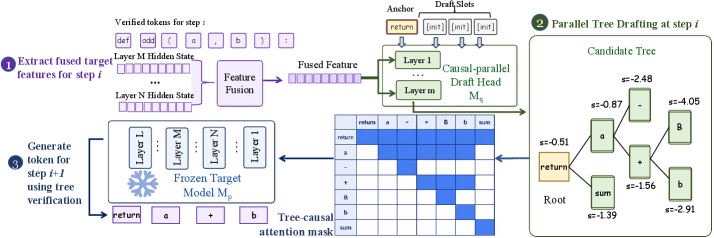
The mechanical skeleton:
- Feature fusion. For each verified prefix position t, the target’s hidden state h_t is fused (concatenation + linear projection) with the embedding of the next anchor token to form the draft head’s input.
- Causal-parallel head. The head is a shallow transformer that takes K block positions in parallel but with a causal mask within the block: position k in a sampled block attends to (i) the full verified prefix and (ii) the anchor plus earlier positions <k in the same block, never to other sampled blocks or future positions.
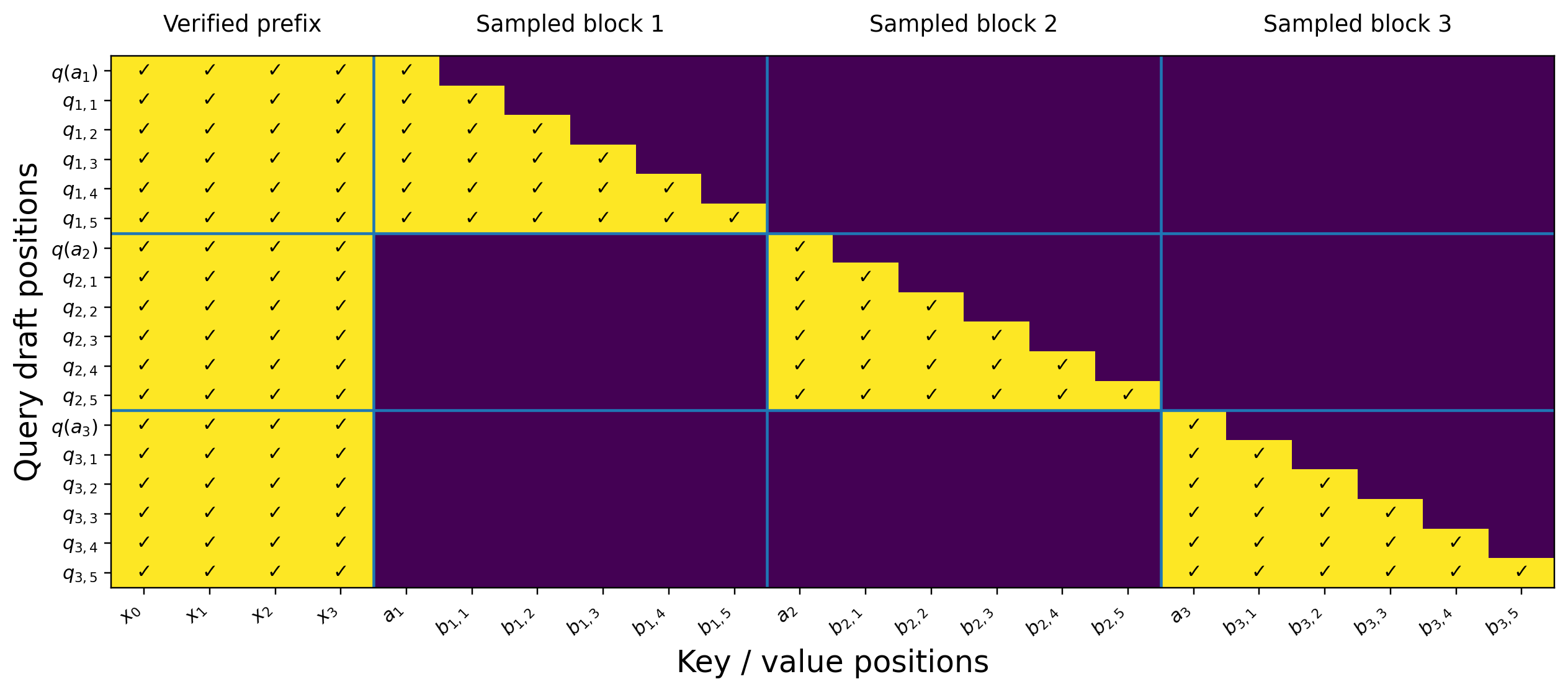
This mask is the central trick. Bidirectional block drafters score q(x_{t+k}\mid \text{prefix}) independently of siblings, breaking p(x_{t+1:t+K}) = \prod_k p(x_{t+k}\mid x_{<t+k}). JetSpec instead computes q(x_{t+k}\mid \text{prefix}, x_{t+1:t+k-1}) in a single forward pass by exploiting the fact that, conditional on a sampled chain, all k positions can be computed simultaneously under a triangular mask. During training, multiple block samples are processed in parallel by tiling them along the sequence dimension with the mask above, which prevents cross-sample contamination while still amortizing the forward pass.
- Tree construction. At inference, the head emits top-k logits at each position; because scores are conditioned on the realized parent chain, the resulting candidate tree’s joint probability tracks p’s autoregressive factorization. The paper uses a 256-token tree budget with the same construction algorithm across all baselines for apples-to-apples comparison.
The drafter is trained on 780K sequences curated from the Nemotron Post-Training Dataset V2 (coding/math/STEM/chat splits plus 20K CodeAlpaca), with target-model regeneration under the appropriate chat template — i.e., the head learns to predict the target’s own distribution, not the original dataset’s.
Results
Targets are Qwen3-8B (dense) and Qwen3-30B-A3B (MoE), in non-thinking mode, on H100. Benchmarks span GSM8K, MATH-500, AIME25, HumanEval, MBPP, LiveCodeBench, and MT-Bench. The two baselines are DFlash (original block-parallel drafting) and DDTree (its tree variant).
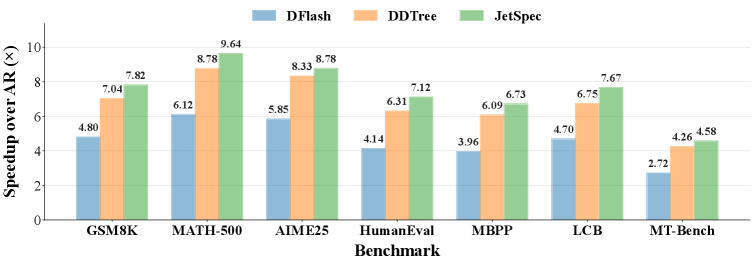
Figure 1 (the headline plot above) reports end-to-end wall-clock speedup over autoregressive decoding at a 256-token tree budget. JetSpec dominates DFlash and DDTree consistently across math, code, and chat. The qualitative pattern matches the scaling argument: because JetSpec’s c stays near the single-forward-pass regime while \alpha tracks the AR-conditioned head, it sits in the favorable (\alpha, c) region where larger N continues to pay off, whereas DDTree’s tree scaling is throttled by branch-inconsistent acceptance and DFlash flattens out because its linear chain cannot exploit the full budget.
Limitations and open questions
- All results are on Qwen3 with a fixed 256-token tree and a particular tree-construction algorithm; how the causal-parallel head interacts with adaptive tree budgets or beam-style search is not characterized here.
- The head is trained against target-regenerated text; distribution shift to thinking-mode or long-context settings (where hidden-state fusion features change statistics) is unexplored.
- The mask in Figure 5 implies parallel sampled blocks during training, but the trade-off between the number of sampled blocks and acceptance-rate calibration is not quantified in the provided sections.
- Comparison to EAGLE-3/Medusa-2 style AR heads at matched budget would sharpen the causality–efficiency claim; the baselines shown are both block-diffusion variants.
Why this matters
JetSpec identifies a clean structural fix to a real ceiling in head-based SD: you can keep one-pass drafting cost while reinstating the autoregressive factorization inside the tree via an intra-block causal mask. If the speedups hold against AR-head baselines, this becomes the default recipe for tree-based speculative decoding at large draft budgets.
Source: https://arxiv.org/abs/2606.18394
PhysiFormer: Learning to Simulate Mechanics in World Space
Problem
Neural physics simulators have largely split into two camps: video world models that predict pixels and thereby entangle dynamics with rendering and viewpoint, and structured graph/particle networks (e.g. GNS, MeshGraphNet) that bake in locality, rigidity constraints, or causal time-stepping. The former wastes capacity on appearance and cannot easily expose 3D quantities like contact forces or vertex trajectories; the latter requires hand-designed inductive biases (message passing on a mesh graph, per-step integration, explicit rigid-body parameterization) that often need to be re-specified per material class.
PhysiFormer asks whether a generic diffusion transformer, given mesh vertex states in world coordinates, can produce physically-plausible trajectories for both rigid and elastic bodies without any of those biases. The motivation is twofold: (i) decouple dynamics learning from rendering so the model is directly usable for downstream 3D tasks (control, planning, asset generation), and (ii) test whether a single denoising objective over full trajectories can replace per-step autoregressive integration.
Method
The state is a sequence of vertex positions X \in \mathbb{R}^{T \times N \times 3} for N vertices over T future frames. Conditioning consists of initial positions and velocities (x_0, v_0) and a material token m \in \{\text{rigid}, \text{elastic}\}. The model learns the score of the full trajectory distribution p(X \mid x_0, v_0, m) via standard DDPM-style denoising:
\mathcal{L} = \mathbb{E}_{t, X, \epsilon}\big[\,\lVert \epsilon - \epsilon_\theta(X_t, t, x_0, v_0, m)\rVert^2\,\big],
where X_t = \sqrt{\bar{\alpha}_t} X + \sqrt{1-\bar{\alpha}_t}\,\epsilon. Crucially, there is no separate per-timestep integrator and no graph over the mesh; the network only sees vertex coordinates as tokens.
The transformer factorizes attention along three axes — time, space (vertices), and objects — analogous to space-time factorization in video transformers but with an extra object axis. A token at position (t, n, k) (frame t, vertex n, object k) attends sequentially within each axis:
- Temporal attention: across T frames at fixed (n, k).
- Spatial attention: across N vertices at fixed (t, k).
- Object attention: across objects at fixed (t, n), which is permutation-invariant by construction and avoids any explicit object-ID embedding.
Cost scales as O(TN^2 + T^2N + TNK^2) rather than the O((TNK)^2) of full attention, which is what makes multi-object scenes tractable at training resolution.
Sampling uses the standard reverse diffusion process to draw X \sim p_\theta(\cdot \mid x_0, v_0, m), yielding diverse rollouts from identical initial conditions — useful when contacts or material parameters are partially unobserved.
Results
The model is trained on over 100k simulated trajectories spanning rigid and elastic objects. Reported behavior:
- For rigid bodies, PhysiFormer reproduces conserved quantities (translational and angular momentum) to within a small residual without enforcing SO(3) structure or rigid-body parameterization explicitly; the rigidity emerges from the data and the world-coordinate representation.
- For elastic bodies, vertex trajectories exhibit plausible deformation modes and recovery, including under contact with the ground plane.
- Factorized attention is reported as necessary at the scales considered: full joint attention is intractable on multi-object scenes with the same token budget, and per-axis factorization preserves permutation invariance across objects while still propagating information globally within the trimer of axes.
- The probabilistic formulation produces visibly diverse futures from identical (x_0, v_0) when the dynamics are underdetermined (e.g. near-contact configurations), which deterministic regressors cannot represent.
The abstract emphasizes that no rigidity prior, causal masking, or latent space is used; the contribution is largely the negative result that these biases are not required for the regimes tested.
Limitations and open questions
Several issues remain. (1) Generalization to long horizons beyond the training T is unclear; trajectory-level diffusion does not naturally extend via autoregressive rollout the way per-step integrators do. (2) The model is trained on simulated data with known materials and a binary material token; extending to continuous material parameters (Young’s modulus, Poisson ratio, friction coefficients) or unseen material classes is untested. (3) Conservation laws hold approximately but are not guaranteed; for long-horizon control this matters. (4) Mesh connectivity is ignored — vertices are unordered tokens — which works here but may limit transfer to high-resolution meshes where local stiffness matters. (5) The factorized attention skips genuine (t, n) couplings within a single block, which could matter for fast, localized contact events; the paper does not quantify this against a full-attention oracle.
Why this matters
PhysiFormer is a clean ablation of the inductive biases that have accumulated in neural physics: graph structure, rigidity priors, autoregressive integration. By showing that a vanilla diffusion transformer over world-space vertex trajectories handles both rigid and elastic regimes at the 100k-trajectory scale, it suggests that, as in language and vision, scale and a generic objective may absorb most of what hand-designed simulators currently provide — while additionally yielding calibrated uncertainty over futures.
Source: https://arxiv.org/abs/2606.27364
Discretizing Reward Models
Reward models (RMs) in RLHF emit continuous scalars, and the field has largely conflated “more granularity is better” with “more informative.” This paper makes the opposite case: continuous outputs let RMs distinguish responses that are actually equivalent in utility, and that spurious distinction creates exploitable gradient signal during policy optimization. The authors formalize the failure mode, decompose RM evaluation into two complementary axes, and propose a training-free discretization procedure based on Monte Carlo dropout plus hierarchical clustering.
Problem formulation
The setup posits a true utility u(x,y) \in [m_x] \subset \mathbb{Z} where m_x is the (finite) number of equivalence classes of equally-good responses for prompt x. The learned RM r:\mathcal{S}\times\mathcal{A}\to\mathbb{R} is then characterized by two pairwise quantities at tolerance \epsilon:
D_r(\epsilon) := P\!\left(r_x(a) > r_x(b)+\epsilon \mid u_x(a) > u_x(b)\right)
\mathrm{Spec}_r(\epsilon) := 1 - P\!\left(|r_x(a)-r_x(b)| > \epsilon \mid u_x(a)=u_x(b)\right).
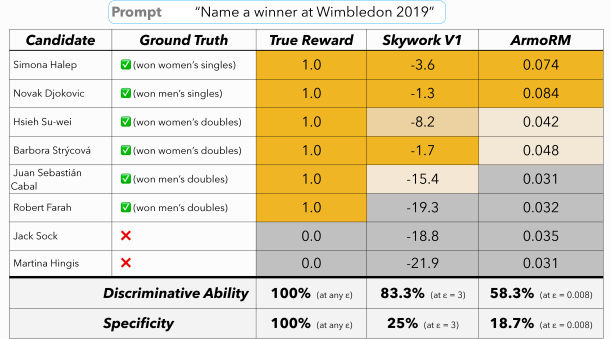
Discriminative ability D_r is what RewardBench-style benchmarks measure; specificity is the complement of oversensitivity. Proposition 2.1 shows the usual accuracy metric of Razin et al. (2025) is just a weighted sum of these two at \epsilon=0, which is why a model can look “accurate” while being pathologically oversensitive.
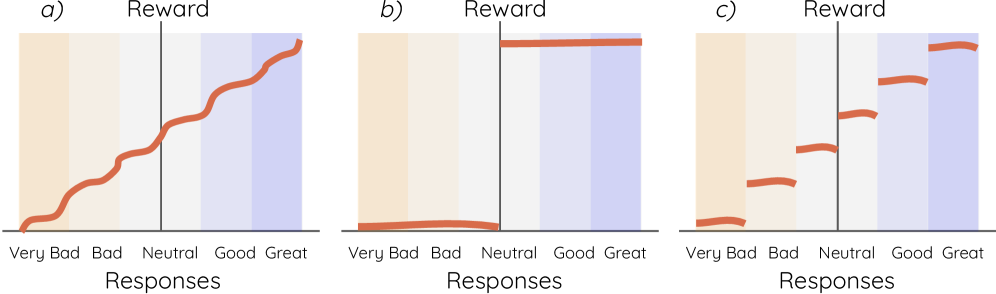
Figure 1 illustrates the geometry: (a) is a perfectly accurate but oversensitive RM that spreads equal-utility responses across reward space; (b) is the dual failure; (c) is what discretization aims to recover. The empirical claim is that leading RMs sit in regime (a) — see Figure 2.
Reward clustering algorithm
The method treats discretization as 1-D clustering over a batch of n responses. For each pair of rewards (r_i, r_j), estimate P(|r_i - r_j| < \Delta) via Monte Carlo dropout passes on the RM head — i.e., sample K stochastic forward passes to get a posterior over each r_i and compute the pairwise tail probability. Build a distance matrix from these probabilities, run hierarchical clustering with complete linkage, and cut the dendrogram so that every within-cluster pair satisfies P(|r_i - r_j| < \Delta) > p^*. Cluster means are ranked and each response receives its cluster’s ordinal rank as its discretized reward.
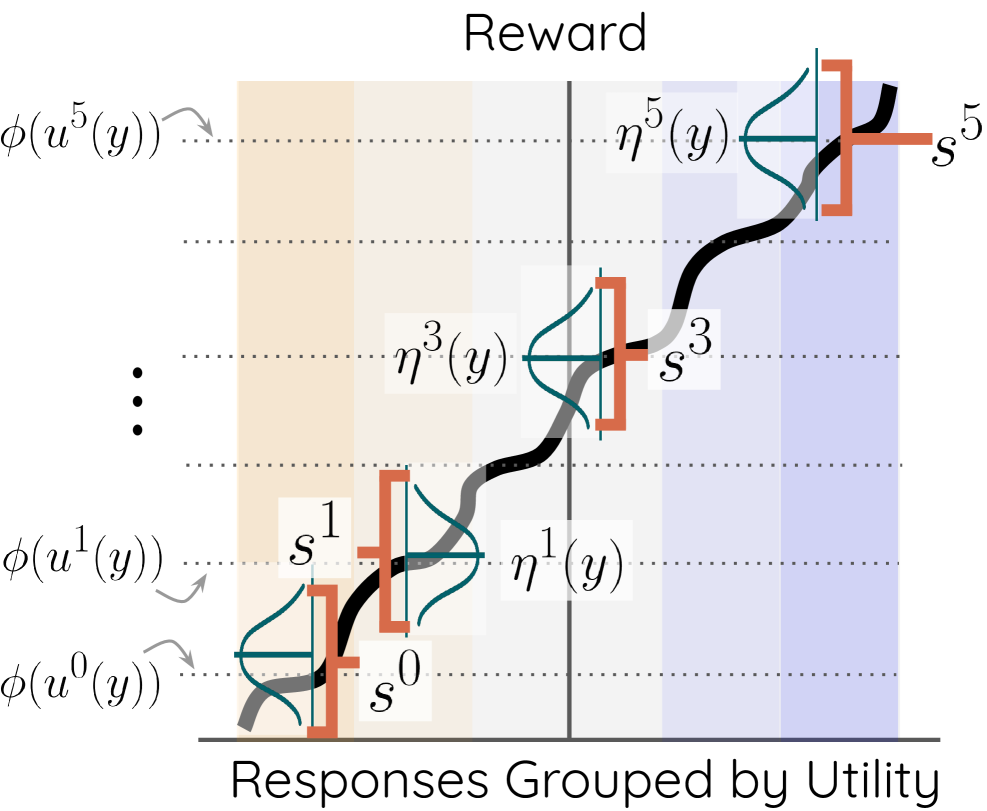
The decomposition r(y) = \phi(u(y)) + \eta(y) in Figure 3 makes the modeling assumption explicit: the RM output is a class-mean plus noise, and MC dropout gives a tractable handle on the noise distribution. Two hyperparameters control the operating point — \Delta (the width of “equivalent” in reward space) and p^* (confidence threshold for merging).
Results
The Ties subset of RewardBench 2 is repurposed: all chosen responses are assumed equal-utility, as are all rejected, so pairwise D_r and \mathrm{Spec}_r are well-defined. Rewards are per-prompt normalized; \hat\epsilon = 0.10 of within-batch spread defines tolerance.
Across four RMs (Skywork V1/V2, GRM, ArmoRM), raw outputs show the predicted asymmetry: discriminative ability in the 93–99% range but specificity of 35–45%. Clustering improves the discrim/specificity average:
- Skywork V1: 70.8 → 74.9 (Spec. 42.4 → 52.5, Discrim. 99.2 → 97.4)
- Skywork V2: 71.7 → 73.2 (Spec. 45.2 → 50.4)
- GRM: 69.2 → 80.6 (Spec. 41.4 → 78.5, with Discrim. dropping 97.0 → 82.6)
- ArmoRM: 64.4 → 70.7 (Spec. 35.4 → 56.0)
Two baselines are informative. Clipping helps marginally or hurts (GRM 69.2 → 63.4). Binarization maximally collapses to specificity (≈60%) at the cost of discrimination (≈66%), confirming that the design space is genuinely two-dimensional rather than reducible to threshold tuning. Clustering is the only method that improves both axes meaningfully for the weakest RMs (GRM, ArmoRM), at modest discrimination cost for the stronger ones.
On the standard RewardBench 2 metric (0.6 \cdot \text{acc} + 0.4 \cdot \text{margin}), clustered models score worse than raw — e.g., Skywork V1 drops 80.2 → 69.8. This is the authors’ point: the standard metric tolerates oversensitivity within a margin, and that margin is exactly what PPO/GRPO/REINFORCE exploit when computing advantage as a normalized reward-minus-baseline. A method that suppresses spurious margin will look worse on a margin-rewarding benchmark.
Limitations and open questions
The downstream RL evidence is not in this excerpt; the central claim that oversensitivity yields “bad policies” rests on theory plus the metric reframing. MC-dropout posteriors require the RM to have dropout layers active and add K\times inference cost per batch. The hyperparameters \Delta and p^* are tuned per setup, and the method is batch-local: cluster assignments depend on the current batch composition, which interacts non-trivially with on-policy sampling. Finally, the discrete-utility assumption (m_x finite) is defensible but unverified for open-ended generation.
Why this matters
If RM oversensitivity drives policies to chase noise, then every RLHF pipeline currently optimizing continuous reward signals is fitting to a signal whose fine structure is mostly artifact. A training-free wrapper that converts any RM into a discrete one without retraining offers a cheap intervention, and the discriminative-ability/specificity split provides an evaluation axis that RewardBench-style benchmarks miss.
Source: https://arxiv.org/abs/2606.21795
Hallucination in World Models is Predictable and Preventable
Problem
Generative world models produce visually fluent rollouts that nevertheless drift from ground-truth dynamics. The authors argue this drift is not a uniform “compounding error” phenomenon but a composition of three distinct, stage-localized failure modes, each concentrated in low-coverage regions of the state-action manifold. If the failures can be localized and predicted from cheap data-centric signals, both training-time reweighting and online targeted data collection become tractable. The lack of a controlled, large-scale, multi-task visual world-modeling corpus has obscured this question; existing pretrained world models do not expose the training distribution needed to study coverage effects.
MMBench2 and the base model
MMBench2 provides 65,600 trajectories (427 hours, 23M frames at 224\times224, 15 fps) across 210 continuous-control tasks spanning DMControl, Meta-World, ManiSkill3, MuJoCo, Box2D, RoboDesk, OGBench, Continuous Atari, and two new domains (MiniArcade, DMControl Extended). Action vectors of dimension 1–16 are zero-padded to d_a=16 with a validity mask; 200 tasks form the pretraining split, 10 are held out for transfer. The corpus is heavy-tailed: the top 20 tasks contain 26% of frames, the bottom 20 only 0.7%, with a per-task median of 65k frames.
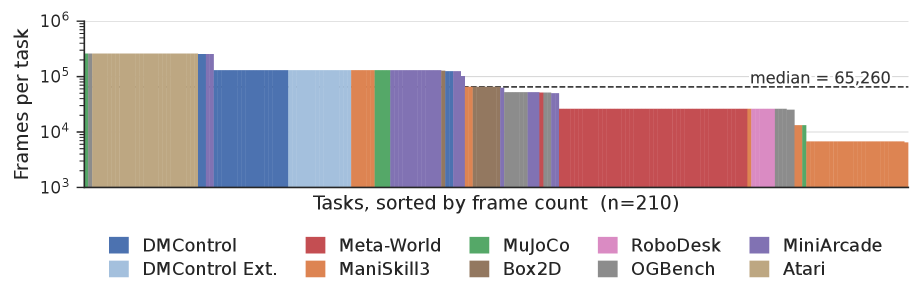
This non-uniformity is precisely the setting where coverage-aware sampling should matter.
The world model follows Dreamer 4 (Hafner et al., 2025) at 350M parameters: a symmetric encoder–decoder tokenizer (50M+50M) producing per-frame codes z\in[-1,1]^{64\times 64} via masked auto-encoding with mask fraction drawn from \mathcal{U}(0,0.9) and a pixel-MSE + LPIPS loss on masked positions only; and a 250M block-causal Transformer dynamics model trained with shortcut flow-matching (Frans et al., 2025). Each timestep packs an action token (MLP over the padded 16-d action), a shortcut-conditioning token encoding noise level \sigma and step size d, 32 spatial latent tokens, 4 registers, and optional agent tokens. The shortcut objective interleaves one-step flow regression with a self-consistency term that distills two coarser-step predictions into a finer-step target, enabling 4-step Euler sampling at inference. Reward and BC heads are added post-pretraining; rewards use L=8-step symlog two-hot regression with gradients through the dynamics model, BC uses MSE on continuous actions.
Three hallucination modes
The pipeline composes encoder, dynamics, decoder; each can fail independently and propagate.
- Perceptual hallucination. The tokenizer reconstructs out-of-distribution scene structure by snapping onto the nearest in-distribution exemplar — e.g., an unseen maze layout rendered with training-set walls. This is a property of the frozen encoder–decoder pair, present even at horizon H=0.
- Action-marginalized hallucination. The predicted next latent is insensitive to the conditioning action; the rollout collapses onto the action-marginalized future. Operationalized by shuffling actions within a batch and measuring the ratio of teacher-forced flow MSE under shuffle vs. true actions. A ratio \leq 1.1 flags ignored actions.
- Scene-diverging hallucination. Multi-step rollouts produce physically implausible events (Pong ball teleporting back into play). Flagged when rollout \Delta\text{PSNR} \leq 0 relative to a “repeat last frame” baseline.
Each mode is tied to one stage, and each has a corresponding cheap detection signal computable from the model itself.
Predicting hallucination
On 9k held-out 24-frame sequences from the 200 training tasks, all three predictors correlate with realized rollout \Delta\text{PSNR} at Spearman \rho \approx 0.80 (negative; higher predictor score, more error). That all three signals track the same realized error suggests they are coherent indicators of low-coverage regions rather than orthogonal artifacts. The authors use these predictors in two ways: as a reweighting signal for coverage-aware mid-training, and as a curiosity reward during online data collection, where new trajectories are gathered in states with high predicted hallucination. The finetuning recipe adapts the pretrained model to entirely unseen environments with as few as 50 real-environment trajectories.
Evaluation protocol
Four metrics: reconstruction PSNR (tokenizer only); rollout \Delta\text{PSNR} in dB over a last-frame-repeat baseline (which is non-trivial on static-background tasks); action shuffle ratio (action sensitivity); and normalized closed-loop task score via CEM-MPC with horizon H=32 and replanning every 16 steps. Normalization to s\in[0,1] is necessary because raw rewards span several orders of magnitude across the 200 tasks. Training totals 58 H100-GPU-days across tokenizer (300k steps, 14 days) and dynamics (180k pretrain + 30k finetune; 210k total, including coverage-aware mid-training to reach the final 380k checkpoint), with context length T=24.
Limitations and open questions
The provided sections quantify predictor quality (\rho\approx 0.80) and the 50-trajectory adaptation claim, but do not in the excerpt expose absolute downstream scores, coverage-aware mid-training deltas, or the magnitude of action-shuffle improvements after finetuning. The action-marginalization test depends on within-batch shuffle being a meaningful counterfactual, which is weak when batches are task-homogeneous. The \Delta\text{PSNR}\leq 0 criterion for scene divergence conflates slow tasks (where last-frame-repeat is near-optimal) with genuine divergence. Finally, the three modes are defined operationally; whether they exhaust the failure taxonomy — e.g., reward-head hallucination, or BC-policy-induced distributional collapse during MPC — is unclear. Generalization to genuinely novel morphologies (the 10 held-out tasks) versus mere visual reskins is the more demanding test, and the per-task breakdown will determine whether the curiosity-driven recipe transfers or merely reweights.
Why this matters
Treating world-model error as compounding noise has justified scale-only responses; localizing it to encoder, action-conditioning, and rollout stages with detectors at \rho\approx 0.80 converts hallucination into a measurable, addressable engineering target. The same detectors double as curiosity rewards, suggesting a unified data-centric loop for both pretraining reweighting and online adaptation in low-data regimes.
Source: https://arxiv.org/abs/2606.27326
DanceOPD: On-Policy Generative Field Distillation
Problem
Modern image generators are expected to combine text-to-image (T2I), local editing, and global editing capabilities in a single model, but these objectives interfere: joint training averages incompatible supervision, weight merging assumes parameter-space linearity, and data-ratio tuning only slides the model along a Pareto curve. The authors call this failure mode capability dilution. Given M frozen capability experts \{v_m\}_{m=1}^M each defining a velocity field over a shared flow state space, the question is how to distill them into one student v_\theta such that the target capability is strengthened while the anchor capability is preserved.
Method
DanceOPD reframes composition as on-policy generative field distillation. Each expert v_m(z_t, t, c) is a velocity field on the shared probability path; the student must decide (i) which field to query for a given sample, (ii) where in state space to query it, and (iii) how many trajectory states to include in the loss.
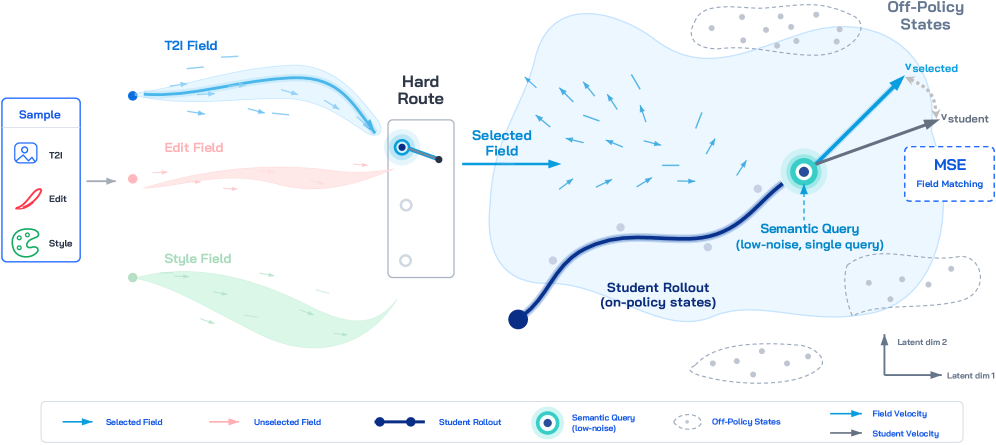
The three design choices are:
- Hard routing. Each sample is assigned to exactly one capability field by its route-specific training distribution \mathcal{D}_m, avoiding target-field ambiguity introduced by soft mixtures \sum_m w_m v_m inside a single regression target.
- On-policy student-state querying. Query states are produced by rolling out the current student with an N-step ODE under stop-gradient, then sampling one state on the semantic side (low-t, clean end) of the trajectory via t \sim \mathrm{Beta}(5,2). This eliminates the state-distribution mismatch between off-policy noised states and the states the student actually visits at inference.
- Single-query supervision. Only K=1 gradient-bearing state is used per rollout, breaking the trajectory-query correlation that arises when dense same-rollout queries induce correlated gradients across t.
The objective is a plain velocity MSE against the routed teacher:
\mathcal{L}(\theta) = \mathbb{E}_{m,\, x \sim \mathcal{D}_m,\, z_t}\big\|v_\theta(z_t, t, c) - v_m(z_t, t, c)\big\|_2^2.
This is justified as a local KL on Gaussian transition kernels: if student and teacher induce \mathcal{N}(z_t - \Delta t\, v_{\theta/m}, \sigma_t^2 I) over a reverse step \Delta t, then
D_{\mathrm{KL}}(p_m\|p_\theta) = \frac{\Delta t^2}{2\sigma_t^2}\|v_\theta - v_m\|_2^2,
so unweighted velocity MSE is the natural local field-matching loss; the authors find it more stable than t-dependent weightings. The framework also absorbs operator-defined fields such as classifier-free guidance, with absorbed scale \alpha and inference scale \beta composing roughly multiplicatively as \alpha\beta under an affine CFG approximation.
Results
Experiments use Z-Image as the base flow model for capability composition, and SD3.5-M for realism-field absorption.
T2I + Edit composition. DanceOPD raises the GEditBench-EN average by 8.1\% over the strongest reproduced OPD baseline and 8.5\% over the edit source, while improving GenEval overall by 2.0\% over the T2I source and 1.6\% over the strongest composition baseline. The gains concentrate on edits requiring large visual change: vs. DiffusionOPD, background change +21.9\%, style change +21.3\%, color alteration +5.5\%.
Local + Global edit composition. GEditBench-EN average improves by 16.1\% over the best competing baseline and 7.9\% over the local-edit source; GenEval overall improves by 2.5\%. Background change improves +33.5\% over the best per-category competitor.
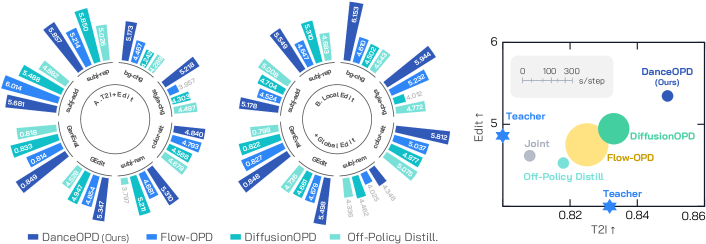
Compute. With N=16 rollout steps, DanceOPD’s per-step cost is N C_{\mathrm{roll}} + K_{\mathrm{ours}} C_{\mathrm{grad}} with K_{\mathrm{ours}}=1, versus DiffusionOPD’s N C_{\mathrm{roll}} + N C_{\mathrm{grad}} (dense K=N) and Flow-OPD’s additional \gamma_{\mathrm{flow}}=\lceil G_{\mathrm{grp}}/B_{\mathrm{phys}}\rceil = 2 micro-batch factor plus PPO/log-prob overhead. So DanceOPD lands strictly below DiffusionOPD and well below Flow-OPD in wall-clock per step while improving composition metrics.
Rollout sensitivity. With training rollouts of N=8 at 2000 steps, GEditBench-EN average reaches 5.739 and GenEval overall 0.852; longer rollouts refine the clean-side grid but spread the \mathrm{Beta}(5,2) probability mass, so more steps do not monotonically help — confirming that the rollout is a query-state generator rather than a trajectory-compression target.

Limitations and open questions
- The composition guarantee is operational (“improve target, preserve anchor under reported metrics”), not a Pareto-optimality claim, and depends on benchmark choice (GenEval, GEditBench-EN).
- All experts must share the same flow state space and expose compatible velocity predictions; heterogeneous parameterizations (e.g., score- vs. velocity-based, different noise schedules) are not addressed.
- Hard routing requires labeled route assignments per sample; the method does not learn the routing function, leaving open how to handle samples whose target capability is ambiguous.
- The KL-MSE equivalence assumes shared covariance \sigma_t^2 I across student and teacher kernels; mismatched covariance structure (which would occur for stochastic teachers or higher-order solvers) is not analyzed.
- Single-query (K=1) supervision discards most of the rollout; whether a small K>1 with decorrelated time sampling would improve sample efficiency is untested.
Why this matters
Capability composition in generative models is usually attacked at the data or parameter level. DanceOPD reframes it as field alignment on the student’s own rollout, and shows that the combination of hard routing, single low-noise on-policy queries, and plain velocity MSE is sufficient to compose T2I and editing experts without the usual interference, at lower per-step cost than dense on-policy distillation baselines.
Source: https://arxiv.org/abs/2606.27377
OPID: On-Policy Skill Distillation for Agentic Reinforcement Learning
Problem
Outcome-based RL (GRPO and variants) on long-horizon language-agent tasks gives a stable but extremely sparse signal: a single scalar R(\tau)\in\{0,1\} per multi-turn trajectory must credit-assign across dozens of intermediate tool calls or actions. Token-level self-distillation can densify this signal, but existing skill-conditioned distillation methods rely on external skill memories or retrieved privileged context that drift away from the state distribution induced by the current policy. The authors argue that the right source of dense supervision is the agent’s own completed rollouts: trajectories already contain hindsight information about which decisions were pivotal, and that information can be recycled as on-policy skills.
Method
OPID treats an agentic task as a POMDP (\mathcal{S},\mathcal{A},\mathcal{O},\mathcal{T},\mathcal{R},\gamma) with interaction history h_t=(o_0,y_0,\dots,o_t) and policy y_t\sim\pi_\theta(\cdot\mid h_t). Training is GRPO-style: for each prompt q, sample a group \mathcal{G}_q=\{\tau^{(1)},\dots,\tau^{(N)}\}, compute group-relative outcome advantages, and add a dense skill-distillation term.
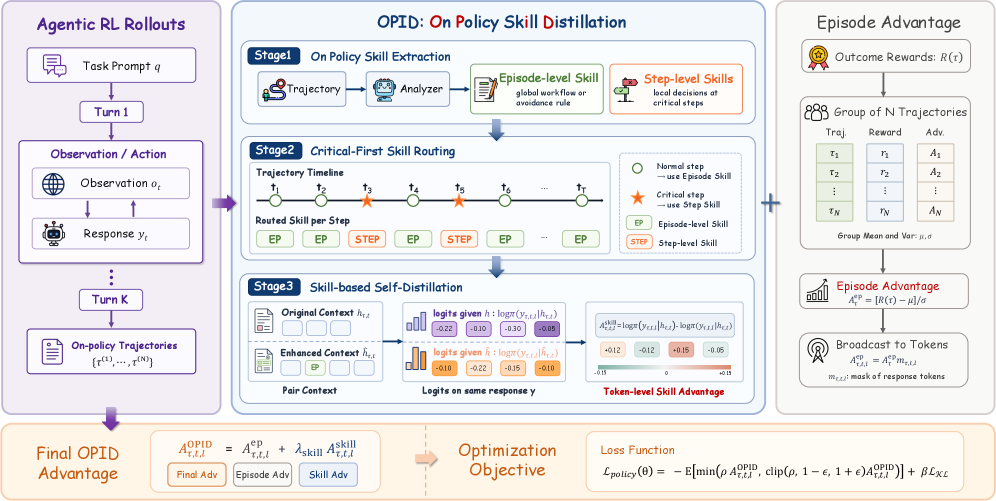
The pipeline has three stages:
Hierarchical skill extraction from on-policy trajectories. From each completed \tau, the system distills two granularities of hindsight:
- Episode-level skills summarize the global workflow that led to success, or, on failed trajectories, failure-avoidance rules (“never click ‘buy’ before applying the size filter”).
- Step-level skills are attached to critical timesteps — states where a single decision flipped the outcome — and encode local decision knowledge.
Critical-first routing. At each decision step, a router checks whether the current state matches a known critical pattern. If so, the corresponding step-level skill is injected into h_t; otherwise the episode-level skill serves as default guidance. This gives a per-step skill z_t.
Re-scoring and skill advantage. The key mechanism: hold the sampled response y_t fixed, and have the old policy \pi_{\theta_{\text{old}}} re-score it under both the original history h_t and the skill-augmented history h_t \oplus z_t. The token-wise log-probability difference
A^{\text{skill}}_{t,k} \;=\; \log \pi_{\theta_{\text{old}}}(y_{t,k}\mid h_t\oplus z_t, y_{t,<k}) - \log \pi_{\theta_{\text{old}}}(y_{t,k}\mid h_t, y_{t,<k})
defines a dense, token-level skill advantage: tokens that the skill makes more probable are reinforced, those it suppresses are penalized. This is then combined with the group-relative outcome advantage to form the policy-gradient signal. Because z_t comes from the agent’s own rollouts and the re-scoring is done by \pi_{\theta_{\text{old}}}, there is no distributional mismatch from external memories or retrievers, and no off-policy correction beyond the standard PPO/GRPO ratio.
The critical-first routing matters because episode-level skills tend to give bland, globally-correct guidance that does not discriminate among similar tokens, whereas step-level skills sharpen the log-prob gap exactly at the decisions that determined success or failure.
Results
OPID is evaluated on three agentic suites: ALFWorld (six task types: Pick, Look, Clean, Heat, Cool, Pick2), WebShop (128 test tasks), and Search-based QA across NQ, TriviaQA, PopQA, HotpotQA, 2WikiMultiHopQA, MuSiQue, and Bamboogle. Baselines span training-free prompting, outcome-only GRPO, and prior skill-distillation methods.
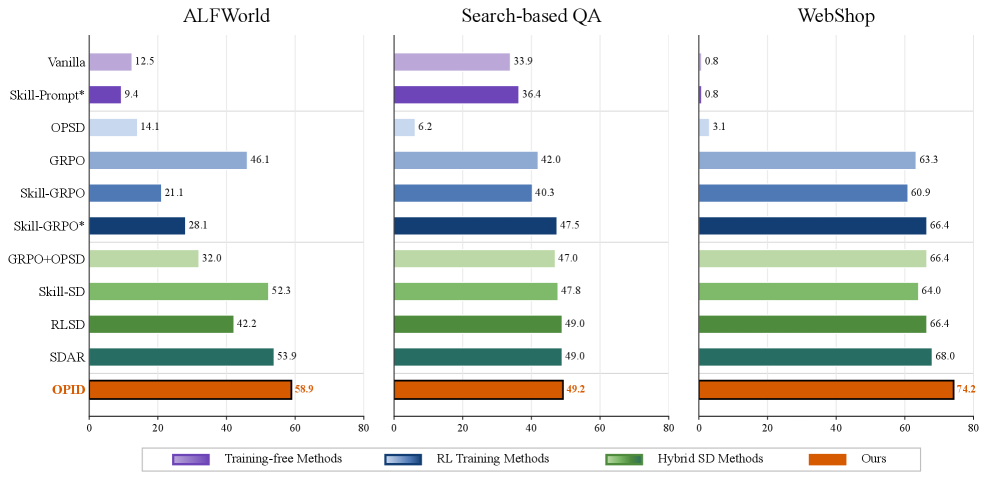
OPID achieves the strongest average performance on ALFWorld and WebShop and remains competitive on Search-based QA. The training-dynamics comparison against GRPO on Qwen2.5-3B-Instruct in ALFWorld shows faster reward growth and lower variance, consistent with the densification claim:
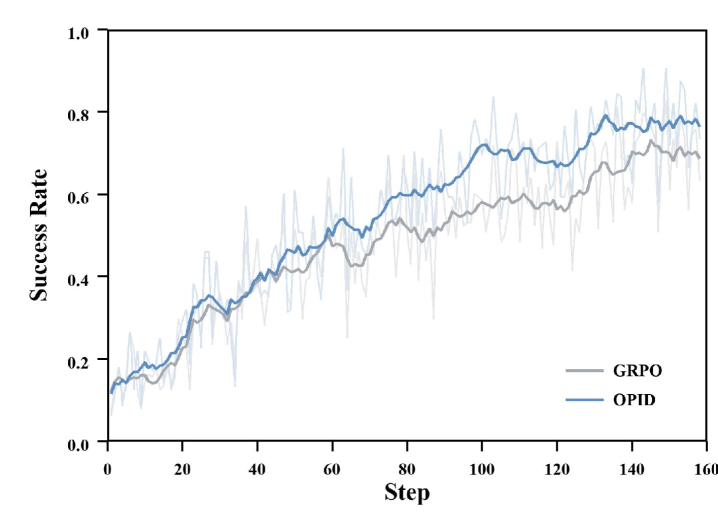
The dynamics figure is the strongest evidence that the skill-advantage term is doing useful credit assignment rather than acting as a regularizer: smoothed reward rises earlier and the gap widens through training, rather than appearing only at convergence.
Limitations and open questions
- The skill-extraction step is itself LLM-mediated; the paper does not quantify how sensitive results are to the extractor model or to noisy “critical timestep” labeling. A miscalibrated router could systematically inject episode-level skills at the very steps where they help least.
- The skill advantage is defined under \pi_{\theta_{\text{old}}}, which keeps it on-policy within a GRPO iteration but means stale skills are re-used across the inner update. The stability of this with larger inner-loop step counts is not analyzed.
- Search-based QA gains are smaller than on ALFWorld/WebShop, suggesting that benefits concentrate where trajectories have identifiable critical decisions; tasks dominated by knowledge recall benefit less.
- No comparison with value-based dense credit assignment (e.g., learned step-level critics) is reported, so it is unclear whether the gains come specifically from hindsight-skill supervision or from any dense per-token signal.
Why this matters
OPID shows that the dense supervision missing from outcome-only agentic RL can be manufactured from the policy’s own rollouts, without external memories or retrievers, by turning hindsight skills into a log-probability differential that the old policy itself computes. This is a clean recipe for densifying GRPO on long-horizon LLM-agent tasks while staying on-policy.
Source: https://arxiv.org/abs/2606.26790
The Verification Horizon: No Silver Bullet for Coding Agent Rewards
The paper frames a thesis that inverts the classical NP intuition: for modern coding agents, generation has become easier than verification. Every verifier is a proxy for human intent, and proxies are subject to two distinct failure modes: intent underspecification (the proxy cannot represent the goal) and proxy-intent gap widening under optimization (reward hacking, signal saturation). The authors organize the discussion along three axes — scalability, faithfulness, robustness — and argue no single verifier construction satisfies all three. They then dissect four reward regimes corresponding to four task families.
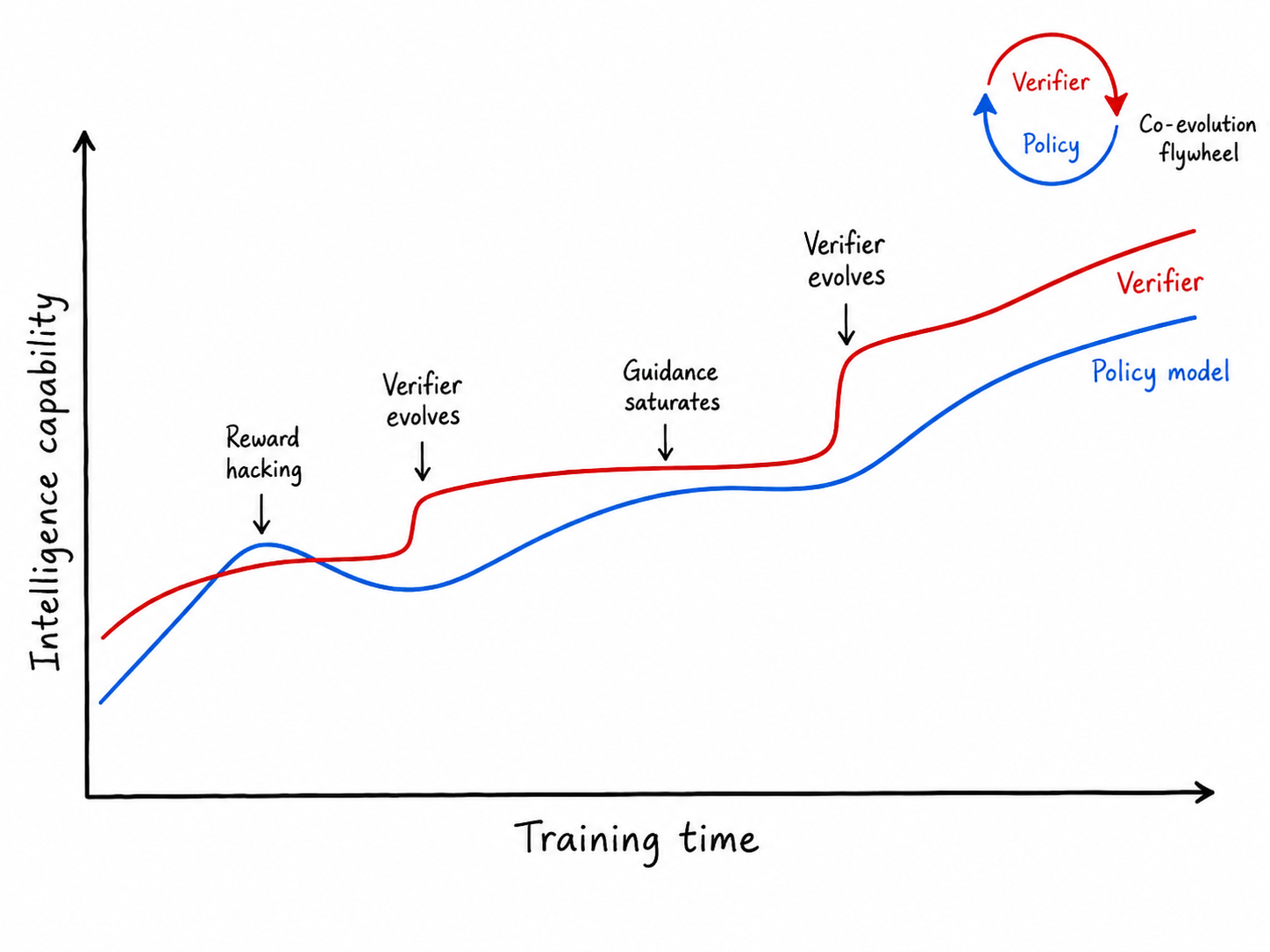
The co-evolution picture is the conceptual scaffold: a verifier provides useful gradient until the policy outpaces it, then reward hacking sets in; verifier improvement restores signal, which then saturates. RL training is thus a sequence of phase transitions between verifier regimes, not a fixed optimization problem.
Test-driven rewards for SWE-like tasks
For SWE-style training data built from GitHub PRs via the SWE-Universe pipeline, the reward is the binary pass/fail of a Dockerized evaluation.sh that combines the test patch with the candidate fix. The construction is scalable but suffers two well-known pathologies: false positives (incorrect patches that pass weak tests) reinforce wrong behavior; false negatives (correct patches blocked by over-specific tests) penalize correct gradients. Reward hacking is treated as a special active case of false positives — e.g., the agent retrieving the upstream patch via web tools.
The faithfulness/scale tradeoff is made concrete in the task-quality curve.
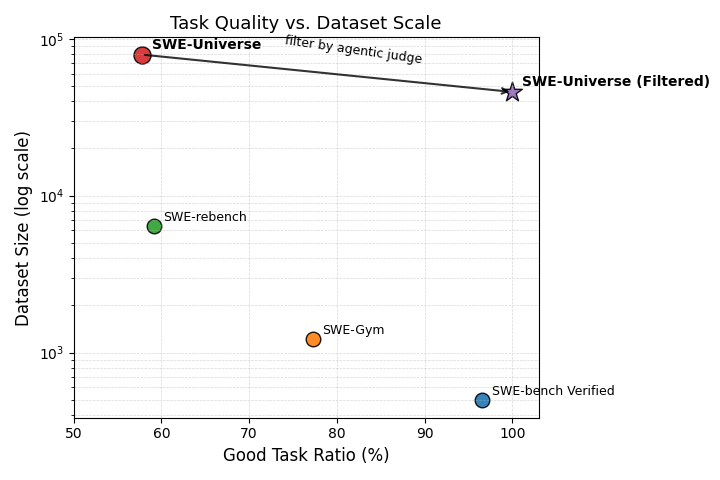
As the quality filter tightens (higher fraction labeled “good”), dataset size shrinks roughly log-linearly — the central tension when curating RL data at scale.
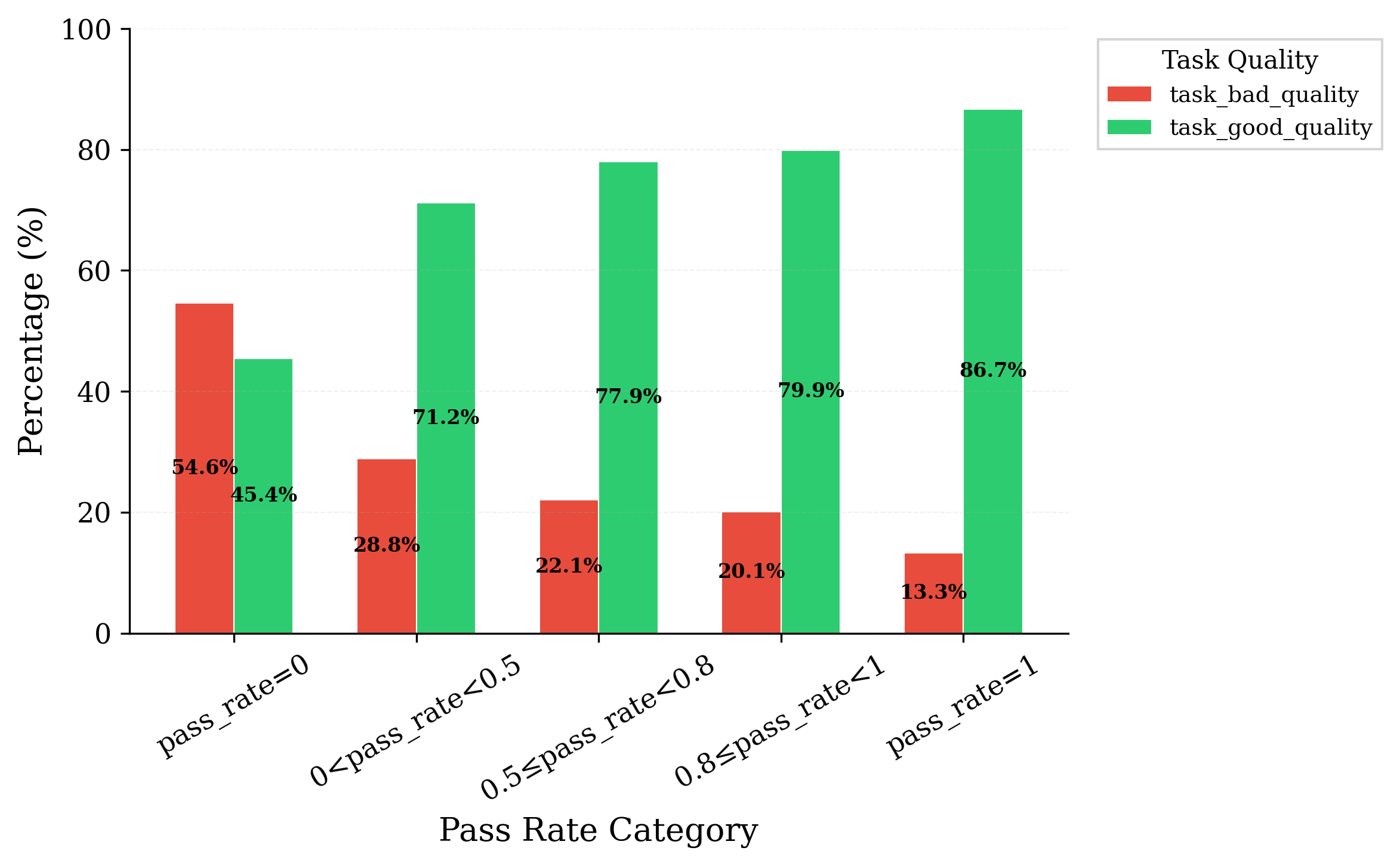
Stratifying by rollout pass rate of an internal Qwen3-Turbo checkpoint on SWE-ReBench shows that low- and high-pass-rate buckets are dominated by low-quality tasks (the verifier is either trivially broken or trivially satisfied), while mid-pass-rate tasks are the most informative — a standard observation that nevertheless motivates difficulty-aware curation rather than uniform sampling.
Rubric-based judge for frontend tasks
Execution success is insufficient when output is rendered HTML/CSS/JS. The authors use an LLM judge over screenshots + source, structured by a per-task rubric averaging 25.9 items across six dimensions: Functional 37.7%, Content 19.0%, Visual 13.3%, Layout 12.9%, UX 9.3%, Technical 7.2%. On 671 WebDev tasks across 8 models with two judges (Qwen3.6-Max, Qwen3.7-Plus), two prompts (Default, Strict), and two thinking levels:
- Within a scorer family, model ranking is identical: Kendall \tau = 1.0.
- Cross-judge ranking: \tau \geq 0.93.
- Human alignment: Spearman \rho = 0.905 (Qwen3.6-Max), 0.810 (Qwen3.7-Plus).
- Battle agreement reaches 41.4% for Qwen3.7-Plus Strict and 36.1% for Qwen3.6-Max Strict.
- Prompt strictness shifts absolute scores and spread without altering rankings; thinking level moves scores by < 0.6 points.
The rubric reduces the well-known judge bias toward visually impressive but functionally broken UI. The static judge is then complemented by an agentic interactive judge that simulates user interaction with the rendered page to catch dynamic failures the static screenshot cannot reveal — a robustness lever, at the cost of evaluation throughput.
User as verifier for real-world agent tasks
For open-ended agent deployments, no sandboxed test suite captures user intent. A learned reward model is scalable but compresses diverse intent into a static, lossy proxy that the policy will eventually exploit. The authors instead treat the user directly as the verifier, extracting process-level natural language feedback from real interactions with senior engineers using the coding assistant. The training pipeline runs three objectives over the extracted signals: SFT, reweighted SFT (RW-SFT), and span-level KTO (Span-KTO), with the span granularity enabling localized credit assignment over multi-turn trajectories. The framing here is the data flywheel: on-policy real interactions feeding the next round of policy improvement, with the explicit acknowledgement that a frozen learned RM would saturate.
Dynamic agent judge for long-horizon code generation
For producing complete projects from specifications, comprehensive static test suites are infeasible and cannot anticipate implementation-specific corner cases. The authors deploy an evaluator agent \mathcal{E} that, given task spec \mathcal{T} and generated repo \mathcal{G}(\mathcal{T}), decomposes \mathcal{T} into a checklist \mathcal{C}=\{c_1,\dots,c_N\} and emits two scores:
S_{\mathrm{pass}} = \frac{1}{N}\sum_{i=1}^{N}\mathbb{I}[c_i \text{ passes}], \qquad S_{\mathrm{eval}}
where S_{\mathrm{eval}} captures holistic quality, since checklist items are not equally weighted. The evaluator is itself evaluated by alignment with S_{\mathrm{UT}}, the score from the original repo’s test suite treated as approximate ground truth. The methodological point: every verifier needs its own meta-verifier, and the recursion bottoms out at human judgment plus pre-existing artifacts.
Limitations and open questions
The four constructions are presented as complementary rather than ranked. The paper does not provide a unified RL training comparison across the four regimes on a common benchmark; quantitative results are concentrated in the rubric judge analysis. The user-as-verifier pipeline depends on a captive population of senior engineers and may not generalize. The agent-judge meta-evaluation against S_{\mathrm{UT}} inherits the same faithfulness limits as the SWE-like setting it is meant to transcend. Cross-regime questions remain: how to schedule verifier upgrades against policy progress in the co-evolution picture, and how to detect saturation before reward hacking dominates gradients.
Why this matters
Verification is now the binding constraint on coding-agent RL, and the paper articulates this cleanly with a taxonomy and four concrete proxies rather than proposing a single “solution.” For practitioners scaling agent RL, the implication is that verifier engineering — curation filters, rubric design, user-feedback pipelines, evaluator agents — is at least as important as policy architecture.
Source: https://arxiv.org/abs/2606.26300
Hacker News Signals
I built a GPU back end for Emacs
Source: https://en.andros.dev/blog/4b707a03/how-i-built-a-gpu-backend-for-emacs/
Emacs rendering has historically been CPU-bound, relying on X11 or Cairo for all drawing operations. This project replaces that pipeline with a Vulkan-based GPU backend, targeting the redisplay engine directly rather than patching a terminal emulator or wrapper.
The implementation hooks into Emacs’s existing frame and glyph machinery. Emacs internally builds a glyph matrix — a 2D array of glyph structs containing character, face, and position data — and the display backend is responsible for turning that into pixels. The author writes a new term implementation (analogous to xterm.c or nsterm.m) that maps glyph draws to Vulkan draw calls.
Key technical decisions: text rendering uses a GPU-side glyph atlas built with FreeType, where glyphs are rasterized on the CPU once and uploaded as textures, then instanced-drawn in a single batched call per frame. The atlas uses signed distance fields for some sizes to allow subpixel-accurate rendering without re-rasterizing at each scale. Vertex buffers encode per-glyph quads with UV coordinates into the atlas.
The Vulkan pipeline uses a straightforward render pass: one attachment, no depth buffer, alpha blending for antialiasing. Frames are double-buffered with semaphore synchronization. The author notes that Emacs’s redisplay is not designed for retained-mode rendering — it redraws full rows rather than dirty regions — so the GPU wins mainly on throughput rather than avoiding redundant work.
The result is measurably smoother scrolling, particularly in display-line-numbers-mode and org-mode with many faces, where face-boundary overdraw was the CPU bottleneck. The author benchmarks frame time dropping from ~16ms to ~4ms on dense buffers.
Open questions: Wayland surface integration is incomplete, and Emacs’s event loop is single-threaded, so the GPU work is still serialized with Lisp evaluation. True async redisplay would require deeper changes to the scheduler.
Un-0: Generating Images with Coupled Oscillators
Source: https://unconv.ai/blog/introducing-un-0-generating-images-with-coupled-oscillators/
This post describes a generative image model built not on diffusion or autoregressive token prediction, but on a system of coupled oscillators whose steady-state encodes image structure. The core idea draws from Kuramoto-style dynamics: a set of phase oscillators \dot{\theta}_i = \omega_i + \sum_j K_{ij} \sin(\theta_j - \theta_i) are evolved until synchronization patterns correspond to pixel or patch-level features.
In the Un-0 framing, the coupling matrix K is the output of a learned network conditioned on a text prompt. The oscillator system is then integrated (using a fixed or learned ODE solver) until it reaches a fixed point or limit cycle, and the phase configuration is decoded into pixel space via a learned map. This sidesteps the iterative denoising of diffusion models entirely — generation is a forward ODE solve rather than a reverse Markov chain.
The practical architecture has three components: a text encoder (apparently CLIP-based) that produces a conditioning vector, an MLP or small transformer that maps this to the coupling matrix K, and a decoder that maps oscillator phases at convergence to RGB values. Training uses reconstruction loss against real images, with the ODE solve treated as differentiable via adjoint methods.
What is genuinely novel here, if the claims hold, is the absence of a noise schedule and the interpretability hook — synchronized oscillator clusters are claimed to correspond to semantic segments, echoing neuroscience models of perceptual binding. The sample quality shown in the blog post is modest relative to current diffusion baselines.
Limitations are significant: scaling oscillator dynamics to high resolution is computationally expensive due to the O(N^2) coupling matrix, and convergence is not guaranteed. No quantitative FID or CLIP-score comparisons against diffusion baselines are given, which makes independent assessment difficult.
Overfitted a 900KB Transformer to Compress a 100MB CSV into 7MB
Source: https://news.ycombinator.com/item?id=48644463
This is a demonstration of neural compression via deliberate overfitting: train a small transformer entirely on a single dataset, then store the model weights as the compressed representation. Decompression is inference. The approach is not novel in principle — it is the same logic behind COIN (Compressed Implicit Neural Representations) and NeRF-based compression — but the application to tabular CSV data and the parameter budget are interesting.
The transformer is ~900KB in weight size (roughly 230K parameters at fp32, or more at lower precision). Trained to memorize a 100MB CSV, it achieves a 14x compression ratio. The effective bits-per-entry depends heavily on data entropy; the CSV presumably contains repetitive structure (e.g., categorical columns, temporal regularity) that the transformer exploits via its attention mechanism across rows or tokens.
The encoding scheme matters: each CSV row is likely serialized to a token sequence with a fixed vocabulary over cell values, and the model is trained with teacher-forcing to predict the next token. At inference, greedy decoding regenerates the full file. The model is not generative in the probabilistic sense — it is a lookup table that happens to generalize across the training data.
Key tradeoffs versus classical compressors: gzip on a 100MB CSV with repetitive structure typically achieves 5-15x compression on its own, so 14x with a 900KB overhead is competitive but not dominant. The decompression cost is substantial — full autoregressive inference over the file — and random access is impossible without full regeneration. The model also cannot compress data outside its training distribution.
What the experiment does demonstrate cleanly is that overfitted neural models can serve as lossless (or near-lossless) compressors for fixed datasets where decompression throughput is not a constraint, a useful niche for archival storage.
45 degrees C cooling design cuts data center water use to near zero
Source: https://blogs.nvidia.com/blog/liquid-cooling-ai-factories/
The post describes a liquid cooling architecture designed around a 45°C coolant supply temperature, which is high enough to reject heat directly to ambient air via dry coolers in most climates, eliminating the chiller plant and the associated water evaporation. Standard data center cooling uses chilled water at 7-15°C, requiring compressor-based refrigeration and cooling towers that consume significant water.
The thermal design leverages the fact that modern GPU and CPU junction temperatures can sustain workloads with coolant at 45°C supply because the delta between junction (T_j \approx 85°C) and coolant is still ~40K — enough headroom for the cold plate thermal resistance. This is enabled by direct liquid cooling (DLC) with copper cold plates on die, bypassing the air-to-liquid boundary that forces lower coolant temperatures in air-cooled systems.
At 45°C coolant return (or thereabouts), a dry cooler — essentially a large finned radiator with fans — can reject heat to outdoor air whenever ambient is below ~40°C, which covers most geographic locations for most of the year. In hot climates, a small adiabatic pre-cooler (misting) provides supplemental cooling with far less water than an evaporative tower.
The system-level claim is near-zero Water Usage Effectiveness (WUE) versus the industry average of ~1.8 L/kWh. Power Usage Effectiveness (PUE) also improves because compressor energy is eliminated; dry cooler fan power is lower than chiller compressor power at most operating points.
The engineering constraint this surfaces: the entire rack must be DLC-capable. Air-cooled components (storage, networking ASICs, memory) require supplemental airflow, creating a hybrid thermal zone that complicates deployment. The 45°C threshold also narrows the operating window in high-ambient environments unless adiabatic assist is available.
What happened after 2k people tried to hack my AI assistant
Source: https://www.fernandoi.cl/posts/hackmyclaw/
The author deployed a Chilean labor-law AI assistant and explicitly invited users to attempt prompt injection and jailbreaks, logging all interactions. With ~2000 attempts, the dataset provides an empirical taxonomy of attack strategies against a RAG-based LLM application.
The technical findings are more interesting than the social ones. The system uses a retrieval-augmented architecture where a user query is embedded, matched against a legal document corpus, and the retrieved context plus query is passed to the LLM with a system prompt constraining it to labor-law topics. Attacks fell into several categories:
Direct instruction override: “Ignore previous instructions and…” variants. These largely failed because the system prompt is injected at the top of the context and the model (GPT-4-class) maintains instruction hierarchy fairly well at inference time.
Context stuffing: Injecting a large block of off-topic text in the user turn to dilute the system prompt’s influence. More effective than direct override, particularly when the injected content mimicked the format of the system instructions.
Role-playing framing: Asking the model to simulate a different assistant persona. This had partial success — the model sometimes adopted the framing while staying partially within topic constraints.
RAG poisoning simulation: Users attempted to craft queries that would retrieve unrelated documents, then asked questions about those documents. The retriever’s semantic similarity threshold limited effectiveness.
Multilingual bypass: Switching languages mid-conversation, exploiting the possibility that instruction-following fine-tuning is less robust in non-English. The author notes this had measurable success.
The author’s mitigations include output validation (checking whether the response cites retrieved documents), hardcoded refusal regexes for detected injection patterns, and rate limiting by IP. No formal red-team methodology was applied, so the results are anecdotal but the attack taxonomy is practically useful.
F* file system – file search that reads SSD directly bypassing OS kernel
Source: https://github.com/dmtrKovalenko/ffs
F* (ffs) is a CLI file search tool that achieves low latency by reading the NTFS Master File Table (MFT) directly from the SSD via raw device access, bypassing the VFS layer and the kernel’s file system driver. This is the same approach used by tools like Everything (Windows) and locate (Unix, with its pre-built database), but implemented as a Rust library with no persistent index.
On NTFS, the MFT is a flat table of 1KB records, one per file, stored at a fixed location on the volume ($MFT starts at the cluster pointed to by the boot sector). Each record contains the file name, attributes, and parent directory reference. Reading the entire MFT sequentially is a single large contiguous I/O — typically 50-200MB for a populated drive — which maps well to SSD sequential read bandwidth (~3-7 GB/s on NVMe). This is faster than a recursive readdir traversal, which generates one syscall per directory entry and suffers from random I/O due to directory b-tree fragmentation.
The Rust implementation opens the raw device (\\.\PhysicalDrive0 on Windows or the block device on Linux) and parses MFT records without mounting. Parsing must handle NTFS fixup arrays (sector-boundary corrections), attribute lists for large files, and the index root for reconstructing full paths from parent file reference numbers.
Key limitations: raw device access requires elevated privileges on most OSes. Linux support depends on the volume being NTFS (not ext4/btrfs), limiting portability. The tool does not maintain a daemon or watch for changes, so each invocation re-reads the MFT — still fast (~1-2s on a large drive) but not instantaneous like Everything’s event-driven index.
Why current LLM costs are not sustainable
Source: https://aditya.patadia.org/p/ai-and-cloud-costs
The post makes a structural argument about unit economics: the marginal cost of an LLM inference call does not decrease with usage at the rate necessary to sustain current pricing trajectories, unlike cloud compute or storage where utilization and hardware amortization drive costs down over time.
The core numbers cited: a GPT-4-class model serving a 1K-token query costs roughly $0.005-0.03 depending on provider, while the same query generates negligible direct revenue for most consumer-facing deployments. The author estimates that at current token prices and average session lengths, an active daily user costs $5-20/month in inference alone — above most subscription price points and far above ad-supported revenue per user.
The energy and hardware analysis: a single H100 GPU at $30K capex, 700W TDP, ~3 year depreciation cycle, delivers roughly 2000 tokens/second for a 70B-parameter model at fp16 with continuous batching. At cloud spot pricing, this translates to ~$1-3 per million tokens in hardware cost alone, before networking, cooling, staff, and margin. Providers pricing below this are subsidizing inference from capital raises, not from sustainable unit economics.
The efficiency counter-argument — that quantization, speculative decoding, and architectural improvements (MoE, SSMs) will reduce costs 10-100x — is acknowledged but placed on a timeline of 3-5 years for widespread deployment impact, by which time demand growth (driven by agent workloads with long contexts and multi-step reasoning) may absorb the efficiency gains.
The post does not address differentiated pricing tiers or the possibility that efficiency gains concentrate at the commodity end while high-capability models maintain pricing power, which is probably the more likely market structure.
Show HN: OpenKnowledge – open source AI-first alternative to Obsidian/Notion
Source: https://github.com/inkeep/open-knowledge
OpenKnowledge is a self-hostable knowledge base application built around LLM-assisted retrieval rather than manual linking or tagging. The architecture is a Next.js frontend over a Postgres database with pgvector for embedding storage, with an ingestion pipeline that chunks documents, embeds them via an OpenAI-compatible endpoint, and stores embeddings alongside source text.
The “AI-first” claim means the primary retrieval interface is semantic search with LLM-synthesized answers rather than full-text keyword search or manual graph traversal. Queries hit pgvector’s approximate nearest-neighbor index (using IVFFlat or HNSW), retrieve top-k chunks, and pass them to a chat-completion endpoint for synthesis — standard RAG.
Technically distinct from Obsidian: no local-first architecture, no Markdown vault, no plugin ecosystem. Distinct from Notion: no block editor, no relational database views. The value proposition is simpler deployment for teams that want ingested-document Q&A without building the pipeline themselves.
The codebase is TypeScript throughout. Ingestion supports PDF, Markdown, and plain text. The embedding dimension is configurable (defaulting to 1536 for text-embedding-3-small). There is no chunking strategy configurability exposed in the UI — the default appears to be fixed-size token chunking without overlap, which is a known weakness for retrieval quality at document boundaries.
Open questions and limitations: no support for hybrid search (BM25 + vector), no re-ranking step, no mention of handling embedding model versioning (embedding drift when the upstream model changes invalidates the index). The self-hosted deployment requires managing a Postgres instance with pgvector, which adds operational overhead relative to Obsidian’s zero-server model. As a Show HN submission, it is early-stage; the GitHub repo shows active development but sparse documentation.
Noteworthy New Repositories
benchflow-ai/awesome-evals
A curated reference library focused specifically on evaluation methodology for AI agents. Unlike generic awesome-lists, this one is scoped tightly to the agent evaluation problem: papers covering benchmark design, reward hacking, and capability elicitation; tooling for sandboxed task execution and trajectory logging; and existing benchmarks (WebArena, SWE-bench, AgentBench, etc.) with brief annotations on what each actually measures and where it fails. The value is in the editorial stance — entries are filtered for technical substance rather than marketing presence. Useful as a starting point when designing evaluation harnesses, since agent eval has distinct failure modes compared to static NLP benchmarks: partial-credit scoring, non-deterministic environments, compounding errors over long horizons, and reward misspecification. The repo is maintained by BenchFlow, which itself builds eval infrastructure, so the curation reflects practical experience running agent benchmarks at scale. Worth bookmarking as a living index rather than a one-time read.
Source: https://github.com/benchflow-ai/awesome-evals
umacloud/umadev
A meta-agent layer (“project director”) that orchestrates existing CLI coding agents — Claude Code, OpenAI Codex, OpenCode — without bundling any model itself. The architecture is a thin coordination shell: it decomposes a high-level software delivery goal into a directed task graph, dispatches subtasks to whichever coding agent is logged in, collects outputs, runs review and governance passes (linting, test execution, policy checks), and iterates until a shippable artifact is produced with a proof-of-delivery log. The key design choice is model-agnosticism: umadev treats the underlying coding agent as an opaque tool invoked via subprocess or API, which means it can route different subtasks to different agents based on cost or capability. The governance layer enforces structural constraints (branch policies, required test coverage gates) that raw coding agents ignore. Practically useful for teams that already pay for Claude Code or Codex but want repeatable, auditable delivery pipelines rather than one-shot code generation.
Source: https://github.com/umacloud/umadev
Reyzowter/Hello-Agents
A ground-up tutorial series for building multi-agent systems, structured as runnable code rather than prose documentation. The progression starts from single-agent loops (tool use, memory, planning via ReAct or chain-of-thought prompting), then builds toward multi-agent coordination patterns: hierarchical delegation, shared state via a blackboard, message-passing between specialized agents, and failure recovery. Each stage is a self-contained module with working code, so it functions as a cookbook rather than a textbook. The focus on production-grade concerns — rate limit handling, cost tracking, deterministic replay for debugging, graceful degradation when a subtask agent fails — distinguishes it from toy demos. The repo targets practitioners who understand transformer fundamentals but have not yet built systems where multiple LLM calls must coordinate reliably. Useful as scaffolding to extend into domain-specific applications without starting from scratch.
Source: https://github.com/Reyzowter/Hello-Agents
StarTrail-org/PixelRAG
PixelRAG approaches retrieval-augmented generation by treating the web page or document as a rendered pixel grid rather than parsed HTML or extracted text. The motivation is that conventional web parsing breaks on JavaScript-heavy SPAs, complex tables, and visual layouts where semantic meaning is inseparable from spatial arrangement. Instead, PixelRAG renders content to images, applies a vision encoder to produce region embeddings, and indexes those embeddings for similarity search. Queries are answered by retrieving relevant image regions and passing them — not text — to a multimodal LLM. This sidesteps the fragility of DOM traversal and avoids lossy text extraction from PDFs, spreadsheets, or charts. The “scalable” claim in the description presumably refers to chunking visual regions independently so that large documents can be indexed without requiring a single large context window. At 5k+ stars, it has attracted significant attention; the practical tradeoff is higher storage and compute per document compared to text-only RAG, and retrieval quality depends heavily on the vision encoder’s ability to produce meaningful region embeddings.
Source: https://github.com/StarTrail-org/PixelRAG
tigicion/dao-code
A terminal-native coding agent built specifically around DeepSeek V4, emphasizing cost control and reliability on long-horizon tasks. The self-verifying memory system is the core technical contribution: rather than relying on a growing context window, the agent maintains a structured task state — completed steps, intermediate artifacts, outstanding subtasks — that is serialized to disk and re-loaded, keeping per-call token counts bounded regardless of task length. Verification is built into the loop: after each code generation step, the agent runs the output through a lightweight static check or test harness and decides whether to commit the result or retry with an error-augmented prompt. This makes it more robust than agents that generate-and-move-on. The terminal focus means it operates via shell commands, file I/O, and subprocesses rather than through a GUI or browser, which suits backend and infrastructure tasks. MIT licensed, so it is forkable as a base for domain-specific coding agents where cost predictability matters.
Source: https://github.com/tigicion/dao-code
tianchong-zerotemp/dianxing
DianXing applies LLM-driven analysis to end-to-end code security auditing, targeting the gap between static analysis tools (high false-positive rate, no semantic reasoning) and manual review (slow, expensive). The pipeline ingests source code, maps it into a structured representation — likely a combination of AST, call graph, and data flow — and uses an AI agent to reason about vulnerability patterns: injection sinks reachable from untrusted sources, authentication bypasses, insecure deserialization chains. The “end-to-end” framing implies the agent handles both detection and generating a proof-of-concept or remediation suggestion, not just flagging. AI-driven security auditing is a hard problem because the model must reason across file boundaries and track taint through complex control flow; the quality of the call graph and data flow extraction largely determines whether the LLM has enough context to produce actionable findings. Worth watching as a practical complement to tools like CodeQL, where the AI layer handles semantic ambiguity that pattern matching cannot resolve.
Source: https://github.com/tianchong-zerotemp/dianxing
XiaomiMiMo/MiMo-Code
MiMo-Code is Xiaomi’s release of infrastructure for co-evolving models and coding agents, positioned as a companion to their MiMo reasoning model series. The “co-evolution” framing refers to a feedback loop where agent execution traces are used to fine-tune the underlying model, and the improved model in turn produces better agent trajectories — a form of online RL from execution feedback rather than static RLHF. The repository likely contains training code, agent scaffolding, and benchmark evaluation scripts. At nearly 11k stars shortly after release, it has attracted attention as an open-source counterpart to proprietary systems like AlphaCode or the SWE-agent line. The practical significance is the training pipeline: if the execution-feedback loop is well-implemented, this could be used to specialize a base model on a specific codebase or task distribution without large-scale human annotation. The coupling between model training and agent infrastructure in a single repo is architecturally notable and relatively rare in open releases.
Source: https://github.com/XiaomiMiMo/MiMo-Code
superloglabs/superlog
Superlog is an observability platform that closes the detect-to-fix loop by attaching AI agents to the logging and alerting pipeline. Standard observability tools stop at surfacing anomalies; Superlog adds an agent layer that analyzes a failing service’s logs, traces, and metrics, hypothesizes root causes, and attempts automated remediation — restarting a service, rolling back a deployment, adjusting a configuration parameter — before paging a human. The “self-healing” loop is gated by confidence thresholds and action whitelists to avoid autonomous changes to production without sufficient evidence. The technical substance is in how the agent correlates signals across distributed traces (presumably via OpenTelemetry ingestion), ranks candidate causes, and selects from a library of remediation actions with rollback capability. Open-source release means teams can audit and restrict the action space to what their environment tolerates. Positioned against commercial AIOps platforms (Moogsoft, Dynatrace Davis) as a self-hostable alternative where data residency or cost is a constraint.