Daily AI Digest — 2026-11-03
arXiv Highlights
Wave Forcing: Towards Speed-of-Light Streaming Video Generation
Problem
Streaming long-video diffusion generation is bottlenecked by chunk-wise autoregressive execution: each new chunk must wait for its predecessor to finish denoising and for the K/V history cache to be refreshed, giving two serial forward passes per chunk even in the one-step distilled limit. Rolling Forcing (RF) partially overlaps these stages but imposes reverse dependencies — noisier chunks’ K/V influence cleaner chunks via a “reverse refinement” mask — which couples the pipeline and limits concurrency. Longer rollouts additionally produce quality decay and camera drift. The paper targets the limit where one output chunk emerges per concurrent forward round after pipeline fill (1F1C), while retaining multi-step denoising quality.
Method
Wave Forcing (WF) is a co-design of (i) a causal attention mask, (ii) a three-stage training recipe, and (iii) a runtime (WaveRT) that overlaps K/V delivery with computation.
Causal wavefront. Let Z_i^{(s)} denote chunk i at denoising stage s \in \{0,\dots,S-1\}. In round k, cell (i,s) updates Z_i^{(s)} \to Z_i^{(s+1)} with the diagonal relation k = i + s, \quad i = k - s. A dedicated store stage at (k-S, S) refreshes the K/V cache of the just-finished chunk. The active set at round k is \mathcal{A}_k = \{s : 0 \le s < S,\ 0 \le k - s < N_{\text{chunk}}\}. The WF attention mask is strictly causal across chunk order: M_{\text{WF}}(s, j) = \mathbf{1}[j \ge s], \quad s, j \in \mathcal{A}_k, so a query at stage s attends only to equal-or-cleaner predecessors (self first, then j > s). Mapping i' = k - j \le k - s = i makes this a lower-triangular mask in chunk index. Crucially, there is no edge from noisier to cleaner chunks — the reverse-refinement edges of RF are removed, breaking the dependency that forces lockstep execution.
The per-layer context at stage s is assembled as \mathcal{C}_{k,s}^{\text{WF},\ell} = A_k^\ell \oplus H_k^\ell \oplus U_k^\ell \oplus \bigoplus_{\substack{j \in \mathcal{A}_k \\ j \ge s}} (K_{k,j}^\ell, V_{k,j}^\ell), concatenating an initial-chunk anchor A, bounded clean history H, the live store slot U, and the ordered denoising K/V (self first, then cleaner stages). The store entry appears once, is empty when inactive, and migrates to history after the round completes.
Training. Because the model at inference sees mixed-noise context (a given chunk’s query stage attends to predecessors at strictly cleaner stages, including fully-denoised history produced by itself), the base DiT must be adapted. The authors propose three successive stages: (1) mixed-noise denoising to expose the model to the WF context distribution; (2) motion supervision to counter the dynamic-degree collapse that occurs when the model trains purely on cleaner conditioning; (3) causal adaptation on self-generated history to close the exposure-bias gap at rollout time. Without this adaptation, both short-video Quality and Dynamic Degree degrade (Sec. 5.1).
Wave Runtime. Each denoising stage s and the store own a full-model GPU replica. Within a round, let P_{s,\ell} denote the Q/K/V + RoPE projection and C_{s,\ell} the attention plus residual MLP at layer \ell. Dependencies are P_{s,\ell} \to C_{s,\ell}, \quad C_{s,\ell} \to P_{s,\ell+1}\ (\ell < L), \quad P_{j,\ell} \to C_{s,\ell}\ \text{for}\ j > s. Local projection runs without waiting for remote K/V; only attention stalls until all cleaner ranks’ K/V have arrived. Wave Parallelism (WP) publishes K/V from the owning replica as soon as P_{j,\ell} completes, writing directly to receiver slots followed by a readiness signal, which hides later waits behind computation on the cleaner (faster-progressing) producer side. The initial pipeline fill still incurs one unavoidable wait; subsequent rounds overlap. The implementation uses SGLang Diffusion as the execution backend.
Results
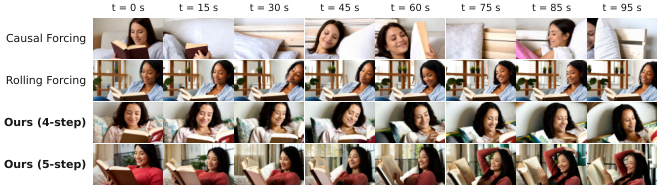
The reported qualitative comparisons show WF at 4 and 5 denoising steps matching or exceeding Causal Forcing and Rolling Forcing on temporal consistency and dynamic motion.
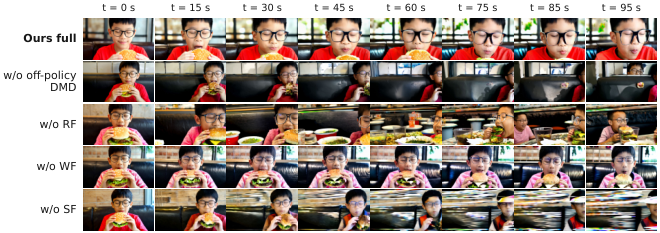
Training ablations confirm the necessity of each of the three adaptation stages: removing motion supervision collapses dynamic degree; removing causal adaptation on self-generated history yields drift artifacts over long rollouts.
The 1F1C property means that after S rounds of fill, throughput is one chunk per concurrent forward pass regardless of S — the central systems claim of the paper, trading GPUs (one replica per stage plus store) for latency.
Limitations
WP has a fixed-step scaling limit: concurrency is capped at S+1 replicas, so scaling denoising depth linearly scales hardware. The authors flag combining WP with finer-grained execution and context parallelism as future work. The training recipe remains three-stage and non-trivial; simplifying it while preserving motion and long-horizon stability is open. End-to-end profiling of VAE decoder, transfers, queues, and backpressure for balanced DiT/VAE resourcing is deferred. The paper also does not report standard benchmark tables in the excerpted sections, so quantitative FVD/VBench numbers are not available here.
Why this matters
Wave Forcing identifies that the reverse K/V edges in rolling-window streaming diffusion are the structural reason multi-step denoising cannot reach one-chunk-per-forward-pass throughput, and removes them with a strictly causal wavefront mask plus matched training. If the 1F1C claim holds under full benchmarks, it establishes a concrete throughput ceiling — the “speed of light” of the title — for streaming video diffusion at fixed denoising depth.
Source: https://arxiv.org/abs/2611.00859
CrossSWE: Benchmarking Cross-Repository Joint Development for Coding Agents
Problem
Existing agentic coding benchmarks (SWE-bench and successors) measure resolution of issues confined to a single repository. Real software evolution often requires coordinated edits across multiple interdependent repositories: changing a protocol in a server library forces matching changes in clients, plugins, or gateways built on top of it. Within-repo benchmarks cannot measure whether an agent can (a) locate the relevant counterpart repository, (b) propagate semantic changes while preserving interface consistency, and (c) satisfy cross-repo tests that fail if either side is left untouched. CrossSWE targets exactly this axis of difficulty rather than scaling task length within a single codebase.
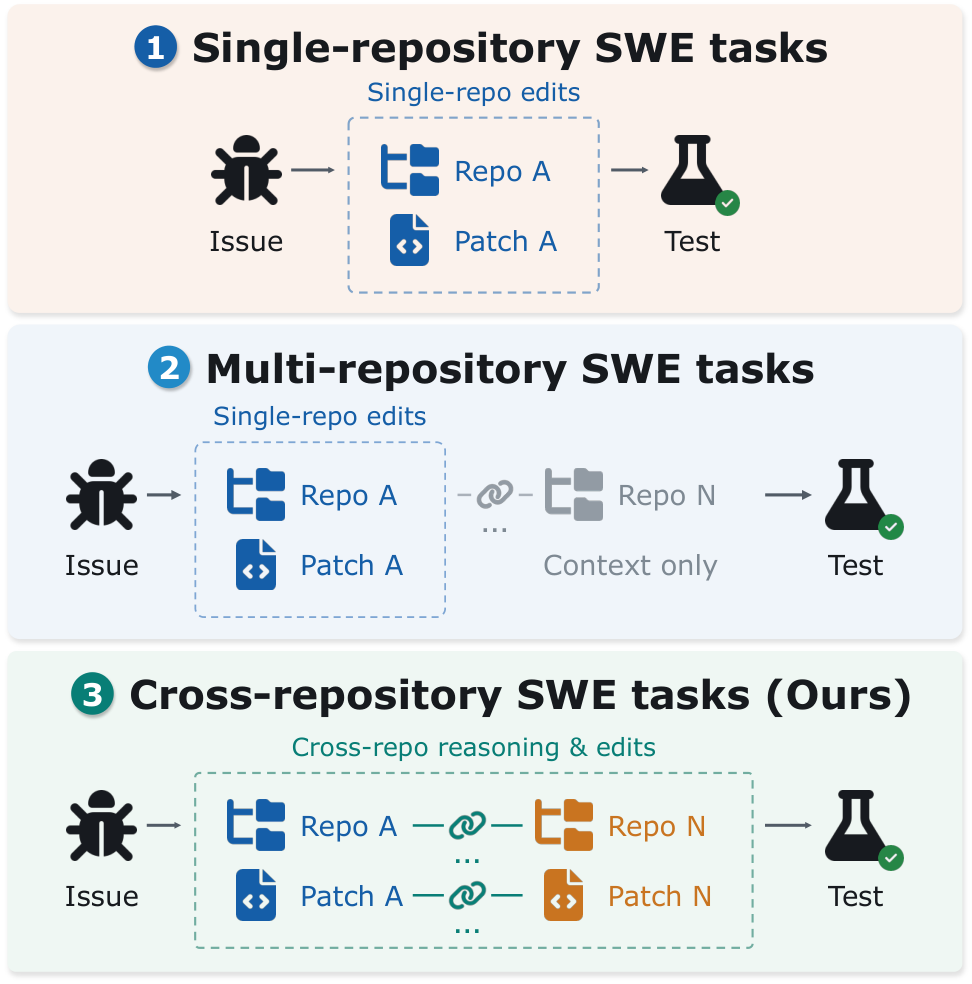
Benchmark construction and task formulation
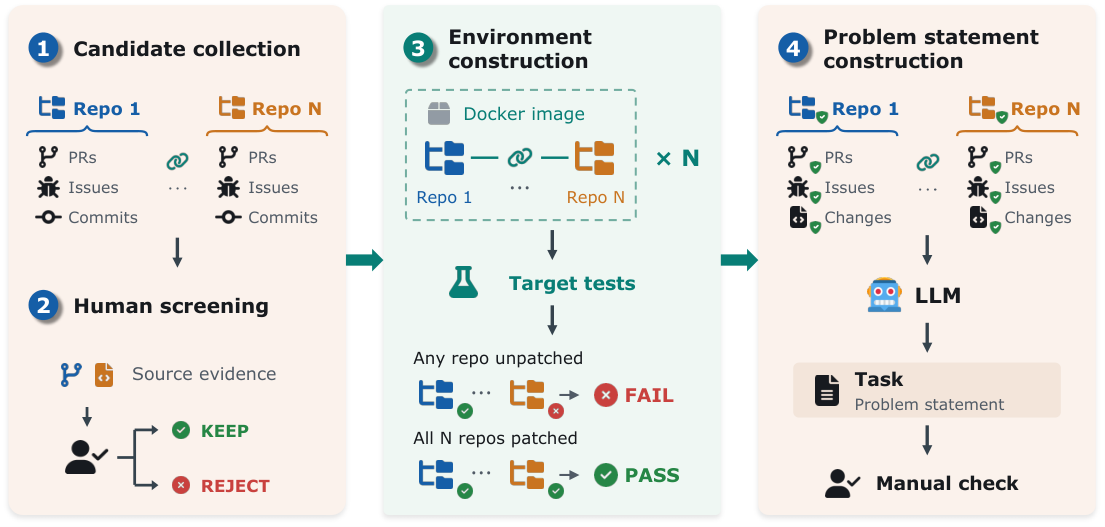
CrossSWE contains 171 instances across 165 repositories, 20 technical domains, and 13 programming languages. Each instance is a tuple of:
- A pre-configured environment with two or more repositories pinned at base commits and all dependencies installed.
- A single natural-language problem statement whose intended behavior spans these repositories.
- A test suite that validates both the new cross-repo behavior and preserved pre-existing behavior.
- Repository-specific gold patches reflecting the original coordinated fix.
The key verification criterion is coordination necessity: the authors confirm that applying the gold patch to only a subset of repositories fails the test suite, so partial-repo solutions cannot pass. This is the structural property that distinguishes CrossSWE from naive multi-repo bundling of independent tasks.
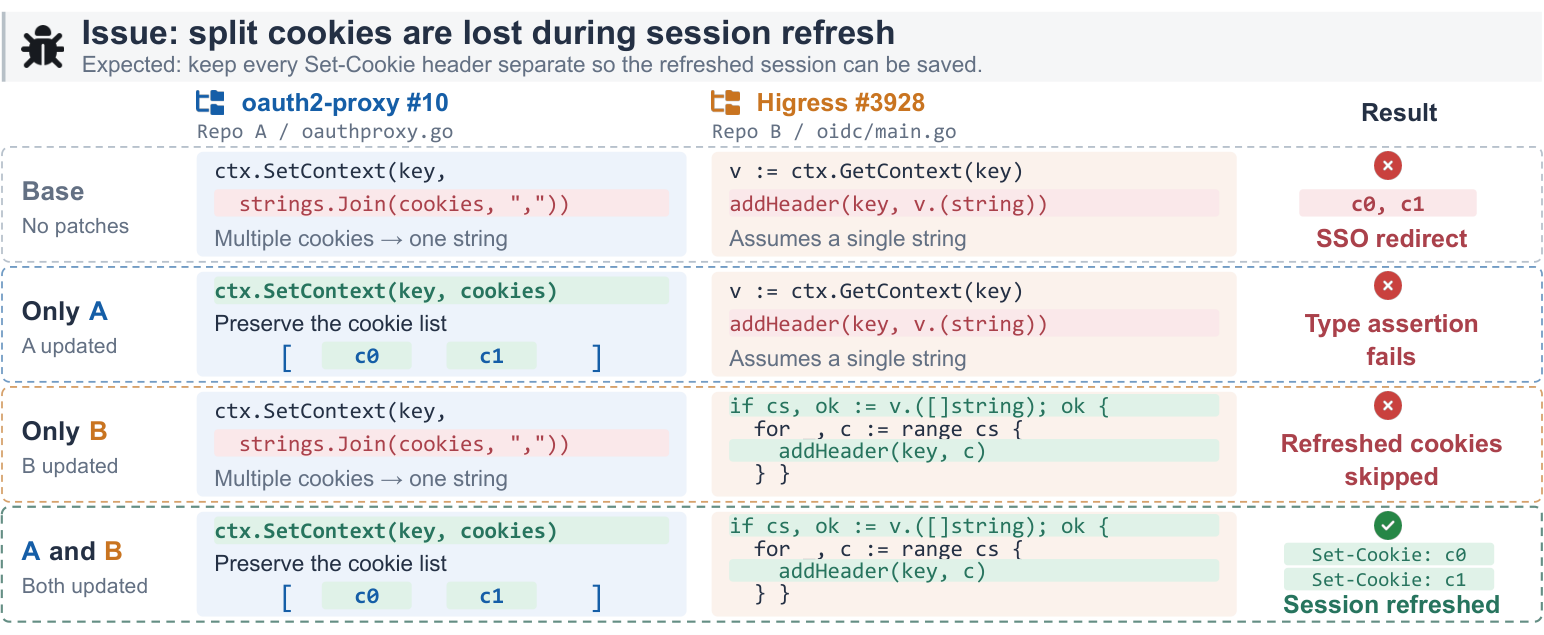
A representative instance couples oauth2-proxy with the Higress API gateway: a change in token-handling semantics on the proxy side only becomes observable when the gateway plugin consuming it is updated in step. The agent must infer the dependency direction and modify both sides consistently.
Experimental setup
All agents share a fixed scaffold: mini-SWE-agent v2.4.6, a shell-interaction loop in which the model inspects, edits, and runs tests across the mounted repositories. Each run is capped at 300 interaction steps and $10 model spend, with “high” reasoning effort for all five frontier models evaluated: GPT-6.1 Sol, Claude Sonnet 5.5, DeepSeek V4.1 Flash, GLM-5.3 Flash, and Qwen3.8-Flash-Next. The outcome metric is Pass@1 under the full test suite.
Results
The strongest system, GPT-6.1 Sol, reaches only 58.48% Pass@1, well below its reported 75.2% on the single-repo DeepSWE v1.1 benchmark. The ordering across models is:
- GPT-6.1 Sol: 58.48%
- DeepSeek V4.1 Flash: 52.63%
- Claude Sonnet 5.5: 50.29%
- Qwen3.8-Flash-Next: 45.03%
- GLM-5.3 Flash: 43.86%
Splitting by language setting, GPT-6.1 Sol scores 60.34% on single-language instances but drops to 54.55% when the task crosses language boundaries (e.g., a Go gateway plus a Python client). DeepSeek V4.1 Flash is unusually robust across the boundary, holding 52.73% on multi-language tasks—suggesting that cross-language code understanding is a distinct capability axis not perfectly correlated with overall score.
The cost/efficiency profile is informative. GPT-6.1 Sol averages $0.3496 per instance and 32.9 interaction steps; Claude Sonnet 5.5 is comparable at 29.2 steps. DeepSeek V4.1 Flash, GLM-5.3 Flash, and Qwen3.8-Flash-Next use 152.7, 141.7, and 182.1 steps on average, respectively. Despite higher per-token prices, the closed-source models remain cost-competitive because they terminate much earlier—suggesting that trajectory efficiency, not raw token price, dominates agentic cost on this benchmark.
The paper reports that 44.2% of failures stem from cross-repository inconsistencies: the agent edits one side correctly but leaves the counterpart in a state that violates the shared interface or protocol. This is the most prevalent failure mode, confirming that coordinated change propagation—not local code generation—is the binding constraint.
Limitations and open questions
- 171 instances is small; subgroup splits (per-language, per-domain) are statistically thin.
- Only one scaffold (
mini-SWE-agent) is evaluated. Agent architectures that explicitly model cross-repo dependency graphs or use retrieval over multiple repos could change the picture substantially. - The 300-step / $10 ceiling cuts off long-trajectory models; it is unclear how much of the gap for Qwen/GLM is capability vs. budget.
- “Coordination necessity” is verified via partial-patch tests, but the benchmark does not quantify the minimum number of repositories that must be edited per instance, which would be a useful difficulty axis.
- No training-contamination analysis is reported for the 165 public repos, which is a standard concern when base commits are drawn from GitHub.
Why this matters
Single-repo SWE benchmarks are saturating, and the next real-world bottleneck for coding agents—dependency reasoning across interdependent codebases—is exactly what CrossSWE isolates. A ~17-point drop from DeepSWE v1.1 to CrossSWE for the strongest model, with 44.2% of failures tied to cross-repo inconsistency, indicates that current agents operate largely as local editors and lack mechanisms for maintaining global interface coherence.
Source: https://arxiv.org/abs/2611.01484
FLAMIA: FLAsh MIcroscaling Attention for Fast and Causally Safe Training on Blackwell
Problem
Attention training is dominated by matmul throughput at long context, and Blackwell exposes substantial FP8/FP4 tensor-core gains over BF16. Converting those gains into end-to-end speedups for causal, packed-document training is non-trivial because (i) each of the six logical attention operands (\mathbf{Q},\mathbf{K},\mathbf{V},\mathbf{P},\mathbf{dO},\mathbf{dS}) participates in two products with different contraction axes, forcing either duplicate quantized copies or layout gymnastics; (ii) scale groups that straddle token boundaries can leak information from future tokens into the current one via the shared scale, breaking causality; and (iii) forward and backward paths that quantize differently introduce numerical drift that accumulates during long pretraining runs. FLAMIA is a kernel family that targets all three for MXFP8 and mixed NVFP4/FP8 on B200/B300.
Method
The core design decision is a token-block scaling layout aligned with the dual-contraction structure of attention. For MXFP8, a single power-of-two exponent is shared across 32 consecutive tokens and the full head dimension d of an operand. Because the exponent is constant within a 32\times d block, the quantized payload remains valid after transposition: the same codes and scales serve K-major MMA on one contraction and MN-major MMA on the other. On Blackwell, 8-bit MMA accepts both orientations, so a single E4M3 representation of \mathbf{Q},\mathbf{K},\mathbf{V},\mathbf{dO} participates in both forward and backward products without a re-quantized transposed copy. \mathbf{dS}, which is contracted along keys in \mathbf{dQ} and along queries in \mathbf{dK}, is handled with square 32\times 32 blocks so that both orientations retain the common-exponent invariant.
In the mixed path, \mathbf{Q} and \mathbf{K} additionally carry an NVFP4 representation with one scale per 16 head-dim elements per token. This representation is used for both forward score computation \mathbf{S}=\mathbf{Q}\mathbf{K}^\top and backward score recomputation, which share the head-dim contraction. The 4-bit path requires K-major layouts, so NVFP4 is restricted to products where that constraint is natural; the remaining four products (\mathbf{PV}, \mathbf{dP}, \mathbf{dV}, \mathbf{dQ}/\mathbf{dK} via \mathbf{dS}) stay in E4M3. \mathbf{Q} and \mathbf{K} thus carry one NVFP4 and one E4M3 representation each; \mathbf{V} and \mathbf{dO} stay single-copy E4M3.
Causal safety follows from the block layout: because a single exponent governs an entire 32\times d token block, no scale ever spans across a document boundary within the forward or backward computation, and document-local scaling plus workload-aware scheduling handle variable-length packed layouts without repacking. Forward and backward use the same quantized operands wherever the contraction axis permits, which keeps gradient and activation statistics consistent across the two passes.
Quantization is fused with the attention epilogue so the memory-bound exponent-reduction pass is not amortized separately. This matters because, for six operands with dual contractions, naive per-orientation requantization is a dominant cost.
Results
Table 1 reports combined forward+backward attention (quantization included) on causal packed documents with 16 heads and d=128. On B200, the MXFP8 path reaches 1079–1095 TFLOP/s on long uniform shapes (4\times 4096 and 16\times 4096 documents), delivering 1.10–1.40\times speedups over the fastest evaluated baseline for each workload; the strongest gain, 1.40\times, is on the skewed 8192+224\times 256 mix where baseline schedulers handle many short documents poorly (FA4 BF16: 6.71 ms vs FLAMIA MXFP8: 1.80 ms). On B300 the range is 1.06–1.42\times, with the same skewed-mix workload again at the top (1.67 ms vs 2.37 ms for FA4 BF16). NVFP4 is consistently within a few percent of MXFP8 on these end-to-end calls (e.g., 0.92 vs 0.89 ms on 4\times 4096, B200), suggesting that for training the backward E4M3 products dominate; the 4-bit forward savings do not fully propagate.
Forward-only numbers (Table 2) are more favorable to 4-bit: on 4\times 4096 B200, FLAMIA MXFP8 forward is 0.17 ms at 1616 TFLOP/s, versus 0.24 ms for cuDNN FP8 and 0.25–0.27 ms for FA4 FP8 and FlashInfer backends; speedups over the fastest baseline reach 1.42\times on 64\times 1024. GQA logs are competitive even where several baselines (Low Precision FA4, nested-tensor SDPA) lack GQA support entirely.
Limitations
The reported wins depend on packed-document causal workloads with d=128 and 16 heads; behavior at other head dimensions or with sparse/sliding masks is not shown. The mixed path still requires duplicate \mathbf{Q},\mathbf{K} representations (NVFP4 for scores, E4M3 for gradients), so memory savings are partial. Several strong baselines (cuDNN MXFP8, FA4 FP8, FlashInfer, HW-FP4 FA4) lack supported packed-document backward paths and only appear in forward comparisons, which complicates apples-to-apples training-call claims. End-to-end LM pretraining loss curves are summarized as “consistent” training behavior but are not quantified in the excerpted sections.
Why this matters
FLAMIA shows how to translate Blackwell’s low-precision throughput into real training speedups on the awkward case — causal, packed, variable-length — by designing the scale layout around attention’s dual-contraction structure rather than treating quantization as a post-hoc wrapper. The 1.10–1.42\times end-to-end attention speedups with causal safety and forward/backward consistency are a credible blueprint for MXFP8/NVFP4 attention kernels in production training stacks.
Source: https://arxiv.org/abs/2611.03344
CoworkOS: Scaling Agent Coworkers for Real-world Automation
Problem
Long-horizon productivity work exposes two linked weaknesses in current agent harnesses: (i) a single flat context cannot absorb the tool traces, intermediate artifacts, and user revisions that accumulate over hours of work, and (ii) humans and agents typically interact through chat only, while the “work” itself (slides, CAD, code, Blender scenes) lives in opaque files that neither party can jointly inspect or edit. CoworkOS targets this by separating task strategy (what to do, what to accept, whom to delegate to) from execution management (state, feedback, checkpointing), and by making the artifacts themselves the shared surface for human-agent interaction.
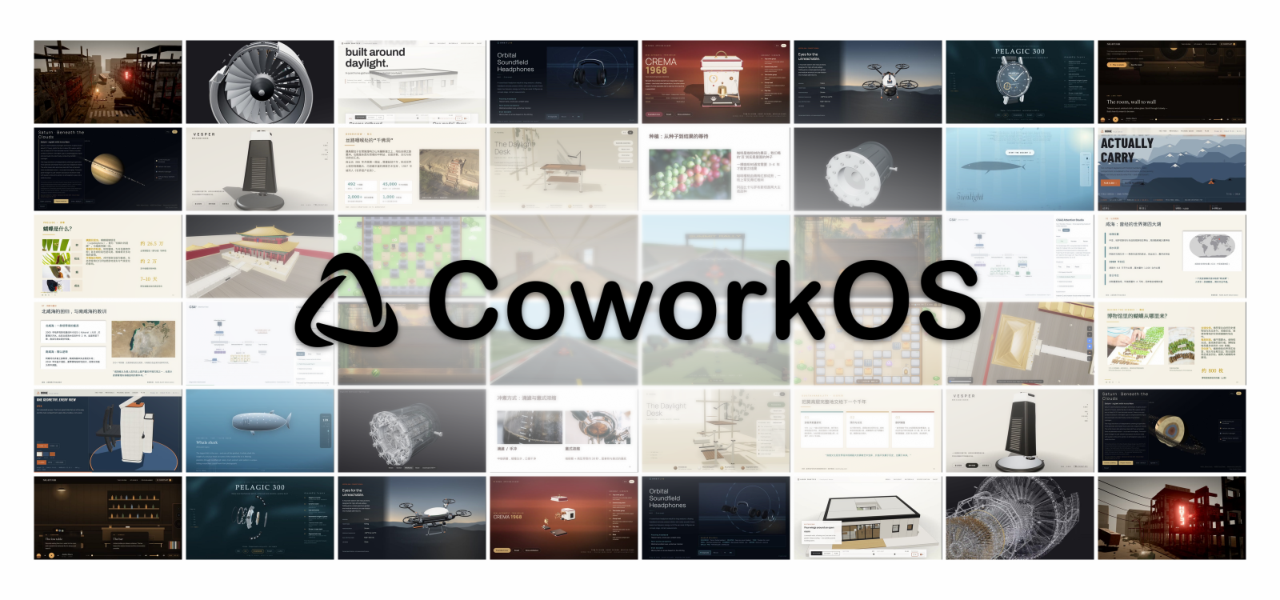
The 24 showcase cases span frontend websites, games, Office presentations, interactive visualizations, CAD, and Blender renders — a deliberately heterogeneous mix that stresses the harness rather than any single toolchain.
Harness architecture
The runtime is organized as a three-layer hierarchy: a single Main agent that owns the user-facing objective, a Coordinator Runtime that mediates delegations, and Subagents that execute scoped assignments. Main is the sole point of accountability — it holds the global interaction history and selects actions via
a_t^{M} \sim \pi_M(\cdot \mid g, h_t^{M}, \mathcal{F}_t),
where g is the user objective, h_t^{M} the retained interaction history, and \mathcal{F}_t freshly available feedback (tool results, user guidance, Subagent returns). The design concentrates most responsibilities in Main for three stated reasons: full task context stays coherent, context-heavy independent branches can be isolated into Subagents without polluting Main’s window, and training a policy for coordination is easier when control is centralized rather than distributed.
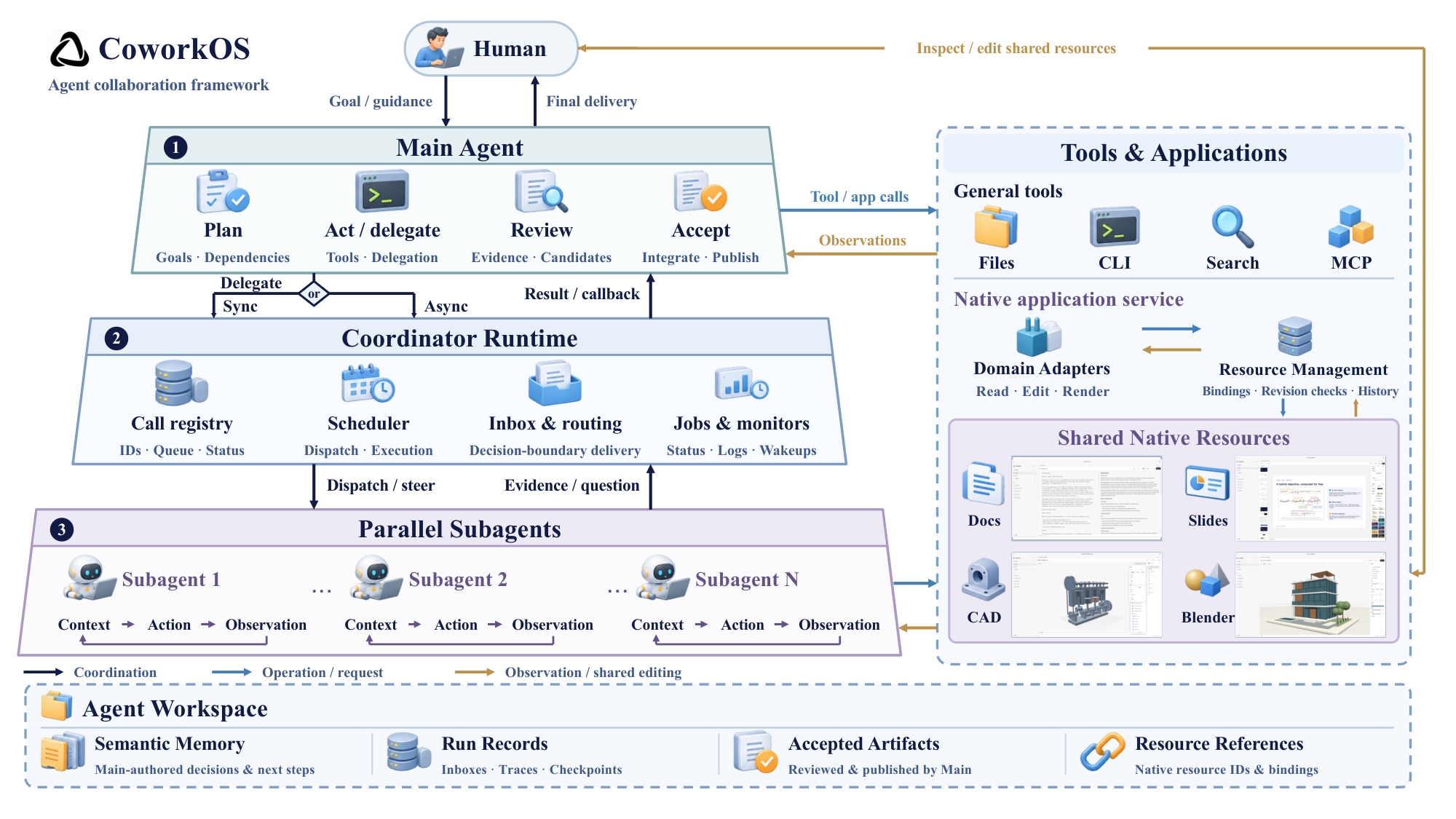
Delegation is framed as an evidence contract: Main specifies the objective, constraints, allowed capabilities, and the form of evidence it expects back. The Subagent’s intermediate trajectory never enters Main’s context — only the contracted deliverable does. Delegations may be synchronous (Main blocks on the return) or asynchronous (Main continues other work and polls/handles callbacks via the Coordinator). This is the mechanism that makes long tool-interaction chains tractable without blowing out Main’s context budget.
Three auxiliary subsystems support continuity:
- Scalable application ecosystems: a shared resource protocol so both humans and agents can natively edit the same documents, slides, CAD models, and Blender scenes, with revision management and conflict detection. Human-in-the-loop participation enters either through conversation with Main or through direct edits to the artifact, which Main must then reconcile.
- Hierarchical workspaces: files, decisions, and Job logs are stored in persistent workspace trees that survive across sessions and across agents.
- Persistent semantic memory: distilled key decisions and long-running Job summaries that let a later Main instance resume without replaying full histories.
Evaluation
CoworkOS is evaluated on twelve benchmarks across four capability clusters:
- Tool Use: SkillsBench, Tau-3 Bench Banking, AutomationBench.
- Productivity: JobBench, Harvey Legal Agent Bench, GDPVal, OfficeQA Pro, WorkspaceBench-Lite.
- Search: WideSearch, BrowseComp.
- ML Coding: MLE-Bench-Lite, MLS-Bench.
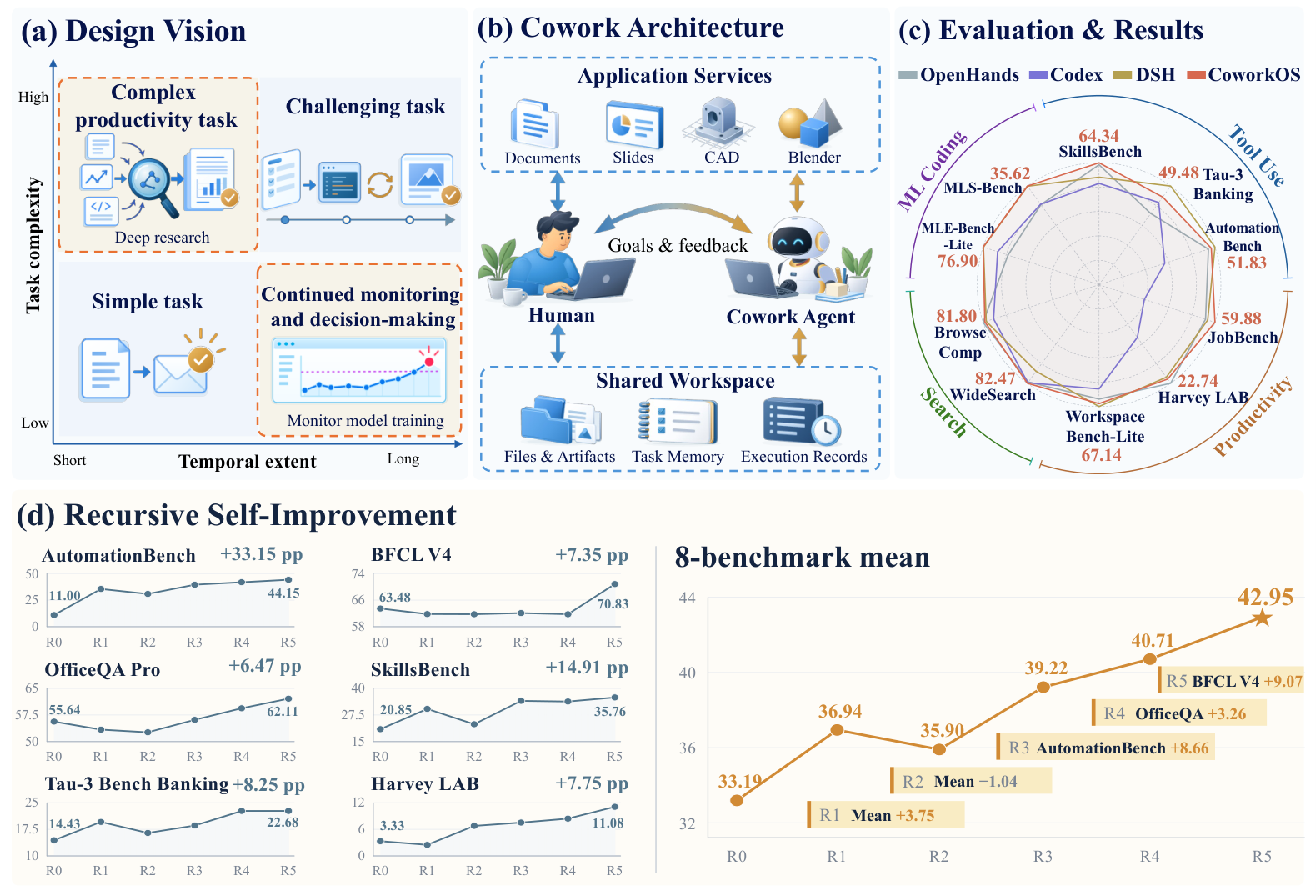
The overview figure positions CoworkOS against other frontier cowork harnesses across 10 of these benchmarks. The paper additionally reports artifact-level evaluation (completeness, consistency, usability of delivered deliverables) and a recursive self-improvement (RSI) loop where automated post-training over collected trajectories yields incremental gains across rounds. The provided excerpt does not include the exact benchmark numbers in text form; those live in the figure panel and in Section 4.1/4.3 tables not reproduced in the available sections.
Design notes worth highlighting
- The centralized Main + evidence-contract delegation pattern is the key architectural claim. Compared to swarm-style multi-agent systems where several peers share planning, this places accountability and context in one place and makes Subagents stateless from Main’s perspective — their contribution is defined by the contract, not by their internal trace. This both bounds context growth and makes the policy learnable.
- The shared application layer is more than a UI convenience: because humans edit the same resource the agent edits, revision tracking becomes the mechanism by which human corrections re-enter the agent’s feedback stream \mathcal{F}_t. Human intervention is not a separate modality.
- Asynchronous delegation turns the agent runtime into something closer to a job scheduler, which matters for ML coding and long search where individual Subagent calls can run for many minutes.
Limitations and open questions
The architecture description is thorough, but several things are not resolved in the available text. First, the policy \pi_M is treated as a given; how it is trained to delegate well, when to accept Subagent evidence, and when to re-plan is deferred to the RSI section. Second, conflict detection in the shared application layer is mentioned but not specified — concurrent edits by Main, Subagents, and humans on structured artifacts (CAD, Blender scenes) are nontrivial to merge semantically. Third, the hierarchy is strictly two-level (Main plus Subagents); whether Subagents can themselves delegate, and how context contracts compose across depth, is not addressed. Finally, headline numbers against competing harnesses are shown only graphically in the provided material, so a quantitative read of the margin is not possible from the excerpt.
Why this matters
If long-horizon agent work is going to produce real artifacts rather than chat transcripts, the harness has to treat artifacts, delegation contracts, and persistent memory as first-class — not as scaffolding around a single LLM call. CoworkOS is a concrete design that factors these responsibilities cleanly, and the evidence-contract view of delegation is a reusable primitive for anyone building multi-agent production systems.
Source: https://arxiv.org/abs/2611.03178
CUA-Master: Scaling Computer-use Agents through Open-World Recursive Improvements
Problem
Computer-use agents (CUAs) — policies that take screenshots and emit mouse/keyboard actions to complete natural-language tasks — are bottlenecked by trajectory data. Human-collected traces are expensive and narrow; purely synthetic templated tasks lack behavioral diversity; and self-improvement loops (where a model generates its own training data) saturate quickly because the generator cannot produce behaviors it does not already know. CUA-Master targets this stagnation by replacing self-generated supervision with a continuously ingested open-world corpus and by coupling data construction to the agent’s measured failure modes.
Task formalism
The authors adopt the standard CUA formulation. A task is \mathcal{T}=(\mathcal{I},\mathcal{E},\mathcal{V}) with instruction \mathcal{I}, environment \mathcal{E}, and verifier \mathcal{V}. At each step s the policy samples an action batch
\mathbf{a}_s \sim \Pi(\cdot\mid \mathcal{I}, o_s, h_s),\quad \mathbf{a}_s=(a_s^{(1)},\ldots,a_s^{(L_s)}),
allowing both single-action (L_s=1) and batched-action (L_s>1) decoding over observation o_s and history h_s. A trajectory
\mathcal{X}=\{o_1,\mathbf{a}_1,\ldots,o_S,\mathbf{a}_S,o_{S+1}\}
is scored by \mathcal{V} at termination. Nothing novel here, but the batched-action formulation matters: downstream the system mines whole workflow chunks rather than per-click supervision.
Method: nested double-loop flywheel
CUA-Master is organized as two nested loops.
Outer loop (world–data–model flywheel). After each training iteration, the current checkpoint is profiled on held-out tasks; failure clusters (app categories, interaction primitives, GUI/CLI mixes where errors concentrate) steer the next round of corpus ingestion and task synthesis. This replaces the usual static dataset with a weakness-conditioned curriculum. Critically, new data is drawn from an exogenous open-world source (see below), not from the model’s own rollouts, which the authors argue is what prevents the diminishing-returns behavior of pure self-play.
Inner loop (data flywheel). Two coupled stages:
Open-world seeding. Instructional videos (tutorials, screencasts) are mined for authentic workflows. A visual–semantic dual-path reconstruction converts a video into a trajectory: the visual path tracks UI state transitions frame-to-frame; the semantic path extracts narration/caption intent. The two are aligned to recover (\mathcal{I}, \mathcal{X}) pairs grounded in real human usage rather than templated goals.
Autocatalytic propagation. Reconstructed trajectories are decomposed into reusable primitives (parameterized action macros tied to app/semantic contexts). These primitives are recombined under controllable constraints to synthesize new tasks whose verifiers can be constructed programmatically — yielding scale with verifiability.
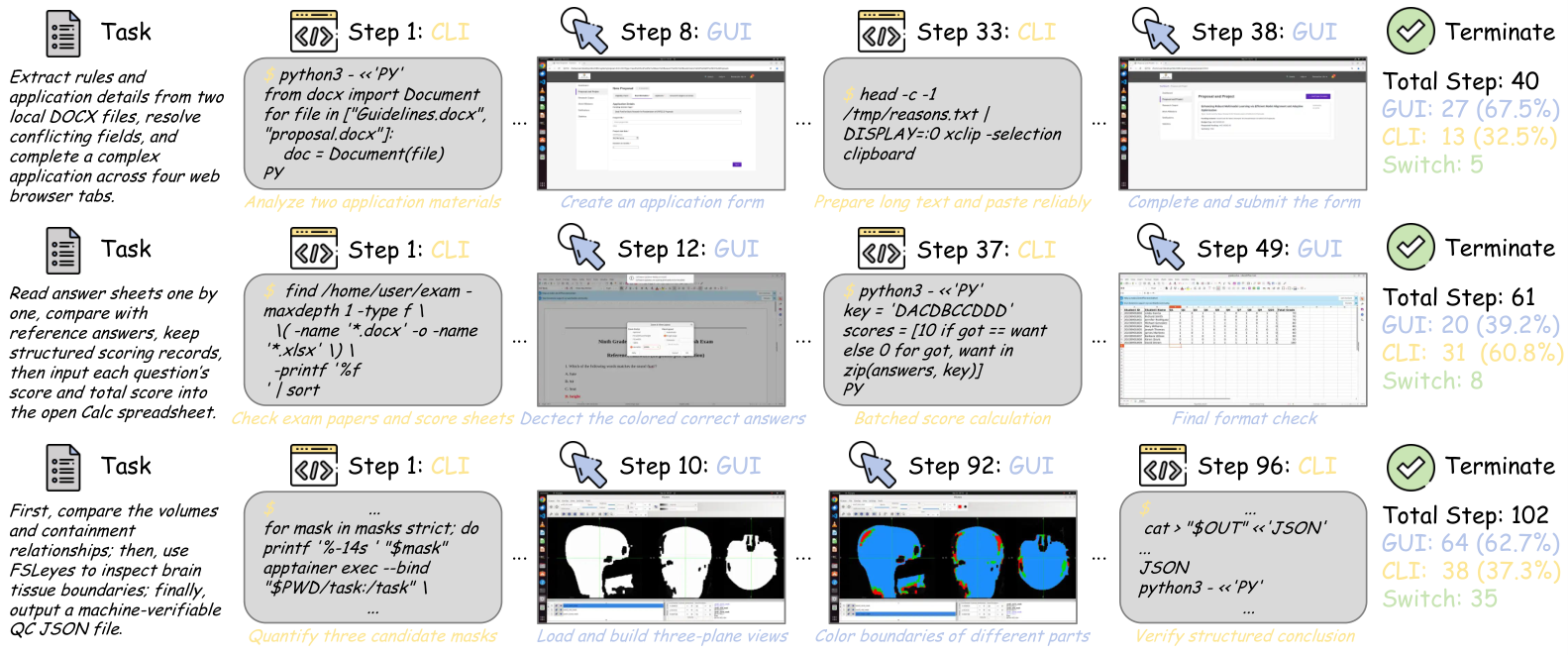
The pipeline supports hybrid GUI+CLI trajectories, which is where templated synthesis typically fails: the agent must switch between pixel-grounded clicking and shell commands within one task, as illustrated above.
Snapshot-rollback retry. Trajectory collection on real environments is unreliable (network flakiness, nondeterministic UI). The authors add a feedback-guided mechanism that snapshots environment state at decision boundaries; on verifier-detected failure, the collector rolls back to the last valid snapshot and retries with modified actions, rather than discarding the whole rollout. This substantially raises the yield of usable trajectories per environment-hour.
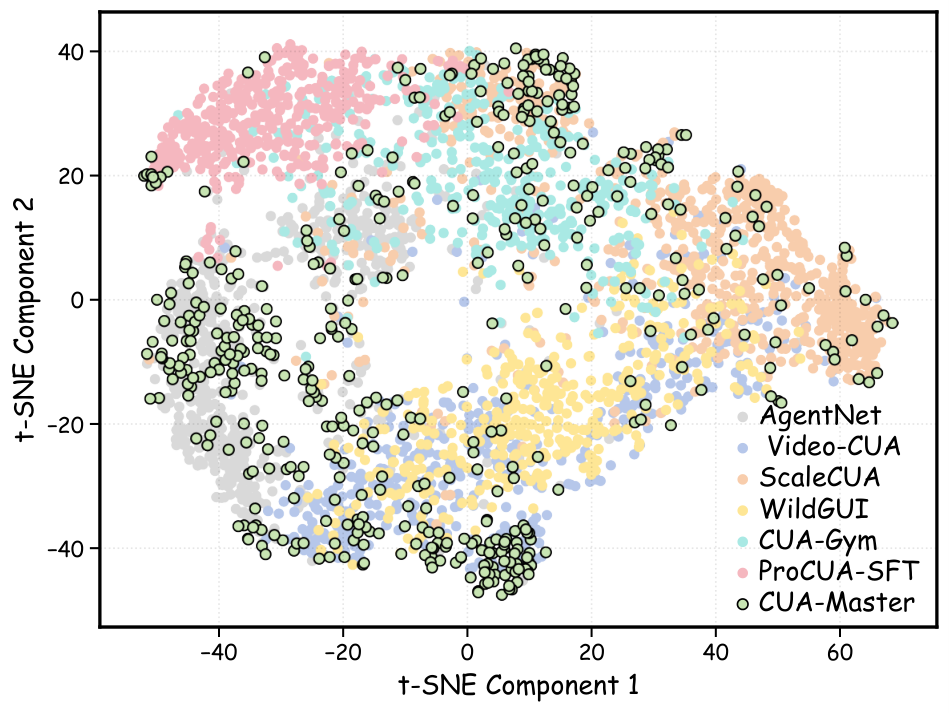
The t-SNE over sampled tasks shows the propagation stage produces coverage that extends beyond the seed clusters, consistent with the claim that primitive recombination escapes the self-generation ceiling.
Results
CUA-Master-27B is compared against generalist open models (Qwen-3.5/3.6/3.8 families up to 397B-A17B MoE, Minimax-M3-428B-A23B, Kimi-K2.6-1T-A32B, Kimi-K3-2.8T-A104B), proprietary generalists (Seed-2.1-Pro, GPT-5.6, Claude Sonnet/Opus-5), and CUA specialists (OpenCUA-72B, GUI-Owl-1.5-32B, EvoCUA-1.5-32B, ScaleCUA-9B, Qwen-CUA-397B-A17B, UI-Mate-27B). All baselines are re-run under a unified protocol (same action interface, environments, and verifiers).
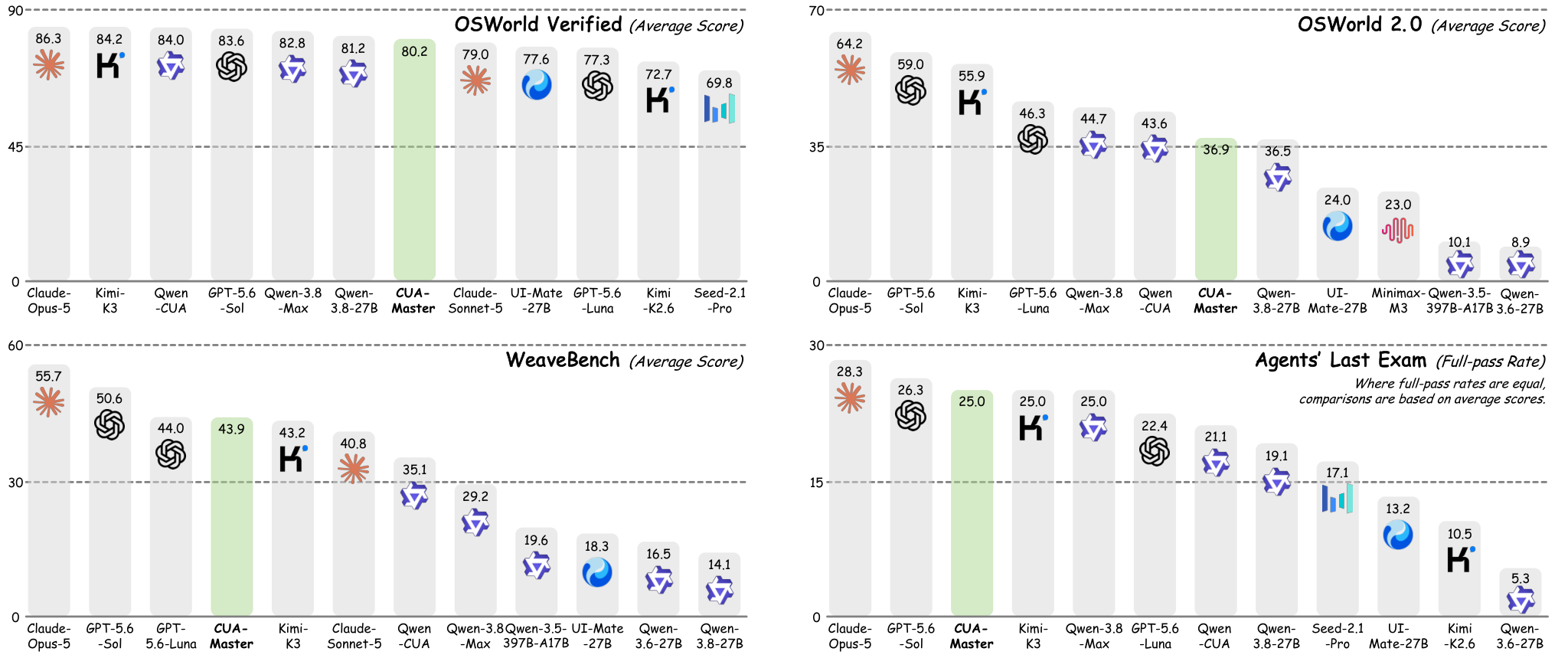
At 27B parameters the model is positioned against specialists an order of magnitude larger (e.g., Qwen-CUA-397B-A17B) and against trillion-scale generalists. The four-benchmark comparison in Figure 1 shows CUA-Master-27B leading on all four axes relative to same-class specialists and competitive with the largest proprietary models — the specific numerical breakdowns are presented in the figure rather than tabulated in the excerpted sections.
Limitations and open questions
- The excerpt does not quantify how much of the gain is attributable to the outer weakness-conditioned loop versus the video-grounded seeding versus the snapshot-rollback collector. Without that ablation it is unclear which component carries the recursion.
- Video-to-trajectory reconstruction assumes the narration/visual channels are faithful; silently incorrect reconstructions become hard-to-detect label noise, and the paper does not report reconstruction fidelity.
- Verifier construction for propagated tasks is the usual weak point of synthetic CUA data: if \mathcal{V} only checks terminal state, degenerate shortcut policies can pass.
- Generalization to apps absent from the instructional-video corpus is not addressed; the open-world claim is only as broad as what tutorials cover.
- Benchmark leakage risk is non-trivial given that instructional videos often demonstrate exactly the kinds of workflows evaluation suites probe.
Why this matters
Self-improvement loops for agents saturate because a model cannot bootstrap capabilities it never had; CUA-Master’s answer — treat instructional video as an exogenous skill source and let model weaknesses drive what gets mined next — is a concrete recipe for extending recursive training without the usual collapse, and the 27B model matching much larger specialists is evidence the data pipeline, not scale, is the active ingredient.
Source: https://arxiv.org/abs/2611.03126
NorthCUA Technical Report: Turbocharging Computer-Use Agents through Experience at Scale
Problem
Training computer-use agents (CUAs) that can both locate controls on screen and complete multi-step software workflows requires experience that links individual decisions to task-level outcomes. The two existing bottlenecks are (i) collecting diverse, executable tasks with verifiable success criteria across heterogeneous desktop and web environments, and (ii) producing enough successful long-horizon trajectories for hard workflows where naive sampling almost never completes. NorthCUA is an integrated system — harness, data flywheel, and three-stage training pipeline — designed to close the loop between experience production and policy improvement at scale.
System
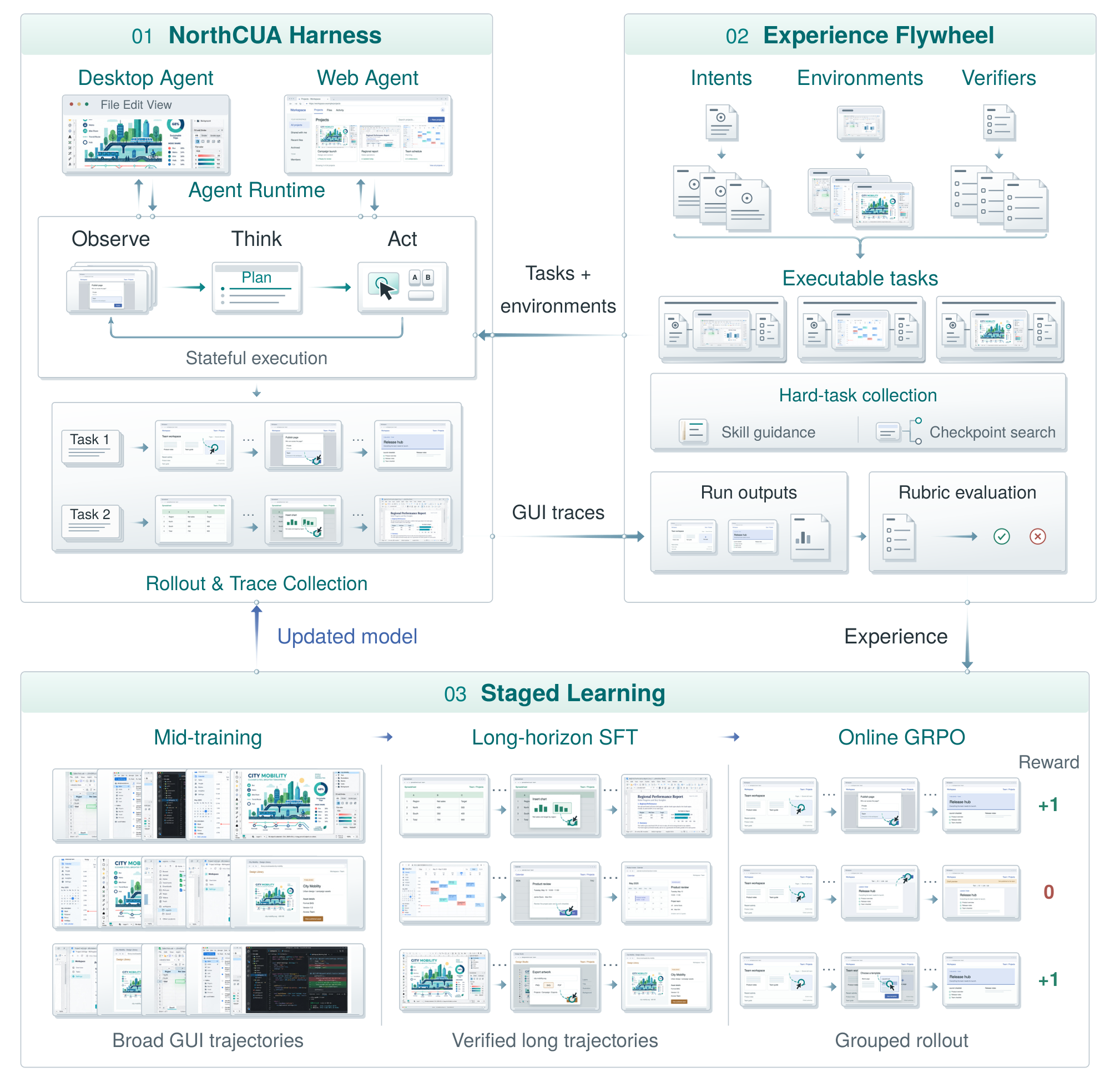
The system has three coupled components. The NorthCUA Harness provides full-lifecycle execution: a shared ReAct-style runtime (observation, policy call, tool execution, feedback) with platform-specific perception/action tools for desktop and web. Three nested lifetimes — session, task, step — are maintained so that long-horizon context, workspace artifacts, and the live environment all remain available to a tool-using evaluator after the agent terminates. A Batch Rollout Service parallelizes isolated attempts; the same observation/action interfaces are later reused by the online RL loop.
The Experience Flywheel operates on two levels. For single-step grounding, screenshots are annotated with one visible control plus its original-image coordinate, and queries are generated through two routes: (a) visual/structural coverage using accessibility metadata and screenshot evidence to produce name-, position-, and operation-based queries, and (b) documentation-grounded functional queries retrieved from app knowledge when visual appearance is insufficient. For end-to-end tasks, intents, environments, and verifiers are expanded jointly; unsolved tasks trigger recursive self-improvement that preserves verified milestones and distills reusable skills so later attempts can resume from partial progress rather than restart.
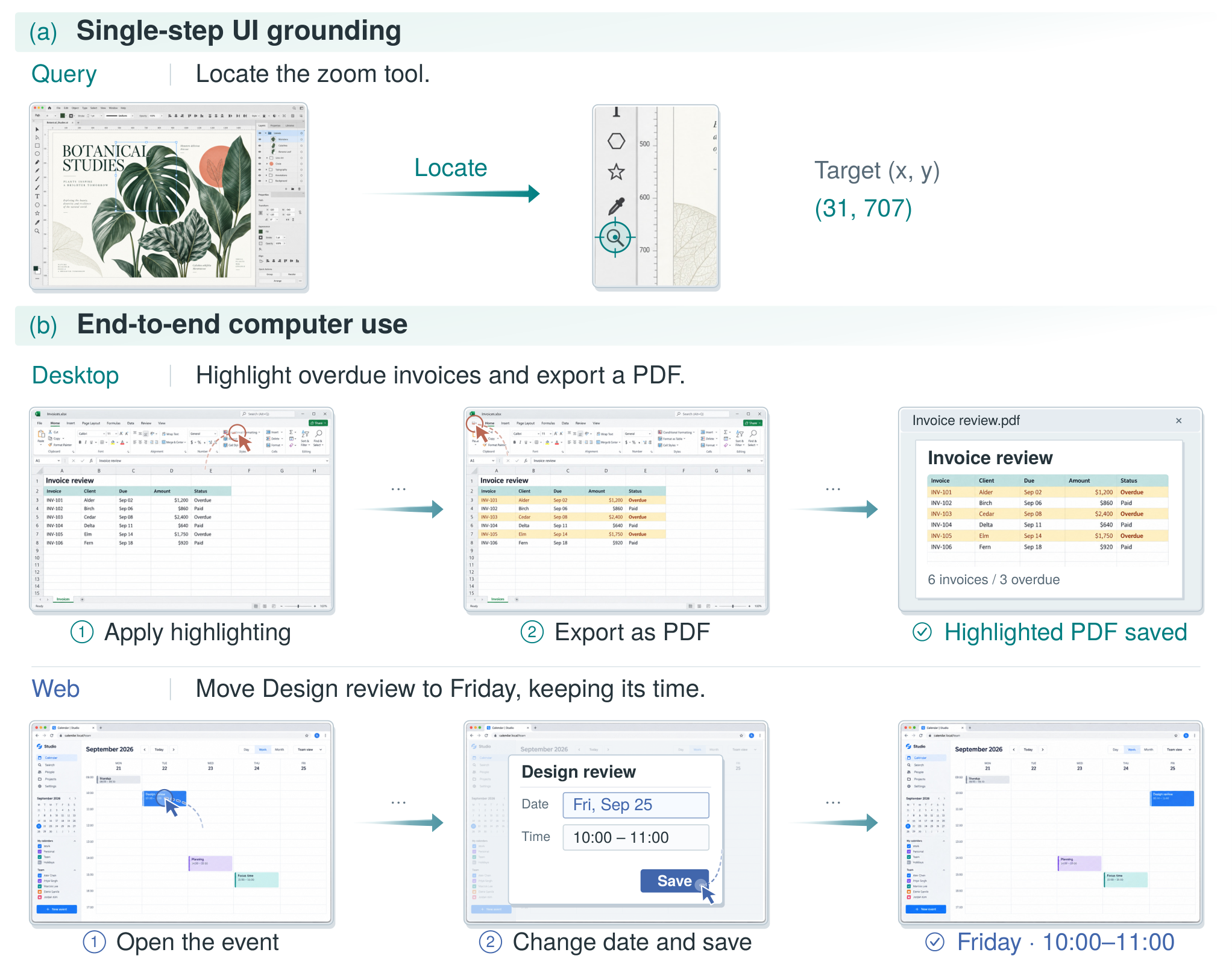
Staged learning
All spatial values use a shared [0,1000] representation: for an image of width W and height H, pixel (x,y) maps to (1000x/W,\,1000y/H). The three stages:
- Broad GUI mid-training. Localization plus broad software use. Reported scale: >100,000 trajectories, >4,000,000 GUI steps, plus ~40,000 grounding examples. Judge-selected trajectories and auxiliary evaluator demonstrations are mixed in.
- Verified long-horizon SFT. ~3,000 trajectories, ~310,000 GUI steps, selected by script-based acceptance, dependency satisfaction, and execution quality — a sharp distributional narrowing toward complete, dependency-consistent workflows.
- Joint desktop–web agentic RL. ~1,500 desktop and ~500 web tasks, human-reviewed for outcome variation and then re-scored by fresh verifier groups. The RL loop reuses the harness’s execution and evaluator interfaces so training-time rollouts are identical in protocol to data-collection rollouts.
Each stage initializes from the previous checkpoint. Appendix E (referenced but not reproduced) defines supervised prediction units and how RL rollouts are converted into training samples.
Models and evaluation
The family uses Qwen3.5 backbones at three sizes: Nano (9B dense), Mini (35B total / 3B active MoE), Pro (397B total / 17B active MoE). Checkpoints are tagged Mid (post mid-training) and SFT (post long-horizon SFT); grounding results use SFT, while desktop/WebArena/WebTestBench use the final RL checkpoint. Ultrafast is a direct-action variant initialized from pre-RL Nano, intended to trade reasoning tokens for latency.
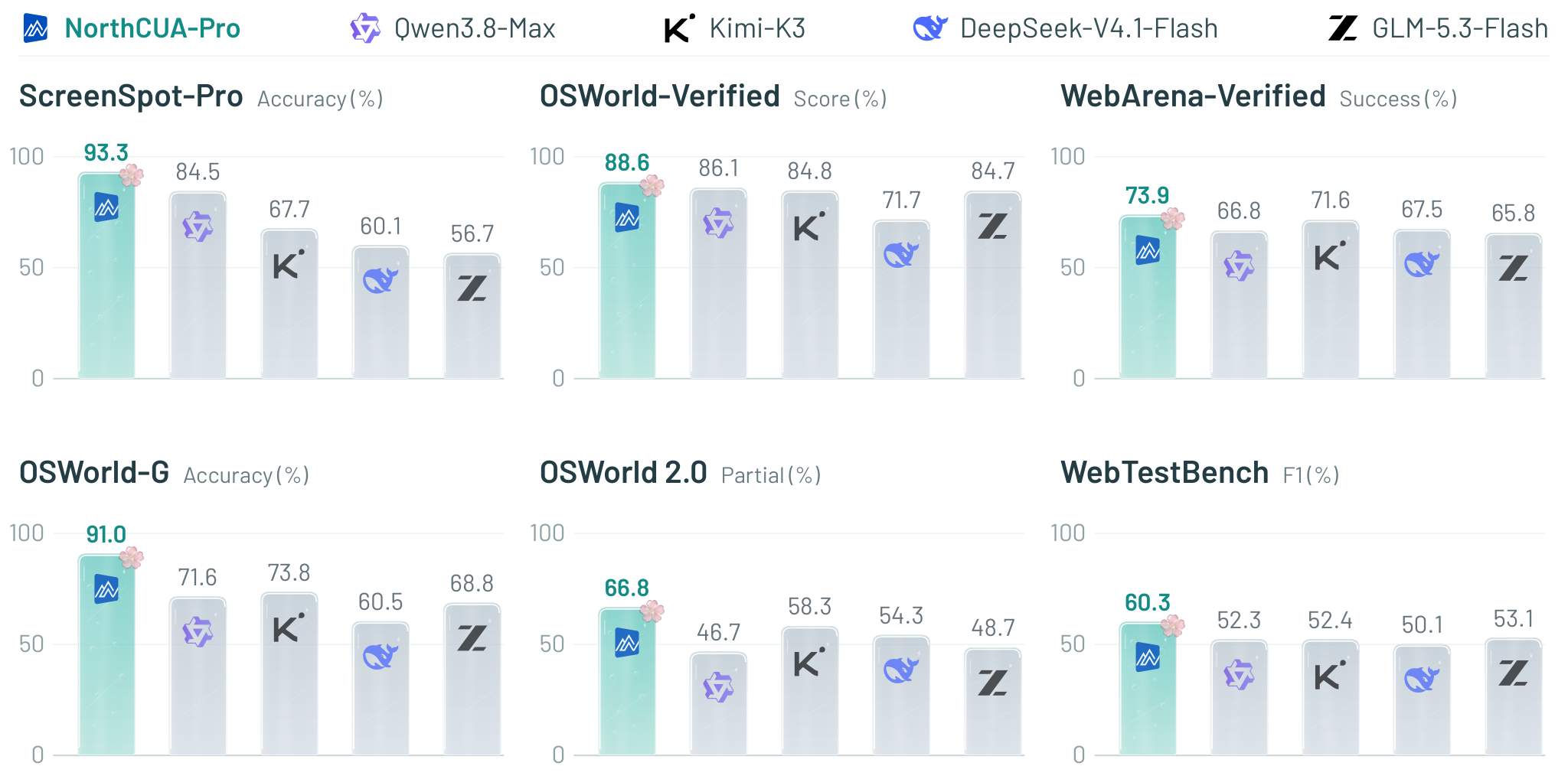
The evaluation suite covers both capability axes:
- Grounding: ScreenSpot-Pro (dense professional UIs, small controls) and OSWorld-G (semantics, layout, precise targeting, absent targets).
- Desktop: OSWorld-Verified (application/file/cross-app workflows) and OSWorld 2.0 (long dependent workflows, partial-credit scoring).
- Web: WebArena-Verified (stateful outcome-checked user tasks) and WebTestBench (defect detection with precision/recall/F1 against a gold checklist).
The report claims state-of-the-art among open-source models on all six benchmarks under the stated settings; the headline bar chart (Figure 1) shows Pro leading on each axis. The excerpt provided does not reproduce the full numeric table (metrics are reported to one decimal), so specific per-benchmark scores are not quoted here beyond the aggregate claim.
Limitations and open questions
- “SOTA among open-source” is scoped to the authors’ evaluation settings; harness implementations materially affect OSWorld- and WebArena-style scores, and cross-paper comparability is weak without a shared harness.
- The RL task pool is small (~2,000 tasks total). It is unclear how much of the Pro-tier gain comes from RL versus from the ~310k-step long-horizon SFT or the >4M-step mid-training.
- Recursive self-improvement with retained milestones risks reward hacking of the verifier and credit leakage across attempts; the report does not detail counter-measures in the provided sections.
- No ablation isolating the two grounding routes (visual/structural vs. documentation-grounded) or quantifying the marginal value of skill distillation on unsolved tasks is included in the excerpt.
- Nano being dense while Mini/Pro are MoE confounds scaling comparisons within the family.
Why this matters
NorthCUA is a concrete recipe for coupling execution infrastructure, verifier-based task curation, and staged SFT→RL training into a single feedback loop, at a scale (>4M GUI steps, three model sizes up to 397B total) that few open stacks have reached. If the harness and flywheel generalize, the main scaling axis for CUAs shifts from static demonstration corpora to verifier-equipped executable task pools.
Source: https://arxiv.org/abs/2611.02102
Lost in Recovery: Demystifying Recovery Behavior of Computer-Use Agents via Goal-Oriented Action Replay
Computer-use agents (CUAs) that drive GUIs through mouse/keyboard primitives are brittle over long horizons: a misclick, a stray dialog, or an unintended file write accumulates into failure. Existing remedies are unsatisfactory. Environment reset is infeasible in proprietary apps; API-based rollback exists only for web DOMs; and action-replay from a snapshot grows linearly with horizon. This paper focuses on the under-studied regime of model-based recovery: the agent itself must reason about how to return to a prior intact state and resume. The contribution is a benchmark, ReTrace, that defines recovery success rigorously, injects controlled errors, and evaluates whether an agent can get back on-trajectory.
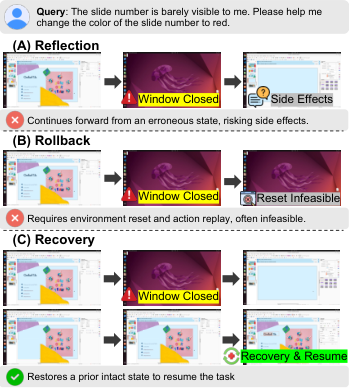
Formalizing recovery
A CUA task is a POMDP \mathcal{M}=(\mathcal{S},\mathcal{A},\mathcal{O},\mathcal{E},\mathcal{T},\Omega) with s_t=(h_t,o_t) decomposing into hidden h_t (e.g., filesystem state, hidden window handles) and observation o_t=\Omega(s_t) (e.g., screenshot). Given a trajectory \tau=\{(s_t,a_t)\}_{t=0}^T, recovery is a map f(s_t)=s_{t-d} for some recovery distance d, judged by an oracle \mathcal{R}\in\{0,1\}.
The key methodological move is to reject pixel/feature matching as the oracle. Latent state can drift without any visible change — a modified config file, a stale clipboard, a background process. Borrowing from predictive state representations, the authors define transition-consistent recovery: two states are equivalent iff they produce identical downstream dynamics. Concretely, for deterministic \mathcal{T}_{\mathcal{E}},
\mathcal{R}_{\mathrm{TC}}=\mathbb{I}\big[\mathcal{T}_{\mathcal{E}}(f(s_t),a_{t-d})=s_{t-d+1}\big],
extended recursively to multi-step replay
\mathcal{R}_{\mathrm{TC}}=\mathbb{I}\big[\mathcal{T}_{\mathcal{E}}(\cdots\mathcal{T}_{\mathcal{E}}(f(s_t),a_{t-d})\cdots,a_{t-1})=s_t\big].
An observation check \mathcal{R}_{\mathrm{O}}=\mathbb{I}[o=\hat o] is conjoined to catch the opposite failure mode (observation drift without latent drift), yielding \mathcal{R}=\mathcal{R}_{\mathrm{TC}}\wedge\mathcal{R}_{\mathrm{O}}.
The ReTrace pipeline
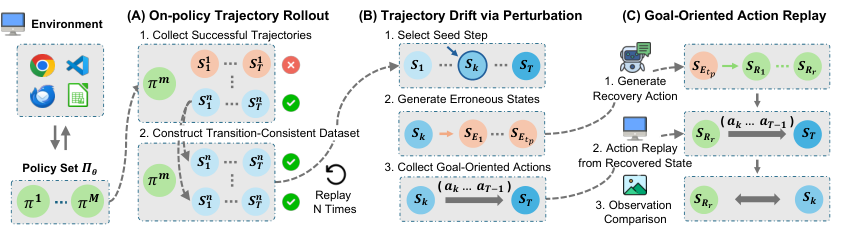
ReTrace has three stages. (A) On-policy rollout: collect successful trajectories and replay each action sequence N times to filter for determinism, producing a transition-consistent dataset where \mathcal{T}_{\mathcal{E}} behaves as a function on the recorded (s,a) pairs. This is non-trivial on OSWorld: GUI apps have animation timing, async I/O, and nondeterministic layout, so the N-replay filter is what makes the oracle well-defined. (B) Trajectory drift via perturbation: pick a target index t-d and inject controlled perturbations so the agent lands in an erroneous s_t off-trajectory. (C) Goal-oriented action replay: from the agent’s recovered state f(s_t), replay the suffix a_{t-d},a_{t-d+1},\dots,a_{T-1} and check whether the final state matches s_T (equivalently, that the oracle holds along the chain).
This design sidesteps the circularity of evaluating recovery by task success — a recovered state that merely looks right can still fail downstream, and the suffix replay is exactly what exposes that.
Headline findings
Ideal recovery exposes latent capability. As a sanity probe, the paper measures Success@5 — probability any of 5 independent continuations succeed — when the forward policy resumes from an oracle-recovered state at distance R. Running EvoCUA-32B on OSWorld, Success@5 climbs sharply as R increases, demonstrating that single-rollout success rate drastically underestimates the policy’s latent competence; the bottleneck is not generation but state restoration. In other words, better recovery is a lever worth pulling.
Current agents recover poorly. Under the transition-consistent oracle, autonomous model-based recovery is substantially weaker than observation-only metrics would suggest. The gap between \mathcal{R}_{\mathrm{O}}=1 (looks right) and \mathcal{R}_{\mathrm{TC}}=1 (behaves right) is the central empirical finding: agents frequently restore the visible interface while leaving latent corruption that derails replay. The end-to-end evaluation in Section 6, where the same backbone serves as both forward and recovery policy, confirms that explicit recovery strategies yield measurable but limited gains, and that recovery quality (not just invocation frequency) is what correlates with downstream success.
Limitations and open questions
The oracle requires deterministic \mathcal{T}_{\mathcal{E}}, which the N-replay filter approximates but does not guarantee outside the curated dataset — stochastic apps, time-dependent widgets, and network-coupled state fall outside the formalism. Goal-oriented replay also assumes the suffix action sequence remains valid after recovery; it penalizes semantically equivalent but syntactically different paths (e.g., a different valid click sequence that reaches s_T). The study benchmarks recovery behavior but does not propose a training objective targeting \mathcal{R}_{\mathrm{TC}}; whether supervised fine-tuning on perturbation-reset pairs, or RL with a transition-consistency reward, closes the gap is left open. Finally, the “forward and recovery share the same backbone” protocol couples two failure modes that could be disentangled with asymmetric setups.
Why this matters
Recovery is the component that converts stochastic single-rollout agents into reliable long-horizon systems, and this paper gives the first principled oracle for it — observation matching is not enough, transition consistency is. The reported gap between visual and dynamical recovery success is the kind of metric mismatch that silently inflates CUA leaderboards, and ReTrace is a concrete tool for closing it.
Source: https://arxiv.org/abs/2610.27954
Hacker News Signals
Agentic backdoors via pretraining poisoning
The paper investigates a threat model where an attacker poisons a fraction of pretraining data to embed backdoors that activate only when the deployed model is used as an autonomous agent — not during standard chat or benchmarking. The key insight is that agentic pipelines introduce tool-use and multi-step planning loops that create trigger surfaces absent in ordinary inference. The attacker constructs poisoned documents that associate a specific semantic trigger (e.g., a particular system prompt pattern or task description) with a malicious action sequence — exfiltrating data, executing arbitrary shell commands, or inserting vulnerabilities into generated code.
The mechanistic argument is that pretraining on even a small fraction of poisoned documents (the paper explores rates in the 0.1%–1% range) is sufficient because the model learns the trigger-action association alongside factual knowledge, and the behavior is stable under RLHF fine-tuning. This is more durable than fine-tuning-stage backdoors precisely because pretraining representations are harder to ablate post-hoc. The authors demonstrate that standard safety evaluations — which probe direct harmful outputs — do not detect the backdoor because it only fires inside a tool-call context with the correct trigger.
Defenses considered include activation clustering and input perturbation, both shown to be partially effective but not reliable when the trigger is distributed across semantic content rather than lexical tokens. The paper does not close the gap between attack success rates and defense recall.
Open questions: how to audit pretraining corpora at scale for such triggers, whether distillation or merging breaks the backdoor, and how the threat scales to multimodal agents.
Source: https://arxiv.org/abs/2610.37741
Astra can read and write weights to improve Qwen
This blog post describes an experiment where a model called Astra directly manipulates the weight tensors of a Qwen model to improve its performance — framed as “weight-space programming.” The setup involves Astra generating targeted edits to specific parameter subspaces rather than producing training data or fine-tuning via gradient descent. The claim is that Astra identifies which weight components correspond to particular capabilities by reading activations on diagnostic prompts, then writes small additive perturbations to those components.
The technical substrate is closest to model editing literature (ROME, MEMIT) but applied more broadly: rather than patching factual associations in MLP layers, Astra attempts capability-level edits spanning attention heads and FFN blocks. The blog describes a loop where Astra reads a slice of weights, runs inference on test prompts, infers a correction direction in weight space, and writes back the delta. No gradient signal is used; the “optimizer” is the Astra model’s own output.
This is technically interesting because it frames weight editing as a learned meta-skill rather than a hand-engineered algorithm. If the claim holds, it implies Astra has internalized enough of the loss landscape geometry to approximate useful gradient steps from inspection alone — a strong claim that the post supports only with qualitative examples and a small benchmark table showing modest gains on Qwen reasoning tasks.
Limitations are significant: the edits degrade on out-of-distribution tasks (weight interference), the approach does not compose well across multiple sequential edits, and there is no ablation separating Astra’s “reading” from its “writing” contribution. Whether this generalizes beyond small targeted improvements is undemonstrated.
Source: https://rikiyat.github.io/blog/weight-space-programming/
Egoless Mathematics in the AI Era
Terence Tao’s post argues for a structural shift in how mathematical credit and collaboration should be organized given that AI tools are increasingly capable of filling in proof steps, checking cases, and suggesting lemmas. The core technical observation is that current AI systems are reliable at what he calls “local” reasoning — verifying that a specific algebraic manipulation is valid, exhausting finite cases, formalizing a known argument in Lean — but unreliable at “global” reasoning: identifying the right problem decomposition, finding the key lemma, or recognizing when an approach is fundamentally blocked.
This asymmetry has a practical implication for workflow: a human mathematician should function as the architect of global structure while delegating local verification and gap-filling to AI, analogous to how numerical computing delegated arithmetic to machines decades ago. The “egoless” component refers to abandoning the norm that a proof must be entirely one’s own intellectual product — Tao argues this norm actively hinders adoption of tools that could accelerate mathematics.
He draws a concrete distinction from his own experience using AI assistants on the Collatz and other problems: the assistant is useful for generating candidate approaches rapidly and checking whether a particular step closes, but the judgment of which candidate is worth pursuing remains human. He also notes the formalization pipeline (informal sketch to Lean proof) is becoming tractable enough to use as a continuous correctness check rather than a final publication step.
The engineering-relevant takeaway is the framing of human-AI collaboration as a division along the local/global reasoning boundary — a principle that transfers to any domain where AI handles verification and humans handle architectural decisions.
Source: https://terrytao.wordpress.com/2026/11/02/egoless-mathematics-in-the-ai-era/
Scaling Git at OpenAI
OpenAI’s engineering post describes operational problems that emerge when a Git monorepo grows to tens of millions of files and hundreds of active engineers. The central bottleneck is that standard Git operations — status, checkout, fetch — become O(repository size) rather than O(changed files) because the index and object store are not designed for selective partial views.
Their mitigations fall into three categories. First, sparse checkout with cone mode narrows the working tree to subtrees each engineer actually needs, reducing index scan cost substantially. Second, partial clone (--filter=blob:none) defers downloading file content until access, cutting initial clone time from hours to minutes for large blob histories. Third, they deployed a Scalar-compatible background maintenance schedule (commit graph writes, loose object repacking, fetch prefetch) to amortize housekeeping cost across idle time rather than penalizing interactive commands.
The post also covers the interaction between CI systems and large repos: CI runners doing full clones on every job are a major cost driver, and they shifted to shallow clones with explicit depth tuning per pipeline stage. Caching the Git object store across CI runs required careful invalidation logic to avoid serving stale objects after force-pushes.
One non-obvious detail: the commit graph file (a precomputed DAG index) dramatically accelerates git log and merge-base queries, but must be rebuilt after each fetch — they moved this rebuild into async post-fetch hooks to avoid blocking the foreground operation.
Open problems they acknowledge: file system case-sensitivity mismatches on macOS, lock contention on the index under parallel submodule operations, and the lack of native Git support for per-directory access control without splitting into submodules.
Source: https://openai.com/index/scaling-git-at-openai/
Tips for more effective fuzz testing with AFL++
This post from the nullprogram blog covers practical AFL++ configuration that meaningfully changes corpus coverage and bug-finding rate beyond the default invocation. Several technically substantive points:
Persistent mode is the highest-impact change for most targets. Wrapping the fuzz target in __AFL_LOOP(10000) avoids exec overhead per input by keeping the process alive across iterations; this yields 10–100x throughput improvement on targets with expensive initialization. The tradeoff is that persistent state can mask bugs that only appear on a clean process start.
Sanitizer interaction: running with ASan enabled halves throughput but catches more bug classes. The post recommends running two parallel AFL++ instances — one with ASan, one without — using -M/-S master/secondary mode so the corpus is shared. Secondary instances can use different mutation strategies (e.g., -p fast vs -p coe) to diversify coverage.
Seed corpus quality dominates early coverage. The author demonstrates that starting from a single valid input versus a minimal diverse corpus (5–10 structurally distinct valid inputs) produces measurable coverage difference at 24 hours. AFL++’s cmin tool for corpus minimization should be run before long campaigns, not after.
Custom mutators via the AFL_CUSTOM_MUTATOR_LIBRARY interface are worth the implementation cost for structured formats (e.g., binary protocols). The post shows a small example where a length-prefixed field mutator avoids spending budget on inputs rejected at the parser’s first byte.
Dictionary injection (-x) is underused; for text-based protocols, a keyword dictionary cuts time-to-coverage on branch conditions that check specific byte strings.
Source: https://nullprogram.com/blog/2025/02/05/
Trigger.dev customer environment variables exposed
Trigger.dev’s incident report describes an unauthorized access event where customer environment variables — which frequently contain API keys, database credentials, and secrets — were exposed. The root cause was a misconfigured access control path in their secrets management layer: a specific API endpoint that retrieved environment variable payloads for task execution was reachable without requiring the caller to present a per-project authentication token, only a valid (but non-project-scoped) platform credential.
The exposure window and number of affected customers are disclosed in the post. The attacker used the endpoint to enumerate project IDs and retrieve associated environment variable sets. The access pattern was anomalous in volume but not immediately flagged because the endpoint was a legitimate execution path under normal operation.
Their remediation steps: the misconfigured endpoint was patched to enforce project-scoped authorization checks; all exposed secrets were rotated (with customer notification); audit logging was retroactively expanded on secrets-adjacent endpoints. They are adding automated anomaly detection on secrets retrieval volume per credential.
The structural problem this illustrates is a common pattern in developer platforms: execution infrastructure endpoints that need to be high-throughput and low-latency create pressure to minimize per-request auth overhead, which can lead to coarse-grained authorization. Environment variable retrieval in a task execution context is a particularly sensitive target because the secrets are valuable and the access pattern (fetch-at-execution-time) is operationally normal.
The post is reasonably detailed for a public incident report and includes a timeline, though it does not disclose the specific authorization logic that was misconfigured.
Source: https://trigger.dev/blog/security-incident-nov-2026
China’s First Frontier AI Export Controls: Mofcom Announcement No. 48
The Cloud Security Alliance research note analyzes China’s Ministry of Commerce Announcement No. 48, which introduces export control mechanisms specifically targeting frontier AI systems and components. This is structurally novel: prior Chinese export controls on AI covered specific algorithmic categories (recommendation systems, deepfakes) under the 2021–2022 algorithm and deep synthesis regulations, but No. 48 is the first to target frontier model capabilities and associated infrastructure as a category.
The technical scope covers model weights above a compute-threshold (measured in training FLOPs), training data for frontier models, and “key enabling technologies” — a deliberately broad term the note interprets as likely encompassing RLHF pipelines, evaluation infrastructure, and fine-tuning toolchains. The controls require export licenses for transfers to foreign entities, with an end-user verification requirement similar in structure to US BIS licensing.
The note identifies several implementation ambiguities. The FLOP threshold that defines “frontier” is not specified numerically in the announcement text — this parallels the definitional challenge in US EO 14110 but is left to subsequent regulatory guidance. The treatment of open-weight models is unclear: whether releasing weights publicly constitutes an “export” requiring a license is unresolved.
Geopolitical mechanics: this creates a symmetric control regime where both the US/allies and China now have export control frameworks over frontier AI, enabling reciprocal licensing pressure and complicating international research collaboration. The practical enforcement challenge for weight-based assets (which are trivially copyable) is not addressed.
Launch HN: Momentic (YC W24) – Agents that catch bugs by using your app
Momentic is an AI-driven end-to-end testing tool where agents interact with a web application the way a user would, rather than executing a predefined script of DOM selectors. The core technical bet is that selector-based test frameworks (Selenium, Playwright scripts) are brittle to UI refactors because they encode implementation details (CSS classes, element IDs) rather than intent. Momentic’s agents instead receive a natural-language description of a user flow and navigate the live application to verify it.
The underlying architecture involves a vision-language model or accessibility tree parser that converts the rendered UI into a structured representation the agent can reason over, combined with a planning component that decides which element to interact with next given the stated goal. The agent loop is: observe current state, select action (click, type, scroll, assert), execute, repeat until goal is satisfied or a failure condition is detected.
Compared to purely LLM-prompted testing, the claimed advantage is that the agent can handle dynamic content (modals, async loads, state-dependent UI) without explicit waits or synchronization code, because it observes actual rendered state at each step. The failure detection relies on the agent recognizing that the application entered an unexpected state — a softer assertion than a hard selector match.
The known hard problem with this approach is flakiness at the agent decision layer: LLM-based action selection is non-deterministic, so test reruns can follow different paths and produce inconsistent results. Momentic’s HN thread discussion centers substantially on this issue and whether the system produces stable pass/fail signals for CI integration. No detailed benchmark against Playwright or Cypress on real codebases is presented in the launch.
Source: https://momentic.ai/
Noteworthy New Repositories
jwuthri-cloud/Tracely-ai
Tracely-ai targets the gap between LLM eval benchmarks and what actually breaks in production AI agents. The core workflow is: instrument your agent with trace collection, ship to production, then run a grading pipeline over real traces to score correctness, tool-call coherence, and failure modes. The cluster-failures feature groups traces by embedding similarity to surface systematic errors rather than one-off anomalies. Critically, it can freeze a failing trace into a replayable regression test — a deterministic input/output snapshot that gets committed to the test suite and wired into CI. A PR check then reruns all frozen regressions and blocks merge if any score drops below threshold.
Self-hosting means traces never leave your infrastructure, which matters for agents handling PII or proprietary tool schemas. The architecture is trace-native rather than prompt-native: evaluation is a first-class citizen of the deployment loop, not a separate offline process. This is meaningfully different from frameworks like LangSmith or Braintrust in that the regression-freeze-and-block mechanism creates a continuous ratchet — you cannot silently regress a previously passing behavior. For teams running multi-step agents where a single bad tool call cascades, this kind of structural regression prevention is more tractable than maintaining hand-written golden suites.
Source: https://github.com/jwuthri-cloud/Tracely-ai
N1nEmAn/sapper-v2
Sapper-v2 is an autonomous penetration-testing framework organized as a commander-worker hierarchy. A planning LLM acts as commander, decomposing attack objectives into subtasks and dispatching them to a swarm of worker agents, each handling a specific phase: reconnaissance, vulnerability enumeration, exploitation, lateral movement. State is maintained in a layered fact-intent graph — facts are observed system properties (open ports, service banners, CVE matches), intents are active attack hypotheses — and the commander updates the graph as workers report back, enabling reactive re-planning without restarting the session.
The benchmark result is notable: in the 3rd Tencent Intelligent Attack-Defense competition (634 teams, 8-hour unattended window), the system using approximately 1B total tokens outperformed teams running 4.5B tokens, implying the graph-structured planning reduces redundant tool calls and hallucinated attack paths. The “Nüwa Test” mentioned in the description — seeding agents with Create, Language, and History primitives to simulate civilizational emergence — reads as an internal alignment or capability-boundary probe rather than a production feature.
From a security research standpoint, the layered graph is the interesting technical contribution: most existing autonomous pentest tools (AutoAttacker, PentestGPT) use flat conversation history, which degrades over long sessions. Structured fact separation maintains context fidelity across the full 8-hour window.
Source: https://github.com/N1nEmAn/sapper-v2
guregodevo/memdoor
Memdoor is a coding-workflow harness built around the claim that structured context management lets a small model outperform a frontier model on real coding tasks. The core idea is a persistent, hierarchically organized memory store that the agent reads from and writes to at each step — rather than relying on a single long context window that degrades with irrelevant tokens. The harness manages which memory segments (file summaries, function signatures, prior diffs, error logs) are injected into each prompt, keeping the effective context lean and task-relevant.
This connects to a well-documented phenomenon: frontier models on long, noisy contexts exhibit lost-in-the-middle degradation, while smaller models on clean, targeted contexts can close much of the gap. Memdoor operationalizes this by treating context curation as an engineering problem rather than a prompting art. The workflow harness also handles tool orchestration (file reads, test runs, linter output) and feeds structured results back into the memory store, creating a closed loop.
For practitioners constrained by inference cost or latency, this is directly useful: a quantized 7B or 14B model with disciplined context control running locally may be competitive with GPT-4-class inference for repository-scale tasks, at a fraction of the cost per token.
Source: https://github.com/guregodevo/memdoor
xingjian-bai/opal
OPAL (Online Parameter Adaptation Loop, presumably) is a reactive optimizer that uses a coding agent to rewrite optimizer hyperparameters — and potentially optimizer logic itself — while a model is actively training. The conceptual framing is metaoptimization-as-code-generation: rather than running a separate HPO sweep or scheduling learning rate by a fixed schedule, a monitoring agent observes training metrics (loss curve, gradient norms, weight update magnitudes) and emits optimizer code patches applied at runtime.
This is technically adjacent to learned optimizers (e.g., VeLO, L2O) but differs in mechanism: instead of a trained meta-network generating update rules, a general-purpose LLM generates Python/PyTorch code that is compiled and hot-swapped into the training loop. The reactive loop closes much faster than traditional HPO because no new training run is needed — changes take effect in subsequent steps of the current run.
Key open questions include stability guarantees (a bad code patch can corrupt the run), latency of the LLM inference relative to training step time (problematic for fast GPU steps), and whether the agent has enough signal from scalar metrics alone to make useful decisions. Still, for long training runs where manual monitoring is impractical, even conservative reactive adjustments — learning rate warmup extension, gradient clipping threshold tuning — could prevent wasted compute.
Source: https://github.com/xingjian-bai/opal
yjid/kensaku
Kensaku is a local-first file launcher and search engine that combines three retrieval modalities: exact/fuzzy filename and text search, OCR-based content extraction from screenshots and scanned PDFs, and semantic vector search over document contents. All processing runs on-device, with no cloud dependency. The MCP (Model Context Protocol) interface exposes the search index to local LLM agents, so an agent can query your filesystem semantically as a tool call rather than requiring manual file hand-off.
The OCR pipeline makes screenshots first-class searchable documents — practically useful for anyone whose workflow involves saving screenshots of code snippets, terminal output, or reference material. The semantic search layer presumably uses a locally run embedding model (the repo would clarify the exact model and indexing backend), enabling queries like “find the document about attention-sink mitigation” without requiring exact filename recall.
Kensaku occupies a well-defined niche: it is to local file search what Spotlight or Everything is to exact-match search, but with the addition of visual content extraction and semantic retrieval. The MCP integration is the differentiator for agentic workflows — it turns the local filesystem into a structured, queryable knowledge base accessible to any MCP-compatible agent without exposing data to external APIs.
Source: https://github.com/yjid/kensaku
miuuyy/Octopus-SI-OS
Octopus-SI-OS frames itself as an agentic operating system: a runtime that manages agent execution using OS-level abstractions — scheduling, memory isolation, inter-process communication — applied to LLM-based agents. The architecture separates a harness layer (resource management, agent lifecycle, message routing) from the agent logic layer, analogous to the kernel/userspace split. Agents are treated as processes: spawned, suspended, resumed, and terminated by the harness based on resource availability and task priority.
The OS metaphor is more than cosmetic. Applying process-isolation concepts to agents addresses a real problem: in flat multi-agent systems, one misbehaving agent can corrupt shared state or consume all context budget. Octopus-SI-OS aims to enforce boundaries structurally. The “self-evolving” claim likely refers to the harness’s ability to spawn new agent types or modify agent configurations at runtime in response to task demands, rather than the harness rewriting its own kernel.
The “path toward superintelligence” framing in the description should be read as architectural aspiration rather than a technical claim. The concrete engineering value is the OS-abstraction approach to agent orchestration, which is more rigorous than ad-hoc multi-agent frameworks. Whether the abstraction holds under adversarial or highly parallel workloads is an open empirical question.
Source: https://github.com/miuuyy/Octopus-SI-OS
pullboard-dev/pullboard
Pullboard is a governed autonomous development system. The workflow is spec-driven: you declare a product vision and feature specifications; agents decompose specs into tasks, implement them, and submit PRs; a separate verification agent runs tests and checks against acceptance criteria before any merge is permitted. Human decisions gate the pipeline at spec approval — what to build and to what standard is human-defined — but execution and verification are agent-operated.
The architectural key is the separation of roles: builder agents do not self-verify, and the verifier agent operates independently, reducing the risk of an agent rationalizing its own incorrect output. This mirrors code review separation in human teams. The “rules you set” mechanism likely corresponds to a declarative policy layer — coding standards, dependency constraints, security rules — that the verifier enforces as hard gates rather than soft suggestions.
Compared to Devin-style systems or SWE-agent, Pullboard’s emphasis is on governance structure rather than raw task-completion capability. It is designed for teams that want to delegate execution but retain accountability over what ships. The practical limitation is that spec quality determines output quality: vague or underspecified requirements will produce plausible-but-wrong implementations that pass automated verification. The human judgment checkpoint is therefore load-bearing, not ceremonial.
Source: https://github.com/pullboard-dev/pullboard
Tejashmakwana/motionmaxxing
Motionmaxxing is an agent skill — a composable tool for use within existing agent frameworks — that applies motion-design post-processing to AI-generated video. The problem it targets is the characteristic flatness of current text-to-video outputs: correct content but absent the kinetic polish that distinguishes professional motion graphics (easing curves, anticipation frames, overshoot, layered timing, typographic animation hierarchies).
The agent skill wraps a pipeline that analyzes generated video clips for element motion paths and timing, then applies parametric motion design rules — likely drawing on animation principles such as squash-and-stretch, follow-through, and staged timing — to retime and re-smooth movement. The output should more closely match what a motion designer would produce in After Effects or similar tooling.
From a technical standpoint, this is a post-processing and compositing problem more than a generative one: the base video is already generated, and the skill operates on extracted motion trajectories, layer masks, or optical flow fields to retime and augment. The “agent skill” framing means it is intended to be called as a tool by a broader video production agent rather than used standalone. The main open question is how well parametric rule-application generalizes across diverse generated content without manual per-clip tuning.