Daily AI Digest — 2026-10-22
arXiv Highlights
Retrieval Augmented Generation Compositionality
Modern RAG pipelines stack many stages — chunking, embedding, retrieval, reranking, query augmentation, context compression, and agentic verification — but published ablations almost always vary one knob at a time. This paper asks whether per-stage gains compose, whether retrieval quality and answer faithfulness are optimized by the same choices, and whether a configuration that wins on a small corpus still wins at scale. The authors pre-register three hypotheses, build an evaluation framework (LASAGNA), and run 450 configurations over eight benchmarks and corpora of 5K–200K documents.
LASAGNA: a controlled compositional harness
LASAGNA defines nine pipeline stages and eight typed component abstract base classes (embedder, chunker, reranker, retriever, document_processor, query_enhancer, agentic_pipeline, generator). Each stage has a typed dataclass I/O contract, and a @registry.register("<stage>", "<name>") decorator makes a component discoverable from YAML. Five automated isolation tests verify that toggling one stage does not mutate neighboring state, which is what lets the authors attribute interaction estimates to the varied components rather than to cross-stage leakage.
The framework ships 53 components spanning 30 methods across the eight factorial dimensions, six vector backends (Milvus, Pinecone, Qdrant, Weaviate, pgvector, OpenSearch), and adapters for five BEIR retrieval sets and three long-form QA sets. The authors expose a configurator surface that mirrors the factorial axes, with the Essential tab exposing high-impact toggles like enable_hybrid_search, enable_reranking, enable_mmr, enable_hyde, use_agentic_rag, and enable_hierarchical:

A finer-grained Search & Retrieval tab exposes RRF fusion constants, sparse method choice (BM25 vs. SPLADE), MMR score normalization, and context compression method/ratio:

Four profiles — speed, standard, balanced, max-reliable — are distilled from the sweeps as best-observed configurations along the retrieval–faithfulness–latency Pareto surface. The joint objective is a hypervolume
\mathrm{HV}(L_{\mathrm{ref}}) = \mathrm{NDCG@10} \times \mathrm{Faith} \times \max\!\left(0,\, 1 - \mathrm{latency}/L_{\mathrm{ref}}\right)
with L_{\mathrm{ref}} = 30 s. Marginal effects are reported as \eta^2. The complete study — factorial sweep plus 138 non-factorial ablations plus the 5K–200K scaling run — cost roughly $5,200 and 310 wall-clock hours.
Finding 1: per-stage gains do not add
Rather than attempt all \binom{8}{2}=28 pairwise interactions (which would require 232 parameters, beyond what the design supports), the authors compare predicted gain from independently measured improvements to the measured gain of the combined pipeline. Starting from default_standard with NDCG@10 = 0.412 (BM25-only scores 0.403, a standard dense encoder 0.436, so this is not a weak baseline), the three largest individually positive retrieval techniques — cross-encoder reranking, disabling MMR, and document-awareness prefixes — predict a +46.6\% lift. The balanced composition delivers only +17.2\%, a 63\% shortfall. Adding all five individually positive retrieval techniques widens the shortfall to 72\%. Across 17 tested combinations the shortfall spans 7\%–72\% with a median of 41\%. Ablations attribute this to functional overlap: reranking already does much of the filtering MMR-off would deliver.
Finding 2: retrieval and faithfulness decouple
Retrieval quality and faithfulness (whether generated claims are grounded in retrieved context) are optimized by different levers. Embedding, index-time enrichment, and reranking dominate NDCG@10; query augmentation and agentic gating dominate faithfulness. Across matched configurations the two metrics are essentially uncorrelated: pooled Pearson r = -0.01, p = 0.91. 5\% of configurations combine high faithfulness with low retrieval quality, and 6\% show the inverse. The decorrelation holds per-benchmark, ruling out Simpson-style pooling artifacts. Operationally, selecting on retrieval alone can produce weakly grounded answers; selecting on faithfulness alone can mask bad retrieval.
Finding 3: best composition shifts with corpus size
The optimal composition at 5K documents is not the optimum at 200K — a direct challenge to the common practice of validating pipeline choices on small retrieval benchmarks (NFCorpus, FiQA) and deploying them unchanged on production-scale corpora. The paper’s scaling sweep from 5K to 200K is the empirical basis; the implication is that any component-level claim needs scale-conditioned reporting.
Limitations
The design uses marginal-effect decomposition because full interaction estimation is infeasible at this budget; interactions beyond pairwise are inferred indirectly. The study covers eight benchmarks and 200K-document corpora — still well below production retrieval scales (10^7–10^9). Generator choice is held relatively fixed, so interactions between retrieval design and specific LLM behaviors (e.g., long-context handling, in-context robustness to distractors) are not fully mapped. The pre-registered hypotheses buy credibility but the four distilled profiles are themselves selected from the sweep, so their generalization to new domains is an open question.
Why this matters
RAG research reports isolated gains, but a 63\% median compositional shortfall and a near-zero correlation between retrieval quality and answer faithfulness mean that single-stage ablations are a poor predictor of deployed pipeline behavior. A controlled, typed, end-to-end harness is a precondition for making component-level claims that actually survive integration.
Source: https://arxiv.org/abs/2610.29722
StreamEval: Evaluating Interactive Streaming Video Generation Models
Problem
Streaming video generation systems increasingly accept multimodal inputs that arrive mid-generation: a user interrupts an avatar, a world model receives new navigation commands, an editing stream gets a new reference image. Existing video generation benchmarks score static text-to-video pairs; they do not test whether a model can execute a new request at t=10s while preserving scene content established at t=0, nor whether it keeps the persona stable across a 300-second session. StreamEval targets this gap with a unified benchmark across five interactive tasks: avatar dialogue, avatar performance, world generation, instruction editing, and reference editing.
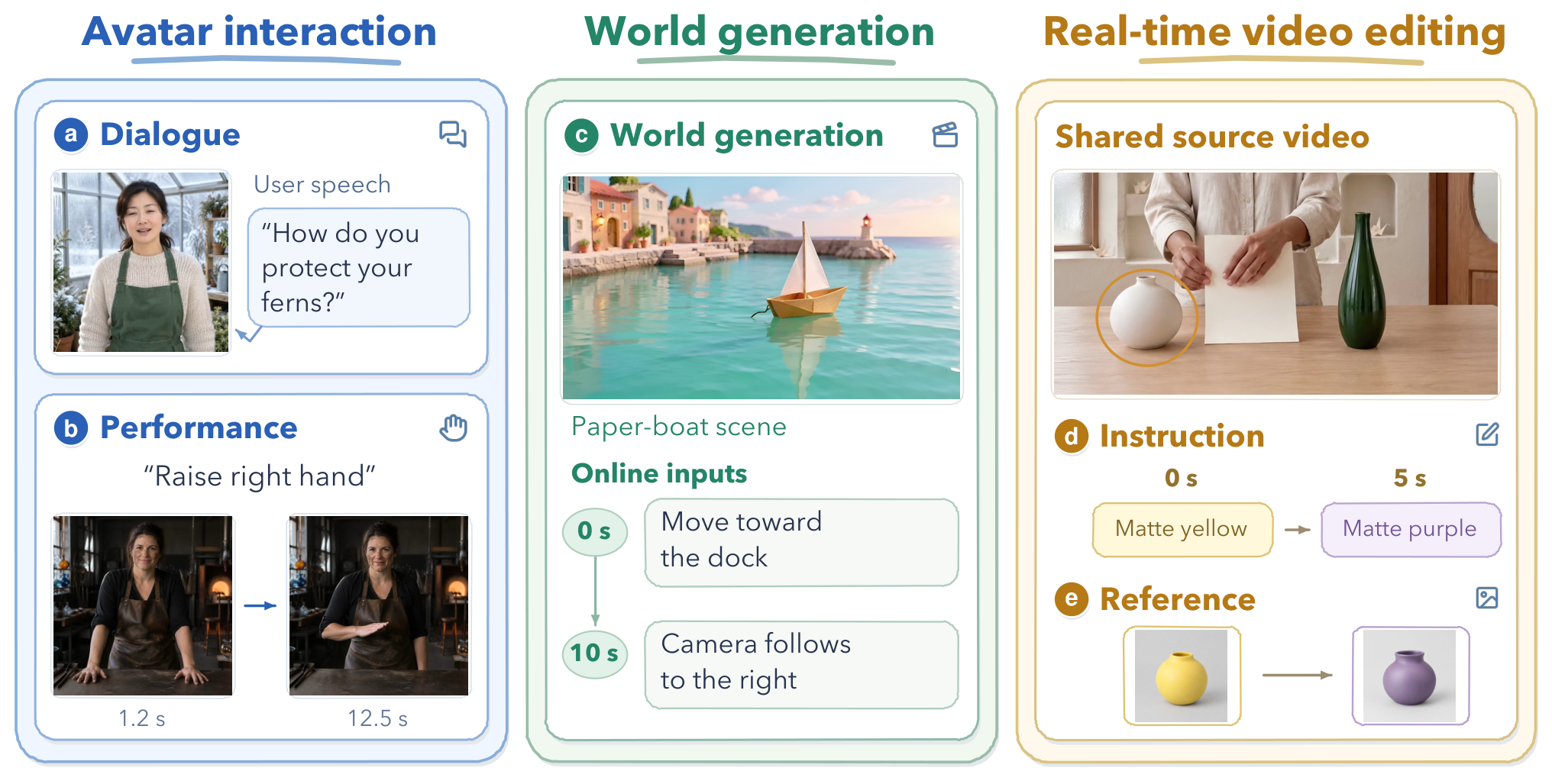
Construction and task structure
Each of the 300 scripted cases (15–300s) specifies three things: (i) initialization assets (opening frame, source video, reference image, or persona), (ii) a time-stamped schedule of incoming inputs, and (iii) scoring opportunities with explicit state-change versus preservation requirements. A scheduler releases inputs on a session clock and advances editing sources accordingly, so the system under test receives data at the same relative wall-clock times across models.
Case authoring uses a model-assisted pipeline followed by modality-specific checks (portrait validity, prompt coverage, reference asset integrity). Figure 2 illustrates the loop: a Qwen-Image portrait with hand defects is regenerated and resubmitted through the same screening, enforcing uniform input quality across cases.
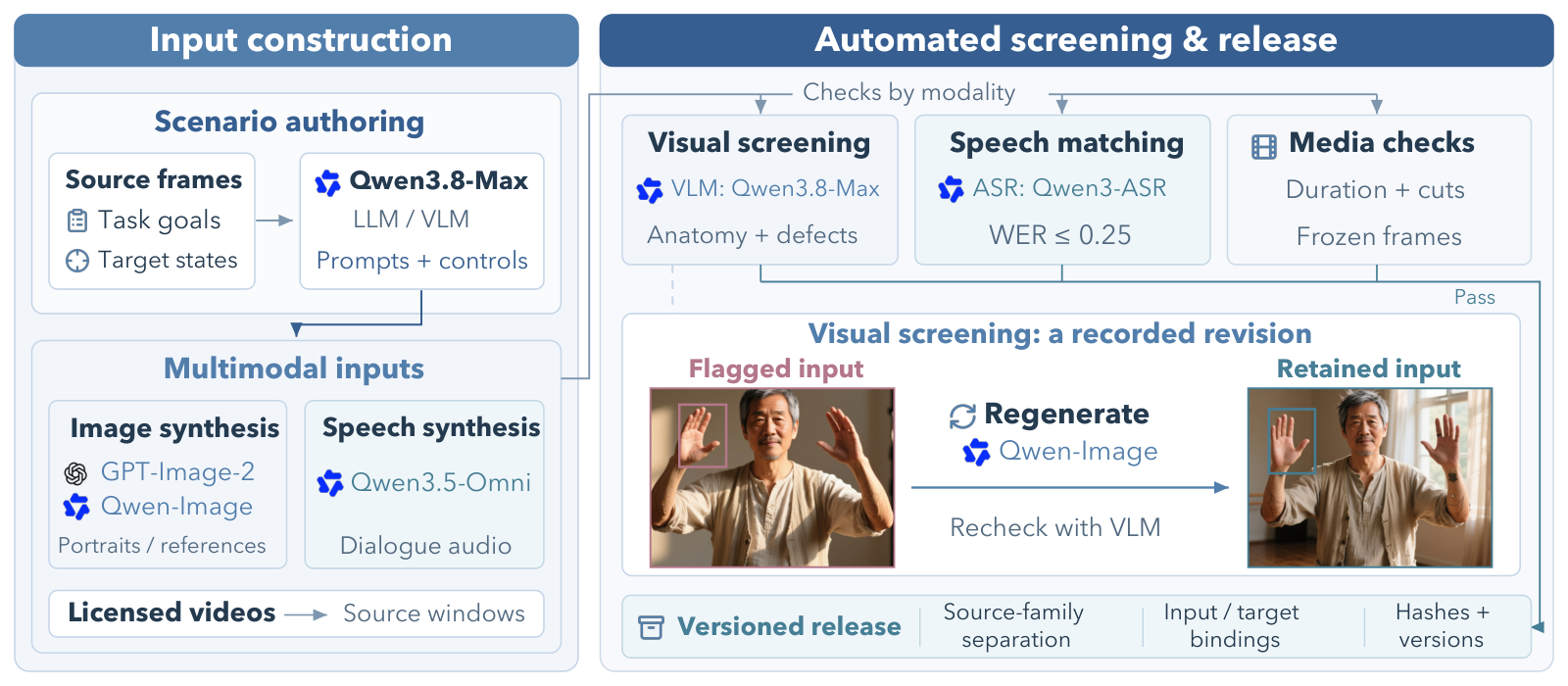
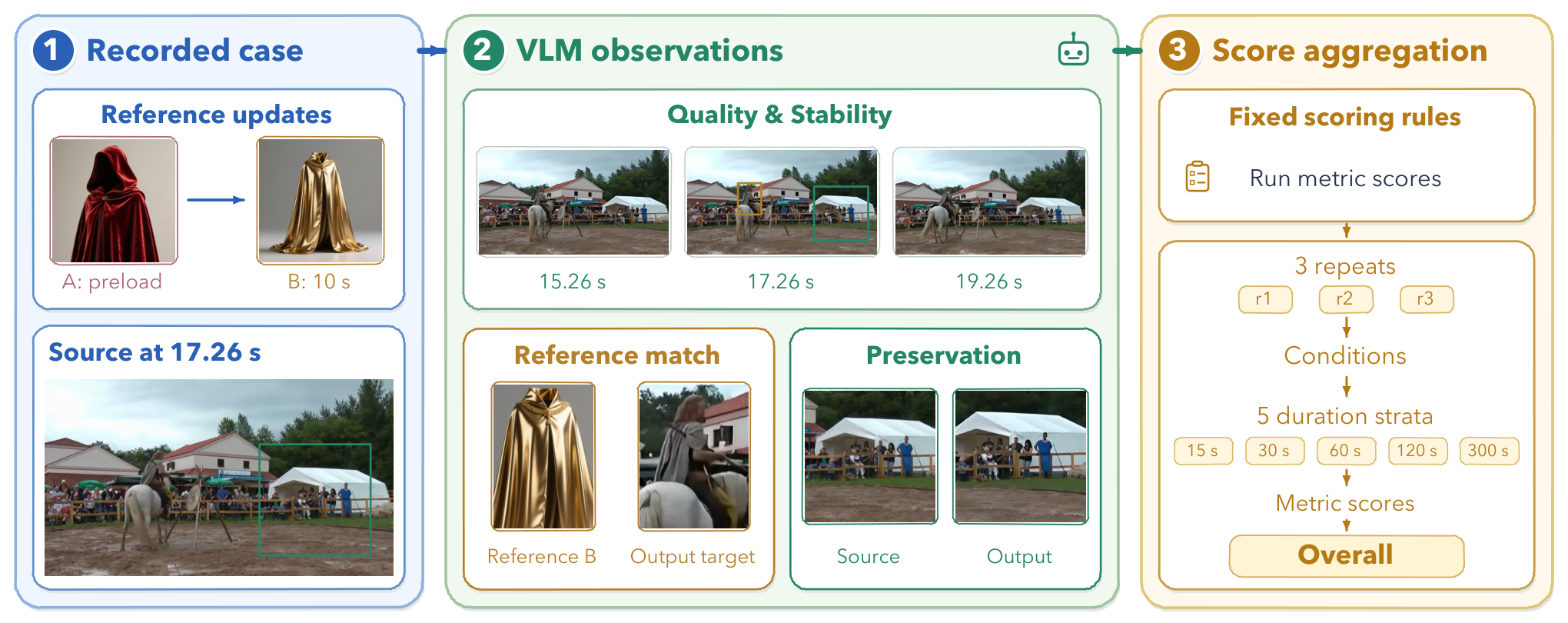
Four evaluation dimensions — task execution, state consistency, visual fidelity, audiovisual coordination — are instantiated as ten task-specific metrics on a 0–100 scale, each with a defined profile per task. VLM-produced structured observations are converted to numeric scores by fixed rules, then averaged over repeats, conditions, and duration strata before the per-task Overall is computed.
Main results
38 distinct models are evaluated across 49 task configurations, including commercial avatar systems (Vidu S2 Avatar, Tavus CVI Full, Quark Live Avatar, Runway Characters), world models (Matrix-Game 3.5, LongLive 2.0, Rolling Forcing, Self-Forcing, Krea Realtime, Yume 1.5), and editing systems (Lucy 2.5, SANA-Streaming, JoyAI-Video-Edit, Vidu S2 Editing). The editing table is a presentation subset filtered to Overall \ge 5.
The headline finding is a systematic decoupling between surface quality and request execution:
- Avatar performance: the best Following score across seven models is 36.90/100. Models render prescribed speech and maintain identity well, but reliably executing requested actions (gaze shifts, hand gestures) at the right time is substantially harder.
- World generation (text-conditioned): the best Following score is 25.93/100. Models produce visually coherent scenes but respond weakly to incremental text controls arriving mid-rollout.
- Reference editing: the best Edit Success among three reported models is 15.00/100. Visual fidelity and source preservation can be high while the requested edit simply fails to take effect.
Section 4.1 documents the editing failure mode on a specific case: Reference A (red velvet cape) is preloaded, Reference B (gold satin cape) arrives at t=10s, and a removal request arrives at t=20s. In the B phase, outputs preserve the underlying scene but retain the original grey cape rather than adopting the gold satin reference. The models score well on preservation while failing the adoption condition — which is exactly what Edit Success is designed to isolate.
The broader pattern across the 300 cases is that identity retention and visual fidelity scores are high and tightly clustered among top systems, while execution metrics (Following, Edit Success) have both lower absolute ceilings and wider spread. Composite leaderboards that collapse quality and execution into a single score tend to reward the former and mask the latter — a known hazard that StreamEval mitigates by keeping the dimensions separate in the Overall decomposition.
Limitations and open questions
The authors note that LiveAvatar FULL and Tavus CVI Full use provider-supplied fixed avatars because customization is not exposed; Identity for these is rated against each system’s own opening frame, which is marked in the table but is not strictly comparable to systems rated against user-supplied portraits. The editing table drops configurations with Overall < 5, which hides long-tail failure cases from the headline comparison. The scoring pipeline relies on VLM observations converted by fixed rules; the paper does not report inter-rater or VLM-vs-human agreement in the sections provided, so the calibration of each 0–100 metric remains an open question. Finally, latency and throughput — arguably the defining axes of “streaming” — are not among the four evaluation dimensions; a system that passes all content checks only when run offline on recorded inputs would still score well.
Why this matters
StreamEval reframes video generation evaluation around the operational question that matters for interactive deployment: can the model act on a new input during generation while holding onto what it has already produced? The large gap between visual fidelity and the sub-40 Following / sub-15 Edit Success ceilings quantifies how far current streaming systems are from reliable mid-session controllability, independent of how good their frames look.
Source: https://arxiv.org/abs/2610.28402
Spectral-Spatial Interpretation
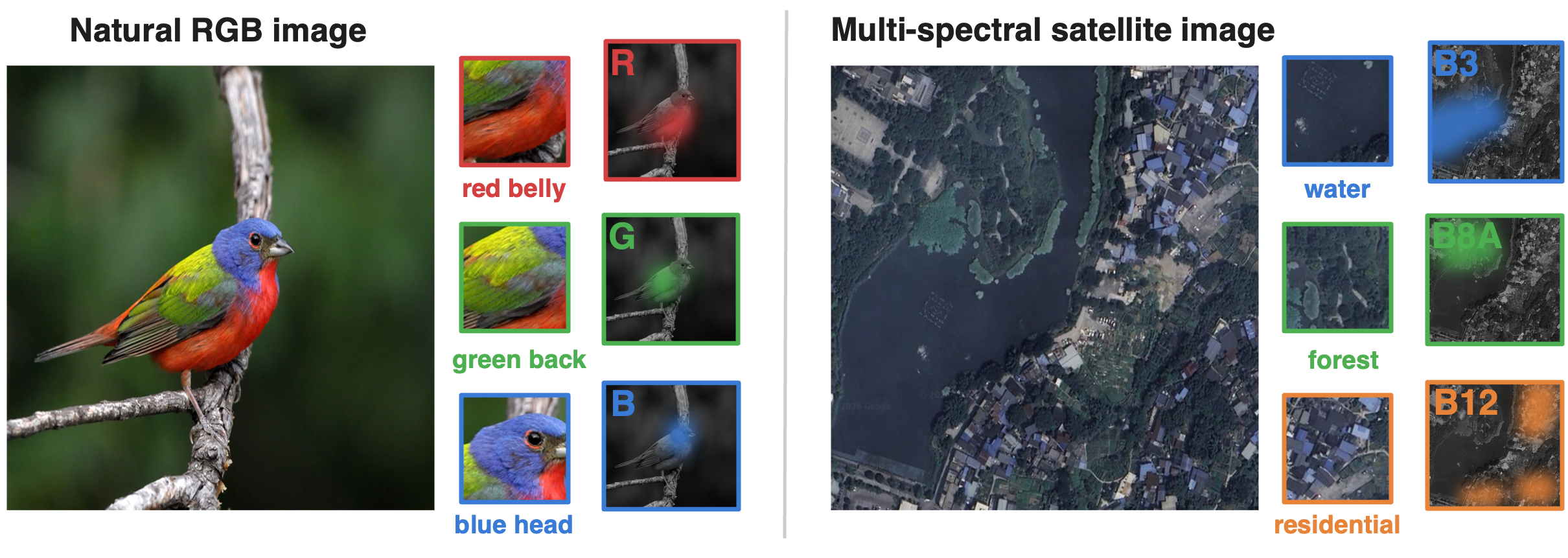
Post-hoc attribution for multispectral imagery sits awkwardly between two conventions: spatial heatmaps (where did the model look?) and global channel scores (which bands matter?). For sensors like Sentinel-2 or HLS, this separation is physically wrong — band B8A matters in forest regions, B12 matters over burn scars, and B3 matters over water. A global band ranking averages these out; a spatial heatmap collapses them into a scalar per pixel. Spectral-Spatial Interpretation (SSI) proposes a full position-channel attribution matrix \Phi(g,c) computed via a local Shapley game at each spatial position, with external context held fixed.
Setup and the conditional game
Given input x \in \mathbb{R}^{C\times H\times W}, the player space is the Cartesian product \mathcal{P} = \mathcal{G} \times \mathcal{C} of spatial grid cells and channels. For subset S \subseteq \mathcal{P}, x_S denotes the input with all non-S players replaced by a masking baseline. The centered value function uses the target-class logit:
v(S) = z_y(x_S) - z_y(x_\emptyset), \qquad v(\emptyset) = 0.
Monotonicity is not assumed — adding players can lower the target logit. The key structural choice is the decomposition \mathcal{P} = \bigsqcup_{g} S_g with S_g = \{(g,c) : c \in \mathcal{C}\}: channels within a position share a physical region, channels across positions do not.
SSI as a per-position conditional Shapley value
Rather than running Shapley over the full |\mathcal{G}| \cdot |\mathcal{C}| player set — which blurs spectral and spatial contributions through averaging over external coalitions — SSI fixes the observed context outside position g and runs a Shapley game only over the C channels at g. Formally, for each g the local game is v_g(T) = v((\mathcal{P}\setminus S_g) \cup T) - v(\mathcal{P}\setminus S_g) for T \subseteq S_g, and \Phi(g,c) is the Shapley value of channel c in this game.
Two consequences follow directly:
- Local fairness. Within each position, \Phi(g,\cdot) inherits Shapley’s efficiency, symmetry, dummy, and linearity axioms over the C-channel game.
- Contextual aggregation consistency. Summing channel attributions at g exactly recovers the position-level contextual contrast \sum_{c\in\mathcal{C}} \Phi(g,c) = \Delta(g) = v(\mathcal{P}) - v(\mathcal{P}\setminus S_g). That is, the spatial marginal of the SSI matrix is the leave-one-position-out contrast with full external context, not a context-averaged quantity.
This is the main conceptual contrast with Owen-style hierarchical values that use the same (g,c) grouping but average over external spatial coalitions. Owen attributions are globally efficient (they sum to v(\mathcal{P})) but their per-position aggregates equal context-averaged marginals, not the full-context contrast \Delta(g). For physically-grounded multispectral explanations the full-context contrast is usually the right target: the user wants to know what the channels at this pixel contribute given everything else is observed.
Experimental evaluation
SSI is evaluated on three regimes: CUB-200-2011 (RGB, ResNet-18 fine-tuned), EuroSAT (13-band Sentinel-2, ResNet-18 trained from scratch), and HLS Burn Scar (6-band HLS, lightweight UNet segmentation; scalar response is the burn-class logit averaged over ground-truth mask positions). Faithfulness is measured by deletion/insertion AUC on the joint (g,c) grid, with additional rank-1 factorization analysis to see how much of \Phi is captured by an outer product of spatial and spectral vectors. Spatial aggregates are evaluated by localization against bounding-box or mask annotations; spectral aggregates by channel-deletion AUC and spectral hit rate against physically expected bands. On HLS Burn Scar, SSI outperforms an MC-Owen estimator (same player grouping, context-averaged accounting) on retained-attribution metrics, and the paper additionally benchmarks against stronger gradient-based baselines using the ROAD protocol.
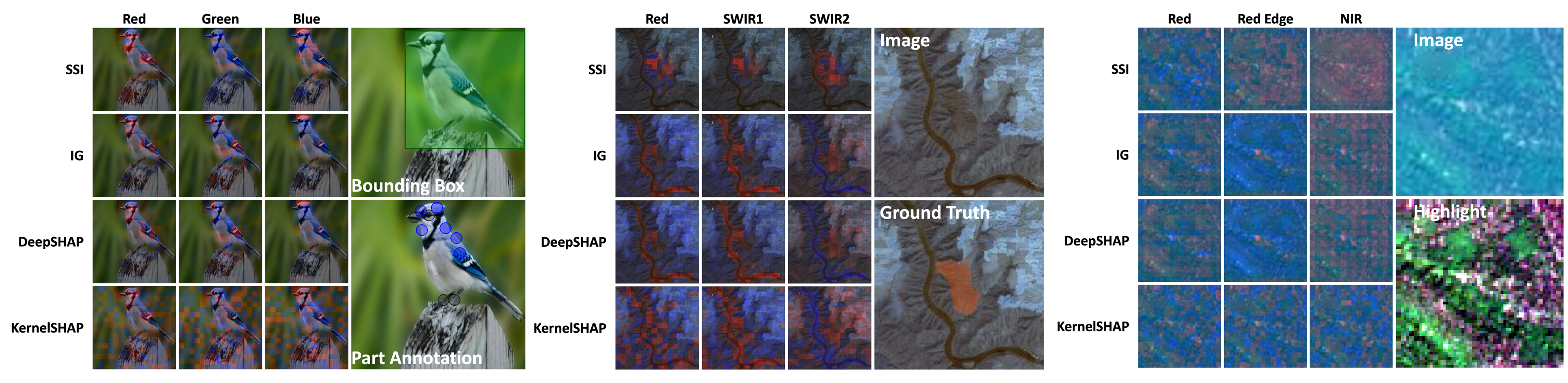
The qualitative panels make the central claim visible: a single heatmap would merge “red belly” and “blue head” into one blob, and a global channel score would call all three RGB channels roughly equally important. SSI’s \Phi(g,c) matrix separates them, and the same pattern holds for burn scars (B12/SWIR concentrated on scar pixels) and EuroSAT land cover.
Limitations and open questions
The method inherits Shapley’s exponential cost per position; the paper relies on sampling (deferred to Appendix A), and the practical quality of \Phi depends on this sampler. Choice of masking baseline x_\emptyset remains a semantic lever — zero, mean, or in-distribution baselines change what “absence” means spectrally. The grid cell size \mathcal{G} also controls the locality/variance tradeoff and is not learned. Finally, “spectral hit rate” assumes known physical band semantics, which is clean for Sentinel-2/HLS but not for arbitrary learned feature maps; whether SSI extends usefully to intermediate representations is open.
Why this matters
Multispectral and hyperspectral models are increasingly deployed in remote sensing where channel semantics are physical, not arbitrary. SSI gives a principled attribution object — a (g,c) matrix with per-position Shapley fairness and exact consistency with contextual position contrasts — that neither spatial heatmaps nor global band rankings can produce, and distinguishes itself cleanly from Owen-style context-averaged alternatives.
Source: https://arxiv.org/abs/2610.21114
Right Screen, Wrong Transition: World Models as Verifiers for GUI Agents
Problem
GUI agents are vulnerable to attacks where a legitimate-looking screen appears in response to the wrong action — the canonical case being a credential prompt that follows “View order” instead of “Sign in.” Any detector that scores only the outcome screen s_{t+1} is defeated by construction: the same pixels can be benign under one (s_t, a_t) and malicious under another. Integrity is a property of the transition, not of a frame. Verifying it requires an expectation of what should have followed the action, conditioned on (s_t, a_t), and a comparison of that expectation to what was actually observed.
Existing GUI world models supply such expectations but emit them as text, code, or rendered pixels, so verification demands a second model (typically a VLM) to adjudicate expected-vs-observed. The authors argue this is the wrong interface for a verifier: the predictor should live in the same representation space as the observation encoder, so that checking reduces to a vector comparison.
Method: LGWM
LGWM is a decoder-free, action-conditioned joint-embedding predictive architecture (JEPA-style, following Assran et al. 2023), adapted from masked-image prediction to GUI transition prediction.
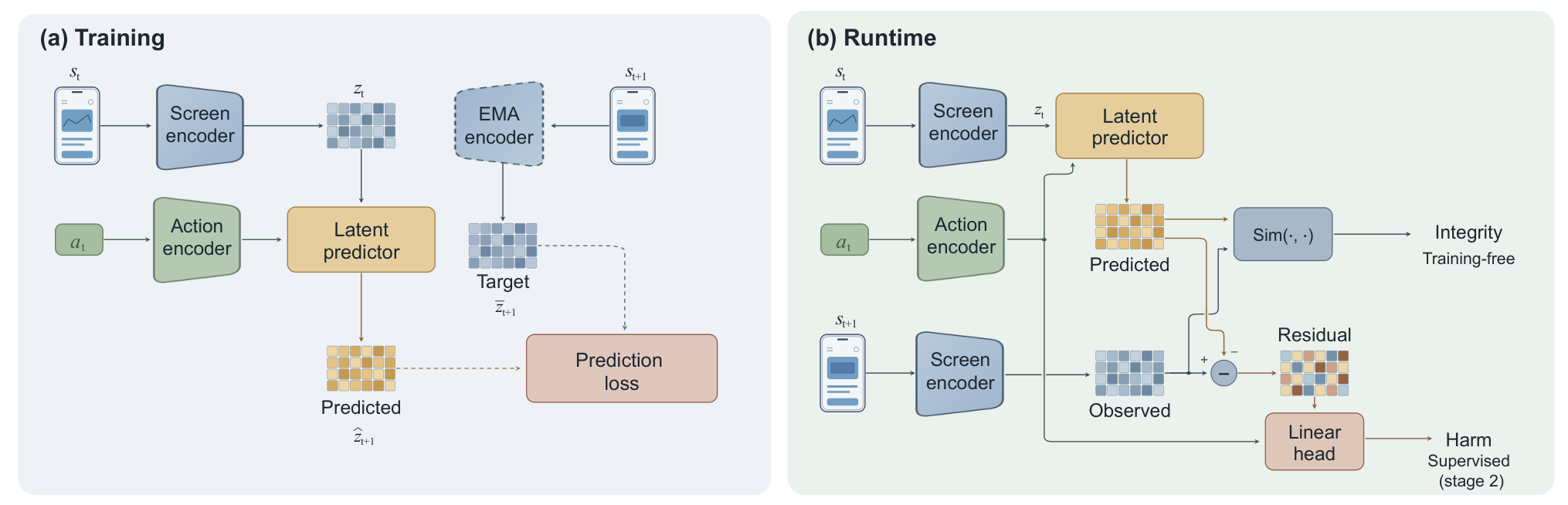
Given screenshot s_t and structured action a_t:
\hat{\mathbf{z}}_{t+1} = g_\phi(\mathbf{z}_t, e_\psi(a_t)), \qquad \bar{\mathbf{z}}_{t+1} = \operatorname{sg}[f_\xi(s_{t+1})]
where f_\theta is a DINOv2 ViT-B/14 fine-tuned with layer-wise LR decay, mapping a 448\times224 screenshot to a 32\times16 grid of 512-dim patch tokens; f_\xi is its EMA copy supplying the target; g_\phi is a Transformer latent predictor; e_\psi encodes the heterogeneous action (discrete type, continuous tap coordinates, free-form text). Predicted and target maps live in \mathbb{R}^{512\times 768}.
Three design choices follow GUI-specific properties:
- Shared positional basis for touches and patches. A tap is meaningless without its coordinates, so action tokens and visual patch tokens share one 2-D positional embedding — the predictor can attend to “the patch under the finger.”
- Change-weighted loss. GUI transitions are sparse (one toggle, or wholesale page replacement). A uniform loss would waste capacity on static chrome, so changed patches receive weight \lambda_{\text{chg}}=8 relative to unchanged ones. Coverage (\lambda_{\text{cov}}=0.01) and invariance (\lambda_{\text{inv}}=0.5) regularizers prevent collapse.
- No decoder. The consumer is a program; nothing is rendered back to pixels. Verification is \|\hat{\mathbf{z}}_{t+1} - \bar{\mathbf{z}}_{t+1}\|-style alignment, and the directional residual \hat{\mathbf{z}}_{t+1} - \bar{\mathbf{z}}_{t+1} feeds a lightweight linear head that distinguishes harmful from benign mismatches.
Pretraining uses 1,845,659 transitions pooled from Android in the Wild (55.0%), MiniWoB++ (25.0%), GUIOdyssey (9.8%), AndroidControl (6.9%), and AMEX (3.3%), with no semantic annotation. Training is 120k steps at global batch 512, AdamW/bfloat16, on 4×A100-80GB. The graph has 261M parameters; 172.86M execute at runtime.
RSWT-Bench and the outcome-blindness guarantee
The companion benchmark enforces that no detector reading only s_{t+1} can beat chance. Each example is a full transition (s_t, a_t, s_{t+1}) drawn from held-out AITW and GUIOdyssey episodes. For every credential screen used as a hijacked outcome, the same pixel-identical screen also appears elsewhere as the legitimate outcome of its own true transition, with the opposite label — “donor pairing.”
Proposition 1 (Outcome blindness). Any detector d(s_{t+1}) depending only on the outcome has expected RSWT AUC equal to 1/2: donor pairs share pixels, so d scores them identically, and under the tie convention each pair contributes 1/2. This makes any above-chance score strict evidence of transition information rather than screen-prior leakage — and the guarantee covers detectors that do not yet exist.
Results
At runtime, LGWM produces two readouts from one forward pass: the alignment gap between \hat{\mathbf{z}}_{t+1} and \bar{\mathbf{z}}_{t+1} as a training-free integrity score, and the directional residual as input to a linear head trained on the disjoint split for harm classification. The abstract reports that the training-free score “reaches” above chance on RSWT-Bench (the full numeric table was truncated in the provided excerpt). Baselines are evaluated under matched conditions: closed-source APIs, open VLMs with identical zero-shot prompts, and GUI world models that emit semantic or rendered futures — all receive the triplet (before, structured action, after). Latency is reported at batch size one on a single A100-80GB.
Limitations and open questions
The excerpt does not expose the final headline AUCs on RSWT-Bench or the baseline deltas, so the margin over prompted VLMs and over pixel-space world models cannot be stated here. More substantively: (i) donor pairing is a strong but narrow attack model — real UI hijacks may include partial overlays, timing-based deception, or screens that are plausibly close to the true successor; (ii) the harm classifier is supervised and may not generalize beyond credential-themed hijacks; (iii) encoding into DINOv2 space inherits whatever invariances the backbone has, including possible blindness to small but security-relevant text differences (domain in a URL bar, sender name); (iv) the predictor is deterministic over an inherently multimodal P^\star, so legitimate but low-probability branches may be flagged as surprising.
Why this matters
Framing GUI safety as a transition-level property, and showing that a decoder-free latent world model yields verification as a vector comparison, is cleaner than the current pattern of chaining a generative world model with a VLM judge. The outcome-blindness guarantee of RSWT-Bench is also a useful methodological template: it forces evaluation to measure the quantity the paper claims to measure.
Source: https://arxiv.org/abs/2610.11942
Looking Ahead: Modeling Future Evolution in Autoregressive Video Generation
Problem
Autoregressive video diffusion models generate chunk-by-chunk under teacher forcing: each target chunk \mathbf{x}_{k+1} is denoised given the ground-truth prefix \mathbf{x}_{\leq k}. Because consecutive video chunks are highly redundant, the immediately preceding frames provide a near-sufficient visual prior for denoising the next chunk via local extrapolation. The model is thus under-pressured to internalize how a scene evolves — object dynamics, causal propagation, slow state changes — and this manifests at rollout time as physically implausible continuations (anomalous collisions, missed slow processes). The authors want a training signal, drawn purely from the training videos themselves, that forces the generator to encode temporal evolution rather than exploit local continuity.
Method: Future Chunk Prediction (FCP)
Standard next-chunk factorization models p(\mathbf{x}_{k+1}\mid \mathbf{x}_{\leq k}, \mathbf{c}). FCP adds an auxiliary objective that predicts a temporally distant chunk while excluding the intervening chunks from the context:
p_{\mathrm{FCP}}(\mathbf{x}_{k+\Delta}\mid \mathbf{x}_{\leq k}, \mathbf{c}),\quad \Delta > 1,\ k+\Delta \leq K.
Removing \mathbf{x}_{k+1:k+\Delta-1} from conditioning breaks the local-continuity shortcut: the model cannot linearly extrapolate from the frame immediately before the target, so it must represent longer-horizon dynamics.
A key architectural question is where this objective lives. The authors found that sharing generator parameters with the masked-context future predictor degraded temporal coherence of the main generation — the two objectives compete on shared weights. Training a separate predictor in isolation, on the other hand, leaves the generator’s representations unaffected. The compromise follows the MTP-style design from DeepSeek: the auxiliary predictor has its own parameters but is conditioned on the generator’s intermediate hidden states \mathbf{h}_k, with the FCP loss backpropagated through them:
p_{\mathrm{FCP}}(\mathbf{x}_{k+\Delta}\mid \mathbf{h}_k),\quad \Delta \geq 1.
Two deliberate reductions in the conditioning: (i) text conditioning \mathbf{c} is dropped so the predictor must extract predictive information from \mathbf{h}_k itself; (ii) only \mathbf{h}_k (not \mathbf{h}_{\leq k}) is used, forcing a compact per-chunk representation and reducing compute. The auxiliary predictor is three DiT blocks initialized from the corresponding generator blocks; generators (Wan I2V checkpoints) and predictors are jointly optimized. Inference is unchanged — the predictor is discarded, so the method adds training cost only.
Results
Qualitatively, FCP corrects failure modes characteristic of local-shortcut learning. In a domino-toppling clip, teacher forcing produces an anomalous mid-row collapse while FCP propagates the chain in the correct direction; in a melting-ice clip, FCP captures the gradual rise in water level that teacher forcing misses entirely.
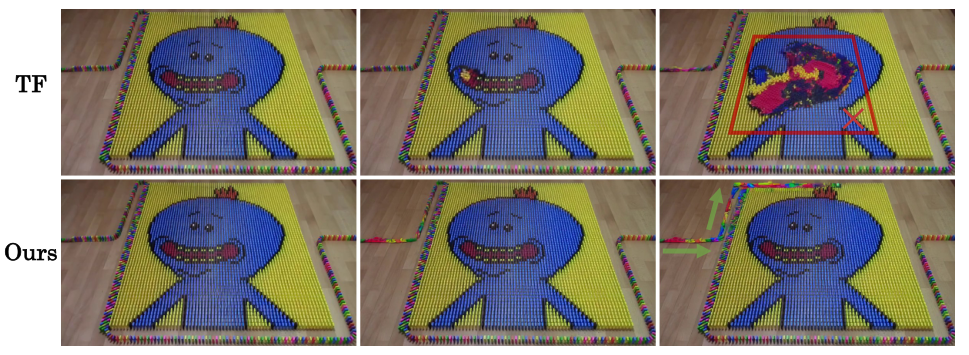
The authors emphasize that FCP achieves “superior physical plausibility over standard teacher-forced autoregressive training with a lower overall training compute budget” — the auxiliary objective is more sample-efficient per FLOP than simply training longer with teacher forcing, consistent with the hypothesis that teacher forcing wastes gradient on an easy local-copy task.
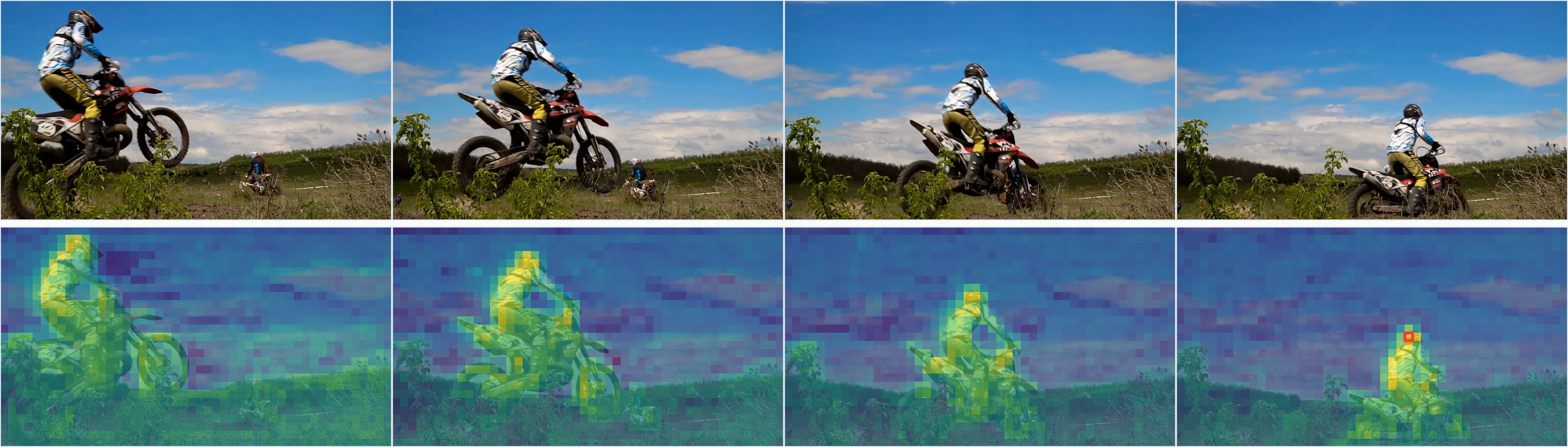
Representation probes support the mechanism. Within-frame token-similarity maps become visibly more structured under FCP, with similarity cleanly tracking semantic/object boundaries rather than diffuse local neighborhoods:
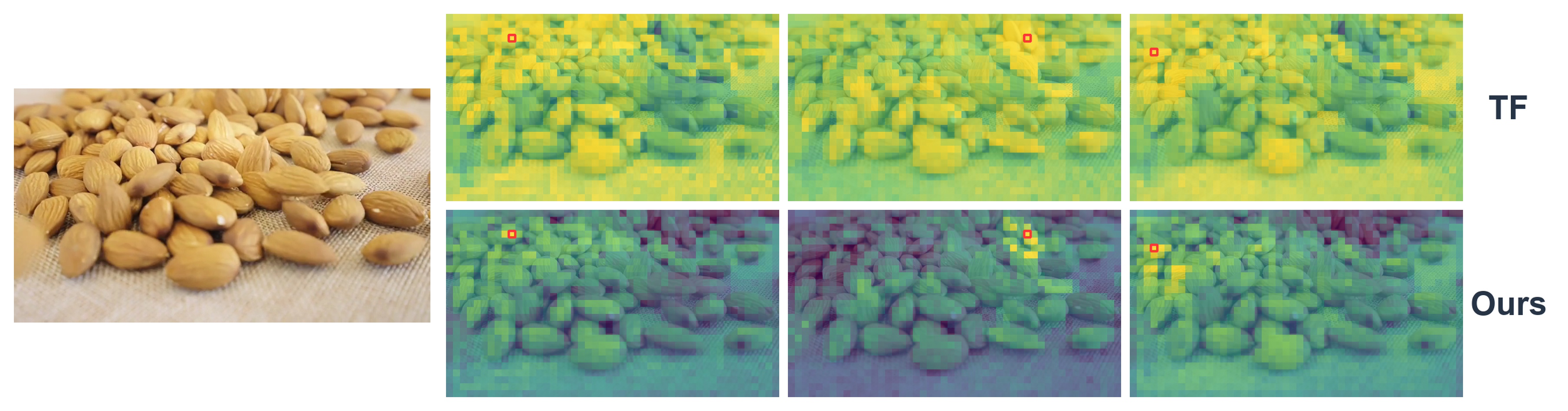
Extending the probe spatiotemporally, FCP’s hidden-state similarity to a query token tracks the same physical content across frames, indicating the representation encodes object identity through motion rather than frame-local appearance:
Limitations and open questions
The paper reports qualitative plausibility gains and representation visualizations but the provided sections do not include numerical benchmark tables (e.g., VBench physics subscores, FVD) in the excerpts available; the strength of the quantitative claim rests on the asserted compute-matched comparison without specific percentages here. Several design axes remain under-explored: the choice of offset \Delta (fixed vs. sampled, curriculum), scaling of the auxiliary predictor depth beyond three blocks, and whether dropping text conditioning in the auxiliary head is strictly beneficial at larger scales. The decision to condition on \mathbf{h}_k only (not \mathbf{h}_{\leq k}) is motivated by compactness but could limit \Delta beyond short horizons where longer prefixes carry necessary slow-variable information. Finally, the method is validated on I2V with Wan; whether the representational benefit transfers to text-to-video pretraining from scratch, or to action-conditioned world models where predictive quality matters most, is an open question the authors themselves frame as the natural next step.
Why this matters
FCP is a cheap, inference-free modification that targets the specific pathology of teacher-forced autoregressive video training — local continuity acting as a denoising shortcut — and the resulting hidden states look much more like world-model representations than those of a vanilla autoregressive generator. If the compute-efficiency claim holds at scale, this is a drop-in objective for any chunk-wise video diffusion stack that wants to behave less like a frame extrapolator and more like a dynamics model.
Source: https://arxiv.org/abs/2610.29989
DONIC: Generalist Dexterous Bimanual Tracking Control from Human Demonstrations
Problem
Reference-tracking policies for dexterous manipulation have largely been single-hand. Bimanual manipulation introduces three difficulties simultaneously: (i) training data is scarce — most public hand-object datasets (GRAB, OakInk2, TACO, HOI4D) have bimanual-contact rates between 15% and 39%, so even the “bimanual” clips are mostly unimanual-contact segments; (ii) rewards must handle asynchronous contact and complementary roles between the two hands; (iii) because reward magnitudes are strongly reference-dependent, advantages computed per clip have offsets that bias PPO updates across a heterogeneous training pool. DONIC targets a single policy that tracks arbitrary bimanual hand+object references, zero-shot across operation categories and across human-motion sources.
BiHOI dataset
The authors first expand bimanual training data by capturing BiHOI with 32 calibrated RGB cameras at 1920\times1232 and 30 fps around a tabletop. The resulting dataset has 1,575 sequences, 229 objects, roughly 1.60M synchronized frames, and — critically — a 65.91% simultaneous bimanual-contact rate, roughly double the next-highest public source (H2O at 38.57%, GigaHands at 34.74%, GRAB at 32.21%). Reconstructed interactions are retargeted to the Wuji Hand V1 and replay-screened, yielding executable references.
Method
The reference for a T-step clip is
\tau=\{(\hat{\bm q}^{L}_t,\hat{\bm q}^{R}_t,\hat{\bm p}^{o}_t,\hat{\bm R}^{o}_t)\}_{t=0}^{T},
with per-hand configurations \hat{\bm q}^h_t\in\mathbb{R}^d (wrist pose plus finger joints) and object pose in \mathbb{R}^3\times SO(3). A single policy outputs actions for both hands given the current simulated state and the reference window.
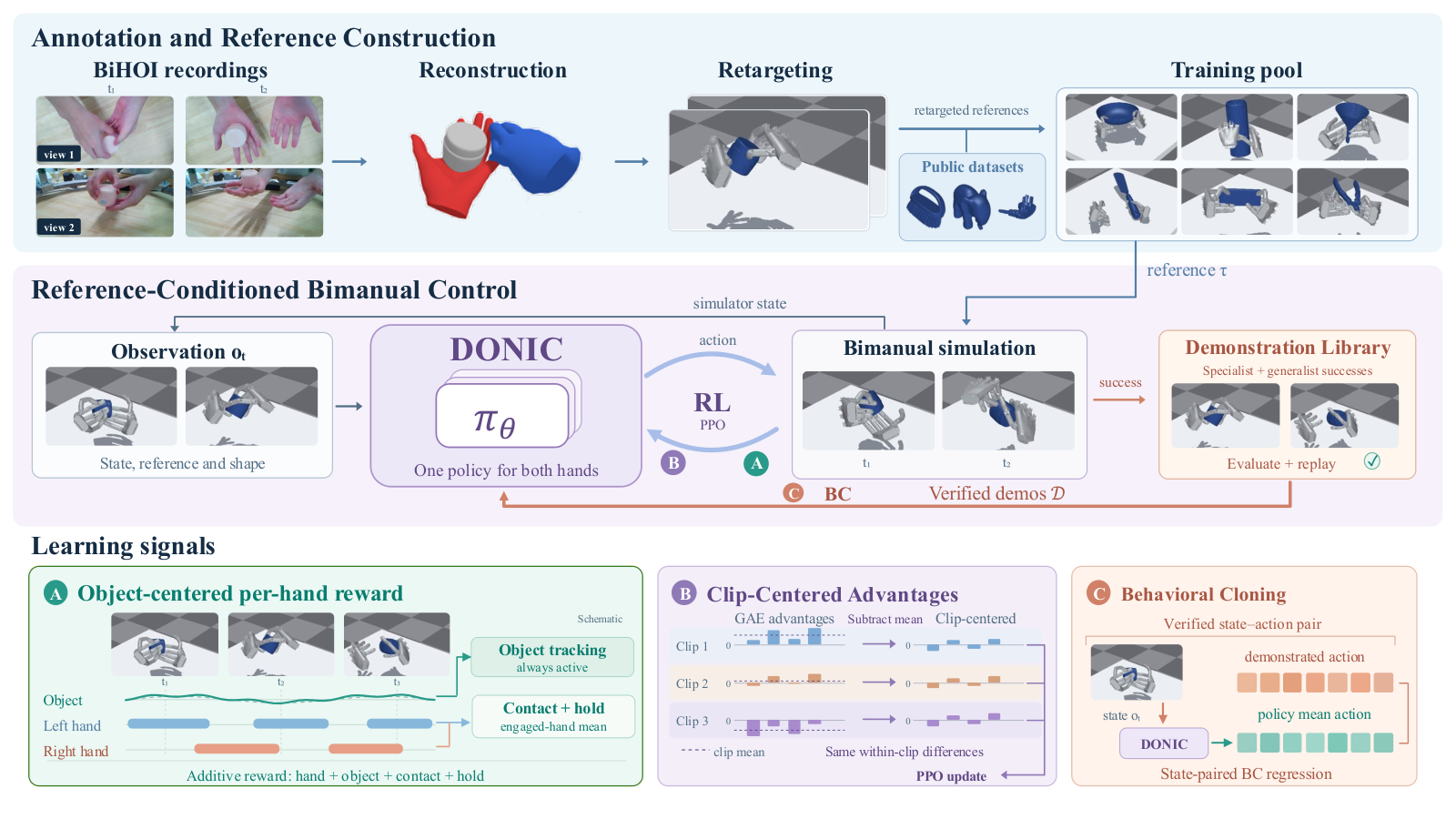
Three design choices define DONIC on top of a DexTrack-style PPO+BC backbone:
Object-centered per-hand reward. Rather than symmetric tracking of both hands, each hand’s shaping is conditioned on its reference contact role (which hand should be in contact when), while the object-motion term — tracking \hat{\bm p}^o_t, \hat{\bm R}^o_t, and \hat{\bm v}^o_t computed by finite differences — is shared. This preserves object-level feedback even when one hand is in free motion and avoids penalizing a hand for not matching reference finger kinematics during phases where the human reference’s contact is unreliable.
Clip-Centered Advantages (CCA). PPO’s advantages after GAE carry a clip-dependent offset because mean return levels differ across references of different difficulty. CCA subtracts the per-clip mean of GAE advantages before the policy update, removing the reference-dependent bias while preserving within-trajectory differences that drive credit assignment. The effect is that gradient magnitudes across the pool of 3,420 clips become comparable, which matters when jointly training over GRAB, GigaHands, OakInk2, TACO, H2O, and BiHOI simultaneously.
Iterative PPO+BC with recycled successes. Successful rollouts verified in simulation are appended to the behavioral-cloning buffer. BC provides a dense regression signal on action sequences that have passed simulator physics, so the policy is pulled toward executable trajectories, and PPO continues to explore around them. The loop stabilizes training on the long tail of hard references.
Experiments
Training uses 1,845 curated clips from GRAB, GigaHands, OakInk2, TACO, and H2O (public-only setting) and 3,420 clips when BiHOI is added. Evaluation splits are strictly held out: unseen-traj (53 unseen trajectories of training objects) and unseen-obj (164 clips with held-out objects). No per-clip fine-tuning. Baselines include Dexplore-bi and DexTrack-bi — bimanual adaptations of the respective single-hand trackers.
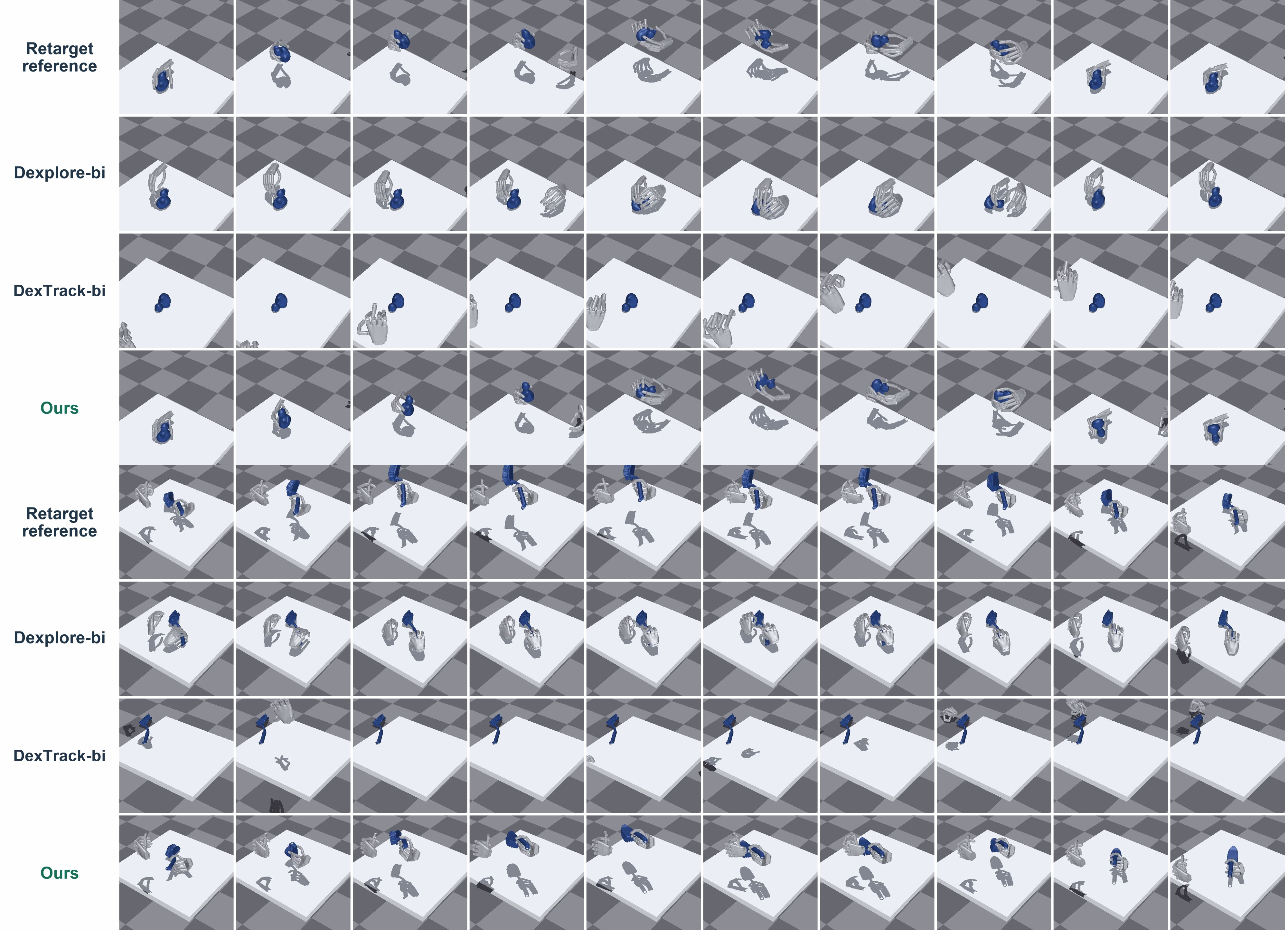
The qualitative rows show the typical failure modes of the baselines: one hand drifts off the object, or the two hands fail to co-arrive at a grasp, producing object slippage. DONIC maintains bimanual contact phases consistent with the reference and recovers object pose through the asynchronous contact transitions characteristic of handovers and two-hand regrasps. The provided excerpt emphasizes the training/evaluation protocol and qualitative behavior; the ablation of CCA versus raw GAE and the role of BiHOI augmentation are the key factors the method isolates (CCA removes advantage offsets after GAE; BiHOI roughly doubles the training pool and shifts the contact-rate distribution upward).
Limitations and open questions
The setup is simulation-based with retargeted references to a specific hand (Wuji Hand V1); sim-to-real transfer under contact-rich bimanual loads is not addressed in the excerpt. The reward relies on reference contact-role labels, which depend on reconstruction quality from the multi-view pipeline; errors in which-hand-touches-when could propagate to policy supervision. Finally, CCA removes between-clip advantage offsets, but the resulting policy still inherits whatever bias is present in the clip-sampling distribution — references with more frames implicitly contribute more gradient steps.
Why this matters
Bimanual dexterous tracking has been bottlenecked by data distribution (contact rate) and by heterogeneous-reference RL dynamics. DONIC addresses both at once: a dataset where sustained bimanual contact is the norm rather than the exception, and a trivially-implementable advantage centering that unlocks joint training across sources. The combination is a credible path to a single generalist bimanual tracker.
Source: https://arxiv.org/abs/2610.29997
Agent World Model in the Wild: Computer-Use Agent Environment Synthesis
Problem
Training computer-use agents (CUAs) through interaction requires executable environments with realistic state, solvable tasks, and reliable verifiers. Existing synthesis pipelines usually (i) target a single interaction modality (web GUI, or MCP tools, or shell), (ii) inject thin, task-specific state that lacks the accumulated clutter of a real user’s machine, and (iii) depend on proprietary frontier models to generate tasks and judge outcomes. Scaling interaction directly in real OS/web systems is also risky from a security standpoint. WildAWM targets a scalable, open-source-only pipeline that produces cross-interface (GUI + MCP + CLI, which they call XAI) environments, tasks, and verifiers in a sandbox.
Method
The pipeline synthesizes triples (W, \tau, V): a world state W, a task \tau, and an executable verifier V.
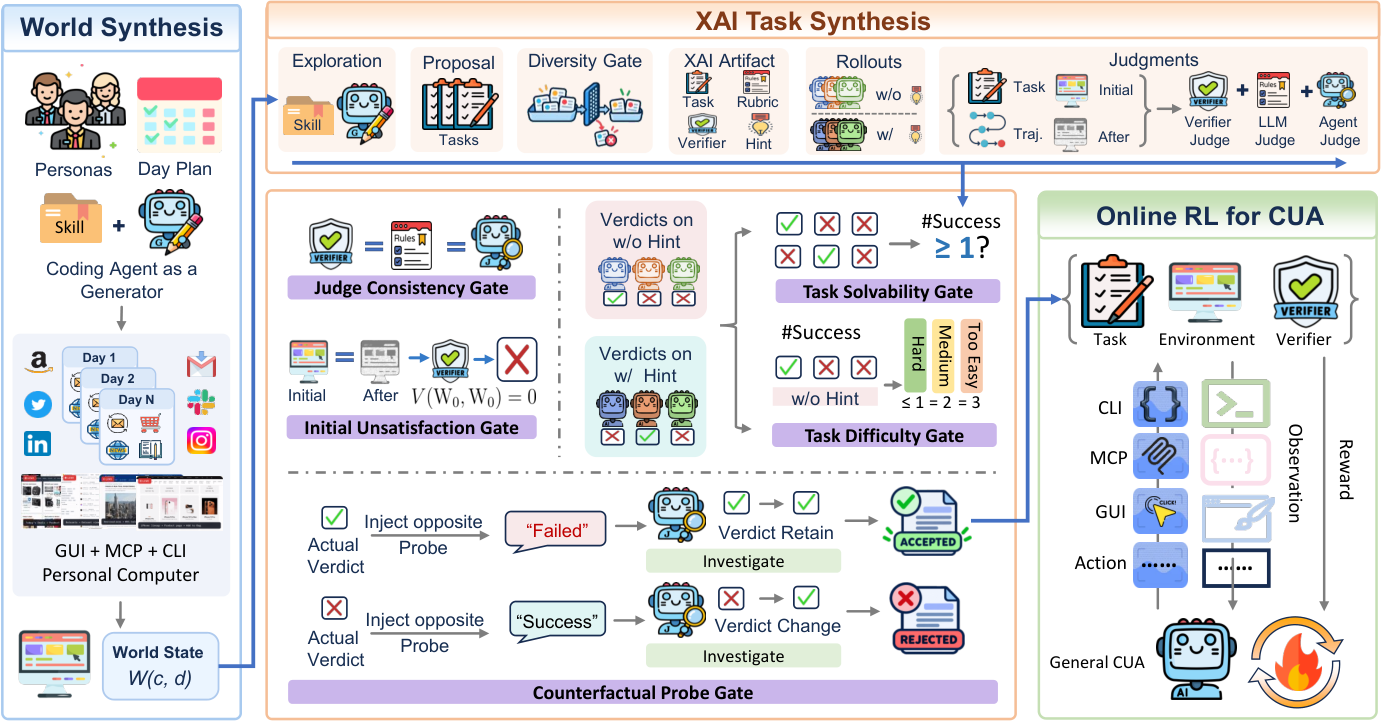
World synthesis. A world is the accumulated state of a personal computer: web apps (15 mirrored sites from WebHarbor), MCP services (8), local files, and databases. Rather than injecting a minimal state per task, WildAWM first synthesizes personas, then expands each persona into a sequence of day plans, then materializes those plans day by day using a coding agent built on GLM-5.2 inside OpenCode.
Concretely, let W(c, d) denote the state of persona c after day d. For each day d: 1. The planner inspects W(c, d-1) to preserve continuity of ongoing activities. 2. It emits a plan listing activities, named contacts, required apps/services, and the DB tables/files touched. 3. The coding agent materializes the plan: reusing existing application implementations when possible and synthesizing missing artifacts.
Persona diversity is enforced by comparing each candidate against accepted personas along life-domain and multi-day storyline axes, regenerating duplicates with similarity feedback. The resulting scale: 36 personas, 640 world states, 83 reusable skills, averaging 17.8 states per persona and 5.25 sites / 5.44 MCPs per persona. Daily deltas touch 3.97 sites and 5.31 MCPs on average, modifying 15.38 DB tables and 4.97 files per day. The accumulated final-day world holds 171.6K DB records, 50.1 local files, and totals 59.3 MiB — a world-size growth of ~30.9 KiB per day.
XAI task synthesis. On top of each world state, the pipeline generates cross-interface tasks that require combining visual GUI interaction, MCP tool use, and shell execution. Five quality gates filter candidates for (a) solvability, (b) sufficient difficulty, and (c) verifier reliability. Solvability and difficulty are estimated by rolling out heterogeneous agents across multiple models and harnesses and checking whether at least one succeeds while not all succeed trivially. Verifier reliability uses cross-judge consistency: multiple LLM judges plus execution-based checks must agree. Sketches that fail a gate are revised with feedback and re-entered; the funnel distinguishes “Direct” acceptances from “After feedback” acceptances, and remains monotonic across stages.
Results
WildAWM yields 341 XAI tasks (100 SFT / 208 RL / 33 in-domain eval) and the agents trained on it are evaluated OOD on 8 benchmarks across three families: WebArena and Online-Mind2Web (web); QwenClawBench and ClawEval (tool/MCP); CUA-Gym, OSWorld-Verified, OSWorld 2.0, and Agents’ Last Exam (full CUA).
Quantitative comparisons on environment quality:
- State scale. Median environment-state size is 52.4K tokens for WildAWM vs. 1.1K for CUA-Gym — roughly 48× larger, reflecting accumulated multi-day user activity rather than injected scaffolding.
- Diversity. Using Qwen3-Embedding-8B representations, WildAWM achieves consistently higher Vendi score across all sample sizes (95% intervals do not overlap with baselines).
- Redundancy. Mean nearest-neighbor cosine distance is 0.25 vs. 0.20, indicating less duplication among environment artifacts.
- Solvability. Across 24 model–harness configurations (3 open models × 6 harnesses plus Opus-4.8), tasks are stratified by difficulty; hints shift the solvability distribution upward even when Opus-4.8 is excluded, suggesting the difficulty signal is not merely a frontier-model artifact.
Crucially, the entire generator stack (persona writer, coding agent, judges) uses only open-source models (GLM-5.2 in OpenCode), undercutting the common assumption that frontier closed models are required for high-quality CUA synthesis.
Limitations and open questions
The paper reports environment statistics and solvability funnels in detail but the excerpt does not quote end-to-end agent success rates on the 8 OOD benchmarks, so the downstream training payoff of the richer state is not pinned down here. Persona count (36) is modest; it is unclear how diversity scales as personas increase, or whether the Vendi gains plateau. The five quality gates rely on heterogeneous rollouts and LLM-judge consensus, which inherits the biases of the underlying open-source models — verifier reliability is measured by cross-judge agreement rather than against a human-labeled gold set in the excerpt. Finally, 15 mirrored websites and 8 MCP services cover a slice of the real computer-use surface; software installation, native desktop apps beyond file I/O, and long-horizon stateful workflows across weeks remain underexplored.
Why this matters
WildAWM is a concrete existence proof that persona-driven, multi-day world simulation yields environments substantially larger and more diverse than task-injected baselines, and that this can be done without proprietary models. For CUA research, this reduces a major cost and licensing barrier to building interaction data at scale, and the GUI+MCP+CLI unification matches where general agents are actually heading.
Source: https://arxiv.org/abs/2610.26828
Hacker News Signals
SIMD-accelerated computer vision on a $2 microcontroller
The ESP32-S3 contains a 128-bit vector processing unit — Xtensa’s PIE (Processor Instruction Extensions) — that Espressif documents poorly and almost no production code exploits. This post reverse-engineers the intrinsic interface and applies it to real-time image processing tasks (edge detection, downsampling, color conversion) on hardware that costs under two dollars.
The core insight is that PIE operates on 128-bit “Q” registers and exposes SIMD lanes for 8-, 16-, and 32-bit integers. The author maps grayscale pixel batches into Q registers and performs horizontal sums, absolute differences, and saturating arithmetic entirely in-register, avoiding the main Xtensa pipeline for inner loops. A Sobel gradient computation that takes ~18 ms scalar drops to ~3 ms with PIE — roughly 6x — on a 240 MHz core.
The alignment constraints are strict: PIE loads require 16-byte-aligned buffers, so the author wraps framebuffer allocation with memalign. The intrinsics themselves are not in any standard SDK header; they are hand-assembled using __asm__ volatile blocks with the raw opcode mnemonics, since the Espressif IDF only partially exposes PIE through dsps_ DSP library functions that cover FFT and FIR but not general vision ops.
The post also covers how the ESP32-S3’s DMA-linked camera interface (using the I2S peripheral in camera mode) can feed frames directly into aligned PSRAM without CPU involvement, keeping the vector unit busy rather than stalled on memory transfers.
The practical ceiling is set by PSRAM bandwidth (~80 MHz octal SPI, effective ~40 MB/s), not compute — which means the vector approach hits diminishing returns for large frames (640x480+) but is genuinely competitive for 160x120 or 320x240 inference preprocessing pipelines feeding a quantized model.
Source: https://shraiwi.com/blog/simd-fast-esp32s3/
Code-execution flaw in UEFI firmware threatens most servers on planet Earth
The vulnerability is a heap buffer overflow in the reference implementation of the UEFI HTTP Boot driver, which is distributed by Tianocore as part of EDK II and incorporated verbatim by virtually every major server OEM (HPE, Dell, Lenovo, Supermicro, and others). The affected code path is triggered during PXE-like network boot: when the firmware fetches a boot image over HTTP, a length field in the server’s chunked-transfer response is trusted without bounds checking before being used to size a heap copy. An attacker on the same network segment — or controlling the DHCP/boot server — can overwrite UEFI heap structures before the OS loader runs, meaning the compromise precedes any measured boot or Secure Boot policy evaluation.
The critical detail is the attack surface: HTTP Boot is enabled by default on most server-class motherboards even when not used for provisioning, because it is part of the standard UEFI network stack initialization. A malicious DHCP server responding on the local subnet is sufficient; no existing OS needs to be running.
The severity is compounded because UEFI heap exploits can install persistent firmware implants. Overwriting heap metadata in the pre-OS environment can redirect execution to attacker-controlled code that survives OS reinstalls, TPM measurements (which occur after the vulnerable code runs), and most forensic tooling. Patching requires a signed firmware update from the OEM, not an OS patch — which historically takes months to reach enterprise deployments.
The CVE is tracked separately for each affected OEM firmware branch. Mitigations short of firmware updates include disabling HTTP Boot in UEFI configuration and restricting DHCP responses via switch-level DHCP snooping, though neither is universally deployable in large heterogeneous fleets.
Cross-request KV cache exposure in the GLM-5.3 Workers AI model (155 responses)
This is a concrete, publicly documented instance of KV cache state leaking across independent user requests in a production LLM inference deployment. Cloudflare’s Workers AI platform serves GLM-5.3 (a THUDM model) via shared GPU infrastructure; a bug in the inference engine’s cache management allowed prior-request KV activations to remain resident and be attended to by subsequent requests from different users.
The mechanism: transformer KV caches are allocated per-sequence and are supposed to be invalidated or scoped strictly to a single request’s attention computation. When a cache block is incorrectly marked as reusable before being zeroed — or when prefix-cache sharing logic conflates user sessions — a new request’s attention scores incorporate key/value pairs from a previous user’s prompt or partial completion. The result is not random noise; it is coherent text fragments from prior requests appearing in responses, which Cloudflare confirmed in 155 identified responses.
This matters architecturally because prefix KV caching (reusing KV activations for shared system prompts or common prefixes) is a standard latency optimization deployed across vLLM, TGI, and proprietary inference stacks. The optimization requires exact cache-key matching on token sequences; any hash collision, off-by-one in sequence length tracking, or race condition under concurrent load can cause incorrect reuse. The bug class is not hypothetical — it has appeared in vLLM issues and TGI bug reports at smaller scales.
Cloudflare’s remediation involved disabling the specific caching optimization for GLM-5.3 while auditing cache invalidation logic. The post does not specify whether the root cause was in their inference wrapper or upstream in the model-serving library, leaving the question of whether other models on the same infrastructure were affected partially open.
Source: https://blog.cloudflare.com/kv-cache-exposure-remediation/
Python’s experimental JIT to be removed
CPython 3.13 shipped a copy-and-patch JIT based on work by Brandt Bucher, generating native code by copying pre-compiled template stubs and patching in runtime values (addresses, constants) rather than doing full IR-based code generation. The approach was explicitly labeled experimental. The LWN article covers the core maintainer discussion around removing it before 3.14 stabilizes.
The stated reasons are net negative: the JIT adds ~50 KB to the CPython binary, complicates the build system (requires LLVM at build time for the template compilation step), and has not produced measurable speedups on the standard pyperformance benchmark suite. The copy-and-patch design intentionally trades optimization quality for implementation simplicity — there is no register allocator, no inlining across bytecode boundaries, and no speculative type feedback integrated into code selection. What it does do is eliminate interpreter dispatch overhead for hot bytecodes, but in practice pyperformance workloads are dominated by Python-level object allocation and attribute lookup, not dispatch.
The broader tension is that CPython’s Tier 2 specializing adaptive interpreter (the “specializing” machinery added in 3.11-3.12) already provides most of the dispatch-reduction benefit through inline caching, without the binary size and build complexity costs. The JIT was intended to sit above Tier 2 and emit native code for the most-executed traces, but the trace selection and type-stability heuristics are immature.
The removal is not permanent abandonment — the proposal is to pull it from the default build while the design is reworked, potentially reintegrating a more capable version later. The discussion references the Pyston and Cinder work as evidence that meaningful Python JIT speedups require deep integration with the object model, not just dispatch elimination.
Source: https://lwn.net/SubscriberLink/1102102/0c00e4d550f25f8c/
Ten days later, Git on macOS still trusts the compromised eMudhra certificates
eMudhra is an Indian certificate authority trusted in several root stores. A compromise of (or issuance error from) eMudhra’s intermediate CA resulted in certificates that Apple has not yet removed from macOS’s trusted root store, and — critically — Git’s HTTPS transport on macOS uses the system certificate store via libcurl linked against Apple’s Security framework. This means git clone and git fetch over HTTPS will succeed against a server presenting a certificate chaining to the compromised eMudhra root, with no warning to the user.
The site documents the timeline: the problem was publicly disclosed, other trust stores (Mozilla NSS, used by Firefox; Microsoft’s root store) revoked or distrusted the relevant certificates within days, but macOS had not shipped an updated trust store ten days post-disclosure. macOS distributes root store updates via the “Trusted Root Certificates” system configuration asset, which can be pushed without a full OS update — making the delay a policy/operations choice, not a technical constraint.
The attack surface for developers is real: a supply-chain attacker with access to a TLS certificate from the compromised CA can perform a MITM against git clone URLs, substituting malicious repository contents. Combined with common patterns like bootstrapping development environments via shell scripts fetched over HTTPS from git hosts, this is a plausible code-execution path.
The workaround is to set GIT_SSL_CAINFO to a manually maintained bundle (e.g., the curl project’s Mozilla-derived ca-bundle.crt) or to use Git builds linked against OpenSSL with a separately managed trust store. Neither is a standard developer configuration on macOS.
Source: https://emudhra.we-have-a-problem.com/apple.html
PaperPilot: Zero-Cloud, Pure-Rust PDF Engine with WASM and MCP
PaperPilot is a PDF processing library and toolchain written entirely in Rust, compiled to WebAssembly for browser-side execution, and exposing a Model Context Protocol (MCP) interface for LLM tool integration. The “zero-cloud” framing means all PDF parsing, rendering, and text extraction runs client-side in the WASM sandbox — no document bytes leave the browser.
The Rust PDF engine handles parsing of the cross-reference table, content stream decoding (Flate/LZW/ASCII85), font subsetting, and basic page rendering to a pixel buffer exposed as a JS ImageData. The implementation avoids unsafe for the core parsing paths, leaning on nom for the PDF binary format grammar. WASM compilation uses wasm-bindgen for the JS FFI boundary and wasm-pack for the build pipeline; the resulting .wasm binary is around 2 MB before compression.
The MCP integration is the more novel piece. MCP (Anthropic’s tool-calling protocol) allows an LLM host to invoke structured tools with typed inputs/outputs. PaperPilot exposes PDF operations — extract text by page range, get metadata, search for a string — as MCP tool definitions. This means an LLM agent running in a compatible host can invoke PDF extraction without round-tripping document content through a server, which matters for confidential documents.
Current limitations from the repository: no support for encrypted PDFs (standard 128-bit RC4 or AES encryption), no CJK font rendering (Type0/CIDFont composite fonts are parsed but not rendered correctly), and no form field extraction (AcroForm). The rendering quality for complex layouts with overlapping text runs and masked images is incomplete. It is a useful foundation for text-extraction use cases but not a drop-in replacement for poppler or pdfjs for general rendering.
Source: https://github.com/KrushnaVardhanReddy/PaperPilot
Introducing LFM3: Every Modality for Specialized Intelligence
Liquid AI’s LFM3 is a multimodal model family built on their Liquid Foundation Model architecture, which replaces standard transformer attention with structured state-space layers (their “Liquid” layers, related to LRU/Mamba-style recurrent operators) interleaved with local attention windows. LFM3 extends prior LFM releases to handle text, images, audio, and video within a single model graph rather than via modality-specific adapter towers.
The architectural claim is that the recurrent core handles long temporal sequences (audio, video frames) more efficiently than full self-attention because state update cost is O(L) in sequence length rather than O(L^2), while local attention windows handle fine-grained spatial dependencies within fixed-size chunks. The modality inputs are tokenized via separate encoders (patch embeddings for images/video, mel-spectrogram patches for audio) and projected to the shared hidden dimension before entering the unified sequence mixer.
Liquid reports LFM3 benchmark numbers on a set of multimodal evals (MMMU, VideoMME, and audio QA benchmarks) where the models are competitive with same-parameter-count transformer baselines. Specific figures from the blog: LFM3-3B matches or exceeds Phi-3.5-vision on several image understanding tasks at lower inference memory due to the recurrent state not requiring KV cache growth with sequence length.
The limitations are the standard ones for SSM-based models: parallel training efficiency on long sequences requires careful chunking of the recurrent scan, and the lack of random-access attention means retrieval of information from arbitrary past positions relies on the compressed state, which can degrade on tasks requiring precise verbatim recall from long contexts. The blog post does not release weights or architecture hyperparameters in sufficient detail to reproduce the model.
Source: https://www.liquid.ai/blog/lfm3
Artificial Analysis Intelligence Index v5
The Artificial Analysis Intelligence Index aggregates performance across a standardized battery of benchmarks and weights them into a single scalar “intelligence” score intended to rank frontier LLMs. Version 5 updates the model coverage and revises the benchmark weighting methodology.
The index covers roughly 40 models and includes coding (HumanEval+, LiveCodeBench), reasoning (MATH-500, GPQA), instruction following, and multimodal tasks. The composite score is a weighted geometric mean across categories, with weights chosen to reflect “real-world usefulness” — a subjective call that the methodology section acknowledges but does not fully justify with user studies or task-frequency data.
The v5 rankings show o3 and Gemini 2.5 Pro clustered at the top, with GPT-4o and Claude 3.7 Sonnet in a second tier separated by only a few index points — well within the noise of benchmark variance. The commentary section correctly notes that the index compresses information: a model optimized for coding will score identically to a model optimized for reasoning if their category sub-scores average the same way, so the scalar is only useful as a rough filter, not for task-specific selection.
The site pairs the intelligence index with throughput and latency measurements from their inference benchmarking infrastructure, which is more operationally useful: tokens/second at various concurrency levels and time-to-first-token distributions across API providers. These numbers show substantial variance across providers serving the same model — a 2-3x throughput spread between providers for Llama 3.1 70B, for instance — which matters more for production deployment decisions than a 2-point intelligence score difference.
Source: https://artificialanalysis.ai/articles/artificial-analysis-intelligence-index-v5
Noteworthy New Repositories
mw00/project-maya
Project Maya is a self-hosted inference stack targeting large mixture-of-experts models — specifically GLM-5.3-Flash (321B), DeepSeek-V4.1-Flash-1017 (748B), and MiniMax-M3.1-Flash (428B). The core engineering problem is distributing these models across 1–16 consumer or datacenter GPUs (NVIDIA CUDA and AMD ROCm both supported) without requiring cloud access. The stack ships four integrated components: an inference engine handling MoE routing and tensor parallelism, an API server exposing both OpenAI-compatible and Anthropic-compatible endpoints (useful for drop-in replacement in existing agent pipelines), a web dashboard for monitoring, and quantization tooling to reduce memory footprint. Supporting Windows alongside Linux is non-trivial at this scale and suggests a deliberate effort to reach researchers without Linux-only clusters. The OpenAI/Anthropic dual-API surface means no client-side code changes are needed when switching from hosted endpoints. For users running 748B-parameter models, quantization is not optional — the included quant tools presumably handle GPTQ or similar post-training quantization workflows. This is a strong choice for organizations with data-residency constraints or researchers who need reproducible, private inference over very large MoE checkpoints without routing tokens through a third-party API.
Source: https://github.com/mw00/project-maya
nanaism/yomiyasu
Yomiyasu is an agent skill (a composable capability unit for LLM-based agent frameworks) that post-processes AI-generated Japanese text into prose that reads as natively written. The technical problem it addresses is real and well-documented: LLMs writing Japanese tend to produce characteristic artifacts — overuse of katakana loanwords where native vocabulary is preferred, unnatural sentence-final patterns, excessive passive constructions, and rigid topic-comment structures that feel templated rather than organic. The skill operates as a refinement pass, taking a draft as input and returning a revised version with these patterns corrected. It is framed as an agent skill rather than a standalone tool, meaning it integrates into agent orchestration pipelines (such as those built on frameworks compatible with skill interfaces) rather than running as a one-shot CLI tool. This makes it composable: a writing agent can call it as a post-processing step after generation. For anyone building Japanese-language content pipelines, document automation, or localization tooling on top of LLMs, this is a directly applicable utility. The high star count for a narrow NLP preprocessing task reflects genuine demand for language-quality tooling outside English.
Source: https://github.com/nanaism/yomiyasu
hevnsnt/CVEngine
CVEngine is an AI-driven external attack surface management (EASM) tool built around a continuous discovery and evidence-based validation loop. Rather than maintaining a static vulnerability database, it performs active reconnaissance to enumerate an organization’s externally facing assets, then validates candidate vulnerabilities with actual evidence before surfacing them — reducing the false-positive burden that plagues traditional scanners. The “AI-first” framing here appears substantive: LLMs are used to reason over discovered assets and correlate findings rather than purely as a reporting layer. The integration with Model Context Protocol (MCP) is architecturally notable — it means CVEngine can expose its findings and scanning capabilities directly to developer-facing AI agents, enabling workflows where a coding assistant can query live attack surface data during a development session. This closes the loop between vulnerability discovery and remediation in a way that static SAST/DAST tools cannot. The tool is positioned as external-facing only, which scopes it clearly away from internal SAST. For security engineers building automated red-team pipelines or wanting to integrate live exposure data into CI/CD-adjacent agent workflows, the MCP interface is the differentiating technical feature.
Source: https://github.com/hevnsnt/CVEngine
jiwoochris/artex-global
ARTEX is an autonomous penetration testing framework; this repository is a Korean-language fork of the upstream Autumn-27/ARTEX (AGPL-3.0). The framework automates the penetration testing cycle — reconnaissance, exploitation attempt, reporting — using LLM-driven agents rather than manual tester direction at each step. The “autonomous” label means the agent selects and sequences attack techniques based on discovered surface area rather than executing a fixed script. Technically, this architecture typically involves a planning LLM that receives tool outputs (port scans, service banners, CVE lookups) and decides the next action, with specialized tool-calling for each phase. The Korean localization suggests targeted adoption in the Korean security research community, which has distinct regulatory and CTF contexts. The AGPL-3.0 license is significant for commercial users — any service built on top must also be open-sourced. For researchers evaluating LLM-based autonomous offensive security agents, ARTEX-style frameworks are a useful benchmark: they expose where current LLMs succeed (straightforward CVE exploitation chains) and fail (novel chaining, privilege escalation requiring multi-step reasoning). Running this requires careful sandboxing and explicit legal authorization for any target.
Source: https://github.com/jiwoochris/artex-global
deeplethe/solid-glass
Solid Glass is a design system targeting AI application interfaces, emphasizing physical and tactile visual metaphors — frosted glass surfaces, material depth, layered translucency — as opposed to the flat or neumorphic aesthetics common in current AI product UIs. The technical substance is a component library and token system providing consistent implementation of these effects across an application. For AI applications specifically, the design rationale is that interfaces mediating between users and probabilistic systems benefit from visual hierarchies that clearly signal system state, confidence, and source layers, which material-depth metaphors can encode more naturally than flat design. The “technical” descriptor in the tagline suggests the system is built with developer ergonomics in mind — likely well-typed component APIs and design tokens that integrate with standard front-end toolchains. For teams building chat interfaces, agent dashboards, or RAG-backed tools, adopting a coherent design system early prevents the inconsistency that accumulates when UI decisions are made ad hoc. The high star count relative to the project scope indicates demand for opinionated, AI-specific UI starting points that go beyond generic component libraries like shadcn or MUI.
Source: https://github.com/deeplethe/solid-glass
morganlinton/BeautifulRust
BeautifulRust packages Rust coding best practices as agent skills consumable by LLM-based coding assistants (Claude Code, OpenAI Codex, GitHub Copilot, Cursor, Gemini CLI). The concrete deliverables are: a set of skills teaching idiomatic Rust patterns (ownership discipline, iterator chains, error handling with ? and thiserror, zero-cost abstraction use), skills for porting code from other languages into idiomatic Rust rather than transliterated equivalents, a code review skill applying Rust-specific heuristics, and a tested clippy.toml configuration defining the lint profile backing these standards. The skills approach matters because coding agents without explicit Rust guidance tend to produce syntactically valid but idiomatically poor Rust — excessive cloning, .unwrap() abuse, C-style index loops instead of iterators. By encoding idioms as agent skills, the corrections become systematic rather than dependent on prompt engineering per session. The included clippy configuration is independently valuable: a well-curated clippy config that enforces the same standards the skills teach provides CI-level enforcement of what the agent produces. This is a useful addition to any Rust-heavy engineering team adopting AI-assisted development, particularly for teams onboarding engineers from Python or Go backgrounds.
Source: https://github.com/morganlinton/BeautifulRust
Edwardxlai/easyread
Easyread is a local PDF translation tool targeting Chinese-speaking researchers reading English academic papers. Its technical stack combines PDF parsing, neural machine translation, and an embedded AI question-answering interface into a single desktop-oriented application. Key features: side-by-side original/translation display (preserving layout context rather than replacing the source), in-place AI querying during reading (ask questions about the current paper without switching tools), and reference/citation management. The local-first architecture matters for academic users who may be working with pre-publication manuscripts or in environments with strict data-handling requirements. The side-by-side rendering is technically non-trivial for academic PDFs because of formula-heavy layouts, multi-column text, and figures — handling these without garbling the translation requires careful PDF segmentation logic to treat math blocks, captions, and body text differently. The literature management layer positions this as a full research workflow tool rather than a single-use translator. For Chinese researchers who need to process large volumes of English literature efficiently, the combination of translation quality, layout fidelity, and integrated querying makes this a more integrated alternative to pasting text into a general-purpose LLM chat interface.
Source: https://github.com/Edwardxlai/easyread
hanzohanzhe/Grandet
Grandet solves a specific and increasingly practical problem: given a target LLM (by model name or capability profile), find the cheapest provider currently offering it across 1,800+ official, inference, and relay providers, and route requests there transparently from an existing AI agent. The system has two surfaces: an agent skill for direct integration into agent pipelines, and an anonymous MCP server that exposes the same routing logic to MCP-compatible clients. Pricing data is sourced from grandet.ai and reflects listed prices, meaning it tracks the public rate card rather than negotiated enterprise pricing. The technical mechanism is straightforward — a lookup and proxy layer — but the value is in the breadth of provider coverage and keeping that data current. For cost-sensitive applications running high token volumes (batch processing, RAG pipelines, multi-agent systems), provider price differences for the same underlying model can be substantial, sometimes 5–10x between providers for identical model weights. The anonymous MCP server design means no credentials are required to query pricing, reducing friction for evaluation. Limitations: listed prices may lag actual pricing, and relay providers add latency and a trust dependency. Still, for teams optimizing inference costs across a heterogeneous model portfolio, a systematic routing layer is preferable to manual provider tracking.