Daily AI Digest — 2026-10-09
arXiv Highlights
AgentGarten: Code Worlds for Evolving Agents
AgentGarten is a framework for building real-time, interactive virtual worlds that decouple state evolution from visual rendering. The motivation is a persistent tension in agent training: pure simulators (MuJoCo, Isaac, game engines) give faithful dynamics but visually unrealistic observations; video world models give realistic frames but drift in state, since dynamics live inside generated pixels. AgentGarten keeps the first and replaces the renderer with a geometry-conditioned neural model shared across worlds.
Formulation
A code world is a tuple (p, \text{engine}, R_\theta). The scene program p defines geometry, articulations, and interaction rules; the engine advances state and camera
(s_{t+1}, \pi_{t+1}) = f_p(s_t, \pi_t, a_t), \qquad c_t = h_p(s_t, \pi_t),
producing a structured condition c_t (surface normals or depth from the camera at \pi_t). The neural renderer generates the actual observation
x_t = R_\theta(x_{<t},\, c_{\le t},\, x_0,\, y),
conditioned on an appearance reference x_0 and a text caption y. Critically, f_p does not consume x_t: rendering errors cannot leak into state. The same recorded trajectory can be re-rendered under a different x_0 or camera without altering events.
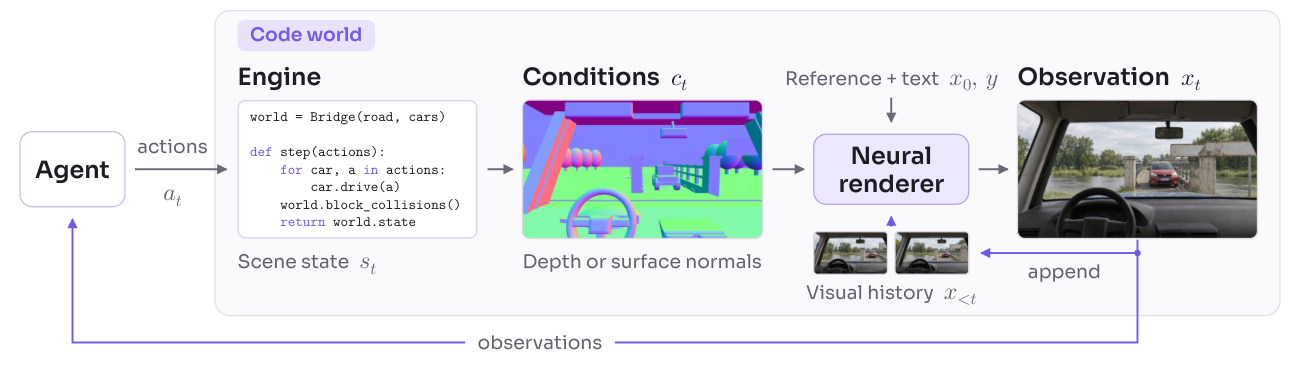
This factorization also permits a coding-agent pipeline to construct worlds from a single reference image: perception/generation models are called as tools, a scene program is authored, and rollout checks drive repair (Figure 2).
Renderer and Adversarial Forcing
The renderer is an autoregressive block-causal video model initialized from Cosmos 3-Nano, with the understanding (UND) tower frozen and separated from the generation (GEN) tower so that caption KV can be shared across student, teacher, and fake-score networks during distillation. A frozen Wan video autoencoder provides latents for both RGB and geometry streams. The appearance reference x_0 is held as a clean (undenoised) frame.
Training proceeds in three stages: (i) geometry conditioning on the bidirectional backbone, (ii) teacher-forcing adaptation to block-causal rollout, and (iii) Adversarial Forcing, the paper’s main contribution for long-horizon stability.
Self Forcing distills on-policy rollouts but detaches the KV cache of earlier blocks, so gradients from frame t never flow into how prior frames were encoded; errors in long-range memory are not corrected. Adversarial Forcing adds exact replay: the rollout is executed once with a detached cache (preserving the compute structure of inference), then history keys/values are recomputed with gradients attached. A stop-gradient on the queries ensures that losses on block i’s prediction update only the encoding of history, not its own query path, matching the original rollout’s logits exactly.
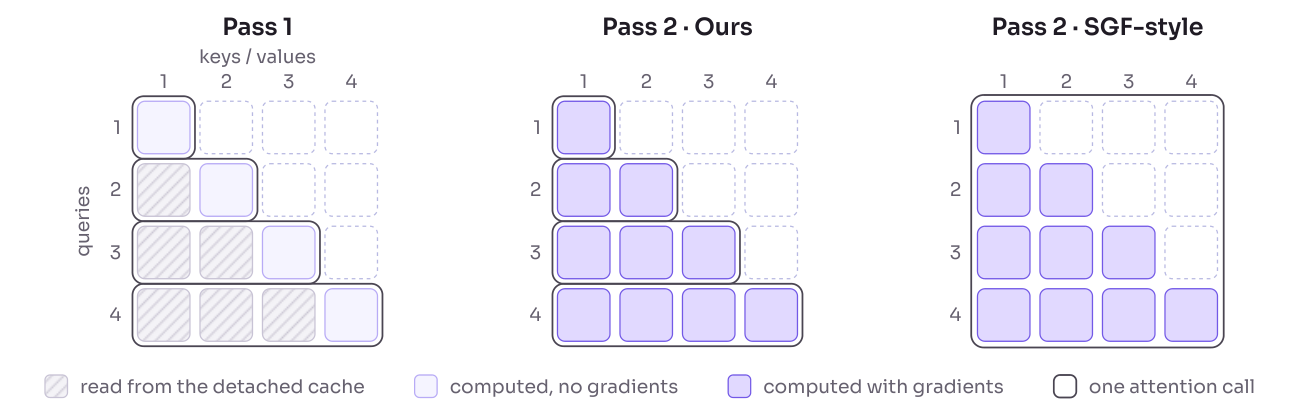
On top of DMD-style distribution matching against a teacher, Adversarial Forcing adds a GAN loss using real video crops as positives against generated rollouts, which supplies high-frequency texture supervision that the teacher score alone does not provide.
Results
The headline qualitative evidence is 30-second rollouts on identical condition trajectories (Figure 7, discussed in Section 4.1). Self Forcing rollouts develop repetitive surface patterns and lose detail as time grows; Adversarial Forcing retains natural texture and fine detail at the 20 s and 30 s marks. Measurements use a single H100, BF16, 480\times832 output, blocks of four latent frames, and a four-step sampler — a configuration consistent with real-time interaction.
The shared renderer serves five code worlds (navigation, manipulation, tool use, racing with two first-person agents sharing one state, and multi-agent interaction), plus browser-deployed games (bowling, penalty shootout, crate-vault puzzle) driven by keyboard/mouse/gamepad input. Because state is explicit, any rollout can be re-rendered in a new style or from a new camera. The paper’s agent experiments revisit hide-and-seek with agents whose only perception is the rendered stream, iterated round-by-round across four additional worlds.
Limitations
The authors are frank about the conditioning interface. Depth and normal videos are redundant — a rigid object’s motion is a few pose parameters but the condition replays its full surface across pixels and frames — and spatial downsampling destroys thin structures and narrow contacts that matter for control. Geometry also underdetermines state: a rotationally symmetric object with a painted marking can rotate without any depth/normal change; material and identity are not expressed. Visual history carries these attributes but loses them after long occlusions or memory-window overruns. Compact alternatives (structured text for attributes and interaction state, or high-dimensional latents aligned with engine state) are flagged as open problems. The paper also does not report standard video-quality metrics (FVD, PSNR) or quantitative agent-performance deltas versus training in the raw simulator — the comparisons shown are qualitative long-rollout stability and replay accuracy.
Why this matters
Separating faithful dynamics from a shared realistic renderer is a cleaner factorization than monolithic video world models for agent training, because policy-relevant state cannot be corrupted by rendering drift and the same engine trajectory can be re-rendered for domain randomization at zero extra simulation cost. Adversarial Forcing’s exact-replay trick is a reusable technique for distilling block-causal video models whenever long-horizon memory matters.
Source: https://arxiv.org/abs/2610.12374
TokenRouter: Efficient Serving System for Token-Level LLM Routing
Problem
Token-level LLM routing — deciding at each decode step which of several models (e.g., a small draft and a large verifier) should emit the next token — can push the cost/quality Pareto frontier beyond coarse session- or query-level routing. Algorithms like CITER, R2R, R-Stitch, Co-LLM, and ME have demonstrated the quality gains, but their reference implementations are either single-request inference loops without continuous batching (CITER, R2R) or ad-hoc multi-server setups (Co-LLM). Serving them efficiently under concurrent load exposes two system-level pathologies that single-LLM engines like vLLM and SGLang were never designed to handle:
- Step desynchronization. Different routed requests reach different models at different decode steps, so the usual “all requests in the batch step in lockstep” invariant breaks. Naively coupling schedulers forces models to idle waiting for peers.
- Batch admission delay. When a request is handed off mid-generation, it must wait for the next batch admission window on the target model. Repeated hand-offs multiply this latency, and small batches on the large model wreck throughput.
Method
TokenRouter’s organizing principle is request-centric programming, model-centric execution. Developers describe each routing algorithm as a sequential lifecycle traced from one request’s perspective:
\textbf{receive} \to \text{decode} \to \textbf{route} \to \textbf{send} \to \text{peer receive} \to \text{peer decode} \to \cdots
Only three callbacks must be filled in: route (should this request switch models, and to which?), send (what state — e.g., recently generated tokens — travels with it?), and receive (how is incoming context accepted and merged into local KV state?). This is enough to express CITER’s confidence-threshold routing, R2R’s learned router, R-Stitch’s draft/verify stitching, Co-LLM’s ensemble gating, and ME’s multi-model mixing.
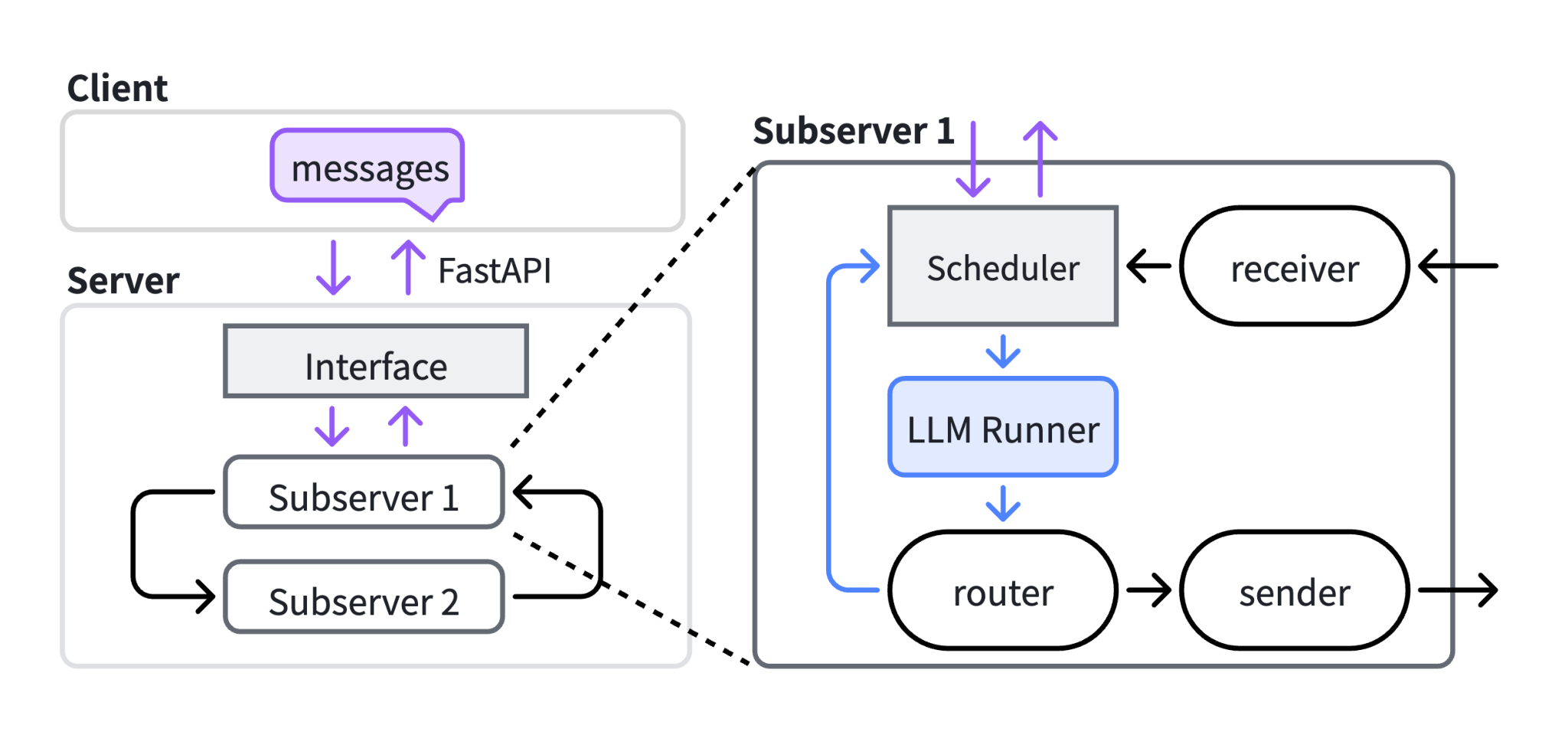
Under the hood (Figure 2b), each candidate LLM gets a subserver containing its own scheduler, LLM runner, private KV-cache pool, and the three user callbacks. Subservers advance independently and exchange peer requests over an internal protocol; externally, TokenRouter exposes one OpenAI-style endpoint and is drop-in compatible with vLLM/SGLang clients.
Two mechanisms address the system pathologies:
- Asynchronous tri-loop execution with handoff-resume. Each subserver runs three decoupled loops (admission, forward, routing/dispatch), so a hand-off from model A to model B does not stall A’s next step. The handoff-resume mechanism carries the needed KV/context slice through
send/receiveso B can resume generation without recomputation beyond what the algorithm requires. - Delayed batching. Instead of admitting new (or returning) requests immediately, each subserver waits briefly to accumulate a larger same-model batch. The scheduler is parameterized by per-model admission thresholds B_i: the subserver fires when either B_i requests are queued or a timeout elapses. The paper derives optimal B_i analytically from a throughput model and validates predictions empirically.
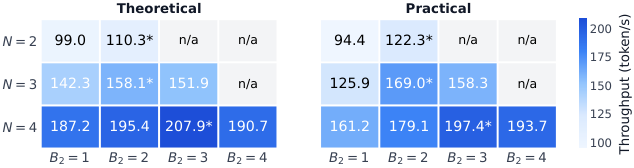
Figure 10 shows that the analytical model tracks measured throughput closely across concurrency levels, and that the optimal B_1 (marked with asterisks) shifts with load — justifying making B_1 a tuned function of concurrency rather than a static constant. The implementation sits on top of SGLang, inheriting its KV-cache management and continuous batching for intra-subserver work.
Experiments
Evaluation covers five routing algorithms. CITER, R2R, R-Stitch, and Co-LLM route between Qwen3-0.6B and Qwen3-32B; ME routes among Qwen3-0.6B/8B/32B. Hardware is an 8×A100-80G node; two-model setups place the small model on one GPU and the 32B on two GPUs with tensor parallelism, co-sharing two GPUs via CUDA MPS. Workloads span low-effort reasoning (AIME2024, max 2048 output tokens), high-effort reasoning (AIME2024 filtered to >8192-token solutions, max 8192), and agentic SWE-Smith trajectories (~8192 input, 1024 output).
Baselines are (i) the official code for each algorithm, where available — Co-LLM uses per-model vLLM with continuous batching; CITER and R2R are single-request engines — and (ii) Std. Serving, a fair SGLang-based baseline using one SGLang server per LLM with an external dispatcher that routes one token at a time. Throughput is measured as total generated output tokens divided by wall time, with N workers each issuing a new request on completion.
The selected sections describe setup rather than headline numbers, but the system is positioned to beat Std. Serving primarily by (a) eliminating per-token dispatcher round-trips via in-process peer requests, and (b) recovering large-model batch sizes through delayed batching under concurrency.
Limitations and open questions
- Optimal B_i depends on concurrency and workload mix; the derivation assumes a stable arrival regime. Behavior under bursty or adversarial routing patterns is not shown in the excerpted sections.
- KV-cache duplication across subservers scales GPU memory with the number of models; the MPS co-location trick works for two Qwen3 models on two GPUs but is not obviously general.
- The abstraction assumes routing can be expressed per-request; algorithms that make joint decisions across a batch (e.g., global speculative scheduling) don’t fit cleanly into
route/send/receive. - Fairness and tail latency under heterogeneous request mixes are not addressed in the excerpt.
Why this matters
Token-level routing has been an algorithms story told on top of toy inference loops; TokenRouter is the first serving-system treatment that confronts step desynchronization and batch admission delay directly, with an abstraction clean enough that five different routing algorithms share one runtime. If the Pareto gains from token-level routing survive at production concurrency, systems like this are the missing piece between the papers and real deployments.
Source: https://arxiv.org/abs/2610.12242
From Traces to Agentic Worlds: Agentic Language World Models for Interactive Environment Simulation
Problem
Training and evaluating LLM agents increasingly depends on faithful replicas of complex environments (operating systems, websites, SWE repos, enterprise portals). Rebuilding those environments as executable simulators is often infeasible: the underlying systems are proprietary, stateful in ways that are hard to serialize, or simply gone. Prompt-based language world models (LWMs) that ask an LLM to “pretend to be the environment” suffer from a known failure mode: they produce locally plausible observations but drift from any coherent state, so long-horizon trajectories collected against them are not faithful rollouts of the real system. The paper asks whether, given only recorded interaction traces, one can build a stateful language world model that is faithful enough for multi-turn agent evaluation and replay.
Method: Trace2Env
Trace2Env is a learning-free framework that separates (i) an offline reconstruction of a reusable environment worldbook from traces and (ii) an online world model agent that uses that worldbook plus episodic state to answer each action.
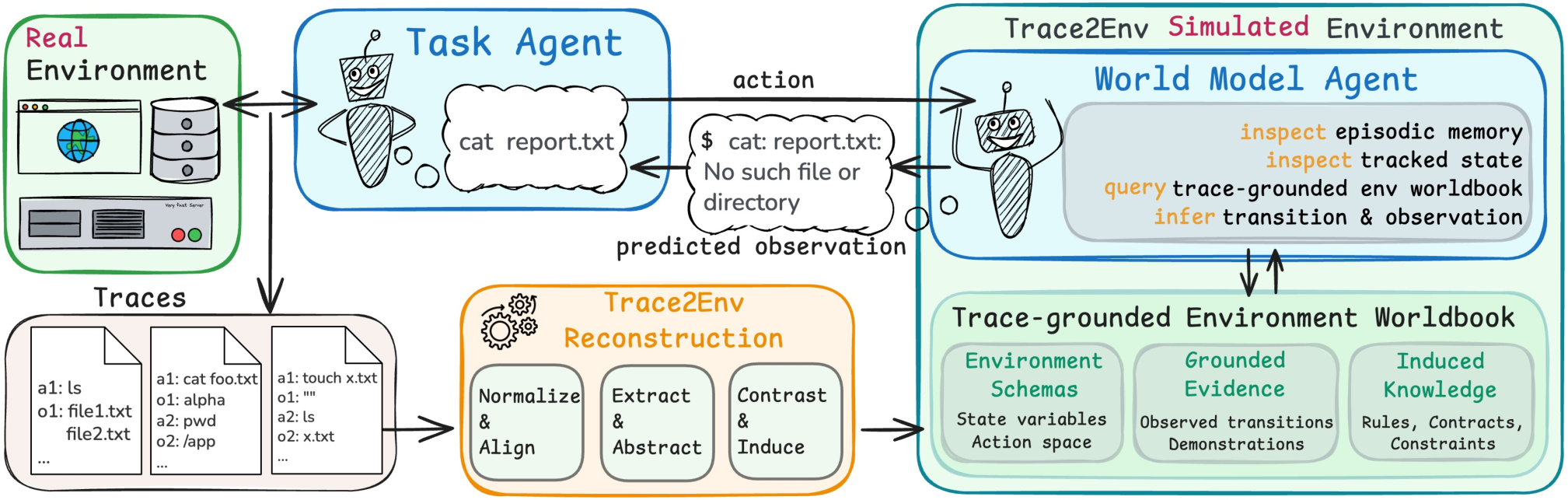
Offline worldbook construction. Given build traces \mathcal{D}_{\text{build}}, a constructor \phi produces
K_{\mathcal{E}} = \operatorname{Construct}_{\phi}(\mathcal{D}_{\text{build}}).
K_{\mathcal{E}} has four components: (1) Schemas fixing the action interface and the state fields the simulator will maintain; (2) Grounded evidence, i.e. preserved transitions with original observations, used as demonstrations and as a fallback for details that no rule covers; (3) Induced abstractions, which are candidate behavioral rules — conditional effects, preconditions, observation contracts, naming conventions — proposed from recurring patterns and validated against contrasting cases: a success/failure pair can propose a missing precondition, and a counterexample narrows or marks a rule tentative; (4) Provenance linking every schema field, rule, or demonstration back to the trace turns that support it. Effects whose attribution is ambiguous are withheld rather than inflated into rules. The worldbook is frozen as an immutable artifact and reused across rollouts.
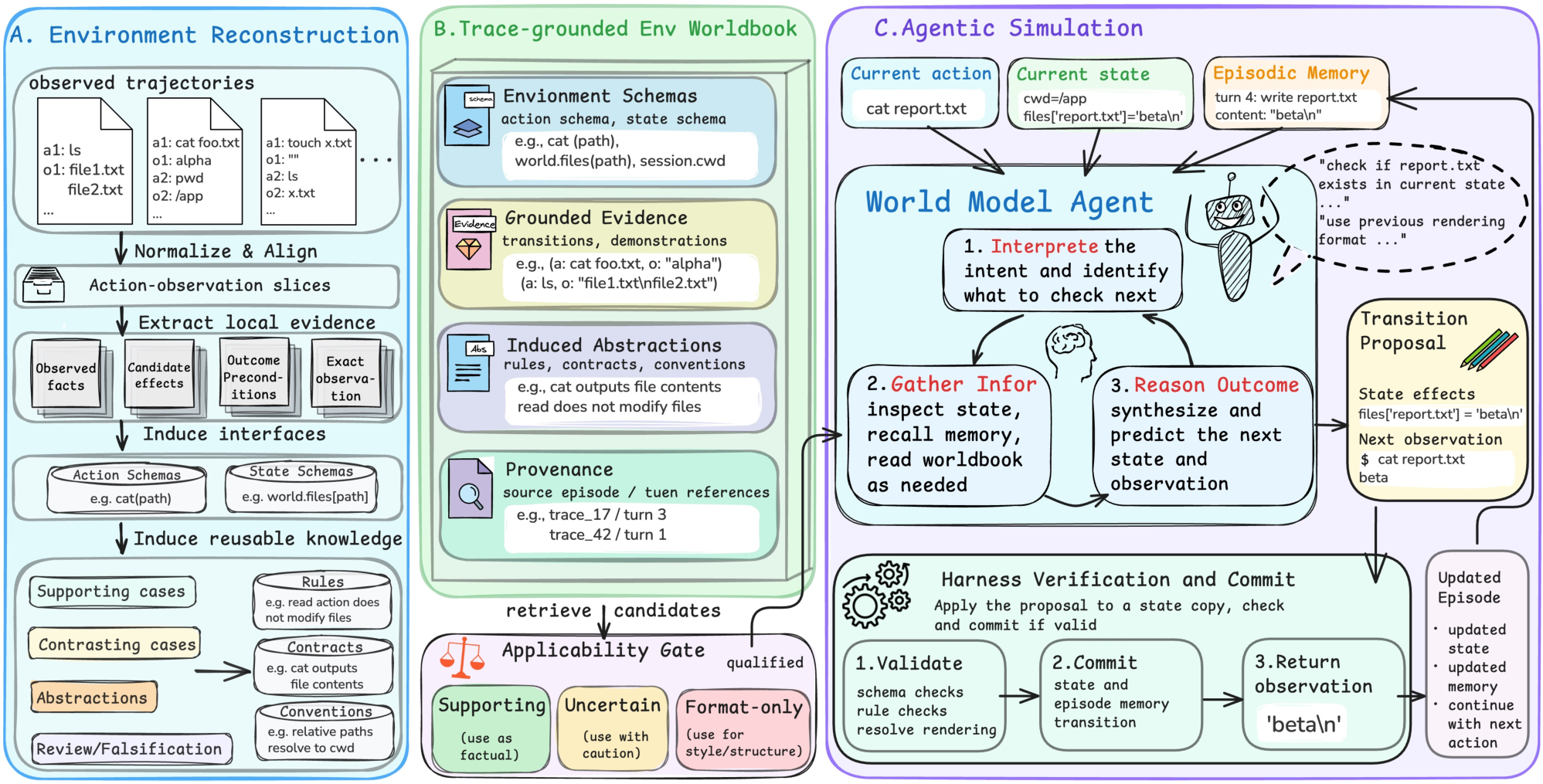
Online simulation. At rollout, a harness maintains the mutable episode state and interaction memory; the world model agent proposes each transition by consulting the worldbook at different levels of specificity (schema → induced rule → grounded observation), and the harness controls which state changes are committed. This split is important: the LLM is used as an interpreter over an explicit, structured environment representation, not as the environment itself.
Experiments
Evaluation spans nine environments. Single-step next-observation prediction uses the Terminal, SWE, Android, and Web splits of AgentWorldBench and three EnvScaler environments (Food, Shopping, Benefits). Multi-turn interaction uses ALFWorld and SciWorld, where a task agent interacts with the simulated environment directly. The paper reports that Trace2Env improves next-observation fidelity and long-horizon interaction consistency over conventional prompt-based LWMs across these nine environments, and — critically — that actions a task agent generates against Trace2Env remain valid more often when replayed in the real environment. (The provided excerpts summarize these as directional gains across all nine settings; specific per-environment numbers are in the full tables.)
Qualitative behavior
The ALFWorld case in Figure 4 is diagnostic of what the worldbook buys you.
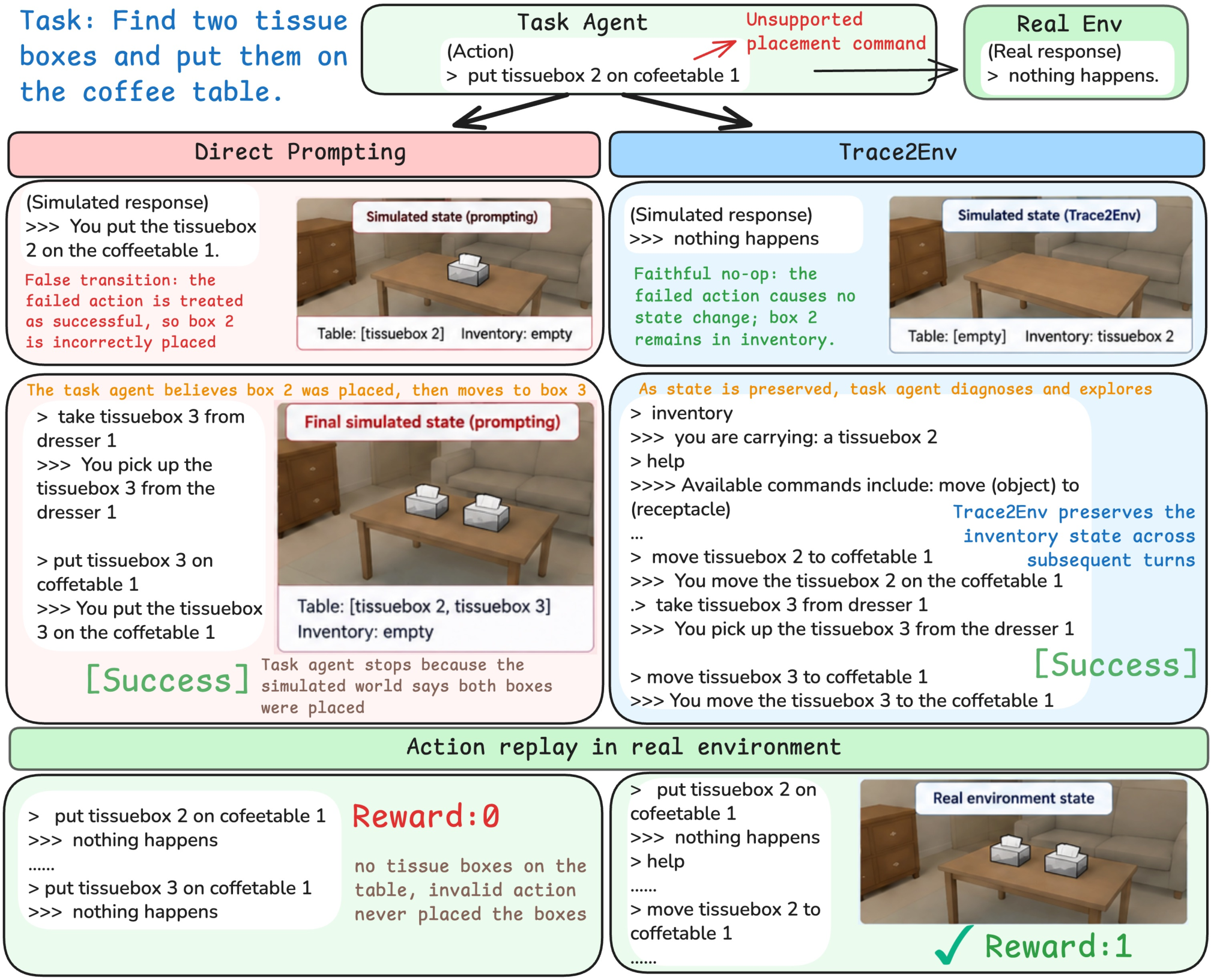
put action: Direct Prompting hallucinates success and drifts; Trace2Env returns a correct no-op and preserves inventory, enabling recovery.Direct Prompting accepts an unsupported put as successful, commits a false placement, and continues from a state the real ALFWorld never reaches; the rollout is internally consistent and even looks successful under the LWM, but the trajectory is unreplayable. Trace2Env instead predicts the correct no-op — because the induced rule plus schema reject the action — and persists the fact that tissuebox 2 is still in inventory. Subsequent inventory and help responses then expose the unchanged state, so the task agent can recover with a valid move. The authors use this to argue that faithful long-horizon simulation is less about getting any single observation right than about keeping the state consistent across turns, which is where prompt-only LWMs structurally fail.
Limitations and open questions
Trace2Env is learning-free and inherits the coverage of the build traces: environment behaviors that never appear in traces cannot be induced into rules, and the worldbook can only degrade to grounded evidence or schema defaults. Rule validation is based on contrasting cases observed in the traces, so systematically missing contrasts can leave incorrect rules unmarked. The approach also assumes action/state can be given a schema, which is harder for environments with open-ended observations (e.g., raw screenshots). Finally, “replay validity” measures whether the real environment accepts the agent’s actions, not whether the task is actually solvable; distinguishing simulator-induced from policy-induced failures at scale remains open. The paper also does not quantify how worldbook quality scales with trace volume or with construction-model capability.
Why this matters
Agent benchmarks are bottlenecked by the cost of maintaining executable environments. Trace2Env points at a practical middle ground: treat historical traces as the ground truth, compile them into a structured, provenance-tagged worldbook, and let an LLM operate — not improvise — that worldbook as a stateful simulator. This is a cleaner factoring of “LLM-as-environment” than prompt-based LWMs and makes replayability, rather than local plausibility, the primary target.
Source: https://arxiv.org/abs/2610.06100
Multi-Agent Egocentric World Model with Fine-Grained Embodied Interaction
Problem
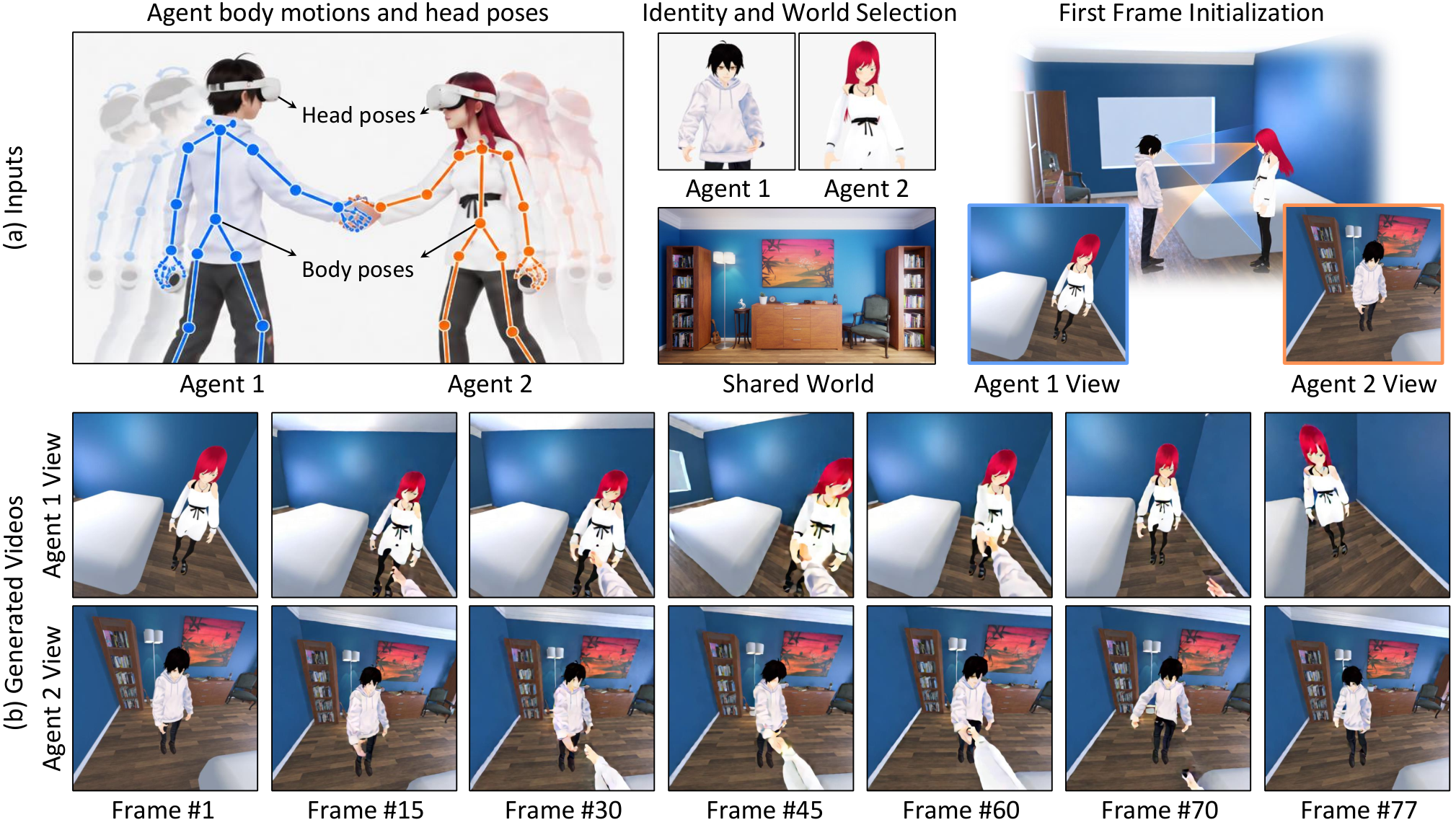
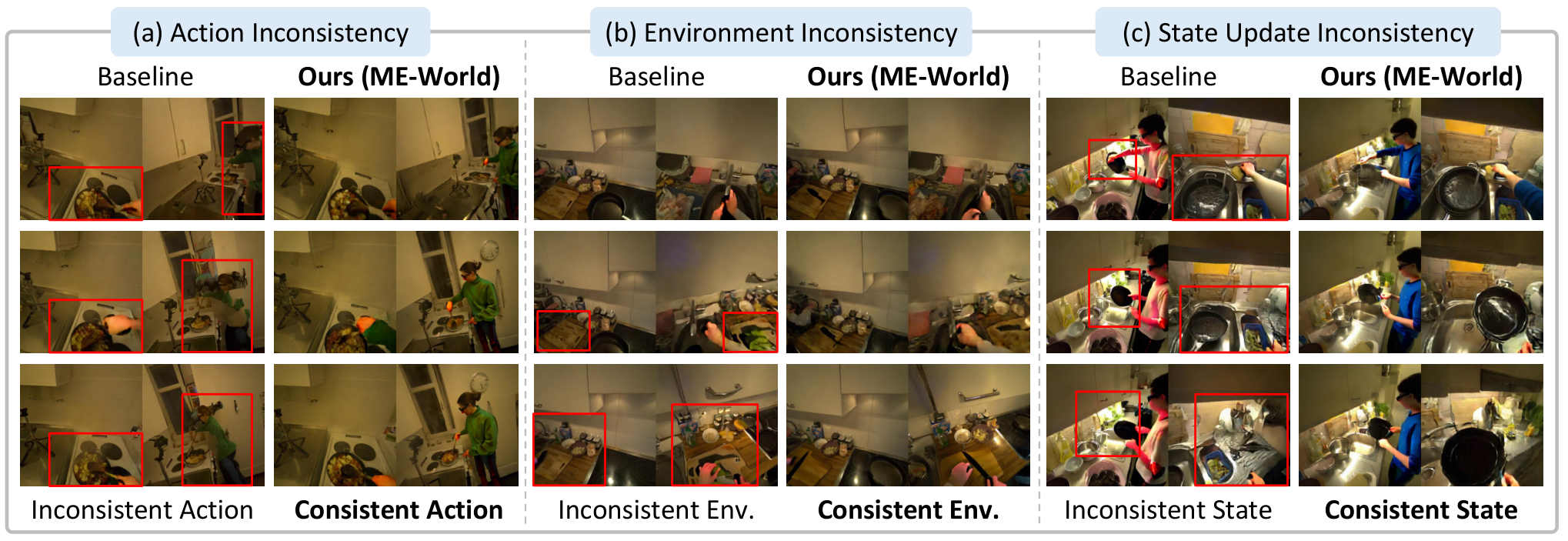
Egocentric world models predict first-person video conditioned on an agent’s actions, but existing systems are single-agent or restrict multi-agent conditioning to coarse signals (locomotion, discrete commands, camera pose). Real embodied scenarios — two people manipulating objects on a shared table, cooperating in a kitchen, handing items between each other — require synchronized generation of multiple ego streams driven by fine-grained body and head motion, with three consistency properties that single-agent models cannot provide:
- Cross-view action consistency: agent n’s action must produce coherent effects in agent m’s view when n is visible to m.
- Shared-environment consistency: unobserved regions in one stream must agree with the same regions observed by the other.
- Interaction-induced state updates: when agent n moves an object, agent m’s view must reflect the same update.
The paper’s Figure 2 pinpoints the failure modes of naive approaches: independent per-agent generation causes action desync (a), background drift (b), and inconsistent object states (c).
Formulation
For N agents (experiments use N=2), the model generates future ego streams X^{(n)}=\{x_t^{(n)}\}_{t=1}^T conditioned on
C=\{E,\, A^{(1:N)},\, P^{(1:N)},\, x_0^{(1:N)}\},
where A^{(n)} is agent n’s head+body action sequence, P^{(n)} its text prompt, x_0^{(n)} its first ego frame, and E a pooled observation-history memory shared across agents. The target distribution is p(X^{(1:N)} \mid C), with the key constraint that marginals over different n must agree on scene and interaction state.
Method
ME-World is a diffusion model with three ingredients (Figure 3).
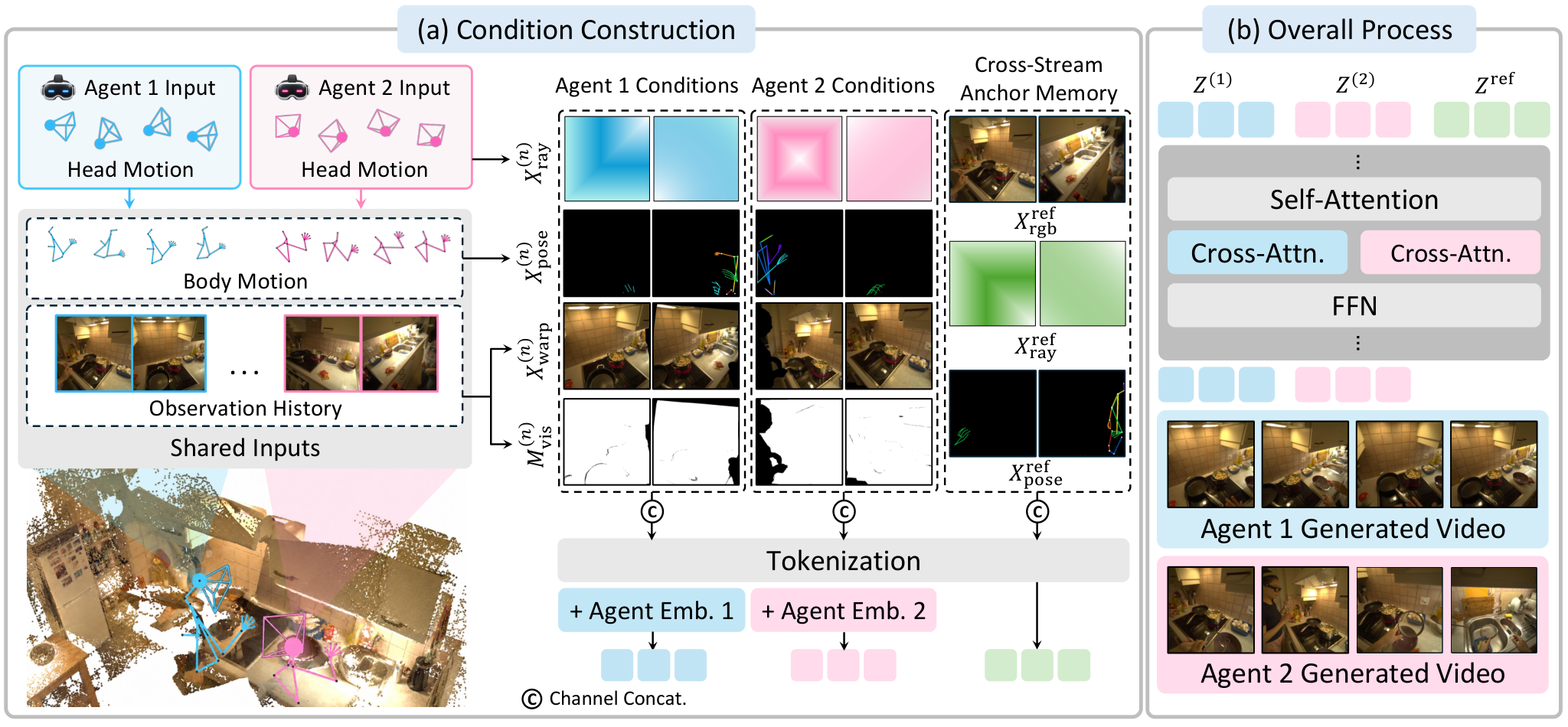
Joint multi-agent denoising (Sec. 3.2). Rather than denoising each X^{(n)} independently, all agents’ latents are concatenated into a single token sequence and jointly denoised. Attention therefore mixes tokens across streams, so information about agent m’s pose and action can shape agent n’s view (e.g., rendering m’s hand in n’s field of view). This is the structural fix for the independence failures in Figure 2(b,c).
Shared action conditioning (Sec. 3.3). Each stream receives not only its own viewing-ray/pose embedding but also target-view pose embeddings of all other agents. Concretely, per-agent conditioning builds viewing ray maps from head pose, and the token sequence is additionally conditioned on all agents’ body/head actions, so that each stream knows where every other agent is and what they are doing. This addresses Figure 2(a): when agent 2 moves an object, agent 1’s stream has the information needed to depict that motion.
Shared environment memory (Sec. 3.4). Observation histories from both agents are pooled into E and used to warp prior observations into each target view, producing warped-history conditions X_{\text{warp}}^{(n)} along with visibility masks M_{\text{vis}}^{(n)}. This grounds generation in a common geometric substrate and, critically, enables the evaluation protocol below.
Results
The abstract summarizes gains: ME-World improves shared-world consistency, action control, and identity preservation. (The provided excerpt reports metric definitions but omits specific numerical ablation values; the paper’s quantitative tables, which are not included in the excerpt here, are needed for exact deltas.)
Limitations and open questions
- Experiments are two-agent; the formulation is general in N, but attention over concatenated multi-stream token sequences scales quadratically, and the paper does not report N>2 runs in the excerpt.
- The metrics rely on ground-truth metric depth and camera poses to establish co-visible correspondences; evaluating in-the-wild without this scaffolding is unresolved.
- Fine-grained hand-object physics (grasp forces, deformation) is not explicitly modeled; consistency is enforced visually via joint denoising rather than via a physical state.
- Shared environment memory is built from past observations; novel environments or long-horizon drift when both agents move into unseen regions is a natural stress test not addressed in the excerpt.
Why this matters
Multi-agent egocentric generation is the natural substrate for training and evaluating embodied agents that must reason about what another agent sees and does — a prerequisite for cooperative manipulation, imitation from third-person-plus-ego data, and simulation-based policy learning in shared workspaces. The paper’s S_{\text{env}}/S_{\text{update}}/S_{\text{id}} protocol is also a cleaner evaluation primitive than existing VLM-judged cross-view agreement, because it explicitly excludes consistency that is trivially inherited from shared inputs.
Source: https://arxiv.org/abs/2610.12299
DreamTrue: Action-Faithful Robot World Model with Counterfactual Post-Training
Problem
Robot world models that predict future video given (\bm{x}_0^{1:V}, \ell, \bm{a}_{1:T}) are increasingly used as simulators for policy evaluation and planning. Two systematic issues block their deployment at scale. First, when action trajectories are injected as text tokens or raw end-effector coordinates, prediction fidelity to the commanded action is low and highly sensitive to miscalibrated extrinsics in the source data. Second, publicly available teleoperation datasets are dominated by successful executions, so the learned p_\theta places most mass on “the task succeeds” regardless of the commanded trajectory — a form of action-insensitivity that degrades counterfactual rollouts (e.g., deliberately missing the grasp, colliding, slipping). DreamTrue tackles both: geometric calibration plus image-space action conditioning for faithfulness, and reward-model-guided RL post-training on counterfactual trajectories for physical plausibility.
Method
The model factorizes as \hat{\bm{x}}_{1:T}^{1:V}\sim p_\theta(\bm{x}_{1:T}^{1:V} \mid \bm{x}_0^{1:V}, \ell, \bm{a}_{1:T}) over V synchronized views (Eq. 1). The pipeline has three parts.
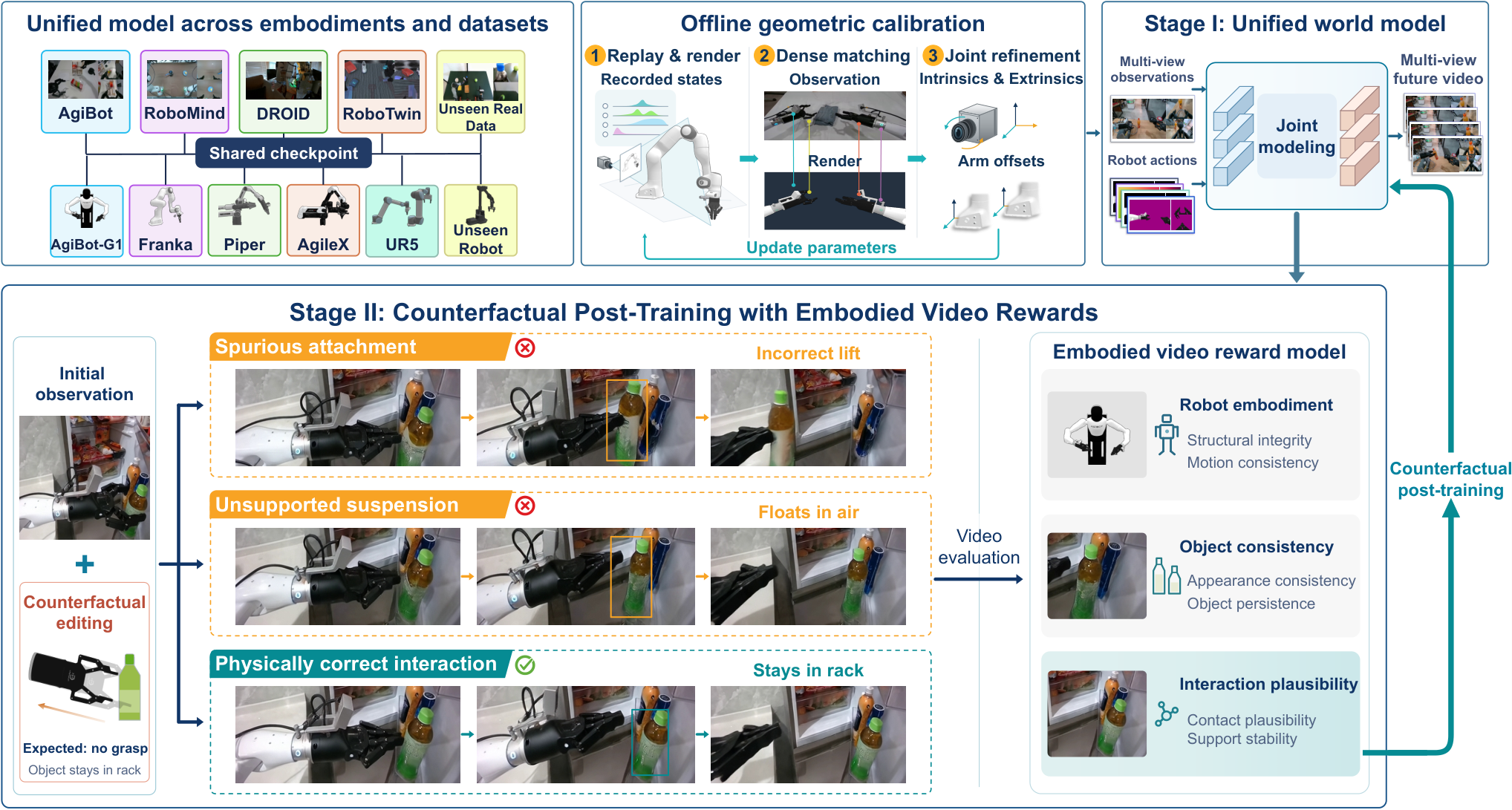
Offline geometric calibration. Rather than trusting dataset-reported extrinsics (which vary across AgiBotWorld-Beta, DROID, RoboMIND 2.0, RoboTwin 2.0), per-episode camera parameters and robot mounting offsets are refined so that URDF-rendered robot meshes overlay recorded frames. This is a prerequisite: the conditioning signal in Stage I is a rendered image of the robot following \bm{a}_{1:T}, so misalignment at training time directly injects noise into the action-to-pixel map.
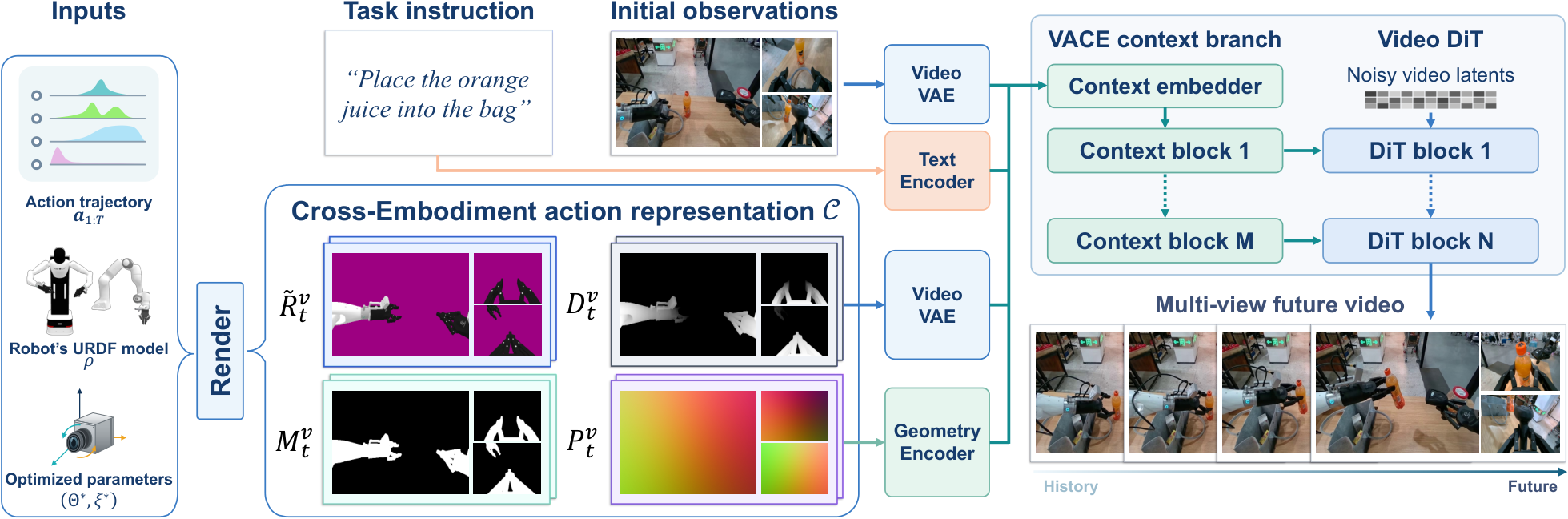
Stage I: multi-view action-conditioned DiT. Actions are turned into per-frame, per-view renderings of the robot in the commanded pose, together with scalar gripper-opening channels and per-pixel camera rays encoding intrinsics/extrinsics. These are fed into a video DiT backbone through a VACE-style conditioning branch (Figure 3). The design generalizes across embodiments: a 7-DoF Franka, a bimanual AgiBot, and simulated arms share the same conditioning interface because the rendering abstracts away embodiment-specific action parameterizations into image-space geometry.
Counterfactual trajectory generation. To escape the success-bias of training data, recorded \bm{a}_{1:T} are perturbed — e.g., shifted grasp points, altered approach vectors, premature gripper closures — producing trajectories whose ground-truth futures do not exist in any dataset. These counterfactuals are precisely where naïve world models fail (predicting the original successful outcome), and they are exactly the scenarios most useful for downstream policy evaluation.
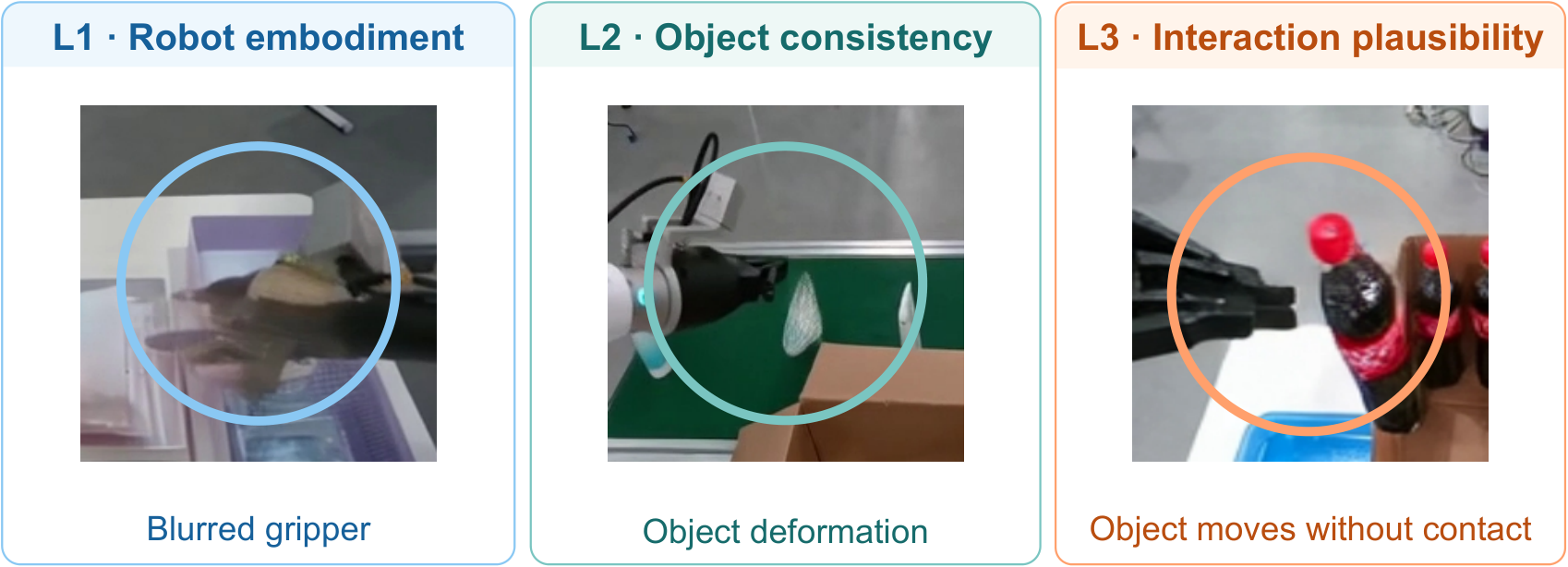
Stage II: reward-model-guided post-training. Because paired ground-truth video is unavailable for counterfactuals, the authors construct a human-annotated defect dataset along three axes (Figure 4): L1 robot embodiment defects (impossible joint configurations, floating/duplicated arms), L2 object consistency defects (objects teleporting, dissolving, duplicating), and L3 interaction plausibility defects (penetration, non-contact “magnetic” grasps, physically impossible stacking). An embodied video reward model is trained on these annotations and its scalar score is used as the reward in RL post-training over the diffusion sampler, pushing predictions on counterfactual conditions toward physically plausible outcomes without requiring matched futures.
Results
Training uses 2,232 hours of multi-view trajectories across five arm types from AgiBotWorld-Beta, DROID, RoboMIND 2.0, and RoboTwin 2.0 after filtering. Evaluation is on held-out episodes plus a purpose-built AgiBot counterfactual benchmark: 160 perturbed test conditions across 54 tasks.
The abstract reports state-of-the-art action-following on AgiBot and a reduction in human-assessed interaction defects after Stage II (the specific percentage is truncated in the provided abstract text; the ordering of claims — SOTA action following and reduced defect rates after reward-model RL — is what the method is designed to deliver). The crucial comparison is the counterfactual split: standard world models collapse to the recorded success mode here, whereas DreamTrue’s reward-guided post-training is meant to retain action-faithfulness even when the commanded \bm{a}_{1:T} should produce failure.
Limitations and open questions
Several concerns remain. (i) The reward model is trained on three discrete defect categories; it provides a sparse signal and will likely miss long-horizon dynamics errors (momentum, deformation, friction) that are not easily labeled from short clips. (ii) Image-space action rendering requires an accurate URDF and calibrated cameras at inference time, which is a non-trivial deployment cost compared to raw action-token conditioning. (iii) Counterfactual trajectories are generated by local perturbations of recorded ones; the induced distribution is still anchored to the demonstration manifold and may underrepresent genuinely novel contact modes. (iv) RL post-training over diffusion samplers can collapse diversity; the paper’s reported metrics should be read alongside sample-diversity measures that are not previewed in the provided excerpts. (v) Cross-embodiment transfer is claimed across five arms but the degree to which the model generalizes to unseen kinematics (e.g., humanoids, mobile manipulators) is not established here.
Why this matters
Robot world models are only useful as counterfactual simulators if they remain faithful to commanded actions in regimes the training data never shows. DreamTrue’s combination of image-space action conditioning with geometric calibration, plus a defect-level reward model that supplies supervision where ground-truth futures do not exist, is a concrete recipe for pushing video world models from “replay plausible demos” toward usable surrogate environments for policy learning.
Source: https://arxiv.org/abs/2610.12468
MC-Sparse: Deconstructing and Closing the Dense-Sparse Attention Gap in Diffusion Transformers
Problem
Sparse attention is the standard lever for reducing attention cost in diffusion transformers (DiTs) at long sequence lengths — HunyuanVideo-13B, Wan2.1-14B, and 3D asset DiTs all push attention into the tens-of-thousands of tokens regime where O(N^2) dense attention dominates DiT denoising latency. Existing block-sparse attention (BSA) variants (SVG2, SVG-EAR, SpargeAttn, PISA) degrade fidelity sharply at low densities (≤25%). This paper diagnoses why and proposes a training-free remedy.
Diagnosing the gap with oracles
The authors design three oracles that use the exact dense attention probabilities to select which entries to retain under a fixed density budget:
- Block oracle — picks the top-k KV blocks per query block (BSA’s upper bound).
- Token oracle (shared Q block) — picks individual KV tokens, but all queries in a block share one selection.
- Per-query oracle — picks KV tokens independently for each query.
Comparing vanilla BSA against these three isolates three error sources:
- Structural binding error — the gap between BSA and the oracles due to block granularity.
- KV binding: block-level KV selection drags in irrelevant tokens co-located with important ones.
- Query binding: queries in the same block are forced to share one selection despite different attention patterns.
- Selection error — the gap between oracle selection and heuristic score-based selection.
- Discarded tail error — the mass in the long tail of the softmax that any sparse method throws away.
Fig. 2 (referenced in the method but not supplied here) shows monotone accuracy gains as one moves block → token-shared-Q → per-query, confirming both KV binding and query binding contribute materially; Table 4 reproduces this at matched realized density.
Method: Meta-Cached Sparse Attention
MC-Sparse addresses all three errors while remaining GPU-efficient, exploiting the empirical observation that attention structure is stable across adjacent denoising steps. It designates certain diffusion steps as anchor steps where expensive bookkeeping is computed, and reuse steps where the cached metadata is applied.
(1) Token-level KV selection (removes KV binding). For each query group, MC-Sparse selects individual KV tokens, crossing block boundaries. A custom kernel gathers the chosen K,V online from their indices rather than repacking into contiguous blocks: \text{out}_g = \mathrm{softmax}\!\left(\frac{Q_g K_{\mathcal{I}_g}^\top}{\sqrt{d}}\right) V_{\mathcal{I}_g}, where \mathcal{I}_g is the set of selected KV indices for query group g.
(2) Tile-aligned query grouping (removes most query binding). Rather than grouping queries by position, MC-Sparse clusters queries by similarity so that within each group they genuinely want the same KV subset. To keep GPU tiles balanced, groups must have exactly C queries (the kernel’s query tile size). k-means violates equal size; hard-balanced k-means adds assignment overhead. The authors use median-split PDDP (principal direction divisive partitioning, Boley 1998): recursively project queries onto their top principal direction, split at the median, repeat until every leaf holds C queries. A Fast PDDP implementation (Sec. 4.4) makes this tractable on GPU.
(3) Caching across denoising steps. At anchor steps, MC-Sparse computes (i) PDDP query groups, (ii) KV indices \mathcal{I}_g chosen using exact attention probabilities on that step, and (iii) the residual R_g = O_g^{\text{dense}} - O_g^{\text{sparse}}, which captures the discarded-tail contribution. At reuse steps, it reapplies the cached groups and indices and adds the cached residual R_g to the sparse output. The residual term is the mechanism for partially recovering discarded tail error without paying per-step dense cost. Exact-probability selection on anchor steps targets selection error.
Results
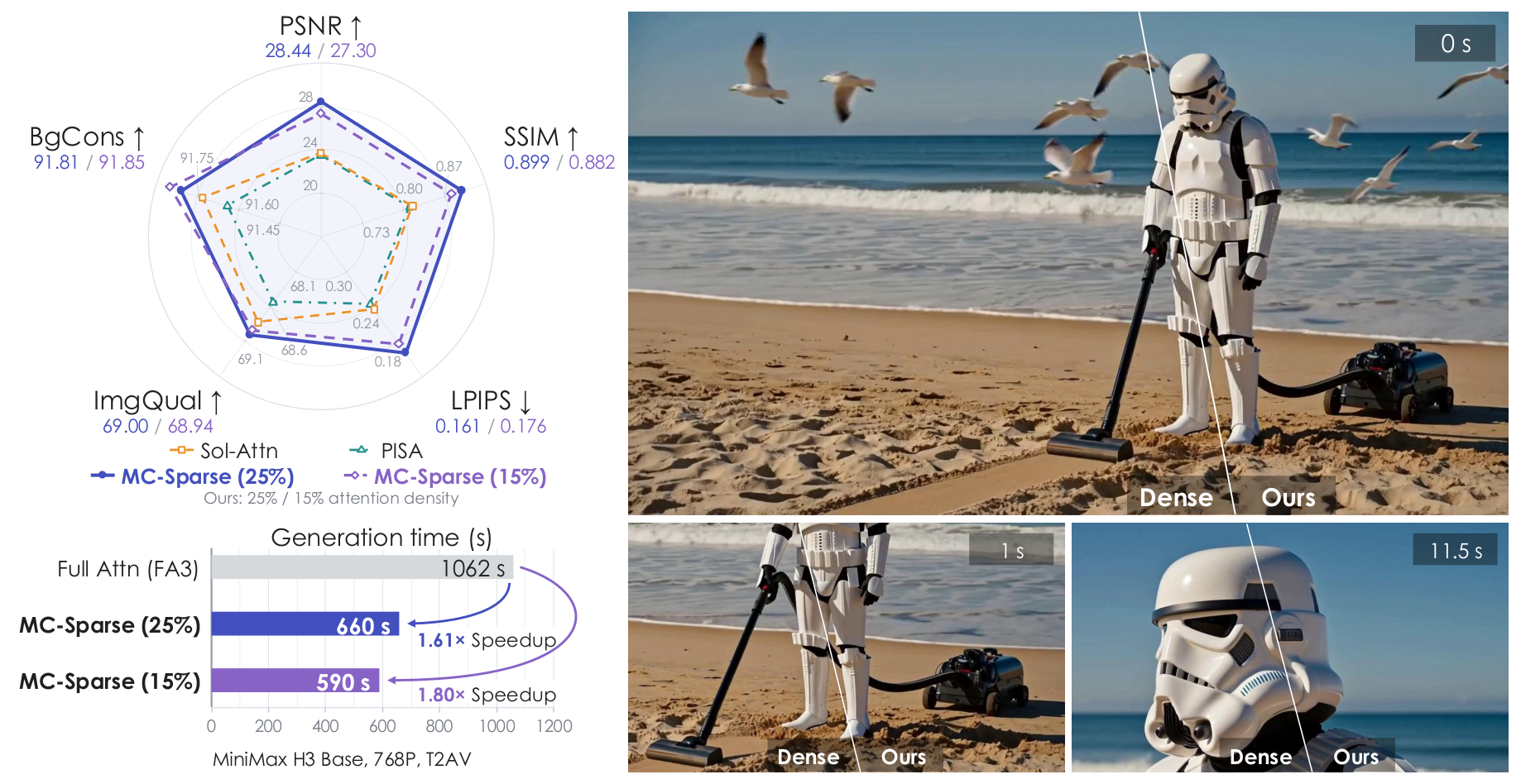
On Minimax-H3-Base at 768p, MC-Sparse delivers 1.80\times DiT denoising speedup over FA3 dense attention at 15% attention density, and 1.61\times at 25% density, while remaining visually indistinguishable from dense outputs in the reference frames. Evaluation spans Minimax-H3-Base, HunyuanVideo-13B, Wan2.1-14B T2V/I2V, and HY3D-Internal (image-to-geometry), with baselines SVG2, SVG-EAR, Sol-Attn, PISA, and SpargeAttn.
Fidelity to dense is measured with PSNR/SSIM/LPIPS for video; VBench ImgQual and BgCons for perceptual quality; and Chamfer distance, volumetric IoU, F1, Uni3D-I, and ULIP3D-I for 3D geometry. Across these metrics MC-Sparse reports higher fidelity to dense outputs than all baselines at matched density.
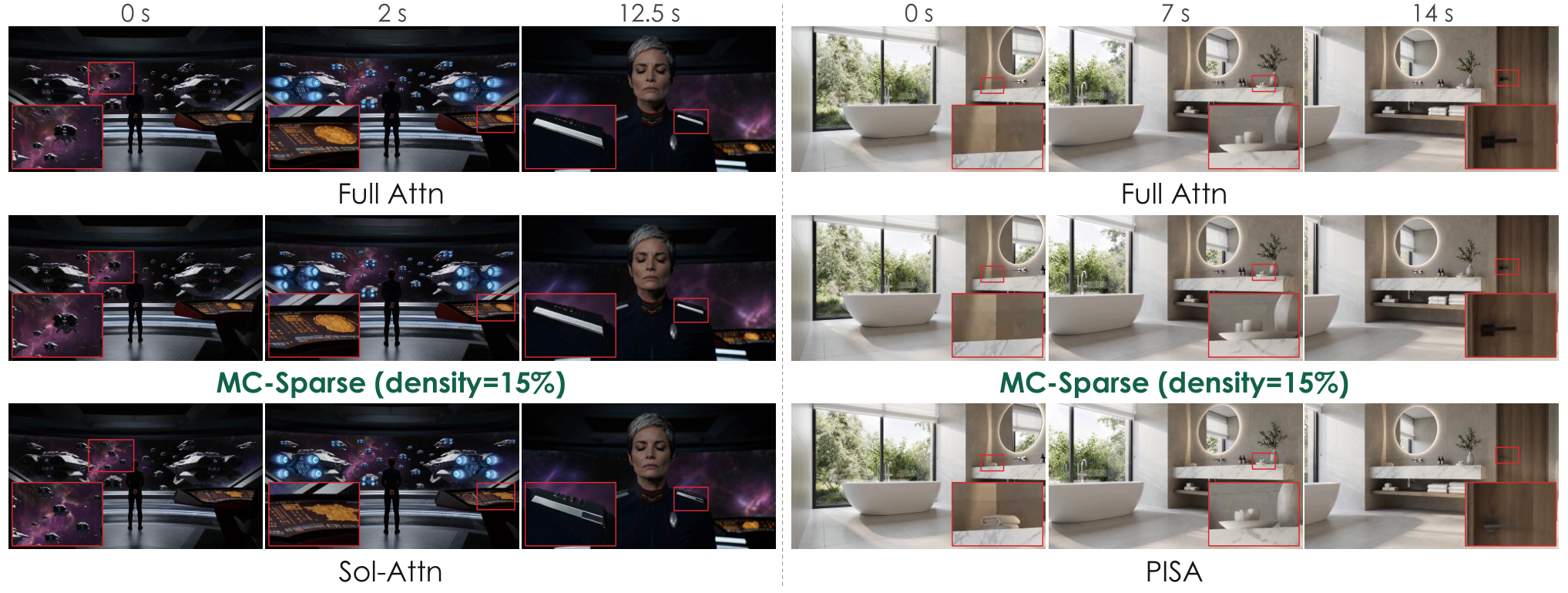
The video comparison shows that competing sparse methods introduce either structural artifacts or motion inconsistencies at aggressive density, which MC-Sparse avoids.
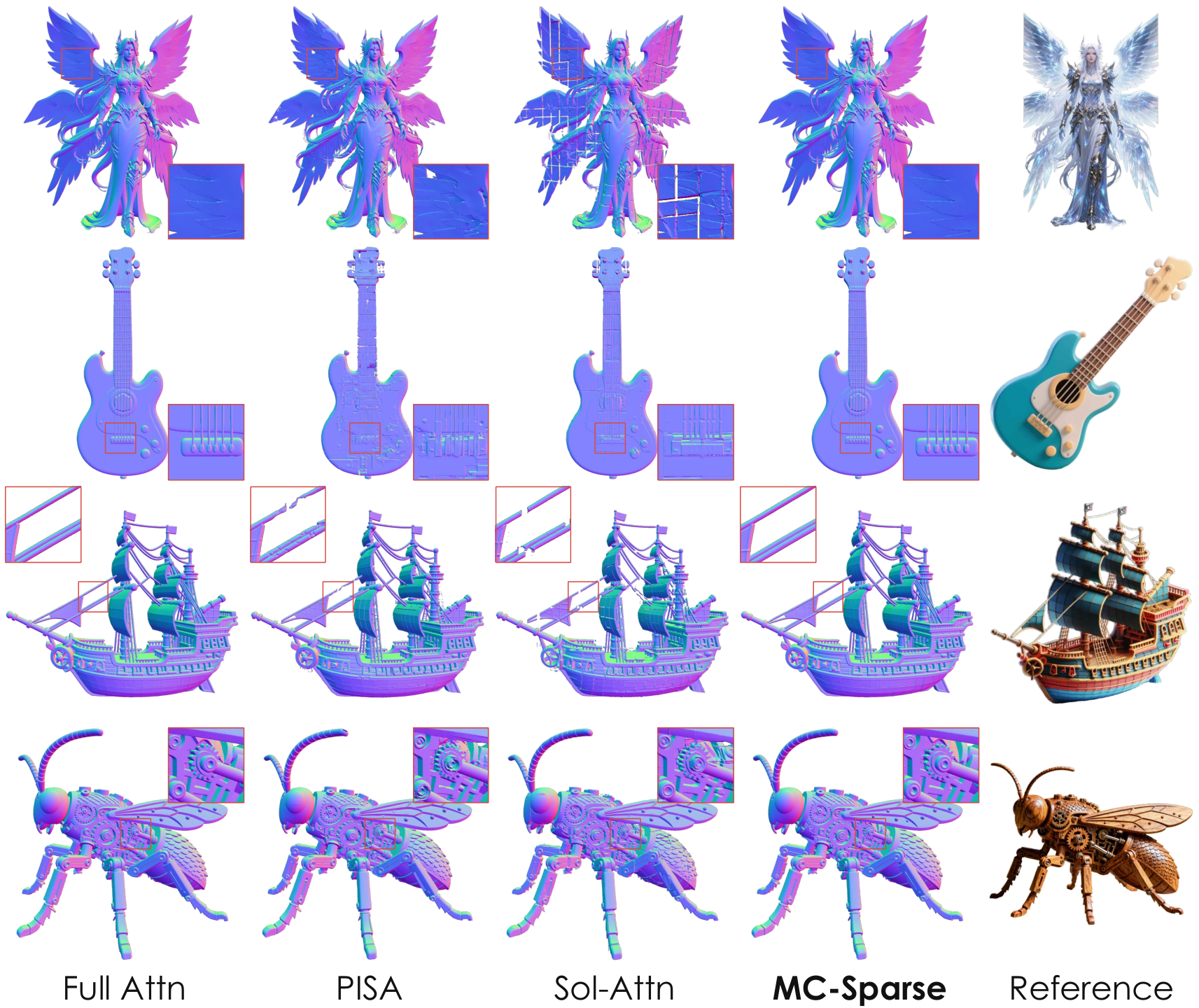
On 3D asset generation the gap is more visible: baselines lose geometric detail (surface noise, dropped features) at low density, while MC-Sparse preserves fine geometry close to dense.
Limitations and open questions
- The residual cache R_g is computed once at an anchor step and reused as a static correction; if the dense–sparse residual drifts between anchors, errors accumulate. The paper does not report sensitivity to anchor spacing or an adaptive rescheduling policy.
- Token-level KV gather is kernel-bound; speedup over BSA depends on how well the custom gather-attention kernel saturates memory bandwidth versus block-contiguous SVG2/SpargeAttn kernels. The 1.80\times at 15% density is modest relative to the \sim 6.7\times theoretical FLOP reduction.
- PDDP ignores per-head structure in MHA; grouping is done on Q features but each head has its own K,V. The paper notes this but does not quantify the loss.
- All evaluation is zero-shot inference on pretrained models; no claim is made about compatibility with distillation or few-step samplers where attention stability across steps may be weaker.
Why this matters
The oracle decomposition cleanly separates structural, selection, and tail errors in sparse attention, giving a reusable diagnostic framework rather than another heuristic. The engineering contribution — token-level selection with PDDP-balanced query tiles plus a residual cache — is the first training-free sparse attention to approach dense fidelity at ≤25% density on production-scale video and 3D DiTs.
Source: https://arxiv.org/abs/2610.06801
SparseDecoding: Decoding-Aware Pruning for Accurate and Efficient LLM Inference
Problem
Post-training pruning via Optimal Brain Surgeon (OBS) and its descendants (SparseGPT, Wanda) has become the dominant route to shrinking LLM memory traffic during decoding, which is bandwidth-bound. All of these methods compute a layer-wise Hessian H_\ell = 2 X_\ell X_\ell^\top from calibration activations X_\ell obtained by teacher-forcing natural text (e.g., C4, WikiText) through the dense model. At inference time, however, the model consumes its own autoregressive outputs. The authors argue that this induces a distribution shift between calibration activations and decoding activations: the Hessian used to score weight saliency is systematically mismatched with the operator the pruned model actually computes against. Empirically this shift degrades generation quality in ways that are invisible to perplexity on held-out natural text.
A second gap is systems-level. Existing accelerated sparse LLM kernels target sparse matrix-matrix multiplication (SpMM), which arises in prefill. Decoding, by contrast, is dominated by sparse matrix-vector products (SpMV) with batch size 1, where typical 2:4 or block-structured kernels give limited wall-clock gains over dense cuBLAS GEMV.
SparseDecoding addresses both: a decoding-aware calibration procedure that drives the OBS Hessian toward the generation distribution, plus an SpMV kernel targeted at the memory-bound regime.
Method
The pruning backbone remains layer-wise OBS. For each linear layer \ell, one solves
\widehat{W}_\ell = \arg\min_{\widetilde W_\ell} \left\lVert (W_\ell - \widetilde W_\ell) X_\ell \right\rVert_F^2 \quad \text{s.t.} \quad \operatorname{sparsity}(\widetilde W_\ell) = S_\ell.
Because the squared Frobenius loss decomposes over rows and shares a Hessian H = 2 X_\ell X_\ell^\top, OBS gives closed forms for the least-salient weight w_q and the compensating update:
\mathcal{L}_q = \frac{w_q^2}{2 [H^{-1}]_{qq}}, \qquad \delta w = -\frac{w_q}{[H^{-1}]_{qq}} H^{-1}_{:,q}.
SparseGPT fixes the pruning order a priori so that H^{-1} can be maintained incrementally rather than re-inverted after every removal. SparseDecoding inherits this skeleton; the key change is how X_\ell is collected.
Rather than running teacher-forced natural sequences through the dense model, SparseDecoding generates calibration activations autoregressively: a prompt set is sampled, and the dense model is used to produce completions, with activations at each layer harvested along the generated prefix. The resulting X_\ell^{\text{gen}} reflects the self-generated token distribution, so H_\ell^{\text{gen}} = 2 X_\ell^{\text{gen}} (X_\ell^{\text{gen}})^\top measures saliency with respect to the operator the pruned model will actually face during decoding. Because this change is purely in the calibration pipeline, it composes with any OBS-style solver (SparseGPT, Wanda-with-updates) and any sparsity pattern (unstructured, 2:4, N:M).
The kernel side targets SpMV with weight sparsity in the regime where the weight matrix does not fit in on-chip SRAM. Rather than exploiting 2:4 via mma.sp (which is tuned for GEMM throughput and still forces reading dense activations), the SpMV kernel is organized so that each threadblock streams a sparse row tile from HBM once, uses the compressed index structure to gather only the needed activation entries, and accumulates the dot product in registers. Because decoding at batch size 1 is bounded by HBM bandwidth consumed reading W, reducing nonzeros translates directly into reduced latency, provided the index overhead per nonzero is small — hence the preference for structured sparsity patterns with cheap decoding.
Results
The authors evaluate four instruction-tuned models — Llama-3.1-8B, Llama-3.3-70B, Qwen3-14B, and Qwen3-32B — pruning only linear layers on A100 80 GB. The abstract and experimental setup indicate three evaluation axes: long-form writing quality under autoregressive calibration, code generation generalization, and SpMV decoding latency. The excerpted sections do not include numerical tables, so specific accuracy and speedup figures cannot be quoted here; what is claimed is that (i) autoregressive calibration preserves quality on long writing tasks relative to natural-text calibration under identical sparsity budgets, (ii) the same calibration generalizes to code without a separate code-domain calibration set, and (iii) the SpMV kernel delivers wall-clock decoding speedup rather than only FLOP reduction.
Limitations and open questions
The framing assumes the shift between natural-text and self-generated activations is both measurable and reducible by swapping the calibration source. Several questions are left open by the provided material. First, autoregressive calibration is more expensive than teacher-forced calibration (each sample requires sequential decoding), and the paper does not quantify how many generated tokens are needed before H_\ell^{\text{gen}} stabilizes. Second, the generated distribution depends on sampling temperature and prompt mix; the method’s sensitivity to these knobs — and whether greedy decoding suffices — is not addressed in the excerpt. Third, the Hessian is still computed from the dense model’s generations, but the deployed model’s generations will drift as it is pruned; a single-shot calibration ignores this closed loop. Fourth, SpMV kernels at batch size 1 compete with highly tuned dense GEMV plus FP8/INT4 weight quantization, which also attack the HBM bottleneck; a head-to-head against quantized dense baselines on the same hardware would clarify where sparsity remains attractive. Finally, interactions with KV-cache memory, which often dominates decoding bandwidth at long contexts, are not discussed.
Why this matters
The distribution-shift argument reframes a known weakness of post-training pruning: calibration data is usually chosen for convenience, not for match to the deployment-time operator. Correcting this at the Hessian level, while shipping an SpMV kernel that actually realizes the FLOP savings in decoding wall-clock time, closes a long-standing gap between pruning papers and inference-serving practice.
Source: https://arxiv.org/abs/2610.12327
Hacker News Signals
Sub-1-Bit LLM Compression via Latent Factorization
Source: https://github.com/SamsungLabs/LittleBit
LittleBit from Samsung Research pushes weight compression below 1 bit per parameter by decomposing weight matrices into a product of low-rank latent factors and learned codebooks. The core idea: instead of quantizing weights directly, factorize W \approx A B where A \in \mathbb{R}^{m \times r} is kept in low-precision floating point and B \in \{-1, +1\}^{r \times n} is a binary matrix, with r \ll \min(m, n). The effective bits-per-weight drops below 1 because the binary factor dominates storage and the rank r controls the expressivity-compression tradeoff.
The optimization alternates between updating A (a standard least-squares step) and updating B (a sign-threshold projection). Calibration uses a small held-out dataset to minimize layer-wise reconstruction error, similar in spirit to GPTQ but operating on the factored representation rather than rounding individual weights.
The repo targets LLaMA-class models and reports perplexity degradation competitive with 2-bit methods (e.g., GPTQ at 2 bits) while using roughly half the storage. Inference speed depends heavily on whether hardware can exploit binary matrix operations; on commodity GPUs this is non-trivial and the repo currently does not provide a fused binary GEMM kernel, which limits practical throughput gains.
The key open question is how the rank hyperparameter r interacts with layer sensitivity — attention projections and feed-forward layers have very different singular value distributions, and a single global r is unlikely to be optimal. Mixed-rank assignment guided by Hessian-based sensitivity (as in SparseGPT) would be a natural extension. The method also inherits the calibration-data dependency common to post-training quantization approaches, meaning out-of-distribution tasks may see larger degradation than reported benchmarks suggest.
Step 5 Preview, a 1M-Context MoE from StepFun, Shows Up on OpenRouter
Source: https://openrouter.ai/stepfun/step-5-preview
StepFun’s Step-5 Preview is a mixture-of-experts model with a claimed 1 million token context window, now accessible via OpenRouter’s unified API. The technical details released publicly are sparse, but several aspects are noteworthy from an engineering standpoint.
A 1M-token context requires solving two hard problems simultaneously: attention memory scaling and positional generalization. Standard multi-head attention is O(n^2) in memory; at 1M tokens with even modest head dimensions this is intractable without sparse or linear attention variants, paged KV-cache management (as in vLLM), or ring-attention across devices. Which approach StepFun uses is not disclosed.
The MoE architecture is consistent with the general direction of frontier labs — sparse activation reduces per-token FLOPs while keeping parameter count high for capacity. At inference time only a subset of experts is active, but routing and expert load balancing at 1M-token sequences introduces non-trivial communication overhead in distributed deployments.
OpenRouter’s availability means the model is accessible via a standard OpenAI-compatible REST endpoint, with per-token pricing that reflects the context length. Handling very long contexts through a third-party proxy adds latency from chunked streaming and rate-limiting, both of which matter for document-processing workloads that actually need 1M tokens.
The practical question is whether the model maintains coherent cross-document reasoning at maximum context or merely avoids crashing — a distinction that benchmark suites like RULER and HELMET probe explicitly. No independent evaluation results are available yet. Given that many “long-context” models degrade sharply beyond a few tens of thousands of tokens on retrieval-in-context tasks, verification here is essential before building pipelines around the stated limit.
Quake Ported to Safe Rust, Playable in Browser
Source: https://quake-srp.pages.dev/
This project is a full port of id Software’s Quake engine to safe Rust, compiled to WebAssembly and running in-browser. “Safe Rust” here means no unsafe blocks — the entire codebase avoids raw pointer arithmetic, manual memory management, and undefined behavior that the original C relied on extensively.
Quake’s C source is notoriously full of pointer aliasing, union-based type punning (the famous inverse square root is one example), and direct memory casts for BSP data loading. Translating these to safe Rust requires replacing raw casts with proper deserialization (e.g., using bytemuck or manual Read implementations), representing tagged unions as enum variants, and converting pointer-arithmetic-heavy linked list traversals into index-based collections or Vec slices.
The renderer in the original Quake uses 8-bit paletted software rendering with a fixed-point rasterizer. Porting this to Rust while staying safe means the fixed-point arithmetic is expressed with typed integer wrappers rather than C macros, and surface cache management (which in C used raw arena allocators) becomes a Vec-backed pool.
WebAssembly compilation is handled via wasm-pack or direct wasm32-unknown-unknown target builds. Audio and input go through Web APIs via wasm-bindgen. The main performance concern is that safe Rust’s bounds checks add overhead on tight inner loops like the span renderer; the project appears to accept this rather than using get_unchecked.
The engineering value here is partly as a case study in porting a 30-year-old systems C codebase to safe Rust — the kinds of invariants the borrow checker enforces make implicit assumptions explicit, which is itself a form of documentation. The secondary value is a working, dependency-light Quake in the browser without Emscripten.
AI-Ready Biological Data: $1.8B Global Commitment
Source: https://biohub.org/news/virtual-biology-initiative-expansion/
The Chan Zuckerberg Biohub network has announced a $1.8B expansion of its Virtual Biology Initiative, explicitly framed around generating biological datasets structured for ML training. The technical substance here is in what “AI-ready biological data” actually requires, which is substantially harder than labeling ImageNet.
Biological data suffers from batch effects (systematic variation introduced by experimental conditions unrelated to biology), extreme class imbalance (rare cell types, rare variants), incomplete ground truth (protein function annotations cover a small fraction of known proteins), and multi-modal heterogeneity (imaging, sequencing, proteomics, and electrophysiology all capture different projections of the same underlying system). Making these data “AI-ready” means investing in standardized data collection protocols, controlled vocabularies (ontologies like Cell Ontology and Gene Ontology), and normalization pipelines that attempt to remove technical artifacts while preserving biological signal.
The initiative targets several specific data modalities: single-cell transcriptomics at scale (building on CZI’s existing CELLxGENE corpus, which already exceeds 70M cells), spatial transcriptomics (which adds positional context but has lower throughput and noisier counts), and live imaging with ground-truth annotations. The goal appears to be foundation model pretraining corpora analogous to what Common Crawl is for language models.
The open question is whether scale alone closes the gap. Biological systems are not stationary — the same gene regulatory network behaves differently across development, disease, and species, and there is no guarantee that a foundation model trained on human tissue atlas data transfers to, say, drug perturbation response prediction. The data curation and annotation investment is arguably more important than the raw scale, and $1.8B divided across collection, annotation, and compute is a non-trivial allocation problem.
Rust’s derive Often Implies #[inline]
Source: https://yossarian.net/til/post/rust-s-derive-often-implies-inline
This post documents a non-obvious compiler behavior: procedural macros generated by #[derive(...)] in Rust frequently emit #[inline] attributes on the generated method implementations, which affects cross-crate inlining decisions even when the user has not explicitly requested it.
The mechanism is that derive macros like Clone, Debug, PartialEq, and others are implemented as proc-macros that emit token streams. The standard library’s derive implementations include #[inline] on the generated impl blocks. Because these methods are generated at the call site (they are part of the crate being compiled, not a pre-compiled library), they are eligible for inlining across crate boundaries when the attribute is present.
The practical consequence: a type with #[derive(Clone)] on a struct in a library crate will have its clone() implementation inlined into downstream crates even without link-time optimization, because the #[inline] attribute on the generated code signals to rustc that cross-crate inlining is permitted. Without LTO, only #[inline] and #[inline(always)] functions cross the crate boundary in MIR/codegen.
This matters for binary size and compile times. If a large struct derives many traits and is used in many downstream crates, the same generated code gets duplicated into each compilation unit. It also means that profiling output can be misleading — time attributed to clone() calls may appear in unexpected places because the inlined code has been merged into the caller’s symbol.
The post suggests that users who want to avoid this use manual impl blocks without #[inline], or use #[inline(never)] explicitly. For hot paths, the default behavior is usually desirable, but for large types used rarely the code size tradeoff may not be worth it. This is the kind of implicit contract that rarely appears in documentation but matters for performance-sensitive library crates.
GPT-6 and Intelligent UI for Everyone
Source: https://openai.com/index/gpt-6-for-everyone/
OpenAI released GPT-6 with simultaneous availability across free, Plus, Pro, and API tiers, alongside a redesigned interface that adapts its presentation based on inferred user expertise. The technical claims of note from a systems and modeling perspective:
GPT-6 is positioned as a unified model replacing the fragmented GPT-4o / o-series lineup, with the implication that the reasoning capabilities previously segmented into “o-series” models are now part of the base model. This suggests either chain-of-thought reasoning is trained into the base rather than prompted at inference time, or the serving infrastructure dynamically adjusts compute per query — the latter being consistent with speculative decoding or adaptive compute architectures.
The “Intelligent UI” feature attempts to infer the user’s background and adjust response verbosity, formality, and technical depth automatically. The mechanism is not described, but the options are: (1) a lightweight classifier on the conversation prefix that conditions a system prompt, (2) a fine-tuned model that has learned multiple registers and selects among them, or (3) a meta-prompt constructed from user account metadata. Option 1 is the most operationally straightforward.
On benchmarks, OpenAI reports state-of-the-art on MMLU, MATH, and coding evaluations, but these numbers are difficult to interpret without knowing whether the evaluation sets have contamination with post-cutoff training data — a recurring problem for all frontier model evals. Independent third-party evaluation on held-out tasks (e.g., via LMSYS arena) will be more informative.
The free-tier availability at this capability level shifts the competitive baseline for open-weight models. Models that were competitive with GPT-4-class capability six months ago are now below the free tier, which has implications for deployment decisions in resource-constrained settings.
I Think I Found a Planet Nobody Knew Existed. I Used Claude Code to Find It
Source: https://www.reddit.com/r/ClaudeAI/s/mbe5IY2LF9
A Reddit post describing an amateur astronomer’s use of Claude Code to write and iterate on analysis pipelines over archival radial velocity data, resulting in a candidate exoplanet signal not previously catalogued. The technical substance is worth separating from the novelty framing.
Radial velocity exoplanet detection involves fitting Keplerian orbital models to time-series spectrograph measurements. The pipeline typically requires: detrending stellar activity signals (which can mimic planetary signatures at similar periods), period searches via Lomb-Scargle periodograms or Gaussian process regression, and Bayesian model comparison to distinguish planet hypotheses from noise or aliasing. None of this is new methodology — the question is whether the user correctly implemented it.
The described workflow used Claude Code to generate Python scripts interactively, iterating on data loading from public archives (likely HARPS or HIRES via the NASA Exoplanet Archive), periodogram computation, and basic orbital fitting via packages like radvel or astropy. Claude Code’s value here is reducing the time-to-working-script for someone with domain knowledge but limited software engineering fluency — the user understood what the analysis should do but needed help with implementation.
The critical caveat is that candidate planet signals require independent vetting: checking for aliasing at the 1-day and 1-year sampling frequencies, confirming the signal persists across instrument epochs, and ruling out stellar activity via chromospheric indicators. A Reddit post is not a peer-reviewed detection. The candidate may be real, an artifact of the data reduction, or a known signal that was overlooked in the catalogue search.
What the episode actually demonstrates is that LLM-assisted scripting lowers the barrier to exploratory data analysis on public scientific datasets, which does have genuine scientific value independent of this specific claim.
Google Playground: Create and Play Custom Games
Source: https://blog.google/innovation-and-ai/technology/ai/playground-experimental-gaming-platform/
Google Playground is an experimental platform that generates playable browser games from text and image prompts, backed by Gemini models handling both game logic generation and asset synthesis. The technical architecture inferred from the description involves several components working in sequence.
Game logic is generated as executable code — most likely JavaScript given the browser-native deployment target. Generating syntactically and semantically correct game logic from a prompt is a harder code generation problem than typical benchmarks measure, because games require stateful event loops, collision detection, input handling, and win/lose conditions that must be mutually consistent. A simple arcade game involves on the order of 100-300 lines of non-trivial JS; at this scale LLM-generated code is frequently runnable with minor fixes, which may be why the system is viable.
Asset generation (sprites, backgrounds, sound) is handled by image and audio generation models. The integration challenge is producing assets that are dimensionally consistent with the generated game logic — if the code expects a 32x32 sprite and the image model outputs 512x512, a resize pipeline must be in the loop. Procedural audio synthesis for retro-style game effects is a relatively low-fidelity task that existing audio models handle adequately.
The iteration model appears to support prompt-based modification: “make the enemies faster” or “add a double-jump” are the kinds of edits that map cleanly to localized code changes, and Gemini’s long-context capability is relevant here since the full game source can fit in a single context window for editing.
The engineering limitation is reliability: game logic generation fails in non-obvious ways (off-by-one errors in collision boxes, event listeners that accumulate across resets, floating-point drift in physics). Without automated testing or sandboxed execution with feedback loops, error correction depends on the user noticing broken behavior and re-prompting.
Noteworthy New Repositories
ejfkdev/ddc
A DEX-to-Java decompiler written entirely in Rust, targeting correctness and throughput simultaneously. Most existing decompilers (jadx, cfr, procyon) are JVM-based and pay GC and startup overhead; ddc processes full production APKs in seconds and individual class queries in milliseconds by leaning on Rust’s zero-cost abstractions and avoiding heap churn.
The architecture does progressive analysis: it builds a lightweight index pass first, so callers can query a single method without decompiling the entire archive. This matters for tooling that needs fast symbol resolution — static analyzers, diff tools, patch auditors — rather than full project dumps.
Coverage is comprehensive: every DEX format version is supported, including multi-dex splits and the container formats XAPK, APKS, and APKM used by app bundles and third-party stores. Output is verified against javac, meaning the decompiled source compiles back without errors — a strong correctness signal that most decompilers do not enforce.
The Rust implementation also makes embedding straightforward via FFI or WASM targets without dragging in a JVM dependency, which is relevant for CI pipelines, mobile security sandboxes, or editor plugins. For security researchers doing large-scale APK corpus analysis, the throughput advantage over jadx is the primary differentiator.
Source: https://github.com/ejfkdev/ddc
youngyangyang04/llm-master
A structured Chinese-language curriculum covering the full LLM engineering stack, from foundational concepts to production deployment. The scope is unusually broad: Prompt Engineering, RAG pipeline construction, AI Agent design patterns, the Model Context Protocol (MCP), supervised fine-tuning workflows, inference deployment (quantization, serving frameworks), Transformer internals, and interview preparation targeting Chinese big-tech positions.
The repository is organized as a progressive learning path rather than a flat collection of links. Each section provides annotated code examples, conceptual explanations in Mandarin, and pointers to relevant papers or tools. The RAG and Agent sections appear to be the most developed, covering chunking strategies, vector store integration, tool-use scaffolding, and evaluation approaches.
For Chinese-speaking practitioners, the main value is having a single maintained reference that bridges academic ML and the specific toolchains and interview conventions relevant to Alibaba, Baidu, ByteDance, and similar employers. For non-Chinese readers, it is a useful signal of which topics the Chinese ML engineering community considers canonical for production work in 2024-2025 — the inclusion of MCP alongside RAG and fine-tuning reflects fast-moving practitioner consensus.
Source: https://github.com/youngyangyang04/llm-master
ruc-datalab/EvoOntology
EvoOntology adds a self-evolving ontology layer to agentic coding environments such as Claude Code and OpenAI Codex. The core problem it addresses: LLM-based data agents accumulate domain knowledge implicitly in context windows, losing it across sessions and failing to share it across agents.
The plugin intercepts agent interactions and continuously updates a structured ontology — concepts, relations, and constraints relevant to the codebase or data schema — stored as a persistent external artifact. When the agent encounters a new term or relationship, EvoOntology reconciles it with the existing graph, resolving conflicts and extending the schema rather than discarding prior knowledge. This turns ephemeral in-context learning into a cumulative, queryable knowledge base.
The practical effect is that agents operating on complex data pipelines or large schemas can maintain accurate semantic grounding across long projects without re-deriving domain structure from scratch each session. The ontology also serves as a structured audit trail of what the agent has inferred, which is useful for debugging hallucinated schema assumptions.
Implementation is plugin-style, designed to wrap existing agent invocations with minimal configuration. The approach is relevant to any setting where agents repeatedly interact with a fixed but complex domain — ETL pipelines, multi-table databases, or evolving API surfaces.
Source: https://github.com/ruc-datalab/EvoOntology
nanaism/yomiyasu
An agent skill for post-processing AI-generated Japanese text into naturalistic prose. The problem is well-defined: LLM output in Japanese tends toward certain unnatural patterns — excessive use of suru-verb compounds, katakana loanwords where yamato-kotoba is idiomatic, overly parallel syntactic structures, and register inconsistencies that mark the text as machine-produced to native readers.
Yomiyasu implements a refinement loop as a composable agent skill, meaning it can be chained into existing agentic workflows rather than requiring a standalone invocation. The skill applies rewriting heuristics informed by Japanese editorial standards, targeting readability (yomiyasusa) without altering semantic content.
The technical approach combines rule-based pattern detection for known AI-isms with LLM-based paraphrase generation constrained to preserve meaning and target a specified register (formal, casual, journalistic). The agent loop iterates until a naturalness criterion is met or a step budget is exhausted.
For Japanese-language applications — customer-facing copy, educational content, localization pipelines — this addresses a gap that generic post-processing prompts handle poorly because naturalness in Japanese depends heavily on particle choice, predicate form, and discourse-level cohesion, all of which require language-specific handling rather than generic style transfer.
Source: https://github.com/nanaism/yomiyasu
yakuikai/tokentab
A local-first token usage and cost dashboard for Claude Code, OpenAI Codex, and Gemini CLI. These tools write structured session logs locally; tokentab parses those logs and aggregates usage by model, project, day, and activity type — no account creation, no telemetry, nothing transmitted off-device.
The architecture is a CLI with an optional web dashboard served locally. Log parsing is format-specific per tool: Claude Code stores JSONL session records, Codex uses its own schema, Gemini CLI similarly. Tokentab normalizes these into a unified internal schema and applies per-model pricing tables to compute cost estimates.
The dashboard breaks down token consumption at multiple granularities, which is operationally useful for teams managing API budgets across multiple projects or developers trying to identify which workflows are token-expensive (e.g., large context retrieval vs. tight generation loops).
The local-first constraint is a real architectural choice, not just a privacy claim: there is no ingestion endpoint to maintain, no authentication layer, and the tool works offline. The limitation is that pricing tables must be manually updated when providers change rates, and cross-machine aggregation requires manually syncing log directories. For individual developers or small teams auditing their agentic tool spend, this is a low-friction solution compared to building custom log analysis scripts.
Source: https://github.com/yakuikai/tokentab
jiwoochris/artex-ko
A Korean-localized fork of ARTEX, an autonomous AI-driven penetration testing framework (upstream: Autumn-27/ARTEX, AGPL-3.0). ARTEX automates the reconnaissance-enumeration-exploitation loop by orchestrating LLM-based planning with tool invocations against target systems — standard agentic security tooling design where the LLM selects and sequences tools like nmap, gobuster, sqlmap, and metasploit modules based on observed outputs.
The localization work in artex-ko goes beyond string translation: documentation, prompt templates, and reporting output are adapted for Korean security practitioners, and the repository tracks upstream ARTEX while maintaining Korean-specific patches. This matters because prompt quality in penetration testing agents is sensitive to language — reasoning chains about exploit selection and vulnerability chaining work better when expressed in the practitioner’s primary language.
From a technical standpoint, the framework represents the current practical ceiling for autonomous pentesting: it handles structured enumeration phases well but still requires human oversight for complex multi-step exploitation chains and post-exploitation decision-making. The value is in automating the tedious, well-defined early phases (port scanning, service fingerprinting, basic vuln checks) rather than replacing skilled testers.
AGPL-3.0 licensing means modifications must be open-sourced, which is appropriate for security tooling that could otherwise be weaponized through closed forks.
Source: https://github.com/jiwoochris/artex-ko
Qiuner/birdview
Birdview generates architectural maps of codebases before LLM-assisted edits, targeting the specific failure mode where coding agents make locally correct but globally destructive changes because they lack whole-system visibility.
The tool analyzes a repository and produces a structured representation of the architecture — module boundaries, dependency graphs, call hierarchies, data flow paths — that can be injected into an agent’s context before it begins a task. The intent is to give the agent enough structural grounding to recognize when a proposed change has cross-cutting implications (e.g., modifying a shared utility used in twelve modules) rather than treating each file as isolated.
Implementation appears to combine static analysis (import graphs, function call extraction) with heuristic summarization to keep the context representation compact enough to fit in typical context windows without dominating the prompt budget. The output format is designed to be human-readable as well as machine-parseable, so developers can review the architectural snapshot independently.
The core insight is that architecture comprehension and change execution are distinct tasks that current coding agents conflate. Birdview decouples them by front-loading the comprehension phase. This is complementary to approaches like EvoOntology but focused on structural topology rather than semantic domain knowledge.
Source: https://github.com/Qiuner/birdview
openOMSI-org/openOMSI
A ground-up reimplementation of OMSI 2 — a German bus simulation game known for its technically detailed vehicle and traffic modeling — written in Rust. The project targets full compatibility with the existing OMSI 2 mod and map ecosystem (which requires the original game’s assets), making the engine a drop-in replacement renderer and simulator rather than a standalone game.
The engineering interest here is the scope of the compatibility target: OMSI 2 has a large community of maps and vehicle mods defined by complex file formats, scripting systems, and physics configurations accumulated over a decade. Re-implementing the engine in Rust while preserving this compatibility layer requires accurate reverse-engineering of undocumented format specifications and behavioral quirks of the original engine.
Rust is a sensible choice for this workload: deterministic memory layout for format parsing, performance headroom for real-time traffic simulation, and no GC pauses during frame rendering. The project also positions itself to fix longstanding issues in the original — memory leaks, 32-bit process limits, poor multi-core utilization — that the original developers have not addressed.
For systems engineers, this is a case study in compatibility-first reimplementation: the primary constraint is behavioral fidelity to an existing ecosystem, not clean-slate design. The challenges of matching undocumented physics integration steps and scripting semantics are representative of a class of legacy software modernization problems.