Daily AI Digest — 2026-09-22
arXiv Highlights
WorldCrafter: Consistent Video World Model with Implicit 3D-aware Memory
Problem
Chunk-wise autoregressive video diffusion models can roll out arbitrarily long clips, but they forget. A sliding window of recent latents \mathbf{z}^{\mathrm{r}} preserves temporal continuity for a few seconds; it cannot preserve what the camera saw one minute ago, or from another viewpoint. Existing fixes fall into two camps: retrieval by camera-pose similarity (e.g., HY-WorldPlay, DreamX-World), which puts raw history tokens into the DiT and blows up the token budget; or explicit geometric memory (Lyra 2.0, Alaya-EVOKE, Matrix-Game 3.5) built from estimated depth and warping, which inherits the failure modes of depth estimators, especially on dynamic content. Neither cleanly scales to minute-scale, closed-loop revisit trajectories where the model must reproduce previously seen regions from new viewpoints.
WorldCrafter proposes an implicit, camera-queryable memory that is jointly trained with the video generator and produces a fixed-size, target-view-specific set of tokens regardless of how much history has accumulated.
Method
The backbone is a standard latent video DiT trained with conditional flow matching. Given a clean video latent \mathbf{z}=\mathcal{E}_{\mathrm{VAE}}(\mathbf{x})\in\mathbb{R}^{c\times f\times h\times w}, noisy sample \mathbf{z}_t=(1-t)\mathbf{z}+t\boldsymbol{\epsilon} and target velocity \mathbf{v}^*_t=\boldsymbol{\epsilon}-\mathbf{z}, the denoiser \mathbf{v}_\theta optimizes
\mathcal{L}_{\mathrm{FM}}=\mathbb{E}_{\mathbf{z},t,\boldsymbol{\epsilon}}\left[\|\mathbf{v}_\theta(\mathbf{z}_t,t\mid\mathbf{y})-\mathbf{v}^*_t\|_2^2\right].
For chunk-wise rollout, the conventional formulation conditions only on recent history \mathbf{z}^{\mathrm{r}}:
\frac{\mathrm{d}\mathbf{z}_t}{\mathrm{d}t}=\mathbf{v}_\theta(\mathbf{z}_t,t\mid\mathbf{z}^{\mathrm{r}},\mathbf{y}).
WorldCrafter augments this with a memory pathway. Let \mathbf{z}^{\mathrm{h}} be all accumulated clean history latents with their camera poses, and let \mathbf{P} be the pose sequence for the target chunk.
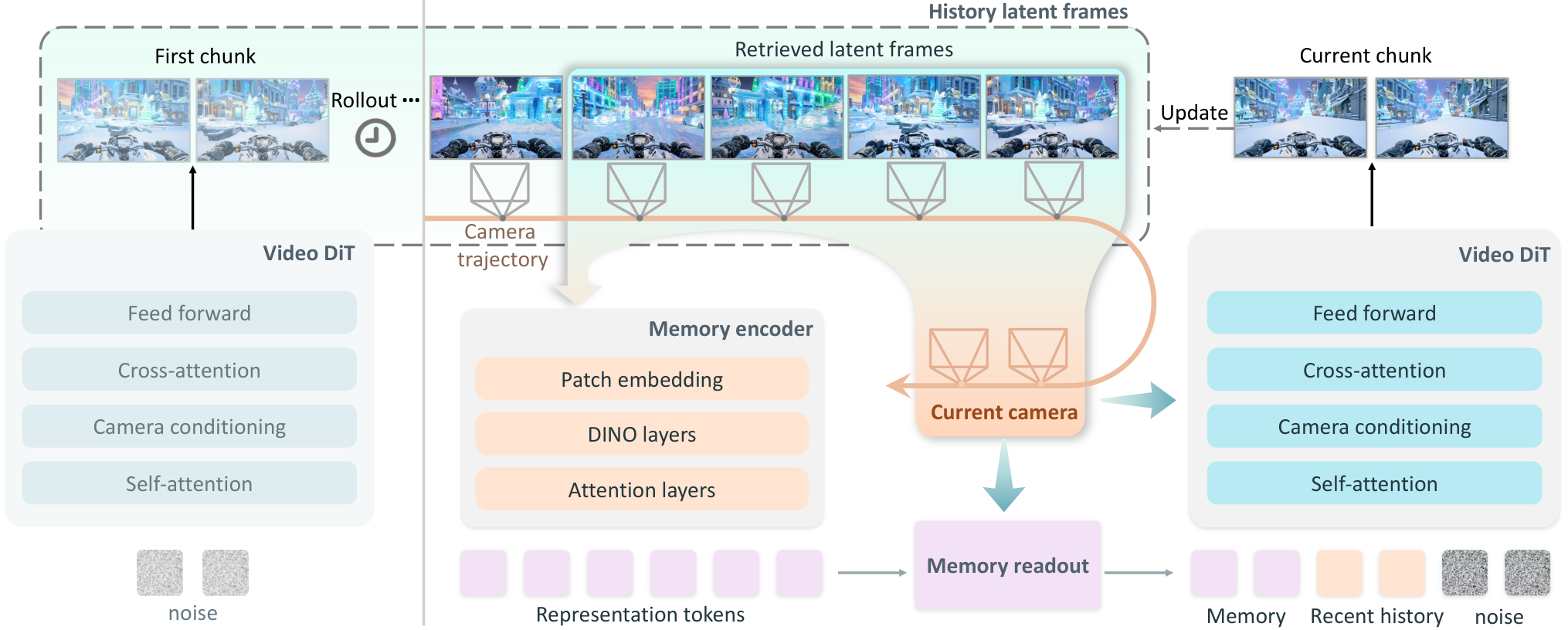
Three components sit on top of the DiT (see the pipeline overview):
Max-coverage history retrieval. Given the target camera trajectory, the retriever selects a subset of history frames from \mathbf{z}^{\mathrm{h}} that maximizes viewpoint coverage of the requested view, rather than simple cosine similarity of pose vectors. This biases retrieval toward frames whose frusta actually intersect the query frustum.
Memory encoder. Retrieved latent frames plus their poses are encoded into a set of memory features \mathbf{M}. No depth estimator, no explicit correspondences, no warping — geometry is expected to emerge implicitly from joint training.
Pose-conditioned readout. The readout is the key idea: rather than passing all memory tokens to the DiT, it compresses \mathbf{M} into a fixed-size set of tokens \tilde{\mathbf{M}}(\mathbf{P}) conditioned on the target poses. The DiT then denoises [\tilde{\mathbf{M}}(\mathbf{P});\mathbf{z}^{\mathrm{r}};\mathbf{z}_t]. Because |\tilde{\mathbf{M}}| is fixed, the token budget is invariant to history length — a minute of rollout costs the same per-step compute as ten seconds.
The first chunk is generated with pose conditioning only, since no history exists. Subsequent chunks use retrieval + memory + recent window. WorldCrafter-fast additionally applies few-step distillation for streaming inference.
Experiments
The benchmark is deliberately hostile to sliding-window models: 145 images (83 dynamic object-centric, 62 static) paired with 5 metric camera trajectories each, totaling 725 videos per method, with 528–1,648 frames per trajectory and closed-loop revisits explicitly probing memory. Comparisons cover 8 recent camera-controllable world models spanning pose-similarity retrieval (HY-WorldPlay, DreamX-World), Gated DeltaNet memory (SANA-WM), sliding-window UCPE (Echo-WM), and depth-warping spatial memory (Lyra 2.0, Alaya-EVOKE, Matrix-Game 3.5). All methods are evaluated at 640\times 384 with identical initial image, text, and target trajectories.
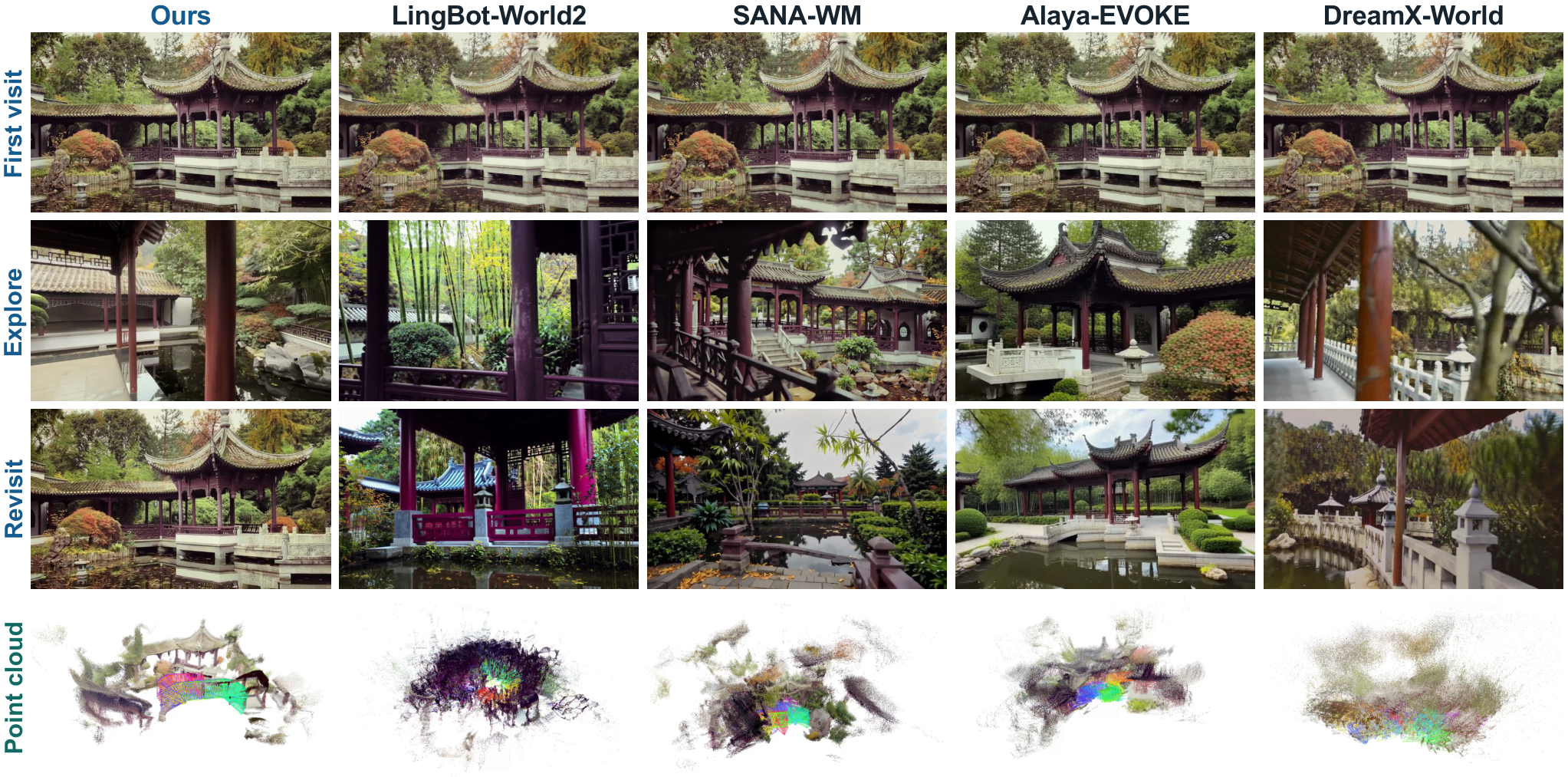
The provided qualitative panels show the intended failure mode of baselines and its correction here. On the static revisit case, WorldCrafter reproduces the initial-frame content when the camera returns, and the reconstructed point cloud is metrically coherent across the loop.
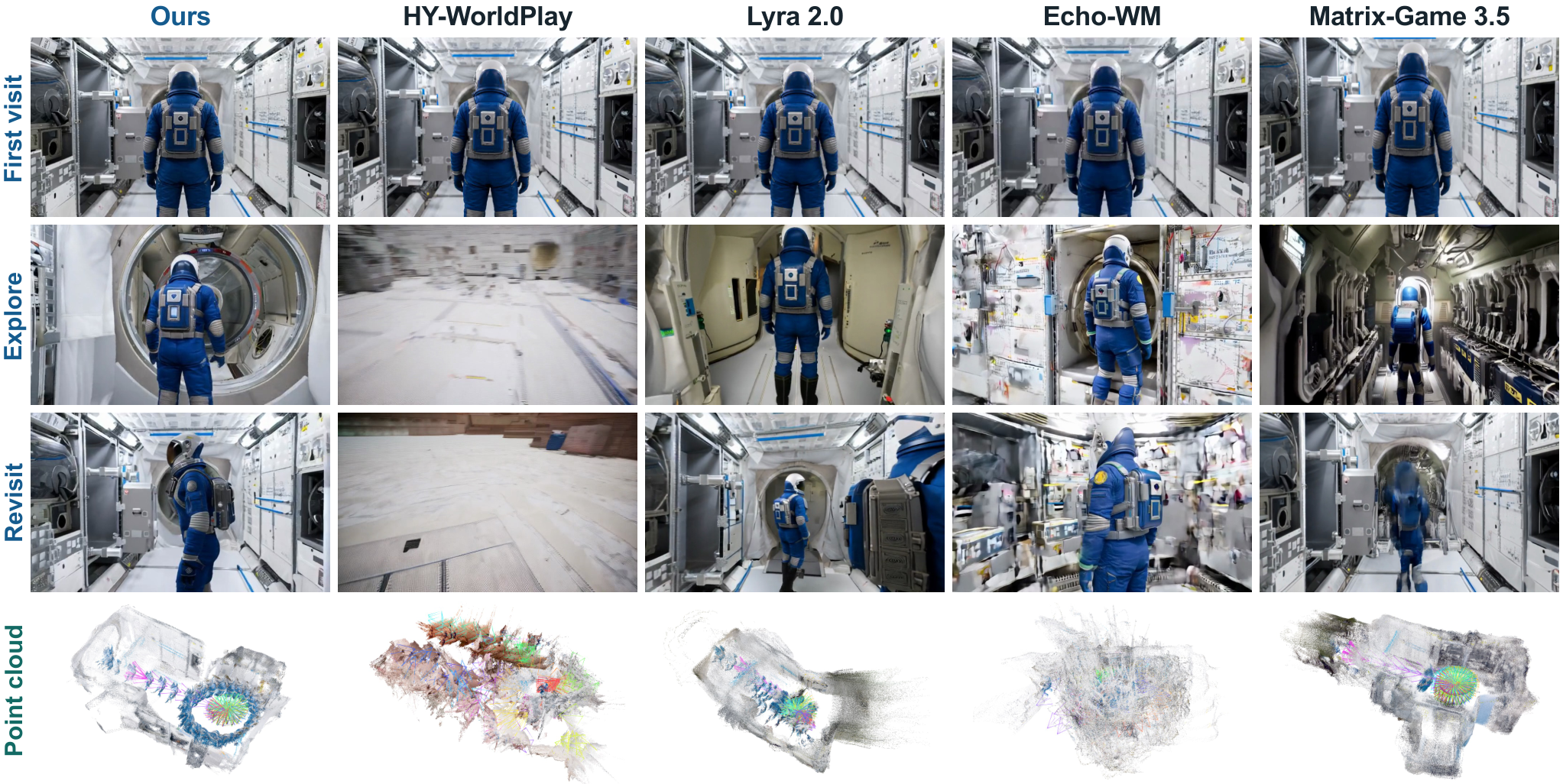
The dynamic case is harder because depth-based baselines cannot warp moving objects consistently; the implicit memory sidesteps this by never committing to an explicit geometric parameterization.
The abstract reports “substantial gains in long-horizon consistency and camera-control accuracy while preserving visual quality during minute-scale exploration.” The excerpts provided do not include the numerical table, so per-metric deltas against the eight baselines are not reproducible here.
Limitations and open questions
- The readout’s fixed token budget is the mechanism enabling scaling, but also the ceiling: at some horizon, the compression must become lossy in ways that hurt fine-grained revisit fidelity. The paper does not, in the excerpts shown, characterize this saturation point.
- Implicit 3D memory is trained end-to-end with the generator. Transferring the memory module to a different DiT backbone likely requires retraining; there is no explicit geometric interface.
- Max-coverage retrieval depends on accurate pose annotations for history; behavior under noisy or drifting poses at long horizons is unspecified.
- Ablations decomposing the contribution of retrieval vs. encoder vs. readout, and comparisons against a matched-token-budget version of pose-similarity retrieval, would clarify how much of the gain is architectural vs. simply “more history in context.”
- All baselines were evaluated in their distilled variants except three; the fairness of comparing full-step WorldCrafter to distilled baselines is worth scrutinizing, though WorldCrafter-fast is reported alongside.
Why this matters
Long-horizon video world models have converged on either raw context stuffing or explicit depth-warped memory, both of which scale poorly. Making the memory camera-queryable and fixed-size decouples per-step compute from rollout length, which is the right factoring for streaming, minute-scale interactive exploration — and it does so without depending on the depth estimators that break on dynamic scenes.
Source: https://arxiv.org/abs/2609.24984
Grounded Action Model: 3D Grounding as a Foundation for Robotics
Problem
Current robot foundation models inherit their priors from either vision-language pretraining (VLAs) or video-generation pretraining (WAMs). Neither objective requires metric grounding: language pretraining rewards describing objects and relations without pinning them in 3D, and video pretraining rewards appearance and dynamics that often correlate with backgrounds rather than with the task-relevant geometry. The result is that connecting pretrained features to precise motor commands is offloaded to the demonstration set, and the learned mapping tends to rely on visual correlations that collapse when scenes are randomized. RoboTwin 2.0’s Hard split makes this failure mode concrete: strong VLAs and WAMs that reach ~77% on clean scenes drop to 26.7% (Spatial Forcing) or 1.9% (FastWAM) under randomization.
The authors argue the pretraining objective itself should require metric grounding, and instantiate this with a Grounded Action Model (GAM) built on a frozen promptable 3D detector.
Method
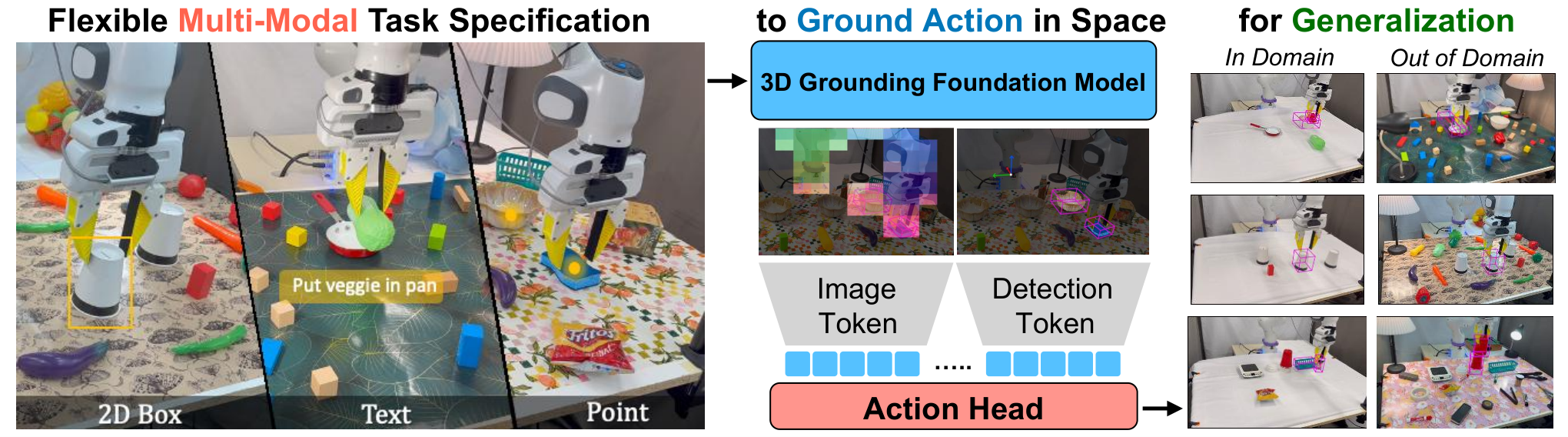
GAM has two stages: a frozen 3D grounding backbone that resolves a task specification into object-centric observations, and a flow-matching action head that consumes those observations.
Prompt → detections. The backbone is WildDet3D. It accepts three prompt modalities:
- Language: a span-tagging head over a frozen Flan-T5 encoder extracts object phrases from the instruction (e.g. “pick up the sponge and place it in the bowl” → {sponge, bowl}), used as separate grounding queries.
- 2D points or 2D boxes: passed as direct object queries, which is the interface a VLM planner uses.
For each of N queried objects, the backbone returns a 2D box u_i, a metric 3D box b_i, a dense metric depth map \hat{D}_t, and dense visual features F_t = \mathrm{Enc}_{\mathcal{G}}(o_t).
Object-centric observation. GAM constructs two streams from the grounded objects:
- Image tokens: features from F_t masked to the union of the task objects’ 2D boxes plus the robot arm, suppressing background pixels.
- Detection tokens: per-object point clouds (built from \hat{D}_t inside each 2D box) together with b_i’s pose and extent, giving explicit metric geometry.
A state-history token summarizes recent joint positions.
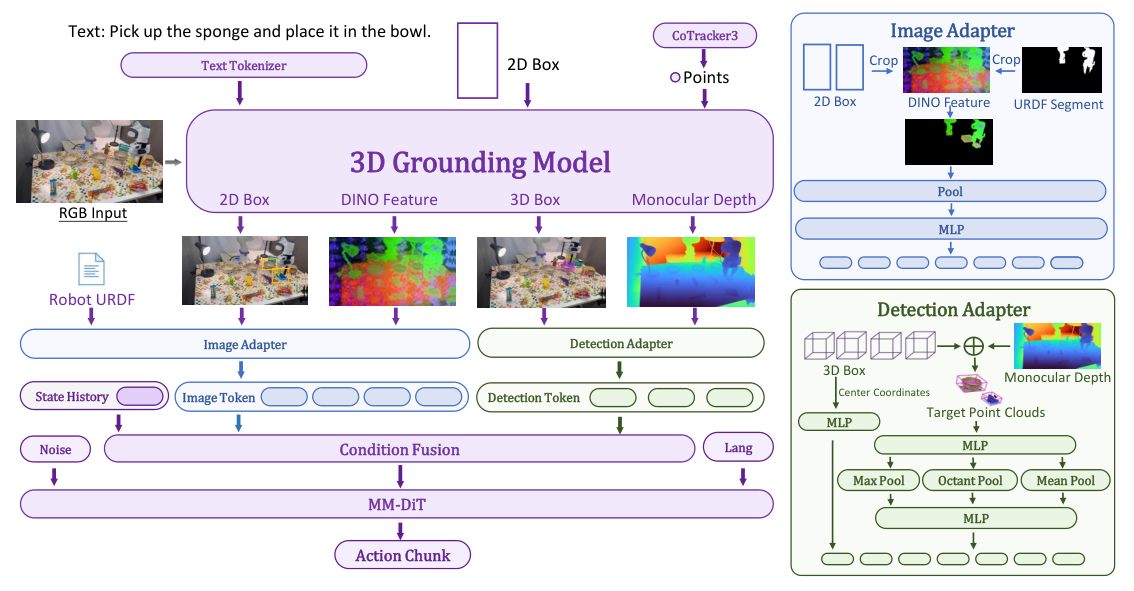
Action head. A multi-stream transformer (MM-DiT, as in SD3) combines image tokens, detection tokens, and the state-history token, with a language embedding injected via adaptive layer normalization. The head predicts a chunk of absolute joint-position targets by flow matching. Only the action head is trained per task; the grounding backbone is fine-tuned once to the RoboTwin renderer (using simulator-exported 2D boxes, 3D boxes, and depth as free supervision) and then frozen.
Results
On the RoboTwin 2.0 leaderboard protocol (50 bimanual tasks, 100 rollouts per task, Easy vs. Hard averaged):
- GAM: 63.0 Easy / 47.6 Hard / 55.3 avg, trained single-task on 50 clean demos per task.
- Spatial Forcing (best VLA, co-trained on all 50 tasks): 77.2 / 26.7 / 52.0.
- FastWAM (best WAM): 77.8 / 1.9 / 39.9.
- \pi_{0.5} under the same single-task protocol: 64.0 / 25.9 / 45.0 — GAM beats it by 10.3 points on average.
- Next-best Hard entry is Abot-M0 at 30.4; GAM reaches 47.6, a 17-point margin.
The clean-to-randomized retention is the most striking number: GAM keeps 76% of its clean performance under Hard randomization (63.0 → 47.6), while Spatial Forcing keeps 35% and FastWAM keeps 2.4%. This is consistent with the hypothesis that grounding-conditioned observations decouple the policy from irrelevant scene statistics.
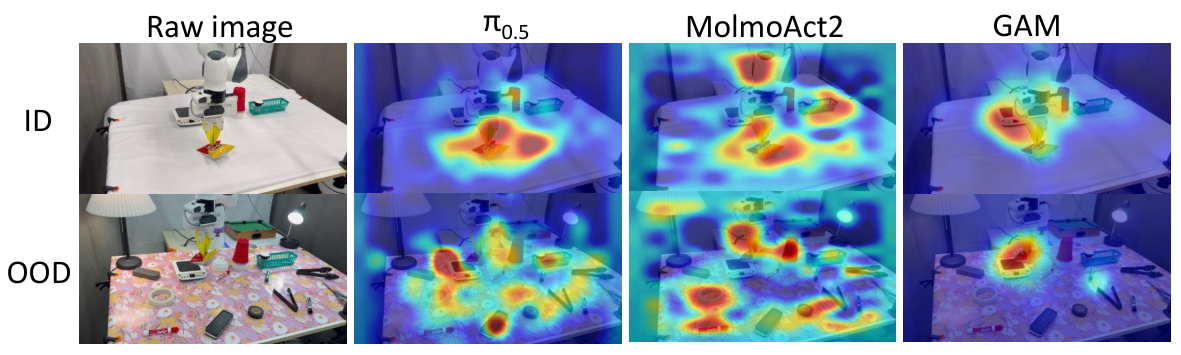
The attention visualization supports the mechanism claim: under distribution shift the baselines’ attention leaks onto perturbed backgrounds and distractors, while GAM’s attention remains localized on the grounded targets — a direct consequence of masking image tokens to the queried objects.
Limitations
The pipeline is only as good as its grounding: detection errors propagate to actions with no recovery mechanism, and the object-centric mask by construction discards unselected context (e.g. obstacles the planner did not name), which is a safety concern for cluttered execution. The 3D box representation is coarse; dense 3D instance segmentation or occupancy could give finer geometry, especially for articulated or deformable objects. The Easy-column result (63.0) is below the top VLAs/WAMs (77+), suggesting that when scenes are in-distribution, richer semantic/temporal priors still help — GAM trades some in-distribution ceiling for large out-of-distribution robustness. Finally, backbone adaptation used privileged simulator state; transferring to real without such supervision depends on the quality of the pretrained real-image grounder.
Why this matters
The paper reframes the choice of robot-foundation-model backbone as a question about which pretraining objective forces metric structure into the representation. The empirical answer — that a frozen 3D grounder plus a small flow-matching head beats co-trained VLAs and WAMs by 17 points on randomized scenes — suggests that explicit “which objects, where, what geometry” is a stronger prior for manipulation than either language semantics or video futures alone.
Source: https://arxiv.org/abs/2609.23863
Why Do Video Diffusion Models Violate Physics? Unveiling the Flaws in Attention Mechanisms
State-of-the-art text-to-video diffusion models produce visually convincing outputs that routinely break Newtonian mechanics: balls bounce mid-air, objects float, motion freezes. Prior fixes bolt on external priors, physics simulators, or specialized training corpora. This paper instead does a mechanistic-interpretability pass on Wan2.1-T2V-1.3B to locate where inside the network physics gets broken, and traces the failure to a specific interaction between RoPE’s spatial decay and the “first shape, then details” schedule of diffusion denoising.

Cross-attention plans motion in the first 5 steps
Because early-step T2V latents cannot be decoded to pixels usefully, the authors probe motion planning indirectly through cross-attention to the object token (“basketball”). Visualizing \mathbf{A}^{\mathrm{CA}}\in\mathbb{R}^{f\times h\times w} layer by layer and step by step shows a sharp phase structure: at T1 the map is noise; at T3 multiple candidate regions light up along a plausible trajectory; by T5 they collapse; by T7 the trajectory is locked. All motion planning happens in the first ~5 of 50 denoising steps.
Two metrics quantify this. Attention entropy is the normalized spatiotemporal entropy of the video-normalized map \mathbf{P}^{\mathrm{vid}}(z,y,x)=\mathbf{A}^{\mathrm{CA}}(z,y,x)/\|\mathbf{A}\|_1, giving H^{\mathrm{vid}}/\log(fhw). Support quality overlays \mathbf{P}^{\mathrm{vid}} with a binary mask \mathbf{M}^{\mathrm{obj}} of the final trajectory to measure geometric overlap, Q^{\mathrm{vid}}=\sum_{\mathcal{V}}\mathbf{P}^{\mathrm{vid}}\mathbf{M}^{\mathrm{obj}}.

Combining trajectory-alignment scoring with causal head ablation isolates a small subset of attention heads that drive motion planning. Zero-ablating this subset destroys motion coherence while leaving appearance intact, confirming their causal role.

Self-attention and the RoPE spatial anchoring effect
Cross-attention specifies what content and where candidates lie; self-attention is the only mechanism that can propagate positional consistency across frames and thereby select one candidate per frame to form a trajectory. Visualizing self-attention from a query region k in frame f_i reveals that most heads do not attend along the trajectory — they attend to the same spatial location k across all other frames.
The paper attributes this to RoPE’s long-range decay. With rotary phases f(q,p)=[q^f e^{ip^f\theta}, q^h e^{ip^h\theta}, q^w e^{ip^w\theta}], the QK dot product becomes
\mathrm{Re}\Big[\sum_{a\in\{f,h,w\}} q^a {k^a}^{*} e^{i\Delta p^a\theta}\Big].
Decay in \Delta p^h,\Delta p^w biases each query toward keys at similar spatial coordinates across all frames — the “spatial anchoring effect.” Consequence: once a candidate region is highlighted in an early frame, self-attention preferentially reinforces the same spatial location in adjacent frames rather than the location displaced along a physically plausible trajectory. Early candidates lock in place, suppressing kinematically correct alternatives, and the motion collapses to freezing / floating / teleporting artifacts. The authors formalize candidate selection by extracting candidate sets \{\Omega_{i,k}\} per frame, defining anchor regions from step-49 attention, and tracking the “winner” k^+=\arg\min_k \|\mu(\Omega_{i,k})-\mu(\Omega_{i,1}^{\mathrm{ref}})\| versus the strongest non-winner across denoising.
Fix: step-dependent RoPE frequency scaling
Since the pathology is excessive spatial decay during the motion-planning window, the fix is to shrink the spatial rotation frequency in exactly that window. For queries/keys,
f^h(q,p)=q^h e^{ip^h\lambda^h\theta}, \qquad f^w(q,p)=q^w e^{ip^w\lambda^w\theta}, \quad \lambda^{h},\lambda^{w}<1,
applied only to the first 5 denoising steps. This flattens the QK decay curve in the spatial dimensions, letting self-attention consider spatially displaced candidates in adjacent frames — i.e. actual trajectories. The temporal component is unchanged. \lambda^{h/w} is a preset searched on the early steps; adaptive parameterizations are reported to underperform.
Results on VideoPhy
On VideoPhy (SA = semantic adherence, PC = physical commonsense), the base Wan2.1-T2V-1.3B scores 53.64 / 29.45 overall. Modified RoPE alone (training-free) raises this to 57.43 / 39.94, a +10.5 absolute gain on PC without touching weights. Stacking with prompt refinement gives 86.30 / 58.89 vs. the PR baseline 80.47 / 44.31 — the PC gain (+14.58) is much larger than the SA gain, indicating the improvement is genuinely on physics rather than on prompt following. Combining LoRA + modified RoPE + PR reaches 87.46 / 62.68, the top row on every subcategory except a small SA regression on Solid-Fluid. LoRA and VideoREPA alone improve PC modestly (35.57, 37.90); the RoPE modification is complementary to both.
Limitations and open questions
The analysis is grounded almost entirely in a single model (Wan2.1-1.3B) and a single canonical prompt (basketball drop); generalization of the identified head set and the \lambda schedule across model families, resolutions, and motion types is not established. \lambda^{h/w} is a hand-searched constant on the first 5 steps — adaptive schemes reportedly fail, which suggests the underlying tradeoff between spatial coherence and trajectory freedom is not yet well characterized. Cross-attention is used as a proxy for latent-space dynamics because early T2V latents are not decodable; a direct latent-space account would strengthen the causal story. Finally, weakening spatial decay may hurt fine spatial detail in longer-range regimes; the paper does not fully quantify this tradeoff.
Why this matters
This is one of the first mechanistic accounts of why video diffusion violates physics that points to a concrete architectural culprit (RoPE spatial decay during the shape-formation window) rather than blaming data or scale. The fix is a two-line change to positional embeddings that yields double-digit PC gains without retraining, suggesting that a nontrivial fraction of the “physics gap” in video generation is an interpretability-tractable inductive-bias bug, not a capacity problem.
Source: https://arxiv.org/abs/2609.23658
HuRo: Robotizing Human Videos for Scalable VLA Pretraining
Problem
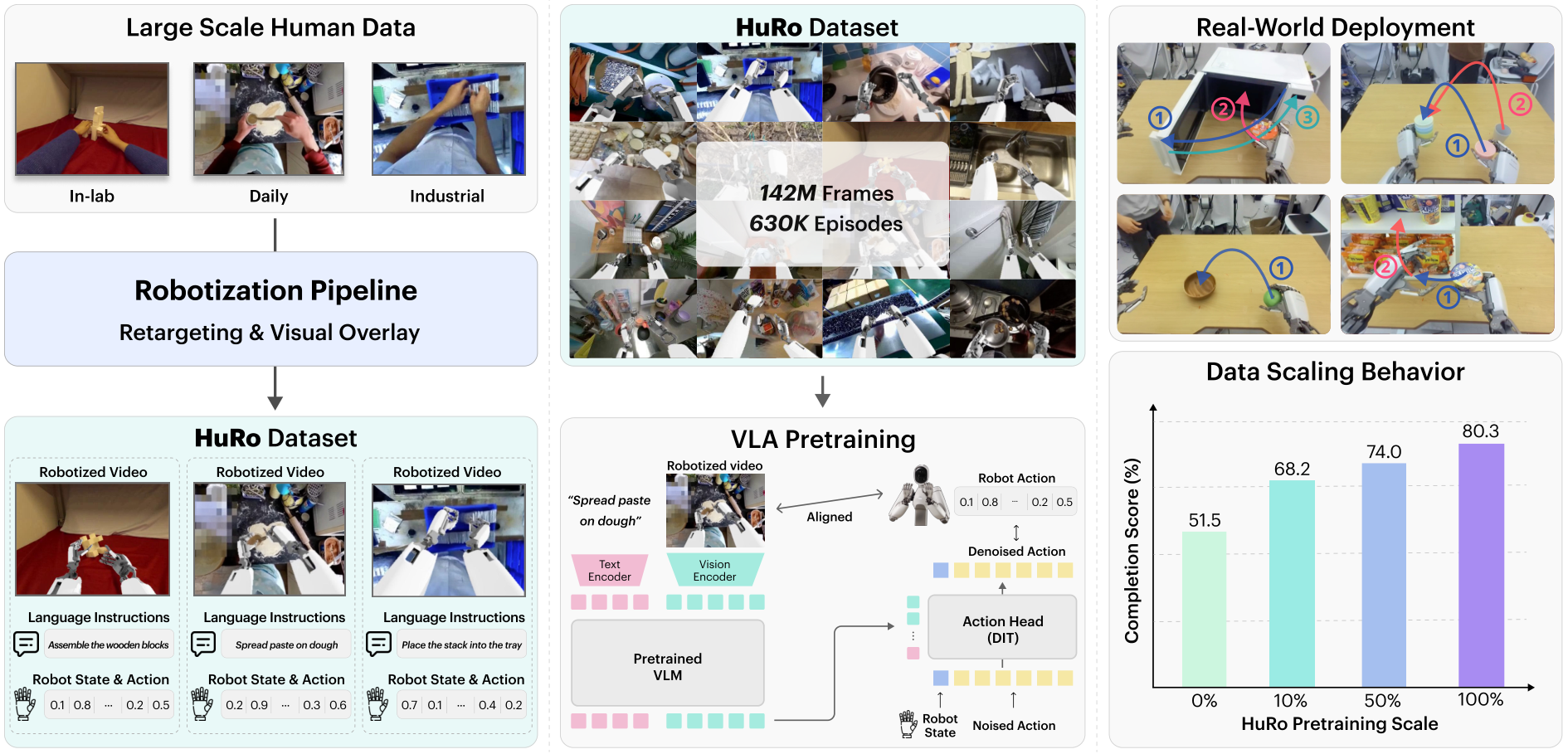
Vision-language-action (VLA) models are bottlenecked by teleoperated robot data, which is expensive and narrow in coverage. Egocentric human video is abundant and diverse but suffers from an embodiment gap: the observations contain human hands (not the target robot), and there are no explicit action labels in the robot’s joint or end-effector space. Prior work either curates task-matched robotizations at small scale, or aligns observations and actions separately without a unified pipeline. HuRo asks whether a systematic, scalable robotization of heterogeneous human video, followed by end-to-end VLA pretraining, yields meaningful gains — particularly under out-of-distribution shifts where robot-only pretraining tends to collapse.
Method
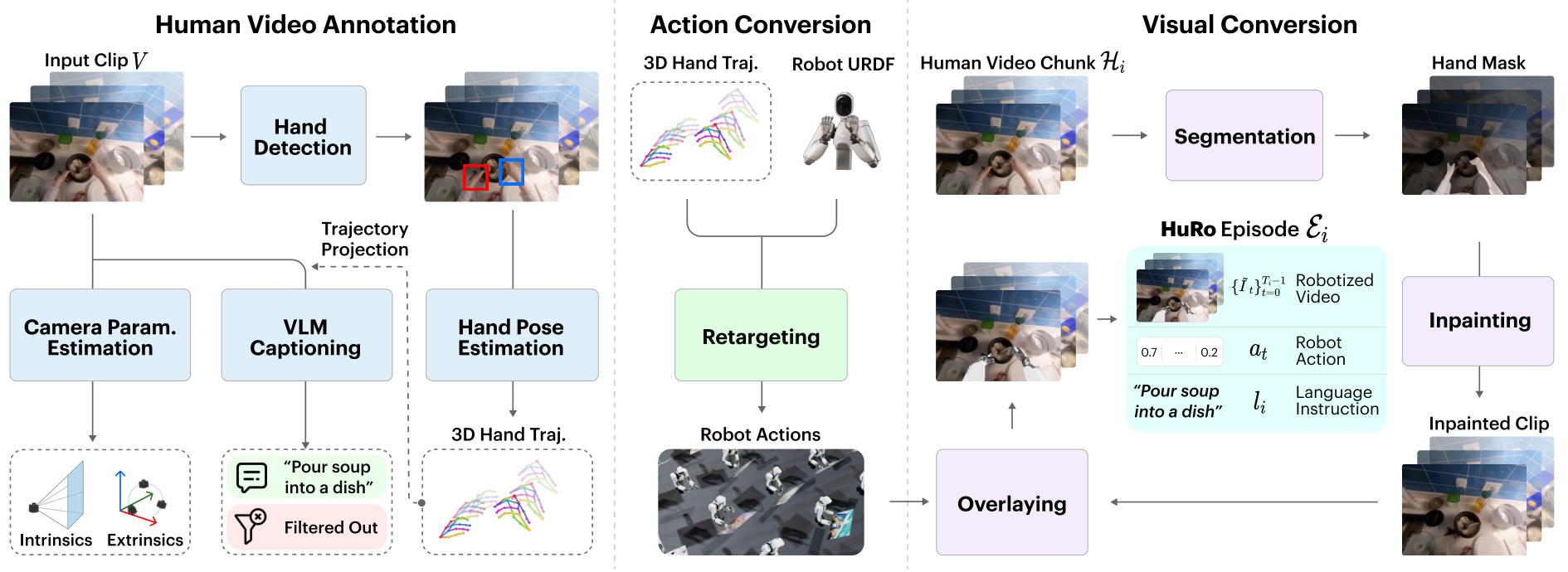
HuRo processes egocentric clips V = \{I_t\}_{t=0}^{T-1} through three stages: annotation, action conversion, and visual conversion.
Annotation. Per clip, camera intrinsics K are estimated with droidcalib, falling back to AnyCalib for near-static clips; frames are rectified to a pinhole model. Hands are detected per-frame with 100DoH, and hand-side identities are stabilized temporally with BOT-SORT to produce consistent left/right crops feeding a 3D hand-pose estimator. Manipulation segments are extracted and each segment is chunked into bounded-length subclips with an associated language instruction. This yields, per chunk, camera geometry, per-frame 3D hand pose, and text.
Action conversion. The annotated human hand trajectories are retargeted into robot end-effector / joint trajectories for the ALLEX target embodiment. This gives explicit action supervision a_t and states s_t aligned with the visual timeline.
Visual conversion. The visible human hand/arm is inpainted out, and the retargeted robot is rendered into the scene at the retargeted pose. The output tuple (o_t, s_t, a_t, \ell) mirrors what a teleoperated robot demonstration would provide.
Applying this pipeline to five human-video sources produces roughly 630K robotized episodes and 142M processed frames. Downstream, a VLM backbone initialized from GR00T-N1.6-3B is paired with an action head trained from scratch; pretraining is performed on HuRo and then finetuned on small task-specific demonstration sets.
Results
Evaluation uses four real ALLEX tasks: Apple Pick-and-Place (43 demos, binary success), Cup Stacking (40 demos, stage-wise), Cup-Noodle Handover (16 demos, stage-wise), and Microwave Loading (20 demos, stage-wise). Both ID (held-out configurations from the finetuning distribution) and OOD (spatial and visual shifts) conditions are scored.
Data scaling. Averaged over the four tasks, overall completion rises monotonically with the HuRo pretraining fraction: 51.5% at 0% (no HuRo pretraining, only finetuning) to 80.3% at 100%. The OOD numbers show the steeper gain: 34.9% → 72.2% under spatial and visual shifts. That is, HuRo pretraining nearly doubles OOD completion, while ID gains are more modest — consistent with the intuition that human-video diversity primarily fills coverage holes rather than tightening in-distribution behavior.
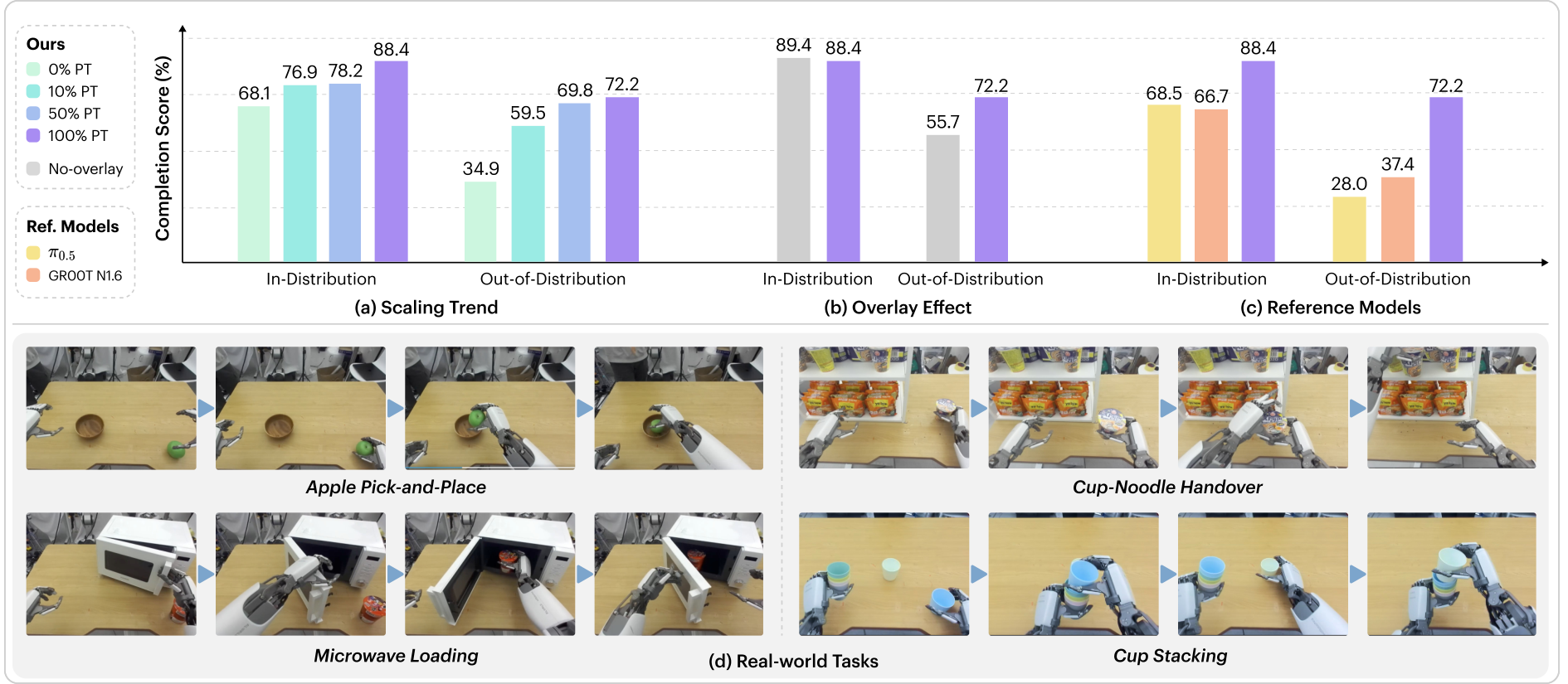
Visual robotization ablation. A “no-overlay” variant retains the original human-video pixels but uses the same retargeted action supervision. Removing the visual conversion degrades OOD robustness in particular, indicating that action retargeting alone is insufficient — the observation distribution must also be aligned to the robot embodiment for transfer to hold up under distribution shift.
End-to-end vs. visual-only transfer. Pretraining end-to-end with retargeted actions outperforms visual-only transfer (e.g., using human video only for representation learning), supporting the claim that jointly modeling (o, s, a, \ell) in the robot’s action space is what unlocks the scaling behavior.
Reference comparison. HuRo-pretrained policies are compared against \pi_{0.5} and GR00T N1.6 finetuned from their released checkpoints with pretrained action modules retained. The HuRo variant is competitive with these substantially larger pretraining regimes despite starting the action head from scratch.
Limitations and open questions
The reported gains come from a single target embodiment (ALLEX) and four tasks; how well the pipeline transfers to embodiments with very different kinematics (e.g., dexterous hands, mobile manipulators) is not established. The retargeting step assumes a reasonable mapping from human hand pose to robot end-effector pose, which is unlikely to hold for fine in-hand manipulation or tool use requiring wrist geometry the robot cannot achieve. Visual overlay quality — inpainting artifacts, lighting mismatch between the rendered robot and the original scene — is a plausible source of a sim-to-real-like gap that the paper does not quantify. The 51.5% → 80.3% comparison uses the same VLM initialization; whether the same scaling holds when the backbone itself is retrained on HuRo, or when robot demonstrations are more abundant, is open. Finally, all comparisons are at 3B scale; scaling laws with respect to both HuRo size and model size remain to be characterized.
Why this matters
Human-video pretraining for robot policies has largely been treated as a representation-learning tool. HuRo shows that once you commit to aligning both observations and actions to the target robot at scale, human video functions as a direct substitute for additional robot data — with the largest gains where robot-only training fails, namely spatial and visual OOD. That reframes web-scale egocentric video as an actionable pretraining corpus for VLAs rather than an auxiliary signal.
Source: https://arxiv.org/abs/2609.10706
Think Like a World Model, Act Like a VLA: Distilling World-Model Representations into Compact Robot Policies
Problem
Vision-Language-Action (VLA) models map (\mathbf{o}_t, \ell) \mapsto \mathbf{a}_{t:t+K} without any objective that constrains how the environment evolves under those actions. Their robustness to viewpoint, lighting, and clutter is therefore bounded by data coverage. World models, trained to predict future frames/states, do carry such an objective and produce more temporally grounded features, but rolling the future forward is prohibitively slow: DreamZero requires roughly 3 s per decision on an H100 and 45.9 GB of memory, while \pi_{0.5} runs in 65 ms and the paper’s 0.8B student in 32 ms at 1.86 GB on a consumer RTX 5090. The question is whether the world-model’s grounding can be inherited by a compact VLA without inheriting its inference cost.
Method
The core claim is that the world model’s knowledge lives in its internal features, and generation is only the objective that shaped them. So one can supervise a student on the features alone.
The student is a QwenGR00T policy: a Qwen3-VL backbone producing prefix hidden states h(\mathbf{o}_t) \in \mathbb{R}^{L \times D_s}, followed by a GR00T-style flow-matching action expert. The base objective is velocity regression along the linear interpolant \mathbf{a}^\tau = \tau \epsilon + (1-\tau)\mathbf{a}_{t:t+K}:
\mathcal{L}_{\mathrm{act}} = \mathbb{E}_{\mathbf{o}_t,\tau,\epsilon}\,\big\|v_\theta(\mathbf{a}^\tau, \tau, h(\mathbf{o}_t)) - (\epsilon - \mathbf{a}_{t:t+K})\big\|^2.
A single feature-alignment term is added. A frozen world-model teacher (Cosmos3-Nano) is run over the training frames once and its features are cached; during student training, the student’s pooled image-token features are pushed to agree in direction (cosine, not exact reproduction) with the cached teacher features via a lightweight projector. Two properties fall out:
- No teacher at train time. Because the teacher is frozen and its outputs depend only on the training frames, targets are precomputed. A distilled training run costs what an undistilled run costs in wall-clock and VRAM.
- Nothing at deploy time. The projector is discarded, the student’s action objective is unchanged, and the deployed policy is bit-identical in architecture to the baseline — same backbone, same four flow steps, same 32 ms latency. Any accuracy gain is attributable to the representation the student ended up with, not to added parameters or test-time compute.
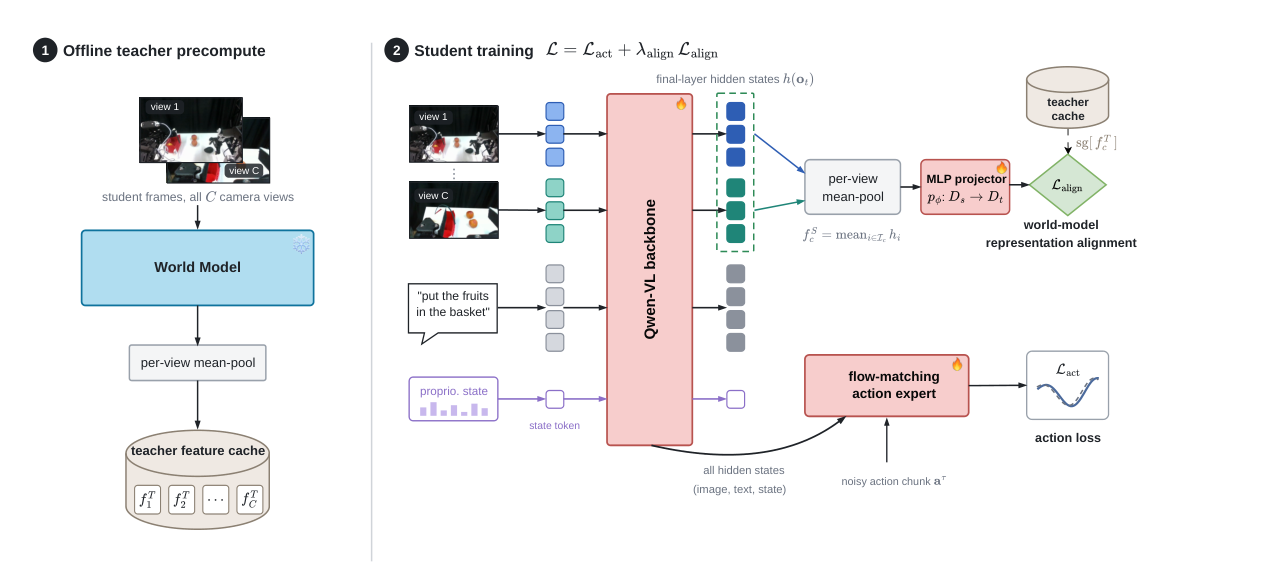
Importantly, the action channel is deliberately excluded from distillation: teacher and student need not share action parameterization or feature dimensionality, so the recipe is teacher-agnostic. Sec. IV-E repeats the recipe at 4B, on other backbones, and with alternative teachers.
Results
Evaluation protocol is careful: because flow-matching sampling is stochastic and the LIBERO/RoboCasa simulator renderer is not bit-identical across GPUs, every checkpoint is evaluated four times (2 seeds × 2 GPUs: A100-80GB, RTX 5090) with means and stds reported.
- LIBERO (four suites, 500 trials/suite): the 0.8B distilled student reaches \mathrm{SR}_{\mathrm{avg}} = 97.9\%, matching or exceeding policies several times larger.
- RoboCasa-GR1 (24 humanoid tasks, 29-D bimanual action, one policy trained jointly on 6.02M steps and evaluated on all 24 environments at 20 episodes each): distillation improves the same 0.8B student from 48.2\% to 50.5\%. Per-checkpoint variance on this benchmark is several points across GPUs, which the authors flag explicitly.
- Deployment cost: 32 ms and 1.86 GB on an RTX 5090 (versus \pi_{0.5} at 65 ms and DreamZero at 3 s / 45.9 GB — the last of which does not fit on the 32 GB card at all).
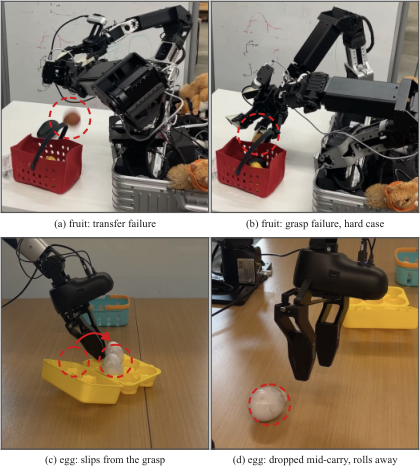
- Real robots: single-arm AgileX Nero on fruit and egg pick-and-place, and TRIP-Bag bimanual fruit handover, all succeed on the distilled 0.8B student.
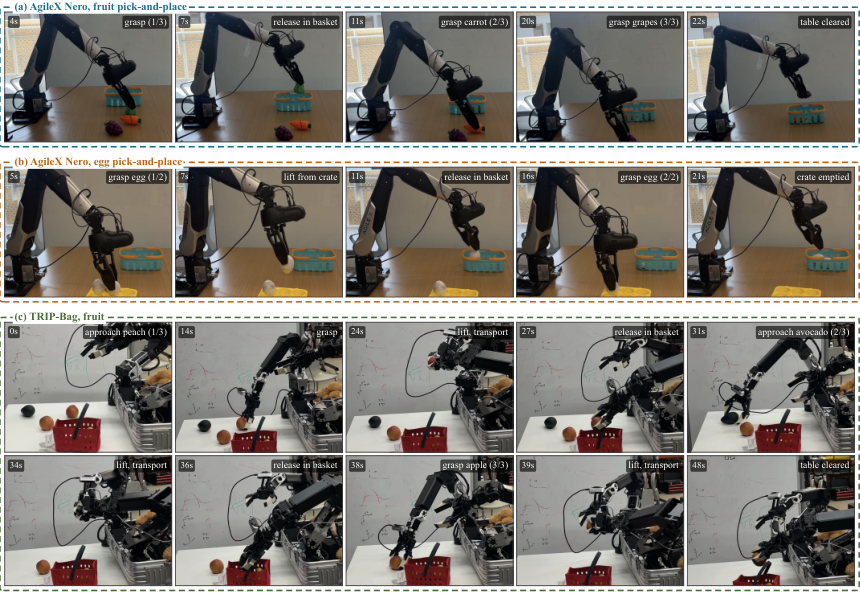
Failure modes on the real hardware are dominated by low-level grasp physics rather than semantic mistakes: dropping before the receptacle, closing on the rim instead of the fruit, and the egg slipping either at grasp or mid-carry.
The authors describe the gains as “modest but consistent” across student scales (0.8B, 4B), backbones, alignment layers, and choice of teacher — the invariance pattern one would expect from a representational prior rather than a coincidental agreement between two networks.
Limitations and open questions
The RoboCasa-GR1 improvement (48.2 → 50.5) is within a few points of the reported cross-hardware variance for the same checkpoint, so the effect there is real only in expectation over the 4-run protocol. The alignment is direction-only on pooled image tokens; whether stronger objectives (patchwise, or aligning across time to actually import the temporal structure the teacher was trained to encode) would help is untested here. The action channel is intentionally left out — that keeps the recipe teacher-agnostic, but it also means the student never receives supervision about dynamics, only about scene features that happen to have been shaped by a dynamics objective. Real-robot failures are physical, not perceptual, which suggests the ceiling on this axis of improvement may be lower than the compute headroom implies.
Why this matters
This is a clean demonstration that the expensive part of a world model (generation) and the useful part (grounded features) can be decoupled at training time and dropped at inference. For deployable robot policies, it converts a class of otherwise unusable teachers into a free training-time prior with zero deployment overhead.
Source: https://arxiv.org/abs/2609.24682
Transferring the Intelligence of VLMs to Robotic Control
RoboDawn asks whether a frozen, pretrained VLM can control a real robot in closed loop without any task-specific fine-tuning, by exposing manipulation as a discrete semantic action interface and grounding the model with a small number of in-context demonstrations. The claim is that the digital-to-physical gap is primarily one of embodiment and interface, not of reasoning, and that a suitably designed harness lets general-purpose VLM intelligence transfer directly to control.
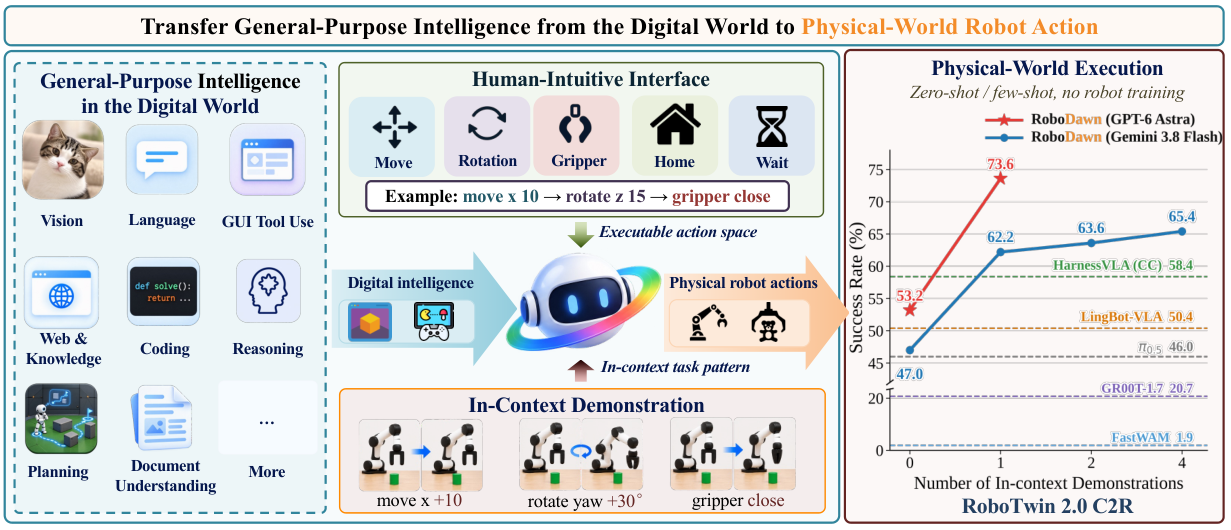
Interface and closed-loop formulation
A task is specified by a natural-language instruction L. The VLM \pi_\theta is frozen; adaptation occurs only through evolving observations, feedback, and memory. At round t:
(y_t, \mathbf{a}_t) = \pi_\theta(L, E, D;\; I_t, x_t, F_{t-1}, M_t),
where E is a robot–environment profile (workspace bounds, camera conventions, grid-based localization, gripper properties), D is a fixed set of in-context demonstrations, I_t is a multi-view annotated image, x_t is proprioceptive state, F_{t-1} is execution feedback from the previous round, and M_t is a running memory. The output \mathbf{a}_t is a sequence of discrete semantic commands over translation, rotation, and gripper primitives, while y_t is a structured JSON-like response containing task-progress estimate, plan, and scratchpad — effectively pushing chain-of-thought into an explicit control surface.
The environment then applies (s_{t+1}, F_t) = \mathcal{E}_P(s_t, \mathbf{a}_t), produces the next observation (I_{t+1}, x_{t+1}) = \mathcal{O}_P(s_{t+1}), and memory updates via M_{t+1} = \mathcal{U}(M_t, \mathbf{a}_t, y_t, F_t, x_{t+1}). Crucially, s_t (privileged object poses) is never exposed to the VLM: the policy operates entirely from images plus proprioception plus grounded feedback.
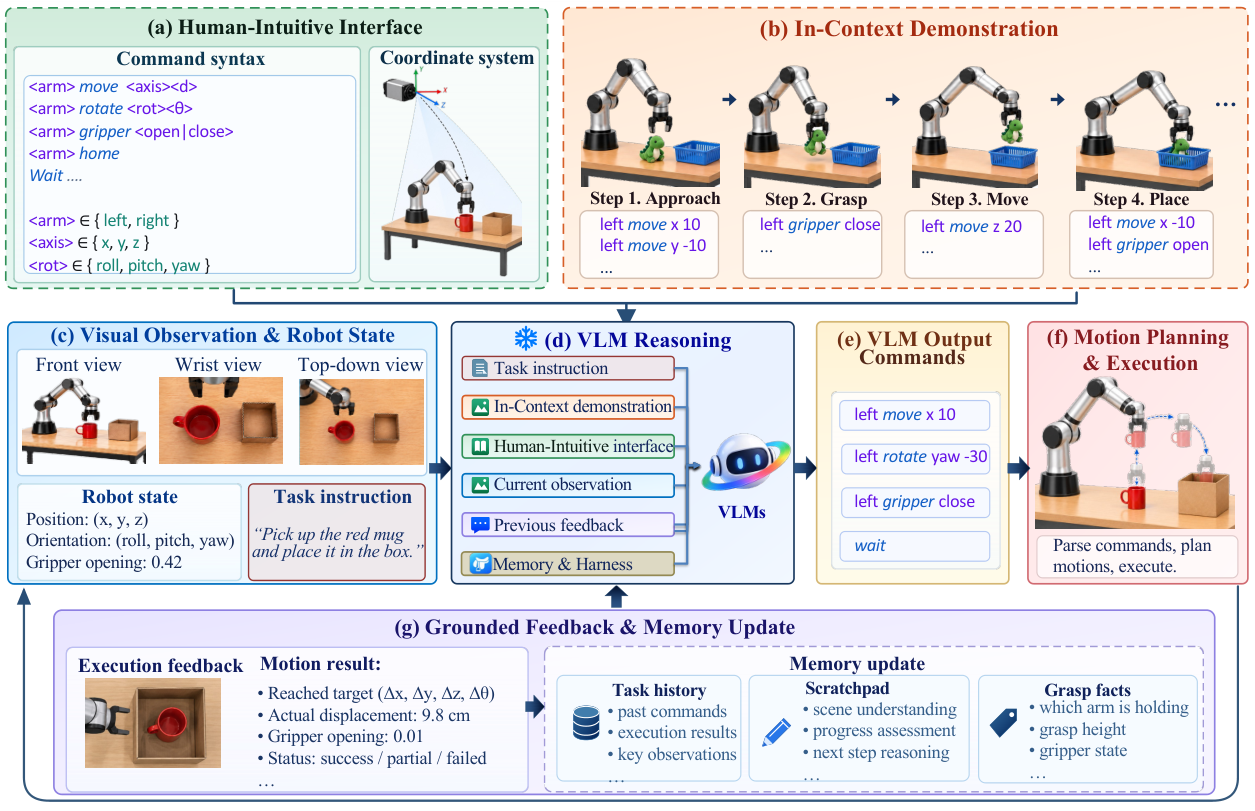
The execution operator \mathcal{E}_P is where the harness does heavy lifting: it parses semantic commands, grounds them into low-level motions through a fixed motion planner, executes them, and — importantly — synthesizes textual feedback describing whether the primitive succeeded, whether the gripper closed on an object, and whether the target grid cell was reached. This closes the loop symbolically, so the VLM never has to infer failure modes from pixels alone.
Results on RoboTwin 2.0 C2R
The RoboTwin 2.0 C2R protocol trains a single bimanual policy on 50 clean demonstrations per task across 50 tasks, then evaluates under domain randomization. RoboDawn instead uses zero or one demonstrations, provided only as in-context text/images, and never updates parameters.
With GPT-6 Astra, zero-shot RoboDawn reaches 53.2% average success, already beating \pi_{0.5} (46.0%) and LingBot-VLA (50.4%), both of which are fully post-trained on the benchmark. With one in-context demonstration, success rises to 73.6%, exceeding HarnessVLA (Claude Code) — the prior agentic-VLA SOTA — by 15.2 percentage points. With Gemini-3.8-Flash, zero-shot is 47.0% and 1-shot is 62.2%. For reference, X-VLA sits at 20.9% and GR00T-1.7 at 20.7% under the same protocol, so the gap between conventional VLA training and an in-context VLM harness is roughly 30–50 points on this benchmark.
Scaling in-context demonstrations shows diminishing and then negative returns: Gemini-3.8-Flash improves 47.0 → 62.2 → 65.4% at 0/1/4 shots, but drops to 62.7% at 8 shots. This is consistent with long-context degradation observed elsewhere in VLM reasoning, and it suggests that the useful signal from demonstrations saturates quickly once interface conventions are covered.
Failure modes
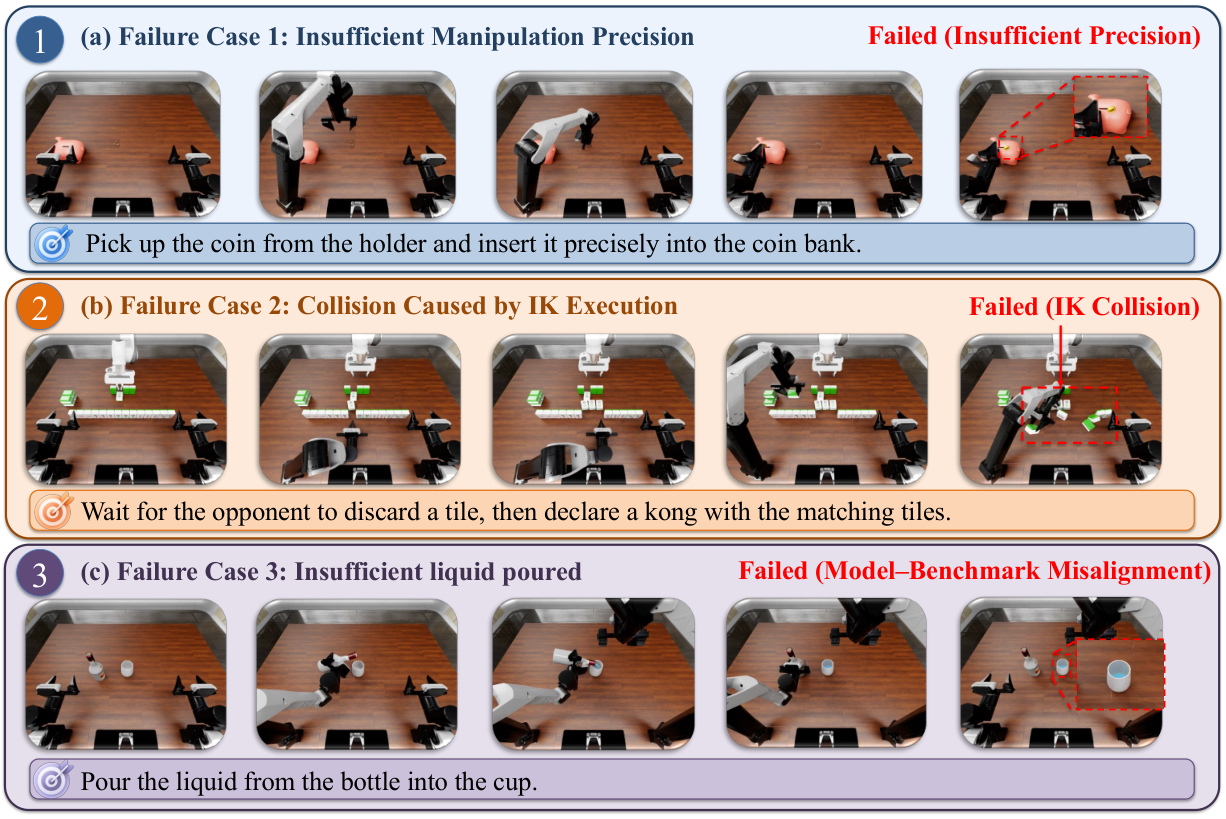
Failures on RoboDojo cluster around fine-grained spatial reasoning (misjudging grasp offsets under the grid-based localization scheme), interface misuse (issuing rotations that violate workspace constraints even after the profile E specifies them), and premature declaration of task completion. These are consistent with the underlying VLM’s known weaknesses rather than with the harness itself, and they explain why performance is bounded well below 100% even for capable base models.
Limitations
The approach inherits VLM latency: closed-loop control at semantic-action granularity means multi-second decision rounds, which precludes reactive tasks. The interface is discretized (grid localization, primitive rotations), so tasks requiring continuous fine control — insertion, deformable manipulation — are out of scope. Results depend heavily on the choice of frontier VLM; the gap between Gemini-3.8-Flash and GPT-6 Astra (10–11 points) suggests brittleness to model updates. Finally, the C2R protocol tests randomization from a clean seed scene, not truly novel task distributions, so “zero-shot” here still assumes tasks drawn from the benchmark’s semantic distribution.
Why this matters
If a frozen VLM plus a lightweight discrete action interface beats fully post-trained VLAs by 15+ points on a standard bimanual benchmark, the current paradigm of collecting large robot-specific datasets to fine-tune VLAs deserves scrutiny — at least for tasks where semantic reasoning dominates over fine motor control. The result also reframes robot learning as an interface-design problem: much of the “training” can be replaced by a well-specified profile E and a handful of in-context examples.
Source: https://arxiv.org/abs/2609.22966
GameHorizon Suite: Multi-Horizon Data and Evaluation in Gameplay
Problem
Games are natural benchmarks for embodied AI: they demand perception, instruction decomposition, planning, and low-level control on horizons ranging from single keystrokes to multi-minute strategies. But the existing landscape is fragmented. Web-scraped video corpora recover actions via inverse dynamics models (IDMs) or gamepad segmentation, which introduces pseudo-label noise. Instruction supervision is either absent, sparse, or manually labeled at scales that never leave a single lab (e.g., Game-TARS). Online evaluations depend on high-variance rollouts and are not reproducible across labs. GameHorizon addresses these three gaps jointly: authentic action capture, scalable multi-horizon instruction annotation, and a benchmark that combines reproducible offline MCQs with a controlled online track.
Data collection and the three-level instruction pyramid
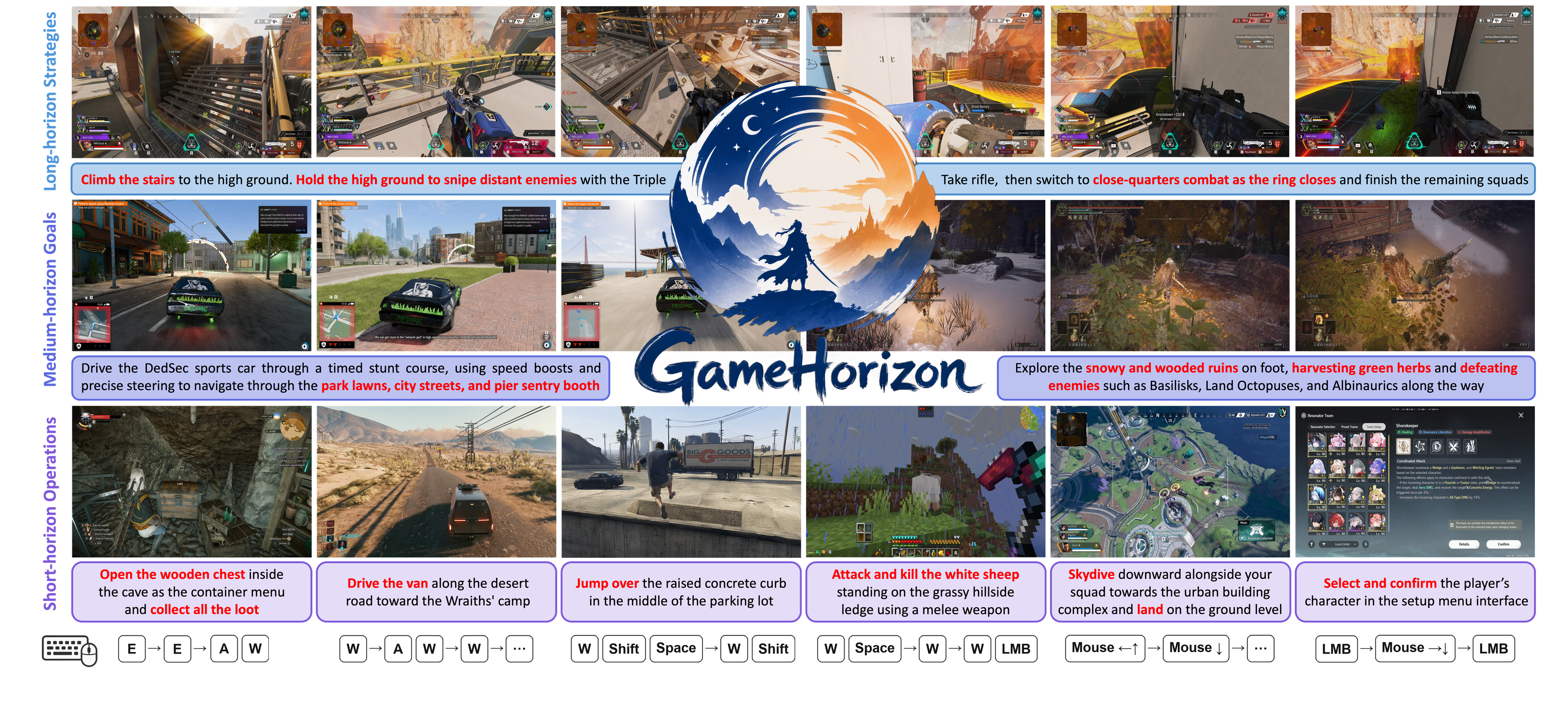
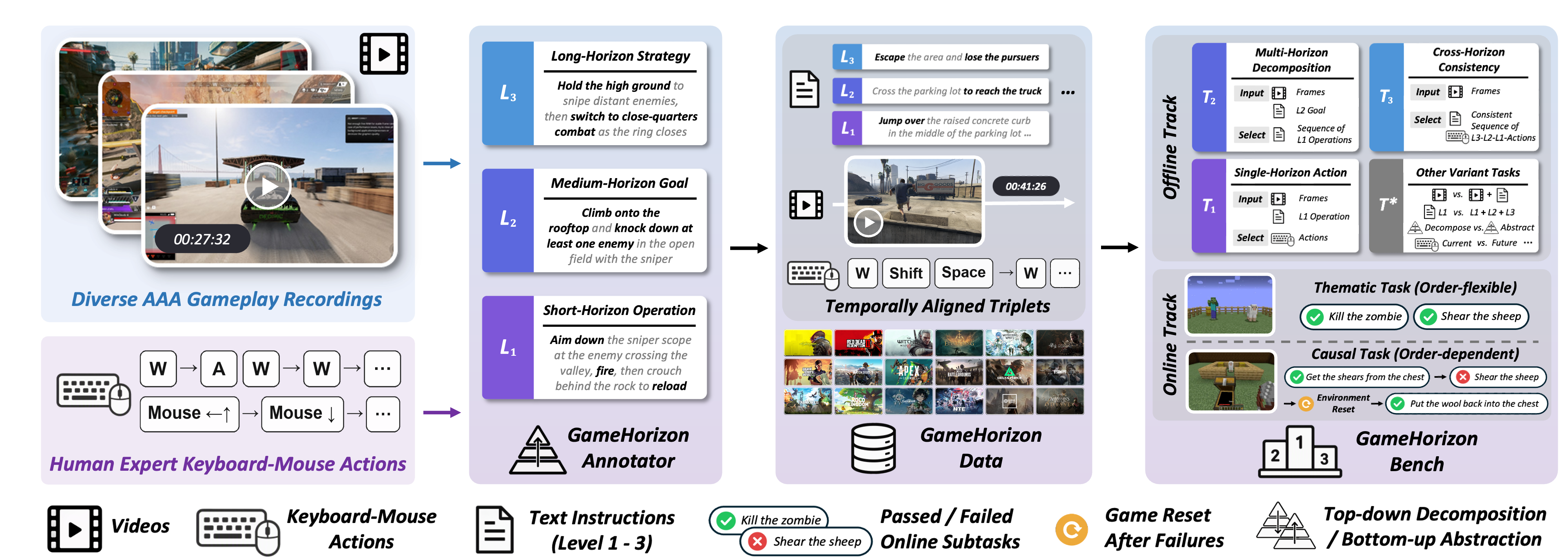
Rather than infer actions post hoc, the authors recruit 100 expert players and deploy a synchronized recording client that captures 2K video with timestamped keyboard and mouse events. The final GameHorizon-Data contains 5,000 hours across 21 AAA titles, 4,571 videos at 60 fps, and 411.03M keyboard-mouse events. Instructions are stratified into three horizons:
- L_1: short-horizon operations, 1–5 s (e.g., “reload weapon”).
- L_2: medium-horizon goals, 1–2 min (e.g., “clear the outpost”).
- L_3: long-horizon strategies, 5–8 min (e.g., “defend the bridge until reinforcements arrive”).
The full annotation set totals 6,184,036 instructions, dominated by 5,947,588 L_1 operations. The genre coverage—open-world, ARPG, competitive shooter, sandbox survival, creature-collection—matters because gameplay abstractions do not transfer trivially across genres.
Annotator pipeline
GameHorizon-Annotator is bottom-up. Raw video-plus-action streams are first split by action-aware segmentation: temporal boundaries are placed at key input events so each short clip corresponds to a coherent motor primitive. A VLM then labels each clip with an L_1 operation grounded in the observed inputs. L_2 goals are produced by merging adjacent L_1 clips using two criteria: (i) action continuity (no long idle gaps, consistent input modality) and (ii) semantic coherence in the VLM captions. The same merge operator applied to L_2 segments yields L_3 strategies.
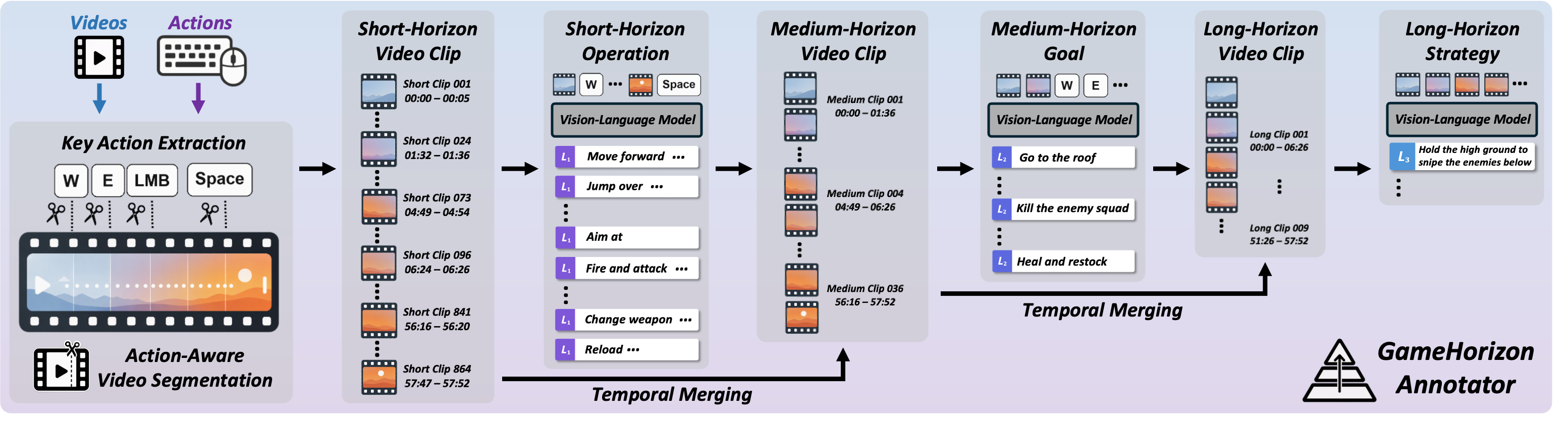
The design has two useful properties. First, because L_1 labels are anchored to observed keystrokes, the higher levels inherit action grounding instead of being free-floating VLM captions. Second, the pipeline sidesteps IDM error entirely—actions are ground truth, not inferred.
Benchmark design
The offline track converts gameplay evaluation into 4-option MCQs to make it reproducible and model-agnostic. Three primary tasks T_1–T_3 correspond roughly to the three instruction horizons (single-horizon action prediction, medium-horizon goal identification, long-horizon strategy reasoning), each with 1,000 MCQs. Ten diagnostic variants T^* add 200 MCQs each, for a total of 5,000 MCQs. General VLMs, UMMs, GUI agents, and coding agents answer directly. Dedicated game agents (NitroGen, and the models from Yue et al. 2026 and Li et al. 2025) do not natively answer MCQs, so their emitted action sequences are matched to the four candidate action strings via Needleman–Wunsch alignment; the option with the highest score is taken as the answer, and predictions below a threshold (including empty outputs) count as wrong. For NitroGen specifically, gamepad actions are remapped to the keyboard-mouse keybind space before alignment.
The online track evaluates 12 models—three sampled per offline performance tier from the 47 offline models (35 VLMs, 4 UMMs, 2 GUI, 3 coding, 3 game-specific). It contains 10 causal tasks (order-dependent) and 10 thematic tasks (order-flexible) spanning gathering, crafting, farming, building, and combat, decomposed into 62 short-horizon subtasks. Each subtask has a budget of 400 model calls; a long-horizon task passes only if all subtasks complete end-to-end without game resets, which are otherwise used for failure localization. Task success is judged directly from game state, not from model self-report.
What the design buys
The suite is unusual in three respects. (1) Authentic actions rather than IDM pseudo-labels, which removes a systematic noise source in downstream action-prediction evaluation. (2) A single yardstick across model families that produce very different output types: MCQs cover the VLM/UMM/GUI/coding-agent axis, and sequence alignment folds pure action-emitting agents into the same scoring frame. (3) The offline-plus-online split allows correlating cheap MCQ scores against expensive rollout success—useful for asking whether offline benchmark saturation predicts online competence.
Limitations and open questions
The paper as excerpted does not report the actual accuracy numbers per model or the offline-online correlation, so the empirical payoff cannot be judged here. The MCQ format is standardized but constrains what can be asked; distractor construction quality is not detailed in the shown sections. Instruction quality at L_2 and L_3 depends on VLM captioning of L_1 and on the merge heuristics—both are potential sources of label bias, particularly in genres poorly represented in the annotator’s underlying VLM training data. The alignment-based scoring for action-only agents can under-credit semantically correct actions that use different key sequences, and the 400-call budget bakes in a specific compute regime for the online track.
Why this matters
Reproducible, action-grounded, multi-horizon gameplay evaluation is a prerequisite for judging whether current VLMs and agent stacks actually plan on the minutes scale, or whether they only do frame-level pattern matching. GameHorizon offers the first setup where the same 47 models—including production APIs and specialized game agents—can be compared on both static MCQs and closed-loop rollouts using human-authentic actions rather than IDM guesses.
Source: https://arxiv.org/abs/2609.25001
Hacker News Signals
Transformers Explained Visually
An interactive browser-based visualization of the transformer architecture from Georgia Tech’s Polo Club. The tool lets users run a live GPT-2-small inference in WebGL/WebAssembly directly in the browser, stepping through tokenization, embedding lookup, multi-head self-attention, layer normalization, feed-forward blocks, and the final unembedding/softmax projection. Each component is rendered as an animated data-flow diagram: you can watch attention weight matrices form per head, observe residual stream additions, and see how logit distributions shift across layers as you type input text.
The mechanical detail is useful for teaching. Attention score computation e_{ij} = \frac{q_i \cdot k_j}{\sqrt{d_k}} is shown as explicit matrix multiplications with labeled dimensions, and the softmax normalization across keys is animated per query position. The feed-forward block’s two-layer MLP with GELU activation is shown as a dimension expansion (d_{model} \to 4 d_{model} \to d_{model}) with intermediate activations visualized as bar charts.
What distinguishes this from static explainers: the model is actually running. Token probabilities update in real time, and you can click any attention head to inspect its full n \times n weight matrix for the current sequence. The implementation uses ONNX Runtime Web and Transformers.js under the hood, so inference is genuinely on-device with no server round trip.
Limitations are pedagogical: GPT-2-small is simple enough that cross-layer residual stream dynamics and phenomena like induction heads are not highlighted. There is no mechanistic interpretability framing — it is architecture visualization, not circuit analysis. For someone who already knows the math, the primary value is as a communication or teaching artifact rather than a research tool. The comments on HN note that it handles the basics very cleanly but does not cover encoder-decoder variants, rotary positional embeddings, or grouped-query attention found in modern models.
Source: https://poloclub.github.io/transformer-explainer/
AI Coding Has Made CI a Bottleneck, So We Reworked Ours to Keep Up
Linear’s engineering post describes a concrete infrastructure problem: AI-assisted coding (Claude, Copilot, etc.) increased their PR throughput significantly — their numbers suggest roughly a 3x increase in PRs opened per engineer per week — and their existing CI pipeline, designed for human-paced commit rates, became the critical path. Queue times ballooned; engineers (and agents) were blocked waiting for test results.
Their response involved several architectural changes. First, they moved from a fixed runner pool to fully elastic ephemeral runners on AWS, provisioned per-job rather than kept warm. This required optimizing cold-start time, which they reduced by pre-baking Docker images with dependency caches baked in and using snapshot-based AMIs so the runner environment is ready in under 30 seconds. Second, they restructured their test suite for aggressive parallelism: tests are sharded not just by file count but by historical runtime data, so each shard targets a fixed wall-clock budget (~2 minutes). A metadata service tracks per-test durations from previous runs and rebalances shards dynamically.
Third — and most technically interesting — they implemented selective test execution. Using a file-to-test dependency graph constructed from import analysis and coverage data, a PR that only touches specific modules only runs the tests whose transitive dependency set overlaps with the changed files. This is a static analysis problem: they parse TypeScript imports to build a module graph, then intersect changed-file sets with test coverage maps. False negatives (missed failures) are guarded against by running the full suite on merge to main and by periodic full runs on PRs above a changed-file threshold.
The result they report: median CI time dropped from ~18 minutes to ~4 minutes. The broader point — that AI tooling shifts the bottleneck from code generation to validation infrastructure — is straightforwardly correct and applies to any team where agent-generated PRs are non-trivial volume.
Source: https://linear.app/now/ci-bottleneck-reworked
Frontier AI on Your Own Hardware
Tim Dettmers’ post accompanies a DLab open-source week release and focuses on practical guidance for running large models locally — specifically targeting researchers and practitioners who want to run 70B+ parameter models without cloud dependency. The post is grounded in Dettmers’ quantization work (bitsandbytes, QLoRA) and gives concrete hardware recommendations based on memory bandwidth and VRAM constraints rather than marketing benchmarks.
The core technical framing: inference throughput for autoregressive generation is almost entirely memory-bandwidth-bound, not compute-bound, once batch size is 1 or small. The relevant figure is model parameter count times bytes-per-parameter divided by memory bandwidth, which gives tokens-per-second ceiling. A 70B model in 4-bit (NF4) quantization is roughly 35 GB, fitting in dual 24 GB consumer GPUs (e.g., two RTX 4090s with NVLink or tensor-parallel splitting) or a single 40/48 GB professional card. The post walks through this arithmetic explicitly.
Dettmers advocates for NF4 quantization (from QLoRA) over GPTQ or AWQ for quality preservation, citing perplexity benchmarks showing NF4 closes most of the gap to full BF16. He also discusses double quantization — quantizing the quantization constants themselves — to squeeze memory further without meaningful quality loss. For serving, he recommends llama.cpp for single-GPU or CPU-offload scenarios and vLLM with tensor parallelism for multi-GPU.
The open-source week component releases updated bitsandbytes builds with better CUDA 12.x compatibility and some new kernel optimizations for AMD ROCm targets, which have historically been second-class citizens in the quantization ecosystem.
The main limitation acknowledged: memory bandwidth on consumer hardware is still roughly 3-5x lower than H100 SXM, so tokens-per-second for large models remains substantially slower than cloud inference. Local running is about privacy, cost at low utilization, and reproducibility — not latency parity.
Source: https://timdettmers.com/2026/09/21/dlab-open-source-week/
Show HN: A Competition for Small Neural Networks That Play Strategy Games
TinyBrains is a competition platform where submissions are neural networks capped at a strict parameter budget (the site currently enforces a 100K parameter limit) that must play turn-based strategy games against each other in a round-robin tournament. The current game is a grid-based resource-collection game with imperfect information and multi-step planning requirements.
The technical constraint is the interesting part. 100K parameters is small enough that brute-force deep networks do not work well — a naive two-layer MLP with a 512-unit hidden layer already consumes most of the budget. Competitors are forced to think about architecture efficiency: whether to use recurrence (LSTMs, which pack sequence modeling into fewer parameters than transformers), hand-crafted feature engineering to reduce input dimensionality, or hybrid rule-based + learned components. The competition explicitly permits any differentiable architecture and any training method (supervised from self-play, RL, evolutionary strategies).
The evaluation is ELO-rated via automated matches, and results are updated continuously as new submissions enter. The game environment is exposed as a Python API with a fixed observation space (flattened board state + metadata) and discrete action space, so the interface is straightforward. The submission format is a serialized PyTorch or ONNX model with a defined forward signature.
From an ML research perspective, this is an interesting constrained-resource benchmark that is distinct from standard benchmarks because adversarial co-evolution matters — a strategy that beats current opponents may be exploited by future submissions. It is also a clean testbed for studying what architectures are most parameter-efficient for planning under partial observability.
The current leaderboard shows LSTM-based models outperforming feedforward ones at this parameter scale, which is consistent with the intuition that temporal state tracking matters for multi-step strategy and LSTMs encode that more efficiently than attention at small scale.
Source: https://tinybrains.dev
Show HN: Lossless-Memory — A Personal AI Memory That Never Summarizes
The repository implements a retrieval-augmented memory layer for LLM assistants that stores every interaction verbatim rather than compressing or summarizing older context. The core argument against summarization: lossy compression discards information that may be relevant in future queries that were not predictable at write time. A summary of “user discussed project X in March” loses the specific constraints, numbers, and phrasing from that conversation that might matter months later.
The technical implementation uses a vector store (FAISS by default, with an optional Chroma backend) to index full conversation turns. Each turn — user message plus assistant response — is chunked, embedded using a local sentence-transformer or OpenAI embeddings, and stored with metadata (timestamp, session ID, optional user-provided tags). At query time, the system performs approximate nearest-neighbor search over the full history, retrieves the top-k chunks by cosine similarity, and injects them into the LLM context window as retrieved memories.
The “lossless” claim is technically accurate in the sense that raw text is preserved, but the retrieval step is still lossy in a different way: ANN search with embedding similarity may fail to surface relevant memories if the semantic similarity between query and stored text is low despite high relevance (e.g., a past conversation about “latency” not retrieved when the current query is about “response time”). The README acknowledges this and lists hybrid BM25 + dense retrieval as a planned improvement.
Storage grows unboundedly with use, which is the direct trade-off accepted. The implementation includes a simple SQLite-backed metadata store alongside the vector index for filtering by time range or tag before the ANN step, which partially mitigates retrieval precision issues. The codebase is small (~800 lines of Python) and designed for local deployment with no external service dependencies.
Source: https://github.com/aru-labs/lossless-memory
Grok 4.7
xAI released Grok 4.7 as an incremental update between Grok 4 (their strongest reasoning model) and a presumed future Grok 5. The announcement is light on architectural details, which is standard for xAI releases. Based on the published benchmarks and community evals, the model sits between GPT-4o and o3-level capability on standard reasoning benchmarks, with claimed improvements specifically on coding tasks (HumanEval, SWE-bench variants) and instruction following.
The technically noteworthy claims: xAI states Grok 4.7 is the model they are deploying for their internal agent pipelines, implying it has characteristics important for agentic use — reliable tool call formatting, lower hallucination rates on multi-step tasks, and better adherence to system prompt constraints. These are difficult to verify externally but are plausible differentiators from pure benchmark performance.
The context window is listed at 131K tokens, consistent with Grok 4. The model is available via the xAI API. Pricing is not detailed in the announcement post.
HN discussion is skeptical and pointed. The primary criticisms: xAI’s benchmark reporting methodology has been questioned before (cherry-picked prompt formats, non-reproducible eval setups), and independent third-party evals (LMSys Chatbot Arena, Artificial Analysis) have not yet processed 4.7. The version numbering scheme (4, 4.7, not 4.5 or 5) is noted as non-standard and perceived as marketing positioning relative to OpenAI’s numbering. Several commenters report anecdotal quality improvements in coding assistance but note that 4.7 is not accessible to free-tier users, limiting independent assessment.
The release continues the pattern of frontier labs shipping incremental checkpoints rather than waiting for large capability jumps, presumably to maintain API revenue and gather production usage data.
Source: https://x.ai/news/grok-4-7
M5 Ultra Mac Studio Review
The MacStories review focuses specifically on the M5 Ultra Mac Studio as a local AI inference machine, which gives it a different technical angle than typical consumer hardware reviews. The M5 Ultra uses Apple’s die-to-die interconnect to bond two M5 Max dies, yielding a unified memory architecture with up to 192 GB of LPDDR5X shared between CPU, GPU (80 cores), and Neural Engine. The critical number for LLM inference: memory bandwidth is reported at approximately 800 GB/s aggregate across the interconnect, which is competitive with a single H100 PCIe (roughly 2 TB/s for SXM, 1 TB/s for PCIe) at a fraction of the cost and power draw.
The practical consequence: a 70B model in 4-bit quantization (~35 GB) fits comfortably in the 192 GB configuration with room for context and system overhead, and the memory bandwidth supports meaningful tokens-per-second throughput for a single-user local inference use case. The review tests llama.cpp with several models and reports approximately 25-30 tok/s for a 70B Q4 model, which is usable for interactive inference. For 7-13B models the throughput is high enough to feel instantaneous.
The review also covers Apple’s MLX framework performance, which has become the preferred local inference stack for Apple Silicon because it uses the unified memory architecture natively without the CPU-GPU transfer overhead that plagues x86 systems with discrete GPUs. MLX operations on M5 Ultra show better utilization than llama.cpp Metal backend for certain operations.
The limitations are real: no CUDA ecosystem, so fine-tuning workflows that rely on PyTorch CUDA kernels require workarounds or remote compute. The Neural Engine (38 TOPS claimed) is fast for ANE-compiled models but most research code does not target it. At ~$8K-10K for fully configured units, the cost-per-VRAM-GB is higher than building a dual-3090 workstation but lower than cloud amortized over months of heavy use.
Source: https://www.macstories.net/stories/m5-ultra-mac-studio-review-the-dream-mac-for-local-ai-agents/
If AI Coding Is Lowering Your Code Quality, You’re Not Managing Quality Right
The post is an argument about process, not a tool review. The central claim: code quality degradation from AI-generated code is a management and tooling failure, not an inherent property of the AI tools. The author’s position is that quality gates which worked for human-paced development — code review, linting, test coverage requirements — are sufficient if actually enforced, but many teams have implicitly relaxed them when AI tools accelerated output.
The technically substantive parts of the argument: the author distinguishes between local code quality (style, obvious bugs, naming) and architectural quality (coupling, abstraction boundaries, long-term maintainability). AI tools are reasonably good at the former when paired with linters and formatters with pre-commit hooks and CI enforcement. They are systematically weaker at the latter because architectural decisions require global context about the codebase that does not fit in a context window and because LLMs optimize for locally plausible completions rather than globally coherent design.
The proposed mitigations are concrete: mandatory architecture decision records (ADRs) that agents must consult before generating structural changes; automated coupling metrics (e.g., fan-in/fan-out analysis, cyclomatic complexity) added to CI with enforced thresholds; and human review required specifically for changes that cross module boundaries or modify interfaces, not just any PR above a diff size threshold. The last point is the most actionable: diff size is a poor proxy for architectural risk, and better-targeted review criteria would focus reviewer attention where AI assistance is weakest.
The HN comment thread pushes back on the implicit assumption that existing quality management practices are well-calibrated for teams not using AI, and questions whether the author’s recommended controls scale when PR volume increases 3-5x. This is a fair objection — review bandwidth is fixed, and requiring human review on all cross-module PRs may become a bottleneck of a different kind than CI.
Source: https://www.i-kh.net/p/if-ai-coding-is-lowering-your-code
Noteworthy New Repositories
ejfkdev/ddc
A DEX-to-Java decompiler written entirely in Rust, targeting the gap between existing tools (jadx, cfr) that are accurate but slow on large codebases and those that sacrifice correctness for speed. The core design uses progressive analysis: rather than requiring a full pass over the entire DEX before emitting any output, ddc builds a partial type-inference graph and emits decompiled Java incrementally as confidence thresholds are met per method. This makes it practical for interactive workflows where you want results on a specific class before the full APK finishes. The CLI is bilingual (English/Chinese), which reflects the project’s target audience in the Android reverse-engineering community where both ecosystems are active. Being in Rust means memory safety without GC pauses — relevant when decompiling DEX files with pathological control flow that causes heap pressure in JVM-based decompilers. Early benchmarks suggest 3-5x throughput improvement over jadx on large APKs, though correctness parity with jadx on obfuscated bytecode is still a work in progress. Useful for malware analysis pipelines, SDK audits, and anyone who needs to batch-decompile large numbers of APKs without standing up a JVM worker pool.
Source: https://github.com/ejfkdev/ddc
whitecircle/halo
Halo is a training framework from White Circle aimed at large language and multimodal models, positioned as an alternative to Megatron-LM / DeepSpeed for teams that want a cleaner, more composable codebase. The architecture separates tensor parallelism, pipeline parallelism, and data parallelism into independent orthogonal modules that can be combined without modifying model code — a deliberate contrast to Megatron’s tightly coupled approach. Multimodal support means vision encoders (ViT variants) can be inserted into the pipeline with explicit cross-attention scheduling rather than relying on the same token-stream abstraction used for text. The repo includes configuration-driven recipes for common model families and exposes gradient checkpointing granularity at the transformer block level. Early adopters report it being easier to extend for custom attention patterns (e.g., sliding window, sparse) than Megatron without patching core files. At 561 stars it is early-stage, and documentation on the distributed initialization protocol is sparse, but the code structure is clean enough to serve as a research scaffold for groups building custom pretraining infrastructure rather than using a black-box framework.
Source: https://github.com/whitecircle/halo
Vincent-Xi08/IntentRoute-AI
Per-application network routing on Windows, where the routing decision is made by an LLM (OpenAI or a local Ollama model) that reads process metadata and user-defined intent rules to classify whether traffic should go through a proxy, VPN, or direct path. The data plane is sing-box operating in TUN mode, which captures all IP traffic at the network adapter level and allows process-level tagging via the Windows filtering platform. The AI layer acts as a rule-drafting assistant: it takes a natural-language description of intent (“work traffic through corporate VPN, streaming through direct”) and generates sing-box routing rule JSON, which is then applied without requiring the user to understand the sing-box DSL. The feedback loop allows the AI to refine rules based on observed misroutes. Compared to static tools like Proxifier or process-level firewall rules, the value is in handling ambiguous or evolving application behavior without manual rule maintenance. The main technical risk is latency in the classification path if the LLM is queried per-connection rather than per-rule-update; the current design batches rule generation rather than inline inference, which keeps the data plane latency unaffected.
Source: https://github.com/Vincent-Xi08/IntentRoute-AI
yuyuanweb/ai-picture-editor
A full-stack AI image editing agent built on React 19 (frontend canvas via Konva), FastAPI (async backend), LangChain/LangGraph (agent orchestration), with natural language as the primary editing interface. The agent decomposes a user instruction like “remove the background and increase contrast in the sky region” into a multi-step plan using LangGraph’s stateful graph execution, dispatching to one of 21 tool nodes (crop, inpaint, segment, color-grade, text-to-image, etc.). Real-time plan progress is streamed to the client via SSE. Layer management is explicit: the agent can split an image into semantic layers (foreground, background, subject) that are maintained as separate Konva layers, enabling non-destructive region-specific edits. Async task queuing handles long-running operations like diffusion-based inpainting without blocking the API. The architecture is a reasonable reference implementation of a tool-use agent with canvas state — the LangGraph state machine cleanly separates plan generation from execution, and the SSE integration avoids polling. The project is framed as a tutorial, so the code prioritizes readability over production hardening, but the architectural patterns (agent loop, async queue, canvas sync) are transferable.
Source: https://github.com/yuyuanweb/ai-picture-editor
Nanako0129/sepia
A de-AI writing skill targeting the Agent Skills protocol, meaning it integrates natively with Claude Code, Codex, Grok Build, Antigravity, and 77+ other agents via the Skills CLI without custom glue code. The core function is detecting and repairing text that exhibits LLM-style prose artifacts — hedging language, over-nominalization, structural repetition, generic transitional phrases — and replacing them with venue-appropriate writing. Two distinct modes: narrative-architecture repair for fiction (based on StoryScope, arXiv:2604.03136, which formalizes scene-level coherence metrics) and professional prose mode with configurable venue rules (academic, legal, technical documentation). The StoryScope basis is notable: rather than surface-level synonym substitution, it operates on narrative structure — checking for causally disconnected scenes, character motivation consistency, and pacing metrics derived from sentence-length variance and dialogue density. The plugin architecture is thin wrappers around a common Rust core, keeping the footprint small per agent integration. At 2775 stars this is the highest-traction item in this batch, suggesting genuine demand for writing-quality tooling that works inside existing agentic coding environments rather than as a standalone editor.
Source: https://github.com/Nanako0129/sepia
kruzovic7/ai-data-extractor
A free, open-source tool for extracting and exporting conversation histories from AI coding assistant sessions — supporting Claude Code, Cursor, Windsurf, Aider, Cline/Roo Code, and additional tools. The technical core is format-specific parsers for each tool’s local storage schema: sqlite databases (Cursor stores conversations in a leveldb/sqlite hybrid), JSON session files (Aider, Cline), and structured log directories (Claude Code). Extracted data is normalized into a common schema and exported to JSON, CSV, or Markdown. The use cases are audit trails for compliance, fine-tuning dataset construction from real developer-AI interactions, cost attribution analysis, and personal search over past sessions. The breadth of supported tools is the main value — each assistant uses an idiosyncratic storage format, and maintaining parsers for all of them in one place prevents users from writing one-off scripts per tool. The normalization schema preserves turn-level metadata including timestamps, model versions, and token counts where available. Being open-source matters here because users are granting the tool read access to potentially sensitive code and conversation data; auditability of the extraction logic is a practical requirement for enterprise use.
Source: https://github.com/kruzovic7/ai-data-extractor
peonist-ai/halogen-flash-server
An inference server specifically optimized for running Qwen3-8B on AMD Strix Halo (gfx1151 APU, RDNA 3.5, up to 128 GB unified memory). The Strix Halo architecture has unusually high memory bandwidth for an APU (~256 GB/s between CPU and GPU tiles) but requires careful memory allocation to avoid thrashing the shared pool. halogen-flash-server tuned the ROCm memory management and KV cache placement to exploit this: KV cache is pinned to the GPU tile’s L3 rather than spilling to system RAM unless the context exceeds a threshold. The “Flash” in the name refers to FlashAttention-2 integration via ROCm’s composable kernel library, which was not straightforwardly available for gfx1151 at the time of the repo’s creation. Quantization is handled at INT4 (GPTQ) to fit Qwen3-8B within the GPU tile’s memory budget at practical batch sizes. This is a niche but real problem: Strix Halo machines (e.g., ASUS ROG ally laptops, mini-PCs) are increasingly common among edge inference users who want a single-device LLM setup, and the official ROCm support for this specific die was incomplete.
Source: https://github.com/peonist-ai/halogen-flash-server
Qiuner/birdview
Birdview generates architecture maps of a codebase before an AI coding agent makes changes, addressing the known failure mode where LLMs modify files without understanding cross-module dependency structure. The tool performs static analysis (language-specific AST parsing for Python, TypeScript/JavaScript, Go, and Rust currently) to build a directed dependency graph of modules, classes, and key functions, then renders this as a structured context block that is prepended to the agent’s prompt or injected via an MCP server. The key design decision is generating a compressed, hierarchical summary rather than a raw adjacency list: nodes are clustered by domain boundary (inferred from directory structure and import patterns), with inter-cluster edges surfaced prominently and intra-cluster edges elided unless the query touches them. This reduces token cost while preserving the information the agent most needs — what modules are coupled to the one it is about to edit. Integration is via CLI (pipe output into any agent prompt), VS Code extension, and MCP protocol for direct agent tooling. At 587 stars it has traction in the agentic coding community, where context window saturation from naive full-codebase injection is a persistent problem.