Daily AI Digest — 2026-09-14
arXiv Highlights
PLC-DPO: Posterior Label Correction in Noisy and Ambiguous Preference Optimization
Problem
Direct Preference Optimization treats every observed pair (y_w, y_l) as a reliable indicator of preference direction. In practice, human- or model-annotated preference datasets contain three failure modes: (i) flipped labels where y_l is actually preferable, (ii) weakly directional pairs where the two responses are near-equivalent, and (iii) genuine ties. Under the Bradley-Terry loss \mathcal{L}_{\mathrm{DPO}} = -\log\sigma(m_{\mathrm{seq}}), a flipped label produces a gradient that actively pushes the policy in the wrong direction with the same magnitude as a correct one; weak or tied pairs contribute noise. Existing robust variants (cDPO, rDPO, IPO, filtering-based methods) either apply a uniform label-smoothing prior or discard suspicious examples, both of which throw away signal.
PLC-DPO reframes this as an online latent-label problem: the hidden variable is the true pairwise direction, not response quality, and each pair should be routed at training time into one of three actions — reinforce (clean), reverse (flip), or neutralize (tie).
Method
The core observation is that the policy-reference margin
m_{\mathrm{seq}}(x,y_w,y_l) = \beta\!\left[\log\frac{\pi_\theta(y_w\mid x)}{\pi_{\mathrm{ref}}(y_w\mid x)} - \log\frac{\pi_\theta(y_l\mid x)}{\pi_{\mathrm{ref}}(y_l\mid x)}\right]
acts as online evidence about the latent label. If the current policy has moved substantially in the labeled direction relative to the reference (m_{\mathrm{seq}} large positive), the pair is likely clean; strongly negative m_{\mathrm{seq}} under a well-trained-enough policy is a signal of a flipped label; margins concentrated near zero indicate a tie. Because raw margins drift in scale during training, PLC-DPO standardizes them (batch or running statistics) before feeding them into a routing distribution over \{\mathrm{clean}, \mathrm{flip}, \mathrm{tie}\}, then applies a confidence gate so that low-certainty routing decisions do not fire aggressive corrections.
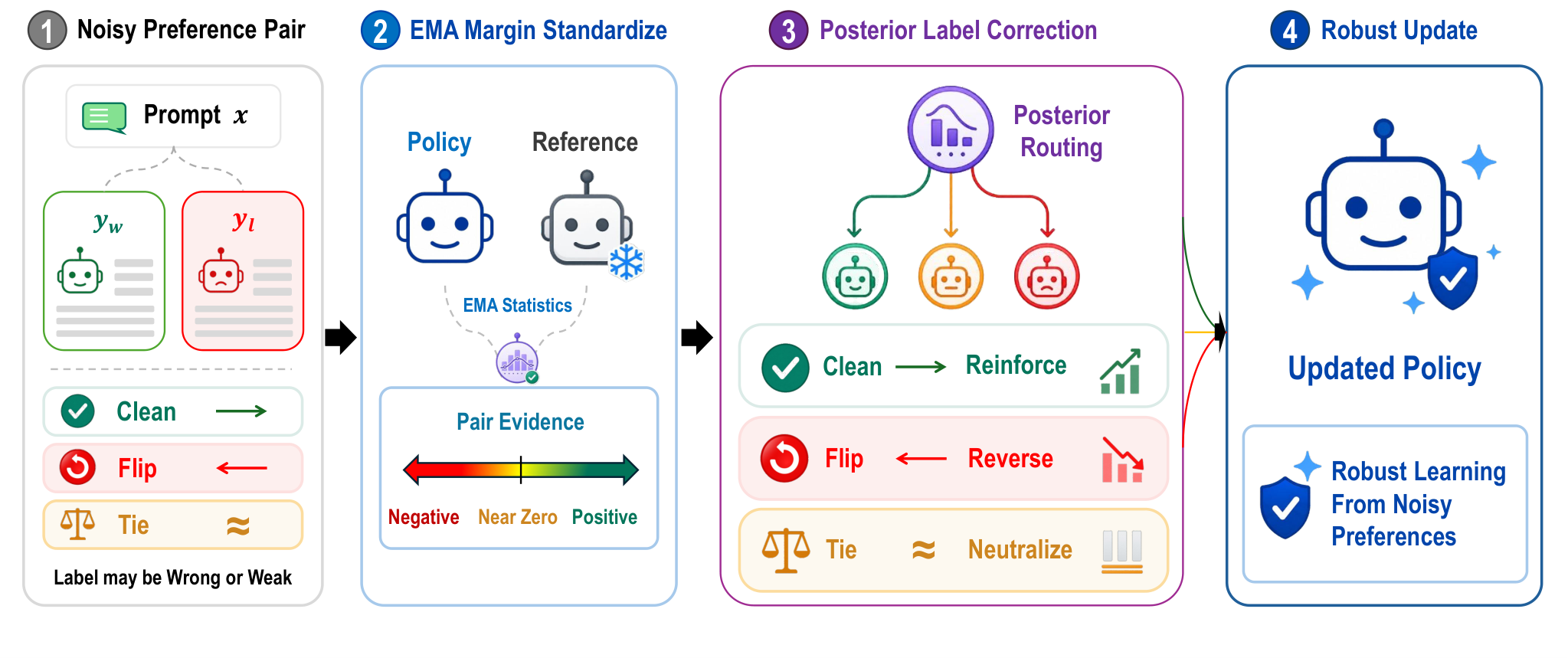
Given routing posteriors p_c, p_f, p_t for each pair, the loss becomes a mixture: the clean branch is the ordinary -\log\sigma(m_{\mathrm{seq}}), the flip branch is -\log\sigma(-m_{\mathrm{seq}}) (equivalent to swapping y_w and y_l), and the tie branch drives m_{\mathrm{seq}}\to 0 (e.g., an IPO-style squared-margin penalty or symmetric KL toward the reference). The confidence gate scales the correction actions by the sharpness of the routing posterior, so that pairs with ambiguous evidence receive near-DPO updates rather than aggressive reversals — this is what prevents the pathology where the model “self-confirms” its current bias by flipping labels it merely disagrees with.
To re-implement the skeleton: (1) compute m_{\mathrm{seq}} per pair; (2) maintain running mean/variance to produce \tilde m; (3) map \tilde m through a three-way softmax (with tie centered at zero, clean/flip in the tails) to get (p_c, p_f, p_t); (4) compute the mixture loss; (5) apply confidence gating based on \max_k p_k or negative entropy.
Results
Evaluation spans 57 dataset-model-benchmark cells covering Qwen2.5-1.5B, Qwen2.5-7B, Phi-2-2.7B, and (for generalization) Llama-3-8B and Mistral-7B, all SFT-initialized on UltraChat-200k. The headline number: PLC-DPO achieves a mean win rate of 60.5 against DPO, versus 55.5 for the next-best baseline — a 5-point margin over the strongest robust-DPO competitor. Gains persist across base models and preference datasets (Q2), which suggests the routing mechanism is not tuned to a specific reward-model artifact.
Under injected-noise stress tests where a controlled fraction of labels is flipped, the inferred routing states track the ground-truth noise rate, and performance degrades gracefully relative to DPO’s cliff. Tie stress tests using both synthetic near-duplicate pairs and human-disagreement subsets show that the tie route activates on genuinely ambiguous pairs rather than merely on hard-to-fit ones. Self-confirmation diagnostics indicate the method distinguishes flipped pairs from weakly directional pairs — a nontrivial requirement, since both produce small or negative margins early in training.
Limitations and open questions
- Routing depends on \pi_\theta itself being informative; early in training, m_{\mathrm{seq}}\approx 0 everywhere and the routing distribution is uninformative. The paper relies on confidence gating and SFT initialization to bridge this, but very cold starts remain a concern.
- The tie loss formulation is not fully specified in the excerpt; whether it uses IPO-style squared margins vs. reference-KL affects gradient scale and interacts with \beta.
- Self-confirmation risk is mitigated but not eliminated: a policy that becomes confidently wrong on a subpopulation can, in principle, route correct labels there as flips. Diagnostics are reported but no formal identifiability result is given.
- Compute overhead of margin standardization and three-branch loss is modest but nonzero; scaling behavior at 70B+ is untested.
- Comparisons against reward-model-based filtering (rather than pure DPO variants) would clarify whether posterior routing subsumes external quality estimation.
Why this matters
Robust preference optimization has been dominated by static label-smoothing or filtering, both of which treat noise as a nuisance to attenuate. PLC-DPO instead makes the noise structure part of the loss, using the policy’s own trajectory as evidence — a natural fit for online alignment pipelines where preference data is heterogeneous in reliability. A 5-point mean win-rate improvement over the next-best robust variant across 57 cells is a substantive margin in this literature.
Source: https://arxiv.org/abs/2608.30597
Breaking the Vision-Action Shortcut: Latent Interface Training for Generalizable Robotics Foundation Models
Problem
Robot foundation models — VLAs like \pi_{0.5} and MolmoAct2, and world-action models (WAMs) like FAST-WAM and ImageWAM — couple pretrained vision/language backbones to embodiment-specific action experts. During imitation learning on demonstrations with limited visual diversity, the action expert can latch onto task-irrelevant visual cues (backgrounds, lighting, camera pose, distractors) that happen to correlate with demonstrated actions. Under distribution shift these correlations break and success rates collapse, even though the geometric task itself is unchanged. Prior mitigations either enrich representations (which does not constrain how the expert uses them) or use image-free action pretraining (which does not constrain the subsequent visual-conditioning stage), leaving shortcuts intact.
The authors ask how to structure action learning and visual conditioning so that task-relevant spatial content survives while task-irrelevant visual channels are throttled.
Method: Latent Interface Training
LIT is a two-stage, framework-agnostic training recipe. Let \mathbf{o}_t, l, \mathbf{s}_t denote visual observation, language, and robot state, with predicted chunk
\mathbf{A}_t = (\mathbf{a}_t, \dots, \mathbf{a}_{t+H-1}).
For every demonstrated chunk, define a terminal SE(3)+gripper goal
\mathbf{g}_t = [\mathbf{p}_{t+H}; \mathbf{r}_{t+H}; \mathbf{q}_{t+H}] \in \mathbb{R}^{8},
with position \mathbf{p}\in\mathbb{R}^3, axis-angle orientation \mathbf{r}\in\mathbb{R}^3, and 2-DoF gripper \mathbf{q}. This \mathbf{g}_t is available only at training time.
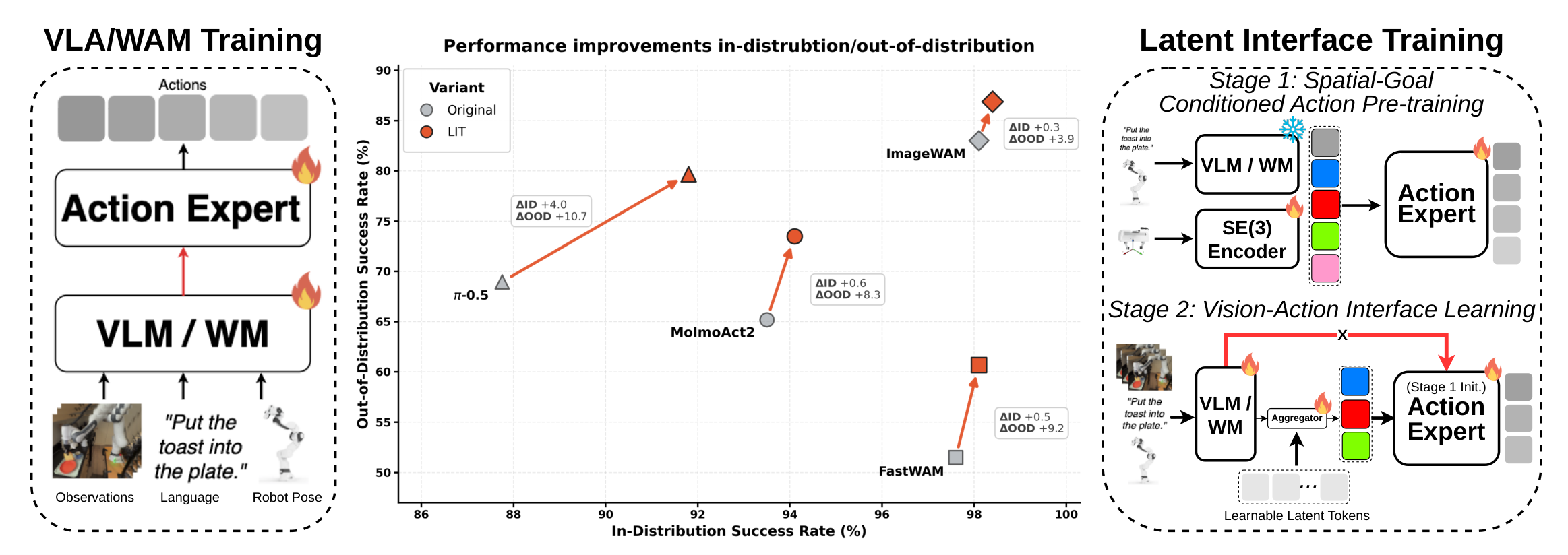
Stage 1 — Image-free spatial-goal-conditioned action prior. The action expert is trained to generate \mathbf{A}_t conditioned on (i) language and robot-state tokens from the frozen backbone and (ii) an encoding of \mathbf{g}_t. Crucially, visual tokens are excluded. Because \mathbf{g}_t specifies the terminal pose of the chunk, this stage learns a goal-directed action prior rather than a language-only prior; the expert cannot form vision–action correlations because it never sees images.
Stage 2 — Pose-supervised latent interface. Learnable latent tokens \mathbf{z} cross-attend to visual and semantic backbone representations and are the only pathway by which visual information reaches the pretrained action expert; they inject layer-wise conditioning (replacing the native joint-attention or per-layer KV cross-attention of each host architecture). Their supervision is a pose-reconstruction loss forcing \mathbf{z} to decode back to the same terminal \mathbf{g}_t used in Stage 1. This ties the visual bottleneck to the spatial target that Stage 1 has already made actionable, so the interface is incentivized to encode goal-relevant geometry and to discard nuisance appearance content.
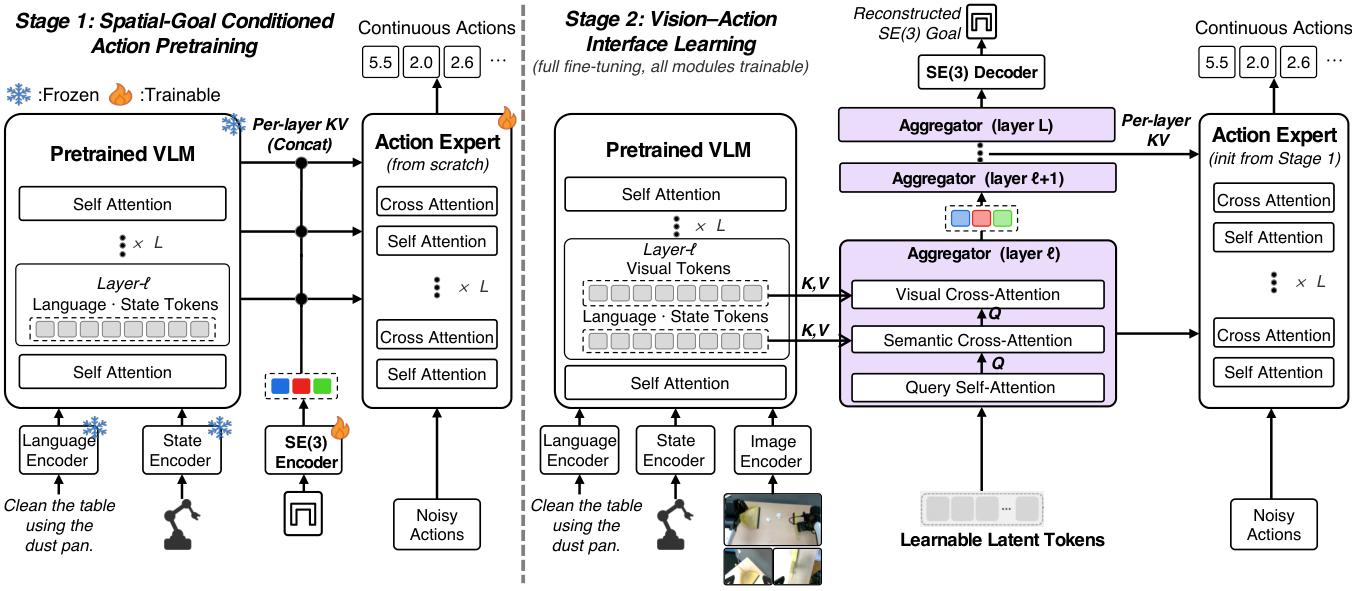
Integration into each of the four host models keeps the original backbone, action expert parameterization, and action-generation objective (autoregressive tokens for MolmoAct2, flow matching for \pi_{0.5}, diffusion/flow for the WAMs). Only the visual-conditioning pathway is replaced by the pose-supervised latent interface. At inference \mathbf{g}_t is not required — the latent tokens supply spatial conditioning from the current observation.
Note on the experimental protocol: baselines and LIT variants are trained from the same pretrained backbones with randomly initialized action experts, avoiding vision-action dependencies inherited from published policy checkpoints. This is a stricter comparison than the usual fine-tuning setup but means the baseline numbers are not directly comparable to published LIBERO fine-tuning leaderboards.
Results
Evaluation covers LIBERO (4 suites × 10 tasks × 50 rollouts = 2,000 episodes) for in-distribution performance and LIBERO-Plus (10,030 perturbed instances across seven task-preserving axes: camera viewpoint, sensor noise, initial state, language, object layout, lighting, background) for zero-shot OOD. All four host architectures — \pi_{0.5}, MolmoAct2, FAST-WAM, ImageWAM — are trained only on original LIBERO demonstrations.
Across all four backbones, LIT preserves or slightly improves in-distribution LIBERO success while improving the unweighted mean OOD success on LIBERO-Plus (summary panel in Fig. 1). The paper’s main claim is that this pattern holds simultaneously across the two VLM–action-expert coupling styles (joint self-attention vs. per-layer KV cross-attention) and the two WAM styles (train-time future video prediction without inference-time use, vs. inference-time image-editing denoising), i.e., the shortcut-mitigation effect is architecture-agnostic.
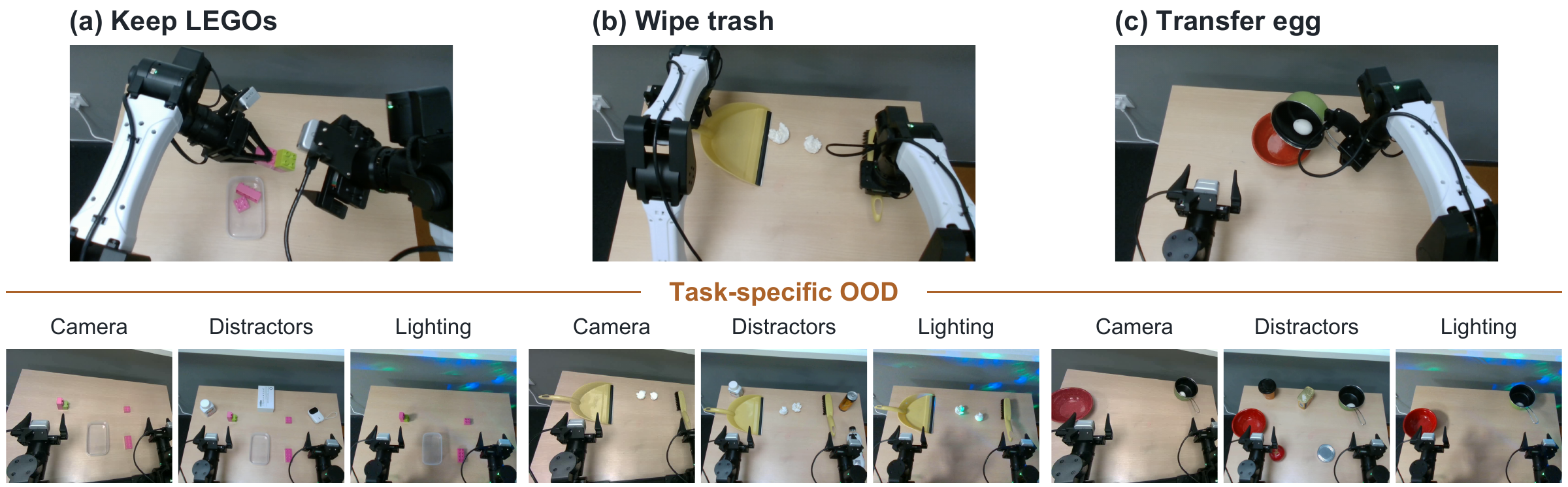
Real-robot experiments cover three manipulation tasks under three OOD conditions — Lighting, Camera (top-view only), and Distractors — and show improved robustness to unseen visual variations while ID performance is retained. Ablations attribute the gains to the joint design: Stage-1 image-free spatial-goal pretraining, pose supervision on the latent tokens, and routing all visual conditioning through the interface. Removing any one component recovers shortcut behavior.
Limitations and open questions
- The results anchor on LIBERO/LIBERO-Plus and a small real-robot suite; scaling to larger cross-embodiment datasets (OXE-scale) and long-horizon tasks is untested.
- Terminal SE(3) pose is a strong supervisory signal that assumes accurate proprioception on every demonstrated chunk; noisy or missing end-effector state (e.g., human video, teleop without kinematics) would break Stage 1.
- Using the terminal end-effector pose of a fixed-horizon chunk implicitly biases the action prior toward reaching behaviors; contact-rich or force-modulated skills where the terminal pose underspecifies the trajectory may not benefit as clearly.
- The comparison protocol trains action experts from scratch, so absolute numbers do not tell us how LIT interacts with large-scale pretrained policy weights, which is the regime most practitioners deploy.
- No analysis is provided of whether the latent interface bandwidth (number/dim of tokens) trades off shortcut suppression against fine-grained visual acuity needed for e.g. small-object grasping.
Why this matters
LIT reframes shortcut mitigation as an architectural bottleneck problem: constrain the visual channel with a spatial supervisory target rather than hoping representation quality alone yields invariance. That the same recipe transfers across four heterogeneous VLA/WAM designs without touching backbones or action objectives suggests pose-supervised latent interfaces are a drop-in modification worth trying on any policy that currently pipes raw visual tokens into an action expert.
Source: https://arxiv.org/abs/2609.12641
SAS: Simple Attention Sparsification via End-to-End Optimization of Context Ranking
Problem
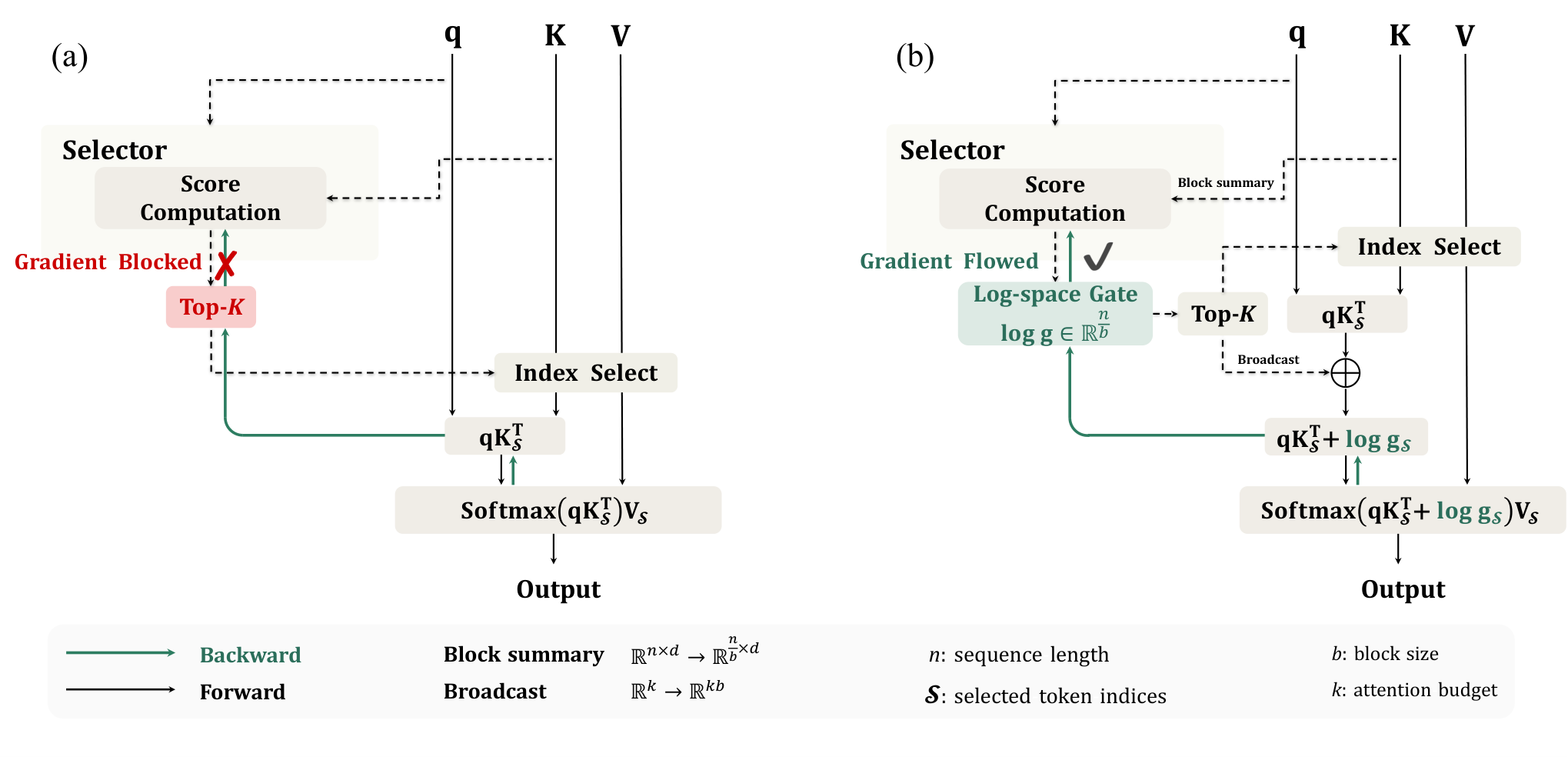
Post-training attention sparsifiers reduce the O(N^2) cost of pretrained transformers by selecting, per query, a small set of context blocks to attend to. The dominant recipe (SeerAttention-R, NSA-style selectors) trains a lightweight scorer to predict per-block scores, applies hard Top-K, and — because Top-K blocks gradients — supervises the scorer via distillation against the dense attention distribution of the frozen backbone. The authors argue this objective is misaligned with what matters: under a fixed budget K, the scorer should rank blocks by their marginal contribution to next-token prediction, not by their dense attention weight. A block with large softmax mass but small \|V\| contribution, or a block whose information is redundant with another selected block, wastes the budget.
Method
SAS reframes sparse selection as differentiable context ranking. Given the always-retained current block B_0 and C candidate historical blocks \mathcal{H}=\{B_1,\dots,B_C\}, the selector produces scores \mathbf{s}\in\mathbb{R}^C, mapped to positive gates
\mathbf{g}=\phi(\mathbf{s})\in\mathbb{R}_+^C,\qquad g_0=1.
Each gate g_m is broadcast to all tokens in block B_m and injected into the attention computation so that the language modeling loss can update the selector by standard backprop. At inference, discrete Top-K is recovered from the ranking induced by \mathbf{s}.
The paper isolates four design axes that determine whether this simple idea actually works:
- Gate position. Inject g_m inside the softmax (i.e., add \log g_m to logits of tokens in B_m) or multiply outside the softmax on attention weights. Inside-softmax injection means the gate competes with other blocks for normalized mass, which is what one wants for a ranking signal.
- Gate activation. Three choices for \phi: (a) softmax-normalize scores jointly across candidate blocks; (b) independent sigmoid per block; (c) raw logits. The current block always has unit gate.
- Ranking preservation. Keep continuous scores during training vs. collapsing to binary Top-K masks with a straight-through estimator. Preserving continuous scores keeps the ranking well-defined and gradients informative for near-threshold blocks.
- Training scope. Backpropagate through all context blocks vs. only the currently selected ones. Full-scope gradients let the loss reshape the ranking even for blocks not currently in the Top-K.
A specialized training kernel is required because injecting per-block gates into softmax while retaining differentiability through all C candidates changes the standard FlashAttention pattern; the paper describes a training kernel to handle broadcast gates efficiently.
Results
Experiments use Qwen3 backbones at 4B/8B/14B, comparing SAS against full attention, SeerAttention-R (matched selector architecture but distillation-trained), Sliding Window, StreamingLLM, and Quest. Evaluation spans reasoning (MATH500, GPQA-Diamond, AIME24/25), long-context (LongBench, non-thinking mode), and agentic tasks (BFCL multi-turn, VitaBench, with YaRN extending context to 65,536). SAS is evaluated both in the frozen-backbone post-training setting and in continued pretraining where selector and backbone are jointly trained.
The most informative analysis is in Section 6. Using covered attention mass
\operatorname{Cov}(\mathcal{S})=\frac{\sum_{i\in\mathcal{S}} w_i}{\sum_j w_j},
with w_i=\exp(z_i) (raw attention) and the value-aware variant w_i=\exp(z_i+\log\|\mathbf{v}_i\|_2) from STEM, SAS covers less per-layer attention mass than SeerAttention-R under both metrics in nearly all layers. This is counterintuitive but consistent with the misalignment argument: distillation is trained to match the dense distribution, so it maximizes coverage by construction; SAS is only trained to minimize NTP loss and does not need to reproduce dense mass.
The payoff shows up cross-layer: the union of SAS-selected blocks across layers has higher overlap recall against the full-attention oracle than SeerAttention-R’s union. That is, SAS selectors across layers are more complementary, whereas distillation-trained selectors tend to converge to similar high-mass blocks per layer. On downstream reasoning, this translates into shorter traces and fewer truncations, and the authors report substantial decode speedups over full attention (with the exact numbers tied to the efficiency table in Section 6.3).
Limitations and open questions
- The paper’s own coverage analysis shows SAS covers less per-layer attention mass, so any evaluation that scores selectors by attention-mass recovery will penalize SAS. This complicates comparisons.
- End-to-end training requires gradients through the gated attention path; the specialized kernel is necessary, and its overhead relative to FlashAttention-style dense training is not fully quantified here.
- Whether the four design axes generalize outside the Qwen3 family — particularly to MoE backbones or GQA with very small numbers of KV heads — is not addressed.
- Comparisons to Quest and other selection-free methods on long-context are limited to a subset of tasks; head-to-head at matched budget across all tasks would sharpen the claim.
Why this matters
Attention sparsifiers have been converging on “train a selector to imitate dense attention.” SAS provides a clean counterexample: aligning the selector directly with the LM loss produces rankings that cover less mass per layer but yield better cross-layer coverage and better task performance. The four-axis design study (gate position, activation, ranking preservation, training scope) turns a folk-wisdom problem — how to backprop through Top-K — into a set of concrete, testable choices for future sparse-attention work.
Source: https://arxiv.org/abs/2609.13141
COBRA-Skills: Contextual Bandit-Guided Evolution for Agent Skill Optimization
Problem
Skill libraries — reusable natural-language procedures distilled from prior agent trajectories — improve LLM agents on downstream tasks, but constructing them is expensive: each candidate skill must be evaluated by rolling out the target agent on many task instances. Prior methods (Trace2Skill, SkillOpt, LLM Skill) either use large optimization sets or exhaustively score a fixed candidate pool. This paper poses skill construction as budgeted sequential optimization: given a small \mathcal{D}_{\mathrm{opt}} (50 examples/benchmark), initial no-skill rollouts \mathcal{T}_0, and a horizon of T rounds, find
s^{\star}=\arg\max_{s\in\mathcal{S}_T}\mathbb{E}_{(x,y)\sim\mathcal{D}}[\mathrm{Metric}(\mathcal{A}(x;s),y)].
The key tension is that \mathcal{S}_T itself is not fixed — it must be grown from execution evidence — while each evaluation call is expensive.
Method
COBRA-Skills alternates contextual-bandit selection over a live population of skills with evidence-grounded evolution that rewrites the population between rounds.
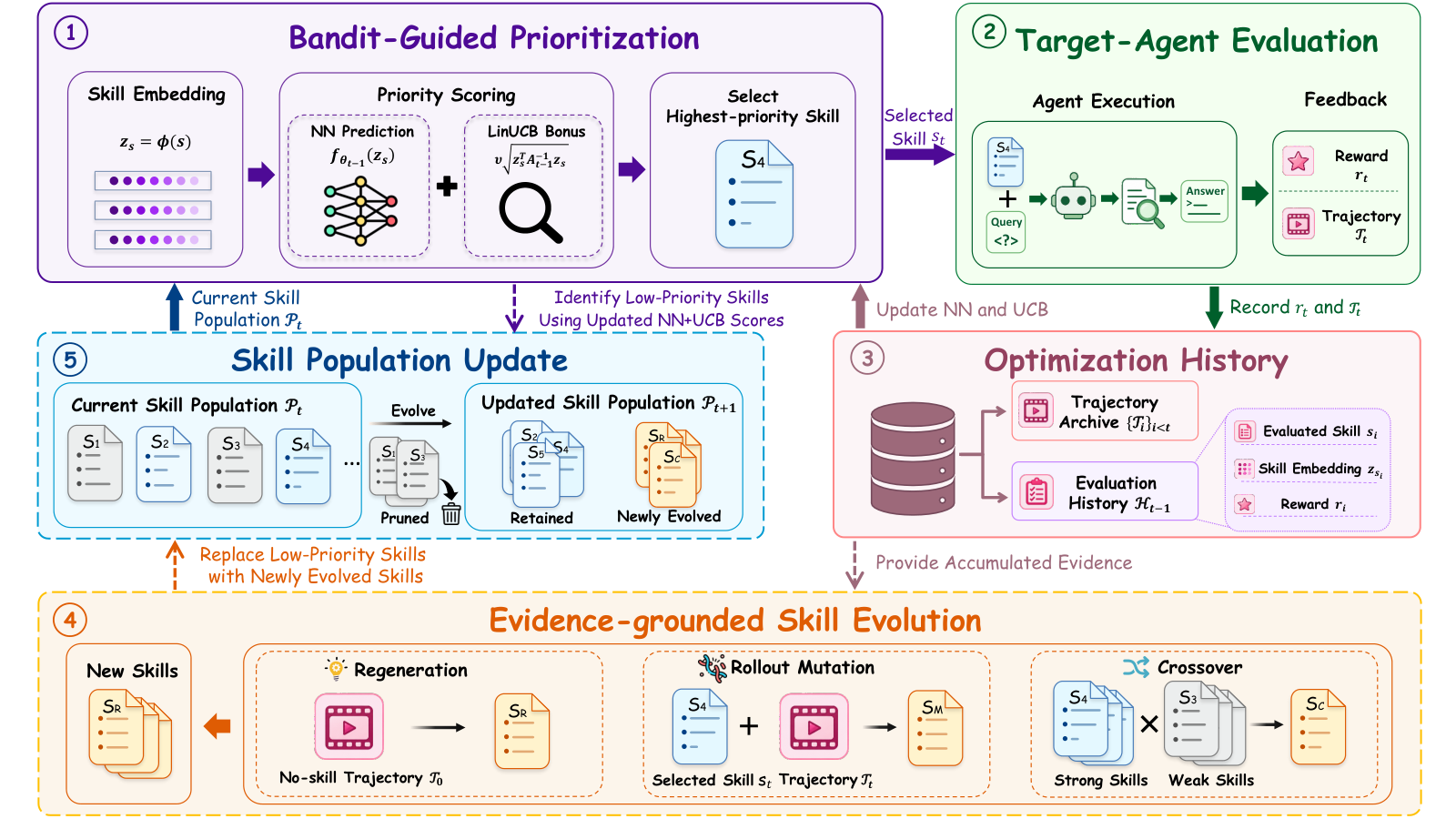
For each candidate s\in\mathcal{P}_t, an embedding z_s=\phi(s) is scored with a neural reward predictor f_{\theta_{t-1}} plus a LinUCB-style exploration bonus:
U_t(s)=f_{\theta_{t-1}}(z_s)+\nu\sqrt{z_s^\top A_{t-1}^{-1}z_s},\quad A_t=A_{t-1}+z_{s_t}z_{s_t}^\top.
The maximizer s_t is executed by the target agent \mathcal{A} on \mathcal{D}_{\mathrm{opt}}, producing reward r_t and trajectories \mathcal{T}_t. History \mathcal{H}_t=\mathcal{H}_{t-1}\cup\{(s_t,z_{s_t},r_t)\} is used to refit f_\theta each round (a small NN over embeddings, initialized to 0.5).
Evolution is scheduled by a two-condition trigger: t-t_{\mathrm{last}}\ge d AND \log(t/t_{\mathrm{last}})\ge\eta (linearly-spaced early, geometrically-spaced later). When triggered, Evolve uses the teaching model M_{\mathrm{teach}} to prune low-utility skills and synthesize new ones grounded in \mathcal{T}_0, \mathcal{T}_t, and \mathcal{H}_t — importantly, M_{\mathrm{teach}} never scores skills; scores come only from executing \mathcal{A}. The initial population \mathcal{P}_1 is produced by applying a regeneration operator to \mathcal{T}_0 independently, giving diverse seeds.
The final output is the skill with the highest mean reward in \mathcal{H}_T.
Results
Across six benchmarks (SearchQA, Spreadsheet, DocVQA, LiveMath, SocialMaze, ALFWorld) and three target models with only 50 optimization examples each:
- Qwen3.6-35B-A3B: 73.5% avg vs. SkillOpt 69.6, LLM Skill 66.2, Trace2Skill 64.4, baseline 60.4. Largest gains on LiveMath (55.3 vs. 42.3) and SocialMaze (95.5 vs. 91.7).
- GPT-5.4-Nano: 56.9 vs. SkillOpt 53.7, baseline 30.0. Spreadsheet jumps from 27.3 → 45.7.
- Gemma4-26B-A4B-it: 68.9 vs. SkillOpt 67.6, baseline 46.4.
Efficiency (Table 2) is the more striking result. Per \Deltascore: - Qwen: COBRA $4.13 vs. SkillOpt $13.15 vs. Trace2Skill $57.70. - GPT-Nano: $2.17 vs. $5.64 vs. $7.28. - Gemma: $1.73 vs. $4.35 vs. $93.54.
Teacher token usage drops sharply (3.00M–4.13M vs. SkillOpt’s 12.51M–15.16M) — a 55–58% cost reduction — because the bandit avoids exhaustive scoring of the candidate pool.
Under external agent harnesses (Claude Code, Codex) with Qwen as target, COBRA still leads: 68.2% on Claude Code vs. SkillOpt 64.0, baseline 57.1, indicating the optimized skills are not overfitted to the native scaffolding.
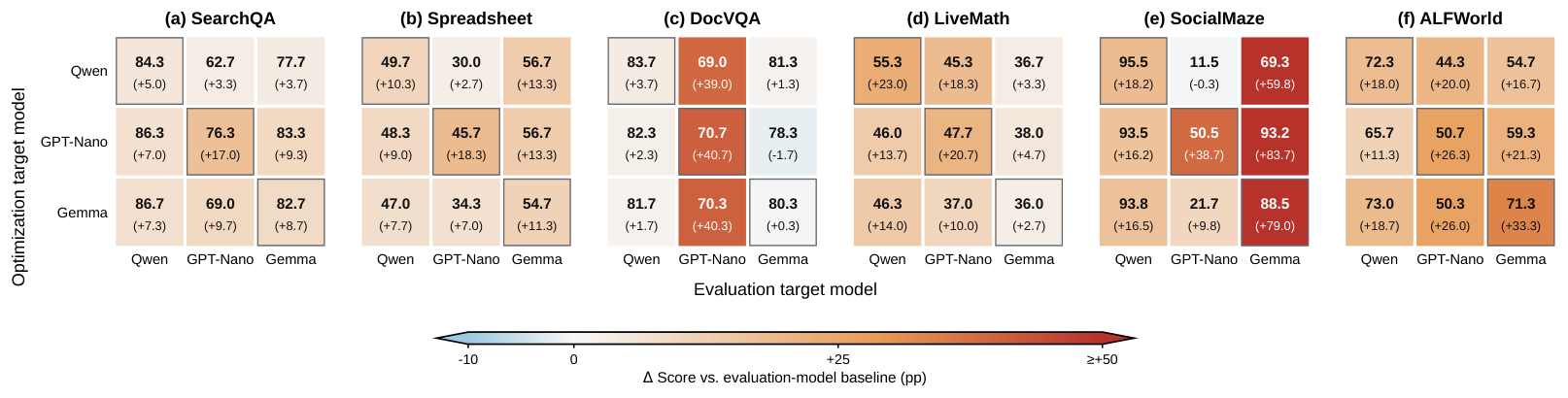
Skills also transfer across target models — most off-diagonal cells retain positive gains — suggesting the induced procedures capture task-level rather than model-specific behavior.
Ablations
Ablations on Qwen (Table 4) isolate the two components:
- w/o Bandit (random selection, evolution on): 71.3, \Delta=-2.2.
- w/o Evolution (bandit on fixed pool of 30): 71.1, \Delta=-2.4.
- Best-of-30 (evaluate all 30, pick best): 71.0, \Delta=-2.5.
The candidate pool size in Best-of-30 matches the ~30 distinct skills COBRA encounters over 30 rounds, so gains cannot be attributed to more candidates. Both components contribute roughly equally, and — importantly — the bandit on a fixed pool is no better than exhaustive scoring, meaning the bandit’s value primarily arises when paired with an evolving candidate space that the predictor f_\theta can generalize across.
Limitations and open questions
- The neural reward predictor is refit every round on very few points (t\le T, e.g. 30). The paper does not analyze how f_\theta’s calibration degrades on out-of-population candidates introduced by evolution, which is precisely where LinUCB should compensate — no ablation isolates \nu or the embedding \phi.
- The evolution schedule \log(t/t_{\mathrm{last}})\ge\eta is a heuristic; sensitivity to d,\eta is not reported.
- Only 50 optimization examples are used per benchmark; scaling behavior with larger \mathcal{D}_{\mathrm{opt}} (where cost matters most) is untested.
- All benchmarks return scalar rewards; extension to sparse or long-horizon RL-style feedback is unclear.
- The “cross-model transfer” claim uses GPT-5.5 as the teaching model throughout, so what transfers may be teacher-model priors as much as target-agent-specific skills.
Why this matters
Treating agent-skill induction as a budgeted contextual bandit over an evolving candidate set gives a principled way to spend expensive rollouts, and the empirical payoff — matching or exceeding SkillOpt at roughly one-third the dollar cost — makes skill optimization tractable in regimes where each evaluation costs API dollars. The framing also cleanly separates scoring (must come from the target agent) from generation (can use any teacher), which is likely the right abstraction for future agent-improvement pipelines.
Source: https://arxiv.org/abs/2609.11682
Online Learning with LLM Experts from Limited Feedback
Problem
Routing prompts to one of K LLM experts is naturally a contextual bandit, but the practical bottleneck is not compute — it is reward acquisition. Obtaining a scalar quality signal typically requires an LLM judge, human rater, or paid API, so the number of reward queries m over horizon T satisfies m \ll T. Standard linear bandit algorithms (LinUCB, OFUL) assume m = T and break under this regime because their exploration schedule is coupled to the query schedule. This paper decouples the two: the router must act on every round, but choose which past rounds to actually pay for feedback on.
Formally, at round t a context x_t \in L\cdot \mathcal{B}^d arrives (a frozen transformer embedding of the prompt), the algorithm picks expert a_t \in [K], and the reward model is linear on the frozen embedding: r_{t,a} = \langle \theta_a, x_t\rangle + \eta_{a,t}, \quad \theta_a \in \mathcal{B}^d, with sub-Gaussian noise of variance proxy 1. The linearity assumption is defensible because \theta_a plays the role of a per-expert linear head atop a fixed embedding — the standard reward-modeling parameterization minus fine-tuning.
Full-information algorithm: LimFullFeed
In the full-information variant, when a round is queried, rewards of all K experts on that round’s prompt are revealed (think: running a batch judge over all candidate responses). The algorithm exploits greedily, a_t = \arg\max_{a\in[K]} \langle \widehat\theta_{t-1,a}, x_t\rangle, and interleaves this with an information-theoretic query schedule. Every T/m rounds (enforced by the trigger \lfloor b(t-1)\rfloor < \lfloor bt\rfloor with b = m/T), it selects a past unobserved index by D-optimal design: s_t = \arg\max_{\ell \in [t]\setminus \mathcal{S}_{t-1}} \det(V_{t-1} + x_\ell x_\ell^\top), then updates the shared covariance V_t = V_{t-1} + x_{s_t}x_{s_t}^\top and per-expert OLS estimates \widehat\theta_{t,a} = V_t^{-1} y_{t,a}. Two things are worth noting. First, V_t is shared across experts — full-information feedback means every query informs every \theta_a. Second, the choice of which past prompt to query is deferred: rather than committing to query round t’s prompt, the algorithm can revisit any \ell \le t and pick the one maximizing information gain. This is the “look back” that gives the method its edge over naive query-now strategies. The claimed regret is O(dT/m).
Bandit algorithm: LimBanFeed
In the bandit setting, only r_{s_t, a_t} is observed — feedback is tied to a specific expert. Now each expert maintains its own V_{t,a}, and the action rule is UCB: a_t = \arg\max_{a\in[K]}\, \langle \widehat\theta_{t-1,a}, x_t\rangle + \beta \|x_t\|_{V_{t-1,a}^{-1}}. Query scheduling is per-expert: each expert a carries a counter n_a; when n_{a_t} \ge z := T/m, a query is triggered for that expert, and the D-optimal choice ranges only over past rounds where a was played: s_t = \arg\max_{s \in \{s\in[t]: a_s = a\}\setminus \mathcal{S}_{t-1,a}} \det(V_{t-1,a_t} + x_\ell x_\ell^\top). This preserves the total budget m because triggers are spaced by z per expert but summed appropriately. Regret is O(dTK/m), with the extra K reflecting that feedback informs a single \theta_a per query rather than all of them.
Results
Experiments use RouterBench and Nectar. On Nectar with K=6, d=40, T=60{,}000, cumulative regret against the in-hindsight best expert (averaged over 5 runs) is:
| m | LimFullFeed | NoLookBack (full) | LimBanFeed | NoLookBack (bandit) |
|---|---|---|---|---|
| 1000 | 672.9 | 631.6 | 3583.4 | 3789.6 |
| 2000 | 441.4 | 408.0 | 3084.1 | 3580.0 |
| 5000 | 214.1 | 218.7 | 2295.7 | 3020.7 |
| 10000 | 128.0 | 129.0 | 1839.1 | 2538.4 |
| 20000 | 73.6 | 75.8 | 1567.9 | 2090.7 |
Two patterns stand out. In the bandit regime the D-optimal look-back consistently beats NoLookBack, with the gap widening as m grows — at m=20{,}000 LimBanFeed reduces regret by about 25% (1567.9 vs 2090.7). In the full-information regime the gap is small and NoLookBack actually wins at very small m (m=1000, 2000); once m \ge 5000, LimFullFeed marginally edges ahead. The intuition: under full-information every query is already very informative because it updates all K heads, so cleverness in choosing which past prompt matters less than in the bandit case, where per-expert coverage is sparse.
Limitations and open questions
The linear-reward assumption is load-bearing; whether frozen embeddings actually linearize expert quality across domains is an empirical claim, not verified here beyond aggregate regret curves. The D-optimal criterion requires an \arg\max over O(t) past rounds each query, which is O(td^2) per determinant update — fine for T = 60{,}000 but nontrivial at production scale. The schedule b = m/T presumes T is known; extension to anytime budgets is not discussed. There is no comparison against active-learning bandit baselines such as RewardedSoups-style approaches or SquareCB with subsampled feedback, so the D-optimal design’s advantage over uniform random querying is not isolated. Finally, the regret bounds hide constants in \lambda and \beta that in practice govern the exploration-exploitation trade-off in LimBanFeed.
Why this matters
Framing LLM routing as a bandit with a feedback budget (not just an action budget) matches how deployed routing systems actually pay for evaluation, and the decoupling of action-time and query-time scheduling gives a clean template — greedy or UCB routing plus D-optimal retrospective querying — that any team running an LLM cascade can implement on top of an existing embedding model.
Source: https://arxiv.org/abs/2609.05820
SNAP3D: Physically Grounded 3D Parts for Assembly from a Single Image
Problem
Part-aware image-to-3D generators (X-Part, HoloPart, PartCrafter, etc.) produce semantically decomposed meshes but treat each part as an independent reconstruction target. The resulting assemblies fail as physical objects: neighboring parts interpenetrate, contact surfaces are ill-defined, and there is no mechanism holding the parts together, so the assembly collapses under gravity in simulation. For downstream uses that require the decomposition to be meaningful — articulation, fabrication, rigid-body simulation, editing — visual completeness of individual parts is insufficient. The paper targets three concrete failure modes: volume overlap between adjacent parts, absence of an explicit contact graph, and lack of connector geometry that survives gravitational loading.
Method
Given a single image, the pipeline reconstructs a holistic mesh with Hunyuan3D and decomposes it into semantic parts \{P_1, \ldots, P_n\} using X-Part in a common frame. Three stages then transform this raw decomposition into a physically valid assembly.
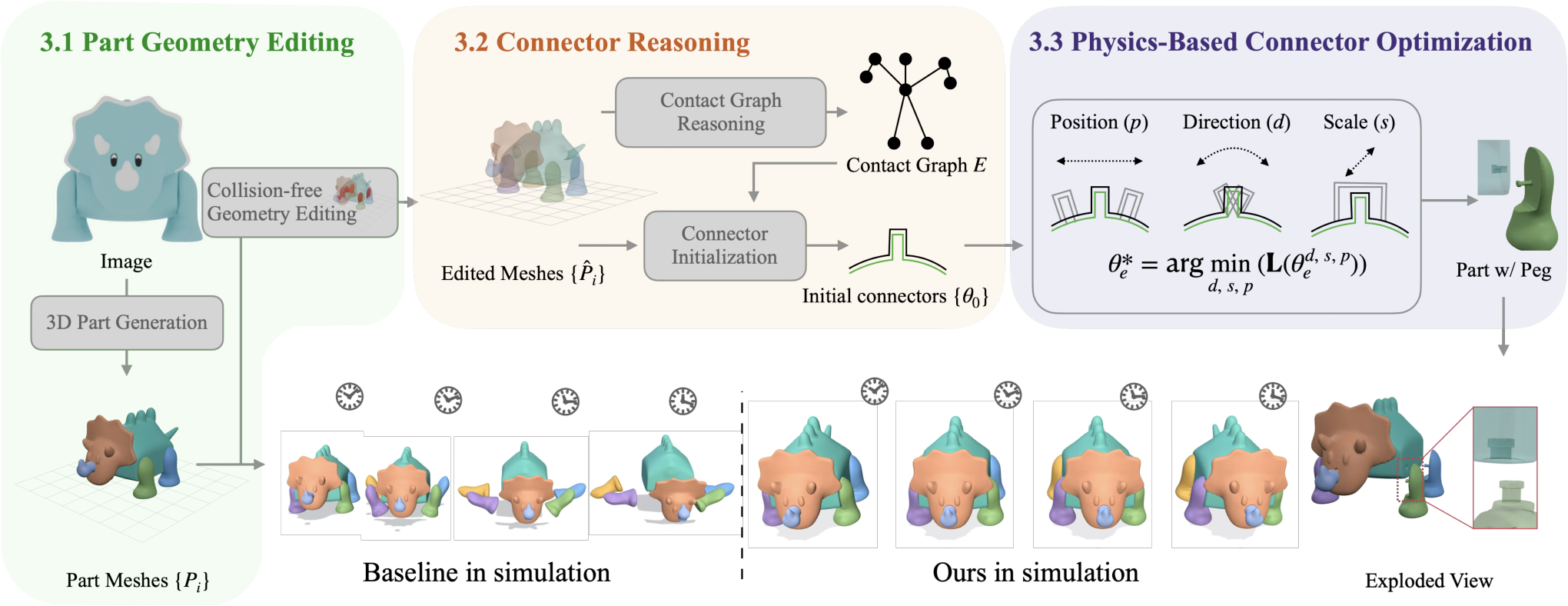
Part geometry editing (PGE). The authors treat inter-part overlap as a boundary problem rather than a shape problem — each P_i is individually well-formed, so edits are restricted to shared boundaries. Overlapping volume between neighbors is resolved to produce disjoint solids with well-defined contact surfaces S_{ij} \subset \partial P_i \cap \partial P_j. This yields the input needed for connector placement: paired contact patches on the two mating parts.
Connector geometry reasoning (CGR). From the edited parts, a contact graph G = (V, E) is built where vertices are parts and edges denote nonempty contact surfaces. For each edge (i,j), a parameterized peg-and-socket connector is instantiated at the centroid of S_{ij}, oriented along the local surface normal, with initial dimensions scaled to the local contact patch. The connector consists of a protruding peg on one part and a matching socket on the other, producing a snap-fit joint.
Physics-based connector optimization (PCO). Each connector has parameters \theta_e = (\mathbf{p}_e, \mathbf{d}_e, \mathbf{s}_e) — position, direction, and scale. The assembled object is dropped under gravity in a rigid-body simulator, and connector parameters are refined using simulation feedback to maximize stability, quantified by residual displacement and separation of the parts after a settling interval. Crucially, only the connector geometry is optimized; the generated part shells are preserved so that geometric fidelity to the input image is not sacrificed for stability.

The stage ablation figure makes the mechanics concrete. The raw X-Part output interpenetrates at contact regions (insets). PGE produces clean mating surfaces. CGR inserts snap-fit pegs and sockets at each contact — but with default parameters the connectors pop apart under gravity. PCO refines pose and scale until the assembly settles and remains stable.
Results
Evaluation uses 100 image/mesh pairs from HY3D-Bench with ground-truth part annotations. Assemblies span 2 to 18 parts across furniture, vehicles, characters, tools, and articulated props, covering stacked support, cantilevered attachments, enclosed fits, and multi-branch contact topologies. Beyond conventional geometric metrics on the decomposition, the authors introduce a physics-based evaluation protocol that directly measures (a) whether an assembly is physically realizable (parts don’t interpenetrate and are connected) and (b) whether it remains stable under gravity in simulation.
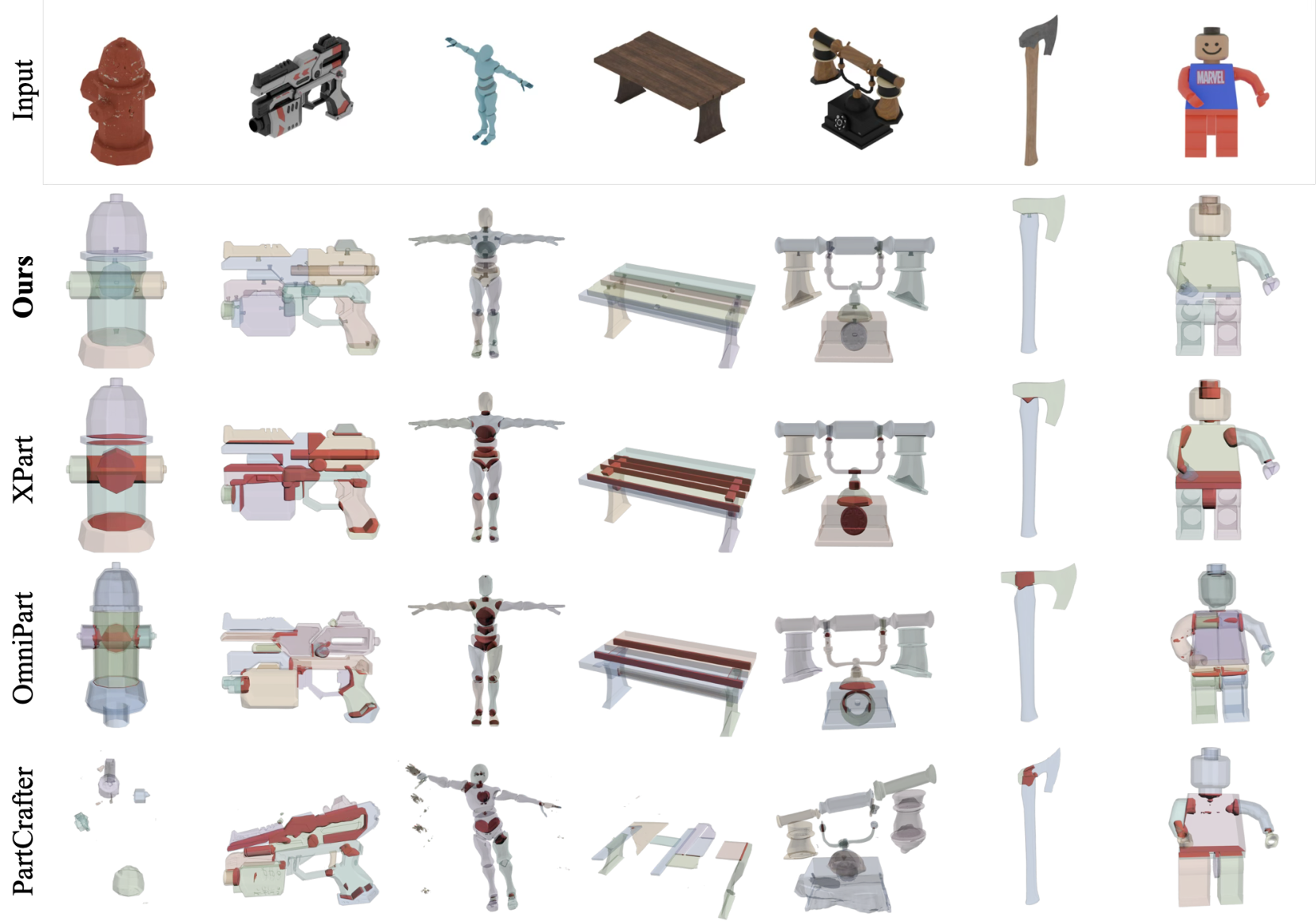
Across multiple part-aware 3D generator backbones, the pipeline substantially improves physical realizability and stability while maintaining geometric quality of the decomposition. Baseline outputs typically fail the gravity test — parts detach and fall — whereas the SNAP3D-processed assemblies settle and remain fixed. The qualitative comparison shows the interpenetration regions (red) present in every baseline being eliminated without altering the part identities or overall silhouette.
Limitations and open questions
The approach inherits the semantic decomposition from X-Part; if a part is mis-segmented or a contact is missed by the graph construction, no connector is created there. The connector library is a parameterized peg-and-socket — sufficient for snap-fit assembly but not for hinges, sliders, or threaded interfaces needed for full articulation or fabrication. The physics-based optimization treats bodies as rigid; deformable contacts, friction-dominated stability, and pre-stressed assemblies are outside scope. The paper does not report wall-clock cost of the simulation-in-the-loop optimization, which is relevant for scaling to the 18-part assemblies in the benchmark. Finally, the introduced evaluation protocol depends on the choice of simulator, mass assignment, and settling window — standardization across future part-aware generators would strengthen comparisons.
Why this matters
Part-aware 3D generation has focused on segmentation quality and per-part fidelity, leaving generated assets useless for simulation, articulation, or fabrication without manual cleanup. SNAP3D reframes the problem around physical realizability — clean contacts, explicit connectors, gravity-stable assemblies — and offers an evaluation protocol that penalizes visually correct but physically incoherent outputs, which is the right target for downstream 3D use.
Source: https://arxiv.org/abs/2609.13146
Benchmark Radar: A Living Database and Search Engine for AI Benchmarks and Evaluation
Problem
Finding the right evaluation for an LLM or agent is a retrieval problem that current infrastructure handles poorly. Benchmark names collide across papers, model cards report scores under undocumented settings, and leaderboards drift as saturation sets in. A researcher designing a new evaluation, or a reviewer checking whether a claimed benchmark result is comparable to prior work, must currently reconcile leaderboards (Artificial Analysis, OpenCompass), catalog sites (LLM Stats), and the ad hoc benchmark mentions inside technical reports. Benchmark Radar is a plumbing paper: it builds a daily-updated catalog that preserves source identity — i.e., it does not fuse ostensibly identical benchmarks across sources — and exposes retrieval over papers, repositories, datasets, releases, and score histories.
System
The system inherits its daily-discovery architecture from BuilderPulse. It pulls from 37 sources: 13 direct connectors (registries, catalogs, dataset hubs) and 24 first-party research and engineering feeds (labs, model card releases). The core design decision is to separate the benchmark catalog (canonical rows describing a benchmark) from the discovery history (time-stamped evidence: papers, releases, score observations). Model reports — model cards, system cards, technical reports — are ingested through the same record schema as benchmark registries; a Claude 3.5 system card mentioning GPQA becomes a record with the same fields as an OpenCompass GPQA entry, but with a distinct source label.
The v0.11.0 release has 1,283 source-specific records drawn from four catalogs (Table 1 in the paper): LLM Stats (687), OpenCompass Hub (461), Artificial Analysis (25), and model reports (110). Two sources that describe the “same” benchmark are retained as separate records rather than deduplicated, which is deliberate: normalization would erase disagreements about scale, subset, or scoring rule that are exactly what a careful reader needs to see.

Figure 8 shows the discovery-side view: category cards break out newly surfaced releases from track updates on existing benchmarks, and a coverage notice surfaces failed sources so users can distinguish “no activity” from “we could not reach the source today.”
Coverage and score audit
Of the 1,283 records, 790 carry numeric observations for a total of 12,916 score points; 493 records are unscored. The distribution is skewed: Artificial Analysis contributes 25 records but 7,050 scores (roughly 282 per record, driven by commercial leaderboard density), while OpenCompass Hub contributes 461 records and 0 archived scores — it is a benchmark registry, not a score aggregator. LLM Stats sits between with 687 records and 5,544 scores. Model reports add 322 scores across 110 records.
Unscored records are not dead weight. Of the 493 unscored, 464 have at least one paper, repository, or dataset link. Across the full catalog, 475 records link to papers, 506 to repositories, and 293 to datasets. This matters for prior-art work where a benchmark’s design is the object of interest, not its current leaderboard.
For scored records, the Leaderboard view plots reported scores against benchmark release date (or a first-score date proxy where the release date is missing), sized by number of scored models. Pareto candidates get gold rings; hollow marks flag unverified scales; dotted outlines flag date proxies. Drilling into a single record — e.g., Humanity’s Last Exam via the Artificial Analysis source — surfaces 577 reported scores with a top score of 55.47, with organizations color-coded and successive best scores connected in release-date order.
Worked example
The prior-art use case is the paper’s most interesting evaluation of the system. A contributor investigating credit assignment in agentic RL with Qwen-series backbones ran a coding agent that installed the Benchmark Radar client and its Skill, downloaded the corpus, and queried locally.
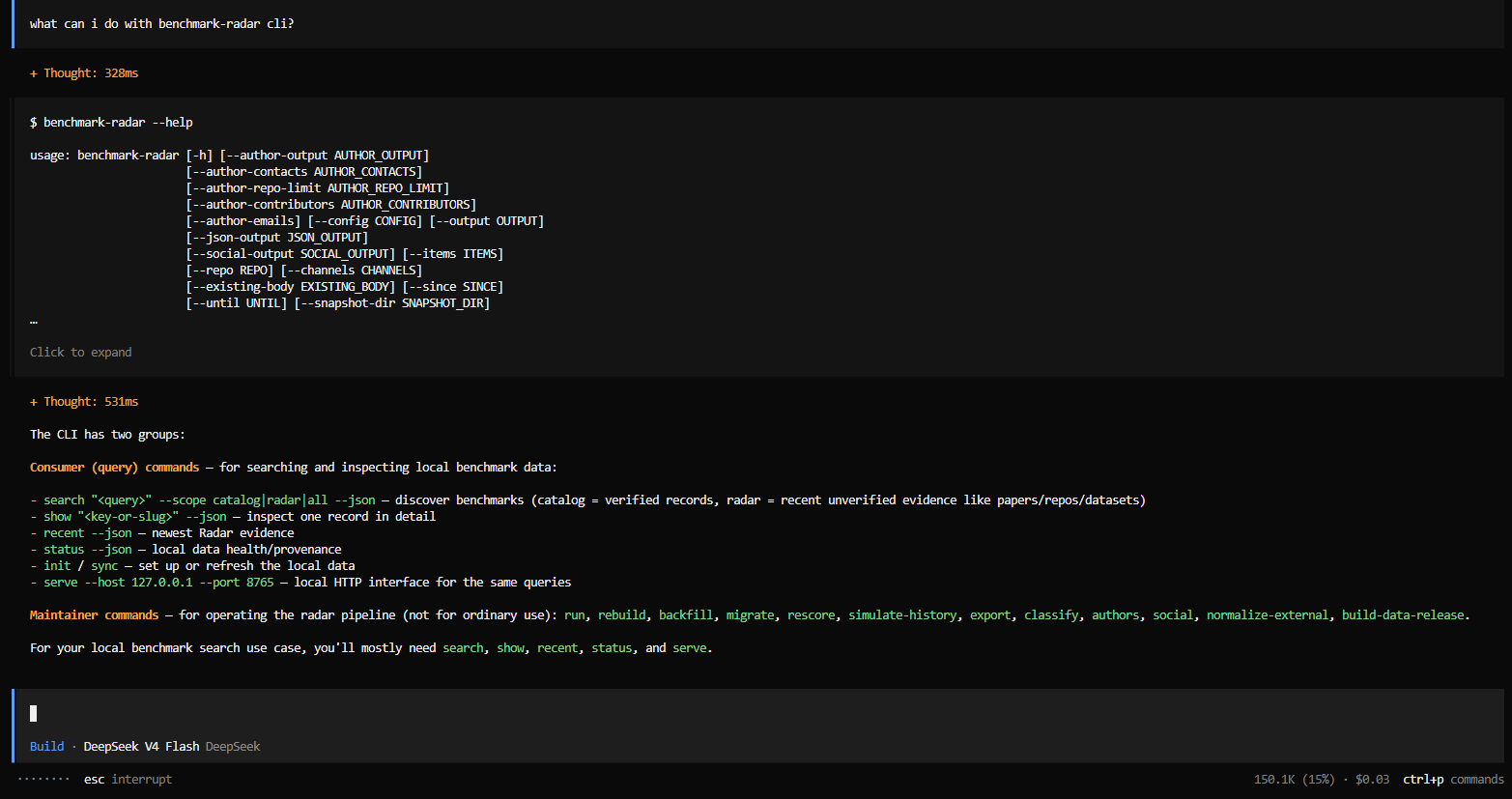
The agent surfaced five relevant August 2026 papers (Table 4 in the paper): SRPO (Qwen3-8B, reflection-conditioned token-level signal, evaluated on AIME’24 / WebShop / ALFWorld / SWE-Bench-Lite), ContextPilot (action-level credit over branched trajectories, InfiniteBench / NovelQA / LongMemEval), SkillGate (skill-selector credit starvation, partitioned into outcome vs. action-local channels), CIPO (turn-level EALR credit on HotpotQA / MuSiQue / Bamboogle), and MoRSE (hierarchical GRPO with two-layer credit assignment). The retrieved records include repository links where available; when a record is thin, the agent falls back to web search.
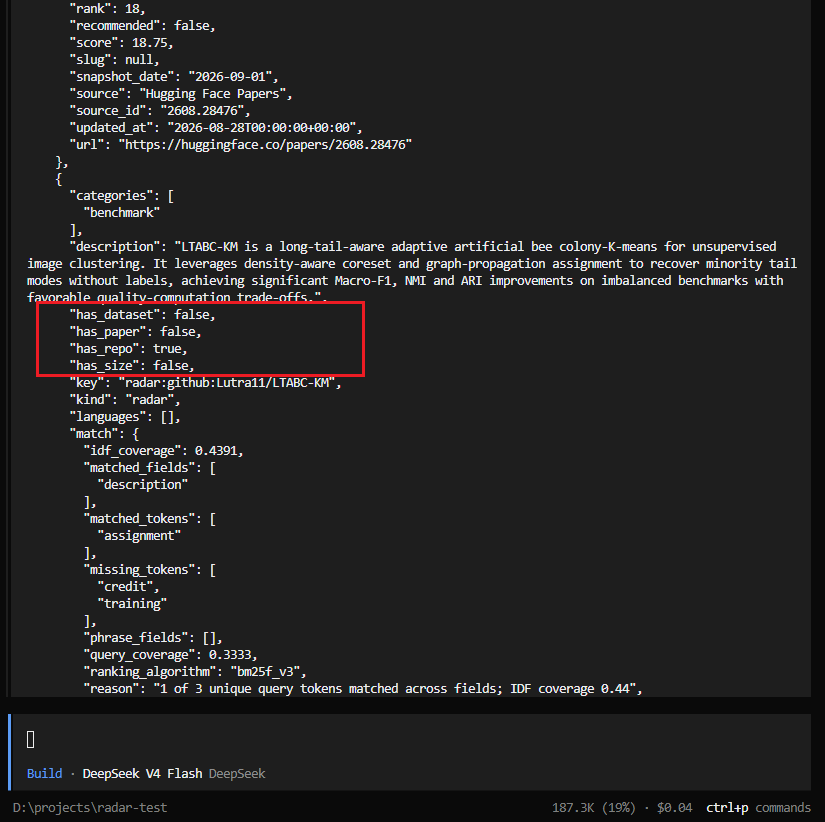
Figure 11 makes the failure mode explicit: some discovery records surface a repository but no linked paper or dataset, and the interface flags this rather than silently omitting the record. The design principle throughout is that Benchmark Radar retrieves candidates and exposes their evidence; the judgment of relevance is deferred to the human or agent downstream.
Limitations
The catalog is small and English-heavy: 1,283 records is far below the true benchmark population, and OpenCompass Hub’s 461 records contribute zero scores, so cross-source score comparisons cannot use it as a bridge. Non-deduplication is a feature for auditability but means that any aggregate statistic (“average score on MMLU”) requires manual reconciliation. Date fields lean on model-release proxies where benchmark-release dates are missing, and the paper is explicit that these are flagged, not corrected. No claim is made about score-comparability across sources — different subsets, prompts, and scoring rules are not normalized.
Why this matters
Benchmark discovery is a bottleneck for evaluation research that has been solved badly by ad hoc leaderboards and outright ignored by search engines. A living, source-preserving catalog with agent-callable retrieval is the correct primitive for both prior-art checks and meta-analysis of benchmark saturation, and the 12,916-observation score archive is large enough to start doing the latter seriously.
Source: https://arxiv.org/abs/2609.11115
Hacker News Signals
CUDA for AMD on Windows
This project attempts to run CUDA workloads on AMD GPUs under Windows by translating CUDA API calls and PTX/SASS instructions to their ROCm/HIP equivalents at runtime. The approach is distinct from what ZLUDA (the best-known prior attempt) did on Linux. On Linux, ROCm provides a relatively complete HIP runtime and compiler toolchain, making translation feasible. On Windows, ROCm support is sparse — AMD does not officially ship a Windows ROCm stack — so this project ships its own minimal HIP-for-Windows layer alongside the translation shims.
The technical mechanism: a drop-in nvcuda.dll and nvml.dll replacement intercepts CUDA runtime and driver API calls. PTX (NVIDIA’s portable IR) is transpiled to LLVM IR, then compiled to AMDGPU target via the bundled LLVM backend. Kernel argument marshalling and memory management are mapped to HIP equivalents. The project is early-stage; the repo contains mostly scaffolding, dependency wiring, and a basic test harness. BLAS and cuDNN interception are not yet implemented, which means no real ML workloads run end-to-end. The fundamental challenge is ABI fidelity: CUDA’s driver model exposes fine-grained control over stream ordering, unified memory, and cooperative groups that have no direct HIP analog, requiring either emulation or silent semantics mismatch. Community comments note that ZLUDA’s Windows port died partly because of exactly these gaps, plus Microsoft’s driver signing requirements making unsigned translation DLLs awkward to deploy. Still, the demand is real: AMD consumer GPUs are substantially cheaper per VFLOP than NVIDIA equivalents, and Windows is the dominant OS for that market segment.
Source: https://github.com/Speedstu/CUDA-for-AMD-Windows
The Malicious Use of Artificial Intelligence
This is the 2018 report from the Future of Humanity Institute, Centre for the Study of Existential Risk, and OpenAI (among others), resurfacing on HN. At 100 pages, it is a structured threat taxonomy rather than a speculative essay. The report partitions misuse into three domains: digital security (automated vulnerability discovery and exploit generation, spear-phishing at scale via language models), physical security (autonomous weapons, adversarial perturbations against perception systems in vehicles), and political security (disinformation, synthetic media, automated influence operations).
The technical substance holds up reasonably well six years later. The document correctly anticipated that the marginal cost of targeted social engineering would collapse as language models improved, that GAN-generated synthetic media would outpace detection, and that cyberoffense would benefit asymmetrically from automation relative to defense. What it underestimated was the speed of capability gain and the degree to which open-weight models would democratize access to the offense-side tools. The policy recommendations — red-teaming norms, dual-use publication guidelines, international coordination mechanisms — remain largely unimplemented. The report is methodologically careful about distinguishing “AI raises capability ceilings” from “AI lowers skill floors,” noting that the latter is often more consequential for actual threat actors. For readers who know the current landscape, the value is historical: it shows which threat models were legible in 2018 and which were not, providing calibration for how much the field’s threat models have actually updated versus merely grown louder.
Source: https://arxiv.org/abs/1802.07228
Fable 5.1 Solves the Cyphral Distich, a 370-year-old Cipher
The Cyphral Distich is a two-line encoded inscription found in a 17th-century manuscript, unsolved for approximately 370 years. Vals AI claims their Fable 5.1 model cracked it. The blog post is light on technical detail about the model itself but heavy on the cipher’s history and the solution’s content. The inscription uses a polyalphabetic substitution with a keyword-derived tableau — roughly Vigenere-class — combined with deliberate misspellings and archaic orthography to increase ambiguity. Previous attempts failed partly because solvers were not accounting for period-appropriate spelling variation and partly because the keyword space is large when you include Latin, Greek, and Early Modern English candidates.
The claimed solution method involves the model jointly reasoning over candidate keywords, period lexicons, and syntactic plausibility of candidate plaintexts. This is essentially a constraint satisfaction problem over a high-dimensional discrete space where the scoring function is a language model’s perplexity over 17th-century English/Latin. The approach is not novel in principle — using LM scoring to guide cryptanalysis of classical ciphers has been demonstrated before — but applying it to a specific historically significant unsolved instance is notable. The HN thread is skeptical about verification: independent historians have not yet confirmed the solution, the blog post does not provide the full decryption methodology, and the company has an obvious marketing incentive. Commenters with classical cipher expertise point out that Vigenere-class ciphers with short texts are genuinely hard to verify without the original key, and a convincing-sounding plaintext is not proof of correctness.
Source: https://www.vals.ai/blogs/fable-solves-cyphral-distich
Stabilizing Rust’s Never Type
Rust’s ! (never) type represents computations that do not return — diverging functions, panic!, infinite loops, return expressions, and so on. ! is a bottom type: it should coerce to any type, which is why let x: u32 = return; typechecks. The type has existed in the compiler for years but has never been stabilized as a user-visible feature because of unresolved coherence interactions with trait implementations.
The core problem is that ! implements every trait trivially (since you can never construct a value of type !, any trait impl body is vacuously correct). This causes conflicts: if !: From<T> for all T via a blanket impl, and a crate provides impl From<MyType> for SomeOtherType, the compiler’s coherence checker must reason about whether ! is involved. Historically, the blanket impl<T> From<!> for T triggered overlap with impl<T> From<T> for T (the reflexive impl), requiring special-casing. The stabilization path involves removing or restricting certain ! blanket impls and introducing a new fallback mechanism where ! coercion to () occurs in specific positions (notably, the try operator ? context) rather than universally. The LWN article covers the RFC and tracking issue history, noting that the stabilization is gated on resolving a long-standing divergence in how the type-checker handles ! in match arms versus expression contexts. This has downstream effects for std::convert, error handling patterns, and any crate using ! in associated types. The stabilization is expected in a near-term Rust edition.
Source: https://lwn.net/SubscriberLink/1091015/d9e48318ed242b41/
TailTalk: A Modern Async AppleTalk Stack in Rust and Tokio
TailTalk reimplements the AppleTalk protocol suite in Rust using Tokio for async I/O. AppleTalk is Apple’s pre-TCP/IP networking stack from the 1980s-90s, comprising several layered protocols: LocalTalk (physical/data link), DDP (Datagram Delivery Protocol, the network layer), ATP (AppleTalk Transaction Protocol), NBP (Name Binding Protocol for service discovery), ASP (AppleTalk Session Protocol), and AFP (AppleTalk Filing Protocol, the file-sharing layer). The project targets modern hardware using EtherTalk (AppleTalk over Ethernet) rather than the original RS-422 LocalTalk physical layer.
The technical interest is in mapping AppleTalk’s synchronous, callback-heavy original implementations to Rust’s async model. DDP packet routing uses zone-based addressing (network number + node ID + socket number) rather than IP; TailTalk implements the routing table and address resolution in async-safe data structures. NBP, AppleTalk’s equivalent of mDNS, requires broadcast-based name registration and lookup with retry logic that maps naturally to Tokio’s timer and select machinery. The repo is early but has working DDP framing, basic NBP lookup, and a partial ATP implementation. The motivation is retrocomputing interoperability: running modern machines as AppleTalk peers to vintage Macs without requiring a physical LocalTalk bridge or older OS. This is a niche but technically legitimate systems project — AppleTalk’s protocol design has interesting historical properties (zone-based multicast routing predates many IETF equivalents) and Rust’s ownership model maps well to the buffer management patterns the stack requires.
Source: https://github.com/FeralFirmware/TailTalk/
OpenArch: PyTorch Implementations of Modern LLM Architectures
OpenArch is a repository of clean, standalone PyTorch implementations of contemporary LLM architectural components and full model skeletons. The stated goal is educational and research-scaffolding: each architecture is implemented from scratch without depending on Hugging Face’s model hub, keeping the code readable and modifiable. Current contents include implementations of transformer variants with different attention mechanisms (grouped-query attention, sliding window attention), positional encoding schemes (RoPE, ALiBi), and normalization placements (pre-norm, RMSNorm). Some full model skeletons approximate published architectures (Llama-style, Mistral-style).
The technical quality from a quick read is reasonable for a reference implementation: RoPE is correctly implemented with the frequency computation \theta_i = 10000^{-2i/d} and the rotation applied to query/key pairs before attention, GQA correctly shares key/value heads across query head groups. The repo does not claim to reproduce exact published weights or match benchmark numbers — it is architecture documentation in code form, not a training framework. Limitations: no distributed training support, no gradient checkpointing, minimal documentation on numerical stability choices, and the implementations are not optimized (no FlashAttention, no fused kernels). For a PhD-level reader, the value is as a clean starting point for architecture experiments rather than a production framework. The gap between this and something like GPT-NeoX or torchtitan is significant if you need to train at scale, but for understanding architectural choices in isolation it serves the purpose.
Source: https://github.com/anuj0456/OpenArch
Libraries Run Rust Inside Python with PyO3
The post is a practical walkthrough of PyO3, the Rust-Python FFI framework, focused on how library authors use it to ship performance-critical extensions. PyO3 allows writing Python extension modules in Rust: you annotate Rust functions and structs with #[pyfunction] and #[pyclass] macros, and the macro expansion generates the C extension ABI (PyObject*-based) that CPython expects. The maturin build tool handles the compilation pipeline, producing a .so/.pyd file importable as a normal Python module.
The technical substance: PyO3 manages the GIL via Python<'py> lifetime tokens — acquiring the GIL is represented as obtaining a Python<'py> value, and functions that release it use py.allow_threads(|| ...). This gives the borrow checker a way to statically prevent data races across the GIL boundary. Type conversion between Python objects and Rust types goes through FromPyObject and IntoPy<PyObject> traits, with derive macros for common cases. The post covers the common pattern used by libraries like polars, pydantic-core, and cryptography: the Rust core does all computation with native types, Python wrappers are thin, and the extension avoids unnecessary Python object allocation in hot paths. Error handling maps Rust’s Result<T, E> to Python exceptions via PyErr. Limitations discussed: maturin’s build times are slow for iterative development (no incremental compilation across Python and Rust boundaries), and debugging across the FFI boundary is awkward since Python’s traceback and Rust’s stack traces are disjoint. The post is an accessible on-ramp for library authors considering the Rust-extension path.
Source: https://belderbos.dev/blog/how-libraries-run-rust-inside-python/
Noteworthy New Repositories
bojieli/ai-infra-book
An open-access Chinese-language book, “Deep Understanding of AI Infra: Quantitative Analysis and System Design,” focused on deriving LLM inference and training system design from first principles. The approach is explicitly quantitative: starting from hardware constraints (memory bandwidth, compute throughput, interconnect topology) and model architecture parameters, the author works through roofline-model-style analyses to size batches, pipeline stages, tensor-parallel degrees, and KV-cache budgets. Rather than cataloguing existing systems, the book teaches the reader to reproduce capacity-planning calculations themselves. The repository ships the full manuscript source, rendered PDFs, and companion computational tools (likely Jupyter notebooks or scripts) for replicating the numerical estimates. This is useful for engineers who need to make decisions about GPU cluster configuration, serving stack choice, or training job topology and want the underlying math rather than vendor benchmarks. The quantitative framing makes it a natural companion to papers like the Megatron-LM series or the PaLM scaling paper, grounding their engineering choices in derivable numbers. Appropriate for ML infrastructure engineers, systems researchers, and PhD students entering the LLM-systems space.
Source: https://github.com/bojieli/ai-infra-book
Matthew0822/ToolReplay
A dependency-free Python CLI for auditing AI agent tool-call transcripts. The core mechanism is a hash-chain over the serialized transcript: each tool-call record is committed as h_i = \text{SHA256}(h_{i-1} \| \text{record}_i), making post-hoc tampering detectable without a trusted third party. Beyond integrity, the tool supports deterministic replay — re-executing a recorded transcript against a sandboxed environment to verify that outputs are consistent — and scope-overreach checks, which compare each tool invocation against a declared permission manifest to flag calls that exceed the agent’s stated authority (e.g., filesystem writes outside an allowed prefix, network calls to undeclared hosts). The absence of external dependencies means it can be dropped into any audit pipeline or CI job without dependency conflicts. This addresses a real gap: most agent frameworks log tool calls but provide no integrity guarantee and no mechanism to distinguish “the agent did X” from “the log claims the agent did X.” Useful for compliance workflows, red-teaming pipelines, and any deployment where tool-call accountability matters.
Source: https://github.com/Matthew0822/ToolReplay
peonist-ai/halogen-flash-server
A purpose-built inference server for running Qwen3-8B-Flash-Next on AMD Strix Halo (gfx1151) APUs. Strix Halo is architecturally interesting for local inference because it integrates up to 96 GB of unified LPDDR5X memory accessible to both CPU and a 40-CU RDNA 3.5 GPU, yielding bandwidth competitive with discrete mid-range cards at much lower power. The server is optimized for this specific memory hierarchy: gfx1151 is not yet well-supported by mainstream ROCm paths, so the project likely includes custom kernel selection or llama.cpp/Vulkan backend tuning to get correct and fast execution on the target ISA. The Flash variant of Qwen3-8B uses a linear-complexity attention approximation, which matters here because the bottleneck on unified-memory hardware is bandwidth, not compute, and reducing attention’s quadratic memory traffic directly improves throughput. This is relevant to the growing class of users running capable models on high-memory APU laptops without discrete GPU. The repo fills a specific driver/backend gap that general-purpose servers have not yet closed for this hardware.
Source: https://github.com/peonist-ai/halogen-flash-server
Hoylon/peerbridge-mcp
A local-first multi-agent coordination layer implementing the Model Context Protocol (MCP) as a control room for coding, review, evidence collection, and remote-work tasks. “Local-first” here means the coordination state — task assignments, inter-agent message passing, audit logs — is stored and processed on the user’s machine without routing through a cloud backend, which is relevant for proprietary codebases and privacy-sensitive workflows. “Auditable” implies persistent, inspectable logs of which agent took which action on which artifact, aligning with the same concerns as hash-chain transcript tools. The MCP interface allows plugging in arbitrary tool-capable agents (Claude, Codex, local models) as peers in the control room, coordinating them through a shared task graph rather than ad-hoc prompt chaining. The architecture separates orchestration logic from model backends, so the coordination protocol is model-agnostic. Useful for developers who want structured multi-agent workflows — e.g., one agent drafts code, another reviews it, a third runs tests — without surrendering data to a hosted orchestration service or accepting the opacity of purely emergent multi-agent behavior.
Source: https://github.com/Hoylon/peerbridge-mcp
kruzovic7/ai-data-extractor
An open-source extractor that recovers conversation histories from the local storage formats used by AI coding assistants: Claude Code, Cursor, Windsurf, Aider, Cline/Roo Code, and others. Each tool serializes chat state differently — SQLite databases, JSON blobs in app-support directories, flat log files — and this project provides a unified extraction layer that parses all of them into a common schema. Practical use cases include migrating conversation context between tools, building personal retrieval systems over past coding sessions, auditing what was sent to which model API, and feeding transcripts into fine-tuning pipelines. The “free and open-source” framing is relevant because the alternative for many tools is paying for official export features that may not exist or using proprietary sync services. The breadth of supported tools (six-plus at launch) suggests the author reverse-engineered storage formats rather than relying on official APIs, which means it may require maintenance as tools update their storage schemas. For researchers studying how developers interact with AI coding assistants, this is a practical data-collection instrument.
Source: https://github.com/kruzovic7/ai-data-extractor
jinzijian/EvoTrace
A pipeline for converting real-world agent trajectories — specifically Claude Code and OpenAI Codex execution traces — into verified, tokenized post-training assets. The “compile” framing is deliberate: raw trajectories are noisy and contain failed steps, so the system applies verification filters (test execution, static analysis, or reward models) to retain only trajectories that demonstrably reach correct outcomes. Surviving trajectories are then packaged as tradable assets, implying a marketplace or provenance-tracking layer where trajectory provenance is recorded and originators can receive credit or compensation when their data is used in fine-tuning runs. This addresses a concrete problem in RLVR and SFT data pipelines: high-quality agentic trajectories are expensive to collect but widely needed, and there is currently no standard mechanism for attributing or compensating contributors. The “EvoTrace” name suggests iterative refinement — possibly trajectories are filtered through multiple verification rounds, with each round selecting a harder subset. Relevant to anyone building code-agent post-training datasets or studying the economics of synthetic data generation.
Source: https://github.com/jinzijian/EvoTrace
Qiuner/birdview
A static analysis and visualization tool that generates architectural maps of codebases before AI-assisted edits are applied. The motivation is that LLM coding assistants operate token-locally: they see a file or a diff but not the global dependency graph, leading to changes that are locally coherent but architecturally inconsistent (broken import boundaries, unintended coupling, circular dependencies). Birdview addresses this by extracting a module/dependency graph from the codebase and presenting it in a human-readable form that can be reviewed — or injected into the agent’s context — before any edit session begins. The “map before every change” workflow integrates into the pre-edit phase of agent-assisted development rather than as a post-hoc linter. Implementation likely uses AST parsing or import graph traversal for supported languages. The value proposition is clearest for large codebases where no single developer holds the full architecture in working memory and where AI assistants are being used to make cross-cutting changes. Complements tools like dependency-cruiser or Sourcetrail but targets the agent-assisted development workflow specifically.
Source: https://github.com/Qiuner/birdview
Nanako0129/sepia
A writing-style post-processor packaged as an agent skill compatible with the Skills CLI (77+ agents supported) plus native plugins for Claude Code, Codex, Grok Build, and Antigravity. The technical core is described as “narrative-architecture repair for fiction” and “venue-matched rules for professional prose,” grounded in the StoryScope framework (arXiv:2604.03136). StoryScope models narrative structure as a set of architectural constraints — scene-level coherence, character-voice consistency, pacing targets — and frames revision as constraint satisfaction over a story graph rather than local sentence-level edits. The “de-AI” framing means the skill specifically targets statistical artifacts of LLM-generated text: hedging constructions, rhythmic uniformity, overuse of particular connectives, and loss of register specificity. Venue-matching implies the system holds a library of stylistic norms indexed by publication target (academic abstract, literary fiction, technical blog) and applies different rule sets accordingly. The skill architecture means it runs as a post-processing pass after any agent generates text, without requiring the base agent to be retrained or prompted differently. Relevant to researchers studying controllable generation and to practitioners deploying agents in content-production workflows.