Daily AI Digest — 2026-09-02
arXiv Highlights
SMELT: Scaling Laws for Compute-Matched MoE Looped Transformers
Problem
Looped Transformers reuse a shared block of layers to increase effective depth without adding parameters, and prior work has repeatedly reported gains from this trick. But most of those comparisons hold model size fixed, which inflates per-token FLOPs and KV cache along with effective depth, conflating architectural benefit with extra compute. The question this paper answers: when you strictly match per-token FLOPs, total non-embedding parameters, and KV cache, does looping still help — specifically for MoE Transformers, where sparsity already decouples parameters from active compute?
Method
The Baseline is a decoder-only sparse MoE Transformer with GQA attention, top-8 expert routing, and physical depth L \in \{10, 12, 20, 30\} giving four labeled active-parameter scales (100M, 200M, 600M, 1.6B). A Looped variant iterates a contiguous span of m layers r times. To prevent correlated weight-tied residual updates from blowing up the residual stream, each sublayer update inside the loop is scaled by 1/r:
x \leftarrow x + \tfrac{1}{r}\,\text{Sublayer}(x).
The design ablations (all at 200M scale) sweep (m,r) and land on the SMELT recipe: loop the middle half of layers twice (r=2, span = middle L/2 layers). Budget matching is enforced by adjusting the Baseline’s width/experts/heads so that the paired Baseline and SMELT match on all three budgets (per-token FLOPs, total non-embedding params, KV cache); only the loop configuration differs.
Scaling laws are fit Chinchilla-style, separately per architecture, over a 4\times 4 grid: four scales crossed with a dense-reference control S=0\% and three MoE sparsities S\approx\{85\%, 95\%, 97\%\}. A shared WSD (warmup–stable–decay) schedule is used: one stable run per cell is forked into six cosine-decay branches at different token horizons, giving the data-axis variation needed to fit the scaling surface. In total 32 runs produce 96 matched Baseline/SMELT pairs and 192 evaluation endpoints, up to 54B non-embedding parameters at the largest scale.
Results
Loss curves. At S\approx 97\%, SMELT tracks below Baseline throughout the stable phase and in every one of the six cosine-decay branches, at both the 22B (600M active) and 54B (1.6B active) non-embedding-parameter scales. When the token axis is replaced with cumulative training FLOPs, SMELT reaches lower validation loss than Baseline in every one of the 16 grid cells. Fitting Chinchilla-style surfaces yields 6.8–18.0% training-FLOP savings on the compute-optimal frontier, depending on sparsity and scale.
Downstream transfer. SMELT wins on DCLM Completion in 96/96 matched pairs, DCLM Core in 83/96, and MMLU in 29/30 pairs (restricted to Baselines at least 10 pp above chance, since near-chance comparisons are noisy). Crucially, the downstream gain exceeds what validation loss predicts. The authors fit a four-parameter sigmoid calibration \hat{y}_m(\ell) from validation loss \ell to each benchmark y using the 96 Baseline endpoints,
\hat{y}_m(\ell) = b_m + \frac{a_m}{1+\exp[-d_m\,\alpha_m(\ell - \tau_m)]},
with d_m = +1 for the completion loss and d_m = -1 for accuracy metrics. Fits are tight: R^2 = 0.997 (Completion), 0.974 (Core), 0.911 (MMLU). Defining the sign-corrected residual \delta_i = s\cdot(y_i - \hat{y}(\ell_i)), SMELT endpoints land systematically on the “better than Baseline curve” side of the calibration at every scale. The advantage is largest on Code and grows with sample length and number of in-context examples.
Mechanistic probes. Routing overlap between visit 1 and visit 2 of the same token through the same physical MoE layer is measured as |\text{top-8}_1 \cap \text{top-8}_2| \in \{0,\dots,8\}; independent-random routing gives expected overlap 8^2/n for n candidate experts. At the dense-reference S=0\% setting the two visits reuse nearly all 8 experts, but at S\approx 97\% overlap drops to 2–3 experts per token — still well above chance, but indicating the router genuinely reassigns experts on the second pass in response to updated residual-stream content. Attention analysis further shows the second visit reduces the attention-sink mass (the pathological concentration on the first few tokens) and redirects it toward content-relevant tokens. This is the inductive bias the authors credit for the excess downstream gain over validation-loss prediction.
Limitations and open questions
Only r=2 is scaled; larger loop counts, or asymmetric span choices, are not tested at 54B. The scaling laws are fit per-architecture rather than jointly, so the extrapolated compute-savings interval depends on the parametric form. The Code-heavy advantage and the in-context-length scaling are demonstrated but not causally tied to the attention-sink reduction — the mechanistic story is correlational. Finally, matching KV cache and per-token FLOPs matches training and prefill cost, but a second pass through the middle half still doubles the wall-clock latency for decoding tokens that route through that span; inference-time trade-offs are not directly quantified.
Why this matters
Once looping is compared under strict FLOPs/parameters/KV matching — the setting practitioners actually care about — a simple recipe (loop the middle half twice) still shifts the compute-optimal MoE scaling frontier by 6.8–18.0% and gives excess downstream gains beyond what validation loss predicts, up to 54B non-embedding parameters. That makes weight-tied depth a live architectural axis for frontier MoE training, not just a small-model curiosity.
Source: https://arxiv.org/abs/2609.01343
StudentSim: Training LLM-based Student Simulators
Problem
AI tutoring research needs a way to evaluate which guidance strategies work for which learners without waiting months to collect data from actual students. Two existing approaches fall short in opposite ways. Bayesian/IRT-style state-tracking models fit a student’s response distribution reasonably well but cannot ingest natural-language tutor explanations or corrections — they have no mechanism to update on text. LLM role-play does the reverse: it reads and responds fluently to guidance but does not match the specific competence profile of the student being imitated (a GPT-4-class model asked to “play a beginner” tends toward a generic weak player, not this particular player’s error distribution). StudentSim asks whether a training pipeline can produce per-student simulators that are both behaviorally faithful (match the student’s recorded responses on held-out problems) and guidance-responsive (shift toward the canonical corrected response after reading tutor text).
Formalization
For each real student \pi_i (i=1,\dots,N), the paper holds two record types. Single-turn records S_i = \{(x,m)\} pair problems with the student’s actual response. Multi-turn records T_i = \{(x,m,\tau,m^*)\} additionally include tutor guidance \tau addressing wrong response m and the canonical corrected response m^* (engine-recommended move in chess, corrected fragment in L2 writing, correct option in math). Behavioral fidelity \mathcal{F}_i scores M_i against S_i and is instantiated per-domain: move-prediction accuracy in chess, error-profile match in L2 (overall error rate plus issue-type distribution), option-match accuracy in math. Guidance responsiveness \mathcal{R}_i measures how often M_i’s response on T_i shifts to m^* after \tau is inserted. Population scores are averages: \mathcal{F} = \tfrac{1}{N}\sum_i \mathcal{F}_i.
Two-stage training
Per-user sparsity is severe: the median L2 learner contributes 3 essays, and >2/3 contribute ≤5. Fitting one LLM per student end-to-end would overfit and re-learn shared structure each time. StudentSim therefore uses:
Stage 1 (pooled). A single domain base simulator is trained on the union of S_i \cup T_i across all Stage-1 students, learning shared error patterns, response formatting, and the guidance→revised-response mapping. Multi-turn records are sampled at a ratio of 0.20 in each batch (with 0.80 single-turn), so guidance-following is learned alongside baseline behavior.
Stage 2 (specialization). The Stage-1 base is fine-tuned on the small per-student S_i \cup T_i to produce M_i. Since the pooled backbone already carries the shared structure, per-student adaptation only needs to shift the base toward one student’s idiosyncrasies — which is what a handful of essays or a thousand moves can support.
Evaluation and data scale
StudentSimEval fixes a roster of 30 chess players (Lichess, May 2025), 15 L2 learners (EFCAMDAT, Geertzen et al. 2013), and 15 math students (Worden et al. 2026 foundational-assistance corpus). Stage-1 scales (students / pooled training instances): chess 100 / 100,000; L2 200 / 7,800; math 200 / 23,400. Stage-2 per-student scales: chess 1,000; L2 73; math 153 training instances. Held-out per-student sets are S/T = chess 5,000/4,000; L2 26/40; math 66/59 (mean, range 21–99). Multi-turn corpora for L2 are real-teacher-annotated; for chess and math they are LLM-generated under fixed style templates where the LLM controls wording but the target response m^* is fixed by Stockfish or an audited answer key — decoupling guidance style from ground-truth targets.
Tutor RL with simulator feedback
The paper closes with a chess proof of concept using the pooled Stage-1 StudentSim as an RL reward source. Each episode replays a real wrong move A_{\text{prev}} on position Q; the tutor policy proposes guidance; the frozen simulator emits a revised move A_{\text{rev}}; the reward is the Stockfish centipawn improvement of A_{\text{rev}} over A_{\text{prev}}. Optimization is GRPO (Shao et al. 2024) over a Qwen3-VL-8B tutor that reads the board as an image alongside text. Three conditions share SFT init and tutor policy and differ only in reward: no-RL SFT baseline; GPT-5.4-as-student simulator; and StudentSim with two multiplicative gates — a personalization head scoring adherence to the intended teaching style, and a perception head penalizing explanations that misdescribe the board (wrong square, hallucinated piece). The core claim is not “best tutor” but that a faithful, responsive, locally served simulator is a viable and cheaper reward source than a frontier-API simulator, evaluated by expert human study (Appendix E.5). Stockfish provides an external validation signal independent of the simulator, which is why chess was chosen; transfer to L2/math would require per-domain free-form reward functions and is explicitly out of scope.
Limitations and open questions
The paper does not (in the sections provided) give aggregate \mathcal{F} and \mathcal{R} numbers here, and the tutor-RL result rests on a human study whose effect sizes are not quoted in the main-body excerpts. Sparsity mitigation via pooling assumes a coherent shared population; heterogeneous learner cohorts (e.g., very mixed L2 backgrounds) may need clustered or hierarchical Stage-1s. The L2 fidelity metric is a marginal-plus-profile match, not a joint sequence-level match, so a simulator could match error-rate statistics while producing implausible essays. The multi-turn ratio 0.20 is fixed rather than tuned per student, and per-student T counts in math range 21–99, making \mathcal{R}_i noisy for low-count students. The RL reward heads are hand-designed gates; how they compose with the move-quality term and whether they trade off is not analyzed in the excerpts.
Why this matters
Reward models for adaptive tutoring have been the bottleneck: real-student data is slow to collect and frontier-API rollouts are expensive and closed. A small, open, per-student simulator that is both behaviorally faithful and updates correctly under natural-language guidance turns tutor optimization into a standard RL loop with a local reward, and provides a reproducible benchmark (StudentSimEval) for a subfield that has largely lacked one.
Source: https://arxiv.org/abs/2609.01591
ZimaBlue: Evolving Generalizable World Action Models through Scalable Video Pre-training
Problem
Robot manipulation policies generalize poorly because action-labeled trajectories are scarce and narrow, whereas egocentric video is abundant but action-free. The question is how to turn passive video into control-relevant priors without collapsing the action distribution to a single embodiment. ZimaBlue proposes a three-stage curriculum that decouples video supervision from action supervision, uses a unified 100-dimensional semantic state-action interface across embodiments, and deploys a Slow-Fast dual-system architecture so a large video-generation world model can drive real-time closed-loop control.
Unified state–action interface
Robot datasets expose heterogeneous control APIs (Cartesian EE, joint-space, bimanual, mobile bases, dexterous hands). ZimaBlue maps them all into a fixed 100-D slot vector shared by state and action. Each end-effector consumes 9 dims (3D translation + continuous 6D rotation), with additional slots for grippers (1+1), arm joints (7+7), torso (4), mobile base and auxiliary channels (16), and two 23-dim dexterous hands. Inactive slots are zero-filled and masked. DROID, for instance, activates 17 of 100 coordinates (left EE pose 9 + gripper 1 + 7 left-arm joints). This preserves per-slot physical semantics so a single head can be trained across DROID, bimanual platforms, and humanoid data without per-dataset action tokenizers.
Three-stage curriculum
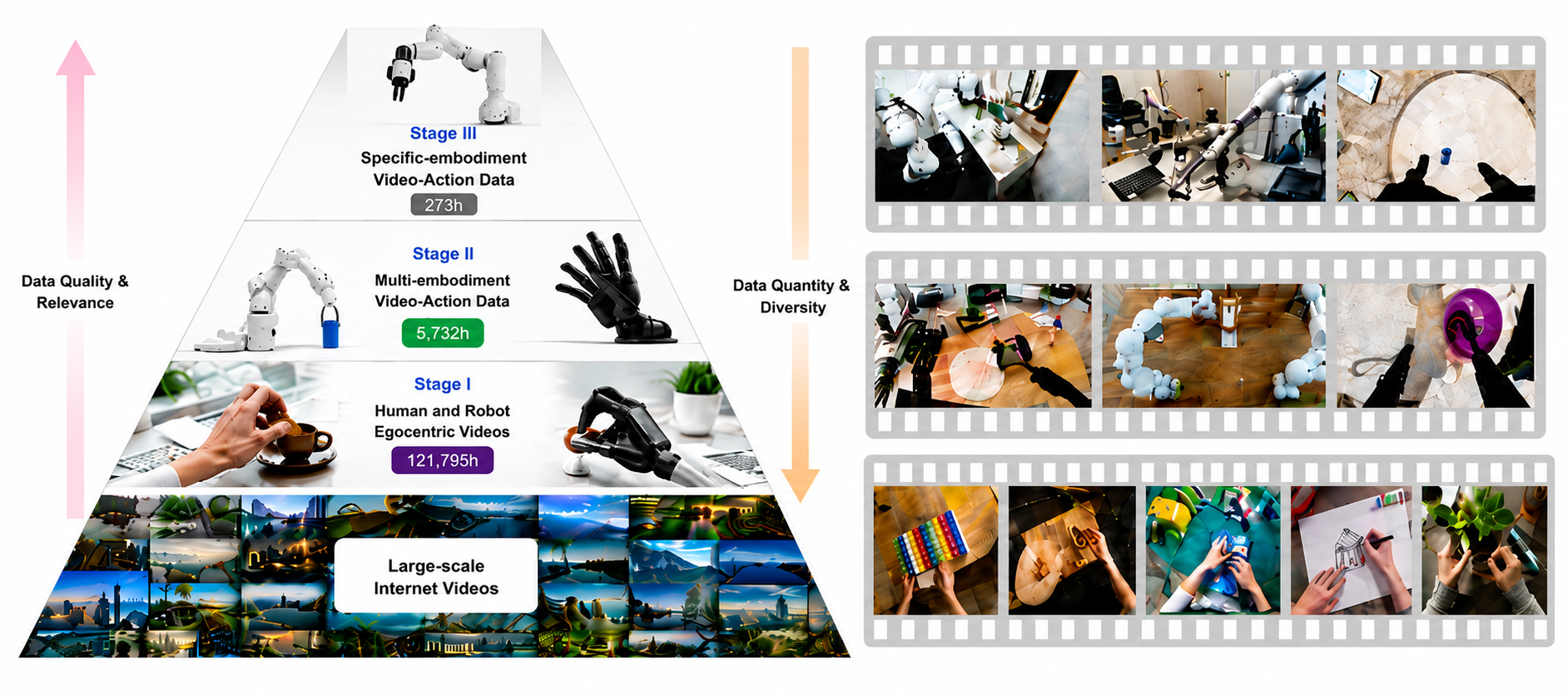
The base is a pre-trained text-to-video diffusion transformer.
- Stage I — Causal embodied video pretraining. The Slow DiT is trained on large-scale heterogeneous egocentric human and robot video with a flow-matching objective applied only to visual latents. This adapts the generative prior from unconstrained internet video to causal, embodied forward dynamics (contact, tool use, long horizons) without needing actions.
- Stage II — Video-action mid-training. Robot trajectories with synchronized observations, proprioceptive state, language, and actions are introduced. The same flow-matching objective is extended to action chunks in the unified 100-D space. Action prediction here is an auxiliary alignment signal, not the final deliverable: it forces the Slow model’s visual features to retain motor-relevant information under a shared action interface across embodiments.
- Stage III — Post-training. The lightweight Fast branch is introduced and specialized to the deployment embodiment. Only Slow is optimized in Stages I–II to concentrate compute on the video-centric world model; by Stage III the Slow features are already action-grounded, so mapping them to executable low-latency actions is a much smaller learning problem.
A single flow-matching objective is used throughout — on visual latents in Stage I, jointly on visual latents and action chunks in Stage II, and on Fast-branch actions in Stage III.
Slow-Fast dual system
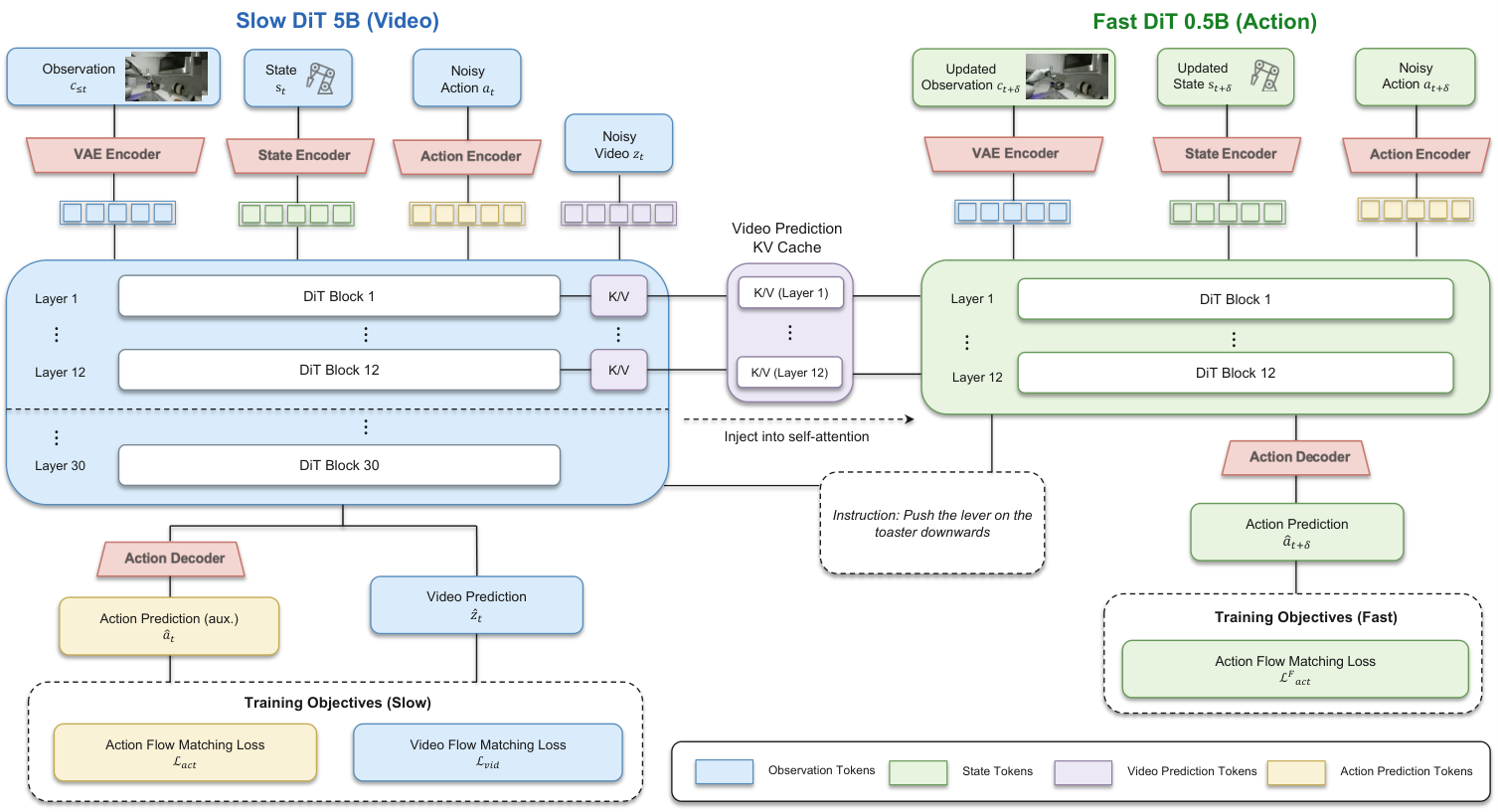
The Slow DiT ingests observations, proprioceptive state, language, and noisy video+action tokens and jointly denoises future video latents and actions. In deployment, its predicted actions are used only for training-time alignment; execution comes from the Fast DiT, which takes the current observation and state and conditions on the Slow branch’s K/V cache to produce action chunks at high frequency.
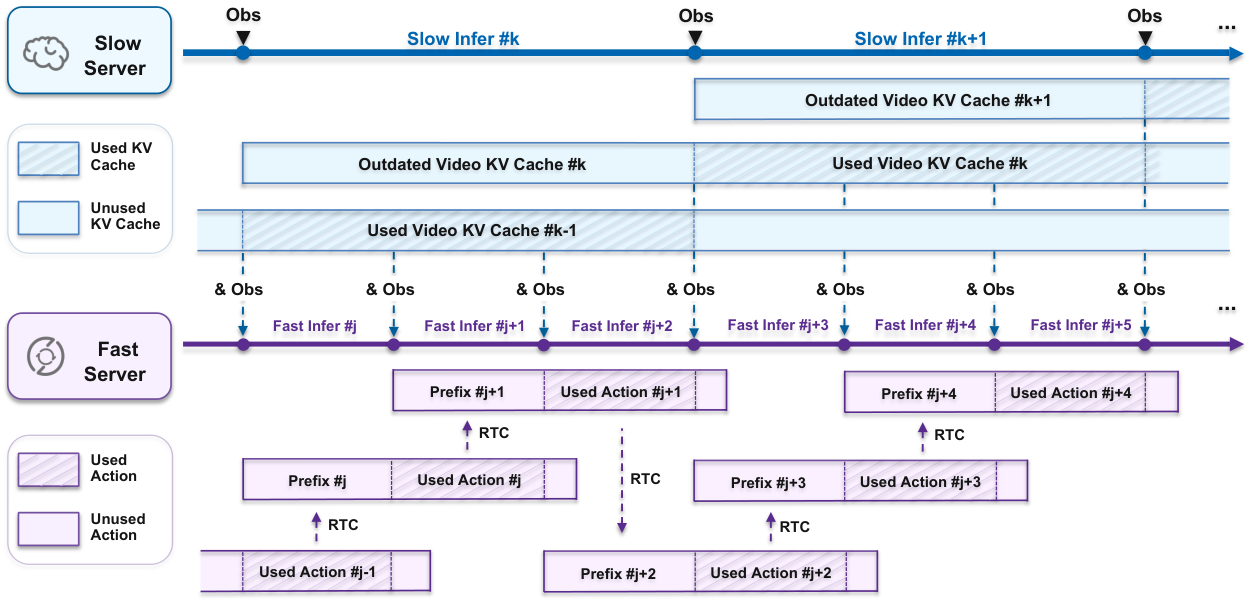
Inference is asynchronous: Slow runs at a lower rate and publishes future-video K/V caches; Fast runs at a higher rate, tolerating “outdated” Slow caches while continuously executing actions and providing fresh observations. Distribution Matching Distillation (DMD) is then applied sequentially to both branches, reducing each from 8 to 2 DiT function evaluations. Together with torch.compile, this brings the generative WAM into a real-time regime that vanilla diffusion policies cannot reach.
Results
Zero-shot real-robot evaluation uses a 7-DoF Franka post-trained on DROID and evaluated on 12 held-out tasks split into Standard and Perturbed protocols, with two exterior RGB views, a wrist camera, proprioception, and a language instruction. The paper reports these tasks as the empirical basis for ablating (i) egocentric video pretraining and (ii) multi-embodiment video-action mid-training against variants that omit each stage. The provided text does not enumerate per-task success rates in the sections available here, but the evaluation is explicitly designed to isolate the contribution of each curriculum stage on held-out task–scene configurations without task-specific demonstrations.
Limitations and open questions
Several issues are visible from the design. First, the 100-D slot layout is hand-designed and asymmetric — 46 of 100 dimensions go to dexterous hands, and cross-embodiment transfer still depends on shared slot semantics rather than a learned action codebook. Second, action supervision in Stage II is auxiliary; whether the Slow branch’s action head is actually calibrated enough to serve as a fallback controller is unclear. Third, asynchronous Slow guidance introduces staleness; the paper acknowledges “outdated” caches but does not (in the shown sections) quantify the degradation curve versus Slow update frequency. Fourth, DMD from 8 to 2 steps typically costs some fidelity in video generation — how this interacts with the Fast branch’s dependence on Slow K/V quality is not reported here. Finally, the evaluation platform is a single 7-DoF arm; cross-embodiment claims from the unified interface are not directly tested on bimanual or dexterous hardware in the excerpts provided.
Why this matters
ZimaBlue is a concrete recipe for turning a video diffusion transformer into a real-time robot controller by (a) separating video and action supervision across curriculum stages and (b) offloading generative cost to an asynchronous Slow branch while a distilled Fast branch closes the loop. If the ablations hold up, it argues that scalable manipulation policies should be built on top of video world models rather than trained end-to-end from action-labeled trajectories.
Source: https://arxiv.org/abs/2609.00188
From Production Traffic to Post-Training: Building a Self-Hosted LLM That Covers the Corporate Request Mix
Problem
Data-residency requirements force enterprises to self-host LLMs, and the temptation to add a new model every quarter — without retiring the older ones — turns a finite GPU pool into a zoo of half-utilized deployments. The authors target a specific consolidation problem: replace 200+ internal application-specific model instances with a single self-hosted checkpoint that matches or exceeds the aggregate quality of a mixed fleet, restricted to non-reasoning mode to meet latency/cost budgets. The base model is Qwen3-32B with a Cyrillic-dense retokenization; the target is to displace a \sim 7\times larger baseline on the in-house Arena.
Three quality axes are surfaced by production error analysis: instruction following (IF), function calling (FC), and alignment to the internal task distribution. The paper’s central claim is that jointly optimizing these axes causes cross-domain reward interference — semantic collapse, over-calling, verbosity hacking — and that a fork-and-merge recipe cleanly dominates joint training.
Building an in-house Arena from production traffic
The evaluation problem is upstream of training: the internal traffic (\sim 100k queries/month) is dominated by templated requests where a small set of prompt templates is instantiated with variable slots. Naively pursuing “diversity” (greedy max-min, #InsTag) inflates near-duplicate templates into distinct clusters, distorting the service distribution.
The authors’ template-aware sampler masks variable tokens, LSH-groups normalized prompts, picks intra-template exemplars via greedy max-min over variable spans, and allocates budget as \sqrt{\text{count}}. Measuring diversity as mean pairwise TF-IDF cosine distance and representativeness as Jensen–Shannon divergence against the production pool along model/length/service/taxonomy, this method achieves diversity 0.953 versus 0.944 (greedy max-min) and 0.874 (#InsTag), while keeping \text{JS}_{\text{svc}} = 0.281 versus 0.683 for greedy max-min. Random sampling has the lowest JS but diversity of only 0.653. This is the only sampler on the Pareto frontier.
Training recipe: SFT-then-fork-then-SLERP
Stage 1 is a single combined SFT mixing in-house, general, IF, and FC data. Ablations (their Table 3) show that per-domain SFT experts add nothing over the joint mixture, so SFT is kept monolithic.
Stage 2 forks the SFT checkpoint into three GRPO experts, each trained to convergence against a domain-specific reward:
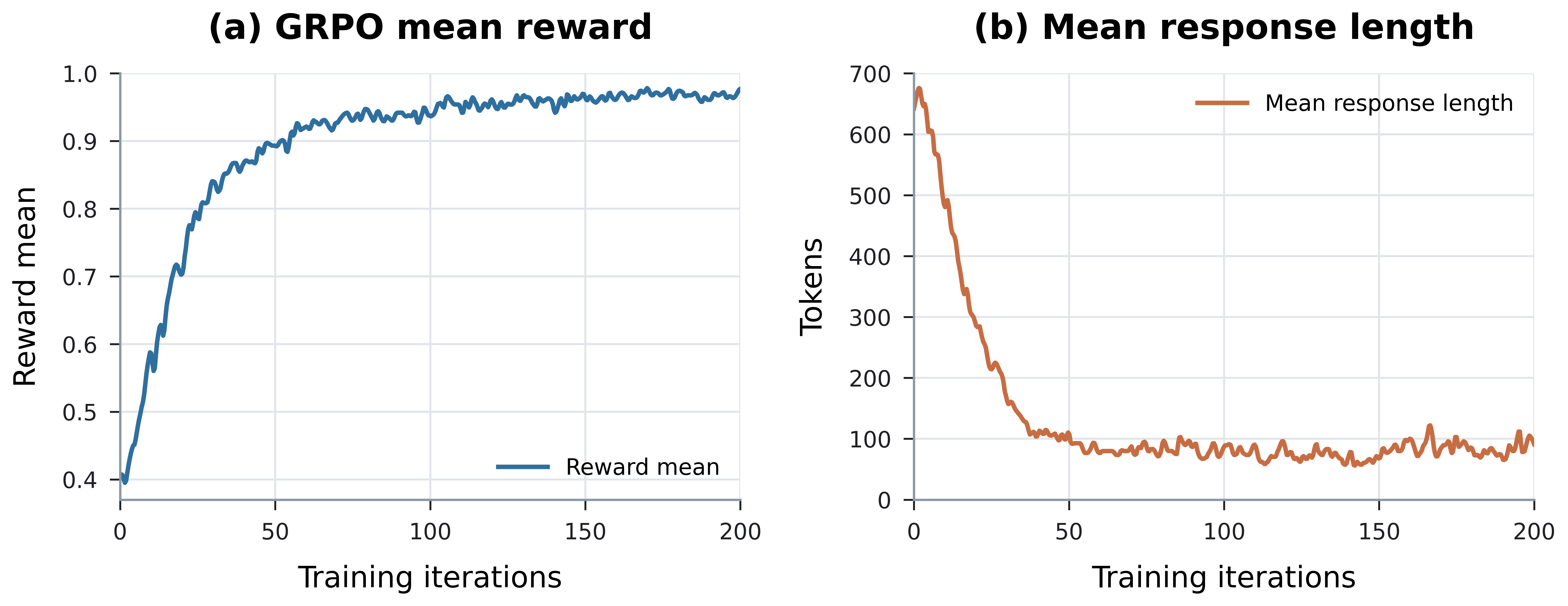
- General expert. 80% Russian open-source instruction data + 20% in-house samples (drawn with the template-aware sampler, Min-Hash-decontaminated), all completions regenerated by Qwen3-235B-A22B-Instruct-2507 for target-distribution homogeneity. A separately trained reward model on this corpus scores GRPO rollouts. Two key stabilizers: a multiplicative length penalty computed against a per-prompt length baseline from the teacher, and an inflated KL coefficient to constrain drift.
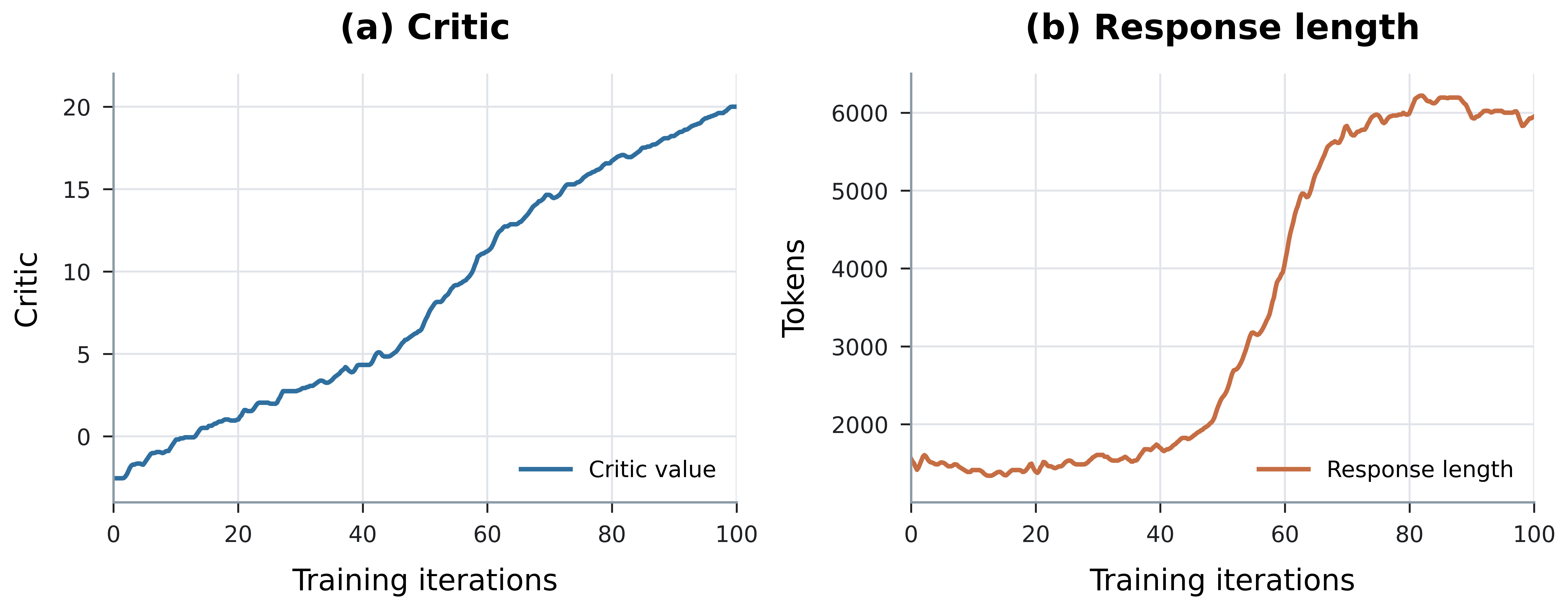
Figure 1 shows the failure mode being blocked: without length + KL regularization, mean RM reward climbs while response length inflates monotonically — classic verbosity hacking against a length-biased RM. With regularization (Figure 2) reward still increases but length stays bounded.
- IF expert. GRPO with deterministic verifier rewards (the failure mode here is semantic collapse — the model satisfies structural constraints while degrading content).
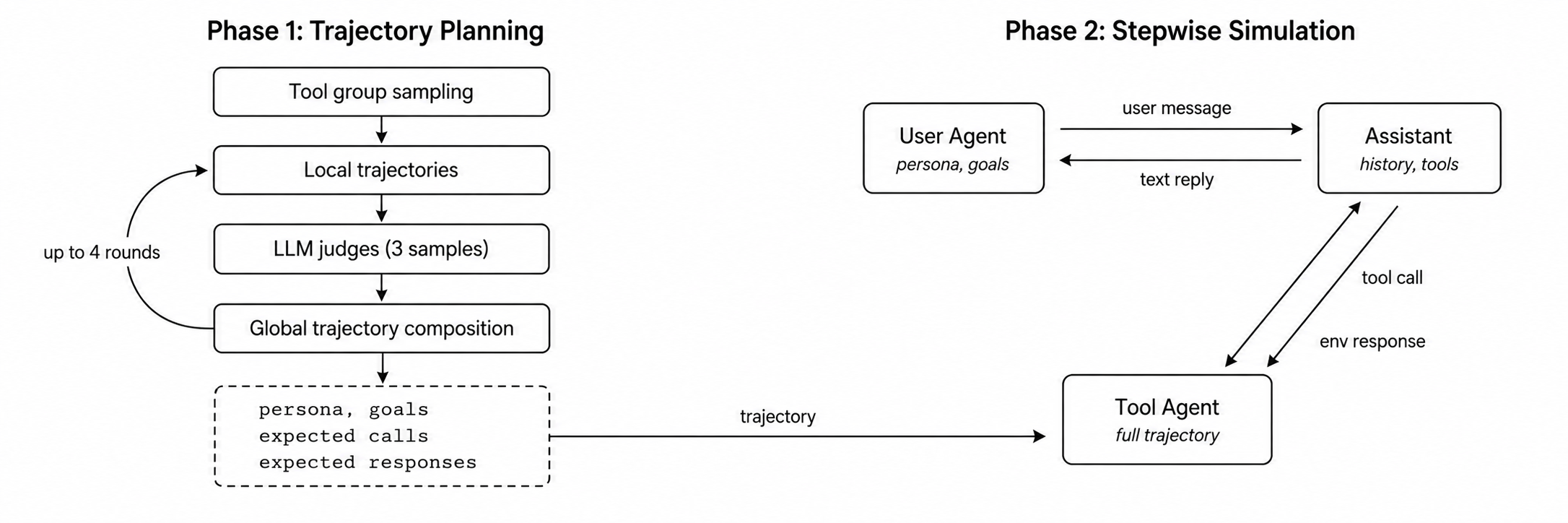
- FC expert. Trained on synthetic dialogues from the pipeline in Figure 3: a planner assembles a structured trajectory from a sampled tool group, refines it through up to four judge-feedback rounds, then a three-agent stepwise simulation (User, Assistant, Tool) with asymmetric visibility executes the trajectory. Flagged erroneous assistant turns remain in context but are never labeled as targets. The failure mode blocked here is over-calling — spurious tool invocations rewarded by shallow success heuristics.
Stage 3 merges the three experts by two-stage sequential SLERP (Shoemake 1985; Goddard et al. 2024). SLERP interpolates along the geodesic on the unit hypersphere in parameter space,
\text{SLERP}(\theta_A, \theta_B; t) = \frac{\sin((1-t)\Omega)}{\sin\Omega}\theta_A + \frac{\sin(t\Omega)}{\sin\Omega}\theta_B,
with \Omega = \arccos(\hat\theta_A \cdot \hat\theta_B). Doing it sequentially (rather than a single 3-way barycenter) preserves the axis-specific gains, though the paper does not fully characterize why one merge order dominates another.
Results
In non-reasoning mode, the merged 32B model surpasses a \sim 7\times larger baseline on:
- in-house Arena: 69.6 vs 65.8
- ruIFEval (loose): 0.85 vs 0.83
- BFCLv3 (function calling): 0.79 vs 0.77
General dialogue benchmarks (Arena Hard Ru, WildChat Hard Ru) also improve. Operationally, the single deployment absorbs 50% of platform traffic (the abstract is truncated on the exact statement, but this is the headline consolidation number).
Decontamination is deliberate: benchmark items are held out from the general expert’s in-house increment, and IF/FC experts train on synthetic data only, so improvements are not attributable to memorizing the eval templates that share structure with production traffic.
Limitations and open questions
- The recipe is restricted to non-reasoning mode; whether the interference argument transports to long-CoT regimes is untested.
- SLERP merge order is treated empirically; there is no principled account of which axis should be interpolated first, or how the geodesic assumption interacts with non-Gaussian expert deltas.
- The general axis has no verifiable reward and relies on an RM whose in-house-adapted variant did not beat the general one — the authors offload the alignment to data curation, which limits how much the general expert can push production alignment.
- Reported gains are on Russian-adapted benchmarks; the English appendix numbers are not summarized here.
Why this matters
This is one of the few published post-training pipelines that treats production traffic itself as the training and evaluation distribution, and it presents concrete evidence that reward interference across IF/FC/general axes is severe enough to justify fork-train-merge over joint RL. The template-aware sampler and the verbosity/over-calling/semantic-collapse taxonomy are directly reusable for anyone consolidating an internal LLM fleet.
Source: https://arxiv.org/abs/2609.01572
Uncovering Understanding-Generation Synergy in Native Unified Multimodal Models: From Representation, Task to System
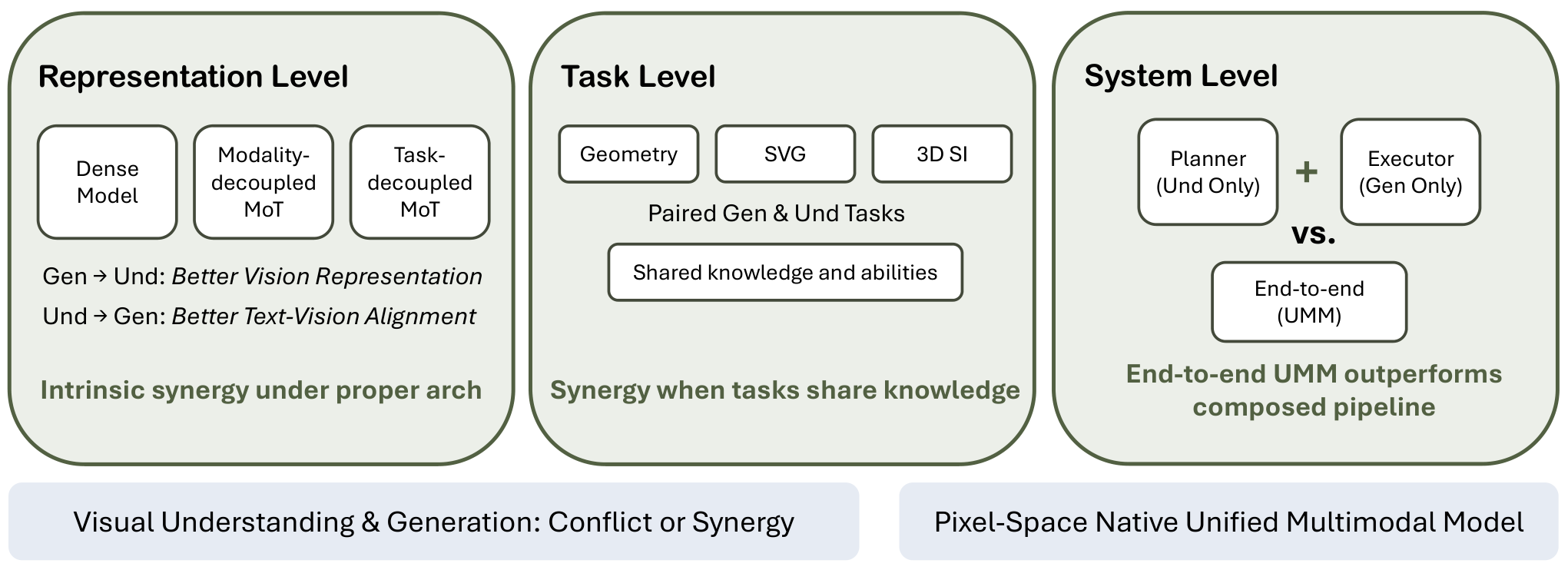
Unified multimodal models (UMMs) fold visual understanding and image generation into one network, but functional co-existence does not imply learning synergy. This paper dissects the interaction at three levels — representation, task, and system — in a native setting where no pretrained vision encoder is imported, so that any observed synergy is attributable to joint training rather than to inherited priors. The formulation combines causal autoregressive modeling over the multimodal context with bidirectional flow matching over visual tokens within a generated image, i.e., the currently dominant hybrid AR + flow recipe (Zhou et al. 2025; Deng et al. 2025).
Representation level: interference vs. specialization
The authors train from scratch with a constant 1\times 10^{-4} learning rate for 210k steps on SenseNova-U1 mixtures, then probe frozen features. Both objectives supply mutually useful signal — generation sharpens the visual features consumed by understanding, and understanding tightens vision–language alignment for generation — but when the two objectives are routed through the same computation path one dominates and degrades the other. A task-decoupled Mixture-of-Transformers (MoT) that specializes conflicting visual computation while keeping the semantic interaction shared avoids this asymmetric collapse.
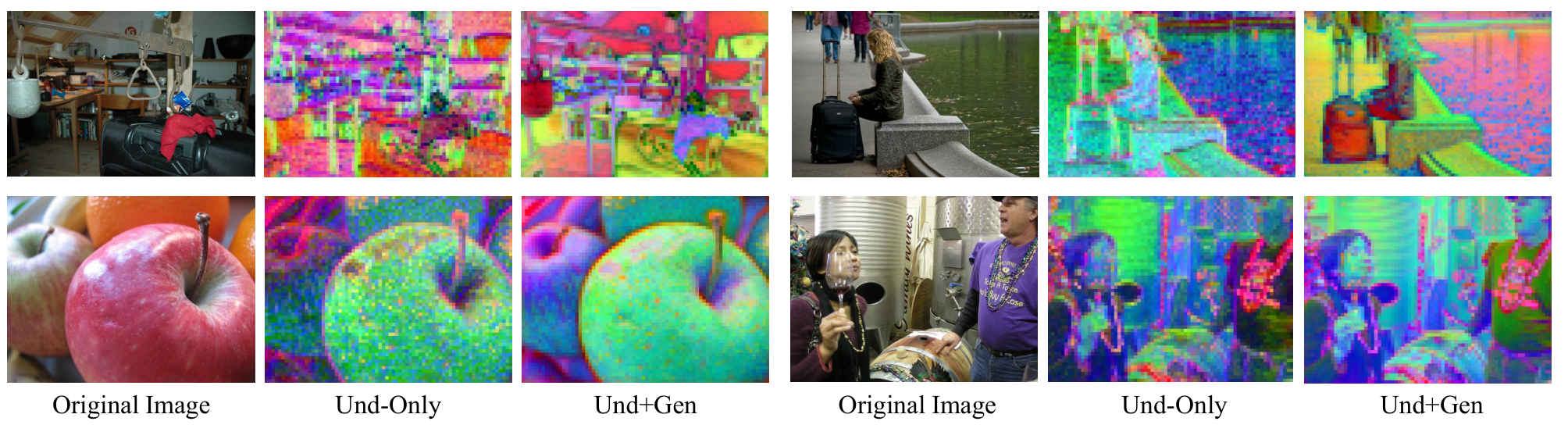
The PCA projections of patch-level features onto a shared 3D basis make the effect visible: joint training yields more coherent object regions and cleaner spatial structure than understanding-only training, consistent with improvements measured by frozen linear probes. The takeaway is architectural: parameter sharing per se is not the source of synergy — the routing topology decides whether the two objectives cooperate or overwrite each other.
Task level: bidirectional transfer through shared knowledge
The task-level experiments hold the base model and general-purpose data fixed (50% of every mixture) and swap in task-specific understanding/generation data. The interesting case is geometry problem solving, where diagrams carry the same relational structure whether being parsed or drawn.
Three regimes are compared: understanding-only (Und), Und augmented with the geometry generation/editing data as generation targets (Und+Gen), and a controlled Textual-Desc baseline that converts the exact same generation examples into image-description and transformation-description tasks (so the source data is identical, only the learning signal changes).
| Training | Geometry3K | PGPS9K | MathVerse | MathVista |
|---|---|---|---|---|
| Und | 59.90 | 72.40 | 60.13 | 71.80 |
| Und + Textual-Desc | 63.56 | 73.90 | 59.11 | 73.60 |
| Und + Gen | 65.39 | 73.40 | 63.15 | 74.30 |
Und+Gen improves Geometry3K by +5.5 points and MathVerse by +3.0 points over Und, and also transfers to non-geometry math (MathVista +2.5). Crucially, Textual-Desc — which sees the same underlying data — is weaker on Geometry3K (63.56 vs. 65.39) and actually worse than Und on MathVerse (59.11 vs. 60.13). So the benefit is not just “more geometry tokens”; producing the diagram (pixel-space supervision constrained by geometric structure) is a stronger auxiliary signal than describing it in text.
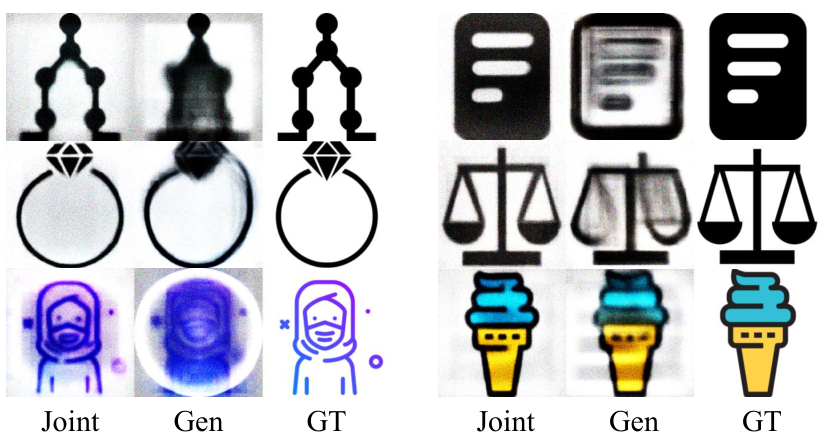
The SVG case reinforces this: after joint training the model answers code-conditioned VQA more accurately (i.e., it can infer the rendered appearance of an SVG without seeing the image), and the one-step flow-matching prediction already exhibits correct global shape and layout. Generation is acting as a rendering-consistent grounding objective that regularizes understanding.
System level: end-to-end UMM vs. planner–executor
The final question is whether unification helps on tasks that inherently chain understanding and generation, or whether a modular pipeline of two specialists suffices. The setup is carefully matched: the same task-decoupled MoT checkpoint is finetuned three ways on the same reasoning-intensive editing data — (1) end-to-end (implicit instruction → explicit edit + target image), (2) planner only (implicit → explicit instruction), (3) executor only (source + explicit instruction → target). At inference, (2)+(3) is the agentic pipeline; (1) is the UMM.
| System | RISEBench Overall | KRIS-Bench Overall |
|---|---|---|
| Planner → Executor | 16.66 | 66.48 |
| End-to-end UMM | 18.88 | 68.33 |
The end-to-end model beats the pipeline on every RISEBench category except Logical (9.41 vs. 11.76), with the largest gains on Temporal (22.35 vs. 18.82) and Causal (27.77 vs. 22.22) editing. KRIS-Bench shows a smaller but consistent +1.85 overall improvement. Since base weights, data, and compute budget are matched, the delta is attributable to the executor having direct access to the planner’s internal reasoning state rather than to a discretized textual instruction — exactly where an information bottleneck would hurt a modular system.
Limitations and open questions
The study is confined to the AR-text + flow-matching-image formulation; whether the conclusions transfer to fully autoregressive tokenized pipelines or discrete denoising UMMs (e.g., LLaDA-style) is explicitly left open. The representation-level probing relies on PCA visualizations and linear probes on frozen features rather than mechanistic interventions, so the “which computation conflicts” claim is architectural-empirical, not causal. The task-level study covers three cases (geometry is the one detailed here); it is not yet clear when shared knowledge between an understanding task and a generation task is strong enough to yield positive transfer versus when the generation objective becomes a distraction. On the system side, Logical editing on RISEBench regresses under end-to-end training, suggesting the unified model may sacrifice explicit symbolic planning that a dedicated text planner retains.
Why this matters
The paper reframes UMM design around a testable question — does joint training actually produce synergy, and where? — and gives concrete architectural (task-decoupled MoT), data (generation-as-auxiliary supervision beats text-description-as-auxiliary), and system (end-to-end beats planner–executor on tightly coupled reasoning-edit tasks) prescriptions. For anyone building native UMMs, it argues that the correct unit of unification is semantic interaction, not shared weights on every computation path.
Source: https://arxiv.org/abs/2609.01607
DiagEvo: Diagnosis-Guided Self-Evolution via Hierarchical Error Memory
Problem
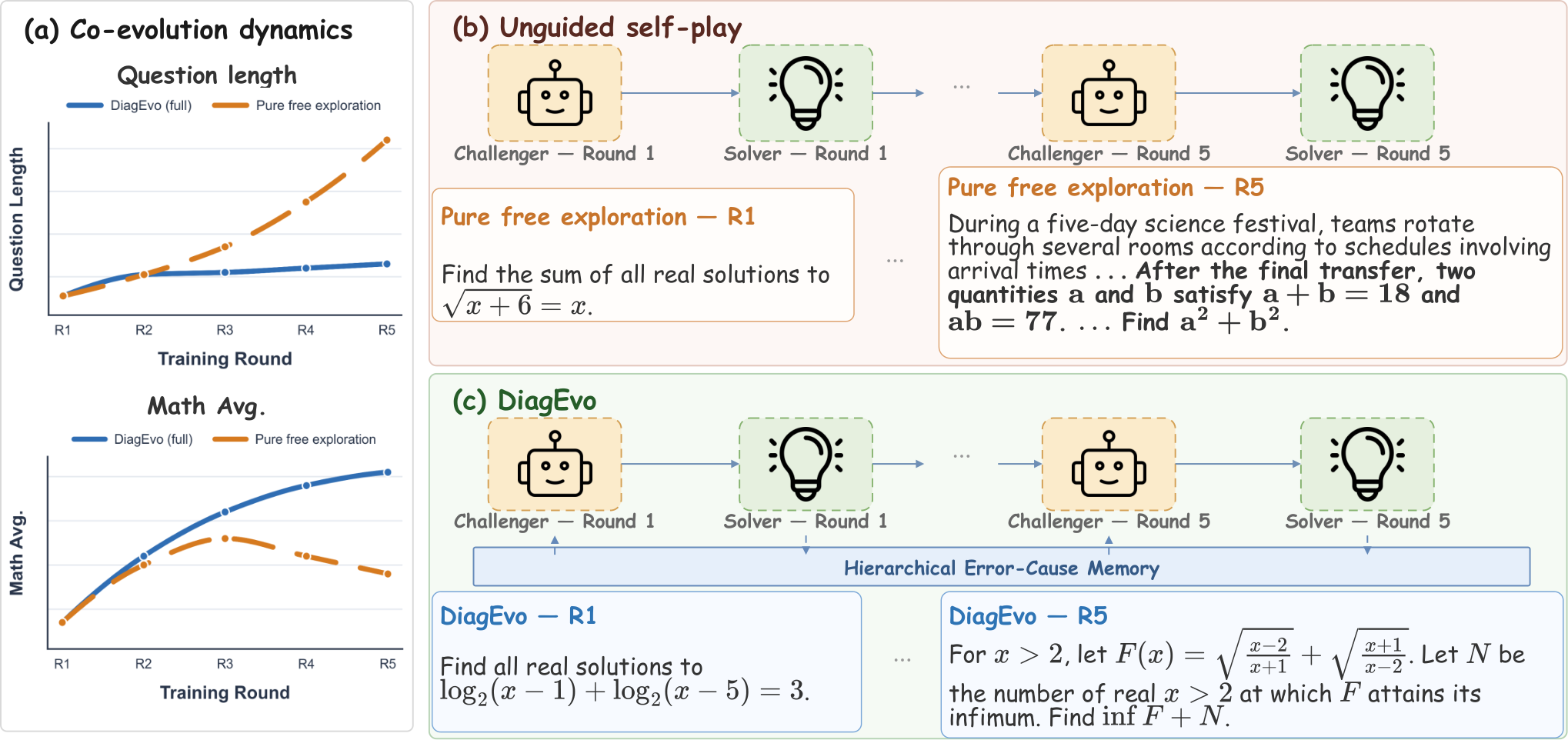
Self-play LM training loops that alternate a challenger (question generator) with a solver tend to plateau or regress after a few rounds. Unguided objectives — difficulty, learnability, diversity — keep questions hard and varied but do not indicate which reasoning weaknesses to attack next. The typical failure mode is surface inflation: the challenger increases prompt length and syntactic complexity without exposing new reasoning gaps, so the solver’s held-out accuracy stagnates while question length grows.
The alternative — guided self-play — imports direction from human seeds, corpora, or target difficulties, breaking the closed loop. DiagEvo’s claim is that direction can be extracted endogenously from the solver’s own failure trajectories, via a diagnostician model that maintains a persistent, hierarchical memory of recurring error causes.
Method
A DiagEvo round has four stages: cause-conditioned generation, double-confidence filtering, memory maintenance from failed trajectories, and scheduling of the next round from cause states.
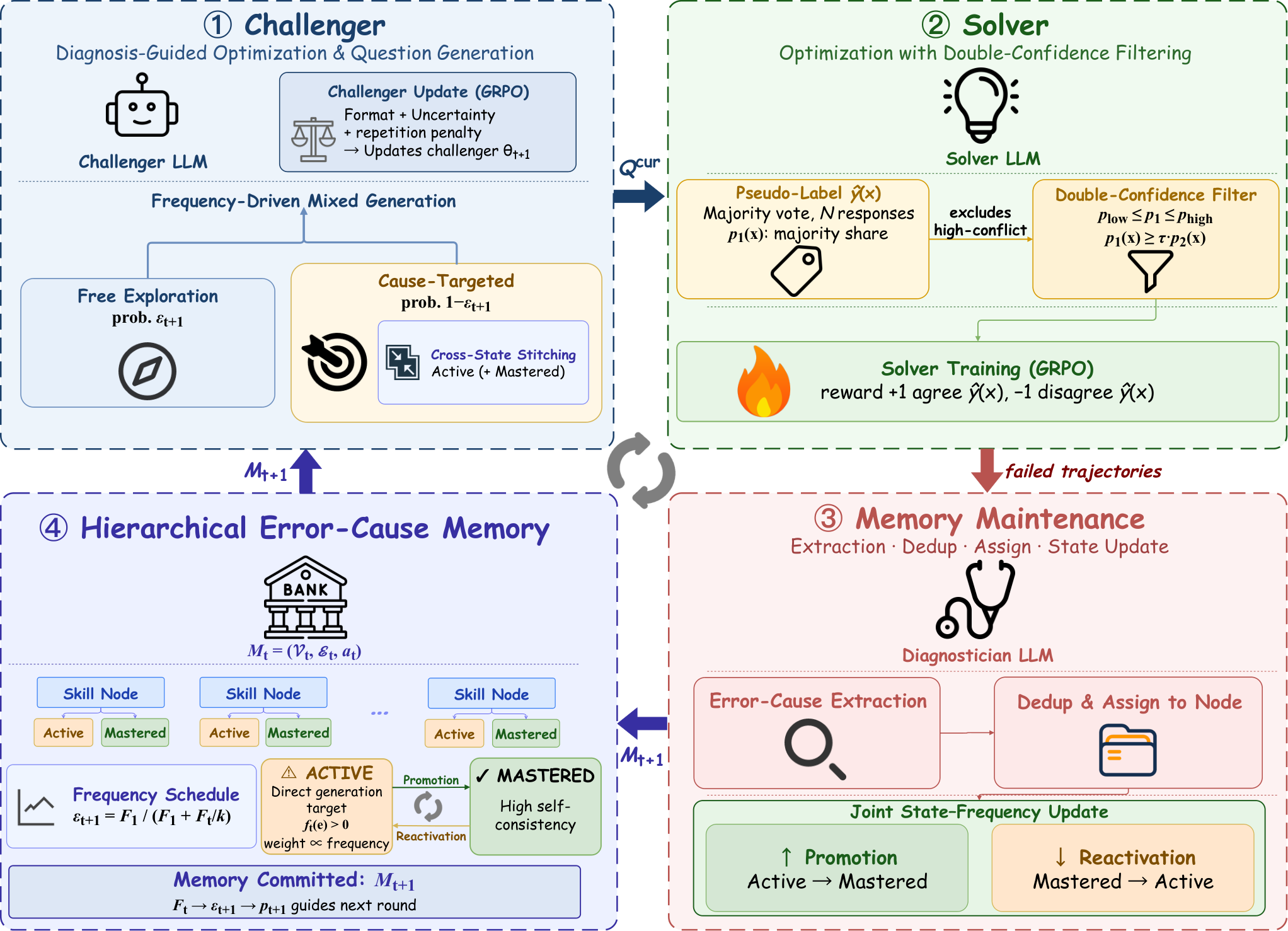
Hierarchical error memory. Failed solver trajectories are passed to a diagnostician LM (Qwen3-Instruct variants at 4B/30B/235B in experiments) that extracts natural-language error causes, deduplicates them against existing entries, and assigns each to a skill node in a two-level tree. Every cause carries a state in \{\text{Active}, \text{Mastered}\} plus a recurrence counter. Mastery is decided by self-consistency of the solver on targeted probe questions; promotion resets the counter.
Frequency-driven scheduling. Let \mathcal{M}_t be the committed memory after round t, \mathcal{E}_t its Active causes, and f_t(e) the failure count in e’s current active episode. An active episode starts when a cause is activated and ends at promotion, at which point f_t(e) \leftarrow 0. Aggregate failure pressure is F_t = \sum_{e \in \mathcal{E}_t} f_t(e). Round 1 uses only free exploration and defines a reference F_1; subsequently z_t = F_t / F_1.
The next round’s free-exploration probability \varepsilon_{t+1} and target-cause distribution p_{t+1}(e) are
\varepsilon_{t+1} = \frac{F_1}{F_1 + F_t / k}, \qquad p_{t+1}(e) = \frac{f_t(e)}{F_t}.
So the log-odds of cause-targeted vs. free generation grow linearly in z_t, with k setting the crossover: the two modes are equiprobable at z_t = k. Cause sampling is proportional to episode frequency, biasing effort toward causes that keep re-firing. If F_t = 0 (all Active causes went quiet), \varepsilon_{t+1} = 1 and the challenger reverts to unconstrained exploration. Promotion of a cause therefore has two effects: it drops f_t(e) to zero and, absent reactivation, shrinks F_t, gradually returning probability mass to exploration.
The full generation distribution is a mixture q_{t+1}(x \mid \mathcal{M}_t) = \varepsilon_{t+1}\, q^{\mathrm{free}}_\theta(x) + (1-\varepsilon_{t+1}) \sum_{e \in \mathcal{E}_t} p_{t+1}(e)\, q^{\mathrm{tar}}_\theta(x \mid e, \mathcal{M}_t), where q^{\mathrm{tar}} conditions on the natural-language cause and its skill-node context. The challenger is trained with GRPO; the solver receives only newly generated question–pseudo-label pairs.
Double-confidence filtering. To construct solver training data, questions are kept only when the solver’s most-common pseudo-label attains an intermediate frequency band — filtering out both trivial items (label agreement too high) and unsolvable items (no dominant answer). This yields a self-labeled curriculum at controlled difficulty without external supervision.
Alternation. Within a round, one of {challenger, solver} is frozen while the other updates. Only the challenger has access to \mathcal{M}_t; the solver sees only samples and pseudo-labels. The solver’s failures then feed the diagnostician, closing the loop.
Results and analysis
Experiments run on three base solvers — Qwen3-4B-Base, Qwen3-8B-Base, and OctoThinker-8B-Hybrid-Base — with three diagnostician scales (Qwen3-4B-Instruct-2507, Qwen3-30B-A3B-Instruct-2507, Qwen3-235B-A22B-Instruct-2507). The introductory comparison (Figure 1) shows the qualitative failure of unguided self-play: question length drifts upward across rounds while the solver’s math average flattens. DiagEvo holds question length roughly stable and continues to improve the math average, indicating that gains come from targeting unresolved reasoning weaknesses rather than from surface complexity. The example questions in Figure 1(b) make this concrete — free exploration inflates wording and irrelevant structure, while cause-conditioned generation produces items exercising specific skills tracked in memory.
The provided excerpt does not include the full results table, so exact deltas across benchmarks cannot be quoted here beyond the qualitative curves in Figure 1.
Limitations and open questions
- The scheduler depends on F_1 as a fixed normalizer; if the first round’s exploration is unrepresentative (e.g., too easy), the entire cause-targeting schedule is miscalibrated.
- Mastery is decided by self-consistency, which conflates confident-but-wrong plateaus with genuine competence.
- The diagnostician is itself an LM; systematic biases in error-cause extraction (e.g., collapsing distinct failure modes into one node) directly shape the curriculum.
- Double-confidence filtering discards items with no dominant pseudo-label, which are precisely the hardest cases; the method may under-train on frontier difficulty.
- Skill-node granularity and the hyperparameter k appear influential but their sensitivity is not quantified in the shown material.
Why this matters
DiagEvo operationalizes an idea that has been informally present in RL-from-self-play work: that the solver’s own error distribution is a sufficient statistic for curriculum direction. Making the failure history explicit, structured, and typed — and scheduling generation from it via a simple odds equation — gives a closed-loop alternative to corpus- or human-seeded guided self-play, with a clean knob (k) trading targeted drill against exploration.
Source: https://arxiv.org/abs/2609.00768
EM^2Mem: Event-Centric Multimodal Memory for Large Language Models
Problem
Long-video QA with LLMs typically relies on multimodal memory: caption stores, frame indices, ASR transcripts, per-segment summaries, or knowledge graphs. Retrieval over these stores returns modality-specific fragments that the LLM must re-align at inference time. This shifts the cross-modal binding problem into the context window, where budget is tight and attribution across sources is fragile. The result is redundant tokens, weak grounding, and inconsistent temporal reasoning when questions span many minutes or days of video.
EM^2Mem argues that alignment should happen at write time, not read time. Instead of indexing fragments by modality, index by event, and bind heterogeneous evidence to each event anchor.
Method
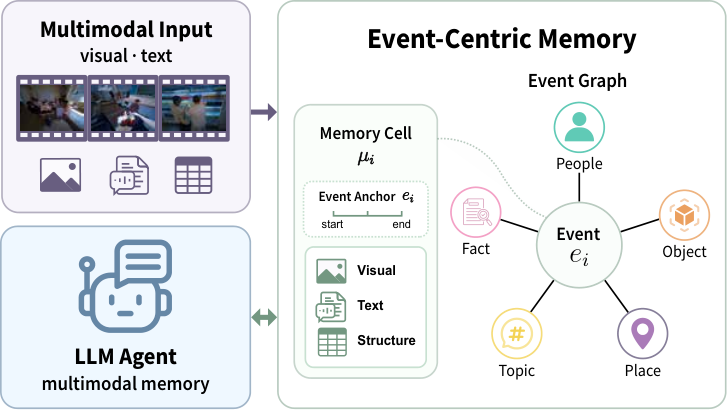
The pipeline is align-then-retrieve. A long video V is parsed into a sequence of short temporal events \{e_i\} that serve as shared indices. For each event e_i, the system constructs a memory cell
M_i = (R_i, \mathcal{C}_i, \pi_i)
where R_i is the local multimodal record (visual snippet features, captions, transcript spans, detected entities/objects, semantic facts), \mathcal{C}_i is a multi-scale context view (neighboring events at several temporal resolutions), and \pi_i is provenance (source modality, timestamp, extractor ID) used for attribution.
Cross-event structure is captured by two lightweight graphs anchored on events rather than on entities. An episodic graph G_E encodes concrete cross-event links — shared entities, objects, scenes, topics, and temporal transitions. A semantic graph G_S encodes higher-level regularities (routines, habits, recurring relations), where each semantic node is required to point back to the supporting events that instantiate it. This grounding constraint prevents semantic facts from drifting away from evidence.
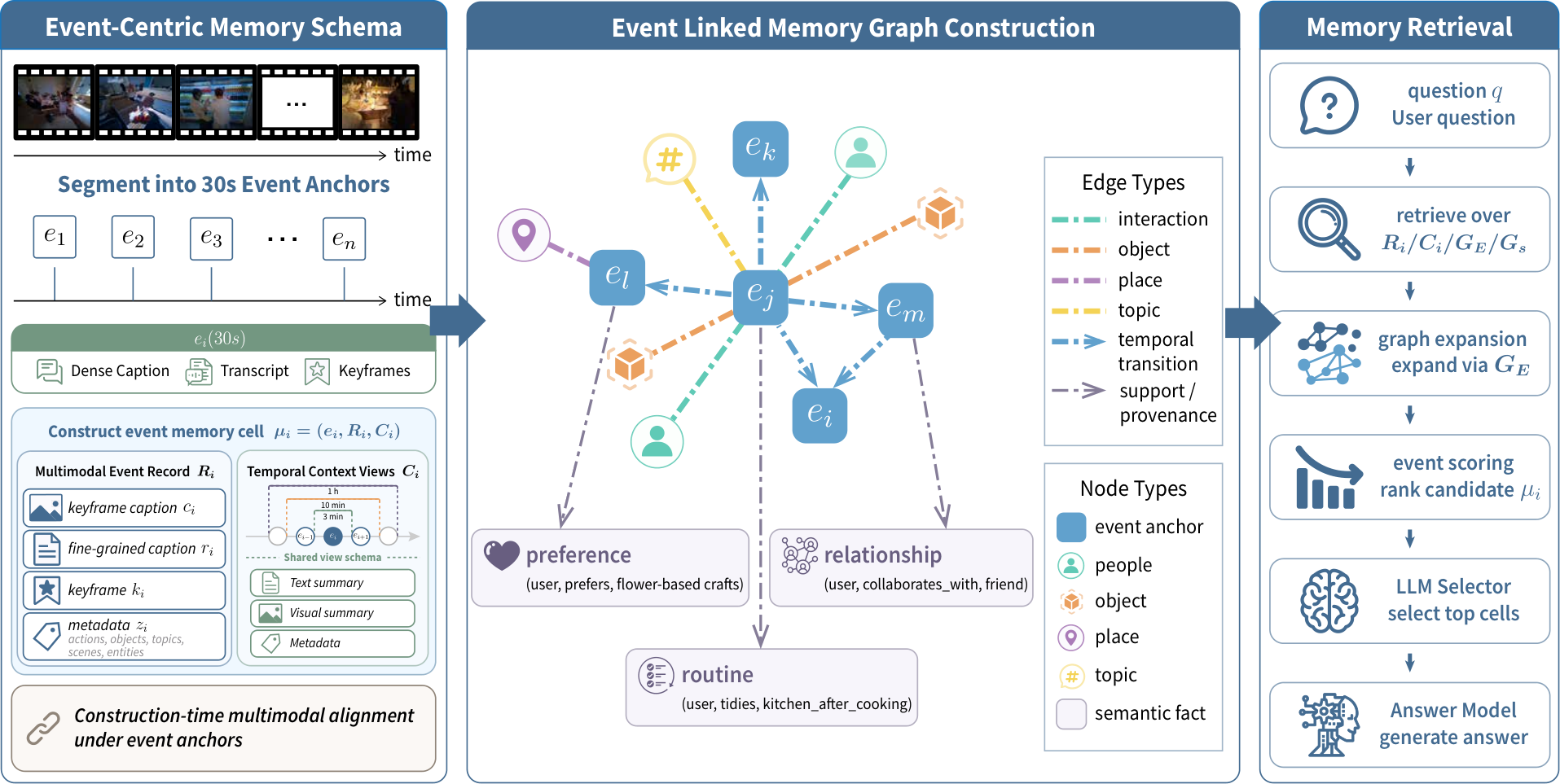
At inference, a question q triggers a two-stage retrieval. First, a lightweight scorer selects a small set of candidate event cells \{M_i\} by matching q against event summaries and record fields. Second, the candidates are expanded along G_E and G_S: episodic neighbors provide temporal and entity continuations, semantic nodes provide abstracted patterns with their supporting events attached. The expanded set is compiled into a query-specific evidence view — one compact block per event with aligned modalities and provenance — which is fed to the LLM for answer generation.
The key mechanical choices to re-implement the skeleton: (i) an event segmenter over the raw video (temporal boundaries from shot/activity change); (ii) an extractor pass per event that fills R_i across modalities with a common event ID; (iii) graph construction with events as first-class nodes, entities and semantic facts as typed neighbors carrying event back-pointers; (iv) retrieval that scores events (not fragments) and expands via graph edges; (v) an evidence compiler that serializes each retrieved cell as a single aligned block rather than concatenating modality-specific hits.
Results
EM^2Mem is evaluated on three multiple-choice long-video QA benchmarks with distinct regimes: EgoLifeQA (week-long egocentric), Ego-R1 Bench (ultra-long egocentric reasoning), and Video-MME (L) (open-domain long-video). Against the strongest prior memory baseline, average accuracy improves by 2.0, 2.4, and 3.7 points across the three benchmarks respectively.
Beyond accuracy, the paper reports two operational metrics that matter for memory systems. Strict event-level Top-5 evidence recall — whether the retrieved top-5 contain the gold event — improves by 7.0 points, indicating that event-indexed retrieval genuinely localizes better than fragment-indexed retrieval, not just that the LLM patches over noisy context. Per-query latency drops by 4.67x and total inference tokens by 63.66%, because compiling one aligned block per event replaces the redundant multi-fragment context typical of caption/summary/graph-fact concatenation.
Limitations and open questions
Several points are underspecified in the excerpts. The event segmentation quality bounds everything downstream; the paper does not discuss sensitivity to boundary errors or over/under-segmentation. Semantic graph construction — how facts are induced and how grounding to supporting events is enforced — is described conceptually but the extraction reliability, especially for long-horizon routines, is not quantified in the shown sections. Retrieval scoring for events versus expansion depth in G_E, G_S is a natural ablation axis but not detailed here. The gains, while consistent, are in the 2–4 point range, so it would be useful to see per-category breakdowns to identify which question types (temporal, causal, entity-tracking, routine) most benefit from event anchoring. Finally, as the ethical statement flags, structuring routines and entities into persistent memory has clear surveillance implications that are not addressable purely through technical design.
Why this matters
Most “multimodal memory” for LLMs is really a heterogeneous retrieval index whose fragments the model must re-align at read time. EM^2Mem shifts alignment to write time via event anchors, which simultaneously improves evidence recall (+7.0 pts Top-5), accuracy (+2–3.7 pts), and inference cost (4.67x latency, ~64% fewer tokens) — an unusual Pareto move for retrieval-augmented systems and a template for how to structure memory when the underlying signal is inherently temporal.
Source: https://arxiv.org/abs/2609.00551
Hacker News Signals
The Emergent Symbolic Structure of Artificial Neural Networks
Source: https://arxiv.org/abs/2608.29530
This paper investigates whether trained neural networks spontaneously develop internal representations that correspond to discrete symbolic structures — not by design, but as a consequence of learning from data. The core claim is that gradient-descent-trained networks on tasks with latent compositional or algebraic structure will, under certain conditions, converge to weight configurations whose activations can be decoded as symbolic expressions.
The authors analyze this through the lens of representational geometry: they look at when activation manifolds in hidden layers factor into approximately independent subspaces aligned with the ground-truth symbolic variables underlying the task. The mechanism proposed is that networks trained with sufficient capacity on data generated by a compositional process will find that the minimum-description-length solution (in the loss landscape sense) is one that mirrors the generative structure. This connects loosely to prior mechanistic interpretability work (circuits, grokking, modular arithmetic) but attempts a more general theoretical framing.
Technically, the paper leans on tools from topology and algebra — looking at when the learned representation admits a group-theoretic decomposition, echoing the “representation theory of neural networks” thread that has been active since Anthropic’s superposition work. They provide empirical support on synthetic tasks where ground-truth symbolic structure is known, showing that probes for the latent symbols achieve high accuracy in specific layers, and that this emergence is not monotone in training time (grokking-style delayed phase transitions appear).
The limitations are the usual ones for this line of work: synthetic tasks may not generalize to naturalistic settings, the definition of “symbolic structure” is somewhat post-hoc, and the gap between theoretical framing and the actual mechanics of SGD remains large. The open question of whether this tells us anything actionable about real LLMs is not answered. Still, it is a serious theoretical attempt at a problem the field has been circling for years.
Atlas: A World Model for Spatial Intelligence
Source: https://www.worldlabs.ai/blog/atlas
WorldLabs (Fei-Fei Li’s startup) released Atlas, a world model targeting spatial and physical reasoning. The system is positioned as a 3D-aware generative model that can produce spatially consistent video and novel-view synthesis, with the stated goal of enabling downstream applications in robotics, simulation, and embodied AI.
The technical substance, as described in the blog post, centers on training a generative model that maintains explicit 3D structure rather than treating video generation as a purely 2D sequence problem. The approach appears to encode scenes into representations that preserve metric spatial relationships — distances, occlusion, and geometry — rather than relying purely on implicit 2D appearance statistics. This is relevant because standard video diffusion models (Sora-class systems) routinely violate geometric consistency across frames because they have no inductive bias toward 3D coherence.
Atlas reportedly uses a latent space factored to separate appearance from geometry, enabling controllable manipulation of camera pose and object placement while holding the rest of the scene fixed. This is technically related to NeRF/3DGS hybrid approaches and the broader class of “video generation with camera control” methods (e.g., CameraCtrl, ViewCrafter), but with an apparent emphasis on scaling the geometric reasoning component.
Quantitative benchmarks are not disclosed in the blog post, which is a real limitation for evaluating claims. The qualitative demos show consistent novel-view synthesis and object manipulation in cluttered scenes, but without controlled comparisons to Stable Video 3D, ZeroNVS, or similar, it is hard to assess the actual delta.
The open questions are substantial: how does the 3D representation scale to dynamic scenes with multiple independently moving objects? What is the compute cost per inference? The announcement is notable primarily because of the team’s credibility and the funding behind it, not because the technical writeup provides sufficient detail for independent verification.
Continuous Diffusion Language Models (CDLMs)
Source: https://sander.ai/2026/08/24/continuous-dlms.html
Sander Dieleman’s blog post is a careful technical treatment of applying continuous diffusion to language generation — a problem that is non-trivial because language is inherently discrete and the standard diffusion framework assumes a continuous data manifold.
The core tension: discrete diffusion (MDLM, D3PM, masked diffusion) is the natural fit but sacrifices the expressive forward-process flexibility of Gaussian diffusion. Continuous diffusion on token embeddings (e.g., Diffusion-LM, CDCD) requires working in embedding space, which introduces the question of how to handle the manifold structure of embeddings and how to decode back to discrete tokens at inference time.
Dieleman walks through several design choices. First, the embedding space is not flat — token embeddings trained end-to-end cluster in complex geometry, and naive Gaussian noise corruption does not respect this. One approach is to use a fixed embedding space (e.g., frozen CLIP or a pre-trained LM embedding table) and train the denoiser to map noisy embeddings back to the manifold. Second, the loss function needs to be carefully chosen: the standard ELBO in embedding space does not directly optimize for token-level perplexity. Third, classifier-free guidance in continuous embedding space is straightforward mathematically but empirically tricky because guidance can push embeddings off-manifold.
The post discusses the “self-conditioning” trick (using the previous denoising step’s output as an additional input) and its importance for CDLMs specifically — it significantly reduces the number of function evaluations needed for coherent generation. Benchmark numbers cited show CDLMs closing the gap with autoregressive models on standard LM benchmarks, though not yet matching them at scale.
The honest assessment here is that CDLMs remain behind autoregressive transformers on perplexity per compute, but they offer bidirectional generation and flexible-length inference that AR models cannot match natively.
I Trained a Small Transformer in 1.5hrs and It Beats Many LLMs
Source: https://mvakde.github.io/blog/44-on-arc-1/
This post is specifically about ARC-AGI-1 (the Abstraction and Reasoning Corpus), not general language modeling, and the headline is technically accurate in a narrow sense: a small transformer fine-tuned for ARC tasks outperforms general-purpose LLMs on ARC-AGI-1 because general LLMs are not optimized for it.
The method: the author trains a small transformer (details on parameter count are given in the post) on synthetically generated ARC-like tasks, following the general “program synthesis via neural network” approach. The key insight is that ARC tasks have a combinatorially small output space (grids of at most 30x30 with 10 colors), so the output distribution is highly constrained compared to open-ended language generation. The model is trained to predict the output grid token-by-token given input/output demonstration pairs.
The training pipeline involves data augmentation (rotations, reflections, color permutations — the standard ARC augmentation playbook from prior work like ARCformer and the RE-ARC dataset generator). The 1.5-hour training time on a single GPU is plausible given the small model size and the constrained task domain.
The interesting technical question the post raises: ARC performance scales poorly with general LLM size because the task requires inductive rule extraction from a handful of examples, not pattern matching against a large training distribution. Small specialized models can beat large generalists here because they are trained on a distribution closely matched to the test distribution.
Limitations: ARC-AGI-1 is now a known benchmark and train-distribution overlap is a real concern. ARC-AGI-2 is substantially harder, and it is unclear whether this approach generalizes. The post is an honest empirical report rather than a research contribution claiming novelty, but the engineering details are reproducible and the point about task-specialization vs. scale is worth taking seriously.
The Efficient Frontier of LLM Inference
Source: https://www.baseten.co/blog/the-efficient-frontier-of-llm-inference/
This post applies the concept of the Pareto efficient frontier to LLM inference hardware and serving configurations. The framing is: given a set of deployment constraints (latency, throughput, cost), what configurations are non-dominated?
The technical content covers the standard inference optimization axes: tensor parallelism degree, pipeline parallelism, KV cache quantization (FP8, INT4), speculative decoding with draft models, continuous batching, and prefix caching. The post provides empirical measurements — tokens per second, time-to-first-token, and cost per million tokens — across several configurations on H100 and A100 hardware for a handful of open-weight models.
Key findings reported: speculative decoding improves latency-bound workloads (interactive chat) but degrades throughput-bound workloads (batch inference) because the draft model consumes memory bandwidth that could serve more concurrent requests. KV cache quantization to FP8 recovers roughly 15-20% throughput at negligible quality degradation on tested models, but INT4 KV cache shows measurable perplexity increase on long-context tasks. Tensor parallelism beyond 4 GPUs for 70B-class models shows diminishing returns due to all-reduce communication overhead.
The “efficient frontier” framing is useful because inference optimization is genuinely multi-objective and the right operating point depends on the application SLA. A batch translation pipeline and a real-time coding assistant have completely different optimal configurations even on identical hardware.
Limitation: the post is from a serving infrastructure vendor (Baseten), so model selection and benchmark conditions favor their platform’s strengths. The numbers are plausible and internally consistent, but independent replication on equivalent hardware would be needed before treating them as ground truth. The framework for thinking about inference trade-offs is sound regardless.
Claude Fable 5.1 and Claude Mythos 5.1
Source: https://www.anthropic.com/claude-fable-and-mythos-5-1
Anthropic released two new model variants: Fable 5.1 (positioned as a mid-tier, efficient model) and Mythos 5.1 (positioned as a high-capability frontier model). The naming convention shifts from the prior Haiku/Sonnet/Opus tier labeling.
The technical disclosures in the announcement are sparse, as is standard for frontier lab releases. What is stated or strongly implied: both models use a context window of at least 200K tokens, both have improved tool use and agentic task performance over their 3.x predecessors, and Mythos 5.1 is reported to achieve top scores on several standard benchmarks including MMLU, GPQA, and coding evaluations (specific numbers are in the announcement but should be read with the usual benchmark saturation caveats).
The high HN comment count (1236) is driven largely by product and pricing discussion rather than technical substance — the models are commercially significant because Claude has become widely deployed in coding assistants and agentic pipelines. The technical interest is in the reported improvement in long-context faithfulness and reduction in sycophancy, both of which are stated to have been targeted specifically in the 5.1 training runs.
Anthropic continues to publish Constitutional AI and RLHF methodology papers separately from model releases, so the announcement itself contains no information about training changes, architecture modifications, or data composition. The model names appear to be a deliberate break from the prior tier naming to signal a product line restructuring rather than a pure capability increment.
From a research standpoint, the most interesting question the release raises is whether the reported reductions in sycophancy reflect advances in RLHF reward modeling or post-hoc prompt-level interventions — a distinction the announcement does not address.
Agent Memory as a File Format
Source: https://calpaterson.com/memoryfields.html
This post proposes a concrete specification for how AI agents should persist and retrieve memory, framing the problem as a file format design problem rather than a retrieval or embedding problem. The core observation is that current agent memory implementations are ad hoc — either flat key-value stores, vector databases with opaque similarity search, or unstructured text dumps — and that this makes memory unportable, hard to inspect, and difficult to reason about correctness.
The proposed design uses a structured record format where each memory entry has explicit typed fields: content (text), temporal metadata (creation time, last access, decay parameters), associative links to other memories (explicit graph edges, not implicit embedding proximity), and provenance (which agent action created this memory). The decay model is borrowed from cognitive science — specifically ACT-R’s base-level activation formula — where memory activation is a function of frequency and recency of access: A_i = \ln\left(\sum_{j} t_j^{-d}\right) where t_j are times since each access and d is the decay parameter.
The retrieval mechanism proposed is a hybrid: activation-based filtering (drop memories below a threshold) followed by exact structured queries on typed fields, followed optionally by embedding similarity on the remaining candidates. This is more interpretable than pure vector search because failures can be diagnosed at each stage.
The post also addresses memory consolidation — merging redundant memories and elevating frequently accessed short-term memories to longer-term storage — which is analogous to OS page promotion in tiered memory systems.
Practical limitation: the format requires the agent framework to commit to a schema upfront, which is inflexible for open-ended tasks. The decay parameters are sensitive hyperparameters that the post treats as tunable but does not provide guidance for. The ideas are sound but the proposal is at the design-doc stage, not an implemented system with ablation results.
I Used Fable to Rewrite 65kLoC of Go in Rust. It Cost $400
Source: https://iurii.net/en/blog/posts/software-engineering/i-used-fable-to-rewrite-65kloc-to-rust/
This is a detailed engineering post-mortem on using Claude Fable (an Anthropic model, presumably via API) to perform a large-scale language migration from Go to Rust on a real production codebase. The $400 figure refers to API costs across the full rewrite.
The technical workflow: the author did not attempt whole-file translation in single prompts. Instead, they used a structured pipeline — parse Go source into logical units (functions, types, interfaces), translate unit by unit with context injection (relevant type definitions, imported packages, Rust idioms for the specific Go patterns encountered), then run cargo check and feed compiler errors back to the model in a repair loop. This repair loop is the technically interesting part: Rust’s borrow checker produces structured, precise error messages that are machine-readable and provide strong signal for targeted correction without re-translating the entire unit.
The Go-to-Rust translation problem has specific hard cases that the post enumerates: Go interfaces map awkwardly to Rust traits (especially when the interface is used as a first-class value), goroutines and channels require manual mapping to tokio async tasks or std::thread plus mpsc, and Go’s nil-able pointer semantics require explicit Option<Box<T>> wrapping in Rust. The author notes that Fable handled straightforward struct-and-method code well but required significant human intervention for concurrency patterns and interface-heavy code.
The 65kLoC number with $400 cost implies roughly 162k LoC per dollar at current API pricing, which is consistent with published token costs if we assume the translated code is roughly 1:1 LoC ratio and the repair loops add ~2-3x overhead in tokens. The human time cost — reviewing, patching, and testing — is reported as substantial and is not captured in the $400 figure. The honest conclusion: LLM-assisted language migration is economically viable for the mechanical parts, but the hard architectural decisions still require human judgment.
Noteworthy New Repositories
2akouwu/reverify
Verified reverse engineering via AI grounded in deterministic tooling. The core idea is that LLM-generated decompilation analysis is always cross-checked against the actual binary rather than accepted verbatim — halting the standard failure mode where a model confidently names a function or reconstructs a struct layout that does not match the binary evidence.
The architecture chains symbolic execution, disassemblers (Ghidra/Binary Ninja integrations are referenced), and constraint solvers as an oracle layer. The LLM proposes hypotheses — variable types, calling conventions, loop semantics — and the tool suite verifies each claim against the binary’s actual control flow, byte offsets, and register states. Claims that fail the oracle are rejected or flagged, and the agent iterates. This is closer to a CEGAR loop than a plain RAG setup.
Practically, this matters because hallucinated symbol names or wrong struct sizes silently corrupt downstream analysis. The verification layer converts RE from a “trust but hope” workflow into one where every annotated fact has a machine-checked provenance. The tooling is Python-orchestrated with subprocess calls into the underlying disassembly backends. Useful for CTF automation, malware triage, and vulnerability research pipelines where correctness matters more than throughput.
Source: https://github.com/2akouwu/reverify
truespar/sentio
A full multi-tenant mail server written in Rust, purpose-built to give AI agents real, durable email identities. Each agent is provisioned its own address; inbound mail is parsed, normalized, and delivered as structured JSON webhooks; replies are issued over a REST API with automatic thread association.
The protocol stack is unusually complete: DKIM signing and verification, SPF and DMARC policy enforcement, ARC chain handling for forwarded mail, MTA-STS for policy-based TLS enforcement, and DANE for TLSA-record-backed certificate pinning. Anti-spam runs three tiers (likely header analysis, content scoring, and reputation lookup, though specifics depend on the implementation). The entire stack is a single Rust binary, which makes deployment straightforward — no Postfix/Dovecot/Rspamd sprawl.
The design fits agentic workflows that need asynchronous, real-world communication channels: an agent that can send a confirmation email and wait for a reply webhook is meaningfully more capable than one restricted to HTTP APIs. The multi-tenant provisioning model means a single deployment serves many independent agents without address collision. For security researchers or developers building autonomous systems that interact with humans over email, this is a drop-in mail infrastructure layer rather than a wrapper around a SaaS ESP.
Source: https://github.com/truespar/sentio
Player-YN/PawWork_ZhuaZhua
A Chrome extension implementing a selection-first web agent: the user selects DOM elements on a live page, describes the desired output, and the agent extracts, transforms, and writes results to an editable Office file (XLSX, DOCX). The interaction model inverts the usual “describe everything in natural language” approach — spatial selection on the rendered page gives the LLM precise grounding about which nodes to operate on, reducing ambiguity.
Execution is fully client-side and sandboxed inside the extension; no data transits a backend. The user supplies their own API keys (BYOK), so the trust boundary is between the browser and the chosen LLM provider, not a third-party service. The agent’s action space is constrained to read and file-write operations rather than arbitrary browser automation, which limits blast radius compared to a full computer-use agent.
Technically interesting as a demonstration that selection as structured input signal substantially narrows the grounding problem for DOM-heavy extraction tasks. The editable-file output is pragmatic: downstream users get something they can correct rather than a terminal text dump. Useful for researchers scraping structured data from pages without stable APIs, or for building lightweight RPA workflows without a server-side orchestration layer.
Source: https://github.com/Player-YN/PawWork_ZhuaZhua
antinomie-lab/pi-book
An architecture notebook covering the engineering decisions involved in building a production agent system, written as source-backed prose rather than marketing copy. The “source-backed” framing indicates claims are tied to code, configurations, or referenced implementations rather than being purely conceptual.
The content targets the design layer that most agent tutorials skip: how memory, tool dispatch, context management, and failure recovery compose into a system that does not degrade over long task horizons. Topics reportedly include multi-agent coordination patterns, persistent state management, and the boundary between orchestration logic and model capability.
This is reference material rather than a library — the value is the reasoning recorded alongside the decisions, which is usually stripped out of published codebases. For PhD-level readers building or evaluating agent frameworks, the interest is in seeing which architectural commitments the authors made and what tradeoffs they accepted, particularly around state representation and tool-call reliability. The Rust/systems-adjacent framing of the lab suggests the notes lean toward infrastructure rather than prompt engineering. Useful as a counterpoint to the many agent architecture diagrams that omit failure modes and operational concerns.
Source: https://github.com/antinomie-lab/pi-book
PicoMQ/picomq
A durable message stream broker aimed at the lightweight end of the deployment spectrum — the niche between “run Kafka” and “use an in-process queue.” Durability is the primary design constraint: messages survive process restarts, which rules out Redis pub/sub and most embedded brokers.
The implementation targets minimal operational footprint, consistent with the “Pico” naming. The architecture likely uses an append-only log for persistence (the standard durable-stream primitive), with consumer offset tracking either in the log itself or in a small embedded KV store. Without a distributed consensus layer, the operational model is single-node-durable rather than replicated-durable, making it suitable for edge deployments, IoT gateways, or development environments where Kafka-class complexity is unjustifiable.
For systems developers the interesting question is the durability guarantee under crash scenarios — fsync policy, write-ahead logging discipline, and recovery path — which are the axes that differentiate durable brokers in practice. The project is early-stage by star count but fills a real gap: most lightweight brokers sacrifice durability for simplicity, and most durable brokers require JVM or multi-process deployments. Worth watching for teams that need guaranteed delivery semantics on constrained hardware.
Source: https://github.com/PicoMQ/picomq
mbm110/MSN-GUARD
A native Android VPN client with a Rust core, supporting an unusually wide set of tunneling protocols: MASQUE over HTTP/3 (the IETF proxying protocol using QUIC), WireGuard, Cloudflare WARP-over-WARP (double-hop), and both Psiphon and Tor for censorship-circumvention scenarios. The combination in a single client is the distinguishing feature — most Android VPN apps commit to one protocol family.
The Rust implementation handles the data plane, which is standard for modern VPN clients where memory safety in packet-processing code matters. Android’s VpnService API provides the TUN interface; the Rust layer handles protocol negotiation, tunnel establishment, and traffic routing. MASQUE support is notable because HTTP/3-based tunneling is harder to fingerprint and block than WireGuard’s distinctive UDP handshake, which matters in restrictive network environments.
WARP-on-WARP implies a two-hop architecture through Cloudflare’s network, trading latency for separation between the entry and exit points. Psiphon and Tor integration suggests the target use case includes high-censorship environments where a single-protocol client is insufficient. For security researchers and developers in this space, the Rust-core architecture and multi-protocol dispatch logic are the technically interesting components to examine.
Source: https://github.com/mbm110/MSN-GUARD
zhaoxuya520/MeshLAN
A self-hosted virtual LAN built on top of Nebula (Slack’s open-source overlay network), adding a service-sharing layer, multi-relay support, and AI-driven automation on top of Nebula’s existing certificate-based mesh. Nebula provides the encrypted P2P tunnels and NAT traversal; MeshLAN adds the application-layer primitives for exposing and discovering services across the mesh.
The multi-relay configuration addresses Nebula’s known limitation in highly restricted environments where direct peer connections fail — cascading through relay nodes maintains connectivity at the cost of latency. Service sharing means participants can expose local ports as named mesh services, effectively making the overlay a private service mesh without a sidecar proxy architecture.
The AI automation layer is the less-defined component: likely LLM-assisted configuration generation or anomaly-based access policy suggestions given the current state of “AI automation” in network tooling. The self-hosted, P2P-first design makes this appropriate for homelab federations, small-team internal tooling, or privacy-sensitive deployments where SaaS overlay networks (Tailscale, ZeroTier) are off the table. Rust-adjacent tooling via the underlying Nebula dependency provides reasonable performance for the control plane.
Source: https://github.com/zhaoxuya520/MeshLAN
vercel-labs/eve-software-factory-template
A Next.js-based template instantiating the “software factory” pattern with an agent called Foreman acting as orchestrator. The design models a software development pipeline as a multi-agent system: Foreman interprets high-level tasks and dispatches to specialized sub-agents handling code generation, testing, review, and deployment steps, with Vercel’s infrastructure providing the execution environment.
The technical substance is in the orchestration layer: how Foreman decomposes a task into a directed workflow, how sub-agent outputs are validated before the next stage proceeds, and how human-in-the-loop checkpoints are inserted. As a Vercel Labs release, it leverages the AI SDK and likely uses streaming function calls or tool-use APIs to coordinate the pipeline stages.
The template format means the architecture is inspectable and forkable rather than locked behind a service boundary — the orchestration logic, prompt templates, and agent handoff protocols are all modifiable. This is most useful as a concrete existence proof of a multi-agent dev pipeline that runs on real infrastructure, rather than as a drop-in production system. Researchers studying agentic coding systems should examine the task decomposition logic and the failure-handling paths between stages, which are typically where factory-pattern agent systems break down in practice.
Source: https://github.com/vercel-labs/eve-software-factory-template