Daily AI Digest — 2026-08-26
arXiv Highlights
Meta^n: Recursive Self-Improvement through Emergent Depth
Problem
Self-improving LLM agents typically operate at a single meta-level: either the agent refines answers to a task (STaR, Reflexion), or a fixed outer loop edits the inner solver (Gödel Agent, PromptBreeder). Both paradigms hit a structural ceiling. Answer-refiners never touch the process that produces answers. Self-editors must exempt some portion of their own editing machinery from modification to remain stable, which the authors argue caps realized meta-depth at roughly two. The open question: can an agent recurse arbitrarily deep in the meta-hierarchy without a stability/expressivity tradeoff?
Method
Meta^n keeps a single meta-operation \Omega fixed and recurses on its input rather than on itself. Given a solver stack S_k producing traces T_k and its own generating code C_k, layer k+1 is built as
(C_{k+1}, S_{k+1}) = \Omega(C_k, T_k, \text{task set}),
where \Omega emits two artifacts: (i) a Python pre-process that injects strategic context into each task before the solver sees it, and (ii) a library of callable helpers the solver may invoke. Because \Omega itself is never rewritten, it cannot destabilize the system; because C_{k+1}’s input strictly contains C_k and the traces produced by C_k, each layer reasons from strictly more information than the previous one — this is the sense in which the “vantage” grows monotonically.
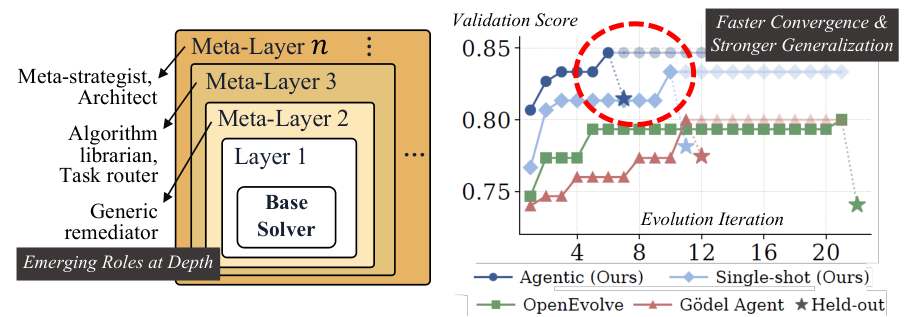
Depth is not preset. The stack halts when performance stops improving on a held-out slice (patience-based convergence). To avoid greedy commitment to one bad layer, an evolutionary archive of size B maintains multiple layer chains; at each step, K candidate expansions are generated from the archive by applying \Omega, evaluated, and the top-B retained. B, K, patience, and max-iter are tuned per benchmark (their Appendix C, Table 5).
Two variants share the identical \Omega template: single-shot (one LLM call per task, isolating \Omega’s contribution absent tool use) and agentic (observe–act loop, max 8 turns per task). Solvers span three substrates — Python source, bash-in-Docker, and prompt rewriting for a frozen downstream model — so the same \Omega has to generalize across output modalities.
The right panel of Figure 1 shows the LawBench trajectory: both Meta^n variants climb faster and plateau higher than Gödel Agent, consistent with the claim that recursion adds usable depth rather than merely more compute.
Results
Evaluation uses Gemma 4 31B-IT and GPT-5.2 across eight families: CO-Bench (36 NP-hard problems), AlphaEvolve Math, Symbolic Regression (4 domains), AlgoTune (8 tasks), ARC-AGI-2 (120 tasks), TerminalBench 2.0 (89 tasks, 13 categories), Symptom2Disease, and LawBench charge prediction. Numbers are mean \pm stdev over seeds 42/43/44, except TB2 (stdev over categories; single-seed under GPT-5.2) and benchmarks without a held-out split (AlphaEvolve Math, AlgoTune, SR) which report benchmark score directly.
Meta^n outperforms prior self-improving agents on all eight benchmark families under both backbones. The headline case is ARC-AGI-2, explicitly designed to resist skill memorization: Meta^n is the only system in the comparison scoring above zero. On LawBench (Figure 1, right), both variants exceed the Gödel Agent asymptote within the search budget.
The authors’ ablations attribute most of the recursion gain not to the accumulated code library but to the conditioning each layer passes to the next — i.e., the trace-plus-code context that lets layer k+1 judge whether layer k’s strategy was sound, rather than only whether individual outputs were wrong. This is the mechanical claim that distinguishes Meta^n from stacked prompt optimization: what recurses is not the solver but the diagnostic frame.
Limitations and open questions
- The paper does not report how deep the stacks actually grow at convergence, nor whether emergent role differentiation across layers (claimed in Figure 1) is stable across seeds or an artifact of the LLM’s stylistic priors.
- \Omega being fixed sidesteps stability but shifts all expressivity onto the prompt template for \Omega; the sensitivity to that template is not quantified in the excerpt.
- ARC-AGI-2 being the only system scoring above zero is striking but the magnitude is not stated here; whether “above zero” means a few tasks or substantial coverage matters.
- Evolutionary orchestration with per-benchmark B, K, patience, and max-iter tuning raises the usual question of how much of the gain is search compute versus recursive structure. A compute-matched flat-search baseline would clarify this.
- Cost scales with archive size times depth times per-task solver calls; the excerpt defers full cost accounting to Appendix C.
Why this matters
Meta^n reframes recursive self-improvement: instead of an agent editing itself (bounded by the fixed-point problem of not damaging its editor), a fixed meta-operator recurses over a growing context of its own outputs. If the ARC-AGI-2 result holds up in detail, it is one of the few concrete demonstrations that agent-level structure — not model scaling — can produce non-trivial gains on a benchmark built to defeat memorization.
Source: https://arxiv.org/abs/2608.24735
Annotations as Rollouts: Efficient and Scalable Reinforcement Learning for Video MLLMs
Problem
GRPO-style RL post-training for video MLLMs is bottlenecked by rollout quality. When the base policy is weak on structured video tasks (temporal grounding, tracking, mask-aware segmentation), most on-policy samples in a group receive near-zero reward, so the group-relative advantage collapses and the update signal vanishes. Generating longer chain-of-thought rollouts to raise diversity is expensive and often fails to produce any positive exemplar per query. The authors observe that supervised annotations — already paid for — carry the exact information the group lacks: a guaranteed high-reward trajectory. The question is how to inject an annotation into an on-policy group without breaking the advantage estimator.
Method
OraRL keeps GRPO’s clipped surrogate (Eq. 4) intact and modifies only (i) group composition, (ii) advantage estimation, and (iii) rollout selection.
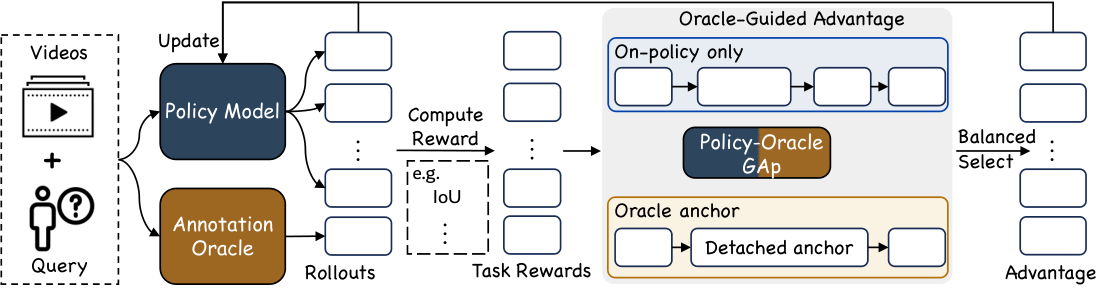
Oracle augmentation. Given query q=(v,x), sample n on-policy rollouts \mathcal{O}_{\text{op}}=\{o_i\}_{i=1}^n \sim \pi_{\theta_{\text{old}}}(\cdot\mid q) with rewards r_i. Append the annotation o_{\text{gt}} with reward r_{\text{gt}} (typically near 1).
Why naive GRPO fails: advantage inversion. If one simply computes \mu_{\text{grp}}, \sigma_{\text{grp}} over the n{+}1 rewards, the high r_{\text{gt}} pulls up the baseline. Rollouts that would have been positive under an oracle-free baseline are pushed below the mean and receive negative advantage — the gradient now penalizes correct-ish behavior.
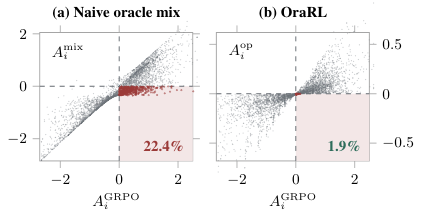
Decoupled advantage estimator. The baseline is computed from on-policy rewards only: \mu_{\text{op}} = \tfrac{1}{n}\sum_{j=1}^n r_j,\quad \sigma_{\text{op}} = \text{std}(\{r_j\}). The oracle-free advantage is A_i^{(0)} = (r_i - \mu_{\text{op}})/(\sigma_{\text{op}}+\epsilon). The oracle then contributes two additional signals:
- A directional gain A_i^{\text{op}} that scales positive-advantage rollouts by the oracle-policy gap g_q (weight w_q), reinforcing above-average trajectories in proportion to how far the oracle sits above the group.
- A detached oracle advantage A_{\text{gt}} attached to o_{\text{gt}} itself, treated as a bounded anchor (no gradient flow into the gap estimator).
Sign-balanced pruning. Backprop over n{+}1 rollouts is wasteful given the standard n=8 and long video contexts. OraRL retains the oracle plus the strongest \kappa n positives and \kappa n negatives from \mathcal{O}_{\text{op}}, then re-centers and rescales the surviving advantages \widehat{A}_k. With n=8, \kappa=0.5, groups compact from 9 to 4 retained rollouts, and sequence-length balancing across data-parallel ranks shrinks backward compute. The paper reports 2.2× SFT step time versus 4.9× for standard GRPO — less than half.
System. Implemented in veRL with vLLM rollouts and FSDP training. Videos are decoded once and frames plus temporal metadata are shared between rollout and actor engines. Rewards run asynchronously, and detached old-policy log-probs from the pre-update forward are reused, avoiding a second old-policy evaluation.
Results
Training uses 284,779 SFT prompts and 100,032 RL prompts spanning seven task families (temporal grounding, spatial grounding, spatial-temporal grounding, tracking, segmentation, VQA, spatial reasoning), producing Video-ORA-4B and Video-ORA-9B — a single model per size trained by one recipe, evaluated without CoT decoding.
On temporal grounding (Table 1), Video-ORA-9B reaches mIoU 61.8 / 63.6 / 72.5 on Charades-, ActivityNet-, and QVHighlights-TimeLens, exceeding TimeLens2-8B (58.6 / 58.6 / 70.2) and Gemini-2.5-Pro (52.8 / 58.1 / 70.4). On the tightest threshold R1@0.7 it reports 42.4 / 53.3 / 64.0, versus Gemini-2.5-Pro’s 34.0 / 47.1 / 61.1. The 4B variant is competitive with 8B baselines: mIoU 56.8 / 57.3 / 67.5, above Qwen3-VL-8B (48.3 / 46.8 / 59.4) and InternVideo3-8B (53.2 / 46.3 / 59.2).

The unified evaluation extends to RefCOCO (R@0.5, cIoU), STVG (tIoU/sIoU), GOT-10k AO, MeViS/ReasonVOS J&F, seven VideoQA benchmarks, and VSI-Bench/MindCube/MMSI-Bench for spatial reasoning — a single 9B checkpoint dominating specialized baselines across all seven families per Figure 1.
Limitations and open questions
- The oracle-policy gap g_q and its weight w_q act as hyperparameters governing how aggressively the oracle reshapes advantages; the paper does not fully characterize the sensitivity or offer a principled schedule.
- OraRL presumes reward-scorable annotations (verifiable structured labels). It is unclear how the decoupled estimator behaves when annotations are noisy or when R(o_{\text{gt}}, q) \not\approx 1 (e.g., soft captions).
- Sign-balanced pruning assumes both signs exist in the group. On very easy or very hard queries, one sign may be empty; the fallback behavior and its effect on the effective batch composition are worth quantifying.
- Detached A_{\text{gt}} blocks gradient into the gap term but the oracle itself receives an off-policy gradient through the clipped ratio; importance-ratio clipping behavior on an annotation drawn from a very different distribution than \pi_{\theta_{\text{old}}} deserves scrutiny.
Why this matters
OraRL exploits an underused asset — the labels the dataset already ships — as a positive rollout inside GRPO, and identifies advantage inversion as the specific failure that has kept prior work from doing so cleanly. The decoupled baseline plus sign-balanced pruning turn RL post-training from a 5× SFT-cost regime into a 2.2× one while still improving a single generalist across seven video task families, which changes the practical calculus for scaling RL on multimodal models where rollouts are the dominant cost.
Source: https://arxiv.org/abs/2608.20492
AutoSaddler: Automatic Harness Optimization with Durable Updates from Agent Execution Traces
Problem
LLM agents deployed on long-horizon tasks are wrapped in harnesses — the scaffolding of system prompts, tool schemas, retry policies, memory management, and control flow that sits between the model and the environment. Empirically, harness design dominates end-task success as much as model choice, but harness authoring is manual: engineers stare at failure traces, edit prompts and tool wrappers, re-run evaluations, and iterate. The search space (natural-language instructions × tool configurations × discrete control logic) is combinatorial and does not admit a numerical gradient. AutoSaddler treats this as an offline learning problem: given a fixed base agent and a training set of tasks, produce a durable harness update that generalizes.
Method
The harness H_n is parameterized by \theta_n, a structured collection of textual/code artifacts. Tasks are split into D_{\mathrm{train}}, D_{\mathrm{dev}}, D_{\mathrm{test}}. Each iteration n processes a mini-batch B_n \subset D_{\mathrm{train}} through four sessions.
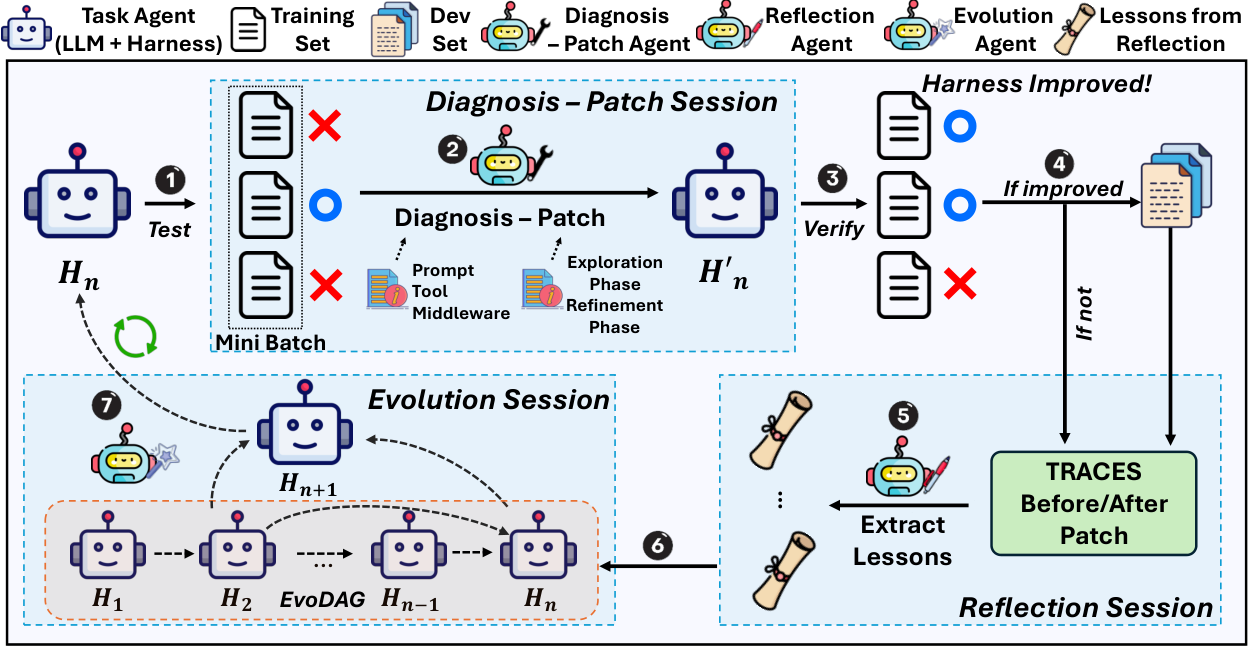
Diagnosis–Patch. Failed traces in B_n are analyzed to produce a structured patch \Delta\theta_n, yielding H_n' = H_n + \Delta\theta_n. The authors emphasize that patches target specific harness components (prompt fragments, tool wrappers, controller branches) rather than issuing free-form rewrites — this is the “targeted modifications” ingredient identified in the ablations.
Verification. H_n' is re-rolled on the same B_n. The patch is a mini-batch improvement iff \widehat{J}_{B_n}(H_n') > \widehat{J}_{B_n}(H_n). Because textual “gradients” are not automatically consistent with the loss (unlike numerical backprop), verification is the empirical check that closes the loop. Only patches passing this test are evaluated on D_{\mathrm{dev}}.
Reflection. Regardless of acceptance, pre/post traces are compared and each task is bucketed into fixed, regressed, still-failing, or still-passing. Lessons and scalar scores are stored in EvoDAG, a directed acyclic graph whose nodes are candidate harnesses and whose edges carry diagnostic rationale. This preserves negative results — patches that regressed some tasks — as constraints for future proposals.
Evolution. The next harness H_{n+1} is proposed conditioned on EvoDAG history, so proposals are history-aware rather than purely local to the current mini-batch. After exhausting the rollout budget K, the candidate with highest \widehat{J}_{D_{\mathrm{dev}}} is selected and evaluated once on D_{\mathrm{test}}.
The authors frame Diagnosis–Patch–Verify as the analog of a backward pass under textual gradients, and EvoDAG + Evolution as the optimizer state; the mini-batch structure follows standard SGD-style bias/variance tradeoffs adapted to expensive rollout-based evaluation.
Deep debugging. A recurring emphasis is that diagnosis must inspect the trace at mechanism-level granularity, not just paraphrase the model’s own reflection.
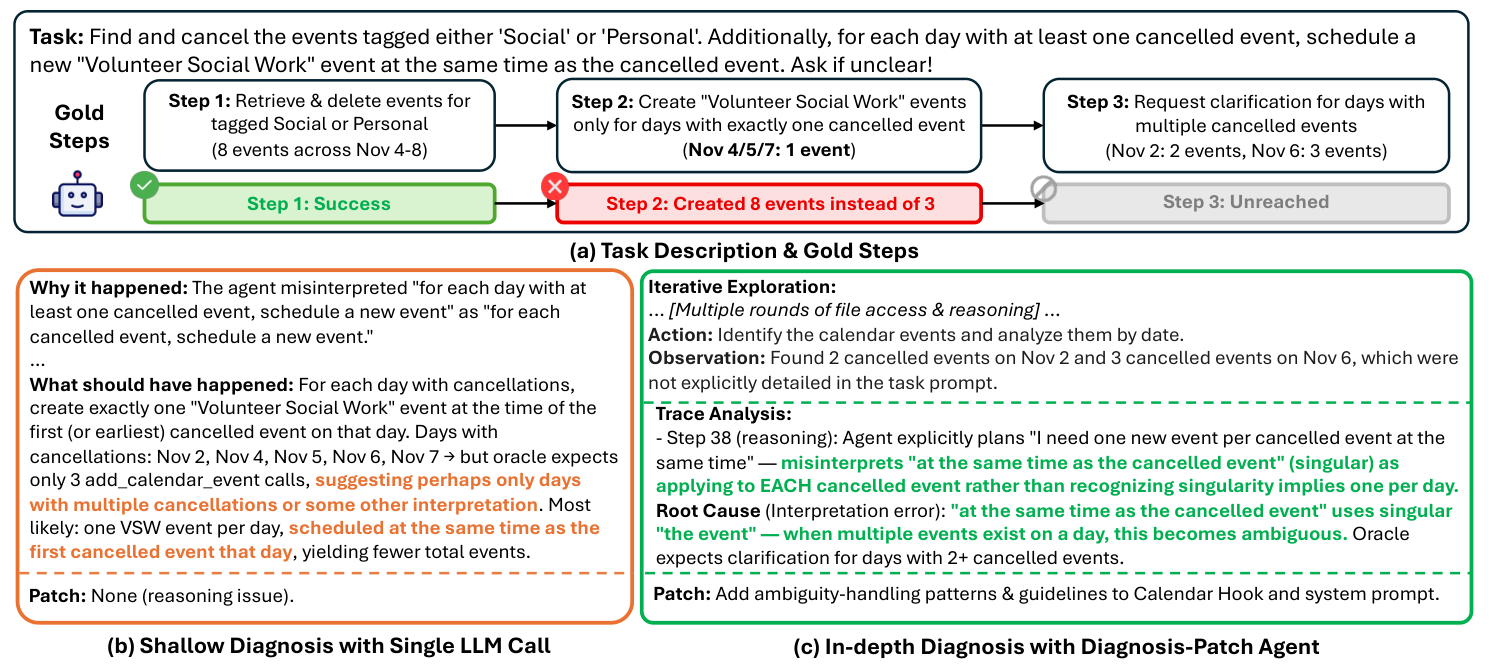
In the calendar case, shallow reflection latches onto surface symptoms while AutoSaddler traces the root cause through the tool-call sequence.
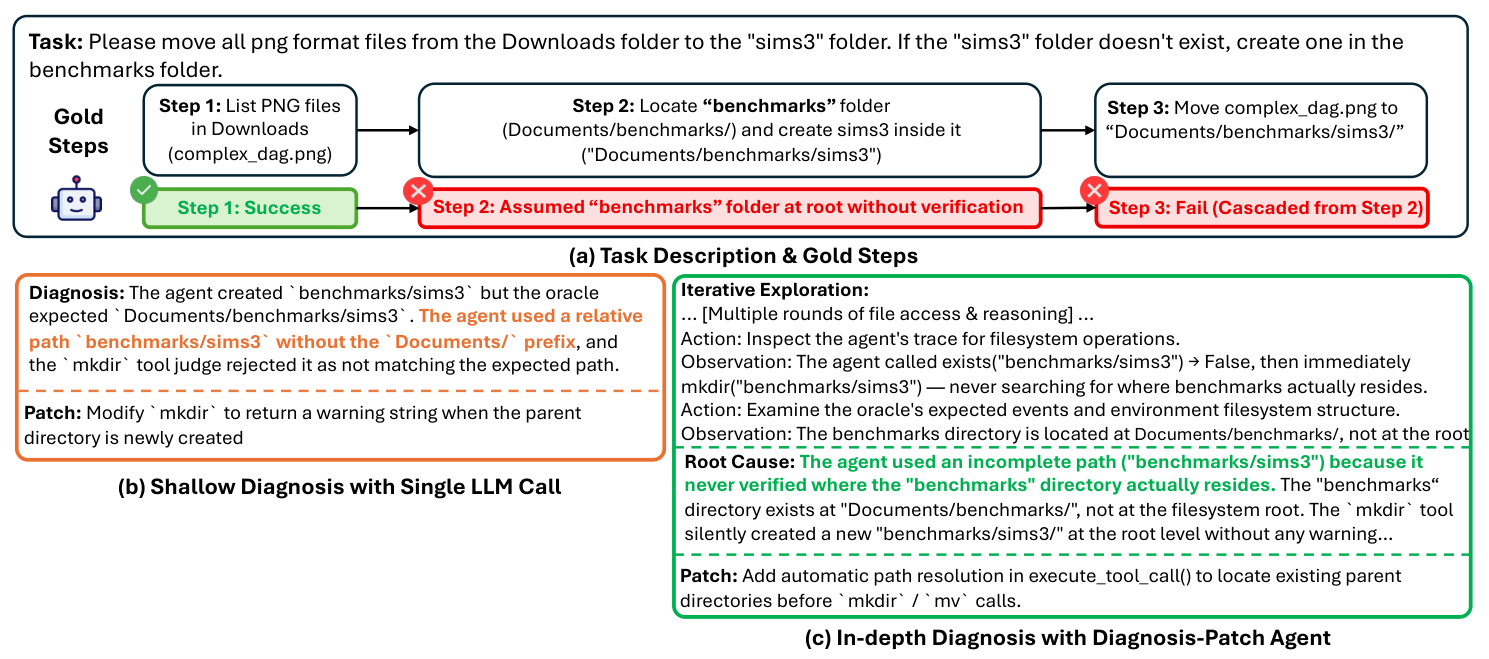
The file-management case illustrates the same failure mode of shallow diagnosis — misattributing to a plausible-sounding cause (relative-path handling) rather than verifying the filesystem state that the tool actually observed.
Results
Across three benchmarks with distinct base harnesses:
- GAIA2 (default ReAct agent, 10 Universes): +9.0 percentage points over base.
- SWE-Bench Pro (SWE-agent base): +9.6 percentage points.
- Terminal-Bench 2.0 (Terminus 2 base, 89 tasks): +10.0 percentage points.
The three benchmarks span smartphone assistant tasks, enterprise SWE repositories, and terminal/sysadmin/ML/security tasks — so the same optimization loop transfers across quite different action spaces without benchmark-specific machinery. Ablations attribute the gains to three ingredients: (i) deep debugging over shallow reflection, (ii) targeted structured patches over unconstrained editing, and (iii) generalization-aware selection via D_{\mathrm{dev}} rather than mini-batch overfitting.
Limitations and open questions
The paper does not report the rollout budget K or the wall-clock/token cost of optimization, which are the practical bottleneck: each Diagnosis–Patch–Verify triple requires running the agent on B_n twice. Mini-batch verification protects against local regressions but not against distribution shift between D_{\mathrm{train}} and deployment; the +9–10 pp gains on D_{\mathrm{test}} are encouraging but the benchmarks are still IID with training. The EvoDAG structure is presented as an optimizer analog, but there is no explicit account of when the search stalls or how diverse the proposals from Evolution actually are — a plausible failure mode is collapse to a narrow neighborhood around an early-accepted patch. Finally, whether the improvements are model-agnostic (i.e., whether a harness tuned with model A transfers to model B) is an obvious question given how much of the harness is prompt text targeted at a specific policy.
Why this matters
Harness engineering is currently the dominant lever for agent reliability in industry, and it is done by hand. AutoSaddler shows that framing it as offline mini-batch optimization with explicit verification and history-aware proposal — rather than agent self-reflection — produces ~10 pp gains across three heterogeneous benchmarks using different base agents, which is a strong signal that “harness tuning” can be automated with roughly the discipline of hyperparameter search rather than treated as bespoke prompt craft.
Source: https://arxiv.org/abs/2608.23041
On-Policy Self-Distillation in Diffusion Models
Problem
RL fine-tuning of diffusion models (DDPO, DPOK, ReFL, and preference-based variants like DPO/DiffusionDPO) aligns generation with scalar image-level rewards r(x_0). The endpoint reward, however, gives no per-step signal: given an intermediate latent x_t and its clean-output prediction \hat{x}_0(x_t;\theta), we do not know what the prediction should have been. Existing approaches either backprop through a partial denoising chain (memory-heavy, biased at truncation), or treat the trajectory as an RL rollout and estimate policy gradients (high variance, off-policy drift when the sampler is reused). The paper’s premise is that a well-defined per-query target for \hat{x}_0 can be constructed from local reward gradients, and that fitting these targets separates “how good the target is” from “how well we realize it,” a decomposition that is muddled in end-to-end reward backprop.
Method
DiffusionOPSD is an on-policy self-distillation loop with a frozen behavior policy \pi_{\bar\theta} and a trainable policy \pi_\theta, coupled by EMA:
- Rollout. \pi_{\bar\theta} samples full trajectories, yielding query states x_t at sampled timesteps t and anchor predictions \hat{x}_0^{\text{anc}} = \hat{x}_0(x_t;\bar\theta).
- Target construction. Using a differentiable reward r, compute g = \nabla_{\hat{x}_0} r(\hat{x}_0^{\text{anc}}) and form bounded positive/negative targets around the anchor:
\hat{x}_0^{+} = \hat{x}_0^{\text{anc}} + \eta\,\Pi(g),\qquad \hat{x}_0^{-} = \hat{x}_0^{\text{anc}} - \eta\,\Pi(g),
where \Pi is a bounded projection (norm clip / trust region) and \eta is a target step. Targets are detached — they are supervision, not a differentiable path.
- Finite fitting. Do K inner steps of a distillation loss, e.g.
\mathcal{L}(\theta) = \mathbb{E}_{x_t}\big[\|\hat{x}_0(x_t;\theta) - \hat{x}_0^{+}\|^2 - \lambda \|\hat{x}_0(x_t;\theta) - \hat{x}_0^{-}\|^2\big],
or the paired/contrastive variant used in the paper. Because targets are fixed and query states are drawn from \pi_{\bar\theta}, the update is on-policy w.r.t. the frozen behavior but reduces to supervised regression from \theta’s viewpoint.
- EMA refresh. \bar\theta \leftarrow \tau\bar\theta + (1-\tau)\theta, propagating gains to the sampler and closing the loop.
The key methodological contribution is the clean factoring: the target-construction quality (how much r increases if \hat{x}_0 were replaced by \hat{x}_0^{+}) is measured independently of the finite-realization gain (how much r increases after one gradient step of fitting on the same query). This decomposition is not visible in ReFL-style pipelines where target and update are entangled.
Results
Controlled same-query ablations show that increasing \eta (larger target-construction gain) does not monotonically improve realized gain after a single fitting step: beyond a threshold, the target lies outside the network’s local expressivity at x_t, and the fit under-realizes it. This is the operational justification for bounded \Pi.
At scale, the method is evaluated on SD 3.5-M and the step-distilled Z-Image-Turbo across ten evaluators (aesthetic, HPS, PickScore, ImageReward, and preference/quality proxies), with baselines matched by total reward-model queries. DiffusionOPSD attains the best final held-out score in 19 of 20 reward-matched settings across the two backbones × ten evaluators, outperforming the strongest compared method (the abstract cuts off, but this includes ReFL-family and preference-tuning baselines). The result on Z-Image-Turbo is notable: step-distilled samplers have short trajectories where per-step reward-gradient methods typically degrade, but on-policy target fitting remains effective because the supervision is local to each \hat{x}_0 prediction rather than backpropagated through remaining denoising steps.
Limitations and open questions
- Reward differentiability. Target construction requires \nabla_{\hat{x}_0} r; non-differentiable or discrete rewards need a surrogate.
- Bounded projection \Pi is a hyperparameter with reward-dependent scale; the paper’s controlled experiments suggest tuning it matters more than target magnitude itself.
- The EMA time constant \tau interacts with the finite-fitting budget K; the on-policy guarantee weakens as \theta drifts from \bar\theta within an outer iteration.
- No analysis is reported (in the abstract) of mode collapse or diversity, a known failure of reward-maximizing diffusion fine-tuning; whether the negative-target term -\lambda\|\cdot - \hat{x}_0^-\|^2 regularizes this is unclear.
- Compositional or multi-reward settings, and whether targets from conflicting rewards can be combined at the \hat{x}_0 level, are open.
Why this matters
Reward fine-tuning of diffusion models has been dominated by two paradigms — differentiable-reward backprop and RL policy gradients — both of which conflate target quality with optimization dynamics. Recasting alignment as on-policy self-distillation with explicit, bounded per-query targets on \hat{x}_0 gives a cleaner objective, works on short-trajectory distilled samplers, and yields consistent gains across a wide evaluator panel. If the target-construction/realization decomposition holds up, it provides a more principled substrate for future work on per-step credit assignment in generative models.
Source: https://arxiv.org/abs/2608.24646
Recursive Experiential-Working Memory Evolution for Long-Horizon Agent Harnesses
Problem
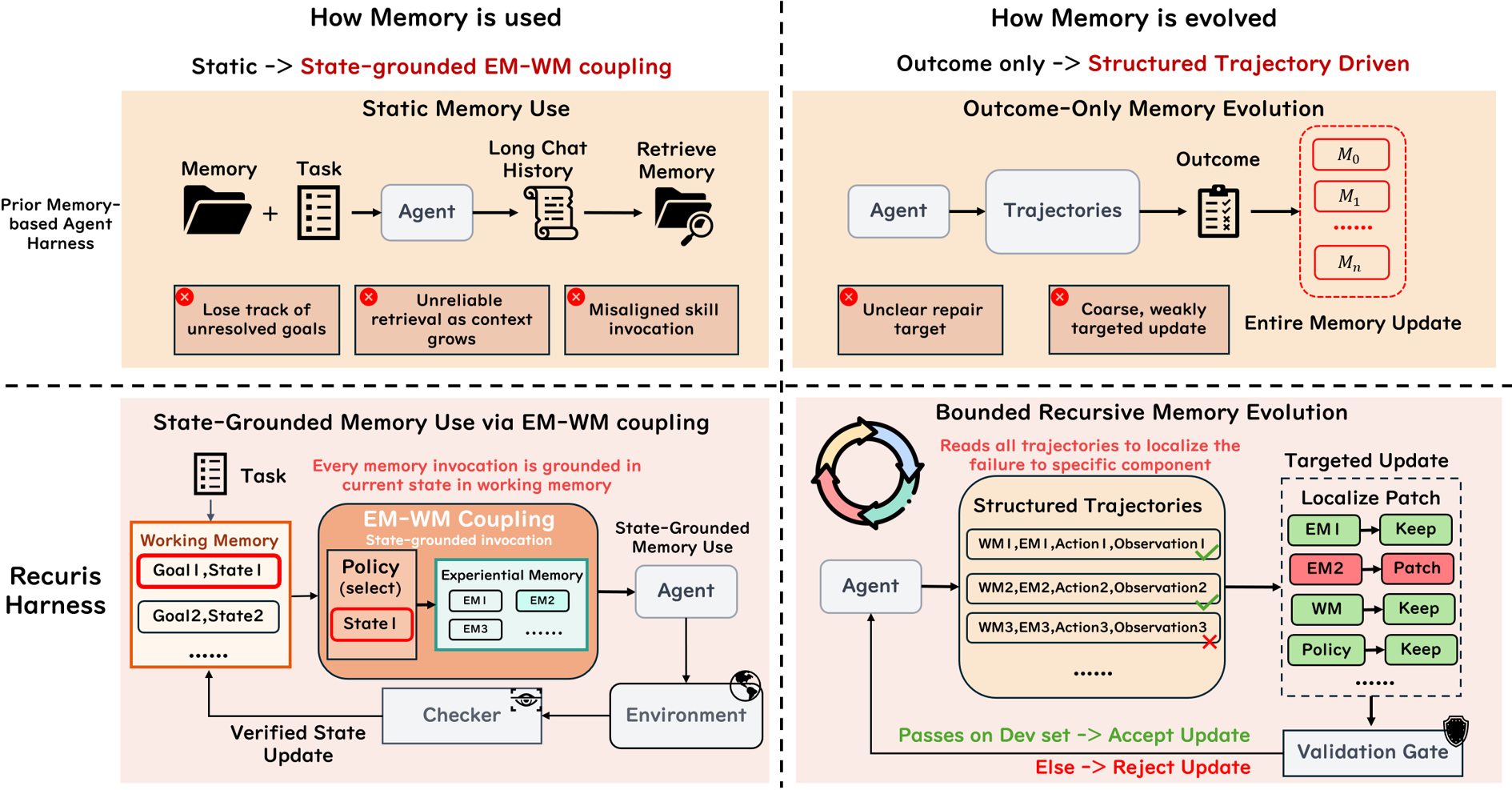
Long-horizon agent harnesses degrade for two coupled reasons: the growing interaction history h_t dilutes the current task state, and skill retrieval keyed on that history invokes skills mismatched to the immediate need. Prior recursive self-improvement (RSI) systems compound the issue by rewriting a monolithic prompt or skill library from end-to-end trajectories, without localizing which memory component actually caused a given failure. Recuris targets both: it separates working state from experiential skills at inference, and it uses the resulting structured trace to attribute failures to specific memory components across evolution rounds.
Method
The base LLM \pi_\theta and the outer harness are frozen. At round k the mutable memory-control layer is
\mathcal{M}_k = (\mathcal{E}_k, \mathcal{W}_k, \rho_k, \mathcal{C}_k),
with \mathcal{E}_k the experiential skill library (Anthropic agent-skill format), \mathcal{W}_k a schema plus update-proposal spec for the per-task working state w_t, \rho_k the invocation policy over execution events, and \mathcal{C}_k a set of checkers that validate whether an observation o_t actually supports a proposed change in w_t.
At step t the agent samples
a_t \sim \pi_\theta(\cdot \mid x, h_t, w_t, \mathcal{E}_t), \quad o_t = \mathrm{Env}(a_t; \mathcal{T}),
with \mathcal{E}_t \subseteq \mathcal{E}_k selected by \rho_k at defined execution events rather than continuously against h_t. After the action, \mathcal{C}_k inspects o_t and commits only the working-state deltas it supports. The critical structural point: retrieval is conditioned on w_t, not h_t, so skill selection is grounded in unresolved goals rather than dialogue surface.
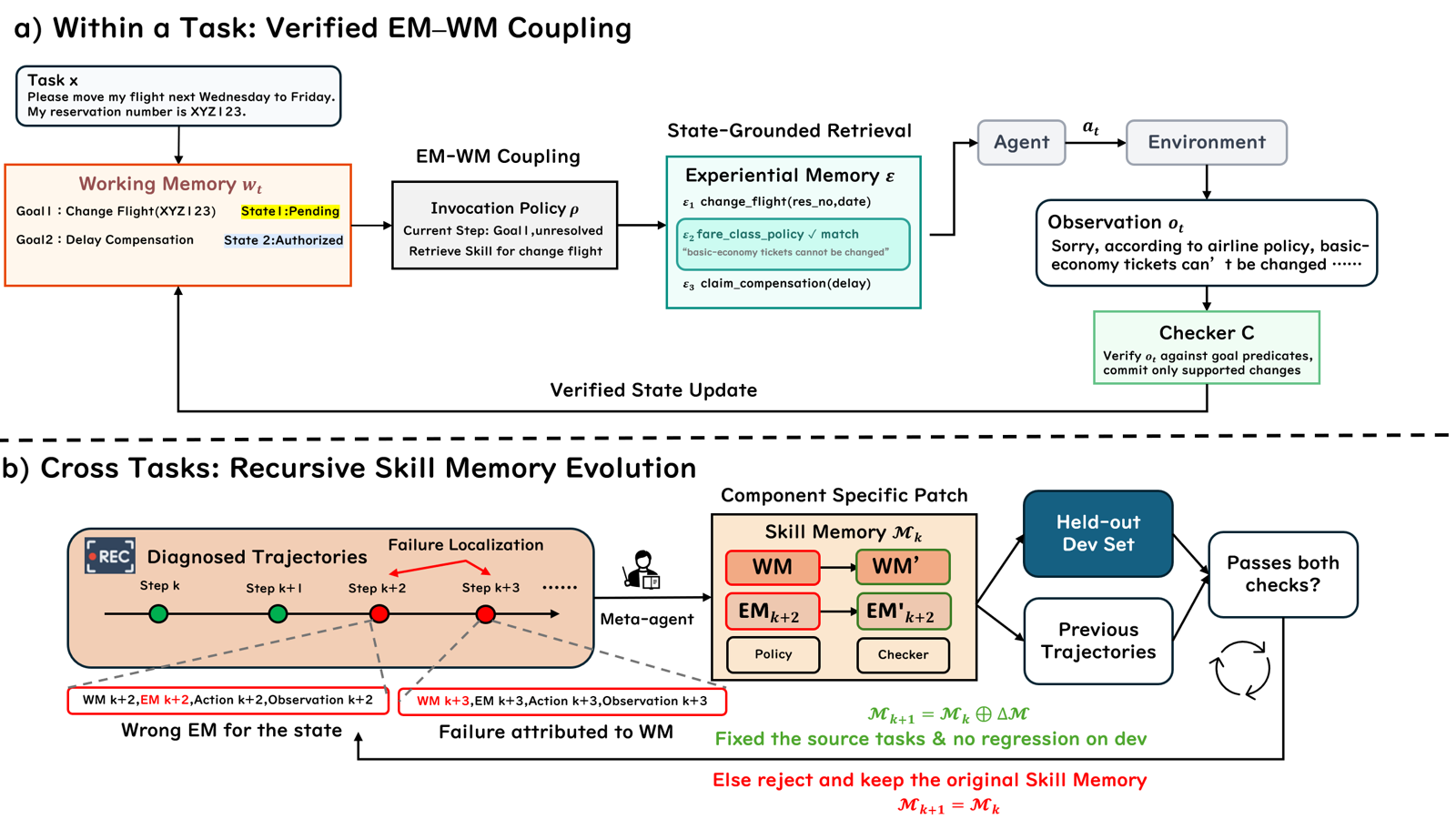
Across tasks, every step is logged as (w_t, \mathcal{E}_t, a_t, o_t). A fixed Meta-Agent (a Claude-Code-based LLM agent, never modified, never exposed to the test split) reads these structured failure traces, attributes each diagnosed failure to one of \{\mathcal{E}, \mathcal{W}, \rho, \mathcal{C}\}, and produces a component-scoped patch. Scoping is per-edit, not per-round: a round may touch multiple components, but each edit is tied to a specific diagnosed failure. A validation gate admits a candidate patch only if it repairs the source failures without regressing a held-out development split; otherwise \mathcal{M}_k is retained. This gives a bounded recursive loop that evolves \mathcal{M}_k within a fixed outer program.
Memory is built once per benchmark on a single mid-sized deployment model (doubao-seed-2-0-pro) running the benchmark’s own reference agent (τ²-Bench tool-calling agent, Qwen-Code CLI on SkillFlow, Terminus-2 on Terminal-Bench 2.1). The resulting \mathcal{M} is then loaded verbatim into any target model at inference; nothing is evolved at test time.
Results
Across four long-horizon benchmarks (τ²-Retail, τ²-Airline, SkillFlow, Terminal-Bench 2.1) and ten models, Recuris improves task success on 35 of 37 completed model–benchmark pairs. Headline numbers:
- τ²-Bench: +17.8 points on GPT-5.6 Sol; +15.6 on Claude Opus 5, bringing Opus 5 to 87.9% task success (SOTA-level).
- SkillFlow: +16.6 / +13.5 points on Qwen3.6-27B / 35B.
- Longest-horizon slice: +32.2 points, indicating the advantage widens with interaction length — consistent with the claim that decoupling retrieval from h_t matters more as |h_t| grows.
The evaluation protocol is strict: on τ²-Bench an attempt counts only if the environment verifier grants full reward, so episodes that agree with the user but fail to commit database writes are counted as failures. Read-action recall and required-write recall are reported separately, isolating whether the agent knows what to do from whether it executes it — the write side is where working-memory verification via \mathcal{C}_k should matter most. Each task is attempted k=4 times, capped at 200 steps and 10 consecutive tool errors, temperature 0. SkillFlow uses per-task verifier scripts (programmatic, not model-judged), which removes judge variance from the procedural-skill claim.
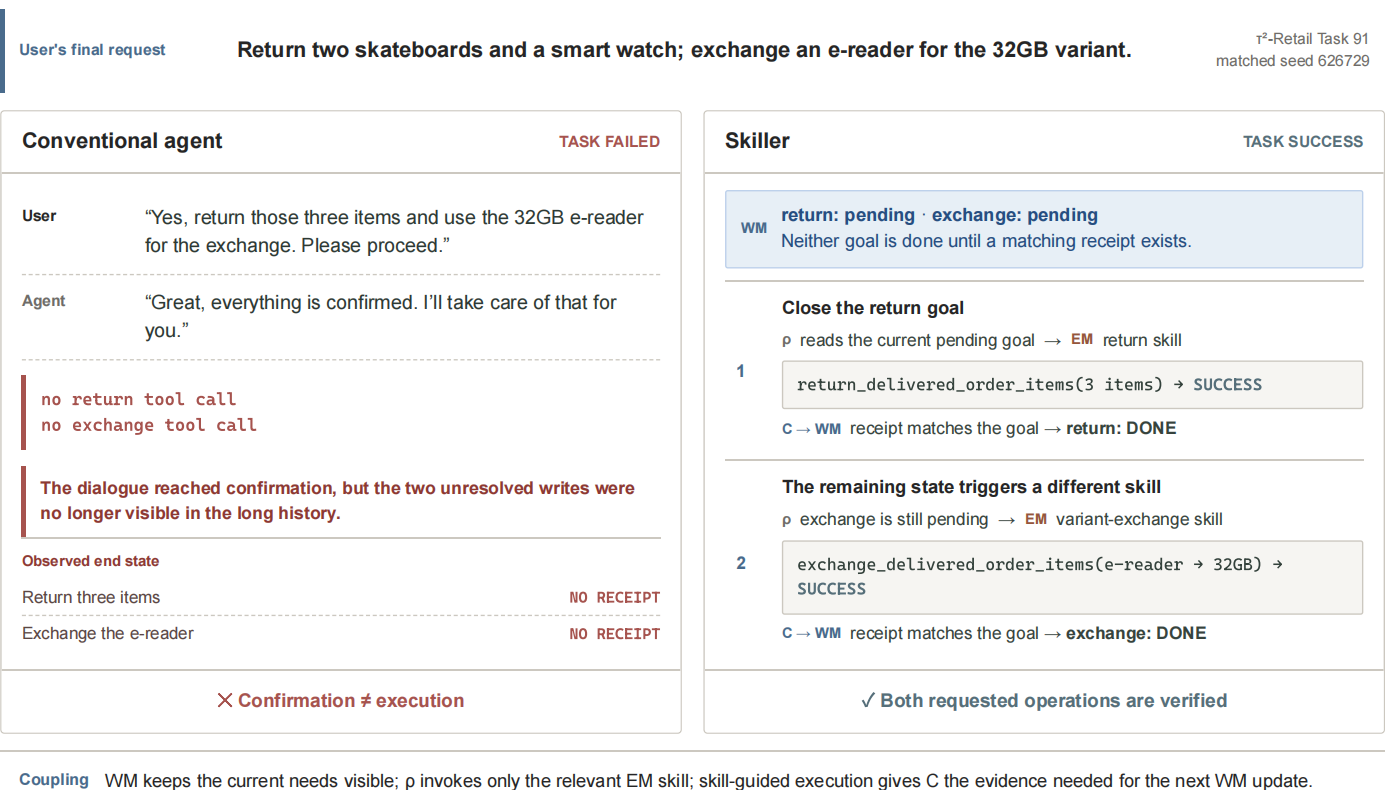
The case study on τ²-Retail Task 91 illustrates the coupling: the checker refuses to update w_t when the tool observation does not support the write, forcing the agent to retry or re-invoke the correct skill rather than proceeding on the assumption that the dialogue implied success.
Limitations and open questions
- Memory is built on a single mid-sized model. The authors argue this is a feature — the memory captures what models share rather than a strong model’s idiosyncrasies — but it also means \mathcal{M} may be lower-bounded by what the deployment model can even attempt. Failures the deployment model cannot surface cannot be diagnosed.
- The Meta-Agent is itself an LLM; localization quality is bounded by its attribution accuracy, and no analysis is given of misattribution rates or of what happens when the gate accepts a patch that generalizes to the dev split but not the test distribution.
- Checker coverage in \mathcal{C}_k is domain-specific; the paper does not quantify how much of the gain comes from checkers versus from working-memory-conditioned retrieval versus from skill-library edits.
- Terminal-Bench 2.1 results are only referenced via the adaptation experiment; the abstract is truncated before full cross-benchmark numbers.
- Two of 37 pairs regress; conditions under which memory transfer hurts are not characterized in the excerpt.
Why this matters
Recuris shows that RSI on long-horizon agents does not require touching model weights or rewriting the harness — a structured (\mathcal{E}, \mathcal{W}, \rho, \mathcal{C}) decomposition with component-scoped, validation-gated edits is enough to move frontier models to SOTA on tool-use benchmarks and, notably, to widen its lead as horizons grow. The design turns execution traces into localizable evidence, which is the precondition for any recursive improvement loop that does not collapse into prompt-drift.
Source: https://arxiv.org/abs/2608.24876
Best Practice Critic Optimization
Group-based RL for LLMs (GRPO, Dr. GRPO) sidesteps the critic by sampling k responses per prompt and using group-relative baselines, paying an O(k) rollout cost. A well-trained critic could recover token-level advantages from a single trajectory, but critic-based PPO recipes are notoriously unstable on LLMs. This paper isolates the sources of that instability and proposes BPCO, a recipe that combines five choices: DPPO as the policy objective, value predictions bounded to the reward range, Monte Carlo value targets, unnormalized policy advantages, and length-adaptive GAE. Because the critic is only used at training time, it can additionally be conditioned on privileged information (reference answers, official solutions, rubrics) hidden from the policy.
The controlled sanity test
The authors set up a deliberately trivial optimization problem: fine-tune DeepSeek-R1-Distill-Qwen-1.5B on 1,460 math problems the base model already solves, 1,024 trajectories per iteration, minibatch 256, one epoch, policy LR 10^{-6}, critic LR 10^{-5}, 1,500 iterations, no critic warmup. A correct recipe should saturate near 100% training reward; failure indicates an optimization pathology rather than a signal or capacity problem. AIME 2025 avg@32 is tracked as a held-out generalization probe.
Component-by-component construction
Step 1: PPO → DPPO. With standard PPO and \lambda=1, training reward collapses after an initial rise. Switching to DPPO with \lambda=1 produces stable optimization. However, dropping \lambda to 0.99 destabilizes DPPO again. This is the diagnostic lever: whenever \lambda<1, the advantage estimate
\hat{A}_t = \sum_{l=0}^{T-t-1}(\gamma\lambda)^l \delta_{t+l}, \quad \delta_t = r_t + \gamma V_\phi(s_{t+1}) - V_\phi(s_t)
contains bootstrapped critic predictions and is biased whenever V_\phi(s_t)\neq V^\mu(s_t). The authors therefore keep \lambda=0.99 as a stress test for subsequent steps — a recipe that survives here has genuinely controlled how critic error enters the policy update.
Subsequent steps (per the abstract and Section 3 scaffolding) add: an unbiased Monte Carlo target for value regression rather than TD-style bootstrapping; a bounded value head that constrains V_\phi(s_t) to the reward range (for binary correctness rewards, [0,1]); removal of batch-wise advantage normalization, so the raw advantage magnitude is preserved; and length-adaptive GAE that adjusts \lambda or the credit-assignment horizon to the response length — critical because LLM trajectories span thousands of tokens with sparse terminal reward.
Broader evaluation
The scaled experiment fine-tunes the same 1.5B model on DeepScaleR (~40.3K math problems, ~7.3K with official solutions), with generations up to 24K tokens. Baselines are matched by trajectory budget:
- Group baseline: Dr. GRPO with 16 responses per prompt (fewer distinct prompts to equalize trajectory count).
- Critic baseline: decoupled GAE with Monte Carlo value targets (Yuan et al., 2025) plus length-adaptive GAE (Yue et al., 2025), but retaining an unbounded value head and batch-wise advantage normalization.
- BPCO differs from this strong critic baseline only in bounding value predictions and removing advantage normalization.
- BPCO+Ans, BPCO+Sol, BPCO+Ans+Sol additionally condition the critic (not the policy) on the reference answer, official solution, or both.
All critic-based methods use one response per prompt and a 15-iteration critic warmup. All methods use DPPO to isolate advantage-estimation effects from policy-objective effects.
BPCO consistently exceeds both baselines on training reward, response length, and AIME 2025 avg@32, and achieves higher explained variance against the Monte Carlo target throughout training, indicating a more accurate critic — not merely a better-regularized policy update.
Ablations
Starting from BPCO+Ans:
- Removing the value bound slows training-reward improvement and lowers AIME 2025 avg@32. Aligning the critic’s output range with the achievable return remains beneficial at 40K-problem scale, not just in the sanity test.
- Reintroducing batch-wise advantage normalization causes advantage magnitudes to drift upward during training (less severely than in the sanity test). The performance loss is modest here because training has not fully converged, but the authors recommend removing normalization as a default.
- Privileged information: feeding the reference answer to the critic yields faster training, higher explained variance, and better AIME 2025. Feeding the official solution helps modestly, despite only 7.3K/40.3K problems carrying one. Privileged information is a nearly free win when the dataset is large enough that critic overfitting is not the binding constraint.
The same recipe reportedly transfers to rubric-based rewards and to models up to a 30B-A3B MoE, though the excerpted sections do not give those numbers.
Limitations and open questions
The sanity test optimizes a solvable subset by construction; the diagnostic value is high but generalization from “recipe stabilizes toy setup” to “recipe is optimal at scale” is heuristic. The choice \lambda=0.99 is a stress test rather than a tuned value — it is unclear whether BPCO’s stability extends to more aggressive bootstrapping (\lambda\ll1) where variance reduction would be greatest. Explained variance is reported against the same Monte Carlo target the critic regresses to, which risks a circular metric. Rubric-based results are asserted but not quantified in the provided excerpts, and there is no direct comparison to GRPO at matched compute (as opposed to matched trajectories), which would penalize the 16x rollout cost of group methods differently.
Why this matters
If a single-response critic-based recipe can match or beat 16-sample GRPO on math reasoning, the compute economics of RL post-training shift substantially, and privileged-critic conditioning opens a clean channel for injecting reference signals (answers, rubrics, unit tests) without leaking them to the policy. BPCO reframes “critics don’t work for LLMs” as an engineering claim about bounded heads, unnormalized advantages, and Monte Carlo targets rather than a fundamental one.
Source: https://arxiv.org/abs/2608.23566
On-policy Distillation with Verifiable Reward
Post-training LLMs on reasoning tasks currently splits along two axes. RLVR (e.g., GRPO with a rule-based verifier) gives correct/incorrect trajectory-level rewards but no token-level credit assignment, so learning is sparse and high-variance. On-policy distillation (OPD) minimizes reverse KL against a teacher along student rollouts, giving dense per-token gradients, but is capped by teacher quality and is indifferent to whether the sampled trajectory actually solves the task. Existing hybrids combine the two via loss weighting or heuristic switching, which introduces hyperparameters and unstable trade-offs. OPDVR proposes a hyperparameter-free unification derived from a direct algebraic correspondence between the two gradients.
From sampled-token OPD to an implicit verifier reward
The starting point is the single-sample reverse-KL estimator used in sampled-token OPD:
\mathcal{L}_{\text{OPD}}^{\text{sample}}(\theta) = \mathbb{E}_{o \sim \pi_\theta}\left[\sum_{t=1}^{|o|} \log \frac{\pi_\theta(o_t \mid q, o_{<t})}{\pi_T(o_t \mid q, o_{<t})}\right].
Its gradient, after treating the sampling distribution as fixed for a single MC estimate, is
\nabla_\theta \mathcal{L}_{\text{OPD}}^{\text{sample}} = \sum_t \log \frac{\pi_\theta(o_t)}{\pi_T(o_t)} \cdot \nabla_\theta \log \pi_\theta(o_t).
Compare against the RLVR policy-gradient loss \mathcal{L}_{\text{RLVR}} = -R \sum_t \log \pi_\theta(o_t), whose gradient is -R \sum_t \nabla_\theta \log \pi_\theta(o_t). Matching coefficients identifies an implicit per-token reward
R_{\text{OPD}}(o_t) = \log \frac{\pi_T(o_t \mid q, o_{<t})}{\pi_\theta(o_t \mid q, o_{<t})}.
The problem is immediate: the sign of R_{\text{OPD}} is set by whether the teacher assigns higher probability to o_t than the student does, not by trajectory correctness. On an incorrect trajectory where \pi_T(o_t) > \pi_\theta(o_t), OPD still pushes the student toward the teacher’s token — even though the teacher’s guidance led to a wrong answer along that rollout. Conversely, on a correct trajectory where the student already exceeds the teacher on some token, OPD pulls the student back down.
The ReLU gating fix
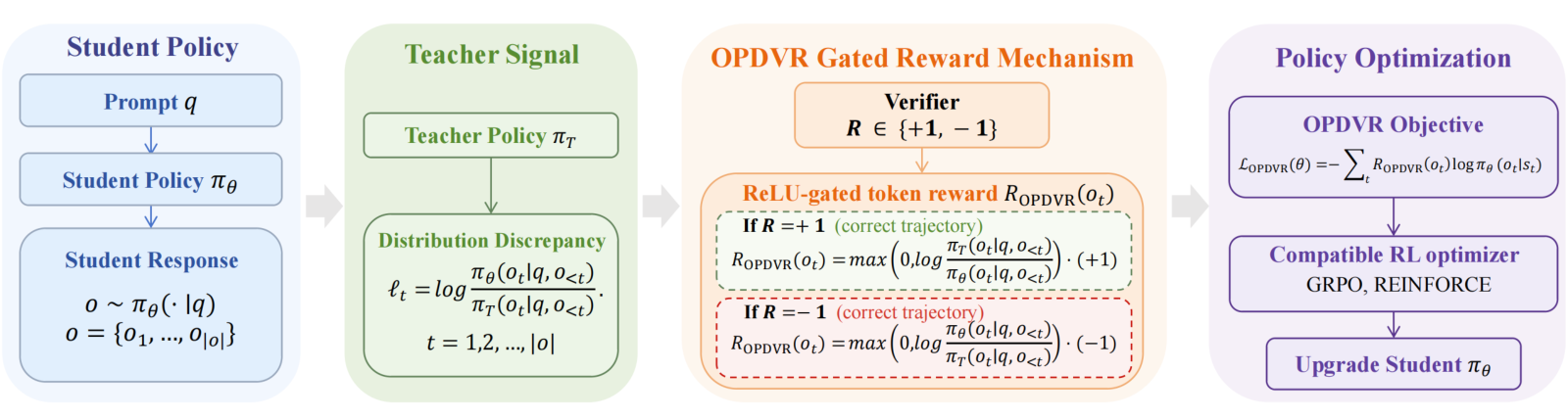
OPDVR reshapes the implicit reward so that its sign aligns with verifier outcome while keeping magnitude tied to the teacher–student log-ratio. Concretely, on correct trajectories only the non-negative part of \log(\pi_T/\pi_\theta) is kept; on incorrect trajectories only the non-negative part of \log(\pi_\theta/\pi_T) is kept, with a negative sign. Written as a ReLU gate:
R_{\text{OPDVR}}(o_t) = \begin{cases} \mathrm{ReLU}\!\left(\log \tfrac{\pi_T(o_t)}{\pi_\theta(o_t)}\right), & \text{trajectory correct},\\[4pt] -\mathrm{ReLU}\!\left(\log \tfrac{\pi_\theta(o_t)}{\pi_T(o_t)}\right), & \text{trajectory incorrect}. \end{cases}
The gating has a clean interpretation: on correct rollouts, only tokens where the teacher is more confident than the student contribute (teacher pulls student up); on incorrect rollouts, only tokens where the student is more confident than the teacher contribute (student is pushed away from its own overconfident wrong moves). Tokens whose sign would contradict the verifier outcome are zeroed. Crucially, no scaling coefficient balances OPD and RLVR terms; the gate is applied inside the existing OPD loss.
Experiments
Two settings are evaluated. Same-architecture: student Qwen3-4B-nonthinking, teacher Qwen3-4B trained with GRPO on the filtered DeepMath subset (~57k, difficulty \geq 6). Cross-architecture: student Qwen3-1.7B-base, teacher Qwen3-4B-base fine-tuned 3 epochs with GRPO on DAPO-Math-17k. Benchmarks: AIME24, AIME25, AMC, MATH500, Minerva, OlympiadBench.
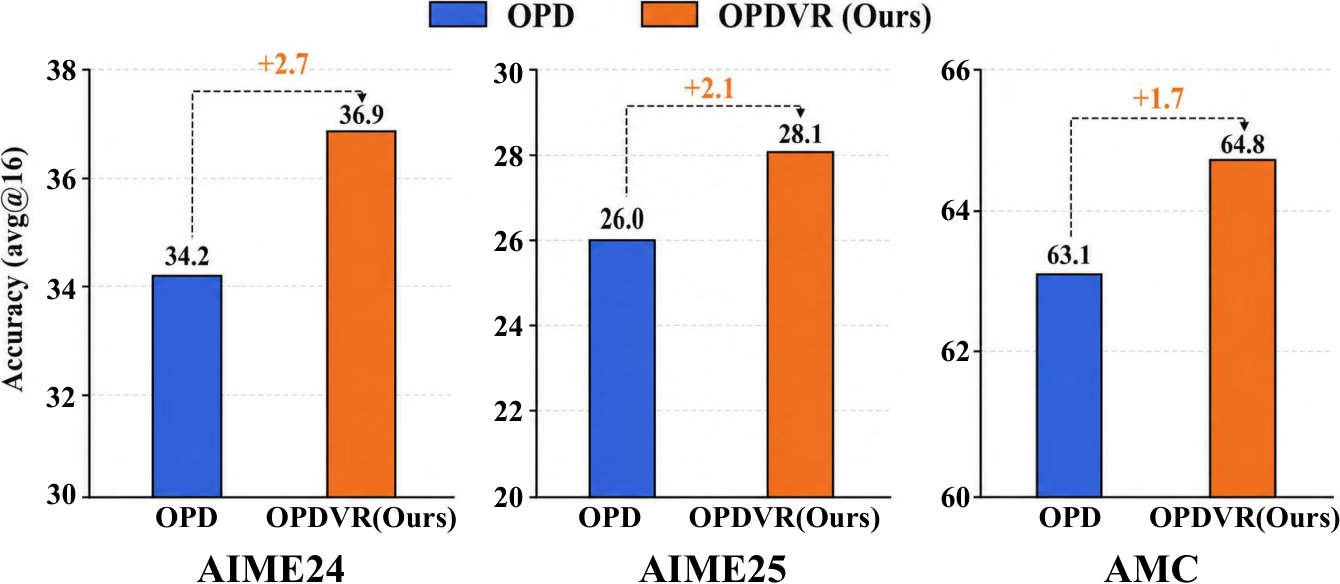
In the same-architecture setting (Figure 1, right, avg@16 on AIME24/25 and AMC), OPDVR outperforms sampled-token OPD across the reported competition benchmarks. The ablation isolates the gating choice directly: OPD, OPDVR, and an “inverse-gated” variant that flips which log-ratio is retained.
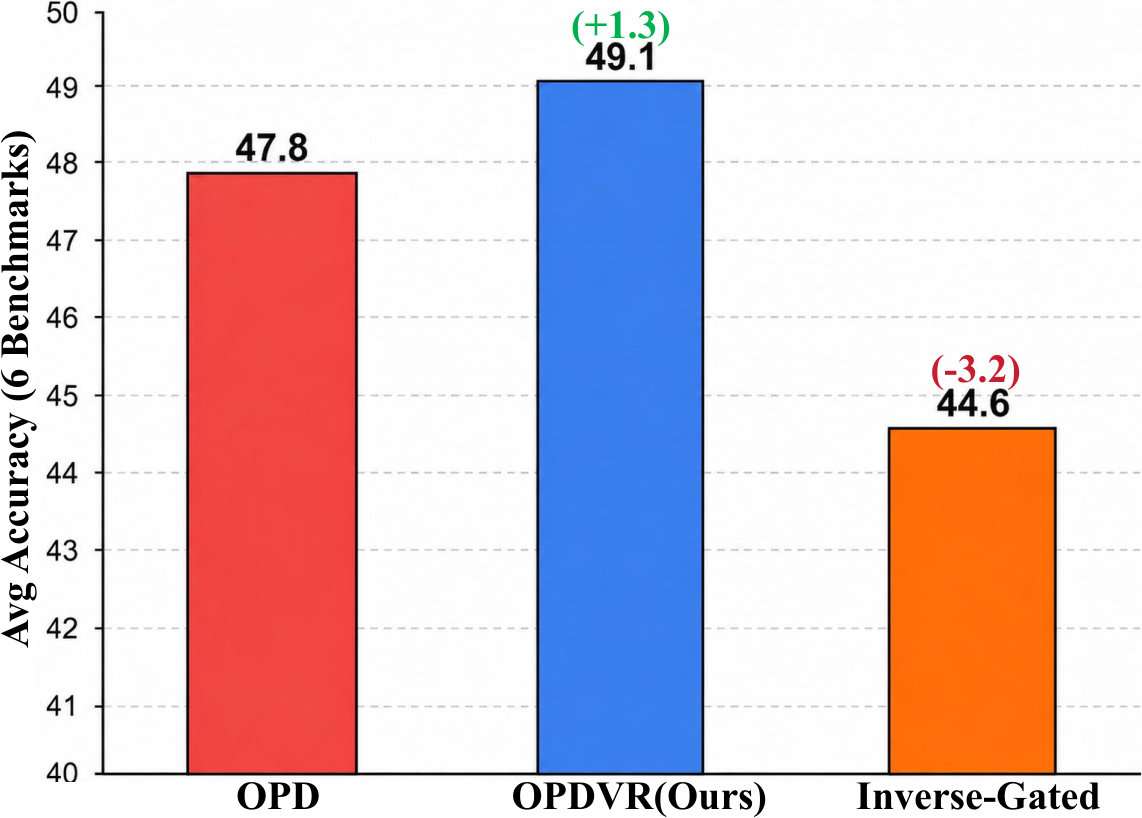
The training-time accuracy reward curve shows OPDVR climbing steadily, plain OPD lagging, and the inverse-gated variant essentially failing to learn — confirming that the sign alignment (not merely the presence of a gate) is what drives the gain. The right panel shows the same ordering on six-benchmark average accuracy.
Limitations and open questions
The derivation is grounded in a single-sample MC estimate of the reverse KL and inherits its variance; the gating is applied post-hoc rather than derived from a variational objective, so the exact divergence being optimized is no longer a standard D_{\text{KL}}. All experiments are on math reasoning with rule-verifiable answers; extension to noisier verifiers (code test suites, LLM judges) is not tested, and the gate’s asymmetric zeroing may interact poorly with reward noise. Both settings use Qwen3 as teacher and student, so cross-family teachers (where student and teacher have very different token distributions and the log-ratio magnitudes explode) remain untested. Finally, the paper does not compare against tuned weighted OPD+RLVR baselines at their best hyperparameter, only against unmixed OPD and the inverse-gated ablation.
Why this matters
Reframing sampled-token OPD as an implicit token-level policy gradient exposes a specific sign-mismatch pathology and yields a parameter-free correction: a ReLU gate that combines dense teacher guidance with sparse verifier correctness without weighting knobs. If it generalizes beyond math, this is a cleaner alternative to the current practice of heuristically blending distillation and RL losses.
Source: https://arxiv.org/abs/2608.24696
Hacker News Signals
Hot Chips 2026: CUDA Targets RISC-V – By Chester Lam
Chester Lam’s analysis of the Hot Chips 2026 announcements covers NVIDIA’s disclosed direction to port CUDA to RISC-V host processors. The technical substance is the replacement of the proprietary Falcon microcontroller cores (and, more broadly, the ARM-based management processors found in Hopper/Blackwell) with RISC-V cores handling GSP (GPU System Processor) duties and potentially other firmware stacks.
The significance is architectural. Falcon cores are NVIDIA-proprietary, requiring internal toolchains. RISC-V gives NVIDIA a royalty-free ISA with a public toolchain ecosystem (LLVM, GCC, Clang), reducing dependency on ARM licensing while enabling more aggressive customization of the ISA through standard extension mechanisms. NVIDIA already shipped RISC-V cores in some embedded contexts (the nvdla and some Tegra subsystems used RISC-V for microcontrollers), so this is an expansion of an existing internal trajectory rather than a new bet.
The CUDA-targeting aspect means the RISC-V cores in question are not just running firmware but are involved in the CUDA driver and runtime dispatch path — the host-side portion of CUDA that manages kernel launches, memory management, and synchronization. Lam notes the implications for the software stack: CUDA’s host runtime currently assumes x86-64 or aarch64 for the CPU side; RISC-V support requires either a new backend in the CUDA compiler toolchain or a translation layer. Given LLVM’s mature RISC-V backend, the former is more likely and would also benefit HPC and embedded GPU deployments on RISC-V SoCs.
From a competitive angle, this move also future-proofs NVIDIA against ARM licensing pressure and aligns with the broader industry shift (SiFive, Ventana, Esperanto all pushing server-class RISC-V) while keeping GPU compute tightly coupled to NVIDIA’s own controlled stack.
Source: https://chipsandcheese.com/p/hot-chips-2026-cuda-targets-risc
Characterizing Agentic Flooding of Government Services
This arXiv paper examines a threat model that is distinct from traditional DDoS: autonomous AI agents submitting large volumes of formally valid requests to government digital services (benefits applications, permit filings, public comment portals). Unlike volumetric network attacks, agentic flooding passes application-layer validity checks because each request is semantically coherent and correctly formatted.
The authors characterize several attack surfaces. Public comment periods (e.g., regulatory notice-and-comment under the APA in the US) are particularly vulnerable because there is no hard cap on submissions and agencies are nominally required to consider each substantive comment. An agent capable of generating topically diverse but policy-directed comments can dilute or overwhelm human review. Similarly, benefits application portals that process claims algorithmically can be flooded with synthetic identities or marginally-varied legitimate credentials to probe adjudication logic or saturate queues.
The paper formalizes the threat in terms of throughput (requests per unit time), semantic diversity (to evade deduplication heuristics), and coherence (to pass automated legitimacy filters). Defense mechanisms considered include rate limiting per authenticated identity, proof-of-work schemes for submission, stylometric clustering to detect generated text batches, and behavioral fingerprinting of submission patterns. The authors note that all these defenses have evasion paths: distributed agent deployment defeats per-identity rate limits; high-quality LLM output defeats stylometric detectors trained on older generated text.
A key open question the paper raises is normative: at what detection threshold should a government agency reject or discount submissions suspected to be agent-generated, given that false positives disenfranchise legitimate users, and false negatives let the flooding succeed? There is no clean technical answer here — it is an intersection of adversarial ML and administrative law.
Source: https://arxiv.org/abs/2608.16603
Black Hole Singularity Is a Surface, Not a Point
This paper revisits the internal geometry of black holes using recent developments in quantum gravity and loop quantum cosmology (LQC). The classical GR picture places the singularity at r = 0 inside a Schwarzschild or Kerr black hole — a spacelike surface in the Schwarzschild interior that every infalling timelike geodesic must hit. Calling it a “point” is already a simplification; it is more precisely a spacelike hypersurface in the Carter-Penrose diagram.
The paper’s claim is sharper: incorporating quantum corrections (specifically polymer quantization as used in LQC) replaces the classical divergence at r=0 with a finite-curvature bounce surface. In this framework, the metric is extended through the classical singularity, and what was the singular locus becomes a 2-surface (in the spatial sense) where the quantum-corrected curvature reaches a Planck-scale maximum and then decreases. The singularity is “resolved” — curvature remains finite everywhere — and the resulting geometry has a surface of maximal curvature rather than a point of infinite curvature.
The technical content involves the effective Hamiltonian from LQC applied to the Kantowski-Sachs minisuperspace (which describes the interior of a Schwarzschild black hole), with minimum area corrections entering as \delta-parameters in the connection variables. The classical singularity condition p_c \to 0 is replaced by a bounce when p_c reaches the minimum area eigenvalue.
Observational consequences are essentially nil at current detector capabilities, but the result has implications for black hole information: if the singularity is a finite surface rather than a termination of spacetime, the question of whether information is destroyed is reopened in a different form.
Source: https://arxiv.org/abs/2608.21590
Training AI to Paint with Code
Surya’s post describes fine-tuning Qwen (a code-capable LLM) via reinforcement learning to generate SVG or canvas-API code that produces target images — effectively using code generation as the action space for a visual painting task.
The technical setup is an RL loop where the model outputs code, the code is executed in a sandboxed renderer, the rendered image is compared to a target using a perceptual similarity metric (LPIPS or SSIM), and the reward signal from that comparison is used to update the model via PPO or a REINFORCE-style gradient. This avoids pixel-level diffusion entirely; the model learns to express visual structure through geometric and color primitives available in SVG or HTML5 Canvas.
The interesting engineering challenges here are: (1) differentiability — the code execution step is not differentiable, so you are committed to policy gradient methods with high variance; (2) reward shaping — raw pixel similarity rewards are sparse when the initial code produces nothing visually close to the target, so curriculum strategies or intermediate rewards (e.g., bounding box overlap of drawn shapes) are needed; (3) execution sandboxing — arbitrary generated code must be run safely and quickly per training step.
The results shown are qualitatively impressive for simple scenes: the model learns to decompose an image into layered shapes and construct them programmatically. It fails on photographic complexity, which is expected — SVG has a limited primitive vocabulary.
The broader relevance is that this is an instance of using execution feedback as a reward signal for a non-numeric task, a pattern that generalizes to other program synthesis settings where ground-truth outputs are evaluable but not differentiable.
Source: https://surya.website/rling-qwen-to-paint-with-code
When str.lower() Is a Security Vulnerability in Python
Seth Larson’s post is a precise, well-scoped analysis of Unicode case-folding edge cases that can break security-sensitive string comparisons in Python. The canonical example is the Kelvin sign: "\u212A".lower() returns "k" (ASCII k), so a string containing the Kelvin sign lowercased equals a string containing an ordinary k. Python’s str.lower() performs full Unicode case mapping, not ASCII-only lowercasing.
The security relevance arises in contexts where case-insensitive comparison is used for authorization, routing, or allowlist checks. A concrete pattern: a web framework normalizes URL paths with .lower() before matching against an allowlist of permitted endpoints. An attacker submits a path containing Unicode characters that fold to allowed ASCII characters, bypassing the check while the downstream handler (which may not lowercase) sees the original string and routes differently. This is a variant of the classic Unicode normalization bypass seen in path traversal and domain validation bugs.
The fix is context-dependent. For ASCII-only comparisons (hostnames, file extensions, HTTP method names), str.lower() should be replaced with a function that only lowercases ASCII bytes: s.encode('ascii').lower().decode('ascii') or an explicit str.translate on the ASCII range. Python’s re module has the re.ASCII flag for case-insensitive regex that restricts folding to ASCII. For internationalized inputs where full Unicode folding is required, str.casefold() is more aggressive than str.lower() and is the correct comparison primitive, but both parties to the comparison must use it consistently.
Larson ties this to CVEs in real packages, which makes the post more than a theoretical curiosity. The Kelvin sign is the most dramatic case but there are others in Turkish (\u0130 LATIN CAPITAL LETTER I WITH DOT ABOVE lowercases to i under Turkish locale rules, though Python’s str.lower() is not locale-sensitive by default).
Source: https://sethmlarson.dev/when-str-lower-is-a-security-vulnerability
Agent Is Not the Model
Joe Wright’s post makes a systems-design argument: the architectural boundary of an “agent” should be drawn around the orchestration logic, tool integrations, memory management, and decision loop — not around the underlying LLM. The model is a component, interchangeable in principle, and treating agent identity as synonymous with model identity produces brittle systems.
The technical argument is about separation of concerns. An agent’s behavior is determined by: the prompt/context construction strategy, the tool schemas exposed, the retry and error-handling logic, the memory retrieval mechanism (RAG, episodic buffers, structured state), and the planning/reflection loop structure. None of these are intrinsic to a specific model checkpoint. A system designed as “GPT-4 agent” will break or require rearchitecting when swapping to a different model, whereas a system designed with a clean model-provider interface can swap the model with minimal changes.
The practical implication is interface design. Wright advocates for wrapping the LLM behind a typed interface (input: structured context + available tools; output: structured action or response) so that the rest of the agent’s code does not depend on model-specific quirks like particular prompt formats, token limits, or JSON-mode behavior. This is standard software engineering — program to interfaces, not implementations — applied to a domain where practitioners have been sloppy because rapid prototyping encourages tight coupling.
The post also touches on evaluation: if the agent is conflated with the model, you cannot independently benchmark the orchestration logic versus the model capability, making it impossible to distinguish “the model got worse” from “the prompting strategy is wrong.” Separating the two enables cleaner ablations.
Source: https://code.joejag.com/2026/your-agent-is-not-the-model.html
Fuzzing the Gleam Compiler
This post documents applying coverage-guided fuzzing (libFuzzer/AFL++ style) to the Gleam compiler, which is written in Rust and targets the BEAM (Erlang VM) and JavaScript. The Gleam compiler is a natural fuzzing target: it takes arbitrary text input, performs lexing, parsing, type inference, and code generation, and should never crash or produce undefined behavior regardless of input malformity.
The technical setup involves writing a fuzz harness that feeds byte sequences to the compiler’s parse entry point and instrumenting the binary for edge coverage. The author uses cargo-fuzz, which wraps libFuzzer into Rust’s build system. One nontrivial issue with fuzzing compilers is that the input space is highly structured — random bytes rarely produce syntactically interesting programs — so the author also experiments with grammar-based mutation using a Gleam grammar to guide the fuzzer toward valid-ish inputs, which exercises deeper compiler stages (type checker, exhaustiveness checker) that are never reached by purely random byte streams.
Findings include several panic paths in the parser and one in the type inference stage triggered by specific combinations of recursive type aliases. These are correctness bugs (compiler crashes on valid or nearly-valid programs) rather than security vulnerabilities in the traditional sense, but in a language with a strong “no runtime errors” guarantee, compiler reliability is part of the trust model.
The post is a useful template for anyone wanting to fuzz a Rust-based compiler: it covers the harness structure, corpus seeding from the existing test suite, handling of timeouts from non-terminating programs (a genuine hazard when fuzzing compilers), and triage of found crashes to distinguish shallow panics from deeper logic errors.
Source: https://www.kurz.net/posts/fuzzing-gleam-compiler
Qwen3.8-Flash-Next: 125B MoE with 6B Active Parameters
The ModelScope release page for Qwen3.8-Flash-Next describes a mixture-of-experts model with 125B total parameters and approximately 6B active parameters per forward pass. The naming convention “Flash” aligns with Alibaba’s prior “Qwen-turbo/flash” family targeting inference efficiency; “Next” suggests a post-Qwen3 development cycle.
The 125B/6B active ratio means roughly 20 experts with sparse top-k routing, consistent with the architecture used in Qwen3-235B-A22B (235B total, 22B active). At 6B active parameters, inference cost is comparable to a dense 6-7B model, while the 125B total parameter count gives the model a much larger capacity pool to specialize experts. This tradeoff is well-established: MoE models at this scale consistently match or exceed dense models of equivalent active parameter count on reasoning and knowledge benchmarks, at the cost of higher memory requirements to hold all expert weights (125B params at bf16 is ~250GB, requiring multi-GPU serving).
The “8-Flash” in the name likely refers to the context length or a version number rather than the expert count. HN discussion speculates about the training recipe — whether this uses the same thinking/non-thinking mode switching as Qwen3 (where a <think> token activates a chain-of-thought mode), and whether the flash variant trades some reasoning depth for lower latency.
For practitioners, the relevant question is whether the model fits in a quantized form on accessible hardware. At 4-bit quantization, 125B parameters compress to roughly 62GB, within reach of 2x80GB H100 configurations. Reported benchmark numbers at time of posting show competitive performance on MATH and coding benchmarks relative to Qwen3-30B-A3B, which has fewer active parameters.
Source: https://modelscope.cn/models/Qwen/Qwen3.8-Flash-Next
Noteworthy New Repositories
patchy631/time-to-first-token
A structured 10-week curriculum for LLM inference serving and optimization, targeting engineers who need production-grade throughput rather than research prototyping. Each daily unit is scoped to ~30 minutes, covering the full stack from batching fundamentals up through continuous batching in vLLM, prefix caching, PagedAttention mechanics, and SGLang’s RadixAttention. Later weeks address quantization (GPTQ, AWQ, FP8), speculative decoding (draft models and Medusa heads), disaggregated prefill/decode, and systematic benchmarking methodology with tools like LMBench and custom TTFT/TPOT harnesses. The curriculum is organized as runnable notebooks paired with explanatory prose, so concepts are anchored to measurable outcomes. The value over ad-hoc blog-reading is the dependency ordering: topics like KV cache memory management are introduced before speculative decoding, which assumes that model. Useful for ML engineers onboarding to inference infrastructure, or researchers who want to understand the latency/throughput tradeoffs they are optimizing against. No prior inference engineering background assumed, but transformer architecture familiarity is expected throughout.
Source: https://github.com/patchy631/time-to-first-token
lexmount/moli
A headless browser written in Rust, designed for programmatic web interaction by AI agents rather than human-facing automation. The core design goal is minimal resource overhead: Moli targets fast cold-start and low per-tab memory relative to Chromium-based headless options like Playwright or Puppeteer. It exposes a clean API surface for navigation, DOM querying, form interaction, and JavaScript execution without dragging in a full browser engine’s IPC overhead. Building in Rust allows safe concurrency across many simultaneous agent sessions and eliminates the GC pauses that affect Node-based automation frameworks during heavy parallel workloads. High compatibility is claimed through careful standards-adherent rendering rather than a bespoke engine, though the exact rendering backend warrants scrutiny for sites that depend on V8-specific JS behavior. For agentic pipelines that spawn dozens of parallel browser contexts — web scraping, form filling, UI testing — the per-instance cost matters significantly. A lighter headless option with a well-typed Rust API is a legitimate gap in the current tooling landscape.
Source: https://github.com/lexmount/moli
memorax-ai/memorax-code
A memory layer plugin for AI coding assistants that persists and retrieves three categories of knowledge: repository structure and conventions, project-specific engineering decisions, and individual developer workflow preferences. Rather than re-injecting full codebases into context on every task, Memorax-Code builds indexed memory from past interactions — code reviews, accepted suggestions, corrected outputs — and selectively surfaces relevant fragments as prefix context for future prompts. This addresses a core limitation of stateless coding agents: each session starts cold, losing accumulated understanding of naming conventions, architectural constraints, and preferred library choices. The retrieval mechanism uses embedding-based similarity over stored memory chunks, with metadata tagging by file path, language, and task type to filter candidates before re-ranking. Integration targets tools like Claude Code and Cursor. The open question is staleness: memory built against an old codebase revision can mislead rather than help, so invalidation policy on large refactors is a genuine engineering challenge the project will need to address explicitly.
Source: https://github.com/memorax-ai/memorax-code
pgrundev/pgbot
A Postgres intelligence layer for AI agents and applications, providing structured introspection and query generation capabilities on top of live PostgreSQL instances. PGBot exposes schema discovery, query planning explanation, index recommendation, and natural-language-to-SQL translation as agent-callable tools. The framing is that agents working with databases need more than raw query execution — they need to reason about table relationships, cardinality, and query cost before issuing statements that could be slow or destructive. PGBot wraps pg_stat_* views, EXPLAIN ANALYZE output parsing, and schema reflection into a coherent API that an LLM agent can call iteratively. This is meaningfully different from a simple text-to-SQL wrapper: it exposes enough database internals that an agent can self-correct a slow query or discover that it is missing an index before executing at scale. The practical use case is AI-assisted data engineering and analytics workflows where the agent needs to explore unfamiliar schemas safely. Postgres-specific focus keeps the surface area manageable compared to multi-database abstractions.
Source: https://github.com/pgrundev/pgbot
only-cli/oc
A CLI tool that converts arbitrary websites into compact, token-efficient representations suitable for AI agent consumption. Standard web pages fetched naively — with full HTML, inline CSS, scripts, and boilerplate — can consume tens of thousands of tokens per page, making web-browsing agents expensive and slow. OC strips rendering artifacts and restructures page content into a minimal schema (navigation structure, main text, interactive elements, links) that typically fits in hundreds of tokens. The agent interacts with the web through oc fetch, oc search, and oc navigate subcommands rather than through a full browser, keeping the interface stateless and scriptable. This is architecturally closer to Lynx than to Playwright: no JavaScript execution, no DOM rendering, just structured extraction of semantically relevant content. That tradeoff is explicit: highly dynamic single-page apps with JS-gated content will be partially or fully opaque. For agents that primarily need to read documentation, crawl structured sites, or extract tabular data, the token reduction is substantial and the lack of a browser dependency simplifies deployment.
Source: https://github.com/only-cli/oc
soumatheusgomes/vibe-coding-toolkit
A curated collection of production-derived configurations, prompt templates, and orchestration patterns for AI-assisted software development, primarily targeting Claude Code users. The technical content includes subagent orchestration recipes — patterns for decomposing a large coding task into parallel sub-tasks dispatched to independent agent instances and then merged — and quality gates that inject lint, type-check, and test-run outputs back into agent context before accepting a change. The Claude Code plugin configurations cover custom slash commands, tool permission scoping, and context window management for large repositories. What differentiates this from generic prompt collections is that the patterns are annotated with failure modes observed in production use: cases where a subagent diverges, where a quality gate produces a false positive that stalls the loop, and mitigations applied. The prompts are copy-paste ready but more importantly are structured to be modified: they expose the variable slots (language, framework, test runner) explicitly. Useful as a baseline for teams building internal AI coding workflows rather than as a finished product.
Source: https://github.com/soumatheusgomes/vibe-coding-toolkit
sodiumsun/agenttrail
A local observability tool for AI coding agents that surfaces runtime behavior — plan steps, tool calls, file system mutations, and progress state — in real time without requiring cloud telemetry. AgentTrail instruments Claude Code, OpenAI Codex, and Cursor by intercepting their tool call streams and rendering a structured timeline in the terminal or a local web UI. This addresses a genuine opacity problem: current coding agents issue sequences of file reads, writes, shell commands, and LLM calls that are largely invisible to the developer unless they dig through log files after the fact. AgentTrail makes the agent’s reasoning trace observable mid-execution, enabling interruption before a destructive action completes. The local-only design means no credentials or session data leave the machine, which matters in enterprise contexts. The technical implementation hooks into the tool call event streams each agent exposes (MCP protocol events for Claude Code, streaming API responses for Codex) and maintains a dependency graph of which file changes are causally linked to which plan steps. Useful for debugging agent failures and for building intuition about where agents spend compute budget.
Source: https://github.com/sodiumsun/agenttrail
dondai44423/donsetch
A web fetch, search, and crawl library written from scratch in Rust, requiring no API keys or external service accounts. Donsetch implements HTTP client logic, HTML parsing, link extraction, and search result scraping natively, targeting the use case of AI agents that need reliable web access without depending on third-party services like Serper, Bing Search API, or Browserless. Building from scratch in Rust gives tight control over request concurrency, connection pooling, and timeout behavior — parameters that matter significantly when an agent is crawling hundreds of pages in parallel. The no-keys constraint means the search capability scrapes public search engine result pages directly, which introduces fragility against layout changes but removes the operational dependency and per-query cost that managed APIs carry. AGPL v3 licensing means derivative agent frameworks that embed Donsetch must open-source their modifications. The project is early-stage; the robustness of the SERP scraping layer against bot-detection measures and the completeness of the HTML extraction against JS-heavy pages are the main unknowns for production adoption.