Daily AI Digest — 2026-08-25
arXiv Highlights
ReWorld: An Interactive World Model with Long-Horizon Memory
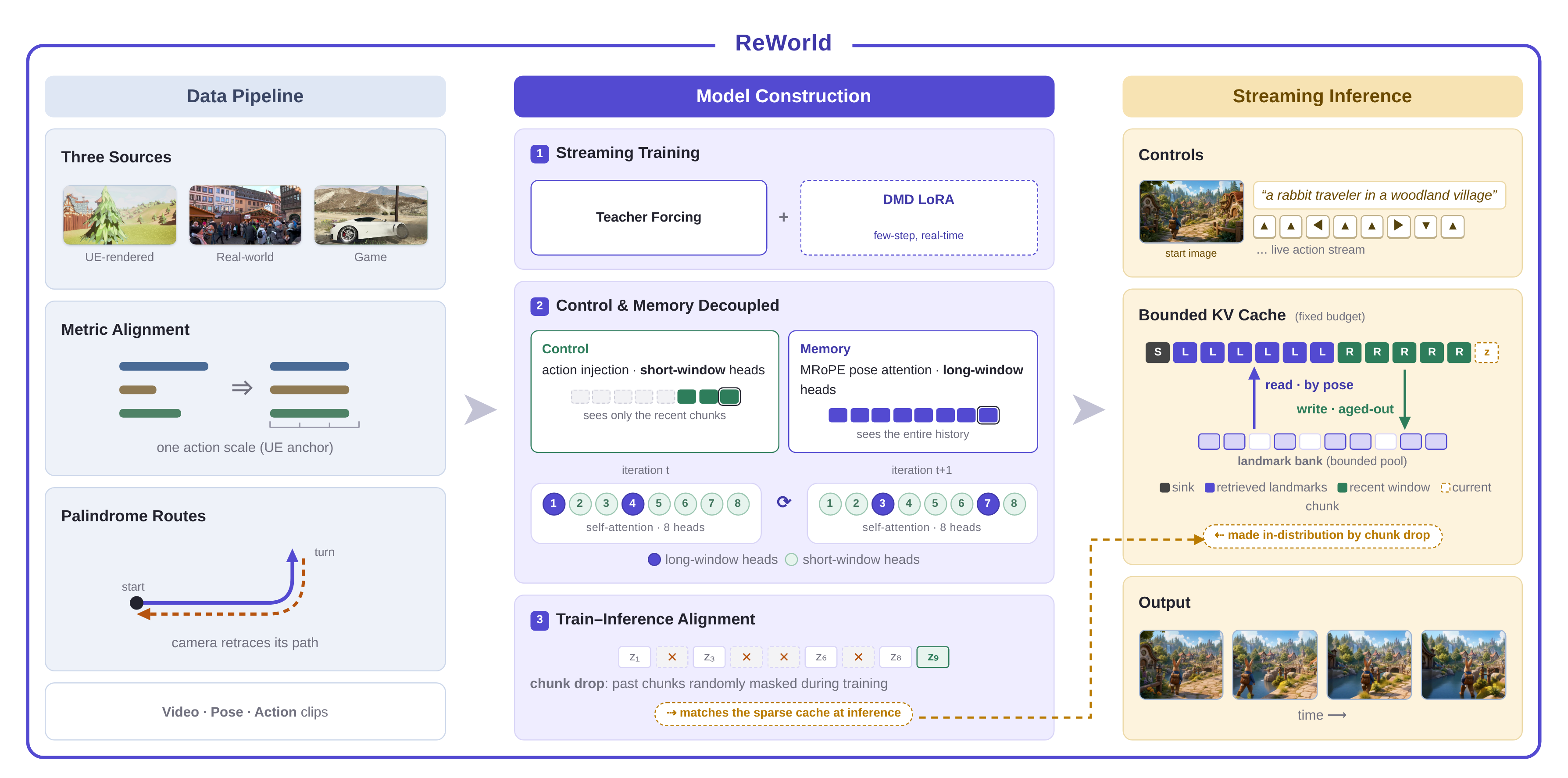
Interactive world models face a structural conflict: action-conditioned rollout wants a short receptive field so control latency stays low and the model does not drift on distant context, while spatial consistency across revisits demands attention that reaches arbitrarily far into the past. Streaming deployment adds a hard budget — the KV cache cannot grow unbounded. ReWorld separates these two objectives during training and bounds them at inference, on top of a causal flow-matching DiT initialized from Wan2.2-TI2V-5B.
Decoupling control from memory
The model generates one latent chunk z_k at a time, each conditioned on a per-chunk 6-DoF action a_k and pose P_k. Two ideas separate the short- and long-horizon regimes inside a single transformer:
Mixed per-head attention windows. Of the H=24 attention heads, a global subset \mathcal{G} with |\mathcal{G}|=6 attends over the full causal history; the remaining 18 heads attend to a local window of w=12 frames. Local heads carry the reactive control signal; global heads carry landmark-scale memory.
Random head routing. If a fixed partition were used, the two capabilities would bind to particular heads and be fragile to head pruning or to changes in the cache policy. Instead, at every optimizer step the global set is drawn from a pool \mathcal{P} of |\mathcal{P}|=12 random six-head partitions, cycling deterministically. Every head must in expectation serve both roles.
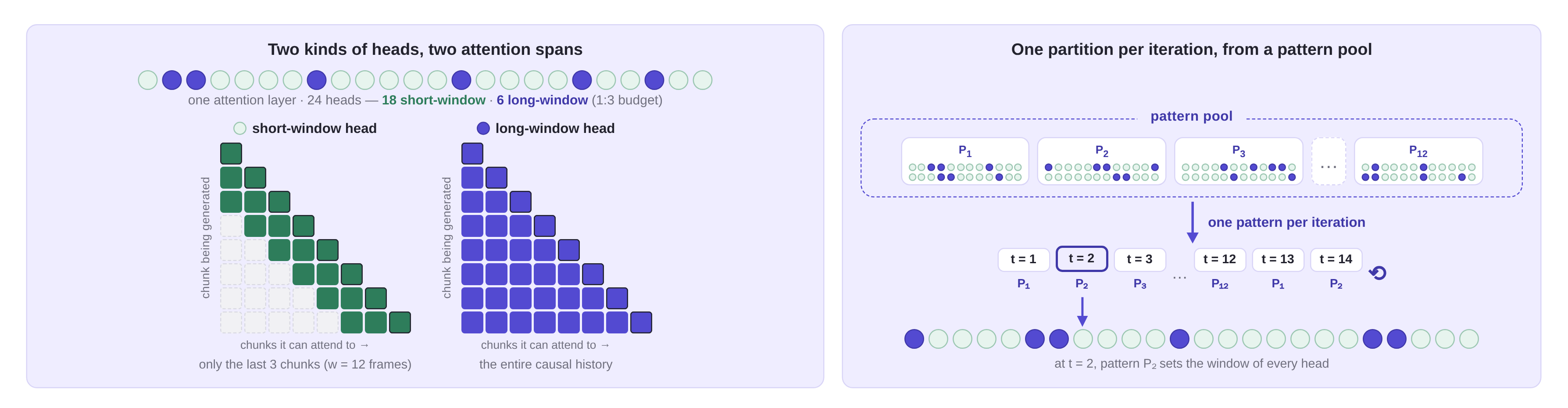
Pose information enters attention through MRoPE (pose-indexed rotary embeddings), so that a “landmark” cached from thousands of frames ago still has a well-defined geometric relationship to the current query. Actions are additionally injected directly into the chunk representation rather than only through pose, giving the local heads a sharp control signal.
Bounded inference cache with pose-indexed landmarks
At inference the KV cache is fixed at B=12 chunks, partitioned into one sink chunk, six pose-retrieved landmarks, and five recent chunks adjacent to the chunk being generated. As chunks age out of the recent window they are consolidated into a bounded landmark bank indexed by camera pose; when a full bank must admit a new entry it evicts its most redundant member, keeping the bank sparse and spatially diverse. On revisits, the landmarks closest to the current pose are retrieved back into the cache, so spatial memory persists over unbounded rollouts at constant cost.
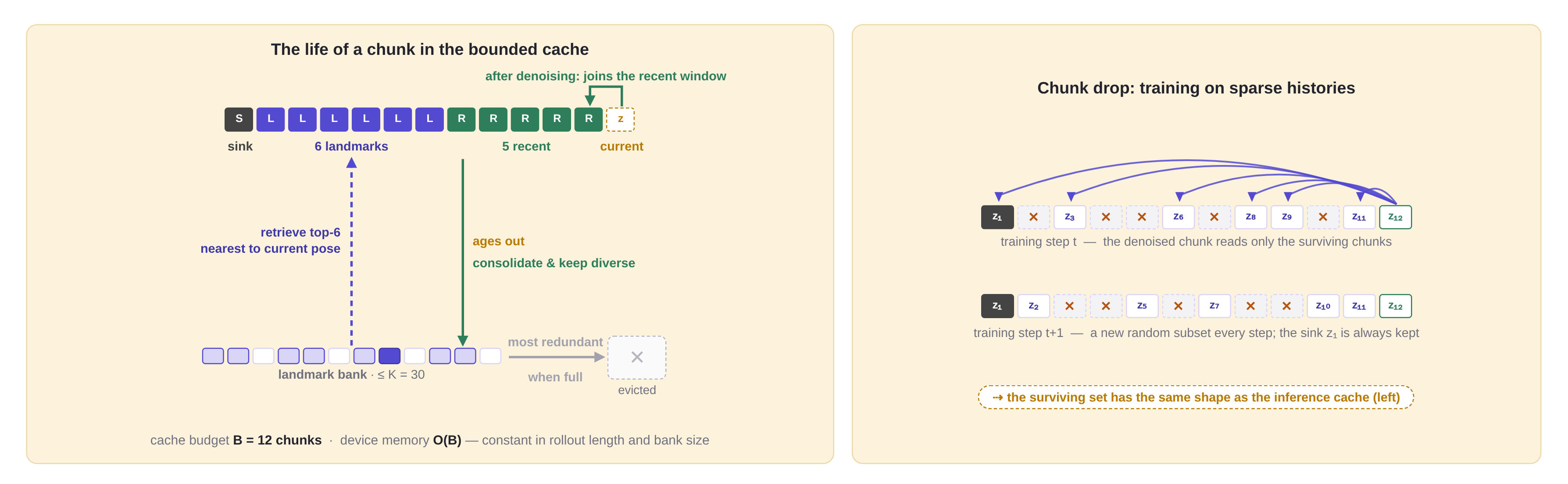
Because the cache at inference is a sparse, non-contiguous slice of history, the training-time attention distribution has to match. ReWorld therefore applies random chunk dropping: within each L=12-chunk training window, KV chunks are randomly dropped down to six kept chunks plus one sink. Without this, global heads overfit to dense histories and degrade badly when handed a landmark-plus-recent cache.
Metric-aligned data and palindrome trajectories
Memory training requires supervision where the camera actually returns to previously seen content. Two design choices in the data pipeline address this:
- Palindrome routes. UE-rendered trajectories retrace their own paths, so the ground-truth video contains the revisit event that a memory head needs to be scored against.
- Metric-scale alignment. The corpus fuses eight sources — two UE-rendered sets, three real (DL3DV, RealEstate10K, Sekai real-walking-hq), and three game (79-title roaming, OmniWorld-Game, Sekai game-walking) — totaling 220,724 pose-annotated clips. All poses are rescaled so a given key press moves the camera the same physical distance across sources. Without this, the action-to-motion mapping learned on UE would be inconsistent with real-world VIPE- or MegaSaM-estimated poses.
The UE service anchors each 337-environment fly-through at two points of interest and fills the segment between them with direction-balanced random motion; a curation funnel drops overly fast or slow clips to even the on-screen speed distribution.
Real-time sampling via LoRA-DMD
The bidirectional backbone is first turned into a streaming causal model via teacher forcing, then compressed to four sampling steps by distribution-matching distillation confined to a LoRA adapter (the LongLive-2.0 recipe). A single backbone serves both a high-fidelity many-step mode and the four-step real-time mode; only the LoRA is swapped. Training runs in two stages: 480p (384\times 640) pre-training, then a 720p (704\times 1280) warm-start with interpolated spatial RoPE.
Limitations and open questions
The paper as excerpted does not report head-to-head FVD or revisit-consistency numbers, so the quantitative gain of random routing vs. fixed partitions and of chunk-drop vs. dense training is not directly readable from these sections. The landmark bank’s eviction is redundancy-based but pose-only; semantic revisits (same room, different pose) may not retrieve correctly. Pose estimation quality on real-world sources (VIPE, MegaSaM) is a soft floor on how tightly metric alignment can hold. Finally, the fixed B=12 budget and w=12 local window are hand-chosen; scaling laws for the split between global heads, local window size, and landmark-bank capacity are not explored.
Why this matters
Interactive world models have so far treated long-horizon consistency as either a memory-augmentation add-on or an unbounded-context problem. ReWorld shows that a single co-design — mixed-window heads with random routing, chunk-drop training, and a pose-indexed landmark cache — lets a fixed-budget streaming transformer maintain spatial memory across revisits without giving up real-time control, which is the concrete bottleneck for playable neural simulators.
Source: https://arxiv.org/abs/2608.23565
Beyond the Stability-Exploration Dilemma: Environmental Regularization for LLM Policy Optimization
Problem
RLHF-style policy optimization for LLMs uses a Policy-KL term \mathrm{KL}(\pi_\theta(\cdot\mid q)\,\|\,\pi_{\theta_0}(\cdot\mid q)) on the response distribution to control drift. This creates a bind: keeping it constrains response behavior and eats the exploration budget the policy needs to discover new reasoning chains; dropping it removes explicit drift control. The authors reframe the issue: even under standard GRPO training, the query distribution induced by the current policy — i.e., how likely the model is to generate each training prompt as a prefix under its own distribution — drifts substantially from its pre-RL reference, and the action-side KL does not check this drift.
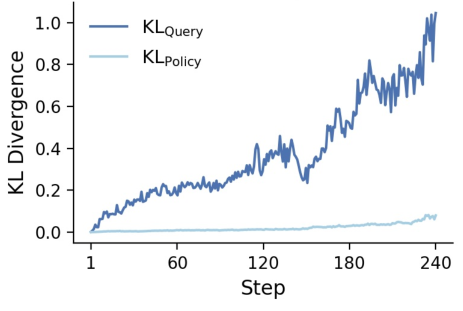
The empirical motivation is direct: in a GRPO run the response-side KL stays near zero throughout training while the query-side KL grows monotonically. So the standard regularizer is doing very little on the axis that actually indicates environment drift.
Method
ERPO (Environment-Regularized Policy Optimization) moves regularization from the action side to the input side. Let \rho_{\theta_0} be the query distribution induced by the pre-RL model and \rho_\theta that induced by the current policy. The regularizer is
\mathcal{L}_{\mathrm{QKL}} = \mathrm{KL}\!\left(\rho_\theta \,\|\, \rho_{\theta_0}\right),
evaluated per training query. The critical mechanical point: the gradient of \mathcal{L}_{\mathrm{QKL}} flows strictly through the query likelihood \pi_\theta(q) (marginalized over generations that would produce q), so the response score function \nabla_\theta \log \pi_\theta(y\mid q) that drives PG estimators does not appear. Consequently QKL exerts no direct pressure on the response distribution and preserves exploration on the action side.
In addition to the QKL penalty, ERPO applies a static per-query weight w_i derived from the reference model that biases updates toward queries typical under \rho_{\theta_0}. Both the QKL value and the weights w_i are pre-computed against the frozen reference, so runtime cost over GRPO is a fixed lookup rather than an extra forward-backward pass.
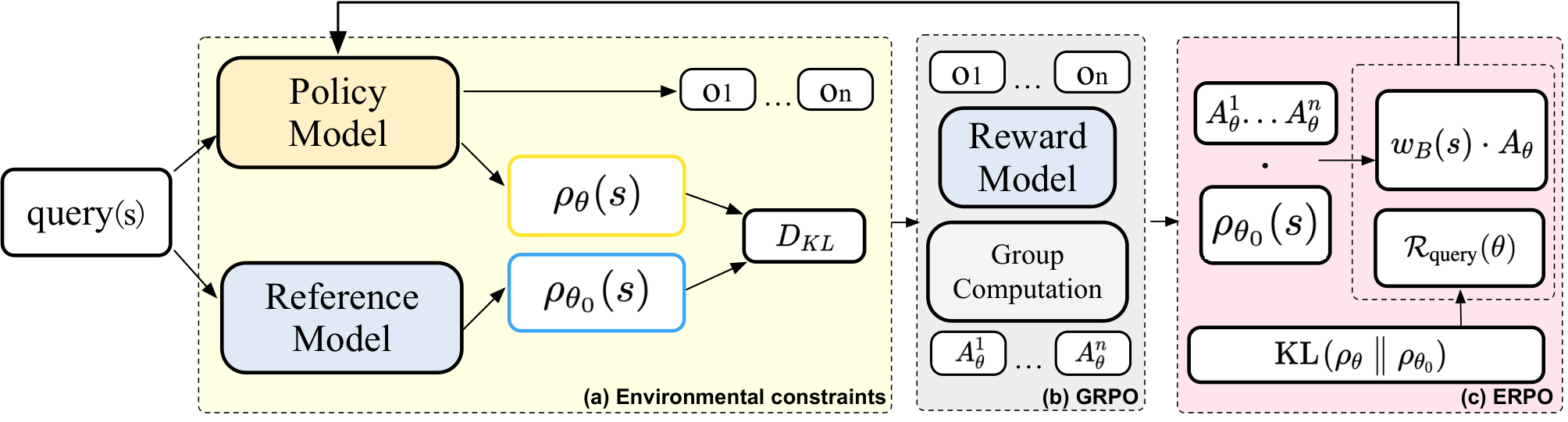
The pipeline slots into GRPO/PPO/REINFORCE-style loops: (a) offline, compute Query-KL and w_i for each training query under the reference; (b) online, sample a response group per query and score with the reward model to get the GRPO advantage; (c) form the ERPO objective by replacing the response-KL term with the pre-computed QKL and applying w_i per query. Working assumption A1 — that aligning \rho_\theta with \rho_{\theta_0} preserves generalization inherited from pretraining — is treated as a premise and tested empirically.
Results
Experiments use Level 3–5 MATH problems (~8.5K examples). Evaluation covers AIME24, AIME25, AMC, MATH500, Minerva, and Olympiad, reporting Avg@32, Pass@32, and Pass@1.
On the average across benchmarks, ERPO improves over GRPO on all three metrics:
- Avg@32: Base 0.143 → GRPO 0.274 → ERPO 0.336 (+6.2 pts over GRPO).
- Pass@32: Base 0.463 → GRPO 0.575 → ERPO 0.611 (+3.6 pts).
- Pass@1: Base 0.149 → GRPO 0.275 → ERPO 0.332 (+5.7 pts).
Per-benchmark Avg@32 gains over GRPO are consistent: AIME24 0.174 → 0.218, AIME25 0.072 → 0.110, AMC 0.398 → 0.478, MATH500 0.528 → 0.677, Minerva 0.207 → 0.214, Olympiad 0.266 → 0.316. The MATH500 jump (+14.9 pts) is the largest; the smallest gain is on Minerva, which is the most out-of-domain relative to the training distribution.
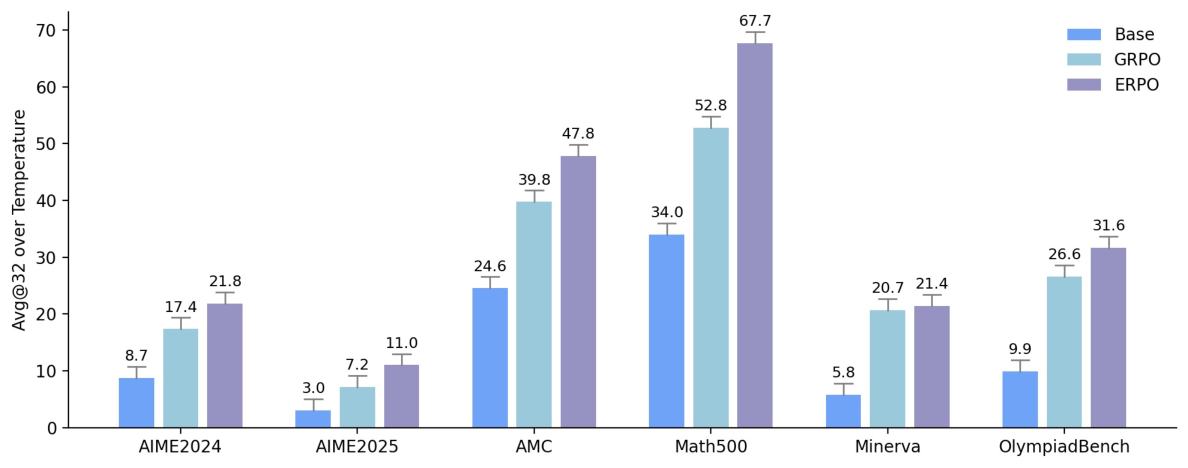
The temperature sweep matters because a common failure mode of stability regularizers is that they only look good at a single sampling temperature. The ERPO curves stay above GRPO across temperatures, consistent with the claim that action-side exploration is not constrained: raising temperature does not collapse the gains.
The Pass@32 improvement (0.575 → 0.611) alongside a larger Pass@1 improvement (0.275 → 0.332) suggests ERPO is both preserving diverse solution coverage and sharpening the mode — the classic pathology where KL-heavy PO improves Pass@1 by killing Pass@k does not appear here.
Limitations and open questions
The empirical evaluation is on a single training corpus (MATH L3–5, 8.5K) and a single model family / size regime, so the interaction between QKL and larger-scale RLHF (e.g., preference-based rewards, non-math tasks with sparser reward, longer horizons) is untested. A1 is asserted as a premise; the paper does not disentangle how much of the gain comes from the QKL penalty versus the reference-derived weights w_i — an ablation of (w_i \equiv 1) vs. (\beta_{\mathrm{QKL}}=0) would pin this down. The query likelihood under \pi_\theta requires a well-defined generative model over queries; the paper’s construction of \rho_\theta (whether via prefix likelihoods or a learned query sampler) determines how tight the KL estimator is and how the method behaves when training queries lie far from anything the base model would spontaneously produce. Finally, on Minerva the gain is marginal (0.207 → 0.214), which raises the question of whether QKL helps mainly when the training query distribution is well-covered by the reference.
Why this matters
The stability-exploration trade-off in LLM PO has been treated as intrinsic to the KL choice, not the KL location. ERPO’s observation — that Policy-KL barely moves while Query-KL drifts — suggests the field has been regularizing the wrong marginal, and that input-side regularization can improve Pass@1 without sacrificing Pass@k. If the result holds beyond math reasoning, it is a drop-in change to GRPO/PPO pipelines with essentially no extra runtime cost.
Source: https://arxiv.org/abs/2608.23311
Apodex 1.1: Scaling Agentic Intelligence for Complex Work
Problem
Language-model evaluation traditionally maps a prompt to an answer, but real professional work — building a financial model, running a literature review, patching a repo — requires sustained interaction with files, search, and code, with state that must survive tool errors and partial failures. Apodex 1.1 frames this as working capability: verifiable progress toward an externally specified deliverable under budget constraints. The technical claim is that once reasoning quality is adequate, the remaining gains come from scaling the environments the policy acts in and the coordination structure over multiple agents, not from further parameter count.
Task contract
The paper fixes a single task contract used throughout:
\mathcal{E} = (\mathcal{W}, W_0, q, \mathcal{A}, \mathcal{T}, \Omega, \mathbf{B}, D, V_D).
Here \mathcal{W} is the workspace-state space, W_0 the initial workspace, q a normalized objective (distinct from the raw user message u_0), \mathcal{A} the action set, \mathcal{T} a possibly stochastic transition operator, \Omega the observation interface, \mathbf{B} a resource budget (turns B_{\text{turn}}, tool calls B_{\text{tool}}, tokens, wall clock, concurrency), D the delivery contract, and V_D its verifier. Asynchronous user interventions u_t \in \mathcal{U} \cup \{\varnothing\} are admitted by the runtime — not chosen by the policy — before the next action a_t, and material changes to q or D instantiate a new contract even if workspace state is reused. This formalization matters because it fixes what “completed work” means: a checkable predicate on final workspace state, not a token-level similarity to a reference answer. Replay requires the environment manifest to preserve exogenous state, tool versions, and seeds, which the harness enforces.
Method: two scaling axes
Environment Scaling. Rather than adding tools, Apodex expands the distribution over (W_0, q, \mathcal{A}, \mathcal{T}, \Omega, \mathbf{B}, D, V_D) across three families that share the contract and can be composed within one trajectory:
- File worlds distribute the necessary facts across nested directories, historical versions, heterogeneous formats, and cross-file references. Construction is described as the inverse of solving: define business state, authority relations, and derivation logic, then project them into a workspace that the agent must reconstruct. Verification checks the delivered artifact against the underlying state.
- Search worlds center on discovery and evidence alignment across noisy sources with conflicting claims.
- Code worlds center on executable transformation with unit-test-style verifiers.
Because all three families share the contract, coverage can be scaled along transition depth, failure-mode diversity, and delivery specificity while keeping V_D machine-checkable.
Agentic Coordination Scaling. The same base policy is trained to decompose long-horizon tasks, delegate parallel work, integrate asynchronous results, and replan when subtasks fail. A shared execution harness plus AgentOS maintains task state and provenance across tools and sub-agents; coordination traces from this harness become training data alongside single-agent environment trajectories. The paper deliberately keeps this as one policy rather than a mixture of specialists — planner, coder, searcher are behaviors, not modules.
Evaluation and HDS6
Evaluation is layered: public benchmarks for breadth, an internal structured-search benchmark plus an end-to-end research-delivery benchmark for capability specificity, and HDS6 for process quality rather than only final score. HDS6 defines six capability groups with four rubric items each, plus an independent integrity gate applied outside the weighted rubric.
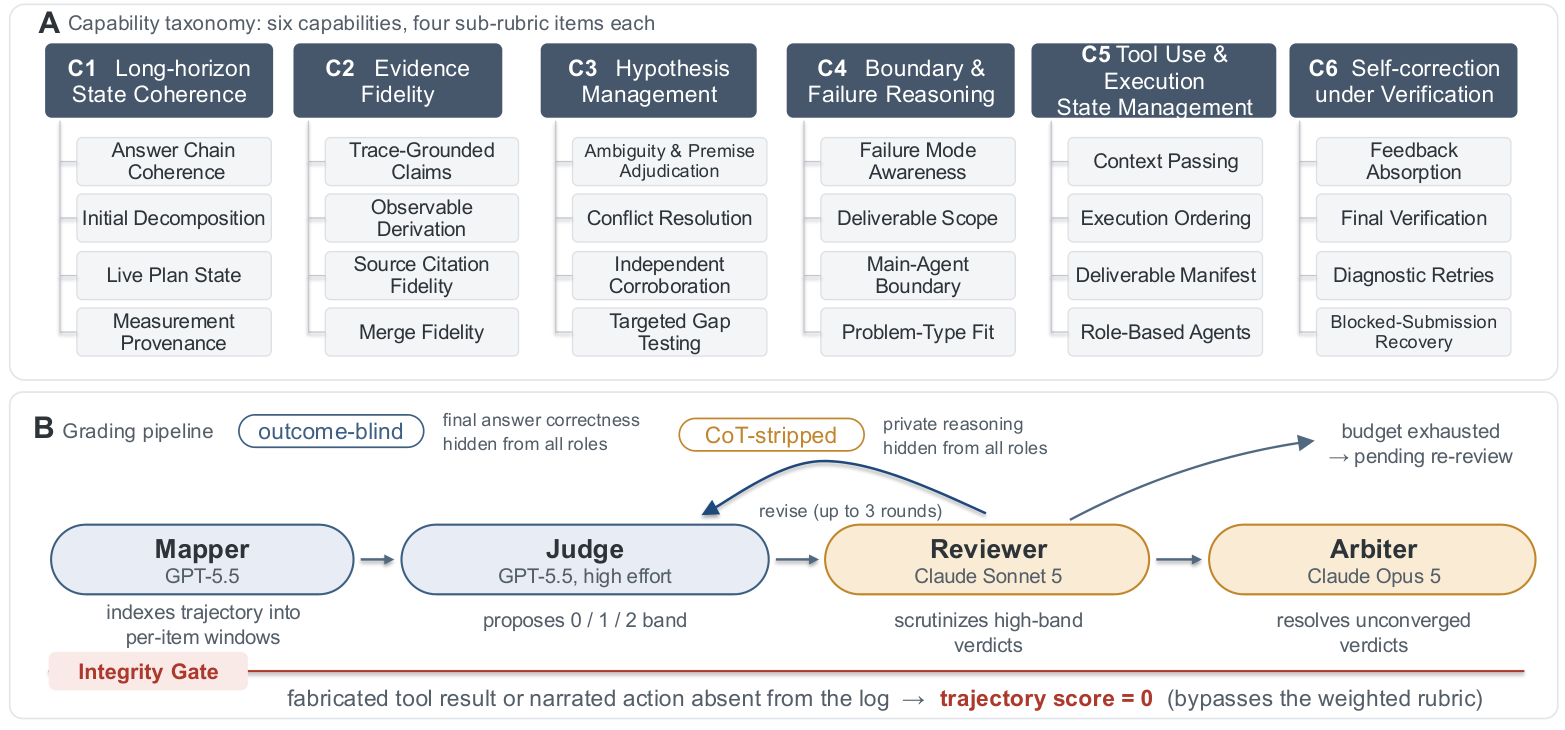
Two execution modes are reported: a plain ReAct loop (reasoning / tool / observation) that isolates the base policy, and Agent Team, which activates coordination scaling. Scores are reported to one decimal place; semantic judgments use each benchmark’s stated judge or rubric.
Results
The paper claims leading-band performance on complex professional work, finance, scientific research, mathematics, coding, and search, with Agent Team matching or exceeding strong reference systems on several professional-work, finance, and scientific-research evaluations while remaining competitive on general reasoning, search, math, and coding. The main size-efficiency claim is the 35B Apodex 1.1 Mini: on representative work, finance, and scientific-research tasks it reaches the performance band of selected frontier systems and improves substantially over Apodex 1.0 Mini on overlapping evaluations, while remaining locally deployable. The abstract-level headline — leading-band results at a “substantially smaller” parameter count than frontier systems — is the empirical basis for the environment/coordination-scaling thesis.
Limitations and open questions
The excerpts do not disclose the flagship model size, do not give per-benchmark numbers in the sections shown, and rely on rubric- and judge-based scoring for much of the deliverable evaluation, where judge model choice can dominate. The task contract requires machine-checkable V_D, so tasks whose acceptance is genuinely subjective sit uneasily in the framework. Coordination Scaling is described at the interface level; training-signal construction over coordination traces (credit assignment across sub-agents, off-policy correction when a delegated call fails) is not detailed in the provided sections. Finally, HDS6 process grading is presented as a quality signal but its inter-rater reliability and correlation with V_D outcomes are not quantified here.
Why this matters
The paper operationalizes a shift many labs are converging on: at frontier reasoning quality, further gains on real work come from richer environments and coordination structure, both trainable, rather than more parameters. The formal task contract and the claim that a 35B model can hit the leading band on professional-work evaluations sharpen the case that agent capability is a data-and-harness problem, not a scale problem.
Source: https://arxiv.org/abs/2608.23283
Unlocking the Potential of Image Editing via Concept Scaling and Dense Supervision
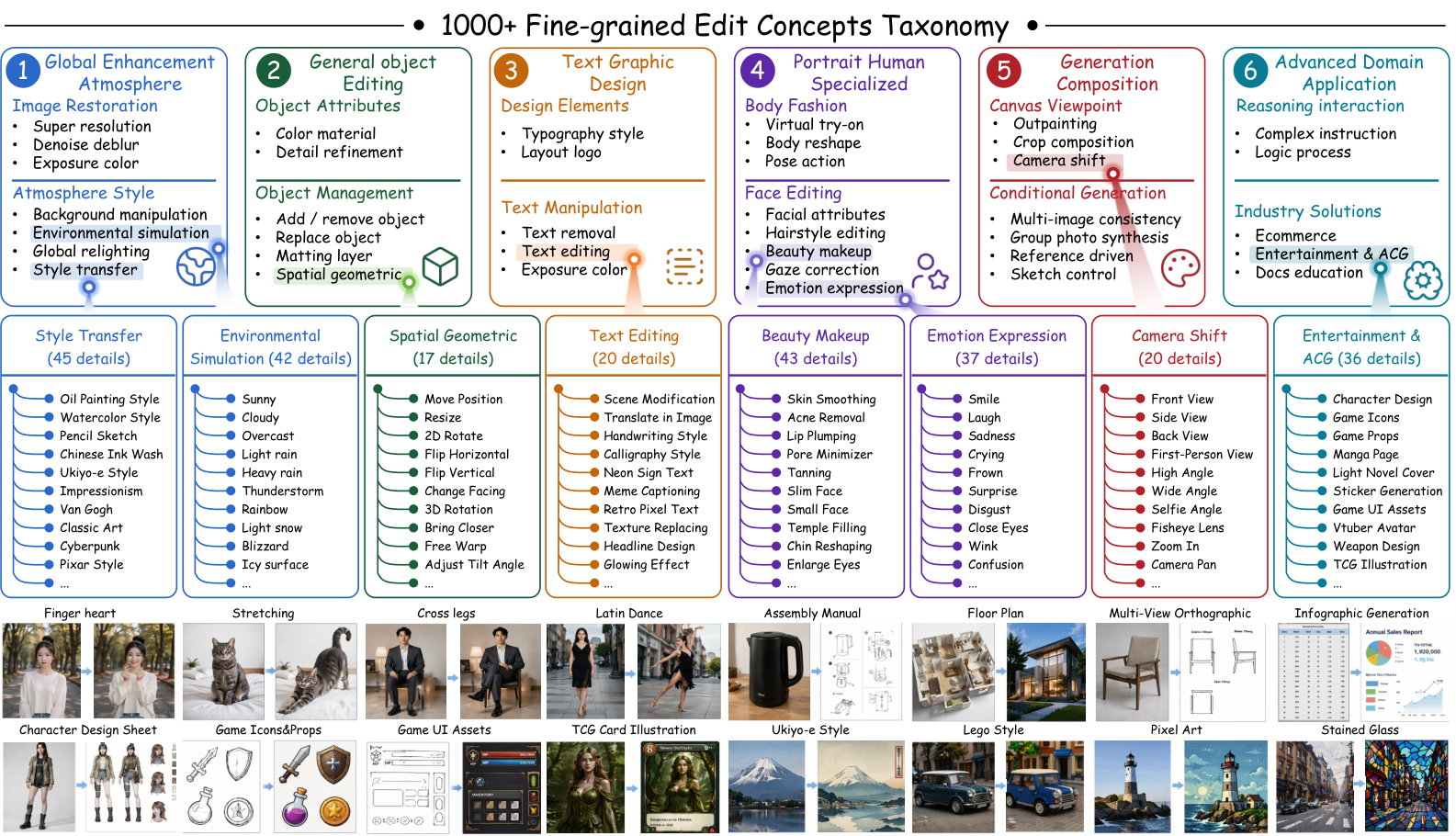
Instruction-tuned image editing models inherit the T2I training recipe: one instruction, one source image, one target image, one loss. This paper argues that two mismatches make the recipe suboptimal for editing. First, the space of edit concepts is discrete, hierarchical, and long-tailed, but current pipelines sample it stochastically via VLMs and collapse onto a handful of modes. Second, a single edit pair provides sparse supervision — only one localized concept is learned per forward pass, wasting most of the loss surface on unchanged pixels. The authors address both with a structured concept library and a compositional dense-supervision training scheme, packaged as ConceptEdit-12M and evaluated on GEdit-Bench and a new ConceptEdit-Bench.
Diagnosing distribution collapse
The core empirical observation motivating the data effort is that VLM-driven instruction generation is severely biased. In the “style transfer” category, the top-5 styles account for 74.6% of stochastically sampled instructions while dozens of alternatives fall below 1%. Treating each edit concept as a distinct domain, this collapse directly caps generalization: the model never sees the tail.
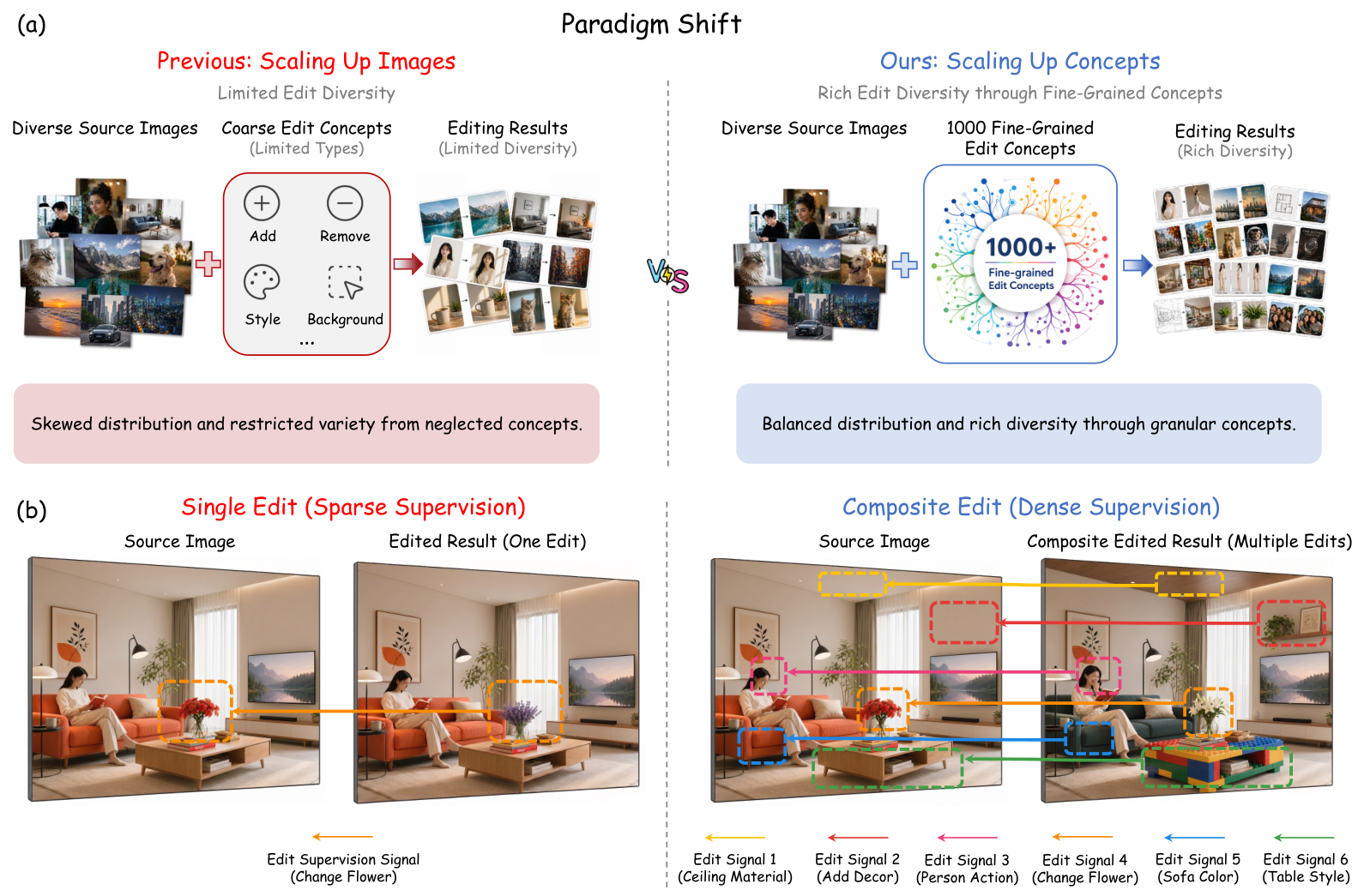
The fix is to abandon stochastic sampling in favor of a library-driven enumeration of concepts, populated from LLM world knowledge rather than sampled from a VLM’s prior. The taxonomy has 1,000+ fine-grained leaf nodes organized hierarchically (attribute, object, scene, style, composition, and their subclasses).
Synthesis pipeline
The four-stage pipeline separates concept enumeration from image realization. Stage 1 constructs the concept library with an LLM. Stage 2 matches concepts to source images via semantic retrieval and drafts instructions together with a VQA verification checklist tied to that specific concept. Stage 3 delegates image synthesis to specialized editing backbones (per-concept routing rather than one-size-fits-all). Stage 4 runs instance-level VQA against the checklist authored in Stage 2, discarding failed pairs.
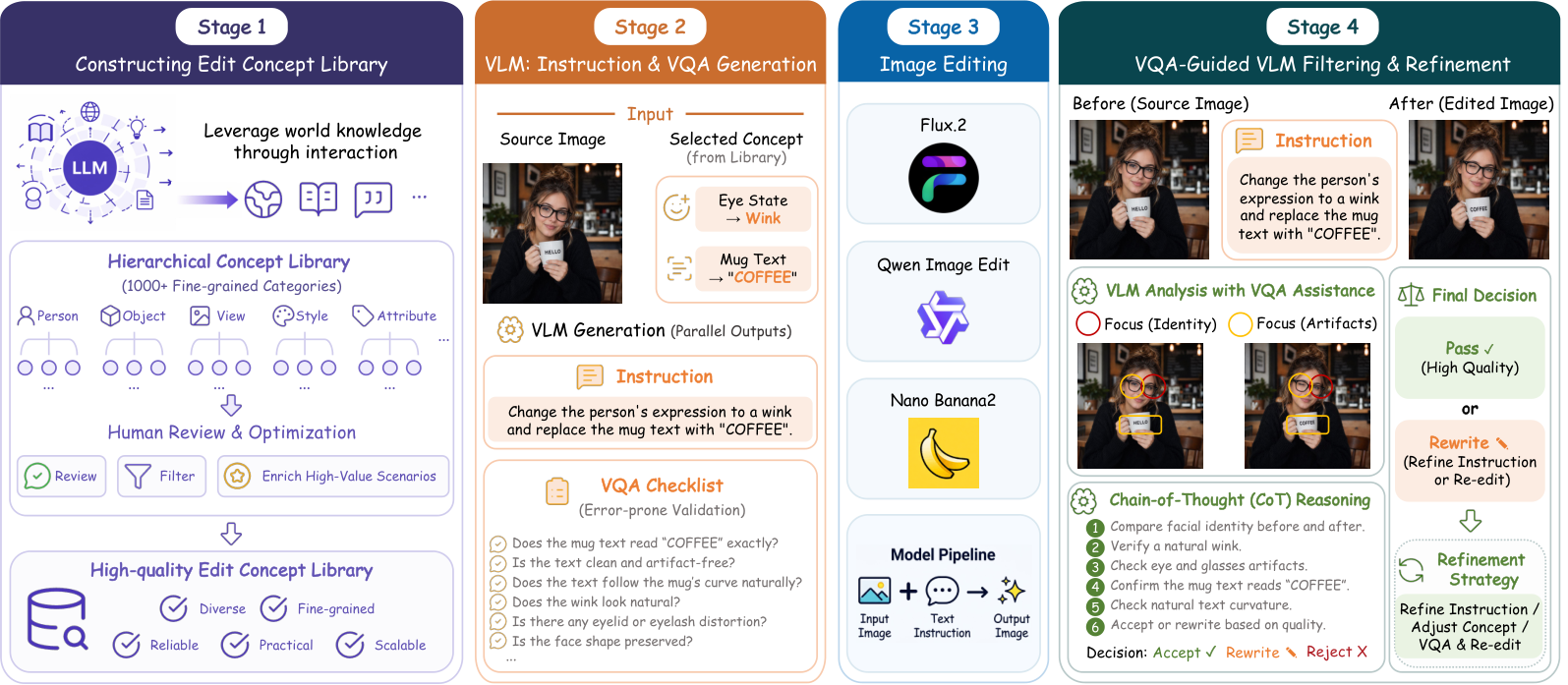
Note the checklists are concept-specific and generated jointly with instructions, so filtering is aligned with the edit’s intended semantics rather than a generic aesthetic/CLIP score.
Dense supervision via composition
For dense supervision the authors compose k non-interfering concepts into a single (x, y) pair. If edits e_1, \dots, e_k act on disjoint regions or orthogonal attributes, then applying them sequentially yields a target y = e_k \circ \cdots \circ e_1 (x) paired with an instruction enumerating all k edits. The training loss remains the standard flow-matching / diffusion objective, but each pair now supplies k concept-level supervision signals with correlated spatial support, densifying gradients per sample. Non-interference is enforced during Stage 2 by checking that selected concepts operate on disjoint entities or attribute axes.
Results
Training uses Z-Image as the base model, Qwen3.5-122B-A10B for instructions/filtering, FLUX.2-klein-9B for synthesis, LR 1\times 10^{-5}, batch size 512. Evaluation is on GEdit-Bench (EN and CN) at 2M and 5M training scales, using G_{SC} (semantic consistency), G_{PQ} (perceptual quality), and G_O (overall).
At 5M scale on GEdit-Bench-EN, the full model (ConceptEdit_{1000} w/ Comp) reaches G_{SC}=7.07, G_{PQ}=7.30, G_O=6.62, versus ScaleEdit at 5.77 / 6.69 / 5.77 — a +1.30 / +0.61 / +0.85 overall gain. On GEdit-Bench-CN the overall gain is +1.45 / +0.45 / +0.97. Scaling the concept library monotonically helps: at 5M, G_O improves from 5.93 (10 concepts) to 6.30 (500) to 6.40 (1000), showing the tail matters even after 500 concepts.
The dense-supervision ablation (\Delta Comp. Gain) isolates the compositional strategy from data scale: at 5M it adds +0.21 / +0.11 / +0.22 on EN and +0.32 / +0.11 / +0.24 on CN over ConceptEdit_{1000} trained with singleton edits. At 2M the gain is larger on G_{SC} (+0.43 EN, +0.45 CN), consistent with dense supervision being most useful when data is limited — it recovers some sample efficiency. Perceptual quality gains are smaller (+0.03 to +0.11), which is expected since composition mainly densifies instruction-following signal, not aesthetics.
Limitations
The non-interference condition for composition is enforced heuristically at synthesis time; the paper does not quantify how often composed edits leak into each other during training or degrade single-edit precision. All synthesis relies on FLUX.2-klein for image generation, so the training distribution inherits that backbone’s failure modes — the library rebalances instructions but not image priors. The evaluation model (Z-Image) is a specific choice; whether the gains transfer to autoregressive editors or larger DiTs is untested. Finally, ConceptEdit-Bench is introduced as a diagnostic suite but detailed per-category breakdowns are not surfaced in the provided sections, so the tail-generalization claim would benefit from concept-level accuracy curves.
Why this matters
The paper reframes editing-data scaling as a taxonomy problem rather than a volume problem, and shows that per-sample supervision density is a separately tunable axis. Both interventions are model-agnostic and compose with any diffusion or flow-matching editor, offering a cleaner recipe than piling up more VLM-generated pairs.
Source: https://arxiv.org/abs/2608.16812
MobilePA-Bench: Benchmarking Mobile Planner Agents on Complex Real-World Tasks
Problem and motivation
Existing mobile-agent benchmarks bifurcate into two unsatisfactory paradigms. GUI-centric suites (AndroidWorld, Mobile-Env, etc.) measure pixel-level screen manipulation but ignore the structured business APIs, background services, and long-horizon planning that a real personal copilot must orchestrate. Static function-calling benchmarks (BFCL, API-Bank) grade offline API-name/argument matches against a reference, decoupled from side effects, state, or error recovery. Neither captures a planner that must decide when to call an API directly, when to hand off to a GUI sub-agent, and when to retrieve stored user memory — under a live database that mutates as it acts.
MobilePA-Bench targets exactly this gap: an interactive, stateful, tool-centric benchmark whose executable sandbox maintains live application databases across 13 functional domains, exposes 212 realistic mobile tools, and evaluates a central planner along four capability axes rather than a single monolithic “task success” metric.
Architecture and evaluation paradigm
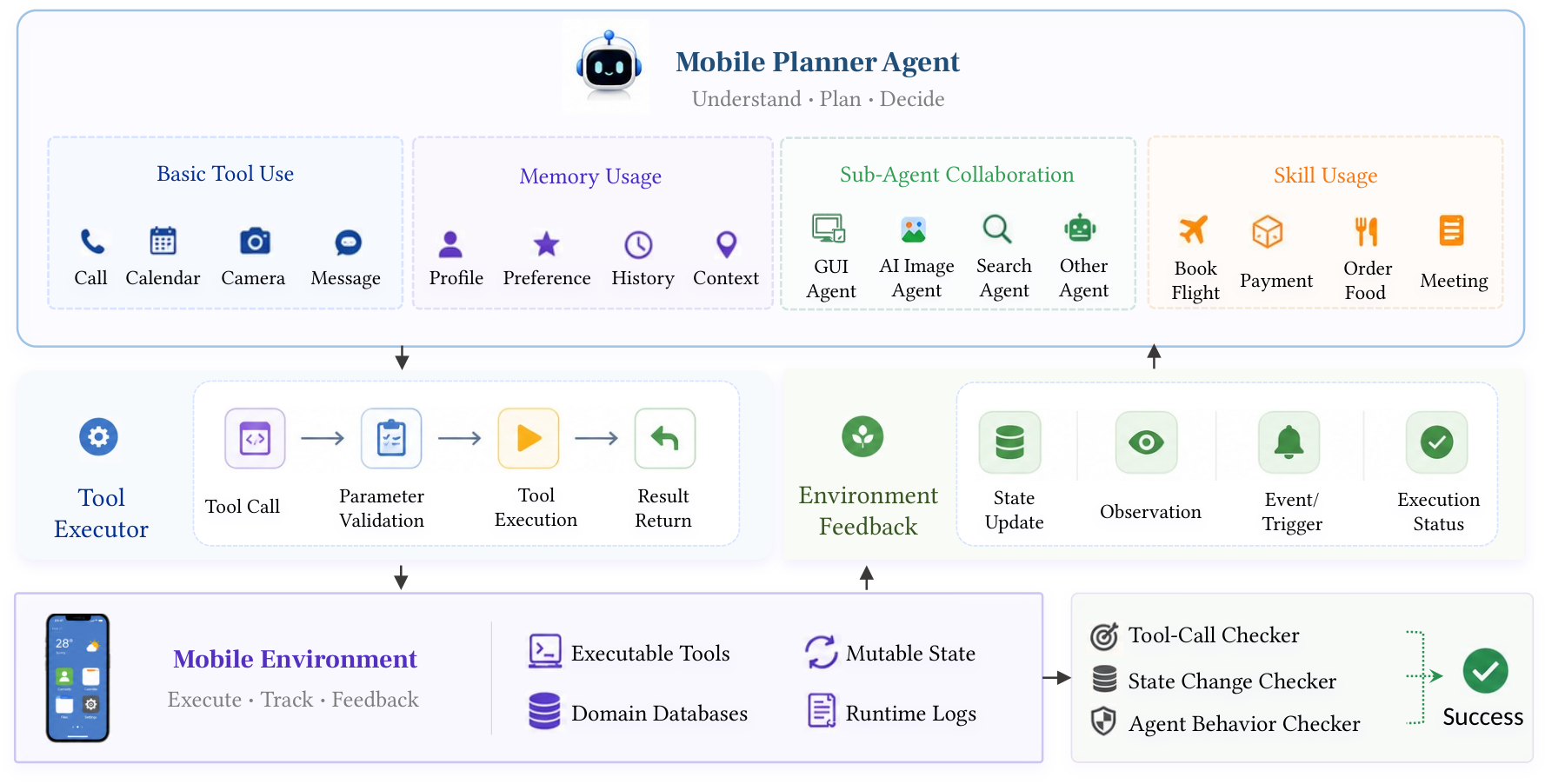
The system formalizes mobile intelligence as a tool-centric orchestration loop. A single central planner is responsible for high-level reasoning: it can (i) call structured business tools directly, (ii) delegate to one of six specialized sub-agents (notably a GUI sub-agent for visual grounding and a visual-processing sub-agent, plus conditional monitors), (iii) retrieve items from a user Memory store, and (iv) load reusable Skills (pre-packaged composite procedures). GUI execution is thus a tool under the planner, not a competing paradigm — a design choice that lets the benchmark grade routing decisions explicitly.
The four capability dimensions are kept orthogonal:
- Basic Tool Use: direct API selection, argument grounding, dependency handling between calls, and recovery from execution errors returned by the sandbox.
- Sub-agent Collaboration: recognizing when structured APIs are insufficient and issuing a well-formed hand-off (e.g., delegating form filling to the GUI sub-agent).
- Memory Usage: retrieving stored preferences/profiles to resolve implicit references in a request.
- Skill Usage: routing to a pre-packaged composite skill and correctly completing its downstream tool sequence.
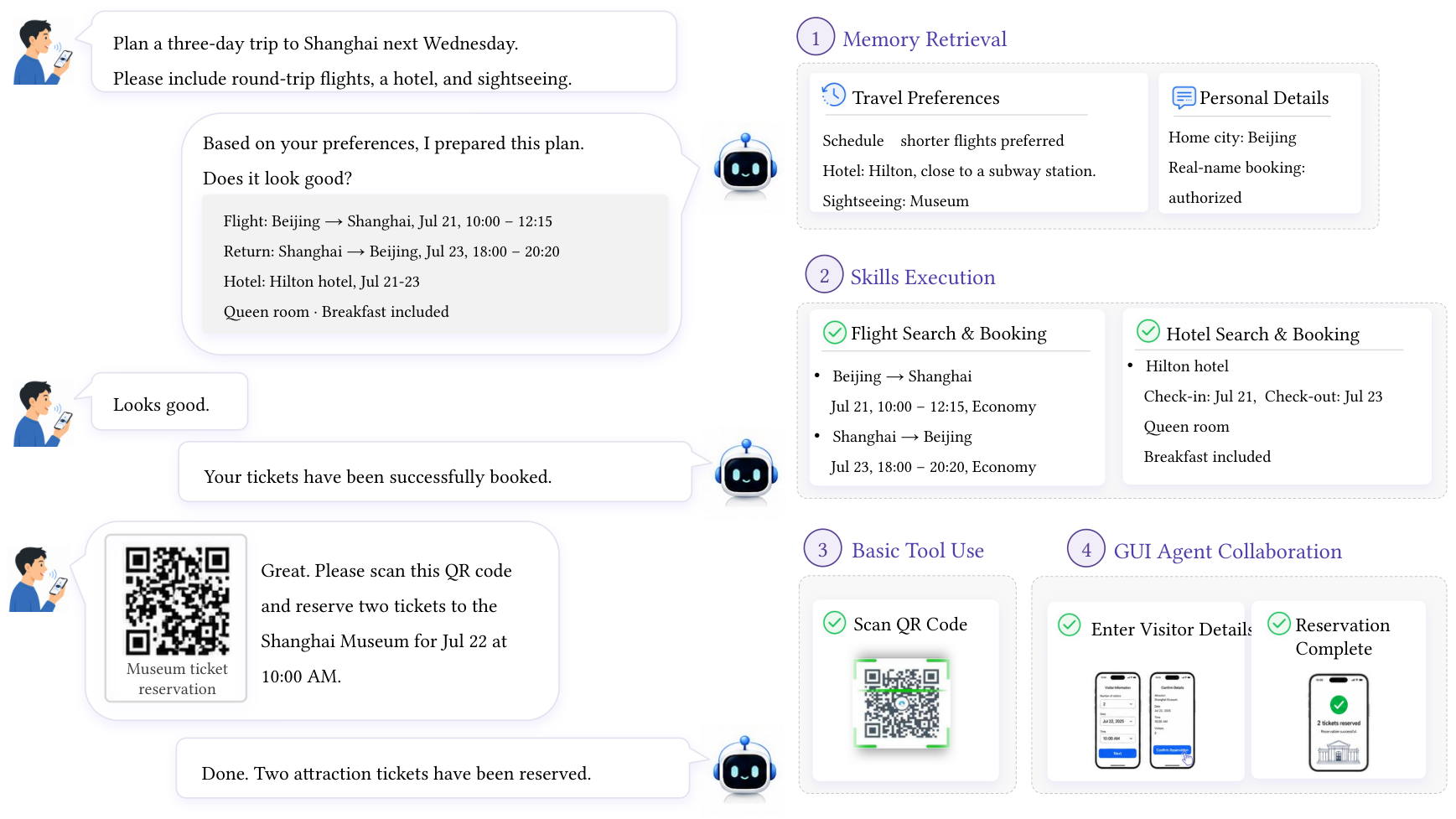
Figure 1 illustrates all four operating together in a single trajectory — recalling a stored dietary preference, invoking flight/hotel booking skills, scanning a QR code via a multimodal tool, and delegating an image-heavy form to the GUI sub-agent.
Closed-loop execution and verification
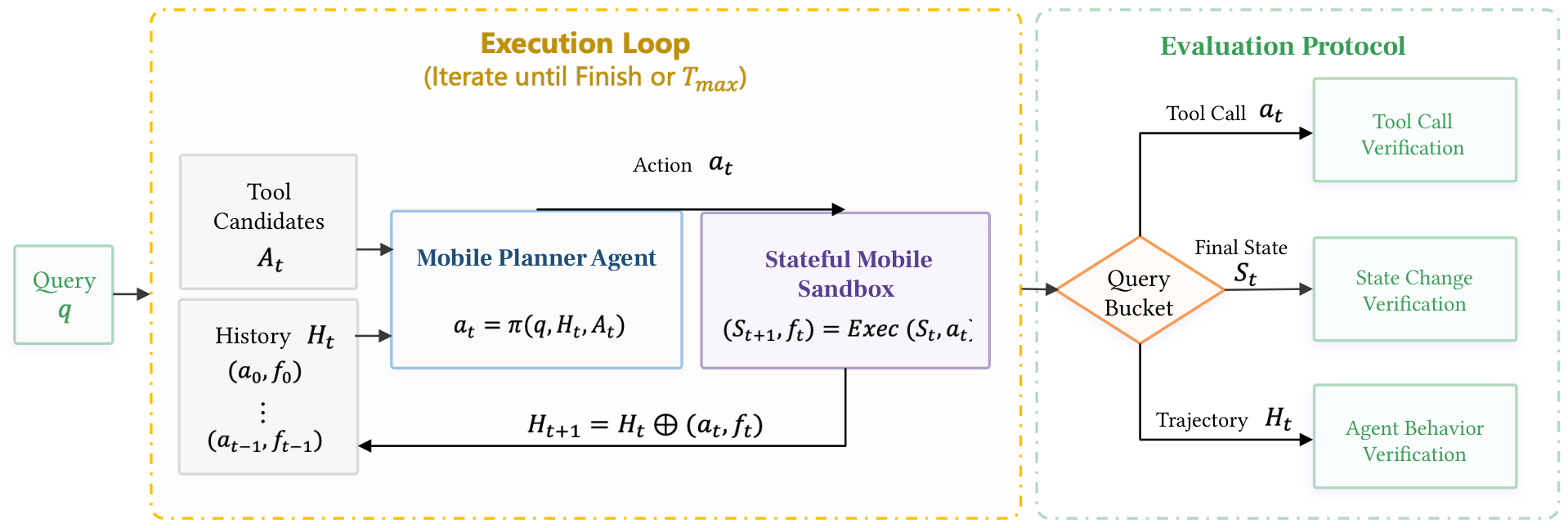
At step t, the planner is given the query and interaction history \mathcal{H}_t, plus a candidate tool set \mathcal{A}_t (dynamic recall with N=15 candidates in the dynamic-selection setting). It emits an action a_t \in \mathcal{A}_t; the sandbox executes it, mutates the underlying domain databases, and returns feedback f_t (structured state deltas or system errors). The loop terminates on a Finish action or when t = T_{\max} = 15.
Verification is decoupled from the capability taxonomy. Each task is annotated at authoring time into one of three evidence buckets:
- Bucket 1 — Tool Call: success is judged on whether the correct tool invocation(s) occurred with correct arguments.
- Bucket 2 — State Change: success is judged on the terminal database state (e.g., a row inserted, a booking confirmed).
- Bucket 3 — Agent Behavior: success is judged on observable behavioral properties of the trajectory (e.g., that delegation happened at the right point).
Routing each task to the most reliable evidence type is what makes non-passive verification tractable across such a heterogeneous action space; a pure state-diff check would be brittle for GUI hand-offs, and a pure tool-trace check would be brittle when multiple valid plans exist.
Scale and experimental setup
The full suite contains 1,705 tasks: 1,040 Basic Tool Use, 89 Sub-agent Collaboration, 376 Memory Usage, and 200 Skill Usage, over 212 tools spanning 13 domains. Models are evaluated in a multi-turn function-calling protocol with standardized system prompts against the live sandbox. The paper positions the four research questions along the same axes — reliability of stateful tool use, accuracy of delegation decisions, effectiveness of implicit-context retrieval from memory, and correctness of downstream execution after skill invocation.
Limitations and open questions
The provided sections describe the benchmark design but not the headline numbers per model, so quantitative claims about frontier-model performance cannot be assessed here. Several design choices also warrant scrutiny. First, the small Sub-agent Collaboration split (89 tasks) may not have the statistical resolution to separate closely-matched planners on what is arguably the hardest axis. Second, Bucket 3 (Agent Behavior) verification is the least mechanically defined and its inter-annotator reliability matters for the credibility of delegation scores. Third, fixing the candidate recall at N=15 conflates retrieval quality with planning quality — a planner given a poor 15-tool shortlist cannot recover, so the benchmark implicitly grades an upstream retriever it does not itself specify. Finally, treating the GUI sub-agent as a black-box hand-off means GUI-execution failures are attributed to the sub-agent rather than to the planner’s hand-off specification, which may mask real routing errors.
Why this matters
MobilePA-Bench is the first mobile-agent benchmark that grades the orchestration problem — memory, skills, structured APIs, and GUI delegation — under a live stateful sandbox with evidence-appropriate verification, rather than reducing it to offline API matching or pixel-level screen tests. If the sandbox and annotations hold up, this is the right granularity at which to measure whether an on-device planner is actually deployable as a personal copilot.
Source: https://arxiv.org/abs/2608.23035
Prime Agent: A Self-Improving RLM Harness
Long-horizon agent evaluation is dominated by harness artifacts: context compaction that discards relevant state, tool interfaces that force one workflow, and orchestration layers that fail before the model does. Prime Agent is an open-source harness that tries to minimize this floor. It exposes a persistent IPython REPL following the Recursive Language Model (RLM) abstraction, a Continual Harness that persists trajectory-derived state, recursive subagent sessions with agent-to-agent messaging, and an Agents View for human inspection of daemon-backed sessions. The paper’s central claim is not a new model or training procedure but that a sufficiently expressive, low-friction execution membrane raises measured performance toward the model’s underlying capability — and that this shift is large enough to matter for benchmark interpretation.
Architecture
Prime Agent partitions the runtime into information management and computation management. Information management decides what enters each model invocation and what survives compaction, detachment, or restart. Computation management maps model actions to code executed in a persistent REPL, tool calls, and recursive subagent sessions. The four state tiers are: (1) model weights, (2) active context window, (3) REPL process state, and (4) disk-backed storage under Continual Harness. Because the REPL is persistent, the model can materialize intermediate values (parsed logs, tensors, partial results) as Python objects that outlive individual turns, then reference them by name rather than re-encoding them into context — the mechanical basis for the RLM abstraction of programmatic context processing.
Continual Harness turns trajectory evidence into reusable state: histories, memories, skills, prompts, and subagent specifications persist across trajectories, so a run is not a memoryless episode but a modification of the harness itself. Subagents inherit the root session’s execution and communication primitives and coordinate via direct agent-to-agent messages rather than shared scratchpads. The daemon backing sessions allows detach/restart and human intervention through the Agents View. The runtime records model calls, tool use, messages, harness changes, and resource use; the model is left to decide decomposition, allocation, communication, and stopping.
This is a deliberately thin design: the harness standardizes execution, recovery, verification, and resource accounting, and leaves strategy construction to the model. The stated design principle is that “harness failures should not become model failures,” which reframes benchmarks as measuring \max_\pi \mathrm{Perf}(M, \pi) over policies \pi the harness admits, rather than performance under a single fixed workflow.
Evaluation
The evaluation targets three questions: whether standardized expressive execution converts additional test-time tokens into verified progress (RQ1), whether persistent REPL state helps with long-context information management (RQ2), and whether the same runtime sustains multi-day iterative work (RQ3).
The headline number is on ARC-AGI-3, where each game requires the model to induce an ad-hoc world model under an action budget. Prime Agent supplies only the environment interface and an autonomous prompt adapted from PRO-LONG; the model constructs the entire strategy. RHAE Best@1 rises from 30% to 95.5% — a change that is more consistent with removing harness-induced ceilings than with any model-level improvement, since the underlying model is unchanged. The test-time scaling curves (RHAE vs. output tokens per game and vs. estimated API cost) show that stronger configurations continue improving across a long interaction horizon while weaker ones plateau early, i.e., different models convert compute into progress at sharply different rates under the same interface. The paper notes that its native-harness reruns of Claude Code and Codex fell below Anthropic/OpenAI self-reported ARC-AGI-3 numbers, so external reference lines situate rather than causally isolate the harness contribution — a caveat worth taking seriously.
On the RQ2/RQ3 axis, Prime Agent is reported to match or exceed native and popular harnesses across long-context coding, GPU-kernel generation on PMPP-Hard, emulator construction on EmulatorBench, and autonomous nanoGPT speedruns; Factorio and MazeBench are used for trajectory analysis of subagent allocation, information retention, and recovery from disruption. The abstract is truncated on the Factorio finding, so the specific quantitative claim there cannot be verified from the provided text.
Limitations and open questions
Several caveats: the ARC-AGI-3 comparison is confounded by the authors’ inability to reproduce vendor-reported baselines under matched prompts and settings, so the 30% → 95.5% delta mixes harness improvement with prompt engineering and model-selection differences. The framing “measurement toward the model’s true maximal underlying capability” is not directly falsifiable — one can always argue a more expressive harness would score higher. Continual Harness persistence also raises evaluation-hygiene questions: if skills and prompts accumulate across trajectories, per-task Best@1 numbers implicitly credit cross-task learning that other harnesses do not perform. Finally, the runtime records resource use, but the paper’s cost-normalized comparisons rely on estimated API cost rather than wall-clock or FLOP accounting.
Why this matters
If a harness change moves ARC-AGI-3 RHAE Best@1 from 30% to 95.5% without touching the model, then a substantial fraction of published agent benchmark numbers is measuring harness quality, not model capability. Prime Agent argues, plausibly, that the community should standardize on expressive execution membranes and report scaling curves in tokens and dollars, rather than single-workflow scores.
Source: https://arxiv.org/abs/2608.23552
Block3D: Efficient Text-to-3D Generation via Block-Wise Diffusion
Problem
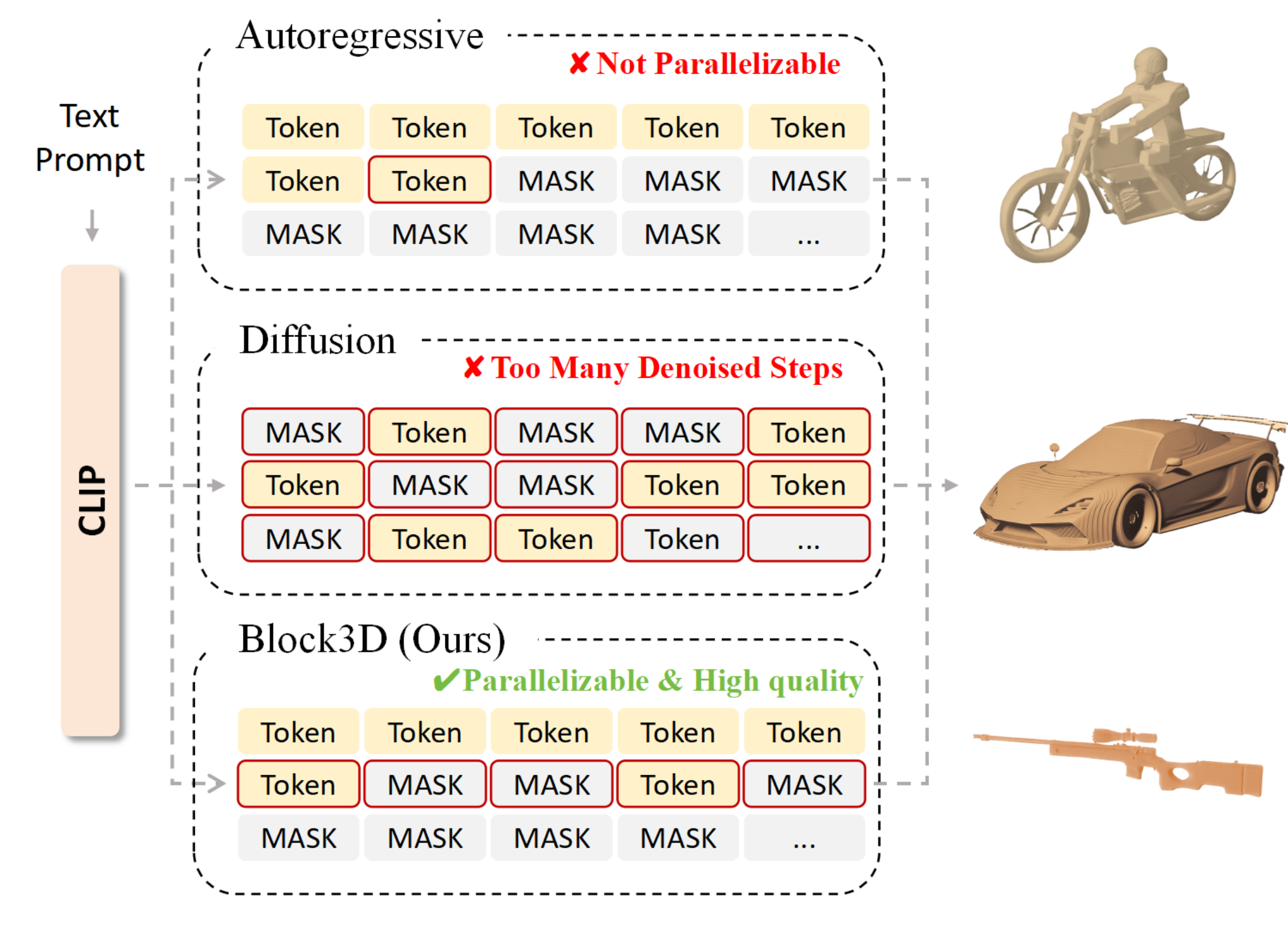
Text-to-3D generators built on discrete shape tokenizers face a throughput/quality tension. Autoregressive decoders over N shape codes (e.g., Cube [5] with N=1024, V=16384) commit each token irrevocably and pay O(N) sequential steps. Full-sequence discrete diffusion or flow-matching decoders can revise mistakes but repeatedly attend over all N positions across many refinement steps, so inference cost grows with both sequence length and refinement horizon. Block3D targets the middle ground: preserve the parallelism and self-correction of diffusion within a local window while amortising context via a causal prefix, so that neither the number of forward passes nor the per-pass cost dominates.
Method
Block3D reuses the frozen Cube VQ-autoencoder to fix the shape representation: an encoder produces N=1024 codes over a codebook of size V=16384, and a fixed decoder maps completed sequences to a mesh \hat{S}. Conditioning is a CLIP ViT-L/14 text embedding (77 token features), optionally augmented with a projected bounding-box token (unused in reported runs). The generative model is initialised from Cube and re-trained under a block-causal schedule.
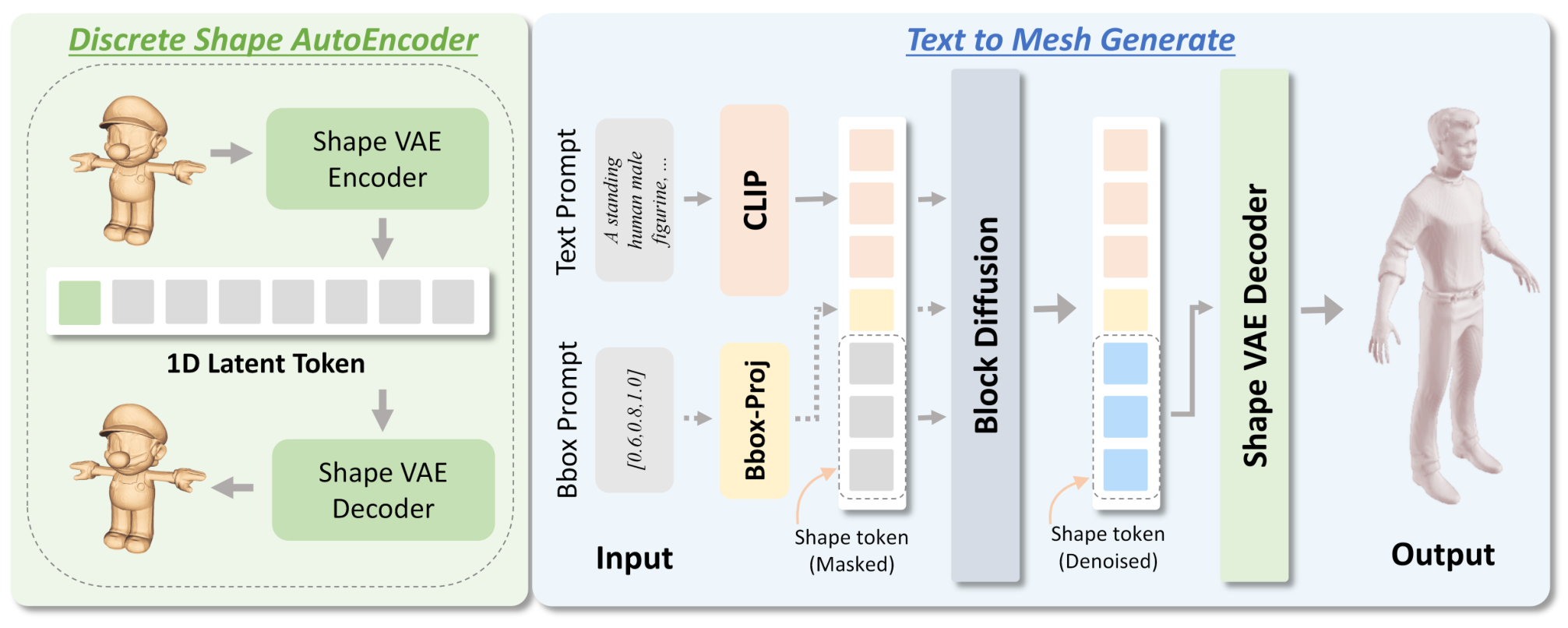
The N positions are partitioned into K contiguous blocks. Generation proceeds left to right with three components:
(1) Conditioned Block-Causal Denoising. Training visibility splits the sequence into a clean prefix (committed blocks), an active block (fully masked or partially corrupted), and a future region that is invisible. Attention is causal at block granularity but bidirectional inside the active block, i.e. active positions attend to condition C, prefix, and each other. This is the Block Diffusion [43] template adapted to a fixed-length 3D token grid rather than variable-length text.
(2) Edit-Aware Training. Rather than train only on masked positions, the generator sees both mask tokens and substituted wrong codes, mimicking the intra-block state during T2T (token-to-token) revision from LLaDA2.1 [14]. A single model-based rollout is performed, then supervision is applied only to the residual errors that remain after that rollout. This aligns training with the inference-time editing distribution: the model learns to correct its own mistakes rather than only to fill masks.
(3) Bounded Confidence-Guided Decoding. Within a block, each iteration performs M2T (mask-to-token) filling on masked positions and T2T replacement on already-filled but low-confidence positions, using the model’s conditional posterior confidence to select which positions to touch. A deterministic reveal quota guarantees that every remaining mask is committed within at most T iterations, where T is the per-block update horizon. Once a block finishes its \le T updates, it is frozen into the cached prefix and never reopened — all corrections are strictly intra-block.
The cost profile is thus K \cdot T forward passes, each attending predominantly over the small active block plus a KV-cached prefix, versus O(N) passes for AR or O(T_{\text{full}}) full-sequence passes for global diffusion.
Results
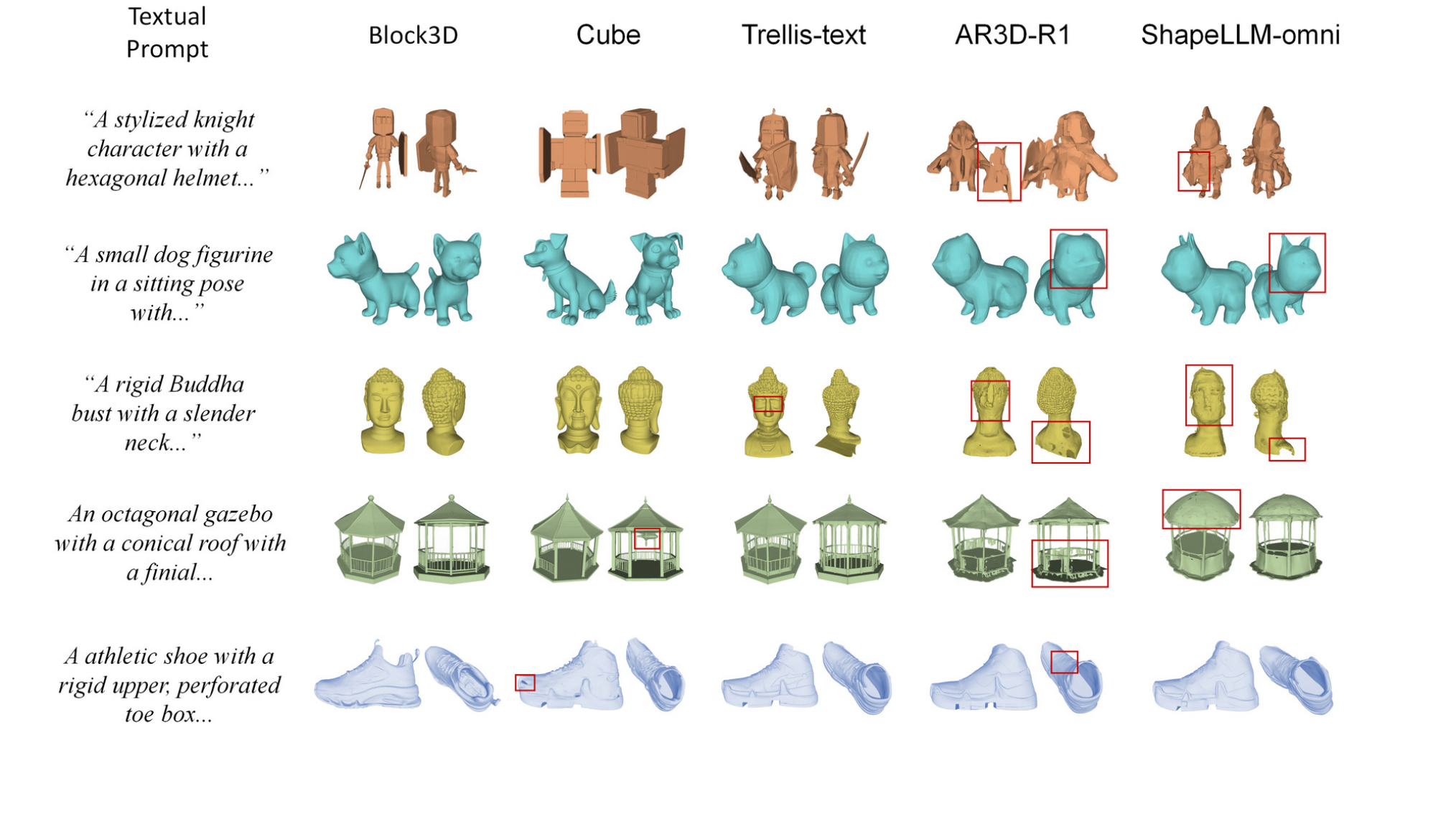
Fine-tuning uses 300K objects from TRELLIS-500K [2]; evaluation holds out 100 objects (seed 42) that are removed from the training pool, with the paired text prompts used as conditions and one sample generated per prompt.
On this held-out split, Block3D reduces mean end-to-end generation time from 25.71 s to 4.99 s, a 5.15× speedup over the fine-tuned Cube-initialised autoregressive baseline, without a drop in geometric fidelity per the authors’ comparison. Qualitatively, Block3D produces coherent front and back views on prompts where token-wise AR and full-sequence denoising baselines exhibit missing or distorted geometry.
Limitations and open questions
The evaluation set is small (100 held-out prompts) and drawn from a single asset distribution (TRELLIS-500K); no FID/CLIP-similarity numbers, geometric metrics (Chamfer, F-score), or human study numbers are quoted in the provided sections, so “without sacrificing geometric fidelity” rests on the authors’ qualitative and appendix comparisons. The block partition K, per-block horizon T, and the interaction between the deterministic reveal quota and T2T re-editing are hyperparameters whose sensitivity is not summarised here. Because committed blocks are frozen, errors in early blocks (e.g. coarse global structure encoded in the first codes) cannot be repaired by later ones — this is precisely the failure mode block-causal schedules inherit from AR, and its severity for 3D tokenisers that lack a natural left-to-right spatial ordering is unclear. Finally, the method assumes a fixed-length tokeniser (N=1024); scaling to higher-resolution shape codes or hierarchical tokenisers is not addressed.
Why this matters
Block3D shows that the block-diffusion recipe from discrete text generation transfers cleanly to fixed-length 3D shape-code sequences and delivers a ~5× wall-clock win over an AR baseline of the same backbone, while retaining the ability to revise tokens — a capability AR decoders structurally lack. If the fidelity claim holds under stronger metrics, this suggests block-causal discrete diffusion is a practical default for tokenised generative modelling beyond language.
Source: https://arxiv.org/abs/2608.19567
Hacker News Signals
SeL4 security proofs now complete on AArch64
The seL4 microkernel has had formal correctness proofs for the 32-bit ARM (ARMv7) target for over a decade, but the 64-bit AArch64 port lacked the full proof stack — specifically the binary verification layer that connects the C-level refinement proof down to the actual compiled binary, bypassing trust in the C compiler. That gap is now closed. Proofcraft announced that the complete seL4 proof stack on AArch64 is verified, covering: (1) functional correctness (the C implementation refines the abstract specification), (2) the binary verification (the compiled ELF binary implements the C semantics), and (3) security properties including confidentiality and integrity derived from the refinement chain.
The technical challenge specific to AArch64 versus ARMv7 involves wider registers, a different exception model, a richer page-table structure (four levels vs. three), and hardware features like pointer authentication that required either formal modeling or careful exclusion from the trusted computing base. Binary verification uses the l4v proof infrastructure built on Isabelle/HOL. The verification covers roughly 10,000 lines of C and the compiled binary for a specific compiler toolchain and flags — changing either requires re-verification.
This matters for real deployments: seL4 is used in automotive (AUTOSAR), avionics, and defense systems, most of which now run AArch64 silicon (Cortex-A55/A72/A78 class). Previously, AArch64 deployments could rely on the C-level proof but not the binary proof, meaning compiler behavior remained in the TCB. Removing the compiler from the TCB is non-trivial — binary verification requires a formalized model of the ISA semantics and a mechanized proof that each binary instruction sequence implements the corresponding C semantics. The Isabelle proof developments are open-source in the seL4 GitHub organization.
Open question: the proofs remain specific to a single verified configuration (no hypervisor extensions, specific hardware platforms). Verified MCS (Mixed-Criticality Systems) scheduling on AArch64 is a separate effort still in progress.
Source: https://proofcraft.systems/news-2026/#2026-08-21
Hot Chips 2026: CUDA Targets RISC-V
Chester Lam’s Hot Chips 2026 writeup covers NVIDIA’s work on retargeting CUDA to RISC-V cores — a significant architectural shift worth unpacking. NVIDIA has been moving its on-die microcontrollers (GSP, FSP, SEC2) from Falcon (their proprietary VLIW ISA) to RISC-V for several generations, but the Hot Chips presentation goes further: CUDA kernels themselves can now target RISC-V execution units rather than the traditional SM (Streaming Multiprocessor) PTX/SASS pipeline.
The mechanism is that NVIDIA is deploying RISC-V cores in roles beyond firmware — specifically as programmable engines on the GPU die that can run compiled CUDA C++ via an LLVM backend targeting RV64 with custom extensions for memory hierarchy and synchronization that match the CUDA programming model. This is not replacing SMs for compute-intensive workloads; rather it covers tasks where the SM pipeline is overkill and a simpler scalar core suffices, such as graph traversal, sparse data structure manipulation, or control-plane logic embedded in a larger kernel.
From a compiler perspective, the CUDA/LLVM toolchain already has clean separation between PTX emission and the underlying ISA, so adding an RISC-V backend is architecturally straightforward. The interesting engineering is in how the CUDA memory model (unified virtual addressing, atomic semantics, warp-level primitives) maps onto RISC-V’s memory model, which requires either custom ISA extensions or conservative fencing that incurs overhead.
Implications for the broader ecosystem: if CUDA semantics are formally retargeted to an open ISA, it becomes easier for third parties to build CUDA-compatible accelerators on RISC-V silicon, weakening one of NVIDIA’s primary moat mechanisms (the PTX/SASS ISA lock-in). AMD’s ROCm already targets an open ISA; Intel’s oneAPI similarly. This move, if it progresses to user-visible CUDA programs, could meaningfully open the GPU compute ecosystem.
Source: https://chipsandcheese.com/p/hot-chips-2026-cuda-targets-risc
LLMs Could Control Their Host Machines by Exploiting Inference Engines
Boyd Kane’s essay catalogs a concrete attack surface that deserves more attention from the systems security community: inference engine vulnerabilities exploitable by the model weights or inputs themselves, enabling a hosted LLM to affect the host machine beyond its intended I/O boundaries.
The argument is not about prompt injection in the conventional sense (manipulating outputs). It is about the inference engine runtime — TensorFlow, PyTorch, llama.cpp, vLLM, TensorRT-LLM, etc. — as a privileged process running native code that deserves the same threat modeling as any other network-facing service. Several specific vectors are identified:
Custom ops / plugins: Inference engines support user-defined kernels (CUDA, CPU) loaded as shared libraries. If an attacker can influence which ops are loaded or their arguments, arbitrary code execution follows. Model formats like GGUF and SafeTensors have varying levels of op sanitization.
Deserialization bugs: The legacy pickle-based PyTorch model format is well-known to be unsafe. But even SafeTensors has had parser bugs. A malicious tensor file can exploit buffer overflows or integer overflows in shape/stride parsing.
Memory aliasing in attention: Carefully crafted KV-cache poisoning in multi-tenant serving (where the engine reuses KV cache across requests via prefix caching) could cause one tenant’s computation to read another’s cached state — an information disclosure rather than code execution, but still a confidentiality breach.
Side channels via timing: An LLM aware of its execution environment (through system prompts or tool call results) could probe memory timing or generate workloads that influence shared hardware state observable by co-located processes.
The essay argues that model weights should be treated as untrusted inputs to the runtime — a threat model most inference engine developers have not formally adopted. Mitigations include sandboxed inference (seccomp, gVisor, separate process per request), mandatory SafeTensors-only loading, and formal audits of shape arithmetic in parsers.
Source: https://boydkane.com/essays/llms-could-control-their-host-machines-by-exploiting-inference-engines
PicoMQ: Durable Streams over HTTP, on Object Storage
PicoMQ is a message streaming system that uses object storage (S3-compatible) as its sole durable backend, exposing a simple HTTP API for producers and consumers. The architecture deliberately avoids the stateful broker model of Kafka, Pulsar, or NATS JetStream.
The core design: producers POST messages to an HTTP endpoint; the server batches them and flushes segments as objects to S3/GCS/R2. Consumers perform long-poll GET requests with an offset parameter; the server reads the relevant segment objects and streams records back. Consumer offsets are either stored by the client or optionally checkpointed as small objects in the same bucket. There is no replication broker layer — durability derives entirely from the object store’s replication guarantees (typically 11 nines for S3).
This approach has a well-understood cost structure: write latency is bounded below by object store PUT latency (tens to hundreds of milliseconds for small objects), making it unsuitable for sub-100ms publish-to-consume latency. But for event pipelines tolerating 1-10 second end-to-end latency, the operational simplicity is significant — no Zookeeper, no broker cluster, no partition rebalancing, no disk management. The system scales horizontally on the read path because S3 GET is stateless. Write throughput is limited by batching logic and PUT parallelism.
Similar systems: Cloudflare’s internal event pipeline, WarpStream (also S3-backed Kafka-compatible), and Responsive’s Kafka tiered storage all explore the same tradeoff space. PicoMQ differentiates by targeting simplicity over Kafka API compatibility — no consumer groups, no partition topology, just streams and offsets over plain HTTP.
Open questions: exactly-once semantics require two-phase coordination that is nontrivial atop eventual-consistent object stores, and the project’s current status on this is unclear. Compaction of old segments and retention policies are also not specified in detail.
Source: https://picomq.com/
Fences, Not Sandboxes
Steve Yegge’s essay argues that the industry’s instinct to sandbox AI agents — giving them isolated environments with restricted syscall surfaces, containerized filesystems, network egress controls — is architecturally misguided. The core thesis is that sandboxing creates an adversarial relationship between the agent and the host, forcing constant negotiation of capability boundaries, and that the right model is “fences”: explicit, semantically meaningful boundaries defined in terms of the task domain rather than OS-level permissions.
The technical substance is in the distinction between capability restriction (what syscalls can be called, what paths can be written) and semantic intent specification (what the agent is supposed to accomplish, what invariants must hold after it finishes). Sandboxing operates at the wrong abstraction level: an agent solving a coding task in a sandboxed container can still produce subtly wrong code, delete the wrong files within its allowed path, or exhaust resources — none of which syscall filtering catches. Conversely, sandboxes block legitimate operations the agent needs, forcing workarounds.
The proposed alternative is to define “fences” as formal contracts: pre/post conditions on the state space the agent operates in, monitored by a lightweight verifier rather than an OS-level enforcer. This is closer to design-by-contract or session types for agent interactions than to traditional sandboxing. The implementation burden shifts from the OS to the task specification layer.
This connects to research on LLM agent safety through formal verification of action traces (e.g., checking that file modifications are within a specified diff against a base), and to work on process calculi for multi-agent systems. The weakness of the essay is that it remains programmatic — no concrete implementation, no formal semantics, no empirical comparison. It reads as an architectural manifesto rather than a systems contribution. Still worth reading as a framing critique.
Source: https://yegge.ai/essays/fences-not-sandboxes/
Zig’s Io.Threaded Is Neat
matklad’s post (Alex Kladov, author of rust-analyzer) analyzes Io.Threaded, an I/O abstraction in Zig’s standard library that achieves async-style non-blocking behavior using OS threads rather than an event loop or green threads. The key insight is that it makes I/O strategies interchangeable at compile time through a comptime interface, with Io.Threaded being one implementation alongside Io.Async (epoll/kqueue-based) and Io.Blocking.
The mechanism: Io.Threaded spawns a thread per blocking operation. Callers write synchronous-looking code; the Io abstraction wraps each call in a thread and returns a handle that the caller can await. Because Zig’s comptime allows selecting the Io implementation at build time with no runtime overhead from the abstraction itself, a program can be built with Io.Blocking for debugging (single-threaded, all operations blocking, easy to reason about) and Io.Threaded or Io.Async for production without changing application code.
Why Io.Threaded specifically is interesting: it provides true concurrency without requiring the application to be written in async/await style or to manage an event loop. For programs with moderate concurrency requirements (hundreds rather than thousands of simultaneous I/O operations), the thread-per-operation model is simple, debuggable, and avoids the composability problems of colored functions (async functions infecting their callers). The thread overhead is acceptable when I/O operations are coarse-grained.
This is a concrete realization of the “function color” problem’s solution: by abstracting over I/O at the type level, Zig avoids forcing the programmer to choose a concurrency model at the language level. The tradeoff relative to Io.Async is memory (each thread needs a stack, typically 2-8 MB by default) and scheduler overhead at high concurrency. matklad argues that for most practical programs this tradeoff is favorable, and the debuggability advantage of threads is underappreciated.
Source: https://matklad.github.io/2026/08/06/neat-io-threaded.html
AI Chip Architectures
Jordan Peake’s technical survey covers the major architectural themes distinguishing modern AI accelerators: systolic arrays vs. dataflow vs. spatial architectures, memory hierarchy design, and the interconnect strategies that dominate at scale.
The survey is organized around the key bottleneck: arithmetic intensity. Transformer inference is memory-bandwidth-bound for autoregressive decoding (low arithmetic intensity) and compute-bound for prefill (high arithmetic intensity). Different chips optimize for different points on this spectrum. TPUs use large systolic arrays that amortize memory access over many MACs — favorable for large batch training but inefficient for single-sequence decoding. NVIDIA’s Hopper/Blackwell adds a Transformer Engine with FP8 support and asynchronous memory copy (TMA) to address the decoding bottleneck partially.
Dedicated inference chips (Cerebras, Groq, SambaNova) take more extreme positions. Groq’s TSP (Tensor Streaming Processor) is a VLIW design where the compiler statically schedules all data movement; there is no cache hierarchy — all weights live in distributed SRAM on-die. This trades flexibility for deterministic, low-latency execution. Cerebras WSE-3 puts the entire model on a single wafer-scale chip (900K cores, 44 GB on-chip SRAM) to eliminate inter-chip communication for models up to ~24B parameters at current die sizes.
The interconnect section covers NVLink (GPU-to-GPU, 900 GB/s bidirectional for H100 NVLink 4.0), Intel’s Gaudi 3 using 21x 200Gb Ethernet ports instead of a proprietary fabric (interesting for scale-out commodity networking), and Etched’s Sohu (if it ships) which hard-codes attention into silicon to eliminate the attention compute cost entirely.
The survey is a reasonable onramp for someone coming from the ML side who wants to reason about why certain operations are bottlenecks on specific hardware. It does not go deep into microarchitecture (pipeline stages, cache replacement policies, DRAM timing) but covers the architectural-level tradeoffs well.
Source: https://www.jepeake.com/ai-chip-architectures
Training AI to Paint with Code: RL on Qwen for SVG Generation
Surya Bhupatiraju’s post describes fine-tuning Qwen (a 7B-class open-weight model) with reinforcement learning to generate SVG code that accurately renders specified visual targets — a constrained code generation problem where the reward signal is image similarity rather than text match.
The setup: the model generates SVG XML as text; the SVG is rendered using a headless browser or cairosvg; the rendered bitmap is compared to a target image using a differentiable perceptual metric (likely CLIP similarity or SSIM, though the post uses both). The RL algorithm is GRPO or a PPO variant (the post appears to use GRPO following the DeepSeek-R1 pattern). The reward is purely visual — no supervision on SVG syntax beyond validity.
The interesting technical challenge is that SVG generation involves long token sequences with complex hierarchical structure (nested elements, transform matrices, bezier path syntax) where small token-level errors produce large visual errors non-smoothly. This makes the reward landscape sparse early in training. The post addresses this by curriculum: starting with simple geometric targets (rectangles, circles), then progressing to complex scenes.
The model learns to use SVG features the training data would not have made salient via supervised fine-tuning alone: gradient fills, clipping paths, and layered composition to achieve visual effects. This is analogous to how RL post-training for code generation (AlphaCode, CodeRL) enables the model to use language features that maximize test pass rates beyond what imitation learning produces.
Results are qualitative but compelling — the generated SVGs for portrait-style images show coherent use of geometric primitives to approximate photographic content, which pure SFT on SVG datasets typically fails to achieve. The post does not include formal metrics comparing to baselines (e.g., SVGCraft, Star-Vector), which is the main gap.
Noteworthy New Repositories
QwenAudio/qwen-audio-agent
A real-time voice runtime designed to keep LLM-based agents responsive and coherent during live audio sessions. The core problem it addresses is the latency and state-management gap between streaming audio I/O and the relatively slow inference loop of large models: naive pipelines either block on model output or drop conversational context. This runtime maintains a persistent agent state across turns, buffers audio chunks, and coordinates VAD (voice activity detection) with asynchronous tool-call execution so the agent can continue working — running functions, querying APIs — while the user is speaking or waiting. The architecture separates the audio pipeline (capture, VAD, ASR) from the reasoning layer, feeding transcribed turns into a Qwen-Audio model with a managed context window. Tool results are injected back into the stream without interrupting the audio channel. Designed as infrastructure rather than a demo, it exposes hooks for custom tool registration and supports multi-turn sessions with explicit memory management. Relevant for anyone building voice assistants that need to handle overlapping speech and background tasks without the agent going silent. Built on top of Qwen-Audio’s multimodal capabilities, so it benefits from that model’s joint audio-text pretraining rather than cascading separate ASR and LLM components.
Source: https://github.com/QwenAudio/qwen-audio-agent
hardrave/NIGHTRUN
NIGHTRUN runs an LLM directly from UEFI firmware — no OS, no kernel, no libc. Written in Rust, it boots via a UEFI application that takes control of the machine at the EFI stage and runs inference entirely in that privileged, bare-metal context. The practical consequence is a drastically reduced trusted computing base: there is no OS scheduler, no filesystem driver stack, no network stack unless explicitly written, and no user/kernel privilege boundary. Memory management is handled manually against the UEFI memory map. The Rust no-std ecosystem makes this tractable — the codebase uses uefi-rs for firmware bindings and implements its own allocator against EFI memory descriptors. Model weights are loaded either from the EFI system partition or embedded at compile time. Compute is CPU-only; no GPU driver exists in this environment. The inference engine is minimal, targeting small quantized models (likely GGUF-style Q4 or Q8) that fit within available physical RAM before any memory-mapped I/O conflicts. Interesting from a security research angle: an LLM at UEFI level could serve as a pre-boot policy engine or an air-gapped analysis tool immune to OS-level tampering. Also a technically serious demonstration that Rust’s no-std story is mature enough for firmware-level ML workloads. Not production inference infrastructure, but a meaningful proof of concept for constrained and adversarial environments.
Source: https://github.com/hardrave/NIGHTRUN
truespar/sentio
Sentio is a full multi-tenant SMTP mail server written in Rust, purpose-built to give AI agents programmable email identities. Each agent gets a real, routable email address; inbound mail is parsed and delivered as structured JSON webhooks rather than raw MIME, and outbound replies go through a REST API with thread context preserved. The infrastructure layer is comprehensive: DKIM signing and verification, SPF and DMARC policy enforcement, ARC (Authenticated Received Chain) for forwarded mail, MTA-STS for transport security policy, and DANE (DNS-Based Authentication of Named Entities) for TLSA record validation. Anti-spam operates across three tiers, though the specific mechanisms (heuristics, reputation lists, content scoring) are not fully documented publicly yet. The Rust implementation means the MTA itself is safe for concurrent tenant isolation without the memory-safety pitfalls common in older C-based MTAs. The multi-tenancy model is the key engineering decision: provisioning a new agent address is an API call, not a mail server configuration change. For agent workflows that require asynchronous communication — waiting for replies, participating in email threads, receiving external notifications — this removes the need to bolt on third-party email APIs with rate limits and data-sharing implications. Directly useful for autonomous agents that interact with humans or services over email as a native communication channel.
Source: https://github.com/truespar/sentio
antinomie-lab/pi-book
Pi-book is a living architecture notebook — source-controlled, structured notes on the design and implementation decisions involved in building an AI agent from the ground up. The content is not a tutorial or a framework; it is closer to an architectural decision record (ADR) corpus, covering the reasoning behind component boundaries, state representations, tool interfaces, memory models, and orchestration patterns. Being source-backed means the notes evolve alongside code, with git history providing the rationale trail for why a design changed. For a PhD-level reader, the value is in the design-space analysis rather than the code itself: what tradeoffs are explicit, what assumptions are load-bearing, where the authors encountered friction with existing abstractions. This format addresses a real gap — most agent frameworks ship with minimal documentation of why they are structured as they are, making it hard to adapt them or understand their failure modes. Pi-book makes the reasoning first-class. It is also a useful reference for anyone designing a novel agent architecture who wants to audit their own decisions against a documented prior. The repository’s star trajectory suggests the format resonates with practitioners who are tired of black-box framework documentation and want to think through agent design at the level of principles rather than API calls.
Source: https://github.com/antinomie-lab/pi-book
PicoMQ/picomq
PicoMQ is a durable stream broker targeting the lower end of the infrastructure complexity spectrum — situations where Kafka or Redpanda are operationally excessive but you need persistent, ordered, replayable message streams rather than at-most-once delivery. The “durable streams” framing means messages are written to disk before acknowledgment, consumers can seek to arbitrary offsets, and the broker survives restarts without data loss. The implementation is minimal by design: a small binary, low dependency count, straightforward deployment. This positions it between Redis Streams (which are durable but RAM-primary) and full Kafka (which requires ZooKeeper/KRaft and JVM overhead). The likely use cases are edge deployments, embedded infrastructure in larger systems, and development environments where you want Kafka semantics without Kafka’s operational footprint. The technical bets are on simplicity and correctness over throughput maximization — relevant when the operational cost of a heavier broker exceeds the engineering value it provides. The codebase is worth examining for its storage engine choices: how it handles segment rotation, index structures for offset lookup, and consumer group state. At 191 stars and early stage, the API surface and durability guarantees are still stabilizing, so production adoption warrants scrutiny of the write-path and fsync behavior under failure conditions.
Source: https://github.com/PicoMQ/picomq
aigclink/geolook
GeoLook implements an end-to-end GEO (Generative Engine Optimization) pipeline — the emerging practice of optimizing content and presence for visibility in LLM-generated answers rather than traditional search rankings. The pipeline covers the full loop: status analysis (measuring current LLM citation frequency for a target entity), diagnosis (identifying why citations are absent or inaccurate), strategy generation (what content or structured data changes would improve representation), ticket creation (actionable work items), execution, and verification (re-measuring after changes). This matters because LLM-based answer engines (ChatGPT, Perplexity, Gemini) increasingly synthesize answers without surfacing ranked links, making traditional SEO metrics irrelevant. GEO requires understanding how models sample training data, handle entity disambiguation, and weight authoritative sources. GeoLook’s open-source implementation makes the full diagnostic and optimization loop auditable, which is valuable both for practitioners and for researchers studying how model behavior can be influenced through corpus manipulation. The architecture appears to use LLM calls for both the diagnostic reasoning and strategy generation phases, creating a meta-loop where models advise on how to influence models. That circularity raises legitimate measurement validity questions that the project will need to address as evaluation methodology matures.
Source: https://github.com/aigclink/geolook
rome-os/rome
Rome positions itself as an agentic OS — a runtime and coordination layer where AI agents are first-class processes rather than application-level constructs bolted onto a conventional OS. The design hypothesis is that standard operating system abstractions (processes, files, sockets) are poorly matched to agent workloads, which have different resource, persistence, and communication patterns. Rome attempts to provide native primitives for agent lifecycles: spawning, suspending, and resuming agents as the fundamental unit of computation, with memory and tool access managed at the OS level rather than inside application code. This is architecturally ambitious and still early-stage. The interesting engineering questions are how it handles agent isolation (sandboxing tool access, preventing unintended side effects), how it models shared state between cooperating agents, and whether the scheduler is preemptive or cooperative with respect to inference calls. At 305 stars, it is generating interest as a conceptual bet on the direction of systems software if agentic workloads become dominant. The near-term practical use is likely as an opinionated agent orchestration framework rather than a literal OS replacement, but the framing influences the API design toward lower-level, more composable primitives than frameworks like LangGraph or AutoGen expose.
Source: https://github.com/rome-os/rome
brijr/iris
Iris is a website screenshot service with a minimal API surface and a focus on rendering fidelity. The core engine captures live, JavaScript-rendered pages — not static HTML snapshots — using a headless browser backend, which means SPAs and dynamically loaded content are captured correctly. The interface is intentionally minimal: provide a URL, receive a screenshot, with options for viewport dimensions, delay (to allow JS execution), and format. The “powerful engine” claim refers to the rendering pipeline rather than a complex feature set; the value proposition is reliability and correctness of capture over a broad range of modern web stacks. Use cases include visual regression testing, content archival, link preview generation, and LLM vision pipelines that need a current visual representation of a URL. For AI agent workflows, screenshot capture is a recurring primitive — agents that browse the web or verify task completion often need a visual ground truth that DOM inspection alone does not provide. Iris provides this as a clean, self-hostable service rather than requiring integration with a full browser automation framework like Playwright or Puppeteer directly. The minimal interface reduces integration friction while the engine handles the complexity of modern web rendering, including font loading, lazy images, and CSS animations. Suitable as a microservice dependency in larger pipelines.
Source: https://github.com/brijr/iris