Daily AI Digest — 2026-08-19
arXiv Highlights
Agentic ESOpt: Fine-Tuning Long-Horizon LLM Agents with Minimal GPU Requirements
Problem
Agentic RL fine-tuning of LLMs (GRPO, PPO) suffers from two coupled bottlenecks. First, backpropagation through long trajectories requires activation storage and optimizer state that scale prohibitively with model size, restricting practical fine-tuning to small backbones. Second, terminal-reward credit assignment becomes brittle as the horizon H grows: a policy-gradient estimator of the form
\widehat{g}_{\mathrm{PG}}=(R(\bm{a})-b)\sum_{t=1}^{H}\nabla_\theta\log\pi_\theta(a_t\mid s_t)
has variance \mathrm{Var}[\widehat{g}_{\mathrm{PG}}]\propto H under the standard weak-per-step-correlation assumption. The paper argues that both problems are attacked simultaneously by replacing policy-gradient RL with an evolution-strategies (ES) estimator applied to full model parameters, using only forward passes.
Method
Agentic ESOpt optimizes the Gaussian-smoothed trajectory return
J_\sigma(\theta;c)=\mathbb{E}_{\bm{\epsilon}\sim\mathcal{N}(0,I)}[J(\theta+\sigma\bm{\epsilon};c)],
with pseudo-gradient \nabla_\theta J_\sigma=\tfrac{1}{\sigma}\mathbb{E}_{\bm{\epsilon}}[J(\theta+\sigma\bm{\epsilon};c)\bm{\epsilon}]. Each iteration draws G perturbations \{\bm{\epsilon}_i\}, rolls out the perturbed agent \pi_{\theta+\sigma\bm{\epsilon}_i} in the environment, collects scalar returns R_i=R(\bm{\tau}_i), z-score normalizes them to \hat R_i=(R_i-\mu_R)/(s_R+\varepsilon), and applies
\theta_{t+1}=\theta_t+\frac{\alpha}{G}\sum_{i=1}^{G}\hat R_i\,\bm{\epsilon}_i.
Two engineering details keep the memory footprint at inference level: (i) only the RNG seed for each \bm{\epsilon}_i is stored, and (ii) perturbations are applied in-place (\theta\mathrel{+}=\sigma\bm{\epsilon}_i, then \theta\mathrel{-}=\sigma\bm{\epsilon}_i), following Salimans et al. There is no backprop and no optimizer state.
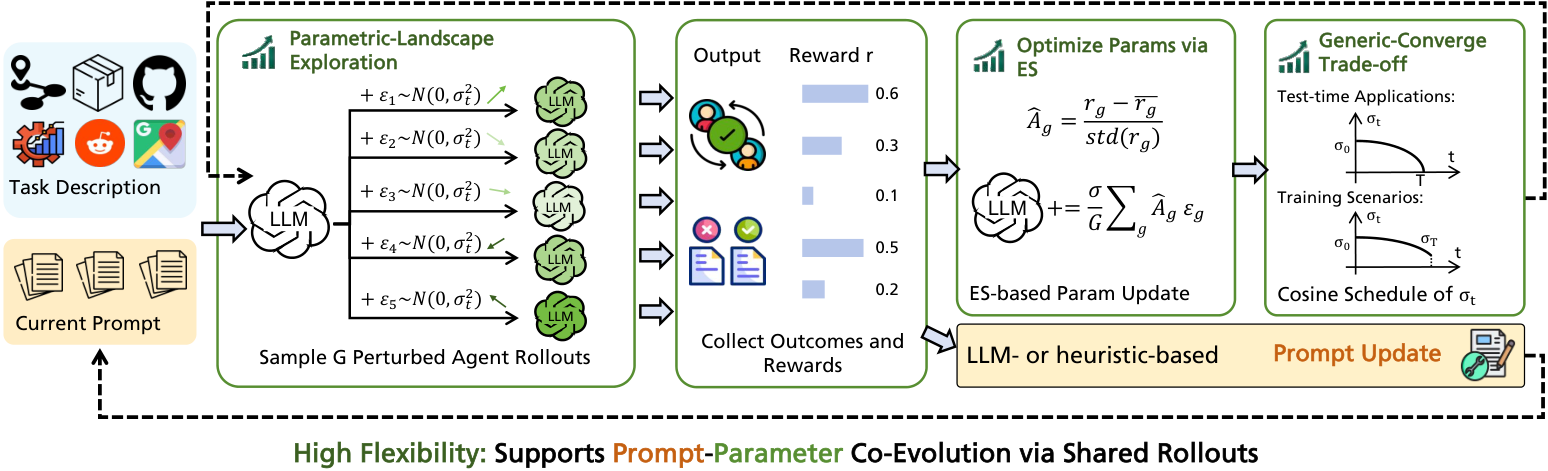
Because the interface is black-box scalar feedback, the same trajectory rewards can drive parameter updates and simultaneously feed prompt-space search — Trace2Skill (LLM skill distillation) or EoH (heuristic evolution) — enabling prompt/parameter co-evolution without re-instrumenting the outer loop.
Long-horizon variance analysis
For a single rollout under a perturbed policy, the ES estimator is \widehat{g}_{\mathrm{ES}}=(R-b)\bm{\epsilon}/\sigma, with variance \mathrm{Var}[\widehat{g}_{\mathrm{ES}}]\approx\mathrm{Var}[R]\,\mathrm{Var}[\bm{\epsilon}/\sigma] — no summation over H. The parameter-score term \bm{\epsilon}/\sigma attributes the terminal return to a single coherent policy variation rather than distributing it across H per-step log-probabilities. This predicts a widening advantage over policy gradients as effective horizon grows, which is tested in a controlled multi-turn Sudoku where the minimum successful horizon H^*\in\{5,10,15\} is set by the number of masked cells and only a terminal reward is given.
Results
Sudoku experiments on 4×H100 compare Agentic ESOpt against 8-rollout Agentic GRPO (two configurations), Agentic PPO, and vanilla agents; the relative gap over RL widens with H^*, consistent with the variance argument.
On ReAct-style tool use with Qwen3.5-4B (horizon limit 50 turns, G=16), Agentic ESOpt reports substantial gains over both the base model and matched Agentic GRPO (8 rollouts):
- Math DAPO Mean@4: 63.0 (base) → 68.8 (GRPO) → 76.8 (ESOpt); +13.8 over base.
- AIME 2026 Mean@4: 55.8 → 58.3 → 70.8; +15.0 over base, +12.5 over GRPO.
- DocVQA accuracy Mean@4: 40.3 → 48.0 → 52.5; +12.3 over base.
- ANLS Mean@4: 0.3875 → 0.4627 → 0.5043.
Averaged over the three headline metrics, ESOpt improves the base by 13.7 points versus 8.3 for GRPO. Notably, Qwen3.5-4B + ESOpt on AIME 2026 Mean@4 (70.8) approaches Qwen3.5-27B No Skill (76.7), and on Pass@4 exceeds it (96.7 vs 93.3). Composition with Trace2Skill yields the top row in every Mean@4 metric (DAPO 77.3, AIME 71.7, DocVQA 52.8). The paper claims roughly halved FLOPs relative to GRPO in this setting (Appendix C.5).
For automatic heuristic design with LLaMA-3.1-8B-Instruct at total evaluation budget T=1000, gap-ratio gains \Delta=g(b)/g(m)-1 are: on TSP N=20, ESOpt+Sample reduces gap by 22.96% vs Sample and ESOpt+EoH by 7.83% vs EoH; on TSP N=50, 18.56% and 12.5%-range reductions respectively. KP and ASP results are mixed but generally positive (e.g., ASP N=21: +5.96% vs Sample, and ESOpt+EoH raises objective from 28,465.67 to 30,887.33).
Limitations and open questions
The variance argument treats ES and PG as inducing comparable return variation, which will not hold uniformly — for very dense per-step rewards or short horizons, RL’s decomposed credit assignment should retain an advantage. ES gains from larger populations G and from stronger backbones whose neighborhoods contain more useful directions (an intuition the paper visualizes for population scaling).
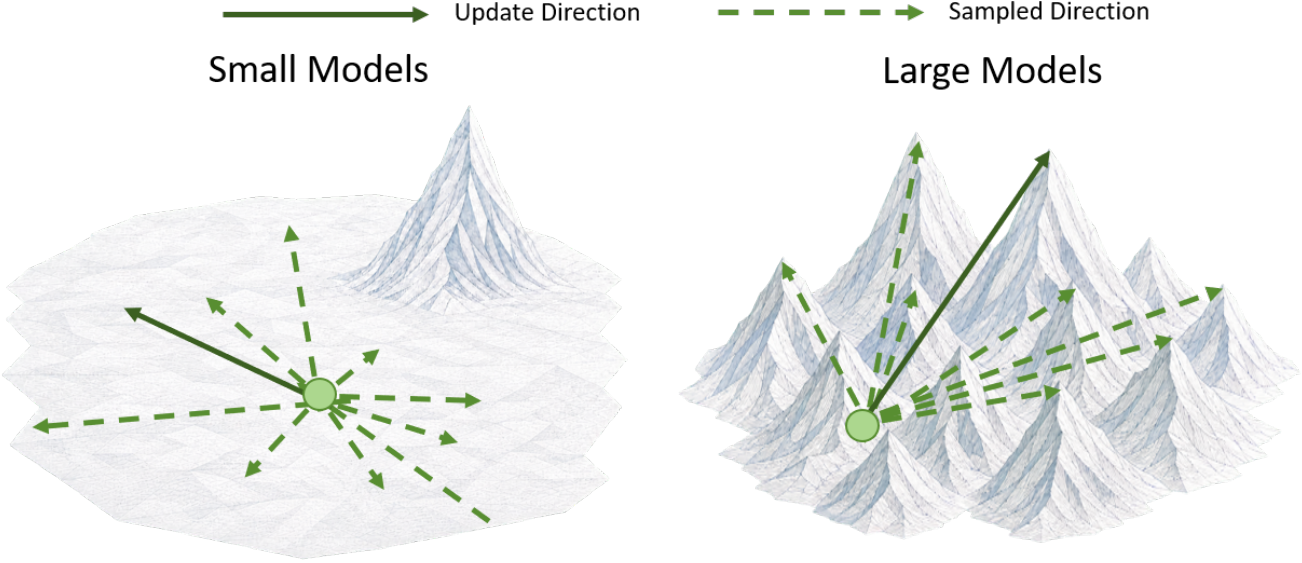
The reported experiments are limited to Qwen3.5-4B and LLaMA-3.1-8B; scaling to 27B+ backbones — the setting where ES’s inference-only memory should matter most — is not empirically demonstrated. The choice G=16 is small for high-dimensional ES; convergence guarantees and sensitivity to \sigma across tasks are not systematically ablated in the main text. Finally, ES throughput is bounded by rollout cost; for extremely long trajectories with expensive environments (browser agents), wall-clock competitiveness with RL depends heavily on rollout parallelism, and WebArena numbers are not shown in the excerpts above.
Why this matters
If the horizon-independent variance property holds in practice, ES becomes a serious alternative to policy-gradient fine-tuning for long-horizon agentic tasks precisely where RL is weakest, with a memory profile that admits full-parameter updates on inference-sized hardware. The clean black-box interface also makes parameter learning composable with prompt-space search, blurring the line between train-time fine-tuning and test-time compute.
Source: https://arxiv.org/abs/2608.17310
Abra: Scaling Diffusion Image Training
Problem
Chinchilla-style compute-optimal scaling laws are a standard tool for allocating parameters N and tokens D under a compute budget C \approx 6ND in language modeling, but the analogous prescriptions for text-to-image diffusion have been largely absent. Prior scaling studies of diffusion models either fit small models over narrow compute ranges, conflate architectural changes with scale, or evaluate on proxy losses whose relationship to sample quality is unclear. Without a controlled study, practitioners size diffusion models by intuition — typically undertraining large DiTs on relatively small captioned image corpora. Abra fills this gap with a systematic study over three orders of magnitude of compute (10^{19} to 10^{22} FLOPs), yielding compute-optimal frontiers, CFG prescriptions, and universal loss-curve shapes for flow-matching transformers.
Method
Abra is a family of flow-matching transformers trained on text-conditioned image generation. Given a data sample x_1 and noise x_0 \sim \mathcal{N}(0, I), the model learns a velocity field v_\theta(x_t, t, c) along the linear interpolant x_t = (1-t)x_0 + t x_1 by regressing to the target velocity x_1 - x_0:
\mathcal{L}(\theta) = \mathbb{E}_{t, x_0, x_1, c}\left[\|v_\theta(x_t, t, c) - (x_1 - x_0)\|^2\right].
The architecture is a standard DiT-style transformer with text conditioning; the family varies width, depth, and MLP ratio while holding aspect ratio, tokenizer, patch size, and optimizer conventions fixed so that FLOPs vary cleanly with N and image-token count D. The authors adopt the approximation C \approx 6ND where D is measured in image tokens (i.e., latent patches seen during training), and fit isoflop parabolas across (N, D) grids at each compute budget to locate the compute-optimal (N^\ast, D^\ast) frontier.
The key empirical finding of the fit is that the compute-optimal token-to-parameter ratio is
D^\ast / N^\ast \approx 200,
roughly 10\times Chinchilla’s prescription of \sim 20 tokens per parameter for LLMs. Equivalently, diffusion models at compute optimum are much smaller and trained much longer than a naive Chinchilla transplant would suggest.
Beyond the loss-based frontier, the authors demonstrate that the scaling regularity extends to:
- Generative quality metrics (FID and related image quality scores), which track the loss-based frontier — the compute-optimal model in loss is close to compute-optimal in FID.
- Optimal classifier-free guidance scale w^\ast, which varies predictably with N and D rather than requiring per-model tuning.
- Representation quality (linear probing of internal features), which improves along the same frontier.
- The shape of the training curves themselves, which under an appropriate rescaling of x-axis (compute) and y-axis (loss offset above the irreducible term) collapse onto a universal curve across model sizes.
The universal-curve claim is the strongest statement: it implies the loss L(N, D) decomposes into a scale-free trajectory plus size- and data-dependent scale factors, which is what one would expect from a Chinchilla-style law L(N, D) = E + A/N^\alpha + B/D^\beta with well-behaved exponents.
Results
- Compute range: 10^{19} to 10^{22} FLOPs, substantially exceeding prior diffusion scaling work.
- Compute-optimal ratio: \approx 200 image tokens per parameter, 10\times the LLM value.
- Overtraining robustness: Unlike LLMs, where pushing D/N far above optimum yields diminishing loss returns and can hurt downstream metrics, diffusion models continue to improve well past the compute-optimal D/N. The practical guidance is asymmetric: when in doubt, err toward more data rather than a larger model.
- Predictability of downstream quantities: FID, optimal CFG w^\ast, and probe accuracy each follow smooth scaling relations with C, enabling extrapolation of hyperparameters (including CFG) from small-scale sweeps.
- Universal training curve: loss trajectories from different (N, D) collapse onto a single shape after rescaling.
Limitations and open questions
The study fixes the tokenizer, patch size, resolution regime, and noise schedule; whether the D^\ast/N^\ast \approx 200 constant is universal across tokenizers (e.g., higher-compression VAEs, raw-pixel diffusion, or wavelet tokenizers) or across resolutions is not established. Flow matching with linear interpolants is one point in a larger design space of diffusion/consistency/rectified-flow objectives; whether the same exponents transfer is untested. The token accounting uses image tokens, which conflates repeated exposure (D during training) with unique data; the paper’s overtraining regime likely revisits images many times, so the relationship to unique-data scaling — the more relevant quantity when captioned image corpora are the bottleneck — is not fully disentangled. Finally, “robust to overtraining” is stated at the metrics measured; whether long overtraining harms rarely-measured axes (compositionality, text rendering, long-tail concepts) remains open.
Why this matters
If diffusion truly obeys a Chinchilla-like law with D^\ast/N^\ast \approx 200 and downstream metrics including CFG scale on the same frontier, then image-generation training becomes a planning problem rather than a search problem: pick a compute budget, read off N^\ast, D^\ast, and w^\ast, and train once. The 10\times gap versus LLMs also reframes the field’s default architectures — most current text-to-image DiTs are likely oversized for their data budgets.
Source: https://arxiv.org/abs/2608.17286
MathForm: Scaling Mathematical Autoformalization with Knowledge Retrieval and Verification-Guided Refinement
Problem
Autoformalization — mapping natural-language mathematics into Lean 4 (typically against Mathlib) — is bottlenecked less by surface translation than by two structural issues. First, correct formalization requires resolving informal terms against Mathlib’s typed hierarchy (definitions, instances, notations, algebraic structures), which is too large and volatile to fit reliably in a model’s parametric memory. Second, standard SFT pipelines produce data by single-pass sampling and rejection filtering: statements that fail compilation or semantic consistency are simply discarded, so the model never learns to recover from its own errors. The result is autoformalizers that are competent on competition-style targets but degrade sharply on library-heavy domains (algebra, combinatorics, foundations of algebraic geometry).
MathForm addresses both issues by (i) retrieving Mathlib context before generation and (ii) constructing multi-turn refinement trajectories driven by compiler diagnostics and semantic-consistency checks, then training an 8B model on the reconstructed trajectories.
Method
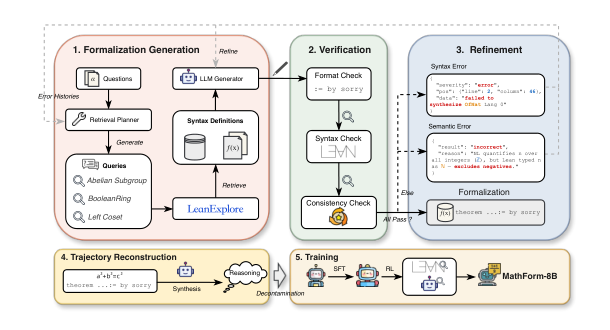
The pipeline has four stages.
1. Problem collection and normalization. Problems are aggregated from DeepTheorem, NuminaMath, AceReason-Math, Lean Workbook, Principia-Collection, DeepMath, OpenR1-Math, and classical textbooks. A normalization pass strips answer-format instructions, drops purely numerical exercises and non-theorem material, and rewrites problems into theorem-statement form.
2. Retrieval-augmented generation. A retrieval planner queries Mathlib for definitions and existing formalizations relevant to the informal problem. Retrieved snippets are injected into the prompt of the formalization generator, so type-class choices (e.g., CommRing, Module, MeasurableSpace) and canonical Mathlib idioms come from evidence rather than memory. This is the key mechanism against library drift and hallucinated lemma names.
3. Verification-guided iterative refinement. Each candidate formalization is subjected to two checks:
- Syntax/Compilation Check (SC): the Lean 4 elaborator returns diagnostics (unknown identifiers, type mismatches, universe issues).
- Consistency Check (CC): a semantic-equivalence judgment between the informal statement and the Lean statement (round-trip / back-translation style), catching cases that compile but change the mathematical claim (wrong quantifier scope, missing hypotheses, weakened conclusions).
Failed candidates are revised conditionally on the diagnostic feedback, and the loop iterates until both SC and CC pass or a budget is exhausted.
4. Trajectory reconstruction and decontamination. Successful runs are reconstructed into multi-turn training trajectories that expose the model to (informal problem, retrieved context, draft, diagnostic, revised draft, …, verified statement). Standard decontamination against the evaluation benchmarks is applied. The resulting corpus is FormalVerse, used to train MathForm-8B (with an SFT-only ablation, MathForm-8B-SFT).
Results
Evaluation is Pass@8 under both SC and the stricter CC on six benchmarks: FormalMATH-Lite, DeepSeek ProverBench, CombiBench, and the FATE-M / FATE-H / FATE-X algebra suite.
Headline macro-averages (SC / CC):
- MathForm-8B: 88.06 / 72.37
- ReForm-32B: 81.61 / 68.41
- ReForm-8B: 81.76 / 66.21
- Goedel-Formalizer-V2-32B: 78.28 / 63.74
- StepFun-Formalizer-32B: 63.65 / 44.47
- Kimina-Autoformalizer-7B: 73.20 / 34.37
MathForm-8B is best on every benchmark on SC and best on CC on five of six, matched only on ProverBench-CC (94.83 vs Goedel-V2-32B 92.53 and ReForm-32B 94.25 — MathForm still leads). Notable margins:
- FATE-X (foundations of algebraic geometry / homological algebra), CC: 37.00 vs ReForm-32B 25.00 and Goedel-V2-32B 13.00 — a +12 absolute gain over the next 32B model with a 4× smaller model.
- FATE-H, CC: 63.00 vs ReForm-32B 52.00; SC: 82.00 vs 69.00.
- FATE-M, CC: 97.33 vs ReForm-8B 91.33.
- CombiBench, CC: 47.00, competitive with ReForm-32B (55.00) and above Goedel-V2-32B (49.00).
- FormalMATH-Lite, SC: 100.00 (first model to saturate SC on this benchmark in the table).
The SFT-only variant already reaches 84.38 / 66.53 AVG, matching or beating all prior systems including 32B baselines; the full MathForm-8B adds roughly +3.7 SC and +5.8 CC over the SFT ablation, indicating that the trajectory training (beyond mere retrieval-augmented SFT) contributes a substantial fraction of the gain, particularly on the hardest FATE-H/X splits (FATE-X CC jumps 25 → 37).
The consistent CC lead is the more informative signal: SC rewards syntactic well-formedness, while CC penalizes semantically drifted statements — precisely the failure mode that retrieval + verification-guided refinement is designed to suppress.
Limitations and open questions
- Evaluation is on statement autoformalization (Pass@k with SC/CC), not end-to-end proof. Whether FormalVerse statements support downstream prover training at comparable quality is not shown here.
- The CC judge is itself a learned semantic-equivalence check; systematic false negatives/positives (especially for existential vs universal reformulations, or coercion-heavy statements) are not quantified against a human gold standard in the excerpt.
- The retrieval planner depends on a fixed Mathlib snapshot; library churn (Mathlib rename waves) is a known operational hazard not addressed.
- CombiBench CC (47.00) remains well below the algebraic FATE-M numbers, suggesting combinatorial encodings (finite sets, indicator functions, counting) are still the weakest regime.
- No ablation on retrieval-off vs refinement-off is shown in the provided sections, so the relative contribution of the two mechanisms cannot be decomposed precisely beyond the SFT/full split.
Why this matters
Autoformalization progress has been rate-limited by data pipelines that discard failures rather than learn from them, and by models that must memorize a moving library. MathForm shows that retrieval-conditioned generation plus verification-driven trajectory data lets an 8B model surpass 32B specialized autoformalizers on semantic consistency, including on FATE-X where prior systems were near-random. This is a concrete recipe for scaling formal-math data quality without scaling parameters.
Source: https://arxiv.org/abs/2608.14221
Demystifying Agent Skills: Why They Work-Until They Don’t
Problem
“Skills”—curated, structured procedural artifacts injected into LLM agents at inference—have become a common way to boost tool-using agents beyond raw prompting. But most evaluations only report aggregate task success, leaving open the mechanistic question: what does a skill actually change in a trajectory relative to giving the agent the raw prior experience (workflow memory) it was distilled from? This paper isolates that comparison and builds a taxonomy of skill-use modes grounded in trajectory-level evidence.
The design matters because workflow memory and skills are constructed from the same source trajectories. Any performance gap must therefore be attributed to representation, not to the amount of prior experience. This is the cleanest available ablation of “distillation into a skill” as an operation.
Method
The study is organized around four research questions covering representation (skill vs. workflow memory, RQ1), the role of outcome annotations (RQ2), cross-framework portability (RQ3), and retrieval from skill pools of varying size and confusability (RQ4). For each configuration, the agent is run under three arms sharing task and setting:
- Raw execution.
- Workflow-memory injection (trace-level prior experience).
- Skill injection (a distilled procedural artifact derived from the same traces).
The evidence base is 8,135 normalized trial records (7,837 with transcripts). From these, the authors sample 240 trajectories, open-code them, and retain 238 valid unique labels. These labels are consolidated into a taxonomy with three top-level Skill-use Categories (SC1–SC3) and 12 fine-grained modes:
- SC1: successful procedural anchoring (agent succeeds autonomously or via useful prior guidance).
- SC2: execution-layer and verification failures (environment setup, formatting, shell execution, runtime validation, etc.).
- SC3: invocation, applicability, and boundary failures (guidance present but misused, over-applied, ignored, or bounded out).
The main analysis unit is a paired triple: same task, same setting, three arms. They construct 528 triples across SkillsBench (144), Terminal-Bench 2.0 (186), and Terminal-Bench-Pro (198), yielding 528 \times 3 = 1{,}584 arm-level mode assignments. For each triple, an LLM judge tags each arm with a taxonomy mode and further labels the mechanism by which the injected artifact acts: procedural anchoring, knowledge injection, failure warning, no meaningful use, or counterproductive guidance.
Human validation is nontrivial: annotators verify all 238 raw labels against three supporting trajectories each (714 trajectory–label checks) and independently map labels to the 12 canonical modes. Human vs. LLM aggregation reaches 95.8% exact agreement and Cohen’s \kappa = 0.952, suggesting the taxonomy is stable beyond a single LLM judge.
Results
Aggregate success (oracle-status). Skill: 61.9%. Raw: 59.1%. Workflow memory: 55.9%. The salient comparison is skill vs. workflow memory: +6.06 points, 95% bootstrap CI [+0.76, +11.36]. Because both arms share source trajectories, this gap is a clean measurement of the representational effect of distillation.
Category shifts. Skill arms move trajectories into SC1 at 326/528, versus 294/528 for workflow memory. SC2 (execution-layer failures) drops to 124/528 for skill vs. 197/528 raw and 176/528 workflow memory—skills materially reduce setup/formatting/shell failures. However, SC3 rises to 78/528 for skill vs. only 19/528 raw: skills introduce a new failure surface where guidance is misapplied, over-generalized, or triggered outside its applicability envelope.
Mechanism labels. Among skill mechanisms, procedural_anchor = 65.7%, knowledge_injection = 4.5%. Skills rarely inject missing facts; they stabilize action selection—setup order, tool sequence, intermediate checks, pitfall avoidance. Success-mode decomposition mirrors this: skill_guided_success = 61.6% in the skill arm, workflow_guided_success = 54.5% in the workflow arm. Workflow memory retains reusable commands and debugging evidence but also carries incidental process, dead-ends, and task-specific noise; compression into a skill removes that overhead.
Baselines against “any compact procedural hint.” On 26 selected Terminal-Bench-2 tasks: an instruction-derived short plan reaches 47.7%, a workflow-derived test-first template 59.2%, workflow memory 62.3%, and skill injection 79.2%. The gap is not explained by “provide a short procedural hint”; the distilled skill format itself matters.
Limitations and open questions
- The mechanism labels come from an LLM judge; despite strong human agreement on the taxonomy, per-trajectory attribution (procedural anchor vs. knowledge injection) is not human-verified at the same scale.
- SC3 growth is under-analyzed as a design problem: skills reduce SC2 but multiply invocation/applicability errors roughly 4x over raw. Under what pool sizes, distractor structures, or verification protocols does this trade-off invert?
- The +6.06 point CI includes values near zero; the effect is real but not large in absolute terms, and benchmark composition (heavy Terminal-Bench weighting) may drive it.
- The paper documents an efficiency–effectiveness trade-off between skills and workflow memory (Appendix A.9) but does not model when a trace should remain raw vs. be distilled.
- Retrieval failures (RQ4) are separable from application failures, but the paper does not report a decomposition of end-to-end error into “wrong skill retrieved” vs. “right skill misapplied,” which is the actionable split for skill-library designers.
Why this matters
If skills work primarily as procedural anchors (65.7%) rather than knowledge carriers (4.5%), then the design target for skill libraries should be operational stability—canonical action sequences, checkpoints, pitfall lists—not encyclopedic factual coverage. It also predicts that scaling skill pools without tighter invocation gating will trade SC2 wins for SC3 losses, which is exactly the failure mode most agent frameworks currently under-instrument.
Source: https://arxiv.org/abs/2608.14036
FreeToken: Efficient Edge-Native MoE Serving with Bandwidth-Adaptive Execution
Problem
Frontier open-weight MoE models (DeepSeek-V4-Flash 284B/13B-active, Qwen3.6-35B-A3B, GLM-5.2 753B/40B-active) now ship as public checkpoints, but their weights exceed the VRAM of any consumer GPU. Existing edge serving engines (llama.cpp, Ollama, KTransformers, MoE-Infinity) fall back to fixed offloading policies that leave large gaps between measured throughput and hardware ceilings, and the gap widens on agentic workloads. The paper identifies three concrete bottlenecks:
Prefill expert transfer. Prefill routes thousands of tokens per layer, so effectively the entire expert pool must cross PCIe each turn. For an FP4 DSV4-Flash deployment this is ~140 GB per prefill, costing ~2 s on a PCIe 5.0 x16 5090, ~5 s on 4090/3090-class PCIe 4.0 x16, and 10+ s on the x8 laptop links common on mobile hardware. On-demand fetch turns this into pure GPU idle time.
Agentic re-prefill of hybrid/recurrent state. Models like DSV4-Flash and GPT-OSS interleave full and sliding-window attention; Qwen3.6-35B-A3B uses gated DeltaNet, Kimi-K3 uses Kimi Delta Attention. These recurrent layers compress the prefix into a single evolving state that cannot be partially reused, so prefix reuse depends on sparse checkpoints. Because tool calls in agentic sessions edit context on almost every turn (removing tool outputs, deleting thinking segments), any checkpoint after the edit point is invalidated and the engine re-prefills thousands of tokens on a GPU that delivers ~1/5 the BF16 throughput of an H100.
Heterogeneous, machine-specific balance between PCIe bandwidth B_P and effective CPU MoE-kernel bandwidth B_H. Table 1 shows these vary independently: the 4060 laptop has B_P=11.8, B_H=47.5 GB/s; the 5090 server has B_P=52.7, B_H=77.3; the PRO 6000 workstation has B_P=51.5, B_H=178. A fixed offload policy cannot be right on all of them.
Method
FreeToken treats the machine as one elastic pool. Non-expert weights stay resident on the GPU; the CPU holds the complete routed-expert pool as the source of truth; remaining VRAM becomes a single LRU expert cache whose slots are (layer, expert) tensor bundles.
Prefill: full-layer double buffering. Two full-layer buffers are allocated from the global slot pool. While the GPU executes routed experts of layer l, a dedicated CUDA stream streams the entire expert set of layer l+1 over PCIe. Because the transfer is the whole layer, it starts before routing for l+1 is known, keeping the interconnect saturated. Buffers swap on each layer; entries that survive prefill seed the decode cache with no phase handoff. If the slot pool can’t spare two full layers, FreeToken degrades to on-demand loading rather than oversubscribing VRAM.
Semantic-aware state cache. For recurrent layers, FreeToken maintains a small pool of state checkpoints anchored at special-token boundaries (message headers, tool-call delimiters). After a context edit, execution resumes from the nearest surviving semantic anchor and re-prefills only the new suffix; full-attention KV is managed by a radix prefix tree as in SGLang.
Decode: bandwidth-adaptive execution. Given m missed experts at a layer, FreeToken splits them between “fetch over PCIe into cache then compute on GPU” and “execute in place on the CPU,” using the closed-form optimal split
q^\star = m \cdot \frac{B_P}{B_P + B_H}
so wall time equals m/(B_P+B_H) times the per-expert byte volume. Bandwidths are measured on deployed tensor shapes, not spec sheets. In the paper’s example (m=4, 8 of 12 experts hit), one expert is fetched and three are executed on host cores; GPU and CPU partial outputs merge exactly via gate-weighted sum.
CUDA-graph-compatible LRU. The whole decode step, including device-to-host copies, a host-function node driving the CPU worker pool, the concurrent GPU MoE path, synchronization, and the host-to-device merge, is captured into a single CUDA graph per batch size. All routing-dependent control is expressed as device-resident data inside the static graph: one kernel deduplicates routed IDs, classifies hits/misses against a residency table, computes q, selects LRU victims in a single pass (identifying K candidates so the miss path just consumes the first q \le K), and rewrites logical IDs into physical slot IDs or a CPU-assignment flag. A single fused index list drives copies across all expert banks because banks share the same logical-to-slot map. The CPU workers are a persistent C++ pool pinned to physical cores, using SIMD kernels with in-kernel dequantization to stay bandwidth-bound.
Results
FreeToken’s headline claims are qualitative capacity gains: serving a 35B model on an 8 GB laptop GPU, DSV4-Flash (284B) on a single consumer desktop, and GLM-5.2 (753B, 433 GB NVFP4 checkpoint) on a single RTX PRO 6000 (96 GB). The evaluation spans four workloads: W1 AIME chain-of-thought (single-turn, decode-dominated), W2 SWE-bench through OpenCode with tool calls, W3 Claude Code with concurrent subagents growing to 56–65k tokens, and W4 a 13-turn email/calendar agent with a ~24.5k-token system-context floor. Weight formats are aligned bit-exactly across engines (BF16 Qwen3.6, native MXFP4 DSV4-Flash experts). The provided section text does not contain the throughput and TTFT tables; the setup nevertheless emphasizes that the three rented servers are capped to 6 CPU threads and NUMA-pinned so their host bandwidth (56.7–77.3 GB/s) matches the real desktop (53.8) and laptop (47.5), making the sweep representative of edge hardware rather than server surrogates.
Limitations and open questions
The double-buffer prefill needs enough slots for two full layers; on the tightest configurations (8 GB laptop serving a 35B model) FreeToken degrades to on-demand loading, and the paper does not quantify how often this occurs across the sweep. The q^\star split assumes accurate, stable measurements of B_P and B_H; contention from other host processes or thermal throttling on laptops could destabilize it. Semantic anchoring for recurrent state relies on special-token boundaries that agent harnesses happen to emit; models or scaffolds without such delimiters would see the anchor pool shrink. Finally, the excerpt does not report accuracy parity checks beyond the “must produce gold patch” gate on SWE-bench, so it is unclear whether CPU/GPU merged partials match a pure-GPU baseline to bit-exactness under FP4.
Why this matters
FreeToken reframes local MoE serving as a bandwidth-scheduling problem with a closed-form optimal split between PCIe fetch and CPU execution, rather than a choice between static offloading policies. If the throughput numbers hold, it converts open-weight frontier MoEs from datacenter artifacts into deployable local software on hardware people actually own.
Source: https://arxiv.org/abs/2608.16157
EDITBRIDGE: Towards Faithful and Efficient Ultra-High-Resolution Image Editing
Problem
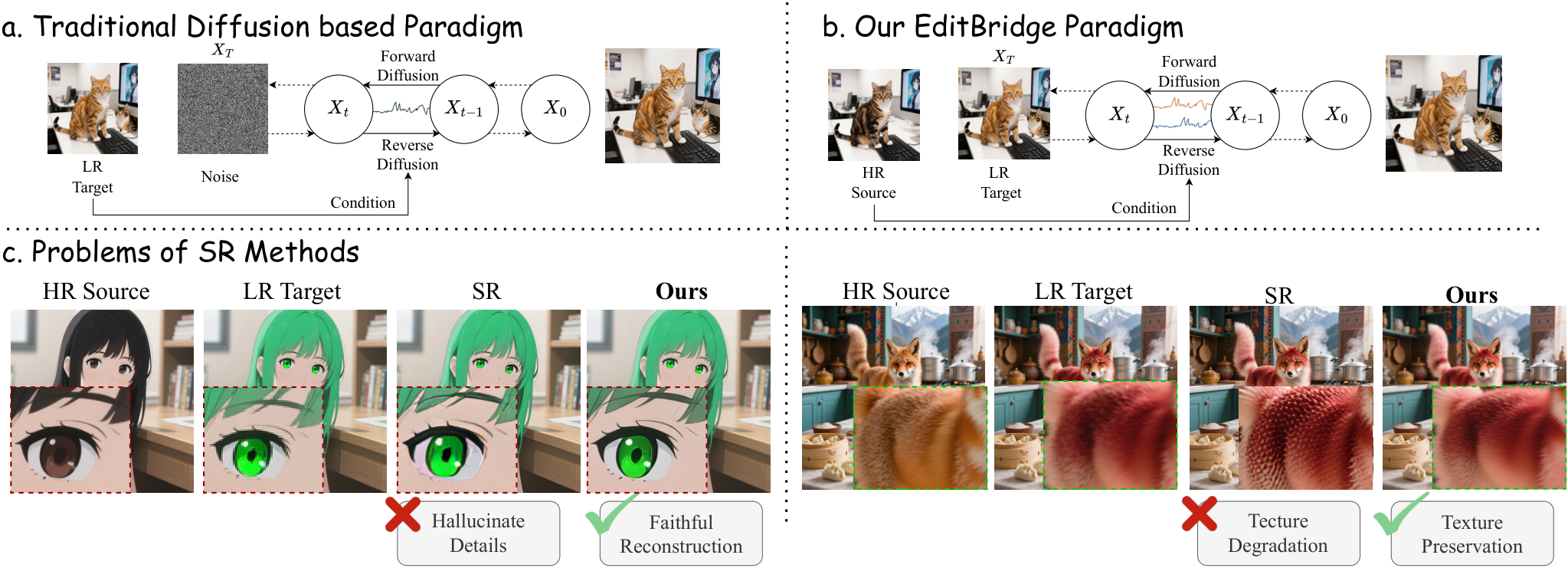
Instruction-guided diffusion editors (e.g., Qwen-Image-Edit, Nano Banana) largely cap out below 1K resolution because self-attention scales quadratically with token count and activation memory becomes prohibitive at 2K–4K. The standard workaround — edit at low resolution, then super-resolve — decouples the two stages and introduces two failure modes the paper names explicitly: (i) information divergence, where the SR stage hallucinates textures inconsistent with the untouched regions of the HR source, and (ii) texture degradation (over-smoothing or over-sharpening) because the SR model has no access to the true HR statistics of the source.
Method
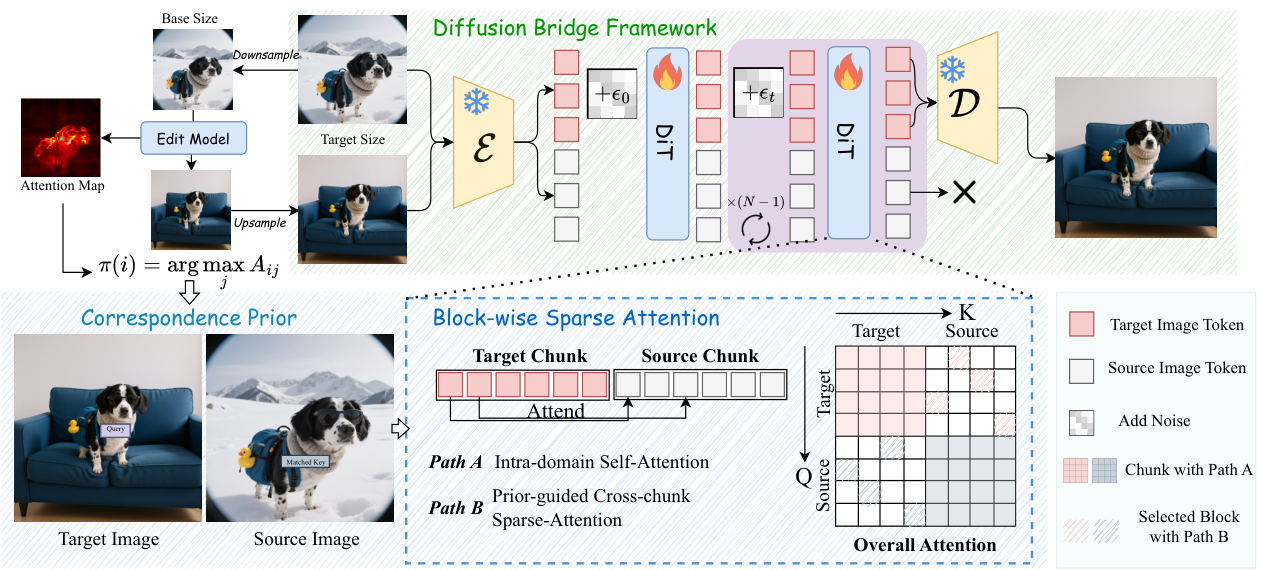
Bridge formulation for HR refinement. Instead of running an unconditional diffusion from noise at HR (Fig. 1a), EditBridge treats HR refinement as a data-to-data translation from the upsampled LR edit \tilde{x}_t^{HR} to the HR edit x_t^{HR}, conditioned on the untouched HR source x_s^{HR}. Using a Brownian bridge, intermediate states are
X_t \mid (x_0, x_1) \sim \mathcal{N}\!\left((1-t)x_0 + t x_1,\; t(1-t)I\right),
with instantaneous velocity u_t(X_t\mid x_0,x_1) = (x_1 - X_t)/(1-t). A DiT-based velocity network v_\theta(X_t, t \mid x_s^{HR}) is trained via the matching loss
\mathcal{L}(\theta) = \mathbb{E}_{x_0,x_1,t,X_t}\bigl\|v_\theta(X_t,t\mid x_s^{HR}) - u_t(X_t\mid x_0,x_1)\bigr\|^2,
with x_0 = \tilde{x}_t^{HR} and x_1 = x_t^{HR}. Because the trajectory starts from a structured endpoint rather than Gaussian noise, the generative path is shorter and the untouched HR source x_s^{HR} is available as a first-class conditioning signal — directly addressing both information divergence and texture degradation.
Prior-Guided Block-wise Sparse Attention (PG-BSA). Conditioning on x_s^{HR} naively means cross-image attention between two HR feature grids, which is O(N^2) in the number of HR tokens and infeasible at 4K. EditBridge instead uses the first-stage LR edit to compute a correspondence prior: because the LR edit and the LR source are semantically aligned outside the edited region and (approximately) in edited regions after inversion of the LR editor, one can identify, for each query block in x_t^{HR}, the small set of key blocks in x_s^{HR} it should attend to. Attention is restricted to those blocks via VMoBA-style block sparsity with FlashAttention kernels.
Implementation. The backbone is Qwen-Image-Edit adapted with LoRA (r=\alpha=128) applied to all linear layers, trained with Prodigy (lr =1.0, weight decay 0.01) on 8×H800 with batch size 1 per GPU. Training data: 5,000 pairs at 1K/2K and 1,500 at 4K, curated from Aesthetic-4k and Aesthetic-Train-V2 by center-cropping, with Gemini 3 generating edit instructions and Nano Banana Pro synthesizing the HR targets. Evaluation follows ScaleEdit: HaarPSI globally; M-PSNR, M-SSIM, M-MSE over unedited regions (fidelity of preservation); M-LPIPS over edited regions (perceptual quality of the modification).
Results
Qualitatively, at 1K EditBridge preserves high-frequency detail in unedited regions (skin pores, foliage, text) while sharpening the edited region without the halo/over-smoothing seen in decoupled edit→SR baselines.
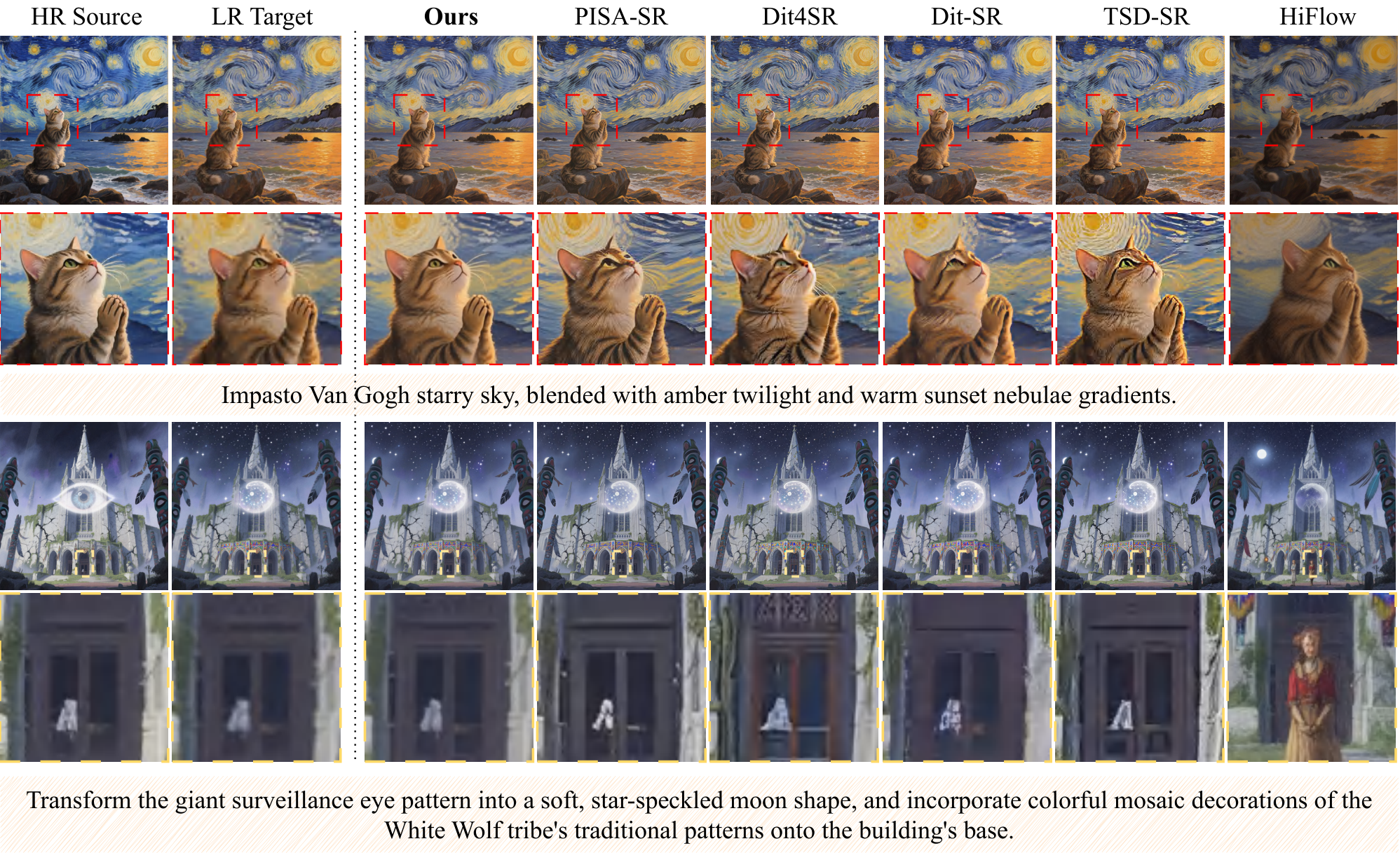
The paper’s quantitative claims center on the dual-region protocol: HaarPSI improvements over the LR-edit-then-SR baseline, higher M-PSNR/M-SSIM and lower M-MSE in unedited regions (indicating the bridge does not disturb preserved content), and lower M-LPIPS in edited regions (indicating higher perceptual quality of the modification itself). The training setup — only 6,500 pairs total, LoRA-only fine-tuning, 8×H800 — indicates the method is a lightweight adaptation of a pretrained editor rather than a full HR retraining.
Limitations and open questions
- The correspondence prior is derived from the LR editor’s semantic alignment; when the LR edit substantially rearranges geometry (e.g., large object insertions or viewpoint changes), the block-wise mask may miss the correct HR support region, and the paper does not quantify robustness to such cases.
- Dependence on synthetic HR targets from Nano Banana Pro caps the achievable ceiling at the generator’s own fidelity; systematic bias from the teacher may transfer.
- The evaluation follows ScaleEdit’s mask-based decomposition, which requires ground-truth edit masks; realistic deployments do not have them.
- Compute scaling is described qualitatively; explicit tokens-per-second or peak memory numbers at 2K/4K versus dense attention would clarify the practical envelope of PG-BSA.
- The bridge is trained on paired (\tilde{x}_t^{HR}, x_t^{HR}) where the LR editor is fixed (Qwen-Image-Edit). Whether the refinement generalizes across LR editors — or requires per-editor retraining — is unclear.
Why this matters
EditBridge reframes HR editing as conditional data-to-data translation rather than SR-after-edit, which is the right abstraction: the HR source is available, contains ground-truth texture, and should be used to constrain refinement rather than discarded. The combination of a Brownian bridge (short trajectory, structured endpoints) with prior-guided sparse cross-image attention is a plausible template for pushing pretrained sub-1K editors to 4K without full retraining.
Source: https://arxiv.org/abs/2608.18063
V-RAE: Rethinking Video Latent Spaces for Generation
Problem
Latent video generation stacks a diffusion or autoregressive model on top of a video autoencoder whose latent space is trained end-to-end for pixel reconstruction. The resulting latents are pixel-optimal but semantically flat: they encode low-level texture and motion cues at the expense of the higher-level structure that a generator actually needs to model. Prior image-side work (RAE, REPA, and related) has shown that swapping VAE latents for features from frozen vision foundation models (VFMs) yields better generative latents. V-RAE ports this insight to video, where the key extra difficulty is temporal redundancy: naively stacking DINO/SigLIP features per frame gives a latent tensor that is both too large for a diffusion transformer and temporally over-parameterized.
Method
V-RAE keeps a frozen visual representation encoder and learns only two components: a temporal pooling module that removes redundancy along the time axis, and a Transformer video decoder that maps the compressed features back to pixels.
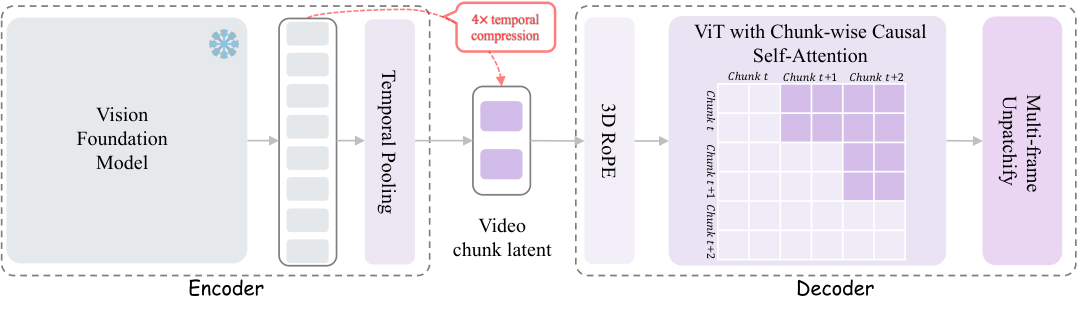
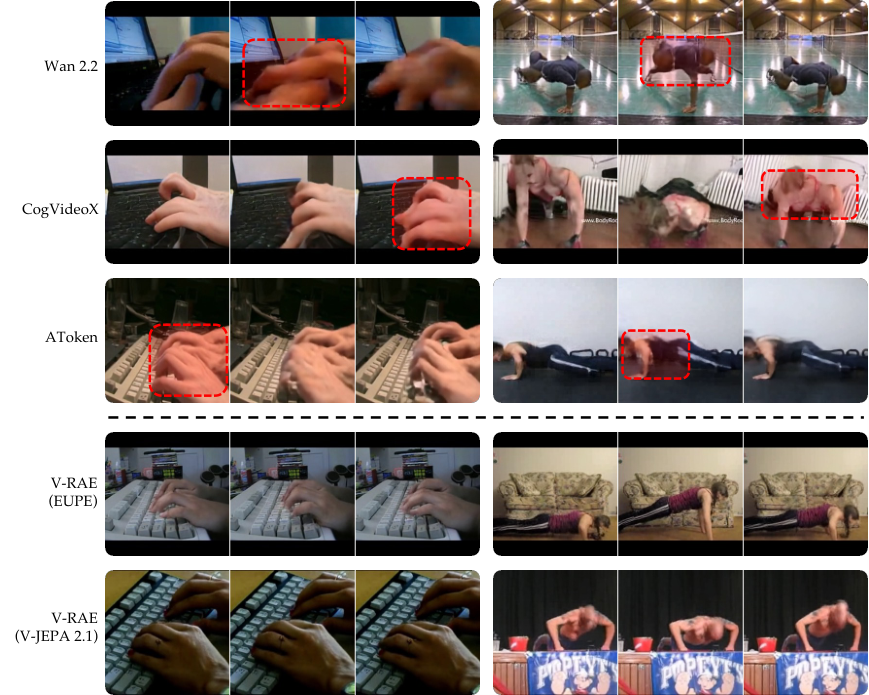
Four frozen encoders are evaluated: three image-pretrained (DINOv3-L, SigLIP2, EUPE) and one video-native (V-JEPA 2.1-L). For image encoders, each frame is embedded independently, producing a T \times H \times W \times D tensor; the temporal pooling module then compresses along T. For V-JEPA, the encoder already produces spatiotemporal tokens, and pooling operates on the same interface. The decoder is chunk-wise causal, which lets it stream longer clips at inference without recomputing global attention across the full sequence.
Only pooling and decoder parameters are trained; the frozen VFM is never fine-tuned for reconstruction. This is the central design choice: rather than deform a semantic space toward pixel fidelity, V-RAE preserves the semantic geometry and pushes reconstruction burden into the decoder. Class-conditional generation is then done by training a separate DiT on 20-frame clips (interval 3) in V-RAE latent space, following the Latte protocol.
For temporal-stability analysis, the authors introduce Temporal Reconstruction Error Difference (TRED). Let e_t(\mathbf{p}) = \tfrac{1}{C}\sum_c |x_{t,c}(\mathbf{p}) - \hat{x}_{t,c}(\mathbf{p})| be the channel-averaged error at pixel \mathbf{p}. Then
\overline{\mathrm{TRED}}_t(\mathbf{p}) = \frac{1}{T-1}\sum_{t=1}^{T-1}\left|e_{t+1}(\mathbf{p}) - e_t(\mathbf{p})\right|,
with a corresponding spatial average \overline{\mathrm{TRED}}_{\mathrm{ROI}}(t) over a high-frequency region of interest. This isolates temporal jitter in reconstruction, which rFVD alone can mask.
Results
On reconstruction, V-RAE with DINOv3-L reaches 6.12 rFVD on UCF101, second only to Wan2.1 VAE at 6.05. On K600, V-RAE with V-JEPA 2.1-L achieves 2.13 rFVD, a 40.5% relative improvement over the strongest video VAE baseline at 3.58. All four V-RAE variants beat Open-MAGVIT2, OmniTokenizer, and LARP on both datasets. The best encoder is dataset-dependent — DINOv3-L on UCF101, V-JEPA 2.1-L on K600 — suggesting that neither frame-wise semantic features nor video-native spatiotemporal features dominate universally.
Because the encoder is not tuned for pixel reconstruction, V-RAE trails the best video VAEs on LPIPS, PSNR, and SSIM despite winning on rFVD. The authors read this as evidence that distributional similarity in feature space and per-frame fidelity are genuinely distinct objectives, and that generative modeling benefits from the former.
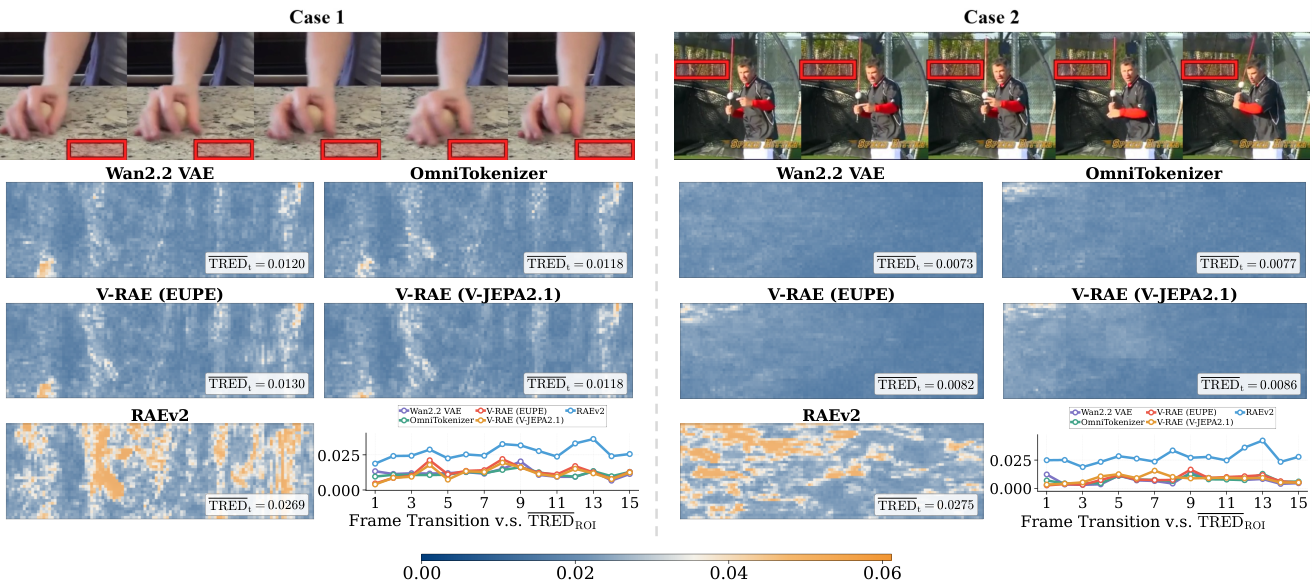
TRED confirms that V-RAE’s rFVD gains are not just global distribution matching: local temporal error stability approaches that of pixel-optimized video VAEs, and clearly beats the frame-wise RAEv2 baseline, showing the temporal pooling module produces coherent latents rather than independent per-frame codes.
For class-conditional generation with matched DiT settings, the best V-RAE variant reaches gFVD 117.86 on UCF101 and 19.16 on K600. The paper also reports substantially higher semantic-probing accuracy on UCF101, SSv2, and K400 than conventional tokenizer latents, quantifying the intuition that VFM-derived latents preserve action structure.
Limitations and open questions
The encoder is frozen, so the reconstruction ceiling is set by whatever the VFM discards — hence the LPIPS/PSNR/SSIM gap versus Wan2.x. There is no comparison to end-to-end trained VFM-plus-decoder variants, so the specific contribution of “frozen” versus “semantic-init” is unclear. The generation results use a fixed DiT and 20-frame clips; scaling behavior to longer horizons, higher resolution, and text conditioning is not addressed. The choice between image-native and video-native encoders remains empirical, with no principled criterion beyond dataset trial-and-error.
Why this matters
V-RAE is a clean demonstration that the “VAE-first” default in video generation is not obligatory: freezing a strong VFM and learning only pooling and a decoder produces latents that are simultaneously better for generation (gFVD 19.16 on K600) and more semantically probeable, at the cost of some per-pixel fidelity. It reframes the video tokenizer as a semantic-preserving compressor rather than a pixel-optimal codec.
Source: https://arxiv.org/abs/2608.13556
Hacker News Signals
AI-Generated GitHub Copilot “Autofix” Allowed Compromise of Snowflake’s Jira
Wiz Research disclosed a supply-chain attack path against Snowflake’s internal Jira instance that exploited GitHub’s Copilot Autofix feature. The core issue: Copilot Autofix generated a remediation patch for a reported vulnerability that itself introduced a secondary vulnerability — specifically, an SSRF via an unvalidated redirect introduced in the “fixed” code. An attacker who could submit a vulnerability report and trigger Autofix could therefore influence the suggested patch content, then exploit the resulting flaw before the patch was reviewed.
The CI/CD angle is what makes this structurally interesting. Snowflake’s pipeline had a configuration in which security fixes auto-merged after Autofix produced them, bypassing normal review gates. This meant the attack surface was not just “LLM produces bad code” (a known risk) but “LLM-produced code is granted elevated trust and automated deployment rights.” The attacker used the SSRF to reach internal metadata services, pivot to credentials, and eventually authenticate to the Atlassian instance.
The technical lesson is about trust transitivity. A human reviewer would have had a chance to catch the introduced flaw; an automated merge pipeline assumes the LLM output is already reviewed. The vulnerability class (LLM-assisted code introducing secondary vulns) is not new in the literature — Pearce et al. 2022 showed Copilot suggesting insecure completions at significant rates — but this is a documented exploitation of that class in production infrastructure via the Autofix workflow specifically.
Mitigations are straightforward in principle: auto-merge should require human sign-off on security-critical patches regardless of tooling provenance, and Autofix suggestions should be treated as untrusted contributor code. The broader implication is that AI-assisted remediation workflows need a distinct, more restrictive trust tier than AI-assisted development.
Source: https://www.wiz.io/blog/red-agent-snowflake-copilot-cicd-bug
GPT 5.6 Sol is the best “vision” model OpenAI ever released
Roboflow benchmarked what OpenAI internally labels “GPT 5.6 Sol” (the snapshot accessible via the API as of the post date) on a battery of computer vision tasks: object detection grounding, document OCR, structured extraction from images, and spatial reasoning. The framing “best vision model” comes from head-to-head comparisons against GPT-4o, GPT-4.5, and o3.
The benchmarks cover: (1) counting and localization tasks where the model must output bounding box coordinates or counts, (2) document understanding with dense text and tables, (3) chart/figure QA. Roboflow reports GPT 5.6 Sol outperforming prior snapshots on structured extraction accuracy and on spatial grounding tasks, with the biggest deltas on multi-object counting and chart reading. Specific numbers from the post include a ~12-point improvement on their internal chart QA set over GPT-4o and significantly better structured JSON extraction from scanned documents.
What’s mechanically different is unclear — OpenAI hasn’t published an architecture note for this snapshot. The most plausible explanations are either a better vision encoder (higher resolution patching or a ViT upgrade), improved instruction tuning on vision-language pairs, or both. The “Sol” suffix is not an official OpenAI product name; it appears to be an internal codename that leaked via the API model list.
Caveats: Roboflow’s benchmark suite is not the same as standard academic benchmarks (MMMU, MMBench, DocVQA), so generalization claims are limited. The comparison is also against older GPT-4o snapshots, not the latest. Still, the task-specific numbers on document and chart understanding are practically useful for developers building vision pipelines.
Source: https://blog.roboflow.com/openai-gpt-5-6/
Turbovec – Google’s TurboQuant for vector search in Rust
Turbovec is a Rust implementation of Google’s TurboQuant-style quantization for approximate nearest neighbor (ANN) search. The core idea behind TurboQuant (and similar asymmetric quantization schemes like ScaNN’s anisotropic quantization) is to reduce memory footprint and accelerate distance computations by quantizing database vectors to low-bit representations while keeping query vectors at full precision, then correcting for quantization error during scoring.
The repo implements product quantization (PQ) and its variants: each high-dimensional vector is split into M subspaces of dimension d/M, each subspace is independently quantized to one of k centroids (typically k = 256 for 8-bit codes), and inner-product or L2 distance is computed via lookup tables rather than full dot products. The asymmetric distance computation (ADC) maintains query-side full precision:
\hat{d}(q, x) = \sum_{m=1}^{M} \text{LUT}_m[c_m(x)]
where c_m(x) is the codebook index for subspace m of database vector x and \text{LUT}_m is precomputed per query. This reduces memory by a factor of 32/(b \cdot M) for b-bit codes relative to float32.
The Rust implementation emphasizes SIMD acceleration for the LUT accumulation step, which is the throughput bottleneck at query time. The repo is early-stage — no published recall/QPS benchmarks yet against FAISS or hnswlib — but the code structure is clean and the quantization pipeline is complete. The value proposition over the Python/C++ ecosystem is Rust’s safety guarantees and easier embedding into Rust-native inference stacks.
Open question: whether the SIMD paths are competitive with FAISS’s highly tuned AVX-512 kernels remains to be benchmarked.
Source: https://github.com/RyanCodrai/turbovec
GLM-5.3 Artificial Analysis Benchmarks
Artificial Analysis published a benchmark card for GLM-5.3, Zhipu AI’s latest model in the GLM (General Language Model) family. The evaluation covers standard LLM capability axes: MMLU, MATH, HumanEval/MBPP, reasoning benchmarks (ARC, HellaSwag), and multilingual tasks with particular attention to Chinese-language performance where GLM models historically lead.
GLM-5.3 sits in an interesting tier: the Artificial Analysis numbers place it competitive with GPT-4o-mini and Claude Haiku on English benchmarks while significantly outperforming comparable-parameter Western models on Chinese reasoning and reading comprehension. On MATH it scores in the high 70s (percentage), which is competitive but below frontier models like o3 or Gemini 2.5 Pro. Latency and throughput metrics from Artificial Analysis show it as one of the faster models in its capability tier, with time-to-first-token and output tokens-per-second favorable compared to GPT-4o-mini.
Architecturally, GLM-5.3 continues the GLM approach of using blank infilling pretraining objectives alongside causal LM, which historically helped on bidirectional understanding tasks. The model is available via Zhipu’s API, and the weights are accessible under a research license.
The benchmark page is useful because Artificial Analysis runs their evaluations under controlled API conditions (measuring latency, price, and quality on the same tasks), making cross-model comparisons more apples-to-apples than cherry-picked vendor numbers. For teams doing cost-performance optimization and considering non-OpenAI providers, GLM-5.3 represents a credible option for mixed English/Chinese workloads.
Source: https://artificialanalysis.ai/models/glm-5-3
Using the railway network as a flatbed scanner
This is a genuinely clever hack: mount a line-scan camera (a camera with a 1D sensor that captures one pixel-row per exposure) on a train, orient it perpendicular to the direction of travel, and let the train’s motion provide the scan axis. The result is a high-resolution 2D image constructed by concatenating successive 1D scanlines, with spatial resolution along the track determined by the train’s speed and camera exposure rate.
The technical challenges are non-trivial. Train speed is not constant — acceleration, braking, and track curvature all vary the ground sample distance per scanline. The author addresses this with GPS logging and post-hoc resampling: each scanline is tagged with a GPS timestamp, the instantaneous velocity is computed by differencing positions, and the image stack is resampled to produce uniform spatial sampling. The math is essentially the same as pushbroom satellite imagery correction.
Vibration is the other major issue. Railway carriages oscillate at several Hz with amplitudes that introduce pixel-level jitter perpendicular to the scan axis. The author applies inertial measurement (IMU) data and image-registration-based stabilization to suppress this. Rolling shutter artifacts, present in CMOS line sensors, are addressed by understanding the sensor’s fixed integration pattern.
The output images have a characteristic look: extremely wide aspect ratios (kilometers of track compressed into a single image), with motion-blurred objects that moved during the scan (people, cars) appearing smeared while static infrastructure (tracks, platforms, buildings) renders sharply. The project sits at the intersection of computational photography, photogrammetry, and opportunistic sensor deployment. The writeup is technically detailed with good discussion of the failure modes.
Source: https://philo.gay/linecam/
Cerebras CS-4
Cerebras announced the CS-4, the fourth generation of their wafer-scale engine (WSE) chip. The WSE architecture remains the core differentiator: rather than packaging multiple dies, Cerebras fabricates a single die at the full reticle limit of a 300mm wafer, yielding a chip with 4 trillion transistors, 900,000+ AI cores, and 44 GB of on-chip SRAM. The CS-4 claims 125 peta-ops (INT8) and 3.8 PB/s on-chip memory bandwidth.
The bandwidth number is the key metric for LLM inference. Memory bandwidth, not FLOPS, bottlenecks autoregressive generation because each token requires loading the full KV cache and model weights. At 3.8 PB/s on-chip bandwidth vs. ~3.35 TB/s for an H100 SXM, the CS-4 has roughly 1000x the bandwidth — though the comparison is against off-chip HBM, and the CS-4’s 44 GB capacity limits which models fit entirely on-chip without inter-chip communication.
For training, the wafer-scale approach eliminates NVLink/InfiniBand bottlenecks by keeping all inter-core traffic on-chip. The tradeoff is that models must be partitioned to fit the memory footprint, and the programming model (via Cerebras’s CSL compiler) diverges from standard CUDA workflows.
The CS-4 also introduces architectural changes to the interconnect fabric enabling higher sustained utilization during sparse operations, which matters for MoE models. Cerebras is positioning CS-4 for inference on large frontier models (their marketing cites 70B and 405B inference), which requires either model parallelism across multiple CS-4 nodes or weight streaming from external DRAM, both of which they support.
Open questions: actual MFU numbers at scale and real-world cost-per-token versus H100 clusters remain to be published by independent parties.
Source: https://www.cerebras.ai/cs4
Rethinking Database Programming
Acadia Engineering’s post argues that the current dominant paradigm of embedding SQL strings inside application code is a category error — not just an ergonomics problem, but a semantic mismatch that leads to structural bugs. The post distinguishes between three approaches: raw SQL interpolation (the status quo for most codebases), ORM-based query construction (ActiveRecord, SQLAlchemy), and what they call “database-native programming” where the query logic lives in typed, composable objects that map to the database’s relational algebra rather than its string syntax.
The technical argument centers on composability. SQL strings compose via string concatenation, which breaks type safety and makes partial query construction error-prone. ORMs provide object-level composition but leak SQL semantics in ways that produce N+1 queries and other footguns. The alternative proposed is a query builder that models the relational algebra directly: joins, projections, and predicates are first-class typed values, query fragments can be composed with static guarantees, and the optimizer can reason about the full query before execution.
This connects to prior work: LINQ in .NET took this approach seriously; jOOQ in Java occupies a similar niche; Rust’s Diesel enforces schema-type consistency at compile time. The post leans on examples showing how a naive ORM query generates 40+ roundtrips where a composed relational query generates one.
The post also touches on the impedance mismatch problem: application objects are trees (nested structs/objects), relational data is flat rows, and ORMs paper over this without solving it. The proposed direction is essentially moving toward something like the Haskell opaleye or beam approach: embedding a typed relational DSL in the host language.
It is a design-space survey more than a concrete proposal, but the diagnosis is technically sound.
Source: https://acadia.engineering/blog/rethinking-database-programming
Solo – a .so loader for static Linux binaries
Solo is a small Rust tool that enables statically compiled Linux binaries to load shared objects (.so files) at runtime — a capability that normally requires the dynamic linker (ld.so) to be present and operative. Static binaries lack the ELF interpreter entry (PT_INTERP segment) and the PLT/GOT machinery that the dynamic linker populates at load time, so dlopen is either absent or non-functional.
Solo addresses this by implementing a userspace ELF loader. The mechanism: at program startup, Solo (compiled in as a library or injected via a constructor attribute) sets up a minimal runtime linking environment — it parses ELF headers, handles RELA/REL relocations, resolves symbol references against the binary’s own exported symbols and against other loaded .so files, and wires up the GOT entries. This is essentially reimplementing the subset of ld-linux.so behavior needed for dlopen/dlsym/dlclose.
The use case is environments where you want a single static binary (no glibc dependency, no dynamic linker on the host) but still need to load plugins or vendor-specific .so files at runtime — common in edge computing, embedded Linux, and some containerized deployments where the base image has no lib directory.
Technical constraints: Solo cannot load .so files that themselves depend on glibc symbols that aren’t in the static binary, and TLS (thread-local storage) support is noted as limited. The implementation handles COPY relocations, IFUNC, and versioned symbols to varying degrees. The Rust implementation is ~1500 lines, which is impressively small for an ELF loader. The HN discussion is predictably deep on edge cases: dlopen in musl static builds, RTLD_GLOBAL semantics, and interaction with seccomp profiles.
Source: https://github.com/pg83/solo
Noteworthy New Repositories
Flaminis/Dalaran
A hard fork of Rerun targeting robotics-first workloads. Dalaran is an Apache-2.0 visualization and data infrastructure tool built around multimodal time-series data, with first-class ROS 2 support and backward compatibility with existing .rrd recordings. Where Rerun has evolved toward a general-purpose data visualization SDK, Dalaran pulls focus back to robotics pipelines: sensor fusion, joint state streams, camera feeds, and the message bus patterns common in ROS 2. The fork retains the underlying columnar log format and the timeline scrubbing UI that made Rerun compelling, while adding ROS 2 native bindings so you can drop it into an existing robot stack without a data-conversion layer. This is useful when you need reproducible offline playback of .rrd logs for debugging perception or control loops, or when you want to pipe live ROS 2 topics directly into a structured visual debugger. The ~968-star uptake suggests the robotics community wanted a Rerun variant that does not drift toward general BI tooling. If you are already on Rerun, migration cost is low given shared file formats.
Source: https://github.com/Flaminis/Dalaran
pis10/TraceSurface
A security research tool for discovering and validating unauthorized API access risks buried in frontend JavaScript. TraceSurface combines two complementary techniques: dynamic browser-based tracing that instruments a running page to observe network calls, XHR/fetch patterns, and JS-initiated API invocations at runtime; and static analysis of JavaScript source to extract endpoint patterns, parameter shapes, and authentication logic without executing the code. The combined approach catches APIs that are only reachable via specific UI state (dynamic) as well as endpoints referenced in bundled but currently inactive code paths (static). The use case is penetration testing and bug bounty work on SPAs where the attack surface is not documented: minified React/Vue/Angular bundles often embed dozens of internal API routes, some of which lack proper authorization checks. TraceSurface automates the enumeration step and flags candidates for manual authorization testing. Built for researchers who want to go beyond passive proxy replay (Burp, ZAP) and actively surface the full API graph from client-side code. At 163 stars it is niche but technically focused.
Source: https://github.com/pis10/TraceSurface
wie-project/kakehashi
A userspace translation layer that runs macOS binaries on Linux ARM64 without kernel modifications or hardware virtualization. The name “kakehashi” (bridge) describes the intent: shim the macOS system call interface and Mach-O loader against a Linux ARM64 kernel. The project lives in userspace, meaning it implements macOS ABI translation — Mach-O binary parsing, dyld emulation, Mach trap dispatch, Grand Central Dispatch stubs, and enough of the Objective-C runtime to bootstrap simple applications — entirely in user-level code. This is architecturally closer to Wine for macOS than to a full VM, and the ARM64 constraint matters: Apple Silicon’s AArch64 ISA matches what Linux ARM64 runs natively, so no instruction-set translation is needed, only syscall and library interface translation. The hard problems are Mach port semantics, the XNU memory model, and the sprawling set of Apple frameworks. At 420 stars it is clearly in early/experimental stage, but the technical premise is sound given ISA alignment. Useful for CI/CD environments running macOS toolchains on Linux ARM64 server hardware.
Source: https://github.com/wie-project/kakehashi
woowabros/critical-script
A Vite plugin from Woowa Brothers (Baemin) that solves a specific front-end performance problem: running TypeScript logic before the main JS bundle parses and executes. The plugin compiles designated TypeScript modules and inlines them as synchronous <script> blocks in the HTML <head>, ahead of the deferred main bundle. This enables prefetching API calls, initiating asset preloads, and establishing WebView bridge handshakes during the browser’s initial parse pass rather than after the bundle hydrates. The LCP optimization angle is concrete: if your critical render path depends on a data fetch, starting that fetch during HTML parsing rather than post-bundle-execution saves the full bundle parse and execution time from the critical path latency. The plugin handles TypeScript compilation, tree-shaking of the inlined module, and cache-busting of the injected script content. Configuration is declarative: you annotate which modules are “critical” and the plugin handles embedding. The approach is an automated form of the manual “inline critical JS” technique, integrated into the Vite build pipeline. Useful for high-traffic SPAs and hybrid WebView apps where LCP and time-to-interactive metrics are business KPIs.
Source: https://github.com/woowabros/critical-script
orbien-org/orbien
A lightweight, high-performance intranet penetration / NAT traversal tool written in Rust, targeting the ~5 MB binary footprint that makes it deployable on embedded or constrained environments. Transport layer supports TCP, QUIC, KCP, and WebSocket, giving operators protocol flexibility depending on network conditions: QUIC and KCP provide reliability-over-UDP with better performance under packet loss than TCP, while WebSocket allows traversal through HTTP proxies and firewalls that block raw TCP tunnels. Proxied protocol support covers TCP, UDP, HTTP, and HTTPS. The distribution model includes a native cross-platform desktop client (Rust, likely via Tauri or equivalent) and a server-side Web UI, reducing the operational overhead of managing tunnels compared to purely CLI-driven tools like frp. The Rust foundation provides memory safety and predictable latency without a garbage collector, relevant for tunneling workloads where tail latency and throughput stability matter. At 564 stars this is competing in a crowded space (frp, rathole, ngrok-oss), but the multi-protocol transport stack and small binary distinguish it.
Source: https://github.com/orbien-org/orbien
dulaiduwang003/Pavise-Game
A Windows gaming performance tool that reclaims CPU, I/O, and scheduling resources consumed by background processes, without injecting code into game processes. The no-injection constraint matters: anti-cheat systems (EAC, BattlEye, Vanguard) aggressively detect process injection and DLL hooking within game address spaces, so Pavise-Game operates entirely through OS-level mechanisms — Windows Job Objects, process priority classes, I/O priority APIs, CPU affinity assignments, and potentially power plan switching — applied to non-game processes rather than to the game itself. All modifications are reversible, meaning the tool tracks what it changed and restores defaults on exit or crash. The local-only execution model means no telemetry or cloud dependency. Technically the approach is well-understood: pushing background services to efficiency cores or lower priority classes reduces scheduler contention and memory bandwidth pressure that would otherwise compete with the game’s render and physics threads. The value is in automation and safe reversibility. At 308 stars it addresses a real problem for users running resource-heavy background stacks (browsers, update agents, cloud sync) alongside latency-sensitive games.
Source: https://github.com/dulaiduwang003/Pavise-Game
cristicretu/diri
A native macOS orchestrator for running multiple AI coding agents in parallel across isolated git worktrees and remote hosts. The core abstraction is a session per agent: each session gets its own worktree (so Claude Code, Codex, Cursor, Gemini agents each operate on isolated filesystem state without merge conflicts), its own shell, and optionally a remote host target via SSH. The orchestrator layer provides a unified UI for spawning, monitoring, and coordinating these sessions — viewing outputs, diffing worktree state, merging results — which addresses the practical friction of manually managing N terminal windows and N git branches when running parallel agentic coding tasks. Native macOS implementation (likely Swift/SwiftUI) means tight OS integration for process management, window handling, and file watching. The worktree-per-agent model is the key technical insight: it maps cleanly onto git’s lightweight worktree feature, giving full isolation without full repository clones. Useful for workflows where you want to run competing implementations of the same feature and evaluate the results, or parallelize independent subtasks across agents.
Source: https://github.com/cristicretu/diri
AIDevGTM/gtm-cofounder
An open-source collection of go-to-market agent skills and workflow templates aimed at developer tools and AI products. The technical substance is a structured library of agentic prompts, evaluation criteria, and workflow definitions covering GTM stages: positioning, initial user acquisition, product launch sequencing, and pricing strategy. Under MIT license and framed as skills for AI agents (Claude, GPT-4-class models) rather than static playbooks, the intent is that these components can be composed into automated GTM pipelines or used as grounded context for AI assistants advising founders. The engineering interest is limited — this is primarily prompt engineering and structured knowledge capture rather than novel infrastructure — but the artifact has practical value for technical founders who lack GTM experience and want a systematized, agent-compatible knowledge base rather than unstructured blog advice. The “sharpened by Frankl & Czakon” attribution suggests human expert curation of the underlying content. Most useful as a retrieval corpus or system-prompt ingredient for an AI assistant embedded in a founder’s workflow, rather than as standalone software.