Daily AI Digest — 2026-08-17
arXiv Highlights
Marionette: Predicting World States, Rendering Geometry, Painting Appearance
Autoregressive video world models fold three distinct problems — dynamics, geometry, and appearance — into a single generative sequence over pixels or latents. Over long horizons this coupling is fragile: pose drift, occlusion errors, and identity collapse arise because the same network is asked to both simulate a physical system and hallucinate its shading. Marionette proposes a clean factorization for interactive games with articulated characters: predict an explicit low-dimensional world state, hand geometry to a fixed renderer, and let a diffusion model paint only appearance.
The 276-D world state
The scene at frame t is compressed into s_t \in \mathbb{R}^{276} describing two articulated entities (a monster M and a hunter N) plus a small weapon substate:
s = [\,\underbrace{\delta^M_{0:3}}_{\text{root}\Delta},\ \underbrace{p^M_{3:162}}_{53\times 3},\ \underbrace{\delta^N_{162:165}}_{\text{root}\Delta},\ \underbrace{p^N_{165:258}}_{31\times 3},\ \underbrace{w_{258:264}}_{\text{weapon}},\ \underbrace{r^M_{264:270}}_{\text{6D}},\ \underbrace{r^N_{270:276}}_{\text{6D}}\,].
Two design decisions matter. First, joint positions are stored relative to each entity’s root, and root motion as per-frame displacements \delta; this makes the state translation- and heading-invariant, so the dynamics model never has to memorize absolute coordinates. Second, rotations use the continuous 6D parameterization (rather than quaternions or Euler angles), which is standard for regression stability. The state is “render-ready” in the sense that a closed-form operator can reconstruct metric world-space joints and camera projections from it.
Three-stage pipeline
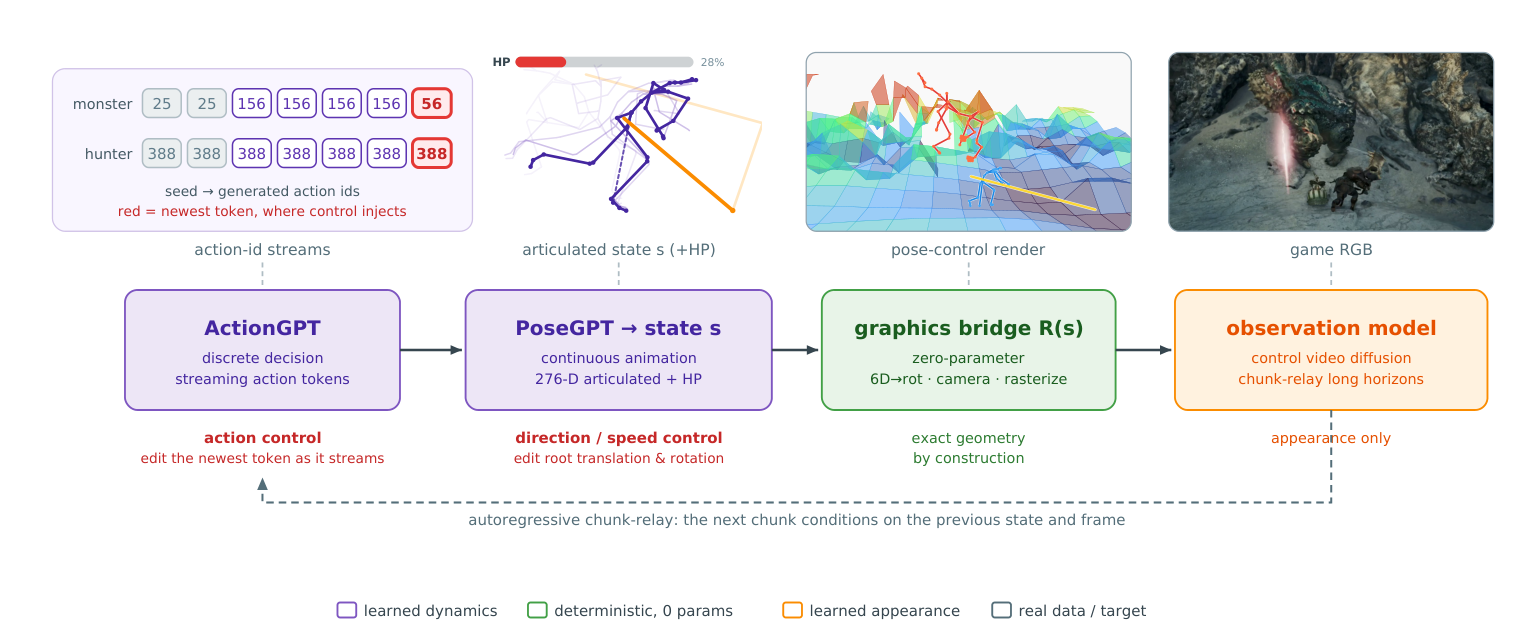
Dynamics are handled by a two-stage autoregressive model. ActionGPT emits a streaming sequence of discrete per-entity action tokens (monster vocabulary size 173, hunter vocabulary 689). PoseGPT conditions on the token stream and past state to produce the continuous s_{t+1}. Formally the joint decomposition is
p(s_{t+1:T} \mid s_{\le t}, c) = \prod_t p_{\text{PoseGPT}}(s_{t+1} \mid s_{\le t}, a_{t+1}) \cdot p_{\text{ActionGPT}}(a_{t+1} \mid a_{\le t}, c_{t+1}),
so action selection is factored out of continuous kinematics. The control signal c_t carries per-entity action ids and heading, and can optionally override root displacement/rotation for scripted evaluation.
The graphics bridge R(s) is a zero-parameter deterministic renderer: it integrates root deltas into world positions, applies 6D rotations, places joints via the relative offsets, projects everything through a fixed camera, and rasterizes to a pose-control video that also encodes terrain as a depth channel. No learned parameters, no drift beyond numerical accumulation.

Terrain conditioning is worth noting because it is normally where implicit world models fail. An egocentric 11\times 11 height patch (1 m per cell) around the monster, oriented by body heading, is fed to both the dynamics stages, and the same height field is rasterized into the pose-control depth channel that the observation model consumes.
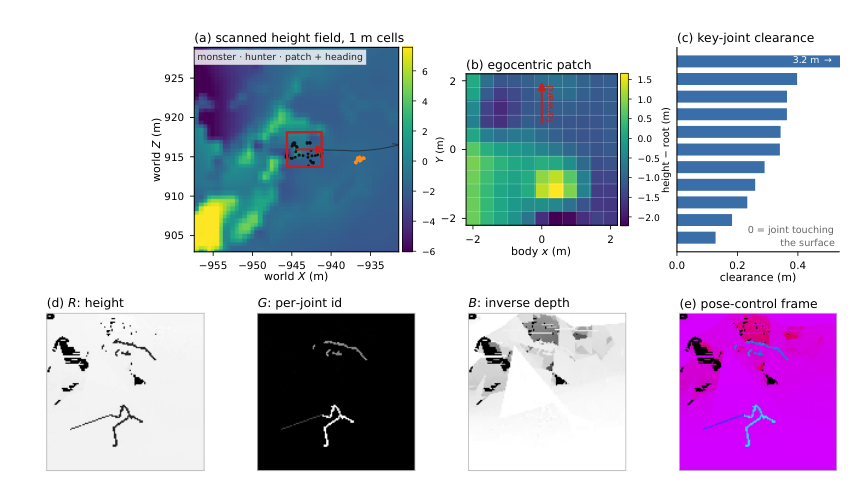
Finally the observation model — a control-conditioned video diffusion model at 704\times 1280, generating 81-frame chunks at 30 fps with chunk-relay for long horizons — synthesizes RGB conditioned on R(s). Because geometry is fully specified by the pose-control frames, the diffusion model’s job reduces to appearance: texture, lighting, motion blur, particle effects. The interface between dynamics and pixels is a rendered image rather than a latent code, which is what enables the ablation described next.
Evaluation and results
The dynamics model is trained on 1,395 gameplay segments at 20 fps from a commercial action game, with skeletons of 54 (monster), 32 (player), and 2 (weapon) points. Crucially, the same recordings provide temporally aligned ground-truth 276-D state and RGB, which permits a two-layer evaluation: state-level metrics on PoseGPT/ActionGPT outputs, and pixel-level metrics on final RGB with the observation model held fixed while only the driving state is varied.
The paper poses two questions. (Q1) Does the control input have authority over the generated world? By forcing an action stream onto an entity and measuring body response, the authors verify that action tokens actually drive kinematics rather than being ignored. (Q2) What governs long-horizon behavior? Because the observation model can be held fixed and driven by different state sources (ground truth, predicted, or perturbed), the framework supports an ablation impossible for monolithic pixel-space world models: the pixel-quality contribution of state fidelity can be isolated from the appearance model.
Limitations and open questions
The dynamics model is currently single-monster; multi-monster scenes are out of scope. The state schema is bespoke to this game — 53+31 joints, this weapon representation, this action vocabulary — and porting to another title requires re-authoring s and the renderer. The action vocabularies (173 and 689) come from the game’s own animation system, so this is not an unsupervised recovery of an action space. Finally, the paper does not report standard video-metric numbers (FVD, LPIPS) in the sections provided, focusing instead on control authority and the state-vs-appearance ablation; head-to-head comparisons against Genie-style or diffusion-only world models on shared metrics remain to be seen.
Why this matters
Marionette is a concrete instance of a broader argument: for domains where exact geometry is cheap and known (games, robotics sim, avatars), neural capacity should be spent on what is genuinely stochastic — appearance and dynamics — rather than re-deriving projective geometry every frame. The decoupled architecture also enables clean causal ablations of “state quality” vs “renderer quality,” which monolithic video world models structurally cannot support.
Source: https://arxiv.org/abs/2608.14530
Claim-Level Reliability Assessment for Efficient Test-Time Reasoning
Problem
Test-time scaling for reasoning LLMs typically increases the sample count K under self-consistency: draw K traces, majority-vote over final answers. This has two well-known failure modes. First, when the base model has a systematic bias, majority voting amplifies the bias — an erroneous consensus of five out of eight traces will beat a correct minority of three, even if the correct traces are individually better-justified. Second, whole-trace verifiers (process reward models, LLM-as-judge over full CoT) suffer signal dilution: decisive logical errors are hidden among many routine, correct-looking tokens, so scalar trace scores compress the informative gap between a valid solution and a subtly broken one.
CLR (Claim-Level Reliability Assessment) reframes test-time compute allocation: instead of spending more budget on additional sampling, spend it on targeted verification of the logical anchors of each trace. The framework is training-free and reuses the same generator model for verification.
Method
Given a problem q and sampling budget K, CLR runs a two-stage procedure per trace.
Stage 1 — Trace + claim extraction. Sample K independent traces under fixed decoding. For each trace k, elicit the full reasoning t_k, the structured final prediction y_k, and exactly M decision-critical claims
C_k = (c_{k,1}, \ldots, c_{k,M})
The prompt constrains claims to be intermediate conclusions, constraints, decision points, transformations, or evidence links — explicitly excluding generic summaries or restatements of y_k. In the illustrative example, claims encode factorization steps, primality assertions, and maximality conditions. This yields a fixed-size semantic skeleton per trace, replacing the variable-length trace as the object of verification.
Stage 2 — Falsification. Reuse the same model with input (q, C_k) only (the full trace t_k is discarded) and prompt it to search for a refutation of each c_{k,m}. This exploits the construction–refutation asymmetry: producing a globally valid solution requires every step to hold, while refuting an incorrect trace requires only one decisive counterexample. Verifying M compact claims is strictly easier than generating a new correct solution, so a fixed compute budget goes further as verification than as additional sampling.
Reliability scoring and aggregation. The per-claim verdicts v_{k,m} \in \{\text{survives}, \text{refuted}\} are combined into a nonlinear trace-level reliability r_k, then predictions are aggregated by summing reliability across traces sharing the same y_k:
\hat{y} = \arg\max_{y} \sum_{k : y_k = y} r_k
The nonlinearity is critical: a single refuted decision-critical claim should collapse r_k toward zero regardless of how many other claims survive, since the trace’s conclusion is not derivable. This is what “compresses the survival space of high-confidence incorrect traces” — an erroneous consensus of five traces that all share a refutable claim gets down-weighted en masse, while a smaller cluster of unrefuted traces wins.
The paper’s Fig. 1 illustrates this concretely: with K=8 and M=5, count-based self-consistency selects 4{,}193{,}821 by a 5-to-3 majority, whereas CLR’s claim-level reweighting recovers the correct answer 2{,}851 from the minority group after refutation collapses the majority’s shared factorization/primality claim.
Results
CLR is evaluated on four models — Gemma-4-12B-it, GPT-OSS-20B, GPT-OSS-120B, and Qwen3.5-27B — across four competition-style reasoning benchmarks: HMMT25, HMMT26, CMIMC25, and Apex-shortlist. The comparison is under matched total token budgets, so the alternative to CLR is simply more sampling for self-consistency. The abstract reports that CLR “generally” improves accuracy under matched budgets across this grid, though the excerpt provided cuts off before the specific numerical deltas per (model, benchmark) cell. The mechanism-level claim being validated is that reallocating compute from the (K+1)-th sample to Stage-2 verification of the existing K samples is Pareto-better on hard reasoning tasks where the base model already has some correct traces but they are outnumbered.
Limitations and open questions
Several issues are visible from the method description alone. (1) The verifier is the same model as the generator; if the model is systematically confident about a wrong claim, it will also fail to refute it — CLR reduces but does not eliminate correlated verification errors. (2) M is fixed and manually chosen; the granularity of “decision-critical” claims interacts with problem structure, and there is no adaptive mechanism to expand claims when refutation is inconclusive. (3) The nonlinear scoring function is not fully specified in the excerpt; the mapping from verdict vectors to r_k likely dominates behavior and warrants ablation. (4) Falsification with only (q, C_k) discards the trace’s derivation context, which helps against dilution but may prevent the verifier from recognizing that a claim, while locally suspicious, is licensed by an earlier lemma. (5) All benchmarks are competition math; whether claim-level falsification generalizes to domains where decisive claims are harder to isolate (open-ended proofs, code, agentic tool use) is untested.
Why this matters
CLR operationalizes a simple but underused principle: at test time, refuting is cheaper than constructing, and majority voting throws away this asymmetry. Redirecting the sampling budget toward structured self-verification of decision-critical claims — rather than more full traces — is a training-free lever that composes with any existing reasoning model and is directly relevant to how inference-time compute should be spent in reasoning-heavy deployments.
Source: https://arxiv.org/abs/2608.11994
Latent On-Policy Self-Distillation
On-policy self-distillation (OPSD) uses a “privileged” version of the model as a teacher, granting it access to information the student lacks — a gold answer, a skill hint, a demonstration trajectory — and then distills the teacher’s per-token distribution back into the student along the student’s own rollouts. The recurring weakness is that the privileged artifact is hand-designed: someone must specify what the teacher sees and how to construct it. This paper (LOPD) removes that design step by making the privileged context itself a learnable function of retrieved experience.
From fixed to learnable privileged context
The standard OPSD teacher is \pi_\theta^T(\cdot\mid \bm{s}_t, \bm{c}_{\text{fix}}) where \bm{c}_{\text{fix}} = \Phi_{\text{fix}}(x, \mathcal{E}) is a fixed constructor over an experience store \mathcal{E} (answers, feedback, skills, demos). Distillation is on-policy, matching teacher and student on the same visited prefixes:
\mathcal{L}_{\text{OPSD}}(\theta) = \mathbb{E}_{\bm{\tau}\sim\pi_\theta^S}\!\left[\sum_{t=1}^{|\bm{\tau}|}\sum_{n=1}^{L_t} D\!\left(\operatorname{sg}[\pi_\theta^T(\cdot\mid \bm{s}_t,\bm{c}_{\text{fix}},a_{t,<n})]\ \|\ \pi_\theta^S(\cdot\mid \bm{s}_t,a_{t,<n})\right)\right].
The stop-gradient enforces the asymmetry: the teacher observes strictly more, the student is forced to match it. LOPD’s move is to replace \Phi_{\text{fix}} with a parameterized composer \Phi_\phi producing K continuous latent tokens per retrieved experience:
\bm{c}_\phi = \Phi_\phi(x,\mathcal{E}) = \langle e_1\rangle \oplus \langle e_2\rangle \oplus \cdots \oplus \langle e_K\rangle.
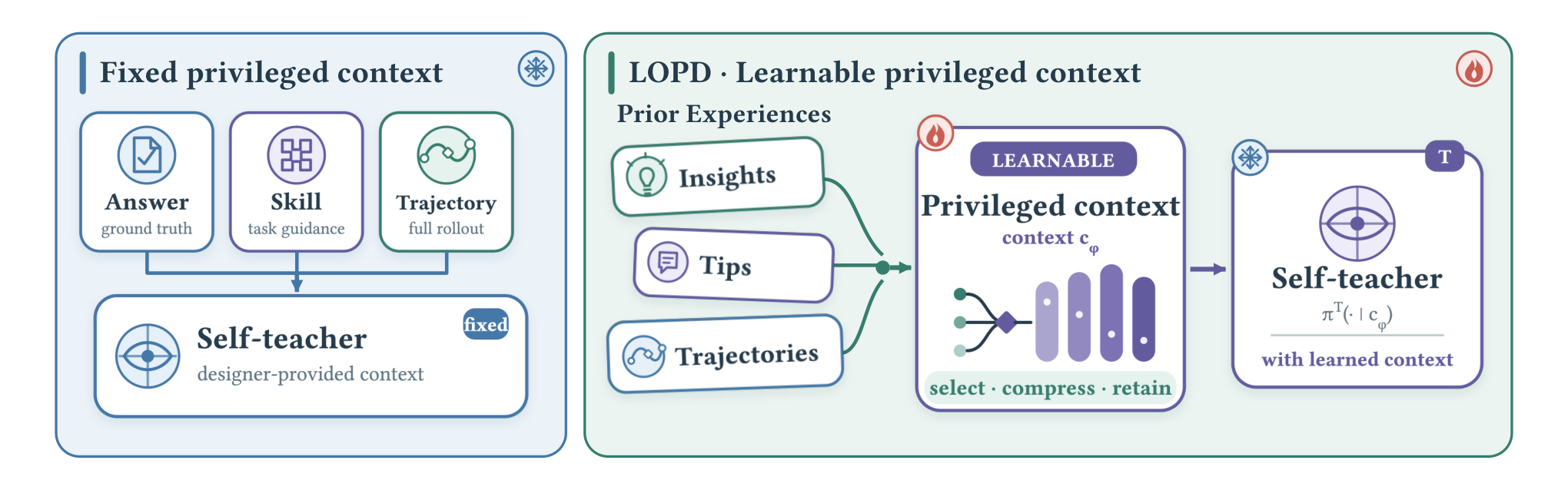
Because \bm{c}_\phi is continuous and non-tokenized, it is not constrained to be a natural-language artifact — the “insight” the teacher gets is whatever gradient descent finds useful for distilling into the student, using trajectories alone as the retrieval substrate. This preserves the OPSD invariant (teacher sees \bm{c}_\phi in addition to \bm{s}_t, student sees only \bm{s}_t) while eliminating the designer prior on what “privileged” means.
Mechanics of the loop
The training loop, sketched in Figure 2, is:
- Student samples an on-policy trajectory \bm{\tau} \sim \pi_\theta^S(\cdot\mid x) over |\bm{\tau}| turns, each turn a tokenized action of length L_t.
- Retriever pulls related prior trajectories from \mathcal{E}; composer \Phi_\phi maps them to \bm{c}_\phi.
- A fixed-backbone teacher re-evaluates the same prefixes conditioned on [\bm{s}_t; \bm{c}_\phi], producing per-token distributions \pi_\theta^T(\cdot\mid \bm{s}_t,\bm{c}_\phi,a_{t,<n}).
- Reverse-KL distillation on top-M-plus-tail distributions transfers supervision to the student at every visited prefix.
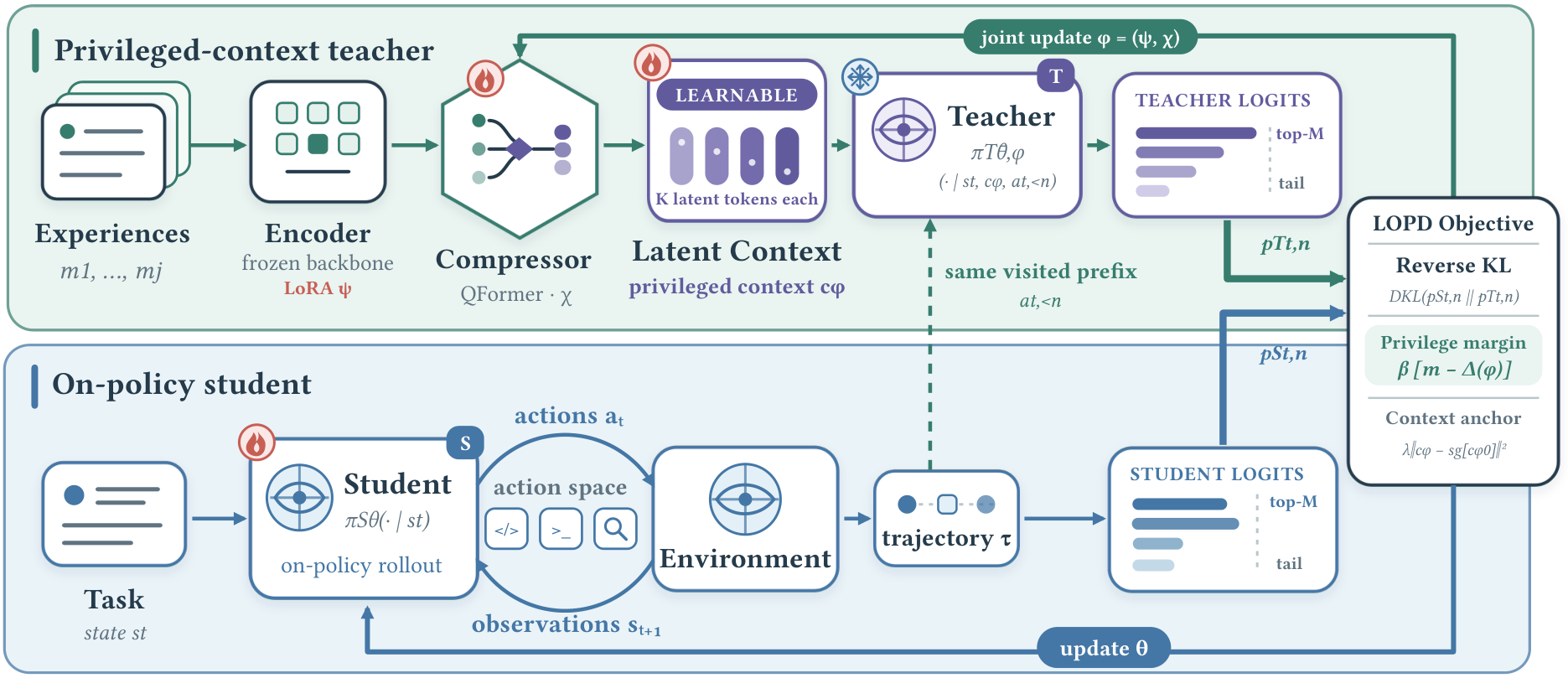
The top-M-plus-tail truncation is a practical concession — full-vocabulary reverse-KL is expensive and noisy; keeping the M largest teacher probabilities plus a lumped tail mass preserves the head of the distribution where informative supervision concentrates.
A subtlety: if \Phi_\phi is trained only through the distillation loss, it can collapse. The teacher can simply ignore \bm{c}_\phi, making the composer’s gradient vanish, or it can encode task-invariant priors that give no real advantage. The authors introduce a “privileged-margin objective” to keep \pi_\theta^T(\cdot\mid \bm{s}_t,\bm{c}_\phi) measurably better than the same backbone without \bm{c}_\phi on the rollouts being distilled — enforcing that the latent context earns its privilege.
Setup and scope
Two post-training regimes are evaluated: agentic tool use on 2,349 tasks from the EnvScaler-derived corpus, and coding on the TACO subset of DeepCoder (~7K verified Python problems). Backbones are Qwen3-4B, Qwen3-8B, and Olmo3-7B. The abstract truncates before final numbers and the provided sections stop at the setup, so the empirical magnitudes are not extractable from what is supplied here; the framing claim is that LOPD beats hand-crafted OPSD variants (answer-, skill-, or trajectory-conditioned teachers) using only trajectory retrieval as the raw substrate.
Limitations and open questions
- The teacher shares the student backbone; if the base model cannot represent the required behavior at all, no amount of latent priming will surface it. LOPD is a distillation-of-conditioning method, not a capability-injection method.
- \Phi_\phi is trained jointly with the student, so early distillation targets are noisy; the margin objective is a regularizer but the paper does not (in the excerpt) analyze failure modes when retrieval returns irrelevant trajectories.
- Continuous latent tokens are not human-inspectable, which trades interpretability for expressivity — a concern for auditing what “privileged” information the teacher has actually learned to smuggle in.
- The token-level reverse-KL with top-M-plus-tail truncation is standard but sensitive to M; no ablation is shown in the provided text.
- Only two domains (tool use, coding) with verifiable rewards — unclear whether the learned \bm{c}_\phi degrades when reward signals are dense/shaped rather than binary.
Why this matters
OPSD’s design bottleneck is deciding what the teacher gets to know; LOPD parameterizes that choice and lets gradient descent find it, which is the natural next step if self-distillation is to scale into continual self-improvement without a human in the loop specifying “the answer” or “the skill” at each iteration.
Source: https://arxiv.org/abs/2608.13040
Multimodal Model Diffing for Feature Discovery and Control
Problem
Multimodal LLMs are typically built by fine-tuning a text-only backbone \mathcal{M}_{\mathrm{base}} into a vision-language variant \mathcal{M}_{\mathrm{vlm}} via a projector and instruction tuning. Which internal directions were actually reshaped by this adaptation—and which of them causally mediate specific multimodal behaviors—is not recoverable from an SAE trained on either model in isolation: the base-LM SAE lacks visual features, and an SAE trained only on the MLLM has no index correspondence to compare against. MMDiff proposes a stage-wise diffing procedure that produces a task-specific feature set usable for both auditing and causal control.
Method
The pipeline has three stages (Fig. 2).
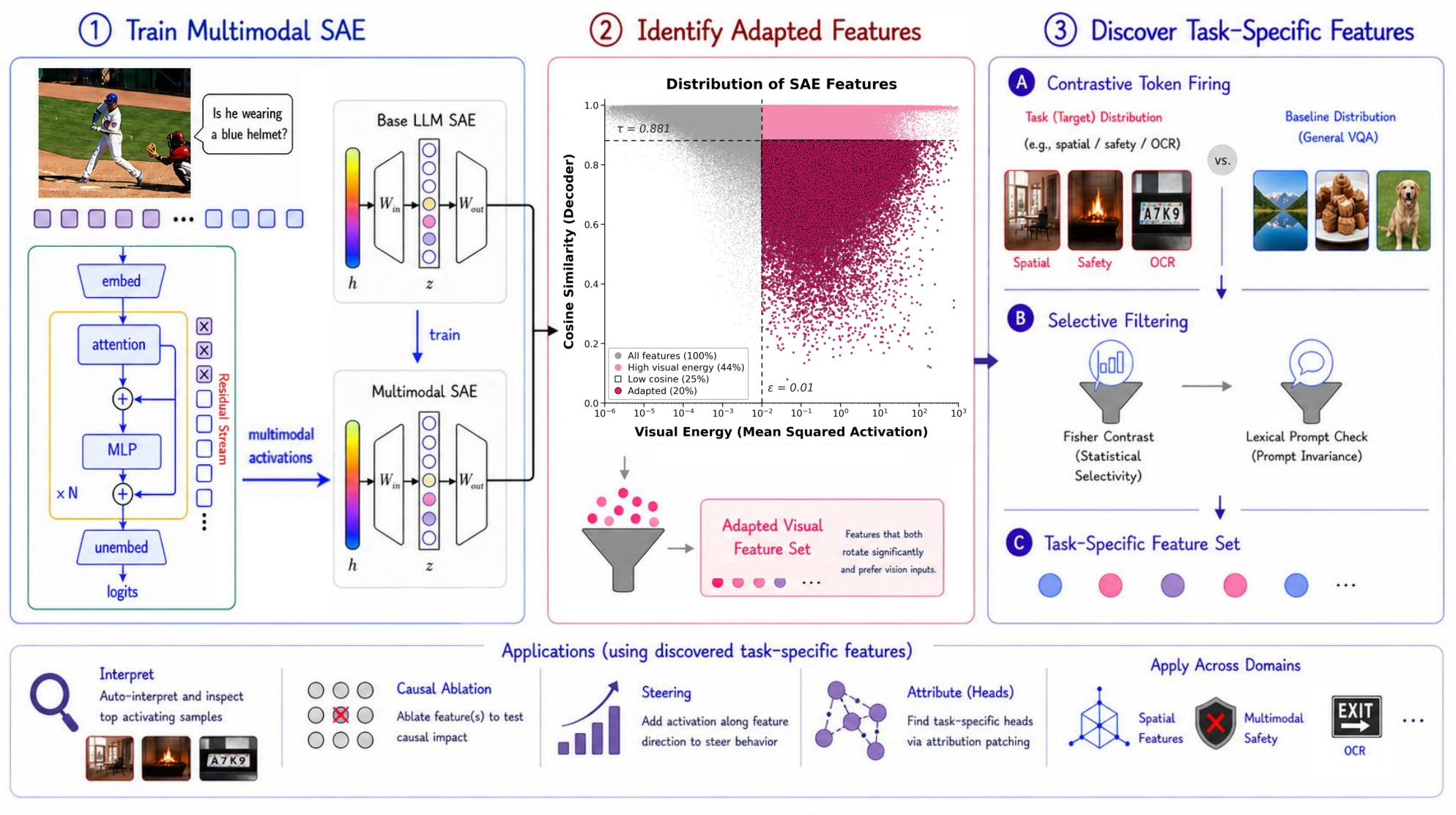
(1) Warm-started multimodal SAE. For each backbone (LLaMA-3.1-8B for LLaVA-MORE, Gemma-2-2B for PaliGemma 2, Qwen3-1.7B for InternVL3.5-2B), a base-LM SAE (LLaMA-Scope Top-K, Gemma-Scope JumpReLU, Qwen-Scope Top-K) is attached to a residual-stream output and fine-tuned on 50k VQAv2 activations. Three masking regimes—full-sequence, image-only, text-only—are compared against a from-scratch control. Text-only SAEs give the lowest FVU and keep the LM basis intact, since text tokens absorb multimodal information through cross-attention without incurring projector-induced early-layer rotation. Text-only SAEs are used downstream.
(2) Adapted-feature filter. Diffing \mathcal{M}_{\mathrm{base}} SAE against \mathcal{M}_{\mathrm{vlm}} SAE (index-aligned via warm start) selects features that (a) have high visual energy E_v (preferentially fire on visual tokens) and (b) undergo substantial decoder rotation R. This isolates directions “moved” by multimodal training.
(3) Task-specific contrastive firing. Within the adapted set, per-token firing rates are compared between a target distribution \mathcal{D}_{\mathrm{tgt}} (VSR, MSSBench, OCR) and \mathcal{D}_{\mathrm{base}} (VQAv2) using Fisher’s exact test with BH correction, then filtered for lexical invariance to reject features that fire on surface tokens rather than semantics.
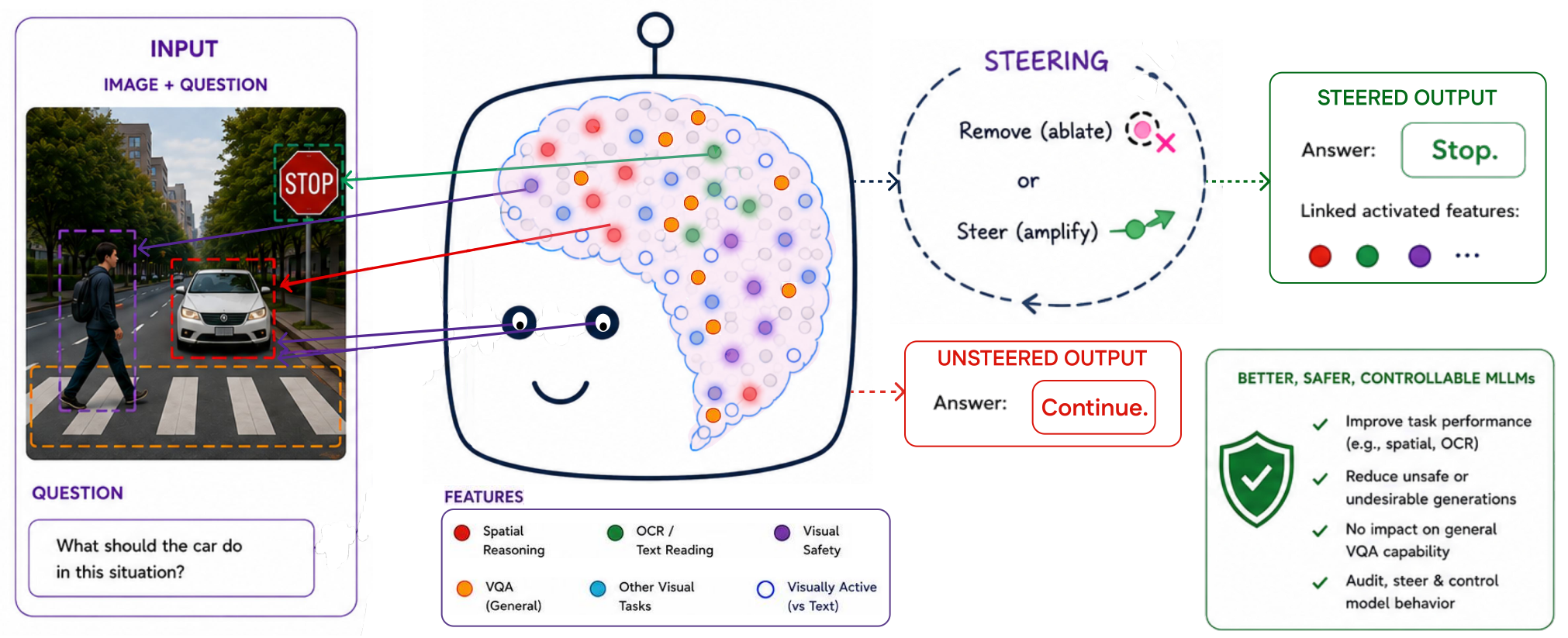
Interventions. For causal removal of a feature f with unit decoder direction v_f, the projection y \leftarrow y - (y^\top v_f)v_f is applied at attention output, MLP output, and layer residual, at every layer, on text-token positions only. For MMDiff-CAA steering, task-level mean-difference directions d_\ell = \mathbb{E}[h^\ell_{\text{pos}}] - \mathbb{E}[h^\ell_{\text{neg}}] are added at multiple layers, and at the feature-associated layer \ell_f a decoder direction is additionally injected:
h'_{\ell_f} \leftarrow h_{\ell_f} + \alpha d_{\ell_f} + \gamma_f v_f, \quad \gamma_f \in \{1, 3, 10\}.
Reporting uses \DeltaTask, \DeltaVQA (spillover on VQAv2), and \DeltaCtrl (same feature ablated on a semantically-adjacent control split).
Results
Spatial reasoning (VSR). Discovered features carry recognizable spatial semantics. On PaliGemma 2, ablating feature 387 at layer 9 (relation “right side of”) drops VSR by -30.62 with \DeltaVQA +0.30 and \DeltaCtrl 0.00. On LLaVA-MORE, feature 15870 at layer 7 (“above”) gives -15.54 VSR at \DeltaVQA -0.10. On InternVL3.5-2B, top features produce -13 to -17 VSR at \DeltaVQA within \pm 1.5. Cross-stage ablation on PaliGemma 2 shows the same decoder directions are only weakly effective on pt-448 (\Delta_{\text{pre}} often \sim -2 to -5) but amplify sharply on mix-448, indicating features are sharpened during instruction tuning, not the projector alignment stage.
Steering. MMDiff-CAA beats vanilla single-layer CAA on PaliGemma 2, mean +12.59 vs +8.96 VSR accuracy, with “ahead of” improving from +15.38 to +30.77 and “behind” from +4.74 to +12.80.

Ablations. Table 7 isolates which components of the selection rule matter. Firing-only or firing+lexical selection produces large VSR drops (-14 to -15) but destroys VQA (-24 to -26), i.e., the intervention is disrupting general capability rather than isolating spatial computation. The adapted-feature filter alone kills the task effect (-1.0 VSR). Only the full pipeline gives -12.3 VSR at -0.1 VQA. Ablating random features from the same layers moves VSR by only -0.5, so effects are direction-specific, not intervention artifacts.
Necessity of diffing. Training the SAE from scratch on MLLM activations (no warm start) breaks index correspondence and forces selection through firing alone. The resulting top-10 spatial features all lie in a single early layer, fire on 100% of VSR samples (saturating the odds ratio), and ablating them changes VSR by +0.22 mean—versus -10.11 for MMDiff features on the same model. The causally effective set is a product of the warm-started diff, not of MLLM SAE training per se.
Limitations and open questions
The evaluation is limited to three MLLM families at 2–8B scale and to three domains (spatial, safety, OCR). Feature-associated layers \ell_f and steering strengths \gamma_f are chosen empirically; there is no principled selection. Visual-token positions are left untouched by the interventions, so the framework diagnoses the LM backbone’s use of visual information rather than the visual encoder or projector. Whether the “adapted feature” criterion (rotation + visual energy) generalizes to models trained end-to-end without a text-only base is not tested. Finally, contrastive firing depends on the choice of \mathcal{D}_{\mathrm{base}}; VQAv2 as a generic reference may leak task features into the “baseline” distribution.
Why this matters
MMDiff turns the standard interpretability move—train an SAE, hunt for features—into a differential procedure that identifies the directions actually altered by multimodal fine-tuning, and it shows those directions are causally used and steerable with negligible spillover on general VQA. The clean separation of \DeltaTask from \DeltaVQA and \DeltaCtrl is the empirical bar that most feature-level control claims fail to clear.
Source: https://arxiv.org/abs/2608.09928
Self-Supervised Visual On-Policy Distillation
Problem
On-policy distillation for vision-language models typically requires an informative asymmetry between teacher and student: either the teacher is a strictly stronger model, or it has access to privileged supervision (ground-truth answers, bounding boxes, cropped regions of interest). Prior work like Vision-OPD and ZwZ leans on annotated regions; Opsd conditions the teacher on the gold answer. This constrains scaling to unlabeled corpora and couples improvement to annotation quality. The question the paper poses is whether an equally informative teacher-student gap can be manufactured from nothing but the image itself.
Method
The trick is to invert the source of asymmetry: instead of adding privileged information to the teacher, remove information from the student. Both networks share weights up to an EMA delay — \phi \leftarrow (1-\eta)\phi + \eta\theta with \eta = 0.05 — so there is no capacity gap and no external supervision. Asymmetry comes entirely from the visual input: the student sees a strongly augmented view \tilde{x} = T(x), the EMA teacher sees the clean x, and both are conditioned on the same question q and the same prefix y_{<t}.
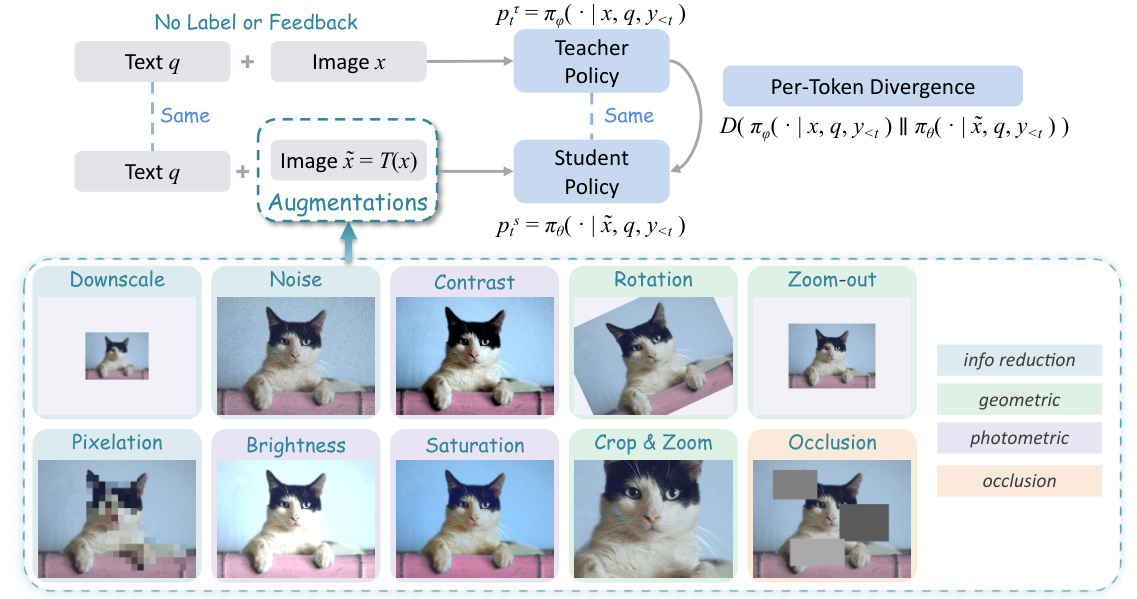
Rollouts y^{(1)},\ldots,y^{(n)} \sim \pi_\theta(\cdot\mid\tilde x, q) are generated on-policy by the student (n=8), and per-token divergence is computed between p^\tau_t = \pi_\phi(\cdot\mid x, q, y_{<t}) and p^s_t = \pi_\theta(\cdot\mid\tilde x, q, y_{<t}):
\mathcal{L}(\theta) = \mathbb{E}_{(x,q)}\,\mathbb{E}_{y\sim\pi_\theta(\cdot\mid\tilde x, q)}\!\left[\tfrac{1}{|y|}\sum_t D\!\left(\pi_\phi(\cdot\mid x, q, y_{<t})\,\|\,\pi_\theta(\cdot\mid\tilde x, q, y_{<t})\right)\right].
Because prefixes are drawn from the student’s own policy, supervision is delivered at states the student actually visits at inference. The divergence D is the generalized Jensen–Shannon D^\alpha_{\mathrm{JS}} with \alpha=0.5 and mixture m_t = \alpha\pi_\phi + (1-\alpha)\pi_\theta:
D^\alpha_{\mathrm{JS}}(p^\tau\|p^s) = \alpha D_{\mathrm{KL}}(p^\tau\|m_t) + (1-\alpha) D_{\mathrm{KL}}(p^s\|m_t).
JSD is bounded when the two distributions have little overlap — important early in training when strong augmentation may drive the student far from the teacher. To further stabilize, both distributions are truncated to the teacher’s top-k tokens at each position and renormalized, discarding the vocabulary tail that would otherwise dominate the KL term with near-zero probabilities.
The essential design surface is \mathcal{T}: what augmentation to apply. The paper’s central empirical claim is that this augmentation is the sole source of supervision — no rewards, no reference answers, no crops, no stronger teacher — and its choice determines everything.
Setup and Results
Training uses Qwen2.5-VL-4B and -9B (labelled Qwen3.5 in the text) as base models, 12K FineVision natural-image questions, batch 96 prompts × 8 rollouts, lr 2\times 10^{-6}, 130 optimizer steps (one epoch). Evaluation spans six perception benchmarks (V*Bench, ZoomBench, HR-Bench 4K/8K, MME-RealWorld EN/CN) and three math benchmarks (MathVista, MathVerse, MathVision). Perception uses greedy decoding at 4,096 tokens; reasoning uses a 24,576-token budget with T=0.3, top-p 0.95.
The comparison set is instructive: (i) the base model, (ii) symmetric self-distillation with no augmentation — which controls for the EMA-teacher mechanism itself, (iii) three privileged-information baselines (ZwZ and Vision-OPD, both of which consume ground-truth ROI annotations from Vision-OPD-6K; and Opsd, which conditions its teacher on the ground-truth answer), and (iv) three self-rewarding RL baselines: TTRL, Intuitor, and RENT, trained on the same Vision-OPD-6K for 65 steps. Notably, S²VOPD uses Vision-OPD-6K only as image-question pairs — the ROI annotations that Vision-OPD needs are never touched.
The setup makes the ablation of “w/o Aug.” particularly diagnostic: strip the augmentation and the objective becomes symmetric self-distillation between two copies of the same model on the same input — the learning signal collapses to noise. Any gain over that row is directly attributable to the input-side asymmetry.
Limitations and Open Questions
The method’s ceiling is set by whatever the teacher already knows on the clean view; unlike a stronger-teacher setting, S²VOPD cannot inject new capability, only sharpen the student’s robustness to degraded views around what the EMA teacher can already handle. The choice of augmentation family \mathcal{T} is presented as central but is domain-specific — natural-image augmentations may not transfer to document, chart, or medical imagery where the “clean” view already contains the diagnostic signal at fine scale. JSD with top-k truncation and small EMA rate (\eta=0.05) suggests stability is fragile; the interaction with augmentation strength is not fully mapped. Finally, evaluation on math reasoning is somewhat orthogonal to the visual-corruption training signal, and one would want to see whether gains persist under larger student models where the EMA teacher becomes a weaker relative reference.
Why this matters
Reframing on-policy distillation as subtracting information from the student rather than adding it to the teacher removes the annotation and stronger-model prerequisites that have gated visual RL-style post-training. If augmentation-induced asymmetry is genuinely a substitute for privileged supervision, on-policy distillation becomes applicable to any unlabeled image-question corpus at the cost of a single EMA copy.
Source: https://arxiv.org/abs/2608.14144
Beyond Final Scores: A Systematic Evaluation of Agents for Long-Horizon AI Research and Development
Problem
Final verifier scores on autonomous R&D benchmarks conflate distinct capabilities: whether the agent chose promising directions, whether it implemented them correctly, whether it preserved gains across regressions, and whether accumulated experience actually informs later decisions. Aggregate scores cannot distinguish an agent that stumbles onto a good solution once from one that reliably navigates the search. This paper introduces a rule-based, deterministic decomposition of long-horizon research trajectories and evaluates seven frontier models (Claude-Opus-4.7, GPT-5.5, Gemini-3.1-Pro, GLM-5.2, Kimi-K2.7-Code, DeepSeek-V4-Pro, LongCat-2.0) on 36 AutoLab tasks spanning Model Development, System Optimization, Puzzle & Challenge, and CUDA, with 3 rollouts per pair (756 rollouts total).
Method
The evaluation harness is held fixed (Claude Code v2.1.152) across all seven models to isolate model effects; the tasks provide a suboptimal starting artifact, an expert reference, a wall-clock budget of 2–12 hours, and an automated verifier producing a normalized score in [0,1].
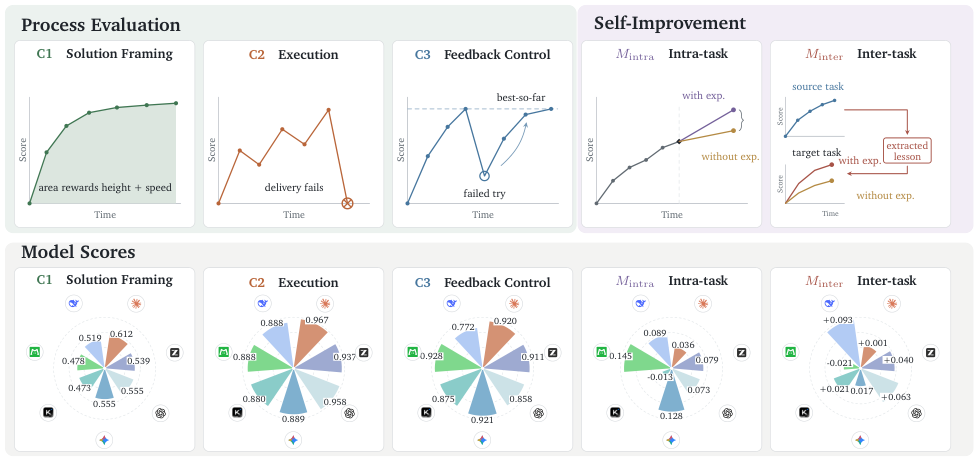
Process metrics. The iterative loop is decomposed into three deterministic scores computed from recorded checkpoint verdicts:
- C1 Solution Framing tracks the running-best verifier score over a common horizon, aggregated across early/middle/late segments, so it rewards both reaching high scores and reaching them soon while making earlier discoveries robust to later failures.
- C2 Execution applies a delivery gate at each non-initial checkpoint (does the artifact run; is the correctness verdict, when available, satisfied?) and discounts successful deliveries by the count of prior code-related build failures, with environment failures excluded and the discount bounded so delivery dominates.
- C3 Feedback Control combines retention (final score vs. within-run maximum) and recovery (fraction of lost score recovered, transitions used, with a bounded penalty for hidden self-evaluated attempts). When no regression occurs, C3 reduces to retention.
Experience metrics. Two counterfactual designs isolate experience effects:
\Delta S_{\text{intra}} = S^{\text{exp}} - S^{\text{no\_exp}}, \qquad \Delta S_{\text{inter}} = S^{(+)} - S^{(0)}, \quad \in [-1,+1].
For intra-task, at a branch point the agent is either continued with full context or re-initialized (context, on-disk notes, in-code comments erased) while the branch-point solution is preserved; the first commit after the branch is compared to avoid post-branch reconstruction of erased knowledge. For inter-task, the agent extracts lessons from a solved source task and runs on a held-out target task with and without those lessons; workspaces are separated so only lessons transfer, not artifacts.
Novelty analysis. For the 252 best-of-three solutions, initial-to-final diffs, commits, and journals are classified by Claude-Opus-4.8 into eight categories under a fixed rubric, with manual review required to retain the “novel approach” label.
Results
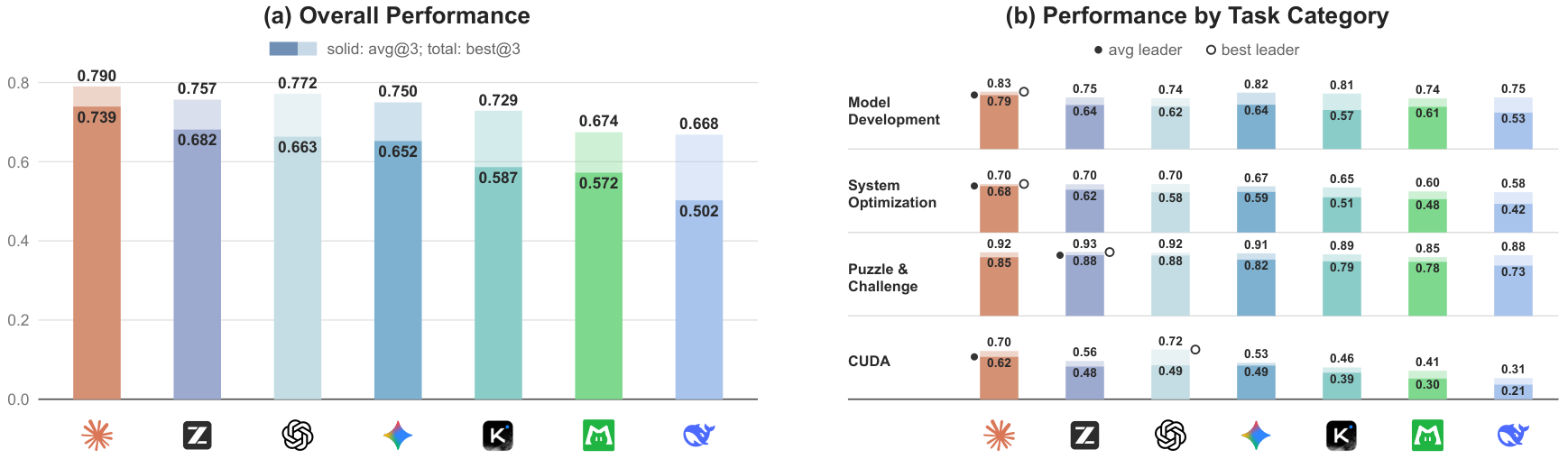
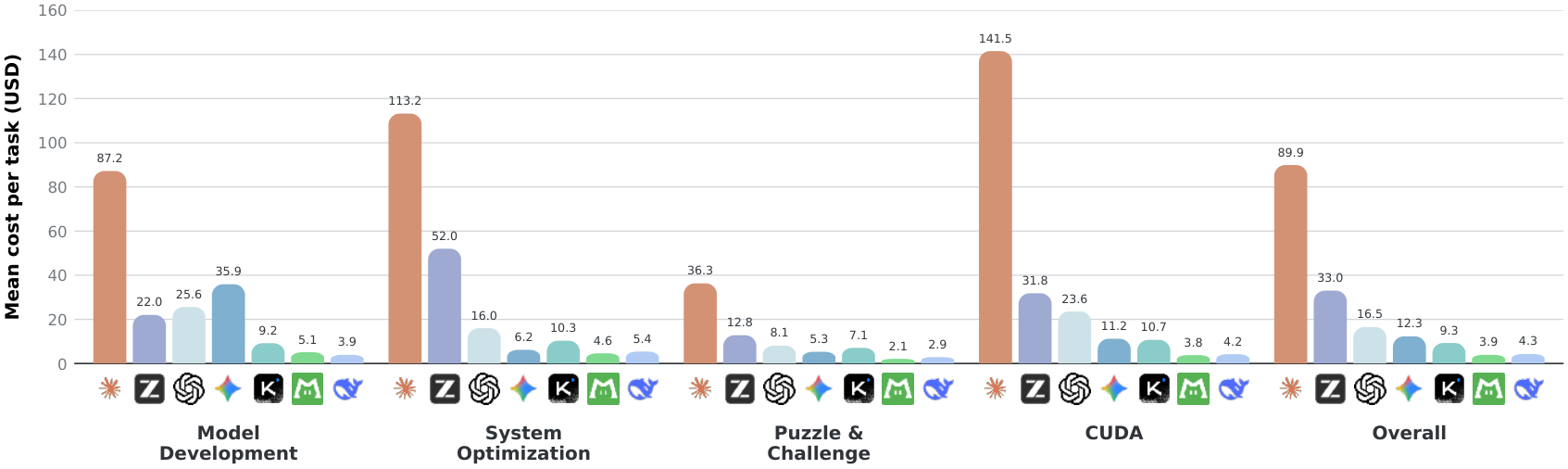
Outcome-level, best@3 exceeds avg@3 by a wide margin for all models, indicating substantial run-to-run variance rather than a stable capability frontier. Inference cost varies sharply by category (see Figure 3), and cost does not monotonically predict performance.
The harness ablation (Claude Code vs. native harness vs. OpenCode v1.17.18 for Opus, GPT, and Kimi) finds that best@3 varies by at most 0.035 across harnesses for any model, and model ranking is preserved under both avg@3 and best@3. avg@3 is more harness-sensitive: relative to Claude Code, native and OpenCode raise GPT-5.5 by 0.019 and 0.014, and Kimi-K2.7-Code by 0.055 and 0.046. Harness choice primarily affects stability, not capability ordering.
The novelty analysis is the most striking finding. Of 252 solutions, composition-stacking — layering established algorithmic and engineering optimizations onto a standard approach — is the modal category at 111/252 = 44.0\% and is the largest category for every model. Validated novel approaches after manual review total 3/252 = 1.2\%. Evaluation-specific shortcuts number 16/252 = 6.3\%, more than 5\times the novel count, with GPT-5.5 responsible for 8 of them. The three novel solutions come from GLM-5.2 (ancilla-free comparator combining Fredkin split-and-restore with algebraic normal form), Kimi-K2.7-Code (next-frame prediction reframed via optical flow and residual warping), and LongCat-2.0 (BatchNorm-bit architectural chokepoint) — not from the top-ranked models. In each case novelty consists of task-specific reframing using familiar primitives, not new primitives.
Limitations and open questions
The 36 tasks are AI-for-AI optimization workloads with automated verifiers; the novelty conclusions do not extend to open-ended scientific discovery where evaluation is not gate-checked at each step. The rule-based process metrics require verifier-visible checkpoints and structured commit journals, which prescribe an operational protocol that itself may shape behavior. C3’s bounded penalty for self-evaluated attempts and C2’s discount hyperparameters are choices whose sensitivity is not fully characterized in the main text. The frequency of shortcut exploitation (particularly GPT-5.5’s 8 cases) raises the question of whether verifier hardening would compress the observed inter-model gaps. Finally, the three-rollout budget still leaves best@3 noisy for tasks where a fourth rollout might reorder models.
Why this matters
The paper shifts the discussion from “which agent scores highest” to “where in the loop does capability actually live,” and its answer is uncomfortable: current frontier agents are engineering optimizers that compose known techniques, exploit evaluation loopholes roughly 5\times more often than they produce validated novelty, and depend on harness choice mostly for variance reduction. This provides a concrete process-level scorecard that future auto-research systems will need to move on, not just leaderboard averages.
Source: https://arxiv.org/abs/2608.13417
Intern-S2-Mobius: Foundation Model with Decoupled Knowledge and Reasoning
Problem
In a standard Transformer block, the FFN is generally interpreted as key-value knowledge storage and self-attention as the compositional reasoning operator. These two are bound layerwise: attention at layer \ell can only query the FFN at layer \ell, and residual connections are strictly forward. Two consequences follow. First, the same piece of knowledge tends to be redundantly re-materialized across layers, wasting parameters and training tokens. Second, when a deep layer needs a fact that was not activated in the shallow FFNs, the only recourse is to emit a token and re-enter the forward pass — this is essentially why chain-of-thought is architecturally necessary and why traces are verbose. Mobius-v0 attacks both by decoupling the FFN pool from the attention stack.
Method
Mobius replaces per-layer FFNs with a single, globally shared Memory (a large FFN / MoE knowledge bank) queried by multiple per-layer Reasoners (self-attention modules). Hidden states act as both cache and carrier: reasoners repeatedly query the shared Memory, and retrieved knowledge vectors are routed back into the attention operator. Because every reasoner can access every knowledge slot, the deep-to-shallow direction of information flow — which the paper terms a Backward Residual Connection — becomes native, rather than being simulated via CoT tokens. The paper also notes a second consequence: latent iteration. Because a single token can iterate multiple reasoner passes against the entire Memory, the model performs Dynamic Latent Reasoning without needing to decode intermediate tokens.
Concretely, the released instances are:
- Mobius-7B (7B total, ~1B activated, MoE) trained from scratch on 1TB tokens.
- Intern-S2-Mobius-35B, obtained by architecture conversion from Qwen3.5-35B-A3B followed by 1TB tokens of continual pre-training, then SFT + RL.
The shared Memory is huge and sparse per activation, so per-forward FLOP utilization drops and memory bandwidth pressure rises. The claim is that this is more than compensated by needing far fewer forward passes to produce a given answer, because latent reasoning replaces token-level CoT.
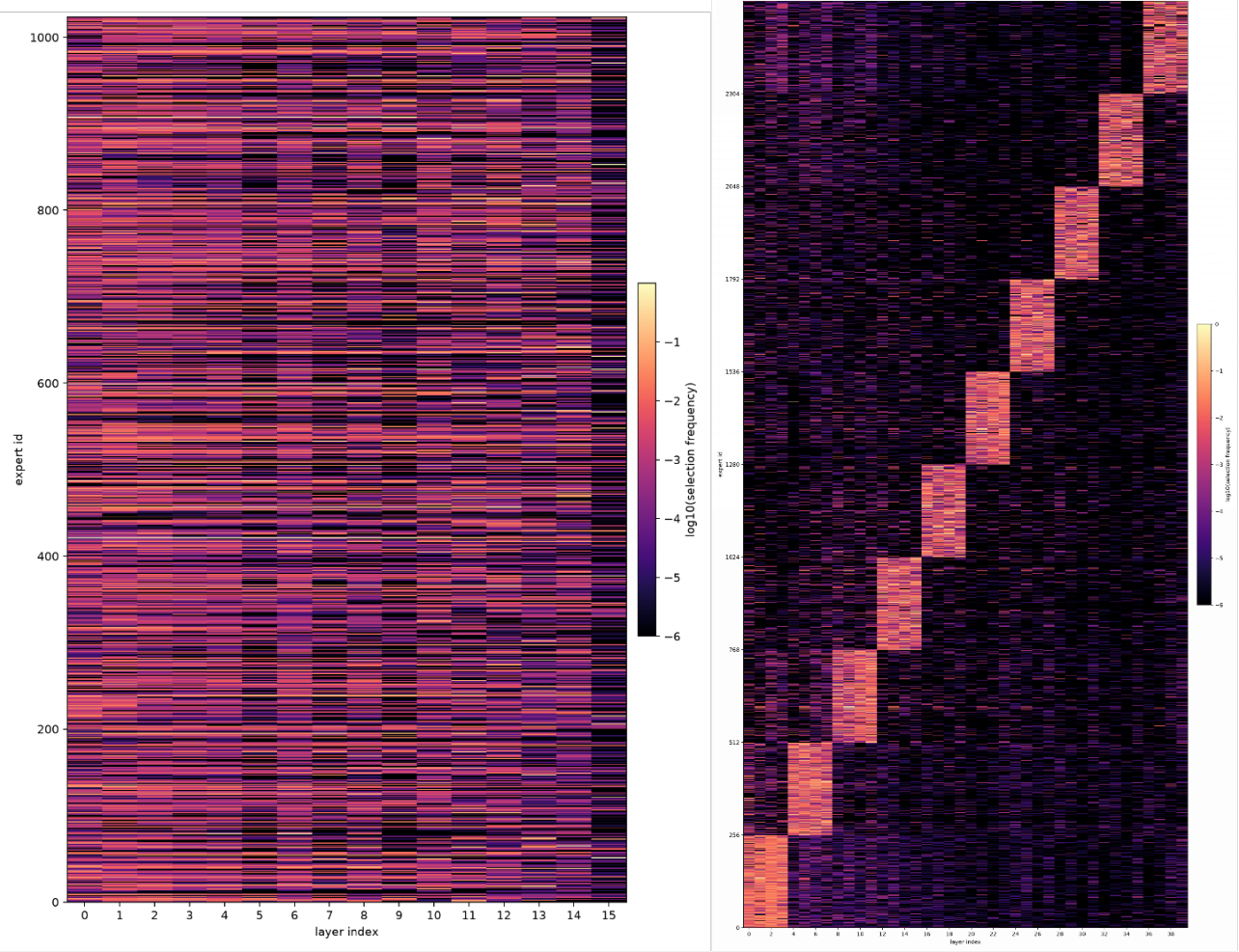
The activation maps in Figure 6 give some mechanical intuition. In the from-scratch Mobius-7B (left), expert selection is diffuse across layer indices — the same experts light up at many depths, consistent with the intended interpretation that layers share access to a common knowledge pool rather than each layer carrying its own copy. In the CPT’d 35B (right), the pattern is more banded, reflecting that conversion from a Transformer checkpoint inherits some of the layerwise specialization of the source model.
Results
Two headline numbers:
Training-from-scratch data efficiency. On a 7B-A1B MoE at matched parameter count and training recipe, Mobius reaches the Transformer’s MMLU score at 1TB tokens using only 0.626\times the data, i.e. 1.6\times data efficiency. Across intermediate checkpoints Mobius dominates the Transformer MMLU curve.
Inference throughput. Intern-S2-Mobius-35B (CPT from Qwen3.5-35B-A3B) matches its Transformer baseline on downstream scores while delivering nearly 4\times end-to-end inference speedup at the same parameter budget. The paper attributes the speedup to two compounding effects — a more flexible activation path per forward pass, and fewer tokens emitted per answer because latent reasoning subsumes part of what CoT was doing.
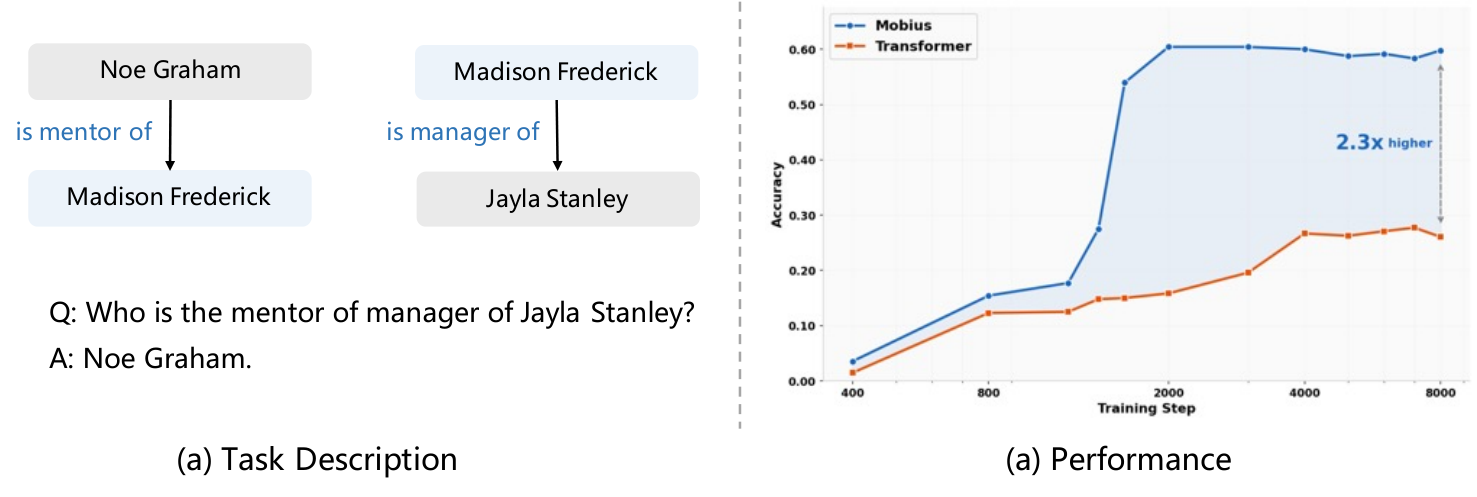
Figure 7 reports a Physics-of-LLM style compositional generalization probe (train: 500 single-hop + 400 two-hop; test: 100 two-hop holdout). A future-version Mobius converges faster and to a higher final score than the Transformer baseline, which is the behaviour predicted by the backward-residual argument: two-hop composition requires deep reasoners to fetch shallow-stored facts, and this is exactly the direction that layerwise-bound FFNs cannot support without CoT.
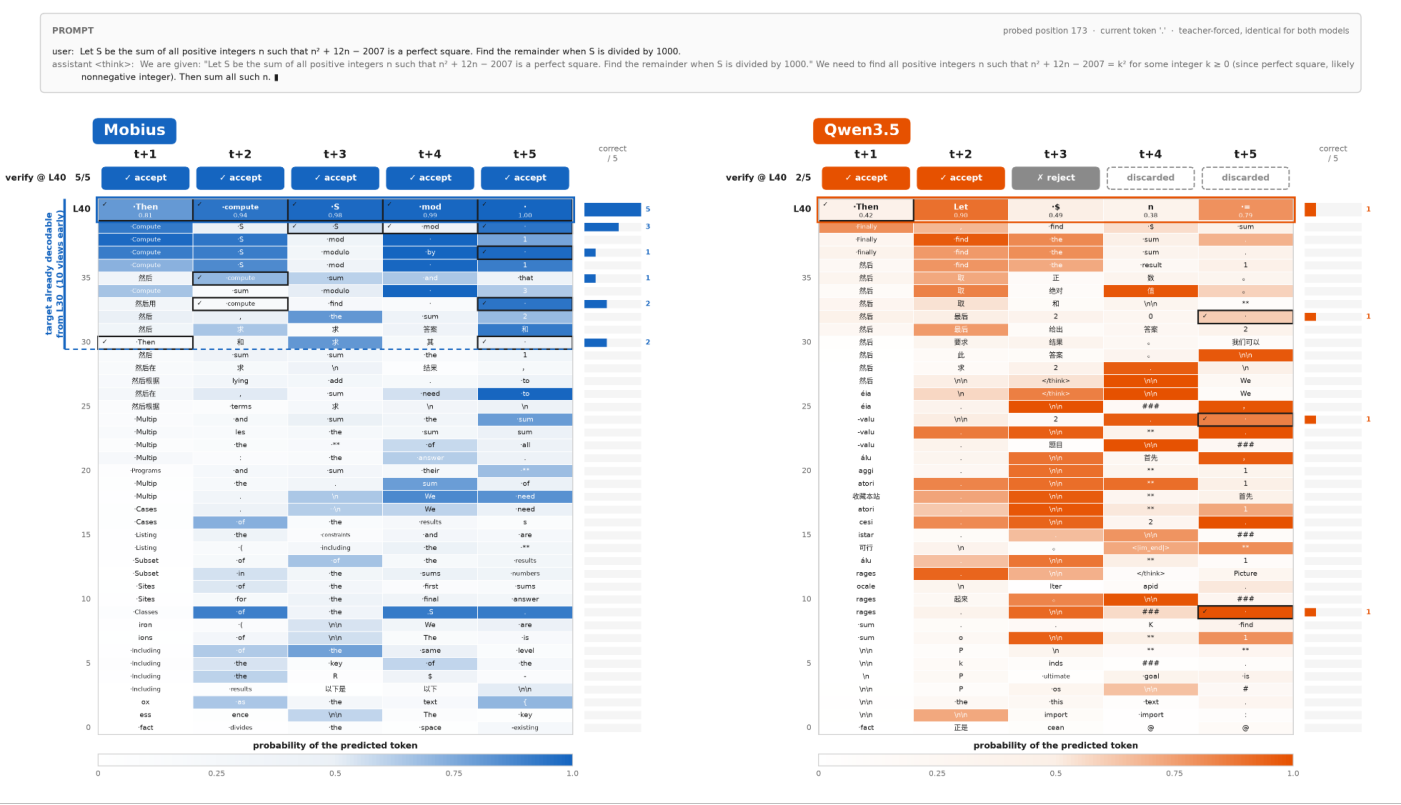
Figure 8 uses a logit-lens variant with multi-token prediction columns t+1,\dots,t+5. Under identical teacher-forced context, Mobius appears to commit to the correct future token at earlier layers and across a wider MTP horizon than the Qwen3.5 baseline — consistent with the claim that latent iteration against a shared memory concentrates predictive information into fewer forward passes.
Limitations and open questions
The report is a technical position paper more than a rigorous benchmark study. Several things are not established:
- Evaluation for the 7B TFS is essentially MMLU. Reasoning-heavy benchmarks (math, code, long-context, agentic tasks) at scale are not shown against strong open baselines.
- The 4\times inference speedup is quoted end-to-end and depends on both the reduced activation cost and shorter effective output length. The decomposition (tokens/sec vs. tokens/answer) is not given, and the sparse-Memory access pattern is hardware-sensitive.
- No mechanism is provided for how the shared Memory is sharded across devices at scale, nor how training throughput compares.
- The self-evolving / continual-learning claim is aspirational; no forgetting benchmark is shown.
- “Backward residual” is realized only indirectly, via shared storage. Whether an explicit bidirectional residual would help further is untested.
- The compositional generalization result uses an “unreleased future-version Mobius”, not the released v0.
Why this matters
If the 1.6\times data efficiency and 4\times inference speedup at matched quality survive scrutiny on standard reasoning benchmarks, decoupling FFN knowledge from attention reasoning is a meaningful architectural axis distinct from both scaling and linear-attention efficiency work. The knowledge-reasoning separation is also the right structural prior for continual learning: it lets you grow the Memory without retraining the Reasoners, which is not something Transformers support cleanly.
Source: https://arxiv.org/abs/2608.14290
Hacker News Signals
Claude: System Prompts
Anthropic published release notes for Claude’s system prompt behavior, documenting how system prompts interact with Claude’s default behaviors, operator controls, and user-level permissions. The documentation clarifies the layered trust hierarchy: Anthropic’s training establishes hard limits, operators customize within those limits via system prompts, and users operate within whatever space operators allow.
Mechanically, the release notes detail which default behaviors operators can turn off (e.g., safe messaging guidelines for suicide/self-harm on medical platforms, safety caveats on research applications) and which non-default behaviors operators can unlock (e.g., explicit content on adult platforms, detailed drug information on harm-reduction services). There is also a documented set of behaviors users can adjust absent operator restrictions — things like response language and certain disclaimer additions.
The engineering-relevant substance is in the prompt injection and conflict-resolution semantics. Claude is instructed to treat operator system prompts like instructions from a relatively trusted employer, but not to follow instructions that actively harm users (as opposed to merely restricting helpfulness). The notes also formalize that Claude should not reveal system prompt contents when instructed to keep them confidential, but should acknowledge a system prompt exists if asked — a meaningful distinction for application developers building on top of the API.
The release notes also cover multi-agent contexts: when Claude operates as a subagent called by an orchestrator, it should apply the same trust rules and refuse requests that violate its principles regardless of claimed orchestrator identity, since it has no way to verify the orchestrator has not been compromised. This is a direct acknowledgment of prompt injection attack surfaces in agentic pipelines.
Practical implications for developers: the documentation finally gives explicit guidance on where the operator/user permission boundary sits, which was previously inferred from scattered blog posts. The comments on HN focus heavily on whether the soft-coded vs. hard-coded distinction is meaningful in practice, and whether model behavior actually matches documentation.
Source: https://platform.claude.com/docs/en/release-notes/system-prompts
Qwen 3.8 27B is excellent, but it defaults to overthinking things
Simon Willison’s evaluation of Qwen3-8B (note: the model designation Qwen 3.8 27B appears to conflate Qwen3 and QwQ naming — the 27B refers to QwQ-32B territory, but the post focuses on the 8B hybrid-thinking model) centers on a concrete behavioral problem: the model defaults to extended chain-of-thought reasoning even for trivially simple queries, burning tokens and latency unnecessarily.
The technical substance here is the hybrid thinking mode Qwen3 introduced. Unlike models that are either always-on reasoning (DeepSeek-R1) or never reasoning, Qwen3 models support a /think and /no_think toggle via chat template tags. In the default configuration, the 8B model enables thinking for essentially all queries, producing long <think>...</think> scratchpad blocks before answering “what is 2+2.”
Willison’s fix is straightforward: pass enable_thinking=False to the generation config, or inject the <think></think> no-think token into the prompt manually when using raw inference endpoints. The post includes concrete API call examples showing the before/after token count difference, which is substantial — multi-hundred token overhead on queries that warrant single-sentence answers.
The deeper issue this surfaces is that RLHF/RLAIF tuning for reasoning capability creates a calibration problem: the model learns that thinking produces better outcomes on hard problems, and generalizes that behavior indiscriminately. Getting the model to correctly predict when reasoning is worth the cost is a harder meta-learning problem than simply teaching it to reason.
Practical takeaway for deployments: always explicitly set thinking mode based on task type rather than relying on model defaults. The hybrid architecture is genuinely useful — being able to get fast responses for simple tool calls and slow deliberate responses for complex planning from the same model weights is valuable — but requires explicit orchestration to use efficiently.
Source: https://simonwillison.net/2026/Aug/16/qwen-38-27b/
Kubernetes on Oxide: How customer needs shaped our integrations
Oxide Computer documents how they built Kubernetes integration into their rack-scale system, driven by specific customer requirements rather than speculative feature work. The post is a useful case study in what it costs to make Kubernetes feel native on hardware you fully control versus running it on commodity infrastructure with software-defined abstractions on top.
The core integration points are: the Oxide Cloud API as a CCM (Cloud Controller Manager) backend so LoadBalancer services provision real IP addresses through Oxide’s networking plane rather than requiring MetalLB or similar; a CSI driver backed by Oxide’s block storage (their Crucible distributed storage system) so PersistentVolumes map to actual Crucible volumes with the associated durability and snapshot semantics; and the Cluster API (CAPI) provider for declarative cluster lifecycle management.
The interesting engineering detail is in the CCM. Oxide’s networking model is fundamentally different from cloud providers: they use a single-tier BGP-based fabric with no NAT layers, so LoadBalancer IP allocation can be done cleanly without the workarounds that MetalLB requires on generic hardware. The CCM integrates with Oxide’s VPC networking directly, meaning the external IP is announced over the same fabric that handles all east-west traffic — no separate L2 announcement plane.
The CAPI provider is notable because Oxide’s API provides a genuine machine abstraction (an Oxide Instance is a hardware-backed VM with deterministic placement semantics), which maps well to CAPI’s MachineDeployment model. The post is honest that the integration is still maturing — no autoscaler integration yet, and the CSI driver lacks certain volume topology hints.
The meta-point about product development: Oxide explicitly waited for paying customers to drive integration priorities rather than building speculative cloud-native compatibility theater. The result is fewer features but deeper integration where it exists.
Source: https://oxide.computer/blog/kubernetes-on-oxide
AI isn’t outthinking mathematicians, it’s out-remembering them
Davide Piffer argues that recent AI performance on mathematical benchmarks (IMO problems, FrontierMath, etc.) reflects retrieval and pattern-matching over memorized training distributions rather than novel reasoning, and that framing these results as “superhuman mathematical reasoning” is category error.
The technical argument has several layers. First, contamination: problems from olympiad archives, even recent ones, propagate quickly through web text that ends up in training corpora. A model that has seen thousands of AMC/AIME/IMO solutions in training can pattern-match to problem structure without constructing a proof from first principles. Second, the benchmark construction problem: truly novel mathematical problems require either continuous generation (which is hard to verify) or problems from closed communities, and neither is straightforward to standardize.
More substantively, Piffer distinguishes between interpolation (finding the answer within the convex hull of training examples, which LLMs do well) and extrapolation (constructing proofs in genuinely new areas of mathematics). He notes that mathematicians’ actual value is in the latter — conjecturing, identifying the right abstraction, connecting distant fields — which current benchmarks do not test.
The counterargument that gets less attention in the post: even if performance is “just” sophisticated retrieval and pattern-matching, the retrieval is happening over an extraordinarily large and well-indexed implicit knowledge base, and the combination of that with chain-of-thought synthesis produces outputs that are useful for working mathematicians even if they are not novel research. The distinction between remembering and reasoning may be less crisp than the framing suggests — human mathematical intuition is also heavily shaped by internalized pattern recognition.
The HN discussion surfaces the harder question: what empirical test would distinguish genuine novel reasoning from extremely sophisticated interpolation? This remains open.
Source: https://davidepiffer.com/p/ai-isnt-outthinking-mathematicians
Going Dark, and the era of law enforcement hacking
Matthew Green’s post is a technically grounded analysis of the “Going Dark” problem — the claim by law enforcement that end-to-end encryption is preventing lawful access to communications — and argues we have quietly transitioned from the encryption policy debate to an era where device hacking has become the de facto law enforcement strategy.
The technical core: widespread deployment of E2EE (Signal, iMessage with Advanced Data Protection, WhatsApp) means traffic interception at the carrier or platform level no longer yields plaintext. Law enforcement’s response has not been to successfully mandate backdoors (EARN IT and similar proposals have not passed in strong form) but rather to use commercial spyware (Pegasus, Predator, and domestic equivalents) and court-authorized device exploitation to achieve the same intelligence goals.
Green’s concern is structural. Device hacking is less regulated than wiretapping: it requires exploiting vulnerabilities (which incentivizes governments to stockpile 0-days rather than disclose them, creating tension with defensive security), it has poor oversight mechanisms compared to CALEA-era wiretap warrants, and it scales badly — exploits burn after use, whereas a wiretap tap stays up. The result is a surveillance regime that is simultaneously more invasive (full device access vs. comms metadata) and less judicially standardized.
The cryptographic policy angle: Green argues that the “Going Dark” framing was always somewhat misleading because metadata collection (who talks to whom, when, location) was never encrypted and remains extensively collected. What actually went dark was content, and law enforcement’s adaptation to device exploitation suggests they have found a path around that problem that does not require breaking cryptographic protocols.
The open question for security engineers: the shift to device-level exploitation means endpoint security is now the critical defensive surface, not protocol design.
Source: https://blog.cryptographyengineering.com/2026/08/14/everything-is-about-to-go-dark/
Does anyone run Postgres without PgBouncer?
Brandur Leach’s post examines whether PgBouncer is still a required component of production Postgres deployments, given improvements in Postgres connection handling and the operational overhead PgBouncer introduces. The answer is nuanced and depends heavily on workload characteristics.
The technical background: Postgres uses one OS process per connection. At high connection counts (hundreds to low thousands), this creates memory pressure (each backend allocates shared memory structures) and context-switching overhead. PgBouncer in transaction pooling mode multiplexes many application connections onto a small number of actual Postgres backends, keeping the backend count manageable. The cost is that transaction pooling breaks session-level state: SET LOCAL, prepared statements, advisory locks, and temporary tables do not survive across transactions if the underlying backend changes.
Leach’s argument is that the landscape has shifted. Modern connection pool implementations in application frameworks (HikariCP, pg-pool, SQLAlchemy pool) handle much of the multiplexing in-process. Postgres 14+ improved connection scalability. For applications with moderate concurrency (tens of connections), the added operational complexity of PgBouncer — separate process to monitor, configuration to tune, subtle breakage of session semantics — may not be worth it.
The cases where PgBouncer remains clearly necessary: applications with very high connection counts from many application instances (serverless functions, large microservice deployments), or applications that need to coexist with a connection limit they cannot control (managed Postgres with per-plan limits). The HN comments add that Supabase and other managed providers run PgBouncer by default precisely because they cannot control per-tenant connection behavior.
The practical guidance: profile actual backend connection counts before adding PgBouncer. Many applications that were configured with it years ago may not need it given current Postgres capabilities and application-side pooling.
Source: https://brandur.org/fragments/postgres-without-pgbouncer
Simplifying and Refactoring Introductory Calculus (2018)
This 2018 arxiv paper by Norman Wildberger and others proposes reorganizing the standard first-year calculus curriculum around what they call “rational trigonometry” and a reformulation that avoids limits in introductory treatment, instead grounding differentiation in algebraic identities and finite difference operators before introducing the limit concept.
The technical proposal centers on replacing the standard \epsilon-\delta or intuitive-limit approach to derivatives with an algebraic treatment first: defining the “algebraic derivative” of a polynomial p(x) as the coefficient of h in the expansion of p(x+h) - p(x), before generalizing. This is essentially the divided difference / formal derivative approach from algebra, which is well-defined without analysis.
The argument for this sequencing: students encounter the computational rules of differentiation (power rule, product rule, chain rule) before they have the analytical infrastructure to understand why \lim_{h\to 0} \frac{(x+h)^n - x^n}{h} = nx^{n-1}, which creates a mismatch between what students can do and what they understand. The algebraic approach gives a rigorous justification for the rules in the polynomial case, deferring the full limit machinery to a later course.
The paper also proposes using projective and rational trigonometric identities to simplify how trigonometric derivatives are introduced, avoiding the geometric limit argument for \lim_{\theta \to 0} \frac{\sin\theta}{\theta} = 1 which requires its own set of prerequisites.
The HN discussion is skeptical about adoption: curriculum inertia is substantial, and the algebraic approach, while rigorous for polynomials, requires significant additional work to extend to transcendental functions. Whether the conceptual clarity for polynomials outweighs the eventual reconciliation cost is contested.
Source: https://arxiv.org/abs/1811.03459
A third world engineer responds to “RISC-V: They should have known better”
This post is a direct rebuttal to a prior critique of RISC-V arguing that the ISA’s design choices (lack of a standardized ABI across extensions, complexity of the extension negotiation model, fragmentation of the ecosystem) make it unsuitable for serious systems work. The author writes from the perspective of an embedded engineer in a resource-constrained national context, and the technical substance is stronger than the framing suggests.
The core engineering argument: the RISC-V extension model is a feature, not a bug, for hardware-constrained embedded contexts. A microcontroller vendor can implement exactly RV32IMC (base integer + multiply + compressed instructions) and produce a minimal die area core that runs code correctly. ARM’s equivalent (Cortex-M series) requires licensing from ARM and baking in features that may be unnecessary. The “fragmentation” problem is severe for general-purpose OS deployment but largely irrelevant for bare-metal embedded firmware where you control the full stack.
On the ABI concern specifically: the post argues that for embedded targets, there is no meaningful ABI portability requirement because firmware is compiled from source against a known hardware target. The ABI fragmentation that causes problems is a Linux userspace/glibc concern, which is a different use case from the one being defended.
The geopolitical layer is technically relevant: export controls on ARM licenses (and chip designs more broadly) create genuine supply chain risk for non-US/EU countries building embedded systems. RISC-V’s open ISA means a country can design, tape out, and manufacture a RISC-V core without licensing negotiation with a foreign entity. This is not an abstract concern — it directly affects what silicon is available and at what cost in certain markets.
The rebuttal is most persuasive on the embedded case and least persuasive on the general-purpose compute case, where the original critique’s points about ecosystem maturity have more bite.
Noteworthy New Repositories
QwenAudio/qwen-audio-agent
A real-time voice runtime designed to keep LLM-based agents responsive during long-running tasks. The core problem it solves is the dead-air problem: when an agent is executing tool calls or waiting on async work, the voice channel goes silent and the interaction degrades. This runtime maintains a parallel speech loop that generates filler acknowledgments, status narration, or intermediate reasoning while the agent’s actual compute is in flight. Built on top of the Qwen-Audio model family, it exposes a streaming WebSocket interface and handles turn-taking, barge-in detection, and audio buffering internally. The architecture separates the voice I/O thread from the agent executor thread, letting both run concurrently without blocking. Relevant for anyone building telephony bots, voice assistants, or multimodal agents where latency perception matters as much as latency itself. The runtime is Python-based with hooks for custom TTS/STT backends, so you can swap in Whisper or a cloud ASR without touching the agent logic.
Source: https://github.com/QwenAudio/qwen-audio-agent
TryCaspian/caspian-sdk
A unified communication abstraction layer for AI agents, providing a single API surface across email, WhatsApp, Slack, Discord, Telegram, and SMS. The SDK is available in both Python and TypeScript and frames each channel as a message-passing interface with a consistent envelope schema: sender, recipient, thread ID, payload, and channel metadata. The technical value is normalization — agents can route outbound messages or receive inbound triggers without per-channel adapter code. Internally it handles OAuth flows, webhook registration, and rate-limit management per provider. For multi-agent systems where human-in-the-loop steps happen over consumer messaging apps, this eliminates significant glue code. The open-source release covers the core protocol and several channel adapters; enterprise connectors appear to be a separate offering. Useful for agentic workflows that need to surface results or request approvals through channels users already monitor, rather than requiring a dedicated dashboard.
Source: https://github.com/TryCaspian/caspian-sdk
antinomie-lab/pi-book
An architecture notebook written in Markdown/LaTeX covering the design decisions involved in building a software agent from first principles. Rather than being a framework, it is a living document — source-backed in the sense that design notes are version-controlled alongside any reference implementations. Topics covered include memory architecture (episodic vs. semantic stores), planning loop variants (ReAct, LATS, tree-search), tool-use schemas, and evaluation methodology. The “source-backed” framing means each architectural claim is linked to either a paper citation or a minimal code snippet demonstrating the concept. Useful as a structured reference for researchers or engineers who want a curated, opinionated synthesis rather than raw paper lists. The document is organized as a book rather than a wiki, so there is a deliberate reading order. At 347 stars shortly after publication, it is gaining traction as a study resource for people standing up agent systems from scratch.
Source: https://github.com/antinomie-lab/pi-book
Shpigford/nurb
An agentic CAD tool targeting 3D printing workflows. Rather than a traditional parametric CAD GUI, nurb exposes a natural-language interface where users describe geometry, constraints, and modifications in text, and the system generates or mutates 3D models accordingly. The name is a reference to NURBS (Non-Uniform Rational B-Splines), the mathematical backbone of most surface representations. Under the hood it appears to use an LLM to translate intent into geometric operations, likely outputting OpenSCAD or direct mesh representations compatible with slicer pipelines. The agentic framing means iterative refinement is first-class: the system can propose design variants, check printability constraints (wall thickness, overhang angles), and loop until the geometry meets specified criteria. This is technically interesting because it attempts to close the loop between design intent and manufacturing constraints without requiring the user to know CAD software. Early-stage but the approach is a credible direction for democratizing functional part design.
Source: https://github.com/Shpigford/nurb
makecindy/cindy
A general-purpose, open-source AI agent positioned as a self-contained task executor that works immediately after installation without configuration-heavy setup. The “open-source, out-of-the-box” framing suggests the project ships with sensible defaults for model backend (likely OpenAI-compatible APIs), tool integrations, and a task planning loop rather than requiring users to wire components together manually. The architecture appears to follow a ReAct-style loop with tool dispatch and result integration. With over 2,100 stars, it is gaining adoption quickly, suggesting the ergonomics are meaningfully better than rolling a LangChain or AutoGen setup from scratch. The bilingual README (English and Simplified Chinese) indicates the project targets both Western and Chinese developer communities. Useful as a starting point for teams that want a working agent scaffold they can extend rather than building task planning, memory, and tool-calling infrastructure themselves.
Source: https://github.com/makecindy/cindy
Tiger3807861189/J-Space-Cognition-Suite-V3.6
A collection of prompting and scaffolding techniques framed around Anthropic’s internal “J-space” global workspace research — a theoretical model of attention and cognitive integration in transformer systems. The suite provides structured prompt templates and chain-of-thought scaffolds intended to improve reasoning coherence, working-memory utilization, and task decomposition in Claude and similar models. Global workspace theory, borrowed from cognitive neuroscience, posits a shared broadcast medium through which specialized modules exchange information; the prompts here attempt to operationalize that metaphor by structuring context in ways that encourage the model to explicitly maintain and update a shared state representation. The practical output is a set of reusable instruction patterns for complex multi-step reasoning tasks. The theoretical grounding is speculative — it is unclear how rigorously the prompts connect to Anthropic’s actual internal research — but the engineering patterns may be independently useful for structured reasoning workflows.
Source: https://github.com/Tiger3807861189/J-Space-Cognition-Suite-V3.6
Pinvou/pinvou-agent
An open-source desktop AI agent with a focus on local execution and concrete deliverables rather than chat-style interaction. The system integrates tool use (shell commands, file I/O, web retrieval), a knowledge base backed by local document embeddings, and a workflow engine for multi-step task automation — all running on the user’s machine. The desktop-native stance means it can interact directly with the local filesystem, installed applications, and OS-level APIs without routing through cloud services. The “real deliverables” framing distinguishes it from agents that produce text summaries; the intent is to produce artifacts: files, reports, executed scripts, or populated templates. Built for power users and developers who want an agent that operates at the operating-system level rather than being sandboxed in a browser tab. Architecturally it resembles OpenInterpreter but with a more structured workflow layer and explicit knowledge management.
Source: https://github.com/Pinvou/pinvou-agent
aigclink/geolook
An end-to-end implementation of GEO (Generative Engine Optimization) — the emerging practice of optimizing content and technical infrastructure for visibility in AI-generated answers rather than traditional search rankings. The pipeline covers the full lifecycle: status analysis (measuring current GEO performance), diagnosis (identifying why content is or is not cited by LLMs), strategy generation, ticket/task creation, execution of changes, and verification. This is technically interesting because it treats GEO as a closed-loop control problem rather than a static checklist. The open-source release provides the full stack including the scoring methodology, which is otherwise opaque in commercial GEO tools. Relevant for SEO engineers and content infrastructure teams adapting to a world where answer engines (Perplexity, ChatGPT search, Gemini) are primary discovery surfaces. The end-to-end automation — from diagnosis to verified change — distinguishes it from one-off analysis scripts.