Daily AI Digest — 2026-08-07
arXiv Highlights
AgentOPSD: Recursive Self-Distillation for Agentic Reinforcement Learning
Problem
Agentic RL with verifiable rewards (GRPO and variants) reduces an entire multi-turn trajectory to a single scalar advantage and broadcasts it to every token. In long-horizon tasks such as ALFWorld or multi-hop retrieval, success typically hinges on a small number of pivotal decisions — noticing an object, issuing a correct query, deciding to terminate search. Uniform credit blurs these turns with routine ones, slows learning, and destabilizes entropy. Prior “privileged self-distillation” schemes use a teacher that has seen the answer or gold trajectory to produce denser supervision, but they treat the teacher–student gap as a local, per-token weight rather than as evidence about which turn was pivotal in a sequential decision. AgentOPSD asks: given per-token teacher–student log-probability gaps, what is the principled way to turn them into turn-level credit?
Method
The setup is standard. At turn k the agent observes history s_k and samples a_k = (y_{k,1},\dots,y_{k,L_k}) \sim \pi_\theta(\cdot \mid s_k); a K-turn episode \boldsymbol{\tau} receives binary reward R(\boldsymbol{\tau}). GRPO forms group-normalized sequence advantages
A_{\mathrm{seq}}^{(i)} = \frac{R^{(i)} - \bar{R}}{\widehat{\sigma}_R + \epsilon_0}
and assigns A_{\mathrm{seq}}^{(i)} to every token.
AgentOPSD replaces this uniform assignment with a three-step turn-level reshaping (see Figure 2).
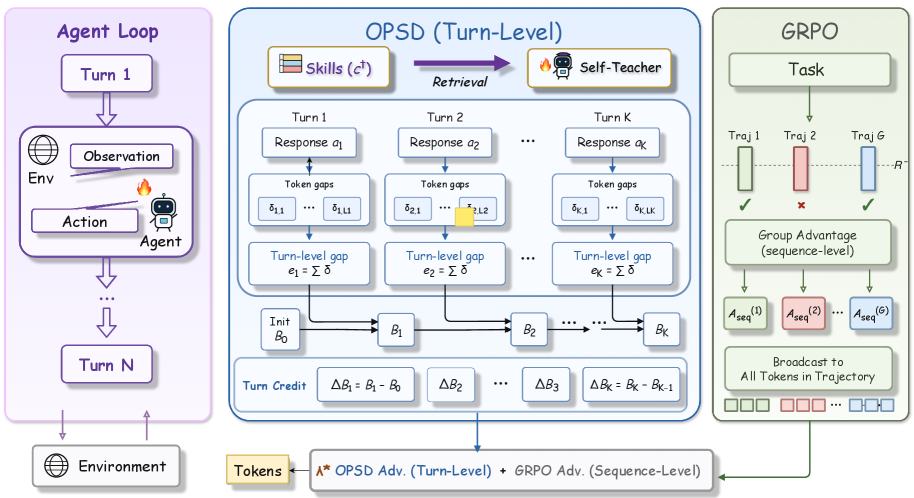
Token-to-turn aggregation. A privileged teacher \pi_{\mathrm{tea}} (conditioned on additional information such as the gold trajectory or answer) provides per-token log-probability gaps \delta_{k,t} = \log \pi_{\mathrm{tea}}(y_{k,t} \mid \cdot) - \log \pi_\theta(y_{k,t} \mid s_k, y_{k,<t}). These are aggregated within a turn to a scalar turn-level evidence e_k (a length-normalized sum of \delta_{k,t}).
Recursive belief update in log-odds space. A Bayesian belief B_k that the trajectory is on a successful path is maintained in log-odds form,
\ell_k = \ell_{k-1} + \lambda\, e_k,
with discount \gamma applied to the prior so that recent turns carry more weight. Because the update is additive in log-odds, it is equivalent to a product of likelihood ratios on the probability scale — a proper sequential Bayesian filter over turn evidence. Working in log-odds bounds numerical range and makes the influence of a single turn linear in e_k.
- Pivotal-turn identification via marginal revision. The per-turn credit is the marginal belief change \Delta B_k = \sigma(\ell_k) - \sigma(\ell_{k-1}), i.e. how much the posterior over eventual success moves at turn k. Turns with large |\Delta B_k| are pivotal. The reshaped turn advantage is A_k^{(i)} = A_{\mathrm{seq}}^{(i)} \cdot w_k^{(i)}, where w_k^{(i)} is a normalized function of \Delta B_k. All tokens within turn k inherit A_k^{(i)}, and this plugs directly into the GRPO clipped-ratio objective with high-clip \epsilon_{\mathrm{high}}. No critic, no extra rollouts, and only one teacher forward pass per trajectory.
Results
On Qwen2.5-3B and 7B across ALFWorld, WebShop, and Search-QA, AgentOPSD outperforms GRPO and prior self-distillation baselines. Figure 1(a) shows validation success on ALFWorld with Qwen2.5-7B rising faster and to a higher plateau than baselines.
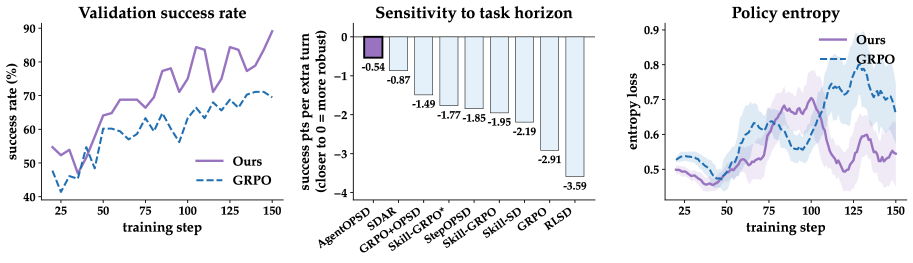
The horizon-robustness panel (b) — OLS slope of per-sub-task success against measured mean turns — is the more diagnostic result: AgentOPSD has a substantially flatter negative slope, meaning it loses fewer success points per additional required turn than GRPO or uniform-gap distillation. Panel (c) shows that entropy does not collapse as it does under GRPO, consistent with the intuition that concentrating credit on pivotal turns leaves routine turns weakly supervised and preserves exploration.
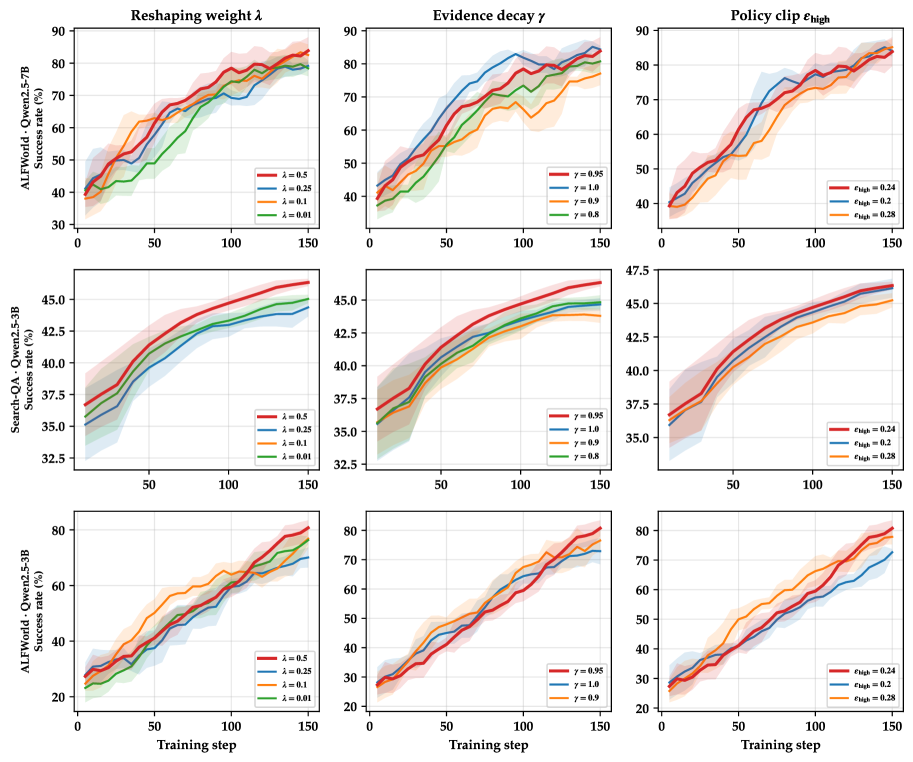
Hyperparameter sensitivity (Figure 3) is mild across the belief discount \gamma, evidence gain \lambda, and clip \epsilon_{\mathrm{high}}: performance is stable across a wide band and degrades gracefully at extremes.
Limitations and open questions
The method requires a privileged teacher; in Search-QA and ALFWorld the teacher can be constructed from ground truth, but the general recipe for domains without a natural privileged view is unclear. The Bayesian belief has a well-defined semantics only if e_k is calibrated as a log-likelihood ratio — treating raw teacher–student log-prob gaps as such is a heuristic that works empirically but lacks a formal justification. The belief update is Markov in \ell_{k-1} and cannot represent non-monotone reasoning (e.g. a decision that only becomes pivotal after a later observation). Finally, evaluation is confined to two model scales and three environments; behavior at larger scales, on tool-use benchmarks with longer horizons, and with off-policy or asynchronous rollouts remains open.
Why this matters
AgentOPSD offers a clean, critic-free way to convert privileged-teacher signal into sequential credit with the right inductive bias: a Bayesian filter whose marginal revision naturally identifies pivotal turns. It is a drop-in change to GRPO training loops, and the horizon-robustness result suggests the mechanism, not just the extra supervision, is what buys the improvement.
Source: https://arxiv.org/abs/2608.05987
EnvACE: Internalizing Environment Dynamics via World Rehearsal for Agentic Reinforcement Learning
Problem
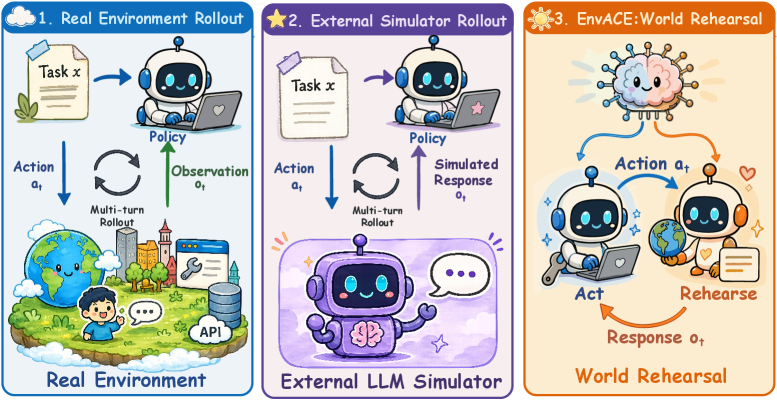
Agentic RL for tool-using LLMs is bottlenecked by the environment. Real executable environments (databases, APIs, MCP servers) are expensive to build, verify, and keep stable across training; synthesized simulators are cheaper but suffer grounding drift and reward hacking. Both paradigms couple policy scaling to environment scaling, and in both cases the environment-response model lives outside the policy, so the agent never internalizes how its actions shape observations. EnvACE removes the external response provider during training by folding the environment-response generator into the policy itself.
Method
EnvACE assigns two roles to a shared policy \pi_\theta: an acting role that emits tool calls, and a rehearsal role that plays the environment. Given history h_t, the rollout alternates
a_t \sim \pi_\theta(\cdot \mid h_t, \textsc{Act}),\quad \hat{o}_t \sim \pi_\theta(\cdot \mid h_t, a_t, \textsc{Rehearse}),\quad h_{t+1} = h_t \oplus (a_t, \hat{o}_t),
until termination. The trajectory therefore unfolds with no external simulator: the observation feeding turn t+1 is drawn from the same parameters that produced a_t. Task-success reward is assigned at the end of the trajectory, and gradients flow through both act and rehearse tokens.
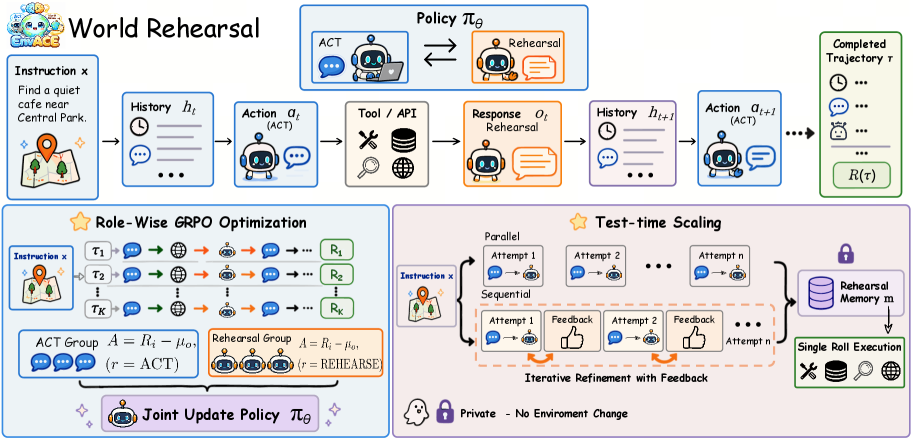
The optimizer is a role-wise variant of GRPO. Because act and rehearse tokens have very different reward-to-length statistics — rehearsals are typically longer JSON-like observations while acts are short tool calls — a single group baseline is dominated by the rehearsal role and collapses the acting gradient. EnvACE maintains separate group baselines b^{\textsc{Act}} and b^{\textsc{Rehearse}} estimated over the G sampled trajectories per prompt, and computes advantages within each role before summing the clipped surrogate objectives. Concretely, for group returns \{R_i\}_{i=1}^G, the role-conditional advantage on tokens of role r is
\hat A_i^{(r)} = \frac{R_i - \mathrm{mean}(\{R_j\})}{\mathrm{std}(\{R_j\})},
applied only to tokens whose role tag equals r, with the standard PPO clip. This keeps the two roles jointly optimized against the same task reward while preventing one role’s variance from swamping the other.
At test time the policy issues private rehearsals (parallel or sequential rollouts against its internal world model), condenses them into a short “rehearsal memory,” and only then commits an action to the real environment. This is inference-time planning against the learned world model, analogous to MCTS-style lookahead but implemented entirely as autoregressive sampling.
Importantly, world rehearsal is not distillation from a ground-truth simulator: the rehearsed \hat o_t need not match a real environment token-for-token. What is optimized is whether the policy, conditioned on its own imagined observations, still selects actions that would succeed when finally executed. This effectively regularizes \pi_\theta to be consistent under its own rollout distribution.
Results
EnvACE is evaluated on four benchmarks that span function calling and stateful service environments: BFCL-v4, \tau^2-Bench (Retail/Telecom/Airline), VitaBench (food delivery, in-store, travel, cross-domain), and FinMCP-Bench (MCP-based financial tools). Across all four, EnvACE outperforms environment-scaling baselines in overall score, i.e., it beats agents trained with more real- or simulated-environment interaction.
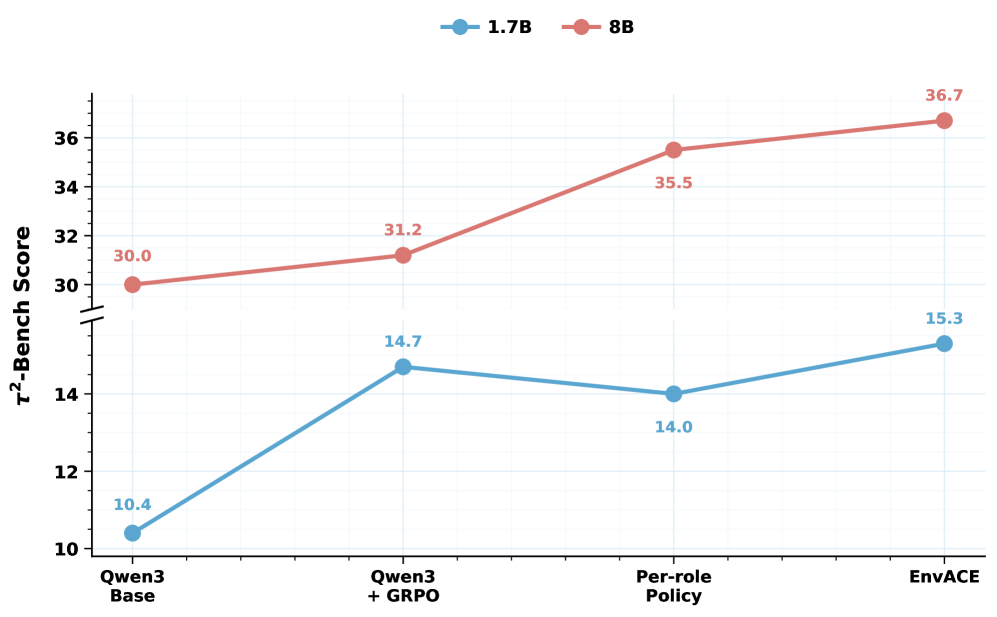
Controlled ablations on \tau^2-Bench (Figure 3) show that world rehearsal helps at both 1.7B and 8B parameter scales, indicating the gains are not an artifact of a specific capacity regime. The paper also reports transfer: a policy trained with rehearsal on one task family retains gains on out-of-distribution benchmarks, which is consistent with the claim that the policy has internalized generic action-response structure rather than memorized simulator quirks.
Limitations and open questions
- Rehearsal fidelity is unmeasured. The method optimizes task success, not observation likelihood against a real environment. When the real environment has sharp, adversarial branching (e.g., authentication failures, race conditions), the internal world model may systematically miss failure modes that only appear at deployment.
- Compute per trajectory increases. Every turn now spends tokens both acting and rehearsing, and test-time private rehearsal further multiplies inference cost. The paper does not present a compute-matched comparison against environment-scaling that spends the same FLOPs on additional real rollouts.
- Role imbalance is handled heuristically. Role-wise baselines fix the dominant symptom but the token-length disparity between act and rehearse still affects optimization dynamics; a principled per-role KL or length-normalized objective is a natural next step.
- Reward sparsity. With only terminal task-success rewards, credit assignment across long alternating act/rehearse sequences is nontrivial; the ablations do not isolate how much of the gain comes from rehearsal per se versus from the implicit auxiliary objective of predicting plausible observations.
- Failure mode of self-consistent hallucination. If the policy converges to a rehearsal distribution that makes any action look successful, training reward can rise while real-environment performance stagnates. The reported transfer results argue against this, but the mechanism preventing it is not analyzed.
Why this matters
EnvACE reframes agentic RL from scale the environment to scale the policy’s world model, letting a single set of parameters serve as actor, critic-of-observations, and simulator. If this generalizes, it decouples agent capability from the engineering cost of building executable environments — the current dominant bottleneck for training tool-use and computer-use agents.
Source: https://arxiv.org/abs/2608.06197
OSReward: Instituting Standardized Evaluation for Cross-Platform Computer-Use Reward Models
Problem
Computer-using agents (CUAs) produce trajectories — sequences of screenshots, actions, and reasoning — whose success must be verified for three downstream uses: benchmark scoring, data curation, and RL reward. Human annotation does not scale, and hand-written verifiers exist only for narrow, state-inspectable tasks. The field has defaulted to VLM-as-judge, but no rigorous measurement of judge reliability across platforms exists. OSReward supplies that measurement, and OS-Shepherd is an attempt to turn the resulting findings into a cheap open reward model.
Building the benchmark
The authors argue reusing existing benchmarks’ rollouts is not viable: the runs inherit quality confounds from their harnesses, and the labels inherit noise from the original verifiers. They therefore collect fresh trajectories end-to-end on infrastructure they operate across desktop, mobile, and web. Environments are provisioned with realistic state — user profiles, seeded databases, real files to edit, distractor content — so that (i) failure modes are non-trivial and (ii) success requires environment state change rather than narrated completion. Web tasks run on live sites.
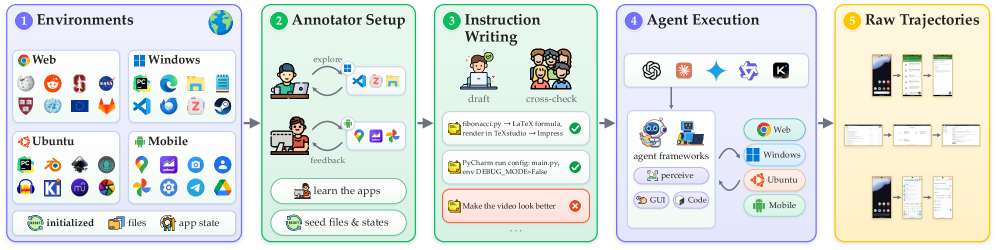
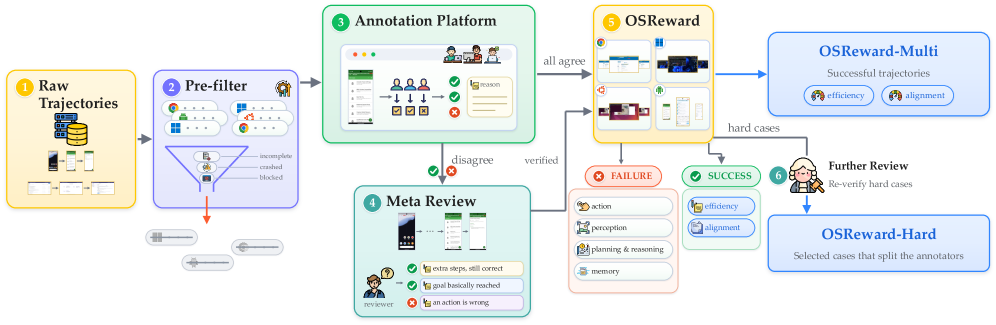
Trajectories are then produced by agents drawn from four model families and labeled through a three-annotator pipeline with meta-review for disagreements, yielding 1019 gold trajectories at a cost of roughly 800 human hours. The gold set is exposed in three views: OSReward (full), OSReward-Hard (concentrated hard cases where judges disagree or verdicts are close), and OSReward-Multi (fine-grained efficiency and alignment scoring beyond binary success).
Judge benchmarking
27 VLM judges are evaluated under a fixed protocol spanning OpenAI, Anthropic, Gemini, Qwen, Doubao, Kimi, and Intern series, including thinking variants and small open-weight models. The headline finding: every judge, including frontier closed models, falls short of an ideal judge, and they share a systematic leniency bias — false positives on failed runs dominate false negatives.
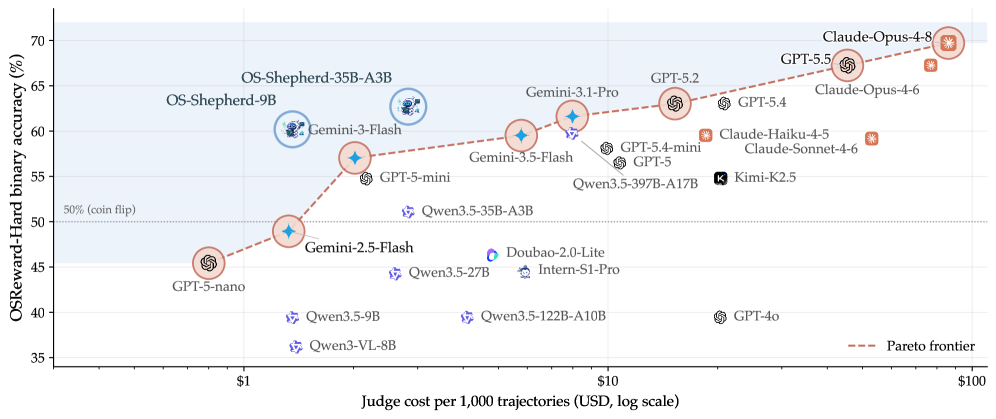
The cost/accuracy frontier (Figure 1) shows the operational problem: judges strong enough for rejection sampling or RL are prohibitively expensive at CUA training call volumes, while affordable judges are weak or lenient.
What drives a verdict
The analysis systematically perturbs judge inputs. Visual perturbations barely move aggregate accuracy: swapping the trailing five screenshots for the last three, or the first plus last two, changes binary accuracy by less than half a point; removing the red click marker has no effect; and sweeping the number of trailing screenshots from 1 to 16 causes each judge to wander only 2–3 points with no monotonic trend, with per-judge optima at N \in [5, 9]. However, each “harmless” visual setting still flips 5–7% of individual verdicts relative to the main setting. This averages out in evaluation but not in reward labeling, where per-trajectory labels are consumed individually — establishing a noise floor for downstream RL that vote-based aggregation cannot fully suppress because judges herd.
The complementary finding (referenced from §5.2) is that the verdict lives mainly in the text stream — the reasoning chain and action log — not in the pixels, which motivates preserving judge reasoning rather than only binary verdicts in any distilled corpus.
OS-Shepherd
Given that reliable judges are too expensive to run at training scale and voting cannot sharpen a verdict, the authors build OS-Shepherd-100K by agreement-filtered ensemble distillation: a trajectory is kept only if diverse strong judges independently reach the same verdict under varied screenshot counts. The filter retains roughly 85% of judged trajectories. Rollouts span five model families (Claude, Gemini, GPT, Kimi, Qwen) under varied harnesses, action spaces, and step budgets, plus independent open-source agent stacks, and are decontaminated against the OSReward gold set. Crucially, each retained sample carries the judge’s reasoning trace, making OS-Shepherd-100K the first large-scale reasoning-annotated CUA judge corpus. On OSReward-Hard, OS-Shepherd models approach frontier-judge accuracy at a fraction of the inference cost (Figure 1).
Generalization
Running the same judges on three prior CUA benchmarks against their own human-written verifiers reveals that agreement varies far more by platform than by judge. Using ~90% agreement as the bar for replacing a hand-written verifier: best judges approach it on mobile, come within about 6 pp on web, and fall well short on desktop. The ordering across judges is preserved across benchmarks. The desktop shortfall reproduces the leniency bias — false positives concentrate in unverifiable domains and on long trajectories.
Limitations and open questions
Human-written verifiers used as ground truth in the generalization study are themselves imperfect, so absolute judge accuracy is likely underestimated on non-OSReward benchmarks. Judge herding means ensemble voting cannot break the leniency ceiling; the agreement filter helps only because it can discard rather than resolve. The 5–7% per-setting verdict flip rate places a hard noise floor on any reward derived from a single judge call, which will manifest as reward hacking pressure during long-horizon RL. Whether OS-Shepherd’s reasoning-conditioned supervision transfers to policies trained with it as the reward — as opposed to serving as an offline evaluator — is not directly measured.
Why this matters
Reward reliability, not policy capability, is now the binding constraint for CUA RL and rejection sampling. OSReward puts a number on the leniency of every serious VLM judge and shows the bias survives outside its own data, while OS-Shepherd demonstrates that agreement-filtered, reasoning-annotated distillation can recover most of a frontier judge’s discrimination at training-scale cost.
Source: https://arxiv.org/abs/2607.28609
WorldClaw: Agentic 3D Open-World Generation at Scale
Problem
Text-to-3D scene generation systems have progressed rapidly on room-scale and object-scale outputs, but generating explorable open-world environments still fails on three simultaneous requirements: (i) global spatial coherence — a consistent terrain skeleton on which regions, settlements, and biomes sit; (ii) rich local content that survives close-range walkthroughs; and (iii) explicit, editable asset instances suitable for downstream reuse in engines like Blender or Unreal. Monolithic diffusion or NeRF-based generators tend to collapse one of these axes: they either produce continuous but non-editable radiance fields, or per-object meshes without a coherent world frame. WorldClaw targets this triangulation directly by treating world generation as a planned, staged agent workflow rather than a single generative sampling step.
Method
The system decomposes generation into three sequential operators over a shared structured representation:
\mathcal{P}=F_{\mathrm{plan}}(q),\quad \mathcal{T}=F_{\mathrm{terrain}}(\mathcal{P}),\quad \mathcal{O}=F_{\mathrm{region}}(\mathcal{P},\mathcal{T}),
with the final scene \mathcal{S}=\operatorname{Compose}(\mathcal{T},\mathcal{O}). Here \mathcal{P} is a JSON-like scene specification (regions, terrain parameters, asset categories, materials, spatial relations), \mathcal{T} is an explicit region-aware terrain (height field + material assignments + scattered terrain assets), and \mathcal{O} is the set of placed, textured, instance-level meshes for detail-demanding regions.
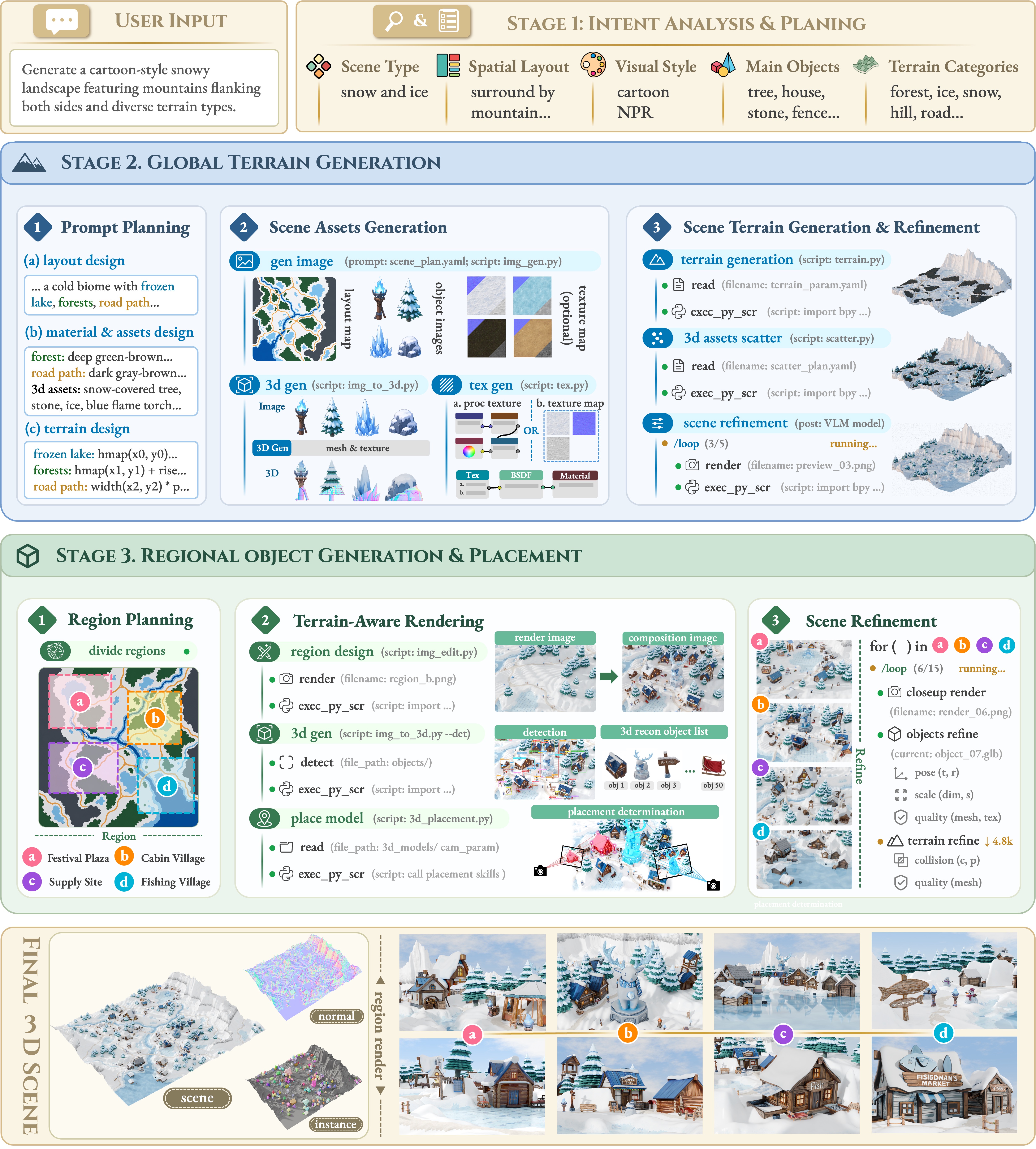
Stage 1 — Intent analysis and planning. Two agents (intent analysis + scene planning) expand an underspecified prompt into \mathcal{P}. This resolves the two failure modes the authors flag: missing spatial/geometric/appearance attributes, and ambiguous category/style references that would otherwise be interpreted inconsistently across downstream stages. The structured spec is the semantic contract between stages.
Stage 2 — Global terrain generation. From \mathcal{P}, the terrain agent produces a semantic layout map that partitions the ground plane into regions, then instantiates a composite height field with per-region terrain parameters (roughness, elevation range, biome type) and material assignments. Terrain-associated assets (rocks, vegetation, water bodies) are scattered conditioned on both region semantics and local surface conditions (slope, curvature).

Stage 3 — Regional object generation and placement. For each detail-demanding region, WorldClaw generates a terrain-conditioned composite image, segments and lifts it to textured meshes using SAM3 / SAM3D / Hunyuan3D, and recovers placement on the terrain so that instance poses match the rendered composition. This lets the system inherit the compositional prior of 2D generative models while producing editable mesh instances rather than baked radiance.
Render-based refinement. A separate refinement loop closes the pipeline over rendered views:

The object-refinement agent pulls instances from a report queue, evaluates pose, mesh quality, and scale against the regional context, issues targeted edits (re-mesh, re-texture, re-pose), and verifies via re-render. The terrain-refinement agent inspects the support surface where objects sit, detects floating or interpenetration, and applies local co-deformation of the height field — updating \mathcal{T} so that object–terrain contact is consistent rather than moving the object alone. This co-deformation is the key mechanical detail: refinement acts on both the placed instance and the underlying support, which avoids the common artifact where contact fixes drift objects away from their planned positions.
Implementation and results
The agent backbone is Claude Opus 4.8, orchestrating task-specific skills wired to GPT-Image-2 (image generation), SAM3 / SAM3D (segmentation and lifting), and Hunyuan3D (mesh + PBR texture). PBR texture resolution is 2048 \times 2048 for large objects and 1024 \times 1024 for small ones. All geometry composition, refinement, and rendering run in Blender 5.1.1 on 4× NVIDIA H20 GPUs.
The experimental section is qualitative. The authors show seven full worlds spanning distinct regimes: medieval village across mixed biomes, snow-covered riverside village, dragon-encircled desert camp, Japanese-town island, volcanic demon lair, gemstone mining site, and Hobbit-village mountain valley. Each is presented via global orbit, regional, and local walk views, alongside instance, depth, and normal renderings that expose the explicit scene graph. The instance renderings confirm the central claim: assets remain individually addressable rather than fused into implicit fields, and the terrain remains a single coherent surface across regions.
Limitations and open questions
The paper does not report quantitative benchmarks — no FID/CLIPScore, no user studies with numeric scores, no timing or token-cost measurements per world. Comparisons to prior text-to-scene systems are described as present but no head-to-head numbers appear in the supplied sections. Several dependencies are heavy proprietary components (Claude Opus 4.8, GPT-Image-2, Hunyuan3D), which complicates reproducibility and makes the failure modes of the agent loop hard to attribute: it is unclear whether the refinement loop converges or is capped by iteration budget, how often terrain co-deformation is triggered, or how object density scales with world area. The height-field terrain also precludes overhangs, caves, and cliffs with negative-space geometry — a structural limit of the representation rather than the agent design. Finally, the region-level compositional prior comes from a 2D image generator; whether this scales to worlds with tens of regions without style drift is not shown.
Why this matters
WorldClaw is a concrete instance of the “agent-as-scene-compiler” pattern: rather than training a monolithic 3D generator, it uses an LLM to plan a structured intermediate and dispatches specialized 2D/3D foundation models against explicit geometric state. The output is editable mesh + height-field content, which is the representation game engines and downstream simulators actually consume — a more useful target than radiance fields for most content pipelines.
Source: https://arxiv.org/abs/2608.05248
GST-Bench: Can VLMs Develop Global Spatial Awareness from Video?
Problem
Existing spatial reasoning benchmarks for VLMs are dominated by single-image or few-view VQA: “what is to the left of X?”, “how far is Y?”, relative depth, or object counting. These probe local spatial perception but do not test whether a model can integrate a long egocentric traversal into a persistent, global scene representation — the capability that actually matters for embodied agents that must localize themselves, remember object positions after they leave the field of view, and reason about scene topology.
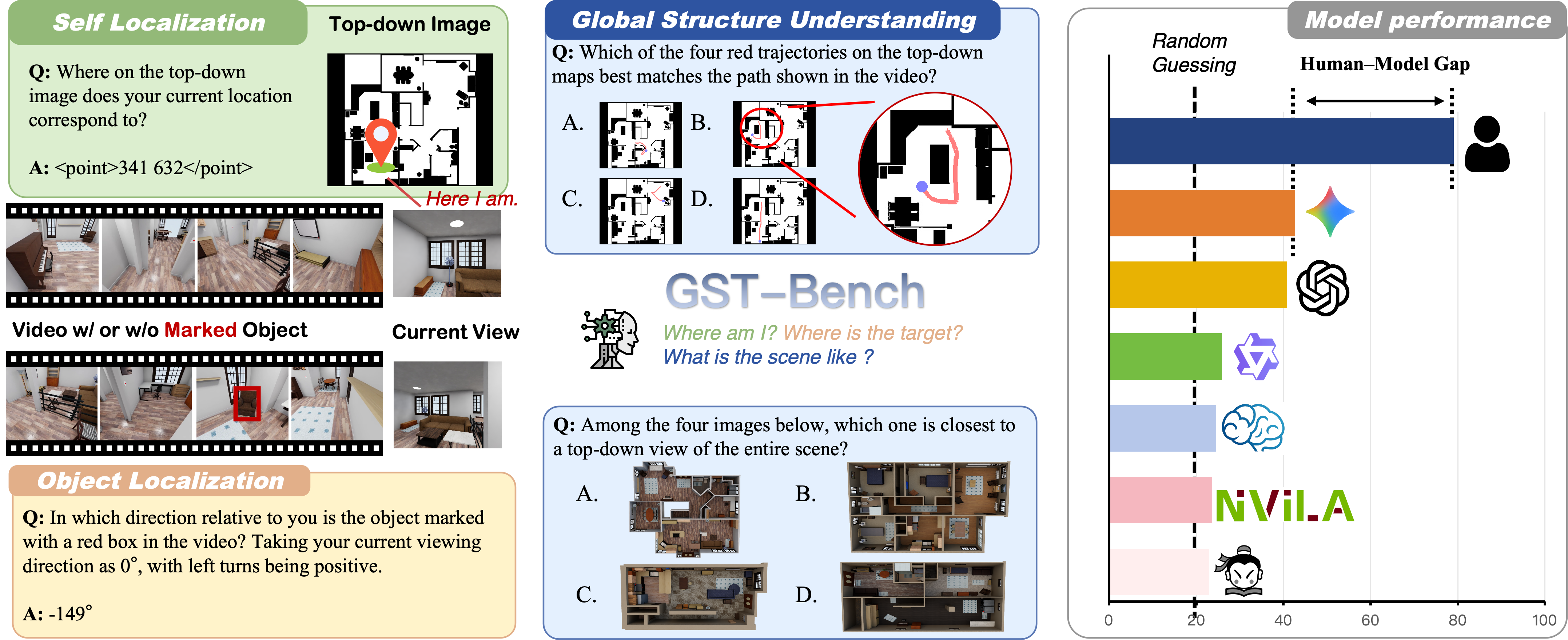
GST-Bench targets this gap. It asks: given a long exploration video and a novel query viewpoint (not sampled from the video), can a VLM (i) localize itself in a global top-down frame, (ii) locate objects that are not visible in the current view, and (iii) reason about the overall scene layout?
Benchmark construction
The benchmark is organized around three competencies — self localization, object localization, and scene structure understanding — instantiated as twelve task types.
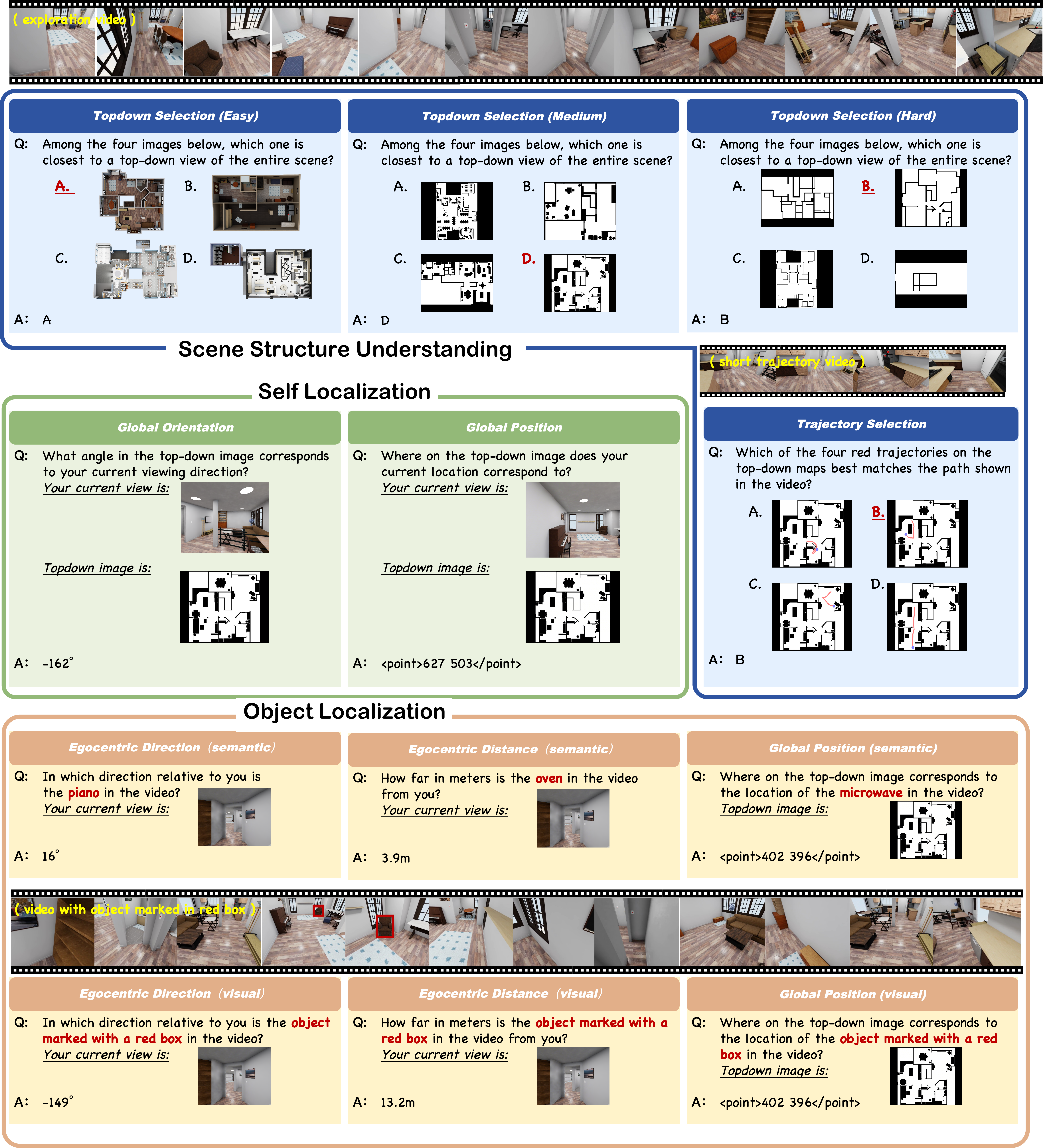
Each item combines up to five visual inputs:
- an exploration video: a long-horizon egocentric traversal serving as the sole source of spatial memory;
- object-annotated frames;
- one or more novel-viewpoint images that do not appear in the exploration video (forcing genuine global reasoning rather than frame retrieval);
- top-down images rendered at three levels of abstraction (photographic, semantic, schematic), which the model must map onto egocentric evidence;
- a text query.
Data are generated in simulation, giving ground-truth camera poses, object placements, and top-down maps. The pipeline produces exploration videos, novel-view renderings, top-down maps, and template-instantiated QA, then applies automated filtering and human verification.
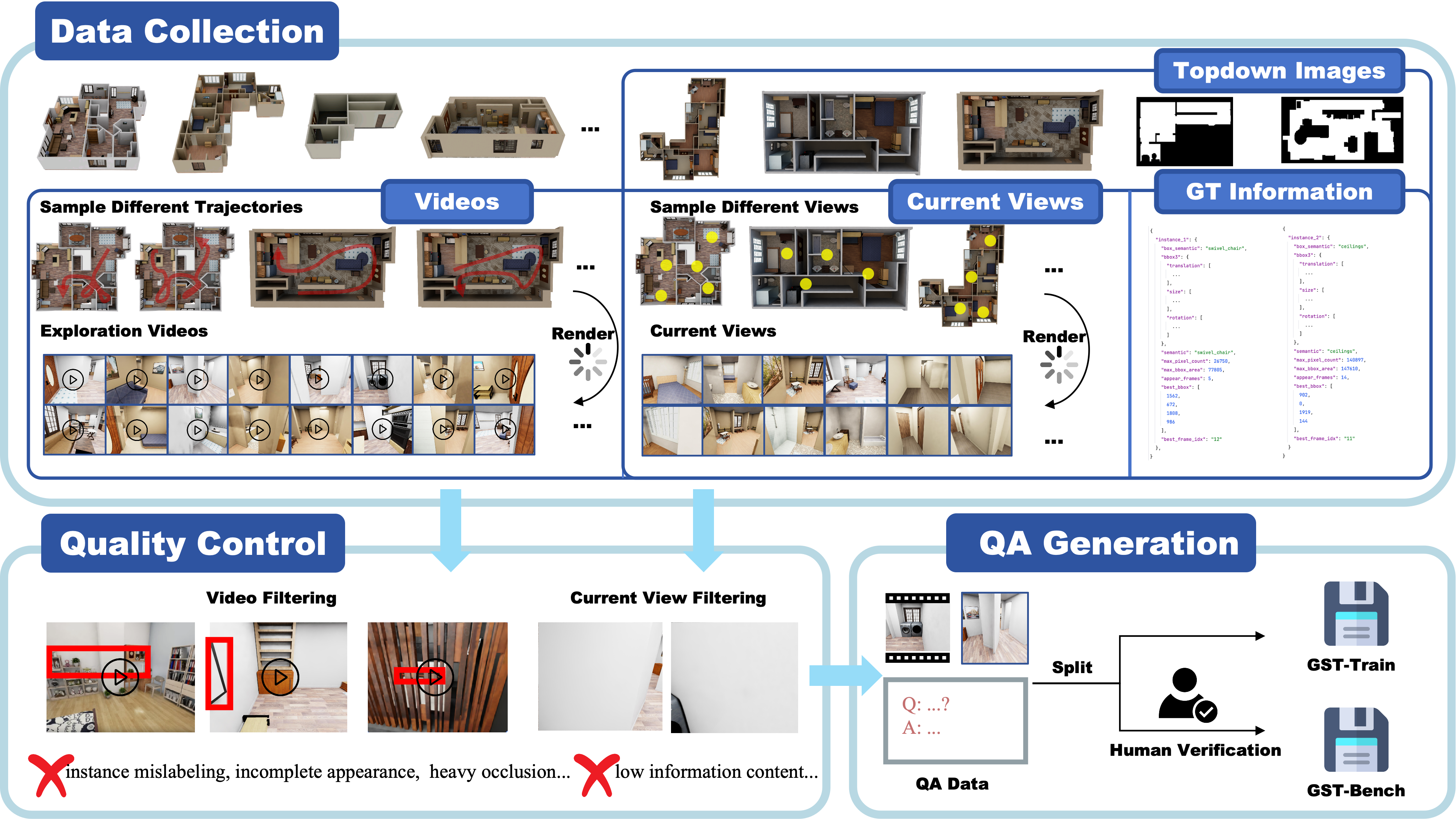
The final benchmark contains human-verified questions derived from 6,790 minutes of synthetic video. The novel-view requirement is the key mechanical design choice: because the query view is unseen, models cannot solve tasks by frame matching or 2D visual grounding and must instead build an internal global map.
Evaluation
Twenty-two VLMs are evaluated zero-shot with greedy decoding and official prompt templates, spanning:
- proprietary: Gemini-2.5-Pro, Gemini-3-Pro, GPT-5, GPT-4o, Seed1.8;
- open-source: LLaVA-OneVision-1.5 (4B, 8B), Qwen3-VL (2B/4B/8B/32B), InternVL3.5 (2B/4B/8B/38B), NVILA (8B/15B);
- embodied-tuned: Cosmos-Reason2 (2B, 8B), RoboBrain2.5-8B, Robix (7B, 32B);
- Qwen3-VL-8B fine-tuned on the paper’s GST-Train.
Main results
The headline gap: the strongest zero-shot model reaches 42.68, versus 79.08 for humans. This holds across proprietary frontier models and larger open-source models, i.e. scaling from 2B to 38B does not close it. Embodied-tuned models (Cosmos-Reason2, RoboBrain2.5, Robix), despite being pitched at grounded spatial reasoning, do not systematically outperform generalist VLMs on global tasks.
To isolate whether the failure is spatial perception per se or the aggregation of many views into a global representation, the authors construct GST-Bench-Local, which reuses the same task formulation and question templates but restricts evidence to a local window. Models score substantially higher on the local variant, indicating that the bottleneck is not local geometric reasoning but consolidation of long-horizon observations into a globally consistent scene representation. In other words, current VLMs handle “where is X relative to me in this view” reasonably well, but fail to maintain a persistent map across a several-minute traversal.
Fine-tuning Qwen3-VL-8B on GST-Train (the accompanying training set) improves performance on GST-Bench, suggesting the deficit is partly a data-distribution issue rather than a purely architectural one — though the paper does not claim to close the human gap.
Limitations and open questions
- All video is synthetic. Sim-to-real transfer of the diagnostic conclusions is not established; real egocentric video adds motion blur, exposure variation, and dynamic agents that may change the failure modes.
- Twelve template-based task types give clean per-competency scores but constrain question phrasing; models may overfit to templates.
- The benchmark diagnoses that global consolidation fails, but does not disentangle candidate mechanisms — insufficient temporal context length, weak positional encoding across frames, lack of explicit 3D inductive bias, or absence of a persistent memory module.
- Top-down maps are given as image inputs at three abstraction levels; whether the failure is in reading the top-down image versus in building the global representation from video is only partially isolated.
- Fine-tuning results are reported for a single 8B backbone; scaling behavior of GST-Train supervision is not characterized.
Why this matters
GST-Bench operationalizes a specific, mechanically well-posed deficit in current VLMs: they can perceive space locally but cannot integrate egocentric video into a globally consistent map, which is precisely the capability required for navigation, manipulation planning, and any embodied policy that outlives a single frame. The 42.68 vs 79.08 gap, combined with the local/global ablation, gives a concrete target for future work on temporal memory and 3D-aware video encoders.
Source: https://arxiv.org/abs/2608.05747
ChronoVision: Temporal Reasoning via Latent State Reconstruction
Problem
Multimodal LLMs handle static visual QA well but degrade sharply on tasks that require tracking continuous visual transformations across time — object permanence through occlusion, physical state changes, ordering of causally linked frames. The authors argue the root cause is the language bottleneck: forcing chain-of-thought to verbalize sub-pixel or geometric transitions introduces ambiguity that compounds over reasoning steps. Descriptions like “the ball moves slightly left and rotates” underdetermine the actual visual state that the next reasoning step must condition on.
ChronoVision reframes multi-step visual reasoning so that intermediate states are represented in a latent visual space rather than in language tokens, and adds an attention-localization mechanism that binds each reasoning step to specific image regions.
Method
The framework has three coupled components trained in two stages (SFT then RL).
Reconstructive Visual Head (RVH). During SFT, in addition to the standard autoregressive text loss, an auxiliary head predicts the latent representation of the transformed final visual state. Let z^\* = E(I_T) be the frozen visual encoder embedding of the target image, and let \hat z = g_\phi(h_L) be the head’s projection from the terminal hidden state h_L of the MLLM. The reconstruction loss is
\mathcal{L}_{\text{RVH}} = \lVert \hat z - \text{sg}(z^\*) \rVert_2^2,
with stop-gradient on the target. This forces the language backbone to maintain a representation from which the visual outcome can be recovered, rather than only tokens sufficient to name it.
ROI Attention Locating (RAL). Semantic span queries — noun phrases extracted from the question or the model’s own rationale — are mapped to spatial attention masks over the vision tokens. Concretely, for a span embedding q_s and vision token features \{v_i\}, RAL computes a_i = \text{softmax}(q_s^\top W v_i) and supervises a against ground-truth ROI masks with a KL term \mathcal{L}_{\text{RAL}} = \text{KL}(a \Vert a^\*). This grounds each intermediate step to the region of evidence it purports to reason about.
RL with implicit process grounding. Post-training uses policy optimization with a composite reward
R = \alpha R_{\text{ans}} + \beta R_{\text{lat}} + \gamma R_{\text{focus}},
where R_{\text{ans}} \in \{0,1\} is outcome correctness, R_{\text{lat}} = \cos(\hat z, z^\*) rewards latent-state alignment even when the final answer is wrong (dense process signal), and R_{\text{focus}} is an unsupervised term rewarding low-entropy, temporally consistent RAL attention (i.e., the model looks at a coherent object across steps rather than diffusing). This yields process supervision without requiring per-step human annotation, since the latent trajectory is checked against the ground-truth visual outcome.
The overall SFT objective is \mathcal{L} = \mathcal{L}_{\text{LM}} + \lambda_1 \mathcal{L}_{\text{RVH}} + \lambda_2 \mathcal{L}_{\text{RAL}}.
Vbvr-VQA dataset. The authors reformulate video reasoning as a strict image-ordering task: given a set of shuffled frames from a video with a causal or physical event, the model must output the correct temporal order. This isolates temporal tracking from linguistic priors — a captioning shortcut cannot solve it, since captions of adjacent frames are near-identical. The dataset has in-domain and out-of-domain splits (differing in event categories/domains).
Results
On Vbvr-VQA, ChronoVision reaches 74.8% in-domain accuracy and 71.6% out-of-domain, reported as state of the art on the benchmark. The OOD gap of ~3.2 points is small, suggesting the latent-reconstruction objective encourages representations that transfer beyond the training event distribution rather than memorizing frame-order heuristics.
The abstract truncates before ablations, but the composite reward structure implies each of the three components (R_{\text{ans}}, R_{\text{lat}}, R_{\text{focus}}) contributes independently; the RVH is the mechanistically novel piece and is presumably the largest driver, since it is the only channel by which continuous visual state enters the loss beyond text.
Limitations and open questions
Several issues are visible from the description. First, the target latent z^\* = E(I_T) is only as good as the frozen encoder; if E discards the fine-grained cues the task actually depends on (pose, occlusion boundaries), the RVH cannot recover them. Second, ordering tasks constrain reasoning to a permutation output space, which is easier to reward-shape than open-ended visual QA — it is unclear whether the latent-state approach helps on generative counterfactual reasoning (“what would the scene look like if…”). Third, R_{\text{focus}} is unsupervised and could collapse to trivially confident but wrong attention; the paper should show that focus-reward hacking is bounded. Fourth, the ROI supervision during SFT requires span-to-region alignment, which is expensive to obtain at scale outside curated data. Finally, no comparison numbers to strong closed-source baselines (GPT-4o, Gemini) on Vbvr-VQA are surfaced in the abstract, so absolute positioning is unclear.
Open questions: does the latent trajectory recovered by RVH correspond to interpretable intermediate states (e.g., can one decode \hat z at intermediate layers to a plausible frame)? And does the approach compose — i.e., can multiple RVH targets be chained for reasoning chains of length >2?
Why this matters
Verbalized chain-of-thought is a lossy channel for continuous visual dynamics, and the community has largely papered over this by scaling text traces. ChronoVision is a concrete demonstration that supervising intermediate reasoning in the visual latent space, combined with region-grounded attention and a process-level RL reward, materially improves temporal reasoning without requiring per-step human labels. If the RVH mechanism generalizes beyond ordering to prediction and counterfactual tasks, it points toward MLLMs whose internal reasoning is genuinely multimodal rather than translated through language.
Source: https://arxiv.org/abs/2608.05631
HarnessOpt-Bench: Evaluating LLMs at Harness Optimization
Problem
Agent performance depends jointly on the underlying LLM and on the harness: prompts, tool wrappers, memory, control flow, and orchestration code. Practitioners now routinely spend more effort tuning harnesses than fine-tuning weights, and increasingly delegate that tuning to LLMs themselves. But there has been no standard protocol for measuring how well a frontier model can act as a harness optimizer under realistic constraints: expensive stochastic evaluation, held-out generalization, and no leakage of test-set signal. HarnessOpt-Bench fills that gap and, in doing so, produces a quantitative comparison of the current frontier as scaffold-writers.
Task formalization
A candidate harness H is an executable codebase in a feasible set \mathcal{H}, with a pinned seed H_0. The task fixes invariants \theta=(\mathcal{M},E,V): the set of callable models \mathcal{M}, the per-case environment E(x), and a verifier V:\text{trajectory}\to[0,1]. The optimizer edits H but cannot change \theta. Given a target-evaluation budget B and a policy \pi_\mathcal{D} for revealing feedback, the optimizer interactively commits candidates H', requests case sets Q, receives (\hat s,\varphi)\leftarrow F_\theta(H,Q) with feedback \pi_\mathcal{D}(\hat s,\varphi), and finally nominates H^+\in\mathcal{C}. The server evaluates H^+ on a held-out \mathcal{D}^{\text{test}} and reports normalized gain g over the seed.
Enforcement is what makes this benchmark non-trivial. A trusted execution server owns the evaluation boundary: the optimizer can write only the target harness, read development traces and aggregate validation metrics, but cannot touch test cases or test scores.
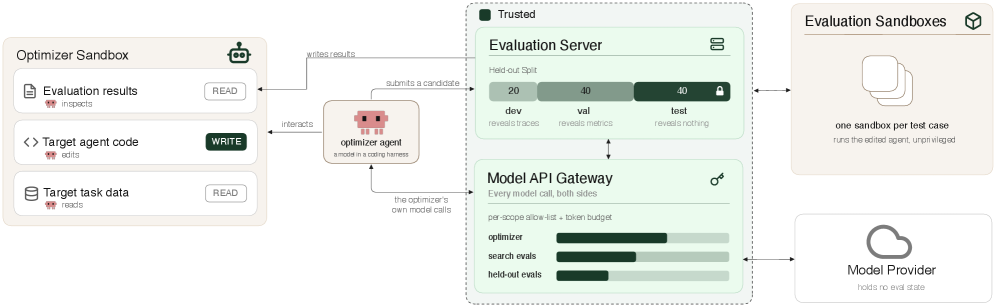
Resource metering, candidate versioning, and audit logs sit on the trusted side, which prevents both accidental test-set contamination and Goodharting against the visible validation signal.
Experimental grid
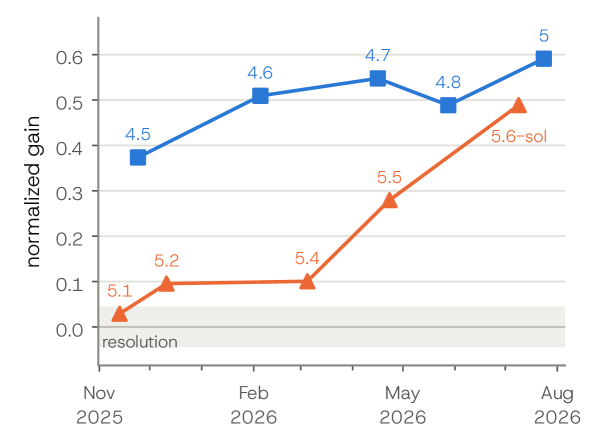
Five frontier models are evaluated: claude-opus-5, claude-sonnet-5, gpt-5.6-sol, gpt-5.6-terra, and kimi-k3. Each optimizer model is run inside two coding harnesses: a shared opencode scaffold (fixed across models) and the model family’s native harness (claude-code, codex, kimi-cli). This yields 10 core optimizer configurations, run over four target-agent tasks: OfficeQA, BrowseComp-Plus, Terminal-Bench, and GAIA. On GAIA, two additional shared harnesses (goose, mini-swe-agent) are added, giving four levels of harness at fixed model. A capability-ladder study on OfficeQA runs earlier releases of Claude Opus and GPT under their native harnesses.
Main results
The headline decomposition: with task and harness fixed, changing the optimizer model shifts normalized gain by 0.142 on average; with task and model fixed, changing the coding harness shifts it by 0.079. Model choice is roughly 1.8\times the harness effect. Both exceed per-task resolution bands, though the harness effect only narrowly.
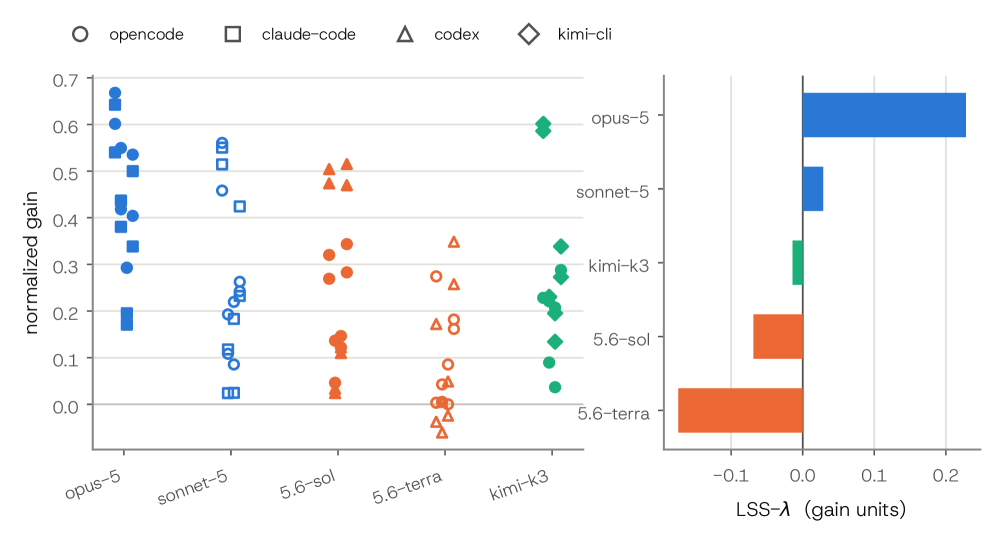
The left panel shows per-run gains in the controlled two-harness design; marker shape encodes the harness and the vertical spread is dominated by model identity, not scaffold. The right panel gives the LSS-\lambda (a variance-decomposition estimate) on the balanced shared-harness grid across the three competent-seed tasks, quantifying the same ordering.
The tails separate cleanly while the middle does not. The strongest configuration recovers roughly two-thirds of OfficeQA headroom and half of BrowseComp-Plus headroom over seed; the weakest configuration is unresolved from zero on BrowseComp-Plus and Terminal-Bench, i.e., no statistically detectable improvement over the seed harness. Intermediate configurations differ by less than their round-to-round variance, so the authors report tiers rather than a strict ranking.
On GAIA, where four harness levels are available per model, no single harness dominates.
Both GPT variants gain substantially under their native codex harness — +0.179 for gpt-5.6-sol and +0.131 for gpt-5.6-terra versus the best shared alternative — while both Claude models and Kimi sit within a resolution band or two of zero either way. This is direct evidence that “best coding harness for LLM-as-optimizer” is model-conditional: recommendations that fix a single scaffold generalize poorly.
Finally, on the release-ladder ablation, successive Claude Opus and GPT releases produce monotone improvements on OfficeQA that exceed the \pm 0.045 resolution band, supporting the interpretation that harness-optimization skill tracks general capability rather than being a narrowly-trained ability.
Limitations and open questions
The benchmark measures a single-nomination end-to-end protocol, so it conflates search, verification, and self-stopping into one score; separating these would need a different interaction policy \pi. Only four tasks are used, two of which (BrowseComp-Plus, Terminal-Bench) have seeds strong enough that several optimizers fail to move the needle — the discriminative range is compressed. The trusted execution server prevents test leakage but cannot prevent overfitting to the validation partition when B is large; the paper does not report how gain scales with B. Extending to multi-agent harnesses, or to harnesses that themselves invoke \mathcal{M} for auxiliary training, would require redefining the invariants \theta.
Why this matters
If harness optimization is now a first-class subroutine of AI development, we need shared numerical evidence for which optimizer-scaffold pairs actually improve agents rather than folklore. HarnessOpt-Bench shows the effect is real (1.8\times model over harness), model-dependent in non-obvious ways (native codex helps GPT far more than native scaffolds help Claude or Kimi), and correlated with base-model capability — a concrete substrate for tracking recursive self-improvement in a bounded, auditable form.
Source: https://arxiv.org/abs/2608.06301
Hacker News Signals
Prime Agent: A self-improving RLM agent
Prime Intellect describes Prime Agent as a reinforcement-learning-from-model-feedback (RLMF) loop where the agent improves its own policy by treating its own outputs as a reward signal. The core idea is bootstrapped self-improvement: the agent generates candidate solutions, scores them with a verifier (itself or a stronger judge), and fine-tunes on the high-reward trajectories — a familiar RLHF/RLAIF pattern, but applied continuously rather than in discrete training runs.
The engineering angle is the integration with Prime Intellect’s distributed training infrastructure. Rather than offline batch RL, they run online policy updates interleaved with inference, keeping a rollout buffer that feeds gradient updates without stopping the agent. This requires careful replay-buffer management to avoid distribution collapse and reward hacking, both known failure modes in self-play regimes.
The “RLM” framing (Reinforcement Learning Model) distinguishes agents whose reward signal is model-generated from those using human labels or hard-coded verifiers. This is important because reward model accuracy is the binding constraint: a self-referential loop amplifies any bias in the reward model. The blog post does not detail how they mitigate reward model collapse, which is the main open question here.
Practical details are thin — no benchmark numbers are released, and the architecture of the reward model versus the policy model is not specified. What is visible is the scaffolding: tool use, multi-step planning, and a loop that checkpoints the policy whenever the rolling eval score improves past a threshold.
This is early-stage work. The interesting research question is whether continuous self-improvement without human feedback checkpoints converges or drifts — empirical evidence either way would be valuable.
Source: https://www.primeintellect.ai/blog/prime-agent
Can you reverse engineer an ASIC?
Jane Street’s post is a practical walkthrough of physical reverse engineering on a real ASIC — the kind of work normally associated with hardware security labs. The process involves: depackaging the chip (chemical or mechanical decap), imaging layers via scanning electron microscopy (SEM) or focused ion beam (FIB), and then tracing the metal interconnect layers to reconstruct a netlist.
The key technical challenges are (1) layer count — modern processes have 10+ metal layers, each requiring separate delayering and imaging; (2) cell identification — standard cells at 7 nm or below are sub-100 nm features, making optical microscopy useless and requiring electron-beam imaging; and (3) netlist extraction — going from a set of 2D layer images to a functional circuit requires stitching images, segmenting wires and vias, and matching cells against a known library. The last step is tractable when the fab’s standard cell library is known or can be inferred, harder for fully custom logic.
Jane Street’s interest here is security-oriented: understanding what an ASIC actually does versus what its vendor claims. For financial infrastructure, third-party ASICs in critical paths (network accelerators, FPGAs with hard IP) are a real supply-chain risk. The post is honest that full RE of a modern ASIC at advanced nodes is expensive (six to seven figures for commercial labs) and time-consuming, making it impractical as routine auditing.
The post also touches on partial RE: you do not need to recover the full netlist to verify specific properties (e.g., no hidden wireless interface, no unexpected memory). Targeted FIB cross-sections can answer bounded questions more cheaply than full reconstruction.
Open question: as chiplets and 2.5D packaging become standard, RE gets harder because the die-to-die interconnect is buried under the interposer.
Source: https://blog.janestreet.com/can-you-reverse-engineer-an-asic/
AMD acquires Taalas to boost inference performance by etching models in silicon
Taalas was building model-in-silicon (MiS) inference accelerators — ASICs where the weights of a specific neural network are encoded into the hardware fabric at tape-out time rather than loaded from DRAM at runtime. The approach trades flexibility for latency and power: once weights are fixed in silicon (as ROM or as hardwired interconnect patterns), you eliminate the memory-bandwidth bottleneck that dominates transformer inference.
The technique is not new — it traces back to neuromorphic computing and lookup-table-based inference — but it is newly relevant for a specific niche: high-volume, stable model deployments where the same model will run for years at scale (think a fixed embedding model or a specific ASR system). The value proposition is that DRAM bandwidth, not FLOP count, is the binding constraint in LLM inference, particularly for small-batch or single-token autoregressive decoding. A chip where weights live in on-die ROM or are structurally encoded sidesteps this entirely.
The hard engineering problem is that state-of-the-art models change on a six-to-twelve month cycle, making a fixed-weight ASIC commercially risky. Taalas’s apparent answer was to target specific layers or sub-networks (e.g., fixed embedding tables, fixed KV-projection heads) rather than entire models, combining a hardwired substrate with a small programmable portion for the volatile parts.
AMD’s strategic rationale is to compete with custom inference silicon from Google (TPUs), Amazon (Trainium/Inferentia), and Microsoft (Maia) for hyperscaler workloads. Integrating MiS techniques into ROCm-compatible chiplets would let AMD offer tiered inference silicon without an entirely separate ISA.
The acquisition price and technical maturity of Taalas’s silicon are not disclosed, so it may be an acqui-hire of a team with design IP rather than production-ready silicon.
Stateless MCP has recaptured my interest
Simon Willison’s post is a technical reassessment of the Model Context Protocol (MCP) after the spec added a stateless HTTP transport mode. The original MCP relied on persistent SSE connections, which created real operational problems: servers had to maintain per-session state, horizontal scaling required sticky sessions or a shared state store, and connection drops forced full reconnection with session loss.
The stateless variant maps each MCP request to a self-contained HTTP request/response cycle. Tool calls, resource reads, and prompt retrievals all carry full context inline rather than relying on server-side session state. This aligns MCP with REST/HTTP semantics that existing infrastructure (load balancers, CDNs, serverless platforms) already handles correctly.
The tradeoff is payload size. A stateless request must carry enough context for the server to respond correctly without prior interaction — this is fine for idempotent tool calls (a function with explicit arguments) but problematic for tools that inherently require accumulated state (e.g., a multi-turn database transaction). The spec handles this by allowing servers to return a state token that the client must echo back, pushing state management to the client rather than the server — a signed-JWT-like approach.
Willison’s specific interest is deploying MCP servers on serverless functions (Cloudflare Workers, Lambda), which are a natural fit for stateless HTTP but hostile to persistent SSE. He also notes that stateless MCP enables simpler testing: a test is just an HTTP request with a JSON body, no SSE harness needed.
The remaining friction he identifies is auth: OAuth flows in the current spec are still complex to implement correctly in a stateless context, and the spec leaves several security decisions to implementors.
Source: https://simonwillison.net/2026/Jul/31/stateless-mcp/
LLMs won’t break symmetric crypto
The post makes a precise technical argument: current LLMs cannot perform the sustained, bit-exact computation required to attack symmetric primitives (AES, ChaCha20, SHA-2/3), and the architectural reasons why this is unlikely to change with scale.
The core claim is that symmetric cryptanalysis reduces to finding structural weaknesses (differential/linear characteristics, algebraic relations) or to brute-force key search. The former requires combinatorial search over exponentially large spaces with exact arithmetic — a task where transformer attention has no known efficiency advantage over exhaustive search. The latter is embarrassingly parallel integer arithmetic at 2^{128} scale, which is neither what transformers are trained for nor what they execute efficiently.
The author distinguishes this from areas where LLMs do provide cryptographic risk: social engineering, code generation with subtle vulnerabilities, and side-channel leakage through prompts. These are real and already observed. The post is pushing back against inflated claims that LLMs represent a cryptographic threat at the primitive level.
There is also a subtler point about differential cryptanalysis: yes, an LLM trained on cryptanalysis literature can describe known attacks, but describing an attack and executing it are different. Executing a differential attack on AES requires finding collisions in the difference distribution table — a computation that must be done exactly, not approximately, and must run for 2^{50}+ trials to be useful. Autoregressive token generation is not a reasonable substrate for this.
The open question the post does not fully address is whether future LLM-guided solvers (model + SMT solver + MILP) could accelerate algebraic attacks on reduced-round ciphers. That is a more credible threat surface, though still far from operational symmetric key recovery.
Source: https://www.bfswa.blog/p/llms-wont-break-symmetric-crypto
Qwen3.8 Max now ranked as the best overall model by agentic index
Artificial Analysis’s agentic index is a benchmark suite targeting multi-step tool-use tasks rather than single-shot question answering. The methodology matters: rather than measuring accuracy on a static dataset, agentic benchmarks evaluate the model’s ability to chain tool calls, recover from errors, and complete tasks that require planning over several turns. Metrics include task completion rate, number of steps to completion, and cost-per-task (factoring in token consumption).
Qwen3.8 Max reaching the top of this ranking is technically notable because the model sits at a much lower parameter count than GPT-4-class models and substantially undercuts them on inference cost. Artificial Analysis’s data shows it outperforming larger proprietary models specifically on agentic metrics while being competitive but not dominant on standard capability benchmarks — suggesting the model was explicitly optimized or fine-tuned for multi-step reasoning and tool use rather than broad knowledge.
The technical substance of what makes a model strong on agentic tasks is not fully understood, but empirical correlates include: reliable instruction following on structured output formats (JSON tool calls), low hallucination rate on function signatures, and the ability to recover from tool errors by re-planning rather than repeating the same call. Models trained with RL on verifiable multi-step tasks (similar to DeepSeek-R1’s approach) tend to score better here.
Caveats: Artificial Analysis’s agentic index is not published as a peer-reviewed benchmark, and the task distribution may favor patterns in Qwen’s training data. Independent replication on private task suites would be needed to confirm the ranking is not benchmark-specific.
Source: https://artificialanalysis.ai/?intelligence=agentic-index
Celld: Self-hosted, distributed Durable Objects
Celld is a Deno-land project implementing Cloudflare’s Durable Objects (DO) programming model as a self-hostable, distributed runtime. The DO model provides single-threaded stateful actors with co-located storage: each object instance owns a key-value store, handles one request at a time, and is addressable by a globally unique ID. The critical property is strong consistency without coordination — reads and writes to an object’s storage are serialized by the actor itself, so there is no distributed lock or consensus required for per-object operations.
Celld implements this by running object instances as V8 isolates (reusing Deno’s isolate infrastructure), persisting state to a configurable backend (SQLite for local dev, distributed KV for production), and routing requests to the correct node via consistent hashing on the object ID. When a node fails, objects migrate: the coordinator detects the failure, re-routes requests to a new node, and the object re-hydrates its state from the persistent backend before handling the next request.
The hard distributed systems problem here is exactly-once semantics during failover. Celld’s approach appears to use a write-ahead log per object combined with fencing tokens to prevent a zombie instance on the failed node from processing stale requests after migration. The details are in the source rather than documented explicitly, so this warrants close reading before relying on it for production.
Performance characteristics differ from Cloudflare’s hosted DO in one important way: Cloudflare colocates the object’s storage with the compute, achieving sub-millisecond storage access. Celld over a network KV backend will have higher storage latency, which matters for request-rate-limited actors.
This is useful primarily for teams that need the DO programming model without Cloudflare vendor lock-in, or for testing DO-based code locally without wrangler.
Source: https://github.com/denoland/celld
Show HN: The Channels SDK – Bring Any Agent to Any Channel
The Channels SDK from CopilotKit is an abstraction layer for connecting LLM-backed agents to messaging platforms (Slack, Microsoft Teams, Discord, and generic webhooks). The core technical problem it addresses is impedance mismatch between agent APIs and platform APIs: each messaging platform has its own event model (Slack’s events API vs. Teams’ Bot Framework vs. Discord’s gateway), authentication scheme, and interactive component model (Block Kit vs. Adaptive Cards).
The SDK normalizes these into a single agent-facing interface. An agent receives a Message object with a normalized schema, executes its logic, and returns a Response object. The SDK handles serialization to the platform-specific format, manages OAuth tokens and webhook verification, and exposes a thin adapter interface for adding new platforms.
The interesting engineering tradeoff is how stateful conversations are handled. Slack threads and Teams conversation IDs provide natural grouping, but the SDK must maintain a conversation context mapping to give the agent a consistent thread ID across platforms. The implementation uses a key-value store (pluggable) to persist this mapping and to store agent-side conversation state between turns.
Integration with CopilotKit’s existing agent infrastructure means the SDK hooks into LangGraph and other graph-based agent frameworks via a standard protocol, so the same agent graph can be deployed across channels without modification. This is the genuine value: write the agent once, route it to multiple channels through adapter configuration rather than code changes.
Limitations visible from the repo: error handling for platform API rate limits is minimal, and there is no built-in support for platform-specific rich interactions (polls, approval flows) that do not map cleanly to a text + buttons abstraction.
Noteworthy New Repositories
kirodotdev/KiroCrew
A persistent multi-agent development workspace designed to maintain context and state across sessions, addressing the fundamental problem that most agentic coding environments reset on every invocation. KiroCrew stores a structured project memory — task history, architectural decisions, intermediate artifacts — so agents can resume work without re-deriving context. The self-improvement loop allows the system to refine its own planning heuristics based on prior task outcomes. The architecture separates the orchestrator (which manages memory and task routing) from the executor agents (which handle code generation, testing, and review), enabling swap-out of individual agent backends. Built primarily in TypeScript, it targets teams running long-horizon software projects where single-session agents repeatedly lose context and regress. The persistence layer serializes workspace state to a local store, making it portable across machines without cloud lock-in. Compared to ephemeral tools like raw Claude Code sessions, KiroCrew provides a reproducible audit trail of what each agent did and why, which matters for debugging agent-introduced regressions.
Source: https://github.com/kirodotdev/KiroCrew
mereyabdenbekuly-ctrl/clodex-ide
A local-first IDE designed around a zero-trust security model for agentic software development. The core premise is that autonomous agents should operate in a verifiable execution environment where every action — file write, shell command, network call — is logged, hash-chained, and auditable before and after execution. The “zero-trust” framing means the IDE does not assume the agent’s outputs are safe; instead it interposes a verification layer that checks proposed actions against a policy manifest before committing them. This is architecturally distinct from wrapping an LLM in a file-system tool: Clodex-IDE treats verifiability as a first-class primitive, emitting signed execution receipts that can be replayed or audited externally. The local-first design means no agent output is routed through external infrastructure, which matters for proprietary codebases. Targeted at developers who need auditability guarantees that standard coding-agent UIs (Cursor, Copilot Workspace) do not provide. Early-stage but technically interesting for the policy-manifest and receipt-signing architecture.
Source: https://github.com/mereyabdenbekuly-ctrl/clodex-ide
mikehasa/agentacct
A local observability dashboard for coding agents — Claude Code, OpenAI Codex, OpenCode, and others — focused on cost attribution and work-step decomposition. Each agent session is broken down into discrete steps with associated metadata: tool calls made, files read/written, test invocations, wall-clock time, and token consumption per model. The dashboard runs entirely locally with no login or telemetry, making it suitable for teams with confidentiality requirements. Technically, agentacct hooks into agent log streams or structured output files produced by supported runtimes, parses them into a normalized step schema, and renders them through a local web UI. Token cost accounting is model-aware, applying per-token pricing to produce per-task cost breakdowns. The value proposition is visibility into agent behavior that the agents’ own UIs obscure: it answers “why did this task cost $4 and take 12 minutes” with a traceable step-by-step breakdown rather than aggregate numbers. Useful for both cost optimization and debugging runaway agent loops.
Source: https://github.com/mikehasa/agentacct
deerwork-ai/deer-workflow
A graph-based agent orchestration runtime where workflow topology is defined in TypeScript and semantic execution is delegated to pluggable agent runtimes. The design separates two concerns that most orchestration frameworks conflate: the control-flow graph (node transitions, branching conditions, retry logic, parallelism) stays in typed TypeScript and is therefore statically analyzable, while the “do something intelligent” nodes call out to swappable backends — any LLM agent, tool-use system, or external API. This means you can unit-test the graph structure independently of any model, and swap the semantic backend without rewiring orchestration logic. The runtime handles node lifecycle, state propagation between nodes, and error recovery. Architecturally similar to LangGraph but with a stronger TypeScript-native type system emphasis and explicit runtime/orchestration boundary. The open-source graph engineering framing targets platform teams who want to own the orchestration layer without depending on a framework vendor’s agent abstractions.
Source: https://github.com/deerwork-ai/deer-workflow
Optim-Agent/optim-plans
A human-in-the-loop planning plugin for Claude and Codex that interposes a structured review and approval stage between ideation and execution. The workflow is: an agent converts a natural-language idea into a Markdown plan with explicit decision points, a human reviews and annotates the plan (approving, rejecting, or modifying steps), and only after explicit gate approval does execution proceed. Decisions are recorded alongside the plan for audit. The “execution gates” are enforced by controller primitives — tested, composable building blocks that prevent an agent from proceeding past a checkpoint without a recorded human approval signal. This addresses a real failure mode in agentic systems: agents that infer approval from silence or that skip confirmation steps when under time pressure. The tested controller primitives are the technically substantive part: they provide verifiable pre/post-condition checks around gated steps rather than relying on prompt-level instructions to enforce the gate. Useful for any workflow where irreversible actions (deployments, data mutations) require human sign-off.
Source: https://github.com/Optim-Agent/optim-plans
gakonst/nanocodex
A Rust library providing building blocks for constructing OpenAI-compatible agentic pipelines, targeting performance-critical or resource-constrained deployments where the Python SDK overhead is unacceptable. The crate exposes typed abstractions for the OpenAI Responses and Chat Completions APIs, tool/function-call handling, streaming, and agent loop primitives — the minimal scaffolding needed to run a Codex-style agent without pulling in a full Python orchestration stack. Building in Rust gives the library memory safety, predictable latency, and suitability for embedding in systems software (CLI tools, daemons, edge runtimes) that cannot host a Python interpreter. The “frontier agents in Rust” framing reflects the gap: Python dominates LLM tooling but is a poor fit for systems contexts. From gakonst (known for foundry and alloy in the Ethereum tooling space), the library follows the same pattern of bringing rigorous Rust engineering discipline to a space previously dominated by scripting-language tooling. Early-stage but fills a real niche for systems engineers who want agent capabilities without Python.
Source: https://github.com/gakonst/nanocodex
KlaatAI/klaatcode
An open-source terminal-native AI coding agent with a model-routing layer that selects among Claude, GPT-4-class, Gemini, and DeepSeek models based on task characteristics, rather than routing every request to the most capable (and most expensive) model. The routing logic classifies subtasks — e.g., simple edits vs. complex multi-file refactors vs. test generation — and assigns each to the cheapest model that meets a quality threshold for that task type. The claimed 10x cost reduction relative to single-model approaches comes from this routing, not from any model-level optimization. The terminal interface targets developers who prefer CLI workflows over GUI coding agents and want Claude Code-level accuracy without the cost. Supporting multiple backends through a unified interface also provides provider redundancy and lets users swap in locally-hosted models. The open-source release means the routing heuristics are inspectable and extensible, unlike proprietary multi-model systems. Main limitation is that routing quality depends heavily on the task classifier, and miscategorization can route complex tasks to underpowered models.
Source: https://github.com/KlaatAI/klaatcode
OlegSotnikov/sallyport
A macOS credential vault designed specifically for the MCP (Model Context Protocol) agent ecosystem, implementing a proxy pattern where agents request authenticated operations but never receive the underlying credentials. The vault exposes MCP-compatible endpoints; an agent sends an operation request (“make this API call”), the vault resolves the required credential, executes the operation, and returns the result — the credential string itself is never present in the agent’s context or any MCP message. There is intentionally no export route, meaning even a compromised agent process cannot exfiltrate stored secrets. This is architecturally analogous to a hardware security module’s “no key export” guarantee implemented in software on macOS, using the system Keychain as the secure backing store. The design addresses a real attack surface: current agentic workflows routinely inject credentials into model context windows (via environment variables or system prompts), making them trivially extractable if the model is prompted to reveal its context. Sallyport removes that attack surface entirely by keeping the credential resolution inside the vault process.