Daily AI Digest — 2026-07-28
arXiv Highlights
The Physics of Multi-Turn Long-Horizon Planning: From Pre-training to Post-training via Single- and Multi-Teacher On-Policy Agentic Distillation
Problem
Long-horizon multi-turn planning is the load-bearing capability of foundation-model agents, yet its origins in training are opaque: web corpora conflate action imitation, world-model reasoning, and post-training shaping. This paper builds a fully controlled synthetic gym to disentangle where planning ability is acquired (pre-training), shaped (RL/OPD post-training), and integrated (multi-teacher distillation, MOPD), then runs ablations along each axis.
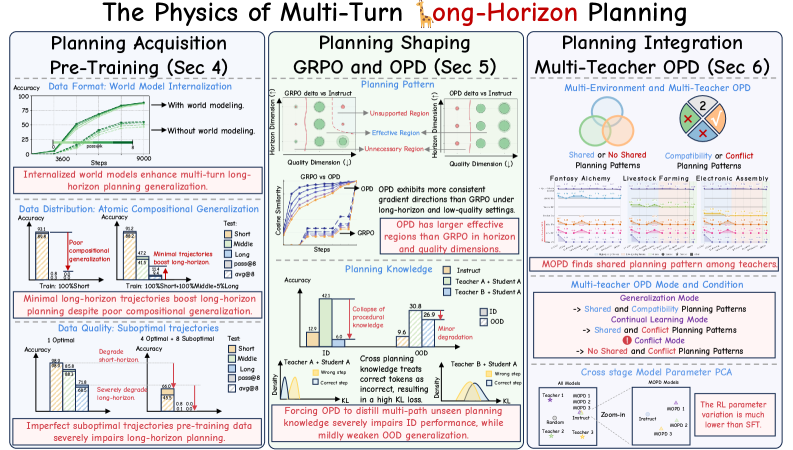
The gym: hierarchical skill graphs with AND/OR recipes
Three disjoint domains (Fantasy Alchemy, Livestock Farming, Electronic Assembly) are compiled as trees of height H, width W, and N items per category. Synthesis rules are logical combinations over prerequisites: for target node v,
v \iff (u_{1,1}\land\dots\land u_{1,k_1})\lor\dots\lor(u_{m,1}\land\dots\land u_{m,k_m}),
where each conjunction is a recipe and the outer disjunction lists alternatives. A greedy minimization prevents combinatorial blow-up in step count, and disjoint abstract graphs (A, B) are generated per domain to allow clean cross-environment tests. Because rules are counterfactual and injected at pre-training, contamination from web priors is controlled.
Pre-training: three questions about data
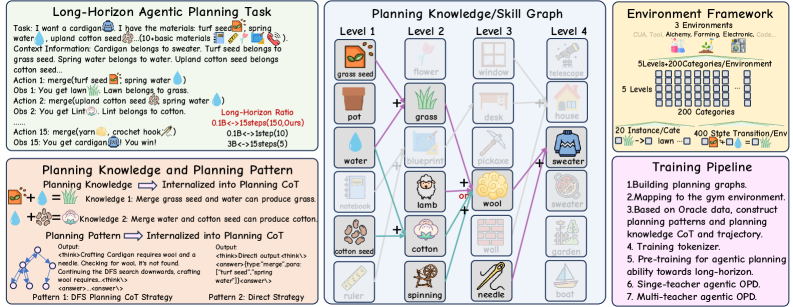
The world model is the transition \mathcal{T}:\mathcal{S}\times\mathcal{A}\to\mathcal{S}. The paper contrasts two pre-training formats: (i) pure action-sequence imitation and (ii) CoT trajectories that explicitly emit s_{t+1}=\mathcal{T}(s_t,a_t) as intermediate reasoning (“world-model internalization”). Across 1,440 evaluation instances per checkpoint (3 domains \times 3 difficulty levels \times 160 instances, 8 samples at T=0.4, 20-step budget), CoT state-transition modeling yields substantially stronger long-horizon generalization, with the gap widening at higher difficulty.
Two further findings on data distribution and quality:
- Atomic skills do not compose. Training only on short atomic transitions fails to generalize to compositional long-horizon tasks; adding even a small fraction of long-horizon trajectories closes most of the gap. Compositional generalization is not free from a bag of primitives.
- Suboptimal trajectories are toxic at long horizons. Redundant or erroneous demonstrations amplify along the chain because per-step error compounds multiplicatively, degrading final task success much more than they would in single-turn settings.
Post-training: separating pattern from knowledge via mutual information
The paper decomposes an agent’s output into a general planning pattern P (reflection, backtracking, subgoal decomposition) and task-specific planning knowledge K (which recipe, which item), and measures
I(T;P)=H(P)-H(P\mid T),\qquad I(T;K)=H(K)-H(K\mid T).
Because P is reusable across tasks while K is tightly bound to the current state, I(T;P)<I(T;K). This decomposition partitions post-training’s effect into three regions for patterns — unnecessary (already present in the base), effective (RL/OPD reliably injects), and unsupportable (pattern cannot be elicited without richer pre-training substrate) — and explains why GRPO and on-policy distillation (OPD) succeed or fail based on which region a target capability lives in.
Multi-teacher OPD: cascaded distillation and its failure modes
Because mixture MOPD requires simultaneous serving of teachers, the analysis focuses on the cascaded variant. For teacher m\in\{1,\dots,M\} the on-policy objective is a token-level KL under the student’s own rollouts \tau\sim\pi_\theta:
\mathcal{L}^{(m)}_{\text{Agent-OPD}}(\theta)=\mathbb{E}_{\tau\sim\pi_\theta}\!\left[\sum_{k=1}^{K}\sum_{t=1}^{T_k}D_{\text{KL}}\!\left(p_{k,t}\,\|\,q_{k,t}^{(m)}\right)\right],
with q_{k,t}^{(m)}=\pi^{(m)}_{\text{teacher}}(\cdot\mid H_k,\hat{Y}_{k,<t}). Training iterates m=1,\dots,M. Three regimes are identified:
- Q1 Generalization mode: when teachers share compatible planning patterns across environments, MOPD transfers cross-environment.
- Q2 Continual-learning mode: when patterns are non-shared but non-conflicting, sequential distillation can accumulate skills without catastrophic loss.
- Q3 Conflict mode: when teachers encode contradictory patterns (e.g., different backtracking priors on Graph A vs. Graph B), cascaded MOPD loses cross-environment performance, and later teachers overwrite earlier competence.
This maps directly onto reported foundation-model recipes (MiMo-V2-Flash, GLM-5, Nemotron-Cascade 2, DeepSeek-V4), which the paper places into the two paradigms of cross-domain capability integration vs. cross-stage capability retention.
Limitations and open questions
The gym uses counterfactual synthesis rules and abstract items; whether the same phase structure (world-model advantage, atomic-composition gap, suboptimal-trajectory toxicity, MOPD conflict regime) holds when the underlying tokens carry strong prior semantics from web pre-training is not established. Horizon length is capped at 20 steps and evaluation is over 1,440 instances per checkpoint — small relative to production regimes. Mutual information between T and P/K is argued qualitatively rather than estimated directly, and the pattern/knowledge split is not operationalized as an extractable representation. Finally, the cascaded MOPD analysis omits mixture-form MOPD, where interference dynamics likely differ.
Why this matters
The paper turns “why is long-horizon planning hard?” into a controlled, decomposable question and produces concrete design rules: bake state-transition CoT into pre-training, include some long trajectories rather than only atomic skills, aggressively filter suboptimal demonstrations, and pick MOPD ordering based on whether teachers’ planning patterns conflict. These are directly actionable for anyone building agentic post-training pipelines.
Source: https://arxiv.org/abs/2607.24720
dRAE: Representation Autoencoder with Hyper-Spherical Codes
Problem
Discrete visual tokenizers built on top of high-capacity vision encoders (CLIP, SigLIP, DINOv2) are the bottleneck for unifying vision with autoregressive/masked LMs. Standard VQ-VAE-style quantization on such encoders collapses: as codebook size K grows, utilization drops and downstream quality plateaus. The authors argue the failure is not an optimization trick but a metric mismatch. Vision-encoder features live on a thin spherical shell (a consequence of Gaussian-like concentration in high dimensions plus contrastive/self-distillation training pressure toward directional uniformity), yet \ell_2 nearest-neighbor assignment mixes angular direction with magnitude. Codes with larger norms dominate assignment regardless of semantic direction, producing anisotropic codebooks with high magnitude variance and clumped angular distributions.
Two diagnostics motivate the split (Tab. 1). Feeding an LLaVA-style MLLM either raw features Z or \ell_2-normalized Z' = Z/\|Z\|_2 costs only ~1% (MMBench 82.2 → 81.1, TextVQA 61.3 → 60.7, POPE 85.2 → 84.3): semantics is essentially directional. In contrast, a ViT decoder reconstructing pixels from Z' collapses (PSNR 22.5 → 20.6, SSIM 0.62 → 0.51, rFID 4.62 → 9.57): magnitude carries the structural signal needed for pixel-level fidelity. A quantizer must therefore preserve both, but assign codes by angle.
Method: Hyper-Spherical Quantization
HSQ decouples routing from magnitude. Given latent z \in \mathbb{R}^d and codebook \{c_k\}_{k=1}^{K}, the assignment uses cosine similarity:
k^\ast = \arg\max_k \frac{\langle z, c_k \rangle}{\|z\|\,\|c_k\|}.
The codebook loss \mathcal{L}_{\text{codebook}} is defined in cosine space (pulls the selected code’s direction toward z’s direction), while the commitment loss \mathcal{L}_{\text{commit}} remains \ell_2 so encoder outputs still match code magnitudes:
\mathcal{L}_{\text{codebook}} = 1 - \cos(\text{sg}(z), c_{k^\ast}), \qquad \mathcal{L}_{\text{commit}} = \|z - \text{sg}(c_{k^\ast})\|_2^2.
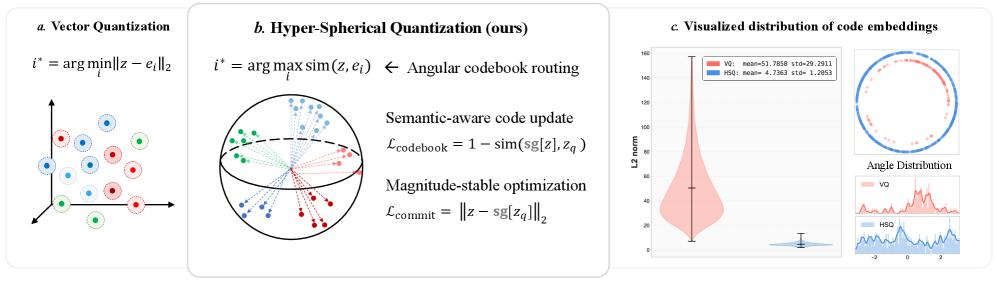
Figure 1(c) shows why this matters: PCA projections of VQ codes cluster into low-angular-diversity blobs with heavy-tailed norms, while HSQ codes distribute uniformly on the shell. The full-cosine variant (cosine for both losses) breaks reconstruction (Tab. 7: rFID 3.02 → 12.7, SSIM 0.65 → 0.33), confirming that the \ell_2 commitment term is what forces the encoder’s magnitude distribution to remain informative for the decoder.
The tokenizer follows the RAE recipe: pretrained SigLIP2 ViT-So400M encoder, symmetric ViT decoder, distillation loss to the frozen teacher, trained end-to-end in one stage. No codebook initialization tricks, EMA resets, dead-code revival, or curriculum are used.
Results
Reconstruction ablation (Tab. 7) isolates the metric contribution: switching only the assignment to cosine drops rFID 3.59 → 3.31; adding cosine \mathcal{L}_{\text{codebook}} gives 3.02 with SSIM 0.65.
C2I on ImageNet (Tab. 5) with a discrete diffusion head, no sampler tuning: at K=32{,}768, HSQ gives gFID 4.83 / IS 268.4 vs VQ 5.37 / 251.3; at K=65{,}536, HSQ improves to 4.45 / 287.3 while VQ degrades to 5.51 / 264.3. VQ fails to benefit from a larger codebook; HSQ scales monotonically. With iREPA alignment (Tab. 6) HSQ reaches gFID 6.11 vs VQ 7.16.
Understanding (Tab. 8, LLaVA-1.5 recipe with Qwen2.5-7B): HSQ improves with codebook size (GQA 34.3 → 35.8, MMB 44.1 → 45.6 from K=16K to 65K) while VQ regresses (GQA 34.1 → 33.8, MMB 43.8 → 42.0). The authors also report VQ suffers oscillating reconstruction loss and a monotonically increasing distillation loss late in training; HSQ does not.
Feature-reconstruction proxy (Tab. 9), freezing the encoder and quantizing z directly: HSQ reaches PSNR 8.24 / cosine 0.92 vs VQ 4.91 / 0.81.
Joint image–semantic training with K=131{,}072, plugging the quantizer between a frozen encoder and Qwen-3.5 with a parallel pixel ViT decoder and entropy regularization \tau=0.01:
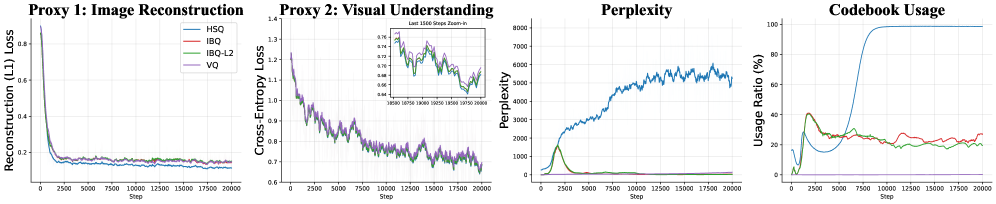
HSQ attains 100% codebook utilization and the fastest convergence on both the reconstruction and LM losses, beating IBQ and \ell_2-normalized IBQ despite not using stochastic (Gumbel-style) sampling; VQ is worst on both axes.
Limitations and open questions
- Feature reconstruction quality (PSNR 8.24) remains poor in absolute terms; the authors attribute this to intrinsic noise in encoder features and the absence of perceptual supervision, but this limits use of HSQ as a direct semantic tokenizer without a pixel proxy.
- The design depends on encoders whose features actually concentrate on a shell (CLIP/SigLIP/DINO family). For encoders without this geometry (e.g., raw VAE latents), the angular routing assumption may not hold.
- The mixed cosine/\ell_2 recipe is empirical; there is no principled account of why the \ell_2 commitment term is exactly what preserves useful magnitude structure beyond the ablation.
- Generation results, while strong, use discrete diffusion; effects on autoregressive next-token generation with these very large (K=131K) vocabularies are not fully characterized.
Why this matters
The paper reframes the codebook-collapse problem as a geometry problem rather than an optimization pathology, and shows that a two-line change — angular assignment plus cosine codebook loss, with \ell_2 commitment retained — yields 100% utilization at K=131{,}072 without any of the stability hacks (EMA, dead-code resets, stochastic routing) that current tokenizers rely on. If it generalizes, it removes a real obstacle to scaling visual vocabularies to LM-sized budgets.
Source: https://arxiv.org/abs/2607.22148
Kimi K3: Open Frontier Intelligence
Kimi K3 is a 2.8T-parameter Mixture-of-Experts model with 104B activated parameters, native vision, and a 1M-token context. The report positions itself as an architectural and infrastructural update to K2 rather than a pure scale-up: at fixed compute, the authors report roughly 2.5\times scaling efficiency over K2, driven by three named components — Kimi Delta Attention (KDA), Attention Residuals, and Stable LatentMoE — plus a post-training regime centered on multi-domain RL with tunable reasoning effort.
Architecture
The attention stack replaces standard softmax attention in most layers with Kimi Delta Attention, a linear-attention variant in the DeltaNet family. The recurrence maintains a state matrix S_t \in \mathbb{R}^{d_k \times d_v} updated as
S_t = S_{t-1}(I - \beta_t k_t k_t^\top) + \beta_t v_t k_t^\top,
so each token performs a rank-1 correction to the associative memory rather than an additive write. This preserves the O(N) time and O(1) per-token memory of linear attention while giving the model an explicit erase-and-write channel; combined with a data-dependent gate \beta_t, KDA behaves closer to a controllable state-space model than to naive linear attention. The paper couples this with Attention Residuals, which route pre-attention residuals across depth so that later layers can re-use earlier attention states rather than recomputing them, improving depthwise information flow. A minority of layers retain full softmax attention to preserve exact long-range retrieval, giving a hybrid stack similar in spirit to Jamba/RecurrentGemma but with KDA as the linear component.
For the MoE block, Stable LatentMoE activates 16 of 896 routed experts per token. The “latent” qualifier refers to routing being performed in a low-rank projected space to stabilize the router under high expert counts; 896 experts at this activation ratio ({\sim}1.8\%) is aggressive compared with K2 or DeepSeek-V3, and the stability claims rest on that projection plus load-balance auxiliary losses. With 104B activated of 2.8T total, the sparsity ratio is {\sim}27\times.
Training infrastructure
Training a 2.8T MoE with KDA is nontrivial because linear-attention kernels do not compose well with expert parallelism or with pipeline stages that assume attention is a pure function of (Q,K,V). The paper describes algorithm-system co-design for KDA (fused recurrent kernels compatible with sequence parallelism), “perfectly balanced” expert-parallel training with memory management tuned to the 16/896 activation pattern, and, for post-training, a million-token agentic RL setup with persistent rollout and sandbox state. The persistence matters: agentic trajectories at 1M context are dominated by environment I/O, so keeping sandboxes (shells, browsers, code executors) warm across policy updates avoids re-materializing state each rollout, which is where naive RLHF pipelines collapse at long horizons.
Post-training
Post-training is RL-heavy and spans general chat, agentic tool use, and coding, with multiple reasoning-effort levels trained jointly. Concretely, the model is conditioned on an effort token so a single checkpoint supports low-latency direct answers and high-effort chain-of-thought / tool-using trajectories. The authors argue this yields compositional generalization: skills learned in one domain (e.g., debugging in coding RL) transfer to another (agentic web tasks) because the effort-conditioned policy factorizes reasoning strategy from domain knowledge. Long-horizon execution is stressed as a first-class objective rather than a byproduct of instruction tuning.
Results
The abstract claims frontier-level performance on long-horizon coding, agentic, knowledge, reasoning, and vision benchmarks, with the headline number being the {\sim}2.5\times scaling-efficiency improvement over K2. Without the full evaluation tables in the provided excerpt, the salient quantitative points are: 2.8T total / 104B active parameters, 16/896 expert activation, 1M-token context, and the 2.5\times compute-efficiency figure. The efficiency claim should be read as loss-vs-FLOPs on the pretraining objective; whether it fully transfers to downstream RL-tuned performance depends on how much of the gain comes from KDA (which changes the loss landscape) versus LatentMoE (which changes the parameter-to-FLOP ratio).
Limitations and open questions
The abstract is truncated but the architectural choices flag several open issues. First, KDA is a linear-attention variant; despite hybridization, tasks requiring exact needle-in-haystack retrieval at 1M tokens are historically where linear attention degrades, and the report should be scrutinized on RULER-style evals rather than perplexity. Second, 16-of-896 routing at 2.8T scale is at the frontier of what load-balancing losses can stabilize; expert collapse or dead experts are not discussed in the abstract. Third, “compositional generalization” from multi-domain RL is claimed but the standard failure mode — reward hacking on one domain leaking into another — needs quantitative treatment. Fourth, the effort-conditioned policy raises a calibration question: does the model correctly select effort when the token is not user-specified?
Why this matters
Kimi K3 is a data point that architectural changes (linear-attention hybrids, latent-space routing at very high expert counts) can still deliver multiplicative compute-efficiency gains at the 2T+ MoE scale, rather than the field being purely data- and scale-bound. If the 2.5\times figure holds up under independent evaluation, KDA-style recurrences become hard to ignore for anyone training frontier models with long contexts.
Source: https://arxiv.org/abs/2607.24653
From Proprietary to Open-Source: Bridging the Distribution Gap via Multi-Agent Protocol Distillation in Agentic Search
Problem
Agentic search interleaves multi-step reasoning with retrieval, and outcome-based RL (e.g., GRPO with EM reward) supplies only a sparse trajectory-level binary signal R(x,y)\in\{0,1\}. Denser supervision from a strong proprietary teacher is attractive, but two structural barriers block standard distillation (see Figure 1): teacher logits are hidden and tokenizers differ, ruling out logit or token-level KL matching; and imitating the teacher’s raw natural-language trajectories transfers surface style (verbosity, formatting idioms) and induces hallucination, since the student’s own generation distribution is dragged toward tokens it cannot faithfully produce.
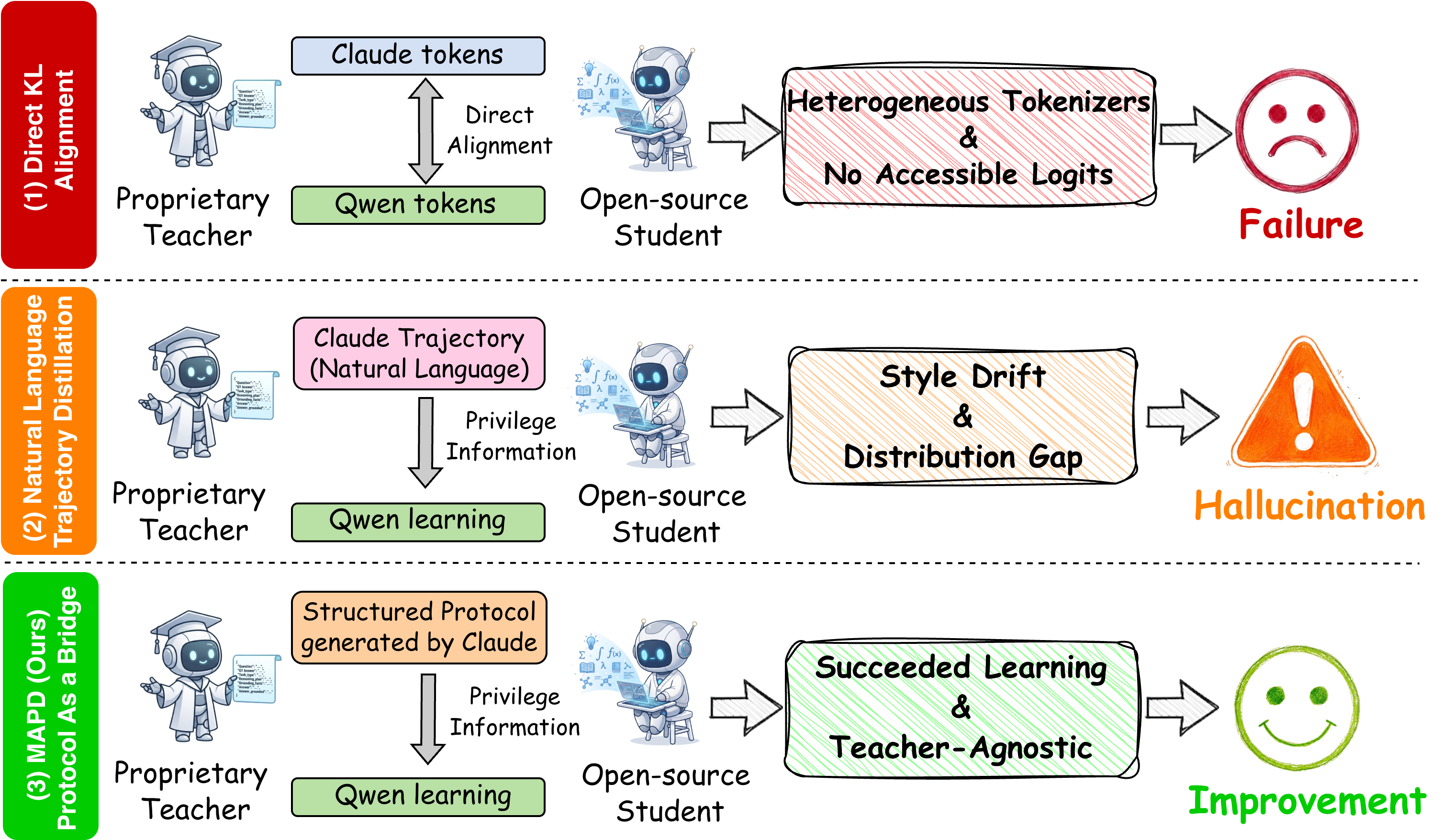
Method
Multi-Agent Protocol Distillation (MAPD) inserts a style-normalized intermediate representation — a Structured JSON Protocol z — between teacher and student, then combines protocol-conditioned distillation with GRPO.
Structured JSON Protocol. Each teacher trajectory is compressed into five fields:
task_type\in {single_hop, multi_hop, comparison, others}reasoning_plan: ordered sub-goal listgrounding_facts: extractive evidence spans from retrieved passagespartial_findings: optional intermediate results when search failed to convergeanswer_verification: final answer plus a booleananswer_groundedflag
The rendered protocol p = f(z) is fed as privileged information to a teacher-conditioned branch of the student during training only. Because z discards teacher-specific phrasing and keeps only structured cognitive artifacts plus verbatim evidence, the student’s native token distribution is preserved while high-level strategy and grounded facts are transferred.
Multi-Agent Generation Pipeline. An offline MAS built on a proprietary model decomposes each training query, executes retrievals, repairs failed searches (producing partial_findings when EM cannot be reached), and emits the JSON protocol under quality-control filters. This yields protocols even for queries the teacher’s search cannot solve outright — a nontrivial coverage property, since sparse-reward RL would discard those trajectories entirely.
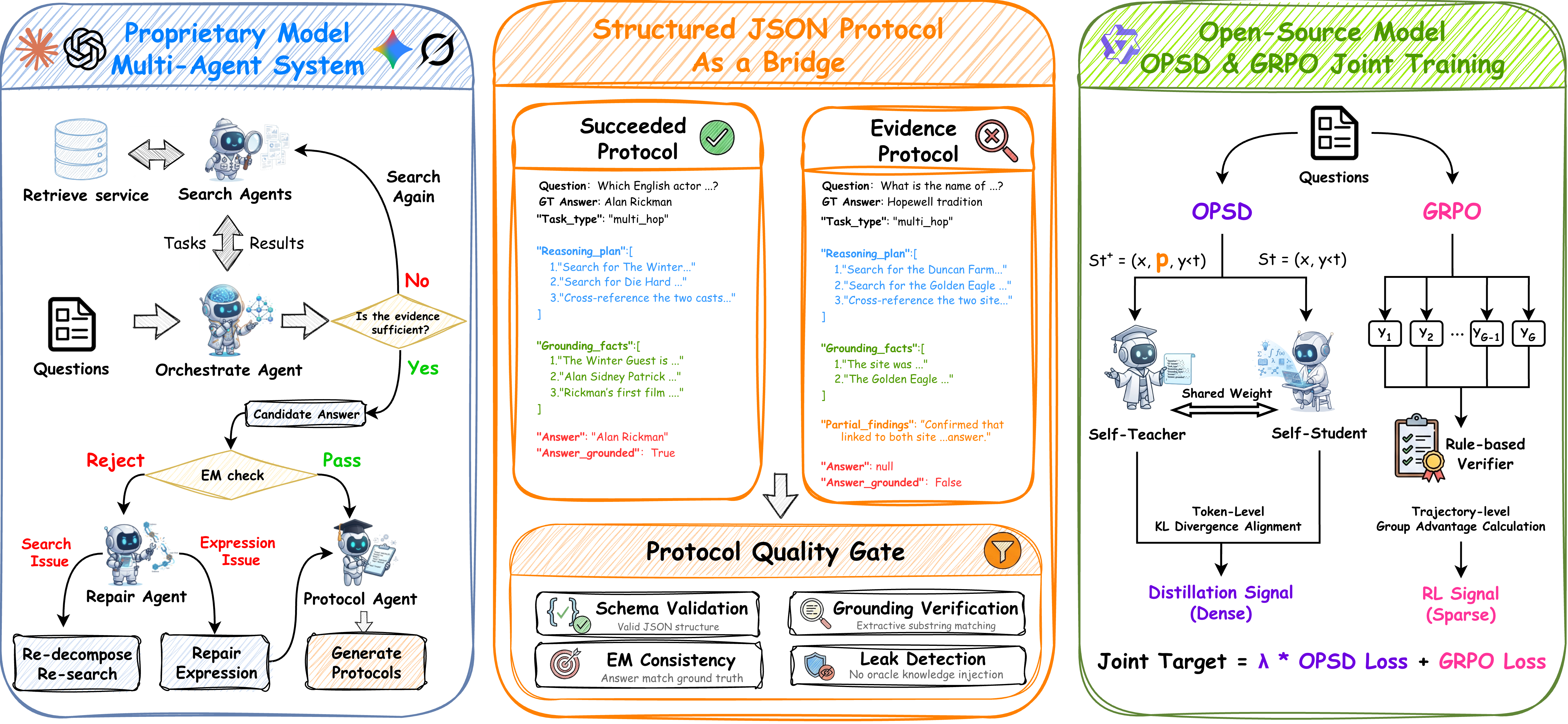
Joint objective. Training combines an on-policy sequence distillation (OPSD) term with GRPO. The OPSD term aligns the student’s unconditional policy \pi_\theta(y\mid x) with the protocol-conditioned policy \pi_\theta(y\mid x, p) at the token level, using the privileged-teacher branch as a soft target on the student’s own tokenizer — sidestepping the heterogeneous-tokenizer problem entirely. The composite loss is
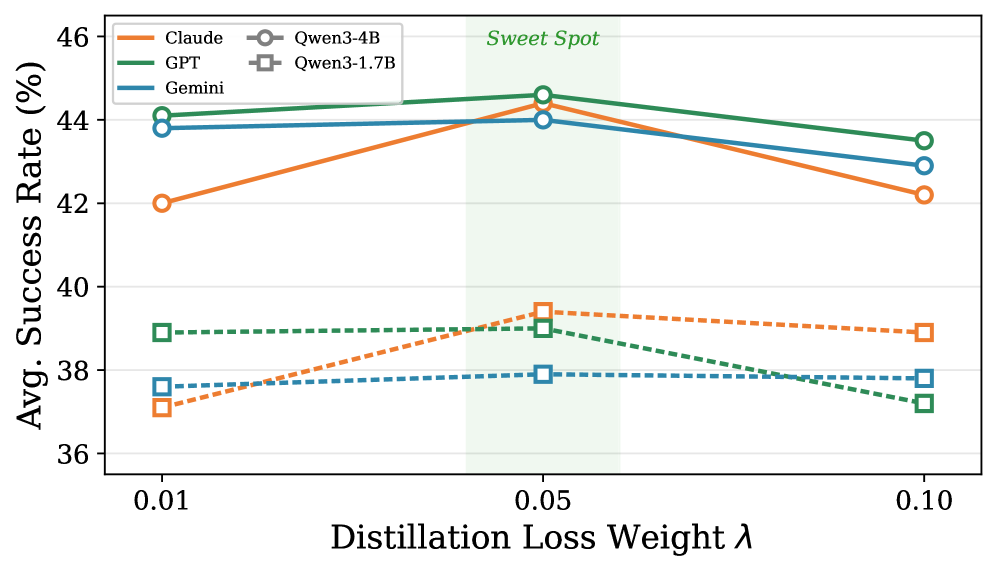
\mathcal{L} = \mathcal{L}_{\text{GRPO}} + \lambda\,\mathcal{L}_{\text{OPSD}},
with \lambda=0.05 selected by the sweep in Figure 3, which shows a clear inverted-U: too small yields negligible densification, too large overwhelms the RL signal and destabilizes the policy.
Results
Training uses only NQ + HotpotQA; five of the seven eval benchmarks are OOD. On Qwen3-1.7B, MAPD reaches an average success rate of 39.4% vs. SDAR 37.6%, GRPO+OPSD 30.5%, GRPO 31.6%, and vanilla 25.7%. On Qwen3-4B, MAPD hits 44.4% vs. SDAR 43.0%, GRPO+OPSD 38.3%, GRPO 37.4%, vanilla 28.8%.
Two patterns stand out. First, naive OPSD alone is catastrophic: 5.9% on 1.7B and 20.9% on 4B — below vanilla — confirming that raw trajectory imitation degrades the student. Even GRPO+OPSD (raw traces) barely matches GRPO on 1.7B (30.5 vs. 31.6). The protocol representation is what makes distillation additive rather than destructive. Second, gains concentrate on multi-hop OOD tasks: Bamboogle improves 15.0% relative on 1.7B (22.4 → 36.8 vs. GRPO; 32.0 → 36.8 vs. SDAR), MuSiQue 5.7%, 2Wiki 5.5%. Single-hop gains are smaller (TriviaQA +0.9%), consistent with the intuition that structured reasoning plans and grounding facts matter most when multiple retrievals must be chained.
Limitations and open questions
- The protocol schema is hand-designed; whether the five fields are Pareto-optimal or whether learned decompositions would transfer better is untested.
- All experiments use Qwen3-{1.7B, 4B}; scaling behavior beyond 4B and to non-Qwen families is unreported.
- OPSD conditions the teacher branch on ground-truth-verified protocols, but at inference the student has no protocol. The size of the teacher-branch / student-branch gap, and whether it can be closed via test-time protocol prediction, is not analyzed.
- The MAS pipeline itself uses proprietary-model calls per training query; the total teacher-token budget vs. pure RL is not tabulated.
- EM as the sole reward and eval metric obscures partial-credit behavior on multi-hop chains, and the arXiv ID appears anomalous (2607 prefix), suggesting either a preprint versioning quirk or a placeholder.
Why this matters
MAPD shows that when logit access and tokenizer alignment are unavailable, a structured intermediate representation — not raw text — is the right distillation interface, and it composes cleanly with sparse-reward RL rather than fighting it. This is a practical recipe for lifting open-source agents toward proprietary-teacher competence on multi-hop retrieval tasks without any privileged access to the teacher’s internals.
Source: https://arxiv.org/abs/2607.24280
StateAct: Program State, before Pixels, for Long-Horizon Computer-Use Agents
Problem
Most computer-use agents treat the screen as the primary observation: a VLM reads a screenshot, chooses coordinates, clicks. StateAct argues this is the wrong interface for desktop automation. A screenshot o_{\mathrm{pix}} = f_{\mathrm{render}}(s) is a lossy, non-injective projection of the underlying program state s (files, DOM, application backends, spreadsheet cells). Two states with identical pixels can differ in what actually determines task success: a cell showing “42” may hold a literal, a rounded value, or a formula; hidden rows and off-screen data do not render at all. Since the deliverable of a desktop task is a change in s — success predicate G(s) evaluated over saved state, not over pixels — grounding perception on f_{\mathrm{render}}(s) compounds error over hundreds of steps.
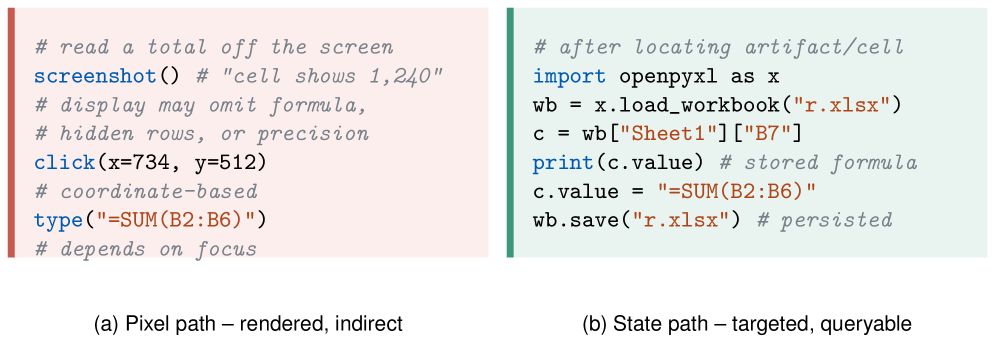
Formally, there is generally no \tilde{G} with G(s)=\tilde{G}(f_{\mathrm{render}}(s)) when the deliverable depends on non-rendered content. The state channel o_{\mathrm{state}}=g(s) — a shell command, openpyxl read, DOM serialization — is effectively invertible over the substate a task touches and both reads and writes the actual artifact.
Method
StateAct is a code-first multi-agent harness with three components (Figure 2).
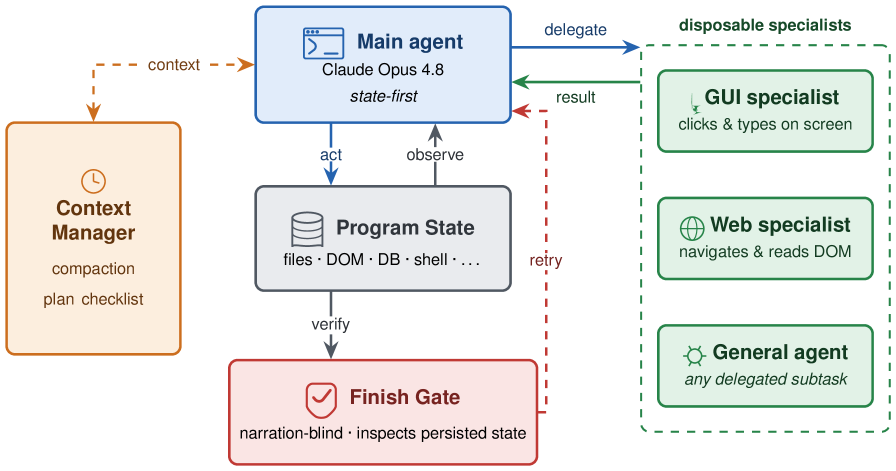
Main agent (code on state). The action space is a persistent bash, a file editor, a read-only view_image for image files, a plan checklist, a finish action, and an agent-delegation tool. Crucially, no mouse or keyboard is exposed to the main agent. State discovery relies on model priors about where applications persist state (mail stores, office formats, browser profiles, sqlite DBs) plus active probing with find/ls/grep/sqlite3.
GUI/browser subagents. When a subgoal genuinely requires screen interaction (visual layout confirmation, non-scriptable UI), the main agent delegates to a fresh-context specialist. Empirically the GUI subagent is invoked on only 28 of 108 tasks and consumes 1.1% of main-agent steps.
Finish gate. An independent verifier re-reads persisted artifacts on finish (after at least three non-finish steps), with up to three rounds. It catches structural failures: output missing, unsaved, wrong path, or logically inconsistent. Figure 5 (task 038) shows the gate re-deriving all 40 CRM lead statuses and rejecting lead-6 because it was sourced from a stale record superseded by a newer email; the agent then re-derives and passes.
Context management. Long horizons are handled by handing subgoals to fresh subagents while the main agent’s context stays focused on the plan and task facts. Turn accounting: ~57 main-agent turns per episode; each delegation adds ~23 interior turns (capped at 50), totaling ~155 model turns per task.
Results
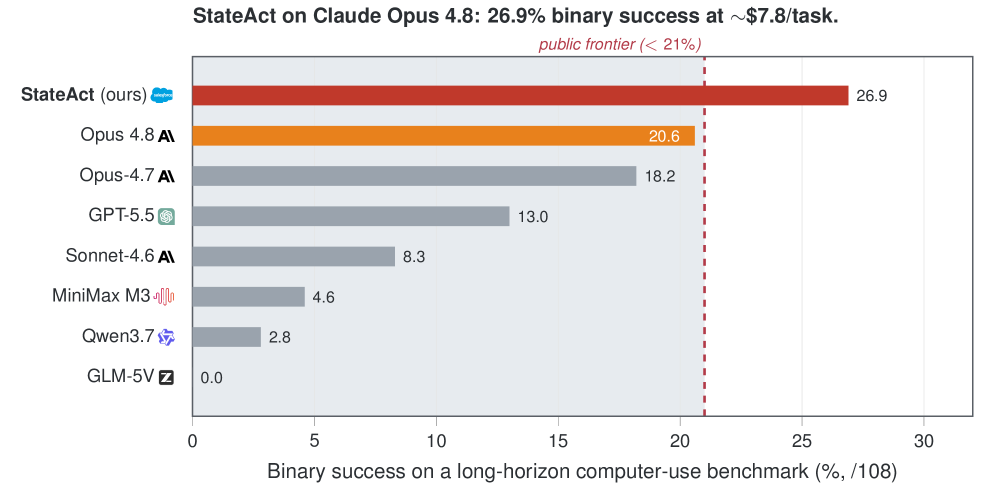
On OSWorld 2.0 (108 long-horizon tasks) with Claude Opus 4.8, adaptive thinking, and a 200-turn main-agent budget:
- Binary success: 26.9% vs. 20.6% for the same Opus 4.8 under the reference CUA harness.
- Mean partial score: 61.6% vs. 54.8%.
- Cost: ~$7.8/task vs. ~$72/task — roughly 9\times cheaper despite better accuracy.
Per-capability, gains concentrate exactly where the state-grounding argument predicts. On Multi-item state StateAct hits 27.9/66.7 vs. next-best GPT-5.5 at 14.0/50.6. Streaming jumps to 66.7/66.7 vs. GPT-5.5’s 50.0/57.8 and Sonnet-4.6’s 0.0/4.7. Cross-source (26.1/64.9), Conflict disambiguation (30.8/64.5), Visual-spatial (31.1/61.3), and Implicit state (30.2/60.1) all show similar 2–3× multiples over the strongest non-StateAct baselines on binary success. The one regression is Human-in-the-loop at 0.0/43.9 (GPT-5.5 hits 16.7/43.1), suggesting the code-first stance under-serves genuinely interactive negotiation.
Trajectories in Figure 5 illustrate the modes: task 012 solves an entire exam-question binding problem with python-docx/pdfplumber/tesseract and no GUI; task 001 writes an .ics calendar file directly and only delegates to a GUI specialist to visually confirm GNOME Calendar; task 038 exercises the gate-retry loop.
Limitations and open questions
The evaluation covers a single backbone (Claude Opus 4.8) on a single benchmark. The state-channel advantage depends on the model having accurate priors about where applications persist state; this is likely weaker for niche or closed-source software than for the office/mail/browser stack OSWorld emphasizes. The finish gate as described checks structural properties; semantic verification remains bounded by the same model’s judgment. Human-in-the-loop degradation suggests the harness needs a principled way to escalate to interactive modes rather than treating GUI as a fallback specialist. The paper does not ablate the finish gate, context manager, and delegation policy separately, so the attribution among the three components is unclear. Also, “state discovery” via find/grep/sqlite3 is a security-sensitive capability outside sandboxed evaluation.
Why this matters
If the deliverable of a desktop task is program state, then the right interface for an agent is the state channel, not pixels — and StateAct provides direct evidence that this reframing yields both higher success (26.9% vs. 20.6%) and ~9\times lower cost on the same backbone. It suggests that further scaling of screen-perception VLMs is the wrong axis for long-horizon computer-use agents; the axis is code, artifact-level verification, and context discipline.
Source: https://arxiv.org/abs/2607.22798
Rethinking Classifier-Free Guidance in On-Policy Diffusion Distillation
Problem
On-policy distillation (OPD) for diffusion models queries a teacher along trajectories rolled out by the current student and matches teacher velocities. Modern diffusion systems almost always deploy classifier-free guidance (CFG), so the natural objective is to match the CFG-composed velocity
v_\gamma = \gamma v_+ + (1-\gamma) v_-,
where v_+ and v_- are the conditional and unconditional (or negative-branch) velocities. The paper argues this default is under-identified at the branch level and can silently degrade the student when the teacher’s negative branch carries information the student cannot see.
Let \mathbf{e}_+ = v_+^S - v_+^T and \mathbf{e}_- = v_-^S - v_-^T be the branch errors. Matching only the guided prediction requires
\gamma \mathbf{e}_+ + (1-\gamma)\mathbf{e}_- = \mathbf{0} \;\;\Longleftrightarrow\;\; \mathbf{e}_+ = \tfrac{\gamma-1}{\gamma}\mathbf{e}_-,
which admits infinitely many non-zero branch-error pairs. Whether this ambiguity is benign depends on the conditioning structure.
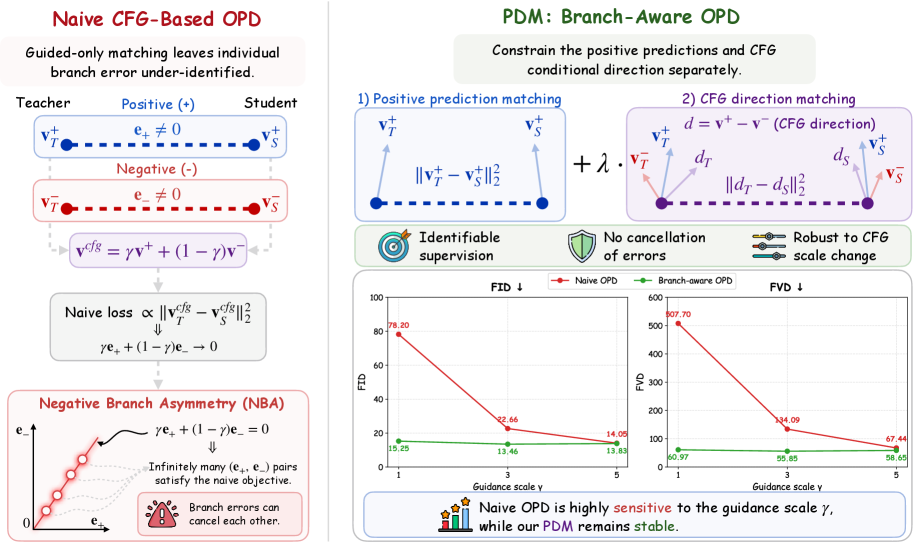
Negative Branch Asymmetry
The authors distinguish two regimes:
- Shared negative conditioning: teacher and student both use \varnothing on the negative branch (e.g., text-rendering with \mathbf{c}_T^-=\mathbf{c}_S^-=\varnothing). Reducing the guided error tends to reduce both branch errors jointly.
- Privileged negative conditioning: the teacher’s negative branch has information the student lacks. In the reference-conditioned FLUX-2-klein setup, \mathbf{c}_T^- = (\varnothing, \mathbf{r}) while \mathbf{c}_S^- = \varnothing. The student’s negative branch cannot in principle match the teacher’s, but the composed objective still admits solutions that satisfy Eq. 7 by letting \|\mathbf{e}_-\| grow to compensate a reduced \|\mathbf{e}_+\|.
They call the resulting failure mode Negative Branch Asymmetry (NBA): naive CFG-composed matching produces antagonistic dynamics — \|\mathbf{e}_+\|_2 decreases while \|\mathbf{e}_-\|_2 increases. Because the two errors cancel at \gamma_{\text{train}}, the pathology is invisible at the training scale and only exposed when guidance is rescaled at inference.
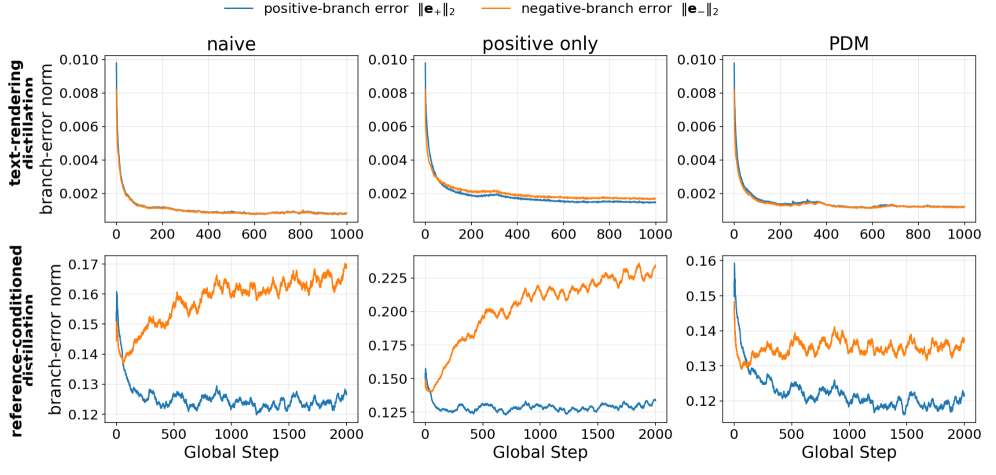
Figure 2 confirms both predictions empirically. In the text-rendering distillation (SD3.5-Medium, LoRA rank 32, \gamma_{\text{train}}=4.5), all three objectives — naive, positive-only, and PDM — drive both branch errors down. In the FLUX-2-klein reference-conditioned setting (\gamma_{\text{train}}=2), naive matching and even the positive-only ablation reduce \|\mathbf{e}_+\|_2 while \|\mathbf{e}_-\|_2 climbs; PDM alone keeps the negative branch stable.
Positive-Direction Matching (PDM)
PDM removes the ambiguity by decomposing the objective into (i) a positive-branch velocity match and (ii) a match on the conditional direction v_+ - v_- — the actual CFG update direction — rather than on the composed prediction. Concretely, PDM constrains
\ell_{\text{PDM}} = \|v_+^S - v_+^T\|_2^2 + \lambda \,\|(v_+^S - v_-^S) - (v_+^T - v_-^T)\|_2^2.
Because the student’s negative branch cannot literally reproduce a privileged teacher negative, PDM asks the student to reproduce the direction the teacher wants CFG to move in, not the teacher’s absolute v_-. This is identifiable: the positive term pins \mathbf{e}_+, the direction term pins \mathbf{e}_+ - \mathbf{e}_-, and together they pin \mathbf{e}_- up to the student’s representational capacity, eliminating the compensating solutions of Eq. 7.
Qualitative evidence
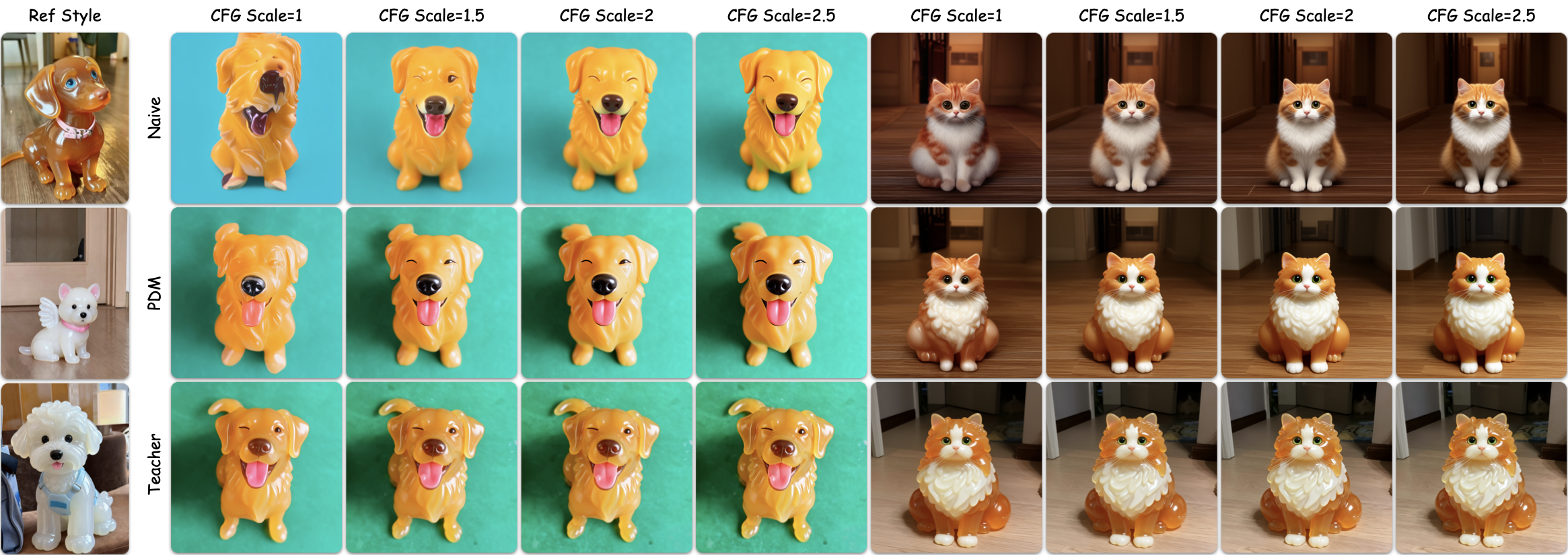
Figure 3 shows the practical consequence. With the FLUX-2-klein reference-conditioned teacher, the teacher preserves the reference style consistently across inference guidance scales. A PDM-distilled text-only student tracks this behavior closely. The naive-matching student, trained at exactly the same \gamma_{\text{train}}=2, exhibits visible style drift and structural distortion — most severely at \gamma=1, where the CFG composition weights \mathbf{e}_- maximally and the accumulated negative-branch error is fully exposed. This is the “hidden at training scale, exposed at recomposition” signature predicted by the NBA analysis.
Setup details worth noting
- Text rendering: SD3.5-Medium base, LoRA r=32,\alpha=64 on Q/K/V and output projections of every self- and cross-attention block in the MM-DiT; only the LoRA is trained. Teacher is the DiffusionOPD OCR teacher. Evaluation on 1,018 held-out prompts.
- Reference conditioning: FLUX-2-klein-base-4B, \gamma_{\text{train}}=2, evaluated across a sweep of inference guidance scales.
- The positive-only ablation (\ell_+ = \|\mathbf{e}_+\|_2^2) is used only as an optimization diagnostic; it shows that even removing the negative branch from the loss does not prevent \|\mathbf{e}_-\|_2 from growing under privileged conditioning, because on-policy trajectory shifts couple the branches implicitly.
Limitations and open questions
The diagnostic is largely qualitative on the reference-conditioned side; the paper leans on branch-error trajectories and side-by-side generations rather than a standardized style-fidelity metric. The theoretical statement (Eq. 7) is a first-order condition at a supervised state and does not by itself explain why gradient dynamics prefer the antagonistic solution — the paper defers this to empirical observation. The choice of direction-matching weight \lambda and its interaction with \gamma_{\text{train}} is not fully characterized. It is also unclear how PDM interacts with other guidance variants (e.g., autoguidance, perturbed-attention guidance) where the “negative” branch is not a null condition at all, and whether NBA occurs in video/audio diffusion with more complex conditioning stacks.
Why this matters
CFG-composed matching has been the tacit default in diffusion distillation, and this paper shows it is silently under-identified whenever the teacher’s negative branch carries privileged signal — an increasingly common regime with reference-image, subject, or control conditioning. PDM is a small, mechanical fix that restores identifiability and preserves the teacher’s guidance-scale behavior, which is the property practitioners actually deploy.
Source: https://arxiv.org/abs/2607.24731
Sol-Attn: Accelerating Video Generation Inference via On-the-Fly Attention Sparsification
Problem
Video diffusion transformers (DiTs) operate on token sequences that can exceed 10^5 elements once spatial patches are unrolled over dozens of frames. Attention cost scales as O(N^2 d), and empirically dominates end-to-end inference latency for recent models such as HunyuanVideo and Wan. Training-free dynamic sparse attention — where each query attends only to a subset of key/value blocks selected at runtime — is attractive because it avoids retraining and adapts per-sample. However, existing dynamic-sparse schemes fall into two failure modes:
- Rigid or costly routing. Top-k block selection using a proxy score (e.g., mean-pooled key against query) imposes a fixed budget per query, wasting compute where attention is sharply peaked and losing mass where it is diffuse. Cumulative-mass routing (retain blocks until \sum p_i \ge \tau) gives dynamic budgets but requires materializing a full proxy distribution and sorting, whose overhead becomes significant at long context.
- Hard drop of unselected blocks. Setting the contribution of unselected blocks to zero introduces bias in the softmax normalizer and the output, and this bias compounds across layers and diffusion steps. Under aggressive sparsity (e.g., >80%), quality collapses.
Sol-Attn (Sparsifying online attention) targets both issues within a single fused online-softmax kernel.
Method
Standard FlashAttention-style online softmax processes key/value blocks B_j sequentially, maintaining a running max m, exponent-sum \ell, and unnormalized output O. For a query row q and block j with scores s_j = q K_j^\top / \sqrt{d}:
m_j = \max(m_{j-1}, \max s_j), \quad \ell_j = e^{m_{j-1}-m_j}\ell_{j-1} + \sum e^{s_j - m_j}, \quad O_j = e^{m_{j-1}-m_j} O_{j-1} + e^{s_j - m_j} V_j.
Sol-Attn injects three modifications into this loop.
On-the-fly routing without a separate proxy pass. Rather than pre-computing proxy scores over all blocks, Sol-Attn uses the current block’s own summary statistic — cheaply derivable from \max s_j and mean s_j estimated at the block header before the full q K_j^\top is materialized — to decide whether to (a) fully compute the block, (b) approximate it, or (c) skip it. Because routing is fused with the online-softmax scan, no auxiliary tensor of proxy scores is written to HBM. Budget is implicitly dynamic: sharply peaked queries stop expanding blocks early, diffuse queries admit more.
Approximation correction instead of hard drop. For blocks classified as “approximate,” Sol-Attn contributes an estimated \hat{\ell}_j and \hat{O}_j derived from the block-level summary (block-mean key \bar{k}_j and block-mean value \bar{v}_j):
\hat{s}_j \approx q \bar{k}_j / \sqrt{d}, \quad \hat{\ell}_j \mathrel{+}= B \cdot e^{\hat{s}_j - m}, \quad \hat{O}_j \mathrel{+}= B \cdot e^{\hat{s}_j - m} \bar{v}_j,
where B is block size. This keeps the softmax normalizer unbiased in expectation for blocks with low intra-block variance, avoiding the mass leakage of pure keep-or-drop routing. Skipped blocks (those whose upper-bound score \max s_j falls far below the running max) contribute nothing, matching top-k behavior at the tail.
Unified single-pass kernel. Routing decision, exact computation, approximation, and softmax update happen within one loop iteration per block, so control flow, memory reads, and arithmetic are amortized. The proxy computation is not a separate kernel launch.
Results
The paper reports on HunyuanVideo and Wan-class video DiTs. Headline claims from the abstract and setup:
- Sol-Attn attains a Pareto-superior accuracy-vs-sparsity curve relative to top-k and cumulative-mass baselines. At matched VBench / PSNR quality, it operates at higher sparsity; at matched sparsity, it retains more quality.
- The elimination of the proxy pass removes overhead that other dynamic-sparse methods incur, translating routing “savings on paper” into wall-clock speedup in the kernel.
- Approximation correction is the component that enables the aggressive-sparsity regime; ablating it recovers the accuracy cliff of keep-or-drop methods.
(Specific speedup ratios and VBench deltas are cited in the paper’s experiments; the abstract emphasizes the unification of routing, sparse compute, and correction as the source of the gain rather than a single number.)
Limitations and open questions
- The block-mean approximation assumes that keys and values within a block are reasonably homogeneous. For video DiTs this holds because tokens are patch-ordered, but for models with permuted or heavily mixed token orders (e.g., after certain positional shuffles or MoE routing), the approximation error grows.
- Routing decisions from block-level statistics can be biased when a block contains a single sharp key surrounded by irrelevant ones; the max-score estimate helps, but a formal error bound is not given.
- The method is training-free and therefore inherits whatever attention distributions the base DiT produces. If a future model is trained with denser attention patterns (e.g., long-range global tokens), the sparsity headroom shrinks.
- Interaction with other inference-time accelerations (caching across diffusion steps, step distillation, quantization) is not fully characterized.
Why this matters
Long-context attention in video DiTs is the current inference bottleneck, and every training-free saving compounds across dozens of denoising steps. Sol-Attn’s contribution is architectural for the kernel, not the model: by folding routing and residual approximation into a single online-softmax pass, it removes the overhead that typically eats into dynamic-sparse gains and pushes the usable sparsity frontier higher without retraining.
Source: https://arxiv.org/abs/2607.24027
Hacker News Signals
A $500 RL fine-tune of a 9B open model beat frontier models on catalog review
A practitioner at FermiSense describes fine-tuning a 9B open-weights model with reinforcement learning for the specific task of e-commerce catalog review — checking whether product listings meet structured quality criteria — and outperforming GPT-4-class frontier models at a fraction of the cost. The total compute spend was roughly $500.
The method follows the GRPO / outcome-supervised RL recipe: generate multiple rollouts per input, score them against a verifiable reward signal (catalog rules are boolean or near-boolean: does the title contain the brand name, is the description under N characters, are required attributes present), then update the policy to increase probability of high-reward outputs. This is precisely the regime where RL fine-tuning beats SFT and prompt engineering — when ground truth is cheap to evaluate programmatically and the task distribution is narrow.
Key technical points: (1) The reward function was hand-coded against the retailer’s style guide, not learned — this is what makes the signal reliable. (2) The 9B parameter count sits in a sweet spot where GRPO is tractable on a single A100 node for a few hours. (3) Frontier model comparison used the same structured prompt; the fine-tuned model won on precision, recall, and consistency metrics across held-out SKUs.
The post is honest about what this does not generalize to: the model is brittle outside the catalog domain, and the approach requires an existing rule set precise enough to write a reward function. It also papers over the data curation work needed to construct good prompt templates.
The broader lesson is mundane but important: for any task where correctness is programmatically verifiable and the input distribution is stable, a narrow RL fine-tune of a small open model will routinely beat general-purpose frontier inference at 10-100x lower marginal cost. The expensive part is scoping the reward function, not the compute.
Source: https://fermisense.com/when-machines-take-the-wheel/
Terence Tao: Mathematics in the Age of AI
Slides from Tao’s ICM 2026 talk lay out a sober, technically grounded view of where AI currently intersects with mathematical research. The argument is structured around three distinct use cases, each with a different fidelity requirement.
First, AI as a search and retrieval layer over the mathematical literature — here LLMs already provide value, with the caveat that hallucinated citations and subtly wrong theorem statements are a genuine hazard. Tao notes that a mathematician can sanity-check outputs, but the failure mode is insidious for non-experts.
Second, AI-assisted formalization: using LLM suggestions to accelerate Lean/Mathlib proof authoring. Tao is cautiously optimistic here. Autocompletion and tactic suggestion reduce the friction of formalization substantially, and he points to recent projects where the proof search component was meaningfully accelerated by model-generated candidates. The limiting factor is not the model but the absence of a large corpus of machine-checkable intermediate lemmas.
Third, autonomous proof generation for research-level problems. Tao is direct: current systems, including the best reasoning models, fail on problems that require genuinely novel combinations of ideas. They perform well on olympiad-style problems because those are heavily represented in training data and require relatively shallow search trees. The gap between olympiad performance and Fields-Medal-level work is not a matter of scale — it likely requires architectural changes or new training paradigms, possibly closer to tree-structured search with formal verification in the loop.
He raises the underappreciated point that even a perfect formal verifier does not solve the problem of finding the right conjecture to prove. Mathematical progress is bottlenecked on taste and problem selection as much as on proof search.
The slides are dense and worth reading directly; this is not a hype piece.
Source: https://teorth.github.io/tao-web/slides/age-of-ai-icm-2026.pdf
PyTorch: A Reference Language
The PyTorch compiler team’s dev blog post argues for an explicit reframing: PyTorch eager mode should be treated as a reference language specification, not as a performance target, and the compiler stack (torch.compile, Inductor, Triton) is the actual execution layer.
The technical substance is in what this framing justifies. The reference language semantics are defined by eager Python execution with autograd — every operator has a canonical Python-level behavior. The compiler is then free to rewrite, fuse, reorder, and lower to hardware-specific kernels so long as observable outputs match the reference within floating-point tolerance. This is analogous to how C is a reference for compiler backends: you write semantics in C, the compiler generates ISA-specific code.
Practically, this resolves a long-standing tension in the PyTorch ecosystem. Users writing custom ops or debugging numerics need to trust that eager == compiled up to rounding. The post describes work on a systematic test harness that runs both paths and flags divergences, which is necessary infrastructure if the compiler is to be trusted for production training runs.
It also explains the rationale for operator decomposition in torch.compile: composite operators get decomposed into primitives whose reference semantics are simpler to specify, even if this adds graph nodes. Correctness of the reference is prioritized over minimizing the decomposition tree.
The framing has implications for new hardware backends. A backend only needs to match reference semantics on the primitive operator set; it does not need to match eager’s internal implementation. This is how XLA, MPS, and custom accelerator backends get composability without reimplementing all of PyTorch.
Short post, but the framing clarifies a lot of otherwise confusing design decisions in the compiler stack.
Source: https://docs.pytorch.org/devlogs/compiler/2026-07-25-pytorch-a-reference-language/
Watching Go’s new garbage collector move through the heap
A detailed observational post comparing Go’s classic tricolor mark-and-sweep concurrent GC against the new garbage collector introduced in recent Go versions (targeting Go 1.24+), which uses a regionalized, generational-adjacent approach. The author instruments a real workload and visualizes GC pauses, heap scans, and write barrier overhead.
The key mechanical difference: the old GC maintains a global mark queue and scans the entire reachable heap on each cycle. Write barriers keep the tricolor invariant intact during concurrent mutation. The new collector introduces a notion of heap regions that can be collected independently, reducing the working set per GC cycle and improving pause locality. This is not full generational collection in the traditional sense — Go’s escape analysis already reduces nursery pressure — but it amortizes scan work across time more evenly.
Observed results on the author’s workload: median GC pause drops from ~1.2ms to ~0.3ms; 99th percentile drops from ~8ms to ~1.1ms. Throughput impact is roughly neutral, which is expected since the total work is similar but better scheduled. Write barrier overhead remains the dominant GC-induced cost during mutator execution.
The post walks through pprof and runtime/trace output to show exactly where time goes, which is the pedagogically valuable part. The visualization of concurrent mark phases interleaved with mutator goroutines is clear.
Limitations noted: the new collector has higher per-region metadata overhead, which matters at very small heap sizes. The regionalization heuristics are tuned for server workloads; embedded or batch workloads with different allocation patterns may not see the same pause improvements.
Source: https://theconsensus.dev/p/2026/07/19/observing-gos-garbage-collector-old-and-new.html
Don’t ask an LLM for a confidence score
A focused technical critique of the common pattern of prompting an LLM with “on a scale of 0-100, how confident are you?” and treating the resulting number as a calibrated probability.
The core argument is that these scores are not probabilities in any meaningful sense. A calibrated probability p should satisfy: among all claims you assign probability p to, roughly fraction p should be true. LLM-generated confidence numbers fail this test for several structural reasons: (1) the score is generated autoregressively from the same context that produced the answer, so it inherits whatever biases or errors drove the answer; (2) the model has no direct access to its own internal uncertainty — token probabilities on the final answer tokens are a better (though still imperfect) proxy; (3) prompting for a number anchors on surface-level framing, not on epistemic state.
The post distinguishes this from verbalized uncertainty expressions (“I’m not sure, but…”) which carry some calibration signal in aggregate, and from logit-based uncertainty estimates derived from the model’s own probability distribution over answer tokens, which at least have a mechanistic grounding.
Practical recommendation: if you need uncertainty quantification, use the log-probability of the answer sequence \sum_t \log p(x_t | x_{<t}) as a proxy, or use ensemble / multi-sample methods and measure output variance. These are imperfect but have a defensible connection to model uncertainty. An LLM-generated integer between 0 and 100 does not.
Short and empirically grounded with a few examples. The point is well-known in the calibration literature but frequently ignored in production LLM pipelines.
Source: https://justinflick.com/2026/07/27/llm-confidence-scores.html
MAI-Cyber-1-Flash inside MDASH
Microsoft announces MAI-Cyber-1-Flash, a security-specialized model integrated into MDASH (Microsoft Defender Automated Security Hardening). The technical content centers on what “cyber-specialized” means architecturally and what MDASH actually does with it.
MDASH is Microsoft’s automated attack surface reduction system for enterprise tenants. It ingests signals from Defender XDR, Entra, and Intune, reasons over misconfiguration and exposure chains, and generates remediation actions — policy changes, conditional access rule modifications, exposure score reductions — that can be applied automatically or with human approval. The integration of MAI-Cyber-1-Flash provides the reasoning layer for this pipeline.
The model is described as fine-tuned on security-domain corpora: CVE descriptions, threat intelligence reports, attack chain graphs, and remediation playbooks. It is positioned as a “Flash” (smaller, lower-latency) variant appropriate for inline decision support rather than deep research tasks. The announcement does not disclose parameter count or architecture details.
From a systems perspective, the interesting part is the agentic loop: the model receives a structured context (asset graph, current policies, observed signals) and must produce a ranked list of remediation actions with justifications, constrained to actions that are reversible and within scope. This is a constrained action-generation problem, not open-ended reasoning — the action space is bounded by what MDASH can actually execute.
Security-specific fine-tuning matters here because general reasoning models hallucinate remediation steps that are syntactically plausible but semantically wrong (e.g., recommending a registry key that does not exist, or a Conditional Access policy combination that creates a lockout). Domain fine-tuning reduces this class of error on known playbook paths, though novel attack surfaces remain a gap.
Source: https://microsoft.ai/news/introducing-mai-cyber-1-flash-inside-mdash/
How real are real numbers? (2004)
Chaitin’s 2004 paper revisits the question of whether the real number continuum is a mathematically meaningful object or a formal convenience that vastly exceeds what is physically or computationally realizable. The technical core is algorithmic information theory and its implications for the foundations of analysis.
The central exhibit is Chaitin’s constant \Omega, the halting probability of a universal prefix-free Turing machine: \Omega = \sum_{p \text{ halts}} 2^{-|p|} \Omega is a well-defined real number in [0,1], is normal (its bits pass all computable randomness tests), and yet no algorithm can compute more than finitely many bits of it. It is maximally algorithmically random — its Kolmogorov complexity satisfies K(\Omega_{1:n}) \geq n - O(1).
Chaitin’s argument: most real numbers are like \Omega — uncomputable, with no finite description. The reals we actually use in analysis (rationals, algebraic numbers, \pi, e, computable reals) are a measure-zero subset. Classical analysis builds its entire structure on a continuum where “almost all” elements are inaccessible to any finite description or computation.
He is not arguing for a strictly finitist or constructivist position, but rather raising the question of whether a physics-based or information-theoretic foundation for mathematics would look different — possibly restricting to computable analysis (in the sense of Weihrauch or Bishop) or to structures definable within some bounded complexity class.
The paper is short and accessible. The HN comments engage seriously with the constructive mathematics literature and the distinction between “exists” in ZFC versus “is constructible.” Worth reading alongside Bishop’s constructive analysis or Pour-El and Richards on computability in analysis.
Source: https://arxiv.org/abs/math/0411418
Residential Proxies Are a National Security Threat
A technically detailed post arguing that the residential proxy industry — where consumer devices (routers, IoT, mobile phones) are enrolled, often without meaningful informed consent, as exit nodes for commercial proxy networks — constitutes an infrastructure-level security risk beyond the commonly discussed fraud and abuse use cases.
The mechanics: proxy network operators pay SDK vendors or bundled software distributors to embed proxy client code in legitimate apps. A user installs a free VPN, game, or utility; the app enrolls their device as a proxy exit node. The device’s IP address, which carries the reputation of a residential ISP assignment, is then sold to customers who want traffic to appear to originate from residential users rather than datacenter ranges.
The national security framing comes from several threat vectors. First, state-sponsored actors can purchase residential proxy access to route reconnaissance and intrusion traffic through U.S. residential IPs, making attribution and blocking significantly harder — datacenter IP block-listing, which is the standard defense, is ineffective. Second, the aggregate network of enrolled devices constitutes a distributed infrastructure that can be tasked for coordinated traffic at scale, functionally equivalent to a botnet but operating within terms of service. Third, the devices themselves — particularly residential routers and IoT — may have elevated network access (internal LAN visibility, split routing) that a pure exit-node model does not capture.
The post documents specific proxy networks, their SDK distribution chains, and the gap between disclosed terms of service and actual device behavior. The technical evidence includes traffic captures and decompiled SDK code showing the proxy enrollment logic.
The policy gap is that this industry operates legally in most jurisdictions; the enrolled devices are not “compromised” in the traditional malware sense.
Source: https://jacob.gold/posts/residential-proxies-are-a-national-security-threat/
Noteworthy New Repositories
Brain0-ai/brain0
A provenance and audit layer for AI-generated code. The core idea is a passive decision graph that links every repository commit back to the agent prompts that produced it, without requiring changes to existing workflows. Technically, it performs drift detection by comparing the current codebase state against the recorded intent graph, flags divergence when code evolves without a corresponding agent-prompt trace, and enforces DLP policies on what context agents were permitted to read during generation. Provenance attestations are cryptographically signed, making the audit trail tamper-evident. An MCP (Model Context Protocol) memory interface lets coding agents query prior decisions, so future agent runs can remain consistent with past architectural choices. The tooling runs offline by default with a single-command setup, which matters for air-gapped or regulated environments. The primary use case is compliance and forensics in organizations deploying autonomous coding agents at scale — answering “why does this code exist and who (or what) authorized it?” rather than just “what changed.”
Source: https://github.com/Brain0-ai/brain0
olemeyer/rocketplaneIO
A self-hosted SRE automation platform targeting Kubernetes clusters. The observability layer uses eBPF probes attached at the kernel level, meaning no application-side instrumentation, sidecar injection, or SDK changes are required — the kernel captures syscalls, network flows, and process events transparently. A copilot component processes these signals, reasons over cluster state, and proposes or executes remediation actions through a guardrailed execution model: actions are self-verified before application, limiting blast radius. The architecture is LLM-agnostic (bring your own model) and designed for air-gapped deployment, which differentiates it from SaaS observability products. The combination of zero-instrumentation eBPF telemetry with an autonomous remediation loop is technically ambitious: eBPF gives rich, low-latency signal without overhead, and the guardrail layer is what makes autonomous action acceptable in production. Suitable for platform engineering teams that want Kubernetes autopilot capabilities without vendor lock-in or data egress.
Source: https://github.com/olemeyer/rocketplaneIO
deerwork-ai/deer-workflow
A graph-based agent orchestration runtime where the control flow is expressed in TypeScript and semantic execution is delegated to swappable Agent runtimes. The architectural separation is the key design decision: graph topology (node dependencies, branching, parallelism, retry logic) is handled deterministically in TS, while the LLM-backed agent nodes are treated as replaceable black boxes conforming to a defined interface. This avoids the common failure mode of mixing orchestration logic with prompt engineering in the same layer, making it easier to swap models, test subgraphs in isolation, or audit control flow independently of model behavior. The TypeScript runtime gives strong typing over graph edges and node contracts. Compared to Python-centric frameworks (LangGraph, Temporal-based agents), the TS-native approach integrates naturally with existing Node/Next.js backend stacks. Targeted at engineering teams building multi-step agentic pipelines who want reproducible orchestration without sacrificing flexibility in the agent execution layer.
Source: https://github.com/deerwork-ai/deer-workflow
EXXETA/exxperts
A local-first system for persistent, governed AI collaboration rooms. The core mechanism is approval-gated memory: agents operating within a room can propose memory writes, but those writes require explicit human approval before they are committed to persistent state. This creates an auditable, human-in-the-loop memory graph rather than an unchecked accumulation of context. Rooms are isolated scopes that maintain their own memory and participant state. Running entirely on the user’s machine means no data leaves the local environment, which is relevant for organizations with strict data residency requirements. The governance model — where memory is mutable but gated — addresses a real gap in current multi-agent frameworks, which typically either have no persistent memory or allow agents to write freely. The “persistent AI rooms” abstraction is closer to a governed shared workspace than a simple chat session, making it applicable to longer-running collaborative tasks like document drafting, code review workflows, or ongoing analysis projects.
Source: https://github.com/EXXETA/exxperts
gokulrajaram/ProductSpec
A proposed open specification format for expressing software intent in a way that AI agents can consume, interpret, and act on reliably. The motivation is that current artifacts describing software requirements (PRDs, tickets, wikis) are written for human readers and are structurally ambiguous for LLM-based agents. ProductSpec defines a machine-readable schema for intent — capturing goals, constraints, acceptance criteria, and dependencies in a structured format that agents can parse without lossy natural-language interpretation. The analogy is to OpenAPI for REST interfaces: a contract layer that decouples the producer of intent (product, engineering) from the consumers (coding agents, test generators, documentation agents). Adoption of such a standard would allow agent toolchains to reason about scope, detect conflicts between requirements, and generate verifiable completion criteria. The repository is currently in the specification and discussion phase rather than a mature implementation, making it primarily relevant to teams designing AI-native development workflows who want to influence an emerging standard.
Source: https://github.com/gokulrajaram/ProductSpec
SuperJJ007/CSSwitch
A proxy/adapter layer that intercepts Claude Code (Anthropic’s CLI coding assistant) API calls and rewrites them to target arbitrary OpenAI- or Anthropic-compatible endpoints. Supported backends include DeepSeek, Qwen (Tongyi), Zhipu GLM, Moonshot (Kimi), MiniMax, Xiaomi MiMo, SiliconFlow, and OpenRouter, as well as any self-hosted endpoint following either API convention. The mechanism is a local request interceptor that translates the Claude API schema to the target provider’s schema on the fly, handling authentication headers, model name mapping, and any structural differences in the request/response format. This is practically useful for users in regions where Anthropic access is restricted, for cost arbitrage (routing to cheaper inference providers), or for benchmarking Claude Code’s agent behavior across different underlying models. The one-command setup positions it as a drop-in rather than a deep integration. The main technical risk is schema drift as Anthropic updates the Claude API surface.
Source: https://github.com/SuperJJ007/CSSwitch
yuwen-cool/yuwen-publish-precheck
A content compliance pre-screening tool for Chinese social media platforms (Douyin/TikTok China, Xiaohongshu/RED, WeChat Channels). The system uses an LLM to classify content against a curated ruleset derived from 72 official regulatory citations, identifying specific phrases or passages that risk policy violations and providing rewrite suggestions. The key engineering decisions are: (1) a local rule database that accumulates user-specific violation history, improving precision over time through feedback; (2) calibration against 38 real content samples with known outcomes, grounding the classifier’s decision boundary in empirical data rather than pure zero-shot LLM judgment; (3) explicit citation of the regulatory source for each flagged item, making the reasoning auditable rather than opaque. The system explicitly does not promise approval and does not teach circumvention — it is a risk-reduction tool, not an exploit. The local rule accumulation design is the technically interesting piece: it functions as a retrieval-augmented compliance engine where the retrieval corpus grows with usage.
Source: https://github.com/yuwen-cool/yuwen-publish-precheck
wzn1118/AsteriaAnalyst
An enterprise data analysis workbench built on a FastAPI backend and Next.js frontend, targeting Windows deployment. The key design feature is traceable evidence: every analytical output (statistical summary, visualization, report section) is linked back to the specific data rows and computations that produced it, creating an audit chain from conclusion to source data. This addresses the common failure mode of LLM-generated analysis where outputs look plausible but cannot be verified. The “Analysis Lab” interface provides an interactive environment for exploratory statistics and visualization construction, while the report generation layer assembles governed outputs into management-ready documents. The local Windows deployment model (rather than cloud-SaaS) makes it applicable to organizations with data residency constraints or limited cloud access. The FastAPI/Next.js stack is conventional but the provenance tracking layer — connecting rendered charts and narrative claims to underlying data evidence — is the architectural differentiator relative to generic AI analytics tools.