Daily AI Digest — 2026-07-21
arXiv Highlights
The Geometry of Semantic Space: A Continuous Geometric Framework for the Transformer Architecture
Problem and framing
The paper builds a continuous geometric surrogate for the discrete Transformer computation, treating the architecture as the exact numerical integrator of a nearby integro-differential equation (IDE) on a semantic fiber bundle \mathcal{E} = \mathcal{M} \times \mathbb{R}^d, with \mathcal{M} \cong [0,\infty) the sequence base manifold. The stated aim is not to claim the Transformer is a physical system, but that the continuous lens yields quantitative predictions for phenomena usually written off as numerical artifacts: RMSNorm’s \epsilon-dependence, representation drift, norm blow-up under ablation, RoPE aliasing, context-length collapse, and the non-equilibrium character of SGD. The methodological posture is Backward Error Analysis: identify the modified equation whose leading generators (Lie brackets, vorticity 2-forms, entropic pressure) classify macroscopic observables of the discrete integrator.
Method: the translation dictionary
Each core module is mapped to an object in differential geometry / measure theory:
- Token positions become coordinates on a 1-manifold with boundary; the context window is the support of an empirical Radon counting measure \eta_\Lambda = \sum_{\mu_i \in \Lambda} \delta_{\mu_i}.
- RMSNorm’s \epsilon is a topological mollifier controlling the tangent-space singularity at the zero section, predicted to induce \|D\mathcal{F}\|_{\mathrm{op}} \propto \epsilon^{-1/2}.
- RoPE is the unique flat unitary connection \nabla^{\mathrm{RoPE}} preserving a covariantly constant almost-complex structure J on an interaction sub-bundle E_{\mathrm{int}} in the Whitney sum E = E_{\mathrm{int}} \oplus E_{\mathrm{matter}}; attention is a holomorphic flow, FFN an anti-holomorphic symmetry breaker on E_{\mathrm{matter}}.
- Softmax attention is derived variationally from a local free energy \mathcal{F}_\mu[\omega] = \int_{\Lambda \cap [0,\mu]} [-w \mathcal{E} + \beta^{-1} w \ln w]\, d\eta_\Lambda with a Markovian mass constraint \int w = 1; the Lagrange multiplier is exactly the Helmholtz free energy, generating the partition function \mathcal{Z}_\mu and identifying attention with a Schrödinger-bridge / entropic optimal transport kernel.
- Weight decay is recast as breaking non-compact internal gauge symmetries. For QK-invariance W_Q \mapsto c W_Q, W_K \mapsto c^{-1} W_K leaves the kernel invariant; the Frobenius penalty \tfrac{\lambda}{2}(\|cW_Q\|^2 + \|c^{-1}W_K\|^2) diverges as c \to 0, \infty, coercing sublevel sets and enabling a bounded non-equilibrium steady state (NESS).
- SGD is treated as an Itô diffusion on the parameter manifold \mathcal{W} = \bigoplus_l \mathrm{End}(E_l) with anisotropic noise — generically violating detailed balance, yielding a NESS with nonzero circulation.
Empirical results
A six-part falsification campaign spans Qwen3-0.6B, LLaMA-3.1-8B, Gemma-3-1B, GPT-2, and Mistral (124M–8B parameters). Three tests are foregrounded.
Conical singularity scaling. Sweeping \epsilon over 13 decades (10^{-2} to 10^{-15}, 30 log-spaced points) with input norm \|\Psi\|=10^{-10} to isolate the origin, the maximum singular value of the layer Jacobian is computed exactly via torch.autograd.functional.jacobian + full SVD in float64, averaged over 10 probe directions.
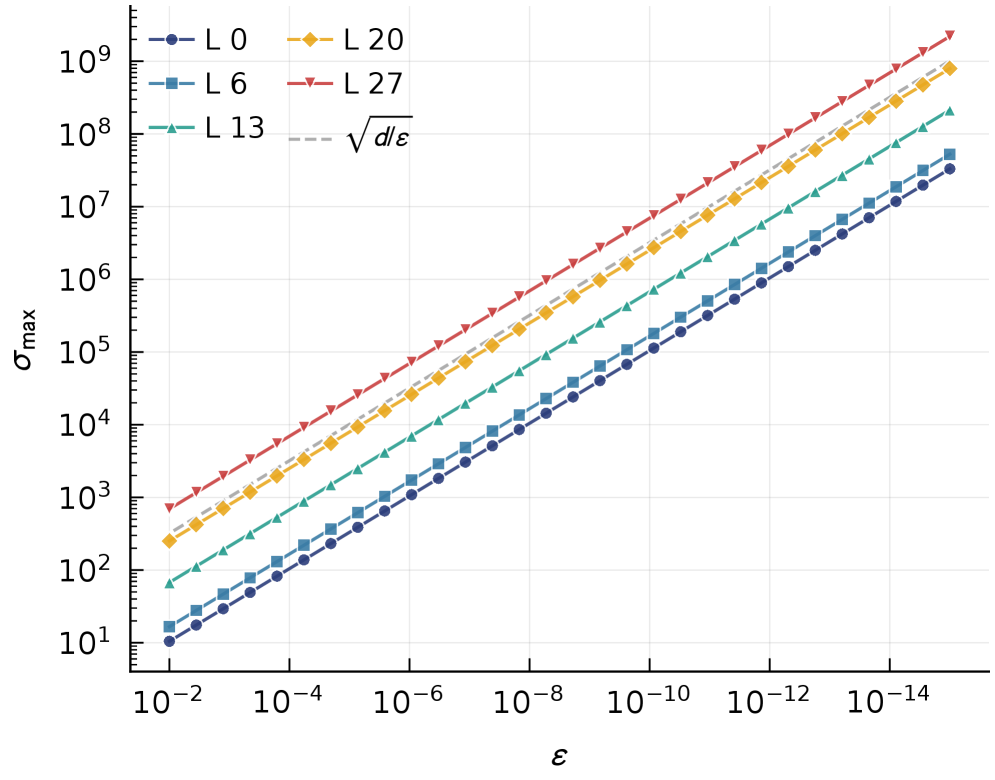
All five sampled Qwen3 layers give slope \alpha = -0.5000 with R^2 = 1.000000, matching the predicted \sigma_{\max} = C_\ell \epsilon^{-1/2} to machine precision. Parallel curves across layers indicate that only the prefactor C_\ell (layer-specific weight geometry) varies; the exponent is architectural.
Lie–Trotter torsion interferometer. For non-commuting attention \mathcal{T} and FFN \mathcal{R}, operator splitting predicts a deterministic residual drift \delta aligned with the commutator [\mathcal{T}, \mathcal{R}]\Psi at leading order in step size.
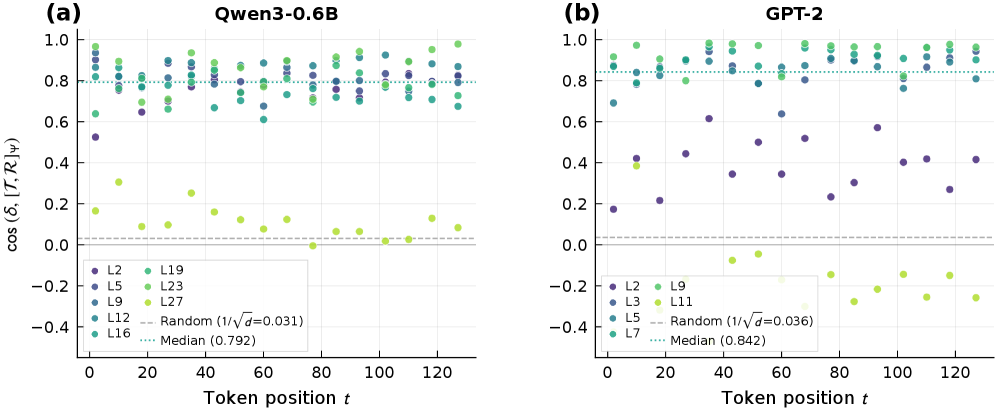
Both models show systematic positive alignment against the 1/\sqrt{d} isotropic-random baseline, confirming that representation drift under layer perturbation is not stochastic noise but the commutator predicted by non-commuting vector fields.
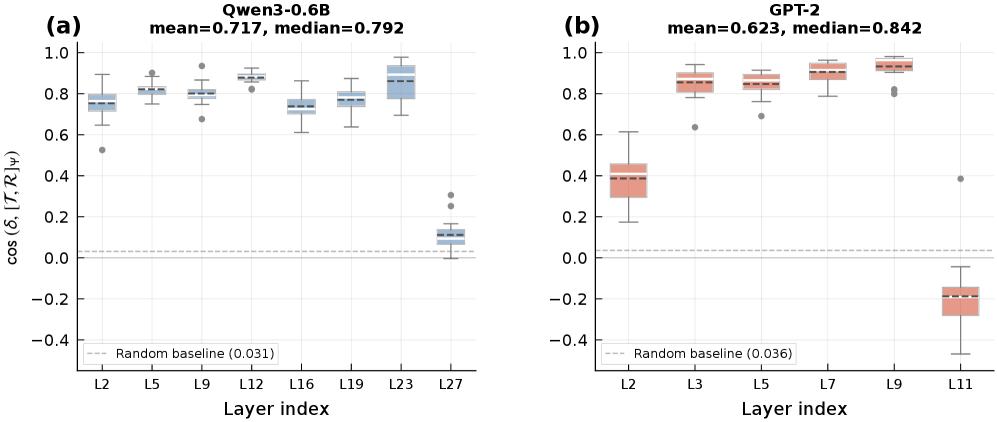
Alignment peaks in mid-network (Qwen3 L12: 0.879; GPT-2 L9: 0.933) and degrades at output layers (Qwen3 L27: 0.112; GPT-2 L11: -0.188), consistent with dominant higher-order (non-leading Trotter) terms once representations become task-specific.
Additional confirmations. Symmetric ablation (VI.3) shows that removing the antisymmetric component of layer Jacobians shatters forward-norm stability of trained networks, but retraining from scratch under the symmetric constraint recovers stable basins — a configurational rather than architectural necessity. A micro-transformer with feature dimension k=2 exhibits Poincaré recurrence on the RoPE torus; scaling k suppresses recurrence at the predicted \mathcal{O}(1/\sqrt{k}) rate, justifying an asymptotic spatial ergodic hypothesis at production dimension. Context-window degradation is characterized as an IR phase transition where entropic bulk pressure overwhelms the Dirichlet boundary at \partial\mathcal{M} = \{0\}, surviving in natural language only because effective token count N_{\mathrm{eff}} \ll N. Finally, parameter trajectories exhibit an irreversible NESS vortex (nonzero circulation) across 2\times 2 conditions.
Limitations and open questions
The framework is explicitly a classical lattice field theory on a rigid Galilean background: the connection and base metric do not back-react, so there is no diffeomorphism invariance. Statements about “path monodromy” on the 1D ray are topologically vacuous — all 2-forms vanish on \mathcal{M} — which the authors acknowledge. The predictive content is therefore concentrated in (i) scaling laws with mechanical constants set by architecture and (ii) leading-order structure of drifts and stabilities; the framework does not derive loss values or generalization bounds. The torsion alignment collapses at output layers, indicating that leading-order Trotter analysis is insufficient there. Attention as a Schrödinger bridge is presented as a variational rederivation, not as a new algorithmic prescription; whether it yields non-trivial training or inference-time interventions (e.g., \beta-annealing schedules, entropic-OT-regularized attention) is untested. The NESS/vortex claim relies on trajectory circulation measurements whose robustness to optimizer choice (Adam vs SGD, momentum, warmup) is not systematically dissected.
Why this matters
Recasting stability constants (\epsilon), representation drift, and context-window collapse as deterministic macroscopic observables of a well-specified continuous surrogate gives sharp, falsifiable predictions — the \epsilon^{-1/2} law at R^2=1.000 is the cleanest example — rather than post-hoc empirical fits. If the framework’s leading-order generators genuinely classify these phenomena, they provide a principled basis for choosing normalization constants, diagnosing layerwise commutator structure, and reasoning about when RoPE aliasing or context degradation should appear.
Source: https://arxiv.org/abs/2607.17146
TimeLens2: Generalist Video Temporal Grounding with Multimodal LLMs
Problem
Video MLLMs describe events but rarely localize them. Temporal grounding — mapping a natural-language query to the interval(s) of a video that support it — is inherently a set-valued prediction problem: the answer \mathcal{Y} = \{[s_k, e_k]\}_{k=1}^K has variable cardinality K, and the target intervals may be fragmented, ordered arbitrarily, and span videos ranging from seconds to over an hour. Existing pipelines mishandle this in two ways. First, long-video labels are produced by single-pass annotators that lose precision as distractors grow. Second, RL rewards either collapse (temporal IoU is zero for any non-overlapping prediction, so a near miss and a distant error are indistinguishable) or require Hungarian-style segment matching that is unstable when predicted and target cardinalities differ or when the same evidence is fragmented differently across two candidate outputs.
TimeLens2 addresses both the data and the optimization side, treating temporal evidence as an interval set throughout.
Data: TimeLens2-93K
The corpus contains 23,793 videos and 93,232 grounding instances, of which 12,091 have multiple supporting intervals. Videos are stratified across five duration bins from <1 min to >1 hr, so search horizon and distractor density are controlled design axes rather than sampling artifacts.
The construction pipeline factorizes into candidate construction (Steps 1–3) and label determination (Steps 4–6).
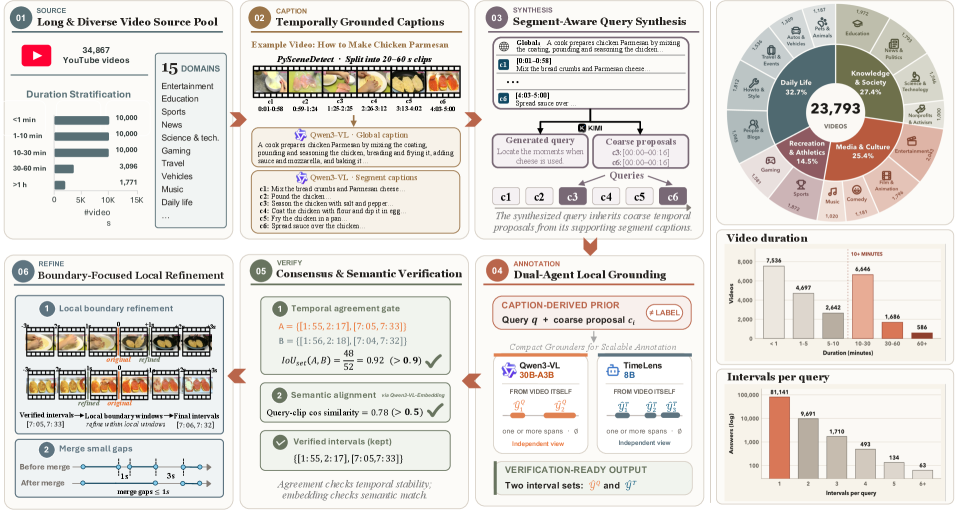
Steps 1–3: hierarchical time-stamped captions of the full video yield declarative queries plus coarse single- or multi-span proposals — the query is authored with full context so the model learns to search, not just to align. Steps 4–6: independent agents relocalize each proposal from short clips around the proposal, cross-agent temporal consensus rejects unstable intervals, a semantic verifier rejects mismatched ones, and a local boundary refiner sharpens only the surviving intervals. The staged factorization avoids the standard failure mode where a single annotator must simultaneously find and delimit evidence inside a long video.
Reward: temporal Wasserstein
The core optimization contribution is a temporal Wasserstein reward R_{\mathrm{TW}} that operates directly on interval sets without segment matching. Given predicted and target interval sets, merge overlapping intervals within each set, then define uniform 1-D distributions p_{\hat{\mathcal{Y}}} and p_{\mathcal{Y}} over the merged supports. The reward is a monotone transform of the exact 1-D Wasserstein-1 distance
W_1(p_{\hat{\mathcal{Y}}}, p_{\mathcal{Y}}) = \int_0^T |F_{\hat{\mathcal{Y}}}(t) - F_{\mathcal{Y}}(t)|\, dt,
which reduces to a closed-form integral over the difference of two step CDFs and is O(n \log n). Two properties matter mechanically:
- Non-overlapping predictions still receive graded feedback proportional to temporal proximity, so gradients exist in the region where tIoU is identically zero.
- Equivalent fragmentations of the same union yield equal reward, and unequal cardinalities require no explicit matching — a prediction with \hat{K} \neq K is scored by the transport cost between densities, not by a permutation.
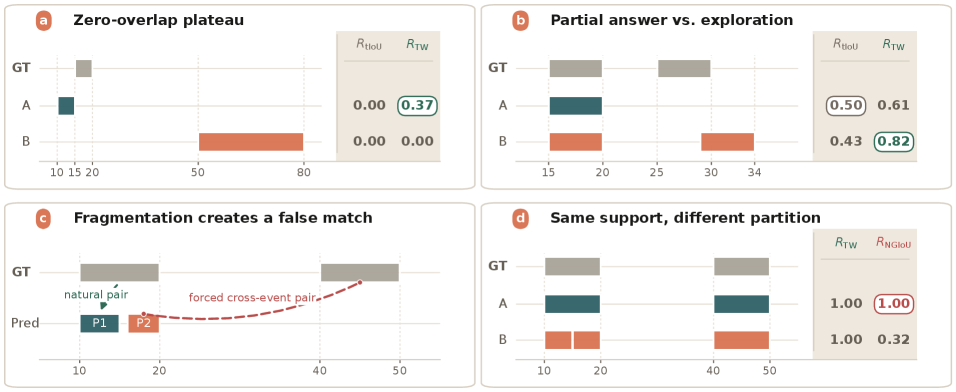
The figure illustrates the two canonical failure modes: (a) tIoU ties a near miss and a distant error at zero while R_{\mathrm{TW}} separates them; (b) tIoU prefers a single-moment prediction that overlaps one target, whereas R_{\mathrm{TW}} prefers a prediction that partially recovers a second target moment. tIoU is retained as a complementary term for precise-overlap feedback, so the combined reward is R = \alpha R_{\mathrm{TW}} + (1-\alpha) R_{\mathrm{tIoU}}; R_{\mathrm{TW}} supplies dense long-range signal, R_{\mathrm{tIoU}} supplies sharpness once predictions overlap.
Results
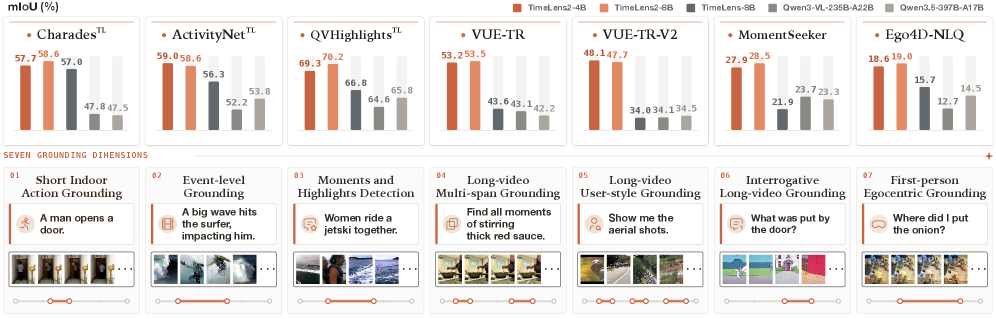
Evaluation spans seven benchmarks covering short and long videos, single- and multi-span, declarative and interrogative queries, and third-person and egocentric views: TimeLens-Bench re-annotations of Charades-STA, ActivityNet Captions, and QVHighlights; the vision subsets of VUE-TR and VUE-TR-V2; the text-only query subset of MomentSeeker; and Ego4D-NLQ validation. The mIoU radar in Figure 1 shows TimeLens2-2B dominating across all seven axes, with particularly large gains on the long-video and multi-span axes (VUE-TR, VUE-TR-V2, QVHighlights re-annotation) where the R_{\mathrm{TW}} signal is expected to be most informative — regions where tIoU-only baselines suffer from zero-gradient plateaus. The abstract-level headline is that a 2B-parameter generalist matches or exceeds specialists across this evaluation suite; the excerpt provided is truncated before the full numeric table.
Limitations and open questions
The W_1 formulation treats intervals as measure over time and is invariant to which interval a mass unit belongs to, which is the desired behavior for equivalent fragmentation but discards ordering information that matters for causal or procedural queries. The reward also does not natively penalize spurious short intervals unless they shift mass; combining it with tIoU only partially addresses this. The data pipeline depends on caption quality from the initial hierarchical captioner, and the cross-agent consensus threshold is a tunable that trades recall for label noise. Finally, the evaluation is at 2B scale; whether the reward’s advantage persists at larger scale, where SFT alone becomes stronger, is untested.
Why this matters
Interval-set prediction is the natural formulation for grounded video QA and retrieval, but reward design has lagged, forcing systems into either single-span assumptions or brittle matching. A closed-form, matching-free 1-D Wasserstein reward gives RL a well-behaved objective on this space and pairs cleanly with tIoU for local sharpness — a template likely to transfer to any set-valued 1-D localization task.
Source: https://arxiv.org/abs/2607.17423
DeepSearch-World: Self-Distillation for Deep Search Agents in a Verifiable Environment
Problem
Training web-search agents to iteratively improve from their own trajectories is bottlenecked by two failure modes. Supervised fine-tuning on teacher-distilled traces (e.g., trajectories collected from GPT-4-class models) caps the student at the teacher’s behavior distribution and is expensive to refresh. Sparse-reward RL on end-to-end task success provides too weak a signal for long-horizon browsing where a single episode may involve 20+ tool calls, and the reward landscape is polluted by non-determinism in the live web: pages change, search rankings drift, and rate limits corrupt rollouts. What is missing is an environment where trajectories are reproducible, tool outputs are stable across time, and success can be verified deterministically, so that self-generated data can be filtered and recycled as training signal.
DeepSearch-World is that environment, and DeepSearch-Evolve is the self-distillation loop built on top of it.
DeepSearch-World: the environment
DeepSearch-World is a deterministic, verifiable search sandbox. It exposes two tools — search and page-read — backed by a frozen snapshot of a web corpus so that a given query returns the same ranked results and a given URL returns the same content on every rollout. This determinism is what makes reward signals stable enough for self-distillation: an agent’s trajectory can be replayed and its intermediate steps re-scored.
Tasks are 420K multi-hop QA problems generated by entity-level random walks over a knowledge graph. A random walk of length k produces a chain of entities e_0 \to e_1 \to \cdots \to e_k; a question is synthesized that requires traversing this chain by successive search-and-read operations, and the ground-truth answer is the terminal entity or an attribute of it. Because the walk is explicit, the environment knows which pages must be visited, which allows finer-grained trajectory-level verification than just final-answer matching.
The authors explicitly design the environment to elicit three cognitive behaviors that matter for long-horizon agents:
- Progress verification: the agent checks whether an intermediate retrieval satisfies a subgoal before continuing.
- Grounded reflection: the agent cites the passage it is conditioning on when it commits to a next action.
- Failure recovery: after a dead-end search, the agent backtracks and rewrites the query rather than hallucinating.
DeepSearch-Evolve: the self-distillation loop
DeepSearch-Evolve is an iterative loop over four stages:
- Trajectory generation. The current policy \pi_\theta rolls out N trajectories per task on a sampled subset of the 420K pool. Each trajectory is a sequence of (thought, tool call, observation) triples ending in an answer.
- Filtering. Trajectories are scored by (a) final-answer correctness against the ground-truth entity and (b) structural checks — did the agent visit the required intermediate entities, did tool calls parse, was the reflection grounded in observed text. Only trajectories that pass both are retained.
- Data mixing. Retained trajectories are mixed with a small anchor of prior-round data and re-balanced by task difficulty (multi-hop depth). This prevents mode collapse onto easy 2-hop tasks and preserves harder chains in the training mix.
- Fine-tuning. The mixed corpus is used for SFT on \pi_\theta, producing \pi_{\theta'}, which becomes the generator for the next iteration.
The loop closes: no external teacher is queried, so the ceiling is set by the base model’s ability to occasionally succeed on hard tasks plus the environment’s ability to verify those successes reliably. The training objective is standard next-token cross-entropy over the filtered trajectories,
\mathcal{L}(\theta) = -\mathbb{E}_{\tau \sim \mathcal{D}_{\text{filtered}}} \sum_{t} \log \pi_\theta(a_t \mid s_{<t}),
with a_t ranging over both natural-language thoughts and tool-call tokens.
Results
DeepSearch-World-9B, trained purely by self-distillation from a 9B base without teacher trajectories, reaches:
- 31.2% on BrowseComp,
- 61.5% on GAIA,
- 93.4% on HotpotQA.
These numbers are competitive with open-source agents that rely on distillation from more capable proprietary models. HotpotQA at 93.4% is essentially saturated for a 9B agent and reflects that multi-hop QA over a verifiable corpus matches the training distribution closely. The BrowseComp result at 31.2% is the more interesting data point: BrowseComp is designed to be hard even for frontier browsing agents, and reaching 31.2% without teacher distillation suggests the filtered self-generated trajectories carry non-trivial reasoning signal, not just imitation of a stronger model. GAIA at 61.5% shows the behavior transfers out of the training environment onto tasks with different tool surfaces.
Limitations and open questions
The environment is a frozen snapshot, so the agent never has to handle live-web pathologies: stale caches, adversarial pages, contradictory sources across time, or dynamic UIs. Task construction from entity random walks biases the difficulty distribution toward chain-following rather than tasks requiring disjunctive reasoning, arithmetic on retrieved values, or cross-referencing conflicting sources. The filtering criterion depends on knowing the ground-truth entity chain, which is only cheap because the walks are synthetic; extending to organic tasks would require a separate verifier. Finally, the paper reports SFT-only self-distillation — it does not compare against an RL variant (e.g., DPO or GRPO on the same filtered trajectories), which would clarify whether the gains come from the environment’s verifiability or from the training algorithm.
Why this matters
Verifiable, deterministic environments are turning into the missing substrate for self-improving agents: once trajectories can be replayed and scored offline, the SFT-vs-RL debate collapses into a filtering problem. DeepSearch-World shows that a 9B model can reach BrowseComp-competitive numbers without any teacher trajectories, which is evidence that agent capability scales with environment quality at least as much as with model size.
Source: https://arxiv.org/abs/2607.07820
Apple-π: Benchmarking Thinking with Video Towards Law-Grounded Physical Intelligence
Problem
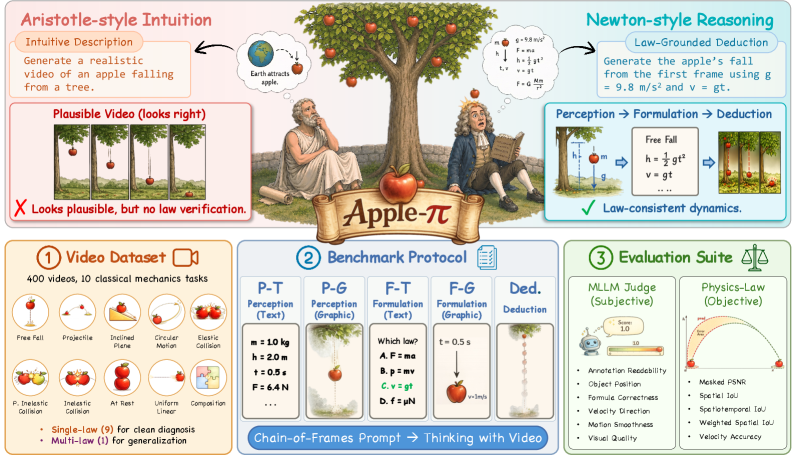
Video generation models are increasingly framed as world models with implicit physical priors, but existing benchmarks (VideoPhy, PhyGenBench, etc.) score only terminal plausibility of generated clips. A model can produce a plausible-looking trajectory while violating conservation laws, or arrive at a correct outcome by pattern-matching training data rather than by grounding motion in physics. Apple-π asks a sharper question: does the generation trace correspond to a faithful chain of physical reasoning — perceiving state, selecting the governing law, and deducing dynamics — rather than just terminating in a plausible frame?
Method
Apple-π has three components: the Orchard dataset, a three-stage protocol, and a hybrid evaluation suite.
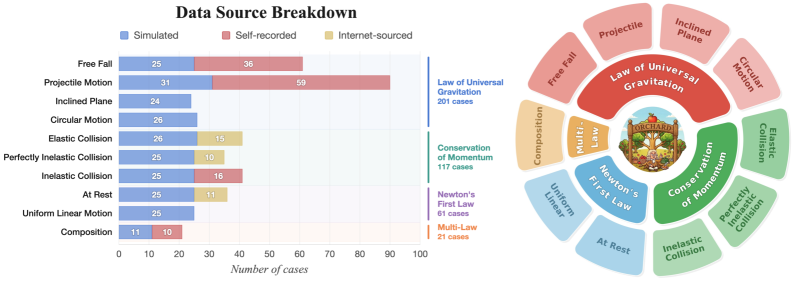
Orchard. 400 cases spanning ten canonical classical-mechanics tasks, organized into three single-law pillars — universal gravitation, conservation of momentum, Newton’s first law — plus a multi-law composition branch. Data come from three sources: 243 Isaac Sim renders (yielding ground-truth parameters and pixel-accurate trajectories, needed for objective metrics), 121 self-recorded lab videos, and 36 curated Internet clips. Objects are restricted to four primitive solids (sphere, cube, cylinder, cone) to control for semantic priors and to make masks, centers, and contact surfaces consistently annotatable.
Protocol. Each case begins with an infographic-annotated first frame (variables, vectors, reference axes drawn on the image). A chain-of-frames prompt then elicits five subtracks that decompose scientific reasoning:
- Perception-Text (P-T): read numerical quantities from the annotated frame.
- Perception-Graphic (P-G): segment/localize objects.
- Formulation-Text (F-T): select the governing law.
- Formulation-Graphic (F-G): predict the target state (final-frame artifact).
- Deduction (Ded.): generate the full video sequence realizing the predicted dynamics.
The generated video is treated as the model’s visible reasoning trace, so subtrack-level scoring localizes failures rather than aggregating them into a single plausibility number.
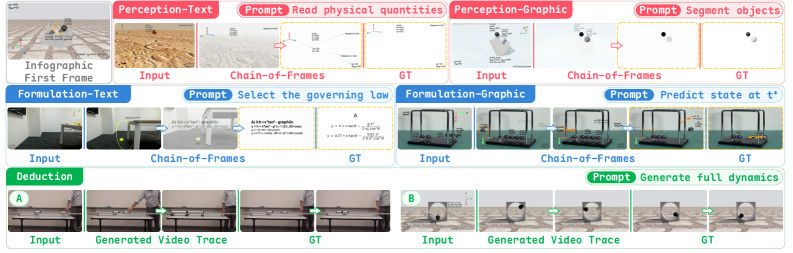
Evaluation suite. MLLM-based subjective scoring (Gemini 3 Flash as judge) covers all subtracks; physics-law-grounded objective measures — e.g., trajectory error against simulator ground truth — anchor Deduction and F-G on the simulated split. For unified understanding-generation models, which do not emit full videos, Deduction is evaluated on sparse keyframes at prescribed timestamps using the same frame-level criteria.
Each model is run on 400 \times 5 \times 3 = 6000 responses (five subtracks, three rollouts).
Results
Eleven models are benchmarked: five video generators (Wan2.2, HunyuanVideo-1.5, VBVR-Wan2.2, Seedance 2.0, Veo 3.1) and six unified models (BAGEL, OmniGen2, SenseNova-U1-8B-MoT with and without Think, GPT Image 2, Nano Banana 2). Scores are on [0,1].
The headline finding: no video generator exceeds average 0.473 (Seedance 2.0), while two unified image models dominate — GPT Image 2 at 0.704 and Nano Banana 2 at 0.699. The gap is not uniform across subtracks; it concentrates in Formulation-Text and Deduction:
- Perception-Text: several video models already do well (VBVR-Wan2.2 0.923, Nano Banana 2 0.934, GPT Image 2 0.921). Reading annotated quantities is largely solved.
- Formulation-Text (law selection): catastrophic failure for pure video generators — Wan2.2 0.009, VBVR-Wan2.2 0.001, HunyuanVideo-1.5 0.027 — versus GPT Image 2 0.824 and Nano Banana 2 0.841. Video-only pipelines essentially cannot verbalize which law applies.
- Deduction: even the best models are weak. Seedance 2.0 leads video generators at 0.315; GPT Image 2 and Nano Banana 2 reach only 0.406 and 0.405 despite their strong upstream stages. Generating law-consistent dynamics remains the binding constraint.
- Pillar-wise: Newton’s first law is easiest (uniform/rest motion; e.g., Seedance 0.495, GPT Image 2 0.742), while multi-law composition is uniformly hardest (GPT Image 2 drops to 0.618, Seedance to 0.389).
- Source-wise: simulated splits score higher than real-world across the board (e.g., Seedance 0.487 vs. 0.459; Nano Banana 2 0.743 vs. 0.656), consistent with domain-shift and clean-parameter effects rather than genuine generalization.
Two secondary observations. First, SenseNova-U1-8B-MoT and its “-Think” variant score 0.362 vs. 0.359 — explicit reasoning tokens provide no measurable gain here, suggesting chain-of-thought does not transfer to law-grounded visual dynamics. Second, VBVR-Wan2.2 illustrates a P-T/F-T mismatch (0.923 perception, 0.001 formulation): reading the scene does not imply access to physics.
Limitations and open questions
Orchard restricts to four primitive solids and three classical laws plus composition; friction-dominated, deformable, fluid, and thermodynamic regimes are absent, and object-shape confounders are minimized rather than studied. The MLLM judge (Gemini 3 Flash) introduces a scoring prior that likely favors text-competent unified models over pure video generators, particularly on F-T. Evaluating unified models on Deduction via sparse keyframes is not strictly comparable to full-video Deduction; the gap between 0.405 (Nano Banana 2) and 0.315 (Seedance) may partly reflect this asymmetry. Finally, objective physics metrics anchor only the simulated subset, so the real-world numbers rest more heavily on subjective scoring.
Why this matters
Apple-π reframes physical evaluation from “does the clip look right” to “did the model reason through Perception → Formulation → Deduction,” and the resulting stage-resolved scores show that current video generators fail predominantly at law selection and dynamics generation, not at perception. This suggests progress on physical world modeling will come from tighter coupling between symbolic/law-level reasoning and pixel-level rollout, not from scaling video priors alone.
Source: https://arxiv.org/abs/2607.16401
DiffGI: Differentiable Geometry Images for High-Fidelity Thin-Shell 3D Generation
Problem
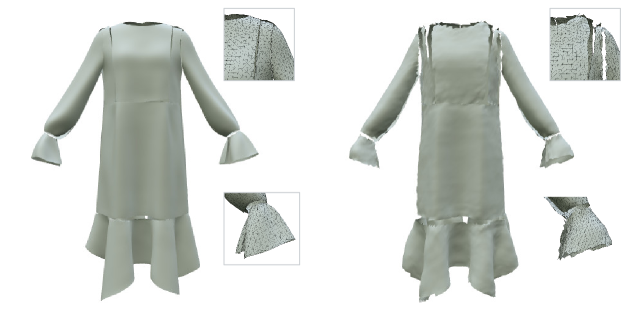
Volumetric 3D generative models (SDF/occupancy grids, TRELLIS-style latents) enforce watertight topology and inflate thin-shell objects like garments, collars, and hems. Geometry-image approaches sidestep this by unfolding the mesh onto a 2D grid via UV charts, but existing pipelines (Omages, GarmageNet) use a binary occupancy map to mark valid chart pixels. Binary boundaries suffer two coupled problems: (i) sub-pixel boundary positions are lost when the 1024×1024 authoring resolution is downsampled to the 256×256 latent training resolution, producing staircase aliasing along hems and open edges; and (ii) mesh recovery via marching-squares-style tessellation is non-differentiable, so 3D-space losses cannot backpropagate to the network.
Method
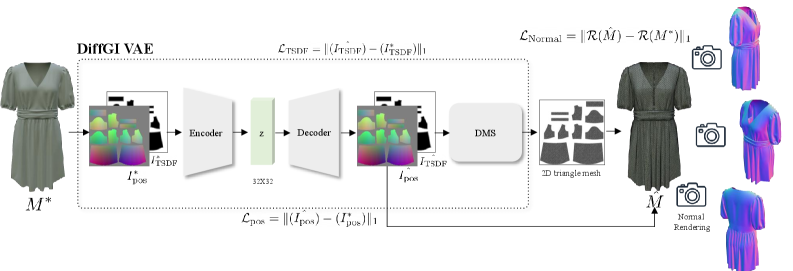
DiffGI replaces the binary occupancy channel with a 2D truncated signed distance function computed in the UV plane, and pairs it with a differentiable marching squares (DMS) extractor so end-to-end 3D supervision is possible.
Mesh → DiffGI conversion (offline). UV charts are packed via an AABB algorithm with inter-chart padding and a globally optimized fill ratio. The mesh surface is barycentrically sampled onto a 1024×1024 grid, yielding a 3-channel position map P \in \mathbb{R}^{1024\times1024\times3}. Edge pixels are dilated outward to prevent boundary corruption. Independently of P, the packed charts are rasterized to a binary mask; a 2D Euclidean distance transform then assigns each pixel a signed pixel-distance to the nearest chart contour (positive inside, negative outside), clamped at \pm 15 px. Crucially, background pixels with no valid 3D position still receive a well-defined negative TSDF value. The 4-channel tensor (P, \text{TSDF}) \in \mathbb{R}^{1024\times1024\times4} is then bilinearly downsampled to 256\times256\times4. Because TSDF varies smoothly across the boundary, downsampling shifts the zero level set continuously rather than snapping to a coarser pixel grid.
DiffGI-VAE + DMS. A Stable Diffusion 1.5–initialized VAE encodes the 256×256×4 map into a compact latent and reconstructs it. Meshing recovers a triangle set from the zero level set of the TSDF channel via marching squares, but with vertex coordinates given by analytical linear interpolation between adjacent pixel TSDF values,
v = p_a + \frac{\phi_a}{\phi_a - \phi_b}(p_b - p_a),
which is differentiable in \phi_{a,b} almost everywhere. The 3D vertex positions are then read off from the reconstructed position map. Ambiguous saddle configurations (MS cases 6 and 9) are resolved deterministically as two disjoint patches; inter-chart padding at 256×256 makes bridge-like intra-cell configurations rare, and vertex coordinates remain continuous in \phi even in those cases.
Losses. Pixel-space L1/L2 losses on the TSDF and position maps are combined with a 3D normal-consistency loss \mathcal{L}_{\text{Normal}} computed on the extracted mesh. \mathcal{L}_{\text{Normal}} only produces useful gradients because DMS is differentiable — this is what closes the loop from 3D surface geometry back to the VAE weights.
Results
Representation gain (ablation, GarmageSet). Swapping occupancy for TSDF, holding losses fixed, drops Chamfer distance from 1.503\times10^{-3} to 0.595\times10^{-3} — more than 2× — before any 3D loss is added. Turning on \mathcal{L}_{\text{Normal}} (only possible because DMS is differentiable) further reduces CD to 0.461\times10^{-3} and raises normal consistency from 0.921 to 0.961.
Resolution scaling. Without VAE compression, TSDF has substantially lower Hausdorff distance than occupancy at 64 and 128 px; the two converge above 256, validating 256×256 as the operating resolution. The TSDF advantage is larger on GarmageSet (dense wrinkles, irregular hems) than on the flat-planar ABO furniture, consistent with the claim that continuous boundary encoding pays off in proportion to boundary complexity.
Initialization. Random-init VAE reaches CD 0.47\times10^{-3} vs. 0.46\times10^{-3} for SD1.5 init, with identical NC of 0.96 on GarmageSet. SD1.5 pretraining accelerates convergence but is not the source of quality — the TSDF representation is.
Data augmentation. Perturbing UV chart placement expands ABO from 3.8K to 500K training samples without altering 3D semantics. Without augmentation, DiT-Base diverges on ABO and only DiT-Tiny trains stably; with augmentation, DiT-Base converges and outperforms DiT-Tiny qualitatively. This is a legitimate augmentation only because the geometry image is a structured 2D encoding of a 3D signal.
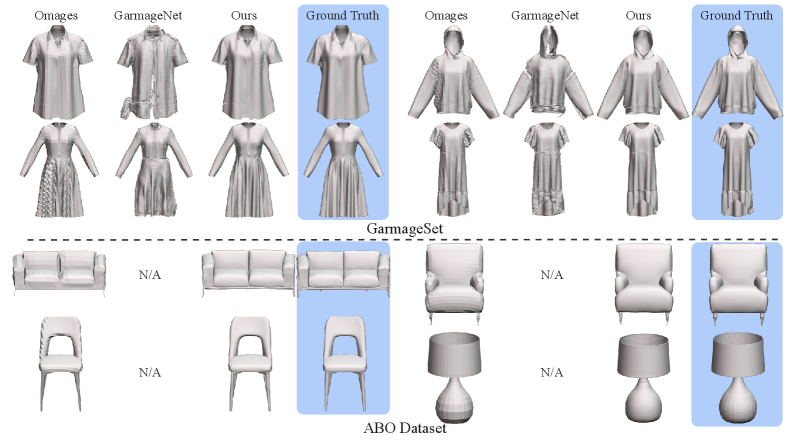
Qualitatively, on GarmageSet image-to-3D, TRELLIS thickens garments due to its watertight prior, and GarmageNet exhibits staircase aliasing along boundaries from its binary occupancy. DiffGI produces cleaner collars, sleeves, and hems with fewer vertices.
Limitations and open questions
- Saddle disambiguation is a deterministic hack. Genuinely narrow bridges within one cell would be split; safe only because packing padding keeps charts apart at 256×256.
- The TSDF is defined in the 2D UV plane, not the 3D surface — so it encodes UV-chart shape, not intrinsic geodesic distance. Boundary fidelity is thus contingent on UV packing quality.
- Non-manifold junctions across chart seams still rely on the position map’s continuity and dilation; there is no explicit seam-stitching loss.
- Evaluation is against Omages/GarmageNet and TRELLIS; comparison to recent Gaussian-surfel or flow-based mesh generators is absent.
- Truncation at 15 px and the 256 resolution are coupled — scaling to 512+ or to higher-genus surfaces is not explored.
Why this matters
Thin-shell and open-surface 3D generation has been bottlenecked by representations that assume watertight volumes or discretize boundaries too coarsely. DiffGI shows that swapping a binary channel for a continuous 2D TSDF plus a differentiable marching-squares layer is enough to cut Chamfer error by more than half and enable direct 3D-space supervision on a 2D VAE — a small architectural change with disproportionate impact on garments and other non-manifold assets.
Source: https://arxiv.org/abs/2607.13365
LLM-as-a-Coach: Experiential Learning for Non-Verifiable Tasks
Problem
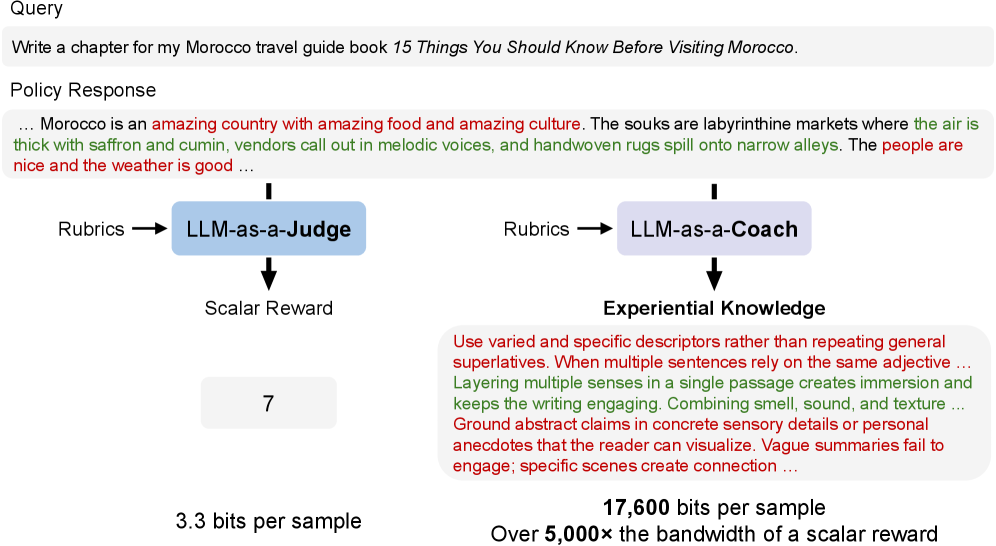
Post-training LLMs on open-ended, non-verifiable tasks (creative writing, instruction following, conversational assistance) typically relies on an LLM-as-a-Judge that scores on-policy responses against a rubric. RL then optimizes the scalar reward. This compression is lossy in two ways: (i) it discards the judge’s textual analysis — the actual diagnostic content behind the score — and (ii) it conflates responses of distinct quality profiles that happen to land on the same numeric bucket, which is common at the top of the score distribution where fine distinctions matter most. The authors argue this bandwidth bottleneck is what drives poor generalization and reward hacking on non-verifiable tasks.
Method
Experiential Learning (EL) reframes the same feedback model M as an LLM-as-a-Coach. For a prompt x with rubric set \mathcal{R}_x and on-policy response y \sim \pi_\theta(\cdot\mid x), the coach produces M(x, y, \mathcal{R}_x) — a full textual assessment. Instead of extracting a scalar, EL distills the coach’s assessment into a piece of experiential knowledge e: a transferable lesson (what worked, what failed against which rubric criterion) that could apply beyond this specific (x,y) instance.
That experiential knowledge then conditions a teacher \pi_{\text{teacher}}(y \mid x, e) — either the frozen initial policy or the current policy re-prompted with e as context. The student policy \pi_\theta is trained by on-policy context distillation (OPD): match the teacher’s conditional distribution while itself running without e in-context. Concretely, minimize a token-level KL
\mathcal{L}_{\text{EL}}(\theta) = \mathbb{E}_{(x,\mathcal{R}_x)\sim\mathcal{D},\, y\sim\pi_\theta} \big[ D_{\mathrm{KL}}\big(\pi_{\text{teacher}}(\cdot \mid x, e) \,\|\, \pi_\theta(\cdot \mid x)\big) \big],
with e = \text{Distill}(M(x, y, \mathcal{R}_x)). Contrast with the RL baseline (GRPO), which optimizes
\max_\theta \mathbb{E}_{(x,\mathcal{R}_x)\sim\mathcal{D},\, y\sim\pi_\theta}[r], \quad r = \text{Extract\_Reward}(M(x,y,\mathcal{R}_x)).
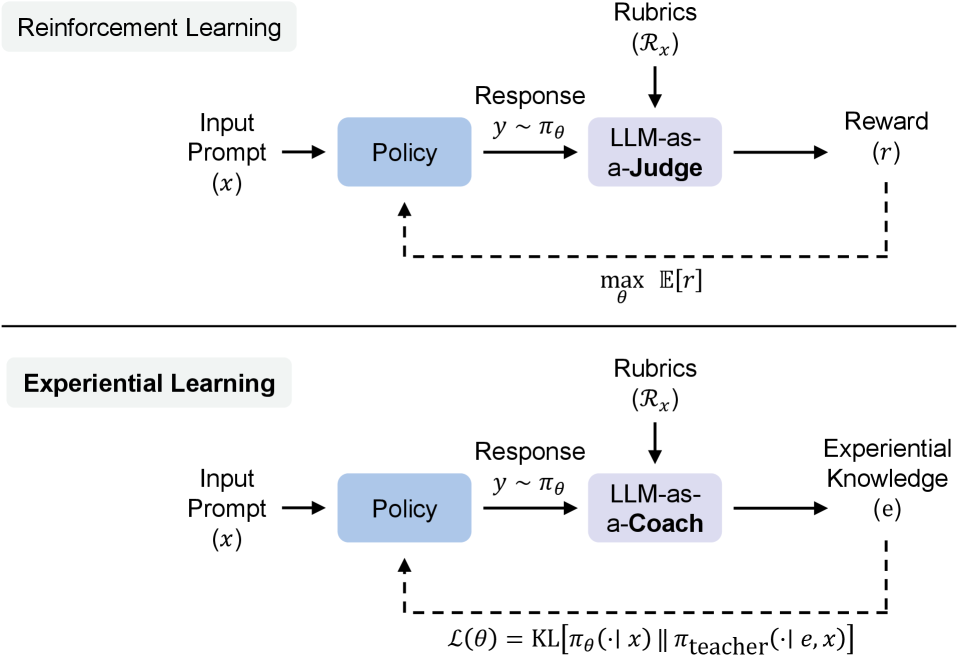
The pipeline preserves the rubric-based evaluation protocol (same M, same \mathcal{R}_x) but changes what is retained from M’s output and how it enters the gradient. Key design choices:
- Same feedback model for both RL and EL, isolating the effect of signal bandwidth from feedback-model capability.
- Teacher variants: frozen initial-policy teacher (simple, stable) vs. iterative teacher (current policy conditioned on e). The iterative variant mixes in Tulu3 prompts at 1:0.25 with the frozen policy as OPD teacher to guard against capability drift.
- Training data: 7500 WildChat-IF prompts; rubrics pre-generated by GPT-4o and reused across RL and EL for parity.
- Policies: Qwen3-8B (non-thinking) and OLMo-3-7B-Instruct. Coach is either the initial policy checkpoint or GPT-4o.
The claim is that e carries information the scalar r discards — specifically, which rubric axis failed and how, which admits transfer to unseen prompts sharing that axis.
Results
EL beats rubric-based RL consistently across both policy families and both coach choices (self-coach vs. GPT-4o) on held-out and unseen open-ended benchmarks.
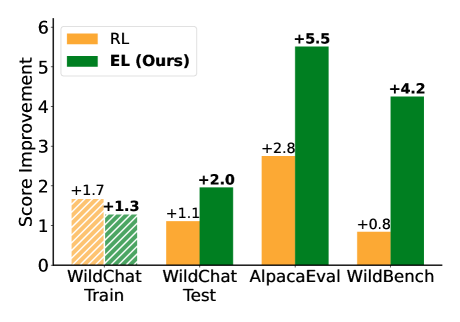
The generalization pattern in Figure 3 is the paper’s main empirical point: RL achieves higher scores on the WildChat training subset but EL wins on held-out and OOD splits. This is consistent with reward-hacking: RL fits idiosyncrasies of the judge on the training distribution, while EL, by supervising on the reasons behind scores, produces behavior that transfers. The authors also report that EL mitigates reward hacking directly (e.g., in cases where RL exploits length or formatting cues that inflate rubric scores without improving content).
Limitations and open questions
- The paper’s mechanism depends on the coach producing high-quality, transferable e. When the coach is the initial policy itself (self-coach), the quality ceiling of e is bounded by the policy’s own rubric-reasoning ability; the paper shows this still works, but the ceiling under self-coaching versus GPT-4o coaching is not fully mapped.
- OPD requires forward passes from both teacher and student per update; wall-clock cost relative to GRPO is not analyzed in the excerpts provided.
- Extraction of e from M’s raw output is itself a distillation step whose prompt design likely matters and is not ablated here.
- Results are on 7B–8B policies with rubric quality anchored to GPT-4o. Scaling behavior — do larger policies still benefit as their own critique catches up to the coach? — is open.
- The rubric decomposition itself is a design axis: EL’s advantage may shrink under coarser rubrics that leave less structure for e to encode.
Why this matters
Rubric-based RL on non-verifiable tasks throws away most of what the judge actually knows. Treating the same model as a coach and distilling its textual diagnosis via on-policy context distillation recovers that bandwidth and, crucially, improves OOD generalization while suppressing reward hacking — a direct answer to one of the standing failure modes of RLAIF-style pipelines.
Source: https://arxiv.org/abs/2607.18110
HarmoHOI: Harmonizing Appearance and 3D Motion for Multi-view Hand-Object Interaction Synthesis
Problem
Multi-view hand-object interaction (HOI) synthesis sits at the intersection of two hard problems: modelling fine-grained articulated hand motion under heavy occlusion, and enforcing geometric consistency across viewpoints. Pure video foundation models generate plausible single-view footage but drift across views because they do not carry an explicit 3D representation. Conversely, geometry-first pipelines (MANO fits, physics simulators) produce consistent motion but poor appearance and generalization. HarmoHOI’s premise is that the two must be co-generated: appearance across views is only consistent if it is anchored to a shared, metric-scale 3D motion field, and 3D motion is only recoverable if guided by strong visual priors.
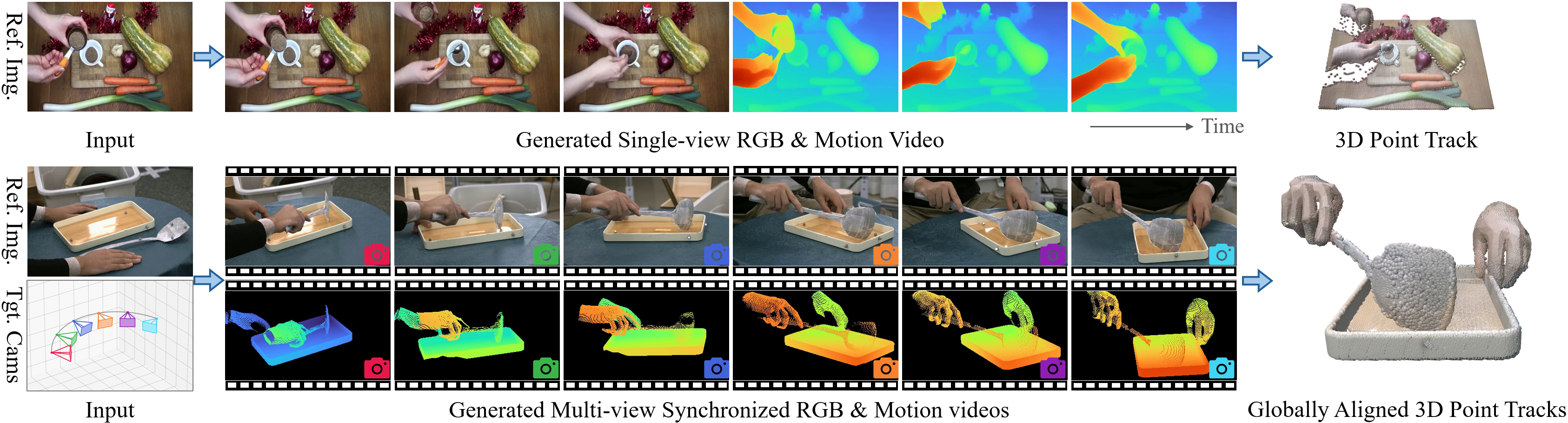
The task is: given a reference image I \in \mathbb{R}^{H\times W\times 3}, target camera poses \Pi=\{\pi_v\}_{v=1}^{V}, and prompt P, jointly produce multi-view videos V \in \mathbb{R}^{V\times T\times H\times W\times 3} and 3D point tracks M \in \mathbb{R}^{V\times T\times K\times 3} in metric scale.
Method
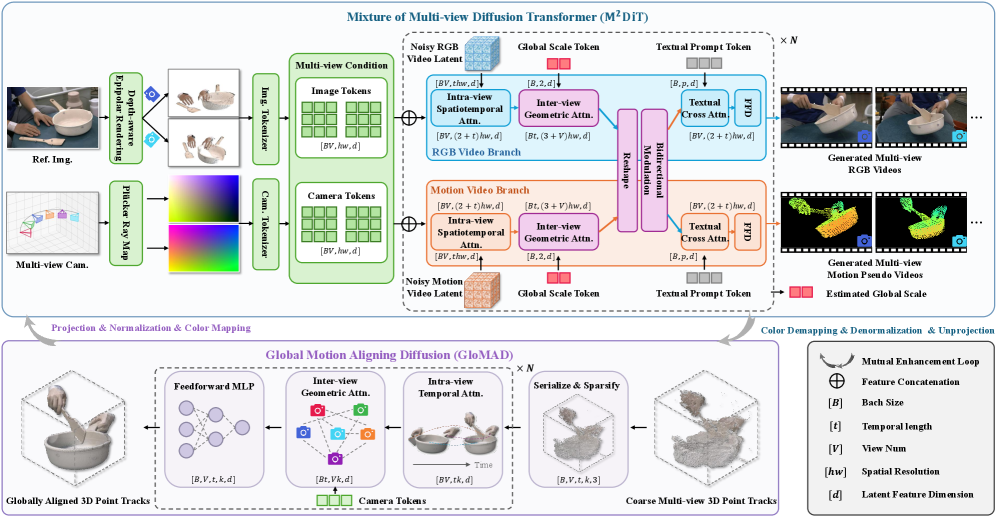
HarmoHOI is a two-stage diffusion system built on a Rectified-Flow text-to-video DiT with a spatio-temporal VAE. The base model predicts velocities
v_t = \mathrm{d} z_t/\mathrm{d} t = z_1 - z_0,\qquad z_t=(1-t)z_0 + t z_1,
trained with \mathcal{L}=\mathbb{E}\|v_t-\hat v_\Theta(z_t,c,t)\|_2^2 and denoised with z_{t-1}=z_t+\Delta t\,\hat v_\Theta(z_t,c,t).
Mixture of Multi-view Diffusion Transformer (M^2DiT). The first module jointly generates (i) synchronized multi-view RGB latents, (ii) an intermediate “motion pseudo-video” that encodes 3D point tracks as an RGB-like tensor, and (iii) a global metric scale scalar per sequence. Representing 3D tracks as pseudo-videos is the key adaptation trick: it puts geometric signals into the same 2D latent space the pretrained VAE and DiT operate on, so the model can reuse spatial/temporal priors instead of learning a foreign modality. The DiT block structure (temporal modulation, visual self-attention, text cross-attention, MLP) is preserved; multi-view tokens are attended jointly so epipolar structure emerges implicitly.
Global Motion Aligning Diffusion (GloMAD). The pseudo-video decode gives coarse, per-view point tracks that are not guaranteed to be metric-scale or globally aligned. GloMAD is a second diffusion process conditioned on these coarse tracks; it outputs refined, metric-scale, globally aligned 3D trajectories. During inference, M^2DiT and GloMAD form a closed-loop: at each denoising step the refined 3D motion is fed back to guide the next RGB/pseudo-video velocity prediction, so appearance and geometry co-evolve rather than being sequentially decoupled.
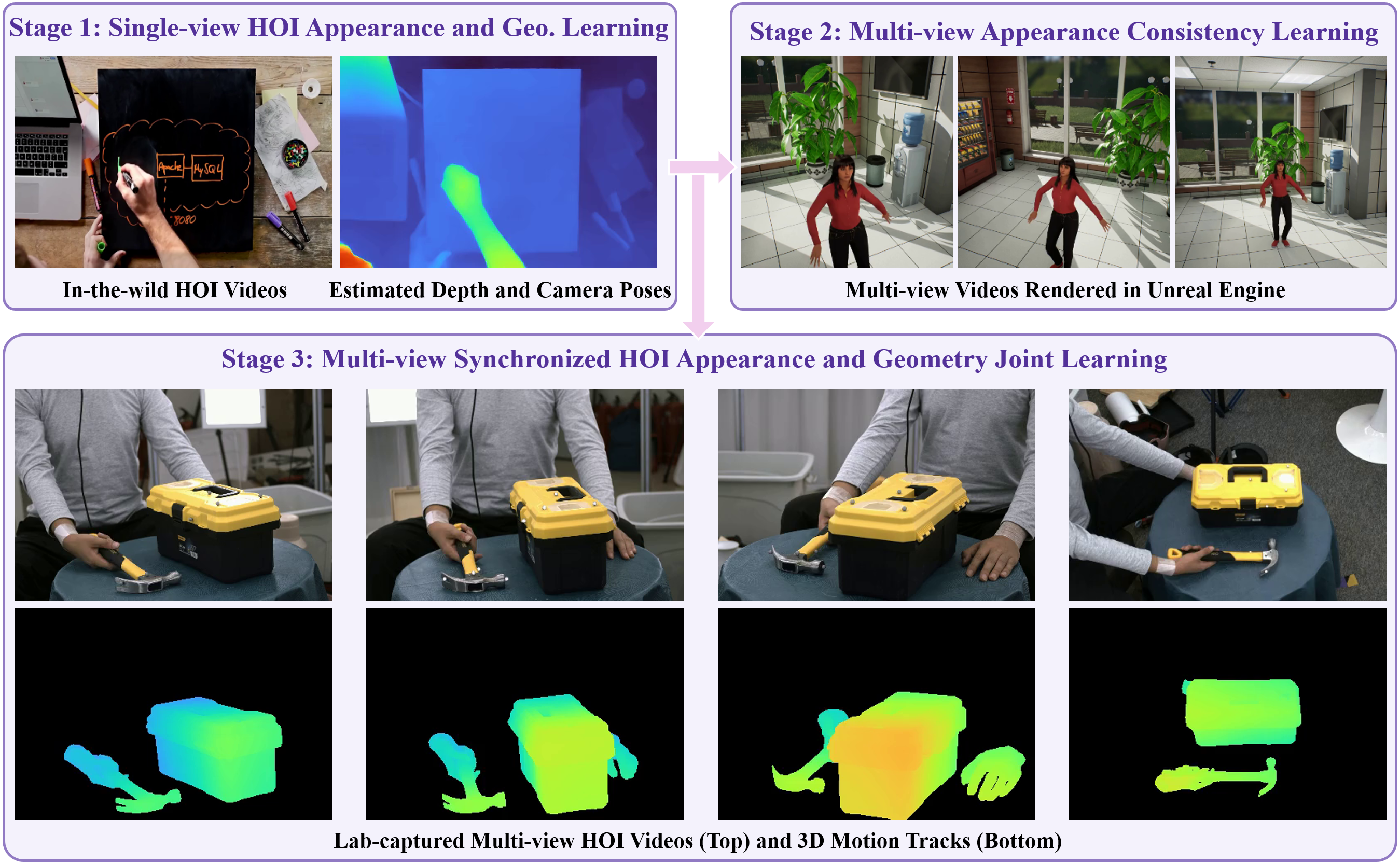
Hybrid-data curriculum. Multi-view HOI data is scarce, so training proceeds in three stages: (1) single-view geometry-aware learning on HOIGen1M (1M+ single-view HOI clips with depth/pose estimated by Depth Anything 3), (2) multi-view appearance synchronization on SynCamVideo (3.4K scenes × 10 cameras = 34K clips from UE5 assets), and (3) unified multi-view appearance-geometry learning on TACO (25K clips, 12 viewpoints, ground-truth 3D). Stages 1 and 2 preserve the pretrained visual manifold while progressively injecting geometry and cross-view consistency; stage 3 fuses both under supervision from real multi-view HOI.
Evaluation setup and expected results
Video quality uses VBench Subject Consistency and Dynamic Degree for single-view fidelity, and Matching Pixels (via GIM) plus CLIP-Views for cross-view consistency (following SynCamMaster). Motion quality is decomposed into accuracy — Chamfer Distance, Motion Smoothness, Relative Point Error (RPE) and Percentage of Inliers (PI) as in GeometryCrafter — and plausibility (penetration rate, non-contact rate). Multi-view motion consistency uses the same accuracy metrics after cross-view reprojection, which is a stringent test because a globally misaligned track will incur large Chamfer errors under any reprojection.
TACO is split by held-out object/action pairs (e.g., “hammer”, “measure”) to test generalization across the tool-action-target triplet structure (20 physical categories, 196 instances, 15 actions, 14 participants), with the remainder split 9:1 train/val.
Limitations and open questions
- The pseudo-video encoding of point tracks assumes the VAE’s inductive biases (local smoothness, patch structure) are appropriate for 3D coordinate fields; abrupt occlusion boundaries in tracks may be poorly reconstructed.
- Global scale is emitted as a scalar per sequence; scenes with articulated scale ambiguity (e.g., zoom vs. dolly) or multiple loosely-coupled objects may not be well served by a single scale.
- Depth/pose pseudo-labels on HOIGen1M come from Depth Anything 3, so stage-1 supervision inherits monocular depth biases, particularly around thin fingers and grasped tools.
- The closed-loop M^2DiT ↔︎ GloMAD denoising roughly doubles inference cost relative to a single-pass DiT, and its convergence properties under Rectified Flow are not formally characterized.
- Contact/penetration are evaluated but not explicitly enforced as losses; physically infeasible grasps could still be scored favorably on VBench-style metrics.
Why this matters
HarmoHOI operationalizes a concrete recipe for injecting 3D geometry into pretrained video DiTs without discarding their visual priors: encode geometry as a pseudo-video sharing the model’s latent space, then close the loop between appearance denoising and metric-scale motion refinement. If the closed-loop co-evolution generalizes beyond HOI, it offers a template for multi-view-consistent world models built on top of existing text-to-video foundations rather than trained from scratch.
Source: https://arxiv.org/abs/2607.17097
Hacker News Signals
How we measured AI writing across arXiv, and where the measurement breaks
The Unslop team applied a suite of AI-writing detectors to a large sample of arXiv abstracts and full texts, then documented where the signal degrades. The core technical finding is that current classifiers — most of which are fine-tuned on GPT-style output and trained on pre-2023 data — exhibit systematic false-positive rates on dense technical prose. Domain-specific vocabulary (LaTeX-heavy notation, field jargon, citation-dense sentences) pushes perplexity and burstiness features into distributions the classifiers associate with LLM output, even when the text is human-written.
The methodology section is the most useful part: they compute token-level perplexity using a reference LM, then apply the “binoculars” ratio (ratio of perplexity under two related models), and compare against classifier ensembles. The breakdown analysis shows that abstracts written by non-native English speakers score systematically higher on AI-likelihood metrics — a well-known confound that most deployed tools do not correct for. They also note that fine-tuned or lightly edited LLM output, which is probably the dominant real-world case, is nearly indistinguishable from clean human text at current classifier thresholds.
The most honest part of the post is the “where measurement breaks” section: watermarking is not deployed at scale, the ground truth labeling problem is intractable for retrospective analysis, and any classifier trained on known-LLM data has a covariate shift problem as models improve. The conclusion is essentially that aggregate trend detection (fraction of papers above a threshold) has some validity, but individual-paper classification does not.
This is worth reading alongside the Liang et al. EMNLP 2024 paper on ChatGPT usage in academic abstracts, which used a similar methodology and reached similar calibration caveats.
Source: https://unslop.run/blog/measuring-ai-writing-on-arxiv
LoRA Speedrun – a public wall-clock leaderboard for fine-tuning techniques
This repo frames LoRA fine-tuning as a competitive benchmark: given a fixed task (currently single-GPU instruction tuning of a 7B-class model), submissions are ranked by wall-clock time to reach a target validation loss or accuracy threshold. The leaderboard tracks not just time but also hardware spec, peak VRAM, and the exact configuration — rank r, alpha, target modules, optimizer, batch size, precision.
The technical interest is in what variations actually move the needle. Current top entries exploit several orthogonal tricks: (1) torch.compile with reduce-overhead mode, which fuses the LoRA forward pass and eliminates Python overhead; (2) gradient checkpointing disabled in favor of larger micro-batches when VRAM permits, since the recomputation cost exceeds the benefit at small rank; (3) bfloat16 throughout including optimizer states, avoiding the mixed-precision cast overhead; (4) packing short sequences to fill context windows, eliminating padding waste.
The repo also surfaces a subtle point about LoRA rank scheduling: starting with a higher rank and decaying it (analogous to learning rate warmup) has shown speedups for some submitters, though the mechanism is unclear — it may be that early high-rank updates matter more for convergence than late ones.
The benchmark design has gaps: wall-clock time is hardware-dependent and submissions from H100 clusters are not directly comparable to consumer GPU entries. The repo handles this by normalizing to FLOP estimates, but FLOP normalization misses memory bandwidth bottlenecks that dominate at small batch sizes. Still, the leaderboard format creates useful ablation pressure that a static benchmark would not.
Source: https://github.com/Saivineeth147/lora-speedrun
Controlling Reasoning Effort in LLMs
Raschka’s post surveys the mechanisms by which “thinking” or chain-of-thought compute can be throttled or extended at inference time, covering both API-level controls and architectural approaches. The practical problem: reasoning models like o3 or QwQ spend variable token budgets on intermediate steps, and for many queries that budget is wasteful.
At the API level, providers expose a reasoning_effort parameter (OpenAI) or thinking token budget (Anthropic) that directly caps the number of tokens allocated to scratchpad reasoning before the final answer is produced. The post explains that this is not simply truncation — the model is trained with RLVR (reinforcement learning with verifiable rewards) on varied-length reasoning traces, so it learns to compress or skip reasoning steps when the budget signal is present in the prompt or system context.
The more interesting architectural angle covers budget-forcing: a technique where during training, a <budget>N</budget> token is prepended and the model is rewarded for producing correct answers within N reasoning tokens. This produces a model that generalizes to unseen budget values at inference. The post also covers “thinking on/off” toggles implemented via special tokens in models like Qwen3, where a /no_think system prompt suppresses the <think> block entirely, effectively switching the model into a standard instruction-following mode.
The calibration question is left open: how should a user or system decide what effort level is appropriate for a given query? The post notes that routing based on query complexity classification is an active area, but current heuristics (question length, presence of mathematical symbols) are crude. Learned routers that predict required reasoning depth before generation would close this gap but require labeled effort-vs-accuracy data.
Source: https://magazine.sebastianraschka.com/p/controlling-reasoning-effort-in-llms
Qwen-Image-3.0: Rich Content, Authentic Details, Deep Knowledge
Alibaba’s Qwen image generation model focuses on three claimed improvements: typographically accurate text rendering, photorealistic detail in dense scenes, and knowledge-grounded generation (producing factually consistent depictions of named entities, diagrams, and technical content). The blog post is light on architecture but describes a dual-stream training approach where a text-understanding branch and an image-synthesis branch are jointly trained on a curated dataset emphasizing text-image consistency.
The text rendering improvement is the most technically concrete claim. Prior diffusion models struggle with text in images because character-level spatial consistency requires attending to token order in a way that standard cross-attention over CLIP embeddings does not naturally enforce. Qwen-Image-3.0 appears to use a character-level encoding path that feeds spatial glyph information directly into the denoising network, bypassing the CLIP bottleneck. The result is legible multi-word text in generated images, including non-Latin scripts, which is a genuine differentiator.
The “deep knowledge” framing covers cases like generating accurate molecular diagrams, circuit schematics, and architectural floor plans when prompted by name or description. This likely depends heavily on the training data curation — if the model has seen enough paired (description, diagram) examples, it can reproduce structural patterns without truly “understanding” them.
Limitations: the blog does not release model weights or a technical report at launch. Benchmark numbers cited are on internal evaluations. The comparison to DALL-E 3, Imagen, and Midjourney uses cherry-picked examples rather than standardized human evaluation. Until a reproducible evaluation is available, the knowledge-grounding claims are hard to verify independently.
Source: https://qwen.ai/blog?id=qwen-image-3.0
Agent swarms and the new model economics
Cursor’s engineering blog post analyzes the cost and latency structure that emerges when you run many parallel LLM agents on a single task — what they call a “swarm” — versus sequential single-agent operation. The core argument is that the economics of parallelism over agents are different from the economics of scaling a single call, and that this changes which models are worth using.
The key accounting: if a task takes 10 sequential steps with a strong model at $X per step, a swarm that fans out into 10 parallel sub-agents each doing 1 step may complete faster but costs $10X if you use the same model. The incentive is therefore to use cheaper, weaker models for sub-tasks and reserve strong models for orchestration and synthesis. This is a practical argument for heterogeneous model routing within a single agentic pipeline.
The post introduces a latency-cost Pareto frontier framing: for a given task, you can trace out achievable (latency, cost) pairs by varying the swarm width and model tier at each level. Their empirical data shows that the frontier is non-convex — there are “sweet spots” where modest parallelism with mid-tier models dominates both single strong-model and massively parallel weak-model approaches.
Technically, the post is honest about the hard parts: task decomposition into parallelizable sub-tasks is not automatic, coordination overhead (context passing, result merging) grows with swarm width, and failure modes (one bad sub-agent corrupting the final synthesis) are hard to bound. They note that most of their gains come from the first 4-8 parallel agents; beyond that, diminishing returns and coordination costs dominate.
Source: https://cursor.com/blog/agent-swarm-model-economics
Qwen 3.8
Alibaba released Qwen3-8B, a dense 8B-parameter model in the Qwen3 family. The most discussed technical property is the hybrid thinking/non-thinking mode: the model supports a /think and /no_think system-prompt toggle that activates or suppresses an explicit chain-of-thought scratchpad, implemented via special tokens in the vocabulary and trained with RLVR on reasoning traces of variable length.
Benchmark numbers driving the HN discussion: Qwen3-8B reportedly matches or exceeds GPT-4o-mini on MATH-500 and LiveCodeBench in thinking mode, and performs competitively with much larger models on MMLU. The HN comments focus heavily on the open-weight release — the model is available under Apache 2.0, which allows commercial fine-tuning and deployment without restriction.
The architecture follows the Qwen2.5 foundation: grouped-query attention (GQA) with 8 KV heads, RoPE positional embeddings, SwiGLU activations, and a 128K context window via YaRN extrapolation from a 32K training context. The tokenizer is shared with the broader Qwen3 family at 152K vocabulary size, which improves tokenization efficiency for non-English languages relative to the 32K vocab in earlier versions.
Community concern in the comments centers on the reasoning training data provenance — whether the RLVR training used distillation from larger closed models (which would make the Apache 2.0 license legally questionable under some providers’ terms of service). Alibaba has not published the full training data card. The separate MoE variant (Qwen3-235B-A22B) also drew attention for its reported performance, but the 8B dense model is the practically deployable one for most HN readers.
Source: https://twitter.com/Alibaba_Qwen/status/2078759124914098291
I found a WordPress RCEs with GPT5.6 and $25
The post documents a vulnerability research workflow where the author used an LLM (labeled “GPT5.6,” which appears to refer to a GPT-4.5 or o-series model accessed via API) to assist in auditing WordPress plugin code for remote code execution vulnerabilities. The total API spend was approximately $25.
The technical substance: the author fed plugin PHP source code to the model in chunks, asking it to identify dangerous function calls (eval, unserialize, system, passthru, file write sinks) and trace data flow from HTTP inputs to those sinks. The model’s output was not directly exploitable — it produced candidate vulnerable patterns that the author then manually verified and constructed PoC exploits for. The LLM acted as a triage and pattern-matching layer, not an autonomous exploit generator.
The RCE class found was a combination of arbitrary file write (via a plugin’s media handling feature that did not validate file extension server-side) and a path traversal that placed a PHP file in a web-accessible directory. Classic WordPress plugin vulnerability class; the novelty is the discovery method’s economics. The $25 API cost covered auditing roughly 15,000 lines of PHP across several plugins.
The broader implication the post draws — that exploit broker payouts ($500K cited for WordPress RCE) create a positive ROI even for expensive AI-assisted auditing — is straightforward math. The more interesting technical question the post does not fully answer is the false positive rate: how many LLM-flagged patterns required investigation before finding a true positive? The post implies a low number but does not give exact figures, which makes replicating the economics difficult.
What’s the deal with all the random weekly quota resets for agents lately?
Max Woolf’s post is an operational analysis of an observed pattern: AI coding agents and API-based tools reset usage quotas on a weekly cadence rather than monthly or per-request, and the reset times are irregular enough to be practically unpredictable. The post investigates why this pattern has emerged and what it implies for users planning workflows around these tools.
The technical explanation Woolf arrives at is resource management under unpredictable demand. Weekly quotas with soft reset windows allow providers to smooth GPU allocation across a rolling 7-day window, absorbing burst usage without committing to the hard per-second rate limiting that would require more sophisticated admission control infrastructure. The irregular reset time (not midnight UTC, not a fixed day) is a deliberate anti-gaming measure: if resets were predictable, users would batch expensive agent runs immediately post-reset, recreating the spike problem.
The post also covers the interaction between quota design and agent task structure. Agents that run long multi-step tasks are disproportionately sensitive to mid-task quota exhaustion, which causes partial work states that are expensive to recover from. Unlike a single completion call that either succeeds or fails atomically, a 50-step agent run that hits quota at step 35 leaves the user with a partially applied diff or half-executed plan.
The practical recommendation is to build explicit checkpoint and resume logic into agent orchestration layers — a systems engineering point that applies regardless of which provider’s quota model you are working under. The post notes that none of the major providers document their quota reset semantics precisely, which makes building robust tooling on top of them genuinely hard.
Noteworthy New Repositories
arcships/light-ocr
Fast, offline OCR library targeting Node.js and C++ runtimes, built on PaddleOCR’s PP-OCRv6 model pipeline. The stack runs entirely on-device with hardware acceleration via Core ML on Apple Silicon and WebGPU on compatible GPUs, avoiding any network round-trips or cloud API dependencies. The recognition pipeline returns bounding box coordinates alongside per-detection confidence scores, making it suitable for document layout analysis rather than just raw text extraction. The npm package @arcships/light-ocr integrates directly into Node.js projects, while the C++ interface allows embedding in native applications or WASM builds. PP-OCRv6 improves on earlier PaddleOCR versions through a distilled lightweight detection head and a refined recognition backbone that balances speed and accuracy across Latin and CJK scripts. Core ML and WebGPU backends mean inference stays off the CPU for the bulk of the compute, which matters for throughput-sensitive workloads like batch document processing. Compared to Tesseract (CPU-only, aging architecture) or cloud OCR APIs (latency, cost, privacy), this sits in a useful middle ground: modern model quality with offline guarantees. The main open question is multi-language model coverage and whether the bundled model weights are quantized for size.
Source: https://github.com/arcships/light-ocr
elder-plinius/T3MP3ST
An autonomous red teaming meta-harness that orchestrates multiple offensive-security agents against target systems. The architecture is a multi-agent loop where specialized sub-agents handle distinct attack phases — reconnaissance, vulnerability enumeration, exploit selection, payload delivery — coordinated by a meta-controller that tracks state and adapts strategy based on feedback. The “meta-harness” framing means T3MP3ST itself does not implement exploits directly; instead it wraps existing tools and LLM-driven reasoning agents, issuing structured task assignments and aggregating results. This maps naturally onto frameworks like LangGraph or AutoGen for the orchestration layer, with tool-call interfaces to standard security utilities (nmap, Metasploit, custom scripts). The value proposition over manual pentesting or single-agent approaches is persistence: the meta-controller can retry failed attack paths, pivot across discovered footholds, and maintain a coherent attack graph across a long session. High star velocity (5k+) reflects broad interest in LLM-augmented offensive security research. Key technical concerns include prompt injection in feedback loops, hallucinated exploit viability, and the obvious dual-use risk — responsible use requires controlled lab environments. The codebase is early-stage and the autonomous decision quality depends heavily on the underlying LLM backbone selected at runtime.
Source: https://github.com/elder-plinius/T3MP3ST
mereyabdenbekuly-ctrl/clodex-ide
A local-first, zero-trust agentic IDE designed for verifiable autonomous software development. “Zero-trust” here applies to the agent itself: the system is architected so that no agent action executes without a cryptographically verifiable audit trail, and all file system and network operations are sandboxed with explicit capability grants. The “local-first” constraint means the primary state — code, agent history, task graph — lives on the developer’s machine and synchronizes optionally, rather than being cloud-resident. The agentic layer accepts high-level development tasks, decomposes them into subtasks (write test, implement, refactor, run CI), and executes them with rollback capability at each checkpoint. This is differentiated from Cursor or GitHub Copilot Workspace by the emphasis on auditability: every agent decision and tool call is logged with enough context to reconstruct why a change was made. The IDE surface itself appears to be built on a standard extensible editor core. Practical appeal is strongest in regulated or security-sensitive development contexts where you need an audit log of all code modifications, automated or manual. At 849 stars the project is gaining traction; maturity of the sandbox isolation and the fidelity of the verification scheme are the critical open questions.
Source: https://github.com/mereyabdenbekuly-ctrl/clodex-ide
badchars/darknet-mcp-server
An MCP (Model Context Protocol) server exposing 66 tools for dark web and threat intelligence operations. MCP is Anthropic’s standardized interface for giving LLMs structured access to external tools, so this package turns an LLM client into a threat intelligence workstation. Tool categories span breach data lookup, ransomware group tracking, Tor .onion site access, malware sample analysis, blockchain transaction intelligence, exploit database search, and stealer log parsing. Practically, this means an analyst can run natural-language queries like “show recent leaks for domain X” or “trace this wallet address” and have the LLM orchestrate the relevant tool calls, parse results, and synthesize a report. The server presumably wraps existing APIs (Have I Been Pwned-style breach DBs, ransomware.live, various threat intel feeds) and Tor proxy connectivity into a unified MCP interface. Technical value is in the aggregation: standardizing heterogeneous dark web data sources into one tool namespace lowers the integration burden for LLM-based SOC automation. Security and legal considerations are substantial — accessing .onion services and breach data carries operational risk and jurisdictional complexity. Appropriate only for authorized threat intelligence and security research contexts.
Source: https://github.com/badchars/darknet-mcp-server
TencentCloud/Octop
Self-hosted, multi-user, multi-agent AI assistant platform from TencentCloud. The multi-agent architecture allows different agents to be specialized by role or data domain — one agent handles code, another handles document QA, another handles API integrations — and a routing layer dispatches user queries to the appropriate agent or composes across agents for complex requests. Multi-user support includes per-user session isolation, permission scoping, and presumably usage tracking, making it deployable as a shared internal tool rather than a single-user chatbot. Being self-hosted means all data stays within the operator’s infrastructure, which is the primary differentiator from SaaS AI assistants in enterprise contexts. The stack is likely built on a standard LLM backend abstraction layer (supporting multiple model providers or local models), with a web frontend and a backend service handling session management and agent orchestration. Compared to open-source alternatives like Open WebUI or Dify, Octop’s positioning under TencentCloud suggests tighter integration with Tencent’s cloud services and model offerings, though the self-hosted framing implies portability. At 236 stars it is early; documentation quality and ease of bringing your own model endpoint are the factors that will determine adoption.
Source: https://github.com/TencentCloud/Octop
inbjo/MirrorProxy
A unified mirror acceleration proxy with an adapter-based architecture. The core is a generic reverse proxy that routes and caches requests, extended by per-registry adapters that handle protocol and authentication specifics for each upstream. Shipped adapters cover GitHub release downloads, Docker/OCI registry pulls, npm, PyPI, Cargo, Go module proxy, Composer (PHP), plus OS package mirrors. The adapter pattern is the right design here: each registry has idiosyncratic URL structures, auth flows (Docker token auth, Go module proxy protocol, etc.), and cache invalidation semantics — a single monolithic proxy would be a maintenance nightmare. Operators in network-restricted environments (corporate networks, regions with poor connectivity to npmjs.com or pkg.go.dev) deploy this as a local or edge service, and developers point their toolchains at it via standard environment variable overrides (GOPROXY, PIP_INDEX_URL, NPM_CONFIG_REGISTRY, etc.). The implementation in Go or a similar systems language is typical for this class of proxy due to connection concurrency requirements. Key technical considerations are cache consistency (stale packages can break reproducible builds), TLS termination and certificate handling, and the operational burden of keeping adapter logic current as upstream registries update their APIs.
Source: https://github.com/inbjo/MirrorProxy
MIgHTy-alIeN/Trading-Bot
An on-chain arbitrage system split into two components: a Solidity smart contract that executes the actual token swaps atomically, and an off-chain automation script that monitors prices and triggers the contract. The contract encodes the arbitrage logic — typically a flash loan borrow, multi-hop swap across two or more DEXs, repayment, and profit extraction — as a single atomic transaction that reverts if the net result is unprofitable, eliminating execution risk. The external script handles the latency-sensitive work: subscribing to mempool events or block updates, querying on-chain reserves via view calls, computing expected profit after gas and fees, and submitting the transaction when the spread exceeds threshold. Common targets are Uniswap v2/v3 and Sushiswap pool price divergences, with the profit window typically milliseconds wide. Technical challenges include gas optimization in the contract (every saved opcode is profit), MEV competition (other bots and block builders see the same opportunities), and slippage modeling accuracy. The flash loan integration (Aave or similar) means no capital is locked in the contract — the borrowed principal is returned within the same transaction. At 546 stars this is one of many public arbitrage bot repos; the differentiating factor would be the sophistication of the opportunity-detection heuristics in the off-chain script.
Source: https://github.com/MIgHTy-alIeN/Trading-Bot
penecho/penecho
A spatial, multi-modal canvas for AI-augmented reasoning, positioned explicitly outside the chat paradigm. Instead of a turn-based text interface, the canvas accepts handwriting input, typeset or handwritten equations, freehand diagrams, and typed text as first-class objects arranged in 2D space. The AI layer operates on the full spatial context — it can interpret a hand-drawn circuit diagram alongside LaTeX equations and written annotations together, rather than requiring the user to linearize their thinking into a prompt. This is technically interesting because it requires multi-modal understanding that respects spatial relationships: a label next to an arrow in a diagram means something different from the same label in isolation. The shared canvas aspect supports collaborative sessions where multiple users and AI agents co-inhabit the same workspace, which enables use cases like real-time collaborative problem solving or tutoring. Implementation likely involves a vector canvas layer (SVG or Canvas API), an ink recognition and handwriting-to-text pipeline, and a multi-modal model backend (GPT-4o or similar vision-language model) that receives canvas snapshots or structured representations as context. The hard research problem is grounding AI responses spatially — attaching generated content to the relevant region of the canvas rather than appending to a flat thread.