Daily AI Digest — 2026-07-20
arXiv Highlights
RAGU: A Multi-Step GraphRAG Engine with a Compact Domain-Adapted LLM
Problem
Single-pass GraphRAG systems (e.g., LightRAG, HippoRAG) fold entity/relation extraction, canonicalization, and typing into one LLM call, producing graphs with duplicate nodes, inconsistent types, and unstable retrieval. Their construction quality therefore scales with the extractor LLM, which has motivated using ever-larger models. RAGU rejects both premises: it decomposes indexing into a pipeline of narrow-scope stages, and it argues that the LLM competencies actually exercised inside the pipeline — schema-conformant extraction, local reasoning, summarization — are language skills that scale weakly with parameter count, unlike memorized world knowledge.
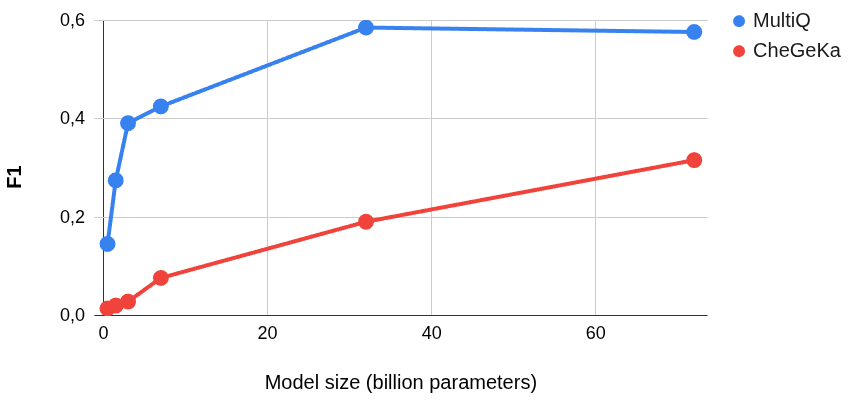
The scaling argument is made empirically on the MERA benchmark for the Qwen2.5-Instruct family: from 0.5B to 72B, F1 on CheGeKa (world knowledge) grows 21.1\times while MultiQ (language skills over supplied context) grows only 4\times, with log-linear slopes 0.65 vs. 0.26.
Method
RAGU’s indexing pipeline has six configurable stages, with artifacts persisted across a graph DB, a KV store, and a vector store.
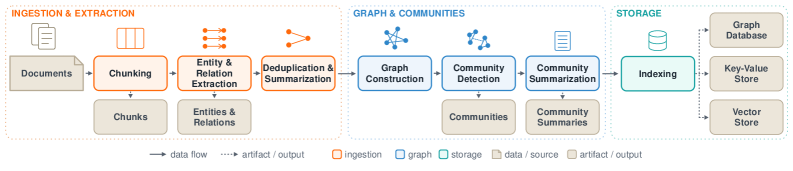
- Chunking. Three interchangeable strategies: fixed-window
SimpleChunker, embedding-gapSemanticTextChunker, and a cross-encoder-rerankedSmartSemanticChunker. - Two-stage typed extraction. Entities and relations are extracted under the NEREL schema. Stage one produces candidate mentions; stage two assigns fine-grained types and normalizes spans. Optional in-context examples (
ICL) and a validation pass (Val) are toggleable and are set toICL=1, Val=yesin the reported runs. - DBSCAN deduplication. Entity mentions are embedded and clustered with DBSCAN; clusters become canonical nodes. This replaces the string-match or exact-alias dedup used in prior systems.
- LLM summarization. Each canonical node/edge aggregates its supporting mentions into a summary used later for retrieval.
- Leiden community detection. Communities on the entity graph produce multi-scale groupings used for coarse retrieval and synthesis-style queries.
- Persistence across three swappable storage tiers.
The extractor model, Meno-Lite-0.1, is a 7B model post-trained specifically for the in-pipeline skills (typed extraction, local reasoning, summarization). The design bet is that a 7B model tuned on the narrow skill distribution should match a general 32B model on graph construction, because the missing \sim5\times parameters mostly encode factual recall that the pipeline does not need.
Results
On knowledge-graph construction, Meno-Lite-0.1 (7B) beats Qwen2.5-32B by +12.5% relative harmonic mean, and matches it on end-to-end English GraphRAG.
The main evaluation is GraphRAG-Bench (Medical) with four levels — Fact Retrieval, Complex Reasoning, Contextual Summarization, Creative Generation — plus BioASQ, MuSiQue, and 2WikiMultiHopQA. All systems share bge-large-en-v1.5 embeddings and gpt-4o-mini for generation; only the index LLM varies. Judge is gemini-3-flash-preview to avoid generator overlap.
Selected AC/Coverage/Faithfulness (×100), RAGU with ICL=1, Val=yes:
| System | Index LLM | Fact AC | Reas. AC | Summ. AC / Cov | Creative AC / Cov / Faith |
|---|---|---|---|---|---|
| LightRAG | Meno-Lite-0.1 | 26.2 | 20.2 | 22.6 / 51.2 | 14.4 / 3.9 / 27.6 |
| HippoRAG 2 | Meno-Lite-0.1 | 72.4 | 68.4 | 65.0 / 51.7 | 56.9 / 34.7 / 26.6 |
| RAGU | Meno-Lite-0.1 | 54.2 | 53.7 | 64.1 / 71.1 | 59.0 / 57.4 / 34.2 |
RAGU dominates coverage on synthesis-heavy tasks: Creative Generation coverage of 57.4 vs. HippoRAG 2’s 34.7 (a \sim1.65\times gap), and Contextual Summarization coverage 71.1 vs. 51.7. On Creative Generation AC, RAGU (59.0) exceeds HippoRAG 2 (56.9).
The apparent HippoRAG 2 advantage on Fact Retrieval / Complex Reasoning is not a retrieval gap. Evidence Recall for RAGU is up to 0.84 vs. \le 0.76 for competitors at every factoid level — RAGU retrieves the most complete context throughout. The authors attribute the AC gap to answer-format artifacts in the LLM-judge evaluation on short-answer factoids, not to information loss.
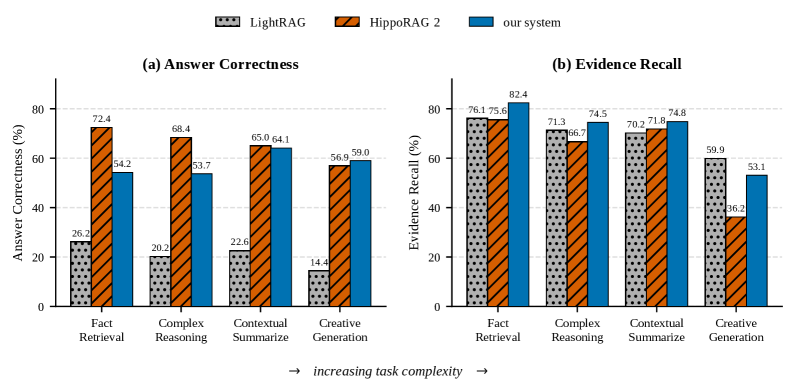
Crucially, swapping Qwen2.5-7B for Meno-Lite-0.1 as the index LLM leaves downstream numbers essentially unchanged across all three RAG systems (e.g., RAGU Creative AC 58.1 → 59.0), supporting the claim that a narrowly tuned compact model suffices for graph construction.
Limitations and open questions
- Evaluation is dominated by a single medical benchmark; BioASQ/MuSiQue/2Wiki numbers are referenced but not shown here.
- The “answer-format artifact” explanation for the Fact Retrieval AC gap is asserted rather than isolated with format-controlled judging.
- The DBSCAN dedup depends on embedding quality; no ablation on \varepsilon,
min_samples, or alternative clusterers is reported. - Meno-Lite-0.1’s training data and how much of its edge comes from schema-specific supervision vs. general language-skill tuning are not detailed here.
- The language-skill scaling argument is drawn from one model family (Qwen2.5) on Russian-heavy MERA tasks; generalization to other families is untested.
Why this matters
RAGU operationalizes a specific and testable claim — that GraphRAG indexing needs language skills, not world knowledge — and shows that a 7B extractor can match a 32B general model while a properly decomposed pipeline substantially improves evidence recall and synthesis-task coverage. If the scaling asymmetry holds across families, the economically correct GraphRAG stack uses small, skill-tuned extractors and spends compute on pipeline structure rather than extractor size.
Source: https://arxiv.org/abs/2607.11683
Xiaomi-Robotics-1: Scaling Vision-Language-Action Models with over 100K Hours of Real-World Trajectories
Problem
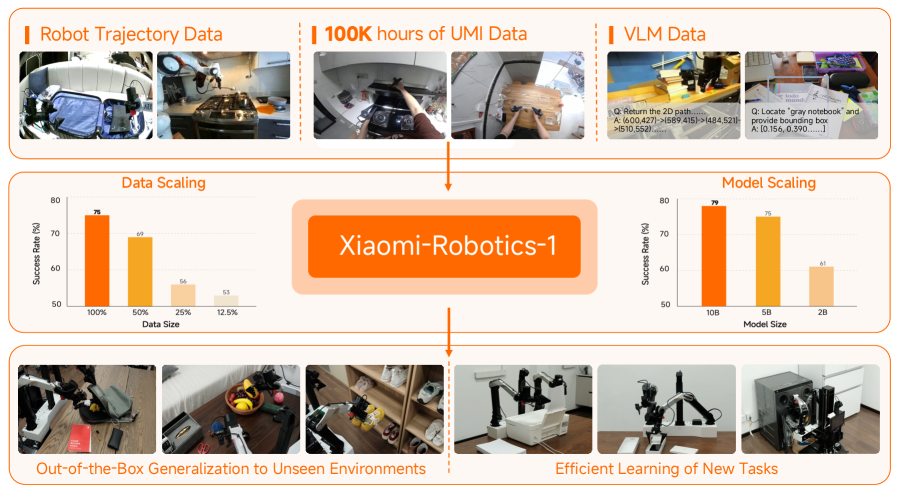
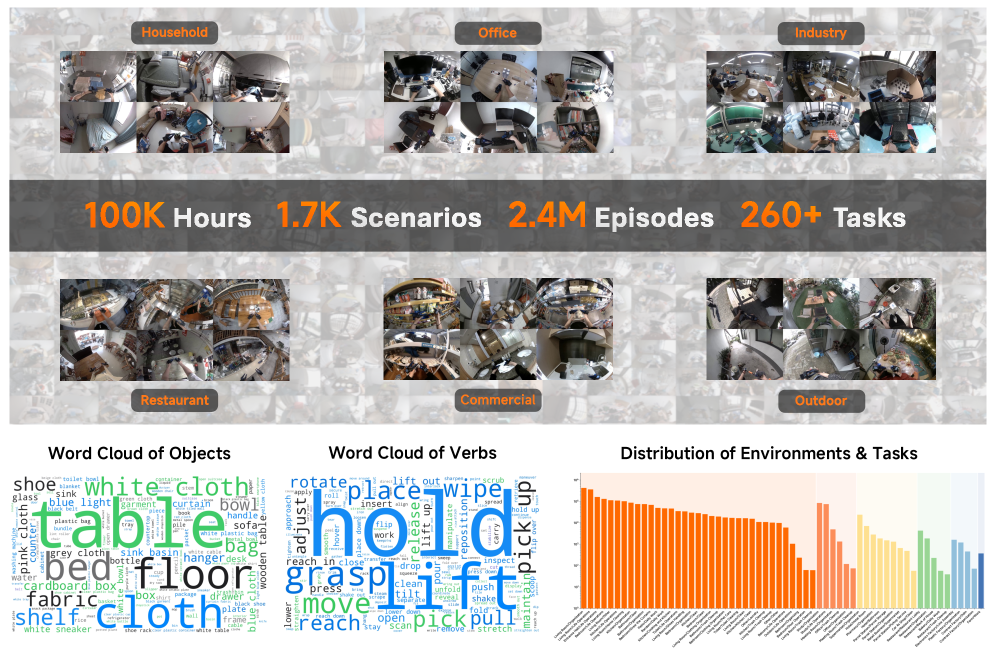
Robot foundation models remain data-starved relative to their language and vision counterparts. Teleoperated robot data is expensive to collect and biased toward specific embodiments; internet video is abundant but lacks action labels. Xiaomi-Robotics-1 (XR-1) attacks this bottleneck by using hand-held UMI grippers to collect over 100k hours of real-world manipulation trajectories, paired with an auto-labeling pipeline that annotates clips with natural-language descriptions of scene state transitions. The central claim is that VLA models exhibit clean scaling behavior in this regime, and that pre-training gains transfer to both zero-shot deployment on real robots and to few-shot adaptation on new tasks.
Method
XR-1 is a Mixture-of-Transformers (MoT) that couples a pre-trained VLM (Qwen3-VL) with a diffusion transformer (DiT) action head. The VLM ingests the current observation \mathbf{o}_t and language instruction l, and — following Choice Policies — additionally predicts action chunks directly to accelerate convergence. The DiT has the same depth as the VLM but a smaller hidden size for inference throughput, and it attends only to the VLM’s KV cache of observation/language tokens plus the robot proprioceptive state \mathbf{s}_t; the VLM’s action-related tokens are explicitly excluded from DiT attention so that the two heads specialize.
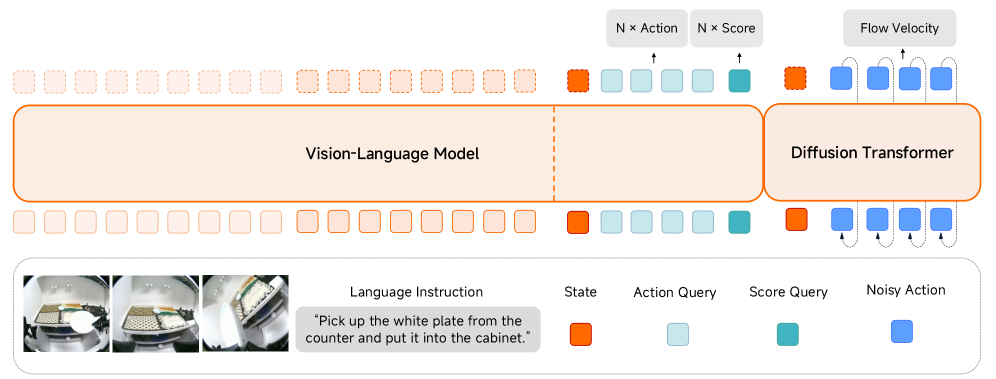
The DiT is trained with flow matching. Given a clean action chunk \mathbf{a}_{t:t+H} and noise \boldsymbol{\epsilon}\sim\mathcal{N}(\mathbf{0},\mathbf{I}), the noisy sample is
\tilde{\mathbf{a}}_{t:t+H}^{\tau} = \tau\,\mathbf{a}_{t:t+H} + (1-\tau)\,\boldsymbol{\epsilon},
and the objective regresses the velocity field
L_{\mathrm{Flow}}(\theta) = \big\|\mathbf{v}_\theta(\mathbf{o}_t, l, \mathbf{s}_t, \tilde{\mathbf{a}}_{t:t+H}^{\tau}, \tau) - \mathbf{u}(\tilde{\mathbf{a}}_{t:t+H}^{\tau}, \mathbf{a}_{t:t+H}, \tau)\big\|_2^2.
Timesteps are drawn from a shifted Beta so training emphasizes noisier states: u\sim\mathrm{Beta}(1.5, 1), \tau = (1-u)\cdot 0.999. The flow-matching timestep is injected into the DiT via adaLN. At inference, actions are decoded from Gaussian noise with 5-step Euler integration:
\mathbf{a}_{t:t+H}^{\tau+\Delta\tau} = \mathbf{a}_{t:t+H}^{\tau} + \Delta\tau\cdot\mathbf{v}_\theta(\mathbf{o}_t, l, \mathbf{s}_t, \mathbf{a}_{t:t+H}^{\tau}, \tau).
Training is two-stage. Pre-training runs on UMI trajectories with auto-labeled natural-language descriptions of state transitions — critically, the labels describe how the scene changes over a clip rather than issuing imperative commands, which matches the causal structure of manipulation better than post-hoc task names. Post-training aligns the model to concrete robot embodiments and to the imperative instruction style humans actually use when prompting robots, using a smaller curated cross-embodiment dataset.
Results
The scaling study uses XR-1-5B and pre-trains on 12.5%, 25%, 50%, and 100% of a roughly 20k-hour UMI subset, measuring MSE between flow-matching-predicted actions and ground truth on a held-out validation set. The two low-data settings (12.5%, 25%) exhibit classic overfitting: validation action error decreases then rises during training. The 50% and 100% runs show monotonically decreasing validation loss, and the 100% (20k-hour) run descends most steeply — the standard signature of a model that is under-parameterized relative to data at the small-data end and enters the compute/data-bound regime at scale. The paper further claims (per the abstract) that this behavior extends to the full 100k-hour corpus and to larger model variants, and that stronger pre-training translates to better out-of-the-box performance on unseen environments and better few-shot post-training on novel tasks. The provided sections stop short of specific real-robot success-rate numbers or head-to-head comparisons to baselines like \pi_0 or RT-2.
Limitations and open questions
Several substantive points are underspecified in the excerpted content. (1) The auto-labeling pipeline for state-transition captions is central but its accuracy, failure modes, and effect on downstream success rate are not quantified here. (2) UMI captures gripper-frame trajectories without a real robot embodiment, so the embodiment gap must be absorbed entirely in post-training; the amount of post-training data and the resulting sim-to-real / hand-to-arm gap are not reported in these sections. (3) Scaling is shown in validation MSE, which is a weak proxy for closed-loop task success — MSE improvements can plateau while success rates continue to move, or vice versa. (4) The 5-step Euler decode gives fast inference but the trade-off against more steps is not characterized. (5) Comparisons to prior VLAs and specific task success numbers are promised in the abstract but not present in the shared sections.
Why this matters
If the reported scaling laws hold at 100k hours, UMI-style hand-held collection plus auto-labeled state-transition captions becomes a viable substitute for teleoperation data — the first plausible path to internet-scale manipulation corpora without sacrificing action labels. The decoupled MoT design, with a frozen-style VLM feeding KV cache into a flow-matching DiT, is also a reusable recipe for turning any strong VLM into an action model without disturbing its language capabilities.
Source: https://arxiv.org/abs/2607.15330
Understanding Reasoning from Pretraining to Post-Training
Post-training with RL now dominates the discourse on reasoning LLMs, but it is almost always analyzed in isolation from pretraining. This paper takes the opposite approach: use a fully controlled domain — chess — to sweep both stages jointly and ask (i) how pretraining choices shape the returns to RL compute, and (ii) what RL actually does to the policy at the token and trace level. Chess is chosen because (a) rewards are verifiable via puzzle solutions, (b) the tokenization is compact (|\mathcal{V}|=81, four tokens per move: piece, source, destination, flag), and (c) pretraining data (Lichess games) can be subsampled cleanly along axes like Elo. A supplementary math experiment tests whether findings transfer.
Setup
The pipeline mirrors standard LLM training. Autoregressive pretraining on tokenized Lichess games; SFT on synthetic reasoning traces followed by the target move; RL on chess puzzles with a verifiable reward (correct principal-variation move). Model sizes span 5M–1B, with 11 pretraining compute budgets from 6.5\times10^{16} to 6.5\times10^{19} FLOPs (roughly 200M–52B tokens) across 10 sizes.
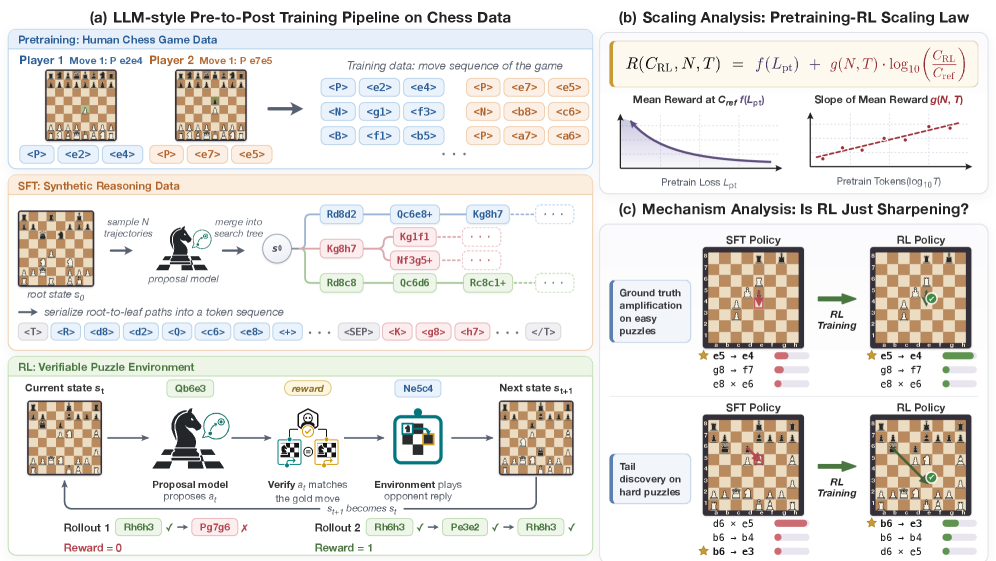
A key methodological choice: SFT with reasoning traces improves pass@1, pass@8, and pass@16, while SFT on the target move alone improves only pass@1 (the samples lose useful diversity). Hence all RL runs start from trace-SFT initializations. For any state s, the induced move policy under a reasoning model is defined by marginalizing over traces,
\widetilde{\pi}_\theta(a\mid s)=\sum_r \pi_\theta(r)\,\widetilde{\pi}_\theta(a\mid s,r),
and normalizing over the legal set \mathcal{A}(s); they draw 128 traces per puzzle for this estimate.
Joint pretraining–RL scaling
The Pareto frontier over pretraining-vs-RL compute allocation is non-trivial: at small total budgets, RL is essentially wasted unless pretraining is sufficient, and stronger pretrained bases dominate at every RL compute level.
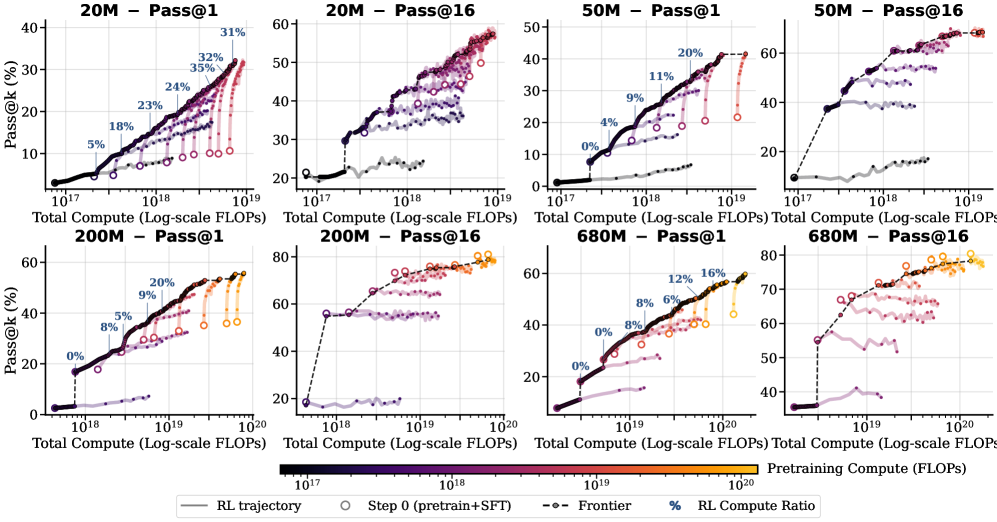
The main quantitative claim is a predictive relation between pretraining loss and post-RL performance. Let R^{\mathrm{ref}}_{N,T} denote the fitted pass@1 at RL compute T for a model of size N. Plotting R^{\mathrm{ref}}_{N,T} against pretraining validation loss gives a family of curves parameterized by T; correlation strengthens monotonically with RL compute, from \rho=-0.93 at low RL compute to \rho=-0.99 at high RL compute.
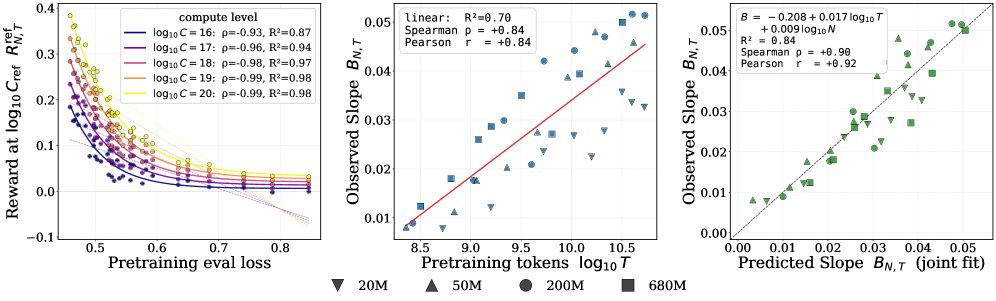
The slope B_{N,T} of the reward curve increases approximately linearly in \log_{10}T, meaning each additional decade of RL compute converts a fixed reduction in pretraining loss into a larger post-RL gain. Two consequences: (1) at a given target performance, more pretraining reduces the RL compute required, and the trade-off is quantifiable; (2) pre-RL pretraining loss — not model size or token count in isolation — is the sufficient statistic for post-RL performance in this regime.
What RL does to the policy
The paper interrogates the “elicitation vs. novel capability” debate empirically. First, they test the temperature-sharpening hypothesis \pi_{\mathrm{RL}}(a\mid s)\propto \pi_{\mathrm{SFT}}(a\mid s)^\alpha via zero-intercept regression of centered log-probs. The global slope \alpha increases during RL (consistent with sharpening on average), but R^2 is only moderate and per-state slopes vary widely — a uniform temperature is a poor model of RL.
They then categorize per-state changes in the top-k set of the move policy:
- Ground-truth amplification: correct move already in top-k, further reinforced.
- Tail discovery: correct move promoted from probability below \epsilon_{\mathrm{tail}}=0.05 into the top-k.
- Wrong-mode amplification: correct move stays outside top-k; RL sharpens an incorrect mode.
Tail discovery is non-negligible, which is direct evidence against a strict “RL only elicits what the base model already ranks highly” interpretation in this setup. Wrong-mode amplification also occurs, cautioning that RL can lock in prior errors when the base’s ordering is systematically wrong at a state.
Transfer to math
To check that the scaling structure is not a chess artifact, they pretrain a 1B OLMo-2 on 200B tokens (70% Nemotron-CC-Math-v1, 30% Dolma3), SFT on NuminaMath-CoT, and RL on a 24.9K mix of GSM8K, MATH, and DeepScaler. Across 14 checkpoints from 10B to 200B pretraining tokens, the same qualitative law holds: R^{\mathrm{ref}}_T vs. pretraining loss tightens with RL compute, and the slope B_T grows nearly linearly in \log_{10}T. Evaluation is pass@1 estimated from 16 samples at temperature 0.7 on held-out problems and on GSM8K/MATH test sets.
Limitations and open questions
Chess is a single, closed domain with a deterministic verifier and small vocabulary; the SFT reasoning traces are synthetic and structured. The math transfer experiment is a single 1B model on one recipe, so slope-linearity in \log_{10}T is suggestive rather than established at frontier scale. The mechanism analysis identifies tail discovery but does not quantify how often novel-behavior gains would be attainable via best-of-N from the base — a critical control for the elicitation debate. Finally, the paper does not address off-policy vs. on-policy RL variants, KL regularization strength, or the interaction between trace length and RL scaling.
Why this matters
If pretraining loss is a sufficient statistic for post-RL performance and the RL-reward slope grows linearly in log-compute of pretraining tokens, then RL compute allocation becomes a predictable planning problem rather than an empirical gamble. The tail-discovery evidence also refines the “RL only sharpens” narrative: in a controlled setting, RL provably surfaces moves the base ranked below 5%.
Source: https://arxiv.org/abs/2607.16097
Audio-Visual Flamingo: Open Audio-Visual Intelligence for Long and Complex Videos
Problem
Existing audio-visual LLMs (AV-LLMs) are largely built for short clips and evaluated on short-form benchmarks, where cross-modal reasoning reduces to captioning-plus-QA. Real-world video — hour-long podcasts, films, instructional streams — requires (i) long-context temporal reasoning over hundreds of frames plus continuous audio, (ii) compositional cross-modal grounding (matching a sound event to a visual event at a particular timestamp), and (iii) explicit temporal alignment between reasoning steps and stream positions. AV-Flamingo (AVF) targets these three deficits with a data curation effort, a curriculum, and a chain-of-thought (CoT) format grounded in timestamps.
Method
The architecture follows OmniVinci and comprises five modules (see Figure 2): a SigLip vision encoder, the AF-Whisper audio encoder from Audio Flamingo 3, a cross-modal interleaving/temporal alignment module, a text-only LLM backbone, and a streaming TTS head.
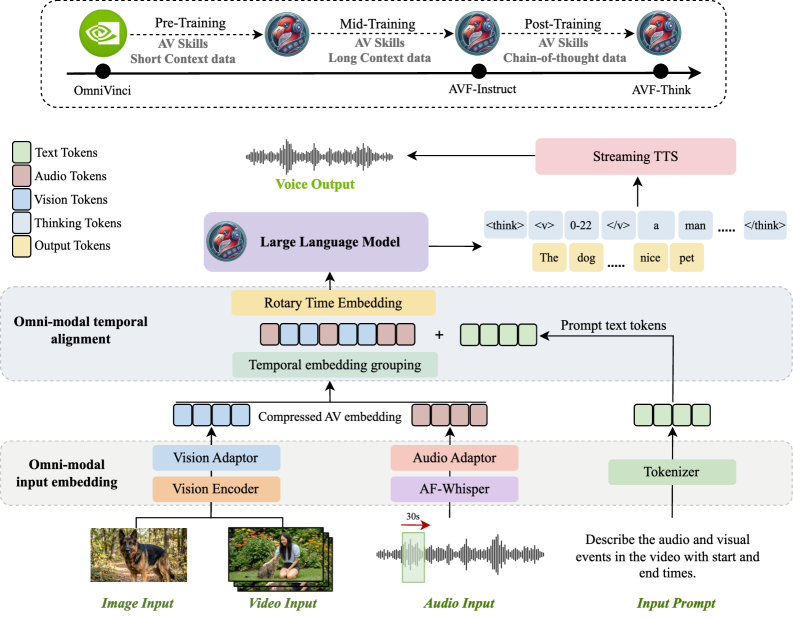
Visual features h_v = f_v(V) \in \mathbb{R}^{HW \times d_v} are extracted with a “Spatial-Scale-then-Compress” Dynamic S2 module: SigLip feature maps are computed at multiple resolutions and then compressed into a compact token sequence. This decouples input resolution/frame count from token budget consumed by the LLM, which is the enabling trick for long-video context without blowing up sequence length.
Audio is resampled to 16 kHz mono, converted to a 128-channel log-mel spectrogram (25 ms window, 10 ms hop), and encoded by AF-Whisper using a 30-second sliding window over non-overlapping chunks:
h_a = f_a(A) \in \mathbb{R}^{N \times d_a},
with N the chunk count. Chunk embeddings are concatenated along time so podcast- or movie-length audio can be processed without truncation.
Audio and visual token streams are interleaved and temporally aligned. Rotary Time Embeddings replace positional indices with wall-clock timestamps so that co-occurring audio and visual tokens share a temporal coordinate before being fed to the LLM together with the text prompt. This is the substrate for the CoT format described below.
Three-stage curriculum. Training proceeds as:
- Pre-training on AV-Skills short-context data (short clips, perception-heavy).
- Mid-training on AV-Skills long-context data (long videos, multi-event reasoning).
- Post-training on CoT data, producing two variants: AVF-Instruct (standard SFT target) and AVF-Think (CoT target).
AV-Skills itself contributes ~7M caption and QA instances built to stress temporal, compositional, and cross-modal reasoning. Figure 3 shows the taxonomy: questions require binding a sound to a specific visual event, ordering events across modalities, and reasoning over event co-occurrence rather than modality-independent classification.
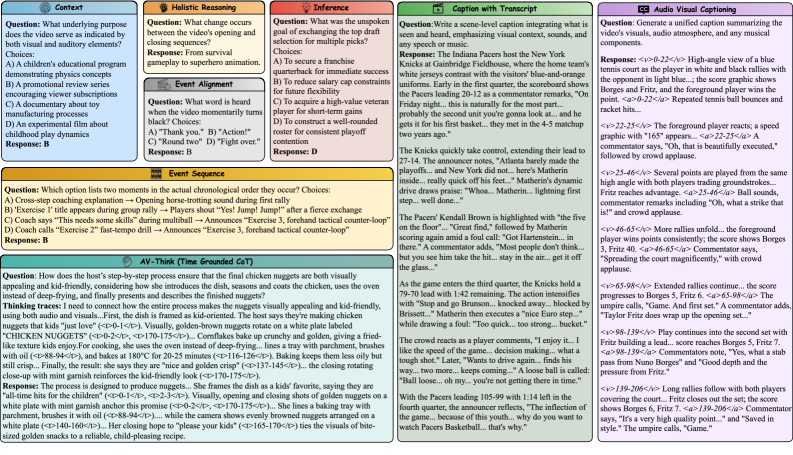
Temporal Audio-Visual Interleaved CoT. Rather than generating free-form rationales, the model emits reasoning steps anchored to timestamps in the AV stream. Combined with rotary time embeddings, this forces the intermediate tokens to reference concrete frames/audio chunks, which the authors argue improves alignment and interpretability.
Results
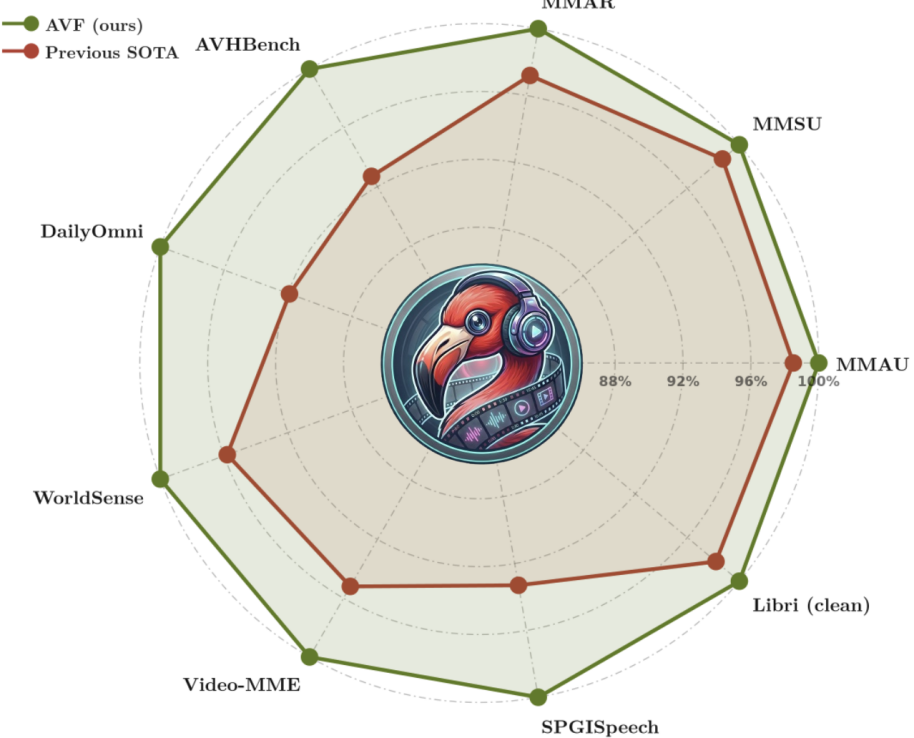
Training runs on 512 H100s. Evaluations span audio (MMAR, MMSU, MMAU), video (Video-MME, ActivityNetQA, LongVideoBench), omni-modal (WorldSense, DailyOmni), and ASR (LibriSpeech clean/other, SPGISpeech, TEDLIUM, GigaSpeech, Common Voice 15, VoxPopuli).
Specific numbers reported:
- Audio reasoning. MMAR: 60.1 vs. OmniVinci 58.4. MMSU: 61.5 vs. Gemini 1.5 Pro 60.7. MMAU average: 73.49, above both AF3 and OmniVinci, with the strongest gains on sound and speech subsets.
- ASR. LibriSpeech test-clean WER 1.64 (best), SPGISpeech 2.8 (best), VoxPopuli 5.8 (best); competitive elsewhere.
- Video. Video-MME: 70.7 without subtitles and 71.2 with subtitles, beating NVILA and OmniVinci. LongVideoBench: slightly below OmniVinci but above NVILA.
- Omni-modal. Best-reported scores on WorldSense and DailyOmni; MMOU results identified as best-in-class for long and complex AV.
The most notable finding is that a jointly trained AV model does not degrade — and in several cases improves over — specialized single-modality baselines (AF3 for audio, NVILA for video). This runs against the usual observation that omni-training dilutes single-modality performance.
Limitations and open questions
- LongVideoBench still trails OmniVinci, suggesting the long-context mid-training stage helps AV joint reasoning more than pure long-video visual reasoning.
- The paper reports aggregate MMAU/MMAR numbers but provides only high-level ablations of the AV-Skills curriculum in the excerpted sections; the marginal contribution of the Temporal AV Interleaved CoT versus rotary time embeddings alone is not isolated here.
- The Dynamic S2 compression ratio, frame rate, and audio chunking cadence together determine effective temporal resolution; how CoT timestamp accuracy degrades with more aggressive compression is unexamined.
- Comparisons include proprietary models (Gemini 2.5 Pro, GPT-4o) whose training data and compute are unknown, so “state-of-the-art open” is the honest framing.
- Streaming TTS is described architecturally but not evaluated with latency or MOS numbers in the shown results.
Why this matters
AVF demonstrates that a fully open AV-LLM can match or exceed specialized single-modality models on their own benchmarks while extending to long-form joint audio-visual reasoning, primarily through data curriculum design (AV-Skills, three stages) and timestamp-grounded CoT rather than architectural novelty. It provides a concrete recipe — Dynamic S2 for vision, chunked AF-Whisper for audio, rotary time embeddings for cross-modal alignment — that others can reproduce for long-video multimodal work.
Source: https://arxiv.org/abs/2607.16107
Beyond Entropy: Correctness-Aware Advantage Shaping via Contrastive Policy Optimization
RLVR pipelines typically use policy entropy as a proxy for where to invest gradient signal — high-entropy tokens are treated as decision points, and advantages are reshaped accordingly (Entropy-Tokens, Entropy-Adv, EM-RL, IB-reg, RL-ZVP, etc.). The problem is that entropy conflates two very different phenomena: productive exploratory uncertainty at a genuine reasoning branch, and pathological confusion at a wrong step. Neither Shannon entropy nor its variants distinguish them, because entropy is a functional of the marginal distribution and has no access to which token is actually correct. This paper proposes a replacement signal that is directly aligned with correctness: the token-level log-ratio between a reference-conditioned posterior and the vanilla prior.
From Bayes rule to a correctness signal
Let g(x, y_{<t}, y_t) := \mathbb{P}(C \mid X{=}x, Y_{<t}{=}y_{<t}, Y_t{=}y_t) be the probability that emitting token y_t leads to a correct completion under policy continuation, where C = \{R(x,Y)=1\}. Define the “ideal” posterior conditioning on correctness \tilde\pi_{\mathrm{post}}(y_t\mid x, y_{<t}) := \mathbb{P}(Y_t = y_t \mid x, y_{<t}, C). Bayes gives
\tilde\pi_{\mathrm{post}}(y_t\mid x, y_{<t}) = \frac{\pi(y_t\mid x, y_{<t})\, g(x, y_{<t}, y_t)}{Z(x, y_{<t})},
with Z(x, y_{<t}) = \sum_b \pi(b\mid x, y_{<t}) g(x, y_{<t}, b) the prior-averaged correctness at the prefix. Taking logs,
\log \frac{\tilde\pi_{\mathrm{post}}(y_t\mid x, y_{<t})}{\pi(y_t\mid x, y_{<t})} = \log g(x, y_{<t}, y_t) - \log Z(x, y_{<t}).
For fixed prefix, this log-ratio is monotone in g: tokens with above-average correctness score positive, below-average score negative. So the log-ratio is a proper token-level correctness signal, up to a prefix-dependent additive constant that cancels within a trajectory-level baseline.
\tilde\pi_{\mathrm{post}} is intractable, but the paper substitutes a reference-guided posterior \pi_{\mathrm{post}}(y_t \mid x, y^\star, y_{<t}), obtained by conditioning the same policy on the gold answer y^\star via a refinement-style prompt. Because y^\star pins down correctness, this is treated as an operational proxy: \pi_{\mathrm{post}}(\cdot\mid x, y^\star, y_{<t}) \approx \tilde\pi_{\mathrm{post}}(\cdot\mid x, y_{<t}). The contrastive disagreement is then
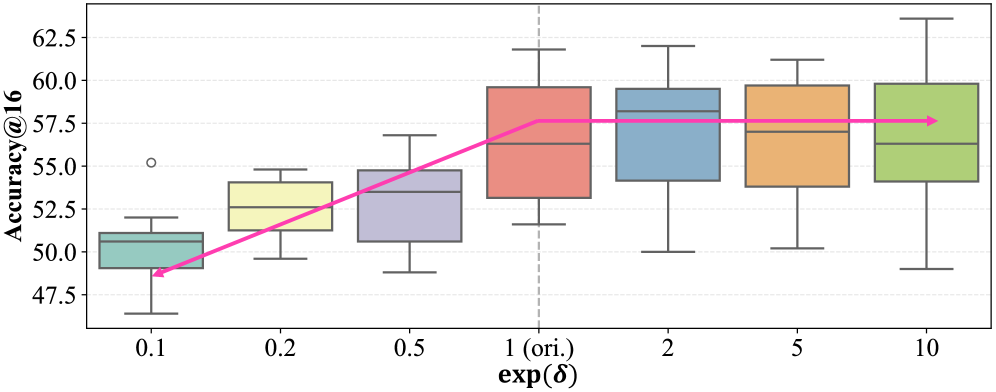
\delta_t(x, y) := \log \frac{\pi_{\mathrm{post}}(y_t\mid x, y^\star, y_{<t})}{\pi(y_t\mid x, y_{<t})} \propto \log g(x, y_{<t}, y_t) + \text{const}.
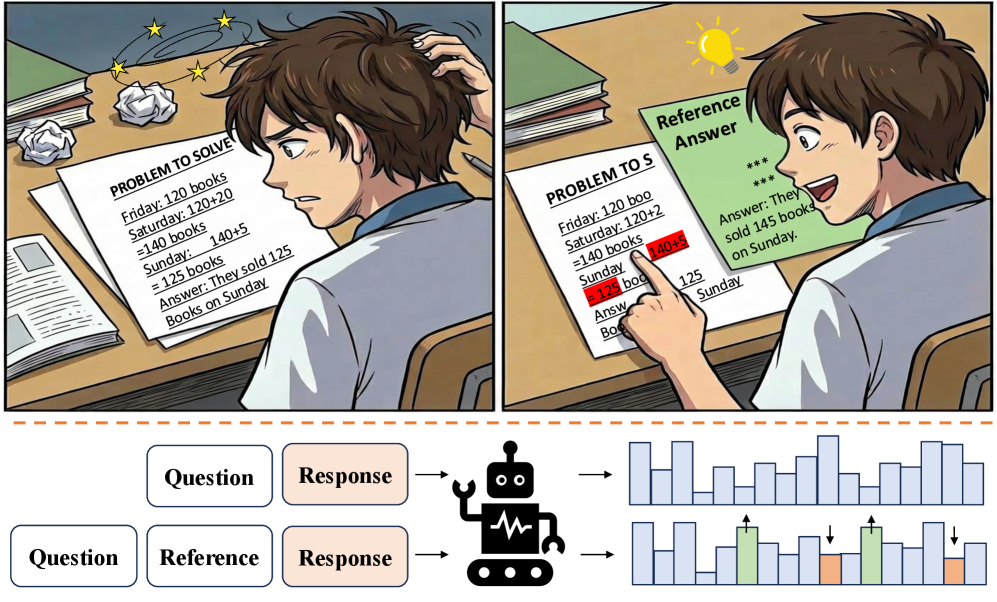
Empirically, \delta_t tracks token-level correctness. Figure 2 plots Accuracy@16 as a function of \delta_t bins, showing a clean monotone relationship — tokens with large negative disagreement are systematically the wrong ones.
CPO: advantage shaping and the zero-advantage fix
CPO plugs \delta_t into GRPO-style advantage shaping. The trajectory-level advantage A_i from group-relative rewards is modulated per token by a function of \delta_{i,t}, producing A_{i,t} = f(A_i, \delta_{i,t}). Correct trajectories get their advantage concentrated on positive-\delta tokens (reinforcing genuinely good decisions), while incorrect trajectories concentrate negative advantage on negative-\delta tokens (penalizing the actual mistakes rather than the entire chain). Crucially, when A_i = 0 — the notorious zero-advantage case in GRPO where all rollouts in a group share the same reward and the gradient collapses — \delta_t still provides a nonzero, correctness-aligned per-token signal, so the group contributes learning updates. This is the mechanism that RL-ZVP tries to address with entropy regularization but does so without a correctness prior.
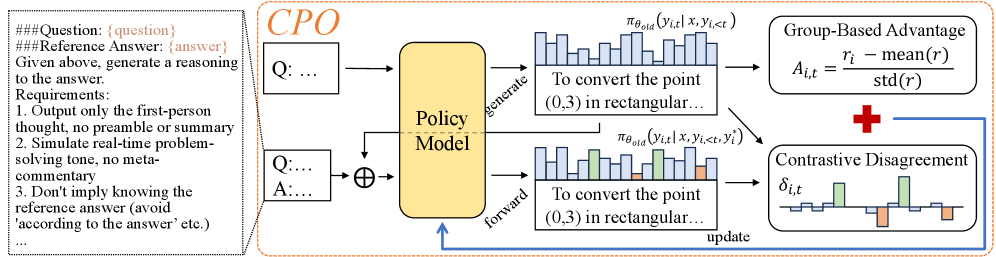
The paper further observes that On-policy Distillation is a special case of CPO in which the reference-guided posterior is replaced by an external teacher’s distribution; the contrast then reduces to a teacher–student KL-style shaping term.
Experiments
Training uses MATH (7.5k problems) on Qwen3-Base-4B and Qwen2.5-Math-7B, built on GRPO. Evaluation covers in-domain (MATH500, AIME2024/2025, AMC23) and OOD (GPQA, MMLU-Pro, Knowlogic) with Pass@16 at temperature 0.6, top-p 0.95. Baselines include GRPO, DAPO, and five entropy-intervened variants (Entropy-Tokens, Entropy-Adv, EM-RL-token, RL-ZVP, IB-reg). CPO substantially outperforms entropy-based RLVR both in-domain and OOD (specific numbers not in the excerpted sections). The paper also reports an exploration/exploitation decomposition: correct rollouts naturally support exploration (positive \delta reinforces alternative good tokens), incorrect rollouts support exploitation (negative \delta localizes penalty), and balancing the two is what yields the strongest results.
Limitations and open questions
The proxy \pi_{\mathrm{post}}(\cdot \mid x, y^\star, \cdot) \approx \tilde\pi_{\mathrm{post}} is only as good as the model’s ability to condition faithfully on y^\star; a weak base model may leak y^\star tokens verbatim, inflating \delta_t at positions that merely copy the reference rather than reason. The approach also requires access to gold references at training time, so it does not extend to purely outcome-supervised settings without answers. Compute doubles per rollout because both prior and posterior distributions must be computed. Finally, the reduction of on-policy distillation to CPO suggests a spectrum of “posterior instantiations” (teacher, self-refine, retrieval-augmented) that is left largely unexplored.
Why this matters
Entropy has been the default correctness-agnostic knob for RLVR advantage shaping, and it demonstrably conflates useful uncertainty with error. Replacing it with a Bayes-justified contrastive log-ratio gives a signal that is provably monotone in token-level correctness and that fixes the zero-advantage pathology of GRPO for free — a rare case where a theoretically clean object also plugs into an existing pipeline with minimal surgery.
Source: https://arxiv.org/abs/2607.14614
Agon: Competitive Cross-Model RL with Implicit Rival Grading of Reasoning
Problem
GRPO-style RL with verifiable rewards grades only the final answer. On hard problems, this incentivizes verbose exploration rather than sharper reasoning: the trace is never scored, no process labels exist, and self-generated critiques inherit the same biases that produced the errors in the first place. Empirically, single-model self-play saturates because a policy re-audits its own work with its own blind spots (Huang et al., 2024). The paper asks whether a second, comparably strong but behaviorally divergent model can supply the missing signal without any process reward model.
Method
Agon trains two policies A and B instantiated as two LoRA adapters (rank 16) over a single frozen base, so divergence is engineered structurally while capacity is matched. Each optimizer step runs two parallel streams on the same problem x:
Standalone stream (drafter). A produces N=8 rollouts \{a_i\} from the plain prompt and receives a vanilla GRPO update on correctness plus a format term (weight \lambda=0.5).
Competitive stream (challenger). B reads a summary of each a_i (final answer withheld) as in-context “peek” and produces one paired rollout b_i per opponent draft, again N total. B’s reward is competitive: it combines standalone correctness with a conversion bonus that pays B for solving problems where A’s paired draft was wrong (or, symmetrically, for holding the answer when A got it right and B was tempted to flip). Concretely, the reward on b_i uses the outcome of a_i to decide whether B has “out-solved” the rival that saw its problem — no explicit rubric on the trace, only outcome differentials.
Roles rotate every optimizer step, so both adapters see both streams. Because both are updated, each faces a progressively stronger rival — a curriculum single-model RL cannot provide. The key qualitative claim is that the trace is graded implicitly: to win, B must produce reasoning that A, having seen B’s summary, cannot ride to the correct answer, and vice versa.
The paired-vs-standalone routing is the mechanical core. Denoting the GRPO advantage on group \{b_i\} with per-sample reward R(b_i),
R(b_i) = r_\text{correct}(b_i) + \lambda \phi(b_i) + \beta \cdot \mathbb{1}[b_i \text{ correct} \land a_i \text{ wrong}],
with \phi the well-formed <think>/<answer> reward. The conversion term \beta \cdot \mathbb{1}[\cdot] is what turns outcome asymmetries between the paired draft and the paired response into a gradient on the challenger’s reasoning.
At inference the pair deploys exactly as it trains: a two-stage cascade where one adapter drafts and the other answers after reading the draft summary. This preserves the train/test distribution and — importantly for fair comparison — the total compute is accounted against baselines under compute parity (Section 4.5).
Why a second model
The authors argue self-play plateaus because a single policy re-audits its rollouts with the same biases that produced them. A behaviorally divergent peer supplies audits from different failure modes; because the peer is also being optimized, the grader improves alongside the graded, which the paper contrasts as an “open loop” against self-play’s closed loop. The two conditions are (i) comparable strength — otherwise the game collapses into distillation from the stronger side — and (ii) different failure modes, engineered here by adapter divergence over a shared base.
Results
Training uses Qwen3 (0.6B primary; 1.7B/4B for scaling) on the hard split of DeepMath-103K (difficulty 8, binary-answer removed), G=N=8, LoRA rank 16, lr 5\times10^{-5}, 3,000 training problems, one epoch, evaluated on a 300-problem held-out split with temperature 0.6, top-p 0.95, 15k-token budget per stage. Pair-trained methods are evaluated as the two-stage cascade, reporting the better direction, with 95% Clopper–Pearson intervals.
The headline claim: on DeepMath-hard with Qwen3, Agon doubles GRPO’s pass@1, and this gain is roughly 8× that of an untrained Mixture-of-Agents pass over the same base. In other words, the improvement is not attributable to the two-stage cascade at inference — an untrained MoA cascade over the same base captures only \sim 1/8 of Agon’s uplift, isolating the training-time competitive signal. The ordering replicates on CodeContests (easy split, unit-test verifier as r=1 iff all tests pass) under the same protocol. Sanity checks on GSM8K and MATH-500 are reported in Table 2 of the paper.
Limitations and open questions
The abstract and Section 4 note several unresolved points. The strength-gap tolerance is not ablated — how close must A and B be before the game collapses to distillation? The divergence condition is engineered by two adapters over one base; whether cross-family pairs (e.g., Qwen3 vs. Llama or Mistral) satisfy the different-failure-modes requirement is left to future work. The conversion bonus’s coefficient and its interaction with the format weight \lambda=0.5 and length tiebreak \gamma=0.5 deserve more scrutiny, particularly around length hacking, which the paper only partially addresses via the tiebreak. Finally, the “implicit grading” story rests on the assumption that reading a summary (answer withheld) is a faithful proxy for grading reasoning; a peer that solves the problem from scratch on the peeked context is not, strictly, evaluating the drafter’s trace, only its informativeness.
Why this matters
Agon converts the process-reward problem into an outcome-differential game between two co-trained peers, sidestepping both learned reward models and human process labels. If the 2× pass@1 gain over GRPO holds at larger scales and across domains, it is a cheap, verifier-only recipe for pushing past the self-play plateau — with the cascade preserved at inference so training and deployment share a distribution.
Source: https://arxiv.org/abs/2607.07690
RESOURCE2SKILL: Distilling Executable Agent Skills from Human-Created Multimodal Resources
Problem
Skill libraries for software agents are typically hand-authored, text-only, or bootstrapped from agent traces. This leaves a large body of human-created multimodal instruction — tutorial videos, GitHub repos, technique articles, reference artifacts — outside the retrieval loop. For creative authoring tasks (slide design, 3D modeling, DAW mixing), the operative knowledge lives precisely in those modalities: videos encode temporal manipulation and visual outcomes, code encodes tool invocation patterns, articles encode conceptual framing. RESOURCE2SKILL asks how to distill this heterogeneous corpus into a retrievable, executable skill library usable by a generic LM agent.
Method
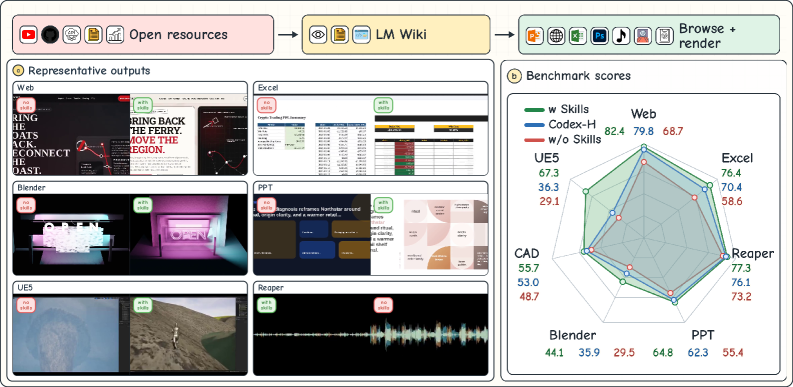
The framework has four stages sharing a single MCP-mediated browse-select-execute interface: (1) offline construction of the wiki from resources, (2) hierarchical organization, (3) retrieval and selection at inference, (4) execution against a domain backend. Crucially, the same construction operator is reused online when the retrieved pool fails to cover the task, so there is no separate online-learning pipeline.
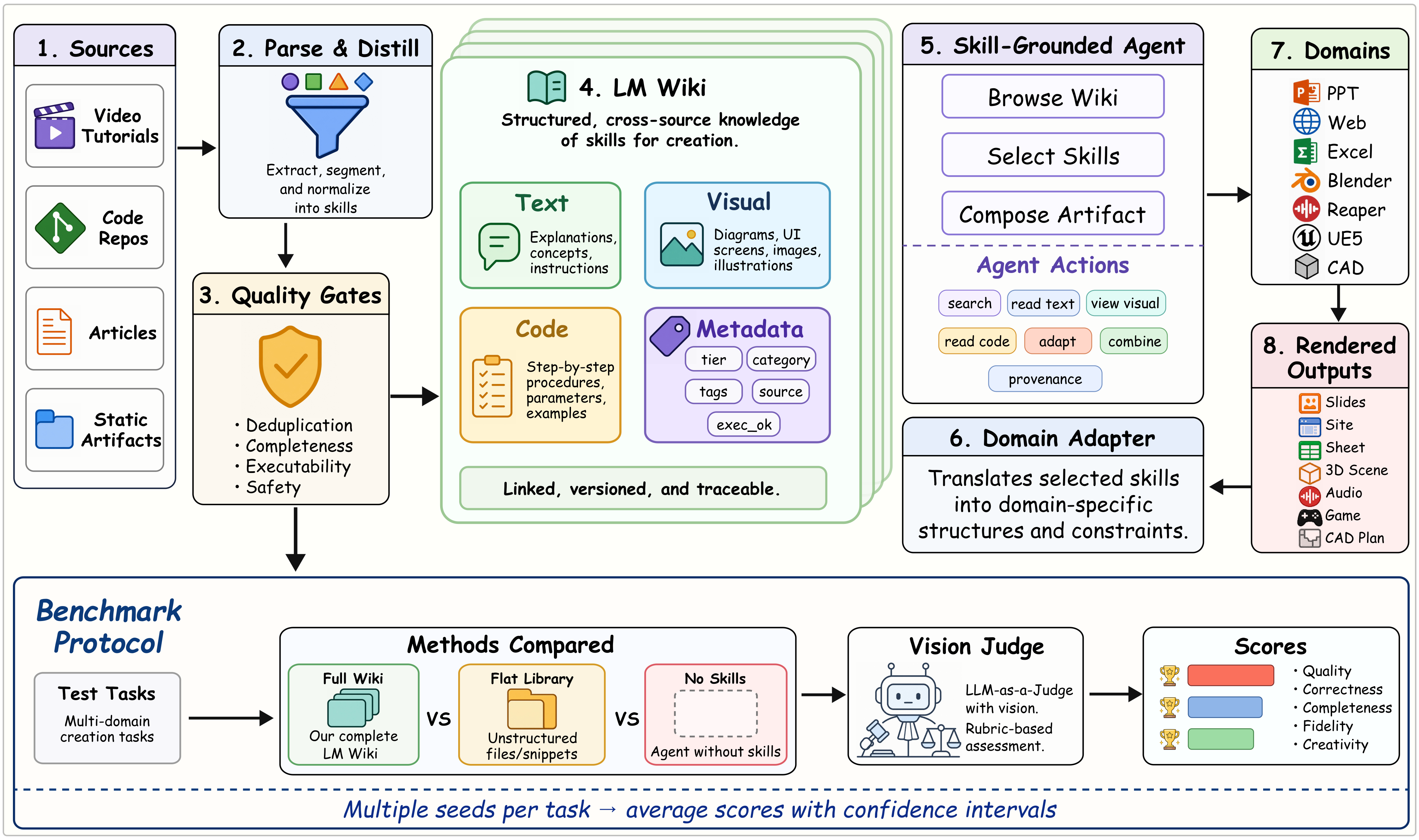
A skill is a tuple
s = (p, x_{\text{text}}, x_{\text{visual}}, x_{\text{code}}, m),
where p is the path within a domain-specific taxonomy \mathcal{T}_{\mathcal{D}} and m is metadata (provenance, filters, audit trail). The three content views are intentionally redundant-with-complementary-detail:
- x_{\text{text}}: name, mechanism, applicability conditions, inputs, expected effects.
- x_{\text{visual}}: thumbnails, screenshots, rendered previews, or diagrams.
- x_{\text{code}}: executable or adaptable procedure fragments (may be empty for reference-only entries).
Taxonomies are hand-shaped per domain — PPT is organized by layout, typography, and motion; Blender by geometry, material, lighting, and composition — but the read interface is uniform. The library is
\Sigma_{\mathcal{D}} = \{s : s \text{ accepted by the construction operator } (f_\theta, A_{\mathcal{D}})\},
and its cardinality is treated as an experimental variable (i.e., scaling curves over |\Sigma_{\mathcal{D}}| are reported).
Retrieval is performed by a component called MetaBrowse, which surfaces candidate skills for a task brief; the LM then picks among candidate skills using whichever of the three views is most informative. Selected skills are applied to the domain backend through MCP. When retrieved coverage is insufficient, f_\theta is invoked online on task-relevant resources to synthesize a new skill entry, which is then usable through the same interface.
The design implicitly separates two things typical skill-library work conflates: procedural knowledge (what to do, when) from executable substrate (how to call the tool). Because x_{\text{code}} can be empty, the wiki can hold “reference-only” entries — conceptual or stylistic scaffolding — that guide LM planning even without direct tool bindings.
Results
Evaluation spans seven authoring domains — PPT, CAD, HTML/CSS/JS web, Excel, Blender, UE5, and Reaper — and four agent backends. Each domain uses a screened pool of 80 task briefs disjoint from the resource corpus, authored blind to the wiki. The main comparison and scaling studies use matched N=80 subsets; ablations use matched N=40. Brief IDs are shared across conditions in a comparison, so within-table deltas are paired.
The headline number: RESOURCE2SKILL improves average overall score by +11.9 percentage points over the no-skill ablation. Comparisons are also made against two off-the-shelf agentic harnesses (numbers not reported in the excerpt) and controlled ablations isolate: (a) whether the wiki interface (browse over MetaBrowse plus multi-view select) matters beyond raw text retrieval, (b) the source mix (video vs. code vs. article vs. artifact), (c) entry format (which of x_{\text{text}}, x_{\text{visual}}, x_{\text{code}} contribute), (d) library scale, (e) online vs. offline acquisition, and (f) selection strategy.
Qualitative web outputs show the intended failure mode of no-skill agents: they generate valid HTML/CSS but miss the visual-design conventions that the skill entries encode (grid alignment, typographic hierarchy, motion timing), which are exactly the properties videos and reference artifacts capture.
Limitations and open questions
The taxonomy \mathcal{T}_{\mathcal{D}} is domain-specific and hand-designed; the paper does not report how brittle results are to taxonomy choice or whether \mathcal{T}_{\mathcal{D}} can itself be induced. The construction operator’s acceptance criterion is treated as a black box in the excerpt — how many candidate skills are filtered, and by what noise model, is not detailed here. Evaluation uses a matched N=80 per domain with briefs authored blind to the wiki, which controls for leakage but is small enough that +11.9 pp averaged over seven domains masks per-domain variance. Finally, cost analysis is missing: the multimodal distillation pipeline (video → structured skill) presumably requires a strong VLM at construction time, and the amortization argument depends on how often skills are reused.
Open questions: how does \Sigma_{\mathcal{D}} scale — is there a coverage plateau, or logarithmic gains? Does online acquisition converge to offline-equivalent quality, or produce a lower-quality tail that pollutes retrieval? Does the multi-view selection actually exploit x_{\text{visual}}, or does the LM default to x_{\text{text}}?
Why this matters
Most agent-skill work has treated tutorial videos and reference artifacts as unusable because they are not directly executable. RESOURCE2SKILL shows that with a taxonomy and a multi-view entry format, these resources yield meaningful capability gains (+11.9 pp) on realistic creative authoring tasks, unifying offline distillation and online acquisition under one operator.
Source: https://arxiv.org/abs/2606.29538
Hacker News Signals
Claude Fable produced a counterexample to the Jacobian Conjecture
The Jacobian Conjecture — open since 1939 — states that a polynomial map f: \mathbb{C}^n \to \mathbb{C}^n with everywhere nonzero Jacobian determinant is a polynomial automorphism. It is one of Smale’s problems and resisted proof for 86 years. A post by mathematician Levent Alpoge claims that Claude (the “Fable” model) produced a purported counterexample. The thread is cautious: the mathematical community has seen several false proofs and false counterexamples for this conjecture, and the original tweet is light on verification details. What is technically notable is not whether this is correct (it almost certainly requires independent peer verification), but the workflow implied: using an LLM to search a combinatorially large space of polynomial maps for one that satisfies the Jacobian condition while failing surjectivity or injectivity. This is plausible as a search task — LLMs can propose structured algebraic constructions and check symbolic constraints iteratively. The conjecture is known to be equivalent to asking whether the map has a polynomial inverse; degree bounds and particular ring-theoretic reductions have been studied extensively, so the search space has known structure an LLM could exploit if prompted carefully. If the counterexample withstands scrutiny from algebraic geometers, it would be remarkable; if not, it is still a data point about AI-assisted conjecture exploration. Discussion on HN is appropriately skeptical, noting that amateur claimed counterexamples to this conjecture appear every few years. The key technical question — what degree polynomial was proposed and can a computer algebra system (Macaulay2, Sage) verify the claimed Jacobian and non-invertibility — remains unanswered in the public thread.
Source: https://xcancel.com/__alpoge__/status/2079028340955197566
Exploit brokers pay $500k for WordPress RCEs. I found one with GPT-4 and $25
The post describes a complete WordPress RCE discovery workflow driven almost entirely by GPT-4 (the author brands it “GPT5.6” colloquially). The technical substance is what matters. The researcher pointed GPT-4 at a target WordPress plugin’s PHP source, asking it to reason about unsanitized input paths that reach eval, system, preg_replace with the /e modifier, or deserialization sinks. GPT-4 flagged a chain involving object injection through a plugin’s use of unserialize() on user-controlled data — a class of vulnerability that requires identifying a suitable Property-Oriented Programming (POP) gadget chain in the loaded PHP classes. The LLM was used iteratively: first for triage across plugin files to narrow the attack surface, then for gadget chain construction, then for payload serialization. The $25 figure reflects API call costs. The exploit achieves unauthenticated RCE, which puts it in the highest exploit-broker tier (Zerodium lists WordPress RCE at up to $500k for unauthenticated chains). The key technical insight from a security research methodology standpoint is that LLM-assisted triage dramatically reduces the time to find deserialization sinks and construct POP chains, work that previously required expert manual source review. The author responsibly disclosed before publication. Limitations: the technique requires the source to be available (GPL plugins are all public), and the LLM still needed human judgment to verify exploitability and test the chain. The broader implication is that the economics of vuln research shift significantly when entry costs drop from weeks of expert labor to hours plus $25 of API credits.
1-Bit LLM in the Browser
This Hugging Face Space runs BitNet-style 1-bit quantized inference entirely in the browser via WebGPU. The model is “Bonsai,” a small LLM where weights are ternary \{-1, 0, +1\} (1.58-bit per weight in the BitNet b1.58 formulation), which reduces matrix multiplications to additions and subtractions, eliminating floating-point multiplies in the dominant compute path. The WebGPU backend computes on the GPU through the browser’s GPUDevice API without any server round-trip. The technical interest is in how ternary weight packing and dequantization are implemented in WGSL shaders: weights are bit-packed, unpacked per tile during the matmul, and accumulation happens in fp16 or fp32 depending on the device. Memory bandwidth is the dominant constraint in browser inference, and 1.58-bit packing yields roughly 20x size reduction versus fp32, allowing a model that would otherwise exceed VRAM limits to fit in device memory. The demo is limited to a small model (parameter count not prominently advertised, likely sub-2B), so generation quality is modest. The engineering interest is validating that the full stack — tokenizer in JS/WASM, KV cache management, ternary matmul shaders — works end-to-end with no Python runtime. This is a useful existence proof for edge deployment where installing native runtimes is not viable. Open questions: latency at longer context, cross-browser WGSL compatibility (Chrome/Edge are reliable, Firefox WebGPU support is partial), and whether quantization-aware training artifacts affect perplexity noticeably on the small model.
Source: https://huggingface.co/spaces/webml-community/bonsai-webgpu
What AI did to Stack Overflow in a graph
The linked Stack Exchange Data Explorer query plots Stack Overflow question and answer volume over time, and the signal is unambiguous: both metrics inflect sharply downward in late 2022, coinciding with ChatGPT’s release. The technical substance here is in what the data actually represents. Question volume is a proxy for developer demand for searchable, community-curated technical answers. The decline indicates that a large fraction of that demand is now absorbed by LLM chat interfaces that provide immediate, personalized answers without requiring the asker to compose a well-formed, reproducible question. The answer volume decline is arguably more consequential: it signals reduced incentive for experts to write durable, indexed answers when the audience for those answers has collapsed. This creates a data flywheel problem: LLMs are trained on Stack Overflow data, but if SO stops receiving high-quality new content, future training corpora degrade. The forum’s comment section discusses whether the remaining traffic is shifting toward harder, more niche questions that LLMs handle poorly. From a systems perspective, Stack Overflow’s moderation infrastructure, ranking algorithms, and reputation economy were all calibrated to a volume regime that no longer exists. The migration is not symmetric: LLM answers are not indexed, not correctable by the community, not linked, and not persistent in any shared knowledge base. Whether this represents a net loss in collective technical knowledge infrastructure or just a format transition is the genuine open question.
Source: https://data.stackexchange.com/stackoverflow/query/1953768#graph
AI advice made people less accurate but more confident
The study (covered by TNW, underlying paper is the primary reference) ran participants through a decision task with and without AI-generated advice, then measured accuracy and self-reported confidence. The finding: AI advice decreased accuracy while increasing confidence — the classic miscalibration pattern, but now induced by an external system rather than individual cognitive bias. The mechanistic claim is automation bias: participants anchored to the AI output and reduced their own reasoning effort, producing worse decisions while feeling more certain because they had an “authoritative” source. The experimental design measured confidence via numerical probability elicitation before and after seeing AI advice, and accuracy against a ground-truth outcome. Effect sizes and sample sizes are not detailed in the TNW summary, so direct quantitative evaluation requires the primary paper. From a human-computer interaction and decision-support systems perspective, this replicates and extends prior automation-bias literature (originally studied in aviation and medical diagnosis contexts) to LLM-style advisory systems. The relevant technical implication: confidence calibration in AI systems and calibration of users of AI systems are separate problems, and solving the former (better model uncertainty estimates) does not address the latter if users treat any AI output as authoritative. Interface-level interventions — displaying model uncertainty, requiring users to commit to an answer before seeing AI advice, showing reasoning chains — have been studied as mitigations but have inconsistent efficacy.
Source: https://thenextweb.com/news/ai-advice-suppresses-critical-thinking-wrong-answers-study
LoRA Speedrun — public wall-clock leaderboard for fine-tuning techniques
The repo establishes a benchmark where the metric is wall-clock time to reach a fixed target validation loss on a standardized fine-tuning task, using LoRA and its variants. This is technically distinct from the existing landscape of fine-tuning benchmarks that report final quality at a fixed compute budget. By measuring wall-clock time to a loss threshold, it penalizes implementations that are computationally efficient in FLOPs but poorly optimized for actual hardware (slow kernels, suboptimal data loading, excessive host-device synchronization). The leaderboard accepts submissions that specify hardware, LoRA rank r, alpha \alpha, target modules, optimizer, and any additional techniques (DoRA, rsLoRA, etc.). The task appears to be a text fine-tuning objective on a fixed dataset. Technical interest: this surfaces implementation-level differences between LoRA variants that are obscured by FLOP-normalized comparisons. For example, DoRA (decomposing weight updates into magnitude and direction) adds overhead per forward pass that may not be justified in wall-clock terms even if it improves loss per gradient step. The benchmark also implicitly tests data pipeline efficiency since IO can dominate for small models. Limitations: the target loss threshold and dataset choice heavily influence which techniques win; results are not portable across hardware generations; and wall-clock is noisy across runs on shared cloud instances. Still, a wall-clock leaderboard fills a gap that purely academic benchmarks leave open.
Source: https://github.com/Saivineeth147/lora-speedrun
Scrying the AMD GFX1250 LLVM Tea Leaves
Chips and Cheese examines LLVM compiler source code commits targeting the gfx1250 GPU target to infer AMD’s unreleased architecture before official disclosure. This is a standard reverse-engineering approach: GPU vendors upstream ISA support, instruction scheduling models, and feature flags to LLVM/Mesa before hardware ships, because open-source driver development requires lead time. The analysis finds that GFX1250 introduces new instruction encodings and feature flags distinct from the RDNA4 family (GFX12xx series). Specific findings include changes to the wavefront size configuration, new scalar and vector ALU capabilities suggested by the instruction set additions, and memory subsystem hints from the scheduling cost models embedded in the LLVM target description. The article infers that GFX1250 may represent a compute-focused variant rather than a gaming GPU, based on the relative emphasis on certain instruction classes and the absence of display-related feature flags seen in prior gaming targets. From a compiler engineering standpoint, LLVM’s GPU backends encode substantial microarchitectural detail — register file sizes, VGPR/SGPR counts, memory latency tables — in machine-readable form that is more precise than marketing specs. The methodology of reading these to reconstruct ISA capabilities before NDA lift is well-established in the open-source GPU driver community (similar analysis has been done repeatedly for Intel Xe and Nvidia Ampere/Hopper targets using Mesa and NVCC artifacts).
Source: https://chipsandcheese.com/p/scrying-the-amd-gfx1250-llvm-tea
Claude Code uses Bun written in Rust now
Simon Willison documents that Anthropic’s Claude Code CLI has migrated its JavaScript runtime from Node.js to Bun, where Bun’s core is implemented in Zig (not Rust — Willison’s title is slightly imprecise; Bun’s JS engine JavaScriptCore is C++/Swift, and Bun itself is Zig). The HN thread has 751 comments largely because the Rust/Zig confusion generated significant pedantic correction, but the technical substance is the runtime switch itself. Bun provides faster startup time than Node.js — relevant for a CLI tool where cold-start latency is user-visible — and bundles a faster package manager, native TypeScript execution without a separate transpile step, and a built-in test runner. For an agentic coding tool like Claude Code that spawns subprocesses, reads files, and runs shell commands in tight loops, startup overhead per invocation compounds. The migration implies Anthropic is shipping Claude Code as a standalone executable using bun build --compile, which produces a self-contained binary embedding the Bun runtime alongside the application JS/TS, removing the Node.js installation prerequisite. The thread debates whether this is primarily a developer experience decision or a performance decision; the answer is likely both — Bun’s module resolution is also faster for large dependency trees, which matters when bundling a complex agentic application. The Zig/Rust confusion in the original framing was enough to generate a high-signal thread about runtime implementation tradeoffs.
Source: https://simonwillison.net/2026/Jul/19/claude-code-in-bun-in-rust/
Noteworthy New Repositories
Brain0-ai/brain0
Brain0 is an audit and provenance layer for AI-generated code. It operates as a passive observer — no changes to existing workflows — and constructs a decision graph that links every commit to the agent prompts that produced it. The core technical pieces: signed provenance attestations (think sigstore-style signing for agent outputs), DLP scanning of what the agent read before writing, and drift detection that flags when runtime behavior diverges from the intent encoded in the prompt history. It ships an MCP memory backend so coding agents can query prior decisions, enabling a form of episodic context across sessions. Everything runs offline by default, invoked with a single command, which makes it viable for air-gapped environments handling sensitive codebases. The risk scoring is evidence-driven rather than heuristic — it derives from the actual artifact graph, not keyword matching. The primary use case is regulated-industry engineering teams who need to answer “why did the agent write this, and what did it read?” during an incident or compliance audit. This fills a real gap: current agent toolchains emit logs but not causally structured provenance.
Source: https://github.com/Brain0-ai/brain0
kerlenton/mcpsnoop
MCPSnoop is a transparent proxy that intercepts Model Context Protocol traffic between an AI client and one or more MCP servers and renders it live in the terminal. Architecturally it sits in-band: you point your client at the proxy endpoint rather than directly at the MCP server, and it forwards traffic while decoding the JSON-RPC envelope to extract tool call names, arguments, and responses. The “Wireshark for MCP” framing is accurate — it is passive inspection, not modification. The immediate utility is debugging: MCP tool calls are opaque at the client level, so when an agent misbehaves it is currently difficult to distinguish a prompt failure from a bad tool response. MCPSnoop makes every call observable in real time. It is also a lightweight security audit tool: you can confirm that an agent is not invoking tools outside the expected set, or that sensitive data is not being passed to external tool endpoints unexpectedly. The implementation is lightweight enough to run in CI to log agent tool usage during integration tests. At 275 stars with a narrow, well-defined scope, it is the kind of focused utility that tends to become a default in developer toolchains as MCP adoption grows.
Source: https://github.com/kerlenton/mcpsnoop
olemeyer/rocketplaneIO
RocketplaneIO is a self-hosted AI site reliability agent for Kubernetes that combines zero-instrumentation observability with LLM-driven remediation. The observability layer uses eBPF, meaning it attaches kernel probes to capture syscalls, network flows, and process events without requiring any application-side instrumentation or sidecar injection — no changes to existing deployments. The copilot component connects to a user-supplied LLM (BYO-LLM, compatible with any OpenAI-API-compatible endpoint) and issues remediation actions through a guardrailed execution layer that validates proposed changes before applying them and self-verifies the outcome afterward. The self-verification step is the architecturally interesting part: rather than fire-and-forget kubectl apply, the agent checks post-action cluster state against the expected resolution, enabling a closed-loop correction cycle. Air-gap capability means it runs without external API calls except to the local LLM endpoint, relevant for on-premises or classified environments. The absence of instrumentation requirements is the key differentiator over observability stacks like Datadog or New Relic, which require SDK integration. The tradeoff is that eBPF-level data is lower semantic fidelity than application-emitted traces — the agent must infer service-level meaning from system-level events.
Source: https://github.com/olemeyer/rocketplaneIO
benchflow-ai/awesome-evals
A curated index of evaluation resources for AI agents, maintained by BenchFlow. The scope covers academic papers on agent evaluation methodology, benchmark suites (task-completion, tool-use, multi-step reasoning, safety), practical tooling for running evals, and engineering blog posts on real-world eval pipelines. The value proposition is curation quality over quantity — the repository positions itself explicitly against low-signal link dumps. For a researcher or engineer building an agent eval framework, the practical utility is having benchmark papers, tooling, and implementation references in one place rather than scattered across arXiv, GitHub, and conference proceedings. The 740-star count in what appears to be an early stage suggests genuine demand for organized eval resources. Technically, the repo itself is a structured markdown document rather than executable code, so the contribution is editorial. The critical question for long-term utility is maintenance cadence: the agent eval landscape is moving fast (new benchmarks monthly), and a curated list decays quickly without active upkeep. BenchFlow’s organizational backing is the reason to trust it will stay current rather than become another stale awesome-list.
Source: https://github.com/benchflow-ai/awesome-evals
gokulrajaram/ProductSpec
ProductSpec proposes an open specification format for expressing software intent in a form that AI coding agents can consume, interpret, and verify against. The premise is that current handoffs between product requirements and coding agents are unstructured — natural language PRDs fed directly to agents produce inconsistent results because there is no schema that an agent can reliably parse, decompose, or validate against. ProductSpec attempts to define that schema: a structured representation of what software should do (functional requirements, constraints, acceptance criteria) that is simultaneously human-readable and machine-parseable. The practical impact, if adopted, would be standardized agent input that enables reproducibility, diff-able requirements history, and automated compliance checking against stated intent. This is analogous to what OpenAPI did for REST interfaces — a contract format that both producers and consumers can program against. At 180 stars the project is early-stage, and the critical challenge is the same one that befell earlier structured requirement formats (SysML, EARS): adoption requires buy-in from tooling vendors and the spec must be expressive enough for real systems without becoming as complex as the code it describes.
Source: https://github.com/gokulrajaram/ProductSpec
simonlin1212/Vibe-Research
Vibe-Research is a self-hosted, LLM-driven investment research agent targeting A-share (mainland China), US, and Hong Kong equity markets. The architecture follows the “vibe coding” pattern applied to quantitative research: the agent orchestrates data ingestion, daily review generation, news radar, individual stock data retrieval, sector rotation analysis, portfolio tracking, and research note recording. Users supply their own LLM backend, making it model-agnostic. The technical substance is in the data pipeline and agent tool design — each research function (daily review, news scan, stock fundamentals) is implemented as a tool the LLM can invoke, enabling compositional research queries rather than fixed report templates. This is more flexible than point-solution financial dashboards but requires more setup. The 919-star traction is partly community-driven by the Chinese retail investor audience, but the underlying architecture — LLM as orchestrator over a financial data tool suite — is a reasonable template for domain-specific research agents generally. The main engineering questions are data freshness, source reliability, and how well the agent handles structured financial data (tables, time series) versus free-text synthesis.
Source: https://github.com/simonlin1212/Vibe-Research
SuperJJ007/CSSwitch
CSSwitch is a client-side API routing shim that intercepts requests from Claude-based applications (specifically targeting Claude Science / Claude desktop workflows) and redirects them to alternative LLM provider endpoints: DeepSeek, Qwen (Tongyi), Zhipu GLM, Kimi, MiniMax, MiMo, SiliconFlow, OpenRouter, or any OpenAI/Anthropic-compatible endpoint. The mechanism is a proxy or configuration injection layer — the user configures their target endpoint and API key, and the switch translates or passes through the request format as needed. The utility is cost arbitrage and model substitution: users who have built workflows around Claude’s interface but want to route inference to cheaper or locally-hosted models can do so without modifying the application. This is technically straightforward but practically useful in markets (primarily China) where Anthropic API access has friction or cost constraints. The broader engineering pattern — a compatibility shim that decouples the UI/workflow layer from the inference backend — is a recurring theme in the LLM tooling ecosystem. The 382-star count reflects genuine demand. The main risk is fragility when target providers update their APIs or when the upstream client application changes its request format.
Source: https://github.com/SuperJJ007/CSSwitch
yuwen-cool/yuwen-publish-precheck
A local content compliance pre-checker for Chinese social media platforms (Douyin, Xiaohongshu, WeChat Channels). The technical design has three layers: a rule corpus of 72 cited official platform policy clauses, a calibration dataset of 38 real-world samples with known review outcomes, and an LLM-backed inference step that maps input content against the rule corpus to flag specific violations with policy citations and suggest concrete rewrites. The calibration dataset is the key engineering decision — rather than prompting an LLM cold, the system uses the 38 samples to anchor the judgment threshold, reducing false positives and negatives relative to zero-shot policy interpretation. Violations are reported with clause-level citations, making the output auditable. The local rule database accumulates user-reported edge cases over time, creating a personalized prior that improves with use. The system is explicit about its limits: it does not guarantee platform approval and does not teach circumvention. From a systems perspective, it is a retrieval-augmented classification pipeline where the retrieval corpus is structured policy text rather than unstructured documents. The practical value is shifting a manual, anxiety-driven review step into a fast, reproducible pre-publication check.
Source: https://github.com/yuwen-cool/yuwen-publish-precheck