Daily AI Digest — 2026-07-06
arXiv Highlights
The Mirage of Optimizing Training Policies: Monotonic Inference Policies as the Real Objective for LLM Reinforcement Learning
The objective misalignment
Modern LLM RL stacks use two different engines for the same weights: a high-throughput inference engine (often FP8/INT8, fused kernels, paged KV) for rollouts, and a training engine (higher precision, different attention/MLP implementations) for gradient steps. Even when weights are synchronized, the two engines assign different token probabilities to the same trajectory. The literature has treated this as a nuisance-level off-policy issue and patched it with importance-sampling corrections, clipping, or truncated ratios on the training policy \pi.
This paper argues the framing itself is wrong. What gets deployed is the inference policy \mu, not the training policy \pi. Because \pi \neq \mu, monotonic improvement of \pi carries no guarantee about \mu:
J(\pi_{k+1}) - J(\pi_k) \geq 0 \;\nRightarrow\; J(\mu_{k+1}) - J(\mu_k) \geq 0.
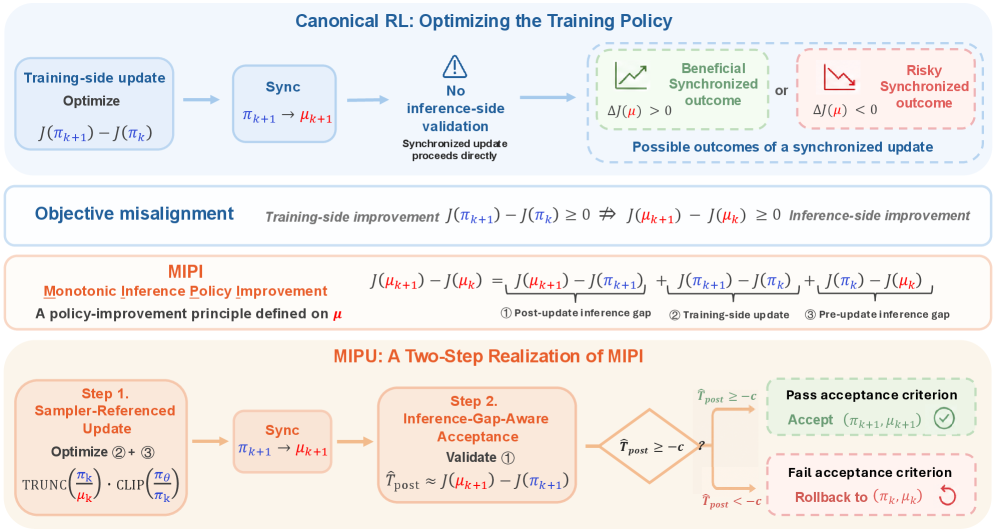
The authors instantiate the misalignment inside GRPO. The GRPO surrogate
\mathcal{J}_{\mathrm{GRPO}}(\theta) = \mathbb{E}_{x,\{y_i\}\sim \mu_k}\!\left[\tfrac{1}{G}\sum_i \min\!\left(r_i(\theta)\hat{A}_i^{\mu_k},\;\mathrm{clip}(r_i(\theta),1-\epsilon,1+\epsilon)\hat{A}_i^{\mu_k}\right)\right]
carries two sources of mismatch. First, r_i(\theta) = \pi_\theta(y_i\mid x)/\pi_k(y_i\mid x) is a training-side ratio, but the samples y_i are drawn from the inference policy \mu_k, so r_i is not the correct importance weight for either policy. Second, the group-relative advantage \hat{A}_i^{\mu_k} is computed from rewards of rollouts sampled from \mu_k; it is an estimator of an advantage under \mu_k, not under \pi_k. GRPO thus weights \pi-side updates by \mu-side advantages, an inconsistency previous stabilization work leaves untouched.
MIPI and the two-step MIPU procedure
The proposed objective, Monotonic Inference Policy Improvement (MIPI), replaces “improve \pi” with “guarantee J(\mu_{k+1}) \geq J(\mu_k)”. MIPU (Monotonic Inference Policy Update) is a two-step realization of this objective:
- Step 1 — inference-aware candidate. Instead of forming r_i(\theta) against the old training policy \pi_k, the candidate update is built to reduce the mismatch between the update direction and the inference policy that actually generated the rollouts. This changes the surrogate’s importance ratio and advantage normalization so that the update targets \mu-improvement rather than \pi-improvement.
- Step 2 — inference-gap-aware acceptance. After the candidate weights are computed and synchronized to the inference engine, an acceptance test measures the post-sync inference gap (denoted \widehat{T}_{\mathrm{post}} in the paper), roughly a KL-like quantity between what the training engine believed it produced and what the inference engine will produce. Updates that fail the test are rolled back. This turns the synchronization event itself into a monotonicity checkpoint rather than a silent quantization step.
Empirical results under FP8-quantized rollout
The authors deliberately stress the pipeline by using FP8-quantized rollouts, which sharply amplifies \pi \neq \mu. Training uses Qwen3-1.7B (5759 filtered DAPO-Math-17 problems) and Qwen3-4B (1491 filtered DeepMath-103K problems), where filtering keeps prompts with non-trivial, non-saturated pass rates so that reward variance remains informative.
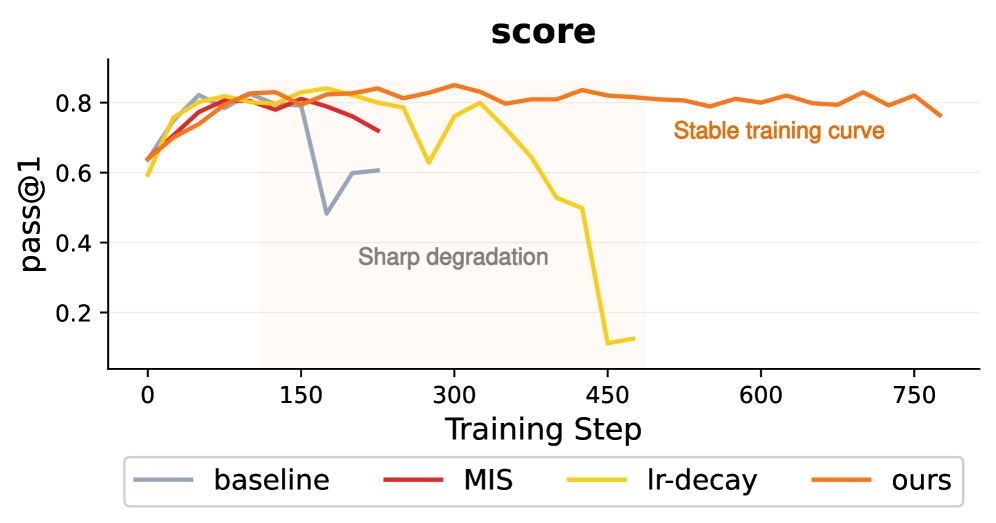
Under FP8 rollout, baseline methods (GRPO and prior mismatch-correction variants) show unstable trajectories with sharp collapses, consistent with the theoretical claim that \pi-side monotonicity can silently degrade \mu. MIPU produces a monotone-looking score curve on both Qwen3-1.7B and Qwen3-4B without collapse.
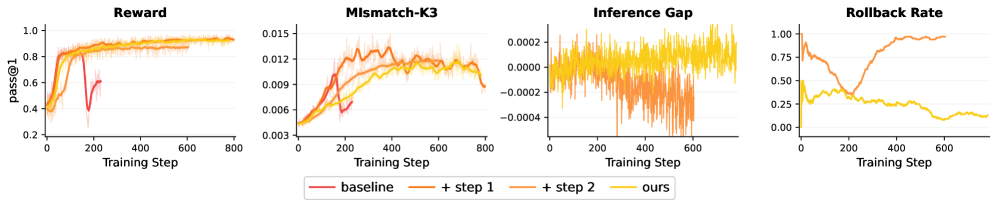
The ablations disentangle the two steps. Step 1 without Step 2 improves the direction of updates — the candidate is better aligned with \mu-improvement — but does not fully control post-sync \widehat{T}_{\mathrm{post}}, since quantization can still flip advantageous updates. Step 2 without Step 1 raises the rollback rate but wastes gradient work on candidates that were never \mu-aligned to begin with. A control experiment (RQ3) verifies that Step 2 is not just a random-rejection regularizer: replacing the inference-gap signal with a rejection scheme matched in rollback frequency degrades performance, so the content of the gap signal matters, not merely the rejection rate. The K3-KL between inference and training distributions is also tracked over a 100-step moving window and stays bounded under MIPU where baselines drift.
Limitations and open questions
The evaluation is confined to math-reasoning benchmarks with Qwen3-1.7B/4B and to a single stress axis (FP8 rollout). Whether the same acceptance test suffices under more exotic mismatches — speculative decoding disagreement, KV-cache precision drift, tensor-parallel numerical divergence, or distinct attention kernels — is not shown. The acceptance step introduces a rollback cost that the paper does not quantify against wall-clock. The theoretical MIPI bound presumably requires assumptions on the discrepancy \|\pi_k - \mu_k\| that may fail for aggressive quantization (INT4, W4A8), and it is unclear whether Step 2 can be made differentiable to avoid discrete rollbacks. Finally, the framework is presented for GRPO; extension to actor-critic setups where the value function is itself computed in the training engine warrants care, because the value function inherits the same \pi/\mu split.
Why this matters
The paper reframes training-inference mismatch from a numerical annoyance into an objective-level bug: canonical LLM RL optimizes a policy that is never deployed. If the diagnosis holds, every mismatch-correction technique that operates purely on \pi is treating a symptom, and the correct interface is a post-synchronization acceptance test on \mu — a small but load-bearing change for anyone running quantized-rollout RL.
Source: https://arxiv.org/abs/2606.29526
OrbitQuant: Data-Agnostic Quantization for Image and Video Diffusion Transformers
Problem
Diffusion transformers now dominate high-fidelity image and video synthesis, but their inference cost scales with both parameter count and the number of denoising steps. Post-training quantization is the standard fix, yet DiT activations are non-stationary along three axes simultaneously: they drift with the diffusion timestep t, vary across text prompts, and differ between the conditional and unconditional branches used for classifier-free guidance. Range-calibrated PTQ methods (SmoothQuant, QuaRot, ViDiT-Q, SVDQuant, AdaTSQ) therefore need to re-fit scales for every new checkpoint or modality, and their scales are still, at best, a compromise across timesteps. OrbitQuant asks whether one can avoid range estimation entirely by quantizing in a basis where the shape of the activation distribution is fixed by construction.
Method
The core observation is that any orthogonal \Pi_d\in\mathbb{R}^{d\times d} leaves a linear layer invariant:
Wx = (W\Pi_d^\top)(\Pi_d x) = \hat W \hat x.
If \Pi_d is chosen so that, for input dimension d, the coordinates of \hat x are approximately i.i.d. with a known marginal f_d regardless of input, then a single scalar codebook fitted once to f_d suffices for every timestep, prompt, and CFG branch. OrbitQuant uses f_d = \mathcal{N}(0, 1/d), motivated by concentration on the sphere: for a fixed-norm vector, a Haar-random rotation produces coordinates that are approximately Gaussian with variance 1/d.
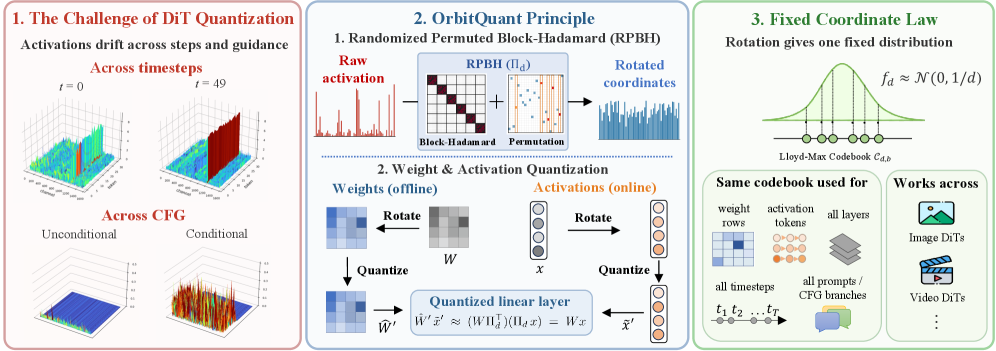
The codebook is Lloyd-Max optimal for \mathcal{N}(0,1/d) at a given bit-width. Because the target is analytic, no calibration data is used at any point. Weights are rotated offline (\hat W = W\Pi_d^\top) and quantized row-wise against the same normalized target; the offline rotation and quantization together absorb \Pi_d^\top into \hat W so at runtime only a single forward rotation \Pi_d x is applied before each linear layer.
The realization of \Pi_d is a randomized permuted block-Hadamard (RPBH) transform: apply a uniform random permutation P over the d coordinates, then a block-diagonal Hadamard H_b\otimes I_{d/b}. The permutation is essential because block-Hadamard alone leaves clustered outliers in-block; permuting first spreads them so the marginal converges to f_d.
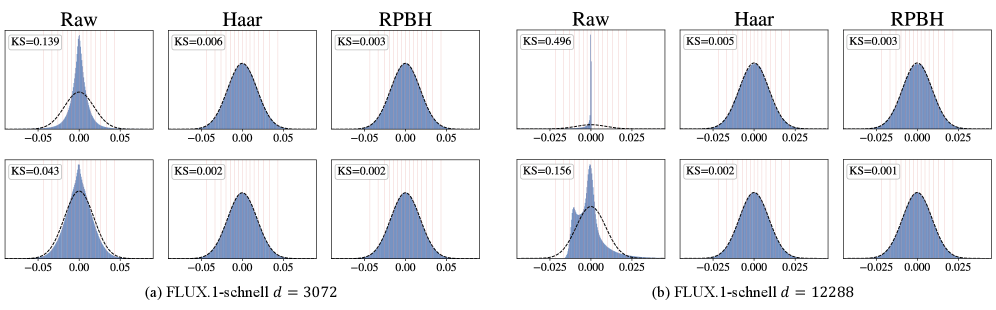
The empirical marginals in Figure 3 confirm that RPBH tracks the analytic \mathcal{N}(0,1/d) target as closely as a dense Haar rotation, validating the assumption that lets a single codebook serve all layers of a given d.
Results
On GenEval, OrbitQuant sets the state of the art at W4A4 across three image DiTs and remains functional at W2A4 where all baselines collapse.
- FLUX.1-schnell (FP16 Overall 0.664): OrbitQuant W4A4 reaches 0.703, above AdaTSQ (0.680) and SVDQuant (0.624); at W2A4 it retains 0.604 while QuaRot/ViDiT-Q/SmoothQuant score \le 0.001.
- FLUX.1-dev (FP16 0.667): W4A4 Overall 0.633 vs AdaTSQ 0.618 and SVDQuant 0.573; W2A4 still yields 0.475.
- Z-Image-Turbo (FP16 0.754): W4A4 0.767 (slightly above FP16, within seed noise), vs AdaTSQ 0.762 and SVDQuant 0.718.
The W2A4 setting is the interesting regime: prior rotation-based methods (QuaRot) and smoothing methods (SmoothQuant, ViDiT-Q) all produce essentially zero GenEval scores, while OrbitQuant retains most compositional capability. This matches the qualitative comparison.
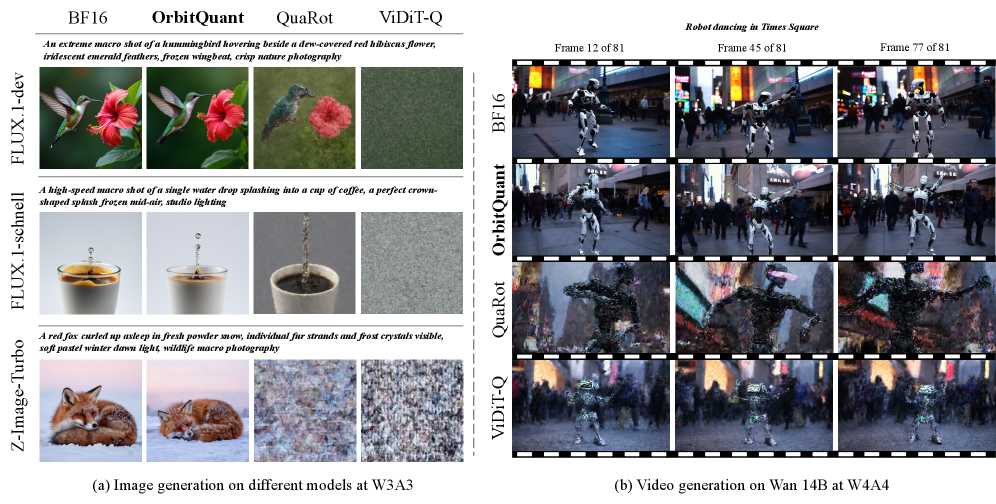
The same recipe transfers to video (Wan 2.1, CogVideoX) with no modality-specific tuning; because the codebook depends only on d and not on data statistics, moving to video introduces no re-calibration step.
The rotation ablation on FLUX.1-schnell isolates the contribution of the permutation and structure choice:
| Rotation | W4A4 | W3A3 | W2A4 | Latency (s) |
|---|---|---|---|---|
| Haar (dense) | 0.696 | 0.669 | 0.591 | 11.65 |
| Full RHT | 0.691 | 0.672 | 0.587 | 0.452 |
| Block-RHT | 0.678 | 0.642 | 0.558 | 0.381 |
| RPBH | 0.690 | 0.674 | 0.595 | 0.451 |
RPBH matches Full RHT quality, beats permutation-free Block-RHT at low bits (the permutation gains +0.032 / +0.037 at W3A3 / W2A4), and is 26\times faster than dense Haar by using fast Hadamard kernels. It is also constructible at arbitrary d — including d=1920 in CogVideoX-2B where no fast size-d Hadamard exists — because only the block size need be a power of two.
Limitations and open questions
The Gaussian marginal argument is asymptotic in d; at small d (e.g. per-head attention dimensions) the analytic codebook may be mildly suboptimal, and the paper does not probe how the guarantee degrades. The reliance on activations being approximately norm-concentrated is empirical — anomalous layers with heavy-tailed norms (LayerNorm inputs, embedding projections) may need to be excluded. Runtime rotation still adds ~0.45 s per image at 1024^2 summed over layers and steps, which is non-trivial relative to the compute savings at W4A4. Finally, the analysis is limited to linear-layer weight-activation quantization; KV-cache and attention-map quantization for long video generation are not addressed.
Why this matters
Data-free PTQ that works uniformly across timesteps, prompts, guidance branches, and modalities removes the main operational cost of deploying quantized diffusion transformers: rebuilding calibration pipelines per checkpoint. That OrbitQuant is the first method to produce non-degenerate W2A4 image DiTs suggests distributional quantization in a fixed rotated basis is a more principled starting point than range calibration for models with strongly non-stationary activations.
Source: https://arxiv.org/abs/2607.02461
DataComp-VLM: Improved Open Datasets for Vision-Language Models
Problem
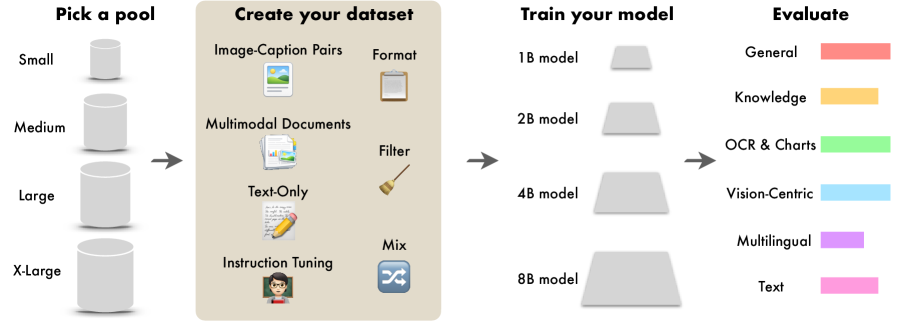
Open VLM training pipelines lack a controlled testbed for data curation. Prior data-centric benchmarks (DataComp, DataComp-LM) target contrastive image-text or text-only LM pretraining, neither of which captures the heterogeneous mix — captions, interleaved documents, plain text, instruction data — that modern autoregressive VLMs consume. As a result, comparisons between open datasets (Cambrian, FineVision, LLaVA-OneVision variants) confound data quality with model architecture, tokenizer, and training recipe. DCVLM fixes the training stack and varies only the data, enabling apples-to-apples curation studies at 1B–8B parameters and 6.25B–200B token budgets.
Benchmark construction
The authors assemble 160 source datasets into a 6T multimodal-token pool spanning four categories: image-caption pairs, multimodal interleaved documents, text-only corpora, and multimodal instruction-tuning data. Four compute scales (small/medium/large/x-large) fix model size and token budget; participants submit a curated subset produced by any combination of formatting, filtering, mixing, and sampling. Training uses a fixed autoregressive VLM recipe (ViT encoder + LLM decoder with cross-modal projection), and evaluation runs on up to 52 downstream benchmarks in 9 domains, with a 33-task Core set used for headline numbers.
Findings on curation
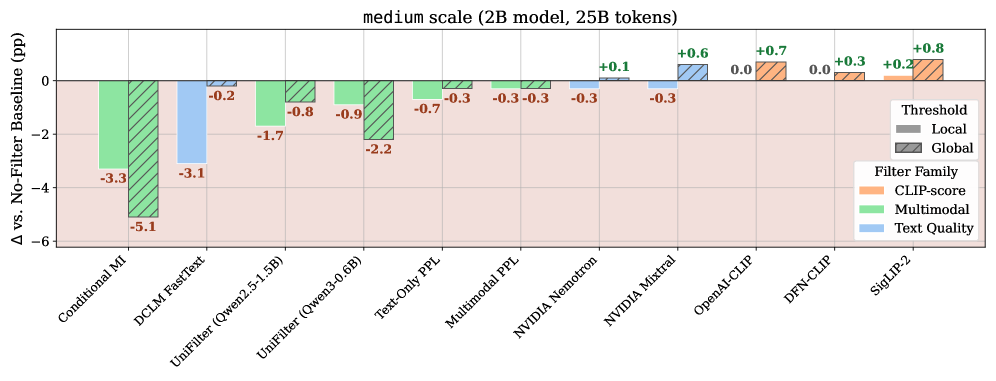
The central empirical claim is that mixing dominates filtering. The authors reproduce standard filters — CLIP-score thresholds, perplexity filters, deduplication, aesthetic and NSFW filters, image-text alignment scoring — and find they rarely beat a no-filter baseline at either small or medium scale. When filtering does help, the mechanism is almost entirely that it shifts the global mixture across the four data types, not that it removes low-quality samples within a type.
Sweeping mixture weights reveals a monotone trend: instruction-heavy mixtures scale better than caption-heavy ones, and the gap widens with compute. The resulting DCVLM-Baseline mixture is
- 10% image-caption pairs
- 5% multimodal interleaved documents
- 15% text-only
- 70% multimodal instruction-tuning
This is a striking departure from the caption-dominated recipes common in open pretraining (e.g., LAION/DataComp-style pools), and it inverts the usual “pretrain on captions, SFT on instructions” separation into a single joint distribution.
Quantitative results
At 8B parameters and 200B training tokens, DCVLM-Baseline reaches 63.6% average accuracy on the 33-task Core suite. Against FineVision, the previous state-of-the-art open training set, DCVLM-Baseline wins across all evaluated scales, and the gap grows with compute. A 4B model trained on DCVLM-Baseline for 100B tokens matches or exceeds larger models trained on prior open corpora.
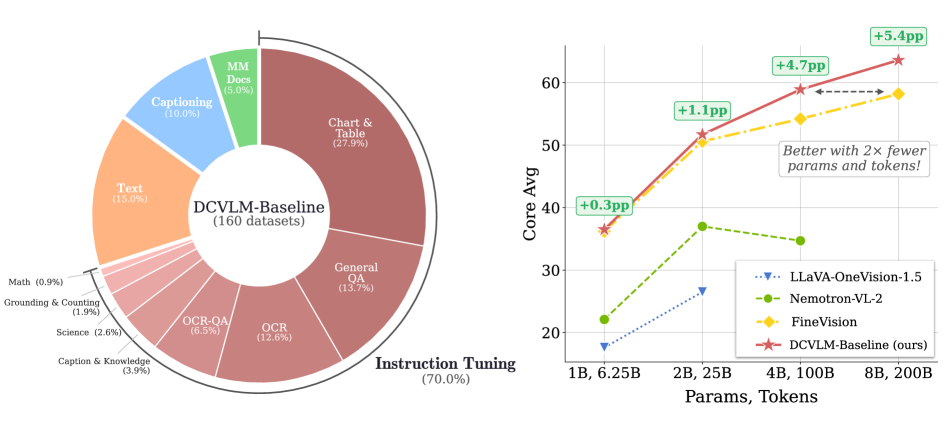
The scaling behavior is the more informative signal: caption-heavy baselines flatten as tokens grow, while instruction-heavy mixtures continue to improve, suggesting that the marginal token from a well-formatted instruction sample carries more supervision than a marginal caption token even during “pretraining.”
Mechanical takeaways for re-implementation
To replicate the skeleton:
- Assemble a pool partitioned into the four data types; ensure consistent tokenization across modalities (image patches → tokens, interleaved documents preserving positional order).
- Fix the training recipe: autoregressive next-token loss over interleaved multimodal sequences, single-stage training (no separate SFT phase — instruction data is folded into the mix).
- Sample mini-batches according to global mixture weights w = (w_\text{cap}, w_\text{doc}, w_\text{text}, w_\text{inst}); the objective per step is
\mathcal{L} = \sum_{t} w_{c(t)} \cdot \mathbb{E}_{x \sim \mathcal{D}_{c(t)}} \left[ -\log p_\theta(x_t \mid x_{<t}) \right]
where c(t) selects the data type for token t. DCVLM-Baseline sets w = (0.10, 0.05, 0.15, 0.70). 4. Skip aggressive per-sample filtering; the returns do not justify the compute. 5. Evaluate on the Core-33 suite spanning VQA, OCR, document understanding, chart/table reasoning, grounding, and multi-image tasks.
Limitations and open questions
The instruction-heavy finding is contingent on the quality and diversity of available instruction data, which is itself the product of prior filtering effort by upstream dataset creators — so “filtering doesn’t help” partly reflects that filtering has already happened elsewhere. The benchmark also fixes the training recipe and model family; whether the 10/5/15/70 mixture transfers to MoE architectures, longer contexts, or video-heavy VLMs is untested. Filtering was evaluated primarily at small/medium scale; it remains possible that fine-grained per-sample scoring pays off at x-large budgets where the pool is exhausted. Finally, the 6T-token pool inherits licensing and provenance issues from its 160 sources, which will constrain downstream commercial use.
Why this matters
DCVLM reframes open VLM data work: the leverage is in composition, not per-sample scoring, and instruction data should be treated as a first-class pretraining ingredient rather than a post-hoc SFT layer. A reproducible 8B model at 63.6% Core accuracy on fully open data narrows the gap to closed pipelines and gives the community a controlled substrate for future curation research.
Source: https://arxiv.org/abs/2606.28551
Embodied.cpp: A Portable Inference Runtime of Embodied AI Models on Heterogeneous Robots
Deploying vision-language-action (VLA) models and world-action models (WAMs) on robots exposes a mismatch between what modern inference runtimes provide and what closed-loop embodied control actually needs. Systems like vLLM, TensorRT-LLM, or llama.cpp assume request-response serving with token I/O, large-batch throughput optimization, and uniform backend assumptions. Embodied deployment inverts nearly every one of these: execution sits inside a control loop, batch size is effectively one, latency and jitter dominate throughput, hardware is heterogeneous (Jetson, RK-series NPUs, x86 edge boxes), and the I/O surface includes images, proprioception, tactile signals, action chunks, and world predictions rather than tokens. Embodied.cpp is a C++ runtime designed against this different contract.
Architectural analysis and layered design
The authors first taxonomize embodied models into VLA (categories a-d) and WAM (categories e-h) families, distinguished by internal inference structure — how perception encoders, transformer backbones, predictive branches, and action heads are wired.
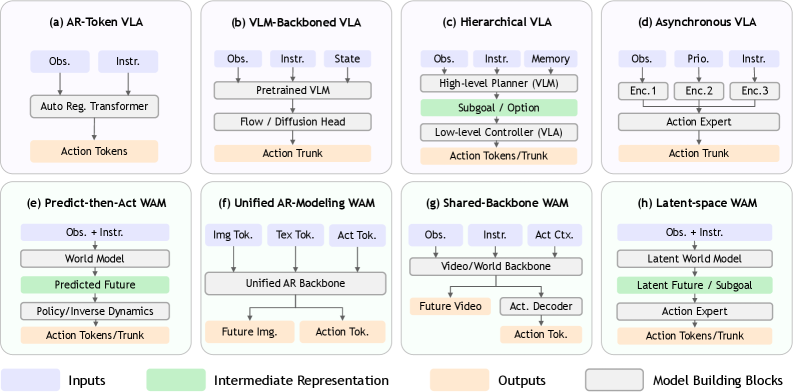
From this taxonomy they extract a shared execution path and split it into five layers: (1) input adapters that normalize sensor and dataset streams; (2) sequence builders that assemble the multimodal token/embedding sequence; (3) backbone execution (typically a transformer); (4) head plugins for discrete action tokens, continuous vectors, action chunks, or world-state predictions; and (5) deployment adapters that bridge outputs to simulators or physical robots.
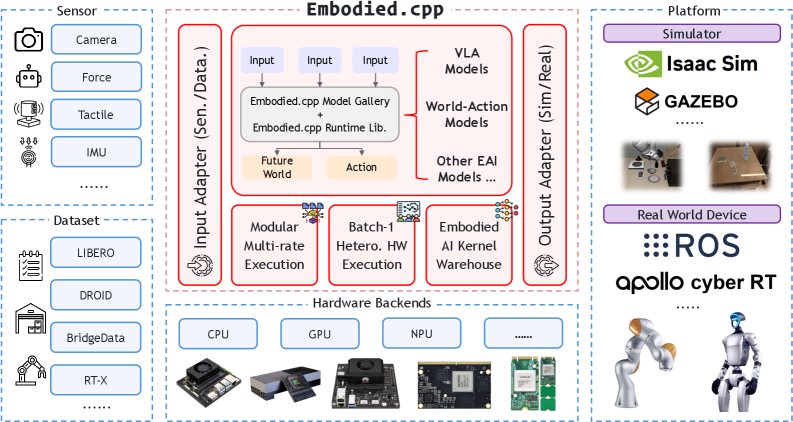
Three runtime capabilities sit under this shared path and directly answer the three challenges identified in Section 3:
- Multi-rate execution. Embodied models are no longer monolithic — a perception encoder may refresh at a slow rate, a predictive branch may fire only when future estimation is required, and an action head may run at a much higher control rate. The runtime schedules modules at independent rates rather than treating the model as a single forward pass per step.
- Latency-first fused inference. Because deployment is batch-1, the runtime prioritizes single-sample latency and predictable timing, while still exposing fused-kernel paths for backends where fusion is what makes small-batch execution efficient (fused attention, quantized GEMM, KV cache reuse).
- Extensible operator and I/O support. A single backend abstraction absorbs model-specific operators (custom attention variants, per-family vision projectors) and non-token I/O (images, force/tactile, chunked continuous actions, world predictions).
Evaluation
The runtime is exercised on two VLA models, HY-VLA (Hunyuan-VL backbone) and pi0.5 (PaliGemma backbone), and a WAM microbenchmark on LingBot-VA.
VLA closed-loop. HY-VLA is evaluated on the RoboTwin place_empty_cup task; pi0.5 uses its packaged C++ deployment config. Reported metrics are success rate, action chunk length, server-side inference latency, amortized per-step latency, and peak VRAM.
| Model | Backbone | Chunk | Success (%) | Step (ms) | Inf. (ms) | VRAM (MiB) |
|---|---|---|---|---|---|---|
| HY-VLA | Hunyuan-VL | 20 | 100.0 [83.9, 100.0] | 735.9 | 1340.3 | 6850 |
| pi0.5 | PaliGemma | 50 | 91.0 [86, 94] | 56.85 | 266.6 | 6546 |
Both models run correctly through the C++ path and preserve task behavior. HY-VLA’s higher latency (1340.3 ms inference, 735.9 ms amortized step) traces to the larger Hunyuan-VL backbone, three-view inputs, and a video-history/MEM vision path. pi0.5 amortizes over a chunk of 50 actions, driving per-step cost down to 56.85 ms despite a heavier 266.6 ms model call. The two models fit in comparable VRAM budgets (~6.6-6.9 GiB), showing the runtime does not incur runaway memory overhead across architectures.
WAM microbenchmark. Because full LingBot-VA is not yet stable on the constrained edge device used, the authors benchmark only the first WanTransformerBlock, comparing the original PyTorch BF16 implementation against the Embodied.cpp path with GGUF Q4_K quantization on 100 random inputs.
| Runtime | Quant | Latency/block (ms) | Memory/block (MiB) | MAE | Cosine |
|---|---|---|---|---|---|
| Python | BF16 | 3.236 | 312.2 | 0 | 1 |
| Embodied.cpp | Q4_K | 3.171 | 88.1 | <3.3\times 10^{-2} | >9.997\times 10^{-1} |
Resident weight memory drops from 312.2 MiB to 88.1 MiB — a 3.54\times reduction — with MAE below 3.3\times 10^{-2} and cosine similarity above 0.9997 against the BF16 reference. Latency is essentially unchanged (3.171 vs 3.236 ms) after warmup; the measurement excludes request parsing, tensor staging, and output post-processing, so it reflects backend compute only.
Limitations and open questions
The evaluation is thin. Only one RoboTwin task is used per VLA model, and the HY-VLA success interval [83.9, 100.0] hints at high variance under a small trial count. The WAM story is a single-block microbenchmark; a full LingBot-VA closed-loop result is deferred because the model is not stable on the target edge device. No comparison is made against other inference runtimes (llama.cpp, TensorRT-LLM, ONNX Runtime) on the same models, so latency numbers cannot be placed on an absolute efficiency curve. The multi-rate scheduler and backend abstraction are described but not ablated — it is unclear how much of the latency budget comes from scheduling choices versus raw backend kernels, or how the system behaves under jitter constraints in true real-time control. Finally, the extensibility claim depends on how much glue is needed to onboard a new model family; that engineering cost is not quantified.
Why this matters
Embodied deployment has been stuck in per-model Python stacks with ad-hoc robot-side glue. A layered C++ runtime that treats multi-rate execution, batch-1 latency, and non-token I/O as first-class — rather than retrofitting an LLM server — is the right abstraction for closed-loop VLA/WAM deployment on heterogeneous edge hardware, and the Q4_K memory reduction with sub-10^{-2} MAE suggests the quantization path is viable for larger WAM blocks.
Source: https://arxiv.org/abs/2607.02501
VLA-Corrector: Lightweight Detect-and-Correct Inference for Adaptive Action Horizon
Problem
Action-chunked VLA policies (e.g., \pi_{0.5}, SmolVLA, X-VLA) amortize policy inference by predicting a horizon of H future actions and executing them open-loop. This trades reactivity for efficiency: during the H-step blind window, contact-rich perturbations accumulate. The paper’s motivating figure makes this concrete — a drawer-opening task fails at H=10 because early contact errors compound, but succeeds at H=1 where every step re-plans.
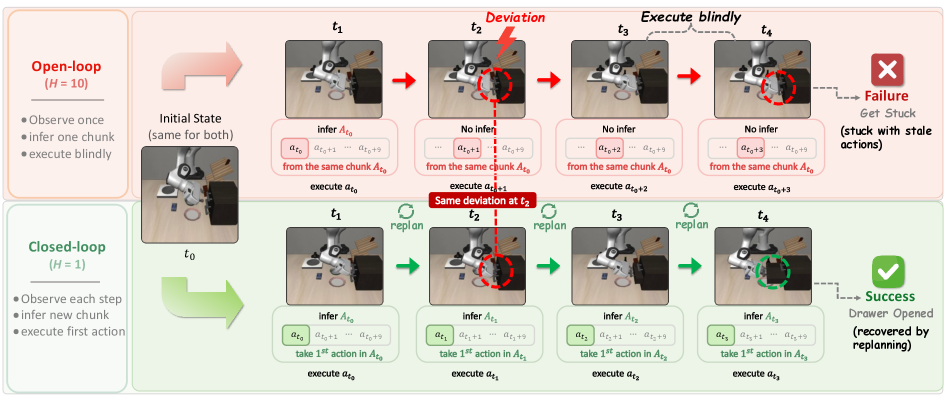
The naive fix — shrink H — sacrifices the throughput benefit of chunking (Figure 2 shows the standard success-vs-calls Pareto front). VLA-Corrector aims to get closed-loop reactivity at open-loop cost by detecting when the current chunk has gone stale and only then re-planning, with a corrective bias.
Method
The framework leaves the VLA backbone frozen and adds two modules: a Latent-space Vision Monitor (LVM) that decides when to interrupt, and Online Gradient Guidance (OGG) that biases the next replan.
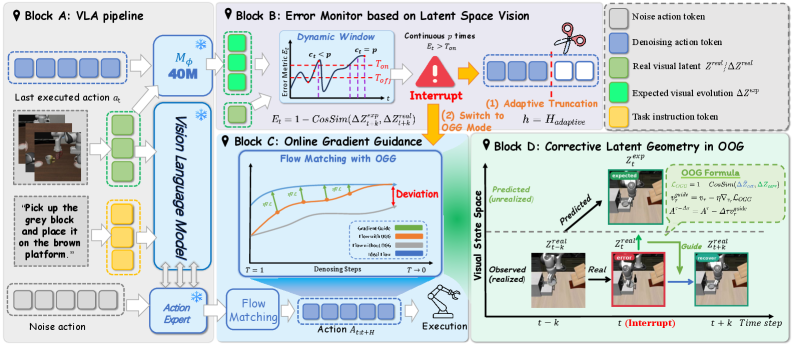
External latent dynamics corrector. Using the frozen VLA visual encoder \mathcal{E}, transitions (o_t, a_t, o_{t+k}) are converted to latents Z_t^{\mathrm{real}}=\mathcal{E}(o_t) and a residual target
\Delta Z_{t+k}^{*} = Z_{t+k}^{\mathrm{real}} - Z_t^{\mathrm{real}}.
A lightweight MLP M_\phi predicts \Delta \hat{Z}_{t+k} = M_\phi(Z_t^{\mathrm{real}}, a_t), trained with
\mathcal{L}_{\mathrm{corr}} = \|\Delta\hat{Z}_{t+k}-\Delta Z_{t+k}^{*}\|_2^2 + \beta\bigl[1 - \mathrm{CosSim}(\Delta\hat{Z}_{t+k},\Delta Z_{t+k}^{*})\bigr].
Predicting a residual (rather than absolute future latents) suppresses static scene content and focuses capacity on task-relevant dynamics. A 40M-parameter MLP suffices; scaling to 160M yields essentially no gain (64.28 vs. 64.35 avg. on MetaWorld).
LVM detection with hysteresis. At runtime the LVM computes an inconsistency score E_t between predicted and observed latent evolution, then applies a robust MAD-based two-threshold rule over a sliding window \mathbf{E}_W:
M_e=\mathrm{median}(\mathbf{E}_W),\quad \mathrm{MAD}=\mathrm{median}(|E_i - M_e|), T_{\mathrm{on}} = M_e + \lambda_{\mathrm{on}}\mathrm{MAD},\quad T_{\mathrm{off}} = M_e + \lambda_{\mathrm{off}}\mathrm{MAD},\ \lambda_{\mathrm{on}}>\lambda_{\mathrm{off}}.
A persistence counter c_t increments while E_t>T_{\mathrm{on}}, resets when E_t<T_{\mathrm{off}}, and triggers an interrupt at c_t\geq p. This asymmetric Schmitt-trigger design suppresses transient spikes and chattering. After an interrupt, the pending action queue is flushed; if h of H actions had been executed, the realized horizon is adaptive: H_{\mathrm{adaptive}} = h < H.
OGG-guided replan. On interrupt, the next policy call switches from standard flow-matching sampling to an Online Gradient Guidance variant that uses the mismatch between expected and observed latent evolution as a gradient signal to steer the replan back toward the demonstration manifold. Guidance strength \eta=1 is best; \eta=10 drops average success by 3.70 points and \eta=100 by 5.45.
Results
MetaWorld cross-architecture (Table 1). Average success improves by +15.65 pts for \pi_{0.5}, +4.75 for SmolVLA, and +4.05 for X-VLA. The largest single gain is on \pi_{0.5} Very Hard: 41.0\% \to 65.0\%.
LIBERO few-shot (Table 2). Starting from LeRobot’s few-shot pi05_libero_base, VLA-Corrector raises average success from 94.00\% to 97.80\%, exceeding the fully fine-tuned baseline at 96.95\%. The interpretation is that demonstrations already cover on-track trajectories; the corrector supplies the recovery behavior that few-shot data cannot reach.
Corrector data efficiency (Table 3, MetaWorld, \pi_{0.5}, H=50 baseline 48.72\%). At r=0.2 the corrector is neutral (-0.40); gains emerge at r=0.6 (+3.48) and saturate at r=1.0 (+5.60, i.e., 54.32\%). This is consistent with the modest capacity requirement of local latent-dynamics prediction.
Ablations. LVM capacity 10M → 40M raises average from 56.58 to 64.35; 160M does not help. OGG guidance is sharply peaked around \eta=1.
Real-world (AgileX PiPER, \pi_{0.5}). Nine tasks in three groups — pick-and-place, precise alignment, and disturbance-recovery where a human moves the target during the precision-sensitive phase — with 20 trials each. The disturbance group is the key stress test for whether the LVM correctly identifies stale chunks and OGG can re-align.
Limitations and open questions
- The corrector is trained on demonstrations, so it implicitly defines “on-track” as “close to demonstration latent dynamics.” Legitimate but under-represented recovery motions may spuriously trigger interrupts.
- OGG guides toward recoverable latent trajectories but is not a planner: if the demonstration manifold offers no nearby recovery mode, gradient guidance in flow matching cannot invent one.
- All monitoring is done in the frozen encoder’s latent space; when \mathcal{E} is invariant to the failure mode (e.g., subtle force-domain deviations invisible in RGB), E_t will not fire.
- The MAD thresholds and patience p are per-benchmark hyperparameters; robust automatic calibration across embodiments is not addressed.
- Compute overhead of running M_\phi every step, and end-to-end latency of the OGG replan vs. standard sampling, are not quantified in the excerpt.
Why this matters
Action chunking is the dominant efficiency lever in modern VLA deployment, and its blind-execution failure mode is what keeps horizons short in contact-rich settings. Decoupling monitoring from generation — with a 40M latent-residual MLP over frozen features — recovers closed-loop reactivity without retraining the backbone and, on LIBERO, matches full fine-tuning from a few-shot checkpoint. This is a practical template for adaptive-horizon inference over any chunked generative policy.
Source: https://arxiv.org/abs/2607.01804
Interpretation-Oriented Cloud Removal via Observation-Anchored Residual Flow with Geo-Contextual Alignment
Cloud removal (CR) in optical remote sensing is usually posed as an image restoration problem judged by PSNR/SSIM, but the reconstructed pixels are consumed by downstream analytics — land-cover classification, building extraction, semantic segmentation, height estimation — which are sensitive to semantic drift that fidelity metrics do not penalize. The authors argue that generative CR models optimized purely for perceptual realism can hallucinate structures that look plausible yet destroy the class-consistent features required downstream. GACR (Geo-Anchored Cloud Removal) addresses this with two components: an Observation-Anchored Residual Flow (OAR-Flow) for the generative dynamics, and a Geo-Contextual Prior Alignment (GCPA) loss that pulls reconstructions toward the semantic manifold of a pretrained Vision Foundation Model (VFM).
From noise-anchored diffusion to observation-anchored flow
The starting point is the standard SDE view of diffusion,
dx = f(x,t)\,dt + g(t)\,d\mathbf{w},\qquad x(0)\sim p_0(x),
with reverse-time dynamics driven by the score \nabla_x \log p_t(x). Prior CR work (e.g., mean-reverting diffusion) already generalizes this to interpolate between a reference state \mu and the clean target,
dx = \theta_t(\mu - x)\,dt + \sigma_t\,d\mathbf{w},
but still relies on a stochastic trajectory whose endpoints are only loosely tied to the actual cloudy observation. OAR-Flow reformulates CR as a deterministic residual inversion: rather than initializing from noise (or a Gaussian around \mu), the trajectory is anchored at the cloudy image y, and the network is trained to predict a velocity field mapping y to the clean image x under a flow-matching-style objective \mathcal{L}_{vel}. This gives a physically grounded prior — the model learns the residual between what is observed and what is occluded — and yields fast, stable inference without stochastic sampling. Figure 2 shows the two-stage pipeline where OAR-Flow provides the generative backbone and GCPA branches off to compute a semantic regularizer.
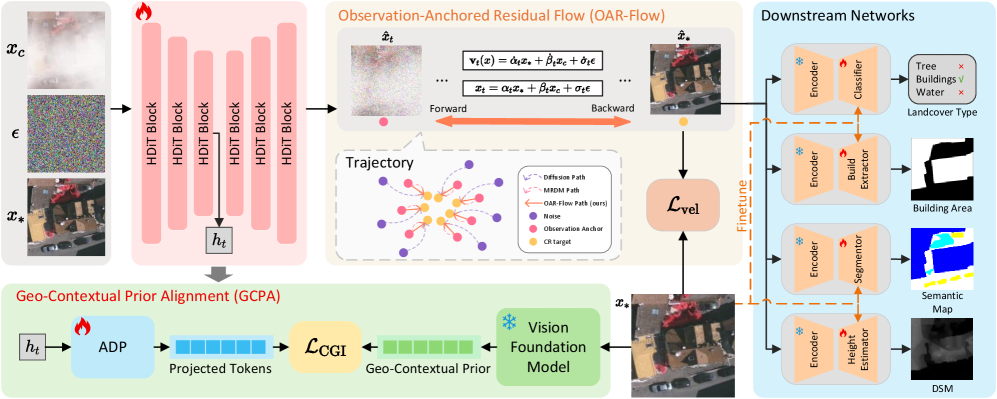
Geo-Contextual Prior Alignment
GCPA uses a frozen DINOv3 ViT-L/16 (either the SAT-300M or LVD-1689M variant) as a semantic oracle. Patch-level features are extracted from both the reconstruction and the ground-truth cloud-free image, and an alignment loss constrains the reconstructed image to lie on the same semantic manifold. Crucially, the VFM used for guidance is disjoint from any downstream encoder used at evaluation, so the reported downstream gains are not an artifact of shared representations. Configurations are named GACR-{SAT,LVD}/{1,2}, where the trailing integer is the OAR-Flow patch size (smaller patches → finer spatial supervision).
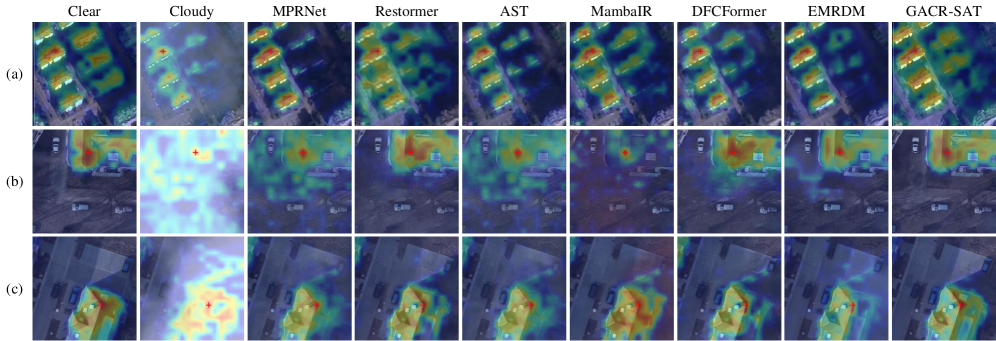
Figure 4 visualizes the DINOv3 similarity heatmaps computed from a red-cross query location across baselines and GACR reconstructions; competing methods produce diffuse or shifted response maps, whereas GACR reconstructions produce heatmaps that closely match those obtained from the true cloud-free image, indicating preserved geo-context.
Results
On six datasets (two real: CUHKCR-EXT-GZ, CUHKCR-EXT-CS; four synthetic: Potsdam/Vaihingen × thin/thick), GACR-SAT/1 is the top model across essentially all PSNR/SSIM entries. Selected numbers versus the strongest priors (EMRDM, DFCFormer):
- CUHKCR-EXT-GZ: PSNR 26.100 vs EMRDM 25.862; SSIM 0.744 vs DFCFormer 0.746.
- CUHKCR-EXT-CS: PSNR 24.354 vs DFCFormer 23.876 (+0.48 dB).
- Potsdam-CR-thin: 33.642 vs Restormer 31.413 (+2.23 dB); SSIM 0.976 vs 0.972.
- Potsdam-CR-thick: 31.049 vs Restormer 28.831 (+2.22 dB); SSIM 0.938 vs 0.923.
- Vaihingen-CR-thin: 36.918 vs EMRDM 33.620 (+3.30 dB); SSIM 0.991 vs 0.988.
- Vaihingen-CR-thick: 34.048 vs DFCFormer 30.396 (+3.65 dB); SSIM 0.970 vs 0.951.
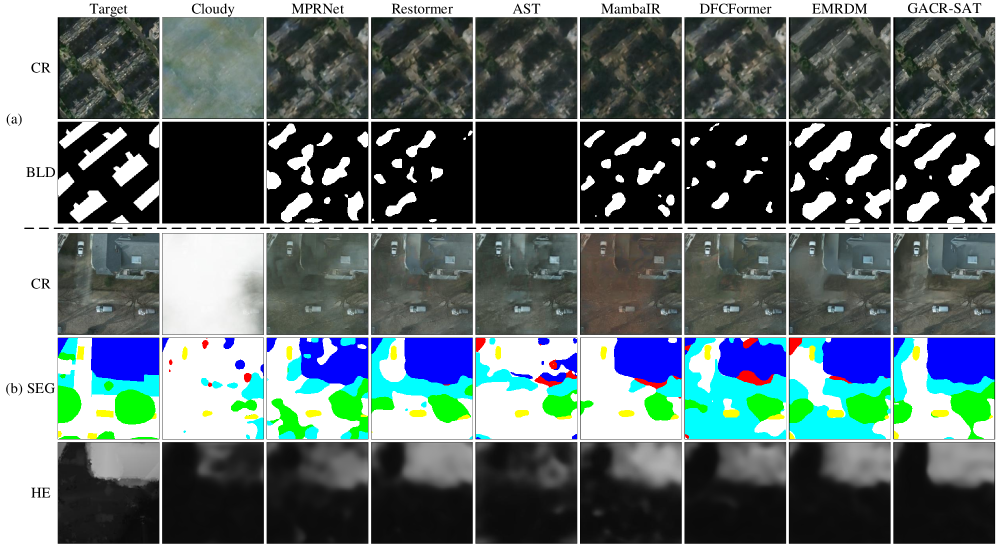
Gains are largest under thick cloud in the Potsdam/Vaihingen benchmarks — precisely the regime where naive generative models tend to hallucinate. The /1 patch variant consistently beats /2 by roughly 0.2–1.0 dB, indicating that fine-grained geo-contextual supervision matters. SAT-pretrained DINOv3 slightly outperforms the larger LVD-pretrained one, suggesting domain match of the VFM prior dominates over model scale. Qualitative CR plus downstream BLD/SEG/HE outputs (Figure 3) show that pixel-level improvements translate into cleaner building footprints and segmentation masks.
Limitations and open questions
The paper reports only PSNR/SSIM in the main comparison table; the abstract emphasizes downstream tasks (CLS/BLD/SEG/HE) but numerical downstream results are deferred to appendices, so the coupling between OAR-Flow, GCPA, and the claimed interpretability gains cannot be fully audited from the excerpt. The synthetic cloud sets (Potsdam/Vaihingen-CR) use in-house cloud simulation, which likely explains the very high absolute PSNR (>36 dB) — real thick-cloud, multi-temporal SAR-optical settings remain untested. It is also unclear how sensitive GCPA is to VFM domain shift (e.g., non-nadir, non-RGB, SAR); using DINOv3-SAT partly mitigates this but ties the method to a specific pretraining corpus. Finally, the ablation between the observation anchor and the geo-context loss is not shown here, leaving open which component drives the thick-cloud gains.
Why this matters
Cloud removal has been evaluated as a standalone image restoration problem for too long, and generative CR pipelines have been quietly degrading downstream remote-sensing tasks. Anchoring the generative trajectory to the observation and regularizing with a VFM semantic prior is a simple, transferable recipe for aligning restoration with interpretation, and the 2–3.5 dB gains on thick-cloud benchmarks suggest the anchoring choice — not just capacity — is doing the work.
Source: https://arxiv.org/abs/2607.02471
MultAttnAttrib: Training-Free Multimodal Attribution in Long Document Question Answering
Problem
Grounded QA systems must cite the evidence supporting each generated answer, both for user trust and to enable downstream verification. In the text-only setting, mechanistic-interpretability work has identified sparse “retrieval heads” whose attention maps directly localize copied evidence, enabling single-pass attribution without fine-tuning or multi-call pipelines. The multimodal case — where evidence can be a text span, a set of images, or a joint (text span, image set) — is largely uncharted. Naively reusing text-only retrieval heads discards visual evidence, and prompting-based citation generation on long, mixed-modality documents (e.g., PDFs with figures) tends to trade recall for precision or vice versa. The authors formalize the task as learning f:(q,\mathcal{D},a)\to\hat\alpha with \hat\alpha\in\mathcal{A}=\{\mathcal{T}_{i:j}\}\cup\{\mathcal{I}^*\}\cup\{(\mathcal{T}_{i:j},\mathcal{I}^*)\}, and address both the method and the evaluation gap.
Method
MultAttnAttrib is a training-free, label-supervised procedure that piggy-backs on the model’s prefill pass on the answer conditioned on (q,\mathcal{D},a). The pipeline has three stages:
- Per-head signal extraction: For each attention head, aggregate attention mass from answer tokens onto (a) text token positions and (b) image slot positions in the document.
- Cross-modal head selection: Using a small probe set drawn from MultAttrEval, rank heads by how well their attention distributions recover ground-truth text and image evidence, and keep the top-k heads that behave as cross-modal retrieval heads. The paper’s central empirical observation motivating this step is that retrieval heads are modality-specific at the top ranks but largely shared across the broader population — so a small pool of shared heads can score both modalities simultaneously.
- Threshold calibration: On the same probe set, calibrate per-modality thresholds on the aggregated top-k attention scores to maximize F1, then apply them at inference to produce contiguous text spans and image subsets.
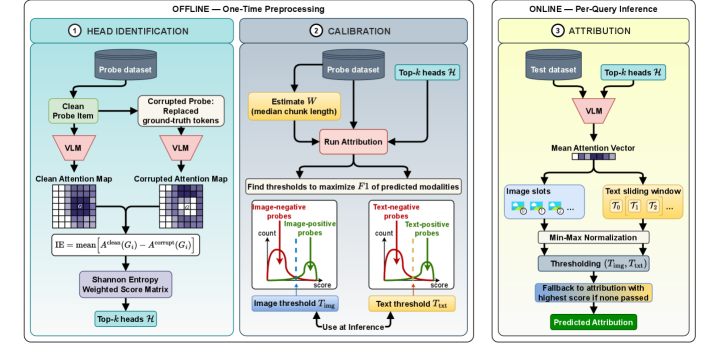
At test time, a single forward pass yields attention over both text tokens and image slots; thresholded scores from the selected heads give the predicted attribution \hat\alpha. No gradient updates, no auxiliary citation model, no multi-step verifier.
MultAttrEval
To evaluate this, the authors build MultAttrEval, a benchmark of Question-Answer-Attribution (QAA) triplets drawn from MINT-1T PDFs. Documents are filtered for image count and valid URLs; text and images are embedded, and text/text, text/image, image/image similarity pairings are computed. QAAs are then synthesized in three regimes: text-only (mutually dissimilar chunks), image-only (dissimilar images plus disjoint text context), and text+image (reranked similar (text,image) pairs, with entity-verification that named entities in the text actually appear in the image before eliciting a QA).
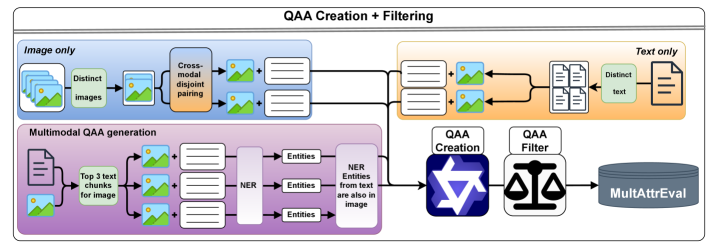
The split reserves 30 QAAs per regime (90 total) as the Probe set for head selection and threshold calibration, and 608 items as the Test set. To the authors’ knowledge, this is the first fine-grained multimodal attribution benchmark for long documents.
Results
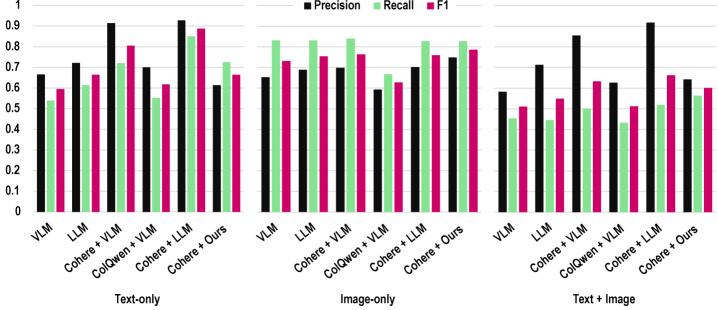
Backbone is Qwen3-VL-30B-A3B-Instruct throughout. Baselines include direct VLM attribution, an LLM-only variant, and Cohere / ColQwen retrieval-augmented VLM and LLM pipelines. On F1, MultAttnAttrib improves over the Qwen VLM baseline by +22.9% on text-only (0.485 → 0.596), +25.8% on image-only (0.617 → 0.776), and +18.1% on text+image (0.493 → 0.582). Pairing with Cohere retrieval pushes text F1 to 0.665 (+37.1%), image F1 to 0.786 (+27.4%), and multimodal F1 to 0.601 (+21.9%). The gains are recall-driven for text (text recall jumps from 0.382 to 0.726 with Cohere, a +90.1% relative gain) and precision-driven for images (image precision rises from 0.477 to 0.749). Prompting-style citation is thus biased toward high text precision / low text recall and high image recall / low image precision — attention-based localization reverses both failure modes.
Against frontier models, the Cohere + MultAttnAttrib variant matches GPT-5.4-class systems across text, image, and joint attribution rather than only competing with same-backbone prompting.
Efficiency is a further advantage: on an A100 with batch size 1 and non-vLLM inference, MultAttnAttrib runs at 2.16\pm 0.17 s per instance vs 15.67\pm 14.38 s for the VLM prompting baseline (roughly 7× faster) and uses 63.41 GB peak VRAM vs 78.28 GB, because it avoids autoregressive citation generation and multi-turn verification.
Limitations and open questions
The method is label-supervised in the sense that head selection and thresholds require ground-truth attributions from a probe set — small (90 items) but non-zero, and drawn from the same distribution as the test set. Generalization of the selected head subset across document domains, languages, and backbones is not evaluated; text precision under Cohere retrieval drops relative to the VLM baseline (0.883 → 0.614), suggesting the threshold trades off precision for recall in a way that may need per-domain recalibration. The image side treats each image as a slot rather than localizing within an image (no bounding-box attribution), and the analysis is confined to a single 30B backbone; whether the “shared cross-modal retrieval head” phenomenon holds in smaller or differently trained VLMs is open. Finally, MultAttrEval is synthesized via an MLLM pipeline, so ground-truth attributions inherit any biases of the generator, particularly for the text+image regime where entity verification is heuristic.
Why this matters
Attribution in long multimodal documents has been dominated by expensive fine-tuning or multi-call prompting pipelines; MultAttnAttrib shows that a small probe set plus attention-head selection on an off-the-shelf VLM matches frontier prompting systems at ~7× lower latency, extending the retrieval-head story from text-only QA to genuinely multimodal evidence.
Source: https://arxiv.org/abs/2607.01420
Hacker News Signals
Does code cleanliness affect coding agents? A controlled minimal-pair study
A controlled experiment testing whether code readability and cleanliness measurably changes the performance of LLM-based coding agents. The study constructs minimal pairs: two versions of the same codebase differing only in cleanliness-related properties (naming, structure, dead code, formatting), holding functionality constant. Agents are then asked to perform tasks — bug fixes, feature additions — on both versions, and success rates are compared.
The key methodological contribution is the minimal-pair design, borrowed from linguistics: by isolating cleanliness as the single variable, confounds from task difficulty and domain are controlled. The authors evaluate several agents across multiple cleanliness dimensions, finding that poor naming and structural noise (dead code, deeply nested logic) degrade agent success rates non-trivially, while pure formatting differences have smaller effects. The effect is more pronounced on multi-step tasks where the agent must traverse and understand a larger context window of code.
The implications are practical: codebases maintained with clean conventions aren’t just easier for humans but provide a measurable edge for AI-assisted development. This pushes back on the informal claim that agents “don’t care” about code style the way humans do — turns out they partially do, because they rely on the same lexical and structural cues.
Limitations: the study is necessarily bounded in scope (a finite set of tasks and agent types), and the magnitude of the effect likely varies with model scale. Larger models may be more robust to noisy code. The paper does not fully disentangle whether the degradation stems from context length pressure, attention diffusion, or tokenization artifacts of mangled identifiers.
Open question: does the effect persist with retrieval-augmented agents that do not ingest the full codebase at once?
Source: https://arxiv.org/abs/2605.20049
New AI tutor achieves 0.71-1.30 SD effect size in Dartmouth course
A deployment study of an AI tutoring system in an actual undergraduate course at Dartmouth, reporting effect sizes between 0.71 and 1.30 standard deviations on learning outcomes relative to a control group. For context, Bloom’s 2-sigma problem established that one-on-one human tutoring achieves ~2 SD over conventional instruction; most educational technology interventions cluster below 0.4 SD.
The system is built around an LLM backbone with retrieval over course materials, enabling Socratic-style dialogue rather than answer dispensing. The design explicitly avoids giving direct answers, instead scaffolding towards understanding — a constraint enforced at the prompt level and partially through RLHF-style fine-tuning. Assessment is through pre/post testing and course examinations, with the control group receiving standard recitation sections.
The 0.71 SD lower bound is already competitive with high-quality human tutoring programs at scale. The 1.30 SD upper bound (on a specific sub-assessment) is striking, though the authors are careful to note variance across student cohorts and question types. Higher effect sizes correlate with students who engage in longer dialogue turns, suggesting the Socratic mechanism is doing real work rather than the system acting as a sophisticated answer key.
Technical details in the PDF are limited on model specifics (likely for commercial reasons), but the evaluation methodology follows standard ITS (Intelligent Tutoring System) conventions, using pre/post normalized gain scores.
Limitations: single institution, single course, self-selection bias in engagement, and the usual concerns about teaching to a test. Generalization across domains with less structured knowledge (humanities, open-ended writing) is undemonstrated.
Source: https://intextbooks.science.uu.nl/workshop2026/files/itb26_s1s2.pdf
Web-based cryptography is always snake oil
A technically detailed argument that deploying cryptographic security through JavaScript in a browser is fundamentally broken — not due to implementation bugs but due to structural properties of the web security model. The core claim: the code executing your cryptography is delivered by the same server you are trying not to trust, so a compromised or malicious server can simply serve modified JavaScript that exfiltrates keys or plaintext before any crypto executes. No amount of correct WebCrypto API usage fixes this.
The author distinguishes this from the question of whether crypto.subtle is a sound API (it largely is) or whether JavaScript crypto implementations are buggy (some are, but that is a separate problem). The issue is the trust model: in native applications, the executable is distributed and potentially auditable out-of-band; in web apps, the cryptographic code arrives at runtime from the endpoint being protected.
Content Security Policy and Subresource Integrity are addressed and dismissed as partial mitigations that do not close the fundamental gap — CSP can be set by the same server, and SRI only verifies hash integrity of fetched resources, which the server controls. Browser extensions delivering the crypto client might be an exception, but that is not “web-based cryptography” in the usual sense.
The practical consequence is that end-to-end encryption in web apps (messaging, password managers) provides weaker guarantees than native equivalents, even when implemented correctly. The server can always serve a key-logging version of the app to a targeted user without violating any cryptographic primitive.
This is not a novel observation — the argument has circulated since at least the early 2010s — but the writeup is unusually systematic and is worth assigning to anyone building security-sensitive web products.
Source: https://www.devever.net/~hl/webcrypto
A sociotechnical threat model for AI-driven smart home devices
An arxiv paper that applies structured threat modeling to AI-enabled smart home devices, treating them as sociotechnical systems rather than purely technical ones. The distinction matters: standard threat models (STRIDE, attack trees) focus on technical vectors, but smart home devices embed into social contexts — households with multiple users of varying technical literacy, power dynamics, and differing threat profiles (e.g., domestic abuse scenarios where a device becomes a surveillance/coercion tool).
The authors enumerate threat categories that standard IoT security analysis misses: ambient data collection enabling inference of behavioral patterns beyond the stated device function, differential trust within a household (who controls the hub, who cannot opt out), adversarial use by a technically-capable household member against others, and supply-chain threats that are hard to detect by end users.
For AI-specific threats, the paper focuses on voice assistant and LLM-backed devices: prompt injection via ambient audio, model inversion attacks on fine-tuned personalization models, and the risk that “helpful” behavior (proactive suggestions, behavioral prediction) constitutes a privacy violation even absent a data breach.
The threat model is presented as a framework rather than an exhaustive enumeration, which is appropriate given the diversity of devices in scope. The paper does not propose new defenses — it frames the problem space, arguing that security-by-design for smart home AI needs to explicitly account for intra-household adversarial relationships, not just external attackers.
Limitation: the framework is qualitative and hard to operationalize directly for a device manufacturer. Prioritization criteria between threat categories are not developed.
Source: https://arxiv.org/abs/2602.09239
GPT-5.5 Codex reasoning-token clustering may be leading to degraded performance
A GitHub issue on the OpenAI Codex repository accumulating substantial community evidence that a specific failure mode has emerged in GPT-5.5/Codex: reasoning tokens (the chain-of-thought tokens generated before the output) appear to cluster into repetitive or degenerate patterns, leading to degraded code generation quality on tasks that previously worked reliably.
The technical hypothesis being discussed in the thread is that the model’s internal reasoning is collapsing into attractor states — essentially, the latent chain-of-thought converges to a narrow set of templates regardless of the actual problem, producing code that structurally resembles previous outputs but fails on the specific task constraints. Several commenters provide reproducible examples with before/after comparisons showing regression on tasks that GPT-4 handled correctly.
No official explanation has been provided by OpenAI as of the time of the score capture. Community analysis points to a few hypotheses: RLHF pressure optimizing for superficial reasoning-token fluency over correctness, quantization or serving-level changes that affect the reasoning phase differently from the output phase, or a genuine distribution shift in the fine-tuning data for reasoning traces.
The broader engineering concern is observability: reasoning tokens in production deployments are often hidden from users, making this class of failure hard to detect and debug at scale. Standard eval benchmarks may not catch the regression if they measure final-answer accuracy on well-represented problem types rather than generalization to slightly novel combinations.
This is a live issue with no resolution; treat the technical details as community speculation until OpenAI responds. The thread is nonetheless a useful catalog of failure-mode phenomenology for reasoning-augmented models.
Source: https://github.com/openai/codex/issues/30364
Performance per dollar is getting faster and cheaper
A benchmark post from Wafer.ai comparing GLM-52 (a 52B-parameter model from Zhipu AI) running on AMD Instinct hardware against competing deployment configurations, used as a vehicle for the broader empirical claim that inference cost per useful output is dropping faster than most practitioners track.
The technical substance is in the benchmarking methodology. The author runs throughput measurements (tokens/second at various batch sizes and context lengths), normalizes by cloud cost, and compares against the previous generation of GPU deployments. The AMD Instinct angle is relevant because ROCm-based inference has historically lagged CUDA in software maturity; the post argues this gap has narrowed enough for AMD hardware to be cost-competitive on specific workloads.
The GLM-52 model itself is notable: at 52B parameters with a 128k context window, it sits in a tier where cost-per-token is more sensitive to memory bandwidth than raw compute, making AMD’s HBM configurations relatively favorable. The post reports specific throughput numbers and cost-per-million-token estimates, showing roughly 2-3x cost reduction over reference configurations for long-context workloads.
The “performance per dollar is accelerating” thesis is supported by the data presented, though the post is written by a company with a commercial interest in AMD inference infrastructure, so independent replication would be warranted. The hardware utilization methodology is transparent enough to reproduce.
For ML infrastructure practitioners, the practical takeaway is that AMD is now worth including in cost-optimization analyses for long-context inference workloads, which was not clearly true 18 months ago.
Source: https://www.wafer.ai/blog/glm52-amd
Introduction to Compilers and Language Design (2021)
A freely available undergraduate compiler textbook by Douglas Thain (Notre Dame), covering the full pipeline from scanning through code generation for a concrete subset of C targeting x86-64. The book is structured around a semester-long project building a working compiler, which distinguishes it from survey texts that treat implementation abstractly.
Technical coverage: regular languages and DFA/NFA construction for scanning, context-free grammars and LL/LR parsing with worked examples of shift-reduce conflicts, AST construction, type checking with symbol tables, intermediate representation (three-address code), and backend code generation including register allocation via graph coloring. Each chapter is calibrated to what a student needs to implement the next stage of their project compiler.
The x86-64 target is a practical choice: it forces engagement with calling conventions, stack frames, and the complexity of a real ISA rather than a toy architecture. The code generation chapters cover CISC addressing modes and condition codes in enough detail to produce correct output, not just pseudocode.
Compared to the Dragon Book (Aho et al.), this text trades theoretical depth for implementability — it will not give you everything you need to build a production compiler, but it will get a student to a working end-to-end system, which is pedagogically the right goal. The treatment of parsing theory is sufficient without being encyclopedic.
The book is available as a PDF under open access terms, which combined with its practical orientation makes it a reasonable recommendation for self-study or as a course text. The 2021 edition is current enough that the x86-64 and system-level material is not dated.
Source: https://dthain.github.io/books/compiler/
Explanation of everything you can see in htop/top on Linux (2019)
A comprehensive reference post that systematically explains every field displayed by htop and top, grounded in the /proc filesystem interfaces that back those displays. The post works from first principles: most values shown by these tools are read directly from /proc/[pid]/stat, /proc/[pid]/status, /proc/meminfo, and /proc/stat, and understanding the mapping clarifies what the numbers actually mean.
Technically dense sections include: the distinction between VIRT, RES, and SHR memory columns (virtual address space size vs. RSS vs. shared pages from the page cache), which is routinely misread; the CPU percentage calculation, which is a delta of utime + stime over a sampling interval and is therefore sensitive to the sampling rate; and the load average, which counts all threads in TASK_RUNNING or TASK_UNINTERRUPTIBLE state, not just CPU-bound work — hence I/O pressure inflates load average independently of CPU saturation.
The top fields covering wa (iowait) and si/hi (software/hardware interrupt time) are explained in terms of the kernel accounting model. A common confusion — that iowait is time the CPU spends waiting for I/O — is corrected: it is time the CPU is idle while at least one I/O is pending, which makes it a coarse and sometimes misleading signal.
The post covers zombie processes (child has exited, parent has not called wait()), process state codes, and nice/priority values including the relationship between nice values (-20 to 19) and the kernel’s internal priority scheduling.
The 2019 date is not a liability: the /proc interface and the accounting semantics described are stable across kernel versions relevant to any current deployment.
Source: https://peteris.rocks/blog/htop/
Noteworthy New Repositories
synthetic-sciences/openscience
An open-source AI workbench targeting the scientific research workflow: hypothesis generation, literature synthesis, experimental design, and result analysis. The project positions itself as a structured environment where LLM-driven agents operate over domain-specific tools (data loaders, statistical routines, citation graphs) rather than a generic chat interface. The architecture separates a core reasoning layer from pluggable scientific tool modules, allowing domain-specific extensions without touching the central orchestration logic. Built primarily in Python, it integrates with standard scientific stack components (NumPy, pandas, likely BibTeX/Semantic Scholar APIs for literature). The workbench targets reproducibility: experiments and agent traces are logged with enough context to reconstruct a reasoning chain post-hoc. Compared to generic agent frameworks, the value proposition is the opinionated scientific workflow scaffold — structured experiment tracking, citation-aware retrieval, and a UI designed around research iteration rather than software development. Useful for researchers who want LLM assistance embedded in a reproducible, auditable pipeline rather than ad-hoc prompt sessions.
Source: https://github.com/synthetic-sciences/openscience
Goekdeniz-Guelmez/MLX-LoRA-Studio
A native macOS application for on-device LoRA fine-tuning using Apple’s MLX framework on Apple Silicon. The app wraps MLX-LM’s LoRA training routines in a SwiftUI interface, letting users configure rank, alpha, learning rate, target modules, and dataset paths without touching the command line. All compute runs on the unified memory architecture — no data leaves the machine. The training loop uses MLX’s lazy evaluation graph, which exploits the GPU/Neural Engine on M-series chips. Users can load GGUF or MLX-format base models, attach LoRA adapters, run training, and immediately inference the merged model within the same app. This is technically meaningful: Apple Silicon’s unified memory eliminates PCIe bandwidth bottlenecks that constrain GPU fine-tuning on discrete hardware, and MLX’s memory-efficient attention lets 7–13B models train with modest RAM. The native app layer reduces friction for practitioners who want reproducible fine-tuning runs on local hardware without managing conda environments or Python toolchains.
Source: https://github.com/Goekdeniz-Guelmez/MLX-LoRA-Studio
linxidnju/OpenTag
A channel-native agent gateway for Slack that routes threaded conversations to backend AI agents — Claude Code, OpenAI Codex, OpenCode, Docker-based agents, HTTP endpoints, or arbitrary CLI processes. The core architecture is a routing layer that maps Slack thread context to agent configurations via policy rules, with an approval workflow before sensitive operations execute. Memory is maintained per-thread or per-user, giving agents conversational context across sessions. Audit logs record every agent invocation, input, and output. Artifact management handles files and code snippets produced by agents, surfacing them back into the Slack thread. The gateway pattern is technically sound: rather than embedding agent logic in the messaging layer, OpenTag acts as a thin broker, keeping agent implementations decoupled and independently swappable. Policy enforcement at the gateway level means security controls don’t need to be re-implemented per agent. Relevant for teams wanting to operationalize multiple AI coding agents without building bespoke Slack integrations for each.
Source: https://github.com/linxidnju/OpenTag
shy3130/tickflow-stock-panel
A self-hosted quantitative workbench for A-share (Chinese equity) markets combining stock screening, real-time monitoring, and backtesting in a single deployable panel. The data layer integrates with TickFlow as the primary feed, with hooks for third-party data sources via a pluggable connector interface. LLM integration drives three functions: natural-language strategy customization (translating textual rules into screening filters), per-stock narrative analysis, and post-session review generation. The backtesting engine applies defined strategies over historical tick data with configurable parameters. The zero-maintenance design targets individual traders running on a single machine or small VPS — no separate database daemon, minimal configuration. Built in Python with a web-based dashboard, the project is explicitly personal/community-driven and not affiliated with TickFlow officially. The LLM-assisted strategy layer is the differentiating feature: users can describe screening logic in Chinese natural language and have it compiled into executable filter rules, lowering the barrier for non-programmer quant experimentation.
Source: https://github.com/shy3130/tickflow-stock-panel
LING71671/open-reverselab
A structured reverse engineering lab combining a 197-article knowledge base, MCP (Model Context Protocol) tool integrations, and an automation toolchain for CTF challenges, APK analysis, and PE binary inspection. The agent-native design means analysis workflows are orchestrated by LLM agents that invoke specialized tools — disassemblers, decompilers, string extractors, entropy analyzers — via MCP rather than requiring manual tool chaining. The knowledge base covers topics across binary exploitation, malware analysis, obfuscation techniques, and protocol reversing, structured to be retrievable by RAG pipelines feeding agent context. The APK and PE automation modules handle static analysis tasks: manifest parsing, import table extraction, packing detection, and section entropy analysis. The project’s own disclaimer notes a currently open jailbreak vector affecting most AI backends used in the toolchain, pending upstream fixes. Intended use is authorized security testing and CTF work. The MCP integration pattern is technically noteworthy — it externalizes tool state from the LLM and allows deterministic tool calls with auditable inputs and outputs.
Source: https://github.com/LING71671/open-reverselab
eli-labz/Godcoder
A local-first desktop coding agent that requires only an LLM API key; all code and context remain on-device and are transmitted solely to the user-specified model provider. The architecture centers on a “harness” that the agent constructs autonomously: rather than operating with a fixed tool set, the agent builds and refines its own scaffolding — file system access patterns, test runners, build commands — as it learns the project structure. This self-scaffolding approach distinguishes it from tools like Aider or Continue, where the tool layer is fixed. The agent loop involves read/write/exec cycles against the local filesystem with the LLM directing operations based on task description and accumulated context. Being desktop-native (rather than IDE-plugin-based) means it operates across any editor or project type. The bring-your-own-key model avoids vendor lock-in at the infrastructure level, though it shifts trust to the model provider’s API. Open source and early-stage, but the autonomous harness construction is a technically interesting design choice worth watching as it matures.
Source: https://github.com/eli-labz/Godcoder
XiaomiMiMo/MiMo-Code
Xiaomi’s release of MiMo-Code, a code-focused model and agent co-evolution framework with over 11k stars at time of writing. The project implements a training pipeline where model capabilities and agent scaffolding are jointly developed: the model is trained on agent-generated trajectories, and the agent’s tool-use strategies are updated based on model capability assessments — a mutual bootstrapping loop. The codebase covers pretraining data curation for code, supervised fine-tuning, reinforcement learning from execution feedback (unit test pass rates as reward signal), and the agent harness that executes generated code in sandboxed environments. The RL loop uses execution outcomes rather than human preference labels, making it scalable to large code datasets without annotation cost. Released weights and training code are included. The “co-evolution” framing reflects that neither the model nor the agent policy is held fixed during development — both update in response to the other’s outputs. This is methodologically close to recent work on self-play for coding but applied at production model scale by an industrial lab.
Source: https://github.com/XiaomiMiMo/MiMo-Code
duckbugio/flock
An autonomous AI development team bot that orchestrates multiple specialized agents — planner, coder, reviewer, tester — over a shared task context. The architecture assigns roles to agent instances backed by configurable LLM endpoints, with a coordinator that decomposes incoming issues or feature requests into subtasks and routes them to the appropriate agent. Agents communicate via a structured message bus rather than direct chaining, which allows asynchronous execution and re-assignment when an agent stalls or produces low-confidence output. Code artifacts flow through a shared workspace with version tracking so the reviewer and tester agents operate on the same artifact state the coder produced. The bot integrates with GitHub Issues and PRs as its primary interface, meaning the team workflow stays in existing tooling. Compared to single-agent coding tools, the multi-role decomposition allows parallelism on independent subtasks and specialized prompting per role. The main open question is coordination overhead — multi-agent systems often spend more tokens on inter-agent communication than single-agent approaches, and flock’s practical efficiency on real tasks would benefit from systematic benchmarking.