Daily AI Digest — 2026-07-03
arXiv Highlights
Program-as-Weights: A Programming Paradigm for Fuzzy Functions
Many “small” programming tasks — deciding whether a log line is urgent, fixing broken JSON, ranking search hits by intent — do not admit clean symbolic implementations, so developers increasingly wrap them in LLM API calls. The cost is locality (data leaves the machine), reproducibility (models change under you), and price per invocation. This paper proposes an alternative: compile the natural-language spec once into a small, locally-executable neural artifact, and then call that artifact cheaply and offline.
The paradigm
A fuzzy function f:X\to Y is specified by a natural-language string s (optionally with example pairs). A Compiler maps s to a program p; a small, frozen Interpreter runs it on input x:
p = \texttt{Compiler}(s), \qquad \hat{y} = \texttt{Interpreter}(p, x) \approx f(x).
Crucially, the “executable” is a parameter blob and the “runtime” is a neural network. New fuzzy functions require recompiling p; the interpreter is fixed. The program is a hybrid p = (p_{\text{discrete}}, p_{\text{continuous}}): a token sequence prepended to the interpreter’s context, plus a PEFT module (LoRA, in the best variant) injected into its weights.
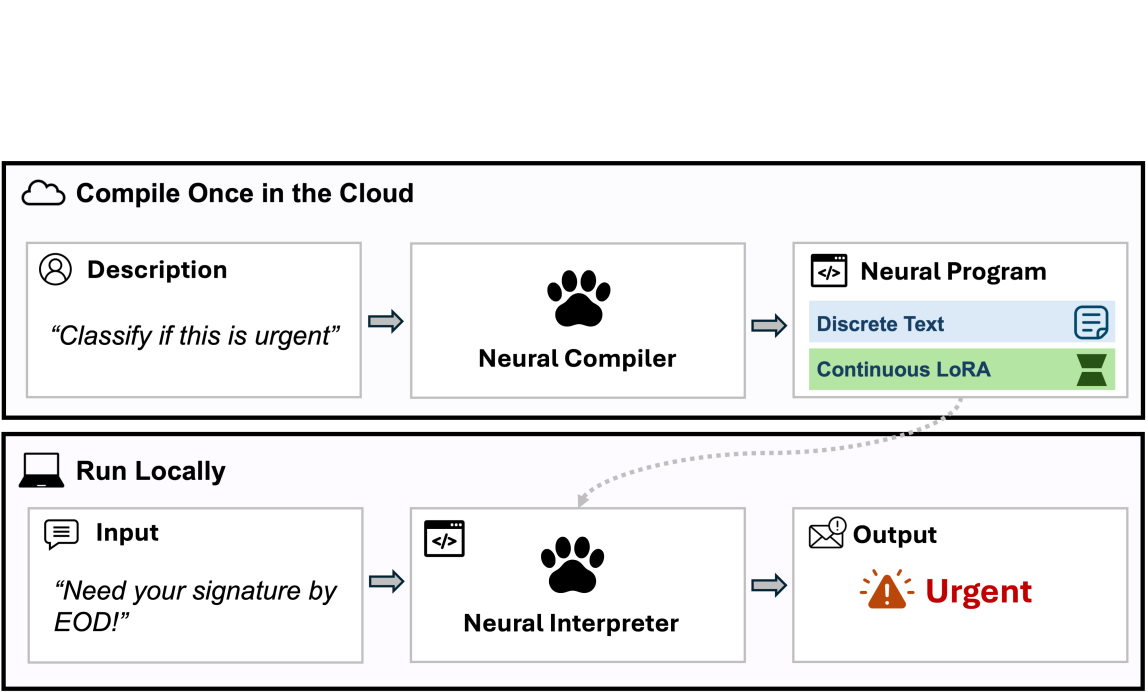
The compiler–interpreter system
Three components, none coupled to the choice of PEFT:
- Pseudo compiler C_p — an off-the-shelf, unmodified Qwen3-4B-Instruct-2507 prompted with a fixed template that produces a paraphrase of the spec plus a handful of I/O examples. This is p_{\text{discrete}}. Notably, an earlier RL-trained compiler for this stage converged on exactly this format, so the authors replaced RL with a hand-crafted prompt.
- PEFT compiler C_L — trained. Reads [s \mid p_{\text{discrete}} \mid \texttt{EOS} \mid \tau_{1:T}] where \tau_{1:T} are learned prefix tokens; the prefix-position hidden states H are mean-pooled, passed through a residual MLP, and projected to mixing coefficients over a shared basis set to produce the LoRA weights p_{\text{LoRA}}.
- Interpreter — frozen Qwen3-0.6B with the LoRA attached.
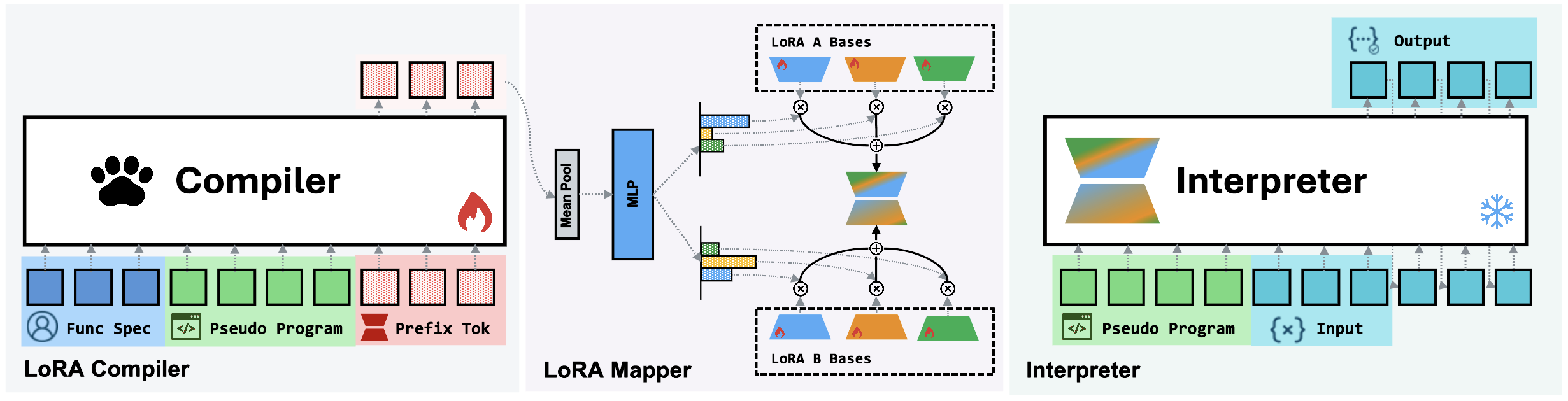
Training uses a single SFT objective; the interpreter and C_p are frozen, so the gradient reduces to
\mathcal{L}(\theta) = \mathbb{E}_{(s,x,y)}\!\left[-\log P_\phi\!\left(y \,\big|\, p_{\text{discrete}},\, p_{\text{LoRA}}(\theta;\, s, p_{\text{discrete}}),\, x\right)\right],
where \theta covers C_L and the LoRA mapper, and \phi is the frozen interpreter. Gradients flow through the frozen interpreter into the LoRA mapper and back into C_L’s hidden states.
FuzzyBench
The authors release FuzzyBench, 10M (spec, input, output) triples generated by gpt-5.2 via a two-stage pipeline: first generate 8 fuzzy-function specs per call under varying category constraints; then for each spec generate 8 I/O pairs. The 80/10/10 split is by spec, so test specs are unseen. The evaluation subset is filtered to items on which gpt-5.2 and gpt-5-mini agree, removing intrinsically ambiguous targets.
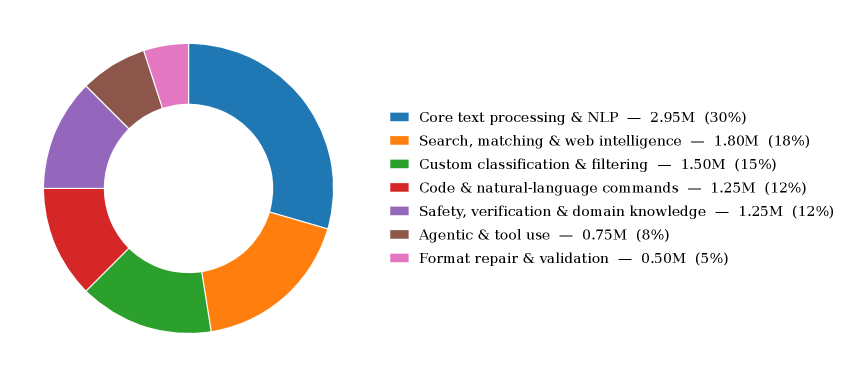
Results
The headline claim: a 0.6B Qwen3 interpreter loaded with a PAW-compiled LoRA matches direct prompting of Qwen3-32B at roughly 1/50 the inference memory and 30 tok/s on an M3 MacBook.
Against same-base-model adaptation baselines (Table 5), PAW substantially outperforms both fixed LoRA and full fine-tuning of the 0.6B base:
- Fixed LoRA r=18: 0.4236
- Fixed LoRA r=64: 0.5210
- Fixed LoRA r=128: 0.5159
- Full fine-tuning: 0.5840
- PAW (Qwen3 0.6B): 0.7378
That the fixed LoRA saturates near r=64 and drops at r=128 suggests the gain from PAW is not simply capacity but the per-function conditioning provided by the compiler.
Ablations
The counterintuitive finding (Table 4/5): every “more expressive” mapper variant hurt. Default (mean-pool over prefix tokens, shallow MLP, shared bases across layers, r=64, N=64) scored 0.6223. Per-position aggregation dropped to 0.5598; per-position with per-layer bases 0.5559; per-layer bases alone 0.6028; combined LoRA + prefix-tuning 0.6033. The authors report this without a theoretical explanation.
Robustness
Under seven noise perturbations of the spec (typos, grammar, ambiguity, formatting, combined, terse, paraphrase), PAW degrades at most -3.7\% (all-noise combined). The mechanism is that C_p denoises: an ablation that feeds the raw spec directly to the interpreter (bypassing p_{\text{discrete}}) trails by 1.6 points on clean specs (0.6285 vs 0.6443) but 4.5 points on heavy-typo specs (0.5662 vs 0.6108). The 4B pseudo compiler absorbs the noise before the small interpreter sees it.
Local execution
The deliverable is a single serializable file. paw.compile(spec) returns a program object; paw.function(id) exposes it as a Python (or JS) callable. After the initial download, all execution is offline.
Limitations and open questions
- The interpreter is Qwen3-0.6B and the LoRA rank is fixed; scaling laws for interpreter size vs program size are not explored. The 32B-matching claim is against direct prompting, not against 32B fine-tuned on the same specs.
- Absolute accuracy on FuzzyBench sits at 0.7378 — respectable, but ceiling models (gpt-5.2) are used as ground truth, so evaluation is anchored to a specific labeler.
- The negative results on more expressive mappers are unexplained and may not survive different training scales or interpreter architectures.
- Compositionality (chaining compiled fuzzy functions, or updating one when its spec changes slightly) is not evaluated.
- FuzzyBench itself is model-generated; distribution shift to real developer specs is only probed via synthetic noise, not real logs.
Why this matters
PAW reframes the foundation model as a tool-builder invoked once per function definition rather than a solver invoked per input, collapsing per-call cost from a 32B forward pass to a 0.6B one while keeping data local. If the compile-once/run-locally split holds at larger interpreter scales, it offers a concrete path to routing routine LLM-mediated logic out of API calls and into cached, versionable artifacts that fit on a laptop.
Source: https://arxiv.org/abs/2607.02512
Breaking Failure Cascades: Step-Aware Reinforcement Learning for Medical Multimodal Reasoning
Post-training of medical multimodal LLMs largely inherits generic RLHF/GRPO recipes: rewards fire on final-answer correctness or a sequence-level preference, leaving intermediate reasoning steps unsupervised. In clinical VQA, where a wrong differential mid-chain silently propagates, this sparse credit assignment is the wrong objective. The authors argue — and quantify — that the dominant failure mode is a cascade: one bad early step poisons every subsequent step. Their fix, Medical Reasoning-aware Policy Optimization (MRPO), attaches a step-wise process reward to GRPO and shapes token-level advantages so that earlier-failing steps in an incorrect trace absorb exponentially larger penalties.
Diagnosing cascades
The setup rests on two measurements over reasoning traces. Let K be the number of steps and k the index of the first invalid step (judged by an external verifier against MedThink-style gold reasoning). Define
\mathrm{FFP} = k/K, \qquad \mathrm{FAR} = \frac{\#\text{failed steps after } k}{\#\text{total steps after } k}.
Across several MLLM backbones on VQA-RAD/SLAKE/PathVQA, samples cluster in the Early bin (FFP \in [0.0, 0.4]), and this bin dominates the incorrect-answer population.
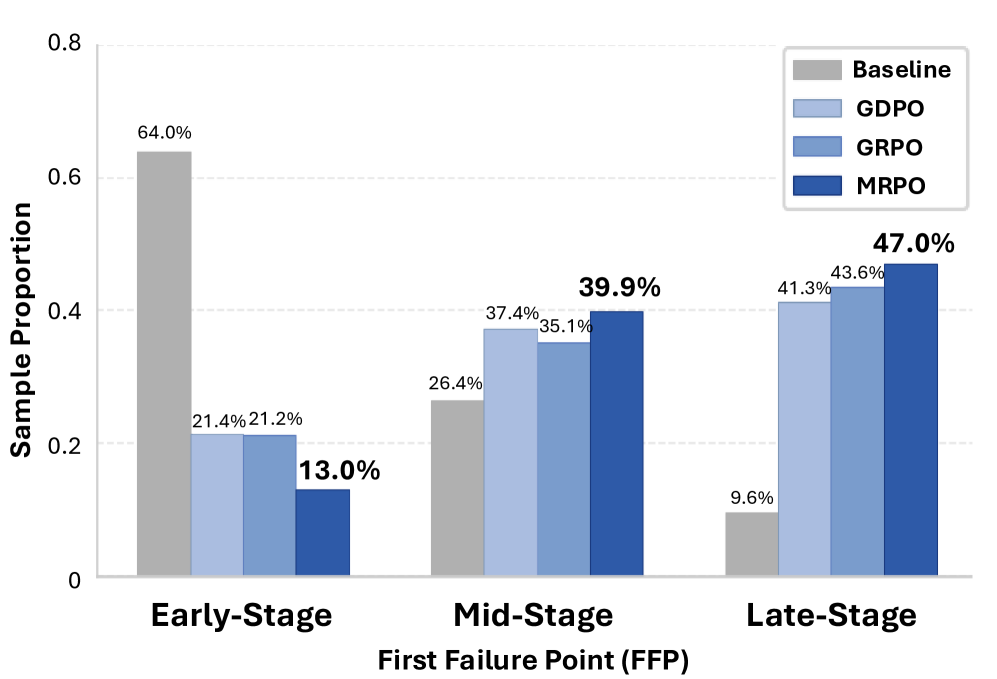
Once a chain fails early, FAR stays high, i.e., the model rarely recovers. This motivates a reward that (i) can distinguish where the trace first breaks and (ii) concentrates gradient on those tokens rather than smearing a scalar over the entire sequence.
MRPO
MRPO keeps the GRPO group-relative advantage baseline but replaces the scalar reward with three components combined per rollout:
- Answer reward: R_{\mathrm{ans}} = \lambda_1 (\mathrm{ROUGE\text{-}1} + \mathrm{BLEU\text{-}1}) + \lambda_2 \mathrm{BERTScore}, with \lambda_1 = 0.25, \lambda_2 = 0.5, and BERTScore computed via BiomedBERT to give a dense semantic signal on short open-ended answers where lexical overlap is brittle.
- Reasoning process reward: a per-step validity judgment producing a binary label at each of the K steps.
- Length reward: the standard anti-degeneracy regularizer.
The key mechanism is advantage shaping. When R_{\mathrm{ans}} indicates an incorrect final answer, tokens belonging to step k (the first invalid step) receive a penalty scaled by an exponentially decaying function of the step index, so the earliest failing step is punished hardest and later steps proportionally less. Successful trajectories are left unshaped, preserving good behavior.
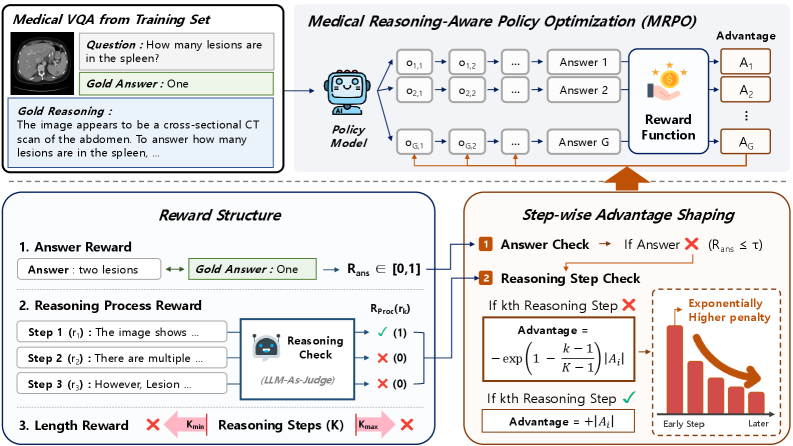
Concretely, for each rollout the policy generates a reasoning trace, the verifier locates k, and only if the answer is judged wrong does MRPO inject the step-wise penalty pattern into the token-level advantages before the PPO-style clipped update inherited from GRPO. This is a minimal modification to a standard GRPO trainer: add a step verifier, compute k, and multiply advantages of tokens in step j \le k by an exponential weight.
Results
On three MLLM backbones (including Qwen3-VL-8B-Instruct), MRPO beats vanilla GRPO and a recent RL baseline across VQA-RAD, SLAKE, PathVQA and five OOD benchmarks (PMC-VQA, VQA-Med-2021, Quilt-VQA, RadImageNet-VQA, MIMIC-Ext-MIMIC-CXR-VQA). On Qwen3-VL-8B-Instruct, MRPO surpasses HuatuoGPT-Vision-34B — roughly 4x the parameters — by 2.79 points on the aggregate metric.
The mechanistic evidence is more informative than the leaderboard delta. Early-stage reasoning failures drop from 64.0% to 13.0%, meaning the FFP distribution shifts sharply toward the Late bin. FAR after the first failure also drops uniformly across FFP bins, indicating that when failures do occur, subsequent steps are less likely to compound them.
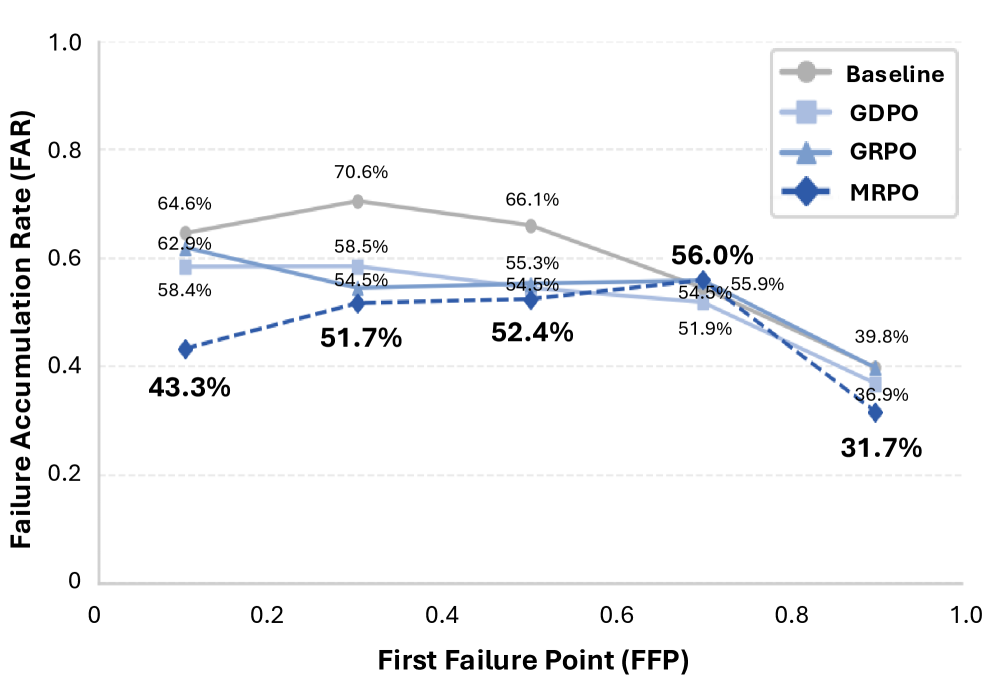
That both FFP and FAR improve is nontrivial: pushing failures later without lowering FAR would simply relocate the cascade, and lowering FAR without moving FFP would produce longer but still-broken chains.
Limitations and open questions
The process reward depends on a step-level validity judge; the paper leans on gold reasoning from MedThink for training and (implicitly) an LLM/rule-based verifier at rollout time. The quality and calibration of this judge is a load-bearing assumption — noisy step labels would misplace k and mis-target the exponential penalty. The exponential penalty schedule is a design choice without an ablation reported in the excerpts; linear or learned schedules could matter. It is also unclear how the method behaves when the ground-truth answer is correct but reasoning is spurious (right-for-wrong-reasons), since shaping is gated on R_{\mathrm{ans}} being low. Finally, all training data are open-ended VQA on three benchmarks; transfer to report generation or multi-turn clinical dialogue is untested.
Why this matters
Sparse outcome rewards are a poor fit for domains where reasoning process is itself the deliverable. MRPO shows that a simple step-localized advantage reshaping — not a new algorithm class — can cut early-stage failure rates by roughly 5x and let an 8B model outperform a 34B medical MLLM, suggesting that process supervision, not scale, is the binding constraint for clinical reasoning quality.
Source: https://arxiv.org/abs/2606.31825
Representation Distribution Matching for One-Step Visual Generation
This paper unifies a family of one-step generator training methods — Fréchet-distance losses, drifting-field matchers, and their kin — under a single objective: match the pushforward of the generator’s law \phi_* p_\theta to the pushforward of the data law \phi_* p_{\mathrm{data}} under a frozen pretrained encoder \phi. The authors call this Representation Distribution Matching (RDM) and dissect its design space along two axes: (i) the discrepancy \mathcal{D} and how it is estimated from finite samples, and (ii) which encoders define the feature space and how they are combined. The payoff is iRDM, a recipe that trains a one-step ImageNet generator to \mathrm{SW}_{r^{14}}=1.30 and post-trains four-step FLUX.2 [klein] into a matched-quality one-step model in ~90 H200 GPU-hours.
The setup and why the estimator matters
The core objective is
\mathcal{L}(\theta) = \mathcal{D}(\phi_* p_\theta,\; \phi_* p_{\mathrm{data}}),
which constrains the output distribution rather than any per-sample trajectory — this is what makes the generator one-step by construction, and lets the same loss post-train a few-step sampler by treating its final output as g_\theta(z).
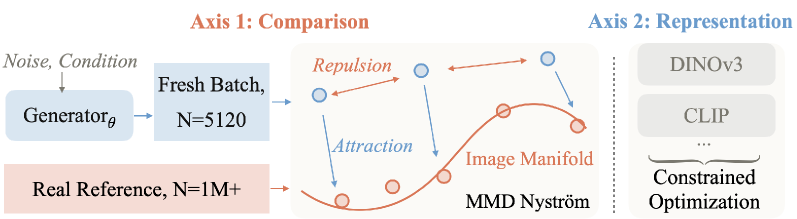
For \mathcal{D}, the authors return to squared MMD with a Gaussian kernel k(x,y)=\exp(-\|x-y\|_2^2/2\sigma_\phi^2), bandwidth fixed per encoder via the median heuristic. MMD famously failed to train convincing generators a decade ago; the paper’s first claim is that this failure was an estimator problem, not an objective problem. The three MMD terms have opposing roles: the cross-term attracts generated features toward data, the generator self-term repels them from each other to prevent mode collapse, and the data self-term is \theta-independent. Because attraction and repulsion have different variance profiles, they should not be estimated the same way:
\widehat{\mathcal{L}}_\phi = \underbrace{\frac{1}{B^2}\sum_{i,j} k(g_i,g_j)}_{\text{repulsion, exact U-stat on batch}} - \underbrace{\frac{2}{B}\sum_i \psi(g_i)^\top \bar{\mu}_\phi}_{\text{attraction, Nyström vs. frozen full-data mean}}.
The attraction term is computed against a frozen mean embedding \bar\mu_\phi built once over the full training set and compressed to 4096 Nyström landmarks with feature map \psi. This is the key move: the “reference” side is not rebuilt per batch (as in drifting-field methods that are consequently confined to small batches), which decouples reference quality from batch size.
Batch size and the spiral diagnostic
Once attraction is stabilized by the frozen Nyström reference, the generated batch B becomes the operative variable — it is the only remaining source of noise in the repulsion term. A 2D spiral diagnostic at ambient dimension D=64 shows that Fréchet (frozen global mean/covariance), sliced-Wasserstein with L=1000 projections, drifting-field with a 128-sample reference bank, and the MMD family all behave very differently as B varies.
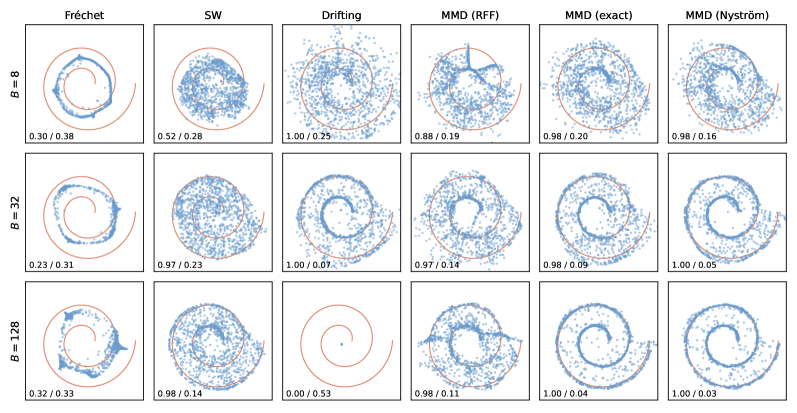
The empirical sweet spot for iRDM is above 2048 — far larger than the batch sizes conventional for one-step generator training, and precisely the regime the drifting-field cost model excludes.
Gaming and the encoder battery
The third finding is that any single encoder can be gamed: the generator can drive \widehat{\mathcal{L}}_\phi below the real-data score while producing visibly fake images. The remedy is a battery of ten frozen encoders combined by a proportional Lagrangian controller with per-encoder “satisfaction” floors computed on the ImageNet validation set, and a fixed total budget \Sigma=10. Evaluation is deliberately off-objective: \mathrm{SW}_{r^{14}} is a sliced-Wasserstein ratio averaged over 14 encoders (4 held out from training), estimated from 16384 samples with M=1024 projections, and PickScore, a learned human-preference model, is used as a second check that the objective never optimizes.
Results
On ImageNet-256, iRDM post-trains the pMF-H FD-SIM checkpoint for 4000 steps at \mathrm{lr}=1.6\times 10^{-6}, N=5120, reaching \mathrm{SW}_{r^{14}}=1.30, the one-step state of the art on this benchmark. Against the pMF-H FD-SIM starting point, generating 4000 class-conditional latents under matched noise, iRDM wins in paired PickScore — corroboration from a preference model the loss never sees.
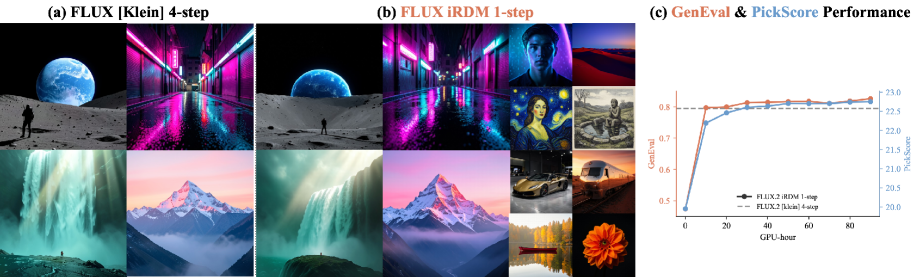
For text-to-image, iRDM post-trains four-step FLUX.2 [klein] into a one-step generator that surpasses the four-step teacher on both GenEval and PickScore after roughly 90 H200 GPU-hours (Figure 1c). No online teacher, no adversary, no trajectory matching.
Limitations and open questions
The battery is fixed at ten training encoders plus four held-out; whether \mathrm{SW}_{r^{14}} can itself be gamed by a sufficiently expressive generator remains open (the authors mitigate but do not prove resistance). The Nyström reference with 4096 landmarks is a fixed compression of \phi_* p_{\mathrm{data}}; how much the residual approximation error costs at very large B is not characterized. Bandwidths are fixed by the median heuristic at a single scale — multi-scale kernels or learned bandwidths are unexplored. And while the recipe transfers from ImageNet to FLUX.2, scaling to models the size of frontier T2I systems with joint image-text objectives is only demonstrated at the [klein] tier.
Why this matters
RDM reframes one-step generator training as a distribution-matching problem where the hard part is estimator design, not objective choice: a two-decade-old loss (MMD) becomes state-of-the-art once attraction is estimated against a frozen Nyström reference and repulsion is scaled to B>2048. Because the objective avoids online teachers and adversaries, post-training a few-step diffusion model into a one-step generator becomes a well-conditioned, cheap procedure — ~90 H200-hours for FLUX.2 [klein].
Source: https://arxiv.org/abs/2607.02375
AgenticSTS: A Bounded-Memory Testbed for Long-Horizon LLM Agents
Problem
Long-horizon LLM agents typically operate under an implicit memory contract: append every past observation, tool call, and reflection to the running prompt. This makes prior context trivially accessible but conflates the effects of individual memory components — retrieved facts, reflections, skill triggers, planner outputs — into a single unstructured mixture. Ablating any one layer is confounded by the presence of the raw transcript, and prompts grow unboundedly with run length, which is problematic for tasks requiring hundreds of decisions. The paper’s thesis is that memory should be treated as a contract on what each decision is allowed to see, and that a bounded, typed contract enables clean causal attribution of memory components to agent performance.
The bounded contract
The alternative contract the authors instrument works as follows. Each decision d_t is generated from a freshly assembled user message u_t; no raw cross-decision transcript is appended to the system or user prompt. The message u_t is populated by typed retrieval over a set of memory layers \{L_1, \dots, L_k\} (observations, reflections, skills, plans, etc.), each of which contributes a bounded slot. Concretely, if \mathcal{M}_i denotes layer i’s store and r_i its typed retriever, then
u_t = \mathrm{Assemble}\big(o_t,\; \{r_i(\mathcal{M}_i, o_t)\}_{i=1}^k\big),
where o_t is the current environment observation. Because |u_t| is bounded by construction (each r_i returns a fixed-size, typed payload), the prompt does not grow with t, and any layer i can be zeroed out — a “fixed-A_0” ablation — while holding all other layers constant. This is the mechanical property that distinguishes the harness from append-transcript baselines: the counterfactual “same run without layer i” is well defined because layer i never leaked into any other layer’s prompt.
Testbed: Slay the Spire 2
The environment is Slay the Spire 2 (STS2), a closed-rule stochastic deck-building roguelike. Runs consist of hundreds of decisions spanning two coupled timescales: tactical (per-combat card play, targeting, energy management under stochastic draws) and strategic (map path selection, card acquisition, relic and shop choices, deck shaping over an entire run). The rules are fully specified, the state is inspectable, and outcome is a binary win/loss at run end — a clean long-horizon credit assignment target.
Two calibration points anchor difficulty. A public online benchmark of frontier LLMs on the same game reports zero wins at the lowest difficulty across five configurations, indicating that the task is genuinely out of reach for stock prompted agents. The developer-reported human win rate at the same difficulty is 16%, so the ceiling is finite but the game is not saturated — there is measurable headroom for memory-architecture interventions without hitting a trivial or unreachable regime.
Fixed-A_0 ablation results
The reported experiment uses the bounded contract as the fixed backbone and toggles individual layers on/off. The largest observed effect comes from enabling triggered strategic skills — retrieval entries keyed on strategic conditions (e.g., deck composition thresholds, act transitions) that fire injected guidance into u_t only when their trigger predicate holds on o_t. Against a no-store baseline (all higher layers ablated, only raw current observation), the strategic-skills configuration produces the largest observed delta. The excerpt reports the no-store baseline winning 3/10 games in the measured configuration; the strategic-skills-enabled variant improves on this, and this gap is the largest across the ablations the authors ran. (The abstract is truncated mid-sentence, so the exact strategic-skills win count is not visible in the provided text, but the qualitative claim — that triggered strategic skills produce the largest observed lift under fixed-A_0 — is stated directly.)
Two methodological observations matter here. First, that a no-store baseline wins 3/10 at the lowest difficulty while public frontier-LLM benchmarks report 0/N indicates the harness itself (action space shaping, observation formatting, decision loop) contributes substantial signal beyond memory. Second, because the contract is bounded, this 3/10 baseline is a genuine floor for the memory-layer contribution, not a confound with prompt length.
Limitations and open questions
The evaluation is on a single game with n=10 runs per configuration; variance on binary win-rate at these sample sizes is large (\sigma \approx 0.15 for p=0.3), so ranking of smaller layer contributions is not yet statistically resolved. The typed-retrieval design pushes complexity into the retrievers r_i: each layer needs a schema and a retrieval policy, and the paper does not (from the excerpt) address how retriever design itself is ablated or how much of the “layer effect” is actually a retriever-quality effect. Transfer of the contract to open-world or partially observable environments — where the assumption that o_t suffices to key retrieval breaks down — is untested. Finally, the strategic-skills layer is essentially a hand-authored trigger library; the extent to which such skills can be learned or extracted automatically is left open.
Why this matters
Most agent-memory work compares end-to-end architectures where transcript, retrieval, reflection, and planning are entangled, making it impossible to attribute gains to specific mechanisms. A bounded, typed contract with clean fixed-A_0 ablations is the right substrate for causal claims about memory design, and STS2 gives it a genuinely long-horizon, unsaturated target.
Source: https://arxiv.org/abs/2607.02255
EvoPolicyGym: Evaluating Autonomous Policy Evolution in Interactive Environments
Problem
Existing evaluations of LLM coding agents on RL-style tasks either collapse to a single terminal score or entangle policy improvement with generic software-engineering progress (repo navigation, tool use, test-passing). Neither cleanly measures what one actually wants from an autonomous agent operating a control loop: does it convert episodic feedback into a better executable policy under a bounded interaction budget? EvoPolicyGym isolates this question by fixing the interface (edit a policy file, submit rollouts, receive server-side summaries) and the budget (128 training episodes), then scoring the best validation-selected checkpoint on a held-out pool.
Setup and interaction protocol
A run is defined over three objects: an environment (standard reset/step), a persistent policy system (a policy.py plus any locally imported modules the agent authors), and an episode. The agent iterates: edit the policy workspace, submit for training rollouts on visible cases, receive rollout summaries and trajectories, revise. After 128 episodes are consumed, the platform performs hidden checkpoint selection on 16 validation cases, and the selected checkpoint is scored on 32 held-out cases. Only training feedback is visible; validation returns and held-out cases are server-owned.
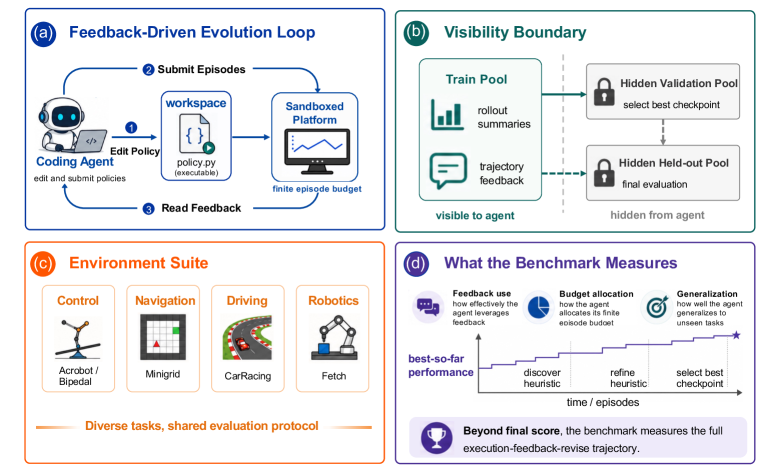
The suite is Core16: 16 environments spanning Gym/Box2D, MuJoCo, MiniGrid, and Robotics/Driving. Four model-and-harness systems are evaluated: GPT-5.5 (Codex harness), Claude Opus 4.7, MiniMax-M3, and DeepSeek-V4-Pro (all three via Claude Code). Harnesses are treated as part of the evaluated system — no normalization of tokens, context management, or provider defaults. A uniform random policy is scored on the same held-out pools as a floor. Conventional RL algorithms are deliberately excluded: 128 episodes is well below their convergence regime, and their training interface does not match code-edit-and-submit.
Results
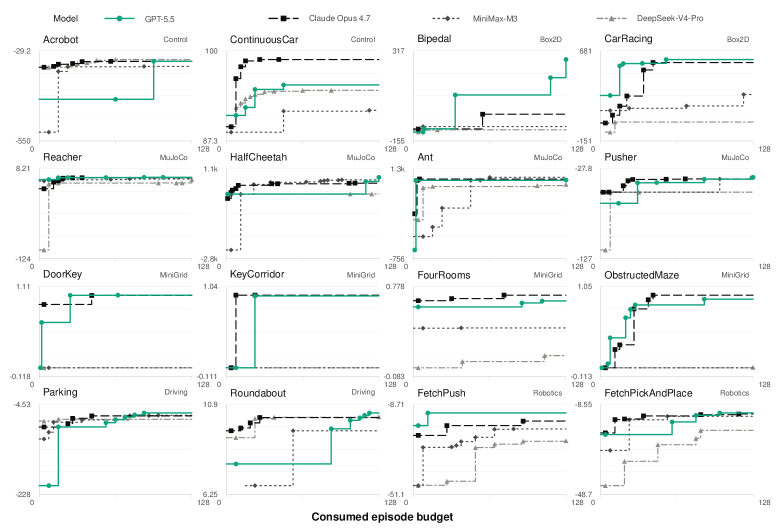
GPT-5.5 achieves the strongest aggregate rank and places in the top two on all 16 environments. The trajectory-level view (Figure 3) shows when improvements happen inside each 128-episode budget: sharp vertical jumps indicate a successful policy revision, while long plateaus indicate budget spent without progress. This exposes budget efficiency independent of the final score.
The more interesting analysis splits environments into a synthesis-dominant group (pixel-perception, symbolic-planning tasks that require the agent to build visual state extraction, memory, search, or recovery logic) versus a tuning-dominant group (low-dimensional control where a simple controller family suffices and gains, thresholds, and branch constants dominate outcomes).
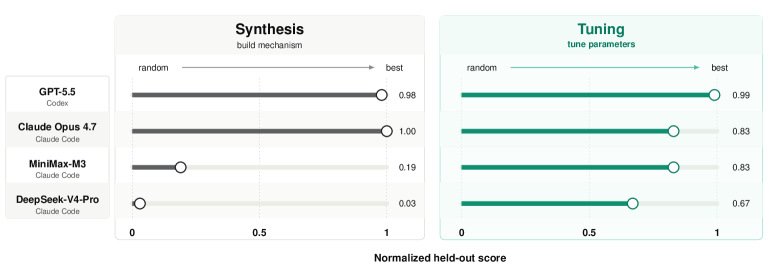
Table 3 reports deterministic AST features of the validation-selected policy bundles (functions, branches, loops, nesting depth, persistent state slots), averaged within each demand group. On synthesis-dominant tasks, GPT-5.5 produces the richest machinery: 30.2 functions, 68.2 branches, 13.0 loops, depth 4.6, and 48.4 state slots. Claude Opus 4.7 also produces heavy code (19.0 functions, 77.0 branches, 16.8 loops, depth 7.6, 26.0 state) but with fewer functions and less state than GPT-5.5. MiniMax-M3 (12.8 / 38.2 / 7.6 / 4.0 / 16.0) and DeepSeek-V4-Pro (5.4 / 21.8 / 3.2 / 3.2 / 11.2) produce visibly thinner bundles on the same tasks.
Tuning-dominant rows compress uniformly — GPT-5.5 selects 8.5 functions, 8.6 branches, 0.5 loops, depth 2.1, 9.2 state; DeepSeek-V4-Pro selects 3.6 / 5.8 / 0.1 / 2.5 / 5.7 — consistent with the interpretation that these tasks reward parametric refinement of a small controller rather than new machinery.
The authors emphasize that Claude Opus 4.7’s high branch count (77.0) paired with weaker performance shows that code volume is not sufficient: complex code is not necessarily task-adapted machinery. Structural synthesis must produce the right modules (perception, memory, recovery), not merely more code.
Limitations and open questions
- The comparison bundles model and harness. Codex vs. Claude Code differ in context management and token defaults, and these are not controlled. It is unclear how much of GPT-5.5’s lead is model capability versus harness affordance.
- Only four systems and 16 environments; the synthesis/tuning split is coarse and self-selected by the authors.
- AST features are diagnostic, not causal. The paper does not test whether ablating specific modules (e.g., removing agent-authored perception) causes the observed drops.
- 128 episodes is a specific budget regime; scaling behavior in budget is not reported here.
- No comparison against a properly-tuned RL baseline at matched interaction budget on a subset — such a comparison would clarify whether coding agents dominate at this budget or merely occupy a different operating point.
Why this matters
EvoPolicyGym operationalizes a distinction that terminal-score benchmarks blur: agents that discover task-appropriate control mechanisms versus agents that tune plausible controllers. The AST-level diagnostics plus best-so-far trajectories give a concrete substrate for studying feedback utilization in coding agents outside of open-ended SWE tasks, and the synthesis-vs-tuning split is a useful lens for future work on agent-driven policy search.
Source: https://arxiv.org/abs/2607.02440
Morphing into Hybrid Attention Models
Hybrid attention models keep a small subset of full-attention layers and replace the rest with linear attention, trading exact softmax attention for constant-state recurrence in most layers. The critical design question is which layers stay full-attention. Prior work uses either fixed interleaving (every n-th layer) or per-layer scoring (replace layer l, measure a divergence, rank). Both treat layer importance as independent, ignoring that once layer l is linearized, the value of keeping layer l' as full attention changes. FlashMorph reframes selection as a joint, budget-constrained subset optimization and solves a continuous relaxation via learned gates.
Problem formulation
Given a pretrained Transformer with L layers, choose \mathcal{I}_{\mathrm{full}}\subseteq[L] with |\mathcal{I}_{\mathrm{full}}|=K that maximizes downstream score of the resulting hybrid \mathcal{M}(\mathcal{I}_{\mathrm{full}}):
\mathcal{I}^\star_{\mathrm{full}}=\arg\max_{|\mathcal{I}_{\mathrm{full}}|=K}\operatorname{Score}\!\big(\mathcal{M}(\mathcal{I}_{\mathrm{full}})\big).
Exact search costs \binom{L}{K} evaluations. FlashMorph relaxes this into a differentiable gate-optimization problem.
Method

Stage 1 — Morphable layers. For each attention layer, a linear-attention branch (Lightning Attention, GLA, or Gated DeltaNet) is trained to match the full-attention layer’s hidden-state output via distillation on 320M tokens from DCLM. This yields, for every layer l, two functionally comparable branches \mathrm{Attn}_{\mathrm{full}}^{(l)} and \mathrm{Attn}_{\mathrm{lin}}^{(l)}.
Stage 2 — Gated layer selection. All weights are frozen. A scalar gate \alpha^{(l)}\in[0,1] per layer mixes the two branches:
h^{(l)} = \alpha^{(l)}\,\mathrm{Attn}_{\mathrm{full}}^{(l)}(x) + (1-\alpha^{(l)})\,\mathrm{Attn}_{\mathrm{lin}}^{(l)}(x).
Gates are jointly optimized on a synthetic long-context retrieval task — DCLM background text with ten 32-word passkeys inserted at random depths across context lengths sampled from 1K–16K — using an LM loss plus a linearization regularizer that pushes \alpha^{(l)}\to 0. The regularizer creates the budget pressure: only layers that measurably help retrieval retain nonzero gates. After only 250 steps (batch size 8, WSD schedule 2e{-2}\to 2e{-3}) on ~20M tokens, gates are ranked and the top-K are discretized to full attention.
Stage 3–4 — Standard logits distillation (1B tokens) and long-context finetuning at 16K (1B tokens). Both are identical to the HALO pipeline; only the selection strategy differs across baselines.
The token budget for selection itself is the key efficiency claim: 20M tokens vs. 234M for HALO, 20B for KL-LS, and 50B for PostNAS.
Results
NIAH performance under the 3:1 hybrid ratio (Table 2) shows FlashMorph matches or beats far more expensive methods. On Qwen3-1.7B, NIAH-Single-3 at 128K/256K reaches 94.4/73.2 for FlashMorph vs. 67.4/52.8 for HALO (which used ~12× more tokens) and 57.2/57.6 for PostNAS (2500× more tokens). NIAH-Single-2 at 128K is 98.2 (FlashMorph) vs. 95.0 (HALO) vs. 78.0 (PostNAS). At 0.6B, FlashMorph is competitive with HALO on NIAH-Single-1 (all ≥99.0 at 256K), and leads on NIAH-Single-2 at 32K (92.2 vs. 86.0) and NIAH-Single-3 at 32K (81.2 vs. 68.6), though it trails HALO at 128K–256K on Single-2/3, where the smaller retrieval signal in 20M tokens matters more.
Selection efficiency scales favorably. 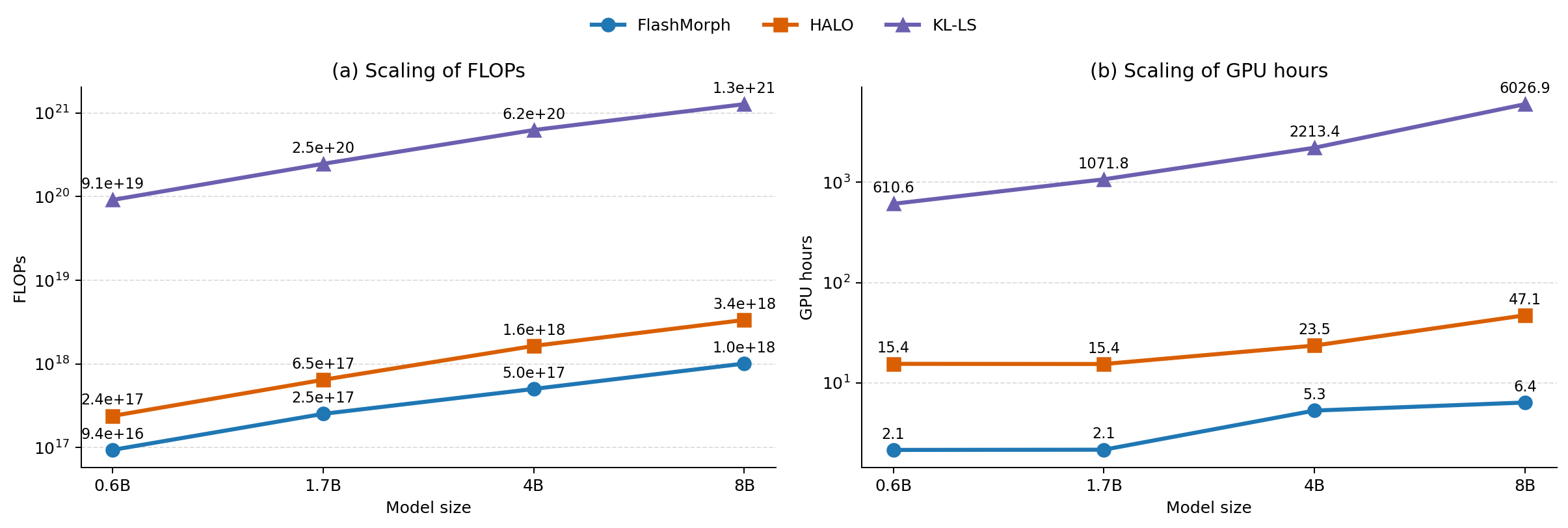 The gap widens with model size because HALO’s layerwise probing and KL-LS’s supernet training scale multiplicatively with L, while FlashMorph’s cost is a single 250-step joint training run.
Inference gains from the resulting hybrid are what motivate the whole exercise. 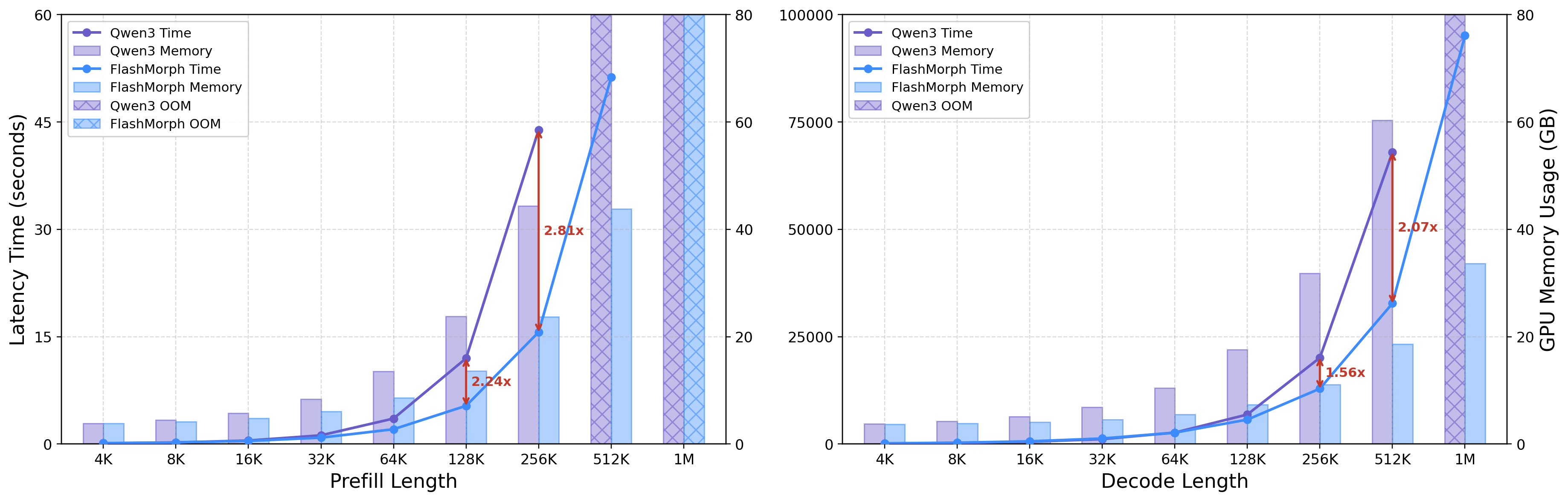 At 256K context, prefill is 2.81× and decode 2.07× faster than the Qwen3 baseline; at 128K, prefill reaches 2.24×.
Inspection of the selected indices (Table 8) is informative. FlashMorph consistently retains layer 1 (early) and mid-network layers like 11, 16, 21 across Qwen3-0.6B/1.7B backbones and all three linear-attention variants — a pattern robust across GLA, GDN, and Lightning. KL-LS clusters selections in the mid-to-late block (16–26), while HALO picks scattered early layers (3, 5, 9, 10). The stability of FlashMorph’s top-K across linear-attention families suggests the retrieval-critical layers are a property of the base Transformer, not of the replacement kernel.
Limitations
The selection signal is dominated by passkey retrieval; whether the same gate landscape optimizes reasoning-heavy or generative long-context tasks is untested here. Context lengths during selection cap at 16K, yet evaluation extends to 256K — the assumption that layers important for 16K retrieval remain important at 256K holds empirically for NIAH but is not proven. The linearization regularizer’s strength implicitly sets the budget; achieving an exact target K requires tuning or post-hoc discretization. Finally, results at 8B and 30B-A3B are reported only against uniform and HALO, since reproducing PostNAS/KL-LS is prohibitive — the very cost asymmetry FlashMorph exploits also blocks a full comparison at scale.
Why this matters
Hybrid attention conversion is becoming a standard recipe for extending pretrained Transformers to long context, and the layer-selection step has been the ad hoc part of the pipeline. FlashMorph shows that a 250-step joint gate optimization on 20M tokens can match or exceed selection methods using 10×–2500× more tokens, making principled selection cheap enough to apply routinely at 8B–30B scale.
Source: https://arxiv.org/abs/2606.30562
WorldDirector: Building Controllable World Simulators with Persistent Dynamic Memory
Problem
Autoregressive video world models degrade when objects leave the field of view and later return: pixel-level memory mechanisms (KV caches, FOV attention, hierarchical compression) cannot reliably preserve identity across long occlusions because they entangle physical dynamics with rendering. If a character walks off-screen for 20 seconds and returns, the model has typically forgotten their appearance or their trajectory. WorldDirector’s premise is that this entanglement is the root cause and should be broken: semantic motion planning belongs in a symbolic layer (3D trajectories driven by an LLM), while a video diffusion model is reduced to a conditional renderer.
Method
The architecture partitions the generative problem into (i) an LLM orchestrator (Gemini at inference time) that plans 3D object trajectories and camera motion, projected to 2D bounding boxes, and (ii) a chunk-wise autoregressive video generator built on LingBot-World-Base that consumes three conditioning streams.
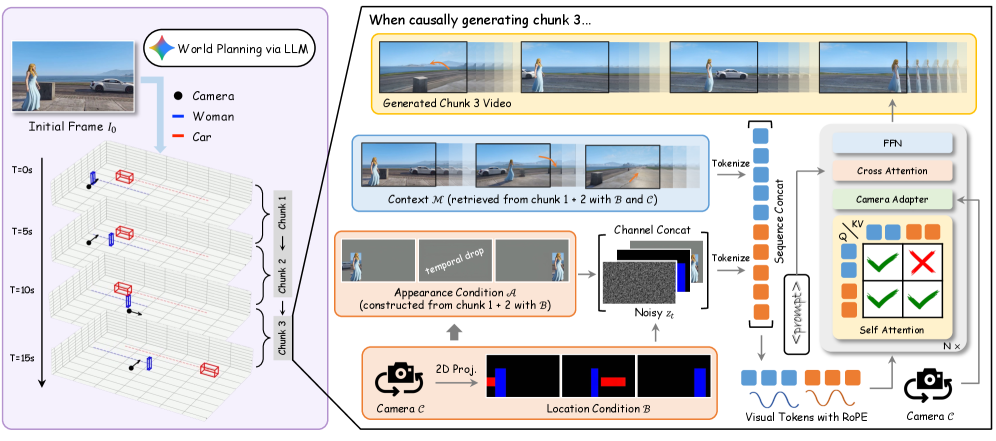
The three conditioning streams are:
- Location condition \mathcal{B}: a synthetic video where each dynamic object’s 2D bbox is filled with a unique color ID on a zero background. This encodes both trajectory and (implicitly) camera pose through the induced bbox motion.
- Appearance condition \mathcal{A}: for object a at frame t with bbox \text{box}_{a,t}, retrieve \text{box}_{a,t'} from a 10 s candidate pool minimizing aspect-ratio divergence, crop, resample, and paste into the coordinates of \text{box}_{a,t}. This injects exact pixel evidence for the object at its planned spatio-temporal location, regardless of how long it has been off-screen.
- Context memory \mathcal{M}: retrieved historical frames — top-K FoV-overlap frames for static scene, plus a greedy selection of frames containing active object identities (min stride of 4 frames), covering N=10 context frames total, each encoded independently by the pre-trained 3D VAE.
\mathcal{B} and \mathcal{A} are channel-concatenated with the noisy latent (same spatio-temporal shape, dense per-frame conditioning), while \mathcal{M} is sequence-concatenated as historical tokens. An asymmetric attention routing lets current-chunk tokens attend to memory tokens but blocks the reverse direction, so denoising noise cannot corrupt clean context features. Temporal dropout on context is applied during training to prevent the model from over-relying on any single retrieved frame.
The data pipeline is built to force the exit/re-entry phenomenon: 15 s game-engine videos with scripted disappearances, SAM3 for re-ID-preserving bbox tracks, a contiguous 5 s training window chosen to maximize newly visible objects (absent in frame 1 but appearing later), and Qwen2.5-VL-72B captioning of color-boxed frames to produce per-entity action captions. Training runs 3,000 steps at 832 \times 480, 16 fps, batch 64, LR 1 \times 10^{-5}. Inference partitions the full video into 5 s chunks generated autoregressively.
Results
On a held-out set of 100 unseen scenes, WorldDirector reaches PSNR 18.127 vs. next-best 14.782 (HY-World) — a large 3.3 dB gap — SSIM 0.502 vs. 0.455 (Yume 1.5), and LPIPS 0.359 vs. 0.398. On DSC (bbox-crop DINO/CLIP similarity between an object’s current appearance and its earlier contextual instances), the model achieves DSC_DINO 0.769 and DSC_CLIP 0.917, top or tied-top despite generating substantially more motion than baselines.
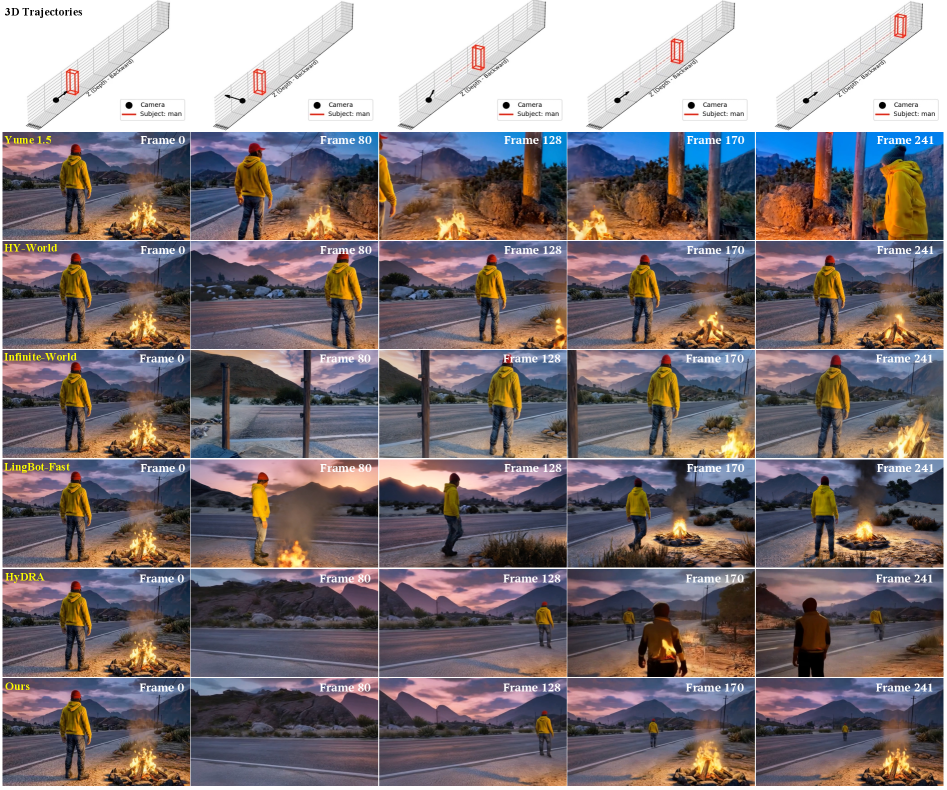
The authors correctly note that Yume/HY-World/Infinite-World win VBench Subject Consistency (0.898–0.934) and Background Consistency (0.908–0.931) partly because they generate near-static outputs — a well-known confound in VBench-style temporal consistency metrics. WorldDirector sits at 0.891 / 0.909 while producing scripted walk-away-and-return sequences (Figure 3).
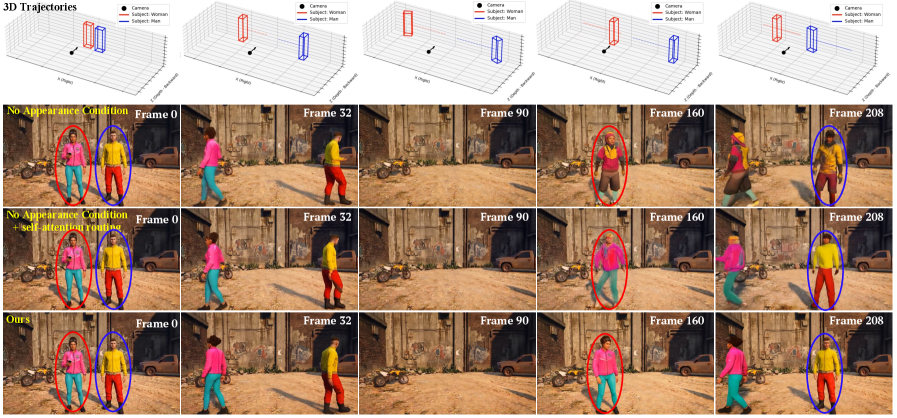
The appearance-condition ablation (Figure 4) is the load-bearing experiment for the paper’s central claim: without \mathcal{A}, the model can still track where an object should be (from \mathcal{B}) but drifts in identity across large pose changes and re-entries. Injecting the retrieved crop into the exact bbox coordinates supplies the pixel evidence the diffusion prior needs to keep identity locked.
Limitations and open questions
- The evaluation uses game-engine data plus a 100-sample in-distribution test set; generalization to real footage where SAM3 tracks and 3D trajectories are noisier is untested.
- The LLM-orchestrator is treated as an oracle; the paper does not report failure modes when Gemini produces physically implausible 3D plans (occlusion order, contact, articulated motion).
- Chunk-wise generation at 5 s with autoregressive rollout is not stress-tested for drift over minutes; the DSC metric only compares to earlier contextual counterparts, not to a stable canonical identity.
- Multi-object interactions where bboxes overlap or occlude break the color-ID assumption in \mathcal{B} and the paste-in-bbox trick in \mathcal{A}; the paper does not quantify degradation as scene density scales.
- PSNR 18.1 on a 3,000-step fine-tune of an existing foundation model is state-of-the-art here but still low in absolute terms — the reconstruction problem in dynamic long-horizon video remains open.
Why this matters
Decoupling symbolic motion planning from neural rendering sidesteps the “the model must remember through pixels” trap that has defined interactive video world models. If this factorization holds up at scale, world models become steerable via structured 3D plans rather than prompt engineering, and persistent identity reduces to a retrieval-and-paste problem rather than a memory-architecture problem.
Source: https://arxiv.org/abs/2607.02517
Hacker News Signals
Is One Layer Enough? A Single Transformer Layer Matches Full-Parameter RL Training
A paper on arxiv asking whether full-model fine-tuning via RL (think RLHF/PPO or GRPO on LLMs) is actually necessary, or whether updating a single transformer layer achieves comparable performance. The authors run controlled experiments comparing full-parameter RL training against single-layer RL updates across reasoning and alignment tasks. The result is that a single layer — chosen carefully — can match full fine-tuning on several benchmarks, with obvious implications for compute cost and memory footprint during RL post-training.
The mechanistic question is interesting: which layer matters most? The findings suggest later layers disproportionately drive the policy shift, consistent with prior interpretability work showing that later layers handle higher-level task-specific representations. This has a practical angle for labs doing iterative RLHF: if one layer suffices, you can freeze the rest, drastically reducing optimizer state memory (no Adam moments for 95%+ of parameters) and backward-pass cost.
The caveat is that “matches” is benchmark-dependent. Tasks requiring deep representational change presumably still benefit from full fine-tuning, and the evaluation set here is limited. The open question is whether this holds at scale (70B+) or for more complex multi-step reasoning where gradient signal needs to propagate through many layers to reshape earlier representations. Still, the result challenges the default assumption that RL post-training requires full-model gradient updates.
Source: https://arxiv.org/abs/2607.01232
Postgres Transactions Are a Distributed Systems Superpower
The DBOS blog makes the case for co-locating workflow/application state inside Postgres rather than managing it in a separate orchestration layer (Temporal, custom Redis state machines, etc.). The core argument is that Postgres ACID transactions let you atomically update workflow state and business data together, eliminating the dual-write problem that plagues systems where orchestration state lives separately from application data.
The technical substance: workflows in DBOS are stored as rows in Postgres tables. A workflow step either commits both its side effects (recorded as a completed step) and any downstream state changes in a single transaction, or nothing commits. This means crash recovery is just reading the workflow table and replaying from the last committed step — no external saga log, no distributed coordinator.
The performance angle is non-obvious. The post acknowledges that Postgres is not a message broker, and high-throughput event-driven workloads will hit row-locking and WAL pressure. But for the typical enterprise workflow (order processing, user onboarding, multi-step API orchestration) where correctness matters more than sub-millisecond latency, the transactional guarantee buys a lot. You also get the full Postgres query model over workflow state — ad-hoc debugging queries, joins against business tables — for free.
The limitation is scalability: Postgres vertical scaling caps out before Kafka-backed orchestrators do, and the approach essentially serializes concurrency through the transaction log. For workflows that fan out to thousands of parallel branches, lock contention becomes a concern. The blog sidesteps this somewhat but it is the real constraint.
Source: https://www.dbos.dev/blog/co-locating-workflow-state-with-your-data
Show HN: ZeroFS – A Log-Structured Filesystem for S3
ZeroFS implements a POSIX-ish filesystem backed by S3-compatible object storage, using a log-structured design. The core idea: rather than mapping directory trees directly to S3 key prefixes (the naive approach that suffers from expensive LIST operations and no atomicity), ZeroFS maintains a write-ahead log of filesystem operations stored as sequentially appended S3 objects, with periodic compaction into checkpoint snapshots.
Log-structured storage on object backends is technically interesting because S3 has PUT/GET semantics with no in-place update, which naturally suits an append-only log. The challenge is read amplification: to reconstruct current filesystem state, you potentially replay the entire log from the last checkpoint. ZeroFS addresses this with an in-memory index (presumably a B-tree or hash map) that maps inodes/paths to log positions, so reads touch only the relevant log segment plus the object data itself.
Metadata operations (mkdir, rename, unlink) become log appends with O(1) write cost, though rename across directories — an atomic operation in POSIX — requires careful journaling since S3 has no cross-key atomicity. Concurrent writers are the hard problem; the project appears to use optimistic concurrency with version checks on the log tail object to detect conflicts.
Performance characteristics will be dominated by S3 round-trip latency (~10-50ms per operation), making ZeroFS unsuitable for latency-sensitive workloads but potentially viable for batch pipelines, archival, or ML training data staging where throughput matters more than latency. The compaction strategy and crash recovery semantics are the critical engineering questions the project needs to document clearly.
Source: https://www.zerofs.net/
FoundationDB’s Flow: Actor-Based Concurrency in C++11
Flow is the custom C++ concurrency framework underlying FoundationDB, developed before C++20 coroutines existed. It implements cooperative multitasking via actors — essentially stackless coroutines — using a source-to-source compiler that transforms .actor.cpp files into standard C++11. The transformation rewrites ACTOR-annotated functions into state machine classes, with wait() calls becoming suspension points that yield control back to the event loop.
The motivation: FoundationDB needs deterministic simulation for testing, which requires controlling all sources of nondeterminism (network, disk, time). With native threads, you cannot intercept scheduling. With Flow actors running on a single thread under a controlled event loop, the simulator can inject faults, reorder events, and replay scenarios deterministically — this is how FDB achieves its famous correctness guarantees.
The mechanical details are worth noting. Each actor is a heap-allocated object holding its local state across suspension points. wait() on a Future<T> registers a callback; when the future resolves, the actor resumes from the suspension point. Cancellation propagates through the future chain. The event loop is a simple priority queue of ready actors.
The design predates and independently parallels std::coroutine (C++20), Rust’s async/await, and Go’s goroutines. The source transformation approach is pragmatic but has costs: debugging is harder (stack traces show generated code), and the preprocessor step adds build complexity. The documentation is candid about this. The broader lesson is that deterministic simulation via cooperative scheduling is a testability strategy that the industry has largely not adopted despite FDB demonstrating its value.
Source: https://apple.github.io/foundationdb/flow.html
Linux 6.9 LUKS Suspend Stopped Wiping Disk-Encryption Keys from Memory
A security regression with direct impact on full-disk encryption users. Prior to Linux 6.9, systemd-sleep would call cryptsetup luksSuspend before suspend-to-RAM, which flushed the dm-crypt key from kernel memory and locked the device. On resume, the passphrase was re-entered. This means that a cold-boot attack on a suspended laptop would find no key material in RAM.
Starting with Linux 6.9, a change in how systemd or the kernel handles the suspend path broke this: luksSuspend is no longer called, so the AES key sits in RAM during suspend. An attacker with physical access and a cold-boot attack setup (chilling RAM, rapid transplant to another system) can recover the key and decrypt the drive. This is a real threat model for laptops left suspended in hostile environments — travel, border crossings, theft.
The thread identifies the regression as stemming from systemd’s sleep handling changes rather than a kernel crypto change per se, but the interaction between the two codebases is where the bug lives. The fix requires either a patched systemd that re-introduces the luksSuspend call, or a user-space workaround (a custom suspend hook script). Several distributions have not yet shipped a fix.
The broader issue is that the intersection of power management and security is poorly tested. Suspend/resume paths are complex, involve many subsystems (ACPI, dm-crypt, systemd, initramfs), and security-critical behavior like key wiping is not covered by standard kernel CI. This is a recurring failure mode.
Source: https://mathstodon.xyz/@iblech/116769502749142438
Google Opens Zero-Knowledge Proof Technology for Age Assurance
Google is open-sourcing a ZKP-based age verification system designed to let users prove they meet an age threshold without revealing their actual birthdate or identity to the verifying party. The technical core is a zero-knowledge proof over a credential issued by a trusted authority (e.g., a government ID wallet or Google’s own account system). The prover demonstrates knowledge of a valid credential satisfying a predicate (age >= 18) without the verifier learning the underlying data.
The specific construction matters but Google’s post is light on cryptographic detail. ZKP systems suitable for this use case include zk-SNARKs (Groth16, PLONK) or more practically sigma protocols over committed attributes. The key property is unlinkability: successive age proofs to different verifiers should not be correlatable, preventing the verifier network from tracking user activity across sites — a property that simple token-based approaches lack.
The open-sourcing is aimed at regulators and platform operators building age-gating into their systems (as required by various child safety laws in the UK, EU, and US). The practical deployment challenge is the credential issuance layer: ZKPs only preserve privacy if the issuer does not collude with verifiers, and if the issuance event itself is not logged in a linkable way.
The comments on HN are appropriately skeptical about whether government-issued digital IDs will actually be privacy-preserving end-to-end, regardless of the ZKP layer on top. The cryptography can be sound while the ecosystem around it is not. The open-source release at least allows independent audit of the proof system itself.
Show HN: Slopo – Semantic Code Duplication Detection via Embeddings
Slopo is a CLI tool that finds near-duplicate code using embedding models rather than syntactic/AST comparison. The approach: chunk source files into functions or logical blocks, embed each chunk using a code embedding model (CodeBERT, StarEncoder, or an OpenAI embedding endpoint), then run approximate nearest-neighbor search over the embedding space to surface semantically similar blocks above a cosine similarity threshold.
The distinction from traditional clone detection (which uses normalized AST comparison, token hashing like CCFinder, or PDG-based methods) is that semantic similarity survives variable renaming, control-flow restructuring, and language-level differences that fool syntactic tools. Two functions that implement the same algorithm in different styles will cluster together in embedding space even if their token sequences are dissimilar.
The practical workflow: slopo scan <directory> produces a report of candidate duplicate pairs with similarity scores. The threshold is configurable. The embedding step is the bottleneck — for large codebases, this means either paying for API calls or running a local model, and the tool appears to support both modes.
Limitations are inherent to the embedding approach: high similarity in embedding space does not guarantee semantic equivalence (embeddings can conflate structurally different code that uses similar vocabulary), and very short functions will have noisy embeddings. The precision/recall tradeoff is controlled by the threshold, which requires calibration per codebase. The tool does not currently explain why two blocks are similar, making triage manual. Still, for legacy codebase audits where you want to find copy-paste-and-modify patterns that evaded syntactic tools, this is a reasonable approach.
Source: https://github.com/rafal-qa/slopo
Six Years and 360 Patches to Remove strncpy from the Linux Kernel
strncpy is a C standard library function with a design that is almost universally misused: it pads the destination buffer with null bytes if the source is shorter than the count, but does not guarantee null termination if the source is longer. This means code that uses strncpy expecting null-termination is potentially writing unterminated strings into kernel buffers — a source of information disclosure and memory corruption bugs.
The replacement in the Linux kernel is strscpy (introduced by Linus Torvalds, backported from a Rusty Russell proposal), which always null-terminates, does not pad, and returns the number of bytes copied or a negative error on truncation. The semantics are unambiguous and the function is harder to misuse.
The effort to remove all strncpy calls took six years and 360 patches across the entire kernel tree because: (1) the kernel is enormous and the calls were spread across every subsystem and architecture, (2) many call sites required careful analysis to determine whether the padding behavior was intentional (some kernel ABI structures genuinely require zero-padded fixed-width fields, which needs memset + memcpy instead), and (3) patches had to go through each subsystem maintainer independently.
The project is a case study in the cost of language-level footguns in a large codebase. The work is now essentially complete. The broader context is the ongoing push to eliminate undefined behavior and unsafe patterns from the kernel — including the parallel effort to introduce Rust for new drivers, which sidesteps this class of issue entirely at the type level.
Source: https://smist08.wordpress.com/2026/06/25/linux-kills-strncpy/
Noteworthy New Repositories
amElnagdy/guard-skills
A quality-gate layer targeting the specific failure modes that LLM-generated code tends to produce: hallucinated APIs, missing edge-case tests, undocumented side effects, and silent semantic regressions. The project ships a set of composable “guard skills” — each a declarative rule or executable check — that can be wired into a CI pipeline or called directly by a coding agent before it commits output. Guards operate at three levels: code (static analysis hooks, type-consistency checks, dependency validation), tests (coverage thresholds, assertion density, flakiness detection), and docs (docstring completeness, example validity). The design is language-agnostic at the rule layer but ships Python-first implementations. What distinguishes this from standard linters is the focus on AI-specific failure signatures: e.g., detecting when generated tests assert the wrong thing confidently, or when a function signature matches a nonexistent library version. Integration surface is intentionally minimal — a YAML manifest declares which guards apply to which paths, and a runner CLI produces pass/fail with structured JSON output suitable for agent feedback loops. Useful for teams running Claude Code, Codex, or similar tools in semi-autonomous PR workflows who need a last-mile correctness filter before human review.
Source: https://github.com/amElnagdy/guard-skills
omnigent-ai/omnigent
A meta-harness for multi-agent orchestration that treats individual coding agents (Claude Code, OpenAI Codex, Cursor, and custom agents) as interchangeable backends behind a unified interface. The core abstraction is a harness adapter layer: each supported agent gets an adapter implementing a common protocol, so workflows written once run against any backend without modification. On top of that, Omnigent adds three things conventional agent runners omit: policy enforcement (per-agent capability restrictions, output filtering rules declared in config), sandboxing (process and filesystem isolation to contain agent side effects), and real-time collaboration (a WebSocket-based session model that allows multiple human or agent participants to observe and interject in a running task). The orchestrator itself is stateful — it tracks task decomposition, inter-agent message passing, and rollback points. Architecture is modular: a core engine handles scheduling and state, plugin slots handle harness adapters, and a policy engine evaluates pre/post-action rules. At 6k+ stars this is one of the more traction-heavy agent-framework repos of the current cycle, likely because the harness-swap property addresses real vendor lock-in pain. The main technical bet is that a common protocol can span agents with very different underlying APIs, which remains an open engineering problem.
Source: https://github.com/omnigent-ai/omnigent
modiqo/skillspec
Addresses a concrete gap in agent skill definitions: skills are typically informal prose or loosely structured YAML, making them neither machine-verifiable nor auditable. SkillSpec introduces a structured contract format for agent skills — inputs, outputs, preconditions, postconditions, and side-effect declarations — with tooling to validate implementations against those contracts. The “Doctor risk report” is a static analysis pass that scores a skill definition for ambiguity, incomplete preconditions, and misaligned capability claims. Guided imports parse existing informal skill descriptions and attempt to lift them into the contract schema with human-in-the-loop confirmation for ambiguous fields. The “alignment proof” component is the most technically interesting: it generates test scaffolding from the contract and runs a bounded set of behavioral checks to produce evidence that an implementation satisfies its spec. This is not formal verification but structured property-based testing anchored to the declared contract. The design is relevant to any system that needs to audit what an agent can and cannot do before deploying it in a pipeline — particularly useful in regulated or safety-sensitive settings. The testability focus also makes skills composable: if each skill has a machine-readable contract, a planner can reason about compatibility before chaining them.
Source: https://github.com/modiqo/skillspec
nullpointexception-i/agent-sphere
A lightweight agent orchestration platform implementing the perception-planning-execution-feedback loop with explicit architectural seams between each stage. The decision engine is LLM-driven: at each cycle it receives a structured observation (tool outputs, prior context, task state) and produces a structured action (tool call, sub-task delegation, or completion signal). Tool capabilities span built-in utilities, MCP (Model Context Protocol) integration for external tool registration, CLI execution with captured stdout/stderr, and browser automation. The closed-loop design means the agent re-evaluates its plan after each action result rather than executing a static plan to completion — closer to ReAct-style execution than a pure planner-executor split. MCP support is notable because it allows third-party capability providers to register tools without modifying the core; this is the same protocol Anthropic ships with Claude, so compatible tool servers drop in without adaptation. The codebase is primarily Python. Compared to heavier frameworks like LangGraph or AutoGen, the stated goal is minimalism — enough infrastructure to close the loop without imposing a complex abstraction hierarchy. For researchers building custom agents who want a thin scaffolding rather than a full framework, this is a reasonable starting point.
Source: https://github.com/nullpointexception-i/agent-sphere
modiqo/cliare
Targets a specific and underserved problem: evaluating whether a CLI tool is actually usable by an AI agent without special-casing. CLIARE (CLI Agent-Readiness) runs static and dynamic analysis on a command-line tool to produce three outputs. First, an agent-readiness score covering structured output availability (JSON/YAML flags), exit-code semantics, help text parsability, and stdin/stdout predictability. Second, command-shape inference: it attempts to reconstruct a machine-readable schema of the CLI’s subcommands, flags, and argument types from help text and man pages — essentially auto-generating a tool spec an agent could use for planning. Third, CI scorecards that track readiness across versions so regressions in agent-compatibility are caught in the same pipeline that catches functional regressions. The motivation is that most CLIs were designed for humans and fail silently or inconsistently when called by agents: non-zero exit codes for non-errors, unstructured error messages mixed into stdout, interactive prompts that block. CLIARE makes these failure modes quantifiable. Practically useful for platform teams who maintain internal CLIs and are now exposing them to LLM-based tooling, and for OSS maintainers who want to advertise agent-compatibility as a first-class property.
Source: https://github.com/modiqo/cliare
adshao/flounder
An autonomous white-hat security auditor that orchestrates LLM reasoning over a target codebase or running service to surface vulnerabilities without manual prompt engineering per finding. The architecture follows an agentic loop: a reconnaissance phase collects code structure, dependency graph, and exposed API surface; a planning phase selects audit strategies (SAST pattern matching, taint analysis, known CVE pattern search, logic-flaw probing); an execution phase applies those strategies using a mix of static tools and LLM-driven reasoning; and a reporting phase produces structured findings with severity, reproduction steps, and remediation suggestions. The “white-hat” framing means the tool is scoped to analyzing assets you own or have permission to test — it does not include active exploitation modules. The LLM layer contributes primarily to semantic vulnerability detection (business logic flaws, authorization bypass patterns) that pure static analysis tools miss. The integration with standard SAST output means it can augment rather than replace existing pipelines. At 270 stars it is early-stage, but the architecture is sound and the problem is real: LLMs have demonstrated non-trivial capability at reading code for security issues, and wrapping that in an agentic loop with structured tooling is the natural productization path.
Source: https://github.com/adshao/flounder
tigerless-labs/cost-xray
A transparent cost-attribution proxy for Claude Code and OpenAI Codex API traffic. It intercepts outgoing API calls, decomposes the request and response into attributed token buckets (system prompt, tool definitions, conversation history, current turn, response), and maps each bucket to its per-token cost at current pricing. The output is a real-time breakdown showing not just total cost per call but which structural component of the prompt is consuming budget. This is technically non-trivial because the prompt is assembled by the agent framework and arrives at the proxy as a flat byte stream; cost-xray has to re-parse the message structure to attribute tokens back to source components. Use cases: diagnosing why a session is expensive (often tool definitions or long system prompts dominate), optimizing context window usage, and generating per-feature cost reports in CI. Built as a local proxy so it requires no changes to the agent code — redirect API base URL and it intercepts. The practical value is high for teams running coding agents at scale where API costs are a real budget line. The technical approach of structural token attribution rather than simple per-call metering is the differentiating design choice.
Source: https://github.com/tigerless-labs/cost-xray
xingwudao/xquant-beginner
An open-source book manuscript titled “XQuant: Everyone Can Be a Quantitative Trader,” targeting readers with programming ability but no prior finance background. The technical content covers the full quant workflow: data acquisition and cleaning (A-share market data, tick data handling), factor construction and alpha research, backtesting engine internals (avoiding look-ahead bias, transaction cost modeling, slippage), portfolio optimization (mean-variance, risk parity), and live trading infrastructure. Code examples are Python-first, using pandas, numpy, and standard quant libraries. What distinguishes this from generic quant tutorials is the explicit treatment of implementation pitfalls — survivorship bias in backtests, data-snooping correction, realistic fill modeling — that introductory materials typically skip. The book format means content is structured for sequential learning rather than reference lookup. At 517 stars it has accumulated a readership likely drawn from the Chinese quant community (the original title and description are in Chinese). For an ML researcher moving toward quantitative finance or wanting to understand the infrastructure that sits beneath strategy research, this provides a concrete end-to-end picture without requiring a proprietary data or execution platform.