Daily AI Digest — 2026-06-25
arXiv Highlights
Are We Ready For An Agent-Native Memory System?
LLM-agent memory has drifted from “retrieval-augmented prompting” into a full data-management stack: persistent storage, extraction, retrieval/routing, consolidation, eviction, and lifecycle governance. But evaluations have not kept pace. Most benchmarks report only end-to-end task scores (F1, BLEU, EM), treating the memory subsystem as a black box. This paper performs a systems-level audit of agent memory, evaluating 12 representative memory systems plus two baselines (Long Context and Embedding RAG) across 5 workloads and 11 datasets, with controlled per-module ablations.
The taxonomy: four modules
The authors decompose every agent memory system into four modules (M1–M4): (M1) representation and storage, (M2) extraction, (M3) retrieval and routing, (M4) maintenance. Figure 1 shows how these compose into the standard execution workflow (write path: extract → represent → store; read path: route → retrieve → inject; background: consolidate/evict).
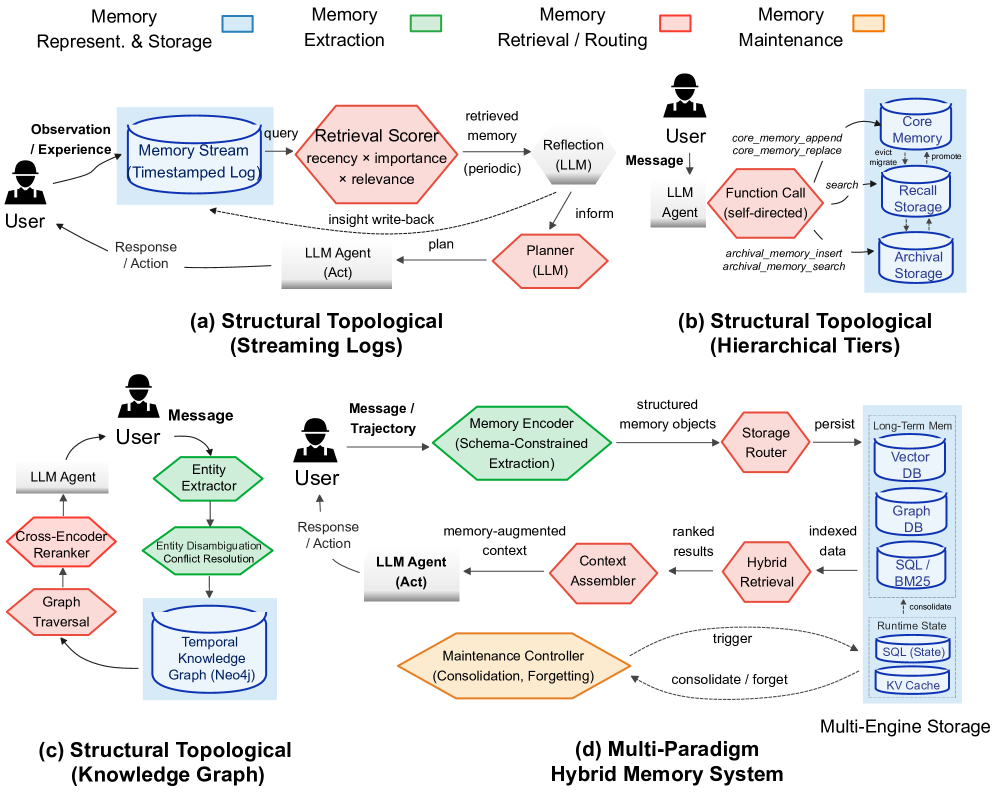
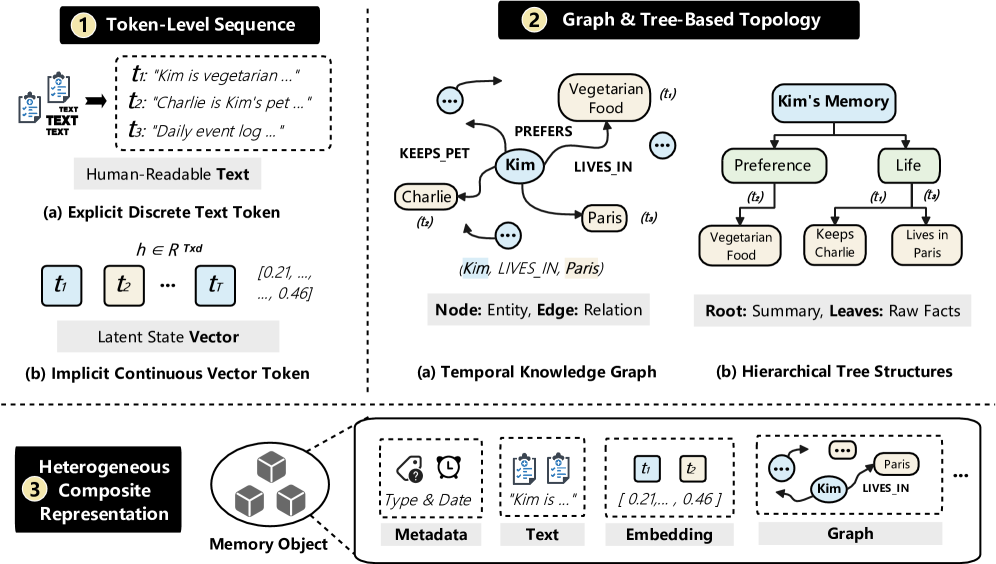
Representation (M1) splits into a logical axis and a physical axis. Logical representations span (a) token-level sequences — either explicit discrete text (Mem0 stores extracted natural-language facts; MemoChat structures dialogues into JSON topic/summary/raw blocks; MemAgent caps an internal belief state to 1024 tokens; MEM1 wraps state in <IS> tags) or implicit continuous vectors (Mem0 fact embeddings, MemoRAG’s compressed KV-cache tensors) — and (b) graph/tree topologies, including temporal knowledge graphs (Zep partitions memory into episode/entity/community subgraphs; Mem0^g encodes a directed labeled graph with relation-typed edges like LIVES_IN and timestamped entity nodes).
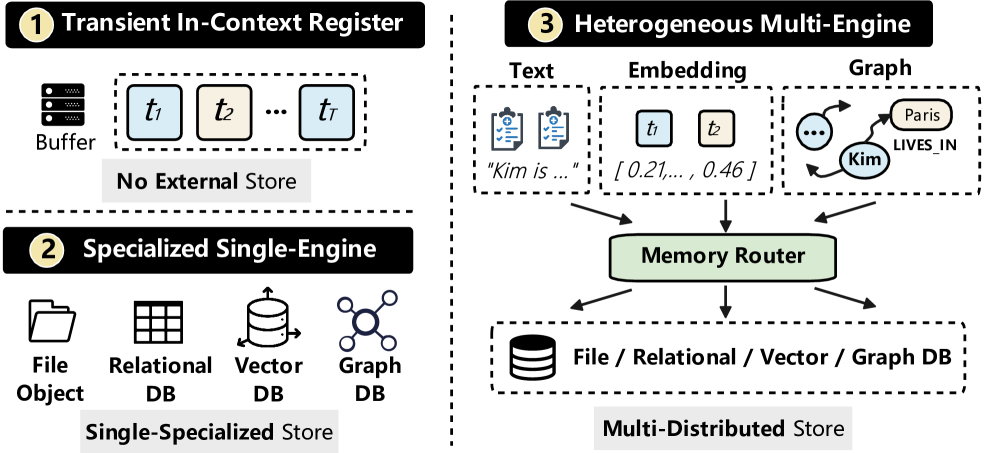
Physical storage (Figure 3) ranges from volatile in-context registers to dense vector indexes and topological graph DBs. The taxonomy makes explicit a trade-off the field has largely papered over: high-structure representations enable predicate filtering and temporal reasoning but lose recoverable evidence, while flat text retains evidence but offers no leverage for targeted updates.
End-to-end findings
The headline result (RQ1): no single architecture dominates. Leaders rotate by workload:
- LongMemEval (cross-session reasoning): structure-aware systems win. Zep hits 48.0 LLM-Judge Accuracy; Cognee reaches 35.3 ROUGE-L F1. Temporal graphs help when evidence is scattered across sessions and must be aggregated by entity or time.
- LoCoMo (long-conversation QA, often canonical short answers): hybrid filtering leads. MemOS attains 11.5 EM, the best exact-match score. Summary-first/coarse-to-fine routing helps recover a specific date or name in semantically coherent dialogues.
- DB-Bench (procedural DB operations from LifelongAgentBench): trace-preserving memories win. Long Context gets 48.20 EM, MemoChat gets 55.40 Task Success Rate. Correctness here depends on intermediate state and operation order (e.g., dependent UPDATE/INSERT chains), which abstraction destroys.
Among systems with full workload coverage, MemoryOS and MemOS sit closest to the frontier overall — robustness comes from “preserving the right evidence at the right level of abstraction,” not from a universal memory form.
The second observation (O2) is methodological: EM is misleading once correctness allows paraphrastic synthesis or executable equivalence. On DB-Bench, Long Context is best on EM but MemoChat substantially better on Task Success Rate; on LongMemEval, ranking changes appreciably when ROUGE-L and LLM-Judge replace EM. Evaluations that lean exclusively on EM systematically reward representations that happen to preserve surface form, not those that preserve task-relevant semantics.
Per-module ablations: content fidelity beats abstraction
The most actionable result comes from the M1 ablation (Table 3). Three controlled variants vary only representation while fixing the rest of the pipeline:
- LightMem: User-Only Raw vs. Summary vs. Compressed.
- MemTree: Flat-biased vs. Deeper Tree.
- Mem0: Default vs. Graph Store.
Raw verbatim storage wins on all four metrics. LightMem-Raw scores 24.2 EM / 38.9 Ans. F1 on LoCoMo and 26.0 Substring EM / 31.4 ROUGE-L F1 on LongMemEval. Light compression stays close on LoCoMo (23.6 / 38.6) but collapses on LongMemEval Substring EM to 10.7 — a 15.3-point drop — because compression strips the exact tokens needed for cross-session grounding. LLM-generated summaries are uniformly worst (8.5 EM on LoCoMo). MemTree’s deeper hierarchy gives only a small bump (18.7 vs. 18.2 EM on LoCoMo); structure helps navigation but cannot resurrect content deleted upstream. Mem0’s graph variant matches its default within noise (3.0 vs. 3.2 EM), suggesting that imposing a graph store on top of an aggressive fact-extraction pipeline doesn’t recover the evidence that extraction discarded.
Finding 6 is therefore blunt: the dominant performance boundary is recoverable evidence, not abstraction depth or structural sophistication. Compactness and structure are second-order optimizations; they cannot compensate for lossy extraction.
Limitations and open questions
The study is observational over existing systems and metrics; the four-module decomposition treats modules as orthogonal, though in practice extraction and representation co-design (e.g., graph builders that decide what’s worth extracting). Cost/latency analysis is mentioned as a system-level concern but the excerpts here focus on quality. The strong “raw text wins” result also has an obvious confound: workloads are bounded enough that raw storage fits — at industrial agent timescales, raw retention is not a viable null hypothesis, and the question of which lossy representation degrades most gracefully remains open. Finally, the M2–M4 ablations (extraction, routing, maintenance) are not summarized in the excerpts; the full paper presumably addresses whether retrieval routing can claw back evidence that aggressive representations discard.
Why this matters
This is the first systematic, module-level audit of agent memory, and it inverts the prevailing research direction: most recent memory papers add structure (graphs, trees, hierarchies, learned compressions) on the assumption that organization improves reasoning. The data say the opposite — preserving raw evidence dominates, abstraction is a Pareto trade against exact recall, and EM-only evaluations have been quietly rewarding surface-form preservation rather than memory quality.
Source: https://arxiv.org/abs/2606.24775
Beyond NL2Code: A Structured Survey of Multimodal Code Intelligence
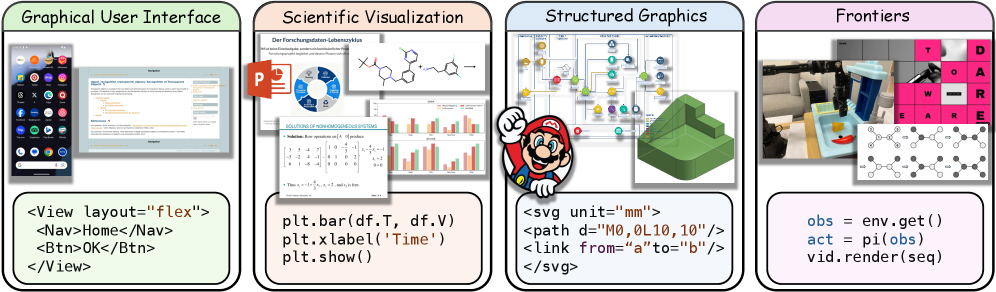
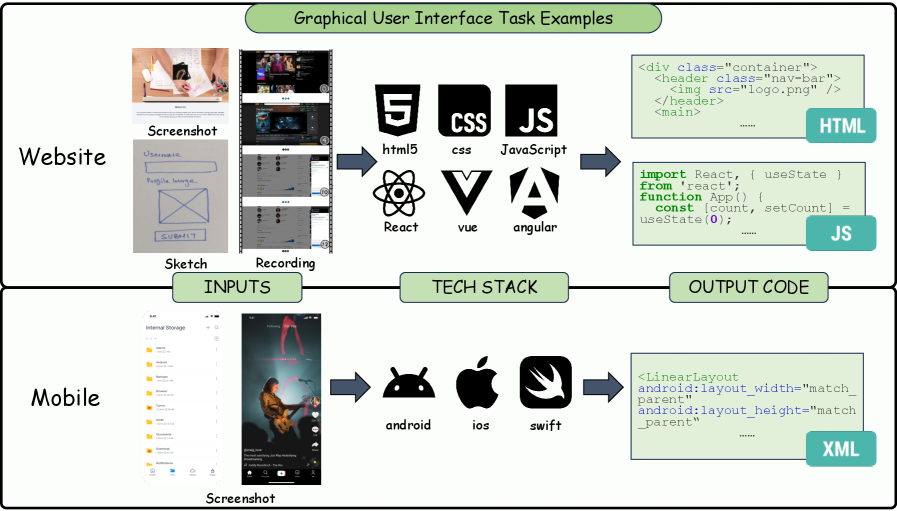
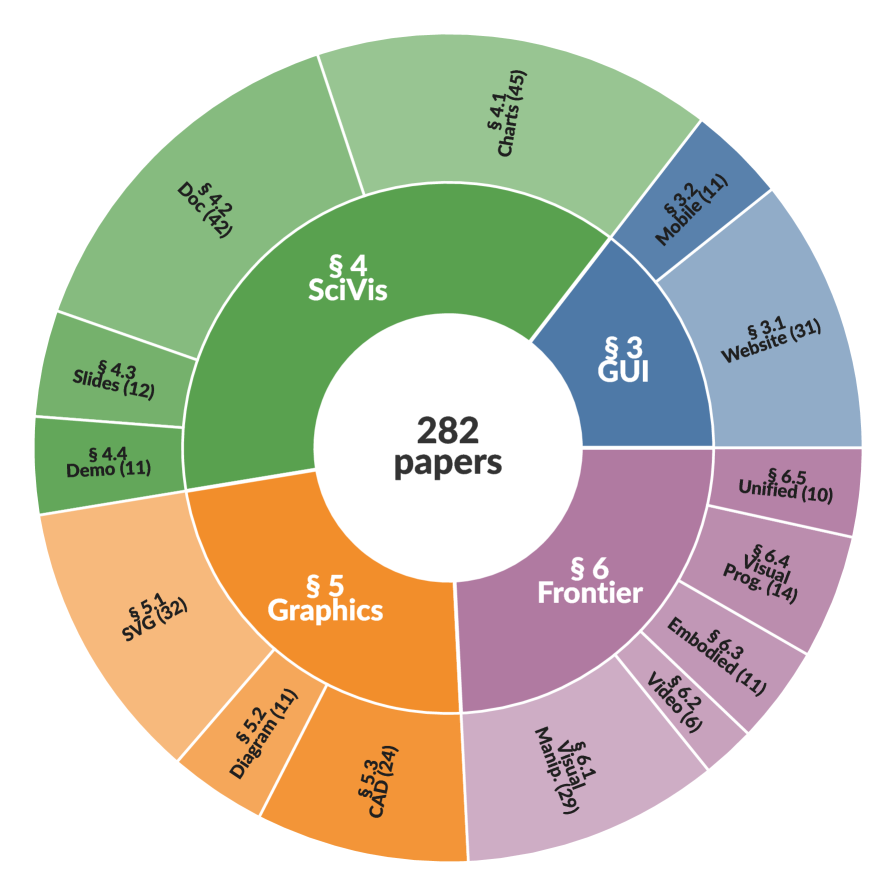
This survey reframes code generation as a multimodal problem in which intent is conveyed through screenshots, charts, vector drawings, videos, CAD references, or interactive states, and where correctness depends on what happens after the code executes. The authors argue that the standard NL2Code formulation \mathcal{C}=\operatorname{LLM}(\mathcal{T}) is insufficient because it cannot express spatial layout, data semantics, interaction transitions, or domain constraints. They organize the field by the role code plays — rendered artifact, editable symbolic structure, scientific representation, intermediate reasoning trace, or executable policy/tool — and group methods into four domains: GUI, scientific visualization, structured graphics, and frontier agentic/unified tasks.
Task formulation
The authors extend NL2Code along two axes. Visual-to-code synthesis maps a visual input \mathcal{I} (and optional text \mathcal{T}) to executable code \mathcal{C} that, when rendered or executed, produces an artifact whose correctness is judged against \mathcal{I} on multiple signals: pixel similarity, DOM/AST structure, executed behavior under actions a_t, and data-semantic fidelity. Code-centric reasoning uses generated code as an intermediate trace: a tool program \mathcal{C}_{\text{tool}} that transforms \mathcal{I}\to\mathcal{I}' to support an answer \mathcal{A}, or as a policy that produces an action sequence in an environment. This taxonomy is what lets the survey compare otherwise unrelated benchmarks under a common notion of “correctness signal exposed to the evaluator.”
GUI
Web-to-code is treated as the cleanest setting because the browser closes the loop between code, render, and interaction. The survey distinguishes static benchmarks (WebSight, Web2Code, Design2Code, WebCode2M) that grade rendered similarity from diagnostic ones that probe DOM recovery (Vision2UI), element-level layout (IW-Bench), and rendered fidelity (WebRenderBench, WebGen-V). It then catalogs dynamic protocols where the browser acts as interaction executor: Interaction2Code for reactive prototypes, MRWeb for multi-page navigation and backend routing, Web-Bench for sequential development, IWR-Bench for interactive reconstruction from video, and WebGen-Bench which drives a GUI agent to verify functionality through execution. The implicit critique is that visual-similarity benchmarks saturate quickly and tolerate data leakage, while interaction benchmarks expose where models actually fail.
Scientific visualization
Charts are split into two asymmetric tasks. NL-to-Chart is under-specified — multiple plots satisfy one query — and is evaluated for executability and semantic appropriateness (nvBench, VisEval, MatPlotBench, PandasPlotBench, nvBench 2.0 with one-to-many mappings, PlotCraft with 982 multi-turn refinement instances). Chart-to-Code is over-constrained: many programs render the same chart, but the recovered data and visual encoding must match. The survey extends the scope beyond plots to structured documents, academic presentations, and scientific demonstrations, arguing that correctness must preserve data, equations, argument flow, and domain constraints in inspectable form. The asymmetry between synthesis and reconstruction explains why methods specialized to one direction fail at the other.
Structured graphics
For SVG, the survey separates text/instruction-conditioned generation (IconShop, SVGFusion, LLM4SVG, VGBench, Reason-SVG, UniSVG, SVGenius) from image-conditioned reconstruction (DeepSVG, StarVector/SVG-Bench, OmniSVG, RLRF, VCode, RoboSVG). Evaluation combines three proxy classes: semantic alignment (CLIP, BLIP, SigLIP), perceptual reconstruction (SSIM, LPIPS, DINOScore), and task-specific structural metrics for editability and code economy. The authors are explicit that no single proxy captures the joint requirement of rendered fidelity plus compact, editable vector structure — a CLIP-high SVG can still be unusable as a vector asset. Diagrams and CAD inherit the same tension: correctness lives in symbolic structure that pixel-space metrics cannot see.
Frontier tasks
Section 6 turns to code-as-trace settings: programmatic visual manipulation in the “Thinking with Image” paradigm, video code generation, embodied control, visually grounded programming, and unified multimodal code generation. In tool-augmented visual reasoning, the bottleneck is process faithfulness: whether \mathcal{C}_{\text{tool}} executes into an \mathcal{I}' that is causally responsible for \mathcal{A}. The survey is sharp that existing evaluations are indirect — final-answer accuracy, trace executability, and process rewards each leave gaps — and proposes that operation replay, region grounding, evidence ablation, and counterfactual-image tests should be combined.
Proxy-judge taxonomy and open problems
The most useful contribution is the proxy-judge table in Section 7, which groups reward signals by what they actually observe and what they miss. Visual proxies (MSRL, RLRF SSIM/CLIP, VinciCoder DINO) overscore surface match and miss data/structure/editability. Text/code proxies (Table2LaTeX-RL TEDS+CW-SSIM, LATTE LaTeX edit score, Infinity Parser layout, FD-RL format) check local syntax but miss reading order, layout, and relations. Preference rewards (DualDPO, ReLook VLM critic, CADFusion) are prompt-sensitive and weakly reproducible. Agent-replay rewards (Coder-CUA, WebGen-Agent, WebVIA interaction-graph replay) are bounded by agent capability. Trace rewards (Visual-ARFT) check tool calls but not causal sufficiency. The authors argue for a diagnostic profile separating visual similarity, execution success, textual correctness, data fidelity, structural validity, editability, and interaction correctness, with explicit separation of training rewards from held-out reliability checks.
Limitations
As a survey, the work does not produce new experimental numbers, and the proposed multi-signal validation framework is prescriptive rather than empirically tested. The frontier section on programmatic visual manipulation explicitly notes that VQA-style accuracy is incomplete evidence for trace validity, but does not offer a unified benchmark that implements the counterfactual and replay tests it advocates. Coverage of 3D/CAD and video-code generation is shallower than GUI and charts.
Why this matters
The field has been measuring rendered similarity and calling it correctness; this survey makes the gap between “looks right” and “behaves right” precise by typing tasks according to which post-execution signal validates them. The proxy-judge taxonomy is directly actionable for anyone designing RL rewards or benchmarks for visual code generation.
Source: https://arxiv.org/abs/2606.15932
Improved Large Language Diffusion Models
iLLaDA is an 8B masked diffusion language model trained from scratch with fully bidirectional attention, positioned as a direct successor to LLaDA. The central claim is empirical: with sufficient pre-training scale (12T tokens), careful SFT (25B-token corpus, 12 epochs), and a handful of architectural and inference refinements, a non-autoregressive diffusion LM can match Qwen2.5 7B on several reasoning benchmarks while substantially outperforming previous diffusion baselines.
Training objective and architecture
The pre-training objective is the standard absorbing-state masked diffusion loss. Given clean sequence x_0 of length L, sample t \sim U[0,1], independently replace each token with a mask token \text{M} with probability t, and predict the masked positions:
\mathcal{L}(\theta) = -\mathbb{E}_{t, x_0, x_t}\!\left[\frac{1}{t}\sum_{i=1}^{L} \mathbf{1}[x_t^i = \text{M}] \log p_\theta(x_0^i \mid x_t)\right].
The 1/t weighting comes from the continuous-time discrete-diffusion ELBO (Shi et al., Sahoo et al., Ou et al.), and unlike BERT-style MLM the masking ratio is random rather than fixed. Attention is fully bidirectional throughout pre-training and SFT — there is no causal mask phase.
Architecturally, iLLaDA keeps LLaDA’s 32-layer, d=4096, 32-head transformer but switches MHA to grouped-query attention with 8 KV heads, widens the FFN to 14,336, expands the vocabulary to 155,136, ties input and output embeddings, and doubles the context length to 8192. This trades MHA for GQA primarily to make diffusion-style KV-cache implementations (DKV-Cache, entropy-cache, etc.) memory-feasible, and ties embeddings to keep the non-embedding parameter count fixed at 6.98B even as the vocabulary roughly doubles.
Two pragmatic training details matter. First, with probability 0.3 an 8192-token window is split into two shorter segments, packed via FlashAttention’s variable-length kernel (cumulative offsets, no padding) — this exposes the model to a wider distribution of effective lengths and prevents the masked-diffusion model from overfitting to a single sequence length. Second, the LR is warmed up to 2\times 10^{-4} and held constant; when the loss plateaus, the schedule is switched mid-run to cosine decay down to 5\times 10^{-6}, after which loss resumes decreasing. AdamW with weight decay 0.1.
Inference uses variable-length generation (rather than fixed-block denoising) for efficiency, and multiple-choice evaluation uses a confidence-based scoring rule rather than the conditional likelihoods that are awkward to define under bidirectional masking.
Results
On base models (Tab. 2), iLLaDA 8B at 12T tokens reaches an 8-task average of 63.9, vs. 51.1 for LLaDA 8B (2.3T tokens), 61.4 for Dream 7B (18T AR pre-training + 0.6T diffusion fine-tuning from Qwen2.5), and 63.3 for Qwen2.5 7B. The largest gains over LLaDA are on BBH (71.3 vs. 49.7, +21.6), ARC-Challenge (60.8 vs. 45.9, +14.9), GSM8K (81.9 vs. 70.3), HumanEval (50.0 vs. 35.4), and MBPP (57.8 vs. 40.0). Against Qwen2.5 7B as a base model, iLLaDA wins on MMLU (74.8 vs. 71.9), BBH (71.3 vs. 63.9), ARC-C (60.8 vs. 51.5), and GSM8K (81.9 vs. 78.9), and loses on HellaSwag, MATH, HumanEval, and MBPP. Dream 7B, despite being initialized from Qwen2.5, is beaten on most general and math benchmarks; it only retains an edge on HumanEval (57.9 vs. 50.0).
On instruct models (Tab. 3), iLLaDA-Instruct averages 67.1 vs. 54.5 for LLaDA-Instruct (+12.6) and 60.2 for Dream-Instruct. Key deltas over LLaDA: MATH 56.7 vs. 42.2 (+14.5), HumanEval 65.9 vs. 49.4 (+16.5), GSM8K 89.0 vs. 77.5, MMLU-Pro 52.3 vs. 37.0. The gap to Qwen2.5-Instruct widens substantially after SFT — Qwen2.5 reaches 77.1 average, with notable separation on MATH (75.5 vs. 56.7), HumanEval (84.8 vs. 65.9), and MBPP (79.2 vs. 58.0). The authors attribute this gap to Qwen2.5’s post-SFT RL alignment, which iLLaDA does not yet apply, and note that iLLaDA-Base is competitive with Qwen2.5-Base on the same suite.
Limitations and open questions
The paper offers no RL post-training, which is plausibly responsible for most of the remaining gap on math and code at the instruct stage; whether standard RLHF/RLVR pipelines transfer cleanly to a fully bidirectional masked-diffusion likelihood (where token-level log-probs are conditional on a random masking schedule) is the main open methodological question. There is no inference-cost comparison reported here — variable-length generation and confidence-based MC scoring are introduced but not benchmarked against AR decoding in tokens/sec or FLOPs per answer. The 12T-token base recipe is also not directly comparable to Dream’s 18T+0.6T or Qwen2.5’s 18T budgets, so the data-efficiency claim is suggestive rather than controlled. Finally, the architectural ablations (GQA vs. MHA, tied vs. untied embeddings, the 30% sequence-splitting probability, the cosine-decay switch) are not separately ablated; the gains over LLaDA conflate scale, vocabulary, context length, and recipe changes.
Why this matters
iLLaDA is the first masked diffusion LM trained from scratch (not distilled from a strong AR model, as Dream is) to land within striking distance of Qwen2.5 7B on standard reasoning benchmarks, which weakens the assumption that causal AR factorization is required for competitive language modeling at the 8B scale. The remaining instruct-tuning gap localizes the next research question — RL alignment under bidirectional likelihoods — quite cleanly.
Source: https://arxiv.org/abs/2606.25331
Causal-rCM: A Unified Teacher-Forcing and Self-Forcing Open Recipe for Autoregressive Diffusion Distillation in Streaming Video Generation and Interactive World Models
Problem
Autoregressive video diffusion with causal DiTs is the dominant paradigm for streaming and action-conditioned world models, but distilling such models into few-step samplers is harder than the bidirectional case. Two distillation families dominate: consistency models (CM), which minimize a forward-type divergence along the ODE, and distribution matching distillation (DMD), which minimizes a reverse-type divergence. rCM showed these are complementary in bidirectional diffusion. The open question is how to port this complementarity to causal video diffusion, where training can either use teacher-forcing (TF, clean history) or self-forcing (SF, on-policy autoregressive rollouts) — two regimes with different exposure bias and gradient noise characteristics.
Method
Causal-rCM aligns the forward/reverse split of rCM with TF/SF causal training: TF-CM is the offline, forward-divergence component, and SF-DMD is the on-policy, reverse-divergence component.
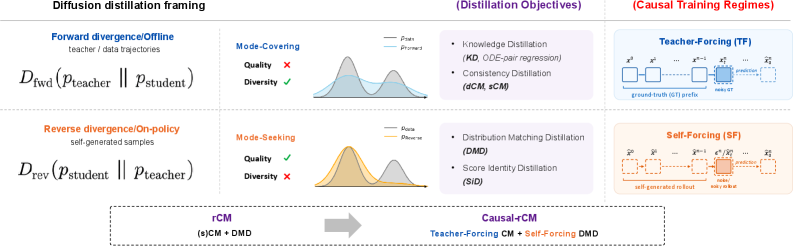
Unlike rCM’s joint training, Causal-rCM runs the two stages sequentially, in a three-stage pipeline:
- TF (or DF) causalization. A pretrained bidirectional Wan2.1 model is converted into an autoregressive diffusion model via teacher-forcing (preferred over diffusion-forcing because TF exposes the teacher to clean historical frames, matching the context distribution used downstream). This yields both the causal teacher and the student initialization.
- TF-CM distillation. The causal teacher distills into a few-step causal student under the same clean-context regime. CM can be the discrete-time dCM or the continuous-time sCM / MeanFlow variants.
- SF-DMD refinement. The TF-CM student is fine-tuned on its own autoregressive rollouts. A bidirectional teacher and bidirectional fake-score network supply real/fake scores; DMD loss is applied. This stage closes the train-inference gap and reduces exposure bias.
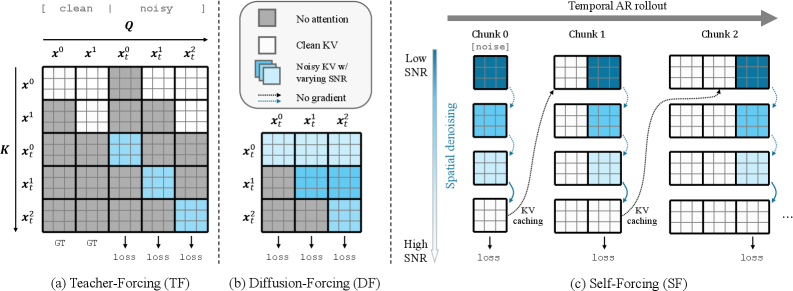
The mechanical core of TF is a packed causal forward pass over concatenated clean context and noisy targets. Rather than evaluating \bm{v}_\theta(\bm{x}_t, t), one evaluates
\left[\bm{v}_\theta\!\left([\bm{x}_0^{\text{clean}}, \bm{x}_t^{\text{noisy}}],\, [\bm{0}^{\text{clean}}, \bm{t}^{\text{noisy}}];\, \bm{M}_{\text{TF}}\right)\right]_{\text{noisy}},
where \bm{M}_{\text{TF}} is a block-causal mask: each noisy block attends only to its allowed clean history and its own noisy tokens; the regression loss applies only to noisy positions. Under RF, the target is \bm{v}=\bm{\epsilon}-\bm{x}_0. The authors argue against the two-pass alternative (cache clean KV, then forward noisy tokens) because it requires holding the clean KV in the computational graph, which breaks activation checkpointing and inflates memory.
The continuous-time sCM/MeanFlow objectives require Jacobian-vector products (JVPs) through attention with the custom TF mask. The authors implement a custom-mask FlashAttention-2 JVP kernel to make this tractable; they report ~10× faster convergence than discrete-t dCM. This is the first TF-based continuous-time CM implementation for autoregressive video.
For SF-DMD, the student generates an autoregressive rollout up to a configured horizon (max rollout = 4 chunks) and the DMD gradient is estimated from the difference of real/fake scores at the rollout states. Student updates are throttled relative to the fake-score network (update frequency 6).
Setup and results
Experiments use Wan2.1 T2V at 480p, 832×480, 81 frames (21 latent frames after VAE temporal compression). Two chunk patterns are evaluated: frame-wise c1-1 (1-frame initial then 1-frame chunks) and chunk-wise c3-3 (3-frame chunks). Training data is rCM’s synthetic T2V set generated by the bidirectional Wan2.1-14B teacher (100-step Euler, shift 3.0, CFG 5.0). Stage 1 (TF/DF) runs 30k iterations on both 1.3B and 14B; TF-dCM 30k, TF-sCM 10k, SF-DMD 1k iterations (Table 3). Student LR is 10^{-5} for causalization and 2\times 10^{-6} for distillation; fake-score LR is 4\times 10^{-7}. CFG is 3.0 during TF-CM and 5.0 during SF-DMD. SF-DMD uses logit-normal generator time sampling (\mu=-0.8,\sigma=1.6) and UniformShift(5) discriminator time sampling.
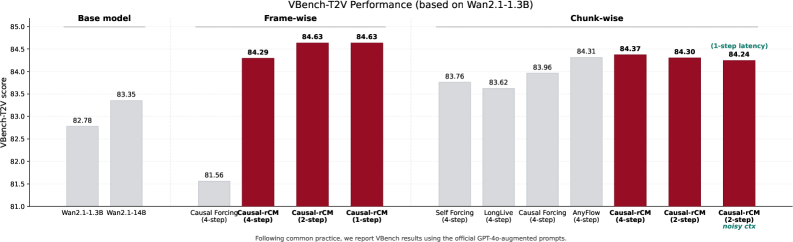
On VBench-T2V, Causal-rCM hits 84.63 at 1-step and leads across 1-, 2-, and 4-step regimes in both frame-wise (c1-1) and chunk-wise (c3-3) autoregressive settings. The TF-sCM kernel delivers ~10× convergence speedup over discrete-t dCM, which is what makes the continuous-time branch trainable within the 10k-iteration stage-2 budget.
Limitations and open questions
The recipe is sequential rather than joint; whether a joint TF-CM + SF-DMD schedule could further close the train-inference gap is untested. SF-DMD still relies on a bidirectional teacher and a bidirectional fake-score network, leaving the question of whether a fully causal critic pipeline is feasible. Rollout horizons are short (4 chunks), so long-horizon drift in extended streaming is not directly characterized. The custom-mask FlashAttention-2 JVP kernel is the enabling infrastructure; reproducibility hinges on that kernel being released. Action-conditioned interactive world-model evaluations are framed as motivation but the experiments shown here are T2V only.
Why this matters
Causal-rCM gives a clean mapping between the forward/reverse divergence decomposition of diffusion distillation and the TF/SF dichotomy of causal training, and demonstrates that this mapping is not just conceptual — sequencing TF-CM into SF-DMD yields state-of-the-art few-step streaming video generation on Wan2.1. The TF-masked FlashAttention-2 JVP kernel is the key piece of infrastructure that makes continuous-time CM viable for autoregressive video.
Source: https://arxiv.org/abs/2606.25473
RL-Index: Reinforcement Learning for Retrieval Index Reasoning
Problem
Reasoning-intensive retrieval breaks the standard assumption that lexical or semantic similarity between query and document is sufficient. When a math problem requires a theorem stated under different notation, or a coding query needs a configuration block expressed in a different vocabulary, surface matching collapses. The dominant fix has been query-side reasoning: rewrite the query with an LLM (e.g., TongSearch-QR, HyDE-style methods) so its expanded form matches relevant documents. This pushes LLM inference onto every online query, inflating latency, and leaves the corpus representation untouched even though the same documents are re-retrieved across many queries.
RL-Index inverts this: do the reasoning once per document, offline, and train the augmenter with RL using retrieval similarity as a verifiable reward.
Method
Let \mathcal{D}=\{\mathcal{D}_i\} be the corpus, F_{\Theta_{\text{Indexer}}} an LLM that produces a rationale \widetilde{\mathcal{D}}_i = F_{\Theta_{\text{Indexer}}}(\mathcal{D}_i; P), and F_{\Theta_{\text{Retriever}}} a frozen retriever (BM25, SBERT, BGE, or Qwen embedding). At query time, retrieval is run over \mathcal{D}\cup\widetilde{\mathcal{D}}:
\widehat{\mathcal{D}}(Q)=\operatorname{TopK}_{\mathcal{D}_i\in\mathcal{D},\,\widetilde{\mathcal{D}}_i\in\widetilde{\mathcal{D}}} F_{\Theta_{\text{Retriever}}}(Q,\mathcal{D}_i,\widetilde{\mathcal{D}}_i).
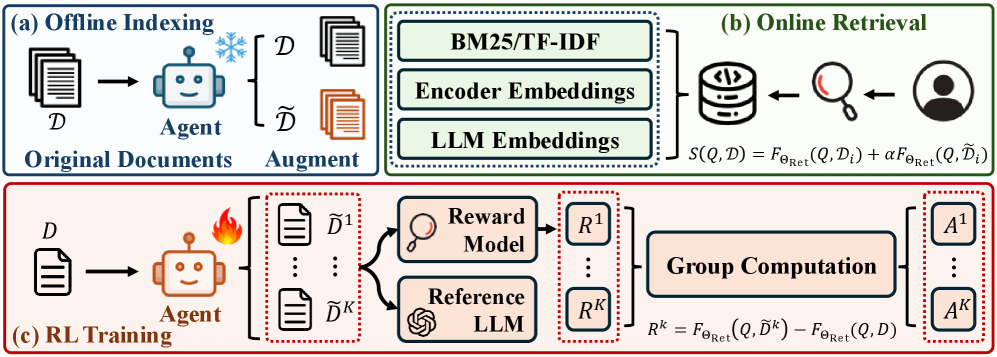
The rationale has a two-part structure enforced by the prompt:
- Thematic Synthesis (Key Points): the document is distilled into atomic propositions (following the propositional-decomposition line from Chen et al., 2024), avoiding generic summarization.
- Functional Alignment (Explanations): the LLM articulates how those propositions would satisfy plausible user intents, constrained to derive only from the extracted key points to keep rationales traceable.
The indexer is trained with GRPO. For each document, G rationale rollouts are sampled (the authors use group size K=16). The reward is the incremental relevance gain of the augmented document over the original against the gold query:
R_i \propto F_{\Theta_{\text{Retriever}}}(Q,\widetilde{\mathcal{D}}_i) - \alpha \cdot F_{\Theta_{\text{Retriever}}}(Q,\mathcal{D}_i),
with \alpha=1 in all reported experiments. GRPO normalizes within the group, removing the need for a learned value function, and clips at coefficient \epsilon in the standard fashion. Training uses a 30K query–document pair set (V2 from Qin et al., 2025) spanning biology, chemistry, code review, CS, earth science, economics, math, physics, and robotics. Setup: 4×H100, per-device batch 8–16, 1000 steps, learning rate 1\!\times\!10^{-6}, KL coefficient \beta=0.008, averaging the final three checkpoints.
A critical design choice: the retriever used to compute training rewards can differ from the inference-time retriever. This separates the RL signal from the deployment encoder and tests transferability of the learned augmentation policy.
Results
Evaluation is on BRIGHT (1,384 reasoning-heavy queries, 12 sub-datasets), measured by nDCG@10.
- With BGE retriever at inference, original 13.6 → SPIKE 14.4 (+5.9%) → RL-Index 15.4 (+13.2%).
- With SBERT, 14.9 → SPIKE 15.8 (+6.0%) → RL-Index 16.3 (+9.4%).
- With Qwen embedding, 23.3 → SPIKE 25.1 (+7.7%) → RL-Index ≈ 25.1+ with strongest gains on reasoning-heavy splits (Economics 17.7→21.9, Psychology 24.4→27.8, Sustainability 20.3→26.7, Leetcode 25.5→28.3, Pony 12.4→17.0).
The pattern is consistent: RL-Index roughly doubles SPIKE’s gain when both use the same base LLM augmenter (Llama3.2-3B-Instruct or Qwen2.5-1.5B-Instruct), with the largest relative wins on weak retrievers (BGE) where the augmentation has the most to add. The Pony (code-doc) and Economics splits — both heavy on implicit intent mismatch — show the clearest separation.
Case studies
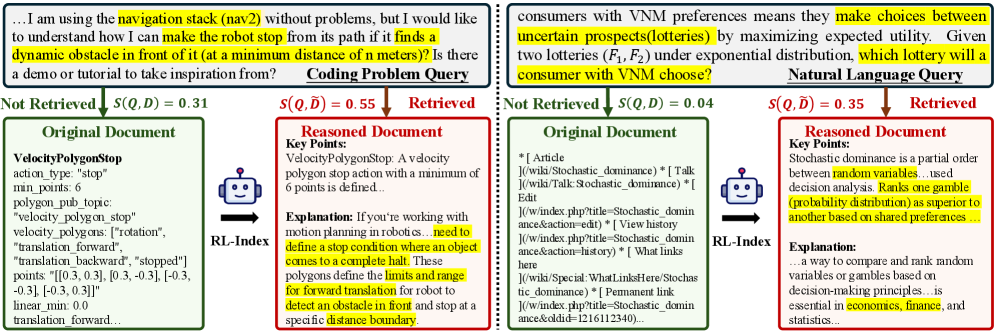
The case studies make the mechanism concrete. A Nav2 robotics config document containing the correct settings but expressed in low-level configuration syntax goes from similarity 0.31 to 0.55 after RL-Index appends an intent-aligned explanation mapping “stop at a specific distance” onto polygon-based stop logic. A natural-language example where the original document was relevant but worded as link-curation goes from 0.04 to 0.35. These are not paraphrase wins — they are bridges between user-intent vocabulary and document evidence.
Limitations and open questions
- Index cost and staleness. Every corpus update requires re-running the RL-trained agent; the paper does not characterize storage overhead or index size growth from appending rationales.
- Reward hacking risk. Using retriever similarity as reward can push rationales toward retriever-specific lexical signatures. Cross-retriever transfer numbers are positive but modest, and degenerate cases (e.g., rationale becoming a query-style restatement that overfits training queries) are not stress-tested.
- Dependence on training query distribution. The 30K pairs span specific STEM domains; behavior on domains absent from RL training (e.g., legal, biomedical) is not reported.
- Generator quality. Results use small augmenters (1.5B–3B). Whether gains saturate or grow with larger augmenters is unclear; this matters because the offline cost argument depends on keeping the augmenter cheap.
- Interaction with rerankers. All numbers are first-stage retrieval; the gains may be partially absorbed by a strong reranker downstream.
Why this matters
RL-Index reframes retrieval-side reasoning as an offline, amortized policy-learning problem with a verifiable, cheap reward (retriever similarity), avoiding both the latency tax of online query rewriting and the supervision cost of distillation-style approaches like SPIKE. The use of GRPO with retrieval similarity as reward is a clean instantiation of “verifiable rewards” outside of math/code RL, and the demonstrated transfer across retrievers suggests the learned augmentation policy captures generalizable reasoning bridges rather than retriever-specific artifacts.
Source: https://arxiv.org/abs/2606.16316
Wan-Streamer v0.1: End-to-end Real-time Interactive Foundation Models
Problem
Real-time conversational agents that take and produce audio, video, and text are almost universally built as cascades: VAD → ASR → LLM → TTS → audio-driven avatar/video generator. Each module adds latency, and errors compound. Worse, turn-taking, barge-in, and cross-modal synchronization are not learned end-to-end — they are stitched together by heuristics. Wan-Streamer collapses this stack into a single Transformer that ingests and emits interleaved text, audio, and video tokens under block-causal attention, with streaming units as short as 160 ms at 25 FPS.
Method
The model treats interaction as a continuous causal stream. At streaming unit k, the user contributes u_k = (u_k^t, u_k^a, u_k^v) and the agent emits y_k = (y_k^t, y_k^a, y_k^v). The joint distribution factorizes causally over both sides:
p_\theta(y_{1:K} \mid u_{1:K}) = \prod_{k=1}^K p_\theta\!\left(y_k^t, y_k^a, y_k^v \mid u_{\leq k}^{t,a,v}, y_{<k}^{t,a,v}\right).
Text is modeled as discrete tokens with cross-entropy next-token prediction. Audio and video live in continuous latent spaces and are generated by conditional flow matching. For m \in \{a, v\}, with clean target z_0^m and Gaussian noise \epsilon^m, the linear interpolant is
z_\tau^m = (1-\tau) z_0^m + \tau \epsilon^m, \qquad \partial_\tau z_\tau^m = \epsilon^m - z_0^m,
and the unified diffusion transformer f_\theta is trained to regress the velocity field conditioned on the clean streaming context c_k = \{u_{\leq k}^{t,a,v}, y_{<k}^{t,a,v}\}:
\mathcal{L}_{\mathrm{FM}}^m = \mathbb{E}_{\epsilon^m}\left\|f_\theta(z_\tau^a, z_\tau^v, c_k, \tau) - (\epsilon^m - z_0^m)\right\|_2^2.
Crucially, the same clean context conditions both audio and video velocity predictions, so lip motion, prosody, appearance, and scene evolution co-adapt rather than being aligned post-hoc. After denoising, estimated clean latents are committed to history and rendered by causal decoders.
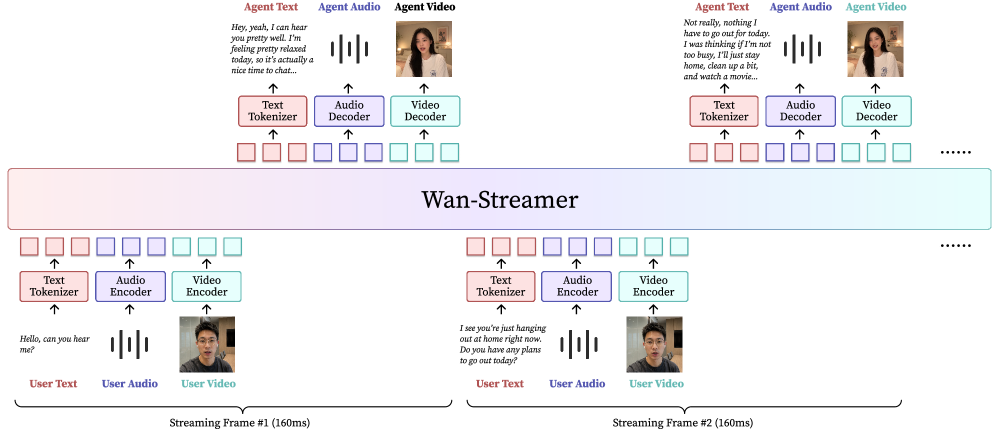
The entire stack is redesigned around streamability: causal encoders, causal decoders, block-causal attention masking (so that within a block, tokens attend bidirectionally to enable cross-modal coupling, but across blocks attention is strictly causal), and low-latency token scheduling that interleaves modalities at the 160 ms granularity.
Thinker-performer serving
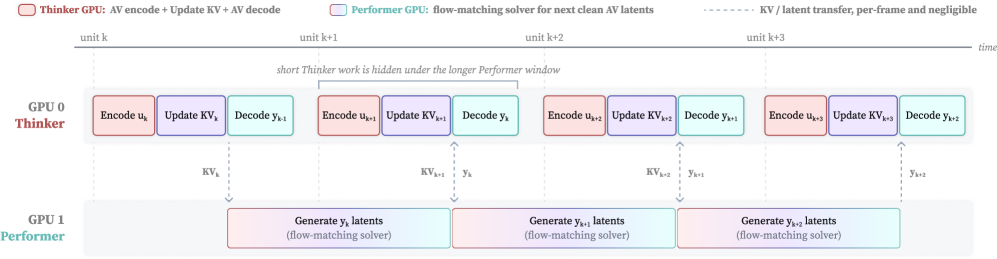
Inference is split across two GPUs in a pipelined “thinker-performer” arrangement. At unit k, the thinker encodes the new user observations u_k, updates the KV cache, and decodes the previous response latents y_{k-1} for immediate emission. The performer, given a KV slice from the thinker, runs only the flow-matching ODE solver to produce the next clean audio-visual latents y_k. This overlaps the autoregressive context update with the iterative denoising solve, hiding the dominant cost of flow matching behind the thinker’s forward pass.
Results
The headline measurement is signal-to-signal latency from the arrival of a 160 ms user streaming unit to the emission of the corresponding 25 FPS audio-video response unit. Wan-Streamer reports ~200 ms model-side latency, and ~550 ms total user-visible latency when a 350 ms bidirectional network budget is included.
The paper is careful to read Table 1 by measurement boundary rather than raw number. Comparable points:
- Moshi: 160 ms theoretical / 200 ms practical model latency, speech-only.
- GPT-4o Realtime: 232/320 ms official audio response, ~500 ms API TTFB, ~800 ms target voice-to-voice.
- Doubao Realtime Voice: ~700 ms bare-model, ~1 s overall, speech-only.
- Hume EVI 3: <300 ms model, 0.9–1.4 s web-app, speech-only.
- Qwen3/3.5-Omni: first-packet 234/547 ms (audio-video in, speech/text out — no synchronized visual avatar).
- MiniCPM-o 4.5: 0.58 s first-token, RTF 0.20–0.27, no visual avatar.
Wan-Streamer is the only entry that closes the loop with synchronized 25 FPS visual agent output from a single causal stream at sub-second total latency. The 200 ms model-side number is competitive with Moshi’s speech-only practical latency despite generating coupled audio and video.
Limitations and open questions
- No quantitative comparison on perceptual quality (lip-sync accuracy, video fidelity, speech MOS, turn-taking error rates) is presented in the excerpted sections — only latency. Whether the unified flow-matching objective matches dedicated TTS/avatar quality at this latency budget is unverified here.
- Block-causal attention with bidirectional intra-block context constrains how short the block can be before quality degrades; the 160 ms unit appears chosen for 25 FPS alignment, not justified by an ablation.
- Two-GPU thinker-performer serving is required to hit 200 ms; single-GPU latency and scaling cost are not reported.
- The flow-matching solver step count, which dominates performer compute, is not given in the excerpt, making it hard to assess the latency-quality trade-off.
- “v0.1” framing suggests training data scale, model size, and benchmark breakdowns are not yet disclosed.
Why this matters
If a single Transformer can jointly learn perception, reasoning, generation, response timing, and cross-modal synchronization under block-causal attention at 160 ms granularity, the entire cascaded interactive-agent stack — VAD, ASR, LLM, TTS, talking-head — becomes a candidate for replacement by one end-to-end objective. The ~200 ms model-side latency with synchronized 25 FPS video is the first reported number that makes that replacement plausible without sacrificing the visual channel.
Source: https://arxiv.org/abs/2606.25041
MVTrack4Gen: Multi-View Point Tracking as Geometric Supervision for 4D Video Generation
Problem
Novel-view video synthesis from a monocular reference along a user-specified camera trajectory must satisfy two competing demands: geometric consistency with the reference scene and faithful preservation of dynamic motion. Two families of methods dominate. Explicit 3D-lifting approaches (GEN3C, TrajectoryCrafter, CogNVS, NeoVerse) reconstruct a 3D representation then render it, but inherit errors from monocular depth and dynamic-object reconstruction. Camera-conditioning-only diffusion models (ReCamMaster, Redirector) score better on visual quality but drift in geometry and motion because no explicit cross-view correspondence is enforced. MVTrack4Gen targets the second family and adds geometric/motion supervision derived from multi-view point tracking, without re-introducing an explicit 3D pipeline.
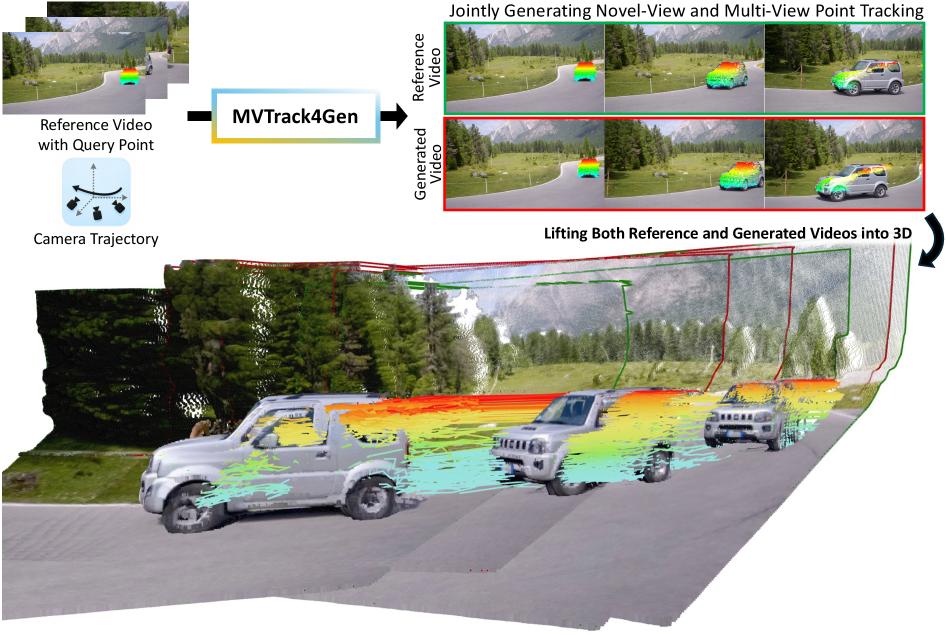
Analysis: emergent correspondences in 3D attention
The starting observation is that the 3D attention in video DiTs already encodes correspondences. In ReCamMaster-style architectures, query and key tokens from the reference and target streams attend jointly across time and across views (Fig. 2), yielding three distinguishable correspondence types: intra-video temporal in the reference, intra-video temporal in the target, and inter-video cross-view. The first two govern motion smoothness; the third governs geometric alignment.
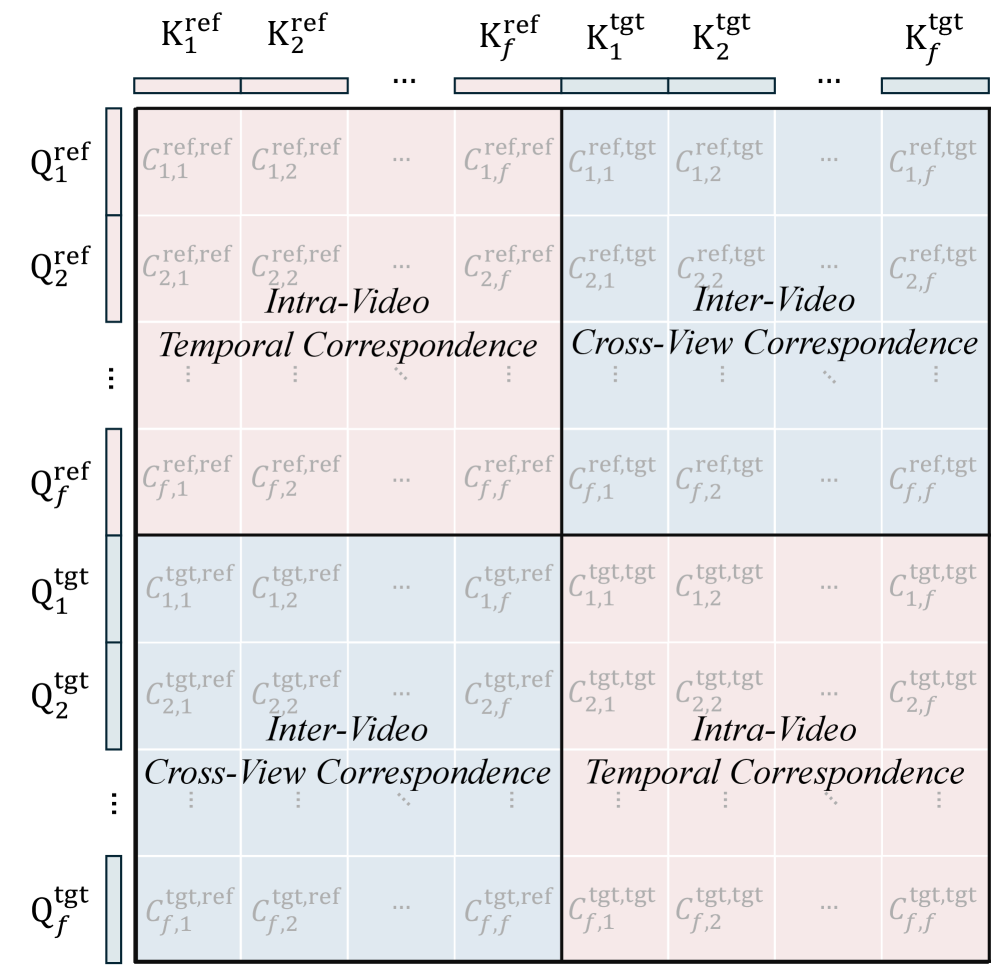
On 40 scenes from MultiCamVideo, the authors extract token-level matches from attention weights and compare them to pseudo ground-truth tracks produced by MV-TAP, a multi-view tracker that operates jointly on the reference and target videos. Misaligned attention maxima correlate with the visible motion inconsistencies of the baseline. Concretely, for a query token on a moving subject in the generated frame, ReCamMaster’s cross-view attention disperses onto background or wrong objects in the reference; this is exactly the failure mode that needs to be fixed.
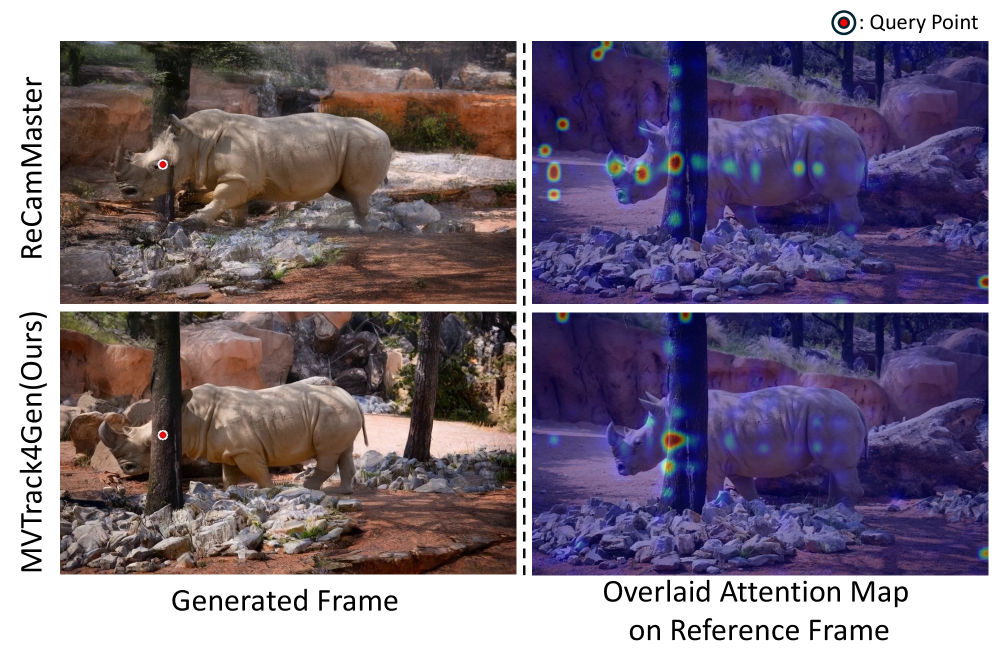
Method
MVTrack4Gen keeps the diffusion backbone (ReCamMaster or Redirector) and adds two interventions.
Richer camera conditioning. Both reference and target cameras are encoded as dense Plücker ray maps using extrinsics and intrinsics (the baselines used only the target extrinsics). Each pixel becomes a 6D ray and these maps are injected into every DiT layer.
Auxiliary multi-view tracking head with attention supervision. Query and key features from the DiT’s 18th 3D-attention layer are routed into a lightweight multi-view tracking head that predicts point tracks \{p_i^{v}\} with visibilities \{o_i^{v}\} across reference and target frames. Pseudo ground truth \mathcal{T}=\{p_i^{v,\text{GT}}\} and \mathcal{O}=\{o_i^{v,\text{GT}}\} comes from MV-TAP. The tracking loss is the standard tracker objective on positions and visibilities. Additionally, the 3D attention maps themselves are directly supervised so that each query token’s softmax weights peak on the geometrically corresponding token across views and across time — exploiting the analysis finding that this layer already approximates correspondence. Only the 3D attention layers and the camera encoder are fine-tuned; the rest of the DiT is frozen. Training runs 13k iterations, batch 16, AdamW at 1\times 10^{-4}, on 4 H100s at 480\times 832, 81 frames.
The tracking head is auxiliary at training time, but because it shares features with the generator, gradients pull the generator’s representations toward correspondence-consistent geometry and motion.
Results
On DAVIS, MVTrack4Gen-Redirector achieves the best overall numbers: MEt3R drops from 0.318 to 0.267 (-0.051), MEt3R_\text{dynamic} from 0.395 to 0.349 (-0.036), mTransErr from 0.086 to 0.073, mCamMC from 0.109 to 0.097. Aesthetic and imaging quality slightly improve (0.897→0.905, 0.911→0.919). For MVTrack4Gen-ReCamMaster, MEt3R improves 0.337→0.274 (-0.063), MEt3R_\text{dynamic} 0.369→0.287 (-0.082), and mRotErr from 3.660 to 1.858 — a 49% reduction in rotation error — at a small cost in subject consistency (0.962→0.953).
On the iPhone dataset (real, more challenging dynamics), MVTrack4Gen-Redirector reaches PSNR 11.830 vs 11.447 baseline, LPIPS 0.638 vs 0.720, and MEt3R 0.397 vs 0.580 (-0.183). MVTrack4Gen-ReCamMaster improves PSNR 11.005→11.521 and MEt3R 0.461→0.381. Both MVTrack4Gen variants beat all explicit 3D-lifting methods on MEt3R and LPIPS; NeoVerse retains higher SSIM (0.394) but with worse MEt3R (0.493) and worse perceptual scores.
The SSIM drop on iPhone for MVTrack4Gen-ReCamMaster (0.338→0.270) is notable — perceptual and geometric metrics improve but pixel-structural similarity does not, suggesting the model is producing geometrically faithful but pixel-wise re-textured outputs.
Limitations and open questions
The supervision depends on MV-TAP’s pseudo ground truth; failure modes of the tracker (occlusion handling, thin structures, large baselines) will propagate into the attention supervision. The attention loss targets a specific layer (the 18th) chosen empirically — whether the routing should be learned, multi-layer, or dynamic per scene is open. SSIM regressions on iPhone hint at a residual tension between sharpening geometric correspondence and preserving exact appearance. The framework also assumes paired multi-view training data; scaling beyond MultiCamVideo will require synthetic or self-supervised correspondence sources. Finally, no test-time tracker is needed, but inference cost relative to the camera-conditioning baselines is not quantified.
Why this matters
The paper turns an emergent property of video-DiT attention — that some layers already approximate cross-view, cross-time correspondence — into an explicit training signal via a shared-feature multi-view tracker. The result is that camera-conditioning-only generators inherit the geometric consistency of 3D-lifting pipelines without inheriting their reconstruction errors, with concrete gains on dynamic-scene geometric metrics (e.g., MEt3R_\text{dynamic} -0.082 on ReCamMaster).
Source: https://arxiv.org/abs/2606.26087
Hacker News Signals
Krea 2: SOTA open-weights 12B image model
Krea released a 12B-parameter open-weights image generation model claiming state-of-the-art results among publicly available models. The technical report describes a transformer-based architecture operating in a compressed latent space, trained on a heavily curated dataset with an emphasis on aesthetic quality and prompt adherence. The model uses a flow-matching objective rather than classic DDPM-style diffusion, which reduces inference step count while maintaining sample quality. Krea emphasizes a two-stage training pipeline: a large-scale pretraining phase on broad web imagery followed by a targeted fine-tuning phase on high-quality curated data, with human preference feedback incorporated via DPO-style reward alignment to improve compositional coherence and text rendering. At 12B parameters, the model sits in a range where inference is feasible on high-end consumer hardware (a single 80GB A100 or with quantization on 2x24GB cards). The weights are released under a permissive license, making this one of the more capable openly redistributable image models available. Benchmark results on GenEval and T2I-CompBench show competitive or leading scores against prior open models, with particular gains on attribute binding and counting tasks that typically challenge diffusion models. The report is sparse on architectural novelty — the gains appear to come primarily from scale, data curation, and alignment rather than fundamental changes to the generation paradigm. Open questions include reproducibility of the training pipeline (dataset composition is described only coarsely), long-term maintenance of the weights, and how it compares under controlled conditions against proprietary systems like FLUX.1 or Ideogram 3.
Source: https://www.krea.ai/blog/krea-2-technical-report
GLM-5.2 is a step change for open agents
Nathan Lambert’s analysis focuses on GLM-5.2 (from Zhipu AI / Tsinghua) as a meaningful inflection point for open-weight models in agentic settings. The core technical claim is that GLM-5.2 achieves strong performance on tool-use and multi-step task completion benchmarks, particularly BFCL (Berkeley Function-Calling Leaderboard) and web agent evals, at a level that previously required closed frontier models. The model builds on the GLM-4 architecture — a causal transformer with modifications to positional encoding (RoPE variants) and an extended context window — but the differentiation here is in training data and RLHF targeting. Zhipu explicitly trained on structured agentic trajectories: sequences of tool calls, environment observations, and reasoning steps, rather than relying solely on instruction-following fine-tuning. Lambert’s piece highlights that this approach to data curation for agentic capability is the key lever, not architecture changes. The model demonstrates multi-turn robustness: it maintains consistent tool-call formatting and handles error recovery within a trajectory, which has historically been a failure mode for open models when the action space involves real API calls. On BFCL v3, GLM-5.2 reportedly approaches GPT-4o-level function-calling accuracy. Practically, having an open-weight model that can reliably operate as an agent backbone matters for self-hosted pipelines where sending trajectories to closed APIs has latency, cost, and privacy implications. Open questions include evaluation on longer-horizon tasks beyond the benchmarks highlighted, behavior under distribution shift in real tool environments, and whether the trajectory data curation approach generalizes or is brittle to the specific benchmark distributions.
Source: https://www.interconnects.ai/p/glm-52-is-the-step-change-for-open
Computer use in Gemini 3.5 Flash
Google announced native computer-use capability in Gemini 3.5 Flash — a multimodal action model that can observe a screen via screenshots and emit structured UI actions (click, type, scroll, key combinations) to operate desktop and web interfaces. The implementation follows the same pattern as Anthropic’s computer-use API: a vision-language model receives a screenshot and task description, returns a JSON-serialized action, which an external harness executes and feeds back as the next screenshot. Technically, the model is fine-tuned specifically for this loop: the training distribution includes demonstration trajectories of GUI interactions, and the action output is constrained to a typed schema that maps directly to OS-level input events. Gemini 3.5 Flash is positioned as the latency/cost-optimized member of the Gemini 3.x family, making the economics of this action loop more viable — each step requires an inference call, so model cost and latency per action directly gates usability. Google reports evaluation on OSWorld and WebArena-style benchmarks, with numbers suggesting parity or improvement over equivalent-tier competition. The key technical tension is screenshot resolution vs. context length: high-resolution screenshots improve localization of small UI elements but increase token count; the model uses dynamic resolution tiling to manage this tradeoff. Limitations are substantial and acknowledged: the model struggles with novel UI layouts, has no persistent memory between separate sessions, and performs poorly on tasks requiring long chains of precisely-coordinated actions. Security implications of autonomous computer operation (prompt injection via malicious screen content) remain an open and underspecified problem in all current computer-use implementations.
45 degrees C cooling design cuts data center water use to near zero
NVIDIA’s liquid cooling writeup describes a rear-door heat exchanger and direct liquid cooling (DLC) architecture designed to operate with facility coolant supply temperatures up to 45°C — substantially higher than the ~18-25°C typical of chilled-water plants. The engineering significance is thermodynamic: conventional data center cooling relies on chilled water produced by mechanical chillers, which consume significant electrical power and, in evaporative cooling towers, large volumes of water. By raising the acceptable coolant inlet temperature to 45°C, the system can reject heat using dry coolers (air-cooled heat exchangers with no water evaporation) or free cooling in most climates without running compressor-based refrigeration at all. For GPU infrastructure specifically, the thermal design power (TDP) density has increased dramatically — Blackwell-class GPUs can exceed 1kW per chip — making air cooling insufficient and forcing liquid cooling adoption. The DLC implementation routes coolant directly to cold plates mounted on GPU packages and power delivery components. The rear-door heat exchanger variant integrates into standard rack form factors and can be retrofitted to existing facilities. NVIDIA claims near-zero water usage index (WUE) with this design in appropriate climates, compared to WUE values of 1-2+ L/kWh for evaporative cooling. The critical constraint is coolant supply infrastructure: facilities need facility-side distribution at sufficient flow rates and pressure, and the 45°C tolerance depends on GPU junction temperature headroom being maintained, which requires validated thermal interface materials and cold plate contact pressure specifications. This is primarily a systems integration story rather than new physics.
Source: https://blogs.nvidia.com/blog/liquid-cooling-ai-factories/
I rewrote PostHog’s SQL parser, 70x faster, while barely looking at the code
This PostHog engineering post describes replacing their Python-based SQL parser with one driven by an LLM-assisted rewrite process, ultimately achieving a 70x throughput improvement. The technical substance is split between the parsing work and the development methodology. On the parser side: the original implementation used a hand-rolled Python recursive-descent parser for HogQL (PostHog’s SQL dialect), which carried overhead from Python’s interpreter and object allocation per parse operation. The replacement uses a Rust-based parser with ANTLR4-generated grammar targeting their SQL dialect; Rust’s zero-cost abstractions and compile-time dispatch eliminate the Python overhead. Profiling showed the original parser spending significant time in Python object construction for AST nodes — the Rust version builds a compact AST with arena allocation. The 70x figure covers end-to-end parse throughput, not just wall time for a single query; at PostHog’s query volumes, this meaningfully reduces compute cost. The “barely looking at the code” framing refers to using Claude to assist with the Rust implementation: the author provided the ANTLR grammar and Python AST definitions, and the LLM produced most of the Rust visitor/transformer code, requiring primarily structural review and debugging of edge cases rather than line-by-line authorship. This is a credible account of LLM-assisted systems programming for well-specified translation tasks — the grammar and AST were already formally defined, reducing the ambiguity that usually degrades LLM code quality. The post is honest that significant debugging was still required for dialect-specific edge cases and error recovery paths.
Source: https://posthog.com/blog/sql-parser
RubyLLM: A Ruby framework for all major AI providers
RubyLLM is an open-source Ruby gem providing a unified interface over major LLM provider APIs (OpenAI, Anthropic, Google Gemini, Cohere, and others), analogous to what LangChain or LiteLLM do in Python. The technical design centers on a provider abstraction layer: a common Chat object handles conversation state and message formatting, with per-provider adapters translating to and from each API’s wire format. Tool/function calling is abstracted through a Ruby DSL that lets you define tools as annotated Ruby methods; the framework handles schema generation (converting Ruby type annotations to JSON Schema), injection into the API request, and execution of the returned tool call. Streaming is supported through a block-based API that yields token chunks as they arrive, managing the per-provider differences in SSE stream formats. Active Record integration is a notable feature: the framework can persist conversation history directly to a database-backed model, which simplifies building stateful chat applications in Rails without separate storage logic. The gem uses a Faraday-based HTTP layer for request execution, giving it flexibility on connection pooling and middleware. Compared to using provider SDKs directly, the value is portability across providers and reduced boilerplate for tool-calling workflows. The limitation common to all such abstraction layers applies: lowest-common-denominator API surfaces mean provider-specific features (extended thinking, prompt caching controls, modality-specific parameters) require escape hatches. For Rails shops that have avoided Python tooling, this fills a genuine gap — Ruby has historically been underserved in the LLM integration ecosystem.
Source: https://rubyllm.com/
Claude Tag
Anthropic’s Claude Tag is a physical RFID/NFC card that, when tapped to a compatible phone or NFC reader, launches a Claude conversation with a pre-configured system prompt embedded in the tag’s payload. Technically, an NFC tag stores a URL or deep-link URI in NDEF format; tapping triggers the device to open that URL, which can encode a conversation context or redirect to a Claude interface with specific parameters. The product is primarily a UX and distribution mechanism rather than a novel AI capability: it reduces the friction of starting a contextually-configured AI session in physical environments. From an implementation standpoint, the interesting question is how the system prompt or context is delivered — if it’s encoded entirely in the URL, prompt length is constrained by URL length limits and there are obvious prompt injection risks from user-visible URLs; if the URL is a short token that resolves server-side to a stored prompt, that’s cleaner but requires server infrastructure for each tag. Anthropic’s positioning targets business use cases: a card on a restaurant table launches a menu-assistance bot, a card on a product launches support context, and so on. The security surface is non-trivial: NFC tags can be cloned or overwritten, and malicious tags could redirect to adversarial prompts. The broader pattern here — physical triggers for contextual AI sessions — is technically straightforward but the product question is whether it gets traction against QR codes (which already do this) and whether Claude’s brand carries enough value to justify dedicated hardware over a link.
Source: https://www.anthropic.com/news/introducing-claude-tag
Statistics that live in your SQL
Kolistat’s “Stats Duck” is a DuckDB extension that embeds statistical testing directly into SQL queries via custom aggregate functions and scalar UDFs. Version 0.6.0 adds several frequentist and Bayesian testing primitives callable as SQL aggregates: t-tests, Mann-Whitney U, chi-squared, as well as sequential testing corrections (e.g., always-valid p-values using e-values or mixture sequential probability ratio tests). The technical architecture uses DuckDB’s extension API to register C++ UDFs that accumulate sufficient statistics during query execution — the aggregate functions maintain running state (sum, sum of squares, count) so a single table scan computes test statistics without materializing intermediate datasets. This is the key performance argument: compared to pulling data into Python/R and running scipy or statsmodels, pushing the computation into the query engine eliminates serialization overhead and keeps computation close to storage. The extension targets A/B testing and experimentation analysis workflows, particularly within analytics stacks already using DuckDB (e.g., via MotherDuck or local files). Sequential testing support addresses a real need: naive repeated significance testing inflates type I error, and implementing always-valid confidence sequences correctly in user-space code is error-prone. Having these as SQL primitives makes correct sequential analysis accessible to analysts without requiring statistics expertise in the test implementation. Limitations: the extension is early-stage, documentation of exact methodological choices (which e-value martingale, parameter settings for sequential tests) is sparse, and as with any statistics library the correctness of the implementations under edge cases (small samples, heavy tails) requires independent validation.
Noteworthy New Repositories
CodeBendKit/codeseek
A Rust CLI that builds structured code intelligence indexes for use by AI coding agents. The core pipeline constructs call graphs across seven languages and produces a hybrid retrieval index combining dense vector embeddings, sparse BM25-style inverted indexes, and reciprocal rank fusion (RRF) for result merging, followed by a reranker pass. This layered retrieval strategy is well-motivated: dense search covers semantic similarity while sparse search handles exact token matches; RRF avoids calibration issues when fusing ranked lists from heterogeneous retrievers, and the reranker re-scores the fused candidate set for precision.
The tooling ships as native MCP (Model Context Protocol) tools, meaning Claude Code and Codex CLI can call into codeseek’s indexes directly without a separate HTTP layer. The Rust implementation is a deliberate choice for latency-sensitive code navigation — graph traversal and index queries happen in-process at native speed rather than through a Python subprocess.
Practical use case: drop codeseek into a large monorepo, let it index call graphs and embeddings once, then point any MCP-compatible agent at it for context retrieval. This avoids repeatedly shipping entire file trees into context windows. The multi-language support and reranker stage make it more production-capable than simpler grep-or-embed approaches. The main unknown is how well the call-graph extraction handles dynamic dispatch and cross-language FFI boundaries.
Source: https://github.com/CodeBendKit/codeseek
854875058/Symbio
A Python-based multi-agent orchestration framework positioned at the infrastructure layer rather than the application layer. The architectural centerpiece is a dynamic DAG scheduler: agent task graphs are constructed and modified at runtime rather than being statically declared, which matters for workflows where intermediate results determine the next computation steps.
Notable design decisions include an ontology-based memory system that structures agent state as typed knowledge graphs rather than flat key-value stores, enabling more precise retrieval and cross-agent context sharing. A “premature completion prevention” mechanism monitors agent outputs against task specifications before allowing a subtask to be marked done — a practical guard against agents declaring success on partial results. The semantic cache layer deduplicates equivalent LLM calls by embedding queries and checking cosine similarity against prior call results, reducing token spend on repetitive subtask patterns.
Observability is handled via OpenTelemetry instrumentation throughout the execution graph, giving standard trace/metric/log output compatible with existing backend infrastructure. The HITL (human-in-the-loop) hooks are declared at DAG node boundaries, so a human approval gate can be inserted at arbitrary points without restructuring the graph. The “neuro-symbolic safety” layer appears to combine learned classifiers with rule-based constraints for output validation, though the exact formulation is not fully detailed in the public docs. Edge and privacy-compute support suggest the framework is designed for deployment contexts beyond centralized cloud.
Source: https://github.com/854875058/Symbio
omnigent-ai/omnigent
A meta-harness that abstracts over multiple AI coding agents — Claude Code, OpenAI Codex, Cursor, and custom agents — through a unified orchestration interface. The core abstraction is a harness adapter layer: each underlying agent exposes a different API surface, and omnigent wraps them behind a common protocol so that task definitions, policy enforcement, and output handling do not need to be rewritten when switching agents.
The sandboxing layer enforces execution policies (file system scope, network access, allowed shell commands) uniformly across harnesses, which is important when different underlying agents have different native sandbox capabilities or none at all. Real-time collaboration is implemented to allow multiple users or agents to co-operate on the same task session from different devices, which implies a stateful session management layer with conflict resolution.
The “swap harnesses without rewriting” property is the primary engineering differentiator: organizations experimenting with multiple frontier models can benchmark them against the same task corpus without maintaining parallel infrastructure. The policy enforcement being centralized in the meta-harness rather than delegated to individual agents also provides a consistent security boundary. With 4800+ stars shortly after release, there is clear demand for this abstraction. Key open questions are around latency overhead introduced by the indirection layer and how the framework handles agent-specific streaming or tool-call protocols that do not map cleanly to a common interface.
Source: https://github.com/omnigent-ai/omnigent
amElnagdy/guard-skills
A quality-gate framework targeting failure modes specific to AI-generated code. The core idea is that LLM coding agents produce systematic error patterns — hallucinated API signatures, missing edge-case tests, stale docstrings, incorrect error handling — that differ structurally from typical human coding mistakes and therefore benefit from purpose-built static checks rather than generic linters.
“Skills” are modular, composable checks that operate over code, test suites, and documentation simultaneously. This cross-artifact validation is useful because AI agents often produce code and tests in a single pass, creating correlated failures: a hallucinated function signature will appear consistently in both the implementation and the tests, defeating standard unit test coverage metrics. Skills that cross-reference the three artifact types can surface this class of inconsistency.
The framework is designed to integrate into CI pipelines and into agent feedback loops — a failing skill can be returned to the agent as a structured error signal for self-correction rather than only blocking a human reviewer. This positions it as both a gate and a training signal. At 894 stars, it has traction in the agent-tooling space. The main technical gap is documenting the skill definition interface precisely enough for contributors to write new checks; the breadth of AI failure modes is large and a well-specified extension API matters more here than in conventional linting frameworks where failure modes are relatively stable.
Source: https://github.com/amElnagdy/guard-skills
packyme/privacy-filter
A Go service implementing a low-latency gateway that sits between application code and LLM APIs, redacting PII and secrets before requests leave the network boundary. The millisecond-latency claim is architecturally plausible given Go’s runtime characteristics and the nature of the task: PII detection at request time can be implemented as a combination of regex pattern matching (credit card numbers, SSNs, API key formats) and a small NER model, both of which are fast on short text.
The “secret redaction” component is distinct from PII — it targets credentials, tokens, and keys that appear in code snippets or logs passed to LLMs, which is a realistic threat model for developer tooling where LLM context frequently includes configuration files or stack traces.
Being written in Go makes deployment straightforward: a single statically-linked binary that can be inserted as a reverse proxy or called as a library. The production use by PackyCode provides some validation of the latency and correctness claims under real traffic. Compared to Python-based alternatives like Microsoft Presidio, the Go implementation prioritizes throughput and deployment simplicity over the breadth of NER model options. The main limitations are that transformer-based NER for subtle PII (e.g., names embedded in prose) is harder to run at millisecond latency, so the tradeoff between recall and speed is worth examining before deploying in high-sensitivity contexts.
Source: https://github.com/packyme/privacy-filter
ATOM00blue/machine-learning-library
A curated, structured corpus of 923 ML educational documents: 391 arXiv papers, 474 lectures from Stanford, MIT, Karpathy, and fast.ai, and 58 explainer articles. All content is normalized to Markdown with provenance metadata preserved, making it directly consumable by tools that expect plain text — Obsidian for human navigation, RAG pipelines for retrieval-augmented generation, or fine-tuning datasets for domain-adapted models.
The value here is curation and normalization rather than novelty. Raw arXiv PDFs are poorly suited for chunked retrieval because LaTeX artifacts, multi-column layouts, and figure references degrade embedding quality. Lecture transcripts and HTML articles present similar cleaning challenges. Having a single repository where this work is done once and maintained creates a shared resource that avoids duplicated preprocessing effort across research groups and projects.
The topic organization enables structured retrieval: documents are grouped by ML subdomain, which can be exploited by a RAG system to restrict search scope by topic before running dense retrieval, improving precision. For fine-tuning, the mixture of formal paper writing, pedagogical explanation, and code commentary provides stylistic diversity that a single-source corpus would lack. The primary limitation is staleness: the arXiv frontier moves fast, and a static curated corpus will drift from the state of the art. The provenance metadata helps users identify which documents need updating, but active maintenance is required to keep the corpus current.
Source: https://github.com/ATOM00blue/machine-learning-library
roam-bit/ai-collaboration-notebook
A lightweight framework for persistent AI self-correction, structured around the idea that LLMs should maintain an explicit, queryable record of their own past mistakes and consult it before producing new outputs in similar contexts. The mechanism is a “mistake notebook”: errors are logged with structured metadata (task type, error category, corrective action), and at inference time relevant past errors are retrieved and prepended to the prompt as few-shot negative examples.
This is a practical implementation of retrieval-augmented self-reflection without requiring model fine-tuning. The retrieval step uses embedding similarity over the mistake log to surface relevant prior failures, so the correction signal is context-sensitive rather than a blanket instruction to “be careful.” The iterative improvement loop closes when the model produces outputs that no longer match known error patterns in the retrieved set.
The framework is written for Chinese-language primary documentation but the mechanism is language-agnostic. At 125 stars it is early, but the problem it addresses — LLMs repeating identical mistakes across sessions because they have no persistent error state — is a real production pain point. The key technical question is how the mistake log is structured to avoid retrieval noise as it grows: naive embedding-based retrieval over a large error log will surface spurious matches. Hierarchical categorization of error types or periodic log summarization would improve recall precision at scale.
Source: https://github.com/roam-bit/ai-collaboration-notebook
adshao/flounder
An autonomous white-hat security auditing agent. The core capability is automated vulnerability discovery: the agent reasons over a target codebase or running system, generates exploit hypotheses, attempts to validate them, and produces structured findings without requiring per-test human direction.
The “white-hat” framing implies the tool is scoped to authorized penetration testing and code audit contexts rather than offensive exploitation. Architecturally, autonomous security agents of this type typically combine static analysis (AST traversal, taint analysis) with dynamic probing (fuzzing, authenticated API calls) and use an LLM to reason about which vulnerability classes are plausible given the observed code patterns, then prioritize which probes to execute. The agent loop continues until a finding is confirmed or the search budget is exhausted.
The project is written by adshao, who has a track record in Go-based infrastructure tooling (go-binance, etc.), which suggests the implementation is likely Go-based and oriented toward reliability in automated pipeline contexts. With 200 stars and minimal documentation available at time of writing, the scope of supported vulnerability classes and the target environment (web apps, binaries, cloud APIs) are not yet fully specified. The primary risk with autonomous security tooling is false-positive rates: an agent that generates unvalidated findings wastes auditor time faster than manual review. How flounder manages confidence scoring and finding deduplication will determine its practical utility.